Article

An Integrated INF-DEMATEL-MABAC Framework for Enhanced FMEA: Prioritizing Scaffold-Related Fall Risks in Demolition Projects

Department of Industrial Engineering and Management, National Taipei University of Technology, Taipei 10608, Taiwan
*
Author to whom correspondence should be addressed.
Appl. Sci. 2026, 16(11), 5400; https://doi.org/10.3390/app16115400 (registering DOI)
Submission received: 7 April 2026 / Revised: 20 May 2026 / Accepted: 26 May 2026 / Published: 28 May 2026

Abstract

Scaffold-related falls remain a major safety concern in demolition projects, where temporary access systems are frequently erected, modified, used, and dismantled under changing structural and site conditions. These characteristics complicate risk prioritization because scaffold failures may involve interacting human, technical, organizational, and environmental factors. This study develops an expert-based risk prioritization framework for scaffold-related fall risks in demolition projects by integrating Failure Mode and Effects Analysis (FMEA), interval neutrosophic fuzzy (INF) theory, Decision-Making Trial and Evaluation Laboratory (DEMATEL), and Multi-Attributive Border Approximation Area Comparison (MABAC). Using the 4M1E perspective, namely Man, Machine, Material, Method, and Environment, 37 demolition-specific failure modes were identified through literature review and expert elicitation. Ten experts evaluated these failure modes using the SODE criteria, namely Severity, Occurrence, Detection difficulty, and Expected Cost impact. INF theory was used to represent uncertainty, hesitation, and judgmental variation in expert assessments. INF-DEMATEL was applied to examine interrelationships among the SODE criteria and derive interdependence-aware criterion weights, while INF-MABAC was used to rank the failure modes according to their distance from the Border Approximation Area. The framework was illustrated through an empirical application in Taiwan’s demolition industry. The results identified Severity as the most influential criterion. The highest-priority failure modes were insufficient safety awareness, improper scaffold-to-structure anchoring, and inadequate scaffold maintenance and inspection governance. Comparison with risk priority number (RPN)-based methods and sensitivity analyses using expert exclusion and Severity-weight variation showed that the ranking was generally consistent and reasonably stable under the tested conditions. The proposed framework provides a structured, uncertainty-aware decision-support procedure for identifying prevention priorities in demolition scaffold operations.

1. Introduction

Despite decades of regulatory development and technological advancement, falls from height (FFHs) remain a major source of occupational fatalities and disabling injuries in the global construction industry [1]. Within this high-risk context, scaffold-based operations are frequently associated with severe and sometimes catastrophic incidents. Scaffold risk is closely related to its temporary and changing nature, as scaffold systems are repeatedly erected, modified, used, and dismantled under compressed project schedules, often while multiple trades operate in parallel and site conditions continue to change [1,2,3]. Although recent evidence suggests that mandatory work-at-height training can improve safety knowledge and reduce lost-time injuries, scaffold-related fall risks remain difficult to eliminate [4,5]. This persistent safety gap indicates that training and personal protective equipment (PPE) alone are insufficient for controlling scaffold-related hazards. Accordingly, recent accident analysis has increasingly treated falls as evolving sequences of technical, organizational, and behavioral events rather than isolated failures, providing a more appropriate basis for proactive hazard identification and prevention [3].
Demolition and dismantling operations represent a particularly hazardous stage of the construction lifecycle because they involve greater uncertainty and structural instability than many new construction activities. Unlike conventional construction, where work generally progresses toward a planned and stable end state, demolition requires the systematic removal of structural and nonstructural elements. This process can alter load paths, change access conditions, and create a transient workfront [6]. In this setting, scaffolding often serves both as a work platform and as a protective interface for debris containment. However, scaffold configurations may need to be adjusted repeatedly as the workfront changes. These conditions are further complicated by tight urban sites, restricted access and egress, and intensive interaction among trades, all of which can reduce the effectiveness of supervision and coordination. In addition, demolition work is physically demanding and may be performed under thermal strain or other environmental pressures, which can increase worker fatigue and reduce the ability to recognize changing hazards on scaffolds [7].
The literature increasingly emphasizes that FFH hazards are rarely caused by a single technical failure. Instead, they often emerge from interactions among engineering conditions, organizational controls, supervisory practices, and worker behavior [8,9,10,11]. Large-scale analyses of building collapse and fall investigation reports suggest that underlying contributors frequently include weak safety management, insufficient supervision, and inadequate control of changing site conditions rather than purely technical deficiencies [12,13]. Within demolition projects, scaffold collapses and fall-related accidents may therefore be understood as the result of coupled failures across physical conditions and managerial controls. Recurring hazards such as falling objects and fall events continue to appear even under regulatory requirements, suggesting that compliance-based approaches may not fully address the dynamic and high-intensity nature of demolition work. This highlights the need for a systems perspective that considers engineering controls together with administrative governance, inspection effectiveness, supervision, and feedback mechanisms.
A further challenge in demolition scaffolding is the quality of hazard recognition and the transfer of safety training into daily site practice. Empirical evidence indicates that safety knowledge gaps may appear when workers or supervisors fail to identify rapidly changing hazard cues, such as missing guardrails, unstable platforms, incomplete access routes, or compromised scaffold ties. This issue is especially important in demolition because the safe condition of a scaffold may change between shifts or even within the same workday. Process-oriented studies using graph-based modeling have mapped recurrent accident scenarios and shown that falls can arise from the combined effects of work organization, protective system integrity, and worker behavior [3,8]. However, prioritizing these contributing factors remains challenging because many factors are interdependent, expert judgments are often uncertain, and conventional scoring approaches may not adequately reflect the dynamic characteristics of demolition scaffolding.
Although existing studies have contributed to demolition hazard identification, scaffold accident analysis, and fall prevention, there remains a need for a decision-oriented risk prioritization framework tailored to the volatility of demolition scaffolding [2,9,10,11]. To address this need, this study adopts Failure Mode and Effects Analysis (FMEA) as the analytical backbone. FMEA is a structured risk assessment technique that identifies potential failure modes within a process, clarifies their causes and effects, and supports proactive risk prioritization [14,15,16,17,18]. This structure aligns with the need to decompose scaffold-related fall scenarios in demolition projects into concrete and controllable failure pathways. Therefore, the objective of this study is to develop an expert-based risk prioritization framework for scaffold-related fall risks in demolition projects. The framework is intended to support failure mode identification, risk evaluation, and safety management decision making under uncertain and dynamic construction conditions.
The specific objectives of this study are as follows:
(i)
To identify and classify potential failure modes associated with scaffold-related fall risks in demolition projects from a 4M1E perspective, namely Man, Machine, Material, Method, and Environment, and to establish a context-specific failure mode structure for demolition scaffolding.
(ii)
To extend the conventional FMEA criteria of Severity (S), Occurrence (O), and Detection difficulty (D) by incorporating Expected Cost impact (E) as an additional risk criterion, so that the evaluation can consider injury consequences, likelihood of occurrence, detection difficulty, and potential cost, schedule, and management impacts.
(iii)
To apply interval neutrosophic fuzzy (INF) theory to represent expert hesitation, uncertainty, and judgmental differences during the evaluation of scaffold-related fall risks.
(iv)
To integrate multi-criteria decision-making (MCDM) methods into the FMEA framework to examine interrelationships among the risk criteria and derive a structured priority ranking of failure modes for supporting scaffold safety management and preventive intervention planning.
The use of the 4M1E perspective is appropriate because scaffold-related accidents are rarely attributable to a single technical defect. In demolition environments, fall risks may arise from workers’ hazard awareness and safety behavior, equipment condition and use, scaffold component integrity, work methods, inspection procedures, and the changing physical environment. By organizing failure modes into Man, Machine, Material, Method, and Environment, the framework provides a structured basis for capturing the socio-technical nature of demolition scaffolding. In addition, this study extends the conventional FMEA criteria of S, O, and D by incorporating Expected Cost impact. The inclusion of E does not aim to replace injury-based risk assessment or provide an exact financial prediction [16,18]. Rather, it offers an additional decision-relevant perspective by considering repair, rework, schedule disruption, work stoppage, regulatory response, and management burden. This is particularly relevant in demolition projects, where scaffold-related failures may lead not only to injury but also to cascading operational and contractual consequences.
Recent FMEA studies have increasingly treated failure mode prioritization as an MCDM problem rather than relying solely on the conventional risk priority number (RPN). MCDM can simultaneously consider multiple factors or criteria to make a more appropriate assessment or selection [19,20]. This shift is motivated by well-known limitations of classical RPN, including equal treatment of risk criteria, repeated RPN values generated from different combinations of S, O, and D, insufficient representation of expert uncertainty, and limited consideration of interdependence among risk criteria. Accordingly, many recent studies have integrated FMEA with MCDM and uncertainty modeling techniques to support failure mode ranking [14,21,22,23]. Following this research stream, this study introduces INF theory to represent uncertainty in expert judgment. In field-based risk assessment, experts may hold incomplete information, express hesitation, or provide partially conflicting evaluations. INF representation allows truth membership, indeterminacy membership, and falsity membership to be considered simultaneously, thereby preserving more information from expert assessments before the final prioritization is derived [24,25,26]. This feature is relevant to demolition scaffold risk analysis because assessed conditions are often dynamic, site-specific, and difficult to describe with fully precise numerical values.
The selection of Decision-Making Trial and Evaluation Laboratory (DEMATEL) and Multi-Attributive Border Approximation Area Comparison (MABAC) is aligned with the decision-oriented purpose of this study. DEMATEL is used to examine the interrelationships among the SODE criteria because the risk criteria in FMEA are not necessarily independent in demolition scaffolding. For example, high Occurrence may increase the practical importance of Detection difficulty, while Expected Cost impact may be closely related to Severity and the manageability of resulting consequences. DEMATEL provides a transparent procedure for identifying the prominence and causal tendency of each criterion, supporting the derivation of interdependence-aware criterion weights [26,27]. MABAC is then used to prioritize the identified failure modes because it evaluates alternatives according to their distance from a Border Approximation Area. This allows each failure mode to be assessed relative to a reference region rather than only through simple score multiplication or subjective ordering. The integration of DEMATEL and MABAC within the FMEA structure therefore provides a traceable workflow from criterion weighting to failure mode ranking [28].
In summary, the proposed framework contributes to scaffold safety management by offering a structured and uncertainty-aware approach for identifying and prioritizing scaffold-related fall failure modes in demolition projects. For industry practitioners, the results can support discussion of inspection priorities, supervisory focus, worker training needs, and preventive intervention planning. For government agencies and regulatory bodies, the framework provides a way to organize expert knowledge on demolition scaffold hazards and examine how technical, managerial, and environmental factors jointly influence risk prioritization. For academic research, the study contributes an applied example of extending FMEA with 4M1E classification, SODE criteria, INF representation, DEMATEL-based criterion weighting, and MABAC-based prioritization.

2. Literature Review

Demolition work presents a distinct safety profile within the construction sector, particularly in relation to scaffold-related fall incidents. Unlike conventional construction projects, demolition activities involve rapidly changing workfronts, frequent structural alterations, constrained access conditions, and intensive interaction among trades. These conditions create a dynamic risk environment in which scaffold systems may be repeatedly erected, modified, used, and dismantled as work progresses. As structural components are removed and load paths are altered, the workfront becomes transient. Site constraints, such as tight urban footprints and limited access or egress, may further compress work sequencing and reduce supervision capacity. In this context, accidents are rarely the result of isolated unsafe acts. They often emerge from interacting hazards, including unstable or partially degraded structural components, inadequate temporary works, insufficient control of work-at-height interfaces, and weaknesses in field coordination. Accordingly, recent demolition-focused research has emphasized the need for systematic risk assessment and proactive safety planning, including structured identification and prioritization of demolition-specific hazards and influencing factors [6].
Within the demolition domain, existing evidence increasingly supports a systems perspective. Accidents, especially collapse-type events that may occur together with work-at-height exposure, are shaped by coupled failures across physical conditions, field operations, managerial controls, and external supervision. Large-scale analyses of building collapse investigation reports have shown that collapse incidents are not limited to new construction, but also occur during maintenance, demolition, and renovation. These studies further indicate that underlying contributors often include deficient safety management and weak supervisory oversight rather than purely technical deficiencies. Such findings suggest that demolition accident prevention requires attention not only to engineering controls, but also to governance, inspection effectiveness, feedback mechanisms, and enforcement practices [12].
Broader construction incident database studies also show that frequent hazards, such as falling objects and fall-related events, continue to occur despite regulatory and managerial efforts. For example, an analysis of 10,415 construction incidents found that falling objects accounted for the largest share of recorded incidents and highlighted the value of combining descriptive incident analytics with hazard-specific interventions to reduce recurrence. These findings support the need for systematic hazard analysis and targeted prevention in high-risk operations, including demolition projects where overhead work, debris handling, and temporary access systems are common [13].
Scaffolding systems are particularly important in demolition projects because they often function as temporary access, working platforms, and interfaces for protective measures while structural components are removed or modified. Consequently, scaffold-related fall incidents remain a key concern in demolition risk management. A process-oriented study of scaffolding accidents demonstrated that falls from scaffolding can be conceptualized as recurring event sequences. By compiling accident documentation into a dedicated database and applying graph-based modeling, the authors identified repeated accident scenarios and critical paths that can inform preventive controls. This stream of research shows that scaffold fall incidents arise from the combined effects of work organization, protective system integrity, and worker behavior rather than from a single failure point [3].
Complementing scenario-based analyses, detailed case investigations provide technical and operational insight into how scaffold failures occur and how similar events may be prevented. A case study of a scaffolding accident in a live construction setting illustrated the value of reconstructing failure mechanisms and examining installation, inspection, and operational control. Although case studies are context-specific, they are useful for demolition and temporary works because they can reveal latent conditions, such as unexpected interactions between equipment configuration and site constraints, that are difficult to capture through aggregate statistics alone [29].
Recent research has also moved toward proactive and data-driven safety management for work-at-height and scaffolding operations. Wearable sensing and machine learning have been used to classify scaffolding workers’ safety behaviors and detect noncompliance with key regulations, addressing the limitation that manual observation cannot continuously monitor all workers [30].
Real-time assessment approaches have further expanded the risk construct beyond static site conditions. For instance, a fall-risk model was developed to jointly consider location-related hazardous zones and workers’ physiological burden, including heat-related workload indicators, thereby supporting more timely interventions during repair or demolition operations [31].
In parallel, automated inspection and compliance checking of temporary fall protection systems, such as guardrails, using rule-based logic and digital representations such as point clouds, has been proposed to support more consistent identification of faulty or noncompliant protective installations in live work environments [32].
The effectiveness of demolition and scaffolding risk management is also closely tied to hazard recognition, safety knowledge, and training transfer. Empirical evidence indicates that inadequate safety knowledge can lead to hazard identification failure, and that training design can influence hazard identification performance. This line of work is directly relevant to demolition scaffolding because hazard cues may change rapidly as work progresses. Failures to recognize missing protection, unstable platforms, unsafe access routes, or compromised scaffold ties may quickly lead to severe fall outcomes [8]. Therefore, scaffold-related fall prevention in demolition projects requires more than general compliance or training provision. It requires a structured understanding of how human behavior, temporary works, material or component conditions, work procedures, and the site environment jointly shape risk.

3. Methods

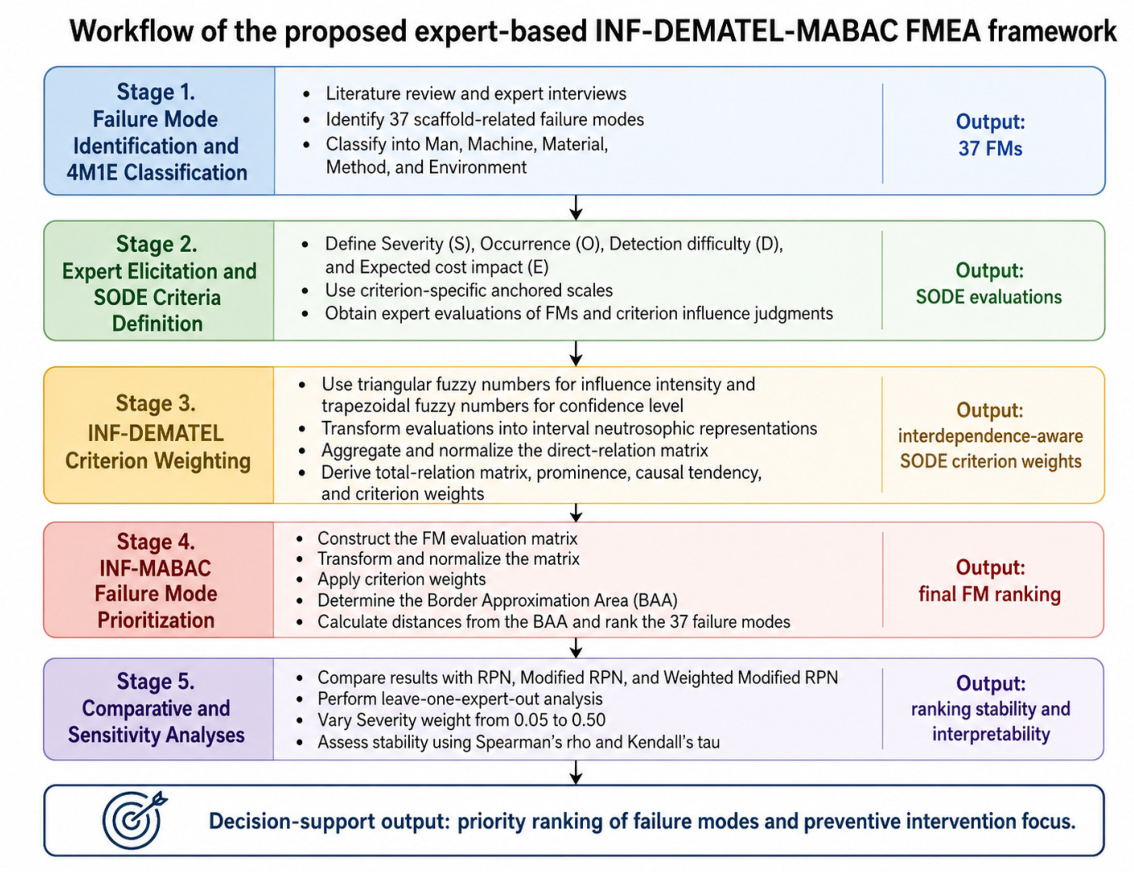
This study follows a structured expert-based workflow to prioritize scaffold-related fall failure modes in demolition projects. First, potential failure modes were identified from the literature and expert input, and then classified using the 4M1E perspective. Second, an extended FMEA was used to evaluate each failure mode according to four criteria, collectively referred to as the SODE criteria. Third, interval neutrosophic fuzzy (INF) theory was applied to represent uncertainty, hesitation, and judgmental differences in expert evaluations. Fourth, INF-DEMATEL was used to examine interrelationships among the SODE criteria and derive interdependence-aware criterion weights. Fifth, INF-MABAC was used to rank the identified failure modes according to their relative risk priority. Finally, comparative and sensitivity analyses were conducted to examine the consistency and stability of the prioritization results. The overall research workflow is presented in Figure 1.

3.1. Identification of Failure Modes

To ensure content validity and practical relevance, the failure modes were identified through a two-stage elicitation process that integrated a systematic literature review with semi-structured expert interviews.
In the first stage, an evidence-based initial pool of scaffold- and demolition-related failure modes was established. Recurring hazard conditions, control breakdowns, and accident pathways were extracted from prior demolition safety assessments and scaffold accident analyses. To convert these findings into FMEA-ready failure modes, the candidate items were screened according to three criteria: specificity, actionability, and mutual exclusivity. Specificity required each item to describe a single observable breakdown in design, management, equipment, work method, or site environment. Actionability required each item to focus on a controllable failure point, such as what failed, rather than a general accident outcome, such as what happened. Mutual exclusivity required overlapping items to be merged while preserving distinct underlying mechanisms, such as differentiating PPE defects from PPE misuse [6,33]. This process is consistent with previous research suggesting that demolition risk analysis benefits from explicit and curated failure mode inventories rather than ad hoc checklists [6].
In the second stage, the initial pool of failure modes was reviewed and refined through expert elicitation. Purposive sampling was used to recruit experts with technical and managerial experience in demolition safety, scaffold operations, occupational safety regulation, construction supervision, and project management. A total of ten experts participated in this process, and their professional backgrounds are described in Section 4.1.
Data collection was conducted through individual semi-structured interviews. To ensure consistency, all experts were provided with the same review package, including the literature-derived candidate failure modes, operational definitions, and the 4M1E classification framework. During the interviews, the experts examined the relevance, clarity, and completeness of the candidate items. The researchers provided only procedural explanations and avoided guiding the experts’ judgments regarding item importance or subsequent risk ratings. The elicitation process was concluded when additional expert input led only to minor wording refinements and did not introduce new conceptual categories or substantially different failure modes. This indicated that the failure mode set had reached practical saturation. The final set of 37 scaffold-related failure modes served as the basis for the subsequent extended FMEA evaluation and risk prioritization [34].

3.2. Extended FMEA Framework

To prioritize the contributors to scaffold-related fall risks during demolition, this study adopts FMEA as the analytical backbone. FMEA provides a structured risk assessment procedure for identifying failure modes, clarifying their causes and effects, and supporting proactive risk prioritization [35]. The criteria are defined as follows:
(i)
Severity (S): The potential magnitude of injury, damage, or adverse consequence resulting from a failure mode.
(ii)
Occurrence (O): The likelihood or frequency with which a failure mode may occur during demolition scaffold operations.
(iii)
Detection difficulty (D): The difficulty of detecting a failure mode before worker exposure or before an incident occurs. A higher D value indicates lower detectability and therefore a higher risk level.
(iv)
Expected Cost impact (E): The anticipated project-level consequence associated with a failure mode, including repair, rework, schedule disruption, work stoppage, regulatory response, and management burden.
The inclusion of Expected Cost impact does not aim to replace injury-based risk assessment or provide an exact monetary prediction. Instead, it offers an additional decision-relevant perspective for demolition scaffolding, where scaffold-related failures may lead not only to injuries but also to operational, contractual, and managerial consequences.
Although the conventional risk priority number (RPN), calculated from Severity, Occurrence, and Detection difficulty, is widely used in FMEA, it has limitations in complex construction environments. First, classical RPN relies on crisp scoring and may not adequately represent expert hesitation or uncertainty. Second, different combinations of S, O, and D can produce identical RPN values even when they represent different risk profiles, which weakens interpretability [27]. Third, conventional RPN typically treats risk criteria as independent, although interdependence among criteria can influence risk interpretation [36]. Fourth, the standard RPN structure does not explicitly consider post-incident cost-related consequences. Therefore, the extended SODE-based FMEA framework was used to provide a broader and more transparent basis for expert-based risk prioritization in demolition scaffold operations.

3.3. The Proposed INF-DEMATEL-MABAC Model

To address selected limitations of conventional RPN-based prioritization, this study integrates INF theory with DEMATEL and MABAC within the extended FMEA framework. The proposed model was designed to support expert-based prioritization of scaffold-related fall failure modes under uncertainty and interdependent risk criteria.
INF theory is used to represent uncertainty and hesitation in expert evaluations. Unlike conventional crisp scoring, INF representation describes expert judgments through three components: truth membership, indeterminacy membership, and falsity membership [24,25]. This structure helps preserve incomplete, hesitant, or partially conflicting expert information before final prioritization [25]. It is suitable for demolition scaffold risk assessment because site conditions are dynamic, expert judgments may vary, and risk information is often difficult to express using fully precise numerical values.

3.3.1. Structural Analysis and Weighting via INF-DEMATEL

The INF-DEMATEL procedure was used to examine the structural relationships among the SODE criteria and to derive criterion weights for the subsequent INF-MABAC prioritization. This step addresses two limitations of the classical RPN approach: the assumption that all risk criteria are equally important and the assumption that the criteria are independent [26]. By modeling both direct and indirect influence relationships among the Severity, Occurrence, Detection, and Expected Cost criteria, this phase derives interdependence-based weights that reflect the actual causal dynamics of scaffold fall hazards in demolition operations.
  • Step 1. Elicitation of Expert Influence Judgements
Let C = {S, O, D, E} represent the set of risk criteria evaluated by a panel of q experts (K = {1, 2,…, q}). Each expert k assesses the direct influences of criterion Ci on Cj using a dual-dimensional assessment framework. To separate the perceived magnitude of influence from the expert’s subjective confidence, a dual-dimensional assessment structure was adopted [37]. In this study, trapezoidal fuzzy numbers were used to represent influence evaluations because the perceived influence between two criteria may cover a relatively broad range of possible values rather than a single central tendency. This allows the influence scale to preserve a wider judgment interval. In contrast, the confidence degree was encoded through a neutrosophic confidence representation, which records the degree of truth membership, indeterminacy membership, and falsity membership associated with each judgment. This design allows the model to consider both the influence intensity and the reliability of the expert’s evaluation.
  • The linguistic influence scale consisted of five levels:
    No Influence (NI) {0, 0.1, 0.1, 0.1}.
    Low Influence (LI) {0.2, 0.3, 0.3, 0.4}.
    Moderate Influence (MI) {0.4, 0.5, 0.5, 0.6}.
    High Influence (HI) {0.6, 0.7, 0.7, 0.8}.
    Absolutely High Influence (AI) {0.8, 0.9, 0.9, 1}.
  • The confidence scale also contained five levels:
    No Certainty (NC) {0, 0, 0}.
    Low Certainty (LC) {0.6, 0.2, 0.2}.
    Moderate Certainty (MC) {0.8, 0.1, 0}.
    High Certainty (HC) {0.9, 0.1, 0.1}.
    Absolutely Certain (AC) {1, 0, 0}.
These scales were used to transform qualitative expert judgments into interval neutrosophic information for the subsequent INF-DEMATEL analysis.
  • Step 2. Construction of the Interval Neutrosophic Direct-Relation Matrix
The qualitative judgments obtained in Step 1 were transformed into interval neutrosophic numbers. For each expert k, the direct influence evaluation matrix was constructed as shown in Equation (1).
In this study, S = s i j k denotes the direct influence evaluation matrix provided by expert k, where n is the number of criteria and s i j k represents the influence of criterion i on criterion j. Each element s i j k consists of two parts. The first part, s i j , α 1 k ,   s i j , α 2 k ,   s i j , α 3 k ,   s i j , α 4 k , is a trapezoidal fuzzy number used to represent the linguistic evaluation of influence intensity. The second part, s i j , T α k ,   s i j , F α k ,   s i j , I α k , represents the corresponding truth membership, indeterminacy membership, and falsity membership degrees. Therefore, each matrix element records both the expert’s fuzzy influence evaluation and the confidence-related uncertainty information associated with that evaluation.
S = s i j k n × n = s i j , α 1 k ,   s i j , α 2 k ,   s i j , α 3 k ,   s i j , α 4 k ,   s i j , T α k ,   s i j , F α k ,   s i j , I α k n × n = s 11 , α 1 k ,   s 11 , α 2 k ,   s 11 , α 3 k ,   s 11 , α 4 k ,   s 11 , T α k ,   s 11 , F α k ,   s 11 , I α k s 1 n , α 1 k ,   s 1 n , α 2 k ,   s 1 n , α 3 k ,   s 1 n , α 4 k ,   s 1 n , T α k ,   s 1 n , F α k ,   s 1 n , I α k s n 1 , α 1 k ,   s n 1 , α 2 k ,   s n 1 , α 3 k ,   s n 1 , α 4 k ,   s n 1 , T α k ,   s n 1 , F α k ,   s n 1 , I α k s n n , α 1 k ,   s n n , α 2 k ,   s n n , α 3 k ,   s n n , α 4 k ,   s n n , T α k ,   s n n , F α k ,   s n n , I α k n × n , i = j = 1 ,   2 , ,   n ;   k = 1 ,   2 , ,   q . ,
  • Step 3. Aggregation of Expert Judgements
To synthesize individual assessments into a collective group-level matrix, an aggregation process was performed. Individual matrices were combined using the operator defined in Equation (2). To maintain the diversity of expert opinions and account for inter-expert variability, the lower and upper bounds of the membership intervals were determined by the minimum and maximum values across the panel, as shown in Equation (3). This approach retained the dispersion of professional consensus. The lower bound of Θ g i j represents the minimum influence value assigned by the experts, while the upper bound represents the maximum influence value. Therefore, this aggregation procedure does not simply average expert opinions. Instead, it retains the dispersion of expert judgments and preserves inter-expert variability. This interval-based aggregation is consistent with the uncertainty-aware purpose of the proposed framework because it keeps professional disagreement and judgmental variation visible in the subsequent INF-DEMATEL analysis.
sc S = s c s i j k n × n = s i j , α 1 k + s i j , α 2 k + s i j , α 3 k + s i j , α 4 k 2 + s i j , T α k s i j , F α k s i j , I α k / 18
Θ G = Θ g i j n × n = g i j l o w e r , g i j u p p e r n × n = min k s c s 11 k , max k s c s 11 k min k s c s 1 n k , max k s c s 1 n k min k s c s n 1 k , max k s c s n 1 k min k s c s n n k , max k s c s n n k n × n , i = j = 1 ,   2 , ,   n ;   k = 1 ,   2 , ,   q . ,
  • Step 4. Normalization of the Aggregated Matrix
To ensure scale consistency and facilitate the convergence of subsequent matrix operations, the aggregated matrix was normalized. A normalization factor was calculated based on the total influence value in the matrix, and the transformation was performed according to Equations (4) and (5). The resulting normalized matrix rescaled all influence magnitudes to the interval [0, 1], providing a standardized basis for deriving the total influence structure in the next step.
Θ X = Θ x i j n × n = π Θ g i j n × n ,   i = j = 1 ,   2 , ,   n .
π = min 1 max i j = 1 n g i j u p p e r , 1 max j i = 1 n g i j u p p e r .
  • Step 5. Derivation of the Total Influence Matrix
The total influence matrix was derived to capture both direct impacts and indirect propagation effects between criteria. In this expression, Θ X represents the direct influence among criteria. In this expression, Θ X represents the direct influence among criteria. The term Θ X 2 represents first-order indirect influence transmitted through one intermediate criterion, Θ X 3 represents influence transmitted through two intermediate criteria, and higher-order terms represent longer influence propagation paths. Therefore, the total influence matrix integrates both immediate and propagated effects within the criterion system.
Therefore, by expanding the normalized matrix through a power series in Equation (6), the infinite series converged to the total influence structure as expressed in Equation (7). The total influence matrix was constructed to quantify the aggregate influence intensity among criteria, integrating direct impacts with indirect propagation effects. This matrix provided the analytical framework necessary to distinguish between causal drivers and dependent factors within the evaluation system.
Θ T = Θ X + Θ X 2 + + Θ X = Θ X I Θ X I Θ X 1 = Θ X I Θ X 1
Θ T = Θ t i j n × n = t 11 l o w e r , t 11 u p p e r t 1 n l o w e r , t 1 n u p p e r t n 1 l o w e r , t n 1 u p p e r t n n l o w e r , t n n u p p e r n × n , i = j = 1 ,   2 , ,   n ,
  • Step 6. Calculation of Criteria Prominence and Weights
The final criteria weights were determined through a three-stage process: (1) Defuzzification: The elements of the total influence matrix were converted into crisp values by averaging their respective lower and upper bounds; (2) Influence and Dependence Vectors: The row-wise sum r (Equation (8)) was calculated to represent the total influence exerted by a criterion, while the column-wise sum s (Equation (9)) represents the influence received (dependence); and (3) Weight Assignment: The “prominence” value (r + s) was calculated for each criterion to indicate its overall importance in the system. Final weights were then derived by normalizing these prominence values (Equation (10)).
r = r i n × 1 = j = 1 n 0.5 t i j l o w e r + 0.5 t i j u p p e r n × 1 = r 1 ,   r 2 , ,   r i , ,   r n
s = s j 1 × n t r a n s p o s e = i = 1 n 0.5 t i j l o w e r + 0.5 t i j u p p e r 1 × n t r a n s p o s e = s i n × 1 = s 1 ,   s 2 , ,   s i , ,   s n .
w i = r i + s i i = 1 n r i + s i

3.3.2. Risk Prioritization via INF-MABAC

Following the determination of criterion weights through INF-DEMATEL, the INF-MABAC procedure was applied to prioritize the identified scaffold-related fall failure modes. MABAC was selected because it evaluates each alternative according to its relative distance from the Border Approximation Area (BAA). This feature allows each failure mode to be assessed against a reference region rather than only through direct score multiplication or subjective ordering.
  • Step 1. Construction of the Initial Linguistic Evaluation Matrix
An initial evaluation matrix was constructed to assess m failure modes (h = 1, 2,…, m) against n risk criteria (j = 1, 2,…, n). For the risk evaluation, linguistic ratings were represented using trapezoidal fuzzy numbers across five levels, ranging from Level 1 to Level 5 [28]. To improve the reproducibility of expert elicitation, this study used criterion-specific anchored scales for the four SODE criteria, as shown in Table 1. Severity refers to the potential injury or health consequence associated with a failure mode. Occurrence refers to the likelihood or frequency with which the failure mode may arise during demolition scaffold operations. Detection difficulty refers to the difficulty of identifying the failure mode before worker exposure or before an incident occurs. Therefore, a higher value of Detection difficulty indicates lower detectability and a higher risk level. Expected Cost impact refers to the anticipated project-level consequences if the failure mode occurs, including repair, rework, schedule delay, work stoppage, legal or regulatory consequences, and management burden. In this study, Expected Cost impact was treated as an ordinal cost impact criterion rather than a precise monetary estimate. Its time horizon was defined as the period from the occurrence or identification of the failure mode to the completion of corrective actions and restoration of safe scaffold operation.
  • The five confidence levels were defined as follows:
    No Certainty (NC) {0, 0, 0}.
    Low Certainty (LC) {0.6, 0.2, 0.2}.
    Moderate Certainty (MC) {0.8, 0.1, 0}.
    High Certainty (HC) {0.9, 0.1, 0.1}.
    Absolutely Certain (AC) {1, 0, 0}.
  • Step 2. Transformation into the Crisp Evaluation Matrix
Following the same aggregation logic used in the INF-DEMATEL phase, particularly Equations (2) and (3), the expert evaluations were first transformed into interval neutrosophic representations and then aggregated to obtain the lower and upper bounds of each evaluation element. In this way, the variability and uncertainty embedded in the expert judgments were preserved during the transformation and aggregation stages.
For the subsequent MABAC procedure, these aggregated interval values were then converted into crisp deterministic scores. This defuzzification step was performed at this stage because the following MABAC operations, including normalization, criterion weighting, construction of the weighted matrix, and calculation of the Border Approximation Area (BAA), require comparable numerical inputs. Specifically, the lower and upper bounds of each aggregated interval element were averaged to obtain the crisp evaluation value. The resulting crisp evaluation matrix A, shown in Equation (11), served as the input matrix for the subsequent MABAC calculations.
A = a h j m × n = a 11 a 1 n a m 1 a m n m × n ,   h   =   1 ,   2 , ,   m ;   j   =   1 ,   2 , ,   n .
  • Step 3. Normalization of the Evaluation Matrix
To eliminate dimensional differences and scale disparities among criteria, the crisp matrix was normalized. This process benchmarked each evaluation against the “aspiration level” (best possible) and “worst level” derived from the extreme linguistic values. The normalized values were mapped onto a unified scale [0, 1] using Equations (12) and (13).
Y = y h j m × n = y 11 y 1 n y m 1 y m n m × n ,   h   =   1 ,   2 , ,   m ;   j   =   1 ,   2 , ,   n .
y h j = a h j a j w o r s t a j a s p i r e a j w o r s t
  • Step 4. Construction of the Weighted Normalized Matrix
The relative importance of each criterion was integrated by multiplying the normalized entries by the weights obtained from the INF-DEMATEL stage. The weighted normalized matrix V was calculated as Equation (14):
V = v h j m × n = w 1 y 11 + 1 w n y 1 n + 1 w 1 y m 1 + 1 w n y m n + 1 m × n , h   =   1 ,   2 , ,   m ;   j   =   1 ,   2 , ,   n .
  • Step 5. Determination of the Border Approximation Area (BAA)
The BAA acted as a reference benchmark for each criterion. The BAA value gj for each criterion was calculated as the geometric mean of the weighted normalized values across all failure modes (Equation (15)). The resulting n × 1 vector (Equation (16)) formed the boundary profile against which all alternatives were compared.
g j = h = 1 m v h j 1 m ,   j   =   1 ,   2 , ,   n .
G = g 1 , g 2 , , g n
  • Step 6. Calculation of the Distance from the BAA
The distance of each failure mode from the BAA was determined by calculating the difference matrix Q (Equation (17)). Based on the sign of qhj, failure modes were categorized into three regions (Equation (18)): (1) Upper Approximation Region (UAR) indicating higher relative risk (G+); (2) Border Approximation Area (BAA) indicating neutral risk (G); and (3) Lower Approximation Region (LAR) indicating lower relative risk (G).
Q = q h j m × n = v 11 g 1 v 1 n g n v m 1 g 1 v m n g n m × n ,   h   =   1 ,   2 , ,   m ;   j   =   1 ,   2 , ,   n .
A h = G + G G i f i f i f q h j > 0 q h j = 0 q h j < 0
  • Step 7. Final Aggregation and Ranking
The final risk priority for each failure mode was obtained by summing the distances across all criteria to derive a composite criterion function Sh (Equation (19)). Failure modes were ranked in descending order of Sh. A higher Sh value signified a higher priority for risk mitigation and managerial intervention.
S h = j = 1 n q h j

4. Empirical Analysis of Demolition Projects in Taiwan

To illustrate the implementation and practical interpretability of the proposed model, this study conducted an empirical analysis of demolition scaffold operations in Taiwan. This application context is relevant because demolition projects in dense urban environments often involve constrained workspaces, frequent structural modifications, changing access conditions, and intensive coordination among trades. These characteristics make demolition scaffold operations suitable for examining scaffold-related fall risks under dynamic and uncertain conditions.
The empirical analysis proceeded in two stages. First, the INF-DEMATEL procedure was applied to determine the interdependence-aware weights of the SODE risk criteria and to examine the structural prominence and causal tendency of each criterion. Second, the INF-MABAC procedure was used to prioritize the identified failure modes based on the weighted SODE evaluations. This application illustrates how the proposed framework transforms expert-based evaluations into a structured ranking of scaffold-related fall failure modes. The resulting ranking is intended to support discussion of inspection priorities, supervisory focus, training needs, and preventive intervention planning in demolition scaffold operations. It should be interpreted as an illustrative expert-based prioritization result rather than as external validation of the model’s superiority over other FMEA or MCDM-based approaches.

4.1. Demographics of the Experts

The expert panel consisted of ten professionals selected through purposive sampling. The experts represented industry, government, engineering, consultancy, and contracting sectors, thereby providing perspectives from frontline operations, site supervision, engineering practice, project management, and regulatory enforcement. This composition was intended to improve the practical relevance of the expert elicitation process.
The number of experts was determined by considering professional relevance, domain experience, and the elicitation burden of the proposed framework. Because the experts were required to evaluate 37 failure modes under the SODE criteria and provide criterion influence judgments for the INF-DEMATEL procedure, the study prioritized qualified and relevant expertise over numerical representativeness. Most experts had more than ten years of professional experience, and several held senior managerial or supervisory positions. The demographic information of the expert panel is presented in Table 2.

4.2. Identified Failure Modes

The analytical process yielded a converged catalogue of 37 failure modes (FM1–FM37), which categorized scaffold risks across technical, organizational, and personnel domains (Table 3). At the structural level, the findings identified critical deficiencies in platform integrity and component adequacy, such as damaged decking or insufficient member strength. These technical failures extended to stability mechanisms, including improper footing, missing base plates, and inadequate anchorage or bracing, alongside issues in load management and material selection. These results were consistent with engineering investigations that highlighted how flawed erection configurations and compromised component conditions directly precipitated structural collapse and fall events [25,33].
Beyond these physical defects, the catalogue captured the organizational and personnel layers that served as enabling conditions for technical failures to remain latent. These systemic drivers included inadequate professional training for design and inspection, unauthorized modifications to approved designs, and a lack of competent on-site supervision. Furthermore, the results highlighted operational gaps such as incomplete hazard communication, PPE-related deficiencies, and noncompliance with prescribed work procedures. Such findings aligned with recent fall-from-height research that identified knowledge gaps and poor site management as dominant risk factors [2,3].
By integrating these diverse failure modes, the research demonstrated that scaffold accidents were multi-domain phenomena rather than isolated technical malfunctions. The results suggested that latent organizational failures, such as inadequate governance and supervision, frequently allowed technical risks to remain uncorrected until a point of failure. This comprehensive mapping underscored the necessity of addressing both engineering controls and administrative factors to effectively mitigate scaffold-related risks in demolition operations.

4.3. Assessment of Risk Criteria Weights via INF-DEMATEL

The results of the INF-DEMATEL analysis, including the interval neutrosophic direct-relation, total influence, and final weight distributions for the SODE criteria, were detailed in Table 4, Table 5 and Table 6.
Table 4 presents the aggregated interval neutrosophic direct-relation matrix, which reflected expert perceptions of the influence intensity between criteria. The matrix revealed significant interdependencies, particularly between E and S. E exerted a substantial direct influence on S, with an interval range of [0.546, 0.864], suggesting that anticipated financial burden was perceived to significantly amplify potential accident consequences. Furthermore, S maintained a consistently strong influence on all other criteria, highlighting its foundational role in the risk evaluation framework.
The total influence matrix (Table 5) captured both direct and indirect relationships. E demonstrated the strongest overall outgoing influence, specifically toward S [0.359, 1.186], identifying it as a dominant driver of risk dynamics. Conversely, Detectability (D) exhibited lower total influence values, functioning primarily as a responsive factor rather than a primary system driver. Occurrence (O) occupied an intermediate role, both exerting and receiving moderate influence from S and E.
The final INF-DEMATEL summary in Table 6 illustrated the prominence (r + s) and causal effects (rs) of the criteria. S achieved the highest prominence value (5.790), confirming its central structural importance in demolition scaffold fall risk evaluation. E followed as the second most prominent factor (4.706). Regarding causal dynamics, O was the only criterion to yield a positive rs value (0.123), classifying it as the sole net “cause” factor that drove other elements in the system. In contrast, S, D, and E exhibited slightly negative values, indicating they were net “receivers” within the network. However, the small magnitude of these values suggested a highly coupled system where criteria were deeply interconnected rather than polarized.
The normalized weights derived from the prominence and causal values established a clear hierarchy of risk importance. S ranked first with a weight of 0.296, followed by E (0.241), O (0.236), and D (0.227). These results indicated that the risk of falls from demolition scaffolding was primarily governed by the severity of consequences and the subsequent financial cost, while the frequency of occurrence acted as the underlying driving mechanism within the interdependent risk structure.

4.4. Prioritization of Failure Modes via INF-MABAC

The interval neutrosophic evaluation matrix (Table 7) consolidated the aggregated expert assessments for the 37 failure modes across the SODE criteria. By utilizing interval values [L, U] rather than single-point estimates, the matrix preserved the uncertainty inherent in group judgment and provided a more realistic representation of demolition scaffold risk conditions prior to defuzzification.
The results indicated that S and E consistently exhibited higher interval ranges across most failure modes, with many upper bounds exceeding 0.80. This pattern suggests that experts perceived demolition scaffold risks primarily through the lenses of consequence magnitude and financial cost. Structural-related failure modes, particularly those involving anchoring integrity and load stability, showed elevated severity intervals, reflecting the high-consequence nature of potential scaffold collapse. Simultaneously, the relatively high values for E in behavior-driven and configuration-related modes indicated that unsafe states frequently arose from dynamic work conditions and procedural deviations that carried heavy recovery or mitigation costs.
In contrast, D generally presented lower interval magnitudes and narrower ranges. This implies that within the context of demolition scaffolding, risk was less differentiated by detection capability and more strongly governed by the dynamics of consequence and expected cost. Furthermore, while expert perceptions varied, the interval widths remained bounded, which supported the appropriateness of the interval neutrosophic framework for capturing heterogeneous yet convergent group evaluations.
Table 8 presents the final ranking results obtained from the INF-MABAC procedure. The values in the matrix represent the distance of each failure mode from the BAA under the SODE criteria, while the aggregated sum reflects the overall deviation across all criteria, serving as the final risk score.
The results showed that FM7 achieved the highest overall score (0.078) and ranked first. This suggests that FM7 consistently lies in the upper approximation region across multiple criteria, identifying it as a structurally dominant and high-priority risk condition. The second and third highest-ranked failure modes were FM16 (0.077) and FM27 (0.074), respectively. Both exhibited positive and relatively large deviations from the BAA, confirming their strong contribution to the overall risk structure. These findings were consistent with the earlier INF-DEMATEL analysis, which emphasized the prominence of Severity and Expected Cost within the criteria system.
Furthermore, FM14 and FM15 shared identical scores (0.066), followed by FM18 (0.053), indicating that structural configuration, loading stability, and anchoring-related factors remained central contributors to fall risk escalation. Conversely, lower-ranked items such as FM36 (−0.066) and FM37 (−0.052) fell predominantly within the lower approximation region, suggesting comparatively weaker systemic influence under the weighted SODE structure. The AL and WL values for each criterion further illustrated the reference boundaries within the MABAC framework, confirming that high-ranking failure modes were positioned close to the ideal region and away from the anti-ideal region.

5. Discussions

5.1. Management Implications

This section interprets the empirical findings of the INF-DEMATEL-MABAC-based FMEA and discusses their implications for demolition scaffold safety management. The results suggest that scaffold-related fall risks should not be treated as isolated events, but as outcomes of interacting technical, organizational, and human factors. The unequal criterion weights, interdependence among the SODE criteria, and variation in expert judgments indicate that demolition scaffold risk is difficult to represent using only crisp, equally weighted, and independent risk factors.
The weighting results show that Severity is the most influential criterion in the SODE structure, with a weight of 0.2964. This is reasonable because scaffold instability and falls from height often lead to severe consequences with limited time for recovery or intervention. In demolition projects, where work sequencing, space constraints, and multi-trade activities frequently change exposure conditions, safety management should prioritize the prevention of high-consequence exposure states. Engineering controls, such as complete platforms, edge protection, stable access systems, and structurally sound scaffold configurations, should therefore be verified before work proceeds.
FM07, insufficient safety awareness, was ranked as the highest-priority failure mode. This result indicates that safety awareness is not only an individual behavioral issue, but also an upstream factor that may influence hazard recognition, PPE use, compliance with work procedures, and tolerance of incomplete scaffold conditions. In demolition scaffolding, where guardrails, access routes, platforms, and scaffold ties may change rapidly, workers and supervisors need to recognize weak signals before exposure escalates. Safety management should therefore emphasize scenario-based hazard recognition training, short refresher sessions, field coaching, daily pre-task briefings, and clear stop-work authority when critical protections are missing.
FM16, improper tying or anchoring of the scaffold to the structure, was ranked as the second-highest-priority failure mode. This finding highlights scaffold anchoring as a critical structural control. If ties or anchors are missing, improperly installed, or removed without authorization, the scaffold may become vulnerable to wind, eccentric loading, and operational disturbance. In practice, tie locations, anchorage specifications, and any relocation or removal of ties should be treated as controlled information. Any change should require authorization, verification, and reinspection.
FM27, inadequate implementation of the scaffold maintenance and inspection system, was ranked third. This finding shows that scaffold safety should be managed as a lifecycle control process rather than as a one-time handover activity. Temporary structures may deteriorate, loosen, suffer impact damage, or be modified by different trades. Without systematic inspection and maintenance, small deviations may remain unnoticed and gradually become normalized. Effective management should include clear inspection responsibilities, routine pre-use checks, periodic competent-person inspections, immediate isolation of unsafe scaffolds, and documented reauthorization after correction. Digital tools such as scaffold tags, location-linked inspection records, and QR-code documentation may further improve traceability.
Overall, the findings provide practical implications for industry, government, and academia. For industry stakeholders, the ranking highlights priority areas for inspection, supervision, training, and preventive intervention, particularly FM7, FM16, and FM27. For regulators, the results provide a structured basis for risk-focused inspection and training programs. For academic research, this study presents an applied example of integrating 4M1E classification, SODE criteria, INF representation, DEMATEL-based criterion weighting, and MABAC-based prioritization in a demolition scaffold context. The results should be interpreted as expert-based decision support rather than as universal validation of one method over all other FMEA approaches.

5.2. Sensitivity Analysis and Comparison with Multiple Methods

To examine the stability of the proposed prioritization results, two sensitivity analyses were conducted. First, a leave-one-expert-out sensitivity analysis was conducted. In each run, one expert was excluded from the panel, and the complete INF-DEMATEL-MABAC procedure was recalculated. Since the expert panel consisted of ten experts, this analysis was repeated ten times. Table 9 summarizes the exclusion scenarios and the corresponding ranking consistency indicators. The results show that the ranking outcomes remained highly consistent across all scenarios. Spearman’s rho ranged from 0.979 to 0.992, and Kendall’s tau ranged from 0.909 to 0.951. Moreover, the high-priority failure modes, especially FM07, FM16, and FM27, remained largely stable across all recalculations. These findings indicate that the final prioritization results were not dominated by any single expert and that the proposed framework exhibits satisfactory stability under expert exclusion conditions.
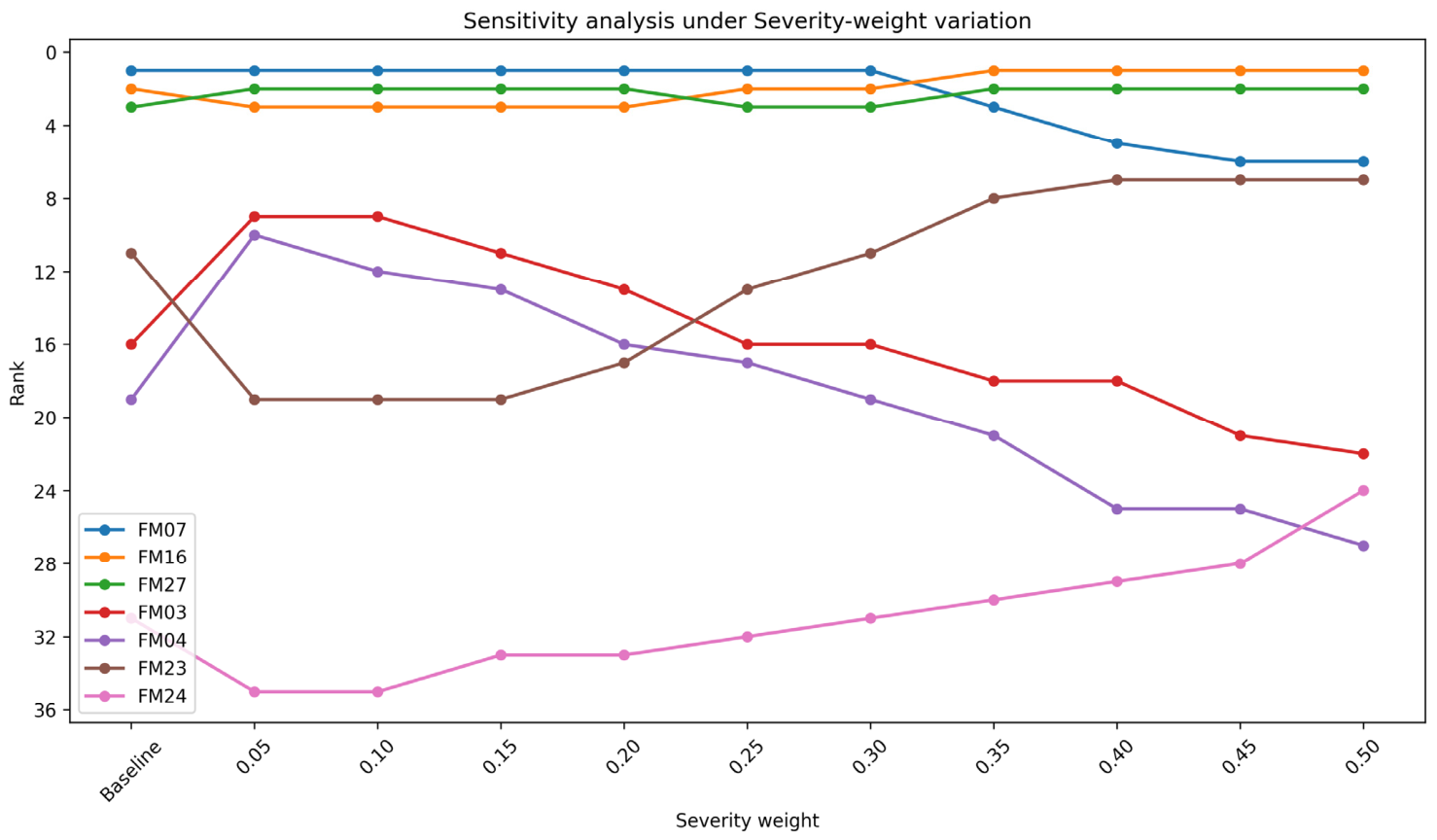
Second, criterion-weight variation was examined by adjusting the weight of Severity, which was identified as the most influential criterion in the baseline INF-DEMATEL results. The Severity weight was varied from 0.05 to 0.50 across ten scenarios, while the weights of O, D, and E were proportionally adjusted to ensure that the total criterion weight remained equal to 1. Figure 2 illustrates the scenario-wise ranking trends of the failure modes under these weight-variation conditions. To improve readability, the following discussion focuses on representative failure modes that show either stable high-priority patterns or noticeable rank changes.
The results show that the overall ranking structure remained largely consistent across the tested scenarios. Spearman’s rho ranged from 0.930 to 1, and Kendall’s tau ranged from 0.802 to 1. The high-priority group also remained relatively stable. In particular, FM16 and FM27 consistently remained among the highest-priority failure modes, while FM07 remained highly ranked across the scenarios, although its position declined when the S weight became relatively large. This indicates that the major risk priorities were not fundamentally altered by the weight variation. However, the figure also shows that several middle-priority and lower-priority failure modes experienced more visible rank shifts. For example, FM03 and FM04 moved to lower priority positions as the S weight increased, whereas FM23 moved to a higher priority position under larger S weights. These changes indicate that some failure modes are more sensitive to criterion-weight settings than others. Therefore, the use of a formal criterion-weighting procedure is necessary, because assuming equal or fixed weights may change the relative priority of certain failure modes.
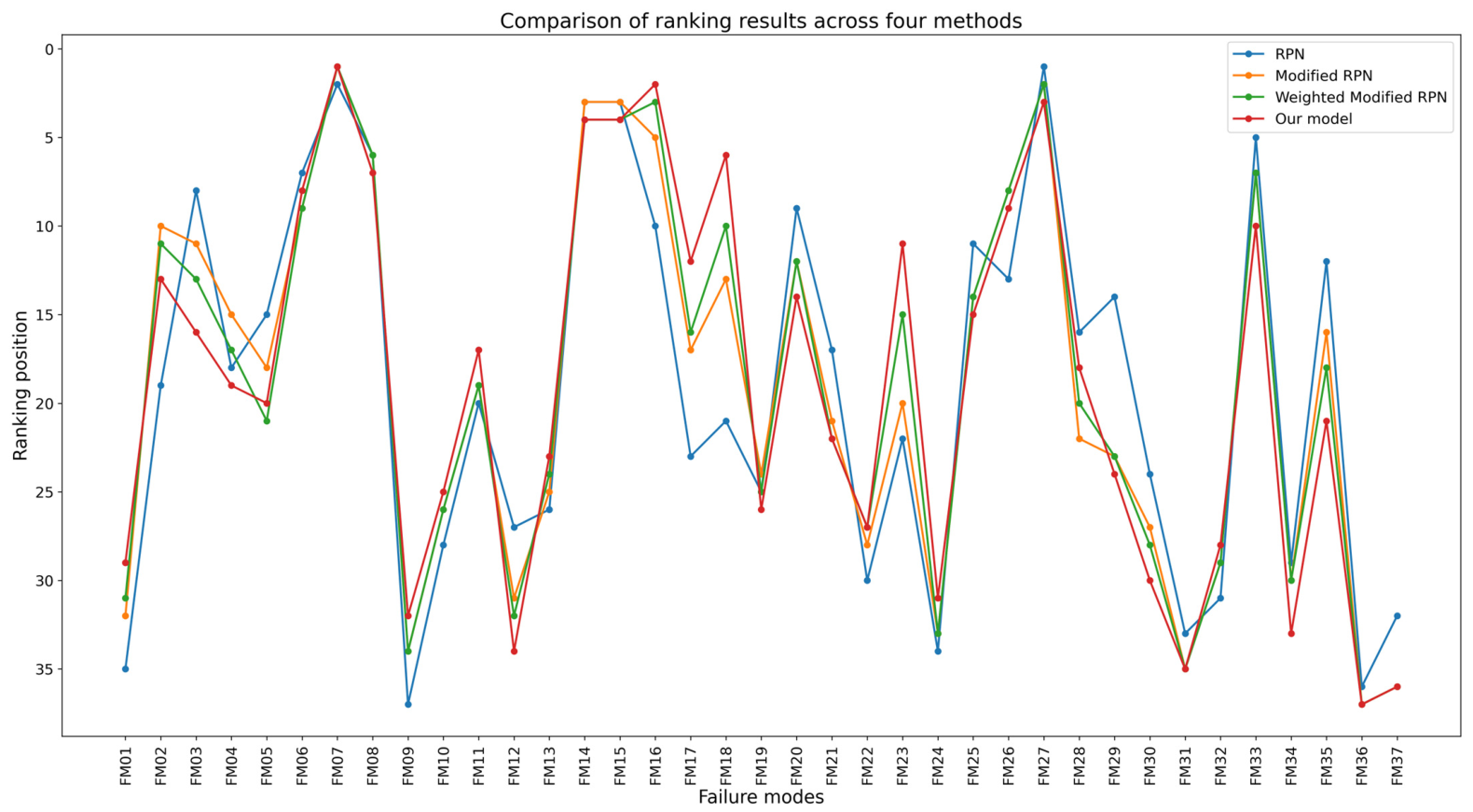
This study also compared the ranking results of four methods: traditional RPN, Modified RPN, Weighted Modified RPN, and the proposed model, as shown in Figure 3. The overall ranking trends were broadly consistent, indicating that the four methods shared a similar general view of high-priority and low-priority failure modes. However, several failure modes changed noticeably after incorporating Expected Cost impact, criterion weights, uncertainty representation, and criterion interdependence.
For example, FM16 was ranked 10th by traditional RPN, 5th by Modified RPN, 3rd by Weighted Modified RPN, and 2nd by the proposed model. FM18 moved from 21st, 13th, and 10th under the first three methods to 6th under the proposed model. FM23 also moved from 22nd, 20th, and 15th to 11th. These changes suggest that the proposed model can provide more refined prioritization for failure modes that may receive lower rankings under conventional scoring schemes. At the same time, key failure modes such as FM07, FM16, FM27, FM14, and FM15 remained in the high-priority group across methods, indicating that the proposed model preserves the general risk structure while offering additional differentiation.
Rank correlation analysis was conducted using Spearman’s rho and Kendall’s tau. All method pairs showed statistically significant positive correlations. The proposed model had the highest correlation with Weighted Modified RPN, with Spearman’s rho of 0.9839 and Kendall’s tau of 0.9068, indicating high consistency after Expected Cost impact and criterion weights were considered. In contrast, the correlation between traditional RPN and the proposed model was lower, with Spearman’s rho of 0.8582 and Kendall’s tau of 0.6692, although still statistically significant. These results suggest that the proposed model remains consistent with RPN-based approaches while introducing meaningful refinements through uncertainty representation and interdependence-aware criterion weighting.

6. Conclusions

This study developed an expert-based risk prioritization framework for scaffold-related fall risks in demolition projects by integrating Failure Mode and Effects Analysis, interval neutrosophic fuzzy theory, DEMATEL, and MABAC. The framework was designed to address selected limitations of conventional RPN-based FMEA, particularly the difficulty of representing expert hesitation, the assumption of independent and equally important criteria, and the limited consideration of cost-related consequences. By combining 4M1E classification, SODE criteria, INF representation, DEMATEL-based criterion weighting, and MABAC-based prioritization, the study provides a structured procedure for identifying and ranking scaffold-related failure modes under uncertain and dynamic demolition conditions.
The empirical application in Taiwan’s demolition scaffold context showed that Severity was the most influential criterion among the SODE criteria. This finding suggests that the high-consequence nature of scaffold-related falls should remain a central concern in demolition safety management. The final prioritization identified three high-priority failure modes: insufficient safety awareness, improper scaffold-to-structure anchoring, and inadequate scaffold maintenance and inspection governance. These results indicate that scaffold-related fall risk is shaped by interacting human, structural, and managerial factors. Therefore, prevention should not rely only on general compliance or personal protective equipment, but should also strengthen hazard recognition, anchoring control, inspection routines, and lifecycle-based scaffold governance.
Methodologically, this study contributes to construction safety research by extending the conventional SOD structure of FMEA into an SODE framework that incorporates Expected Cost impact as an additional decision-relevant criterion. In this study, Expected Cost impact was treated as an ordinal cost-impact criterion rather than a precise monetary estimate. Its inclusion helps capture repair, rework, schedule delay, work stoppage, regulatory response, and management burden associated with scaffold-related failures. The integration of INF, DEMATEL, and MABAC also provides a traceable workflow from expert judgment representation to criterion weighting and failure mode ranking. Practically, the results can support safety managers in discussing inspection priorities, supervisory focus, worker training needs, and preventive intervention planning.
Several limitations should be noted. First, this study is based on one in-depth empirical application in Taiwan and uses expert evaluations from a panel of ten professionals. Although the case involved detailed failure mode identification, expert elicitation, method comparison, and sensitivity analysis, the findings should be interpreted as an illustrative expert-based prioritization result rather than as complete external validation of the model. Second, the framework relies on expert judgment, which may vary across regions, project types, organizational cultures, and regulatory environments. Third, Expected Cost impact was evaluated as an ordinal criterion, so the model does not provide a precise financial loss prediction. Fourth, DEMATEL was applied to the SODE criteria rather than to the 37 failure modes; therefore, this study focuses on interdependence among risk criteria, not on a complete causal network among failure modes.
Future research can extend this study in several directions. The framework should be applied to multiple demolition projects, different regions, and larger expert panels to examine its generalizability. Historical accident records, regulatory inspection data, insurance claim data, or near-miss reports may also be incorporated to compare expert-based rankings with observed safety outcomes. Future studies may compare DEMATEL with other structural modeling methods, such as WINGS or HISA, especially when both positive and negative influence relationships among criteria or failure modes need to be examined. In addition, future research may develop failure-mode-level causal models to analyze how one failure mode influences another, or integrate the framework with digital inspection systems, sensor-based monitoring, building information modeling, and digital twin simulations to support dynamic risk updating during demolition operations.
The proposed framework may also be adapted to other high-risk construction and temporary work contexts, such as façade work, formwork and falsework, roof work, bridge maintenance, excavation, confined space access, and industrial shutdown maintenance. These applications would require context-specific failure mode identification and criterion calibration. However, the general logic of combining expert elicitation, uncertainty representation, criterion weighting, and failure mode prioritization may provide a useful decision-support structure for safety management in complex work environments.


Author Contributions

Conceptualization, C.-T.L. and S.-F.M.L.; Methodology, C.-T.L. and S.-F.M.L.; Investigation, S.-F.M.L.; Resources, C.-T.L.; Data curation, C.-T.L.; Writing—original draft, C.-T.L. and S.-F.M.L.; Writing—review & editing, S.-F.M.L.; Project administration, S.-F.M.L. All authors have read and agreed to the published version of the manuscript.

Funding

This research received no external funding.

Institutional Review Board Statement

Not applicable.

Informed Consent Statement

Not applicable.

Data Availability Statement

All data generated or analyzed during this study are included in this published article.

Acknowledgments

The authors would like to express their sincere gratitude to the Editor-in-Chief, the Guest Editors, and the reviewers for their valuable comments and suggestions, which have significantly improved the quality of this manuscript.

Conflicts of Interest

The authors declare no conflicts of interest.

References

  1. Huang, X.; Hinze, J. Analysis of Construction Worker Fall Accidents. J. Constr. Eng. Manag. 2003, 129, 262–271. [Google Scholar] [CrossRef]
  2. Khan, M.; Nnaji, C.; Khan, M.S.; Ibrahim, A.; Lee, D.; Park, C. Risk Factors and Emerging Technologies for Preventing Falls from Heights at Construction Sites. Autom. Constr. 2023, 153, 104955. [Google Scholar] [CrossRef]
  3. Szóstak, M.; Hoła, B.; Bogusławski, P. Identification of Accident Scenarios Involving Scaffolding. Autom. Constr. 2021, 126, 103690. [Google Scholar] [CrossRef]
  4. Halperin, K.M.; McCann, M. An Evaluation of Scaffold Safety at Construction Sites. J. Saf. Res. 2004, 35, 141–150. [Google Scholar] [CrossRef] [PubMed]
  5. Robson, L.S.; Lee, H.; Amick, B.C., III; Landsman, V.; Smith, P.M.; Mustard, C.A. Preventing Fall-from-Height Injuries in Construction: Effectiveness of a Regulatory Training Standard. J. Saf. Res. 2020, 74, 271–278. [Google Scholar] [CrossRef]
  6. Alipour-Bashary, M.; Ravanshadnia, M.; Abbasianjahromi, H.; Asnaashari, E. A Hybrid Fuzzy Risk Assessment Framework for Determining Building Demolition Safety Index. KSCE J. Civ. Eng. 2021, 25, 1144–1162. [Google Scholar] [CrossRef]
  7. Szer, I.; Lipecki, T.; Szer, J. The Impact of Work Intensity on Scaffolding Workers’ Safety. Saf. Sci. 2026, 193, 107013. [Google Scholar] [CrossRef]
  8. Fu, H.; Tan, Y.; Xia, Z.; Feng, K.; Guo, X. Effects of Construction Workers’ Safety Knowledge on Hazard-Identification Performance via Eye-Movement Modeling Examples Training. Saf. Sci. 2024, 180, 106653. [Google Scholar] [CrossRef]
  9. Kim, K.; Cho, Y.; Zhang, S. Integrating Work Sequences and Temporary Structures into Safety Planning: Automated Scaffolding-Related Safety Hazard Identification and Prevention in BIM. Autom. Constr. 2016, 70, 128–142. [Google Scholar] [CrossRef]
  10. Rubio-Romero, J.C.; Carmen Rubio Gámez, M.; Carrillo-Castrillo, J.A. Analysis of the Safety Conditions of Scaffolding on Construction Sites. Saf. Sci. 2013, 55, 161–164. [Google Scholar] [CrossRef]
  11. Yassin, A.S.; Martonik, J.F. The Effectiveness of the Revised Scaffold Safety Standard in the Construction Industry. Saf. Sci. 2004, 42, 921–931. [Google Scholar] [CrossRef]
  12. Chen, X.; Qiao, W. A Hybrid STAMP-Fuzzy DEMATEL-ISM Approach for Analyzing the Factors Influencing Building Collapse Accidents in China. Sci. Rep. 2023, 13, 19745. [Google Scholar] [CrossRef]
  13. Newaz, M.T.; Jefferies, M.; Ershadi, M. A Critical Analysis of Construction Incident Trends and Strategic Interventions for Enhancing Safety. Saf. Sci. 2025, 187, 106865. [Google Scholar] [CrossRef]
  14. Huang, A.; Yang, Y. FMEA Risk Assessment Method: Integration of Multi-Perspective Weights and Interval Cloud Model with TOPSIS Approach. Expert Syst. Appl. 2025, 289, 128377. [Google Scholar] [CrossRef]
  15. Lin, S.-W.; Lo, H.-W. An FMEA Model for Risk Assessment of University Sustainability: Using a Combined ITARA with TOPSIS-AL Approach Based Neutrosophic Sets. Ann. Oper. Res. 2024, 342, 2119–2145. [Google Scholar] [CrossRef]
  16. Lo, H.-W.; Liou, J.J.H.; Huang, C.-N.; Chuang, Y.-C. A Novel Failure Mode and Effect Analysis Model for Machine Tool Risk Analysis. Reliab. Eng. Syst. Saf. 2019, 183, 173–183. [Google Scholar] [CrossRef]
  17. Lo, H.-W.; Shiue, W.; Liou, J.J.H.; Tzeng, G.-H. A Hybrid MCDM-Based FMEA Model for Identification of Critical Failure Modes in Manufacturing. Soft Comput. 2020, 24, 15733–15745. [Google Scholar] [CrossRef]
  18. Lo, H.-W.; Liou, J.J.H. A Novel Multiple-Criteria Decision-Making-Based FMEA Model for Risk Assessment. Appl. Soft Comput. 2018, 73, 684–696. [Google Scholar] [CrossRef]
  19. Ohta, R. Selection of Industrial Maintenance Strategy: Classical Ahp and Fuzzy Ahp Applications. Int. J. Anal. Hierarchy Process 2018, 10. [Google Scholar] [CrossRef]
  20. Ohta, R.; Salomon, V.A.P.; Silva, M.B. Classical, Fuzzy, Hesitant Fuzzy and Intuitionistic Fuzzy Analytic Hierarchy Processes Applied to Industrial Maintenance Management. J. Intell. Fuzzy Syst. 2020, 38, 601–608. [Google Scholar] [CrossRef]
  21. Hua, Z.; Jing, X.; Martínez, L. An ELICIT Information-Based ORESTE Method for Failure Mode and Effect Analysis Considering Risk Correlation with GRA-DEMATEL. Inf. Fusion 2023, 93, 396–411. [Google Scholar] [CrossRef]
  22. Zhang, P.; Zhang, Z.-J.; Gong, D.-Q. An Improved Failure Mode and Effect Analysis Method for Group Decision-Making in Utility Tunnels Construction Project Risk Evaluation. Reliab. Eng. Syst. Saf. 2024, 244, 109943. [Google Scholar] [CrossRef]
  23. Yu, J.; Ding, H.; Yu, Y.; Wu, S.; Zeng, Q.; Xu, Y. Risk Assessment of Liquefied Natural Gas Storage Tank Leakage Using Failure Mode and Effects Analysis with Fermatean Fuzzy Sets and CoCoSo Method. Appl. Soft Comput. 2024, 154, 111334. [Google Scholar] [CrossRef]
  24. Yucesan, M.; Gul, M. Failure Modes and Effects Analysis Based on Neutrosophic Analytic Hierarchy Process: Method and Application. Soft Comput. 2021, 25, 11035–11052. [Google Scholar] [CrossRef]
  25. Zhang, Y.; Zhu, Y. Extended Combined Method Based on Cumulative Prospect Theory with Type-2 Neutrosophic Fuzzy Numbers and Their Application to the Prioritization of Inefficient Land Redevelopment. Eng. Appl. Artif. Intell. 2025, 145, 110212. [Google Scholar] [CrossRef]
  26. Lo, H.-W. A Novel Interval Neutrosophic-Based Group Decision-Making Approach for Sustainable Development Assessment in the Computer Manufacturing Industry. Eng. Appl. Artif. Intell. 2024, 132, 107984. [Google Scholar] [CrossRef]
  27. Ervural, B.; Ayaz, H.I. A Fully Data-Driven FMEA Framework for Risk Assessment on Manufacturing Processes Using a Hybrid Approach. Eng. Fail. Anal. 2023, 152, 107525. [Google Scholar] [CrossRef]
  28. Simic, V.; Gokasar, I.; Deveci, M.; Karakurt, A. An Integrated CRITIC and MABAC Based Type-2 Neutrosophic Model for Public Transportation Pricing System Selection. Socio-Econ. Plan. Sci. 2022, 80, 101157. [Google Scholar] [CrossRef]
  29. Dogan, E.; Yurdusev, M.A.; Yildizel, S.A.; Calis, G. Investigation of Scaffolding Accident in a Construction Site: A Case Study Analysis. Eng. Fail. Anal. 2021, 120, 105108. [Google Scholar] [CrossRef]
  30. Hong, S.; Yoon, J.; Ham, Y.; Lee, B.; Kim, H. Monitoring Safety Behaviors of Scaffolding Workers Using Gramian Angular Field Convolution Neural Network Based on IMU Sensing Data. Autom. Constr. 2023, 148, 104748. [Google Scholar] [CrossRef]
  31. Cheng, M.-Y.; Vu, Q.-T.; Teng, R.-K. Real-Time Risk Assessment of Multi-Parameter Induced Fall Accidents at Construction Sites. Autom. Constr. 2024, 162, 105409. [Google Scholar] [CrossRef]
  32. Johansen, K.W.; Teizer, J.; Schultz, C. Automated Rule-Based Safety Inspection and Compliance Checking of Temporary Guardrail Systems in Construction. Autom. Constr. 2024, 168, 105849. [Google Scholar] [CrossRef]
  33. Singh, S.P.; Mansuri, L.E.; Patel, D.A.; Chauhan, S. Harnessing BIM with Risk Assessment for Generating Automated Safety Schedule and Developing Application for Safety Training. Saf. Sci. 2023, 164, 106179. [Google Scholar] [CrossRef]
  34. Man, S.S.; Xie, Y.; Chen, Y.; Chan, A.H.S.; Liu, L. Role of Safety Supervision, Coworker Support and Safety Training in Shaping the Safety Behaviour of Construction Workers. Saf. Sci. 2025, 192, 106998. [Google Scholar] [CrossRef]
  35. Lo, H.-W.; Hsu, C.-C.; Huang, C.-N.; Liou, J.J.H. An ITARA-TOPSIS Based Integrated Assessment Model to Identify Potential Product and System Risks. Mathematics 2021, 9, 239. [Google Scholar] [CrossRef]
  36. Mahmoudvand, R.; Fiori Maccioni, A.; Frigau, L.; Banks, D. Probability Distribution of Risk Priority Numbers in Failure Mode and Effects Analysis. Risk Anal. 2025, 45, 4783–4795. [Google Scholar] [CrossRef] [PubMed]
  37. Abdel-Basset, M.; Saleh, M.; Gamal, A.; Smarandache, F. An Approach of TOPSIS Technique for Developing Supplier Selection with Group Decision Making under Type-2 Neutrosophic Number. Appl. Soft Comput. 2019, 77, 438–452. [Google Scholar] [CrossRef]
Figure 1. Research flow chart.
Applsci 16 05400 g001
Figure 2. Sensitivity analysis under Severity-weight variation.
Applsci 16 05400 g002
Figure 3. Ranking results of the 37 failure modes across four methods.
Applsci 16 05400 g003
Table 1. Linguistic variables, corresponding fuzzy numbers, and criterion-specific anchored scales for risk criteria.
LevelCodeFuzzy NumberSeverityOccurrenceDetection DifficultyExpected Cost Impact
1NR{0, 0.1, 0.1, 0.1}No injury or first-aid onlyVery unlikelyEasily detectable before exposureNegligible cost, no schedule delay
2LR{0.2, 0.3, 0.3, 0.4}Minor injuryRareMostly detectableMinor repair or rework, delay less than one working day
3MR{0.4, 0.5, 0.5, 0.6}Medical treatment/restricted workOccasionalModerately detectableModerate repair, rework, or delay of one to three working days
4HR{0.6, 0.7, 0.7, 0.8}Serious injury/lost timeLikelyDifficult to detect before exposureMajor repair or temporary stop-work, delay of more than three working days
5AR{0.8, 0.9, 0.9, 1}Fatality or multiple serious injuriesVery likely/frequentVery difficult or impossible to detect before incidentSevere cost impact, extended stop-work, major delay, legal or regulatory consequence
Table 2. Demographics of the experts.
IDAgeEducationWork ExperienceProfessional Role and Background
160+Bachelor10+ yearsServes as a Department Supervisor in the Occupational Safety Department and is responsible for supervising occupational safety and health management at construction sites.
260+Bachelor10+ yearsWorks as a Chief Engineer in the Mechanical and Electrical Engineering Department and has supervisory responsibilities for mechanical and electrical operations in construction projects.
330+Bachelor5+ yearsServes as a Safety Officer in the Environment, Health, and Safety (EHS) unit and is mainly engaged in on-site occupational safety inspection and auditing.
450+Bachelor10+ yearsWorks as an Inspector at the Occupational Safety and Health Center and represents the government perspective in occupational safety and health inspection and enforcement.
540+Master10+ yearsIs the General Manager of an engineering company and has extensive experience in engineering consulting, project coordination, and construction risk management.
650+Master10+ yearsWorks in the Occupational Safety Section and serves as a construction-site occupational safety and health supervisor, with direct involvement in safety management and control.
750+Bachelor10+ yearsServes as a Department Chief in the Occupational Safety Department and is responsible for overseeing occupational safety and health practices at construction sites.
840+Bachelor10+ yearsWorks as a Senior Engineer in the Safety and Health Department and is primarily involved in construction-site occupational safety planning and related management tasks.
930+Master10+ yearsIs an Engineer in an engineering company and specialized in construction engineering planning, with practical experience in project execution and site-related coordination.
1050+Master10+ yearsServes as the General Manager of a professional contractor organization and acts as a project management leader with substantial experience in construction-site operations and coordination.
Table 3. The description of the proposed failure modes.
CategoryFM NumberFailure Mode and Description
ManFM01Inadequate professional training of personnel, resulting in errors in scaffold design, erection, and inspection.
FM02Unauthorized modification of the original design drawings, resulting in deviations from the intended quality and safety requirements.
FM03Absence of a qualified site manager or competent person, resulting in insufficient scaffold safety supervision.
FM04Insufficient, damaged, or malfunctioning personal protective equipment (PPE), increasing the risk of worker falls.
FM05Improper use or non-use of PPE by workers, reducing the effectiveness of fall protection.
FM06Noncompliance with prescribed work procedures, increasing the likelihood of accidents.
FM07Insufficient safety awareness among workers, leading to inadequate identification or avoidance of potential hazards.
FM08Poor mental or physical condition of workers, impairing concentration, judgment, and safe performance.
FM09Lack of scaffold erectors and users who have received appropriate occupational safety and health training, reducing operational safety.
MachineFM10Use of uncertified or noncompliant hoisting equipment, causing equipment failure, lifting failure, or increased fall risk.
FM11Improper installation or operation of hoisting equipment in violation of safety requirements, resulting in hoisting system failure or lifting failure.
FM12Use of tools that are unsuitable for site conditions or task requirements, compromising work safety and efficiency.
MaterialFM13Incomplete or damaged scaffold platform planks, reducing load-bearing capacity and operational safety.
FM14Use of noncompliant platform planks or scaffold frame members, reducing structural stability.
FM15Missing base plates or improper foundation support, resulting in an unstable scaffold base.
FM16Improper tying or anchoring of the scaffold to the building structure, increasing the risk of scaffold instability or collapse.
FM17Unstable or nonstandard installation of scaffold supports, compromising structural stability.
FM18Overloading beyond the design capacity or inappropriate material selection, leading to scaffold instability or collapse.
FM19Missing or improperly installed cross braces or lower tie members, reducing the scaffold’s lateral resistance.
FM20Absence or improper installation of a guardrail-first or advance guardrail system, increasing worker fall risk during scaffold erection, use, or dismantling.
FM21Absence or improper installation of extension brackets or fall prevention nets, reducing fall protection capacity.
FM22Damage to primary scaffold components or accessories, compromising structural integrity.
FM23Insufficient strength of primary scaffold components or accessories, preventing the scaffold from resisting expected loads or wind pressure.
MethodFM24Selection of an inappropriate scaffold type for task requirements, reducing operational safety and structural stability.
FM25Failure to conduct scaffold inspections based on the four-aspect inspection approach, namely foundation, structure, work environment, and protection, reducing safety assurance.
FM26Failure to follow required scaffold erection procedures, compromising erection safety and structural quality.
FM27Inadequate implementation of the scaffold maintenance and inspection system, preventing timely identification of damage or abnormal conditions.
FM28Use of primary scaffold components or accessories that do not comply with applicable regulations, compromising structural safety.
FM29Improper erection or dismantling of the scaffold system, causing structural imbalance or worker injury.
FM30Failure to provide required safety training and refresher training for workers, weakening safety awareness and operational competence.
FM31Failure to communicate hazards to workers as required, preventing workers from properly identifying and responding to site risks.
FM32Failure to engage a qualified professional engineer to perform structural safety calculations as required, affecting scaffold design and use safety.
FM33Failure to assign a dedicated scaffold operation supervisor on site as required, affecting scaffold supervision and management.
EnvironmentFM34Insufficient or unstable site space, affecting scaffold erection and construction safety.
FM35Inadequate protective measures, increasing the risk of falls from height and falling objects.
FM36Insufficient safe working space, compromising worker safety and construction quality.
FM37Unsafe or inadequate access and egress routes, affecting the safe movement of workers and equipment.
Table 4. The interval neutrosophic direct-relation matrix.
SODE
S[0.000, 0.000][0.542, 0.802][0.496, 0.730][0.536, 0.820]
O[0.470, 0.802][0.000, 0.000][0.354, 0.490][0.414, 0.490]
D[0.470, 0.748][0.282, 0.430][0.000, 0.000][0.276, 0.450]
E[0.546, 0.864][0.276, 0.450][0.324, 0.470][0.000, 0.000]
Table 5. The total influence matrix.
SODE
S[0.223, 1.118][0.359, 1.112][0.354, 1.090][0.374, 1.148]
O[0.347, 1.165][0.145, 0.712][0.280, 0.876][0.305, 0.906]
D[0.320, 1.085][0.231, 0.813][0.132, 0.657][0.240, 0.842]
E[0.359, 1.186][0.243, 0.875][0.264, 0.876][0.152, 0.744]
Table 6. The results of the INF-DEMATEL analysis.
Risk Criteriar + srsWeightRank
S5.790 −0.013 0.296 1
O4.614 0.123 0.236 3
D4.425 −0.105 0.227 4
E4.706 −0.006 0.241 2
Table 7. The interval neutrosophic evaluation matrix.
FM NumberSODE
FM01[0.604, 0.864][0.519, 0.788][0.114, 0.484][0.514, 0.806]
FM02[0.608, 0.900][0.496, 0.788][0.153, 0.640][0.532, 0.864]
FM03[0.600, 0.806][0.658, 0.802][0.192, 0.626][0.486, 0.788]
FM04[0.497, 0.882][0.608, 0.762][0.153, 0.662][0.514, 0.842]
FM05[0.550, 0.882][0.594, 0.802][0.114, 0.666][0.486, 0.806]
FM06[0.658, 0.846][0.680, 0.810][0.153, 0.600][0.519, 0.784]
FM07[0.583, 0.882][0.686, 0.864][0.231, 0.612][0.608, 0.864]
FM08[0.558, 0.882][0.646, 0.846][0.114, 0.676][0.507, 0.846]
FM09[0.560, 0.824][0.568, 0.766][0.114, 0.464][0.550, 0.780]
FM10[0.640, 0.882][0.424, 0.806][0.075, 0.644][0.486, 0.824]
FM11[0.722, 0.846][0.496, 0.730][0.114, 0.680][0.496, 0.820]
FM12[0.520, 0.806][0.450, 0.762][0.231, 0.618][0.434, 0.702]
FM13[0.644, 0.882][0.496, 0.784][0.114, 0.590][0.536, 0.784]
FM14[0.726, 0.864][0.546, 0.882][0.153, 0.636][0.564, 0.842]
FM15[0.726, 0.864][0.546, 0.882][0.153, 0.636][0.564, 0.842]
FM16[0.766, 0.864][0.586, 0.846][0.114, 0.594][0.644, 0.864]
FM17[0.694, 0.846][0.524, 0.824][0.153, 0.536][0.586, 0.824]
FM18[0.752, 0.900][0.532, 0.864][0.192, 0.460][0.572, 0.828]
FM19[0.604, 0.846][0.450, 0.820][0.114, 0.648][0.546, 0.762]
FM20[0.622, 0.882][0.556, 0.824][0.114, 0.694][0.486, 0.788]
FM21[0.600, 0.882][0.486, 0.770][0.153, 0.676][0.486, 0.806]
FM22[0.622, 0.846][0.486, 0.748][0.114, 0.600][0.536, 0.784]
FM23[0.752, 0.864][0.486, 0.806][0.192, 0.514][0.572, 0.784]
FM24[0.658, 0.882][0.480, 0.730][0.153, 0.464][0.496, 0.762]
FM25[0.622, 0.864][0.600, 0.828][0.192, 0.586][0.425, 0.842]
FM26[0.672, 0.810][0.542, 0.824][0.192, 0.590][0.558, 0.842]
FM27[0.708, 0.864][0.632, 0.900][0.267, 0.592][0.471, 0.846]
FM28[0.694, 0.864][0.532, 0.734][0.192, 0.596][0.522, 0.748]
FM29[0.668, 0.846][0.496, 0.806][0.192, 0.600][0.450, 0.766]
FM30[0.522, 0.788][0.594, 0.788][0.189, 0.600][0.450, 0.784]
FM31[0.474, 0.824][0.558, 0.774][0.192, 0.474][0.414, 0.788]
FM32[0.582, 0.882][0.464, 0.842][0.114, 0.536][0.558, 0.756]
FM33[0.608, 0.900][0.608, 0.842][0.192, 0.612][0.522, 0.740]
FM34[0.464, 0.860][0.526, 0.730][0.192, 0.604][0.496, 0.708]
FM35[0.572, 0.824][0.568, 0.802][0.192, 0.636][0.486, 0.828]
FM36[0.506, 0.770][0.496, 0.698][0.192, 0.558][0.460, 0.672]
FM37[0.486, 0.842][0.506, 0.698][0.192, 0.554][0.450, 0.708]
Table 8. The results of the INF-MABAC analysis.
FM NumberSODESumRank
FM010.006−0.001−0.0210.006−0.01029
FM020.013−0.0040.0050.0170.03113
FM03−0.0050.0210.008−0.0010.02316
FM04−0.0100.0080.0080.0110.01719
FM050.0000.0120.0030.0020.01620
FM060.0120.0250.0000.0030.0408
FM070.0060.0330.0120.0280.0781
FM080.0010.0250.0040.0110.0417
FM09−0.0090.003−0.0240.007−0.02232
FM100.016−0.011−0.0050.0040.00325
FM110.024−0.0120.0050.0050.02217
FM12−0.019−0.0140.012−0.020−0.04134
FM130.016−0.004−0.0070.0060.01123
FM140.0270.0160.0040.0180.0664
FM150.0270.0160.0040.0180.0664
FM160.0340.017−0.0070.0330.0772
FM170.0190.005−0.0090.0190.03312
FM180.0380.012−0.0140.0170.0536
FM190.003−0.0060.0010.0040.00226
FM200.0120.0100.007−0.0010.02814
FM210.008−0.0080.0100.0020.01222
FM220.006−0.011−0.0060.006−0.00527
FM230.032−0.003−0.0070.0110.03311
FM240.019−0.014−0.019−0.003−0.01731
FM250.0090.0160.003−0.0020.02715
FM260.0080.0080.0030.0170.0379
FM270.0240.0310.0140.0050.0743
FM280.022−0.0060.004−0.0010.01818
FM290.014−0.0010.005−0.0090.00824
FM30−0.0220.0100.004−0.006−0.01430
FM31−0.0240.003−0.012−0.011−0.04435
FM320.005−0.001−0.0140.005−0.00528
FM330.0130.0190.006−0.0020.03610
FM34−0.019−0.0080.005−0.011−0.03233
FM35−0.0070.0080.0100.0050.01621
FM36−0.028−0.016−0.001−0.021−0.06637
FM37−0.019−0.015−0.001−0.017−0.05236
AL0.0640.0680.1400.0740.347
WL−0.232−0.168−0.086−0.167−0.653
Table 9. Leave-one-expert-out sensitivity analysis results.
ScenarioExcluded ExpertTop 5 Failure Modes After RecalculationSpearman’s RhoKendall’s Tau
Run 01Expert 1FM07, FM16, FM27, FM14, FM150.9910.946
Run 02Expert 2FM07, FM16, FM27, FM15, FM140.9880.935
Run 03Expert 3FM07, FM16, FM27, FM18, FM140.9840.921
Run 04Expert 4FM07, FM16, FM27, FM14, FM150.9920.951
Run 05Expert 5FM07, FM16, FM27, FM15, FM180.9790.909
Run 06Expert 6FM07, FM16, FM27, FM14, FM150.9860.928
Run 07Expert 7FM07, FM16, FM27, FM14, FM180.9820.915
Run 08Expert 8FM07, FM16, FM27, FM15, FM140.9890.940
Run 09Expert 9FM07, FM16, FM27, FM14, FM150.9850.924
Run 10Expert 10FM07, FM16, FM27, FM14, FM150.9870.931
Disclaimer/Publisher’s Note: The statements, opinions and data contained in all publications are solely those of the individual author(s) and contributor(s) and not of MDPI and/or the editor(s). MDPI and/or the editor(s) disclaim responsibility for any injury to people or property resulting from any ideas, methods, instructions or products referred to in the content.