Food Waste Valorization: Guidance for Integrating Sustainable Management Strategies


 and
and 
Abstract
1. Introduction
2. Food Waste Definition
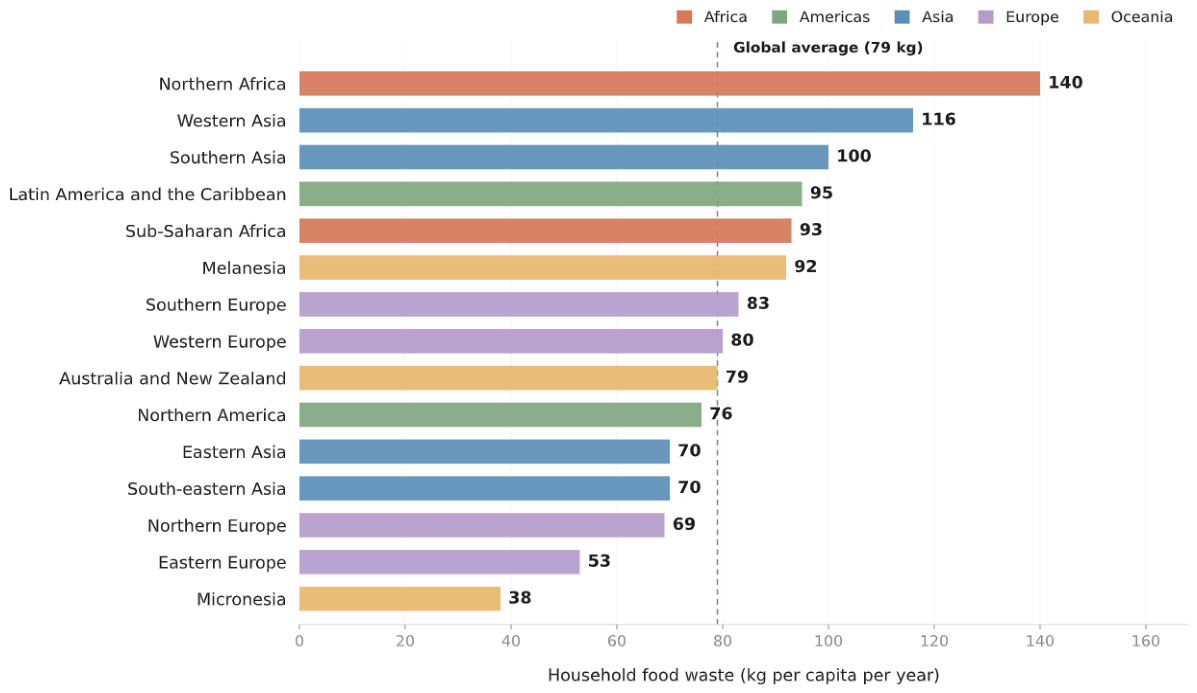
3. Food Waste Generation and Composition

| Food Category | Samples | Food Composition | Ref. | |||||
|---|---|---|---|---|---|---|---|---|
| Carbohydrate (%) | Protein (%) | Lipid (%) | ||||||
| Mean ± SD | Min–Max | Mean ± SD | Min–Max | Mean ± SD | Min–Max | |||
| Mixed FW | n = 12 | 41.87 ± 15.56 | 16.90–69.51 | 16.57 ± 6.91 | 3.40–29.60 | 20.08 ± 8.42 | 3.80–33.82 | [39,40,41,42,43,44,45] |
| Potato | n = 16 | 26.03 ± 13.12 | 12.4–64.83 | 2.65 ± 1.93 | 1.20–9.46 | 4.08 ± 7.06 | 0.05–24.7 | [46,47,48,49,50] |
| Bakery waste | n = 10 | 53.17 ± 13.88 | 37.42–86.04 | 10.58 ± 2.90 | 7.32–15 | 11.34 ± 13.14 | 0.40–35.32 | [51,52,53,54,55] |
| Fruits a | n = 46 | 13.51 ± 8.63 | 3.10–40.12 | 1.53 ± 1.65 | 0.20–8.60 | 0.99 ± 2.25 | 0.10–14.70 | [56,57,58,59] |
| Vegetables a | n = 34 | 8.27 ± 8.28 | 0.40–34.60 | 2.09 ± 1.35 | 0.30–6.40 | 0.42 ± 0.23 | 0.10–1.10 | [60,61,62] |
| Fish | n = 19 | - | - | 19.29 ± 1.89 | 15.61–21.80 | 2.33 ± 1.79 | 0.81–8.60 | [63,64,65] |
| Meat | n = 16 | 2 ± 2.27 | 0–8 | 18.33 ± 2.81 | 14.10–22.20 | 7.83 ± 6.84 | 1.10–26.40 | [66,67,68] |
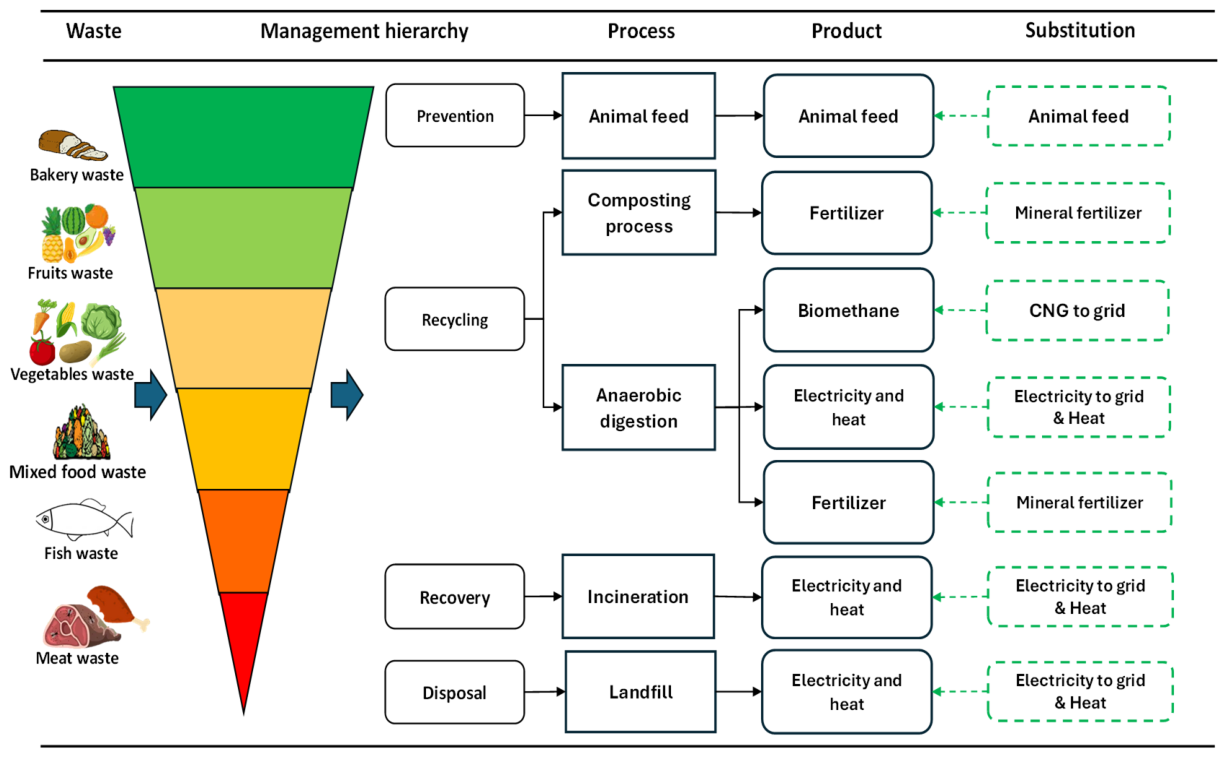
4. Food Waste Management Practice
| Feedstock | FW Management Option | Technology | Product | Economic Value | Environmental Impact (kg CO2-eq/t Feedstock) | Reference | ||
|---|---|---|---|---|---|---|---|---|
| Investment (M$/t Feedstock) | Production Cost (M$/t Feedstock) | Revenue (M$/t Feedstock) | ||||||
| FW | Animal feed | Dry process | Dry pallet feed | - | - | - | −28.3 | [105] |
| FW | Animal feed | Dry process | Dry pig feed | - | - | - | 39.6 | [106] |
| FW | Animal feed | Wet process | Wet pig feed | - | - | - | 2.09 | |
| FW | Composting | Composting | Fertilizer | - | - | - | −936.6 | [105] |
| FW | Composting | Composting | Fertilizer | 0.017 | 0.01 | 0.017 | - | [107] |
| FW | Composting | Top soil pot | Fertilizer | * 0.08 | * 0.042 | * 0.007 | - | [108] |
| Organic FW | Composting | Windrow composting | Fertilizer | - | ** 29.94 | ** 69.85 | 1.52 | [109] |
| FW | Composting | Open-air static pile | Fertilizer | 0.081 | 0.024 | 0.018 | −402.9 | [110] |
| FW | AD | Fermentation | Biomethane | - | - | -- | −61.8 | [105] |
| FW | AD | Methane upgrading | Biomethane | 0.033 | 0.008 | 0.014 | −37.7 | [111] |
| FW | AD | CHP | Electricity & heat | 0.038 | 0.0078 | 0.0017 | −193.5 | |
| FW | AD | Methane upgrading | Biomethane | 0.0302 | 0.0051 | 0.0042 | −219.9 | [112] |
| FW | AD | CHP | Electricity & heat | 0.0303 | 0.0017 | 0.0063 | −289.1 | |
| FW | AD | CHP | Electricity | 0.05 | 0.011 | 0.021 | 0.036 | [113] |
| FW | Incineration | Combustion | Electricity | - | - | - | 284 | [105] |
| a MSW | Incineration | Combustion | Electricity | 0.092 | 0.0037 | 0.0004 | - | [114] |
| FW | Incineration | CC | Electricity | - | - | - | 107 | [115] |
| a MSW | Incineration | MGC | Electricity | 0.0356 | 0.0014 | b −0.0009 | - | [116] |
| a MSW | Incineration | CFBC | Electricity | 0.0409 | 0.0016 | b −0.0082 | - | |
| a MSW | Incineration | Combustion | Electricity | 0.229 | 0.567 | b −0.584 | - | [117] |
| a MSW | Incineration | CHP | Electricity & heat | - | - | - | 58 | [118] |
| a MSW | Landfill | CHP | Electricity & heat | - | - | - | 223 | |
| FW | Landfill | CHP | Electricity & heat | - | - | - | 565.3 | [105] |
| b Organic waste | Landfill | CHP | Electricity & heat | 0.0034 | 0.00047 | b 0.129 | 3860 | [119] |
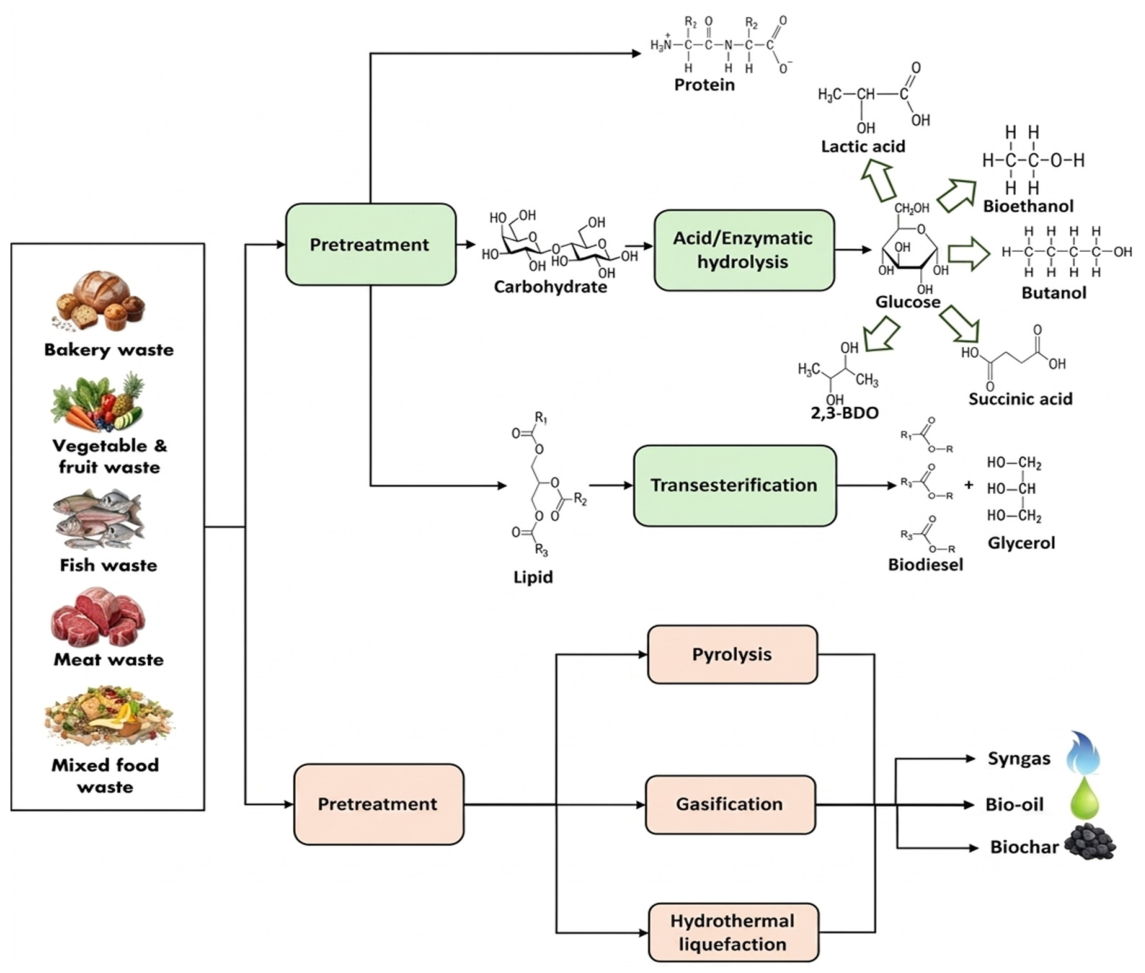
5. Food Waste Valorization
5.1. FW-Based Biochemical Conversion
5.1.1. Pretreatment
5.1.2. Macronutrient Extraction and Fractionation
| Substrate | Pretreatment | Microorganism/Catalyst/ Solvent | Product | Product Produced (g/L) | Yield (g/g) | Productivity (g L/h) | Reference |
|---|---|---|---|---|---|---|---|
| Bread waste | Acid hydrolysis | S. cerevisiae KL17 | Ethanol | 106.9 | 0.47 | 2.97 | [51] |
| Bread waste | Enzymatic hydrolysis | S. cerevisiae KL17 | Ethanol | 114.9 | 0.49 | 3.19 | |
| Bakery waste | Enzymatic hydrolysis | Lb. casei Shirota | Lactic acid | 94 | 0.92 | 2.61 | [165] |
| FW | Enzymatic hydrolysis | Lactobacillus pentosus | Lactic acid | 157 | 0.92 | 2 | [166] |
| Bakery waste | Enzymatic hydrolysis | Bacillus coagulans DSM1 | Lactic acid | 155.4 | 0.85 | 1.3 | [167] |
| Mixed FW | Enzymatic hydrolysis | Yarrowia lipolytica | Succinic acid | 31.7 | 0.52 | 0.6 | [168] |
| FW | Enzymatic hydrolysis | Y. lipolytica PSA02004 | Succinic acid | 87.8 | 0.56 | 0.7 | [169] |
| Bakery | Enzymatic hydrolysis | Actinobacillus succinogenes | Succinic acid | 47.3 | 0.55 | 1.12 | [170] |
| FW | - | Clostridium beijerinckii P260 | ABE | 18.9 | 0.38 | 0.46 | [171] |
| FW | Enzymatic hydrolysis | C. saccharoperbutylacetonicum deltptabuk | ABE | 19.65 | 0.43 | 1.93 | [172] |
| FW | - | C. beijerinckii P260 | ABE | 10 | 0.36 | 0.49 | [173] |
| Bread waste | Acid hydrolysis | Enterobacter ludwigii | BDO | 135.4 | 0.42 | - | [132] |
| Enzymatic hydrolysis | Enterobacter ludwigii | BDO | 138.8 | 0.48 | - | ||
| Bakery waste | Enzymatic hydrolysis | Bacillus licheniformis YNP5-TSU | BDO | 36.7 | 0.47 | 0.99 | [174] |
| FW | n-hexane extraction | KOH & Methanol | Biodiesel | - | 96.62 a | - | [175] |
| FW | Ethanol extraction | NaOH & Methanol | Biodiesel | - | 96.3 a | - | [176] |
| Bakery waste | Fungal hydrolysis | Novozyme-435 & methanol | Biodiesel | - | 90 a | - | [153] |
| Alkaline extraction | NaOH | Protein | - | 93.9 a | - | [160] | |
| FW | Enzyme extraction | Alcalase | Protein | - | 90.6 a | - | [158] |
| Soybean | Ultrasonication | - | Protein | - | 84 a | - | [159] |
5.2. FW-Based Thermochemical Conversion
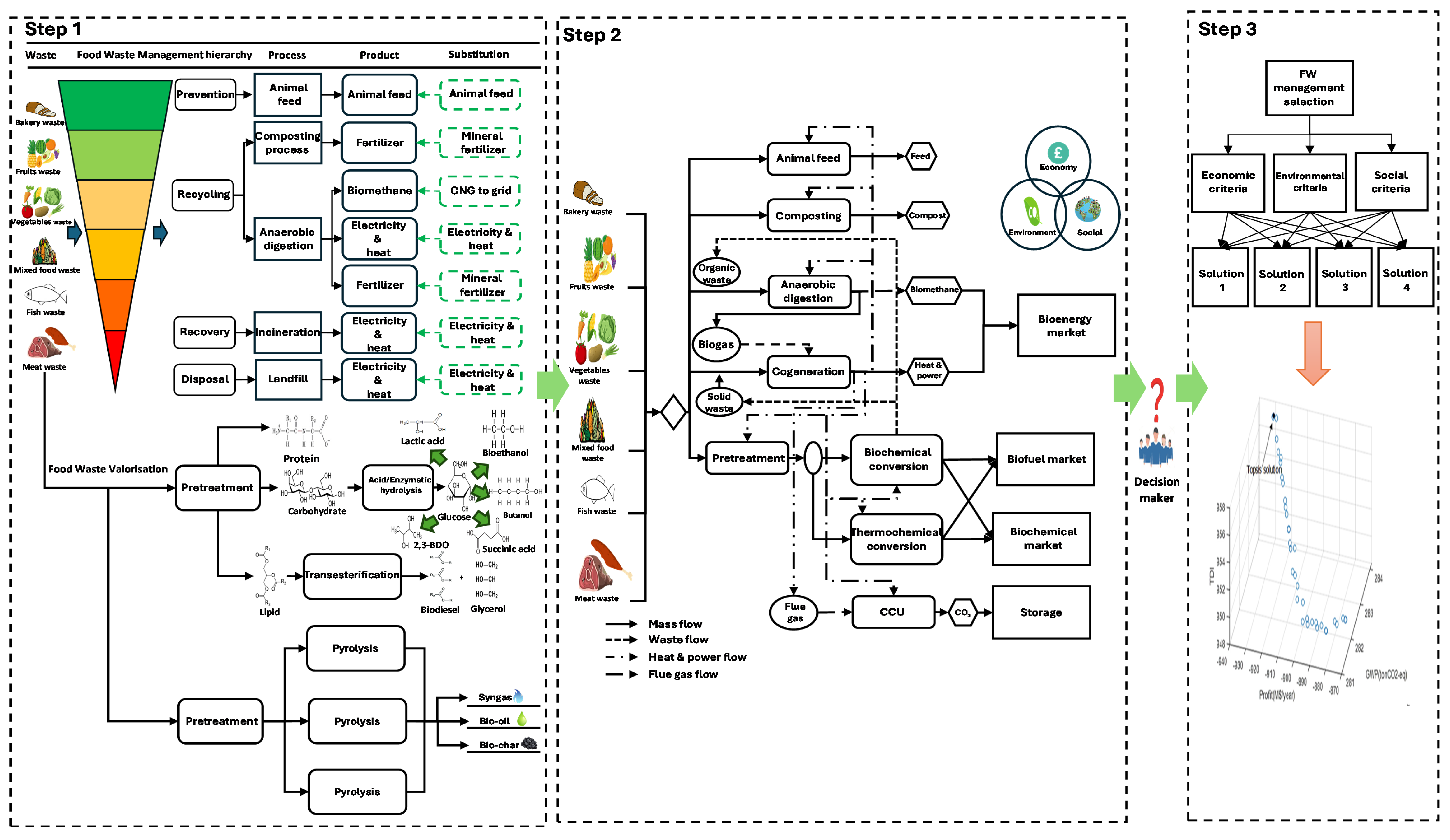
6. Food Waste Valorization Integration
7. Food Waste Management Challenges
8. Decision-Making Approach of Food Waste Management Selection
8.1. Multi-Objective Optimization of Integrated Food Waste Management
8.1.1. General Formulation
8.1.2. Problem Formulation Type
8.1.3. Objective Functions in Integrated FW Optimization
8.1.4. Uncertainty Problem Optimization
| Feedstock | Objective Function | Model Approach | Uncertain Parameters | Uncertainty Approach | Final Products | Reference | ||
|---|---|---|---|---|---|---|---|---|
| Economic | Environmental | Social | ||||||
| Beanstalk, Rice straw, Hardwood and softwood | √ | - | - | MILP | Product demands | DDRP | Bioethanol & electricity | [223] |
| MSW | √ | √ | - | MILP | Demand & cost | 2-stage SP | Electricity & biodiesel | [225] |
| Microalgae, wheat straw and corn stover | √ | - | - | MILP | Biomass supply, biofuel demand, price & costs | RP | Bioethanol | [221] |
| Beanstalk, Rice straw, Hardwood and softwood | √ | - | - | MILP | Biomass supply | RP | Bioethanol, & electricity | [226] |
| Microalgae | √ | √ | - | - | Product demands | RP | Biodiesel, methanol, biochar & power | [227] |
| Woody biomass | √ | - | - | MILP | Biomass supply | DDRP | Power | [222] |
| Forest waste | √ | - | - | MILP | Biomass productivity and selling price of product | RP | Pulp, lignin, and power | [228] |
| Potato peel, sugarcane, willow, poplar, & cornstover | √ | √ | - | MINLP | Biomass feedstock and products | SP | Butadiene, Jet fuel, surfactant, lubricant, p-xylene, H2 & power | [229] |
| Rice straw, wheat straw, maize straw, cow manure, and hen | √ | √ | √ | MILP | Biomass feedstock, product demand, and cost | RP | Power & fertilizer | [230] |
| Algae | √ | √ | - | MINLP | Biomass supply | RPP | Biodiesel | [231] |
| Forest waste | √ | - | - | MILP | Biomass feedstock, product demand, and cost | RP | Syngas | [232] |
| Woody biomass and seaweed | √ | √ | - | MILP | Biomass feedstock and products | SP | Biofuel | [233] |
| Waste animal fat | √ | √ | - | MILP | Biomass supply and biodiesel demand | RPP | Biodiesel | [234] |
| Sugarcane | - | √ | - | MILP | Biomass supply | RP | Bioethanol | [235] |
| Potato peels, poplar wood, red oak, sugarcane, corn stover | √ | √ | - | MINLP | Proces conversion, market price of biomass & products | RP | PSA, electricity, butadiene, jet-fuel, surfactants, lubricants, and PX | [236] |
8.2. Multi-Criteria Decision Making of Integrated Food Waste Management
9. Conclusions
Author Contributions
Funding
Institutional Review Board Statement
Informed Consent Statement
Data Availability Statement
Conflicts of Interest
Abbreviations
| FW | Food waste |
| FAO | Food and Agricultural Organization |
| UNEP | United Nations Environmental Programme |
| LCA | Life cycle assessment |
| USDA | United States Department of Agriculture |
| EPA | Environmental Protection Agency |
| NEA | National Environmental Agency |
| AVA | AgriFood and Veterinary Authority |
| AD | Anaerobic digestion |
| WWTPs | Wastewater treatment plant sludge |
| VOCs | Volatile organic compound |
| LFG | Landfill gas |
| DOE | Department of Energy |
| MOO | multi-objective optimization |
| MCDM | multi-criteria decision-making |
| TEA | Techno-economic assessment |
| SIA | Social impact assessment |
| CAPEX | Capital expenditure |
| OPEX | Operational expenditure |
| MILP | Mixed-integer linear programming |
| MINLP | Mixed-integer nonlinear programming |
| DDRP | Data driven robust programming |
| RP | Robust programming |
| SP | Stochastic programming |
| RPP | Robust probabilistic programming |
| AHP | Analytic hierarchy process |
| PWA | Power-weighted average |
| ARAS | Additive ratio assessment |
| CRITIC | Combining inter-criteria correlation |
| SVNSs | Single-valued neutrosophic sets |
References
- Burke, D.T.; Hynds, P.; Priyadarshini, A. Quantifying farm-to-fork greenhouse gas emissions for five dietary patterns across Europe and North America: A pooled analysis from 2009 to 2020. Resour. Environ. Sustain. 2023, 12, 100108. [Google Scholar] [CrossRef]
- Gonçalves, J.; Anjos, O.; Guiné, R.P.F. A Revisit of Plant Food Waste Along Food Supply Chains: Impacts and Perspectives. Foods 2025, 14, 1364. [Google Scholar] [CrossRef]
- UNEP. Food Waste Index Report 2024. Think Eat Save: Tracking Progress to Halve Global Food Waste. 2024. Available online: https://wedocs.unep.org/20.500.11822/45230 (accessed on 12 January 2025).
- Caldeira, C.; Vlysidis, A.; Fiore, G.; De Laurentiis, V.; Vignali, G.; Sala, S. Sustainability of food waste biorefinery: A review on valorisation pathways, techno-economic constraints, and environmental assessment. Bioresour. Technol. 2020, 312, 123575. [Google Scholar] [CrossRef]
- Kumar, A.; Ramamoorthy, D.; Kumar, N.; Chandra, P. Chapter 13—Food waste conversion into value-added products: Different pathways, current challenges, and opportunities. In Bio-Based Materials and Waste for Energy Generation and Resource Management; Hussain, C.M., Kushwaha, A., Bharagava, R.N., Goswami, L., Eds.; Elsevier: Amsterdam, The Netherlands, 2023; Volume 5, pp. 387–409. [Google Scholar]
- Rana, M.S.; Bhushan, S.; Prajapati, S.K.; Preethi; Kavitha, S. Chapter 15—Techno-economic analysis and environmental aspects of food waste management. In Food Waste to Valuable Resources; Banu, J.R., Kumar, G., Gunasekaran, M., Kavitha, S., Eds.; Academic Press: Cambridge, MA, USA, 2020; pp. 325–342. [Google Scholar] [CrossRef]
- Bräutigam, K.-R.; Jörissen, J.; Priefer, C. The extent of food waste generation across EU-27: Different calculation methods and the reliability of their results. Waste Manag. Res. 2014, 32, 683–694. [Google Scholar] [CrossRef]
- WRAP. UK Food Waste & Food Surplus—Key Facts. In Food Surplus and Waste in the UK—Key Facts; WRAP: Banbury, UK, 2025; Available online: https://www.wrap.ngo/resources/report/uk-food-waste-food-surplus-key-facts (accessed on 10 July 2025).
- Hu, P.; Toma, L.T.; Alam, A.; Ahmmed, M.T.; Islam, M.J.; Farhana, K.; Sultana, M.; Bhuiyan, M.A. A comprehensive review of food waste management in attaining SDG 12.3 goals: Insights from Asian countries. Front. Sustain. Food Syst. 2026, 9, 1710361. [Google Scholar] [CrossRef]
- European Commission: Directorate-General for Research and Innovation, E4tech, BTG, ICONS, FNR and WUR. EU Biorefinery Outlook to 2030—Studies on Support to Research and Innovation Policy in the Area of Bio-Based Products and Services; Publications Office of the European Union: Luxembourg, 2021; Available online: https://data.europa.eu/doi/10.2777/103465 (accessed on 10 May 2026).
- Department for Environment; Food and Rural Affairs (Defra). Our Waste, Our Resources: A Strategy for England. 2018. Available online: https://www.gov.uk/government/publications/resources-and-waste-strategy-for-england (accessed on 31 January 2024).
- DEFRA. Department of Energy. In Climate Change (DECC) and Department for Environment, Food & Rural Affairs. Anaerobic Digestion Strategy and Action Plan; DEFRA: London, UK, 2011. Available online: https://assets.publishing.service.gov.uk/government/uploads/system/uploads/attachment_data/file/69400/anaerobic-digestion-strat-action-plan.pdf (accessed on 31 January 2024).
- Liu, K.-M.; Lin, S.-H.; Hsieh, J.-C.; Tzeng, G.-H. Improving the food waste composting facilities site selection for sustainable development using a hybrid modified MADM model. Waste Manag. 2018, 75, 44–59. [Google Scholar] [CrossRef] [PubMed]
- Bakkaloglu, S.; Cooper, J.; Hawkes, A. Life cycle environmental impact assessment of methane emissions from the biowaste management strategy of the United Kingdom: Towards net zero emissions. J. Clean. Prod. 2022, 376, 134229. [Google Scholar] [CrossRef]
- Otles, S.; Kartal, C. 11—Food Waste Valorization. In Sustainable Food Systems from Agriculture to Industry; Galanakis, C.M., Ed.; Academic Press: Cambridge, MA, USA, 2018; pp. 371–399. [Google Scholar] [CrossRef]
- Talan, A.; Tiwari, B.; Yadav, B.; Tyagi, R.D.; Wong, J.W.C.; Drogui, P. Food waste valorization: Energy production using novel integrated systems. Bioresour. Technol. 2021, 322, 124538. [Google Scholar] [CrossRef] [PubMed]
- Sadhukhan, J.; Dugmore, T.I.J.; Matharu, A.; Martinez-Hernandez, E.; Aburto, J.; Rahman, P.K.S.M.; Lynch, J. Perspectives on “Game Changer” Global Challenges for Sustainable 21st Century: Plant-Based Diet, Unavoidable Food Waste Biorefining, and Circular Economy. Sustainability 2020, 12, 1976. [Google Scholar] [CrossRef]
- Ankush; Khushboo; Dubey, K.K. 17—Food industry waste biorefineries: Future energy, valuable recovery, and waste treatment. In Refining Biomass Residues for Sustainable Energy and Bioproducts; Kumar, R.P., Gnansounou, E., Raman, J.K., Baskar, G., Eds.; Academic Press: Cambridge, MA, USA, 2020; pp. 391–406. [Google Scholar] [CrossRef]
- Hafyan, R.H.; Mohanarajan, J.; Uppal, M.; Kumar, V.; Narisetty, V.; Maity, S.K.; Sadhukhan, J.; Gadkari, S. Integrated biorefinery for bioethanol and succinic acid co-production from bread waste: Techno-economic feasibility and life cycle assessment. Energy Convers. Manag. 2024, 301, 118033. [Google Scholar] [CrossRef]
- Rajendran, N.; Han, J. Techno-economic analysis and life cycle assessment of poly (butylene succinate) production using food waste. Waste Manag. 2023, 156, 168–176. [Google Scholar] [CrossRef]
- Li, Y.; Rosenthal, A.; Zhang, J.; Hawkins, T.R.; Liang, Y.; Urgun-Demirtas, M.; Bian, Y.; Ren, Z.J.; Tuteja, A.; Speer, D. Technoeconomic and Life Cycle Analysis of an Integrated Fermentation and Microbial Electrochemical Process for Volatile Fatty Acid Production from Food Waste. ACS Sustain. Chem. Eng. 2026, 14, 8660–8669. [Google Scholar] [CrossRef]
- Santagata, R.; Ripa, M.; Genovese, A.; Ulgiati, S. Food waste recovery pathways: Challenges and opportunities for an emerging bio-based circular economy. A systematic review and an assessment. J. Clean. Prod. 2021, 286, 125490. [Google Scholar] [CrossRef]
- Lenka, B.; El Fels, L.; Acharya, R.; Raklami, A. Harnessing the untapped value of food waste: A review of integrated valorization technologies. J. Mater. Cycles Waste Manag. 2026, 28, 57–78. [Google Scholar] [CrossRef]
- Arvelli, S.; Jia, L.; Zhang, M.; Zhao, J. Review of Advanced Technologies and Circular Pathways for Food Waste Valorization. J. Agric. Food Chem. 2025, 73, 16085–16108. [Google Scholar] [CrossRef]
- Hafyan, R.H.; Mohanarajan, J.; Uppal, M.; Kumar, V.; Narisetty, V.; Maity, S.K.; Sadhukhan, J.; Gadkari, S. Bread waste valorization: A review of sustainability aspects and challenges. Front. Sustain. Food Syst. 2024, 8, 1334801. (In English) [Google Scholar] [CrossRef]
- Malik, B.X.; Smith, L.; Stewart, I.; Burnett, N. Food Waste in the UK. Available online: https://commonslibrary.parliament.uk/research-briefings/cbp-7552/ (accessed on 12 April 2024).
- Murphy, F. Food Loss and Waste: Quantification, Impacts and Potential for Sustainable Management; Task 36; IEA Bioenergy: Paris, France, 2024. [Google Scholar]
- WRAP. Food Surplus and Waste in the UK Key Facts—Updated November 2023. 2023. Available online: https://wrap.org.uk/resources/report/food-surplus-and-waste-uk-key-facts-updated-november-2023 (accessed on 31 January 2024).
- Todd, E.C.D.; Faour-Klingbeil, D. Impact of Food Waste on Society, Specifically at Retail and Foodservice Levels in Developed and Developing Countries. Foods 2024, 13, 2098. [Google Scholar] [CrossRef] [PubMed]
- Mohamed Yusoff, N.I.B.; Godsell, J.; Woolley, E. Towards zero waste: A comprehensive framework for categorizing household food waste. Sustain. Prod. Consum. 2024, 48, 1–13. [Google Scholar] [CrossRef]
- Abdelradi, F. Food waste behaviour at the household level: A conceptual framework. Waste Manag. 2018, 71, 485–493. [Google Scholar] [CrossRef] [PubMed]
- Elgarahy, A.M.; Eloffy, M.G.; Alengebawy, A.; El-Sherif, D.M.; Gaballah, M.S.; Elwakeel, K.Z.; El-Qelish, M. Sustainable management of food waste; pre-treatment strategies, techno-economic assessment, bibliometric analysis, and potential utilizations: A systematic review. Environ. Res. 2023, 225, 115558. [Google Scholar] [CrossRef]
- Banks, C.; Heaven, S.; Zhang, Y.; Baier, U. Food Waste Digestion: Anaerobic Digestion of Food Waste for a Circular Economy. 2018. Available online: https://www.ieabioenergy.com/blog/publications/food-waste-digestion-anaerobic-digestion-of-food-waste-for-a-circular-economy/ (accessed on 10 July 2025).
- Yang, Y.-F.; Ye, G.-B.; Wang, H.-J.; Li, H.-Y.; Lin, C.S.K.; Zheng, X.-F.; Pugazhendhi, A.; Wang, X. Utilization of lipidic food waste as low-cost nutrients for enhancing the potentiality of biofuel production from engineered diatom under temperature variations. Bioresour. Technol. 2023, 387, 129611. [Google Scholar] [CrossRef]
- Priefer, C.; Jörissen, J.; Braeutigam, K.-R. Options for Cutting Down on Food Waste—Layman’s Summary; STOA: Brussels, Belgium, 2013; Available online: https://www.europarl.europa.eu/stoa/en/document/IPOL-JOIN_ET(2013)513515/ (accessed on 10 July 2025).
- Salimi, E.; Saragas, K.; Taheri, M.E.; Novakovic, J.; Barampouti, E.M.; Mai, S.; Moustakas, K.; Malamis, D.; Loizidou, M. The Role of Enzyme Loading on Starch and Cellulose Hydrolysis of Food Waste. Waste Biomass Valorization 2019, 10, 3753–3762. [Google Scholar] [CrossRef]
- Kumar, V.; Longhurst, P. Recycling of food waste into chemical building blocks. Curr. Opin. Green Sustain. Chem. 2018, 13, 118–122. [Google Scholar] [CrossRef]
- Yukesh Kannah, R.; Merrylin, J.; Poornima Devi, T.; Kavitha, S.; Sivashanmugam, P.; Kumar, G.; Rajesh Banu, J. Food waste valorization: Biofuels and value added product recovery. Bioresour. Technol. Rep. 2020, 11, 100524. [Google Scholar] [CrossRef]
- Wang, L.; Shen, F.; Yuan, H.; Zou, D.; Liu, Y.; Zhu, B.; Li, X. Anaerobic co-digestion of kitchen waste and fruit/vegetable waste: Lab-scale and pilot-scale studies. Waste Manag. 2014, 34, 2627–2633. [Google Scholar] [CrossRef]
- Vavouraki, A.I.; Volioti, V.; Kornaros, M.E. Optimization of thermo-chemical pretreatment and enzymatic hydrolysis of kitchen wastes. Waste Manag. 2014, 34, 167–173. [Google Scholar] [CrossRef]
- Bhatt, A.H.; Tao, L. Economic Perspectives of Biogas Production via Anaerobic Digestion. Bioengineering 2020, 7, 74. [Google Scholar] [CrossRef]
- Browne, J.D.; Murphy, J.D. The impact of increasing organic loading in two phase digestion of food waste. Renew. Energy 2014, 71, 69–76. [Google Scholar] [CrossRef]
- Zhang, J.; Gu, D.; Chen, J.; He, Y.; Dai, Y.; Loh, K.-C.; Tong, Y.W. Assessment and optimization of a decentralized food-waste-to-energy system with anaerobic digestion and CHP for energy utilization. Energy Convers. Manag. 2021, 228, 113654. [Google Scholar] [CrossRef]
- Hafid, H.S.; Nor’Aini, A.R.; Mokhtar, M.N.; Talib, A.T.; Baharuddin, A.S.; Umi Kalsom, M.S. Over production of fermentable sugar for bioethanol production from carbohydrate-rich Malaysian food waste via sequential acid-enzymatic hydrolysis pretreatment. Waste Manag. 2017, 67, 95–105. [Google Scholar] [CrossRef]
- Shen, F.; Yuan, H.; Pang, Y.; Chen, S.; Zhu, B.; Zou, D.; Liu, Y.; Ma, J.; Yu, L.; Li, X. Performances of anaerobic co-digestion of fruit & vegetable waste (FVW) and food waste (FW): Single-phase vs. two-phase. Bioresour. Technol. 2013, 144, 80–85. [Google Scholar] [CrossRef]
- Pedreschi, F.; Cocio, C.; Moyano, P.; Troncoso, E. Oil distribution in potato slices during frying. J. Food Eng. 2008, 87, 200–212. [Google Scholar] [CrossRef]
- Gontariu, I.; Buculei, A. The appreciation and determination the chemical composition of the tubercles at some potato grades. J. Agroaliment. Process. Technol. 2010, 16, 54–58. [Google Scholar]
- Damto, T.; Chala, G. Effect of blanching and frying time on the sensory quality of fried sweet potato chips. Food Nutr. Sci. Int. J. 2019, 3, 1–17. [Google Scholar]
- Robertson, T.M.; Alzaabi, A.Z.; Robertson, M.D.; Fielding, B.A. Starchy Carbohydrates in a Healthy Diet: The Role of the Humble Potato. Nutrients 2018, 10, 1764. [Google Scholar] [CrossRef]
- Senanayake, S.; Gunaratne, A.; Ranaweera, K.; Bamunuarachchi, A. Physico-chemical properties of five cultivars of sweet potato (Ipomea batatas Lam (L)) root tubers grown in Sri Lanka. Trop. Agric. 2013, 90, 87–96. [Google Scholar]
- Narisetty, V.; Nagarajan, S.; Gadkari, S.; Ranade, V.V.; Zhang, J.; Patchigolla, K.; Bhatnagar, A.; Kumar Awasthi, M.; Pandey, A.; Kumar, V. Process optimization for recycling of bread waste into bioethanol and biomethane: A circular economy approach. Energy Convers. Manag. 2022, 266, 115784. [Google Scholar] [CrossRef]
- Leung, C.C.J.; Cheung, A.S.Y.; Zhang, A.Y.-Z.; Lam, K.F.; Lin, C.S.K. Utilisation of waste bread for fermentative succinic acid production. Biochem. Eng. J. 2012, 65, 10–15. [Google Scholar] [CrossRef]
- Adessi, A.; Venturi, M.; Candeliere, F.; Galli, V.; Granchi, L.; De Philippis, R. Bread wastes to energy: Sequential lactic and photo-fermentation for hydrogen production. Int. J. Hydrogen Energy 2018, 43, 9569–9576. [Google Scholar] [CrossRef]
- Han, W.; Huang, J.; Zhao, H.; Li, Y. Continuous biohydrogen production from waste bread by anaerobic sludge. Bioresour. Technol. 2016, 212, 1–5. [Google Scholar] [CrossRef]
- Haque, M.A.; Kachrimanidou, V.; Koutinas, A.; Lin, C.S.K. Valorization of bakery waste for biocolorant and enzyme production by Monascus purpureus. J. Biotechnol. 2016, 231, 55–64. [Google Scholar] [CrossRef]
- Gómez-Maqueo, A.; Escobedo-Avellaneda, Z.; Welti-Chanes, J. Phenolic Compounds in Mesoamerican Fruits—Characterization, Health Potential and Processing with Innovative Technologies. Int. J. Mol. Sci. 2020, 21, 18357. [Google Scholar] [CrossRef]
- Maldonado-Celis, M.E.; Yahia, E.M.; Bedoya, R.; Landázuri, P.; Loango, N.; Aguillón, J.; Restrepo, B.; Guerrero Ospina, J.C. Chemical Composition of Mango (Mangifera indica L.) Fruit: Nutritional and Phytochemical Compounds. Front. Plant Sci. 2019, 10, 1073. (In English) [Google Scholar] [CrossRef]
- Dhumal, S.; Karale, A.; Garande, V.; Chavan, U.; Jadhav, S.; Kad, V. Recent advances and developments in pomegranate processing and utilization: A review. J. Agric. Crop Sci. 2012, 1, 1–17. [Google Scholar]
- De Matos, M.E.; Bianchi Pedroni Medeiros, A.; De Melo Pereira, G.V.; Thomaz Soccol, V.; Soccol, C.R. Production and Characterization of a Distilled Alcoholic Beverage Obtained by Fermentation of Banana Waste (Musa cavendishii) from Selected Yeast. Fermentation 2017, 3, 62. [Google Scholar] [CrossRef]
- Seal, T.; Pillai, B.; Chaudhuri, K. Nutritional potential of wild edible fruits, traditionally used by the local people of Meghalaya state in India. Indian J. Nat. Prod. Resour. (IJNPR) [Former. Nat. Prod. Radiance (NPR)] 2015, 5, 359–364. [Google Scholar]
- Ebabhi, A.; Adebayo, R. Nutritional values of vegetables. In Vegetable Crops-Health Benefits and Cultivation; IntechOpen: London, UK, 2022. [Google Scholar] [CrossRef]
- Houngla, E.J.H.; Gbankoto, A.; Mizehoun-Adissoda, C.; Anani, C.B.L.; Edorh, P.A.; Moutaïrou, K.; Sohounhloué, D.C. Nutrient Composition and Heavy Metals Content of Three Leafy Vegetables (Amaranthus cruentus L., Lactuca sativa L., Solanum macrocarpon L.) in Porto-Novo, Republic of Benin. J. Food Nutr. Res. 2020, 8, 80–86. [Google Scholar]
- Das, N.; Khuntia, B.; Raychaudhuri, U.; Dora, K.; Ganguly, S. Effect of water washing on the functional properties of fish meat. Int. J. Med. Microbiol. Trop. Dis. 2015, 1, 8–12. [Google Scholar]
- Ajeeshkumar, K.; Vishnu, K.; Kumari, K.R.; Navaneethan, R.; Asha, K.; Ganesan, B.; Niladri, S.; Anandan, R.; Mathew, S. Biochemical composition and heavy metal content of selected marine fish from the Gulf of Mannar, India. J. Fish. Technol. 2015, 52, 164–169. [Google Scholar]
- Lilly, T.; Immaculate, J.; Jamila, P. Macro and micronutrients of selected marine fishes in Tuticorin, South East coast of India. Int. Food Res. J. 2017, 24, 191–201. [Google Scholar]
- Hammad, H.; Ma, M.; Damaka, A.; Elkhedir, A.; Jin, G. Effect of freeze and re-freeze on chemical composition of beef and poultry meat at storage period 4.5 months (SP4. 5). J. Food Process. Technol. 2019, 10, 5. [Google Scholar]
- Choe, J.-H.; Yang, H.-S.; Lee, S.-H.; Go, G.-W. Characteristics of pork belly consumption in South Korea and their health implication. J. Anim. Sci. Technol. 2015, 57, 22. [Google Scholar] [CrossRef]
- Murphy, K.J.; Thomson, R.L.; Coates, A.M.; Buckley, J.D.; Howe, P.R.C. Effects of Eating Fresh Lean Pork on Cardiometabolic Health Parameters. Nutrients 2012, 4, 711–723. [Google Scholar] [CrossRef]
- Chen, C.R.; Chen, R.J.C. Using Two Government Food Waste Recognition Programs to Understand Current Reducing Food Loss and Waste Activities in the U.S. Sustainability 2018, 10, 2760. [Google Scholar] [CrossRef]
- Blanchard, C.; Harris, P.; Pocock, C.; McCabe, B.K. Food and Garden Organic Waste Management in Australia: Co-Benefits for Regional Communities and Local Government. Sustainability 2023, 15, 9901. [Google Scholar] [CrossRef]
- Joshi, P.; Visvanathan, C. Sustainable management practices of food waste in Asia: Technological and policy drivers. J. Environ. Manag. 2019, 247, 538–550. [Google Scholar] [CrossRef]
- Jia, B.; Ng, B.; Mao, Y.; Chen, C.-L.; Rajagopal, R.; Wang, J.-Y. Municipal food waste management in Singapore: Practices, challenges and recommendations. J. Mater. Cycles Waste Manag. 2015, 19, 560–569. [Google Scholar] [CrossRef]
- Lee, E.; Shurson, G.; Oh, S.-H.; Jang, J.-C. The Management of Food Waste Recycling for a Sustainable Future: A Case Study on South Korea. Sustainability 2024, 16, 854. [Google Scholar] [CrossRef]
- Meng, M.; Wen, Z.; Luo, W.; Wang, S. Approaches and Policies to Promote Zero-Waste City Construction: China’s Practices and Lessons. Sustainability 2021, 13, 13537. [Google Scholar] [CrossRef]
- EC. Directive 2008/98/EC of the European Parliament and of the Council of 19 November 2008 on Waste and Repealing Certain Directives (Text with EEA Relevance). 2008. Available online: https://eur-lex.europa.eu/legal-content/EN/TXT/?uri=CELEX:32008L0098 (accessed on 10 July 2025).
- Facchini, F.; Silvestri, B.; Digiesi, S.; Lucchese, A. Agri-food loss and waste management: Win-win strategies for edible discarded fruits and vegetables sustainable reuse. Innov. Food Sci. Emerg. Technol. 2023, 83, 103235. [Google Scholar] [CrossRef]
- Brancoli, P.; Bolton, K.; Eriksson, M. Environmental impacts of waste management and valorisation pathways for surplus bread in Sweden. Waste Manag. 2020, 117, 136–145. [Google Scholar] [CrossRef]
- Eriksson, M.; Strid, I.; Hansson, P.-A. Carbon footprint of food waste management options in the waste hierarchy—A Swedish case study. J. Clean. Prod. 2015, 93, 115–125. [Google Scholar] [CrossRef]
- San Martin, D.; Ramos, S.; Zufía, J. Valorisation of food waste to produce new raw materials for animal feed. Food Chem. 2016, 198, 68–74. [Google Scholar] [CrossRef]
- Quintero-Herrera, S.; Zwolinski, P.; Evrard, D.; Cano-Gómez, J.J.; Rivas-García, P. Turning food loss and waste into animal feed: A Mexican spatial inventory of potential generation of agro-industrial wastes for livestock feed. Sustain. Prod. Consum. 2023, 41, 36–48. [Google Scholar] [CrossRef]
- Boumans, I.J.M.M.; Schop, M.; Bracke, M.B.M.; de Boer, I.J.M.; Gerrits, W.J.J.; Bokkers, E.A.M. Feeding food losses and waste to pigs and poultry: Implications for feed quality and production. J. Clean. Prod. 2022, 378, 134623. [Google Scholar] [CrossRef]
- Wong, M.-H.; Mo, W.-Y.; Choi, W.-M.; Cheng, Z.; Man, Y.-B. Recycle food wastes into high quality fish feeds for safe and quality fish production. Environ. Pollut. 2016, 219, 631–638. [Google Scholar] [CrossRef]
- Siddiqui, Z.; Hagare, D.; Jayasena, V.; Swick, R.; Rahman, M.M.; Boyle, N.; Ghodrat, M. Recycling of food waste to produce chicken feed and liquid fertiliser. Waste Manag. 2021, 131, 386–393. [Google Scholar] [CrossRef]
- Tian, H.; Wang, X.; Lim, E.Y.; Lee, J.T.E.; Ee, A.W.L.; Zhang, J.; Tong, Y.W. Life cycle assessment of food waste to energy and resources: Centralized and decentralized anaerobic digestion with different downstream biogas utilization. Renew. Sustain. Energy Rev. 2021, 150, 111489. [Google Scholar] [CrossRef]
- Sardarmehni, M.; Levis, J.W.; Barlaz, M.A. What Is the Best End Use for Compost Derived from the Organic Fraction of Municipal Solid Waste? Environ. Sci. Technol. 2021, 55, 73–81. [Google Scholar] [CrossRef]
- Amato, A.; Tsigkou, K.; Becci, A.; Beolchini, F.; Ippolito, N.M.; Ferella, F. Life Cycle Assessment of Biomethane vs. Fossil Methane Production and Supply. Energies 2023, 16, 4555. [Google Scholar] [CrossRef]
- Karthikeyan, O.P.; Mehariya, S.; Chung Wong, J.W. Bio-refining of food waste for fuel and value products. Energy Procedia 2017, 136, 14–21. [Google Scholar] [CrossRef]
- Yan, J.; Salman, C.A. Chapter 2—Waste-to-energy (WtE): Current technologies and their future potential. In Waste Biorefineries; Yan, J., Salman, C.A., Eds.; Elsevier: Amsterdam, The Netherlands, 2023; pp. 25–61. [Google Scholar] [CrossRef]
- Ouadi, M.; Bashir, M.A.; Speranza, L.G.; Jahangiri, H.; Hornung, A. Food and Market Waste–A Pathway to Sustainable Fuels and Waste Valorization. Energy Fuels 2019, 33, 9843–9850. [Google Scholar] [CrossRef]
- Kaur, A.; Bharti, R.; Sharma, R. Municipal solid waste as a source of energy. Mater. Today Proc. 2023, 81, 904–915. [Google Scholar] [CrossRef]
- Hla, S.S.; Roberts, D. Characterisation of chemical composition and energy content of green waste and municipal solid waste from Greater Brisbane, Australia. Waste Manag. 2015, 41, 12–19. [Google Scholar] [CrossRef]
- Đurđević, D.; Blecich, P.; Jurić, Ž. Energy Recovery from Sewage Sludge: The Case Study of Croatia. Energies 2019, 12, 1927. [Google Scholar] [CrossRef]
- Xiao, H.; Cheng, Q.; Liu, M.; Li, L.; Ru, Y.; Yan, D. Industrial disposal processes for treatment of polychlorinated dibenzo-p-dioxins and dibenzofurans in municipal solid waste incineration fly ash. Chemosphere 2020, 243, 125351. [Google Scholar] [CrossRef]
- Delkash, M. Air Emissions from Combustion and Incineration Processes: Insights into Air Quality and US EPA Regulations. Water Air Soil Pollut. 2025, 237, 104. [Google Scholar] [CrossRef]
- Sarkar, N.; Ganguly, A.; Chatterjee, P.K. 8—Valorization of food waste. In Handbook of Advanced Approaches Towards Pollution Prevention and Control; Rahman, R.O.A., Hussain, C.M., Eds.; Elsevier: Amsterdam, The Netherlands, 2021; pp. 157–172. [Google Scholar] [CrossRef]
- El-Saadony, M.T.; Saad, A.M.; Fahmy, M.A.; Mohammed, D.M.; Salem, H.M.; Abd El-Mageed, T.A.; Abu-Elsaoud, A.M.; Alsyaad, K.M.; Ahmed, A.E.; Al-Najjar, M.A.A.; et al. Hazardous landfill leachate: Integrated treatment strategies, regulatory frameworks, and circular economy perspectives. Ecotoxicol. Environ. Saf. 2026, 312, 119878. [Google Scholar] [CrossRef]
- Bouyakhsass, R.; Souabi, S.; Bouaouda, S.; Taleb, A.; Kurniawan, T.A.; Liang, X.; Goh, H.H.; Anouzla, A. Adding value to unused landfill gas for renewable energy on-site at Oum Azza landfill (Morocco): Environmental feasibility and cost-effectiveness. Trends Food Sci. Technol. 2023, 142, 104168. [Google Scholar] [CrossRef]
- Vandermeersch, T.; Alvarenga, R.A.F.; Ragaert, P.; Dewulf, J. Environmental sustainability assessment of food waste valorization options. Resour. Conserv. Recycl. 2014, 87, 57–64. [Google Scholar] [CrossRef]
- Alsaleh, A.; Aleisa, E. Triple Bottom-Line Evaluation of the Production of Animal Feed from Food Waste: A Life Cycle Assessment. Waste Biomass Valorization 2023, 14, 1169–1195. [Google Scholar] [CrossRef]
- Evangelisti, S.; Lettieri, P.; Borello, D.; Clift, R. Life cycle assessment of energy from waste via anaerobic digestion: A UK case study. Waste Manag. 2014, 34, 226–237. [Google Scholar] [CrossRef]
- Slorach, P.C.; Jeswani, H.K.; Cuéllar-Franca, R.; Azapagic, A. Environmental sustainability of anaerobic digestion of household food waste. J. Environ. Manag. 2019, 236, 798–814. [Google Scholar] [CrossRef]
- Slorach, P.C.; Jeswani, H.K.; Cuéllar-Franca, R.; Azapagic, A. Environmental and economic implications of recovering resources from food waste in a circular economy. Sci. Total Environ. 2019, 693, 133516. [Google Scholar] [CrossRef]
- Slorach, P.C.; Jeswani, H.K.; Cuéllar-Franca, R.; Azapagic, A. Assessing the economic and environmental sustainability of household food waste management in the UK: Current situation and future scenarios. Sci. Total Environ. 2020, 710, 135580. [Google Scholar] [CrossRef]
- Ma, Y.; Liu, Y. Turning food waste to energy and resources towards a great environmental and economic sustainability: An innovative integrated biological approach. Biotechnol. Adv. 2019, 37, 107414. [Google Scholar] [CrossRef]
- Aleisa, E.; Alsaleh, A. Upcycling food waste into animal feed: An environmental assessment based on food waste quantities in different district types in Kuwait. J. Eng. Res. 2024, 13, 2212–2223. [Google Scholar] [CrossRef]
- Salemdeeb, R.; zu Ermgassen, E.K.H.J.; Kim, M.H.; Balmford, A.; Al-Tabbaa, A. Environmental and health impacts of using food waste as animal feed: A comparative analysis of food waste management options. J. Clean. Prod. 2017, 140, 871–880. [Google Scholar] [CrossRef]
- Su, Y.; Zhou, S.; Tian, P.; Qi, C.; Xu, Z.; Zhang, Y.; Huh, S.-Y.; Luo, W.; Li, G.; Li, Y. Techno-economic assessment of industrial food waste composting facility: Evaluating bulking agents, processing strategies, and market dynamics. Bioresour. Technol. 2024, 408, 131210. [Google Scholar] [CrossRef]
- Al Mussa Ugak, M.; Mohamad, N.E.; Rajin, M.; Lamaming, J.; Saalah, S.; Yaser, A.Z. Passive aerated in-vessel composting of food waste with the addition of Sabah ragi for campus sustainability: Mass balance, dwarf crape jasmine growth and techno-economic study. J. Mater. Cycles Waste Manag. 2023, 25, 899–909. [Google Scholar] [CrossRef]
- Rashid, M.I.; Shahzad, K. Food waste recycling for compost production and its economic and environmental assessment as circular economy indicators of solid waste management. J. Clean. Prod. 2021, 317, 128467. [Google Scholar] [CrossRef]
- Keng, Z.X.; Chong, S.; Ng, C.G.; Ridzuan, N.I.; Hanson, S.; Pan, G.-T.; Lau, P.L.; Supramaniam, C.V.; Singh, A.; Chin, C.F.; et al. Community-scale composting for food waste: A life-cycle assessment-supported case study. J. Clean. Prod. 2020, 261, 121220. [Google Scholar] [CrossRef]
- Rahmani, A.M.; Hafyan, R.H.; Tyagi, V.K.; Gadkari, S.; Kazmi, A.A.; Ojha, C.S.P. Advanced anaerobic co-digestion of hydrothermally pretreated wheat straw: Process performance, techno-economic and life cycle assessment. J. Environ. Manag. 2025, 373, 123559. [Google Scholar] [CrossRef]
- Chen, Y.; Pinegar, L.; Immonen, J.; Powell, K.M. Conversion of food waste to renewable energy: A techno-economic and environmental assessment. J. Clean. Prod. 2023, 385, 135741. [Google Scholar] [CrossRef]
- Rasheed, R.; Yasar, A.; Wang, Y.; Tabinda, A.B.; Ahmad, S.R.; Tahir, F.; Su, Y. Environmental impact and economic sustainability analysis of a novel anaerobic digestion waste-to-energy pilot plant in Pakistan. Environ. Sci. Pollut. Res. 2019, 26, 26404–26417. [Google Scholar] [CrossRef]
- Yakah, N.; Kwarteng, A.A.; Addy, C.; Yirenkyi, M.; Martin, A.; Simons, A. Techno-Economic Assessment of Municipal Solid Waste (MSW) Incineration in Ghana. Processes 2024, 12, 1286. [Google Scholar] [CrossRef]
- Tong, H.; Shen, Y.; Zhang, J.; Wang, C.-H.; Ge, T.S.; Tong, Y.W. A comparative life cycle assessment on four waste-to-energy scenarios for food waste generated in eateries. Appl. Energy 2018, 225, 1143–1157. [Google Scholar] [CrossRef]
- Escamilla-García, P.E.; Camarillo-López, R.H.; Carrasco-Hernández, R.; Fernández-Rodríguez, E.; Legal-Hernández, J.M. Technical and economic analysis of energy generation from waste incineration in Mexico. Energy Strategy Rev. 2020, 31, 100542. [Google Scholar] [CrossRef]
- Leme, M.M.V.; Rocha, M.H.; Lora, E.E.S.; Venturini, O.J.; Lopes, B.M.; Ferreira, C.H. Techno-economic analysis and environmental impact assessment of energy recovery from Municipal Solid Waste (MSW) in Brazil. Resour. Conserv. Recycl. 2014, 87, 8–20. [Google Scholar] [CrossRef]
- Jeswani, H.K.; Azapagic, A. Assessing the environmental sustainability of energy recovery from municipal solid waste in the UK. Waste Manag. 2016, 50, 346–363. [Google Scholar] [CrossRef]
- Otero Meza, D.D.; Sagastume Gutiérrez, A.; Cabello Eras, J.J.; Salcedo Mendoza, J.; Hernández Ruydíaz, J. Techno-economic and environmental assessment of the landfill gas to energy potential of major Colombian cities. Energy Convers. Manag. 2023, 293, 117522. [Google Scholar] [CrossRef]
- Rahman, T.; Deb, N.; Alam, M.Z.; Moniruzzaman, M.; Miah, M.S.; Horaira, M.A.; Kamal, R. Navigating the contemporary landscape of food waste management in developing countries: A comprehensive overview and prospective analysis. Heliyon 2024, 10, e33218. [Google Scholar] [CrossRef]
- Dong, J.; Tang, Y.; Nzihou, A.; Chi, Y.; Weiss-Hortala, E.; Ni, M. Life cycle assessment of pyrolysis, gasification and incineration waste-to-energy technologies: Theoretical analysis and case study of commercial plants. Sci. Total Environ. 2018, 626, 744–753. [Google Scholar] [CrossRef]
- Wijekoon, P.; Koliyabandara, P.A.; Cooray, A.T.; Lam, S.S.; Athapattu, B.C.L.; Vithanage, M. Progress and prospects in mitigation of landfill leachate pollution: Risk, pollution potential, treatment and challenges. J. Hazard. Mater. 2022, 421, 126627. [Google Scholar] [CrossRef]
- Mia, M.S.; Ahmed, M.M.; Zzaman, W. Valorization of food waste into functional ingredients supports a sustainable strategy for the food industry. Discov. Food 2025, 5, 275. [Google Scholar] [CrossRef]
- Narisetty, V.; Adlakha, N.; Kumar Singh, N.; Dalei, S.K.; Prabhu, A.A.; Nagarajan, S.; Naresh Kumar, A.; Amruthraj Nagoth, J.; Kumar, G.; Singh, V.; et al. Integrated biorefineries for repurposing of food wastes into value-added products. Bioresour. Technol. 2022, 363, 127856. [Google Scholar] [CrossRef]
- Ye, Y.; Guo, W.; Ngo, H.H.; Wei, W.; Cheng, D.; Bui, X.T.; Hoang, N.B.; Zhang, H. Biofuel production for circular bioeconomy: Present scenario and future scope. Sci. Total Environ. 2024, 935, 172863. [Google Scholar] [CrossRef]
- Kwan, T.H.; Pleissner, D.; Lau, K.Y.; Venus, J.; Pommeret, A.; Lin, C.S.K. Techno-economic analysis of a food waste valorization process via microalgae cultivation and co-production of plasticizer, lactic acid and animal feed from algal biomass and food waste. Bioresour. Technol. 2015, 198, 292–299. [Google Scholar] [CrossRef] [PubMed]
- Sharma, H.B.; Vanapalli, K.R.; Samal, B.; Cheela, V.R.S.; Dubey, B.K.; Bhattacharya, J. Circular economy approach in solid waste management system to achieve UN-SDGs: Solutions for post-COVID recovery. Sci. Total Environ. 2021, 800, 149605. [Google Scholar] [CrossRef]
- Ashraf Joolaei, A.; Makian, M.; Prakash, O.; Im, S.; Kang, S.; Kim, D.-H. Effects of particle size on the pretreatment efficiency and subsequent biogas potential of polylactic acid. Bioresour. Technol. 2024, 394, 130306. [Google Scholar] [CrossRef]
- Li, Z.; Jiang, X.; Shi, W.; Yang, D.; Zhao, Y.; Zhou, T. Enhancement of Anaerobic Digestion from Food Waste via Ultrafine Wet Milling Pretreatment: Simulation, Performance, and Mechanisms. Sustainability 2024, 16, 2933. [Google Scholar] [CrossRef]
- Sawarkar, A.N.; Kirti, N.; Tagade, A.; Tekade, S.P. Bioethanol from various types of banana waste: A review. Bioresour. Technol. Rep. 2022, 18, 101092. [Google Scholar] [CrossRef]
- Hernández Pérez, R.; Salgado Delgado, R.; Olarte Paredes, A.; Salgado Delgado, A.; García Hernández, E.; Medrano Valis, A.; Martínez Candia, F. Comparing Acid and Enzymatic Hydrolysis Methods for Cellulose Nanocrystals (CNCs) Obtention from Agroindustrial Rice Husk Waste. J. Nanotechnol. 2022, 2022, 5882113. [Google Scholar] [CrossRef]
- Narisetty, V.; Zhang, L.; Zhang, J.; Sze Ki Lin, C.; Wah Tong, Y.; Loke Show, P.; Kant Bhatia, S.; Misra, A.; Kumar, V. Fermentative production of 2,3-Butanediol using bread waste—A green approach for sustainable management of food waste. Bioresour. Technol. 2022, 358, 127381. [Google Scholar] [CrossRef]
- Manju. Chapter 21—Food wastes for bioethanol production. In Value-Addition in Agri-food Industry Waste Through Enzyme Technology; Academic Press: Cambridge, MA, USA, 2023; pp. 315–328. [Google Scholar] [CrossRef]
- Taheri, M.E.; Salimi, E.; Saragas, K.; Novakovic, J.; Barampouti, E.M.; Mai, S.; Malamis, D.; Moustakas, K.; Loizidou, M. Effect of pretreatment techniques on enzymatic hydrolysis of food waste. Biomass Convers. Biorefin. 2021, 11, 219–226. [Google Scholar] [CrossRef]
- Werpy, T.; Petersen, G. Top Value Added Chemicals from Biomass: Volume I—Results of Screening for Potential Candidates from Sugars and Synthesis Gas; National Renewable Energy Lab. (NREL): Golden, CO, USA, 2004. [Google Scholar]
- LBNet. UK Top Bio-Based Chemicals Opportunities; E4tech (UK) Ltd. for LBNet: London, UK, 2017; Available online: https://www.bbnet-nibb.co.uk/resource/uk-top-bio-based-chemicals-opportunities (accessed on 10 July 2025).
- Kumar, R.S.; Jain, A.; Singh, N.K.; Ghosh, S. Bioethanol production from mixed sugars at a semi-pilot scale through two-step repeated sequential fermentation. Fuel 2024, 357, 130042. [Google Scholar] [CrossRef]
- Abedi, E.; Hashemi, S.M.B. Lactic acid production—Producing microorganisms and substrates sources-state of art. Heliyon 2020, 6, e04974. [Google Scholar] [CrossRef]
- Tran, V.G.; Mishra, S.; Bhagwat, S.S.; Shafaei, S.; Shen, Y.; Allen, J.L.; Crosly, B.A.; Tan, S.-I.; Fatma, Z.; Rabinowitz, J.D.; et al. An end-to-end pipeline for succinic acid production at an industrially relevant scale using Issatchenkia orientalis. Nat. Commun. 2023, 14, 6152. [Google Scholar] [CrossRef] [PubMed]
- Mailaram, S.; Narisetty, V.; Ranade, V.V.; Kumar, V.; Maity, S.K. Techno-Economic Analysis for the Production of 2,3-Butanediol from Brewers’ Spent Grain Using Pinch Technology. Ind. Eng. Chem. Res. 2022, 61, 2195–2205. [Google Scholar] [CrossRef]
- Hou, X.; From, N.; Angelidaki, I.; Huijgen, W.J.J.; Bjerre, A.-B. Butanol fermentation of the brown seaweed Laminaria digitata by Clostridium beijerinckii DSM-6422. Bioresour. Technol. 2017, 238, 16–21. [Google Scholar] [CrossRef]
- Bhuiya, M.M.K.; Rasul, M.; Khan, M.; Ashwath, N.; Mofijur, M. Comparison of oil extraction between screw press and solvent (n-hexane) extraction technique from beauty leaf (Calophyllum inophyllum L.) feedstock. Ind. Crops Prod. 2020, 144, 112024. [Google Scholar] [CrossRef]
- He, Y.; Huang, Z.; Zhong, C.; Guo, Z.; Chen, B. Pressurized liquid extraction with ethanol as a green and efficient technology to lipid extraction of Isochrysis biomass. Bioresour. Technol. 2019, 293, 122049. [Google Scholar] [CrossRef]
- Kanda, H.; Hoshino, R.; Murakami, K.; Wahyudiono; Zheng, Q.; Goto, M. Lipid extraction from microalgae covered with biomineralized cell walls using liquefied dimethyl ether. Fuel 2020, 262, 116590. [Google Scholar] [CrossRef]
- Pleissner, D.; Kwan, T.H.; Lin, C.S.K. Fungal hydrolysis in submerged fermentation for food waste treatment and fermentation feedstock preparation. Bioresour. Technol. 2014, 158, 48–54. [Google Scholar] [CrossRef]
- Carmona-Cabello, M.; García, I.L.; Papadaki, A.; Tsouko, E.; Koutinas, A.; Dorado, M.P. Biodiesel production using microbial lipids derived from food waste discarded by catering services. Bioresour. Technol. 2021, 323, 124597. [Google Scholar] [CrossRef] [PubMed]
- Kim, J.Y.; Yeom, S.H. Optimization of Biodiesel Production from Waste Coffee Grounds by Simultaneous Lipid Extraction and Transesterification. Biotechnol. Bioprocess Eng. 2020, 25, 320–326. [Google Scholar] [CrossRef]
- Rajendran, N.; Han, J. Integrated polylactic acid and biodiesel production from food waste: Process synthesis and economics. Bioresour. Technol. 2022, 343, 126119. [Google Scholar] [CrossRef]
- Bhuana, D.S.; Qadariyah, L.; Panjaitan, R.; Mahfud, M. Optimization of biodiesel production from Chlorella sp through in-situ microwave-assisted acid-catalyzed trans-esterification. IOP Conf. Ser. Mater. Sci. Eng. 2020, 732, 012004. [Google Scholar] [CrossRef]
- Shinde, K.; Kaliaguine, S. A Comparative Study of Ultrasound Biodiesel Production Using Different Homogeneous Catalysts. ChemEngineering 2019, 3, 18. [Google Scholar] [CrossRef]
- Mandari, V.; Devarai, S.K. Biodiesel Production Using Homogeneous, Heterogeneous, and Enzyme Catalysts via Transesterification and Esterification Reactions: A Critical Review. BioEnergy Res. 2022, 15, 935–961. [Google Scholar] [CrossRef] [PubMed]
- Kapil, A.; Wilson, K.; Lee, A.F.; Sadhukhan, J. Kinetic Modeling Studies of Heterogeneously Catalyzed Biodiesel Synthesis Reactions. Ind. Eng. Chem. Res. 2011, 50, 4818–4830. [Google Scholar] [CrossRef]
- Karmee, S.K.; Linardi, D.; Lee, J.; Lin, C.S.K. Conversion of lipid from food waste to biodiesel. Waste Manag. 2015, 41, 169–173. [Google Scholar] [CrossRef]
- Kamal, H.; Le, C.F.; Salter, A.M.; Ali, A. Extraction of protein from food waste: An overview of current status and opportunities. Compr. Rev. Food Sci. Food Saf. 2021, 20, 2455–2475. [Google Scholar] [CrossRef]
- Zaelani, B.F.D.; Safithri, M.; Tarman, K.; Setyaningsih, I.; Meydia. Collagen isolation with acid soluble method from the skin of Red Snapper (lutjanus sp.). IOP Conf. Ser. Earth Environ. Sci. 2019, 241, 012033. [Google Scholar] [CrossRef]
- Zhang, Y.; Tu, D.; Shen, Q.; Dai, Z. Fish Scale Valorization by Hydrothermal Pretreatment Followed by Enzymatic Hydrolysis for Gelatin Hydrolysate Production. Molecules 2019, 24, 2998. [Google Scholar] [CrossRef]
- Choi, Y.H.; Verpoorte, R. Green solvents for the extraction of bioactive compounds from natural products using ionic liquids and deep eutectic solvents. Curr. Opin. Food Sci. 2019, 26, 87–93. [Google Scholar] [CrossRef]
- Görgüç, A.; Özer, P.; Yılmaz, F.M. Microwave-assisted enzymatic extraction of plant protein with antioxidant compounds from the food waste sesame bran: Comparative optimization study and identification of metabolomics using LC/Q-TOF/MS. J. Food Process. Preserv. 2020, 44, e14304. [Google Scholar] [CrossRef]
- Eze, O.F.; Chatzifragkou, A.; Charalampopoulos, D. Properties of protein isolates extracted by ultrasonication from soybean residue (okara). Food Chem. 2022, 368, 130837. [Google Scholar] [CrossRef]
- Barrios, C.; Fernández-Delgado, M.; López-Linares, J.C.; García-Cubero, M.T.; Coca, M.; Lucas, S. A techno-economic perspective on a microwave extraction process for efficient protein recovery from agri-food wastes. Ind. Crops Prod. 2022, 186, 115166. [Google Scholar] [CrossRef]
- Shahid, K.; Srivastava, V.; Sillanpää, M. Protein recovery as a resource from waste specifically via membrane technology—From waste to wonder. Environ. Sci. Pollut. Res. 2021, 28, 10262–10282. [Google Scholar] [CrossRef]
- Navaf, M.; Sunooj, K.V.; Aaliya, B.; Sudheesh, C.; Akhila, P.P.; Mir, S.A.; Nemtanu, M.R.; George, J.; Lackner, M.; Mousavi Khaneghah, A. Contemporary insights into the extraction, functional properties, and therapeutic applications of plant proteins. J. Agric. Food Res. 2023, 14, 100861. [Google Scholar] [CrossRef]
- Sadhukhan, J.; Gadkari, S.; Martinez-Hernandez, E.; Ng, K.S.; Shemfe, M.; Torres-Garcia, E.; Lynch, J. Novel macroalgae (seaweed) biorefinery systems for integrated chemical, protein, salt, nutrient and mineral extractions and environmental protection by green synthesis and life cycle sustainability assessments. Green Chem. 2019, 21, 2635–2655. [Google Scholar] [CrossRef]
- Ladakis, D.; Stylianou, E.; Ioannidou, S.-M.; Koutinas, A.; Pateraki, C. Biorefinery development, techno-economic evaluation and environmental impact analysis for the conversion of the organic fraction of municipal solid waste into succinic acid and value-added fractions. Bioresour. Technol. 2022, 354, 127172. [Google Scholar] [CrossRef]
- Kwan, T.H.; Hu, Y.; Lin, C.S.K. Valorisation of food waste via fungal hydrolysis and lactic acid fermentation with Lactobacillus casei Shirota. Bioresour. Technol. 2016, 217, 129–136. [Google Scholar] [CrossRef]
- Lobeda, K.; Jin, Q.; Wu, J.; Zhang, W.; Huang, H. Lactic acid production from food waste hydrolysate by Lactobacillus pentosus: Focus on nitrogen supplementation, initial sugar concentration, pH, and fed-batch fermentation. J. Food Sci. 2022, 87, 3071–3083. [Google Scholar] [CrossRef]
- Cox, R.; Narisetty, V.; Nagarajan, S.; Agrawal, D.; Ranade, V.V.; Salonitis, K.; Venus, J.; Kumar, V. High-Level fermentative production of Lactic acid from bread waste under Non-sterile conditions with a circular biorefining approach and zero waste discharge. Fuel 2022, 313, 122976. [Google Scholar] [CrossRef]
- Li, C.; Ong, K.L.; Yang, X.; Lin, C.S.K. Bio-refinery of waste streams for green and efficient succinic acid production by engineered Yarrowia lipolytica without pH control. Chem. Eng. J. 2019, 371, 804–812. [Google Scholar] [CrossRef]
- Yang, X.; Wang, H.; Li, C.; Lin, C.S.K. Restoring of Glucose Metabolism of Engineered Yarrowia lipolytica for Succinic Acid Production via a Simple and Efficient Adaptive Evolution Strategy. J. Agric. Food Chem. 2017, 65, 4133–4139. [Google Scholar] [CrossRef]
- Gadkari, S.; Kumar, D.; Qin, Z.-h.; Ki Lin, C.S.; Kumar, V. Life cycle analysis of fermentative production of succinic acid from bread waste. Waste Manag. 2021, 126, 861–871. [Google Scholar] [CrossRef]
- Teresa Sponza, D.; Öztekin, R. 1-Butanol Production from the Food Wastes in Dokuz Eylül University Campus Buca-Izmir, Turkey. Open J. Case Rep. 2022, 3, 1–5. [Google Scholar]
- Jin, Q.; An, Z.; Damle, A.; Poe, N.; Wu, J.; Wang, H.; Wang, Z.; Huang, H. High Acetone-Butanol-Ethanol Production from Food Waste by Recombinant Clostridium saccharoperbutylacetonicum in Batch and Continuous Immobilized-Cell Fermentation. ACS Sustain. Chem. Eng. 2020, 8, 9822–9832. [Google Scholar] [CrossRef]
- Huang, H.; Singh, V.; Qureshi, N. Butanol production from food waste: A novel process for producing sustainable energy and reducing environmental pollution. Biotechnol. Biofuels 2015, 8, 147. [Google Scholar] [CrossRef]
- Yu, D.; O’Hair, J.; Poe, N.; Jin, Q.; Pinton, S.; He, Y.; Huang, H. Conversion of Food Waste into 2,3-Butanediol via Thermophilic Fermentation: Effects of Carbohydrate Content and Nutrient Supplementation. Foods 2022, 11, 169. [Google Scholar] [CrossRef]
- Jain, S. Biodiesel production from food waste using insitu transesterification method. Sustain. Energy Technol. Assess. 2023, 58, 103380. [Google Scholar] [CrossRef]
- Rajendran, N.; Kang, D.; Han, J.; Gurunathan, B. Process optimization, economic and environmental analysis of biodiesel production from food waste using a citrus fruit peel biochar catalyst. J. Clean. Prod. 2022, 365, 132712. [Google Scholar] [CrossRef]
- Parvari, E.; Mahajan, D.; Hewitt, E.L. A Review of Biomass Pyrolysis for Production of Fuels: Chemistry, Processing, and Techno-Economic Analysis. Biomass 2025, 5, 54. [Google Scholar] [CrossRef]
- Zaharioiu, A.M.; Şandru, C.; Ionete, E.I.; Marin, F.; Ionete, R.E.; Soare, A.; Constantinescu, M.; Bucura, F.; Niculescu, V.-C. Eco-Friendly Alternative Disposal through the Pyrolysis Process of Meat and Bone Meal. Materials 2022, 15, 6593. [Google Scholar] [CrossRef]
- Fadhil, A.B.; Ahmed, A.I.; Salih, H.A. Production of liquid fuels and activated carbons from fish waste. Fuel 2017, 187, 435–445. [Google Scholar] [CrossRef]
- Kim, S.; Lee, Y.; Andrew Lin, K.-Y.; Hong, E.; Kwon, E.E.; Lee, J. The valorization of food waste via pyrolysis. J. Clean. Prod. 2020, 259, 120816. [Google Scholar] [CrossRef]
- Elgazar, Y.G.; Khalifeh, H.A.; Alkhedher, M.; Ramadan, M. A review of hydrogen production from food waste through gasification process. Int. J. Hydrogen Energy 2024, 67, 959–969. [Google Scholar] [CrossRef]
- Mirzaei, R.; Tavakoli, O. Sustainable hydrogen production via subcritical and supercritical water gasification of food waste: An optimization and reaction pathway study. J. Energy Inst. 2026, 125, 102427. [Google Scholar] [CrossRef]
- Raizada, A.; Yadav, S.; Tripathi, M.; Misra, S.; Mohanty, P. Food waste treatment using in situ gasification after pyrolysis to produce hydrogen-rich syngas. Biomass Convers. Biorefin. 2023, 13, 9689–9699. [Google Scholar] [CrossRef]
- Raizada, A.; Shukla, A.; Yadav, S.; Modak, S.; Katiyar, P. Food Waste Ash Supported Nickel Catalyst to Steam Gasification of Food Waste for Enhanced Tar Reduction and Hydrogen Production. BioEnergy Res. 2025, 18, 22. [Google Scholar] [CrossRef]
- Raizada, A.; Shukla, A.; Yadav, S.; Katiyar, P.; Kumar, R. Enhancement of H2 production via catalytic steam gasification of food waste as feedstock and its ash as a support and promoter for Ni catalyst. Int. J. Hydrogen Energy 2024, 60, 272–281. [Google Scholar] [CrossRef]
- Sharma, T.; Hakeem, I.G.; Gupta, A.B.; Joshi, J.; Shah, K.; Vuppaladadiyam, A.K.; Sharma, A. Parametric influence of process conditions on thermochemical techniques for biochar production: A state-of-the-art review. J. Energy Inst. 2024, 113, 101559. [Google Scholar] [CrossRef]
- Liu, M.; Zeng, Y. Key Processing Factors in Hydrothermal Liquefaction and Their Impacts on Corrosion of Reactor Alloys. Sustainability 2023, 15, 9317. [Google Scholar] [CrossRef]
- Tito, E.; Marcolongo, C.A.; Pipitone, G.; Monteverde, A.H.A.; Bensaid, S.; Pirone, R. Understanding the effect of heating rate on hydrothermal liquefaction: A comprehensive investigation from model compounds to a real food waste. Bioresour. Technol. 2024, 396, 130446. [Google Scholar] [CrossRef]
- Bayat, H.; Dehghanizadeh, M.; Jarvis, J.M.; Brewer, C.E.; Jena, U. Hydrothermal Liquefaction of Food Waste: Effect of Process Parameters on Product Yields and Chemistry. Front. Sustain. Food Syst. 2021, 5, 658592. [Google Scholar] [CrossRef]
- Brilovich Mosseri, M.; Duenyas, A.; Cohen, E.M.A.; Vitkin, E.; Steinbruch, E.; Epstein, M.; Kribus, A.; Gozin, M.; Golberg, A. Hydrothermal liquefaction of representative to Israel food waste model. Energy Convers. Manag. X 2023, 20, 100475. [Google Scholar] [CrossRef]
- Etezadi, R.; Zhao, L.; Tsotsis, T. Chapter 18—Syngas from food waste. In Advances in Synthesis Gas: Methods, Technologies and Applications; Rahimpour, M.R., Makarem, M.A., Meshksar, M., Eds.; Elsevier: Amsterdam, The Netherlands, 2023; Volume 1, pp. 439–455. [Google Scholar] [CrossRef]
- Kane, S.; Ryan, C. Biochar from food waste as a sustainable replacement for carbon black in upcycled or compostable composites. Compos. Part C Open Access 2022, 8, 100274. [Google Scholar] [CrossRef]
- Oyedun, A.O.; Patel, M.; Kumar, M.; Kumar, A. The Upgrading of Bio-Oil via Hydrodeoxygenation. In Chemical Catalysts for Biomass Upgrading; John Wiley & Sons: Hoboken, NJ, USA, 2020; pp. 35–60. [Google Scholar] [CrossRef]
- Mei, D.; Hu, Q.; Zhao, W.; Dai, S.; Wu, W.; Feng, P. Combustion performances evaluation of bio-oil upgraded via catalytic cracking of coconut oil. Energy Sources Part A Recovery Util. Environ. Eff. 2026, 48, 2637783. [Google Scholar] [CrossRef]
- Lin, P.; Yi, W.; Zhang, D.; Wang, F.; Fu, P.; Duan, X.; Sheng, Y. Hydrogen production from light bio-oil: Effect of bio-oil separation processes on catalytic steam reforming. Int. J. Hydrogen Energy 2025, 186, 152044. [Google Scholar] [CrossRef]
- Motta, I.L.; Marchesan, A.N.; Maciel Filho, R.; Maciel, M.R.W. Syngas cleaning and conditioning in biomass gasification plants: A review of technologies, bibliometric trends, and future directions. Int. J. Hydrogen Energy 2025, 154, 150234. [Google Scholar] [CrossRef]
- Danesh, P.; Prussi, M.; Salimbeni, A.; Negro, V.; Chiaramonti, D. Review on Biochar Upgrading Methods for Its Application in Thermochemical Conversion Processes and Critical Materials Recovery. Sustainability 2025, 17, 10194. [Google Scholar] [CrossRef]
- Elkamel, A.; Kim, K.; Hourfar, F.; Laljee, M.M.; Fowler, M. Optimal and sustainable design of integrated biorefineries for microalgae and municipal solid waste processing. J. Clean. Prod. 2025, 519, 145938. [Google Scholar] [CrossRef]
- Criado, A.; Martín, M. Integrated Multiproduct Facility for the Production of Chemicals, Food, and Utilities from Oranges. Ind. Eng. Chem. Res. 2020, 59, 7722–7731. [Google Scholar] [CrossRef]
- Mailaram, S.; Narisetty, V.; Maity, S.K.; Gadkari, S.; Thakur, V.K.; Russell, S.; Kumar, V. Lactic acid and biomethane production from bread waste: A techno-economic and profitability analysis using pinch technology. Sustain. Energy Fuels 2023, 7, 3034–3046. [Google Scholar] [CrossRef]
- Hafyan, R.H.; Sadhukhan, J.; Gadkari, S. Multi-objective optimization of bread waste valorization: A framework for integrated food waste management. Resour. Conserv. Recycl. 2026, 229, 108871. [Google Scholar] [CrossRef]
- Kumar, V.; Brancoli, P.; Narisetty, V.; Wallace, S.; Charalampopoulos, D.; Dubey, B.K.; Kumar, G.; Bhatnagar, A.; Bhatia, S.K.; Taherzadeh, M.J. Bread waste—A potential feedstock for sustainable circular biorefineries. Bioresour. Technol. 2022, 369, 128449. [Google Scholar] [CrossRef]
- Soni, R.; Bhardwaj, A.; Jarangal, L.P.S. Bread waste and mitigation strategies: A review. In Proceedings of the IOP Conference Series: Materials Science and Engineering; IOP Publishing: Bristol, UK, 2022; Volume 1248, p. 012010. [Google Scholar] [CrossRef]
- Valipour, M.; Mafakheri, F.; Gagnon, B.; Prinz, R.; Bergström, D.; Brown, M.; Wang, C. Integrating bio-hubs in biomass supply chains: Insights from a systematic literature review. J. Clean. Prod. 2024, 467, 142930. [Google Scholar] [CrossRef]
- Chen, C.-S.; Narani, A.; Daniyar, A.; McCauley, J.; Brown, S.; Pray, T.; Tanjore, D. Ensemble models of feedstock blend ratios to minimize supply chain risk in bio-based manufacturing. Biochem. Eng. J. 2022, 181, 107896. [Google Scholar] [CrossRef]
- Ehrgott, M.; Köksalan, M.; Kadziński, M.; Deb, K. Fifty years of multi-objective optimization and decision-making: From mathematical programming to evolutionary computation. Eur. J. Oper. Res. 2026, 330, 1–25. [Google Scholar] [CrossRef]
- Abbas, S.; Robinson, A.J.; Papadokonstantakis, S. Superstructure configuration and optimization of the biofuel production perspectives in Austria. In Computer Aided Chemical Engineering; Kokossis, A.C., Georgiadis, M.C., Pistikopoulos, E., Eds.; Elsevier: Amsterdam, The Netherlands, 2023; Volume 52, pp. 619–624. [Google Scholar] [CrossRef]
- Sadhukhan, J.; Sen, S.; Randriamahefasoa, T.M.S.; Gadkari, S. Energy System Optimization for Net-Zero Electricity. Digit. Chem. Eng. 2022, 3, 100026. [Google Scholar] [CrossRef]
- Krishnan, R.; Arshinder, K.; Agarwal, R. Robust optimization of sustainable food supply chain network considering food waste valorization and supply uncertainty. Comput. Ind. Eng. 2022, 171, 108499. [Google Scholar] [CrossRef]
- Amin, H.; Rizwan, M.; Mukhtar, M.; Zaman, M.; Naqvi, S.R.; Elkamel, A.; Shehzad, K. Evaluation of optimal technology for the sustainable processing of municipal solid waste employing MINLP model: A case study of Pakistan. In Energy Systems; Springer: Berlin/Heidelberg, Germany, 2024. [Google Scholar] [CrossRef]
- Giuliano, A.; Poletto, M.; Barletta, D. Process optimization of a multi-product biorefinery: The effect of biomass seasonality. Chem. Eng. Res. Des. 2016, 107, 236–252. [Google Scholar] [CrossRef]
- Sadhukhan, J.; Ng, K.S.; Hernandez, E.M. Life Cycle Assessment. In Biorefineries and Chemical Processes; John Wiley & Sons: Hoboken, NJ, USA, 2014; pp. 93–146. [Google Scholar] [CrossRef]
- Hafyan, R.H.; Bhullar, L.K.; Mahadzir, S.; Bilad, M.R.; Nordin, N.A.H.; Wirzal, M.D.H.; Putra, Z.A.; Rangaiah, G.P.; Abdullah, B. Integrated Biorefinery of Empty Fruit Bunch from Palm Oil Industries to Produce Valuable Biochemicals. Processes 2020, 8, 868. [Google Scholar] [CrossRef]
- Sadhukhan, J.; Sen, S.; Gadkari, S. The Mathematics of life cycle sustainability assessment. J. Clean. Prod. 2021, 309, 127457. [Google Scholar] [CrossRef]
- Saleem, N.N.; Yin, N.L.; Andiappan, V. Process Synthesis of Biorefineries under Uncertain Feedstock Conditions Based on Hurwicz Criterion. Process Integr. Optim. Sustain. 2021, 5, 231–246. [Google Scholar] [CrossRef]
- Bairamzadeh, S.; Saidi-Mehrabad, M.; Pishvaee, M.S. Modelling different types of uncertainty in biofuel supply network design and planning: A robust optimization approach. Renew. Energy 2018, 116, 500–517. [Google Scholar] [CrossRef]
- Mavromatidis, G.; Orehounig, K.; Carmeliet, J. Design of distributed energy systems under uncertainty: A two-stage stochastic programming approach. Appl. Energy 2018, 222, 932–950. [Google Scholar] [CrossRef]
- Xie, C.; Tian, Y.; Wu, L. Multiperiod Two-Stage Stochastic Programming of Supply Chain for Co-Processing System of Bio-Oil and Heavy Oil. ACS Sustain. Chem. Eng. 2023, 11, 3850–3860. [Google Scholar] [CrossRef]
- Huynh, D.; Ierapetritou, M. Biorefinery superstructure optimization under carbon pricing policies using stochastic programming. Appl. Energy 2024, 376, 124283. [Google Scholar] [CrossRef]
- He, W.; Zhao, J.; Zhao, L.; Li, Z.; Yang, M.; Liu, T. Data-driven two-stage distributionally robust optimization for refinery planning under uncertainty. Chem. Eng. Sci. 2023, 269, 118466. [Google Scholar] [CrossRef]
- Jabbarzadeh, A.; Shamsi, M. Designing a resilient and sustainable multi-feedstock bioethanol supply chain: Integration of mathematical modeling and machine learning. Appl. Energy 2025, 377, 123794. [Google Scholar] [CrossRef]
- Sadeghi Darvazeh, S.; Mansoori Mooseloo, F.; Gholian-Jouybari, F.; Amiri, M.; Bonakdari, H.; Hajiaghaei-Keshteli, M. Data-driven robust optimization to design an integrated sustainable forest biomass-to-electricity network under disjunctive uncertainties. Appl. Energy 2024, 356, 122404. [Google Scholar] [CrossRef]
- Huang, X.; Ji, L.; Xie, Y.; Luo, Z. Robust optimization of regional biomass supply chain system design and operation with data-driven uncertainties. Food Bioprod. Process. 2025, 149, 176–189. [Google Scholar] [CrossRef]
- Zhang, Y.; Liu, Y.; Shu, S.; Zheng, F.; Huang, Z. A data-driven distributionally robust optimization model for multi-energy coupled system considering the temporal-spatial correlation and distribution uncertainty of renewable energy sources. Energy 2021, 216, 119171. [Google Scholar] [CrossRef]
- Mukhtar, M.; Rizwan, M.; Ullah, A.; Elkamel, A.; Raza Naqvi, S.; Zaman, M. Municipal solid waste supply chain optimization for value-added product development under uncertainty. Waste Manag. Bull. 2025, 3, 66–75. [Google Scholar] [CrossRef]
- Huang, X.; Ji, L.; Yin, J.; Huang, G. Optimal design and robust operational management of regional bioethanol supply chain with various technological choices and uncertainty fusions. Comput. Chem. Eng. 2024, 182, 108565. [Google Scholar] [CrossRef]
- Co, D.V.Y.; Lim, A.S.O.; Ng, R.C.N.; Sy, K.W.V.; San Juan, J.L. Integrating heterogenous robustness levels to the multi-objective target-oriented robust optimization of a microalgal biorefinery. J. Clean. Prod. 2024, 475, 143675. [Google Scholar] [CrossRef]
- Theozzo, B.; Teles dos Santos, M. A robust optimization framework for forest biorefineries design considering uncertainties on biomass growth and product selling prices. Comput. Chem. Eng. 2023, 175, 108256. [Google Scholar] [CrossRef]
- Luo, Y.; Ierapetritou, M. Multifeedstock and Multiproduct Process Design Using Neural Network Surrogate Flexibility Constraints. Ind. Eng. Chem. Res. 2023, 62, 2067–2079. [Google Scholar] [CrossRef]
- Zarrinpoor, N. Bioenergy production from agro-livestock waste under uncertainty: A sustainable network design. Biomass Convers. Biorefin. 2024, 14, 1149–1172. [Google Scholar] [CrossRef]
- Umar, M.; Tayyab, M.; Chaudhry, H.R.; Su, C.-W. Navigating epistemic uncertainty in third-generation biodiesel supply chain management through robust optimization for economic and environmental performance. Ann. Oper. Res. 2023, 359, 1485–1524. [Google Scholar] [CrossRef]
- Ahmadvand, S.; Sowlati, T. A robust optimization model for tactical planning of the forest-based biomass supply chain for syngas production. Comput. Chem. Eng. 2022, 159, 107693. [Google Scholar] [CrossRef]
- Zarei, M.; Shams, M.H.; Niaz, H.; Won, W.; Lee, C.-J.; Liu, J.J. Risk-based multistage stochastic mixed-integer optimization for biofuel supply chain management under multiple uncertainties. Renew. Energy 2022, 200, 694–705. [Google Scholar] [CrossRef]
- Habib, M.S.; Omair, M.; Ramzan, M.B.; Chaudhary, T.N.; Farooq, M.; Sarkar, B. A robust possibilistic flexible programming approach toward a resilient and cost-efficient biodiesel supply chain network. J. Clean. Prod. 2022, 366, 132752. [Google Scholar] [CrossRef]
- Abdali, H.; Sahebi, H.; Pishvaee, M. A sustainable robust optimization model to design a sugarcane-based bioenergy supply network: A case study. Chem. Eng. Res. Des. 2022, 180, 265–284. [Google Scholar] [CrossRef]
- Bhosekar, A.; Athaley, A.; Ierapetritou, M. Multiobjective Modular Biorefinery Configuration under Uncertainty. Ind. Eng. Chem. Res. 2021, 60, 12956–12969. [Google Scholar] [CrossRef]
- Iacovidou, E.; Voulvoulis, N. A multi-criteria sustainability assessment framework: Development and application in comparing two food waste management options using a UK region as a case study. Environ. Sci. Pollut. Res. 2018, 25, 35821–35834. [Google Scholar] [CrossRef]
- Sanaei, S.; Chambost, V.; Stuart, P.R. Systematic assessment of triticale-based biorefinery strategies: Sustainability assessment using multi-criteria decision-making (MCDM). Biofuels Bioprod. Biorefining 2018, 12, S73–S86. [Google Scholar] [CrossRef]
- Makarichi, L.; Techato, K.-a.; Jutidamrongphan, W. Material flow analysis as a support tool for multi-criteria analysis in solid waste management decision-making. Resour. Conserv. Recycl. 2018, 139, 351–365. [Google Scholar] [CrossRef]
- Taherdoost, H.; Madanchian, M. Multi-Criteria Decision Making (MCDM) Methods and Concepts. Encyclopedia 2023, 3, 77–87. [Google Scholar] [CrossRef]
- Zarei, M.; Cherif, A.; Yoon, H.-J.; Liu, J.J.; Lee, C.-J. Optimal design of a biofuel supply chain using an augmented multi-objective and TOPSIS method. Green Chem. 2023, 25, 4067–4075. [Google Scholar] [CrossRef]
- Yadav, S.; Choudhary, A.K.; Yadav, P.; Pal, D.B. Lignocellulosic biomass gasification for bio-circular economy sustainability: A multiple criteria analysis framework. Biomass Convers. Biorefin. 2025, 15, 30667–30677. [Google Scholar] [CrossRef]
- Nath, B.; Basumatary, B.; Wary, N.; Basumatary, U.R.; Basumatary, J.; Rokhum, S.L.; Azam, M.; Min, K.; Basumatary, S. Agricultural Waste-Based Heterogeneous Catalyst for the Production of Biodiesel: A Ranking Study via the VIKOR Method. Int. J. Energy Res. 2023, 2023, 7208754. [Google Scholar] [CrossRef]
- Akgün, M.K.; Soygüder, S. A Hybrid Decision-Making Framework for Evaluating mHealth App Quality: Integrating Fuzzy BWM with the Weighted Heronian Mean. Int. J. Fuzzy Syst. 2025. [Google Scholar] [CrossRef]
- Malefaki, S.; Markatos, D.; Filippatos, A.; Pantelakis, S. A Comparative Analysis of Multi-Criteria Decision-Making Methods and Normalization Techniques in Holistic Sustainability Assessment for Engineering Applications. Aerospace 2025, 12, 100. [Google Scholar] [CrossRef]
- Wang, W.; Cao, Y.; Deveci, M.; Wu, Q. An extensible complex spherical fuzzy decision making model based selection framework for the food waste treatment method. Appl. Soft Comput. 2024, 150, 111068. [Google Scholar] [CrossRef]
- Rani, P.; Mishra, A.R.; Krishankumar, R.; Ravichandran, K.S.; Kar, S. Multi-criteria food waste treatment method selection using single-valued neutrosophic-CRITIC-MULTIMOORA framework. Appl. Soft Comput. 2021, 111, 107657. [Google Scholar] [CrossRef]



Disclaimer/Publisher’s Note: The statements, opinions and data contained in all publications are solely those of the individual author(s) and contributor(s) and not of MDPI and/or the editor(s). MDPI and/or the editor(s) disclaim responsibility for any injury to people or property resulting from any ideas, methods, instructions or products referred to in the content. |
© 2026 by the authors. Licensee MDPI, Basel, Switzerland. This article is an open access article distributed under the terms and conditions of the Creative Commons Attribution (CC BY) license.
Share and Cite
Hafyan, R.H.; Kumar, V.; Maity, S.K.; Sadhukhan, J.; Gadkari, S. Food Waste Valorization: Guidance for Integrating Sustainable Management Strategies. Appl. Sci. 2026, 16, 5349. https://doi.org/10.3390/app16115349
Hafyan RH, Kumar V, Maity SK, Sadhukhan J, Gadkari S. Food Waste Valorization: Guidance for Integrating Sustainable Management Strategies. Applied Sciences. 2026; 16(11):5349. https://doi.org/10.3390/app16115349
Chicago/Turabian StyleHafyan, Rendra Hakim, Vinod Kumar, Sunil K. Maity, Jhuma Sadhukhan, and Siddharth Gadkari. 2026. "Food Waste Valorization: Guidance for Integrating Sustainable Management Strategies" Applied Sciences 16, no. 11: 5349. https://doi.org/10.3390/app16115349
APA StyleHafyan, R. H., Kumar, V., Maity, S. K., Sadhukhan, J., & Gadkari, S. (2026). Food Waste Valorization: Guidance for Integrating Sustainable Management Strategies. Applied Sciences, 16(11), 5349. https://doi.org/10.3390/app16115349