1. Introduction
Pavement surface texture, defined by the deviations of a pavement surface from a true planar surface, is a fundamental property that governs tire-pavement interaction [
1]. Its characteristics, particularly at the micro- and macro-texture levels, are directly correlated with essential performance metrics such as skid resistance [
2], wear resistance [
3], and tire-pavement noise [
4]. Accurate and efficient acquisition of high-resolution three-dimensional (3D) pavement texture data [
5] is therefore crucial for pavement management, safety assessment, and the development of sustainable pavement technologies.
Traditional methods for measuring pavement texture, such as the sand patch method or outflow meter, are volumetric or indirect and provide only a single-value index, such as Mean Texture Depth [
6]. While useful, these methods fail to capture the intricate 3D spatial details of the surface. Advanced technologies like high-speed laser profilometers and stationary laser scanners can acquire detailed 3D profiles [
7]. However, high-resolution 3D scanning over large areas can be time-consuming and equipment-intensive, limiting its practicality for routine, large-scale network-level surveys.
In contrast, 2D imaging systems, which capture the reflectance intensity of the pavement surface, are generally faster and less complex. These intensity images contain valuable information about the surface’s material properties and, indirectly, its geometric texture, as variations in surface height cause variations in shadowing and light reflection. This suggests a potential relationship between the 2D intensity image and the underlying 3D texture [
8].
Recent advances in deep learning, particularly Generative Adversarial Networks (GANs), have shown remarkable success in image-to-image translation tasks [
9]. A GAN typically consists of two competing networks—a generator that learns to produce synthetic data and a discriminator that attempts to distinguish between real and generated samples—which together enable the model to generate highly realistic outputs [
10]. Building upon this framework, image-to-image translation GANs [
11], specifically conditional GANs, learn a direct mapping from an input image to an output image by conditioning the generation process on the input data, making them particularly well-suited for problems where paired data exist.
The three-dimensional texture data of pavement surfaces can also be conceptualized as a form of image-like data, and several studies have recently explored the use of such network architectures for pavement texture reconstruction [
12]. Chen et al. [
13] used a GAN for data augmentation which significantly improved pavement texture classification accuracy. Yang et al. [
14] introduced Pavement Texture Scaling Networks, that effectively upscales low-resolution pavement texture data across macro and micro scales. Liu et al. [
15] develop a novel CNN architecture for reconstructing asphalt pavement macro-texture from monocular 2D RGB images. Lu et al. [
16] proposes a complete GAN-based framework for pavement surficial texture regeneration using limited samples. Wang et al. [
17] proposed a novel recursive generative adversarial network-based super-resolution technique named PT-SRGAN, to reconstruct high-quality 0.1 mm 3D pavement texture images from low-resolution data and enable fast, accurate texture measurement at driving speeds up to 24 mph (approximately 38.6 km/h). However, the task of predicting 3D texture from a single 2D reflectance intensity image—a dimensionality expansion problem—has received little attention. This study fills that gap by training a conditional GAN to infer 3D height maps directly from 2D intensity inputs.
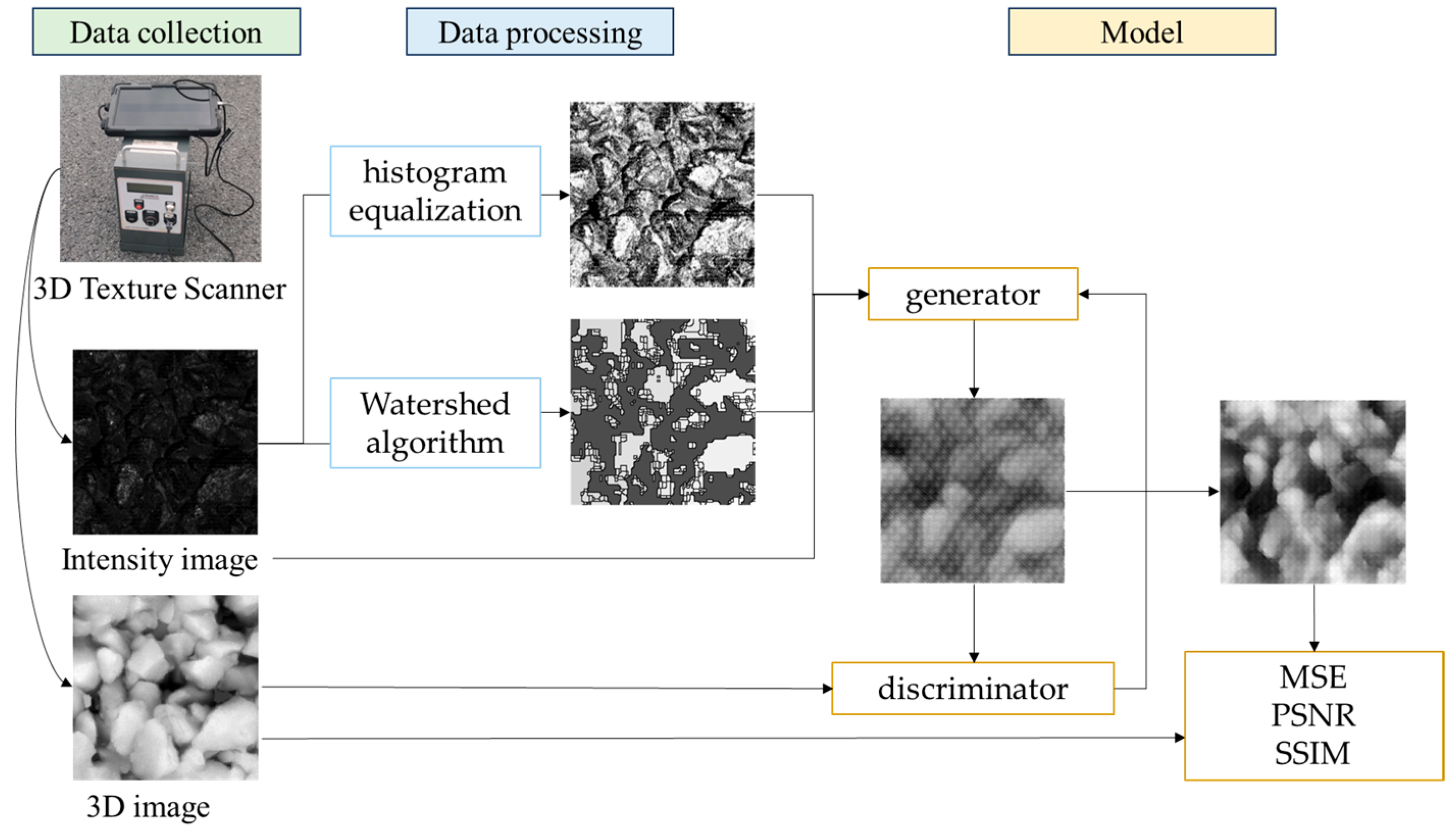
This study aims to investigate the feasibility of using a conditional GAN-based model to predict high-fidelity 3D pavement texture from 2D reflectance intensity images. Specifically, this research has the following objectives: to acquire a co-registered dataset of pavement 3D texture and corresponding 2D reflectance intensity images using a high-precision line laser scanner; to pre-process the raw intensity images using different enhancement techniques—namely, histogram equalization and a watershed-based segmentation—to generate distinct input representations; to develop and train multiple conditional GAN-based models, each using a different combination of the pre-processed intensity images as input channels, to predict the 3D texture; and to quantitatively evaluate and compare the performance of these models using metrics such as Root Mean Squared Error, Peak Signal-to-Noise Ratio, and Structural Similarity Index, thereby identifying the most effective input data representation. The research pipeline is shown in
Figure 1.
2. Materials and Methods
2.1. Data Acquisition and Equipment
For this study, all raw data were acquired using the AMES Engineering Laser Texture Scanner 9500 (Ames, IA, USA). This self-contained device is a high-precision line scanner that captures a surface patch in a single pass. Its operational principle allows for the direct measurement of three-dimensional coordinates and the corresponding reflectance intensity values for each point. Consequently, each acquired data point comprises a complete set of information including spatial coordinates and intensity value.
The scanner’s specifications are critical for the resolution of this study. It covers a standard scanning area of 101.6 mm by 101.6 mm. The sampling interval along the length is 0.0496 mm, and along the width is 0.0415 mm, resulting in a highly dense point cloud. The acquisition time for a single sample is 90 s. This high-resolution data provides the detailed ground truth necessary for training and evaluating the predictive model.
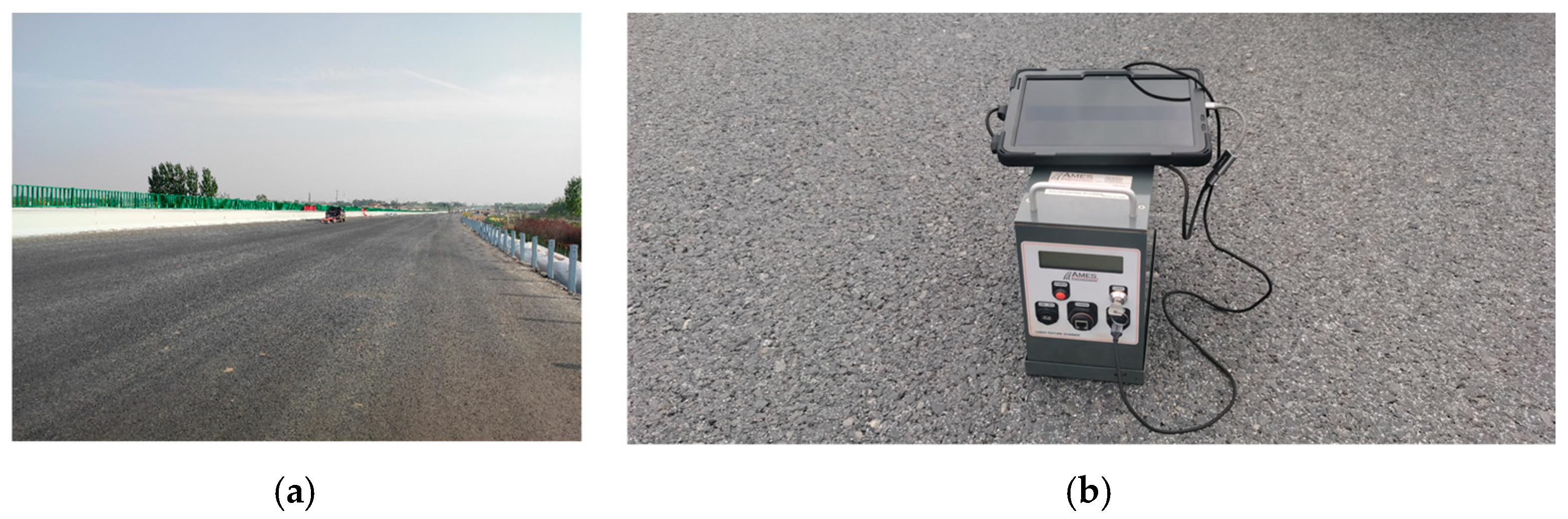
Data were collected from two distinct field sites (
Figure 2): the Jiangluo Expressway and the campus roads of Tongji University. The pavement types included conventional mixtures such as stone mastic asphalt and asphalt concrete, as well as surfaces treated with various preventive maintenance techniques. These techniques comprised sand fog seal, micro-surface treatment, high-performance anti-slip treatment coating, DTO high extension ultra-thin overlay, CTO composite modified ultra-thin overlay, and ultra-high-performance pavement drainage wearing course. To enhance sample diversity, specimens were collected both before and after the application of each preservation treatment. A total of 860 samples were obtained and subsequently divided into training and test sets at a ratio of 9:1.
2.2. Data Preprocessing and Input Representation
A key aspect of this research is investigating how different preprocessing techniques applied to the raw intensity data affect the quality of the predicted 3D texture. The raw output from the scanner was processed to generate three distinct types of 2D images for each scanned pavement sample.
The raw intensity values from the scanner were first mapped onto a regular 2D grid using the corresponding spatial coordinates, creating a baseline grayscale image that represents the unaltered reflectance characteristics of the surface. To enhance the global contrast of these intensity images, histogram equalization was applied, which redistributes the intensity values to span the entire available range and can potentially accentuate textural features that might be subtle in the raw data. This preprocessing step was implemented in MATLAB R2022a using the histogram equalization function.
A more complex preprocessing method was employed to extract edge and boundary information, which are often strong indicators of 3D structure. This involved a multi-step algorithm applied to the raw intensity image, including contrast enhancement through histogram equalization, noise reduction using a Gaussian filter, band-pass filtering to isolate relevant spatial frequencies, edge detection using a Sobel filter to compute the gradient magnitude, and finally a marker-controlled watershed transform on the gradient magnitude. The resulting segmentation map, where each region is labeled, was normalized to produce a grayscale image that encodes information about the boundaries and morphological features of the surface texture. All generated images from these three preprocessing methods and the corresponding ground truth 3D height maps were cropped to a uniform size of 224 by 224 pixels to serve as inputs and outputs for the neural network.
2.3. Conditional GAN Architecture
This study employs a conditional Generative Adversarial Network (cGAN) architecture adapted for the image-to-image translation task. The primary objective is to learn a mapping function from a two-dimensional input image—or a multi-channel image composed of the three pre-processed intensity variants—to a corresponding three-dimensional height map. The cGAN framework consists of two competing networks: a generator that learns to produce realistic synthetic outputs, and a discriminator that learns to distinguish between real and generated samples. This adversarial process encourages the generator to produce outputs that are indistinguishable from the ground truth.
2.3.1. Generator Network
The generator network is responsible for transforming the input 2D intensity image into a synthetic 3D texture map. Its architecture is designed to capture both low-level features and high-level textural details while preserving spatial resolution throughout the generation process. The generator follows an encoder–decoder structure with residual learning and progressive upsampling.
The network begins with an initial feature extraction stage followed by LeakyReLU activation. LeakyReLU is defined as , with in this work; it allows a small gradient for negative inputs, thereby mitigating the problem of inactive neurons during training. This stage progressively reduces the spatial dimensions from 224 × 224 to 28 × 28 while increasing the feature depth. Following the initial downsampling, the architecture incorporates ten residual blocks. Each residual block consists of two convolutional layers with 64 filters of kernel size 3, each followed by batch normalization and ReLU activation. A skip connection adds the input of the block to its output, facilitating gradient flow and enabling the learning of residual functions, which is critical for capturing fine texture details.
After the residual blocks, a final convolutional layer with 64 filters of kernel size 3 is applied, followed by batch normalization. This layer is then combined with the output from the initial downsampling stage via an element-wise addition, forming a long-range skip connection that preserves low-level spatial information.
The decoding stage consists of three upsampling blocks. Each block first doubles the spatial resolution using an upsampling layer, followed by a convolutional layer with 256 filters of kernel size 3 and ReLU activation. This progressive upsampling restores the spatial dimensions from 28 × 28 to 224 × 224, matching the input resolution. Finally, a convolutional layer with three filters of kernel size 9 and hyperbolic tangent (tanh) activation produces the final output, which is a three-channel image representing the predicted 3D texture map.
2.3.2. Discriminator Network
The discriminator network functions as a binary classifier, tasked with distinguishing between real ground-truth 3D texture maps and the synthetic maps generated by the generator. Its architecture is a convolutional neural network that progressively downsamples the input image while increasing feature depth, culminating in a single output value representing the probability that the input is real.
The discriminator takes a 224 × 224 × 3 input image and applies an initial convolutional layer with 64 filters of kernel size 3 and stride 1, followed by LeakyReLU activation. Subsequently, a series of convolutional blocks are applied, each consisting of a convolutional layer with stride 2 for downsampling, followed by batch normalization and LeakyReLU activation. This structure is repeated with increasing filter counts: 64, 128, 256, and 512 filters, respectively.
After the final convolutional block, the feature maps are flattened and passed through a dense layer with 1024 units, followed by LeakyReLU activation. A final dense layer with a single unit and sigmoid activation produces the classification output. The discriminator does not employ pooling layers; instead, strided convolutions are used for downsampling, which allows the network to learn its own spatial downsampling strategy.
2.3.3. Training Objectives and Loss Function
The combined model is trained with a hybrid loss function that integrates both adversarial and perceptual components. The adversarial loss encourages the generator to produce outputs that can fool the discriminator, while the perceptual loss ensures that the generated texture maps are not only pixel-wise accurate but also perceptually similar to the real textures.
The perceptual loss is computed using a pre-trained Visual Geometry Group (VGG) 19 network, which has been trained on the ImageNet dataset and is widely used for feature extraction in image generation tasks. Specifically, the feature maps from the ninth layer of VGG19 are extracted for both the generated image and the ground truth image. The mean squared error between these feature representations is then calculated, effectively encouraging the generator to produce outputs with similar high-level semantic characteristics to the real texture maps.
The total loss function for the generator is defined as follows:
where
is the adversarial loss from the discriminator,
is the perceptual loss from the VGG19 network, and
and
are weighting coefficients set to 0.5 and 1.0, respectively. The discriminator is trained with binary cross-entropy loss to maximize its ability to distinguish real from fake images.
All models were trained for 10,000 epochs with a batch size of two using the Adam optimizer, with an initial learning rate of 0.0002 and momentum parameters and . To evaluate the impact of different input representations, four distinct models were trained, corresponding to the following input channel configurations. For each configuration, the three input channels were stacked to create a single 224 × 224 × 3 tensor, which served as the input to the generator.
2.3.4. Evaluation Metrics
The performance of each trained model was quantitatively assessed on a held-out test dataset using three standard image quality assessment metrics: Root Mean Squared Error (RMSE), Peak Signal-to-Noise Ratio (PSNR), and Structural Similarity Index (SSIM).
Root Mean Squared Error is defined as the root mean squared difference between the predicted and ground truth:
where
and
represent the texture height of the ground truth and predicted pavement sample pixel intensities of the ground truth and predicted images,
denotes the image dimensions.
Peak Signal-to-Noise Ratio represents the ratio between the maximum possible power of a signal and the power of corrupting noise that affects the fidelity of its representation, with a higher value generally indicating higher reconstruction quality. PSNR is expressed as follows:
where
is the maximum possible pixel value of the image,
and
represent the pixel intensities of the ground truth and predicted images, respectively. For the 8-bit grayscale images used in this study,
. Although the predicted 3D texture maps represent physical height values rather than grayscale intensities, they are normalized to the range
prior to PSNR computation to maintain consistency with the metric definition.
The Structural Similarity Index is a perceptual metric that quantifies the similarity between two images based on structural information, luminance, and contrast, and is considered a better indicator of perceived image quality than pixel-wise error metrics. Its values range from
to
, with a value of
indicating perfect structural similarity. As the SSIM value approaches
, the two images become increasingly similar, whereas a value approaching
indicates growing dissimilarity. The SSIM is defined as follows:
where
and
are the mean intensities of images
and
,
and
are their standard deviations,
is the covariance, and
and
are constants used to stabilize the division.
3. Results
First, the effect of different input representations was evaluated. The performance of the various input configurations on the test dataset is summarized in
Table 1, which lists the input channel allocations and the corresponding average RMSE, PSNR, and SSIM scores. Specifically, the three positions in the input channel configuration correspond to (1) the raw intensity image, (2) the histogram-equalized image, and (3) the watershed-segmented image. The sum of the three numbers is always three, meaning each model receives a three-channel input tensor. For example, the configuration (3, 0, 0) indicates that all three channels are derived from the raw intensity image, while (0, 3, 0) uses three channels from the histogram-equalized image. The results demonstrate a clear variation in performance based on the input data representation.
Among these four input schemes, Input 3, which exclusively uses three channels of the histogram-equalized images, achieved the best overall performance. It recorded the lowest RMSE and the highest SSIM (0.4065), indicating that its predictions possessed the best pixel-level accuracy and structural similarity to the ground truth. The PSNR of Input 3 (18.79 dB) was slightly lower than that of Input 1 (19.79 dB), yet the substantial gain in SSIM indicates better structural fidelity. In stark contrast, Input 4, which relied solely on the watershed-segmented images, performed the worst across all metrics, with a significantly higher RMSE and an extremely low SSIM of 0.1084, demonstrating that this representation alone is insufficient for reconstructing detailed 3D texture.
To benchmark the performance of the proposed cGAN, widely adopted image-to-image translation architectures were implemented for the same task: pix2pix [
18], pix2pixHD [
19], CycleGAN [
20], DiffBIR [
21] and ResShift [
22]. All comparative models were trained using the optimal input representation identified in the input configuration study—namely, the three-channel histogram-equalized intensity images—to ensure a fair comparison. The pix2pix model employs a U-Net-based generator and a PatchGAN discriminator, learning a direct mapping from the 2D input to the 3D height map. pix2pixHD extends this framework with a coarse-to-fine generator and multi-scale discriminators to produce higher-fidelity outputs. CycleGAN, originally designed for unpaired image-to-image translation, was adapted to learn the mapping in a paired fashion by incorporating the same generator–discriminator structure used in the paired setting, with an additional cycle-consistency loss to regularize the mapping. DiffBIR is a recent diffusion-based blind image restoration model, adapted for 2D-to-3D translation by conditioning on the input intensity images. ResShift is an efficient diffusion model originally designed for super-resolution, retrained for paired image-to-image translation. All models were trained under identical data splits and optimization settings as the proposed cGAN to guarantee a consistent comparison. The quantitative results are presented in
Table 2.
As shown in
Table 2, the proposed cGAN attained the highest SSIM (0.4065) among all models, indicating its effectiveness in preserving the structural details of pavement texture. While pix2pixHD achieved a slightly lower RMSE, its SSIM of 0.4043 remained marginally below that of the proposed cGAN, suggesting that the latter better preserves the textural coherence of the 3D surface. pix2pix offered the highest PSNR (20.04 dB) but at the cost of reduced structural similarity (SSIM = 0.3878). CycleGAN, which is primarily designed for unpaired translation, exhibited the poorest performance in this paired prediction task. DiffBIR and ResShift also achieve competitive RMSE and PSNR values, with DiffBIR yielding an RMSE of 0.0228 mm and ResShift 0.0229 mm, comparable to the proposed cGAN. However, their SSIM values (0.3854 and 0.3792) are lower than that of the cGAN (0.4065), indicating that the cGAN better preserves the textural structure of the pavement surface. The slightly reduced structural fidelity of the diffusion models may be attributed to the limited training dataset and, in the case of ResShift, its original design for super-resolution rather than direct paired image-to-image translation, which may constrain its capacity to learn the 2D-to-3D mapping. These results suggest that the residual blocks and perceptual loss used in the proposed cGAN contribute to the reconstruction of 3D pavement texture from 2D intensity images.
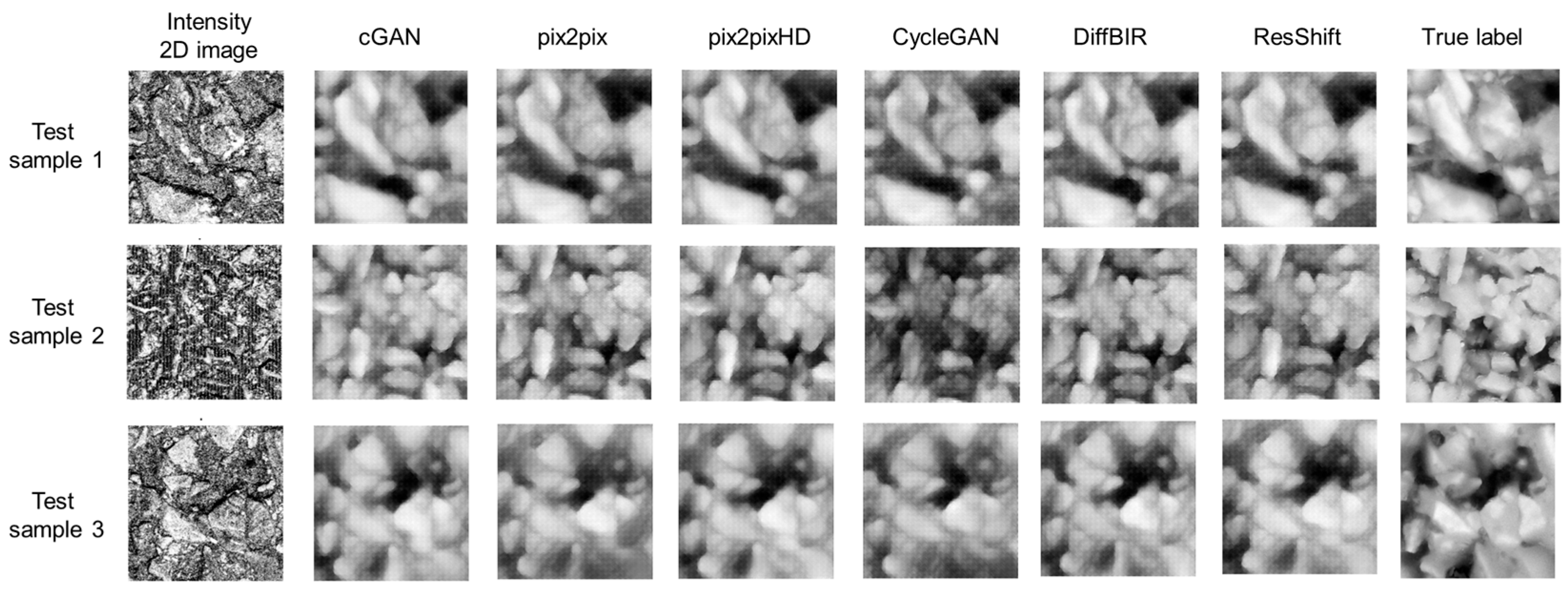
Figure 3 compares the prediction results of the four comparative models on representative test samples, along with the corresponding input intensity images and ground truth 3D maps. The proposed cGAN tended to produce predictions that were visually closer to the ground truth, with sharper texture details and fewer noticeable artifacts than the other architectures, especially in the best and average cases.
4. Discussion
The experimental results provide new insights into both the role of input data representation and the architectural choices in predicting 3D pavement texture from 2D intensity images. Consistent with the initial hypothesis, the histogram-equalized intensity images proved to be the most informative input among the four configurations. Input 3, which exclusively used three channels of the equalized images, achieved the highest SSIM (0.4065) and the lowest RMSE, confirming that enhancing global contrast effectively accentuates the textural cues essential for height reconstruction. Interestingly, although Input 1 (equal mix of raw, equalized, and watershed channels) yielded a slightly higher PSNR (19.79 dB), its SSIM (0.3939) fell behind that of Input 3, suggesting that the multi-channel combination introduced some degree of structural inconsistency while preserving pixel-level fidelity. This reinforces that PSNR alone can be misleading in texture synthesis tasks, and that SSIM better reflects the perceptual quality required for pavement analysis.
The watershed-segmented images performed poorly across all metrics, with an SSIM of only 0.1084 when used alone. From a physical perspective, the marker-controlled watershed transform tends to over-segment the surface, dividing continuous aggregate particles into multiple homogeneous regions and creating artificial boundaries from subtle intensity fluctuations caused by surface micro-texture or noise. As a result, the smooth height gradients that encode macro-texture undulations are destroyed, and the generator must infer a continuous height field solely from discrete edge cues that lack directional height information. In contrast, histogram equalization enhances the global contrast while preserving the gradual photometric transitions induced by surface slopes and shadowing, which are physically linked to the underlying topography. This retention of continuous intensity cues is critical for the network to learn a plausible mapping from 2D reflectance to 3D height.
This study also compared the proposed cGAN with several mainstream image-to-image translation models. Among the compared models, the proposed cGAN achieved the highest SSIM (0.4065), while pix2pixHD obtained a slightly lower RMSE and a comparable SSIM (0.4043). pix2pix produced the highest PSNR (20.04 dB) but a lower SSIM (0.3878), suggesting its outputs tended to be smoother. CycleGAN showed relatively lower performance in this paired prediction task, which is consistent with its design for unpaired image translation. DiffBIR and ResShift were slightly inferior to the proposed cGAN. A probable explanation is the relatively small number of pavement texture samples available for training, as diffusion models typically require large-scale data to fully exploit their generative capabilities. Furthermore, ResShift is inherently a super-resolution architecture, not specifically designed for the domain translation task attempted here, which may limit its ability to capture the complex 2D-to-3D mapping. The visual results (
Figure 3) showed that the cGAN produced sharper texture details. The reasonable performance of the proposed cGAN may be attributed to its residual blocks and the use of a perceptual loss, which help balance local detail and global structure.
It should be noted that the current SSIM of approximately 0.40, while demonstrating structural similarity, remains insufficient for directly inferring fine-scale functional performance indicators such as skid resistance or tire–pavement noise. These performance metrics are governed by both macro-texture (0.5–50 mm) and micro-texture (<0.5 mm), the latter of which is particularly challenging to reconstruct from normalized 2D intensity images. The predicted 3D maps may smooth out subtle asperities that are critical for friction and high-frequency noise generation. However, the core contribution of this study lies in establishing a rapid 2D-to-3D generation framework that can produce a large variety of pavement texture samples. Such generated surfaces, even if not identical to specific real pavements, can serve as diverse geometric inputs for tire–pavement contact simulations, friction models, and acoustic analyses, thereby enriching the statistical sample space that is often limited by the cost and speed of direct 3D scanning. This capability is valuable for parametric studies and data-driven surrogate modeling. Future work will focus on enhancing micro-texture fidelity and validating the physical responses computed from generated surfaces against measured performance data.
A limitation of this study is the validation strategy. Given the relatively modest dataset of 860 samples, a single 90/10 random split was adopted to keep a larger training set, but no cross-validation or site-wise hold-out was performed. Consequently, the reported results should be considered indicative of the model’s potential rather than fully generalizable to unseen pavement types or acquisition conditions. Future work should include leave-one-site-out validation and testing on independent multi-site datasets to better assess generalization.
5. Conclusions
This paper investigated the use of a conditional Generative Adversarial Network to predict high-resolution 3D pavement texture from 2D reflectance intensity images. By evaluating multiple input representations and comparing against mainstream image-to-image translation models, it was demonstrated that both the data preprocessing and the network architecture profoundly affect prediction accuracy. The model trained exclusively with histogram-equalized intensity images achieved the best performance among all input variants, recording the lowest RMSE and the highest SSIM of 0.4065. In the architectural comparison, the proposed cGAN outperformed other networks in terms of structural similarity (SSIM), highlighting the effectiveness of its residual encoder–decoder design and the incorporated perceptual loss. However, the achieved reconstruction fidelity is still moderate and is not yet sufficient for directly estimating functional parameters such as skid resistance or noise. These results suggest that the proposed cGAN, when paired with appropriately enhanced intensity data, offers a potential route for rapid pavement texture characterization and for generating diverse 3D surface topographies for simulation purposes. Future work should focus on expanding the dataset to include a wider variety of pavement surfaces, exploring more advanced deep-learning architectures, and investigating additional pre-processing techniques that could further improve the fidelity of the reconstructed 3D texture. Ultimately, this approach could lead to the development of a practical, high-speed imaging system for comprehensive pavement surface evaluation.
Author Contributions
Conceptualization, Z.W. and P.C.; methodology, P.C.; software, H.Y. (Hongxu Yang); validation, H.Y. (Hongxu Yang); formal analysis, Z.W.; investigation, Q.S.; resources, H.Y. (Haochun Yang); data curation, Q.S.; writing—original draft preparation, P.C. and Z.W.; writing—review and editing, H.Y. (Haochun Yang); visualization, P.C.; supervision, P.C.; project administration, H.Y. (Haochun Yang); funding acquisition, P.C. All authors have read and agreed to the published version of the manuscript.
Funding
This study was supported by the Fundamental and Interdisciplinary Disciplines Breakthrough Plan of the Ministry of Education of China (JYB2025XDXM116).
Institutional Review Board Statement
Not applicable.
Informed Consent Statement
Not applicable.
Data Availability Statement
Data used in this study are available from the corresponding author on request.
Conflicts of Interest
Authors Hongxu Yang, Haochun Yang and Qingli Shi were employed by the company BWTON Technology Co., Ltd. The remaining authors declare that the research was conducted in the absence of any commercial or financial relationships that could be construed as a potential conflict of interest.
Abbreviations
The following abbreviations are used in this manuscript:
| cGAN | Conditional Generative Adversarial Network |
| GAN | Generative Adversarial Network |
| RMSE | Root Mean Squared Error |
| MTD | Mean Texture Depth |
| PSNR | Peak Signal-to-Noise Ratio |
| PTSN | Pavement Texture Scaling Network |
| SSIM | Structural Similarity Index |
| VGG | Visual Geometry Group |
References
- Weng, Z.; Liu, C.; Du, Y.; Wu, D.; Leng, Z. Integrating spatial and channel attention mechanisms with domain knowledge in convolutional neural networks for friction coefficient prediction. Comput.-Aided Civ. Infrastruct. Eng. 2025, 40, 2480–2497. [Google Scholar] [CrossRef]
- Weng, Z.; Leng, Z.; Du, Y.; Liu, C.; Zhang, X.; Li, D.; He, Y. Leveraging Tabular Prior-data Fitted Networks for Accurate Pavement Friction Coefficient Prediction from 3D Texture Features. Tribol. Int. 2026, 218, 111794. [Google Scholar] [CrossRef]
- Miao, Y.; Li, J.; Zheng, X.; Wang, L. Field investigation of skid resistance degradation of asphalt pavement during early service. Int. J. Pavement Res. Technol. 2016, 9, 313–320. [Google Scholar] [CrossRef][Green Version]
- Chen, W.; Zheng, M.; Wang, H. Evaluating the Tire/Pavement Noise and Surface Texture of Low-Noise Micro-Surface Using 3D Digital Image Technology. Front. Mater. 2021, 8, 683947. [Google Scholar] [CrossRef]
- Weng, Z.; Ablat, G.; Wu, D.; Liu, C.; Li, F.; Du, Y.; Cao, J. Rapid pavement aggregate gradation estimation based on 3D data using a multi-feature fusion network. Autom. Constr. 2022, 134, 104050. [Google Scholar] [CrossRef]
- Weng, Z.; Xiang, H.; Lin, Y.; Liu, C.; Wu, D.; Du, Y. Pavement texture depth estimation using image-based multiscale features. Autom. Constr. 2022, 141, 104404. [Google Scholar] [CrossRef]
- Weng, Z.; Liu, C.; Du, Y.; Leng, Z.; Wu, D.; Adey, B.T. Research paradigms and scales of asphalt pavement skid resistance evaluation: A review. Friction 2026, 14, 9441082. [Google Scholar] [CrossRef]
- Weng, Z.H.; Du, Y.C.; Wu, D.F.; Liu, C.; He, Y. A Framework for Asphalt Pavement Surface Homogeneity Evaluation Based on 3D Texture Feature Distribution. J. Transp. Eng. Part B Pavements 2025, 151, 04025050. [Google Scholar] [CrossRef]
- Alotaibi, A. Deep Generative Adversarial Networks for Image-to-Image Translation: A Review. Symmetry 2020, 12, 1705. [Google Scholar] [CrossRef]
- Pang, Y.; Lin, J.; Qin, T.; Chen, Z. Image-to-image translation: Methods and applications. IEEE Trans. Multimed. 2021, 24, 3859–3881. [Google Scholar] [CrossRef]
- Yang, H.D.; Ma, T.; Huyan, J.; Han, C.; Wang, H. Aggregation segregation generative adversarial network (AG-GAN) facilitated multi-scale segregation detection in asphalt pavement paving stage. Eng. Appl. Artif. Intell. 2024, 129, 107663. [Google Scholar] [CrossRef]
- Sedighian-Fard, M.; Golroo, A.; Javanmardi, M.; Alahi, A.; Rasti, M. Data generation for asphalt pavement evaluation: Deep learning-based insights from generative models. Case Stud. Constr. Mater. 2025, 23, e05116. [Google Scholar] [CrossRef]
- Chen, N.; Xu, Z.; Liu, Z.; Chen, Y.; Miao, Y.; Li, Q. Data Augmentation and Intelligent Recognition in Pavement Texture Using a Deep Learning. IEEE Trans. Intell. Transp. Syst. 2022, 23, 25427–25436. [Google Scholar] [CrossRef]
- Yang, L.; Tu, H.; Gong, H.; Li, H.; Sun, L. Scaling from macro to micro: A novel approach to bridging gaps in multiple pavement texture scales using generative neural networks. Transp. Res. Part C Emerg. Technol. 2025, 174, 105108. [Google Scholar] [CrossRef]
- Liu, X.; Yin, C. 3D Reconstruction of Asphalt Pavement Macro-Texture Based on Convolutional Neural Network and Monocular Image Depth Estimation. Appl. Sci. 2025, 15, 4684. [Google Scholar] [CrossRef]
- Lu, J.; Pan, B.; Ren, W.; Liu, Q.; Liu, P.; Oeser, M. Regeneration of pavement surface textures using M-sigmoid-normalized generative adversarial networks. Comput.-Aided Civ. Infrastruct. Eng. 2023, 38, 2225–2241. [Google Scholar] [CrossRef]
- Wang, G.; Wang, K.C.; Yang, G. Reconstruction of sub-mm 3D pavement images using recursive generative adversarial network for faster texture measurement. Comput.-Aided Civ. Infrastruct. Eng. 2023, 38, 2206–2224. [Google Scholar] [CrossRef]
- Henry, J.; Natalie, T.; Madsen, D. Pix2pix gan for image-to-image translation. Res. Gate Publ. 2021, 2021, 1–5. [Google Scholar]
- Arai, K. Modified pix2pixHD for Enhancing Spatial Resolution of Image for Conversion from SAR Images to Optical Images in Application of Landslide Area Detection. Information 2025, 16, 163. [Google Scholar] [CrossRef]
- Chu, C.; Zhmoginov, A.; Sandler, M. Cyclegan, a master of steganography. arXiv 2017, arXiv:1712.02950. [Google Scholar] [CrossRef]
- Lin, X.; He, J.; Chen, Z.; Lyu, Z.; Dai, B.; Yu, F.; Qiao, Y.; Ouyang, W.; Dong, C. Diffbir: Toward blind image restoration with generative diffusion prior. In Proceedings of the European Conference on Computer Vision; Springer: Berlin/Heidelberg, Germany, 2024. [Google Scholar]
- Yue, Z.; Wang, J.; Loy, C.C. Resshift: Efficient diffusion model for image super-resolution by residual shifting. Adv. Neural Inf. Process. Syst. 2023, 36, 13294–13307. [Google Scholar]
| Disclaimer/Publisher’s Note: The statements, opinions and data contained in all publications are solely those of the individual author(s) and contributor(s) and not of MDPI and/or the editor(s). MDPI and/or the editor(s) disclaim responsibility for any injury to people or property resulting from any ideas, methods, instructions or products referred to in the content. |