1. Introduction
Primary cardiac tumors are rare, with an estimated incidence ranging from 0.001% to 0.3% in autopsy series, whereas metastatic cardiac involvement is substantially more common. Despite their rarity, intracardiac masses are clinically significant because delayed diagnosis may lead to embolic events, heart failure, arrhythmias, or sudden cardiac death [
1]. Accurate detection and characterization of intracardiac masses remain among the most demanding challenges in cardiovascular imaging. Thrombi, vegetations, and primary or metastatic tumors often exhibit overlapping morphological and functional features, rendering their differentiation difficult even in expert hands [
2]. As the frontline imaging modality, echocardiography plays a pivotal role in the initial evaluation of these lesions, offering real-time visualization, broad accessibility, and a non-invasive approach [
3], and yet, despite these advantages, its diagnostic performance is frequently constrained by intrinsic limitations.
Echocardiographic assessment is inherently operator-dependent, requiring precise probe positioning, optimal acoustic windows, and advanced anatomical interpretation skills, all of which vary across operators and patient populations [
4]. Image quality is further compromised by factors such as body habitus, lung interference, and suboptimal acquisition conditions, which may obscure critical findings. Consequently, subtle or atypically located masses may be missed, while benign anatomical variants may be erroneously classified as pathological. Beyond technical challenges, interpretation is complicated by the dynamic nature of cardiac motion and the need to reconstruct complex three-dimensional anatomy from two-dimensional projections [
5]. Key discriminative features, including echogenicity, attachment, mobility, and hemodynamic impact, are often nuanced and inconsistently assessed, contributing to diagnostic uncertainty. In many cases, this necessitates additional imaging with cardiac magnetic resonance or computed tomography, underscoring the limitations of echocardiography as a standalone diagnostic tool. At the same time, the rapidly increasing volume of echocardiographic studies in modern clinical practice places substantial pressure on clinicians, amplifying variability in interpretation and creating a critical need for more efficient and reproducible diagnostic strategies [
6].
AI systems may reduce interobserver variability by standardizing the interpretation of morphological and hemodynamic patterns traditionally assessed subjectively by clinicians. Recent deep learning approaches have demonstrated diagnostic accuracies exceeding 95% in experimental intracardiac mass classification settings, although most studies remain limited by small datasets and a lack of external validation. In this context, artificial intelligence (AI), encompassing machine learning and deep learning techniques, has emerged as a transformative paradigm in cardiovascular imaging. By enabling automated image analysis, pattern recognition beyond human perception, and standardized interpretation, AI has the potential to fundamentally redefine how intracardiac masses are detected and characterized [
7,
8]. Recent advances in multimodal deep learning, explainable AI, and real-time ultrasound guidance systems have shifted the field from proof-of-concept models toward clinically translatable applications. However, despite growing evidence of its promise, significant barriers remain, including limited generalizability, data heterogeneity, and challenges in clinical integration.
Against this background, AI-enhanced echocardiography represents a compelling opportunity to overcome longstanding diagnostic limitations. This review aims to critically examine recent advances in AI-driven approaches for cardiac tumor detection, evaluate their current challenges, and explore their potential for clinical translation, with the goal of bridging the gap between technological innovation and real-world cardiovascular practice. This review was guided by three key questions: (1) how AI can improve echocardiographic detection and characterization of intracardiac masses, (2) what limitations currently prevent clinical implementation, and (3) which emerging strategies may facilitate future clinical translation.
2. Methodology
This narrative review was conducted through a literature search of PubMed, Scopus, and Google Scholar databases for studies published between 2016 and 2026. Search terms included “artificial intelligence”, “machine learning”, “deep learning”, “echocardiography”, “cardiac tumors”, “intracardiac masses”, “multimodal imaging”, and “ultrasomics”. English-language original studies, reviews, and methodological papers focusing on AI-assisted cardiovascular imaging and intracardiac mass characterization were considered. Articles were selected based on their relevance to echocardiographic analysis, artificial intelligence methodologies, multimodal imaging integration, and potential clinical translation.
3. Echocardiographic Features of Common Benign and Malignant Cardiac Masses
Echocardiography is the initial imaging modality for the evaluation of suspected cardiac masses because it allows real-time assessment of lesion morphology, mobility, attachment, and hemodynamic consequences. In routine practice, the principal diagnostic challenge is not only detecting an intracardiac mass but also distinguishing true neoplastic lesions from more common non-neoplastic entities such as thrombi and infective vegetations [
9]. This distinction is clinically essential, as management ranges from anticoagulation or antimicrobial therapy to urgent surgery or oncologic treatment. Although echocardiography alone is often insufficient for definitive tissue characterization, several features can provide important clues regarding the nature of a mass.
3.1. General Echocardiographic Parameters Used in Mass Characterization
Systematic evaluation of a cardiac mass typically includes its location, size, shape, border definition, echogenicity, attachment site, stalk presence, mobility, multiplicity, and associated effects on valvular or chamber function. Location is particularly informative, as certain lesions show a strong predilection for specific chambers or structures. For example, myxomas most commonly arise from the interatrial septum in the left atrium, papillary fibroelastomas are usually attached to valvular surfaces, thrombi frequently occur in regions of blood stasis such as the left atrial appendage or ventricular apex, and metastatic tumors often involve the right heart, pericardium, or vena cava inflow [
10]. Mobility is another key feature: highly mobile masses attached by a stalk are more suggestive of myxoma or fibroelastoma, whereas broad-based, infiltrative, or immobile lesions raise suspicion for malignant tumors. Echogenicity may also be helpful, although it is rarely specific; homogeneous masses are more often benign, whereas heterogeneous echotexture with areas of necrosis or calcification may indicate malignancy [
11]. Beyond morphology, Doppler imaging contributes to assessment by demonstrating obstruction, regurgitation, altered inflow patterns, or embolic risk associated with mobile lesions. Contrast echocardiography may further improve characterization by assessing vascularity, since tumors tend to show perfusion while thrombi are usually avascular [
12,
13]. Previous studies have demonstrated that contrast-enhanced echocardiography may improve differentiation between vascularized tumors and avascular thrombi, increasing diagnostic confidence and reducing false-positive interpretations in selected clinical settings. Three-dimensional echocardiography can also refine assessment of lesion extent, attachment, and spatial relationships, especially for masses involving valves or the atrial septum [
14].
3.2. Benign Primary Cardiac Tumors
3.2.1. Myxoma
Myxoma is the most common primary benign cardiac tumor in adults and classically arises from the fossa ovalis region of the interatrial septum, most often in the left atrium [
10]. Echocardiographically, myxomas are usually pedunculated, mobile masses with heterogeneous echogenicity and a smooth, villous, or polypoid surface. Their mobility may cause prolapse through the atrioventricular valves during diastole, producing functional obstruction that can mimic valvular stenosis [
15]. Some lesions contain calcifications, hemorrhage, or cystic degeneration, contributing to heterogeneity. Clinical presentation may include constitutional symptoms, embolization, or positional dyspnea, and this combination with a typical left atrial mass strongly suggests the diagnosis. Nevertheless, atypical myxomas occurring in the ventricles or right atrium may be more difficult to recognize [
16].
3.2.2. Papillary Fibroelastoma
Papillary fibroelastoma is a small, benign, avascular tumor that most often arises on cardiac valves, particularly the aortic and mitral valves. On echocardiography, it is typically seen as a small, highly mobile, pedunculated valvular mass with a characteristic frond-like or “sea-anemone” appearance, although this morphology is more readily appreciated pathologically than sonographically [
17]. These tumors are often discovered incidentally but are clinically important because of their association with embolic stroke, myocardial infarction, and sudden death. Their small size can make them difficult to detect on transthoracic imaging, and transesophageal echocardiography is often superior for diagnosis [
18]. Transesophageal echocardiography has been reported to achieve sensitivities exceeding 85–90% for the detection of small valvular masses, particularly papillary fibroelastomas, although diagnostic accuracy may still depend on lesion size and operator expertise.
3.2.3. Lipoma and Lipomatous Hypertrophy
Cardiac lipomas are encapsulated benign tumors composed of mature adipose tissue and may occur in subendocardial, myocardial, or subepicardial locations. They typically appear as well-circumscribed, homogeneous, echogenic masses, although echogenicity may vary [
19]. Lipomatous hypertrophy of the interatrial septum, while not a true neoplasm, appears as thickening of the interatrial septum with sparing of the fossa ovalis, producing a characteristic dumbbell shape. This finding can be confused with atrial tumors if not recognized correctly [
20].
3.2.4. Rhabdomyoma and Fibroma
In pediatric populations, rhabdomyoma is the most common primary cardiac tumor and is strongly associated with tuberous sclerosis complex. Echocardiographically, rhabdomyomas usually appear as multiple, well-defined, homogeneous, hyperechoic intramyocardial masses, often located in ventricles or the interventricular septum [
21]. In contrast, fibromas are generally solitary, large, intramural ventricular tumors with homogeneous echogenic appearance and may cause arrhythmias or obstruction due to their size and location [
22]. Although both are benign, their clinical significance can be substantial.
3.3. Malignant Primary and Secondary Cardiac Tumors
3.3.1. Primary Malignant Tumors
Primary malignant cardiac tumors are rare, with sarcomas representing the predominant histological type. Angiosarcoma is the most common primary malignant cardiac tumor in adults and typically involves the right atrium. On echocardiography, it often appears as a broad-based, irregular, heterogeneous mass infiltrating the atrial wall or pericardium, sometimes accompanied by pericardial effusion [
23]. Areas of necrosis, hemorrhage, and tissue destruction contribute to its heterogeneous appearance. Other sarcomas, such as undifferentiated pleomorphic sarcoma, leiomyosarcoma, and osteosarcoma, may occur in the left atrium or ventricles and can mimic myxoma when presenting as atrial masses. Features favoring malignancy include non-septal attachment, multiple masses, broad-based implantation, local invasion, rapid growth, and associated effusion [
1,
24,
25].
Primary cardiac lymphomas, though uncommon, usually involve the right heart and may present as infiltrative masses associated with pericardial effusion, wall thickening, or conduction abnormalities. Echocardiography may show a bulky, relatively homogeneous mass, but the diagnosis often requires multimodality imaging and tissue confirmation [
26].
3.3.2. Metastatic Tumors
Metastatic involvement of the heart is more common than primary cardiac malignancy and may occur through hematogenous spread, lymphatic dissemination, direct extension, or transvenous growth. Common primary sources include lung cancer, breast cancer, melanoma, lymphoma, leukemia, and renal cell carcinoma [
27]. Echocardiographic appearances are variable and depend on the route and extent of spread. Metastases may manifest as multiple nodules, infiltrative myocardial thickening, pericardial masses, or right atrial extension from the inferior vena cava. Pericardial effusion is a frequent accompanying finding and may be the first clue to secondary cardiac involvement [
28]. Compared with benign tumors, metastatic lesions are more likely to be multiple, poorly defined, and associated with extracardiac disease.
3.4. Echocardiographic Clues Suggesting Benign Versus Malignant Pathology
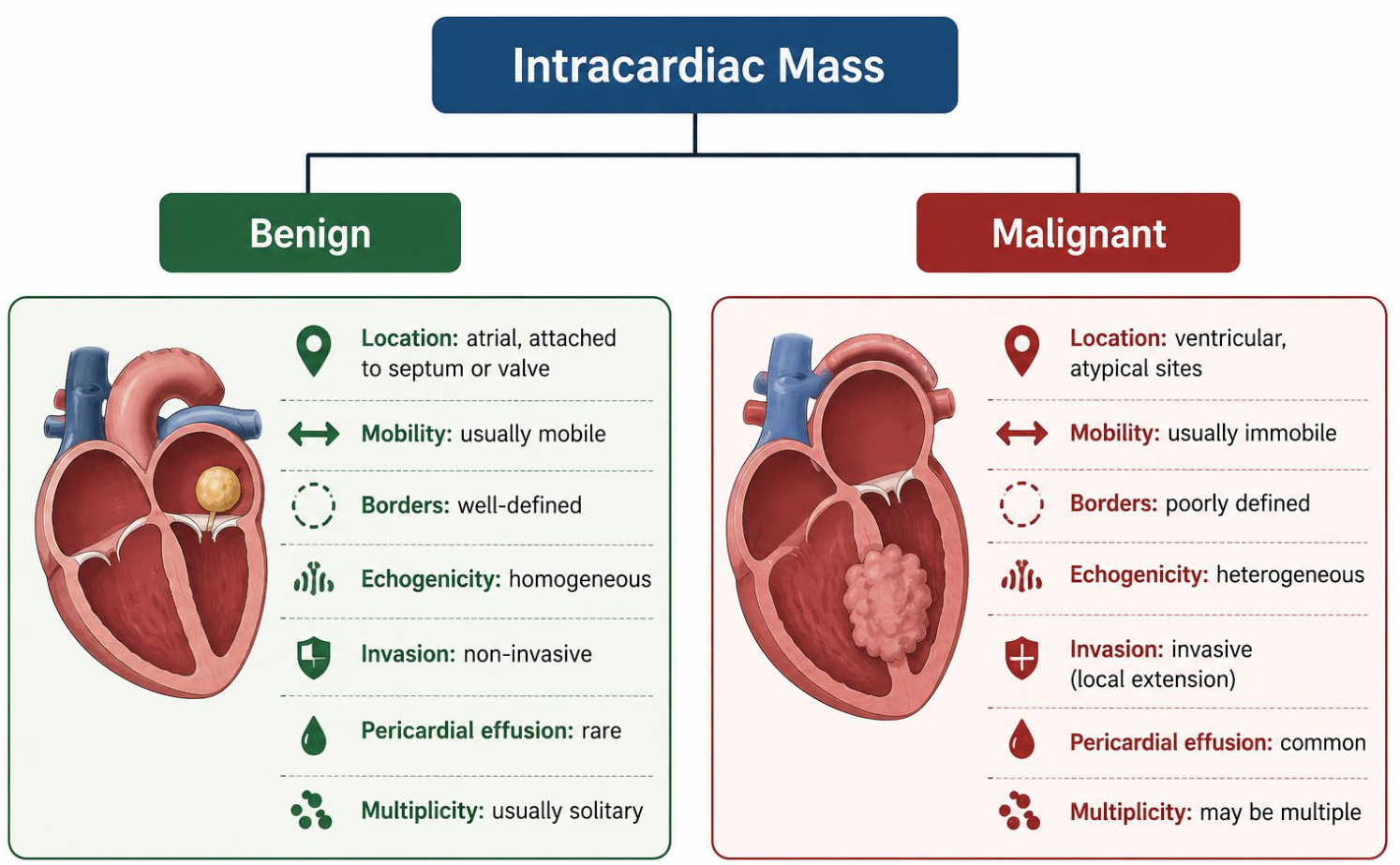
Although there is substantial overlap in appearance, several echocardiographic patterns may help distinguish benign from malignant lesions. Benign tumors are generally more likely to be well circumscribed, pedunculated, and localized, with limited tissue invasion. They often arise from characteristic sites, such as the interatrial septum for myxomas or valve leaflets for fibroelastomas. Malignant tumors, in contrast, are more often broad-based, infiltrative, irregular, rapidly enlarging, and associated with pericardial effusion or invasion of adjacent structures [
7,
29]. Heterogeneous texture, necrotic areas, and multiplicity also increase suspicion for malignancy. Nevertheless, these criteria are probabilistic rather than definitive, and overlap is common, particularly between atypical benign lesions, organized thrombi, and malignant tumors. The principal echocardiographic features that may help differentiate benign from malignant intracardiac masses are summarized in
Figure 1.
3.5. Current Limitations of Echocardiographic Characterization
Despite its central role, echocardiography remains limited in the characterization of cardiac masses. Tissue composition cannot be directly assessed, acoustic windows may be suboptimal, and small lesions may be missed. In addition, interpretation depends heavily on operator experience and the clinical context. Even advanced echocardiographic techniques, including contrast and three-dimensional imaging, do not always provide definitive differentiation between tumor subtypes or between tumor and non-tumor masses [
30]. As a result, multimodality imaging with cardiac magnetic resonance, computed tomography, positron emission tomography, or histopathology is frequently required for final diagnosis [
31,
32]. These limitations provide an important rationale for exploring artificial intelligence-based tools that could improve pattern recognition, reduce subjectivity, and support more consistent classification of intracardiac masses.
4. AI Methods Relevant to Echocardiographic Analysis of Intracardiac Masses
Echocardiography, also known as cardiac ultrasound, is one of the most widely used imaging modalities in cardiology due to its portability, relatively low cost, and absence of ionizing radiation [
33]. It enables real-time visualization of cardiac chambers, valves, and hemodynamic processes, making it an essential tool for the assessment of cardiac structure and function in everyday clinical practice. Despite its advantages, the interpretation of echocardiographic images remains highly dependent on operator experience and technical expertise. Variability in probe positioning, patient anatomy, and imaging conditions can significantly affect image quality and measurement accuracy. Furthermore, the increasing number of echocardiographic examinations has substantially expanded the workload associated with image analysis and reporting [
33].
In recent years, artificial intelligence (AI) has emerged as a promising approach to address these challenges (
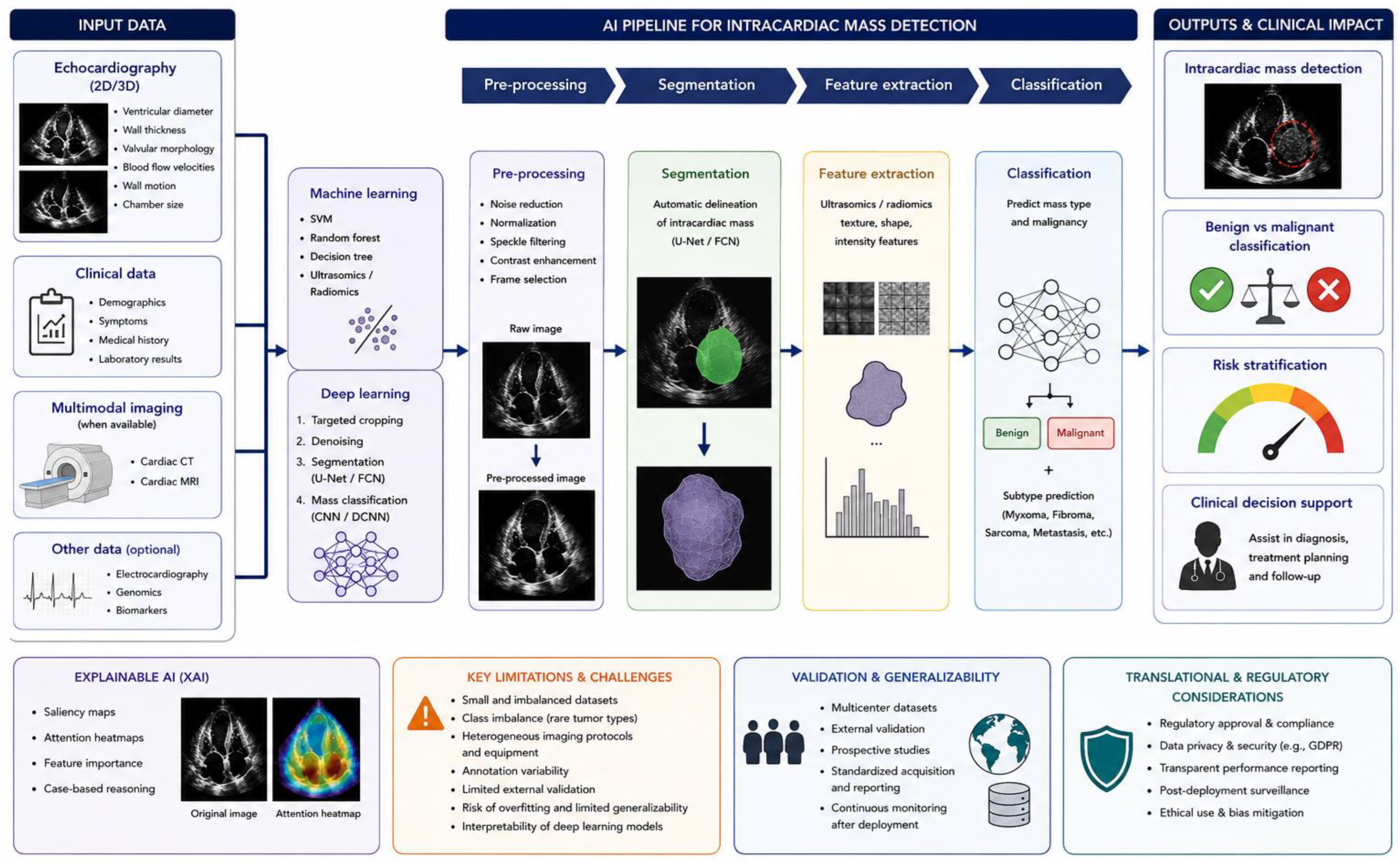
Figure 2). AI encompasses computational systems capable of performing tasks that typically require human cognitive abilities, such as pattern recognition, learning and decision-making. Within this field, machine learning (ML) refers to algorithms that learn patterns from data to generate predictions, while deep learning (DL) represents a specialized subset of ML that utilizes multi-layered neural networks capable of automatically extracting complex features from large datasets. Machine learning and deep learning methods have increasingly been incorporated into echocardiographic imaging, enabling the creation of automated tools that assist with image acquisition, classify standard imaging views, segment cardiac chambers, quantify cardiac function, and support disease detection. These technologies have the potential to reduce operator-dependent variability, improve diagnostic accuracy, and enhance the efficiency of clinical workflows [
34]. AI systems are trained on large, annotated datasets containing both normal and pathological echocardiographic patterns. During training, neural networks iteratively learn hierarchical spatial and temporal features associated with normal cardiac anatomy, chamber geometry, wall motion, and tissue appearance. Deviations from these learned representations enable detection of pathological findings, including intracardiac masses. Compared with traditional interpretation alone, AI-assisted approaches may improve diagnostic consistency and reduce observer variability; however, failure may occur in cases involving poor acoustic windows, rare tumor phenotypes, or imaging distributions not represented in the training dataset.
4.1. Principles of Cardiac Ultrasound Imaging
Echocardiography is based on the transmission of high-frequency sound waves through biological tissues. An ultrasound transducer emits acoustic waves that propagate through the body and are reflected when they encounter interfaces between tissues with different acoustic properties. These returning echoes are detected by the transducer and converted into digital images representing cardiac structures and motion. The most commonly used technique is transthoracic echocardiography (TTE), in which the ultrasound probe is placed on the patient’s chest to obtain images of the heart from multiple anatomical perspectives. Standard views include parasternal long-axis view, parasternal short-axis view, apical four-chamber view and subcostal view. Each view provides complementary information about cardiac anatomy and physiology. Echocardiography allows clinicians to evaluate several important parameters such as ventricular dimensions, myocardial wall thickness, valvular morphology and blood flow velocities. One of the most clinically relevant measurements derived from echocardiography is the left ventricular ejection fraction (LVEF), which represents the percentage of blood ejected from the left ventricle during systole. LVEF is widely used for the diagnosis and management of heart failure and other cardiovascular conditions [
35].
4.2. Machine Learning Applications in Echocardiography
Traditional machine learning techniques were among the first artificial intelligence methods applied to medical image analysis. In classical ML workflows, relevant features must be extracted from images before training predictive models. These features may represent texture patterns, intensity distributions, morphological characteristics, or motion patterns observed during the cardiac cycle. After feature extraction, algorithms such as support vector machines (SVM), random forests and decision trees can be used to classify images or predict clinical outcomes. These approaches have been applied to detect myocardial abnormalities, classify echocardiographic views and estimate cardiac function.
A particularly promising methodology is radiomics. Radiomics refers to a computational approach in which numerous quantitative descriptors are derived from medical images. In the context of cardiac ultrasound, this type of analysis is commonly known as ultrasomics. Ultrasomics enables the analysis of subtle structural patterns in myocardial tissue that may not be easily recognized by human observers [
36,
37]. Research has demonstrated that machine learning models trained on ultrasomic features derived from echocardiographic images are capable of distinguishing infarcted myocardial tissue from normal myocardium with high diagnostic accuracy. Such approaches demonstrate the potential of computational image analysis to improve the detection of myocardial injury and other pathological changes [
4]. Machine learning methods have also been used to analyze echocardiographic reports through natural language processing (NLP). NLP techniques enable the extraction of clinically meaningful information from unstructured echocardiographic reports, transforming narrative text into structured data sets that can be used for research or clinical decision-support systems [
38].
4.3. Deep Learning for Cardiac Ultrasound Analysis
Unlike traditional machine learning methods, deep learning models can automatically identify informative features directly from raw input data without the need for manual feature engineering. This capability has made deep learning particularly effective for medical analysis. Deep learning models are typically composed of artificial neural networks containing multiple processing layers. These layers progressively transform input data into increasingly abstract representations. Among the various architectures developed for image analysis, convolutional neural networks (CNNs) have become the dominant approach in medical imaging research [
39]. CNNs analyze images using convolutional filters that detect spatial patterns and structural characteristics within the visual data. Early layers in the network identify simple visual features such as edges and shapes, while deeper layers capture more complex anatomical structures. Through this hierarchical learning process, CNNs can automatically learn meaningful representations of cardiac ultrasound images without manual feature engineering [
39].
Deep learning algorithms have been successfully applied to numerous echocardiographic tasks, including automated segmentation of cardiac chambers, classification of imaging views, estimation of ventricular volumes and detection of cardiovascular diseases. Automated segmentation plays a crucial role in echocardiographic analysis, as precise identification of cardiac structures enables accurate measurement of ventricular volumes and calculation of ejection fraction. Several deep learning architectures have been proposed for this purpose, including fully convolutional networks (FCN), U-Net models and recurrent neural networks designed to analyze temporal information in ultrasound video sequences. These methods have demonstrated high accuracy in identifying cardiac structures and quantifying cardiac function [
39].
4.4. Clinical Applications of Artificial Intelligence in Echocardiography
Artificial intelligence technologies can support multiple stages of the echocardiographic workflow. One important application is AI-assisted image acquisition. Obtaining high-quality echocardiographic images requires precise probe position and appropriate imaging angles. Deep learning algorithms integrated into ultrasound devices can provide real-time guidance to users, helping them adjust probe orientation to obtain optimal views. Clinical studies have demonstrated that ultrasound systems supported by AI can assist clinicians with limited ultrasound experience in acquiring diagnostically adequate cardiac images more efficiently compared with traditional imaging approaches [
40,
41]. Such technology may help expand access to cardiac imaging in settings where trained sonographers are not available. Artificial intelligence can also facilitate automated interpretation of echocardiographic images. Algorithms trained on extensive imaging datasets are capable of automatically estimating ventricular volumes, computing ejection fraction and identifying structural cardiac abnormalities such as cardiomyopathy or valvular disease. By standardizing measurements, these systems can reduce inter-observer variability and improve reproducibility of clinical assessments [
34]. Another promising application involves AI-assisted focused cardiac ultrasound used in bedside evaluation. Studies suggest that AI-supported ultrasound examinations can influence clinical decision-making and contribute to changes in treatment plans during patient care [
42].
Despite significant progress, several challenges must be addressed before artificial intelligence systems can be widely implemented in routine echocardiographic practice. One important limitation is the availability of large, annotated datasets required for training deep learning models. Annotation of echocardiographic images requires expert cardiologists and can therefore be time-consuming. Another challenge is model generalizability. Algorithms trained on data from a specific institution may not perform equally well when applied to data obtained using different ultrasound equipment or imaging protocols. Multicenter datasets are, therefore, necessary to ensure robust algorithm performance. Interpretability is another important issue. Many deep learning models operate as systems whose internal decision-making processes are not fully transparent, meaning that the reasoning behind their predictions may not be easily understood by clinicians. Developing explainable AI models capable of providing interpretable outputs remains a key research priority. This issue is particularly important in intracardiac mass assessment, where incorrect classification may lead to major therapeutic consequences, including unnecessary surgery or delayed oncologic treatment. Visualization techniques such as saliency maps and attention heatmaps may improve clinician trust by identifying image regions contributing most strongly to AI predictions. Finally, regulatory approval, ethical considerations and data privacy concerns must be carefully addressed before AI-based technologies can be safely integrated into clinical practice. Regulatory implementation of AI systems for intracardiac mass assessment will likely require prospective multicenter validation studies, standardized reporting frameworks, transparent performance metrics across heterogeneous populations, and continuous post-deployment monitoring to ensure diagnostic safety, reproducibility, and clinical reliability in high-risk decision-making environments. Artificial intelligence is expected to play an increasingly important role in the future of cardiovascular imaging. Advances in multimodal learning may allow algorithms to integrate echocardiographic images with other clinical data, such as electronic health records, laboratory findings, and genomic information. Real-time AI-assisted ultrasound systems may also become more common. These systems could automatically perform measurements during image acquisition and provide immediate diagnostic feedback to clinicians. Such development could expand access to cardiac imaging in remote or resource-limited healthcare environments.
5. AI-Assisted Detection, Segmentation, and Classification of Intracardiac Masses
Diagnosis of intracardiac masses via echocardiography is often complex but crucial, as different types—such as thrombosis, tumors, or vegetation—require distinct treatments. Typically, additional testing with advanced imaging tools like magnetic resonance imaging (MRI) is necessary to further evaluate these masses. Many echocardiography devices now feature semi-automatic software for segmenting heart chambers, allowing automatic identification of the endocardial wall in both 2D and 3D images. This segmentation process also enables automatic evaluation and precise measurement of parameters such as chamber size. If certain diseases alter heart morphology, standard pressure and volume values change, causing chamber enlargement, wall thickening, and cardiac remodeling. These changes provide a foundation for ML methods aimed at detecting intracardiac masses [
43].
5.1. Data Limitations and Overfitting
A major challenge in applying ML in medical diagnosis is the availability and quality of data. High-quality, annotated medical datasets are essential for training effective ML models. However, in specialized fields like cardiac tumor diagnosis, such datasets are often limited due to the rarity of the condition. This scarcity poses a significant challenge in developing robust and generalizable ML models [
44]. Machine learning relies on large, varied datasets. In specialized medical fields like cardiac tumor diagnosis, the rarity of such cases means datasets are small, which challenges model development and accuracy [
45]. Recent progress in machine learning has aimed to tackle the issue of having limited data.
A key challenge associated with limited data is the increased risk of overfitting. Overfitting arises when a model assimilates training data excessively, including noise and outliers, thereby diminishing its ability to perform effectively on novel, unseen data. This concern is especially pronounced in healthcare, where robust generalization to new patients or conditions is essential [
46]. Additionally, small datasets often suffer from data imbalance, with certain classes being underrepresented. For example, in studies of cardiac tumors, some tumour types may appear far less frequently than others. Such an imbalance can result in models that favor majority classes, detracting from their accuracy in identifying minority classes—a significant limitation when precise classification across all categories is imperative. Additional limitations include variability in image acquisition protocols, differences in ultrasound equipment across institutions, and inconsistencies in expert annotation, all of which may further reduce model reproducibility and external generalizability. One promising approach is transfer learning, which involves using a model developed for one task as the foundation for another, often by applying pre-trained models from large, related datasets to new tasks [
47]. Moreover, data augmentation strategies and synthetic data generation can increase both the volume and diversity of training datasets, thereby enhancing model performance and reliability. For example, Ali et al. review various machine learning optimization techniques for predicting chronic kidney disease, illustrating how these approaches can substantially improve predictive accuracy in medical diagnostics [
48]. Furthermore, Ramachandra et al. underscore the efficacy of ensemble machine learning techniques, which combine multiple models or employ methods such as bagging and boosting to enhance performance and increase robustness against overfitting in the detection of pancreatic cancer [
49].
5.2. AI-Based Segmentation and Classification Pipelines
Manikadan et al. introduced a systematic approach for the detection and classification of intracardiac masses. The process begins with targeted cropping to define the region of interest. Subsequently, a globally unique denoising technique is applied to remove speckle noise while preserving essential anatomical structures, utilizing patch-based sparse representation in the preprocessing phase. The mass contour and its associated arterial wall are then delineated through a segmentation mechanism referred to as the Linear Iterative Vessel Segmentation (LIVS) model. In the next stage, boundary, texture, and motion features are extracted using a double convolutional neural network (DCNN) classifier to enable discrimination between different types of intracardiac masses. Texture features are subsequently extracted with GLCM (Gray-Level Co-occurrence Matrix) and MS-LBP (Multi-scale Local Binary Patterns), both commonly used feature extraction techniques for texture analysis, image classification, and segmentation. The reported performance metrics for the DCNN system include an accuracy of 98.98%, sensitivity of 98.89%, and specificity of 99.16% [
50]. Despite these promising results, the study was based on a relatively small single-center dataset, highlighting the persistent risk of overfitting and limited generalizability to broader clinical populations. Representative studies applying artificial intelligence to echocardiographic analysis are summarized in
Table 1, highlighting their methodological approaches, performance, and key limitations.
5.3. Segmentation Challenges in Intracardiac Masses
Accurate segmentation of intracardiac masses remains particularly challenging due to cardiac motion, variable tumor morphology, acoustic shadowing, heterogeneous echogenicity, and limited contrast between masses and surrounding cardiac structures. Unlike standard chamber segmentation tasks, intracardiac masses often demonstrate irregular borders, mobility, and overlap with adjacent anatomical structures, complicating automated delineation. Additional challenges arise from the rarity of cardiac tumors and the limited availability of annotated segmentation datasets. Consequently, segmentation models trained on small single-center datasets may demonstrate reduced robustness and limited generalizability across imaging protocols and institutions.
6. Multimodal AI Approaches Combining Echo with MRI/CT or Clinical Data
6.1. Integration of Echocardiography with Cardiac MRI and CT
The integration of multimodal data represents an increasingly important direction in cardiovascular AI research. Multimodal AI frameworks aim to combine complementary information from multiple sources, such as imaging modalities, physiological signals, and clinical variables, to improve disease characterization, diagnostic accuracy, and risk prediction. In cardiovascular medicine, this approach is particularly appealing because different imaging techniques capture distinct aspects of cardiac pathology, including anatomy, function, tissue composition, and hemodynamics. Recent reviews have emphasized that machine learning models capable of integrating heterogeneous datasets may outperform single-modality approaches by leveraging these complementary signals for more robust clinical decision support. However, despite the central role of echocardiography in cardiovascular diagnostics, multimodal AI research has historically focused more heavily on computed tomography (CT)- and MRI-based datasets, and the number of studies explicitly incorporating echocardiography within multimodal frameworks remains relatively limited [
53,
54].
One of the most illustrative examples of echo-centered multimodal learning is provided by Puyol-Antón et al., who proposed a framework integrating echocardiography with cardiac magnetic resonance (CMR) imaging for the prediction of response to cardiac resynchronization therapy (CRT). Their approach used paired echocardiographic and CMR datasets from a cohort of 50 patients to train a multimodal deep learning model capable of learning complementary features across modalities. Importantly, the model was designed to leverage multimodal information during training while still allowing inference using echocardiography alone at test time, an approach particularly relevant to real-world clinical settings where MRI may not always be available. Multimodal training improved predictive performance compared with models trained solely on echocardiographic data, while echo-only inference after multimodal training achieved an accuracy of approximately 77%. Importantly, this study highlights how cross-modal learning can enrich echocardiography-based models by incorporating complementary structural and tissue-level information from CMR during training, illustrating the potential of multimodal AI frameworks to improve cardiovascular imaging analysis while preserving the accessibility of echocardiography in clinical practice [
51].
6.2. Integration of Echocardiography with Electrocardiographic and Clinical Data
Additional evidence supporting echo-centered multimodal fusion comes from a study by Torres Soto et al., who developed a machine learning model integrating electrocardiographic (ECG) signals with echocardiographic data to improve the classification of left ventricular hypertrophy etiologies. Their fusion model demonstrated superior performance in differentiating hypertrophic cardiomyopathy from hypertensive heart disease compared with models relying on either ECG or echocardiography alone. These findings illustrate that integrating echocardiographic imaging with complementary data can substantially improve diagnostic discrimination in complex phenotyping tasks. Although CT or MRI were not included, the findings highlight a central principle of multimodal AI, namely that combining heterogeneous but complementary data sources can enhance the interpretive power of individual modalities. Electrocardiographic features may further contribute to AI-assisted risk stratification by providing complementary information regarding arrhythmias, conduction abnormalities, and electrophysiological manifestations associated with intracardiac pathology. Such fusion strategies may therefore provide a valuable framework for integrating echocardiography with advanced imaging modalities such as cardiac MRI or CT in future diagnostic applications [
52].
Stronger evidence for the clinical value of multimodal imaging-based machine learning also emerges from studies conducted in other cardiovascular domains. Pezel et al. developed a machine learning model integrating coronary CT angiography (CCTA) and stress CMR imaging to predict major adverse cardiovascular events in patients with obstructive coronary artery disease. In a cohort of more than 2000 patients with external validation datasets, the multimodal model achieved superior predictive performance (AUC 0.86) compared with models based on CT or MRI alone. These results demonstrate that the integration of complementary imaging modalities can produce measurable improvements in predictive performance when evaluated in large, well-validated cohorts. Even without the inclusion of echocardiographic data, the study demonstrates how multimodal AI frameworks can translate complex imaging information into clinically meaningful prognostic insights [
55].
Despite these promising developments, the current evidence base for multimodal AI in cardiology remains relatively limited, particularly for approaches centered on echocardiography. Existing studies are typically small, heterogeneous, and frequently focused on structural heart disease phenotyping or ischemic risk prediction [
56,
57]. Published work combining echocardiography with advanced imaging modalities such as CT or MRI within unified AI frameworks remains relatively sparse, and direct multimodal AI applications targeting cardiac tumors are largely absent from the current literature. As a result, the potential role of multimodal AI for cardiac tumors detection and characterization must currently be inferred from related cardiovascular applications rather than supported by direct disease-specific evidence.
Nevertheless, the conceptual rationale for multimodal AI in cardiac tumors imaging is compelling. Multimodality imaging already plays a central role in the clinical evaluation of cardiac masses, as no single imaging technique fully captures the anatomical, functional, and tissue-level characteristics required for accurate diagnosis [
58]. Echocardiography provides real-time assessment of intracardiac masses and their hemodynamic impact, whereas cardiac MRI offers superior tissue characterization and perfusion assessment, and CT contributes detailed anatomical visualization and detection of calcification or extracardiac extension [
58,
59]. AI may therefore provide a powerful framework for integrating these complementary data streams, potentially enabling more consistent and comprehensive interpretation than sequential human analysis alone [
56,
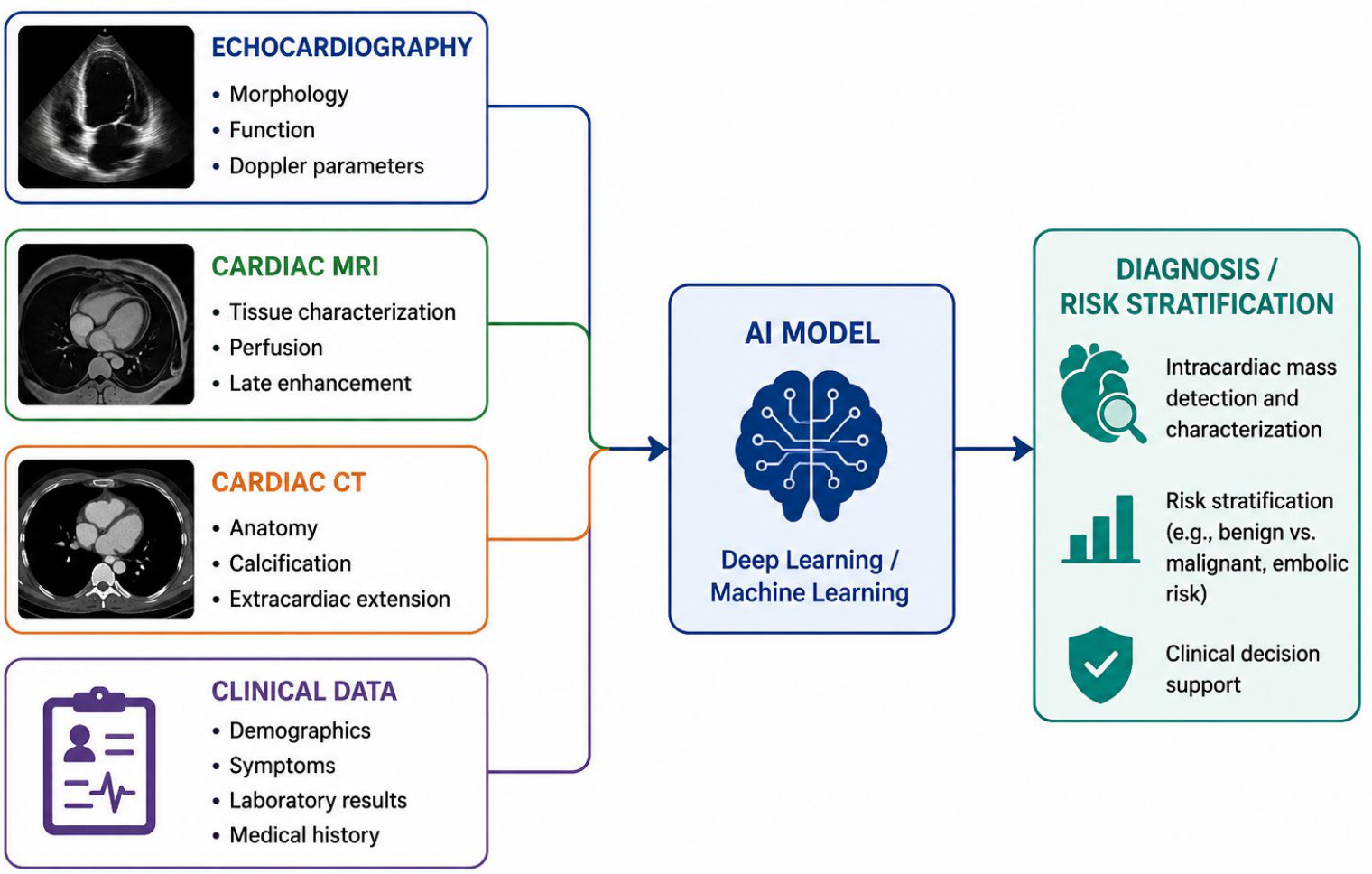
57]. A schematic overview of multimodal AI integration in cardiovascular imaging is presented in
Figure 3.
6.3. Challenges of Multimodal AI Integration
Additionally, the implementation of multimodal AI in cardiology faces several important limitations. First, the development of robust multimodal models requires large, well-annotated datasets containing synchronized information from multiple imaging modalities and clinical variables, which remain scarce in cardiovascular research. Current AI studies in cardiac imaging are often limited by heterogeneous datasets, variability in imaging protocols, and incomplete integration of clinical metadata, all of which may reduce model generalizability across institutions and patient populations [
56,
57]. In addition, differences in acquisition techniques, equipment vendors, and image quality between echocardiography, CT, and MRI create substantial technical challenges for data harmonization and model training. These issues are particularly relevant for echocardiography, which is inherently operator-dependent and subject to variability in acoustic windows and image interpretation [
57,
59]. Another critical limitation is the relative scarcity of large, standardized multicenter registries containing comprehensive imaging variables, especially for rare or heterogeneous conditions, which constrains the ability to train and externally validate multimodal AI systems [
58]. Furthermore, ethical and regulatory considerations, including data privacy, algorithmic bias, and the need for transparent and explainable decision-making, remain significant barriers to widespread clinical implementation [
57]. Together, these challenges highlight the need for coordinated multicenter collaborations, standardized imaging datasets, and rigorous validation frameworks to ensure that multimodal AI systems can be safely and effectively translated into routine cardiovascular practice.
7. Validation Strategies, Dataset Limitations, and Generalizability Issues
The development of artificial intelligence (AI) models for echocardiographic detection of cardiac tumors requires rigorous validation to ensure reliability, safety, and clinical applicability. Given the high stakes associated with diagnostic errors in cardiovascular medicine, validation strategies must extend beyond simple accuracy metrics and incorporate comprehensive assessments of model robustness, reproducibility, and external validity [
60]. A fundamental distinction exists between internal validation and external validation. Internal validation, such as k-fold cross-validation or hold-out test sets, provides an initial estimate of model performance but often overestimates real-world effectiveness, particularly when data are derived from a single institution. Several recent cardiovascular AI studies have demonstrated substantial performance degradation during external validation compared with internal testing, underscoring the importance of multicenter validation frameworks and heterogeneous imaging datasets. These challenges have been observed across multiple cardiovascular imaging applications, including deep learning-based echocardiographic assessment and cardiovascular phenotyping studies, where model performance may decline when applied to datasets derived from different institutions, acquisition protocols, or patient populations [
61,
62].
External validation, using independent datasets acquired from different centers, imaging protocols, and patient populations, is essential for assessing generalizability. Prospective validation in clinical workflows represents the highest level of evidence and yet remains relatively rare in current literature. Dataset-related limitations represent one of the most critical barriers in this field. Cardiac tumors are rare entities, leading to inherently small and imbalanced datasets, where non-neoplastic findings (e.g., thrombi or normal structures) vastly outnumber true tumors. This imbalance can bias models toward majority classes, reducing sensitivity for clinically important but infrequent conditions. In addition, annotation quality is a significant concern: ground truth labels often rely on expert interpretation rather than histopathological confirmation, introducing inter-observer variability and potential misclassification [
60,
63,
64]. Another key issue is data heterogeneity. Echocardiographic images vary widely depending on equipment vendors, acquisition settings, operator expertise, and patient-specific factors. Models trained on homogeneous datasets may fail when exposed to different imaging conditions, limiting their applicability across institutions. Furthermore, many studies rely on curated, high-quality images, which do not fully reflect the variability and noise encountered in routine clinical practice [
65].
Generalizability is further challenged by domain shift, where differences in patient demographics, disease prevalence, and imaging protocols alter the underlying data distribution. Without careful design, AI systems may perform well in controlled environments but degrade significantly in real-world settings. Techniques such as data augmentation, domain adaptation, and multi-center training cohorts can mitigate these issues, but require coordinated efforts and data-sharing infrastructures. Ultimately, robust validation frameworks should incorporate multi-institutional datasets, standardized reporting metrics, and clinically meaningful endpoints, such as diagnostic impact, time to diagnosis, and patient outcomes. Addressing dataset limitations and ensuring generalizability are prerequisites for translating AI models from research prototypes into reliable clinical tools.
8. Future Directions
Advances in artificial intelligence offer promising avenues to address many of the current limitations in echocardiographic tumor detection. Emerging methodologies, including federated learning, synthetic data generation, and improved integration into clinical workflows, are likely to play a central role in the next phase of development. Federated learning represents a paradigm shift in collaborative model training. Instead of sharing raw patient data, institutions train models locally and share only model parameters or gradients. This approach enables the use of large, multi-center datasets while preserving patient privacy and complying with data protection regulations. In the context of rare cardiac tumors, federated learning can significantly increase dataset size and diversity, thereby improving model robustness and generalizability. For example, federated learning frameworks could allow multiple tertiary cardiovascular centers to collaboratively train AI models for rare intracardiac tumors while maintaining local control over sensitive patient imaging data [
66,
67]. However, challenges remain, including communication efficiency, model convergence, and handling heterogeneity across participating sites. Synthetic data generation, particularly through generative models such as generative adversarial networks (GANs) and diffusion models, offers another potential solution to data scarcity. Synthetic echocardiographic images can augment training datasets, improve class balance, and simulate rare pathological scenarios [
68]. When carefully validated, these data can enhance model performance without requiring additional patient data. Nonetheless, ensuring that synthetic images accurately reflect true physiological and pathological variability is essential, as poorly generated data may introduce artefacts or bias. Another important direction is the development of multimodal AI systems integrating echocardiographic data with cardiac MRI, CT, electrocardiographic findings, and clinical data to improve diagnostic discrimination and risk stratification. Equally important will be the seamless integration of AI tools into clinical workflows through real-time decision-support systems and user-centered interfaces. In clinical practice, such systems could assist clinicians during echocardiographic examinations by automatically highlighting suspicious intracardiac masses, suggesting segmentation boundaries, or identifying imaging patterns associated with malignant behavior. Future research should also focus on prospective multicenter validation studies assessing not only diagnostic accuracy but also clinical utility and impact on patient outcomes [
69,
70]. These developments highlight both the opportunities and the challenges associated with the integration of artificial intelligence into echocardiographic practice.
9. Conclusions
This review demonstrates that AI-enhanced echocardiography has substantial potential to improve the detection, segmentation, and classification of intracardiac masses through automated pattern recognition and multimodal data integration. Current evidence suggests that AI-assisted approaches may improve diagnostic consistency and reduce observer variability compared with conventional interpretation alone. Despite promising early results, clinical implementation remains limited by small datasets, insufficient external validation, and challenges in generalizability across institutions and imaging protocols. At present, AI is most appropriately viewed as an assistive rather than autonomous diagnostic tool. Future progress will depend on large-scale multicenter collaboration, standardized imaging datasets, explainable AI frameworks, and prospective clinical validation to ensure safe and effective integration into routine cardiovascular practice.
Author Contributions
Conceptualization, P.B., B.D. and D.P.; methodology, P.B., L.B. and N.H.; validation, K.Đ., M.M. and I.D.; formal analysis, B.D., L.B., K.Đ. and M.M.; investigation, P.B., N.H., I.D. and D.P.; data curation, L.B., N.H. and P.B.; writing—original draft preparation, K.Đ., M.M., I.D., L.B., N.H. and P.B.; writing—review and editing, B.D. and D.P.; visualization, L.B. and P.B.; supervision, B.D. and D.P.; project administration, P.B. and D.P. All authors have read and agreed to the published version of the manuscript.
Funding
This research received no external funding.
Institutional Review Board Statement
Not applicable.
Informed Consent Statement
Not applicable.
Data Availability Statement
No new data were created in this article.
Acknowledgments
We would like to thank the International Society for Applied Biological Sciences and the International Center for Applied Biological Research for their ongoing support.
Conflicts of Interest
The authors declare no conflicts of interest.
References
- Chong, J.; Richvalsky, T.; Musuku, S.; Samy, S.; Nakai, C. Primary Cardiac Leiomyosarcoma Extending From Right Atrium to Inferior Vena Cava Without Metastasis: A Case Report. Cureus 2024, 16, e73826. [Google Scholar] [CrossRef] [PubMed]
- Kurmann, R.; El-Am, E.; Ahmad, A.; Abbasi, M.A.; Mazur, P.; Akiki, E.; Anand, V.; Herrmann, J.; Casanegra, A.I.; Young, P.; et al. Cardiac Masses Discovered by Echocardiogram; What to Do Next? Struct. Heart 2023, 7, 100154. [Google Scholar] [CrossRef]
- L’Angiocola, P.D.; Donati, R. Cardiac Masses in Echocardiography: A Pragmatic Review. J. Cardiovasc. Echogr. 2020, 30, 5–14. [Google Scholar] [CrossRef]
- Holste, G.; Oikonomou, E.K.; Tokodi, M.; Kovács, A.; Wang, Z.; Khera, R. Complete AI-Enabled Echocardiography Interpretation With Multitask Deep Learning. JAMA 2025, 334, 306–318. [Google Scholar] [CrossRef] [PubMed] [PubMed Central]
- Vukadinovic, M.; Chiu, I.M.; Tang, X.; Yuan, N.; Chen, T.-Y.; Cheng, P.; Li, D.; Cheng, S.; He, B.; Ouyang, D. Comprehensive echocardiogram evaluation with view primed vision language AI. Nature 2026, 650, 970–977. [Google Scholar] [CrossRef]
- Prentice, R.; Ahmadian, H.; Thomas, D.; Berger, J.; Gore, R. Improved efficiency and diagnostic utility of inpatient transthoracic echocardiography following implementation of a sonographer-initiated perflutren-based contrast administration protocol. Cardiovasc. Ultrasound 2020, 18, 35. [Google Scholar] [CrossRef] [PubMed]
- Myhre, P.L.; Grenne, B.; Asch, F.M.; Delgado, V.; Khera, R.; Lafitte, S.; Lang, R.M.; Pellikka, P.A.; Sengupta, P.P.; Vemulapalli, S.; et al. Artificial intelligence-enhanced echocardiography in cardiovascular disease management. Nat. Rev. Cardiol. 2026, 23, 164–182. [Google Scholar] [CrossRef]
- Chen, L.; Chen, W.; Zhu, Y.; Zhang, Z.; Liu, T.; Zhang, L. Global research landscape on artificial intelligence in echocardiography from 1997 to 2024: Bibliometric analysis. Digit. Health 2025, 11, 20552076251351201. [Google Scholar] [CrossRef]
- Sozzi, F.B.; Gnan, E.; Pandolfi, A.; Iacuzio, L.; Kim, J.K.; Canetta, C.; Rizzuto, A.S.; Ruscica, M.; Carugo, S. Diagnostic Algorithm Using Multimodal Imaging for the Differential Diagnosis of Intra-Cardiac Masses. J. Clin. Med. 2025, 14, 508. [Google Scholar] [CrossRef] [PubMed]
- Manche, N.; Mercer, M.K.; Baruah, D. Diagnosis and Treatment of Cardiac Myxoma. Cureus 2023, 15, e39148. [Google Scholar] [CrossRef]
- Hrabak-Paar, M.; Muršić, M.; Balaško-Josipović, T.; Dilber, D.; Bulj, N. Multimodality Imaging of Cardiac Myxomas. Rev. Cardiovasc. Med. 2024, 25, 204. [Google Scholar] [CrossRef] [PubMed]
- Kuo, L. Multimodality Imaging and Echocardiographic Guidance in Cardiac Mass Diagnosis and Biopsy. JACC Case Rep. 2026, 31, 106655. [Google Scholar] [CrossRef]
- Yang, Z.; Niu, Y.; Ma, H.; Gong, W.; Yu, L.; Liu, L.; Zheng, M. Contrast-enhanced echocardiographic diagnosis of benign and malignant cardiac tumors and its correlation with pathology. Front. Cardiovasc. Med. 2023, 10, 1182334. [Google Scholar] [CrossRef] [PubMed]
- Turton, E.W.; Ender, J. Role of 3D Echocardiography in Cardiac Surgery: Strengths and Limitations. Curr. Anesthesiol. Rep. 2017, 7, 291–298. [Google Scholar] [CrossRef]
- Okongwu, C.C.; Olaofe, O.O. Cardiac myxoma: A comprehensive review. J. Cardiothorac. Surg. 2025, 20, 151. [Google Scholar] [CrossRef]
- Holden, P.; Banga, A.; VanderLaan, P.; Pond, K.; Chu, L. Unusual-Appearing Calcified Left Atrial Myxoma. JACC Case Rep. 2025, 30, 105282. [Google Scholar] [CrossRef] [PubMed]
- Akabane, K.; Kuroda, Y.; Uchida, T. A Rare Case of a Cardiac Papillary Fibroelastoma Arising in the Right Atrial Septum and Resected via Minimally Invasive Cardiac Surgery. Cureus 2024, 16, e76486. [Google Scholar] [CrossRef]
- De Martino, A.; Pattuzzi, C.; Garis, S.; Bosco, F.; Virgone, V.M.; Salsano, A.; Santini, F.; Pucci, A. A Comprehensive Review of Cardiac Tumors: Imaging, Pathology, Treatment, and Challenges in the Third Millennium. Diagnostics 2025, 15, 1390. [Google Scholar] [CrossRef]
- Wang, Z.; Li, H.; Xu, H.; Li, W. Surgical management of a cardiac lipoma following surveillance: A case of delayed intervention. J. Cardiothorac. Surg. 2025, 21, 2. [Google Scholar] [CrossRef]
- Shu, S.; Wang, J.; Zheng, C. From pathogenesis to treatment, a systemic review of cardiac lipoma. J. Cardiothorac. Surg. 2021, 16, 1. [Google Scholar] [CrossRef]
- Fogante, M.; Ventura, F.; Schicchi, N.; Regnicolo, L.; Potente, C.; Argalia, G.; Polonara, G. Cardiac rhabdomyomas and cerebral lesions in 4 pediatric patients with tuberous sclerosis. Radiol. Case Rep. 2023, 18, 2645–2648. [Google Scholar] [CrossRef]
- Jayaprakash, S. Clinical presentations, diagnosis, and management of arrhythmias associated with cardiac tumors. J. Arrhythm. 2018, 34, 384–393. [Google Scholar] [CrossRef]
- Mubder, M.; Pour-Ghaz, I.; Al-Taweel, O.; Alhwarat, B.; Bond, A.; Choudhury, A.H.; Mahmoud, O.; Alkhatib, D. Primary Cardiac Sarcoma: Angiosarcoma Compressing the Right Coronary Artery. Cureus 2023, 15, e38360. [Google Scholar] [CrossRef]
- Eaton, K.W.; Jagenburg, E.; Pakray, A.; Kinni, V.; Pomerantz, B. Undifferentiated Pleomorphic Sarcoma: A Diagnosis of Exclusion. Cureus 2025, 17, e85786. [Google Scholar] [CrossRef]
- Li, T.; Nguyen, E.; Hasoon, J.; Khalifa, A.; Nguyen, A. Primary Cardiac Osteosarcoma: Epidemiology, Diagnosis, and Management—A Narrative Review. Orthop. Rev. 2025, 17, 147169. [Google Scholar] [CrossRef] [PubMed]
- Nakata, A.; Takamatsu, H.; Eguchi, Y.; Izumida, T.; Aburadani, I.; Hirota, S.; Takagawa, K. Primary Cardiac Lymphoma Arising from Both Sides of the Heart. Intern. Med. 2022, 61, 3377–3381. [Google Scholar] [CrossRef] [PubMed]
- Lucà, F.; Parrini, I.; Canale, M.L.; Rao, C.M.; Nucara, M.; Pelaggi, G.; Murrone, A.; Oliva, S.; Bisceglia, I.; Sergi, A.; et al. Cardiac Metastasis: Epidemiology, Pathophysiology, and Clinical Management. Life 2025, 15, 291. [Google Scholar] [CrossRef]
- Pino, P.G.; Moreo, A.; Lestuzzi, C. Differential diagnosis of cardiac tumors: General consideration and echocardiographic approach. J. Clin. Ultrasound 2022, 50, 1177–1193. [Google Scholar] [CrossRef] [PubMed]
- Ohshika, S.; Saruga, T.; Ogawa, T.; Ono, H.; Ishibashi, Y. Distinction between benign and malignant soft tissue tumors based on an ultrasonographic evaluation of vascularity and elasticity. Oncol. Lett. 2021, 21, 281. [Google Scholar] [CrossRef]
- Gatti, M.; D’Angelo, T.; Muscogiuri, G.; Dell’AVersana, S.; Andreis, A.; Carisio, A.; Darvizeh, F.; Tore, D.; Pontone, G.; Faletti, R. Cardiovascular magnetic resonance of cardiac tumors and masses. World J. Cardiol. 2021, 13, 628–649. [Google Scholar] [CrossRef]
- Mousavi, N.; Cheezum, M.K.; Aghayev, A.; Padera, R.; Vita, T.; Steigner, M.; Hulten, E.; Bittencourt, M.S.; Dorbala, S.; Di Carli, M.F.; et al. Assessment of Cardiac Masses by Cardiac Magnetic Resonance Imaging: Histological Correlation and Clinical Outcomes. J. Am. Heart Assoc. 2019, 8, e007829. [Google Scholar] [CrossRef]
- Jain, S.; Dhingra, V.; Girdhani, B. Scope of PET imaging in the evaluation of cardiac tumors. Cancer Treat. Res. Commun. 2023, 37, 100754. [Google Scholar] [CrossRef]
- Schuuring, M.J.; Išgum, I.; Cosyns, B.; Chamuleau, S.A.J.; Bouma, B.J. Routine Echocardiography and Artificial Intelligence Solutions. Front. Cardiovasc. Med. 2021, 8, 648877. [Google Scholar] [CrossRef]
- Maturi, B.; Dulal, S.; Sayana, S.B.; Ibrahim, A.; Ramakrishna, M.; Chinta, V.; Sharma, A.; Ravipati, H. Revolutionizing Cardiology: The Role of Artificial Intelligence in Echocardiography. J. Clin. Med. 2025, 14, 625. [Google Scholar] [CrossRef]
- Mor-Avi, V.; Khandheria, B.; Klempfner, R.; Cotella, J.I.; Moreno, M.; Ignatowski, D.; Guile, B.; Hayes, H.J.; Hipke, K.; Kaminski, A.; et al. Real-Time Artificial Intelligence–Based Guidance of Echocardiographic Imaging by Novices: Image Quality and Suitability for Diagnostic Interpretation and Quantitative Analysis. Circ. Cardiovasc. Imaging 2023, 16, 905–913. [Google Scholar] [CrossRef]
- Jamthikar, A.D.; Hathaway, Q.A.; Maganti, K.; Hamirani, Y.; Bokhari, S.; Yanamala, N.; Sengupta, P.P. Ultrasonic Texture Analysis for Predicting Acute Myocardial Infarction. JACC Cardiovasc. Imaging 2025, 18, 1185–1199. [Google Scholar] [CrossRef] [PubMed]
- Lee, J.W.; Park, C.H.; Im, D.J.; Lee, K.H.; Kim, T.H.; Han, K.; Hur, J. CT-based radiomics signature for differentiation between cardiac tumors and a thrombi: A retrospective, multicenter study. Sci. Rep. 2022, 12, 8173. [Google Scholar] [CrossRef] [PubMed]
- Subramaniam, S.; Rizvi, S.; Ramesh, R.; Sehgal, V.; Gurusamy, B.; Arif, H.; Tran, J.; Thamman, R.; Anyanwu, E.C.; Mastouri, R.; et al. Ontology-Guided Machine Learning Outperforms Zero-Shot Foundation Models for Cardiac Ultrasound Text Reports. Sci. Rep. 2025, 15, 5456. [Google Scholar] [CrossRef]
- Chen, C.; Qin, C.; Qiu, H.; Tarroni, G.; Duan, J.; Bai, W.; Rueckert, D. Deep Learning for Cardiac Image Segmentation: A Review. Front. Cardiovasc. Med. 2020, 7, 25. [Google Scholar] [CrossRef] [PubMed]
- Elmekki, H.; Alagha, A.; Sami, H.; Spilkin, A.; Zanuttini, A.M.; Zakeri, E.; Bentahar, J.; Kadem, L.; Xie, W.-F.; Pibarot, P.; et al. CACTUS: An Open Dataset and Framework for Automated Cardiac Assessment and Classification of Ultrasound Images Using Deep Transfer Learning. Comput. Biol. Med. 2025, 190, 110003. [Google Scholar] [CrossRef]
- Kumar, A.; Baum, E.; Parmer-Chow, C.; Kugler, J. Limited Echocardiogram Acquisition by Novice Clinicians Aided with Deep Learning: A Randomized Controlled Trial. Biol. Methods Protoc. 2025, 10, bpaf083. [Google Scholar] [CrossRef]
- Frydman, S.; Freund, O.; Miller, R.; Sror, N.; Barel, N.; Baruch, G.; Rothschild, E.; Merin, R.; Shporn, O.; Ohad, M.; et al. The Effect of AI-Assisted Bedside Echocardiography on Inpatient Care: A Prospective Trial. Eur. Heart J. Digit. Health 2026, 7, ztag013. [Google Scholar] [CrossRef]
- Zhou, J.; Du, M.; Chang, S.; Chen, Z. Artificial Intelligence in Echocardiography: Detection, Functional Evaluation, and Disease Diagnosis. Cardiovasc. Ultrasound 2021, 19, 29. [Google Scholar] [CrossRef]
- Ahsan, M.M.; Luna, S.A.; Siddique, Z. Machine-Learning-Based Disease Diagnosis: A Comprehensive Review. Healthcare 2022, 10, 541. [Google Scholar] [CrossRef]
- Alkayyali, Z.K.D.; Idris, S.A.B.; Abu-Naser, S.S. A Systematic Literature Review of Deep and Machine Learning Algorithms in Cardiovascular Diseases Diagnosis. J. Theor. Appl. Inf. Technol. 2023, 101, 1353–1365. [Google Scholar]
- Kigo, S.N.; Omondi, E.O.; Omolo, B.O. Assessing Predictive Performance of Supervised Machine Learning Algorithms for a Diamond Pricing Model. Sci. Rep. 2023, 13, 17315. [Google Scholar] [CrossRef]
- Kora, P.; Ooi, C.P.; Faust, O.; Raghavendra, U.; Gudigar, A.; Chan, W.Y.; Meenakshi, K.; Swaraja, K.; Plawiak, P.; Rajendra Acharya, U. Transfer Learning Techniques for Medical Image Analysis: A Review. Biocybern. Biomed. Eng. 2022, 42, 79–107. [Google Scholar] [CrossRef]
- Ali, A.; Ramachandra, H.V.; Ramakrishnan, N.; Murtugudde, G. Prognosis of Chronic Kidney Disease Using ML Optimization Techniques. In Proceedings of the 2023 International Conference on Advances in Electronics, Communication, Computing and Intelligent Information Systems (ICAECIS), Bangalore, India, 19–21 April 2023; pp. 459–463. [Google Scholar]
- Ramachandra, H.V.; Chavan, P.; Ali, A.; Ramaprasad, H.C. Ensemble Machine Learning Techniques for Pancreatic Cancer Detection. In Proceedings of the 2023 International Conference on Applied Intelligence and Sustainable Computing (ICAISC), Dharwad, India, 16–17 June 2023; pp. 1–5. [Google Scholar]
- Manikandan, A.; PonniBala, M. Intracardiac Mass Detection and Classification Using Double Convolutional Neural Network Classifier. J. Eng. Res. 2023, 11, 272–280. [Google Scholar] [CrossRef]
- Puyol-Antón, E.; Sidhu, B.S.; Gould, J.; Porter, B.; Elliott, M.K.; Mehta, V.; Rinaldi, C.A.; King, A.P. A Multimodal Deep Learning Model for Cardiac Resynchronisation Therapy Response Prediction. Med. Image Anal. 2022, 79, 102465. [Google Scholar] [CrossRef]
- Soto, J.T.; Weston Hughes, J.; Sanchez, P.A.; Perez, M.; Ouyang, D.; Ashley, E.A. Multimodal Deep Learning Enhances Diagnostic Precision in Left Ventricular Hypertrophy. Eur. Heart J.-Digit. Health 2022, 3, 380–389. [Google Scholar] [CrossRef] [PubMed]
- Amal, S.; Safarnejad, L.; Omiye, J.A.; Ghanzouri, I.; Cabot, J.H.; Ross, E.G. Use of Multi-Modal Data and Machine Learning to Improve Cardiovascular Disease Care. Front. Cardiovasc. Med. 2022, 9, 840262. [Google Scholar] [CrossRef]
- Milosevic, M.; Jin, Q.; Singh, A.; Amal, S. Applications of AI in Multi-Modal Imaging for Cardiovascular Disease. Front. Radiol. 2024, 3, 1294068. [Google Scholar] [CrossRef]
- Pezel, T.; Toupin, S.; Bousson, V.; Hamzi, K.; Hovasse, T.; Lefevre, T.; Chevalier, B.; Unterseeh, T.; Sanguineti, F.; Champagne, S.; et al. A Machine Learning Model Using Cardiac CT and MRI Data Predicts Cardiovascular Events in Obstructive Coronary Artery Disease. Radiology 2025, 314, e233030. [Google Scholar] [CrossRef] [PubMed]
- Moradi, A.; Olanisa, O.O.; Nzeako, T.; Shahrokhi, M.; Esfahani, E.; Fakher, N.; Tabari, M.A.K. Revolutionizing Cardiac Imaging: A Scoping Review of Artificial Intelligence in Echocardiography, CTA, and Cardiac MRI. J. Imaging 2024, 10, 193. [Google Scholar] [CrossRef] [PubMed]
- Tolu-Akinnawo, O.Z.; Ezekwueme, F.; Omolayo, O.; Batheja, S.; Awoyemi, T. Advancements in Artificial Intelligence in Noninvasive Cardiac Imaging: A Comprehensive Review. Clin. Cardiol. 2025, 48, e70087. [Google Scholar] [CrossRef]
- Szugye, N. Greater than the Sum of Its Parts: Multimodality Imaging in Adults with Congenital Heart Disease. Cardiovasc. Diagn. Ther. 2024, 14, 1176–1185. [Google Scholar] [CrossRef]
- Rivera Boadla, M.E.; Sharma, N.R.; Varghese, J.; Lamichhane, S.; Khan, M.H.; Gulati, A.; Khurana, S.; Tan, S.; Sharma, A. Multimodal Cardiac Imaging Revisited by Artificial Intelligence: An Innovative Way of Assessment or Just an Aid? Cureus 2024, 16, e64272. [Google Scholar] [CrossRef]
- Patel, D.; Kantamneni, R.; John, J.D.; Patel, T.; Shukla, A.; Salma, A.; Anand, N. Artificial intelligence in cardiology: An updated systematic review with ethical considerations and challenges in implementing artificial intelligence models. Ann. Med. Surg. 2025, 88, 1789–1805. [Google Scholar] [CrossRef]
- Ouyang, D.; He, B.; Ghorbani, A.; Yuan, N.; Ebinger, J.; Langlotz, C.P.; Heidenreich, P.A.; Harrington, R.A.; Liang, D.H.; Ashley, E.A.; et al. Video-based AI for beat-to-beat assessment of cardiac function. Nature 2020, 580, 252–256. [Google Scholar] [CrossRef]
- Duffy, G.; Cheng, P.P.; Yuan, N.; He, B.; Kwan, A.C.; Shun-Shin, M.J.; Alexander, K.M.; Ebinger, J.; Lungren, M.P.; Rader, F.; et al. High-Throughput Precision Phenotyping of Left Ventricular Hypertrophy With Cardiovascular Deep Learning. JAMA Cardiol. 2022, 7, 386–395. [Google Scholar] [CrossRef] [PubMed]
- Haupt, M.; Maurer, M.H.; Thomas, R.P. Explainable Artificial Intelligence in Radiological Cardiovascular Imaging-A Systematic Review. Diagnostics 2025, 15, 1399. [Google Scholar] [CrossRef] [PubMed]
- Salih, A.M.; Galazzo, I.B.; Gkontra, P.; Rauseo, E.; Lee, A.M.; Lekadir, K.; Radeva, P.; Petersen, S.E.; Menegaz, G. A review of evaluation approaches for explainable AI with applications in cardiology. Artif. Intell. Rev. 2024, 57, 240. [Google Scholar] [CrossRef]
- Al Saikhan, L. AI-Enabled Precision Echocardiography: Toward Personalized Cardiovascular Care. Diagnostics 2026, 16, 694. [Google Scholar] [CrossRef] [PubMed]
- Linardos, A.; Kushibar, K.; Walsh, S.; Gkontra, P.; Lekadir, K. Federated learning for multi-center imaging diagnostics: A simulation study in cardiovascular disease. Sci. Rep. 2022, 12, 3551. [Google Scholar] [CrossRef] [PubMed]
- Tölle, M.; Garthe, P.; Scherer, C.; Seliger, J.M.; Leha, A.; Krüger, N.; Simm, S.; Martin, S.; Eble, S.; Kelm, H.; et al. Real world federated learning with a knowledge distilled transformer for cardiac CT imaging. npj Digit. Med. 2025, 8, 88. [Google Scholar] [CrossRef]
- Kumar, V.; Sharma, N.M.; Mahapatra, P.K.; Dogra, N.; Maurya, L.; Ahmad, F.; Dahiya, N.; Panda, P. Enhancing Left Ventricular Segmentation in Echocardiograms Through GAN-Based Synthetic Data Augmentation and MultiResUNet Architecture. Diagnostics 2025, 15, 663. [Google Scholar] [CrossRef]
- He, B.; Kwan, A.C.; Cho, J.H.; Yuan, N.; Pollick, C.; Shiota, T.; Ebinger, J.; Bello, N.A.; Wei, J.; Josan, K.; et al. Blinded, randomized trial of sonographer versus AI cardiac function assessment. Nature 2023, 616, 520–524. [Google Scholar] [CrossRef]
- Sakamoto, A.; Kagiyama, N.; Sato, E.; Nakamura, Y.; Murata, A.; Kaneko, T.; Miyazaki, S.; Ashikawa, Y.; Sugihara, K.; Minamino, T. Artificial Intelligence-Based Automated Echocardiographic Analysis and the Workflow of Sonographers: A Randomized Crossover Trial (AI-Echo RCT). J. Am. Heart Assoc. 2026, 15, e045637. [Google Scholar] [CrossRef]
Figure 1.
Schematic comparison of echocardiographic features suggestive of benign and malignant intracardiac masses. Illustrative overview of characteristic echocardiographic findings associated with benign and malignant intracardiac masses. Benign lesions are more commonly localized to typical anatomical sites such as the interatrial septum or cardiac valves and are often pedunculated, mobile, well-circumscribed, and non-invasive. In contrast, malignant masses more frequently demonstrate atypical localization, infiltrative growth, heterogeneous echogenicity, poorly defined borders, associated pericardial effusion, and possible multiplicity.
Figure 1.
Schematic comparison of echocardiographic features suggestive of benign and malignant intracardiac masses. Illustrative overview of characteristic echocardiographic findings associated with benign and malignant intracardiac masses. Benign lesions are more commonly localized to typical anatomical sites such as the interatrial septum or cardiac valves and are often pedunculated, mobile, well-circumscribed, and non-invasive. In contrast, malignant masses more frequently demonstrate atypical localization, infiltrative growth, heterogeneous echogenicity, poorly defined borders, associated pericardial effusion, and possible multiplicity.
Figure 2.
Artificial intelligence pipeline for echocardiographic detection and characterization of intracardiac masses. Schematic overview of AI-assisted intracardiac mass assessment integrating echocardiography, clinical data, and multimodal imaging. Conventional echocardiographic parameters, including ventricular dimensions, myocardial wall thickness, valvular morphology, blood flow velocities, wall motion, and chamber size, are incorporated into machine learning (ML) and deep learning (DL) frameworks. The illustrated AI pipeline includes image pre-processing, automated segmentation of intracardiac masses using architectures such as U-Net and fully convolutional networks (FCN), feature extraction through ultrasomics/radiomics analysis, and classification of benign versus malignant masses. Integration with multimodal imaging modalities, including cardiac computed tomography (CT) and magnetic resonance imaging (MRI), as well as clinical and electrocardiographic data, may improve diagnostic discrimination, risk stratification, and clinical decision support. The figure also highlights key translational considerations, including explainable AI approaches, dataset limitations, validation strategies, and regulatory challenges relevant to clinical implementation.
Figure 2.
Artificial intelligence pipeline for echocardiographic detection and characterization of intracardiac masses. Schematic overview of AI-assisted intracardiac mass assessment integrating echocardiography, clinical data, and multimodal imaging. Conventional echocardiographic parameters, including ventricular dimensions, myocardial wall thickness, valvular morphology, blood flow velocities, wall motion, and chamber size, are incorporated into machine learning (ML) and deep learning (DL) frameworks. The illustrated AI pipeline includes image pre-processing, automated segmentation of intracardiac masses using architectures such as U-Net and fully convolutional networks (FCN), feature extraction through ultrasomics/radiomics analysis, and classification of benign versus malignant masses. Integration with multimodal imaging modalities, including cardiac computed tomography (CT) and magnetic resonance imaging (MRI), as well as clinical and electrocardiographic data, may improve diagnostic discrimination, risk stratification, and clinical decision support. The figure also highlights key translational considerations, including explainable AI approaches, dataset limitations, validation strategies, and regulatory challenges relevant to clinical implementation.

Figure 3.
Conceptual framework of multimodal artificial intelligence integration for intracardiac mass assessment. Schematic illustration of a multimodal artificial intelligence (AI) framework integrating echocardiography, cardiac magnetic resonance imaging (MRI), cardiac computed tomography (CT), and clinical data for intracardiac mass detection and characterization. Echocardiography contributes real-time morphological and hemodynamic information, while MRI provides tissue characterization and perfusion assessment, CT enables detailed anatomical evaluation and detection of extracardiac extension, and clinical data provide contextual patient information. These heterogeneous data streams may be integrated through machine learning and deep learning models to support diagnosis, risk stratification, and clinical decision-making.
Figure 3.
Conceptual framework of multimodal artificial intelligence integration for intracardiac mass assessment. Schematic illustration of a multimodal artificial intelligence (AI) framework integrating echocardiography, cardiac magnetic resonance imaging (MRI), cardiac computed tomography (CT), and clinical data for intracardiac mass detection and characterization. Echocardiography contributes real-time morphological and hemodynamic information, while MRI provides tissue characterization and perfusion assessment, CT enables detailed anatomical evaluation and detection of extracardiac extension, and clinical data provide contextual patient information. These heterogeneous data streams may be integrated through machine learning and deep learning models to support diagnosis, risk stratification, and clinical decision-making.
Table 1.
Representative AI approaches for echocardiographic detection and classification of intracardiac masses.
Table 1.
Representative AI approaches for echocardiographic detection and classification of intracardiac masses.
| Study/Year | Task | AI Method | Dataset | Performance | Key Strength | Main Limitation |
|---|
| Manikandan et al., 2023 [50] | Mass detection and classification | DCNN + handcrafted features | <100 patients (single center) | Accuracy 98.98%, Sensitivity 98.89%, Specificity 99.16% | Demonstrates feasibility of end-to-end automated classification | High risk of overfitting, no external validation |
| Zhou et al., 2021 [43] | Structural abnormality detection | ML (SVM, RF) | Retrospective dataset | High diagnostic accuracy reported | Early demonstration of ML utility in echocardiography | Not tumor-specific, requires manual feature extraction |
| Chen et al., 2020 [39] | Cardiac structure segmentation | CNN (U-Net, FCN) | Multi-cohort datasets | High segmentation accuracy | Enables automated ROI extraction for downstream tasks | Indirect application to tumor detection |
| Puyol-Antón et al., 2022 [51] | Multimodal prediction (echo + CMR) | Multimodal DL | ~50 patients | Accuracy ~77% (echo-only inference) | Highlights benefit of multimodal training strategies | Small cohort, not tumor-focused |
| Torres Soto et al., 2022 [52] | Disease classification (echo + ECG) | ML fusion model | Clinical dataset | Improved performance vs. single modality | Demonstrates value of multimodal integration | No direct application to cardiac masses |
| Disclaimer/Publisher’s Note: The statements, opinions and data contained in all publications are solely those of the individual author(s) and contributor(s) and not of MDPI and/or the editor(s). MDPI and/or the editor(s) disclaim responsibility for any injury to people or property resulting from any ideas, methods, instructions or products referred to in the content. |




 ,
,