A Cross-Scale Decoder with Token Refinement for Off-Road Semantic Segmentation


Abstract
1. Introduction
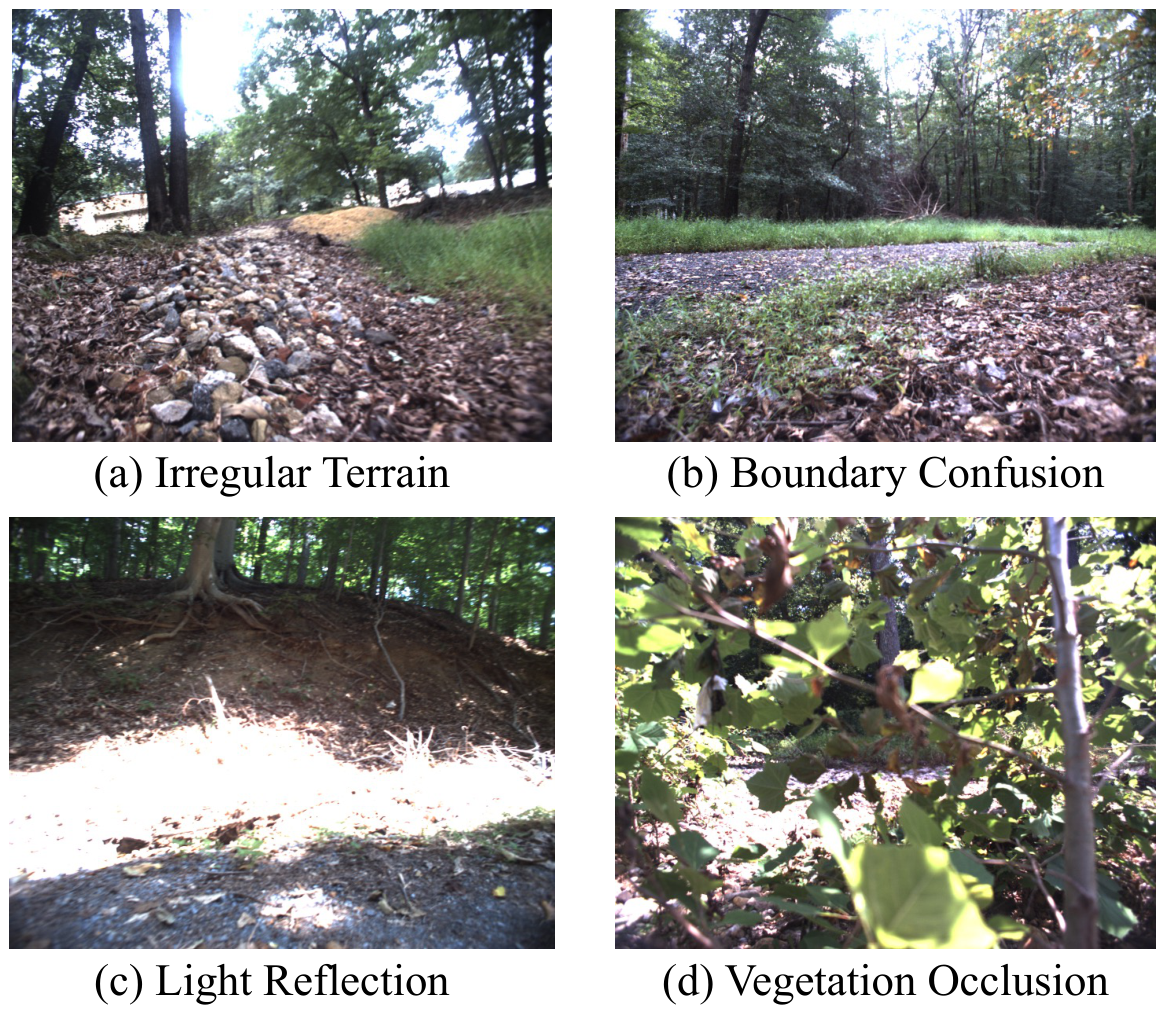
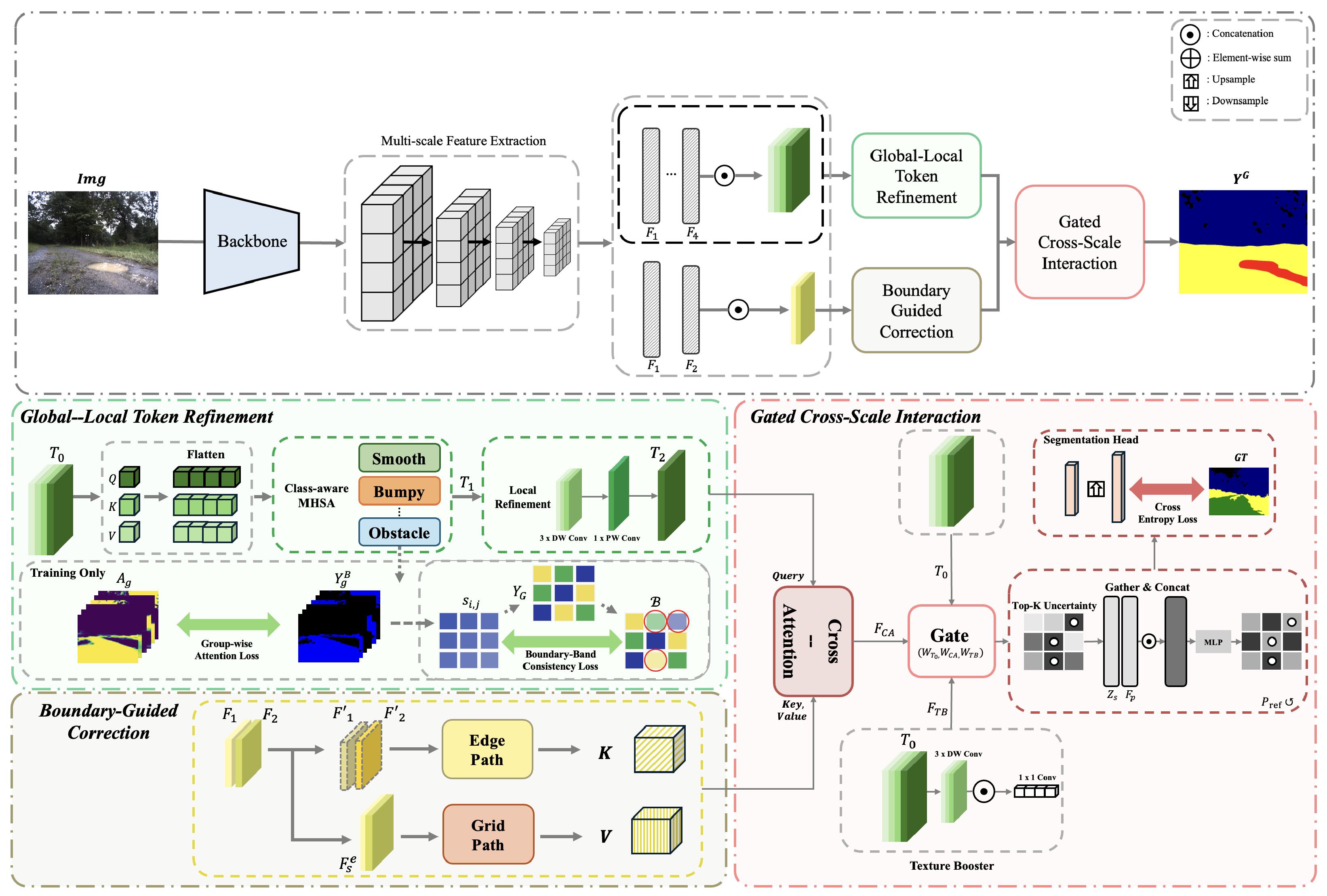
- We propose CSTR, which is designed to separate semantic consolidation from selective structural correction guided by boundary cues, enabling robust off-road semantic segmentation under ambiguous and noisy supervision without relying on dense multi-scale fusion.
- We introduce GLTR, which stabilizes semantic representations on a compact bottleneck lattice through global attention and lightweight local refinement, supported by a boundary-band group attention regularizer for noise-robust semantic consolidation near ambiguous transition regions.
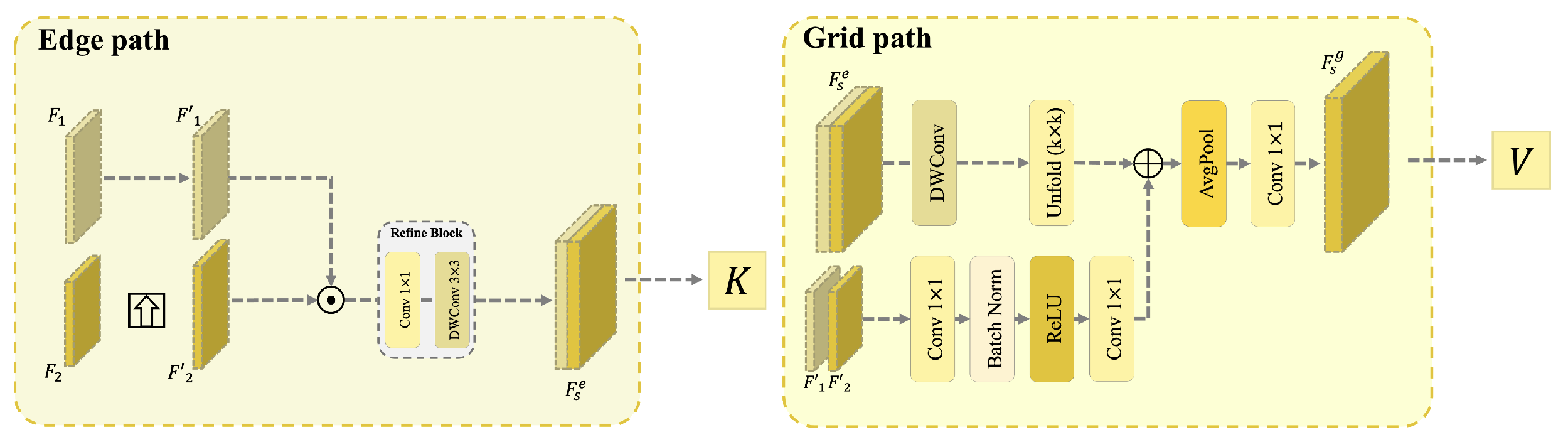
- We realize boundary-guided correction through BGC and GCS, where BGC extracts fine-scale structural cues and GCS selectively integrates them with uncertainty-guided, class-aware point-wise correction to recover rare and ambiguous structures while maintaining practical inference efficiency.
2. Related Work
2.1. Off-Road Semantic Segmentation
2.2. Multi-Scale Decoder Architectures
2.3. Boundary-Aware Refinement
3. Methods
3.1. Overview
3.2. Global–Local Token Refinement (GLTR)
3.3. Boundary-Guided Correction (BGC)
3.4. Gated Cross-Scale Interaction (GCS)
3.5. Training Objective
4. Experiments
4.1. Datasets
4.2. Experiment Settings
4.3. Main Results
4.4. Computational Efficiency
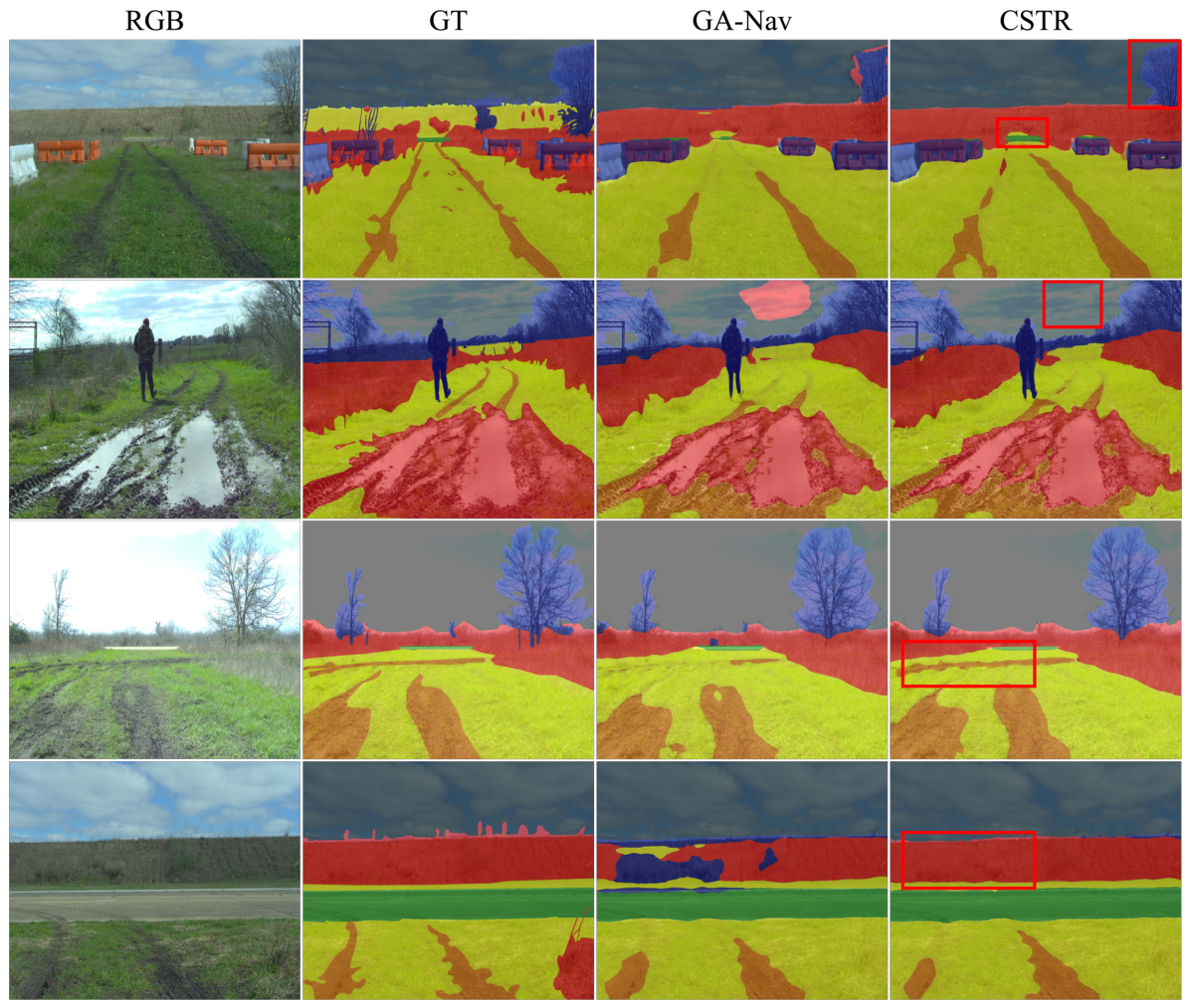
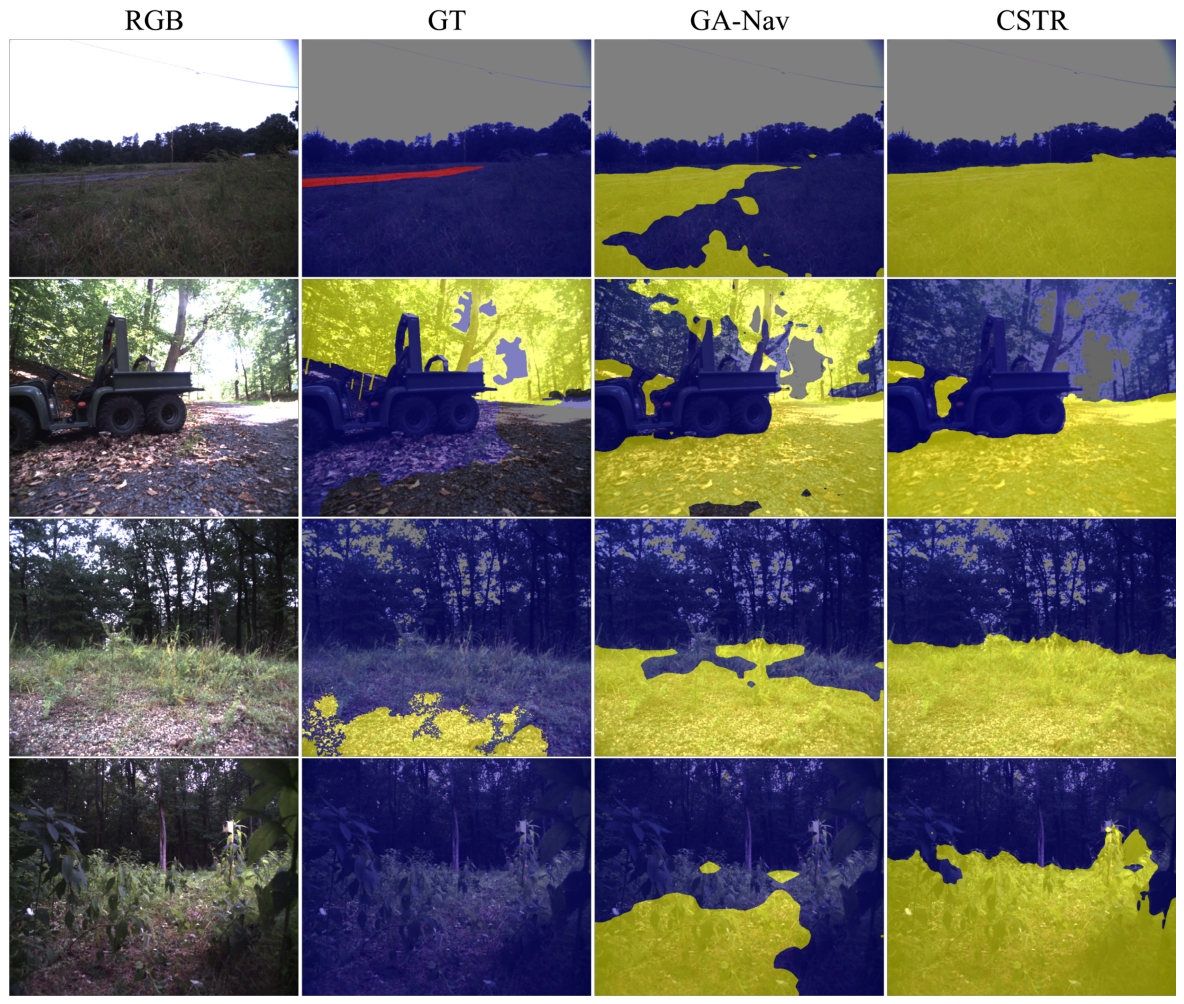
4.5. Qualitative Assessment
4.6. Ablation Studies
5. Conclusions
Author Contributions
Funding
Institutional Review Board Statement
Informed Consent Statement
Data Availability Statement
Conflicts of Interest
References
- Wigness, M.; Eum, S.; Rogers, J.G.; Han, D.; Kwon, H. RUGD: A Dataset for Autonomous Navigation and Visual Perception in Unstructured Outdoor Environments. In Proceedings of the 2019 IEEE/RSJ International Conference on Intelligent Robots and Systems (IROS); IEEE: Piscataway, NJ, USA, 2019; pp. 5000–5007. [Google Scholar]
- Jiang, P.; Osteen, P.; Wigness, M.; Saripalli, S. RELLIS-3D Dataset: Data, Benchmarks and Analysis. In Proceedings of the 2021 IEEE International Conference on Robotics and Automation (ICRA); IEEE: Piscataway, NJ, USA, 2021; pp. 1110–1116. [Google Scholar]
- Mortimer, P.; Hagmanns, R.; Granero, M.; Luettel, T.; Petereit, J.; Wuensche, H.J. The GOOSE Dataset for Perception in Unstructured Environments. In Proceedings of the 2024 IEEE International Conference on Robotics and Automation (ICRA); IEEE: Piscataway, NJ, USA, 2024; pp. 14838–14844. [Google Scholar]
- Triest, S.; Sivaprakasam, M.; Wang, S.J.; Wang, W.; Johnson, A.M.; Scherer, S. TartanDrive: A Large-Scale Dataset for Learning Off-Road Dynamics Models. In Proceedings of the 2022 International Conference on Robotics and Automation (ICRA); IEEE: Piscataway, NJ, USA, 2022; pp. 2546–2552. [Google Scholar]
- Sivaprakasam, M.; Maheshwari, P.; Castro, M.G.; Triest, S.; Nye, M.; Willits, S.; Saba, A.; Wang, W.; Scherer, S. TartanDrive 2.0: More Modalities and Better Infrastructure to Further Self-Supervised Learning Research in Off-Road Driving Tasks. In Proceedings of the 2024 IEEE International Conference on Robotics and Automation (ICRA); IEEE: Piscataway, NJ, USA, 2024. [Google Scholar]
- Guan, T.; Kothandaraman, D.; Chandra, R.; Sathyamoorthy, A.J.; Weerakoon, K.; Manocha, D. GA-Nav: Efficient Terrain Segmentation for Robot Navigation in Unstructured Outdoor Environments. IEEE Robot. Autom. Lett. 2022, 7, 8138–8145. [Google Scholar] [CrossRef]
- Shaban, A.; Meng, X.; Lee, J.; Boots, B.; Fox, D. Semantic Terrain Classification for Off-Road Autonomous Driving. In Proceedings of the Conference on Robot Learning, London, UK, 8–11 November 2021; PMLR: New York, NY, USA, 2022; pp. 619–629. [Google Scholar]
- Gao, B.; Hu, S.; Zhao, X.; Zhao, H. Fine-Grained Off-Road Semantic Segmentation and Mapping via Contrastive Learning. In Proceedings of the 2021 IEEE/RSJ International Conference on Intelligent Robots and Systems (IROS); IEEE: Piscataway, NJ, USA, 2021; pp. 5950–5957. [Google Scholar]
- Benatti, S.; Young, A.; Elmquist, A.; Taves, J.; Tasora, A.; Serban, R.; Negrut, D. End-to-End Learning for Off-Road Terrain Navigation Using the Chrono Open-Source Simulation Platform. Multibody Syst. Dyn. 2022, 54, 399–414. [Google Scholar] [CrossRef]
- Zheng, S.; Lu, J.; Zhao, H.; Zhu, X.; Luo, Z.; Wang, Y.; Fu, Y.; Feng, J.; Xiang, T.; Torr, P.H.S.; et al. Rethinking Semantic Segmentation from a Sequence-to-Sequence Perspective with Transformers. In Proceedings of the IEEE/CVF Conference on Computer Vision and Pattern Recognition (CVPR), Virtual, 19–25 June 2021; pp. 6881–6890. [Google Scholar]
- Xie, E.; Wang, W.; Yu, Z.; Anandkumar, A.; Alvarez, J.M.; Luo, P. SegFormer: Simple and Efficient Design for Semantic Segmentation with Transformers. Adv. Neural Inf. Process. Syst. 2021, 34, 12077–12090. [Google Scholar]
- Ranftl, R.; Bochkovskiy, A.; Koltun, V. Vision Transformers for Dense Prediction. In Proceedings of the IEEE/CVF International Conference on Computer Vision (ICCV), Montreal, QC, Canada, 11–17 October 2021; pp. 12179–12188. [Google Scholar]
- Zhao, H.; Shi, J.; Qi, X.; Wang, X.; Jia, J. Pyramid Scene Parsing Network. In Proceedings of the IEEE Conference on Computer Vision and Pattern Recognition (CVPR), Honolulu, HI, USA, 21–26 July 2017; pp. 2881–2890. [Google Scholar]
- Chen, L.C.; Zhu, Y.; Papandreou, G.; Schroff, F.; Adam, H. Encoder–Decoder with Atrous Separable Convolution for Semantic Image Segmentation. In Proceedings of the European Conference on Computer Vision (ECCV), Munich, Germany, 8–14 September 2018; pp. 801–818. [Google Scholar]
- Kirillov, A.; Mintun, E.; Ravi, N.; Mao, H.; Rolland, C.; Gustafson, L.; Xiao, T.; Whitehead, S.; Berg, A.C.; Lo, W.Y.; et al. Segment Anything. In Proceedings of the IEEE/CVF International Conference on Computer Vision (ICCV), Paris, France, 2–6 October 2023; pp. 4015–4026. [Google Scholar]
- Zou, X.; Yang, J.; Zhang, H.; Li, F.; Li, L.; Wang, J.; Wang, L.; Gao, J.; Lee, Y.J. Segment Everything Everywhere All at Once. Adv. Neural Inf. Process. Syst. 2023, 36, 19769–19782. [Google Scholar]
- Ravi, N.; Gabeur, V.; Hu, Y.T.; Hu, R.; Ryali, C.; Ma, T.; Khedr, H.; Rädle, R.; Rolland, C.; Gustafson, L.; et al. SAM 2: Segment Anything in Images and Videos. arXiv 2024, arXiv:2408.00714. [Google Scholar]
- Yuan, Y.; Chen, X.; Wang, J. Object-Contextual Representations for Semantic Segmentation. In Proceedings of the European Conference on Computer Vision (ECCV); Springer: Cham, Switzerland, 2020; pp. 173–190. [Google Scholar]
- Takikawa, T.; Acuna, D.; Jampani, V.; Fidler, S. Gated-SCNN: Gated Shape CNNs for Semantic Segmentation. In Proceedings of the IEEE/CVF International Conference on Computer Vision (ICCV), Seoul, Republic of Korea, 27 October–2 November 2019; pp. 5229–5238. [Google Scholar]
- Kirillov, A.; Wu, Y.; He, K.; Girshick, R. PointRend: Image Segmentation as Rendering. In Proceedings of the IEEE/CVF Conference on Computer Vision and Pattern Recognition (CVPR), Seattle, WA, USA, 14–19 June 2020; pp. 9799–9808. [Google Scholar]
- Singh, A.; Singh, K.; Sujit, P.B. OffRoadTranSeg: Semi-Supervised Segmentation Using Transformers on Off-Road Environments. arXiv 2021, arXiv:2106.13963. [Google Scholar]
- Liu, Z.; Lin, Y.; Cao, Y.; Hu, H.; Wei, Y.; Zhang, Z.; Lin, S.; Guo, B. Swin Transformer: Hierarchical Vision Transformer Using Shifted Windows. In Proceedings of the IEEE/CVF International Conference on Computer Vision (ICCV), Virtual, 11–17 October 2021; pp. 10012–10022. [Google Scholar]
- Jain, J.; Li, J.; Chiu, M.T.; Hassani, A.; Orlov, N.; Shi, H. OneFormer: One Transformer to Rule Universal Image Segmentation. In Proceedings of the IEEE/CVF Conference on Computer Vision and Pattern Recognition (CVPR), Vancouver, BC, Canada, 18–22 June 2023; pp. 2989–2998. [Google Scholar]
- Cheng, B.; Misra, I.; Schwing, A.G.; Kirillov, A.; Girdhar, R. Masked-Attention Mask Transformer for Universal Image Segmentation. In Proceedings of the IEEE/CVF Conference on Computer Vision and Pattern Recognition (CVPR), New Orleans, LA, USA, 19–24 June 2022; pp. 1290–1299. [Google Scholar]
- Fu, J.; Liu, J.; Tian, H.; Li, Y.; Bao, Y.; Fang, Z.; Lu, H. Dual Attention Network for Scene Segmentation. In Proceedings of the IEEE/CVF Conference on Computer Vision and Pattern Recognition (CVPR), Long Beach, CA, USA, 15–20 June 2019; pp. 3146–3154. [Google Scholar]
- Wu, T.; Tang, S.; Zhang, R.; Cao, J.; Zhang, Y. CGNet: A Light-Weight Context Guided Network for Semantic Segmentation. IEEE Trans. Image Process. 2020, 30, 1169–1179. [Google Scholar] [CrossRef] [PubMed]
- Poudel, R.P.K.; Liwicki, S.; Cipolla, R. FastSCNN: Fast Semantic Segmentation Network. arXiv 2019, arXiv:1902.04502. [Google Scholar]
- Yu, C.; Gao, C.; Wang, J.; Yu, G.; Shen, C.; Sang, N. BiSeNet V2: Bilateral Network with Guided Aggregation for Real-Time Semantic Segmentation. Int. J. Comput. Vis. 2021, 129, 3051–3068. [Google Scholar] [CrossRef]
- Krähenbühl, P.; Koltun, V. Efficient Inference in Fully Connected CRFs with Gaussian Edge Potentials. Adv. Neural Inf. Process. Syst. 2011, 24. [Google Scholar]
- Kervadec, H.; Bouchtiba, J.; Desrosiers, C.; Granger, E.; Dolz, J.; Ayed, I.B. Boundary Loss for Highly Unbalanced Segmentation. In Proceedings of the International Conference on Medical Imaging with Deep Learning; PMLR: New York, NY, USA, 2019; pp. 285–296. [Google Scholar]
- Ke, T.W.; Hwang, J.J.; Liu, Z.; Yu, S.X. Adaptive Affinity Fields for Semantic Segmentation. In Proceedings of the European Conference on Computer Vision (ECCV), Munich, Germany, 8–14 September 2018; pp. 587–602. [Google Scholar]
- Wang, C.; Zhang, Y.; Cui, M.; Ren, P.; Yang, Y.; Xie, X.; Hua, X.S.; Bao, H.; Xu, W. Active Boundary Loss for Semantic Segmentation. Proc. Aaai Conf. Artif. Intell. 2022, 36, 2397–2405. [Google Scholar] [CrossRef]
- Yuan, Y.; Xie, J.; Chen, X.; Wang, J. SegFix: Model-Agnostic Boundary Refinement for Segmentation. In Proceedings of the European Conference on Computer Vision (ECCV); Springer: Cham, Switzerland, 2020; pp. 489–506. [Google Scholar]
- Ding, H.; Jiang, X.; Liu, A.Q.; Thalmann, N.M.; Wang, G. Boundary-Aware Feature Propagation for Scene Segmentation. In Proceedings of the IEEE/CVF International Conference on Computer Vision (ICCV), Seoul, Republic of Korea, 27 October–2 November 2019; pp. 6819–6829. [Google Scholar]
- Vaswani, A.; Shazeer, N.; Parmar, N.; Uszkoreit, J.; Jones, L.; Gomez, A.N.; Kaiser, Ł.; Polosukhin, I. Attention Is All You Need. Adv. Neural Inf. Process. Syst. 2017, 30. [Google Scholar]
- MMSegmentation Contributors. MMSegmentation: OpenMMLab Semantic Segmentation Toolbox and Benchmark. 2020. Available online: https://github.com/open-mmlab/mmsegmentation (accessed on 18 May 2026).
- Deng, J.; Dong, W.; Socher, R.; Li, L.J.; Li, K.; Fei-Fei, L. ImageNet: A Large-Scale Hierarchical Image Database. In Proceedings of the 2009 IEEE Conference on Computer Vision and Pattern Recognition (CVPR); IEEE: Piscataway, NJ, USA, 2009; pp. 248–255. [Google Scholar]
- Yeom, S.K.; von Klitzing, J. U-MixFormer: UNet-Like Transformer with Mix-Attention for Efficient Semantic Segmentation. In Proceedings of the IEEE/CVF Winter Conference on Applications of Computer Vision (WACV), Tucson, AZ, USA, 26 February–6 March 2025; pp. 7710–7719. [Google Scholar]
- Zhao, H.; Zhang, Y.; Liu, S.; Shi, J.; Loy, C.C.; Lin, D.; Jia, J. PSANet: Point-Wise Spatial Attention Network for Scene Parsing. In Proceedings of the European Conference on Computer Vision (ECCV), Munich, Germany, 8–14 September 2018; pp. 267–283. [Google Scholar]
- Wu, H.; Zhang, J.; Huang, K.; Liang, K.; Yu, Y. FastFCN: Rethinking Dilated Convolution in the Backbone for Semantic Segmentation. arXiv 2019, arXiv:1903.11816. [Google Scholar] [CrossRef]
- Guo, M.H.; Lu, C.Z.; Hou, Q.; Liu, Z.; Cheng, M.M.; Hu, S.M. SegNeXt: Rethinking Convolutional Attention Design for Semantic Segmentation. Adv. Neural Inf. Process. Syst. 2022, 35, 1140–1156. [Google Scholar]
- Cheng, B.; Girshick, R.; Dollár, P.; Berg, A.C.; Kirillov, A. Boundary IoU: Improving Object-Centric Image Segmentation Evaluation. In Proceedings of the IEEE/CVF Conference on Computer Vision and Pattern Recognition (CVPR), Virtual, 19–25 June 2021; pp. 15334–15342. [Google Scholar]
- Ghosh, A.; Kumar, H.; Sastry, P.S. Robust Loss Functions under Label Noise for Deep Neural Networks. Proc. AAAI Conf. Artif. Intell. 2017, 31. [Google Scholar] [CrossRef]
- Han, B.; Yao, Q.; Yu, X.; Niu, G.; Xu, M.; Hu, W.; Tsang, I.; Sugiyama, M. Co-Teaching: Robust Training of Deep Neural Networks with Extremely Noisy Labels. Adv. Neural Inf. Process. Syst. 2018, 31. [Google Scholar]
- Pranto, T.H.; Noman, A.A.; Noor, A.; Deepty, U.H.; Rahman, R.M. Effect of Label Noise on Multi-Class Semantic Segmentation: A Case Study on Bangladesh Marine Region. Appl. Artif. Intell. 2022, 36, 2039348. [Google Scholar] [CrossRef]



| Terrain Group | RUGD Labels | RELLIS-3D Labels |
|---|---|---|
| Smooth | Concrete, asphalt | Concrete, asphalt |
| Rough | Gravel, grass, dirt, sand | Dirt, grass |
| Bumpy | Rock, rock bed | Mud, rubble |
| Forbidden | Water, bushes, tall vegetation | Water, bush |
| Obstacles | Trees, poles, logs, etc. | Tree, pole, vehicle, etc. |
| Background | Void, sky, signs | Void, sky |
| Dataset | Method | Smooth | Rough | Bumpy | Forbidden | Obstacle | Background | mIoU ↑ | aAcc ↑ |
|---|---|---|---|---|---|---|---|---|---|
| RUGD | PSPNet [13] | 48.62 | 88.92 | 69.45 | 29.07 | 87.98 | 78.29 | 67.06 | 92.85 |
| DeepLabv3+ [14] | 5.86 | 84.99 | 50.40 | 25.04 | 87.50 | 81.47 | 55.88 | 91.51 | |
| DANet [25] | 2.26 | 81.47 | 8.69 | 15.00 | 82.54 | 74.86 | 44.14 | 88.81 | |
| OCRNet [18] | 66.29 | 89.47 | 76.15 | 59.14 | 88.77 | 79.17 | 76.50 | 93.46 | |
| PSANet [39] | 34.92 | 87.70 | 35.64 | 8.66 | 86.95 | 78.97 | 55.47 | 92.13 | |
| BiSeNetv2 [28] | 24.27 | 89.99 | 89.99 | 83.31 | 90.93 | 75.29 | 75.10 | 93.40 | |
| CGNet [26] | 40.84 | 90.39 | 85.67 | 76.21 | 89.75 | 74.48 | 76.22 | 93.29 | |
| FastSCNN [27] | 83.03 | 92.82 | 87.69 | 81.05 | 90.94 | 75.11 | 85.11 | 94.77 | |
| FastFCN [40] | 26.27 | 89.85 | 85.95 | 84.13 | 91.23 | 75.63 | 75.51 | 93.46 | |
| * SETR [10] | 89.77 | 92.46 | 84.58 | 70.33 | 89.55 | 70.47 | 82.86 | 94.09 | |
| * DPT [12] | 1.04 | 81.23 | 22.98 | 25.84 | 89.18 | 74.50 | 49.13 | 88.77 | |
| * SegFormer [11] | 93.26 | 93.16 | 87.56 | 77.31 | 91.20 | 78.50 | 86.83 | 95.17 | |
| * SegNeXt [41] | 90.39 | 91.17 | 83.96 | 65.43 | 87.80 | 68.17 | 81.15 | 93.22 | |
| * U-MixFormer [38] | 94.71 | 92.99 | 89.70 | 83.43 | 91.77 | 81.70 | 89.05 | 95.48 | |
| * Mask2Former [24] | 87.98 | 91.39 | 78.78 | 79.20 | 91.18 | 85.42 | 85.66 | 95.09 | |
| * GA-Nav [6] | 95.15 | 94.45 | 89.83 | 86.25 | 91.95 | 76.86 | 89.08 | 95.66 | |
| * CSTR (ours) | 95.11 | 94.47 | 90.36 | 87.16 | 92.60 | 80.13 | 89.97 | 95.98 | |
| RELLIS-3D | PSPNet [13] | 69.21 | 80.99 | 8.89 | 53.70 | 60.70 | 94.67 | 61.36 | 86.01 |
| DeepLabv3+ [14] | 65.76 | 79.84 | 19.72 | 47.52 | 64.88 | 95.92 | 62.27 | 85.84 | |
| DANet [25] | 72.93 | 85.18 | 13.10 | 60.60 | 70.53 | 95.65 | 66.38 | 89.11 | |
| OCRNet [18] | 74.67 | 83.04 | 27.76 | 60.44 | 62.35 | 92.58 | 66.81 | 86.95 | |
| PSANet [39] | 64.06 | 75.29 | 17.08 | 47.45 | 61.74 | 94.31 | 59.99 | 83.71 | |
| BiSeNetv2 [28] | 65.56 | 73.24 | 39.35 | 48.17 | 71.91 | 93.78 | 65.33 | 83.03 | |
| CGNet [26] | 62.84 | 74.17 | 49.57 | 45.41 | 68.88 | 94.53 | 65.90 | 82.70 | |
| FastSCNN [27] | 67.06 | 77.60 | 56.49 | 49.76 | 70.31 | 94.43 | 69.27 | 84.51 | |
| FastFCN [40] | 70.51 | 79.15 | 49.72 | 51.37 | 63.90 | 94.82 | 68.24 | 84.10 | |
| * SETR [10] | 65.37 | 78.64 | 40.89 | 52.59 | 63.80 | 91.87 | 65.53 | 83.59 | |
| * DPT [12] | 5.42 | 76.65 | 47.13 | 54.87 | 62.74 | 85.50 | 55.38 | 81.61 | |
| * SegFormer [11] | 60.28 | 79.78 | 53.35 | 53.78 | 70.15 | 94.37 | 68.62 | 85.37 | |
| * SegNeXt [41] | 51.67 | 78.40 | 19.38 | 42.61 | 66.04 | 92.05 | 58.36 | 82.16 | |
| * U-MixFormer [38] | 85.18 | 85.80 | 36.71 | 70.63 | 75.03 | 97.01 | 75.06 | 91.10 | |
| * Mask2Former [24] | 80.59 | 77.68 | 59.93 | 58.02 | 77.49 | 95.89 | 74.93 | 86.77 | |
| * GA-Nav [6] | 78.50 | 88.25 | 37.28 | 72.34 | 74.75 | 96.07 | 74.44 | 91.69 | |
| * CSTR (ours) | 80.92 | 89.16 | 37.26 | 73.56 | 75.08 | 96.35 | 75.39 | 92.15 |
| Method | Params ↓ (M) | GFLOPs ↓ | Inf Mem ↓ (MiB) | Run-Time ↑ (img/s) |
|---|---|---|---|---|
| PSPNet [13] | 48.97 | 258.90 | 1635 | 21.97 |
| DeepLabv3+ [14] | 43.58 | 256.08 | 1443 | 43.48 |
| DANet [25] | 49.82 | 288.81 | 1425 | 29.97 |
| OCRNet [18] | 36.51 | 221.47 | 1407 | 20.76 |
| PSANet [39] | 59.13 | 289.52 | 1629 | 28.26 |
| BiSeNetv2 [28] | 14.78 | 17.88 | 1137 | 90.33 |
| CGNet [26] | 0.493 | 5.05 | 1087 | 62.35 |
| FastSCNN [27] | 1.45 | 1.35 | 1081 | 110.63 |
| FastFCN [40] | 68.70 | 189.61 | 1707 | 47.83 |
| * SETR [10] | 309.17 | 312.21 | 2295 | 22.96 |
| DPT [12] | 109.67 | 255.49 | 1633 | 37.03 |
| SegFormer [11] | 3.72 | 9.29 | 1143 | 73.49 |
| SegNeXt [41] | 6.69 | 6.57 | 1109 | 52.72 |
| U-MixFormer [38] | 6.10 | 7.17 | 383 | 75.58 |
| Mask2Former [24] | 43.95 | 83.21 | 1365 | 28.72 |
| GA-Nav [6] | 6.94 | 18.69 | 1415 | 65.53 |
| CSTR (ours) | 8.21 | 12.30 | 739 | 51.09 |
| Variant | mIoU ↑ | bIoU ↑ | ↑ | aAcc ↑ |
|---|---|---|---|---|
| Baseline | 88.32 | 28.53 | 46.97 | 95.19 |
| + GLTR | 88.66 | 29.78 | 47.81 | 95.44 |
| + BGC | 88.80 | 29.75 | 47.80 | 95.51 |
| + GCS (w/o point-wise) | 88.86 | 30.03 | 48.05 | 95.52 |
| + GCS (with point-wise) | 89.97 | 32.75 | 49.18 | 95.98 |
| Model | Noise Level | mIoU ↑ | bIoU ↑ | aAcc ↑ | |
|---|---|---|---|---|---|
| GA-Nav [6] | clean | 89.08 | 39.66 | 93.65 | 95.66 |
| 87.66 | 39.34 | 93.28 | 95.20 | ||
| 88.36 | 39.24 | 93.69 | 95.43 | ||
| 88.05 | 39.84 | 93.51 | 95.60 | ||
| Ours | clean | 89.97 | 45.94 | 94.64 | 95.98 |
| 89.18 | 43.55 | 94.19 | 95.73 | ||
| 88.85 | 43.29 | 94.01 | 95.62 | ||
| 88.20 | 42.47 | 93.62 | 95.30 |
| Gate | Inputs to Gate | mIoU ↑ | bIoU ↑ | ↑ | aAcc ↑ |
|---|---|---|---|---|---|
| 1-way | CA | 89.72 | 32.22 | 48.87 | 95.93 |
| 2-way | CA + | 89.71 | 32.12 | 48.78 | 95.83 |
| CA + TB | 89.86 | 32.62 | 49.14 | 95.95 | |
| 3-way | CA + TB + | 89.97 | 32.75 | 49.18 | 95.98 |
| mIoU ↑ | bIoU ↑ | ↑ | aAcc ↑ | |
|---|---|---|---|---|
| 0.0 | 87.42 | 39.31 | 92.48 | 94.93 |
| 0.1 | 87.28 | 39.04 | 92.31 | 94.86 |
| 0.5 | 87.71 | 39.46 | 92.77 | 95.08 |
| 1.0 | 88.15 | 39.82 | 93.18 | 95.32 |
| 2.0 | 87.89 | 39.57 | 92.91 | 95.17 |
| 5.0 | 86.94 | 38.76 | 91.96 | 94.62 |
Disclaimer/Publisher’s Note: The statements, opinions and data contained in all publications are solely those of the individual author(s) and contributor(s) and not of MDPI and/or the editor(s). MDPI and/or the editor(s) disclaim responsibility for any injury to people or property resulting from any ideas, methods, instructions or products referred to in the content. |
© 2026 by the authors. Licensee MDPI, Basel, Switzerland. This article is an open access article distributed under the terms and conditions of the Creative Commons Attribution (CC BY) license.
Share and Cite
Choi, S.; An, J. A Cross-Scale Decoder with Token Refinement for Off-Road Semantic Segmentation. Appl. Sci. 2026, 16, 5238. https://doi.org/10.3390/app16115238
Choi S, An J. A Cross-Scale Decoder with Token Refinement for Off-Road Semantic Segmentation. Applied Sciences. 2026; 16(11):5238. https://doi.org/10.3390/app16115238
Chicago/Turabian StyleChoi, Seongkyu, and Jhonghyun An. 2026. "A Cross-Scale Decoder with Token Refinement for Off-Road Semantic Segmentation" Applied Sciences 16, no. 11: 5238. https://doi.org/10.3390/app16115238
APA StyleChoi, S., & An, J. (2026). A Cross-Scale Decoder with Token Refinement for Off-Road Semantic Segmentation. Applied Sciences, 16(11), 5238. https://doi.org/10.3390/app16115238