1. Introduction
Over the last decades, the rapid digital transformation of industrial systems has significantly changed the role of industrial robotics in manufacturing environments. Advances in computing power, communication infrastructures, and distributed control architectures have enabled production systems to evolve from rigid and hierarchical structures into interconnected and data-driven ecosystems [
1,
2,
3].
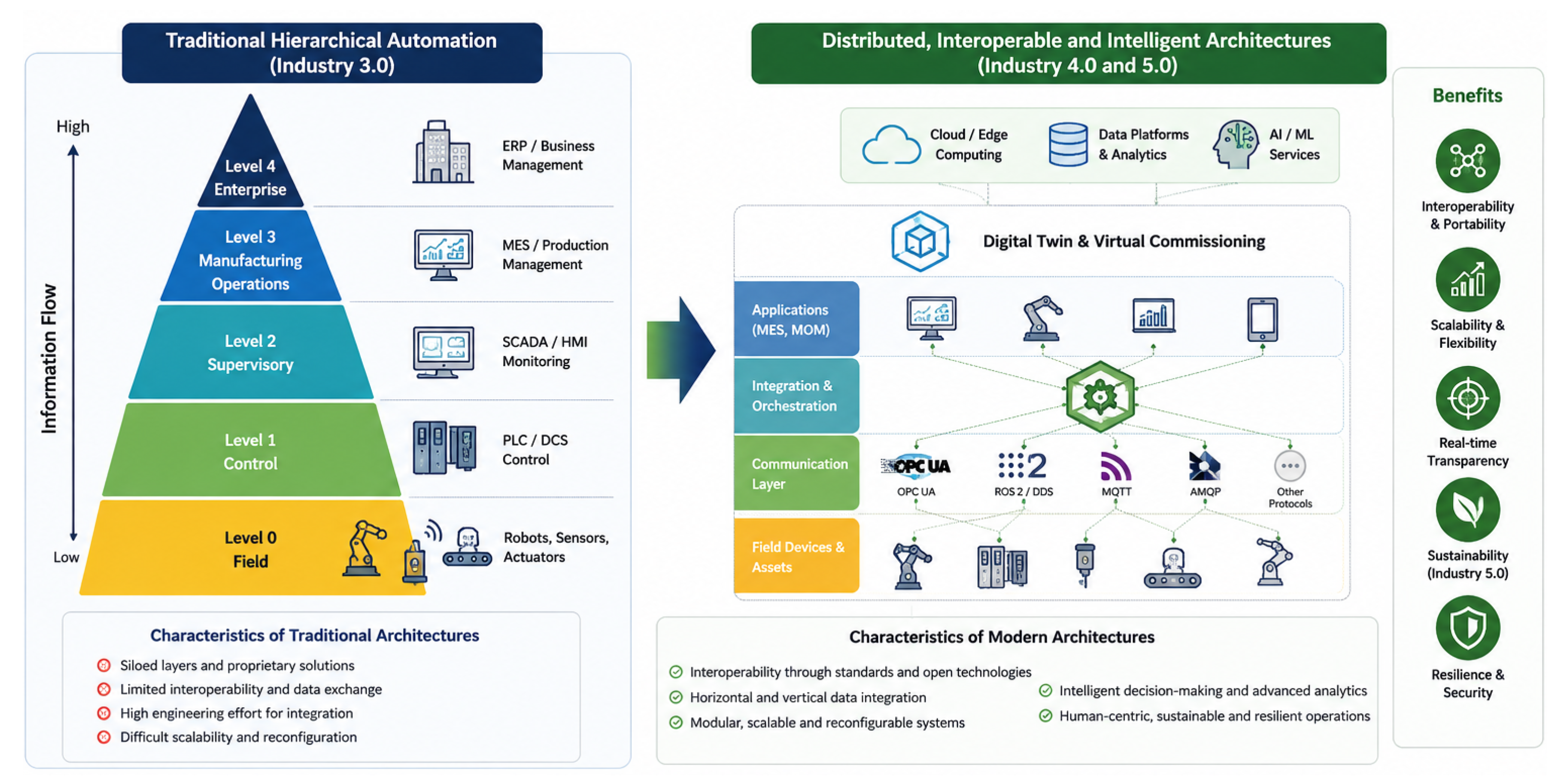
This evolution is commonly described through the transition from traditional hierarchical automation architectures to more distributed and integrated environments. The classical automation pyramid, shown in
Figure 1, represents the vertical separation between field devices, control systems, supervisory layers, and enterprise applications that has historically characterized industrial automation systems [
4,
5,
6,
7].
Within the Industry 4.0 framework, industrial robots have evolved from isolated machines executing fixed motion sequences into cyber–physical components connected to sensors, programmable logic controllers, manufacturing execution systems, and enterprise applications [
3,
4,
5] (
Figure 1). As a result, the effectiveness of industrial robotic systems increasingly depends not only on mechanical performance, but also on software architecture, communication mechanisms, data models, and system-level integration. However, modern industrial environments frequently combine equipment from different vendors, legacy systems, and proprietary control technologies [
1,
8]. Although vendor-specific programming languages and control interfaces provide optimized performance and deterministic behavior, they also create tightly coupled architectures that limit portability, reuse, and cross-vendor interoperability [
5].
Beyond Industry 4.0, interoperability is also relevant to Industry 5.0, where industrial robotic systems are expected to support human-centric production, resilience, trustworthy automation, and closer collaboration between human operators and intelligent machines. In this context, interoperability is not only a matter of data exchange or connectivity, but also a prerequisite for adaptive workcells, operator-aware systems, safe human–robot collaboration, and the integration of AI-enabled perception and decision-support tools (
Figure 1).
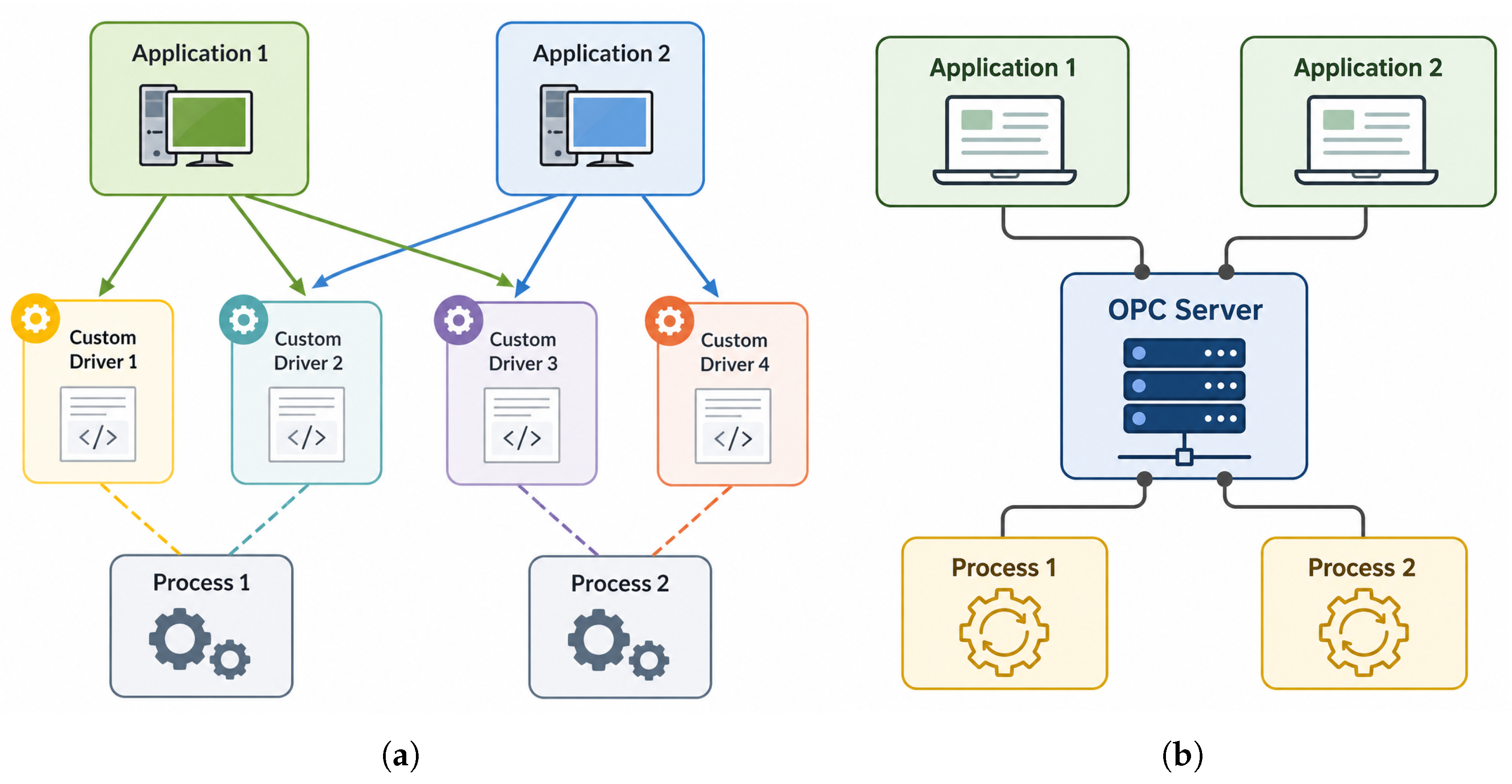
This limitation is particularly evident in communication architectures. Traditional integration methods depend on private point-to-point connections between applications and devices, making such systems harder to modify, scale, and maintain. Middleware-based approaches, on the other hand, add abstraction layers that separate applications from hardware. This difference is illustrated in
Figure 2, where standardized communication mechanisms such as Open Platform Communications (OPC) enable more flexible and scalable integration across heterogeneous systems [
9,
10,
11].
At the same time, the increasing adoption of distributed and service-oriented architectures requires robust communication mechanisms capable of ensuring reliability, security, and, in many cases, real-time or deterministic performance [
12]. Middleware technologies and standardized protocols such as Open Platform Communications Unified Architecture (OPC UA) have been introduced to abstract device-level communication and promote interoperability across heterogeneous systems [
13,
14]. In parallel, robotics software frameworks such as ROS and ROS 2 have emerged as modular platforms for developing distributed robotic applications, with ROS 2 incorporating data-centric middleware and configurable Quality of Service (QoS) policies to better meet industrial requirements [
15,
16]. However, these approaches typically address specific parts of the problem and do not fully resolve the fragmentation caused by vendor dependency and heterogeneous architectures.
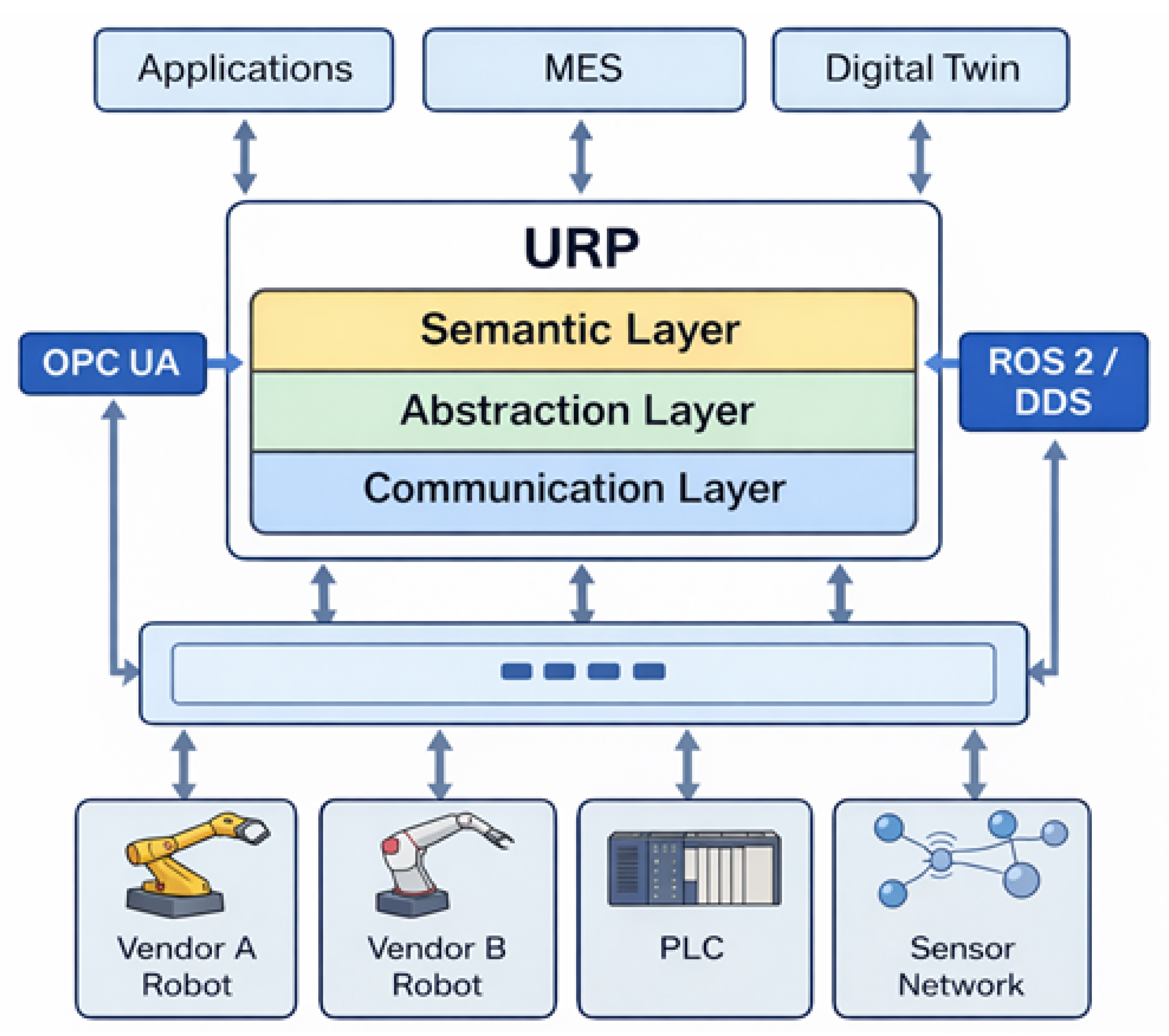
In this context, the URP is proposed as a conceptual interoperability architecture designed to coordinate communication, abstraction, and semantic integration across heterogeneous industrial robotic systems. URP is not intended to replace existing industrial protocols, robot controllers, fieldbuses, or safety-certified interfaces. Instead, it acts as an architectural interoperability specification that defines how existing technologies such as OPC UA, ROS 2/DDS, Asset Administration Shell models, and capability-based representations can be combined within a common integration structure.
Figure 3 shows the conceptual architecture of the proposed URP. The communication layer supports standardized message exchange between industrial devices and robotic systems. The abstraction layer provides a vendor-neutral representation of robot capabilities, commands, execution states, and status variables. The semantic layer supports consistent information modelling of tasks, resources, workcell entities, and system-level context, enabling higher-level orchestration across heterogeneous platforms [
13,
14].
Based on the identified gaps,
Table 1 lists the minimum requirements and boundaries of the proposed URP framework.
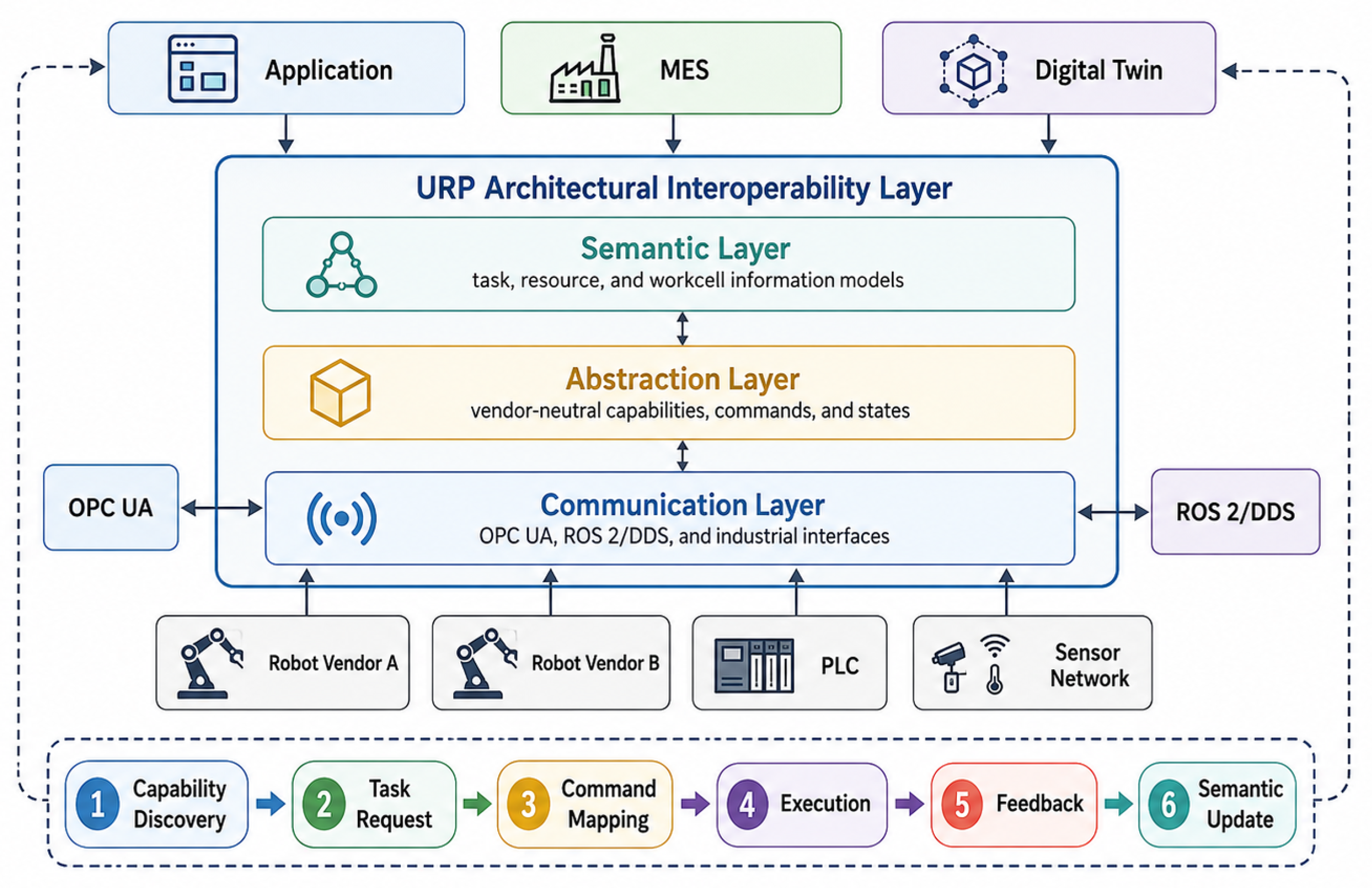
To further clarify the role and positioning of the proposed URP architecture, three complementary perspectives are presented: its conceptual role within industrial systems, its mapping to existing technologies, and an illustrative use-case scenario, as shown in
Figure 4.
- 1.
Role of URP—To clarify its intended role, URP should not be interpreted as a replacement for vendor-specific motion controllers, fieldbus protocols, or safety-certified industrial interfaces. Instead, it is conceived as a unifying interoperability layer that coordinates communication, abstraction, and semantic alignment across heterogeneous systems;
- 2.
Technological mapping—From a technological perspective, the URP concept can be mapped onto existing industrial and robotic technologies (
Table 2). The communication layer relies on standardized mechanisms such as OPC UA, DDS/ROS 2, and industrial networking solutions. The abstraction layer is aligned with capability-based models, skill-based programming, and robotics middleware interfaces. The semantic layer is supported by structured information models such as Asset Administration Shell (AAS), OPC UA information models, and domain-specific ontologies. This mapping reinforces that URP is not intended to replace existing technologies, but rather to integrate them within a coherent interoperability framework;
- 3.
Illustrative use-case scenario—For instance, in a multi-vendor robotic workcell integrating robots from different manufacturers, PLC-controlled processes, and sensor networks, URP would enable a unified representation of robot capabilities, standardized communication across devices, and consistent semantic interpretation at the system level. This would facilitate reconfiguration, system integration, and higher-level orchestration without requiring extensive vendor-specific adaptations.
Operational Workflow of URP in a Multi-Vendor Robotic Workcell
In a representative multi-vendor workcell, the URP workflow can be described in six steps:
- 1.
Capability registration, where each robot, PLC-controlled device, and sensor exposes its available functions through a common capability model;
- 2.
Semantic description, where these capabilities are associated with standardized task, resource, and workcell information models;
- 3.
Task request, where a higher-level application or MES requests an operation independently of the robot vendor;
- 4.
Command abstraction and mapping, where the URP layer translates the requested operation into vendor-specific command structures or middleware calls;
- 5.
Execution monitoring, where status, alarms, completion state, and quality-related information are collected through OPC UA, ROS 2/DDS, or equivalent communication mechanisms;
- 6.
Semantic update, where the workcell state is updated and made available to supervisory, digital twin, or decision-support applications.
This workflow illustrates that URP does not impose a new low-level robot language, but rather organizes the interoperability logic required to coordinate heterogeneous devices and software systems.
A minimally viable validation scenario for URP could involve a multi-vendor robotic handling cell composed of two industrial robots from different manufacturers, one PLC-controlled conveyor or positioning unit, and a sensor network providing object detection or workcell status information. The validation workflow would include: (i) registration of robot and device capabilities; (ii) semantic description of tasks and resources; (iii) submission of a vendor-neutral handling task from a higher-level application; (iv) mapping of this task to robot-specific commands or middleware calls; (v) execution monitoring through OPC UA, ROS 2/DDS, or equivalent communication mechanisms; and (vi) update of the semantic workcell state after task completion.
Such a scenario would allow the evaluation of URP in terms of integration effort, command portability, semantic consistency, communication latency, execution feedback, and reconfiguration capability. However, this validation is defined as future work, since the present manuscript focuses on the review-based derivation and conceptual specification of the framework.
In this context, this work introduces URP as a conceptual architectural specification for industrial robotic interoperability. Rather than defining a new implemented communication protocol, URP aims to organize existing middleware-based communication, standard-driven interoperability, and robotics-oriented software abstraction into a coherent cross-layer structure. Therefore, URP should be interpreted as a research-driven conceptual framework derived from the cross-analysis of the identified literature gaps, rather than as a complete technical standard or deployable protocol at this stage.
The main contributions of this work can be summarized as follows:
A review of the literature on interoperability in industrial robotics;
A cross-layer comparison of architectural approaches, middleware technologies, and communication paradigms;
The derivation of a gap-driven conceptual interoperability framework (URP) intended to unify communication, abstraction, and semantic layers in heterogeneous industrial robotic environments.
This article presents a structured analysis of the current state of the art in industrial robotic interoperability, examining architectural evolution, programming and control interfaces, communication protocols, and existing integration solutions. By identifying limitations and open challenges in current approaches, it establishes the conceptual foundation for the development of a URP capable of supporting scalable, modular, and interoperable industrial robotic systems.
This dual contribution refers to two complementary outcomes of the manuscript. First, the article consolidates the current state of the art on industrial robotic interoperability through a structured review. Second, it derives from the identified gaps a conceptual architectural direction, URP, intended to guide future research on unified communication, abstraction, and semantic integration in heterogeneous industrial robotic systems.
The remainder of this article is organized as follows.
Section 2 describes the review of the literature on industrial robotic interoperability, including methodology, research questions, study-selection procedure, and qualitative synthesis of selected studies.
Section 3 discusses the research questions and summarizes the contributions of the reviewed studies to each of them. Finally,
Section 4 and
Section 5 present the conclusions, highlight the research gaps and study limitations, and reinforce the conceptual motivation for the concept of URP.
2. Literature Review
2.1. Overview and Objectives
This section presents the literature review conducted to support the research on interoperability, communication, and programming of industrial robotic systems. The increasing adoption of digitally integrated manufacturing environments has intensified the need for interoperable solutions capable of supporting heterogeneous, multi-vendor robotic systems across their full lifecycle.
As industrial robots evolve from isolated automation units into interconnected components of cyber–physical production systems, challenges related to system integration, communication, programming portability, scalability, and long-term maintainability become increasingly relevant. In this context, a literature review provides a transparent and reproducible means of synthesizing existing research, identifying dominant technical approaches, and highlighting limitations and open research gaps that persist in real industrial environments.
The primary objective of this review is to analyze the state of the art related to interoperability in industrial robotics, covering architectural evolution, types of robots and workcells, integration challenges, programming and control interfaces, communication protocols, and existing interoperability solutions, including middleware and ROS-based approaches. To ensure methodological rigor and reduce selection bias, the review follows a structured process inspired by PRISMA principles, enabling traceability of the search, screening, and selection stages.
2.2. Research Questions
This literature review is structured around six research questions that directly reflect the scope of this article and its main technical dimensions. The research questions are formulated as follows:
RQ1: How have industrial robotic systems evolved in terms of architecture, connectivity, and integration, transitioning from isolated automation units to distributed and heterogeneous industrial environments?
RQ2: What types of industrial robots and robotic workcell configurations are commonly found in modern manufacturing systems, and what are their functional and integration requirements?
RQ3: What are the main integration, scalability, and maintenance challenges arising in industrial environments that combine multi-vendor robotic systems and legacy equipment?
RQ4: What programming and control approaches are currently used in industrial robotics, including proprietary interfaces, abstraction-based solutions, and high level programming paradigms, and what are their interoperability limitations?
RQ5: Which communication protocols and paradigms are employed in industrial robotic systems, and how suitable are they with respect to real-time performance, reliability, security, and interoperability?
RQ6: What existing solutions aim to improve interoperability among industrial robots, including robotic middleware, open source and commercial platforms, and ROS/ROS 2 based approaches, and what gaps remain in terms of industrial adoption?
2.3. Review Protocol
The review follows a structured protocol inspired by PRISMA style reporting. The process is defined in terms of planning, database searching, screening, eligibility assessment, and final inclusion of studies. Each stage is documented using explicit inclusion and exclusion criteria, together with quantitative reporting of the number of records processed at each step.
This structured approach ensures transparency, reproducibility, and consistency throughout the review process, supporting a synthesis of the literature aligned with the research questions.
2.4. Data Sources and Search Strategy
The literature search was conducted using the major scientific databases widely recognized in industrial automation, robotics, and cyber–physical systems. The selected databases were IEEE Xplore, ScienceDirect, and SpringerLink, ensuring comprehensive coverage of peer-reviewed journal articles and conference proceedings.
The search was restricted to publications from 2010 to 2026 to capture both foundational work and recent developments aligned with Industry 4.0, distributed automation architectures, and modern robotic software frameworks. Only studies published in English were considered.
To support a structured review, six dedicated search queries (Q1–Q6) were defined and executed across the selected databases. Each query targeted a specific technical dimension of industrial robotic interoperability, combining the anchor term “industrial robots” with complementary keywords related to architecture, integration, programming, communication, and middleware. Boolean operators (AND, OR) were used to balance coverage and precision, while grouped keywords ensured thematic relevance.
Table 3 summarizes the structured formulation of the six search queries.
During revision, an additional targeted update was performed to identify recent high-quality journal articles published in the last three years, particularly in journals addressing industrial informatics, industrial automation, cyber–physical production systems, and manufacturing system integration. This update was used to strengthen the coverage of architectural evolution, real-time interoperability, semantic integration, and industrial deployment constraints.
The structured search was based on predefined Boolean search queries applied to the selected databases, rather than exclusively on the author-defined keyword sections of individual papers. The title, abstract, and keywords of each retrieved record were used during screening to assess thematic relevance, while full-text reading was used during eligibility assessment and classification. Therefore, paper-level keywords supported the screening and coding process, but the initial retrieval of records was driven by the structured database queries reported in
Table 3.
This multi-query strategy improved thematic coverage and reduced the risk of overlooking relevant contributions across different dimensions of interoperability.
Each query was explicitly aligned with one research question (RQ1–RQ6), ensuring consistency between the research objectives and the literature retrieval process.
Table 4 presents the mapping between the research questions and their thematic focus.
2.4.1. Inclusion Criteria
Studies were included if they addressed industrial robotics or industrial automation and contributed to at least one of the following dimensions: system architecture and integration, robotic workcells, interoperability in heterogeneous environments, programming and control interfaces, industrial communication protocols, or interoperability solutions such as middleware and ROS-based approaches. Only peer-reviewed publications within the defined time window were considered.
2.4.2. Exclusion Criteria
Studies were excluded if they focused on domains outside the scope of industrial robotic interoperability, including mobile, aerial, or medical robotics, machine learning approaches without clear relevance to interoperability, or trajectory planning when motion generation, path optimization, or collision avoidance was the main contribution. Trajectory planning was not excluded because it is irrelevant to robotics, but because this review focuses on system-level interoperability, communication, programming portability, middleware integration, and semantic representation. Studies involving trajectory planning were retained when they explicitly addressed cross-vendor programming, middleware-based execution, or interoperability in heterogeneous industrial robotic systems.
2.5. Study Selection Process
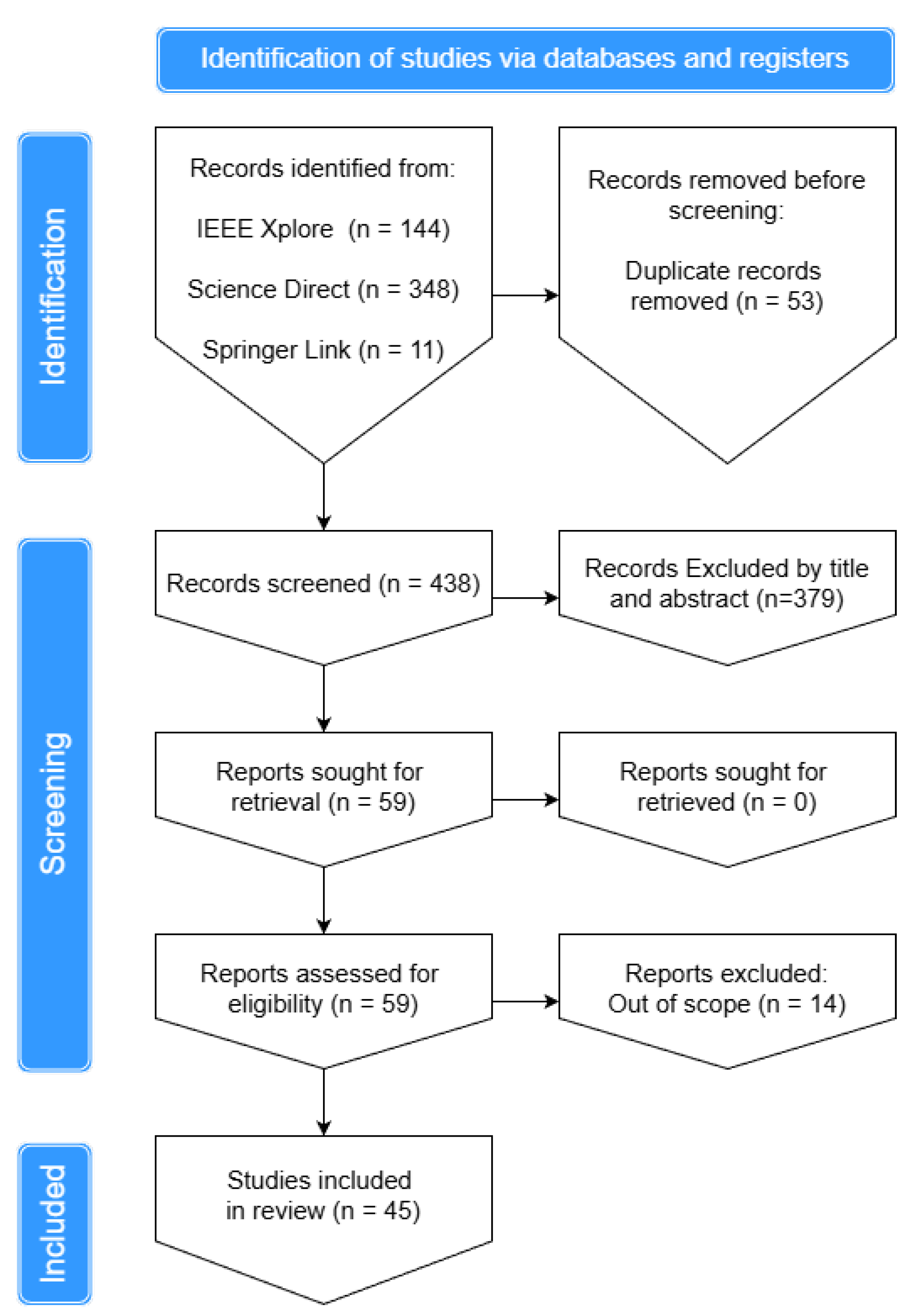
The study selection process followed a sequence of stages inspired by PRISMA reporting. Initial database searches yielded 491 records. After removing 53 duplicate entries, 438 unique studies remained. These studies were screened based on title and abstract to assess relevance to industrial robotics and interoperability, resulting in the exclusion of 379 records that clearly fell outside the defined scope.
The remaining studies were assessed for full text eligibility. During this phase, publications were examined in greater detail to confirm alignment with the research questions and the inclusion criteria. Fourteen studies were excluded at this stage for being out of scope, resulting in a final set of 45 studies included in the qualitative synthesis and analysis.
Figure 5 presents a PRISMA style flow diagram summarizing the identification, screening, eligibility assessment, and inclusion stages of the review process.
2.6. Data Extraction and Coding Strategy
For each of the selected studies, relevant information was systematically extracted to support qualitative analysis and structured comparison. The collected data included bibliographic details, main technical focus, addressed research questions, proposed approaches, and reported limitations. Whenever this information was clearly described, aspects such as the industrial context, type of robotic system, and communication technologies were also recorded. This structured approach helped ensure consistency and made it easier to compare the different contributions.
2.7. Quality Assessment of Included Studies
To strengthen the methodological transparency of the review, a quality assessment was performed for all included studies. Each study was assessed using five criteria (
Table 5):
QA1—clarity of research objective and scope;
QA2—relevance to industrial robotic interoperability;
QA3—methodological or architectural detail;
QA4—industrial relevance or applicability;
QA5—presence of empirical, experimental, prototype-based, or case-study validation.
Each criterion was scored using a three-level scale: 0 = not addressed, 1 = partially addressed, and 2 = clearly addressed. Therefore, each study could receive a maximum score of 10. The purpose of this assessment was not to exclude studies automatically, but to characterize the maturity and evidential strength of the reviewed literature. Studies with lower scores were retained only when they provided specific conceptual or technical relevance to one of the research questions.
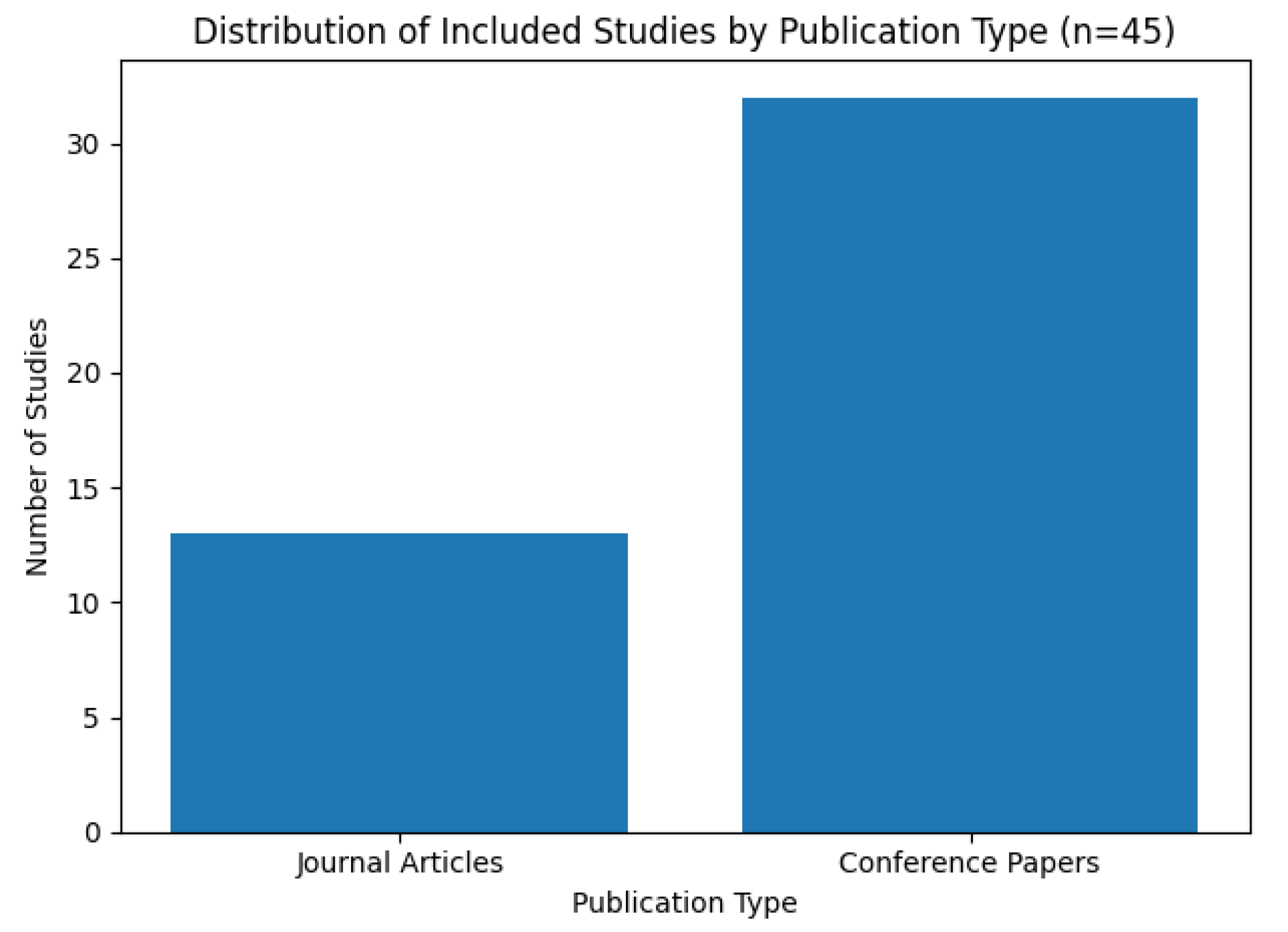
To better characterize the overall literature corpus, the studies were also classified according to publication type.
Figure 6 presents the distribution between journal articles and conference papers.
As illustrated in
Figure 6, most of the included publications are conference papers (32 studies), while 13 are journal articles. This reflects the fast-paced and evolving nature of research in industrial robotic interoperability, where new ideas and technical developments are often first presented at conferences before being further consolidated in journal publications. Although conference papers remain relevant in this field due to the rapid development of industrial robotics middleware and interoperability prototypes, the revised corpus was reassessed to ensure that conference publications were retained only when they provided clear technical relevance, industrial applicability, or methodological contribution to the research questions.
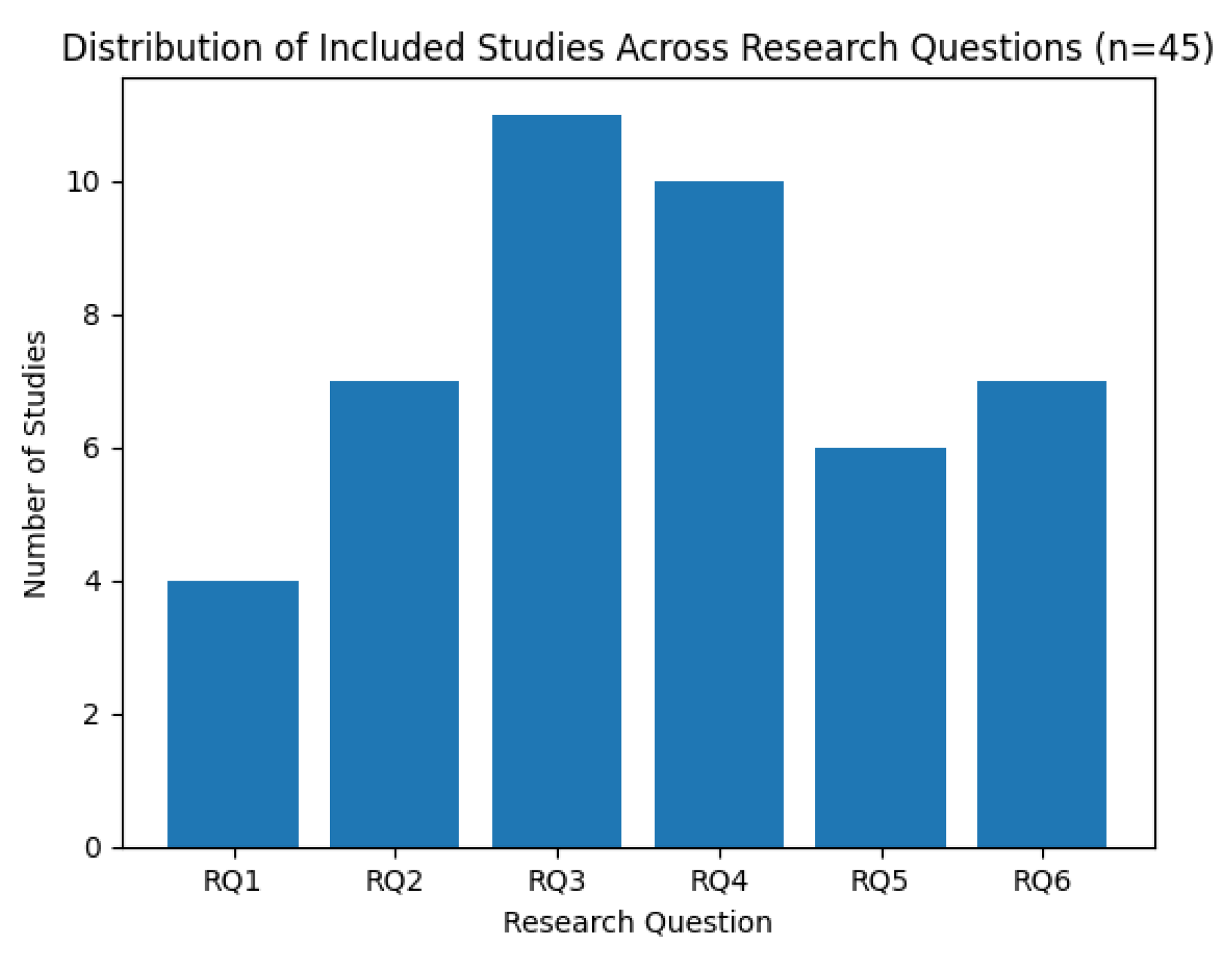
Each study was assigned to one primary research question according to its dominant technical contribution. When a study addressed more than one topic, secondary relevance tags were also recorded. This distinction between primary assignment and secondary relevance was used to avoid double counting while preserving cross-topic traceability. In the revised appendix, each study will therefore be reported with its primary RQ and, where applicable, its secondary RQ tags.
Figure 7 shows how the 45 selected studies are distributed across the six research questions.
The results indicate that most studies focus on RQ3 (11 studies) and RQ4 (10 studies). RQ2 and RQ6 include 7 studies each, while RQ5 comprises 6 studies and RQ1 includes 4 studies. Overall, this distribution suggests a stronger research emphasis on interoperability challenges, system integration, and programming approaches within heterogeneous industrial environments.
The uneven distribution across research questions does not necessarily indicate a methodological imbalance, but rather reflects the current emphasis of the literature. In particular, the larger number of studies associated with RQ3 and RQ4 suggests that interoperability challenges and programming/control abstraction have received greater attention than broader architectural evolution. Nevertheless, the corpus was re-examined to identify additional high-quality journal publications related to RQ1 and to improve the balance and completeness of the review.
For clarity and transparency,
Appendix A provides two complementary tables.
Table A1 presents the set of keywords associated with each research question. These keywords summarize the main themes considered during the classification process and help clarify the scope of each RQ.
Table A2 and
Table A3 contain the complete list of included studies, together with publication venue, year, assigned primary research question, and secondary RQ tags when applicable.
To improve consistency in the qualitative synthesis, each paper was initially screened based on its dominant technical contribution and then assigned to a primary research question (RQ1–RQ6) according to its main focus. When a study addressed multiple dimensions, secondary relevance tags were recorded to preserve cross-topic traceability. The selection and classification steps were iteratively reviewed to reduce subjective bias and ensure alignment between the research questions and the analyzed literature corpus.
The quality assessment of
Table A4 in
Appendix A showed that the strongest studies were those combining architectural detail with industrial applicability and some form of prototype or case-study validation. Conversely, some conference papers provided useful conceptual insights but lower empirical support. This result was considered when interpreting the evidence associated with each research question, particularly in relation to the maturity of existing interoperability solutions and their readiness for industrial deployment.
3. Results
This section presents a structured synthesis of the reviewed literature based on the six research questions. The analysis follows a progressive logic: first, it describes how industrial robotic systems have evolved toward distributed and heterogeneous architectures; second, it identifies the integration, scalability, programming, and communication problems created by this evolution; third, it analyses existing approaches that partially address these problems; and finally, it uses these findings to motivate the need for a cross-layer interoperability framework such as URP.
3.1. RQ1: Evolution of Industrial Robotic Systems
The first research question focuses on the evolution of industrial robotic systems in terms of architecture, connectivity, and integration. The reviewed literature consistently highlights a transition from rigid and hierarchical automation structures toward distributed, interconnected, and data-driven systems aligned with Industry 4.0 principles.
Several works describe this evolution from complementary perspectives. The service-based architecture approach presented in [
7] emphasizes the limitations of traditional automation pyramids and proposes the adoption of Service oriented Architectures (SoA) to enable modularity, scalability, and system flexibility. In this context, production systems evolve from tightly coupled structures to loosely coupled services that can be dynamically orchestrated, improving adaptability to changing production requirements.
From an integration and connectivity perspective, the work in [
17] addresses the challenge of heterogeneous industrial environments by proposing an Industrial IoT architecture that integrates robots and PLCs through multiple communication protocols and cloud-based infrastructures. This approach demonstrates how distributed data acquisition and centralized processing can support interoperability across different industrial devices.
Complementing this view, standardization-driven approaches such as the Asset Administration Shell (AAS), discussed in [
18], introduce a unified digital representation of industrial assets. This concept supports the development of digital twins and enables interoperability between cyber–physical systems by providing standardized interfaces and data models.
Finally, the methodological approach proposed in [
19] focuses on the integration of physical assets within Industry 4.0 architectures. It highlights the lack of generic and technology-independent integration methods and proposes a multilayer architecture to decouple integration concerns, improving scalability, flexibility, and reusability across different industrial systems.
Overall, these contributions show that the evolution of industrial robotic systems is driven not only by technological advancements, but also by the need for more flexible architectures, standardized representations, and scalable integration strategies. This transition reflects a broader shift toward distributed, interoperable, and service-oriented industrial ecosystems.
Despite this architectural evolution, most studies still focus primarily on enabling connectivity and distributed integration rather than achieving full cross-vendor operational interoperability. In practice, this indicates that architectural modernization alone does not guarantee portable robot programming, unified semantic representation, or reusable integration workflows across heterogeneous industrial environments.
3.2. RQ2: Types of Robots and Workcell Configurations
The second research question addresses the types of industrial robots and their deployment within robotic workcells. The reviewed literature shows a clear shift from isolated robot-centric perspectives toward system-oriented configurations, where robots operate as part of coordinated and interconnected workcells.
Several studies highlight the structural and functional composition of modern robotic workcells. The work in [
20] presents a collaborative workcell testbed that integrates robots, machines, supervisory control units, and human operators within a unified cyber–physical environment. This workcell model emphasizes the importance of coordinated data exchange and control between components, reflecting the increasing complexity of industrial production systems.
From a design perspective, the approach proposed in [
21] focuses on the integration of CAD and CAR tools for robotic cell development. It highlights the iterative nature of robotic workcell design, where mechanical layout, robot programming, and simulation must be continuously aligned. The lack of seamless integration between design and simulation tools is identified as a key limitation affecting efficiency and engineering productivity.
In terms of system representation, the architecture framework introduced in [
22] provides a structured way to model manufacturing systems across multiple viewpoints, including functional, physical, and behavioral dimensions. This approach supports the understanding of how robotic workcells are composed of interconnected components, each contributing to overall system capabilities.
The role of distributed and intelligent coordination within workcells is further explored through multi-agent system approaches. The review presented in [
23] shows how manufacturing systems can be organized using centralized or decentralized agent-based architectures, enabling flexible coordination between different system entities and supporting distributed decision-making processes.
Additionally, advances in human-robot collaboration introduce new requirements for workcell configurations. The ontology proposed in [
24] emphasizes the need for structured knowledge representation to support interaction between human operators and robots, enabling more adaptive and context-aware behaviors in collaborative environments.
Finally, recent approaches based on skill-based engineering and standardized interfaces, such as those discussed in [
25], aim to model robotic capabilities at a higher level of abstraction. These approaches enable more flexible configuration and orchestration of robotic workcells, supporting plug-and-produce scenarios and improving system reconfigurability.
Overall, the literature indicates that modern industrial robotic systems are increasingly defined by their integration within complex workcells rather than by individual robot characteristics. These workcells combine multiple physical and software components, requiring coordinated control, standardized representations, and flexible design methodologies to support scalable and interoperable manufacturing systems.
Although modern workcells are increasingly modeled as coordinated cyber–physical environments, the reviewed studies rarely provide standardized mechanisms for representing robot capabilities in a portable and vendor-neutral manner. This limitation restricts system reconfigurability and reduces the effectiveness of plug-and-produce paradigms in real industrial scenarios.
3.3. RQ3: Challenges and Limitations in Industrial Robotic Systems Integration
The third research question focuses on identifying the main challenges and limitations associated with the integration of industrial robotic systems within modern manufacturing environments. The literature consistently highlights interoperability, system heterogeneity, and scalability as the primary barriers to achieving fully integrated and flexible production systems [
11,
26,
27].
One of the most critical challenges is interoperability between heterogeneous devices, software platforms, and communication protocols. Industrial environments typically involve a wide variety of technologies, often developed by different vendors and based on different standards [
11,
28]. This heterogeneity makes seamless data exchange and system coordination difficult, even when standard solutions such as OPC UA are adopted. Despite its widespread use, OPC UA alone does not fully solve interoperability issues due to differences in data models and semantic interpretations across systems [
28,
29].
Closely related to interoperability is the lack of standardized and aligned information models. As discussed in [
30], industrial systems rely on multiple data models originating from different domains, leading to inconsistencies and difficulties in integrating data across the system. This problem is further reinforced by the need for semantic interoperability across heterogeneous environments [
29].
Another major limitation is the complexity of integrating distributed and modular systems. Modern manufacturing systems are increasingly based on Cyber–Physical Systems (CPSs) and distributed architectures, which promote modularity and flexibility [
27,
31]. However, these architectures introduce new challenges related to coordination, orchestration, and system-wide knowledge representation. While distributed control improves flexibility and reconfigurability, it also increases system complexity and requires additional mechanisms for coordination between system components [
32].
The integration of legacy systems further complicates the deployment of Industry 4.0 solutions. Many industrial environments still rely on existing equipment that was not designed for modern communication standards. Retrofitting these systems to support digitalization and interoperability requires additional layers of integration, increasing system complexity and implementation costs [
33].
From a software perspective, the diversity of programming environments and system interfaces presents additional barriers. The coexistence of multiple control tools and industrial software solutions makes system integration difficult, slowing down development processes and reducing overall efficiency [
34].
Furthermore, while middleware-based approaches have been proposed to address these challenges, they still face limitations in fully abstracting hardware heterogeneity and ensuring seamless integration across different systems. Although middleware solutions improve modularity and enable communication between components, they do not completely eliminate the complexity associated with integrating heterogeneous devices [
26].
Finally, emerging approaches such as semantic interoperability and capability-based models aim to address these limitations by introducing higher levels of abstraction. However, these approaches are still evolving and require further standardization and industrial adoption to become practical solutions for large-scale deployment [
29,
35].
Overall, the reviewed studies show that the main limitation is no longer only device-level connectivity, but the lack of coordinated interoperability across communication, control abstraction, and semantic representation. This finding provides the main transition from the problem analysis in RQ3 to the architectural and middleware-oriented solutions discussed in RQ4.
3.4. RQ4: Proposed Approaches to Improve Interoperability and Flexibility in Industrial Robotic Systems
Based on the challenges identified in RQ3, RQ4 explores existing and emerging approaches that aim to improve interoperability, flexibility, and scalability in industrial robotic systems. The literature suggests that no single solution fully addresses all challenges, but rather a combination of architectural, semantic, and technological approaches is required [
36].
Table 6 summarizes the main interoperability-oriented approaches identified in the literature, highlighting their strengths, limitations, and scope across different architectural layers.
As shown in
Table 6, existing approaches tend to address interoperability at specific layers, such as communication, control, or semantic modeling. However, none of them provide a unified solution across all layers simultaneously. This limitation highlights the fragmentation of current solutions and reinforces the need for a cross-layer approach capable of integrating communication mechanisms, abstraction models, and semantic consistency within a single framework, as envisioned in the URP concept.
One of the most promising directions is the adoption of standardized communication and data exchange frameworks. Technologies such as OPC UA and AutomationML provide a foundation for interoperability by enabling platform-independent communication and structured data exchange between heterogeneous devices. Their combined use allows both real-time communication and engineering data integration, improving the overall compatibility between robotic systems and other industrial components [
38].
Another key approach is the use of the Asset Administration Shell (AAS), which introduces a standardized digital representation of industrial assets. AAS acts as a digital twin, enabling consistent data models, semantic interoperability, and seamless communication across different systems and lifecycle phases. By providing a unified interface for accessing asset data and functionalities, AAS facilitates integration and supports collaborative engineering processes in Industry 4.0 environments [
39]. Additionally, the integration of AAS with function block-based control systems allows low-level devices to interact with high-level digital representations, bridging the gap between operational and information layers [
40].
Service-oriented and distributed architectures also play a crucial role in addressing integration challenges. Approaches based on Service-Oriented Architecture (SOA) and Cyber–Physical Systems (CPSs) promote modularity, loose coupling, and scalability [
36]. In this context, standards such as IEC 61499 enable the development of distributed control systems using reusable function blocks, supporting hardware independence and dynamic reconfiguration [
41]. However, despite these advantages, practical adoption remains limited due to implementation complexity and standard ambiguities [
42].
To further enhance flexibility and reusability, skill-based engineering has emerged as a promising paradigm. In this approach, industrial functionalities are encapsulated as modular “skills” with standardized interfaces, allowing their orchestration across different systems. This abstraction reduces system complexity and enables dynamic composition of production processes, improving adaptability in changing manufacturing environments [
43].
Middleware solutions also contribute significantly to improving interoperability by abstracting hardware and communication heterogeneity. Advanced middleware platforms enable seamless integration of robots and sensors from multiple vendors, supporting plug-and-play capabilities and reducing system setup time. For instance, plug-and-play architectures based on standardized interfaces and communication libraries allow rapid deployment and reconfiguration of robotic systems, although full interoperability is still not completely achieved [
44].
Another relevant direction is the use of higher-level abstraction techniques such as domain-specific languages (DSLs). These approaches aim to simplify system development by providing intuitive and domain-focused programming environments, enabling non-expert users to participate in system design and maintenance. DSLs improve usability and reduce development complexity, although they are typically limited to specific application domains [
45].
Finally, advanced communication paradigms such as publish–subscribe models have been proposed to reduce system complexity and improve scalability in distributed environments. These models decouple data producers and consumers, enabling more flexible and robust communication patterns in industrial automation systems [
36].
These findings confirm that current interoperability approaches remain valuable but partial. They provide important building blocks for industrial integration, but they still require architectural coordination to support consistent cross-vendor operation in heterogeneous robotic environments.
3.5. RQ5: Future Research Directions and Open Challenges in Industrial Robotic Interoperability
Despite the significant progress in enabling interoperability and flexibility in industrial robotic systems, several open challenges remain that limit the full realization of Industry 4.0 and Cyber–Physical Production Systems (CPPSs). Based on the findings from previous research questions, this section identifies key research directions and future opportunities.
One of the most critical challenges is achieving deterministic and real-time communication in heterogeneous distributed systems. While middleware technologies such as DDS provide flexible and scalable publish–subscribe communication, they lack inherent support for strict real-time guarantees [
46]. Recent research highlights the integration of DDS with Time-Sensitive Networking (TSN) as a promising solution to achieve deterministic latency, reduced jitter, and reliable communication for mission-critical applications [
47,
48]. However, this integration introduces additional complexity in configuration, scheduling, and QoS mapping, which still lacks standardized and automated solutions.
In industrial robotic environments, deterministic communication is not only a matter of average latency, but also of bounded jitter, predictable scheduling, synchronization, fault handling, and validated behaviour under degraded network conditions. Although DDS provides configurable QoS policies and TSN can support time-aware traffic scheduling, their integration requires careful configuration and validation. Therefore, DDS, ROS 2, OPC UA PubSub, and TSN should be interpreted as enabling technologies rather than complete interoperability solutions by themselves.
Another important research direction is the evolution of industrial communication protocols towards hybrid and adaptive architectures. Protocols such as OPC UA, MQTT, and DDS are increasingly combined to leverage their complementary strengths, such as semantic interoperability, lightweight communication, and real-time performance. For example, the extension of OPC UA with publish–subscribe mechanisms and MQTT brokers enables scalable many-to-many communication while reducing latency and network overhead [
49]. Nevertheless, selecting and orchestrating these protocols dynamically based on application requirements remains an open research problem [
50].
Security and trust represent another major challenge in highly connected industrial environments. As industrial systems increasingly rely on IoT and machine-to-machine (M2M) communication, ensuring confidentiality, integrity, authentication, and availability of data becomes essential. Middleware-based security mechanisms have been proposed to address these issues, but the heterogeneity of devices and protocols complicates the implementation of unified and scalable security solutions [
51]. Future research should focus on integrating security-by-design principles into industrial architectures and developing standardized trust frameworks.
Scalability and system complexity also remain open issues. As the number of interconnected devices grows, managing communication, configuration, and coordination becomes increasingly difficult. Middleware solutions and service-oriented architectures help mitigate these challenges by abstracting system heterogeneity and enabling loose coupling between components [
46]. However, achieving seamless scalability without compromising performance or maintainability requires further advancements in distributed system design and orchestration mechanisms.
In addition, performance optimization of communication protocols is still an active research area. Comparative studies show that different protocols (e.g., OPC UA, DDS, MQTT, ROS) exhibit trade-offs in terms of latency, bandwidth consumption, and resource usage, making it difficult to select a universally optimal solution [
50]. Future work should explore adaptive communication frameworks capable of dynamically selecting or combining protocols based on context and system requirements.
Finally, the integration of wireless communication and real-time networking introduces new challenges and opportunities. Technologies such as wireless TSN aim to provide deterministic communication in flexible and mobile industrial environments, enabling applications such as collaborative robotics and distributed sensing [
47]. However, issues related to synchronization, interference, and scheduling complexity must be addressed to ensure reliable performance.
Overall, the literature shows that significant efforts have been made to improve communication reliability, real-time performance, and scalability in industrial robotic systems through advanced protocols and middleware technologies. However, existing solutions still struggle to simultaneously guarantee deterministic performance, interoperability, and seamless integration across heterogeneous environments. This highlights a critical gap in aligning communication efficiency with system-level interoperability, motivating the need for unified approaches capable of bridging these limitations, such as the conceptual URP framework discussed in this work.
3.6. RQ6: Towards a Unified Architecture for Interoperable Industrial Robotic Systems
Building upon the findings from previous research questions, this section proposes a unified architectural perspective for enabling interoperability, flexibility, and real-time performance in industrial robotic systems.
One of the main requirements for next-generation industrial systems is the seamless integration of heterogeneous robotic platforms, communication protocols, and control systems. Current approaches rely on middleware technologies such as ROS/ROS2, OPC UA, DDS, and MQTT, each addressing specific aspects of the system [
52,
53]. ROS, in particular, has emerged as a widely adopted middleware framework that facilitates modular development and communication between distributed robotic components, promoting software reuse and flexibility [
53].
ROS2 extends these capabilities by leveraging DDS to enable distributed and real-time communication between robotic components, supporting scalable and decentralized architectures [
54,
55]. However, limitations related to real-time guarantees, predictability, and system robustness still hinder its adoption in safety-critical industrial environments [
56]. From an industrial perspective, ROS 2 still requires additional engineering layers to satisfy requirements related to determinism, reliability, lifecycle management, cybersecurity, validation, and certification. Its DDS-based communication model provides relevant QoS mechanisms, but the achievement of predictable and certifiable behaviour depends on the selected DDS implementation, operating system, network configuration, execution model, and validation procedure.
To overcome heterogeneity across robotic ecosystems, bridging solutions have been proposed to interconnect different middleware platforms. For example, integrating ROS1, ROS2, and OPC UA through bridging mechanisms allows robots using different communication stacks to collaborate within a unified industrial testbed [
57]. These approaches highlight the importance of interoperability layers capable of translating data models, communication paradigms, and protocols across systems.
Middleware-centric architectures emerge as a key enabler for unified industrial systems. By acting as an abstraction layer, middleware platforms decouple hardware and software components, enabling communication between heterogeneous devices and supporting concepts such as digital twins and cyber–physical systems [
52]. In this context, ROS exemplifies a middleware layer that provides standardized communication mechanisms and modular software components, although it still lacks full standardization and industrial-grade robustness [
53]. Consequently, existing middleware solutions often lead to fragmented ecosystems and increased system complexity.
A unified architecture for industrial robotic systems should therefore integrate multiple layers, including a communication layer based on standardized protocols (e.g., DDS, OPC UA), a middleware layer providing abstraction and interoperability, a control layer supporting real-time and distributed execution, and an application layer enabling intelligent and autonomous behavior. In such an architecture, protocols should not compete but coexist, leveraging their complementary strengths.
Another key aspect of future architectures is the need for real-time and deterministic communication. While DDS provides QoS mechanisms and ROS2 introduces distributed communication, achieving strict real-time guarantees remains challenging. Recent approaches propose integrating scheduling strategies and time-sensitive networking concepts into ROS2 communication layers to improve latency, reliability, and packet prioritization [
56].
Furthermore, formal methods and verification techniques are gaining importance in ensuring system correctness and reliability. For example, formal specification of middleware communication protocols enables validation of expected behavior and increases confidence in safety-critical applications [
58]. This is particularly relevant as industrial robotic systems become more autonomous and operate in dynamic environments.
Overall, existing interoperability solutions, including middleware platforms and ROS/ROS2-based approaches, provide valuable contributions toward modularity and system integration. However, their adoption in industrial environments remains limited due to fragmentation, lack of standardization, and insufficient alignment between communication, control, and semantic layers. This reinforces the need for a unified and structured interoperability framework, such as the conceptual URP proposed in this work, capable of harmonizing these dimensions in a coherent and scalable manner.
4. Discussion
The reviewed literature shows that the interoperability problem originates from the combined effect of three developments: the increasing heterogeneity of industrial robotic workcells, the coexistence of proprietary and standardized communication mechanisms, and the lack of consistent abstraction and semantic models across vendors and system layers. Existing solutions address important parts of this problem, but they remain fragmented across communication, middleware, control, and information-modelling perspectives. This progression from industrial evolution to interoperability barriers provides the rationale for deriving URP as a conceptual cross-layer framework.
4.1. Cross-Layer Interoperability Challenges
The findings indicate that the reviewed literature has progressed from isolated connectivity solutions toward middleware-based, semantic, and capability-oriented approaches. However, these developments remain only partially aligned. The main contribution of the proposed URP concept is therefore not the introduction of a new communication protocol, but the organization of these existing approaches into a coherent cross-layer interoperability structure.
4.2. Industrial Constraints: Real-Time Behaviour, Security and Functional Safety
Industrial robotic interoperability cannot be evaluated only in terms of connectivity or data exchange. Real-time behaviour, cybersecurity, functional safety, deterministic validation, and certification constraints are decisive requirements in production environments. In this context, technologies such as OPC UA, ROS 2/DDS, TSN, and AAS provide complementary capabilities, but they do not automatically solve all industrial requirements.
OPC UA contributes to structured and secure industrial information exchange. ROS 2/DDS supports modular distributed robotic software and configurable QoS policies. TSN can contribute to bounded latency and deterministic Ethernet communication. AAS supports structured asset representation and lifecycle integration. However, safety-critical robotic functions, including emergency stop, protective stop, safe speed monitoring, safe torque off, and safety-rated monitored stop, must remain implemented through certified robot controllers, safety PLCs, safety-rated fieldbuses, and validated safety architectures.
Therefore, URP should be positioned as an interoperability and coordination layer that coexists with certified safety mechanisms, rather than replacing them. Future implementation of URP must include validation under real-time, security, and safety constraints, including latency analysis, jitter analysis, fault handling, communication loss, cybersecurity exposure, and compatibility with certified industrial control architectures.
4.3. Industrial Implications
From an industrial perspective, the lack of unified interoperability directly impacts system integration, scalability, and reconfigurability. Multi-vendor environments require significant engineering effort for integration, particularly in retrofit scenarios and dynamic production systems.
Recent AI- and vision-enabled robotic systems introduce additional interoperability requirements beyond conventional communication. Vision systems generate perception outputs such as object pose, defect classification, quality indicators, uncertainty values, and scene context. AI-based decision-support modules may also generate task priorities, adaptive trajectories, inspection decisions, or predictive maintenance indicators. For these outputs to be useful in heterogeneous industrial robotic workcells, they must be represented in a way that can be interpreted by robot controllers, PLCs, MES platforms, digital twins, and operator interfaces.
In this context, URP could support AI- and vision-enabled robotics by providing a common abstraction and semantic structure for perception-driven tasks. For example, a vision module could expose an object detection result or quality inspection outcome through the semantic layer, while the abstraction layer maps this information to a robot capability such as pick, place, inspect, reject, or rework. The communication layer would then support the exchange of commands and feedback through technologies such as OPC UA, ROS 2/DDS, or other industrial interfaces.
Therefore, URP should not be understood as replacing AI models, machine vision algorithms, or real-time robot control. Instead, it provides an interoperability structure that can help integrate these components into multi-vendor robotic environments in a consistent and reusable way [
59,
60].
4.4. Industry 5.0 Implications
From an Industry 5.0 perspective, interoperability must support not only connectivity and digitalization, but also human-centricity, resilience, adaptability, and trustworthy automation. In industrial robotics, this means that heterogeneous robots, sensors, PLCs, digital twins, and AI-enabled applications should be integrated in a way that supports safe human-robot collaboration, rapid reconfiguration, and transparent system behaviour.
The proposed URP framework contributes to this direction by promoting a common representation of robot capabilities, task information, and workcell status across heterogeneous systems. Such a structure can support operator-aware interfaces, AI-assisted decision-making, and more flexible orchestration of robotic resources. However, URP should be understood as an interoperability framework and not as a substitute for certified safety architectures or validated industrial control systems.
4.5. Safety and Certification Considerations
Safety is a critical requirement in industrial robotic environments, especially in collaborative or reconfigurable workcells. Although interoperability frameworks can improve system integration and monitoring, they must not replace certified safety mechanisms. Safety-critical functions such as emergency stop, protective stop, safe torque off, safe speed monitoring, safety-rated monitored stop, and safety-rated fieldbus communication must remain under certified industrial safety controllers and robot safety systems.
Therefore, URP should be positioned as a coordination and interoperability layer that coexists with safety-certified architectures. Its role is to harmonize communication, abstraction, and semantic information across systems, while safety-critical decisions remain implemented and validated according to applicable industrial safety standards and certification procedures. This distinction is important to avoid presenting URP as a universal solution for safety-critical control. Future validation of URP should therefore include deterministic behaviour analysis, fault-handling scenarios, communication delay monitoring, and compatibility with safety-certified industrial architectures.
4.6. Limitations of Existing Approaches
Existing approaches such as OPC UA, ROS 2, and AAS contribute significantly to specific aspects of interoperability. However, OPC UA primarily addresses communication and information modeling, ROS 2 focuses on modular control and distributed execution, and AAS supports semantic representation. None of these approaches alone provides a complete cross-layer solution.
4.7. Emergence of URP as a Conceptual Direction
Based on the identified gaps, the URP concept emerges as a logical direction toward achieving cross-layer interoperability. Rather than proposing a new standalone technology, it provides a conceptual framework to integrate communication, abstraction, and semantic consistency into a unified architecture.
4.8. Limitations of Review
A further limitation of this review is that a significant portion of the selected studies consists of conference publications, which reflects the fast-evolving nature of the field but may also indicate that some approaches are still at an early stage of maturity. Additionally, the review is limited to the selected databases and defined search criteria, which may have excluded relevant contributions outside the considered scope.
Table 7 shows a summary of the identified challenges and associated solution directions, followed by the resulting set of requirements for URP.
5. Conclusions
This work presented a literature review on interoperability in industrial robotic systems within the context of Industry 4.0, covering key aspects such as system architectures, communication technologies, programming approaches, and integration strategies.
The analysis highlights a clear evolution from tightly coupled, vendor-specific solutions toward more modular, distributed, and architecture-oriented approaches. Technologies such as OPC UA, the Asset Administration Shell, and middleware-based frameworks like ROS 2 have played an important role in improving communication capabilities and system flexibility. Nevertheless, interoperability remains an open challenge. The results show that current limitations are no longer confined to communication mechanisms alone. Instead, they are mainly associated with the lack of unified integration strategies across different system layers. Most existing solutions address isolated aspects, such as communication, control abstraction, or semantic representation, without offering a fully integrated approach that spans the entire system architecture.
In response to these gaps, this work introduced the concept of a URP as a conceptual framework aimed at improving interoperability. Rather than replacing existing technologies, URP is intended to provide a unifying perspective that brings together communication, abstraction, and semantic layers within a consistent architectural structure. This approach may help reduce system complexity and improve integration in heterogeneous, multi-vendor environments. From an industrial perspective, achieving this type of cross-layer interoperability is essential to support scalable, reconfigurable, and maintainable robotic systems. The increasing adoption of cyber–physical production systems, digital twins, and data-driven manufacturing further reinforces the importance of more integrated and flexible solutions.
This study has some limitations. Although a structured review methodology was followed, the analysis is limited to the selected databases and defined inclusion criteria. A further limitation is that URP is proposed as a conceptual architectural framework and not as a certified industrial control or safety protocol. Future work must therefore address implementation, deterministic validation, safety coexistence, and certification-related constraints before deployment in safety-critical industrial robotic environments.
Overall, this work provides a consolidated view of the current state of the art and identifies the main interoperability challenges that still limit heterogeneous industrial robotic systems. The manuscript does not claim to deliver a fully implemented or certified Universal Robot Protocol. Instead, it demonstrates the need for such a framework and proposes URP as a conceptual architectural specification structured around communication, abstraction, and semantic layers. Future work should transform this conceptual specification into an implementable prototype, define formal interfaces, validate it in multi-vendor industrial workcells, and assess its behaviour under real-time, safety, security, and reconfiguration constraints.