1. Introduction
Modern web services have reached the point where they are continuously receiving cyberattacks with the aim of compromising infrastructure and destabilizing functionality. These attacks have evolved over time, including combining payload obfuscation, non-standard encoding, and contextual evasion to bypass traditional web application firewalls (WAFs). ModSecurity with the OWASP Core Rule Set (CRS) remains the de facto open-source standard [
1], but heuristic scoring and static signatures often struggle with application-specific behavior and obfuscated inputs, which in turn generates false positives and limits secure blocking in production. Recent studies argue that fixed aggregation of CRS scores is suboptimal and show that learning weights on CRS signals can improve the trade-off between detection and false positives while reducing the active rule set used at inference time [
1]. High alert volumes have become a problem because they discourage rigid blocking, simply by defining static rules that can lead to blocking legitimate requests or, in the case of a complex attack, the inability to block payloads that do not fit the standard attack type, reinforcing the need for approaches that adapt to context and reduce noise.
Meanwhile, the security engineering community has increasingly adopted the practice of treating detections as software artifacts, versioned and tested like code. Under the label Detection as Code (DaC), teams write modular rules, run them through validation pipelines, and measure them against real logs before deployment. Several groups have applied machine learning to HTTP-level attack classification [
2,
3,
4], though operators frequently report difficulty understanding why a given request was flagged and how to adjust the model when application behavior changes.
Our paper presents a Python (version 3.12) rules engine that brings DaC principles to application-level intrusion detection while remaining transparent and controllable. The logic used to create the rules is expressed as modular JSON chunks that analysts can compose and reuse. Each rule can extract fields, split inputs, and apply chained decoders, including Base64 and hex in direct or reverse form, XOR, zlib, and gzip, to reveal hidden content before matching. The matching supports word boundaries, substring sets, regular expressions, simple command injection heuristics, and file path extraction. When a rule is used, it will receive a request and generate an event. This event will be assigned a score that will increase with the match on each step of the rule if a security issue with the analyzed payload is detected in the step. A request is blocked if any rule issues a 403 marker or if the cumulative score exceeds a threshold. The analysis engine integrates with mitmproxy for inline inspection, which allows real-time blocking of malicious requests, and comes with a Rule Studio that gives the analyst the ability to create, version snapshots, calculate content hashes over selected fields, and test replay based on event corpora.
Rule-based systems are interpretable and auditable, but writing and maintaining rules by hand is slow. Machine learning can adapt on its own, yet the resulting models are opaque. Large language models (LLMs) sit in an unusual position: They can reason about security patterns and produce structured output, but they are too slow and too unpredictable for real-time blocking decisions.
Our hybrid architecture works around this limitation. Explicit rules handle the real-time path—every blocking decision is deterministic and traceable. The LLM enters only when all rules return a zero score, at which point it reviews the request offline and, if it finds something suspicious, drafts a new rule in the same JSON format the analyst would use. That draft goes through the normal validation pipeline before it can block anything. The result is that the system can learn, but every piece of learned knowledge ends up as a readable, editable, deletable rule.
This paper makes four contributions:
- 1.
A composable, JSON-based rules model that unifies decoding, transformation, and matching for HTTP requests, improving analyst transparency and control.
- 2.
An interpretable scoring and decision scheme that aligns with operational workflows while enabling deterministic block decisions and audit trails.
- 3.
A novel LLM-assisted adaptive detection mechanism that acts as a second-opinion layer, automatically generating validated rules for previously unknown attack patterns while maintaining system interpretability.
- 4.
A practical tool stack that supports DaC workflows, including inline deployment and offline replay, and that complements both signature-centric WAFs and ML-centric approaches reported in the recent literature.
We describe the design and implementation of the engine, compare it to previous WAF- and ML-augmented systems, and discuss how composable decoding plus transparent scoring can detect obfuscation, command injection, and suspicious payloads in real traffic without sacrificing interpretability.
The rest of this paper is organized as follows.
Section 2 reviews related work in the areas of signature- and anomaly-based web application firewalls, payload detection techniques, and the evolution toward interpretable security systems.
Section 3 establishes our threat model and presents the design goals that guide the system architecture.
Section 4 formalizes the rule language and execution model, detailing how events are processed through pipelines in multiple steps.
Section 5 introduces the LLM-assisted adaptive detection mechanism, including its architecture, rule generation process, and validation framework.
Section 6 describes the complete system architecture, covering the Control Plane (Rule Studio), Data Plane (inline and log-based implementation), and Analysis Plane (Request Broker).
Section 7 presents our experimental evaluation on standard benchmarks, including per-attack-type detection rates, performance metrics, a head-to-head comparison with ModSecurity and a learned CNN + BiLSTM baseline, and an empirical characterization of decoder-chain stress and prompt injection resistance. Finally,
Section 9 discusses the implications of our approach, acknowledges limitations, and presents directions for future work.
2. Background and Related Work
Web application intrusion detection has evolved along three largely independent trajectories: rule-based and signature-driven systems that provide deterministic, auditable decisions; statistical and machine-learning anomaly detectors that adapt to traffic structure without explicit rules; and deep-learning approaches that learn request representations end-to-end. A fourth, more recent trajectory combines large language models with structured policy representations. This section surveys each trajectory, identifies the limitations that motivate the present work, and concludes with an explicit positioning statement.
2.1. Rule-Based and Signature-Driven Web Application Firewalls
The foundational approach to web application defense is signature matching: Incoming HTTP requests are tested against a library of patterns derived from known attack payloads. Early systems exploited the inherent regularity of attack syntax (SQL keywords, shell metacharacters, traversal sequences) to construct high-precision filters [
5]. ModSecurity, now stewarded by OWASP, operationalized this approach at scale; its SecLang rule language, combined with the OWASP Core Rule Set (CRS), has become the de facto open-source standard for inline HTTP inspection [
1,
6]. The CRS assigns anomaly scores to matched rules and blocks requests whose cumulative score exceeds a configurable threshold, a design that balances recall against false positive rate through the
paranoia level parameter.
Despite its maturity and widespread deployment, the signature paradigm faces two fundamental limitations that have been well documented in the literature. First, rules are written against known attack patterns, so novel or mutated payloads evade detection by construction [
4]. Second, and more critically for the present work, modern attackers routinely chain encoding and compression layers (Base64 over hex over XOR over zlib) so that the malicious content is never present in cleartext form [
7,
8]. A signature engine that inspects the raw parameter value without first reversing each encoding layer will not see the payload at all. ModSecurity provides transformation functions (e.g.,
t:base64Decode), but these are applied individually to a single field; there is no composable pipeline in which the output of one decoding step feeds the input of the next [
1]. Furthermore, recent work has demonstrated that learning optimal weights for CRS signals, rather than using the fixed scoring matrix, can significantly improve the detection-to-false-positive trade-off, suggesting that the rule engine and its scoring policy are separable concerns worth decoupling [
1].
Gap 1: Existing rule-based systems lack a composable, pipeline-oriented mechanism for chained multi-layer deobfuscation; once obfuscation spans more than one encoding layer, signature matching fails regardless of the individual rule quality.
2.2. Statistical, Machine Learning, and Deep Learning Detectors
To address the novelty-blindness of signature systems, a large body of research has modeled the statistical structure of legitimate HTTP traffic and raised alarms on deviating requests [
9,
10,
11,
12,
13]. These approaches operate on raw parameter values without prior deobfuscation and require labeled training data or extended benign traffic collection before deployment. A persistent operational obstacle is the false-positive problem: Even a 0.1% rate generates thousands of incorrect blocks per hour for a busy application, making rigid enforcement untenable and frequently driving operators to detection-only mode [
1,
14,
15].
Deep-learning detectors feed raw character sequences from URLs, query strings, headers, and request bodies into neural architectures that learn task-relevant features automatically. End-to-end CNN and LSTM hybrids report accuracy above 99% on CSIC 2010 for SQL injection and related classes [
2,
16,
17,
18,
19,
20,
21,
22,
23,
24]. A recurring observation across this body of work is that accuracy improvements come at the cost of complete opacity in the decision process [
25]: A neural WAF cannot tell an analyst which part of a request triggered the block, nor can an analyst adjust the model without full retraining on an updated labeled corpus. Deep detectors are also sensitive to distribution shift, generalizing poorly to traffic from a different application or to encoding schemes absent from the training set. We characterize this failure mode empirically in
Section 7.8, where a CNN + BiLSTM trained on SR-BH 2020 collapses from 0.03% benign FPR in-distribution to 87.93% on CSIC and 77.74% on HttpParamsDataset.
Gap 2: Statistical and deep-learning detectors do not pre-process encoded payloads before modeling, cannot explain individual decisions to analysts, require labeled training data, and exhibit distribution-shift fragility across applications.
2.3. Large Language Models for Security and Detection-as-Code
Two recent developments challenge the traditional trade-off between adaptability and interpretability. The first is the emergence of large language models (LLMs) with security reasoning capability. Unlike classical ML models, LLMs can analyze an HTTP request in natural language context, identify suspicious patterns, and articulate why a payload appears malicious, all without task-specific fine-tuning. The 2024–2025 literature documents an expanding range of LLM applications across the cybersecurity domain [
26], including vulnerability detection, malware analysis, and network intrusion detection. Web-attack detection specifically has been addressed by combining LLM-derived feature representations with classical autoencoder–MLP classifiers [
27], and the ability of instruction-tuned models to produce structured output (JSON, YAML) makes them direct candidates for automated rule authoring. However, LLMs are too slow and too stochastic for real-time blocking decisions—inference latency is measured in seconds, and the same input can produce different outputs across runs, precluding the determinism that production enforcement requires. Used without a validation gate, LLM-generated rules carry risk: A hallucinated pattern that matches benign traffic would introduce false positives at scale.
Two recent works directly target the LLM-assisted WAF rule generation problem and bracket the design space. GenSQLi [
28] uses GPT-4o to first synthesize novel SQL injection payloads against a target WAF and then auto-generate ModSecurity rules covering the bypassing payloads, reporting a 99% block rate on previously successful attacks using 23 newly generated rules; the work demonstrates that LLM-generated rules can be operationally effective when scoped to a specific attack class. VibeWAF [
29] proposes a hybrid in which a fast rule engine handles known patterns while an LLM analyses unmatched traffic and generates new rules covering similar future requests, evaluated on the SR-BH 2020 dataset with a feedback-loop convergence to an 88% rule hit rate that reduces average latency from 6.5 s to under 400 ms. Both works share the LLM-as-rule-author pattern with the present paper, but neither addresses the prompt-injection threat introduced by the LLM layer itself.
Parallel literature has emerged on adversarial inputs to the LLM layer itself. Indirect prompt-injection attacks embed adversarial instructions in untrusted data processed alongside legitimate user commands, exploiting the LLM’s inability to distinguish system instructions from input content. Spotlighting [
30] introduces a family of prompt engineering transformations (delimiter fencing, datamarking, base64 encoding of untrusted blocks) that reduce indirect prompt-injection success rates from above 50% to below 2% in the original evaluation while preserving NLP task efficacy. We adopt spotlighting as one of the seven defense templates in our prompt-injection evaluation (
Section 8).
The second development is the Detection-as-Code (DaC) movement in security engineering. Under the DaC model, detection logic is expressed in version-controlled, machine-testable artifacts (rules, policies, and corpora) that undergo the same review and regression testing discipline as production software. This practice addresses the reproducibility and auditability requirements that pure ML pipelines cannot satisfy: A JSON rule can be read, diffed, rolled back, and replayed against historical events with deterministic results. Fuzzy rule-based systems at the application layer have demonstrated the operational value of explicit, auditable detection logic [
31], and the broader DaC literature establishes the organizational benefits of treating security policies as first-class software artifacts.
To date, however, LLM-assisted rule generation, DaC practices, and adversarial defenses against LLM-targeted attacks have not been integrated into a single, coherent pipeline for HTTP intrusion detection. The closest precedent, VibeWAF [
29], shares the hybrid architecture but does not characterize the adaptive component’s behavior under prompt-injection adversaries. GenSQLi [
28] demonstrates LLM-driven rule synthesis but does not include the gating infrastructure required to admit LLM output safely into a production engine.
Gap 4: No existing system combines LLM-assisted adaptive rule generation with a deterministic, audit-capable rules engine, an automated validation gate, and an empirically characterized defense against prompt injection of the LLM layer, leaving analysts with a choice between adaptability and interpretability rather than providing both.
2.4. Summary and Positioning
Table 1 summarizes the key capabilities and limitations across the four research threads identified above.
Three gaps motivate the design of the present system. The composable JSON rule language (Contribution 1) addresses Gap 1 by providing a pipeline-oriented execution model in which each step consumes the output of its predecessor, enabling arbitrary chains of extraction, decoding, and matching without modifying the engine code. The interpretable scoring scheme (Contribution 2) addresses Gap 2: Every blocking decision accumulates a numerical score from explicitly labeled rule steps, and the full evidence chain is recorded for analyst review. The LLM-assisted adaptive component (Contribution 3) addresses Gap 4: The LLM operates as an offline second-opinion layer on zero-score traffic, with generated rules expressed in the same JSON format and passing through the same validation gate (FPR < 1%, detection rate > 80% on labeled corpora) as hand-authored rules. The Detection-as-Code tooling (Contribution 4) closes the operational gap across all prior paradigms by providing policy versioning, event replay, and regression diffing.
3. Threat Model and Design Goals
This section specifies the environment in which the rule engine operates, the classes of adversaries it is designed to resist, and the constraints that shape the detection policy. The main purpose of the application is to inspect HTTP requests in order to detect cyberattacks and malicious payloads, even if they are malformed, in order to try to avoid filters and defense mechanisms, including multi-stage attacks, which are encoded and obfuscated multiple times. These payloads, together with the rest of the request are normalized, and translated into concrete requirements for the rule language and runtime so that design choices can be traced back to the threats.
3.1. Operational Scope and Adversary Model
The engine analyzes HTTP requests as captured by ModSecurity audit logs or observed inline by an intercepting proxy. Each request is represented by the method, path, query string, headers, and an optional body; transport security and upstream infrastructure are out of scope. Given that reverse-proxy or CDN services may sit in front of the engine, all inbound headers are treated as insecure (including X-Forwarded chains and provider-specific routing hints) unless a site policy explicitly restricts their origin. The system aims at semantic analysis of individual requests, not volumetric defense or account abuse.
The adversary creates HTTP requests and observes server responses but has no prior knowledge of the origin. Attacks combine payload obfuscation (Base64 and hexadecimal encodings sometimes reversed, XOR over strings, zlib and gzip compression [
7,
8,
9,
32]), token-combining that hides operators in benign substrings, and structural manipulation (splitting tokens, repeating keys, targeting sensitive paths for command execution or file traversal [
33]). The threat primitives are addressed by accepting malformations, transformations, encryptions, and decoders that can be chained before matching.
3.2. Design Goals and Rule-Language Requirements
The design pursues six goals: composability, obfuscation coverage, multiple matching modes, interpretability, deterministic decisions, and operational match. The first three are formalized here; the remaining three are realized through the rule language (
Section 4) and the tooling (
Section 6).
Rules are ordered recipes of steps that extract fields, combine multiple sources, apply decoders, and match. Steps can depend on previous steps or consume multiple inputs, enabling multi-step decode-then-match workflows without engine modifications. The decoder set includes Base64 and hexadecimal decoders with optional inversion, single-byte XOR over decoded strings, zlib inflation (raw or Base64 input), and gzip decompression. URL decoding of parameter keys and values is performed on ingestion. Matching primitives include substring checks, contains-any/contains-all sets, word-boundary matching with optional inversion, regular expressions, command-injection heuristics, and file-path extraction. Each match can contribute a score and a human-readable message.
A request is blocked if any rule issues a message containing the status code “403” (used when the engine analyses ModSecurity logs) or if the cumulative score reaches the configurable threshold. Inline enforcement uses the same decision function as offline replay, which guarantees reproducibility. Detection logic is stored as JSON rules editable through the Rule Studio front-end; the studio maintains versioned snapshots and a replay facility for regression testing against historical events.
The language separates evidence from action: one step may add score and produce a message without forcing a block, while another may issue an explicit “403…” message to assert immediate blocking. Conditional execution (
if-clauses referencing prior Boolean outputs) and multi-input steps (
from_many) provide the branching logic needed to express common decoder chains such as parameter extraction, token splitting, Base64/hex testing with inverted forms, and subsequent word-boundary matching. The current runtime relies on defensive decoder parsing; strict input size limits, per-step timeouts, and a compiled regex cache are planned enhancements measured in
Section 7.9.
3.3. Decision Policy, Reproducibility, and Adaptive Learning
The blocking function is transparent and debuggable: An event is blocked when its cumulative score reaches the threshold or when any rule emits a message containing “403”. Inline operation issues a 403 response and removes blocked flows from the backend; offline replay runs the same decision function against stored events for both a reference and a candidate policy, summarizing block counts and score deltas. Policies are JSON documents captured in snapshots and reapplied verbatim, ensuring reproducibility across environments and over time.
Traditional rule-based systems cannot adapt to novel attack patterns without manual intervention, while black-box ML sacrifices interpretability for adaptability. We address this trade-off through LLM-assisted rule generation: When base rules classify a request as benign (score = 0), the request is forwarded to an LLM for second-opinion analysis. If the LLM identifies suspicious characteristics, it generates a candidate rule in the system’s JSON format. Candidates undergo automated validation against benign and attack corpora; rules meeting both thresholds (FPR < 1%, detection rate > 80%) are deployed automatically, while those failing either are queued for human review. Interpretability is preserved because every blocking decision still traces to an explicit JSON rule, and the LLM operates only on requests already classified benign by the base rules, so false negatives in LLM judgment cannot compromise security.
3.4. Limitations and Out-of-Scope Threats
The current model focuses on per-request semantics and does not build long-term behavioral profiles. It does not attempt to mitigate transport downgrades, TLS termination issues, or volumetric denial of service. There are no explicit execution limits yet on step timeouts or input sizes, which may be relevant in the case of adversarial decoder abuse; these are planned security measures. Finally, the response content is not parsed or persisted, which simplifies the trust boundary but limits the post-blocking client feedback to a synthetic 403 with an empty body.
4. Rule Language and Execution Model
This section formalizes the policy model, action semantics, evaluation order, and resulting decision mechanics of the engine. The system is designed as a pipeline-based, declarative rules engine for stand-alone analysis of HTTP traffic. The description is based on the provided implementation, so that each assertion can be traced back to the source code.
4.1. Event and Policy Model
The main function of the engine is to process an event according to a policy. An event represents a single, self-contained HTTP request, while a policy is a structured set of rules that define the analysis logic.
4.1.1. Event Model
An event is the atomic unit of data processed by the engine. It is a dictionary object constructed by the mitmproxy addon from a live HTTP request. The schema for an event object E is a key-value map containing the following fields:
timestamp: An ISO 8601 formatted string of the event time;
source_ip, destination_ip: Network address information;
request_method: The HTTP method (e.g., GET, POST);
request_path: The URL path and query string;
request_headers: A dictionary of HTTP headers;
request_body: The raw request body as a string;
request_parameters: A normalized list of key-value dictionaries derived from both URL query parameters and the request body (supporting URL-encoded forms and flattened JSON).
This structure provides a flattened, analysis-ready representation of the original HTTP request. The event object is mutable, and the engine directly modifies it during execution by adding score and info fields to record evidence.
4.1.2. Policy Model and Operational Control
A policy is a JSON object containing a list of rules that are derived from the detection logic of the execution engine and are managed, versioned, and distributed by the Studio web interface, which exposes endpoints for exporting the current policy (/api/rules/export) or versioned snapshots (/api/snapshots/<id>). This functionality makes it possible to debug an event.
For operational control, rules are decorated with labels so that analysts can know exactly what each one does. The mitmproxy add-on implements a two-stage evaluation discipline for performance and noise reduction:
Skip phase: The engine first evaluates rules labeled skip. If any of these rules match, the event is considered benign, and further processing is stopped. This acts as a fast gate to allow known traffic to pass without the cost of a full analysis. A valid example for this phase is where legitimate paths, such as git endpoints where pieces of code are uploaded that may contain various elements such as SQL queries or executable code, are blocked due to matches to known attacks.
Enforcement phase: If the event does not fall into the skip phase, the engine continues to evaluate rules with enforcement tags. These rules perform basic security analysis and generate evidence.
4.2. Rule Language
A rule is a sequence of processing instructions, or steps, that are executed in order to analyze an event. A rule is a JSON object defined by a name, an array of tags, a condition, and an ordered array of steps. The condition field (for example, AND, OR) dictates how the boolean results of the individual steps are aggregated to determine whether the rule as a whole was matched.
Each step is a JSON object with a name that is unique within the rule and an action to be performed. The behavior of the step is configured by additional keys:
Data dependency: A step specifies its input using from (for a single input) or from_many (for multiple inputs). These keys reference the name of a previous step, allowing for the creation of complex data processing pipelines in which the output of one step becomes the input for another.
Conditional execution: A step can be protected by an if key, which references the name of a previous step. The current step will only execute if the referenced protection step produced a True result.
Evidence generation: Steps designed for detection (e.g., contains_any) can include score and message fields. If the step logic is met, its score is added to the event’s total score, and a formatted message is added to the event’s findings list.
Example Rule
As a concrete illustration of composability, a Command-and-Control (C2) beacon detection rule chains seven steps in a single JSON object. The rule extracts request_body (get_field), strips two known evasion noise tokens (remove_string), decodes Base64 (decode_base64_auto), reverses XOR with a fixed key (xor), decompresses the result with zlib (zlib_inflate, encoding=raw), and matches the recovered plaintext against a command list (contains_any, score=1500, message “C2 beacon: command found after deobfuscation”). Each step references its predecessor via the from directive; only when every step in the chain succeeds does the final match contribute to the request’s score.
4.3. Execution Model
The
RuleEngine class orchestrates the evaluation of rules based on an event.
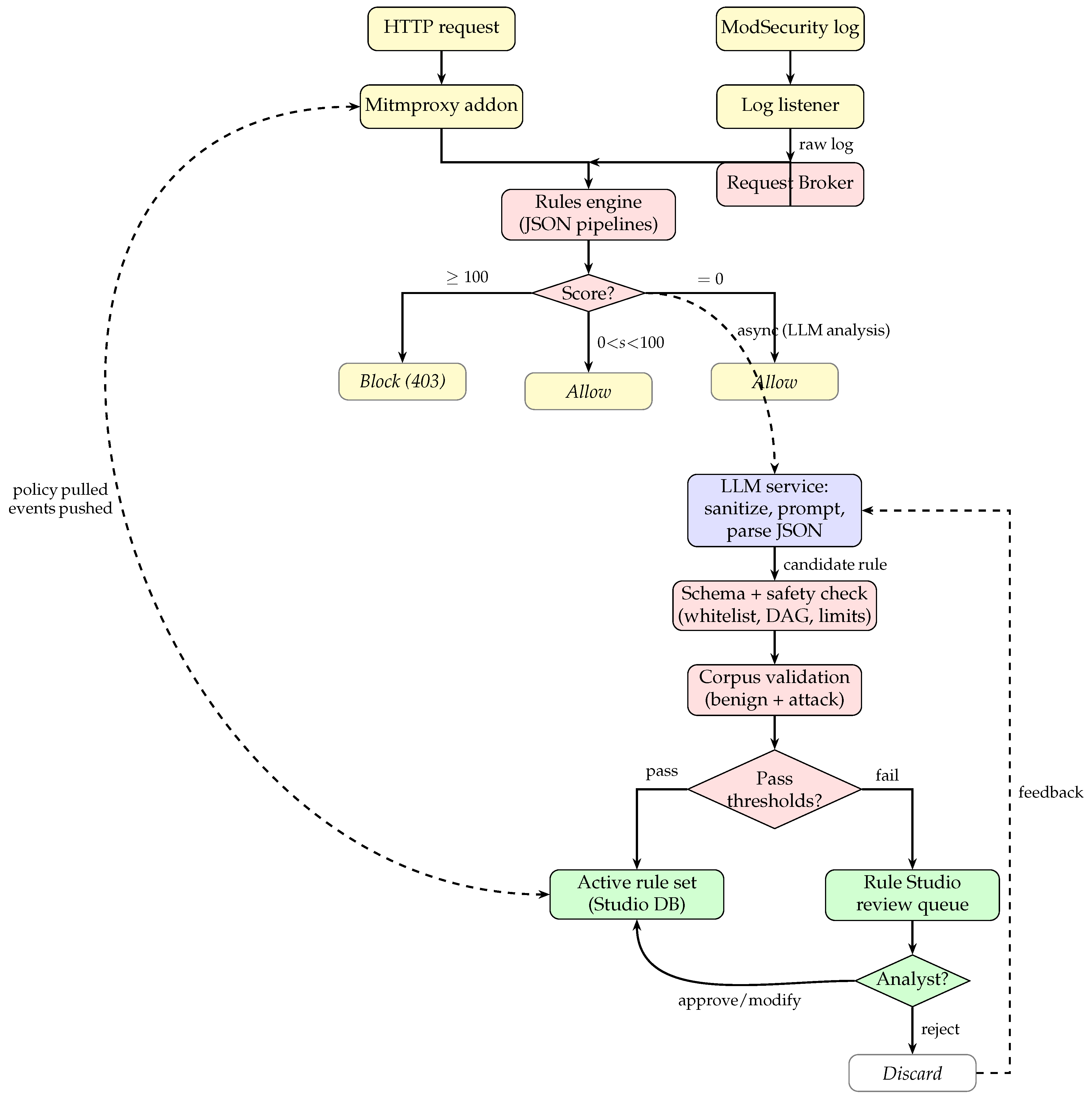
Figure 1 situates the engine within the overall data flow of the system, from HTTP traffic capture and ModSecurity log ingestion through the Rule Engine to the scored events surfaced in the analyst-facing storage and review interface. Within the engine itself the execution flow is sequential and stateful, building a context as it processes each step.
The Evaluation Loop
When a rule is applied to an event, the engine initializes an empty context dictionary that will be populated later as it iterates through the rule steps by following the next scenario. It first checks whether the step has an if condition. If the condition refers to a step name that is not in the context or whose value is not True, the current step is skipped. The engine resolves the step input by reading the from or from_many keys and retrieving the corresponding outputs from the context. If no input source is specified, the step can operate directly on raw event_data. The engine invokes the Python function corresponding to the step action name, passing in the event, the step configuration, and the resolved input value. The value returned by the action function is stored in the context dictionary, with the step name key, and this makes the result available for subsequent steps to consume. If the action returns True and the step is configured with a score and a message, then the engine moves the original event object directly. The score is added to event[‘score’], and the formatted message is added to event[‘info’].
The results stored in the context are aggregated according to the rule condition (AND or OR) to produce the final result for the entire rule, thus resulting in both a complete analysis of the event that will have a score and notes according to the steps it went through, but also a marker that will say whether the entire rule matched the event.
4.4. Action Semantics and Decision Mechanics
The capabilities of the engine are defined by its registry of available actions and the logic used to make a final block/allow decision based on the generated evidence.
The engine maintains a static mapping of action names to Python methods. This registry is extensible and includes a variety of functions that can be categorized as follows: Extraction (e.g., get_field), Decoding and Transformation (e.g., decode_base64_auto), Matching (e.g., contains), and Utility (e.g., generate_hash).
After the enforcement rules have been fully executed against an event, the decide function makes a final decision. This function implements a hybrid decision model that combines a risk score with specific high severity indicators. A request is marked as blocked if any of the following conditions are met:
The cumulative score of the event object is greater than or equal to the configured RISK_THRESHOLD (which is 100 by default).
Any message string in the event information list contains the status code “403”.
Using this double condition by which the module can block an event, we can allow expanding the capabilities so as to integrate new functionalities that return a forbidden result from the HTTP server when an attack is detected, such as using an external WAF engine that has these capabilities. In our research, ModSecurity was used for this, namely the logs that it generates in verbose mode.
6. System Architecture
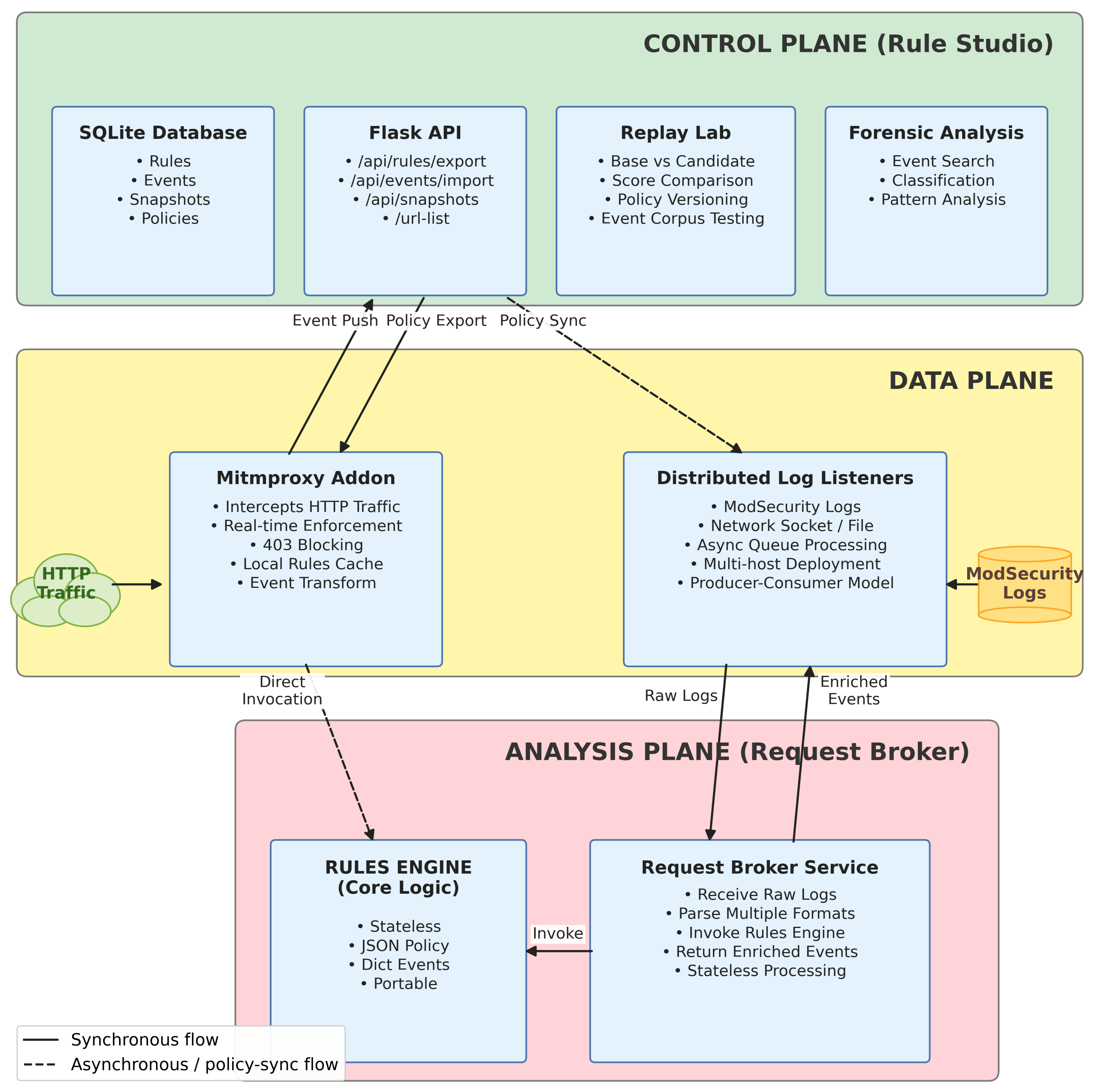
The system is organized as three decoupled planes that share a single Rules Engine. This separation lets policy be edited, versioned, and replayed offline in the Control Plane without disturbing real-time inspection and enforcement in the Data Plane.
Figure 2 shows where each module sits. The Control Plane (top) hosts the Rule Studio and the rule database; the Data Plane (left) intercepts and forwards HTTP traffic via the inline addon and the log listener; the Analysis Plane (right) executes the Rule Engine, Request Broker, and LLM service. Solid arrows depict the synchronous request path; dashed arrows depict the asynchronous LLM-analysis feedback loop. Each plane is shaded with a distinct background colour for visual separation.
Figure 3 traces the end-to-end runtime path that an HTTP request follows through these planes, including the LLM-driven feedback loop that turns zero-score events into validated rules. Solid arrows denote the synchronous request path; dashed arrows denote the asynchronous LLM-analysis loop. Node fills are colour-coded by plane: yellow for the Data Plane, red for the Analysis Plane, green for the Control Plane, and pale purple for the LLM Service. The Data Plane has two entry paths: the inline Mitmproxy addon, which invokes the Rules Engine directly, and the log-based Listener, which forwards events to the Request Broker before the engine is invoked. The Rules Engine in the Analysis Plane scores each event; scores
trigger a 403 block (inline path only), scores in
are allowed, and zero-score events both allow the request and asynchronously invoke the LLM Service (dashed arrow). Candidate rules emitted by the LLM pass through two validation stages: a schema and safety check (action whitelist, DAG well-formedness, resource limits) and corpus validation against benign and attack traffic. Rules passing the deployment thresholds (FPR
, detection rate
, no duplicate) are added directly to the active rule set in the Control Plane; rules that fail enter the Rule Studio review queue, where an analyst can approve, modify, or reject them. Rejected rules feed back into LLM prompt engineering (dashed loop). The Data Plane and Studio communicate bidirectionally: the Mitmproxy addon periodically pulls the active policy, and pushes processed events back to Studio for storage and review.
6.1. The Control Plane: The Rule Studio
Rule Studio, the Control Plane, is a Flask web application backed by SQLite that exposes policy, rule, and step management through a web UI and a RESTful API.
Data Plane components push processed events back to Studio via /api/events/import for storage. Replay Lab uses this corpus to compare a candidate policy against a baseline before deployment, and policy versioning produces stable, reproducible exports.
Studio also exposes a /url-list service-discovery endpoint that publishes available analytics brokers to distributed listeners, and a forensic search interface in which analysts can label requests or whole patterns as benign or malicious to refine detection logic.
6.2. The Data Plane
The Data Plane collects security-relevant data and, in some configurations, enforces decisions inline. Two implementations are supported.
6.2.1. The Inline Enforcement Addon
An inline mitmproxy addon intercepts live HTTP traffic and applies the current policy. It pulls the active rule set from Studio’s /api/rules/export on a timer and caches it locally for resilience and throughput.
Each request is normalized into the engine’s event dictionary, evaluated through the omission and enforcement passes described in
Section 4, and either forwarded or blocked with a 403 response. The processed event, with its final score and any messages, is then pushed back to Studio for storage.
6.2.2. The Distributed Log Ingestion System
An alternative deployment uses smart_listener.py to ingest logs from sources such as ModSecurity on multiple hosts. Each listener can consume a live network log stream or replay a log file from disk for forensics.
Unlike the inline addon, the listener does not run the engine locally; it forwards raw logs to the Analysis Plane and, on receiving the enriched event back, queues it for asynchronous write to requests.db by a pool of writer threads.
6.3. The Analysis Plane: Request Broker and Rule Engine
The Analysis Plane is built from two layers. The outer layer is the Request Broker, a stateless service that parses incoming logs into the standard event dictionary, invokes the engine, and returns the scored event to the originating listener; centralising this step guarantees that every log source is evaluated under the same policy.
The inner layer is the Rule Engine itself, a standalone Python class that accepts a JSON policy and an event dictionary and returns a scored event. It has no dependency on HTTP, web frameworks, or storage, which keeps it portable and testable and ensures that the inline mitmproxy addon and the offline Replay Lab evaluate events under identical semantics. The same engine is therefore the shared kernel of both the Data Plane (inline path) and the Analysis Plane (log-based path) shown in
Figure 2 and
Figure 3.
6.4. The LLM Analysis Service
The LLM Analysis Service is a pluggable module that extends detection beyond static rules and integrates with both the inline enforcement addon and the offline analysis pipeline. Internally it is split into a client abstraction over the supported backends, a rule generator, and a validation engine, all described in detail in
Section 5; externally, the Rules Engine invokes it on zero-score events and the Rule Studio surfaces a review queue for analysts to approve, modify, or reject generated rules.
The service supports four deployment modes. In fully automated mode, validated rules are deployed to the active rule set without human intervention, suitable for mature installations with well-tuned validation thresholds. In review-required mode, every generated rule enters the analyst queue before deployment, appropriate for initial rollout or high-security environments. In logging-only mode, the LLM analyses requests and emits rules but does not deploy them, useful for measuring LLM behavior before granting it enforcement authority. In disabled mode, the service is inactive and the system operates as a traditional rule-based engine.
7. Evaluation and Results
To assess the practical viability and effectiveness of the proposed system, we conducted an empirical evaluation using the CSIC 2010 HTTP Dataset [
34], a widely cited benchmark for web application firewall research. The dataset was generated by the Spanish National Research Council and contains raw HTTP requests directed at an e-commerce web application. It comprises 36,000 normal (benign) requests and 25,065 anomalous (malicious) requests covering multiple attack categories: SQL injection, Cross-Site Scripting (XSS), CRLF injection, path traversal, information gathering, parameter tampering, buffer overflow, and server-side includes.
7.1. Dataset and Methodology
The CSIC 2010 anomalous traffic is dominated by parameter tampering attacks (79.8% of all anomalous requests), which involve application-specific business logic violations such as modifying product prices, injecting invalid identifiers, or adding unexpected form fields. These attacks are inherently application-specific and cannot be detected by general-purpose signature rules, since no WAF can determine that a price was tampered with without knowledge of the application’s expected values. This limitation is shared by all signature-based systems, including ModSecurity CRS, which provides no rules for parameter tampering detection.
We therefore report detection results both on the full dataset and on the payload-based attack subset, which excludes parameter tampering and isolates the attack categories amenable to general-purpose rule-based detection: SQL injection (1480 requests), information gathering (1695 requests), CRLF injection (932 requests), XSS (736 requests), and path traversal (194 requests), totaling 5037 malicious requests. The full normal test set (36,000 benign requests) is used for all false positive measurements. All experiments use a blocking threshold of score ≥ 100.
7.2. Detection Results
Table 2 presents the per-attack-type detection rates on the payload-based subset. The engine achieves perfect detection (100%) on four of five attack categories and 93.6% on SQL injection.
The 94 missed SQL injection payloads follow a specific pattern: The tautology AND 1 = 1 is appended directly to a parameter value without a preceding space (e.g., entrarAND+1%3D1), which prevents the word-boundary matching from triggering. These edge cases represent a known trade-off between detection sensitivity and false positive rate; broadening the pattern to match without word boundaries would increase false positives on benign traffic containing common substrings.
7.3. Overall Metrics
Table 3 summarizes the aggregate detection metrics on the payload-based evaluation set (5037 malicious + 36,000 benign requests).
The confusion matrix for this evaluation is 4943 true positives, 94 false negatives, 183 false positives, and 35,817 true negatives. The 183 false positives (0.51% FPR) originate primarily from the SQL comment obfuscation rule (157 cases), part of the SQL injection detection chain. The rule targets the canonical SQL comment markers (–, #, and /* */) appearing near the tail of a payload, which is a standard SQL injection technique for neutralizing the rest of the original query. The misfires trace not to the raw request content but to the engine’s auxiliary decoded views, in particular hex_all and b64_all: short numeric form fields such as the quantity field (cantidad=23) and a 16-digit credit-card-like identifier (ntc=5904492147242322) consist entirely of valid hexadecimal digits, so the hex auto-decoder produces short byte strings that happen to contain the byte 0x23 (#, the MySQL-style line comment marker), satisfying the tail-anchored regex purely by coincidence of byte values. The same effect appears when the URL-encoded form body, taken as a single string, is Base64-decoded into a gibberish byte sequence that happens to contain a # within the trailing 200 bytes. The Spanish locale of the dataset is incidental to this mechanism: The trigger is the interaction between an aggressive auto-decoder chain and short, hex-shaped inputs, and would surface identically on any benign traffic that contains numeric identifiers or alphanumeric form bodies. The remaining false positives are caused by shell metacharacter patterns matching in benign URL-encoded values (25 cases from encoded slashes, 20 cases from parameter content resembling shell operators). Both false positive sources are well-understood and can be mitigated without modifying the broader detection logic, for example by adding a minimum-length guard before the comment-tail regex is applied to decoded views, or by restricting that specific rule to the raw and percent-decoded inputs rather than the hex and Base64 views.
7.4. Performance Metrics
Performance was measured during the evaluation on a standard workstation (4 GB RAM, 4 CPUs).
Table 4 presents the latency and throughput results.
The sub-millisecond median latency and consistent P99 below 3.1 ms demonstrate the engine’s suitability for inline deployment as a reverse proxy. The throughput of 793 requests/second was achieved in a single-threaded Python process; in the multi-threaded offline analysis mode with 4 concurrent threads, the system achieves approximately 1000 events per second.
7.5. Comparative Analysis
To contextualize our results,
Table 5 and
Table 6 present a feature-level comparison with leading intrusion detection and web application firewall systems, split into detection logic and operational properties for readability. (The original
Table 5 was restructured into two narrower tables in this revision.)
Two properties distinguish the proposed engine from the systems in
Table 5 and
Table 6: a declarative JSON pipeline that composes decode and match steps without modifying engine code, and native interpretability in which every blocking decision traces to an auditable rule together with its intermediate pipeline outputs, a property that ML-based WAFs cannot offer and that network-level systems do not target at the HTTP layer.
7.6. Cross-Dataset Validation: HttpParamsDataset
To assess generalization beyond a single benchmark, we evaluated the engine on the HttpParamsDataset [
35], an independent collection of 31,067 individual HTTP parameter values (19,304 benign and 11,763 malicious) labeled by attack type. Unlike CSIC 2010, which provides full HTTP requests against a specific web application, HttpParamsDataset contains isolated parameter payloads sourced from multiple security tools (sqlmap, XSSYA, Vega Scanner, FuzzDB), testing the engine’s matching capabilities at the parameter level regardless of request context. Each payload was injected as a query parameter value into a synthetic HTTP request and evaluated using the same rule set and threshold (score ≥ 100) as the CSIC 2010 evaluation.
Table 7 presents the per-attack-type detection rates.
Table 8 summarizes the aggregate metrics across all 31,067 payloads.
The results demonstrate consistent performance across both benchmarks: 98.3% detection rate on HttpParamsDataset versus 98.1% on CSIC 2010 (payload-based subset), with comparable false positive rates (0.47% vs. 0.51%) and precision (99.23% vs. 96.43%). The remaining missed payloads reflect deliberate trade-offs between detection sensitivity and false positive risk:
Path traversal (47.6%): The 152 missed payloads use non-standard traversal patterns that replace the canonical ../ sequence with alternative representations, such as continuous dot sequences without slash separators (e.g., ........................etcpasswd) or Windows-specific paths (c:oot.ini, c:/boot.ini). These patterns are not generalizable attacks; they target specific server configurations and would generate false positives on legitimate Unix-style paths if broadly matched.
XSS (95.9%): The 22 missed payloads are predominantly HTML tags without event handlers or JavaScript execution vectors (e.g., <a href = “http://…”>text</a>, <img src = “http://…”>), which represent injection of benign HTML rather than executable cross-site scripting.
SQL injection (99.8%): The 20 remaining missed payloads are edge cases including single-character probes (‘1), CASE WHEN expressions that also appear in legitimate analytics queries, and arithmetic subtractions (5739-5738) indistinguishable from normal numeric input.
Command injection (89.9%): The 9 missed payloads use absolute paths to system binaries (/bin/ls, /usr/bin/id) or backtick-enclosed common words (‘uname’, ‘true’), which the current heuristics do not flag to avoid false positives on legitimate Unix-style paths and quoted strings.
7.7. Contemporary Cross-Dataset Validation: SR-BH 2020
To validate the engine against a more recent benchmark and address the limitation that CSIC 2010 reflects HTTP traffic patterns predating widespread API-driven and JavaScript-heavy web applications, we additionally evaluated on the SR-BH 2020 dataset [
36] hosted on Harvard Dataverse. SR-BH 2020 contains 907,815 labeled HTTP requests captured against an instrumented WordPress test site, with 525,195 benign and 382,620 malicious requests. Unlike CSIC 2010 (which uses five high-level attack categories) and HttpParamsDataset (binary labels per parameter value), SR-BH 2020 annotates each request with one or more CAPEC identifiers [
37], giving a multi-label structure across thirteen attack categories. We restrict our analysis to the subset of CAPEC categories that fall within the threat model of
Section 3, namely SQL Injection (CAPEC-66), Path Traversal (CAPEC-126), OS Command Injection (CAPEC-88), and Scanning for Vulnerable Software (CAPEC-310).
Inspection of SR-BH 2020 disclosed two classes of automated-labeling artifact that motivate our dual-reporting methodology. On the attack side, the tagging tool assigns CAPEC labels heuristically; the SQL Injection tag is attached to any request containing a ver parameter regardless of whether the value carries SQL syntax, so standard WordPress static-asset loads such as /blog/wp-admin/load-styles.php?ver = 4.9.5 appear as SQL injection attacks. Approximately 22% of the 250,311 SQL Injection-tagged requests contain no SQL syntax in URL or body; the engine correctly treats them as benign, recorded as missed detections under the raw scheme. Similar cross-category confusion places both SQL Injection and OS Command Injection labels on any request containing the keyword sleep, conflating SQL SLEEP() calls with shell sleep N invocations. On the benign side, 58,643 (11.17%) of the 525,195 Normal requests contain a syntactic indicator consistent with an attack class (URL-encoded shell injection %26cat+%2Fetc%2Fpasswd%26, encoded path traversal, etc.) that the test server simply did not honor; the engine correctly flags many of these as attacks, recorded as false positives under the raw scheme.
To distinguish engine behavior from these labeling artifacts we report each per-category detection rate twice: against the raw SR-BH labels exactly as published, and against a signature-validated subset. The validation procedure is a per-category filter that retains a CAPEC label on a request only when the request’s URL or body (raw and twice percent-decoded) matches at least one signature from the corresponding signature set. The signature sets are deliberately narrow and reflect canonical syntactic markers of each attack class, summarized in
Table 9.
The same signature sets are also applied to the benign half of the dataset. Any request labeled Normal whose URL or body matches a signature from any category is excluded from the validated benign subset and is not used for the false-positive-rate calculation. The procedure is conservative by design; it removes only requests whose payload unambiguously matches the canonical syntactic shape of an attack class, so the residual validated subset retains the bulk of the original dataset (88.83% of benign rows and between 72.84% and 100% of attack rows per category) while removing the most obvious labeling artifacts. We acknowledge that any signature-based filter remains a heuristic; in particular, it may reject highly unusual real attacks that do not match common syntactic forms, and the absolute ground truth of every record is unknown.
Table 10 reports the per-category detection rate of our rule engine against both the raw and validated subsets.
The gap between the raw and validated columns is largest for SQL Injection, where the raw rate of 86.20% rises to 99.12% once label-noise rows are excluded. This is consistent with the labelling artifact described above: roughly 27% of SR-BH’s SQL Injection tags correspond to WordPress static-asset traffic or scanner heuristics that do not contain any SQL syntax, and the engine correctly treats these as benign, which is counted as a missed detection by the raw label scheme. The two large in-scope volume categories that do not show such a gap, Path Traversal and Scanning, are categories in which the dataset labels already track payload content closely, so the raw and validated rates agree to within a fraction of a percentage point.
The false positive rate on SR-BH 2020 is more sensitive to label noise on the benign side. Of the 525,195 requests labelled benign in the published dataset, 58,643 (11.17%) contain at least one attack signature in the URL or body, predominantly shell command injection probes (
&cat/etc/passwd& and similar) that elicited non-exploitation responses from the test server and were therefore filed under benign rather than under their attack CAPEC. On the validated benign subset of 466,552 requests, the engine produces 8582 false positives, a false positive rate of 1.84%. The dominant remaining false positive sources are scanner-style traffic with absent or generic User-Agent headers and benign WordPress paths whose components match path-extraction heuristics. The headline aggregate metrics on the validated SR-BH 2020 subset are summarised in
Table 11.
We make three observations on these results. First, the engine maintains detection performance in the high-90s percentage range on a 2020-vintage benchmark that includes contemporary WordPress traffic patterns, addressing the concern that CSIC 2010 alone may not be representative of present-day web traffic. Second, the substantial difference between raw and validated detection rates underscores the importance of inspecting dataset labels rather than treating them as ground truth: the engine appears nearly twelve percentage points weaker on SQL Injection if the noisy labels are accepted at face value. Third, the analysis surfaced a concrete engine improvement that we incorporated into the production rule set; the original Command Injection rule scanned only parsed parameter values and missed shell payloads smuggled into the raw URL via decoded ampersand separators (e.g., ?mode=grid&sleep+15&, where the URL parser interprets sleep 15 as a parameter name rather than as a value). Extending the rule to additionally scan the raw and once-decoded URL strings raised cleaned OS Command Injection detection from 84.56% to 96.47% without introducing new false positives on the validated benign subset.
7.8. Head-to-Head Comparison with a CNN + BiLSTM Baseline
The literature comparison in
Section 7 reports detection rates of CNN, LSTM, and CNN–LSTM models on CSIC 2010 from prior work, but those results are quoted from published papers rather than measured against the same evaluation splits used in this study. To enable a fair head-to-head comparison on identical test data, we implemented, trained, and evaluated a CNN + BiLSTM model of the family established by Kuang et al. [
38], Tekerek [
39], and Tadhani et al. [
17], the three architectures the existing comparison table cites. The model, training procedure, and evaluation are released alongside this paper so any reported number can be reproduced.
Each HTTP request is canonicalized into a single 2048-character sequence concatenating method, path, query, host header, user-agent, and body, with control characters as separators. The sequence is embedded into 64-dimensional vectors, then passed through three parallel 1D convolution branches with kernel sizes 3, 5, and 7 (128 filters each, followed by batch normalization and a max-pooling of stride 2). The branches are concatenated along the feature axis and fed to a bidirectional LSTM with 128 units per direction. A single dense layer (64 units, dropout 0.5) precedes a six-way softmax head. The total parameter count is 675,142 (2.6 MB). The architecture is documented in the released model.py.
We trained on the cleaned SR-BH 2020 dataset of
Section 7.7, restricted to the five attack categories within the engine’s threat model (SQL injection, path traversal, OS command injection, code injection, scanning for vulnerable software) plus the strict benign subset (
normal_strict), totaling 685,906 rows. We applied a stratified 70/15/15 train/val/test split (seed 42) yielding 480,134 training rows, 102,886 validation rows, and 102,886 test rows. Training used the Adam optimizer at learning rate
, sparse categorical cross-entropy weighted by inverse class frequency to compensate for the heavy imbalance (the
scanning class has 289 total rows; the
normal class has 466,552), batch size 256, and early stopping on validation accuracy plateau. Training was stopped at the end of epoch 5 with validation accuracy 99.68% on the held-out set; further epochs produced sub-0.1-percentage-point improvements. Training ran on an NVIDIA RTX A4000 (16 GB) for approximately 50 min.
7.8.1. In-Distribution Performance
On the held-out 102,886-row SR-BH test split (
Table 12), the model achieves 99.65% multi-class accuracy with weighted F1 of 0.997. Under a binary collapse (any non-zero predicted class is treated as “attack”), the model reaches a true-positive rate of 99.99% at a false-positive rate of
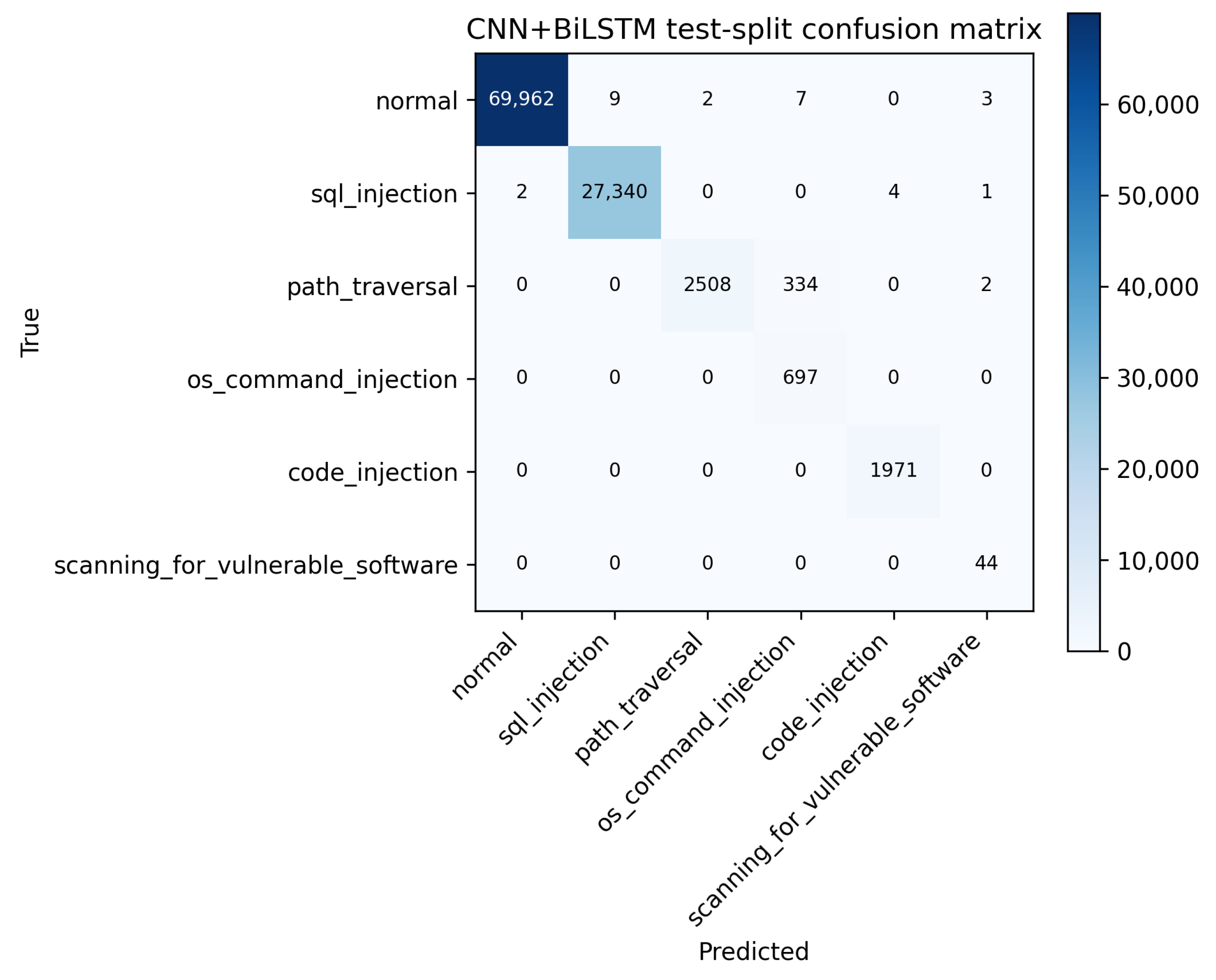
0.03%, a single-request mean inference latency of 0.34 ms. The two attack categories with the smallest training support (OS command injection at 4644 rows total, scanning at 289) carry visibly lower per-class precision (0.67 and 0.88, respectively), but recall on both remains at or above 0.98. SQL injection, path traversal, and code injection all reach
.
The confusion matrix (
Figure 4) shows near-diagonal structure with the only meaningful off-diagonal mass in the OS command injection column. A small number of normal requests are routed to OS command injection, which is what drives that class’s precision drop. There is no substantial class confusion across the five attack categories themselves.
7.8.2. Cross-Dataset Generalization
The same trained model was applied without retraining to CSIC 2010 (
Table 13) and HttpParamsDataset (
Table 14). The model output was collapsed to a binary attack/benign decision; any non-zero predicted class counts as an attack prediction. On both datasets the in-distribution performance does not transfer.
On CSIC 2010, the model classifies
87.93% of the 36,000 benign requests as attacks. By way of comparison, the rule engine on the same benign set produces a false-positive rate of 0.51% (
Section 7); ModSecurity with the OWASP CRS produces zero false positives. The CNN + BiLSTM’s behavior on benign CSIC traffic is operationally indistinguishable from a random reject decision. On the attack side, the model recovers the in-distribution behavior for attack
syntax that transfers across datasets: 99.91% on blind SQL injection, 99.45% on classical SQL injection, and 100% on path traversal. It does not recover on attack classes whose surface form differs from SR-BH, with CRLF injection in particular dropping to 35.22% TPR.
On HttpParamsDataset, the false-positive rate on benign payloads is
77.74%; the rule engine produces 0.47% on the same set. Detection rates on attack payloads range from 50.56% (command injection) to 87.24% (path traversal), substantially below the 80–100% range the rule engine achieves in
Section 7.
7.8.3. Discussion: Cross-Method Asymmetry and Temporal Stability
The central observation is the asymmetry between in-distribution and out-of-distribution performance. The CNN + BiLSTM matches or exceeds the rule engine on SR-BH (99.65% multi-class accuracy, 0.03% FPR) but degrades by two to three orders of magnitude on the benign distribution of either cross-evaluation corpus (0.03% → 87.93% on CSIC; 0.03% → 77.74% on HttpParamsDataset). The rule engine, applied without retraining to the same three datasets, remains within a single percentage point of its CSIC false-positive rate everywhere.
The mechanism is consistent with prior observations on deep-learning intrusion detectors trained on a single corpus [
4,
25]: the CNN learns dataset-specific surface cues alongside the underlying attack syntax. SR-BH was generated by automated scanners against a WordPress test deployment, so its benign traffic shares stylistic markers (User-Agent strings, path conventions, header orderings) absent from CSIC’s Spanish e-commerce captures or HttpParamsDataset’s isolated parameter payloads. Attack-syntax knowledge (SQL keywords,
../sequences, shell metacharacters) transfers cleanly, as the model’s 99.4–100% per-attack-type detection rates on CSIC SQL injection and path traversal demonstrate; what does not transfer is the model of
benign traffic, and a binary classifier with a corrupted benign model is unusable in production regardless of its attack detection rate.
The three evaluation corpora span a decade of evolving HTTP traffic (CSIC 2010, HttpParamsDataset 2018, SR-BH 2020), and the asymmetry above is therefore also a concept-drift result. The rule engine exhibits no measurable temporal drift; its false-positive rate stays within a 0.47–1.84% band across the three time points and SQL-injection detection stays above 99% throughout because the detection logic encodes syntactic primitives independent of any specific benign distribution. The CNN + BiLSTM, trained on the most recent corpus, exhibits the opposite behavior and serves as the control case for the textbook concept-drift failure mode of end-to-end learned detectors. The numbers in
Section 7 and
Section 7.8.2 thus do double duty; along the cross-method axis, they characterize the head-to-head ML comparison; along the temporal axis, they characterize the rule engine’s decade-long stability and the learned detector’s drift across the same period. This is the empirical content of the interpretability claim made throughout this paper: The rule engine’s
–
false-positive rate across three datasets, achieved without any training data, is the operational benefit of separating attack syntax from benign-distribution style in the detection model.
Every percentage reported in this subsection was computed from the held-out test split described above and from the per-row prediction logs of the trained CNN + BiLSTM on each of the three evaluation corpora.
7.9. Decoder-Chain Stress Evaluation
Section 3 lists adversarial decoder abuse, an attacker chaining many encoding layers to evade detection or to exhaust the engine’s decoder pipeline, as a limitation requiring experimental characterization. We constructed and ran a dedicated stress test to quantify the engine’s behavior under such payloads.
We assembled 50 base attack payloads spanning the engine’s threat model: 15 SQL injection, 10 XSS, 10 path traversal, 10 OS command injection, and 5 code-injection/SSTI/log4shell-style payloads. For each base payload, we generated 10 nested-encoding instances at depths . Each instance applies d encoding layers drawn uniformly at random (seeded by ) from the alphabet , with non-printable XOR and zlib outputs wrapped in a base64 envelope so each layer produces a printable string consumable by the next. The xor uses a fixed 15-byte key. For each instance we then constructed a matching decoder rule that reverses the chain layer by layer and terminates in a case-insensitive substring check against the first 20 characters of the original payload. The total experiment is (payload, rule) pairs covering the full depth range. Each rule was executed by a fresh RuleEngine instance in a separate process with a 60 s wall-clock timeout via signal.alarm; per-call elapsed time and peak resident-set size were recorded.
Because the encoding chain is multiplicative ( doubles, inflates by ), some chains at depth 50 produce encoded payloads exceeding 100 MB, a size that exceeds any realistic HTTP request limit. We cap the runner at a 100 MB encoded payload limit and report skipped instances separately as oversize_skipped rather than feeding the engine inputs larger than would ever reach it in a real deployment.
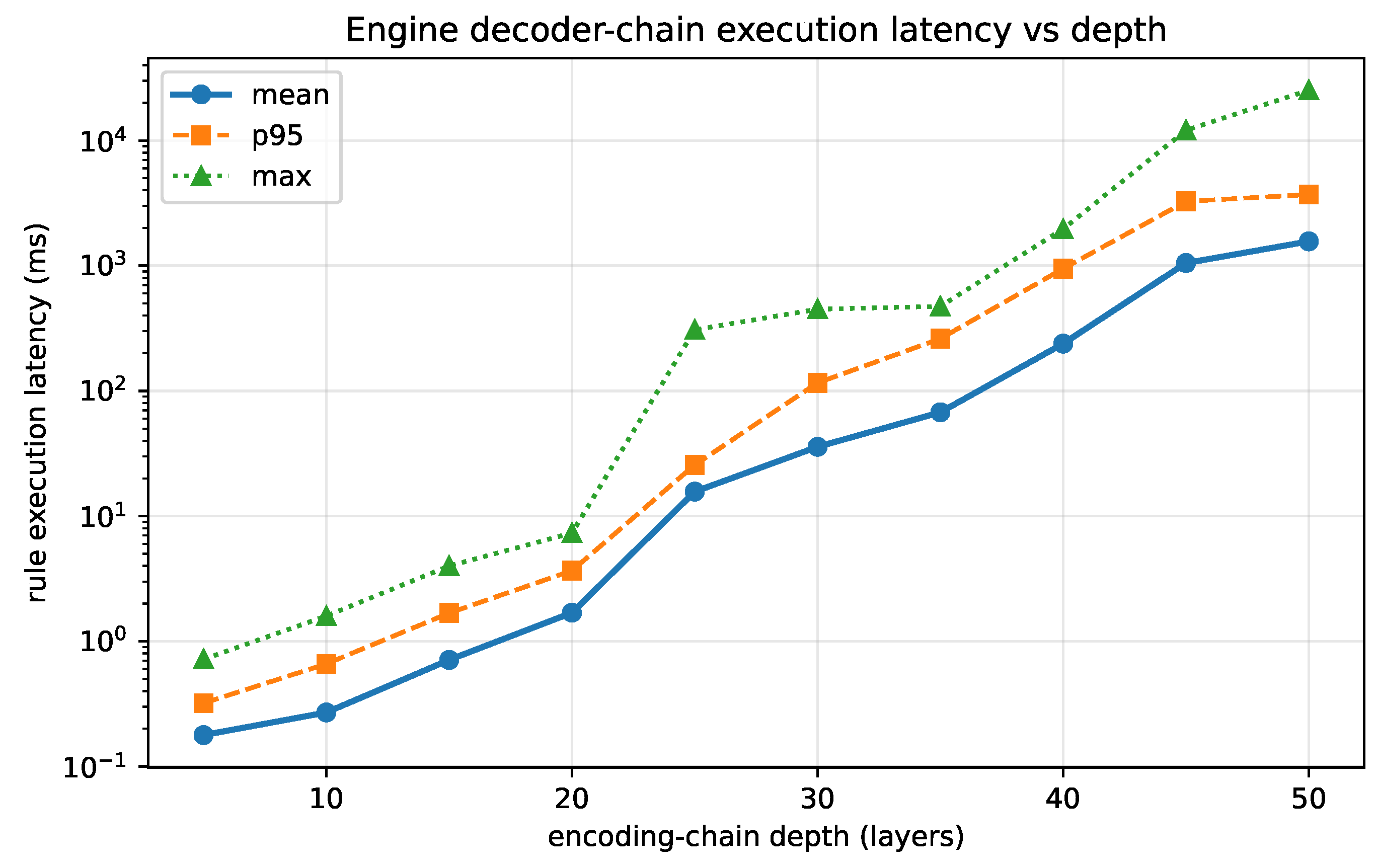
Table 15 reports per-depth statistics over the 500 trials. The engine recovered the original payload with 100% success at every depth up to and including 45, with zero timeouts and zero exceptions in the engine itself. At depth 50, 2 of the 50 trials were oversize-skipped (encoded payload exceeded the 100 MB cap); the remaining 48 trials matched cleanly. Across the entire experiment, 498 of 500 trials matched (99.60%), 0 timed out, and the two non-matches are accounted for by realistic payload size filtering rather than engine failure.
Figure 5 plots execution latency (mean, p95, max) against chain depth on a log scale. Latency growth is super-linear in depth, consistent with each additional layer operating on a 4/3-to-2-times larger intermediate buffer; mean latency rises from 0.2 ms at depth 5 to 35.7 ms at depth 30, 238 ms at depth 40, and 1.56 s at depth 50. The p95 latency stays below 1.2 s up to depth 40 and reaches 3.7 s at depth 50. Peak resident-set delta per worker remained below 100 MB for every chain shorter than 40 layers and reached 819 MB at the depth-50 worst case (a chain dominated by
hex layers, which doubles bytes per layer).
A complementary linear breakdown of latency contribution per layer type, computed as the mean per-layer cost across all chains, shows that zlib is the cheapest decoder (median 0.91 ms per layer amortised; it compresses the input before the engine sees it), followed by base64 (1.25 ms), hex (1.28 ms), and xor (1.48 ms). The differences are explained by intermediate buffer size rather than algorithmic complexity: hex expands its output by a factor of two, so subsequent decoders have more work to do; zlib typically compresses small payloads, reducing work for later layers in the same chain.
The limitation listed in
Section 3 (“adversarial decoder abuse, planned security measures”) is now characterized empirically. There are three concrete findings:
- 1.
The engine does not crash, exception, or silently pass through any chain up to depth 50 with realistic-size inputs. All 498 rules executed without an engine-side error.
- 2.
No timeout occurred in 500 trials at the configured 60-s budget. The maximum observed latency was 25.2 s on a single worst-case depth-50 chain; the p95 across all depths was 1.17 s.
- 3.
The practical attacker bound is set by HTTP request size, not by the engine. At depth 50, the encoded payload can exceed 2 GB; web servers reject such requests at the protocol level long before they reach the engine. The 100 MB cap used in this experiment is generous relative to typical WAF inspection limits (≤1 MB).
This characterization supports moving adversarial decoder abuse from the open-limitation column to a measured-bound column. Chains shorter than the request-size limit are handled in bounded time; chains exceeding the request-size limit never reach the engine. The production engine retains the 60 s per-rule timeout as a defense-in-depth against future encoder additions whose worst-case expansion factor is not yet characterized.
7.10. Head-to-Head Comparison with ModSecurity
To directly compare detection capabilities against the industry-standard open-source WAF, we deployed ModSecurity v3.0.14 with the OWASP Core Rule Set (CRS) in a Docker container and replayed all payloads from both benchmark datasets through both systems. ModSecurity was configured at Paranoia Level 1 with the default inbound anomaly scoring threshold of 5. To ensure a fair comparison focused on payload detection rather than header anomaly scoring, requests were sent with standard browser headers.
Table 16 presents the per-attack-type comparison on CSIC 2010.
Table 17 presents the comparison on HttpParamsDataset.
Table 18 consolidates the aggregate metrics across both datasets.
On both datasets our engine detects more attacks than ModSecurity (+2.90 percentage points on CSIC 2010, +0.60 on HttpParamsDataset). The advantage on CSIC 2010 comes mainly from information gathering (91 backup-file probes that CRS does not flag) and from SQL injection edge cases where our regex patterns match 79 payloads that CRS misses. ModSecurity catches 24 CSIC payloads that we miss. On HttpParamsDataset the gap is narrower, though our engine still holds a 147-to-76 lead in unique detections; the widest margin is in command injection (38 vs. 3), where timed-probe patterns like ping -i 30 trigger our heuristics but not CRS rules.
7.11. Comparison with Published Results on CSIC 2010
Table 19 places our results in context with detection rates reported by other systems evaluated on the same dataset. Most published results use supervised classifiers trained on the CSIC 2010 corpus and report accuracy on the full dataset (including parameter tampering), whereas our system uses no training phase and we report detection rate on the payload-based subset only. Despite this methodological difference, our rule-based engine achieves results competitive with CNN and LSTM approaches, while remaining fully interpretable—every decision traces to an explicit rule that an analyst can read and modify, a property that none of the neural approaches offer.
The systems reporting higher accuracy (Shaheed [
43] 99.6%, Tadhani et al. [
17] 99.8%) are supervised classifiers that learn directly from the CSIC 2010 training split, including parameter tampering patterns specific to the target application. Our system requires no training data and generalizes across applications. The Montes et al. [
44] study is notable because it directly benchmarked ModSecurity OWASP CRS on CSIC 2010, reporting a true positive rate of only 26.6% at Paranoia Level 1 and 29.5% at Paranoia Level 2, both substantially below our 98.1% and below the 95.2% we measured for ModSecurity in our own head-to-head evaluation. The difference likely reflects dataset preprocessing choices and CRS version differences.
The trade-off is precision. ModSecurity produces zero false positives on both datasets. Our engine flags 185 benign CSIC requests (0.51% FPR), almost all from a single SQL comment obfuscation rule that fires not on the raw request content but on the engine’s auxiliary hex and Base64 decoded views of short numeric form fields (such as a quantity field with value 23, which is itself a valid hex sequence and decodes to the byte 0x23, namely the MySQL-style # comment marker). The trigger is an interaction between the over-eager auto-decoder chain and short hex-shaped inputs and is independent of the Spanish locale of the dataset. On HttpParamsDataset both systems are clean. The 70 CSIC payloads that neither system catches are SQL injection tautologies (AND 1 = 1) glued to a parameter value without a space, and the 127 shared misses on HttpParamsDataset are mostly dot-only path traversal variants (105 payloads) that no general-purpose signature can safely match.
7.12. LLM-Assisted Adaptive Detection: Experimental Evaluation
To evaluate the LLM-assisted adaptive detection component described in
Section 5, we simulated the full pipeline: Starting from the original base rules (7 rules covering SQL injection, XSS, command injection, path traversal, NoSQL injection, SSTI, and user-agent anomalies), we identified all zero-score requests (payloads that evaded the base rules entirely) and submitted them for LLM analysis. The LLM analyzed the missed payloads and generated 6 candidate rules targeting the identified attack patterns. Each candidate rule was validated against both benign corpora before deployment.
7.12.1. Candidate Rule Generation
The LLM identified four categories of attacks that the base rules could not detect: (1) blind SQL injection probing functions (make_set(), elt(), iif(), randomblob()) and arithmetic-based blind probes; (2) CRLF injection via double-encoded %250D%250A sequences with header injection; (3) information gathering through backup file probing (.bak, .old, ~) and sensitive path access; and (4) XSS via legacy script URI schemes (vbscript:, mocha:, livescript:) and dangerous tags (<embed>, <object>, <layer>). For each category, the LLM generated a detection rule in the system’s JSON format using the available action primitives (regex matching, substring checks, field extraction).
7.12.2. Validation Results
All six generated rules passed the automated validation framework.
Table 20 summarizes the validation results.
The zero false positive rate across all generated rules on both benign corpora (19,304 HttpParamsDataset benign values and 36,000 CSIC 2010 normal requests) confirms that the attack-specific patterns identified by the LLM do not occur in legitimate traffic. All rules met the deployment thresholds (FPR < 1%, detection rate > 80%) and were automatically added to the active rule set.
7.12.3. Detection Recovery
Table 21 presents the detection recovery achieved by the LLM-generated rules on payloads that the original base rules missed entirely.
The LLM-generated rules recovered 545 out of 748 previously missed HttpParamsDataset payloads (72.9%), with particularly strong recovery on SQL injection (96.3%) where the blind probing function rules captured nearly all
make_set(),
elt(), and arithmetic-based payloads. On CSIC 2010, the recovery was 96.5%, driven by the CRLF injection and information gathering rules that addressed two entire attack categories absent from the original rule set. The unrecovered payloads are predominantly non-standard path traversal patterns (152) and edge-case XSS/command injection variants that were deliberately excluded from rule generation to avoid false positives, as discussed in
Section 7.
7.12.4. Impact on Overall Detection
Table 22 summarizes the overall detection rate improvement from the LLM-generated rules.
The improvement on CSIC 2010 is particularly significant (+51.76 percentage points) because the original base rules lacked coverage for two major attack categories present in the dataset (CRLF injection and information gathering), which together comprise 2627 of the 5037 payload-based attacks. The LLM component identified these gaps from the zero-score requests and generated rules that achieved 100% detection on both categories. On HttpParamsDataset, the improvement of +4.63 percentage points is driven primarily by the blind SQL injection rules, which recovered 525 previously undetected payloads. None of the generated rules produced a single false positive on either benign corpus.
The base rule set was intentionally kept minimal for this evaluation (seven rules, no manual expansion of attack category coverage) in order to isolate the adaptive capability of the LLM fallback mechanism. In a production deployment, an analyst would likely author rules for well-known categories such as CRLF injection and backup file probing from the outset. The purpose of this experimental design is twofold. First, it validates that the LLM component can autonomously identify previously unseen vulnerability classes from zero-score traffic, formulate generalizable detection patterns, and produce structurally valid rules that pass automated validation, thereby functioning as an effective second-opinion layer that extends coverage to attack categories not anticipated during initial rule development. Second, it highlights a fundamental architectural advantage of the system: since the detection logic is expressed as composable, declarative JSON rules with a well-defined action vocabulary, both human analysts and automated agents (including LLMs) can contribute rules through the same interface. The modular rule format imposes no distinction between manually authored and machine-generated rules; both undergo identical validation, versioning, and deployment workflows. This uniformity of representation means that the barrier to extending the system’s coverage is deliberately low; adding detection for an entirely new attack class requires only the formulation of a new JSON rule, without modifications to the engine code, retraining of a model, or redeployment of the infrastructure. The LLM evaluation thus serves as empirical evidence that this design objective is achieved: the same declarative rule language that enables rapid manual rule authoring also enables automated rule generation with measurable detection gains and zero degradation in false positive performance.
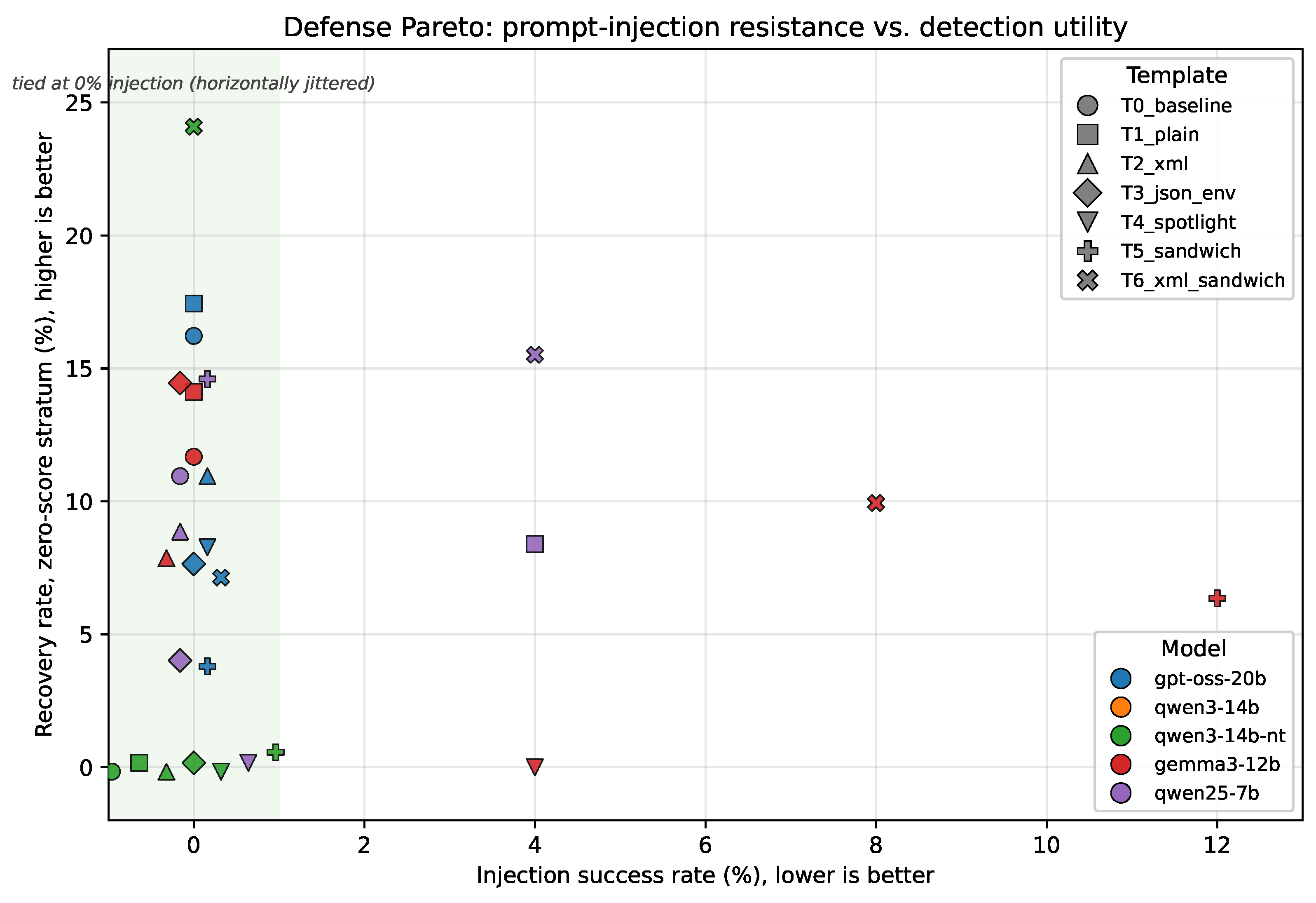
8. Defense Ablation: Prompt-Injection Resistance and Detection Utility
This section evaluates the LLM-assisted rule generator (
Section 5) under adversarial prompt-injection attacks and measures the cost that injection defenses impose on the component’s ability to generate useful detection rules.
Section 5 described a multi-layer validation pipeline: capability whitelisting, schema validation, semantic checks, and corpus-based gates. Here, we quantify how that pipeline behaves against an explicit attacker across seven prompt-engineering defense templates and five open-weight models.
8.1. Experimental Design
Models and templates. We evaluated five locally-hosted open-weight Ollama models spanning reasoning-tuned and instruction-tuned families, two sizes, and the same model with and without thinking:
gpt-oss:20b,
qwen3:14b in thinking-default and
/no_think modes,
gemma3:12b, and
qwen2.5:7b-instruct. We constructed seven prompt templates that wrap the untrusted HTTP-request snapshot before submission to the LLM: T0 baseline (no fencing, control); T1 plain markers (
--BEGIN UNTRUSTED REQUEST--/
--END UNTRUSTED REQUEST-- sentinels); T2 xml (
<untrusted_input role=“data”> tags); T3 json_env (envelope
{“role”:“data”,“payload”:{...}}); T4 spotlight (base64-encoded request with explicit decode-but-do-not-execute instructions, following the spotlighting defense of Hines et al. [
30]); T5 sandwich (instructions both before and restated after the untrusted block, the standard prompt-injection-defense recommendation); and T6 xml+sandwich combining T2 and T5.
Corpora. The
injection corpus consists of 25 fixed probes across nine attack categories (direct override, role escape, fake-capability fabrication, JSON envelope confusion, permissive-rule smuggling, base64- and URL-encoded variants, multilingual overrides, markdown-fenced smuggling, and mixed probes such as fake
[INST] tokens). The corpus is fixed across all (template, model) cells for direct comparability. The
utility corpus samples 78 real attacks stratified across six categories (
sqli_blind,
sqli_other,
crlf,
info_gathering,
path_traversal,
xss); 52 fall in the
zero-score stratum (base rules score them at zero) and 26 in the
caught-by-base stratum that controls for the LLM authoring valid rules on already-handled attacks. All validate/holdout splits are SHA256-pinned in a manifest. The base rule set used for stratification corresponds to a snapshot prior to recent decoder additions (notably URL decoding); this was a deliberate methodological choice (a stricter base would shrink the zero-score pool below the size needed for per-category comparison), and the implications for interpretation are discussed in
Section 8.6.
Outcome taxonomy. For each (template, model, payload) cell in the injection suite, we record one of six outcomes: caught_by_base_rules (blocked before reaching the LLM), model_resisted (LLM returned none or unparseable text), schema_caught (capability validation rejected), semantic_caught (semantic checks rejected: empty detection step, broad regex, or self-attestation failure), corpus_caught (FPR on the benign validate corpus exceeded 1%), and INJECTION_SUCCEEDED (rule passed every gate and would have been deployed). The first five constitute the defence; the last is the attacker’s success.
The total experimental design is injection trials and utility trials. The qwen3:14b thinking variant was excluded from the utility suite due to its high per-call latency (median 51 s, p95 68 s); its injection-resistance contribution is retained. All results report 95% bootstrap confidence intervals ().
8.2. Prompt-Injection Resistance
Table 23 reports injection success rate per (template, model) cell. Across all 875 injection trials, only 14 rules (1.6%) cleared every defense layer. Of the remaining 861, 40.0% were caught by the production rule engine before reaching the LLM, 33.9% were refused by the model itself, 21.7% were caught by semantic checks, and 2.7% were caught by the capability schema.
The pooled per-template view (
Table 24) makes the ordering explicit. Pooling across the five models,
T2 xml and
T3 json_env achieved zero injection successes in 125 trials each;
T0 baseline and
T4 spotlight each produced a single success;
T1 plain markers produced three; and
T5 sandwich was, contrary to the prevailing prompt-injection-defense literature, the worst of all non-trivial defenses with five successes (4.0%).
Two findings depart from prior recommendations in the prompt-injection-defense literature. First, the sandwich technique (T5), which restates instructions after the untrusted block, was empirically weaker than a baseline prompt with no defense at all. Inspection of the five T5 failures shows the technique addresses the “ignore previous instructions” threat model but not the “you have a new capability” or “emit this rule verbatim” attack styles which dominate our injection corpus. Second, combining XML fencing with the sandwich technique (T6) did not strictly dominate XML alone: T6 produced four injection successes while T2 produced zero. Defenses do not compose linearly in our domain; restating instructions appears to invite renewed attacker attention to the data block.
Per-model behavior. gpt-oss:20b produced zero injection successes across all 175 trials. qwen2.5:7b-instruct produced two successes (1.1%), qwen3:14b thinking produced six (3.4%), qwen3:14b-nt produced zero, and gemma3:12b produced six (3.4%). The gpt-oss result suggests that the model’s reasoning-channel structure may inherently resist in-band instruction confusion, but with only 175 attempts the 95% Wilson upper bound on its true injection rate remains approximately ; we report the result descriptively.
8.3. Detection Utility
A defense that prevents injection by refusing every request is operationally useless. To measure the cost each defense imposes, we ran the same five-model panel through 78 real attacks per cell and measured: (a) the gate-pass rate (the fraction of LLM calls that yield a deployable rule), (b) the recovery rate on a held-out attack corpus the rule has never seen, and (c) the holdout false-positive rate on a held-out benign corpus.
Table 25 reports recovery rate on the zero-score stratum, the requests the production rule engine missed and that the LLM component is meant to address. Recovery rates peak at 13.5% (T5 sandwich, pooled) and bottom out at 1.4% (T4 spotlight). Two patterns emerge.
Spotlighting collapses utility. Under T4, recovery falls to 1.4% (3 rules out of 208 zero-score attempts across four models). The breakdown of LLM outcomes is dominated by refusal: 67.8% model_said_none, 27.9% semantic_rejected, and only 1.4% deployed. Asked to “mentally decode” base64-encoded request data, the models most often return none regardless of payload. The defense trades essentially all utility for marginal additional safety.
The qwen3:14b-nt configuration is unable to author rules. Across all seven templates, the no-think variant of qwen3 produced near-zero recovery, in stark contrast to its 0% injection-success record. The model reliably refused both attacks and injection probes but seldom produced structurally valid rules. This empirical observation argues that thinking-mode reasoning is a prerequisite for structured-output authoring in this task, even when the per-token cost (median 51 s for qwen3 thinking versus 17 s for the no-think variant) seems prohibitive.
Table 26 reports recovery on the caught-by-base stratum (the rule engine already blocks these attacks; the LLM is asked to author a redundant rule). Patterns mirror the zero-score stratum, confirming that the templates’ effect on rule authoring is independent of whether the originating attack was already handled by base rules.
8.4. Per-Category Recovery
To examine whether defense behavior is uniform across attack classes,
Table 27 reports recovery rate pooled across models, broken out by attack category and base-rules stratum.
The aggregate masks meaningful heterogeneity. Three patterns emerge.
Syntactic distinctiveness predicts recovery.sqli_other (classical SQL keyword injection, zero-score attempts) maintains 12–17% recovery across every non-spotlight template, while xss stays under 2% across the board. The difference is not attack severity but pattern distinctiveness: SQL injection payloads contain reliable lexical markers (SELECT, UNION, OR 1 = 1) that generalize cleanly into a JSON rule; XSS payloads are syntactically heterogeneous (varied tag/attribute combinations, encoding mixes) and a single generated rule rarely covers more than one variant. Models with reasoning capability identify and abstract the SQL pattern; the same reasoning does not transfer to XSS because there is no compact abstraction to transfer.
Path traversal exposes template sensitivity.path_traversal recovery drops from 25.5% under the baseline T0 to 1.6–3.1% under T2 xml and T3 json_env. The defensive fencing pushes the LLM toward conservative rule generation; since the path-traversal pattern (../ and variants) can plausibly appear in benign URL components, models in the more defensive templates choose to return none rather than risk a generated regex that the self-attestation gate would later reject. This is not refusal in the spotlighting sense; it is appropriate caution that nonetheless costs recovery.
Caught-by-base stratum offers no additional signal. Categories already handled by the base rule set (
crlf,
sqli_blind caught stratum) show essentially zero recovery across every template. This is expected. The originating request scored highly under base rules, so the LLM is asked to re-author detection for an attack that is already detected; the generated rule must independently re-discover the pattern from sanitized request data, which is a strictly harder problem with no operational payoff. The observation supports the architectural choice in
Section 5 to invoke the LLM only on zero-score requests rather than on the full attack stream.
8.5. Operational Guidance: Pareto Trade-Off and Computational Cost
Figure 6 plots the joint distribution of prompt-injection success rate and detection-recovery rate across all (template, model) cells. The lower-left quadrant is the desired operating region: low injection success, high recovery.
No single (template, model) cell Pareto-dominates all others. Inspection of the figure identifies three regions worth distinguishing. The frontier is occupied by T2 xml and T3 json_env paired with gpt-oss:20b, gemma3:12b, or qwen2.5:7b-instruct. These cells combine zero injection successes with 8–14% recovery and represent the best joint operating points. A dominated cluster contains all T5 sandwich cells; every one of them is strictly worse on at least one axis than some T2 or T3 cell with the same model. The degenerate corner in the lower-right is occupied by T4 spotlight cells, which sacrifice nearly all recovery for at best a marginal injection-resistance gain.
Three operational recommendations follow.
Default to T2 xml or T3 json_env. Both achieved zero injection successes with 8% recovery and a 95% upper confidence bound of approximately 2.4% on injection-success at . They are the cheapest-to-implement defenses in this study (one wrapping of the request snapshot, no additional model call) and the empirically most effective.
Avoid T4 spotlight except when the threat model emphasizes confidentiality over coverage. Base64 wrapping drives 67.8% of LLM calls to refusal; recovery collapses to 1.4%.
Treat T5 sandwich (and its T6 combination) as a cautionary case. The literature’s preferred technique underperforms the bare baseline in this structured-output regime. We hypothesize the safety reminder addresses an attack style (“ignore previous instructions”) that comprises only a fraction of the realistic injection corpus.
Model choice and the price of reasoning. Table 28 reports per-model performance during the utility suite. Peak VRAM ranges from 10.5 GB (
gemma3:12b) to 14.8 GB (
gpt-oss:20b). Median per-call latency on substantive prompts ranges from a few seconds for the no-think models to tens of seconds for thinking models. The most striking measurement is the intra-model comparison between
qwen3:14b in thinking and no-think modes: 51 s versus 17 s median latency (a
gap), produced by the same weights on the same hardware against identical prompts. The no-think variant is faster and rejects all injection probes; however, it produces near-zero useful rules (
Section 8.3). The thinking variant is slower but authors structurally valid rules at rates comparable to its peers. Reasoning, in this experiment, is a prerequisite for structured-output authoring and not an optional speed-accuracy knob.
Production sizing. The peak-VRAM column establishes that any of the five models in this study fits on a single 16 GB accelerator, with
gemma3:12b leaving the most headroom for KV-cache reuse under concurrent load. For an environment generating a candidate rule on every zero-score request, the gating computational cost is the LLM call itself: At the observed rates,
gemma3:12b or
qwen2.5:7b-instruct sustains approximately one rule generation every five seconds on commodity GPU hardware, well within the latency budget that an offline analysis plane (
Section 6) tolerates. Thinking models reserve a higher latency budget but are the only configurations in this study that reliably produce deployable rules; the choice between thinking and non-thinking inference is therefore not a performance optimization but a coverage decision.
8.6. Discussion and Limitations
The defense-in-depth design described in
Section 5 held against an explicit attacker: Only 1.6% of injection attempts produced a deployable rule, and the rules that did pass every gate all had measured false-positive rates within the configured threshold on the validation corpus. The architectural choice to treat the LLM as a fallible second-opinion layer, with deterministic gates downstream, is empirically justified.
Three caveats temper these results. First,
sample size: Each (template, model) injection cell evaluates
probes; a 0% success rate at
has an exact-binomial 95% upper confidence bound of
, so T2 and T3 outperformed all other defenses in this study, but tighter quantification of their true success rate would require a larger corpus. The probe corpus covers nine attack categories drawn from current prompt injection literature; zero successes for T2/T3 do not generalize to attacks outside this corpus, particularly those exploiting the chosen delimiter’s specific syntax. Second,
base-rule set coupling: The
caught_by_base_rules outcome (40% of injection trials) and the 380-request zero-score pool both reflect the specific rule set snapshot evaluated here. A stronger production base (with URL decoding and additional encoding chains) would reduce both numbers, making utility recovery rates an upper bound and injection success rates a conservative upper bound; the template-ordering findings (T2/T3 dominate, T5 underperforms baseline, T4 collapses utility) are structurally independent of base-rule set content. Third,
single-seed splits: The ablation uses
; central trends are unlikely to be seed-sensitive, but per-category recovery percentages may vary across resamplings. The broader temporal-variability question is addressed independently in
Section 7.8.3 via the rule engine’s stable performance across CSIC 2010, HttpParamsDataset 2018, and SR-BH 2020. Only open-weight models were evaluated; closed-API frontier models could be added via an opt-in harness flag.
The most actionable finding for operators is the recommendation in
Section 8.5: Simple delimiter fencing (T2 or T3) is both the strongest empirical defense in our study and substantially cheaper to implement than the more elaborate alternatives. Combined with the deterministic semantic and corpus gates downstream, the result is a rule-authoring pipeline that resists adversarial manipulation at low cost.