Article

Unraveling the Biotechnological Potential of Red Seaweed (Rhodophyta, Florideophyceae) in Culture


1
MARE-Marine and Environmental Sciences Centre/ARNET-Aquatic Research Network, ESTM, Polytechnic University of Leiria, Edifício Cetemares, Av. Porto de Pesca, 2520-641 Peniche, Portugal
2
MARE-Marine and Environmental Sciences Centre/ARNET-Aquatic Research Network, Department of Life Sciences, University of Coimbra, Calçada Martim de Freitas, 3000-456 Coimbra, Portugal
3
CFE-Centre for Functional Ecology: Science for People & Planet, Marine Resources, Conservation and Technology-Marine Algae Lab, Department of Life Sciences, University of Coimbra, Calçada Martim de Freitas, 3000-456 Coimbra, Portugal
*
Author to whom correspondence should be addressed.
Appl. Sci. 2026, 16(10), 5141; https://doi.org/10.3390/app16105141
Submission received: 29 April 2026 / Revised: 15 May 2026 / Accepted: 17 May 2026 / Published: 21 May 2026
(This article belongs to the Special Issue Recent Technologies and Applications of Algal Biomass)

Abstract

The global demand for sustainable protein sources has led to increased interest in macroalgae, particularly red seaweed, due to their rich nutritional content and bioactive compounds, which translates into a wide range of biotechnological applications. This study compares the biochemical profiles, specifically pigments and proteins, as well as antioxidant activity, of four red seaweed species, namely Nitophyllum punctatum, Chondria coerulescens, Plocamium cartilagineum and Sphaerococcus coronopifolius. The aim was to compare wild and cultivated biomasses to identify optimal cultivation strategies for maximizing their value. The results show that culture conditions have a significant impact on pigment and protein content, as well as antioxidant potential, for all species. While all cultured species showed increased protein content, specific responses in pigment production and antioxidant activity were clearly species-dependent. These results highlight the specific culture conditions required to produce pigments or antioxidant activities on a species-by-species basis. As these four red seaweed species remain relatively underexplored, further targeted research is required to refine cultivation methods and enhance our understanding of their biotechnological value.

1. Introduction

The rise in the world population, projected to be a 50% increase between 2000 and 2050, has intensified the need for alternative and sustainable sources of protein. Traditional animal-based protein sources are widely regarded as unsustainable due to their high environmental costs, specifically in terms of land and water use, carbon footprint, and greenhouse gas emissions associated with livestock production. Nowadays, existing protein sources are mostly supplied by plants (57%), followed by meat, dairy, fish and shellfish and other animal sources [1]. Additionally, alternative protein sources, including algae and insects, have been extensively explored as potential substitutes for livestock proteins [2].
Among these alternative sources of protein, seaweed has emerged as promising candidates, offering not only high protein content but also a wide array of essential elements, nutrients, and vitamins capable of supporting a balanced and healthy diet [3,4]. Asian cultures have long recognized the dietary and therapeutic potential of seaweed. However, it is only in recent decades that this knowledge has gained widespread recognition, especially in the context of growing concerns over environmental sustainability and human health. As a result, seaweed now hold significant economic value across various biotechnological sectors, including food, pharmaceutical, and biofuel industries [3,5,6,7,8]. Advances in algal technology continue to yield diverse natural products derived from seaweed [3,9,10,11].
Red algae (Rhodophyta) represent the most taxonomically diverse group of macroalgae. Of the approximately 10,000 seaweed species identified worldwide, around 7600 are classified as red algae [12]. Commonly consumed species include Irish moss (Chondrus crispus), laver (Porphyra/Pyropia spp.), and dulse (Palmaria palmata) [13]. Red macroalgae have been utilized since ancient times for both culinary and medicinal purposes [14]. Their biochemical richness and nutritional profile continue to drive scientific interest in uncovering new bioactive compounds with sustainable and cost-effective applications [15,16,17].
Red seaweed is recognized as having the highest crude protein content among macroalgae, reaching levels of up to 47% dry weight [18]. They also contain substantial amounts of carbohydrates and relatively low lipid content, primarily composed of health-beneficial polyunsaturated fatty acids [19]. Their cell walls are rich in commercially valuable polysaccharides, such as agar and carrageenan, which serve as gelling and thickening agents widely used in the food industry [20,21], as well as in pharmaceuticals, cosmetics, and medical applications due to their therapeutic properties [20,21,22,23]. Additionally, red algal extracts are used in agriculture as soil conditioners and plant growth regulators [21].
The characteristic red hue of Rhodophyta results from the accessory pigments phycoerythrin and phycocyanin, complemented by chlorophyll a and carotenoids such as β-carotene, lutein, and zeaxanthin. These pigments possess a broad range of applications across biomedical, pharmaceutical, food, cosmetic, and textile industries due to their antioxidant, anti-inflammatory, and coloring properties [24]. Red macroalgae are also abundant in secondary metabolites such as flavonoids, phenols, and halogenated compounds, which contribute to their reported antioxidant, anti-inflammatory, antimicrobial, antiviral, and antitumor properties [13,25,26,27,28].
Given their extensive utility, high-value red seaweed species are at risk of overexploitation. Seaweed plays a crucial ecological role, providing nursery habitats, food, and shelter in marine ecosystems [29]. Therefore, the development of sustainable seaweed aquaculture offers a viable solution to reduce pressure on wild populations, particularly for fast-growing species that can be successfully cultivated under controlled conditions. This aligns with the growing interest in marine-based, multi-functional natural products within the aquaculture sector [3]. Despite their immense potential, only 27 out of the 221 known commercially used seaweed species are currently cultivated [3,30], leaving a vast number of untapped species to be explored.
In the present study, the biochemical profiles of four red seaweed species, namely Chondria coerulescens, Nitophyllum punctatum, Plocamium cartilagineum and Sphaerococcus coronopifolius, were analyzed in both wild and laboratory-grown conditions. Specifically, we evaluated pigment composition (including the phycobiliproteins phycoerythrin and phycocyanin, carotenoids, and chlorophyll a), total protein content, and antioxidant activity. This allowed for the assessment of how different culture conditions influence the biochemical characteristics of each species and whether cultivation offers advantages over wild harvesting. We aimed to identify the optimal conditions for maximizing pigment and protein production or enhancing antioxidant activity in each species. Ultimately, this research seeks to support the development of sustainable and productive seaweed aquaculture practices, contributing to the broader goal of supplying novel, nutrient-rich, and eco-friendly protein alternatives to meet global demand.

2. Materials and Methods

2.1. Biomass Culturing

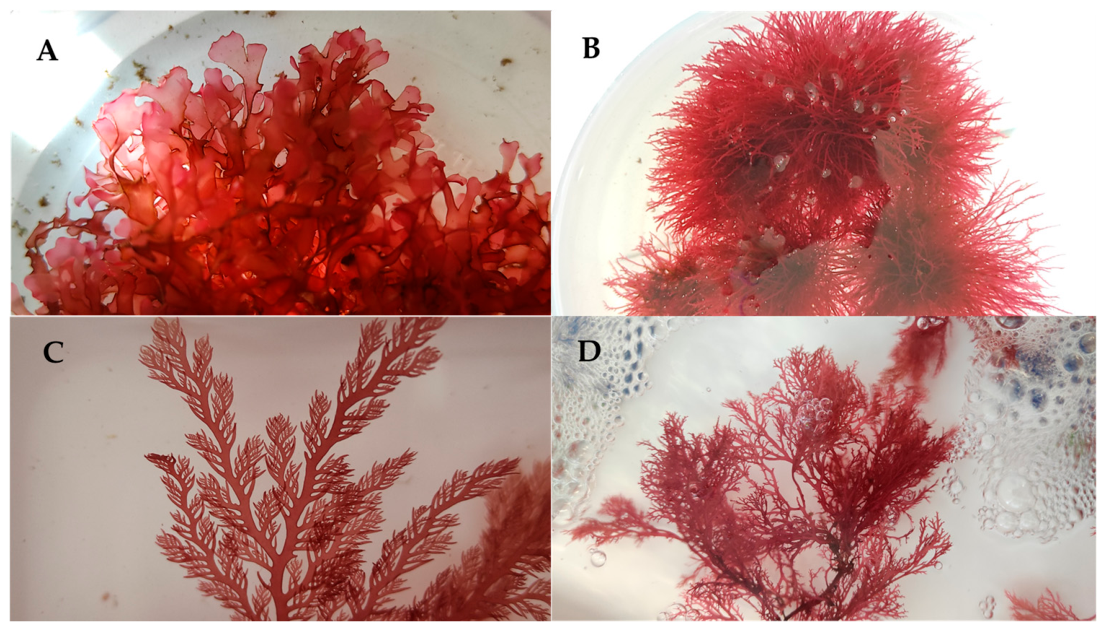
The present work assessed four red seaweed species: Nitophyllum punctatum, Chondria coerulescens, Plocamium cartilagineum and Sphaerococcus coronopifolius (Figure 1). All specimens were identified in situ on the coastal shores of Peniche in central Portugal, based on morphological traits. They were collected during low tide and transported to the laboratory in dark, cool containers. Table S1 shows the harvested data related to this study, which is available in the Supplementary Material.
In the laboratory, all specimens were thoroughly rinsed with running filtered seawater, and carefully inspected and cleaned to remove unhealthy parts, contaminants and debris, to prepare the seaweed for cultivation. The cultivation process consisted of three distinct phases: (1) a 7-day acclimatization period, (2) a 14-day experimental assay, and (3) a final scale-up phase for biomass production.
Thus, all the biomass was distributed in trays to go through the acclimatization period of seven days, under specific controlled conditions, namely: exposure to white LED light (20 ± 1 µmol·m−2·s−1, Input Kilight 18 W 1900 lm G13 AC175–265V 300º 6000 K 032109 RoHS), photoperiod of 12:12 (light:dark), continuously aerated seawater (35 ± 0.5 psu), and a room temperature of 20 ± 0.5 °C. During this period, no culture media were given to the seaweed.
Afterwards, several assays were performed, outlined in Table 1 and Table 2. Assays were performed in flat-bottom flasks following a stock density of 1 g·L−1 (250 mL at the first week, scaled-up to 500 mL at the second week), with the photoperiod set at 12:12 (light:dark), following the conditions described above. For the light source assay, LEDred and LEDblue (AquaBar T-Series Single 1200mm COLOURPLUS, Tropical Marine Centre, Chorleywood, Hertfordshire, UK) were tested alongside LEDwhite. Temperature assays were performed in a separate climate chamber (Fitoclima S600PLH with OSRAM 18W/21-840, Aralab, Sintra, Portugal) fluorescent white bulbs).
Each assay lasted for two weeks, with glassware and corresponding culture media renewed every week. The default culture media used was the Von Stosch Enriched formula, modified for red seaweed use and with nitrate as the main nutrient (VSE-O) [31], unless specified otherwise. The other culture media tested were the Von Stosch Enriched formula, modified for red seaweed use and supplemented with ammonia as the main nutrient (VSE-M) [31]; Provasoli Enriched Seawater (PES), also modified for red seaweed use [32]; and the commercial nutrient solution NutriBloom-PhytoBloom® (NB) [33]. All solutions were applied at a concentration of 1 mL·L−1.
Table 1. Assay ID performed upon Nitophyllum punctatum, Chondria coerulescens, Plocamium cartilagineum and Sphaerococcus coronopifolius. VSE-O: Von Stosch Enriched culture media, modified for red seaweed use, using nitrogen in the form of nitrate; VSE-M: Von Stosch Enriched culture media, modified for red seaweed use, using nitrogen in the form of ammonia; PES: Provasoli Enriched culture media; NB: NutriBloom® culture media [33]; LEDwhite: white LED lights; LEDred: red LED lights; and LEDblue: blue LED lights.
Assay IDParameters
Light Intensity20 µmol·m−2·s−140 µmol·m−2·s−1
Culture MediaVSE-OVSE-MPESNB
LED Light SpectraLEDwhiteLEDredLEDblue
Temperature16 °C20 °C24 °C
Table 2. Details of the assays performed upon Nitophyllum punctatum (NP), Chondria coerulescens (CC), Plocamium cartilagineum (PC) and Sphaerococcus coronopifolius (SC). VSE-O: Von Stosch Enriched culture media, modified for red seaweed use, using nitrogen in the form of nitrate; VSE-M: Von Stosch Enriched culture media, modified for red seaweed use, using nitrogen in the form of ammonia; PES: Provasoli Enriched culture media; NB: NutriBloom® culture media [33]; LEDwhite: white LED lights; LEDred: red LED lights; and LEDblue: blue LED lights.
IDSpecificsSpecies Tested
VSEW20VSE-O + LEDwhite + 20 µmol·m−2·s−1NP + CC + PC + SC
VSEW40VSE-O + LEDwhite + 40 µmol·m−2·s−1NP + CC + PC + SC
VSERedVSE-O + LEDred + 40 µmol·m−2·s−1NP + CC + PC + SC
VSEBlueVSE-O + LEDblue + 40 µmol·m−2·s−1NP + CC + PC + SC
NBW20NB + LEDwhite + 20 µmol·m−2·s−1NP + CC + PC + SC
NBW40NB + LEDwhite + 40 µmol·m−2·s−1NP + CC + SC
NBRedNB + LEDred + 40 µmol·m−2·s−1NP + CC
NBBlueNB + LEDblue + 40 µmol·m−2·s−1NP + CC
PESW40PES + LEDwhite + 40 µmol·m−2·s−1NP + CC + PC + SC
VSEMW20VSE-M + LEDwhite + 40 µmol·m−2·s−1SC
16CVSE-O + 16 °C + 40 µmol·m−2·s−1NP + CC + PC + SC
20CVSE-O + 20 °C + 40 µmol·m−2·s−1NP + CC + PC + SC
24CVSE-O + 24 °C + 40 µmol·m−2·s−1NP + CC + PC + SC
WildWild BiomassNon-Applicable
Preliminary tests ruled out the possibility of performing assays with VSE-M for all species, except S. coronopifolius, which was the only seaweed that appeared visually healthy when grown in this culture medium. Successful assays, evaluated by visually assessing the health of the biomass and weight, were scaled up in order to get sufficient biomass for the biochemical analysis described below. Up to that point, all collected biomass was stored at −20 °C until further utilization.
For pigment content, biomass was used frozen, while for all other assays, biomass was previously dried at 25 °C for 48 h (FD115, Binder, Tuttlingen, Germany), reduced into a fine powder with a blender, and sieved through a 200 µm sieve. Pigment content determination was performed upon all scaled-up assays regarding the four seaweed species (N. punctatum, C. coerulescens, P. cartilagineum and S. coronopifolius) while protein determination and antioxidant analysis was performed upon the successfully scaled-up assays regarding the seaweeds N. punctatum and C. coerulescens.

2.2. Pigment Content Determination

Phycobiliprotein (PBP) extraction was performed based on an adaptation from Dumay et al. [34] and Beattie et al. [35]. Frozen algal samples were mixed with sodium phosphate buffer at a biomass-to-volume ratio of 1:20, and ground with a mortar and pestle for at least 10 min or until fully macerated. Subsequently, the homogenized mixture was stirred continuously for 30 min while protected from light and kept on ice to maintain a low temperature. The samples were then centrifuged at 12,500× g for 20 min at 4 °C (5810R, Eppendorf, Hamburg, Germany). The resulting supernatant was collected, while the pellet was resuspended with 90% acetone to extract chlorophyll a and carotenoids. Similarly to the PBP extraction, the acetone homogenize was stirred continuously for 30 min while protected from light and kept on ice. The solution was then centrifuged at 8000× g for 20 min at room temperature, the supernatant was collected afterwards and the pellet was discarded.
Whenever needed, both PBP and chlorophyll a/carotenoid supernatants were filtered using a 1.2 µm filter to remove residual debris. The absorbance of both extracts was scanned across a wavelength range of 300–800 nm using a UV-visible spectrophotometer (Evolution 201, Thermo Fisher Scientific, Waltham, (MA), USA) to acquire the absorption curve and relevant absorbance values for calculating PBP (R-PE and R-PC) [35,36], total carotenoid [37] and chlorophyll a [38].

2.3. Protein Assessment

Soluble protein was assessed based on the Bradford method [39], after performing a sample hydrolysis and precipitation following an adaptation of the Barbarino and Lourenço [40] method, described below.

2.3.1. Biomass Hydrolysis and Precipitation

Biomass hydrolysis and precipitation were performed to obtain the crude protein fraction from the algal biomass. Therefore, 50 mg of finely ground, sieved 0.2 mm dry biomass were incubated in 4 mL ultra-pure water for 12 h at 4 °C. After vortexing for 1 min, the sample was centrifuged (12,000× g, 20 min, 4 °C), and the supernatant was collected and stored at 4 °C. One mL NaOH (0.1 N) was added to the pellet, and the resulting solution was incubated at room temperature, with brief vortexing every 10 min. The solution was then centrifuged (12,000× g, 20 min, at room temperature), and the resulting supernatant was collected and combined with the previously collected supernatant, whereas the pellet was discarded.
To precipitate the protein, 25% cold trichloroacetic acid (TCA) was added to the collected extract (2.5:1 v/v TCA:extract), and the mixture was kept in an ice bath for 30 min. The solution was then centrifuged (12,000× g, 20 min, 4 °C), and the supernatant discarded. The pellet was rinsed with 10% cold TCA, then centrifuged again (12,000× g, 2 min, 4 °C), and after discarding the supernatant, 5% TCA was added to the pellet (ratio 5:1). After performing a final centrifugation step (15,000× g, 20 min, 20 °C) and discarding the supernatant, the obtained pellet was used to assess protein content using the Bradford method. The pellets were either resuspended in 0.5 mL of NaOH (1.0 N) prior to protein quantification or stored at −20 °C until further use.

2.3.2. Protein Quantification

Protein content was determined using the Bradford method [39] on the previously mentioned resuspended extracts. Briefly, the principle of the method is based on the ability of the Coomassie Brilliant Blue G-250 (Bradford Reagent) to change color from red to blue when it binds to the soluble proteins. This reaction is monitored by reading the resulting absorption maximum at 595 nm [39]. As a microscale method was adopted for this assessment, 20 µL of sample and 200 µL of Bradford reagent were mixed in a 96-well plate and left sitting for 2 min. The absorbance was then read at 595 nm (BioTek Epoch 2, Agilent, Santa Clara, (CA), USA). Bovine serum albumin (BSA, 0.5 mg·mL−1) was used to prepare the calibration curve, to be used as a reference to determine the concentration of protein in the sample, expressed in mg·ml−1 (BSA equivalents).

2.4. Antioxidant Assays

2.4.1. Aqueous Extractions

Aqueous extractions were carried out using a dry biomass-to-solvent ratio of 1:10 (g·mL−1) and an extraction duration of 1 h. In brief, 3 g of powdered dry biomass was combined with 30 mL of ultra-pure water and stirred at room temperature (RT) in the dark for 1 h. The mixture was then centrifuged at 8000× g for 10 min at RT, and the supernatant was collected. The remaining pellet underwent a second extraction with 10 mL of ultra-pure water. After centrifuging the second extraction, the supernatants from both extractions were combined, filtered through a GF/C filter (Cytiva (Whatman), Wilmington (DE), USA) to remove any remaining residue, freeze-dried, and stored at −20 °C. Before being used in the assays, the dried extracts were resuspended in ultra-pure water to a concentration of 100 mg·mL−1.

2.4.2. ABTS Radical Scavenging Activity Assay

The 2,20-azino-bis (3-ethylbenzothiazoline-6-sulfonic acid) (ABTS) radical scavenging activity was assessed using the method outlined by Meng et al. [41], with some modifications. In brief, an ABTS stock solution was prepared by mixing equal volumes of 7 mM ABTS and 2.45 mM potassium persulfate solutions, which had been dissolved in ultra-pure water beforehand. The mixture was then left to stand at room temperature for 12–16 h. Following this, the stock solution was diluted with ultra-pure water to achieve an absorbance of 0.72 ± 0.02 at 734 nm, and this dilution was used as the ABTS working solution.
Aqueous extracts were prepared at concentrations of 20, 40, 60 and 80 mg·mL−1. The assay was performed on a micro-scale in a 96-well plate, with 2 µL of the aqueous extract (at concentrations of 20, 40, 60, 80, or 100 mg·mL−1) and 198 µL of the ABTS working solution in each well. Blank reactions included 2 µL of ultra-pure water instead of the extract, and a positive control was setup using 10 mg·mL−1 ascorbic acid. The plate was incubated in the dark for 6 min at room temperature, after which absorbance was measured at 734 nm (Biotek, Epoch2). The ABTS radical scavenging activity was calculated according to Equation (1):
A B T S   R a d i c a l   S c a v e n g i n g   A c t i v i t y   ( % ) = A b s C A b s S A b s B A b s C × 100 ,
(1) ABTS Radical Scavenging Activity (%), where AbsC represents the absorbance of the control (ultra-pure water and ABTS) at 734 nm, AbsS denotes the absorbance of the sample (extract and ABTS) at 734 nm, and AbsB refers to the absorbance of the blank (sample and ultra-pure water) at 734 nm. The Half-Maximal Effective Concentration (EC50), which is defined as “the concentration of a substance that produces half of its maximum response” [42], was thus determined (in mg extract·mL−1, expressed as mg·mL−1) following the principle that the lower the EC50 value, the greater the antioxidant activity of the corresponding extract.

2.4.3. Total Phenolic Compound Assay (TPC)

The Total Phenolic Content (TPC) assay was conducted using a modified version of the Folin–Ciocalteu method established by Singleton and Rossi [43]. The procedure was adapted to a microplate format and carried out in a 96-well plate, where each well contained 2 µL of the aqueous extract, 158 µL of ultra-pure water, 10 µL of Folin–Ciocalteu reagent, and 30 µL of 1.89 M sodium carbonate (Na2CO3) solution. Blank reactions were prepared by substituting the extract with 2 µL of ultra-pure water. The plate was incubated in the dark for 1 h at room temperature, and absorbance was measured at 755 nm (Biotek, Epoch2). Gallic acid was used as the standard for constructing the calibration curve, and the results were expressed as milligrams of gallic acid equivalent per g of extract (mg GAE·g−1).

2.5. Statistical Treatment

Experimental assays were conducted in four replicates (n = 4). The EC50 value for the ABTS assay was determined using GraphPad Prism version 9.0.0. Statistical analyses were carried out using one-way ANOVA for all treatments after confirming normality and homogeneity of variances. When these assumptions were not met, the Kruskal–Wallis test, a nonparametric alternative, was employed. Statistical significance was set at a p-value < 0.05. Data are presented as mean ± standard deviation, except for the EC50 of the ABTS assay, which is reported as the mean along with 95% confidence intervals. All statistical evaluations were performed using SPSS Statistics 29 (IBM Corporation, New York, NY, USA).

3. Results

3.1. Pigment Content Determination

3.1.1. Phycoerythrin

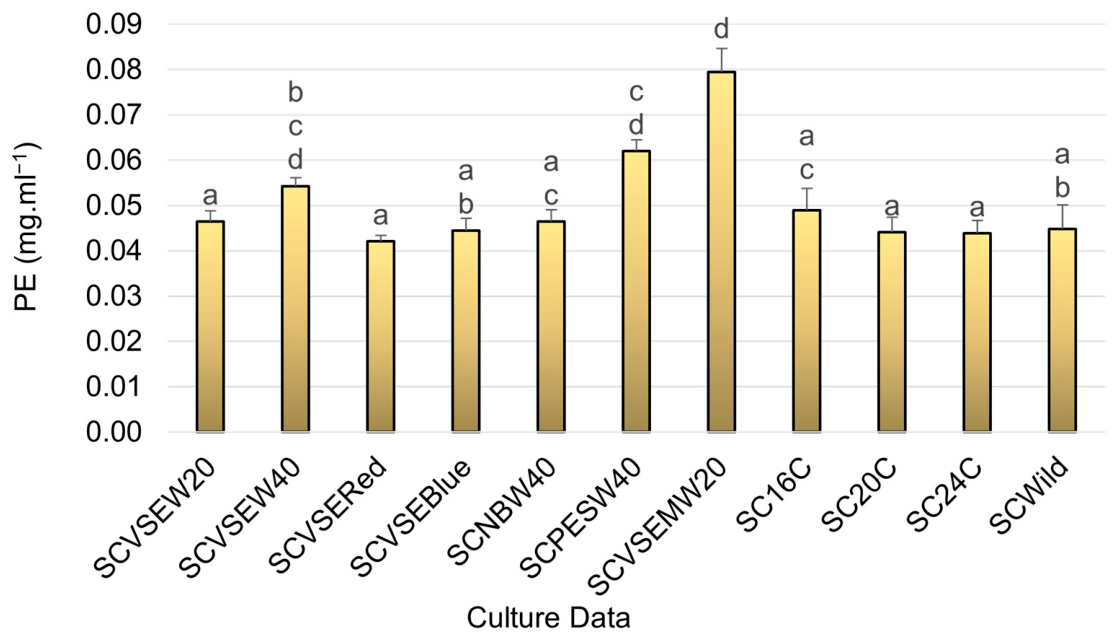
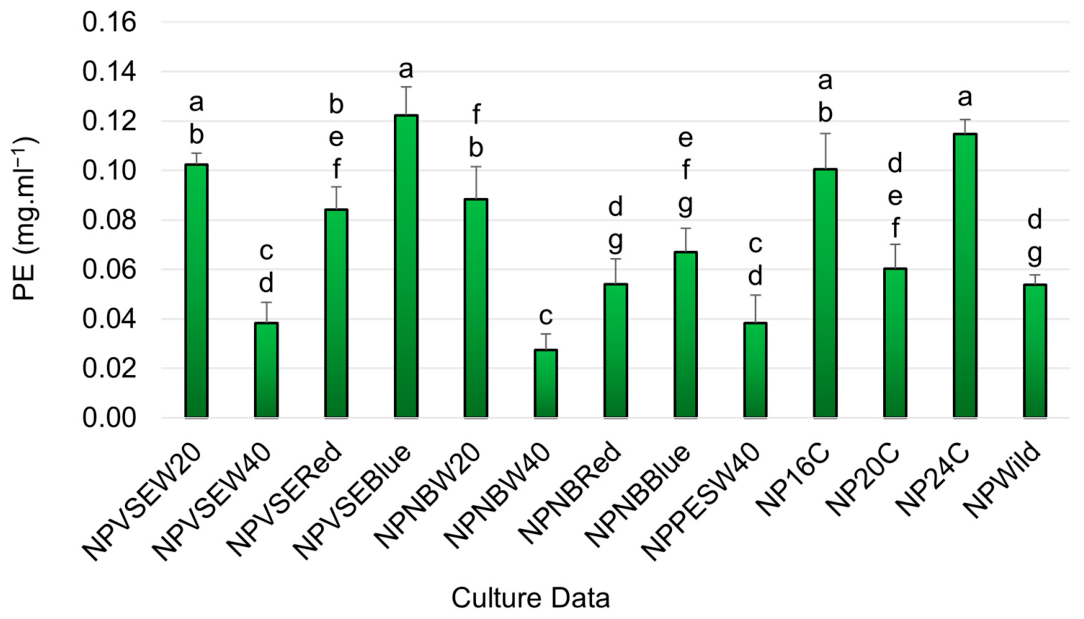
Phycoerythrin (PE) content in cultured algal samples is expressed in Figure 2 (Nitophyllum punctatum), Figure 3 (Chondria coerulescens), Figure 4 (Plocamium cartilagineum) and Figure 5 (Sphaerococcus coronopifolius). For N. punctatum (Figure 2), values ranged from 0.027 ± 0.007 to 0.122 ± 0.011 mg·mL−1 corresponding, respectively, to biomass supplied with NB under white LED light at 40 µmol·m−2·s−1 (NPNBW40), and to biomass supplied with VSE growing under blue LED light (NPVSEBlue). With the exception of biomass cultivated under white LED light at 40 µmol·m−2·s−1, regardless of the nutrient source considered, all other treatments yielded similar or higher PE values than that obtained from wild N. punctatum biomass (0.054 ± 0.004 mg·ml−1). Other results worth pointing out are the significant higher PE values in cultured biomass at 24 °C (NP24C), when compared to those grown under 16 (NP16C) and 20 °C (NP20C). Biomass cultured under colored LED lighting (red and blue) also yielded higher PE content than when cultivated under white LED light at the same intensity (W40), regardless of the culture media considered. Significant differences were found between most treatments according to the Tukey HSD test [F(12,49) = 41.324; p = 0.000].
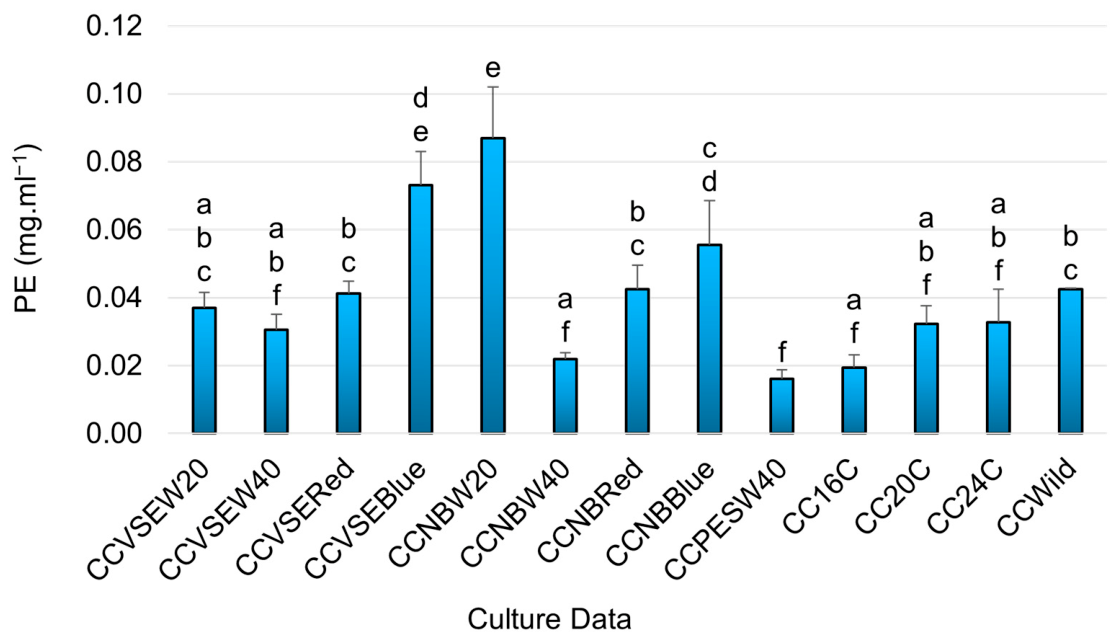
For C. coerulescens (Figure 3), values ranged from 0.016 ± 0.003 to 0.087 ± 0.015 mg·mL−1 corresponding, respectively, to biomass supplied with PES under white LED light at 40 µmol·m−2·s−1 (CCPESW40), and to biomass supplied with NB growing under white LED light at 20 µmol·m−2·s−1 (CCNBW20). With the exception of biomass cultivated under white LED light intensity at 40 µmol·m−2·s−1 (CCNBW40 and CCPESW40), and those cultivated under different temperatures (CC16C, CC20C and CC24C), all other treatments yielded similar or higher PE values than that obtained from wild C. coerulescens biomass (0.043 ± 0.000 mg·mL−1). Other results worth pointing out are the lower PE values in cultured biomass at 16 °C (CC16C), when compared to those grown at higher temperatures (CC20C and CC24C). Biomass cultured under colored LED lighting (red and blue) also yielded higher PE content than when cultivated under white LED light at the same intensity (W40), regardless of the culture media considered. Significant differences were found for most treatments according to the Tukey HSD test [F(12,49) = 27.780; p = 0.000].
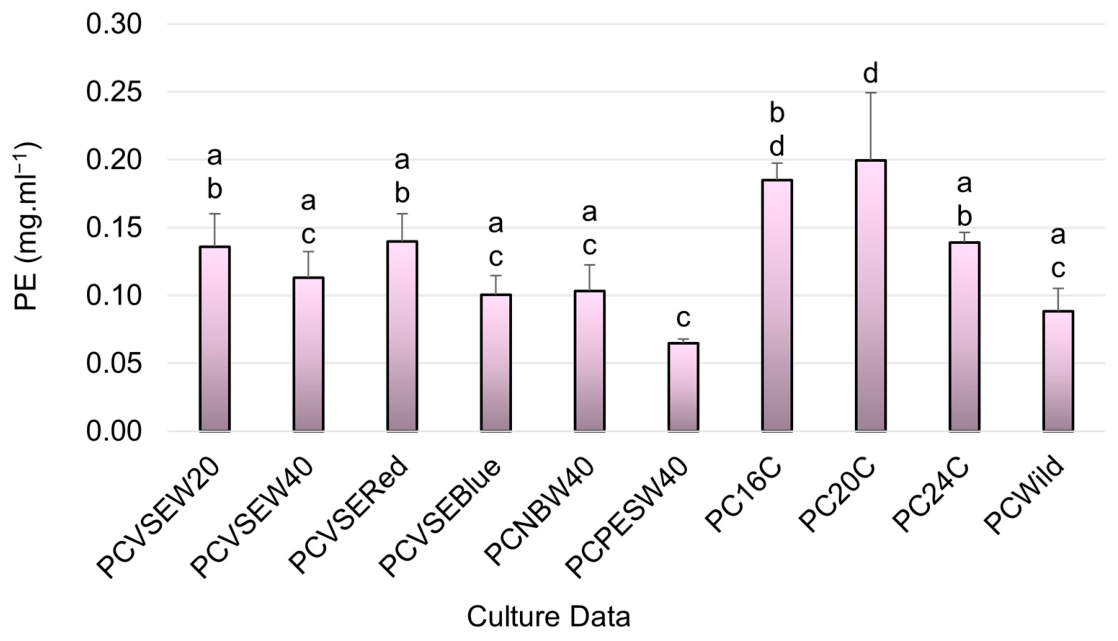
For P. cartilagineum (Figure 4), values ranged from 0.065 ± 0.003 to 0.199 ± 0.050 mg·mL−1 corresponding, respectively, to biomass supplied with PES under white LED light at 40 µmol·m−2·s−1 (PCPESW40), and to biomass growing at 20 °C (PC20C). Except for biomass supplied with PES, all other treatments yielded similar or higher PE values than that obtained from wild P. cartilagineum biomass (0.088 ± 0.017 mg·mL−1). Significant differences were found for most treatments according to the Tukey HSD test [F(9,38) = 13.647; p = 0.000].
For S. coronopifolius (Figure 5), values ranged from 0.042 ± 0.001 to 0.079 ± 0.005 mg·mL−1 corresponding, respectively, to biomass supplied with VSE growing under red LED light (SCVSERed), and to biomass supplied with VSEM growing under white LED light at 40 µmol·m−2·s−1 (SCVSEMW40). All cultured treatments yielded similar or higher PE values than those obtained from wild S. coronopifolius biomass (0.045 ± 0.005 mg·mL−1). It is also noteworthy pointing out that biomass cultured under VSEM and PES yielded higher results than all other treatments considered. Significant differences were found for a few treatments according to the Kruskal–Wallis test (χ2(10) = 29.470; p = 0.001).

3.1.2. Phycocyanin

Phycocyanin (PC) content in cultured algal samples are expressed in Table 3. For N. punctatum (NiPu), values ranged from 0.1 ± 0.1 to 3.3 ± 0.5 µg·mL−1 corresponding, respectively, to biomass growing at 20 °C (NP20C), and to biomass supplied with NB under white VSE light at 20 µmol·m−2·s−1 (VSEW20). Values were low overall, with a number of treatments not showing PC at all. Significant differences were found for most treatments according to the Kruskal–Wallis test (χ2(12) = 41.135; p = 0.000).
For C. coerulescens (ChCo), most treatments yielded no PC content, except for three treatments, namely the wild biomass (0.2 ± 0.3 µg·mL−1, Wild), biomass supplied with NB under blue LED light (0.5 ± 0.4 µg·mL−1, NBBlue) and biomass supplied with NB and growing under white LED light at 20 µmol·m−2·s−1 (3.5 ± 1.8 µg·mL−1, NBW20). Significant differences were found for these treatments according to the Kruskal–Wallis test (χ2(12) = 45.128; p = 0.000).
For P. cartilagineum (PlCa), all treatments yielded variable amounts of PC, ranging from 1.1 ± 0.3 to 12.6 ± 1.2 µg·mL−1 corresponding, respectively, to biomass supplied with PES and growing under white LED light at 40 µmol·m−2·s−1 (PCPESW40) and to biomass growing at 16 °C (PC16C). Generally, the wild biomass and treatments supplied with VSE (including those of the temperature assays) yielded the highest results. Significant differences were found for these treatments according to the Tukey HSD test [F(9,38) = 12.132; p = 0.000].
For S. coronopifolius (SpCo), most treatments yielded variable amounts of PC, ranging from 0.1 ± 0.2 to 3.4 ± 0.4 µg·mL−1 corresponding, respectively, to biomass supplied with VSE and growing under red LED light (SCVSERed) and to biomass supplied with VSE and growing under white LED light at 40 µmol·m−2·s−1 (SCVSEW40). Only the biomass growing at 20 °C (SC20C) and 24 °C (SC24C) yielded no PC content, and the wild biomass yielded low PC content (0.7 ± 0.1 µg·mL−1, SCWild) when compared to several culture treatments. Significant differences were found for these treatments according to the Kruskal–Wallis test (χ2(10) = 38.936; p = 0.000).

3.1.3. Carotenoids

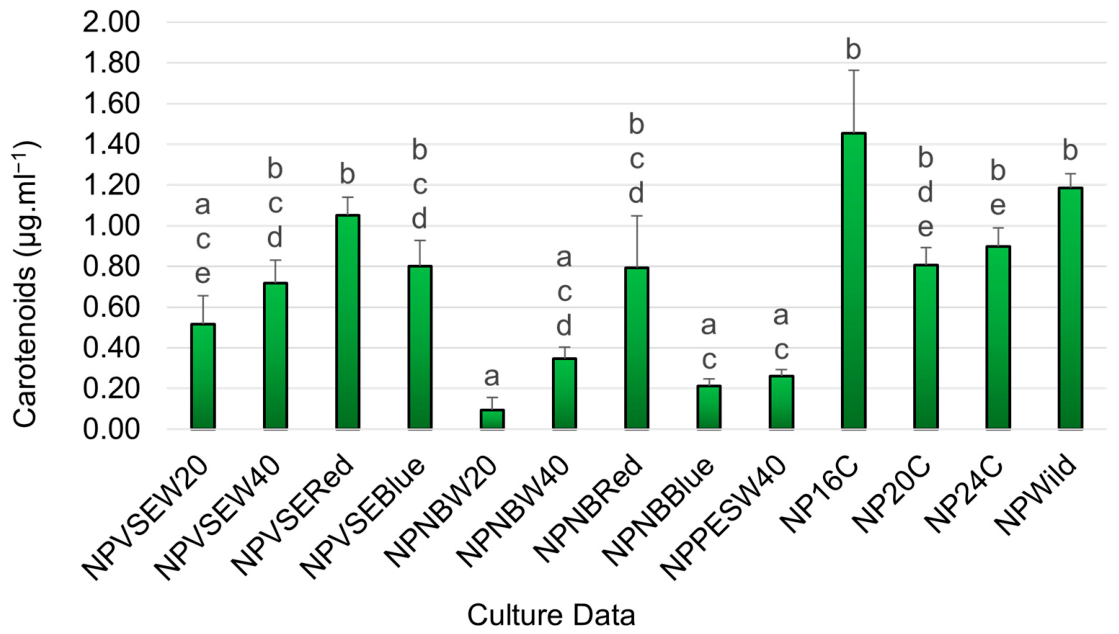
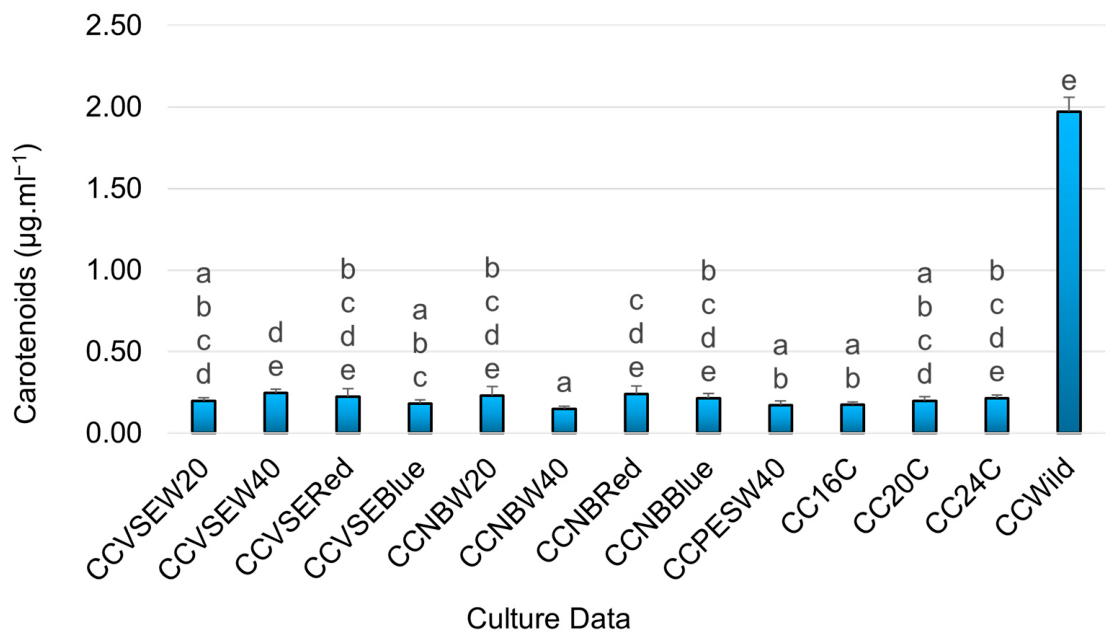
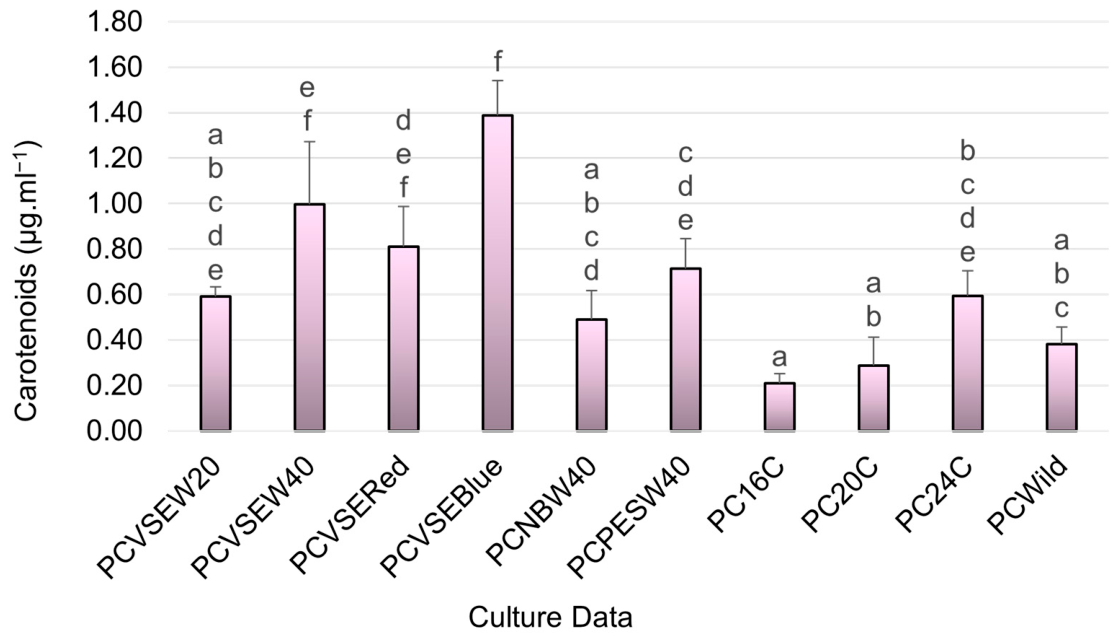
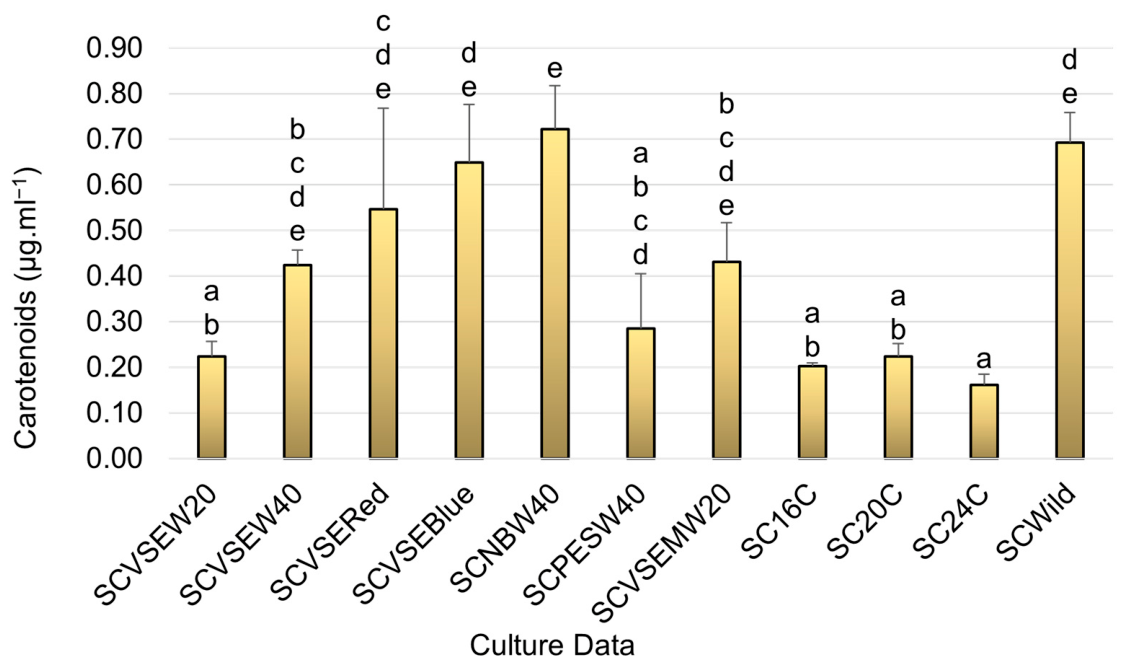
Carotenoid (Car) content in cultured algal samples is expressed in Figure 6 (N. punctatum), Figure 7 (C. coerulescens), Figure 8 (P. cartilagineum) and Figure 9 (S. coronopifolius). For N. punctatum (Figure 6), carotenoid content ranged from 0.094 ± 0.063 to 1.455 ± 0.308 µg·mL−1 corresponding, respectively, to biomass supplied with NB under white LED light at 20 µmol·m−2·s−1 (NPNBW20), and to biomass supplied with VSE growing at 16 °C (NP16C). Generally, biomass supplied with VSE (including that tested under different temperatures) and the wild population yielded higher results than the biomass supplied with NB. Only the biomass cultured under 16 °C yielded a higher carotenoid content than the wild population (1.184 ± 0.072 µg·mL−1, NPWild). Significant differences were found for most treatments according to the Kruskal–Wallis test (χ2(12) = 44.855; p = 0.000).
For C. coerulescens (Figure 7), carotenoid content yielded quite low but similar values for all the cultured biomass, ranging from 0.149 ± 0.016 to 0.247 ± 0.021 µg·mL−1 corresponding, respectively, to biomass supplied with NB under white LED light at 40 µmol·m−2·s−1 (CCNBW40), and to biomass supplied with VSE under white LED light at 40 µmol·m−2·s−1 (CCVSEW40). However, the wild populations showed significant higher values compared to the cultured ones (1.971 ± 0.089 µg·mL−1, CCWild). Significant differences were found for some treatments according to the Kruskal–Wallis test (χ2(12) = 30.493; p = 0.002).
For P. cartilagineum (Figure 8), carotenoid content yielded highly variable values across treatments, ranging from 0.210 ± 0.041 to 1.387 ± 0.153 µg·mL−1 corresponding, respectively, to biomass supplied with VSE growing at 16 °C (PC16C), and to biomass supplied with VSE under blue LED light (PCVSEBlue). Similarly to N. punctatum, P. cartilagineum biomass supplied with VSE yielded generally higher results than all other treatments, and the majority of cultured treatments yielded superior results than that of the wild biomass (0.382 ± 0.076 µg·mL−1, PCWild). Significant differences were found for treatments according to the Kruskal–Wallis test (χ2(9) = 32.720; p = 0.000).
For S. coronopifolius (Figure 9), carotenoid content ranged from 0.161 ± 0.024 to 0.722 ± 0.095 µg·ml−1 corresponding, respectively, to biomass supplied with VSE growing at 24 °C (SC24C), and to biomass supplied with NB under white LED light at 40 µmol·m−2·s−1 (SCNBW40). Close to the highest value, wild biomass showed a result of 0.693 ± 0.065 µg·ml−1 (SCWild). Biomass grown under different temperatures showed lower values than the great majority of the other treatments considered. Significant differences were found for most treatments according to the Kruskal–Wallis test (χ2(10) = 36.354; p = 0.000).

3.1.4. Chlorophyll a

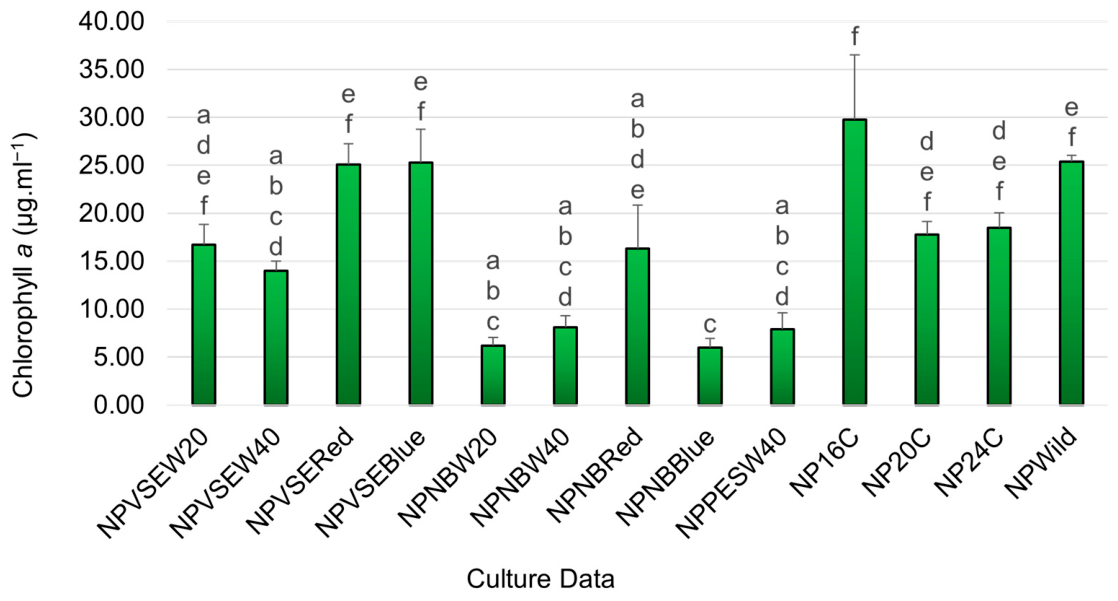
Chlorophyll a (Chl a) content in cultured algal samples is expressed in Figure 10 (N. punctatum), Figure 11 (C. coerulescens), Figure 12 (P. cartilagineum) and Figure 13 (S. coronopifolius). For N. punctatum (Figure 10), values ranged from 5.975 ± 0.954 to 29.746 ± 6.739 µg·ml−1 corresponding, respectively, to biomass supplied with NB under blue LED light (NPNBBlue), and to biomass supplied with VSE growing at 16 °C (NP16C). Wild biomass showed a high result, 25.389 ± 0.664 µg·mL−1 (SCWild). It is also noteworthy to point out that, generally, VSE-O-supplied biomass, including those of the temperature assays, showed higher results than the NB-supplied biomass treatments. Significant differences were found for most treatments according to the Kruskal–Wallis test (χ2(12) = 44.872; p = 0.000).
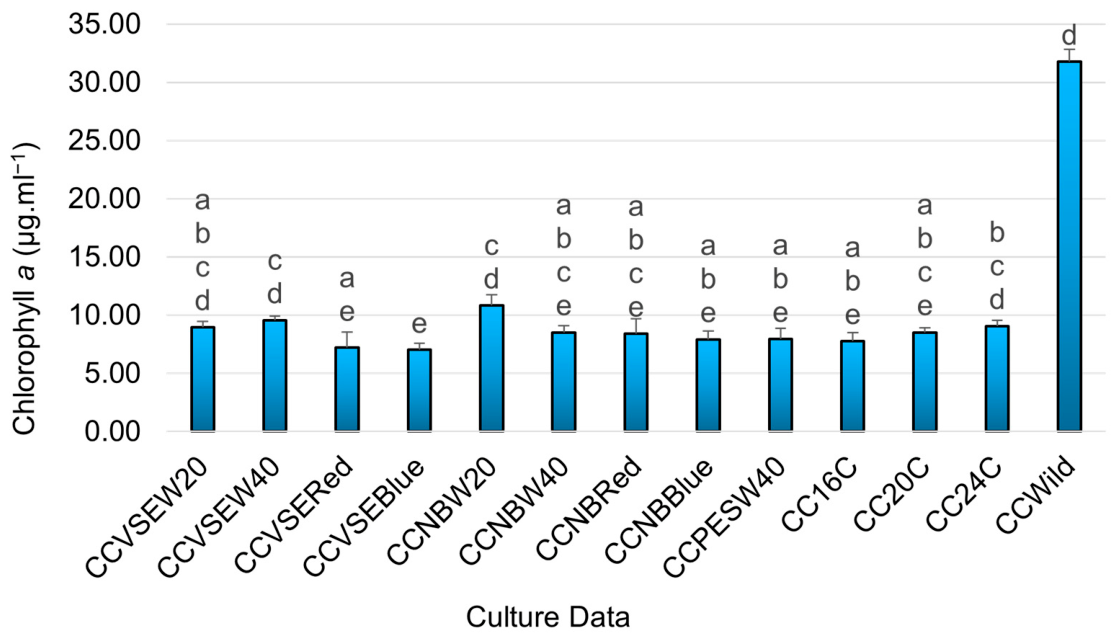
For C. coerulescens (Figure 11), chlorophyll a values ranged from 7.024 ± 0.556 to 31.765 ± 1.078 µg·mL−1 corresponding, respectively, to biomass supplied with VSE under blue LED light (CCVSEBlue), and to wild biomass (CCWild). Wild biomass presented the unique high results, while all other treatments, corresponding to culture assays, yielded similar results, with biomass supplied with NB growing under white LED light at 20 µmol·m−2·s−1 yielding a slightly higher value than all the other culture treatments (10.820 ± 0.911 µg·mL−1, CCNBW20). Significant differences were found for most treatments according to the Kruskal–Wallis test (χ2(12) = 37.717; p = 0.000).
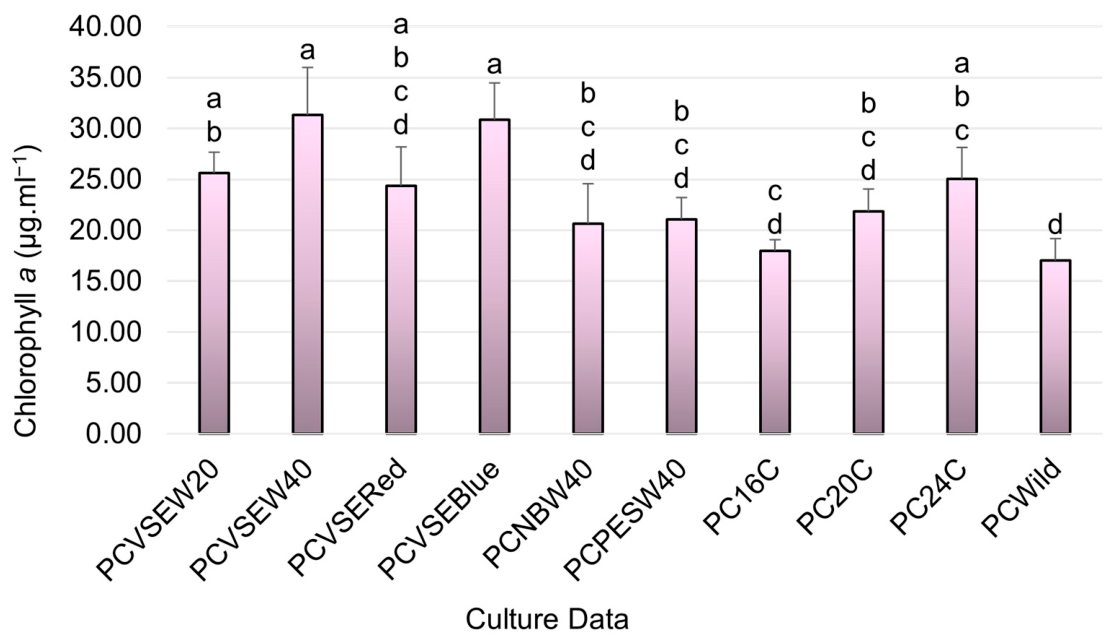
For P. cartilagineum (Figure 12), chlorophyll a values ranged from 17.006 ± 2.131 to 31.292 ± 4.699 µg·mL−1 corresponding, respectively, to wild biomass (PCWild) and to biomass supplied with VSE under white LED light at 40 µmol·m−2·s−1 (PCVSEW40). Results were highly variable and presented no distinct pattern, despite the fact that wild biomass had significant lower results than all other treatments. Significant differences were found for most treatments according to the Tukey HSD test [F(9,38) = 9.306; p = 0.000].
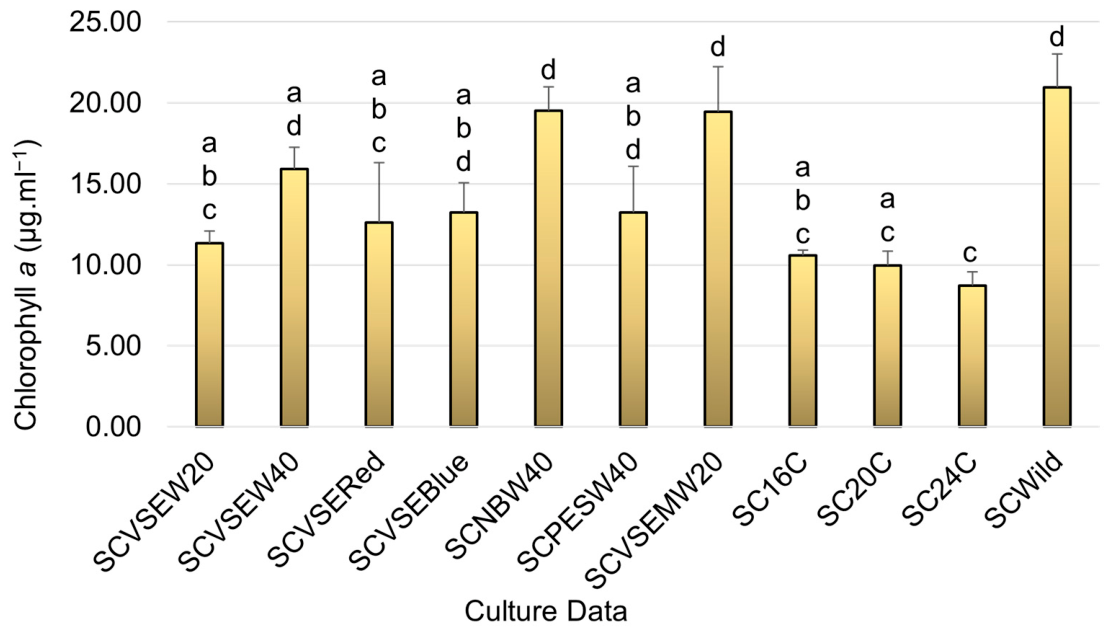
For S. coronopifolius (Figure 13), chlorophyll a values ranged from 8.074 ± 0.848 to 20.962 ± 2.066 µg·mL−1 corresponding, respectively, to biomass growing at 24 °C (SC24C) and to wild biomass (SCWild). Similarly to P. cartilagineum, the highly variable results showed no distinct pattern; however, the wild biomass had significantly higher results than all other treatments. Higher chlorophyll a content was also obtained for treatments growing in VSE-M and NB, when compared to PES and NB. Moreover, treatments under distinct temperatures yielded lower results than all other treatments. Significant differences were found for most treatments according to the Kruskal–Wallis test (χ2(10) = 35.530; p = 0.000).

3.2. Protein Quantification by Bradford

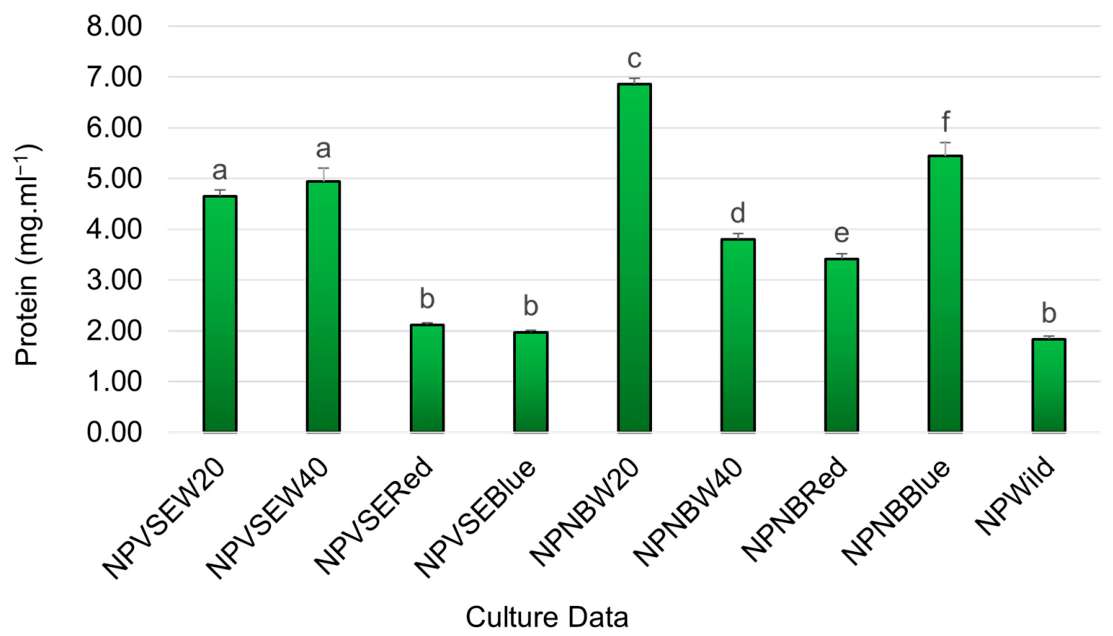
Results of the protein quantification by Bradford are expressed in Figure 14 (Nitophyllum punctatum) and Figure 15 (Chondria coerulescens), and are expressed as mg·mL−1 (BSA equivalents). For N. punctatum (Figure 14), values ranged from 1.829 ± 0.062 to 6.853 ± 0.122 mg·mL−1 corresponding, respectively, to wild biomass and cultured biomass supplied with NB under white LED light. A broad observation shows that biomass cultured under white LED light, and biomass cultured under blue LED light supplied with NB yielded higher protein results, whereas the remaining cultured biomass and the wild seaweed yielded lower results. Significant differences were found for most treatments according to the Tukey HSD test [F(8,35) = 547.529; p = 0.000], although it grouped together wild biomass with those cultured with VSE and under red and blue LED light, and grouped together biomass cultured under white LED light supplied with VSE-O.
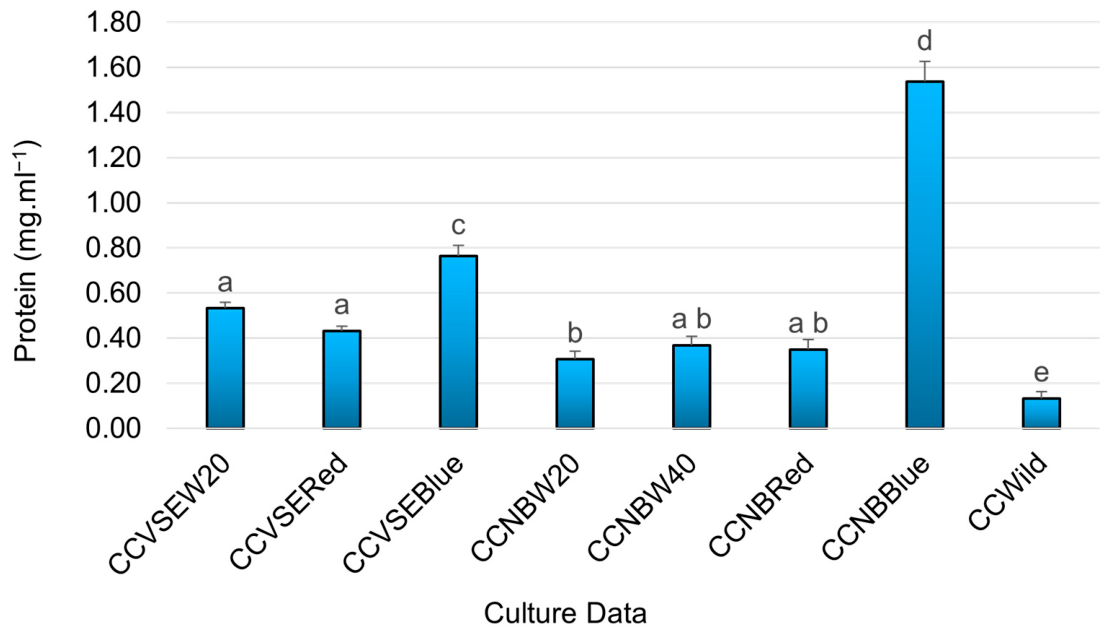
For C. coerulescens (Figure 15), values ranged from 0.133 ± 0.029 to 1.536 ± 0.090 mg·mL−1 corresponding, respectively, to wild biomass and cultured biomass supplied with NB under blue LED light. All cultured biomass showed significantly higher protein values than the wild biomass, where the one cultured under blue LED and supplied with NB showed a remarkably higher value than all other treatments. Significant differences were found for many treatments according to the Tukey HSD test [F(7,31) = 368.759; p = 0.000].
For both species, all cultured biomass yielded more protein than wild biomass.

3.3. Antioxidant Assays

3.3.1. ABTS Radical Scavenging Activity Assay

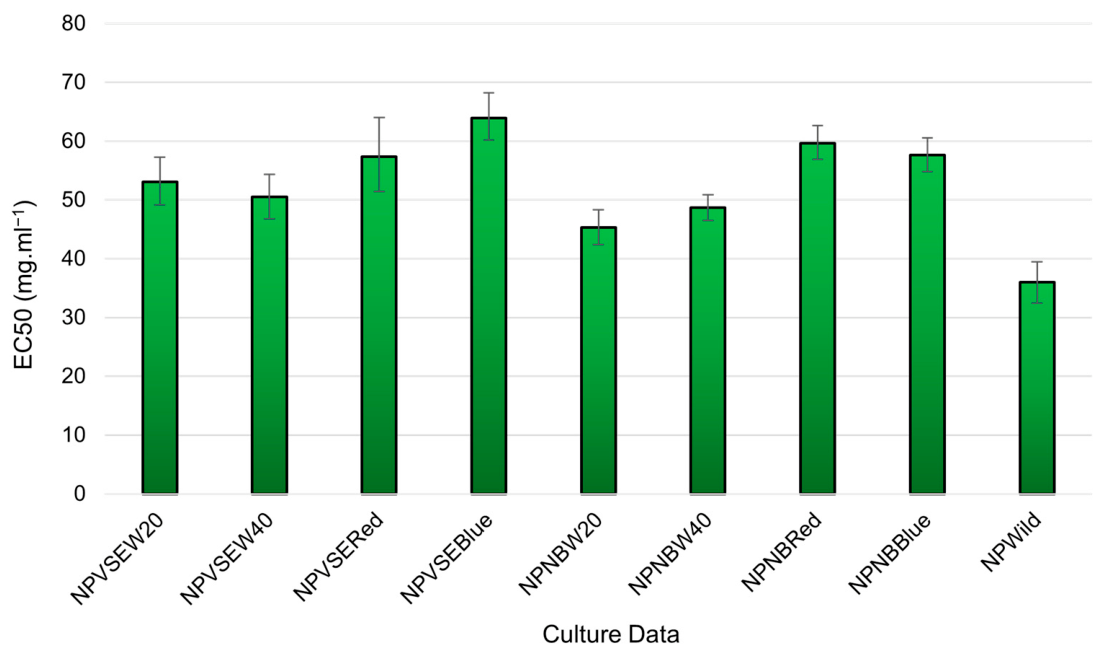
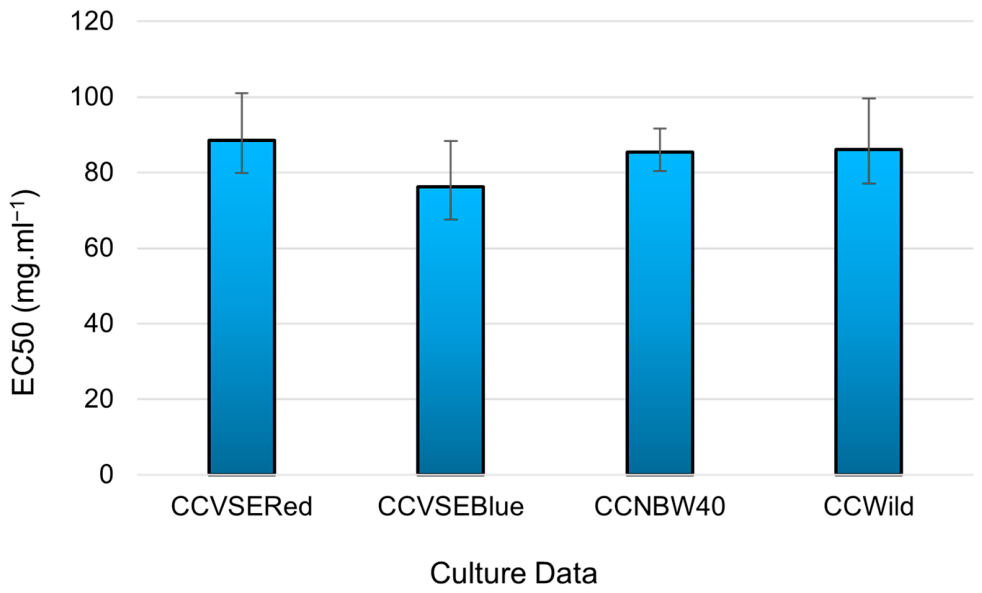
Results from the ABTS assay show distinct results according to culture condition, for N. punctatum and C. coerulescens. The EC50 of N. punctatum ranged from 35.99 mg·mL−1, with a 95% Confidence Interval (CI) [3.55, 3.46] corresponding to wild specimens, to 63.94 mg·mL−1, with a 95% CI [3.79, 4.27] corresponding to specimens cultivated under LEDblue and supplied with VSE-O culture media (NPVSEBlue) (Figure 16). The EC50 of C. coerulescens ranged from 76.18 mg·mL−1, with a 95% CI [8.56, 12.14] corresponding to specimens cultivated under LEDblue and supplied with VSE-O culture media (CCVSEBlue), to 88.60 mg·mL−1, with a 95% CI [8.7, 12.4] corresponding to specimens cultivated under LEDred and supplied with VSE-O culture media (CCVSERed). For this species, only the treatments supplied with VSE growing under LEDred (CCVSERed) and LEDblue (CCVSEBlue), the one supplied with NB growing under white LED light at 40 µmol·m−2·s−1 (CCNBW40) and the wild specimen (CCWild) yielded sufficient activity to calculate EC50 (more than 50% inhibition at the highest concentration of extract considered) (Figure 17).

3.3.2. Total Phenolic Compound Assay (TPC)

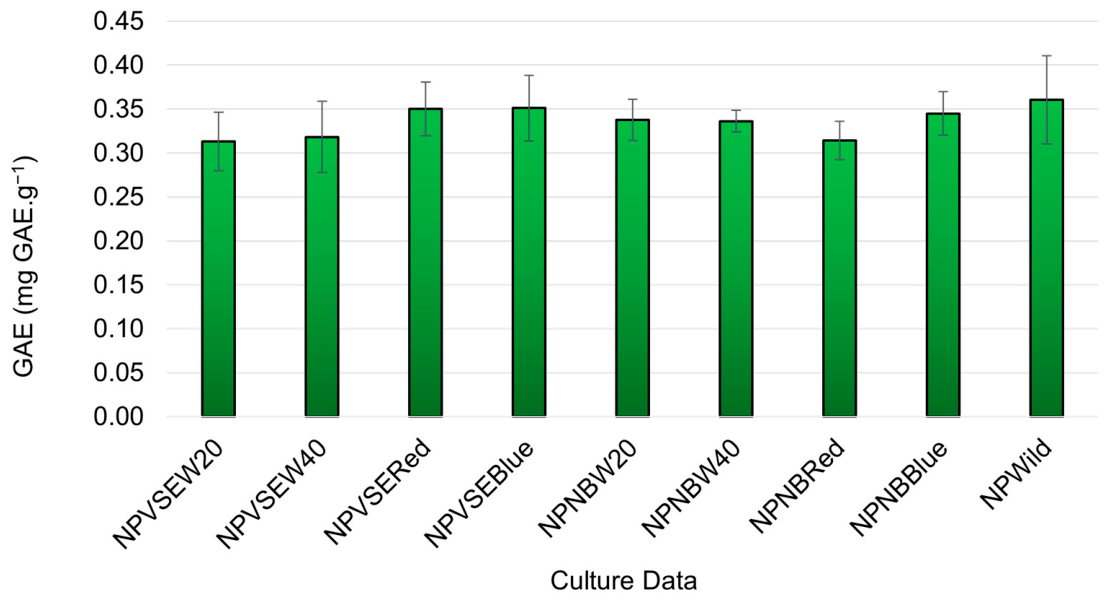
Results from the TPC assay show slight differences among all the treatments considered for N. punctatum (Figure 18), which ranged from 0.313 ± 0.033 mg GAE·g−1 corresponding to biomass cultivated with VSE under white LED light at 20 µmol·m−2·s−1 (NPVSEW20), to 0.361 ± 0.050 mg GAE·g−1 corresponding to wild biomass (NPWild). No statistic differences were found for the QTP results for this species, according to the Tukey HSD test [F(8,35) = 1.160; p = 0.358].
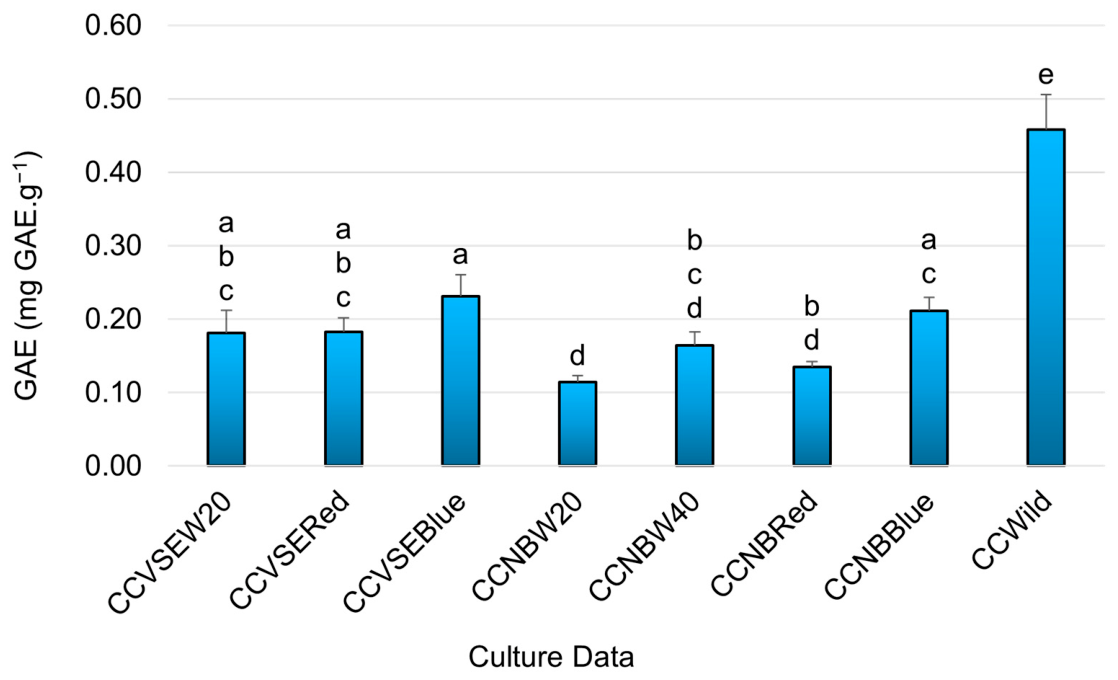
For C. coerulescens (Figure 19), all culture treatments considered presented similar values, ranging from 0.114 ± 0.009 mg GAE·g−1 corresponding to biomass cultivated with NB under white LED light at 20 µmol·m−2·s−1 (CCNBW20), to 0.231 ± 0.030 mg GAE·g−1 corresponding to biomass growing in VSE under LEDblue (CCVSEBlue), with the exception of wild biomass, whose result was significant higher (0.458 ± 0.048 mg GAE·g−1, CCWild). Statistical differences were found for many treatments, in particular for the wild biomass (CCWILD), which presented a significant higher difference than all other treatments, and biomass supplied with VSE presented a generally higher GAE than those supplied with NB (Tukey HSD test [F(7,31) = 69.062; p = 0.000]).

4. Discussion

In this study, we aimed to explore the biotechnological potential of four distinct species of red seaweeds: Nitophyllum punctatum, Chondria coerulescens, Plocamium cartilagineum and Sphaerococcus coronopifolius, under cultured conditions. Specifically, we assessed whether these species exhibited an enhanced biochemical profile and bioactive potential in culture by comparing the biochemical characteristics of cultured biomass to those of their wild counterparts and by identifying the culture conditions that would optimize these profiles. The biochemical profile and bioactive potential were evaluated by measuring pigment content (phycobiliproteins, carotenoids, and chlorophyll a), total protein, and conducting antioxidant analyses using the ABTS and QTP assays.
The results are summarized in Table 4, which presents the optimal culture conditions per analysis and seaweed species, whenever culture led to improvements over wild biomass. For N. punctatum, specific culture conditions resulted in improved yields, particularly in pigment content (phycoerythrin, phycocyanin, carotenoids, and chlorophyll a). All culture conditions increased protein content relative to wild biomass; however, antioxidant activity was higher in the wild biomass, as shown by both ABTS and QTP analyses. For C. coerulescens, culture conditions enhanced yields, especially for the phycobiliproteins phycocyanin and phycoerythrin, as well as ABTS antioxidant activity. Similarly, all culture conditions increased protein content over wild biomass. However, culture did not improve carotenoid or chlorophyll a content, and no enhancement was observed in the QTP analysis. For P. cartilagineum, which was analyzed solely for pigment content, many culture conditions improved pigment levels, with chlorophyll a content increased under all tested conditions. For S. coronopifolius, also analyzed only for pigment content, several culture conditions enhanced both phycoerythrin and phycocyanin levels. However, only one condition led to improved carotenoid content, and none improved chlorophyll a content over wild biomass.
The abundance and diversity of metabolites in a given seaweed species are closely influenced by factors such as taxonomy [44,45,46], geography [47,48,49], season [47,50,51,52], and processing methodologies [53]. In the present study, the culture manipulations simulated environmental variations typically observed in nature. This included nutrient availability, which depends heavily on water currents for mixing and renewal; light color and intensity, which reflect the diffusion of light through different water depths; and temperature, which simulates seasonal thermal fluctuations. The life cycle of red seaweed is long and complex, and its different life stages adapt differently to such changes in environmental conditions [54] with light, temperature and salinity shaping growth and development [14,55,56,57,58,59].

4.1. Pigment Content Determination

Results from the ABTS assay show distinct results according to culture condition, for N. punctatum and at greater depths, low irradiance—rather than spectral composition—has been suggested as the primary factor influencing pigment composition in macroalgae [60]. Red algae (Rhodophyta) exhibit a remarkable ability to adjust both the abundance and composition of their pigments in response to changes in light quality, significantly affecting their pigment profiles [24,61,62,63].
In this study, light quality affected pigment composition across all species analyzed. However, we found few comparable studies on these specific species, except for Plocamium cartilagineum. Wild Plocamium cartilagineum is known to have a high phycoerythrin content compared to other wild red seaweeds [19], and our results show that this content can be further enhanced under cultivation conditions. Notably, this species is recognized for its capacity to modulate both phycoerythrin levels [64] and halogenated compound production [65]. When exposed to high irradiance, wild Plocamium cartilagineum experiences photo-inhibition and photo-acclimation, as reflected by lower pigment concentrations compared to specimens from shaded environments [66]. Additionally, this species has been shown to produce more chlorophyll under blue light, more phycoerythrin under green light, and more phycocyanin under red light [60].
In our comparative analysis of blue and red light, blue light generally enhanced phycoerythrin content across all species, apart from P. cartilagineum, which exhibited greater phycoerythrin production under red light. Red light also stimulated carotenoid and chlorophyll a production in Nitophyllum punctatum and Chondria coerulescens, but not in P. cartilagineum or Sphaerococcus coronopifolius. Blue light, being the most energetic within the photosynthetically active radiation (PAR) spectrum (400–700 nm), is effectively absorbed by phycoerythrin, abundant in red algae, which subsequently transfers this energy to chlorophyll a, a critical step in photosynthesis [62]. However, research performed by Pavlou et al. [67] on PSII charge separation under far-red excitation suggests limited red light energy utilization in red algae, potentially impairing growth [62]. When light energy is limited, red seaweed compensates by increasing pigment production to enhance light-harvesting efficiency [68].
The influence of light quality on pigment composition has been previously examined in other species such as Asparagopsis taxiformis [62], Gracilaria tikvahiae [69], Pyropia haitanensis [65], with results broadly consistent with our findings. In P. haitanensis red light decreased chlorophyll a and phycobiliprotein content, while blue light enhanced phycobiliprotein synthesis [65]. Conversely, red light promoted chlorophyll a accumulation in Asparagopsis taxiformis, suggesting a greater reliance on red light for pigment synthesis, whereas blue light supported growth rather than pigment production [62]. In G. tikvahiae, both chlorophyll a and carotenoid levels increased under a combination of red and blue light [69].
In seaweed, changes in light intensity result in observable modifications in pigment content and composition, occasionally even at the macroscopic level [14,70,71]. Although many red seaweeds inhabit coastal areas, especially intertidal and subtidal zones [72], some species have adapted to the deep sea, where light availability is minimal. To thrive in such environments, red algae have evolved the unique ability to absorb a wide range of light wavelengths, a trait unparalleled in other algal groups, thereby distinguishing red algae from all other seaweed. This is made possible by their specialized pigment composition and spatial distribution, enabling the absorption of nearly the entire visible spectrum. Red algae can dynamically regulate pigment levels in response to variations in both light intensity and spectral quality [73].
These pigments, primarily phycobiliproteins (phycoerythrin, phycocyanin, and allophycocyanin), carotenoids, and chlorophyll a, are not only essential for photosynthesis but also serve protective roles against oxidative stress. They have also garnered interest for their diverse applications in biotechnology [24], particularly in the biomedical, pharmaceutical, and food industries, due to their notable antioxidant, fluorescent, and coloring properties [24,74,75,76,77,78,79,80,81,82,83,84,85].
Temperature also played a significant role in pigment production among the four species studied. The highest tested temperature (24 °C) resulted in the greatest phycoerythrin content in N. punctatum and C. coerulescens, highest carotenoid levels in C. coerulescens and P. cartilagineum, and highest chlorophyll a content in C. coerulescens and P. cartilagineum. The intermediate temperature (20 °C) led to enhanced phycoerythrin and carotenoid levels in S. coronopifolius. The lowest temperature (16 °C) yielded the highest phycoerythrin content in S. coronopifolius, carotenoid content in N. punctatum, and chlorophyll a in both N. punctatum and S. coronopifolius. Temperature treatments that surpassed wild pigment levels were observed in N. punctatum (phycoerythrin at all temperatures; phycocyanin at 16 °C and 24 °C; carotenoids and chlorophyll a at 16 °C), P. cartilagineum (phycoerythrin at all temperatures; phycocyanin at 16 °C and 20 °C; carotenoids at 24 °C; chlorophyll a at all temperatures), and S. coronopifolius (phycoerythrin at 16 °C). In contrast, C. coerulescens consistently exhibited lower pigment concentrations than its wild counterparts under all temperature conditions.
Our study focused on populations collected during winter. Observational data indicate a higher abundance of C. coerulescens in winter and spring, P. cartilagineum and S. coronopifolius in summer, and N. punctatum throughout the year. However, in recent decades, pronounced climate variability has disrupted the traditional Portuguese seasonal patterns, typically cold/rainy winters and hot/dry summers. The winters of 2022 and 2023, for example, were unusually warm and dry [86,87,88], impacting marine environments where these seaweeds reside. Intertidal habitats, where all four studied species are found, are particularly dynamic, with drastic changes in temperature, salinity, solar exposure, and desiccation driven by tidal cycles. Seaweed persists in such fluctuating conditions by producing a variety of secondary metabolites that protect cellular structures from environmental extremes, especially UV radiation and desiccation [89,90,91,92,93].

4.2. Protein Quantification by Bradford

The soluble protein content was analyzed for Nitophyllum punctatum and Chondria coerulescens, revealing high variability both across culture assays and between cultured and wild biomass for each species. Notably, cultured biomass exhibited improved protein content in both species, with a marked preference for the NutriBloom medium. NutriBloom is a culture medium specifically formulated to optimize microalgae growth [33]. Microalgae have generally an organic composition (Carbon:Nitrogen:Phosphorus, C:N:P) distinct from macroalgae (microalgae: 106C:16N:1P; macroalgae: 550C:30N:1P), and thus, different nutrient requirements [94], which highlights the importance of tailoring nutrient formula according to target species and culture objectives.
Between the two species, N. punctatum yielded the highest protein levels when comparing peak values. In seaweed, protein content varies significantly within a phylum, influenced by factors such as species, geographic location, habitat, and seasonal conditions [52]. Chemical composition, morphology, and structural characteristics also contribute to this variability [40]. These factors explain the differences observed in the present study, both interspecific (between N. punctatum and C. coerulescens) and intraspecific (between wild and cultured specimens, and across different culture conditions). These culture conditions mimic natural environmental fluctuations linked to habitat and seasonal changes.
For context, through Bradford assay, red seaweed has shown variable protein content, such as Palmaria palmata (0.43 ± 0.05 mg BSA-Eq·g−1), Chondrus crispus (1.09 ± 0.08 mg BSA-Eq·g−1), Gracilaria gracilis (1.61 ± 0.07 mg BSA-Eq·g−1) and Porphyra dioica (2.37 ± 0.06 mg BSA-Eq·g−1) [95]. Using the Bradford method preceded by trichloroacetic acid (TCA) precipitation and bovine serum albumin (BSA) as a standard, protein contents ranging from 10.2 ± 0.32% (Aglaothamnion uruguayense) and 2.60 ± 0.13% (Porphyra acanthophora) of dry matter were reported [40].
This study, however, focuses specifically on protein content differences within N. punctatum and C. coerulescens. To the best of our knowledge, these species have not been previously studied in a culture context, which limits direct comparisons with existing literature. Nevertheless, variable protein contents have been documented in other cultured red seaweeds. For instance, Porphyra linearis maintained relatively stable, though slightly decreasing, soluble protein levels under high nitrate conditions [96]. This was attributed to reduced metabolic allocation towards antioxidant systems under optimal culture conditions. Conversely, Palmaria palmata exhibited increased protein content—particularly phycobiliproteins—under nitrogen enrichment, with nitrogen stored and redirected toward biosynthesis However, this synthesis can be limited by light availability, as low light exposure leads to reduced nitrogen uptake [97], with low values leading to a decrease in nitrogen uptake [98] subsequently decreasing protein synthesis.
While not applicable to a culture setting, seasonality also plays a role: in the northern hemisphere, nitrogen availability is higher in winter and spring, enhancing protein content in red algae [99]. Thus, it is possible that the wild specimens collected for this study, harvested during winter, represent the highest protein levels attainable throughout the year.
Proteins are essential primary metabolites in seaweed, playing key roles in growth, cellular signaling, structural integrity, and molecular transport. Red seaweed generally have high protein content (8–47% dry weight), exceeding that of brown (4–24%) and green seaweed (9–33%) [100]. Their protein levels are also significantly higher than those of many commonly consumed plant-based protein sources such as chickpeas, lentils, quinoa, and soybeans [101]. Within Rhodophyta, protein content is further influenced by species, life stage, environmental conditions, and season [50]. High-protein red seaweeds include Gracilaria gracilis, Palmaria palmata, and Porphyra spp., with contents ranging from 30% to 47% dry weight [102,103,104,105,106,107]. These values, however, vary based on region, season, and methodological protocols.
Among the most widely used techniques for protein quantification in seaweed are the Kjeldahl [108], Bradford [39], and Lowry [109] methods [110]. Many protocols rely on nitrogen-to-protein conversion using a generic factor (n × 6.25), which often overestimates protein content in seaweed. More accurate results are obtained using species-specific factors (n × 3 to 5) [110,111,112,113]. Additionally, seaweed contains non-protein nitrogenous compounds—including pigments, free amino acids, nucleic acids, and inorganic nitrogen forms (e.g., ammonia, nitrite, nitrate)—which may interfere with accurate quantification [40]. These limitations contribute to the difficulty of comparing protein content across studies and species [100,111].
Spectrophotometric methods such as Lowry and Bradford also introduce variability due to their differing sensitivities to amino acid residues. The Lowry method detects peptide bonds via a copper-catalyzed reaction and is particularly sensitive to tyrosine and tryptophans [109]. The Bradford method, on the other hand, relies on binding to Coomassie Brilliant Blue dye, forming complexes with arginine and, to a lesser extent, lysine, histidine, tyrosine, phenylalanine, and tryptophan [40,114]. Therefore, the accuracy of each method depends heavily on the amino acid profile of the sample [40]. This underscores the importance of conducting amino acid analysis for N. punctatum and C. coerulescens, as it could help determine which quantification method, Bradford or Lowry, is best suited for these species.
The protein values for both targeted species were generally low, which may be explained by the fact that only soluble protein, and not crude protein, was quantified. Moreover, protein quantification in this study was preceded by a hydrolysis step, meaning the results are based on concentrated protein pellets rather than the original dry biomass. This further complicates comparisons with other studies that may not employ this approach. Precipitation using TCA, as employed here, is highly effective at minimizing interference from substances such as phenols, flavonoids, phenolases, and glucosamine that typically reduce the efficiency of both Bradford and Lowry assays [40]. TCA precipitates only proteins, excluding small peptides and free amino acids from detection, and is therefore recommended as a preparatory step prior to spectrophotometric analysis [40,115].

4.3. Antioxidant Assays

Results from the ABTS assay revealed clear differences in antioxidant activity between culture conditions for both Nitophyllum punctatum and Chondria coerulescens. The EC50, or “half maximal effective concentration,” represents the concentration of extract required to reduce 50% of the ABTS radical, with lower EC50 values indicating higher antioxidant capacity. For N. punctatum, although variability was observed across treatments, the wild-collected biomass exhibited the lowest EC50 value, indicating the highest antioxidant activity. In contrast, biomass cultured in NutriBloom medium and exposed to blue LED light (NPVSEBlue) presented a higher EC50, suggesting that a larger extract concentration was required to achieve the same antioxidant effect, and therefore a lower antioxidant capacity. In the case of C. coerulescens, only the wild biomass and samples grown under three specific culture conditions exhibited measurable antioxidant activity. This indicates that culture variables have a substantial influence on the bioactive profile of this species.
The Total Phenolic Content (TPC) assay, used to quantify phenolic compounds, a class of secondary metabolites often correlated with antioxidant activity [116], also showed culture-dependent results. In N. punctatum, phenolic content remained relatively stable across treatments, being slightly higher in the wild biomass. As for C. coerulescens, it displayed a pronounced contrast, with wild specimens containing significantly higher phenolic levels than any of their cultured counterparts.
Studies on related red seaweeds, such as Nitophyllum marginale, report antioxidant activity in ABTS assays, with bioactivity attributed to methanol and chloroform extracts containing phenols, alkaloids, flavonoids, saponins, and carbohydrates [117]. Other species assessed via ABTS include Amphiroa rigida [118], Ellisolandia elongata [26,119], Gelidium corneum [120], Gracilaria gracilis [103], Plocamium cartilagineum [26,66], and a wide range of less known red seaweed species [26]. Those accessed through TPC include Chondrus crispus [95], Ellisolandia elongata [26,119], Gelidium corneum [51], Gracilaria gracilis, [25,95], Palmaria palmata [95], Porphyra dioica [95], among a number of less known species [26].
Antioxidant capacity is known to vary by species and methodology. For example, Castillo et al. [119] compared four brown seaweeds and one red seaweed (E. elongata) using methanol– and ethanol–water extracts via Ultrasound-Assisted Extraction (UAE) and Matrix Solid-Phase Dispersion (MSPD). Reported ABTS IC50 values ranged from 44 mg·L−1 to 11.040 mg·L−1, with the red seaweed exhibiting the highest IC50 (lowest antioxidant activity). TPC values in the same study ranged from 0.2 mg GAE·g−1 to 38 mg GAE·g−1, with E. elongata again showing the lowest phenolic content. Conversely, Trigueros et al. [95] reported higher TPC values in red seaweed compared to green seaweed using ethanolic (80%) extracts. Among red seaweed, Porphyra dioica (14.77 ± 0.044 mg·g−1) and Pyropia haitanensis (10.78 ± mg·g−1) showed particularly high values, underscoring the diversity of responses depending on species, solvents, and extraction methods. A similar study, conducted by Huang et al. [121], revealed a phenolic content ranging from 4.16 to 17.24 mg GAE·g−1, among six brown seaweeds and one red seaweed (Gracilaria lemaneiformis) which were subjected to distinct methods to simulate gastrointestinal digestion. In this study, the brown seaweed contained the highest phenolic content (revealed through TPC) and showed the highest antioxidant activity (revealed through ABTS).
Red seaweeds are known to thrive under extreme conditions of light, salinity, and temperature [122,123,124]. In response, they produce a wide range of bioactive secondary metabolites with potential applications in health, cosmetic, and food industries [7,125,126,127,128]. Antioxidant activity in Rhodophyta has been linked to pigments, phenols, flavonoids, glutathione, and mycosporine-like amino acids [27,129,130,131,132]. Among these, phenolic compounds are recognized for having greater antioxidant power than even vitamin C and E [133]. Carotenoids also contribute to antioxidant defense through singlet oxygen quenching [132,134].
The production of bioactive compounds can be optimized through environmental manipulation, including adjustments to culture conditions [135]. To our knowledge, this is the first study to investigate these effects in N. punctatum and C. coerulescens. Both ABTS and TPC assays are standard methods to assess antioxidant potential and phenolic content in red seaweed, though reported values are highly variable across the literature, regarding ABTS [26,117] and TPC [26,95,136].
Wild seaweed is exposed to rapid and frequent environmental fluctuations, which elicit biochemical responses, including the synthesis of protective bioactive compounds. This physiological plasticity enables seaweed to cope with stresses such as UV radiation, starvation, desiccation, and thermal shifts. In contrast, cultured seaweed is maintained in more stable and controlled conditions, reducing the need for stress-induced secondary metabolite production. Consequently, cultured biomass often prioritizes growth over defense, as reflected in the lower antioxidant activity and phenolic content observed in our study. This was particularly evident in N. punctatum, which exhibited significantly lower EC50 (ABTS) values and higher TPC values in wild-collected specimens. Differences between wild and cultured samples, and within culture conditions, are likely a result of contrasting environmental stressors [97]. Among the culture conditions tested, this seaweed exhibited higher EC50 values, particularly under blue and red light, indicating lower antioxidant activity in the ABTS assay. Light quality differentially influences algal development, with each wavelength exerting distinct effects: white light supports overall growth, blue light drives metabolic activity and development, red light controls rhizoid formation, and green light promotes spore germination. In C. coerulescens, only a few treatments produced measurable activity within the EC50 range, whereas the remaining treatments did not yield sufficient activity for reliable estimation. This pattern may reflect reduced investment in antioxidant defenses under these conditions and a greater allocation of resources to growth or other metabolic processes. These insights enable the targeted manipulation of seaweed life cycles under controlled culture conditions [69,137]. It is also hypothesized that specific wavelengths may further enhance antioxidant activity by promoting the production of target metabolites in both N. punctatum and C. coerulescens.
Vegetative propagation methods may also influence protein content and bioactivity. In Palmaria palmata, cutting thalli into fragments led to enhanced antioxidant activity in cultured individuals [138], suggesting that similar strategies may benefit under-researched species such as N. punctatum and C. coerulescens. Seasonal variation is another key factor, as winter-harvested P. palmata often displays higher protein content [139], with winter harvests generally yielding higher protein content [47]. However, reports on nutrient enrichment show conflicting results, with some studies noting any effect on antioxidant activity for this species [97], while others report significant variation [140]. These discrepancies are likely due to differences in geography, cultivation methods, and analytical techniques.
Nutrient availability, particularly nitrate, can strongly influence secondary metabolism. In Porphyra linearis, higher nitrate concentrations increased antioxidant activity, while intermediate concentrations favored protein accumulation [96]. These findings suggest that nutrient manipulation can shape bioactive compound profiles, influencing seaweed health, fitness, and market value. Notably, acclimatized P. linearis displayed reduced levels of bioactive compounds (e.g., soluble proteins, carbohydrates, MAAs, polyphenols) compared to wild samples, likely due to the higher light intensity in natural environments driving higher photosynthetic, metabolic, and compound production rates [96]. Similar antioxidant activity has also been reported in Sphaerococcus coronopifolius, likely due to pigment and phenolic content [132].
The effectiveness of crude extract assays is also influenced by methodological factors, including solvent choice, extraction duration, and temperature to obtain the extracts themselves [141,142,143], which can add complexity to result comparison between studies [25]. Solvent choice and its associated polarity are particularly critical for the selective extraction of specific classes of compounds such as pigments and phenolic compounds. In this study, aqueous extracts were used for both ABTS and TPC assays. Water, with a high polarity index (10.2), is effective at extracting hydrophilic compounds such as proteins, sugars and pigments [144]. Phenolic compounds are also preferentially extracted using solvents of high polarity [141]. Accordingly, the antioxidant activity and phenolic content measured here likely reflect the presence of polar compounds with a high affinity for water. Extracts with lower pigment and phenolic concentrations generally exhibit reduced antioxidant activity [25].

4.4. Additional Considerations

While seaweed is widely abundant in the ocean and readily available to harvest in many coastal areas of the world from their natural environment [145], the matter of overexploitation of many species justifies efforts directed towards culture. While offshore seaweed culturing needs no artificial added nutrients nor land, and thus retains a negligible ecological impact, indoor or mainland-controlled conditions, which allow parameter manipulation, favor the produce of biomass with certain characteristics. This study evaluates species that remain largely underexplored from both a cultivation and industrial biotechnology perspective. Unlike established genera such as Gracilaria, Palmaria, Chondrus, Porphyra and Gelidium, the red seaweeds Nitophyllum punctatum, Chondria coerulescens, Plocamium cartilagineum and Sphaerococcus coronopifolius have received limited scientific attention, a gap this work seeks to address. Characterizing these overlooked taxa provides a strategic opportunity to establish cultivation protocols while simultaneously exploring their biotechnological potential. Such protocols are essential to enhance the scalability and cost-effectiveness of high-value biochemical production, thereby preventing resource depletion and safeguarding natural populations.
As stated, all the species assessed in the present study have been scarcely studied to this day, either from a culture or biotechnological point of view. Therefore, the main conclusions were drawn by comparison to other red seaweed species, which is not a strong species basis for comparison with other references. Evidently, as stated, differences in results do not stem from species identity alone, but it would remove that factor at least. Moreover, to draw more definitive conclusions, additional studies are required to examine the interactions among the tested conditions. For instance, the temperature assays in this study were conducted exclusively using VSE culture medium and the fluorescent white lights defined by the climatic chamber setup. Future experiments should incorporate other variables, such as the use of NB culture medium under varying temperature conditions, as well as LED lights of different wavelength and radiance. It is also important to note that all wild biomass in this study was collected during the winter season; therefore, comparisons between wild and cultivated specimens do not reflect the environmental conditions typically observed during warmer seasons.
Adopting a more plant-based diet is considered one of the solutions for producing healthy and sustainable food for the ever-growing human population. Currently, food production systems drive a range of environmental crises, including ecosystem damage, biodiversity loss, climate change, greenhouse gas emissions, and disruptions to the global carbon, nitrogen, and phosphorus cycles [146,147]. In this context, seaweed could contribute to a more sustainable future, as they are a nutritious food source that can be farmed sustainably. While seaweed consumption is a millenary tradition in many coastal communities worldwide, especially Asia [3], their potential remains largely overlooked [146], stemming for the most part from the still indifferent attitude towards algae, their importance as photosynthetic organisms and what their role could be in human life [148]. As we hope for a change in this mindset, we recognize that nowadays, seaweed is slowly but seamlessly being integrated into the dietary habits of modern cuisine, driven by the adoption of a more conscious and healthier lifestyle [3,18].

5. Conclusions

This study compares the biochemical profiles of four red seaweed species—namely Nitophyllum punctatum, Chondria coerulescens, Plocamium cartilagineum and Sphaerococcus coronopifolius—grown under a set of laboratory conditions with their wild counterparts, evaluating pigment composition, protein content, and antioxidant activity. With this assessment, we aimed to identify species-specific culture conditions that enhance biomass quality, and results reveal clear patterns in optimal culture conditions across seaweed species. VSE-O medium supported pigment enhancement, particularly in N. punctatum, P. cartilagineum, and S. coronopifolius, indicating its effectiveness in promoting pigment biosynthesis. Light quality also plays a key role, with LEDblue frequently linked to enhanced pigment content and antioxidant capacity. Within LEDwhite, a light intensity of 20 µmol·m−2·s−1 yields enhanced pigment content as opposed to 40 µmol·m−2·s−1 in several assays. Additionally, specific temperature levels, distinct per species, also shape pigment yields, which can be related to species preferences in the wild.
Although seaweeds are abundant and easily harvested in the wild, concerns over overexploitation underscore the importance of developing sustainable cultivation methods, particularly under controlled conditions that allow for targeted biomass optimization. This study aimed to identify optimal culture conditions on a species-specific basis to enhance protein and pigment yields, as well as bioactivity, and to assess whether cultivation offers advantages over harvesting wild specimens. The trends found within highlight species-specific responses and suggest that tailoring culture conditions, particularly nutrient medium, light spectrum, and intensity, can significantly enhance the biochemical composition of cultured seaweeds. By shedding light on the cultivation potential and biochemical properties of N. punctatum, C. coerulescens, P. cartilagineum, and S. coronopifolius, our findings contribute to expanding the currently limited knowledge on these underexplored red seaweeds and emphasize the need for further research to fully unravel their biotechnological value.

Supplementary Materials

The following supporting information can be downloaded at: https://www.mdpi.com/article/10.3390/app16105141/s1, Table S1: Species identity, code names and harvesting information.

Author Contributions

Conceptualization, M.V.F., T.M., C.A. and L.P.; methodology, M.V.F., T.M. and C.A.; investigation, M.V.F.; validation, M.V.F., T.M. and C.A.; formal analysis, M.V.F.; writing—original draft preparation, M.V.F.; writing—review and editing, M.V.F., T.M., C.A. and L.P.; and supervision, T.M., C.A. and L.P. All authors have read and agreed to the published version of the manuscript.

Funding

This work was funded by national funds through FCT—Fundação para a Ciência e a Tecnologia for I.P., within the scope of the projects MARE—Centro de Ciências do Mar e do Ambiente: UID/04292/2025 (https://doi.org/10.54499/UID/04292/2025), ARNET—Aquatic Research Network: LA/P/0069/2020 (https://doi.org/10.54499/LA/P/0069/2020), Center for Functional Ecology Strategic Project (UIDB/04004/2025, UIDP/04004/2025) and TERRA Associate Laboratory (LA/P/0092/2020) and the individual doctoral grant awarded to Marta V. Freitas: UI/BD/150957/2021 (https://doi.org/10.54499/UI/BD/150957/2021).

Institutional Review Board Statement

Not applicable.

Informed Consent Statement

Not applicable.

Data Availability Statement

The raw data supporting the conclusions of this article will be made available by the authors on request.

Conflicts of Interest

The authors declare no conflicts of interest. The funders had no role in the design of the study; in the collection, analyses, or interpretation of data; in the writing of the manuscript; or in the decision to publish the results.

References

  1. Henchion, M.; Hayes, M.; Mullen, A.M.; Fenelon, M.; Tiwari, B. Future Protein Supply and Demand: Strategies and Factors Influencing a Sustainable Equilibrium. Foods 2017, 6, 53. [Google Scholar] [CrossRef]
  2. Grossmann, L.; Weiss, J. Alternative Protein Sources as Technofunctional Food Ingredients. Annu. Rev. Food Sci. Technol. 2021, 12, 93–117. [Google Scholar] [CrossRef]
  3. Mandal, A.K.; Parida, S.; Behera, A.K.; Adhikary, S.P.; Lukatkin, A.A.; Lukatkin, A.S.; Jena, M. Seaweed in the Diet as a Source of Bioactive Metabolites and a Potential Natural Immunity Booster: A Comprehensive Review. Pharmaceuticals 2025, 18, 367. [Google Scholar] [CrossRef]
  4. Pereira, L. Edible Seaweeds of the World, 1st ed.; Pereira, L., Ed.; CRC Press: Boca Raton, FL, USA, 2016. [Google Scholar]
  5. Mandalka, A.; Cavalcanti, M.I.L.G.; Harb, T.B.; Toyota Fujii, M.; Eisner, P.; Schweiggert-Weisz, U.; Chow, F. Nutritional Composition of Beach-Cast Marine Algae from the Brazilian Coast: Added Value for Algal Biomass Considered as Waste. Foods 2022, 11, 1201. [Google Scholar] [CrossRef]
  6. Pereira, L.; Valado, A. The Seaweed Diet in Prevention and Treatment of the Neurodegenerative Diseases. Mar. Drugs 2021, 19, 128. [Google Scholar] [CrossRef] [PubMed]
  7. Holdt, S.L.; Kraan, S. Bioactive Compounds in Seaweed: Functional Food Applications and Legislation. J. Appl. Phycol. 2011, 23, 543–597. [Google Scholar] [CrossRef]
  8. Kumar, K.; Ghosh, S.; Angelidaki, I.; Holdt, S.L.; Karakashev, D.B.; Morales, M.A.; Das, D. Recent Developments on Biofuels Production from Microalgae and Macroalgae. Renew. Sustain. Energy Rev. 2016, 65, 235–249. [Google Scholar] [CrossRef]
  9. Lobine, D.; Rengasamy, K.R.R.; Mahomoodally, M.F. Functional Foods and Bioactive Ingredients Harnessed from the Ocean: Current Status and Future Perspectives. Crit. Rev. Food Sci. Nutr. 2021, 62, 5794–5823. [Google Scholar] [CrossRef]
  10. Rengasamy, K.R.R.; Kulkarni, M.G.; Stirk, W.A.; Van Staden, J. Advances in Algal Drug Research with Emphasis on Enzyme Inhibitors. Biotechnol. Adv. 2014, 32, 1364–1381. [Google Scholar] [CrossRef]
  11. Hamed, I.; Özogul, F.; Özogul, Y.; Regenstein, J.M. Marine Bioactive Compounds and Their Health Benefits: A Review. Compr. Rev. Food Sci. Food Saf. 2015, 14, 446–465. [Google Scholar] [CrossRef]
  12. Guiry, M.D.; Guiry, G.M. AlgaeBase. World-Wide Electronic Publication, National University of Ireland, Galway. Available online: http://www.algaebase.org (accessed on 5 March 2025).
  13. Ifrath Jahan, N.P.; Job, J.T.; Alfarhan, A.; Rajagopal, R.; Kavungal, V.; Oprea, E.; Narayanankutty, A. Elemental Composition, Antioxidant, Anti-Inflammatory and Anti-Genotoxic Properties of Nitophyllum punctatum. J. King Saud Univ. Sci. 2024, 36, 103311. [Google Scholar] [CrossRef]
  14. Yang, W.; Lin, K.; Zeng, Z.; Guo, Y.; Chen, C.; Wang, H.; Xin, R.; Liao, J.; He, H.; Xie, E.; et al. Optimizing Temperature, Light Intensity, and Salinity for Carpospore Culture of Gracilaria fisheri. Aquac. Rep. 2025, 42, 102749. [Google Scholar] [CrossRef]
  15. Santos, M.A.Z.; Colepicolo, P.; Pupo, D.; Fujii, M.T.; de Pereira, C.M.P.; Mesko, M.F. Antarctic Red Macroalgae: A Source of Polyunsaturated Fatty Acids. J. Appl. Phycol. 2017, 29, 759–767. [Google Scholar] [CrossRef]
  16. Cotas, J.; Leandro, A.; Pacheco, D.; Gonçalves, A.M.M.; Pereira, L. A Comprehensive Review of the Nutraceutical and Therapeutic Applications of Red Seaweeds (Rhodophyta). Life 2020, 10, 19. [Google Scholar] [CrossRef]
  17. Ismail, M.M.; Alotaibi, B.S.; EL-Sheekh, M.M. Therapeutic Uses of Red Macroalgae. Molecules 2020, 25, 4411. [Google Scholar] [CrossRef] [PubMed]
  18. Fleurence, J. Seaweed Proteins: Biochemical, Nutritional Aspects and Potential Uses. Trends Food Sci. Technol. 1999, 10, 25–28. [Google Scholar] [CrossRef]
  19. Freitas, M.V.; Inácio, L.G.; Martins, M.; Afonso, C.; Pereira, L.; Mouga, T. Primary Composition and Pigments of 11 Red Seaweed Species from the Center of Portugal. J. Mar. Sci. Eng. 2022, 10, 1168. [Google Scholar] [CrossRef]
  20. Pereira, L. Biological and Therapeutic Properties of the Seaweed Polysaccharides. Int. Biol. Rev. 2018, 2, 1–50. [Google Scholar] [CrossRef]
  21. Mendes, M.; Cotas, J.; Pacheco, D.; Ihle, K.; Hillinger, A.; Cascais, M.; Marques, J.C.; Pereira, L.; Gonçalves, A.M.M. Red Seaweed (Rhodophyta) Phycocolloids: A Road from the Species to the Industry Application. Mar. Drugs 2024, 22, 432. [Google Scholar] [CrossRef] [PubMed]
  22. Tanna, B.; Mishra, A. Nutraceutical Potential of Seaweed Polysaccharides: Structure, Bioactivity, Safety, and Toxicity. Compr. Rev. Food Sci. Food Saf. 2019, 18, 817–831. [Google Scholar] [CrossRef] [PubMed]
  23. Cheong, K.L.; Qiu, H.M.; Du, H.; Liu, Y.; Khan, B.M. Oligosaccharides Derived from Red Seaweed: Production, Properties, and Potential Health and Cosmetic Applications. Molecules 2018, 23, 2451. [Google Scholar] [CrossRef]
  24. Freitas, M.V.; Pacheco, D.; Cotas, J.; Mouga, T.; Afonso, C.; Pereira, L. Red Seaweed Pigments from a Biotechnological Perspective. Phycology 2021, 2, 1–29. [Google Scholar] [CrossRef]
  25. Afonso, C.; Correia, A.P.; Freitas, M.V.; Mouga, T.; Baptista, T. In Vitro Evaluation of the Antibacterial and Antioxidant Activities of Extracts of Gracilaria gracilis with a View into Its Potential Use as an Additive in Fish Feed. Appl. Sci. 2021, 11, 6642. [Google Scholar] [CrossRef]
  26. Freitas, M.V.; Inácio, L.G.; Ruas, A.; Silva, I.A.; Mouga, T.; Pereira, L.; Afonso, C. Antioxidant and Antimicrobial Properties of Selected Red Seaweeds from Central Portugal. Appl. Sci. 2022, 13, 157. [Google Scholar] [CrossRef]
  27. Dhaouafi, J.; Romdhani, M.; Deracinois, B.; Flahaut, C.; Balti, R.; Nedjar, N. Analysis and Characterization of Novel Bioactive Peptides Derived from Red Macroalgae Protein Hydrolysis Using Peptidomics and Bioinformatics Approaches. Waste Biomass Valorization 2024, 16, 911–925. [Google Scholar] [CrossRef]
  28. Alves, C.; Silva, J.; Pintéus, S.; Guedes, R.A.; Guedes, R.C.; Alvariño, R.; Freitas, R.; Goettert, M.I.; Gaspar, H.; Alfonso, A.; et al. Bromoditerpenes from the Red Seaweed Sphaerococcus coronopifolius as Potential Cytotoxic Agents and Proteasome Inhibitors and Related Mechanisms of Action. Mar. Drugs 2022, 20, 652. [Google Scholar] [CrossRef]
  29. Rossery, Y. Tidal Giants: Exploring the Biodiversity and Benefits of Seaweed Ecosystems. J. Mar. Sci. Res. Dev. 2025, 15, 1000497. [Google Scholar]
  30. Cai, J.; Lovatelli, A.; Aguilar-Manjarrez, J.; Cornish, L.; Dabbadie, L.; Desrochers, A.; Diffey, S.; Gamarro, E.G.; Geehan, J.; Hurtado, A.; et al. Seaweeds and Microalgae: An Overview for Unlocking Their Potential in Global Aquaculture Development. In FAO Fisheries and Aquaculture Circular; FAO: Rome, Italy, 2021; p. 48. [Google Scholar] [CrossRef]
  31. Redmond, S.; Green, L.; Yarish, C.; Kim, J.; Neefus, C. Von Stosch’s Enriched Seawater Medium. In New England Seaweed Culture Handbook—Nursery Systems; Redmond, S., Green, L., Yarish, C., Kim, J., Neefus, C., Eds.; Connecticut Sea Grant CTSG-14-01: Groton, CT, USA, 2014; pp. 81–83. [Google Scholar]
  32. West, J.A.; McBride, D.L. Long-Term and Diurnal Carpospore Discharge Patterns in the Ceramiaceae, Rhodomelaceae and Delesseriaceae (Rhodophyta). Hydrobiologia 1999, 398, 101–113. [Google Scholar] [CrossRef]
  33. Necton, S.A. Phytobloom. Available online: https://phytobloom.com/ (accessed on 29 October 2024).
  34. Dumay, J.; Morançais, M.; Nguyen, H.P.T.; Fleurence, J. Extraction and Purification of R-Phycoerythrin from Marine Red Algae. In Natural Products From Marine Algae. Methods in Molecular Biology; Stengel, D., Connan, S., Eds.; Humana Press: New York, NY, USA, 2015; Volume 1308. [Google Scholar]
  35. Beattie, S.W.; Morançais, M.; Déléris, P.; Fleurence, J.; Dumay, J. Extraction of Phycocyanin and Phycoerythrin Pigments. In Protocols for Macroalgae Research; Charrier, B., Wichard, T., Reddy, C.R.K., Eds.; CRC Press: Boca Raton, FL, USA, 2018; pp. 249–265. [Google Scholar]
  36. Beer, S.; Eshel, A. Determining Phycoerythrin and Phycocyanin Concentrations in Aqueous Crude Extracts of Red Algae. Mar. Freshw. Res. 1985, 36, 785–792. [Google Scholar] [CrossRef]
  37. Kirk, J.T.O.; Allen, R.L. Dependence of Chloroplast Pigment Synthesis on Protein Synthesis: Effect of Actidione. Biochem. Biophys. Res. Commun. 1965, 21, 523–530. [Google Scholar] [CrossRef] [PubMed]
  38. Ritchie, R.J. Universal Chlorophyll Equations for Estimating Chlorophylls a, b, c, and d and Total Chlorophylls in Natural Assemblages of Photosynthetic Organisms Using Acetone, Methanol, or Ethanol Solvents. Photosynthetica 2008, 46, 115–126. [Google Scholar] [CrossRef]
  39. Bradford, M.M. A Rapid and Sensitive Method for the Quantitation of Microgram Quantities of Protein Utilizing the Principle of Protein-Dye Binding. Anal. Biochem. 1976, 72, 248–254. [Google Scholar] [CrossRef] [PubMed]
  40. Barbarino, E.; Lourenço, S.O. An Evaluation of Methods for Extraction and Quantification of Protein from Marine Macro- and Microalgae. J. Appl. Phycol. 2005, 17, 447–460. [Google Scholar] [CrossRef]
  41. Meng, W.; Mu, T.; Sun, H.; Garcia-Vaquero, M. Evaluation of the Chemical Composition and Nutritional Potential of Brown Macroalgae Commercialised in China. Algal Res. 2022, 64, 102683. [Google Scholar] [CrossRef]
  42. Neubig, R.R.; Spedding, M.; Kenakin, T.; Christopoulos, A. International Union of Pharmacology Committee on Receptor Nomenclature and Drug Classification. XXXVIII. Update on Terms and Symbols in Quantitative Pharmacology. Pharmacol. Rev. 2003, 55, 597–606. [Google Scholar] [CrossRef]
  43. Singleton, V.L.; Rossi, J.A. Colorimetry of Total Phenolics with Phosphomolybdic-Phosphotungstic Acid Reagents. Am. J. Enol. Vitic. 1965, 16, 144–158. [Google Scholar] [CrossRef]
  44. Rodrigues, D.; Freitas, A.C.; Pereira, L.; Rocha-Santos, T.A.P.; Vasconcelos, M.W.; Roriz, M.; Rodríguez-Alcalá, L.M.; Gomes, A.M.P.; Duarte, A.C. Chemical Composition of Red, Brown and Green Macroalgae from Buarcos Bay in Central West Coast of Portugal. Food Chem. 2015, 183, 197–207. [Google Scholar] [CrossRef]
  45. Kreissig, K.J.; Hansen, L.T.; Jensen, P.E.; Wegeberg, S.; Geertz-Hansen, O.; Sloth, J.J. Characterisation and Chemometric Evaluation of 17 Elements in Ten Seaweed Species from Greenland. PLoS ONE 2021, 16, e0243672. [Google Scholar] [CrossRef]
  46. Patarra, R.F.; Paiva, L.; Neto, A.I.; Lima, E.; Baptista, J. Nutritional Value of Selected Macroalgae. J. Appl. Phycol. 2011, 23, 205–208. [Google Scholar] [CrossRef]
  47. Hagen Rødde, R.S.; Vårum, K.M.; Larsen, B.A.; Myklestad, S.M. Seasonal and Geographical Variation in the Chemical Composition of the Red Alga Palmaria palmata (L.) Kuntze. Bot. Mar. 2004, 47, 125–133. [Google Scholar] [CrossRef]
  48. Young, R.M.; Von Salm, J.L.; Amsler, M.O.; Lopez-Bautista, J.; Amsler, C.D.; McClintock, J.B.; Baker, B.J. Site-Specific Variability in the Chemical Diversity of the Antarctic Red Alga Plocamium cartilagineum. Mar. Drugs 2013, 11, 2126–2139. [Google Scholar] [CrossRef]
  49. Takeshi, S.; Yumiko, Y.-S.; Joko, S. Mineral Components and Anti-Oxidant Activities of Tropical Seaweeds. J. Ocean Univ. China 2005, 4, 205–208. [Google Scholar] [CrossRef]
  50. Afonso, C.; Correia, A.P.; Freitas, M.V.; Baptista, T.; Neves, M.; Mouga, T. Seasonal Changes in the Nutritional Composition of Agarophyton vermiculophyllum (Rhodophyta, Gracilariales) from the Center of Portugal. Foods 2021, 10, 1145. [Google Scholar] [CrossRef] [PubMed]
  51. Cavaco, M.; Duarte, A.; Freitas, M.V.; Afonso, C.; Bernardino, S.; Pereira, L.; Martins, M.; Mouga, T. Seasonal Nutritional Profile of Gelidium corneum (Rhodophyta, Gelidiaceae) from the Center of Portugal. Foods 2021, 10, 2394. [Google Scholar] [CrossRef]
  52. Kumar, K.S.; Kumari, S.; Singh, K.; Kushwaha, P. Influence of Seasonal Variation on Chemical Composition and Nutritional Profiles of Macro- and Microalgae. In Recent Advances in Micro and Macroalgal Processing; Rajauria, G., Yuan, Y.V., Eds.; Wiley-Blackwell: Hoboken, NJ, USA, 2021; pp. 14–71. [Google Scholar]
  53. Nisizawa, K.; Noda, H.; Kikuchi, R.; Watanabe, T. The Main Seaweed Foods in Japan. Hydrobiologia 1987, 151, 5–29. [Google Scholar] [CrossRef]
  54. Guillemin, M.L.; Sepúlveda, R.D.; Correa, J.A.; Destombe, C. Differential Ecological Responses to Environmental Stress in the Life History Phases of the Isomorphic Red Alga Gracilaria chilensis (Rhodophyta). J. Appl. Phycol. 2013, 25, 215–224. [Google Scholar] [CrossRef]
  55. Singh, S.P.; Singh, P. Effect of Temperature and Light on the Growth of Algae Species: A Review. Renew. Sustain. Energy Rev. 2015, 50, 431–444. [Google Scholar] [CrossRef]
  56. Ai, Y.; Sun, J.; Wang, N.; Gao, M.; Li, X. Effects of High Temperature Stress on Conchospore Germination and Early Seedling Development of Pyropia haitanensis. Aquac. Res. 2022, 53, 3975–3983. [Google Scholar] [CrossRef]
  57. Green-Gavrielidis, L.A.; Neefus, C.D. Effects of Temperature, Light Level, and Photoperiod on the Physiology of Porphyra umbilicalis Kützing from the Northwest Atlantic, a Candidate for Aquaculture. J. Appl. Phycol. 2016, 28, 1815–1826. [Google Scholar] [CrossRef]
  58. Freitas, M.V.; Mouga, T.; Correia, A.P.; Afonso, C.; Baptista, T. New Insights on the Sporulation, Germination, and Nutritional Profile of Gracilaria gracilis (Rhodophyta) Grown under Controlled Conditions. J. Mar. Sci. Eng. 2021, 9, 562. [Google Scholar] [CrossRef]
  59. Dawes, C.J.; Orduña-Rojas, J.; Robledo, D. Response of the Tropical Red Seaweed Gracilaria cornea to Temperature, Salinity and Irradiance. J. Appl. Phycol. 1998, 10, 419–425. [Google Scholar] [CrossRef]
  60. López-Figueroa, F.; Niell, F.X. Effects of Light Quality on Chlorophyll and Biliprotein Accumulation in Seaweeds. Mar. Biol. 1990, 104, 321–327. [Google Scholar] [CrossRef]
  61. Talarico, L.; Maranzana, G. Light and Adaptive Responses in Red Macroalgae: An Overview. J. Photochem. Photobiol. B 2000, 56, 1–11. [Google Scholar] [CrossRef]
  62. Jung, J.W.; Kim, J.K. Effects of Light Quality and Photoperiod on Growth, Photosynthesis and Pigments of Tetrasporophytes of Asparagopsis taxiformis (Bonnemaisoniaceae, Rhodophyta). J. Appl. Phycol. 2025, 37, 1289–1296. [Google Scholar] [CrossRef]
  63. Barufi, J.B.; Figueroa, F.L.; Plastino, E.M. Effects of Light Quality on Reproduction, Growth and Pigment Content of Gracilaria birdiae (Rhodophyta: Gracilariales). Sci. Mar. 2015, 79, 15–24. [Google Scholar] [CrossRef]
  64. Moreira, B.R.; Vega, J.; Sisa, A.D.A.; Bernal, J.S.B.; Abdala-Díaz, R.T.; Maraschin, M.; Figueroa, F.L.; Bonomi-Barufi, J. Antioxidant and Anti-Photoaging Properties of Red Marine Macroalgae: Screening of Bioactive Molecules for Cosmeceutical Applications. Algal Res. 2022, 68, 102893. [Google Scholar] [CrossRef]
  65. Wu, Q.; Krauß, S.; Vetter, W. Occurrence and Fate Studies (Sunlight Exposure and Stable Carbon Isotope Analysis) of the Halogenated Natural Product MHC-1 and Its Producer Plocamium cartilagineum. Sci. Total Environ. 2020, 736, 139680. [Google Scholar] [CrossRef]
  66. Moreira, B.R.; Fernandes, D.R.P.; Vega, J.; Álvarez-Gómez, F.; Varela, P.C.; Bonomi-Barufi, J.; Figueroa, F.L. Daily Variations on Photosynthesis, Pigmentation and Photoprotection of Plocamium cartilagineum (Plocamiaceae, Rhodophyta). Phycologia 2024, 63, 399–410. [Google Scholar] [CrossRef]
  67. Pavlou, A.; Jacques, J.; Ahmadova, N.; Mamedov, F.; Styring, S. The Wavelength of the Incident Light Determines the Primary Charge Separation Pathway in Photosystem II. Sci. Rep. 2018, 8, 2837. [Google Scholar] [CrossRef]
  68. Hallik, L.; Kull, O.; Niinemets, Ü.; Aan, A. Contrasting Correlation Networks between Leaf Structure, Nitrogen and Chlorophyll in Herbaceous and Woody Canopies. Basic Appl. Ecol. 2009, 10, 309–318. [Google Scholar] [CrossRef]
  69. Kim, J.K.; Mao, Y.; Kraemer, G.; Yarish, C. Growth and Pigment Content of Gracilaria tikvahiae McLachlan under Fluorescent and LED Lighting. Aquaculture 2015, 436, 52–57. [Google Scholar] [CrossRef]
  70. Machalek, K.M.; Davison, I.R.; Falkowski, P.G. Thermal Acclimation and Photoacclimation of Photosynthesis in the Brown Alga Laminaria Saccharina. Plant Cell Environ. 1996, 19, 1005–1016. [Google Scholar] [CrossRef]
  71. Torres, P.B.; Chow, F.; Santos, D.Y.A.C. Growth and Photosynthetic Pigments of Gracilariopsis tenuifrons (Rhodophyta, Gracilariaceae) under High Light in Vitro Culture. J. Appl. Phycol. 2015, 27, 1243–1251. [Google Scholar] [CrossRef]
  72. Kim, S.-K. Handbook of Marine Macroalgae—Biotechnology and Applied Phycology, 1st ed.; Kim, S.-K., Ed.; John Wiley & Sons: West Sussex, UK, 2012. [Google Scholar]
  73. López-Figueroa, F. Diurnal Variation in Pigment Content in Porphyra laciniata and Chondrus crispus and Its Relation to the Diurnal Changes of Underwater Light Quality and Quantity. Mar. Ecol. 1992, 13, 285–305. [Google Scholar] [CrossRef]
  74. Li, W.; Su, H.N.; Pu, Y.; Chen, J.; Liu, L.N.; Liu, Q.; Qin, S. Phycobiliproteins: Molecular Structure, Production, Applications, and Prospects. Biotechnol. Adv. 2019, 37, 340–353. [Google Scholar] [CrossRef]
  75. Manirafasha, E.; Guo, L.; Jing, K. Nutraceutical and Pharmaceutical Applications of Phycobiliproteins. In Pigments from Microalgae Handbook; Jacob-Lopes, E., Queiroz, M.I., Zepka, L.Q., Eds.; Springer: Cham, Switzerland, 2020; pp. 577–654. [Google Scholar]
  76. Dagnino-Leone, J.; Figueroa, C.P.; Castañeda, M.L.; Youlton, A.D.; Vallejos-Almirall, A.; Agurto-Muñoz, A.; Pavón Pérez, J.; Agurto-Muñoz, C. Phycobiliproteins: Structural Aspects, Functional Characteristics, and Biotechnological Perspectives. Comput. Struct. Biotechnol. J. 2022, 20, 1506–1527. [Google Scholar] [CrossRef]
  77. Fernández-Rojas, B.; Hernández-Juárez, J.; Pedraza-Chaverri, J. Nutraceutical Properties of Phycocyanin. J. Funct. Foods 2014, 11, 375–392. [Google Scholar] [CrossRef]
  78. Eriksen, N.T. Production of Phycocyanin—A Pigment with Applications in Biology, Biotechnology, Foods and Medicine. Appl. Microbiol. Biotechnol. 2008, 80, 1–14. [Google Scholar] [CrossRef] [PubMed]
  79. Ramu Ganesan, A.; Kannan, M.; Karthick Rajan, D.; Pillay, A.A.; Shanmugam, M.; Sathishkumar, P.; Johansen, J.; Tiwari, B.K. Phycoerythrin: A Pink Pigment from Red Sources (Rhodophyta) for a Greener Biorefining Approach to Food Applications. Crit. Rev. Food Sci. Nutr. 2022, 63, 10928–10946. [Google Scholar] [CrossRef]
  80. Meléndez-Martínez, A.J.; Mandić, A.I.; Bantis, F.; Böhm, V.; Borge, G.I.A.; Brnčić, M.; Bysted, A.; Cano, M.P.; Dias, M.G.; Elgersma, A.; et al. A Comprehensive Review on Carotenoids in Foods and Feeds: Status Quo, Applications, Patents, and Research Needs. Crit. Rev. Food Sci. Nutr. 2020, 62, 1999–2049. [Google Scholar] [CrossRef] [PubMed]
  81. Cikoš, A.-M.; Šubarić, D.; Roje, M.; Babić, J.; Jerković, I.; Jokić, S. Recent Advances on Macroalgal Pigments and Their Biological Activities (2016–2021). Algal Res. 2022, 65, 102748. [Google Scholar] [CrossRef]
  82. Lee, H.G.; Lu, Y.A.; Je, J.G.; Jayawardena, T.U.; Kang, M.C.; Lee, S.H.; Kim, T.H.; Lee, D.S.; Lee, J.M.; Yim, M.J.; et al. Effects of Ethanol Extracts from Grateloupia elliptica, a Red Seaweed, and Its Chlorophyll Derivative on 3T3-L1 Adipocytes: Suppression of Lipid Accumulation through Downregulation of Adipogenic Protein Expression. Mar. Drugs 2021, 19, 91. [Google Scholar] [CrossRef] [PubMed]
  83. Saha, S.K.; Ermis, H.; Murray, P. Marine Microalgae for Potential Lutein Production. Appl. Sci. 2020, 10, 6457. [Google Scholar] [CrossRef]
  84. Ajithkumar, V.; Isaimozhi, V.; Dinesh Kumar, S.; Krishnan, S.G.; Gurumoorthy, U.; Avinesh, M.; Veeragurunathan, V.; Dineshkumar, R. Exploring the Potential of Seaweed as a Source of Lutein: A Study of Seasonal and Spatial Variation Insights along the South-Eastern Coast of India. Biocatal. Agric. Biotechnol. 2025, 66, 103576. [Google Scholar] [CrossRef]
  85. Muñoz-Miranda, L.A.; Iñiguez-Moreno, M. An Extensive Review of Marine Pigments: Sources, Biotechnological Applications, and Sustainability. Aquat. Sci. 2023, 85, 68. [Google Scholar] [CrossRef]
  86. Instituto Português do Mar e da Atmosfera (IPMA). IPMA Boletim Climático Portugal Continental—Janeiro 2023; IPMA: Lisbon, Portugal, 2023. [Google Scholar]
  87. Instituto Português do Mar e da Atmosfera (IPMA). IPMA Boletim Climático Portugal Continental—Março 2023; IPMA: Lisbon, Portugal, 2023. [Google Scholar]
  88. Instituto Português do Mar e da Atmosfera (IPMA). IPMA Boletim Climático Portugal Continental—Janeiro 2022; IPMA: Lisbon, Portugal, 2022. [Google Scholar]
  89. Flores-Molina, M.R.; Thomas, D.; Lovazzano, C.; Núñez, A.; Zapata, J.; Kumar, M.; Correa, J.A.; Contreras-Porcia, L. Desiccation Stress in Intertidal Seaweeds: Effects on Morphology, Antioxidant Responses and Photosynthetic Performance. Aquat. Bot. 2014, 113, 90–99. [Google Scholar] [CrossRef]
  90. Jiménez, C.; Figueroa, F.L.; Salles, S.; Aguilera, J.; Mercado, J.; Viñegla, B.; Flores-Moya, A.; Lebert, M.; Häder, D.P. Effects of Solar Radiation on Photosynthesis and Photoinhibition in Red Macrophytes from an Intertidal System of Southern Spain. Bot. Mar. 1998, 41, 329–338. [Google Scholar] [CrossRef]
  91. Contreras-Porcia, L.; Meynard, A.; Piña, F.; Kumar, M.; Lovazzano, C.; Núñez, A.; Flores-Molina, M.R. Desiccation Stress Tolerance in Porphyra and Pyropia Species: A Latitudinal Analysis along the Chilean Coast. Plants 2023, 12, 12. [Google Scholar] [CrossRef]
  92. Bañares, E.; Altamirano, M.; Figueroa, F.L.; Flores-Moya, A. Influence of UV Radiation on Growth of Sporelings of Three Non-Geniculate Coralline Red Algae from Southern Iberian Peninsula. Phycol. Res. 2002, 50, 23–30. [Google Scholar] [CrossRef]
  93. Häder, D.P.; Lebert, M.; Flores-Moya, A.; Jiménez, C.; Mercado, J.; Salles, S.; Aguilera, J.; Figueroa, F.L. Effects of Solar Radiation on the Photosynthetic Activity of the Red Alga Corallina elongata Ellis et Soland. J. Photochem. Photobiol. B Biol. 1997, 37, 196–202. [Google Scholar] [CrossRef]
  94. Atkinson, M.J.; Smith, S.V. C:N:P Ratios of Benthic Marine Plants. Limnol. Oceanogr. 1983, 28, 568–574. [Google Scholar] [CrossRef]
  95. Trigueros, E.; Amaro, F.; de Pinho, P.G.; Oliveira, A.P. Comprehensive Analysis of Dehydrated Edible Macroalgae: Volatile Compounds, Chemical Profiles, Biological Activities, and Cytotoxicity. J. Appl. Phycol. 2025, 37, 597–615. [Google Scholar] [CrossRef]
  96. Pereira, D.T.; Korbee, N.; Vega, J.; Figueroa, F.L. The Role of Nitrate Supply in Bioactive Compound Synthesis and Antioxidant Activity in the Cultivation of Porphyra linearis (Rhodophyta, Bangiales) for Future Cosmeceutical and Bioremediation Applications. Mar. Drugs 2024, 22, 222. [Google Scholar] [CrossRef] [PubMed]
  97. Lafeuille, B.; Tamigneaux, É.; Rodriguez, M.P.R.; Berger, K.; Provencher, V.; Beaulieu, L. Indoor Tank Cultivation of Palmaria palmata from Atlantic Canada: Effects of Light and Nitrogen Enrichment on Specific Growth Rate, Chemical Composition and in Vitro Bioactivities. J. Appl. Phycol. 2025, 37, 1123–1137. [Google Scholar] [CrossRef]
  98. Manríquez-Hernández, J.A.; Duston, J.; Garbary, D.J. Effect of Irradiance on Bioremediation Capacity of the Red Algae Chondrus Crispus and Palmaria palmata. Aquac. Int. 2016, 24, 39–55. [Google Scholar] [CrossRef]
  99. Wiencke, C.; Amsler, C.D. Seaweeds and Their Communities in Polar Regions. In Seaweed Biology: Novel Insights into Ecophysiology, Ecology and Utilization; Wiencke, C., Bischof, K., Eds.; Springer: Berlin/Heidelberg, Germany, 2012; pp. 265–291. [Google Scholar]
  100. Thiviya, P.; Gamage, A.; Gama-Arachchige, N.S.; Merah, O.; Madhujith, T. Seaweeds as a Source of Functional Proteins. Phycology 2022, 2, 216–243. [Google Scholar] [CrossRef]
  101. Jiménez-González, C.; Agrasar, A.M.T.; Mallo, F.; Rúa, M.L.; Fuciños, C. Red Seaweed Proteins: Valuable Marine-Origin Compounds with Encouraging Applications. Algal Res. 2023, 75, 103262. [Google Scholar] [CrossRef]
  102. Dumay, J.; Morançais, M. Proteins and Pigments. In Seaweed in Health and Disease Prevention; Fleurence, J., Levine, I.A., Eds.; Elsevier Academic Press: London, UK, 2016; pp. 275–318. [Google Scholar]
  103. Francavilla, M.; Franchi, M.; Monteleone, M.; Caroppo, C. The Red Seaweed Gracilaria gracilis as a Multi Products Source. Mar. Drugs 2013, 11, 3754–3776. [Google Scholar] [CrossRef]
  104. Wang, T.; Jónsdóttir, R.; Kristinsson, H.G.; Hreggvidsson, G.O.; Jónsson, J.Ó.; Thorkelsson, G.; Ólafsdóttir, G. Enzyme-Enhanced Extraction of Antioxidant Ingredients from Red Algae Palmaria palmata. LWT—Food Sci. Technol. 2010, 43, 1387–1393. [Google Scholar] [CrossRef]
  105. Fleurence, J.; Morançais, M.; Dumay, J. Seaweed Proteins. In Proteins in Food Processing, 2nd ed.; Woodhead Publishing: Cambridge, UK, 2017. [Google Scholar]
  106. Marsham, S.; Scott, G.W.; Tobin, M.L. Comparison of Nutritive Chemistry of a Range of Temperate Seaweeds. Food Chem. 2007, 100, 1331–1336. [Google Scholar] [CrossRef]
  107. Harnedy, P.A.; Fitzgerald, R.J. BIOACTIVE PROTEINS, PEPTIDES, AND AMINO ACIDS FROM MACROALGAE1. J. Phycol. 2011, 47, 218–232. [Google Scholar] [CrossRef]
  108. Kjeldahl, J. Neue Methode Zur Bestimmung des Stickstoffs in Organischen Körpern. J. Anal. Chem. 1883, 22, 366–382. [Google Scholar] [CrossRef]
  109. Legler, G.; Müller-Platz, C.M.; Mentges-Hettkamp, M.; Pflieger, G.; Jülich, E. On the Chemical Basis of the Lowry Protein Determination. Anal. Biochem. 1985, 150, 278–287. [Google Scholar] [CrossRef] [PubMed]
  110. Angell, A.R.; Mata, L.; de Nys, R.; Paul, N.A. The Protein Content of Seaweeds: A Universal Nitrogen-to-Protein Conversion Factor of Five. J. Appl. Phycol. 2016, 28, 511–524. [Google Scholar] [CrossRef]
  111. Biancarosa, I.; Espe, M.; Bruckner, C.G.; Heesch, S.; Liland, N.; Waagbø, R.; Torstensen, B.; Lock, E.J. Amino Acid Composition, Protein Content, and Nitrogen-to-Protein Conversion Factors of 21 Seaweed Species from Norwegian Waters. J. Appl. Phycol. 2017, 29, 1001–1009. [Google Scholar] [CrossRef]
  112. Lourenço, S.O.; Barbarino, E.; De-Paula, J.C.; Pereira, L.O.D.S.; Lanfer Marquez, U.M. Amino Acid Composition, Protein Content and Calculation of Nitrogen-to-Protein Conversion Factors for 19 Tropical Seaweeds. Phycol. Res. 2002, 50, 233–241. [Google Scholar] [CrossRef]
  113. Bjarnadóttir, M.; Aðalbjörnsson, B.V.; Nilsson, A.; Slizyte, R.; Roleda, M.Y.; Hreggviðsson, G.Ó.; Friðjónsson, Ó.H.; Jónsdóttir, R. Palmaria palmata as an Alternative Protein Source: Enzymatic Protein Extraction, Amino Acid Composition, and Nitrogen-to-Protein Conversion Factor. J. Appl. Phycol. 2018, 30, 2061–2070. [Google Scholar] [CrossRef]
  114. Compton, S.J.; Jones, C.G. Mechanism of Dye Response and Interference in the Bradford Protein Assay. Anal. Biochem. 1985, 151, 369–374. [Google Scholar] [CrossRef]
  115. Nguyen, R.T.; Harvey, H.R. A Rapid Micro-Scale Method for the Extraction and Analysis of Protein in Marine Samples. Mar. Chem. 1994, 45, 1–14. [Google Scholar] [CrossRef]
  116. Prinsi, B.; Negrini, N.; Morgutti, S.; Espen, L. Nitrogen Starvation and Nitrate or Ammonium Availability Differently Affect Phenolic Composition in Green and Purple Basil. Agronomy 2020, 10, 498. [Google Scholar] [CrossRef]
  117. Malhotra, R.; Cojandaraj, L. Evaluation of Phytochemicals, Antioxidants, and Antidiabetic Activity of Nitophyllum marginale by Using Analytical Approaches. Curr. Drug ther. 2024, 19, 711–718. [Google Scholar] [CrossRef]
  118. Cikoš, A.M.; Flanjak, I.; Bojanić, K.; Babić, S.; Čižmek, L.; Čož-Rakovac, R.; Jokić, S.; Jerković, I. Bioprospecting of Coralline Red Alga Amphiroa rigida J.V. Lamouroux: Volatiles, Fatty Acids and Pigments. Molecules 2021, 26, 520. [Google Scholar] [CrossRef]
  119. Castillo, A.; Celeiro, M.; Lores, M.; Grgić, K.; Banožić, M.; Jerković, I.; Jokić, S. Bioprospecting of Targeted Phenolic Compounds of Dictyota dichotoma, Gongolaria barbata, Ericaria amentacea, Sargassum hornschuchii and Ellisolandia elongata from the Adriatic Sea Extracted by Two Green Methods. Mar. Drugs 2023, 21, 97. [Google Scholar] [CrossRef] [PubMed]
  120. Taouam, I.; El Bouqdaoui, K.; Ridaoui, K.; Bourjilat, F.; Kabine, M.; Maata, N.; Cherki, M. Nutritional Profile, Phytochemical Composition, Antioxidant and Antibacterial Activities of Gelidium corneum from Dar Bouazza, Morocco. Egypt. J. Aquat. Res. 2024, 50, 516–527. [Google Scholar] [CrossRef]
  121. Huang, Z.; Chen, Q.; Hu, K.; Zhang, R.; Yuan, Y.; He, S.; Zeng, Q.; Su, D. Effects of in Vitro Simulated Digestion on the Free and Bound Phenolic Content and Antioxidant Activity of Seven Species of Seaweeds. Int. J. Food Sci. Technol. 2021, 56, 2365–2374. [Google Scholar] [CrossRef]
  122. Martín, L.A.; Rodríguez, M.C.; Matulewicz, M.C.; Fissore, E.N.; Gerschenson, L.N.; Leonardi, P.I. Seasonal Variation in Agar Composition and Properties from Gracilaria gracilis (Gracilariales, Rhodophyta) of the Patagonian Coast of Argentina. Phycol. Res. 2013, 61, 163–171. [Google Scholar] [CrossRef]
  123. Marinho-Soriano, E.; Bourret, E. Effects of Season on the Yield and Quality of Agar from Gracilaria Species (Gracilariaceae, Rhodophyta). Bioresour. Technol. 2003, 90, 329–333. [Google Scholar] [CrossRef]
  124. Paiva, L.; Lima, E.; Neto, A.I.; Baptista, J. Seasonal Variability of the Biochemical Composition and Antioxidant Properties of Fucus Spiralis at Two Azorean Islands. Mar. Drugs 2018, 16, 248. [Google Scholar] [CrossRef] [PubMed]
  125. Biris-Dorhoi, E.S.; Michiu, D.; Pop, C.R.; Rotar, A.M.; Tofana, M.; Pop, O.L.; Socaci, S.A.; Farcas, A.C. Macroalgae—A Sustainable Source of Chemical Compounds with Biological Activities. Nutrients 2020, 12, 3085. [Google Scholar] [CrossRef]
  126. Lourenço-Lopes, C.; Fraga-Corral, M.; Jimenez-Lopez, C.; Pereira, A.G.; Garcia-Oliveira, P.; Carpena, M.; Prieto, M.A.; Simal-Gandara, J. Metabolites from Macroalgae and Its Applications in the Cosmetic Industry: A Circular Economy Approach. Resources 2020, 9, 101. [Google Scholar] [CrossRef]
  127. Marinho, G.S.; Sørensen, A.D.M.; Safafar, H.; Pedersen, A.H.; Holdt, S.L. Antioxidant Content and Activity of the Seaweed Saccharina latissima: A Seasonal Perspective. J. Appl. Phycol. 2019, 31, 1343–1354. [Google Scholar] [CrossRef]
  128. Gomez-Zavaglia, A.; Prieto Lage, M.A.; Jimenez-Lopez, C.; Mejuto, J.C.; Simal-Gandara, J. The Potential of Seaweeds as a Source of Functional Ingredients of Prebiotic and Antioxidant Value. Antioxidants 2019, 8, 406. [Google Scholar] [CrossRef]
  129. Michalak, I.; Chojnacka, K. Algae as Production Systems of Bioactive Compounds. Eng. Life Sci. 2015, 15, 160–176. [Google Scholar] [CrossRef]
  130. Peixoto, M.J.; Salas-Leitón, E.; Pereira, L.F.; Queiroz, A.; Magalhães, F.; Pereira, R.; Abreu, H.; Reis, P.A.; Gonçalves, J.F.M.; Ozório, R.O.D.A. Role of Dietary Seaweed Supplementation on Growth Performance, Digestive Capacity and Immune and Stress Responsiveness in European Seabass (Dicentrarchus labrax). Aquac. Rep. 2016, 3, 189–197. [Google Scholar] [CrossRef]
  131. Guaratini, T.; Lopes, N.P.; Marinho-Soriano, E.; Colepicolo, P.; Pinto, E. Antioxidant Activity and Chemical Composition of the Non Polar Fraction of Gracilaria domingensis (Kützing) Sonder Ex Dickie and Gracilaria birdiae (Plastino & Oliveira). Rev. Bras. Farm. 2012, 22, 724–729. [Google Scholar] [CrossRef]
  132. Dhaouafi, J.; Nedjar, N.; Jridi, M.; Romdhani, M.; Balti, R. Extraction of Protein and Bioactive Compounds from Mediterranean Red Algae (Sphaerococcus coronopifolius and Gelidium spinosum) Using Various Innovative Pretreatment Strategies. Foods 2024, 13, 1362. [Google Scholar] [CrossRef]
  133. Dai, J.; Mumper, R.J. Plant Phenolics: Extraction, Analysis and Their Antioxidant and Anticancer Properties. Molecules 2010, 15, 7313–7352. [Google Scholar] [CrossRef]
  134. Landete, J.M. Dietary Intake of Natural Antioxidants: Vitamins and Polyphenols. Crit. Rev. Food Sci. Nutr. 2013, 53, 706–721. [Google Scholar] [CrossRef]
  135. Hafting, J.T.; Craigie, J.S.; Stengel, D.B.; Loureiro, R.R.; Buschmann, A.H.; Yarish, C.; Edwards, M.D.; Critchley, A.T. Prospects and Challenges for Industrial Production of Seaweed Bioactives. J. Phycol. 2015, 51, 821–837. [Google Scholar] [CrossRef]
  136. de Alencar, D.B.; de Carvalho, F.C.T.; Rebouças, R.H.; dos Santos, D.R.; dos Santos Pires-Cavalcante, K.M.; de Lima, R.L.; Baracho, B.M.; Bezerra, R.M.; Viana, F.A.; dos Fernandes Vieira, R.H.S.; et al. Bioactive Extracts of Red Seaweeds Pterocladiella capillacea and Osmundaria obtusiloba (Floridophyceae: Rhodophyta) with Antioxidant and Bacterial Agglutination Potential. Asian Pac. J. Trop. Med. 2016, 9, 372–379. [Google Scholar] [CrossRef]
  137. Figueroa, F.L.; Aguilera, J.; Niell, F.X. Red and Blue Light Regulation of Growth and Photosynthetic Metabolism in Porphyra umbilicalis (Bangiales, Rhodophyta). Eur. J. Phycol. 1995, 30, 11–18. [Google Scholar] [CrossRef]
  138. Liboureau, P.; Pampanin, D.M. Effects of Vegetative Propagation on Protein Content and Bioactivity of the Red Seaweed Palmaria palmata. Food Chem. 2024, 455, 139929. [Google Scholar] [CrossRef]
  139. Harnedy, P.A.; Soler-Vila, A.; Edwards, M.D.; FitzGerald, R.J. The Effect of Time and Origin of Harvest on the in Vitro Biological Activity of Palmaria palmata Protein Hydrolysates. Food Res. Int. 2014, 62, 746–752. [Google Scholar] [CrossRef]
  140. Beaulieu, L.; Sirois, M.; Tamigneaux, É. Evaluation of the in Vitro Biological Activity of Protein Hydrolysates of the Edible Red Alga Palmaria palmata (Dulse) Harvested from the Gaspe Coast and Cultivated in Tanks. J. Appl. Phycol. 2016, 28, 3101–3115. [Google Scholar] [CrossRef]
  141. Santos, S.A.O.; Félix, R.; Pais, A.C.S.; Rocha, S.M.; Silvestre, A.J.D. The Quest for Phenolic Compounds from Macroalgae: A Review of Extraction and Identification Methodologies. Biomolecules 2019, 9, 847. [Google Scholar] [CrossRef]
  142. Godlewska, K.; Michalak, I.; Tuhy, Ł.; Chojnacka, K. The Influence of PH of Extracting Water on the Composition of Seaweed Extracts and Their Beneficial Properties on Lepidium sativum. BioMed Res. Int. 2017, 2017, 7248634. [Google Scholar] [CrossRef]
  143. Njiru, C.W.; Makonde, H.M.; Kahindo, J.M.; Matoka, E.O.; Matoka, C.M. Bio-Prospecting of Macro-Algae for Potential Industrial Dyes. Afr. J. Biotechnol. 2018, 17, 804–810. [Google Scholar] [CrossRef]
  144. Trivedi, N.; Baghel, R.S.; Bothwell, J.; Gupta, V.; Reddy, C.R.K.; Lali, A.M.; Jha, B. An Integrated Process for the Extraction of Fuel and Chemicals from Marine Macroalgal Biomass. Sci. Rep. 2016, 6, 30728. [Google Scholar] [CrossRef]
  145. Mahalik, N.P.; Kim, K. Aquaculture Monitoring and Control Systems for Seaweed and Fish Farming. World J. Agric. Res. 2014, 2, 176–182. [Google Scholar] [CrossRef]
  146. Pérez-Lloréns, J.L.; Mouritsen, O.G.; Rhatigan, P.; Cornish, M.L.; Critchley, A.T. Seaweeds in Mythology, Folklore, Poetry, and Life. J. Appl. Phycol. 2020, 32, 3157–3182. [Google Scholar] [CrossRef]
  147. Aleksandrowicz, L.; Green, R.; Joy, E.J.M.; Smith, P.; Haines, A. The Impacts of Dietary Change on Greenhouse Gas Emissions, Land Use, Water Use, and Health: A Systematic Review. PLoS ONE 2016, 11, e0165797. [Google Scholar] [CrossRef] [PubMed]
  148. Chapman, R.L.; Chapman, R.L. Algae: The World’s Most Important “Plants”-an Introduction. Mitig. Adapt. Strateg. Glob. Change 2013, 18, 5–12. [Google Scholar] [CrossRef]
Figure 1. Nitophyllum punctatum (A), Chondria coerulescens (B), Plocamium cartilagineum (C) and Sphaerococcus coronopifolius (D) under laboratory cultivation.
Applsci 16 05141 g001
Figure 2. Phycoerythrin concentration (mg·mL−1) of Nitophyllum punctatum cultivated under distinct controlled conditions, and wild biomass. Values are presented as means ± SD (n = 4), and lower-case letters (a to g) indicate statistically significant differences in the Tukey HSD test [F(12,49) = 41.324; p = 0.000].
Applsci 16 05141 g002
Figure 3. Phycoerythrin concentration (mg·mL−1) of Chondria coerulescens cultivated under distinct controlled conditions, and wild biomass. Values are presented as means ± SD (n = 4), and lower-case letters (a to f) indicate statistically significant differences in the Tukey HSD test [F(12,49) = 27.780; p = 0.000].
Applsci 16 05141 g003
Figure 4. Phycoerythrin concentration (mg·mL−1) of Plocamium cartilagineum cultivated under distinct controlled conditions, and wild biomass. Values are presented as means ± SD (n = 4), and lower-case letters (a to d) indicate statistically significant differences in the Tukey HSD test [F(9,38) = 13.647; p = 0.000].
Applsci 16 05141 g004
Figure 5. Phycoerythrin concentration (mg·mL−1) of Sphaerococcus coronopifolius cultivated under distinct controlled conditions, and wild biomass. Values are presented as means ± SD (n = 4), and lower-case letters (a to d) indicate statistically significant differences in the Kruskal–Wallis test (χ2(10) = 29.470; p = 0.001).
Applsci 16 05141 g005
Figure 6. Carotenoid concentration (µg·mL−1) of Nitophyllum punctatum cultivated under distinct controlled conditions, and wild biomass. Values are presented as means ± SD (n = 4), and lower-case letters (a to e) indicate statistically significant differences in the Kruskal–Wallis test (χ2(12) = 44.855; p = 0.000).
Applsci 16 05141 g006
Figure 7. Carotenoid concentration (µg·ml−1) of Chondria coerulescens cultivated under distinct controlled conditions, and wild biomass. Values are presented as means ± SD (n = 4), and lower-case letters (a to e) indicate statistically significant differences in the Kruskal–Wallis test (χ2(12) = 30.493; p = 0.002).
Applsci 16 05141 g007
Figure 8. Carotenoid concentration (µg·mL−1) of Plocamium cartilagineum cultivated under distinct controlled conditions, and wild biomass. Values are presented as means ± SD (n = 3), and lower-case letters (a to f) indicate statistically significant differences in the Kruskal–Wallis test (χ2(9) = 32.720; p = 0.000).
Applsci 16 05141 g008
Figure 9. Carotenoid concentration (µg·mL−1) of Sphaerococcus coronopifolius cultivated under distinct controlled conditions, and wild biomass. Values are presented as means ± SD (n = 4), and lower-case letters (a to e) indicate statistically significant differences in the Kruskal–Wallis test (χ2(10) = 36.354; p = 0.000).
Applsci 16 05141 g009
Figure 10. Chlorophyll a concentration (µg·mL−1) of Nitophyllum punctatum cultivated under distinct controlled conditions, and wild biomass. Values are presented as means ± SD (n = 4), and lower-case letters (a to f) indicate statistically significant differences in the Kruskal–Wallis test (χ2(12) = 44.872; p = 0.000).
Applsci 16 05141 g010
Figure 11. Chlorophyll a concentration (µg·mL−1) of Chondria coerulescens cultivated under distinct controlled conditions, and wild biomass. Values are presented as means ± SD (n = 4), and lower-case letters (a to e) indicate statistically significant differences in the Kruskal–Wallis test (χ2(12) = 37.717; p = 0.000).
Applsci 16 05141 g011
Figure 12. Chlorophyll a concentration (µg·mL−1) of Plocamium cartilagineum cultivated under distinct controlled conditions, and wild biomass. Values are presented as means ± SD (n = 4), and lower-case letters (a to d) indicate statistically significant differences in the Tukey HSD test [F(9,38) = 9.306; p = 0.000].
Applsci 16 05141 g012
Figure 13. Chlorophyll a concentration (µg·mL−1) of Sphaerococcus coronopifolius cultivated under distinct controlled conditions, and wild biomass. Values are presented as means ± SD (n = 4), and lower-case letters (a to d) indicate statistically significant differences in the Kruskal–Wallis test (χ2(10) = 35.530; p = 0.000).
Applsci 16 05141 g013
Figure 14. Protein content of Nitophyllum punctatum expressed in mg·mL−1 (BSA equivalents) of extract. Values are presented as means ± SD (n = 4), and lower-case letters (a to f) indicate statistically significant differences in the Tukey HSD test [F(8,35) = 547.529; p = 0.000].
Applsci 16 05141 g014
Figure 15. Protein content of Chondria coerulescens expressed in mg·mL−1 (BSA equivalents) of extract. Values are presented as means ± SD (n = 4), and lower-case letters (a to e) indicate statistically significant differences in the Tukey HSD test [F(7,31) = 368.759; p = 0.000].
Applsci 16 05141 g015
Figure 16. EC50 of the ABTS of Nitophyllum punctatum aqueous extracts, expressed in mg·mL−1. Values are presented as mean ± 95% CI (n = 4).
Applsci 16 05141 g016
Figure 17. EC50 of the ABTS of Chondria coerulescens aqueous extracts, expressed in mg·mL−1. Values are presented as mean ± 95% CI (n = 4).
Applsci 16 05141 g017
Figure 18. TPC of Nitophyllum punctatum aqueous extracts, expressed in mg GAE·g−1 of extract. Values are presented as mean ± SD (n = 4), and no statistically significant differences were detected by the Tukey HSD test [F(8,35) = 1.160; p = 0.358].
Applsci 16 05141 g018
Figure 19. TPC of Chondria coerulescens aqueous extracts, expressed in mg GAE·g−1 of extract. Values are presented as mean ± SD (n = 4), and lower-case letters (a to e) indicate statistically significant differences in the Tukey HSD test [F(7,31) = 69.062; p = 0.000].
Applsci 16 05141 g019
Table 3. Phycocyanin (PC) content in Nitophyllum punctatum (NiPu), Chondria coerulescens (ChCo), Plocamium cartilagineum (PlCa) and Sphaerococcus coronopifolius (SpCo) cultured under different controlled conditions, namely nutrient media (VSE, NB and PES), white LED light intensity (W20 and W40) and spectra (W, Red and Blue), and temperature (16 °C, 20 °C and 24 °C), and compared to wild biomass (Wild). Superscript letters indicate statistic differences between treatments, within each species.
Culture DataNiPuChCoPlCaSpCo
VSEW203.3 ± 0.5 a,b0 a7.7 ± 2.0 a,b,c1.5 ± 0.6 a,b,c
VSEW400 c0 a5.9 ± 1.5 a,b,d3.4 ± 0.4 b
VSERed0.2 ± 0.2 c,d,e0 a9.4 ± 2.5 a,c0.1 ± 0.2 d
VSEBlue1.3 ± 0.9 a,d,e0 a3.4 ± 0.9 b,d0.2 ± 0.2 c,d
NBW201.3 ± 0.9 c,d,e3.5 ± 1.8 bn.a.n.a.
NBW400 c0 a3.6 ± 1.9 b,d0.6 ± 0.2 c,d
NBRed1.3 ± 0.7 a,b,e0 an.a.n.a.
NBBlue0.7 ± 0.4 a,c,d,e0.5 ± 0.4 bn.a.n.a.
PESW400 c0 a1.1 ± 0.3 d2.1 ± 0.2 a,b
VSEMW20n.a.n.a.n.a.2.3 ± 0.6 b
16C3.1 ± 1.4 a,b0 a12.6 ± 1.2 c0.2 ± 0.2 c,d
20C0.1 ± 0.1 c,d0 a12.0 ± 5.0 c0 d
24C1.8 ± 0.8 a,b0 a4.9 ± 0.3 a,b,d0 d
Wild1.7 ± 0.6 a,e0.2 ± 0.3 b5.7 ± 1.3 a,b,d0.7 ± 0.1 a,b,d
Table 4. The best culture conditions, from among those tested, to achieve the best results regarding biochemical profile and bioactive potential, by analysis, on a species basis. The analysis where the best results were achieved for the wild biomass are represented as wild > culture. VSE-O: Von Stosch Enriched culture media, modified for red seaweed use, using nitrogen in the form of nitrate; VSE-M: Von Stosch Enriched culture media, modified for red seaweed use, using nitrogen in the form of ammonia; PES: Provasoli Enriched culture media; NB: NutriBloom® culture media [33]; LEDwhite: white LED lights; LEDred: red LED lights; and LEDblue: blue LED lights.
SpeciesAnalysisCulture Condition
PhycoerythrinVSE-O + LEDblue + 40 µmol·m−2·s−1
PhycocyaninVSE-O + LEDwhite + 20 µmol·m−2·s−1
Nitophyllum punctatumCarotenoidsVSE-O + 16 °C + 40 µmol·m−2·s−1
Chlorophyll aVSE-O + 16 °C + 40 µmol·m−2·s−1
ProteinNB + LEDwhite + 20 µmol·m−2·s−1
ABTSWild > Culture
TPCWild > Culture
Chondria coerulescensPhycoerythrinNB + LEDwhite + 20 µmol·m−2·s−1
PhycocyaninNB + LEDwhite + 20 µmol·m−2·s−1
CarotenoidsWild > Culture
Chlorophyll aWild > Culture
ProteinNB + LEDblue + 40 µmol·m−2·s−1
ABTSVSE-O + LEDblue + 40 µmol·m−2·s−1
TPCWild > Culture
Plocamium cartilagineumPhycoerythrinVSE-O + 20 °C + 40 µmol·m−2·s−1
PhycocyaninVSE-O + 16 °C + 40 µmol·m−2·s−1
CarotenoidsVSE-O + LEDblue + 40 µmol·m−2·s−1
Chlorophyll aVSE-O + LEDwhite + 40 µmol·m−2·s−1
PhycoerythrinVSE-M + LEDwhite + 40 µmol·m−2·s−1
Sphaerococcus coronopifoliusPhycocyaninVSE-O + LEDwhite + 40 µmol·m−2·s−1
CarotenoidsNB + LEDwhite + 40 µmol·m−2·s−1
Chlorophyll aWild > Culture
Disclaimer/Publisher’s Note: The statements, opinions and data contained in all publications are solely those of the individual author(s) and contributor(s) and not of MDPI and/or the editor(s). MDPI and/or the editor(s) disclaim responsibility for any injury to people or property resulting from any ideas, methods, instructions or products referred to in the content.