
Article

High-Resolution Reflection Seismic for Quantitative Assessment of Shallow Sulphur Deposits

by
Kamil Cichostępski
Faculty of Geology, Geophysics and Environmental Protection, AGH University of Krakow, al. A. Mickiewicza 30, 30-059 Krakow, Poland
Appl. Sci. 2026, 16(10), 5143; https://doi.org/10.3390/app16105143
Submission received: 16 April 2026 / Revised: 15 May 2026 / Accepted: 19 May 2026 / Published: 21 May 2026
(This article belongs to the Special Issue Recent Advances in Prospecting Geology)

Abstract

This paper examines the applicability of high-resolution reflection seismic profiling to the quantitative assessment of a shallow sulphur-bearing carbonate interval in the western marginal part of the Osiek Sulphur Mine, SE Poland. The investigated reservoir occurs at a depth of approximately 110–150 m and is typically about 25 m thick. The study combines a newly acquired 2D seismic profile with borehole-based petrophysical information to analyze the geometry of the chemical series and to estimate average porosity and sulphur content along the line. The interpretation is based on amplitudes extracted from the reflection generated at the top of the sulphur-bearing limestone; therefore, the acquisition and processing sequence was designed to retain relative amplitude variations. The final seismic image is characterized by a dominant frequency of about 120 Hz, corresponding to an estimated vertical resolution of approximately 7.5 m within the ore-bearing interval. Comparison with borehole data shows that the amplitude-based estimates differ by less than 2% in relatively homogeneous limestone intervals, whereas discrepancies increase to about 5% where gypsum bodies occur. The results indicate that calibrated seismic amplitudes can support preliminary resource evaluation and help identify prospective zones in structurally complex sulphur-bearing carbonate deposits.

1. Introduction

Native sulphur deposits in Poland represent one of the most important accumulations of this raw material in Europe [1,2]. They are concentrated mainly within the distal part of the Carpathian Foredeep, where sulphur mineralization is related to Miocene evaporitic successions. The ore occurs predominantly in carbonate rocks formed during the transformation of sulphate deposits, especially gypsum and anhydrite, under conditions favourable for bacterial sulphate reduction [2,3,4]. Within these deposits, sulphur commonly fills pores, cavities, and fractures in post-gypsum limestones, producing strong spatial variability in both ore quality and petrophysical properties. The average sulphur content in the host rock typically ranges between 25 and 30%, although locally enriched zones may contain up to 70% sulphur.
Although the global role of mined native sulphur has decreased because large amounts of sulphur are now recovered during hydrocarbon processing, natural sulphur deposits remain economically relevant at regional and local scales. In Poland, documented sulphur ore resources are still substantial [5], but active exploitation is limited to a small number of deposits. Among the sixteen deposits historically exploited, only two are currently active: the Osiek Sulphur Mine and the Basznia II Sulphur Mine [6,7]. In both operating mines, sulphur is extracted using the borehole-based underground melting method. In the Osiek area seismic methods have been used for several decades to support mining operations, including preliminary deposit recognition, evaluation of resource potential, and monitoring of changes induced by underground sulphur melting [8,9,10]. The author’s research team has also conducted seismic exploration at the Basznia II sulphur deposit [11].
Seismic characterization of carbonate reservoirs is challenging because these rocks commonly exhibit considerable lateral and vertical variability combined with relatively high propagation velocities [12,13]. Such velocity conditions increase the dominant seismic wavelength, thereby limiting the detectability of small-scale features within the reservoir. As a result, the internal architecture of carbonate intervals is often imaged with reduced vertical resolution [14,15]. In the investigated area, this problem is enhanced by the small thickness of the ore-bearing interval, usually on the order of several tens of metres (approximately 20–30 m), and by rapid lateral variations in porosity, sulphur content, and the presence of unreplaced gypsum bodies. In such heterogeneous, multi-phase porous media, seismic wave propagation may also be affected by scattering, attenuation, and poroelastic effects, which complicates both theoretical modelling and seismic imaging [16]. Therefore, both field acquisition and processing must be adapted to the shallow target and to the need for reliable amplitude interpretation.
In mineral exploration, reflection seismic surveys are most often used to resolve the structural framework of an ore system, for example to map lithological boundaries, faults, ore-controlling structures, and the geometry of mineralized zones [17,18]. Recently, however, increasing attention has been given to quantitative seismic interpretation in hard-rock settings, including the use of seismic attributes, AVO analysis, and acoustic or elastic inversion for lithological discrimination and targeting of mineralized intervals [19,20]. The studies in the Osiek Mine area made it possible to establish quantitative links between the amplitude of seismic reflections originating from the top of the deposit and the key parameters characterizing the sulphur reservoir. Nevertheless, carefully designed field acquisition and amplitude-preserving processing are required before reflection amplitudes can be interpreted quantitatively. While relative-amplitude techniques are commonly employed in hydrocarbon exploration, they are still seldom used in shallow seismic reflection profiling [21,22,23].
For mining evaluation, the most important reservoir descriptors are the average porosity of the carbonate interval and the amount of sulphur occupying its pore space. These properties are closely interrelated because sulphur mineralization progressively reduces the available pore volume. As the limestone becomes less porous and more strongly mineralized, its stiffness and P-wave velocity increase, which modifies the impedance contrast at the upper boundary of the reservoir. Consequently, changes in the amplitude of the reservoir-top reflection may be used to infer lateral variations in reservoir quality [9,10]. Stronger amplitudes are generally expected where the limestone is more compact and sulphur-rich, whereas weaker responses may indicate more porous or less mineralized intervals. The structural interpretation remains equally important, as it provides information on the depth and morphology of the deposit, its thickness, the occurrence of tectonic disruptions and facies variability of the ore-bearing series.
The amplitude-based concept for estimating properties of sulphur-bearing carbonates has already been introduced for the Osiek area [10]. The present study applies this approach to a newly investigated western marginal part of the deposit, where interpretation is complicated by faulting, variable limestone thickness, and locally preserved gypsum bodies. The main objective is therefore to assess how reliably calibrated reservoir-top amplitudes can be used to recognize zones of higher resource potential under structurally complex conditions. The study also evaluates the uncertainty introduced by gypsum-related interference and compares seismic-derived estimates with borehole measurements along the profile.

2. Materials

2.1. Study Area and Geological Setting

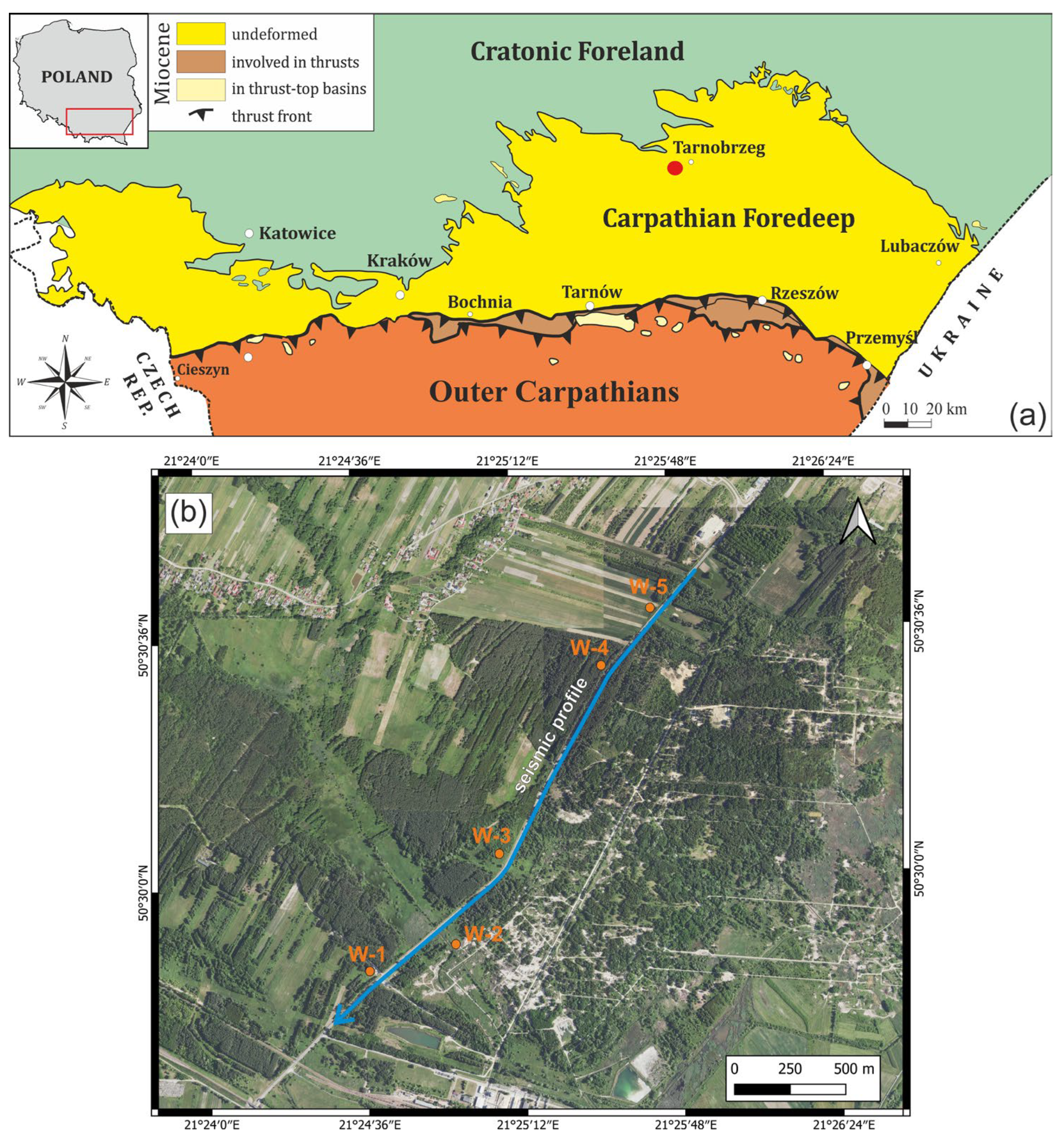
The study area is situated in southeastern Poland, within the northern part of the Carpathian Foredeep (Figure 1). The Carpathian Foredeep is a peripheral basin formed in association with the evolution of the Carpathian orogen. Its fill consists mainly of Miocene clastic sediments, locally several kilometres thick. Northward, these strata thin and overlie older Precambrian to Mesozoic basement and cover units, whereas southward they pass beneath the Carpathian thrust belt and flysch succession [24]. Sedimentation within the basin was strongly affected by the irregular relief of the pre-Miocene basement, including fault-bounded blocks and structural highs and depressions, which led to marked lateral changes in Miocene lithofacies [25,26].
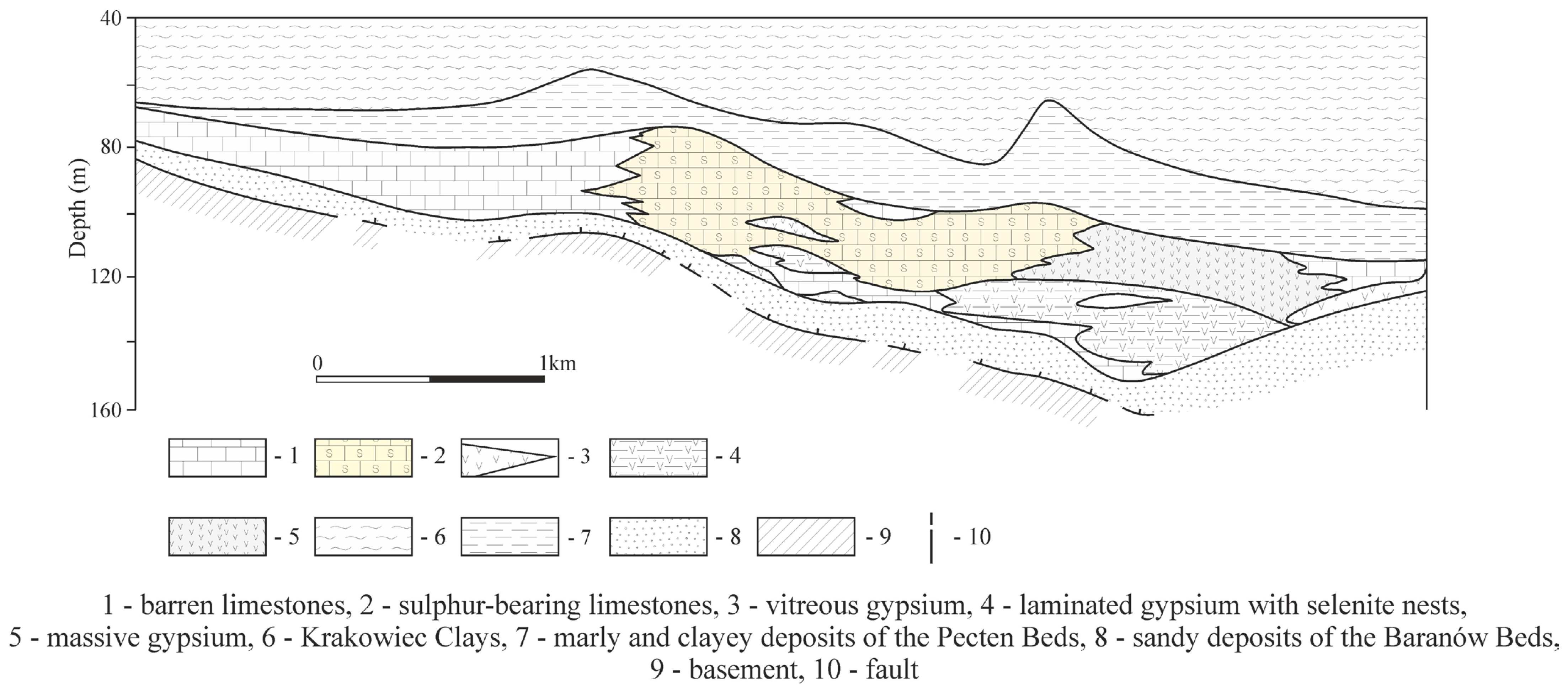
Sulphur deposits occurring in the Carpathian Foredeep are associated with gypsum of the evaporitic Krzyżanowice Formation (the chemical series) of Middle Miocene (Badenian) age. The basal part of the succession consists of mudstones and sandstones of the Baranów Beds or, locally, sandy lithothamnian limestones. The evaporitic interval is overlain by clayey and clay-marly deposits of the Machów Formation, within which two main units are distinguished: the lower Pecten-Spirialis Beds and the upper Krakowiec Clays. The ore-bearing interval is composed of sulphur-bearing limestones accompanied by barren limestones and locally preserved relics of unreplaced gypsum. Gypsum may also occur at the base, and less commonly at the top, of the limestone sequence or as irregular bodies within the deposit, forming so-called gypsum “islands”. The ore series is characterized by considerable local variability in lithology and structure, reflecting the complex conditions of sulphur formation related to gypsum transformation and subsequent diagenetic processes. A generalized geological cross-section through the eastern part of the Osiek sulphur deposit is presented in Figure 2. The complex history of sulphur mineralization results in significant heterogeneity in the internal structure, parameters, and physical properties of the sulphur-bearing limestones [27,28,29]. Abrupt transitions between sulphur-bearing and barren limestones are common. Additionally, unreplaced gypsum may occur within the ore horizon, forming irregular bodies referred to as gypsum “islands”. Structural disturbances also influence the geometry and internal architecture of the deposits. Sulphur deposits documented in Poland are typically associated with horst structures, within which faults with displacements of several metres are commonly observed [29].
Native sulphur mineralization developed within sulphur-bearing limestones formed by the bacterial reduction of gypsum in the presence of hydrocarbons [1,30,31,32]. The ore-bearing series shows considerable thickness variability, ranging from only a few metres to several tens of metres; in some places it reaches 46 m, while its average thickness is close to 25 m. The deposit occurs at an average depth of about 110–150 m.
Figure 2. Generalized geological cross-section through the Osiek sulphur deposit [33], modified.
Applsci 16 05143 g002

2.2. Rock Physics Model of the Sulphur Reservoir

A reliable reservoir model and knowledge of its physical properties are essential for seismic interpretation because the petrophysical parameters of the deposit directly control the propagation velocity of P-waves. These parameters therefore influence both the reflection coefficient at the top of the reservoir and the amplitude of the seismic reflection from this interface. Direct measurements of P-wave velocity required for seismic reservoir characterization were, however, obtained in only a limited number of boreholes. Consequently, theoretical models were applied to investigate the influence of reservoir petrophysical properties on the seismic response in a more comprehensive manner.
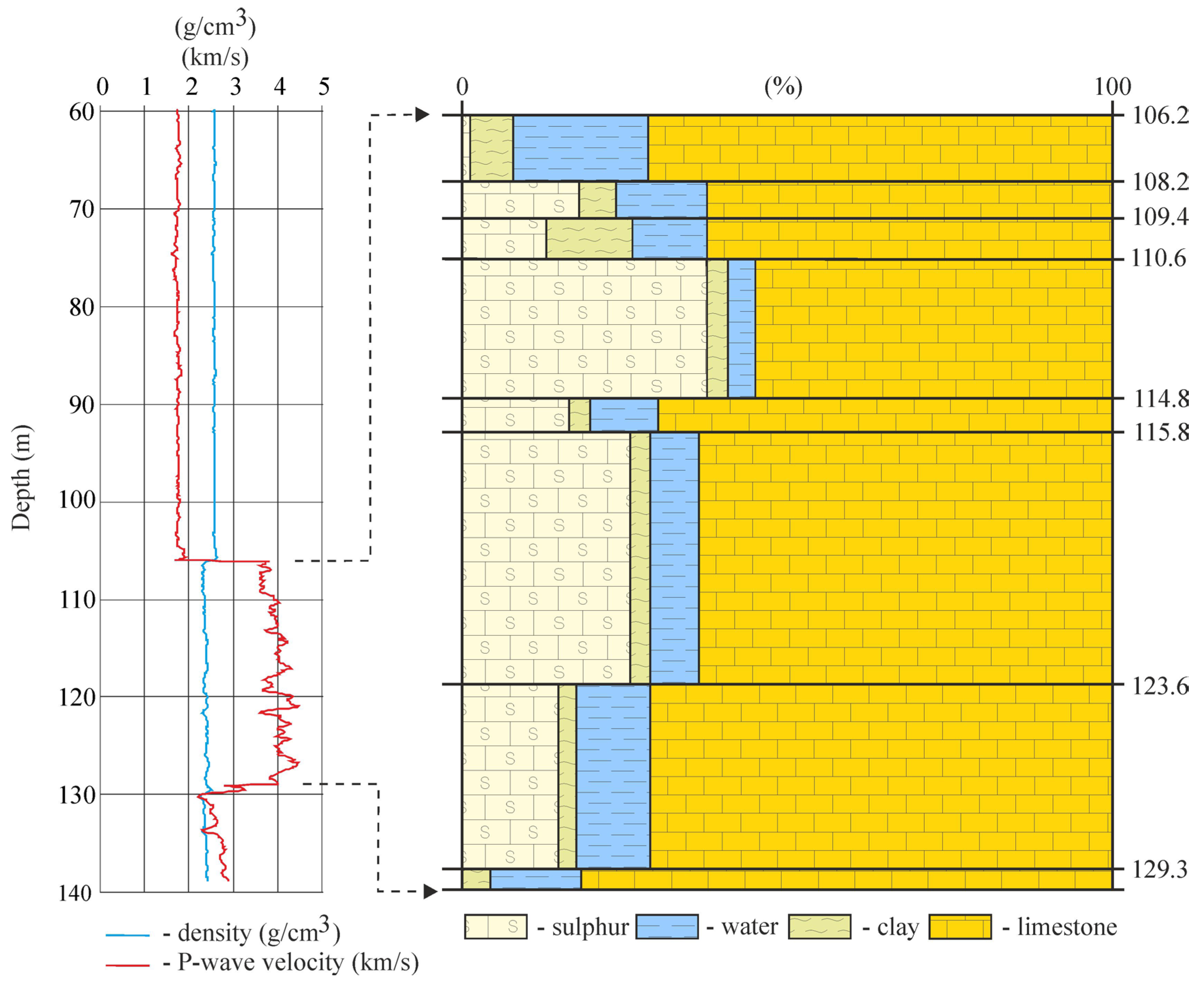
The principal factors controlling seismic wave velocity within the reservoir are the elastic properties of limestone, native sulphur, and the pore-filling fluid (water). Figure 3 presents lithology and the elastic parameters of the deposit derived from borehole W1 (see Figure 1 for location). The reservoir consists predominantly of limestone, while the clay fraction is minor and generally does not exceed a few percent.
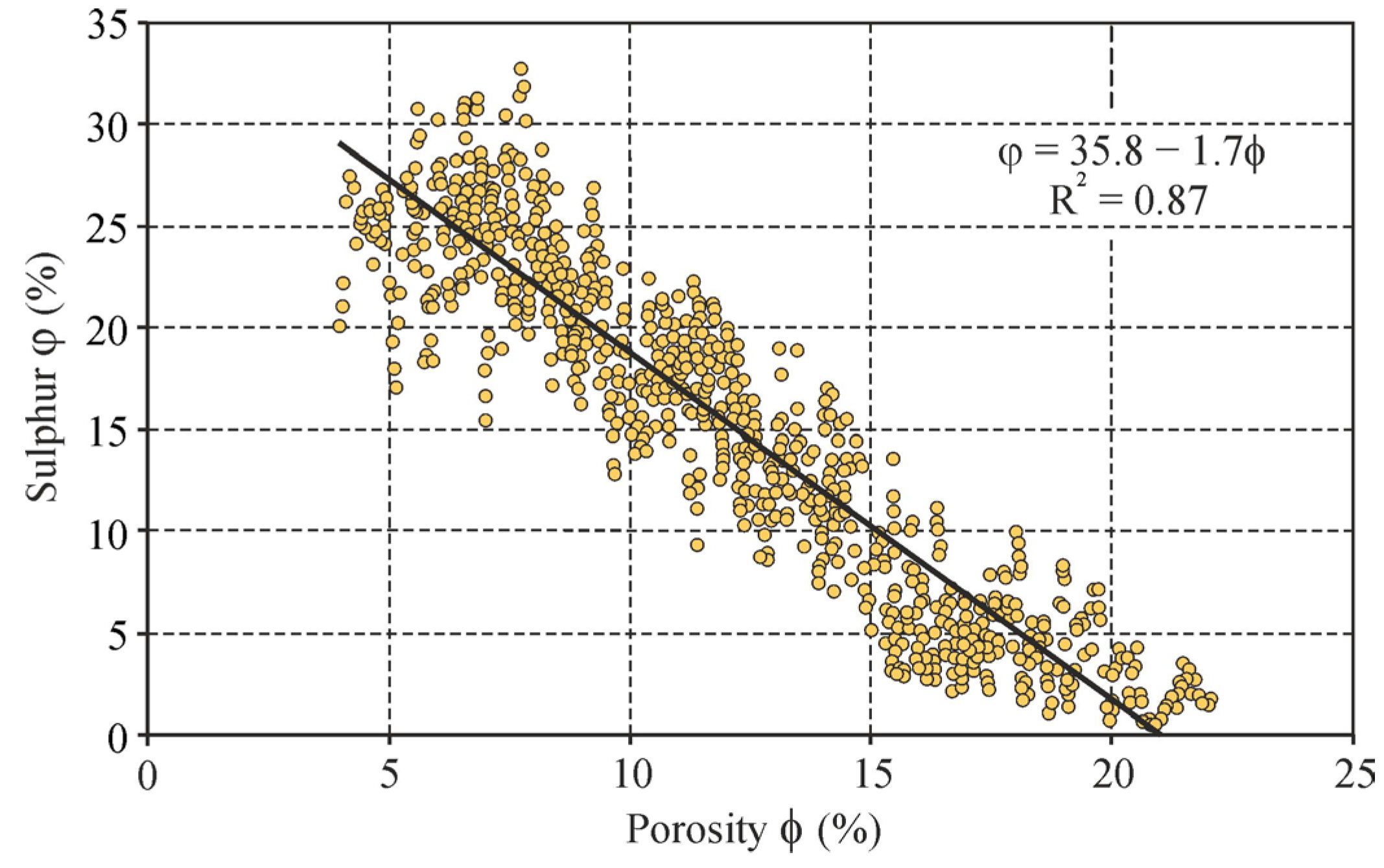
In the Osiek reservoir, porosity and sulphur content are closely linked through the pore-filling character of native sulphur mineralization. Intervals enriched in sulphur generally contain less open pore space, because part of the original void system is occupied by native sulphur. This inverse relationship was quantified using borehole data from multiple wells within the ore-bearing series. The resulting regression, shown in Figure 4, provides an empirical conversion between average reservoir porosity and sulphur content and is expressed as:
φ = 35.8 1.7 · ϕ
where φ represents the sulphur content (%), and ϕ represents porosity (%). The coefficient of determination for the linear estimator is R2 = 0.87. The intercept of the linear estimator is a statistical regression parameter obtained from fitting the borehole data within the calibrated porosity range. It should not be interpreted as physically meaningful sulphur content at zero porosity, because the relationship was not calibrated for such conditions.
This dependence is considered representative for the entire deposit area within the calibrated porosity range of 3–22%, where the borehole dataset is sufficiently populated and the correlation is well constrained. Outside this interval, the number of observations is limited and the porosity-sulphur relationship becomes more scattered. Therefore, Equation (1) should not be used as a robust extrapolation beyond the calibrated range, and any estimates obtained for porosity values below 3% or above 22% should be treated as approximate and requires borehole verification.
The lithological profile in Figure 3 indicates that the studied reservoir intervals are dominated by carbonate rocks, whereas the clay admixture is generally minor. Therefore, for massive limestone intervals, the reservoir can be approximated by a simplified three-component model composed of a limestone framework, native sulphur, and water remaining in the pore space. This model should be treated as a first-order approximation and is most appropriate mainly for massive limestones with low clay content. Where the carbonate interval becomes marly, the velocity of the effective rock framework decreases, and the simplified model may overestimate P-wave velocity. According to experimental data [34], the P-wave velocity in sulphur is Vsp = 2500 m/s, while the velocity in the limestone skeleton is Vm = 6200 m/s [35]. The P-wave velocity in water is assumed to be Vw = 1410 m/s.
Following the equation proposed by Wyllie [36], the velocity model for the three-component reservoir can be written as:
1 V P = 1 ϕ φ V m + ϕ V w + φ V s p
where VP is the estimated P-wave velocity of the reservoir layer.
By substituting the porosity-sulphur relationship (1) into Equation (2), the velocity can be expressed solely as a function of porosity:
1 V P = 1 ϕ 0.358 1.73 ϕ V m +   ϕ V w   + 0.358 1.7 ϕ V s p
In this formulation, the sulphur content is incorporated implicitly through the functional relationship with porosity. With this equation, the average seismic velocity can be associated with a specific porosity value. Variations in porosity result in corresponding changes in velocity, while the obtained velocity also reflects the related variation in sulphur content for the associated porosity value.
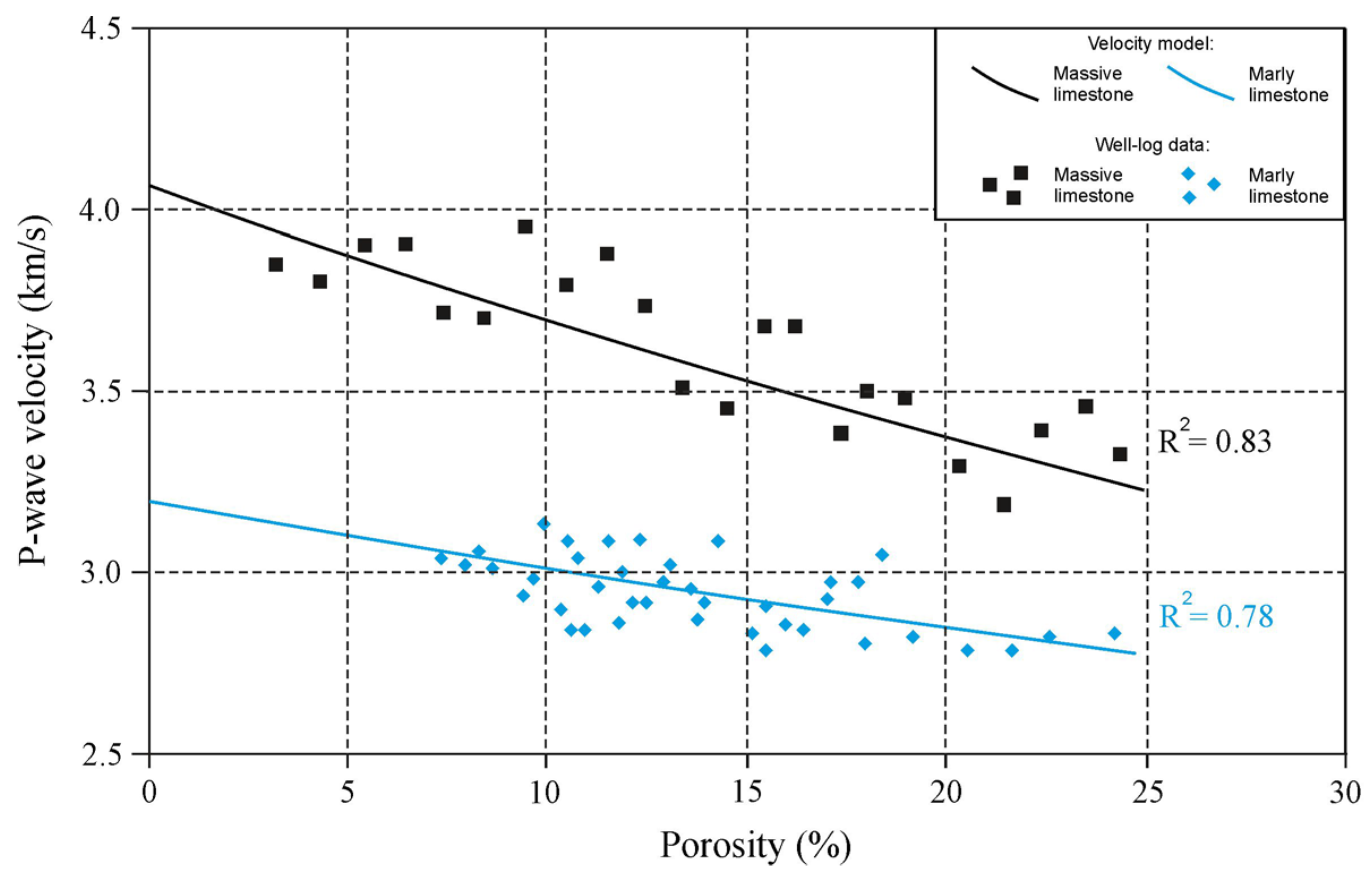
The velocity trends shown in Figure 5 illustrate the expected dependence of P-wave velocity on reservoir porosity for different carbonate-framework properties. The black curve calculated for a consolidated limestone framework reproduces the general range of interval velocities obtained from well-log data (black points), indicating that the three-component model provides a reasonable approximation for massive sulphur-bearing limestone intervals with low clay content. In this case, increasing porosity leads to a clear reduction in P-wave velocity, from values close to 4000 m/s to approximately 3300 m/s. The estimator is most reliable within the porosity range for which the porosity-sulphur relationship was calibrated. In parts of the reservoir where sulphur content is low, borehole data indicate a lithological transition from massive crystalline limestone to more marly carbonate rocks. This lithological change lowers the effective velocity of the carbonate framework and introduces additional uncertainty into velocity estimation. After accounting for increased clay content, the calculated velocities decrease to approximately 3000–2800 m/s (blue curve in Figure 5) and remain consistent with the corresponding well-log observations (blue points). In clay-rich or marly intervals, the marly-limestone trend provides a more appropriate approximation than the massive-limestone estimator.
The porosity-sulphur relationship shown in Figure 4 also indicates a moderate scatter in sulphur content for a given porosity value. In most cases, the deviation from the estimated trend remains within approximately ±7%, which translates into a relatively small uncertainty in modelled P-wave velocity, typically on the order of 2–3%. The agreement between the calculated velocity trends and borehole-derived interval velocities confirms that porosity is one of the main factors controlling the seismic properties of the sulphur-bearing carbonate interval. Therefore, variations in porosity have a significant impact on P-wave velocity and, consequently, the reflection coefficient and seismic amplitude.
Borehole W1 (Figure 3) confirms that the carbonate reservoir has a significantly higher P-wave velocity than the surrounding formations (Figure 3). Within the sulphur-bearing interval, velocities are usually close to 4000 m/s, although they vary according to porosity and degree of mineralization. Porous limestones with low sulphur content may show velocities of about 3200 m/s, whereas compact, strongly mineralized intervals reach approximately 4100 m/s. The P-wave velocity in the overburden is much lower, with average values near 1800 m/s. This contrast creates clear impedance boundaries at the top and base of the chemical series, making the sulphur-bearing interval clearly distinguishable on the seismic section.
The rock physics study indicates that the amplitude of the reflection from the top of the ore-bearing interval is governed mainly by porosity, consolidation, and the related changes in P-wave velocity. Where native sulphur fills part of the pore space, the rock becomes less porous, denser, and stiffer. Such intervals are expected to generate stronger positive reflections from the reservoir top. By contrast, fractured or highly porous limestones with lower sulphur content should be expressed by weaker amplitudes because of their reduced velocity. The use of the reservoir-top reflection as a proxy for average interval properties is justified mainly where the sulphur-bearing limestone behaves as a relatively homogeneous seismic unit at the available vertical resolution. In such zones, the top reflection represents the effective impedance contrast between the overburden and the carbonate reservoir. This amplitude–property relationship provides the basis for estimating reservoir porosity based on the amplitude of seismic reflections from the top of the sulphur deposit. The estimated porosity can then be converted into sulphur content using the empirical porosity-sulphur relationship shown in Figure 4.
Unreplaced gypsum bodies may also modify the seismic response of the chemical series. This is particularly important in the marginal parts of the Osiek deposit, where gypsum interbeds or gypsum layers underlying sulphur-bearing limestones are common. In the Osiek area, gypsum is characterized by a P-wave velocity of approximately 3500 m/s; therefore, its acoustic contrast with sulphur-bearing limestone depends on the local porosity, sulphur content, and degree of consolidation of the carbonate interval. The reflection from the top of the chemical series remains the dominant seismic event, because the reflection coefficient at this boundary is the highest. However, additional weaker reflections may occur at internal limestone–gypsum and gypsum–mudstone boundaries.

3. Methods

The acquisition scheme and processing workflow were adapted to the specific conditions of the investigated sulphur-bearing carbonate interval. The target occurs at shallow depth and is characterized by high seismic velocities, which restrict the vertical resolving power of the seismic method. Therefore, the survey had to provide both a sufficiently detailed image of the chemical series and reliable amplitudes suitable for quantitative interpretation [23]. In this context, special attention was paid to limiting distortions of recorded amplitudes, because changes in reflection strength carry information on contrasts in acoustic properties at lithological boundaries [11]. These contrasts are linked to variations in reservoir parameters, including porosity and sulphur content. Thus, preserving relative amplitude relationships along the seismic profile was essential for using the data in reservoir characterization.

3.1. Seismic Data Acquisition

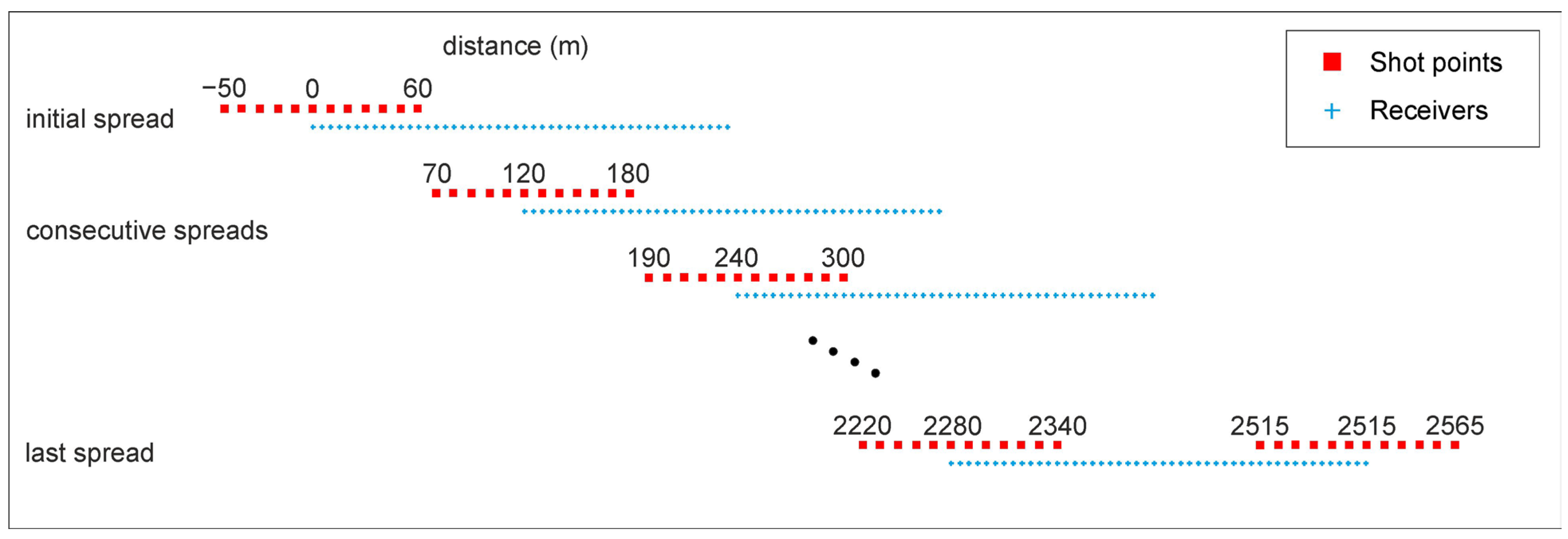
The seismic survey was conducted along the main roadway crossing the study area. Due to heavy traffic along this route, data acquisition was performed during nighttime hours in order to reduce non-stationary, traffic-related noise and improve the signal-to-noise ratio. Although background noise was not completely eliminated, its reduced level allowed for more effective stacking and filtering. The field campaign lasted two days. The seismic survey was conducted using 48 vertical 100 Hz geophones deployed at 5 m receiver spacing and connected to a Geode recording system (Geometrics, San Jose, CA, USA). The selected geophones are suitable for shallow targets (depths of tens of metres), as they enhance sensitivity to higher frequencies (approximately 80–250 Hz), which are required for high-resolution imaging of thin layers. Data were acquired with a variable end-on roll-along spread. Seismic energy was generated every 10 m using a 227 kg ESS-500 Turbo weight-drop source (GISCO, Minneapolis, MN, USA). The source was used directly on the asphalt pavement, which provided favourable and repeatable conditions and resulted in high-quality recordings. However, the consistency of near-surface energy transfer may also depend on local pavement and ground conditions. Owing to the generally strong coupling, only two impacts were performed at each shot location and subsequently vertically stacked. The first shot point was positioned 50 m from the first receiver. When the source reached the thirteenth receiver position, the spread was moved forward while maintaining a 50 m offset relative to the first geophone of the new spread location. After the last spread had been completed, additional shots were acquired from the position corresponding to receiver 36, to obtain a maximum source-receiver offset of 50 m relative to the last active receiver. This acquisition geometry was intentionally designed to avoid recording seismic traces from the central part of the spread, where surface waves typically dominate the wavefield and may significantly distort reflected signals.
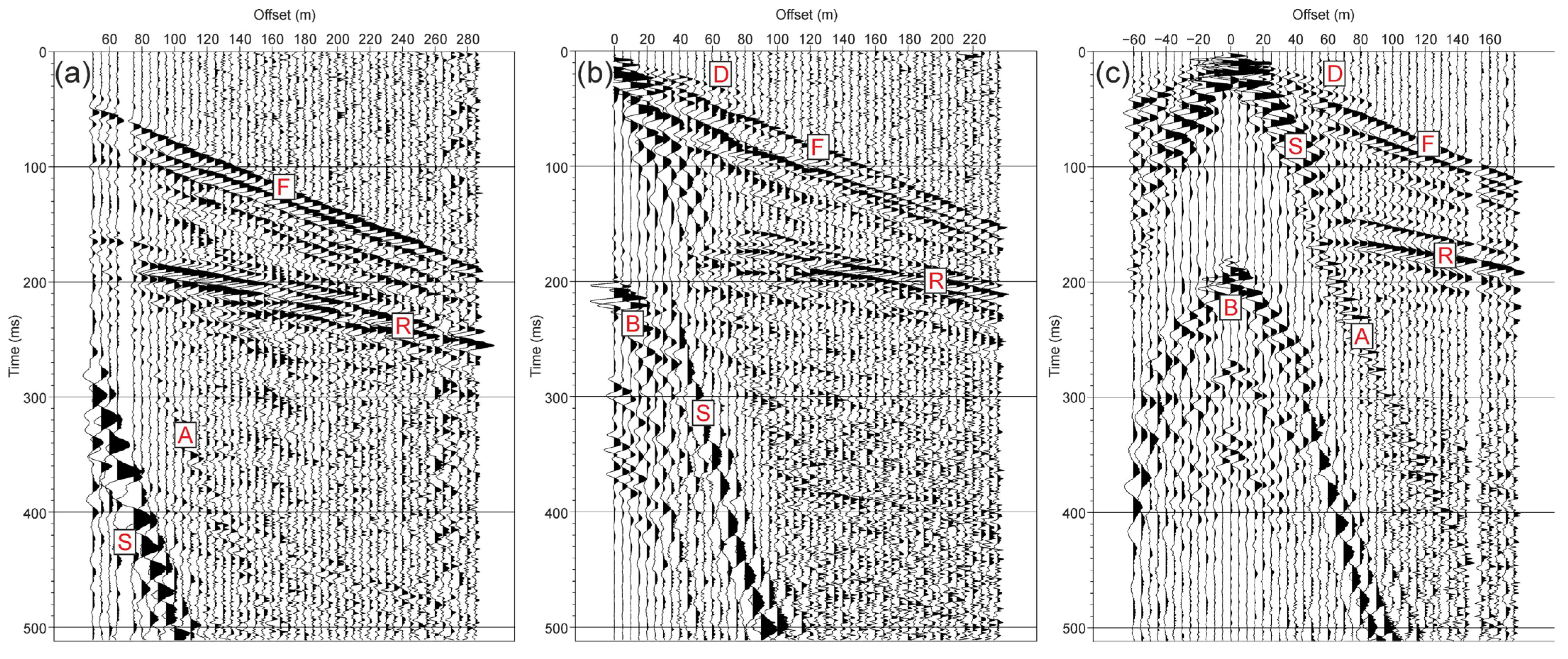
The total length of the shot line was 2625 m, while the receiver line extended over 2515 m. The acquisition geometry resulted in an average fold of approximately 15 and a common midpoint (CMP) spacing of 2.5 m, yielding a total seismic profile length of 2572.5 m. Acquisition parameters are summarized in Table 1, and the field acquisition scheme is shown in Figure 6. Figure 7 presents three representative raw shot gathers acquired along the profile. All records show clear first arrivals, including direct waves, refracted waves, and air waves. Reflection events dominate within the time window between approximately 50 and 250 ms.
The applied acquisition geometry causes surface waves and air waves to arrive later than the reflections from the deposit. Therefore, their amplitudes do not overlap with the seismic response of the reservoir layer. However, in shot gathers corresponding to the thirteenth receiver position, surface and air waves partially obscure reflection events. Because seismic waves were generated on a rigid asphalt surface using an impact source, secondary impacts were produced due to the rebound of the dropped mass. This effect caused repeated generation of the seismic wavefield. In addition, a fast direct wave propagating through the asphalt layer is observed, although it disappears at offsets less than approximately 70 m from the source (Figure 7). In general, the seismic records exhibit good data quality, although they are contaminated by high-frequency noise.

3.2. Seismic Data Processing

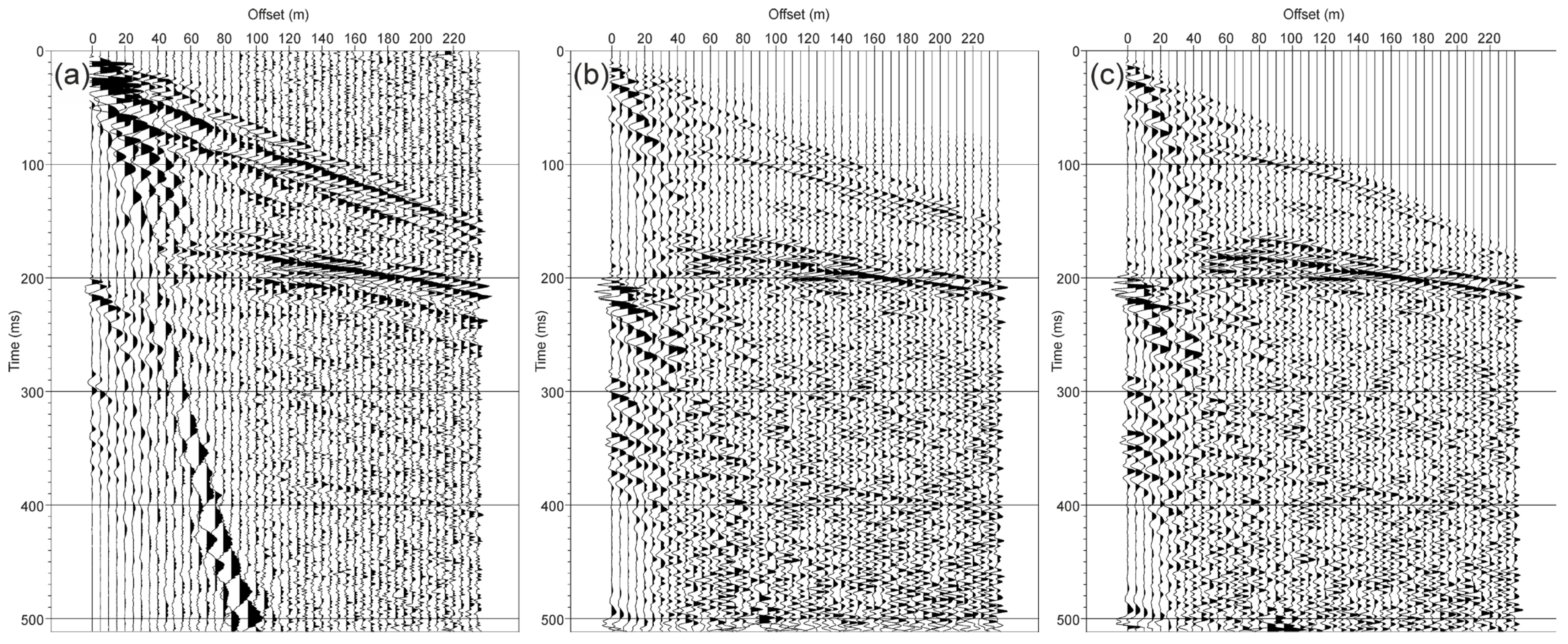
Processing was aimed at obtaining a migrated section suitable for amplitude-based interpretation. The workflow was kept conservative and followed relative amplitude preservation principles [22]. The main objective was to improve the continuity and resolution of the target reflections while preserving useful signal energy and avoiding artificial amplitude balancing. Therefore, aggressive signal enhancement techniques or strong gain functions such as automatic gain control (AGC) or trace equalization were not used because they may artificially amplify or suppress reflections and consequently distort the relationship between amplitude and reservoir properties. Processing was carried out using the Vista 2D/3D Seismic Data Processing 2025 software (https://www.slb.com/products-and-services/delivering-digital-at-scale/software/vista/vista-desktop-seismic-data-processing-software, accessed on 14 May 2026, Schlumberger, Houston, TX, USA). The complete processing sequence is summarized in Table 2, while Figure 8 illustrates the effectiveness of selected processing steps on a representative shot gather. Each processing step was carefully evaluated by comparing input and output gathers to ensure preservation of useful signal and to avoid amplitude distortions.
The preliminary processing workflow included defining the survey geometry and eliminating noisy traces caused by malfunctioning geophones or insufficient ground coupling (Figure 8a). Next, a spherical divergence correction was applied to compensate for amplitude decay caused by wavefront expansion using a smoothed velocity field without introducing local artefacts. This correction is essential in amplitude-preserving processing workflows [22]. The generation of seismic waves on asphalt produced fast direct waves propagating within the pavement layer. The velocity of the direct wave travelling through asphalt was approximately 3200 m/s, whereas refracted waves propagating through the geological medium exhibited velocities around 1780 m/s. These distinct velocity values allowed straightforward identification of the two wave types for the picking of first arrivals.
Static corrections were determined through analysis of the picked first-arrival travel times. The refraction model used for these corrections was built from the apparent slopes of the travel-time curves together with their corresponding intercept times. To reduce source- and receiver-related amplitude variations while preserving lateral changes related to subsurface reflectivity, the surface-consistent amplitude scaling was applied. Predictive deconvolution was subsequently used to enhance vertical resolution and suppress multiples. The operator length was set to 60 ms with a prediction lag of 8 ms. These parameters were selected after testing their influence on the target reflections. The next processing step involved frequency filtering in the 40/60–200/250 Hz range. This operation reduced high-frequency noise enhanced by deconvolution and weakened surface-wave energy (Figure 8b). Previous studies [23] demonstrated that 100 Hz geophones operate effectively in the frequency range of approximately 75–500 Hz, whereas signal energy below 50 Hz is strongly attenuated. Consequently, removing frequencies below 40 Hz did not lead to loss of useful signal in the dataset. After band-pass filtering, the data were shifted to a floating datum defined by a smoothed ground surface.
To prepare the data for subsequent processing steps, the dataset was sorted from the shot domain to the common midpoint (CMP) domain. Velocity analysis was performed manually using semblance spectra, CMP gathers, and constant-velocity stacks at 50 m intervals. Normal moveout (NMO) correction was applied to flatten reflection hyperbolas and obtain zero-offset travel times. First arrivals were subsequently muted using an NMO stretch mute with a threshold of 100%, which allowed preservation of shallow reflections while maintaining a high fold in the shallow part of the records. Residual statics corrections were then applied to minimize remaining near-surface irregularities.
Random noise, air waves, and noise bursts were attenuated using the THOR procedure [37,38]. THOR is a threshold-based noise attenuation method that replaces noisy samples using a median operator in the frequency domain without damaging the signal. In this study, a time window of 60 ms and a spatial window of 13 traces were used. Nevertheless, two types of coherent noise remained visible. The first was a wavefield generated by the rebound of the dropped mass approximately 200 ms after the initial impact. Because this energy occurred below the time window of the target reflections, no additional attenuation was required. The second type consisted of residual surface waves affecting near offsets. To minimize their influence, traces with offsets smaller than 40 m were excluded from the stacking procedure.
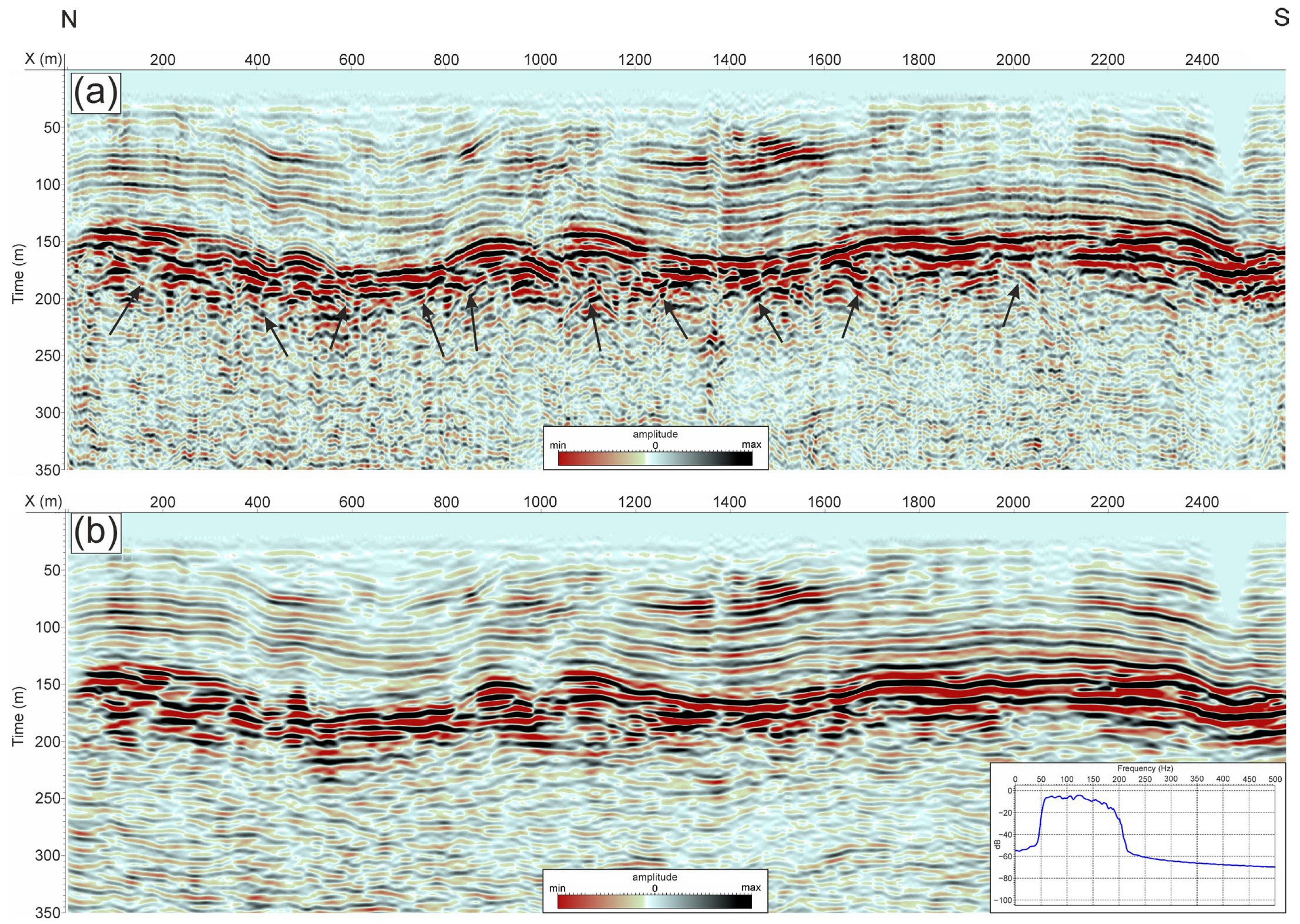
After stacking, some incoherent noise remained in the seismic section. To further reduce random noise and enhance the coherency of reflections, additional band-pass filtering and FX deconvolution were applied. The resulting stacked section is shown in Figure 9a. Numerous diffractions are visible on the stacked section, indicating the presence of faults along the profile. To collapse these diffractions and reposition dipping reflectors to their true subsurface locations, a Kirchhoff time migration was performed (Figure 9b). The final migrated time section exhibits a frequency bandwidth of approximately 40–220 Hz with a dominant frequency of about 120 Hz. Reflections associated with the sulphur-bearing limestone reservoir are clearly visible between 140 and 220 ms. Finally, the migrated time section was converted to the depth domain using a smoothed stacking velocity model.

4. Results and Discussion

4.1. Determination of the Relationship Between Average Porosity and the Amplitude Reflected from the Top of the Deposit

The quantitative interpretation was based on the amplitude response of the reflector marking the top of the sulphur-bearing limestone. For each trace, the RMS (root mean square) amplitude was calculated within a 6 ms window centred on the interpreted reservoir-top event. This short window was selected to include the main energy of the reservoir-top reflection and to reduce the contribution of neighboring events. The extracted amplitudes were then tied to borehole control. At locations where well data were available, reflection coefficients were calculated from the logs and used to scale the seismic amplitudes A(x) to physically meaningful reflectivity values. The scaled reflection coefficient r(x) at any profile position (x) was obtained from:
r x = A x r w e l l A x w e l l
where r w e l l represents the reflection coefficient calculated for the top of the deposit at the borehole location, and A ( X w e l l ) denotes the amplitude of the reflection from this boundary recorded at the same position.
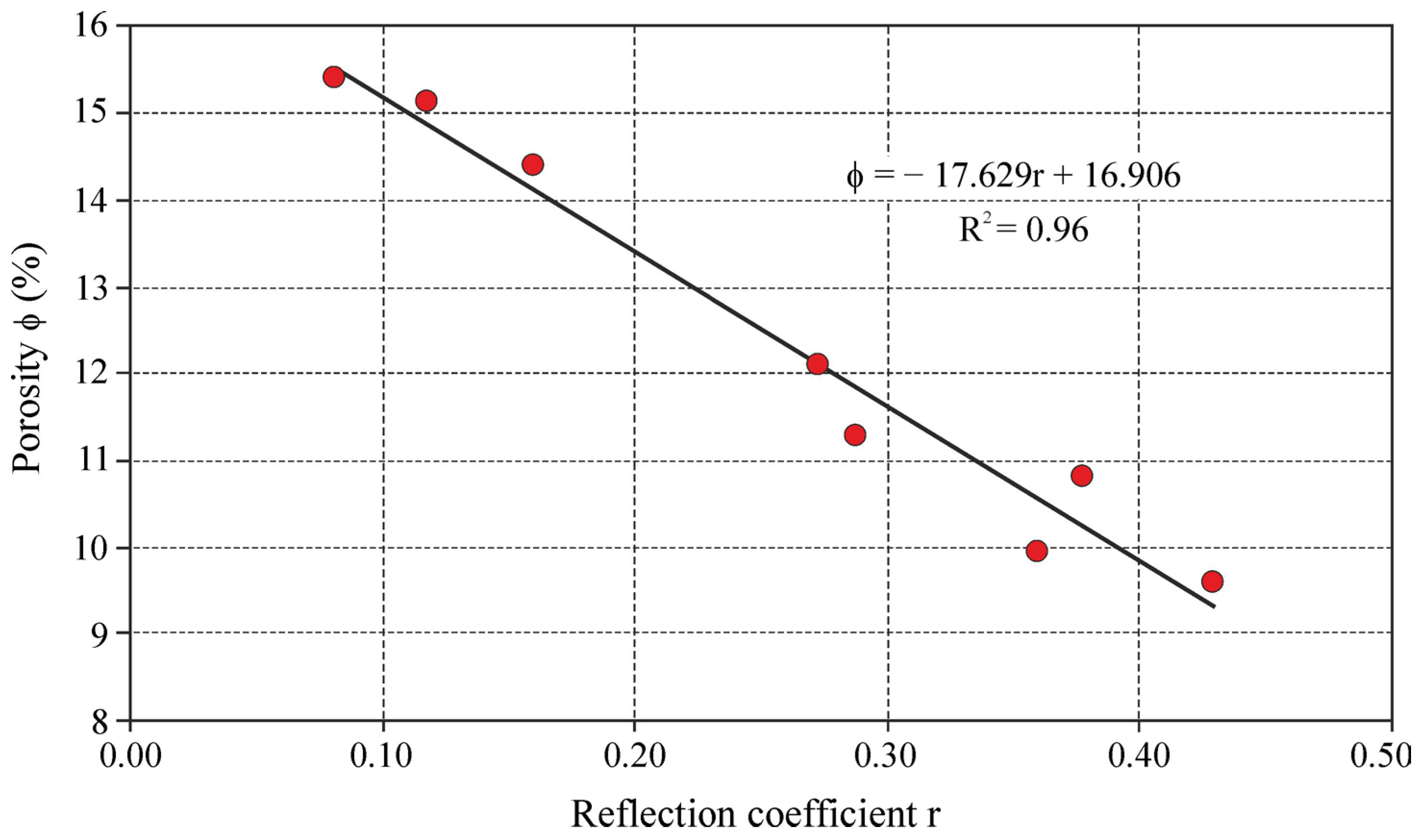
After calibration, the reflectivity values extracted at borehole locations were compared with average reservoir porosity from well logs. This comparison shows a clear linear trend (Figure 10), indicating that the calibrated reservoir-top amplitude can be used as a proxy for average porosity. The fitted relationship is:
ϕ = 17.629 × r + 16.906
The porosity values obtained from Equation (5) were subsequently converted into sulphur content using the empirical porosity–sulphur trend defined in Equation (1).

4.2. Identification of Deposit Structure and Porosity Along the Seismic Profile

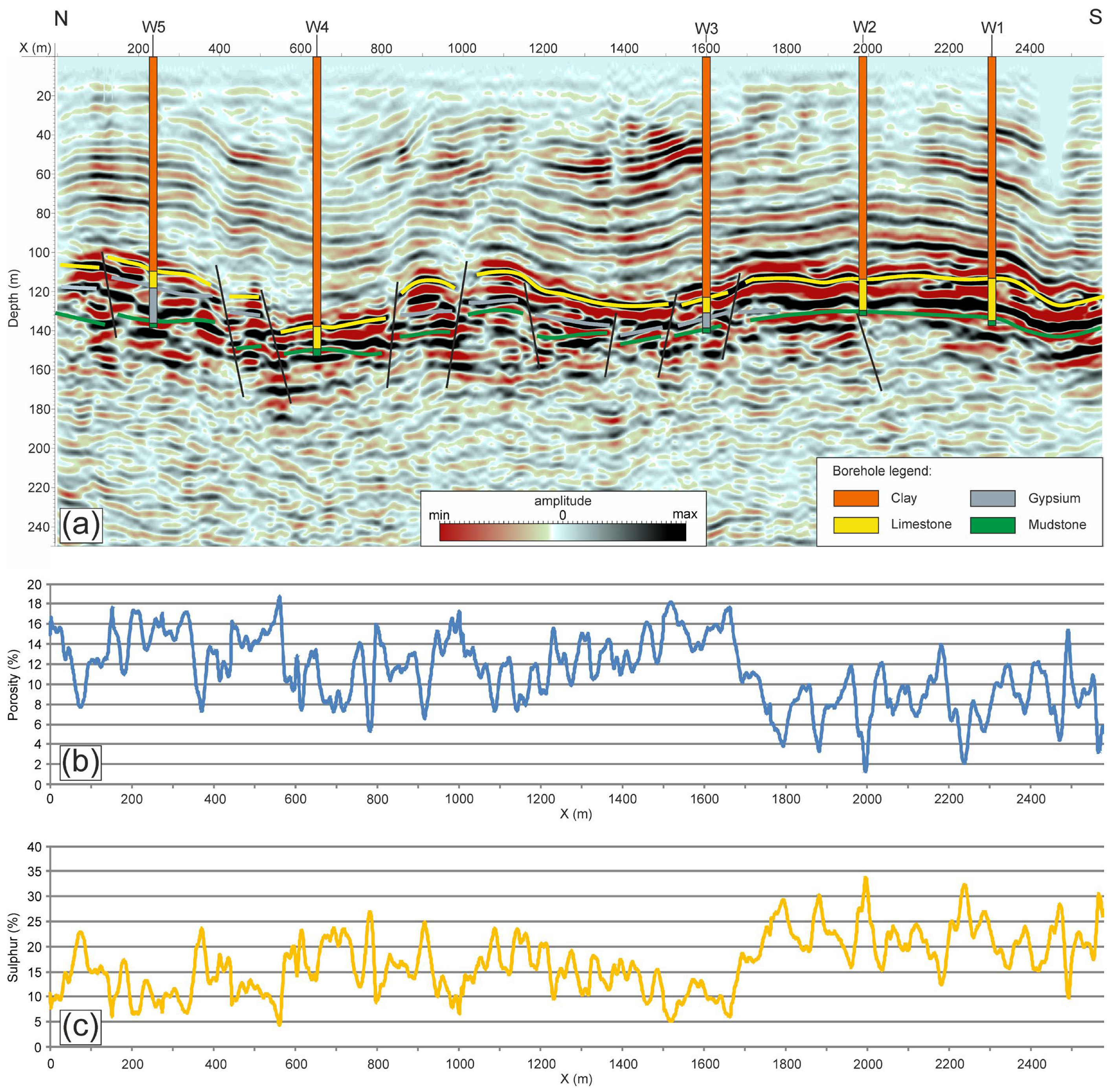
The depth-converted seismic section is presented in Figure 11 and illustrates the structure of the deposit in its western marginal zone. The acquisition geometry, with a CMP spacing of 2.5 m, enabled high-resolution seismic imaging, revealing a laterally variable and structurally complex architecture of the deposit. Boreholes located in the vicinity of the profile (Figure 1) were projected onto the seismic section, allowing for calibration of seismic interpretation with geological data and for identification of the spatial distribution of sulphur-bearing limestones and the extent of gypsum occurrence.
The reflector configuration within the overburden generally follows the morphology of the top of the chemical series, suggesting that the observed structure of the deposit is primarily controlled by tectonic processes. The overburden is continuous and only gently folded, whereas the deposit itself is dissected by several faults that offset individual structural blocks. The highest degree of tectonic deformation is observed within the first 1700 m of the profile (from the northern side), where numerous small horsts and grabens occur, with displacements reaching up to 10 m. Between 1700 and 2400 m, a structural high corresponding to a relatively coherent tectonic block is identified, followed by another structural depression at the end of the profile.
The thickness of the chemical series varies between 20 and 30 m. In the first 1700 m of the profile, an additional positive reflection is observed within the chemical series, which is interpreted as the presence of gypsum. This interpretation is supported by borehole data (W3 and W5), located near the seismic line. The occurrence of gypsum significantly reduces the thickness of the sulphur-bearing limestone interval and thus the resource potential of the deposit. In the vicinity of these boreholes, the total thickness of the chemical series ranges from 27 to 40 m, with the limestone interval reaching 11–14 m and the underlying gypsum ranging from 11 to 24 m. An exception in this area is observed in a small tectonic depression near borehole W4, where no gypsum was encountered.
Gypsum pinches out at approximately 1800 m along the profile, onlapping into the underlying mudstones. Beyond this point, the additional seismic reflection disappears, and only distinct reflections from the top and base of the deposit are observed, which is consistent with borehole data indicating the absence of gypsum.
For porosity estimation, RMS amplitudes were first extracted from the interpreted horizon corresponding to the top of the reservoir. These amplitudes were then transformed into calibrated reflection coefficients according to Equation (4). The resulting reflectivity values were then transformed into average porosity using Equation (5), and sulphur content was obtained from the empirical porosity–sulphur relationship according to Equation (1) (Figure 11c). A clear lateral variation in porosity is observed along the profile. In the tectonically disturbed zone (0–1700 m), porosity ranges from 6% to 18%, with an average of approximately 13.5%, while the corresponding sulphur content varies between 5% and 25% (average ca. 15%). In contrast, within the structural high (beyond 1700 m), porosity decreases to values between 1% and 14% (average ca. 8%), whereas sulphur content increases to 10–35% (average ca. 21.5%).
These results indicate that zones affected by tectonic deformation and the presence of gypsum are associated with increased porosity of the limestone reservoir. In contrast, within the relatively homogeneous structural block extending from borehole W3 toward the end of the profile, the chemical series is composed predominantly of low-porosity limestones with increased sulphur content.
A comparison of average deposit parameters derived from borehole data and seismic amplitudes is presented in Table 3. This comparison was used as the main validation of the amplitude-based quantitative interpretation. For boreholes W1, W2, and W4, the differences between seismic-derived and borehole-derived parameters do not exceed 2%, which indicates that the calibrated amplitudes provide reliable estimates in intervals composed mainly of sulphur-bearing limestones. Larger discrepancies are observed for boreholes W3 and W5, where the differences reach approximately 5%. These boreholes are located in zones where gypsum is present within the chemical series. Therefore, the increased error is most likely related to interference between reflections from closely spaced lithological boundaries. Overall, the validation confirms that the amplitude attribute is suitable for quantitative interpretation in relatively homogeneous limestone intervals, whereas lithological complexity increases uncertainty. The most prospective zone is therefore located in the southern segment of the profile, corresponding to the structural high between 1700 and 2400 m. This interval is characterized by sulphur content exceeding 20% and is composed exclusively of sulphur-bearing limestones, with no occurrence of gypsum.

4.3. Discussion of the Results

The objective of this study was to assess the resource potential of a sulphur deposit located in its western marginal zone, where unreplaced gypsum occurs and the geological structure is particularly complex. The mineralized carbonate interval occurs relatively shallowly, at approximately 110–150 m below the surface, and its average thickness is close to 25 m. Given the objective of quantitative estimation of petrophysical parameters from seismic data, both the acquisition design and data processing workflow were specifically optimized. As a result, a reliable distribution of seismic amplitudes was obtained, enabling accurate interpretation of deposit structure and estimation of porosity and sulphur content along the profile. The processed seismic data exhibit a bandwidth of 40–220 Hz and a dominant frequency of approximately 120 Hz (Figure 9b). Assuming a seismic velocity of 3600 m/s within the deposit, the vertical resolution, estimated according to the Widess criterion [39], is approximately 7.5 m. This resolution is sufficient relative to the deposit thickness and enables reliable identification of facies variations within the deposit.
The reliability of the amplitude-based interpretation was evaluated by direct comparison with borehole-derived porosity and sulphur content. The validation shows that, in gypsum-free or relatively homogeneous limestone intervals, the differences between seismic-derived and borehole-derived parameters remain low, generally not exceeding 2%. In zones where gypsum occurs within the chemical series, the discrepancies increase to approximately 5%. This pattern indicates that the reservoir-top amplitude is a reliable quantitative attribute when the reflected signal is dominated by the sulphur-bearing limestone interval. However, where additional lithological boundaries are present close to the reservoir top, interference effects may modify the RMS amplitude and reduce the accuracy of the estimates.
The interpretation of the reservoir-top amplitude must account for the fact that the recorded reflection is controlled by the acoustic properties of the interval immediately below this boundary. Where the sulphur-bearing limestone is relatively homogeneous and its thickness is sufficient with respect to the estimated vertical resolution, the top reflection can be treated as a proxy for average interval properties. This assumption is less reliable in zones affected by gypsum or rapid facies changes. In particular, when the top of gypsum occurs close to the top of the limestone interval, the measured RMS amplitude may include contributions from several closely spaced interfaces. A weak positive reflection may be generated at the limestone–gypsum boundary, whereas a negative reflection is expected at the gypsum–mudstone boundary. These internal reflections may overlap with the dominant reservoir-top response and reduce the accuracy of porosity and sulphur-content estimates.
Such effects are observed in the vicinity of boreholes W3 and W5, where the gypsum thickness exceeds that of the limestone interval. Interference between reflections from the top of the deposit and the top of the gypsum leads to increased uncertainty in the estimation of porosity and sulphur content. In gypsum-free zones, the estimation error is approximately 2%, whereas in zones where gypsum is present, it increases to about 5%. However, it remains relatively low, which, based on the presented correlations, makes it possible to estimate the porosity and sulphur content of the reservoir with a high degree of certainty.
Discrepancies between seismic-derived and borehole-derived parameters may result from measurement uncertainties as well as from the use of empirical relationships for determining porosity and sulphur content based on signal amplitude. It is important to remember, that the precise reservoir properties determined from borehole measurements apply to a very narrow zone around the borehole. Often, due to high variability, reservoir parameters a few metres from the borehole differ significantly from those determined within the borehole. In seismic surveys, despite their high horizontal resolution, the signal amplitude results from constructive interference within a zone with a radius of 2–3 m (the Fresnel zone after migration). Thus, the amplitude value is related to the reservoir parameters within a cylindrical zone of that radius. In contrast, in borehole surveys, petrophysical parameters are determined for the zone around the borehole, defined by the small radial range of the logging.
The proposed workflow is most useful as a cost-efficient screening tool before detailed drilling. It cannot replace boreholes, which remain necessary for lithological verification and calibration, but it can provide continuous information between wells and help optimize the location of additional boreholes. Compared with isolated drilling data, high-resolution reflection seismic profiling allows the geometry of the ore-bearing interval, fault zones, gypsum bodies, and lateral reservoir-property changes to be traced along the profile. The empirical relationships used in this study should be regarded as site-specific calibrations rather than universal equations. The porosity-sulphur relationship in Equation (1) was derived from borehole data from the Osiek area and is best constrained within the calibrated porosity range of 3–22%. Similarly, the relationship between the reflection coefficient and average porosity in Equation (5) depends on the local seismic response, the impedance contrast at the top of the sulphur-bearing limestone, the acquisition geometry, and the amplitude-preserving processing workflow. Therefore, application of these relationships to other carbonate-hosted sulphur deposits would require independent calibration using local borehole and seismic data. The approach may be transferred to similar deposits only where relative amplitudes can be preserved and where borehole data confirm a stable relationship between reflection amplitude, porosity, and sulphur content.
Compared with more advanced seismic quantitative interpretation methods, such as acoustic or pre-stack inversion, the proposed amplitude-based workflow is simpler and requires fewer input data. Acoustic inversion requires reliable P-wave velocity and density logs for calibration and low-frequency model building, but such data are available only from a limited number of boreholes in the Osiek deposit. Pre-stack inversion also requires carefully conditioned pre-stack gathers and sufficient fold and offset/angle coverage, which can be difficult to obtain in shallow reflection seismic profiling. In addition, pre-stack elastic analysis would require S-wave velocity data, which have not been measured in the Osiek area and would therefore have to be estimated from theoretical models, introducing additional uncertainty. In contrast, the approach used in this study is based on RMS amplitudes extracted from the reservoir-top reflection and calibrated with borehole-derived reflection coefficients. This makes the method faster, less data-demanding, and suitable for preliminary estimation of average porosity and sulphur content along seismic profiles.

5. Conclusions

This study demonstrates that high-resolution reflection seismic data can support quantitative evaluation of shallow sulphur-bearing carbonate deposits when relative amplitudes are preserved and borehole calibration is available.
Along the investigated profile, the seismic image revealed a structurally complex marginal part of the Osiek deposit. The northern segment is affected by faulting and locally contains unreplaced gypsum, whereas the southern segment forms a more coherent structural high composed mainly of sulphur-bearing limestones. This southern interval, located approximately between 1700 and 2400 m along the profile, shows the most favourable reservoir properties, including lower estimated porosity and increased sulphur content.
The observed amplitude pattern reflects the petrophysical variability of the carbonate reservoir. More strongly mineralized intervals are generally less porous because native sulphur fills part of the pore space. This makes the rock framework more rigid. As a result, sulphur-rich and low-porosity zones tend to generate stronger reflections, whereas more porous or weakly mineralized intervals are expressed by lower amplitudes.
Validation against borehole data shows that amplitude-derived estimates are most reliable where the chemical series consists mainly of homogeneous sulphur-bearing limestones. In such intervals, the differences between seismic-derived and borehole-derived parameters remain small (up to 2%). Higher discrepancies occur in gypsum-bearing zones, where interference between closely spaced reflections may modify the measured amplitude at the reservoir top. In such cases, the estimated uncertainty increases to approximately 5%, but remains reasonably low.
The approach should therefore be treated as a calibrated screening method for shallow sulphur-bearing carbonate deposits, rather than as a universal estimator applicable without local borehole control.

Funding

This research was funded by the subsidy granted to the AGH University of Krakow by the Ministry of Science and Higher Education, with additional support from the Osiek Sulphur Mine.

Data Availability Statement

Data are contained within the article.

Acknowledgments

The author would like to thank the Osiek Sulphur Mine for providing the data used in this study and Schlumberger for providing the Vista Seismic Data Processing software (https://www.slb.com/products-and-services/delivering-digital-at-scale/software/vista/vista-desktop-seismic-data-processing-software, accessed on 14 May 2026) through the University Software Donation Program. The author also thanks the Editor and the four anonymous Reviewers for their valuable comments and feedback, which helped improve the manuscript.

Conflicts of Interest

The author declares no conflicts of interest.

Abbreviations

The following abbreviations are used in this manuscript:
R2coefficient of determination
P-wavecompressional wave
CMPcommon midpoint
NMOnormal moveout
RAPrelative amplitude preservation
RMSroot-mean square
VPP-wave velocity of rock
VspP-wave velocity of sulphur
VwP-wave velocity of water
VmP-wave velocity of limestone skeleton
VNMOnormal move-out velocity
ϕporosity
φsulphur content
rreflection coefficient
A(xwell)amplitude from the deposit recorded at the position “x” of borehole
rwellvalue of the reflection coefficient from the deposit at the position of borehole

References

  1. Nieć, M. Native sulfur deposits in Poland. In Native Sulfur: Developments in Geology and Exploration; Wessel, G.R., Wimberly, B.H., Eds.; Society of Mining and Metallurgical Exploration: Littleton, CO, USA, 1992; pp. 23–50. [Google Scholar]
  2. Bolewski, A. Surowce Mineralne Świata. Siarka, Mineralogia i Petrografia; Wyd. Geologiczne: Warszawa, Poland, 1986. (In Polish) [Google Scholar]
  3. Pawłowski, S.; Pawłowska, K.; Kubica, B. Siarka rodzima. In Budowa Geologiczna Polski. T. 6. Złoża Surowców Mineralnych, Część IV: Surowce Chemiczne; Osika, R., Ed.; Wydawnictwo Geologiczne: Warszawa, Poland, 1987; pp. 378–412. (In Polish) [Google Scholar]
  4. Czapkowski, G.; Bukowski, K.; Gąsiewicz, A.; Sadłowska, K. Prospective areas and predicted resources of natural chemical raw materials in Poland presented on the maps at scale 1:200,000—Rock and potash salts and native sulphur. Przegląd Geol. 2015, 63, 561–571. (In Polish) [Google Scholar]
  5. Bońda, R. Siarka. In Bilans Zasobów złóż Kopalin w Polsce wg Stanu na 31.XII.2024r; Szuflicki, M., Malon, A., Tymiński, M., Eds.; PIG-PIB: Warszawa, Poland, 2021; pp. 77–79. (In Polish) [Google Scholar]
  6. Sermet, E.; Nieć, M. Not Mining Sterilization of Explored Mineral Resources. The Example of Native Sulfur Deposits in Poland Case History. Resources 2021, 10, 30. [Google Scholar] [CrossRef]
  7. Nieć, M.; Seremet, E. Discovery, geological investigation, mining and future of sulphur deposits in Poland. Przegląd Geol. 2023, 71, 631–638, (In Polish with English abstract). [Google Scholar]
  8. Dec, J. High resolution seismic investigations for the determination of water flow directions during sulphur deposits exploitation. Acta Geophys. 2010, 58, 5–14. [Google Scholar] [CrossRef]
  9. Dec, J. High-Resolution Seismic Survey for Recognition of the Osiek Sulphur Deposits and Determination of Dynamic Changes Resulting from Exploitation; Wydawnictwa AGH: Kraków, Poland, 2012. (In Polish) [Google Scholar]
  10. Cichostępski, K.; Dec, J. Estimation of shallow sulphur deposit resources based on reflection seismic studies and well logging. Energies 2021, 14, 5323. [Google Scholar] [CrossRef]
  11. Cichostępski, K.; Dec, J.; Kwietniak, A. Simultaneous Inversion of Shallow Seismic Data for Imaging of Sulfurized Carbonates. Minerals 2019, 9, 203. [Google Scholar] [CrossRef]
  12. Li, Y.Y.; Downton, J. Application of amplitude versus offset in carbonate reservoirs: Re-examining the potential. SEG Tech. Program Expand. Abstr. 2000, 19, 166–169. [Google Scholar]
  13. Brigaud, B.; Benoit, V.; Durlet, C.; Decininck, J.; Blanc, P.; Trouiller, A. Acoustic Properties of Ancient Shallow-Marine Carbonates: Effects of Depositional Environments and Diagenetic Processes (Middle Jurassic, Paris Basin, France). J. Sediment. Res. 2008, 80, 791–807. [Google Scholar] [CrossRef]
  14. Dong, W.; Tura, A.; Sparkman, G. An introduction—Carbonate geophysics. Lead. Edge 2003, 22, 637–638. [Google Scholar] [CrossRef]
  15. Chopra, S.; Chemingui, N.; Miller, R.D. An introduction to this special section—Carbonates. Lead. Edge 2005, 24, 488–489. [Google Scholar] [CrossRef]
  16. Zhan, W.; Zhuang, M.; Liu, Q.Q.; Shi, L.; Sun, Y.; Liu, Q.H. Frequency domain spectral element method for modelling poroelastic waves in 3-D anisotropic, heterogeneous and attenuative porous media. Geophys. J. Int. 2021, 227, 1339–1353. [Google Scholar] [CrossRef]
  17. Gil, A.; Malehmir, A.; Buske, S.; Alcalde, J.; Ayarza, P.; Martínez, Y.; Lindskog, L.; Spicer, B.; Carbonell, R.; Orlowsky, D.; et al. Reflection seismic imaging to unravel subsurface geological structures of the Zinkgruvan mining area, central Sweden. Ore Geol. Rev. 2021, 137, 104306. [Google Scholar] [CrossRef]
  18. Singh, B.; Malinowski, M. Seismic Imaging of Mineral Exploration Targets: Evaluation of Ray- vs. Wave-Equation-Based Pre-Stack Depth Migrations for Crooked 2D Profiles. Minerals 2023, 13, 264. [Google Scholar] [CrossRef]
  19. Harrison, C.B.; Urosevic, M. Seismic processing, inversion, and AVO for gold exploration—Case study from Western Australia. Geophysics 2012, 77, WC235–WC243. [Google Scholar] [CrossRef]
  20. Junno, N.; Koivisto, E.; Kukkonen, I. Seismic attribute analysis for enhanced interpretation of the Kevitsa Ni-Cu-PGE ore-bearing intrusion, northern Finland. Bull. Geol. Soc. Finl. 2025, 97, 91–113. [Google Scholar] [CrossRef]
  21. Resnick, J.R. Seismic data processing for AVO and AVA analysis. In Offset-Dependent Reflectivity—Theory and Practice of AVO Analysis; Castagna, J.P., Backus, M.M., Eds.; SEG: Tulsa, OK, USA, 1993; pp. 175–189. [Google Scholar]
  22. Chopra, S.; Castagna, J.P. AVO; SEG: Tulsa, OK, USA, 2014. [Google Scholar]
  23. Cichostępski, K.; Dec, J.; Kwietniak, A. Relative amplitude preservation in high-resolution reflection seismic: A case study from Fore-Sudetic Monocline, Poland. Acta Geophys. 2019, 67, 77–94. [Google Scholar] [CrossRef]
  24. Oszczypko, N.; Krzywiec, P.; Popadyuk, I.; Peryt, T. Carpathian Foredeep Basin (Poland and Ukraine): Its Sedimentary, Structural, and Geodynamic Evolution. In The Carpathians and Their Foreland: Geology and Hydrocarbon; Golonka, J., Picha, F.J., Eds.; AAPG: Tulsa, OK, USA, 2006; pp. 293–350. [Google Scholar]
  25. Dziadzio, P.; Maksym, A.; Olszewska, B. Miocene deposition in the eastern part of the Carpathian Foredeep in Poland. Przegląd Geol. 2006, 54, 413–420. [Google Scholar]
  26. Karnkowski, P.H.; Ozimkowski, W. Ewolucja strukturalna podłoża mioceńskiego basenu przedkarpackiego (obszar pomiędzy Krakowem a Przemyślem). Przegląd Geol. 2001, 49, 431–436, (In Polish with English abstract). [Google Scholar]
  27. Trembecki, A.; Gagulski, J. Parametryczne określenie charakteru politropizmu złóż rud siarki. Zesz. Nauk. AGH 1969. (In Polish) [Google Scholar]
  28. Nieć, M. Metodyka rozpoznawania złóż siarki na potrzeby eksploatacji otworowej. Geologia 1972, 3, 5–81. (In Polish) [Google Scholar]
  29. Kubica, B. O możliwości prognozowania istotnych dla podziemnego wytapiania siarki parametrów geologicznych na przedpolu eksploatacji. Biul. Inst. Geol. 1978, 309, 147–174. (In Polish) [Google Scholar]
  30. Pawłowski, S.; Pawłowska, K.; Kubica, B. Geology and genesis of the Polish sulfur deposits. Econ. Geol. 1979, 74, 475–483. [Google Scholar] [CrossRef]
  31. Pawłowski, S.; Pawłowska, K.; Kubica, B. Budowa geologiczna tarnobrzeskiego złoża siarki rodzimej. Pr. Inst. Geol. 1985, 114, 5–109. (In Polish) [Google Scholar]
  32. Nieć, M. Problemy genezy biochemogenicznych złóż siarki na przykładzie złoża siarki Mishraq. Zesz. Nauk. AGH 1982, 28, 163. (In Polish) [Google Scholar]
  33. Kubica, B. Relation of sulfur-forming processes to lithofacial and structural features of Badenian chemical sediments in the Carpathian Foredeep (Poland). Slovak Geol. Mag. 1997, 3, 121–130. [Google Scholar]
  34. Serra, O. Fundamentals of Well-Log Interpretation—Part 1; Elsevier: New York, NY, USA, 1984. [Google Scholar]
  35. Jarzyna, J.; Bała, M. Measurements and interpretation of well logs in the Jeziórko sulphur deposit, Tarnobrzeg, Poland. Geol. Q. 2000, 44, 157–166. [Google Scholar]
  36. Wyllie, M.R.J. An experimental investigation of factors affecting elastic wave velocities in porous media. Geophysics 1958, 23, 459–494. [Google Scholar] [CrossRef]
  37. Butler, P. Strong Noise—Removal and Replacement on Seismic Data. CSEG Rec. 2012, 37, 34–37. [Google Scholar]
  38. Elboth, T.; Presterud, I.V.; Hermansen, D. Time-frequency seismic data de-noising. Geophys. Prospect. 2010, 58, 441–453. [Google Scholar] [CrossRef]
  39. Widess, M.B. How thin is a thin bed? Geophysics 1973, 38, 1176–1180. [Google Scholar] [CrossRef]
Figure 1. (a) Simplified geological map of southern Poland showing the location of the study area (red circle); (b) Location of seismic profile (blue line) and boreholes (orange dots).
Applsci 16 05143 g001
Figure 3. Well-log data from borehole W1. From left to right: P-wave velocity (red curve), bulk density (blue curve), and lithological profile.
Applsci 16 05143 g003
Figure 4. Calibration of sulphur content against average reservoir porosity for the Osiek carbonate interval. The fitted trend is constrained by borehole data within the 3–22% porosity range [10].
Applsci 16 05143 g004
Figure 5. Modelled P-wave velocity trends for the sulphur-bearing carbonate reservoir compared with borehole-derived interval velocities [10].
Applsci 16 05143 g005
Figure 6. Field acquisition geometry.
Applsci 16 05143 g006
Figure 7. Representative raw shot gathers acquired along the seismic profile: (a) shot located 50 m before the first receiver; (b) shot at the first receiver of the active spread; (c) shot at the thirteenth receiver. F—first arrivals, S—surface waves, A—air waves, R—reflections from the deposit, B—secondary impact caused by source rebound, D—direct wave propagating through asphalt. Amplitude scaling was applied only for display purposes.
Applsci 16 05143 g007
Figure 8. Example of processing workflow applied to a shot gather: (a) raw data; (b) after refraction statics, spherical divergence correction, surface-consistent amplitude scaling, predictive deconvolution, and band-pass filtering; (c) after residual statics and THOR denoising. Amplitude scaling was applied only for display purposes.
Applsci 16 05143 g008
Figure 9. Seismic section after (a) stacking, (b) Kirchhoff time migration. In the stacked section, numerous diffractions are present indicating the occurrence of multiple faults along profile (marked with black arrows). They were successfully collapsed using migration. Reflections from the limestone sulphur deposit are clearly visible between 140 and 220 ms.
Applsci 16 05143 g009
Figure 10. Calibration between reservoir-top reflectivity and borehole-derived average porosity used to estimate porosity from seismic data.
Applsci 16 05143 g010
Figure 11. Quantitative interpretation of the depth-converted seismic profile: (a) interpreted seismic section with nearby wellbores superimposed. The yellow and green horizons mark the top (limestones) and base (mudstones) of the deposit, respectively, while the grey horizon indicates the top of the gypsum layer. The black lines represents faults; (b) estimated average porosity along the profile; (c) distribution of calculated sulphur content along the profile.
Applsci 16 05143 g011
Table 1. Seismic acquisition parameters.
FeatureMeasurement
Source TypeGisco ESS-500 Turbo
Recording systemGeometrics Geode
ReceiverSingle vertical 100 Hz geophone per channel
Active channels48
Vertical stacks2 times average
Receiver interval5 m
Shot interval10 m
CMP interval2.5 m
Geometryvariable end-on roll-along spread
Number of shot points248
Shot line length2635 m
Receiver line length2515 m
Absolute offset range0–285 m
Nominal fold12
Sampling rate0.5 ms
Record length512 ms
Table 2. Seismic processing sequence.
StepProcessing Sequence
1Geometry assignment and trace editing
2Spherical divergence correction
3Refraction statics
4Surface-consistent amplitude scaling
5Surface-consistent predictive deconvolution
6Bandpass filtering (40/60–200/250 Hz)
7Datum (floating)
8First break muting
9Velocity analysis
10Normal moveout correction (NMO)
11Residual statics
12Noise removal with signal preservation
13Stack
14Bandpass filtering (40/60–180/220 Hz)
15Noise removal on stack with signal preservation
16Post-Stack Kirchhoff Migration
17Time-depth conversion
Table 3. Comparison of average petrophysical parameters of the deposit derived from borehole measurements and estimated from amplitudes of the reflection from the deposit top.
BoreholeBorehole MeasurementDerived from AmplitudesDifference (%)
Porosity (%)Sulphur (%)Porosity (%)Sulphur (%)PorositySulphur
W18.5621.768.4221.471.881.34
W28.2521.828.1421.941.340.55
W315.0411.6414.5111.123.594.57
W414.8212.4514.6512.431.150.16
W515.666.9215.057.253.974.66
Disclaimer/Publisher’s Note: The statements, opinions and data contained in all publications are solely those of the individual author(s) and contributor(s) and not of MDPI and/or the editor(s). MDPI and/or the editor(s) disclaim responsibility for any injury to people or property resulting from any ideas, methods, instructions or products referred to in the content.