Article

Experimental Assessment of the Moving Magnet Linear Compressor in a Vapor Compression Refrigeration System Using R134a
1
College of Traffic Engineering, Yangzhou Polytechnic Institute, Yangzhou 225127, China
2
College of Mechanical Engineering, Yangzhou University, Yangzhou 225127, China
3
Department of Mechanical Engineering, Faculty of Engineering, Technology and Built Environment, UCSI University, Kuala Lumpur 56000, Malaysia
*
Author to whom correspondence should be addressed.
Appl. Sci. 2026, 16(10), 5142; https://doi.org/10.3390/app16105142
Submission received: 22 April 2026 / Revised: 13 May 2026 / Accepted: 19 May 2026 / Published: 21 May 2026
(This article belongs to the Special Issue Advances in Thermal Engineering: From Fundamentals to Applications)

Abstract

Vapor compression refrigeration systems account for substantial global electricity consumption, and improving compressor efficiency offers significant potential for energy conservation and climate change mitigation. Linear compressor technology, particularly moving magnet configurations, has attracted attention for its oil-free operation and reduced friction losses, yet comprehensive experimental data under realistic refrigeration cycle conditions remain limited. This study experimentally evaluates the operational characteristics and performance of a moving magnet linear compressor integrated into a complete R134a vapor compression refrigeration system. The investigation systematically varies compressor load from 65% to 85% and pressure ratio from 2.0 to 3.5 while maintaining a fixed condenser temperature of 45 °C. Key parameters, including resonant frequency, piston offset, matching capacitance, power input, mass flow rate, motor and volumetric efficiencies, refrigerant mass distribution, cooling capacity, and coefficient of performance (COP) were measured and analyzed. Results indicate that piston offset remains nearly constant under varying compressor loads, fluctuating around 0.39 mm, but increases by 36% as pressure ratio rises from 2.0 to 3.5, necessitating careful pressure ratio control to prevent mechanical interference. Motor efficiency decreases from 87.7% to 82.4% as the compressor load increases, suggesting favorable part-load operation for domestic energy consumption reduction. This potential remains to be verified through long-term cyclic tests and a full annual energy assessment. The condenser consistently stores over 70% of the refrigerant charge, with distribution most sensitive to operating condition changes. Cooling capacity reaches a maximum of 434.6 W at 85% load and a pressure ratio of 2.0, while the COP achieves approximately 4.5 under the same conditions and decreases to 2.4 at a pressure ratio of 3.5. Normalized COP remains relatively stable at approximately 0.33 across the tested conditions. These experimental findings provide a robust baseline for the design, integration, and control of moving magnet linear compressors in energy-efficient refrigeration applications.

1. Introduction

Vapor compression refrigeration systems are essential for space cooling, refrigeration, and food preservation [1,2,3]. They not only ensure indoor thermal comfort but also underpin a wide range of household and commercial appliances such as refrigerators and air conditioners, thus sustaining modern quality of life [4,5]. As the mainstream technology in the refrigeration sector, these systems account for a substantial and steadily rising share of global electricity consumption [6]. Within these systems, the compressor represents the single most energy-intensive component. Even small improvements in compressor efficiency can lead to large total energy savings and significantly contribute to reducing greenhouse gas emissions [7]. Recent reviews have underscored the persistent need for advanced compression technologies that can enhance both energy efficiency and environmental performance across a range of operating conditions [8,9].
The domestic refrigerator industry, which runs for long hours and often operates under partial load conditions, has become a very important area for energy consumption improvements. Comparative experiments have shown that linear compressors achieve a 24% higher COP compared to a commercial crank-driven reciprocating compressor under the same operating conditions [10]. This proves that this technical approach is practically valuable. Among the different alternatives to traditional compressors, linear compressor technology has drawn a lot of attention. Its main advantages include the potential for oil-free operation, naturally lower friction losses, and the ability to continuously adjust cooling capacity. Even with these well-known benefits, the widespread use of linear compressors is still limited. One reason is the lack of complete experimental tests under real refrigeration cycle conditions. These data are necessary to optimize both system integration and control methods.
Linear compressors eliminate the crankshaft and its associated oil lubrication system. Instead, a linear motor drives a piston–cylinder assembly supported by a resonant spring suspension. This structure enables a clearance seal design, which drastically reduces mechanical friction and wear [11]. Based on motor topology, linear compressors are broadly divided into three categories: moving magnet, moving coil, and moving iron types. Moving coil designs position the permanent magnets on the stator and the coil on the reciprocating part. Several studies have examined moving coil linear compressors for refrigeration applications [12,13,14]. However, these configurations often involve higher moving mass and require complex current transfer mechanisms. Such features can limit durability and overall efficiency [15]. Moving magnet linear compressors place the permanent magnets on the moving assembly. This arrangement can achieve lower moving mass and a mechanically simpler construction [16,17]. Moving iron architectures represent a third variant, though they have been less frequently investigated for domestic refrigeration.
Prior work has established foundational numerical models and provided important experimental benchmarks for oil-free linear compressors. Li et al. developed a comprehensive numerical model of a vapor compression refrigeration system equipped with the linear compressor [18]. Liang et al. compared a moving magnet linear compressor with a conventional crank drive unit and highlighted the efficiency advantages of oil-free operation [19]. More recent investigations have addressed the dynamic behavior and modulation characteristics of linear compressors under varying evaporating and condensing temperatures [20,21]. These contributions underscore the complex interactions between electromechanical dynamics and thermodynamic performance. Operating parameters such as resonant frequency, piston offset, and the requirements of the electrical driving circuit are strongly coupled. Nevertheless, systematic experimental data that simultaneously capture electromechanical behavior and cycle performance across a relevant range of compressor loads and pressure ratios remain sparse for moving magnet linear compressors operating with R134a.
Although theoretical frameworks and simulation capabilities for linear compressors have advanced considerably, several experimental knowledge gaps persist. Existing studies often focus on narrow sets of operating conditions or evaluate compressor configurations whose physical parameters differ markedly from the prototype under consideration. Critical operational phenomena such as piston offset are sometimes treated as secondary effects. Piston offset arises from gas leakage through the clearance seal and can reduce effective stroke or even cause mechanical interference if not properly managed. Furthermore, the distribution of refrigerant mass among system components—a key factor in determining optimal charge and transient response—has received limited attention in oil-free linear compressor systems. A comprehensive understanding of how performance indicators evolve with changes in compressor load and pressure ratio is therefore still needed. Key performance indicators include resonant frequency, volumetric efficiency, motor efficiency, cooling capacity, and the overall COP. This knowledge gap impedes the development of accurate control algorithms and hinders reliable predictions of annual energy consumption for potential domestic refrigeration applications.
The present study aims to experimentally evaluate the operational characteristics and performance of a moving magnet linear compressor integrated into a complete R134a vapor compression refrigeration system. The investigation systematically varies two primary control parameters: compressor load and pressure ratio. Compressor load is adjusted by varying the piston stroke, while pressure ratio is controlled by modulating the expansion valve. The experimental campaign is designed to characterize several aspects of system behavior. These include the variation in resonant frequency and piston offset, the required matching capacitance and electrical input parameters, the compressor motor and volumetric efficiencies, and the distribution of refrigerant mass among the major system components. In addition, overall system performance metrics such as cooling capacity, superheat, subcooling, and COP are quantified. The resulting dataset and accompanying analysis are intended to provide a robust experimental baseline. This baseline can inform the design, integration, and control of moving magnet linear compressors for energy-efficient refrigeration applications, particularly under the part load conditions typical of household appliances, directly supporting Sustainable Development Goal (SDG) 7 and SDG13.

2. Experimental Setup

2.1. Experimental and Measuring Devices

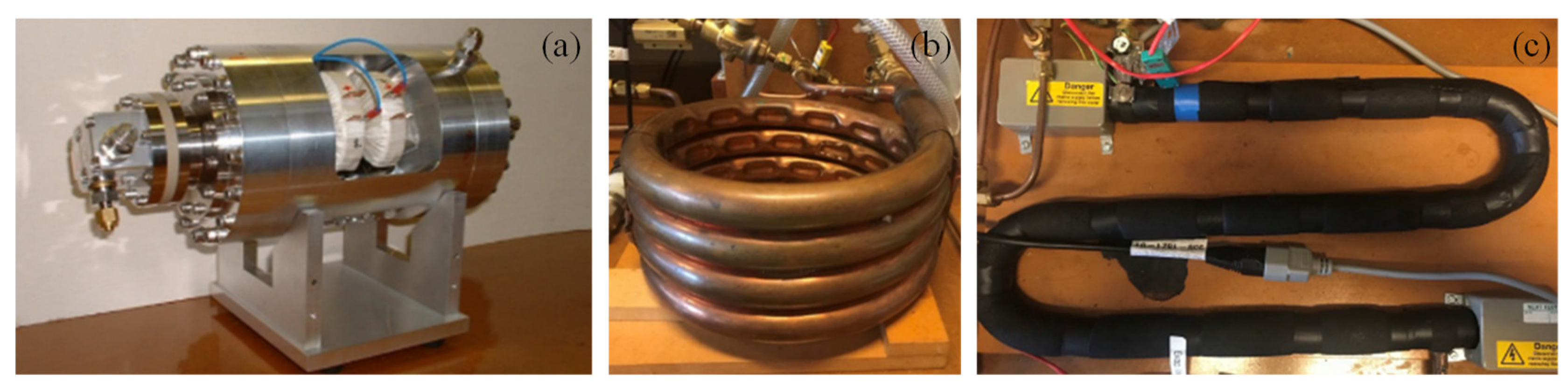
The vapor compression refrigeration system incorporating a moving magnet linear compressor, as employed in this study, primarily comprises the linear compressor, the evaporator, and the condenser. The principal components of a vapor compression refrigeration system are illustrated in Figure 1.
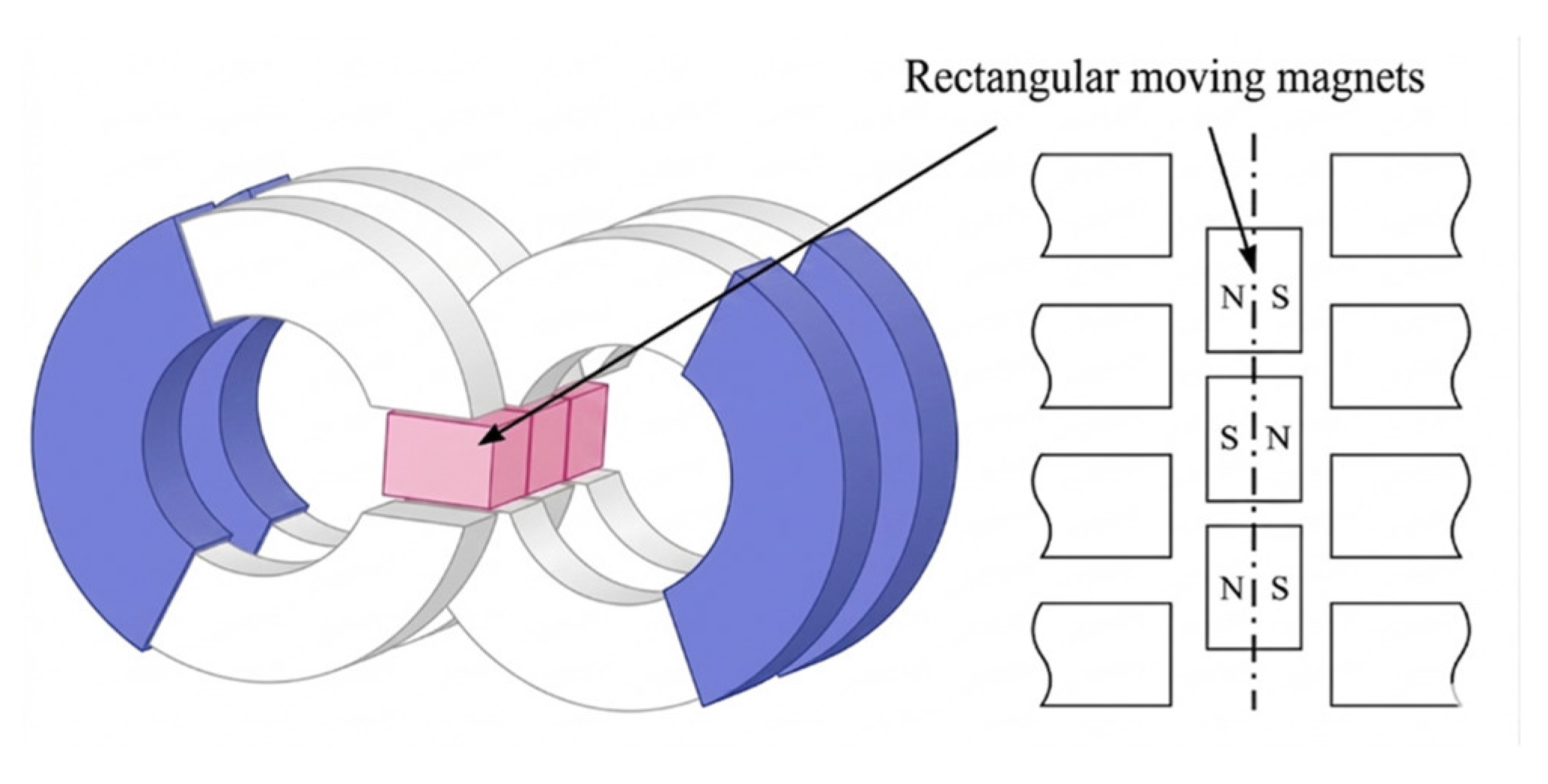
The linear compressor used in this study integrates a moving magnet linear motor, a flexure spring suspension system, a piston–cylinder assembly, and two reed valves. The motor itself contains three rectangular moving magnets and four laminated cores, each carrying a coil. As shown in Figure 2, three rectangular NdFeB permanent magnets are positioned along the motor axis and magnetized with alternating polarities. This alternating polarity configuration generates a circulating magnetic flux that links adjacent laminated cores, thereby forming a closed magnetic circuit. Such a circuit concentrates the magnetic field and delivers the reciprocating electromagnetic force needed to drive the piston.
The flexure spring suspension system consists of two sets of flexure springs spaced axially apart. It supports the moving piston, permitting free reciprocating motion along the cylinder axis while strongly restraining radial displacement. The springs are fabricated from martensitic stainless steel (Sandvik, Sandviken, Sweden, 7C27Mo2), a material that offers high radial stiffness together with sufficient axial compliance. Consequently, the piston’s radial offset during operation is kept to a minimum. Suction and discharge are managed by two reed valves. Since the volumetric flow rate through the suction port exceeds that through the discharge port, the suction reed valve is designed with a correspondingly larger flow area to handle the greater flow and to lower the flow resistance. The suction valve has a thickness of 0.3 mm, whereas the discharge valve is 0.2 mm thick. Further details of this linear compressor design can be found in the study by Liang et al. [16].
The experimental setup employed a commercial water-cooled copper coaxial condenser and an annular evaporator with an electric heater mounted at its center. The heat load was precisely controlled by varying the electrical power supplied to the central heater, allowing the compressor performance to be systematically evaluated across a range of operating conditions. The outer surface of the evaporator was covered with thermal insulation to suppress unwanted heat exchange with the surroundings. The detailed specifications of the moving-magnet linear compressor, the condenser, and the evaporator are summarized in Table 1.
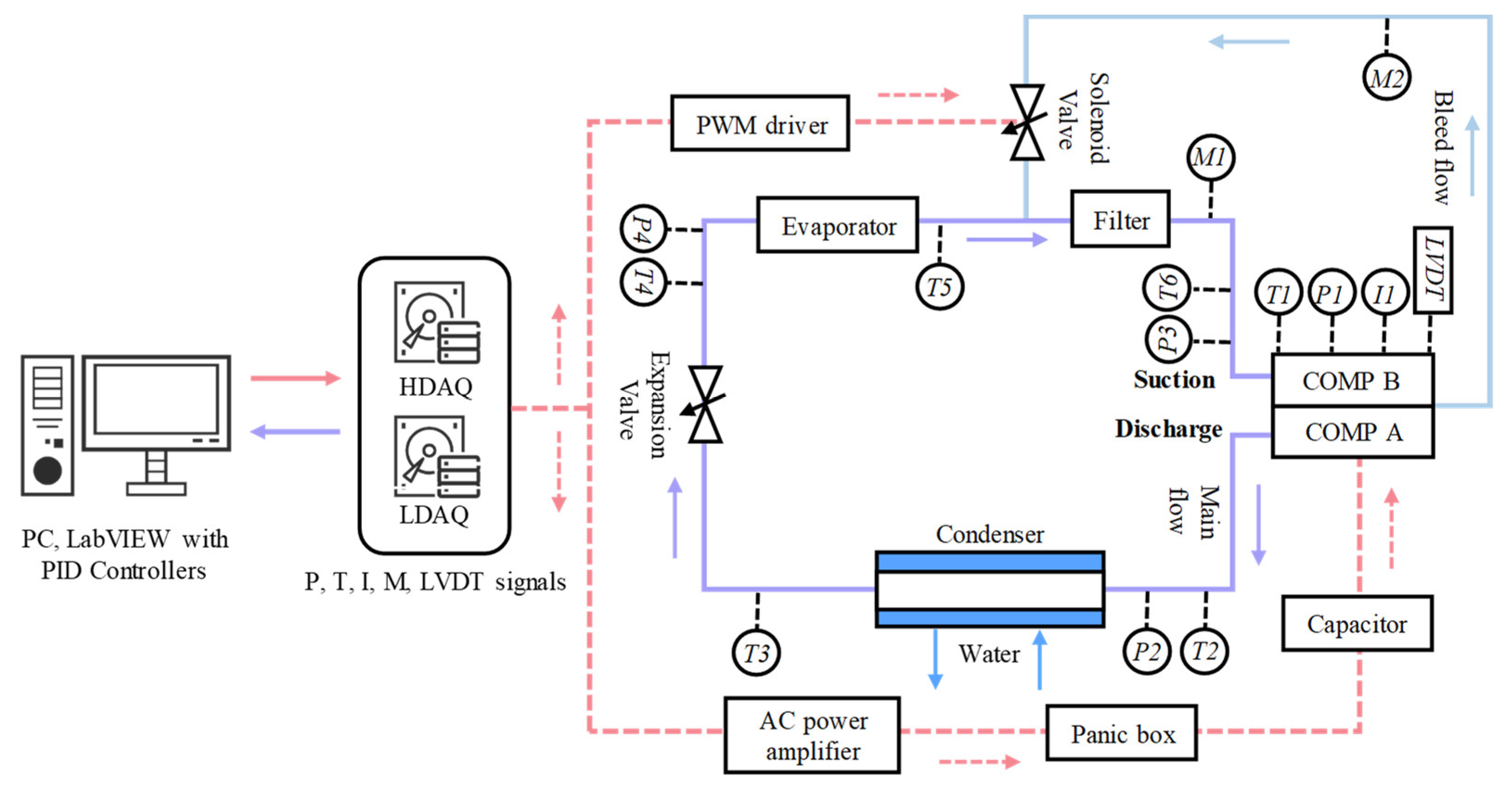
Figure 3 illustrates the layout of the vapor compression refrigeration system driven by a moving magnet linear compressor. During operation, the linear compressor discharges high-temperature, high-pressure refrigerant gas into the condenser, where heat is rejected and the refrigerant condenses. The resulting liquid then passes through an expansion valve, experiences a pressure drop, and enters the evaporator to absorb heat; the low-pressure vapor subsequently returns to the compressor body, thereby completing the cycle.
The system is instrumented with a suite of sensors to monitor key thermodynamic and mechanical parameters. Four pressure transducers are installed at critical locations, namely the compressor body, discharge port, suction port, and evaporator inlet, to record the instantaneous pressure at each stage. Thermocouples are positioned at the compressor body, discharge port, condenser outlet, evaporator inlet, evaporator tube wall, evaporator outlet, suction port, and motor coil. Mass flow meters are used to measure the mass flow rate in the main flow circuit and bleed flow circuit. Current sensors, respectively, cover the current variations in the internal coils of the compressor. A high-precision displacement sensor tracks the piston position and supplies the feedback signal for closed-loop stroke control. Experimental data are acquired through a combination of low-frequency and high-frequency data loggers; the instrument models and their corresponding measurement accuracies are listed in Table 2.

2.2. Experimental Conditions

All tests were conducted at an ambient temperature of 22 °C. Prior to each run, the compressor body was heated to 45 °C using a resistance heater to evaporate and purge any liquid refrigerant that might have accumulated inside the shell, thereby eliminating potential interference with the measurements. The pressure ratio was adjusted by manually varying the opening of the expansion valve located between the condenser and the evaporator, while the operating frequency was also set manually. The compressor load is linearly related to the piston stroke and is controlled by a PID controller implemented in LabVIEW by adjusting the stroke. Starting from zero, the piston stroke was increased in fixed 0.2 mm steps until the target setpoint was reached. With R134a as the working fluid, the compressor load was maintained between 65% and 85% to guarantee an adequate mass flow rate, and the pressure ratio was kept within the range of 2.0 to 3.5 so that the evaporator temperature fell within the typical range for the fresh-food compartment of a domestic refrigerator; the condensing temperature was held constant at 45 °C.
For each test, data acquisition was initiated manually. The operator first brought the system to a near-steady state by tuning the expansion valve opening and the piston stroke and then continuously monitored the real-time signal fluctuations on the LabVIEW front panel. Steady state was confirmed when the variations in key parameters, including suction and discharge pressures, mass flow rate, piston stroke, and temperatures, all remained within predetermined acceptable bounds. Once this condition was satisfied, the operator activated a front-panel control to start data acquisition, which synchronously triggered two NI USB-6341 data acquisition cards. The low-speed card sampled slowly varying signals at 2 kS/s and performed real-time averaging to suppress noise while capturing the slow thermal dynamics; the high-speed card operated at 5 kS/s to resolve transient phenomena within each compression cycle, specifically recording pressure, current, voltage, and displacement. Both cards were triggered simultaneously and wrote their data to separate .txt files. Parameters that the DAQ cards could not capture, or that required on-site verification, such as the operating frequency and the solenoid valve duty cycle, were recorded manually at the same instant as the acquisition trigger. The experimental conditions are compiled in Table 3.

2.3. Validation of the Experimental Rig’s Effectiveness

To validate the experimental test rig, Li et al. constructed a comprehensive numerical model that integrates sub-models for the heat exchanger, refrigerant distribution, and compressor dynamics, and solved it using the MATLAB R2024b/Simulink platform [18]. In parallel, experiments were conducted on the same rig. The comparison indicates that most of the experimental measurements deviate from the simulation results by less than ±10%. The mean absolute percentage error (MAPE) values for the predicted piston stroke, power input, and mass flow rate are 2.95%, 6.18%, and 7.08%, respectively; for the cooling capacity, COP, and refrigerant charge, the MAPE values are 8.26%, 8.66%, and 6.1%. All these discrepancies fall within an acceptable range, confirming the reliability of the experimental setup and the measurement methodology. Additional validation data are provided in Li et al. [18].

3. Data Processing

3.1. Data Analysis

In this experiment, the moving magnet linear compressor was driven at its resonant frequency to ensure optimal performance. The resonant frequency f is determined from Equation (1):
f = 1 2 π k m
where k represents the total stiffness and m denotes the total moving mass.
The total stiffness k of the linear compressor comprises the mechanical spring stiffness k m and the effective gas spring stiffness k g [22]. At low pressure ratios, the equivalent gas spring stiffness was obtained via an equivalent linear model. Accordingly, the effective gas spring stiffness and the total stiffness are calculated from Equations (2) and (3):
k g = ( P d i s P s u c ) π D 2 4 S
k = k g + k m
where P d i s and P s u c denote the discharge and suction pressures, respectively, D is the piston diameter of the linear compressor, and S represents the piston stroke.
Piston offset in linear compressors is generated by the radial clearance that exists between the piston and the cylinder. During compressor operation, gas leakage occurs from the cylinder interior into the compressor body. The piston offset x o f f s e t proposed by Liang et al. is given by Equation (4) [23]:
x o f f s e t = ( P c P b ) A k m
where P c is the average in-cylinder pressure, P b is the compressor body pressure, and A is the piston cross-sectional area.
The required capacitance C for the linear compressor equivalent circuit is given by Equation (5) [24]:
C = 1 4 π 2 f 2 L
where L is the inductance, measured to be 0.141 H.
The total power input supplied to the vapor compression refrigeration system is determined by Equation (6):
W ˙ i n = 1 t 0 t U I d t
where U denotes the voltage, I the current, and t the period.
Considering only copper losses, the simplified motor efficiency can be expressed by Equation (7):
η m = W ˙ i n I r m s 2 R W ˙ i n
where I r m s is the rms current supplied to the linear motor and R is the copper resistance.
The volumetric efficiency η V is defined by Equation (8):
η V = m ˙ R g T s u c S A f P s u c
where m ˙ is the mass flow rate, T s u c denotes the suction temperature, and R g represents the gas constant of R134a.
The refrigerant circuit of the linear compressor vapor compression system is made up of an evaporator, a condenser, a vapor line, a liquid line, and a filter. Specifically, the vapor line comprises the condenser inlet line and the evaporator outlet line, whereas the liquid line consists of the condenser outlet line. The evaporator inlet line serves as a two-phase line and maintains a consistent void fraction. The masses of two-phase and single-phase refrigerant within the heat exchanger are provided by Equations (9) and (10):
m t p = A t p 0 L t p ( α ρ g + ( 1 α ) ρ l ) d l
m = A H X 0 L s p ρ d l
where A t p denotes two-phase cross-sectional area, A H X is the heat exchanger cross-sectional area, L t p denotes the two-phase length, L s p is the single-phase length, α is the void fraction, ρ g denotes the vapor refrigerant density, and ρ l denotes the liquid refrigerant density.
The single-phase refrigerant mass in filters and pipes is given by Equation (11):
m s p = A s p 0 L s p ρ d l
where A s p represents the cross-sectional area of the single-phase line.
Before entering the evaporator, the refrigerant accumulates in the pipes as a two-phase flow. Consequently, the refrigerant mass in the pipes is determined by Equation (12):
m t p = A t p 0 L t p ρ t p d l
Subcooling and superheat are computed as follows:
T s u b = T s a t T c o n d
T s u p = T s u c T s a t
The cooling capacity Q c is obtained from Equation (15):
Q c = m ˙ ( h e v a p _ o u t h e v a p _ i n )
where h e v a p _ i n is the enthalpy at the evaporator inlet and h e v a p _ o u t is the enthalpy at the evaporator outlet.
COP is defined as the ratio of cooling capacity to system power input, as expressed by Equation (16):
C O P = Q c W ˙ i n
The Carnot COP represents the coefficient of performance of the Carnot reversible cycle and is the maximum theoretical COP attainable for a refrigeration system. For this experiment, the Carnot COP is calculated using Equation (17):
C O P c a r n o t = T e v a p _ i n T c o n d _ o u t T e v a p _ i n
where T e v a p _ i n and T c o n d _ o u t are the evaporator inlet temperature and the condenser outlet temperature, respectively.
The Normalized COP is frequently employed to indicate the degree to which a refrigeration cycle approximates a reverse Carnot cycle. It can be expressed as the ratio of actual COP to Carnot COP, as shown in Equation (18):
ε = C O P C O P c a r n o t

3.2. Uncertainty Analysis

During the experiments, temperature, pressure, mass flow rate, voltage, and current were acquired through direct measurements. The corresponding measurement uncertainties are listed in Table 2. Meanwhile, parameters such as compressor input power and volumetric efficiency were derived from the recorded data; accordingly, their uncertainties can be assessed via the uncertainty propagation equations presented in Equations (19) and (20):
u x ¯ = S x ¯ 2 + w x ¯ 2
u R 2 = i = 1 n ( u x i ¯ R x i ) 2
Ultimately, the relative uncertainties for power input, volumetric efficiency, cooling capacity, and COP were determined to be ±0.93%, ±0.3%, ±2%, and ±2.2%, respectively.

4. Discussion

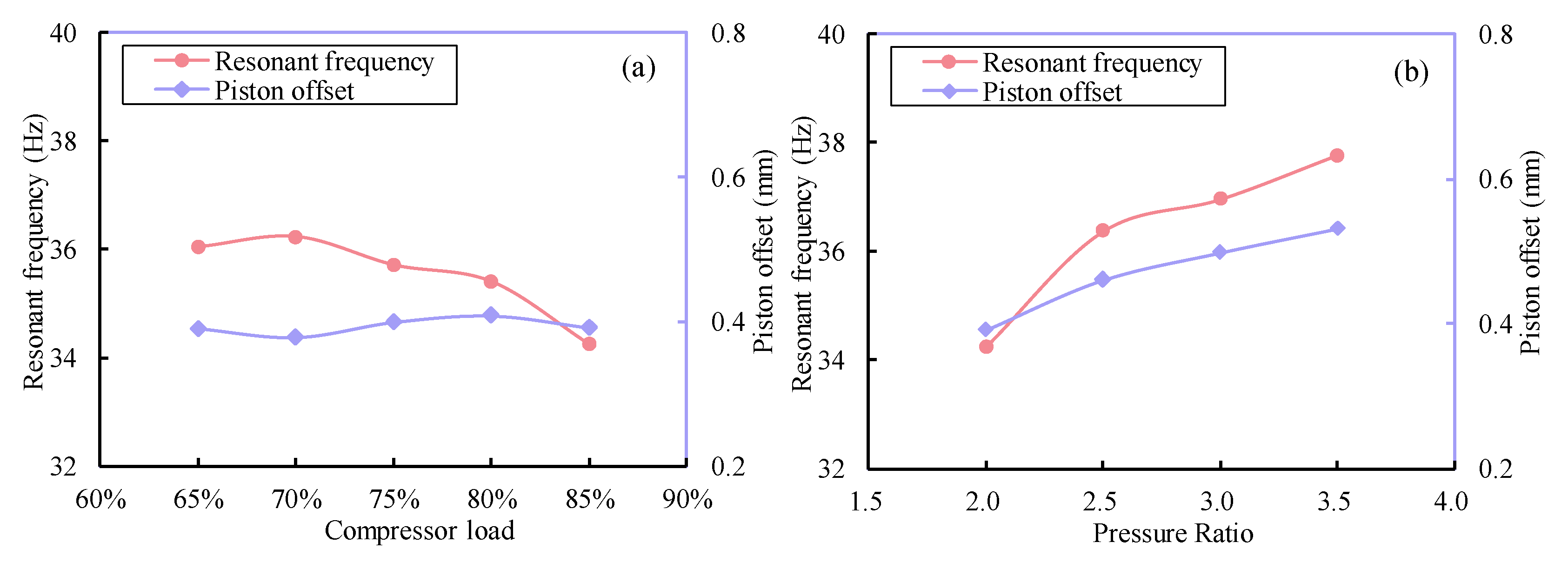
Figure 4 presents the resonant frequency and piston offset of the linear compressor as functions of compressor load and pressure ratio. At a fixed pressure ratio, the resonant frequency was found to decrease monotonically with increasing compressor load. This behavior can be attributed to the fact that a higher load allows the discharge valve to stay open longer in each cycle, which softens the effective gas spring stiffness through flow reversal or pressure pulsation within the cylinder. Consequently, the resonant frequency falls from 36.0 Hz at 65% load to 34.2 Hz at 85% load, representing a decrease of 1.8 Hz. For a given pressure ratio, the piston offset fluctuates only slightly around an average of 0.39 mm with varying load; the largest relative deviation, observed at 70% load, is merely 4.0%. This behavior indicates that the offset essentially stabilizes around 0.39 mm and is not significantly affected by load changes. As the suction and discharge pressures, along with the resulting cycle-averaged cylinder pressure, remain nearly constant at a fixed pressure ratio, the force balance on the piston is largely unaffected by load adjustments. The load insensitivity of the piston offset observed here has been confirmed in multiple studies on other linear compressor designs [12,25]. Therefore, for the linear compressor under investigation, the influence of compressor load on piston offset can be neglected.
Figure 4b shows that, under a constant compressor load, the resonant frequency increases monotonically with pressure ratio. Raising the pressure ratio from 2.0 to 3.5 widens the difference between the discharge and suction pressures, which stiffens the equivalent gas spring and thereby drives the resonant frequency upward by 10.3%. The piston offset also grows gradually with pressure ratio, reaching 0.53 mm at a ratio of 3.5; this represents a 36% increase over the value measured at 2.0. In linear compressors, piston offset arises primarily from clearance seal leakage from the cylinder into the compressor shell. As the pressure ratio increases, the imbalance between the mean cylinder pressure and the body pressure intensifies, pushing the time-averaged piston position further toward the cylinder head. Excessive offset reduces the effective stroke and, in extreme cases, can cause the piston to strike the cylinder head, potentially leading to catastrophic structural failure. It is therefore critical to operate the linear compressor within an appropriate pressure ratio range to suppress excessive piston offset and ensure reliable performance.
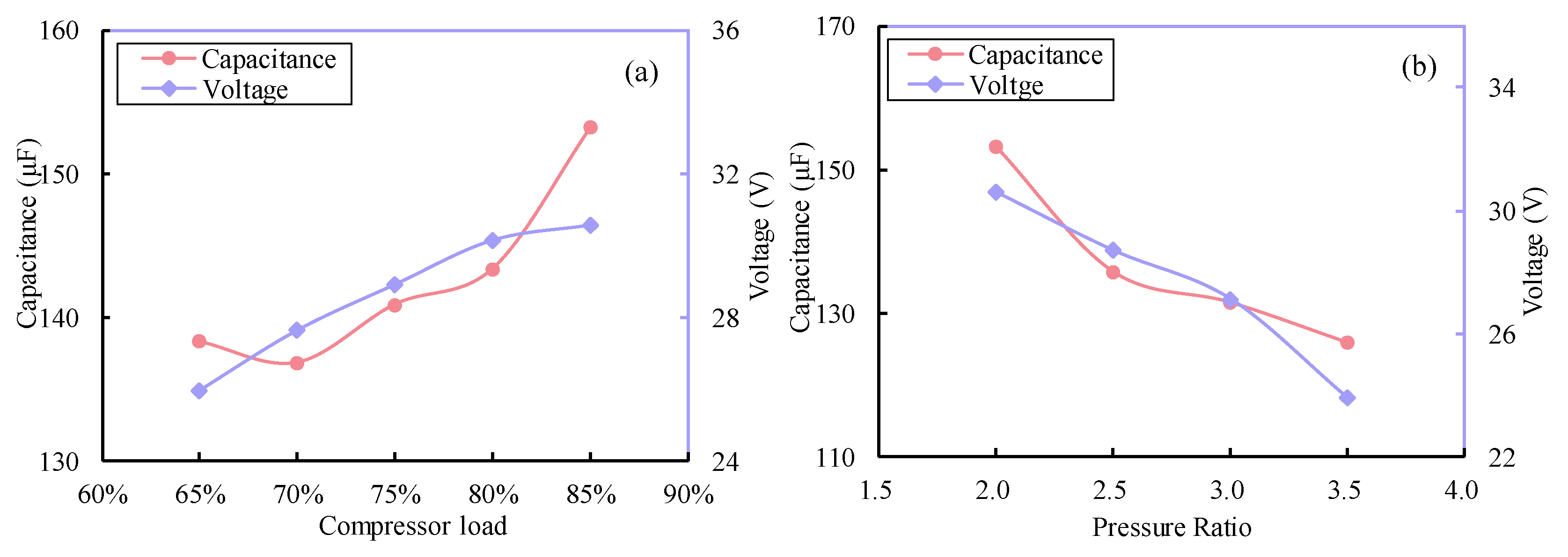
From a circuit perspective, the linear motor can be modeled as a series combination of a resistance, an inductance, and a back-EMF. The inherent phase lag between the input voltage and current leads to a low power factor and limited active power transfer. To remedy this, a resonant capacitor is inserted into the circuit to satisfy the LC resonance condition, forcing the fundamental current to align more closely with the voltage; the required capacitance can then be calculated directly from the resonance criterion. Figure 5 illustrates how the capacitance and the circuit voltage vary with compressor load and pressure ratio. In general, the capacitance requirement varies inversely with the resonant frequency in Figure 4: both a decreasing load and an increasing pressure ratio raise the resonant frequency, thereby reducing the needed matching capacitance. With the pressure ratio held constant, increasing the load from 65% to 85% raises the required capacitance from 138.3 μF to 153.2 μF, an increase of 10.7%. Conversely, at a fixed load, raising the pressure ratio from 2.0 to 3.5 reduces the matching capacitance by 17.8%. The voltage across the circuit follows a trend similar to that of the capacitance. Hence, when the input voltage must be constrained, particularly because of the limited gain of the AC power amplifier, a capacitor with a sufficiently wide tuning range is essential to accommodate diverse operating conditions.
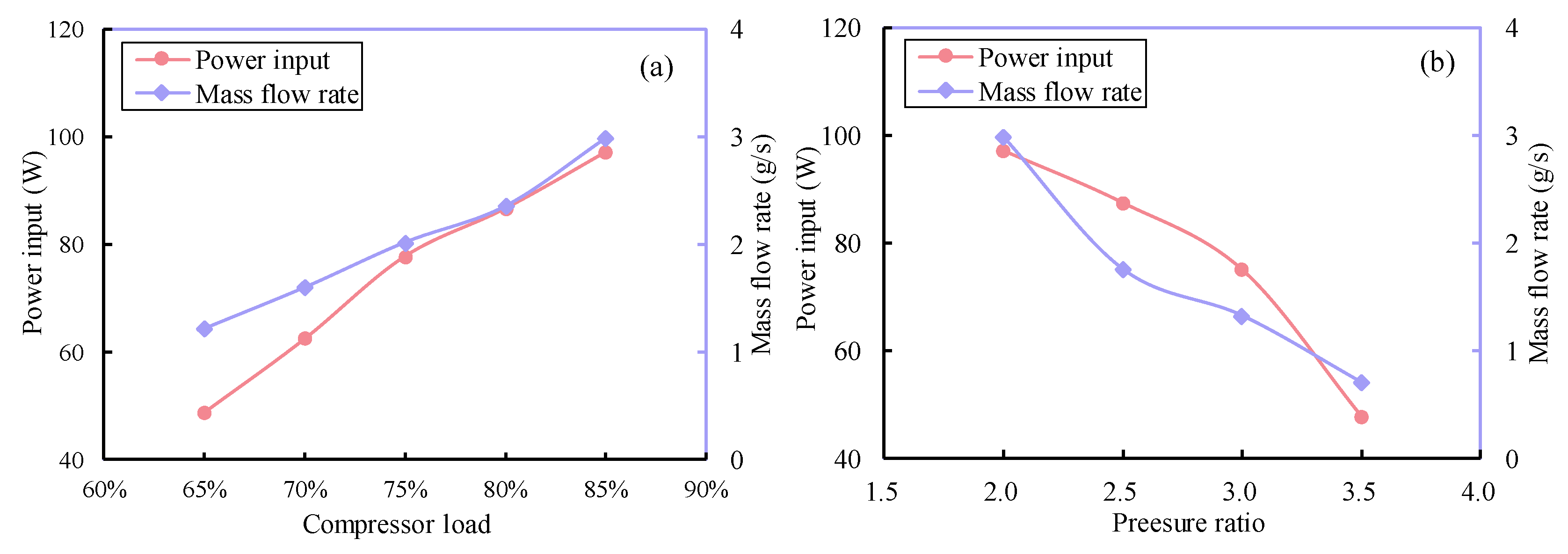
Figure 6 shows how the compressor power input and mass flow rate depend on compressor load and pressure ratio. The power input increases almost linearly with load, mainly because a larger stroke requires a higher input voltage, which raises copper losses and thus elevates the total power consumption. Raising the load from 65% to 85% brought the maximum power input to 97.1 W, an increase of 48.2 W. At constant load, the power input falls monotonically as the pressure ratio rises, a decline that can be attributed to a combined reduction in input voltage and evaporator pressure. At a pressure ratio of 3.5, the power input drops to its minimum of 47.9 W. In contrast, the mass flow rate grows rapidly with compressor load, following a strong linear dependence: increasing the load from 65% to 85% boosts the mass flow rate by 146.2%. When the load is held constant, however, the mass flow rate decreases as the pressure ratio increases, primarily owing to lower volumetric efficiency and reduced suction vapor density. The maximum mass flow rate, approximately 3.0 g/s, occurs at a pressure ratio of 2.0. This linear dependence of mass flow rate on load, together with its inverse relationship with pressure ratio, is consistent with trends reported for other linear compressor configurations that employ oil-free clearance seals.
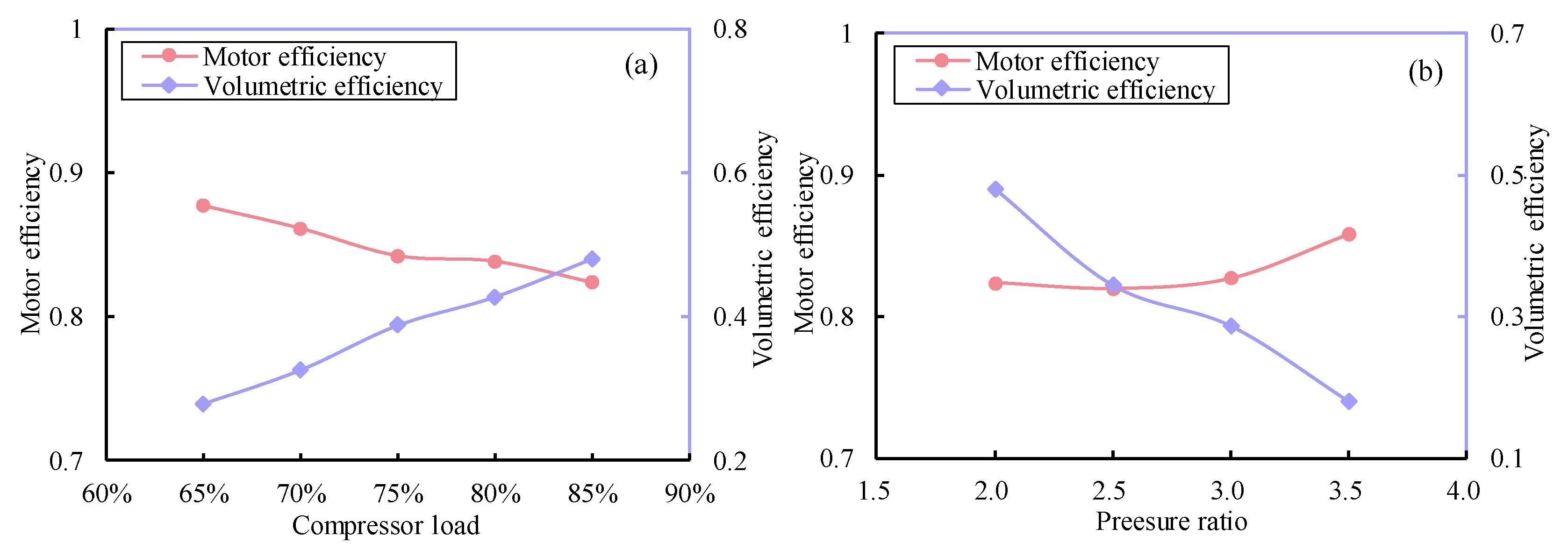
Figure 7 presents the motor efficiency and volumetric efficiency of the linear compressor as functions of compressor load and pressure ratio. Over the range tested, the two efficiencies moved in opposite directions. The motor efficiency decreases monotonically with increasing load, a decline that can be mainly attributed to the progressively larger excitation current required at higher loads, which substantially increases copper losses. Although core losses and other secondary losses exist, they contribute less than 1.5% of the power input and remain almost unchanged over the tested load range; their influence on the downward trend of motor efficiency is therefore negligible, which is dominated by the growth of copper loss. Moreover, because the total input power also rises with load, the absolute increment in copper losses becomes even larger, further intensifying the decline in motor efficiency. As the load was raised from 65% to 85%, the motor efficiency fell from 87.7% to 82.4%. In contrast, the volumetric efficiency follows the same trend as the mass flow rate shown in Figure 6, increasing with load and decreasing with pressure ratio. Notably, volumetric efficiency is inversely proportional to the suction pressure, a relationship that implies a relatively higher volumetric efficiency at low loads and high pressure ratios because of the lower suction pressure. When the pressure ratio was increased from 2.0 to 3.5, the volumetric efficiency dropped by as much as 30.0%. Comparable findings were reported by Liang et al., who further attributed the markedly lower experimental volumetric efficiency, relative to the theoretical value, to the cumulative effects of heat transfer during suction, flow restriction in the valve, wall friction, seal leakage, and other frictional losses [26].
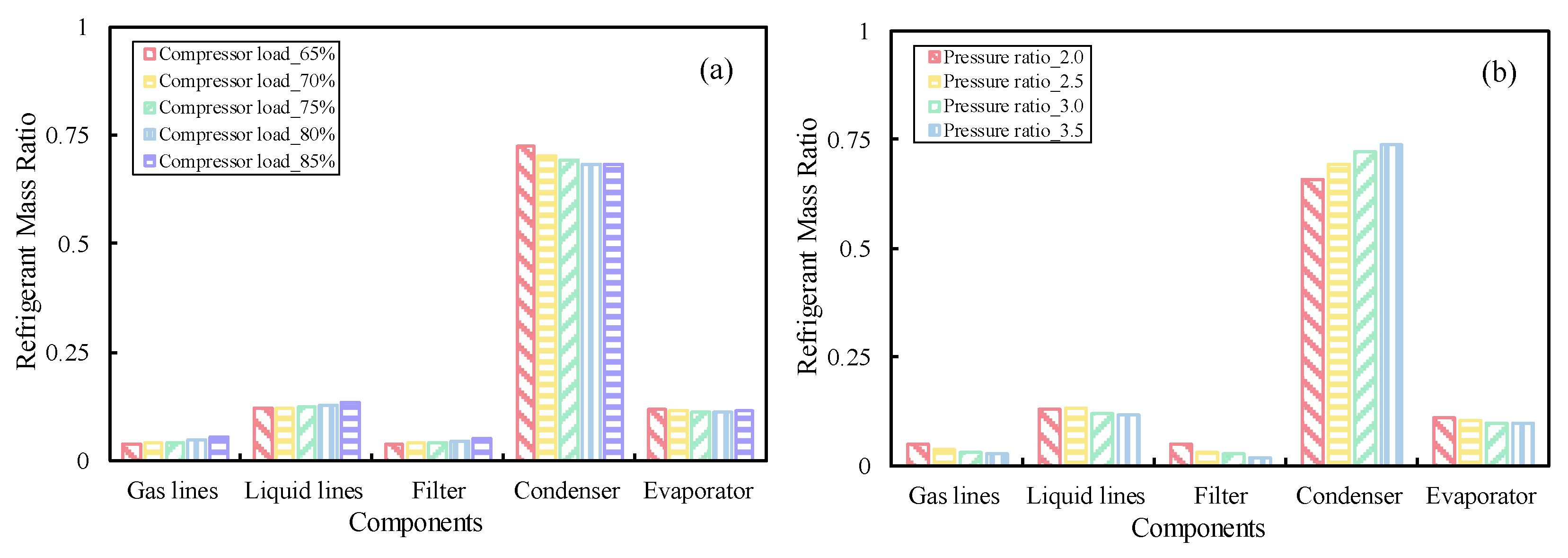
Figure 8 illustrates the distribution of refrigerant mass fraction among the components of a vapor compression refrigeration system employing an oil-free linear compressor. The condenser retains the largest portion of the refrigerant charge under all tested operating conditions, with most of the refrigerant accumulating there. At a load of 65%, the refrigerant residing in the condenser accounts for 72.4% of the total charge. As the load increases in Figure 8a, the refrigerant mass fraction in the condenser decreases considerably, which can be attributed to the larger amount of refrigerant circulating through the system. Raising the load from 65% to 85% led to a 4.1% reduction in the condenser-held refrigerant fraction. In contrast, the quantity of refrigerant held in the evaporator exhibits negligible variation with load, a constancy that stems from two competing mechanisms. On one hand, the two-phase length within the evaporator extends as the piston stroke grows, driven by increases in saturation temperature and compression work; on the other hand, the void fraction also rises with load, offsetting the increase in two-phase length and thereby suppressing the accumulation of refrigerant mass. Additionally, the refrigerant masses in the gas line, liquid line, and filter display a slight upward trend with load, driven by the increase in refrigerant density. From Figure 8b, it is evident that the refrigerant mass fraction in the condenser increases markedly with pressure ratio. As shown in Figure 7, the volumetric efficiency of the linear compressor declines with increasing pressure ratio; this reduction causes refrigerant to gradually build up inside the condenser. When the pressure ratio was raised from 2.0 to 3.5, the refrigerant mass fraction collected in the condenser grew by 7.9%. Hence, the refrigerant distribution in the condenser serves as the most sensitive indicator of changes in compressor operating conditions.
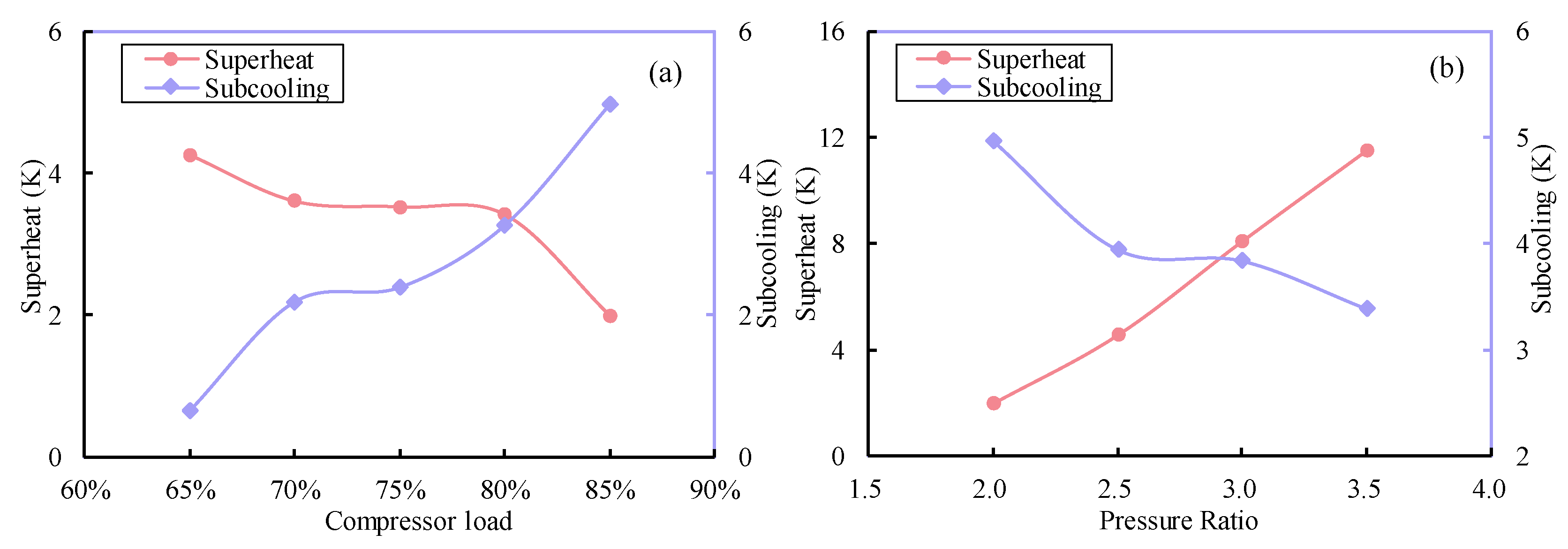
Figure 9 shows the superheat and condenser outlet subcooling across the examined ranges of compressor load and pressure ratio. Overall, the superheat decreases with rising load and increases with rising pressure ratio, a behavior that stems from the response of the saturated suction temperature. Specifically, increasing the load raises the suction pressure, thereby elevating the saturation temperature, whereas increasing the pressure ratio lowers the suction pressure, which depresses the saturation temperature. A minimum superheat of 2.0 K was recorded at a pressure ratio of 2.0 and a load of 85%, while a maximum superheat of 11.5 K occurred at a pressure ratio of 3.5. The same figure also presents the condenser outlet subcooling. Throughout the experiments, the water flow rate from the constant-head tank was adjusted to hold the condenser outlet temperature constant at 45 °C. In general, the discharge pressure increases with load and decreases with pressure ratio, and the corresponding discharge saturation temperature follows the same pattern. The condenser outlet subcooling, defined as the difference between the discharge saturation temperature and the condenser outlet temperature (held constant at 45 °C), therefore tracks the discharge saturation temperature directly, increasing with load and decreasing with pressure ratio. Specifically, raising the load from 65% to 85% increased the subcooling by 4.3 K, whereas increasing the pressure ratio from 2.0 to 3.5 reduced it by 1.6 K.
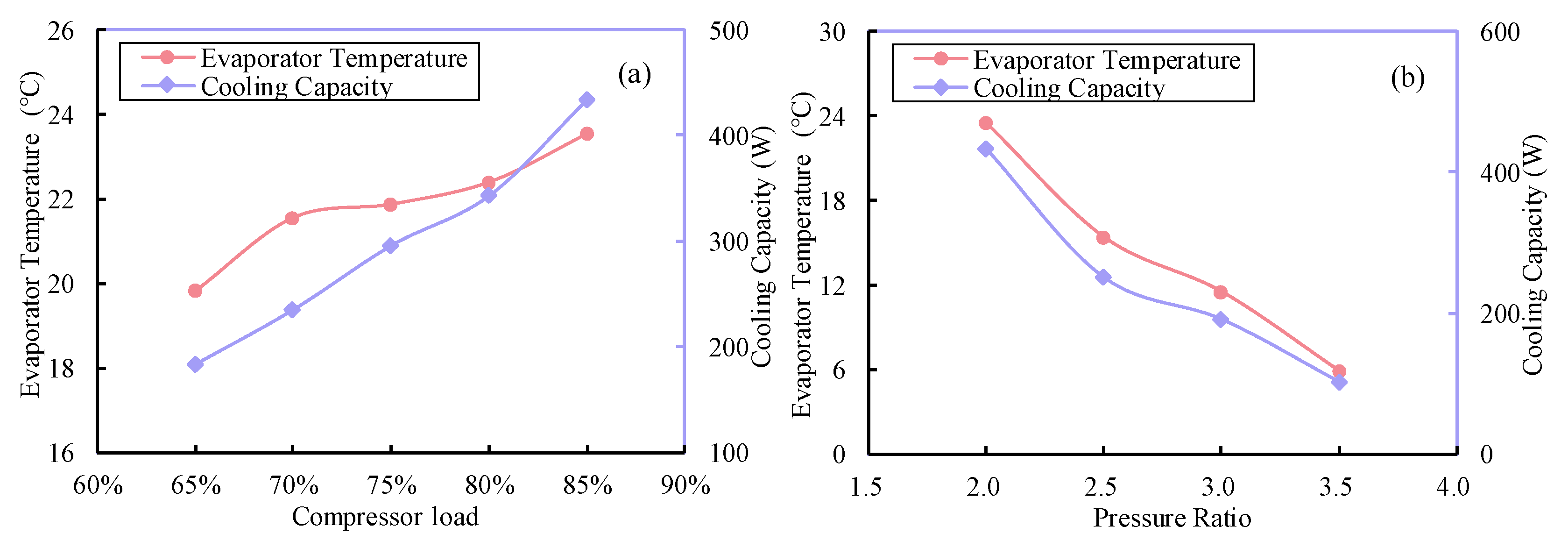
Figure 10 shows the evaporator temperature and the cooling capacity as functions of compressor load and pressure ratio. At a fixed pressure ratio, the evaporator temperature increases with load because a larger piston stroke raises the evaporator inlet pressure. Under constant load, the suction pressure decreases gradually as the pressure ratio is raised. Since the refrigerant side pressure drop across the evaporator was measured at approximately 0.04 bar in the present experiment, the evaporator inlet pressure can be considered essentially equal to the suction pressure. Consequently, the inlet pressure declines progressively with increasing pressure ratio, causing a gradual reduction in evaporator temperature. For instance, raising the load from 65% to 85% elevated the evaporator temperature from 19.8 °C to 23.5 °C, while the minimum evaporator temperature, 5.9 °C, was recorded at a load of 85% and a pressure ratio of 3.5.
Figure 10 also plots the corresponding cooling capacity. The cooling capacity follows a trend that closely mirrors that of the evaporator temperature with respect to both load and pressure ratio. This correspondence arises because the cooling capacity is fundamentally governed by the evaporator temperature through the enthalpy difference across the evaporator; the two are therefore positively correlated. Moreover, the cooling capacity is influenced by the mass flow rate. As shown in Figure 6, the mass flow rate increases with compressor load and decreases with rising pressure ratio, and the cooling capacity was observed to track this behavior closely. The maximum cooling capacity, 434.6 W, was achieved at a load of 85% and a pressure ratio of 2.0.
Comparing the results in Figure 10 with Figure 7 reveals that, at low external thermal loads, simply reducing the compressor load allows the linear compressor to attain a higher motor efficiency than under full-load operation. Since domestic refrigerators operate at partial load for most of their lifetime, the higher motor efficiency observed at reduced compressor loads suggests a promising direction for energy saving. It should be noted, however, that all measurements were obtained under steady-state laboratory conditions. Long-term cyclic tests and a complete annual energy consumption analysis are required before quantitative conclusions regarding real-world performance can be drawn.
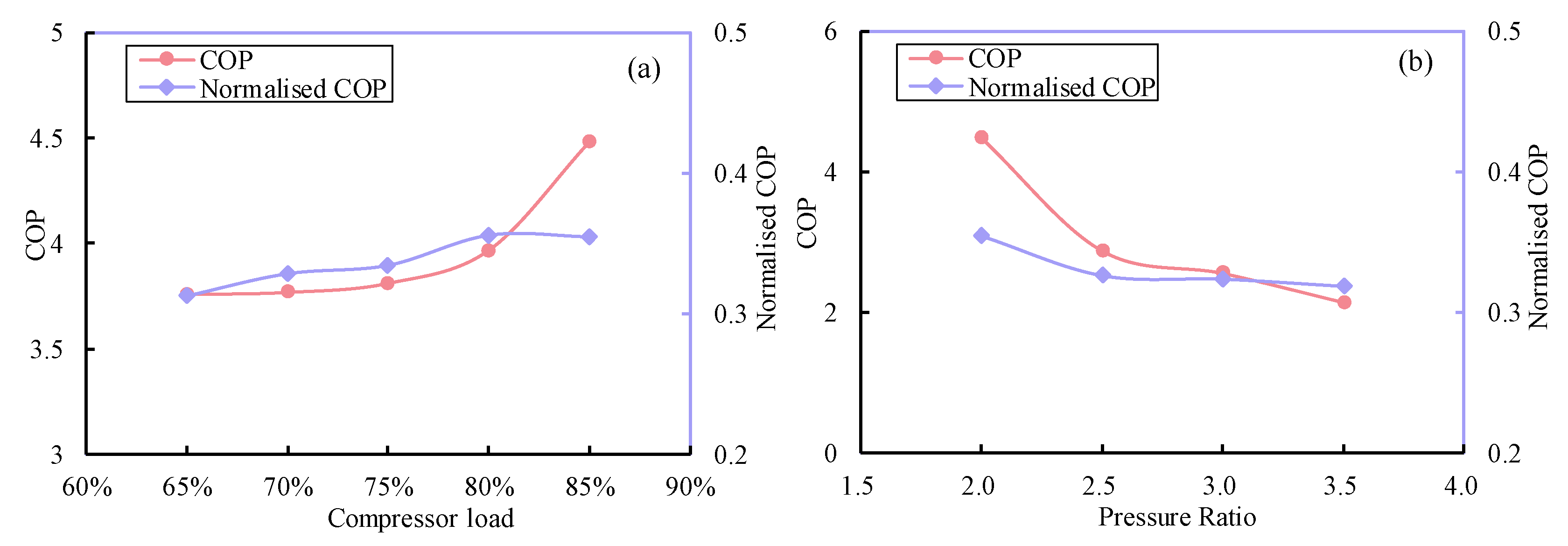
Figure 11 displays the system COP and the Normalized COP as functions of compressor load and pressure ratio. Overall, the COP rises with increasing load. At a constant load, the COP declines as the pressure ratio increases; this reduction can be attributed primarily to the decrease in evaporator temperature. As presented in Figure 10, at a pressure ratio of 2.0 and a load of 85%, the evaporator temperature reaches 23.5 °C, and the corresponding COP is approximately 4.5. At this pressure ratio, the average COP across the different loads is about 3.9, indicating that the refrigeration system based on a linear compressor operating with R134a delivers competitive performance. When the pressure ratio was increased from 2.0 to 3.5, the COP fell to 2.4. This decrease occurred because the rise in pressure ratio lowered the evaporating temperature from 23.5 °C to 5.9 °C, which in turn reduced the cooling capacity by 76.4%. Although the power input of the linear compressor, as shown in Figure 6, also decreased with increasing pressure ratio, it declined by only 50.7%. Hence, the cooling capacity deteriorated more rapidly than the power input, resulting in a net reduction in COP. Consistent with Figure 10, the COP rises with both the cooling capacity and the evaporator temperature: at a pressure ratio of 2.0, the COP increases from 3.8 to 4.5 as the cooling capacity grows from 183.7 W to 434.6 W. The Normalized COP, also plotted in Figure 11, ranges from 0.31 to 0.36 and exhibits a weak dependence on compressor load and pressure ratio, with an average value of 0.33 obtained in the present experiment.

5. Compared with Other Linear Compressors

5.1. Other Types of Linear Compressors

Table 4 summarizes a comparison with other types of linear compressors. Chen et al. introduced a multi-loop moving coil linear compressor that incorporates a co-core bilateral reverse coil and a novel Halbach permanent magnet ring array, and demonstrated it in a prototype [14]. Their prototype has a piston diameter of 19.75 mm, a maximum stroke of 15.6 mm, and a resonant spring stiffness of 62.78 N/mm. At a stroke of 13.2 mm and a discharge pressure of 9 bar, this moving coil compressor exhibits a power input of 102.5 W and a motor efficiency of 77.9%; the latter is lower than that of the moving magnet linear compressor investigated in the present study. Jomde et al. proposed a novel moving coil linear compressor in which the piston surface in contact with the cylinder is coated with Rulon, a special low-friction material, to mitigate piston–cylinder friction [13]. Their compressor features a piston diameter of 22.5 mm and a maximum stroke of 12 mm. At a condensing temperature of 54 °C and an evaporating temperature of −20 °C, it achieved an experimental COP of only 1.4, which is considerably lower than the COP reported in Figure 11. Sun et al. developed an oil-free dual-piston compressor prototype driven by a moving coil linear motor [10]. This design has a maximum piston diameter of 21 mm and a mechanical spring stiffness of 46.2 N/mm. At an evaporating pressure of 3.5 bar and a pressure ratio of 2.54, their compressor attained a COP of 5.34, a motor efficiency of 87.9%, and a volumetric efficiency of 79.1%. Notably, the dual-piston arrangement yields inherently sinusoidal gas forces and electromagnetic forces, which substantially suppress the piston offset. In contrast, moving coil topologies typically require bulkier permanent magnets than moving magnet designs, and the need for dedicated components, such as flexible lead wires or sliding contacts, to transfer current from an external power supply to the moving coil introduces additional cost and system complexity.

5.2. Other Moving Magnet Linear Compressors

Table 5 presents a comparison with other moving-magnet linear compressors. Bradshaw et al. built a prototype based on a commercial H2W Tech linear motor, featuring a radial clearance of 13 μm, a displacement of approximately 3 cm3, and a maximum stroke of 6 mm [27]. The isentropic efficiency was measured to be approximately 4.3% across various operating conditions, indicating significant thermodynamic losses and low motor efficiency. The overall motor efficiency of their moving magnet motor was similarly low, at roughly 41.7%. Although an improved design that adjusts the stroke-to-diameter ratio and the radial clearance is expected to achieve a higher isentropic efficiency than the prototype [28], the system efficiency will likely remain uncompetitive unless a high-performance linear motor is employed. Bijanzada et al. presented a moving magnet linear compressor whose stator incorporates two coils and delivers a motor constant of 50.2 N/A, which surpasses the value obtained in the present experiment [17]. However, the moving mass of that compressor is 0.887 kg, approximately 34.4% heavier than that of the compressor in this work. This heavier mover limits the achievable resonant frequency because the natural frequency of a mass-spring system is inversely proportional to the square root of the moving mass. Moreover, the coil resistance of 5.8 Ω is substantially higher than the 3.5 Ω measured for the current prototype, meaning that, for a given excitation current, the Joule heating losses are considerably larger, which inevitably leads to lower motor efficiency. By contrast, the present moving magnet linear compressor maintains favorable motor efficiency across a broad load range, with the advantage being especially pronounced under part-load operation. Its magnet assembly is structurally simple and robust, and the low moving mass facilitates the achievement of high operating efficiency.

6. Conclusions

To comprehensively assess the performance of the moving magnet linear compressor and its associated vapor compression refrigeration system, this study systematically varied the compressor load and pressure ratio and performed a detailed experimental evaluation. A comprehensive analysis was conducted on the resonant frequency, piston offset, matching capacitance, voltage, power input, mass flow rate, motor efficiency, volumetric efficiency, refrigerant mass distribution, superheat, subcooling, evaporator inlet temperature, cooling capacity, COP, and Normalized COP. The main conclusions are summarized as follows:
  • The piston offset of the linear compressor does not depend on the compressor load but rises as the pressure ratio increases. An excessively large piston offset may cause the piston head to strike the cylinder head. To prevent damage to the linear compressor, operation at a suitable pressure ratio should be ensured.
  • Motor efficiency declines as the compressor load rises, dropping from 87.7% to 82.4% when the load is increased from 65% to 85%. Because household refrigerators operate at partial load for most of their service life, this trend indicates a potential energy saving if linear compressors are adopted, although this potential must still be validated under realistic cyclic conditions.
  • The condenser is the component that retains the largest share of refrigerant. In this experiment, over 70% of the refrigerant charge is located in the condenser. Moreover, the condenser is the most sensitive to variations in operating conditions. The refrigerant distribution in the condenser declines with increasing compressor load and grows with rising pressure ratio. Consequently, faults in the linear compressor vapor compression refrigeration system can subsequently be identified by monitoring changes in the condenser.
  • The mass flow rate and evaporator inlet temperature increase with compressor load, which in turn causes the cooling capacity to rise. For linear compressors, the system cooling capacity can be directly augmented by increasing the compressor load, thereby enabling a dynamic and rapid response to cooling demand.
  • The system COP rises with increasing cooling capacity. However, the Normalized COP remains nearly constant across operating conditions, with a value of approximately 0.33. Enhancing the COP helps reduce energy consumption and the related climate impact, in alignment with SDG 13.

Author Contributions

Conceptualization, X.F. and X.C.; methodology, X.C.; software, X.C.; validation, X.F. and M.-C.C.; formal analysis, X.F.; investigation, X.F.; resources, X.C.; data curation, X.F.; writing—original draft preparation, X.F.; writing—review and editing, X.C.; visualization, X.F.; supervision, M.-C.C.; project administration, X.F.; funding acquisition, X.F. All authors have read and agreed to the published version of the manuscript.

Funding

This research was funded by the 2025 Jiangsu Higher Education Institutions Basic Research Natural Science Program (Grant No. 25KJD580007) and the 2025 High-Level Talent Program of Yangzhou Polytechnic Institute (Grant No. 2025gzk039).

Institutional Review Board Statement

Not applicable.

Informed Consent Statement

Not applicable.

Data Availability Statement

The data presented in this study are available in the article.

Conflicts of Interest

The authors declare no conflicts of interest.

References

  1. Al Khiro, H.A.; Boukhanouf, R. Recent Advancements in Design and Energy Performance of Vapour Compression Systems for Air Conditioning in Buildings: A Review. Energies 2026, 19, 1166. [Google Scholar] [CrossRef]
  2. Alzuguren, I.; Aranguren, P.; Casi, Á.; Sánchez, D.; Rodríguez, A. Experimental evaluation of a R290 vapour compression refrigeration system hybridised with a thermoelectric subcooler. Energy Convers. Manag. 2026, 356, 121393. [Google Scholar] [CrossRef]
  3. Castro-Hernández, S.; Salazar-Pereyra, M.; Bonilla-Blancas, W.C.; Torres-Aldaco, A.; Lugo-Leyte, R.; Lugo-Méndez, H.D. Comparative Exergoeconomic Analysis of Three Vapour-Compression Refrigeration System Configurations. Appl. Sci. 2026, 16, 2483. [Google Scholar] [CrossRef]
  4. Tan, H.; Wong, K.Y.; Othman, M.H.D.; Sheng, D.D.C.V.; Kek, H.Y.; Kuan, G.; Lee, K.Q.; Wong, S.L.; Deris, M.S. Preliminary Assessment of Thermal Comfort in an Operating Room. J. Sustain. Eng. Built Environ. 2026, 2, 23–28. [Google Scholar]
  5. Yun, Y.; Chang, Y.S. Refrigerant Charge Prediction of Vapor Compression Air Conditioner Based on Start-Up Characteristics. Appl. Sci. 2021, 11, 1780. [Google Scholar] [CrossRef]
  6. Bahman, A.M.; Othman, A.-H.; Barta, R.B.; Ziviani, D.; Groll, E.A. Integrated analysis of refrigerant charge and seasonal performance for a residential expander-enhanced vapor compression system. Energy 2025, 340, 139179. [Google Scholar] [CrossRef]
  7. Muneeshwaran, M.; Li, Z.; Yang, C.-M.; Pickles, C.; Shen, B.; Nawaz, K. Energy performance augmentation of domestic refrigerators with microchannel condensers. Energy Build. 2026, 359, 117341. [Google Scholar] [CrossRef]
  8. Bahman, A.M. Advancements in vapor compression air conditioning systems for high ambient temperature applications: A comprehensive review. Therm. Sci. Eng. Prog. 2025, 67, 104227. [Google Scholar] [CrossRef]
  9. Bansal, P.; Vineyard, E.; Abdelaziz, O. Advances in household appliances—A review. Appl. Therm. Eng. 2011, 31, 3748–3760. [Google Scholar] [CrossRef]
  10. Sun, J.; Li, J.; Liu, Y.; Huang, Z.; Cai, J. A Novel Oil-free Dual Piston Compressor Driven by a Moving Coil Linear Motor with Capacity Regulation Using R134a. Sustainability 2021, 13, 5029. [Google Scholar] [CrossRef]
  11. Li, C.; Sun, J.; Zou, H.; Cai, J. Experimental assessment on operation efficiency and output characteristics of an oil-free linear compressor in a refrigeration system under various parameters. Appl. Therm. Eng. 2024, 242, 122453. [Google Scholar] [CrossRef]
  12. Li, C.; Zou, H.; Cai, J.; Jiang, Y.; Guo, C. Dynamic behavior analysis of a moving coil oil-free linear compressor in refrigeration system. Int. J. Refrig. 2022, 133, 235–246. [Google Scholar] [CrossRef]
  13. Jomde, A.; Anderson, A.; Bhojwani, V.; Kedia, S.; Jangale, N.; Kolas, K.; Khedkar, P. Modeling and measurement of a moving coil oil-free linear compressor performance for refrigeration application using R134a. Int. J. Refrig. 2018, 88, 182–194. [Google Scholar] [CrossRef]
  14. Chen, H.; Liu, X.; Zou, X.; Lv, Z.; Li, W.; Chen, C. Study of the moving offset characteristics of multi-loop moving coil linear compressor. Int. J. Refrig. 2022, 133, 289–301. [Google Scholar] [CrossRef]
  15. Chen, X.; Jiang, H.; Li, Z.; Liang, K. Modelling and Measurement of a Moving Magnet Linear Motor for Linear Compressor. Energies 2020, 13, 4030. [Google Scholar] [CrossRef]
  16. Liang, K.; Dadd, M.; Bailey, P. Clearance seal compressors with linear motor drives. Part 1: Background and system analysis. Proc. Inst. Mech. Eng. Part A J. Power Energy 2013, 227, 242–251. [Google Scholar] [CrossRef]
  17. Bijanzada, A.; Hassan, A.; Lazoglu, I.; Kerpiccib, H. Development of a new moving magnet linear compressor. Part A: Design and modeling. Int. J. Refrig. 2020, 113, 70–79. [Google Scholar] [CrossRef]
  18. Li, Z.; Liang, K.; Chen, X.; Zhu, Z.; Zhu, Z.; Jiang, H. A comprehensive numerical model of a vapour compression refrigeration system equipped with a variable displacement compressor. Appl. Therm. Eng. 2022, 204, 117967. [Google Scholar] [CrossRef]
  19. Liang, K.; Stone, R.; Hancock, W.; Dadd, M.; Bailey, P. Comparison between a crank-drive reciprocating compressor and a novel oil-free linear compressor. Int. J. Refrig. 2014, 45, 25–34. [Google Scholar] [CrossRef]
  20. Kim, J.K.; Kim, J.-B. Modulation characteristics of a linear compressor for evaporating and condensing temperature variations for household refrigerators. Int. J. Refrig. 2014, 40, 370–379. [Google Scholar] [CrossRef]
  21. Zou, H.; Li, X.; Tang, M.; Tian, C.; Chen, X. Performance analysis of linear compressor using R290 for commercial refrigerator. Int. J. Refrig. 2020, 109, 55–63. [Google Scholar] [CrossRef]
  22. Mastrullo, R.; Mauro, A.W.; Napoli, G.; Strano, S.; Viscito, L. Thermo-economical sensitivity analysis of a linear compressor. Int. J. Refrig. 2022, 142, 82–91. [Google Scholar] [CrossRef]
  23. Liang, K. Analysis of oil-free linear compressor operated at high pressure ratios for household refrigeration. Energy 2018, 151, 324–331. [Google Scholar] [CrossRef]
  24. Zhu, Z.; Liang, K.; Li, Z.; Jiang, H.; Meng, Z. A numerical model of a linear compressor for household refrigerator. Appl. Therm. Eng. 2021, 198, 117467. [Google Scholar] [CrossRef]
  25. Chen, H.; Lv, Z.; Liu, X.; Chen, C. Static and dynamic characteristics of a novel moving magnet linear compressor. J. Mech. Sci. Technol. 2022, 36, 87–97. [Google Scholar] [CrossRef]
  26. Liang, K.; Stone, R.; Dadd, M.; Bailey, P. A novel linear electromagnetic-drive oil-free refrigeration compressor using R134a. Int. J. Refrig. 2014, 40, 450–459. [Google Scholar] [CrossRef]
  27. Bradshaw, C.R.; Groll, E.A.; Garimella, S.V. A comprehensive model of a miniature-scale linear compressor for electronics cooling. Int. J. Refrig. 2011, 34, 63–73. [Google Scholar] [CrossRef]
  28. Bradshaw, C.R.; Groll, E.A.; Garimella, S.V. Sensitivity analysis of a comprehensive model for a miniature-scale linear compressor for electronics cooling. Int. J. Refrig. 2013, 36, 1998–2006. [Google Scholar] [CrossRef][Green Version]
Figure 1. The main components of a vapor compression refrigeration system. (a) Linear compressor prototype; (b) condenser; (c) evaporator.
Applsci 16 05142 g001
Figure 2. Distribution of the moving magnet.
Applsci 16 05142 g002
Figure 3. Diagram of the experimental system.
Applsci 16 05142 g003
Figure 4. (a) Variation in resonant frequency and piston offset with compressor load; (b) Variation in resonant frequency and piston offset with pressure ratio.
Applsci 16 05142 g004
Figure 5. (a) Variation in capacitance and voltage with compress load; (b) Variation in capacitance and voltage with pressure ratio.
Applsci 16 05142 g005
Figure 6. (a) Variation in power input and mass flow rate with compressor load; (b) Variation in power input and mass flow rate with pressure ratio.
Applsci 16 05142 g006
Figure 7. (a) Variation in motor efficiency and volumetric efficiency with compressor load; (b) Variation in motor efficiency and volumetric efficiency with pressure ratio.
Applsci 16 05142 g007
Figure 8. (a) Variation in refrigerant mass fraction distribution with compressor load; (b) Variation in refrigerant mass fraction distribution with pressure ratio.
Applsci 16 05142 g008
Figure 9. (a) Variation in superheat and subcooling with compressor load; (b) Variation in superheat and subcooling with pressure ratio.
Applsci 16 05142 g009
Figure 10. (a) Variation in evaporating temperature and cooling capacity with compressor load; (b) Variation in evaporating temperature and cooling capacity with pressure ratio.
Applsci 16 05142 g010
Figure 11. (a) Variation in COP and Normalized COP with compressor load; (b) Variation in COP and Normalized COP with pressure ratio.
Applsci 16 05142 g011
Table 1. Detailed parameters of linear compressor, condenser, evaporator.
DevicesMain ParametersValue
Moving magnet linear compressorMoving mass (kg)0.66
Diameter (mm)18.99
Piston length (mm)31
Maximum stroke (mm)14
Mechanical Stiffness (N/mm)16,284.85
Radial clearance (μm)12.5
Motor force constant (N/A)35
Coil resistance (Ω)3.5
CondenserTotal length (mm)2325
Inner diameter (mm)12.7
Outer diameter (mm)16
EvaporatorTotal length (mm)1280
Inner diameter (mm)7.9
Outer diameter (mm)12.7
Table 2. Specific models and accuracy of measuring devices.
DevicesModelUncertainty
ThermocoupleK-type (WIKA Instrument, Lawrenceville, GA, USA)±1.5 °C
Pressure transducerDRUCK PMP1400 (Druck, Leicester, UK)±0.15%
LVDTLucas Schaevitz (Schaevitz Engineering, Pennsauken, NJ, USA)±0.025 mm
Mass flow meterHastings HFM-201 (Teledyne Hastings Instruments, Hampton, VA, USA)±1%
Current transducerLA LEM 25-NP (LEM Holding SA, Geneva, Switzerland)±0.5%
Voltage attenuatorFylde 261HVA HV (Fylde Electronic Laboratories Ltd, Preston, Lancashire, UK)±0.5%
Table 3. Specific conditions of the experiment.
ParameterValue
RefrigerantR134a
Charge (g)280
Pressure ratio2.0, 2.5, 3.0, 3.5
Compressor load65%, 70%, 75%, 80%, 85%
Condenser temperature (°C)45
Operating frequency (Hz)33–37
Ambient temperature (°C)22
Table 4. Comparison with other types of linear compressors.
ParameterPresent StudyChen et al. [14]Jomde et al. [13]Sun et al. [10]
Compressor typeMoving magnet, single pistonMoving coil, single pistonMoving coil,
single piston
Moving coil, dual piston
Piston diameter (mm)18.9919.7522.521
Maximum stroke (mm)1415.61211
Moving mass (kg)0.661.0990.5870.60
Power input (W)97.1102.596158
Motor efficiency (%)87.777.9N/A87.9
Table 5. Comparison with other moving magnet linear compressors.
ParameterPresent StudyBradshaw et al. [27]Bijanzad et al. [17]
Compressor typeMoving magnet, single pistonMoving magnet,
single piston
Moving magnet,
single piston
Piston diameter (mm)18.9912.425
Maximum stroke (mm)14615
Moving mass (kg)0.66N/A0.887
Radial clearance (μm)12.513N/A
Coil resistance (Ω)3.5N/A5.8
Motor constant (N/A)35N/A50.2
Motor efficiency (%)87.7≈41.7N/A
Disclaimer/Publisher’s Note: The statements, opinions and data contained in all publications are solely those of the individual author(s) and contributor(s) and not of MDPI and/or the editor(s). MDPI and/or the editor(s) disclaim responsibility for any injury to people or property resulting from any ideas, methods, instructions or products referred to in the content.