Review

Dietary Phytochemicals as Multi-Target Defenders Against Plastic-Associated Toxicity

1
Institute of Biology, Pomeranian University in Słupsk, 76-200 Slupsk, Poland
2
Division of Ecology and Environmental Protection, Department of Medical Biology and Biochemistry, Faculty of Medicine, Collegium Medicum in Bydgoszcz, Nicolaus Copernicus University in Toruń, 85-094 Bydgoszcz, Poland
3
Department of Ecology, Geography and Nature Management, T.H. Shevchenko National University “Chernihiv Colehium”, 14000 Chernihiv, Ukraine
4
Department of Tropical and Subtropical Plants, M.M. Gryshko National Botanic Garden, National Academy of Sciences of Ukraine, 01103 Kyiv, Ukraine
5
Institute of Geography, Pomeranian University in Słupsk, 76-200 Slupsk, Poland
6
Department of Nature Conservation, Institute of Biological Sciences, Faculty of Biological Sciences, University of Zielona Góra, 65-516 Zielona Gora, Poland
*
Authors to whom correspondence should be addressed.
Appl. Sci. 2026, 16(10), 4761; https://doi.org/10.3390/app16104761
Submission received: 3 April 2026 / Revised: 4 May 2026 / Accepted: 7 May 2026 / Published: 11 May 2026

Featured Application

What are the main findings? (1) Plastic additives disrupt endocrine signalling, oxidative balance and inflammatory pathways. (2) Phytochemicals modulate hormone receptors and stimulate detoxification mechanisms. (3) Polyphenols reduce oxidative stress, inflammation and endocrine dysfunction caused by contaminants associated with plastics. (4) These protective effects are associated with Nrf2 activation, NF-κB suppression and mitochondrial support. What are the implications of these findings? (1) Phytochemicals may be promising natural agents for mitigating the toxicity of plastic additives. (2) The modulation of oxidative, inflammatory and endocrine pathways may help to protect against chronic diseases linked to environmental pollutants. (3) The identified molecular mechanisms support the development of preventive and therapeutic strategies that target pollutant-induced cellular damage. (4) These findings emphasise the potential importance of dietary bioactive compounds in protecting environmental health.

Abstract

Plastic-derived chemical additives, including bisphenols, phthalates, perfluoroalkyl substances (PFAS) and microplastic-associated contaminants, are now recognised as widespread environmental toxins that measurably affect endocrine signalling, oxidative balance, inflammation and metabolic homeostasis. Continuous exposure through food contact materials, consumer products, and environmental media raises concerns about long-term health effects. An increasing number of epidemiological and experimental studies are linking these exposures to metabolic disorders, reproductive dysfunction, neurodevelopmental alterations, and increased disease susceptibility throughout the lifespan. This narrative review summarises the latest evidence on the toxicological mechanisms of these compounds, with a focus on endocrine disruption, redox imbalance, reproductive impairment, thyroid hormone dysregulation and epigenetic modifications induced by plastic-derived chemicals. Literature was identified through searches of major scientific databases, including PubMed, Scopus, and Web of Science. Reference screening was also employed to complement these searches and ensure comprehensive coverage of vertebrate and invertebrate models. The inclusion criteria encompassed studies published within the last 10 years, focusing on experimental, experimental, and translational research. The review evaluates phytochemicals such as polyphenols, flavonoids, isoflavones, catechins, sulforaphane, and chlorogenic acid as natural agents that can mitigate the biological effects of plastic-derived toxicants. These compounds exhibit antioxidant, anti-inflammatory, and receptor-modulating properties that counteract pathways disrupted by BPA, phthalates, and PFAS. Experimental studies have demonstrated that phytochemicals can modulate oestrogen receptor activity, enhance detoxification systems, reduce oxidative biomarkers and mitigate epigenetic and metabolic alterations induced by micro- and nanoplastics. Emerging nutritional evidence suggests that diets high in polyphenols may reduce the biological impact of plastic-derived contaminants within the body, rather than reducing exposure itself. This effect appears to be especially relevant during sensitive developmental periods, such as the prenatal, early postnatal and adolescent stages.

1. Introduction

Plastic-derived contaminants, including microplastics and their associated chemical additives such as bisphenol A (BPA), phthalates, and perfluoroalkyl substances (PFAS), are now recognised as widespread pollutants in terrestrial, freshwater, and marine ecosystems [1,2,3]. Their presence in food, drinking water and atmospheric fallout is an emerging public health concern [4]. Notably, chronic low-dose exposure, rather than acute toxicity, is currently considered the dominant risk scenario for human populations. Living organisms are particularly vulnerable to these environmental toxicants due to their immature detoxification systems, rapidly proliferating tissues, and heightened metabolic demands—an issue that has long been emphasised in developmental toxicology [5,6].
Microplastics (MPs) and nanoplastics (NPs) are now being detected in all major environmental compartments at varying concentrations depending on the ecosystem type and sampling methodology [2]. In aquatic systems, reported levels range from 0.003 to 519,223 particles per litre, while sediments contain between 0 and 18,000 particles per kilogram of dry weight. These variations are driven by hydrodynamics, wastewater inputs and plastic degradation patterns, resulting in substantial spatial heterogeneity. MPs are predominantly present as fibres and fragments, with polypropylene, polystyrene, polyethylene, and polyethylene terephthalate being the most commonly identified polymers [2]. Notably, plastic-associated contaminants are now documented as being ubiquitous even in remote polar ecosystems, demonstrating their long-range transport and persistence [3]. Recent analyses from the Fildes Peninsula in Antarctica revealed measurable levels of Σ46 PFAS across multiple trophic levels: 0.50 ng/g in algae, 2.90 ng/g in fish, 1.14 ng/g in Cape petrel feathers, 1.85 ng/g in penguin feathers, and 4.97 ng/g in neogastropods. The presence of these compounds in penguins, which are top predators in Antarctic food webs, highlights the extent of environmental penetration. Not to mention, these compounds are present in lower trophic organisms that serve as primary exposure routes [3]. These findings emphasise the global scale of microplastic- and PFAS-mediated contamination and the ability of these pollutants to biomagnify throughout ecosystems.
In recent years, MPs have been recognised as not only physical stressors, but also active vectors that can absorb, concentrate and transport environmental pollutants. Studies have demonstrated their ability to carry PFAS, metals, and other contaminants across biological and environmental interfaces [1,2,3,7], which highlights their vector-like behaviour. Furthermore, Kovacs et al. (2025) report that microplastic particles readily bind endocrine-disrupting chemicals, heavy metals and persistent organic pollutants, substantially modifying their toxicokinetics [8]. The effectiveness of this carrier function depends on factors such as particle size, surface area, ageing processes, and environmental conditions, including pH and salinity, which influence sorption capacity and desorption dynamics.
Such interactions can significantly alter the internal dose and biological behaviour of co-occurring chemicals, including pesticides, pharmaceuticals and PFAS, many of which are known to be developmental toxicants [9]. Toxicological evidence suggests that contaminants adsorbed to the gastrointestinal tract can desorb, crossing the immature intestinal barrier and interacting with molecular pathways that regulate oxidative balance, inflammatory signalling and endocrine homeostasis [10]. Furthermore, emerging evidence suggests that MPs themselves may induce epithelial barrier dysfunction and dysbiosis, thereby enhancing the bioavailability of co-transported toxicants even further. Disruption to pathways such as the nuclear factor erythroid 2-related factor 2 (Nrf2)-Kelch-like ECH-associated protein 1 (Keap1) antioxidant system, the nuclear factor kappa-light-chain-enhancer of activated B cells (NF-κB) inflammatory cascade, and the mitogen-activated protein kinase (MAPK) cascade, as well as to hormone receptor-mediated endocrine regulation, during early life can lead to long-term physiological consequences [11,12,13].
The biological relevance of this phenomenon is substantial. MPs and NPs have been shown to cross key biological barriers, including the intestinal epithelium, the placenta and the blood-brain barrier [14], raising concerns about their systemic distribution during early development. Pannetier et al. (2020) demonstrate that pollutants adsorbed onto environmental MPs can exert cytotoxic and oxidative effects once internalised [15]. Principi et al. (2025) argue that such interactions may amplify molecular stress responses during sensitive developmental periods, thereby increasing the risk of chronic disease in adulthood [16]. Notably, NPs may exhibit even greater biological reactivity due to their enhanced cellular uptake and ability to interact directly with intracellular organelles [13,17].
Ali et al. (2023) emphasised that the persistence and chemical stability of MPs and NPs have driven rapid innovation in water treatment technologies, particularly adsorption-based systems that can capture polymer particles before they enter the food and water supply [18]. Their review revealed that advanced adsorbents, including sponge- and aerogel-based materials, as well as metal- and biochar-derived composites, can significantly lower MNP concentrations in contaminated water. This is particularly true when the adsorbents are optimised for surface chemistry, pH, temperature, and natural organic matter. Furthermore, Wang et al. (2024) highlighted the cost-effectiveness and sustainability of carbon-based adsorbents, noting that surface functionalisation and heteroatom doping can significantly enhance their affinity for various plastic polymers [19]. These technological advances are crucial because they mitigate the environmental impact of MNPs and consequently reduce human exposure to plastic-derived chemical additives such as bisphenols, phthalates and flame retardants. However, Tripathi et al. (2025) argue that even the most advanced remediation systems cannot fully eliminate MNPs from food and water due to their ubiquity and continuous generation [20]. Furthermore, current treatment technologies are frequently limited by scalability, cost, and reduced efficiency in complex environmental matrices. This highlights the importance of developing additional biological strategies to safeguard human tissues against the toxicological effects of residual exposure.
In this broader context, phytochemicals emerge as a biologically based alternative to environmental remediation technologies [21,22,23]. While engineered adsorbents aim to prevent MPs and NPs and their additives from entering the body, phytochemicals act at cellular and molecular levels to mitigate the damage caused by contaminants that bypass environmental barriers [24,25,26]. Polyphenols, flavonoids, isothiocyanates and other plant-derived compounds can enhance antioxidant defences, modulate detoxification pathways and stabilise disrupted endocrine and inflammatory signalling associated with chemicals found in plastics [27,28,29]. Many phytochemicals in particular activate phase II detoxification enzymes (e.g., glutathione S-transferases and NAD(P)H:quinone oxidoreductase 1), thereby facilitating the biotransformation and elimination of xenobiotics [30,31]. Therefore, while the technological innovations described by Ali et al. [18] and Wang et al. [19] reduce external exposure, phytochemicals address internal vulnerability by neutralising reactive oxygen species (ROS), supporting glutathione metabolism and restoring redox balance. Tripathi et al. (2025) emphasised that effectively managing MNP pollution requires a cross-disciplinary approach, integrating environmental engineering with nutritional and biochemical strategies [20]. Together, these complementary approaches—removing plastics from the environment and strengthening biological resilience through phytochemicals—form a coherent, multi-layered defence against the health risks posed by plastic-derived chemical additives.
There is growing interest in identifying natural protective agents that can counteract the endocrine-disrupting, pro-oxidative and pro-inflammatory properties of many chemicals derived from plastics [32,33,34,35]. Phytochemicals, which are bioactive compounds found in plants, are increasingly recognised for their potential to counteract oxidative stress, modulate inflammatory pathways, and influence hormone receptor activity [35,36,37]. However, despite promising experimental evidence, their efficacy in humans remains insufficiently validated, highlighting the need for well-designed clinical and translational studies.
This review aimed to summarise and critically evaluate the evidence published between 2014 and 2024 on the influence of phytochemicals on molecular, biochemical, and physiological responses to plastic-derived contaminants. While many studies have examined the toxicity of MPs, NPs and related chemicals, there is a clear lack of integrated analyses demonstrating how naturally occurring dietary compounds could counteract these effects. Existing publications are fragmented and often limited to single pathways or phytochemicals. In several areas, recent high-quality studies remain scarce. This work is novel in that it brings together findings from toxicology, nutritional biochemistry, environmental health and molecular pharmacology to provide a unified overview of how phytochemicals such as sulforaphane, catechins, chlorogenic acid, flavonoids, terpenes and isothiocyanates influence biological responses to plastic-related exposures. Where recent data were insufficient, earlier peer-reviewed studies were included to document the historical development of this field and ensure continuity of scientific interpretation.

2. Methodology

This work aimed to synthesise and critically evaluate the current evidence (2014–2024) on the molecular and biochemical pathways through which phytochemicals mitigate the toxicological effects of plastic-derived contaminants. A comprehensive literature search was conducted using terms relating to MPs, NPs, contaminant sorption, intestinal uptake, oxidative stress, inflammation, endocrine disruption, xenobiotic metabolism, and phytochemical-supported detoxification.
The search covered publications from January 2014 to December 2024 and was performed in PubMed, Scopus, Web of Science and Google Scholar. Additional studies were identified by screening the reference lists of key articles and recent reviews published between 2020 and 2024. Studies were included if they used vertebrate, invertebrate or cellular models and reported molecular, biochemical or physiological endpoints relevant to plastic-associated toxicity. Papers unrelated to plastic toxicology or lacking measurable biological outcomes were excluded. Only peer-reviewed articles published in English were considered.
The collected evidence was organised into major toxicological domains (oxidative imbalance, endocrine disruption, reproductive impairment, thyroid hormone alterations and epigenetic changes) to provide a clear and structured overview of how phytochemicals such as sulforaphane, catechins, chlorogenic acid, flavonoids, terpenes and isothiocyanates influence biological responses to plastic-derived contaminants. This approach integrates findings from toxicology, nutritional biochemistry, molecular pharmacology, and environmental health to offer a coherent framework for understanding these protective effects.

3. Chemical Additives in Plastics: Sources, Exposure Routes, and Health Risks

3.1. Bisphenol A (BPA)

Bisphenol A (BPA) is now recognised as a high-priority endocrine-disrupting chemical due to its structural similarity to 17β-estradiol. This enables BPA to interact directly with oestrogen receptors (ERα and ERβ), subsequently disrupting oestrogen-regulated programmes that are essential for maintaining reproductive, metabolic and neuroendocrine homeostasis [38,39]. Human biomonitoring studies consistently demonstrate widespread exposure to BPA across populations, with measurable levels of the chemical being detected in urine, serum, amniotic fluid, and breast milk [40,41]. This highlights the continuous and unavoidable nature of environmental exposure. Importantly, BPA exhibits non-monotonic dose-response relationships, meaning biologically significant effects may occur at very low exposure levels, complicating traditional risk assessment approaches [42]. These exposure patterns are of particular concern because BPA’s oestrogenic activity can alter gene expression at low, environmentally relevant concentrations, especially during sensitive developmental periods [43].
At the metabolic level, BPA has a profound disruptive effect on hepatic lipid homeostasis. In human liver organoids, BPA alters the expression of key lipid-metabolic regulators, such as hepatocyte nuclear factor 4 alpha (HNF4A), cluster of differentiation 36 (CD36), acetyl-CoA carboxylase 1 (ACC1), carnitine palmitoyltransferase 1A (CPT1A) and cytochrome P450 2E1 (CYP2E1). This leads to impaired β-oxidation, enhanced lipogenesis and lipid accumulation [44,45]. Similar dyslipidaemic profiles characterised by elevated triglycerides, total cholesterol and low-density lipoprotein cholesterol (LDL-C), alongside reduced high-density lipoprotein cholesterol (HDL-C), have been observed in vivo following exposure to MPs or BPA-related compounds [8,46]. This indicates a consistent pattern of metabolic disruption. These results imply that BPA acts as both an endocrine disruptor and a metabolic reprogramming agent, influencing key transcriptional regulators such as sterol regulatory element-binding protein 1c (SREBP-1c) and peroxisome proliferator-activated receptor alpha (PPARα) [47]. Taken together, these findings support the concept of BPA as a metabolic disruptor capable of reprogramming hepatic lipid pathways at the transcriptional and post-transcriptional levels.
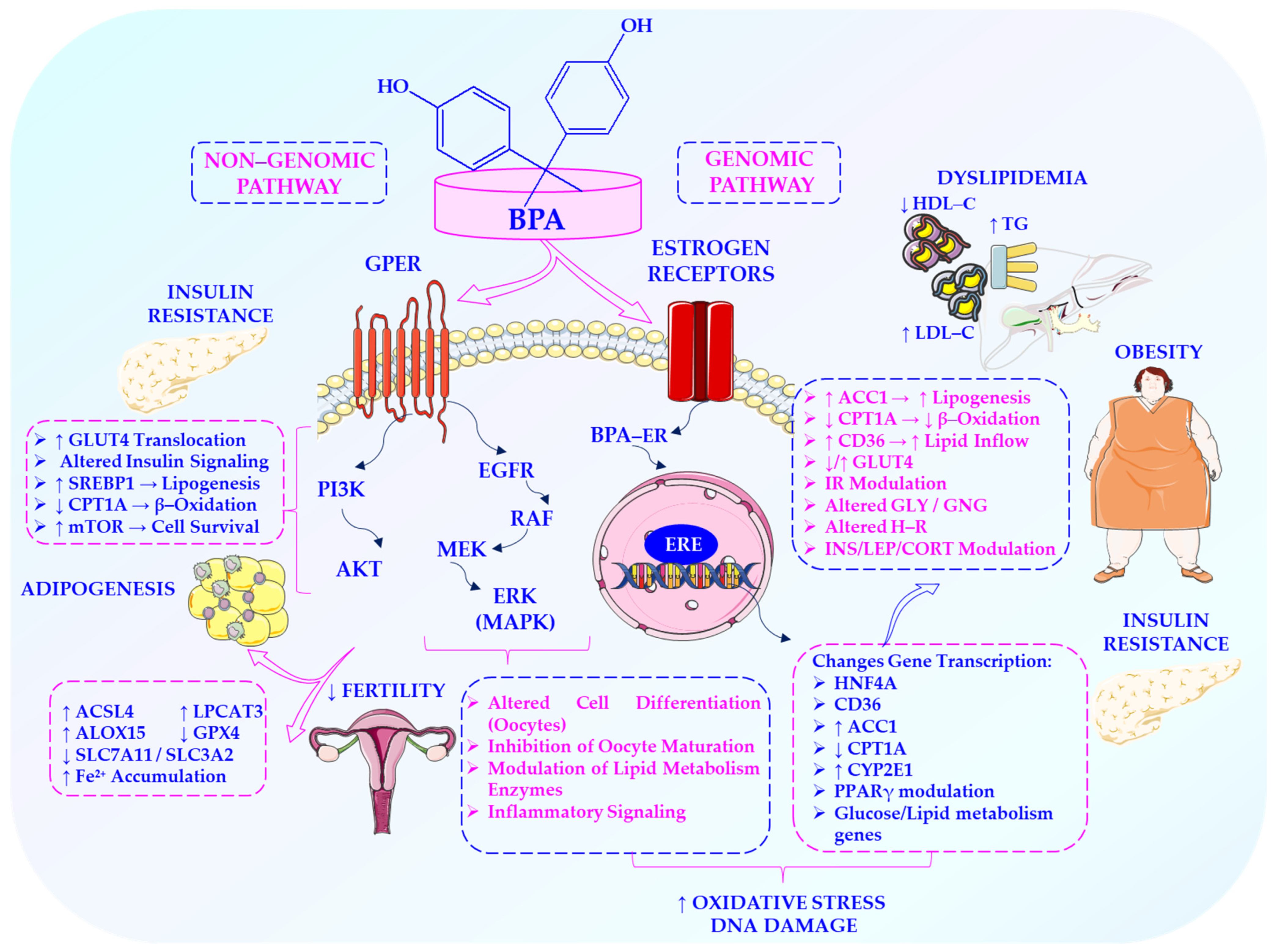
In addition to classical oestrogen receptors, BPA activates the G protein-coupled oestrogen receptor (GPER/GPR30), a key mediator of rapid, non-genomic oestrogen signalling. In hepatic tissue, BPA markedly increases G protein-coupled oestrogen receptor (GPER) expression, coinciding with significant disturbances to lipid metabolism, inflammatory signalling and regulated cell death pathways [48,49]. GPER activation promotes the upregulation of enzymes associated with lipid peroxidation, such as acyl-CoA synthetase long-chain family member 4 (ACSL4), lysophosphatidylcholine acyltransferase 3 (LPCAT3) and arachidonate 15-lipoxygenase (ALOX15), while suppressing components of the antioxidant defence system including glutathione peroxidase 4 (GPX4), solute carrier family 7 member 11 (SLC7A11) and solute carrier family 3 member 2 (SLC3A2). This shifts the intracellular redox environment towards ferroptosis [49,50]. This process is closely linked to iron-dependent lipid peroxidation and mitochondrial dysfunction, which are emerging hallmarks of BPA-induced hepatotoxicity [49]. These findings are consistent with the broader body of evidence indicating that BPA acts as a potent metabolic disruptor capable of altering hepatic lipid homeostasis and redox balance even at low, environmentally relevant concentrations [44,45]. Together, these data establish GPER-dependent ferroptosis as a key link between endocrine disruption, oxidative lipid injury, and hepatocellular degeneration.
In reproductive tissues, BPA activates the G protein-coupled oestrogen receptor (GPER)–epidermal growth factor receptor (EGFR)–mitogen-activated protein kinase (MAPK) signalling axis, thereby modulating cell differentiation and maturation in a manner that is independent of genomic transcription [51,52]. In zebrafish oocytes, low concentrations of BPA bind to GPER with appreciable affinity, inducing EGFR transactivation and stimulating MAPK3/1 (ERK1/2) phosphorylation. Ultimately, this inhibits oocyte maturation via a rapid, membrane-initiated mechanism [53]. This non-classical signalling pathway complements the genomic actions of BPA mediated by oestrogen receptor alpha (ERα) and oestrogen receptor beta (ERβ), and is consistent with its well-documented ability to interfere with reproductive endocrine function in various vertebrate species [54,55]. Importantly, similar mechanisms have been suggested in mammalian systems, indicating translational relevance beyond aquatic models. The convergence of GPER-dependent hepatic ferroptosis and GPER–EGFR–MAPK-mediated reproductive disruption underscores the ability of BPA to disrupt multiple physiological systems via integrated non-genomic mechanisms [52].
Thus, the evidence demonstrates that BPA disrupts metabolic and reproductive homeostasis via two primary mechanisms: (i) ERα/ERβ-mediated transcriptional reprogramming and (ii) GPER-centred rapid signalling that promotes inflammation, lipid peroxidation and ferroptosis. Furthermore, BPA may interact with other nuclear receptors, such as androgen receptors (AR) and thyroid hormone receptors (TR), thereby broadening its endocrine-disrupting profile even further [56,57]. The combined effects of BPA and MPs are amplified, highlighting the importance of considering co-exposure scenarios in environmental risk assessment. The convergence of these pathways establishes BPA as a prototypical endocrine and metabolic disruptor, with significant implications for human health.
In addition to disrupting the endocrine system, BPA induces a strong oxidative imbalance by increasing ROS and reducing antioxidant defences. This results in mitochondrial dysfunction and cellular damage [58]. This oxidative stress is often accompanied by impaired mitochondrial bioenergetics, including reduced ATP production and altered mitochondrial membrane potential. These oxidative disturbances are consistent with the genotoxic effects observed in Drosophila melanogaster, where BPA triggered DNA damage and chromosomal abnormalities via ROS-dependent mechanisms [59]. Further evidence from human erythrocytes shows that BPA and its analogues (BPS, BPF and BPAF) cause membrane oxidation and haemolytic damage, confirming that oxidative stress is a consistent toxicological response across species [60]. Comparative studies in Drosophila melanogaster also demonstrate sex-specific alterations in oxidative biomarkers and lifespan subsequent to exposure to BPA and its structural analogues, thereby highlighting the sensitivity of redox pathways to bisphenol-induced disruption [61].
Figure 1 shows how BPA disrupts endocrine and metabolic homeostasis. This occurs via both genomic (ERα/ERβ-mediated) and rapid non-genomic (GPER-EGFR-MAPK and PI3K/AKT) pathways. The result is oxidative stress, mitochondrial dysfunction, and long-term impairment of metabolism and reproduction.
BPA-induced oxidative stress is closely associated with reproductive toxicity. ROS accumulation and inflammatory signalling disrupt neuroendocrine regulation and gametogenesis [62]. In mammalian models, an oxidative imbalance contributes to ferroptotic cell death, as demonstrated by iron accumulation, mitochondrial damage, and dysregulation of ferroptosis-related genes such as GPX4, ACSL4, COX2, and FTH1 in testicular tissue [63]. These oxidative and ferroptotic mechanisms interact with metabolic disturbances; BPA interferes with glucose and lipid homeostasis by modulating PPARγ, insulin signalling and adipocyte differentiation [64]. Network toxicology analyses further reveal that BPA interacts with key metabolic regulators, including insulin (INS), AKT serine/threonine kinase 1 (AKT1), peroxisome proliferator-activated receptor gamma (PPARG), signal transducer and activator of transcription 3 (STAT3) and peroxisome proliferator-activated receptor alpha (PPARA), and disrupts pathways such as the insulin, AMP-activated protein kinase (AMPK) and hypoxia-inducible factor-1 (HIF-1) cascades [45]. These pathway-level disruptions provide a coherent explanation for the epidemiological links between BPA exposure and obesity, insulin resistance and cardiometabolic disorders. This establishes a clear biological basis for the association between BPA and metabolic disease [65]. Thus, the oxidative, inflammatory and metabolic disturbances caused by BPA demonstrate how chemicals derived from plastics can disrupt multiple biological systems simultaneously. Similar patterns of oxidative imbalance and ferroptosis-related damage have also been observed with other widespread plastic additives. This is particularly evident in the case of phthalates, such as DEHP and its metabolite MEHP. These represent another major group of contaminants that have a significant impact on reproductive and metabolic health.

3.2. The Toxicology of Phthalates (DEHP and MEHP)

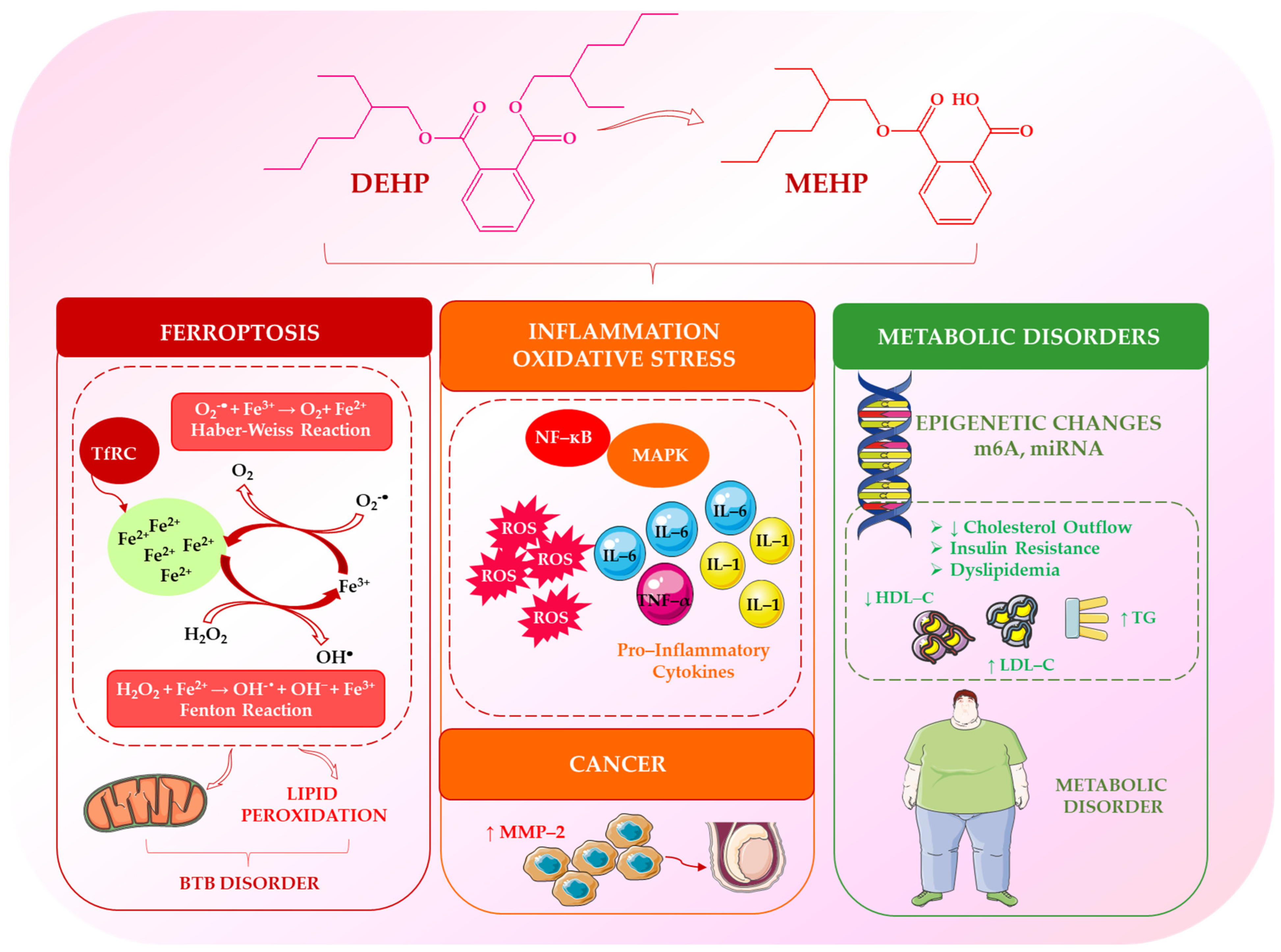
Phthalates such as di-2-ethylhexyl phthalate (DEHP) and its primary metabolite mono-2-ethylhexyl phthalate (MEHP) have a significant impact on reproductive health, with mechanisms strongly linked to ferroptosis and oxidative stress [66]. A significant finding is that DEHP disrupts the blood-testis barrier (BTB) by inducing iron-dependent lipid peroxidation and mitochondrial damage, both of which are characteristic of ferroptotic cell death [67]. This process is mediated by the upregulation of the transferrin receptor (TfRC), which increases the accumulation of intracellular Fe2+ and renders Sertoli cells susceptible to ferroptosis. Conversely, knocking down TfRC effectively blocks this pathway, confirming its causal role [67]. Disruption of the BTB also compromises the immune-privileged status of the testis, exacerbating germ cell vulnerability and impairing spermatogenesis. These ferroptotic mechanisms align with broader evidence that phthalates impair testicular function through oxidative injury, mitochondrial swelling, and disruption of redox homeostasis. Furthermore, phthalates are known to suppress steroidogenesis by downregulating key enzymes such as steroidogenic acute regulatory protein (StAR), cytochrome P450 family 11 subfamily A member 1 (CYP11A1) and 3β-hydroxysteroid dehydrogenase (3β-HSD), thereby contributing to reproductive dysfunction [68,69].
MEHP exerts potent developmental toxicity, impairing early embryogenesis by reducing blastocyst formation and hatching, and altering DNA methylation patterns via Tet3-dependent demethylation [70]. These epigenetic alterations occur alongside micronuclear formation and changes in cell lineage markers, demonstrating that MEHP disrupts genome stability and early developmental programming [70]. Similar reproductive disruption has been observed in marine medaka: chronic exposure to DEHP/MEHP from hatching to adulthood caused endocrine imbalance, reduced fertility and impaired gonadal development [71], confirming the cross-species conservation of phthalate toxicity. These findings emphasise that phthalate-induced toxicity affects critical stages of development, from early embryogenesis to reproductive maturity.
At the molecular signalling level, MEHP acts as a potent agonist of the human TRPA1 ion channel. This induces inward cation currents and nociceptive signalling, which may contribute to the pain, inflammation, and neuroendocrine dysregulation associated with phthalate exposure [72]. TRPA1 activation by MEHP can be blocked by the antagonist A-967079, demonstrating that this receptor is a direct molecular target of phthalate toxicity [72]. This mechanism broadens the toxicological profile of phthalates by linking chemical exposure to sensory perception pathways and neuroimmune interactions. It also expands the toxicological profile of MEHP beyond reproductive tissues by implicating sensory and inflammatory pathways in systemic phthalate responses.
Phthalates also promote carcinogenic processes, particularly in testicular embryonal carcinoma cells. MEHP enhances cell invasion and migration by strongly upregulating MMP2, while leaving MMP9 unaffected. This indicates the selective activation of extracellular matrix-remodelling pathways [73]. Inhibiting MMP2 abolishes MEHP-induced invasiveness, confirming its role in tumour progression [73]. Previous studies have shown that MEHP disrupts junctional complexes in the seminiferous epithelium via MMP2-dependent degradation of adhesion proteins, thereby linking structural testicular damage with carcinogenic potential [74]. Furthermore, phthalates have been reported to exhibit weak genotoxic and epigenotoxic effects, which may contribute to tumour initiation and progression [75]. Network toxicology analyses show that MEHP targets numerous cancer-related proteins and signalling pathways, including immune-regulatory and tumour-promoting networks [76].
Further environmental risk modelling demonstrates that DEHP and MEHP exhibit high chemical activity in environmental matrices. This supports their potential for bioaccumulation and their capacity to reach toxicologically relevant concentrations in wildlife and humans [77]. Quantitative structure-activity relationship (QSAR) and network toxicology models reinforce these exposure risks by identifying phthalates as high-priority reproductive toxicants with strong interactions across endocrine, oxidative and developmental pathways [78]. Notably, human exposure primarily occurs through ingestion, inhalation, and dermal contact; diet is considered a significant source due to contamination of food packaging [79].
At a metabolic level, MEHP disrupts cholesterol homeostasis by interfering with microRNA-dependent regulation of N6-methyladenosine (m6A) RNA methylation. This impairs cholesterol efflux, contributing to dyslipidaemia and metabolic imbalance [80]. This mechanism demonstrates that phthalate toxicity extends beyond reproductive tissues to systemic metabolic pathways by integrating epigenetic regulation with lipid metabolism. Furthermore, MEHP acts as an agonist of peroxisome proliferator-activated receptors (PPARs), particularly PPARα and PPARγ, thereby modulating lipid metabolism and adipogenesis [81,82].
In addition to disrupting the endocrine system, phthalates induce strong inflammatory responses and oxidative stress in various tissues by primarily activating NF-κB and MAPK signalling pathways, thereby increasing cytokine and chemokine production [64]. These inflammatory cascades are consistent with observations that DEHP and MEHP disrupt the blood-testis barrier by promoting lipid peroxidation and mitochondrial injury. This suggests that oxidative stress plays a key role in phthalate-induced tissue damage [68,83]. Furthermore, chronic low-dose exposure may lead to cumulative effects due to the continuous presence of phthalates in the environment. The resulting pro-inflammatory environment can lead to impaired organ function and long-term reproductive dysfunction. For example, marine medaka that were chronically exposed to DEHP and MEHP from hatching to adulthood exhibited impaired organ function and long-term reproductive dysfunction [71]. Phthalates also exert metabolic toxicity, promoting insulin resistance and dyslipidaemia by impacting adipogenesis, lipid metabolism, and the epigenetic regulation of metabolic genes [80]. Network toxicology analyses further demonstrate that MEHP interacts with numerous metabolic and immune-related targets, thereby reinforcing its role in systemic metabolic disruption [78]. Thus, these endocrine, inflammatory and metabolic actions classify phthalates as potent developmental and systemic toxicants with the capacity to impair reproductive, metabolic and immune homeostasis [70]. Nevertheless, despite the strong experimental evidence, more longitudinal human studies are needed to fully elucidate the long-term health consequences of phthalate exposure.
Figure 2 shows that exposure to phthalates (DEHP/MEHP) causes systemic toxicity by triggering ferroptosis and oxidative stress, as well as mitochondrial dysfunction. At the same time, it disrupts reproductive function, enhances inflammatory and cancer-related pathways, and impairs lipid and metabolic homeostasis.
Furthermore, the endocrine, inflammatory and metabolic disturbances caused by phthalates demonstrate how chemicals associated with plastics can disrupt multiple physiological systems during development and in adulthood. Their ability to impair reproductive, metabolic and immune homeostasis is indicative of a broader pattern observed in several classes of persistent contaminant. This becomes even clearer when we consider per- and polyfluoroalkyl substances: a group of highly stable “forever chemicals” that build up in organisms and have toxic effects on multiple organ systems.

3.3. Per- and Polyfluoroalkyl Substances (PFAS) as “Forever Chemicals”

Cao and Ng (2021) state that per- and polyfluoroalkyl substances (PFAS) are commonly known as ‘forever chemicals’ because of their extreme persistence in the environment and resistance to degradation [84]. These compounds accumulate in multiple organs, including the blood, liver and kidneys, and to a lesser extent the brain. Although the brain is not the primary site of PFAS deposition, measurable concentrations can cross the blood-brain barrier and contribute to neurological dysfunction [84]. Further evidence indicates that two of the most extensively studied PFASs, perfluorooctane sulfonate (PFOS) and perfluorooctanoic acid (PFOA), are widely distributed in human tissues and exert toxic effects across multiple organ systems, including the reproductive and endocrine systems [85]. Importantly, PFAS are characterised by long biological half-lives in humans (ranging from years to decades), significantly enhancing their bioaccumulation potential and chronic toxicity [86]. Recent epidemiological and toxicological evaluations demonstrate that exposure to PFAS is associated with impaired fertility, altered hormone regulation, and developmental toxicity in both sexes, highlighting their significance as reproductive toxicants [87,88].
However, emerging research emphasises that modelling the toxicity of PFAS remains highly challenging due to their structural diversity, long biological half-lives and complex toxicokinetics, which make extrapolation between experimental models and human exposure scenarios difficult [89]. This complexity has led to mounting scientific and regulatory concern, as DeWitt et al. (2025) highlight when identifying PFAS as a priority class of contaminants due to their persistence, bioaccumulation, and wide range of adverse health effects [90]. Furthermore, the combined exposure to multiple PFAS compounds (mixture effects) complicates toxicological assessment and may lead to additive or synergistic biological responses [91]. These findings emphasise that PFAS persist in the environment, accumulating in critical tissues where they exert neurotoxic, reproductive and systemic effects.
At the cellular level, PFAS toxicity is mediated by their ability to cross biological barriers and disrupt fundamental processes of cellular homeostasis. PFAS can penetrate tissues by altering tight junction integrity and via transporter-dependent uptake mechanisms. This enables their accumulation in the central nervous system, including regions such as the hippocampus, hypothalamus and thalamus, where they can impair cognitive and behavioural functions [84,92]. PFAS also compromise intestinal barrier integrity by modulating tight junction proteins, thereby increasing epithelial permeability and promoting systemic inflammation [93]. This “leaky barrier” effect may enhance the absorption of co-occurring environmental toxicants, including MPs and their associated additives, thereby amplifying the overall toxic burden.
Human exposure to PFAS is widespread and occurs through contaminated water, food, indoor dust, consumer products and cosmetics, resulting in chronic internal accumulation [94]. Biomonitoring studies confirm that PFOS and PFOA are the dominant PFAS in human serum, with high detection frequencies in vulnerable populations. For instance, elevated levels have been observed in older adults in care homes, where exposure to indoor dust correlates with serum concentrations [95]. Similar patterns have been observed in environmental hotspots, where residents of PFAS-contaminated regions have significantly higher serum levels than control populations, reflecting the persistence of legacy PFAS contamination [96]. Children and adolescents also exhibit measurable PFAS burdens, indicating exposure in early life and raising concerns about developmental toxicity [97]. Prenatal exposure via placental transfer and postnatal exposure via breast milk also contribute to early-life body burdens [98].
Exposure to PFAS has been linked to various adverse health outcomes, including endocrine disruption, metabolic dysfunction, immune impairment, and reproductive toxicity [94]. Epidemiological evidence links PFAS exposure to asthma in young children, suggesting that immune modulation and airway inflammation are key mechanisms underlying respiratory effects [99]. PFAS have also been associated with an increased risk of chronic obstructive pulmonary disease. Serum albumin has been identified as a mediator of PFAS-induced pulmonary dysfunction, which highlights the importance of PFAS-protein interactions [100]. Reproductive toxicity remains a major concern as PFOS and PFOA have been linked to reduced male fertility, impaired spermatogenesis, and hormonal imbalances. However, human data show some variability due to differences in exposure kinetics and study design [101].
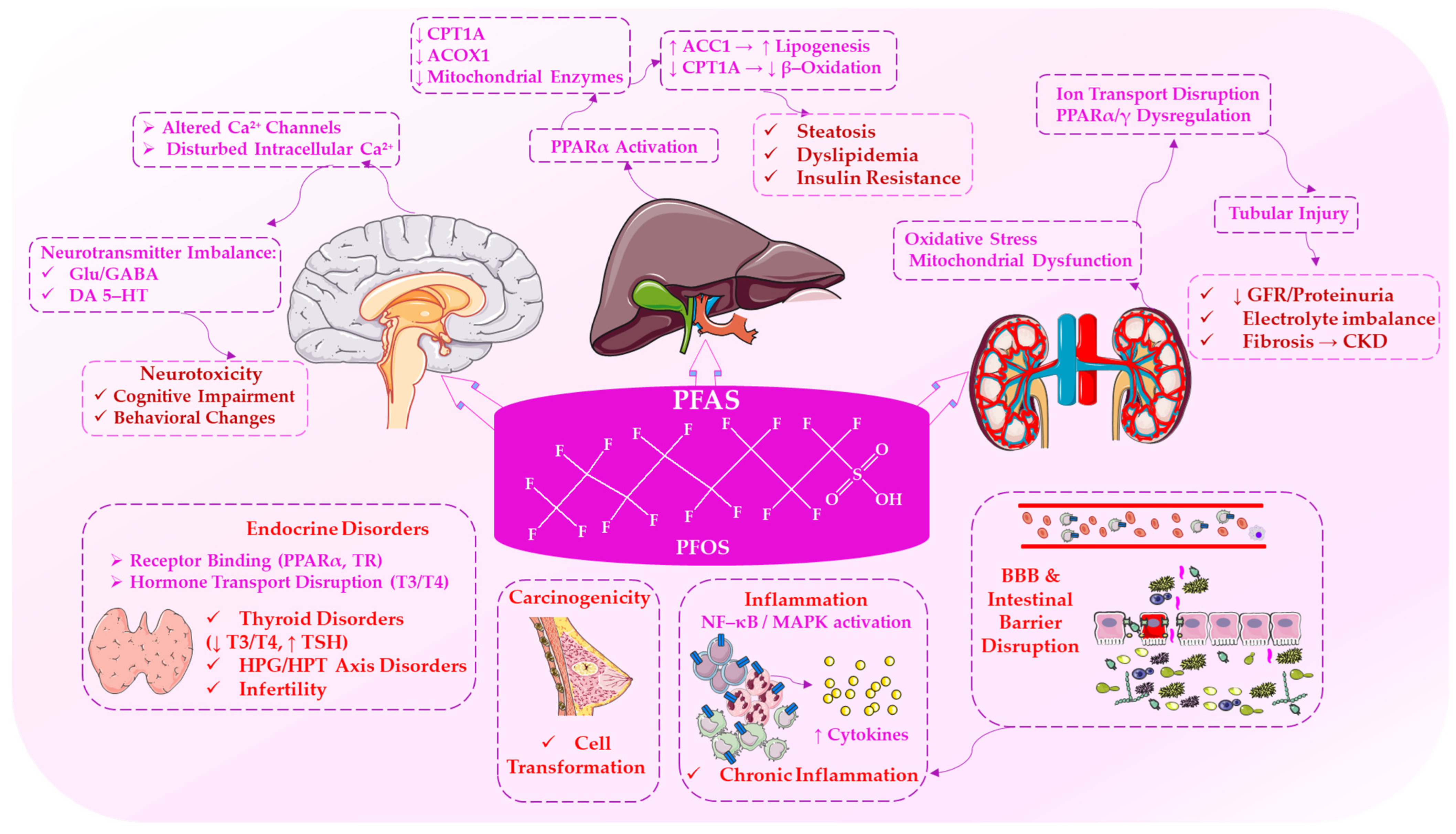
At a molecular level, PFAS disrupt calcium homeostasis and neurotransmitter signalling in neurons, thereby contributing to neurotoxicity and behavioural alterations [84,92]. PFAS also interfere with endocrine and metabolic pathways, including pancreatic function, lipid metabolism, and insulin signalling. This increases the risk of type 2 diabetes and childhood obesity [94,102]. A pivotal pathway entails the activation of nuclear receptors, most notably the PPARα, which modulates lipid metabolism, inflammation, and energy homeostasis. The effects of PFAS on hepatic and renal function are well documented and include hepatocellular hypertrophy, lipid dysregulation and altered xenobiotic metabolism, which is consistent with their classification as metabolic toxicants [86,94]. PFAS also impair immune function, contributing to reduced vaccine responses and increased susceptibility to infections, reflecting their immunotoxic potential [103].
The carcinogenicity of PFAS is an emerging concern, particularly for PFOS, which induces malignant transformation in BALB/c 3T3 cells in a concentration-dependent manner. This forms type III foci, which are indicative of non-genotoxic carcinogenic potential [104,105]. By contrast, PFOA does not induce transformation in the same model, which suggests that there are functional differences among PFAS subclasses [105,106]. Proposed mechanisms include oxidative stress, epigenetic dysregulation and altered cell proliferation signalling, rather than direct DNA mutagenesis. These findings are consistent with epidemiological data indicating an association between PFAS exposure and certain cancers, although the causal mechanisms are not fully understood [94].
Based on the evidence above, PFAS toxicity can be conceptualised as a multi-system process involving barrier disruption, endocrine interference, immune dysregulation, and metabolic reprogramming. PFAS interact with nuclear receptors, such as PPARα, thereby modulating transcriptional programmes that regulate lipid metabolism and inflammation [107,108]. This can lead to hepatic steatosis, dyslipidaemia, and metabolic imbalance, as demonstrated in human and animal studies [85]. In parallel, PFAS-induced immune suppression alters cytokine production and antibody responses, thereby increasing disease susceptibility [109]. Chronic low-dose exposure, combined with bioaccumulation and mixture effects, is likely to be the most relevant exposure scenario in the real world.
Thus, the persistence, bioaccumulation and multisystem toxicity of PFAS highlight them as one of the most concerning classes of environmental contaminants. Despite extensive experimental evidence, significant knowledge gaps remain, particularly concerning the long-term effects on human health, the toxicity of mixtures, and the interaction of PFAS with other environmental pollutants, such as MPs. These challenges highlight the need for more research into the underlying biological pathways and for better regulatory strategies [96].
Figure 3 shows that PFAS cause systemic toxicity by accumulating in organs and disrupting endocrine, metabolic and immune pathways. This occurs through interference with nuclear receptors, thyroid hormone transport and cellular signalling. The result is inflammation, neurotoxicity and multi-organ dysfunction.

4. Mechanisms of Toxicity: How Plastic Additives Affect Human Physiology

4.1. Endocrine Disruption

Numerous studies have demonstrated that plastic-derived chemicals can interact directly and indirectly with oestrogen, androgen and thyroid receptors. This confirms that receptor-level interference is a key mechanism through which plastic-derived chemicals cause endocrine disruption [62,110]. Plastic additives such as BPA, phthalates and PFAS primarily disrupt endocrine function by binding to or interfering with hormone receptors, thereby altering downstream signalling cascades [111,112]. BPA acts as a potent xenoestrogen, binding to ERα and ERβ and modifying transcriptional activity in ways that either mimic or antagonise endogenous oestrogens, thereby disturbing reproductive and neuroendocrine regulation [62,113]. Phthalate metabolites, particularly MEHP, exert anti-androgenic effects by inhibiting androgen receptor activation and suppressing testosterone-dependent signalling pathways, thereby contributing to impaired male reproductive development [69]. Furthermore, BPA and certain phthalates can interact with membrane-bound receptors (e.g., GPER), thereby diversifying their endocrine-disrupting potential even further [114].
Although structurally distinct from BPA and phthalates, PFAS compounds interfere with the transport of thyroid hormones by proteins such as transthyretin and disrupt receptor-mediated signalling. This results in an altered availability of T3 and T4, as well as compensatory changes in TSH [115,116]. PFAS can also activate nuclear receptors such as PPARα, thereby linking endocrine disruption with lipid metabolism and energy homeostasis. These receptor-level interactions propagate through major endocrine axes, including the hypothalamic-pituitary-gonadal and hypothalamic-pituitary-thyroid systems. The result is impaired reproductive maturation, disrupted thyroid homeostasis and altered metabolic regulation [117]. The combined effects on hormone production, receptor binding, and intracellular signalling emphasise the systemic nature of endocrine disruption caused by plastic-derived chemicals, highlighting their capacity to interfere with growth, reproduction, neurodevelopment, and energy balance throughout life [118].
One of the primary pathways through which microplastic-associated contaminants exert developmental toxicity is interference with nuclear hormone receptors. MPs transport endocrine-active chemicals, including bisphenols, phthalates, PFAS, pesticides and adsorbed metals, that bind to oestrogen (ERα/β), androgen (AR), peroxisome proliferator-activated receptors (PPARα/γ/δ) and thyroid receptors (TRα/β). This alters receptor conformation, co-activator recruitment and DNA binding activity [8,119]. Notably, MPs act as both passive carriers and dynamic sorbents, concentrating and releasing contaminants depending on environmental and physiological conditions. As these receptors regulate organogenesis, metabolic programming and sexual differentiation, inappropriate activation or inhibition during early development can redirect normal developmental pathways. MPs amplify these effects by increasing the bioavailability, persistence and tissue accumulation of endocrine-active contaminants [9,120].
Microplastic-associated chemicals disrupt both steroidogenesis and thyroid hormone signalling. PFAS inhibit key steroidogenic enzymes, such as CYP11A1, cytochrome P450 family 17 subfamily A member 1 (CYP17A1), and 3β-hydroxysteroid dehydrogenase (3β-HSD). This reduces the synthesis of testosterone, oestradiol, and progesterone [121,122]. MPs also impair the hypothalamic–pituitary–thyroid (HPT) axis by inhibiting thyroid peroxidase and altering deiodinase activity. This decreases the bioavailability of triiodothyronine (T3) and thyroxine (T4), disrupting peripheral hormone activation cycles [123]. Given the essential role of thyroid hormones in neurodevelopment, growth, and metabolic regulation, disruption in early life can lead to long-term physiological consequences [124].
Endocrine-active contaminants also interfere with hormone transport and metabolic clearance. PFAS, bisphenols and phthalates competitively bind to transthyretin and albumin, displacing endogenous thyroid hormones and reducing their delivery to target tissues [115]. Microplastic-associated chemicals further modulate cytochrome P450 (CYP), UDP-glucuronosyltransferase (UGT) and sulfotransferase (SULT) enzymes, accelerating the degradation of some hormones while impairing the clearance of others [125]. This bidirectional disruption to hormone metabolism contributes to endocrine instability and fluctuating hormonal profiles.
Endocrine disruption also affects the maturation of the HPA, HPT and HPO axes. Altered signalling through oestrogen receptors (ERs), androgen receptors (ARs), peroxisome proliferator-activated receptors (PPARs) and thyroid receptors (TRs) in the hypothalamus, pituitary and gonads can disrupt neuroendocrine programming. This leads to impaired glucocorticoid signalling, altered stress responses and a dysregulated energy balance [126,127]. Disruptions to the HPO axis, including reduced gonadotropin release, altered steroidogenesis and impaired feedback loops, can affect the timing of puberty, the production of gametes and reproductive capacity [128]. Similarly, HPA axis dysregulation can result in maladaptive stress responses and increased susceptibility to metabolic and psychiatric disorders.
A further mechanism involves epigenetic reprogramming. MPs and their associated chemicals can modify DNA methylation, histone acetylation, and microRNA expression in hormone-responsive tissues [129,130]. These changes can activate or silence genes involved in metabolism, reproduction, neurodevelopment and stress regulation. Endocrine-active contaminants may also reprogram germ cell epigenomes, enabling altered gene expression patterns to persist into adulthood or be transmitted to subsequent generations [131]. Such epigenetic alterations are increasingly recognised as a key link between exposure in early life and disease onset in adulthood.
Disruptions to nuclear receptors, hormone synthesis, transport, clearance and epigenetic programming can produce long-term developmental consequences. Altered endocrine signalling during critical periods can lead to an increased risk of metabolic disorders, impaired fertility, neurodevelopmental abnormalities, altered stress responsiveness, and disrupted pubertal timing [6,127]. Epigenetic changes in germ cells mean that physiological vulnerabilities may be passed on to offspring not directly exposed to MPs [132].
Beyond classical endocrine pathways, emerging evidence suggests that endocrine disruption is closely linked to other cellular stress responses. MPs and NPs reduce cellular resilience to environmental toxicants. Chronic exposure interferes with endocrine, metabolic, and developmental pathways, thereby lowering tolerance to oxidative stress across organ systems [133]. NPs that are similar in size to the polypropylene used in medical injection systems can impair endothelial viability and induce stress responses. This demonstrates that exposure routes that are clinically relevant can contribute to a cumulative toxic burden [134].
MPs also disrupt gut-liver and gut-immune communication, reshaping microbial communities and altering host metabolic signalling. This promotes systemic inflammation and redox imbalance [135]. In sensory tissues, polystyrene NPs can penetrate cochlear and neurosensory structures, thereby inducing mitochondrial dysfunction, endoplasmic reticulum (ER) stress and apoptosis [136]. These findings are consistent with broader toxicological evidence indicating that micro- and NPs act as xenobiotic stressors that interact with conventional pollutants to amplify carcinogenic, metabolic, and immunotoxic pathways [137,138]. This integrative perspective highlights that endocrine disruption should be considered as part of a wider network of interconnected toxicological mechanisms, rather than as an isolated effect.
Furthermore, the systemic effects induced by micro- and nano particles, including disruption to gut–liver and gut–immune communication, mitochondrial injury, ER stress, apoptosis, and amplification of carcinogenic, metabolic, and immunotoxic pathways, illustrate how contaminants associated with plastics can interfere with multiple physiological systems simultaneously. These findings align with a broader toxicological pattern observed for other persistent plastic-associated pollutants. Of these, PFAS are of particular concern due to their extreme environmental persistence and their ability to disrupt endocrine regulation, including thyroid hormone homeostasis.

4.2. PFAS and Thyroid Hormone Disruption

There is a growing body of evidence suggesting that PFAS interfere with thyroid hormone homeostasis via multiple molecular pathways. This disruption has been consistently observed in elderly adults, adolescents, pregnant women and children. In a large cohort of older adults, high levels of PFOS, PFOA, PFDA and PFNA were detected, which were significantly associated with reduced TSH levels and altered concentrations of T4, FT4 and T3. This suggests that PFAS may dysregulate the hypothalamic-pituitary-thyroid (HPT) axis [139]. These associations are consistent with PFAS’s ability to bind to transthyretin (TTR) and displace endogenous thyroid hormones, thereby affecting the availability of circulating hormones. This is reflected by TEQ-based mixture analyses showing a decrease in TSH with an increasing PFAS burden [140]. In addition to TTR, PFAS may interact with other transport proteins, such as albumin and thyroid-binding globulin, thereby further modifying hormone distribution and bioavailability [139].
Similar endocrine-disrupting patterns have been reported in adolescent males, where PFOS, PFOA and long-chain PFAS were associated with increased levels of free T4, particularly among those with low iodine intake. This suggests that PFAS may enhance thyroid hormone release or decrease its clearance in the periphery under conditions of micronutrient vulnerability [141]. This observation highlights the importance of nutritional status as a modifier of PFAS toxicity, particularly in iodine-deficient populations. Disruption to thyroid homeostasis has also been observed during pregnancy: exposure to PFAS in the early stages of pregnancy has been linked to higher maternal free T4 levels and altered TSH levels. This suggests that PFAS may interfere with the transfer of thyroid hormones between mother and foetus, as well as with placental hormone regulation [142]. PFAS can cross the placental barrier and accumulate in foetal tissues, potentially disrupting early neurodevelopment by altering thyroid signalling. These findings are consistent with the results of the SELMA cohort study, which found that exposure to PFAS was associated with altered thyroid hormone profiles in pregnant women, thereby reinforcing the sensitivity of the HPT axis during gestation [143].
The endocrine effects of PFAS extend beyond thyroid hormones to encompass broader steroid and parathyroid signalling. In adolescents from northern Norway, exposure to various PFAS—including PFOA, PFOS, PFNA and PFDA—was linked to altered dehydroepiandrosterone sulfate (DHEAS) and 11-deoxycorticosterone/dehydroepiandrosterone sulfate (11-DOC/DHEAS) ratios, alongside reduced free thyroxine (T4) and triiodothyronine (T3) levels in boys. This suggests sex-specific susceptibility and disruption to multiple hormones [144]. These hormonal alterations were accompanied by earlier menarche in girls and higher pubertal development scores in boys, suggesting that PFAS may accelerate or disrupt pubertal timing by interacting with thyroid and steroidogenic pathways. Further evidence from adolescents living near industrial PFAS sources shows consistent associations between PFAS exposure and altered thyroid and sex hormone levels, providing additional support for the endocrine-disrupting potential of these compounds [145]. Taken together, these findings suggest that PFAS act as multi-axis endocrine disruptors rather than thyroid-specific toxicants.
Meta-analytic evidence confirms these patterns, with exposure to PFAS being associated with increased free T4 and altered thyroid-stimulating hormone (TSH) across adult populations, thereby supporting the hypothesis that PFAS interfere with thyroid hormone transport, receptor binding, and feedback regulation [146]. However, the direction and magnitude of these associations may vary depending on the length of the PFAS chain, the timing of exposure, sex and physiological status, which may explain inconsistencies across studies. These findings demonstrate that PFAS disrupt thyroid homeostasis through various mechanisms, including TTR displacement, interference with the HPT axis, altered hormone metabolism, and micronutrient-dependent modulation. This leads to measurable endocrine effects throughout life.
At the molecular level, PFAS have also been shown to interfere with key enzymes involved in thyroid hormone synthesis and metabolism. For instance, the inhibition of thyroid peroxidase (TPO) and the modulation of deiodinase activity (DIO1, DIO2 and DIO3) can hinder the iodination of thyroglobulin and the peripheral conversion of T4 to the biologically active T3. Additionally, PFAS may interact with thyroid hormone receptors (TRα and TRβ), thereby altering transcriptional responses in target tissues [115]. These combined effects further contribute to the disruption of thyroid hormone signalling at systemic and cellular levels.
In summary, altered hormone synthesis and signalling are central to endocrine disruption caused by chemicals derived from plastics. These compounds interfere with receptor binding and upstream processes such as hormone synthesis, secretion, and intracellular signalling cascades. For instance, phthalates hinder steroidogenesis by reducing the activity of essential enzymes involved in testosterone production, resulting in decreased androgen levels and impaired reproductive development [69]. Concurrently, BPA disrupts aromatase activity and alters the balance of oestrogen and progesterone synthesis, thereby reinforcing its role as a potent modulator of ovarian and testicular hormone pathways [147,148]. In the context of PFAS, endocrine disruption extends to thyroid hormone synthesis, transport and peripheral metabolism, leading to reduced or elevated circulating hormone levels, depending on the exposure conditions. These thyroid-disrupting effects have been observed in various populations, including adolescents, pregnant women and adults [141,143,146], confirming that PFAS can destabilise the hypothalamic-pituitary-thyroid axis by displacing transthyretin, altering deiodinase activity and modifying feedback regulation.
Such disruptions propagate through major endocrine axes, including the hypothalamic-pituitary-gonadal and hypothalamic-pituitary-thyroid systems. This can lead to impaired reproductive maturation, metabolic imbalance, and altered energy homeostasis [145]. Evidence from adolescent cohorts also shows that exposure to PFAS is associated with altered steroid hormone profiles, early menarche and modified pubertal development, highlighting the systemic reach of these endocrine effects [144]. The combined impact of phthalates, BPA and PFAS on hormone production, transport and intracellular signalling emphasises the multisystem nature of endocrine disruption caused by chemicals derived from plastics and their ability to interfere with human development throughout life [69]. Thus, PFAS-induced thyroid dysfunction is a significant part of a wider network of endocrine disturbances that can have lifelong and transgenerational consequences.
Notably, the combined endocrine effects of phthalates, BPA and PFAS demonstrate how chemicals associated with plastics can interfere with hormone production, transport and intracellular signalling throughout the lifespan. However, endocrine disruption is just one aspect of the broader biological impact of plastic-related contaminants. Another key element of this toxicity involves oxidative stress and inflammation, particularly when transition metals are transported on microplastic surfaces and enter cells.

4.3. Oxidative Stress and Inflammation

When metals are transported on microplastic surfaces and enter cells, they trigger intense oxidative stress via classical Fenton and Haber-Weiss chemistry. As detailed by Kehrer (2000) [149], Koppenol (2001) [150] and Liochev and Fridovich (2002) [151], transition metals such as Fe2+ and Cu+ convert hydrogen peroxide into hydroxyl radicals. This process is one of the most potent intracellular sources of highly reactive hydroxyl radicals (OH), which can rapidly damage lipids, proteins, and DNA. Metal-loaded MPs accumulate in endosomes and mitochondria, destabilising ETC complexes I and III and amplifying superoxide formation. This shifts redox signalling towards p38 and JNK MAPKs [8]. Such mitochondrial dysfunction is a key step in the process by which exposure to xenobiotics leads to sustained ROS production. This metal-driven oxidative environment increases susceptibility to pesticides transported alongside MPs, which are delivered directly to epithelial membranes and endosomes [1]. Many pesticides undergo metabolic activation via CYP1A1, CYP2B6 and CYP3A, generating unstable intermediates that leak electrons and produce ROS [152]. Concurrently, pesticide-induced PKC and RhoA activation stimulates NOX1/NOX2, further increasing ROS output [153]. The synergy between metal-initiated ROS and pesticide-driven redox cycling creates a highly oxidative microenvironment that magnifies toxicity even at low doses.
The oxidative stress caused by metals and pesticides is exacerbated by PFAS carried on MPs. Studies on algal and plant models [106,154] have demonstrated that PFAS disrupt mitochondrial inner-membrane lipids, impairing ETC complexes I and II and increasing electron leakage. There is emerging evidence that similar mitochondrial liabilities may occur in mammalian systems, although the magnitude of the effect depends on the structure of the PFAS and the duration of exposure. PFAS activate PPARα, thereby enhancing peroxisomal β-oxidation and hydrogen peroxide production whilst interfering with Nrf2, aryl hydrocarbon receptor (AhR), and NF-κB signalling [155,156]. Subcellular analyses demonstrate that PFAS reduce catalase activity and induce ROS through both mitochondrial and non-mitochondrial sources, exhibiting headgroup-dependent toxicity [157]. This dual origin of ROS further amplifies the oxidative burden and promotes redox imbalance at the cellular level.
MPs coated with PFAS can integrate into epithelial membranes, thereby stimulating NOX4 and destabilising redox-sensitive pathways [158,159]. In addition to being chemical contaminants, MPs and NPs themselves amplify oxidative stress by physically disturbing membranes and activating NOX2/NOX4 via mechanosensitive signalling [160,161]. Their accumulation in lysosomes can lead to lysosomal membrane permeabilisation (LMP), cathepsin release and activation of the NLRP3 inflammasome [162,163]. Activation of the NLRP3 inflammasome links oxidative stress directly to inflammatory signalling through the activation of caspase-1 and the maturation of IL-1β/IL-18. MPs and NPs also disrupt mitochondrial dynamics by causing an imbalance in OPA1/DRP1, thereby increasing ETC electron leakage [160,164]. Together, these processes create a redox-primed environment that enhances the ROS-generating potential of all associated contaminants [165].
Combined oxidative stress caused by metals, pesticides, PFAS and MPs rapidly activates the Nrf2–Keap1 antioxidant pathway. Polystyrene micro- and NPs increase ROS, disrupting mitochondrial homeostasis and activating the p62/Keap1/Nrf2 axis [166]. ROS modify Keap1 cysteine residues, enabling Nrf2 to translocate to the nucleus and induce antioxidant response element (ARE)-dependent genes such as haem oxygenase-1 (HO-1), NAD(P)H quinone dehydrogenase 1 (NQO1) and glutamate–cysteine ligase catalytic subunit (GCLC). This is consistent with the findings of Guo et al. (2024) [167]. This response initially represents an adaptive, cytoprotective mechanism aimed at restoring redox balance. However, chronic exposure can repress Nrf2 signalling, reduce the expression of antioxidant enzymes and promote oxidative stress [168]. Persistent ROS can disrupt mitochondrial membrane potential, ATP production and mitochondrial dynamics, thereby overwhelming the body’s antioxidant defences [166]. At this stage, oxidative stress shifts from an adaptive to a pathological process.
NPs can alter the structure and function of SOD in a size-dependent manner [169], thereby increasing lipid peroxidation and intracellular Fe2+, as well as ferroptotic signalling [170]. Excessive superoxide can overwhelm SOD, resulting in the accumulation of hydrogen peroxide beyond the capacity of CAT and GPx [171]. Chronic Nrf2 activation increases HO-1-mediated free iron, fuelling Fenton chemistry [172]. Accumulation of NPs in mitochondria disrupts complexes I-III of the electron transport chain (ETC) [173], triggering ferroptosis, ferritinophagy and apoptosis [13,174]. These processes illustrate a self-reinforcing loop in which oxidative stress promotes iron dysregulation, which in turn further enhances ROS generation.
In addition to causing oxidative stress and mitochondrial injury, MPs and NPs disrupt broader cellular homeostasis, contributing to neurotoxicity, immune dysregulation, and the failure of cross-organ communication. NPs can penetrate the central nervous system, inducing neuronal injury via oxidative stress, MAPK activation and metal-dependent cell death pathways [175]. Polystyrene NPs activate MAPK/ERK-mediated cuproptosis, characterised by copper accumulation, DLAT oligomerisation and mitochondrial collapse [176]. Co-exposure to oxidants such as ozone intensifies neuronal pyroptosis [177]. These findings are consistent with the adverse outcome pathways described by Hu and Palić (2020) [178]. Notably, neuroinflammation driven by microglial activation provides an additional link between oxidative stress and functional neurological impairment.
MPs disrupt autophagy, mitophagy and ferroptosis, thereby exacerbating tissue injury. NPs activate AMPK/ULK1-dependent mitophagy [179], whereas excessive mitochondrial damage causes cells to shift towards necrotic pathways, including ferroptosis driven by ferritinophagy [180]. A similar imbalance of oxidative stress and apoptosis occurs in alveolar epithelial cells [181]. Dysregulation of autophagic flux further impairs the removal of damaged organelles, exacerbating ROS accumulation and inflammatory signalling. These mechanisms demonstrate that MPs act as carriers and catalysts of oxidative stress, creating a multilayered, self-reinforcing ROS cascade that exceeds antioxidant capacity and magnifies the toxicity of all associated contaminants [160,175,176]. This integrated model highlights the tight interconnection between oxidative stress and inflammation, forming a central axis of microplastic-induced toxicity. Furthermore, persistent oxidative stress and inflammation are central to microplastic-induced toxicity, extending downstream to cause long-term alterations in gene regulation and metabolic function. This provides context for understanding how chemicals derived from plastic influence epigenetic and metabolic pathways.

4.4. Epigenetic and Metabolic Effects

It has been demonstrated that DNA methylation and epigenetic reprogramming are key mechanisms through which chemicals derived from plastics exert long-term biological effects. Kim et al. (2021) [182] showed that PFAS can modify DNA methylation and histone marks by affecting the activity of methyltransferases and demethylases. This reshapes chromatin accessibility and transcriptional responses [182]. These compounds can also influence non-coding RNAs, including microRNAs and long non-coding RNAs, thereby expanding their regulatory impact on gene expression even further. Substances such as BPA, phthalates and PFAS can induce profound epigenetic alterations, particularly during early development when the epigenome is highly plastic. Delfosse et al. (2015) [183] and Sellami et al. (2021) [184] showed that plastic-associated endocrine disruptors act through nuclear receptors such as ERα and PPARs. These receptors function as transcriptional regulators that interact directly with chromatin-modifying complexes. This supports the concept that epigenetic and receptor-mediated mechanisms work together [183,184]. As these epigenetic marks are stable and can persist long after exposure, contact with plastic additives in early life may alter developmental trajectories and increase the risk of chronic disease. Furthermore, Tyc et al. (2025) [127] and Ullah et al. (2023) [11] emphasised that germ-cell epigenomes are vulnerable to disruption. This raises the possibility of the transgenerational inheritance of exposure-induced phenotypes [11,127]. Such heritable epigenetic modifications may contribute to disease susceptibility across multiple generations, even in the absence of continued exposure.
Endocrine disruptors associated with plastics strongly affect lipid metabolism. Mistry and Cresci (2010) [185] and Ojo et al. (2021) [186] demonstrated that BPA, phthalates, and PFAS alter adipocyte differentiation, lipid storage, and fatty acid oxidation via PPARα-dependent pathways. This provides evidence for metabolic reprogramming [185,186]. In addition to PPARα, the activation of PPARγ and the disruption of SREBP-1c signalling further promote adipogenesis and lipid accumulation. These metabolic disturbances can lead to hepatic steatosis, altered cholesterol homeostasis, and impaired lipid transport. Domenech and Marcos (2021) [187] and Kumar et al. (2022) [188] have emphasised that disruptions to lipid metabolism in early life can predispose individuals to long-term metabolic disorders, including fatty liver disease and dyslipidaemia. This early-life metabolic programming is increasingly recognised as a critical determinant of adult metabolic health [187,188].
Plastic-derived chemicals can also disrupt glucose homeostasis by impairing insulin signalling, pancreatic β-cell function, and central metabolic regulation. Zhang et al. (2022) [10] and Ojo et al. (2021) [186] have reported that exposure to PFAS impairs glucose tolerance and alters gluconeogenesis. This corroborates existing evidence that BPA and phthalates interfere with insulin receptor pathways and mitochondrial ATP production [189,190]. These effects are linked to the disruption of insulin receptor substrate-1 (IRS-1)/phosphoinositide 3-kinase (PI3K)/protein kinase B (Akt) signalling and altered glucose transporter type 4 (GLUT4) translocation, which leads to reduced cellular glucose uptake.
These disruptions collectively increase the risk of obesity by promoting adipogenesis, reducing metabolic flexibility, and altering pathways that regulate appetite in the brain. Kadac-Czapska et al. (2024) [171] and Obeegadoo et al. (2026) [191] demonstrated that oxidative stress and Nrf2 dysregulation further exacerbate metabolic instability, thereby linking redox imbalance to long-term obesity risk. This highlights the close relationship between oxidative stress and metabolic dysfunction.
Huang et al. (2023) reported that NPs trigger excessive mitophagy and bioenergetic collapse [179]. This phenomenon aligns with the oxidative-stress-driven metabolic injury described by Jia et al. (2024) and demonstrates how mitochondrial dysfunction can increase systemic metabolic risk [192]. Disruption to mitochondrial quality control mechanisms, including mitophagy and biogenesis, further impairs the ability of cells to adapt to metabolic stress. Together, these findings reveal a coherent network in which epigenetic reprogramming, receptor signalling, and mitochondrial impairment reinforce one another. From a translational perspective, these insights highlight potential intervention strategies. To link these processes with mitigation approaches, it is essential to consider how dietary phytochemicals could counteract the oxidative and inflammatory pathways triggered by microplastic-related contaminants. Studies by Huang et al. (2023) [179] and Jia et al. (2024) [192] have demonstrated that phytochemical-mediated activation of mitophagy and Nrf2 signalling can partially restore mitochondrial function and reduce ROS burden. Therefore, compounds such as polyphenols, flavonoids and other plant-derived antioxidants may represent promising modulators of epigenetic and metabolic resilience.
These findings illustrate how plastic-associated contaminants can disrupt cellular regulation at multiple interconnected levels. Kim et al. (2021) [182] demonstrated that PFAS induce persistent epigenetic alterations, which align with the receptor-mediated disruptions described by Delfosse et al. (2015) [183]. This further highlights the multi-target nature of toxicants derived from plastics. These epigenetic changes interact with endocrine pathways. Sellami et al. (2021) showed that plastic-related chemicals bind to ERα and alter transcriptional programmes, thereby reinforcing nuclear-receptor-driven mechanisms [184]. These receptor-level disturbances converge on mitochondrial metabolism, where Huang et al. (2023) [179] reported excessive mitophagy and bioenergetic collapse following nanoplastic exposure, supporting the oxidative-stress-driven metabolic reprogramming described by Jia et al. (2024) [192]. These mitochondrial impairments are further amplified by redox imbalance, as MPs generate ROS that overwhelm antioxidant defences and dysregulate Nrf2 signalling [166,171]. These findings provide an integrated framework that demonstrates how epigenetic reprogramming, metabolic dysregulation, and mitochondrial dysfunction form a unified axis of toxicity underlying the long-term health effects of plastic-derived contaminants. These interconnected epigenetic, metabolic and mitochondrial disturbances provide a biological basis for understanding how MPs impair reproductive function. This relationship becomes evident when their direct effects on ovarian and testicular tissues are examined.

4.5. Microplastic-Induced Reproductive Toxicity

An et al. (2021) [193] provided early evidence that polystyrene microplastics (PS-MPs) directly impair ovarian function by inducing apoptosis and fibrosis in granulosa cells via oxidative stress. Their rat model revealed mitochondrial damage, increased ROS production, and the activation of pro-fibrotic pathways, ultimately compromising follicular development. These alterations were accompanied by disrupted steroid hormone synthesis, indicating impaired oestrogen production and altered folliculogenesis. These findings are consistent with the broader toxicological understanding that granulosa cells are highly susceptible to redox imbalance, and they emphasise the importance of the ovary as a critical target of microplastic toxicity. The study’s significance lies in demonstrating that female reproductive tissues are structurally and functionally impaired, which suggests there may be long-term consequences for fertility [193]. Importantly, these effects may extend to altered oocyte quality and reduced ovarian reserve under chronic exposure conditions.
Jin et al. (2022) [194] extended this research to the male reproductive system, showing that long-term exposure to PS-MPs reduces testosterone levels by interfering with the luteinising hormone (LH)-mediated luteinising hormone receptor (LHR)/cyclic adenosine monophosphate (cAMP)/protein kinase A (PKA)/steroidogenic acute regulatory protein (StAR) pathway. Their research showed that MPs interfere with steroidogenesis at several regulatory points, resulting in impaired Leydig cell function and reduced androgen synthesis. Furthermore, oxidative stress-induced damage to Leydig cell mitochondria compromises cholesterol transport and steroid hormone biosynthesis even further. This hormonal disruption is consistent with the oxidative stress-mediated apoptosis observed in ovarian granulosa cells, indicating that steroidogenic tissues are vulnerable to microplastic exposure. The study emphasises that endocrine disruption is a key mechanism through which MPs cause reproductive decline in both sexes. The findings also suggest that the hypothalamic-pituitary-gonadal (HPG) axis is dysregulated as an upstream contributor to altered gonadotropin signalling [194].
Further studies [195] have demonstrated that exposure to both PS-MPs and microcystin-LR can exacerbate male reproductive toxicity, suggesting that MPs may amplify the effects of other environmental pollutants. The researchers observed synergistic increases in oxidative stress, inflammation, and testicular damage. This suggests that real-world exposures, in which MPs rarely occur in isolation, may pose a far greater risk than models considering a single pollutant imply [195]. This combined toxicity is likely mediated by enhanced cellular uptake, prolonged retention, and the joint delivery of contaminants to sensitive reproductive tissues. This is important because it identifies MPs as vectors and enhancers of toxicity, emphasising the need to evaluate combined exposures rather than isolated contaminants. Furthermore, inflammatory signalling pathways, such as NF-κB, may potentiate tissue injury under co-exposure conditions.
Investigations by Jiang et al. (2024) [196] and Li et al. (2021) [197] have provided crucial insight into the mechanisms by which PS-MPs disrupt spermatogenesis by compromising the blood-testis barrier (BTB). Jiang’s review emphasised that disruption to the BTB allows immune cells and pollutants to infiltrate the seminiferous tubules, thereby triggering inflammation, autophagy, and oxidative stress. These factors collectively impair sperm development [196]. The BTB’s integrity, primarily maintained by Sertoli cells, is essential for protecting germ cells from systemic toxicants and immune surveillance. Li’s experimental work identified the activation of the p38 MAPK pathway and the depletion of Nrf2 as key drivers of BTB protein downregulation, thereby linking oxidative stress to structural barrier failure [197]. Building on these findings, Wei et al. (2021) [198] demonstrated that an imbalance of mTORC1/mTORC2 mediated by ROS disrupts the dynamics of the actin cytoskeleton, further weakening BTB integrity and impairing spermatogenesis. Disruption of cytoskeletal organisation also affects junctional proteins such as occludin, claudins, and ZO-1, which are critical for BTB function [198].
Finally, Wen et al. (2024) [199] demonstrated that PS-MPs and PS-NPs activate distinct yet overlapping molecular pathways that affect retinoic acid metabolism, pyruvate metabolism, and thyroid hormone signalling. This reveals that the size of particles determines their specific toxicological signatures. These metabolic disruptions are particularly relevant to spermatogenesis, as this process is highly dependent on precise energy regulation and retinoic acid signalling [199]. These studies converge on the conclusion that BTB disruption is a central, multi-pathway mechanism through which MPs impair male fertility. Thus, microplastic-induced reproductive toxicity involves a complex interplay of factors, including oxidative stress, endocrine disruption, loss of barrier integrity and metabolic dysregulation. This ultimately leads to impaired gametogenesis and reduced reproductive capacity in both sexes.

5. Phytochemicals as Modulators of Oxidative, Endocrine and Detoxification Pathways in Plastic-Related Toxicity

In consideration of the fact that microplastic-induced reproductive toxicity is the result of a combination of oxidative stress, endocrine disruption, impairment of the barrier and metabolic imbalance, it becomes imperative to examine how phytochemicals can counteract these interconnected pathways and modulate the biological responses to plastic-related contaminants. As evidenced by the growing body of evidence presented in previous sections, MPs and plastic-derived contaminants disrupt cellular homeostasis through interconnected pathways involving oxidative stress, inflammation, endocrine interference and metabolic reprogramming. Together, these mechanisms contribute to long-term health risks, including reproductive dysfunction, metabolic disorders, and neurodevelopmental impairment. Due to the multifactorial nature of these toxic effects, there is a growing interest in identifying biologically plausible strategies that can target multiple toxicity pathways simultaneously rather than single molecular endpoints. Dietary interventions, particularly those rich in bioactive phytochemicals, have emerged as promising, accessible and scalable approaches to mitigate the impact of environmental contaminants [36].
Phytochemicals, including polyphenols, isothiocyanates, and flavonoids, have pleiotropic biological effects which counteract the mechanisms induced by toxicants associated with plastics. They act as antioxidants and modulators of intracellular signalling, gene expression, detoxification pathways and gut microbiota composition [35]. This integrative mode of action enables them to influence key processes such as redox balance, inflammation, hormone receptor activity, and xenobiotic metabolism. Importantly, these compounds may reduce both the internal burden of contaminants and an organism’s susceptibility to their effects, thereby providing dual protection. The following Section 5.1, Section 5.2, Section 5.3 and Section 5.4 summarise the latest research on the antioxidant and anti-inflammatory properties of phytochemicals, their ability to modulate hormone receptors, their capacity to support detoxification systems and their effect on biomarkers of plastic exposure in human populations. Although phytochemicals are generally considered safe at dietary levels, it is important to recognise that some of them can exert pro-oxidant effects at excessively high concentrations. Their biological activity is also constrained by limited and highly variable bioavailability. Their ultimate impact depends strongly on individual differences in metabolism and gut microbiota composition. All of these factors must be taken into account when interpreting experimental findings and translating them into realistic dietary recommendations.

5.1. Antioxidant and Anti-Inflammatory Phytochemicals

Polyphenols such as quercetin, resveratrol, curcumin and chlorogenic acid have emerged as key modulators of oxidative stress, inflammation and gut homeostasis in the context of microplastic-induced toxicity [21,22,23,24,36]. These polyphenols directly scavenge ROS, chelate redox-active metals, and stabilise free radicals. This reduces the oxidative burden caused by microplastic-associated contaminants [35,200]. Additionally, many polyphenols act as indirect antioxidants by modulating redox-sensitive signalling pathways, rather than solely functioning as radical scavengers. Zhao et al. (2017) [23] demonstrated that quercetin, curcumin and resveratrol alleviate intracellular oxidative stress and suppress adipogenesis by modulating redox homeostasis in adipose tissue. This highlights their relevance in metabolic disorders linked to environmental exposures [23]. Their antioxidant properties also extend to preserving mitochondrial function, where they reduce electron leakage and limit superoxide formation—an essential defence given that MPs and NPs disrupt mitochondrial respiration and amplify ROS production in multiple tissues.
In addition to directly neutralising ROS, polyphenols exert potent anti-inflammatory effects by modulating intracellular signalling pathways. For instance, Hussain et al. (2016) [22] showed that polyphenols can inhibit vital enzymes in the arachidonic acid cascade and prevent NF-κB activation. This reduces the production of pro-inflammatory cytokines and eicosanoids [22]. Polyphenols may also inhibit upstream regulators, such as TLR4 and MAPK pathways, thereby further attenuating inflammatory signalling. This is particularly relevant given that chronic exposure to micro- and NPs induces persistent inflammation in the gut, liver, and nervous system. For example, Li et al. (2023) [201] revealed that long-term exposure to polyethylene nano/MPs triggers oxidative stress, neurotoxicity, and gut dysbiosis in zebrafish. This demonstrates the reinforcing relationship between inflammation and microbiota disruption [201]. Similarly, Lin et al. (2024) [202] found that nano-sized polystyrene particles induce greater toxicity in mice than micro-sized particles due to microbiota-mediated metabolic disturbances, highlighting the importance of the gut as a target for microplastic-induced inflammation [202].
One key way in which polyphenols boost cellular resilience is by activating the Nrf2 pathway. Compounds such as curcumin and resveratrol promote Nrf2 nuclear translocation and the induction of ARE-dependent genes, including haem oxygenase-1 (HO-1), NAD(P)H quinone dehydrogenase 1 (NQO1) and glutamate–cysteine ligase catalytic subunit (GCLC), by modifying cysteine residues on Keap1 or disrupting Keap1–Nrf2 binding [203,204]. Liang and Kitts (2016) [21] demonstrated that chlorogenic acids activate antioxidant signalling and restore redox balance under oxidative stress, which further supports the role of dietary phytochemicals in maintaining intracellular homeostasis. Conversely, polyphenols may suppress NF-κB signalling, indicating coordinated regulation between antioxidant and inflammatory pathways. This mechanism is particularly important in epithelial and hepatic tissues, where microplastic-associated contaminants generate high ROS levels through metal-catalysed reactions, PFAS-induced mitochondrial dysfunction, and pesticide metabolism [205,206].
Recent research has highlighted the interplay between polyphenols, the gut microbiota, and the toxicity of MPs. Pan et al. (2024) [24] demonstrated that micro- and NPs can disrupt the composition of the gut microbiota, impair the integrity of the intestinal barrier, and trigger systemic inflammation. Polyphenols can act as prebiotics, promoting the growth of beneficial bacteria such as Lactobacillus and Bifidobacterium, while suppressing opportunistic pathogens. These findings suggest that antioxidant and anti-inflammatory phytochemicals may help restore microbial balance [207]. Further findings by Yuan et al. (2022) [208] reveal that MPs alter gut microbial metabolism and increase susceptibility to metabolic disorders when they enter the food chain, emphasising the importance of dietary strategies that support microbial resilience. These observations align with the broader toxicological landscape described by Zhang et al. (2022) [10], who discovered that MPs and NPs can induce oxidative stress, inflammation, and metabolic dysfunction in various organ systems.
There is also emerging evidence to suggest that phytochemicals may counteract microplastic-induced toxicity by regulating autophagy and protecting mitochondria. For instance, Wang et al. (2025) [35] found that antioxidants such as quercetin and curcumin can modulate autophagy, reduce markers of oxidative stress and restore cellular homeostasis when present alongside microplastic-induced damage [35]. These effects are often mediated through AMPK activation and mTOR inhibition, which are key regulators of cellular energy balance and autophagic flux. These findings are consistent with existing literature showing that phytochemicals enhance mitochondrial quality control, reduce inflammation, and support metabolic stability under environmental stress. Furthermore, Wu et al. (2025) [209] demonstrated that the targeted delivery of cyanidin-3-glucoside via engineered milk exosomes can effectively alleviate microplastic-induced colitis. This illustrates how phytochemical-based interventions can be optimised through advanced delivery systems [209].
Further insights come from plant systems, where MPs alter the biosynthesis of secondary metabolites. For example, Arshad et al. (2025) [210] demonstrated that polypropylene MPs induce the accumulation of flavonoids, including quercetin, kaempferol, and ferulic acid, in tobacco leaves. This suggests that exposure to MPs triggers compensatory antioxidant responses even outside of the animal kingdom. These conserved stress responses indicate that polyphenol-mediated defence mechanisms are evolutionarily preserved across biological kingdoms.
The broader health implications of microplastic exposure further emphasise the importance of antioxidant strategies. Ruggieri et al. (2024) [211] raised concerns about the carcinogenic potential of micro- and NPs, linking chronic oxidative stress and inflammation to tumourigenic pathways. Similarly, Urrutia-Pereira et al. (2025) [212] emphasised the hidden risks that MPs pose to children, including immune dysregulation and respiratory inflammation. These findings highlight the importance of preventive strategies that target early-life exposures.
Advanced imaging studies provide additional clarity. For example, Okkelman et al. (2025) [213] visualised the internalisation of nanoparticles in intestinal organoids using fluorescence lifetime imaging microscopy. This revealed direct interactions between nanoparticles and epithelial mitochondria, which respond well to polyphenol-mediated protection. Meanwhile, Chowdhury et al. (2026) [214] demonstrated that probiotic-derived enzymes can degrade PFAS. This suggests that combining polyphenols with microbiota-targeted therapies could enhance protection against complex environmental toxicants. This integrative approach aligns with the concept of combined nutraceutical and microbiome-based interventions.
To summarise the rapidly expanding body of evidence on the toxicity of micro- and NPs and the emerging biological strategies that mitigate their effects, Table 1 provides a structured overview of experimental models, primary findings, toxicological or protective outcomes, key biological pathways, and corresponding references. The studies summarised in this table cover a wide range of research, including rodent and zebrafish models demonstrating oxidative stress, gut dysbiosis, neurotoxicity and reproductive impairment, and investigations emphasising the protective functions of phytochemicals such as curcumin, as well as probiotics and engineered microbial systems that can modulate MNP-induced damage or degrade persistent pollutants such as PFAS.
Thus, these findings suggest that polyphenols have multiple protective effects, including directly scavenging ROS, activating Nrf2 signalling, suppressing inflammatory cascades, modulating gut microbiota, enhancing mitochondrial function, and supporting metabolic homeostasis. Given their ability to counteract the oxidative, inflammatory and microbiota-mediated pathways triggered by microplastic contaminants, polyphenols are a promising way to mitigate the biological impacts of long-term environmental exposure.

5.2. Phytochemicals That Modulate Hormone Receptors

Beyond their antioxidant and metabolic benefits, hormone-dependent signalling pathways are also influenced by phytochemicals, making it essential for compounds such as isoflavones, lignans and flavonoids to be considered, as they can counteract the endocrine-disrupting actions of plastic-derived chemicals. Isoflavones, lignans and flavonoids are key phytochemicals that can modulate hormone-dependent signalling pathways that are disrupted by endocrine-active chemicals derived from plastics [223]. Their importance is particularly evident when considered alongside the endocrine-disrupting properties of BPA, which competes with endogenous hormones and alters multiple physiological processes [224]. Isoflavones such as genistein and daidzein have a similar structure to 17β-estradiol, enabling them to bind to oestrogen receptors (ERs) and act as selective oestrogen receptor modulators (SERMs) [225]. Early studies have demonstrated that phytoestrogens can modulate the binding of ERα and ERβ to oestrogen response elements, thereby altering transcriptional outcomes in a receptor subtype-specific manner [226]. This structural mimicry is the basis of their ability to compete with both endogenous hormones and synthetic xenoestrogens at receptor binding sites.
Comparative receptor-binding studies demonstrate that phytoestrogens frequently exhibit a stronger affinity for ERβ than ERα. This property underpins their tissue-specific effects and distinguishes them from synthetic xenoestrogens [227]. This selective affinity contributes to more balanced oestrogen signalling modulation, since ERβ activation is generally associated with anti-proliferative, anti-inflammatory, and differentiating effects. In contrast, BPA disproportionately activates ERα-driven proliferative signalling [228]. Lignans and isoflavones also inhibit key steroid-metabolising enzymes such as aromatase, 5α-reductase, and 17β-hydroxysteroid dehydrogenase. This modulates androgen and oestrogen synthesis [229]. This enzymatic regulation complements receptor-level interactions by influencing hormone availability and local tissue exposure.
Studies have shown that flavonoids such as apigenin and kaempferol interact with oestrogen and androgen receptors, thereby influencing receptor conformation and downstream transcriptional activity [230]. Furthermore, certain flavonoids can interact with other nuclear receptors, including peroxisome proliferator-activated receptors (PPARs) and the aryl hydrocarbon receptor (AhR), thereby extending their regulatory effects on endocrine and metabolic pathways. Their molecular actions extend beyond classical hormone signalling. For instance, apigenin has been demonstrated to hinder PI3K/Akt signalling and β4-integrin clustering in invasive breast cancer cells [231]. This contrasts with the proliferative and invasive signalling promoted by BPA and other chemicals derived from plastics, and highlights how flavonoids can counteract multiple oncogenic pathways simultaneously [232]. Such multi-target activity is particularly relevant in complex exposure scenarios involving mixtures of endocrine disruptors.
Beyond receptor competition, these phytochemicals modulate co-activator recruitment, receptor turnover, and feedback regulation within endocrine axes [233]. Isoflavones act as selective oestrogen receptor modulators (SERMs), exerting weak agonist or antagonist effects depending on tissue context, oestrogen receptor (ER) subtype distribution and co-regulator availability [225]. Lignans and flavonoids influence aromatase activity, steroid metabolism, and the expression of genes involved in reproductive and metabolic regulation [229]. They may also affect receptor phosphorylation status and signalling pathway cross-talk, such as with MAPK and PI3K/Akt pathways, thereby further refining cellular responses. These actions help counteract the overstimulation or suppression of hormone pathways, which are commonly induced by BPA and phthalates, particularly during sensitive developmental periods [223].
Notably, a comparison of different studies shows that phytoestrogens and flavonoids act via both receptor-dependent and receptor-independent pathways [230]. Han et al. (2002) [232] demonstrated that flavonoids can suppress the oestrogenic activity of environmental oestrogens by interfering with ER–DNA interactions. Meanwhile, Safe et al. (2002) [228] emphasised the complexity of assessing endocrine disruptor risk due to the diverse, and sometimes opposing, mechanisms of action involved. This dual mode of action—direct receptor modulation combined with interference in downstream signalling—enhances the robustness of phytochemical-mediated protection [228]. These findings are consistent with broader toxicological analyses indicating that phytoestrogens exhibit predictable, receptor-selective, and generally weaker oestrogenic activity than industrial xenoestrogens [224].
Flavonoids contribute to endocrine protection by virtue of their anti-cancer properties, which interact with hormone-dependent signalling [234]. Reviews by Kandaswami et al. (2005) [235] and Ren et al. (2003) [236] demonstrate that flavonoids can inhibit tyrosine kinases, topoisomerases, angiogenesis, and matrix metalloproteinases—mechanisms that counteract proliferative signalling, which is often exacerbated by endocrine disruptors. Chahar et al. (2011) [237] emphasised that these anti-cancer effects are highly tissue-specific, reflecting differences in receptor expression and metabolic activity. This tissue specificity is similar to their selective receptor-binding profiles, which reinforces their role as modulators rather than indiscriminate inhibitors of signalling pathways. Further evidence from Tucak et al. (2018) [238] shows that forage legumes are a rich source of bioactive phytoestrogens, suggesting that dietary patterns can significantly impact endocrine resilience.
Thus, these phytochemical-mediated mechanisms offer a biologically plausible means of protecting the endocrine system from contaminants derived from plastics [223]. Isoflavones, lignans and flavonoids help maintain reproductive, metabolic and neuroendocrine homeostasis by competing with synthetic chemicals at receptor sites, modulating steroidogenic enzymes and restoring physiologically appropriate hormone signalling patterns [225]. Their relatively low binding affinity compared to that of endogenous hormones enables them to fine-tune rather than override endocrine signalling, thereby reducing the risk of adverse overstimulation. Their ability to modulate hormone receptors in a controlled, tissue-specific manner highlights their potential as natural protective agents in environments where exposure to endocrine disruptors is becoming increasingly unavoidable [227].

5.3. Phytochemicals That Support Detoxification Pathways

Beyond their capacity to fine-tune hormone-dependent signalling, phytochemicals also play a crucial role in supporting detoxification systems disrupted by plastic-derived contaminants, making compounds such as sulforaphane, catechins and chlorogenic acid essential to understanding the broader protective landscape. Phytochemicals such as sulforaphane, catechins and chlorogenic acid are increasingly recognised for their ability to improve the efficiency of detoxification systems that have been disrupted by contaminants derived from plastic. Stoian et al. (2025) [31] strongly emphasise this concept, which is supported by earlier frameworks from Galal et al. (2015) [239] and Pool-Zobel et al. (2005) [240]. Sulforaphane, a bioactive isothiocyanate found in high concentrations in cruciferous vegetables, is one of the most potent natural inducers of phase II detoxification enzymes. As demonstrated by Lee and Surh (2005) [241], sulforaphane modifies critical cysteine residues on Keap1, releasing Nrf2 and enabling its nuclear translocation. Surh et al. (2008) [242] later expanded on this mechanism, showing that Nrf2 activation triggers a coordinated transcriptional programme involving GSTs, UGTs, NAD(P)H-quinone oxidoreductase, and heme oxygenase-1. This coordinated induction enhances the conjugation and elimination of xenobiotics, thereby reducing the accumulation of reactive intermediates generated by plastic-associated contaminants. Table 2 provides a structured overview of experimental models, study designs, molecular pathways and representative references for each phytochemical class.
Similar redox-sensitive activation patterns have been observed for catechins and chlorogenic acid. The antioxidant and signalling effects of these compounds were characterised by Farhan (2022) [255], Musial et al. (2020) [254] and Gupta et al. (2022) [259]. These findings are consistent with the broader chemopreventive model proposed by Nair et al. (2007) [261], who demonstrated that phytochemicals can modulate redox-sensitive transcription factors, such as Nrf2, AP-1 and NF-κB, to maintain cellular homeostasis. Galal et al. (2015) [239] further elaborated on the structural determinants of these effects, including the role of hydroxylation patterns and electrophilic centres. This structure-activity relationship helps to explain why different classes of phytochemicals vary in their potency and selectivity towards detoxification pathways.
For example, Wang et al. (2018) [262] demonstrated that the CYP6AE gene family is responsible for the detoxification of phytochemicals and insecticides in cotton bollworm Helicoverpa armigera. Similarly, Jouraku et al. (2025) [263] identified the CYP3652A1 enzyme as conferring resistance to dinotefuran in onion thrips Thrips tabaci. These findings illustrate the evolutionary conservation of CYP modulation by plant-derived compounds. The differential effects of flavonoids on CYP expression, as demonstrated by Křížková et al. (2009) [264], further support the idea that a compound’s ability to regulate CYPs is determined by its glycosylation state and molecular structure. Although these findings are derived from invertebrate models, they provide valuable comparative insight into conserved detoxification mechanisms across species.
A key aspect of phytochemical-mediated detoxification is enhancing glutathione (GSH) metabolism. Stoian et al. (2025) [31] demonstrated that sulforaphane, catechins, and chlorogenic acid increase the expression of enzymes involved in GSH synthesis, including glutamate-cysteine ligase and glutathione synthetase. These findings align with the Nrf2-dependent induction of GSH-related genes as reported by Lee and Surh (2005) [241] and Surh et al. (2008) [242]. By supporting glutathione reductase activity and maintaining a high GSH/GSSG ratio, phytochemicals counteract the depletion of glutathione caused by plastic-derived contaminants that induce the overproduction of ROS, lipid peroxidation, and metal-catalysed redox cycling. This restoration of redox balance is critical for maintaining cellular detoxification capacity under chronic exposure conditions. Further studies by May et al. (2024) [248] and Kurhaluk et al. (2025) [245] demonstrate the importance of GSH-dependent detoxification. These studies show that phenolics and terpenes enhance antioxidant capacity through metal chelation and radical scavenging.
In addition to enzymatic detoxification, phytochemicals contribute to broader metabolic resilience by stabilising mitochondrial function. Mordecai et al. (2023) [251] and Hahm et al. (2020) [250] demonstrated that sulforaphane preserves mitochondrial membrane potential, reduces electron leakage, and curbs superoxide formation. These effects are closely linked to improved mitochondrial bioenergetics and reduced apoptosis activation under stress conditions. These mitochondrial effects are partly mediated by LAMP2-dependent autophagy, which modulates the balance between apoptosis and survival. The involvement of Bax and Bak in sulforaphane-induced apoptosis, as demonstrated by Choi and Singh (2005) [249], highlights the integration of mitochondrial and redox signalling pathways.
Similar protective effects on mitochondria have been reported for catechins: Musial et al. (2020) [254] and Stadlbauer et al. (2018) [258] demonstrated reduced inflammatory signalling and improved mitochondrial resilience. Chlorogenic acid contributes to metabolic stability by supporting fatty acid oxidation and reducing hepatic lipid accumulation, as documented by Gupta et al. (2022) [259] and Singh and Varshney (2025) [260]. These metabolic effects are particularly relevant in the context of the metabolic dysregulation induced by MPs, as described in earlier sections. The benefits are particularly important during early development when detoxification systems are immature and endocrine-active contaminants can have long-lasting effects, as demonstrated by developmental analyses from Lu et al. (2016) [243] and Janarny et al. (2021) [244].
Figure 4 illustrates that phytochemicals protect against microplastic-associated endocrine disruptors by modulating hormone receptor signalling (particularly via ERβ) and enhancing detoxification pathways through Nrf2 activation, antioxidant defence and maintenance of redox homeostasis.
Further evidence from isothiocyanates, such as PEITC, strengthens the parallels between phytochemical classes. Xiao et al. (2005) [252] demonstrated that PEITC induces caspase-dependent apoptosis via Bak and Bax activation, thereby mirroring the mitochondrial pathways triggered by sulforaphane. These findings reinforce the broader chemopreventive framework proposed by Surh et al. (2008) [242], who identified Nrf2 and NF-κB as key nodes linking redox signalling, inflammation, and carcinogenesis. The convergence of these signalling pathways highlights the integrative nature of phytochemical-mediated cytoprotection. The sensory and functional roles of phytochemicals, as described by Kurhaluk et al. (2025) [245], and the detailed phenolic and terpene profiling by May et al. (2024) [248], further illustrate the multifunctionality of these compounds across biological systems.
Thus, the evidence suggests that phytochemicals activate a coordinated network of detoxification, antioxidant and metabolic pathways in order to counteract the toxic effects of plastic-derived contaminants. Sulforaphane emerges as a master regulator of Nrf2-dependent cytoprotection; catechins as potent modulators of redox and inflammatory signalling; and chlorogenic acid as a key contributor to metabolic and mitochondrial stability. Converging findings from human, animal, cellular and comparative biological studies emphasise the evolutionary conservation of phytochemical-mediated defence mechanisms. These compounds enhance enzymatic detoxification, stabilise mitochondrial function, modulate CYP activity, restore glutathione homeostasis and reduce oxidative burden. Consequently, they represent a robust, biologically plausible strategy for mitigating the health risks associated with long-term exposure to plastic-derived chemicals.

5.4. Dietary Polyphenol Intake and Reduced Biomarkers of Plastic Exposure

Building on this cellular and enzymatic evidence, population-level studies now show that a diet rich in unprocessed foods and naturally occurring phytochemicals can measurably reduce internal biomarkers of exposure to plastic-derived contaminants. Namely, Yang et al. (2023) [265] conducted one of the most comprehensive scoping reviews to date on interventions aimed at reducing exposure to synthetic phenols and phthalates. Their analysis showed that replacing packaged foods with fresh alternatives in the diet consistently lowered urinary biomarkers of BPA and phthalates across diverse populations. The analysis of 26 interventions revealed that short, multi-day dietary changes were sufficient to reduce internal exposure. However, compliance and contamination of ‘safer’ products remained important barriers [265]. These findings are strongly supported by Sieck et al. (2024) [266], whose review of 58 behavioural, clinical, and policy interventions showed that 81% successfully reduced bisphenol and phthalate biomarkers. The most pronounced effects were observed in interventions that provided fresh foods rather than relying solely on education. Notably, policy-level interventions produced the most significant and enduring reductions, emphasising the systemic nature of exposure [266]. Together, these findings suggest that dietary exposure is a significant and modifiable source of internal exposure to plastic-related chemicals.
Zeng et al. (2024) [267] shed light on the importance of reducing dietary exposure, demonstrating that exposure to a mixture of bisphenols and phthalates during pregnancy is associated with elevated levels of oxidative stress biomarkers, including 8-OHdG and 8-isoPGF2α. Their mixture analyses identified BPA and BPF as major contributors to oxidative injury, emphasising the importance of reducing internal exposure [267]. Further evidence from Zhan et al. (2022) [268] showed that combined exposure to phenols and phthalates increases the risk of infertility in women of reproductive age, with DEHP metabolites and BPA emerging as the strongest predictors. These findings strengthen the causal link between exposure biomarkers and clinically relevant health outcomes. Consequently, reducing exposure is a strategy with direct implications for reproductive and developmental health, not merely a biomarker-driven objective [268].
Further research by Lim (2020) [269] and Larsson et al. (2014) [270] has demonstrated that internal levels of phthalates, parabens, triclosan and BPA are significantly influenced by the use of personal care products and household environments. Lim’s nationally representative survey of Koreans revealed that urinary concentrations of parabens and phthalates increased with the cumulative number of personal care products used, particularly among women and adolescents [269]. Similarly, Larsson’s study of Swedish mothers and children revealed that dietary habits, household items containing PVC and cosmetic use were significant predictors of exposure. Notably, children consistently exhibited higher phthalate levels than adults [270]. Together, these findings emphasise the importance of considering multiple exposure pathways, including dermal and inhalation routes, when developing mitigation strategies.
Against this background, nutritional and biological research [271] supports the potential of polyphenol-rich diets to mitigate exposure to bisphenols and phthalates, and their biological effects. Studies by Rajaram et al. (2019) [271] have shown that a diet high in polyphenols from plants can boost antioxidant defences, reduce neuroinflammation and enhance metabolic resilience—mechanisms that are directly relevant to counteracting the oxidative stress caused by bisphenols and phthalates. Similarly, Román et al. (2019) [272] emphasised that polyphenols found in fruits, vegetables, tea, coffee and wine can influence inflammatory and metabolic pathways involved in the toxicity of endocrine-disrupting chemicals. Furthermore, polyphenols may influence xenobiotic metabolism and gut microbiota composition, thereby indirectly impacting the absorption, biotransformation and excretion of plastic-associated contaminants. These dietary patterns are important because they offer a feasible, population-level strategy for reducing exposure and susceptibility.
Experimental studies provide direct evidence that specific polyphenols can counteract the toxicity of MPs [273]. For example, these authors demonstrated that epigallocatechin gallate (EGCG) restored gut microbial balance, reduced hepatic inflammation, and attenuated fibrosis in mice exposed to MPs. This highlights the gut–liver axis as a key target of dietary intervention. Similarly, Yu et al. (2024) [274] showed that Lactobacillus rhamnosus GG mitigated microplastic-induced liver inflammation, improved bile acid metabolism, and restored gut barrier integrity. This suggests that diet-derived bioactives and probiotics may act synergistically. Zhang et al. (2023) [275] and Hou et al. (2021) [276] demonstrated that probiotics can alleviate microplastic-induced testicular inflammation and improve sperm quality by modulating the gut microbiota and suppressing IL-17A signalling in the reproductive system. These findings support the concept of a microbiota-mediated axis linking diet, detoxification and endocrine health.
These studies suggest that dietary polyphenols and polyphenol-rich dietary patterns may reduce biomarkers of plastic exposure via two complementary mechanisms: (1) reducing intake of contaminated foods and (2) enhancing endogenous antioxidant, anti-inflammatory and detoxification pathways. A third, emerging mechanism involves modulation of the gut microbiome, which influences xenobiotic metabolism and systemic inflammatory status. The convergence of intervention trials, toxicology and nutritional epidemiology suggests that diet is one of the most accessible and effective strategies for reducing exposure to, and the biological effects of, plastic-derived endocrine disruptors. These insights demonstrate how dietary patterns can affect internal biomarkers of plastic exposure, providing strategies to minimise both contaminant intake and the biological effects of endocrine disruptors.

5.5. Practical Dietary Recommendations and Exposure Reduction Strategies

It is important to distinguish between strategies that reduce external exposure to plastic-derived chemicals and those that mitigate the internal biological effects of contaminants already present in the body, with the recommendations in this section focusing on the former. Previous sections have presented evidence that dietary choices play a dual role in modulating the health effects of plastic-derived contaminants, influencing exposure levels and biological resilience. One of the most effective strategies for reducing the intake of bisphenols, phthalates, and MPs is to replace highly processed and packaged foods with fresh, minimally processed alternatives. This involves prioritising whole foods such as fruit, vegetables, pulses, whole grains and nuts, which are naturally rich in polyphenols and other bioactive compounds. Additionally, reducing the use of plastic containers for heating or storing food can significantly decrease the leaching of chemicals into meals [277].
From a nutritional perspective, diets rich in phytochemicals, such as those based on the Mediterranean or plant-forward dietary patterns, offer a practical way to mitigate the oxidative stress and inflammation associated with environmental exposure [278]. Consuming polyphenol-rich foods regularly, such as berries, green tea, coffee, dark leafy vegetables and cruciferous plants, can boost antioxidant levels and support detoxification pathways [279]. Cruciferous vegetables, in particular, provide the precursors of isothiocyanates, such as sulforaphane, which activate Nrf2-dependent cytoprotective mechanisms. These dietary components act synergistically to target multiple pathways involved in microplastic-induced toxicity [280].
Beyond food selection, lifestyle modifications are also critical in reducing overall exposure. This includes minimising the use of plastic packaging, avoiding microwaving food in plastic containers, choosing glass or stainless steel alternatives, and limiting the use of personal care products containing endocrine-disrupting chemicals. These measures are particularly important for vulnerable groups, such as pregnant women and children, who are more susceptible to endocrine and developmental effects [281].
Importantly, integrating dietary and behavioural strategies offers a comprehensive approach to reducing risk. Combining reduced exposure with enhanced physiological defence mechanisms through phytochemical-rich diets offers a complementary and scalable strategy for mitigating the health risks associated with long-term contact with plastic-derived contaminants. This dual approach aligns with public health recommendations and highlights the importance of nutrition in determining environmental health [282].
Crucially, the protective effects discussed in this review should not be interpreted as relying on supraphysiological exposures because, although many experimental studies necessarily use high concentrations in cell and rodent models to reveal specific pathways, a substantial body of human dietary research shows that the regular consumption of polyphenol-rich foods—such as fruits, vegetables, tea, coffee and cruciferous plants—raises circulating levels of their metabolites to physiologically realistic concentrations that are nonetheless sufficient to activate Nrf2-dependent antioxidant responses, modulate inflammatory signalling and support glutathione homeostasis. In this context, the dietary strategies outlined here are based not on pharmacological dosing, but on attainable, diet-derived exposures that reflect typical human dietary habits, demonstrating that significant biological effects can result from everyday nutritional practices rather than extreme experimental conditions.
These exposure-reduction strategies operate independently from, yet synergistically with, the phytochemical-mediated mechanisms discussed in earlier sections, which target the internal toxicodynamic effects of plastic-derived contaminants.

6. Limitations and Challenges in Phytochemical-Based Interventions

In order to provide a balanced interpretation of the findings, it is crucial to acknowledge the significant limitations of the current body of evidence. Despite the promising protective effects of phytochemicals, several limitations must be considered when interpreting the current body of evidence. A major challenge is the limited number of well-controlled human intervention studies; much of the available data is derived from in vitro systems or animal models. While these experimental designs are informative, they may not fully reflect real-world exposure scenarios involving complex mixtures of contaminants, variable doses, and long-term, low-level exposure patterns.
Another important limitation relates to the bioavailability and metabolism of phytochemicals. Many polyphenols undergo extensive biotransformation in the gut and liver, resulting in metabolites that may differ in activity from their parent compounds [283]. Additionally, variability in the composition of gut microbiota between individuals can significantly influence the absorption and efficacy of dietary phytochemicals [284]. This variability complicates the translation of experimental findings into general dietary recommendations and may lead to heterogeneous responses across populations.
Methodological heterogeneity across studies further complicates the interpretation of results. Differences in exposure assessment, biomarker selection, phytochemical dosing and study duration make it difficult to compare results and establish clear dose-response relationships. Furthermore, the relatively short half-lives of commonly used biomarkers of exposure, such as urinary BPA or phthalate metabolites, mean that they may not accurately reflect chronic exposure or body burden [285,286]. This temporal variability poses challenges for evaluating the long-term effectiveness of dietary interventions.
Finally, the complexity of real-world exposures must be acknowledged. Humans are exposed to a mixture of MPs, plastic additives, and other environmental pollutants that may interact synergistically or antagonistically. Current research often examines single compounds or simplified mixtures, which may underestimate the true biological impact. Addressing these challenges requires more integrative and standardised research approaches that better capture the complexity of environmental exposures and human physiology.

7. Future Perspectives and Research Directions

Future research should prioritise well-designed human studies to validate the protective effects of phytochemicals against toxicants derived from plastics. Randomised controlled trials and longitudinal cohort studies are particularly needed to establish causal relationships, determine effective intake levels, and evaluate long-term health outcomes. These studies should incorporate detailed dietary assessments alongside biomonitoring of exposure, in order to gain a more comprehensive understanding of the interactions between diet and toxicants.
Advances in multi-omics technologies offer promising opportunities to deepen insights. Integrating metabolomics, transcriptomics, epigenomics, and microbiome analyses can reveal how phytochemicals influence biological systems at multiple levels in response to environmental stressors. This systems biology approach is consistent with the emerging concept of the exposome, which considers all environmental exposures throughout an individual’s lifetime. Using exposome-based frameworks improves the accuracy of exposure assessment and helps to identify sensitive biomarkers of exposure and effect [287].
Another important area of research is the development of personalised nutrition strategies. Genetic, metabolic and gut microbiota differences between individuals suggest that tailored dietary interventions may be more effective than general recommendations [288]. Understanding how these factors influence phytochemical bioactivity could facilitate the design of targeted interventions for populations at higher risk of exposure or disease. Additionally, combining phytochemicals with probiotics or prebiotics is a promising strategy for enhancing gut-mediated detoxification and systemic resilience [289].
Finally, translational and policy-oriented research is essential for maximising real-world impact. Bridging the gap between experimental findings and public health applications requires interdisciplinary collaboration between nutrition science, toxicology, environmental health, and regulatory policy. Evaluating the effectiveness of dietary guidelines and exposure reduction strategies at the population level will inform evidence-based recommendations. Together, these efforts will contribute to the development of integrated approaches to mitigating the health risks associated with plastic-derived contaminants in modern environments.

8. Conclusions

This review synthesises evidence demonstrating that MPs and plastic-derived contaminants have widespread biological effects through interconnected mechanisms involving oxidative stress, inflammation, endocrine disruption, and metabolic reprogramming. These processes operate across multiple levels of biological organisation, from molecular signalling and mitochondrial function to tissue integrity and systemic homeostasis, ultimately contributing to adverse health outcomes such as reproductive dysfunction, metabolic disorders, and impaired neurodevelopment. Notably, the complexity of these mechanisms mirrors real-world exposure scenarios, in which mixtures of contaminants interact synergistically to amplify toxicity.
A key finding of this analysis is that dietary phytochemicals are a biologically plausible and biochemically robust strategy for mitigating these effects. Compounds such as polyphenols, isothiocyanates and flavonoids act as multi-target modulators, influencing various processes simultaneously, including redox balance, inflammatory pathways, hormone receptor signalling and detoxification systems. Their ability to activate Nrf2-dependent antioxidant responses, regulate xenobiotic metabolism and modulate gut microbiota places them at a critical interface between environmental exposure and host defence mechanisms. This integrative mode of action is particularly relevant in the context of chronic, low-dose exposure to toxicants associated with plastics.
In addition to their direct biological effects, dietary patterns that are high in phytochemicals can help to reduce internal exposure levels. Replacing processed and packaged foods with fresh, minimally processed alternatives and reducing reliance on materials containing plastic can significantly lower biomarkers of exposure to bisphenols and phthalates. This dual role of limiting exposure while enhancing physiological resilience positions nutrition as a key modifiable factor in environmental health. However, the effectiveness of such strategies is influenced by individual variability, including differences in metabolism, microbiome composition, and lifestyle factors.
Despite the promising findings, important knowledge gaps remain. Current evidence is still dominated by experimental and observational studies, with limited data from controlled human interventions. Future research should prioritise integrative approaches that combine exposome-based assessments, multi-omics technologies, and well-designed clinical studies, in order to better characterise dose-response relationships and long-term health effects. Furthermore, developing personalised, microbiome-informed nutritional strategies could improve the effectiveness of phytochemical-based interventions.
Combining exposure reduction strategies with dietary interventions rich in bioactive phytochemicals is a practical and scalable way to mitigate their biological impact. However, advancing this field will require coordinated efforts across toxicology, nutrition science, and public health in order to translate insights into effective, evidence-based recommendations for human populations.

Author Contributions

N.K., H.T., R.K., L.B., O.L., O.Y. and P.K. conceived the concept of the review; N.K., H.T., R.K., L.B., P.K. and I.K. developed the search strategy; N.K., H.T., R.K., L.B. and P.K. coordinated data selection, extraction, analysis, and interpretation; N.K., H.T., R.K., I.K., L.B. and P.K. critically reviewed the manuscript; N.K. and H.T. drafted the final manuscript. All authors have read and agreed to the published version of the manuscript.

Funding

This research received no external funding.

Institutional Review Board Statement

Not applicable.

Informed Consent Statement

Not applicable.

Data Availability Statement

No new data were created or analysed for this study. Data sharing is not applicable to this article.

Conflicts of Interest

The authors declare no conflict of interest.

Abbreviations

ACC1—acetyl-CoA carboxylase 1; ACOX1—acyl-CoA oxidase 1; ACSL4—acyl-CoA synthetase long chain family member 4; AKT (Akt)—protein kinase B; ALOX15—arachidonate 15-lipoxygenase; AMPK—AMP-activated protein kinase; AP-1—activator protein 1; Apaf-1—apoptotic protease-activating factor 1; AhR—aryl hydrocarbon receptor; AR—androgen receptor; ARE—antioxidant response element; ATP—adenosine triphosphate; Bax—Bcl-2-associated X protein; Bak—Bcl-2 homologous antagonist/killer; BBB—blood–brain barrier; Bcl-xL—B-cell lymphoma-extra large protein; BPA—bisphenol A; BPAF—bisphenol AF; BPF—bisphenol F; BPS—bisphenol S; BTB—blood–testis barrier; CA/CHA—chlorogenic acid; cAMP—cyclic adenosine monophosphate; CAT—catalase; CD36—cluster of differentiation 36; CKD—chronic kidney disease; COX2—cyclooxygenase-2; CPT1A—carnitine palmitoyltransferase 1A; CYP—cytochrome P450 enzymes; CYP1A1—cytochrome P450 family 1 subfamily A member 1; CYP2B6—cytochrome P450 family 2 subfamily B member 6; CYP2E1—cytochrome P450 family 2 subfamily E member 1; CYP3A—cytochrome P450 family 3; CYP11A1—cytochrome P450 family 11 subfamily A member 1; CYP17A1—cytochrome P450 family 17 subfamily A member 1; DA—dopamine; DEHP—di(2-ethylhexyl) phthalate; DHEAS—dehydroepiandrosterone sulfate; DIO1/2/3—deiodinases 1, 2, 3; DKO—double knockout; DLAT—dihydrolipoamide S-acetyltransferase; DRP1—dynamin-related protein 1; EC—epicatechin; EGC—epigallocatechin; ECG—epicatechin gallate; EGCG—epigallocatechin gallate; EGFR—epidermal growth factor receptor; ER—estrogen receptor/endoplasmic reticulum (depending on the context); ERα—estrogen receptor alpha; ERβ—estrogen receptor beta; ERK—extracellular signal-regulated kinase; ERE—estrogen response element; ETC—electron transport chain; Fe2+—ferrous ion; FTH1—ferritin heavy chain 1; FT4—free thyroxine; GABA—gamma-aminobutyric acid; GCLC—glutamate–cysteine ligase catalytic subunit; GFR—glomerular filtration rate; GLY—glycolysis; GLUT4—glucose transporter type 4; GNG—gluconeogenesis; GPER—G protein-coupled estrogen receptor; GPx/GPX4—glutathione peroxidase/glutathione peroxidase 4; GSH—reduced glutathione; GSSG—oxidized glutathione; GSTs—glutathione S-transferases; HDL-C—high-density lipoprotein cholesterol; HIF-1—hypoxia-inducible factor 1; HNF4A—hepatocyte nuclear factor 4 alpha; HO-1—heme oxygenase-1; HPA axis—hypothalamic–pituitary–adrenal axis; HPG axis—hypothalamic–pituitary–gonadal axis; HPO axis—hypothalamic–pituitary–ovarian axis; HPT axis—hypothalamic–pituitary–thyroid axis; IL-1/IL-1β—interleukin 1/interleukin 1 beta; IL-6—interleukin 6; IL-18—interleukin 18; INS—insulin; IR—insulin receptor; IRS-1—insulin receptor substrate 1; JNK—c-Jun N-terminal kinase; Keap1—Kelch-like ECH-associated protein 1; LAMP2—lysosome-associated membrane protein 2; LC-HRMS—liquid chromatography–high-resolution mass spectrometry; LDL-C—low-density lipoprotein cholesterol; LH—luteinizing hormone; LHR—luteinizing hormone receptor; LMP—lysosomal membrane permeabilisation; LPCAT3—lysophosphatidylcholine acyltransferase 3; MAPK—mitogen-activated protein kinase; Mcl-1—myeloid cell leukemia 1 protein; MEHP—mono(2-ethylhexyl) phthalate; miRNA—microRNA; m6A—N6-methyladenosine; MMP2—matrix metalloproteinase 2; MNPs—micro- and nanoplastics; MPs—microplastics; mTOR/mTORC1/mTORC2—mechanistic target of rapamycin/complexes 1 and 2; NAD(P)H-quinone oxidoreductase/NQO1—enzyme involved in quinone detoxification; NFATC2/NFATC3—nuclear factor of activated T-cells (isoforms 2 and 3); NF-κB—nuclear factor kappa B; NOX/NOX1/NOX2/NOX4—NADPH oxidase (isoforms); NPs—nanoplastics; Nrf2—nuclear factor erythroid 2–related factor 2; OPA1—optic atrophy 1 protein; PEITC—phenethyl isothiocyanate; PFAS—per- and polyfluoroalkyl substances; PFDA—perfluorodecanoic acid; PFNA—perfluorononanoic acid; PFOA—perfluorooctanoic acid; PFOS—perfluorooctane sulfonate; PI3K—phosphoinositide 3-kinase; PKA—protein kinase A; PKC—protein kinase C; PPAR/PPARα/PPARγ/PPARδ—peroxisome proliferator-activated receptors; PS-MPs—polystyrene microplastics; PS-NPs—polystyrene nanoplastics; QSAR—quantitative structure–activity relationship; RhoA—Ras homolog family member A; ROS—reactive oxygen species; SH-SY5Y—human neuroblastoma cell line; SLC3A2—solute carrier family 3 member 2; SLC7A11—solute carrier family 7 member 11; SOD—superoxide dismutase; SREBP1/SREBP-1c—sterol regulatory element-binding protein 1; STAT3—signal transducer and activator of transcription 3; StAR—steroidogenic acute regulatory protein; SULT—sulfotransferase; T3—triiodothyronine; T4—thyroxine; TEQ—toxic equivalency; TfRC—transferrin receptor; TG—triglycerides; TLR4—Toll-like receptor 4; TNF-α—tumor necrosis factor alpha; TPO—thyroid peroxidase; TR/TRα/TRβ—thyroid hormone receptor; TRAMP—transgenic adenocarcinoma of mouse prostate model; TRPA1—transient receptor potential ankyrin 1; TSH—thyroid-stimulating hormone; TTR—transthyretin; UGT/UGTs—UDP-glucuronosyltransferase(s); ULK1—Unc-51-like kinase 1; VOCs—volatile organic compounds; Cu2+—cuprous ion; H2O2—hydrogen peroxide.

References

  1. Santhanam, S.D.; Ramamurthy, K.; Priya, P.S.; Sudhakaran, G.; Guru, A.; Arockiaraj, J. A combinational threat of micro- and nano-plastics (MNPs) as potential emerging vectors for per- and polyfluoroalkyl substances (PFAS) to human health. Environ. Monit. Assess. 2024, 196, 1182. [Google Scholar] [CrossRef]
  2. Junaid, M.; Liu, S.; Yue, Q.; Wei, M.; Wang, J. Trophic transfer and interfacial impacts of micro(nano)plastics and per- and polyfluoroalkyl substances in the environment. J. Hazard. Mater. 2024, 465, 133243. [Google Scholar] [CrossRef] [PubMed]
  3. Chanda, M.; Bathi, J.R.; Khan, E.; Katyal, D.; Danquah, M. Microplastics in ecosystems: Critical review of occurrence, distribution, toxicity, fate, transport, and advances in experimental and computational studies in surface and subsurface water. J. Environ. Manag. 2024, 370, 122492. [Google Scholar] [CrossRef]
  4. Cox, K.D.; Covernton, G.A.; Davies, H.L.; Dower, J.F.; Juanes, F.; Dudas, S.E. Human consumption of microplastics. Environ. Sci. Technol. 2019, 53, 7068–7074. [Google Scholar] [CrossRef]
  5. Barouki, R.; Gluckman, P.D.; Grandjean, P.; Hanson, M.; Heindel, J.J. Developmental origins of non-communicable disease: Implications for research and public health. Environ. Health 2012, 11, 42. [Google Scholar] [CrossRef]
  6. Sobral, A.F.; Cunha, A.; Costa, I.; Silva-Carvalho, M.; Silva, R.; Barbosa, D.J. Environmental xenobiotics and epigenetic modifications: Implications for human health and disease. J. Xenobiot. 2025, 15, 118. [Google Scholar] [CrossRef]
  7. Jolaosho, T.L.; Rasaq, M.F.; Omotoye, E.V.; Araomo, O.V.; Adekoya, O.S.; Abolaji, O.Y.; Hungbo, J.J. Microplastics in freshwater and marine ecosystems: Occurrence, characterization, sources, distribution dynamics, fate, transport processes, potential mitigation strategies, and policy interventions. Ecotoxicol. Environ. Saf. 2025, 294, 118036. [Google Scholar] [CrossRef]
  8. Kovacs, K.; Bodis, J.; Vass, R.A. Microplastics, endocrine disruptors, and oxidative stress: Mechanisms and health implications. Int. J. Mol. Sci. 2025, 27, 399. [Google Scholar] [CrossRef] [PubMed]
  9. Bhagat, J.; Nishimura, N.; Shimada, Y. Toxicological interactions of microplastics/nanoplastics and environmental contaminants: Current knowledge and future perspectives. J. Hazard. Mater. 2021, 405, 123913. [Google Scholar] [CrossRef] [PubMed]
  10. Zhang, Q.; He, Y.; Cheng, R.; Li, Q.; Qian, Z.; Lin, X. Recent advances in toxicological research and potential health impact of microplastics and nanoplastics in vivo. Environ. Sci. Pollut. Res. 2022, 29, 40415–40448. [Google Scholar] [CrossRef]
  11. Ullah, S.; Ahmad, S.; Guo, X.; Ullah, S.; Ullah, S.; Nabi, G.; Wanghe, K. A review of the endocrine disrupting effects of micro and nano plastic and their associated chemicals in mammals. Front. Endocrinol. 2023, 13, 1084236. [Google Scholar] [CrossRef]
  12. Bora, S.S.; Gogoi, R.; Sharma, M.R.; Anshu; Borah, M.P.; Deka, P.; Bora, J.; Naorem, R.S.; Das, J.; Teli, A.B. Microplastics and human health: Unveiling the gut microbiome disruption and chronic disease risks. Front. Cell. Infect. Microbiol. 2024, 14, 1492759. [Google Scholar] [CrossRef]
  13. Chulkov, V.; Gasanov, M.; Isakov, V.; Denisenko, A.; Nwosu, C.; Rodkin, S. Molecular and cellular effects of microplastics and nanoplastics in the pathogenesis of cardiovascular, nervous, urinary, digestive, and reproductive system diseases: A global systematic review. Int. J. Mol. Sci. 2025, 26, 11194. [Google Scholar] [CrossRef]
  14. Bhattacharyya, S.; Greer, M.L.; Salehi, M. Impact of micro- and nanoplastics exposure on human health: Focus on neurological effects from ingestion. Front. Public Health 2025, 13, 1681776. [Google Scholar] [CrossRef]
  15. Pannetier, P.; Morin, B.; Le Bihanic, F.; Dubreil, L.; Clérandeau, C.; Chouvellon, F.; Van Arkel, K.; Danion, M.; Cachot, J. Environmental samples of microplastics induce significant toxic effects in fish larvae. Environ. Int. 2020, 134, 105047. [Google Scholar] [CrossRef]
  16. Principi, N.; Argentiero, A.; Campana, B.R.; Seferi, H.; Cinti, E.; Esposito, S. Plastic pollution and child health: A narrative review of micro- and nanoplastics, additives, and developmental risks. J. Clin. Med. 2025, 14, 8399. [Google Scholar] [CrossRef]
  17. Fanghella, F.; Pesce, M.; Franceschelli, S.; Panella, V.; Elsallabi, O.; Lupi, T.; Rizza, B.; Di Battista, M.G.; Bruno, A.; Ballerini, P.; et al. Biological modulation of autophagy by nanoplastics: A current overview. Int. J. Mol. Sci. 2025, 26, 7035. [Google Scholar] [CrossRef]
  18. Ali, I.; Tan, X.; Li, J.; Peng, C.; Wan, P.; Naz, I.; Duan, Z.; Ruan, Y. Innovations in the development of promising adsorbents for the remediation of microplastics and nanoplastics—A critical review. Water Res. 2023, 230, 119526. [Google Scholar] [CrossRef] [PubMed]
  19. Wang, B.; Liu, W.; Zhang, M. Application of carbon-based adsorbents in the remediation of micro- and nanoplastics. J. Environ. Manag. 2024, 349, 119522. [Google Scholar] [CrossRef] [PubMed]
  20. Tripathi, M.; Singh, P.; Pathak, S.; Manimekalai, R.; Garg, D.; Dashora, K. Strategies for the remediation of micro- and nanoplastics from contaminated food and water: Advancements and challenges. J. Xenobiot. 2025, 15, 30. [Google Scholar] [CrossRef] [PubMed]
  21. Liang, N.; Kitts, D.D. Role of chlorogenic acids in controlling oxidative and inflammatory stress conditions. Nutrients 2016, 8, 16. [Google Scholar] [CrossRef] [PubMed]
  22. Hussain, T.; Tan, B.; Yin, Y.; Blachier, F.; Tossou, M.C.; Rahu, N. Oxidative stress and inflammation: What polyphenols can do for us? Oxid. Med. Cell. Longev. 2016, 2016, 7432797. [Google Scholar] [CrossRef] [PubMed]
  23. Zhao, Y.; Chen, B.; Shen, J.; Wan, L.; Zhu, Y.; Yi, T.; Xiao, Z. The beneficial effects of quercetin, curcumin, and resveratrol in obesity. Oxid. Med. Cell. Longev. 2017, 2017, 1459497. [Google Scholar] [CrossRef]
  24. Pan, Y.; Zhang, H.; Zhu, L.; Tan, J.; Wang, B.; Li, M. The role of gut microbiota in MP/NP-induced toxicity. Environ. Pollut. 2024, 359, 124742. [Google Scholar] [CrossRef]
  25. Nhan, N.T.; Luu, T.L. Current status of using adsorbent nanomaterials for removing microplastics from water supply systems: A mini review. Beilstein J. Nanotechnol. 2025, 16, 1837–1850. [Google Scholar] [CrossRef]
  26. Di Giacomo, A.; Russo, G.L.; Moccia, S.; Spagnuolo, C.; Russo, M. Phytochemicals possess selective chemopreventive mechanisms that safeguard human cells from oxidative toxicity. Biomolecules 2026, 16, 191. [Google Scholar] [CrossRef]
  27. Madore, M.P.; Sakaki, J.R.; Chun, O.K. Protective effects of polyphenols against endocrine disrupting chemicals. Food Sci. Biotechnol. 2022, 31, 905–934. [Google Scholar] [CrossRef] [PubMed]
  28. Leti Maggio, E.; Zucca, C.; Grande, M.; Carrano, R.; Infante, A.; Bei, R.; Lucarini, V.; De Maio, F.; Focaccetti, C.; Palumbo, C.; et al. Polyphenols regulate the activity of endocrine-disrupting chemicals, having both positive and negative effects. J. Xenobiot. 2024, 14, 1378–1405. [Google Scholar] [CrossRef] [PubMed]
  29. Bas, T.G. Dietary polyphenols (flavonoids) derived from plants for use in therapeutic health: Antioxidant performance, ROS, molecular mechanisms, and bioavailability limitations. Int. J. Mol. Sci. 2026, 27, 1404. [Google Scholar] [CrossRef]
  30. Yang, Y.M.; Noh, K.; Han, C.Y.; Kim, S.G. Transactivation of genes encoding for phase II enzymes and phase III transporters by phytochemical antioxidants. Molecules 2010, 15, 6332–6348. [Google Scholar] [CrossRef]
  31. Stoian, I.A.; Vlad, A.; Gilca, M.; Dragos, D. Modulation of glutathione-S-transferase by phytochemicals: To activate or inhibit—That is the question. Int. J. Mol. Sci. 2025, 26, 7202. [Google Scholar] [CrossRef] [PubMed]
  32. Mehta, J.; Rayalam, S.; Wang, X. Cytoprotective effects of natural compounds against oxidative stress. Antioxidants 2018, 7, 147. [Google Scholar] [CrossRef]
  33. Mączka, W.; Grabarczyk, M.; Wińska, K. Can antioxidants reduce the toxicity of bisphenol? Antioxidants 2022, 11, 413. [Google Scholar] [CrossRef]
  34. Benvenuto, M.; Focaccetti, C.; Cifaldi, L.; Bei, R. Endocrine-disrupting chemicals: Do polyphenols advantage or counteract their activity? Front. Biosci. 2024, 29, 344. [Google Scholar] [CrossRef]
  35. Wang, Z.; Wang, Y.; Zhang, J.; Feng, G.; Miao, S.; Lu, R.; Tian, X.; Ye, Y. Antioxidant intervention against microplastic hazards. Antioxidants 2025, 14, 797. [Google Scholar] [CrossRef]
  36. Hossain, M.S.; Wazed, M.A.; Asha, S.; Amin, M.R.; Shimul, I.M. Dietary phytochemicals in health and disease: Mechanisms, clinical evidence, and applications—A comprehensive review. Food Sci. Nutr. 2025, 13, e70101. [Google Scholar] [CrossRef]
  37. Singh, D.D.; Yadav, D.K.; Shin, D. Phytochemicals and redox modulation: Molecular mechanisms, clinical relevance, and therapeutic perspectives. Antioxidants 2026, 15, 272. [Google Scholar] [CrossRef]
  38. Cimmino, I.; Fiory, F.; Perruolo, G.; Miele, C.; Beguinot, F.; Formisano, P.; Oriente, F. Potential mechanisms of bisphenol A (BPA) contributing to human disease. Int. J. Mol. Sci. 2020, 21, 5761. [Google Scholar] [CrossRef] [PubMed]
  39. Della Rocca, Y.; Traini, E.M.; Diomede, F.; Fonticoli, L.; Trubiani, O.; Paganelli, A.; Pizzicannella, J.; Marconi, G.D. Current evidence on bisphenol A exposure and the molecular mechanism involved in related pathological conditions. Pharmaceutics 2023, 15, 908. [Google Scholar] [CrossRef]
  40. Lee, J.; Choi, K.; Park, J.; Moon, H.B.; Choi, G.; Lee, J.J.; Suh, E.; Kim, H.J.; Eun, S.H.; Kim, G.H.; et al. Bisphenol A distribution in serum, urine, placenta, breast milk, and umbilical cord serum in a birth panel of mother–neonate pairs. Sci. Total Environ. 2018, 626, 1494–1501. [Google Scholar] [CrossRef] [PubMed]
  41. Colorado-Yohar, S.M.; Castillo-González, A.C.; Sánchez-Meca, J.; Rubio-Aparicio, M.; Sánchez-Rodríguez, D.; Salamanca-Fernández, E.; Ardanaz, E.; Amiano, P.; Fernández, M.F.; Mendiola, J.; et al. Concentrations of bisphenol A in adults from the general population: A systematic review and meta-analysis. Sci. Total Environ. 2021, 775, 145755. [Google Scholar] [CrossRef] [PubMed]
  42. Vandenberg, L.N. Non-monotonic dose responses in studies of endocrine disrupting chemicals: Bisphenol A as a case study. Dose Response 2013, 12, 259–276. [Google Scholar] [CrossRef]
  43. Kundakovic, M.; Champagne, F.A. Epigenetic perspective on the developmental effects of bisphenol A. Brain Behav. Immun. 2011, 25, 1084–1093. [Google Scholar] [CrossRef] [PubMed]
  44. Lee, J.L.; Wang, Y.C.; Hsu, Y.A.; Chen, C.S.; Weng, R.C.; Lu, Y.P.; Chuang, C.Y.; Wan, L. Bisphenol A coupled with a high-fat diet promotes hepatosteatosis through reactive oxygen species-induced CD36 overexpression. Toxics 2022, 10, 208. [Google Scholar] [CrossRef]
  45. Zhu, X.; Liu, Q.; Cheng, Z.; Luo, Y. Disruption of PPARG activity and CPT1A regulation by bisphenol A: Implications for hepatic lipid metabolism. J. Cell. Mol. Med. 2025, 29, e70416. [Google Scholar] [CrossRef] [PubMed]
  46. Nnoruka, U.C.; Okonkwo, C.J.; Ilechukwu, I.; Okonkwo, C.J.; Belonwu, D.C. Impact of polystyrene microplastic exposure on lipid profile and oxidative stress status of male and female Wistar rats. Environ. Anal. Health Toxicol. 2022, 37, e2022024. [Google Scholar] [CrossRef]
  47. Salau, E.A.H.; Diglio, D.; Guimarães, G.R.; Furtado-Filho, O.V.; Porawski, M. Bisphenol A alters the expression of genes involved in lipogenesis, inflammation, and oxidative stress in the liver of adult zebrafish. Pharmaceuticals 2025, 18, 1765. [Google Scholar] [CrossRef]
  48. Liu, R.; Liu, B.; Tian, L.; Jiang, X.; Li, X.; Cai, D.; Sun, J.; Bai, W.; Jin, Y. Exposure to bisphenol A caused hepatotoxicity and intestinal flora disorder in rats. Int. J. Mol. Sci. 2022, 23, 8042. [Google Scholar] [CrossRef]
  49. He, W.; Gao, Z.; Liu, S.; Tan, L.; Wu, Y.; Liu, J.; Zheng, Z.; Fan, W.; Luo, Y.; Chen, Z.; et al. G protein-coupled estrogen receptor activation by bisphenol A disrupts lipid metabolism and induces ferroptosis in the liver. Environ. Pollut. 2023, 334, 122211. [Google Scholar] [CrossRef]
  50. Upadhayay, S.; Gupta, R.; Singh, S.; Mundkar, M.; Singh, G.; Kumar, P. Involvement of the G-protein-coupled estrogen receptor-1 (GPER) signaling pathway in neurodegenerative disorders: A review. Cell. Mol. Neurobiol. 2023, 43, 1833–1847. [Google Scholar] [CrossRef]
  51. Xu, F.; Ma, J.; Wang, X.; Wang, X.; Fang, W.; Sun, J.; Li, Z.; Liu, J. The role of G protein-coupled estrogen receptor (GPER) in vascular pathology and physiology. Biomolecules 2023, 13, 1410. [Google Scholar] [CrossRef]
  52. Kozieł-Leszczyńska, M.J.; Piastowska-Ciesielska, A.W. Bisphenols and their role in female infertility and hormone-related cancer. Endocrine 2026, 91, 32. [Google Scholar] [CrossRef]
  53. Fitzgerald, A.C.; Peyton, C.; Dong, J.; Thomas, P. Bisphenol A and related alkylphenols exert nongenomic estrogenic actions through a G protein-coupled estrogen receptor 1 (GPER)/epidermal growth factor receptor (EGFR) pathway to inhibit meiotic maturation of zebrafish oocytes. Biol. Reprod. 2015, 93, 135. [Google Scholar] [CrossRef]
  54. Rahman, M.S.; Pang, M.G. Understanding the molecular mechanisms of bisphenol A action in spermatozoa. Clin. Exp. Reprod. Med. 2019, 46, 99–106. [Google Scholar] [CrossRef]
  55. Sonavane, M. Classical and non-classical estrogen receptor effects of bisphenol A. In Bisphenol A: A Multi-Modal Endocrine Disruptor; Gassman, N.R., Ed.; Royal Society of Chemistry: Cambridge, UK, 2022; pp. 1–25. [Google Scholar]
  56. Sheng, Z.G.; Tang, Y.; Liu, Y.X.; Yuan, Y.; Zhao, B.Q.; Chao, X.J.; Zhu, B.Z. Low concentrations of bisphenol A suppress thyroid hormone receptor transcription through a nongenomic mechanism. Toxicol. Appl. Pharmacol. 2012, 259, 133–142. [Google Scholar] [CrossRef]
  57. Stanojević, M.; Sollner Dolenc, M. Mechanisms of bisphenol A and its analogs as endocrine disruptors via nuclear receptors and related signaling pathways. Arch. Toxicol. 2025, 99, 2397–2417. [Google Scholar] [CrossRef]
  58. Gassman, N.R. Induction of oxidative stress by bisphenol A and its pleiotropic effects. Environ. Mol. Mutagen. 2017, 58, 60–71. [Google Scholar] [CrossRef]
  59. Anet, A.; Olakkaran, S.; Kizhakke Purayil, A.; Hunasanahally Puttaswamygowda, G. Bisphenol A induced oxidative stress mediated genotoxicity in Drosophila melanogaster. J. Hazard. Mater. 2019, 370, 42–53. [Google Scholar] [CrossRef]
  60. Maćczak, A.; Cyrkler, M.; Bukowska, B.; Michałowicz, J. Bisphenol A, bisphenol S, bisphenol F and bisphenol AF induce different oxidative stress and damage in human red blood cells (in vitro study). Toxicol. Vitr. 2017, 41, 143–149. [Google Scholar] [CrossRef]
  61. Musachio, E.A.S.; Poetini, M.R.; Janner, D.E.; Meichtry, L.B.; Poleto, K.H.; Fernandes, E.J.; Guerra, G.P.; Prigol, M. Sex-specific changes in oxidative stress parameters and longevity produced by bisphenol F and S compared to bisphenol A in Drosophila melanogaster. Comp. Biochem. Physiol. Part C Toxicol. Pharmacol. 2022, 257, 109329. [Google Scholar] [CrossRef]
  62. Santoro, A.; Chianese, R.; Troisi, J.; Richards, S.; Nori, S.L.; Fasano, S.; Guida, M.; Plunk, E.; Viggiano, A.; Pierantoni, R.; et al. Neuro-toxic and reproductive effects of BPA. Curr. Neuropharmacol. 2019, 17, 1109–1132. [Google Scholar] [CrossRef]
  63. Li, L.; Wang, M.Y.; Jiang, H.B.; Guo, C.R.; Zhu, X.D.; Yao, X.Q.; Zeng, W.W.; Zhao, Y.; Chi, L.K. Bisphenol A induces testicular oxidative stress in mice leading to ferroptosis. Asian J. Androl. 2023, 25, 375–381. [Google Scholar] [CrossRef] [PubMed]
  64. Das, S.; Mukherjee, U.; Biswas, S.; Banerjee, S.; Karmakar, S.; Maitra, S. Unravelling bisphenol A-induced hepatotoxicity: Insights into oxidative stress, inflammation, and energy dysregulation. Environ. Pollut. 2024, 362, 124922. [Google Scholar] [CrossRef]
  65. Caporossi, L.; Papaleo, B. Bisphenol A and metabolic diseases: Challenges for occupational medicine. Int. J. Environ. Res. Public Health 2017, 14, 959. [Google Scholar] [CrossRef]
  66. Moghazy, M.; Papathanasiou, M.; Tzoupis, H.; Papavasileiou, K.D.; Xing, C.; Lauschke, V.M.; Afantitis, A.; Melagraki, G. A systematic literature review of reproductive toxicological studies on phthalates. Int. J. Mol. Sci. 2025, 26, 8761. [Google Scholar] [CrossRef]
  67. Zhao, Y.; Zhang, H.; Cui, J.G.; Wang, J.X.; Chen, M.S.; Wang, H.R.; Li, X.N.; Li, J.L. Ferroptosis is critical for phthalates driving the blood–testis barrier dysfunction via targeting transferrin receptor. Redox Biol. 2023, 59, 102584. [Google Scholar] [CrossRef]
  68. Zhou, L.; Beattie, M.C.; Lin, C.Y.; Liu, J.; Traore, K.; Papadopoulos, V.; Zirkin, B.R.; Chen, H. Oxidative stress and phthalate-induced down-regulation of steroidogenesis in MA-10 Leydig cells. Reprod. Toxicol. 2013, 42, 95–101. [Google Scholar] [CrossRef]
  69. Hlisníková, H.; Petrovičová, I.; Kolena, B.; Šidlovská, M.; Sirotkin, A. Effects and mechanisms of phthalates’ action on reproductive processes and reproductive health: A literature review. Int. J. Environ. Res. Public Health 2020, 17, 6811. [Google Scholar] [CrossRef]
  70. Arcanjo, R.B.; Vieira, M.C.; Sivaguru, M.; Nowak, R.A. Impact of mono(2-ethylhexyl) phthalate (MEHP) on the development of mouse embryo in vitro. Reprod. Toxicol. 2023, 115, 111–123. [Google Scholar] [CrossRef]
  71. Ye, T.; Kang, M.; Huang, Q.; Fang, C.; Chen, Y.; Shen, H.; Dong, S. Exposure to DEHP and MEHP from hatching to adulthood causes reproductive dysfunction and endocrine disruption in marine medaka (Oryzias melastigma). Aquat. Toxicol. 2014, 146, 115–126. [Google Scholar] [CrossRef]
  72. Goh, M.; Fu, L.; Seetoh, W.G.; Koay, A.; Hua, H.; Tan, S.M.; Tay, S.H.; Jinfeng, E.C.; Abdullah, N.; Ng, S.Y.; et al. Mono-2-ethylhexylphthalate (MEHP) is a potent agonist of human TRPA1 channel. Chemosphere 2024, 349, 140740. [Google Scholar] [CrossRef]
  73. Yao, P.L.; Lin, Y.C.; Richburg, J.H. Mono-(2-ethylhexyl) phthalate (MEHP) promotes invasion and migration of human testicular embryonal carcinoma cells. Biol. Reprod. 2012, 86, 160. [Google Scholar] [CrossRef] [PubMed]
  74. Yao, P.L.; Lin, Y.C.; Richburg, J.H. Mono-(2-ethylhexyl) phthalate-induced disruption of junctional complexes in the seminiferous epithelium of the rodent testis is mediated by MMP2. Biol. Reprod. 2010, 82, 516–527. [Google Scholar] [CrossRef]
  75. Singh, A.; Khan, G.N.; Choudhury, M.; Rai, P.S.; Kabekkodu, S.P. Phthalates and epigenetics: An emerging public health concern. Curr. Res. Toxicol. 2025, 9, 100267. [Google Scholar] [CrossRef]
  76. Liang, C.; Tian, W.; Zeng, H.; Xia, Z.; Luo, Z.; Zhuo, Y.; Pan, M.; Wu, K.; Xiong, S.; Lin, X.; et al. Revealing the impact of mono(2-ethylhexyl) phthalate (MEHP) on prostate cancer based on network toxicology and molecular docking approaches. J. Appl. Toxicol. 2025, 45, 2078–2094. [Google Scholar] [CrossRef]
  77. Gobas, F.A.P.C.; Otton, S.V.; Tupper-Ring, L.F.; Crawford, M.A.; Clark, K.E.; Ikonomou, M.G. Chemical activity-based environmental risk analysis of the plasticizer di-ethylhexyl phthalate and its main metabolite mono-ethylhexyl phthalate. Environ. Toxicol. Chem. 2017, 36, 1483–1492. [Google Scholar] [CrossRef]
  78. Gao, K.; Hua, K.; Wang, S.; Chen, X.; Zhu, T. Exploring the reproductive exposure risks of phthalates and organophosphates in atmospheric particulate matter based on quantitative structure–activity relationships and network toxicology models. J. Hazard. Mater. 2025, 488, 137395. [Google Scholar] [CrossRef] [PubMed]
  79. Wang, Y.; Qian, H. Phthalates and their impacts on human health. Healthcare 2021, 9, 603. [Google Scholar] [CrossRef]
  80. Park, M.H.; Jeong, E.; Choudhury, M. Mono-(2-ethylhexyl) phthalate regulates cholesterol efflux via microRNAs regulated m6A RNA methylation. Chem. Res. Toxicol. 2020, 33, 461–469. [Google Scholar] [CrossRef]
  81. Hao, C.; Cheng, X.; Xia, H.; Ma, X. The endocrine disruptor mono-(2-ethylhexyl) phthalate promotes adipocyte differentiation and induces obesity in mice. Biosci. Rep. 2012, 32, 619–629. [Google Scholar] [CrossRef]
  82. Jia, Y.; Liu, T.; Zhou, L.; Zhu, J.; Wu, J.; Sun, D.; Xu, J.; Wang, Q.; Chen, H.; Xu, F.; et al. Effects of di-(2-ethylhexyl) phthalate on lipid metabolism by the JAK/STAT pathway in rats. Int. J. Environ. Res. Public Health 2016, 13, 1085. [Google Scholar] [CrossRef]
  83. Yi, W.; Tang, X.L.; Yu, Z.; Li, B.; Sun, L.J.; Liu, C.L.; Lin, T.; He, D.W.; Wu, S.D.; Wei, G.H. DEHP exposure destroys blood–testis barrier (BTB) integrity of immature testes through excessive ROS-mediated autophagy. Genes Dis. 2018, 5, 263–274. [Google Scholar] [CrossRef]
  84. Cao, Y.; Ng, C. Absorption, distribution, and toxicity of per- and polyfluoroalkyl substances (PFAS) in the brain: A review. Environ. Sci. Process. Impacts 2021, 23, 1623–1640. [Google Scholar] [CrossRef]
  85. Mišľanová, C.; Valachovičová, M. Health impacts of per- and polyfluoroalkyl substances (PFASs): A comprehensive review. Life 2025, 15, 573. [Google Scholar] [CrossRef]
  86. Fenton, S.E.; Ducatman, A.; Boobis, A.; DeWitt, J.C.; Lau, C.; Ng, C.; Smith, J.S.; Roberts, S.M. Per- and polyfluoroalkyl substance toxicity and human health review: Current state of knowledge and strategies for informing future research. Environ. Toxicol. Chem. 2021, 40, 606–630. [Google Scholar] [CrossRef] [PubMed]
  87. Maxwell, D.L.; Petriello, M.C.; Pilsner, J.R. PFAS exposure and male reproductive health: Implications for sperm epigenetics. Semin. Reprod. Med. 2024, 42, 288–301. [Google Scholar] [CrossRef]
  88. Li, L.; Guo, Y.; Ma, S.; Wen, H.; Li, Y.; Qiao, J. Association between exposure to per- and perfluoroalkyl substances (PFAS) and reproductive hormones in human: A systematic review and meta-analysis. Environ. Res. 2024, 241, 117553. [Google Scholar] [CrossRef]
  89. Arnesdotter, E.; Stoffels, C.B.A.; Alker, W.; Gutleb, A.C.; Serchi, T. Per- and polyfluoroalkyl substances (PFAS): Immunotoxicity at the primary sites of exposure. Crit. Rev. Toxicol. 2025, 55, 484–504. [Google Scholar] [CrossRef]
  90. DeWitt, J.C.; Goldenman, G.; Lohmann, R.; Ng, C.A.; Wang, Z. Emerging toxicological awareness of per- and polyfluoroalkyl substances: The rising concern over “forever chemicals”. Dis. Model. Mech. 2025, 18, dmm052647. [Google Scholar] [CrossRef]
  91. Brenckman, C.M.; Borgaonkar, A.D.; Pennock, W.H., III; Meegoda, J.N. Combined environmental impacts and toxicological interactions of per- and polyfluoroalkyl substances (PFAS) and microplastics (MPs). Environments 2026, 13, 38. [Google Scholar] [CrossRef]
  92. Brown-Leung, J.M.; Cannon, J.R. Neurotransmission targets of per- and polyfluoroalkyl substance neurotoxicity: Mechanisms and potential implications for adverse neurological outcomes. Chem. Res. Toxicol. 2022, 35, 1312–1333. [Google Scholar] [CrossRef]
  93. Brunetti, K.; Galletti, G.S.; Catalani, E.; Cervia, D.; Del Quondam, S. From exposure to dysfunction: The intestinal toxicity of per- and polyfluoroalkyl substances. Toxics 2025, 14, 39. [Google Scholar] [CrossRef]
  94. Espartero, L.; Yamada, M.; Ford, J.; Owens, G.; Prow, T.; Juhasz, A. Health-related toxicity of emerging per- and polyfluoroalkyl substances: Comparison to legacy PFOS and PFOA. Environ. Res. 2022, 212, 113431. [Google Scholar] [CrossRef]
  95. Burdette, T.; Yakimavets, V.; Panuwet, P.; Ryan, P.B.; Barr, D.B.; Salamova, A. Per- and polyfluoroalkyl substances (PFAS) in senior care facilities and older adult residents. Sci. Total Environ. 2024, 928, 172316. [Google Scholar] [CrossRef]
  96. Hron, L.M.C.; Wöckner, M.; Fuchs, V.; Fembacher, L.; Aschenbrenner, B.; Herr, C.; Schober, W.; Heinze, S.; Völkel, W. Monitoring of per- and polyfluoroalkyl substances (PFAS) in human blood samples collected in three regions with known PFAS releases in the environment and three control regions in South Germany. Arch. Toxicol. 2024, 98, 3727–3738. [Google Scholar] [CrossRef]
  97. Duffek, A.; Conrad, A.; Kolossa-Gehring, M.; Lange, R.; Rucic, E.; Schulte, C.; Wellmitz, J. Per- and polyfluoroalkyl substances in blood plasma—Results of the German Environmental Survey for children and adolescents 2014–2017 (GerES V). Int. J. Hyg. Environ. Health 2020, 228, 113549. [Google Scholar] [CrossRef]
  98. Xu, Y.; Sui, X.; Li, J.; Zhang, L.; Wang, P.; Liu, Y.; Shi, H.; Zhang, Y. Early-life exposure to per- and polyfluoroalkyl substances: Analysis of levels, health risk and binding abilities to transport proteins. Eco-Environ. Health 2024, 3, 308–316. [Google Scholar] [CrossRef]
  99. Jackson-Browne, M.S.; Eliot, M.; Patti, M.; Spanier, A.J.; Braun, J.M. PFAS (per- and polyfluoroalkyl substances) and asthma in young children: NHANES 2013–2014. Int. J. Hyg. Environ. Health 2020, 229, 113565. [Google Scholar] [CrossRef]
  100. Wang, Y.; Zhang, J.; Zhang, J.; Hou, M.; Kong, L.; Lin, X.; Xu, J.; Yan, C.; Lin, F.; Ke, S. Association between per- and polyfluoroalkyl substances exposure and prevalence of chronic obstructive pulmonary disease: The mediating role of serum albumin. Sci. Total Environ. 2024, 925, 171742. [Google Scholar] [CrossRef]
  101. Tarapore, P.; Ouyang, B. Perfluoroalkyl chemicals and male reproductive health: Do PFOA and PFOS increase risk for male infertility? Int. J. Environ. Res. Public Health 2021, 18, 3794. [Google Scholar] [CrossRef]
  102. Lewis, N.; Abdulkadir, A.; Kandel, S.; Rosby, R.; Hossain, E. Per- and polyfluoroalkyl substances (PFAS) as emerging obesogens: Mechanisms, epidemiological evidence, and regulatory challenges. Physiologia 2024, 4, 517–567. [Google Scholar] [CrossRef]
  103. Martano, P.; Mahdi, S.; Zhou, T.; Barazandegan, Y.; Iha, R.; Do, H.; Burken, J.; Nam, P.; Yang, Q.; Mu, R. Visceral, neural, and immunotoxicity of per- and polyfluoroalkyl substances: A mini review. Toxics 2025, 13, 658. [Google Scholar] [CrossRef] [PubMed]
  104. Zahm, S.; Bonde, J.P.; Chiu, W.A.; Hoppin, J.; Kanno, J.; Abdallah, M.; Blystone, C.R.; Calkins, M.M.; Dong, G.H.; Dorman, D.C.; et al. Carcinogenicity of perfluorooctanoic acid and perfluorooctanesulfonic acid. Lancet Oncol. 2024, 25, 16–17. [Google Scholar] [CrossRef]
  105. Vaccari, M.; Serra, S.; Ranzi, A.; Aldrovandi, F.; Maffei, G.; Mascolo, M.G.; Mescoli, A.; Montanari, E.; Pillo, G.; Rotondo, F.; et al. In vitro evaluation of the carcinogenic potential of perfluorinated chemicals. ALTEX-Altern. Anim. Exp. 2024, 41, 439–456. [Google Scholar] [CrossRef]
  106. Zhao, L.; Teng, M.; Zhao, X.; Li, Y.; Sun, J.; Zhao, W.; Ruan, Y.; Leung, K.M.Y.; Wu, F. Insight into the binding model of per- and polyfluoroalkyl substances to proteins and membranes. Environ. Int. 2023, 175, 107951. [Google Scholar] [CrossRef]
  107. Schlezinger, J.J.; Puckett, H.; Oliver, J.; Nielsen, G.; Heiger-Bernays, W.; Webster, T.F. Perfluorooctanoic acid activates multiple nuclear receptor pathways and skews expression of genes regulating cholesterol homeostasis in liver of humanized PPARα mice fed an American diet. Toxicol. Appl. Pharmacol. 2020, 405, 115204. [Google Scholar] [CrossRef]
  108. Kashobwe, L.; Sadrabadi, F.; Braeuning, A.; Leonards, P.E.G.; Buhrke, T.; Hamers, T. In vitro screening of understudied PFAS with a focus on lipid metabolism disruption. Arch. Toxicol. 2024, 98, 3381–3395. [Google Scholar] [CrossRef]
  109. Ehrlich, V.; Bil, W.; Vandebriel, R.; Granum, B.; Luijten, M.; Lindeman, B.; Grandjean, P.; Kaiser, A.M.; Hauzenberger, I.; Hartmann, C.; et al. Consideration of pathways for immunotoxicity of per- and polyfluoroalkyl substances (PFAS). Environ. Health 2023, 22, 19. [Google Scholar] [CrossRef] [PubMed]
  110. Pironti, C.; Ricciardi, M.; Proto, A.; Bianco, P.M.; Montano, L.; Motta, O. Endocrine-disrupting compounds: An overview on their occurrence in the aquatic environment and human exposure. Water 2021, 13, 1347. [Google Scholar] [CrossRef]
  111. Dalamaga, M.; Kounatidis, D.; Tsilingiris, D.; Vallianou, N.G.; Karampela, I.; Psallida, S.; Papavassiliou, A.G. The role of endocrine disruptors bisphenols and phthalates in obesity: Current evidence, perspectives and controversies. Int. J. Mol. Sci. 2024, 25, 675. [Google Scholar] [CrossRef]
  112. Bossio, S.; Ruffolo, S.A.; Lofaro, D.; Perri, A.; La Russa, M.F. Endocrine toxicity of micro- and nanoplastics, and advances in detection techniques for human tissues: A comprehensive review. Endocrines 2025, 6, 23. [Google Scholar] [CrossRef]
  113. Iwamoto, M.; Masuya, T.; Hosose, M.; Tagawa, K.; Ishibashi, T.; Suyama, K.; Nose, T.; Yoshihara, E.; Downes, M.; Evans, R.M.; et al. Bisphenol A derivatives act as novel coactivator-binding inhibitors for estrogen receptor β. J. Biol. Chem. 2021, 297, 101173. [Google Scholar] [CrossRef]
  114. Hafezi, S.A.; Abdel-Rahman, W.M. The endocrine disruptor bisphenol A (BPA) exerts a wide range of effects in carcinogenesis and response to therapy. Curr. Mol. Pharmacol. 2019, 12, 230–238. [Google Scholar] [CrossRef]
  115. Bali, S.K.; Martin, R.; Almeida, N.M.S.; Saunders, C.; Wilson, A.K. Per- and polyfluoroalkyl (PFAS) disruption of thyroid hormone synthesis. ACS Omega 2024, 9, 39554–39563. [Google Scholar] [CrossRef] [PubMed]
  116. Zhang, B.; Zhao, M.; Cong, X.; Liu, C.; Li, C.; Qiu, Y.; Li, S.; Chen, Y.; Li, X.; Li, P. The association between per- and polyfluoroalkyl substances exposure and thyroid hormones in men and non-pregnant women: A systematic review and meta-analysis. Toxics 2025, 13, 214. [Google Scholar] [CrossRef] [PubMed]
  117. Arunsi, U.O.; Ezirim, D.C.; Arunsi, C.C.; Altayyar, A.; Uche, E.G.; Jonathan, F.C.; Opieh, A.K.; Anadi, I.V.; Ofoegbu, C.O.; Nwankwo, V.C.; et al. Pharmacokinetics and pharmacodynamics of perfluorooctane sulfonate (PFOS) and its role in the development and progression of prostate, ovarian and breast cancers. Cancers 2025, 17, 3507. [Google Scholar] [CrossRef] [PubMed]
  118. Guarnotta, V.; Amodei, R.; Frasca, F.; Aversa, A.; Giordano, C. Impact of chemical endocrine disruptors and hormone modulators on the endocrine system. Int. J. Mol. Sci. 2022, 23, 5710. [Google Scholar] [CrossRef]
  119. Snehamayee, N.; Somya, S.; Kumar, S.C.; Niranjan, M.; Ranjan, S.B.; Kumar, M.N. Microplastics and human health: A comprehensive review on exposure pathways, toxicity, and emerging risks. Microplastics 2026, 5, 8. [Google Scholar] [CrossRef]
  120. Amran, N.H.; Zaid, S.S.M.; Mokhtar, M.H.; Manaf, L.A.; Othman, S. Exposure to microplastics during early developmental stage: Review of current evidence. Toxics 2022, 10, 597. [Google Scholar] [CrossRef]
  121. Roychoudhury, S.; Chakraborty, S.; Choudhury, A.P.; Das, A.; Jha, N.K.; Slama, P.; Nath, M.; Massanyi, P.; Ruokolainen, J.; Kesari, K.K. Environmental factors-induced oxidative stress: Hormonal and molecular pathway disruptions in hypogonadism and erectile dysfunction. Antioxidants 2021, 10, 837. [Google Scholar] [CrossRef]
  122. Zhang, Y.; Wang, J.; Yang, H.; Guan, Y. The potential mechanisms underlying phthalate-induced hypospadias: A systematic review of rodent model studies. Front. Endocrinol. 2024, 15, 1490011. [Google Scholar] [CrossRef] [PubMed]
  123. Saha, U.; Kumari, P.; Ghosh, A.; Sinha, A.; Jena, S.; Kirti, A.; Gupta, A.; Choudhury, A.; Simnani, F.Z.; Nandi, A.; et al. Detrimental consequences of micropolymers associated plasticizers on endocrinal disruption. Mater. Today Bio 2024, 27, 101139. [Google Scholar] [CrossRef]
  124. Yoo, M.J.; Jang, Y.H.; Lee, G.Y.; Kang, H.; Ye, D.H.; Hwang, W.; Yang, S.; Lee, H.J. Early postnatal changes in thyroid-stimulating hormone and subsequent neurodevelopment in preterm infants. Front. Endocrinol. 2026, 16, 1745327. [Google Scholar] [CrossRef]
  125. Abbas, G.; Ahmed, U.; Ahmad, M.A. Impact of microplastics on human health: Risks, diseases, and affected body systems. Microplastics 2025, 4, 23. [Google Scholar] [CrossRef]
  126. Ahn, C.; Jeung, E.B. Endocrine-disrupting chemicals and disease endpoints. Int. J. Mol. Sci. 2023, 24, 5342. [Google Scholar] [CrossRef]
  127. Tyc, H.J.; Kłodnicka, K.; Teresińska, B.; Karpiński, R.; Flieger, J.; Baj, J. Micro- and nanoplastics as disruptors of the endocrine system—A review of the threats and consequences associated with plastic exposure. Int. J. Mol. Sci. 2025, 26, 6156. [Google Scholar] [CrossRef]
  128. Acevedo-Rodriguez, A.; Kauffman, A.S.; Cherrington, B.D.; Borges, C.S.; Roepke, T.A.; Laconi, M. Emerging insights into hypothalamic–pituitary–gonadal axis regulation and interaction with stress signalling. J. Neuroendocrinol. 2018, 30, e12590. [Google Scholar] [CrossRef]
  129. Hou, L.; Zhang, X.; Wang, D.; Baccarelli, A. Environmental chemical exposures and human epigenetics. Int. J. Epidemiol. 2012, 41, 79–105. [Google Scholar] [CrossRef]
  130. Marycleopha, M.; Balarabe, B.Y.; Kumar, S.; Adjama, I. Exploring the impact of microplastics and nanoplastics on macromolecular structure and functions. J. Appl. Toxicol. 2026, 46, 22–41. [Google Scholar] [CrossRef] [PubMed]
  131. Reddy, S.R.; Bangeppagari, M.; Lee, S.J. Immune-epigenetic effects of environmental pollutants: Mechanisms, biomarkers, and transgenerational impact. Curr. Issues Mol. Biol. 2025, 47, 703. [Google Scholar] [CrossRef] [PubMed]
  132. Nilsson, E.E.; Ben Maamar, M.; Skinner, M.K. Role of epigenetic transgenerational inheritance in generational toxicology. Environ. Epigenet. 2022, 8, dvac001. [Google Scholar] [CrossRef]
  133. Jahedi, F.; Jaafarzadeh Haghighi Fard, N. Micro- and nanoplastic toxicity in humans: Exposure pathways, cellular effects, and mitigation strategies. Toxicol. Rep. 2025, 14, 102043. [Google Scholar] [CrossRef] [PubMed]
  134. Wang, J.; Chen, Z.L.; Liang, C.G.; Yang, H.Y.; Wu, X.F.; Sun, H.M. Toxicological impacts of polypropylene nanoparticles similar in size to nanoplastics in plastic-bottle injections on human umbilical vein endothelial cells. Toxics 2025, 13, 802. [Google Scholar] [CrossRef]
  135. Ma, W.; Xiong, X.; Tian, Z.; Li, L.; Huang, Y. Environmental pollutants and the gut microbiota: Mechanistic links from exposure to systemic disease. Front. Microbiol. 2026, 17, 1737229. [Google Scholar] [CrossRef]
  136. Wu, Q.; Liu, C.; Liu, D.; Wang, Y.; Qi, H.; Liu, X.; Zhang, Y.; Chen, H.; Zeng, Y.; Li, J. Polystyrene nanoplastics-induced lung apoptosis and ferroptosis via ROS-dependent endoplasmic reticulum stress. Sci. Total Environ. 2024, 912, 169260. [Google Scholar] [CrossRef] [PubMed]
  137. Lin, R.-H.; Chen, H.-T.; Lee, I.-T.; Vo, T.-T.-T.; Wang, Y.-L. Microplastics and nanoplastics in health concerning cellular toxicity mechanisms, exposure pathways, and global mitigation strategies. Life 2025, 15, 1449. [Google Scholar] [CrossRef]
  138. Moulton, C.; Baroni, A.; Tasciotti, E. Micro- and nanoplastics exposure across the lifespan: One health implications for aging and longevity. J. Xenobiot. 2026, 16, 52. [Google Scholar] [CrossRef]
  139. Shrestha, S.; Bloom, M.S.; Yucel, R.; Seegal, R.F.; Wu, Q.; Kannan, K.; Rej, R.; Fitzgerald, E.F. Perfluoroalkyl substances and thyroid function in older adults. Environ. Int. 2015, 75, 206–214. [Google Scholar] [CrossRef] [PubMed]
  140. Dharpure, R.; Pramanik, S.; Pradhan, A. In silico analysis decodes transthyretin (TTR) binding and thyroid disrupting effects of per- and polyfluoroalkyl substances (PFAS). Arch. Toxicol. 2023, 97, 755–768. [Google Scholar] [CrossRef]
  141. Freire, C.; Vela-Soria, F.; Castiello, F.; Salamanca-Fernández, E.; Quesada-Jiménez, R.; López-Alados, M.C.; Fernandez, M.F.; Olea, N. Exposure to perfluoroalkyl substances (PFAS) and association with thyroid hormones in adolescent males. Int. J. Hyg. Environ. Health 2023, 252, 114219. [Google Scholar] [CrossRef]
  142. Jensen, R.C.; Glintborg, D.; Timmermann, C.A.G.; Nielsen, F.; Boye, H.; Madsen, J.B.; Bilenberg, N.; Grandjean, P.; Jensen, T.K.; Andersen, M.S. Higher free thyroxine associated with PFAS exposure in first trimester: The Odense Child Cohort. Environ. Res. 2022, 212, 113492. [Google Scholar] [CrossRef]
  143. Derakhshan, A.; Kortenkamp, A.; Shu, H.; Broeren, M.A.C.; Lindh, C.H.; Peeters, R.P.; Bornehag, C.G.; Demeneix, B.; Korevaar, T.I.M. Association of per- and polyfluoroalkyl substances with thyroid homeostasis during pregnancy in the SELMA study. Environ. Int. 2022, 167, 107420. [Google Scholar] [CrossRef] [PubMed]
  144. Averina, M.; Huber, S.; Almås, B.; Brox, J.; Jacobsen, B.K.; Furberg, A.S.; Grimnes, G. Early menarche and other endocrine disrupting effects of per- and polyfluoroalkyl substances (PFAS) in adolescents from Northern Norway: The Fit Futures study. Environ. Res. 2024, 242, 117703. [Google Scholar] [CrossRef] [PubMed]
  145. van Larebeke, N.; Cox, B.; Remy, S.; Voorspoels, S.; Den Hond, E.; Colles, A.; Leermakers, M.; Schoeters, G.; Verheyen, V. Per- and polyfluoroalkyl substances (PFAS), thyroid hormones, sexual hormones and pubertal development in adolescents residing in the neighborhood of a 3M factory. Environ. Health 2025, 24, 34. [Google Scholar] [CrossRef]
  146. Kim, M.J.; Moon, S.; Oh, B.C.; Jung, D.; Ji, K.; Choi, K.; Park, Y.J. Association between perfluoroalkyl substances exposure and thyroid function in adults: A meta-analysis. PLoS ONE 2018, 13, e0197244. [Google Scholar] [CrossRef]
  147. Nagel, S.C.; Bromfield, J.J. Bisphenol A: A model endocrine disrupting chemical with a new potential mechanism of action. Endocrinology 2013, 154, 1962–1964. [Google Scholar] [CrossRef]
  148. Samova, S.; Doctor, H. The silent threat of BPA: Its pervasive presence and impact on reproductive health. Environ. Health Insights 2025, 19, 11786302251330774. [Google Scholar] [CrossRef]
  149. Kehrer, J.P. The Haber–Weiss reaction and mechanisms of toxicity. Toxicology 2000, 149, 43–50. [Google Scholar] [CrossRef]
  150. Koppenol, W.H. The Haber-Weiss cycle—70 years later. Redox Rep. 2001, 6, 229–234. [Google Scholar] [CrossRef]
  151. Liochev, S.I.; Fridovich, I. The Haber-Weiss cycle—70 years later: An alternative view. Redox Rep. 2002, 7, 55–60. [Google Scholar] [CrossRef] [PubMed]
  152. Sule, R.O.; Condon, L.; Gomes, A.V. A common feature of pesticides: Oxidative stress—The role of oxidative stress in pesticide-induced toxicity. Oxid. Med. Cell. Longev. 2022, 2022, 5563759. [Google Scholar] [CrossRef] [PubMed]
  153. Taetzsch, T.; Block, M.L. Pesticides, microglial NOX2, and Parkinson’s disease. J. Biochem. Mol. Toxicol. 2013, 27, 137–149. [Google Scholar] [CrossRef] [PubMed]
  154. Sun, L.; Liu, Y.; Feng, Y.; Wang, H.; Wang, Y.; Zhang, W. Response mechanism of submerged plants to PFAS and UV-aged PLA microplastics. Response mechanism of submerged plants to stress induced by per- and poly-fluoroalkyl substances and ultraviolet-aged polylactic acid microplastics. J. Environ. Chem. Eng. 2025, 13, 118149. [Google Scholar] [CrossRef]
  155. Rosen, M.B.; Das, K.P.; Rooney, J.; Abbott, B.; Lau, C.; Corton, J.C. PPARα-independent transcriptional targets of perfluoroalkyl acids revealed by transcript profiling. Toxicology 2017, 387, 95–107. [Google Scholar] [CrossRef] [PubMed]
  156. Evans, N.; Conley, J.M.; Cardon, M.; Hartig, P.; Medlock-Kakaley, E.; Gray, L.E., Jr. In vitro activity of a panel of per- and polyfluoroalkyl substances (PFAS), fatty acids, and pharmaceuticals in peroxisome proliferator-activated receptor (PPAR) alpha, PPAR gamma, and estrogen receptor assays. Toxicol. Appl. Pharmacol. 2022, 449, 116136. [Google Scholar] [CrossRef]
  157. Amstutz, V.H.; Mircheva, A.; Cengo, A.; Dubois, L.J.; Sijm, D.T.H.M.; Vrolijk, M.F. A subcellular study on reactive oxygen species generation by PFAS in HepG2 cells. Sci. Rep. 2025, 15, 21914. [Google Scholar] [CrossRef]
  158. Parashar, N.; Mahanty, B.; Hait, S. Microplastics as carriers of per- and polyfluoroalkyl substances (PFAS) in aquatic environment: Interactions and ecotoxicological effects. Water Emerg. Contam. Nanoplast. 2023, 2, 15. [Google Scholar] [CrossRef]
  159. Sands, M.; Sachdeva, A.; Bukavina, L.; Irudayaraj, J. Synergistic toxicity of PFAS and microplastic mixtures across five human cell lines. Environ. Pollut. 2025, 386, 127256. [Google Scholar] [CrossRef]
  160. Hernández, A.F.; Lacasaña, M.; Tsatsakis, A.M.; Docea, A.O. Cellular and molecular mechanisms of micro- and nanoplastics driving adverse human health effects. Toxics 2025, 13, 921. [Google Scholar] [CrossRef]
  161. Mafe, A.N.; Büsselberg, D. Cancer and environmental xenobiotics: Mechanisms, controversies, and innovations. J. Xenobiot. 2025, 16, 2. [Google Scholar] [CrossRef]
  162. Alijagic, A.; Hedbrant, A.; Persson, A.; Larsson, M.; Engwall, M.; Särndahl, E. NLRP3 inflammasome as a sensor of micro- and nanoplastics immunotoxicity. Front. Immunol. 2023, 14, 1178434. [Google Scholar] [CrossRef] [PubMed]
  163. Wu, H.; Cai, R.; Zhou, C.; Yang, Y.; Tian, X.; Zhao, Z.; Bai, Q.; Qiu, X.; Song, Q.; Zhang, L.; et al. Nano-sized polystyrene plastics toxicity: Necroptosis pathway caused by autophagy blockade and lysosomal dysfunction. NanoImpact 2025, 37, 100537. [Google Scholar] [CrossRef]
  164. Lee, S.E.; Yi, Y.; Moon, S.; Yoon, H.; Park, Y.S. Impact of micro- and nanoplastics on mitochondria. Metabolites 2022, 12, 897. [Google Scholar] [CrossRef]
  165. Zayani, Z.; Matinahmadi, A.; Tavakolpournegari, A.; Bidooki, S.H. Exploring stressors: Impact on cellular organelles and implications for cellular functions. Stresses 2025, 5, 26. [Google Scholar] [CrossRef]
  166. Sun, R.; Liu, M.; Xiong, F.; Xu, K.; Huang, J.; Liu, J.; Wang, D.; Pu, Y. Polystyrene micro- and nanoplastics induce gastric toxicity through ROS-mediated oxidative stress and P62/Keap1/Nrf2 pathway. Sci. Total Environ. 2024, 912, 169228. [Google Scholar] [CrossRef]
  167. Guo, M.; Li, Y.; Niu, S.; Zhang, R.; Shen, X.; Ma, Y.; Wu, L.; Wu, T.; Zhang, T.; Tang, M.; et al. Oxidative stress-activated Nrf2 remitted polystyrene nanoplastic-induced mitochondrial damage and inflammatory response in HepG2 cells. Environ. Toxicol. Pharmacol. 2024, 106, 104385. [Google Scholar] [CrossRef]
  168. Wen, Y.; Deng, S.; Wang, B.; Zhang, F.; Luo, T.; Kuang, H.; Kuang, X.; Yuan, Y.; Huang, J.; Zhang, D. Exposure to polystyrene nanoplastics induces hepatotoxicity involving NRF2–NLRP3 signaling pathway in mice. Ecotoxicol. Environ. Saf. 2024, 278, 116439. [Google Scholar] [CrossRef] [PubMed]
  169. Wang, Y.; Shi, H.; Li, T.; Yu, L.; Qi, Y.; Tian, G.; He, F.; Li, X.; Sun, N.; Liu, R. Size-dependent effects of nanoplastics on structure and function of superoxide dismutase. Chemosphere 2022, 309, 136768. [Google Scholar] [CrossRef]
  170. Cheng, Y.; Chen, J.; Fu, R.; Zhang, P.; Chen, H.; Cao, H.; Jiang, Z.; Hong, Y.; Li, Y.; He, C.; et al. Molecular mechanism differences between nanoplastics and microplastics in colon toxicity: Nanoplastics induce ferroptosis-mediated immunogenic cell death, while microplastics cause cell metabolic reprogramming. J. Nanobiotechnol. 2025, 23, 505. [Google Scholar] [CrossRef]
  171. Kadac-Czapska, K.; Ośko, J.; Knez, E.; Grembecka, M. Microplastics and oxidative stress—Current problems and prospects. Antioxidants 2024, 13, 579. [Google Scholar] [CrossRef] [PubMed]
  172. Liu, S.; Liu, J.; Wang, Y.; Deng, F.; Deng, Z. Oxidative stress: Signaling pathways, biological functions, and disease. MedComm 2025, 6, e70268. [Google Scholar] [CrossRef]
  173. Silva, M.G.; Oliveira, M.M.; Peixoto, F. The impact of micro-nanoplastics on mitochondria in the context of diet and diet-related diseases. Stresses 2025, 5, 12. [Google Scholar] [CrossRef]
  174. Wei, Y.Y.; Chen, T.T.; Zhang, D.W.; Zhang, Y.; Li, F.; Ding, Y.C.; Wang, M.Y.; Zhang, L.; Chen, K.G.; Fei, G.H. Microplastics exacerbate ferroptosis via mitochondrial reactive oxygen species-mediated autophagy in chronic obstructive pulmonary disease. Autophagy 2025, 21, 1717–1743. [Google Scholar] [CrossRef]
  175. Rehman, M.F.U.; Khan, M.M.; Khan, M.M. Impact of microplastics and nanoplastics on human health: Mechanistic insights and exposure pathways. Toxicol. Lett. 2025, 414, 111769. [Google Scholar] [CrossRef]
  176. Li, H.; Lin, Q.; Liu, H.; Chen, Z.; Zhang, X.; Jin, L.; Peng, R.; Jin, H. Polystyrene nanoplastics carrying copper ion induce FDX1-mediated cuproptosis. Ecotoxicol. Environ. Saf. 2025, 303, 118923. [Google Scholar] [CrossRef]
  177. Dai, A.; Liu, X.; Chen, Y.; Wang, Y.; Qi, H.; Zeng, Y.; Li, J. Co-exposure to ozone and polystyrene nanoplastic exacerbates cognitive impairment and anxiety-like behavior by regulating neuronal pyroptosis in mice. Environ. Int. 2025, 199, 109501. [Google Scholar] [CrossRef] [PubMed]
  178. Hu, M.; Palić, D. Micro- and nano-plastics activation of oxidative and inflammatory adverse outcome pathways. Redox Biol. 2020, 37, 101620. [Google Scholar] [CrossRef] [PubMed]
  179. Huang, Y.; Liang, B.; Li, Z.; Zhong, Y.; Wang, B.; Zhang, B.; Du, J.; Ye, R.; Xian, H.; Min, W.; et al. Polystyrene nanoplastic exposure induces excessive mitophagy by activating AMPK/ULK1 pathway in differentiated SH-SY5Y cells and dopaminergic neurons in vivo. Part. Fibre Toxicol. 2023, 20, 44. [Google Scholar] [CrossRef]
  180. Yang, S.; Zhang, T.; Ge, Y.; Cheng, Y.; Yin, L.; Pu, Y.; Chen, Z.; Liang, G. Ferritinophagy mediated by oxidative stress-driven mitochondrial damage is involved in the polystyrene nanoparticles-induced ferroptosis of lung injury. ACS Nano 2023, 17, 24988–25004. [Google Scholar] [CrossRef]
  181. Milillo, C.; Aruffo, E.; Di Carlo, P.; Patruno, A.; Gatta, M.; Bruno, A.; Dovizio, M.; Marinelli, L.; Dimmito, M.P.; Di Giacomo, V.; et al. Polystyrene nanoplastics mediate oxidative stress, senescence, and apoptosis in a human alveolar epithelial cell line. Front. Public Health 2024, 12, 1385387. [Google Scholar] [CrossRef]
  182. Kim, S.; Thapar, I.; Brooks, B.W. Epigenetic changes by per- and polyfluoroalkyl substances (PFAS). Environ. Pollut. 2021, 279, 116929. [Google Scholar] [CrossRef] [PubMed]
  183. Delfosse, V.; Maire, A.L.; Balaguer, P.; Bourguet, W. A structural perspective on nuclear receptors as targets of environmental compounds. Acta Pharmacol. Sin. 2015, 36, 88–101. [Google Scholar] [CrossRef]
  184. Sellami, A.; Montes, M.; Lagarde, N. Predicting potential endocrine disrupting chemicals binding to estrogen receptor α (ERα) using a pipeline combining structure-based and ligand-based in silico methods. Int. J. Mol. Sci. 2021, 22, 2846. [Google Scholar] [CrossRef]
  185. Mistry, N.F.; Cresci, S. PPAR transcriptional activator complex polymorphisms and the promise of individualized therapy for heart failure. Heart Fail. Rev. 2010, 15, 197–207. [Google Scholar] [CrossRef]
  186. Ojo, A.F.; Xia, Q.; Peng, C.; Ng, J.C. Evaluation of the individual and combined toxicity of perfluoroalkyl substances to human liver cells using biomarkers of oxidative stress. Chemosphere 2021, 281, 130808. [Google Scholar] [CrossRef] [PubMed]
  187. Domenech, J.; Marcos, R. Pathways of human exposure to microplastics, and estimation of the total burden. Curr. Opin. Food Sci. 2021, 39, 144–151. [Google Scholar] [CrossRef]
  188. Kumar, R.; Manna, C.; Padha, S.; Verma, A.; Sharma, P.; Dhar, A.; Ghosh, A.; Bhattacharya, P. Micro(nano)plastics pollution and human health: How plastics can induce carcinogenesis to humans? Chemosphere 2022, 298, 134267. [Google Scholar] [CrossRef]
  189. Martínez-Pinna, J.; Sempere-Navarro, R.; Medina-Gali, R.M.; Fuentes, E.; Quesada, I.; Sargis, R.M.; Trasande, L.; Nadal, A. Endocrine disruptors in plastics alter β-cell physiology and increase the risk of diabetes mellitus. Am. J. Physiol. Endocrinol. Metab. 2023, 324, E488–E505. [Google Scholar] [CrossRef]
  190. Chen, D. Elucidating the impact of PFAS exposure on diabetes through integrated network toxicology. Toxicol. Mech. Methods 2025, 35, 1462–1474. [Google Scholar] [CrossRef]
  191. Obeegadoo, I.; Luo, R.; Pelland-St-Pierre, L.; Dugandzic, R.; Donaldson, S.; Hayes, S.; Cakmak, S.; Larsen, K. Association between per- and polyfluoroalkyl chemicals and adult overweight, obesity and gestational weight gain: A scoping review. Sci. Total Environ. 2026, 1011, 181134. [Google Scholar] [CrossRef] [PubMed]
  192. Jia, T.; Nie, P.; Xu, H. Combined exposure of nano-titanium dioxide and polystyrene nanoplastics exacerbate oxidative stress-induced liver injury in mice by regulating the Keap-1/Nrf2/ARE pathway. Environ. Toxicol. 2024, 39, 2681–2691. [Google Scholar] [CrossRef]
  193. An, R.; Wang, X.; Yang, L.; Zhang, J.; Wang, N.; Xu, F.; Hou, Y.; Zhang, H.; Zhang, L. Polystyrene microplastics cause granulosa cells apoptosis and fibrosis in ovary through oxidative stress in rats. Toxicology 2021, 449, 152665. [Google Scholar] [CrossRef] [PubMed]
  194. Jin, H.; Yan, M.; Pan, C.; Liu, Z.; Sha, X.; Jiang, C.; Li, L.; Pan, M.; Li, D.; Han, X.; et al. Chronic exposure to polystyrene microplastics induced male reproductive toxicity and decreased testosterone levels via the LH-mediated LHR/cAMP/PKA/StAR pathway. Part. Fibre Toxicol. 2022, 19, 13. [Google Scholar] [CrossRef] [PubMed]
  195. Liu, H.; Jin, H.; Pan, C.; Chen, Y.; Li, D.; Ding, J.; Han, X. Co-exposure to polystyrene microplastics and microcystin-LR aggravated male reproductive toxicity in mice. Food Chem. Toxicol. 2023, 181, 114104. [Google Scholar] [CrossRef]
  196. Jiang, J.; Shu, Z.; Qiu, L. Adverse effects and potential mechanisms of polystyrene microplastics (PS-MPs) on the blood-testis barrier. Environ. Geochem. Health 2024, 46, 238. [Google Scholar] [CrossRef]
  197. Li, S.; Wang, Q.; Yu, H.; Yang, L.; Sun, Y.; Xu, N.; Wang, N.; Lei, Z.; Hou, J.; Jin, Y.; et al. Polystyrene microplastics induce blood-testis barrier disruption regulated by the MAPK-Nrf2 signaling pathway in rats. Environ. Sci. Pollut. Res. Int. 2021, 28, 47921–47931. [Google Scholar] [CrossRef]
  198. Wei, Y.; Zhou, Y.; Long, C.; Wu, H.; Hong, Y.; Fu, Y.; Wang, J.; Wu, Y.; Shen, L.; Wei, G. Polystyrene microplastics disrupt the blood-testis barrier integrity through ROS-mediated imbalance of mTORC1 and mTORC2. Environ. Pollut. 2021, 289, 117904. [Google Scholar] [CrossRef]
  199. Wen, Y.; Cai, J.; Zhang, H.; Li, Y.; Yu, M.; Liu, J.; Han, F. The potential mechanisms involved in the disruption of spermatogenesis in mice by nanoplastics and microplastics. Biomedicines 2024, 12, 1714. [Google Scholar] [CrossRef]
  200. Żwierełło, W.; Maruszewska, A.; Skórka-Majewicz, M.; Goschorska, M.; Baranowska-Bosiacka, I.; Dec, K.; Styburski, D.; Nowakowska, A.; Gutowska, I. The influence of polyphenols on metabolic disorders caused by compounds released from plastics—Review. Chemosphere 2020, 240, 124901. [Google Scholar] [CrossRef] [PubMed]
  201. Li, R.; Nie, J.; Qiu, D.; Li, S.; Sun, Y.; Wang, C. Toxic effect of chronic exposure to polyethylene nano/microplastics on oxidative stress, neurotoxicity and gut microbiota of adult zebrafish (Danio rerio). Chemosphere 2023, 339, 139774. [Google Scholar] [CrossRef]
  202. Lin, H.; Li, X.; Gao, H.; Hu, W.; Yu, S.; Li, X.; Lei, L.; Yang, F. The role of gut microbiota in mediating increased toxicity of nano-sized polystyrene compared to micro-sized polystyrene in mice. Chemosphere 2024, 358, 142275. [Google Scholar] [CrossRef]
  203. Shahcheraghi, S.H.; Salemi, F.; Peirovi, N.; Ayatollahi, J.; Alam, W.; Khan, H.; Saso, L. Nrf2 regulation by curcumin: Molecular aspects for therapeutic prospects. Molecules 2021, 27, 167. [Google Scholar] [CrossRef]
  204. Chi, F.; Cheng, C.; Zhang, M.; Su, B.; Hou, Y.; Bai, G. Resveratrol targeting NRF2 disrupts the binding between KEAP1 and NRF2-DLG motif to ameliorate oxidative stress damage in mice pulmonary infection. J. Ethnopharmacol. 2024, 332, 118353. [Google Scholar] [CrossRef] [PubMed]
  205. Yahfoufi, N.; Alsadi, N.; Jambi, M.; Matar, C. The immunomodulatory and anti-inflammatory role of polyphenols. Nutrients 2018, 10, 1618. [Google Scholar] [CrossRef]
  206. Singh, A.; Yau, Y.F.; Leung, K.S.; El-Nezami, H.; Lee, J.C. Interaction of polyphenols as antioxidant and anti-inflammatory compounds in brain-liver-gut axis. Antioxidants 2020, 9, 669. [Google Scholar] [CrossRef] [PubMed]
  207. Mahdi, L.; Graziani, A.; Baffy, G.; Mitten, E.K.; Portincasa, P.; Khalil, M. Unlocking polyphenol efficacy: The role of gut microbiota in modulating bioavailability and health effects. Nutrients 2025, 17, 2793. [Google Scholar] [CrossRef]
  208. Yuan, Z.; Nag, R.; Cummins, E. Human health concerns regarding microplastics in the aquatic environment—From marine to food systems. Sci. Total Environ. 2022, 823, 153730. [Google Scholar] [CrossRef]
  209. Wu, Y.; Chen, W.; Ye, X.; Hao, X.; Wen, Y.; Wu, J.; Li, D.; Xu, L. Targeted C3G delivery by engineered milk exosomes for effective therapy in microplastics-induced colitis. Mater. Today Bio 2025, 36, 102639. [Google Scholar] [CrossRef]
  210. Arshad, M.; Ma, Y.; Gao, W.; Zhang, S.; Shoaib, M.; Liu, X.; Fan, Y.; Li, G.; Chuai, H.; Jiang, Y.; et al. Polypropylene microplastic exposure modulates multiple metabolic pathways in tobacco leaves, impacting lignin biosynthesis. Ecotoxicol. Environ. Saf. 2025, 292, 118005. [Google Scholar] [CrossRef] [PubMed]
  211. Ruggieri, L.; Amato, O.; Marrazzo, C.; Nebuloni, M.; Dalu, D.; Cona, M.S.; Gambaro, A.; Rulli, E.; La Verde, N. Rising concern about the carcinogenetic role of micro-nanoplastics. Int. J. Mol. Sci. 2024, 26, 215. [Google Scholar] [CrossRef]
  212. Urrutia-Pereira, M.; Camargos, P.A.; Solé, D. Microplastics: The hidden danger. J. Pediatr. 2025, 101, S10–S17. [Google Scholar] [CrossRef] [PubMed]
  213. Okkelman, I.A.; Zhou, H.; Borisov, S.M.; Debruyne, A.C.; Lefebvre, A.E.Y.T.; Leomil Zoccoler, M.; Chen, L.; Devriendt, B.; Dmitriev, R.I. Visualizing the internalization and biological impact of nanoplastics in live intestinal organoids by fluorescence lifetime imaging microscopy (FLIM). Light Sci. Appl. 2025, 14, 272. [Google Scholar] [CrossRef]
  214. Chowdhury, M.R.; Islam, A.; Yurina, V.; Shimosato, T. Probiotic and microbial enzymatic mechanisms for PFAS detoxification. In Probiotics and Antimicrobial Proteins; Springer: Berlin/Heidelberg, Germany, 2026. [Google Scholar] [CrossRef]
  215. Mashayekhi-Sardoo, H.; Sepahi, S.; Ghorani-Azam, A.; Askarpour, H.; Johnston, T.P.; Sahebkar, A. Protective effect of curcumin against microplastic and nanoplastics toxicity. Int. J. Environ. Health Res. 2025, 35, 1314–1353. [Google Scholar] [CrossRef]
  216. Bazeli, J.; Banikazemi, Z.; Hamblin, M.R.; Sharafati Chaleshtori, R. Could probiotics protect against human toxicity caused by polystyrene nanoplastics and microplastics? Front. Nutr. 2023, 10, 1186724. [Google Scholar] [CrossRef]
  217. Xie, S.; Zhou, A.; Wei, T.; Li, S.; Yang, B.; Xu, G.; Zou, J. Nanoplastics induce more serious microbiota dysbiosis and inflammation in the gut of adult zebrafish than microplastics. Bull. Environ. Contam. Toxicol. 2021, 107, 640–650. [Google Scholar] [CrossRef] [PubMed]
  218. Shi, Y.; Chen, C.; Han, Z.; Chen, K.; Wu, X.; Qiu, X. Combined exposure to microplastics and amitriptyline caused intestinal damage, oxidative stress and gut microbiota dysbiosis in zebrafish (Danio rerio). Aquat. Toxicol. 2023, 260, 106589. [Google Scholar] [CrossRef]
  219. Chen, X.; Xu, L.; Chen, Q.; Su, S.; Zhuang, J.; Qiao, D. Polystyrene micro- and nanoparticles exposure induced anxiety-like behaviors, gut microbiota dysbiosis and metabolism disorder in adult mice. Ecotoxicol. Environ. Saf. 2023, 259, 115000. [Google Scholar] [CrossRef]
  220. Berhanu, A.; Mutanda, I.; Taolin, J.; Qaria, M.A.; Yang, B.; Zhu, D. A review of microbial degradation of per- and polyfluoroalkyl substances (PFAS): Biotransformation routes and enzymes. Sci. Total Environ. 2023, 859, 160010. [Google Scholar] [CrossRef]
  221. Mokale Kognou, A.L.; Ngono Ngane, R.A.; Jiang, Z.H.; Xu, C.C.; Qin, W.; Inui, H. Harnessing the power of microbial consortia for the biodegradation of per- and polyfluoroalkyl substances: Challenges and opportunities. Chemosphere 2025, 374, 144221. [Google Scholar] [CrossRef]
  222. Harris, B.A.; Zhou, J.; Clarke, B.O.; Leung, I.K.H. Enzymatic degradation of PFAS: Current status and ongoing challenges. ChemSusChem 2025, 18, e202401122. [Google Scholar] [CrossRef] [PubMed]
  223. D’Angelo, S.; Scafuro, M.; Meccariello, R. BPA and nutraceuticals, simultaneous effects on endocrine functions. Endocr. Metab. Immune Disord. Drug Targets 2019, 19, 594–604. [Google Scholar] [CrossRef]
  224. Safe, S.H.; Pallaroni, L.; Yoon, K.; Gaido, K.; Ross, S.; Saville, B.; McDonnell, D. Toxicology of environmental estrogens. Reprod. Fertil. Dev. 2001, 13, 307–315. [Google Scholar] [CrossRef]
  225. Intharuksa, A.; Arunotayanun, W.; Na Takuathung, M.; Chaichit, S.; Prasansuklab, A.; Chaikhong, K.; Sirichanchuen, B.; Chupradit, S.; Koonrungsesomboon, N. Daidzein and genistein: Natural phytoestrogens with potential applications in hormone replacement therapy. Int. J. Mol. Sci. 2025, 26, 6973. [Google Scholar] [CrossRef] [PubMed]
  226. Kostelac, D.; Rechkemmer, G.; Briviba, K. Phytoestrogens modulate binding response of estrogen receptors α and β to the estrogen response element. J. Agric. Food Chem. 2003, 51, 7632–7635. [Google Scholar] [CrossRef] [PubMed]
  227. Kuiper, G.G.; Lemmen, J.G.; Carlsson, B.; Corton, J.C.; Safe, S.H.; van der Saag, P.T.; van der Burg, B.; Gustafsson, J.A. Interaction of estrogenic chemicals and phytoestrogens with estrogen receptor β. Endocrinology 1998, 139, 4252–4263. [Google Scholar] [CrossRef]
  228. Safe, S.H.; Pallaroni, L.; Yoon, K.; Gaido, K.; Ross, S.; McDonnell, D. Problems for risk assessment of endocrine-active estrogenic compounds. Environ. Health Perspect. 2002, 110, 925–929. [Google Scholar] [CrossRef]
  229. Griffiths, K.; Morton, M.S.; Denis, L. Certain aspects of molecular endocrinology that relate to the influence of dietary factors on the pathogenesis of prostate cancer. Eur. Urol. 1999, 35, 443–455. [Google Scholar] [CrossRef]
  230. Collins-Burow, B.M.; Burow, M.E.; Duong, B.N.; McLachlan, J.A. Estrogenic and antiestrogenic activities of flavonoid phytochemicals through estrogen receptor binding-dependent and -independent mechanisms. Nutr. Cancer 2000, 38, 229–244. [Google Scholar] [CrossRef]
  231. Lee, W.J.; Chen, W.K.; Wang, C.J.; Lin, W.L.; Tseng, T.H. Apigenin inhibits HGF-promoted invasive growth and metastasis involving blocking PI3K/Akt pathway and β4 integrin function in MDA-MB-231 breast cancer cells. Toxicol. Appl. Pharmacol. 2008, 226, 178–191. [Google Scholar] [CrossRef]
  232. Han, D.H.; Denison, M.S.; Tachibana, H.; Yamada, K. Relationship between estrogen receptor-binding and estrogenic activities of environmental estrogens and suppression by flavonoids. Biosci. Biotechnol. Biochem. 2002, 66, 1479–1487. [Google Scholar] [CrossRef] [PubMed]
  233. Gutendorf, B.; Westendorf, J. Comparison of an array of in vitro assays for the assessment of the estrogenic potential of natural and synthetic estrogens, phytoestrogens and xenoestrogens. Toxicology 2001, 166, 79–89. [Google Scholar] [CrossRef]
  234. Sak, K. Cytotoxicity of dietary flavonoids on different human cancer types. Pharmacogn. Rev. 2014, 8, 122–146. [Google Scholar] [CrossRef]
  235. Kandaswami, C.; Lee, L.T.; Lee, P.P.; Hwang, J.J.; Ke, F.C.; Huang, Y.T.; Lee, M.T. The antitumor activities of flavonoids. In Vivo 2005, 19, 895–909. [Google Scholar] [PubMed]
  236. Ren, W.; Qiao, Z.; Wang, H.; Zhu, L.; Zhang, L. Flavonoids: Promising anticancer agents. Med. Res. Rev. 2003, 23, 519–534. [Google Scholar] [CrossRef]
  237. Chahar, M.K.; Sharma, N.; Dobhal, M.P.; Joshi, Y.C. Flavonoids: A versatile source of anticancer drugs. Pharmacogn. Rev. 2011, 5, 1–12. [Google Scholar] [CrossRef] [PubMed]
  238. Tucak, M.; Horvat, D.; Cupic, T.; Krizmanic, G.; Tomas, V.; Ravlic, M.; Popovic, S. Forage legumes as sources of bioactive phytoestrogens for use in pharmaceutics: A review. Curr. Pharm. Biotechnol. 2018, 19, 537–544. [Google Scholar] [CrossRef]
  239. Galal, A.M.; Walker, L.A.; Khan, I.A. Induction of GST and related events by dietary phytochemicals: Sources, chemistry, and possible contribution to chemoprevention. Curr. Top. Med. Chem. 2015, 14, 2802–2821. [Google Scholar] [CrossRef]
  240. Pool-Zobel, B.; Veeriah, S.; Böhmer, F.D. Modulation of xenobiotic metabolising enzymes by anticarcinogens—Focus on glutathione S-transferases and their role as targets of dietary chemoprevention in colorectal carcinogenesis. Mutat. Res.-Fundam. Mol. Mech. Mutagen. 2005, 591, 74–92. [Google Scholar] [CrossRef] [PubMed]
  241. Lee, J.S.; Surh, Y.J. Nrf2 as a novel molecular target for chemoprevention. Cancer Lett. 2005, 224, 171–184. [Google Scholar] [CrossRef]
  242. Surh, Y.J.; Kundu, J.K.; Na, H.K. Nrf2 as a master redox switch in turning on the cellular signaling involved in the induction of cytoprotective genes by some chemopreventive phytochemicals. Planta Med. 2008, 74, 1526–1539. [Google Scholar] [CrossRef]
  243. Lu, B.; Li, M.; Yin, R. Phytochemical content, health benefits, and toxicology of common edible flowers: A review (2000–2015). Crit. Rev. Food Sci. Nutr. 2016, 56, S130–S148. [Google Scholar] [CrossRef]
  244. Janarny, G.; Gunathilake, K.D.P.P.; Ranaweera, K.K.D.S. Nutraceutical potential of dietary phytochemicals in edible flowers—A review. J. Food Biochem. 2021, 45, e13642. [Google Scholar] [CrossRef] [PubMed]
  245. Kurhaluk, N.; Buyun, L.; Kołodziejska, R.; Kamiński, P.; Tkaczenko, H. Effect of phenolic compounds and terpenes on the flavour and functionality of plant-based foods. Nutrients 2025, 17, 3319. [Google Scholar] [CrossRef]
  246. Hayakawa, S.; Ohishi, T.; Miyoshi, N.; Oishi, Y.; Nakamura, Y.; Isemura, M. Anti-cancer effects of green tea epigallocatechin-3-gallate and coffee chlorogenic acid. Molecules 2020, 25, 4553. [Google Scholar] [CrossRef]
  247. Fukutomi, R.; Ohishi, T.; Koyama, Y.; Pervin, M.; Nakamura, Y.; Isemura, M. Beneficial effects of epigallocatechin-3-O-gallate, chlorogenic acid, resveratrol, and curcumin on neurodegenerative diseases. Molecules 2021, 26, 415. [Google Scholar] [CrossRef]
  248. May, N.; Shi, J.; Clunas, H.; de Sousa Alves Neri, J.L.; Kelso, C.; Morgan, J.; Yu, Y.; Charlton, K.; Weston-Green, K. Characterisation and quantification of phenolic, anthocyanidin and terpene species in plant foods and plant food-based complementary products with antioxidant and neuroprotective properties. Food Funct. 2024, 15, 11537–11563. [Google Scholar] [CrossRef]
  249. Choi, S.; Singh, S.V. Bax and Bak are required for apoptosis induction by sulforaphane, a cruciferous vegetable-derived cancer chemopreventive agent. Cancer Res. 2005, 65, 2035–2043. [Google Scholar] [CrossRef] [PubMed]
  250. Hahm, E.R.; Singh, K.B.; Kim, S.H.; Powolny, A.A.; Singh, S.V. The role of lysosome-associated membrane protein 2 in prostate cancer chemopreventive mechanisms of sulforaphane. Cancer Prev. Res. 2020, 13, 661–672. [Google Scholar] [CrossRef] [PubMed]
  251. Mordecai, J.; Ullah, S.; Ahmad, I. Sulforaphane and Its Protective Role in Prostate Cancer: A Mechanistic Approach. Int. J. Mol. Sci. 2023, 24, 6979. [Google Scholar] [CrossRef]
  252. Xiao, D.; Zeng, Y.; Choi, S.; Lew, K.L.; Nelson, J.B.; Singh, S.V. Caspase-dependent apoptosis induction by phenethyl isothiocyanate, a cruciferous vegetable-derived cancer chemopreventive agent, is mediated by Bak and Bax. Clin. Cancer Res. 2005, 11, 2670–2679. [Google Scholar] [CrossRef]
  253. Benelli, R.; Venè, R.; Bisacchi, D.; Garbisa, S.; Albini, A. Anti-invasive effects of green tea polyphenol epigallocatechin-3-gallate (EGCG), a natural inhibitor of metallo and serine proteases. Biol. Chem. 2002, 383, 101–105. [Google Scholar] [CrossRef] [PubMed]
  254. Musial, C.; Kuban-Jankowska, A.; Gorska-Ponikowska, M. Beneficial Properties of Green Tea Catechins. Int. J. Mol. Sci. 2020, 21, 1744. [Google Scholar] [CrossRef]
  255. Farhan, M. Green Tea Catechins: Nature’s Way of Preventing and Treating Cancer. Int. J. Mol. Sci. 2022, 23, 10713. [Google Scholar] [CrossRef]
  256. Wan, S.B.; Chen, D.; Dou, Q.P.; Chan, T.H. Study of the green tea polyphenols catechin-3-gallate (CG) and epicatechin-3-gallate (ECG) as proteasome inhibitors. Bioorg. Med. Chem. 2004, 12, 3521–3527. [Google Scholar] [CrossRef]
  257. Thangapazham, R.L.; Singh, A.K.; Sharma, A.; Warren, J.; Gaddipati, J.P.; Maheshwari, R.K. Green tea polyphenols and its constituent epigallocatechin gallate inhibits proliferation of human breast cancer cells in vitro and in vivo. Cancer Lett. 2007, 245, 232–241. [Google Scholar] [CrossRef]
  258. Stadlbauer, S.; Steinborn, C.; Klemd, A.; Hattori, F.; Ohmori, K.; Suzuki, K.; Huber, R.; Wolf, P.; Gründemann, C. Impact of green tea catechin ECG and its synthesized fluorinated analogue on prostate cancer cells and stimulated immunocompetent cells. Planta Med. 2018, 84, 813–819. [Google Scholar] [CrossRef] [PubMed]
  259. Gupta, A.; Atanasov, A.G.; Li, Y.; Kumar, N.; Bishayee, A. Chlorogenic acid for cancer prevention and therapy: Current status on efficacy and mechanisms of action. Pharmacol. Res. 2022, 186, 106505. [Google Scholar] [CrossRef]
  260. Singh, S.; Varshney, M. Exploring the Pharmacological Potential of Chlorogenic Acid as an Anti-Cancer Agent and a Call for Advance Research. Comb. Chem. High Throughput Screen. 2025, 28, 2047–2072. [Google Scholar] [CrossRef]
  261. Nair, S.; Li, W.; Kong, A.N. Natural dietary anti-cancer chemopreventive compounds: Redox-mediated differential signaling mechanisms in cytoprotection of normal cells versus cytotoxicity in tumor cells. Acta Pharmacol. Sin. 2007, 28, 459–472. [Google Scholar] [CrossRef]
  262. Wang, H.; Shi, Y.; Wang, L.; Liu, S.; Wu, S.; Yang, Y.; Feyereisen, R.; Wu, Y. CYP6AE gene cluster knockout in Helicoverpa armigera reveals role in detoxification of phytochemicals and insecticides. Nat. Commun. 2018, 9, 4820. [Google Scholar] [CrossRef] [PubMed]
  263. Jouraku, A.; Hirata, K.; Kuwazaki, S.; Nishio, F.; Shimomura, H.; Yokoyama, T.; Kusano, H.; Takagi, M.; Shirotsuka, K.; Shibao, M.; et al. Cytochrome P450-mediated dinotefuran resistance in onion thrips, Thrips tabaci. Pestic. Biochem. Physiol. 2025, 210, 106399. [Google Scholar] [CrossRef]
  264. Křížková, J.; Burdová, K.; Stiborová, M.; Křen, V.; Hodek, P. The effects of selected flavonoids on cytochromes P450 in rat liver and small intestine. Interdiscip. Toxicol. 2009, 2, 201–204. [Google Scholar] [CrossRef]
  265. Yang, T.C.; Jovanovic, N.; Chong, F.; Worcester, M.; Sakhi, A.K.; Thomsen, C.; Garlantézec, R.; Chevrier, C.; Jensen, G.; Cingotti, N.; et al. Interventions to reduce exposure to synthetic phenols and phthalates from dietary intake and personal care products: A scoping review. Curr. Environ. Health Rep. 2023, 10, 184–214. [Google Scholar] [CrossRef]
  266. Sieck, N.E.; Bruening, M.; van Woerden, I.; Whisner, C.; Payne-Sturges, D.C. Effects of behavioral, clinical, and policy interventions in reducing human exposure to bisphenols and phthalates: A scoping review. Environ. Health Perspect. 2024, 132, 36001. [Google Scholar] [CrossRef] [PubMed]
  267. Zeng, J.Y.; Zhang, M.; Chen, X.H.; Liu, C.; Deng, Y.L.; Chen, P.P.; Miao, Y.; Cui, F.P.; Shi, T.; Lu, T.T.; et al. Prenatal exposures to phthalates and bisphenols in relation to oxidative stress: Single pollutant and mixtures analyses. Environ. Sci. Pollut. Res. Int. 2024, 31, 13954–13964. [Google Scholar] [CrossRef]
  268. Zhan, W.; Yang, H.; Zhang, J.; Chen, Q. Association between co-exposure to phenols and phthalates mixture and infertility risk in women. Environ. Res. 2022, 215, 114244. [Google Scholar] [CrossRef]
  269. Lim, S. The associations between personal care products use and urinary concentrations of phthalates, parabens, and triclosan in various age groups: The Korean National Environmental Health Survey Cycle 3 2015–2017. Sci. Total Environ. 2020, 742, 140640. [Google Scholar] [CrossRef]
  270. Larsson, K.; Ljung Björklund, K.; Palm, B.; Wennberg, M.; Kaj, L.; Lindh, C.H.; Jönsson, B.A.; Berglund, M. Exposure determinants of phthalates, parabens, bisphenol A and triclosan in Swedish mothers and their children. Environ. Int. 2014, 73, 323–333. [Google Scholar] [CrossRef]
  271. Rajaram, S.; Jones, J.; Lee, G.J. Plant-Based Dietary Patterns, Plant Foods, and Age-Related Cognitive Decline. Adv. Nutr. 2019, 10, S422–S436. [Google Scholar] [CrossRef] [PubMed]
  272. Román, G.C.; Jackson, R.E.; Gadhia, R.; Román, A.N.; Reis, J. Mediterranean diet: The role of long-chain ω-3 fatty acids in fish; polyphenols in fruits, vegetables, cereals, coffee, tea, cacao and wine; probiotics and vitamins in prevention of stroke, age-related cognitive decline, and Alzheimer disease. Rev. Neurol. 2019, 175, 724–741. [Google Scholar] [CrossRef] [PubMed]
  273. Zhang, K.; Yang, J.; Chen, L.; He, J.; Qu, D.; Zhang, Z.; Liu, Y.; Li, X.; Liu, J.; Li, J.; et al. Gut Microbiota Participates in Polystyrene Microplastics-Induced Hepatic Injuries by Modulating the Gut-Liver Axis. ACS Nano 2023, 17, 15125–15145. [Google Scholar] [CrossRef]
  274. Yu, C.; Xu, Y.; Wei, Y.; Guo, Y.; Wang, Y.; Song, P.; Yu, J. Gut microbiota and liver metabolomics reveal the potential mechanism of Lactobacillus rhamnosus GG modulating the liver toxicity caused by polystyrene microplastics in mice. Environ. Sci. Pollut. Res. 2024, 31, 6527–6542. [Google Scholar] [CrossRef]
  275. Zhang, Y.; Hou, B.; Liu, T.; Wu, Y.; Wang, Z. Probiotics improve polystyrene microplastics-induced male reproductive toxicity in mice by alleviating inflammatory response. Ecotoxicol. Environ. Saf. 2023, 263, 115248. [Google Scholar] [CrossRef]
  276. Hou, B.; Wang, F.; Liu, T.; Wang, Z. Reproductive toxicity of polystyrene microplastics: In vivo experimental study on testicular toxicity in mice. J. Hazard. Mater. 2021, 405, 124028. [Google Scholar] [CrossRef]
  277. Pizzorno, J. Plastic Food Container Safety. Integr. Med. 2024, 23, 6–10. [Google Scholar]
  278. Costa-Camilo, E.; Cardoso, F.; Duarte, I.; Carvalho, G.P.; de Almeida, J.M.G.C.F.; Sobral, R.G.; Pinheiro, C. Mediterranean Diet as a Nutraceutical and Sustainable Model for Health and Environmental Wellbeing. Gastronomy 2025, 3, 17. [Google Scholar] [CrossRef]
  279. Saad, A.M.; Mohammed, D.M.; Alkafaas, S.S.; Ghosh, S.; Negm, S.H.; Salem, H.M.; Fahmy, M.A.; Semary, H.E.; Ibrahim, E.H.; AbuQamar, S.F.; et al. Dietary polyphenols and human health: Sources, biological activities, nutritional and immunological aspects, and bioavailability—A comprehensive review. Front. Immunol. 2025, 16, 1653378. [Google Scholar] [CrossRef]
  280. Houghton, C.A.; Fassett, R.G.; Coombes, J.S. Sulforaphane and Other Nutrigenomic Nrf2 Activators: Can the Clinician’s Expectation Be Matched by the Reality? Oxid. Med. Cell. Longev. 2016, 2016, 7857186. [Google Scholar] [CrossRef] [PubMed]
  281. Abahussain, A.A.M.; Nasr, F.A.; Jumah, A.B.; Saravanan, P.; Siva Kumar, N.; Al-Zharani, M.; Guganathan, L.; Sasikumar, G.; Alsalamah, S.A.; Qurtam, A.A.; et al. Toxic threats from plastic waste: Human health impacts, challenges, and policy solutions. RSC Adv. 2025, 15, 40761–40788. [Google Scholar] [CrossRef]
  282. Lucas, A.; Harray, A.; Duong, L.; Herrmann, S.; Vlaskovsky, P.; Trevenen, M.; Chan, D.; Papendorf, H.; Smith, T.; Flint, L.; et al. Randomised controlled trial of a low plastic diet and lifestyle intervention for adults with cardiometabolic risk factors: The Plastic Exposure Reduction Transforms Health (PERTH) trial—A protocol. BMJ Open 2025, 15, e099330. [Google Scholar] [CrossRef]
  283. Scott, M.B.; Styring, A.K.; McCullagh, J.S.O. Polyphenols: Bioavailability, Microbiome Interactions and Cellular Effects on Health in Humans and Animals. Pathogens 2022, 11, 770. [Google Scholar] [CrossRef] [PubMed]
  284. Mirmohammadali, S.N.; Rosenkranz, S.K. Dietary phytochemicals, gut microbiota composition, and health outcomes in human and animal models. Biosci. Microbiota Food Health 2023, 42, 152–171. [Google Scholar] [CrossRef] [PubMed]
  285. Buck Louis, G.M.; Sundaram, R.; Sweeney, A.M.; Schisterman, E.F.; Maisog, J.; Kannan, K. Urinary bisphenol A, phthalates, and couple fecundity: The Longitudinal Investigation of Fertility and the Environment (LIFE) Study. Fertil. Steril. 2014, 101, 1359–1366. [Google Scholar] [CrossRef]
  286. Caporossi, L.; Paci, E.; Pigini, D.; Capanna, S.; Alteri, A.; Pagliardini, L.; Papaleo, B. Urinary Bisphenols as Biomarkers of Exposure to Bisphenol A, Bisphenol F, and Bisphenol S: A New Procedure for Biomonitoring. Laboratories 2025, 2, 7. [Google Scholar] [CrossRef]
  287. Jagani, R.; Chovatiya, J.; Pulivarthi, D.; Meher, A.K.; Patel, D.; Patel, H.; Teraiya, S.; Andra, S.S. Multiclass Assays for Measuring Environmental Chemical Mixture Exposure: Analytical Methodologies and Applications in Exposomics Research. Metabolites 2025, 15, 742. [Google Scholar] [CrossRef]
  288. Singar, S.; Nagpal, R.; Arjmandi, B.H.; Akhavan, N.S. Personalized Nutrition: Tailoring Dietary Recommendations through Genetic Insights. Nutrients 2024, 16, 2673. [Google Scholar] [CrossRef]
  289. Kanimozhi, N.V.; Sukumar, M. Harnessing probiotic fermentation to enhance the bioavailability and health impact of dietary phytochemicals. Food Wellness 2025, 1, 100018. [Google Scholar] [CrossRef]
Figure 1. Mechanisms of endocrine and metabolic disruption induced by bisphenol A (BPA). Bisphenol A (BPA) acts through two complementary mechanisms: (i) genomic signaling via estrogen receptors (ERα/ERβ), leading to long-term reprogramming of gene expression and metabolic pathways, and (ii) rapid non-genomic signaling via GPER, activating the GPER–EGFR–MAPK and PI3K/AKT pathways, which induce oxidative stress, lipid peroxidation, mitochondrial dysfunction, and ferroptosis. While the genomic pathway reprograms cellular function, the non-genomic pathway directly promotes cellular damage. Together, these mechanisms drive metabolic disorders, reproductive dysfunction, and organ damage. Image provided by Servier Medical Art (https://smart.servier.com), licensed under CC BY 4.0 (https://creativecommons.org/licenses/by/4.0/, accessed on 20 March 2026). Abbreviations: ACC1—acetyl-CoA carboxylase 1; ACSL4—acyl-CoA synthetase long chain family member 4; AKT—protein kinase B; ALOX15—arachidonate 15-lipoxygenase; BPA—bisphenol A; BPA-ER—bisphenol A–estrogen receptor complex; CD36—cluster of differentiation 36 (fatty acid translocase); CORT—corticosterone; CPT1A—carnitine palmitoyltransferase 1A; CYP2E1—cytochrome P450 family 2 subfamily E member 1; EGFR—epidermal growth factor receptor; ERK—extracellular signal-regulated kinase; ERE—estrogen response element; GLUT4—glucose transporter type 4; GLY—glycolysis; GNG—gluconeogenesis; GPER—G protein-coupled estrogen receptor; GPX4—glutathione peroxidase 4; HDL-C—high-density lipoprotein cholesterol; HNF4A—hepatocyte nuclear factor 4 alpha; H-R—hormone receptor; HPL-C—high-performance liquid chromatography; INS—insulin; IR—insulin receptor; LDL-C—low-density lipoprotein cholesterol; LEP—leptin; LPCAT3—lysophosphatidylcholine acyltransferase 3; MAPK—mitogen-activated protein kinase; MEK—MAPK/ERK kinase; mTOR—mechanistic target of rapamycin; PI3K—phosphoinositide 3-kinase; RAF—rapidly accelerated fibrosarcoma kinase; SLC3A2—solute carrier family 3 member 2; SLC7A11—solute carrier family 7 member 11; SREBP1—sterol regulatory element-binding protein 1; TG—triglycerides; ↑—increase/upregulation; ↓—decrease/downregulation.
Applsci 16 04761 g001
Figure 2. System-wide impacts of phthalate exposure. Phthalates (DEHP/MEHP) induce reproductive toxicity via iron-dependent ferroptosis, characterized by lipid peroxidation, mitochondrial damage, and disruption of the blood-testis barrier. Phthalates activate TRPA1, increasing inflammation and pain signaling, and enhance cancer cell invasiveness by inducing MMP2. Additionally, they disrupt lipid and cholesterol metabolism, promoting dyslipidemia, insulin resistance, and chronic oxidative stress, leading to systemic metabolic and reproductive disorders. Image provided by Servier Medical Art (https://smart.servier.com), licensed under CC BY 4.0 (https://creativecommons.org/licenses/by/4.0/, accessed on 20 March 2026). Abbreviations: BTB—blood–testis barrier; DEHP—di(2-ethylhexyl) phthalate; Fe2+—ferrous iron; Fe3+—ferric iron; HDL-C—high-density lipoprotein cholesterol; H2O2—hydrogen peroxide; IL-1—interleukin 1; IL-6—interleukin 6; LDL-C—low-density lipoprotein cholesterol; m6A—N6-methyladenosine (RNA modification); MAPK—mitogen-activated protein kinase; MEHP—mono(2-ethylhexyl) phthalate; miRNA—microRNA; MMP-2—matrix metalloproteinase 2; NF-κB—nuclear factor kappa B; O2•−—superoxide anion radical; OH—hydroxyl radical; OH—hydroxide ion; ROS—reactive oxygen species; TfRC—transferrin receptor; TG—triglycerides; TNF-α—tumor necrosis factor alpha, ↑—increase/upregulation; ↓—decrease/downregulation.
Applsci 16 04761 g002
Figure 3. Systemic toxicity and endocrine disruption induced by PFAS. Per- and polyfluoroalkyl substances (PFAS) are persistent environmental contaminants that bioaccumulate in multiple organs (brain, liver, kidneys) and cross biological barriers, including the blood–brain barrier. PFAS (e.g. perfluorooctane sulfonic acid PFOS) disrupt epithelial integrity, promote systemic inflammation, and alter calcium signaling and neurotransmission, contributing to neurotoxicity. At the molecular level, they interfere with nuclear receptors (e.g., PPARα) and thyroid hormone transport proteins, leading to dysregulation of lipid metabolism, insulin signaling, and endocrine axes (HPG and HPT). PFAS also impair immune function, induce oxidative stress, and promote metabolic, reproductive dysfunction, and cancer. Image provided by Servier Medical Art (https://smart.servier.com), licensed under CC BY 4.0 (https://creativecommons.org/licenses/by/4.0/, accessed on 20 March 2026). Abbreviations: 5-HT—serotonin; ACC1—acetyl-CoA carboxylase 1; ACOX1—acyl-CoA oxidase 1; BBB—blood–brain barrier; CKD—chronic kidney disease; CPT1A—carnitine palmitoyltransferase 1A; DA—dopamine; GABA—gamma-aminobutyric acid; GFR—glomerular filtration rate; Glu—glutamate; HPT—hypothalamic–pituitary–thyroid axis; HPG—hypothalamic–pituitary–gonadal axis; MAPK—mitogen-activated protein kinase; NF-κB—nuclear factor kappa-light-chain-enhancer of activated B cells; PPARα—peroxisome proliferator-pctivated receptor alpha; T3—triiodothyronine; T4—thyroxine; TR—thyroid hormone receptor; TSH—thyroid-stimulating hormone, ↑—increase/upregulation; ↓—decrease/downregulation.
Applsci 16 04761 g003
Figure 4. Protective role of phytochemicals in hormonal modulation and detoxification against microplastic-associated endocrine disruptors. Phytoestrogens (isoflavones, lignans, flavonoids) modulate estrogen receptor signaling by preferentially targeting ERβ, competing with endocrine disruptors such as BPA, and regulating steroidogenic enzymes and PI3K/AKT pathways. In parallel, detoxifying phytochemicals (e.g., sulforaphane, catechins, chlorogenic acid) activate the Nrf2 pathway, enhance phase II detoxification, maintain glutathione homeostasis, and reduce oxidative stress, thereby protecting against microplastic-induced endocrine and metabolic disruption. Image provided by Servier Medical Art (https://smart.servier.com), licensed under CC BY 4.0 (https://creativecommons.org/licenses/by/4.0/, accessed on 20 March 2026). Abbreviations: AKT—protein kinase B; AR—androgen receptor; BPA—bisphenol A; CYP—cytochrome P450 enzymes; ER—estrogen receptor; ERβ—estrogen receptor beta; GSH—glutathione; Nrf2—nuclear factor erythroid 2–related factor 2; PI3K—phosphoinositide 3-kinase; PPARα—peroxisome proliferator-activated receptor alpha; SERM—selective estrogen receptor modulator.
Applsci 16 04761 g004
Table 1. Experimental models, primary findings, biological outcomes, mechanisms and references related to MNP/PFAS toxicity and mitigation by phytochemicals, probiotics (non-phytochemical dietary modulators) and microbial systems.
Study/Model TypesPrimary FindingsBiological Outcomes and Toxicity ProtectionMechanisms IdentifiedReferences
Rodent models exposed to PS-MPs/NPs; curcumin interventionMNPs accumulate in lymphoid follicles, Peyer’s patches, endothelial cells; induce multi-organ toxicity (bone, immune, thyroid, kidney, liver, lung, GI, endocrine, reproductive).Curcumin restores oxidative balance, reverses histopathological damage in nearly all organs.Antioxidant, anti-inflammatory, anti-apoptotic, anti-proliferative actions[215]
Probiotics (non-phytochemical dietary modulators) intervention models (rodents, in vitro)PS-MPs/NPs cause dysbiosis, inflammation, reproductive and neurotoxic effects.Probiotics improve gut barrier, reduce inflammation, restore microbiota, protect GI and reproductive systems.Microbiota modulation, reduced permeability, immune regulation[216]
Zebrafish exposed to MPs/NPs (10 μg/L–1 mg/L)MPs and NPs alter gut microbial composition; NPs cause stronger dysbiosis.Increased inflammation, altered phyla (↑ Proteobacteria; ↓ Firmicutes, Fusobacteria, Verrucomicrobiota)Upregulation of IL-8, IL-10, IL-1β, TNFα; size-dependent toxicity[217]
Zebrafish exposed to MPs + amitriptylineCombined exposure increases ROS, alters antioxidant enzymes, disrupts villi and ciliaSevere intestinal injury, dysbiosis (↑ Proteobacteria, Actinobacteriota; ↓ Firmicutes, Bacteroidota), inflammationOxidative stress, microbiota-mediated inflammation, metabolic disruption[218]
Mouse model (PS-MPs/NPs, 30–60 days)Exposure reduces beneficial microbiota, increases pathogenic taxa; alters metabolites.Anxiety-like behavior, increased gut permeability, neurotransmitter imbalance.Gut-brain axis disruption, metabolic pathway alterations[219]
Microbial bioremediation of PFAS (in vitro, engineered probiotics)Microbes and engineered probiotics can transform or sequester PFAS.Reduced systemic PFAS toxicity; enhanced fecal elimination.Oxygenases, reductive dehalogenases, engineered metabolic pathways[214]
Environmental microbial degradation of PFASPFAS highly persistent; microbial degradation slow and partial.Formation of less fluorinated intermediates; incomplete detoxificationBiotransformation, defluorination, enzymatic pathways[220]
Microbial consortia for PFAS biodegradationConsortia degrade diverse PFAS classes; performance limited by toxicity and environmental complexityPotential for scalable PFAS removal; challenges in stability and competitionMulti-enzyme pathways, synergistic microbial interactions[221]
Extracellular enzymatic PFAS degradationEnzymes degrade PFAS with low energy input; limited by efficiency and specificityEco-friendly degradation; incomplete mineralization remains a barrierEnzymatic defluorination, extracellular catalysis[222]
Gut microbiota–centered toxicity models (MPs/NPs)MPs/NPs disrupt gut microbiota and systemic axes (gut-brain, gut-liver, gut-lung)Systemic inflammation, metabolic dysfunction, multi-organ toxicityDysbiosis, axis-mediated toxicity, microbial degradation of plastics; mitigation via probiotics, polyphenols, engineered bacteria[24]
Mouse model (PS-MPs/NPs, 30–60 days)Exposure reduces beneficial microbiota, increases pathogenic taxa; alters metabolitesAnxiety-like behavior, increased gut permeability, neurotransmitter imbalanceGut-brain axis disruption, metabolic pathway alterations[219]
Abbreviations: PS-MPs/NPs—polystyrene microplastics/nanoplastics; MPs—microplastics; NPs—nanoplastics; MNPs—micro- and nanoplastics; ROS—reactive oxygen species; IL-8—interleukin 8; IL-10—interleukin 10; IL-1β—interleukin 1 beta; TNFα—tumor necrosis factor alpha; PFAS—per- and polyfluoroalkyl substances; GI—gastrointestinal; ↑—increase/upregulation; ↓—decrease/downregulation.
Table 2. Experimental evidence on the biological activities of major phytochemical classes, including study models, experimental designs, and key biological outcomes.
Phytochemical ClassesExperimental ModelsStudy Design/SchemesKey ConclusionsPathway-Level InsightsReferences
Terpenes and mixed phenolics (food matrix studies)Human sensory studies; analytical chemistry; plant food matricesSystematic reviews and chemical profiling of terpenes, phenolics, flavonoids; evaluation of flavour, stability, antioxidant potentialTerpenes and phenolics shape sensory attributes and contribute to antioxidant, anti-inflammatory and anticancer propertiesInteraction with taste/olfactory receptors; ROS scavenging; processing-dependent changes in bioavailability[243,244,245]
Terpenes and anthocyanidins (neuroprotective phytochemicals)SH-SY5Y neuroblast-like cells; plant food extractsQuantification of phenolics, anthocyanidins, terpenes; correlation with antioxidant and neuroprotective activityHigh phenolic/terpene content correlates with strong neuroprotection and radical scavengingROS neutralisation; Cu2+/Fe2+ chelation; protection against H2O2-induced oxidative stress[246,247,248]
Isothiocyanates (sulforaphane)Prostate cancer cells (PC-3, 22Rv1); TRAMP miceSulforaphane treatment; LAMP2 knockdown; apoptosis/autophagy assaysSulforaphane induces apoptosis and autophagy; LAMP2 modulates apoptotic sensitivityLAMP2-dependent autophagy; Bak activation; NRF2 pathway; caspase cascade[249,250,251]
Isothiocyanates (sulforaphane—mitochondrial apoptosis)Mouse embryonic fibroblasts (WT, Bax-/-, Bak-/-, DKO)Sulforaphane exposure; mitochondrial apoptosis pathway analysisBax and Bak are essential for sulforaphane-induced apoptosisMitochondrial permeabilisation; cytochrome c release; Apaf-1 regulation[249,250,252]
Isothiocyanates (PEITC)TRAMP-derived prostate cancer cells; TRAMP xenograft micePEITC treatment; apoptosis assays; mitochondrial membrane potentialPEITC induces apoptosis and suppresses tumour growthBak upregulation; Mcl-1/Bcl-xL downregulation; caspase activation[250,251,252]
Catechins (green tea polyphenols)Cancer cell lines; epidemiological and laboratory studiesReviews and studies on EC, EGC, ECG, EGCGCatechins inhibit proliferation, invasion, angiogenesis, metastasis; EGCG most potentROS neutralisation; proteasome inhibition; anti-inflammatory signalling[253,254,255]
Catechins (ECG and fluorinated ECG)LNCaP and PC-3 prostate cancer cells; immune cellsECG and fluorinated ECG analogue treatment; apoptosis and proliferation assaysECG and fluorinated ECG reduce cancer cell viability and inflammatory lymphocyte proliferationApoptosis induction; anti-inflammatory modulation; enhanced potency of fluorinated analogue[256,257,258]
Phenolic acids (chlorogenic acid/CHA)Preclinical and clinical cancer modelsReviews of CA/CHA anticancer activity; signalling pathway analysisCA inhibits cell cycle progression, induces apoptosis, suppresses tumour proliferationNFATC2/NFATC3 upregulation; topoisomerase-DNA complex formation; oxidative stress modulation[246,259,260]
Abbreviations: SH-SY5Y—human neuroblastoma cell line; ROS—reactive oxygen species; Cu2+—cuprous ion; Fe2+—ferrous ion; H2O2—hydrogen peroxide; PC-3 and 22Rv1—human prostate cancer cell lines; TRAMP—Transgenic Adenocarcinoma of Mouse Prostate model; LAMP2—lysosome-associated membrane protein 2; NRF2—nuclear factor erythroid 2-related factor 2; Bax and Bak—pro-apoptotic Bcl-2 family proteins; DKO—double knockout; Apaf-1—apoptotic protease-activating factor 1; PEITC—phenethyl isothiocyanate; Mcl-1 and Bcl-xL—anti-apoptotic Bcl-2 family proteins; EC—epicatechin; EGC—epigallocatechin) and ECG—epicatechinchin gallate; EGCG—epigallocatechin gallate; CA/CHA—chlorogenic acid; NFATC2 and NFATC3—isoforms 2 and 3 of the nuclear factor of activated T-cells.
Disclaimer/Publisher’s Note: The statements, opinions and data contained in all publications are solely those of the individual author(s) and contributor(s) and not of MDPI and/or the editor(s). MDPI and/or the editor(s) disclaim responsibility for any injury to people or property resulting from any ideas, methods, instructions or products referred to in the content.