Topical Analgesics in Sports: A Survey of Usage Patterns and Perceptions Among Adults Engaging in Exercise in Singapore



Featured Application
Abstract
1. Introduction
2. Materials and Methods
2.1. Study Design
2.2. Participants
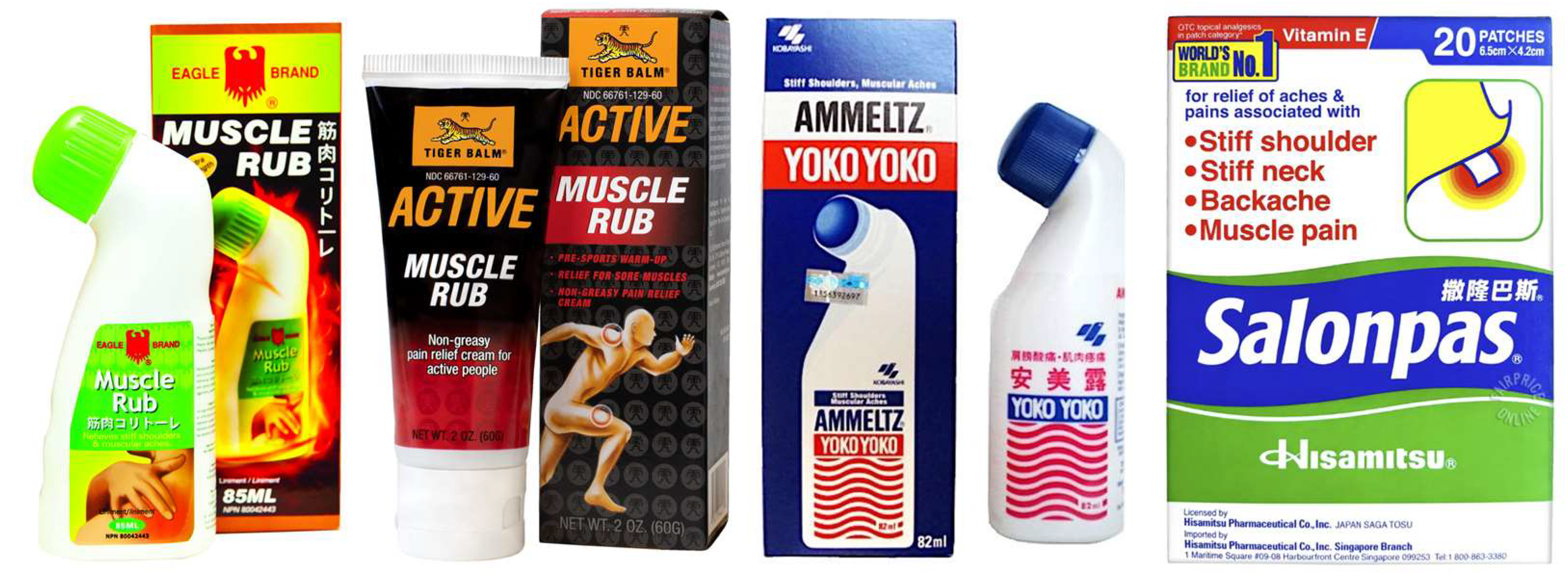
2.3. Topical Analgesics
2.4. Survey Design
2.5. Data Analysis
3. Results
3.1. Participant Demographics
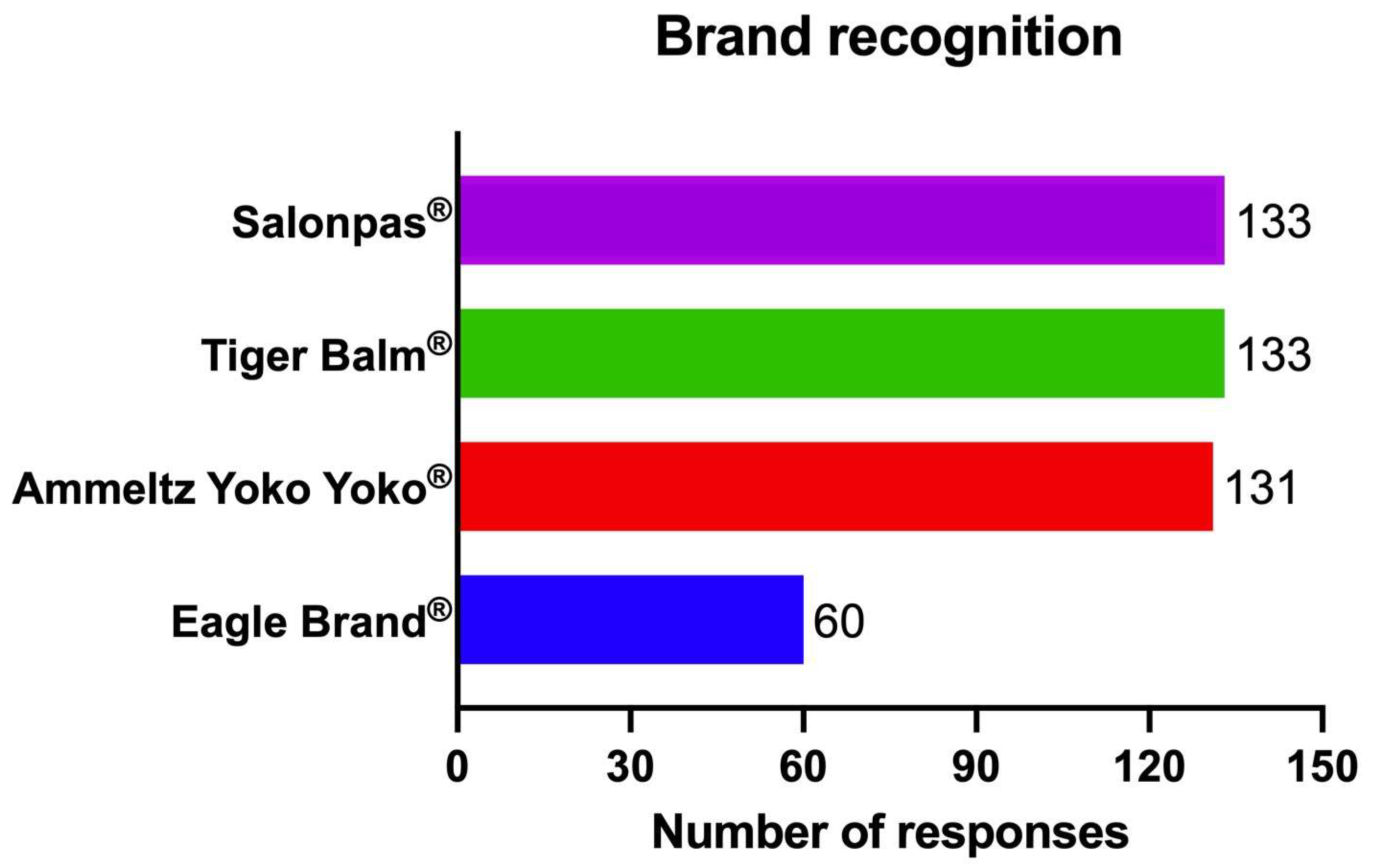
3.2. Brand Recognition
3.3. Usage of Topical Analgesics
3.4. Reasons for Use
3.5. Brand Used
3.6. Timing of Use
3.7. Frequency of Use
3.8. Perceived Effectiveness
4. Discussion
4.1. Summary of Findings
4.2. Pain Relief
4.3. Timing of Use
4.4. Sports Performance Enhancement
4.5. Risks and Benefits
4.6. Limitations
4.7. Practical Applications and Future Direction
5. Conclusions
Author Contributions
Funding
Institutional Review Board Statement
Informed Consent Statement
Data Availability Statement
Conflicts of Interest
Abbreviations
| NSAIDs | Non-Steroidal Anti-Inflammatory Drugs |
| WADA | World Anti-Doping Agency |
References
- Smith, A.C.; Smith, M.S.; Roach, R.P.; Prine, B.R.; Moser, M.W.; Farmer, K.W.; Clugston, J.R. Making sense of topical pain relief options: Comparing topical analgesics in efficacy and safety. Sports Health 2024, 17, 843–852. [Google Scholar] [CrossRef]
- Xiong, Y.; Liu, Y.; Zhou, J.; Shang, X.; He, H.; Li, G.; Chen, S.; Li, J. Clinical practice guidelines for Topical NSAIDs in the treatment of sports injuries. J. Evid. Based Med. 2025, 18, e12661. [Google Scholar] [CrossRef]
- Tawfik, A.G.; Gomez-Lumbreras, A.; Del Fiol, G.; Kawamoto, K.; Trinkley, K.E.; Reese, T.; Jones, A.; Malone, D.C. Nonsteroidal anti-inflammatory drugs and risk of gastrointestinal bleeding: A systematic review and meta-analysis. Clin. Pharmacol. Ther. 2026, 119, 46–62. [Google Scholar] [CrossRef]
- Wongrakpanich, S.; Wongrakpanich, A.; Melhado, K.; Rangaswami, J. A comprehensive review of non-steroidal anti-inflammatory drug use in the elderly. Aging Dis. 2018, 9, 143–150. [Google Scholar] [CrossRef] [PubMed]
- Stanos, S.P. Topical agents for the management of musculoskeletal pain. J. Pain Symptom Manag. 2007, 33, 342–355. [Google Scholar] [CrossRef]
- Klinge, S.A.; Sawyer, G.A. Effectiveness and safety of topical versus oral nonsteroidal anti-inflammatory drugs: A comprehensive review. Phys. Sportsmed. 2013, 41, 64–74. [Google Scholar] [CrossRef] [PubMed]
- Manoukian, M.A.C.; Migdal, C.W.; Tembhekar, A.R.; Harris, J.A.; DeMesa, C. Topical administration of ibuprofen for injured athletes: Considerations, formulations, and comparison to oral delivery. Sports Med.-Open 2017, 3, 36. [Google Scholar] [CrossRef] [PubMed]
- Leońska-Duniec, A. Genetic susceptibility to sport-related muscle injuries: Insights from the literature and novel gene candidates. Int. J. Mol. Sci. 2025, 26, 11175. [Google Scholar] [CrossRef]
- Jeon, J.W.; Lim, S.T.; Cho, J.H. Designing and conducting an injury study in amateur badminton players. Appl. Sci. 2024, 14, 5194. [Google Scholar] [CrossRef]
- Pérez-Contreras, J.; Villaseca-Vicuña, R.; Loro-Ferrer, J.F.; Inostroza-Ríos, F.; Brito, C.J.; Cerda-Kohler, H.; Bustamante-Garrido, A.; Muñoz-Hinrichsen, F.; Hermosilla-Palma, F.; Ulloa-Díaz, D.; et al. Are countermovement jump variables indicators of injury risk in professional soccer players? A machine learning approach. Appl. Sci. 2025, 15, 12721. [Google Scholar] [CrossRef]
- Iraqui-Rato, I.; Cuesta-Barriuso, R. Predictors of risk of muscle injury in non-professional soccer players: An ambispective cohort study. Sports 2024, 12, 314. [Google Scholar] [CrossRef]
- Cavanaugh, E.; Arcot Santillan, A.; Hoshikawa, K.; Giambini, H. Subregions of the rotator cuff muscles present distinct anatomy, biomechanics, and function. Sports 2024, 12, 349. [Google Scholar] [CrossRef]
- Layouni, S.; Dergaa, I.; Ghali, H.; Ceylan, H.İ.; Stefanica, V.; Neguez, M.; Loubiri, I.; Dhahbi, W.; Rjiba, C.; Ksibi, S.; et al. Epidemiology of tennis-related injuries among competitive youth players in Tunisia: Frequency, characteristics, and management patterns. Medicina 2025, 61, 1478. [Google Scholar] [CrossRef]
- Cabrera Linares, J.C.; Párraga Montilla, J.A.; Latorre Román, P.Á.; Moreno del Castillo, R.; González, M.P. Training habits, injury prevalence, and supplement use in CrossFit practitioners. Sci 2026, 8, 21. [Google Scholar] [CrossRef]
- Tedeschi, R.; Giorgi, F.; Donati, D. Sprint training for hamstring injury prevention: A scoping review. Appl. Sci. 2025, 15, 9003. [Google Scholar] [CrossRef]
- Nudo, S.; Jimenez-Garcia, J.A.; Dover, G. Efficacy of topical versus oral analgesic medication compared to a placebo in injured athletes: A systematic review with meta-analysis. Scand. J. Med. Sci. Sports 2023, 33, 1884–1900. [Google Scholar] [CrossRef]
- Bartolomei, S.; Nigro, F.; D’Amico, A.; Cortesi, M.; Di Michele, R. Mud pack with menthol and arnica montana accelerates recovery following a high-volume resistance training session for lower body in trained men. J. Strength. Cond. Res. 2022, 36, 1909–1915. [Google Scholar] [CrossRef] [PubMed]
- Barwood, M.J.; Corbett, J.; Thomas, K.; Twentyman, P. Relieving thermal discomfort: Effects of sprayed L-menthol on perception, performance, and time trial cycling in the heat. Scand. J. Med. Sci. Sports 2015, 25, 211–218. [Google Scholar] [CrossRef]
- Chiam, M.J.; Kong, P.W. Muscle rub enhanced explosive leg power but not flexibility or balance in college athletes. J. Mech. Med. Biol. 2023, 23, 2340017. [Google Scholar] [CrossRef]
- Mazzoni, I.; Barroso, O.; Rabin, O. The list of prohibited substances and methods in sport: Structure and review process by the World Anti-Doping Agency: Testing and interpretation in sports-review, research, and commentary. J. Anal. Toxicol. 2011, 35, 608–612. [Google Scholar] [CrossRef] [PubMed]
- Green, B.G. Interactions between chemical and thermal cutaneous stimuli: Inhibition (counterirritation) and integration. Somatosens. Mot. Res. 1991, 8, 301–312. [Google Scholar] [CrossRef] [PubMed]
- Barkin, R.L. The pharmacology of topical analgesics. Postgrad. Med. 2013, 125, 7–18. [Google Scholar] [CrossRef]
- Pergolizzi, J.V.; Taylor, R.; LeQuang, J.A.; Raffa, R.B. The role and mechanism of action of menthol in topical analgesic products. J. Clin. Pharm. Ther. 2018, 43, 313–319. [Google Scholar] [CrossRef]
- Higashi, Y.; Kiuchi, T.; Furuta, K. Efficacy and safety profile of a topical methyl salicylate and menthol patch in adult patients with mild to moderate muscle strain: A randomized, double-blind, parallel-group, placebo-controlled, multicenter study. Clin. Ther. 2010, 32, 34–43. [Google Scholar] [CrossRef]
- Derry, S.; Wiffen, P.J.; Kalso, E.A.; Bell, R.F.; Aldington, D.; Phillips, T.; Gaskell, H.; Moore, R.A. Topical analgesics for acute and chronic pain in adults—An overview of Cochrane Reviews. Cochrane Database Syst. Rev. 2017, 5, CD008609. [Google Scholar] [CrossRef]
- Ojha, P.K.; Poudel, D.K.; Dangol, S.; Rokaya, A.; Timsina, S.; Satyal, P.; Setzer, W.N. Volatile constituent analysis of wintergreen essential oil and comparison with synthetic methyl salicylate for authentication. Plants 2022, 11, 1090. [Google Scholar] [CrossRef]
- Versteeg, N.; Wellauer, V.; Wittenwiler, S.; Aerenhouts, D.; Clarys, P.; Clijsen, R. Short-term cutaneous vasodilatory and thermosensory effects of topical methyl salicylate. Front. Physiol. 2024, 15, 1347196. [Google Scholar] [CrossRef] [PubMed]
- Craighead, D.H.; McCartney, N.B.; Tumlinson, J.H.; Alexander, L.M. Mechanisms and time course of menthol-induced cutaneous vasodilation. Microvasc. Res. 2017, 110, 43–47. [Google Scholar] [CrossRef] [PubMed]
- Kostopoulos, D.; Rizopoulos, K. Effect of topical aerosol skin refrigerant (Spray and Stretch technique) on passive and active stretching. J. Bodyw. Mov. Ther. 2008, 12, 96–104. [Google Scholar] [CrossRef]
- Whalen, A.; Farrell, K.; Roberts, S.; Smith, H.; Behm, D.G. Topical analgesic improved or maintained ballistic hip flexion range of motion with treated and untreated legs. J. Sports Sci. Med. 2019, 18, 552–558. [Google Scholar]
- Gurton, W.H.; Greally, J.; Chudzikiewicz, K.; Gough, L.A.; Lynn, A.; Ranchordas, M.K. Beneficial effects of oral and topical sodium bicarbonate during a battery of team sport-specific exercise tests in recreationally trained male athletes. J. Int. Soc. Sports Nutr. 2023, 20, 2216678. [Google Scholar] [CrossRef]
- Scano, A.; Lanzani, V.; Brambilla, C. How recent findings in electromyographic analysis and synergistic control can impact on new directions for muscle synergy assessment in sports. Appl. Sci. 2024, 14, 11360. [Google Scholar] [CrossRef]
- Pietraszewski, P.; Maszczyk, A.; Zając, A.; Gołaś, A. Muscle activity and biomechanics of sprinting: A meta-analysis review. Appl. Sci. 2025, 15, 4959. [Google Scholar] [CrossRef]
- Vera-Cartagena, J.; Vera-Garcia, F.J.; Miralles-Iborra, A.; Del Coso, J.; Moreno-Pérez, V. Comparative analysis of quadriceps electromyography during bodyweight strength exercises. Appl. Sci. 2026, 16, 1940. [Google Scholar] [CrossRef]
- Frampton, A.; Hill, M.; Clarke, N.; Eustace, S.; Tallis, J. Reliability of surface EMG during high-risk single-leg jump landing and 90° sidestep cutting in female footballers. Appl. Sci. 2026, 16, 2236. [Google Scholar] [CrossRef]



| No. | Questions |
| 1 | Do you exercise regularly? |
| 2 | What forms of exercises do you perform? |
| 3 | Have you heard of any of these muscle rub brands before? |
| 4 | What is/are the reason(s) you use muscle rub? |
| 5 | Have you used any of these muscle rub brands before? |
| 6 | When do you use muscle rub? |
| 7 | How often do you use muscle rub? |
| 8 | How effective was the use of muscle rub? |
| 9 | Your gender? |
| 10 | Your age? |
| Age Groups | ||||
| 21–30 years (n = 80) | ≥31 years (n = 18) | |||
| Reasons for Use | n | % | n | % |
| Improve sports performance (n = 11) | 8 | 7.8% | 3 | 2.9% |
| Warm up muscles before exercise (n = 16) | 13 | 12.8% | 3 | 2.9% |
| Relieve muscle ache, pain or soreness (n = 90) | 75 | 73.5% | 15 | 14.7% |
| Reduce muscle stiffness (n = 38) | 32 | 31.4% | 6 | 5.9% |
| Relieve joint pain or discomfort (n = 56) | 50 | 49.0% | 6 | 5.9% |
| Fisher–Freeman–Halton statistics | χ2 = 2.752, p = 0.602 | |||
| 21–30 years | ≥31 years | |||
| Brand Used | n | % | n | % |
| Tiger Balm® (n = 63) | 51 | 50% | 12 | 11.8% |
| Eagle Brand® (n = 17) | 11 | 10.8% | 6 | 5.9% |
| Ammeltz Yoko Yoko® (n = 77) | 64 | 62.8% | 13 | 12.8% |
| Salonpas® (n = 88) | 74 | 72.6% | 14 | 13.7% |
| Fisher–Freeman–Halton statistics | χ2 = 3.566, p = 0.313 | |||
| 21–30 years | ≥31 years | |||
| Timing of Use | n | % | n | % |
| Before exercise (n = 23) | 17 | 16.7% | 6 | 5.9% |
| During exercise (n = 15) | 12 | 11.8% | 3 | 2.9% |
| After exercise (n = 59) | 51 | 50.0% | 8 | 7.8% |
| At home whenever I feel the need to (n = 69) | 58 | 56.9% | 11 | 10.8% |
| Fisher–Freeman–Halton statistics | χ2 = 2.211, p = 0.521 | |||
| Exercise Frequency | ||||
| 1–2 times per week (n = 36) | ≥3 times per week (n = 66) | |||
| Reasons for Use | n | % | n | % |
| Improve sports performance (n = 11) | 1 | 1.0% | 10 | 9.8% |
| Warm up muscles before exercise (n = 16) | 2 | 2.0% | 14 | 13.7% |
| Relieve muscle ache, pain or soreness (n = 92) | 32 | 31.4% | 60 | 58.8% |
| Reduce muscle stiffness (n = 39) | 14 | 13.7% | 25 | 24.5% |
| Relieve joint pain or discomfort (n = 57) | 17 | 16.7% | 40 | 39.2% |
| Fisher–Freeman–Halton statistics | χ2 = 5.928, p = 0.201 | |||
| 1–2 times per week | ≥3 times per week | |||
| Brand Used | n | % | n | % |
| Tiger Balm® (n = 65) | 21 | 20.6% | 44 | 43.1% |
| Eagle Brand® (n = 18) | 5 | 4.9% | 13 | 12.8% |
| Ammeltz Yoko Yoko® (n = 79) | 33 | 32.4% | 46 | 45.1% |
| Salonpas® (n = 91) | 33 | 32.4% | 58 | 56.9% |
| Fisher–Freeman–Halton statistics | χ2 = 1.954, p = 0.590 | |||
| 1–2 times per week | ≥3 times per week | |||
| Timing of Use | n | % | n | % |
| Before exercise (n= 23) | 5 | 4.9% | 18 | 17.7% |
| During exercise (n = 15) | 4 | 3.9% | 11 | 10.8% |
| After exercise (n = 60) | 25 | 24.5% | 35 | 34.3% |
| At home whenever I feel the need to (n = 71) | 24 | 23.5% | 47 | 46.1% |
| Fisher–Freeman–Halton statistics | χ2 = 3.292, p = 0.352 | |||
| Frequency | Number of Participants (n) | Percentages (%) |
| More than 3 times per week | 6 | 5.9 |
| 1–2 times per week | 8 | 7.8 |
| 1–2 times per month | 32 | 31.4 |
| Less than 5 times per year | 54 | 52.9 |
| Did not respond | 2 | 2.0 |
| Perceived effectiveness | n | % |
| Very effective | 4 | 3.9 |
| Effective | 58 | 56.9 |
| Unsure | 36 | 35.3 |
| Not effective | 2 | 2.0 |
| Did not respond | 2 | 2.0 |
Disclaimer/Publisher’s Note: The statements, opinions and data contained in all publications are solely those of the individual author(s) and contributor(s) and not of MDPI and/or the editor(s). MDPI and/or the editor(s) disclaim responsibility for any injury to people or property resulting from any ideas, methods, instructions or products referred to in the content. |
© 2026 by the authors. Licensee MDPI, Basel, Switzerland. This article is an open access article distributed under the terms and conditions of the Creative Commons Attribution (CC BY) license.
Share and Cite
Chiam, M.J.; Ko, V.M.-C.; Kong, P.W. Topical Analgesics in Sports: A Survey of Usage Patterns and Perceptions Among Adults Engaging in Exercise in Singapore. Appl. Sci. 2026, 16, 4735. https://doi.org/10.3390/app16104735
Chiam MJ, Ko VM-C, Kong PW. Topical Analgesics in Sports: A Survey of Usage Patterns and Perceptions Among Adults Engaging in Exercise in Singapore. Applied Sciences. 2026; 16(10):4735. https://doi.org/10.3390/app16104735
Chicago/Turabian StyleChiam, Melody Jiale, Violet Man-Chi Ko, and Pui Wah Kong. 2026. "Topical Analgesics in Sports: A Survey of Usage Patterns and Perceptions Among Adults Engaging in Exercise in Singapore" Applied Sciences 16, no. 10: 4735. https://doi.org/10.3390/app16104735
APA StyleChiam, M. J., Ko, V. M.-C., & Kong, P. W. (2026). Topical Analgesics in Sports: A Survey of Usage Patterns and Perceptions Among Adults Engaging in Exercise in Singapore. Applied Sciences, 16(10), 4735. https://doi.org/10.3390/app16104735