1. Introduction
Congestion in cities, resulting from the high volume of goods moving within them, has become particularly acute in recent years with the rise of e-commerce [
1]. This e-commerce brings products directly to our homes, replacing the traditional practice of consumers purchasing goods in stores or department stores. LUZ areas are primarily located in designated zones during specific time slots, which are frequently saturated and only partially fulfil their purpose, unable to meet the full demand generated within their allotted time, Ezquerro et al. 2020 [
2].
Urban freight distribution generates significant pressure on curbside infrastructure, especially in dense European cities where LUZs often operate under saturation conditions. Despite numerous initiatives to promote sustainable logistics, the improper use of LUZs, such as occupancy by unauthorised vehicles or excessive dwell times, remains a major source of operational inefficiency and urban congestion. These problems are compounded by the growing volume of e-commerce deliveries, which intensify the competition for limited curbside space and exacerbate negative externalities affecting both traffic flow and pedestrians.
This indiscriminate and uncontrolled use by unauthorized vehicles and the prolonged presence of authorized commercial vehicles generate operational collapses, externalities and the inefficient occupation of urban space, Alho et al. 2014 [
3], since the unmet demand in one area leads to space being sought in its adjacent areas; if this space is not found, it leads to an illegal occupation of public spaces, causing problems to the circulation of vehicles in the urban environment and annoyances to citizens, Alho et al. 2017 [
4].
In defining illegal occupation, a distinction is made between occupation within the designated zone and occupation outside of it, Ghizzawi et al. 2024 [
5]. LUZs have reserved operating hours, and within those hours, occupation is considered legal when it involves a commercial vehicle and the operation takes less than 30 min. If the LUZ is occupied by an unauthorized private vehicle or a commercial vehicle exceeding 30 min, it constitutes illegal occupation within the zone, Muriel et al. 2022 [
6]. If, due to the lack of space within the LUZ or the carrier’s intentional decision to park near the unloading point, the vehicle double parks, blocks a garage door, crosswalks, traffic islands, or obstructs the sidewalk, then it constitutes illegal occupation outside the LUZ, causing negative externalities for other city users.
In general, analysis of vehicle occupancy distribution in different areas reveals that illegal occupancy is a significant concern in all LUZ areas analysed. Ezquerro et al. 2020 [
2] already pointed out that in most areas, a considerable proportion of vehicles are parked illegally, either because they are unauthorised vehicles or because they exceed the permitted parking time. This indicates that LUZ areas are operating at or even above maximum capacity, leading to operational bottlenecks and the inefficient use of urban space.
Excessive illegal parking time is another significant problem, as many vehicles remain parked for longer than the established 30 min, further aggravating congestion and reducing vehicle turnover. This behaviour highlights the need for stricter management of parking time, which could be optimised through technologies such as digital real-time entry and exit registration systems.
Although several studies have examined the spatial allocation of LUZs or proposed optimisation strategies for their location, much less attention has been given to the analysis of their operational performance under real conditions of demand, regulation compliance, and heterogeneous vehicle behaviour. Existing research rarely integrates queueing theory models without waiting queues (loss systems) to assess LUZ efficiency, even though these environments typically operate without the possibility of forming a service queue. This gap is particularly relevant given that non-served vehicles often recirculate in search of alternative spaces, generating indirect congestion that is not explicitly captured in standard queueing models.
In contrast to studies that address the strategic location or dimensioning of delivery bays, the present work focuses on the operational management of existing LUZ networks under municipal ordinances and real behavioural patterns. This perspective introduces a different decision-making challenge for cities, since congestion often arises not from insufficient physical infrastructure but from partial rule compliance, heterogeneous dwell times, and the improper use of bays by unauthorised vehicles. To address this gap, the study adopts a weighted occupancy metric that captures the effective space–time usage of each zone and models the system as a loss system (Erlang B), consistent with empirical evidence showing recirculation rather than queuing behaviour. This methodological contribution distinguishes the present analysis from conventional queue-based approaches and provides a framework more aligned with the operational realities of curbside freight activity.
Gil Gallego et al. (2025) [
7] defined the OEE indicator as a measure of efficiency for an area or set of areas. This study reinforces the conclusions reached in that work, as it addresses the various factors that make up the OEE model to assess whether the measures proposed in the simulation using queueing theory improve logistics productivity.
In this context, Zaragoza represents an exemplary urban laboratory due to its active policies in sustainable urban mobility and its participation in national and European innovation projects. The selected set of LUZs provides a representative microenvironment for analysing the operational challenges associated with curbside logistics. Municipal ordinances impose access restrictions exclusively on commercial vehicles carrying out LUZ tasks, as well as temporary restrictions during a specific limited time period, with a maximum stay of 30 min in general.
The objective of this study is to evaluate the operational performance of different LUZ configurations by comparing real observed behaviour with an idealised scenario aligned with municipal regulations. By integrating a no-waiting queueing model (Erlang B) with a weighted occupation time metric, this research quantifies system capacity, loss rates, and space time productivity under varying conditions of compliance. This approach contributes to filling the gap in the literature regarding the operational assessment of LUZs using loss-based queueing models and empirically grounded behavioural data. The study demonstrates that proper use, respecting the restrictions indicated in the municipal ordinance [
8], is more relevant than the location of the LUZ itself. Therefore, the proposals for operational improvement are aimed at the management of the LUZ and not at its optimised location, as suggested by Les et al. 2024 [
9], Sun et al. 2023 [
10], Jazemi et al. 2023 [
11], Pinto et al. 2019 [
12] or Jelen et al. 2021 [
13].
To structure the analytical approach of this study, the following research questions are formulated. The research question investigates how the unrestricted use of LUZs, including the presence of unauthorised vehicles and excessive dwell times, affects their operational efficiency, specifically in terms of loss probability, effective capacity, and space time productivity. The second one examines the extent to which the strict enforcement of municipal LUZ ordinances can restore or enhance operational performance across different spatial configurations. The third research question evaluates whether the Erlang B loss system model appropriately represents the operational dynamics of LUZs, given that vehicles unable to access the zone do not queue but instead recirculate through adjacent streets.
In this study, we highlight the environmental externalities associated with the illegal occupation of LUZs, including CO2 emissions and congestion. However, due to the focus and scope of this article, a detailed quantitative assessment of these impacts is not provided. This analysis is a central component of our forthcoming work, where we will explore the environmental consequences in more detail, including metrics such as extra distance travelled and recirculation time. This study serves as an introduction to the broader environmental research we are currently developing.
The article is organised as follows:
Section 2 describes the six cases to be analysed, as well as the selected areas, with their justified description.
Section 3 analyses the results of applying the model in all its aspects and possibilities for analysis, and
Section 4 interprets the results and makes recommendations for city governance. Finally,
Section 5 presents the conclusions and possible future lines of research.
4. Results
This section will analyse and develop the models for the six scenarios and compare them with each other.
4.1. Scenario 1: Z1 All Vehicles According to Actual Observation
In this first analysis, all the steps will be detailed, but they will be omitted in the remaining five cases as they all use the same methodology.
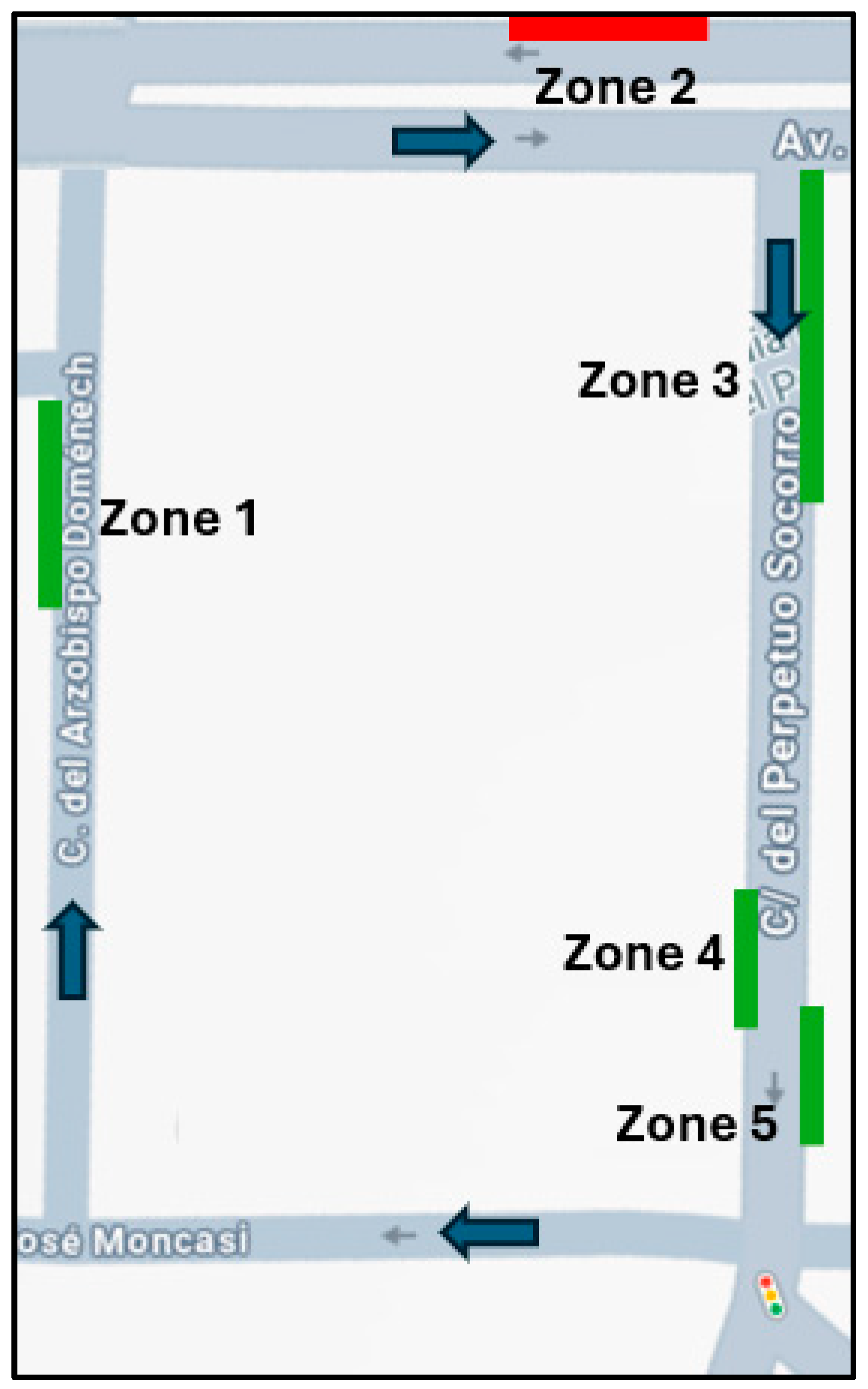
Z1 is the only LUZ in the street in which it is located. The rate of vehicles arriving at the system attempting to unload in Z1 is 474 throughout the month, over the 21 days and 6 h per day of reservation. A total of 273 vehicles were able to find a space in the zone, including private vehicles illegally occupying the zone. The weighted occupancy time of these 273 vehicles in Z1 was 20.94 min.
The effective arrival rate to the system is:
Each unloading operation lasts an average of 20.94 min, meaning that:
Therefore, the service rate in the area is:
Therefore, the intensity of traffic is:
Since ρ > 1, the system is saturated, it is not viable without a queue, and therefore losses occur, resulting in double queues and illegal occupations. In the Erlang B model with c = 1, i.e., a single server with the weighted time of occupation of the entire area used as the time variable, this ρ, which is the traffic intensity, will be referred to as intensity in Erlangs.
Weighted occupancy time treats the curbside as a normalised single unit, where each vehicle contributes a share of its dwell time proportional to the fraction of curb length it occupies. A blocked state occurs when the remaining curb length is insufficient for the typical vehicle types observed, even if small free fragments remain. This approach preserves spatial realism while enabling analytical modelling through a single consolidated service channel.
Let us now consider the probability of loss or blockage in the area. The general formula for the Erlang B model is:
In our case, as there is only one service position, c = 1, it is as follows:
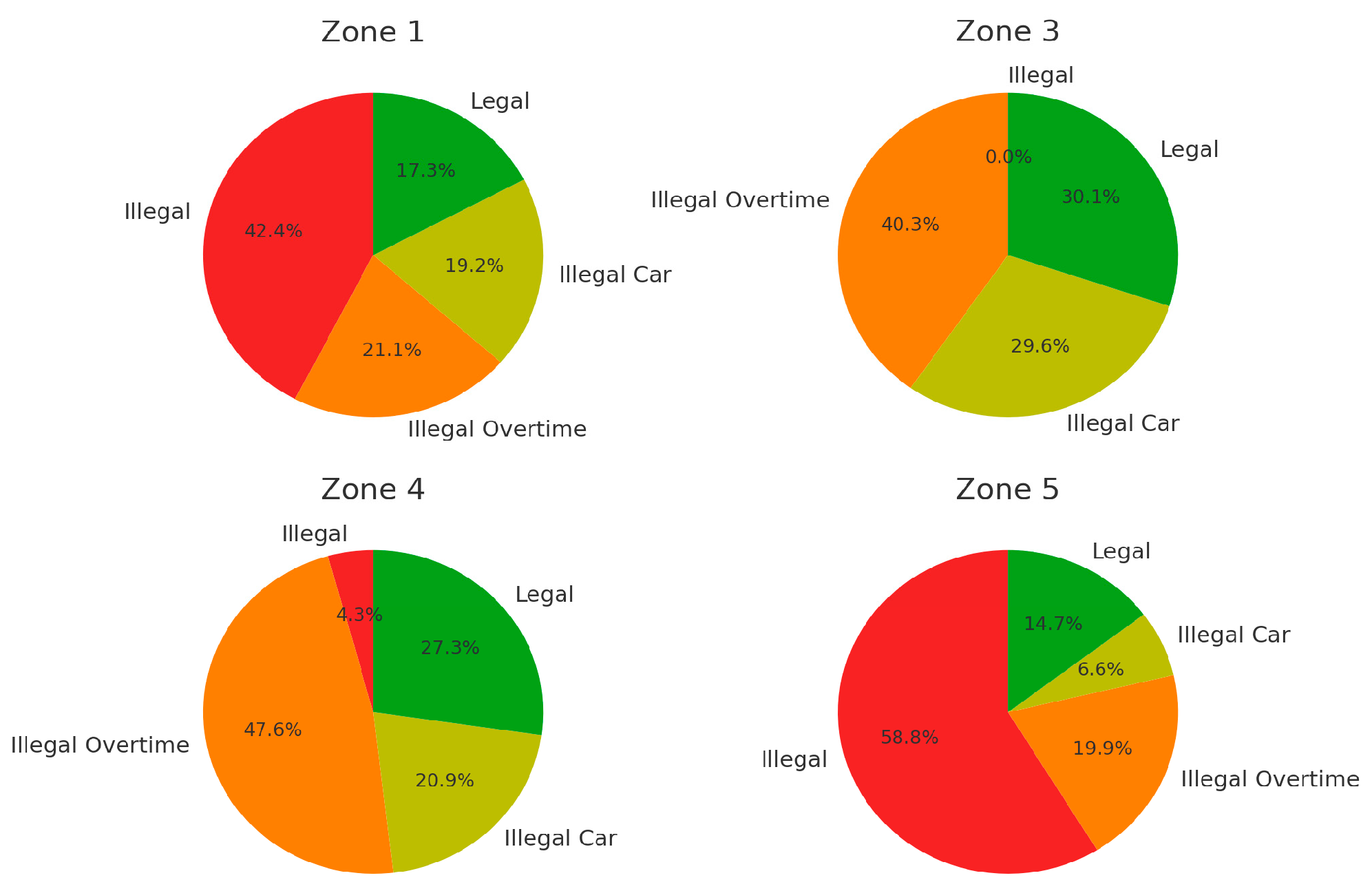
The interpretation of this result is that 56.76% of vehicles arriving at the LUZ do so when it is already occupied and therefore cannot be served. This value is independent of the actual number of vehicles observed and is based solely on the balance between the arrival rate and the service rate. If we compare the number of vehicles not served in the actual observation (474 − 273 = 201), we see that this is a rate of 42.4% compared to the model’s rate of 56.76% (0.5676 × 474 = 269 vehicles). The Erlang B model may overestimate the results as it is an idealised probabilistic model that assumes perfect randomness in arrivals and services (Poisson and exponential), when in reality vehicles arrive without a fixed pattern of arrival sequence. The model assumes that arrivals, according to the Poisson distribution, are constant, which is not the case, and that occupancy times follow an exponential distribution, in which, despite assuming randomness, the probability of a vehicle finishing unloading at a specific time t decreases exponentially as time increases, i.e., vehicles tend to be served faster on average, but the exact time needed for each vehicle to unload may vary, so this blocking probability for the Erlang B model does not provide us with reliable data, and we will now refer to the actual data collected in the field observation. Another reason why the blocking probability of this model loses validity is that using weighted occupancy time as a time variable leads the system to believe that, with only a single service point and a single occupancy, the system would be full, when there may be spaces available.
In terms of usage times for the area, compared to the total weighted available time of 7560 min, the weighted usage time for the area was:
The partial conclusions of this first case are that traffic intensity exceeds the system’s capacity threshold (ρ > 1), indicating that the system is at maximum capacity, generating high losses (42.4% in actual observation). The system is not viable without proper application of use, as disorderly use causes congestion, illegal occupation, and the loss of logistical efficiency.
4.2. Scenario 2: Z1 Without Access to LUZ from Unauthorised Private Vehicles and Considering a Maximum Time of 30 min per Authorised Vehicle Unloading Idealized Use Compliant with Regulations
This simulated case presents an ideal situation in which both access control for authorised vehicles and the time of use of the area are guaranteed. The data characterising this scenario are as follows:
Vehicles entering the system (excluding private vehicles): 381 vehicles/month
Vehicles served applying restrictions in LUZ: 182 vehicles/month
Weighted occupancy time (maximum 30 min per unloading): 9.65 min
Weighted available time: 21 days, daily 6 h, 13 min (Z1): 7560 min
Weighted time occupied in LUZ: daily 6 h, 13 min: 1756.30 min
% of weighted time occupied: 23.23%
Weighted free time in the zone: 3960.32 min
Using this data and following the same methodology as in the first case, the following results are obtained:
λ = 3.02 vehicles/hour
μ = 6.22 vehicles/hour
ρ = 0.49 Erlangs, Viable system as ρ < 1. There is no risk of collapse or saturation, as the system capacity exceeds the vehicle arrival rate.
In this idealised case of no entry into the LUZ by unauthorised private vehicles and no excess time spent in the zone by commercial vehicles, a weighted amount of occupancy time is freed up, which could be offset by a greater number of authorised vehicle occupations.
The weighted occupancy time freed up is then calculated:
In the comparative case of the Z1:
Next, the weighted occupancy time per vehicle is calculated to obtain a standard weighted time for what would be a generic vehicle.
where:
ti: time weighted by vehicle type
pi: percentage of that type out of the total number of authorised vehicles
Although the vehicle type distribution is shown here for Zone 1, field observation confirmed that the typology of vehicles is essentially the same across all LUZs analysed. Therefore, this table serves as a representative distribution for the entire study area, and repeating it for the remaining zones would introduce redundancy. The proportions were incorporated directly into the weighted occupation time calculations used in all scenarios.
Therefore, the formula for new vehicles that could be serviced at LUZ would be:
In Z1, by correctly applying the rules of use, up to 423.63 additional vehicles could be served with the time freed up compared to those actually served in the saturation scenario. In other words, compared to the 381 authorised vehicles entering the system, under these control conditions, (273 + 423.63) 605.63 vehicles could be served, which means 332.62 more vehicles than the 273 that were served in the situation without correct use, a 121.84% increase.
The study is then redone with the new simulated data, in which the Erlang B model will provide us with the probability of blocking to validate whether all demand can be met.
Vehicles entering the system (excluding private vehicles): 381 vehicles/month
Vehicles served applying restrictions in LUZ: 606 vehicles/month
Excess vehicle availability in the area: 606 − 381 = 225 vehicles/month
Weighted occupancy time (maximum 30 min per unloading): 9.65 min
Weighted available time: 21 days, 6 h, 13 min daily (Z1): 7560 min
Weighted time occupied in LUZ: 6 h, 13 min daily: 5844.35 min
% of weighted time occupied: 77.31%
Using this data and following the same methodology as in the first case, the following results are obtained:
λ = 3.02 vehicles/hour
μ = 6.22 vehicles/hour
ρ = 0.49 Erlangs, Viable system as ρ < 1. There is no risk of collapse or saturation, as the system capacity exceeds the vehicle arrival rate.
pB = 0.3272
According to the probability suggested by the model, 124.66 vehicles, or 32.72% of those arriving, cannot be served, but this figure is lower than the 225 calculated as excess availability based on weighted time, so we can categorically state that by enforcing the established rules without exception, and without additional measures, all demand for commercial vehicles for loading and unloading in this area can be met.
4.3. Scenario 3: Z3 + Z4 + Z5 All Vehicles According to Actual Observation
Zones Z3, Z4, and Z5 are on the street parallel to the street where Z1 is located. To obtain the simulation comparison, we took the sum of the download data from the three zones and applied the methodology used in the previous cases:
Vehicles entering the system (including private vehicles): 810 vehicles/month
Vehicles served applying restrictions in LUZ: 678 vehicles/month
Weighted occupancy time (maximum 30 min per unloading): 21.23 min
Weighted available time: 21 days, 7.14 h daily (weighted by metres in the three zones), 36 m (Z3 + Z4 + Z5): 25,200 min
Weighted time occupied in LUZ: daily 7.14 h, 36 m: 14,393.94 min
% of weighted time occupied: 57.12%
Using this data and following the same methodology as in the first case, the following results are obtained:
λ = 5.40 vehicles/hour
μ = 2.83 vehicles/hour
ρ = 1.91 Erlangs, saturated system, not viable without a queue, resulting in losses that translate into double parking and illegal occupation.
As for the probability of blocking, we chose the actual observed data (132 vehicles, 16.30%), disregarding the probability offered by the pB model, which predicted a loss of 66.10% for the reasons stated above.
As in
Section 4.1, the partial conclusions are that traffic intensity exceeds the system’s capacity threshold (ρ > 1). The system is not viable without restrictions, as disorderly use causes congestion, illegal occupation and loss of efficiency in goods unloading operations.
4.4. Scenario 4: Z3 + Z4 + Z5 Without Access to LUZ for Unauthorised Private Vehicles and Considering a Maximum Time of 30 min per Authorised Vehicle Unloading Idealized Use Compliant with Regulations
This simulated case presents an ideal situation in which both access control for authorised vehicles and the time of use of the area are guaranteed. The data characterising this scenario are as follows:
Vehicles entering the system (excluding private vehicles): 635 vehicles/month
Vehicles served applying restrictions in LUZ: 495 vehicles/month
Weighted occupancy time (maximum 30 min per unloading): 9.04 min
Weighted available time: 21 days, daily 7.14 h, 36 min (Z3 + Z4 + Z5): 25,200 min
Weighted time occupied in LUZ: daily 7.14 h, 36 min: 4474.80 min
% of weighted time occupied: 17.76%
Using this data and following the same methodology as in the first case, the following results are obtained:
λ = 4.24 vehicles/hour
μ = 6.64 vehicles/hour
ρ = 0.64 Erlangs, Viable system as ρ < 1. There is no risk of collapse or saturation, as the system capacity exceeds the vehicle arrival rate.
In this idealised case of no entry into the LUZ zone by unauthorised private vehicles and no excessive use of the zone by commercial vehicles, a weighted amount of occupancy time is freed up, which could be offset by a greater number of authorised vehicle occupations.
The weighted occupied time liberated is calculated:
In the comparative case of Z3 + Z4 + Z5:
Con un tiempo ponderado de ocupación por vehículo genérico calculado anteriormente de 9.35, se calcula el nuevo número de vehículos adicionales atendidos.
In the set of street areas, Z3 + Z4 + Z5, by applying restrictions, up to 1061.04 additional vehicles could be served with the time freed up compared to those actually served in the saturation scenario. In other words, compared to the 635 authorised vehicles entering the system, under these control conditions, (495 + 1061.04) 1556.04 vehicles could be served, which means 878.04 more vehicles than the 678 served in the incorrect use situation, a 129.50% increase.
The study is then redone with the new simulated data, in which the Erlang B model will provide us with the probability of blocking to validate whether all demand can be met.
Vehicles entering the system (excluding private vehicles): 635 vehicles/month
Vehicles served applying restrictions in LUZ: 1556 vehicles/month
Excess vehicle availability in the area: 1556 − 635 = 921 vehicles/month
Weighted occupancy time (maximum 30 min per unloading): 9.04 min
Weighted available time: 21 days, daily 7.14 h, 36 m (Z3 + Z4 + Z5): 25,200 min
Weighted time occupied in LUZ: daily 7 h, 36 min: 14,066.62 min
% of weighted time occupied: 55.82%
Using this data and following the same methodology as in the first case, the following results are obtained:
λ = 4.24 vehicles/hour
μ = 6.64 vehicles/hour
ρ = 0.64 Erlangs, Viable system as ρ < 1. There is no risk of collapse or saturation, as the system capacity exceeds the vehicle arrival rate.
pB = 0.3895
According to the probability suggested by the model, 247.35 vehicles, or 38.95% of those arriving, will not be able to be served. But this figure is lower than the 921 calculated as excess availability based on weighted time, so we can categorically state that by enforcing the established rules without exception, and without additional measures, all commercial vehicle demand for loading and unloading in this area can be met.
4.5. Scenario 5: Z1 + Z3 + Z4 + Z5 All Vehicles According to Actual Observation
Z1 is now added to zones Z3, Z4 and Z5 to obtain the total number of zones in the block under study. To obtain the simulation comparison, we take the sum of the download data from the four zones and apply the methodology used in the previous cases:
Vehicles entering the system (including private vehicles): 1285 vehicles/month
Vehicles served applying restrictions in LUZ: 951 vehicles/month
Weighted occupancy time (maximum 30 min per unloading): 20.52 min
Weighted available time: 21 days, 6.87 h per day (weighted by metres in the four zones), 49 m (Z1 + Z3 + Z4 + Z5): 32,760 min
Weighted time occupied in LUZ: daily 6.87 h, 49 m: 19,514.52 min
% of weighted time occupied: 59.57%
Using this data and following the same methodology as in the first case, the following results are obtained:
λ = 8.91 vehicles/hour
μ = 2.92 vehicles/hour
ρ = 3.05 Erlangs, saturated system, not viable without a queue, resulting in losses that translate into double parking and illegal occupation.
As for the probability of blocking, we chose the actual observed data (334 vehicles, 25.99% of those accessing), disregarding the probability offered by the pB model, which predicted a loss of 75.29%, for the reasons stated above.
As in
Section 4.1, the partial conclusions are that traffic intensity far exceeds the system’s capacity threshold (ρ > 1). The system is not viable without restrictions, as disorderly use causes congestion, illegal occupation and loss of efficiency in goods unloading operations.
4.6. Scenario 6: Z1 + Z3 + Z4 + Z5 Without Access to LUZ for Unauthorised Private Vehicles and Considering a Maximum Time of 30 min per Authorised Vehicle Unloading Idealized Use Compliant with Regulations
This simulated case presents an ideal situation in which both access control for authorised vehicles and the time of use of the area are guaranteed. The data characterising this scenario are as follows:
Vehicles entering the system (excluding private vehicles): 1016 vehicles/month
Vehicles served applying restrictions in LUZ: 677 vehicles/month
Weighted occupancy time (maximum 30 min per unloading): 8.94 min
Weighted available time: 21 days, daily 6.87 h, 49 min (Z1 + Z3 + Z4 + Z5): 32,760 min
Weighted time occupied in LUZ: daily 6.87 h, 49 min: 6052.38 min
% of weighted time occupied: 18.47%
Using this data and following the same methodology as in the first case, the following results are obtained:
λ = 7.04 vehicles/hour
μ = 6.71 vehicles/hour
ρ = 1.05 Erlangs, system slightly saturated as ρ > 1, at the limit of viability without queueing.
In this idealised case of no entry into the LUZ zone by unauthorised private vehicles and no excessive use of the zone by commercial vehicles, a weighted amount of occupancy time is freed up, which could be offset by a greater number of authorised vehicle occupations.
The weighted occupied time liberated is calculated:
In the comparative case of Z1 + Z3 + Z4 + Z5:
Con un tiempo ponderado de ocupación por vehículo genérico calculado anteriormente de 9.35, se calcula el nuevo número de vehículos adicionales atendidos.
In the set of zones within the block, Z1 + Z3 + Z4 + Z5, by applying restrictions, up to 1440.03 additional vehicles could be served with the time freed up compared to those actually served in the saturation scenario. In other words, compared to the 1016 authorised vehicles entering the system, under these control conditions, (677 + 1440.03) 2117.03 vehicles could be served, which means 1166.03 more vehicles than the 951 served in the situation without restrictions, a 122.61% increase.
The study is then redone with the new simulated data, in which the Erlang B model will provide us with the probability of blocking to validate whether all demand can be met.
Vehicles entering the system (excluding private vehicles): 1016 vehicles/month
Vehicles served applying restrictions in LUZ: 2117 vehicles/month
Excess vehicle availability in the area: 2117 − 1016 = 1101 vehicles/month
Weighted occupancy time (maximum 30 min per unloading): 8.94 min
Weighted available time: 21 days, daily 6.87 h, 49 min (Z1 + Z3 + Z4 + Z5): 32,760 min
Weighted time occupied in LUZ: daily 6.87 h, 49 min: 18,926.28 min
% of weighted time occupied: 57.77%
Using this data and following the same methodology as in the first case, the following results are obtained:
λ = 7.04 vehicles/hour
μ = 6.71 vehicles/hour
ρ = 1.05 Erlangs, system slightly saturated as ρ > 1, at the limit of viability without queue.
pB = 0.5120
According to the probability suggested by the model, 520.22 vehicles, or 51.20% of those arriving, cannot be served, but this figure is lower than the 1101 calculated as excess availability based on weighted time, so we can categorically state that by enforcing the established rules without exception, and without additional measures, all commercial vehicle demand for loading and unloading in this area can be met.
4.7. Operational Interpretation
In this study, the analytical results obtained from the Erlang-B queueing model are complemented with an operational interpretation aimed at understanding the real behaviour of the LUZs. In this context, operational interpretation refers to the process of translating model-derived performance indicators, such as probability of loss, effective occupancy levels based on weighted time, and theoretical service capacity, into insights about how the zones actually function under real urban conditions. This approach allows us to determine whether observed inefficiencies arise from structural constraints (e.g., insufficient service capacity) or from behavioural factors (such as illegal parking, excessive dwell times, or noncompliance with municipal regulations). By linking analytical outputs to field observed patterns, the study provides a rigorous framework for assessing the operational state of each LUZ and for identifying the specific causes of congestion within the curbside freight environment.
Detailed analysis of data collected in the field reveals that the main cause of congestion is not only the number of available spaces, but also inefficient occupancy due to illegal parking and exceeded parking times. In Z1, the existence of a dark store opposite the area increases the turnover of PMV delivery vehicles and supply vans, generating highly concentrated peaks in demand. In contrast, in Z3–Z5, the lack of parking alternatives and the linear configuration of the road network encourage prolonged occupancy, which reduces effective availability.
The comparative study between scenarios ‘Z1 + Z3 + Z4 + Z5’ and ‘Z3 + Z4 + Z5’ showed a relative improvement in the use of total available time, as the number of active places increased and, with it, the capacity of the system. However, this improvement did not translate proportionally into a reduction in pB, suggesting that increasing the number of places does not guarantee greater efficiency without associated operational control.
4.8. Discussion of the Theoretical Model
The M/M/1/1 (Erlang B) model has proven adequate for estimating the average behaviour of the system when capacity is limited and there is no possibility of waiting. However, empirical results show that the actual distribution of arrivals does not strictly follow a Poisson distribution, but rather presents peaks and troughs associated with business hours and the concentration of deliveries in narrow time windows.
Therefore, the application of non-stationary or discrete event simulation models is proposed as a future line of research, which would allow the incorporation of actual hourly flow variability. However, the Erlang B model remains useful as a first-order reference for quantifying structural loss and establishing comparative scenarios between different zone configurations.
Overall, the results allow us to conclude that the current management of the LUZ selected for the study is functional but inefficient from an operational and environmental point of view, and that the application of some kind of usage control tool is a priority measure for improving sustainability and urban logistics competitiveness.
4.9. How to Comply with Municipal Regulations on Urban Goods Distribution
The simulation of scenarios is based on strict compliance with the rules for the use of LUZ in the city of Zaragoza. To achieve this compliance, the authors propose a tool for controlling loading and unloading spaces, mandatory for all professional drivers who wish to carry out unloading operations, which would allow manual registration using geolocation, without the need for physical sensors or cameras. The system would not allow private vehicles to enter and its use would be free of charge.
The system would allow control of the time spent in the zones, with a configurable limit (30 min by default), generating smart alerts to the driver when the end of the allowed time is approaching, to the police in case of exceeding it, and for the detection of repeat offences. The authorities would be able to view the vehicles present in each zone in real time, with access to a complete history of entries, exits, and violations. In addition, a heat map of occupancy would be available to facilitate further analysis and decision making. The entire system would strictly comply with the GDPR, collecting only the data required by law, and would allow the zone to be catalogued according to the OEE metric resulting from its activity.
The implementation of this control system would increase commercial vehicle turnover, reduce double parking and illegal occupation, and facilitate data-based management by public officials.
The solution could also categorise loading and unloading areas based on a new OEE that could be defined automatically with the data generated, as well as categorising delivery drivers according to their punctuality, as already mentioned by Gil Gallego et al. [
7].
5. Discussion
Below are tables comparing the different scenarios, as well as graphs that aid in better understanding and discussion.
Table 4 shows the results of various scenarios in different loading and unloading zones (Z1, Z3 + Z4 + Z5) with different levels of restrictions. The data includes the number of vehicles arriving at the system, vehicles served, vehicles not served (percentage of illegal occupancy) and weighted occupancy times, both with and without restrictions. Each scenario analyses how restrictions on private vehicles and time overruns affect the operational efficiency of the zones. The values in the table reflect comparisons between different combinations of zones and restrictions, showing how access conditions and the duration of time in LUZs influence the occupancy of available spaces. The percentages indicate the variability in performance for each scenario and how policy changes affect overall efficiency.
Table 5 shows the results of the different scenarios related to the LUZs in Zaragoza. Each row shows the weighted total occupancy and usage times, as well as the percentage of effective occupancy and the estimated loss under the Erlang model, and the differences between theoretical and actual losses.
Table 6 presents the results of the different loading and unloading scenarios in the different scenarios, both with and without restrictions on private vehicles and time overruns. The results include total and weighted usage times, weighted usage percentage, and estimated loss based on the Erlang model, compared with the differences with the actual observed data.
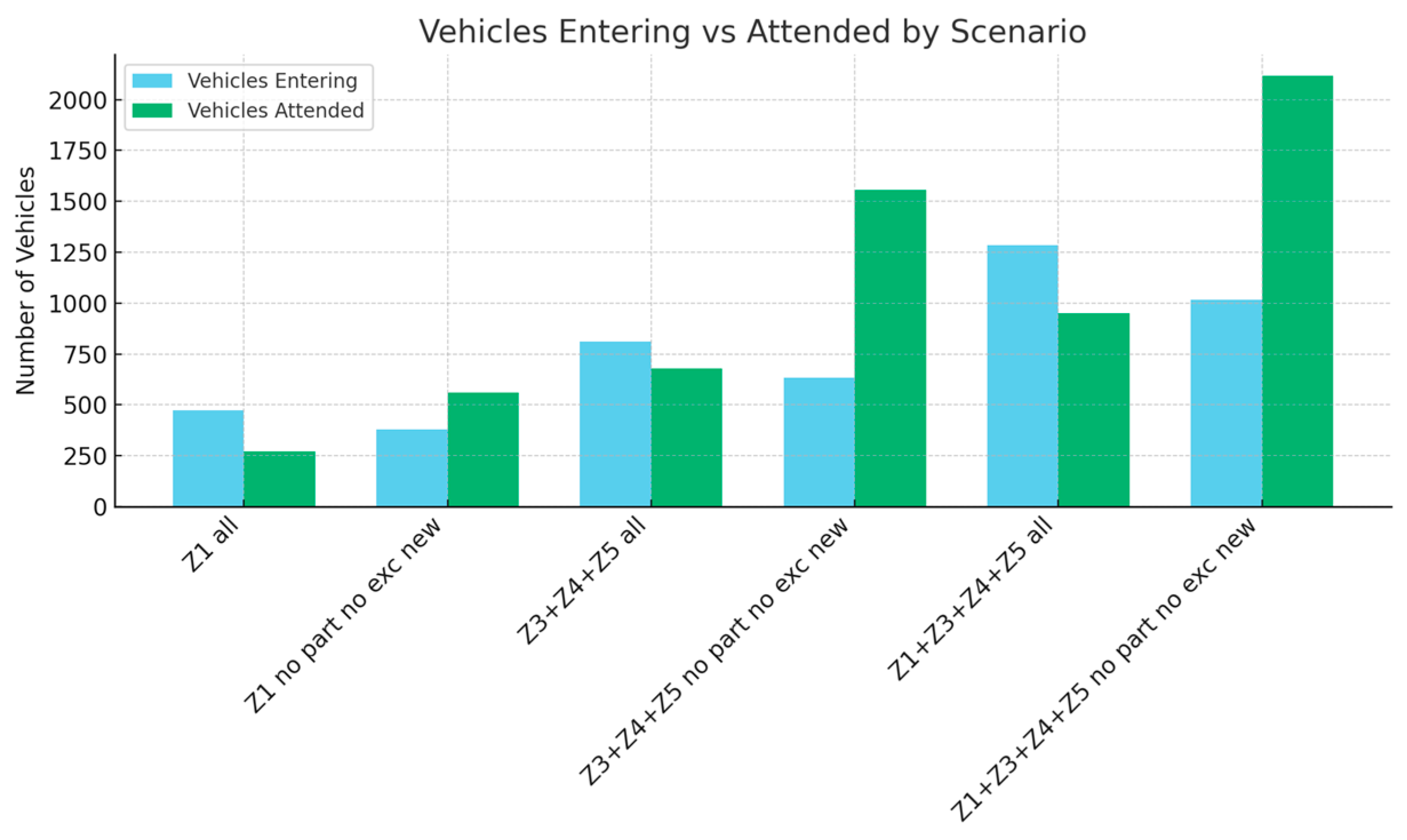
Figure 3 shows that in scenarios involving incorrect use, more vehicles enter the system than can be handled, while in scenarios involving use in accordance with regulations, the capacity to handle commercial vehicles in the LUZ is sufficient and even oversized.
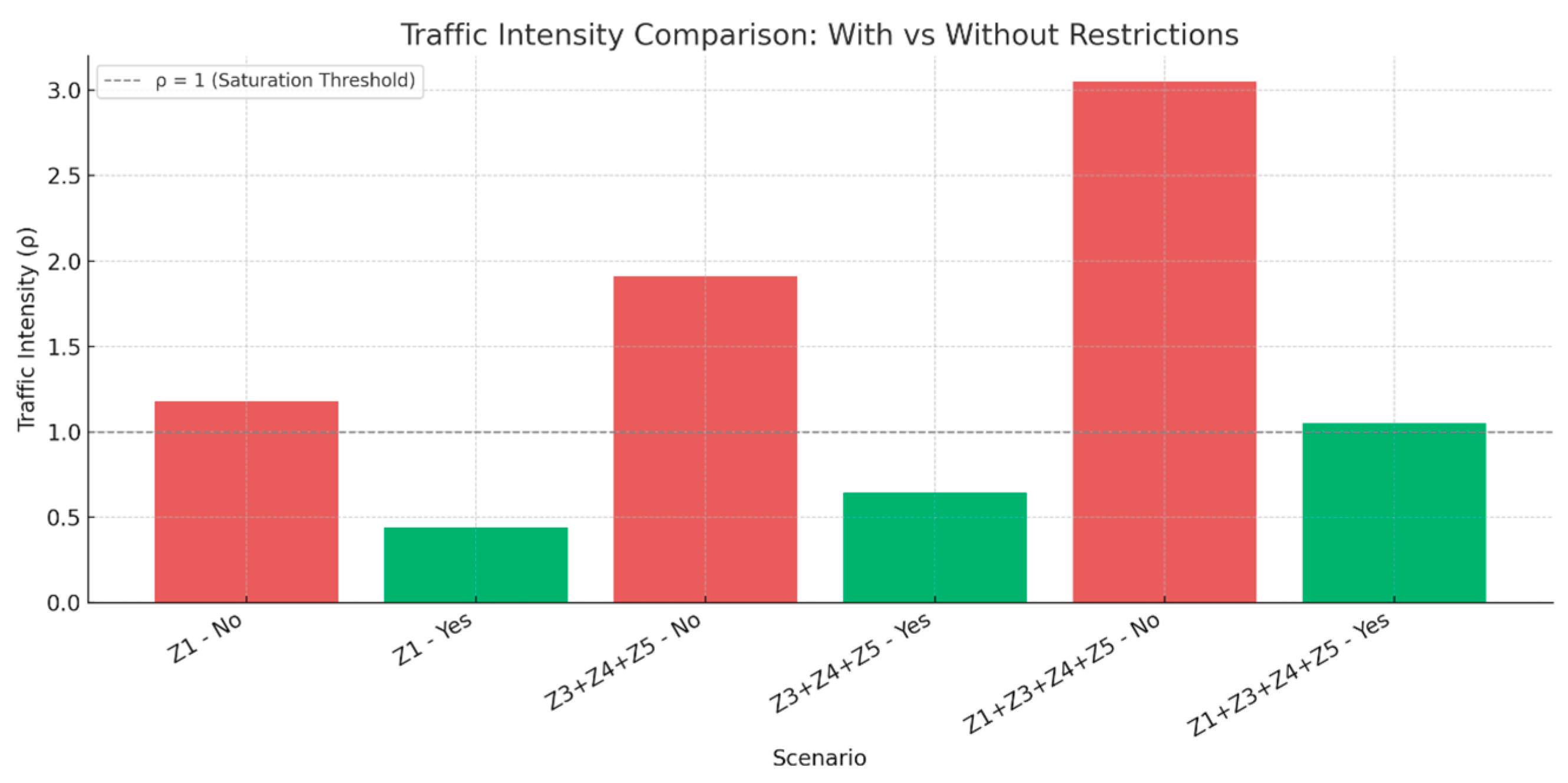
Figure 4 shows the traffic intensity; it is clear that in scenarios involving incorrect use, more vehicles enter the system than can be handled, while in scenarios involving use in accordance with regulations, the capacity to handle commercial vehicles in the LUZ is sufficient and even oversized.
The traffic intensity measured in Erlangs shows that unrestricted systems are not viable as they have >1, while scenarios with restrictions applied are below 1, even in the case of the sum of all areas, which is just at the limit of viability. The contrast between scenarios demonstrates that management and restriction measures are more effective than physically expanding the available space. Controlled scenarios manage to maintain traffic intensity at stable levels (ρ < 1), which guarantees service continuity and reduces the likelihood of illegal parking or operational blockages.
These results suggest the need to implement intelligent access control and dwell time systems. This would allow ρ to be kept within sustainable limits and prevent structural saturation of the urban loading and unloading system.
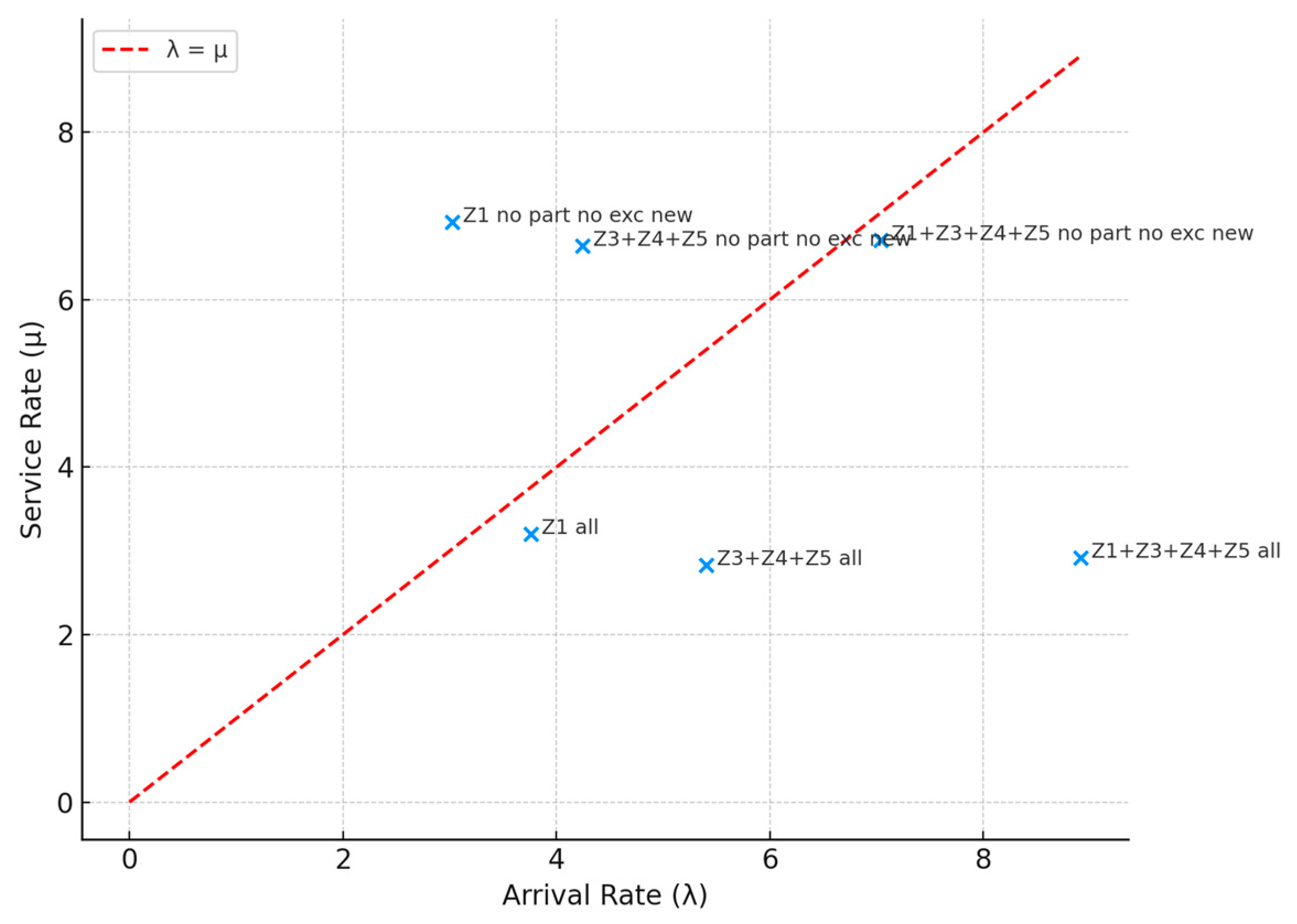
Figure 5 shows the relationship between the arrival rate and the service rate. The scatter plot shows that the points below the red line (λ = μ) represent situations where demand exceeds capacity and therefore there is saturation. The points above the line indicate that the system has sufficient margin to operate without congestion. The combined scenario for the two areas is right on the limit. Overall, the graph shows that the systems studied do not collapse from a mathematical point of view, but operate in regimes of relative inefficiency, where the potential service capacity (μ) does not translate into an equivalent increase in the number of vehicles served. This reinforces the hypothesis that improvement does not only involve increasing the number of spaces or the time available, but also implementing digital control and time traceability mechanisms that optimise the use of existing infrastructure.
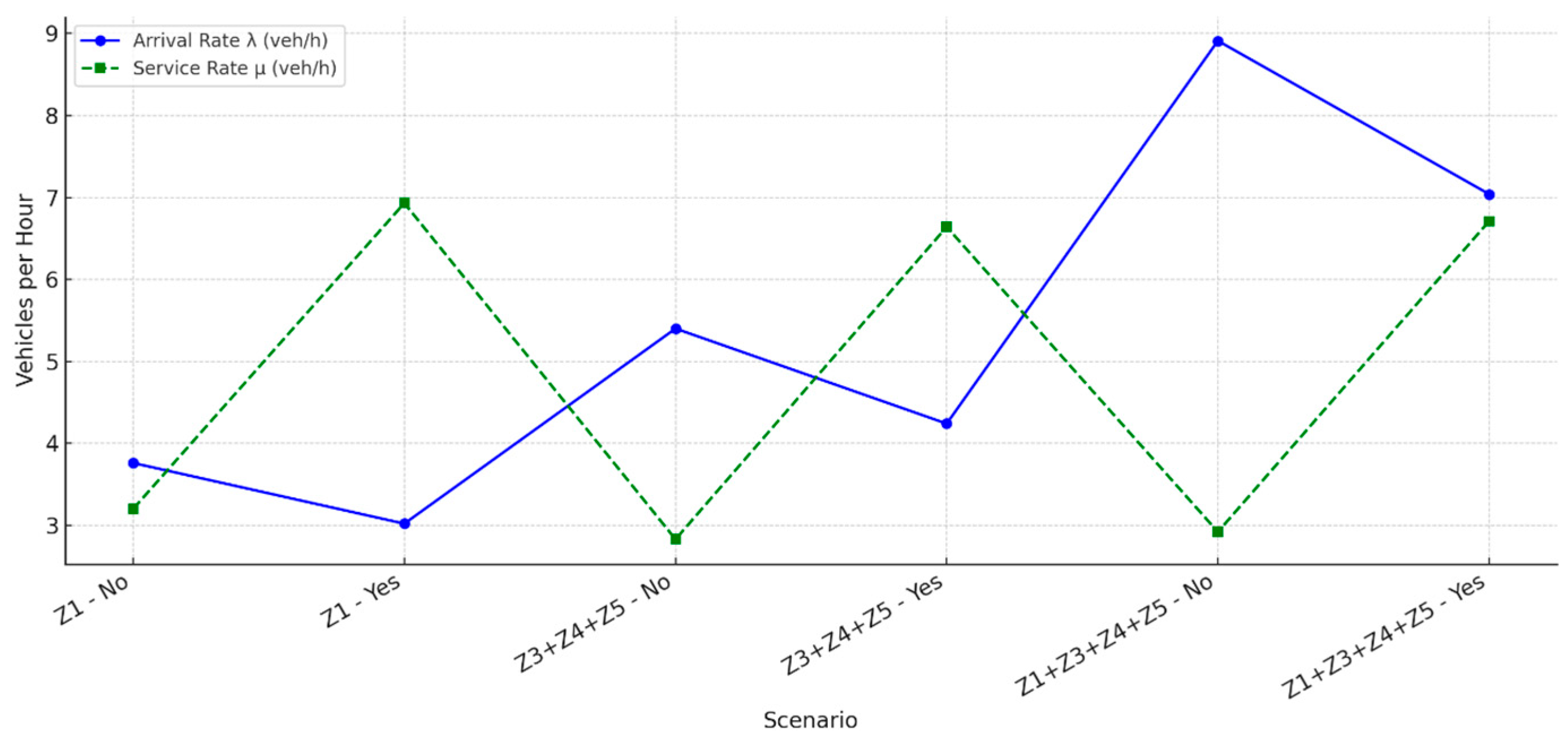
Figure 6 shows the capacity to serve services versus the arrival rate by scenario, almost balancing in the joint case. The application of restrictions (Yes scenarios) produces a significant reduction in the arrival rate (λ), as non-professional vehicles or those with irregular behaviour are eliminated. At the same time, the service rate (μ) tends to increase or stabilise, which shows an improvement in the overall efficiency of the system: with less interference and greater turnover, the areas can handle a similar flow of vehicles in less time. The graph shows that the physical expansion of the system does not guarantee improved performance if it is not accompanied by regulatory and technological measures. In fact, the controlled reduction of non-essential traffic, simulated by the restrictions, leads to greater functional efficiency (lower ρ) and lower blocking losses (pB).
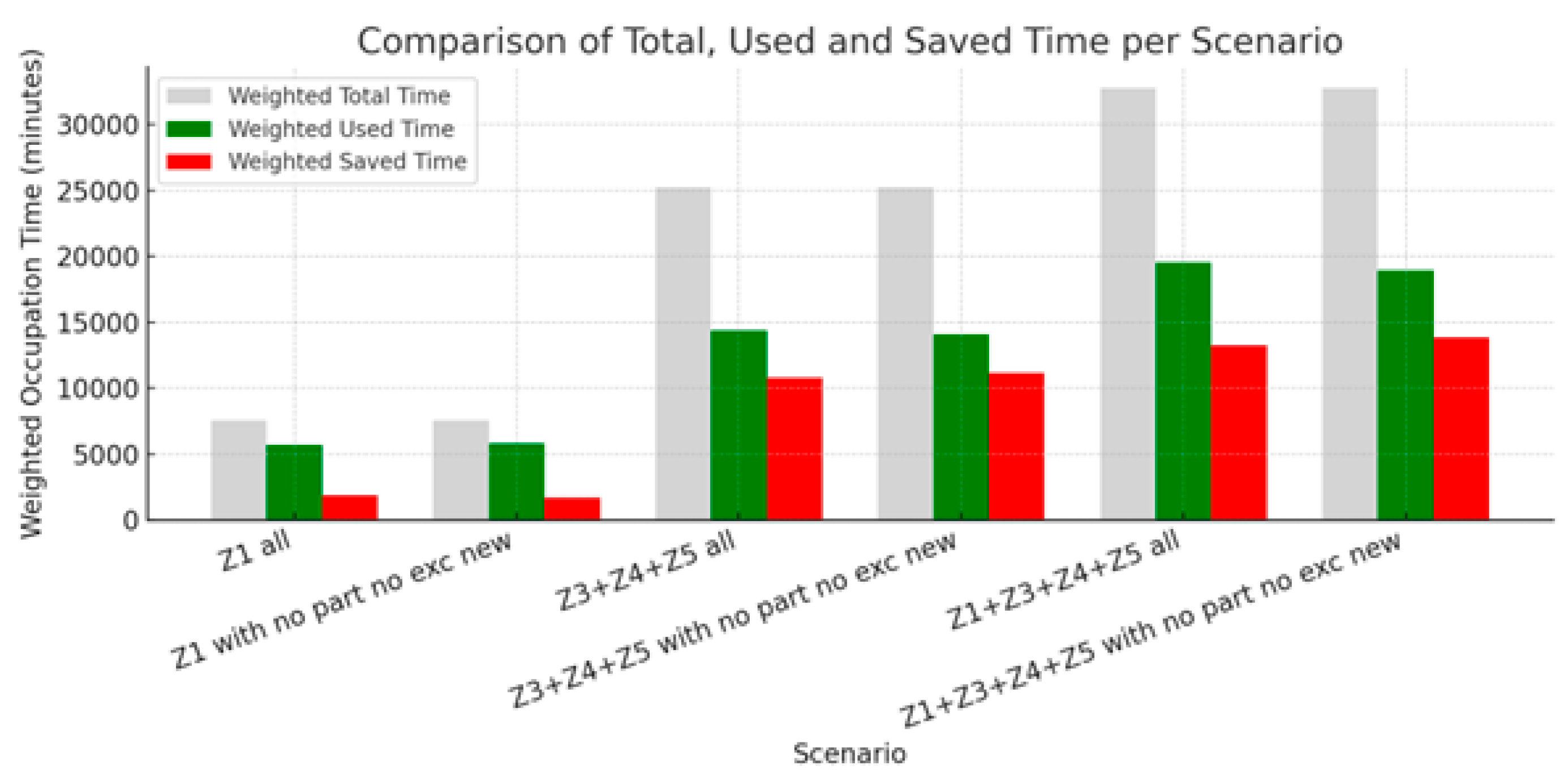
Figure 7 shows the weighted occupancy times: total versus occupied and released, in each scenario. The released times are those that give rise to the simulation of commercial vehicles that could be served in each LUZ scenario according to the weighted occupancy times of the weighted generic average of occupancy times by vehicle type. A significant portion of the reserved time is not used for actual logistics operations. This reflects structural inefficiencies resulting from improper occupancy, downtime, and a lack of controlled turnover.
When comparing the different groups of zones, it can be seen that increasing the operational area (from Z1 to Z3 + Z4 + Z5 and finally to the whole) increases the total available time, but not proportionally to the time of use. This finding confirms that the marginal efficiency decreases as the system expands, suggesting that improvements should focus more on optimisation and control than on capacity expansion.
The graph shows that access restriction and control policies would significantly improve the system’s temporal efficiency, reducing idle time and maximising the effective use of areas. From an urban management perspective, this reinforces the viability of implementing dynamic digital control tools capable of ensuring the rational use of LUZs and contributing to the sustainability of urban mobility.
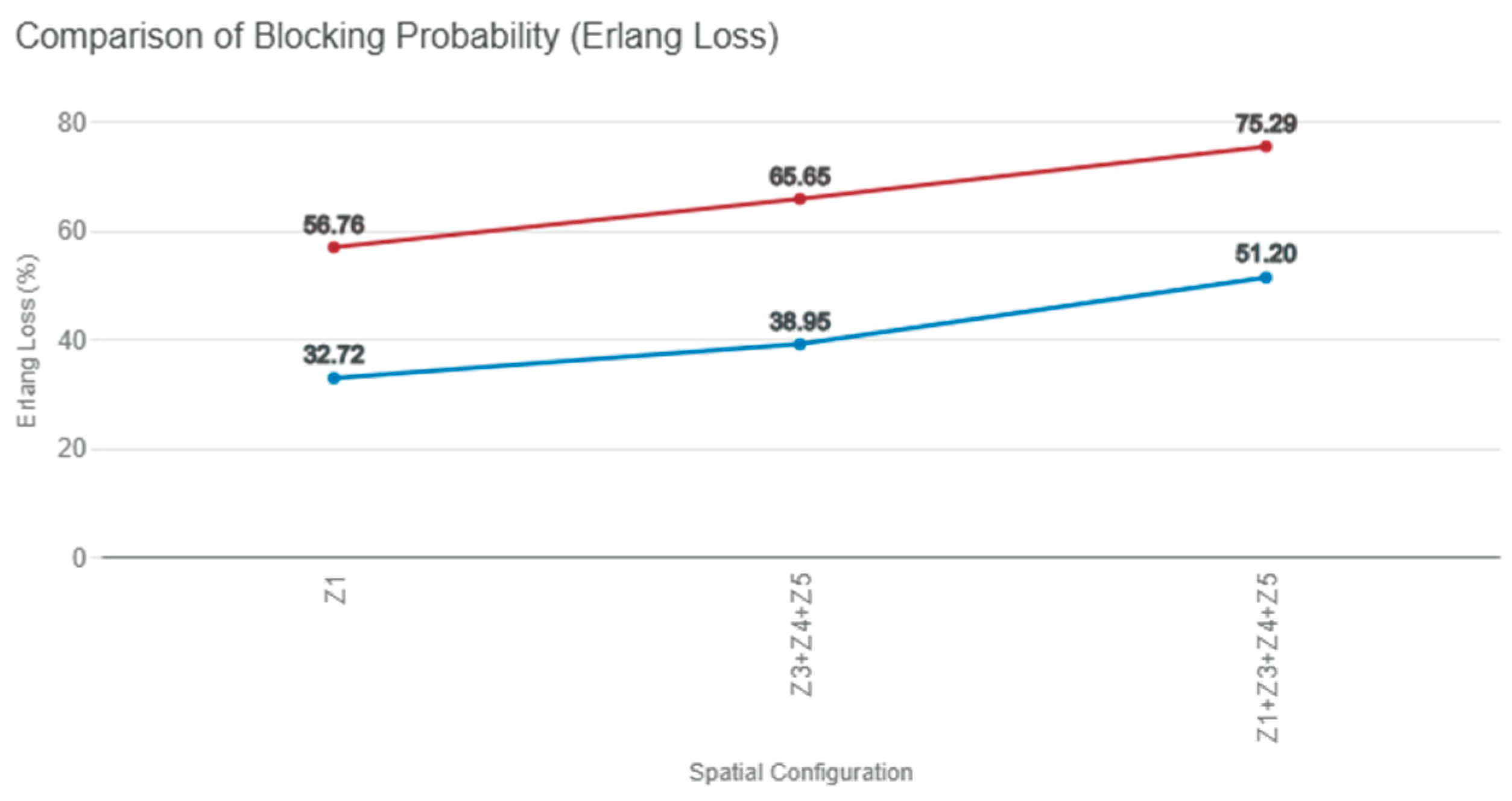
A comparative analysis of the six scenarios shows that the joint enforcement of access restrictions and dwell time limits generates substantial efficiency gains in all spatial configurations. When moving from the observed situations (Sc1, Sc3, Sc5) to the regulated ones (Sc2, Sc4, Sc6), the Erlang-B blocking probability decreases by approximately 24–27 percentage points in each case (from 56.76% to 32.72% in Z1, from 65.65% to 38.95% in Z3 + Z4 + Z5, and from 75.29% to 51.20% in the whole block). These reductions represent relative improvements of around 30–40% in the probability of service denial without expanding the physical space of the LUZs. The largest absolute gain is obtained when the entire block is regulated coherently (Sc5 vs. Sc6), confirming that, at the block level, coordinated enforcement prevents the system from operating in structurally congested regimes and unlocks the latent capacity of existing bays. This can be seen in
Figure 8:
Please note that the calculated capacities, especially in Scenarios 2, 4, and 6, represent the maximal potential throughput. These values correspond to theoretical upper bounds under the assumption of continuous arrival of authorized vehicles, without considering arrival randomness or operational inefficiencies. Thus, they should be understood as idealized scenarios and not as expected operational outcomes.
5.1. Contribution to the Research Gap Operational
The results of this study address a significant gap in the existing literature on curbside management and urban freight distribution. Previous research has extensively analysed the optimal allocation, spatial planning or regulatory design of LUZs, but far fewer studies have empirically examined how these zones operate under real demand conditions and how their performance changes when municipal regulations are strictly enforced. Furthermore, most analytical approaches assume the existence of physical queues or waiting behaviours, despite evidence that, in dense urban settings, vehicles immediately leave when no curbside space is available. This study contributes to filling this gap by providing a quantitative assessment of LUZ performance under both unrestricted and regulation-compliant operational scenarios, using a no-wait queuing model (Erlang B) combined with weighted occupation times.
Our findings demonstrate that non-compliant behaviour is the primary cause of system saturation, confirming that the presence of private vehicles and over time commercial operations drastically reduces effective capacity and leads to high loss rates. This validates empirically what many normative frameworks assume but seldom quantify: that curbside congestion arises not from insufficient infrastructure but from improper use. Conversely, the results also show that when municipal rules are followed, the available curbside space is fully capable of absorbing operational demand without collapsing, with loss probabilities falling sharply across all analysed configurations. This provides evidence-based confirmation that urban freight regulations, when effectively enforced, restore the functional efficiency of LUZs.
Moreover, while the literature recognises that recirculation behaviours create an implicit form of queuing, few studies have modelled this dynamic explicitly as a loss system. By applying weighted occupation time, this study introduces an operationally realistic parameter that accounts for heterogeneous vehicle sizes and enables the modelling of multiple zones as a single server equivalent. This methodological contribution extends the applicability of no-wait queuing models to complex urban environments and provides a framework for evaluating compliance-based efficiency gains at the zone, street and block level. In summary, the study provides empirical and modelling evidence that:
The Erlang B model is appropriate for systems where rejected vehicles recirculate rather than queue.
Together, these results advance the understanding of LUZ performance and offer a scientifically grounded framework for designing and evaluating curbside management policies.
5.2. Comparison with Existing Literature
The findings of this study align with and extend several strands of existing research on curbside management, urban logistics and the queuing-based modelling of freight activity in cities. Prior studies have highlighted that the primary source of congestion in LUZs is not the physical scarcity of space, but rather the improper use of dedicated curbside areas by unauthorised vehicles and inefficient dwell time patterns. This has been documented in empirical analyses by Jaller et al. (2013) [
35], who show that private vehicle intrusion into freight zones significantly reduces operational capacity, and by Allen et al. (2018) [
36], who report that excessive dwell times by commercial operators lead to spillover congestion affecting entire street segments. The present study corroborates these results by demonstrating, through a no-wait queuing model, that unrestricted use produces loss probabilities consistent with system overload.
Similarly, recent work on curbside regulation reinforces the relevance of enforcement and compliance. Alison et al. (2020) [
37] show that when time limits and access restrictions are adhered to, the effective turnover of curbside spaces increases significantly. Our findings confirm this behaviour: when simulations incorporate only authorised vehicles and a maximum dwell time of 30 min, the LUZs in Zaragoza exhibit stable operating conditions across all configurations, validating the premise that proper compliance restores system efficiency.
The behaviour of vehicles when LUZs are full has also been discussed in the literature. While some studies assume physical queuing (e.g., Jaller et al., 2013 [
35]), others acknowledge that urban delivery drivers do not wait but instead recirculate around the block, producing implicit queues and generating additional externalities (Marcucci et al., 2017 [
38]; Castrellon et al., 2024 [
39]). The present study provides empirical confirmation of this behaviour: no vehicles were observed forming a queue; instead, recirculation was the dominant pattern, reinforcing the appropriateness of loss models such as Erlang B.
From a modelling perspective, the use of weighted occupation time in this paper extends the applicability of classical queuing approaches by capturing the effect of heterogeneous vehicle sizes occupying different proportions of the LUZ. Previous studies have partially addressed vehicle heterogeneity (González-Feliu et al., 2011 [
40]), but none have operationalised it within a queuing loss framework. Thus, the present work offers a methodological refinement that allows multiple, spatially dependent LUZs to be modelled as consolidated service units, enabling more realistic performance evaluation.
Overall, the findings reinforce and refine existing scholarly understanding by demonstrating that the primary determinant of congestion in urban LUZs is the improper or illegal use of these spaces, rather than an inherent deficit in their structural capacity. The empirical evidence further shows that strict compliance with municipal regulations, particularly regarding access restrictions and maximum dwell times, is sufficient to maintain the operational efficiency of LUZs that would otherwise exhibit systemic collapse under unregulated conditions. The modelling results additionally confirm that no-wait queueing systems such as the Erlang-B model are theoretically and empirically appropriate for urban freight contexts where vehicles recirculate in search of available space rather than forming traditional queues, thereby aligning with the field-observed behavioural patterns documented in previous studies. Moreover, the introduction of the weighted occupation metric constitutes a methodological advance that enhances the analytical representation of heterogeneous curbside use, enabling a more accurate assessment of space–time productivity in mixed-vehicle environments. Collectively, these contributions situate the present study within the broader scientific discourse on urban freight management and highlight the operational and policy relevance of compliance-based curbside management as an effective mechanism to reduce congestion, mitigate externalities, and support sustainable urban logistics.
5.3. Implications for Urban Logistics
The results obtained in this study have direct and substantive implications for the design and management of urban logistics systems. First, the evidence demonstrates that public policies governing curbside freight operations should prioritise access regulation and dwell time compliance rather than the structural expansion of LUZs. The marked reduction in system overload observed under the “ideal compliance” scenarios indicates that regulatory enforcement is a more effective lever than increasing curbside supply, a conclusion consistent with emerging research on demand-side management in urban freight distribution.
Second, the findings underscore the importance of robust enforcement and real-time control mechanisms. Since illegal use, both by unauthorised vehicles and authorised vehicles exceeding the permitted time, proved to be the primary driver of congestion, municipalities may significantly improve operational efficiency by integrating digital monitoring tools, automated alerts, and graduated enforcement schemes. Such mechanisms are aligned with the shift toward data-driven governance models already being adopted in leading European cities.
Third, the study provides quantitative evidence supporting the definition of rotation standards based on weighted occupation time rather than on nominal dwell time alone. By capturing the combined effect of vehicle size and stay duration, the weighted metric enables cities to design more precise performance indicators, allowing policymakers to tailor regulatory windows, pricing models, or access tiers depending on the heterogeneity of freight demand.
Fourth, the results highlight the potential for reducing negative externalities associated with urban freight movements. Illegal or unsuccessful attempts to use LUZs generate recirculation, double parking, and the obstruction of pedestrian and traffic flows. By demonstrating the operational viability of LUZs under proper compliance, this study provides a quantitative foundation for policies aimed at lowering emissions, reducing fuel consumption linked to recirculation loops, and improving safety in densely populated urban areas.
Finally, the modelling framework presented herein offers a scalable methodological approach for analysing curbside operations in other cities. The application of a no-wait queueing model (Erlang B) in combination with weighted occupation metrics provides a transferable blueprint for evaluating heterogeneous loading zones where vehicle recirculation replaces traditional queue formation. This framework can be adapted to diverse urban morphologies, regulatory regimes, and freight profiles, enabling comparative assessments and supporting evidence-based policy harmonisation across municipalities.
Although the present study focuses on the operational performance of LUZs using an empirical approach and an Erlang B loss system model, more advanced methodological frameworks, such as multi-objective optimisation, hybrid data knowledge approaches, and spatiotemporal demand modelling, represent promising extensions for future research. These techniques could enable a deeper integration of dynamic arrival patterns, systemic interactions between adjacent curbside assets, and the more complex optimisation of regulatory and design parameters, which were beyond the scope of the current manuscript but will be explored in subsequent studies.
5.4. Limitations of Model Assumptions
The analytical formulation adopted in this study relies on classical Erlang B assumptions, Poisson arrivals, exponential service times, and a single consolidated service channel based on weighted occupation time. These assumptions provide a tractable modelling framework consistent with the observed no waiting behaviour of LUZs; however, they introduce limitations. First, empirical arrivals may deviate from a homogeneous Poisson process due to temporal clustering and peak hour concentration. Second, service times exhibit heterogeneity related to vehicle type, delivery activity, and operator behaviour, which may diverge from an exponential distribution. Third, the weighted time aggregation treats the LUZ as a single normalised server, which can indicate a full state even when some physical curb length remains available but is insufficient for typical commercial vehicles. These issues do not invalidate the modelling approach but may result in the overestimation of blocking probabilities. A formal statistical validation of interarrival and service distributions, as well as sensitivity analyses of parameters λ and μ, constitute valuable extensions for future research.
6. Conclusions
This study has made it possible to characterise the actual functioning of four LUZs in the central area of Zaragoza, combining direct empirical observation with theoretical modelling using M/M/1/1 (Erlang B) queues. The results show that, although the physical and temporal capacity of the zones is sufficient in nominal terms, operational efficiency is compromised by misuse, excessive time and a lack of dynamic control, generating loss rates of over 30% during periods of peak demand.
The modelling approach adopted in this study relies on a single aggregated service point derived from the weighted occupation methodology. This abstraction represents a methodological simplification that enables consistent comparison across heterogeneous curbside configurations. However, this assumption constitutes a limitation of the study, as future research could incorporate multi-server or spatially explicit queueing models to represent the geometric and operational characteristics of each zone with greater fidelity. The probabilistic model for predicting loss or blockage indicates the moment when the area is occupied, regardless of whether or not there are spaces available in it. However, this limitation marks the most unfavourable point of occupancy, so in practice, the use of those metres not taken into account would always work in favour of the system’s capacity and never against it.
The study makes three main contributions. The main conclusion is that it is not necessary to expand the spaces or reservation times in the LUZs studied to meet the entire demand for loading and unloading capacity. It is simply necessary to strictly enforce the relevant municipal ordinances, something that does not happen in practice.
The second contribution has been to demonstrate that the M/M/1/1 Erlang B model of queueing theory without queues, supported in this work by the weighted time variable, which eliminates unauthorised private vehicles and limits the stay in the LUZ of commercial vehicles loading or unloading to 30 actual minutes, is sufficient to meet demand by zone and for the LUZ as a whole. Areas with incorrect use tend to collapse and generate externalities. The comparison between the theoretical results and the observed data reveals significant deviations. This phenomenon demonstrates that the assumption of homogeneous Poisson-type arrivals does not accurately reflect the operational reality, where deliveries are grouped into short and uneven periods. Despite this, the Erlang B model remains valid as a first-rate analytical tool for estimating structural service loss and evaluating improvement scenarios, compared to other studies that do consider queues or waiting times.
The third contribution, in response to non-compliance with regulations, is the proposal to develop a tool for managing LUZ, based on geolocation, time recording and automatic alerts. This tool would allow drivers to record their entry and exit in real time, and would provide municipal agents with a control panel to monitor occupancy, excesses and repeat offences. This system, complemented by an adaptation period and without the need for sensors or cameras, would reduce service losses, improve turnover and decrease the environmental impact of unnecessary traffic.
Future work should explore the integration of advanced multi-objective scheduling, spatiotemporal demand modelling, and urban structure analysis to extend our findings. Additionally, more complex models, such as recirculation networks and stochastic simulations, could further enhance the robustness and applicability of the proposed approach.
The study concludes that the three restrictions, one on access and two others that are temporary, should ensure proper compliance with LUZ management. It also aims to provide the city’s governance with an analysis methodology to improve LUZ management and therefore proposes, for future studies, incorporating a new indicator into the restrictions already established to aid decision making regarding the longitudinal impact of expanding or reducing LUZ and the associated environmental impact, thereby enabling the assessment of the impact that modifying them in terms of time windows or space dimensions would have on each area or group of areas, as well as the design approach of the control tool.






 ,
,