Article

Influence of Milling Conditions and Amylose Content on the Bread-Making Quality and Antioxidant Activity of Purple Whole Wheat Flour

1
Department of Food Science and Nutrition, Pusan National University, Busan 46241, Republic of Korea
2
Kimchi Research Institute, Pusan National University, Busan 46241, Republic of Korea
*
Author to whom correspondence should be addressed.
Appl. Sci. 2026, 16(1), 56; https://doi.org/10.3390/app16010056 (registering DOI)
Submission received: 24 November 2025 / Revised: 11 December 2025 / Accepted: 15 December 2025 / Published: 20 December 2025

Abstract

To promote domestic wheat production in South Korea, four functional colored wheat varieties with varying amylose contents: Ariheuk (AH), Arijinheuk (AJ), Ariheukchal (AC), and Sintong (ST), were developed. This study examined their bread-making performance using whole wheat flour (WWF) milled under different conditions with an ultra-centrifugal mill (sieve openings: 0.5 and 1.0 mm; rotation speeds: 6000 and 14,000 rpm). Four flour samples per variety (FL, FH, CL, CH) were prepared. The median particle size (d50) varied among varieties, with harder kernels (AC, AH) producing larger particles than softer ones (AJ, ST). Smaller sieve openings increased the water and sodium carbonate solvent retention capacity, whereas higher rotation speeds reduced them, indicating less damaged starch. Sodium dodecyl sulfate sedimentation volume was higher in AC and AH, suggesting stronger gluten. Bread made from the group F WWF had higher volume and lower firmness, with AH-FH producing the best bread quality. Total phenolic and anthocyanin content and antioxidant activity were slightly higher in the group F, but markedly lower in the ST. Bread crusts showed increased phenolic and antioxidant activity but decreased anthocyanin content due to heat. Overall, kernel hardness, milling conditions, and amylose content strongly influenced purple WWF quality and bread performance, highlighting the need to optimize milling and formulation strategies.

1. Introduction

Wheat is one of the three major crops in the world, along with rice and corn. It grows well even in barren and arid environments, and serves as a staple food for approximately 30% of the global population [1]. In Korea, the annual per capita wheat consumption is 36 kg, making it the second most consumed crop after rice [2]. However, the majority of wheat consumed is imported (approximately 2.5 million tons), resulting in a self-sufficiency rate of approximately only 1% [3]. Alongside initiatives such as the Wheat Industry Development Act [4], the government, academia, and industry are actively working to increase domestic wheat production and consumption in South Korea. With the growing influence of a Westernized diet, the consumption of wheat-based products such as bread, cake, cookies, crackers, and noodles has increased [5]. Rising consumer interest in health has driven the demand for wheat-based products that use whole wheat flour (WWF) and wheat bran [6].
WWF is richer in fiber than refined wheat flour and may reduce the risk of cardiovascular disease, metabolic syndrome, type 2 diabetes, and certain cancers. Wheat bran, a major source of dietary fiber, predominantly contains insoluble fiber [7] and effectively prevents constipation and intestinal diseases such as colon cancer in the Korean population [8]. To promote domestic wheat production and encourage whole-grain consumption, the National Institute of Crop Science under the Rural Development Administration developed a purple wheat variety called Ariheuk (AH). This variety is particularly rich in anthocyanins and polyphenol compounds compared with regular wheat [9], showing potential as a health-promoting ingredient [10].
Besides AH, the National Institute of Crop Science has introduced other purple wheat varieties, including Arijinheuk (AJ), Ariheukchal (AC), and Sintong (ST), each with distinct amylose contents that contribute to their functional properties. Amylose content in wheat is regulated by Wx-A1, Wx-B1, and Wx-D1, which encode GBSSI expressed during starch synthesis. Normal expression of these proteins produces non-waxy wheat, whereas reduced expression results in waxy characteristics [11]. Partially waxy wheat with desirable swelling and gelatinization properties is suitable for noodle production [11]. Consequently, breeding partially waxy wheat is a global objective for developing varieties suitable for noodle production [12].
Numerous studies have explored the quality and applications of WWF because of their health benefits. However, most studies have focused on the use of separated bran rather than examining WWF without separating the bran, necessitating further exploration [9,13]. Particle size is a crucial factor affecting the processing characteristics of WWF. Optimizing particle size through milling is essential for producing uniform quality flours [14]. Commercially, WWF is produced using various mills, including stone, hammer, and roller mills. However, the reconstitution process can result in the loss of some bran fractions, complicating the assessment of the particle size effects. Laboratory ultra-centrifugal mills allow researchers to examine the influence of particle size on WWF quality by varying the milling parameters, such as sieve size and rotation speed [13,15].
This study investigated the effects of milling conditions on the quality of purple WWF with varying amylose contents (AC, AH, AJ, and ST), including particle size, physicochemical properties, and bread-making performance. Additionally, nutritional components, such as phenolic compounds and anthocyanins, and the antioxidant activities of purple WWF and breads were evaluated.

2. Materials and Methods

2.1. Materials

Four Korean domestic purple wheat cultivars, AC, AH, AJ, and ST, were supplied by the National Institute of Crop Science, Rural Development Administration, Republic of Korea. The hardness values of the wheat kernels were 77.1, 68.3, 40.2, and 26.0, respectively [16]. The ingredients for bread making, including sugar (CJ Jeiljedang, Seoul, Republic of Korea), shortening (Lotte Foods, Seoul, Republic of Korea), yeast (Societe Industrielle Lesaffre, Marcq, France), salt (Samyang, Seoul, Republic of Korea), and skim milk powder (Seoulmilk, Seoul, Republic of Korea), were purchased locally. All reagents used in the analyses were of first-grade quality.

2.2. Preparation of Purple WWF

WWF was prepared by milling “as is” kernels without conditioning in an ultra-centrifugal mill equipped with either a 0.5 mm (Fine, F) or 1.0 mm (Coarse, C) sieve at rotational speeds of 6000 rpm (Low, L) or 14,000 rpm (High, H). The mill operates in a single-pass mode. Four WWF types (fine–low [FL], fine–high [FH], coarse–low [CL], and coarse–high [CH]) were produced for each variety. The feed rate per 500 g was recorded for all milling conditions to evaluate the milling performance.

2.3. Analysis of Color and Particle Size Distribution of Purple WWF

The color of the purple WWF was measured using a colorimeter (CR-20, Minolta, Tokyo, Japan) to determine the L* (brightness), a* (redness), and b* (yellowness) values. Particle size distribution was analyzed using the dry method with a particle size analyzer (LS 13 320; Beckman Coulter, Brea, CA, USA).

2.4. Analysis of Physicochemical Properties of Purple WWF

The moisture and ash contents of the purple WWF were determined using the American Association of Cereal Chemists (AACC) Methods 44-15.02 and 08-01.01, respectively [17].
Amylose content was determined using the iodine-binding method. A standard curve was prepared by blending amylose and amylopectin in different ratios. For the analysis, 20 mg of WWF was dissolved in 2 mL of 1.0 N NaOH and 4 mL of distilled water, heated at 100 °C for 30 min, cooled, and mixed with 25 mL of 0.5% trichloroacetic acid. Then, 0.25 mL of iodine solution was added, allowed to react for 30 min, and the absorbance was measured at 620 nm.

2.5. Analysis of Solvent Retention Capacity (SRC) of Purple WWF

Solvent retention capacity (SRC) analysis of purple WWF was performed following the AACC Method 56-11.02 [18] to evaluate flour quality. Water SRC and sodium carbonate SRC were only determined to assess the water absorption capacity and contribution of damaged starch. Lactic acid and sucrose SRC (reflecting gluten strength and arabinoxylans, respectively) were excluded due to bran interference, which can cause errors by preventing precipitation after centrifugation and leaving bran particles suspended in the supernatant [17]. Flour (5 g) was placed in a pre-weighed 50 mL conical tube and mixed with 25 g of distilled water or 5% (w/w) sodium carbonate solution. The suspension was shaken for 20 min for hydration and then centrifuged at 1000× g for 15 min (LaboGene 1248; Gyrozen Inc., Daejeon, Republic of Korea). After discarding the supernatant, the tubes and pellets were weighed to calculate SRC values.

2.6. Measurement of Sodium Dodecyl Sulfate (SDS) Sedimentation Volume of Purple WWF

The sodium dodecyl sulfate (SDS) sedimentation volume of purple WWF was measured using AACC Method 56-70.01 [18]. The flour (5 g) was placed in a 100 mL graduated cylinder with 50 mL of distilled water, capped, and shaken vigorously for 15 s. The cylinder was inverted at 2, 4, and 6 min to ensure a complete dispersion. Next, 50 mL of SDS–lactic acid solution (3% SDS in 1.2 N lactic acid) was added, and the cylinder was inverted again at 0, 2, 4, and 6 min. The swollen volume was recorded at 20 and 40 min and the final SDS sedimentation volume was determined.

2.7. Measurement of Total Phenol and Anthocyanin Contents of Purple WWF

Total phenolic content (TPC) of the purple WWF was determined following the method of Yu and Beta [19]. Lyophilized and sieved flour (2 g) was extracted with 20 g of 80% methanol by stirring (60 min), sonication (10 min and 40 kHz), and centrifugation (12,000× g, 10 min, and 4 °C). Combined supernatants were stored at −20 °C for TPC, 2,2-diphenyl-1-picrylhydrazyl (DPPH), and 2,2′-azino-bis(3-ethylbenzothiazoline-6-sulfonic acid (ABTS) analyses. TPC was measured using tenfold-diluted Folin–Ciocalteu reagent, followed by neutralization with sodium carbonate (60 g/L) and absorbance measurement at 725 nm. Results were expressed as mg gallic acid equivalents (GAE)/100 g.
Total anthocyanin content (TAC) was determined similarly, except that acidified methanol (1 N HCl) was used instead of 80% methanol. Absorbance was measured at 535 nm using cyanidin-3-glucoside as the standard, and TAC was expressed as mg cyanidin-3-glucoside equivalents (C3GE)/100 g.

2.8. Analysis of Antioxidant Activity of Purple WWF

The antioxidant activity of purple WWF was evaluated using DPPH and ABTS radical scavenging assays, following the protocol described by Yu and Beta [19]. For DPPH analysis, a 250 μmol/L DPPH solution (absorbance 1.1–1.2 at 515 nm) was mixed with 0.5 mL of flour extract and reacted for 30 min at 20–25 °C. The absorbance was measured at 515 nm against a control containing 80% methanol.
For ABTS analysis, 7 mM ABTS and 2.45 mM K2S2O8 solutions were mixed (1:1), incubated in the dark for 12 h, and diluted 50-fold. Then, 0.1 mL of flour extract was mixed with 1.85 mL of diluted ABTS solution, and the absorbance was measured at 734 nm.
For both assays, Trolox was used as a standard, and the antioxidant activity was expressed as mg Trolox equivalents (TE)/100 g.

2.9. Measurement of Dough Properties of Purple WWF Using a Mixograph

The dough properties of the purple WWF were evaluated using a 10 g mixograph (National Manufacturing Co., Lincoln, NE, USA) following the AACC Method 54-40.02 [18]. A 10 g WWF sample was placed into the mixing bowl and, based on each WWF’s water SRC value, 6.2–7.8 g of distilled water were added. The sample was then mixed for 10 min, and the resulting mixogram was recorded to assess the dough’s mixing characteristics.

2.10. Preparation of Bread with Purple WWF

Bread was prepared with slight modifications to the AACC Method 10-10.03 [18]. Briefly, 100 g WWF, 4 g non-fat dry milk, 14 g sugar–salt solution (containing 4.54 g sugar and 1.25g salt: 4.54% and 1.25% based on flour weight), and 3 g shortening were mixed in a micropin mixer (100 g, National Manufacturing Inc., Lincoln, NE, USA). The sugar–salt solution was prepared by dissolving 1090 g sugar and 272.2 g salt in 2 L distilled water. Yeast (2 g) was added to 62–78 g of water (30 ± 0.5 °C), adjusted by the flour’s water SRC value. The dough was mixed for 3–4.5 min, sheeted to 0.47 cm thickness, fermented at 35 °C and 85% RH for 60 min, and baked at 215 °C for 21 min (Phantom M301 Combi, Samjung, Gyeonggi, Republic of Korea). After cooling for 30 min in the baking pan and an additional 20 min after removal from the pan, the bread quality was analyzed.

2.11. Measurement of the Quality of Bread Prepared with Purple WWF

Bread volume was determined using a rapeseed replacement method (AACC Method 10–05.01) [18] with minor modifications: the bread was placed in a 1.0 L container filled with millet, the displaced weight was measured, and the volume was calculated; measurements were repeated twice per sample.
Bread firmness was assessed using a Texture Analyzer (Brookfield CT3, Middleboro, MA, USA) according to the AACC Method 74-09.01 [18]. Firmness was measured at the center of the sliced bread using a TA-AACC36 probe in compression mode with pre-test and test speeds of 2.0 mm/s, a post-test speed of 5.0 mm/s, and a penetration distance of 15 mm.

2.12. Measurement of Total Phenol and Anthocyanin Contents, and Antioxidant Activity of the Bread Prepared with Purple WWF

The total phenolic and anthocyanin contents of bread prepared from purple WWF were determined following the method of Yu and Beta [19]. The bread samples were lyophilized for 48 h, ground, and extracted using the same procedure as for the flour. Total phenolic content (TPC) and total anthocyanin content (TAC) were measured using the same methods applied to the flour and expressed as mg gallic acid equivalents (GAE)/100 g and TAC as mg cyanidin-3-glucoside equivalents (C3GE)/100 g.
The antioxidant activities of bread crumbs and crusts were assessed via DPPH and ABTS radical scavenging assays, following the same procedures as for the flour extracts. The results were expressed as mg Trolox equivalents (TE)/100 g.

2.13. Statistical Analysis

All experiments were conducted at least in duplicate. Data were analyzed using ANOVA, followed by Tukey’s HSD test for multiple comparisons using SPSS ver. 25.0 (IBM Corp., Armonk, NY, USA). Differences were considered statistically significant at p < 0.05.

3. Results and Discussion

3.1. Milling Times for Preparing Purple WWF

As shown in Table 1, AC required the longest milling time (10–30 min) under all the conditions, followed by AH (8.0–28 min), AJ (6.5–25 min), and ST (6.0–24 min). This result confirms the influence of kernel hardness on milling performance between hard and soft wheats. Within each variety, a smaller sieve opening and lower rotational speed (FL group) led to longer milling times.
According to Zhang et al. [16], who tested the same wheat varieties, ST exhibited a larger kernel size and lighter color than the other varieties. AJ had a kernel size similar to that of AC and AH but showed a slightly darker purple hue owing to its higher pigment content than AH. Generally, wheat is classified as hard or soft based on kernel hardness [5]. Soft wheat is easily crushed during milling, producing flour with lower damaged starch content, whereas hard wheat is more resistant to crushing, resulting in higher damaged starch levels [20].

3.2. Appearance and Color of Purple WWF

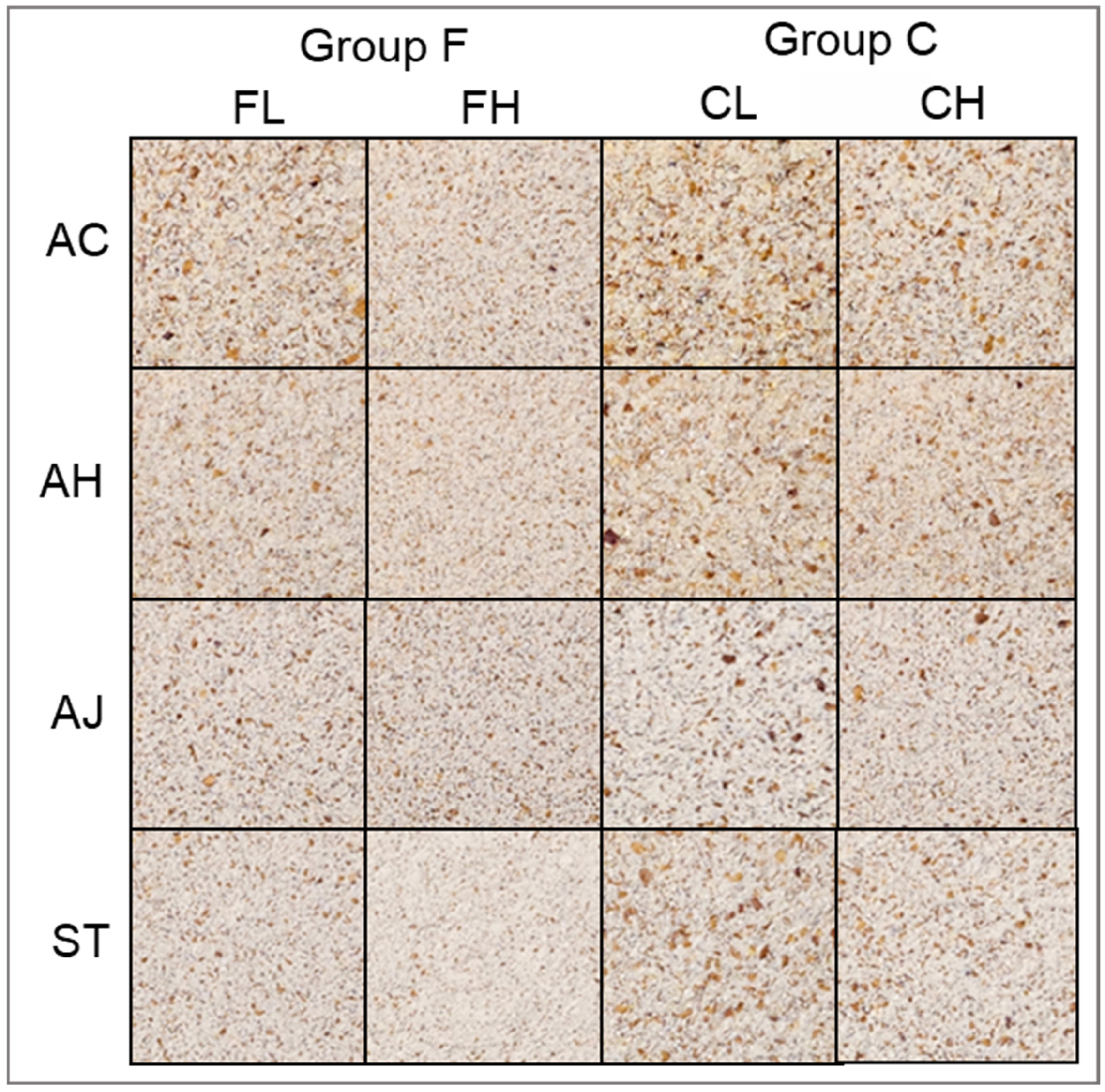
The appearance of the purple WWF is shown in Figure 1. All four varieties (AC, AH, AJ, and ST) exhibited distinct characteristics between the group F (0.5 mm sieve) and the group C (1.0 mm sieve). Among them, AC displayed more noticeable speckles than other varieties, consistent with its harder kernels. WWF milled under different rotation speeds also showed clear differences in appearance (FL vs. FH and CL vs. CH). Notably, the flours milled with a larger sieve opening and lower rotation speed showed prominent speckles, indicating larger bran particle sizes. The coarse bran particles produced a rough appearance, which may negatively affect product processing and texture, such as that observed in noodle making [21]. Therefore, thorough grinding of bran during milling is essential to ensure uniform WWF quality.
The color parameters of the purple WWF are listed in Table 2. Among the varieties, the L* values decreased in the following order: ST > AJ > AH > AC. Under different milling conditions, the group F exhibited higher L* values than the group C. The higher L* with decreasing particle size is attributed to enhanced light scattering from the enlarged surface area [22]. Superfine grinding of wheat bran increases lightness (L*) [23], thereby contributing to the color of WWF.
The redness (a*) of the group C was higher than that of the group F across all wheat varieties, and a similar trend was observed for yellowness (b*), with the group C showing higher values. The color of the WWF was primarily influenced by the bran, as both the bran particle size and the inherent pigmentation of each variety contributed to the overall color. In comparison with the results of Kim et al. [24] for commercial WWF, who reported L* values of 91.5 and 88.5 for small and large particle size groups, respectively, this study showed markedly lower L* values, ranging from 67.3 (AC-CL) to 86.6 (ST-FH). This difference is attributed to the darker bran color of the purple wheat varieties used in this study.

3.3. Particle Size Distribution of Purple WWF

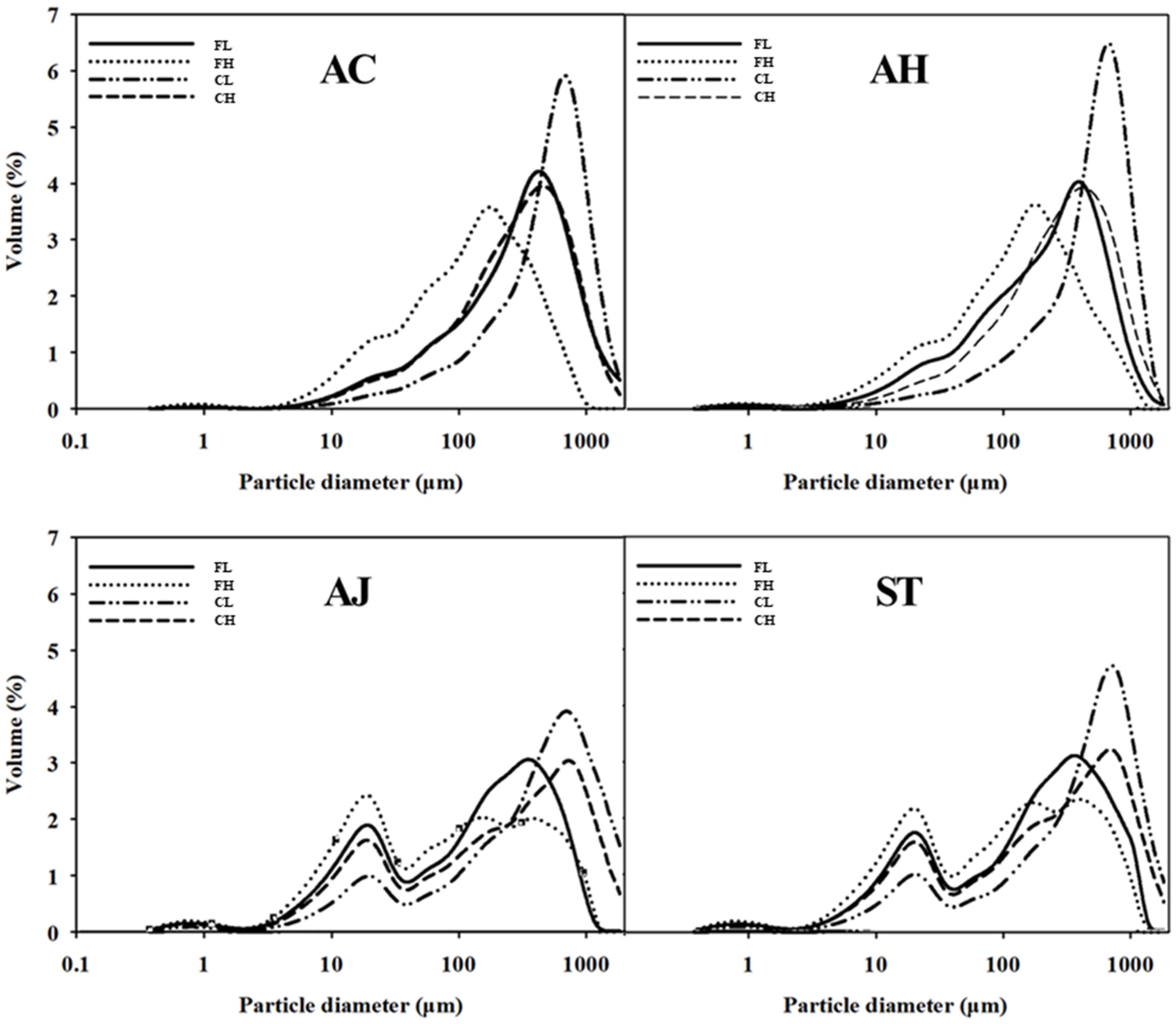
The particle size distributions of the purple WWF are shown in Figure 2. The patterns of the particle size distribution of purple WWF showed two distinct groups: a unimodal shape for AC and AH and a bimodal shape for AJ and ST. AC and AH had much coarser particles than AJ and ST, which could be attributed to variations in kernel hardness. Pearson et al. [25] reported a study on the particle size distribution of hard and soft wheat revealed that soft wheat generally had a higher proportion of small particles (<10 μm) and a peak in the 25 μm region, which was largely absent in hard wheat. Murray et al. [26] also found that the soft wheat variety (Xerpha, 86.8 µm) tended to have a smaller average particle size than the hard wheat variety (Expresso, 105.0–107.1 µm). A similar trend was observed in this study.
In refined flour, particle size distributions typically show a bimodal pattern with peaks at approximately 1–35 μm and 50–100 μm, representing starch and gluten protein fractions, respectively [27]. The bimodal shape of AJ and ST WWF showed a first peak similar to that of refined flour, but the second peak shifted much larger particle size, likely due to bran particles overlapping with gluten protein fraction. In contrast, the unimodal distributions observed in AC and AH WWF may indicate difficult separation of endosperm starch from bran, resulting in starch granules adhering to bran particles.
The average particle diameters (d50), which represent the 50% volume point of the total particle distribution, are listed in Table 3. Across all varieties, the group F exhibited smaller d50 values than the group C. For each variety, the higher rotational speeds produced finer particles. Among the varieties tested, AC and AH exhibited larger d50 values than AJ and ST. The relatively soft wheat varieties (AJ and ST) yielded smaller particle sizes under the same milling conditions, whereas the harder varieties (AC and AH) produced coarser particles. These particle size results confirm the effect of kernel hardness, which strongly influences the milling time of WWF, as shown in Table 1.

3.4. Moisture and Amylose Content of Purple WWF

The moisture and amylose contents of the purple WWF are presented in Table 4. The moisture content ranged from 10.3 to 12.5%, with AJ showing slightly higher values (11.0–12.5%), likely reflecting differences in the moisture of the original kernels. The WWF used in this study were prepared without conditioning.
The amylose content followed the order: AC < AH < AJ < ST. Based on the amylose levels, the varieties can be classified as full-waxy or partial-waxy wheat. AC, with the lowest amylose content (1.7–2.1%), was classified as full-waxy, while AH (12.3–14.4%), AJ (14.8–15.8%), and ST (15.9–16.7%) were classified as partial-waxy. Fully waxy wheat lacks GBSS I, resulting in minimal amylose and starch composed predominantly of amylopectin [28]. Previous studies have reported similar amylose contents (0–3%) for full-waxy wheat [29,30], which is consistent with the AC variety used here. Xu et al. [31] reported that waxy wheat requires more moisture during tempering than wild-type wheats to achieve a comparable reduction in SKCS kernel hardness, indicating greater milling difficulty and resulting in much lower flour yield. The amylose contents of the wheat varieties used in this study help explain the milling time and particle size of WWF presented in Table 1 and Table 3. The median particle size (d50) varied among varieties, with harder, lower-amylose kernels (AC, AH) producing larger particles than the softer, higher-amylose ones (AJ, ST), reflecting their different milling behavior.

3.5. SRC of Purple WWF

The water SRC and sodium carbonate SRC of the WWF are shown in Table 5. The SRC values in water and sodium carbonate solutions are associated with water absorption and the contribution of damaged starch, respectively [17]. The water SRC was highest in AC, followed by AH, AJ, and ST, with a consistent trend under all milling conditions. The highest water SRC in AC corresponded to its lowest amylose content, consistent with the negative correlation between amylose content and water SRC reported by Nishio et al. [32]. In addition, AC exhibited highest in kernel hardness (Section 2.1), which may have generated more damaged starch, thereby contributing to its high water SRC. The group F, which was characterized by a smaller particle size, demonstrated a relatively larger surface area and higher water absorption than the group C. Bressiani et al. [33] also reported a significant increase in water SRC with decreasing WWF particle size due to a higher damaged starch content. Furthermore, variation in water SRC across varieties may be attributed to differences in major dietary fibers, including cellulose, hemicellulose, lignin, β-D-glucans, and arabinoxylans, which are abundant in wheat bran and have high water absorption capacity [34]. To confirm this impact, further research is needed to determine their dietary fiber contents.
Sodium carbonate SRC followed the same decreasing order of water SRC: AC > AH > AJ > ST. These results indicate a greater contribution of damaged starch in AC, which may be attributed to its harder kernels and higher amylose content. When assessed based on milling conditions, the group F displayed higher sodium carbonate SRC values than the group C, further reflecting a greater contribution of damaged starch. Notably, milling harder wheat kernels or using smaller sieve openings in the mill may result in variations in milling time. An increase in the milling time can lead to elevated damaged starch content, which can contribute to increased water absorption [35]. Additionally, Moon et al. [36] observed a positive correlation between sodium carbonate SRC and damaged starch content in commercial WWF. Kim et al. [37] reported that damaged starch is produced due to the resistance of wheat kernels to the physical force exerted by mill rollers during milling. Generally, harder wheat exhibits greater mechanical resistance and generates higher DS levels of damaged starch.

3.6. Sodium Dodecyl Sulfate Sedimentation Volume of Purple WWF

The SDS sedimentation volume of the purple WWF, an indicator of gluten strength, is presented in Table 6. This test reflects the swelling of gluten proteins similar to the lactic acid SRC test. The SDS sedimentation volume in AC and AH varied with the milling conditions, with higher values observed in the group F due to easier protein swelling. In contrast, AJ and ST exhibited significantly lower SDS sedimentation volumes than AC and AH, indicating weaker gluten strength. No significant difference was observed between AJ and ST, whereas AC and AH showed notable variations depending on the milling conditions, likely due to differences in the particle size distribution. These results highlight the influence of particle size, milling conditions, and kernel hardness on the SDS sedimentation volume. Additionally, Nishio et al. [32] reported that lactic acid SRC increased as the amylose content decreased, suggesting that the amylose content may also affect the SDS sedimentation volume in WWF. Consequently, the SDS sedimentation volume of AC, in particular, could be overestimated relative to gluten strength.
Based on the changes in SDS sedimentation volume from 20 to 40 min, the larger variations observed in AC and AH indicate lower gluten stability compared to AJ and ST. For bread making, which requires strong gluten, these results suggest that AJ and ST are less suitable than AC and AH. Furthermore, Ramachandran et al. [38] reported that waxy bread wheat tends to collapse after baking, indicating poor bread-making performance. This suggests that AC in the present study may also be less suitable for bread production, despite its relatively high SDS sedimentation volume, likely resulting in lower bread volume.

3.7. Total Phenolic and Anthocyanin Contents and Antioxidant Activity of Purple WWF

The total phenolic (TPC) and total anthocyanin (TAC) contents of purple WWF are presented in Table 7. Among the varieties, AJ, enriched with functional compounds, exhibited the highest TPC and TAC, while ST had the lowest. AC and AH showed intermediate and similar levels, respectively. AH contains phenolic acids, phenylpropanoids, and flavonoids, which contribute to its distinctive color and taste and are known for their antibacterial, antioxidant, and anticancer properties [39]. In all varieties, the group F showed a higher TPC than the group C, likely due to smaller particle sizes enhancing extraction efficiency. These results confirm the influence of milling conditions on TPC and TAC. Similarly, Brewer et al. [40] reported that reduced wheat bran particle size increases the extraction of anthocyanins and carotenoids, resulting in higher oxygen radical absorbance capacity values. AJ contained the highest anthocyanin content, a major pigment in purple wheat, whereas ST had the lowest. Because all varieties were grown in the same field and year, the observed differences in phenolic and anthocyanin contents reflect genetic variation, although environmental factors can also significantly affect the phenolic content in wheat [41].
The antioxidant activities of the purple WWF are presented in Table 7. Purple wheat is highly valued because of its antioxidant capacity. The trends for both the DPPH and ABTS assays mirrored those of TPC and TAC: AJ exhibited the highest activity, AC and AH were intermediate, and ST showed the lowest activity, closely reflecting the TAC levels. Abdel-Aal et al. [42] reported that high phenolic and anthocyanin contents are associated with stronger antioxidant activity owing to their ability to neutralize free radicals, reduce oxidative stress, and protect cells. A strong correlation between TPC and DPPH scavenging activity was also observed across diverse colored wheat varieties, with acidic methanol extracts showing higher values than acetone extracts [43].

3.8. Dough Property of Purple WWF Using Mixograph

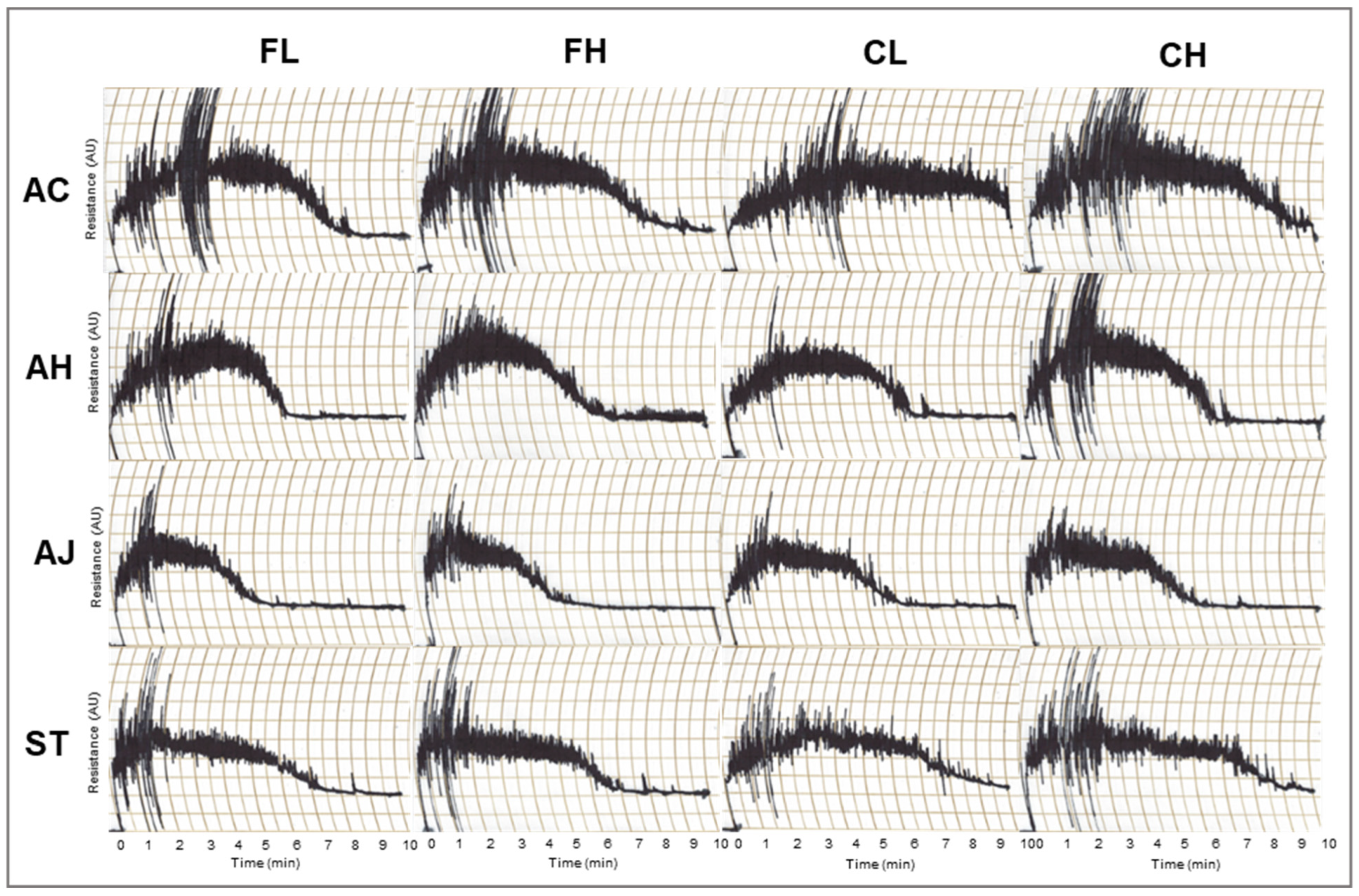
Mixograms showing the dough properties of purple WWF are presented in Figure 3. The bandwidths observed for AJ and ST after the peak were significantly narrower than those of AC and AH. Overall, AJ and ST exhibited relatively narrow bandwidth, indicating weaker gluten strength. The dough development time was notably shorter for AJ than for AC and AH. Although ST showed a similar dough development time to AC and AH, its narrow bandwidth also reflected weak dough strength. In addition, AJ exhibited substantially shorter mixing stability than other samples.
Caffe-Treml et al. [44] reported a significant positive correlation between mixograph peak height of multi-environment spring wheat flours (18 genotypes across 20 environments) and loaf volume. Chung et al. [45] also found significant correlations between mixograph midline peak height and width of 642 hard winter wheat flours and bread loaf volume. In the present study, peak heights and widths of AC and AH were higher than those of AJ and ST, suggesting a higher expected loaf volume for the former compared with the latter.

3.9. Quality of Bread Prepared with Purple WWF

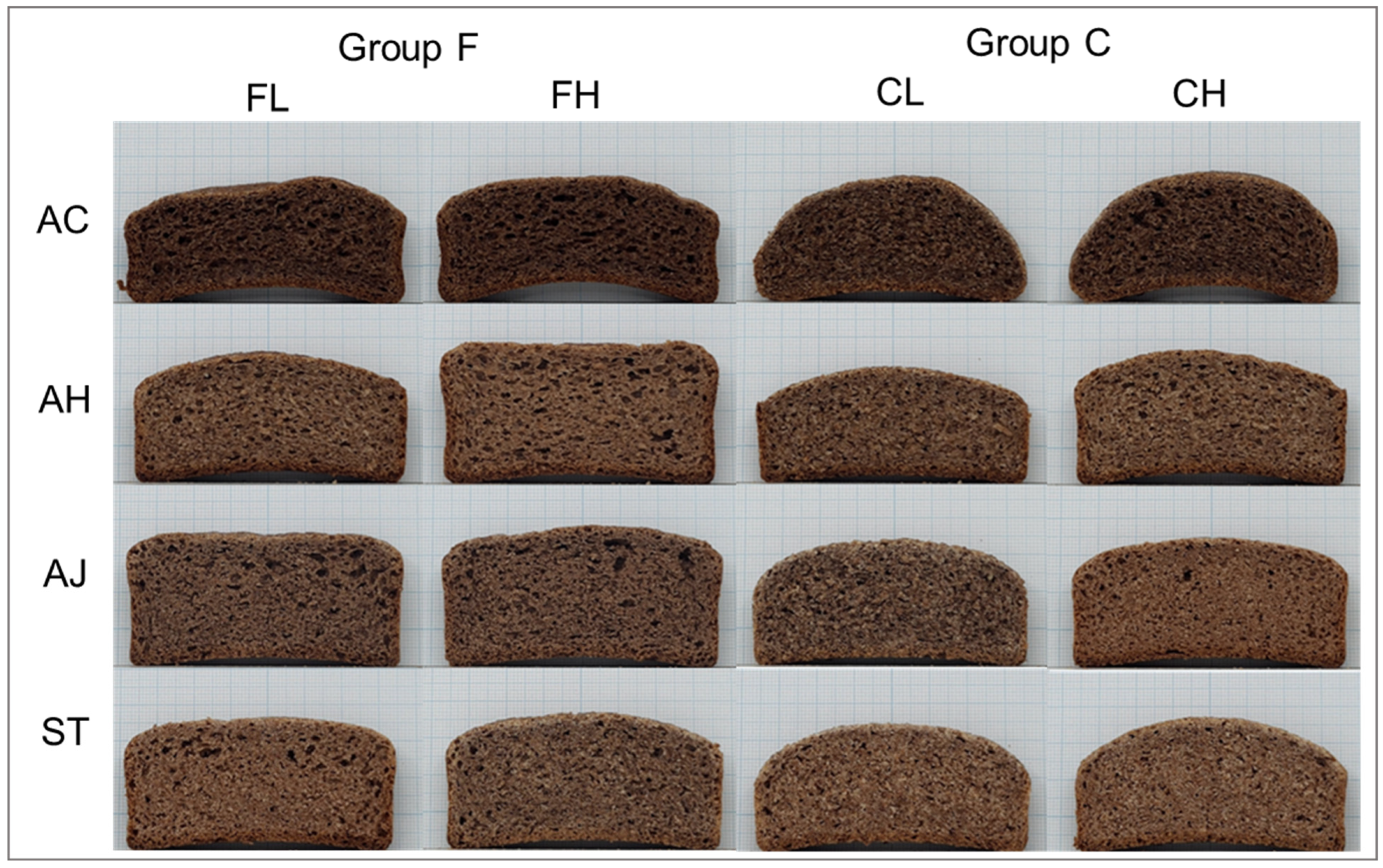
The cross-sections of whole wheat bread prepared using purple WWF are shown in Figure 4.
Breads made with the group F WWF were larger than those made with the group C WWF, demonstrating the positive effect of smaller particle size on bread quality. The bread prepared with AC-WWF exhibited a significantly smaller cross-section than the other varieties. As a fully waxy wheat, AC produces soft dough with weak structural stability, making it difficult to retain gas during fermentation. Its low amylose content may also contribute to reduced bread quality [37]. Similarly, Stefan et al. [46] reported that hearth bread made with waxy wheat flour has lower height-to-width ratios, reduced weights, and a more open pore structure.
Bread volume and firmness values are presented in Table 8. The group C had a smaller bread volume than the group F, likely because of the larger bran particles, which hindered dough development and gas retention during fermentation and baking. In addition, bran dilutes gluten proteins, weakens dough strength, reduces loaf volume, and deteriorates the overall bread quality [47]. The bread volume of AC was lower than that of the other varieties, which was attributable to its waxy wheat properties.
The bread firmness in the group C was higher than that in the group F, which is consistent with its smaller loaf volume and denser crumb structure. Among the varieties, bread prepared with AC (WWF) had a smaller volume, but a softer and chewier texture than the others, which can be attributed to its waxy characteristics and higher water-retention capacity. Van Hung et al. [48] reported that bread made from whole waxy wheat flour exhibited a significantly lower specific volume and larger gas cells than bread made from refined white flour.

3.10. Total Phenolic and Anthocyanin Contents and Antioxidant Activity of Bread Prepared with Purple WWF

The TPC of the crumbs and crusts of bread prepared with purple WWF are presented in Table 9. Consistent with the WWF results, AJ exhibited the highest TPC in both the crust and crumb. Across all varieties, the crumbs showed TPC values comparable to those of the corresponding WWF, whereas the crusts exhibited approximately threefold higher levels. Regardless of the variety, the bread crust showed a higher TPC than the crumb owing to exposure to elevated baking temperatures, which promoted moisture evaporation, accelerated Maillard reactions, and generated colored melanoidin pigments. Gélinas and McKinnon [49] also reported that phenolic compound concentration increased during bread baking, with the crust containing more than the crumb.
In contrast, TAC was significantly lower in the bread crust than in the crumb because anthocyanin pigments are more susceptible to heat degradation in the crust [19,50,51]. In addition, the TPC of both the crust and crumb were significantly lower than those of the corresponding WWF.
The antioxidant activities of crumbs and crusts of bread prepared with purple WWF are shown in Table 10. For both the DPPH and ABTS assays, bread made with AJ WWF exhibited the highest antioxidant activity, followed by AC and AH, whereas ST showed the lowest. The antioxidant activity of bread followed a trend similar to that of its TPC, showing higher activity in the crust than in the crumb [19], suggesting a stronger contribution from phenolic compounds than from anthocyanins. The antioxidant activity is also influenced by melanoidin pigments generated through Maillard reactions during baking, which occur more extensively in the crust than in the crumb [52]. Similarly, Seo et al. [13] reported that TPC and antioxidant activity were higher in the bread crust than in crumbs, whereas the anthocyanin content showed the opposite trend, which is consistent with the present results.

4. Conclusions

This study evaluated the bread-making performance of four colored whole wheat flour (AC, AH, AJ, and ST) with varying amylose contents and milled under different sieve sizes and rotation speeds. Amylose content increased in the order of AC < AH < AJ < ST, with AC being fully waxy and the others being partially waxy. Kernel hardness was highest in AC and AH. Flours with smaller particle size (group F) showed higher water and sodium carbonate SRC values, indicating more starch damage, which is likely linked to kernel hardness. AC and AH exhibited higher SDS sedimentation volumes, reflecting stronger gluten quality. Higher rotation speeds also improved protein quality.
Breads from the group F had greater height and volume but lower firmness, confirming that finer bran particles enhanced bread quality. AC produced the smallest loaf volume and greatest firmness due to its low amylose content. Furthermore, ST showed the lowest total phenolic content, anthocyanin content, and antioxidant activity among all the WWF. Baking increased the phenolic content and antioxidant activity in the crust, but reduced anthocyanin content. For optimal bread-making quality with purple WWF, finer milling (0.5 mm sieve) is recommended, particularly for harder, high-amylose varieties like AH, which produced the best loaf volume. The full-waxy variety AC, despite high water absorption, is not suitable for bread but may be explored for other applications like noodles. Overall, the particle size was impacted by kernel hardness and milling conditions, and amylose content strongly influenced the quality and bread-making performance of purple WWF. Future research should focus on controlling the particle size of WWF by optimizing milling conditions and modifying formulations to balance functional improvements with sensory qualities.


Author Contributions

Conceptualization, H.K. and M.K.; methodology, H.K.; validation, H.K.; formal analysis, H.K.; investigation, M.K.; resources, M.K.; data curation, H.K.; writing—original draft preparation, H.K.; writing—review and editing, M.K.; visualization, M.K.; supervision, M.K.; project administration, M.K.; funding acquisition, M.K. All authors have read and agreed to the published version of the manuscript.

Funding

This research was supported by the Cooperative Research Program of the Agriculture Science and Technology Department (Project No. PJ016031) funded by the Rural Development Administration (Republic of Korea).

Institutional Review Board Statement

Not applicable.

Informed Consent Statement

Not applicable.

Data Availability Statement

The original contributions presented in this study are included in this article. Further inquiries can be directed to the corresponding authors.

Acknowledgments

We thank Kyounghoon Kim for providing purple wheat samples.

Conflicts of Interest

The authors declare no conflicts of interest.

Abbreviations

The following abbreviations are used in this manuscript:
WWFWhole wheat flour
SRCSolvent retention capacity
SDSSodium dodecyl sulfate
TPCTotal phenolic content
TPATexture profile analysis
DPPH2,2-diphenyl-1-picrylhydrazyl
ABTS2,2′-azino-bis(3-ethylbenzothiazoline-6-sulfonic acid)
AACCAmerican Association of Cereal Chemists

References

  1. Kang, C.S.; Cheong, Y.K.; Kim, B.K. Current situation and prospect of Korean wheat industry. Korea Soc. Food Sci. Nutr. 2016, 21, 20–24. [Google Scholar]
  2. Korean Flour Millers Industrial Association. Flour Yield Classification. 2025. Available online: http://www.kofmia.org/data/stat_idx03.jsp (accessed on 5 December 2025).
  3. Song, J.H.; Lee, D.S.; Lim, H.J.; Kim, H.J. A Study on Improving Grain Policy for Strengthening Food Security. Korea Rural Economic Institute. 2024. Available online: https://library.krei.re.kr/pyxis-api/1/digital-files/b53fcce0-0712-4a7b-9e13-c95e0a27dd34 (accessed on 5 December 2025).
  4. Ministry of Agriculture, Food and Rural Affairs. The 1st (’21-’25) Wheat Industry Development Basic Plan to Expand the Domestic Wheat Self-Sufficiency Base. 2020. Available online: https://www.mafra.go.kr/bbs/mafra/68/245335/download.do (accessed on 11 August 2023).
  5. Kim, S.S.; Chung, H.Y. Comparison of quality analyses of domestic and imported wheat flour products marketed in Korea. Korean Soc. Food Nutr. 2014, 27, 287–293. [Google Scholar] [CrossRef]
  6. Food Information Statistics System. Domestic Trends: Trend Pick Domestic Edition—Bread. 2021. Available online: https://www.atfis.or.kr/home/board/FB0002.do (accessed on 16 August 2023).
  7. Ma, S.; Wang, Z.; Liu, H.; Li, L.; Zheng, X.; Tian, X.; Sun, B. Supplementation of wheat flour products with wheat bran dietary fiber: Purpose, mechanism, and challenges. Trends Food Sci. Technol. 2022, 123, 281–289. [Google Scholar] [CrossRef]
  8. Jung, S.J.; Oh, M.R.; Park, S.H.; Chae, S.W. Effects of rice-based and wheat-based diets on bowel movements in young Korean women with functional constipation. Eur. J. Clin. Nutr. 2020, 74, 1565–1575. [Google Scholar] [CrossRef] [PubMed]
  9. Avarzed, E.; Wang, X.; Moon, Y.; Kim, K.H.; Kweon, M. Quality characteristics and antioxidant activities of cookies formulated with the blend of Korean domestic wheat flour and purple wheat bran. Korean J. Food Cook. Sci. 2020, 36, 152–162. [Google Scholar] [CrossRef]
  10. Kwak, J.M.; Lee, J.O.; Im, B.M.; Oh, J.E. Consumer survey of calcium fortified biscuits depending on the differentiated whole grain ratio. J. Korea Contents Assoc. 2019, 19, 106–114. [Google Scholar]
  11. Van Hung, P.; Maeda, T.; Morita, N. Waxy and high-amylose wheat starches and flours-characteristics, functionality and application. Trends Food Sci. Technol. 2006, 17, 448–456. [Google Scholar] [CrossRef]
  12. Baik, B.K. Chapter 11: Effects of flour protein and starch on noodle quality. In Asian Noodles Science, Technology, and Processing, 1st ed.; Hou, G.G., Ed.; John Wiley & Sons: Hoboken, NJ, USA, 2010; pp. 261–284. [Google Scholar]
  13. Seo, Y.; Moon, Y.; Kweon, M. Effect of purple-colored wheat bran addition on quality and antioxidant property of bread and optimization of bread-making conditions. Appl. Sci. 2021, 11, 4034. [Google Scholar] [CrossRef]
  14. Han, H.; Lee, E.; Kweon, M. Predominant factors in milling and wheat variety influencing particle size and quality of whole wheat flour. J. Food Sci. 2025, 90, e70191. [Google Scholar] [CrossRef]
  15. Khalid, K.H.; Ohm, J.B.; Simsek, S. Whole wheat bread: Effect of bran fractions on dough and end-product quality. J. Cereal Sci. 2017, 78, 45–56. [Google Scholar] [CrossRef]
  16. Zhang, T.; Kim, H.; Kweon, M. Impact of kernel hardness and amylose content on quality characteristics of purple-colored whole wheat flour. Cereal Chem. 2024, 101, 1084–1093. [Google Scholar] [CrossRef]
  17. Kweon, M.; Slade, L.; Levine, H. Solvent retention capacity (SRC) testing of wheat flour: Principles and value in predicting flour functionality in different wheat-based food processes and in wheat breeding—A review. Cereal Chem. 2011, 88, 537–552. [Google Scholar] [CrossRef]
  18. AACC. Approved Method of Analysis, 11th ed.; Method 08-01.01, 10-05.01, 10-10.03, 46-30.01, 54-40.02, 56-11.02, 56-71.01, 74-09.01; AACC International: St. Paul, MN, USA, 2010. [Google Scholar]
  19. Yu, L.; Beta, T. Identification and antioxidant properties of phenolic compounds during production of bread from purple wheat grains. Molecules 2015, 20, 15525–15549. [Google Scholar] [CrossRef]
  20. Pasha, I.; Anjum, F.M.; Morris, C.F. Grain hardness: A major determinant of wheat quality. Food Sci. Technol. Int. 2010, 16, 511–522. [Google Scholar] [CrossRef] [PubMed]
  21. Park, G.; Cho, H.; Kim, K.; Kweon, M. Quality characteristics and antioxidant activity of fresh noodles formulated with flour-bran blends varied by particle size and blend ratio of purple-colored wheat bran. Processes 2022, 10, 584. [Google Scholar] [CrossRef]
  22. Niu, M.; Hou, G.G.; Wang, L.; Chen, Z. Effects of superfine grinding on the quality characteristics of whole-wheat flour and its raw noodle product. J. Cereal Sci. 2014, 60, 382–388. [Google Scholar] [CrossRef]
  23. Jin, X.; Lin, S.; Gao, J.; Wang, Y.; Ying, J.; Dong, Z.; Zhou, W. How manipulation of wheat bran by superfine-grinding affects a wide spectrum of dough rheological properties. J. Cereal Sci. 2020, 96, 103081. [Google Scholar] [CrossRef]
  24. Kim, J.; Kim, H.; Moon, Y.; Lee, E.; Kweon, M. Quality characteristics and fresh noodle-making performance of commercial whole wheat flour milled from Korean domestic wheat with different particle sizes. Korean J. Food Cook. Sci. 2023, 39, 41–52. [Google Scholar] [CrossRef]
  25. Pearson, T.; Wilson, J.; Gwirtz, J.; Maghirang, E.; Dowell, F.; McCluskey, P.; Bean, S. Relationship between single wheat kernel particle-size distribution and perten SKCS 4100 hardness index. Cereal Chem. 2007, 84, 567–575. [Google Scholar] [CrossRef]
  26. Murray, J.C.; Kiszonas, A.M.; Wilson, J.; Morris, C.F. Effect of soft kernel texture on the milling properties of soft durum wheat. Cereal Chem. 2016, 93, 513–517. [Google Scholar] [CrossRef]
  27. Tian, X.; Wang, X.; Wang, Z.; Sun, B.; Wang, F.; Ma, S.; Gu, Y.; Qian, X. Particle size distribution control during wheat milling: Nutritional quality and functional basis of flour products—A comprehensive review. Int. J. Food Sci. Technol. 2022, 57, 7556–7572. [Google Scholar] [CrossRef]
  28. Kim, W.; Johnson, J.W.; Graybosch, R.A.; Gaines, C.S. Physicochemical properties and end-use quality of wheat starch as a function of waxy protein alleles. J. Cereal Sci. 2003, 37, 195–204. [Google Scholar] [CrossRef]
  29. Gaur, V.S.; Sood, S.; Cuzmán, C.; Olsen, K.M. Molecular insights on the origin and development of waxy genotypes in major crop plants. Brief. Funct. Genom. 2024, 23, 199–213. [Google Scholar] [CrossRef]
  30. Zi, Y.; Ding, J.; Song, J.; Humphreys, G.; Peng, Y.; Li, C.; Zhu, X.; Guo, W. Grain yield, starch content and activities of key enzymes of waxy and non-waxy wheat (Triticum aestivum L.). Sci. Rep. 2018, 8, 45–48. [Google Scholar]
  31. Xu, B.; Mense, A.; Ambrose, K.; Graybosch, R.; Shi, Y.C. Milling performance of waxy wheat and wild-type wheat using two laboratory milling methods. Cereal Chem. 2018, 95, 708–719. [Google Scholar] [CrossRef]
  32. Nishio, Z.; Oikawa, H.; Haneda, T.; Seki, M.; Ito, M.; Tabiki, T.; Yamaguchi, H.; Miura, H. Influence of amylose content on cookie and sponge cake quality and solvent retention capacities in wheat flour. Cereal Chem. 2009, 86, 313–318. [Google Scholar] [CrossRef]
  33. Bressiani, J.; Oro, T.; Da Silva, P.; Montenegro, F.; Bertolin, T.; Gutkoski, L.; Gularte, M. Influence of milling whole wheat grains and particle size on thermo-mechanical properties of flour using Mixolab. Czech J. Food Sci. 2019, 37, 276–284. [Google Scholar] [CrossRef]
  34. Lin, Y.; Chen, K.; Tu, D.; Yu, X.; Dai, Z.; Shen, Q. Characterization of dietary fiber from wheat bran (Triticum aestivum L.) and its effect on the digestion of surimi protein. LWT-Food Sci. Technol. 2019, 102, 106–112. [Google Scholar] [CrossRef]
  35. Fu, B.X. Asian noodles: History, classification, raw materials, and processing. Food Res. Int. 2008, 41, 888–902. [Google Scholar] [CrossRef]
  36. Moon, Y.; Xia, T.; Cho, H.; Kweon, M. Comparison of particle size and quality characteristics of commercial whole wheat flours made from Korean domestic wheat and foreign wheat. Korean J. Food Cook. Sci. 2021, 37, 41–52. [Google Scholar] [CrossRef]
  37. Kim, J.E.; Choi, S.W.; Kim, H.S.; Kang, C.S.; Choi, Y.S.; Choi, Y.H.; Park, C.S. Evaluation of starch properties of Korean wheat cultivars. Korean J. Breed. Sci. 2017, 49, 1–9. [Google Scholar] [CrossRef]
  38. Ramachandran, A.; Hucl, P.; Briggs, C. Functional characteristics of bread wheat (Triticum aestivum L.) near-isogenic lines differing at the waxy (Wx) locus. Cereal Chem. 2016, 93, 77–85. [Google Scholar] [CrossRef]
  39. Jin, H.Y.; Jeon, S.H.; Kim, K.H.; Kang, C.S.; Choi, H.S.; Youn, Y. Phytochemical components and physiological activities of purple wheat bran ‘Arriheuk’ extracts. Korean J. Food Preserv. 2021, 28, 372–383. [Google Scholar] [CrossRef]
  40. Brewer, L.R.; Kubola, J.; Siriamornpun, S.; Thomas, J.H.; Shi, Y.C. Wheat bran particle size influence on phytochemical extractability and antioxidant properties. Food Chem. 2014, 152, 483–490. [Google Scholar] [CrossRef] [PubMed]
  41. Mpofu, A.; Sapirstein, H.D.; Beta, T. Genotype and environmental variation in phenolic content, phenolic acid composition, and antioxidant activity of hard spring wheat. J. Agric. Food Chem. 2006, 54, 1265–1270. [Google Scholar] [CrossRef] [PubMed]
  42. Abdel-Aal, E.S.M.; Hucl, P.; Rabalski, I. Compositional and antioxidant properties of anthocyanin-rich products prepared from purple wheat. Food Chem. 2018, 254, 13–19. [Google Scholar] [CrossRef]
  43. Liu, Q.; Qiu, Y.; Beta, T. Comparison of antioxidant activities of different colored wheat grains and analysis of phenolic compounds. J. Agric. Food Chem. 2010, 58, 9235–9241. [Google Scholar] [CrossRef]
  44. Caffe-Treml, M.; Glover, K.D.; Krishnan, P.G.; Hareland, G.A. Variability and relationships among mixolab, mixograph, and baking parameters based on multienvironment spring wheat trials. Cereal Chem. 2010, 87, 574–580. [Google Scholar] [CrossRef]
  45. Chung, O.K.; Ohm, J.B.; Caley, M.S.; Seabourn, B.W. Prediction of baking characteristics of hard winter wheat flours using computer-analyzed mixograph parameters. Cereal Chem. 2001, 78, 493–497. [Google Scholar] [CrossRef]
  46. Stefan, S.; Anne, B.B.; Robert, G. Impact of waxy, partial waxy, and wildtype wheat starch fraction properties on hearth bread characteristics. Cereal Chem. 2006, 83, 647–654. [Google Scholar] [CrossRef]
  47. Gómez, M.; Gutkoski, L.C.; Bravo-Núñez, Á. Understanding whole-wheat flour and its effect in breads: A review. Comp. Rev. Food Sci. Food Saf. 2020, 19, 3241–3265. [Google Scholar] [CrossRef] [PubMed]
  48. Van Hung, P.; Maeda, T.; Morita, N. Dough and bread qualities of flours with whole waxy wheat flour substitution. Food Res. Int. 2007, 40, 273–279. [Google Scholar] [CrossRef]
  49. Gélinas, P.; McKinnon, C.M. Effect of wheat variety, farming site, and bread-baking on total phenolics. Int. J. Food Sci. Technol. 2006, 41, 329–332. [Google Scholar] [CrossRef]
  50. Li, W.; Pickard, M.D.; Beta, T. Effect of thermal processing on antioxidant properties of purple wheat bran. Food Chem. 2007, 104, 1080–1086. [Google Scholar] [CrossRef]
  51. Francavilla, A.; Joye, I.J. Anthocyanin content of crackers and bread made with purple and blue wheat varieties. Molecules 2022, 27, 7180. [Google Scholar] [CrossRef]
  52. Perez-Jimenez, J.; Diaz-Rubio, M.E.; Mesias, M.; Morales, F.J.; Saura-Calixto, F. Evidence for the formation of maillardized insoluble dietary fiber in bread: A specific kind of dietary fiber in thermally processed food. Food Res. Int. 2014, 55, 391–396. [Google Scholar] [CrossRef]
Figure 1. Appearance of purple WWF milled using an ultra-centrifugal mill with two sizes of sieves and two rotation speeds. AC, Ariheukchal; AH, Ariheuk; AJ, Arijinheuk; ST, Sintong. FL and FH, with 0.5 mm sieve, rotor speed 6000 and 14,000 rpm; CL and CH, with 1.0 mm sieve, rotor speed 6000 and 14,000 rpm.
Applsci 16 00056 g001
Figure 2. Particle size distribution of colored whole wheat flour samples. FL and FH, with 0.5 mm sieve, rotor speed 6000 and 14,000 rpm; CL and CH, with 1.0 mm sieve, rotor speed 6000 and 14,000 rpm.
Applsci 16 00056 g002
Figure 3. Mixograms of purple WWF. AC, Ariheukchal; AH, Ariheuk; AJ, Arijinheuk; ST, Sintong. FL and FH, with 0.5 mm sieve, rotor speed 6000 and 14,000 rpm; CL and CH, with 1.0 mm sieve, rotor speed 6000 and 14,000 rpm.
Applsci 16 00056 g003
Figure 4. Cross-sections of bread prepared with purple WWF. AC, Ariheukchal; AH, Ariheuk; AJ, Arijinheuk; ST, Sintong. FL and FH, with 0.5 mm sieve, rotor speed 6000 and 14,000 rpm; CL and CH, with 1.0 mm sieve, rotor speed 6000 and 14,000 rpm.
Applsci 16 00056 g004
Table 1. Milling time for 500 g wheat kernels of four purple wheat varieties under different milling conditions.
Wheat VarietyMilling Time (min)
FL 2FHCLCH
AC 130.021.016.010.0
AH28.020.014.08.0
AJ25.015.011.06.5
ST24.013.010.06.0
1 AC, AH, AJ, and ST denote Ariheukchal, Ariheuk, Arijinheuk, and Sintong, respectively. 2 FL and FH are WWF milled with a 0.5 mm sieve at rotor speeds of 6000 and 14,000 rpm, respectively; CL and CH are WWF milled with a 1.0 mm sieve at rotor speeds of 6000 and 14,000 rpm, respectively.
Table 2. Brightness, redness, and yellowness of purple WWF.
VarietyL*a*b*
FL 2FHCLCHFLFHCLCHFLFHCLCH
AC 173.0 cA376.3 dA67.3 aA71.1 bA4.0 aC4.0 aC4.7 bC4.9 bC10.4 aC10.2 aB11.9 cD11.0 bC
AH75.9 cB77.3 dB71.1 aB73.8 bB4.1 aC4.1 aC4.6 cBC4.4 bB10.2 aC10.0 aB11.2 bC10.9 bC
AJ79.8 aC82.3 bC79.4 aC80.2 aC3.2 bA2.5 aA3.3 bA3.3 bA7.8 aA7.4 aA8.0 aA7.6 aA
ST83.2 bD86.6 cD79.6 aC83.6 bD3.7 bB3.1 aB4.4 cB3.3 abA8.7 bB7.9 aA10.3 cB8.3 abB
1 AC, AH, AJ, and ST denote Ariheukchal, Ariheuk, Arijinheuk, and Sintong, respectively. 2 FL and FH are WWF milled with a 0.5 mm sieve at rotor speeds of 6000 and 14,000 rpm, respectively; CL and CH are WWF milled with a 1.0 mm sieve at rotor speeds of 6000 and 14,000 rpm, respectively. 3 Values (mean) (n = 4) with the same uppercase letter within the same column and those with the same lowercase letter within the same row for the same parameter are not significantly different (p > 0.05), according to Tukey’s HSD test.
Table 3. Particle size (d50) of purple WWF.
VarietyParticle Size (μm)
FL 2FHCLCH
AC 1297.8 ± 1.8 bB3171.0 ± 5.6 aD528.3 ± 10.5 cB294.9 ± 4.0 bB
AH257.5 ± 2.0 bB143.9 ± 1.7 aC554.5 ± 2.2 dB303.1 ± 9.2 cB
AJ198.2 ± 1.5 bA103.7 ± 3.4 aB473.9 ± 3.1 cA218.8 ± 9.5 bA
ST167.8 ± 14.0 bA38.6 ± 4.7 aA464.3 ± 1.8 cA194.7 ± 8.9 bA
1 AC, AH, AJ, and ST denote Ariheukchal, Ariheuk, Arijinheuk, and Sintong, respectively. 2 FL and FH are WWF milled with a 0.5 mm sieve at rotor speeds of 6000 and 14,000 rpm, respectively; CL and CH are WWF milled with a 1.0 mm sieve at rotor speeds of 6000 and 14,000 rpm, respectively. 3 Values (mean ± SD) (n = 3) with the same uppercase letter within the same column and those with the same lowercase letter within the same row for the same parameter were not significantly different (p > 0.05), according to Tukey’s HSD test.
Table 4. Moisture and amylose content of purple WWF.
VarietyMoisture Content (%)Amylose Content (%)
FL 2FHCLCHFLFHCLCH
AC 110.5 ± 0.0 bA310.6 ± 0.1 aA11.3 ± 0.0 aB11.4 ± 0.0 aB1.7 ± 0.3 aA1.9 ± 0.2 aA2.1 ± 0.0 aA1.8 ± 0.3 aA
AH11.4 ± 0.0 dA12.0 ± 0.0 cB11.4 ± 0.0 aB11.4 ± 0.0 aB12.4 ± 0.3 bA13.1 ± 0.9 bAB12.3 ± 0.1 bA14.4 ± 0.5 bB
AJ11.0 ± 0.0 cA11.3 ± 0.0 bB12.5 ± 0.0 bC12.4 ± 0.0 cC14.8 ± 0.2 cA15.2 ± 0.4 cAB15.8 ± 0.2 cB15.8 ± 0.2 cB
ST10.3 ± 0.0 aA10.7 ± 0.1 aB11.4 ± 0.1 aC11.6 ± 0.0 bC15.9 ± 0.2 dA16.7 ± 0.4 dB16.7 ± 0.3 dAB16.6 ± 0.3 cA
1 AC, AH, AJ, and ST denote Ariheukchal, Ariheuk, Arijinheuk, and Sintong, respectively. 2 FL and FH are WWF milled with a 0.5 mm sieve at rotor speeds of 6000 and 14,000 rpm, respectively; CL and CH are WWF milled with a 1.0 mm sieve at rotor speeds of 6000 and 14,000 rpm, respectively. 3 Values (mean ± SD) (n = 4) with the same uppercase letter within the same column and those with the same lowercase letter within the same row for the same parameter were not significantly different (p > 0.05), according to Tukey’s HSD test.
Table 5. SRC values of purple WWF in water and sodium carbonate solution.
VarietyWater SRC (%)Sodium Carbonate SRC (%)
FL 2FHCLCHFLFHCLCH
AC 198.2 ± 0.0 dD392.5 ± 0.1 cD90.2 ± 0.1 bD88.2 ± 0.1 aD135.0 ± 0.0 dD126.9 ± 0.1 cD111.4 ± 0.2 bD110.3 ± 0.2 aD
AH94.8 ± 0.2 dC86.8 ± 0.1 cC79.6 ± 0.3 bC76.9 ± 0.3 aC126.4 ± 0.3 dC115.3 ± 0.3 cC98.3 ± 0.3 bC96.2 ± 0.3 aC
AJ83.6 ± 0.1 cB78.4 ± 0.2 bB74.0 ± 0.3 aB73.8 ± 0.1 aB105.5 ± 0.2 dB101.1 ± 0.3 cB89.4 ± 0.1 bB84.5 ± 0.3 aB
ST77.4 ± 0.2 dA74.7 ± 0.1 cA72.2 ± 0.4 bA71.3 ± 0.2 aA94.1 ± 0.0 dA91.1 ± 0.1 cA88.2 ± 0.3 bA83.5 ± 0.4 aA
1 AC, AH, AJ, and ST denote Ariheukchal, Ariheuk, Arijinheuk, and Sintong, respectively. 2 FL and FH are WWF milled with a 0.5 mm sieve at rotor speeds of 6000 and 14,000 rpm, respectively; CL and CH are WWF milled with a 1.0 mm sieve at rotor speeds of 6000 and 14,000 rpm, respectively. 3 Values (mean ± SD) (n = 4) with the same uppercase letter within the same column and those with the same lowercase letter within the same row for the same parameter were not significantly different (p > 0.05), according to Tukey’s HSD test.
Table 6. SDS sedimentation volume of purple WWF at 20 and 40 min sedimentation times.
VarietySDS Sedimentation Volume at 20 min (mL)SDS Sedimentation Volume at 40 min (mL)
FL 2FHCLCHFLFHCLCH
AC 145.8 ± 0.4 bC352.0 ± 0.0 cC35.0 ± 1.4 aC42.5 ± 2.1 bA41.3 ± 0.4 cB45.8 ± 0.4 dB32.5 ± 0.7 aC38.0 ± 1.4 bA
AH38.5 ± 0.7 bB46.0 ± 0.0 cC28.3 ± 1.1 aA37.5 ± 0.7 bB34.8 ± 1.1 bA41.5 ± 0.0 cB26.3 ± 1.1 aA33.8 ± 1.1 bA
AJ18.5 ± 0.0 abA19.3 ± 0.4 bA17.5 ± 0.7 aA17.0 ± 0.0 aA18.5 ± 0.0 abA18.8 ± 0.4 bA17.5 ± 0.7 abA17.0 ± 0.0 aA
ST20.3 ± 0.4 aA17.8 ± 0.4 aA19.3 ± 1.1 aA18.8 ± 1.1 aA19.5 ± 0.7 aA17.5 ± 0.7 aA19.3 ± 1.1 aA18.5 ± 0.7 aA
1 AC, AH, AJ, and ST denote Ariheukchal, Ariheuk, Arijinheuk, and Sintong, respectively. 2 FL and FH are WWF milled with a 0.5 mm sieve at rotor speeds of 6000 and 14,000 rpm, respectively; CL and CH are WWF milled with a 1.0 mm sieve at rotor speeds of 6000 and 14,000 rpm, respectively. 3 Values (mean ± SD) (n = 4) with the same uppercase letter within the same column and those with the same lowercase letter within the same row for the same parameter were not significantly different (p > 0.05), according to Tukey’s HSD test.
Table 7. Total phenolic and total anthocyanin content and antioxidant activities of purple WWF.
VarietyTotal Phenolic Content (mg GAE/100 g)Total Anthocyanin Content (mg C3G/100 g)
FL 2FHCLCHFLFHCLCH
AC 1204.0 ± 0.1 cB3203.6 ± 0.6 cB200.5 ± 0.3 aB201.5 ± 0.5 bB4.12 ± 0.02 bB4.15 ± 0.01 cC4.09 ± 0.01 aB4.09 ± 0.01 aB
AH204.8 ± 0.9 bB204.1 ± 0.6 bB202.6 ± 0.5 aC202.4 ± 0.1 aC4.10 ± 0.02 aB4.10 ± 0.01 aB4.08 ± 0.02 aB4.08 ± 0.03 aB
AJ211.8 ± 0.2 bC212.2 ± 0.3 bC210.5 ± 0.3 aD210.4 ± 0.2 aD4.23 ± 0.02 cC4.27 ± 0.01 cD4.16 ± 0.03 bC4.10 ± 0.02 aB
ST52.0 ± 0.2 bA52.0 ± 0.1 bA50.7 ± 0.2 aA50.6 ± 0.4 aA2.83 ± 0.02 bA2.86 ± 0.01 bA2.51 ± 0.03 aA2.49 ± 0.02 aA
VarietyDPPH mg TE (Trolox equivalents)/100 gABTS mg TE (Trolox equivalents)/100 g
FLFHCLCHFLFHCLCH
AC54.4 ± 0.3 bcB54.8 ± 0.5 cB53.7 ± 0.5 abB53.4 ± 0.3 aB66.4 ± 0.6 bB69.2 ± 1.5 cB62.7 ± 0.7 aB63.7 ± 0.3 aB
AH55.2 ± 0.2 bC55.2 ± 0.1 bB54.7 ± 0.2 abC54.6 ± 0.3 aC68.2 ± 0.9 bcB70.6 ± 2.2 cB62.9 ± 0.4 aB65.5 ± 1.2 abB
AJ59.7 ± 0.1 bD59.7 ± 0.2 bC59.0 ± 0.2 aD59.1 ± 0.2 aD74.6 ± 1.7 bC77.1 ± 0.4 cC70.4 ± 2.8 aC71.9 ± 1.3 aC
ST41.4 ± 0.2 bA41.3 ± 0.2 bA40.6 ± 0.2 aA40.5 ± 0.1 aA59.5 ± 0.4 bA61.1 ± 0.8 cA56.3 ± 0.2 aA57.0 ± 0.3 aA
1 AC, AH, AJ, and ST denote Ariheukchal, Ariheuk, Arijinheuk, and Sintong, respectively. 2 FL and FH are WWF milled with a 0.5 mm sieve at rotor speeds of 6000 and 14,000 rpm, respectively; CL and CH are WWF milled with a 1.0 mm sieve at rotor speeds of 6000 and 14,000 rpm, respectively. 3 Values (mean ± SD) (n = 4) with the same uppercase letter within the same column and those with the same lowercase letter within the same row for the same parameter were not significantly different (p > 0.05), according to Tukey’s HSD test.
Table 8. Volume and firmness of bread prepared with purple WWF.
VarietyBread Volume (mL)Bread Firmness (N)
FL 2FHCLCHFLFHCLCH
AC 1263.8 ± 0.0 cA3269.0 ± 0.2 dA219.9 ± 0.4 aA257.6 ± 0.2 b6.4 ± 1.7 abA4.9 ± 0.8 aA10.9 ± 2.0 cA9.1 ± 2.0 bcA
AH279.2 ± 5.9 bB352.8 ± 0.9 dD240.2 ± 1.3 aB302.6 ± 0.3 cC9.3 ± 1.2 abAB7.2 ± 1.2 aAB13.8 ± 2.1 cAB10.7 ± 1.1 bA
AJ337.7 ± 4.0 cD325.5 ± 0.7 aC267.2 ± 0.9 aC316.2 ± 1.6 bD9.3 ± 1.5 aAB11.3 ± 3.6 abBC17.5 ± 4.7 bB13.7 ± 3.5 abA
ST310.5 ± 0.9 dC299.3 ± 1.5 cB269.6 ± 1.4 aC284.2 ± 0.7 bB11.0 ± 1.5 aB13.4 ± 3.7 aC13.0 ± 1.5 aAB13.3 ± 2.0 aA
1 AC, AH, AJ, and ST denote Ariheukchal, Ariheuk, Arijinheuk, and Sintong, respectively. 2 FL and FH are WWF milled with a 0.5 mm sieve at rotor speeds of 6000 and 14,000 rpm, respectively; CL and CH are WWF milled with a 1.0 mm sieve at rotor speeds of 6000 and 14,000 rpm, respectively. 3 Values (mean ± SD) (n = 3) with the same uppercase letter within the same column and those with the same lowercase letter within the same row for the same parameter were not significantly different (p > 0.05), according to Tukey’s HSD test.
Table 9. Total phenolic and total anthocyanin content of bread crumb and crust prepared with purple WWF.
VarietyTotal Phenolic Content (mg GAE/100 g)
Bread CrumbBread Crust
FL 2FHCLCHFLFHCLCH
AC 1206.3 ± 0.6 bB3205.9 ± 1.0 bB202.8 ± 0.8 abB203.8 ± 1.0 bB550.5 ± 0.3 cB549.3 ± 1.2 cB540.9 ± 0.9 aB543.6 ± 1.2 bB
AH207.1 ± 0.4 bB206.3 ± 0.4 bB204.8 ± 0.3 bC204.7 ± 0.6 bB552.6 ± 2.4 bB550.6 ± 1.6 bB546.5 ± 1.4 aC546.2 ± 0.2 aC
AJ214.1 ± 0.5 aC214.5 ± 0.9 aC212.8 ± 0.4 aD212.6 ± 0.6 aC571.5 ± 0.6 bC572.5 ± 0.7 bC568.0 ± 0.7 aD567.6 ± 0.4 aD
ST54.3 ± 0.7 aA54.2 ± 0.5 aA53.0 ± 0.4 aA52.8 ± 0.2 aA140.4 ± 0.6 bA140.2 ± 0.3 bA136.9 ± 0.4 aA136.4 ± 1.0 aA
VarietyTotal anthocyanin content (mg C3G/100 g)
Bread crumbBread crust
FLFHCLCHFLFHCLCH
AC4.08 ± 0.06 abB4.10 ± 0.03 bB4.00 ± 0.01 aB4.01 ± 0.04 abB3.63 ± 0.06 bcB3.68 ± 0.06 cB3.53 ± 0.05 abB3.49 ± 0.01 aB
AH4.05 ± 0.04 aB4.07 ± 0.05 aB3.99 ± 0.10 aB4.00 ± 0.04 aB3.66 ± 0.04 bB3.72 ± 0.02 cB3.53 ± 0.02 aB3.55 ± 0.01 aC
AJ4.13 ± 0.06 bB4.19 ± 0.01 bC4.03 ± 0.03 aB4.02 ± 0.03 aB3.88 ± 0.04 abC3.91 ± 0.02 bC3.83 ± 0.02 aC3.82 ± 0.03 aD
ST2.23 ± 0.05 bA2.23 ± 0.03 bA2.17 ± 0.01 abA2.15 ± 0.02 aA2.12 ± 0.03 bA2.30 ± 0.03 cA2.01 ± 0.02 aA2.04 ± 0.02 aA
1 AC, AH, AJ, and ST denote Ariheukchal, Ariheuk, Arijinheuk, and Sintong, respectively. 2 FL and FH are WWF milled with a 0.5 mm sieve at rotor speeds of 6000 and 14,000 rpm, respectively; CL and CH are WWF milled with a 1.0 mm sieve at rotor speeds of 6000 and 14,000 rpm, respectively. 3 Values (mean ± SD) (n = 4) with the same uppercase letter within the same column and those with the same lowercase letter within the same row for the same parameter were not significantly different (p > 0.05), according to Tukey’s HSD test.
Table 10. Antioxidant activities of bread crumb and crust prepared with purple WWF.
VarietyDPPH mg TE (Trolox Equivalents)/100 g
Bread CrumbBread Crust
FL 2FHCLCHFLFHCLCH
AC 155.2 ± 0.4 abB355.6 ± 0.6 bB54.5 ± 0.4 aB54.2 ± 0.2 aB154.6 ± 1.1 bcB155.7 ± 1.7 cB152.6 ± 1.1 abB151.8 ± 0.6 aB
AH56.0 ± 0.1 bC56.0 ± 0.1 bB55.5 ± 0.3 aC55.4 ± 0.2 aC156.7 ± 0.2 bcC156.9 ± 0.2 cB155.5 ± 0.8 abC155.2 ± 0.6 aC
AJ60.5 ± 0.1 bD60.5 ± 0.3 bC59.8 ± 0.2 aD59.9 ± 0.1 aD169.3 ± 0.1 cD169.3 ± 0.9 bcC167.4 ± 0.7 aD167.8 ± 0.2 abD
ST42.2 ± 0.2 bA42.1 ± 0.3 bA41.4 ± 0.1 aA41.3 ± 0.1 aA118.1 ± 0.7 bA117.8 ± 0.8 bA115.8 ± 0.2 aA115.5 ± 0.4 aA
VarietyABTS mg TE (Trolox equivalents)/100 g
Bread crumbBread crust
FLFHCLCHFLFHCLCH
AC72.0 ± 0.9 bB74.4 ± 0.4 cB67.5 ± 0.6 aA67.7 ± 0.6 aB202.3 ± 1.6 bB203.5 ± 2.7 bB186.7 ± 6.7 aB194.6 ± 3.1 abB
AH73.7 ± 0.2 cBC75.6 ± 1.0 cB68.1 ± 0.7 aA70.4 ± 1.4 bBC212.6 ± 1.9 cC213.8 ± 0.8 cC198.9 ± 1.3 aC203.8 ± 1.6 bC
AJ75.6 ± 1.3 bcC78.5 ± 1.0 cC69.4 ± 1.8 aA72.3 ± 2.0 abC223.5 ± 0.7 bD222.0 ± 2.9 bD208.7 ± 4.8 aC210.8 ± 2.9 aD
ST58.0 ± 1.4 bA58.1 ± 1.5 bA52.9 ± 0.7 aB53.5 ± 0.8 aA166.5 ± 0.7 bA170.6 ± 3.7 bA154.7 ± 4.3 aA157.9 ± 1.0 aA
1 AC, AH, AJ, and ST denote Ariheukchal, Ariheuk, Arijinheuk, and Sintong, respectively. 2 FL and FH are WWF milled with a 0.5 mm sieve at rotor speeds of 6000 and 14,000 rpm, respectively; CL and CH are WWF milled with a 1.0 mm sieve at rotor speeds of 6000 and 14,000 rpm, respectively. 3 Values (mean ± SD) (n = 4) with the same uppercase letter within the same column and those with the same lowercase letter within the same row for the same parameter were not significantly different (p > 0.05), according to Tukey’s HSD test.
Disclaimer/Publisher’s Note: The statements, opinions and data contained in all publications are solely those of the individual author(s) and contributor(s) and not of MDPI and/or the editor(s). MDPI and/or the editor(s) disclaim responsibility for any injury to people or property resulting from any ideas, methods, instructions or products referred to in the content.