
Article

Partial Substitution of Rye Flour with Sea Buckthorn (Hippophae rhamnoides L.) Fruit Pomace in Three-Stage Rye Sourdough Breadmaking: Fermentation Dynamics and Bread Quality

by
Katarzyna Majewska
1,
Joanna Katarzyna Banach
2,
Lucyna Kłębukowska
3,
Małgorzata Grzywińska-Rąpca
4,
Beata Piłat
1 and
Renata Pietrzak-Fiećko
5,*
1
Department of Plant Food Chemistry and Processing, Faculty of Food Science, University of Warmia and Mazury in Olsztyn, 10-726 Olsztyn, Poland
2
Institute of Management and Quality, Faculty of Economics, University of Warmia and Mazury in Olsztyn, 10-726 Olsztyn, Poland
3
Department of Food Microbiology, Meat Technology and Chemistry, Faculty of Food Science, University of Warmia and Mazury in Olsztyn, 10-726 Olsztyn, Poland
4
Department of Market and Consumption, Institute of Economics and Finance, Faculty of Economics, University of Warmia and Mazury in Olsztyn, 10-720 Olsztyn, Poland
5
Department of Commodity Science and Food Analysis, Faculty of Food Sciences, University of Warmia and Mazury in Olsztyn, 10-726 Olsztyn, Poland
*
Author to whom correspondence should be addressed.
Appl. Sci. 2026, 16(1), 15; https://doi.org/10.3390/app16010015
Submission received: 21 November 2025 / Revised: 16 December 2025 / Accepted: 17 December 2025 / Published: 19 December 2025

Featured Application

The results obtained have practical implications for the baking industry and the fruit-processing sector. The incorporation of sea buckthorn (Hippophae rhamnoides L.) fruit pomace flour (SBPF) at a level of around 10% (with the possibility of increasing it to 15%) may represent an effective strategy for enriching rye bread with bioactive components (antioxidants, polyphenols, dietary fibre), while maintaining acceptable structural and volumetric properties. In addition, such an addition contributes to the waste management of fruit-processing by-products, which is in line with the principles of a circular economy. Under industrial production conditions, it is possible to further optimise formulations using SBPF within the proposed range, as well as to select fermentative microbial strains that are resistant to phenolic compounds, with a view to potentially increasing tolerance to higher levels of SBPF and further improving the functional properties of the bread.

Abstract

Sea buckthorn (Hippophae rhamnoides L.) fruit pomace flour (SBPF) was used as a partial replacement for light rye flour in rye bread production at levels of 5, 10, 15 and 20%. The aim of the study was to determine the effects of SBPF addition on sourdough fermentation dynamics, the development of the associated microflora (yeasts, moulds and lactic acid bacteria), and changes in selected quality attributes of the resulting breads. Fermentation was carried out for 72 h using a three-stage method, while monitoring pH, acidity and microbial counts. The results showed that SBPF addition lowered the initial pH of the sourdough and was associated with higher lactic acid bacteria (Lactobacillus spp.) counts (up to 8.96 log CFU/g at a 10% SBPF level), indicating prebiotic potential. Moderate SBPF addition, particularly at 10% (with an upper limit of 15%), ensured favourable bread quality characteristics, such as increased loaf volume, higher bread yield, improved water retention and a more intense crumb colour, whereas an SBPF level of 20% deteriorated loaf sphericity and weakened crumb structure. Multivariate PROFIT analysis indicated strong positive associations between SBPF level and crumb colour, bread yield and lactic acid bacteria counts, and negative associations with loaf sphericity and crumb compressibility. Therefore, the optimal range of SBPF substitution lies at approximately 10–15%. The obtained data support the use of sea buckthorn fruit pomace flour as a functional ingredient with a potentially beneficial effect on the technological and microbiological quality of rye bread.

1. Introduction

Bread and other bakery products account for approximately 70% of all cereal-based foods in the diet of Polish consumers [1]. Given their high consumption, bread quality should reflect its role as a major source of energy-yielding, structural and regulatory nutrients. In this context, improving bread quality increasingly requires approaches that combine nutritional value with technological stability and reproducible processing. The production of bread with high quality parameters, including nutritional value, depends to a large extent on the raw materials used and on the type, course and control of the technological processes applied.
In the context of increasing consumer awareness of food quality and the need for sustainable management of natural resources, the use of by-products and secondary streams of the agri-food industry as functional raw materials in food production is gaining importance. Numerous review papers have indicated that fruit pomace—which is rich in dietary fibre, polyphenols, simple sugars and other bioactive compounds—can be effectively used to enrich cereal-based foods, including bread, while at the same time contributing to the implementation of circular economy principles [2,3,4,5,6]. However, beyond nutritional enrichment, it remains important to clarify how pomace affects fermentation performance and structure formation in cereal matrices. The application of fermentation, including lactic acid fermentation, offers additional possibilities for transforming these by-products into a more bioavailable form, improving their technological and functional properties [7,8,9,10].
There is increasing evidence that fruit pomace incorporation can improve sensory attributes, nutritional value and shelf life of bread. Pomace has been used as a substrate or adjunct in sourdough systems to deliver fermentable and functional substrates, while enhancing antioxidant potential and maintaining acceptable texture and consumer perception [11,12,13,14,15,16,17,18,19]. Nevertheless, results obtained for wheat-based systems cannot be directly transferred to rye breads, whose structure formation and quality are strongly dependent on acidification and non-starch polysaccharides.
In the context of sea buckthorn fruit (Hippophae rhamnoides L.), the role of pomace in breadmaking is becoming increasingly appreciated. Banach et al. [20] showed that the incorporation of 15 to 20% sea buckthorn fruit pomace flour into rye bread promoted its enrichment with bioactive constituents and may support strategies for the sustainable processing of by-products within a circular economy framework. Stanciu et al. [21], and Ghendov-Mosanu et al. [22] reported that sea buckthorn powders/flours can improve antioxidant activity and colour attributes in wheat breads, although higher inclusion levels may impair sensory properties. Importantly, SBPF used in the present study refers specifically to sea buckthorn fruit pomace flour (a fibre- and polyphenol-rich by-product stream), rather than whole-fruit powder, which may result in distinct technological and fermentation-related effects. The review by Wang et al. [23] highlighted sea buckthorn as a source of carotenoids, vitamins and phenolics for cereal-based products. Overall, available studies suggest practical inclusion ranges, but they primarily focus on nutritional/functional enrichment and end-point quality rather than on time-resolved fermentation behaviour in rye systems.
Despite the growing number of publications, the impact of sea buckthorn pomace flour on time-dependent microbial counts during rye sourdough fermentation and their links to rye bread quality remains insufficiently characterised. Rye sourdough and the fermentation process represent a key stage in rye bread technology, as they influence crumb structure, loaf volume, acidity and the microbiological profile of the final product [24]. Lactic acid fermentation in sourdough can modify cereal polysaccharide structures and alter water retention capacity [8], while the composition of sourdough microbiota may affect the metabolism of non-starch polysaccharides and bread texture [25,26]. In rye breads, controlled acidification is particularly critical because it modulates enzymatic activity and the behaviour of arabinoxylans/β-glucans, which jointly shape crumb structure and loaf stability. Sea buckthorn pomace flour may influence amylolytic activity and starch pasting behaviour, thereby affecting dough viscosity, stability and starch gelatinisation during baking. At the same time, its high dietary fibre and polyphenol content may modify fermentation kinetics and microbial development, with consequences for gas production and crumb structure [9,25,26,27]. Importantly, polyphenols can exert strain- and dose-dependent antimicrobial effects; therefore, microbiological responses should be monitored over time rather than inferred from compositional data alone.
Therefore, the novelty of this study lies in integrating three-stage rye sourdough fermentation dynamics (0–72 h) with microbiological monitoring and multivariate ordination (MDS with PROFIT) to identify key drivers linking SBPF level with fermentation performance and bread quality.
The aim of the present study was to assess the effect of partial substitution of rye flour with SBPF (5–20%) in three-stage rye sourdough breadmaking by integrating fermentation dynamics with end-product quality. Specifically, we evaluated:
  • the dynamics of changes in microbial counts (CFU/g) of yeasts, moulds and lactic acid bacteria (LAB; reported as Lactobacillus spp., s.l.) during sourdough fermentation,
  • the physicochemical parameters of baking blends (moisture content, falling number, amylograph parameters, acidity) and of sourdoughs (pH and acidity),
  • the quality attributes of the resulting bread (baking yield, loaf volume, texture, colour, crumb porosity and crumb stability).
This study made it possible not only to evaluate the functional potential of sea buckthorn fruit pomace in rye bread technology but also to examine the associations between sourdough microbiota development and sea buckthorn flour components and their links to the final product. The findings have practical implications for the baking industry, which is interested in valorisation of by-products from the fruit and vegetable processing sector and introducing innovations in the production of functional bread.

2. Materials and Methods

2.1. Raw Materials and Experimental Design

The basic raw material used for bread production was light rye flour type 720 (Młyn Szczepanki, Szczepanki, Poland) and dried, milled sea buckthorn fruit pomace flour (SBPF) (producer: Szarłat, Cibory Gałeckie, Poland). The sea buckthorn pomace was industrially dried at 50 °C prior to milling (as described for the same raw material source in our previous study) [20]. SBPF was obtained by grinding in a WŻ-1 mill (Sadkiewicz Instruments, Bydgoszcz, Poland) to a flour-like form with an average particle size of 1 mm. According to the producer’s specification, SBPF is marketed as a phyto-complex and consists mainly of dietary fibre (37.0%), fat (18.7%), carbohydrates (16.0%) and protein (10.0%) (w/w, as supplied). The moisture content and acidity of SBPF (determined as described in Section 2.2) were 10.6% and 44°, respectively.
In total, five breadmaking blends were prepared: one containing 100% rye flour and four in which rye flour was partially substituted with SBPF at levels of 5, 10, 15 and 20% (w/w, dry matter basis) (SBPF5, SBPF10, SBPF15, SBPF20). The experiment was conducted as a completely randomised one-factor design, where the SBPF substitution level was the only experimental factor with five levels (0, 5, 10, 15 and 20%). The experimental unit was an individual loaf produced within an independent baking series (batch). All formulations were prepared and baked in two independent series, and loaves from these series were used as independent biological replicates for subsequent analyses. All substitution levels were calculated on a dry matter basis using the moisture contents of the ingredients determined as described in Section 2.2. The proportions of sea buckthorn fruit pomace flour were established primarily on technological grounds and on the acceptability of sour taste and crumb colour intensity on the basis of preliminary pilot baking trials and sensory evaluation of the resulting bread [20].

2.2. Physicochemical Analysis of Flour Blends

In the rye flour and in its blends with sea buckthorn fruit pomace flour, the following parameters were determined: moisture content (%) [28], acidity (°) [29] and falling number (s) [30]. In addition, amylographic analysis was carried out [31] using a Brabender amylograph (Amylograph PT 100) with electronic temperature control (Brabender GmbH & Co. KG, Duisburg, Germany).

2.3. Sourdough Preparation, Fermentation and Baking Trials

Laboratory baking trials were carried out in two independent series using a laboratory baking set comprising a GM-2 mixer and an oven with fermentation chamber equipped with a Sa-Wy device (Sadkiewicz Instruments, Bydgoszcz, Poland). Bread was produced using a three-phase method [32]. The approximate yield of the pre-fermentation stages preceding dough mixing was 200%, while the target final dough yield was 165%. The proportion of sourdough in the final dough was approximately 30%. Salt was added at 1.5% of flour weight, and dough pieces for baking weighed 250 g. The bread was baked in standardised tins made of acid-resistant stainless steel (Sadkiewicz Instruments, Bydgoszcz, Poland). The baking temperature was 230 °C and the baking time was 30 min.
Sourdough fermentation was carried out in a Benchmark Incu-Shaker Mini incubator (Benchmark Scientific, Sayreville, NJ, USA) for 0 to 72 h at 30 °C. During fermentation, the dynamics of the technological microflora responsible for the desired sourdough characteristics were monitored.

2.4. Microbiological Analysis Before and During Fermentation

Microbiological analysis of the fermenting sourdoughs was carried out at four time points: 0 h starter, and after 24, 48 and 72 h of fermentation. At each time point, analyses were performed on independently sampled sourdough material (i.e., the measurements at 0, 24, 48 and 72 h were treated as separate samples rather than repeated measures of the same aliquot). The counts of microorganisms that are crucial for the course of fermentation and of those that may adversely affect bread quality were determined. At each sampling point, the following were enumerated:
  • Yeasts, using selective YGC agar (Merck, Darmstadt, Germany). The plates were incubated at 25 °C for 96 h [33],
  • Lactic acid bacteria (LAB; reported as Lactobacillus spp. s.l.), using MRS agar (Merck, Darmstadt, Germany). The plates were incubated under anaerobic conditions at 30 °C for 72 h [34]. For comparability with culture-based literature, LAB counts are reported as Lactobacillus spp. (sensu lato), acknowledging that the former broad genus Lactobacillus has been reclassified into multiple genera [35].
  • Moulds, using selective YGC agar (Merck, Darmstadt, Germany). The plates were incubated at 25 °C for 96 h,
  • Spore-forming rods of the genus Bacillus. After pasteurisation, samples were surface plated on nutrient agar (Merck, Darmstadt, Germany) and incubated at 30 °C for 72 h. Pasteurisation at 80 °C for 15 min was applied in order to eliminate the accompanying vegetative microflora.
The same groups of microorganisms were also enumerated in rye flour type 720 and in sea buckthorn fruit pomace flour (SBPF). All determinations were performed in triplicate and the results were expressed as log CFU/g.
In parallel with the microbiological analyses, at the same time points 0, 24, 48 and 72 h, pH was measured using a Hanna HI 9126 digital pH meter (MERA, Warsaw, Poland). The measurement was carried out directly after homogenisation of the sample, at the fermentation temperature of 30 °C.

2.5. Technological Parameters of Dough and Bread

During the baking trials, the dough final yield (DFY) was calculated according to the methodology of Haber and Horubałowa [29], using the following Equations ((1)–(3)):
  • dough final yield—DFY:
    DFY = a × 100/m [%]
    where a—the mass of dough obtained, in g; m—the mass of the flour or flour blend used, in g, with its moisture content determined and taken into account when calculating the target final dough yield of 165%.
  • total baking loss (Tbl) was calculated using the following equation:
    Tbl = (a − c) × 100/a [%]
    where a—the mass of the dough piece shaped for baking, in [g]; c—the mass of the cooled bread, in [g].
  • bread yield (By) was calculated using the following equation:
    By = c × DFY/a [%]
    where c—the mass of the cooled bread, in [g]; DFY—the dough final yield, in [%]; a—the mass of the dough piece shaped for baking, in [g].

2.6. Physical and Structural Properties of Bread

Twenty-four hours after baking, bread volume [cm3] was determined using a Sa-Wy apparatus (Sadkiewicz Instruments, Bydgoszcz, Poland), and the volume of 100 g of bread (V100) was then calculated according to the following equation:
V100 = Vm/G × 100 [cm3]
where Vm—the mean volume of the analysed loaf, in [cm3]; G—the mass of the analysed loaf, in [g].
Bread sphericity was determined in accordance with the procedure described by Majewska and Dąbkowska [36]. The height and width of each loaf were measured in four replicates using a LUX digital calliper, D-42929 Wermelskirchen (Germany). The sphericity coefficient (S) was calculated as follows:
S = a/b (−)
where a—loaf height, in [mm]; b—loaf width, in [mm].
Twenty-four hours after baking, crumb acidity and moisture content were also determined according to PN-A-74108:1996 [37]. In addition, crumb porosity was assessed using the Dallmann crumb porosity table, within a coefficient range from 30 to 100 [29].

2.7. Textural and Colour Analysis

Crumb compressibility (expressed in N) was determined instrumentally using a universal testing machine, Instron series 5942, equipped with Bluehill 2 software, version 2.27.828 (Instron, Norwood, MA, USA). Cubic crumb samples with dimensions 20 × 20 × 20 mm were cut from the central part of the loaves and subjected to uniaxial compression between parallel plates to 50% deformation at a crosshead speed of 30 mm/min. The number of replicates was 10.
Crumb colour of the breads obtained was determined by Digital Image Analysis [38] and expressed in the CIE Lab* colour space, based on images of slices 10 mm thick (width × length: 40 × 40 mm) cut from the central part of the loaf. Images were acquired using a Nikon DXM-1200 colour CCD camera (Nikon Inc., Melville, NY, USA) with a resolution of 1280 × 1024 pixels. Colour parameters were determined using LUCIA G software, version 4.8 (Laboratory Imaging, Prague, Czech Republic). The number of replicates was 8.

2.8. Statistical Analysis

Statistical analyses were performed to quantify differences among experimental variants (control, 0% SBPF; and SBPF-substituted breads at 5–20%) and to support interpretation of process–quality relationships. The experiment was carried out in two independent baking series, which were treated as independent replications and combined for inference. Data are presented as means ± standard deviation. For technological and quality parameters, differences among variants were evaluated using one-way analysis of variance. For pH and microbiological parameters, one-way ANOVA was conducted independently at each sampling time point (0, 24, 48 and 72 h) using independently collected material. The assumptions of ANOVA were verified by testing residual normality (Shapiro–Wilk test) and homogeneity of variances (Levene’s test). Where appropriate, Tukey’s HSD was applied for multiple comparisons at p < 0.05 and p < 0.01. In addition to p-values, F-statistics, degrees of freedom (df) and effect sizes (η2) were reported to provide an estimate of practical relevance.
To examine multivariate relationships among physicochemical, microbiological and technological attributes of sourdough, dough and bread samples, multidimensional scaling (MDS) was used to obtain an ordination map, and the resulting configuration was interpreted using the PROFIT (PROperty FITting) procedure [39,40]. Prior to PROFIT, all quantitative variables were standardised (z-scores) to remove scale effects arising from different units of measurement. Quantitative descriptors were fitted to the MDS configuration as vectors, facilitating interpretation of their direction and strength of association with the ordination space and supporting evaluation of relationships among descriptors and samples [41,42].
The multivariate dataset included variables reflecting fermentation performance and bread quality; namely, final sourdough pH (pH72h), acidity, dough final yield (DFY), microbial counts (yeasts, moulds and LAB reported as Lactobacillus spp. s.l.), specific volume, crumb compressibility, crumb porosity, and crumb colour parameters (L, a, b*). Before vector fitting, interrelationships among variables were inspected to retain an informative set of descriptors for ordination interpretation and to minimise redundancy among highly correlated variables. The PROFIT output was used to visualise the structure of relationships between the investigated traits and all experimental variants and to identify key attributes differentiating the samples.
All statistical analyses were performed using Statistica 13.3 (TIBCO Software Inc., Palo Alto, CA, USA) at significance levels of p < 0.05 and p < 0.01.

3. Results and Discussion

3.1. Characteristics of Breadmaking Blends and Sourdough Fermentation Dynamics

In this study, sea buckthorn fruit pomace flour (SBPF) was applied at different inclusion levels (5, 10, 15 and 20%) as a functional component partially replacing rye flour in the formulation of rye bread, and its effect on the course of three-phase fermentation and on the physicochemical, microbiological and quality parameters of the fermentation phases and the resulting loaves was evaluated. The dataset obtained enabled a comprehensive analysis of the dynamics of souring microbiota, the properties of fermented dough and the final structural and sensory attributes of the baked products, including crumb characteristics.
Already at the stage of characterising the breadmaking blends and sourdoughs, a significant effect of increasing SBPF inclusion on selected technological indices was observed (Table 1). Specifically, the falling number increased from 286 s (rye flour) to 377–399 s in blends with 10–15% SBPF, while acidity increased from 4.60° to 19.33° and moisture decreased from 12.38% to 11.09% with increasing SBPF level (Table 1). The increase in falling number with rising SBPF content may indicate a disturbance of the fractional balance within the starch–protein matrix, which translates into lower amylolytic enzyme activity. At the same time, higher acidity values and reduced water content in the blends containing SBPF suggest that this component supplies acidic compounds and reduces the water-holding capacity of the system. These effects may arise from the presence of insoluble dietary fibre and phytochemicals in sea buckthorn flour, such as phenolic compounds and organic acids, which modify the rheological properties and water absorption capacity of the baking blend. Similar relationships—an increase in acidity and water absorption of the mixtures, as well as a modification of dough rheological properties under the influence of fruit pomace or other by-products—have been demonstrated in studies on dough containing apple, olive or mixed-fruit pomace [2,27,38,43].
With increasing SBPF levels in the breadmaking blends, there was a rise in final gelatinisation temperature and peak viscosity in the amylographic assessment, particularly for blends with 15 and 20% substitution. Differences between SBPF5–SBPF10 and the control were [significant/not significant] according to ANOVA (Table 1), whereas SBPF15–SBPF20 showed a pronounced increase in viscosity. The viscosity of suspensions prepared from rye flour type 720 and from blends containing SBPF5 and SBPF10 indicated that these materials had potentially good baking performance and were suitable for sourdough bread production [29]. Both initial and final gelatinisation temperatures, despite some variation between variants, generally remained within the optimal range. An increase in viscosity and a shift in the gelatinisation temperature towards higher values are characteristic of blends enriched with dietary fibre and polyphenol fractions from fruit pomace, as reported, among others, by Reißner et al. [44], and Zarzycki et al. [27] in wheat bread supplemented with berry pomace and other food industry by-products.
During sourdough fermentation (0–72 h) all variants showed a decreasing pH trend, indicating an ongoing acidification process (Table 2). One-way ANOVA performed independently at each time point confirmed a strong effect of SBPF level on sourdough pH throughout fermentation (Table S1). A distinctly lower pH value was recorded already at the beginning of fermentation in the trials containing sea buckthorn fruit pomace flour; for example, in the SBPF20 variant the pH was 3.48 versus 6.25 in the control. This indicates that SBPF-enriched systems started fermentation at a substantially higher acidity (lower pH) level than rye flour. This may indicate the presence in this ingredient of strongly acidic compounds, as well as its potential to stimulate early activity of fermentative microorganisms, in particular lactic acid bacteria (LAB) and yeasts. It should also be noted that the acidity and moisture content of SBPF amounted to 44 and 10.6%, respectively. In turn, the counts of yeasts and moulds in rye flour type 720 and in SBPF were <10 and 70 CFU/g and 2.5 × 10² and 2.0 × 10³ CFU/g, respectively. The numbers of LAB (reported as Lactobacillus spp. s.l.) in rye flour type 720 and in SBPF did not exceed 100 CFU/g. The tendency towards a faster decrease in pH in the presence of substrates rich in organic acids and polyphenols is consistent with reports on sourdoughs and fermented cereal products, in which fruit-derived additives promoted an intensification of lactic acid fermentation and a faster stabilisation of the microbiological profile of the sourdough [7,9,24].
The variants containing SBPF exhibited a clearly higher growth dynamics of sourdough microbiota compared with the control. After 72 h of fermentation, SBPF10 showed the highest mean LAB count (8.96 log CFU/g); however, the between-variant differences at this time point were not statistically significant in the one-way ANOVA (Table S1). This observation (i.e., a numerical increase in mean LAB counts at SBPF10) constitutes the primary empirical basis for further interpretation of SBPF effects on fermentation microbiota. This suggests that moderate levels of SBPF may provide components with a prebiotic potential, such as oligo- and polysaccharides or polyphenols, which support the growth of LAB and yeasts. A definitive confirmation of a prebiotic effect would require detailed taxonomic profiling of LAB and targeted metabolite analysis. This phenomenon is in line with the concept of using fruit pomace as substrates with prebiotic potential in sourdough and bread dough fermentation, as described, among others, by Martău et al. [11], Samad et al. [6] and Gaglio et al. [19], and with the findings relating to bread enriched with sea buckthorn [20,21,22].
Notably, inspection of Table 2 indicates relatively higher standard deviations for yeast and mould counts at later fermentation stages (48–72 h). Such variability is typical for biologically dynamic sourdough ecosystems and may reflect heterogeneity of micro-environments within the fermenting matrix (e.g., local oxygen availability and nutrient gradients), which can affect the growth dynamics of yeasts and moulds. Importantly, despite this increased variability, the overall direction of changes across variants remained consistent, supporting the robustness of the observed trends. Consistent with this dispersion, one-way ANOVA at each time point did not indicate statistically robust differences among variants for yeast and mould counts (Table S1), despite the observed numerical trends.
Importantly, none of the sourdough variants showed elevated populations of spore-forming rods of the genus Bacillus. Their numbers remained below 100 CFU/g throughout the fermentation period. It should be emphasised that in rye flour type 720 and in SBPF used for preparing the breadmaking blends, Bacillus counts also did not exceed 100 CFU/g. Such a population of Bacillus is considered safe in sourdough breadmaking and allows the production of bread free from defects, including rope spoilage. This indicates that the addition of SBPF did not lead to an increase in potentially undesirable microorganisms, while maintaining the microbiological safety of the fermented breadmaking blends. Maintaining low counts of Bacillus spp. confirms the importance of sourdough technology as an effective tool for reducing the risk of rope spoilage, as highlighted both in classical baking literature and in more recent reviews on sourdoughs [24,29].
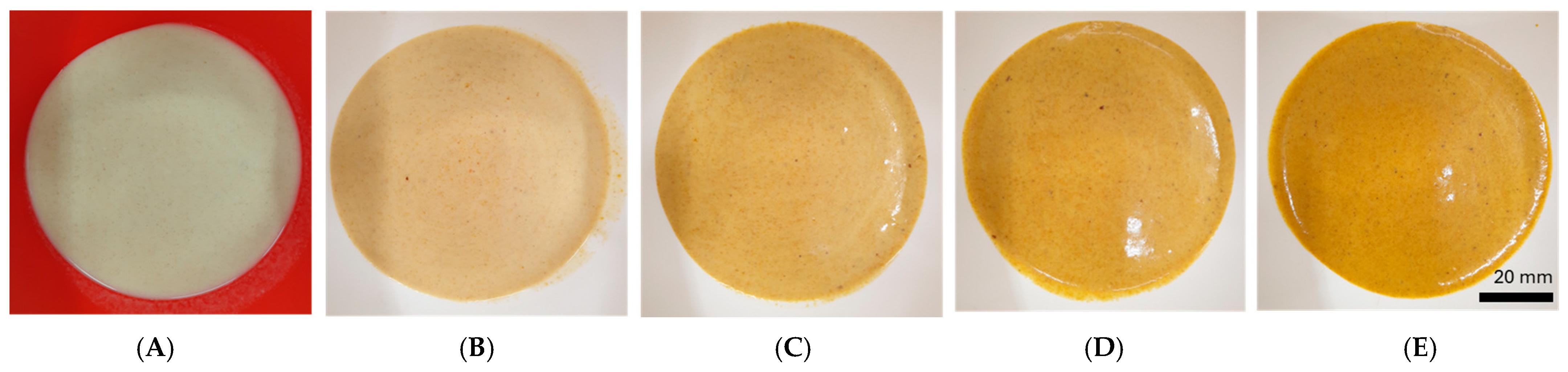
Visual differences between the sourdough variants after 72 h of fermentation are illustrated in Figure 1, showing the effect of SBPF on the overall appearance of the dough, with particular emphasis on its colour.

3.2. Dough, Bread and Crumb Characteristics

The technological and quality parameters of the dough and the baked loaves also indicated a marked effect of sea buckthorn fruit pomace flour. The SBPF10 and SBPF15 variants were characterised by a higher obtained dough yield compared with the target value, lower mass loss baking loss during baking and higher bread yield in comparison with the control. This may result from the presence of fibre fractions in SBPF which, due to their increased water-binding capacity, limit water loss during thermal processing. Similar effects—increased dough yield and reduced mass loss—have been observed in breads enriched with fruit pomace and other by-products of the food industry [20,27,38,43], confirming the beneficial impact of fibre fractions on the dough water balance.
The SBPF10 variant achieved the highest bread volume (289 cm3) versus 255 cm3 in the control. This may reflect more effective retention of fermentation gases and improved dough structure expansion. However, in the variants with higher SBPF inclusion levels (15 and 20%), a gradual decrease in loaf volume was recorded (238 and 221 cm3, respectively). This trend can be attributed to a higher proportion of fibre fractions, which may restrict the elasticity of the colloidal network and reduce dough gas-retention capacity. Similar relationships were observed for the sphericity coefficient: a decrease from 0.78 (control) to 0.61 (SBPF20) suggests reduced loaf shape stability at higher substitution levels (Table 3).
An increased loaf volume at moderate levels of flour substitution with fruit pomace has previously been reported, among others, for breads enriched with apple, chokeberry or grape pomace [13,14,15,16,17], as well as for rolls containing date pomace [45], indicating that a small proportion of fibre fractions can exert a structure-forming effect and promote gas retention.
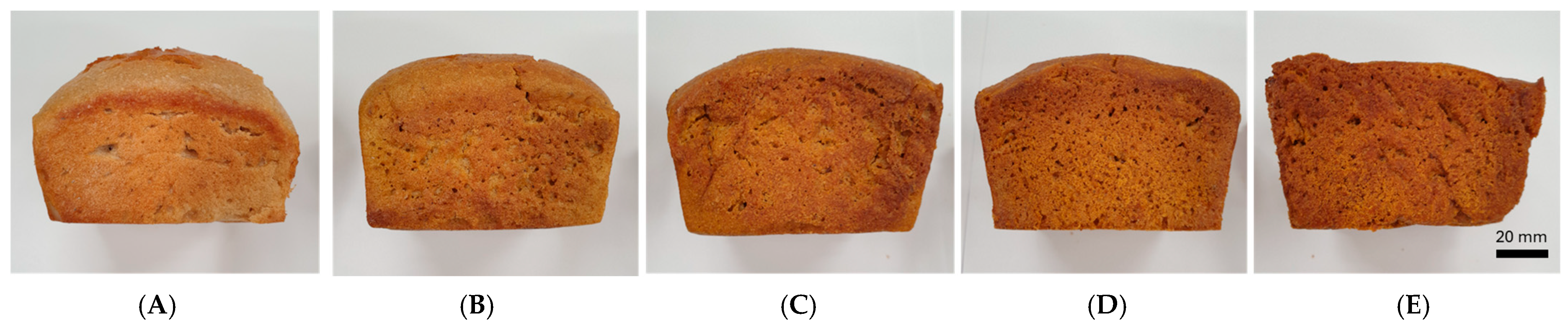
Changes in the external appearance and shape of loaves with different SBPF inclusion levels are illustrated in Figure 2, which confirms the observed differences in loaf sphericity and volume.
The results obtained confirmed that the addition of SBPF had a significant effect on the technological properties of the dough and on the quality of the resulting bread. The SBPF10 and SBPF15 variants showed a particularly beneficial effect, increasing dough and bread yield and reducing baking losses. This behaviour may be explained by the high content of fibre fractions and non-starch polysaccharides in SBPF, which exhibit water-binding capacity, stabilising the dough and limiting water loss during baking. Similar relationships were observed by Martău et al. [11] and Samad et al. [6], who reported that moderate levels of fruit pomace improved dough rheological properties by enhancing its capacity to retain water and fermentation gases.
The increase in loaf volume observed in the SBPF10 variant may be associated with improved gas retention and fermentation activity, which has also been confirmed in studies on the addition of apple and grape pomace [12,46]. Conversely, the marked decrease in loaf volume at higher levels of SBPF addition is consistent with the observations of Reißner et al. [44] and Almoumen et al. [45], who indicated that an excessive amount of fibre from fruit pomace leads to a densification of the dough structure and a reduction in loaf or roll volume. The negative effect of overly high pomace levels on the volume and texture of baked products has also been confirmed in gluten-free and sourdough breads [18,19]. At addition levels exceeding 15%, loaf volume decreases, which can be explained by an excess of fibre disrupting the colloidal network in the dough and impairing its elasticity. Similar phenomena were observed by Reißner et al. [44] and Almoumen et al. [45], who pointed to the negative impact of high fibre doses from pomace on dough structure and loaf volume.
The decrease in the sphericity coefficient in the SBPF15 and SBPF20 variants indicates reduced loaf shape stability. These findings are consistent with the observations of Stanciu et al. [21], where higher levels of sea buckthorn powder adversely affected loaf appearance and texture.
Analysis of crumb properties confirmed a significant influence of SBPF on the textural characteristics and appearance of the bread (Table 4). With increasing SBPF levels, a significant reduction in the lightness value L* and an increase in a* and b* values were observed, indicating intensification of crumb colour towards an orange-red hue. This effect can be attributed to the presence of natural plant pigments, including carotenoids, typical of sea buckthorn fruit. Similar colour changes (a decrease in L* and an increase in a* and b*) were reported by Ghendov-Mosanu et al. [22], Banach et al. [20] and Stanciu et al. [21] for breads enriched with sea buckthorn, and were attributed to the high carotenoid and phenolic compound content of this raw material, which is also supported by the review data of Wang et al. [23].
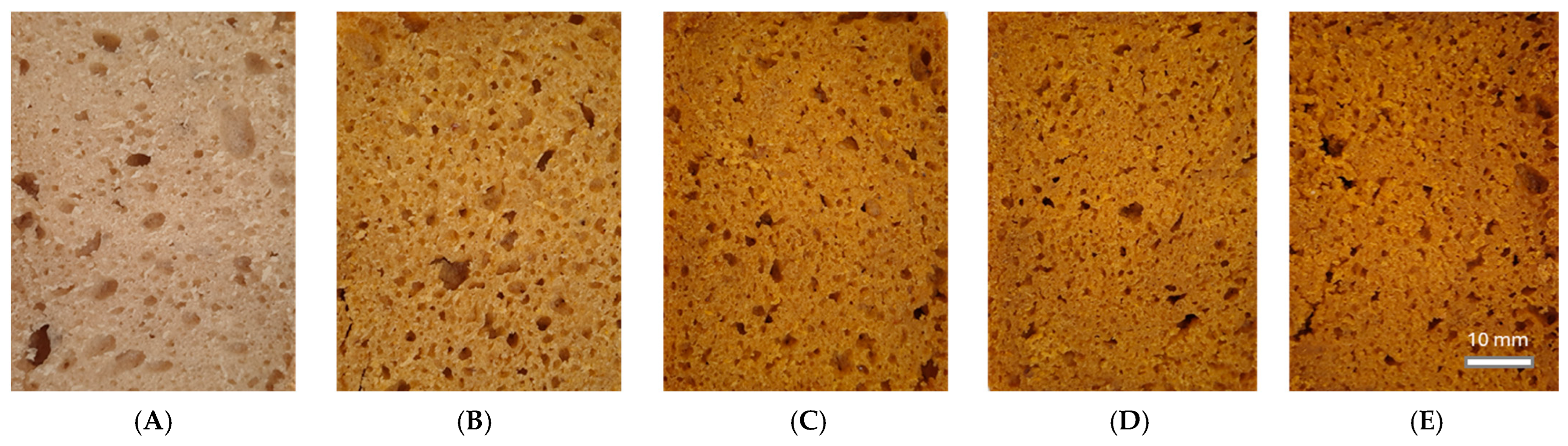
Visual differences in crumb colour and structure are presented in Figure 3, where changes in colour intensity and pore distribution in cross-sections are clearly visible. Colour is one of the key perceptual attributes, so such pronounced changes may affect consumer acceptance both positively, by increasing visual attractiveness, and negatively, if the colour is perceived as excessively intense, as also noted by Stanciu et al. [21].
At the same time, a decrease in crumb compressibility was observed in the SBPF variants; this feature may indicate higher elasticity and greater stability of the internal structure, which should be considered advantageous from both a technological and a consumer point of view. Cantatore et al. [8] demonstrated that lactic acid fermentation products and the presence of dietary fibre can modulate crumb structure, increasing its uniformity and improving water retention. A similar effect—greater crumb elasticity and stability—has been observed in breads and cereal-based products enriched with fibre fractions and fermented fruit substrates [26,43], and, with regard to rye sourdoughs, also in the studies of Koj and Pejcz [25].
The increase in crumb acidity in the SBPF samples (from 5.2 in the control to 10.8 in the 20% variant) further confirms the impact of sea buckthorn pomace flour on the intensification of fermentation processes and the accumulation of acidic metabolites. This effect was also identified by Chiarini et al. [7] and Muñoz Bernal et al. [47] for other fermented pomace-based ingredients. The increased acidity is consistent with the reports of Cantatore et al. [8], Petrova and Petrov [9] and Gaglio et al. [19], which indicated that the incorporation of fruit pomace into fermented cereal products promotes more intensive production of organic acids and affects the microbiological balance and sensory properties of bread.
Crumb porosity did not change significantly compared with the control, which may suggest that the addition of SBPF does not markedly affect the ability of the dough to develop and maintain a gas-cell structure, at least up to a substitution level of 15%. The lack of pronounced differences in crumb porosity at moderate levels of pomace addition is consistent with the findings of Gumul et al. [13,14], Valková et al. [15] and Tolve et al. [16], who demonstrated that an appropriately adjusted pomace level and dough hydration make it possible to maintain the cellular structure of the crumb despite fibre enrichment.
The results obtained indicate that SBPF additions of up to 15% are associated with beneficial changes in dough yield and in the crumb quality of rye bread. It should be emphasised that most of the studies conducted to date have focused on wheat or gluten-free bread, whereas the results presented here relate to sourdough rye bread, which constitutes an important contribution to the available knowledge on the use of sea buckthorn pomace in breadmaking technology. To gain a deeper understanding of the relationships between the level of substitution and the fermentative and structural characteristics of the bread, a correlation analysis was performed, the results of which are presented in the following subsection.

3.3. Correlation Analysis

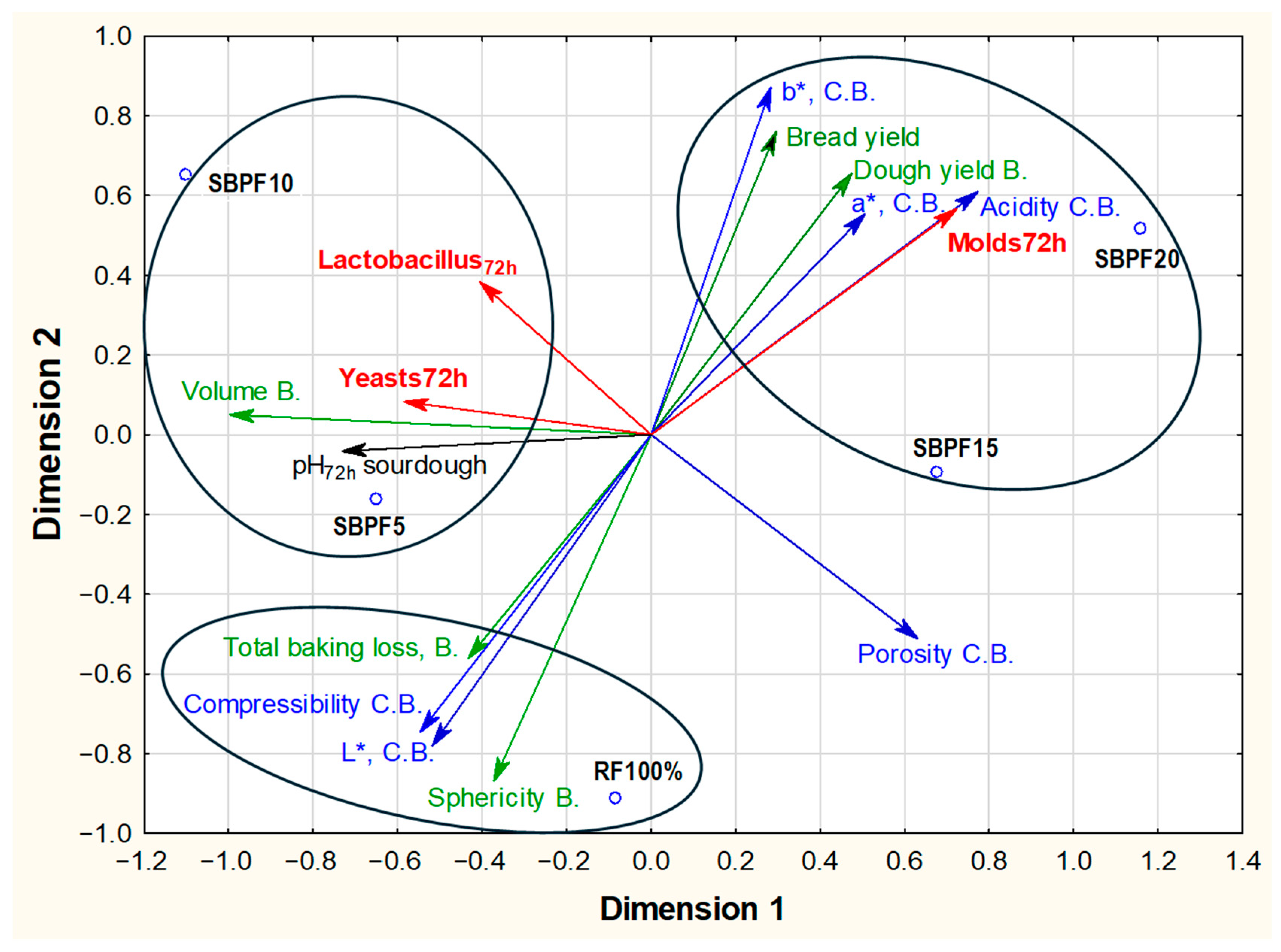
In order to determine the relationships between the level of sea buckthorn fruit pomace flour (SBPF) addition and key fermentative, technological and quality attributes of rye bread, a PROFIT analysis was performed. This technique enables the graphical interpretation of multivariate associations by fitting quantitative variables as vectors onto an ordination map and allows the identification of association patterns between the tested levels of SBPF addition ((RF100% = SBPF0) and SBPF5–SBPF20) and sourdough parameters after 72 h of fermentation, as well as dough, bread and crumb properties, including texture and colour. The analysis thus served as a tool to support the assessment of the optimal range of SBPF application in the context of its impact on fermentation behaviour and quality of rye bread. The use of PROFIT analysis is in line with the growing importance of multivariate methods in the assessment of consumer preferences and product quality, as described, among others, by Błażejczyk-Majka and Boczar [42], Sagan [39] and Zaborski [40]; however, it has so far been rarely applied to breads enriched with fruit pomace.
The results of the analysis presented in Figure 4 show that the SBPF10 variant is located in the vicinity of the vectors representing variables associated with bread volume, sourdough pH after 72 h of fermentation and the counts of yeasts and Lactobacillus. This distribution indicates a favourable technological profile of this variant, as it promotes effective fermentation, higher dough yield and the maintenance of structural stability and controlled acidity. In line with this pattern, key technological parameters in SBPF10 changed by −12.9% to +13.3% relative to the control (RF100%), depending on the trait (e.g., total baking loss: −12.9%; bread yield: +9.3%; volume: +13.3%) (Table 3 and Table 4). At the same time, it may indicate that SBPF10 does not cause excessive intensification of fermentative processes, which could be desirable from the standpoint of quality control and shelf-life of the loaves. The optimal effect of the addition at a level of around 10% is consistent with observations for breads containing apple, grape and other fruit pomace, where moderate pomace doses improved loaf volume, dough rheological properties and the activity of the fermentative microflora [13,14,16,17,45], as well as with data for breads enriched with sea buckthorn [20,21,22].
The SBPF5 variant shows similar, although less pronounced, associations, which may indicate a limited impact of such a low level of addition on fermentative microbiota and on the functional properties of the bread. Accordingly, relative changes in SBPF5 versus RF100% were generally minor (−12.8% to +6.7%, depending on the trait; e.g., sphericity: −12.8%; bread yield: +6.6%; volume: +6.7%) (Table 3 and Table 4). It may be assumed that at a 5% substitution level, the amount of bioactive compounds and fibre fractions is too low for the functional potential of SBPF to be fully expressed, which is consistent with the observations of other authors indicating the need to use at least several to a dozen or so per cent of pomace in order to obtain significant quality changes [15,18,38].
The variants with higher SBPF addition levels (15 and 20%) display different correlation patterns. Both are located in the direction of vectors associated with intensified crumb colour (higher a* and b* values), increased crumb acidity, higher dough and bread yield and enhanced mould activity after 72 h of fermentation. These trends were also reflected in relative differences versus RF100% (Table 3 and Table 4); e.g., at SBPF20 loaf volume decreased by 13.3%, whereas crumb acidity increased by 107.7% compared with the control. These relationships may reflect an intensification of biochemical transformations in the fermenting system at higher SBPF levels, linked to the presence of phenolic compounds, organic acids and dietary fibre that affect the microbiota and physicochemical properties Phenolic compounds, which are present in considerable amounts in sea buckthorn fruit, may exert inhibitory effects on selected yeast strains and lactic acid bacteria, particularly in the absence of adequate metabolic adaptation [43]. At the same time, the high carotenoid and polyphenol content of sea buckthorn [23] explains the strong correlation of the SBPF15 and SBPF20 samples with crumb colour parameters, as also confirmed by previous studies on breads enriched with sea buckthorn [20,22]. However, these same samples also correlate with the crumb porosity vector, which may suggest a less favourable internal structure, potentially leading to a weakening of loaf integrity. A similar phenomenon—deterioration of crumb structure and a reduction in loaf volume at high levels of flour substitution with fibre fractions—was reported by Reißner et al. [44], Almoumen et al. [45] and Gaglio et al. [19].
The control sample (RF100%) is located close to the variables describing the highest loaf sphericity and crumb compressibility and the greatest crumb lightness L*, which reflects the typical characteristics of rye bread produced without colouring and structure-forming components derived from SBPF. At the same time, the absence of SBPF is associated with lower dough and bread yield and less intense activity of the fermentative microbiota, as reflected by the position of the control sample in the opposite direction to the vectors representing dough and bread yield and the counts of yeasts and lactic acid bacteria (Figure 4). Notably, RF100% is also positioned towards the vector of total baking loss, indicating comparatively higher baking loss in the control variant. This is consistent with the classical characteristics of sourdough rye bread described in the literature and technological standards [29,32,37], where the absence of functional additives results in good stability of loaf shape but a limited potential for nutritional enrichment.
The vector relationships also indicate several strong associations between traits. Bread volume is clearly positively associated with sourdough pH and negatively associated with baking loss. Crumb colour a*, b* shows a positive association with crumb acidity and dough yield, which points to a link between colour intensification and the course of fermentation. In turn, the counts of Lactobacillus and yeasts are negatively associated with sourdough pH, confirming their importance in the acidification process. Negative relationships were also observed between crumb compressibility and sphericity and the variables indicative of intensive fermentation and higher SBPF inclusion levels. The structure of these relationships is consistent with reports on breads enriched with various fruit pomaces, where positive associations were observed between colour intensity, acidity and bioactive compound content, accompanied by a simultaneous decrease in loaf volume and changes in texture parameters [13,16,18,20].
In summary, the multivariate PROFIT analysis indicates that the addition of sea buckthorn fruit pomace flour at the SBPF10 level provides the most favourable balance between fermentative, technological and textural parameters of the bread. In contrast, higher SBPF levels (15–20%) promote more intense fermentation processes, increased bread yield and stronger crumb colour, but may adversely affect crumb structural properties such as porosity and elasticity. These findings highlight the need to optimise the level of SBPF addition in order to achieve the desired functional properties without compromising the quality of the final product (Figure 4). At the same time, the results obtained complement previous reports on the use of fruit pomace in wheat and gluten-free breads [13,19,45], showing that a similar compromise between nutritional value and technological quality can also be achieved in sourdough rye bread containing sea buckthorn.
In future studies, it would be advisable to extend the analysis to include the assessment of antioxidant activity, the stability of the microbiota during storage and changes in textural properties over time. It would also be worthwhile to incorporate consumer tests and to apply selected strains of lactic acid bacteria and yeasts that are tolerant to phenolic compounds and fibre fractions, which may enhance the efficiency of fermentation processes and improve bread quality at higher substitution levels. Although sensory tests were not performed in the present study, their inclusion in future work would make it possible to evaluate the overall impact of SBPF addition on consumer preferences and on the acceptability of changes in bread colour and texture. This may represent an important extension of previous studies on consumer acceptance of breads enriched with sea buckthorn and other fruit pomace [20,21,47], and may also fit into the broader trend of preference analyses using multivariate methods [40,42].

4. Summary and Conclusions

The results of the present study indicate that sea buckthorn fruit pomace flour (SBPF) can be effectively used as a functional component in rye bread production, exerting a comprehensive effect on technological and microbiological quality, as well as on the textural and colour properties of the bread. The use of SBPF led to a decrease in the pH of baking mixtures and fermenting sourdoughs, which indicates the presence of compounds with acidifying activity and/or components that may support the fermentative microflora in this ingredient. In particular, an intensification of the growth of Lactobacillus spp. and yeasts was observed in variants with a moderate SBPF level (especially SBPF10), which may suggest a prebiotic potential of SBPF, as inferred from CFU-based microbial counts. At the same time, SBPF additions promoted an improvement in dough and bread yield and reduced mass loss during baking, which can be attributed to the increased water-binding capacity of the fibre fractions present in SBPF.
The SBPF10 variant showed the most favourable quality profile—both in terms of loaf volume and beneficial microflora counts, dough and bread yield, and crumb texture parameters, while at the same time maintaining a moderate crumb colour intensity. In contrast, higher SBPF levels of 15 to 20% led to a gradual deterioration of selected structural parameters of the bread, such as sphericity and loaf volume, indicating the existence of a technological substitution limit beyond which bread structure becomes destabilised. At the same time, the increased crumb acidity and more intense bread colour observed in these variants may be desirable from the perspective of developing products with enhanced functional value and visual attractiveness.
In summary, a moderate addition of sea buckthorn fruit pomace flour of around 10% (with an upper limit of 15%) can effectively enrich rye bread, supporting the development of the fermentative microflora, improving baking performance parameters and modifying the colour and texture attributes of the final product. At the same time, maintaining a balance between the intensity of SBPF addition and the structural stability of the bread appears to be crucial for preserving its high technological quality and potential consumer acceptability. The use of sea buckthorn pomace flour may contribute to a sustainable food-processing strategy, enabling the efficient utilisation of by-products from fruit processing.
In the future, it would be worthwhile to conduct studies on the shelf life of the baked products and on consumer sensory acceptability, in order to confirm the usefulness of SBPF under broader processing and storage conditions and to verify the impact of changes in colour and texture on consumer preferences.

Supplementary Materials

The following supporting information can be downloaded at: https://www.mdpi.com/article/10.3390/app16010015/s1, Table S1. One-way ANOVA statistics for Table 2 (microbial counts and pH).

Author Contributions

Conceptualisation, K.M., J.K.B. and B.P.; methodology, K.M., L.K., M.G.-R. and B.P.; validation, J.K.B. and M.G.-R.; formal analysis, K.M., L.K., B.P. and M.G.-R.; investigation, K.M., L.K. and B.P.; data curation, K.M., L.K. and J.K.B.; writing—original draft preparation, K.M., J.K.B., L.K., R.P.-F. and M.G.-R.; writing—review and editing, K.M., J.K.B., L.K., R.P.-F. and M.G.-R.; funding acquisition, R.P.-F. and K.M. All authors have read and agreed to the published version of the manuscript.

Funding

This work was supported by the Ministry of Science and Higher Education of Poland as part of Statutory activities from the Faculty of Food Science, University of Warmia and Mazury in Olsztyn, project No. 17.610.012-112.

Institutional Review Board Statement

Not applicable.

Informed Consent Statement

Not applicable.

Data Availability Statement

The original contributions presented in this study are in cluded in the article. Further inquiries can be directed to the corresponding author.

Conflicts of Interest

The authors declare no conflicts of interest.

References

  1. Łopaciuk, W. (Ed.) Rynek Zbóż; Stan i Perspektywy. Analizy Rynkowe (Cereal Market. Status and Prospects. Market Analyses), Nr 65; Instytut Ekonomiki Rolnictwa i Gospodarki Żywnościowej–Państwowy Instytut Badawczy (IERiGŻ-PIB): Warsaw, Poland, 2023; ISSN 1231-3149. (In Polish) [Google Scholar]
  2. Piasecka, I.; Górska, A. Possible uses of fruit pomaces in food technology as a fortifying additive—A review. Zesz. Probl. Postępów Nauk Rol. 2020, 600, 43–54. (In Polish) [Google Scholar] [CrossRef]
  3. Lyu, F.; Luiz, S.F.; Azeredo, D.R.P.; Cruz, A.G.; Ajlouni, S.; Ranadheera, C.S. Apple pomace as a functional and healthy ingredient in food products: A review. Processes 2020, 8, 319. [Google Scholar] [CrossRef]
  4. Raczkowska, E.; Serek, P. Health-promoting properties and the use of fruit pomace in the food industry—A Review. Nutrients 2024, 16, 2757. [Google Scholar] [CrossRef] [PubMed]
  5. Jurevičiūtė, I.; Keršienė, M.; Bašinskienė, L.; Leskauskaitė, D.; Jasutienė, I. Characterization of berry pomace powders as dietary fiber-rich food ingredients with functional properties. Foods 2022, 11, 716. [Google Scholar] [CrossRef] [PubMed]
  6. Samad, A.; Zhang, B.; Liu, Z.; Zhang, W. Fruit pomace as an emerging source of dietary fiber and phytochemicals in bakery products: A review. Fermentation 2025, 11, 376. [Google Scholar] [CrossRef]
  7. Chiarini, M.; Azzolini, M.; Dall’Asta, M.; Del Rio, D.; Galaverna, G. Fermentation of fruit and vegetable by-products for food applications: A systematic review. Foods 2024, 13, 3715. [Google Scholar] [CrossRef]
  8. Cantatore, V.; Gallo, M.A.; Sinigaglia, M.; Corbo, M.R. Impact of fermentation on cereal matrix and its possible use in bread-making applications. Front. Microbiol. 2019, 10, 2574. [Google Scholar] [CrossRef]
  9. Petrova, P.; Petrov, K. Lactic acid fermentation of cereals and pseudocereals: Ancient nutritional biotechnologies with modern applications. Nutrients 2020, 12, 1118. [Google Scholar] [CrossRef]
  10. Ziarno, M.; Cichońska, P. Lactic acid bacteria-fermentable cereal-and pseudocereal-based beverages. Microorganisms 2021, 9, 2532. [Google Scholar] [CrossRef]
  11. Martău, G.A.; Mihai, M.; Vodnar, D.C.; Teleky, B.-E. Sustainable use of apple pomace in sourdough fermentation: A functional approach for bakery applications. Sustainability 2021, 13, 13981. [Google Scholar] [CrossRef]
  12. Torreggiani, D.; Manzocco, L.; Nicoli, M.C. Grape pomace powder fermented by lactic acid bacteria: A promising functional ingredient for bakery applications. Foods 2023, 12, 3274. [Google Scholar] [CrossRef]
  13. Gumul, D.; Korus, J.; Ziobro, R.; Kruczek, M. Enrichment of wheat bread with apple pomace as a way to increase pro-health constituents. Qual. Assur. Saf. Crops Foods 2019, 11, 231–240. [Google Scholar] [CrossRef]
  14. Gumul, D.; Ziobro, R.; Korus, J.; Kruczek, M. Apple pomace as a source of bioactive polyphenol compounds in gluten-free breads. Antioxidants 2021, 10, 807. [Google Scholar] [CrossRef]
  15. Valková, V.; Ďúranová, H.; Havrlentová, M.; Ivanišová, E.; Mezey, J.; Tóthová, Z.; Gabriny, L.; Kačániová, M. Selected physico-chemical, nutritional, antioxidant and sensory properties of wheat bread supplemented with apple pomace powder as a by-product from juice production. Plants 2022, 11, 1256. [Google Scholar] [CrossRef] [PubMed]
  16. Tolve, R.; Simonato, B.; Rainero, G.; Bianchi, F.; Rizzi, C.; Cervini, M.; Giuberti, G. Wheat bread fortification by grape pomace powder: Nutritional, technological, antioxidant, and sensory properties. Foods 2021, 10, 75. [Google Scholar] [CrossRef]
  17. Cacak-Pietrzak, G.; Dziki, D.; Gawlik-Dziki, U.; Parol-Nadłonek, N.; Kalisz, S.; Krajewska, A.; Stępniewska, S. Wheat bread enriched with black chokeberry (Aronia melanocarpa L.) pomace: Physicochemical properties and sensory evaluation. Appl. Sci. 2023, 13, 6936. [Google Scholar] [CrossRef]
  18. Pecyna, A.; Krzywicka, M.; Buczaj, A.; Blicharz-Kania, A.; Kobus, Z. The effect of fruit pomace addition on the color, texture and sensory properties of gluten-free bread. Sci. Rep. 2025, 15, 24510. [Google Scholar] [CrossRef]
  19. Gaglio, R.; La Rosa, L.; Serio, G.; Mannino, G.; Alfonzo, A.; Franciosi, E.; Settanni, L.; Gentile, C. Rubus idaeus by-products: Sustainable improvement of the antioxidant value of sourdough bread by a new end-use of exhausted seeds still containing bioactive compounds. Innov. Food Sci. Emerg. Technol. 2023, 90, 103517. [Google Scholar] [CrossRef]
  20. Banach, J.K.; Majewska, K.; Piłat, B.; Grzywińska-Rąpca, M. Benefits of using pomace from sea buckthorn fruit in the production of rye bread for a strategy of sustainable production and consumption. Appl. Sci. 2024, 14, 11067. [Google Scholar] [CrossRef]
  21. Stanciu, I.; Ungureanu, E.L.; Popa, E.E.; Geicu-Cristea, M.; Draghici, M.; Mitelut, A.C.; Mustatea, G.; Popa, M.E. The experimental development of bread with enriched nutritional properties using organic sea buckthorn pomace. Appl. Sci. 2023, 13, 6513. [Google Scholar] [CrossRef]
  22. Ghendov-Mosanu, A.; Cristea, E.; Patras, A.; Sturza, R.; Padureanu, S.; Deseatnicova, O.; Turculet, N.; Boestean, O.; Niculaua, M. Potential application of Hippophae rhamnoides in wheat bread production. Molecules 2020, 25, 1272. [Google Scholar] [CrossRef]
  23. Wang, Z.; Zhao, F.; Wei, P.; Chai, X.; Hou, G.; Meng, Q. Phytochemistry, health benefits, and food applications of sea buckthorn (Hippophae rhamnoides L.): A comprehensive review. Front. Nutr. 2022, 9, 1036295. [Google Scholar] [CrossRef]
  24. Fernández-Peláez, J.; Paesani, C.; Gómez, M. Sourdough Technology as a Tool for the Development of Healthier Grain-Based Products: An Update. Agronomy 2020, 10, 1962. [Google Scholar] [CrossRef]
  25. Koj, K.; Pejcz, E. Rye dietary fiber components upon the influence of fermentation inoculated with probiotic microorganisms. Molecules 2023, 28, 1910. [Google Scholar] [CrossRef]
  26. Bieniek, A.; Buksa, K. The Influence of Arabinoxylan on the Properties of Sourdough Wheat Bread. Appl. Sci. 2024, 14, 2649. [Google Scholar] [CrossRef]
  27. Zarzycki, P.; Wirkijowska, A.; Teterycz, D.; Łysakowska, P. Innovations in wheat bread: Using food industry by-products for better quality and nutrition. Appl. Sci. 2024, 14, 3976. [Google Scholar] [CrossRef]
  28. PN-EN ISO 712:2012; Cereals and Cereal Products—Determination of Moisture Content—Reference Method. Polish Committee for Standardization: Warsaw, Poland, 2013.
  29. Horubałowa, A.; Haber, T. Analiza Techniczna w Piekarstwie (Technical Analysis in Baking), 4th ed.; WSiP: Warszawa, Poland, 1994. [Google Scholar]
  30. PN-EN ISO 3093:2010; Wheat, Rye and Flours Obtained from Them, Durum Wheat and Semolina—Determination of the Falling Number by the Hagberg-Perten Method. Polish Committee for Standardization: Warsaw, Poland. (In Polish)
  31. PN-ISO 7973:2001; Ziarno Zbóż i Przetwory Zbożowe—Oznaczanie Lepkości Mąki—Metoda z Zastosowaniem Amylografu/Cereals and Milled Cereal Products—Determination of the Viscosity of Flour—Method Using an Amylograph. Polish Committee for Standardization: Warsaw, Poland, 2001. (In Polish)
  32. Lubczyńska, H.; Lipińska, H.; Jarosz, K.; Woźniakowski, A.; Kosakowska, J.; Walewska, M. Vademecum Piekarza do Nauki Zawodu (Baker’s Vademecum for Learning the Profession); Handlowo-Usługowa Spółdzielnia, Samopomoc Chłopska: Warszawa, Poland, 2006; ISBN 83-919549-5-1. (In Polish) [Google Scholar]
  33. PN EN ISO 21527-1: 2009; Microbiology of Food and Animal Feeding Stuffs—Horizontal Method for the Enumeration of Yeasts and Moulds. Polish Committee for Standardization: Warsaw, Poland, 2009.
  34. PN-EN ISO 15214: 2002; Microbiology of Food and Animal Feeding Stuffs—Horizontal Method for the Enumeration of Mesophilic Lactic Acid Bacteria—Colony-Count Technique at 30 °C. Polish Committee for Standardization: Warsaw, Poland, 2002.
  35. Zheng, J.; Wittouck, S.; Salvetti, E.; Franz, C.M.A.P.; Harris, H.M.B.; Mattarelli, P.; O’Toole, P.W.; Pot, B.; Vandamme, P.; Walter, J.; et al. A taxonomic note on the genus Lactobacillus: Description of 23 novel genera, emended description of the genus Lactobacillus Beijerinck 1901, and union of Lactobacillaceae and Leuconostocaceae. Int. J. Syst. Evol. Microbiol. 2020, 70, 2782–2858. [Google Scholar] [CrossRef] [PubMed]
  36. Majewska, K.; Dąbkowska, E. Ocena możliwości wykorzystania mąki z ziarna płaskurki. Przegląd Piek. I Cukier. 2011, 59, 36–37. (In Polish) [Google Scholar]
  37. PN-A-74108:1996; Pieczywo—Metody Badań i Ocena Punktowa/Bread—Research Methods and Scoring. Polish Committee for Standardization: Warsaw, Poland, 1996. (In Polish)
  38. Tańska, M.; Roszkowska, B.; Czaplicki, S.; Borowska, E.J.; Bojarska, J.; Dąbrowska, A. Effect of fruit pomace addition on shortbread cookies to improve their physical and nutritional value. Plant Foods Hum. Nutr. 2016, 71, 307–313. [Google Scholar] [CrossRef] [PubMed]
  39. Sagan, A. Analiza preferencji konsumentów z wykorzystaniem programu Statistica–analiza conjoint i skalowanie wielowymiarowe. StatSoft Pol. Sp. Z oo 2009, 3–22. (In Polish) [Google Scholar]
  40. Zaborski, A. Analiza PROFIT i jej wykorzystanie w badaniu preferencji. Pr. Nauk. Uniw. Ekon. We Wrocławiu 2012, 242, 479–487. (In Polish) [Google Scholar]
  41. Kauf, S.; Tluczak, A. PROFIT analysis and its use in building a preference map of logistics customer service parameters. Sci. Pap. Wars. Univ. Life Sci. Econ. Organ. Logist. 2017, 2, 1. [Google Scholar]
  42. Błażejczyk-Majka, L.; Boczar, P. Zastosowanie metod wielowymiarowych w charakterystyce preferencji konsumentów. Metod. Ilościowe W Badaniach Ekon. 2016, 7, 18–32. [Google Scholar]
  43. Di Nunzio, M.; Picone, G.; Pasini, F.; Chiarello, E.; Caboni, M.F.; Capozzi, F.; Gianotti, A.; Bordoni, A. Olive oil by-product as functional ingredient in bakery products. Influence of processing and evaluation of biological effects. Food Res. Int. 2020, 131, 108940. [Google Scholar] [CrossRef]
  44. Reißner, A.-M.; Beer, A.; Struck, S.; Rohm, H. Pre-Hydrated berry pomace in wheat bread: An approach considering requisite water in fiber enrichment. Foods 2020, 9, 1600. [Google Scholar] [CrossRef]
  45. Almoumen, A.; Mohamed, H.; Sobti, B.; Ayyash, M.; Kamleh, R.; Al-Marzouqi, A.H.; Kamal-Eldin, A. Quality of bread rolls fortified with date fruit pomace: Structure, proximate composition, staling, and sensory evaluation. NFS J. 2025, 38, 100214. [Google Scholar] [CrossRef]
  46. Antonić, B.; Jančíková, S.; Dordević, D.; Tremlová, B. Grape pomace valorization: A systematic review and meta-analysis of its application as a functional ingredient in food. Foods 2020, 9, 1627. [Google Scholar] [CrossRef]
  47. Muñoz-Bernal, Ó.A.; Coria-Oliveros, A.J.; Vázquez-Flores, A.A.; Subiria-Cueto, C.R.; De la Rosa, L.A.; Reyes-Vega, M.D.L.L.; Rodrigo-García, J.; Martinez-Ruiz, N.D.R.; Alvarez-Parrilla, E. Functional and sensory evaluation of bread made from wheat flour fortified with wine byproducts. Food Prod. Process. Nutr. 2024, 6, 94. [Google Scholar] [CrossRef]
Figure 1. Appearance of sourdoughs after 72 h of fermentation with SBPF addition: 0% (A), 5% (B), 10% (C), 15% (D), 20% (E). Scale bar = 20 mm (applies to all panels).
Applsci 16 00015 g001
Figure 2. Cross-sections of rye bread loaves with SBPF addition: 0% (A), 5% (B), 10% (C), 15% (D), 20% (E). Scale bar = 20 mm (applies to all panels).
Applsci 16 00015 g002
Figure 3. Crumb structure and colour of bread with SBPF addition: 0% (A), 5% (B), 10% (C), 15% (D), and 20% (E). Scale bar = 10 mm (applies to all panels).
Applsci 16 00015 g003
Figure 4. Multivariate PROFIT analysis of rye breads: RF100% (control) and SBPF-enriched variants (5–20%) in relation to fermentation (pH72h and microbial counts at 72 h), technological parameters, and crumb quality attributes. B, bread/loaf; C.B., crumb.
Applsci 16 00015 g004
Table 1. Selected technological quality parameters of raw materials for bread production: rye flour (SBPF0) and breadmaking blends containing sea buckthorn fruit pomace flour (SBPF5–SBPF20).
ParametersRye FlourSBPF5SBPF10SBPF15SBPF20
Falling number [s]286 ± 1 a298 ± 8 a377 ± 15 b399 ± 3 c367 ± 2 d
Acidity [°]4.60 ± 0.00 a6.50 ± 0.08 b9.70 ± 0.08 c15.40 ± 0.00 d19.33 ± 0.09 e
Moisture content [%]12.38 ± 0.04 e12.12 ± 0.01 d11.62 ± 0.00 c11.37 ± 0.01 b11.09 ± 0.02 a
Tpk [°C]53.3 ac52.9 ab50.2 d51.8 b54.4 c
Tkk [°C]69.4 a69.1 a80.3 b88.9 c89.3 c
η max [B. U.]438 a294 b325 c1350 d1420 e
Abbreviations: Tpk—initial starch gelatinisation temperature; Tkk—final starch gelatinisation temperature; η max—maximum viscosity of the starch paste; a–e—values (mean ± standard deviation) in the columns followed by different letters differ significantly at p < 0.01.
Table 2. Dynamics of changes in microbial counts and pH (mean ± standard deviation) of bakery sourdoughs: control (SBPF0) and variants with sea buckthorn fruit pomace flour (SBPF5–SBPF20).
Microorganisms/ParameterTime [h]ControlSBPF5SBPF10SBPF15SBPF20
Yeasts
[log CFU/g]
00.60 ± 0.19 a1.39 ± 0.59 a1.55 ± 0.92 a1.82 ± 0.76 a2.00 ± 0.77 a
242.15 ± 0.17 a4.04 ± 1.73 a4.16 ± 2.10 a5.14 ± 2.07 a4.25 ± 2.04 a
484.59 ± 1.00 a6.63 ± 1.35 a6.47 ± 1.17 a6.63 ± 1.22 a5.12 ± 2.10 a
726.52 ± 1.21 a7.72 ± 0.29 a7.81 ± 0.30 a7.92 ± 0.17 a5.89 ± 2.26 a
Moulds
[log CFU/g]
01.58 ± 0.25 a1.46 ± 0.33 a1.46 ± 0.53 a1.40 ± 0.54 a1.89 ± 0.26 a
241.76 ± 0.19 a2.13 ± 0.18 a2.25 ± 0.23 a3.33 ± 1.60 a2.69 ± 0.52 a
481.89 ± 0.11 a2.88 ± 0.84 a3.67 ± 1.23 a4.02 ± 1.72 a4.60 ± 2.36 a
721.93 ± 0.08 a2.88 ± 0.85 a3.07 ± 1.33 a4.83 ± 2.32 a4.82 ± 2.25 a
* LAB [log CFU/g]02.09 ± 0.22 a2.05 ± 0.18 a1.90 ± 0.26 a1.88 ± 0.11 a1.72 ± 0.21 a
247.28 ± 0.43 a6.36 ± 0.76 a6.14 ± 0.71 a5.66 ± 0.56 a5.34 ± 1.43 a
488.42 ± 0.58 a8.37 ± 0.75 a8.36 ± 0.74 a8.37 ± 0.72 a7.88 ± 0.12 a
728.86 ± 0.43 a8.86 ± 0.42 a8.96 ± 0.398.64 ± 0.36 a8.93 ± 0.56 a
Sourdough pH06.25 ± 0.02 e4.52 ± 0.02 d4.10 ± 0.00 c3.81 ± 0.00 b3.48 ± 0.02 a
244.70 ± 0.01 e4.35 ± 0.02 d3.90 ± 0.00 c3.62 ± 0.01 b3.38 ± 0.00 a
483.72 ± 0.01 c3.50 ± 0.01 d3.72 ± 0.02 c3.56 ± 0.02 b3.35 ± 0.02 a
723.47 ± 0.08 b3.42 ± 0.04 c3.58 ± 0.06 b3.48 ± 0.04 b3.30 ± 0.03 a
* LAB were enumerated on MRS agar and are reported as Lactobacillus spp. (sensu lato) in a culture-based sense; the taxonomy of the former genus Lactobacillus has been updated [35]. Different superscript letters within the same time point (row) indicate significant differences between variants according to Tukey’s HSD test (p < 0.05). Variants sharing the same letter are not significantly different.
Table 3. Selected quality parameters of dough and bread as affected by the use of breadmaking blends containing sea buckthorn fruit pomace flour (SBPF5–SBPF20).
SampleDough Yield [%]Bread
Total Baking Loss [%]Bread Yield [%]Volume [cm3/100 g]Sphericity
Control (SBPF0)164.0 ± 0.4 b16.33 ± 0.55 d134.59 ± 2.40 a255 ± 6.7 e0.78 ± 0.01 e
SBPF5161.1 ± 0.4 a14.55 ± 1.04 c143.49 ±2.09 b272 ± 4.5 d0.68 ± 0.02 Dd
SBPF10169.9 ± 1.0 c14.22 ± 0.48 c147.06 ± 2.05 c289 ± 12.6 c0.66 ± 0.01 bC
SBPF15170.5 ± 0.9 c12.23 ± 1.13 a151.03 ± 2.93 d238 ± 5.7 b0.65 ± 0.00 b
SBPF20171.0 ± 0.5 c13.66 ± 0.69 b147.82 ± 1.52 ec221 ± 3.3 a0.61 ± 0.00 a
a–e—values in the columns followed by different lowercase letters differ significantly at p < 0.01; C–D—values in the columns followed by different uppercase letters differ significantly at p < 0.05.
Table 4. Selected crumb quality parameters of bread with sea buckthorn fruit pomace flour addition (SBPF5–SBPF20).
SamplePorosity [Dallmann Score]Acidity [°]ColourCompressibility [N]
L*a*b*
Control (SBPF0)69 ± 3.9 a5.2 ± 0.00 a56.68 ± 0.18 e4.87 ± 0.25 a19.44 ± 0.64 a16.4 ± 0.58 d
SBPF563 ± 3.3 a6.4 ± 0.25 b51.56 ± 0.08 d10.69 ± 0.23 b31.74 ± 0.27 b14.51 ± 1.24 c
SBPF1064 ± 3.8 a7.0 ± 0.52 c47.97 ± 0.21 c7.73 ± 0.24 c37.91 ± 0.10 c11 ± 0.39 b
SBPF1567 ± 3.8 a9.4 ± 0.09 d44.57 ± 0.16 b10.98 ± 0.37 b39.46 ± 0.07 d8.7 ± 0.62 a
SBPF2067 ± 3.3 a10.8 ± 0.52 e43.75 ± 0.40 a12.04 ± 0.54 d40.07 ± 0.57 d8.55 ± 1.60 a
a–e—values in the columns followed by different lowercase letters differ significantly at p < 0.01.
Disclaimer/Publisher’s Note: The statements, opinions and data contained in all publications are solely those of the individual author(s) and contributor(s) and not of MDPI and/or the editor(s). MDPI and/or the editor(s) disclaim responsibility for any injury to people or property resulting from any ideas, methods, instructions or products referred to in the content.