An Improved Damage–Plasticity Constitutive Model Capturing Rock Softening Behavior Under Various Confining Pressures


 ,
,
Abstract
1. Introduction
2. Presentation of the Improved Damage–Plasticity Constitutive Model
2.1. Stress–Strain Relationship
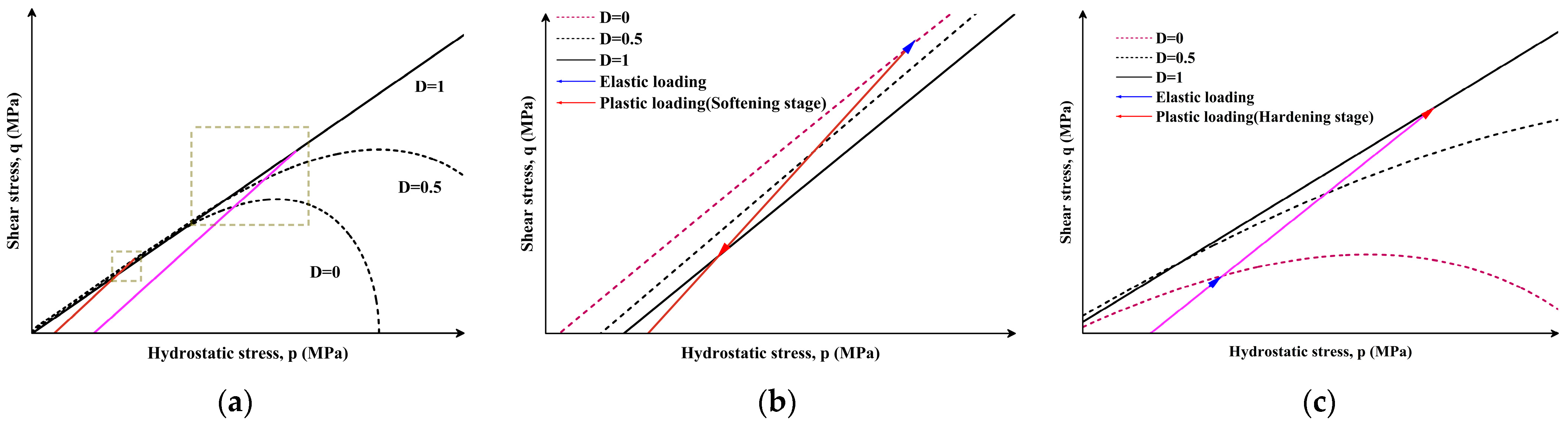
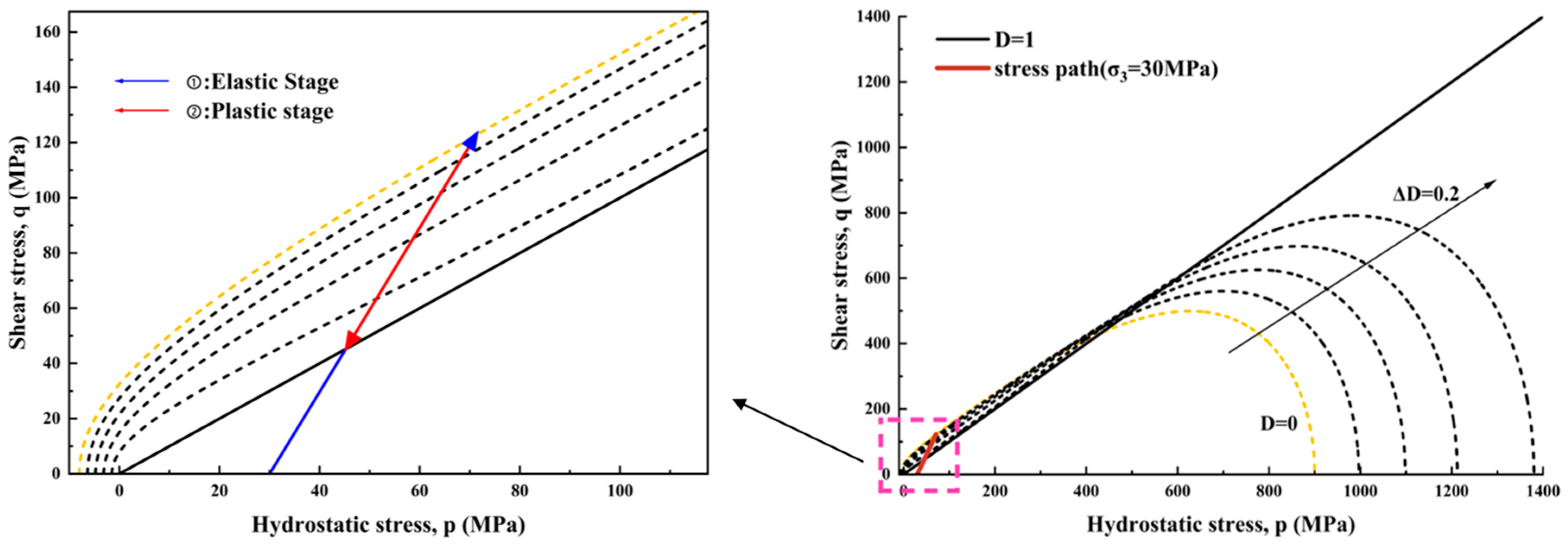
2.2. Formulation of the Yield Criterion Coupled with Damage Evolution
2.3. Coupled Damage–Plasticity Evolution and Pressure-Dependent Softening Parameter
2.4. Stress Update Calculation
- (i)
- given , , and the strain increment , compute the elastic trial stress from Equations (27) and (28) and evaluate the yield function
- (ii)
- if , accept the trial state and keep the internal variables unchanged;
- (iii)
- if , compute from Equation (31), update and , evaluate from Equation (30), and finally update the stress and internal variables using Equations (32) and (33).
3. Model Calibration and Validation
3.1. Model Calibration
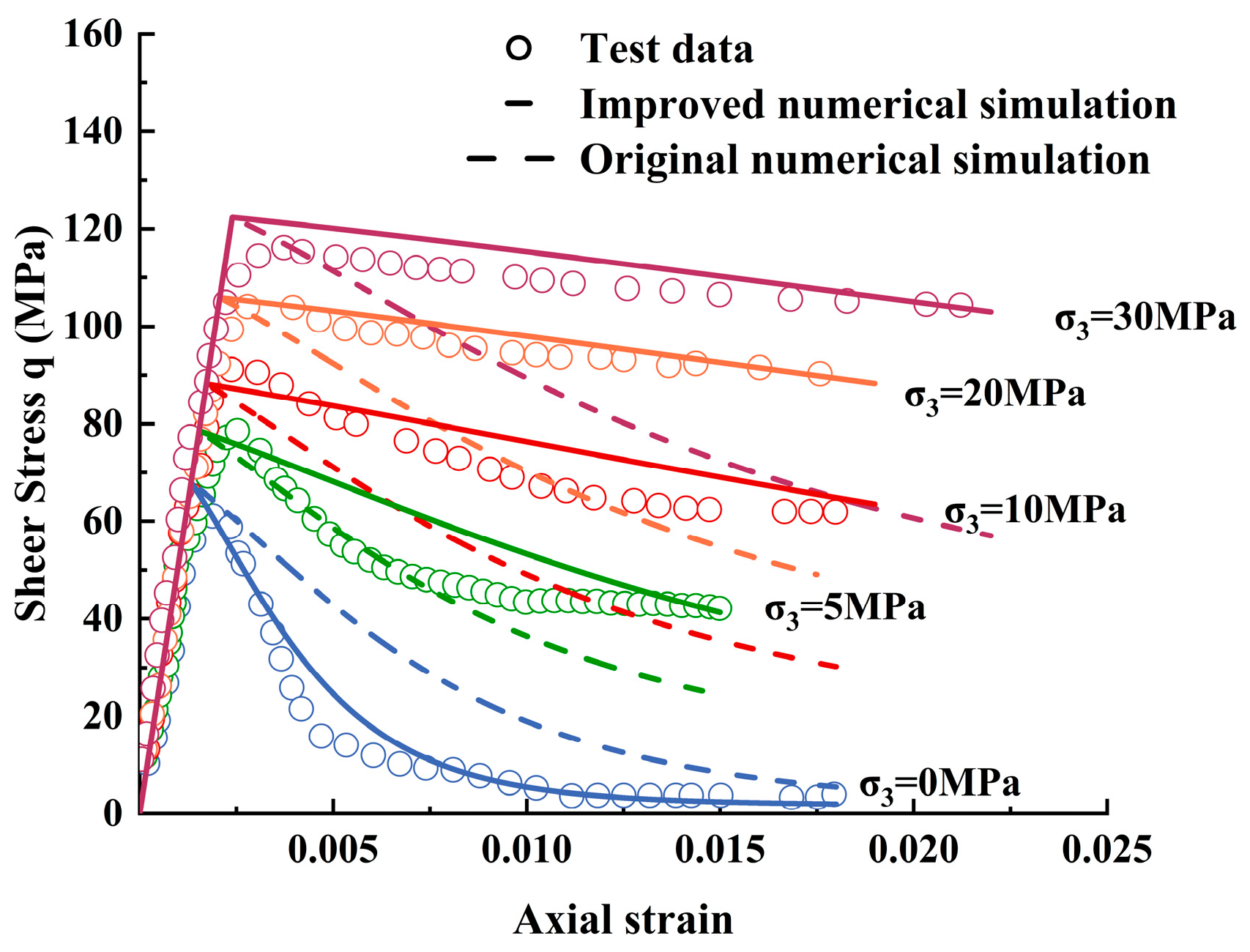
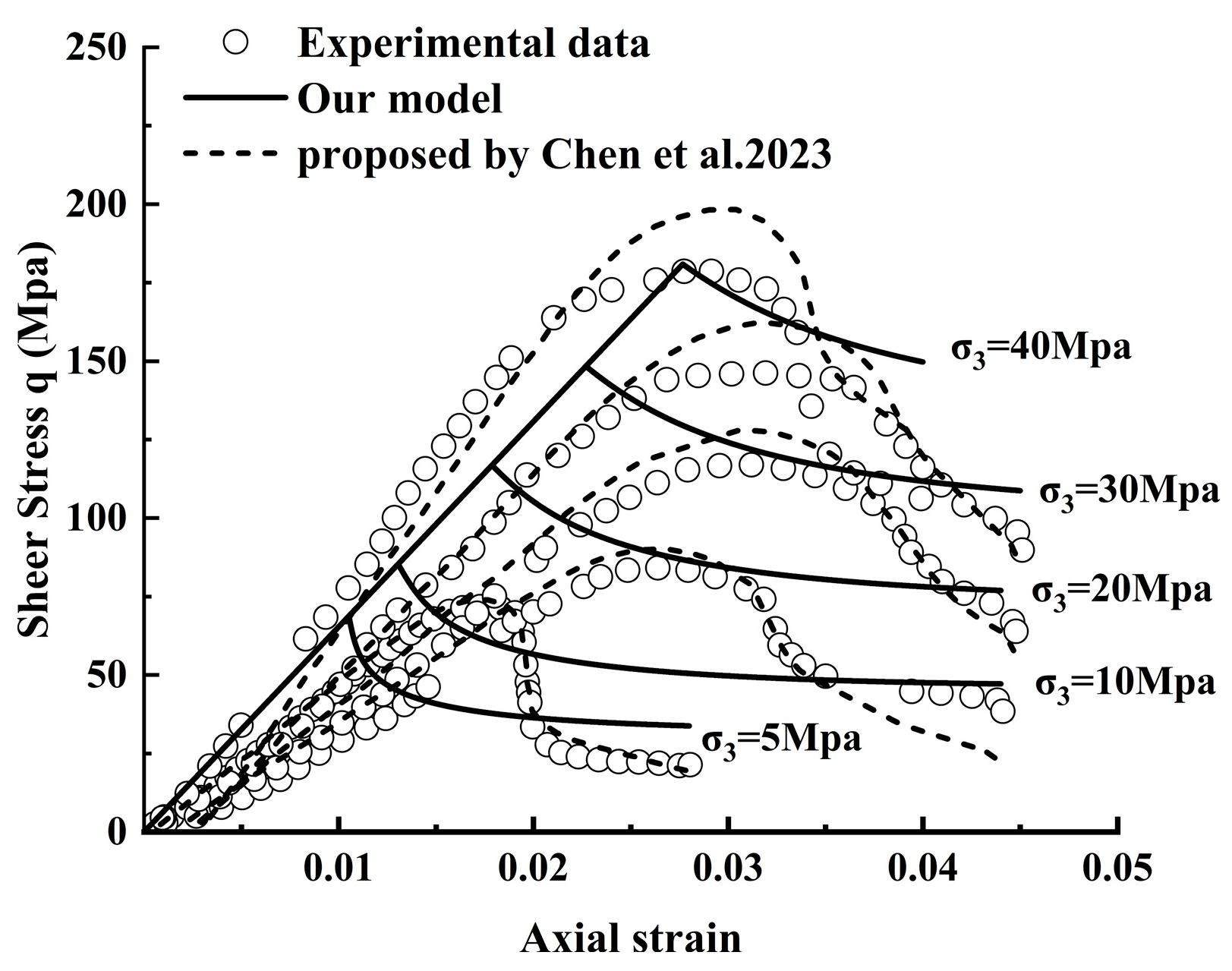
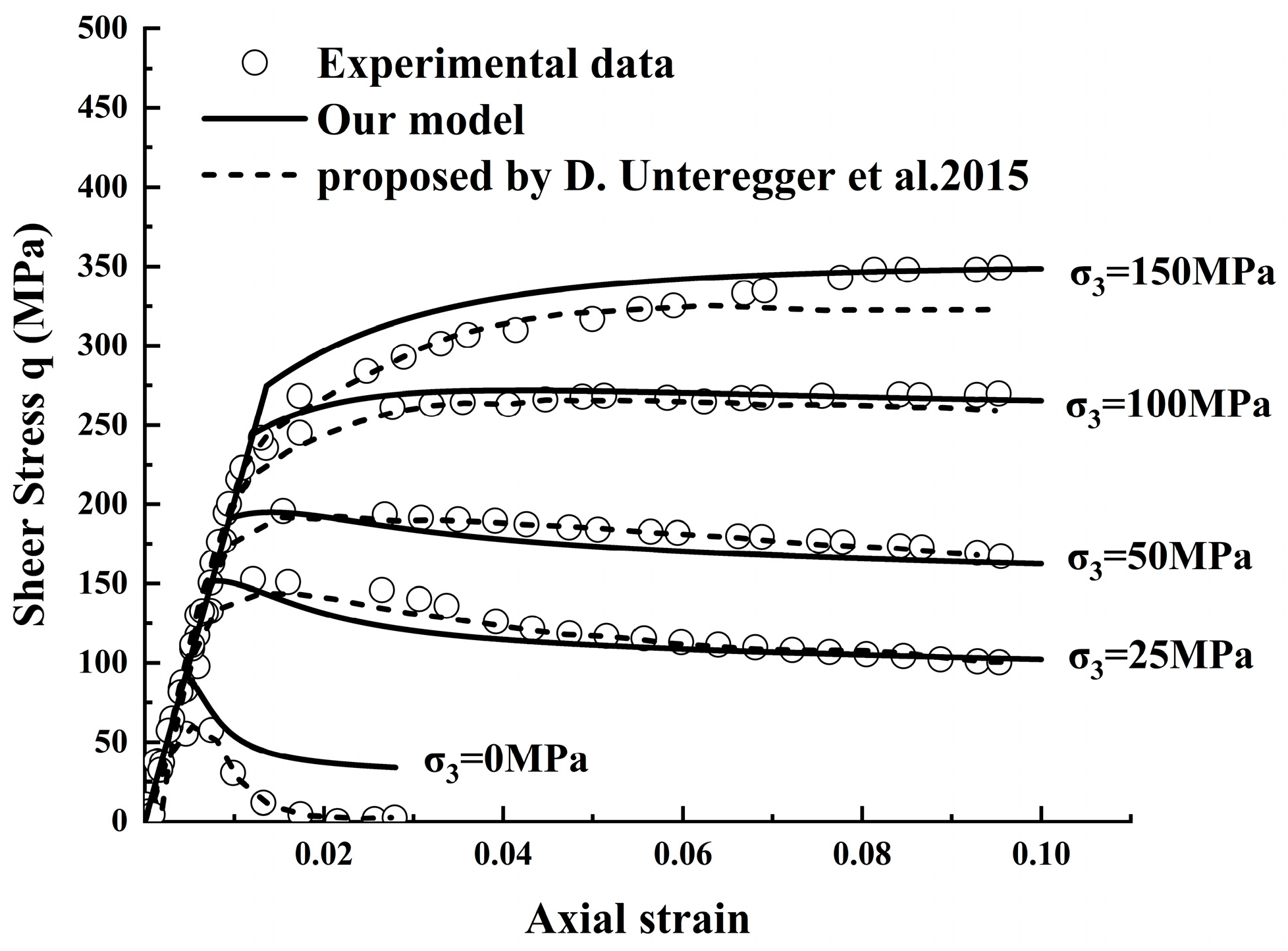
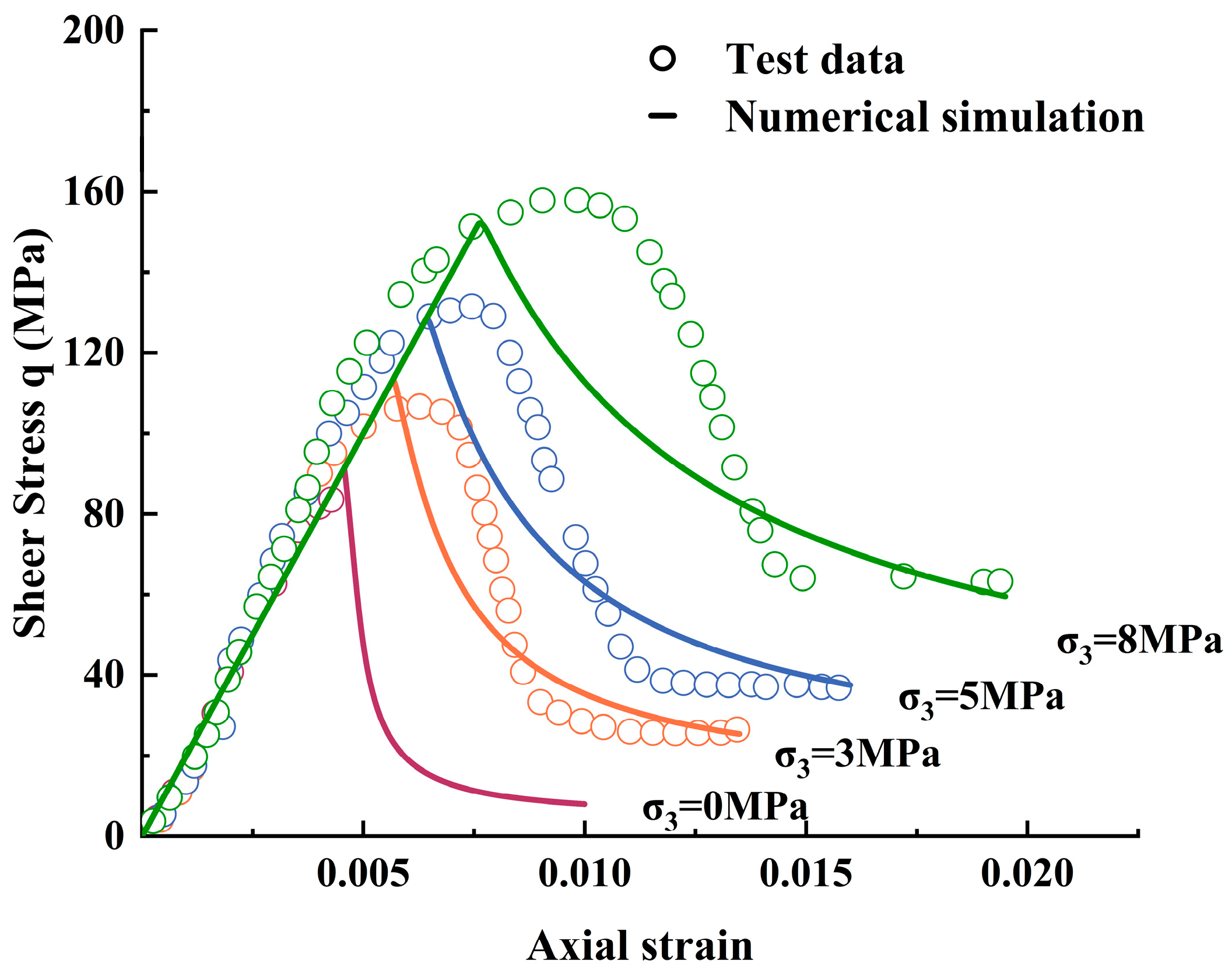
3.2. Model Validation
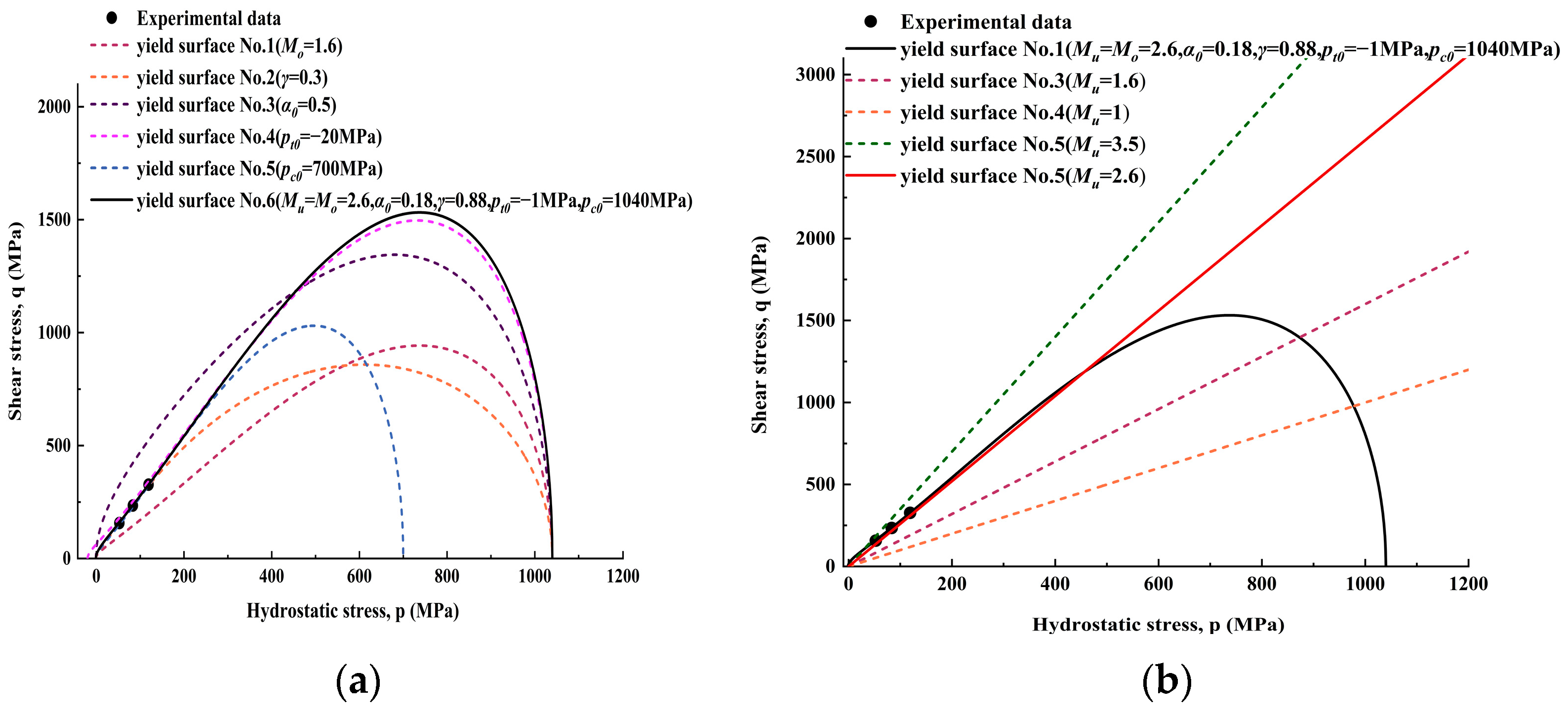
4. Sensitivity Analysis
5. Comparison of Model Simulation Capabilities
6. Discussion
7. Conclusions
- (1)
- The improved model systematically characterizes the entire response process of rock from the elastic stage to the post-peak softening stage, accurately reproducing the mechanical evolution from brittle failure to plastic flow under varying confining pressures.
- (2)
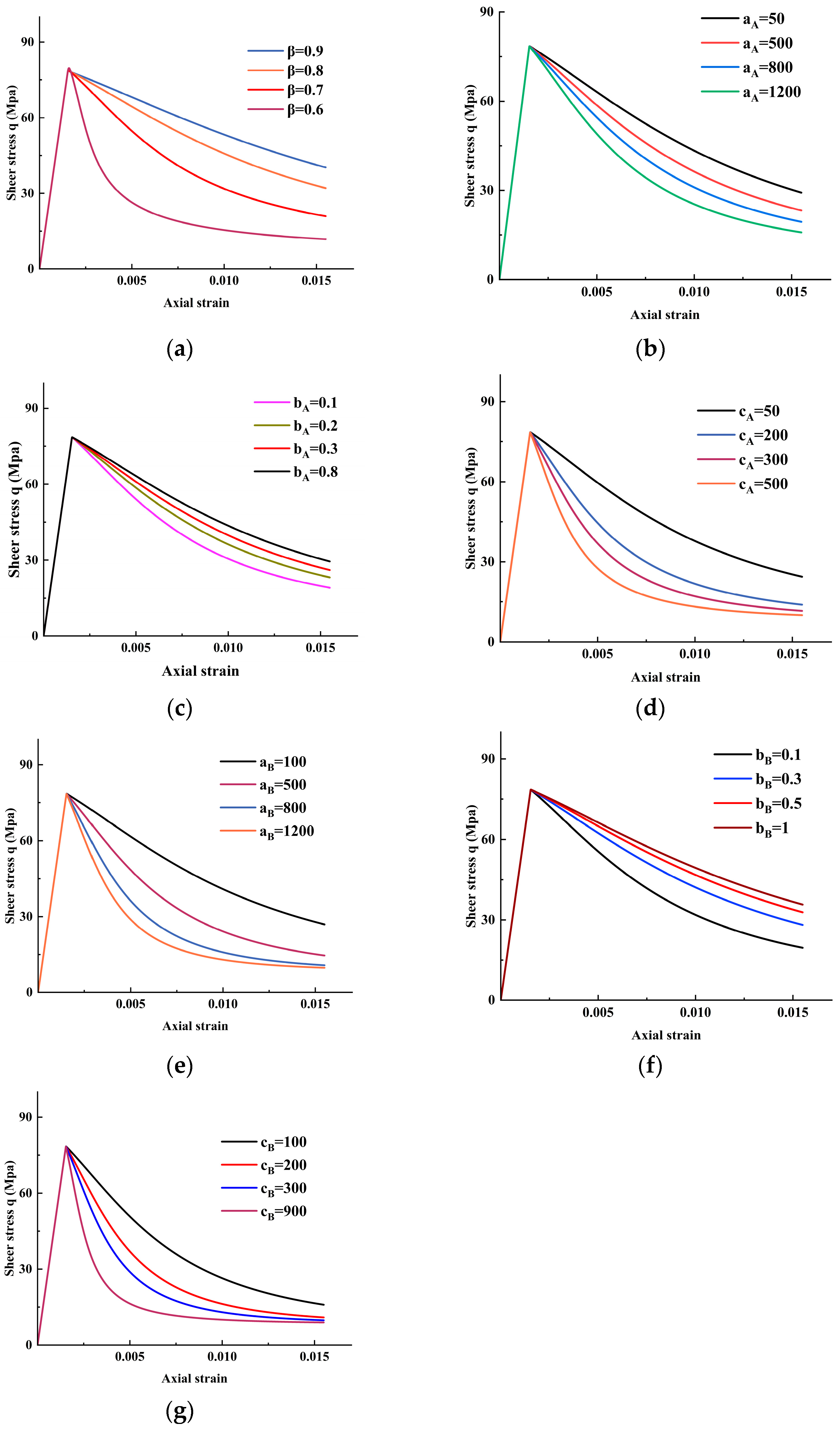
- The behavior during the softening stage is primarily governed by the parameters , , and . Among these, is the expansion parameter, which dominates the coupling mechanism between volume expansion and shear softening; and are plastic strain control parameters, whose variation with confining pressure is determined by (, , and ) and (, , and ), respectively. Parameter analysis reveals:
- (3)
- This model establishes an intrinsic relationship between confining pressure, softening parameters, and mechanical response within a unified framework. It provides a rational explanation for the formation mechanisms of variations in rock strength and ductility under different confining pressure conditions, offering a new theoretical tool for analyzing the stability of deep engineering rock masses.
Author Contributions
Funding
Institutional Review Board Statement
Informed Consent Statement
Data Availability Statement
Conflicts of Interest
References
- Du, X.; Xue, J.; Shi, Y.; Cao, C.-R.; Shu, C.-M.; Li, K.; Ma, Q.; Zhan, K.; Chen, Z.; Wang, S. Triaxial mechanical behaviour and energy conversion characteristics of deep coal bodies under confining pressure. Energy 2022, 266, 126443. [Google Scholar] [CrossRef]
- Huang, Z.; Gu, Q.; Wu, Y.; Wu, Y.; Li, S.; Zhao, K.; Zhang, R. Effects of confining pressure on acoustic emission and failure characteristics of sandstone. Int. J. Min. Sci. Technol. 2021, 31, 963–974. [Google Scholar] [CrossRef]
- Xie, H.; Li, C.; He, Z.; Li, C.; Lu, Y.; Zhang, R.; Gao, M.; Gao, F. Experimental study on rock mechanical behavior retaining the in situ geological conditions at different depths. Int. J. Rock Mech. Min. Sci. Géoméch. Abstr. 2021, 138, 104548. [Google Scholar] [CrossRef]
- Yang, S.-Q.; Huang, Y.-H. An experimental study on deformation and failure mechanical behavior of granite containing a single fissure under different confining pressures. Environ. Earth Sci. 2017, 76, 364. [Google Scholar] [CrossRef]
- Chen, Z.H.; Tham, L.G.; Yeung, M.R.; Xie, H. Confinement effects for damage and failure of brittle rocks. Int. J. Rock Mech. Min. Sci. 2006, 43, 1262–1269. [Google Scholar] [CrossRef]
- Xie, H.; Gao, M.; Fu, C.; Lu, Y. Mechanical behavior of brittle-ductile transition in rocks at different depths. Meitan Xuebao/J. China Coal Soc. 2021, 46, 701–715. [Google Scholar]
- Liu, S.; Chen, H.; Yuan, S.; Zhu, Q. Experimental investigation and micromechanical modeling of the brittle-ductile transition behaviors in low-porosity sandstone. Int. J. Mech. Sci. 2020, 179, 105654. [Google Scholar] [CrossRef]
- Zhang, G.; Wu, S.; Guo, P.; Zhang, S. Mechanical Deformation, Acoustic Emission Characteristics, and Microcrack Development in Porous Sandstone During the Brittle–Ductile Transition. Rock Mech. Rock Eng. 2023, 56, 9099–9120. [Google Scholar] [CrossRef]
- Sari, M.; Sarout, J.; Poulet, T.; Dautriat, J.; Veveakis, M. The Brittle–Ductile Transition and the Formation of Compaction Bands in the Savonnières Limestone: Impact of the Stress and Pore Fluid. Rock Mech. Rock Eng. 2022, 55, 6541–6553. [Google Scholar] [CrossRef]
- Tsikrikis, A.; Papaliangas, T.; Marinos, V. Brittle-Ductile Transition and Hoek–Brown mi Constant of Low-Porosity Carbonate Rocks. Geotech. Geol. Eng. 2021, 40, 1833–1849. [Google Scholar] [CrossRef]
- Zhang, J.-C.; Lin, Z.-N.; Dong, B.; Guo, R.-X. Triaxial Compression Testing at Constant and Reducing Confining Pressure for the Mechanical Characterization of a Specific Type of Sandstone. Rock Mech. Rock Eng. 2021, 54, 1999–2012. [Google Scholar] [CrossRef]
- Wang, Z.; Li, W.; Hu, Y. Experimental study on mechanical behavior, permeability, and damage characteristics of Jurassic sandstone under varying stress paths. Bull. Eng. Geol. Environ. 2021, 80, 4423–4439. [Google Scholar] [CrossRef]
- Yan, J.; Zou, Z.; Guo, S.; Zhang, Q.; Hu, X.; Luo, T. Mechanical behavior and damage constitutive model of granodiorite in a deep buried tunnel. Bull. Eng. Geol. Environ. 2022, 81, 118. [Google Scholar] [CrossRef]
- Wang, G.; Li, X.P.; Luo, Y.; Liu, T.T.; Liu, X.Q.; Qu, D.X. Characterization and mesosimulation of the triaxial compression failure of rock-like materials. IOP Conf. Ser. Earth Environ. Sci. 2020, 570, 22030. [Google Scholar] [CrossRef]
- Zhang, J.; Li, L.; Chen, X.; Cui, Z.; Jin, C.; Shen, C.; Su, Z.; Li, S.; Liang, J. Study on Microcracks Propagation of Shale Under Tensile and Shear Loading at Different Confining Pressures. Appl. Sci. 2025, 15, 11546. [Google Scholar] [CrossRef]
- Chen, H.; Zhao, C.; Zhang, R. Damage mechanism of rock induced by microcrack evolution: A multi-dimensional perspective. Eng. Fract. Mech. 2024, 309, 110420. [Google Scholar] [CrossRef]
- Tang, H.-D.; Zhu, M.-L. Timely spread characteristics of micro- and meso-scale fractures based on SEM experiment. Environ. Earth Sci. 2020, 79, 484. [Google Scholar] [CrossRef]
- Ghasemi, S.; Khamehchiyan, M.; Taheri, A.; Nikudel, M.R.; Zalooli, A. Microcracking Behavior of Gabbro During Monotonic and Cyclic Loading. Rock Mech. Rock Eng. 2021, 54, 2441–2463. [Google Scholar] [CrossRef]
- Zhao, L.; Cui, Z.; Peng, R.; Si, K. Numerical Simulation and Evaluation on Continuum Damage Models of Rocks. Energies 2022, 15, 6806. [Google Scholar] [CrossRef]
- Wu, L.-Y.; Wang, Z.; Ma, D.; Zhang, J.-W.; Wu, G.; Wen, S.; Zha, M.; Wu, L. A Continuous Damage Statistical Constitutive Model for Sandstone and Mudstone Based on Triaxial Compression Tests. Rock Mech. Rock Eng. 2022, 55, 4963–4978. [Google Scholar] [CrossRef]
- Olsen-Kettle, L.; Sarout, J. Assessment of Tensorial and Scalar Damage Models for an Isotropic Thermally Cracked Rock Under Confining Pressure Using Experimental Data: Continuum Damage Mechanics Versus Effective Medium Theory. Rock Mech. Rock Eng. 2021, 55, 505–519. [Google Scholar] [CrossRef]
- Ahmed, Z.; Wang, S.; Hashmi, M.Z.; Zhang, Z.; Zhu, C. Causes, characterization, damage models, and constitutive modes for rock damage analysis: A review. Arab. J. Geosci. 2020, 13, 806. [Google Scholar] [CrossRef]
- Le, V.T.; Nguyen, T.V.; Nguyen, N.T.; Nguyen, G.D.; Karakus, M.; Bui, H.H. A Simple 3D Damage-Plasticity Model with Energy-Based Regularisation in SPH for Modelling Fractured Quasi-brittle Rocks. Rock Mech. Rock Eng. 2025, 58, 9937–9964. [Google Scholar] [CrossRef]
- Yang, S.-Q.; Hu, B.; Xu, P. Study on the damage-softening constitutive model of rock and experimental verification. Acta Mech. Sin. 2019, 35, 786–798. [Google Scholar] [CrossRef]
- Chen, K. Constitutive model of rock triaxial damage based on the rock strength statistics. Int. J. Damage Mech. 2020, 29, 1487–1511. [Google Scholar] [CrossRef]
- Wang, Y.-N.; Wang, L.-C.; Zhou, H.-Z. An experimental investigation and mechanical modeling of the combined action of confining stress and plastic strain in a rock mass. Bull. Eng. Geol. Environ. 2022, 81, 204. [Google Scholar] [CrossRef]
- Shen, P.; Tang, H.; Ning, Y.; Xia, D. A damage mechanics based on the constitutive model for strain-softening rocks. Eng. Fract. Mech. 2019, 216, 106521. [Google Scholar] [CrossRef]
- Chen, Y.; Lin, H.; Wang, Y.; Xie, S.; Zhao, Y.; Yong, W. Statistical damage constitutive model based on the Hoek–Brown criterion. Arch. Civ. Mech. Eng. 2021, 21, 117. [Google Scholar] [CrossRef]
- Zhao, Y.; Li, Y.; Bi, J.; Wang, C.; Li, Y.; Zhong, X. Triaxial compression experiment and damage constitutive model of microbially modified strongly weathered phyllite. Constr. Build. Mater. 2023, 393, 131962. [Google Scholar] [CrossRef]
- Huang, Q.; Zhao, K.; Xiao, W.; Nie, Q.; Chen, J.; Liu, Y.; Zhong, J. Deformation failure and damage evolution law of weathered granite under triaxial compression. Nondestruct. Test. Eval. 2024, 39, 1900–1924. [Google Scholar] [CrossRef]
- Cao, W.; Tan, X.; Zhang, C.; He, M. Constitutive model to simulate full deformation and failure process for rocks considering initial compression and residual strength behaviors. Can. Geotech. J. 2019, 56, 649–661. [Google Scholar] [CrossRef]
- Jin, J.; She, C.; Shang, P. Evolution models of the strength parameters and shear dilation angle of rocks considering the plastic internal variable defined by a confining pressure function. Bull. Eng. Geol. Environ. 2021, 80, 2925–2953. [Google Scholar] [CrossRef]
- Le, V.T.; Nguyen, T.V.; Karakus, M.; Nguyen, G.D.; Bui, H.H. SPH-based modelling of the entire rock caving process: Insights into failure mechanisms. Int. J. Rock Mech. Min. Sci. Géoméch. Abstr. 2025, 194, 106228. [Google Scholar] [CrossRef]
- Wang, C.; He, B.; Hou, X.; Li, J.; Liu, L. Stress–Energy Mechanism for Rock Failure Evolution Based on Damage Mechanics in Hard Rock. Rock Mech. Rock Eng. 2019, 53, 1021–1037. [Google Scholar] [CrossRef]
- Chen, Z.; He, C.; Ma, G.; Xu, G.; Ma, C. Energy Damage Evolution Mechanism of Rock and Its Application to Brittleness Evaluation. Rock Mech. Rock Eng. 2018, 52, 1265–1274. [Google Scholar] [CrossRef]
- Nguyen, N.T.; Nguyen, G.D.; Karakus, M.; Bui, H.H.; Phan, D.G. Controlling behaviour of constitutive models for rocks using energy dissipations. Int. J. Plast. 2024, 184, 104196. [Google Scholar] [CrossRef]
- Mukherjee, M.; Nguyen, G.D.; Mir, A.; Bui, H.H.; Shen, L.; El-Zein, A.; Maggi, F. Capturing pressure- and rate-dependent behaviour of rocks using a new dam-age-plasticity model. Int. J. Impact Eng. 2017, 110, 208–218. [Google Scholar] [CrossRef]
- Walton, G.; Hedayat, A.; Kim, E.; Labrie, D. Post-yield Strength and Dilatancy Evolution Across the Brittle–Ductile Transition in Indiana Limestone. Rock Mech. Rock Eng. 2017, 50, 1691–1710. [Google Scholar] [CrossRef]
- Yumlu, M.; Ozbay, M. A study of the behaviour of brittle rocks under plane strain and triaxial loading conditions. Int. J. Rock Mech. Min. Sci. Géoméch. Abstr. 1995, 32, 725–733. [Google Scholar] [CrossRef]
- Li, K.; Ge, X.; Li, C. Method for Determining Hoek-Brown Softening Parameters of Rocks Based on Triaxial Compression Tests. China Rural Water Hydropower 2011, 8, 117–120. [Google Scholar]
- Chen, X.; Li, Y.; Tong, L.; Geng, D.; Dong, Z.; Yang, P. Elastoplastic Damage Behavior of Rocks: A Case Study of Sandstone and Salt Rock. Rock Mech. Rock Eng. 2023, 56, 5621–5634. [Google Scholar] [CrossRef]
- Unteregger, D.; Fuchs, B.; Hofstetter, G. A damage plasticity model for different types of intact rock. Int. J. Rock Mech. Min. Sci. Géoméch. Abstr. 2015, 80, 402–411. [Google Scholar] [CrossRef]





| Marble | Sandstone | Granite | |
|---|---|---|---|
| (GPa) | 51.14 | 20 | 50 |
| Poisson’s ratio | 0.24 | 0.25 | 0.22 |
| (MPa) | 900 | 1070 | 1040 |
| (MPa) | −8 | −1.8 | −1 |
| 0.39 | 0.15 | 0.18 | |
| 0.98 | 0.95 | 0.88 | |
| 1 | 2.5 | 2.6 | |
| 0.9 | 0.88 | 0.85 | |
| 181.65 | 389.53 | 457.14 | |
| 0.404 | 0.3584 | 0.4159 | |
| 18.2 | 10.13 | 42.86 | |
| 88.71 | 137.59 | 250 | |
| 0.2906 | 0.3407 | 2.71 | |
| 11.08 | 12.21 | 50 |
Disclaimer/Publisher’s Note: The statements, opinions and data contained in all publications are solely those of the individual author(s) and contributor(s) and not of MDPI and/or the editor(s). MDPI and/or the editor(s) disclaim responsibility for any injury to people or property resulting from any ideas, methods, instructions or products referred to in the content. |
© 2026 by the authors. Licensee MDPI, Basel, Switzerland. This article is an open access article distributed under the terms and conditions of the Creative Commons Attribution (CC BY) license.
Share and Cite
Huang, W.; Ren, J.; Wang, P.; Yuan, B.; Long, J.; Zhou, H.; Chen, R.; Li, H. An Improved Damage–Plasticity Constitutive Model Capturing Rock Softening Behavior Under Various Confining Pressures. Appl. Sci. 2026, 16, 541. https://doi.org/10.3390/app16010541
Huang W, Ren J, Wang P, Yuan B, Long J, Zhou H, Chen R, Li H. An Improved Damage–Plasticity Constitutive Model Capturing Rock Softening Behavior Under Various Confining Pressures. Applied Sciences. 2026; 16(1):541. https://doi.org/10.3390/app16010541
Chicago/Turabian StyleHuang, Wei, Juntao Ren, Peiyong Wang, Bingxiang Yuan, Junxuan Long, Haiqing Zhou, Rui Chen, and Hao Li. 2026. "An Improved Damage–Plasticity Constitutive Model Capturing Rock Softening Behavior Under Various Confining Pressures" Applied Sciences 16, no. 1: 541. https://doi.org/10.3390/app16010541
APA StyleHuang, W., Ren, J., Wang, P., Yuan, B., Long, J., Zhou, H., Chen, R., & Li, H. (2026). An Improved Damage–Plasticity Constitutive Model Capturing Rock Softening Behavior Under Various Confining Pressures. Applied Sciences, 16(1), 541. https://doi.org/10.3390/app16010541