

Article

Beam Damage Detection and Characterization Using Rotation Response from a Moving Load and Damage Candidate Grid Search (DCGS)

Department of Civil and Environmental Engineering, Southern Methodist University, P.O. Box 750340, Dallas, TX 75205, USA
*
Author to whom correspondence should be addressed.
Appl. Sci. 2026, 16(1), 539; https://doi.org/10.3390/app16010539
Submission received: 24 November 2025 / Revised: 18 December 2025 / Accepted: 24 December 2025 / Published: 5 January 2026
(This article belongs to the Special Issue Advances in Structural Health Monitoring in Civil Engineering)

Abstract

Structural health monitoring (SHM) increasingly contributes to the safety and durability of key infrastructure, especially bridges. This research introduces a rotation-based approach for damage detection and quantification using a damage candidate grid search technique (DCGS) on simply supported girder bridges under quasi-static or slowly moving loading conditions. Applying the principle of virtual work, the healthy and candidate-damaged rotation responses are analytically obtained and compared with the rotation observed directly at the moving load location. Damage is defined in terms of three key parameters: the start and the end of the damage, L 1 and L 2 , respectively, and the damage severity β . The DCGS method is validated using finite element model simulations of 12 damage scenarios subjected to different noise levels. A statistical analysis and confidence interval characterize the accuracy and consistency of the top ten estimations produced by the DCGS method. A damage length ratio (DLR), defined from the span of the beam, L , and the damage location, L 1 and L 2 , improves the robustness of the methodology against measurement noise by reducing possible false positive estimations. Additionally, the experimental results on two beam structures further validate the method. Absolute relative errors (AREs) of about 6% and absolute errors (AEs) of around 0.16 between the estimated and real damage parameters characterize the performance of the technique, considering damage location and damage severity, respectively. The results show that the DCGS methodology can effectively locate damage and estimate its severity in the presence of noise. The developed framework provides a sensitive and practical SHM tool that is suitable for early damage detection in railway and road bridges.

1. Introduction

Management of aging civil structures, including road and railway bridges, has become a major challenge worldwide [1,2,3]. Sudden or gradual changes in how a structure operates can indicate acute or cumulative damage, such as cracks, corrosion, and other stiffness reductions, which can seriously affect the structure’s behavior and might result in a major failure if not identified and remedied [4,5,6]. Monitoring structures’ performance and detecting early signs of damage enhances safety and promotes continuous operation. Extensive research and development of structural health monitoring (SHM) and Non-Destructive Evaluation (NDE) techniques have demonstrated the use of sensors placed directly on structures to monitor their health and performance [5,7,8,9,10,11,12,13,14,15]. SHM methods aim to detect damage existence, location, severity, and a structure’s remaining life according to the so-called Rytter levels [10,16,17,18,19].
Vibration monitoring techniques represent a common SHM approach for detecting damage in structures [20,21] by evaluating dynamic characteristics such as natural frequencies, mode shapes, and damping [13,22,23,24,25]. While changes in natural frequencies and mode shapes reveal structural changes to the physical quantities that define them, relating these structural changes to specific damage characterization remains a challenging task [26]. For example, many techniques characterize damage most effectively in the presence of large deviations in actual structure response, such as displacements [27] or rotations [28], or the characteristic markers of such dynamic response, e.g., large frequency changes [1,18,29] or large mode shape changes [30,31]. Logistic difficulties of monitoring pose additional challenges in partial implementation of SHM systems on bridges and other structures. The cost and downtime of installing, powering, and maintaining physical sensors placed physically on infrastructure restrict widespread implementation; at a minimum, bridge owners must justify the cost–benefit ratios associated with such efforts [32,33,34]. Remediation of some of the technical limitations of SHM includes, as one example, controlled evaluations of SHM methodologies through the use of techniques that evaluate a structure’s response to a specific moving load [17,27,35,36,37,38]. Two categories of such an approach comprise (1) quasi-static moving load tests, where a vehicle traverses a bridge at slow velocity to reduce the dynamic effect on the bridge [4,37,39,40], and (2) drive-by monitoring, sometimes called indirect monitoring, which uses vehicle vibration response to evaluate the bridge’s condition [38,41,42]. Quasi-static load–response testing has evolved from load rating to more sophisticated load–response characterizations [43,44]. In particular, displacement influence lines (DILs), which represent the static deflection at a fixed point on the span caused by a moving unit load, mechanically relate structural responses, such as deflection or rotation, to load and bridge condition. Differences in DILs between the healthy and damaged conditions have been proposed as a way to detect a damage [37,39,45,46,47]. In another application, the second derivative of DILs relates mechanistically to the flexural rigidity of a structure [46,48]. Techniques based on DILs have shown potential in both locating and quantifying damage [37,45,46,48]. While static deflection changes resulting from reduced stiffness mechanically relate to damage [5], measuring vertical deflections in field conditions has proven difficult in practice, although new non-contact methods show promise [49,50,51]. Additionally, noise in measurements can affect the accuracy of these methods [46,52].
While vertical deflections remain difficult to obtain, especially through indirect monitoring, rotations provide an alternative data stream that has shown strong potential for detecting damage and are much easier to capture from a moving vehicle [3,17,53]. Stiffness reductions cause rotation changes with which to identify structural changes [3,17,48,54]. Measuring rotation is easier to capture than deflection [3], and differences in rotation influence lines (RILs) between healthy and damaged bridge conditions have been suggested as indicators of damage, offering information about both the severity and location of the damage [17,55]. Moreover, rotation-based methods can localize damage with few sensors, for example, two rotation sensors mounted at supports, because rotations are relatively easy to measure with high-precision inclinometers that do not require reference points compared to deflection methods [53]. In addition, RIL methods are less sensitive to operational variability in traffic loading [53]. By contrast, frequency-based methods often show only small modal shifts, making them more susceptible to operational variability [56].
The main concept of indirect (drive-by) monitoring is treating the vehicle–bridge system as a coupled interaction, where the moving vehicle excites the bridge, and the bridge shapes the vehicle’s response [57]. In drive-by monitoring, sensors gather data while moving vehicles, avoiding on-bridge instrumentation and sensor maintenance, which supports faster deployment and less traffic disruption [58,59]. On the other hand, drive-by methods depend on unknown vehicle properties (mass and suspension) and velocity [58]. Also, strong effects from road roughness can decrease the ability to estimate the bridge properties [58,60].
Various indirect response characteristics have been estimated in previous work and used for model updating [61], system identification [62], damage identification [63,64], and damage characterization [65]. As extracting bridge properties remains a challenge, some of the drive-by methods used contact point calculations [18,66,67], and others took advantage of the benefit of having multiple vehicles passing a bridge and used crowdsourcing techniques [18,59,63].
This paper establishes a methodology that mechanically relates rotation measurements from a moving load to damage conditions in a girder-type bridge; specifically, the DCGS method identifies, locates, and quantifies reductions in flexure rigidity, i.e., the Level III SHM method. This study focuses on quasi-static rotation measurements obtained at the moving load location, where the moving load is treated as any mass that directly follows the structural response of the bridge without being influenced by suspension effects or surface roughness. Example applications include wheel or chassis response below the suspension of a vehicle, such as in a cart or trailer [38], a rail bogie [68], or a vehicle with stiff suspension. In load testing or load rating under these configurations, classical vehicle–bridge interaction (VBI) effects and interaction of surface roughness as an input excitation are minimal.
First, theoretical derivations of the healthy and damaged beams are obtained, and the DCGS methodology is introduced. Subsequently, procedures for executing and evaluating the method are detailed, and the results are presented and evaluated. A theoretical model establishes the estimation tool, while finite element models (FEMs) and laboratory experiments provide validation. The addition of noise to the analytical results provides a characterization of the accuracy and confidence of the method’s estimations of damage. A severity versus damage length ratio analysis provides context for the limitations of the method under small damage scenarios. The DCGS method enables accurate damage localization and damage severity estimation based on rotation observations at the moving load location, which offers a practical solution for SHM of bridge-like beams.

2. Theoretical Derivations

2.1. Beam Rotation of a Healthy Beam

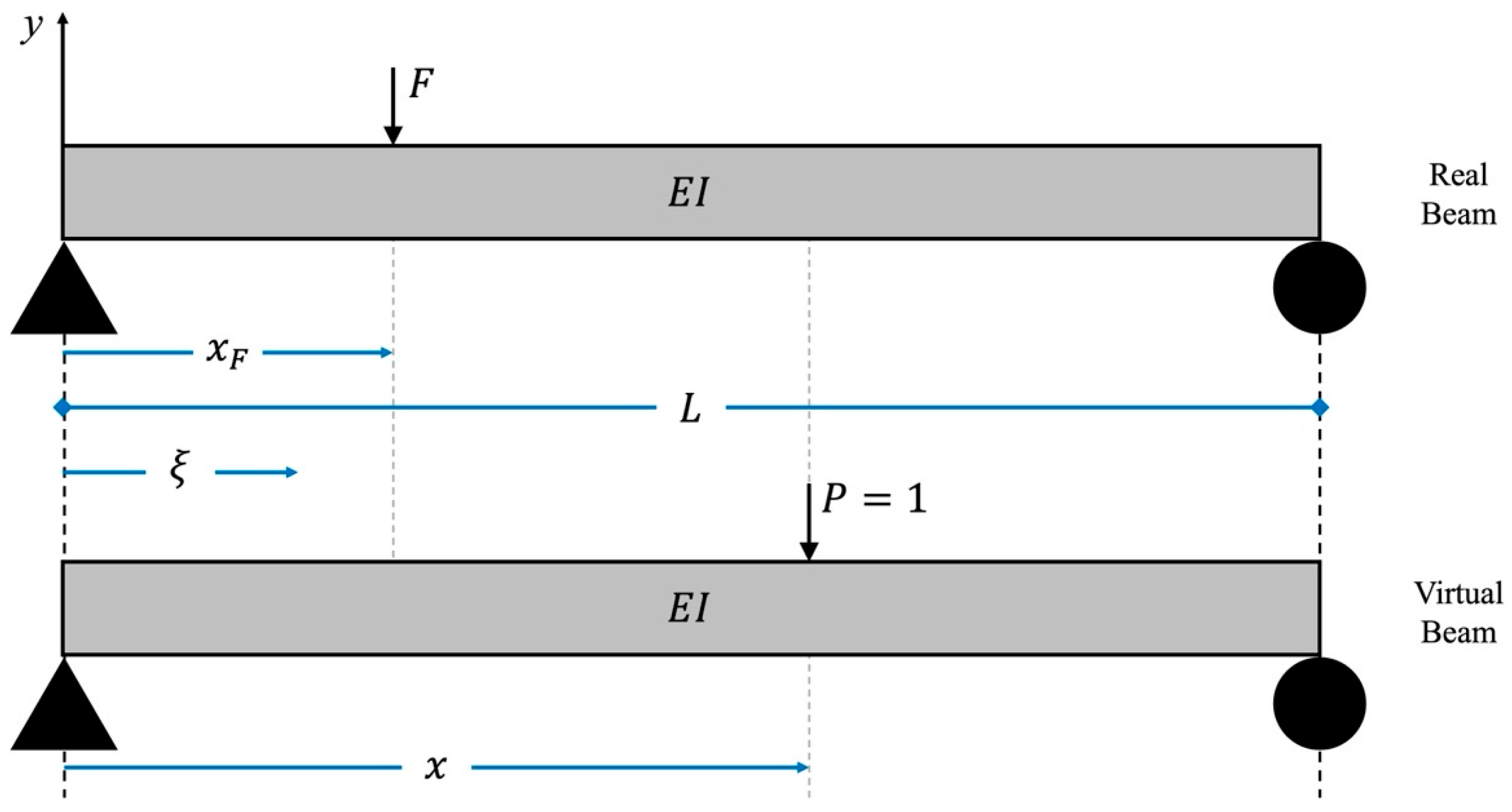
A simply supported beam with a span L , modulus of elasticity E , and second moment of area I that has a constant flexural rigidity (i.e., E I x = E I ) defines the healthy condition. The healthy deflection ( y h ) of the beam at any location x in response to a moving load F at location x F can be formulated via virtual work [69] as follows:
y h x , x F = 0 L M x F , ξ m x , ξ E I d ξ
M x F , ξ and m x , ξ are the bending moment of the beam due to a real moving load F acting at a distance x F and a virtual unit load P acting at a distance x , respectively, from the left support, as shown in Figure 1.
Both moments are a function of the dummy integration variable ξ and are expressed as follows:
M x F , ξ = F ξ L x F L ξ x F F ξ L x F L F ξ x F ξ > x F
m x , ξ = ξ L x L ξ x ξ L x L ξ x ξ > x
Substituting Equations (2) and (3) into Equation (1) and expanding the integral gives the quasi-static healthy deflection as follows:
y h x , x F = y h 1 x , x F x x F y h 2 x , x F x > x F
where
y h 1 x , x F = 0 x M 1 ξ m 1 ξ E I d ξ + x x F M 1 ξ m 2 ξ E I d ξ + x F L M 2 ξ m 2 ξ E I d ξ
y h 2 x , x F = 0 x F M 1 ξ m 1 ξ E I d ξ + x F x M 2 ξ m 1 ξ E I d ξ + x L M 2 ξ m 2 ξ E I d ξ
Utilizing the Heaviside function, H ϕ , Equation (7) is defined as follows:
H ϕ = 0 ϕ < 0 0.5 ϕ = 0 1 ϕ > 0
The total healthy deflection solution from Equations (5) and (6) becomes the following:
y h x , x F = F 6 E I L [ x L x F 2 L x F x 2 x F 2 H x F x           + x F L x 2 L x x 2 x F 2 H x x F ]
The corresponding beam healthy rotation is the first derivative of Equation (8) with respect to x as follows:
θ h x , x F = F 6 E I L [ L x F 2 L x F 3 x 2 x F 2 H x F x           + x F 2 L 2 + 3 x 2 + x F 2 6 L x H x x F ]

2.2. Beam Rotation of a Damaged Beam

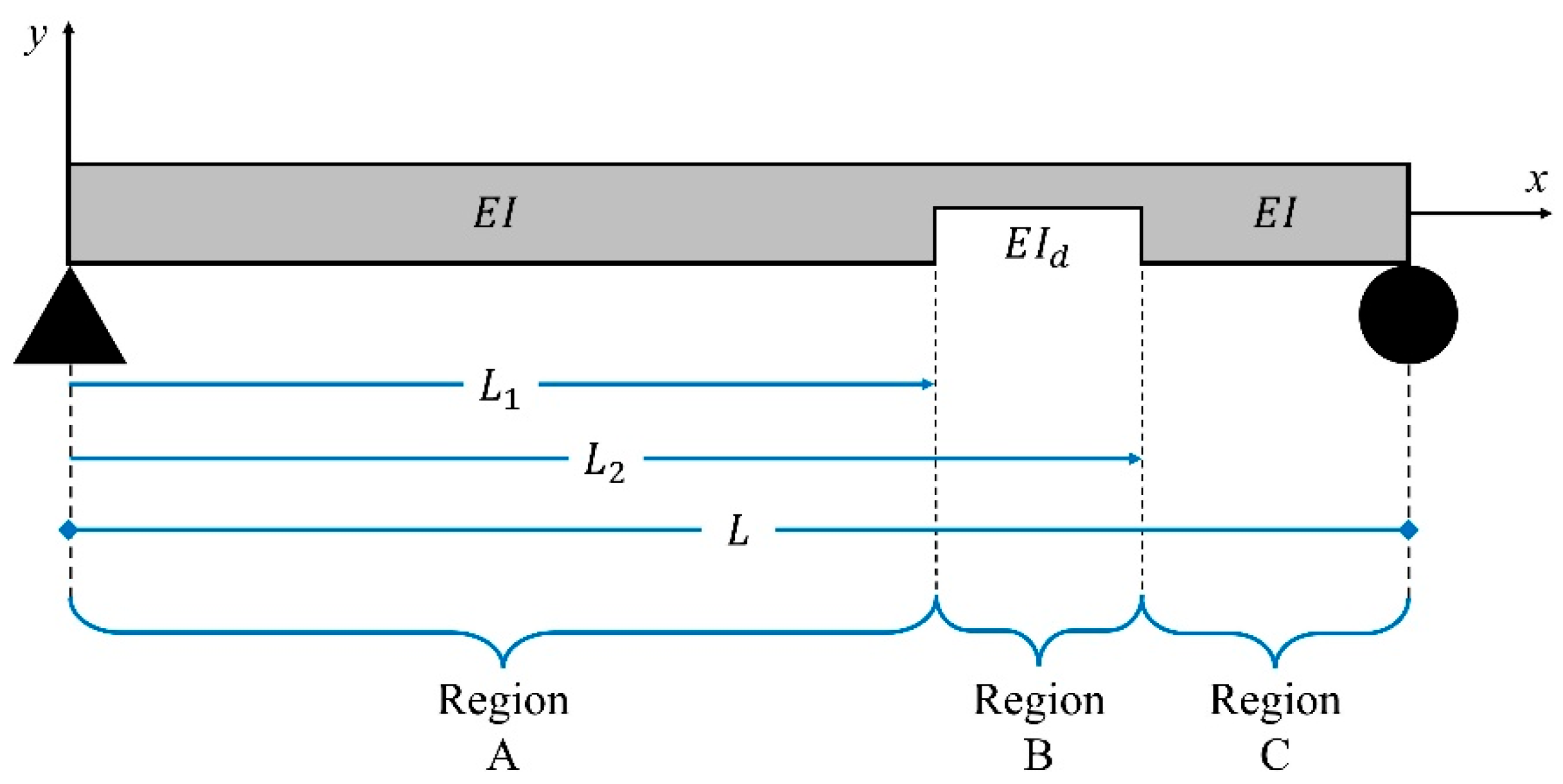
At the damaged location, defined by L 1 and L 2 in Figure 2, the beam’s flexural rigidity is reduced and becomes E I d = 1 β E I , where 0 β < 1 . The beam is divided into three different regions depending on the location of x relative to L 1 and L 2 : Region A, prior to damage ( 0 x < L 1 ); Region B, the region of the damage ( L 1 x < L 2 ); and Region C, the region after the damage ( L 2 x < L ).
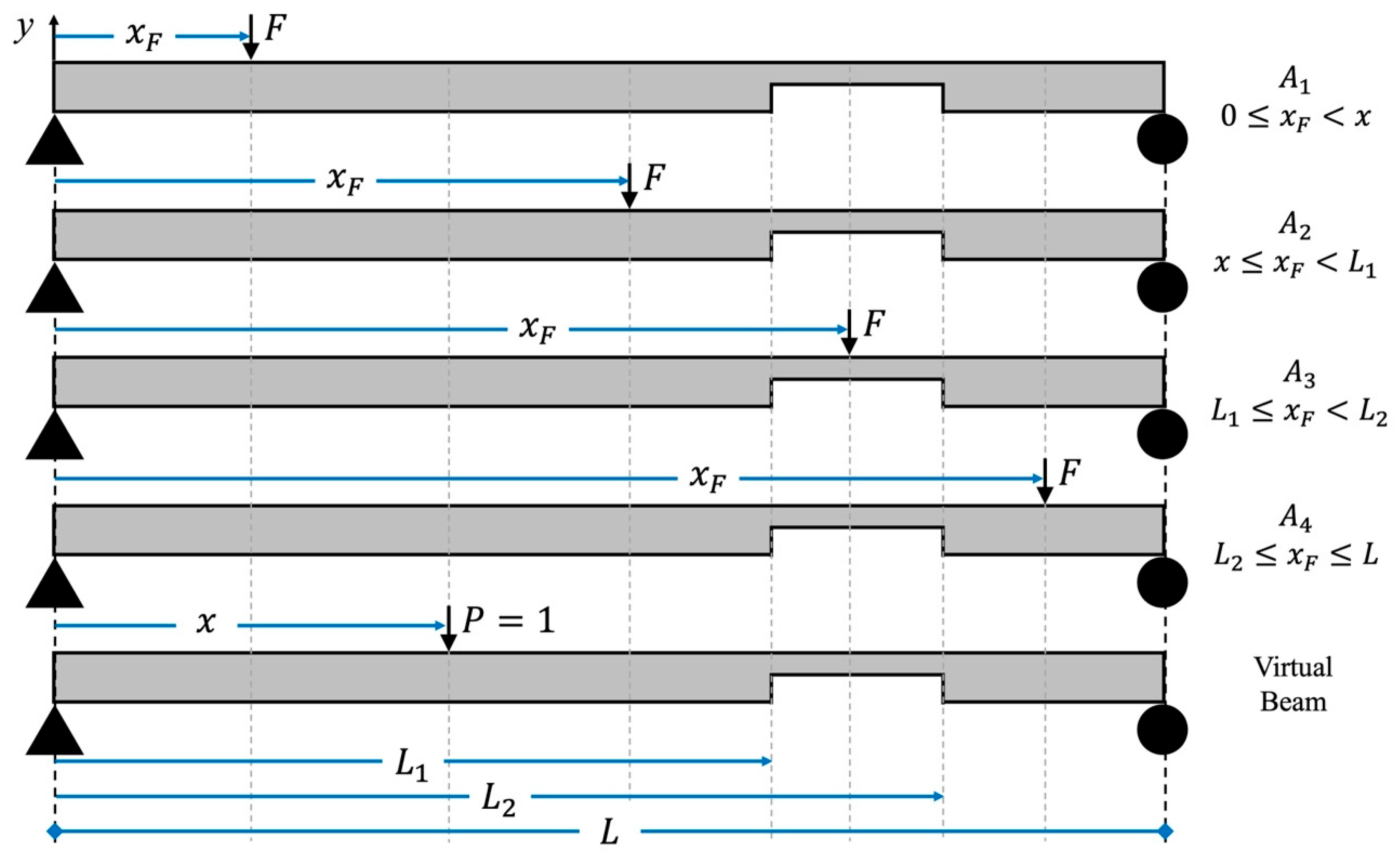
Each region is divided into 4 sub-regions depending on the location of the moving load x F relative to the locations of the measurement and damage. As an illustration, Figure 3 expresses the 4 sub-regions for Region A.
The sub-regions of Regions B and C follow the same pattern in Figure 3. The region’s deflections result from the real and virtual moments defined in Equations (2) and (3) and the method of virtual work. For Region A, the first damaged deflection contribution is as follows:
y d A 1 x , x F = 0 x F M 1 ξ m 1 ξ E I d ξ + x F x M 2 ξ m 1 ξ E I d ξ + x L 1 M 2 ξ m 2 ξ E I d ξ               + L 1 L 2 M 2 ξ m 2 ξ 1 β E I d ξ + L 2 L M 2 ξ m 2 ξ E I d ξ
The same formulation applies to y d A 2 , y d A 3 , and y d A 4 by changing the integration limits and corresponding moment functions. The deflection of Region A in the presence of damage can be represented as the summation of the healthy deflection, y h x , x F and a piecewise term determined by evaluating the difference of Equations (8) and (10) as follows:
y d A i x , x F = y h x , x F + x F α A i
where α is
α = β 6 1 β E I L 2
and the A i coefficients, which, depending on the location of the moving load x F , are defined when 0 x F < x and x x F < L 1 as follows:
A 1 = A 2 = 2 x F L L 2 3 L L 1 3
when L 1 x F < L 2
A 3 = 3 L 2 L 1 2 2 L 2 x F + x F 2 + L 6 L 2 2 x F 2 L 1 3 3 L 1 2 x F x F 3 + 2 x F L 1 3 L 2 3
when L 2 x F L
A 4 = L 1 L 2 L x F 3 L L 1 2 L 1 2 2 L 1 L 2 2 L 2 2 + 3 L L 2
Now, Equation (11) can be expressed using the Heaviside function as follows:
y d A x , x F = y h x , x F + F x α { A 1 H x x F + A 2 H x F x H x F L 1 + A 3 H x F L 1 H x F L 2 + A 4 H x F L 2 }
The corresponding beam rotation for Region A is the first derivative of Equation (14) with respect to x as follows:
θ d A x , x F = θ h x , x F + F α ( A 1 H x x F + A 2 H x F x H x F L 1 + A 3 H x F L 1 H x F L 2 + A 4 H x F L 2 }
Following a similar procedure to Regions B and C, the final total damaged deflection, y d x , x F , of the beam can be expressed as follows:
y d x , x F = y d A x , x F H L 1 x + y d B x , x F H x L 1 H x L 2 + y d C x , x F H x L 2
and the corresponding final total damaged rotation, θ d x , x F , of the beam is as follows:
θ d x , x F = θ d A x , x F H L 1 x + θ d B x , x F H x L 1 H x L 2 + θ d C x , x F H x L 2
The general equations for healthy rotation (i.e., Equation (9)) and damaged rotation (i.e., Equation (17)) can be specialized to represent either (1) the beam rotation profile as a function of x with the load fixed at x F and (2) the rotation influence line, which defines the rotation at a specific location x on the beam as the load location, x F , which varies. For application to indirect monitoring, the rotation response of the moving load location is critical; Equations (9) and (17) represent this rotation at the load location by substituting x F for x as shown in Equations (18) and (19) for the healthy and damaged responses, respectively.
θ h x F = F x F 3 L x F 2 x F 2 L 2 3 E I L
θ d x F = θ d A 1 x F H L 1 x F + θ d B 2 x F H x F L 1 H x F L 2 + θ d C 3 x F H x F L 2
From Equation (19), θ d A 1 x F represents Region A rotation using only the first coefficient of A , θ d B 2 x F represents Region B rotation using only the second coefficient of B , and θ d C 3 x F represents Region C rotation using only the third coefficient of C .

3. Rotation-Based Damage Detection Using the Candidate Grid Search Technique (DCGS)

The literature highlights the potential diagnostic efficacy of rotation towards improved damage characterization [3,17,53,54]. The overall approach of the rotation-based DCGS utilizes the preceding rotation response damage equations and compares measured rotation responses to a pool of candidate damaged rotation responses representing combinations of damage parameters.
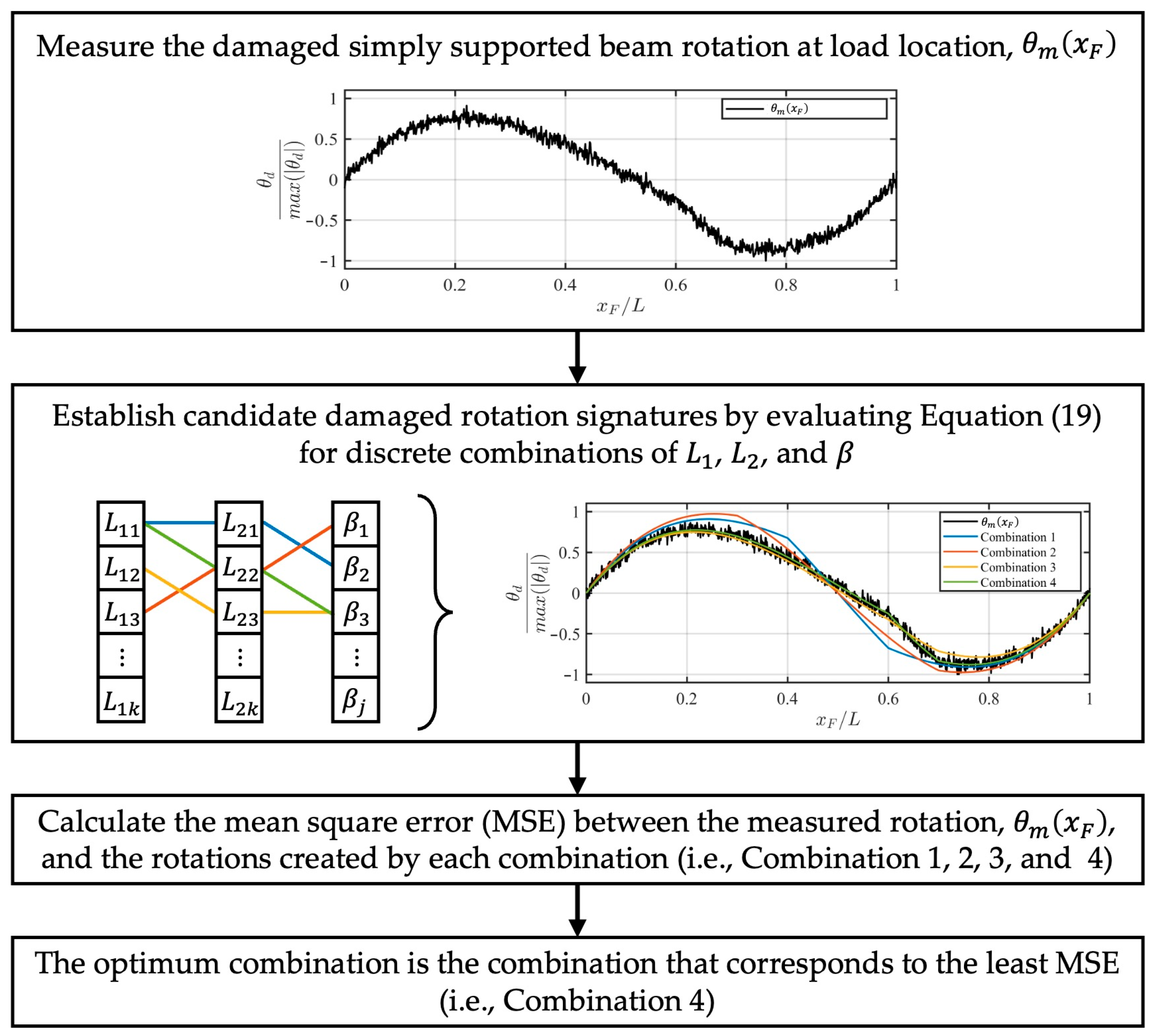
This section outlines the proposed damage estimation methodology and illustrates its structure and workflow in the flowchart depicted in Figure 4.
At the load location, x F , the beam’s rotation θ m x F is measured using a dedicated rotation measuring device (e.g., inclinometer or accelerometer attached to a rail bogie frame). Once the rotation in the damaged state, θ m x F , is measured, Equation (19) provides estimates of rotation in terms of unknown damage parameters, L 1 , L 2 , and β , which define the location (i.e., start and end) of the damage and its severity, respectively. The substitution of combinations of L 1 , L 2 , and β into Equation (19) defines candidate damaged rotation data streams. A grid search was performed over all combinations, with L 1 and L 2 varying along the span of the beam with an increment of 0.001 L and a restriction of L 2 > L 1 , and the severity β ranging from 1 to 99% in 1% increments; a total of about 50 million combinations defined the grid search. The minimum MSE of all combinations with the measured response determines the estimate of L 1 , L 2 , and β .

4. Analytical and Experimental Procedures for the DCGS Evaluation

Analytical simulations and laboratory experiments provide data with which to evaluate the method’s performance. To evaluate the accuracy and reliability of the proposed damage detection method in both analytical and experimental scenarios, the absolute relative error (ARE) and the absolute error (AE) are calculated between the estimated ( V e s t ) and actual ( V a c t ) damage parameters, and they are computed in Equations (20) and (21), respectively, as follows:
A R E = V e s t V a c t V a c t · 100
A E = V e s t V a c t

4.1. Analytical Evaluation via Finite Element Method (FEM) Analysis

FEM analysis provides simulated data with which to evaluate the methodology analytically under several conditions. A simply supported beam represents a girder bridge modeled as a 2D Euler–Bernoulli beam in SAP2000 software (version 22), as shown in Figure 3, using the arbitrary material and geometric values listed in Table 1.
A sensitivity analysis determined the appropriate number of finite elements for accurate rotation response measurement. Models with varying element numbers were tested, and the results showed that increasing the number above 1000 elements (1001 nodes) achieved no additional improvement in accuracy while ensuring adequate representation of damaged response. Damage was introduced by reducing the flexural rigidity, E I , at specific locations, representing different levels of damage severity.
A moving load, F , representing a passing vehicle traveling at a slow speed (i.e., 0.01 m/s) to ensure no dynamic effects, traversed the beam at a constant small step size ( 0.001 L ) in a quasi-static manner. As the load moved across the beam, the rotation response was recorded at each node, producing a rotation influence line for each node. From the observed rotation influence lines, a 1001 by 1001 rotation matrix was constructed, where each column represents the rotation influence line of a specific node and each row corresponds to the beam’s rotation profile for a fixed load location. The observed FEM rotation matrix, denoted as θ m x , x F , is represented in Equation (22). The observed rotation at the load location, θ m x F , is represented by the diagonal of the matrix, as shown in Equation (23).
θ m x , x F = θ 1,1 θ 2,1 θ 3,1 θ 1,2 θ 1,3 θ 1,1001 θ 2,2           θ 1001,1     θ 1000,1000     θ 1001,1001
θ m x F = d i a g θ m x , x F

4.2. Analytical Damage Scenarios

Several FEM damage scenarios were simulated to examine the applicability and robustness of the DDSG methodology to different damage cases and noise levels. Table 2 lists all the damage scenarios used. FE-DS1 through FE-DS6 represent damage over 1% of the span, the damage length ratio (DLR), for increasing severities, representing localized damage, such as a crack. FE-DS7 through FE-DS12 represent distributed damage, such as corrosion or loss of composite action over 10% DLR of the span, for increasing severities.
To study the effect of variability from noise on the DCGS method, the FEM estimation results from all analytical damage scenarios were subjected to four levels of Gaussian noise: 0%, 2%, 5%, and 9%. Noisy FEM rotation measurements, θ n x F , following a normal distribution, were created according to [16,29,46,48] as follows:
θ n x F = θ m x F + ε · N R · r m s θ m x F
In Equation (24), ε is the noise level, N R is the normal random noise vector, and r m s θ m x F is the root mean square of the observed rotation. This noise can represent measurement or environmental noise. In addition, road roughness does not significantly affect the quasi-static bridge response; however, the added noise can act as a surrogate for small contact irregularities that might affect rotation response.

4.3. Laboratory-Scale Experimental Evaluation

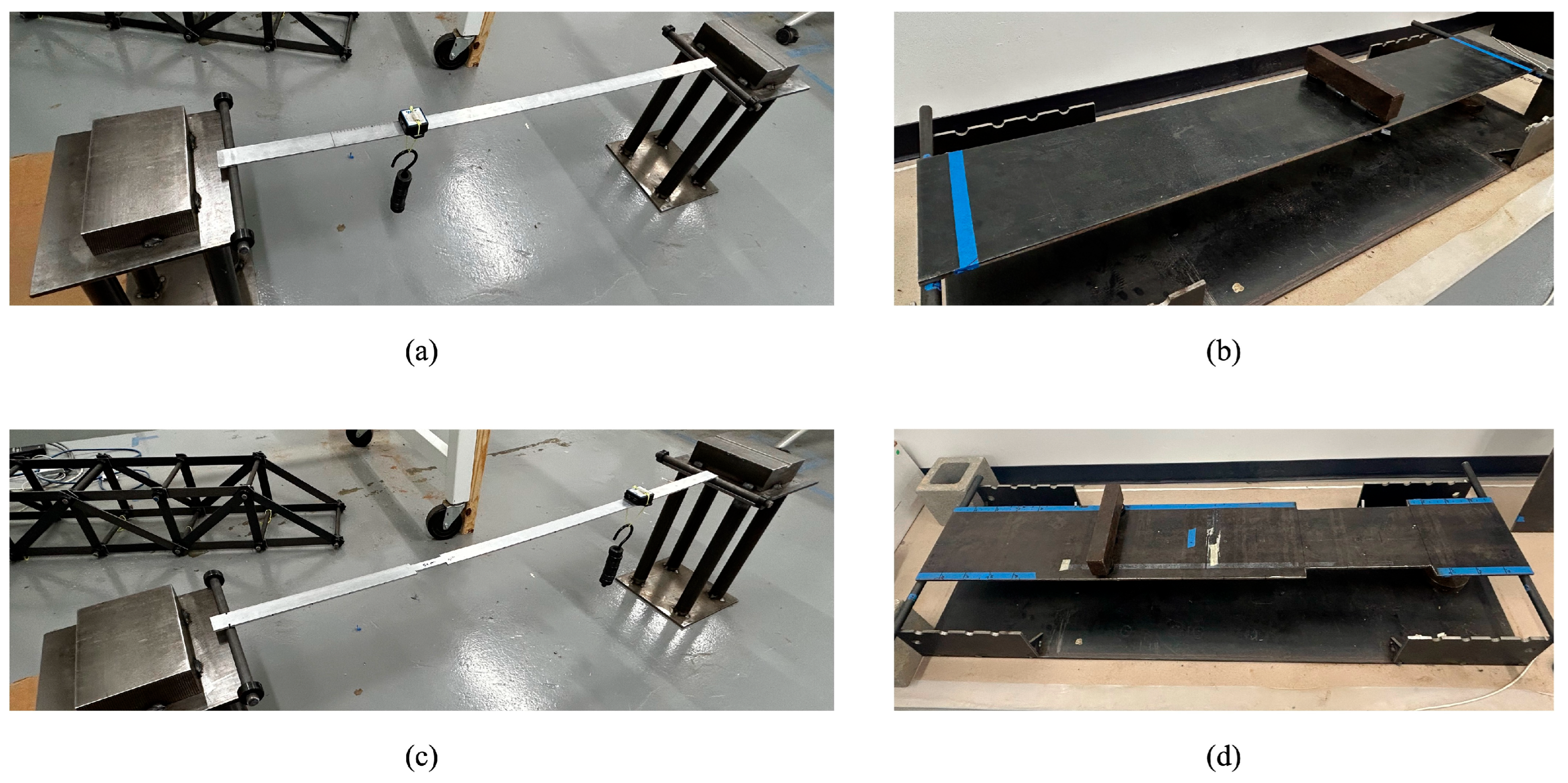
Quasi-static experiments on two simply supported beams provided data with which to further evaluate the methodology. Figure 5 illustrates the aluminum and steel beam setups upon which a load was quasi-statically traversed incrementally along the span.
A WitMotion wireless inertial measurement unit (IMU) (WitMotion Shenzhen Co., Ltd., Shenzhen, China) with sampling frequencies ranging from 0.2 to 200 Hz and a static angle resolution reaching 0.05° measured the angle of rotation created by an applied load at the same location for several locations along the beam.
Both the applied load and the sensor were placed along the beam simultaneously. At each location, the rotation response was recorded, providing the needed beam rotation at the load location, θ m x F . The load and the sensor were carefully applied at discrete locations, simulating a quasi-static analysis. Rotation observations were measured at 19 and 16 evenly spaced locations across the full length of the beam and included both supports for the aluminum and steel beams, respectively.
Three experimental beam damage scenarios (Ex-DS1–Ex-DS3) were imposed by reducing the beams’ second moment of area through width reduction. Ex-DS1 and Ex-DS2 were applied to the aluminum beam, and Ex-DS3 was applied to the steel beam; Table 3 shows the damage scenario parameters.
The parameters in Table 3 were either measured directly (i.e., geometric, load, damage) or, in the case of elastic moduli, determined from the experimental load deflection results. The width and the height of the healthy and damaged regions were measured using digital calipers and measuring tape for the aluminum beam and the steel beam, respectively, and are reported in Table 3.

5. Results and Discussion

This section presents results for the analytical investigation of the DCGS method, followed by a statistical analysis of results, and then an approach is presented using the FEM observations for identifying the healthy region boundaries, considering the effects of noise. Following that, the experimental results are presented. For both analytical and experimental investigations, an evaluation of the DCGS method from a practical implementation is provided. The results are analyzed using visual comparison, statistical analysis, and error calculation.

5.1. Analytical Results

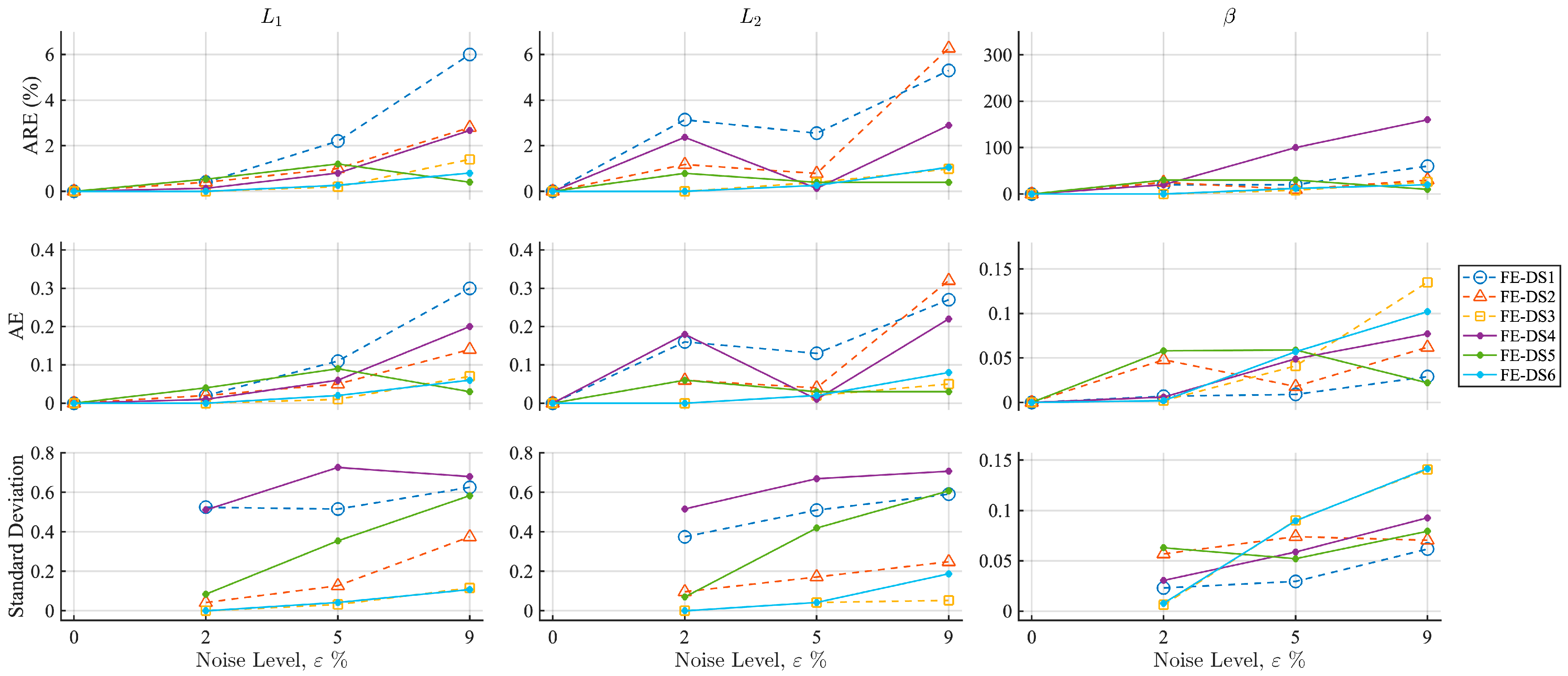
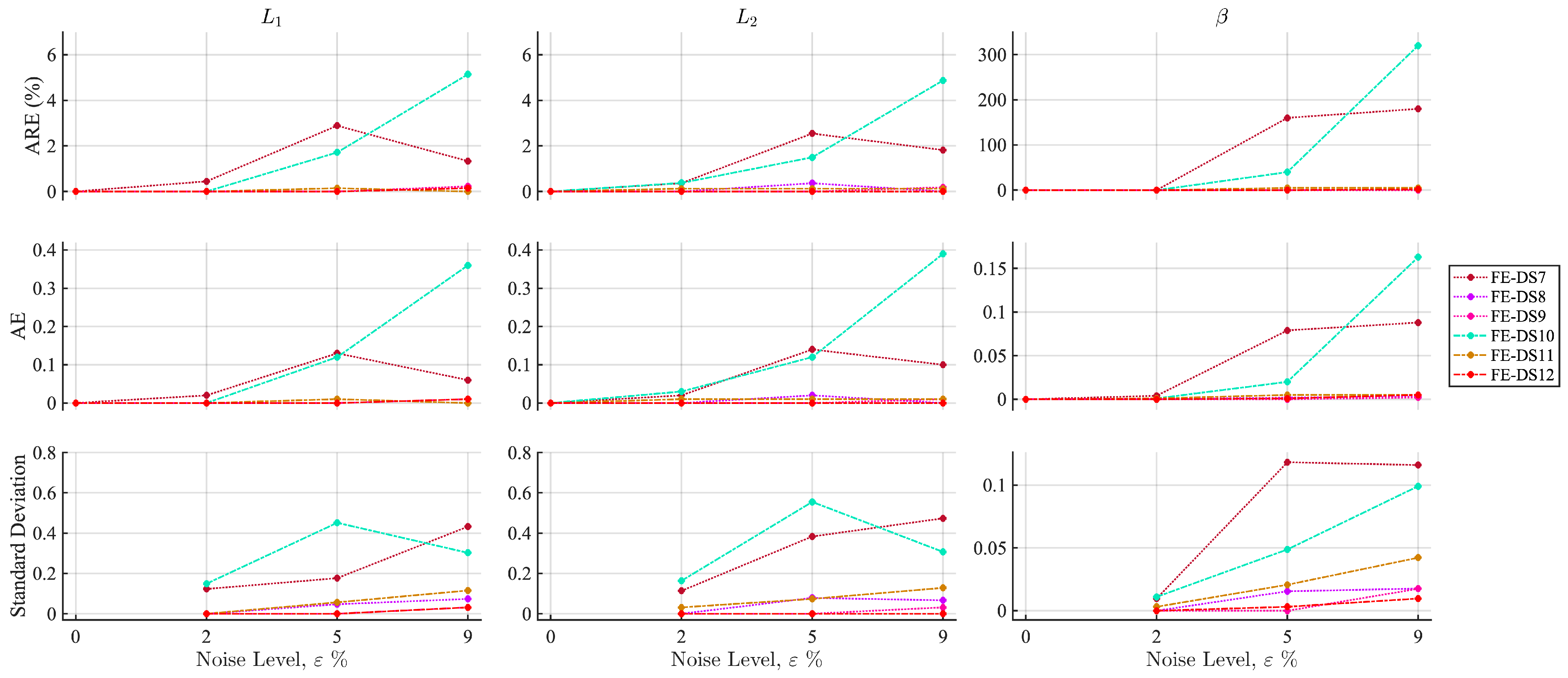
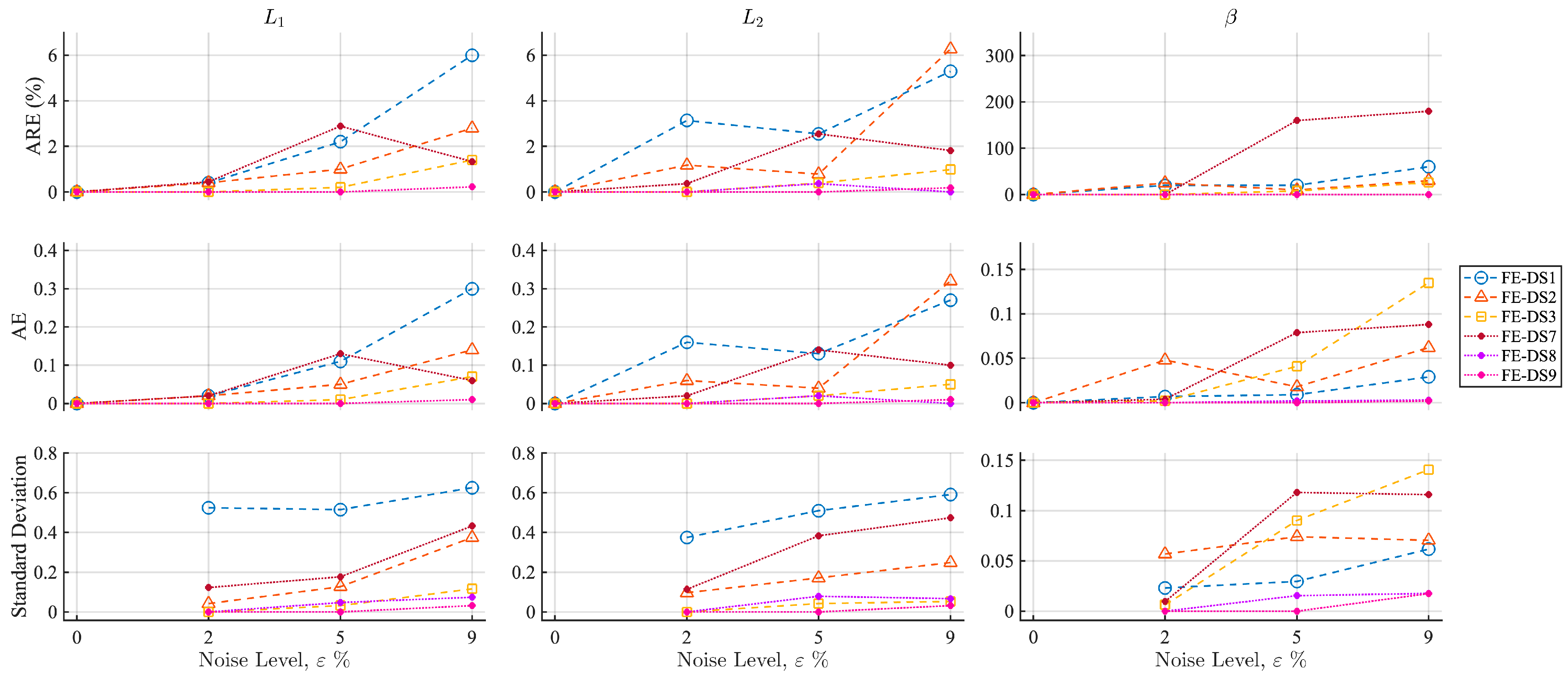
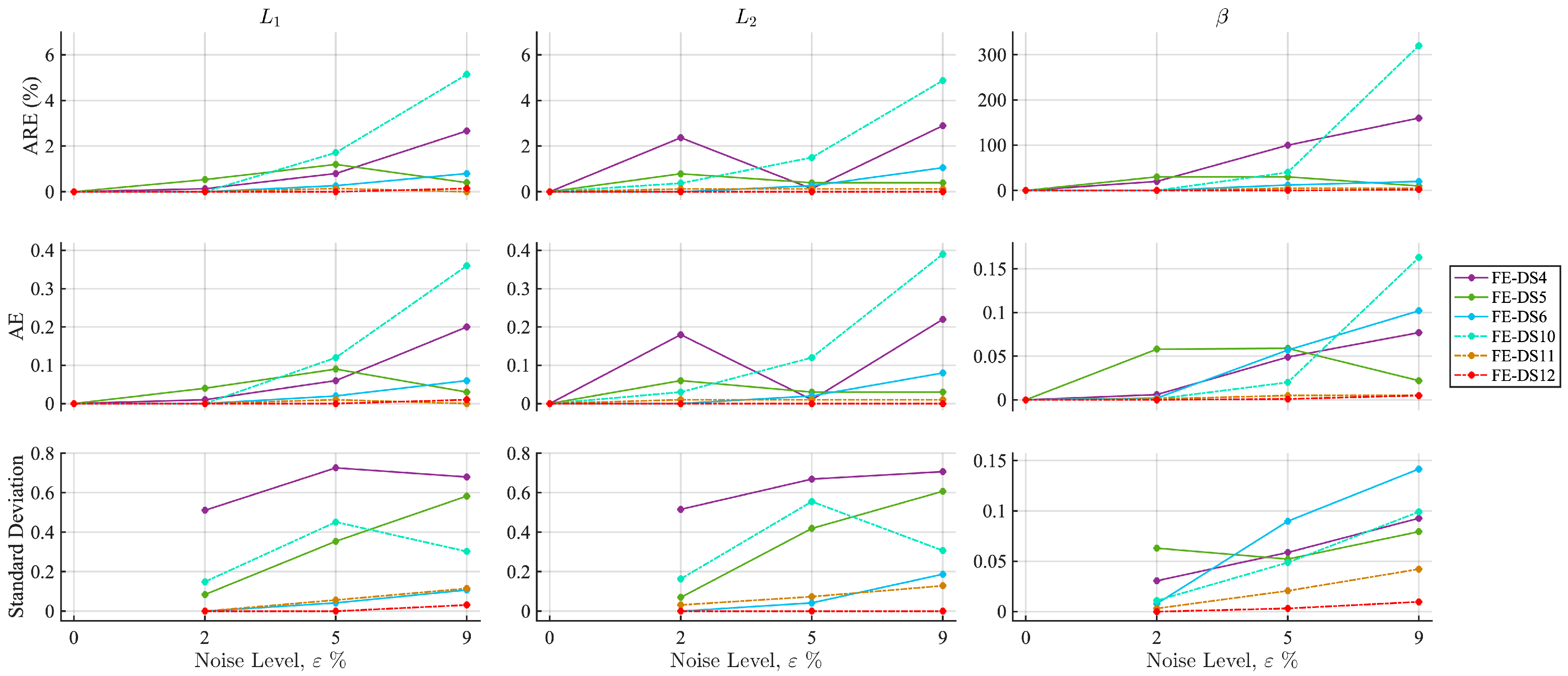
To evaluate the methodology analytically, the 12 FEM damage scenarios in Table 2 were used, which represent different damage locations and severities. For each damage scenario, the beam’s rotation response at the moving load location was obtained using the FEM model. Random noise following Equation (24) with values of 2%, 5%, and 9% was added to each rotation response, and for each noise level, 10 iterations were performed. Figure 6, Figure 7, Figure 8 and Figure 9 summarize the performance of the method using two metrics (ARE and AE) across all damage scenarios and noise levels, while Table 4 provides the corresponding estimated damage locations and severities with their individual errors, thereby directly demonstrating the method’s ability to identify both damage location and severity.
The FEM DSs are analyzed in detail to demonstrate the estimation performance under different noise levels. In each iteration for each noise level, the DCGS method was applied to find the top estimation, which corresponds to the lowest MSE. Then, the average and standard deviation of the top estimations of the 10 iterations are obtained for all variables ( L 1 , L 2 , and β ). To characterize the estimation accuracy, both the ARE and the AE are computed as summarized in Table 4. From Figure 6 and Table 4, FE-DS (1–3) and FE-DS (4–6) represent damage with a 1% DLR at midspan and three-quarters of the span, respectively. Both groups show an overall increase in the errors as the noise levels increase and the damage severities decrease. Specifically, the errors are the highest at a noise level of 9% and at a low damage severity of 0.05. Also, the midspan group (FE-DS 1–3) shows higher errors compared to the three-quarter span group (FE-DS 4–6) due to the higher rotation amplitude that the quarter span and the three-quarters of the span experienced compared to the midspan, which makes the damage more detectable. The same behavior was recognized for FE-DS (7–9) and FE-DS (10–12) in Figure 7 and Table 4, which represent damage with a 10% DLR, again, at midspan and three-quarters of the span, respectively. However, comparing the midspan damage scenarios group, FE-DS (1–3) that corresponds to a 1% DLR and FE-DS (7–9) that corresponds to a 10% DLR in Figure 8 and Table 4, shows that the group corresponding to a 1% DLR experiences larger errors than the group of the 10% DLR for each damage severity. As shown in Figure 8, FE-DS (1 and 7) show higher errors compared to their midspan group damage scenarios because they represent the damage scenarios with low damage severity (0.05), which makes the damage harder to detect. Again, from Figure 9 and Table 4, the same behavior was recognized when comparing the three-quarters of the span damage scenario group, FE-DS (4–6), which corresponds to a 1% DLR and FE-DS (10–12) that correspond to a 10% DLR, but for this time, FE-DSs (four and ten) are representing the damage scenarios with low damage severity (0.05), which again make the damage harder to detect. In general, the DCGS method was able to detect the location of the damage with a maximum ARE and AE of around 6% and 0.4, respectively. Moreover, the DCGS method was able to quantify the damage severity with a maximum ARE and AE of around 320% and 0.16, respectively. All of these errors appear at the 9% level of noise with damage scenarios that have either a low damage severity, a low DLR, or a combination of both.
The results in Table 4 show that the proposed DCGS methodology performs well, as the ARE and AE values remain under the limits provided by the literature [5,16,25,35,46,54], which indicate that the DCGS method can strongly detect and quantify damage under different levels of noise. Also, the standard deviation of the estimations remains relatively low compared to the literature [16,46], showing that the method produces consistent results across multiple iterations. However, with the large number of candidate combinations, the computational effort to apply the DCGS method is expensive.
A summarized comparison of the DCGS methodology with the literature is provided in Table 5. The comparison includes several established damage detection techniques, such as deflection differences between healthy and damaged states [5], rotation influence lines (RILs) [16,54], dynamic curvature [35], deflection influence lines (DILs) [46], and mode shape and frequency analysis [25]. For each referenced method, the published damage scenario parameters were directly applied within the DCGS framework to estimate the corresponding damage location ( L 1 and L 2 ) and severity ( β ), allowing a consistent, method-to-method comparison against the original reported results. To ensure a precise assessment, the comparison focuses on the most challenging scenarios from each study, those involving low damage severity, short damage lengths, or high noise levels.
From Table 5, the DCGS method shows fewer ARE errors compared to the literature for estimating the damage location ( L 1 and L 2 ). The same findings were observed in estimating the damage severity ( β ), as the DCGS method shows fewer AEs compared to the literature. These findings show that the methodology is robust in identifying the location of the damage, even with different noise and severity levels.

5.2. Confidence Interval (CI) Analysis of FEM Results

To further evaluate the consistency and reliability of the proposed DCGS method, a confidence interval (CI) analysis is conducted on the FEM damage scenarios’ rotation results. The aim is to apply different levels of noise to each damage scenario for multiple iterations. From each iteration, a number, n t , of the top estimations, which correspond to the lowest MSE, is selected to construct a sample size, n , which equals n t and is multiplied by the number of iterations. Then, for each noise level, the CI is applied to the sample size n . The CI approach is used to assess how consistently the method produces accurate predictions with different damage and noise levels.
Using the sample size ( n ), a 95% CI is constructed for each of the three estimated parameters ( L 1 , L 2 , and β ). These intervals are based on the sample mean and standard deviation of the top estimations and are intended to show how tightly the resultant intervals are around the damage mean value of the sample. A narrow CI means that the range between the upper and the lower bounds (CI-UB and CI-LB) is small, which suggests strong agreement of all top estimation samples. This indicates the powerful performance of the estimation methodology, even with the presence of noise.
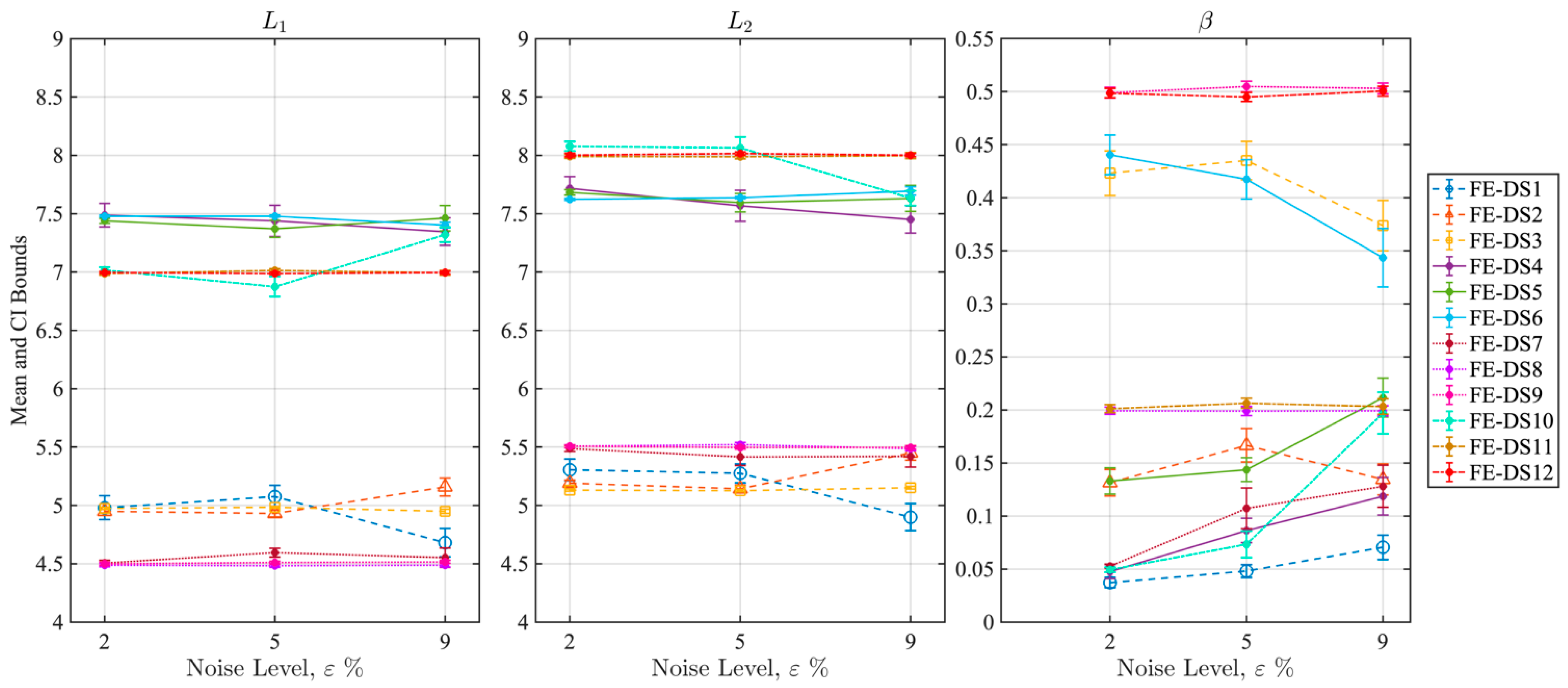
For each noise level, the top 10 estimations ( n t = 10 ), which correspond to the lowest 10 MSEs from all 10 iterations ( n = 100 ), were used to construct the 95% CI for L 1 , L 2 , and β . Figure 10 and Table 6 provide the estimated mean, CI-UB, and the CI-LB of all noise levels for each estimated parameter of all FEM damage scenarios. In Figure 10, the shapes represent the mean, and the horizontal bars represent the CI-UB and CI-LB for one parameter at each noise level, visually showing how noise affects estimation accuracy.
The results confirm that the CI remains narrow for all damage scenarios at all levels of noise, which indicates that the spread of the top 10 estimations is limited. As the noise level increases, a gradual expansion of the CI can be observed, which reflects a slight decrease in the estimation accuracy. This phenomenon is noticeable at the 9% level of noise, where the sample mean starts to slightly deviate from the true values for all parameters. Overall, the results show strong evidence that the DCGS methodology provides a reasonably high level of both accuracy and robustness, especially at lower to moderate levels of noise.

5.3. Methodology Limitation Using Healthy FEM Response

Due to measurement noise, the estimation methodology can classify a healthy response as a damaged scenario, which is known as a false positive. This phenomenon indicates the DCGS method’s limitations in identifying some damage scenarios. To investigate the methodology limitations and the ability to reduce false positives, a study using the healthy rotation out of the FEM is used. Two main parameters for this study are needed, which correspond to L 1 , L 2 , and β . The first parameter is the damage length ratio in percentage (DLR) and is calculated using Equation (25).
D L R = L 2 L 1 L × 100
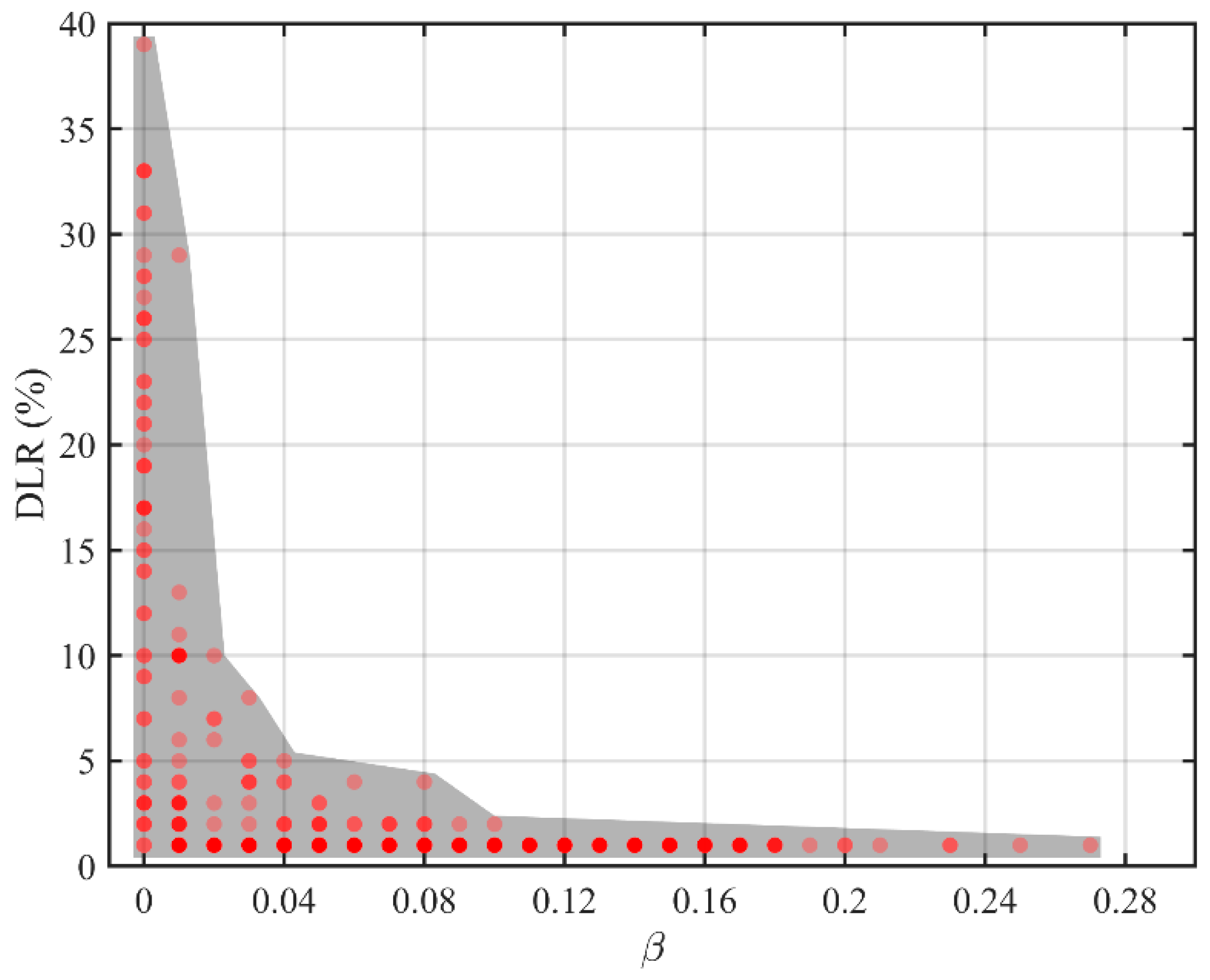
The second parameter is the severity of the damage β . The main idea is to introduce the healthy rotation response from the FEM to the DCGS methodology after adding multiple iterations of different levels of noise to create a plot that has multiple combination points of β -DLR. These combination points construct a region called the healthy region limits. Therefore, any damaged scenario introduced to the estimation method that results in a β -DLR combination falling within the defined healthy region is not considered to indicate damage.

5.4. Healthy Region Identification Using the Healthy FEM Response

Before testing for damage, it is important to define a reference region that represents the response of a healthy beam, even when affected by measurement noise. This is because, in some cases, the healthy rotation response, when affected by noise, may be incorrectly identified by the DCGS method as an observation coming from a damaged beam. To prevent this misinterpretation, a healthy region area is constructed using simulated healthy rotations.
To create this region, the healthy FEM rotation response is used with added different levels of noise (i.e., from 1% to 9%) using Equation (24). For each noise level, the noise addition is repeated across 60 iterations to simulate 540 healthy possible measurement conditions. After each iteration, the DCGS method is applied to the noisy healthy rotation to compute a set of β -DLR values. All β -DLR values obtained from the noisy healthy rotations are plotted to form an area of points, representing a healthy beam behavior under different noise cases, as shown in Figure 11. The boundaries of the healthy β -DLR area were constructed by taking the maximum DLR values of each β value obtained from all healthy simulations under noise, thereby forming an outer envelope (gray envelope in Figure 11) that contained all healthy cases. This plotted region is considered the healthy beam behavior boundary.
The created healthy region serves as an indicator of the DCGS method’s limitation, where, if a tested rotation response observed from either the FEM with noise or experiment produces a β -DLR value that falls within the healthy region, it is not considered a damaged scenario, even if the beam is in fact damaged. This is because a rotation observed from a healthy beam could produce a similar β -DLR value under a certain noise level, which creates limitations for the DCGS method. However, when a β -DLR value falls outside the healthy region, it is considered an indication of damage. This approach ensures that false positives are limited, which is when healthy beams are incorrectly identified as damaged due to noise, making the DCGS method more robust.

5.5. Analytical Assessment of the DCGS Method

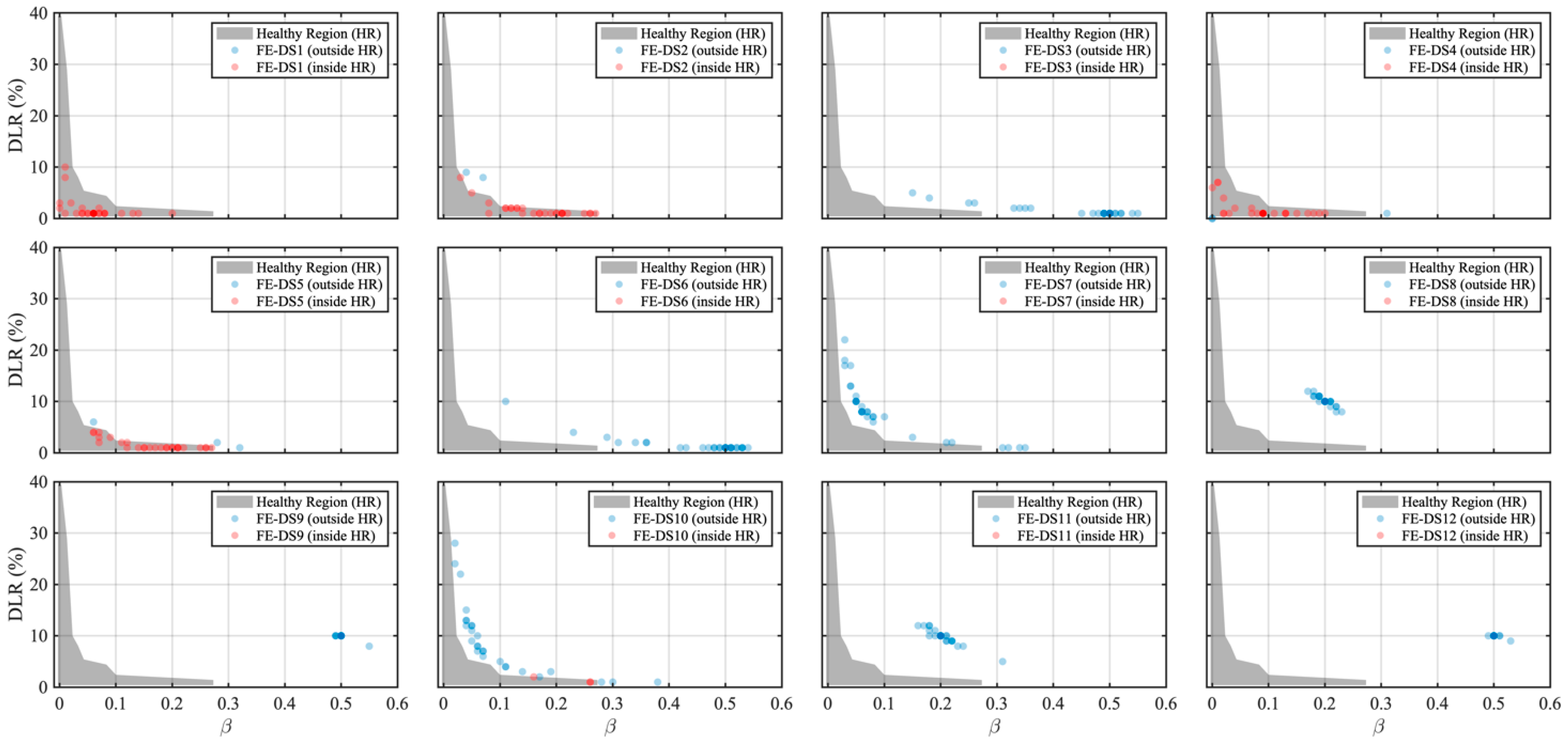
In each iteration, the DCGS method was applied to the noisy FEM rotation response to compute the corresponding β -DLR values. These values were compared to the healthy region previously created with the goal of determining whether the β -DLR values of each damage scenario fall outside the healthy region; if so, there was a significant variation from the healthy noisy beam response.
For each damage scenario, 90 β -DLR values were obtained. The β -DLR of all damage scenarios is illustrated in Figure 12. The results show that FE-DSs (3, 6, 7, 8, 9, 11, 12) have their β -DLR values all outside the healthy region and are likely detectable damage scenarios. However, for the remaining damage scenarios, FE-DSs (1, 2, 4, 5, 10) have either all or some of the β -DLR values within the healthy region, indicating that these damage scenarios are indistinguishable from a healthy beam response under a certain noise level. These damage scenarios come from either a scenario with low β or DLR, or a combination of both. Therefore, the DCGS method is not able to confidently classify these five damage scenarios as damaged cases.
Overall, the accuracy of the FEM-based damage estimation highly depends on the combination of β and DLR in all scenarios. In cases where both β and DLR are high, the method estimations are the highest in accuracy, as they produce a rotation response where the damage is easier to detect. Scenarios with high β and low DLR, or low β and high DLR, also tend to result in low estimation errors, which indicates that either a long damage length or a high damage severity is sufficient for the method to detect and quantify damage. On the other hand, scenarios with low β and low DLR produce weaker rotation responses, and while some of these cases do not fall inside the healthy β -DLR region limits, the method still estimates the damage with reasonable accuracy and with slightly higher errors. These results show that the method’s estimation accuracy is highly influenced by the β -DLR interaction.

5.6. Experimental Assessment of the DCGS Method

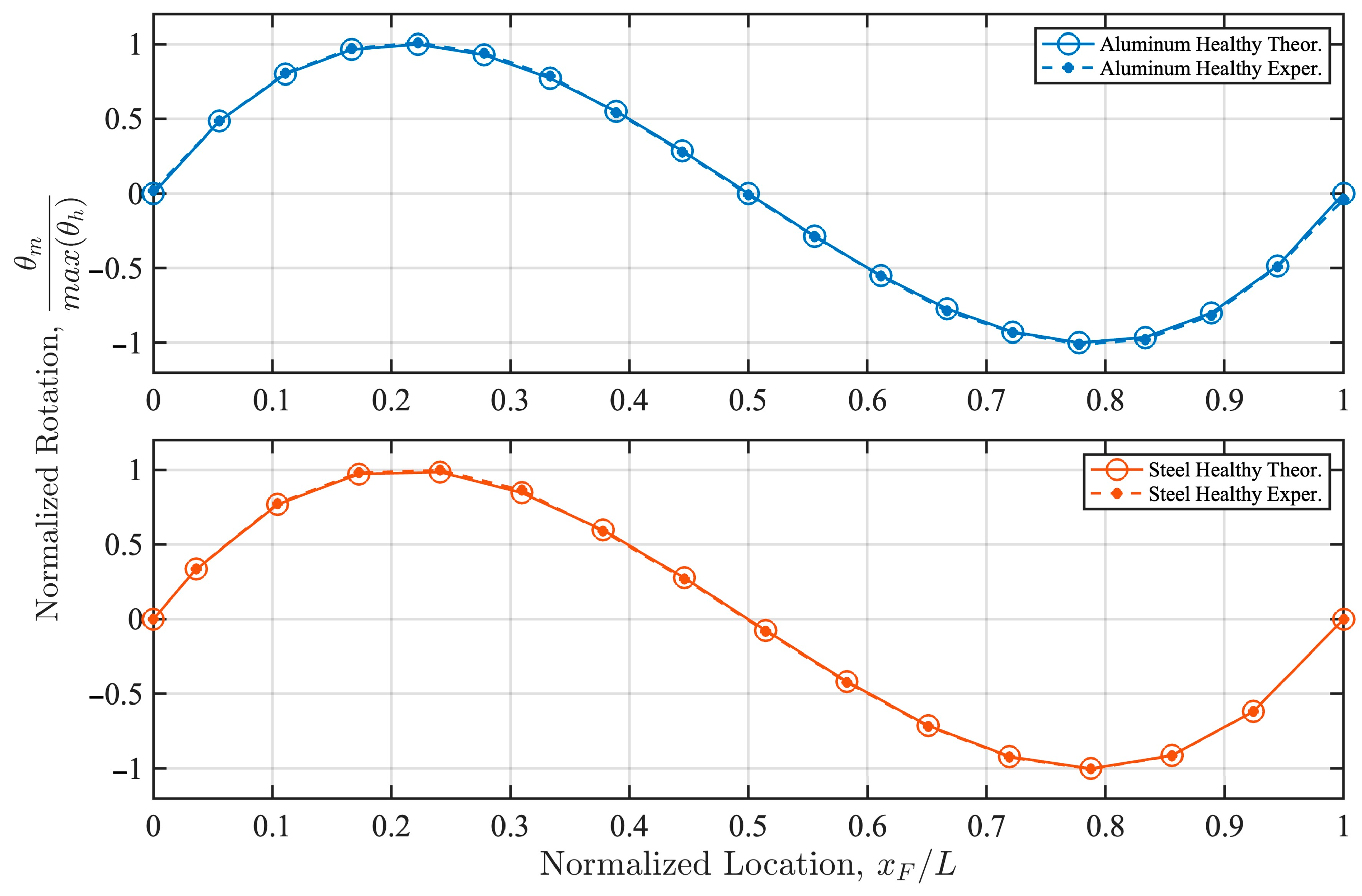
Figure 13 shows the observed healthy rotations of both experimental beam assemblies alongside the theoretical healthy rotations from Equation (18).
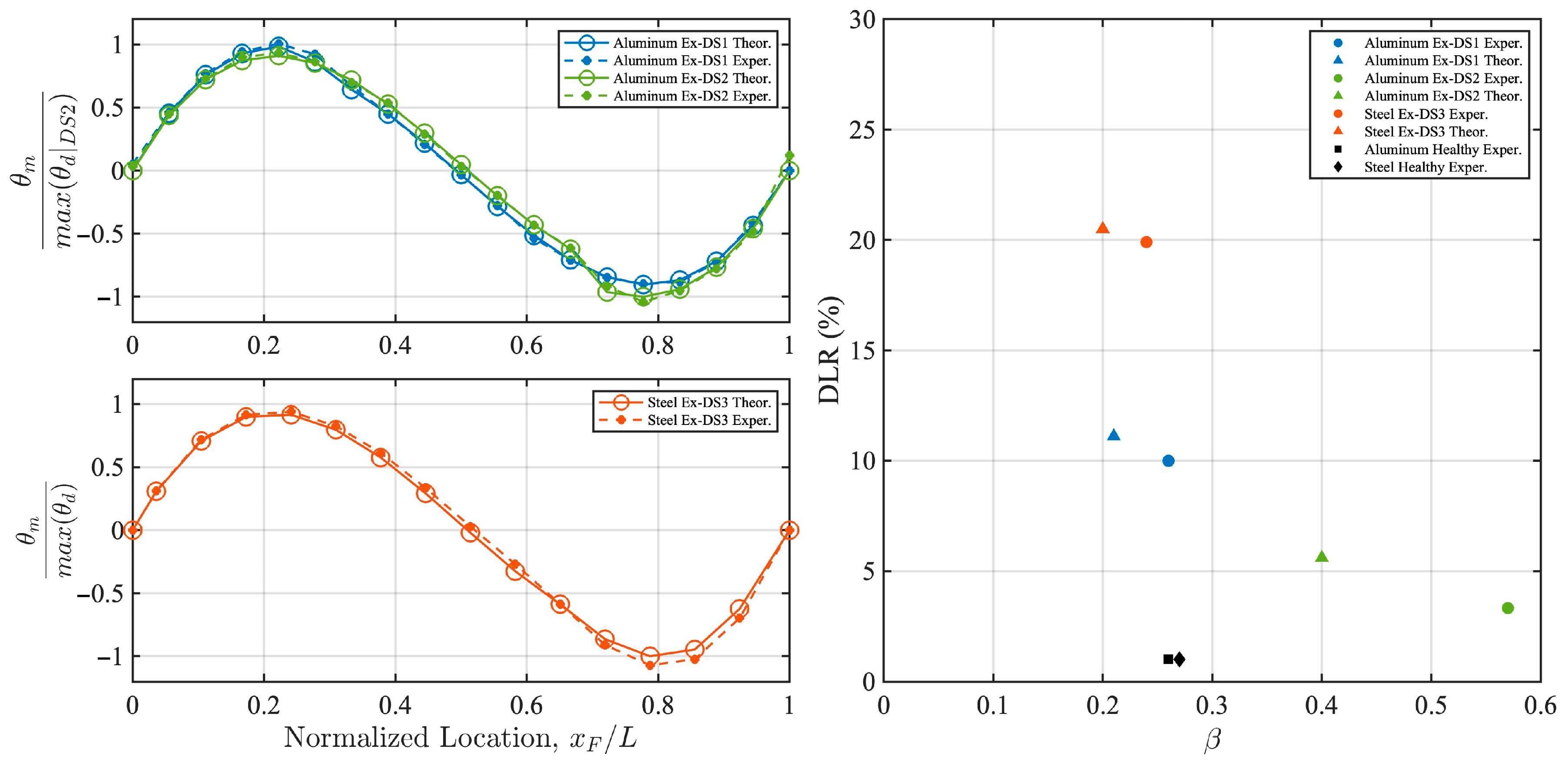
All damage scenarios are previously defined in Table 3. For each of these cases, the observed rotation is plotted alongside the theoretical damaged rotation from Equation (19) in Figure 14. In addition, the β -DLR values of all damaged scenarios and the healthy cases are plotted on the same figure for visual differentiation. The proposed DCGS methodology is applied to all Ex-DSs with different damage location ( L 1 and L 2 ) grid step sizes to investigate the effect on the estimation’s values. Three different damage location grid step sizes are used: 0.01, 0.05, and 0.1 m. The estimated parameter values for each grid step size are reported in Table 7. The table also includes the ARE and AE for each parameter to quantify the accuracy of the estimations in real experimental conditions.
The results indicate the effectiveness of the DCGS method when applied to real-world experimental observations and compared with previous studies [5,46,48,55].
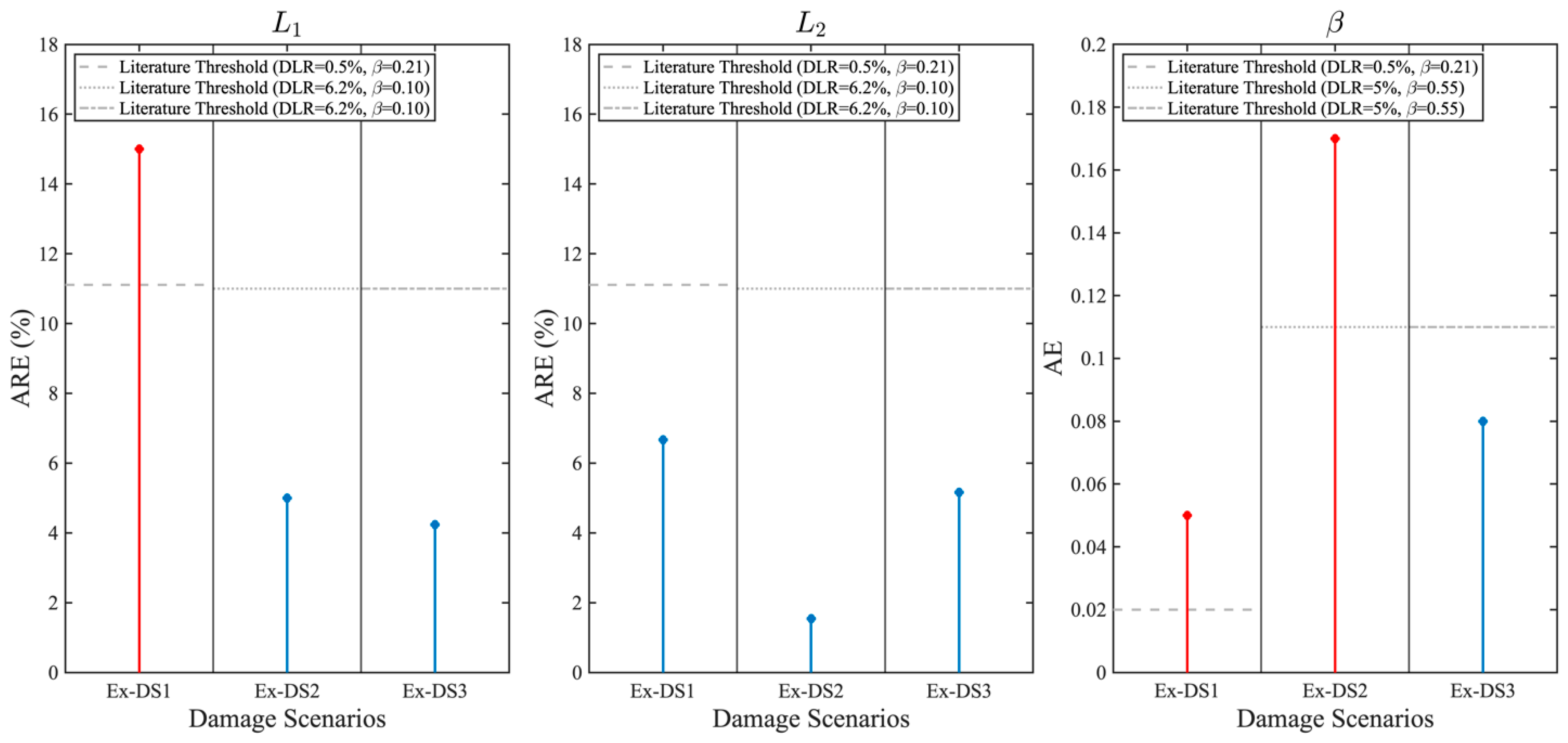
The β -DLR values of the damaged beams are significantly different from the values of the healthy beams, as shown in Figure 14, which confirms that the method can successfully distinguish the damage conditions in both beams. From a grid step size of 0.01 m in all three damage scenarios, the estimated L 1 and L 2 show a maximum ARE at 15% and 6.67%, respectively, observed from Ex-DS1, and a maximum AE of 0.05 and 0.08, respectively, observed from Ex-DS3. However, the β estimations had a maximum ARE of around 42% and a maximum AE of 0.17, and both were observed from Ex-DS2. According to Rytter’s [10] levels of SHM, the DCGS methodology is capable of achieving up to level 3 in most cases, where the damage is detected, localized, and quantified. However, in other cases, while the method accurately detects and locates the damage, the estimated severity differs slightly from the actual value.
Furthermore, the effect of damage location ( L 1 and L 2 ) grid step size on the accuracy of estimation is investigated by testing three different step size values: 0.01, 0.05, and 0.10 m. The results showed that there is no clear indication that increasing or decreasing the grid step size affects the estimation accuracy. In some DSs, increasing the grid step size leads to an improvement in estimation accuracy, while in others, an accuracy reduction is observed. This behavior is mainly influenced by whether the true damage location parameters appear on the search grid values, i.e., when the parameters fall directly on the grid, the estimation error is likely minimized.
A summarized comparison of the experimental damage scenarios results with the literature thresholds is provided in Figure 15 [5,46,48,55]. The literature thresholds were set by the published nearest neighbor matching experimental damage cases using DLR and β values for each experimental damage scenario used in this research; the DLR and β values are reported in the legend of Figure 15. From Figure 15, Ex-DS1 has both L 1 and β above the thresholds. Also, in Ex-DS3, the severity has exceeded the threshold. The reason that these severities are above the threshold is that both damage scenarios have severity values that are almost similar to the severity produced by the healthy beams, as shown in Figure 14, which makes it harder to capture at an experimental level. The β -DLR value for Ex-DS1 is considered the lowest compared to the other damage scenarios, where Ex-DSs (two and three) have either higher β or DLR values. Also, Ex-DS1 has damage on the left side of the beam, which makes L 1 closer to the left support and at the stiffer region compared to L 2 . Due to these two reasons, L 1 had a larger error value that made it exceed the threshold.

6. Conclusions

In this research, a new damage detection and severity estimation methodology for a simply supported bridge-like beams under a quasi-static moving load has been proposed and validated. The DCGS methodology relies on the rotation response of the beam at the location of the moving load, which is a parameter that has been shown to detect stiffness reductions more sensitively than deflection or vibration-related measurements. Applying the principle of virtual work, analytical expressions for healthy and damaged rotation responses were obtained at the location of the moving load.
Damage was characterized by three main parameters: L 1 and L 2 , the start and the end locations of the damage, respectively, and β , damage severity. The DCGS methodology was validated using two approaches: the FEM and experimental testing. In the FEM, 12 different damage scenarios were introduced, and each scenario was subjected to different levels of noise: 2%, 5%, and 9%. The estimation results showed that the method was successfully localizing and quantifying the damage in all scenarios. The maximum ARE for estimating the damage location is below 6.5%, and the maximum AE is around 0.15. On the other hand, the maximum AE of the estimated severity is around 0.15. A damage length ratio parameter (DLR) was developed in this research, which depends on the span of the beam L , L 1 , and L 2 . This important parameter, along with damage severity, was used to enhance the robustness of the method against measurement noise for the FEM responses by creating a healthy region limitation, which is called the β -DLR region. This region works as a filter to distinguish the false positive damage scenarios. A healthy rotation response from an FEM was observed and subjected to multiple iterations of different noise levels. For all iterations of all noise levels, β -DLR values were obtained to construct the healthy region. Thus, any damage scenario that produced a β -DLR value out of the estimation, which falls within the healthy region, was considered indistinguishable from a healthy scenario and was excluded from further evaluation. The β -DLR technique showed that damage scenarios FE-DS (1, 2, 4, 5, 10) have either all or some of the β -DLR values within the healthy region, indicating that these damage scenarios are indistinguishable from a healthy beam response. These damage scenarios were observed from either a scenario with low β or DLR, or a combination of both.
For the experimental studies, two lab-scale experiments were conducted on two different simply supported beam materials, aluminum and steel. Rotation responses were observed at the location of the quasi-static moving load using a wireless sensor that is capable of measuring the angle of rotation. Healthy and damaged beams were tested, and the DCGS estimation methodology was applied. The results display that the damage location estimations were reliably accurate, which show relatively low ARE and AE values, with most of the estimations falling within 15% ARE and 0.08 AE. However, the damage severity estimation had a maximum ARE of around 42% and a maximum AE of 0.17.
One of the main strengths of the DCGS methodology is its ability to handle measurements affected by noise. Using this strength was valuable in constructing the β -DLR filtration area, which helped to distinguish the false positive cases. The method also demonstrated strong performance across different beam materials. However, the method has some limitations, including high computational cost, as a large number of candidate combinations were tested. Also, damage scenarios represented by both low β and small DLR present a greater challenge, and they have slightly higher estimation errors. The DCGS method is unable to distinguish these damage scenarios from healthy cases with noise because they fall within the healthy region created by β -DLR values.
Finally, this research showed that using rotation measurements under a quasi-static moving load provides a sensitive and efficient way to detect and quantify damage in simply supported bridge-like beams. The DCGS method tends to benefit from the drive-by and quasi-static influence lines methods’ advantages by considering the rotation observations at the moving load location and avoiding some of the challenges using stiff suspension and slow velocity to limit suspension and dynamic effects, respectively. The study provided a full strength and limitation evaluation of the method. The methodology is applicable to railway and road bridges, as early damage detection is key to maintaining their safety and performance.
Future work will focus on reducing the DCGS method’s computational cost by adopting faster estimators, including decision tree approaches and physics-informed neural networks for damage estimation. Furthermore, ongoing development centers around developing dynamic relationships and characterizing the mechanical, not just logistical, advantages of rotation as opposed to deflections, strains, and accelerations. In addition, the method could be expanded to more complex structures (i.e., 3D analysis, multi-span beams) involving more diverse damage types, such as asymmetric and gradient damage width.

Author Contributions

Conceptualization, M.Y.A. and B.A.S.; methodology, M.Y.A.; formal analysis, M.Y.A.; resources, B.A.S.; writing—original draft preparation, M.Y.A. and B.A.S.; writing—review and editing, M.Y.A. and B.A.S.; supervision, B.A.S. All authors have read and agreed to the published version of the manuscript.

Funding

This research received no external funding.

Institutional Review Board Statement

Not applicable.

Informed Consent Statement

Not applicable.

Data Availability Statement

The raw data supporting the conclusions of this article will be made available by the authors upon request.

Conflicts of Interest

The authors declare no conflict of interest.

References

  1. Sitton, J.D.; Zeinali, Y.; Rajan, D.; Story, B.A. Frequency estimation on two-span continuous bridges using dynamic responses of passing vehicles. J. Eng. Mech. 2020, 146, 04019115. [Google Scholar] [CrossRef]
  2. ASCE. A Comprehensive Assessment of America’s Infrastructure. 2025. Available online: https://www.infrastructurereportcard.org (accessed on 29 September 2025).
  3. McGeown, C.; Huseynov, F.; Hester, D.; McGetrick, P.; Obrien, E.J.; Pakrashi, V. Using measured rotation on a beam to detect changes in its structural condition. J. Struct. Integr. Maint. 2021, 6, 159–166. [Google Scholar] [CrossRef]
  4. Wang, C.Y.; Huang, C.K.; Chen, C.S. Damage assessment of beam by a quasi-static moving vehicular load. Adv. Adapt. Data Anal. 2011, 3, 417–445. [Google Scholar] [CrossRef]
  5. Le, N.T.; Thambiratnam, D.P.; Nguyen, A.; Chan, T.H.T. A new method for locating and quantifying damage in beams from static deflection changes. Eng. Struct. 2019, 180, 779–792. [Google Scholar] [CrossRef]
  6. Soliman, E.S.M.M. Damage severity for cracked simply supported beams. Fract. Struct. Integr. 2021, 15, 151–165. [Google Scholar] [CrossRef]
  7. Das, S.; Saha, P.; Patro, S.K. Vibration-based damage detection techniques used for health monitoring of structures: A review. J. Civ. Struct. Health Monit. 2016, 6, 477–507. [Google Scholar] [CrossRef]
  8. Doebling, S.W.; Farrar, C.R.; Prime, M.B. A summary review of vibration-based damage identification methods. Shock Vib. Dig. 1998, 30, 91–105. [Google Scholar] [CrossRef]
  9. Fan, W.; Qiao, P. Vibration-based damage identification methods: A review and comparative study. Struct. Health Monit. 2011, 10, 83–111. [Google Scholar] [CrossRef]
  10. Rytter, A. Vibrational Based Inspection of Civil Engineering Structures. Ph.D. Thesis, Aalborg University, Aalborg, Denmark, 1993. [Google Scholar]
  11. Seo, J.; Hu, J.W.; Lee, J. Summary review of structural health monitoring applications for highway bridges. J. Perform. Constr. Facil. 2016, 30, 04015072. [Google Scholar] [CrossRef]
  12. Sohn, H.; Farrar, C.R.; Hemez, F.M.; Shunk, D.D.; Stinemates, D.W.; Nadler, B.R.; Czarnecki, J.J. A review of structural health monitoring literature: 1996–2001. Los Alamos Natl. Lab. USA 2003, 1, 10–12989. [Google Scholar]
  13. Story, B.A.; Fry, G.T. A structural impairment detection system using competitive arrays of artificial neural networks. Comput.-Aided Civ. Infrastruct. Eng. 2014, 29, 180–190. [Google Scholar] [CrossRef]
  14. Worden, K.; Dulieu-Barton, J.M. An overview of intelligent fault detection in systems and structures. Struct. Health Monit. 2004, 3, 85–98. [Google Scholar] [CrossRef]
  15. Chan, T.; Thambiratnam, D. Structural Health Monitoring in Australia; Nova Science Publishers: New York, NY, USA, 2011. [Google Scholar]
  16. Zeinali, Y.; Story, B.A. Impairment localization and quantification using noisy static deformation influence lines and Iterative Multi-parameter Tikhonov Regularization. Mech. Syst. Signal Process. 2018, 109, 399–419. [Google Scholar] [CrossRef]
  17. Huseynov, F.; Kim, C.; Obrien, E.J.; Brownjohn, J.M.W.; Hester, D.; Chang, K.C. Bridge damage detection using rotation measurements–Experimental validation. Mech. Syst. Signal Process. 2020, 135, 106380. [Google Scholar] [CrossRef]
  18. Sitton, J.D.; Rajan, D.; Story, B.A. Damage scenario analysis of bridges using crowdsourced smartphone data from passing vehicles. Comput.-Aided Civ. Infrastruct. Eng. 2024, 39, 1257–1274. [Google Scholar] [CrossRef]
  19. Rabi, R.R.; Vailati, M.; Monti, G. Effectiveness of vibration-based techniques for damage localization and lifetime prediction in structural health monitoring of bridges: A comprehensive review. Buildings 2024, 14, 1183. [Google Scholar] [CrossRef]
  20. Cawley, P.; Adams, R.D. The location of defects in structures from measurements of natural frequencies. J. Strain Anal. Eng. Des. 1979, 14, 49–57. [Google Scholar] [CrossRef]
  21. Hajela, P.; Soeiro, F.J. Structural damage detection based on static and modal analysis. AIAA J. 1990, 28, 1110–1115. [Google Scholar] [CrossRef]
  22. Story, B.A.; Fry, G.T. Methodology for designing diagnostic data streams for use in a structural impairment detection system. J. Bridge Eng. 2014, 19, 04013020. [Google Scholar] [CrossRef]
  23. Perez-Ramirez, C.A.; Amezquita-Sanchez, J.P.; Adeli, H.; Valtierra-Rodriguez, M.; Romero-Troncoso, R.D.J.; Dominguez-Gonzalez, A.; Osornio-Rios, R.A. Time-frequency techniques for modal parameters identification of civil structures from acquired dynamic signals. J. Vibroengineering 2016, 18, 3164–3185. [Google Scholar] [CrossRef]
  24. Zhou, J.; Du, B.; Yi, J.; Yuan, X.; Pan, C.; Kong, X. Extracting flexural and torsional mode shapes of bridges using a 3D two-axle passing vehicle with experimental validations. Thin-Walled Struct. 2025, 219, 114256. [Google Scholar] [CrossRef]
  25. Gorgin, R. Damage identification technique based on mode shape analysis of beam structures. Structures 2020, 27, 2300–2308. [Google Scholar] [CrossRef]
  26. Yang, Q.; Liu, J.K.; Sun, B.X.; Liang, C.F. Damage localization for beam structure by moving load. Adv. Mech. Eng. 2017, 9, 1687814017695956. [Google Scholar] [CrossRef]
  27. Ratcliffe, C.P. A frequency and curvature based experimental method for locating damage in structures. J. Vib. Acoust. 2000, 122, 324–329. [Google Scholar] [CrossRef]
  28. Story, B.; Fry, G. Implementation of a Structural Impairment Detection System on a 100 Year-Old Bascule Bridge. In Structural Health Monitoring 2013: A Roadmap to Intelligent Structures, Proceedings of the Ninth International Workshop on Structural Health Monitoring, Stanford, CA, USA, 10–12 September 2013; DEStech Publications, Inc.: Lancaster, PA, USA, 2013; p. 1729. [Google Scholar]
  29. Sitton, J.D.; Rajan, D.; Story, B.A. Bridge frequency estimation strategies using smartphones. J. Civ. Struct. Health Monit. 2020, 10, 513–526. [Google Scholar] [CrossRef]
  30. Yazdanpanah1a, O.; Seyedpoor, S.M. A new damage detection indicator for beams based on mode shape data. Struct. Eng. Mech. 2015, 53, 725–744. [Google Scholar] [CrossRef]
  31. Duvnjak, I.; Damjanović, D.; Bartolac, M.; Skender, A. Mode shape-based damage detection method (MSDI): Experimental validation. Appl. Sci. 2021, 11, 4589. [Google Scholar] [CrossRef]
  32. Khresat, H.; Thompson, H.B., II; Story, B.A. Improved Rail Bridge Strick Detection and Characterization. In Proceedings of the 2024 AREMA Conference, Louisville, KY, USA, 15–18 September 2024. [Google Scholar]
  33. Lynch, J.P.; Loh, K.J. A summary review of wireless sensors and sensor networks for structural health monitoring. Shock Vib. Dig. 2006, 38, 91–130. [Google Scholar] [CrossRef]
  34. Deng, Z.; Huang, M.; Wan, N.; Zhang, J. The current development of structural health monitoring for bridges: A review. Buildings 2023, 13, 1360. [Google Scholar] [CrossRef]
  35. Sun, Z.; Nagayama, T.; Su, D.; Fujino, Y. A damage detection algorithm utilizing dynamic displacement of bridge under moving vehicle. Shock Vib. 2016, 2016, 8454567. [Google Scholar] [CrossRef]
  36. Wang, N.B.; Wang, C.; Zhou, H.; Zuo, Q. A novel extraction method for the actual influence line of bridge structures. J. Sound Vib. 2023, 553, 117605. [Google Scholar] [CrossRef]
  37. He, W.Y.; Ren, W.X.; Zhu, S. Damage detection of beam structures using quasi-static moving load induced displacement response. Eng. Struct. 2017, 145, 70–82. [Google Scholar] [CrossRef]
  38. Yang, Y.B.; Xu, H.; Zhang, B.; Xiong, F.; Wang, Z.L. Measuring bridge frequencies by a test vehicle in non-moving and moving states. Eng. Struct. 2020, 203, 109859. [Google Scholar] [CrossRef]
  39. Zhang, S.; Liu, Y. Damage detection in beam bridges using quasi-static displacement influence lines. Appl. Sci. 2019, 9, 1805. [Google Scholar] [CrossRef]
  40. Zhu, J.; Zhang, C.; Li, X. Structural damage detection of the bridge under moving loads with the quasi-static displacement influence line from one sensor. Measurement 2023, 211, 112599. [Google Scholar] [CrossRef]
  41. Liu, J. Accurate and Scalable Bridge Health Monitoring Using Drive-By Vehicle Vibrations. Ph.D. Thesis, Stanford University, Stanford, CA, USA, 2023. [Google Scholar]
  42. Zhang, J.; Yi, T.H.; Qu, C.X.; Han, Q.; Wang, Y.F.; Mei, X.D. Experimental studies of extracting bridge mode shapes by response of a moving vehicle. J. Bridge Eng. 2023, 28, 04023076. [Google Scholar] [CrossRef]
  43. Alampalli, S.; Frangopol, D.M.; Grimson, J.; Halling, M.W.; Kosnik, D.E.; Lantsoght, E.O.; Yang, D.; Zhou, Y.E. Bridge load testing: State-of-the-practice. J. Bridge Eng. 2021, 26, 03120002. [Google Scholar] [CrossRef]
  44. Lantsoght, E.O.; van der Veen, C.; de Boer, A.; Hordijk, D.A. State-of-the-art on load testing of concrete bridges. Eng. Struct. 2017, 150, 231–241. [Google Scholar] [CrossRef]
  45. Štimac, I.; Mihanović, A.; Kožar, I. Damage detection from analysis of displacement influence lines. In Proceedings of the International Conference on Bridges, Dubrovnik, Croatia, 21–24 May 2006; pp. 1001–1008. [Google Scholar]
  46. Chen, Z.W.; Zhao, L.; Zhang, J.; Cai, Q.L.; Li, J.; Zhu, S. Damage quantification of beam structures using deflection influence line changes and sparse regularization. Adv. Struct. Eng. 2021, 24, 1997–2010. [Google Scholar] [CrossRef]
  47. Alshallaqi, H.H.; Story, B.A. Truss Bridge Damage Localization and Severity Estimation Using Influence Lines. In Proceedings of the 2025 Railway Engineering Conference, Edinburgh, UK, 10–12 June 2025. [Google Scholar]
  48. Zeinali, Y.; Story, B.A. Framework for flexural rigidity estimation in Euler-Bernoulli beams using deformation influence lines. Infrastructures 2017, 2, 23. [Google Scholar] [CrossRef]
  49. Pan, B.; Tian, L.; Song, X. Real-time, non-contact and targetless measurement of vertical deflection of bridges using off-axis digital image correlation. NDT E Int. 2016, 79, 73–80. [Google Scholar] [CrossRef]
  50. Tian, L.; Pan, B. Remote bridge deflection measurement using an advanced video deflectometer and actively illuminated LED targets. Sensors 2016, 16, 1344. [Google Scholar] [CrossRef] [PubMed]
  51. Feng, D.; Feng, M.Q. Experimental validation of cost-effective vision-based structural health monitoring. Mech. Syst. Signal Process. 2017, 88, 199–211. [Google Scholar] [CrossRef]
  52. Erdenebat, D.; Waldmann, D.; Scherbaum, F.; Teferle, N. The Deformation Area Difference (DAD) method for condition assessment of reinforced structures. Eng. Struct. 2018, 155, 315–329. [Google Scholar] [CrossRef]
  53. Hester, D.; Brownjohn, J.; Huseynov, F.; Obrien, E.; Gonzalez, A.; Casero, M. Identifying damage in a bridge by analysing rotation response to a moving load. Struct. Infrastruct. Eng. 2020, 16, 1050–1065. [Google Scholar] [CrossRef]
  54. Nady, H.O.; Abdo, M.A.; Kaiser, F. Comparative study of using rotation influence lines and their derivatives for structural damage detection. Structures 2023, 48, 397–409. [Google Scholar] [CrossRef]
  55. He, W.Y.; Ren, W.X.; Zhu, S. Baseline-free damage localization method for statically determinate beam structures using dual-type response induced by quasi-static moving load. J. Sound Vib. 2017, 400, 58–70. [Google Scholar] [CrossRef]
  56. Andreaus, U.; Baragatti, P. Experimental damage detection of cracked beams by using nonlinear characteristics of forced response. Mech. Syst. Signal Process. 2012, 31, 382–404. [Google Scholar] [CrossRef]
  57. Yang, Y.B.; Lin, C.W.; Yau, J.D. Extracting bridge frequencies from the dynamic response of a passing vehicle. J. Sound Vib. 2004, 272, 471–493. [Google Scholar] [CrossRef]
  58. Malekjafarian, A.; Corbally, R.; Gong, W. A review of mobile sensing of bridges using moving vehicles: Progress to date, challenges and future trends. Structures 2022, 44, 1466–1489. [Google Scholar] [CrossRef]
  59. Matarazzo, T.J.; Kondor, D.; Milardo, S.; Eshkevari, S.S.; Santi, P.; Pakzad, S.N.; Buehler, M.J.; Ratti, C. Crowdsourcing bridge dynamic monitoring with smartphone vehicle trips. Commun. Eng. 2022, 1, 29. [Google Scholar] [CrossRef]
  60. Yang, Y.B.; Zhang, B.; Chen, Y.; Qian, Y.; Wu, Y. Bridge damping identification by vehicle scanning method. Eng. Struct. 2019, 183, 637–645. [Google Scholar] [CrossRef]
  61. Yuan, Y.; Au, F.T.; Yang, D.; Zhang, J. Active learning structural model updating of a multisensory system based on Kriging method and Bayesian inference. Comput.-Aided Civ. Infrastruct. Eng. 2023, 38, 353–371. [Google Scholar] [CrossRef]
  62. OBrien, E.J.; Mcgetrick, P.J.; González, A. A drive-by inspection system via vehicle moving force identification. Smart Struct. Syst. 2014, 13, 821–848. [Google Scholar] [CrossRef]
  63. Sitton, J. Indirect Bridge Monitoring Using Crowdsourced Smartphone Data from Passing Vehicles. Ph.D. Thesis, Lyle School of Engineering, Dallas, TX, USA, 2023. [Google Scholar]
  64. Orsak, J. A Theoretical Structural Impairment Detection System for Timber Railway Bridges. Master’s Thesis, Texas A&M University, College Station, TX, USA, 2012. [Google Scholar]
  65. Khorram, A.; Bakhtiari-Nejad, F.; Rezaeian, M. Comparison studies between two wavelet based crack detection methods of a beam subjected to a moving load. Int. J. Eng. Sci. 2012, 51, 204–215. [Google Scholar] [CrossRef]
  66. Yang, Y.B.; Zhang, B.; Qian, Y.; Wu, Y. Contact-point response for modal identification of bridges by a moving test vehicle. Int. J. Struct. Stab. Dyn. 2018, 18, 1850073. [Google Scholar] [CrossRef]
  67. Zhou, Z.; Zhou, J.; Deng, J.; Wang, X.; Liu, H. Identification of multiple bridge frequencies using a movable test vehicle by approximating axle responses to contact-point responses: Theory and experiment. J. Civ. Struct. Health Monit. 2025, 15, 1041–1064. [Google Scholar] [CrossRef]
  68. Wickens, A.H. A history of railway vehicle dynamics. In Handbook of Railway Vehicle Dynamics, 2nd ed.; CRC Press: Boca Raton, FL, USA, 2019; pp. 5–42. [Google Scholar]
  69. Hibbeler, R.C. Structural Analysis, 11th ed.; Pearson: London, UK, 2023. [Google Scholar]
Figure 1. A healthy simply supported beam following the method of virtual work.
Applsci 16 00539 g001
Figure 2. A damaged simply supported beam with three regions.
Applsci 16 00539 g002
Figure 3. Region A sub-regions.
Applsci 16 00539 g003
Figure 4. DCGS method procedure flowchart.
Applsci 16 00539 g004
Figure 5. Laboratory-scale beams: (a) healthy aluminum beam; (b) healthy steel beam; (c) damaged aluminum beam; (d) damaged steel beam.
Applsci 16 00539 g005
Figure 6. The average ARE and AE with standard deviations of FE-DS (1–3) and (4–6).
Applsci 16 00539 g006
Figure 7. The average ARE and AE with standard deviations of FE-DS (7–9) and (10–12).
Applsci 16 00539 g007
Figure 8. The average ARE and AE with standard deviations of FE-DS (1–3) and (7–9).
Applsci 16 00539 g008
Figure 9. The average ARE and AE with standard deviations of FE-DS (4–6) and (10–12).
Applsci 16 00539 g009
Figure 10. Graphical representation of the confidence intervals of all FEM DSs.
Applsci 16 00539 g010
Figure 11. Healthy simply supported beam boundary constructed from noisy healthy β -DLR values (red dots).
Applsci 16 00539 g011
Figure 12. β -DLR of all damage scenarios.
Applsci 16 00539 g012
Figure 13. Theoretical and experimental healthy observed rotation.
Applsci 16 00539 g013
Figure 14. Theoretical and experimental damage observed rotation with their β -DLR values.
Applsci 16 00539 g014
Figure 15. Experimental comparison of damage parameters against the literature’s results.
Applsci 16 00539 g015
Table 1. FEM structural values.
ParameterValueUnit
E I 10Force/length2
E I d 1 β E I Force/length2
L 10Length
F 1.0Force
Table 2. FEM damage scenarios.
DS L 1 L 2 DLR β
FE-DS155.11%0.05
FE-DS255.11%0.20
FE-DS355.11%0.5
FE-DS47.57.61%0.05
FE-DS57.57.61%0.20
FE-DS67.57.61%0.5
FE-DS74.55.510%0.05
FE-DS84.55.510%0.20
FE-DS94.55.510%0.5
FE-DS107810%0.05
FE-DS117810%0.20
FE-DS127810%0.5
Table 3. Laboratory-scale beam parameters and damage scenarios.
ParametersValuesUnits
AluminumSteel
HealthyEx-DS1Ex-DS2HealthyEx-DS3
L 0.901.81 m
F 0.9492.97 N
E e s t 70.06200 G P a
h 3.189.53 m m
b h 25.32304.00 m m
b d -19.9715.20-243.84 m m
I e s t 68534121,94017,552 m m 4
L 1 -0.200.60-1.18 m
L 2 -0.300.65-1.55 m
DLR-11.105.60-20.50%
β -0.210.40-0.20-
Table 4. The estimated average and standard deviations with AREs and AEs of all FEM DSs.
FE-DS ε % Estimated   L 1 Estimated   L 2 Estimated   β
Avg.Std.ARE (%)AEAvg.Std.ARE (%)AEAvg.Std.ARE (%)AE
105.00-0.000.005.10-0.000.000.05-0.000.00
24.980.520.400.025.260.373.140.160.040.0220.000.01
55.110.522.200.115.230.512.550.130.060.0320.000.01
94.700.636.000.304.830.595.290.270.080.0660.000.03
205.00-0.000.005.10-0.000.000.20-0.000.00
24.980.040.400.025.160.101.180.060.150.0625.000.05
54.950.131.000.055.140.170.780.040.180.0710.000.02
95.140.372.800.145.420.256.270.320.140.0730.000.06
305.00-0.000.005.10-0.000.000.50-0.000.00
25.000.000.000.005.100.000.000.000.500.010.000.00
54.990.030.200.015.120.040.390.020.460.098.000.04
94.930.111.400.075.150.050.980.050.370.1426.000.13
407.50-0.000.007.60-0.000.000.05-0.000.00
27.510.510.130.017.780.522.370.180.040.0320.000.01
57.440.730.800.067.590.670.130.010.100.06100.00.05
97.300.682.670.207.380.712.890.220.130.09160.00.08
507.50-0.000.007.60-0.000.000.20-0.000.00
27.460.080.530.047.660.070.790.060.140.0630.000.06
57.410.351.200.097.570.420.390.030.140.0530.000.06
97.470.580.400.037.630.610.390.030.220.0810.000.02
607.50-0.000.007.60-0.000.000.50-0.000.00
27.500.000.000.007.600.000.000.000.500.010.000.00
57.480.040.270.027.620.040.260.020.440.0912.000.06
97.440.110.800.067.680.191.050.080.400.1420.000.10
704.50-0.000.005.50-0.000.000.05-0.000.00
24.520.120.440.025.480.110.360.020.050.010.000.00
54.630.182.890.135.360.382.550.140.130.12160.00.08
94.560.431.330.065.400.471.820.100.140.12180.00.09
804.50-0.000.005.50-0.000.000.20-0.000.00
24.500.000.000.005.500.000.000.000.200.000.000.00
54.500.050.000.005.520.080.360.020.200.020.000.00
94.490.070.220.015.500.070.000.000.200.020.000.00
904.50-0.000.005.50-0.000.000.50-0.000.00
24.500.000.000.005.500.000.000.000.500.000.000.00
54.500.000.000.005.500.000.000.000.500.000.000.00
94.510.030.220.015.490.030.180.010.500.020.000.00
1007.00-0.000.008.00-0.000.000.05-0.000.00
27.000.150.000.008.030.160.380.030.050.010.000.00
56.880.451.710.128.120.561.500.120.070.0540.000.02
97.360.305.140.367.610.314.880.390.210.10320.00.16
1107.00-0.000.008.00-0.000.000.20-0.000.00
27.000.000.000.007.990.030.130.010.200.000.000.00
57.010.060.140.017.990.070.130.010.210.025.000.01
97.000.120.000.007.990.130.130.010.210.045.000.01
1207.00-0.000.008.00-0.000.000.50-0.000.00
27.000.000.000.008.000.000.000.000.500.000.000.00
57.000.000.000.008.000.000.000.000.500.000.000.00
97.010.030.140.018.000.000.000.000.510.012.000.01
Table 5. Analytical comparison of damage parameters against the literature’s results.
MethodNoise
ε (%)
L 1 L 2 β
Actual ValueARE (%)Actual ValueARE (%)Actual ValueAE
DCGS0.0 0.40 L 0.0 0.50 L 0.0 0.10 0.0
Deflection difference [5]10.08.30.0
DCGS0.3 0.71 L 0.0 0.76 L 0.0 0.42 0.0
Dynamic curvature [35]2.823.950.14
DCGS0.0 0.48 L 0.0 0.50 L 0.0 0.05 0.0
RIL [54]1.721.670.0
DCGS0.0 0.25 L 0.0 0.30 L 0.0 0.02 0.0
Mode shape and frequency analysis [25]1.00.830.01
DCGS5.0 0.48 L 1.15 0.53 L 1.13 0.20 0.05
DIL [46]--0.08
DCGS5.0 0.85 L 0.0 0.90 L 0.0 0.50 0.04
RIL [16]--0.29
Table 6. Numerical values for the confidence intervals of all FEM DSs.
FE-DSε % L 1 L 2 β
MeanCI-UBCI-LBMeanCI-UBCI-LBMeanCI-UBCI-LB
124.985.084.885.315.405.210.040.040.03
55.085.174.985.285.365.190.050.050.04
94.684.804.564.905.024.780.070.080.06
224.954.964.945.195.215.170.130.140.12
54.934.964.905.145.175.110.170.180.15
95.165.245.085.455.515.390.130.150.12
324.984.984.975.135.145.120.420.440.40
54.984.994.985.135.135.120.440.450.42
94.954.974.935.155.165.140.370.400.35
427.497.597.397.727.817.620.050.050.04
57.447.577.307.577.707.430.090.100.07
97.357.467.237.457.577.330.120.140.10
527.447.467.427.687.717.660.130.150.12
57.377.447.307.597.677.520.140.150.13
97.467.577.357.637.747.520.210.230.19
627.487.497.477.627.637.610.440.460.42
57.487.497.477.647.657.630.420.440.40
97.407.437.387.697.737.660.340.370.32
724.514.534.485.495.515.460.050.050.05
54.604.634.565.425.495.340.110.130.09
94.554.634.475.425.515.330.130.150.11
824.494.504.475.515.525.490.200.200.20
54.484.504.475.525.545.500.200.200.19
94.494.504.475.495.515.470.200.200.19
924.504.514.495.515.525.490.500.500.49
54.514.524.505.505.515.480.500.510.50
94.524.534.505.505.515.480.500.510.50
1027.027.046.998.088.128.040.050.050.05
56.876.966.798.068.167.970.070.090.06
97.327.387.267.637.707.570.200.220.18
1126.997.006.977.998.017.970.200.210.20
57.017.037.007.998.017.970.210.210.20
96.997.016.978.008.027.970.200.210.20
1227.007.016.998.008.027.990.500.500.49
56.997.006.988.018.038.000.500.500.49
97.007.016.988.008.027.990.500.510.50
Table 7. Estimation results for different grid step sizes with AREs and AEs for all Ex-DSs.
Damage
Scenarios
Grid
Step
Size
L 1 L 2 β
Est.ARE (%)AEEst.ARE (%)AEEst.ARE (%)AE
Ex-DS10.010.2315.000.030.326.670.020.2623.810.05
0.050.200.000.000.3516.670.050.1814.290.03
0.10.200.000.000.300.000.000.2414.290.03
Ex-DS20.010.635.000.030.661.540.010.5742.500.17
0.050.600.000.000.707.690.050.2927.500.11
0.10.600.000.000.707.690.050.2927.500.11
Ex-DS30.011.134.240.051.635.160.080.2840.000.08
0.051.152.540.031.603.230.050.2945.000.09
0.11.106.780.081.8016.130.250.2630.000.06
Disclaimer/Publisher’s Note: The statements, opinions and data contained in all publications are solely those of the individual author(s) and contributor(s) and not of MDPI and/or the editor(s). MDPI and/or the editor(s) disclaim responsibility for any injury to people or property resulting from any ideas, methods, instructions or products referred to in the content.