Article

Experimental Investigation of Non-Linear Creep Behavior as a Continuation of Linear Creep in Two-Layer Reinforced Concrete Beams


1
Department of Civil Engineering, Ariel University, Ariel 40700, Israel
2
Institute for Structural Concrete, Leipzig University of Applied Sciences, 04251 Leipzig, Germany
*
Author to whom correspondence should be addressed.
Appl. Sci. 2026, 16(1), 365; https://doi.org/10.3390/app16010365 (registering DOI)
Submission received: 23 November 2025 / Revised: 15 December 2025 / Accepted: 25 December 2025 / Published: 29 December 2025
(This article belongs to the Special Issue Advances in Structural Health Monitoring in Civil Engineering)

Abstract

This paper presents the second stage of an experimental investigation into the creep behavior of two-layer reinforced concrete beams over a one-year period. It follows our previous study, which examined linear creep over 90 days as the first stage of the research. The testing methodology for beams subjected to long-term loading remains the same as in the first stage, which focused on linear creep, and is applied here to investigate the effects of non-linear creep. This study again focuses on interactions between beam layers, with normal-strength concrete (NSC) in the tensile zone and steel-fiber-reinforced high-strength concrete (SFHSC) in the compression zone. Specimens were subjected to four-point bending under load levels corresponding to 70% and 85% of their load-bearing capacity. It was found that although at non-linear creep the number and width of cracks in the NSC layer increased, no cracks appeared in the SFHSC layer or between the concrete layers. Like in the first research stage, load–deflection dependences were monitored and analyzed. It was experimentally demonstrated that, as was the case with linear creep, the maximum midspan deflection in tested beams in the non-linear stage was still less than 1/250 of the beam span. The tests also confirmed that the theoretical border between linear and non-linear creep was εc = 0.5‰. Analysis of the obtained experimental results was carried out using the Structural Phenomenon concept.

1. Introduction

As is well known, concrete creep depends on material properties like w/c ratio and aggregate size, as well as factors such as stress level, temperature, and relative humidity [1,2]. Additionally, measuring concrete creep requires a long time (at least one year), and it is difficult to ensure that none of the factors change during the test. For example, the external load applied in experiments to investigated specimens might relax, leading to an inappropriate assessment of long-term concrete creep [3].
Models for predicting creep deformations are available in modern design codes [4,5,6,7,8], but they produce differing results. Some experimental results have been compared with existing creep models. For example, the creep analysis method proposed in [9] was calibrated using experimental data from a prestressed concrete beam. The comparison demonstrated good agreement between experimental and numerical results.
As a rule, creep models in design codes include empirical coefficients based on experimental data. In [10], an attempt was made to reduce the number of empirical coefficients in a creep model by introducing definitions of elastic and plastic potentials of a system for linear and non-linear creep, respectively.
To reveal the effect of non-linear creep effect in tests, high loads should be applied. According to available data, for fiber-reinforced concrete beams the required loading level Ps/P0 exceeds 80%, where Ps and P0 denote the loads at reloading and before unloading, respectively [11].
In [12], long-term creep tests were conducted on six T-section prestressed concrete beams. Concrete strains and midspan beam deflections were monitored and analyzed. The analysis was based on the creep model recommended in the fib Model Code. The results showed that, based on concrete stress and strain levels, creep behavior could be divided into three distinct stages, as illustrated in Figure 5 of [12]. The first stage covered the period from concrete casting to prestressing; the second stage was from prestressing to load application; the third stage was from load application to the end of the observation period. It was concluded that the developed creep model could be used to predict the creep behavior of prestressed concrete under the given field conditions.
Usually, models of creep impact on constraint forces consider linear or non-linear behavior but neglect the influence of reinforcement and cracking on deformations [13]. Two full-scale two-span reinforced concrete beams (with and without pre-stressing) were tested to study degradation of constrained forces due to creep in pre-stressed beams. The beams had a length of 7.3 m and a section of 0.4 × 0.2 m. Tested specimens were pre-cracked by applying a load corresponding to the serviceability limit state. The constraint force in the tests was applied by lifting the middle support to study the moment relaxation. The experiment duration was over 500 days. It was reported that the analytical values of the constraint moment considering the creep ratio overestimated experimental values by up to 16%, or underestimated them by up to 60%.
The relationship between creep strain and stress in compressed reinforced concrete elements is linear when stress levels are below 30% of the compressive strength [14]. However, when the compressive stress exceeds this threshold, the relationship becomes nonlinear. In a related study, two groups of axially compressed elements subjected to stress levels of 0.2 fc and 0.4 fc were investigated [15]. The nonlinear creep behavior of concrete was with a loading age of 28 days was examined over a time period of one year. Based on the results, it was recommended that nonlinear creep be studied within a stress range of 0.35 fc to 0.75 fc.
The authors experimentally investigated the linear creep behavior of two-layer reinforced concrete beams composed of normal-strength concrete (NSC) in the tensile zone and steel-fiber-reinforced high-strength concrete (SFHSC) in the compression zone [16]. The specimens were tested under four-point bending at load levels corresponding to 70% and 85% of their load-bearing capacity. The loads were applied using amplifying devices that ensured constant loading throughout the entire test duration of 90 days.
In practice, it is assumed that linear creep lasts for periods from months to many years [8]. Non-linear creep starts when the creep rate starts to accelerate as the stress level exceeds 40–50% of compressive strength. As will be shown later, in our experiments creep started to accelerate after about 90 days. In our opinion, therefore, linear creep in concrete lasts 90 days, because during this period the concrete strength still increases slightly relative to the value at 28 days. Although the design codes do not consider this factor, in order to study the creep effect, specimens should be loaded after 28 days of concrete hardening.
Our experimental results [16] revealed that during the linear creep stage cracks developed only in the pure bending zone, while no cracks were observed in the support regions or at the interface between the NSC and SFHSC layers. The maximum midspan deflection remained below 1/250 of the beam span. These findings provide the basis for the second stage of our experimental research, which focuses on non-linear creep effects and is presented in this paper.

2. Hypotheses, Scope, Aims, and Novelty of the Present Research

Following our expression of the theoretical concepts of linear and non-linear creep [10], and our experimental investigation of linear creep [16], the basic hypotheses of the present study may be stated as follows:
-
Beam deflections in the non-linear creep range increase in proportion with compressed concrete deformations;
-
Stress in investigated bending elements is constant, and creep increases as an exponential curve that asymptotically reaches a line parallel to the time axis;
-
A two-layer beam (TLB) consisting of NSC in the tensile zone and SFHSC in the compressed zone exhibits no debonding between layers, and the compressed zone (with steel fibers) is deformed as in ordinary concrete elements.
The aims and scope of the present study are as follows:
-
Experimental verification of the theoretical border between linear and non-linear creep for the same RC element;
-
Experimental investigation of the non-linear creep effect as a continuation of linear creep in TLBs during a one-year period under a high level of load (up to 85% of the ultimate value);
-
Applicability of the previously proposed theoretical creep algorithm [10] to experimental results (including linear and non-linear creep);
-
Establishment of proof that there is no debonding between NSC and SFHSC layers of TLBs at the non-linear creep stage;
-
Investigation of crack development in TLB specimens at non-linear creep (one year) compared to linear (90 days).
Non-linear creep was investigated as a continuation of linear creep in the same TLBs that were tested under constant long-term loads in the previous research [16]. The duration of the present study was one year. Like in the previous research, these tests were performed under similar temperature and humidity conditions in a special climate room.
The novelty of the present research is that, for the first time, the non-linear creep effect in TLBs is investigated experimentally as a continuation of linear creep. The obtained results verify the suitability of the known theoretical creep algorithm for single- layer reinforced concrete beams [10] for TLBs.

3. Theoretical Border Between Linear and Non-Linear Creep

To define the border between linear and non-linear creep, the following requirements should be considered [10]:
-
According to the Structural Phenomenon [17], maximum linear creep, εcr max, corresponds to an up-to-twofold increase in compressed concrete deformation, εc, so that
εcr max = 2 εc
which explains theoretically and verifies the empirical approach used in most design codes;
-
Following the known equation from EC2 [4]:
εcr = φcr εc
where φcr is creep coefficient.
Following [10], and according to the Structural Phenomenon [17],
φcr = 2
The theoretical border between linear and non-linear creep corresponds to εc el max = 1‰, where εc el max represents the concrete elastic potential at linear creep. Non-linear creep appears when
σc ≥ 0.5 fck;    εcr ≥ 1‰

4. Experimental Program for Non-Linear Creep

In this study all tests were conducted in accordance with the requirements of the German Concrete Association [18] and the “Steel Fibre Reinforced Concrete” provisions [19]. To determine concrete strength properties, six standard 15 × 15 × 15 cm cubic specimens (three NSC and three SFHSC) were tested on the day that the TLBs were loaded [16].

4.1. Material Properties and TLB Dimensions

The steel fibers had an ultimate tensile strength of 1100 MPa, a length of 50 mm and a diameter of 1 mm [16]. The compositions of the SFHSC and NSC mixtures are presented in Table 1. Dried aggregates were used in all mixtures.
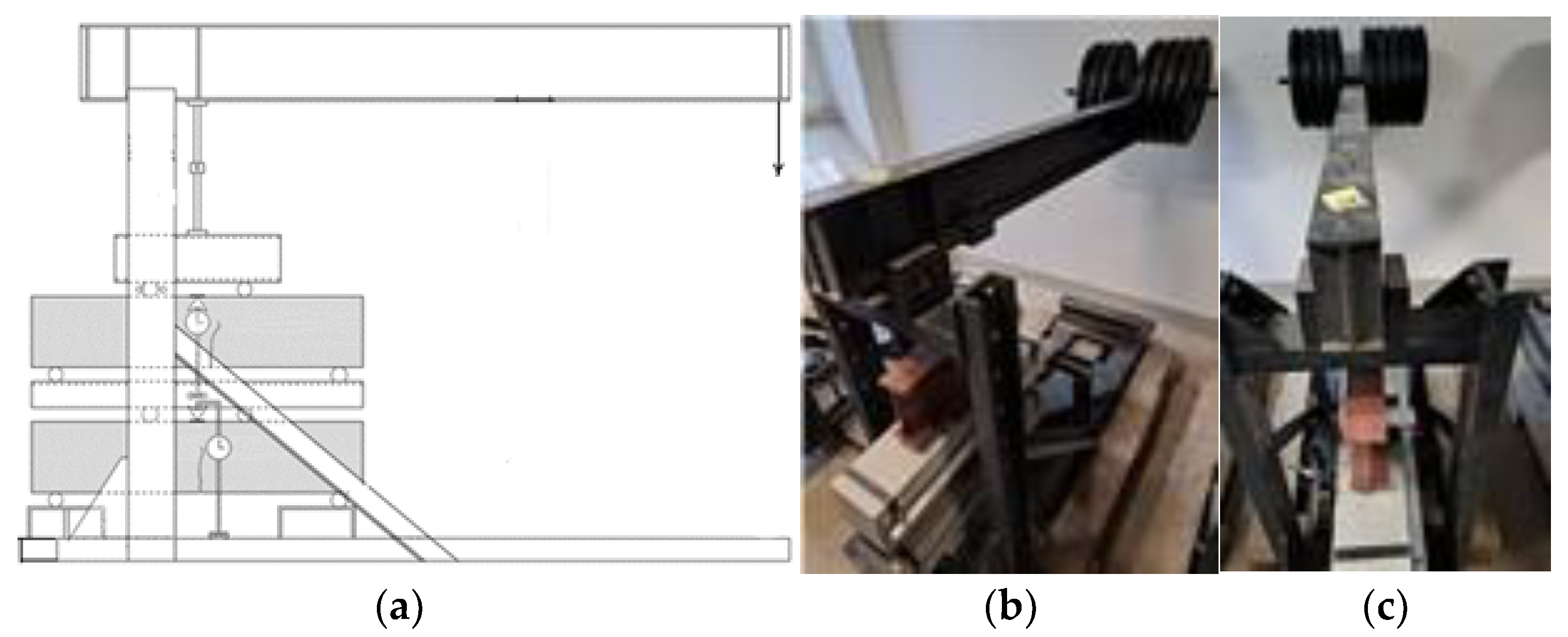
Each TLB was reinforced at the bottom with two longitudinal steel bars of 8 mm diameter and with an ultimate strain of 25‰. Modulus of elasticity, yield strength, and ultimate strength were 200 GPa, 500 MPa, and 525 MPa, respectively. No stirrups were provided in the tested beams [16]. The depths of the SFHSC and NSC layers were 5 cm and 10 cm, respectively. A schematic and photographs of the tested specimens are shown in Figure 1.
The overall TLB dimensions were 700 × 150 × 150 mm. The loading scheme and corresponding dimensions are presented in Figure 1 of [16].
For each TLB, concrete class C 40/50 was selected for the NSC layer and C 90/100 for the SFHSC layer, like in our previous research [16].

4.2. Testing Procedure

The test setup is illustrated in Figure 1a. A single LVDT was installed at the midspan of each tested TLB. The specimens were loaded using mechanical lever arms, preventing load relaxation (Figure 1b,c).
The tests included the following loading cases [16]:
-
Case 1. Two TLB specimens were subjected to long-term loading, corresponding to 70% of the ultimate load;
-
Case 2. Two TLB specimens were first loaded up to cracking and then unloaded; subsequently, they were subjected to long-term loading corresponding to 70% of the ultimate load;
-
Case 3. Two additional TLB specimens were tested under long-term loading, corresponding to approximately 85% of the ultimate load.
The ultimate load was 34.3 kN, and the experiments were conducted over a one-year period. Deflection data were recorded using CATMAN software (v.4.5) [20], with midspan deflections of each TLB measured hourly during the non-linear creep stage.
The tests were performed under constant temperature and humidity conditions (20 °C and 65% correspondingly) in a special climate room. These parameters were automatically controlled by a special machine, as shown in Figure 2.

5. Experimental Results and Discussion

5.1. Beam Cracking

After applying the loads, the formation of cracks in all tested TLBs was documented and their widths were measured. The data on crack opening for linear and non-linear creep are summarized in Table 2.
As indicated in the table, the observed crack widths comply with the requirements of design codes for reinforced concrete structures [5]. Within the linear creep range for Loading Case 1 (specimens loaded at 70% of the ultimate load), no cracks were observed in the top beam, while only a single crack appeared in the bottom beam. In the non-linear creep range, both specimens exhibited cracking.
In Loading Case 2, in which the specimens were pre-cracked by applying 85% of the ultimate load, then unloaded and reloaded to 70% of the ultimate load, two cracks appeared in both beams within the linear creep range. In the non-linear creep range, three cracks were observed in one of the beams.
In Loading Case 3 (when the uncracked specimens were subjected to 85% of the ultimate load), three cracks appeared in one of the beams in the linear and non-linear creep ranges, but the maximum crack width increased from 0.1 mm at linear creep to 0.25 mm at non-linear. In both linear and non-linear creep ranges, the cracks did not propagate to the SFHSC layer. This fact demonstrates the efficiency of the two-layer beam design, and proves its suitability for practical application in the construction industry. This is also one of the novelties of the present research.
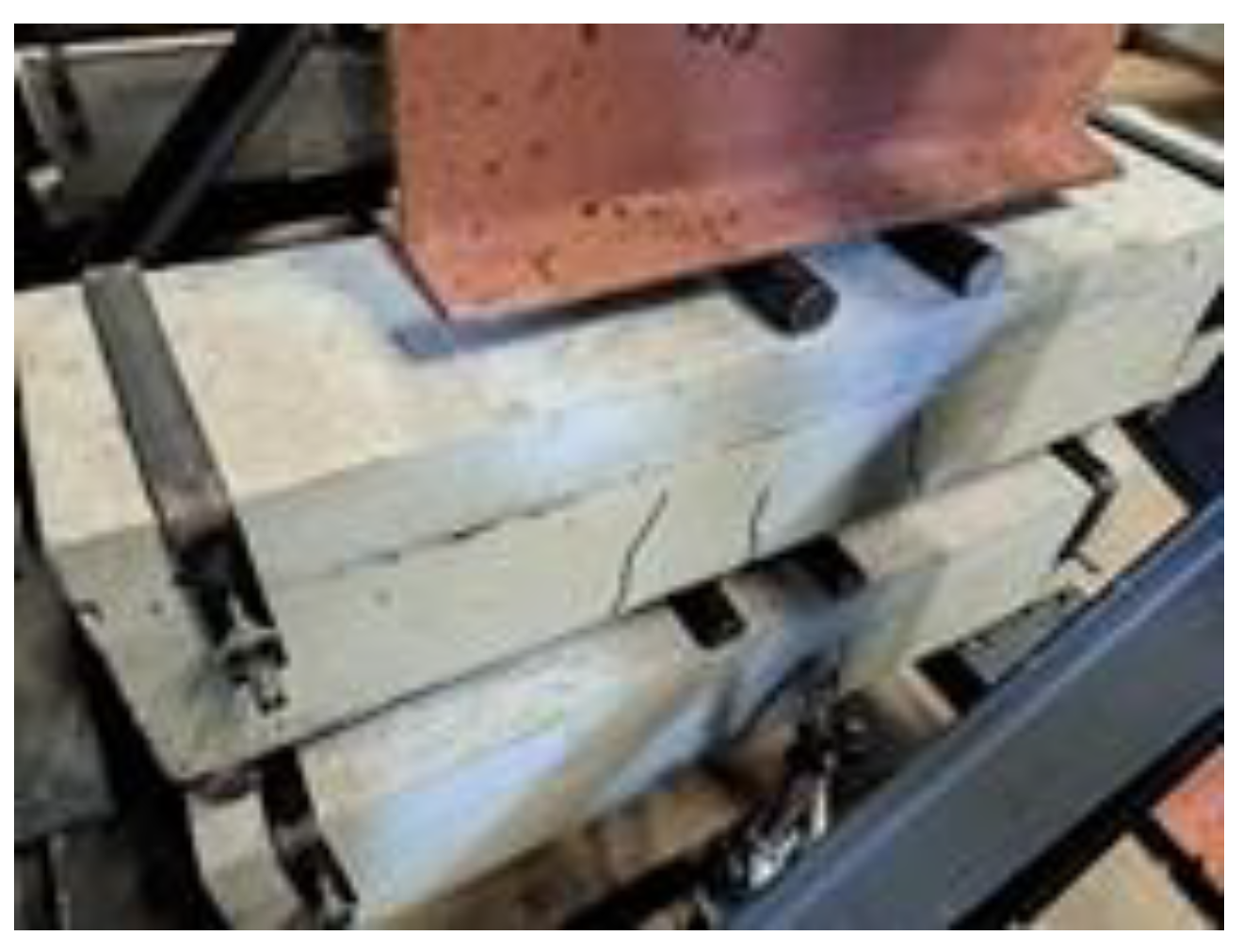
The pattern of cracks in the TLBs in Loading Case 3 is shown in Figure 3. As in the linear creep range, no cracks appeared near the supports or between the SFHSC and NSC layers in the non-linear creep range. No de-bonding between the layers was observed (see Figure 3). Typical cracks appeared in the NSC layer only; therefore, in real TLBs this zone should be pre-stressed [21].

5.2. Analysis of Non-Linear Creep

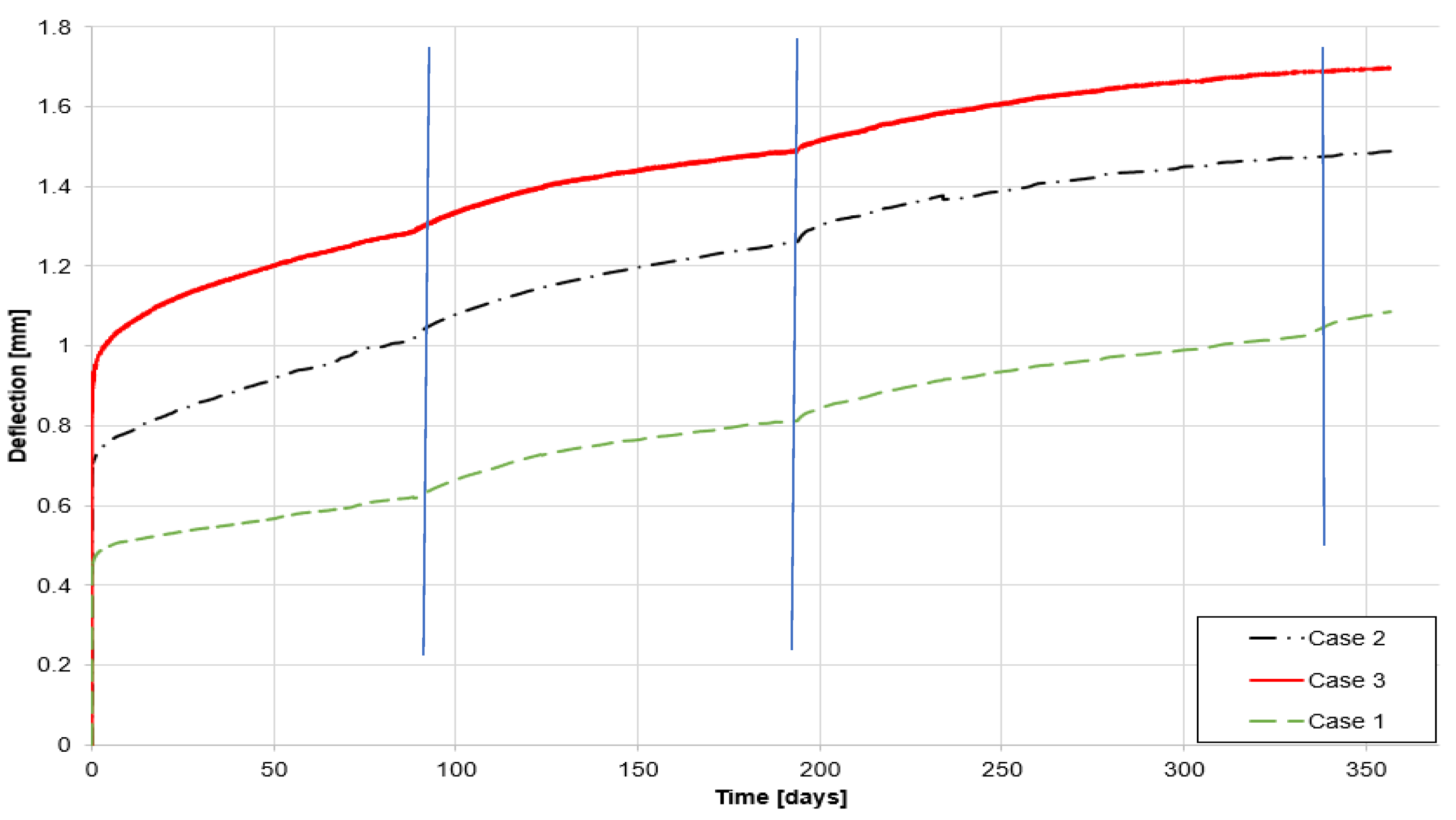
Midspan deflections of tested TLBs were measured and recorded under constant loading and climate-controlled conditions. Figure 4 shows the maximum midspan deflections due to concrete creep observed over one year. Consistent with the previous study [16], the highest creep deflections occurred in Case 3, where load corresponded to 85% of the ultimate capacity. Compared to Case 1 (loading corresponding to 70% of the ultimate load), the deflections in Case 3 at one year are about 1.5 times higher (the difference for linear creep was about 2.33 times [16]). This demonstrates the tendency for deflections in Case 3 to asymptotically reach a constant value of 1.7 mm (see the red line in Figure 4). In the case of pre-cracked TLBs subjected to 70% of the ultimate load (Case 2), the deflection curve is similar to that in Case 3, but the deflections’ values are about 0.2 mm lower; in addition, in Case 2 the deflection at 365 days asymptotically reaches a value of 1.5 mm (see the black line in Figure 4).
It should be mentioned that the critical timepoints with regard to development of deflections are 90, 180 days, and close to one year (see blue vertical lines in Figure 4). Following Figure 4, at these points the derivative of the function deflection vs. time sharply increases. This is similar to the results obtained for the three stages defined in [12] which were related to pre-stressed structures only. The results of the present research demonstrate that these three stages appear also in non-prestressed RC structures and, in particular, in TLBs. It should be mentioned that durations of these three stages correspond to the Structural Phenomenon [17]. These stages are evident visual indicators of the development of deflections due to non-linear creep. Additionally, it may be suggested that the above-mentioned stages correspond to the developments in the width of cracks for all loading cases (see Table 2).
As is known from the design code [5], the deflection of a beam is limited to 1/250 of its span. For the tested specimens, the span is 650 mm [16]; therefore, the maximum deflections should not exceed a value of 2.6 mm. The maximum midspan deflection at non-linear creep obtained for the tested beams in Case 3 at one year was about 0.8 mm. The value corresponding to maximum linear creep under the same load was 0.42 mm [16], i.e., at non-linear creep the deflection is twice as high as at linear, a result which confirms the Structural Phenomenon [17] and the theoretical graph (see Figure 8 in [10], εc = 0.5‰).
As the difference between linear and non-linear creep deflections is rather large, deformations at non-linear creep should be limited by the ultimate value εc cr = 2‰, which corresponds to concrete stress of 0.63 fc [10]. In other words, it is desirable to load RC elements up to the above-mentioned value in order to prevent an uncontrollable increase in non-linear deformations.
As the non-linear creep problem is directly related to the reliability of structures and/or their elements, considering creep deformations as a calculated factor makes it possible to decide if the structure or its element should be repaired [10]. Additionally, if an existing one-layer RC bending element is repaired, a TLB is obtained. In other words, the results of the present study contribute to the achievement of a proper design.

6. Concrete Non-Linear Creep Algorithm

The previously developed algorithm for concrete creep evaluation [10,16] is based on the hypothesis that concrete creep increases mainly during the first year of loading. As in the previous study [16], it was also demonstrated experimentally in the present research that concrete creep in TLBs increases as a curve that asymptotically becomes parallel to the time axis.
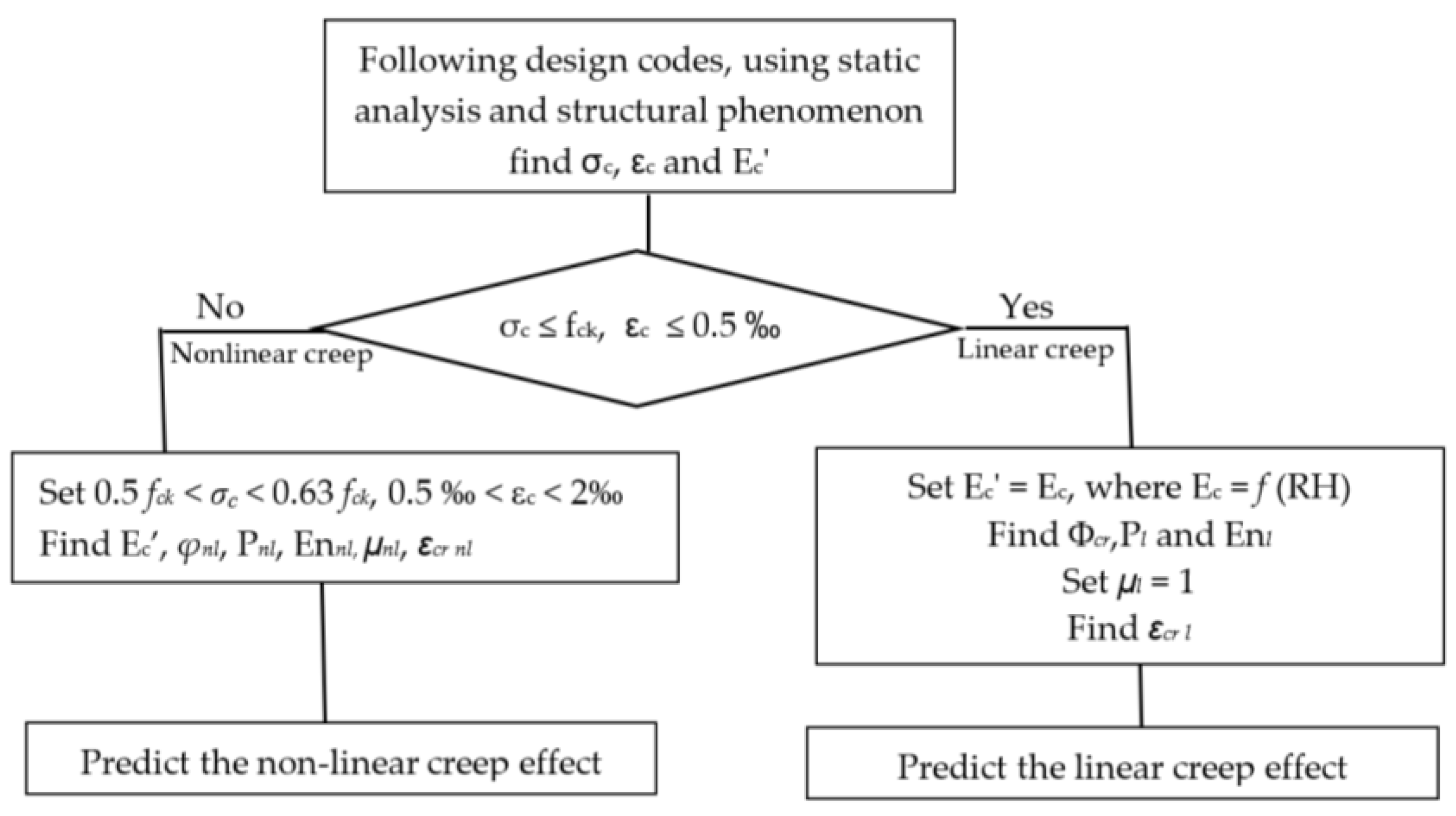
Following the results that were previously reported by the authors for linear creep [10,16], a non-linear creep algorithm was also proposed. A scheme of the algorithm is presented in Figure 5. Usage of all symbols in this figure corresponds to that in [4,10,16].
The algorithm was developed for cases of uniformly distributed and concentrated loads. It considers the influence of humidity in the surrounding environment ranging from 40 to 100% [7]. The influence of unloading was also considered in Case 2.
Based on the experimental results, the tested TLBs exhibited no debonding between layers under all load levels (Cases 1, 2, and 3), even in the non-linear creep range. This indicates proper interaction between the NSC and SFHSC layers. Consequently, the algorithm for non-linear creep developed for single-layer bending elements [10] can also be applied to TLBs.

7. Conclusions

In this paper, the results of an experimental study conducted on non-linear creep as a continuation of linear creep in two-layer reinforced concrete beams are presented. The results of previous experiments were used as a basis for further investigation of the non-linear creep process from initial loading practically up to failure, in pursuit of a unified technology for real-life RC structures.
It was demonstrated experimentally that the theoretical creep algorithm previously proposed can be used for predicting not just the linear but also the non-linear creep effect in two-layer reinforced concrete beams.
It was proved that the investigated TLBs exhibited no debonding between layers, and that the compressed zone (with steel fibers) was deformed as in ordinary concrete elements. As in the linear creep range, so also in the non-linear creep range the cracks did not propagate to the SFHSC layer. This fact demonstrates the efficiency of the two-layer beam design, and proves its suitability for practical application in the construction industry.
As in the case of linear creep, the maximum midspan deflection in the tested beams at the non-linear stage was still less than 1/250 of the beam span, a result which proves that the two-layer beam design methodology is valid for non-linear creep also.
The tests confirmed the theoretical border between linear and non-linear creep, that is, εc = 0.5‰.
It was experimentally demonstrated that the critical timepoints with regard to development of creep deflections are 90 days, 180 days, and close to one year. At these points the derivative of the function deflection vs. time sharply increases. It was shown that these three stages appear not just in prestressed RC structures, but also in non-prestressed ones and, in particular, in TLBs. It should be mentioned that durations of these three stages correspond to the Structural Phenomenon.
It was experimentally confirmed that to prevent non-linear deformations from increasing uncontrollably, their value at non-linear creep should be limited by εc cr = 2‰, which corresponds to a concrete stress of 0.63 fc.
The problem of non-linear creep is directly related to the reliability of structures. Considering creep deformations makes it possible to decide if a structure should be repaired or not.
It was shown that, like in previous experimental investigations on TLBs [21], there was also no debonding between layers in tested TLBs under all load levels at non-linear creep. Hence, the non-linear creep algorithm for single-layer bending elements [10] can be used also for two-layer ones.
The results of wide-ranging experimental and theoretical investigations proved that TLB on the border of two layers in all cases performed similarly. Concrete classes between 30 and 90 were used. Simple supported and continuous non-prestressed and prestressed TLBs were studied. Laboratory and real-life construction site conditions were investigated. No exceptional cases were identified during the course of the investigations. Therefore, the authors think that the TLB is ready for practical implementation in real-life projects.

Author Contributions

Conceptualization, I.I., K.H., and Y.R.; methodology, K.H. and S.K.; software, S.K.; validation, I.I., S.K., and Y.R.; formal analysis, S.K.; investigation, I.I., K.H., S.K., and Y.R.; resources, K.H. and Y.R.; data curation, S.K.; writing—original draft preparation, I.I., S.K., and Y.R.; writing—review and editing, I.I. and Y.R.; visualization, I.I., S.K., and Y.R.; supervision, K.H.; project administration, K.H.; funding acquisition, K.H. and Y.R. All authors have read and agreed to the published version of the manuscript.

Funding

This research was funded by the Alexander von Humboldt Foundation, Germany.

Institutional Review Board Statement

Not applicable.

Informed Consent Statement

Not applicable.

Data Availability Statement

The original contributions presented in this study are included in the article.

Conflicts of Interest

The authors declare no conflicts of interest.

References

  1. Shen, D.; Jiang, J.; Wang, W.; Shen, J.; Jiang, G. Tensile Creep and Cracking Resistance of Concrete with Different Water-to-Cement Ratios at Early Age. Constr. Build. Mater. 2017, 146, 410–418. [Google Scholar] [CrossRef]
  2. Sellier, A.; Multon, S.; Buffo-Lacarrière, L.; Vidal, T.; Bourbon, X.; Camps, G. Concrete Creep Modelling for Structural Applications: Non-Linearity, Multi-Axiality, Hydration, Temperature and Drying Effects. Cem. Concr. Res. 2016, 79, 301–315. [Google Scholar] [CrossRef]
  3. Zhou, Y.; Chen, W.; Yan, P. Measurement and Modeling of Creep Property of High-Strength Concrete Considering Stress Relaxation Effect. J. Build. Eng. 2022, 56, 104726. [Google Scholar] [CrossRef]
  4. EN 1992-1-1; Eurocode 2: Design of Concrete Structures—Part 1-1: General Rules and Rules for Buildings. Management Centre: Brussels, Belgium, 2004.
  5. SI 466 Part 1; Concrete Code: General Principles. Amendment 3. The Standards Institution of Israel: Tel Aviv, Israel, 2012.
  6. ACI Committee. Building Code Requirements for Structural Concrete (ACI Committee 318-05). ACI Committee: Farmington Hills, MI, USA, 2005.
  7. BR 52-101-2003; Non-Pre-Stressed Concrete and Reinforced Concrete Structures. NIIZhB: Moscow, Russia, 2004. (In Russian)
  8. Federation Internationale du Beton (fib). Model Code for Concrete Structures (2020); Version 1.2; FIB: Lausanne, Switzerland, 2024. [Google Scholar]
  9. Xue, W.; Liu, T.; Zeng, M. Prediction of Long-Term Deflections for High-Speed Railway Prestressed Concrete Beams. ACI Struct. J. 2016, 113, 769–778. [Google Scholar]
  10. Iskhakov, I.; Ribakov, Y. New Model of Linear and Non- linear Concrete Creep. Rom. J. Mater. 2021, 51, 528–535. [Google Scholar]
  11. Tho, P.D.; Tien, T.M.; Thanh, D.T.; Ngan, V.M.; Ngoc, V.M.; Sorelli, L. Experimental Investigation of the Secondary Creep of Fiber Reinforced Concrete at High Stress: Macroscopic Measurement and Digital Image Correlation. J. Sci. Technol. Civ. Eng. 2022, 16, 19–28. [Google Scholar] [CrossRef]
  12. Yang, M.; Jin, S.; Gong, J. Concrete Creep Analysis Method Based on a Long-Term Test of Prestressed Concrete Beam. Adv. Civ. Eng. 2020, 2020, 3825403. [Google Scholar] [CrossRef]
  13. Berger, J.; Feix, J. Long-Term Investigations on Reduction of Constraint Forces Caused by Imposed Deformation by Creep. Struct. Concr. 2020, 21, 2643–2653. [Google Scholar] [CrossRef]
  14. Zhang, C.; Zhu, Z.; Zhu, S.; He, Z.; Zhu, D.; Liu, J.; Meng, S. Nonlinear Creep Damage Constitutive Model of Concrete Based on Fractional Calculus Theory. Materials 2019, 12, 1505. [Google Scholar] [CrossRef] [PubMed]
  15. Pan, Z.; Cao, D.; Zeng, B.; Wang, Y. Nonlinear Creep Amplification Factor Considering Damage Evolution of Concrete under Compression. Materials 2022, 15, 6742. [Google Scholar] [CrossRef] [PubMed]
  16. Iskhakov, I.; Holschemacher, K.; Kaeseberg, S.; Ribakov, Y. Methodology and Experimental Investigation of Linear Creep Behavior in Two-Layer Reinforced Concrete Beams. Appl. Sci. 2025, 15, 3456. [Google Scholar] [CrossRef]
  17. Iskhakov, I.; Ribakov, Y. Structural Phenomenon of Cement-Based Composite Elements in Ultimate Limit State. Adv. Build. Technol. Constr. Mater. 2016, 2016, 4710752. [Google Scholar] [CrossRef]
  18. Deutscher Beton- und Bautechnik-Verein E.V. (Ed.) DBV-Merkblatt Stahlfaserbeton; Deutscher Beton- und Bautechnik-Verein E.V.: Wiesbaden, Germany, 2001. (In German) [Google Scholar]
  19. Deutscher Ausschuss für Stahlbeton (DAfStb). Richtlinie Stahlfaserbeton, 23rd ed.; Beuth Verlag GmbH: Berlin/Heidelberg, Germany; Köln, Germany, 2007. (In German) [Google Scholar]
  20. HBM (Hottinger Baldwin Messtechnik GmbH). Software: Catman Professional, version 4.5; HBM (Hottinger Baldwin Messtechnik GmbH): Darmstadt, Germany, 2004. [Google Scholar]
  21. Iskhakov, I.; Ribakov, Y.; Holschemacher, K.; Kaesberg, S. Experimental Case Study and Recommendations for Practical Implementation of Real Pre-Stressed Two Layer Reinforced Concrete Beams. Structures 2023, 47, 1284–1294. [Google Scholar] [CrossRef]
Figure 1. The testing setup: (a) the amplifying equipment scheme (following [16]); (b,c) TLB specimens loaded by a constant force transferred using a lever arm.
Applsci 16 00365 g001
Figure 2. Climate control machine used in the experiments.
Applsci 16 00365 g002
Figure 3. Pattern of cracks in the TLBs in Loading Case 3.
Applsci 16 00365 g003
Figure 4. Maximum midspan deflections in the tested TLBs over a one-year period. Blue lines correspond to periods of about 90, 180, and 350 days.
Applsci 16 00365 g004
Figure 5. Algorithm for non-linear creep analysis. Symbols (following [10,16]): σc—compression stress in SFHSC; fck—normative concrete strength; εc—concrete compressive strain; εcr l—strain at linear creep; εcr nl—strain at non-linear creep; Ec—compressive concrete modulus of elasticity; Ec′—compressive concrete deformation modulus; RH—surrounding environment humidity; Pl—elastic potential of compressed concrete for linear creep; Pnl—elastic potential of compressed concrete for non-linear creep; Enl—section elastic energy under linear creep; En nl—section elastic energy under non-linear creep; Φcr—linear creep coefficient; φnl—non-linear creep coefficient; µl—section ductility for linear creep; µnl—section ductility for non-linear creep.
Applsci 16 00365 g005
Table 1. Concrete mixture compositions (following [16]).
ComponentsQuantity, kg/m3
SFHSCNSC
Portland cement CEM I 52.5 (density of 3.1 kg/dm3)0300
Portland cement CEM II 42.5 (density of 3.085 kg/dm3)4000
Water152180
Fly ash (density 2.3 kg/dm3)1000
Poly-carboxylic ether-based super-plasticizer (density 1.07 kg/dm3)15.40
0/2 sand (density 2.66 kg/dm3)675.43659.36
2/8 gravel (density 2.64 kg/dm3)429.71560.91
8/16 gravel (density 2.64 kg/dm3)618.78654.40
Table 2. Development of cracks in TLBs, measurements in mm.
Load CaseSpecimenLinear Creep/Non-Linear Creep
Crack 1Crack 2Crack 3
1Top-/0.25-/--/-
Bottom0.05/0.05-/0.05-/0.05
2Top0.05/0.050.1/0.1-/-
Bottom0.1/0.10.1/0.1-/0.1
3Top0.1/0.10.1/0.250.1/0.25
Bottom0.1/0.20.1/0.15-/-
Disclaimer/Publisher’s Note: The statements, opinions and data contained in all publications are solely those of the individual author(s) and contributor(s) and not of MDPI and/or the editor(s). MDPI and/or the editor(s) disclaim responsibility for any injury to people or property resulting from any ideas, methods, instructions or products referred to in the content.