Review

Use of Thermal Coatings to Improve the Durability of Working Tools in Agricultural Tillage Machinery: A Review


1
Mechanical Engineering Faculty, “Gheorghe Asachi” Technical University of Iasi, 700050 Iasi, Romania
2
Technical Sciences Academy of Romania, 26 Dacia Blvd., 030167 Bucharest, Romania
3
Mechanical Engineering Faculty, Technical University of Moldova, Bd. Stefan cel Mare 168. L, MD-2004 Chisinau, Moldova
4
CC “BASADORO AGROTEH” LLC, 192 Alba-Iulia, Str., 2049, MD-2071 Chisinau, Moldova
5
Agriculture Faculty, “Ion Ionescu de la Brad” Iasi University of Life Sciences, 700490 Iasi, Romania
*
Authors to whom correspondence should be addressed.
Appl. Sci. 2026, 16(1), 474; https://doi.org/10.3390/app16010474
Submission received: 4 December 2025 / Revised: 25 December 2025 / Accepted: 30 December 2025 / Published: 2 January 2026

Abstract

This article presents an in-depth analysis of the application of thermal deposition techniques, in particular thermal spraying, to improve the properties of materials used in agricultural components that work the soil, such as agricultural plows (mainshare and foreshare). Due to the difficult operating conditions, characterized by abrasive wear, mechanical shocks, and chemical exposure from various soils, these surface coatings aim to increase the durability and corrosion resistance of the materials of components intended for working with the soil. The study investigates thermal deposition methods and their effects on the microstructure, hardness, and friction resistance of the obtained layers. The study highlights experiments that reveal significant improvements in mechanical properties, highlighting superior behavior in real conditions of agricultural use. Nevertheless, soil types significantly influence the abrasive wear rate of the components and also their corrosion, which depends on the soil pH. The results confirm that the use of thermal deposition represents a sustainable and effective solution for extending the life of plows, thus reducing maintenance costs and increasing the efficiency of agricultural processes. This research contributes to the optimization of agricultural equipment, providing an innovative approach for adapting plows to the increasing demands of agricultural exploitation.

1. Introduction

In the context of contemporary agriculture, the efficiency and durability of agricultural tillage machinery (ATM) are pivotal factors for maximizing crop production and minimizing operational costs. The active working components of this machinery are exposed to severe mechanical and chemical stresses, including abrasive wear, mechanical shocks, corrosion, and impact with hard soil constituents. These harsh conditions precipitate accelerated material degradation, significantly shortening the components’ service life. Furthermore, the complexity of variable field conditions exacerbates these wear mechanisms, as the tools must withstand continuous adverse loads. Consequently, the implementation of advanced technological solutions becomes imperative to enhance the performance and longevity of the components most vulnerable to these environmental stressors [1].
To mitigate the detrimental effects of wear and extend the service life of working tools in agricultural tillage machinery (ATM), numerous strategies focused on enhancing wear resistance have been developed. Among these approaches, thermal coatings have emerged as a particularly effective solution, owing to their ability to create protective layers with properties significantly superior to those of the base substrate. Technologies such as hardfacing welding, thermal spraying (including HVOF, electric arc, and plasma), and metallic powder deposition enable the fabrication of surfaces characterized by high hardness, enhanced abrasion resistance, and stability under severe operating conditions.
Within this framework, atmospheric plasma spraying (APS) techniques have garnered increasing attention in the research and optimization of agricultural components. This growing interest stems from their potential to generate protective coatings that exhibit superior mechanical properties, elevated resistance to both wear and corrosion, and ultimately, a substantially prolonged service lifespan for ATM [2,3,4]. Thermal plasma spraying is widely regarded as one of the most versatile and efficient surface treatment methods, facilitating the fabrication of coatings with controlled microstructures, high hardness, and enhanced mechanical strength tailored to the rigorous demands of intensive agriculture. The process involves heating and accelerating metallic or ceramic powders within a plasma jet at temperatures ranging from 6000 °C to 15,000 °C. This extreme heat enables the partial or complete melting of the feedstock particles, resulting in the formation of a compact, uniform coating on the substrate surface. Key technological parameters—such as spraying distance, gas composition, substrate temperature, and jet velocity—can be precisely adjusted to optimize the quality and performance of the deposited layer, thereby offering significant flexibility in adapting the coating to the specific operational stresses encountered by agricultural tillage machinery (ATM) [5,6].
Recent investigations indicate that coatings fabricated via thermal plasma spraying exhibit superior hardness and significantly enhanced abrasion resistance relative to the substrate materials traditionally employed in WTATM manufacturing, such as carbon steels or various specialty alloys. This characteristic is critical for operations in hard and abrasive soil conditions, where wear acts as a primary determinant of agricultural component efficiency and service life. These coatings provide robust protection against corrosion—a particularly relevant factor in moist soils or environments with high concentrations of aggressive chemical agents—thereby preventing chemical degradation of the substrate and reducing the frequency of maintenance and repair interventions [7,8,9].
To fully understand the impact of thermal plasma spray deposition technologies on WTATM performance, a thorough analysis of the induced modifications to the physicochemical properties of the working surfaces is essential. In this regard, extensive research has addressed both the optimization of deposition parameters to yield coatings with superior functional characteristics and the evaluation of their behavior under actual agricultural operating conditions. Mechanical testing—comprising hardness measurements, friction resistance analysis, bond strength evaluation, and impact resistance—has demonstrated that thermal coatings can substantially extend the service life of plows, with direct positive implications for operational costs and agricultural process efficiency [10,11].
Moreover, plasma spray deposition technologies facilitate the customization of protective coating characteristics according to specific soil types and operational regimes, thereby offering an adaptable and sustainable solution suitable for a diverse range of agricultural conditions [12,13]. Such tailoring involves the precise selection of metallic or ceramic feedstocks and the modulation of coating composition to achieve targeted properties—such as self-lubrication or high temperature resistance. The resulting technological flexibility proves particularly beneficial for farms and agricultural operators encountering diverse operational environments, as it enables the rapid and efficient adaptation of equipment to specific field requirements. It should be clarified that, depending on the specific applications related to soil processing, the components must present an optimal ratio between strength and elasticity, this requirement resulting from the stresses arising during processing which requires high wear resistance due to friction with abrasive particles in the soil. At the same time, the components must also present a sufficiently good elasticity so as to withstand the shock stresses arising from the impact with hard elements in the soil which can lead to the appearance of cracks or even the breakage of the components when the hardness is too high and elasticity is too low. Depending on the deposition method, the thicknesses of the layers may vary, but regardless of the thickness, it is necessary to take into account this optimal ratio of strength–elasticity [14,15,16].
Beyond the technical improvements, the implementation of thermal plasma spray deposition techniques yields substantial economic and environmental benefits. Extending the service life of WTATM reduces the necessity for frequent replacements, thereby decreasing the consumption of raw materials and the energy required for manufacturing new components. Concurrently, a reduction in the frequency of repairs and maintenance minimizes downtime and associated costs, enhancing both the productivity and sustainability of agricultural operations. The deployment of optimized materials and coatings can mitigate energy losses attributed to excessive friction during tillage, thus improving the overall energy efficiency of ATM [17,18,19].
Notwithstanding the multiple benefits offered by plasma spray technology, its successful integration into the agricultural sector is contingent upon a complex array of technical and economic factors that demand prudent management. Consequently, a comprehensive understanding of the interplay between process parameters and the ultimate properties of the deposited coatings is essential, alongside a rigorous evaluation of costs and the compatibility of these treatments with established manufacturing workflows. Moreover, ongoing research continues to investigate novel material combinations and deposition strategies, aiming to enhance the performance of protective layers and expand their applicability to agricultural plows and other soil-engaging components. It should not be neglected that opting for spraying technologies involves the use of mostly powdered raw materials (metal/ceramic particles), so the emissions generated and the carbon footprint must also be taken into account. In this regard, an advantage is provided by installations that work in a controlled atmosphere where the particles emitted during the deposition process in the work area do not reach the outside environment and at the same time are retained through filtration systems [20,21,22].
The present study aims to provide a comprehensive perspective on thermal plasma spray deposition techniques as applied within the agricultural sector, with a specific emphasis on enhancing the materials utilized in plow components. The analysis synthesizes the most recent findings from the scientific literature regarding the technological process and deposition parameters, as well as their resultant impact on the microstructure, hardness, and wear resistance of the coatings. The study critically examines the advantages and limitations of these methods, alongside future development trajectories for the optimization of agricultural components through advanced surface engineering. The insights presented herein are intended to facilitate a deeper understanding of how these technologies can be seamlessly integrated into plow manufacturing and maintenance workflows, thereby providing an innovative and sustainable response to the contemporary challenges of intensive agriculture. When opting for thermal spraying of agricultural components, it must be specified that this process can be cyclical, so that the surface can be recoated when the component (or the deposited layer) wears out, and the lifespan is dependent on the properties of the coating material [23,24,25].
It is interesting to examine emerging coating technologies, such as nanocomposite and self-healing coatings, which have significant potential for simultaneously improving wear and corrosion resistance, but with the major disadvantage of being mostly in the development stage and not yet currently implemented on agricultural machinery working parts. These systems can offer additional benefits over traditional thermal coatings from large increases in hardness and wear resistance in nanostructured coatings to the ability to autogenously repair microcracks in self-healing coatings. As for agricultural working parts, they suffer from high impact, severe abrasion, and local plastic deformations during soil cultivation, and self-healing systems are not yet optimized for these extreme stresses. Also, because the layer must resist abrasion from hard soil particles, mechanical shocks, and cyclic loads, in the case of agricultural components that face these severe stresses, thick ceramic or metal layers remain dominant [26,27].
In conclusion, the critical role of plows in agricultural operations, combined with the severity of their operating conditions and the imperative for enhanced durability, fully justifies the growing interest and investment in cutting-edge technologies such as thermal plasma spray deposition. This method offers substantial technical potential to transform the performance of the materials employed, thereby contributing to the development of a more efficient and sustainable agriculture that is well adapted to contemporary requirements for productivity and resilience.

2. The Main Thermal Methods of Surface Deposition

2.1. Atmospheric Plasma Spraying Method (APS)

Atmospheric plasma spraying (APS) constitutes a widely established and highly versatile industrial technique, facilitating the fabrication of functional coatings designed to enhance the surface properties of agricultural components—including agricultural plows, which are subjected to extreme mechanical loads during soil tillage. APS enables the utilization of a broad spectrum of feedstock materials—ranging from oxides and carbides to metals and alloys—thereby yielding coatings that exhibit robust resistance to wear, corrosion, oxidation, and elevated temperatures.
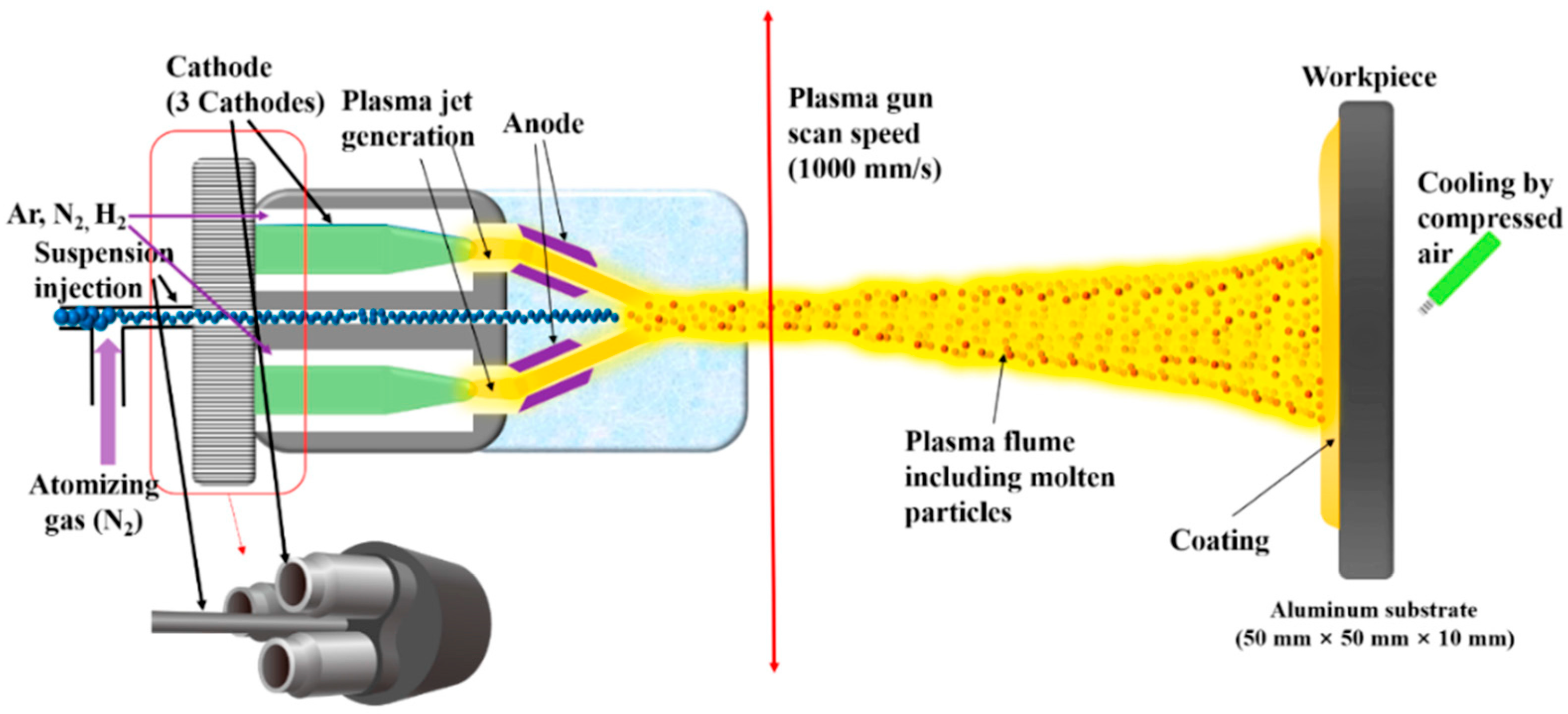
The APS process entails the generation of a plasma jet at atmospheric pressure via an electric arc discharge between two electrodes within an inert or weakly reactive gas medium (typically argon, occasionally supplemented with hydrogen or helium). Plasma temperatures can exceed 10,000 K, facilitating the introduction of the feedstock powder destined to form the coating. The powder is injected either transversely or axially into the plasma stream, where the particles undergo partial or complete melting. Subsequently, these particles are accelerated to velocities ranging from 200 to 500 m/s before being propelled onto the substrate surface [28,29]. Figure 1 schematically illustrates the operating principle of the deposition method [30].
The molten or semi-molten particles impact the surface to form a lamellar structure (referred to as “splats”), building up a coating with typical thicknesses ranging from 50 to 200 µm. The substrate—usually steel or cast iron for agricultural equipment applications—undergoes mechanical or chemical pre-treatment (such as grit blasting or degreasing). Furthermore, the coating’s microstructure, adhesion, porosity, and surface roughness can be finely tuned to meet specific application requirements [31,32].
Critical parameters governing the APS process [33] encompass plasma jet temperature and velocity, feedstock powder characteristics, standoff distance (spray distance), carrier gas flow rate, nozzle kinematics, and the powder feed rate. The rigorous optimization of these variables facilitates the development of a superior coating microstructure, distinguished by reduced porosity, elevated bond strength, and optimal density—properties that are indispensable for agricultural machinery operating under conditions of intensive wear.
Precise control of the substrate temperature during the deposition process mitigates thermal stresses and minimizes the risk of delamination. Post-treatment processes, such as sintering or remelting, can enhance coating cohesion and mechanical properties [33].
Table 1 summarizes the distinct advantages of thermal plasma spray coatings in relation to the critical material properties required for soil-engaging agricultural equipment [34].
The APS deposition method holds significant potential both for enhancing the material properties employed in the construction of plows, shares, and other agricultural working tools, and for the reconditioning of these components once they exhibit a certain degree of wear. In principle, the limitations of this technology are associated with high equipment costs, the necessity for rigorous control over process parameters, and coating adhesion issues (which are heavily dependent on substrate preparation) [35,36].

2.2. Cold Spray Method

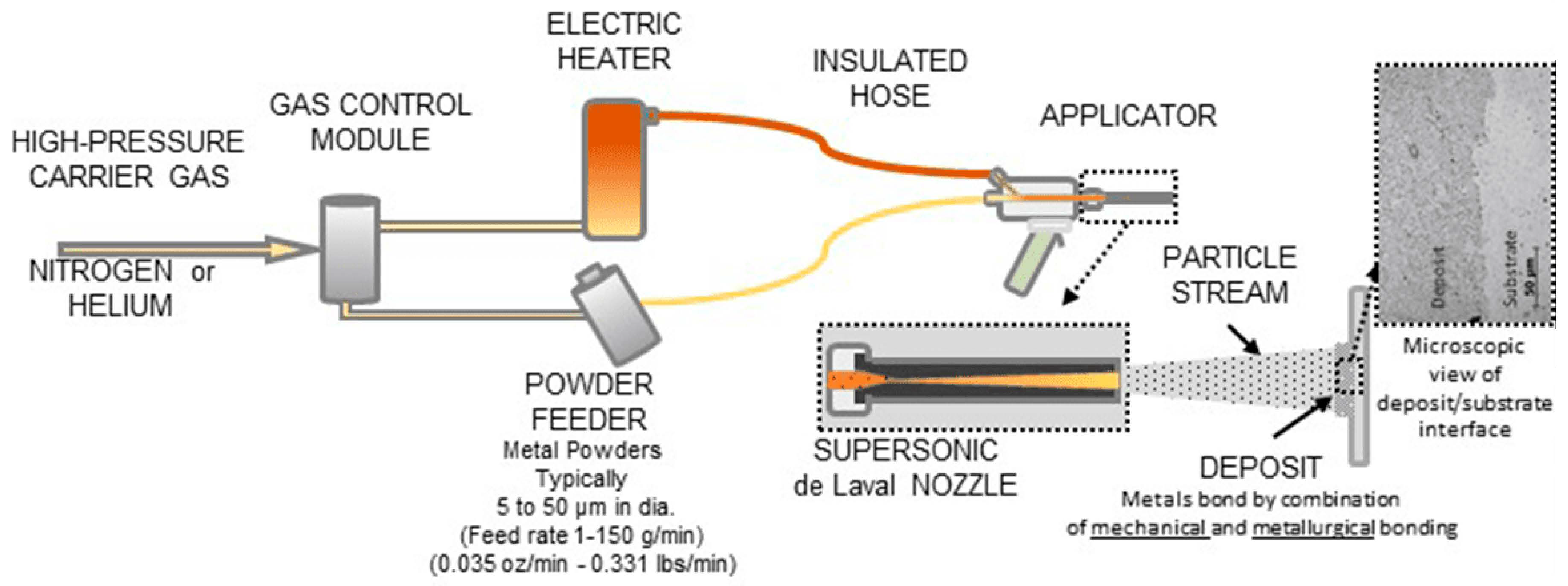
Cold spray is a deposition technology wherein metallic (or ceramic) feedstock particles are accelerated to supersonic velocities via a heated gas jet while maintaining temperatures below the melting point of the deposition material. The particles are injected into the supersonic gas stream and propelled onto the target substrate. The high-velocity impact induces severe plastic deformation of the particles, resulting in a tight mechanical bond and partial metallurgical bonding with the substrate. Crucially, this occurs without oxidation or phase transformations, distinguishing cold spray from conventional thermal deposition processes that involve material melting. Figure 2 illustrates the cold spray deposition system and its principal components [37,38].
This solid-state process enables the fabrication of dense coatings characterized by low porosity and superior resistance to wear, corrosion, and fatigue. Consequently, it is ideally suited for application on components operating in abrasive environments, such as soil-engaging agricultural machinery. Compared to traditional thermal deposition methods, cold spray offers a distinct set of advantages [39,40]:
  • Low process temperatures, thereby avoiding thermal influence on the substrate and preserving the mechanical properties of both the base material and the deposited feedstock.
  • Significant reduction in oxidation, as the particles do not undergo melting; this ensures a material structure with superior properties and enhanced adhesion.
  • Capability to deposit thick, high-density layers, minimizing internal defects, including porosity.
  • Compatibility with a wide range of metallic alloys, including aluminum, copper, nickel, and stainless steel-based alloys, offering potential applications in both the repair and protection of agricultural equipment.
  • Increased wear and corrosion resistance, along with a reduced risk of cracking due to the compressive residual stresses generated during deposition—a characteristicparticularly beneficial for abrasive environments such as soil.
Soil-engaging agricultural machinery operates under conditions of severe wear induced by friction with abrasive soil particulates, moisture, and corrosive agents. Consequently, safeguarding the surface integrity of these components—predominantly fabricated from steel or metallic alloys—is paramount for extending their service life and maintaining operational performance. Through the cold spray deposition technique, it is possible to engineer protective coatings that substantially enhance the abrasion and corrosion resistance of these components, ultimately leading to the following [41]:
  • Mitigation of mechanical wear and chemical corrosion;
  • Preservation of the equipment’s mechanical integrity devoid of thermal distortion;
  • Cost optimization achieved through a reduction in the frequency of repairs and component replacements;
  • Retention of the inherent hardness and mechanical strength characteristics of the substrate material.
Recent studies have demonstrated that coatings fabricated via the cold spray method are characterized by a dense microstructure and strongly adherent layers free of major discontinuities. This structural integrity is attributed to the phenomenon of severe plastic deformation experienced by both the particles and the substrate upon supersonic impact, which facilitates tight mechanical interlocking and the formation of localized metallurgical bonds. The resulting mechanical properties include a significant increase in hardness (the literature reports hardness values exceeding 45 HRC on steel substrates), as well as enhanced fatigue behavior and corrosion resistance—characteristics that are critical for applications involving harsh operating conditions [42,43].
The cold spray method represents a viable solution for enhancing the surface properties of materials employed in soil-engaging agricultural equipment. By applying dense protective coatings that are resistant to wear and corrosion—utilizing supersonically accelerated solid-state particles—this technique ensures superior protection and durability without compromising the thermal integrity of the components. Consequently, the technology holds significant potential for expansion within the agricultural industry, contributing substantially to increasing the efficiency and longevity of machinery [44].

2.3. Electrochemical Deposition

Electrochemical deposition represents an effective technology for the formation of metallic or composite layers on the surface of various materials, including those employed in soil-engaging agricultural equipment. In recent years, significant progress has been achieved in adapting and optimizing this technique for industrial purposes, aiming to enhance the durability of components exposed to wear and corrosion [45].
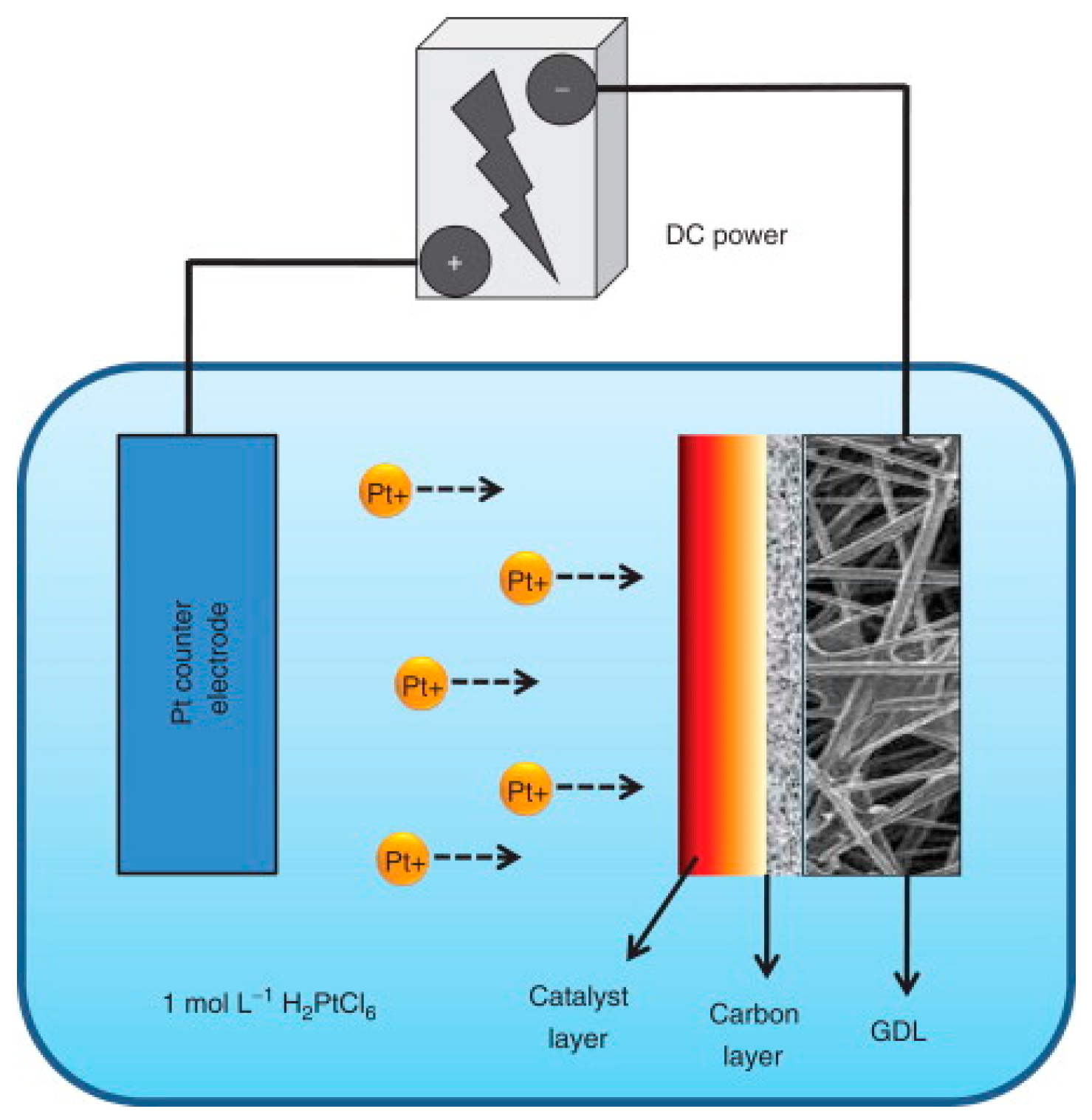
The fundamental principle of electrochemical deposition (electrodeposition) relies on the reduction of metal ions from an electrolyte onto the surface of a conductive substrate, driven by an electric current applied between two electrodes. The cathode serves as the deposition surface, while the anode may be either inert or soluble, depending on the material being deposited. Through the precise control of electrical parameters (current density, voltage), chemical parameters (pH, concentration, temperature), and deposition time, it is possible to obtain a uniform coating with microstructure, thickness, and composition controlled at the micrometric or nanometric scale. Figure 3 illustrates the operating principle of the electrochemical deposition technique [46,47].
This process enables the deposition of pure metals (Ni, Cu, Zn, Cr, Au, Ag, etc.), alloys, or composites (ceramic–metal matrix, micro- and nanoparticles dispersed within a metallic matrix) tailored to meet the specific requirements for strength, hardness, or functional properties demanded by agricultural applications. Electrochemical deposition offers distinct advantages over conventional coating methods [48,49]:
  • Precise control over the composition and thickness of the deposited layer.
  • Homogeneous microstructure and strong adhesion to the substrate.
  • Low process temperatures, thereby eliminating the risk of thermal distortion or degradation of the substrate.
  • The capability to fabricate functional or decorative coatings with tailored properties.
  • Low implementation costs and high efficiency, applicable even to complex geometries.
In the agricultural context, components such as plow blades, shares, cutting disks, and other soil-engaging parts are subjected to intense abrasion, corrosion, and repeated shock cycles. Against this background, electrochemical depositions can provide the following [45,50,51]:
  • Excellent protection against wear and corrosion through the application of hard coatings (e.g., nickel-chromium, hard chrome, Ni-P type alloys).
  • Extension of service life and component reliability.
  • The capability to restore/recondition worn parts by reclaiming their original dimensions while simultaneously enhancing mechanical properties.
  • Precise deposition on critical functional areas without compromising the integrity of the overall component assembly.
For instance, recent studies indicate that nickel-phosphorus-based alloy depositions or metal-matrix composite coatings have achieved a reduction in friction wear of over 50%, alongside enhanced corrosion resistance in acidic or ion-rich environments—conditions typical of agricultural soils treated with chemical fertilizers [50,51].
Research conducted in recent years emphasizes that the microstructure resulting from electrochemical deposition is exceptionally fine and controllable at both micro- and nanometric scales, facilitating the incorporation of distinct chemical elements to optimize hardness, ductility, and impact resistance. Furthermore, through the introduction of specific additives or particles into the electrolytic bath, it is possible to engineer coatings exhibiting lamellar, granular, or columnar morphologies tailored to specific application requirements [51,52].
Numerous studies indicate a direct correlation between deposition parameters (current density, temperature, bath composition) and the final coating properties, rendering the method readily adaptable from laboratory settings to industrial scale. For the protection of agricultural components, these properties translate into superior resistance to abrasion and corrosion, thereby maintaining surface integrity over prolonged operational cycles [52].
Electrochemical deposition represents a modern, efficient, and adaptable method for enhancing the performance of agricultural materials and components, contributing significantly to wear mitigation, extension of service life, and reduction in maintenance costs. The versatility and sustainability of this technique—including its capacity for integration with other technologies (e.g., hybrid or functional coatings)—position it as a promising solution for precision agriculture and equipment requiring extended reliability [51,52].

2.4. Physical Vapor Deposition

Physical vapor deposition (PVD) is a sophisticated physical process widely employed for the deposition of thin films onto various surfaces—including those of soil-engaging agricultural equipment—with the objective of enhancing wear and corrosion resistance properties. This method involves the vaporization of a solid source material within a controlled environment, followed by the condensation of its constituent atoms or molecules onto the target substrate under vacuum or controlled atmosphere conditions [53].
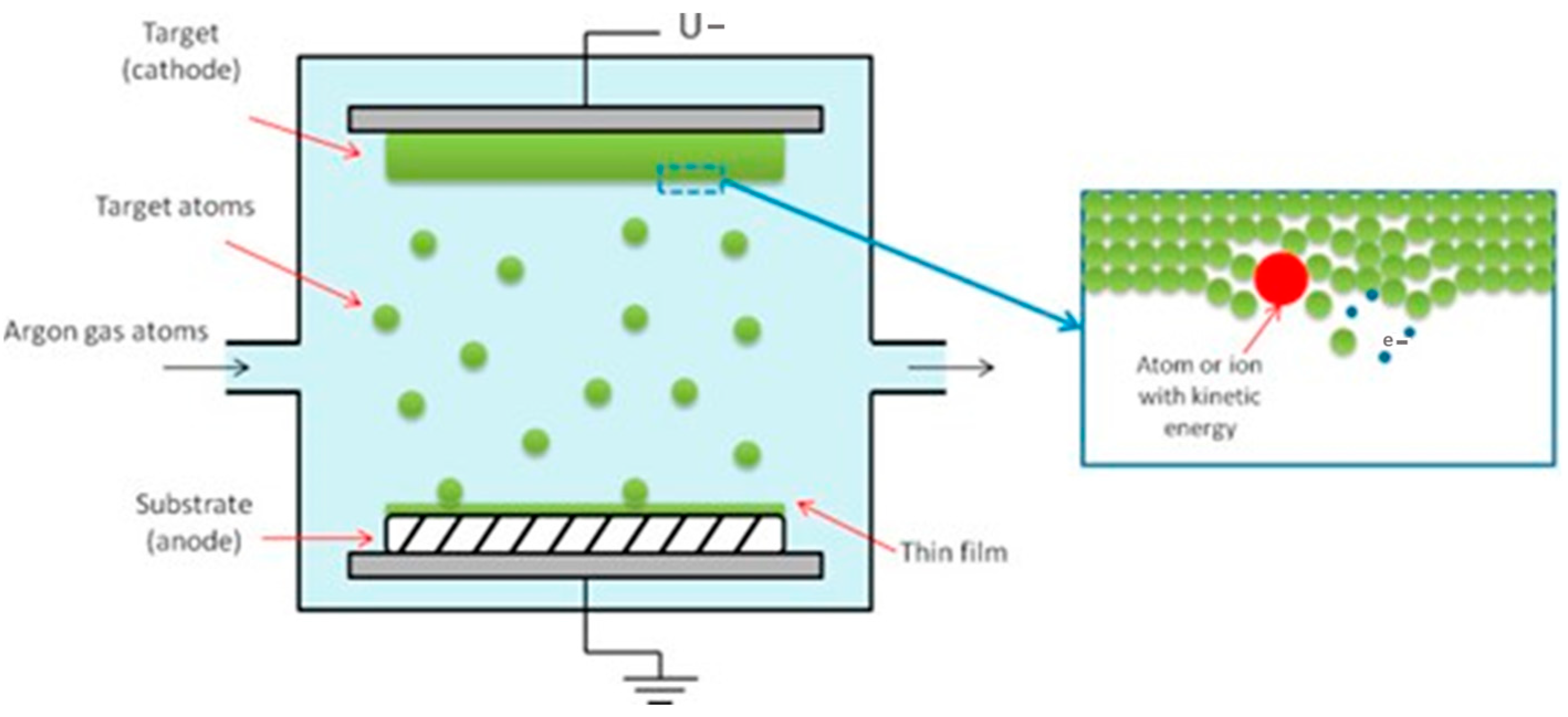
PVD entails the physical transformation of a source material into a vapor (or plasma) phase; these species are subsequently transported and deposited onto the substrate surface, forming a thin film with precisely controlled properties. This process encompasses various techniques, including thermal evaporation, sputtering, laser ablation, and target ionization within ionized environments. Throughout the process, the substrate is maintained under vacuum to prevent contamination and ensure uniform deposition. The PVD method is inherently complex and offers a series of distinct advantages, as outlined below [54,55]:
  • Enables the deposition of extremely pure and strongly adherent coatings.
  • Produces hard coatings with superior resistance to abrasion and corrosion.
  • Characterized by a low environmental footprint due to the absence of toxic chemical solutions.
  • Provides precise control over layer thickness and composition.
  • Compatible with a wide variety of substrate materials and complex geometries.
Figure 4 schematically illustrates the operating principle of the physical vapor deposition technique and the mechanism of coating formation [56].
In the agricultural sector, the surfaces of soil-engaging components—such as disk blades, plowshares, and other implements—are susceptible to severe wear and corrosion arising from mechanical interaction with abrasive soil particles, combined with moisture and chemical reactivity inherent to the soil environment. PVD offers efficient solutions for extending the service life of these components through the deposition of hard protective coatings, such as nitrides (e.g., TiN, CrN), carbides, or metallic alloys [57,58].
For instance, PVD coatings can significantly reduce friction and enhance wear resistance during continuous operations, thereby increasing economic efficiency and minimizing the need for frequent maintenance. Recent studies demonstrate substantial performance improvements in PVD-coated agricultural tools compared to their untreated counterparts or those processed via alternative technologies. PVD coatings are characterized by microstructural refinement, a feature instrumental in controlling mechanical and tribological properties. Layer thickness can be precisely regulated from tens of nanometers to several microns, while properties can be tailored to meet specific requirements. The control of process parameters—such as substrate temperature, chamber pressure, gas type, and ion energy—determines the final quality of the coating [59,60].
PVD represents a modern, environmentally friendly, and highly performaning technology for depositing protective layers on agricultural equipment operated under demanding conditions. The resulting coatings are hard, adherent, and resistant to abrasion and corrosion, thereby significantly prolonging the service life of agricultural components. Recent technological developments continue to expand the applicability of PVD, including for components characterized by complex geometries and specific functional properties [59,60].
Concluding the applicability of these superficial deposition methods on agricultural equipment components, it can be emphasized that APS and electrochemical deposition represent the most frequently used industrial methods for protecting soil-processing components, such as plows, cultivator blades, and disk harrows, due to the good resistance of the coatings to severe abrasion and impact occurring during work with stony or sandy soils. At the same time, an important factor is the affordable cost of implementation and reconditioning, as well as the high scalability for series production or applications in medium–large farms. In contrast, cold spray and PVD remain as emerging or niche technologies in research, being limited by equipment costs and process complexity. The cold spray method shows great potential by obtaining consistent layers with good properties due to low deposition temperatures, but due to cost considerations, its applicability remains limited on a large scale such as in the agricultural sector.
The literature reveals significant contradictions regarding thermal coating performance for agricultural components, which the manuscript does not explicitly address. While both APS and cold spray are presented as highly effective, studies are conflicted on their field performance: APS excels in pure abrasion due to high hardness, yet fails prematurely under cyclic impact–abrasion from lamellar porosity, whereas cold spray offers longer life through dense structures despite lower hardness. Similar trade-offs exist in hardness vs. toughness, PVD limitations, and soil moisture effects. Table 2 summarizes these controversies, optimal conditions, and applicability of these technologies.
Future research should prioritize site-specific testing protocols that reconcile APS–cold spray contradictions through hybrid processes, optimizing hardness–toughness ratios for dominant soil regimes (abrasion vs. impact). PVD limitations necessitate the development of omnidirectional deposition variants for complex agricultural geometries. Addressing soil moisture variability requires multiple coatings, both with different materials and with different aspects/porosities of the layers, to be validated under field conditions. Also, since the specialized literature does not provide extensive studies, it would be useful to take into account future perspectives and longer field tests examining components (with and without thermal coatings) over a much longer period of time, perhaps even on the order of years.

3. Agricultural Soil Tillage Machines

3.1. Tillage Systems

The soil tillage system (STS) encompasses mechanical operations on the arable layer across crop rotations to optimize plant growth and maintain/improve soil fertility. Key objectives include loosening for aeration/infiltration, pulverizing/leveling, incorporating residues/fertilizers, weed control, seedbed preparation, and reducing compaction [64].
Sustainable practices have evolved STS into three main categories, differentiated by soil mobilization, energy use, and environmental impact:
1. Conventional: Moldboard plowing (18–35 cm) with furrow inversion, followed by harrowing/cultivating; effective for weeds/fertilizers but high energy use, moisture loss, and erosion risk [65].
2. Minimum tillage: No plowing; uses cultivators/scarifiers, retains surface residues; saves fuel/moisture, reduces compaction; requires specialized equipment, less effective on heavy/weedy soils [66].
3. Conservation/no tillage: Direct seeding without tillage, soil covered by residues; preserves structure/humus, minimizes erosion/energy; drawbacks include strict weed management and limited suitability for cold/wet soils [65].
The selection of a soil tillage system depends on the soil type, local climatic conditions, technical equipment available to the farm, and the specific agricultural crop being cultivated. The current trend in agriculture is shifting toward sustainable conservation systems capable of maintaining soil fertility and reducing environmental impact without compromising crop productivity [67].

3.2. Soil Tillage Machines

Soil tillage machines (STM) are agricultural implements designed for mobilizing, loosening, pulverizing, leveling, and preparing the soil for sowing or crop maintenance through the action of working organs upon the superficial or deep layers of the land.
Soil tillage machines can be categorized into several groups based on their mode of action and purpose: machines for primary tillage; machines for secondary tillage; and machines for special tillage operations.
Primary tillage machines: Deep mobilization (35–60 cm) with loosening, inversion, or dislocation; includes moldboard plows (simple/reversible), moldboard-less plows, subsoilers, and scarifiers for residue incorporation and hardpan breaking.
Secondary tillage machines: Superficial pulverizing, leveling, and seedbed preparation post-primary tillage; e.g., disk harrows (light/medium/heavy), tine harrows, cultivators, and combinators for aggregate breakdown, weed control, and uniform micro-relief.
Special tillage machines: Targeted operations in arable/inter-row spaces; e.g., row-crop cultivators, deep loosener scarifiers, ridgers, and conservation equipment (minimum-till, strip-till, no-till) for aeration, furrow formation, and minimal soil structure disruption.

3.3. Distinctive Features of the Working Bodies of Soil Tillage Machines

3.3.1. General Components of Soil Tillage Machines

Soil tillage machines are essential for land preparation, plant development, and soil physical state maintenance. Their complex structure integrates load-bearing elements, adjustment mechanisms, force transmission systems, and working organs that directly contact the soil, determining operational efficiency. Analyzing these components, especially working organs, ensures correct, high-performance equipment use [68,69,70].
Although the variety of agricultural soil tillage machines is extensive—ranging from plows, harrows, cultivators, and combinators to grubbers and subsoilers—most of these include several common constructive components:
1. Main Frame (Chassis). This constitutes the structural backbone of the machine, typically fabricated from welded metal profiles. It supports the working assemblies, adjustment elements, and hitching systems, ensuring the stability and rigidity of the entire machine.
2. Hitching and Aggregation Systems. These enable the coupling of the machine to the tractor, being designed according to the three-point linkage standard (Categories I–III), or as semi-mounted or trailed configurations. They ensure force transmission and equipment stability during operation.
3. Regulation and Adjustment Mechanisms. These include depth limiters, rollers, support wheels, screws, and hydraulic pistons for modifying the working depth, the angle of attack, or the pressure exerted upon the soil.
4. Transport and Safety Elements. Wheels, lifting devices, locking systems, and safety guards that facilitate transport between fields and ensure safe usage.
Secondary tillage machines use low-stress organs (disks, tines, knives, blades, rollers) at 5–15 cm depth, enabling high speeds and low power. Adjustable disk angles/pressure/depth ensure uniform pulverization and seedbed quality; reliability is high with moderate wear/costs, though bearings affect lifespan.
Special tillage machines feature task-specific organs (narrow knives, chisels, oscillating tines, ridgers) for inter-row/conservation work. They include fine adjustments, parallelogram linkages, overload protection, and precision tech (GPS/sensors); high acquisition costs are offset by fuel savings, fewer passes, and good reliability from low stress/long repair intervals.
The greatest wear is borne by the working elements—components specially designed to penetrate, loosen, cut or mix the soil—which, including modern equipment, are subjected to variable working demands ranging from low to high. They must withstand these conditions and be able to function optimally, and thermal deposits have a good suitability in this regard as they can lead to obtaining superior mechanical resistance properties of the working surfaces that come into direct contact with the soil.

3.3.2. Working Organs of Soil Tillage Machines–Classification and Functional Role

Working organs are the components of agricultural machinery that come into direct contact with the soil. They determine the quality of the operation, the degree of loosening, the level of pulverization, and the energy consumption. The shape, dimensions, material, and mode of movement of these organs are adapted to various soil types and tillage operations [68,69,70].
The working organs can be classified into several distinct groups:
  • Working organs for soil inversion and loosening (plow bottoms, shares, moldboards);
  • Working organs for loosening without inversion (chisels, scarifying tines);
  • Working organs for soil pulverization and leveling (tine harrows, disk harrows, star rollers, ring rollers);
  • Working organs for superficial tillage (flat blades, L- or C-shaped blades, arrowhead shares, rotary tillers, elastic cultivator tines).
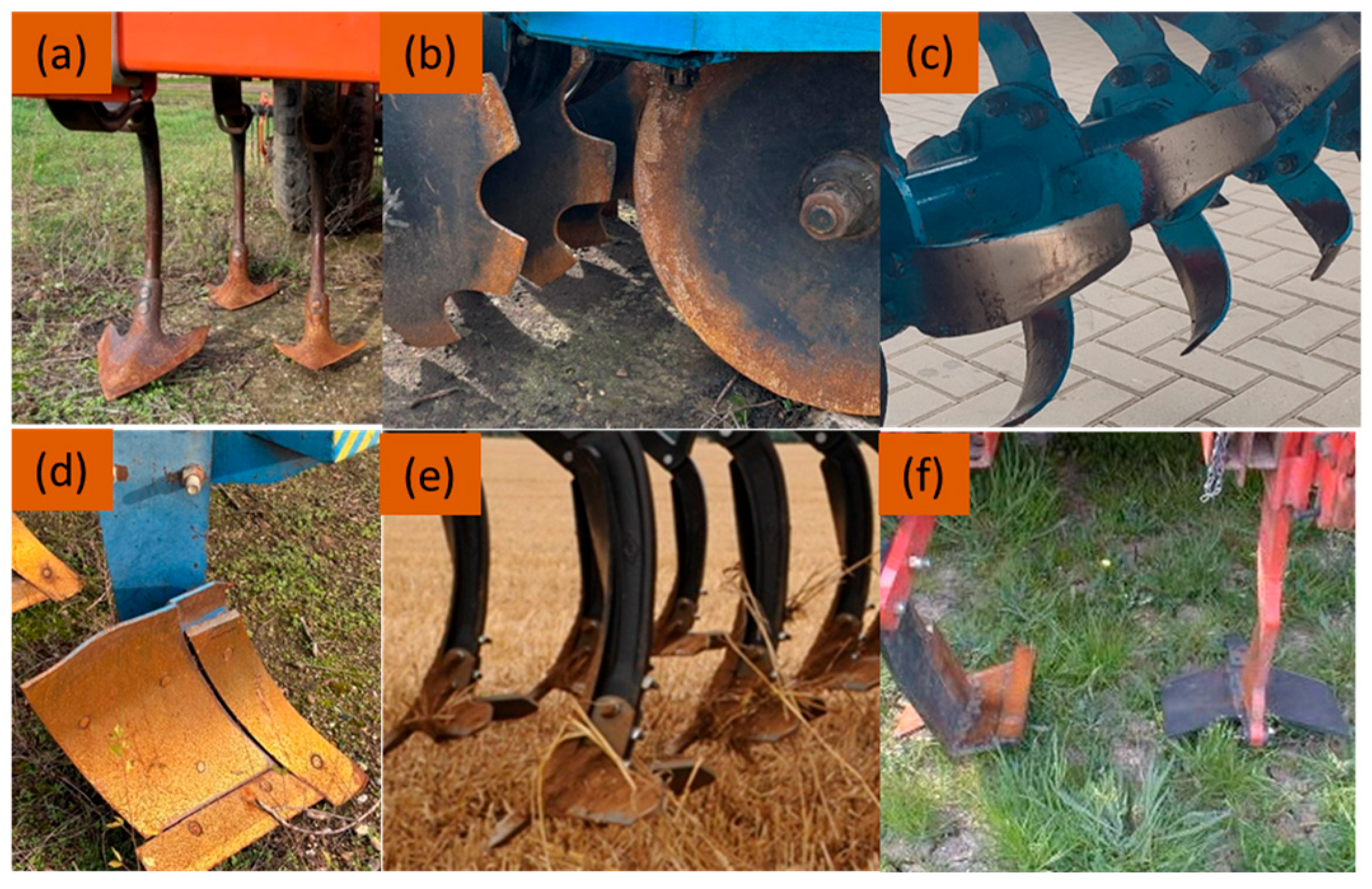
In Figure 5, various working tools intended for soil cultivation are presented.
The working organs of agricultural machinery are distinguished by a series of functional and constructive characteristics that determine their mode of action upon the soil, operational efficiency, and adaptability to various pedological conditions. These particularities directly influence the quality of the tillage, energy consumption, and equipment durability [60,68,69].
One of the most critical differentiating elements is the active shape of the working organ. The cutting edge, angle of attack, lateral curvatures, and guiding surfaces determine how the soil is detached, lifted, cut, or pulverized. Thus, the following are employed:
  • Sharp and narrow working organs (chisels, scarifying tines). These are used when deep penetration is required, fissuring the soil with minimal disturbance to the superficial layer.
  • Broad and curved working organs (moldboards, arrowhead shares). These produce a more extensive displacement of the soil, facilitating its inversion and mixing.
  • Disk-shaped working organs. These feature a circular geometry that combines cutting via rolling action with superficial loosening, being effective in heavy soils or those covered with crop residues.
STM working organs’ angle of attack and positioning affect draft resistance, depth, pulverization, and inversion: small angles reduce fuel use; large angles increase soil aggressiveness for clearing/hard soils.
In conclusion, organ specificity (shape, material, angles, movement) defines soil impact, productivity, and energy use, enabling adaptation from superficial loosening to deep inversion. Proper selection matches soil, field, and crop needs for efficient agriculture.
Durability depends on material properties (composition, microstructure, treatments, geometry, surface) and conditions (soil texture/moisture, abrasives, speed, depth, cycles), influencing wear rate and machine stability.
Considering that the active surfaces of working organs withstand extreme mechanical stresses, micro-cutting processes, chipping, plastic deformation, and intense abrasion, the need for in-depth research regarding the hardening of these surfaces becomes evident. It is worth mentioning that a significant factor in the degree of wear is also the type of equipment intended for soil cultivation, where, comparing, for example, the plow and the disk harrow, they will obviously have different degrees of wear because the plow is subjected to higher stresses during work due to linear movement (translation), unlike the disk harrow, which during operation is subjected to both linear movement (translation) and rotation. Technologies such as hardfacing via welding, cermet depositions, thermochemical treatments, carbide coatings, or the use of composite materials can considerably increase wear resistance and the service life of working organs.
The main argument lies in the fact that, in the absence of advanced protection and hardening solutions, rapid surface deterioration leads to a loss of geometric precision, increased energy consumption, degradation of tillage quality, and rising maintenance costs. Therefore, optimizing wear behavior and developing modern hardening technologies represent a priority research field, capable of ensuring both equipment reliability and economic, sustainable operation under the increasingly variable conditions of modern agricultural operations.

3.3.3. Constructive and Operational Characteristics of the Working Organs of Plows and Coulters

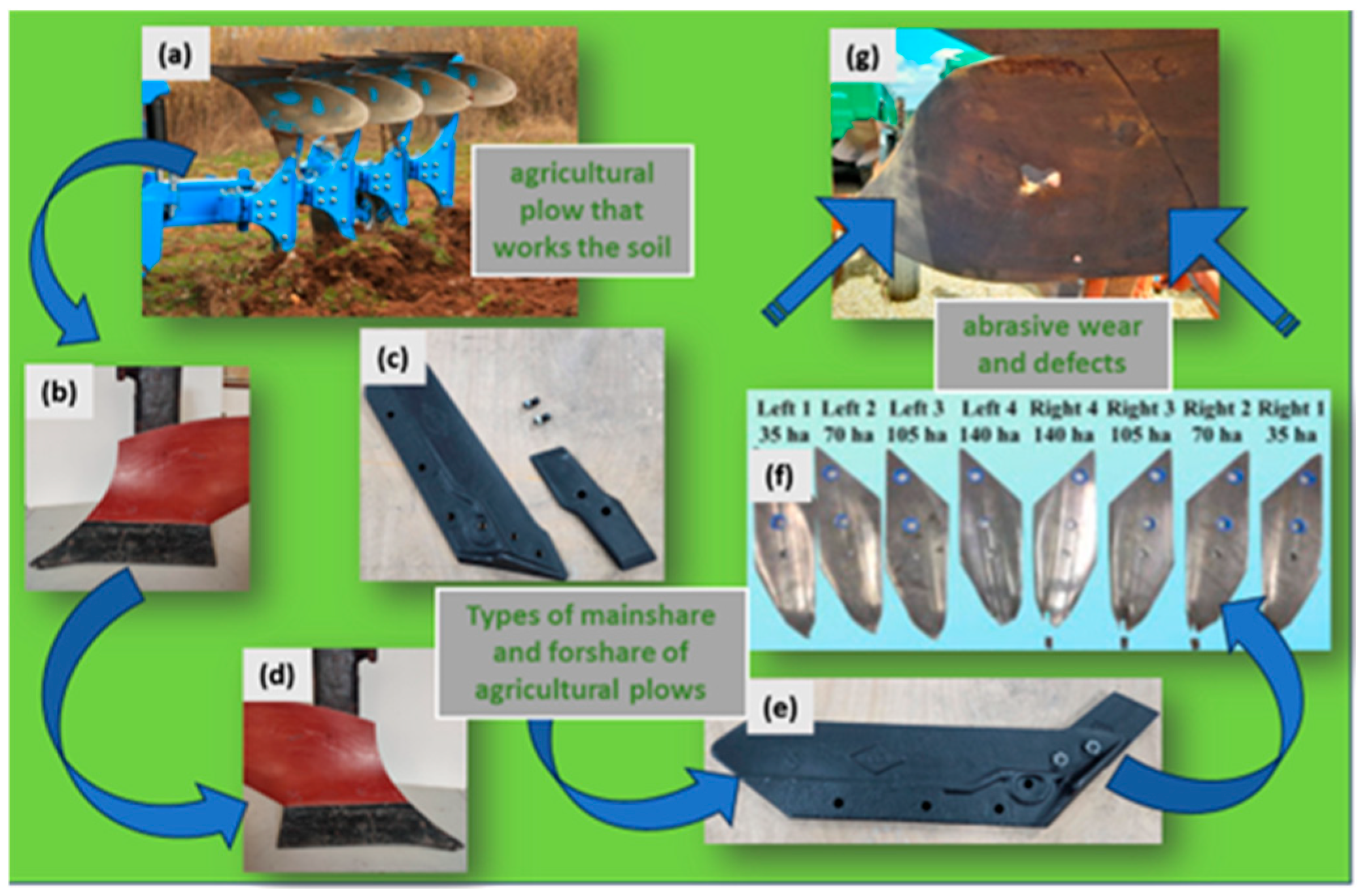
The plow is one of the most widespread agricultural implements for primary tillage. Its main working components are the share, the coulter, and the moldboard, all manufactured from heat-treated steels designed to withstand wear, shock, shear, and corrosion stresses generated by constant contact with soil and stones. Modern shares feature geometrically optimized profiles (angle, shape, thickness), often based on discrete element method (DEM) simulations and real-time wear studies. For instance, shares featuring hard edges applied via thermal methods demonstrate enhanced wear resistance and reduced soil friction, thereby lowering the tractor’s energy consumption. Figure 6 illustrates the assembly of a reversible plow along with its components, as well as the effects of abrasive wear and impact resulting from tillage operations under severe conditions [71,72,73,74].
The functional components of the plow are subjected to severe mechanical stress, particularly the elements that interact with the soil medium. The plowshare constitutes the zone most affected by abrasive degradation, triggered by high-hardness mineral grains (silica crystals, stone fragments) acting as natural abrasives, which generate microscopic material deformations and progressive mass loss. The coulter, responsible for executing the vertical cut in the soil prior to the share’s penetration, is subjected to a combination of repetitive impact stresses and wear uniformly distributed across the soil contact zone. The moldboard, performing the function of inverting and fragmenting the soil strata, experiences abrasive degradation on its active surfaces where it interacts with mobilized soil particles, leading to a gradual decline in the quality of the technological process and an increase in mechanical energy consumption. The vertical landside and the central anchoring element (frog), while not directly participating in the cutting process, are subjected to significant lateral compression forces and mechanical impulses transmitted through the structure of the working assembly. The abrasive degradation process is characterized by a repetitive succession of hard particle actions, causing the progressive dulling of the share’s cutting edge, manifesting as an increased requirement for tractor draft force and diminished operational performance of the implement [75,76,77].

3.3.4. Constructive Elements and Operational Parameters of Working Organs for Harrows and Disks

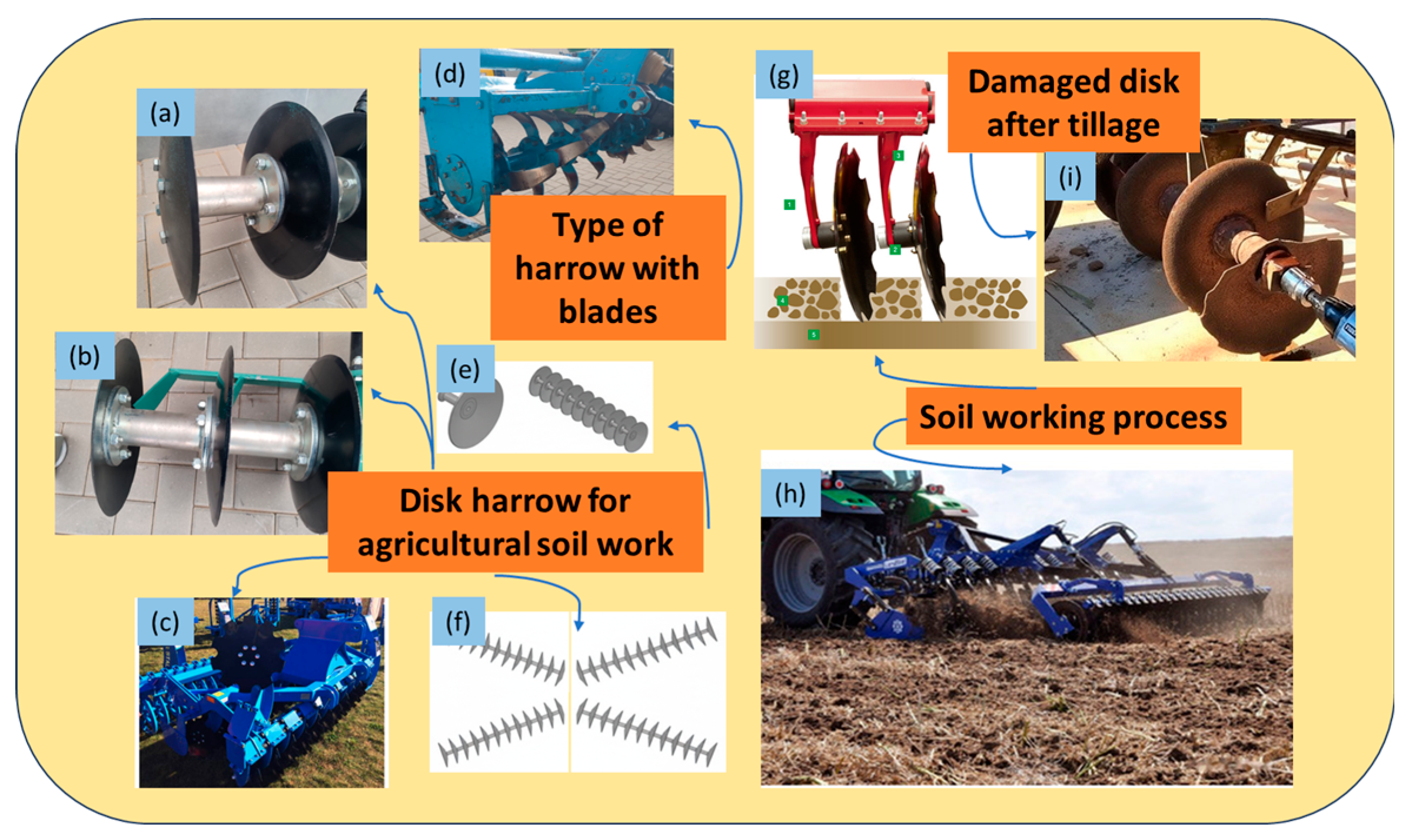
Agricultural disks, mounted singly or in gangs on harrows, ensure the fragmentation of large soil clods and land leveling after plowing. Disks are generally manufactured from martensitic steels and frequently benefit from surface treatments to enhance the durability of the cutting edge. The disks are subjected to flexural–torsional stresses and repetitive impact with stones or compacted soil. Recent studies have shown that the application of hard layers (carbides, hard metal alloys) via thermal deposition techniques increases the disks’ service life several times over, maintaining cutting accuracy and reducing maintenance intervals. Figure 7 presents the main components of the disk harrow that come into direct contact with the soil during tillage [78,79,80,81].
The constructive structure of a disk tillage assembly comprises several fundamental elements, each holding a distinct function within the complex mechanism of soil working. The cutting disk itself constitutes the central active component, to which specialized bearing assemblies and guide rollers are attached, supported by a heat-treated steel frame structure. Depth adjustment springs and suspension mechanisms ensure optimal ground contact and the absorption of transmitted mechanical shocks. Disk radius typically ranges between 356 and 559 mm, while profile thickness sits between 3.5 and 6 mm, parameters that directly influence rigidity and dynamic behavior under load. The disk inclination angle (angle of attack) varies between 15 and 25 degrees, values optimized according to soil type and moisture content, affecting the magnitude of torsional and compressive loads. Abrasive degradation mechanisms manifest differentially on the disk’s functional surfaces: on the anterior face, abrasion is generated by mineral particles in relative motion with the metal surface, while on the posterior face, progressive wear results from continuous contact with the disaggregated material. The accelerated wear rate of the disk’s cutting edge necessitates periodic adjustment of the penetration angle and, in advanced stages of degradation, the complete replacement of the component. Advanced surface treatments, such as plasma deposition, arc spraying, or HVOF (High Velocity Oxygen Fuel), considerably increase resistance to abrasion and corrosion, extending disk operational life by 4–8 times compared to untreated variants. In general, surface deposition methods are expensive due to the high cost of equipment and also the cost of raw materials. Although these aspects directly influence the final cost of the products, they come with a number of advantages, firstly, by creating a superficial layer with high properties that directly increases the life of the equipment, and secondly, the costs are amortized both by decreasing the frequency of equipment service and by reducing the downtime during servicing when, in practice, the equipment is forced to no longer be exploited on agricultural land. It is worth mentioning that it must be emphasized that the cost estimate must also be made from the point of view of the applicability of deposition technologies that involve high costs when we talk about thermal deposition by small enterprises compared to those at the industrial level where costs decrease once in line with large production runs [82,83,84].

3.3.5. Constructive and Functional Particularities of the Working Organs of Rotary Tillers

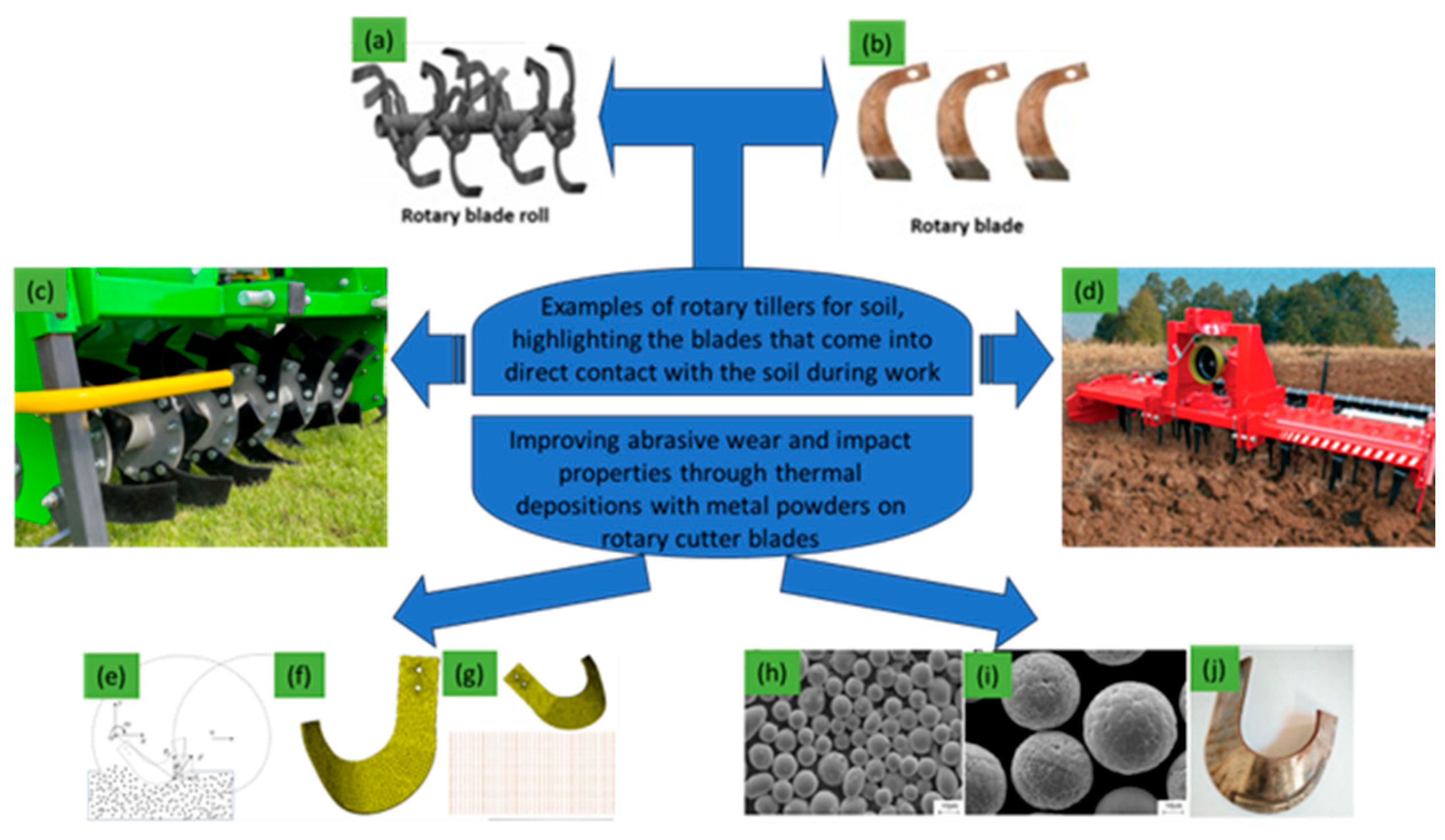
Soil rotary tillers rely on cup-holder arms or blades which, upon contact with the soil, loosen the superficial layer, facilitating seedbed preparation. The cutting components of the tillers (knives, blades) are designed to offer an optimal angle of attack, minimizing the required effort and reducing the risk of premature deformation. Abrasion-resistant ceramic or metallic coatings, applied via thermal spraying, have proven to increase service life by 2–5 times. Figure 8 presents an example of a soil cutter during tillage operations and several examples of knives engaging directly with the soil [85,86,87,88].
Blade thickness typically varies between 7 and 12 mm, while the angle of attack (angle of incidence) falls within the 20–35-degree range, both parameters influencing the magnitude of torsional stresses and the specific mechanical energy consumption. Progressive abrasive degradation mechanisms exhibit accentuated particularities on the tiller’s working surfaces: hard mineral particles in the soil, such as silica sand or rock fragments, generate micro-indentations and micro-cutting on the blade’s metallic surface, leading to progressive mass loss via material detachment in the form of micro-chips. The repeated and intermittent contact between the blade and compacted soil elements determines variable-amplitude impact stresses, which induce localized stress concentrations, accelerating material cracking and disintegration [89,90,91].

3.4. Soil Types and Their Influence on Equipment Service Life

The service life of soil-working equipment is substantially affected by the physicochemical properties of soil, particularly soil type, particle size distribution, moisture content, and pH value. Soil constitutes a complex and aggressive environment for agricultural mechanical components, characterized by the concurrent occurrence of abrasive wear mechanisms and electrochemical and biological corrosion processes. Soil type, determined by particle size and mineralogical composition, influences both the intensity of abrasive wear through tribological interactions and the corrosion rate by modifying the electrochemical environment and promoting the development of corrosive microbial communities. The mineralogical composition of soil, specifically the content of abrasive particles in the sand fraction (0.05–2 mm), largely determines the wear mechanisms at the microscopic level. Hard particles, such as quartz and feldspar, function as abrasive media when subjected to relative motion with metallic surfaces of tools. The wear rate depends on the ratio between the material hardness and the hardness of abrasive soil particles. Sandy soils are characterized by high sand particle content (>70%) and exhibit the greatest aggressiveness from the perspective of abrasive wear, generating wear rates 40–100% higher compared to clay-rich soils [92,93].
Soil type represents one of the principal factors contributing to the service life of agricultural equipment. Loamy soils contain a balanced proportion of sand, silt, and clay, exhibiting moderate-to-high abrasive wear, with the maximum wear rate occurring at a moisture content between 8 and 12. In contrast, the behavior of fine-grained soils in relation to moisture content indicates that at elevated moisture levels, clay particles adhere to metallic surfaces, forming a protective layer that reduces direct contact and results in decreased wear rate. Clay-rich soils and clay soils contain significant proportions of fine particles and possess high water retention capacities. These soils exhibit low abrasive wear at a high moisture content (>15%), but the wear rate increases substantially under drought conditions (0–3% moisture). Conversely, clay-rich soils frequently demonstrate elevated corrosion rates due to their water retention capacity and the anaerobic environment that promotes microbial corrosion [94,95,96].
Soil pH value exerts a significant impact on corrosion rate. The greatest material loss occurs in acidic soils with a pH below 5, exhibiting mass loss 30–40% greater compared to soils with a pH exceeding 6.8. Increased acidity promotes the dissolution of metal ions and accelerates electrochemical reactions responsible for corrosion processes. Soil microorganisms play an essential role in biologically influenced corrosion processes. Iron-oxidizing bacteria, nitrifying bacteria, and denitrifying bacteria are preferentially recruited in the vicinity of corroded metal surfaces. The organic matter content in soil determines the abundance of corrosive microbial communities, with soils exhibiting neutral-to-acidic pH and high organic matter content (>3%), demonstrating the most intensive biological corrosion activities [95,96].
The service life of agricultural equipment is determined by complex interactions between soil type, moisture content, pH, and biological activity. Sandy soils present the highest risk from the perspective of abrasive wear, whereas clay-rich soils and those with a low pH present the highest risk for corrosion. Protection strategies must account for the specific properties of local soil conditions and incorporate protective coatings, material selection, and enhanced component design. Although most studies on agricultural equipment focus largely on resistance to abrasive wear, the effect of pH, which interacts with several factors (chlorides, sulfates, humidity, organic matter), must also be taken into account, and the choice of coating should be made based on both pH and environmental conditions. In acidic soils, pH accelerates the corrosion of zinc and galvanized coatings, significantly reducing the life of the protective layer. In contrast, in neutral or slightly alkaline soils, pH ≥ 7 reduces the corrosion rate and can substantially increase the life of the layer. Also, inherently more corrosion-resistant materials such as carbides, ceramics, and hard layers with a Cr-Ni matrix have an advantage in aggressive aggressive-chemical conditions [90]. Table 3 presents the soil types and the influence of wear and corrosion on agricultural equipment components intended for soil-processing applications.
The service life of agricultural equipment is strongly influenced by the complex interaction between soil type, moisture, pH, and microbiological activity. Sandy soils cause the highest abrasive wear rates, while clayey and acidic soils cause accelerated corrosion, significantly reducing the resistance of metal components. The selection of coating materials and technologies must be adapted to the specific soil conditions to ensure optimal performance. Thermal deposition with carbides, ceramics, or Cr-Ni alloys can simultaneously improve wear and corrosion resistance, significantly extending the service life of active organs. For these reasons, the design of agricultural components must integrate the analysis of the working environment and the appropriate choice of thermal deposition materials.

3.5. Main Types of Materials Used in the Construction of Agricultural Components Intended for Soil Processing

Material selection for soil-working agricultural components requires an integrated approach that accounts for the harsh mechanical and environmental conditions during operation. Steel 65Mn is commonly used for rotary blades because of its superior elasticity and fatigue strength, whereas boron steels such as 27MnCrB5-2 offer an excellent balance between performance and cost for chisels and moldboards. For highly abrasive environments, Hardox-type steels ensure the highest wear resistance. Advanced surface engineering techniques, including thermal spray and laser cladding, can significantly extend component lifespan, thereby improving overall equipment efficiency [88,90].

3.5.1. Steel 65Mn Used in the Construction of Rotating Blades

Steel 65Mn represents one of the most widely employed materials for manufacturing rotating blades in agricultural tillers, owing to its excellent combination of mechanical strength, elasticity, and wear resistance. The chemical composition of this spring steel includes C: 0.62–0.70%, Si: 0.17–0.37%, and Mn: 0.90–1.20%, with the remainder being Fe and inevitable impurities (P ≤ 0.035%, S ≤ 0.035%) [102,103].
The mechanical properties of steel 65Mn are noteworthy: tensile strength ranges from 980 to 1180 MPa following quenching and tempering heat treatment, yield strength reaches 785–835 MPa, and Rockwell hardness exhibits values within the range of 40–50 HRC. The elastic modulus of approximately 210 GPa provides the material with the capacity to resist cyclic deformation, a characteristic essential for rotating blades [102,104].
Heat treatment of steel 65Mn is necessary for achieving optimal properties. The quenching process is performed at temperatures of 850–880 °C, followed by rapid cooling in oil or water to obtain a martensitic structure. Tempering at temperatures between 200 and 400 °C enables the achievement of optimal hardness and toughness. Recent research has demonstrated that the optimal heat treatment parameters for maximum wear resistance are a quenching temperature of 852.64 °C, holding duration of approximately 18–20 min, and tempering temperature of approximately 145–150 °C [90,102].
The microstructure resulting from appropriate heat treatment consists of tempered martensite and tempered troostite, which impart to the material an optimal combination of hardness and impact resistance. A recent investigation of rotating blades demonstrated that application of an Fe60-WC coating layer via laser cladding on 65Mn substrates can substantially enhance wear resistance, resulting in a reduction in mass loss of approximately 45% compared with untreated blades [90,104].

3.5.2. Boron Steels for Chisels and Moldboards

The boron addition, even in small quantities (0.001–0.004%), exerts a dramatic effect on steel hardenability, being approximately 50 times more effective than molybdenum, 75 times more effective than chromium, and approximately 400 times more effective than nickel. This element enhances wear resistance and enables the attainment of elevated hardness levels following heat treatment [88,103,105].
The mechanical properties of steel 27MnCrB5-2 in the quenched and tempered condition are notably elevated: yield strength exceeds 750–850 MPa, tensile strength ranges between 950 and 1300 MPa, elongation at fracture is minimum 13–14%, and area reduction exceeds 50%. Following quenching and tempering, hardness can attain values of 38–43 HRC, ensuring excellent resistance to abrasive wear [88,103,105].
The recommended heat treatment for boron steels involves austenitization at temperatures of 880–920 °C, followed by quenching in oil or water. The tempering temperature is selected according to desired properties, and is typically between 400 and 600 °C. Recent research has demonstrated that at a quenching temperature of 790 °C, steel 27MnCrB5 achieves the most comprehensive mechanical properties [88,103,105].
The resulting microstructure comprises tempered martensite with a fine grain size, which imparts an optimal combination of wear resistance and shock resistance. Comparative studies have demonstrated that plow chisel points fabricated from boron steel B2 (containing 0.22% Cr and 0.0008% B in addition to the B1 variant) exhibit a wear resistance more than 5.3 times higher, with wear of only 0.103 mm/km compared with 0.2 mm/km. For more concrete evaluations, practical testing is necessary to evaluate the wear rate over time, and due to the fact that such studies require long periods of time, an efficient alternative is laboratory testing to expose the level of wear rate of the material [102,105].

3.5.3. Steel 60Si2Mn for Components Subjected to Dynamic Loading

The elevated silicon content (up to 2.00%) imparts excellent elasticity to the material and superior fatigue resistance, while manganese contributes to toughness and hardenability. The mechanical properties in the quenched and tempered condition are remarkable: tensile strength exceeds 1274 MPa, yield strength is minimum 1176 MPa, elongation at fracture is at least 5%, and area reduction exceeds 25% [102,105].
The recommended heat treatment includes quenching at temperatures of 830–860 °C followed by oil cooling, then tempering at 450–550 °C to achieve an optimal balance between strength, elasticity, and impact toughness. The final microstructure consists of tempered troostite or a tempered sorbitized structure, depending on the applied tempering temperature [102,105].

3.5.4. Hardox and AR-Type Wear-Resistant Steels

Wear-resistant steels from the Hardox (SSAB) and AR (abrasion-resistant) categories are increasingly utilized for manufacturing components exposed to severe abrasive wear, including the active elements of soil-processing equipment. These materials are high-strength quenched-and-tempered steels with a fine martensitic structure and elevated hardness. Uncoated Hardox/AR steels are not inherently more cost-effective than conventional coated steels, the cost-effectiveness depending on the stress regime, the possibility of reconditioning, and the costs of shutdown. In high-impact applications and situations of difficult access for repairs, uncoated wear-resistant steels tend to be more cost-effective, while in applications with predominantly sliding wear and easy reloading, solutions based on standard coated steel can offer lower specific costs. This point of view is aimed at agricultural components such as plows or disk harrows because they do not have complex geometries and can be repetitively recoated. Obviously, Hardox/AR steels are excellently suited for components with more complex geometries where thermal coatings cannot be applied due to the difficult (or even impossible) accessibility of the coating gun in complex areas [88,102].
Hardox 400 exhibits a nominal hardness of 400 HB (Hardness Brinell), tensile strength of 1400–1800 MPa, and yield strength of 1000–1300 MPa. Hardox 450 offers 50 HB higher than AR 400, with a hardness of approximately 450 HB, tensile strength of 1400 MPa, and yield strength of 1200 MPa. Hardox 500 attains a hardness of 500 HB and demonstrates wear resistance approximately 25% superior to lower grades [88,105].
The chemical composition of these steels is optimized for uniform hardenability throughout the thickness: carbon content 0.28–0.35%, Si: 0.10–0.60%, Mn: 0.7–1.0%, Cr: 0.4–0.8%, and Mo: 0.10–0.60%, with microalloying additions of Nb, V, Ti, and B for grain refinement and hardenability enhancement. The presence of chromium forms hard carbides in the steel matrix, enhancing wear resistance [90,105].
Comparative studies have demonstrated that Hardox 450 exhibits a wear rate 50% lower compared with conventional structural steels such as S355J2G3, which translates to a service life 30–50% longer. The microstructure comprises tempered martensite with fine grain size, which ensures both elevated hardness and good toughness, including at low temperatures [88,105].
To further enhance wear resistance of agricultural components, surface coating techniques are frequently employed. The most common filler materials are Fe-C-Cr-based alloys (chromium carbide) and WC (tungsten carbide) composites in metallic matrix. Fe-C-Cr alloys typically contain C: 3.5–6%, Cr: 20–34%, Mn: 0.5–2%, and Si: 0.5–1%, with the remainder being Fe. These alloys form M7C3- and M23C6-type primary carbides (where M represents primarily Cr and Fe) dispersed in a ductile eutectic matrix. Coating hardness ranges between approximately 56 and 64 HRC, with microhardness of chromium carbides reaching 1314–1702 HV0.05 [90,102,106].
Recent studies have demonstrated that application of an Fe-C-Cr layer on AR500 steel components reduces wear by a factor of 14 compared with the base material. In operational tests on cultivator chisel points, the component with surface coatings exhibited a volume loss of only 7% compared with 12% for the untreated component. Surface coatings with Fe60-WC composite lead to significant improvement in wear resistance. The composition of Fe60 alloy includes C: 0.8–1.2%, Si: 1.0–2.0%, B: 3.8–4.2%, Cr: 16–18%, and Ni: 9.0–12%, with the remainder being Fe. The addition of WC in proportions of 30–40% creates a structure with hard carbide particles in the ductile matrix [90,106].
Research on rotating tiller blades has demonstrated that deposits with 35% WC exhibit optimal wear resistance, with mass loss of only 1.9 mg and a relatively low friction coefficient of 0.362. Layer hardness can reach 1436 HV0.5, which represents a significant increase of approximately 250% compared with the base material. Field tests (soil-processing operations) confirmed a reduction in average wear of approximately 45–50% for coated blades compared with untreated blades [90,107].

4. Loading Conditions Encountered in Agricultural Equipment

4.1. Abrasive Wear

Abrasive wear constitutes one of the principal degradation factors of active components in agricultural soil-processing equipment, particularly plows, harrows, and cutting blades. This type of wear results from continuous interaction between metallic surfaces of components and hard mineral particles in soil—predominantly quartz, feldspar, and other siliceous particles—which act as abrasive agents causing significant wear of the base material [108].
The process of abrasive wear in mechanized agriculture manifests through two categories of distinctive mechanisms: microscopic cutting (micro-cutting) and localized plastic deformation (microplowing), classified as two-body wear under reduced stress. In the cutting mechanism, abrasive particles from the soil penetrate the metallic surface, generating wear thereof. In contrast, in the plastic deformation mechanism, soil particles do not fully penetrate but produce local plastic flow, followed by fragment detachment from the surface. The ratio between surface hardness of the soil-processing component and soil particle hardness directly determines the predominant wear mechanism. When this ratio is below 0.8, micro-cutting and microplowing mechanisms are dominant; conversely, at ratio values approaching or exceeding unity, microcrack formation, hard-phase fragmentation, and surface layer detachment predominate [108].
Recent research emphasizes that abrasive wear resistance of agricultural equipment depends significantly on the chemical composition, microstructure, and mechanical properties of the material. Steels with elevated carbide content (such as chromium or tungsten carbides) exhibit enhanced wear resistance, since hard phases act as barriers against base material displacement. Studies have demonstrated that tungsten carbide (WC-Co) deposits improve abrasion resistance by up to 50%, and increasing tungsten carbide content from 50% to 60% amplifies durability by approximately 25%. Because agricultural equipment is subjected to severe working conditions that largely involve abrasive wear, delamination, and impact with hard elements in the soil, they require hard materials that can withstand these stresses, so it is recommended to use hard materials, such as WC-Co, or other materials with similar properties. Microstructural characteristics—such as size, distribution, and shape of hard particles in the deposited layer—significantly influence wear behavior. Deposits with a fine and homogeneous microstructure, in which hard phases are uniformly distributed, offer superior protection compared with unprocessed or inhomogeneous materials. Modification of the microstructure through various thermal deposition techniques enables optimization of durability in agricultural components [108].
The intensity of abrasive wear varies considerably depending on operating conditions: soils with larger grain size, elevated quartz content, and low moisture level cause accelerated wear. Research has demonstrated that wear rate increases significantly with increasing sand particle dimensions in soil. Soil moisture exerts a stronger influence on wear than soil type characterized by grain size distribution; an increase in moisture content progressively reduces wear rate, with more pronounced effects in sandy soils. For this reason, material selection and deposition methods must be adapted specifically to local working conditions. Deposition parameters—temperature, deposition velocity, and material flow rate—must be optimized to achieve compact, dense layers with elevated adhesion to the base material. Research conducted using modeling techniques (discrete element method, molecular dynamics simulations) demonstrates that component geometry, working depth, and feed velocity significantly influence wear rate [108].

4.2. Impact Loading

In contrast to slow and progressive abrasive wear, impact loading generates instantaneous effects of high intensity on the material, producing complex degradation phenomena that include localized plastic deformations, microcracks, hard-phase detachment, and, in extreme cases, brittle fractures of the component. Impact loading in agriculture occurs when equipment encounters hard soil objects—primarily stones, rocks, or concrete fragments—generating intense mechanical shocks. These events impose sudden forces that frequently exceed local material resistance. Research demonstrates that plows and cultivators are exposed to impacts with variable energy depending on travel velocity, obstacle dimension, and contact angle. During plowing and cultivation operations, components such as cultivator points, harrow blades, and plow soles experience combined cyclic loading—impact followed by abrasion—which significantly accelerates material degradation. Impact magnitude is directly influenced by operational parameters: working depth, feed velocity, and soil resistance. Field tests have demonstrated that increasing velocity from 1 to 2 m/s amplifies traction forces and increases frequency of collisions with soil obstacles. Additionally, soils with a high stone content (more than 5% by volume) expose equipment to significantly higher rates of impact deterioration compared with homogeneous soils [108,109].
Resistance to impact loading depends on multiple microstructural and mechanical factors. The presence of hard phases uniformly distributed in the metallic matrix—such as chromium carbides (Cr3C2, Cr23C6), tungsten carbides (WC, W2C), and complex borides—increases both hardness and energy absorption capacity under impact. Research on Ni60 deposits reinforced with 60% WC demonstrated that hard WC particles form a rigid skeleton which absorbs a significant portion of impact energy, protecting the ductile matrix from excessive deformation. Controlled heat treatments enable microstructure adjustment to optimize impact behavior. AISI 4340 alloyed steels, heat-treated to hardness levels of 45–50 HRC, offer an excellent combination of impact resistance and wear resistance, being recommended for components exposed to severe impacts. Alternatively, steels with elevated manganese content (11–14% Mn) exhibit a work-hardening phenomenon in which the surface progressively hardens under repeated impacts, offering superior performance in applications with intense shocks [109].

4.3. Influence of Corrosion

Corrosion constitutes a critical degradation factor of soil-processing equipment components, manifesting in both direct chemical corrosion and complex electrochemical mechanisms initiated by soil moisture and corrosive agents. In contrast to mechanical wear, which is purely physical, corrosion represents a chemical transformation of the material that accelerates exponentially in the presence of water, salts, and acidic substances from soil and agricultural products used (fertilizers, pesticides, decontamination solutions). Simultaneous interaction of corrosion and mechanical wear mechanisms (corrosion–erosion) produces synergistic deterioration substantially more severe than the isolated action of each factor. Taking these aspects into account, when it comes to improving the properties of materials through superficial coatings, these considerations become crucial because they can lead to detachment of the coating material. These risks are closely related to the quality of the surface coating work, which must ensure a tight bond between the coating material and the base material so that there is no risk of substances from the external environment penetrating the interface between the two materials. These risks can arise either from uneven coverage or from the porosity of the layer, which can lead to the interconnection of pores and thus create a path for chemical solutions to penetrate from the outside to the inside [108].
Soils, especially those with elevated moisture and soluble salt content, act as electrolytic media in which the underlying metal undergoes oxidation at the anode, while oxygen from water undergoes reduction at the cathode. This process generates electric current which progressively displaces metal ions from the surface, producing pitting, uniform attack, and other forms of electrochemical corrosion. Key factors determining the corrosion velocity of agricultural components include soil pH, soluble salt content (particularly chlorides and sulfates), oxygen concentration, soil redox potential, and presence of microorganisms. Studies demonstrate that acidic soils (pH < 5) and soils with elevated chloride content, such as those from coastal areas or those frequently treated with ammonium-based fertilizers, exert significantly greater corrosive aggressiveness on ordinary carbon steels. Even small chloride ion concentrations (exceeding 50 mg/kg) can initiate localized pitting in cultivator-point and plow-blade areas, leading to the formation of small inclusions that propagate rapidly in depth [109].
Corrosive environments specific to agriculture present elevated complexity. Liquid mineral fertilizers, particularly those based on ammonium and phosphate, are extremely corrosive to carbon steel and low-grade steels. Research demonstrates that corrosive penetration of steel in a 10% ammonium sulfate solution reaches 0.282 μm per year, a value that progressively increases with solution concentration. Additionally, acidifying solutions used for equipment cleaning accelerate corrosion, rapidly degrading the protective layer of natural surface oxides. Soil moisture plays a determining role. Soils with elevated moisture (exceeding 20%) maintain a continuous water film on equipment surfaces, sustaining electrochemical reactions over prolonged periods. Frequent condensation conditions—specific to agricultural structures and storage facilities—promote the formation of an electrolyte film which initiates localized corrosion and deep pitting. Organic matter content and the presence of sulfate-reducing bacteria increase the soil’s corrosive potential through oxygen consumption and production of sulfur compounds [108,109].
The corrosion–erosion combination produces a severe form of degradation in which electrochemical reactions continuously expose fresh surfaces to corrosive attack, while soil particles (sand, soil particles) displace protective oxide films. Recent research on carbon steels and stainless steels in simulations with sand and water demonstrates that mass loss rate through corrosion–erosion is 2–3 times greater than the sum of effects of corrosion and pure mechanical erosion considered separately. Martensitic steels (such as AISI 410) and duplex stainless steels exhibit better corrosion–erosion resistance compared with ordinary carbon steels, while 18Cr-8Ni stainless steels manifest minimal corrosion even under severe exposure conditions to chlorides and acidifying environments. However, the elevated cost of these materials limits their widespread application in mechanized agriculture [110].

5. Enhancement of Material Properties of Agricultural Components Through Thermal Deposition

5.1. Results Obtained in Improving Resistance to Abrasive Wear and Impact

Resistance to abrasive wear and impact are among the most important aspects upon which the service life of soil-processing agricultural equipment depends. Thermal deposition methods or surface enhancement techniques represent attractive alternatives for their reconditioning. From the point of view of the applicability of thermal deposition technologies, they are versatile due to the fact that they allow both their use to increase the properties of new components by depositing a superficial layer with high properties, as well as the potential to recondition worn components by adding a layer that will bring the components back to the nominal dimensions of good functioning by adding material in those areas where wear occurred and led to a decrease in thickness.
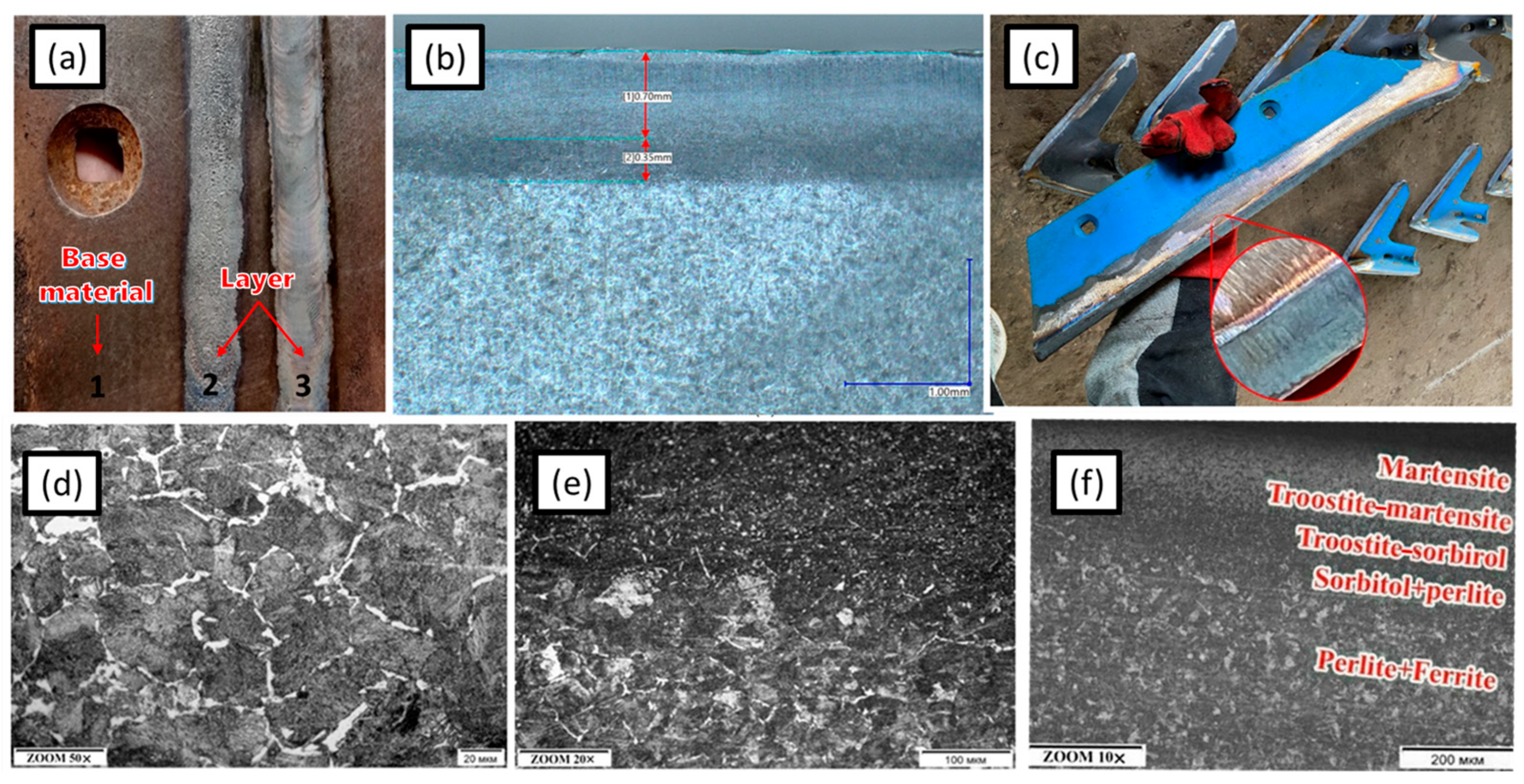
Gulyarenko et al. [111] conducted research aimed at increasing the durability of active components of agricultural equipment, focusing on plow blades, through modern plasma surface hardening treatments. Specimens were fabricated from AISI 65G steel (0.62–0.70% C, 0.90–1.20% Mn, etc.), with a hardened layer thickness of approximately 1.6 mm, and subsequently subjected to practical field tests on predominantly clay soil at a velocity of 10 km/h.
Results indicated that durability of plasma-hardened blades increased 2–3 times compared with untreated ones, achieving a working resource of approximately 31.6 ha for the plow point on light clay soil (compared with 10 ha on untreated specimens). Figure 9a,b present the sample surface and cross-sectional image of the layer. Figure 9c presents the visual appearance of the plow blade after plasma treatment, where preservation of original geometry and hardened layer are evident. Figure 9d–f present the microstructure of the hardened layer containing a succession of zones: micro-melting (acicular martensite), martensite with retained austenite (~20%), troostite, sorbitized structure, and at-depth ferritic–pearlitic structure. Local hardness through plasma treatment shows an increase from 18.2 HRC to 53.2 HRC after hardening, and field tests confirmed uniform wear of treated blades and a significant increase in service life duration [111,112,113].
Kostencki, P. et al. [114] investigated the wear process of active components of soil-processing agricultural equipment and observed that following the abrasive wear process during operation, material fragments from these components are transferred to soil in the form of fine particles, and their chemical composition depends on both the construction materials used and specific operating conditions. In this context, there exists the risk of toxicological influence on soil, and it has been observed that a series of elements remain in soil, such as Al, B, C, Co, Cr, Cu, Fe, Mo, Nb, Ni, P, Pb, S, Si, Ti, V, W, and Zr (Fe was recovered in the highest quantity). Experimental studies conducted on cultivators, plows, and rotary harrows demonstrate that wear intensity varies significantly depending on working depth and soil physical properties; for example, wear resulting from plows under standard dry or semi-dry soil conditions was approximately 3.5 times greater than in wet and softer soils. Surface topography of deteriorated surfaces visualized in Figure 10 reveals distinct wear mechanisms: for martensitized steel, micro-cutting and grooving predominate, while for weld deposits, combinations of micro-cutting, partial grooving, and carbide fracturing result in the context of operation in contact with abrasive soil masses [114,115].
Application of reinforcement through welding with cemented carbides on furrow surfaces reduces overall wear intensity on average by 1.15 to 1.86 times for different tested components; however, this intervention determines introduction into soil of a wider variety of chemical elements, including tungsten and niobium. The microstructure of these materials, presented in Figure 11, shows that elements are present in complex chemical forms—metallic carbides (WC, Fe7Cr3C) and solid solutions based on iron or cobalt—which influences their biogeochemical behavior in the soil environment. Quantification of elements introduced into the soil determines that iron is present in dominant quantities (15,907–222,004 g/ha), as well as potentially toxic elements such as chromium (0.110–2.662 g/ha), nickel, and cobalt derived from wear products, emphasizing the importance of material selection and component design to minimize risks of anthropogenic soil contamination, alongside the primary objective of components to achieve the best possible resistance to abrasive wear. It was found that the elements remaining in the soil are directly proportional to their quantity in the material structure and in close connection with the severe working conditions, indicating that it is strictly necessary for the components to be manufactured and optimized to minimize the risk of delamination or excessive wear so that the quantity of elements remaining in the soil due to manufacturing errors is minimal. Also, a beneficial alternative for reducing the risk of soil toxicity is also presented by the selection of materials, which must take into account their toxicity, such as Co, Cr, Cu, Mn, Mo, and Ni, which present a risk in this regard, although they are suitable for these applications due to their high performance [114,115,116].
It is worth mentioning that the safe exposure limits for Cr and Co in agricultural soils are regulated in the EU by Order 19/2005 (updated), with normal values: Cr ≤ 100 mg/kg dry, Co ≤ 30 mg/kg dry; alert thresholds: Cr 200 mg/kg, Co 50 mg/kg; and intervention: Cr 800 mg/kg, Co 100 mg/kg. Thermally coated components (e.g., WC-Co-Cr, Stellite with Co-Cr) can release Cr and Co through wear, but in normal cases of soil processing, the resulting concentrations in the soil remain below limits due to dilution, coating thickness, and low degradation rate. Comparing the amounts of Cr and Co released through wear in soil processing with major anthropogenic sources such as fertilizers, field quantification presents negligible risks in typical scenarios [117,118].

5.2. Results Obtained in Improving Corrosion Resistance

Aramidă et al. [77] conducted research on evaluation of corrosion behavior of agricultural components deposited through laser additive technology to optimize durability of soil-working equipment in wet and oxidative environments (it should be noted that the laser additive method is similar to the aforementioned surface deposition methods, except that the raw material used is not in powder form but in the form of metal wire, and also leads to the creation of surface structures). Iron-based deposits with elevated ferro-chromium and vanadium-chromium content demonstrated superior electrochemical performances compared with the reference carbon steel substrate under conditions of characteristic soil water solution at ambient temperature. By applying variable quantities of chromium (0; 0.4; 0.8 and 1.2 g/min) in the laser deposition procedure, variants of corrosion resistance properties were obtained; specimen A, without supplementary chromium addition, exhibited the most favorable behavior with a corrosion rate of 0.001869 mm/year and polarization potential of 31378 Ω, substantially exceeding the control substrate (EN48) which recorded 0.1168 mm/year. Specimens with increased chromium addition (B1, B2, B3) manifested increased corrosion rates of 0.005728 mm/year, 0.008877 mm/year, and 0.005562 mm/year, respectively, resulting, surprisingly, in inferior performance due to microgranularity and austenite volume in the metallic matrix. The wear rate of components can also increase due to losses resulting from their corrosion due to soils that have higher humidity, so the choice of a material that also presents good wear resistance is necessary and closely related to the types of soil in which work is being performed. Figure 12, representing potentiodynamic polarization curves, clearly illustrates the distance between corrosion current density of the specimens and that of steel, evidencing passive protection mechanisms generated by refined precipitates of vanadium carbides (VC) and chromium (Cr3C2, Cr7C3). The fine granular structure of specimen A promoted formation of a continuous, dense, and electrochemically stable chromium oxide layer, reducing the corrosive-ion diffusion rate.
Following the analyses, it is emphasized that optimization of corrosion in agricultural components requires balance between chromium content (ideally 14% by weight in powder composite) and maintenance of refined microstructural structure, demonstrating that excessive alloying can compromise protective integrity through carbide fragmentation and lead to obtaining unfavorable microstructural transformations. The potential applicability of thermal deposition technologies (using materials with superior properties to the base materials) is directly related to considerations of the properties of the base materials Thus, before evaluating a coating, it is strictly necessary to test the classic base materials used for agricultural components [77,119].
Vitor Pagani et al. [110] evaluated the corrosion and erosion–corrosion behaviors of steels intended for agricultural applications under conditions of simultaneous exposure to mechanical and chemical factors. A comparative investigation of ASTM A36 carbon steels and high-strength AHSS, alongside ferritic–martensitic 11Cr and austenitic 18Cr8Ni stainless steels, exposed distinctly differentiated behaviors depending on chemical composition and protective-film formation capacity. In deionized water medium, stainless steels demonstrated negligible corrosion rates (below 10−4 mg/mm2), while carbon steels exhibited significantly higher rates, AHSS presenting 0.019 mg/mm2 compared with A36’s 0.051 mg/mm2. The presence of chloride ions (1300 ppm) considerably amplified corrosive aggressiveness, determining approximately 14.1-fold deterioration for AHSS and 5.61-fold for A36, with mass loss rates increasing continuously throughout exposure cycles. Figure 13 illustrates the cumulative evolution of mass loss over 10 consecutive 24 h cycles, evidencing formation of non-adherent and adherent corrosion films on carbon steel surfaces, in contrast with stainless steels which remained practically unaffected [110,120,121].
Microstructural analysis of the surface after exposure shows the mechanisms of generalized corrosion for A36 and the formation of localized corrosion cavities for AHSS in a saline medium, a phenomenon attributed to the distribution of carbide precipitates in the martensitic matrix. Figure 14 presents materials after 10 cycles of pure corrosion, demonstrating the formation of oxide layers with distinct characteristics: an outer, orange, non-adherent, porous, and easily detachable film, overlaid on an inner, light-brownish, more adherent, and more compact film, this characteristic being more pronounced in the chloride-containing medium [122].
Topographic observations confirmed that A36 steel exhibited generalized corrosion across the entire surface, while AHSS manifested a more localized distribution of degradation. The differentiated performance of stainless steels, particularly the low-cost 11Cr variant, positioned it as a cost-effective and sustainable solution for agricultural equipment requiring simultaneous resistance to corrosion and mechanical wear under conditions of exposure to soft grain particles and environments with elevated chloride content [110].

6. Conclusions

1. Thermal deposition methods—atmospheric plasma spraying (APS), cold spray, electrochemical deposition, and physical vapor deposition (PVD)—offer proven and effective solutions for increasing resistance to abrasive wear and corrosion in agricultural components, significantly extending service life based on the applied coating type and operating conditions.
2. Deposits with elevated hard-phase content—such as tungsten carbides (WC-Co) and Fe-C-Cr alloys—demonstrate exceptional performance with wear rates reduced by 40–50% compared with untreated materials; Hardox steels covered with Fe60-WC composite layers present mass losses of only 1.9 mg versus 3.5–4.5 mg for uncoated specimens, and soil-processing components such as plasma-hardened plows achieve an amplified impact–abrasion resistance 2–3 times greater with extended working resources of up to 31.6 ha on light clay soil.
3. Critical pedological factors—sandy soils exhibit maximum aggressiveness from an abrasion perspective (40–100 times greater than clay soils) and acidic soils with a pH < 5 exhibit accelerated corrosion rates of 30–40%—require stratification of protection investments based on local properties and regional climate.
4. 11Cr and 18Cr8Ni stainless steels ensure superior protection in environments with concentrated chlorides (1300 ppm) with negligible corrosion rates below 10−4 mg/mm2, compared with conventional carbon steels which manifest cumulative mass losses of 0.019–0.051 mg/mm2; however, elevated costs limit widespread adoption, justifying selective implementation on critical functional zones.
5. The microstructure of deposited layers—with hard phases uniformly distributed in the ductile matrix and minimized porosity—constitutes the determining factor of mechanical performance; coatings with a fine granular structure obtained through laser additive deposition with optimized composition (ideally 14% chromium by weight) demonstrate a generation of continuous and electrochemically stable chromium oxide layers, reducing the corrosive-ion diffusion rate.
6. These technologies deliver substantial economic and ecological benefits: extending plow service life by 3–5 times cuts replacement frequency, lowers raw material and energy use in manufacturing, reduces downtime and maintenance costs, and boosts energy efficiency via lower friction and traction demands.
7. The transfer of chemical elements to the soil from wear fragments—iron present in dominant quantities (15,907–222,004 g/ha) and potentially toxic elements such as chromium (0.110–2.662 g/ha), nickel, and cobalt—emphasizes the critical importance of material selection and component design for minimizing risks of anthropogenic contamination, demonstrating that equipment durability optimization simultaneously serves production objectives and environmental protection.
8. Future perspectives are oriented toward the development of multifunctional hybrid layers combining self-lubrication properties with enhanced wear and corrosion resistance, the integration of modern technologies for setting deposition parameters, and the search for new composite and nanostructured materials with the potential to significantly extend the service life of agricultural components in modern agriculture. The integration of artificial intelligence for optimizing deposition parameters may also have great potential.

Author Contributions

Conceptualization, C.M. and F.C.L.; methodology, B.I. and F.C.L.; software, V.N.A.; validation, G.I. and N.B.; formal analysis, G.I.; investigation, F.C.L. and N.B.; resources, T.M.; data curation, G.I. and B.I.; writing—original draft preparation, F.C.L. and N.B.; writing—review and editing, B.I.; visualization, G.I. and V.N.A.; supervision, C.M. and G.M.; project administration, C.M. and G.M.; funding acquisition, C.M. and T.M. All authors have read and agreed to the published version of the manuscript.

Funding

This work was supported by a grant from the Ministry of Education and Research, CCCDI–UEFISCDI, project number PN-IV-PCB-RO-MD-2024-0336, within PNCDI IV.

Institutional Review Board Statement

Not applicable.

Informed Consent Statement

Not applicable.

Data Availability Statement

Data from this paper are available from the authors.

Conflicts of Interest

Author Teodor Marian was employed by the company CC “BASADORO AGROTEH” LLC, 192 Alba–Iulia, Str., 2049, MD-2071 Chisinau, Moldova. The remaining authors declare that the research was conducted in the absence of any commercial or financial relationships that could be construed as a potential conflict of interest.

References

  1. Malvajerdi, A.S.; Sabzi, H.; Ghorbani, M. Wear and coating of tillage tools: A review. J. Mater. Res. Technol. 2023, 24, 2085–2101. [Google Scholar] [CrossRef]
  2. Miranda, F.; Caliari, F.; Essiptchouk, A.; Pertraconi, G. Atmospheric Plasma Spray Processes: From Micro to Nanostructures; IntechOpen: London, UK, 2018. [Google Scholar] [CrossRef]
  3. Fauchais, P. Understanding plasma spraying. J. Phys. D Appl. Phys. 2004, 37, R86–R108. [Google Scholar] [CrossRef]
  4. Sampath, S.; Jiang, X. Splat formation and microstructure development during plasma spraying: Deposition temperature effects. Mater. Sci. Eng. A 2001, 304–306, 144–150. [Google Scholar] [CrossRef]
  5. Liu, Y.; Yang, M.; Tang, J.; Kim, A.; Kainuma, S. Anticorrosion performance of thermal spray coatings on corroded steel after surface preparation. Surf. Coat. Technol. 2025, 520, 133039. [Google Scholar] [CrossRef]
  6. Tahir, M.; Qasim, M.; Ahmed, N.; Satti, A.N.; Malik, A.E.; Khan, Z.S.; Anwar, M. Impact of atmospheric plasma spraying parameters on microstructure, mechanical properties and thermal cycling performance of YSX coatings. Ceram. Int. 2024, 50, 53976–53986. [Google Scholar] [CrossRef]
  7. Moore, M.A. Abrasive wear by soil. Tribol. Int. 1975, 8, 105–110. [Google Scholar] [CrossRef]
  8. Nalbant, M.; Palali, T. Effects of different material coatings on the wearing of plowshares in soil tillage. Turk. J. Agric. For. 2011, 35, 215–223. [Google Scholar] [CrossRef]
  9. Jia, X.; Ling, X. Reduction of soil resistance through the use of a composite coating. J. Coat. Technol. Res. 2005, 2, 669–672. [Google Scholar] [CrossRef]
  10. Ali, W.Y.; Khattab, A.A.; Ezzat, F.H. Wear resistance of thermoplastics coatings. J. Egypt. Soc. Tribol. 2010, 7, 36–49. [Google Scholar]
  11. Kushwaha, R.L.; Chi, L.; Roy, C. Investigation of agricultural tools with plasma-sprayed coatings. Tribol. Int. 1990, 23, 297–300. [Google Scholar] [CrossRef]
  12. Wang, Y.; Li, C.; Jiang, F.; Zhang, J.; An, X. Microstructure and mechanical properties of ultrasonic assisted laser cladding Al2O3–ZrO2 ceramic coating. Mater. Res. Express 2019, 6, 106563. [Google Scholar] [CrossRef]
  13. Xu, Z.; Qin, Y.; Hu, W.; Chen, Y.; Zhong, X.; He, Z.; Zhao, H. Influence of metallic Al additions on the microstructure and mechanical properties of plasma sprayed TiC-based coatings. Ceram. Int. 2025. [Google Scholar] [CrossRef]
  14. Karoonboonyanan, S.; Salokhe, V.M.; Niranatlumpong, P. Wear resistance of thermally sprayed rotary tiller blades. Wear 2007, 263, 604–608. [Google Scholar] [CrossRef]
  15. Samal, S.; Zeman, J.; Habr, S.; Pacherova, O.; Chandra, M.; Kopeček, J.; Šittner, P. Evaluation of Microstructure–Porosity–Hardness of Thermal Plasma-Sprayed NiTi Coating Layers. J. Manuf. Mater. Process. 2023, 7, 198. [Google Scholar] [CrossRef]
  16. Odhiambo, J.G.; Li, W.; Zhao, Y.; Li, C. Porosity and Its Significance in Plasma-Sprayed Coatings. Coatings 2019, 9, 460. [Google Scholar] [CrossRef]
  17. Ghasemi, R.; Vakilifard, H. Plasma-sprayed nanostructured YSZ thermal barrier coatings: Thermal insulation capability and adhesion strength. Ceram. Int. 2017, 43, 8556–8563. [Google Scholar] [CrossRef]
  18. Zhang, D.; Zhao, Z.; Wang, B.; Li, S.; Zhang, J. Investigation of a new type of composite ceramics for thermal barrier coatings. Mater. Des. 2016, 112, 27–33. [Google Scholar] [CrossRef]
  19. Baltatu, M.S.; Vizureanu, P.; Sandu, A.P.; Munteanu, C.; Istrate, C. Microstructural analysis and tribological behavior of Ti-based alloys with a ceramic layer using the thermal spray method. Coatings 2020, 10, 1216. [Google Scholar] [CrossRef]
  20. Aramide, B.; Pityana, S.; Sadiku, R.; Jamiru, T.; Popoola, P. Improving the durability of tillage tools through surface modification—A review. Int. J. Adv. Manuf. Technol. 2021, 116, 83–98. [Google Scholar] [CrossRef]
  21. Zhao, X.; Li, C.; Li, S.; Han, X.; Jiang, H. Mechanism study on the influence of combustion models and spray gun geometric parameters on high-velocity oxygen-fuel (HVOF) thermal spraying. J. Manuf. Process. 2023, 98, 173–185. [Google Scholar] [CrossRef]
  22. Bull, S.J.; Jones, A.M. Multilayer coatings for improved performance. Surf. Coat. Technol. 1996, 78, 173–184. [Google Scholar] [CrossRef]
  23. Wang, R.; Duan, J.; Ye, F. Effect of spraying parameters on the crystallinity and microstructure of solution precursor plasma sprayed coating. J. Alloys Compd. 2018, 766, 886–893. [Google Scholar] [CrossRef]
  24. Jordan, E.H.; Gell, M.; Sohn, Y.H.; Goberman, D.; Shaw, L.; Jiang, S.; Wang, M.; Xiao, T.D.; Wang, Y.; Strutt, P. Fabrication and evaluation of plasma sprayed nanostructured alumina–titania coatings with superior properties. Mater. Sci. Eng. 2001, 301, 80–89. [Google Scholar] [CrossRef]
  25. Celik, E.; Ozdemir, I.; Avci, E.; Tsunkawa, Y. Corrosion behaviour of plasma sprayed coatings. Surf. Coat. Technol. 2005, 193, 297–302. [Google Scholar] [CrossRef]
  26. Karaxi, E.K.; Kartsonakis, I.A.; Charitidis, C.A. Assessment of Self-Healing Epoxy-Based Coatings Incorporating Microencapsulated Corrosion Inhibitors for Corrosion Protection of Hot-Dip Galvanized Steel. Front. Mater. 2019, 6. [Google Scholar] [CrossRef]
  27. Abed, N.; Bahrololoom, M.E.; Kasraei, M. The Effect of Nano-Structured Nickel Coating on Reducing Abrasive Wear of Tillage Tine. J. Nanotechnol. 2019, 1, 059–074. [Google Scholar] [CrossRef]
  28. Liu, S.H.; Trelles, J.P.; Li, C.J.; Li, C.X.; Guo, H.B. A review and progress of multiphase flows in atmospheric and low pressure plasma spray advanced coating. High Temp. Mater. Process. 2022, 11, 232–248. [Google Scholar] [CrossRef]
  29. Constantino, B.S.; Sohn, Y.J.; Mauer, G. Magnesia-stabilized zirconia (MSZ) thermal barrier coatings by suspension plasma spraying: Coating properties and service life behavior. J. Eur. Ceram. Soc. 2026, 46, 117790. [Google Scholar] [CrossRef]
  30. Seungjun, L.; Jaehoo, L.; Woongsik, K.; Nong, M.H. Plasma Etching Behavior of YOF Coating Deposited by Suspension Plasma Spraying in Inductively Coupled CHF3/Ar Plasma. Coatings 2020, 10, 1023. [Google Scholar] [CrossRef]
  31. Lamuta, C.; Di Girolamo, G.; Pagnotta, L. Microstructural, mechanical and tribological properties of nanostructured YSZ coatings produced with different APS process parameters. Ceram. Int. 2015, 41, 8904–8914. [Google Scholar] [CrossRef]
  32. Paleu, C.C.; Munteanu, C.; Istrate, B.; Bhaumik, S.; Vizureanu, P.; Bălţatu, M.S.; Paleu, V. Microstructural analysis and tribological behavior of AMDRY 1371 (Mo–NiCrFeBSiC) atmospheric plasma spray deposited thin coatings. Coatings 2020, 10, 1186. [Google Scholar] [CrossRef]
  33. Munteanu, C.; Melnic, I.; Istrate, B.; Hardiman, M.; Gaiginschi, L.; Lupu, F.C.; Arsenoaia, V.N.; Chicet, D.L.; Zirnescu, C.; Badiul, V. A Comprehensive Review of Improving the Durability Properties of Agricultural Harrow Discs by Atmospheric Plasma Spraying (APS). Coatings 2025, 15, 632. [Google Scholar] [CrossRef]
  34. Wang, H.; Zhao, Y.; Li, W.; Xu, S.; Zhong, N.; Liu, Y.; Yin, Z.; Zhang, J. Optimization on the bonding strength and microstructure of atmospheric plasma sprayed Y2O3 coatings by response surface methodology. Ceram. Int. 2004, 50, 20055–20067. [Google Scholar] [CrossRef]
  35. Liu, Y.; Liu, W.; Wang, W.; Zhang, W.; Yang, T.; Li, K.; Li, H.; Tang, Z.; Liu, C.; Zhang, C. Deposition characteristics, sintering and CMAS corrosion resistance, and mechanical properties of thermal barrier coatings by atmospheric plasma spraying. Surf. Coat. Technol. 2024, 482, 130623. [Google Scholar] [CrossRef]
  36. Khan, A.N.; Lu, J. Thermal cyclic behavior of air plasma sprayed thermal barrier coatings sprayed on stainless steel substrates. Surf. Coat. Technol. 2007, 201, 4653–4658. [Google Scholar] [CrossRef]
  37. Singh, H.; Kumar, M.; Singh, R. An overview of various applications of cold spray coating process. Mater. Today Proc. 2022, 56, 2826–2830. [Google Scholar] [CrossRef]
  38. VRC Metal Systems. Available online: https://vrcmetalsystems.com/about/what-is-cold-spray/ (accessed on 12 November 2025).
  39. Srikanth, A.; Basha, G.M.T.; Venkateshwarlu, B. A brief Review on Cold Spray Coating Process. Mater. Today Proc. 2020, 22, 1390–1397. [Google Scholar] [CrossRef]
  40. Poze, P.; Garrido-Maneiro, M.A. Cold-sprayed coatings: Microstructure, mechanical properties, and wear behaviour. Prog. Mater. Sci. 2022, 123, 100839. [Google Scholar] [CrossRef]
  41. Sun, W.; Chu, X.; Lan, H.; Huang, R.; Huang, J.; Xie, Y.; Huang, J.; Huang, G. Current Implementation Status of Cold Spray Technology: A short Review. J. Therm. Spray Technol. 2022, 31, 848–865. [Google Scholar] [CrossRef]
  42. Lupu, F.C.; Munteanu, C.; Istrate, B. Improvement of the Mechanical and Microstructural Properties of Materials Used for Armor by Surface Deposition Using the Cold Spray Method. INCAS Bull. 2024, 16, 73–80. [Google Scholar] [CrossRef]
  43. Lupu, F.C.; Munteanu, C.; Sachelarie, A.C.; Arsenoaia, V.N.; Istrate, B. Improving the Usage Properties of Steel Using Cold Spray Deposition: A review. Crystals 2023, 13, 245. [Google Scholar] [CrossRef]
  44. Karthikeyan, J. The advantages and disadvantages of the cold spray coating process. Cold Spray Mater. Depos. Process 2007, 62–71. [Google Scholar] [CrossRef]
  45. Refai, M.; Hamid, Z.A.; El-kilani, R.; Nasr, G. Reducing the wear and corrosion of the agricultural mower steel knives by electrodeposition nanocomposite coatings–Review. Egypt. J. Chem. 2020, 63, 9–10. [Google Scholar] [CrossRef]
  46. Miao, M.; Duan, H.; Luo, J.; Wang, X. Recent progress and prospect of electrodeposition-type catalysts in carbon dioxide reduction utilizations. Mater. Adv. 2022, 3, 6968. [Google Scholar] [CrossRef]
  47. Hasan, M.N.; Ayham, D.; Szávai, S.; Gabriella, B. Chapter 34-Coating materials for artificial knee joint components. Acad. Press-Cartil. Tissue Knee Jt. Biomech. 2024, 579–591. [Google Scholar] [CrossRef]
  48. Li, C.; Iqbal, M.; Lin, J.; Luo, X.; Jiang, B.; Malgras, V.; Wu, K.C.; Kim, J.; Yamauchi, Y. Electrochemical Deposition: An Advanced Approach for Templated Synthesis of Nanoporous Metal Architectures. Acc. Chem. Res. 2018, 51, 1764–1773. [Google Scholar] [CrossRef] [PubMed]
  49. Gurrappa, I.; Binder, L. Electrodeposition of nanostructured coatings and their characterization—A review. Sci. Technol. Adv. Mater. 2008, 9, 043001. [Google Scholar] [CrossRef] [PubMed]
  50. Mahidashti, Z.; Aliofkhazraei, M.; Lotfi, N. Review of Nickel-Based Electrodeposited Tribo-Coatings. Trans. Indian Inst. Met. 2017, 71, 257–295. [Google Scholar] [CrossRef]
  51. Chugh, B.; Thakur, S.; Singh, A.K.; Joany, R.M.; Rajendran, S.; Nguyen, T.A. Electrochemical sensors for agricultural application. Nanosensors Smart Agric. 2022, 483, 147–164. [Google Scholar] [CrossRef]
  52. Rao, C.R.K.; Trivedi, D.C. Chemical and electrochemical depositions of platinum group metals and their applications. Coord. Chem. Rev. 2005, 249, 613–631. [Google Scholar] [CrossRef]
  53. Ohring, M. Materials Science of Thin Films; Academic Press: Cambridge, MA, USA, 2001; ISBN 9780125249751. [Google Scholar]
  54. Mattox, D.M. Handbook of Physical Vapor Deposition (PVD) Processing; William Andrew Publishing: New York, NY, USA, 2010; ISBN 9780815520375. [Google Scholar]
  55. Baptista, A.; Silva, F.; Porteiro, J.; Miguez, J.; Pinto, G. Sputtering Physical Vapour Deposition (PVD) Coatings: A Critical Review on Process Improvement and Market Trend Demands. Coatings 2018, 8, 402. [Google Scholar] [CrossRef]
  56. Krithikadevi, R.; Mounir, G.; Soumya, C.; Kais, D.; Jannat, H. Chapter 16-Fabrication of noble metal–based antimicrobial nanosystems. Antimicrob. Nanosyst. 2023, 353–375. [Google Scholar] [CrossRef]
  57. Deng, Y.; Chen, W.; Li, B.; Wang, C.; Kuang, T.; Li, Y. Physical Vapor Deposition Technology for Coated Cutting Tools: A review. Ceram. Int. 2020, 46, 18373–18390. [Google Scholar] [CrossRef]
  58. Malvajerdi, S.S.; Malvajerdi, A.S.; Ghanaatshoar, M.; Habibi, M.; Jahdi, H. TiCrN-TiAlN-TiAlSiN-TiAlSiCN Multilayers utilized to increase tillage tools useful lifetime. Sci. Rep. 2019, 9, 19101. [Google Scholar] [CrossRef]
  59. Minello, L.V.P.; Ahmad, I.; Aguzzo, C.; Sperotto, R.A. Surface Engineering of Nanoparticles via Physical Vapor Deposition (PVD): Opportunities and challenges for sustainable agriculture. Plant Nano Biol. 2025, 13, 100187. [Google Scholar] [CrossRef]
  60. Ameen, N.H. Advances in Corrosion and Abrasive Wear Resistance of Agricultural Tillage Tools: Materials, Coatings, and Hardfacing Techniques. Engineering 2025, 16, 294–303. [Google Scholar] [CrossRef]
  61. Ramirez, E.R.; Silvello, A.; Diaz, E.T.; Tornese, F.; Gnoni, M.G.; Cano, G. A comparison of cold spray, atmospheric plasma spray and high velocity oxy fuel processes for WC-Co coatings deposition through LCA and LCCA. Heliyon 2024, 10, e38961. [Google Scholar] [CrossRef]
  62. Kinetek Solution for Researching. What are the limitations of PVD Coating? Overcome Challenges for Optimal Surface Engineering. Available online: https://kintekfurnace.com/faqs/what-are-the-limitations-of-pvd-coating (accessed on 23 December 2025).
  63. Santosh, K.; Manoj, K.; Neeru, J. Overview of cold spray coatings applications and comparisons: A critical review. World J. Eng. 2020, 17, 27–51. [Google Scholar] [CrossRef]
  64. Liskin, I.V.; Lobachevsky, Y.P.; Mironov, D.A.; Sidorov, S.A.; Panov, A.I. Laboratory study results of soil-cutting operating elements. Agric. Mach. Technol. 2018, 12, 41–47. [Google Scholar] [CrossRef]
  65. Derpsch, R.; Franzluebbers, A.J.; Duiker, S.W.; Reicosky, D.C.; Koeller, K.; Friedrich, T.; Sturny, W.G.; Sa, J.C.M.; Weiss, K. Why do we need to standardize no-tillage research? Soil Tillage Res. 2014, 137, 16–22. [Google Scholar] [CrossRef]
  66. Adam, B.; Abdulai, A. Minimum tillage as climate-smart agriculture practice and its impact on food and nutrition security. PLoS ONE 2023, 18, e0287441. [Google Scholar] [CrossRef]
  67. Thapa, B.; Dura, R. A review on tillage system and no-till agriculture and its impact on soil health. Arch. Agric. Environ. Sci. AESA 2024, 9, 612–617. [Google Scholar] [CrossRef]
  68. Mohammad, H.A.F.; Sayed, A.H.; Mohammad, H.A.; Ahmad, S. The behavior of tillage tools with acute and obtuse lift angles. Span. J. Agric. Res. 2014, 12, 44–51. [Google Scholar] [CrossRef]
  69. Mustafa, U.; Chung, L.C. Design and Application of Agricultural Equipment in Tillage Systems. Agriculture 2023, 13, 790. [Google Scholar] [CrossRef]
  70. Available online: https://amtec-group.com/blog/soil-tilling-equipment-revolutionising-land-cultivation-in-modern-agriculture (accessed on 26 November 2025).
  71. Yao, Q.; Han, X.; Li, M.; Guo, Z.; Fan, P.; Zhang, Y. Wear performance of steel plough tips on high-speed hydraulic turning ploughs. Biosyst. Eng. 2025, 256, 104187. [Google Scholar] [CrossRef]
  72. Zhao, H.; Huang, Y.; Liu, Z.; Liu, W.; Zheng, Z. Applications of Discrete Element Method in the Research of Agricultural Machinery: A Review. Agriculture 2021, 11, 425. [Google Scholar] [CrossRef]
  73. Agro Trac Prim. Available online: https://agrotehnica.md/ro/product/plug-oborotnyj-2/ (accessed on 22 November 2025).
  74. Defects to Kkeep an Eye Out For. Available online: https://amtec-group.com/about/buyers-guides/buyers-guide-for-farmers-used-ploughs (accessed on 22 November 2025).
  75. Saygili, Y.S.; Cakmak, B. Improvement of Wear Resistance in Toothed Harrows Coated with HVOF and PVD Methods. J. Agric. Sci. Technol. (JAST) 2023, 25, 47–59. [Google Scholar] [CrossRef]
  76. Tandon, D.; Li, H.; Pan, Z.; Yu, D.; Pang, W. A review on hardfacing, process variables, challenges, and future works. Metals 2023, 13, 1512. [Google Scholar] [CrossRef]
  77. Aramide, B.P.; Jamiru, T.; Adegbola, T.A.; Popoola, A.P.I.; Pityana, S.L. Mechanical, wear and corrosion behaviours of laser additive manufactured iron-based heterogeneous composite coatings for tillage tools. Results Surf. Interfaces 2024, 15, 100203. [Google Scholar] [CrossRef]
  78. Iman, A. A draught force estimator for disc harrow using the laws of classical soil mechanics. Biosyst. Eng. 2018, 171, 52–62. [Google Scholar] [CrossRef]
  79. Lou, S.; He, J.; Li, H.; Wang, Q.; Lu, C.; Liu, W.; Liu, P.; Zhang, Z.; Li, H. Current Knowledge and Future Directions for Improving Subsoiling Quality and Reducing Energy Consumption in Conservation Fields. Agriculture 2021, 11, 575. [Google Scholar] [CrossRef]
  80. Truck1-Used Disc Harrows. Available online: https://www.truck1.eu/agricultural-machinery/disc-harrows/landstal-bts-3-0m-a9261301.html?srsltid=AfmBOoqEtCDU3HXUx5Hu9PvqQ4LcNAQLrX7eDB4mUUHep4rZAs1VfpFX (accessed on 22 November 2025).
  81. POTTINGER. Available online: https://www.poettinger.at/en_in/produkte/detail/disc/terradisc-rigid-mounted-short-disc-harrows (accessed on 22 November 2025).
  82. Borak, K.V. Impact of the form factor of the abrasive particles of the soil on the intensity of the tilling machines tools wear. Sci. Works VNTU 2020, 1, 46–55. [Google Scholar] [CrossRef]
  83. Wang, Y.; Li, D.; Nie, C.; Gong, P.; Yang, J.; Hu, Z.; Li, B.; Ma, M. Research Progress on the Wear Resistance of Key Components in Agricultural Machinery. Materials 2023, 16, 7646. [Google Scholar] [CrossRef]
  84. Stechyshyn, M.S.; Kornienko, A.O.; Stechyshyna, N.M.; Martynyuk, A.V.; Tsepeniuk, M.I.; Herasymenko, V.O. Durability of working bodies of soil-cultivating machines strengthened by composite electrolytic coatings (CEC). Probl. Tribol. 2021, 26, 41–49. [Google Scholar] [CrossRef]
  85. Zhang, X.; Yu, S.; Hu, X.; Zhang, L. Study on rotary tillage cutting simulations and energy consumption predictions of sandy ground soil in a Xinjiang cotton field. Comput. Electron. Agric. 2024, 217, 108646. [Google Scholar] [CrossRef]
  86. Guan, C.; Fu, J.; Xu, L.; Jiang, X.; Wang, S.; Cui, Z. Study on the reduction of soil adhesion and tillage force of bionic cutter teeth in secondary soil crushing. Biosyst. Eng. 2022, 213, 133–147. [Google Scholar] [CrossRef]
  87. Agrorus. Available online: https://www.agrorus.ro/p/utilaje-agricole/freze-agricole/freza-rotativa-sol-1-4-bomet/ (accessed on 22 December 2025).
  88. Zou, Z.; Li, J.; Wang, X.; Tang, C.; Chen, X. Wear Resistance Enhancement of Rotary Tillage Blades Through Structural Optimization and Surface Strengthening. Materials 2025, 18, 5006. [Google Scholar] [CrossRef]
  89. Zhang, P.; Zhang, X.; Hu, X.; Zhang, L.; Shi, X.; Li, Z. Simulation and experimental study on frictional wear of plough blades in soil cultivation process based on the Archard model. Biosyst. Eng. 2024, 248, 190–205. [Google Scholar] [CrossRef]
  90. Yazıcı, A. Wear on steel tillage tools: A review of material, soil and dynamic conditions. Soil Tillage Res. 2024, 242, 106161. [Google Scholar] [CrossRef]
  91. Sidorov, S.A.; Khoroshenkov, V.K.; Lobachevskii, Y.P.; Akhmedova, T.S. Improving Wear Resistance of Agricultural Machine Components by Applying Hard-Alloy Thick-Layer Coatings Using Plasma Surfacing. Metallurgist 2017, 60, 1290–1294. [Google Scholar] [CrossRef]
  92. Knyazeva, L.G.; Zavrazhnov, A.I. Some Corrosion Problems in Agricultural Production and ways of their Solution. Int. J. Innov. Trends Eng. Technol. 2022, 11, 5–9. [Google Scholar] [CrossRef]
  93. Natsis, A.; Petropoulos, G.; Pandazaras, C. Influence of local soil conditions on mouldboard ploughshare abrasive wear. Tribol. Int. 2008, 41, 151–157. [Google Scholar] [CrossRef]
  94. Napiórkowski, J.; Ligier, K.; Lemecha, M. Wear Processes of Abrasion-Resistant Materials in Soil Environments of Varying pH. Adv. Sci. Technol. Res. J. 2023, 17, 269–279. [Google Scholar] [CrossRef]
  95. Borak, K.V. Impact of soil moisture on wear intensity of the actuating elements of soil processing machines. Probl. Tribol. 2020, 25, 34–41. [Google Scholar] [CrossRef]
  96. Huang, Y.; Liang, X.; Tan, M.; Fan, S.; Li, Y.; Guo, J.; Liu, Y. Responses of soil microbiome to steel corrosion. Nat. Commun. 2021, 12, 6. [Google Scholar] [CrossRef]
  97. Romek, D.; Selech, J.; Ulbrich, D. Use of Heat-Applied Coatings to Reduce Wear on Agricultural Machinery Components. Materials 2024, 17, 2849. [Google Scholar] [CrossRef]
  98. Ghani, J.A.; Yusop, F.M.; Ismail, A.; Ismail, T.N.H.T. Characterization of soil properties influence to the corrosion of the underground pipeline. Mater. Today Proc. 2024, 109, 113–119. [Google Scholar] [CrossRef]
  99. Barbalat, M.; Lanarde, L.; Caron, D.; Meyer, M.; Vittonato, J.; Castillon, F.; Fontaine, S.; Refait, P. Electrochemical study of the corrosion rate of carbon steel in soil: Evolution with time and determination of residual corrosion rates under cathodic protection. Corros. Sci. 2012, 55, 246–253. [Google Scholar] [CrossRef]
  100. Li, S.; Kim, Y.G.; Jeon, K.S.; Kang, T. Microbiologically Influenced Corrosion of Carbon Steel Exposed to Anaerobic Soil. Corrosion 2001, 57, 815–828. [Google Scholar] [CrossRef]
  101. Singh, J.; Chatha, S.S.; Sidhu, B.S. Influence of soil conditions on abrasion wear behaviour of tillage implements. Int. J. Latest Trends Eng. Technol. 2017, 258–263. [Google Scholar]
  102. Tong, Y.; Zhang, Y.-Q.; Zhao, J.; Quan, G.-Z.; Xiong, W. Wear-Resistance Improvement of 65Mn Low-Alloy Steel through Adjusting Grain Refinement by Cyclic Heat Treatment. Materials 2021, 14, 7636. [Google Scholar] [CrossRef] [PubMed]
  103. Bayhan, Y. Reduction of wear via hardfacing of chisel ploughshare. Tribol. Int. 2006, 39, 570–574. [Google Scholar] [CrossRef]
  104. Ziemelis, M.; Verdins, G. Plough parts wear resistance depending on their material composition and processing technology. In Proceedings of the 16th International Scientific Conference Engineering for Rural Development, Jelgava, Latvia, 24–26 May 2017. [Google Scholar] [CrossRef]
  105. Benkovic, R.; Mirosavljevic, K.; Brmez, M.; Etongo, D.; Zimmer, D.; Jug, D.; Jug, I.; Sumanovac, L.; Benkovic, L.T. Different tillage systems and their influence on the crop-yield formation and the postharvest residues. Poljoprivreda 2025, 31, 13–24. [Google Scholar] [CrossRef]
  106. Elsheikha, A.M.; Rajhi, M.A.; Taya, M.S. Effect of Coating Chisel Plow Shares with Some Materials on Draft Force Requirement. J. Soil Sci. Agric. Eng. 2021, 12, 611–614. [Google Scholar] [CrossRef]
  107. Why Use Steel in Agricultural Heavy Machinery. Available online: https://www.nationalmaterial.com/why-use-steel-in-agricultural-heavy-machinery/ (accessed on 15 November 2025).
  108. Pankaj, D.; Dushyant, K.; Shabnam, D.; Swati, K. Abrasive Wear in Ground Engaging Tools and Its Remedial Measures. Int. J. Res. Appl. Sci. Eng. Technol. (IJRASET) 2022, 10, 1832–1834. [Google Scholar] [CrossRef]
  109. Votava, J. Usage of abrasion-resistant materials in agriculture. J. Cent. Eur. Agric. 2014, 15, 119–128. [Google Scholar] [CrossRef]
  110. De Souza, V.P.; Da Silva, W.L.; De Freitas, V.C.L. Stainless Steels as a solution for corrosion and erosion problems involving grains in agribusiness sector applications. J. Mater. Res. 2024, 115, 5605–5621. [Google Scholar] [CrossRef]
  111. Gulyarenko, A.; Bembenek, M. The Method of Calculating Ploughshares Durability in Agricultural Machines Verified on Plasma-Hardened Parts. Agriculture 2022, 12, 841. [Google Scholar] [CrossRef]
  112. Kanaev, A.T.; Gulyarenko, A.A.; Sarsembaeva, T.E.; Ayazbaeva, A.B. Structure Formation under Plasma-Assisted Hardening of Thin-Walled Low-Weight Parts. Steel Transl. 2021, 51, 582–586. [Google Scholar] [CrossRef]
  113. Yang, L.J. Plasma Surface Hardening of ASSAB 760 Steel Specimens with Taguchi Optimisation of the Processing Parameters. J. Mater. Process. Technol. 2001, 113, 521–526. [Google Scholar] [CrossRef]
  114. Kostencki, P.; Stawicki, T.; Królicka, A. Wear of the working parts of agricultural tools in the context of the mass of chemical elements introduced into soil during its cultivation. Int. Soil Water Conserv. Res. 2021, 9, 229–240. [Google Scholar] [CrossRef]
  115. Ahmadpour, P.; Ahmadpour, F.; Mahmud, T.M.M.; Abdu1, A.; Soleimani, M.; Tayefeh, F.H. Phytoremediation of heavy metals: A green technology. Afr. J. Biotechnol. 2012, 11, 14036–14043. [Google Scholar] [CrossRef]
  116. Caussy, D.; Gochfeld, M.; Gurzau, E.; Neagu, C.; Ruedel, H. Lessons from case studies of metals: Investigating exposure, bioavailability, and risk. Ecotoxicol. Environ. Saf. 2003, 56, 45–51. [Google Scholar] [CrossRef] [PubMed]
  117. Tóth, G.; Hermann, T.; Da Silva, M.R.; Montanarella, L. Heavy metals in agricultural soils of the European Union with implications for food safety. Environ. Int. 2016, 88, 299–309. [Google Scholar] [CrossRef]
  118. Manea, A.; Vrinceanu, N.; Eftene, C.-A.; Raducu, D. The Heavy Metal Status of Some Agricultural Soils. Rev. Chim. 2020, 71, 10–17. [Google Scholar] [CrossRef]
  119. Cai, L.X.; Wang, H.M.; Wang, C.M. Corrosion resistance of laser clad Cr-alloyed Ni2Si/NiSi intermetallic coatings. Surf. Coat. Technol. 2004, 182, 294–299. [Google Scholar] [CrossRef]
  120. Maher, M.; Iraola, A.I.; Ben, Y.H.; Rhouta, B.; Trabadelo, V. The synergistic effect of wear-corrosion in stainless steels: A review. Mater. Today Proc. 2021, 51, 1975–1990. [Google Scholar] [CrossRef]
  121. Du, Y.; Yang, G.; Chen, S.; Ren, Y. Research on the erosion-corrosion mechanism of 304 stainless steel pipeline of mine water in falling film flow. Corros. Sci. 2022, 206, 110531. [Google Scholar] [CrossRef]
  122. Xu, Y.; Zhang, Q.; Chen, H.; Zhao, Y.; Huang, Y. Experimental study on erosion-corrosion of carbon steel in flowing NaCl solution of different pH. J. Mater. Res. Technol. 2022, 20, 4432–4451. [Google Scholar] [CrossRef]
Figure 1. Schematic representation of the atmospheric plasma spraying (APS) process [30].
Applsci 16 00474 g001
Figure 2. Operating principle of the cold spray deposition technique [38].
Applsci 16 00474 g002
Figure 3. Schematic representation of the electrochemical deposition principle [46].
Applsci 16 00474 g003
Figure 4. Schematic representation of the PVD working principle [56].
Applsci 16 00474 g004
Figure 5. Working organs of soil tillage machines: (a) universal sweeps; (b) spherical disk with notched and smooth edges; (c) L-shaped blades mounted on a horizontal shaft; (d) moldboard plow; (e) chisel and unilateral sweeps mounted on an independent support; (f) winged chisel.
Applsci 16 00474 g005
Figure 6. Plow designed for soil tillage: (a) image captured during tillage operations; (be) plow components engaging directly with the soil; (c) functional dimensions of the plow point; (f,g) specific abrasive wear occurring at the plow point and its deterioration.
Applsci 16 00474 g006
Figure 7. Main components of disk harrows: (af) agricultural harrows for soil tillage featuring disks and blades; (g,h) the soil tillage process; (i) example of a disk damaged due to wear and impact, leading to complete disk fracture.
Applsci 16 00474 g007
Figure 8. Rotary tillers designed for soil tillage: (ad) rotary tillers and the blades within their assembly; (ej) improvement of blade materials through thermal depositions.
Applsci 16 00474 g008
Figure 9. Images of plasma-treated components and their microstructure: (a) sample surface, (b) cross-sectional of layer, (c) plow blade after plasma treatment, (df) microstructure of the hardened layer [111].
Applsci 16 00474 g009
Figure 10. Images showing topographic appearance of worn surfaces following soil-processing work: (a) martensitic steel, (b) weld overlay, (c) carbide cladding of the plate [114].
Applsci 16 00474 g010
Figure 11. Microstructures obtained through scanning electron microscopy (SEM) of materials used in testing: (a) martensitic steel (arrows indicate sulfides), (b) cemented carbide (arrows indicate carbides), (c) weld overlay (arrows indicate), (d) weld overlay with high tungsten content (arrows indicate carbides) [114].
Applsci 16 00474 g011
Figure 12. Graph of polarization curve of studied coatings in soil–water medium at normal temperature (ambient environment) [77].
Applsci 16 00474 g012
Figure 13. Evolution of mass loss of A36 and AHSS steels under corrosion: (a) deionized medium versus saline at 1300 ppm chlorides; (b) detailed analysis in pure water [110].
Applsci 16 00474 g013
Figure 14. Metal surfaces after 10 cycles (240 h) of exposure to corrosion in (a) deionized medium and (b) chloride solution at 1300 ppm [110].
Applsci 16 00474 g014
Table 1. Properties achieved via thermal plasma spray deposition [34].
PropertiesResults Obtained/Advantages
Abrasion and wear resistanceOwing to the fine microstructure and high hardness inherent to oxide or carbide layers (e.g., Al2O3, Cr2O3, WC-Co), APS-coated plows exhibit significantly superior resistance to abrasive soil stresses. This enhanced durability effectively reduces wear rates and prolongs the component’s service life.
Anti-corrosion protectionCeramic or metallic coatings function as an effective barrier against the ingress of corrosive agents, thereby preventing the chemical degradation characteristic of agricultural environments (e.g., moisture, saline compounds, and fertilizers).
Impact on efficiencyThe treated plows exhibit reduced friction at the soil–tool interface, which translates to decreased tractive energy consumption for the tractor and enhanced overall tillage efficiency.
TunabilityPlasma jet parameters (including gas flow rate, velocity, power input, and spray distance) facilitate the precise modulation of coating thickness, surface roughness, porosity, and adhesion strength to suit diverse application requirements.
VersatilityThe technique enables the deposition of composite or stratified materials, including sequential multilayer systems designed to provide multifunctional properties, such as combined protection against corrosion and abrasion.
Table 2. Controversies, optimal conditions, and applicability of coating technologies [61,62,63].
Contradictory AspectFinding 1 (Pro-APS/PVD)Finding 2 (Pro-Cold Spray/Alternative)Optimal Application Conditions
APS vs. Cold SprayAPS provides superior pure abrasion resistance (WC-Co > 1200 HV); high hardness reduces wear rate by 60–80% in ASTM G65 testsCold spray produces dense layers (>99% SD), better cyclic impact–abrasion resistance; +40% lifespan in dynamic conditions due to no microcracksAPS: continuous abrasion, static sandy soils
Cold spray: repetitive impact, stones/roots
Hardness vs. ToughnessExtreme hardness (>1500 HV) maximizes abrasion resistance (APS ceramics); H_coating/H_abrasive > 2Medium hardness (900–1100 HV) + optimal toughness prevents brittle fracture; “cheese-grater effect” at H > 1400 HVH_coating/H_abrasive ratio = 1.2–1.5; ductile–brittle composite layers
PVD LimitationsPVD excels in thin films (1–10 μm), superior adhesion at T < 450 °C; ideal for precision toolsPVD inefficient on complex geometries (line-of-sight); slow deposition (μm/h) vs. thermal spray (mm/h); delamination at thick layers > 20 μmPVD: fine tools, low temperatures
Not recommended: complex plows/blades
Soil Moisture EffectSand: wear with moisture (particle mobility + 100%)Clay: wear peak at 8–14% MC, >15% (protective film); ↑ in drought 0–3% (compaction x3-5)Site-specific testing; cold spray preferred for dynamic wet soils
Table 3. Soil types and their influence on the service life of agricultural equipment [97,98,99,100,101].
Type of SoilInfluence on Abrasive WearInfluence on CorrosionImpact on the Service Life of Equipment
Sandy soilVery high; wear can be 40–100% greater than in clay-rich soils. Large and angular abrasive particles. Wear rate increases with moisture content.Accelerated corrosion in the presence of soluble salts and chlorides. Neutral-to-acidic pH promotes corrosion. Rapid oxygen depletion.Very significant; reduction of up to 50–70% in service life. Frequent component replacement after 1–2 seasons. Thermal deposits can contribute to increasing the abrasive wear resistance of components.
Loamy soil (sandy loam)High; maximum wear rate occurs at moisture content 8–12%. Moderate plasticity, increased permeability. Moderate abrasive capacity.Moderate corrosion; neutral-to-acidic pH (6–7) promotes electrochemical attack. Moderate salt content. Corrosive microorganisms present.
Thermal deposition with carbides, ceramics, or hard layers with Cr-Ni matrix leads to increased corrosion resistance.
Significant; moderate progressive wear with component replacement required at 2–3 seasons. More stable behavior compared to pure sand.
Clay-rich soil (clay loam)Moderate; maximum wear rate at moisture content 9–13%. Clay particles adhere to cultivation tools, reducing direct contact. To reduce the amount of soil particles adhering to the surface, thermal deposition with as little porosity as possible is recommended so as not to accelerate this phenomenon.Moderate-to-high corrosion; increased moisture retention capacity; corrosive microorganisms present. Organic matter content promotes MIC.Moderately significant; better resistance at high moisture content; component replacement at 3–4 seasons. Superior durability compared to sandy soils. Low-porosity thermal coatings (which have the potential to combat the phenomenon of particle adhesion to the surface of components) can help reduce increased energy consumption due to the weighting of agricultural equipment by adhered particles.
Clay soilLow at high moisture content; wear increases if moisture is low (0–3%). Severe compaction during dry periods.Intense corrosion under high-moisture conditions; chlorides and sulfates present at higher concentrations. Accelerated MIC in anaerobic environment.Significant; accelerated corrosion reduces durability to 1–2 seasons under wet conditions. Highly aggressive from an electrochemical perspective. To reduce the failure rate of components, superficial thermal deposits with inert materials are recommended for aggressive-chemical working environments.
Silty clay loam soilModerate-to-high; requires assessment based on sand and clay proportions. Hybrid behavior dependent on soil structure.Variable corrosion depending on composition; maximum mass loss rate occurs at pH < 5 (30–40% greater than pH > 6.8). In the case of acidic soils, thermal deposition with inert materials such as carbides, ceramics, or hard layers with a Cr-Ni matrix also has the potential to increase corrosion resistance.Variable; depends on sand-to-clay ratios and local moisture and pH conditions. Requires site-specific evaluation.
Disclaimer/Publisher’s Note: The statements, opinions and data contained in all publications are solely those of the individual author(s) and contributor(s) and not of MDPI and/or the editor(s). MDPI and/or the editor(s) disclaim responsibility for any injury to people or property resulting from any ideas, methods, instructions or products referred to in the content.