Quantitative Evaluation of the Formation and Evolution of Underpressure in Tight Sandstone of the Upper Paleozoic Shanxi Formation, Ordos Basin

 , ,
, ,
Abstract
1. Introduction
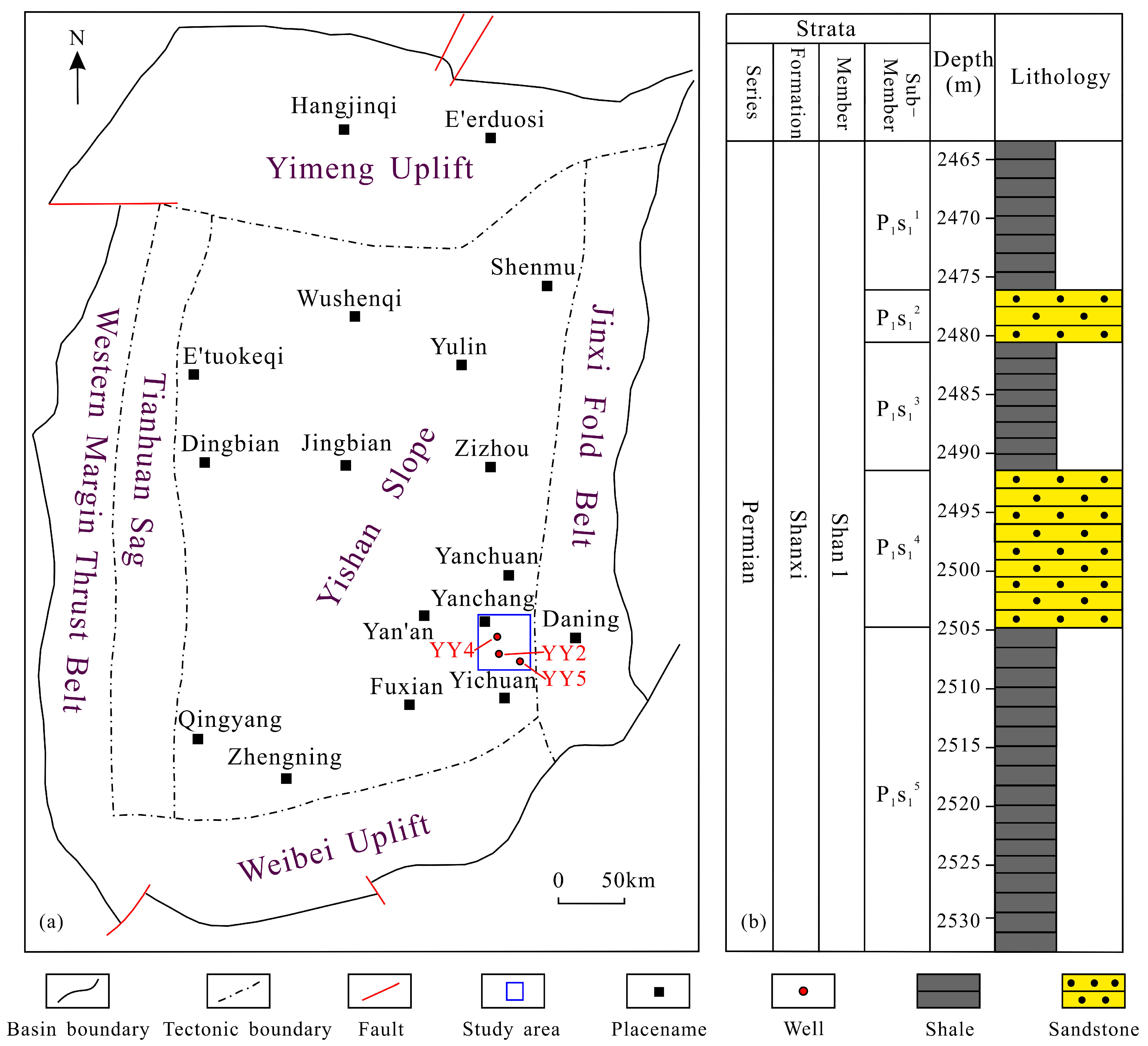
2. Geological Settings
3. Data and Methods
3.1. Data
3.2. Numerical Simulation Method for Paleo-Overpressure Reconstruction
3.3. Calculation Method for Formation Pressure Reduction
3.3.1. Calculation Method for Pressure Reduction Induced by Pore Rebound and Temperature Decrease
3.3.2. Calculation Method for Pressure Reduction Induced by Brittle Fracturing of Shale
3.4. Calculation Method for Formation Pressure Increment in Sandstone Induced by Overpressure Transmission
4. Results
4.1. Current Reservoir Pressure Distribution Characteristics
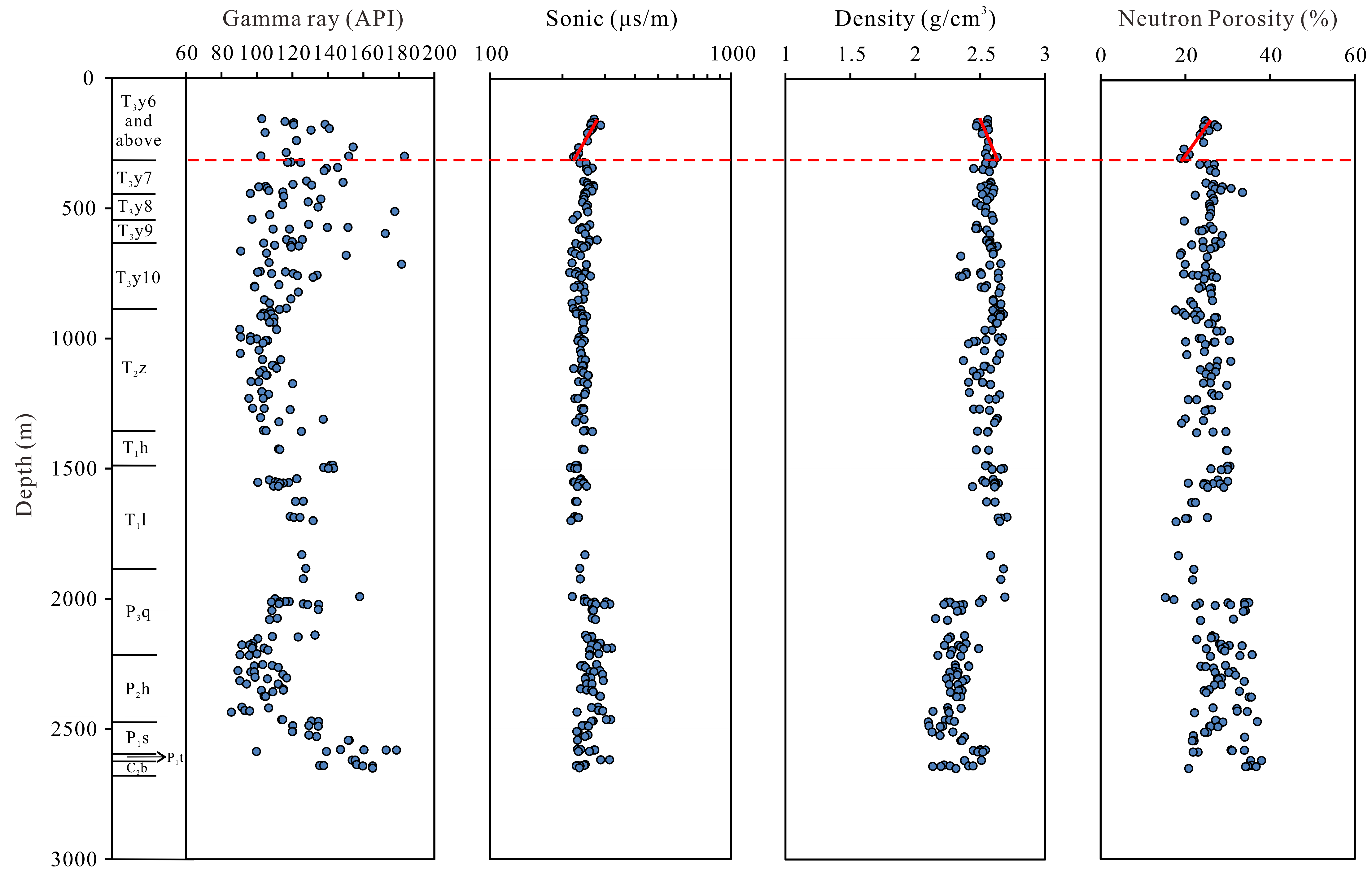
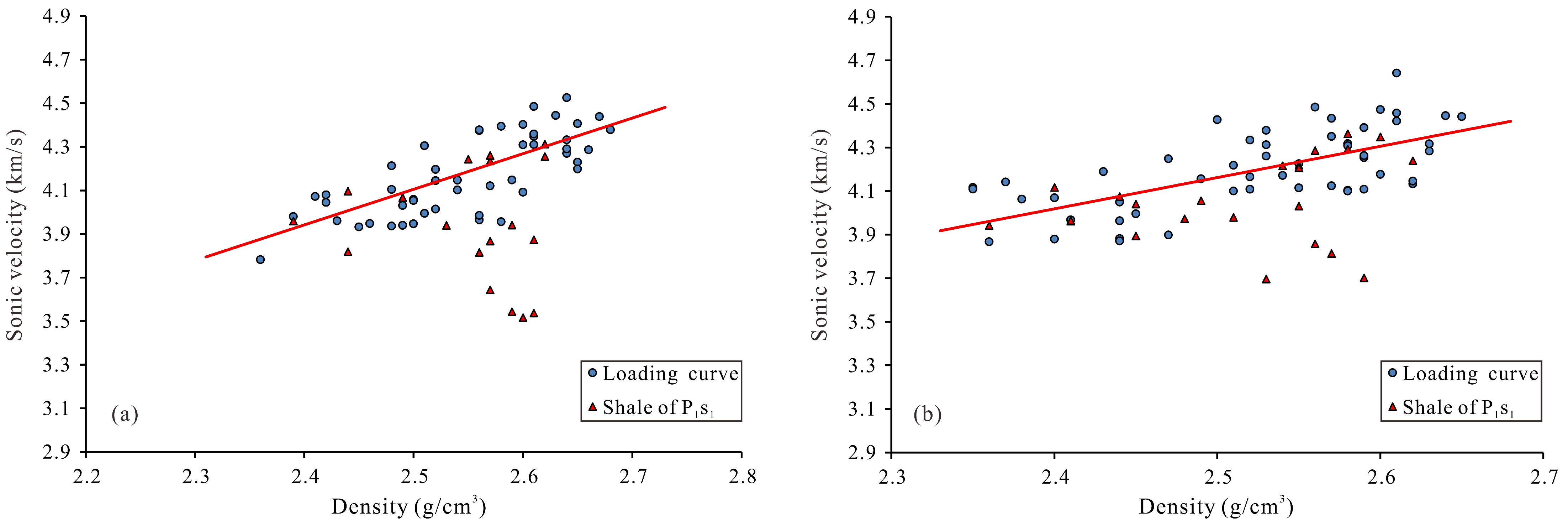
4.2. Genesis of Formation Paleo-Overpressure
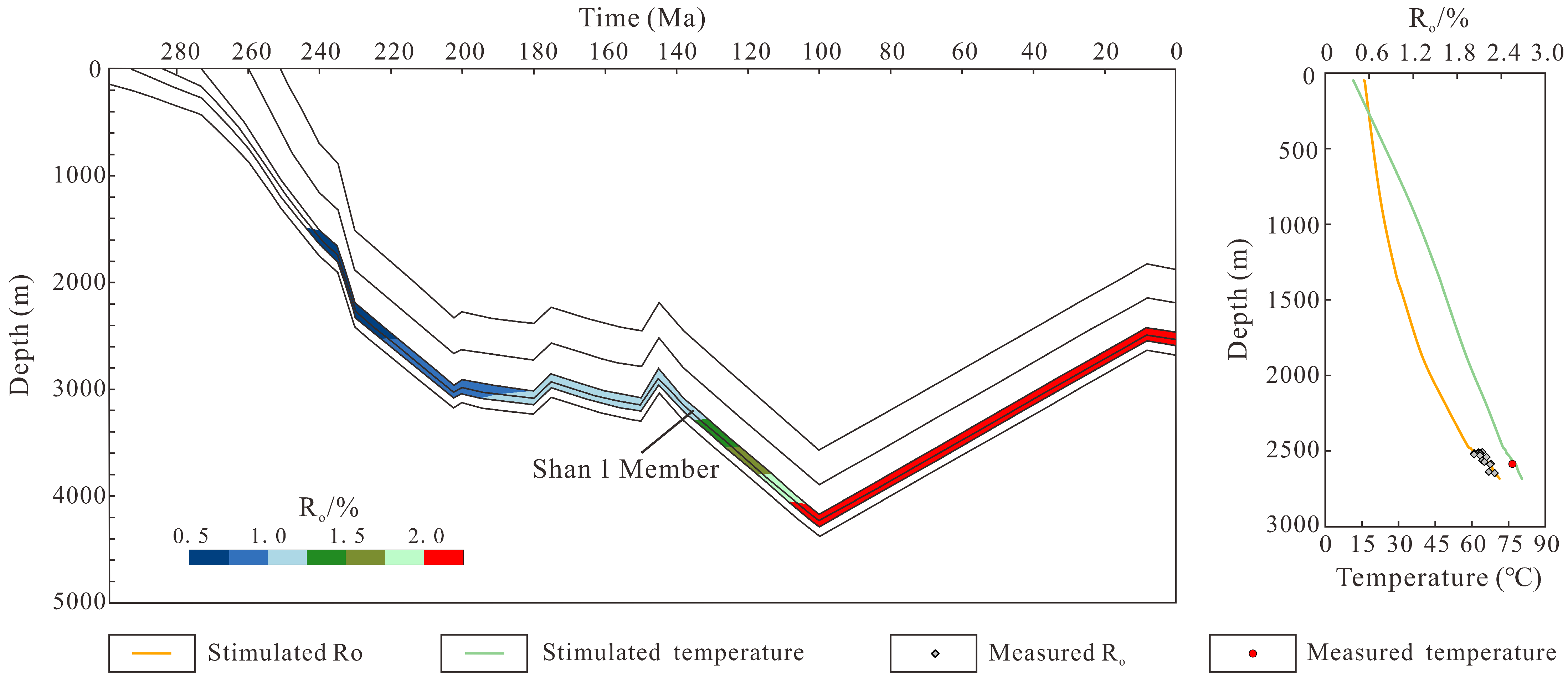
4.3. Simulation Results of Paleo-Overpressure in the Target Strata of a Single Well
4.4. Calculation Results of Pressure Reduction Induced by Pore Rebound and Temperature Decrease
4.5. Calculation Results of Pressure Reduction Induced by Brittle Fracture of Shale
5. Discussion
5.1. Impact of Hydrocarbon Charging and Shale Brittle Fracture Pressure Relief on the Sandstone Strata Pressure of the Shanxi Formation in the Study Area
5.2. Evolution Process of Formation Pressure in the Sandstone of the Upper Paleozoic Shanxi Formation, Study Area
5.3. Impact of the Evolution of Pressure Differences in Different Lithologic Strata of the Upper Paleozoic Shanxi Formation in the Study Area on Natural Gas Accumulation
6. Conclusions
- (1)
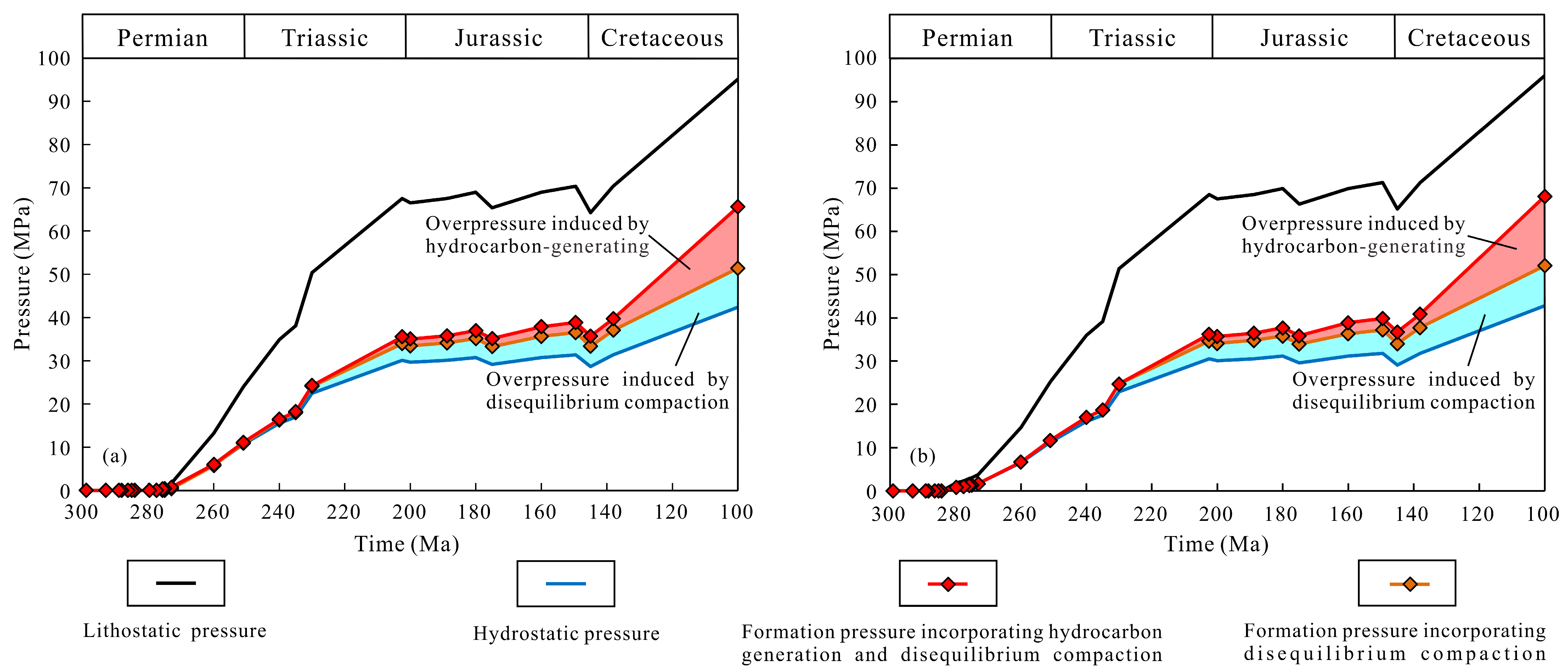
- At the end of the Early Cretaceous, overpressure was extensively developed in the shales of each sub-member of the Shan 1 Member of the Shanxi Formation in the Yanchang area, southeastern Ordos Basin. The genetic mechanism of the paleo-overpressure was attributed to hydrocarbon generation and disequilibrium compaction, which caused respective fluid pressure increases of 13.97–16.04 MPa and 9.21–9.27 MPa.
- (2)
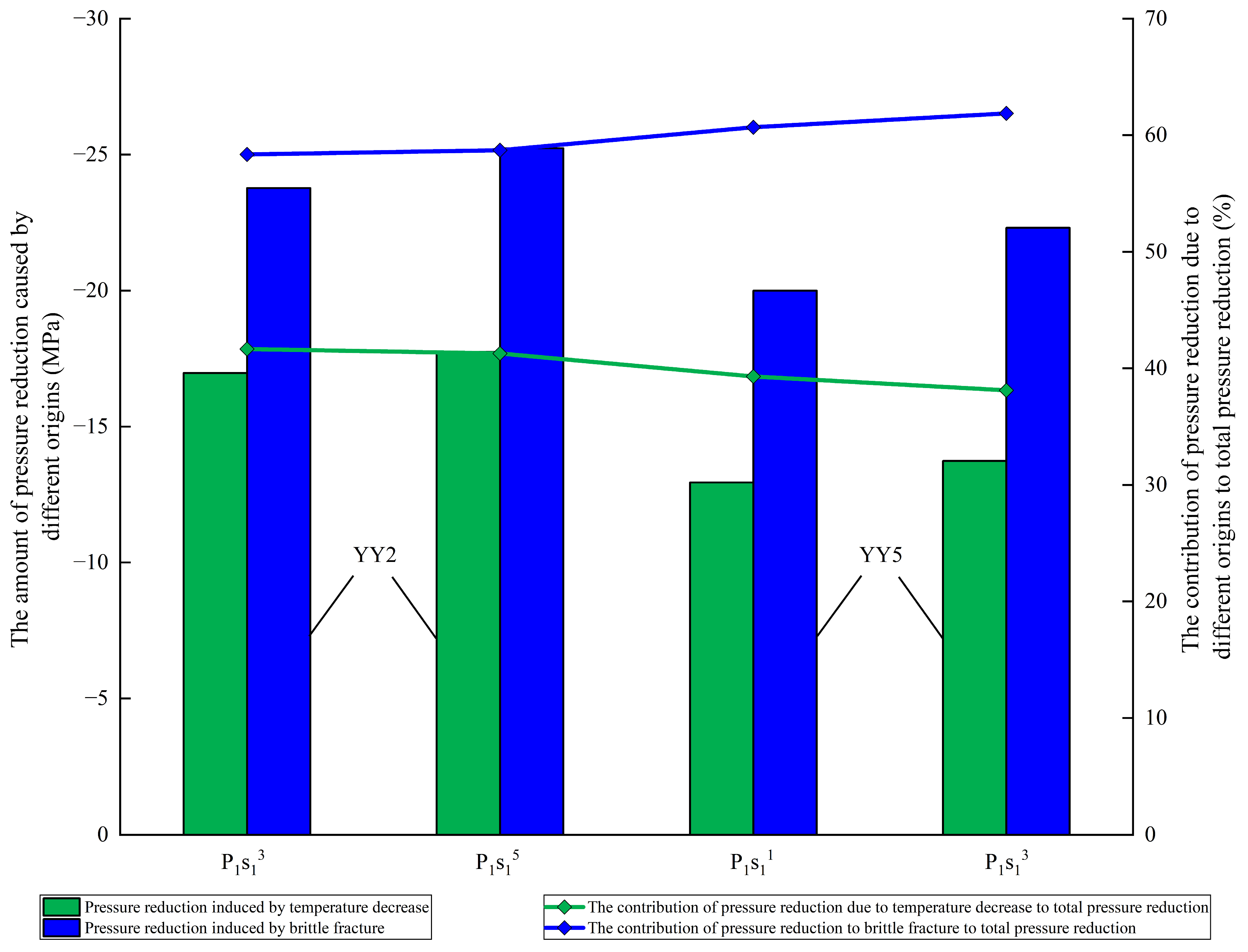
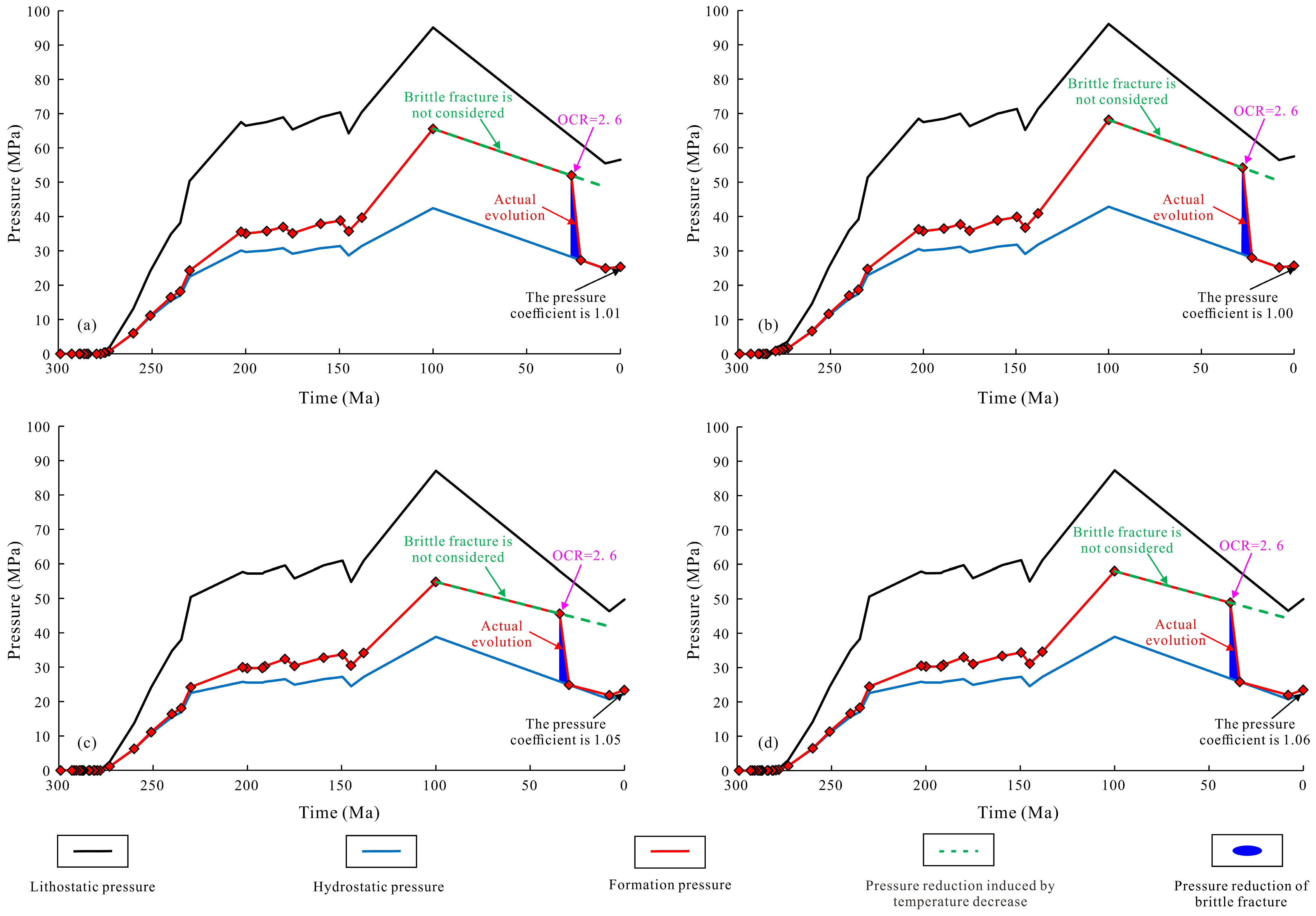
- During the tectonic uplift since the Late Cretaceous, the decrease in formation temperature and brittle fracturing-induced pressure relief are the main controlling factors for the evolution of the shale strata in each sub-member of the Shan 1 Member of the Shanxi Formation in the study area from ultrahigh pressure to the current normal pressure or weak overpressure. Among them, the temperature decrease results in a formation pressure reduction of 12.95–17.75 MPa, with a reduction rate of 38.11–41.65%; the brittle fracturing-induced pressure relief of the shale strata is 20.00–25.24 MPa, with a reduction rate of 58.35–61.89%. Brittle fracturing plays a dominant role in the evolution of the shale strata to the current normal pressure or overpressure state.
- (3)
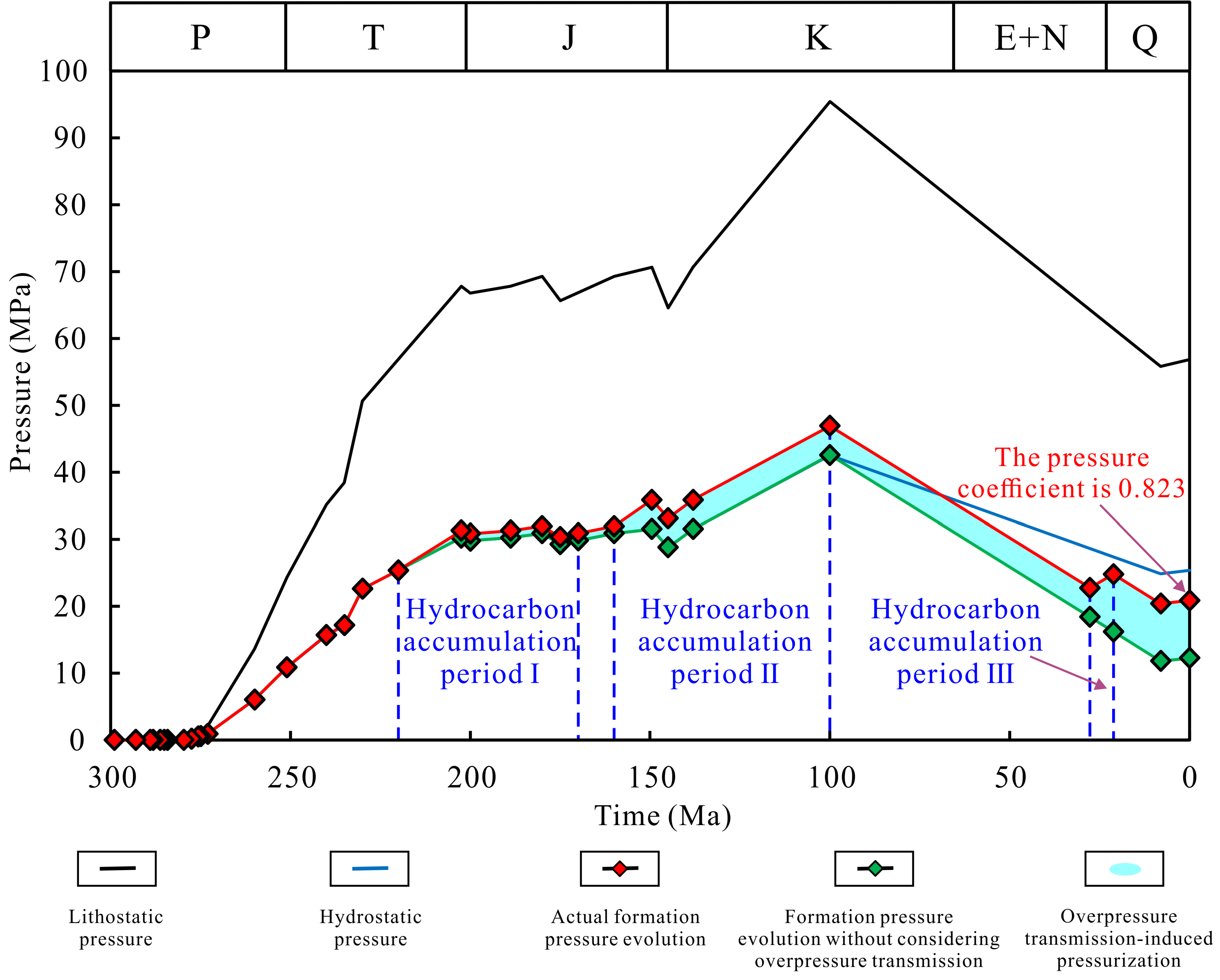
- The controlling factors for the formation of the current underpressure in the sandstones of each sub-member of the Shan 1 Member of the Shanxi Formation in the Yanchang area, southeastern Ordos Basin, are temperature reduction and pore rebound. These two factors, respectively, induce a formation pressure decrease of 12.07–13.85 MPa and 16.93–17.41 MPa in the sandstones, accounting for 40.94–45.00% and 55.00–59.06% of the total pressure reduction, respectively. Additionally, the hydrocarbon charging during reservoir formation, together with the fracturing-induced pressure relief of the adjacent organic-rich mud shales during the late tectonic uplift stage, collectively induces overpressure transfer; this overpressure transfer contributes a pressure increase of 7.32–8.58 MPa to the sandstone formations in the study area. Under the combined effect of the aforementioned factors, the sandstone formations in the study area have evolved into their current underpressure state.
- (4)
- The pressure differential evolution in the “shale–sand–shale” lithological combination of the Shan 1 Member of the Shanxi Formation in the study area permeates the entire reservoir formation process of tight sandstone gas. The source-reservoir excess pressure differences formed at various stages serve as key driving forces for the multi-stage hydrocarbon charging. During the late tectonic uplift stage, the densification of the shale caprock and the 4.45–5.22 MPa excess pressure difference formed with the adjacent sandstone promote hydrocarbon preservation by enhancing the caprock’s physical sealing capacity and overpressure sealing capacity; these two factors jointly lay the foundation for the current distribution pattern of tight sandstone gas reservoirs in the study area.
Author Contributions
Funding
Data Availability Statement
Conflicts of Interest
References
- Birchall, T.; Senger, K.; Swarbrick, R. Naturally occurring underpressure—A global review. Pet. Geosci. 2022, 28, petgeo2021–petgeo2051. [Google Scholar] [CrossRef]
- Nelson, P.H.; Gianoutsos, N.J.; Drake, R.M., II. Underpressure in Mesozoic and Paleozoic rock units in the Midcontinent of the United States. AAPG Bull. 2015, 99, 1861–1892. [Google Scholar] [CrossRef]
- Umari, A.M.J.; Nelson, P.H.; Fridrich, C.; LeCain, G.D. Simulating the Evolution of Fluid Underpressures in the Great Plains, by Incorporation of Tectonic Uplift and Tilting, with a Groundwater Flow Model. Geofluids 2018, 2018, 3765743. [Google Scholar] [CrossRef]
- Birchall, T.; Senger, K.; Hornum, M.T.; Olaussen, S.; Braathen, A. Underpressure in the northern Barents shelf: Causes and implications for hydrocarbon exploration. AAPG Bull. 2020, 104, 2267–2295. [Google Scholar] [CrossRef]
- Wang, Q.C.; Chen, D.X.; Gao, X.Z.; Wang, F.W.; Li, S.; Tian, Z.Y.; Lei, W.Z.; Chang, S.Y.; Zou, Y. Evolution of abnormal pressure in the Paleogene Es3 formation of the Huimin Depression, Bohai Bay Basin, China. J. Petrol. Sci. Eng. 2021, 203, 108601. [Google Scholar] [CrossRef]
- Wang, Q.C.; Chen, D.X.; Wang, F.W.; Gao, X.Z.; Zou, Y.; Tian, Z.Y.; Li, S.; Chang, S.Y.; Yao, D.S. Origin and distribution of an under-pressured tight sandstone reservoir: The Shaximiao Formation, Central Sichuan Basin. Mar. Petrol. Geol. 2021, 132, 105208. [Google Scholar] [CrossRef]
- Xi, S.L.; Yan, W.; Liu, X.S.; Zhang, C.L.; Yin, L.L.; Dong, G.D.; Jing, X.H.; Wei, L.B. New fields, new types and resource potentials of natural gas exploration in Ordos Basin. Acta Pet. Sin. 2024, 45, 33–51+132. (In Chinese) [Google Scholar] [CrossRef]
- Zhu, R.K.; Li, G.X.; Cui, J.W.; Huang, F.X.; Lu, X.S.; Guo, Z.; Cao, Z.L. Geological accumulation conditions and exploration prospects of tight oil and gas in China. Acta Pet. Sin. 2025, 46, 17–32. (In Chinese) [Google Scholar] [CrossRef]
- Fu, J.H.; Zhao, H.T.; Dong, G.D.; Han, T.Y.; Ren, J.F.; Huang, Z.L.; Lu, Z.X.; Zhu, B.D.; Zhu, J.; Yin, L.L.; et al. Discovery and prospect of oil and gas exploration in new areas of Ordos Basin. Nat. Gas Geosci. 2023, 34, 1289–1304. (In Chinese) [Google Scholar] [CrossRef]
- Kuang, L.C.; Dong, D.Z.; He, W.Y.; Wen, S.M.; Sun, S.S.; Li, S.X.; Qiu, Z.; Liao, X.W.; Li, Y.; Wu, J.; et al. Geological characteristics and development potential of transitional shale gas in the east margin of the Ordos Basin, NW China. Pet. Explor. Dev. 2020, 47, 435–446. (In Chinese) [Google Scholar] [CrossRef]
- Wang, X.Z.; Qiao, X.Y.; Zhang, L.; Wang, Y.K.; Zhou, J.S.; Du, Y.H.; Cao, J.; Xin, C.P.; Song, J.X.; Yuan, F.Z. Innovation and scale practice of key technologies for the exploration and development of tight sandstone gas reservoirs in Yan’an Gas Field of southeastern Ordos Basin. Nat. Gas Ind. 2022, 42, 102–113. (In Chinese) [Google Scholar] [CrossRef]
- Liu, W.; Zhao, Q.; Qiu, Z.; Zhao, P.H.; Li, S.X.; Dong, D.Z.; Liu, H.L.; Hou, W.; Zhang, Q.; Xiao, Y.F.; et al. Research status and prospect of accumulation conditions of transitional facies shale gas in the eastern margin of Ordos Basin. Nat. Gas Geosci. 2023, 34, 868–887. (In Chinese) [Google Scholar] [CrossRef]
- Wang, Z.L.; Chen, H.L. Evolution of fluid pressure distribution in the Upper Paleozoic of the Shenmu-Yulin area and its implications for natural gas accumulation. Sci. China Earth Sci. 2007, 37, 49–61. (In Chinese) [Google Scholar]
- Han, X.J. Forming Process of Underpressure and Its Impact on Shale Gas Enrichment, Shan1 Member, Southeastern Ordos Basin. Master’s Thesis, Northwest University, Xi’an, China, 2020. [Google Scholar]
- Wang, H.; Ma, L.Y.; Luo, Q.Q.; Chen, C.F.; Han, B.; Li, C.; Zheng, X.W. Pressure Evolution of Upper Paleozoic in Hangjinqi Area, Ordos Basin. Geoscience 2020, 34, 1166–1180. (In Chinese) [Google Scholar] [CrossRef]
- Ren, W.; Liu, K.; Shi, W.Z.; Qin, S.; Zhang, W.; Qi, R.; Xu, L. Reservoir densification, pressure evolution, and natural gas accumulation in the Upper Paleozoic tight sandstones in the North Ordos Basin, China. Energies 2022, 15, 1990. [Google Scholar] [CrossRef]
- Wang, S.L.; Xu, H.Z. Pressure distribution and genesis of fluid in the Upper Paleozoic of the Ordos Basin. Pet. Geol. Exp. 2010, 32, 536–540. (In Chinese) [Google Scholar] [CrossRef]
- Wang, X.M.; Zhao, J.Z.; Liu, X.S.; Zhao, X.H.; Cao, Q. Distribution characteristics and genesis of present formation pressure of the Upper Paleozoic in the eastern Ordos Basin. Oil Gas Geol. 2013, 34, 646–651. (In Chinese) [Google Scholar] [CrossRef]
- Jing, H.J.; Wang, L.L.; Ren, K.X.; Ye, Y.F.; Liu, Y.K.; Chen, F.; Ma, L.Y.; Hou, Y.G. Pressure evolution and underpressure generation in the Shanxi sandstone reservoirs of the Xinzhao area, northern Ordos. Bull. Geol. Sci. Technol. 2026, 45, 1–15. (In Chinese) [Google Scholar] [CrossRef]
- Kang, R.; Yang, Y.; Yan, X.X.; Chen, H.; Jia, L.; Liang, X. Quantitative analysis of the abnormal low pressure of the fifth member of Shiqianfeng Formation in Yulin-Shenmu area, Ordos Basin. Nat. Gas Geosci. 2025, 36, 284–292. (In Chinese) [Google Scholar] [CrossRef]
- Guo, M.Q.; Song, P.; Zhang, B.; Chen, M.; Wu, W.T. Origin and evolution of paleo-overpressure in the upper Paleozoic in Linxing area, the eastern margin of Ordos Basin, China. J. Xi’an Shiyou Univ. Nat. Sci. Ed. 2020, 35, 19–25. (In Chinese) [Google Scholar] [CrossRef]
- He, Z.L.; Li, S.J.; Nie, H.K.; Yuan, Y.S.; Wang, H. The shale gas “sweet window”: “The cracked and unbroken” state of shale and its depth range. Mar. Pet. Geol. 2019, 101, 334–342. [Google Scholar] [CrossRef]
- Lu, X.S.; Liu, S.B.; Tian, H.; Ma, X.Z.; Yu, Z.C.; Fan, J.J.; Gui, L.L.; Liu, Q. An evaluation method for the integrity of mudstone caprock in deep anticlinal traps and its application: A case study of the Sinian gas reservoirs in the central Sichuan Basin. Acta Pet. Sin. 2021, 42, 415–427. (In Chinese) [Google Scholar]
- Zhao, B.S.; Li, R.X.; Qin, X.L.; Wang, N.; Zhou, W.; Khaled, A.; Zhao, D.; Zhang, Y.N.; Wu, X.L.; Liu, Q. Geochemical characteristics and mechanism of organic matter accumulation of marine-continental transitional shale of the lower permian Shanxi Formation, southeastern Ordos Basin, north China. J. Pet. Sci. Eng. 2021, 205, 108815. [Google Scholar] [CrossRef]
- Yu, Y.C.; Guo, S.B. The Shanxi Formation responses to astronomically forced climate changes during the Upper Paleozoic in the Eastern Ordos Basin, NW China. Mar. Pet. Geol. 2023, 156, 106451. [Google Scholar] [CrossRef]
- Cao, H.R.; Shi, J.; Zhan, Z.W.; Wu, H.; Wang, X.Y.; Cheng, X.; Li, H.L.; Zou, Y.R.; Peng, P.A. Shale oil potential and mobility in low-to medium-maturity lacustrine shales: A case study of the Yanchang Formation shale in southeast Ordos Basin, China. Int. J. Coal Geol. 2024, 282, 104421. [Google Scholar] [CrossRef]
- Yang, P.; Ren, Z.L.; Fu, J.H.; Bao, H.P.; Xiao, H.; Shi, Z.; Wang, K.; Zhang, Y.Y.; Liu, W.H.; Li, W.H. A tectono-thermal perspective on the petroleum generation, accumulation and preservation in the southern Ordos Basin, North China. Pet. Sci. 2024, 21, 1459–1473. [Google Scholar] [CrossRef]
- Xu, X.Y. Study on Faults Structure and Reservoir Control in Ordos Basin. Ph.D. Thesis, China University of Petroleum, Qingdao, China, 2020. (In Chinese). [Google Scholar]
- Yang, P.; Ren, Z.L.; Zhou, R.J.; Cui, J.P.; Qi, K.; Fu, J.H.; Li, J.B.; Liu, X.S.; Li, W.H.; Wang, K. Tectonic evolution and controls on natural gas generation and accumulation in the Ordovician system of the Ordos Basin, North China. Energy Rep. 2021, 7, 6887–6898. [Google Scholar] [CrossRef]
- Cheng, M.; Li, C.; Yin, J.T.; Wang, P.; Hu, C.Z.; Yu, Y.X.; Lei, Y.H.; Zhang, L.K. Modeling of Burial History, Source Rock Maturity, and Hydrocarbon Generation of Marine-Continental Transitional Shale of the Permian Shanxi Formation, Southeastern Ordos Basin. ACS Omega 2024, 9, 20532–20546. [Google Scholar] [CrossRef]
- Chen, R.Y.; Luo, X.R.; Chen, Z.K.; Yu, J.; Yang, Y. Restoration of burial history of four periods in Ordos Basin. Acta Pet. Sin. 2006, 27, 43–47. (In Chinese) [Google Scholar]
- He, D.F.; Bao, H.P.; Kai, B.Z.; Wei, L.B.; Xu, Y.H.; Ma, J.H.; Cheng, X. Critical tectonic modification periods and its geologic features of Ordos Basin and adjacent area. Acta Pet. Sin. 2021, 42, 1255–1269. (In Chinese) [Google Scholar] [CrossRef]
- Jiang, F.J.; Jia, C.Z.; Pang, X.Q.; Jiang, L.; Zhang, C.L.; Ma, X.Z.; Qi, Z.G.; Chen, J.Q.; Pang, H.; Hu, T.; et al. Upper Paleozoic total petroleum system and geological model of natural gas enrichment in Ordos Basin, NW China. Pet. Explor. Dev. 2023, 50, 250–261. (In Chinese) [Google Scholar] [CrossRef]
- Wang, J.M.; Zhang, S. Exploring the characteristics and genesis of low amplitude structures on the Yishaan Slope, Ordos Basin. Earth Sci. Front. 2018, 25, 246–253. (In Chinese) [Google Scholar] [CrossRef]
- Niu, X.B.; Yu, J.; Xu, W.L.; Wang, K.L.; Wen, X.Y.; Sun, Y.S.; Zhang, J.Y. Reservoir-forming geological conditions and exploration directions of Upper Paleozoic coal-rock gas in the Ordos Basin. Nat. Gas Ind. 2024, 44, 33–50. (In Chinese) [Google Scholar] [CrossRef]
- Qin, Y.; Liu, C.Y.; Huang, L.; Wang, J.Q.; Zhao, J.F.; Shao, D.Y.; Yang, L.H.; Zhao, X.C.; Khalaf, E.; Zhang, S.H.; et al. Characteristics of the low-pressure spatial and temporal distributions of oil and gas-bearing layers in the Ordos Basin, China. Int. J. Coal Geol. 2024, 285, 104476. [Google Scholar] [CrossRef]
- Fu, J.H.; Guo, S.B.; Liu, X.S.; Wang, Y.G. Shale Gas Accumulation Condition and Exploration Potential of the Upper Paleozoic Shanxi Formation in Ordos Basin. J. Jilin Univ. Earth Sci. Ed. 2013, 43, 382–389. (In Chinese) [Google Scholar] [CrossRef]
- Peng, H.; Wang, J.Q.; Liu, C.Y.; Zhao, H.G.; Huang, L.; Zhao, X.C.; Zhang, S.H.; Liang, C.; Wang, Z.; Cattò, S.; et al. Long-term and multiple stage exhumation of the Ordos Basin, western North China Craton: Insights from seismic reflection, borehole and geochronological data. Earth-Sci. Rev. 2023, 238, 104349. [Google Scholar] [CrossRef]
- Wang, R.G.; Zhou, J.S.; Zhang, J.F.; Mi, W.W.; Zhang, J.F.; Gao, Z.; Liu, N.; Li, W.H. Sedimentary environment and evolution of Late Carboniferan-Middle Permian in southeastern Ordos Basin. J. Northwest Univ. Nat. Sci. Ed. 2024, 54, 1023–1036. (In Chinese) [Google Scholar] [CrossRef]
- Shi, H.C.; Jiang, C.X.; Sun, M.J.; Liao, Z.B.; Cheng, G.X.; Qi, T.S. Sealing capability assessment of mudstone caprock in the Upper Paleozoic, South Ordos Basin. Pet. Geol. Recovery Eff. 2015, 22, 9–16. (In Chinese) [Google Scholar] [CrossRef]
- Zhou, J.S.; Qiao, X.Y.; Wang, R.G.; Yin, X.; Cao, J.; Cao, B.F.; Lei, Y.H.; Tian, K.; Zhao, Z.D.; Zhugeng, B.L. Effective reservoir development model of tight sandstone gas in Shanxi Formation of Yan’an gas field, Ordos Basin. Nat. Gas Geosci. 2022, 33, 195–206. (In Chinese) [Google Scholar] [CrossRef]
- Du, Y.; Liu, C.; Gao, C.; Guo, C.; Liu, G.; Xu, J.; Xue, P. Progress, challenges and prospects of the continental shale gas exploration and development in the Yanchang exploration area of the Ordos Basin. China Pet. Explor. 2020, 25, 33–42. (In Chinese) [Google Scholar] [CrossRef]
- Wang, K.; Wang, Y.Y.; Wang, F.Q. Formation conditions and the main controlling factors for the enrichment of shale gas of Shanxi Formation in the southeast of Ordos Basin. Nat. Gas Geosci. 2022, 33, 1661–1674. (In Chinese) [Google Scholar] [CrossRef]
- Duan, Y.F.; Zhao, W.W.; Yang, T.X.; Li, F.K.; Li, H.; Wang, J.; Liu, Y.C. Source-reservoir characteristics and accumulation rules of shale gas of Permian Shanxi Formation in Yan’an area, Ordos Basin. Lithol. Reserv. 2024, 36, 72–83. (In Chinese) [Google Scholar] [CrossRef]
- Wang, W.C.; Zhao, J.X.; Xiang, F.; Wang, S.; Shao, X.Y.; Yu, H.; He, J.W. Reservoir characteristics and comparative analysis of otherness of Shanxi Formation and Lower Shihezi Formation in southeastern Ordos Basin, China. J. Chengdu Univ. Technol. Sci. Technol. Ed. 2018, 45, 99–210. (In Chinese) [Google Scholar] [CrossRef]
- Li, C.; Zhang, L.K.; Luo, X.R.; Lei, Y.H.; Yu, L.; Cheng, M.; Wang, Y.S.; Wang, Z.L. Overpressure generation by disequilibrium compaction or hydrocarbon generation in the Paleocene Shahejie Formation in the Chezhen Depression: Insights from logging responses and basin modeling. Mar. Pet. Geol. 2021, 133, 105258. [Google Scholar] [CrossRef]
- Sun, Y.; Xie, P.Y.; Zhang, F.Q.; Chen, S.G.; Li, Y.X.; Guan, M.; Zhou, R.R.; Zhang, J. Mechanism and evolution of overpressure in the Linhe Formation of the Xinglong structural belt in the Linhe Depression of the Hetao Basin. Nat. Gas Geosci. 2024, 35, 661–675. (In Chinese) [Google Scholar] [CrossRef]
- Kauerauf, A.I.; Hantschel, T. Fundamentals of Basin and Petroleum Systems Modeling, 1st ed.; Springer: Berlin/Heidelberg, Germany, 2009; pp. 1–136. [Google Scholar]
- Burnham, A.K. Kinetic models of vitrinite, kerogen, and bitumen reflectance. Org. Geochem. 2019, 131, 50–59. [Google Scholar] [CrossRef]
- Guo, X.W.; He, S.; Zheng, L.J.; Wu, Z.Z. A quantitative model for the overpressure caused by oil generation and its influential factors. Acta Pet. Sin. 2011, 32, 637–644. (In Chinese) [Google Scholar] [CrossRef]
- Guo, X.W.; He, S.; Liu, K.Y.; Dong, T.T. A quantitative estimation model for the overpressure caused by natural gas generation and its influential factors. Earth Sci. J. China Univ. Geosci. 2013, 38, 1263–1270. (In Chinese) [Google Scholar]
- Cohen, K.M.; Finney, S.C.; Gibbard, P.L.; Fan, J.X. The ICS International Chronostratigraphic Chart. Episodes 2013, 36, 199–204. [Google Scholar] [CrossRef]
- Chen, R.Y.; Luo, X.R.; Zhao, W.Z.; Wang, H.J. Thermal anomaly and thermal evolution of source rocks in Mesozoic Ordos Basin. Pet. Explor. Dev. 2007, 34, 658–663. (In Chinese) [Google Scholar] [CrossRef]
- Guo, Q.L.; Mi, J.K.; Wang, J.; Li, J.K.; Li, Y.X.; Yang, Z. An improved hydrocarbon generation model of source rocks and key parameter templates. China Pet. Explor. 2019, 24, 661–669. (In Chinese) [Google Scholar] [CrossRef]
- Lai, J.; Bai, T.Y.; Su, Y.; Zhao, F.; Li, L.; Li, Y.H.; Li, H.B.; Wang, G.W.; Xiao, C.W. Researches progress in well log recognition and evaluation of source rocks. Geol. Rev. 2024, 70, 721–741. (In Chinese) [Google Scholar] [CrossRef]
- Yu, Q. The Paleozoic Thermal Evolution History and Natural Gas Accumulation of the Central and Eastern Parts of Ordos Basin. Ph.D. Thesis, Northwest University, Xi’an, China, 2020. [Google Scholar]
- Ren, Z.L.; Qi, K.; Li, J.B.; Huo, X.J.; Cui, J.P.; Yang, P.; Wang, K.; Chen, Z.J.; Yang, G.L. Thermodynamic evolution and hydrocarbon accumulation in the Ordos Basin. Oil Gas Geol. 2021, 42, 1030–1042. (In Chinese) [Google Scholar] [CrossRef]
- Xia, X.Y.; Michael, E.; Gao, Y.L. Preservation of lateral pressure disequilibrium during the uplift of shale reservoirs. AAPG Bull. 2020, 104, 825–843. [Google Scholar] [CrossRef]
- Zhang, F.Q.; Sun, Y.; Liu, S.Y.; Li, Y.X.; Sun, J.B.; Wang, F.Q.; Liu, G.; Chen, H.G. Characteristics of pressure relief induced by shale brittle fracture in tectonic uplift area and its influence on shale oil enrichment: A case study of Chang 73 sub-member of Yanchang Formation in Yan’an area. Pet. Geol. Exp. 2023, 45, 936–951. (In Chinese) [Google Scholar] [CrossRef]
- Gao, G.; Gang, W.Z.; Fan, H.C.; Sang, T.Y.; Nie, C.Q. Research Advances for the Genesis of Abnormally Low Formation Pressure in Petroliferous Basins. Nat. Gas Geosci. 2008, 19, 311–315. (In Chinese) [Google Scholar]
- Li, S.X.; Shi, Z.J.; Liu, X.Y.; Yang, S.Y.; Deng, X.Q.; Liu, G.L.; Li, J.H. Quantitative analysis of the Mesozoic abnormal low pressure in Ordos Basin. Pet. Explor. Dev. 2013, 40, 528–533. (In Chinese) [Google Scholar] [CrossRef]
- Chang, C.D.; Zoback, M.D. Viscous creep in room-dried unconsolidated Gulf of Mexico shale (II): Development of a viscoplasticity model. J. Pet. Sci. Eng. 2010, 72, 50–55. [Google Scholar] [CrossRef]
- Jiang, M.Y. Accumulation Characteristics of Chang 9 and Chang 10 Members in Longdong Area, Ordos Basin. Master’s Thesis, China University of Petroleum, Beijing, China, 2020. [Google Scholar]
- Barker, C. Aquathermal pressuring-role of temperature in development of abnormal-pressure zones. AAPG Bull. 1972, 56, 2068–2071. [Google Scholar] [CrossRef]
- Liu, B.P. Pressure Characteristics of Reservoir and Accumulations of Nature Gas in Yanchang Gas Field of Ordos Basin. J. Yanan Univ. Nat. Sci. Ed. 2015, 34, 74–77. (In Chinese) [Google Scholar] [CrossRef]
- Lei, W.; Liu, X.J.; Ding, Y.; Xiong, J.; Liang, L.X. The investigation on shale mechanical characteristics and brittleness evaluation. Sci. Rep. 2023, 13, 22936. [Google Scholar] [CrossRef]
- Nygård, R.; Gutierrez, M.; Bratli, R.K.; Høeg, K. Brittle–ductile transition, shear failure and leakage in shales and mudrocks. Mar. Pet. Geol. 2006, 23, 201–212. [Google Scholar] [CrossRef]
- Ding, W.L.; Xu, C.C.; Jiu, K.; Li, C.; Zeng, W.T.; Wu, L.M. The Research Progress of Shale Fractures. Adv. Earth Sci. 2011, 26, 135–144. (In Chinese) [Google Scholar]
- Zeng, L.B.; Ma, S.J.; Tian, H.; Xue, M.; Liu, G.P.; Lü, W.Y. Research Progress of Natural Fractures in Organic Rich Shale. Earth Sci. 2023, 48, 2427–2442. (In Chinese) [Google Scholar] [CrossRef]
- Narr, W.; Currie, J.B. Origin of Fracture Porosity—Example from Altamont Field, Utah. AAPG Bull. 1982, 65, 1231–1247. [Google Scholar] [CrossRef]
- Yuan, Y.S.; Fang, Z.X.; He, X.P.; Li, S.J.; Peng, Y.M.; Long, S.X. Normal pressure formation mechanism of Longmaxi shale gas in Pengshui and its adjacent areas. Reserv. Eval. Dev. 2020, 10, 9–16+21. (In Chinese) [Google Scholar] [CrossRef]
- Yuan, Y.S.; Liu, J.X.; Zhou, Y. Brittle-ductile transition zone of shale and its implications in shale gas exploration. Oil Gas Geol. 2018, 39, 899–906. (In Chinese) [Google Scholar] [CrossRef]
- Xiong, J.; Wu, J.J.; Liu, X.J.; Li, B.; Zhang, J.W.; Liang, L.X. Study on rock mechanical properties of different lithologies in marine continental transitional formation: A case study of the Shanxi Formation in the eastern margin of Ordos Basin. Prog. Geophys. 2024, 39, 0759–0769. (In Chinese) [Google Scholar] [CrossRef]
- Tang, X.; Zhang, J.C.; Ding, W.L.; Yu, B.S.; Wang, L.; Ma, Y.L.; Yang, Y.T.; Chen, H.Y.; Huang, H.; Zhao, P.W. The reservoir property of the Upper Paleozoic marine-continental transition shale and its gas-bearing capacity in the Southeastern Ordos Basin. Earth Sci. Front. 2016, 23, 147–157. (In Chinese) [Google Scholar] [CrossRef]
- Wang, L.; Zhang, J.C.; Wang, Y.; Xu, J. Pore structure and its influence factors of lacustrine facies shale reservoirs in Shanxi formation of Yanchang exploration area. Chin. Min. Mag. 2018, 27, 152–157. (In Chinese) [Google Scholar] [CrossRef]
- Fan, C.H.; He, S.; Zhang, Y.; Qin, Q.R.; Zhong, C. Development Phases and Mechanisms of Tectonic Fractures in the Longmaxi Formation Shale of the Dingshan Area in Southeast Sichuan Basin, China. Acta Geol. Sin. Engl. Ed. 2018, 92, 2351–2366. [Google Scholar]
- Gao, Z.L.; Li, Y.J.; Zhang, X.H.; Yuan, H.F.; Peng, H.L.; Hao, Y.; Cao, H.; Yao, Q.Y.; Zhu, K.D. Evolution of oil and gas formation and distribution of gas reservoirs in the Middle Permian Maokou Formation of Shunan area. Nat. Gas Geosci. 2025, 36, 307–321. (In Chinese) [Google Scholar] [CrossRef]
- Liu, X.F. Overpressure Transmission: Concept and Modes. Pet. Geol. Exp. 2002, 24, 529–532. (In Chinese) [Google Scholar]
- Guo, L.; Guo, S.; Ding, C.; Ma, Z.W. Differential diagenesis of tight reservoirs and its influence on hydrocarbon charging process: Taking the first member of Shanxi Formation of Lower Permian in Yan’an area, Ordos Basin as an example. Nat. Gas Geosci. 2024, 35, 1777–1788. (In Chinese) [Google Scholar] [CrossRef]
- Wu, Z.Q. Analysis on the Relationship Between Faults and Mesozoic and Paleozoic Oil and Gas Reservoirs in Ordos Basin. Master’s Thesis, Northwest University, Xi’an, China, 2020. [Google Scholar]
- Khalaf, M.S.; Soliman, N.; El-Banbi, A.H. Wellbore storage removal in pressure transient analysis for gas wells. J. Petrol. Sci. Eng. 2022, 208, 109712. [Google Scholar] [CrossRef]
- Liu, J.Z.; Chen, H.H.; Li, J.; Hu, G.Y.; Shan, X.Q.; Chen, L. Paleo-fluid pressure distribution and evolution of inclusions in the second member of Shanxi Formation in Yi-Shan Slope of Ordos Basin. Acta Pet. Sin. 2008, 29, 226–230+234. (In Chinese) [Google Scholar] [CrossRef]
- Li, S.X. Effects on Petroleum Accumulation and Genesis of the Mesozoic Abnormal Low Pressure in Ordos Basin. Ph.D. Thesis, Chengdu University of Technology, Chengdu, China, 2017. (In Chinese). [Google Scholar]
- Li, Y.; Zhu, Z.T.; Wu, P.; Shen, C.Z.; Gao, J.X. Pressure evolution of gas-bearing systems in the Upper Paleozoic tight reservoirs at the eastern margin of the Ordos Basin. Oil Gas Geol. 2023, 44, 1568–1581. (In Chinese) [Google Scholar] [CrossRef]
- Qin, B.; Cao, B.F.; Zhou, J.S.; Zhang, L.K.; Lei, Y.H.; Zhang, Z.Y. Availability Identification of Tight Gas Sandstone Reservoirs and Quantitative Assessment: A case study from the first member of the Upper Paleozoic Shanxi Formation in the southeastern Ordos Basin. Acta Sedimentol. Sin. 2019, 37, 403–415. (In Chinese) [Google Scholar] [CrossRef]



| Layer | Litho Mixture Ratio (%) | Initial Porosity (%) | Thermal Conductivity (W/m/K) | Heat Capacity (kcal/kg/K) | ||
|---|---|---|---|---|---|---|
| At 20 °C | At 100 °C | At 20 °C | At 100 °C | |||
| Q | 50 cg 50 sh | 50.00 | 1.91 | 1.89 | 0.20 | 0.23 |
| K1 | 55 sa 45 sh | 54.05 | 2.66 | 2.44 | 0.20 | 0.24 |
| J2 | 50 sa 50 sh | 55.50 | 2.54 | 2.36 | 0.20 | 0.24 |
| J1y | 35 sa 65 sh | 59.85 | 2.23 | 2.13 | 0.20 | 0.24 |
| J1f | 60 sa 40 sh | 52.60 | 2.78 | 2.53 | 0.20 | 0.24 |
| T3y | 40 sa 60 sh | 58.40 | 2.33 | 2.20 | 0.20 | 0.24 |
| T2z | 45 sa 55 sh | 56.95 | 2.44 | 2.28 | 0.20 | 0.24 |
| T1 | 60 sa 40 sh | 52.60 | 2.78 | 2.53 | 0.20 | 0.24 |
| P3q | 25 sa 75 sh | 62.75 | 2.04 | 1.99 | 0.21 | 0.24 |
| P2h | 30 sa 70 sh | 61.30 | 2.13 | 2.06 | 0.20 | 0.24 |
| P1s11 | 100 sh | 70.00 | 1.25 | 1.41 | 0.21 | 0.25 |
| P1s12 | 80 sa 20 sh | 46.80 | 3.14 | 2.79 | 0.21 | 0.24 |
| P1s13 | 100 sh | 70.00 | 1.25 | 1.41 | 0.21 | 0.25 |
| P1s14 | 90 sa 10 sh | 43.90 | 3.52 | 3.07 | 0.20 | 0.24 |
| P1s15 | 100 sh | 70.00 | 1.25 | 1.41 | 0.21 | 0.25 |
| P1s2 | 27 sa 63 sh 10 co | 62.77 | 1.48 | 1.58 | 0.22 | 0.26 |
| P1t | 30 sh 70 lim | 56.70 | 1.88 | 1.87 | 0.20 | 0.23 |
| C2b | 35 sa 60 sh 5 co | 60.15 | 2.05 | 1.99 | 0.21 | 0.24 |
| Well | Denudation Thickness at Different Periods (m) | |||
|---|---|---|---|---|
| Late Triassic | Early Jurassic | Late Jurassic | Early Cretaceous | |
| YY2 | 45 | 160 | 270 | 1750 |
| YY5 | 20 | 165 | 270 | 1800 |
| Classification | Representative Heavy Hydrocarbons | a/ (10−2 Pa·m3·mol−1) | Deviation Relative to Pure Methane (%) | b/ (10−6 m3·mol−1) | Deviation Relative to Pure Methane (%) |
|---|---|---|---|---|---|
| Pure methane | / | 22.83 | / | 42.78 | / |
| Mixed gas (baseline) | C2H6 | 23.08 | +1.10 | 42.84 | +0.16 |
| Mixed gas (heavy-end enriched) | C3H8 | 23.19 | +1.62 | 42.97 | +0.46 |
| Mixed gas (upper-bound reference) | nC4H10 | 23.36 | +2.35 | 43.22 | +1.03 |
| Well | Sub- Member | Pressure Increase Induced by Disequilibrium Compaction | Proportion of Pressure Increase from Disequilibrium Compaction (%) | Pressure Increase Induced by Hydrocarbon Generation | Proportion of Pressure Increase from Hydrocarbon Generation (%) |
|---|---|---|---|---|---|
| YY2 | P1s13 | 13.97 | 60.27 | 9.21 | 39.73 |
| P1s15 | 16.04 | 63.37 | 9.27 | 36.63 | |
| YY5 | P1s11 | 6.06 | 37.88 | 9.94 | 62.13 |
| P1s13 | 9.77 | 51.10 | 9.35 | 48.90 |
| Well | Sub-Member | Temperature Change (°C) | Erosion Thickness Since the Late Cretaceous (m) | Pressure Reduction Caused by Temperature Decrease (MPa) | Proportion of Pressure Reduction from Temperature Decrease (%) | Pressure Reduction Caused by Pore Rebound (MPa) | Proportion of Pressure Reduction from Pore Rebound (%) | Calculate the Pressure Coefficient |
|---|---|---|---|---|---|---|---|---|
| YY2 | P1s14 | 121.29 | 1750 | 13.85 | 45.00 | 16.93 | 55.00 | 0.48 |
| YY5 | P1s12 | 105.66 | 1800 | 12.07 | 40.94 | 17.41 | 59.06 | 0.49 |
| Well | Sub- Member | P1 (MPa) | Temperature Decrease (°C) | V2/V1 | P2 (MPa) | ∆P (MPa) | Calculate the Pressure Coefficient |
|---|---|---|---|---|---|---|---|
| YY2 | P1s13 | 65.60 | 121.11 | 0.7413 | 48.63 | 16.97 | 1.95 |
| P1s15 | 68.14 | 122.87 | 0.7395 | 50.39 | 17.75 | 1.98 | |
| YY5 | P1s11 | 54.81 | 105.58 | 0.7638 | 41.86 | 12.95 | 1.96 |
| P1s13 | 58.05 | 105.94 | 0.7632 | 44.31 | 13.74 | 2.06 |
| Well | Sub- Member | Erosion Thickness Since the Late Cretaceous (m) | Pressure Reduction Caused by Temperature Decrease (MPa) | The Time When the OCR Reaches the Brittle Fracture Threshold (Ma) | Pressure Reduction Caused by Brittle Fracture (MPa) |
|---|---|---|---|---|---|
| YY2 | P1s13 | 1750 | 16.97 | 26.18 | 23.77 |
| P1s15 | 1750 | 17.75 | 27.70 | 25.24 | |
| YY5 | P1s11 | 1800 | 12.95 | 34.37 | 20.00 |
| P1s13 | 1800 | 13.74 | 38.67 | 22.31 |
| Well | Sub- Member | ① Pressure Reduction Caused by Brittle Fracture (MPa) | ② Pressure Reduction Caused by Brittle Fracture (MPa) | Deviation Range (%) | ③ Pressure Reduction Caused by Brittle Fracture (MPa) | Deviation Range (%) | ④ Pressure Reduction Caused by Brittle Fracture (MPa) | Deviation Range (%) |
|---|---|---|---|---|---|---|---|---|
| YY2 | P1s13 | 23.770 | 23.763 | −0.029 | 23.794 | +0.101 | 23.810 | +0.168 |
| P1s15 | 25.240 | 25.237 | −0.012 | 25.233 | −0.028 | 25.231 | −0.036 | |
| YY5 | P1s11 | 20.000 | 19.915 | −0.425 | 20.119 | +0.595 | 20.219 | +1.095 |
| P1s13 | 22.310 | 22.240 | −0.314 | 22.402 | +0.412 | 22.482 | +0.771 |
Disclaimer/Publisher’s Note: The statements, opinions and data contained in all publications are solely those of the individual author(s) and contributor(s) and not of MDPI and/or the editor(s). MDPI and/or the editor(s) disclaim responsibility for any injury to people or property resulting from any ideas, methods, instructions or products referred to in the content. |
© 2026 by the authors. Licensee MDPI, Basel, Switzerland. This article is an open access article distributed under the terms and conditions of the Creative Commons Attribution (CC BY) license.
Share and Cite
Liu, S.; Zhang, F.; Zhao, Z.; Qiao, X.; Wang, J.; Gao, J.; Ji, Y.; Lei, Z. Quantitative Evaluation of the Formation and Evolution of Underpressure in Tight Sandstone of the Upper Paleozoic Shanxi Formation, Ordos Basin. Appl. Sci. 2026, 16, 475. https://doi.org/10.3390/app16010475
Liu S, Zhang F, Zhao Z, Qiao X, Wang J, Gao J, Ji Y, Lei Z. Quantitative Evaluation of the Formation and Evolution of Underpressure in Tight Sandstone of the Upper Paleozoic Shanxi Formation, Ordos Basin. Applied Sciences. 2026; 16(1):475. https://doi.org/10.3390/app16010475
Chicago/Turabian StyleLiu, Siyao, Fengqi Zhang, Zhenyu Zhao, Xin Qiao, Jiahao Wang, Jianrong Gao, Yuze Ji, and Zongru Lei. 2026. "Quantitative Evaluation of the Formation and Evolution of Underpressure in Tight Sandstone of the Upper Paleozoic Shanxi Formation, Ordos Basin" Applied Sciences 16, no. 1: 475. https://doi.org/10.3390/app16010475
APA StyleLiu, S., Zhang, F., Zhao, Z., Qiao, X., Wang, J., Gao, J., Ji, Y., & Lei, Z. (2026). Quantitative Evaluation of the Formation and Evolution of Underpressure in Tight Sandstone of the Upper Paleozoic Shanxi Formation, Ordos Basin. Applied Sciences, 16(1), 475. https://doi.org/10.3390/app16010475