1. Introduction
With the advancement of industrial technology, increasing demands are being placed on robot systems, including the ability to perform more complex tasks, achieve higher precision, and to be able to adapt to more harsh environments. Dual-arm robots not only possess environmental perception capabilities during motion but can also execute designated operational tasks. In recent years, considerable research attention has been directed toward dual-arm robots integrated with mobile bases. This paper proposes a mobile dual-arm robot (MDAR) with the following fundamental structural constraints: the system must incorporate a mobile base capable of providing one-dimensional translational motion, with the two arms symmetrically mounted upon this base, each maintaining an independent kinematic chain. The two arms of the MDAR have both the flexibility of mobile robots and the gripping ability, which largely reduce labor input and improve productivity. The proposed MDAR is not merely a simple combination of two arms, but rather the two arms have a common motion on the same base, and the two arms work together in the same system, are interconnected, interact, and coordinate to accomplish a task. The two arms transfer parameter information such as position, speed, and force to each other to coordinate and cooperate to complete a single action when carrying out a work task. With its unique structural design and high degree of flexibility, the MDAR has a wide range of applications in several fields. Firstly, it can be utilized in intelligent manufacturing within digital workshops [
1]. In the automobile manufacturing industry, two arms of the robots follow a pre-designed program to complete the work task efficiently. Secondly, it can be utilized in the assembly and testing of spacecraft. In the aerospace industry, this kind of robot is utilized to assemble and test the parts of all kinds of spacecraft. The mobile function of the base enables the robot to move flexibly in a narrow space and improves the efficiency and safety of assembly and testing through the precise operation of the arms. Thirdly, it can realize complex tasks such as unmanned, fully automated intelligent inspection and clearing of obstacles [
2]. The MDAR can efficiently handle, sort, and pack goods in logistics department. Additionally, it can be utilized for household services. Moley Robotics in the UK [
3] has designed a robot that can cook by simulating a chef’s process of stir-frying, using two simulated arms to control a variety of kitchen utensils. The MDAR has a wide range of applications in many fields and brings more convenience and benefits to various fields of human society. Therefore, the MDAR with universality is analyzed and researched in this paper.
As is well known, the dynamics investigates the relationship and balance between force and motion in robots, playing a crucial role in their development. To achieve precise control of the dual-arm motion of the MDAR, particularly for tasks requiring high coordination, it is essential to investigate its dynamics. Such analysis enables the optimization of motion trajectories and torque distributions in robotic systems. At present, several studies are available on the dynamics models [
4,
5,
6,
7] of dual-arm robots. Zhong et al. [
8] investigated the dynamics of the 2P-1P3R dual-arm robot using R. P. Paul’s dynamic analysis method, with the derivation of formulas corresponding to the driving force or torque of each joint. Liu et al. [
9] aimed at the dynamics modeling of dual-arm cooperating planar manipulators, a generalized dynamical equation of multi-link planar manipulators was established and proved with traditional Lagrange equation. Jazidie [
10] proposed a method for the dynamic simulation of multiarm robots by taking the mechanism of various contact types into consideration. Wu et al. [
11] analyzed all the working states of the space dual-arm robot and introduced the binary coefficient of determination to inductively obtain four robot working states, namely, two arms independent motion, two arms cooperation, closed-chain body floating, and open-chain body floating, and further the dynamic model of the space dual-arm robot under the four different working states was obtained based on the Lagrangian equation. Shen et al. [
12] presented a recursive inverse dynamics modeling method based on decoupled natural orthogonal complement to deal with the problem of inverse dynamics modeling for dual-arm robots. Zhang et al. [
13] derived a dynamics model for a free-floating space flexible dual-arm robot coordinated operation of a rigid-loaded closed-chain system based on the assumption of the modal method, the Lagrangian equations, and the momentum conservation of the system. Zhang et al. [
14] established the relative dynamics model of the two-arm coordination robot based on the relative Jacobian matrix. Chen et al. [
15] conveniently derived the dynamics equations for a dual-arm robot using the dynamics equations for a single-arm robot obtained by the subsystem Newton–Euler’s recursive method. Shivam et al. [
16] proposed a hybrid learning approach combining data-driven and parameterized modeling to approximate the dynamic model of the two arms. Lu [
17] used the Newton–Euler method to develop a dynamic model for the entire robotic arm. Peng et al. [
18] proposed a dynamic coupling modeling and analysis method for a dual-arm space robot. Lv [
19] established a more comprehensive dynamic model of DLOs based on a discrete elastic rod model, which takes into account the twisting deformation of DLOs. Many existing works has been conducted on the dynamics of dual-arm robots, but the relative dynamics characteristics of the proposed MDAR has not yet been thoroughly explored. In this paper, the MDAR’s relative dynamic model is established to investigate the dynamic relationship between the two arms in the same system, rather than treating the end-effectors as two independent single arms. There are three main reasons for studying the relative dynamic model of the MDAR. First, due to the special working nature of the MDAR, the two arms may produce dynamic coupling effects on the mobile base during operation. It is not possible to think of this dynamic coupling effect as the summation of the effects of two separate arms on the base dynamics. A universal dynamic model of the dual-arm robot must be created to investigate the effects of the two arms operation on the base. Second, current research on dual-arm robots mainly focuses on the situation where most robots have a fixed base. This makes the relative Jacobian matrix of such robots be a square matrix with strong specificity. However, the proposed MDAR has redundant degrees of freedom, which leads to a non-square relative Jacobian matrix of the MDAR, requiring a universal dynamic model to describe the dynamic characteristics of the MDAR. Finally, the relative Jacobian matrix can accurately describe the relationship between joint velocities and relative velocities of the end-effectors of the MDAR.
Another aspect that must be taken into account is control algorithms for the dual-arm robot, which are vital components that determine the behavior and performance in various tasks. These algorithms dictate how a dual-arm robot plans its actions and executes precise movements. By utilizing control algorithms, dual-arm robots can adapt to dynamic environments and accomplish complex tasks with efficiency and precision. Therefore, it is important to mention that the development of effective control strategies [
20,
21,
22,
23] is crucial for enhancing the capabilities and versatility of dual-arm robots across diverse applications. Guo [
24] used a particle swarm algorithm to optimize the coordinated trajectory of a dual-arm robot, which can overcome the singularity problem of robot dynamics, improve the motion accuracy of the robot’s end-effectors, and better perform high-precision occasional tasks. Gerasimos et al. [
25] proposed a nonlinear optimal control approach for the dynamic model of a dual robotic arm. Jing et al. [
26] proposed an inner/outer loop hybrid control strategy for controlling the internal forces of redundant degrees of freedom dual-arm robots when grasping objects. Ai et al. [
27] studied the dynamic problems of spatial dual-arm robots in capturing freely floating targets and proposed a fuzzy control scheme to mitigate impact effects and maintain system stability after capture. Li et al. [
28] proposed a real-time self-avoidance moment control strategy for a dual-arm robot oriented to collision avoidance and designed a moment control algorithm based on inter-joint distances. Senthilnathan et al. [
29] proposed a modified BP-RRT algorithm for the dual-arm collaborative robot has a pre-stage partition of grids that makes the computation faster, efficient, and collision-free compared to the traditional path planning algorithms namely RRT, RRT, Improved RRT and BP-RRT. Ueno et al. [
30] introduced collision barriers to coordinate the trajectories of dual-arm robots to avoid collisions. Jiang et al. [
31] divided the control problem of dual-arm robots with modeling uncertainties into two subsystems based on the functionality of each arm and introduced radial basis function neural networks to handle dynamic uncertainties. Tran et al. [
32] proposed an adaptive synchronization sliding mode control proposed for a dual-arm robot against parameter variations, external disturbance, and unknown control directions. Sun et al. [
33] proposed a hybrid control approach for a mobile robot with two arms to fulfill an explosive disposal task. Li et al. [
34] established a new impedance control method for the master-slave action of two arms, by introducing the relative error between them and the concept of virtual restoring force generated by the relative error. Anh et al. [
35] proposed a new approach for fault-tolerant control of Dual-Arm Robots based on advanced sliding mode control. A comprehensive fractional-order model is proposed taking nonlinear viscous and viscoelastic friction at the joints into account. Using integral fast terminal sliding mode control and fractional calculus, develop two robust controllers for robots subject to motor faults, parametric uncertainties, and disturbances. Cheng et al. [
36] derived the dynamic model of a dual-arm spatial robot capturing non-cooperative targets and designed a control scheme based on fuzzy logic systems to reduce the impact of system uncertainties after capturing the target. The two arms of the proposed MDAR are mounted on a common mobile base and thus cannot be treated as two independently controlled single arms. Consequently, its control algorithm is more complex than those of typical single-arm robots or dual-arm robots with a fixed base. Therefore, a new control algorithm, the relative force/position hybrid controller for the MDAR, is presented and generated in this paper, which can effectively control the force and position of the MDAR.
Compared with the typical dual-arm robot [
37,
38], the MDAR presented in this paper had constant movement of the two arms while the base was moving, and the relative positions of the end-effectors of the two arms changed from time to time. We have previously conducted in-depth research on the relative kinematic modeling, workspace analysis, and closed-loop kinematic control of dual-arm cutting robots (DACR) in reference [
39]. This work addressed the collaborative description and trajectory tracking of the DACR at the kinematic level, but did not yet address the dynamic characteristics or force control for the DACR. This paper, as a matter of fact, extends the DACR to more broadly applicable MDAR. However, after reviewing a large volume of scientific literature, it was found that the proposed MDAR had not been sufficiently studied to date. As a result, the dynamics and the precise control are key issues for the proposed MDAR. Therefore, the motivation behind this paper was to investigate the relative dynamics and closed-loop control strategy for the MDAR, and the novelty of this work stemmed from the following aspects:
A more generalized mobile dual-arm robot (MDAR) featuring a base with one degree of freedom for translational motion was proposed in this paper. Moreover, the relative dynamics model of the MDAR, which characterized the mapping relationship between the joint force of the MDAR and the two end-effector relative force through a unified relative task space, was investigated in this paper.
Meanwhile, a relative force/position hybrid controller for the presented MDAR was proposed based on the relative dynamics, and the effectiveness of the relative force/position hybrid controller was verified by simulation.
The remainder of this paper is structured as follows.
Section 2 introduces the advanced MDAR system and outlines the key challenges in its current research. Based on this, the relative dynamic model for the system is proposed in
Section 3.
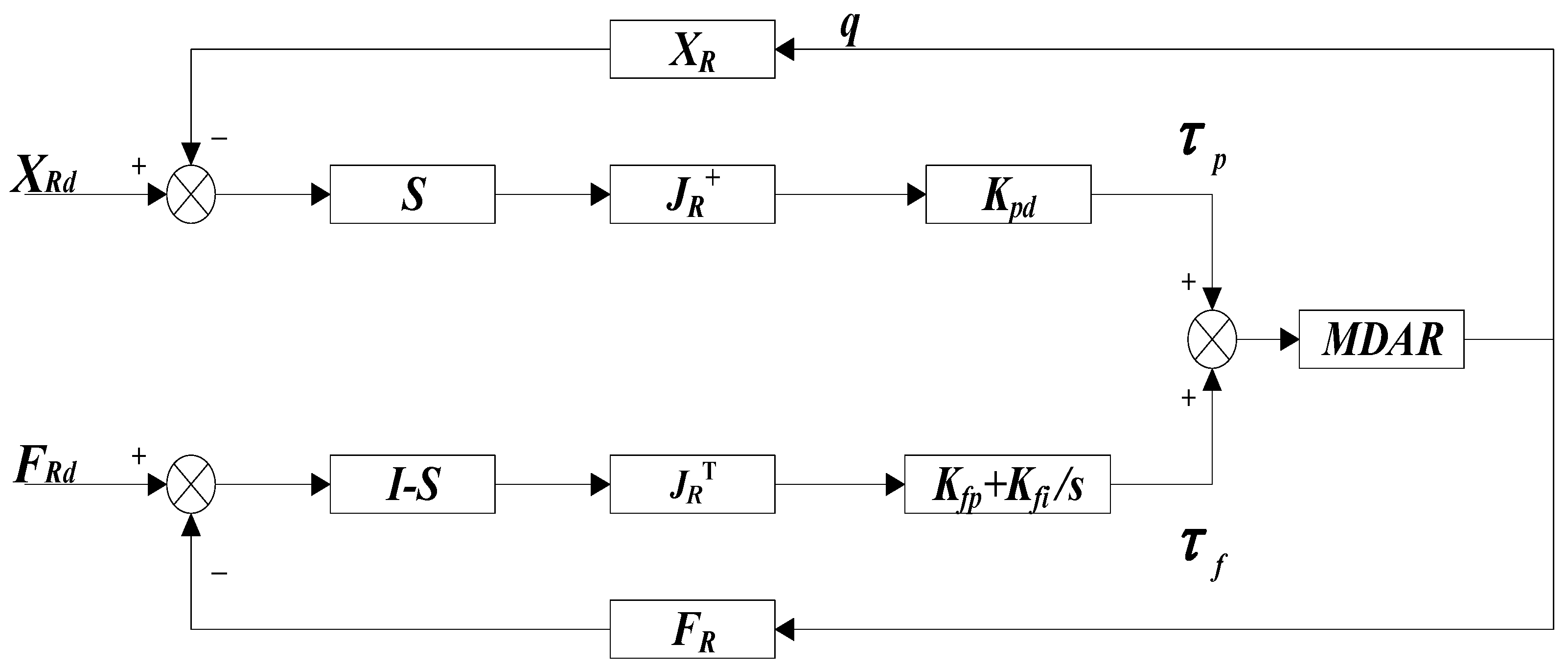
Section 4 is dedicated to the design of a closed-loop hybrid force/position controller for the MDAR, founded on the derived relative dynamics. Subsequently,
Section 5 presents and analyzes the corresponding simulation results.
Section 6 presents the concluding remarks of this paper.
2. The Proposed Mobile Dual-Arm Robots
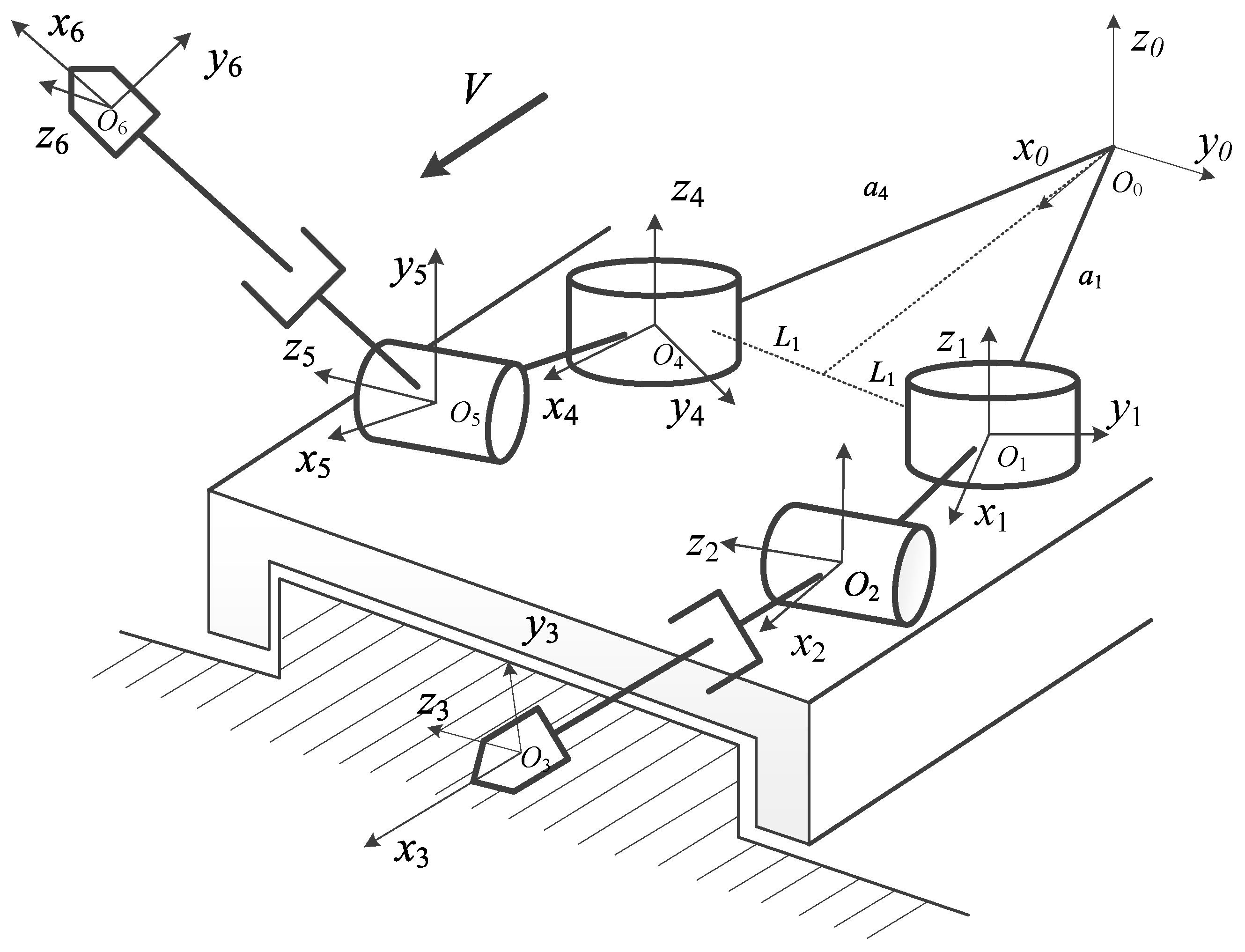
In this research, a mobile dual-arm robot is designed and modeled, which has a wide dynamic translational workspace for heavy and accurate transportation operation in narrow and long areas, such as the excavation of long and narrow roadways in coal mining. Here, the dual-arm robot is installed on a mobile base to increase its translational workspace. The MDAR investigated in this paper, illustrated in
Figure 1, comprises three core subsystems: a base with one degree of freedom for mobility, a robust support platform, and two three-degree-of-freedom robotic arms mounted on it, each arm comprising a twist joint, a pitch joint, and an extension joint, collectively providing seven degrees of freedom. Specifically, specifically, its mobile base adopts the form of sliding, which can realize the translation of the movement direction and provide a broad working range for the system. This redundant design enables the end effector to complete the work task more flexibly.
As mentioned above, the dynamics and control for the proposed MDAR are considerably complex than traditional dual-arm robots. This issue is considered to be one of the most important parts in the field of the MDAR. Another challenge for the MDAR is the possibility of the two arms colliding with each other, which leads to a constraint in the optimal design and motion control of the robot. In subsequent developments, the research and application of the proposed MDAR mainly face the following two key problems:
Dual-output and co-motion of the proposed MDAR make it difficult to model the dynamics of the robots unified. The proposed MDAR relies on two arms installed to the common moving base to complete the task. The movement of the end-effector of robot’s left-arm depends on the left-arm’s three joints and the mobile base simultaneously, while the movement of the end-effector of the robot’s right-arm depends on the right-arm’s three joints and the mobile base simultaneously. The two arms connections do not simply build the kinematic and dynamic models of two independent arms together in a matrix form but rather establish the relationship between the two through matrix parameters or other forms. The output of the two end-effectors makes it difficult to establish a unified description model of the robot. The two arms of the robot are installed to the same base, so the common mobile of the base will inevitably have an important impact on the movement of the two arms. Therefore, how to establish a unified kinematics and dynamics model for the MDAR is the first key problem to be solved urgently.
The precise control of the investigated MDAR presents considerable challenges, primarily attributable to its inherent complexity as a multi-degree-of-freedom system. During operation, the MDAR interacts with target objects via the end-effectors of both arms, applying specified forces to accomplish predefined tasks. Correspondingly, reactive forces from the objects were exerted upon the two arms. This results in system dynamics that exhibit pronounced nonlinearity and strong coupling. Moreover, the actuation of any single joint influences the overall state of the system, thereby imposing stringent requirements on the design of the robot’s control strategy.
It should be pointed out this paper mainly focuses on the two problems: the difficulty of modeling the relative dynamics and the difficulty in controlling problems. Consequently, tackling the two problems outlined above becomes paramount. An accurate and tractable dynamic model serves as the primary foundation, while a sophisticated control strategy is the core guarantee for the robot’s performance.
5. Simulation Analysis and Discussion
The proposed relative dynamics modeling and force/position hybrid control strategy for the MDAR demonstrated excellent versatility. Its applicability required a system featuring a single-degree-of-freedom mobile base providing common motion for both arms, with the kinematic chains of the two arms structurally independent. The theoretical core of this method lay in integrating the dual-output system into a single control object by constructing a relative task space. Consequently, this approach could be directly applied to various mobile dual-arm robot systems possessing this configuration. The mobile dual-arm robot investigated herein was suitable for cutting tasks within coal mine workings. As a result, Liu et al. [
39] developed an advanced dual-arm cutting robot (DACR) system in underground coal mines, which can realize the synchronous operation of the excavation and supporting of laneways. The cooperation of the two cutting arms increases the working area, and the propulsion of the terminal and the terminal cutting are performed simultaneously, which greatly improves the mining efficiency. In this section, the presented DACR (
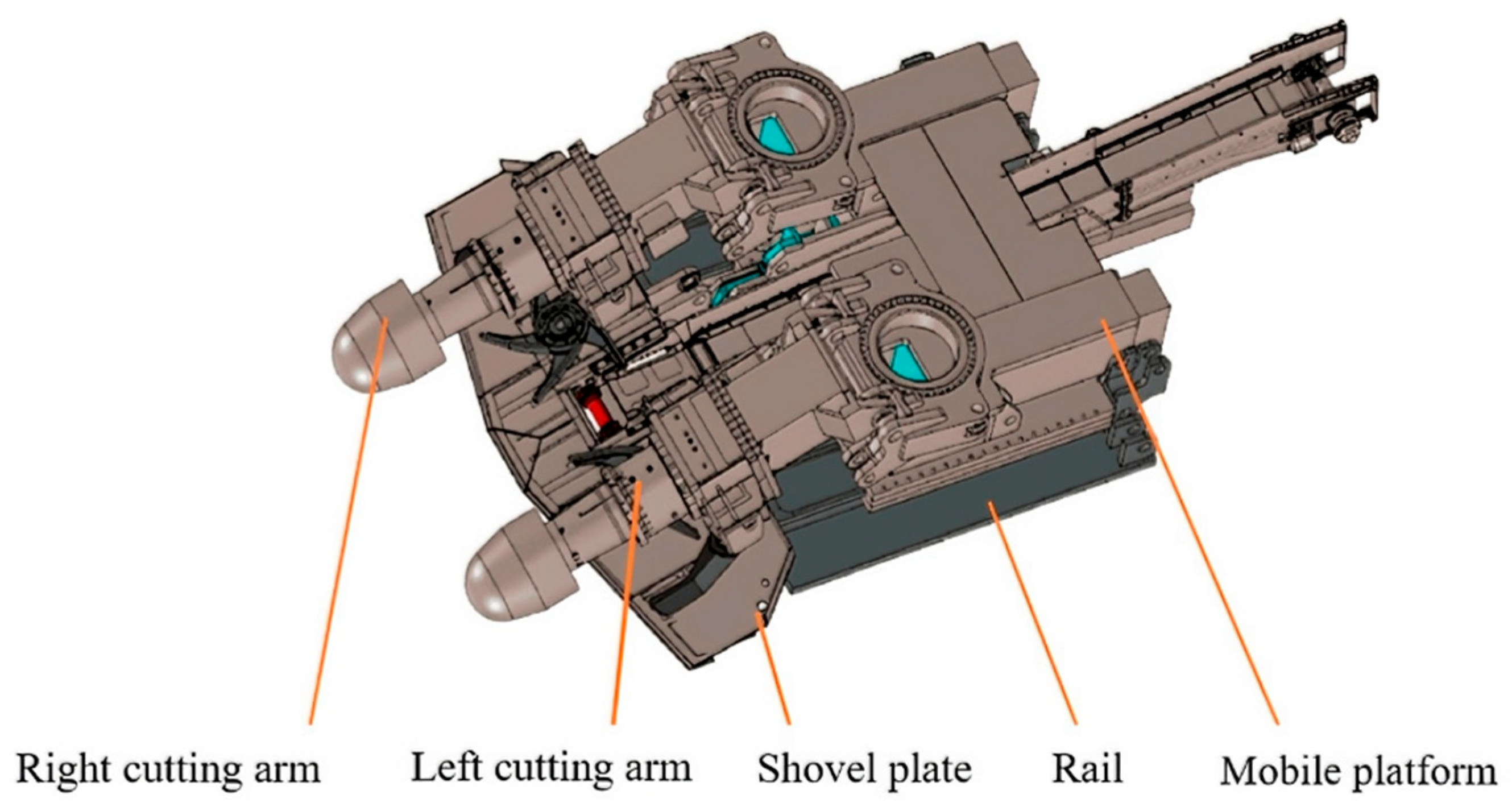
Figure 3) is taken as an example for simulation analysis to verify the correctness of the relative dynamics and the performance of the relative force/position hybrid controller. The design and simulation validation of the relative force/position hybrid controller proposed in this work were carried out on the MATLAB R2023a platform. The control algorithm was developed in MATLAB, which included parameter initialization and the computation of the expected relative positions and forces in task space. A closed-loop simulation framework, integrating the controller and the dual-arm dynamic model, was then implemented in Simulink to comprehensively evaluate the system’s performance in simultaneous trajectory tracking and force regulation.
Figure 3.
The mobile dual-arm cutting robot [
39].
Figure 3.
The mobile dual-arm cutting robot [
39].
As shown in
Figure 3, the DACR features an axial spacing of 2 m between its two yaw joints. The distance between the pitch joint axis and the yaw joint axis is 1 m. The extension joint has a variable range of 4.18 to 4.73 m. In terms of mass, the mobile base weighs 12,000 kg, the connecting rod between the yaw and pitch joints weighs 10,000 kg, and the extension joint weighs 5000 kg.
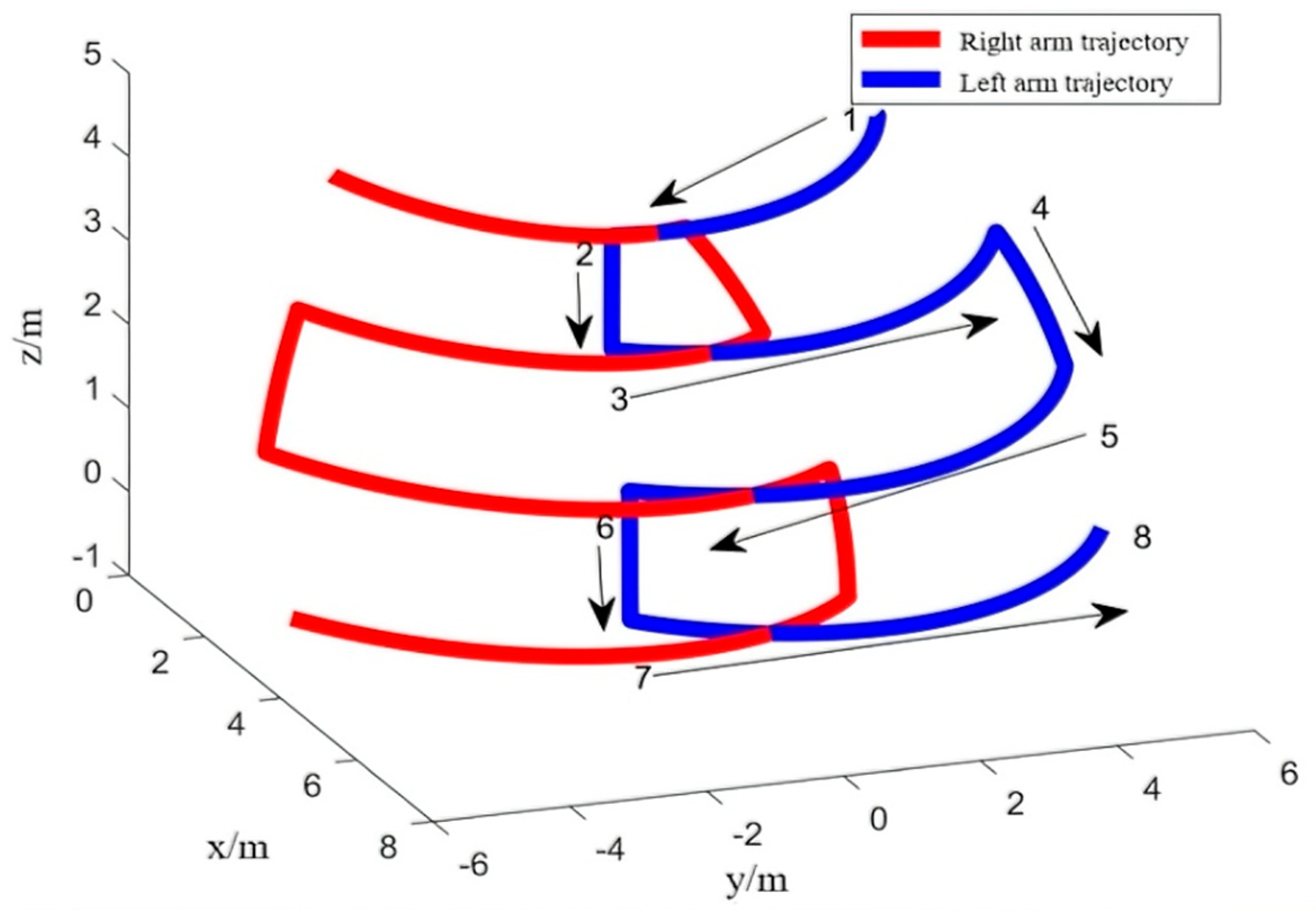
To achieve complete cross-sectional coverage of the laneway, the mechanical limits on the DACR’s two arms have been eliminated. The system employs a centrally symmetric “S”−shaped trajectory pattern (
Figure 4), where the paths of the left and right arms partially overlap to ensure full excavation of the overlapping rock areas within the workspace. Furthermore, an asynchronous starting strategy is implemented, guaranteeing that at any given moment, only one arm operates within the overlapping trajectory zone, thereby preventing mechanical interference.
The motion trajectories of the two cutting arms of the DACR are divided into 7 segments, each spanning 10 s (1000 steps). To better simulate the transition from a stationary to a working state, the DACR’s mobile base is configured to accelerate gradually from a stationary state and then maintain a constant speed along its travel direction. For the two cutting arms of the DACR, due to the presence of inflection points in the designed S-shaped trajectory, the joint velocities of the two cutting arms will also undergo abrupt changes, indicating that the acceleration changes in the joints in the DACR are discontinuous. Due to the dynamic coupling between the joints of the DACR, the abrupt changes in the absolute velocity of the end-effectors may exert dynamic effects on other joints of the DACR. Therefore, careful planning of joint motion trajectories is necessary to mitigate impacts and vibrations in the DACR. To ensure that joint velocities and accelerations are zero at the start and end points of each segment along the S-shaped trajectory, a fifth-order polynomial interpolation method was applied to plan the joint motions. This approach guarantees that the joint angles/lengths at the terminal points of each trajectory segment correspond to the values specified in
Table 2.
When the DACR starts to move, the initial position of the mobile base relative to the base coordinate system is [1, 0, 0]T. At this point, the yaw and pitch joints of the two cutting arms are at zero arc and maximum upward angle, respectively, and the extension joints are kept at maximum length. According to the relative position of the two end-effectors, i.e., in Equation (11), the initial value of is [−2.4271, 4.2039, 2.0258]T and the expected relative force of the DACR’s end-effectors is [148, 136, −17]T. The controller gains are tuned to be = diag[0.015, 0.01, 0.02, 0.015, 0.01, 0.02, 0.005] and = diag[0.45, 0.4, 0.15, 0.45, 0.4, 0.15, 0.25], respectively. It is important to note that, due to the non-square nature of the relative Jacobian matrix of the DACR, when using the relative force/position hybrid controller to calculate the motion states of the joints, it will generate many sets of solutions that conform to the current joint torques. To meet the normal working conditions of the MDAR, the motion of the base of the DACR maintains a constant speed of 0.02 m/s and pushes forward along the slide rail is determined. It allows the relative force/position hybrid controller to generate only one set of solutions that conform to the motion state of the mobile base.
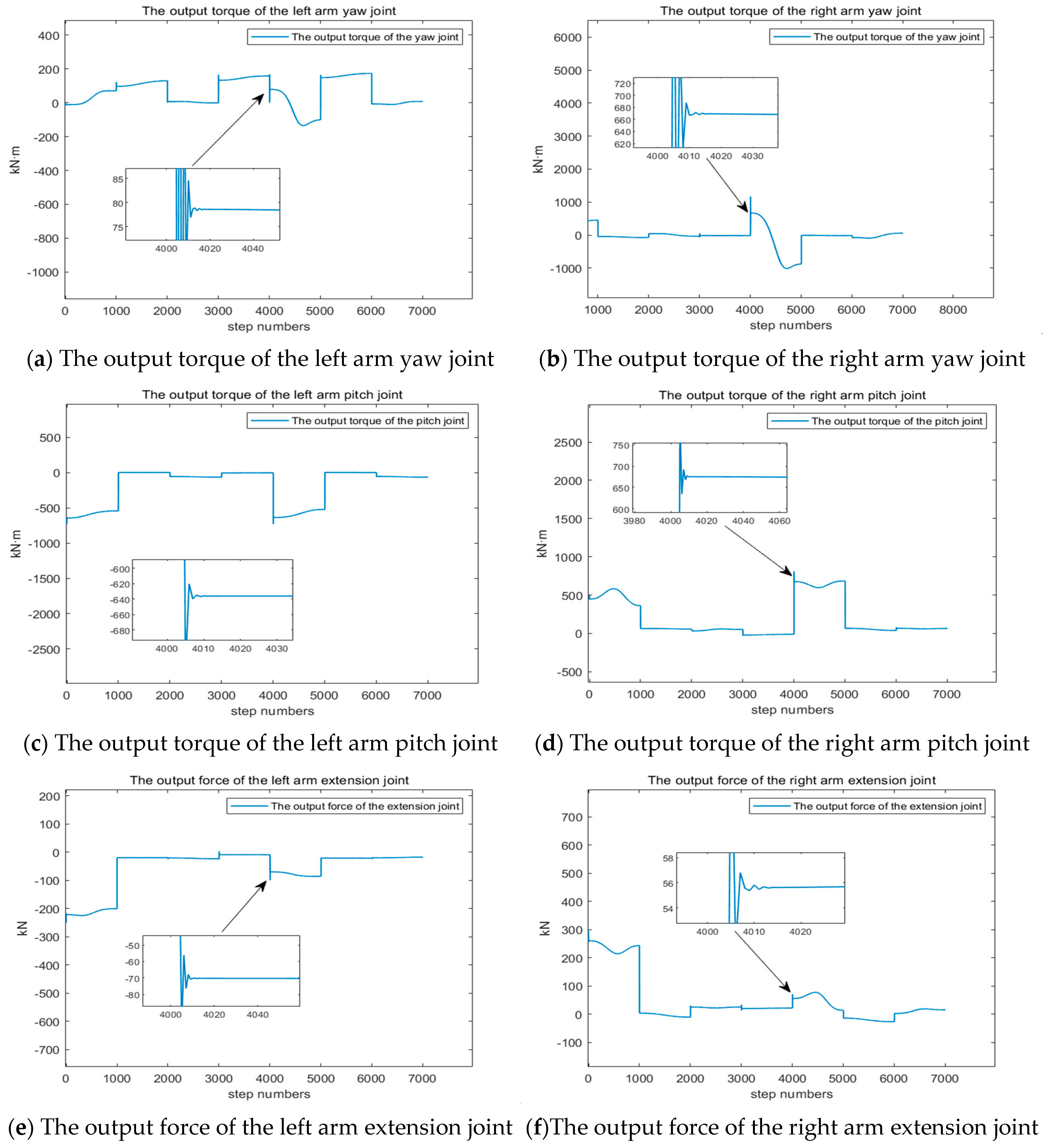
As the two cutting arms of the DACR move along the trajectory planned above, the forces at each joint change constantly. To more intuitively reflect the effects of the relative force/position hybrid controller, the DACR dynamics were simulated and analyzed. The variation in joint output forces of the DACR are shown in
Figure 5, in which the horizontal axis indicates the number of steps and the vertical axis indicates the joint output force. The variations in the joint torque output from the two yaw joints of the DACR are shown in
Figure 5a,b. Both yaw joints oscillate at each inflection point on the planned trajectory and the vibration is relatively high at inflection point 4. The variation in the output torque of the pitch joints is shown in
Figure 5c,d and the variation in the output forces of the extension joints are shown in
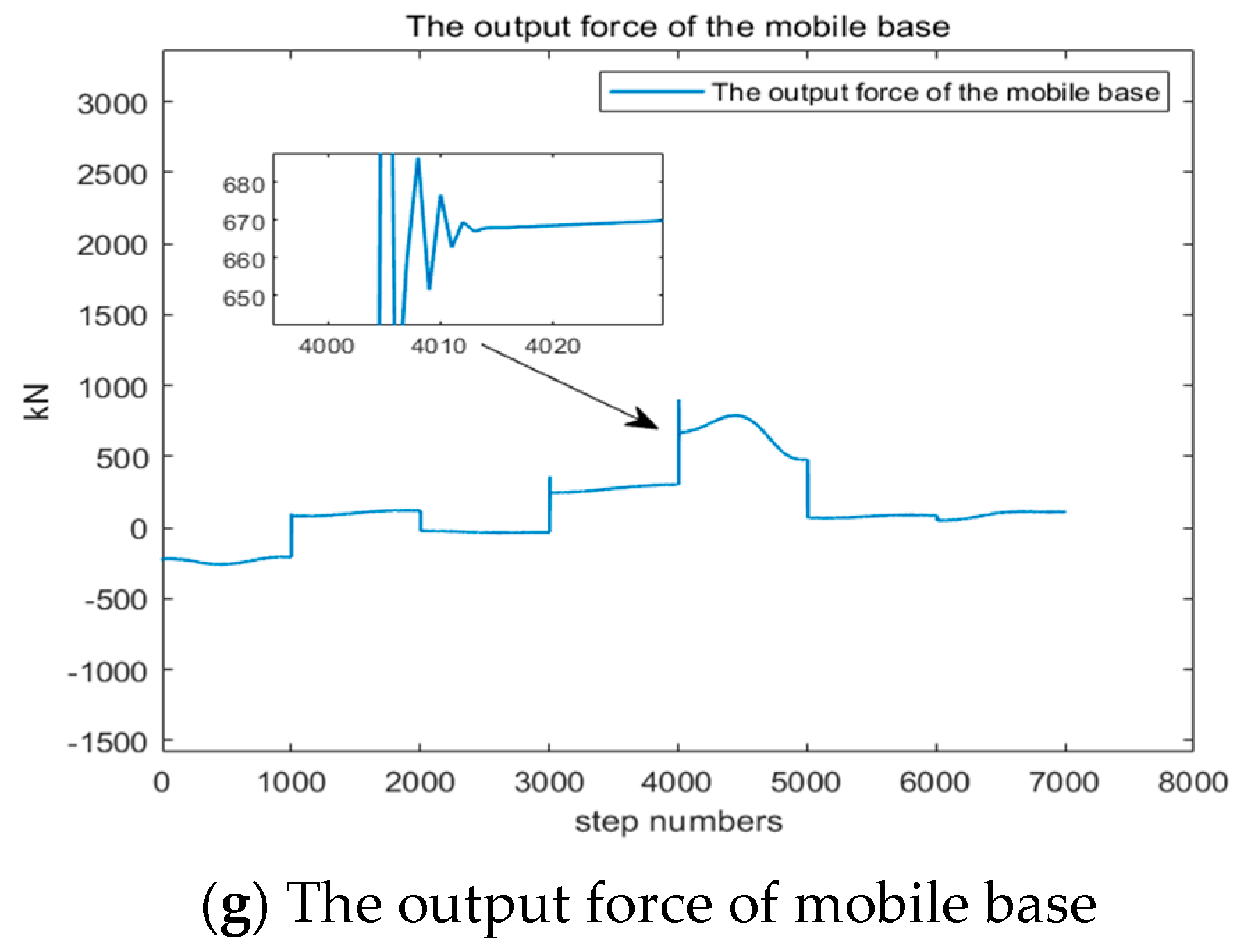
Figure 5e,f. The corresponding joint movements of the two arms are opposite, so the forces output from the joints are also opposite. Furthermore, the variation in the output forces of the mobile base is shown in
Figure 5g. In reality, the motion of the moving base is locked to a uniform forward thrust. To satisfy the expected relative position and relative force at the same time, the joint output forces will be adjusted to varying degrees, which is the reason why the joint output force of the end-effectors of the two arms oscillates when it moves to the inflection points of the planned trajectories. On the whole, during the cutting process of the DACR along the aforementioned trajectory, the maximum output torque of the two yaw joints reached 1167 kN·m, while the pitch joint achieved a maximum output torque of 809 kN·m. Additionally, the maximum output force of the extension joint reached 296 kN, and the maximum output force of the base reached 901 kN. All performance metrics meet coal mining cutting requirements.
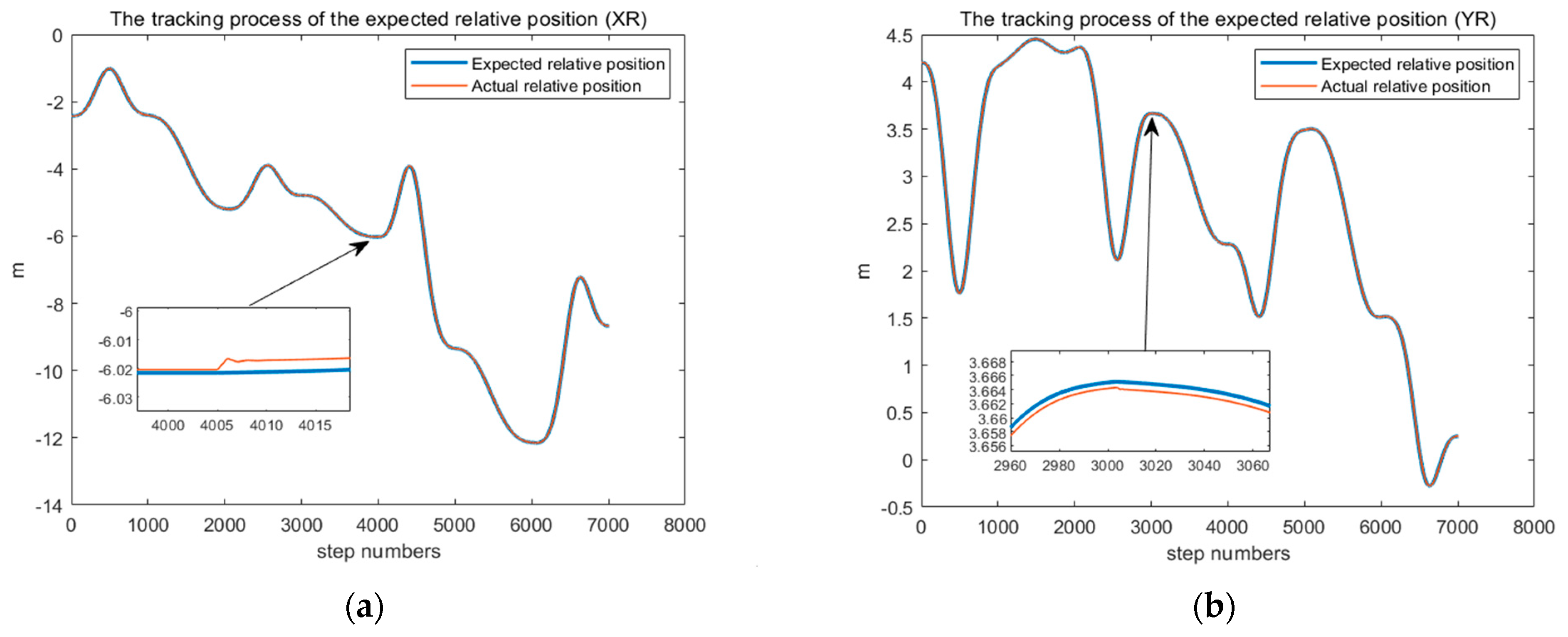
The control effectiveness of the proposed relative force/position hybrid controller for MDAR is shown in
Figure 6. As illustrated in
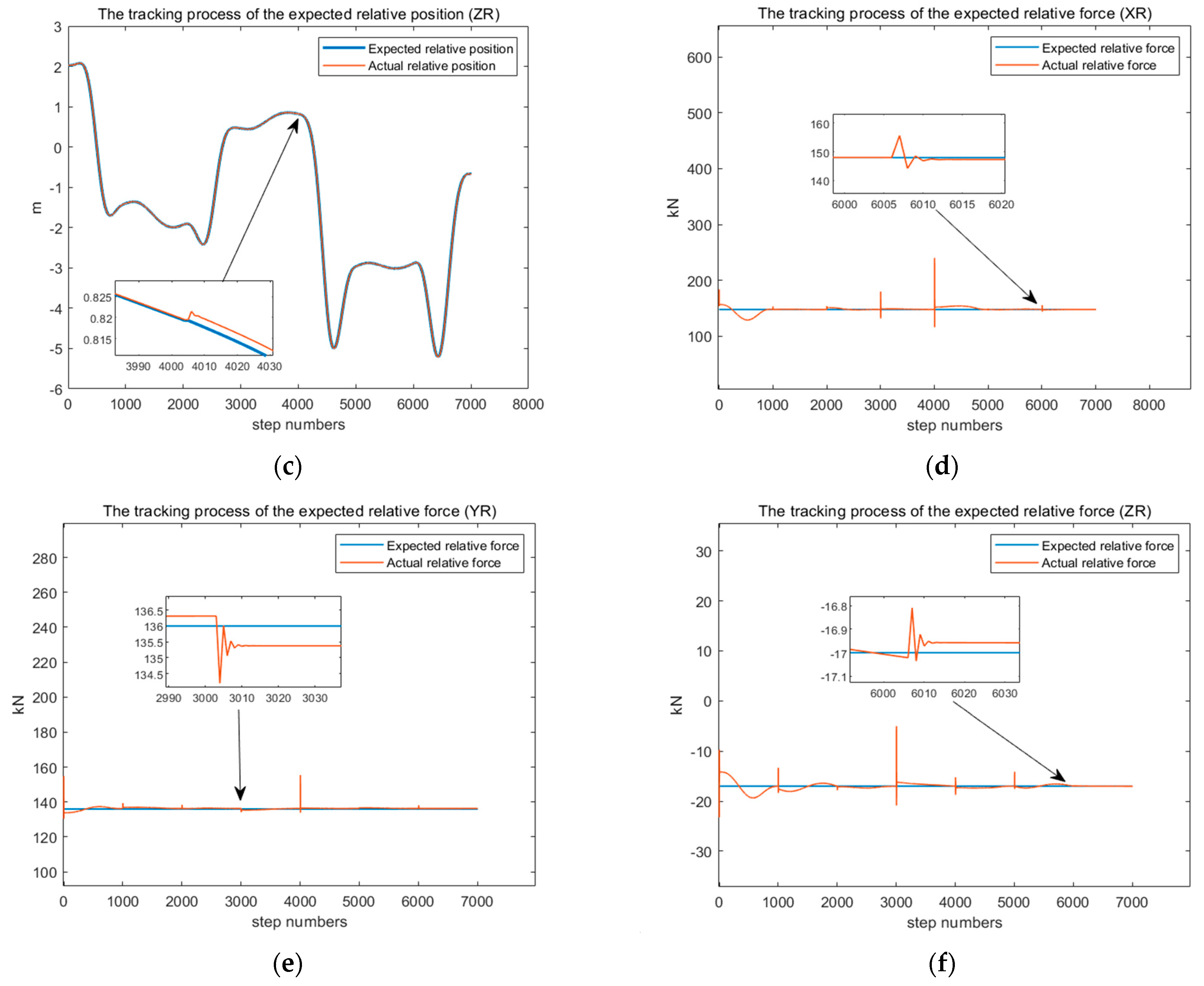
Figure 6a–c, the relative position tracking of the two cutting arms in the X, Y, and Z directions are represented, respectively. The red line represents the actual relative position and the blue line represents the expected relative position. It can be seen that the actual relative position of the two end-effectors of the DACR tracks the expected relative position well. However, their actual relative positions microscopic oscillate to varying degrees at the inflection points of the S-shaped trajectories. And this is because the planned joint velocities and accelerations are both zero at the turning point of the trajectories, and the expected relative force between the two end-effectors remains constant. This requires the two end-effectors of the DACR to generate a large acceleration at the next moment after passing the inflection point, resulting in fluctuations in the relative position of the two end-effectors at the start of each segment of the S-shaped trajectories. Subsequently, under the action of the relative force/position hybrid controller, the expected values are tracked well, which also validates the stability of the proposed relative force/position hybrid controller. The relative forces of the proposed controller are shown in
Figure 6d–f, in which the red line represents the actual relative force and the blue line represents the expected relative force. The relative forces of the two end-effectors oscillate to different degrees at the inflection point of the S-shaped trajectories, but the relative forces of the two end-effectors are still able to converge to the expected value under the action of the controller.
The performance of the proposed relative force/position hybrid controller was evaluated using two metrics: Absolute Error (AE) and Root Mean Square Error (RMSE). AE quantifies the absolute deviation between expected and actual values. Specifically, for DACR, the AE of its relative position is defined as the maximum Euclidean norm among all error vectors, where each vector corresponds to the deviation between the actual and expected relative positions at a given time step during trajectory tracking. The AE is calculated as follows:
Furthermore, the Root Mean Square Error (RMSE) is employed to quantify the deviation in relative positioning. It is determined by the following formula, based on the error between the actual and expected relative positions of the two end-effectors:
To sum up, the simulation results of the proposed relative force/position hybrid controller of the DACR show that the two end-effectors of the DACR tracked the expected relative force and relative position well. The actual relative forces and positions oscillate to varying degrees only at the inflection points of the S-shaped trajectories. The absolute error between the actual and expected relative position of the DACR’s end-effectors was less than 0.0220 m, with a root mean square error of 0.0093. This demonstrates that the proposed relative force/position hybrid controller for the MDAR can effectively control the relative force and position of the two end-effectors and maintain good tracking of the expected values.



 ,
,