Article

Comparative Study of Chocolate Cooling Supported by Computational Fluid Dynamics

1
Federal Institute of Santa Catarina (IFSC), Campus Urupema, Av. Mauro Ramos, 950, Centro, CEP 88020-300, Brazil
2
Mechanical Engineering Department, Lisbon Superior Institute of Engineering, Rua Conselheiro Emídio Navarro 1, 1959-007 Lisbon, Portugal
3
UnIRE, ISEL, Polytechnic University of Lisbon, Rua Conselheiro Emídio Navarro 1, 1959-007 Lisbon, Portugal
4
MARE-IPS, Marine and Environmental Sciences Centre, Campus do IPS—Estefanilha, 2910-761 Setúbal, Portugal
5
Department of Mathematics, NOVA School of Science and Technology, NOVA University of Lisbon, Quinta da Torre, 2829-516 Caparica, Portugal
6
GeoBioTec Research Institute, Campus da Caparica, Universidade Nova de Lisboa, 2829-516 Monte da Caparica, Portugal
7
Department of Technologies and Applied Sciences, Higher School of Agriculture, Polytechnic University of Beja, Rua Pedro Soares, 7800-295 Beja, Portugal
8
MED Mediterranean Institute for Agriculture, Environment and Development & CHANGE Global Change and Sustainability Institute, University of Évora, 7006-554 Évora, Portugal
*
Author to whom correspondence should be addressed.
Appl. Sci. 2026, 16(1), 38; https://doi.org/10.3390/app16010038
Submission received: 27 October 2025 / Revised: 10 December 2025 / Accepted: 13 December 2025 / Published: 19 December 2025

Abstract

The sensorial perception of dark chocolate has been studied and is commonly related to cocoa varieties’ post-harvest or manufacturing process. Although physical and chemical changes during the transformation of cocoa into chocolate are known, there is still a gap concerning the impact of heat transfer on sensory evaluation. This work aimed to apply experimental measurements and numerical simulations in a comparative study of the thermal behaviour of dark chocolate during refrigeration and evaluate its impact over physical properties and sensory evaluation. Temperature presented an initial phase with high cooling rate, shorter at 10 °C due to the higher temperature difference. After, a steady phase was observed at 10 °C, followed by a temperature decrease until 8000 s. The behaviour at 25 °C did not present such plateau, increasing from 27.1 °C to 27.5 °C, a consequence of the dissipation of latent heat during phase transition and the short temperature gradient. Numerical simulations were more correlated to experimental data at 25 °C, presenting a temperature difference < 2 °C. The instrumental evaluation of appearance presented a higher luminance of chocolate surface at 25 °C cooling temperature, which may indicate a higher propensity for occurring fat bloom during storage. Sensory evaluation revealed no significant differences on appearance, texture, and flavour/aroma between cooling at 10 °C and 25 °C.

1. Introduction

Dark chocolate can be identified as a suspension of non-fat particles in a continuous fat phase of cocoa butter, also containing emulsifiers and flavourings [1]. According to the European legislation, chocolate must contain a minimum of 35% dry cocoa solids, of which no less than 18% cocoa butter and no less than 14% dry non-fat cocoa solids [2]. The transformation of cocoa beans into chocolate includes some key steps [3], such as the following: (i) fermentation, for the development of precursors responsible for the development of flavour; (ii) roasting, for the development of cocoa flavour, reduction in moisture content, and reduction in volatile acids; (iii) grinding, to convert cocoa nibs into cocoa liquor; (iv) refining, for reducing particles size below 30 μm for a smooth texture; (v) conching, for reducing moisture and undesirable flavours; (vi) tempering, for improving gloss, appearance, contraction, and heat stability; and (vii) cooling to around 12–18 °C, for solidification and contraction.
Tempering is a controlled crystallization process involving a sequence of melting and cooling for inducing the most stable solid form of cocoa butter, known as Form V, affecting appearance, cooling rate, hardness, sensorial acceptance, and shelf life [4,5]. As different forms present different melting ranges, temperature plays a fundamental role: (i) increase and holding temperature around 45–50 °C for complete melting of polymorphic Forms I to VI; (ii) cooling to 22–27 °C for nucleation of Form V seed crystals; and finally, (iii) reheating to 32 °C for melting of polymorphic forms with lower fusion temperature [6]. However, proper tempering also relies on the shear rate of chocolate to induce the crystallization of Form V across chocolate and an adequate heat transfer flux from chocolate to the environment [7], employing the mechanisms of heat transfer, namely conduction, convection, and radiation [8]. The impact of improper chocolate tempering has been studied [5] and identified as one of the causes for “fat bloom” [6]. Although such a phenomenon does not affect food safety, it has implications on chocolate quality and marketability [3]. Although temperature control is fundamental for controlling the moulding and cooling process, more knowledge is necessary for a better understanding of such transient heat transfer mechanisms [8]. During solidification, several critical variables need to be controlled to ensure the desired quality of chocolate, such as temperature and cooling rate. The temperature should typically be maintained around 15–18 °C, depending on product thickness and mould material, which affect the Biot-number-controlled cooling rate and heat transfer efficiency. Higher temperatures can cause uneven cooling and fat bloom, while lower temperatures may result in overly rapid cooling, leading to cracks or a dull finish [9,10,11]. A gradual cooling rate is crucial to allow proper crystallization of cocoa butter, ensuring a glossy and smooth surface [12]. However, the identification of the proper cooling temperature for chocolate has a direct implication on the adjustment of the vapour compression refrigeration system and, consequently, on energy consumption, while still meeting high quality standards.
Numerical methods have been applied to food sector since the 70 s of the XXth century [13], including refrigeration, heating, or drying, meat [14], fruit, vegetables, and cheese ripening [15]. Computational Fluid Dynamics (CFD) is a simulation tool combining the high processing capacity of computers with fundamental governing equations of fluid dynamics such as continuity, momentum, and energy [16] for the simulation of practical processes, relying on the application of numerical analysis on a specific dataset where boundary conditions, environmental conditions, and physical properties of the sample are set. These last years, CFD codes have been under continuous development due to the development of hardware but also software packages [14]. In the chocolate sector, CFD has been used in modelling thermal properties of micro-aerated chocolate [17], tempering process [4], thermal energy storage on a tempering/mixing chocolate tank [18] and chocolate cooling [8,19,20]. The results of the application of CFD have proven highly effective in understanding the energy transfer mechanisms during the solidification of chocolate, as it allows for detailed simulations of heat flow, phase change, and fluid motion within the molten mass, ultimately improving process optimization. However, further studies are required to evaluate the implication on quality and acceptance.
This work aims to apply numerical simulations, based on CFD, in a comparative study of the thermal behaviour of tempered dark chocolate during refrigeration at different temperatures and evaluate the impact on consumer acceptance, rheological properties, and appearance.

2. Materials and Methods

2.1. Materials

Chocolate Preparation and Sampling

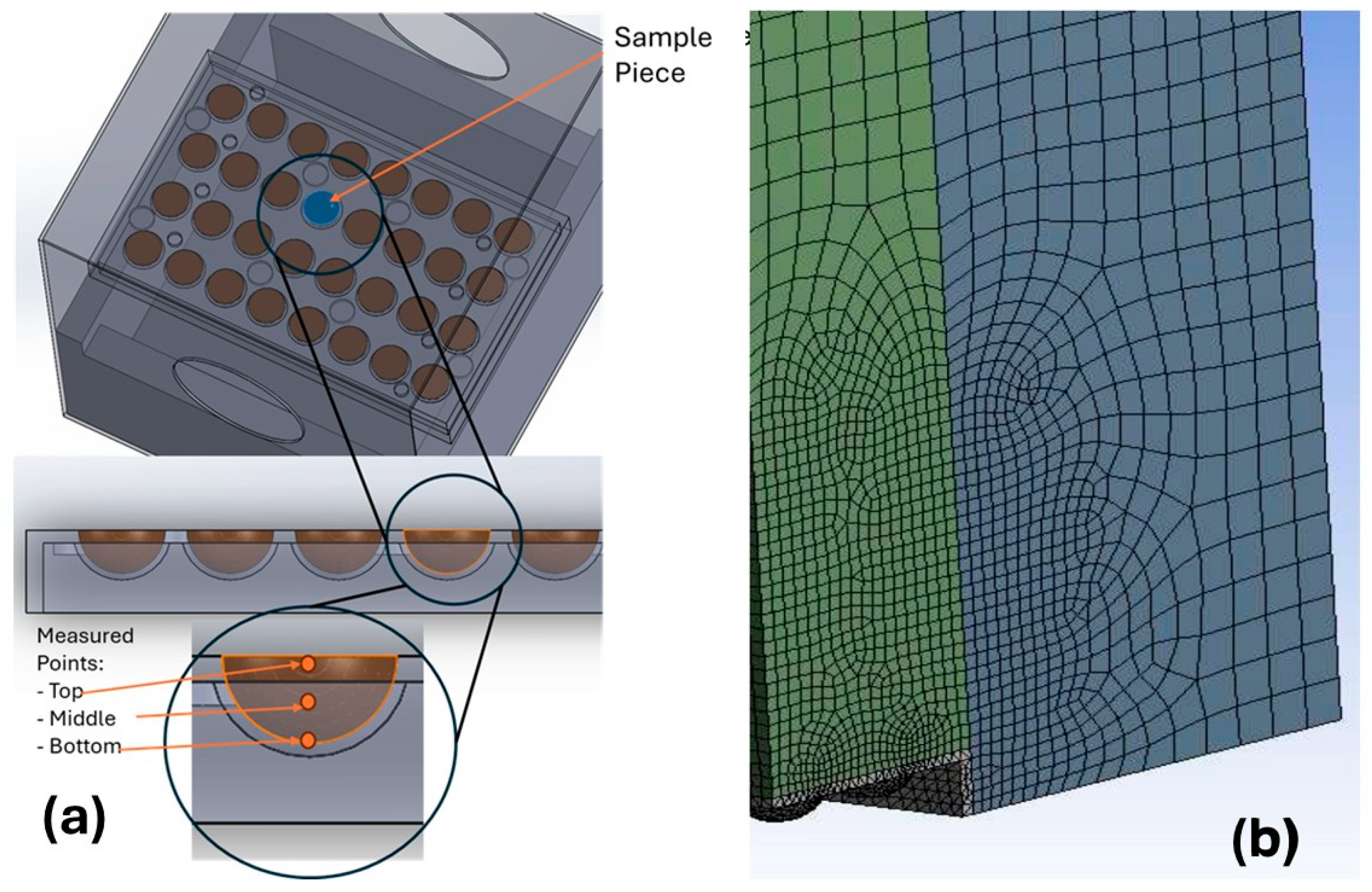
The production of samples started by melting dark chocolate 54.5% cocoa (Ref. 811, Callebaut, Lebbeke-Wieze, Belgium) overnight in a tempering machine (Selmi Ghana Plus, Selmi SRL, Pollenzo, Italy) at 45 °C, later decreasing to 29.5 °C, under constant agitation to homogeneously disperse the crystals within the chocolate batch. Tempered chocolate was poured into a 275 × 175 mm polycarbonate mould, at 18 °C, with 8 × 4 semi-spherical cavities with 30 mm radius. Immediately, a set of three NTC 10 KΩ thermistors connected to a data logger (Arduino, Monza, Italy) was inserted into a sample chocolate piece to register the temperature at the top, middle, and bottom every 5 s for a time period of 8000 s; Figure 1a). Tests were conducted in triplicate.
The mould was placed in a refrigerator (Liebherr TC135S/135L, Bulle, Germany) inside an acrylic box of 310 mm length × 300 mm width × 280 mm height to minimize air currents. A fan (AVC DA12025B12L, Kaohsiung City, Taiwan) was included in the inlet and regulated to 0.35 m·s−1, measured with a hot wire anemometer (Testo 405, Titisee-Neustadt, Germany). Two different cooling temperatures were tested: (i) at 10 °C, and (ii) at 25 °C. The selection of such temperatures was adapted from previous works where the temperature 10 °C was identified as the lowest temperature before dew formation during cooling [9] and 21.9 °C was identified as the highest temperature for chocolate hardening [5]. After solidification, chocolates were de-moulded and stored at 20 °C (±0.2 °C) for 20 days in cardboard boxes for a possible fat bloom settlement, according to previous works [5]. Temperature was recorded with a data logger (Testo 174T, Titisee-Neustadt, Germany).

2.2. Methods

2.2.1. Physical and Chemical Evaluation of Chocolate

A texturometer (Stable Micro Systems TA. XT Plus100, Godalming, UK), with a 100 N load cell, was used for texture analysis at 20 °C (±1 °C). An aluminum cylindrical probe of 3 mm in diameter was used at a penetration depth of 10 mm and test speed of 0.2 mm·s−1 for the evaluation of hardness (in g) and work (in g·s), according to [5]. Analyses were conducted in triplicate.
The digital image acquisition was performed, in triplicate, with a camera M6 (Canon, Tokyo, Japan) attached to a tripod and two fluorescent D65 lamps at 35 cm from the sample. Chocolate samples were placed over a white background. Images were acquired at a resolution of 6000 × 4000 pixel, 24 bits, sRGB, JPEG format, F/6.3, 1/40 seg, ISO100, and no flash. The post-processing was made with ImageJ software version 1.52d (National Institutes of Health, Bethesda, MD, USA) for the evaluation of RGB colour channels inside the region of interest. Luminescence (Y) was calculated from the RGB values, according to Equation (1) as follows [5]:
Y = 0.299R + 0.587G + 0.114B
The parameters phase change heat (in J/kg), solidus temperature (in °C), and liquidus temperature (in °C) were evaluated, in triplicate, by differential scanning calorimetry (DSC) according to [5].

2.2.2. Sensorial Evaluation of Chocolate

The sensorial evaluation of chocolates was conducted by 10 trained tasters at the Polytechnic Institute of Beja through descriptive analysis and using a line scale from “not present” (left side) to “extremely intense” (right side), converted to a 9-point rating. Each sample was placed inside a 10 cm diameter plastic dish and identified with a 3-digit random number. The evaluated parameters were appearance (aspect, colour, brightness), texture (hardness, crispiness, graininess), flavour, and aroma (sweetness, acidity, bitterness, astringency, cocoa flavour, toasted flavour, mouldy flavour, other flavours, and rancidity). To ensure palate neutrality, consumers were provided with neutral, non-carbonated mineral water between tastings. All samples were evaluated in individual booths under artificial daylight-type lightning and at room temperature.

2.2.3. CFD Simulations

The aim of applying CFD simulation to the present study was to predict the cooling profile of chocolate during solidification under two different environmental temperatures for a comprehensive evaluation of the impact on the final product. To implement the numerical model, ANSYS Fluent 22.1 software (Canonsburg, PA, USA) was used to implement several transient 3D simulations [21]. Two-equation turbulence models were employed, allowing for the determination of both turbulent length and time scales by solving two separate transport equations. The standard k-ε model in ANSYS Fluent falls within this class of models and has become a mainstay of practical engineering flow calculations since it was proposed by [22]. The methods included the following: coupled scheme, pressure—second order, momentum, turbulent kinetic energy, specific dissipation rate, and energy—second order upwind, to prevent any possible false diffusion.
The ANSYS Fluent package was used in several transient 3D simulations for the evaluation of thermal energy, temperature, and density of chocolate, together with the evolution of the main variables influencing phase transition. A mesh with 500,000 elements was generated, see Figure 1b), with increased refinement in and around chocolate location for further accuracy. Simulations were run for 5000 s, converging after 600 iterations per time step, on the first 5 min of elapsed time and then converging every 50 iterations for the remainder, using an Intel Xeon W-2155 Processor (3.30 GHz). A grid and time-step independent study were performed.
Phase transition was simulated by the enthalpy-porosity formulation. The complete numerical model solves the mass, momentum, and energy transport equations for constant density [21]. The viscous dissipation term was considered negligible while the energy equation was solved in the form of total enthalpy (Equations (2)–(4)):
ρ t + · ρ v = 0
t ρ V + · ρ V   V = p + μ 2 V + ρ 0 β T T 0 g + S
ρ H t + · ρ V   H = · ( k T )
with V denoting the velocity, ρ the density, μ the dynamic viscosity, k the thermal conductivity, T the temperature, and H the total enthalpy, defined by the following equations as
H = h + H
h = h r e f + T r e f T C p   d T
where h represents the sensible enthalpy, Cp the specific heat, and ∆H the phase-change enthalpy. The temperature was calculated through the total enthalpy and the liquid mass fraction γ, defined as Equation (7):
γ = 0 , T < T s o l i d u s T T s o l i d u s T l i q u i d u s T s o l i d u s ,     T s o l i d u s < T < T l i q u i d u s 1 , T > T l i q u i d u s
Locally, the phase-change enthalpy can be written in terms of the liquid mass fraction and the chocolate latent heat, L, as ∆H = γL. The enthalpy-porosity formulation treats different phases as porous media by means of the following source term S (Equation (8)):
S = 1 γ 2 γ 3 + ξ A m u s h y V
where Amushy is the mushy zone constant which describes how steeply the velocity is reduced to zero when the material solidifies. This is usually a very large value, ranging between 104 and 108 kg·m−3s−1, in the present study a standard value of Amushy = 105 kg·m−3s−1 was employed. The constant ξ is a small value, in this case 10−3, introduced to prevent division by zero. The effect of natural convection in the phase changing was accounted for by the Boussinesq approximation. This approach considers the density of fluid as a constant value in the governing equations, except for the source terms of the momentum equation that models buoyancy, in which the density temperature dependence is modelled according to Equation (9) below:
ρ = ρ 0 1 β T T 0
where ρ0 represents the density of liquid chocolate, β is the thermal expansion coefficient, T0 is defined as T0 = (Ts + Tl)/2, and the subscripts s and l indicate solidus and liquidus, respectively. The flow turbulence of heat transfer fluid was simulated by the standard k-epsilon model [22] and buoyancy effects were neglected. In internal flows of liquid with small density variation, the velocity field is dominated by pressure and friction effects.
Given the nature of the work, the main focus of the numerical simulation was on the cooling process of chocolate under two different temperatures, starting from liquid chocolate at 28 °C. In cooling configurations, the outlet boundaries were specified as pressure outlets set to atmospheric pressure. The inlets were defined by the imposed air velocity and air temperature corresponding to each cooling condition. The walls of the acrylic enclosure were modelled as constant-temperature surfaces, with their temperature fixed to the value of the inlet air temperature. The residuals criteria were set as 1 × 10⁻³ for all, with exception of energy, which was 1 × 10⁻¹² to minimize the change in any false convergence.

2.3. Statistical Analysis

The results of physical and chemical evaluation of chocolate samples were subjected to statistical analysis, considering means of five size samples tested via t-test at a significance level 0.05. In the analysis of the sensorial results, the means of ten size samples were tested via t-test at a significance level of 0.001. In all samples, the assumption of normality was previously tested by using Shapiro–Wilk’s test [23]; furthermore, quantile–quantile plots (Q-Q plots) were drawn and analyzed. Moreover, a Principal Component Analysis (PCA) was used to study inter-sample (temperatures) and inter-variable (sensorial) relationships. All statistical analysis was carried out with IBM SPSS Statistics (Version 22).

3. Results and Discussion

3.1. Experimental and Numerical Results

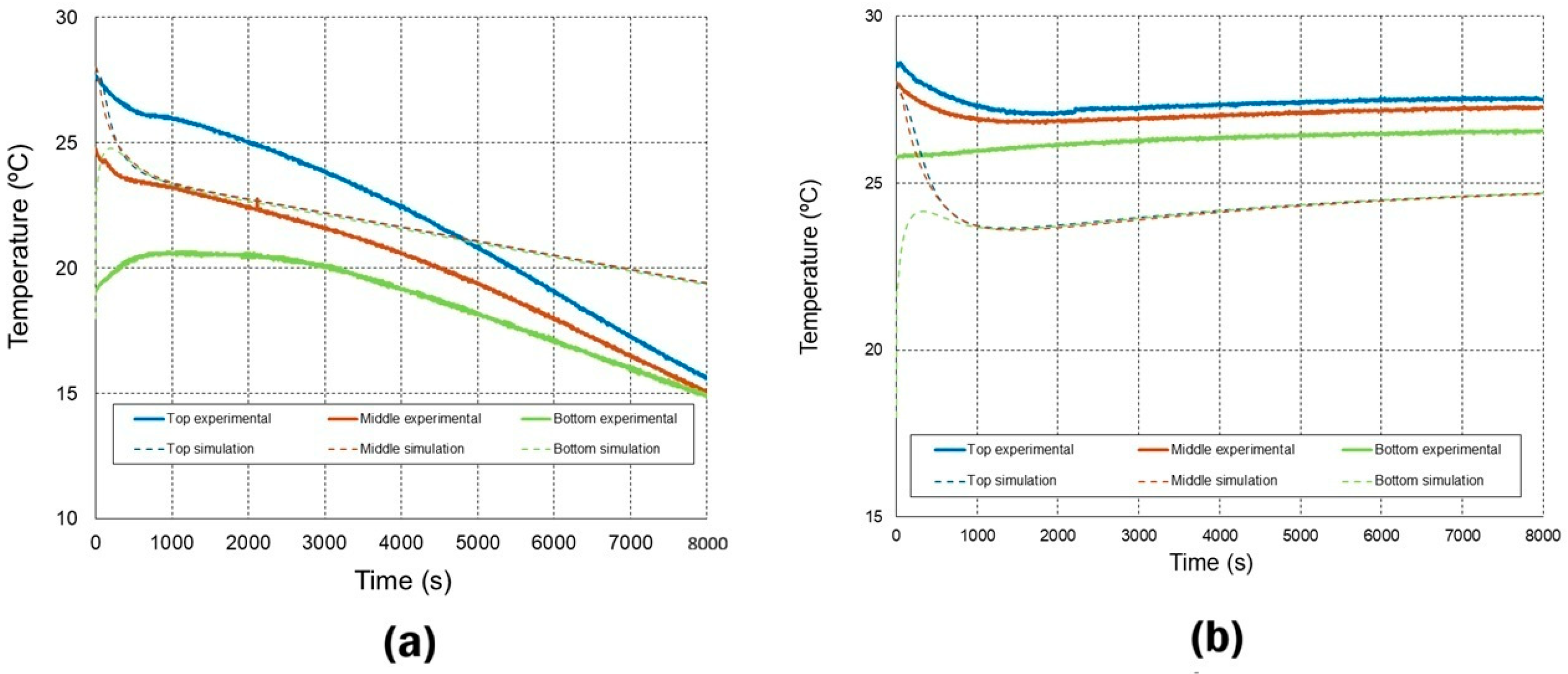
The following results present a comparison between the numerical simulation and the results of the experimental setup for the measuring points top, middle, and bottom. The experimental results of temperature during cooling at 10 °C are shown in Figure 2a.
The top presented an initial rapid cooling from 27.6 °C to 26.1 °C, between t = 0 s and t = 600 s. According to [24], this initial transient period may be affected by the thermal conductivity of the material and the specific heat capacity. Previous works have identified the crystallization stage between 21.9 °C [5] and 30 °C [8], depending on several factors such as the cooling rate or the tempering level of chocolate. After, a steady-state phase was observed, from t = 600 s to t = 900 s, a consequence of the release of latent heat during the crystallization of cocoa butter [8] and considered an indicator of a well-tempered chocolate [25]. As reported by [8], such release of latent heat was not predicted by the numerical model.
From t = 900 s to t = 8000 s, temperature decreased to 15.6 °C, which is in accordance with the previous results from [7]. The temperature in the middle of chocolate also presented an initial phase, from t = 0 s to t = 330 s, with a decrease in temperature from 24.8 °C to 23.6 °C followed by a steady-state phase until t = 500 s. After, the temperature decreased progressively to 15.1 °C; the value was reached at t = 8000 s. The evolution at the bottom presented a different behaviour, increasing from an initial value of 19.1 °C (t = 0 s) to 20.6 °C (t = 690 s), followed by a steady phase until t = 2300 s. After, the temperature decreased to 14.8 °C at t = 8000 s; reference [8] also reported different temperature profiles during the solidification of tempered chocolate using a polycarbonate mould with 4 mm depth, observing the highest value at the bottom of the mould and the lowest at the top of chocolate. Such observations are not consistent with the present work, a consequence of the higher temperature of the mould (25 °C). This difference in mould temperature affects the heat transfer by conduction: a warmer mould reduces heat flux from the chocolate, slowing the cooling at the bottom and temporarily increasing local temperature, whereas a colder mould would accelerate solidification. These effects contribute to the observed non-uniform temperature profiles during chocolate solidification.
On the numerical models, dark chocolate was assumed as a non-Newtonian fluid, with high dynamic viscosity at low shear rates and no movement; therefore, only heat transfer mechanisms were considered. The numerical simulations for cooling at 10 °C are represented with dashed lines for the top (blue), middle (brown), and bottom (green) of chocolate; see Figure 2a). As observed, at t = 0 s, the simulated temperatures on the top and middle of chocolate were 28 °C, decreasing rapidly to 24 °C (t = 500 s), a consequence of the radiative and convective heat transfer to the surrounding environment at lower temperature. The bottom presented an initial increase in temperature from 18 °C (t = 0 s) to just under 25 °C (t = 100 s), followed by a decrease to 23.5 °C after t = 1000 s. The numerical simulations are coherent with the experimental results, presenting a temperature difference below 2 °C until t = 4000 s. After that numerical simulations and experimental results start to diverge, probably as a consequence of eventual differences between the used materials in the experimental setup and the parameters considered in the numerical simulations.
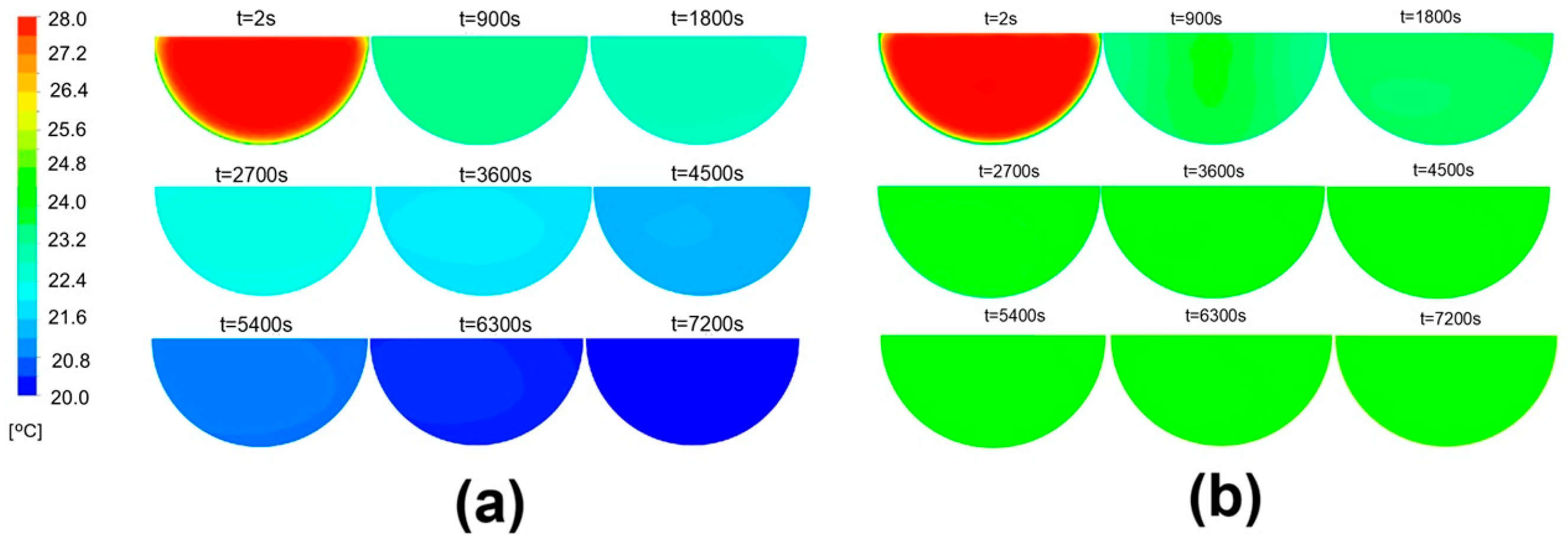
The temperature contours cross-section of the semi-spherical geometry obtained after numerical simulations of cooling at 10 °C are represented in Figure 3a), from t = 2 s to t = 7200 s. At t = 2 s, chocolate is mostly at 28 °C except for a thin cooling layer contacting the polycarbonate mould, a consequence of the heat transfer by conduction. At t = 900 s, the temperature is homogeneous inside the cross-section, around 23 °C, consistent with the results presented in Figure 2a). After t = 3600, the temperature contour is around 21.8 °C and, therefore, below solidification temperature according to the literature [5,8].
The experimental results of temperature during cooling at 25 °C are shown in Figure 2b). The top and middle measuring points exhibited a similar trend, initially experiencing rapid cooling from 28.6 °C (t = 0 s) to 27.1 °C (t = 1800 s), followed by a gradual increase to 27.5 °C (t = 8000 s). This behaviour is attributed to the release of latent heat from the interior, which lacks a sufficient temperature gradient to allow dissipation into the surrounding ambient air [26]. Increasing the measured temperature at the bottom presented a rapid cooling from 28 °C to 25.8 °C (t = 0 s), a consequence of the heat transfer by conduction to the mould [27]; this is visible by the increase in temperature to 26.7 °C (t = 8000 s). The numerical simulations and experimental results in cooling at 25 °C present a higher correlation than at 10 °C, as the difference on temperatures remained <2 °C, indicating a better accuracy of the model in such conditions.
The temperature contours in the cross-section obtained after numerical simulations of cooling at 25 °C are represented in Figure 3b). As observed, chocolate was initially 28 °C, except a thin layer contacting polycarbonate mould. At t = 900 s, the temperature is homogeneous inside the cross-section and presented the minimum value, around 23.7 °C. After, chocolate presented a progressive increase in temperature to 24.6 °C, observed at t = 7200 s. Although a higher cooling temperature was considered (25 °C), temperature contours indicated that convective mechanism is sufficient to significantly reduce the temperature to the values of phase transition.

3.2. Limitations of the CFD Model and Implications for Interpretation

Although the numerical predictions presented a generally coherent trend with experimental observations, particularly under the 25 °C cooling condition, some limitations of the current CFD approach must be acknowledged. The discrepancies observed at longer times during cooling at 10 °C arise mainly from the simplifications required to ensure numerical stability and computational efficiency. First, the thermophysical properties of dark chocolate were generally implemented based on literature data, with the exception of the key phase-change parameters—latent heat (J/kg), solidus temperature (°C), and liquidus temperature (°C)—which were evaluated experimentally in triplicate using differential scanning calorimetry (DSC) according to [5], providing accurate input for thermal characterization. These approximations, particularly for the temperature-dependent properties, may contribute to deviations between predicted and measured temperatures as the material approaches the solidification range. Second, the model uses a sensible-heat formulation and therefore does not explicitly represent latent-heat release, which prevents the numerical simulation from reproducing the short temperature plateau detected experimentally at 10 °C. However, at 25 °C—where thermal gradients are smaller and the magnitude of the phase-change effect is reduced—the model achieves very good agreement with experimental measurements, indicating that the approach remains robust for conditions where the transition occurs more gradually. Finally, minor differences in boundary conditions, such as the effective heat transfer coefficient at the chocolate–air interface or the thermal interaction with the mould, may also influence the long-time response. Future developments should consider an enthalpy-based formulation and refined temperature-dependent material properties, which are expected to improve the model’s ability to capture the crystallization dynamics without substantially increasing computational cost.

3.3. Evaluation of Chocolates

Different methodologies are reported on the literature to assess the visual characteristics of chocolate, including sensory panel, colourimeter, glossmeter, surface topography, and computer vision [25,28]. The adimensional parameter Y is calculated from RGB colour channels obtained from computer vision and used to evaluate the whitish or greyish areas typical of fat bloom formation [5]. For the present work, the RGB colour channels’ values after cooling at 10 °C were 72.38, 55.33, and 50.40, respectively. The calculated parameter Y was 58.60, similar to the obtained values on tempered dark chocolate from different geographical origins [5]. At 25 °C, RGB color channels were 115.69, 102.42, and 96.81, respectively (Table 1). As a consequence of the higher RGB values, the calculated value for Y was also higher (104.84). The image-related parameters (R,G,B,Y) presented significant differences (p > 0.05) between both tested conditions, indicating a higher propensity for the formation of fat bloom when cooling in an environment at 25 °C.
The hardness of chocolate and the typical snap are indicators of the rheological properties, affected by tempering and ingredients (particle size distribution, temperature of consumption and storage conditions) [29]. The instrumental evaluation of the texture of solid chocolate is mostly carried on using a penetration probe and considering the maximum penetration force [30,31]. The chocolates cooled at 10 °C presented an average hardness value of 9694 g and work value of 22,174 g.s. Chocolates cooled at 25 °C presented an average hardness 9426.32 g and work 21,242.64 g.s. No significant differences were observed (p > 0.05) on hardness and work (Table 1), indicating that although chocolate surface was affected by the tested cooling temperatures, as mentioned before, impact was not sufficient to affect chocolate texture. The obtained values on hardness are comparable to the observed on dark chocolate [30], dark chocolate with reduced fat [31], and dark chocolate from Saint Domingue [5].
Chocolate contains a set of sensory attributes that influences the preference of the consumers and are a consequence of the flavour precursors found in cocoa beans, the post-harvest processing, and the transformations from cocoa beans into chocolate, with impact on appearance, texture, aroma and flavour [3]. Considering appearance, the so-called good-quality chocolate must present a continuous light to dark brown colour, glossy appearance, and no colour change due to the formation of fat bloom or sugar bloom. The texture is considered the most complex of all physical properties of chocolate and, together with flavour, is one of the most decisive on consumers’ choice. The perception of texture considers three components—meltiness, smoothness, and hardness—depending on the particle size, cocoa content, type of cocoa butter, among others [3]. The results of sensory analysis of chocolates cooled at 10 °C and at 25 °C are presented in Table 2, converted from a continuous line scale to a 9-point evaluation. As referred previously, chocolate samples were stored at 20 °C for 20 days before sensory evaluation for the eventual development of fat bloom. The evaluation of appearance included the visual perception of colour (from light brown to dark brown) and results ranged from 5.08 (at 25 °C) to 6.50 (at 10 °C), however, with no significant differences (p > 0.001). This observation indicates that although instrumental analysis presents the sensitivity to identify changes in colour due to cooling temperature, those are not enough for human perception. Comparing such results with the parameter luminance obtained from instrumental analysis, we can conclude that, although differences on colour may be identified when using digital tools, they were not enough to be perceived by the consumers. The evaluation of brightness ranged from 2.50 (at 25 °C) to 4.50 (at 10 °C), with no significant differences (p > 0.001) [28], and also compared the appearance of filled dark chocolates by a sensory panel and by image analysis, concluding that the sensorial perception of colour may be influenced by other parameters such as gloss.
The sensorial evaluation of texture included hardness, crispness, and graininess. Hardness is considered the effort to compress and break a piece of chocolate in the first bite and depends on several parameters such as fat content, composition of triglycerides, and polymorphism of cocoa butter [5]. Hardness results ranged from 6.25 (at 10 °C) to 6.67 (at 25 °C), with no significant differences (p > 0.001). Crispness is considered the force to crack or shatter a food product and is usually associated with products with low humidity such as chocolate or snacks [32,33]. This parameter is not only related to mechanical principles but also with the acoustic response during biting [32]. The results of crispness ranged from 4.67 (at 10 °C) to 5.50 (at 25 °C), with no significant differences (p > 0.001). The refining stage in chocolate processing presents a large impact in the size of cocoa and sugar particles, where a mixture of cocoa liquor and sugar is pressed and sheared between rolls with different rotation speeds into particles below 30 μm in size [3], increasing the smoothness of chocolate and, consequently, decreasing the graininess. In this work, the values of graininess ranged from 3.33 (at 10 °C) to 3.83 (at 25 °C), with no significant differences (p > 0.001), meaning a low level of the perception of solid particles in the mouth, as is desired in high quality chocolates.
The flavour of chocolate depends on cocoa genotype, climate, geographical origin, post-harvest processing, and manufacturing process [3]. The obtained values for sweetness, acidity, bitterness, astringency, and roasted flavour are compatible with the expected evaluation of a dark chocolate with 54.5% cocoa content:
(i)
Moderate values of sweetness (5.50–5.92), due to the similar content between sugar and cocoa components;
(ii)
Low values of acidity (2.17–2.75), as high values are usually present in chocolates with higher cocoa content or single origin [1];
(iii)
Low values of bitterness (3.50–3.67) and astringency (2.75–3.17), consequence of the lower content of methylxanthines [34];
(iv)
Low to moderate values of roasted flavour (4.08–4.42), related to the binomial time-temperature used in roasting stage.
No significant differences (p > 0.001) were observed between both cooling temperatures and therefore did not influence the perception of flavour and aroma of chocolate. The presence of unpleasant flavours was also considered and low values were observed for the parameters: mouldy flavour (1.25–1.50), other flavours (1.17–1.33), and rancidity (1.42–1.50); however, normality assumption was rejected by Shapiro–Wilk’s test.
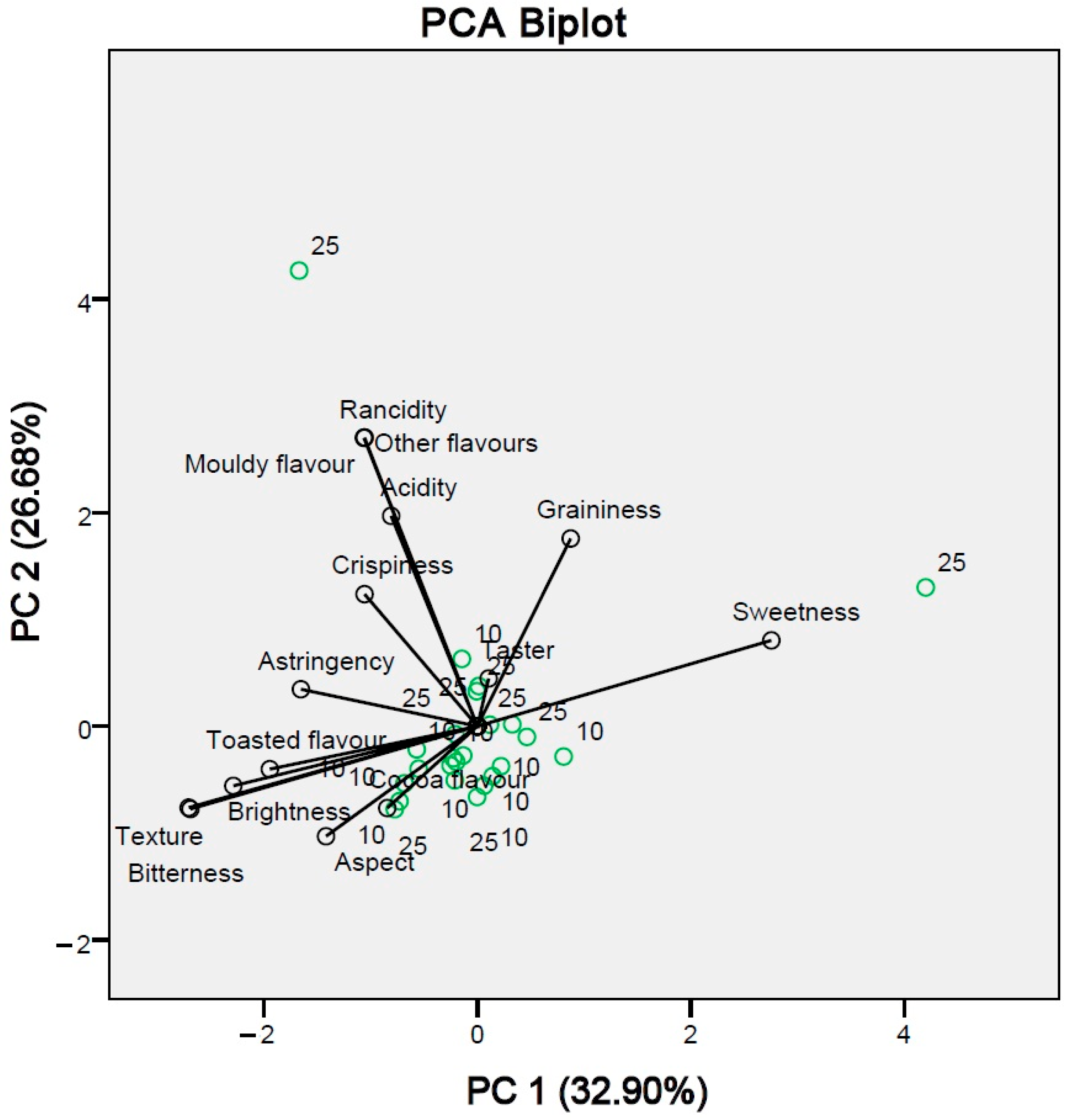
A PCA was performed with the aim of explaining most of the variance in the sensorial variables (original variables) of chocolate samples according to the temperature (Figure 4).
The attributes considered were aspect, brightness, texture, crispiness, graininess, cocoa flavour, roasted flavour, sweetness, acidity, bitterness, rancidity, mouldy flavour, astringency, and other flavours. The similarity map defined by the first two principal components took into account 56.45% of the total variance. The first component (PC1) by itself condensed 31.34% and the second component (PC2) represented 25.11% of the total variance. The PC1 presented positive correlation with sweetness and negative correlations with bitterness, toasted flavour, brightness, texture, and astringency. The PC2 was positively correlated to acidity, mouldy flavour, rancidity, and other flavours, while it was negatively correlated to aspect and cocoa flavour. A PCA biplot was constructed to display the relationships between the temperatures and their sensory/appearance attributes and how the differences in the intensities of these attributes explain variations among the chocolates tempered at 10 °C and 25 °C. According to PCA results, the parameters sweetness, rancidity, acidity, graininess, mouldy flavour, and other flavours were more perceived at cooling temperature of 25 °C, while the parameters cocoa flavour and aspect were more sensed at cooling temperature of 10 °C. The PCA biplot also indicated that rancidity, acidity, and crispiness presented lower scores at cooling temperature of 10 °C.

4. Conclusions

The process of transforming cocoa beans into dark chocolate involves key processes such as fermentation of cocoa beans, roasting, and tempering, affecting appearance, texture, and flavour. Additionally, the regulation of temperature during moulding and cooling has an impact on the polymorphism of cocoa butter crystals, a consequence of the heat transfer mechanisms during phase transition. Therefore, the application of CFD in this work highlights the importance of understanding the thermal behaviour during the solidification stage and how it affects the perception of chocolate during sensory evaluation. The observed temperature profiles presented different cooling rate and solidification behaviours at 10 °C and 25 °C cooling temperatures and also depending on the location inside the chocolate mass. The numerical simulations were closely aligned with experimental results, particularly at 25 °C, showing a temperature difference below 2 °C until 4000 s elapsed time. Additionally, the sensory evaluation of chocolate revealed no significant differences in appearance, texture, and flavour between 10 °C and 25 °C, suggesting that the impact of the temperature on perceived quality attributes may be minimal. Overall, while higher cooling temperatures led to a higher propensity for fat bloom formation, they did not significantly alter the texture or flavour profile, affirming the complexity of chocolate’s sensory attributes and their dependence on various processing factors. The present study presented some limitations, including numerical deviations arising from stability-related simplifications and the use of literature-based thermophysical properties that may not fully match those of the dark chocolate used experimentally. Nevertheless, the model remains robust, and future refinements—such as improved property characterization and boundary-condition definitions—should enhance its ability to capture crystallization dynamics.

Author Contributions

Conceptualization, J.D., and J.G.; methodology, J.D., J.G., M.F., A.S. and J.L.d.S.; software, J.G., and M.S.Q.; validation, J.D., J.G. and J.L.d.S.; formal analysis, J.D.; investigation, M.S.Q., J.D., J.G., J.L.d.S. and M.F.; resources, J.D.; data curation, J.G.; writing—original draft preparation, J.D. and J.G.; writing—review and editing, M.S.Q., J.D., J.G., J.L.d.S., A.S. and M.F.; supervision, J.D.; project administration, J.D. All authors have read and agreed to the published version of the manuscript.

Funding

This research was co-financed by FCT—Fundação para a Ciência e a Tecnologia, I.P., under the R & D Unit GEOBIOTEC—GeoBioCiências, GeoTecnologias e GeoEngenharias (https://doi.org/10.54499/UIDB/04035/2020, accessed on 12 December 2025), and under the R &D unit MED—Mediterranean Institute for Agriculture, Environment and Development (https://doi.org/10.54499/UIDB/05183/2020, accessed on 12 December 2025) and the Associate Laboratory CHANGE—Global Change and Sustainability Institute (https://doi.org/10.54499/LA/P/0121/2020, accessed on 12 December 2025).

Institutional Review Board Statement

Under European Union regulations, ethical approval is not legally required for sensory studies involving adult participants provided that the research does not include sensitive personal data, does not involve vulnerable populations, and does not pose any risk to the participants’ health or well-being. The sensory evaluation was non-invasive, non-clinical, and involved no physical or psychological risk to the participants.

Informed Consent Statement

Informed consent was obtained from all subjects involved in the study.

Data Availability Statement

The data presented in this study are available on request from the corresponding author.

Conflicts of Interest

The authors declare no conflicts of interest.

References

  1. Panda, A.; Alvarenga, N.; Lita da Silva, J.; Partidário, A.; Lageiro, M.; Roseiro, C.; Dias, J. Influence of cocoa origin on the nutritional characterization of chocolate. Eur. Food Res. Technol. 2022, 248, 2569–2577. [Google Scholar] [CrossRef]
  2. Directive 2000/36/EC of the European Parliament and of the Council of 23 June 2000 Relating to Cocoa and Chocolate Products Intended for Human Consumption. Available online: https://eur-lex.europa.eu/eli/dir/2000/36/oj/eng (accessed on 20 May 2025).
  3. Afoakwa, E. Chocolate Science and Technology, 2nd ed.; John Wiley & Sons: Oxford, UK, 2016; pp. 345–364. [Google Scholar]
  4. Debaste, F.; Kegelaers, Y.; Liégeois, S.; Ben Amor, H.; Halloin, V. Contribution to the modelling of chocolate tempering process. J. Food Eng. 2008, 88, 568–575. [Google Scholar] [CrossRef]
  5. Dias, J.; Panda, A.; Partidário, A.; Alvarenga, N.; Lita da Silva, J.; Cordeiro, T.; Prazeres, P. Impact of geographical origin on chocolate microstructure, phase transition, and fat bloom. In Trends in Sustainable Chocolate Production; Galanakis, C.M., Ed.; Springer: Cham, Switzerland, 2022; pp. 153–187. [Google Scholar] [CrossRef]
  6. Pirouzian, H.R.; Konar, N.; Palabiyik, I.; Oba, S.; Toker, O.S. Pre-crystallization process in chocolate: Mechanism, importance and novel aspects. Food Chem. 2020, 321, 126718. [Google Scholar] [CrossRef] [PubMed]
  7. Grob, L.; Papadea, K.; Braun, P.; Windhab, E.J. Influence of local convective heat flux on solidification, contraction and wall detachment behavior of molded chocolate during air cooling. Innov. Food Sci. Emerg. Technol. 2021, 68, 102629. [Google Scholar] [CrossRef]
  8. Tewkesbury, H.; Stapley, A.G.F.; Fryer, P.J. Modelling temperature distributions in cooling chocolate moulds. Chem. Eng. Sci. 2000, 55, 3123–3132. [Google Scholar] [CrossRef]
  9. Hendrik, N.; Marchesini, F.H.; Van de Walle, D.; Dewettinck, K. Chocolate tempering in a rheometer: Monitoring rheological properties during and after crystallization of cocoa butter. Food Anal. Methods 2023, 16, 1555–1570. [Google Scholar] [CrossRef]
  10. Castro Alayo, E.M.; Torrejón Valqui, L.; Medina Mendoza, M.; Cayo Colca, I.S.; Cárdenas Toro, F.P. Kinetics Crystallization and Polymorphism of Cocoa Butter throughout the Spontaneous Fermentation Process. Foods 2022, 11, 1769. [Google Scholar] [CrossRef]
  11. Castro Alayo, E.M.; Balcázar Zumaeta, C.R.; Torrejón Valqui, L.; Medina Mendoza, M.; Cayo Colca, I.S.; Cárdenas Toro, F.P. Effect of tempering and cocoa butter equivalents on crystallization kinetics, polymorphism, melting, and physical properties of dark chocolates. LWT Food Sci. Technol. 2023, 173, 114402. [Google Scholar] [CrossRef]
  12. Wybauw, J.P. Fine Chocolates: Great Experience; Uitgeverij Lannoo nv: Tielt, Belgium, 2004. [Google Scholar]
  13. Wang, L.; Sun, D.W. Recent developments in numerical modelling of heating and cooling processes in the food industry—A review. Trends Food Sci. Technol. 2003, 14, 408–423. [Google Scholar] [CrossRef]
  14. Sun, D.W.; Hu, Z. CFD predicting the effects of various parameters on core temperature and weight loss profiles of cooked meat during vacuum cooling. Comput. Electron. Agric. 2002, 34, 111–127. [Google Scholar] [CrossRef]
  15. Alvarenga, N.; Martins, J.; Caeiro, J.; Garcia, J.; Pássaro, J.; Coelho, L.; Santos, M.T.; Lampreia, C.; Martins, A.; Dias, J. Applying computational fluid dynamics in the development of smart ripening rooms for traditional cheeses. Foods 2021, 10, 1716. [Google Scholar] [CrossRef]
  16. Anderson, J.D. Computational Fluid Dynamics: The Basic with Applications; McGraw-Hill, Inc.: New York, NY, USA, 1995. [Google Scholar]
  17. Bikos, D.; Samaras, G.; Charalambides, M.N.; Cann, P.; Masen, M.; Hartmann, C.; Vieira, J.; Sergis, A.; Hardalupas, Y. A micromechanical based finite element model approach to accurately predict the effective thermal properties of micro-aerated chocolate. Innov. Food Sci. Emerg. Technol. 2023, 83, 103227. [Google Scholar] [CrossRef]
  18. Simão, C.; Murta-Pina, J.; Oliveira, J.P.; Coelho, L.; Pássaro, J.; Ferreira, D.; Reboredo, F.; Jorge, T.; Figueiredo, P. A case study for decentralized heat storage solutions in the agroindustry sector using phase change materials. AgriEngineering 2022, 4, 255–278. [Google Scholar] [CrossRef]
  19. Grob, L.; Papadea, K.; Braun, P.; Windhab, E.J. In-line detection method for crystallization, contraction and mold detachment during cooling of confectionery products. J. Food Eng. 2021, 292, 110322. [Google Scholar] [CrossRef]
  20. Le Révérend, B.J.D.; Smart, I.; Fryer, P.J.; Bakalis, S. Modelling the rapid cooling and casting of chocolate to predict phase behaviour. Chem. Eng. Sci. 2011, 66, 1077–1086. [Google Scholar] [CrossRef]
  21. ANSYS. Ansys Fluent Theory Guide; ANSYS, Inc.: Canonsburg, PA, USA, 2021; pp. 35–40. [Google Scholar]
  22. Launder, B.E.; Spalding, D.B. Lectures in Mathematical Models of Turbulence; Academic Press, Inc.: London, UK, 1972. [Google Scholar]
  23. Shapiro, S.S.; Wilk, M.B. An analysis of variance test for normality (complete samples). Biometrika 1965, 52, 591–611. [Google Scholar] [CrossRef]
  24. Bikos, D.; Samaras, G.; Charalambides, M.N.; Cann, P.; Masen, M.; Hartmann, C.; Vieira, J.; Sergis, A.; Hardalupas, Y. Experimental and numerical evaluation of the effect of micro-aeration on the thermal properties of chocolate. Food Funct. 2022, 13, 4993–5010. [Google Scholar] [CrossRef] [PubMed]
  25. Jin, J.; Hartel, R.W. Accelerated fat bloom in chocolate model systems: Solid fat content and temperature fluctuation frequency. J. Am. Oil Chem. Soc. 2015, 92, 1473–1481. [Google Scholar] [CrossRef]
  26. Ehlers, D.; Hanselmann, W.; Windhab, E.J. Online tempercurve analysis of praline products with the objective of cooling process optimization. J. Food Process Eng. 2013, 36, 292–301. [Google Scholar] [CrossRef]
  27. Rejman, L.L.S. Premium Chocolate Through Cooling Process Optimization—An In-Line Monitoring Approach. Ph.D. Thesis, Doctor of Sciences of ETH Zürich, Zürich, Switzerland, 2017. [Google Scholar] [CrossRef]
  28. Nopens, I.; Foubert, I.; De Graef, V.; Van Laere, D.; Dewettinck, K.; Vanrolleghem, P. Automated image analysis tool for migration fat bloom evaluation of chocolate coated food products. LWT 2008, 41, 1884–1891. [Google Scholar] [CrossRef]
  29. Afoakwa, E.O.; Paterson, A.; Fowler, M.; Vieira, J. Characterization of melting properties in dark chocolates from varying particle size distribution and composition using differential scanning calorimetry. Food Res. Int. 2008, 41, 751–757. [Google Scholar] [CrossRef]
  30. Afoakwa, E.O.; Paterson, A.; Fowler, M.; Vieira, J. Effects of tempering and fat crystallisation behaviour on microstructure, mechanical properties and appearance in dark chocolate systems. J. Food Eng. 2008, 89, 128–136. [Google Scholar] [CrossRef]
  31. Do, T.A.L.; Hargreaves, J.M.; Wolf, B.; Hort, J.; Mitchell, J.R. Impact of particle size distribution on rheological and textural properties of chocolate models with reduced fat content. J. Food Sci. 2007, 72, E541–E552. [Google Scholar] [CrossRef] [PubMed]
  32. Badak-Kerti, K.; Zsom-Muha, V.; Zsom, T.; Nagy, D.; Felföldi, J. Acoustic investigation of chocolate by changing temperature and cocoa content. Prog. Agric. Eng. Sci. 2020, 16, 115–122. [Google Scholar] [CrossRef]
  33. Guinard, J.X.; Mazzucchelli, R. The sensory perception of texture and mouthfeel. Trends Food Sci. Technol. 1996, 7, 213–219. [Google Scholar] [CrossRef]
  34. Rohmah, M.; Sari, K.; Rahmadi, A. The taste development of cocoa bean: Evidence from the tropical rain forest to the table. In Trends in Sustainable Chocolate Production; Galanakis, C.M., Ed.; Springer: Cham, Switzerland, 2022; pp. 41–74. [Google Scholar] [CrossRef]
Figure 1. (a) Polycarbonate mould with semi-spherical cavities showing the positions of the three NTC thermistors (top, middle, bottom). (b) Computational mesh used for the numerical simulation.
Applsci 16 00038 g001
Figure 2. (a) Experimental temperature profiles at the top, middle, and bottom of chocolate during cooling at 10 °C. (b) Comparison between experimental data and numerical simulation results at the same positions, with dashed lines representing the simulated temperatures.
Applsci 16 00038 g002
Figure 3. (a) Temperature contour cross-sections of the semi-spherical chocolate geometry during cooling at 10 °C, from t = 2 s to t = 7200 s. (b) Detailed view of temperature distribution at selected time points highlighting the progression of cooling and approach to solidification.
Applsci 16 00038 g003
Figure 4. PCA biplot showing the objects scores (temperatures) and component loadings (sensory/appearance attributes).
Applsci 16 00038 g004
Table 1. Mean and standard deviation of the digital image and rheological properties of chocolates solidified at 10 °C and at 25 °C.
10 °C25 °C
R (-)72.38 ± 2.47 a115.69 ± 16.04 b
G (-)55.33 ± 3.01 a102.42 ± 17.46 b
B (-)50.40 ± 3.43 a96.81 ± 15.62 b
Y (-)58.60 ± 2.93 a104.84 ± 17.01 b
Hardness (in g)9694.02 ± 227.38 a9426.32 ± 214.74 a
Work (in g s)22,173.90 ± 2527.85 a21,242.64 ± 3062.35 a
Significant difference (p < 0.05) is indicated by different superscripts in each row only.
Table 2. Mean and standard deviation of descriptive ratings, on a 9-point scale, on the sensory attributes of chocolates solidified at 10 °C and at 25 °C.
10 °C25 °C
Appearance
   Aspect6.50 ± 1.31 a5.08 ± 1.73 a
   Colour6.50 ± 1.31 a5.08 ± 1.73 a
   Brightness4.50 ± 1.78 a2.50 ± 1.09 a
Texture
   Hardness6.25 ± 1.29 a6.67 ± 1.50 a
   Crispiness4.67 ± 1.72 a5.50 ± 1.24 a
   Graininess3.33 ± 1.37 a3.83 ± 1.80 a
Flavour and Aroma
   Sweetness5.92 ± 1.08 a5.50 ± 1.57 a
   Acidity2.75 ± 1.60 a2.17 ± 1.47 a
   Bitterness3.50 ± 1.51 a3.67 ± 1.72 a
   Astringency2.75 ± 1.60 a3.17 ± 1.53 a
   Cocoa flavour5.42 ± 1.56 a5.17 ± 1.47 a
   Toasted flavour4.08 ± 1.98 a4.42 ± 1.88 a
   Mouldy flavour1.25 ± 0.621.50 ± 1.45
   Other flavours1.17 ± 0.581.33 ± 1.16
   Rancidity1.42 ± 0.901.50 ± 1.17
Significant difference (p < 0.001) is indicated by different superscripts in each row only.
Disclaimer/Publisher’s Note: The statements, opinions and data contained in all publications are solely those of the individual author(s) and contributor(s) and not of MDPI and/or the editor(s). MDPI and/or the editor(s) disclaim responsibility for any injury to people or property resulting from any ideas, methods, instructions or products referred to in the content.