EEG-Based Assessment of Mental Fatigue in Students: A Systematic Review of Measurement Methods and Data Processing Protocols

 , ,
, ,  ,
,  and
and
Featured Application
Abstract
1. Introduction
2. Materials and Methods
2.1. Eligibility Criteria
2.2. Study Selection and Data Extraction
2.3. Methodological Quality Assessment and Risk of Bias
2.4. Statistical Power Analysis
3. Results
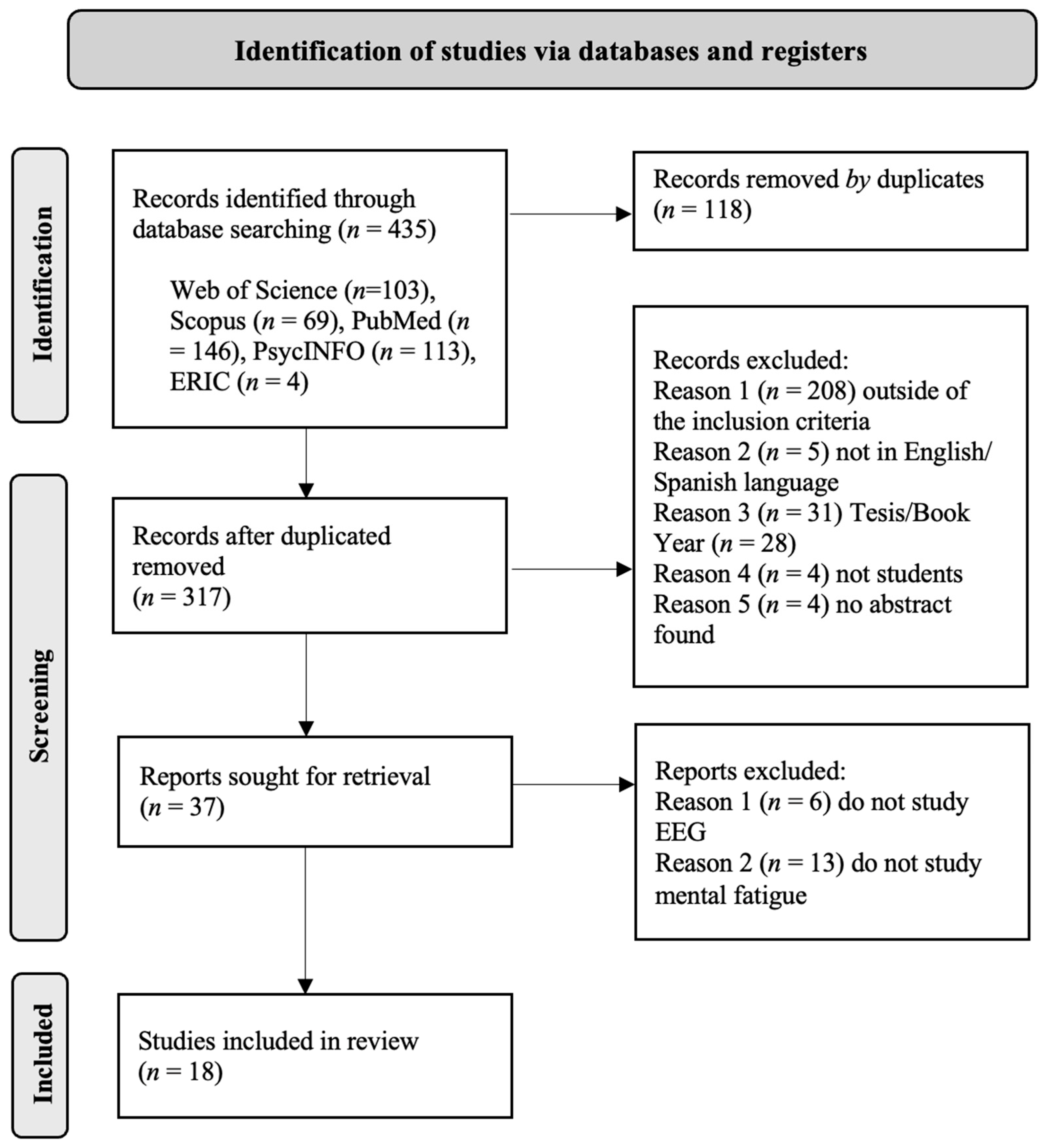
3.1. Search Results
3.2. Geographical Distribution and Participants
3.3. Study Design
3.4. EEG Systems and Hardware
3.5. EEG Frequency Bands

| Author | EEG System/ Headset | SR | Electrodes | Impedance | Placement System | EEG Frequency Bands | Band Information Provided | Software | Preprocessing (Filters/Noise) | Processing Technique |
|---|---|---|---|---|---|---|---|---|---|---|
| [51] | Enophones | - | Four-channel gold-plated dry electrodes Elec. Placement: A1, A2, C3, C4 | - | IS 10–20 | Δ (1–4 Hz), Θ (4–7 Hz), α (8–12 Hz), β (13–29 Hz), γ (30–50 Hz) | - | Brainflow’s Python library (version NM) | Min-max scaling, outlier removal (IQR), quantile methods, and filtering atypical signals | Feature extraction using PSD for EEG bands |
| [52] | Emotiv | - | 14 electrodes | - | - | Δ, Θ, α, β (Bands mentioned without Hz values) | - | Brain Mapping software (EEGLAB toolbox) (version NM) | - | EEG PSA bands (low and high frequency changes) |
| [53] | Emotiv Insight | - | 5 semi-dry polymer sensors (af3, af4, t7, t8, pz) | - | - | θ (0.5–8 Hz), α (9–14 Hz), β (15–30 Hz) | θ: Inward attention, α: Relaxation, β: Focus and concentration | Emotiv software, Python processing (version NM) | Proprietary filtering, FFT, noise removal (<5% discarded) | EEG PSA, β/α ratio for focus, θ/α for inward attention, α asymmetry for motivation, global α for relaxation |
| [23] | Quik-Cap | 250 Hz | 62 Ag–AgCL channels Ref: Earlobes. Gnd: 10/ant. to FZ | 5 kΩ | 10% system | Δ (0–4 Hz), Θ (4–8 Hz), α (8–12 Hz), β (12–20 Hz) | - | MATLAB (EEGLAB 5.03 toolbox) | Baseline normalisation, artifact removal (eye blinks, movements, heartbeats, muscle activity); epochs segmented (500 ms); filtered for bands | PSD using FFT; regional analysis (frontal, central, parietal, occipital); relative power normalised across time points |
| [54] | Quik-Cap SynAmps2 amplifier | 1000 Hz | 9 Ag-AgCl electrodes Pz, P3, P4, Cz, C3, C4, Fz, F3, and F4 | 5 kΩ | IS 10–20 | δ (0.5–3.9 Hz), θ (4–7.8 Hz), α (7.9–12.6 Hz), β (12.7–30 Hz) | - | SynAmps2 and a SCAN™ 4.3 EEG system | 0.15–100 Hz filters; ocular artifact reduction; automatic rejection of epochs exceeding ±100 μV | ERPs; FFT |
| [55] | Starstim tES Cap | 250 Hz | Single-channel dry electrode Electrode positions (F3-F8) | - | IS 10–20 | α (8–13 Hz), β (14–30 Hz) | α-EEG: Relaxation; β-EEG: Effortful thinking | NeuroSky’s proprietary software (version NM) | Artifact correction, spectral transformation using the autoregressive method | Analysis of α and β EEG waves |
| [56] | BrainCap MR | 1000 Hz | 64 electrodes | 5 kΩ | - | N/A (focused on ERP components) N2 (200–350 ms), P3 (350–600 ms) | ERP components: NoGo-N2 (conflict monitoring), NoGo-P3 (response inhibition), Go-P3 (attentional resource allocation) | E-prime (Psychology). Software Tools, (Pittsburgh, PA, USA) (version NM) | Bandpass filter (1–30 Hz), epoching (−200 to +800 ms), artifact rejection (±120 μV), manual ICA for artifact removal | ERP analysis focused on N2 (200–350 ms) and P3 (350–600 ms) at Fz, Cz, and Pz sites for Go/NoGo tasks; ANOVA and post hoc contrasts |
| [57] | Emotiv Epoc X 14 channels | - | 14 channels AF3, AF4, F3, F4, F7, F8, FC5, FC6; T7, T8; O1, O2; P7, P8 | - | IS 10–20 | Δ (0.5–4 Hz), Θ (4–8 Hz), α (8–13 Hz), SMR (13–15 Hz), βMid (15–20 Hz), β (13–30 Hz) | - | MATLAB (EEGLAB v14.1.2. toolbox) | FIR filter (2–39 Hz), ICA for artifact removal | PSD for δ, θ, α, SMR, mid-β, β; relative band power calculation |
| [29] | Quick-Cap | 1000 Hz | 32 channels NaCl-based conductive gel | 5 kΩ | IS 10–20 | Δ (1–3 Hz), Θ (4–7 Hz), α (8–14 Hz), β (15–30 Hz) | Δ, Θ (occipital) ↑; β ↓ (occipital, temporal) with longer response times, indicating MF ↑ | MATLAB (EEGLAB toolbox) (version NM) | 1 Hz high-pass, 50 Hz low-pass FIR filter, manual artifact rejection | FFT for spectral analysis, power spectral changes calculation |
| [58] | Quick-Cap | 1000 Hz | 32 channels using NaCl-based conductive gel | 5 kΩ | IS 10–20 | Θ (4–8 Hz), αlow (8–10 Hz), α (8–13 Hz), Δ (1–4 Hz) | - | MATLAB 2018-based open software EEGLAB v15.0B | 1–50 Hz bandpass filter, ICA for artifact removal, FFT for spectral analysis | PSA: focus on theta, low-alpha, and high-frequency power changes related to depression and anxiety |
| [59] | BIOPAC System EEG100C | 500 Hz | Gold-plated electrodes F3, F4, C3, C4, P3, P4, O1, and O2. Ref: Cz, Gnd: Faz. | 5 kΩ | IS 10–20 | Δ (1–4 Hz), Θ (4–7 Hz), α (8–12 Hz), β (13–29 Hz) | α power during HEP components (F3, F4); ERP latency at P4, O1, O2 | LabVIEW 2010, AcqKnowledge v4.1 | Blink artifact removal (EOG), FFT alpha for power extraction, signal normalisation | Feature extraction: HEP first and second components; ERP latency; FFT-based alpha synchronisation |
| [60] | Ultracortex Mark IV EEG headset | 250 Hz | 8 dry electrodes FP2, FP1, C4, C3, P8, P7, O1, and O2, and REF: one placed in each earlobe | - | IS 10–20 | Δ (1–4 Hz), Θ (4–7 Hz), α (8–12 Hz), β (13–29 Hz), γ (30–50 Hz) | MF linked to Θ ↑, β ↓ power, showing reduced cognitive processing. P300 latency correlated with fatigue. | MATLAB (EEGLAB toolbox) OpenVIBE (version NM) | 60 Hz Notch filter, 0.1–100 Hz bandpass filter, artifact subspace reconstruction (ASR) | Multiple linear regression (MLR), PSD, P300 amplitude/latency analysis |
| [61] | Ultracortex Mark IV EEG headset | 256 Hz | 8 dry electrodes FP2, FP1, C4, C3, P8, P7, O1, and O2 | - | IS 10–20 | Δ (1–4 Hz), Θ (4–7 Hz), α (8–12 Hz), β (13–29 Hz), γ (30–50 Hz) | Θ: Indicative of mental fatigue (θ/α relevant) | OpenBCI (OpenVibe) Matlab (version NM) | Bandpass filter (0.1–100 Hz, 4th-order Butterworth); artifact removal with ASR (k = 15); normalisation to eyes-open baseline | PSA (FFT for bands); feature extraction with normalised power and power ratios |
| [62] | BioSemi head-cap (suitable size) | 1024 Hz | 64 Ag-AgCl active electrodes | - | IS 10–20 | N/A (focused on ERP components) P3 (250–400 ms) | P3: attention, reduced in ADHD; N2: inhibitory control; LC: memory updating and task prep. | MATLAB (EEGLAB toolbox) (version NM) | Bandpass filter (1–80 Hz), notch filter (50 Hz), ICA for artifact removal, referencing to average electrodes | ERP analysis of early and late components (P3, LC) using ANOVA, post hoc tests, and correlations between behavioural indices and ERP amplitudes |
| [63] | Brain Products MR Plus | 2000 Hz | 64 Ag/AgCl scalp electrodes | 5 kΩ | IS 10–20 | Δ (1–4 Hz), Θ (4–7 Hz) | Θ: cognitive control; Δ: inhibition and fatigue | MATLAB 2020B (EEGLAB toolbox) | Bandpass 1–40 Hz, notch filter at 50 Hz, ICA for artifact removal | PSA using Welch’s method |
| [64] | EasyCap Brain | 1000 Hz | 63 sintered Ag-AgCl electrodes Ref: FCz. Gnd: AFz | 5 kΩ | - | N/A (focused on ERP components) N2(290 ms); P2(213–227 ms); P3(290 ms) | P2, P3: cognitive control and working memory; N2: cognitive control and conflict detection | Brain Vision Analyzer 2.0. Software | Bandpass filter (recording): 0.01–250 Hz Bandpass filter (offline): 0.1–35 Hz (Butterworth, 2nd order, 0-phase shift 48 dB) Notch filter: 50 Hz | ERP analysis of N1, P2, N2, P3 components Feature extraction for latency and amplitude differences |
| [65] | CAP100C | 1000 Hz | AgCl electrodes: F3, F4, Fz, Fp, O1 and O2. Ref: earlobe | 5 kΩ | IS 10–20 | α (8–13 Hz) | O1-O2 channels linked to visual fatigue, NM for others | BIOPAC MP150 system with AcqKnowledge 4.0 | EEG: Bandpass filter (1–100 Hz), EOG-based blink removal | FFT for EEG α power (8–13 Hz); RMS for |
| [66] | NSW316Neuracle | 1000 Hz | 16-scalp electrodes Electronic earlobe reference | 5 kΩ | IS 10–20 | α (without Hz values) | decreased complexity in a rhythm (8–13 Hz) with MF, as shown by MSE analysis | NM | Bandpass filter (0.01–100 Hz), Butterworth bandpass (8–13 Hz) for α extraction | MSE analysis on α rhythm and its instantaneous frequency variation (IFV) |
3.6. Software and Preprocessing Techniques
3.7. EEG Data Processing Techniques
3.8. Statistical Approaches
3.9. Quantitative Analysis of Methodological Heterogeneity
| Study | Count. | S.D. | Sample | Age | Intervention | Study Objective | Main Results |
|---|---|---|---|---|---|---|---|
| [51] | Mexico | Exp., cross-sectional | N = 22 10 females 14 males | MAge = 19.8 SD = 2 | IoT-based biofeedback to monitor and improve learning | Enhance learning via real-time biometric feedback on cognitive performance | Θ ↑ and β ↓ power correlated with MF in the auditory-oddball task. The EEG model classified fatigue with 85% accuracy |
| [52] | Iran | Exp. cross-sectional | N = 32 males | MAge = 20 | FIFA 2015 video game (single-elimination tournament). Pre-post assessment with PASAT and EEG | Assess the impact of video games on brain activity, attention, and physiological stress response | During video games, increased low-frequency (≈3 Hz) power, decreased power in 6–10 Hz (occipital), and 15–18 Hz (frontal). PASAT showed no significant MF changes |
| [53] | USA | Quasi-Exp. | N = 46 26 females 19 males N1 = 24 N2 = 21 | MAge 1 = 14 MAge 2 = 11 | 15-min biking session (outdoor track), followed by Stroop before and after biking, EEG monitored throughout | Investigate the cognitive and neurological effects of biking on adolescent students’ MF and cognitive performance | β ↑ during activity, α rose post-activity, θ ↓; working memory and psychomotor speed improved (d = 0.45) |
| [23] | USA | Exp. | N = 14 30% females 70% males | MAge = 21.4 SD = 1.3 | Stroop (Word and Interference) | Examine multimodal fatigue (subjective, cognitive, physiological) during sports concussion assessments to provide a baseline for understanding fatigue effects in clinical populations | Θ ↑ (frontal-parietal) and migration of α (occipital to anterior) in the final Stroop task. Subjective fatigue is linked to more errors |
| [54] | Canada | Exp. | N = 24 females | Arange = 16–18 MAge = 16.9 SD = 0.4 | Stroop colour-word matching task (morning vs. afternoon; Monday vs. Wednesday) | To examine how bedtime patterns, social jet lag (SJL), and school start times (SST) affect cognitive performance and EEG patterns | Δ ↑ Wednesday afternoon, indicating accumulated MF and error monitoring. Θ and β ↑ Monday, reflecting cognitive effort and conflict monitoring during Stroop |
| [55] | China | Quasi-exp. | N = 48 27 females 21 males | MAge = 10.42 SD = 1.05 | Various horticultural activities (flower arranging, kokedama crafting, seed sowing, pressed flower card making, decorative bottle painting) | Evaluate the effectiveness of horticultural activities in stress recovery and MF reduction in elementary students | Horticultural activities boosted α-EEG and reduced β-EEG, suggesting lower stress and MF. Flower arrangement and Kokedama activities had the best recovery outcomes |
| [56] | China | Randomised controlled trial | N = 36 18 females 18 males | Arange = 18–22 MAge = 20.3 | Relaxing music vs. no music during task | To investigate the effect of relaxing music on alleviating mental fatigue and maintaining performance during a continuous cognitive task | Music group had less MF, stable reaction times, and higher P3 amplitudes compared to controls. Control group showed impaired inhibitory control (lower NoGo-P3 amplitude) |
| [57] | South Korea | Exp., repeated-measures design | N = 20 4 females 10 males | Arange = 23–32 MAge = 26.65 SD = 2.61 | Thermal conditions tested in a climate chamber; cognitive tests at 5 conditions (PMV −2 to PMV 2) | Analyse the relationship between thermal conditions, psychophysiological responses, and learning performance | MF and reduced executive ability in cold (17 °C) and warm (33 °C) conditions. Optimal performance at 25.7 °C. EEG showed ↑ d MF and workload, without specific spectral power values |
| [29] | Taiwan | Exp., observational | N = 18 7 females 11 males | Arange = 23–27 | Visual attention task during a real university lecture | Investigate EEG spectral changes associated with sustained attention and MF in a real-world classroom setting | Δ, Θ ↑ in occipital (+15–20%) during slow responses, linked to increased visual fatigue. β ↓ by 25% in occipital/temporal regions, indicating reduced visual alertness. α↓ slightly, no significant change |
| [58] | Taiwan | Longitudinal | N = 18 7 females 11 males | MAge = 24.0 SD = 1.2 | Daily Sampling System (DSS) app for self-reports; bi-weekly EEG recordings after DASS-21 completion | Analyse the relationship between emotional states (stress, anxiety, depression), sleep patterns, and fatigue in students | Θ ↑ and low α linked to anxiety and stress. Higher depression correlated with increased high-frequency EEG in temporal regions. No significant prefrontal α asymmetry |
| [59] | Korea | Exp. | N = 30 15 females 15 males | Arange = 20–28 MAge = 24.1 SD = 3.1 | Viewing 2D and 3D videos for 1 h. | To evaluate 3D cognitive fatigue using HEP as an indicator of heart–brain synchronisation | 3D visual fatigue increased α at F3/F4 regions, prolonged ERP latency at P4, O1, and O2, indicating reduced cognitive capacity and attention |
| [60] | Mexico | Exp., cross-sectional | N = 17 9 females 8 males | MAge = 22 SD = 3 | Passive EEG recording during 5-min P300 oddball task | Develop a fast and efficient EEG-based MF assessment tool for workplace and educational environments | Θ ↑ (+20%) and β ↓ (−25%) in C3 and O2 indicate reduced cognition. β/Θ and α/Θ ratios linked to higher fatigue (p < 0.01). P300 latency ↑ (+15%), delaying responses. EEG model predicted MF with 88% accuracy |
| [61] | Mexico | Exp., comparative | N = 20 12 females 8 males | MAgeT = 22.3 SD = 1.63 MAgeV = 22.7 SD = 2.26 | Text vs. Video learning tasks | Evaluate and compare EEG spectral components and cognitive performance in text and video learning, developing predictive models using EEG data | High θ/α at C3 and delta at FP1 are linked to fatigue and lower performance. Video group performed better, had less fatigue, and optimised cognition with reduced high-frequency ratios |
| [62] | Israel | Double-blind placebo-controlled crossover | N = 18 8 females 10 males | Arange = 9–17 MAge = 12.2 SD = 2.8 | Placebo vs. methylphenidate (MPH) | To investigate MPH’s normalising effects on P3 amplitudes in ADHD and its role in mitigating MF effects during cognitive tasks | MPH increased P3 amplitude in frontoparietal regions vs. placebo, indicating improved attention. Placebo showed lower P3 amplitude, suggesting MF. MPH normalised brain activity |
| [63] | China | Exp., within-subject | N = 19 6 females 13 males | MAge = 22.16 SD = 0.65 | 15-min rest break vs. 15-min exercise break | Investigate the effects of rest and exercise on MF recovery using EEG PSA | Θ ↓ post-exercise, correlating with improved vigilance. Δ ↑, indicating inhibition of interference thoughts. Rest-break showed Δ ↓, indicating improved long-term attention |
| [64] | China | Exp. cross-sectional | N = 36 males | MAge = 25 SD = 2.91 | 100-min 2-back working memory task | Investigate neural patterns prior to errors in a long-lasting working memory task under fatigue | Decreased P2 and P3 amplitudes and delayed N2 latency preceded errors during prolonged working memory tasks, indicating reduced cognitive control and attention under mental fatigue. Error-related neural patterns emerged 200–300 ms before behavioural responses |
| [65] | Malaysia | Exp. | N = 14 7 females 7 males | MAge = 23.1 SD = 1.79 | Repetitive precision tasks with two difficulty levels | Develop predictive models for muscle and MF during repetitive precision tasks | Elevated α in O1-O2 linked to visual demand and fatigue in high-precision tasks. Fatigue correlated with muscle fatigue over time |
| [66] | China | Exp., pre-post | N = 13 males | Arange = 20–22 MAge = 21 SD = 1.2 | Simulated flight task + mental arithmetic (60 problems) | Investigate the complexity loss in the EEG due to MF using MSE on the α rhythm | Complexity of α rhythm decreased by up to 30% after MF, especially in parietal/occipital regions. MSE on IFV showed higher sensitivity, confirming cognitive decline |
4. Discussion
4.1. Critical Evaluation of Methodological Alternatives and Evidence-Based Recommendations
4.1.1. Frequency Band Definitions: Evaluation and Standardisation Recommendations
4.1.2. Hardware Configurations: Balancing Spatial Resolution with Practical Feasibility
4.1.3. Preprocessing Pipelines: Optimising Artifact Removal for Educational Settings
4.1.4. Analytical Methods: Selecting Appropriate Techniques for Research Objectives
4.1.5. Sample Size Considerations and Statistical Power Requirements
4.2. Educational Implications of EEG-Based Mental Fatigue Detection
4.3. Implications for Wearable EEG Device Development and Implementation
5. Conclusions
- Methodological harmonisation: Develop global consensus on frequency band definitions (theta: 4–8 Hz; alpha: 8–13 Hz; beta: 13–30 Hz), create standardised preprocessing pipelines (bandpass filtering 0.1–100 Hz, ICA-based artifact removal), and unify statistical modelling strategies with adequate sample sizes (minimum n = 34 for repeated-measures, n = 64 for between-subjects designs). Additionally, it is crucial that studies focus on evaluating the impact of these standardised methods on the accuracy of mental fatigue detection in real-world educational environments, with larger and more diverse samples to ensure the generalisation of results [17].
- Enhanced study design: Expand sample sizes through multi-site collaborations and ensure participant diversity across educational levels and geographical regions to improve external validity and statistical power [49]. Conduct a priori power analyses to ensure adequate statistical power for reliable effect detection.
- Multimodal integration: Integrate EEG with complementary measures of cognitive load, including behavioural performance metrics (reaction time, accuracy) and subjective self-report measures, for a more holistic assessment of mental fatigue that captures neurophysiological, behavioural, and subjective dimensions of this multifaceted construct.
- Advanced analytical approaches: Explore machine learning-based approaches to enhance EEG’s predictive accuracy and applicability in educational contexts [11]. Ensure rigorous validation, including cross-validation procedures, independent test datasets, and evaluation of generalizability across diverse student populations and educational settings.
- Practical implementation guidelines: Develop evidence-based protocols for optimal measurement timing in educational settings (pre/post learning sessions, during extended cognitive tasks), establish minimum recording durations for reliable detection, and create standardised procedures for classroom-based EEG deployment that minimise environmental interference while maximising ecological validity [8,17,59].
Author Contributions
Funding
Institutional Review Board Statement
Informed Consent Statement
Data Availability Statement
Acknowledgments
Conflicts of Interest
Abbreviations
| ANOVA | Analysis of Variance |
| APC | Article Processing Charge |
| BCI | Brain–Computer Interface |
| EEG | Electroencephalography |
| ERP | Event-Related Potential |
| FFT | Fast Fourier Transform |
| fMRI | Functional Magnetic Resonance Imaging |
| ICA | Independent Component Analysis |
| PICOS | Population, Intervention, Comparison, Outcome, Study Design |
| PRISMA | Preferred Reporting Items for Systematic Reviews and Meta-Analyses |
| PSD | Power Spectral Density |
| PSA | Power Spectral Analysis |
| PROSPERO | International Prospective Register of Systematic Reviews |
| α | Alpha (8–13 Hz frequency band) |
| β | Beta (13–30 Hz frequency band) |
| Δ | Delta (1–4 Hz frequency band) |
| θ | Theta (4–8 Hz frequency band) |
Appendix A
| Study | Study Design | Applicable Items | Score (0–28) | Methodol. Quality |
|---|---|---|---|---|
| [51] | Exp. cross-sectional | 1–10, 12–13, 16–18, 25–26 | 18 | Fair |
| [52] | Exp. cross-sectional | 1–10, 12–13, 16–18, 25–26 | 17 | Fair |
| [53] | Quasi-Exp. | 1–10, 12–15, 16–18, 25–27 | 22 | Good |
| [23] | Exp. | 1–10, 12–15, 16–20, 25–27 | 25 | Good |
| [54] | Exp. | 1–10, 12–15, 16–20, 25–27 | 24 | Good |
| [55] | Quasi-Exp. | 1–10, 12–15, 16–18, 25–27 | 21 | Good |
| [56] | Randomised controlled trial | 1–27 | 27 | Excellent |
| [57] | Exp. repeated-measures design | 1–10, 12–15, 16–20, 25–27 | 24 | Good |
| [29] | Exp. observational | 1–10, 12–13, 16–18, 25–26 | 20 | Good |
| [58] | Longitudinal | 1–10, 12–15, 16–18, 25–27 | 23 | Good |
| [59] | Exp. | 1–10, 12–15, 16–20, 25–27 | 25 | Good |
| [60] | Exp. cross-sectional | 1–10, 12–13, 16–18, 25–26 | 18 | Fair |
| [61] | Exp. comparative | 1–10, 12–15, 16–20, 25–27 | 24 | Good |
| [62] | Double-blind placebo-controlled crossover | 1–27 | 26 | Excellent |
| [63] | Exp. within-subject | 1–10, 12–15, 16–20, 25–27 | 24 | Good |
| [64] | Exp. cross-sectional | 1–10, 12–13, 16–18, 25–26 | 19 | Fair |
| [65] | Exp. | 1–10, 12–15, 16–20, 25–27 | 23 | Good |
| [66] | Exp. pre–post | 1–10, 12–15, 16–20, 25–27 | 22 | Good |
References
- Biasiucci, A.; Franceschiello, B.; Murray, M.M. Electroencephalography. Curr. Biol. 2019, 29, R80–R85. [Google Scholar] [CrossRef] [Scilit]
- Ghojazadeh, M.; Farahbakhsh, M.; Sahrai, H.; Beheshti, R.; Norouzi, A.; Sadeghi-Bazargani, H. The Activity of Different Brain Regions in Fatigued and Drowsy Drivers: A Systematic Review Based on EEG Findings. J. Res. Clin. Med. 2024, 12, 20. [Google Scholar] [CrossRef] [Scilit]
- Ramos-Argüelles, F.; Morales, G.; Egozcue, S.; Pabón, R.M.; Alonso, M.T. Técnicas Básicas de Electroencefalografía: Principios y Aplicaciones Clínicas. In Anales del Sistema Sanitario de Navarra; Gobierno de Navarra, Departamento de Salud: Pamplona/Iruña, Spain, 2009; Volume 32, pp. 69–82. [Google Scholar]
- Ansari, D.; De Smedt, B.; Grabner, R.H. Neuroeducation—A Critical Overview of an Emerging Field. Neuroethics 2012, 5, 105–117. [Google Scholar] [CrossRef] [Scilit]
- Juárez-Varón, D.; Bellido-García, I.; Gupta, B.B. Analysis of Stress, Attention, Interest, and Engagement in Onsite and Online Higher Education: A Neurotechnological Study. Comunicar 2023, 31, 21–34. [Google Scholar] [CrossRef] [Scilit]
- Redolar-Ripoll, D. Neurociencia Cognitiva, 1st ed.; Editorial Medica Panamericana: Madrid, Spain, 2014; ISBN 978-84-9835-408-9. [Google Scholar]
- Wang, X.; He, X. QI-Pathological Constitution Is Associated with Mental Fatigue in Class among University Students: A Cross-Sectional Study. BMC Psychol. 2025, 13, 294. [Google Scholar] [CrossRef] [Scilit]
- Orovas, C.; Sapounidis, T.; Volioti, C.; Keramopoulos, E. EEG in Education: A Scoping Review of Hardware, Software, and Methodological Aspects. Sensors 2025, 25, 182. [Google Scholar] [CrossRef] [Scilit]
- Schofield, H.; Hill, R.M.; Feys, O.; Holmes, N.; Osborne, J.; Doyle, C.; Bobela, D.; Corvilain, P.; Wens, V.; Rier, L.; et al. A Novel, Robust, and Portable Platform for Magnetoencephalography Using Optically Pumped Magnetometers. Imaging Neurosci. 2024, 2, imag-2-00283. [Google Scholar] [CrossRef] [Scilit] [PubMed]
- Bruer, J.T. Education and the Brain: A Bridge Too Far. Educ. Res. 1997, 26, 4–16. [Google Scholar] [CrossRef]
- Hramov, A.E.; Maksimenko, V.A.; Pisarchik, A.N. Physical Principles of Brain–Computer Interfaces and Their Applications for Rehabilitation, Robotics and Control of Human Brain States. Phys. Rep. 2021, 918, 1–133. [Google Scholar] [CrossRef] [Scilit]
- Pan, C.; Mu, H.; Yuan, Q.; Zhang, Y. Research on Methods for Recognizing and Analyzing the Emotional State of College Students. Front. Soc. Sci. Technol. 2025, 7, 27–33. [Google Scholar] [CrossRef] [Scilit]
- Baceviciute, S.; Makransky, G. Remediating Learning from Non-Immersive to Immersive Media: Using EEG to Investigate the Effects of Environmental Embeddedness on Reading in Virtual Reality. Comput. Educ. 2021, 164, 104122. [Google Scholar] [CrossRef] [Scilit]
- Cruz-Garza, J.G.; Darfler, M.; Rounds, J.D.; Gao, E.; Kalantari, S. EEG-Based Investigation of the Impact of Classroom Design on Cognitive Performance of Students. arXiv 2021. [Google Scholar] [CrossRef] [Scilit]
- Ji, R.; Li, J. Tai Chi Chuan Teaching on Alleviating Mental Fatigue among College Students: Insights from ERPs. Front. Psychol. 2025, 16, 1561888. [Google Scholar] [CrossRef] [Scilit]
- Liu, L.; Ji, Y.; Gao, Y.; Li, T.; Xu, W. A Novel Stress State Assessment Method for College Students Based on EEG. Comput. Intell. Neurosci. 2022, 2022, 4565968. [Google Scholar] [CrossRef] [Scilit] [PubMed]
- Hernández-Mustieles, M.A.; Lima-Carmona, Y.E.; Pacheco-Ramírez, M.A.; Mendoza-Armenta, A.A.; Romero-Gómez, J.E.; Cruz-Gómez, C.F.; Rodríguez-Alvarado, D.C.; Arceo, A.; Cruz-Garza, J.G.; Ramírez-Moreno, M.A.; et al. Wearable Biosensor Technology in Education: A Systematic Review. Sensors 2024, 24, 2437. [Google Scholar] [CrossRef] [Scilit]
- García-Calvo, T.; Díaz-García, J. Mental Fatigue and Sport Performance: Current Knowledge and Future Directions. Eur. J. Hum. Mov. 2022, 48, 1–3. [Google Scholar] [CrossRef] [Scilit]
- Hornsby, B.W.Y.; Naylor, G.; Bess, F.H. A Taxonomy of Fatigue Concepts and Their Relation to Hearing Loss. In Proceedings of the Ear and Hearing; Lippincott Williams and Wilkins: Philadelphia, PA, USA, 2016; Volume 37, pp. 136S–144S. [Google Scholar]
- Smith, M.R.; Thompson, C.; Marcora, S.M.; Skorski, S.; Meyer, T.; Coutts, A.J. Mental Fatigue and Soccer: Current Knowledge and Future Directions. Sports Med. 2018, 48, 1525–1532. [Google Scholar] [CrossRef] [Scilit]
- Van Cutsem, J.; Van Schuerbeek, P.; Pattyn, N.; Raeymaekers, H.; De Mey, J.; Meeusen, R.; Roelands, B. A Drop in Cognitive Performance, Whodunit? Subjective Mental Fatigue, Brain Deactivation or Increased Parasympathetic Activity? It’s Complicated! Cortex 2022, 155, 30–45. [Google Scholar] [CrossRef] [Scilit]
- Sanei, S.; Chambers, J.A. EEG Signal Processing and Machine Learning, 2nd ed.; John Wiley & Sons: Hoboken, NJ, USA, 2021; ISBN 978-1-119-38694-0. [Google Scholar]
- Barwick, F.; Arnett, P.; Slobounov, S. EEG Correlates of Fatigue during Administration of a Neuropsychological Test Battery. Clin. Neurophysiol. 2012, 123, 278–284. [Google Scholar] [CrossRef] [Scilit]
- Nayak, C.S.; Anilkumar, A.C. EEG Normal Waveforms; StatPearls Publishing: Treasure Island, FL, USA, 2023. [Google Scholar]
- Soewardi, H.; Azzahra, F.; Atmaji, C. Electroencephalograph (EEG) Study of Mental Fatigue in Learning the Physics at Senior High School’s Students. In Proceedings of the ASIA International Multidisciplinary Conference (AIMC), Johor Bahru, Malaysia, 12–13 May 2018. [Google Scholar]
- Soewardi, H.; Azzahra, F.; Atmaji, C. Electroencephalograph Analysis of Mental Fatigue in Learning the Physics at Senior High School’s Students. Int. J. Eng. Technol. 2018, 7, 344–349. [Google Scholar] [CrossRef] [Scilit]
- Xu, R.; Zhang, C.; He, F.; Zhao, X.; Qi, H.; Zhou, P.; Zhang, L.; Ming, D. How Physical Activities Affect Mental Fatigue Based on EEG Energy, Connectivity, and Complexity. Front. Neurol. 2018, 9, 915. [Google Scholar] [CrossRef] [Scilit] [PubMed]
- Boksem, M.A.S.; Meijman, T.F.; Lorist, M.M. Effects of Mental Fatigue on Attention: An ERP Study. Cogn. Brain Res. 2005, 25, 107–116. [Google Scholar] [CrossRef] [Scilit]
- Ko, L.W.; Komarov, O.; Hairston, W.D.; Jung, T.P.; Lin, C.T. Sustained Attention in Real Classroom Settings: An EEG Study. Front. Hum. Neurosci. 2017, 11, 388. [Google Scholar] [CrossRef] [Scilit]
- Kunasegaran, K.; Ismail, A.M.H.; Ramasamy, S.; Gnanou, J.V.; Caszo, B.A.; Chen, P.L. Understanding Mental Fatigue and Its Detection: A Comparative Analysis of Assessments and Tools. PeerJ 2023, 11, e15744. [Google Scholar] [CrossRef] [Scilit]
- Saygıner, Ş.; Balaman, F.; Tiryaki, S. The Current Trend in Educational Neuroscience Research: A Descriptive and Bibliometric Study. J. Comput. Educ. Res. 2022, 10, 184–201. [Google Scholar] [CrossRef] [Scilit]
- Wascher, E.; Rasch, B.; Sänger, J.; Hoffmann, S.; Schneider, D.; Rinkenauer, G.; Heuer, H.; Gutberlet, I. Frontal Theta Activity Reflects Distinct Aspects of Mental Fatigue. Biol. Psychol. 2014, 96, 57–65. [Google Scholar] [CrossRef] [Scilit] [PubMed]
- Lal, S.K.L.; Craig, A. Driver Fatigue: Electroencephalography and Psychological Assessment. Psychophysiology 2002, 39, 313–321. [Google Scholar] [CrossRef] [Scilit]
- Amo, C.; de Santiago, L.; Barea, R.; López-Dorado, A.; Boquete, L. Analysis of Gamma-Band Activity from Human EEG Using Empirical Mode Decomposition. Sensors 2017, 17, 989. [Google Scholar] [CrossRef] [Scilit]
- Jacquet, T.; Poulin-Charronnat, B.; Bard, P.; Lepers, R. Effect of Mental Fatigue on Hand Force Production Capacities. PLoS ONE 2024, 19, e0298958. [Google Scholar] [CrossRef] [Scilit]
- Liu, J.; He, T.; Hu, Z. The Effect of Music on Resistance to Mental Fatigue: Evidence from the EEG Power Spectrum. Appl. Psychophysiol. Biofeedback 2025, 50, 429–439. [Google Scholar] [CrossRef] [Scilit]
- Tran, Y.; Craig, A.; Craig, R.; Chai, R.; Nguyen, H. The Influence of Mental Fatigue on Brain Activity: Evidence from a Systematic Review with Meta-Analyses. Psychophysiology 2020, 57, e13554. [Google Scholar] [CrossRef] [Scilit]
- Díaz-García, J.; González-Ponce, I.; Ponce-Bordón, J.C.; López-Gajardo, M.Á.; Ramírez-Bravo, I.; Rubio-Morales, A.; García-Calvo, T. Mental Load and Fatigue Assessment Instruments: A Systematic Review. Int. J. Environ Res. Public Health 2022, 19, 419. [Google Scholar] [CrossRef] [Scilit]
- García-Monge, A.; Rodríguez-Navarro, H.; Marbán-Prieto, J.M. Potentialities and Limitations of the Use of EEG Devices in Educational Contexts. Comunicar 2023, 31, 47–58. [Google Scholar] [CrossRef] [Scilit]
- Goodman, S.P.J.; Collins, B.; Shorter, K.; Moreland, A.T.; Papic, C.; Hamlin, A.S.; Kassman, B.; Marino, F.E. Approaches to Inducing Mental Fatigue: A Systematic Review and Meta-Analysis of (Neuro)Physiologic Indices. Behav. Res. Methods 2025, 57, 102. [Google Scholar] [CrossRef] [Scilit]
- Sheela Sobana Rani, K.; Pravinth Raja, S.; Sinthuja, M.; Vidhya Banu, B.; Sapna, R.; Dekeba, K. Classification of EEG Signals Using Neural Network for Predicting Consumer Choices. Comput. Intell. Neurosci. 2022, 2022, 5872401. [Google Scholar] [CrossRef] [Scilit] [PubMed]
- Anderson, A.J.; Perone, S. Developmental Change in the Resting State Electroencephalogram: Insights into Cognition and the Brain. Brain Cogn. 2018, 126, 40–52. [Google Scholar] [CrossRef] [Scilit]
- Ravindran, A.S.; Buckner, C. Developing Explainable Deep Learning Models Using Eeg for Brain Machine Interface Systems. Ph.D. Thesis, University of Houston, Houston, TX, USA, 2021. [Google Scholar]
- Moher, D.; Liberati, A.; Tetzlaff, J.; Altman, D.G. Preferred Reporting Items for Systematic Reviews and Meta-Analyses: The PRISMA Statement. Int. J. Surg. 2010, 8, 336–341. [Google Scholar] [CrossRef] [Scilit]
- Landis, J.R.; Koch, G.G. The Measurement of Observer Agreement for Categorical Data. Biometrics 1977, 33, 159–174. [Google Scholar] [CrossRef] [Scilit]
- Rathbone, J.; Albarqouni, L.; Bakhit, M.; Beller, E.; Byambasuren, O.; Hoffmann, T.; Scott, A.M.; Glasziou, P. Expediting Citation Screening Using PICo-Based Title-Only Screening for Identifying Studies in Scoping Searches and Rapid Reviews. Syst. Rev. 2017, 6, 233. [Google Scholar] [CrossRef] [Scilit] [PubMed]
- Downs, S.H.; Black, N. The Feasibility of Creating a Checklist for the Assessment of the Methodological Quality Both of Randomised and Non-Randomised Studies of Health Care Interventions. J. Epidemiol. Community Health 1998, 52, 377–384. [Google Scholar] [CrossRef] [Scilit] [PubMed]
- Hooper, P.; Jutai, J.W.; Strong, G.; Russell-Minda, E. Age-Related Macular Degeneration and Low-Vision Rehabilitation: A Systematic Review. Can. J. Ophthalmol. 2008, 43, 180–187. [Google Scholar] [CrossRef] [Scilit]
- Button, K.S.; Ioannidis, J.P.A.; Mokrysz, C.; Nosek, B.A.; Flint, J.; Robinson, E.S.J.; Munafò, M.R. Power Failure: Why Small Sample Size Undermines the Reliability of Neuroscience. Nat. Rev. Neurosci. 2013, 14, 365–376. [Google Scholar] [CrossRef] [Scilit] [PubMed]
- Maxwell, S.E.; Kelley, K.; Rausch, J.R. Sample Size Planning for Statistical Power and Accuracy in Parameter Estimation. Annu. Rev. Psychol. 2008, 59, 537–563. [Google Scholar] [CrossRef] [Scilit] [PubMed]
- Aguilar-Herrera, A.J.; Delgado-Jimenez, E.A.; Candela-Leal, M.O.; Olivas-Martinez, G.; Alvarez-Espinosa, G.J.; Ramirez-Moreno, M.A.; Lozoya-Santos, J.D.J.; Ramirez-Mendoza, R.A. Advanced Learner Assistance System’s (ALAS) Recent Results. In Proceedings of the Future of Educational Innovation Workshop Series—Machine Learning-Driven Digital Technologies for Educational Innovation Workshop 2021, Virtually, 15–17 December 2021; Institute of Electrical and Electronics Engineers Inc.: New York, NY, USA, 2021; pp. 1–7. [Google Scholar]
- Aliyari, H.; Kazemi, M.; Tekieh, E.; Salehi, M.; Sahraei, H.; Reza Daliri, M.; Agaei, H.; Minaei-Bidgoli, B.; Lashgari, R.; Srahian, N.; et al. The Effects of FIFA 2015 Computer Games on Changes in Cognitive, Hormonal and Brain Waves Functions of Young Men Volunteers. Basic Clin. Neurosci. 2015, 6, 193–201. [Google Scholar]
- Bailey, A.W.; Chew, A.; Miller, C.; Holmberg, H.; Peyer, K. Cognitive and Neurological Impacts of a Biking Program in Public Schools. J. Phys. Educ. Sport 2021, 21, 1659–1668. [Google Scholar] [CrossRef]
- D’Angiulli, A.; Byczynski, G.; Yeh, W.H.; Garrett, G.; Goldfield, G.; Devenyi, P.; Devenyi, T.; Leisman, G. Cognitive Control, Bedtime Patterns, and Testing Time in Female Adolescent Students: Behavioral and Neuro-Electrophysiological Correlates. Front. Public. Health 2023, 11, 1022731. [Google Scholar] [CrossRef] [Scilit]
- Guo, L.; Xu, W.; Shi, Y.; Gao, S.; Xiao, C.; Zhang, X.; Liu, X.; Zhang, Q.; Zhang, Y. Which Horticultural Activities Are More Effective for Children’s Recovery from Stress and Mental Fatigue? A Quasi-Experimental Study. Front. Psychol. 2024, 15, 1352186. [Google Scholar] [CrossRef] [Scilit]
- Guo, W.; Ren, J.; Wang, B.; Zhu, Q. Effects of Relaxing Music on Mental Fatigue Induced by a Continuous Performance Task: Behavioral and ERPs Evidence. PLoS ONE 2015, 10, e0136446. [Google Scholar] [CrossRef] [Scilit] [PubMed]
- Kim, H.; Hong, T.; Kim, J.; Yeom, S. A Psychophysiological Effect of Indoor Thermal Condition on College Students’ Learning Performance through EEG Measurement. Build. Environ. 2020, 184, 107223. [Google Scholar] [CrossRef] [Scilit]
- Komarov, O.; Ko, L.W.; Jung, T.P. Associations among Emotional State, Sleep Quality, and Resting-State EEG Spectra: A Longitudinal Study in Graduate Students. IEEE Trans. Neural Syst. Rehabil. Eng. 2020, 28, 795–804. [Google Scholar] [CrossRef] [Scilit]
- Park, S.; Won, M.J.; Lee, E.C.; Mun, S.; Park, M.C.; Whang, M. Evaluation of 3D Cognitive Fatigue Using Heart-Brain Synchronization. Int. J. Psychophysiol. 2015, 97, 120–130. [Google Scholar] [CrossRef] [Scilit] [PubMed]
- Ramírez-Moreno, M.A.; Candela-Leal, M.; Alanis-Espinosa, M.; Tudón-Martínez, J.; Roman-Flores, A.; Ramírez-Mendoza, R.; Lozoya-Santos, J. Evaluation of a Fast Test Based on Biometric Signals to Assess Mental Fatigue at the Workplace—A Pilot Study. Int. J. Environ. Res. Public Health 2021, 18, 11891. [Google Scholar] [CrossRef] [Scilit]
- Ramírez-Moreno, M.A.; Díaz-Padilla, M.; Valenzuela-Gómez, K.D.; Vargas-Martínez, A.; Tudón-Martínez, J.C.; Morales-Menendez, R.; Ramírez-Mendoza, R.A.; Pérez-Henríquez, B.L.; Lozoya-Santos, J.d.J. Eeg-Based Tool for Prediction of University Students’ Cognitive Performance in the Classroom. Brain Sci. 2021, 11, 698. [Google Scholar] [CrossRef] [Scilit]
- Rubinson, M.; Horowitz, I.; Naim-Feil, J.; Gothelf, D.; Levit-Binnun, N.; Moses, E. Effects of Methylphenidate on the ERP Amplitude in Youth with ADHD: A Double-Blind Placebo-Controlled Cross-over EEG Study. PLoS ONE 2019, 14, e0217383. [Google Scholar] [CrossRef] [Scilit] [PubMed]
- Wang, S.; Zhu, L.; Gao, L.; Yuan, J.; Li, G.; Sun, Y.; Qi, P. Modulating break types induces divergent low band EEG processes during post-break improvement: A power spectral analysis. Front. Hum. Neurosci. 2022, 16, 960286. [Google Scholar] [CrossRef] [Scilit]
- Xiao, Y.; Wu, J.; Li, J.; Tang, W.; Ma, F.; Sun, C.; Yang, Y.; Zhan, W.; Wang, L.; Yan, H.; et al. The Neuro Patterns Prior to Error Responses in Long-Lasting Working Memory Task: An Event-Related Potential Study. Front. Behav. Neurosci. 2019, 13, 277. [Google Scholar] [CrossRef] [Scilit] [PubMed]
- Zadry, H.R.; Dawal, S.Z.M.; Taha, Z. Development of Statistical Models for Predicting Muscle and Mental Activities during Repetitive Precision Tasks. Int. J. Occup. Saf. Ergon. 2016, 22, 374–383. [Google Scholar] [CrossRef] [Scilit]
- Zhai, Y.; Li, Y.; Zhou, S.; Zhang, C.; Luo, E.; Tang, C.; Xie, K. Mental Fatigue Decreases Complexity: Evidence from Multiscale Entropy Analysis of Instantaneous Frequency Variation in Alpha Rhythm. Front. Hum. Neurosci. 2022, 16, 906735. [Google Scholar] [CrossRef] [Scilit]
- Klimesch, W. Full-Length Review EEG Alpha and Theta Oscillations Reflect Cognitive and Memory Performance: A Review and Analysis. Brain Res. Rev. 1999, 29, 169–195. [Google Scholar] [CrossRef] [Scilit]
- Li, G.; Huang, S.; Xu, W.; Jiao, W.; Jiang, Y.; Gao, Z.; Zhang, J. The Impact of Mental Fatigue on Brain Activity: A Comparative Study Both in Resting State and Task State Using EEG. BMC Neurosci. 2020, 21, 20. [Google Scholar] [CrossRef] [Scilit]
- Lotte, F.; Congedo, M.; Lécuyer, A.; Lamarche, F.; Arnaldi, B. A Review of Classification Algorithms for EEG-Based Brain-Computer Interfaces. J. Neural Eng. 2007, 4, R1–R13. [Google Scholar] [CrossRef] [PubMed]
- Stam, C.J. Modern Network Science of Neurological Disorders. Nat. Rev. Neurosci. 2014, 15, 683–695. [Google Scholar] [CrossRef] [Scilit] [PubMed]
- Luck, S.J. An Introduction to the Event Related Potential Technique; Ilustrada; MIT Press: Cambridge, MA, USA, 2014; ISBN 0262324067; 9780262324069. [Google Scholar]

Disclaimer/Publisher’s Note: The statements, opinions and data contained in all publications are solely those of the individual author(s) and contributor(s) and not of MDPI and/or the editor(s). MDPI and/or the editor(s) disclaim responsibility for any injury to people or property resulting from any ideas, methods, instructions or products referred to in the content. |
© 2025 by the authors. Licensee MDPI, Basel, Switzerland. This article is an open access article distributed under the terms and conditions of the Creative Commons Attribution (CC BY) license.
Share and Cite
Ayuso-Moreno, R.; Rubio-Morales, A.; Durán-Rufaco, A.; García-Calvo, T.; González-Ponce, I. EEG-Based Assessment of Mental Fatigue in Students: A Systematic Review of Measurement Methods and Data Processing Protocols. Appl. Sci. 2026, 16, 234. https://doi.org/10.3390/app16010234
Ayuso-Moreno R, Rubio-Morales A, Durán-Rufaco A, García-Calvo T, González-Ponce I. EEG-Based Assessment of Mental Fatigue in Students: A Systematic Review of Measurement Methods and Data Processing Protocols. Applied Sciences. 2026; 16(1):234. https://doi.org/10.3390/app16010234
Chicago/Turabian StyleAyuso-Moreno, Rosa, Ana Rubio-Morales, Alba Durán-Rufaco, Tomás García-Calvo, and Inmaculada González-Ponce. 2026. "EEG-Based Assessment of Mental Fatigue in Students: A Systematic Review of Measurement Methods and Data Processing Protocols" Applied Sciences 16, no. 1: 234. https://doi.org/10.3390/app16010234
APA StyleAyuso-Moreno, R., Rubio-Morales, A., Durán-Rufaco, A., García-Calvo, T., & González-Ponce, I. (2026). EEG-Based Assessment of Mental Fatigue in Students: A Systematic Review of Measurement Methods and Data Processing Protocols. Applied Sciences, 16(1), 234. https://doi.org/10.3390/app16010234