Review

Advances in Tuberculous Meningitis: Research, Challenges, and Future Perspectives

by
Laura Marinela Ailioaie
1,
Constantin Ailioaie
1 and
Gerhard Litscher
2,3,*
1
Department of Medical Physics, Alexandru Ioan Cuza University, 11 Carol I Boulevard, 700506 Iasi, Romania
2
Swiss University of Traditional Chinese Medicine (SWISS TCM UNI), High-Tech Acupuncture and Digital Chinese Medicine, 5330 Bad Zurzach, Switzerland
3
President of the International Society for Medical Laser Applications (ISLA Transcontinental), German Vice President of the German-Chinese Research Foundation (DCFG) for TCM, Honorary President of the European Federation of Acupuncture and Moxibustion Societies, Honorary Professor of China Beijing International Acupuncture Training Center, China Academy of Chinese Medical Sciences, Honorary President of the American Association of Laser Acupuncture Therapy (ASLAT), USA, Former Head of Two Research Units and the TCM Research Center at the Medical University of Graz, 8053 Graz, Austria
*
Author to whom correspondence should be addressed.
Appl. Sci. 2026, 16(1), 232; https://doi.org/10.3390/app16010232
Submission received: 25 November 2025 / Revised: 17 December 2025 / Accepted: 21 December 2025 / Published: 25 December 2025
(This article belongs to the Special Issue Tuberculosis—a Millennial Disease in the Age of New Technologies)

Abstract

Tuberculous meningitis (TBM) is the most lethal form of tuberculosis (TB), with reported short-term mortality of 20–69% for patients on treatment and five-year deaths exceeding 58%. The World Health Organization has reported a new record of approximately 8.3 million new cases of TB diagnosed worldwide, with TBM accounting for 1–5% of these cases in 2024. Heterogeneous clinical manifestations, as well as difficulties in identifying TBM at onset, will delay timely therapy. Drug-resistant TB (DRTB) represents a real threat to public health and is evolving rapidly. Although new drugs have emerged to overcome DRTB, their role in TBM is limited. Our first objective was to update knowledge about the pathogenic mechanisms, clinical manifestations, diagnosis, therapy, and prevention of TBM. Another goal was to highlight advances in nanomedicine and medical imaging in terms of timely diagnosis of TBM and rapid initiation of targeted treatment, including overcoming DRTBM. The last aim was to bring to the attention of infectious disease specialists, neurologists, pediatricians, healthcare professionals, and information technology (IT) specialists the results of clinical trials on TBM published in the last two years. Technological innovation has integrated next-generation sequencing, and IT and artificial intelligence (AI) will develop new applications for precision medicine in TBM and vaccine optimization.

1. Introduction

Although great achievements have been made in terms of early diagnosis techniques and adequate treatment, tuberculosis (TB) is still in the ten most infectious diseases with the highest mortality caused by a “single infectious agent” that continues to cause great harm to the world population, with approximately 1.4 million deaths per year [1,2].
If we read the Global Tuberculosis Report 2024, published by the World Health Organization (WHO) on 29 October 2024, we find that at the end of 2023, 10.8 million new cases of tuberculosis were declared worldwide, with an incidence of 134 new cases per 100,000 inhabitants. Of the total new cases reported, 662,000 (6.1%) were patients co-infected with HIV and 400,000 (3.7%) included patients with multidrug-resistant (MDR) or rifampicin-resistant (RR) TB. Multidrug-resistant/rifampicin-resistant tuberculosis (MDR/RR-TB) was 3.2% in newly diagnosed patients and 16% in other known cases with previous medication. We also note that for the same period, the number of deaths from the single infectious agent was 1.25 million people [3].
Tuberculosis is a disease caused by the agent Mycobacterium tuberculosis (M.tb), reported as an infectious factor approximately 9000 years ago, also called Koch’s bacillus (BK) or Ziehl–Neelsen (ZN), a facultative intracellular germ that usually affects the lungs, but can also infect other extrapulmonary areas of the body such as the skin, bones, joints, spine, lymph nodes, internal abdominal organs, genitourinary tract, central nervous system, etc. [4,5,6,7].
The inability of the immune system to eliminate M.tb may favor its hematogenous spread to the central nervous system, where the infectious agent will multiply and induce inflammation of the brain or meninges, as well as the cerebrospinal fluid (CSF). Central system involvement, known as tuberculous meningitis (TBM), is a serious form of extrapulmonary tuberculosis that is fatal, especially for infants, preschoolers (2–4 years), the elderly, and those infected with human immunodeficiency virus (HIV) without treatment [8,9].
M.tb accounts for 1–5% of all patients diagnosed with tuberculosis and 5–10% of extrapulmonary tuberculosis cases. A recently published meta-analysis showed that although the incidence of TBM is not high, the proportion of people who died from this disease was 25%, reaching even up to 70% in sub-Saharan African countries. This was due to restricted access to healthcare, limited medical resources, unavailability of treatment, advanced age, poor nutritional status, and compromised immunity, significant risk factors for severe forms of tuberculosis and mortality [10,11,12].
Not all the innate and acquired immune processes that lead to the different manifestations of this pathogen among the organs of the human body have been identified. Clinical management of TBM is still difficult due to the limitations of our knowledge of its immunopathogenesis and the insufficient diagnostic tools currently available. It is still necessary to fill many knowledge gaps with laboratory experiments and clinical trials, to identify new targets, and to create new vaccines or patient-directed therapies for much better control of TBM in the times to come [13].

2. Pathogenic Mechanisms in Tuberculous Meningitis

2.1. Brief Insight into TBM Pathogenesis

The infection caused by M.tb frequently begins in the lung or pulmonary alveoli if the microbe has been inhaled, where an inflammatory lesion will develop that will include the lung parenchyma or pleura and the nearby lymph nodes, known as the focus or Ghon complex (described by Anton Ghon). The histopathological examination of this complex highlights the presence of granulomas or tuberculomas with surrounding macrophages (in which M.tb can replicate) and giant Langerhans cells. The Ghon complex tends to cavitate, a situation more frequently encountered in children, where the Koch bacilli will spread to the extrapulmonary level, being detected in gastric fluid and in sputum by direct examination with special Ziehl–Neelsen staining and then by positive cultures. Following the primary infection with M. tuberculosis, several evolutionary types of disease develop. In the first stage, the body fights through its own immune system and can get rid of the infectious agent. If this is not achieved, the infection can remain for a long time in a latent, controlled state, called latent TB, or in the final phase evolve into a form of active TB. From the area of active TB infection, the bacteria can spread via the lymph–hematogenous route and invade other parts of the body, including the central nervous system [14,15,16,17].
To infect the central nervous system (CNS), Mycobacterium tuberculosis must cross the blood–brain barrier (BBB). Protection of brain tissue from aggressors in the peripheral circulation is ensured by the presence of “barriers” located at several levels of the different compartments of the CNS. The blood–brain barrier provides protection through several mechanisms that regulate the entry of macromolecules from the blood into the brain. The BBB regulates an extensive surface area of interaction between human blood and brain through a network of cerebral capillaries estimated to be approximately 600 km long with a total surface area of15–25 m2 [18,19,20].
In the CNS, the blood network is structured by continuous fenestrated, non-fenestrated, and discontinuous capillaries. Continuous non-fenestrated capillaries are connected to endothelial cells by tight junctions (TJs) and constitute a strong paracellular barrier for macromolecules and ions. Proteins essential for TJ structure and function include claudin family proteins (claudin 3, 5, and 12), occludins, and junctional adhesion molecules [21,22,23].
Astrocytes and pericytes line the basement membrane, and together with endothelial cells surround the cerebral vasculature and confer crucial protective structural and functional features to the BBB [24,25,26,27].
Astrocytes are coupled to penetrating cerebral arteries and to the external structure of mature capillaries, playing a special role in neuroexcitability and neuronal homeostasis. They regulate the blood flow, neuronal activity, express specialized molecules, and release growth factors such as vascular endothelial growth factor (VEGF), glial cell line-derived neurotrophic factor (GDNF), basic fibroblast growth factor (bFGF), and angiopoietin 1 (ANG-1), which are very important for the BBB [28,29,30].
Pericytes, multifunctional vascular cells embedded in the capillary wall, have important functions in the adjustment of cerebral blood flow (CBF), maintenance of the BBB, vascular stability, and control of neuroinflammation. Pericytes have extraordinary stem cell potential, being able to differentiate into smooth muscle cells, glial cells, or neurons. Pericytes, together with endothelial cells, vascular lateral linear smooth muscle cells, basal lamina, astrocytes, microglia, and neurons, constitute the fundamental structural and functional neurovascular unit (NVU) of the CNS [31,32,33,34].

2.2. Hypotheses of Blood–Brain Barrier Penetration

Cerebral microvessels, glial cells, and neurons participate in the regulation of cerebral blood flow. Brain endothelial cells prevent the penetration of molecules from the bloodstream into the brain, except for small and lipophilic molecules. The exact way in which M. tuberculosis manages to cross the BBB and infect brain tissue is still not fully understood. Several hypotheses are postulated as to the pathogenic mechanism of TB’s blood–brain barrier penetration.

2.2.1. The “Trojan Horse” Mechanism

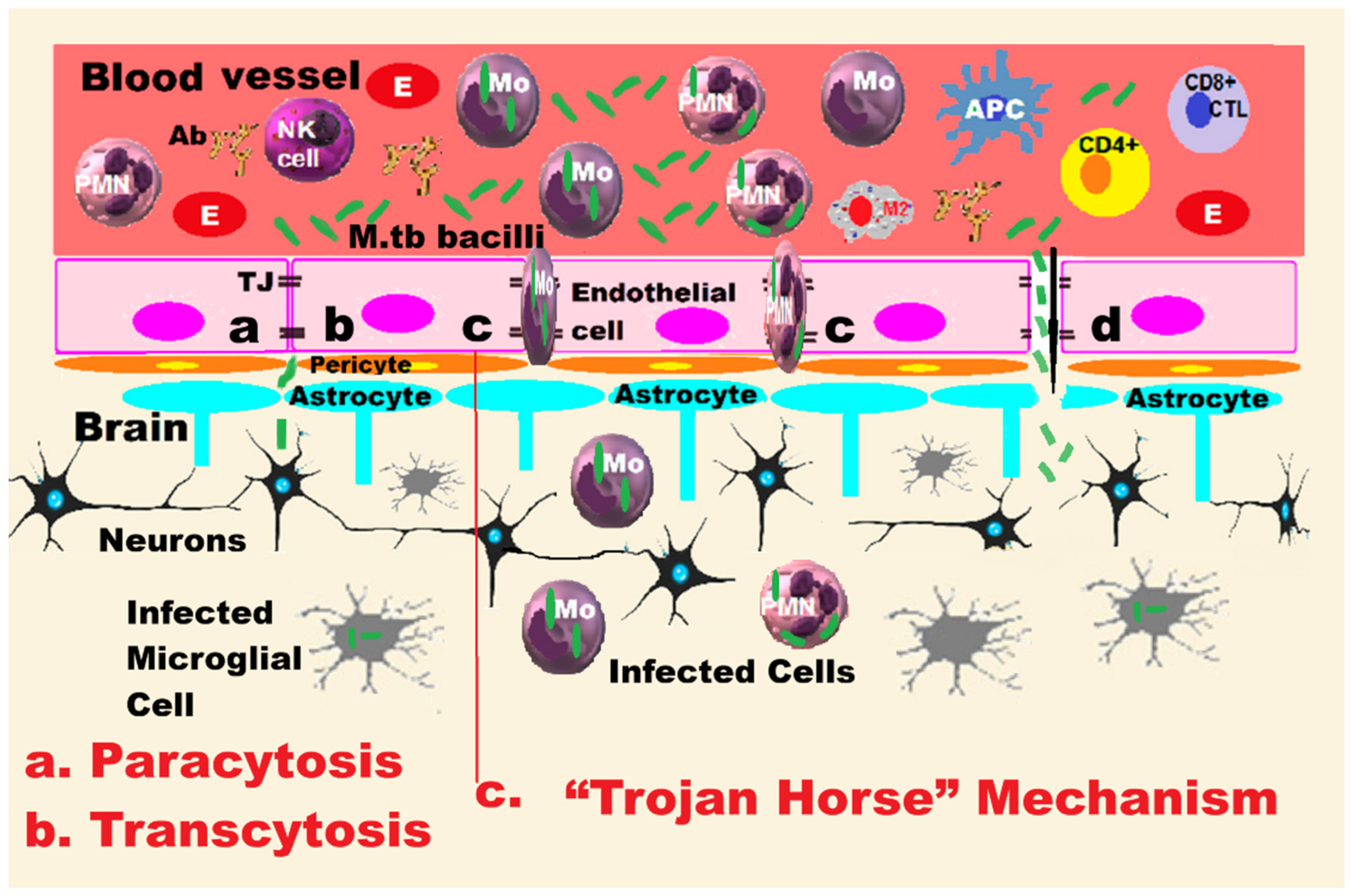
M.tb internalized in CNS-defending monocytes are thought to cross this barrier with the influx of blood to the brain, a mechanism termed the “Trojan horse” mechanism. In contrast to the direct movement of a microorganism through the BBB by transcellular and paracellular microbial transfer, the Trojan horse method is an indirect form of microbial transfer. The BBB is permeable to phagocytic leukocytes, which regularly circulate in the blood to provide immunological surveillance, migrating into and out of tissues. Some microorganisms take advantage of this natural quality and use it to their advantage. Using the Trojan horse method, M.tb transfer occurs simultaneously with the transmigration of an infected phagocyte (e.g., leukocyte). Human immunodeficiency virus 1 (HIV-1), which is a member of the lentivirus family and is frequently associated with M.tb infection, also enters the CNS through the Trojan horse mechanism using C-X-C chemokine receptor type 4 (CXCR-4) and CC chemokine receptor type 5 (CCR5 or CD195). However, microbial transfer can occur through multiple routes to enter the CNS.
In the case of continuous infection, the bacilli damage TJ proteins and trigger vascular endothelial cell death, ultimately further increasing BBB permeability and therefore the chronicity of TBM. The Trojan horse model, experimentally established by macrophages infected with M. bovis, reveals faster disease onset, a higher number of colonies in multiple organs, and critical pathological injuries. New avenues are opened for a deeper understanding of the pathogenesis and study of the chronicity of TBM [11,20,35,36,37].

2.2.2. Hypothesis of Transcellular Mechanisms

Another hypothesis would be that M.tb can enter the brain tissue through a transcellular mechanism, that is, through endocytosis and exocytosis. After entering the lumen of the blood vessel, the bacilli cross endothelial cells and come into direct contact with astrocytes, microglia, and CNS neurons. Transcytosis, a mode of intercellular transfer, is present in a wide variety of cells—endothelial, intestinal, osteoclasts, neurons, etc. Intercellular transfer involving endocytosis and exocytosis of molecules can be achieved by charge-dependent or receptor–ligand-mediated absorptive internalization. Adsorption-mediated transcytosis (AMT) is ensured by the electrostatic interaction between the positive charge on the microbe surface and the anion on the endothelial cell, then transported through the cell and released at the CNS level. Among the positively charged molecules we mention are albumin, cationic lipids, polymers, and various nanoparticles (NPs). Receptor–ligand-mediated transcytosis (RMT) involves a specific attachment between the ligand (microbe) and the receptor (endothelial cell). Receptors that facilitate RMT include the transferrin receptor, the insulin receptor, and the low-density lipoprotein receptor-related proteins 1 and 2 (LRP1 and 2), etc. Another route of BBB crossing would be the paracellular one, i.e., by disrupting and penetrating the tight junctions of endothelial cells [38,39,40,41,42,43,44,45,46].

2.3. Immune System Response After BBB Penetration

After overcoming the BBB, the tubercle bacilli first infect the subarachnoid space and then attack the pia mater, dura mater, and finally the brain. The immune system response to this aggression begins with the activation of macrophages, neutrophils, and dendritic cells (DCs) with the release of numerous cytokines, chemokines, and antimicrobial peptides. Under the action of cytokines and chemokines, the infected dendritic cells move to the local lymph nodes, where they will stimulate the differentiation of T-helper 1 lymphocytes. In turn, T-helper 1 lymphocytes release interferon gamma (IFN-γ) and tumor necrosis factor alpha (TNF-α), which continue the activation of macrophages and DCs with the continued release of cytokines and antimicrobial peptides to extinguish the infection. Following mycobacterial invasion and the inflammatory response, multiple small granulomatous foci or tubercles (Rich foci) will form and may expand, cloazonate, caseate, or break. Tuberculosis bacilli have the ability to survive and replicate in infected macrophages and lymphatic endothelial cells (LECs) surrounding granulomas in lymph nodes. Although M.tb bacilli are detected by their genetic locus, known as region of difference 1 (RD1), and then phagocytosed upon cellular infection, some of them can evade lysosome fusion with the phagosome and will continue to replicate, contributing to lymphatic tuberculosis [47,48,49,50].

2.4. Implications of Genetic Changes in Mycobacterium Tuberculosis

Some strains of M.tb carrying the M.tb Rv0931c (pknD) gene manage to invade and cross all the “barriers” of the CNS compartments and the cerebral endothelial cells in the microvasculature by rearranging the actin in their structure. Recent studies have reported that genetic alterations of MBT can impair the appropriate immune response by releasing cytokines or their abnormal response, especially IFN-γ. The release of proinflammatory cytokines, such as interleukin 1 (IL-1), tumor necrosis factor alpha (TNF-α), interleukin 6 (IL-6), etc., will cause further damage to the physiological integrity of the BBB barrier, thereby intensifying the pathological process. Several genes are known that encode molecules involved in pathogenic mechanisms and interactions of innate and adaptive immune cells of the host; therefore, their mutations and/or polymorphisms can modify the host immune response against M.tb, which allows them to disseminate easily and reach multiple areas, including the meninges [51,52].

2.5. Anatomic-Pathological Changes in the Central Nervous System

Tuberculous meningitis can develop following BBB penetration of M.tb via the hematogenous route during primary pulmonary infection or late reactivation of the disease. M.tbs, once they enter the CNS, infect the subarachnoid space, then the pia mater and dura mater. The immediate inflammatory response is triggered by the activation of macrophages, T lymphocytes, and the release of proinflammatory cytokines, which will generate the appearance of leptomeningeal or cortical granulomas. The granuloma is actually an initial beneficial response to bacterial aggression to locally defend through autophagy the mycobacteria, isolate the infection, and avoid the spread of BKs. These small granulomas are also known as Rich foci, which over time increase in volume and through caseous necrosis can rupture, spreading the infection, which will trigger a strong inflammation in the CNS with the appearance of anatomic-pathological changes such as leptomeningitis, ependymitis (ventriculitis), proliferative basal arachnoiditis, optochiasmatic arachnoiditis, vasculitis (through extracellular growth in smaller blood vessels and infection of endothelial cells), encephalitis, and finally hydrocephalus [39,53,54,55].
As a complete picture of the important hypotheses regarding the pathogenesis of TBM in chronological order, we can summarize the following.
Since ancient Egypt, mankind has tried to decipher TB at the level of the brain, but progress has been very slow. The first descriptions of TBM with clinicopathological correlations date back to the 17th and 18th centuries. After the discovery of its pathogen as M.tb at the end of the 19th century (24 March 1882, Robert Koch), an intensification of treatment attempts was observed [6].
In 1933, the Rich and McCordock hypothesis was issued, considered for several decades the cornerstone of TBM pathogenesis. The initial spread, as a post-pulmonary infection, occurs through the penetration of Mtb into the bloodstream, i.e., the lymphohematogenous route. M.tb infects the brain or meninges, forming small, silent granulomas called “Rich foci.” The disease will progress after the rupture of these foci, releasing bacilli into the subarachnoid space and triggering a strong inflammatory reaction and leptomeningitis [48].
In 2005, Donald et al., starting from Rich’s theory, revealed the close correlation between miliary TB and TBM, making the connection with bacteremia, that is, massive hematogenous spread or miliary TB will determine the multiplication of subcortical foci, resulting in the appearance of TBM immediately after the primary infection [48,49].
The “Trojan horse” hypothesis and molecular hypotheses (2010s–present) are based on the penetration of the BBB by M.tb, which is carried into the CNS by infected peripheral innate immune cells, i.e., macrophages or neutrophils, with the contribution of genetic factors that trigger the host response.
The recently discovered LTA4H genetic polymorphism shows that variants of the LTA4H gene (leukotriene A4 hydrolase) can cause a state of “hyper-” or “hypo-” inflammation, which explains the positive response to corticosteroids or the lack of response in some patients [56].
Very recent studies over the last three years have revealed transcriptional signatures in blood and CSF, correlating mortality with neutrophil-triggered hyperinflammation and reduced T-cell activity, especially in HIV-positive patients [36,48,50,51].

3. Clinical Manifestations of Tuberculous Meningitis

The clinical symptomatology of tuberculous meningitis is usually expressed through three evolutionary stages (Table 1).
  • The initial phase of the disease is called prodromal and encompasses a period of 1–3 weeks from the BK infection, manifesting itself completely nonspecifically in both children and adults through a state similar to a viral disease or similar to that of other forms of chronic meningitis, with subfebrile moments or moderate fever, loss of appetite, a state of apathy, general discomfort, irritability or psychomotor agitation, insomnia, nausea, vomiting, photophobia, and then behavioral changes.
  • The meningitic stage follows, expressed by headache in older children and adults, a persistent symptom that increases and becomes more severe, neck muscle contracture (meningismus), a state of confusion.
  • The final, paralytic, stage is expressed by paresthesia, tremors, chorea, myoclonus, localized paralysis of the cranial nerves, convulsions, hemiparesis, stupor, and coma.
Table 1. Comparative clinical manifestations of tuberculous meningitis in children/adults.
Stages of the Evolving DiseaseChildrenAdults
ProdromalVomiting (morning)
Loss of appetite/difficulty feeding agitation/apathy
Headache (common in older children), behavioral/personality disorders, altered general condition, and fatigue weight loss/underweight
Moderate fever
Vomiting
Loss of appetite
Agitation/apathy
Persistent and progressive headache Behavioral/personality disorders
Night sweats
Nausea
MeningiticPersistent, worsening headache
Neck muscle contracture (rigidity), cranial nerve VI (abducens) palsy, causing diplopia and limited eye movement
Seizures
Focal neurological signs
Increasingly intense to severe headache
Neck muscle contraction (rigidity), sometimes absent
Cranial nerve palsy: III, IV and VI with vision and eye movement disorders
Photophobia
Symptoms of active infection: low-grade fever or fever, chronic cough and weight loss
Paralytic or advancedDisturbance of consciousness: stupor or coma
Motor deficits: hemiparesis or other focal neurological deficits
Opisthotonus (decerebration or decortication attitude)
Hydrocephalus with increased intracranial pressure causing: visual disturbances or blindness; hearing loss; movement disorders
Complications: vasculitis, stroke, hearing loss, psychobehavioral dysfunction
Disturbance of consciousness: stupor or coma
Motor deficits: hemiparesis or other focal neurological deficits
Seizures: generalized or focal
Increased intracranial pressure and hydrocephalus causing severe deterioration of neurological functions
Complications: vasculitis, stroke, deafness, blindness, memory and concentration dysfunction
Symptoms specific to infantsInfants may have an atypical presentation with the absence of neck stiffness (sometimes), bulging of the anterior fontanelle, shrill crying, agitation, irritability, capricious appetite, opisthotonus contracture, regression in neuropsychic development (they may lose acquisitions they have already acquired).
Atypical symptoms in older adultsCommon manifestations: mental status disturbance and severe headache. Uncommon manifestations: vomiting and neck stiffness. Older adults may have more severe signs, rapid clinical deterioration and a high death rate.
In children, the clinical symptoms may have certain particularities related to age and sex. The male sex is more affected, and the clinical manifestations include fever, inappetence, irritability, nausea, vomiting, diarrhea, sensory and movement disorders, neurological deficits and paralysis of the cranial nerves, especially II, III, VI, and VII with downward deviation of the eyeballs, similar to sunset, papillary edema. Infants may present with bulging of the anterior fontanelle as a sign of intracranial hypertension and episodes of hypercontraction of the paravertebral muscles with hyperextension and severe spasticity in which the head, neck and spine are in an arched, bridge-like position, called opisthotonus. In both adults and children, the evolution of clinical symptoms is slow, with manifestations that progress and settle over time, and the inflammatory processes involving the vessels of the brain will lead to local phenomena of cerebral ischemia that result in focal neurological deficits, strokes, seizures, and disturbances of consciousness [57,58,59,60,61].
A comparative analysis of symptoms between TBM and PTB is presented in Table 2, highlighting their distinctive features [61,62].

4. Diagnosis of Tuberculous Meningitis

The diagnosis of tuberculous meningitis represents a major medical problem, precisely because of the multifarious, completely nonspecific clinical manifestations, but also because of the lack of adequate biological parameters and efficient methods of early diagnosis. Numerous attempts have been made to implement clinical prediction prototypes to be used in early and rapid diagnosis, but all have failed. For now, for positive and differential diagnosis, clinical symptoms are taken into account in combination with nonspecific laboratory data, microbiological parameters, molecular tests, and imaging techniques, which are dependent on the financial potential of the health services. It is good to know that delays in diagnosis and treatment are very important risk factors in the evolution of the patient who will have a reduced life expectancy and lower chances of recovery [63,64].
The consensus case definition for tuberculous meningitis and diagnostic criteria (Table 3) was established in Cape Town, South Africa, at a workshop attended by 41 international experts with experience in research or management of tuberculous meningitis. This standardized TBM case definition applies to children and adults regardless of patient age, HIV status, or research resources. According to these criteria, patients can be classified as definite, probable, possible, or not having TBM, depending on a score from 0 to 20. These standardized diagnostic criteria, designed to compare clinical trials, use data from disease history and clinical symptoms along with laboratory parameters and imaging aspects (if available), as presented below [65,66,67].

4.1. Clinical Data and Medical History

Diagnosis of tuberculous meningitis will be based on medical history data demonstrating long-term contact with a patient with tuberculosis in the last 12 months (score: 2) and clinical symptoms lasting more than five days (score: 4), which include night sweats, prolonged cough for more than two weeks, weight loss or developmental delay in infants and young children, focal neurological deficit excluding cranial nerve palsies (score: 1), paralysis (score: 1), and altered state of consciousness (score: 1). Other aspects include a history of contact with a person with active tuberculosis, a history of lung disease, a positive tuberculin skin test (TST), or a positive interferon gamma release assay (IGRA) blood test, which detects infection with M.tb by measuring the release of IFN-γ by the immune system when exposed to tuberculosis-specific proteins (score: 2). The maximum score for this category of criteria must be 6 [65].
Today, there are two types of blood tests on the market (QuantiFERON® and ELISpot®, called IGRA) used in the screening of latent tuberculosis infection (LTBI) that measure the response of the T cells of the person being tested to tuberculosis-specific antigens. QuantiFERON quantifies IFN-γ produced by cells (in IU/mL), and ELISpot (or T-SPOT.TB®) estimates the number of cells producing IFN-γ in “spot-forming units” or colony-forming units (CFUs). IGRA tests are superior to TST (Mantoux test or purified protein derivative—PPD test) because the patient will only have to visit the doctor once and the result is not influenced by a previous BCG vaccination or NTM (non-tuberculous mycobacteria). A positive IGRA test signals that the person either has LTBI or has been in contact with M. tuberculosis, and in this case investigations should be extended with additional examinations. Both TST and IGRA or the fourth-generation QuantiFERON-TB Gold Plus (QFT-Plus) test are recommended for the diagnosis of LTBI in children under five years of age. The performance of QFT-Plus in diagnosing LTBI is similar to that of QuantiFERON-TB Gold In-Tube (QFT-GIT) and T-cell spot of tuberculosis assay (T-SPOT.TB), but slightly more specific than TST [68,69,70,71,72].

4.2. Cerebrospinal Fluid Study

The study of cerebrospinal fluid by spinal puncture may draw our attention to an evacuation with increased pressure (sign of intracranial hypertension in the infant) and a clear color—crystalline rock water (score: 1). The laboratory examination objectifies increased cellularity at 10–500/μL (score: 1), i.e., mononuclear pleocytosis with lymphocytes over 50% (score: 1), proteins in the cerebrospinal fluid over 1 g ‰ (score: 1), a CSF/plasma glucose ratio below 50% (or 0.5) or absolute low glucose level in the CSF < 2.2 mmol/L, which indicates hypoglycorrhachia (score: 1) and a normal or increased chloride level. The maximum score for this group of parameters will be 4 [73,74,75,76].

4.3. Brain Imaging Data

To reach a diagnosis of TMB, imaging investigations are required by radiography (X-ray), computed tomography (CT) and magnetic resonance imaging (MRI), which quantify hydrocephalus (score: 1), basal meningeal uptake (score: 2), presence of tuberculoma (score: 2), cerebral infarction (score: 1), and pre-contrast hyperdensity (score: 2). The maximum score is 6 [77,78,79,80,81].

4.4. Evidence of Tuberculosis Elsewhere

The presence of other signs of tuberculosis outside the CNS can be proven by chest X-ray suggesting signs of active TB (score = 2), appearance of miliary TB (score = 4), CT scan/MRI/ultrasound positive for TB in other body segments (score = 2), identification of acid-fast bacilli or Ziehl–Neilson stain and positive culture from blood, sputum, gastric lavage, urine, lymph node biopsy (score = 4) and nucleic acid amplification testing positive for M. tuberculosis from extraneuronal specimens (score = 4) [82,83,84].

4.5. Molecular Diagnostic Tests for Tuberculous Meningitis

NAATs like polymerase chain reaction (PCR)/multiplex polymerase chain reaction (M-PCR) and nested PCR (a more sensitive and specific version of PCR), which use various genetic targets for the diagnosis of pulmonary TB (PTB) and extrapulmonary TB (EPTB), often give false-negative/positive results due to contamination of samples. Another disadvantage of NAATs is that they cannot identify protein, lipid, or carbohydrate molecules because they do not contain nucleic acid. In such cases, immuno-PCR (I-PCR) test can be used [85,86,87].
Gene-Xpert, a CBNAAT (cartridge-based nucleic acid amplification test), is another rapid diagnostic test for tuberculosis and rifampicin resistance in patients with direct smear-negative results. Molecular tools such as GeneXpert MTB/RIF and other Xpert platform tests (such as Xpert Ultra and Omni), Truenat assays, loop-mediated isothermal amplification (LAMP) or LAMP assays (such as TB-LAMP), as well as platforms from companies such as Abbott and BD Max, which use PCR and isothermal amplification to detect M. tuberculosis and drug resistance, offer faster, more sensitive, and sometimes cheaper alternatives for diagnosing TBM. GeneXpert provides definitive M.tb-positive results in as little as two hours, and the technique can be significantly improved by the additional use of CSF lactate and glucose, allowing for rapid therapeutic decisions. GeneXpert MTB/RIF, together with nanopore sequencing and targeted next-generation sequencing (tNGS), are state-of-the-art techniques that have revolutionized the classic diagnostic methods in TBM by rapidly and highly accurately detecting pathogens. Xpert MTB/RIF Ultra (Ultra) is an improved version of Xpert MTB/RIF (Xpert) with much better results that can be successfully used in countries with a high rate of tuberculosis for the rapid and accurate identification of M.tb in children from CSF. All of this is crucial, as it ensures the chances of early diagnosis and the possibility of guiding treatment, especially for patients with drug-resistant tuberculosis [88,89,90,91,92,93,94,95,96,97].
Nanopore sequencing is one of the third-generation/long-read sequencing methods that allows sequencing of a single deoxyribonucleic acid (DNA) or ribonucleic acid (RNA) molecule in real time without PCR amplification or chemical labeling of the sample. Nanopore-based targeted next-generation sequencing (tNGS) combined with machine learning (ML) in cases of samples with low bacterial load have superior sensitivity and specificity in the study of CSF and the detection of drug-resistance mutations surpass traditional methods such as Xpert Ultra. At the same time, it offers a diagnostic alternative by researching plasma samples, identifying genetic mutations of basic antituberculosis drugs, such as rifampicin and isoniazid. It is anticipated that in the future, tNGS will play a crucial role in the prevention and early control of tuberculosis through a model of personalized treatment against drug-resistant mycobacteria [96,98,99,100].
Based on these criteria, the diagnosis of TBM can be formulated thus: a. definite TBM, when the disease has been diagnosed with acid-fast bacilli (AFB) found in the CSF or CNS through smear, culture, or histopathology; b. probable TBM, which typically requires a higher score (e.g., >12 points with imaging); c. possible TBM, assigned to patients with a lower score (e.g., 6–11 with imaging); and d. negative TBM, a score that does not meet the criteria for a possible diagnosis, can indicate no TBM.
As such, a sure diagnosis of TBM is if there are positive microbiological and/or molecular samples of M. tuberculosis. Probable TBM is if the patient scores 10 points or more (when brain imaging is not available) or 12 points or more (when brain imaging is available) and when other diseases with similar manifestations have been excluded from the differential diagnosis. The diagnosis of possible TBM is assessed by a total score of 6–9 points (when brain imaging is not available) or 6–11 points (when brain imaging is available) and following the exclusion of other entities through the differential diagnosis. Individuals who score < 6 points have no TBM and probably have another disease. In short, the diagnosis of TBM is based on an association between history, clinical examination, laboratory parameters that include CSF analysis obtained by lumbar puncture to identify Koch’s bacillus by culture, microscopy and molecular tests, blood tests (including blood cultures) and brain imaging investigations (CT/MRI). There are several scoring systems formulated for the diagnosis of TBM in adults and adolescents. In addition to the Marais score discussed above, there are another two: a. Lancet Consensus Scoring System (maximum score of 20), which uses 20 parameters in four classes (clinical, CSF, CNS imaging, and evidence of tuberculosis elsewhere); and b. Thwaites Diagnostic Scoring Index, an easy 5-point system that can aid in early diagnosis, but CSF parameters may differ in patients with HIV. TBM scoring is valuable in resource-limited clinics to help diagnose TBM and exclude other infectious CNS entities [13,65,101,102,103,104,105,106,107,108,109].

4.6. Nanotechnologies in Diagnosis of TBM

The diagnosis of TBM remains a major challenge. Even though significant progress has been made with the implementation of Xpert Ultra tests, which have modernized healthcare facilities in establishing an accurate diagnosis in patients suspected of TBM, compared to traditional tests (smear and AAB culture), the clinician still faces inconveniences related to limited accuracy and sensitivity, time consumption, and the high cost of equipment and reagents. With the development of DNA/RNA sequencing technologies and machine learning, diagnosis based on the measurement of a “host response signature” can be performed more quickly and accurately, offering the possibility of personalized treatment decisions in TBM [63,110].
Unlike conventional CSF culture-based tests, GeneXpert MTB/RIF can detect M.tb and rifampicin resistance in up to 2 h, but due to its high cost and strict environmental requirements, this test is difficult to use in remote and poor areas. However, GeneXpert can refine the diagnosis of TBM [111].
Therefore, there is a great need to find rapid, cost-effective, accurate, and sensitive methods for the diagnosis of TB in general and TBM in particular. Nanomedicine, working at the atomic and molecular scale (1–100 nanometers), can generate tools that can be interconnected with cells, proteins and DNA. This branch offers the possibility of creating new diagnostic tools so that NPs and nanorobots interact with the body at the molecular level, allowing early detection of M.tb and improving medical imaging techniques, but also the targeted and precise administration of drugs directly into affected cells and the implementation of new methods of tissue stimulation and regeneration. Nanotechnology diagnostic methods include the following.
  • Nanopore sequencing technologies, such as Oxford Nanopore Technology (ONT), a type of third-generation sequencing technology that uses a barrel-shaped protein called α-hemolysin (which occurs naturally as a “pore” in the cell membrane and allows the passage of a single strand of DNA), which is embedded in an artificial membrane inside the cell being sequenced and measures changes in electrical current, can rapidly detect M.tb resistance genes in nucleic acids, offering high sensitivity and specificity in a short time. ONT has some advantages over other technologies because it can generate ultralong reads (up to several million base pairs), thus facilitating easy sequencing of an entire genome. At the same time, the instrument is very small—from the size of a phone to a microwave oven—which gives it the advantage of being used anywhere desired by attaching it to a laptop [112,113,114].
  • Nanoparticle-based assays are used in diagnostic tests, such as calorimetric assays, to rapidly detect M.tb in cultures, which could lead to faster diagnoses. NPs are valuable in the early stages of tuberculosis infection, when the number of mycobacteria may be low, and in excluding other infectious agents with similar symptoms. The calorimetric assay using mesoporous silica NPs incorporating gold on in vitro cultures of M.tb can be used for the rapid diagnosis of TB, as well as for its treatment. Although the results are promising, there are limitations and issues regarding the stability of the biosensors, biocompatibility, and long-term performance. These diagnostic techniques need to be validated in clinical use to ensure safety, efficacy, and compliance with current regulations. Further research is needed to improve sensor design, nanomaterial fabrication, and interpretation of the generated parameters [110,115,116].
  • Discovery of new biomarkers is possible due to progress in the implementation of nanotechnologies that manage to analyze cellular and molecular changes in the CNS of patients with TBM.
  • Detection of genetic mutations has been developed through a new technique using magnetic nanospheres labeled with streptavidin and biotin [117].
A comparative analysis of the advantages versus disadvantages of TBM diagnostic methods is presented in Table 4 [118,119,120].
Future TBM diagnostic trends focus on AI-powered analysis, advanced molecular tests (like CRISPR, mNGS, digital PCR for faster, more sensitive detection), host-based biomarkers (proteins, metabolites in blood/CSF), and integrating imaging (positron-emission tomography–computed tomography (PET–CT)) with clinical data, aiming for rapid, non-invasive, and highly accurate early diagnosis, especially for drug-resistant forms [118,119,120].
Table 5 compares the novel molecular diagnostic technologies Xpert Ultra, nanopore-targeted sequencing (NTS), and mNGS, which are potentially valuable in differentiating TBM from PTB and other forms of extrapulmonary TB. These can be difficult to apply in resource-limited settings, a major impediment to global TB eradication [88,89,90,91,92,93,94,95,96,97,121,122].

5. Treatment of Tuberculosis Meningitis

TBM is considered a critical neurological emergency defined by a high level of mortality and morbidity that requires immediate medical attention, even before microbiological and molecular tests are positive. In the treatment of TBM, the greatest obstacle is the BBB, which significantly limits the use of antituberculosis drugs at the level of the central nervous system, leading to suboptimal drug doses and ineffective responses to therapy.
For these reasons, the physician must choose an appropriate treatment that includes antibiotics with effective penetration of BBB and at the same time administer host-directed therapy (HDT) as an adjunct to traditional antituberculosis therapy (ATT) that targets the microglial pathway and participates in the regulation of host immune responses [12,123].
Progress towards a better understanding of the host immune response to M.tb is a challenge, and recent developments in proteomics, transcriptomics, and metabolomics have favored the use of these technologies in the development of promising immunomodulatory therapies [36].

5.1. Standard Therapy Protocol for Drug-Sensitive TBM

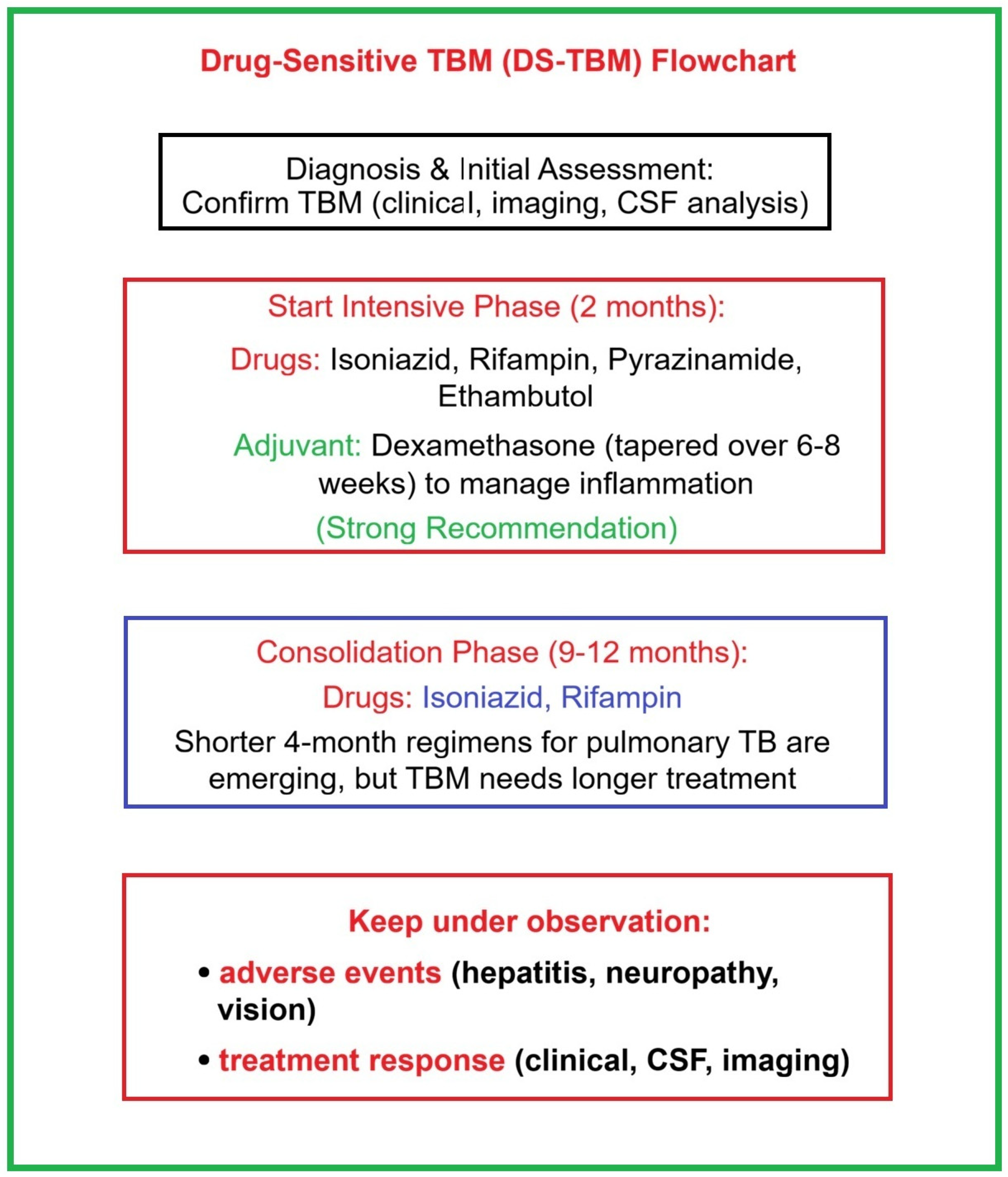
The World Health Organization (WHO) currently recommends a standard protocol for drug-susceptible TBM. This protocol includes an intensive first period with four tuberculostatics—isoniazid (H), rifampicin (R), pyrazinamide (Z), and ethambutol (E)—administered daily for 2 months (2HREZ). This is followed by a continuation phase with isoniazid and rifampicin taken daily for 9–12 months (2HREZ/9–12HR). Although this therapy protocol has been effective in many cases, at present there is still no “best treatment plan” universally applicable and optimal for all patients with TBM. The WHO has also proposed a protocol variant with the approach of a short, intensified regimen based on isoniazid, rifampicin, pyrazinamide, and ethionamide (Eto) administered daily for 6 months (6HRZEto) and with higher doses of isoniazid and rifampicin compared to the 12-month regimen. Ethionamide is an antibiotic considered second-line in the treatment of tuberculosis, but because it has good penetration of the blood–brain barrier, it is being considered. This intensified 6HRZEto regimen has proven successful with lower mortality rates, but the percentage of neurological sequelae in survivors, compared to the standard 12-month protocol, has increased. Children with TBM aged between 0 months and 19 years can be treated with this 2HRZE/10HR regimen or with a short intensive treatment program consisting of isoniazid, rifampicin, pyrazinamide, and ethionamide (6HRZEto) for 6 months. The shorter intensive treatment protocol used in TBM patients should not be administered to children and adolescents who also have HIV infection. Therapy will be guided by the drug susceptibility test (DST). Otherwise, the administration of a drug to which the bacilli are resistant will lead to poor results [12,124,125,126,127,128,129].
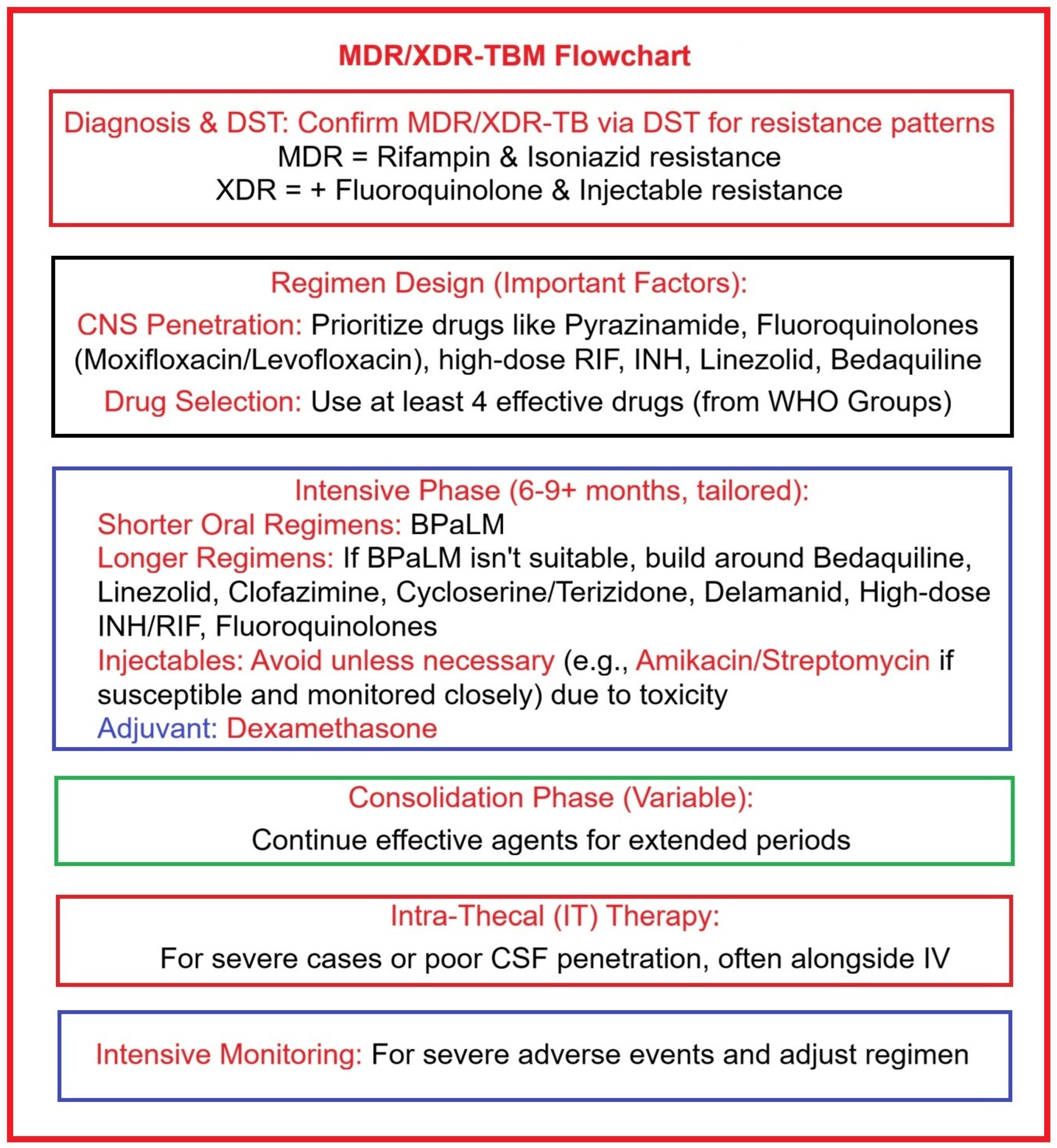
Two treatment flowcharts for drug-sensitive TBM (DS-TBM) and multidrug-resistant TBM are presented in Figure 1 and Figure 2, respectively.

5.2. Treatment Strategies for Drug-Resistant TBM

Detection of antimicrobial resistance (where possible) can be achieved from a positive culture or by at least rifampicin-specific tests such as Xpert MTB/RIF and Xpert MTB/RIF Ultra. Multidrug-resistant and extensively drug-resistant M.tb infections are increasingly common in countries with a high TB burden and require long-term treatment with antituberculosis drugs. WHO guidelines for the treatment of TBM in the presence of MDR/RR-TB recommend the use of drugs with high BBB permeability from the BPaLM regimen (bedaquiline (B), pretomanid (Pa), linezolid (L), moxifloxacin (M)) and other updates such as a 9-month all-oral regimen as an alternative to longer regimens. Key agents with good CNS penetration in particular include levofloxacin, moxifloxacin, and linezolid [64,130,131,132,133,134,135,136].
Linezolid is a synthetic antibiotic from the oxazolidinone group that increases the success rates of TBM therapy by rapidly improving some clinical and biological parameters in the CSF within the first 4 weeks of treatment, but must be used with caution for long periods because it interacts with antidepressant drugs like selective serotonin reuptake inhibitors (SSRIs) and monoamine oxidase inhibitors and predisposes to optic neuropathy. Its toxicity is dose- and exposure-dependent and may be more intense in patients with HIV co-infection due to peripheral neuropathy and preexisting anemia [137,138,139,140,141]. Cycloserine and ethionamide are used successfully to replace ethambutol, but they can have gastrointestinal adverse effects, also associated with neurotoxicity [142,143].
Several recent ongoing clinical trials suggest that high-dose rifampicin (13 mg/kg intravenously and 20 mg/kg to 35 mg/kg orally) administered in combination with other antituberculosis drugs and immunomodulatory agents targeting the host response may be valuable in improving the response to therapy and prognosis of TBM [144,145,146].
Other treatment strategies using second-line antituberculosis drugs, such as bedaquiline and linezolid, are more effective for drug-resistant TBM, especially when combined with fluoroquinolones and other agents with good BBB penetration [147].
The penetration of antituberculosis drugs into the CNS is presented in Table 6 [8,12,17,60,124,125,126,127,128,129,148].
Despite progress, there are still delays in diagnosis, treatment resistance, and high rates of neurological sequelae, highlighting the need for further research. Preventive strategies focused on early diagnosis, risk factor management, and public health interventions are essential to reduce the global burden of TBM [11].

5.3. Host-Directed Therapy

The effects of therapy for TB are correlated with the emergence of antituberculosis drug resistance, long treatment periods, and numerous adverse effects. A treatment modality accepted with optimism refers to HDT. This therapy, administered synergistically with existing approved drugs, can increase the value of existing anti-TB drugs and reduce drug resistance, treatment duration, and the degree of unwanted effects. With the potential capacity to adjust the host immune response, HDT improves immunopathological damage and boosts autophagy phenomena, the level of antimicrobial peptides, and other mechanisms, thus improving the final effects. Based on recent years’ findings, it is recommended that in addition to antituberculosis agents, HDT should be associated with strong immunomodulatory adjuvants (macrolides, vitamin D3, phenylbutyrate, bacterial ghosts, gingerol, allicin, etanercept, etc.) and anti-inflammatory drugs such as aspirin and corticosteroids. The role of aspirin as an adjunct in TBM is still debated, requiring more randomized, placebo-controlled trials to establish clear guidelines for administration and optimal dosage. There is evidence that it reduces new strokes and inflammation, with no conclusive effects on mortality. Steroids administered orally, especially in non-HIV-infected patients, for 6 to 8 weeks or short periods of time intravenously or intrathecally (e.g., dexamethasone) can manage inflammation and reduce mortality rates, severe disability, and relapses [149,150,151,152,153,154].

5.4. Nanotechnologies in Treatment and Prevention of TBM

Currently, only quinolones and rifampicin have demonstrated significant effects in the treatment of TB. The latest antituberculosis drugs under development have disadvantages related to high cost, lack of extensive clinical trials, toxicity, and inability to target MDR and latent bacilli. The integration of nanotechnology in the diagnosis, treatment, and prevention of TB currently holds promise to improve immunization against tuberculosis. Drug delivery systems created with nanocarriers and biomaterials have proven their ability to overcome physicochemical impediments and improved the bioavailability and solubility of drugs, as demonstrated in animal models infected with TB. The need for new drugs with improved efficacy, reduced toxicity, and targeted delivery has increased dramatically to reduce dosage, side effects, and improve treatment, as well as for rapid patient recovery [155,156,157,158,159].
  • Improved drug delivery can be achieved through NPs that are capable of encapsulating antituberculosis drugs to enhance their stability, solubility, and ability to cross the BBB to reach the desired target and work without causing adverse reactions. Nanotechnology-based NPs are very easily modifiable and specific in their characteristics and structure, which guarantees their use for managing drugs in a particular way. Nanocarriers that are currently in a research-and-clinical-trial process for use in TB therapy include silica nanoparticles, chitosan, micelles, dendrimers, liposomes, metallic nanoparticles (AuNPs, AgNPs, magnetic nanoparticles—iron, nickel, cobalt and oxides, quantum dots, carbon-based nanomaterials—fullerene, carbon nanotubes, nanodiamonds, and graphene), and fluorescent nanodiamonds. New drug delivery technologies are focused on optimizing drug delivery to the brain while minimizing damage to non-targeted tissues. These include focused ultrasound-mediated BBB opening and microbubble technology that can temporarily and locally open the BBB, facilitating drug penetration. Magnetic targeting offers excellent potential because it uses magnetic NPs to direct drugs to specific areas. Receptor-mediated delivery, polymeric nanoparticle systems, gene therapy that can repair or replace diseased genes, cell-penetrating peptides, exosomes, stem cells, and smart nanoparticle systems are used for BBB penetration, slow release, and drug stability [118,160,161,162,163,164].
  • Reduced toxicity and side effects can be limited by drug-loaded nanoparticles that are guided and delivered to the site of infection.
  • With NPs designed to overcome the emergence of drug resistance through high loading concentration and delivery directly to the site of infection, nanoengineered solutions are revolutionizing the fight against extensively drug-resistant tuberculosis (XDR-TB), a major public health challenge. Nanoengineering allows the simultaneous administration of multiple drugs through a single NP, a high-tech solution to the multidrug regimen required for XDR-TB [165].
  • Improving patient compliance through the development of intelligent drug delivery systems can allow for less frequent dosing and address the problems associated with poor patient compliance.
Unlike effective strategies in countries with abundant financial resources, the real problems in resource-limited contexts are related to late diagnosis, delays in initiating anti-TB therapy, treatment discontinuation due to unavailability of drugs, high costs, inability to seek medical care, uncontrolled spread of M.tb, emergence of drug resistance, poor nutrition, unsanitary and crowded housing, lack of community support, poor education, religious beliefs, and many others.
  • Theranostic agents or “theranostics” are manufactured for simultaneous diagnostic and therapeutic action by combining imaging capabilities (such as MRI or PET scans) with the role of drug delivery. Simultaneous incorporation of diagnostic agents into NPs could implement a theranostic approach for simultaneous real-time monitoring of therapy and TBM progression. Although nanocarrier-based systems have proven high drug-loading capacities, high fixity, good tolerability of pharmaceutical products, decreased multidrug resistance, controlled release, and targeted administration with greater efficiency compared to conventional treatments, numerous studies are still needed, since currently physical and biological factors (pH, phagocytosis, various proteins, enzymes, renal clearance, etc.) are hostile factors for nanocarriers [166].
  • Vaccine development can be achieved with the help of NPs used to generate new vaccine formulations to prevent TB infection. To better understand and improve knowledge about the immunology and pathogenesis of TBM, complementary studies on immune cell categories, specificity and reactions in CSF and peripheral blood of patients are needed. These data may provide information about new potential therapeutic targets for vaccines and the host. BCG (bacillus Calmette–Guérin) is a live-attenuated vaccine made from a weakened strain of Mycobacterium bovis, usually administered as a single injection typically under the skin of the upper arm during the neonatal period, that has proven its effectiveness against severe forms of BK infection and dissemination in the CNS in children, being the only vaccine with this capacity. However, BCG has low efficiency in preventing cavernous TB in adults, which justifies the need to expand research to discover a new effective vaccine against pulmonary TB. BCG vaccine has highly variable efficacy (0–80%) in different clinical trials conducted in adults due to the complexity of M.tb pathogenesis in the lungs and the interactions of the M.tb with the environment, which the vaccine is not optimized to combat. For an in-depth explanation, in tropical and subtropical regions, where there is a strong interference of M.tb with the environment, preexisting immunity induced by these common microorganisms may produce a cross-reaction, leading to altered, i.e., harmful, T-cell responses in the form of Treg cells, which will restrict the effective control of M.tb by the immune system later in life [167].
Although there are currently more than 22 antituberculosis vaccines undergoing clinical evaluation worldwide, there are several controversies that have slowed the production and marketing of a new effective vaccine against TB. There are still many gaps in the understanding of the immune mechanisms that confer protection against M.tb, for example, characterizing both the innate and the adaptive immune responses in BCG-vaccinated individuals, defining criteria for assessing efficacy, and ensuring safety in HIV-infected individuals.
One of the most valuable vaccines in advanced clinical trials is the M72/AS01E (M72) vaccine. Its potential impact as a vaccine against M.tb in patients aged 15 years could prevent approximately a quarter of a million deaths by 2040. The potential benefits could also be financial, totaling over USD474 billion by the middle of this century from vaccinating young people and adults. M72 is the most valuable, with a very complex structure, designed not only for M.tb, but also against malaria, adult respiratory syncytial virus, and zona zoster. A possible launch could be in the next 5 years, as it is in a phase III clinical trial on 20,000 participants enrolled in March 2024 from 54 locations in South Africa, Kenya, Malawi, Zambia, and Indonesia [13,167,168,169,170].
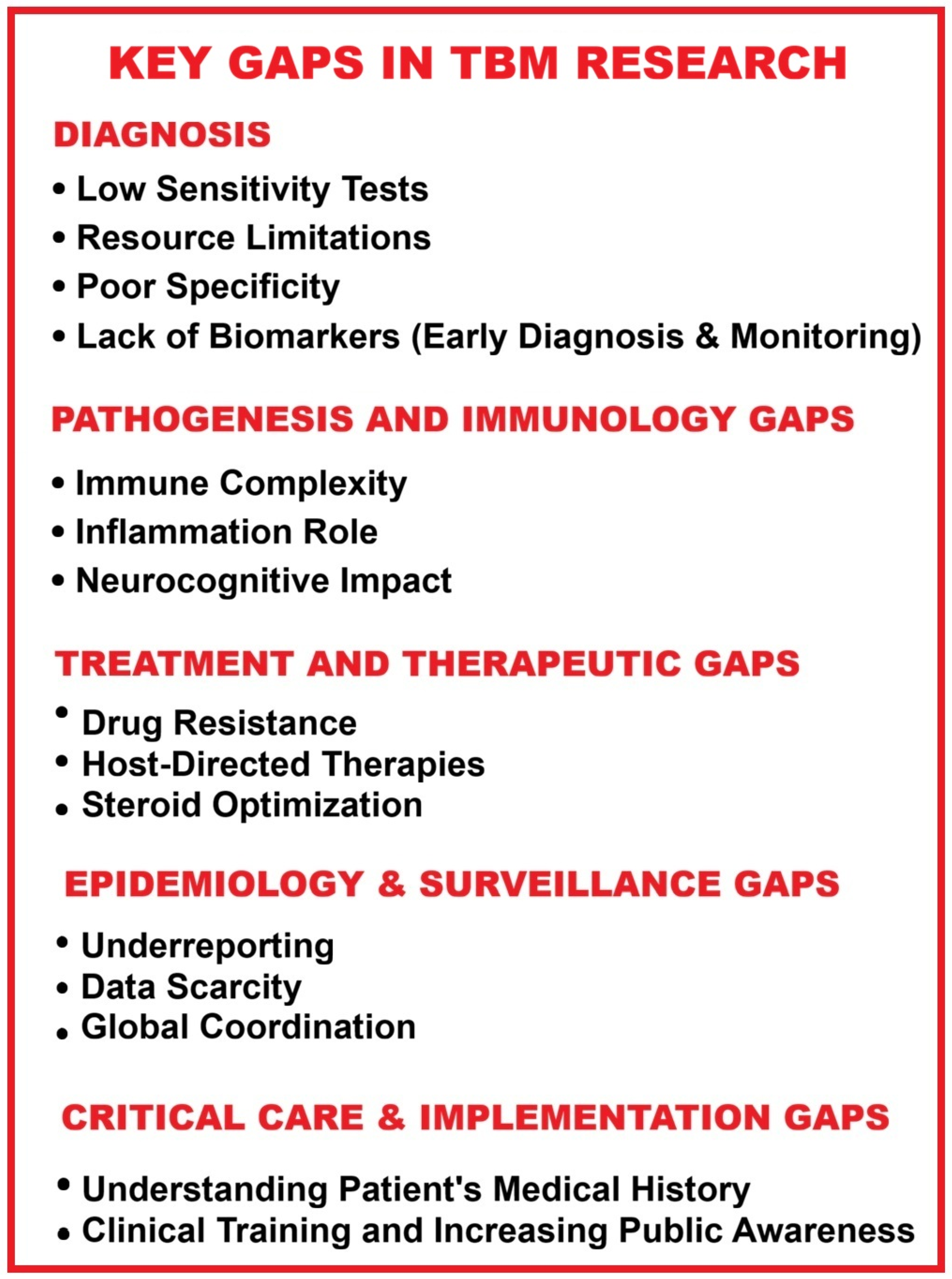
Currently, there are many limitations and gaps, e.g., underdiagnosis (poor epidemiology), lack of rapid and accurate diagnosis (late detection of M.tb), in-depth understanding of pathogenesis, i.e., how TB attacks the brain, optimization of treatments, prevention measures and long-term care of TBM patients. These issues, which scientific research needs to address as soon as possible, are summarized in Figure 3. Research needs better coordination and tools to address these gaps, including care and monitoring from symptoms to cure [8,13,171,172].

6. State-of-the-Art Clinical and Experimental Studies in TBM

6.1. Clinical Studies Applied in TBM

A series of recently published clinical studies on TBM are described and presented below in Table 7. Spatola et al. (2024) [173] comprehensively studied antibodies as biomarkers of disease progression, but also as molecules capable of destroying or inhibiting the growth of M.tb, i.e., as responses divided into different categories (across the blood and brain compartments) in the case of 10 different M.tb antigens, including lipoarabinomannan (LAM) and purified protein derivative (PPD), in HIV-negative adults with pulmonary TB (n = 10) in contrast to TBM (n = 60), focusing on T cells involved in the control of M.tb. The authors highlighted the structure of antibodies in the blood compartments but also in the case of cerebral infection or TBM, i.e., responses across the blood–brain barrier (BBB), highlighting different humoral immune reactions in TBM comparatively with pulmonary TB. The authors investigated the isotypes of IgG, IgM, IgA and subclasses IgG1–4, as well as the ability of M.tb-specific antibodies to bind to Fc receptors or C1q and activate innate immunity, i.e., the complement, natural killer cells, or monocytes and neutrophils to eliminate M.tb. Researchers have deployed machine learning methods to classify serum and CSF reactions in TBM, name prognostic factors related to the severity of infection, and determine crucial antibody characteristics that differentiate TBM from TB in the lungs. The authors concluded that M.tb-specific antibody signatures are detectable in the CSF of TBM patients, with distinct profiles from those in serum differentiating between TBM and lung disease. The typical profiles detected may be associated with disease severity or mortality in TBM. Antibody marks or signatures could be valuable diagnostic biomarkers for TBM, unlike other non-infectious brain diseases [173].
Only optimal drug concentrations at sites of infection can make treatment more efficient, and dosing based only on plasma concentrations without integrating the specific pharmacokinetics of the infected compartment will generate resistant bacteria and lead to lack of success instead of cure.
Chen et al. (2024) carried out first-in-human 18F-pretomanid positron-emission tomography (PET)/CT in eight persons (six healthy volunteers and two newly diagnosed TB patients) to examine its biodistribution in several compartments. The analysis provided superior antibiotic-specific partitioning into brain versus lungs. Compartmentalized antibiotic exposures of four antibiotics active against multidrug-resistant M.tb strains were achieved by means of scientific experiments in infected mice and rabbits, using dynamic PET with similar antibiotic radioanalogs (18F-pretomanid, 18F-sutezolid, 18F-linezolid, and 76Br-bedaquiline—all chemically alike to the parent antibiotic) and via after-death mass spectrometry assessment. The researchers advanced pharmacokinetic representations for pretomanid, sutezolid, linezolid, and bedaquiline that accurately forecast human PET and published pharmacokinetic statistics. Monte Carlo simulations (n = 1000 subjects for each drug) were applied to predict human tissue exposures (brain and lungs) at different oral doses. Finally, the authors presented the best use of pretomanid-based multidrug treatment for TBM. This valuable study, published in 2024 in Nature Communications, in humans, rabbits, and mice indicated the possibility of developing novel pretomanid-based regimens tested at equipotent human doses in a model of TBM with potential for MDR-TBM, consisting primarily of antibiotics already approved by the FDA for human use and currently being evaluated in clinical trials [174].
The inflammatory response to M.tb infection and the pathophysiological processes that underpin it are still not satisfactorily understood. Hai, H.T. et al. (2024) have conducted important research on the transcriptional scenery of TBM, highlighting possible remarkable molecular disparities generated by HIV co-infection. The team imagined a mortality prediction model through the intersection of a gene expression signature with clinical parameters. In the study were included 281 adults with TBM, 295 patients with pulmonary tuberculosis (PTB), and 30 healthy controls, for whole-blood RNA sequencing. The researchers examined the genes and the pathways associated with disease development, severity, and mortality from TBM. Bioinformatic modeling was limited and should have provided a deeper insight into all factitive factors, but especially their correlation with TBM immunopathogenesis. Although the results are important, they need to be validated in the near future [175].
Yu, S. et al. (2024) included 1612 recently hospitalized patients diagnosed with PTB in a retrospective cross-sectional study to highlight elements that trigger the evolution and progression of the infectiousness of this disease by analyzing and comparing the clinical features of patients positive for smear tests with M.tb compared to those negative for this test, but positive for Gene Xpert also from sputum. Group I (sputum smear positive) compared to group II (GeneXpert positive) showed that senior patients (aged between 75 and 89 years) and below normal weight (BMI < 18.5 kg/m2) had more frequent clinical manifestations such as dyspnea, cough and sputum expectoration, hemoptysis and weight loss, with progression to extrapulmonary tuberculosis such as tuberculous peritonitis, TBM, or tuberculous pleurisy. These attributes indicated that they were carrying a larger number of M.tb that they could eliminate. They were thus highly infectious and needing to be urgently identified and rapidly isolated, interrupting dissemination routes, and then immediate early pragmatic therapeutic measures taken to slow the progression of the disease and stop a possible severe fulminant condition [176].
Miliary (or disseminated) tuberculosis is a severe and rare form of TB that occurs when bacteria spread through the bloodstream and create numerous small, millet-like lesions in various organs such as the lungs, liver, spleen, and less commonly the brain and kidneys. This form is due to a more advanced infection, which is more common in people with weakened immune systems. Key characteristics are M.tb entering the bloodstream and spreading throughout the body, causing multiple small lesions (less than 3 mm) called tubercles (similar to “millet grains,” hence the name). The location is commonly the lungs, liver, and spleen, but can also be other organs, including the brain and kidneys. The main cause is compromised immunity in some patients, especially those with HIV/AIDS or diabetes. It is a serious and rapidly progressive form that requires urgent medical treatment to prevent death.
TBM is one of the most serious complications of miliary tuberculosis (MT), with a high mortality rate in over half of cases, which could be reduced by early screening and on-the-spot initiation of treatment for TBM. The lack of clinical methods for predicting the progression of MT to TBM led Tian, Y. et al. (2024) to develop an early investigation or screening approach of MT-MTB, starting from case-based learning with multiple windows and feature granularities (MWFG), i.e., by analyzing chest CT (computed tomography) images of MT patients. Extended attributes were extracted from a set of CT images of each MT case. The software used has an adaptive regularization, being trained on cooperation of a support set and query set to avoid overfitting. The researchers analyzed chest CT data and images from 40 patients diagnosed with MT from their medical records and created an original, cutting-edge representation or prototype for early screening of MT-TBM that overcomes the existing gap in computer-assisted prediction of TBM, with positive clinical implications for physicians who should immediately prevent MT-TBM and administer early treatment for TBM in patients with MT [177].
Samuel, V. et al. (2024) investigated in a retrospective study conducted on 46 children (aged 12 years or less), the metabolic markers associated with M.tb in cerebrospinal fluid (CSF) from a cohort of pediatric patients. The children were divided as follows: group 1 (with bacteriologically proven TBM; n = 21) were clinically examined by a team of pediatric neurologists, and CSF samples were obtained by lumbar puncture; group 2, without meningitis (n = 25), was the control group. M.tb-linked metabolites in the CSF of both groups were measured by targeted proton magnetic resonance spectroscopy (1H-NMR) and two-dimensional gas chromatography–time-of-flight mass spectrometry (GCxGC–TOFMS). Four metabolites were identified as statistically significant in differentiating TBM patients from controls: nonanoic acid and propanoic acid, found at higher concentrations in group 1 (TBM), while mannose and arabinose were found at lower concentrations in the same group. The authors concluded that nonanoic acid should be considered a valuable M.tb-related marker in the CSF of TBM cases, perhaps as a degradation product of the M.tb cell wall), while propanoic acid could be linked to disrupted neuroenergetic processes and brain inflammation in cases of TBM and is likely a host-response metabolite. Mannose and arabinose are not reliable markers for M.tb. The team concluded that more testing should analyze fatty acids in the CSF of TBM cases in the near future [178].
Although it affects only 1% of the millions of new active tuberculosis cases diagnosed annually due to its unexpected onset, indefinite symptoms, and especially insufficient laboratory available testing methods, TBM is very difficult to diagnose and endangers the patient’s life itself. Yang, C. et al. (2024) studied 122 patients suspected of intracranial TB (41 with TBM, 27 with TB brain parenchyma, 32 with mixed cerebral TB, and 22 patients with other brain diseases) and investigated the detection efficiency of nanopore-targeted sequencing (NTS), a prominent third-generation sequencing technique, comparatively with MTB culture, Xpert MTB/RIF test, polymerase chain reaction (PCR) and acid-fast bacillus (AFB) smear in CSF samples. By mathematical modeling, the risk parameters and key clinical markers were highlighted. Using the chi-squared test, the diagnostic accuracy of the five applied methods for a variety of intracranial TB images was assessed. NTS demonstrated a sensitivity of 60.0% and a specificity of 95.5%, with an overall performance significantly better than other detection methods. NTS presents effectiveness and fast response and could constitute a future and valid solution for delivering reliable diagnostics in cases of intracranial TB, but also for screening at-risk communities [179].
A recently developed molecular diagnostic test, Truenat, has been used for scientific studies on its accuracy and utility by Nanda et al. (2024) in CSF probes. This method has multiple benefits over classical methods and suggests a necessary course of action within a few hours, being valuable for the rapid detection of M.tb and the initiation of treatment. Taking urgent measures based on a correct diagnosis will influence the positive outcome of patients. Researchers conducted a cross-sectional study of 150 patients divided into four groups: definite, probable, possible, and non-TBM. The collected CSF samples were studied comparatively by two tests—the cartridge-based nucleic acid amplification test (CBNAAT) and Truenat (Molbio Diagnostics Private Limited, Verna, Goa, India)—simultaneously with brain imaging investigations. Positive cases on the Truenat test were considered definitive, and its efficacy and clinical utility for TBM were compared with CBNAAT. Truenat exhibited powerful diagnosis efficacy compared with CBNAAT. The conclusion was that Truenat may refine diagnostic precision and could direct cost-effective management for TBM compared with CBNAAT. Being a molecular test, which cannot identify the bacilli by itself, a whole analysis of specific clinical, microbiological, and radiological features is indispensable for the early recognition of TBM [180].
Liu et al. (2024) studied a cohort of patients with CNS infection between 2018 and 2020. Taking into consideration clinical signs, laboratory tests, and imaging analyses, 514 patients were diagnosed with CNS infection and included in the study. Demographic data, CSF analysis, epidemiological data, and clinical courses of the 514 CNS infection patients were analyzed. Researchers picked out patients with TBM and compared the sensitivities of metagenomic next-generation sequencing (mNGS), GeneXpert, and microbial cultures. They compared these methods in terms of reliability using kappa statistics. The most common CNS infections in the studied cohort were TBM (29%) and neurosyphilis (25%). CSF analysis revealed that 76% of the patients had leukocytosis, suggesting a possible inflammatory state of the CNS. In the group diagnosed with TBM, 92.5% had increased protein and leukocyte counts in the CSF, and 55.6% of these patients had positive mNGS results. GeneXpert and MTB culture applied separately had decreased sensitivity, but when used in combination, a positive rate of 53.4% was achieved. This research draws attention to the high sensitivity of mNGS, comparable to GeneXpert and MTB culture. Combining the two methods is cost-effective and simple, and could partially replace mNGS, highlighting important options for diagnosing TBM and supplying knowledge on manifold diagnostic master plans in clinical practice [181].
Worldwide, up to 5% of patients diagnosed with TB will develop TBM, especially in communities with elevated HIV prevalence due to drastic immunosuppression and restricted funds. Long-term sequelae of infection are frequent and TBM mortality is unacceptably high, with almost half of patients dying. This percentage has not lessened in the last 20 years. Modern methods such as GeneXpert are useful in diagnosing TBM, but making use of these remains limited. In some underserved areas, prior to the introduction of GeneXpert, testing for TB was available only by M.tb culture, and data on the routine use of the Xpert MTB/RIF assay (the rapid diagnostic test for TB that simultaneously detects the bacteria M.tb and resistance to the drug rifampicin (RIF)) in these resource-limited environments were rare. This Xpert MTB/RIF automated molecular test can provide results in about two hours, helping to quickly diagnose TB disease and guide treatment for drug-resistant strains. Milburn et al. (2024) investigated electronic records for CSF patients tested during 2016–2022 in Botswana to identify the number of M.tb-positive cases following the expansion of Xpert MTB/RIF capacity. Regardless of positive trends in increasing testing for TBM in patients with suspected CNS infections, testing rates remained low in the studied areas, even though the Xpert MTB/RIF assay is promising. The research illustrates that the introduction of decentralized rapid molecular testing for TBM has increased the rate of TB-specific testing and microbiologically confirmed TBM cases [182].
Canas et al. (2024) investigated clinical and brain MRI features in 216 mature patients diagnosed with TBM (34% of whom were HIV-positive, a factor consistent with the mortality rate) in a prospective longitudinal study with the aim of more accurately predicting the evolution of the disease, but also the situations of its worsening. The researchers created a state-of-the-art machine learning model for automatic coding of clinical and MRI data, in which they also implemented time-series approaches, especially to predict by analysis the TBM progression. The approach was powerfully built through optimization techniques to be strong enough when data are missing. The model achieved a well-proportioned precision of 60% in predicting the prognosis of TBM patients’ outcomes over six distinct categories. The factor HIV did not modify the results through modeling. The research identified structural pathological changes within the brain triggered by TBM in both HIV-infected and HIV-uninfected patients and connected brain lesions to disease phases with an overall accuracy of 96%. It demonstrated high potential to anticipate severe forms of TBM, facilitating timely clinical action [183].
Last year, the WHO reported about 10.8 million new cases of tuberculosis, of which 16% were extrapulmonary TB (epTB), which is a challenge in some countries like India, where 15–24% of tuberculosis cases are epTB, a percentage that increases to over 50% in patients co-infected with HIV. VidyaRaj et al. (2025) included 4526 patients from South India suspected of epTB (i.e., lymphatic, pleural, meningeal tuberculosis or TBM, genitourinary, gastrointestinal, bone and joint tuberculosis, peritoneal, skin, and breast tuberculosis) in a retrospective study. All forms of epTB require distinct diagnostic procedures based on clinical and microbiological evidence, as well as therapeutic approaches tailored to the affected area. Patients included in this study were hospitalized during the period 1 January 2026–31 December 2019 and met the following criteria for the diagnosis of epTB and rifampicin-resistant epTB. The GeneXpert MTB/RIF assay was applied for non-respiratory samples, such as aspirates from lymph nodes, CSF, and pleural liquid. The diagnostic performance of Xpert was evaluated. Children aged 0 to 18 years and patients with an impaired immune system, including those with HIV, were included in the study. Of the total, 16.5% were positive for M.tb and diagnosed with epTB, of whom 4.83% had rifampicin-resistant epTB. Among patients with epTB, over 91% had positive outcomes due to treatment (which exceeds the 90% target recommended by the WHO) compared with only 83.3% of those with rifampicin-resistant epTB. A broad majority had tuberculous lymphadenitis (n = 348, 38.79%). Patients who consumed alcohol or tobacco generally had poor therapy results. TBM and tissue samples were all notably linked to unfavorable treatment outcomes [184].
Especially in patients previously infected with HIV or people living with HIV (PLWH), TBM is a serious CNS infection caused by M.tb, with important consequences in terms of morbidity and mortality. Urmenyi et al. (2025) conducted a retrospective study of 1819 adult patients hospitalized with TBM according to a database of notifiable diseases in Brazil. In sum, 5084 patients were registered with TBM in the SINAN-meningitis database between 2007 and 2021, but only 1819 patients met the inclusion criteria for the study. The prevalence of HIV co-infection was 56.8% (n = 1034). The researchers investigated the clinical and laboratory characteristics related to HIV and clinical outcomes for patients aged > 18 years with a known HIV diagnosis (from which they excluded pregnant patients) to highlight factors associated with mortality during hospitalization. The relationship with in-hospital mortality was estimated by reverse stepwise binomial logistic regression analysis. Compared with HIV-negative patients, PLWH were slightly younger, and both groups (HIV− and HIV+) included mostly men (63.9% and 67.9%), with no significant differences between lots. Although the study showed that TBM is more common among HIV patients, the symptoms presented were different from those usual in these cases and the deaths recorded in the hospital were fewer [185].
Winichakoon et al. (2025) investigated the diagnostic accuracy of the Xpert MTB/RIF test to detect TBM in patients with subacute lymphocytic meningitis hospitalized at a university hospital in Thailand (January 2015–March 2016). Initially, a total of 72 patients were included, but only 65 patients remained after excluding 7 patients who no longer met the study criteria. The investigation collected data from the patients at a single point in time (cross-sectional) and consisted of analysis of 65 CSF samples. For calibration, a test tube for the culture was the reference standard, i.e., the mycobacterial growth indicator tube (MGIT). The sensitivity, specificity, and consistency between Xpert MTB/RIF and MGIT were assessed. The diagnostic performance of the Xpert MTB/RIF assay was analyzed, and a TBM score ≥ 6 compared to MGIT culture in cases of culture-confirmed TBM proved to be a cutoff value (threshold) for establishing the diagnosis of possible TBM. This critical value of a TBM score of 6 (a cutoff point due to its 100% sensitivity) facilitates the practical implementation in the case of sequential testing when combined with the Xpert MTB/RIF assay. Diagnostic performance according to HIV status was also evaluated, as out of the total patients, 17 were infected with HIV. The Xpert MTB/RIF test has been shown to have high sensitivity and specificity for detecting M.tb in CSF samples, and by integrating it with the TBM score, it paves the way for new diagnostic achievements and the initiation of therapy without delay in patients with TBM [186].
Jian, Y. et al. (2025) investigated the consequences of prescribing different doses of isoniazid (INH) in the context of NAT2 gene polymorphisms on the prognosis in patients diagnosed with TBM. The metabolic rate of INH depends on the activity of N-acetyltransferase 2 (NAT2), a key enzyme in the metabolism of various drugs and expressed in the epithelium of several organs, especially in the intestinal epithelium. Polymorphisms identified for the NAT2 gene essentially influence the expression, stability and catalytic activity of this enzyme and allow the classification of patients as fast acetylators (FA), intermediate acetylators (IA) or slow acetylators (SA), so the plasma concentration of the administered drug will differ greatly in patients depending on acetylation phenotypes for similar doses of INH. For this reason, the research team retrospectively included 119 patients hospitalized with TBM (July 2020–December 2022), whose clinical data were taken from medical records and who were classified as follows: group I (32 patients, treated with a standard dose of INH of 300 mg/day) and group II (87 patients, with double dose of INH, i.e., 600 mg/day), for which NAT2 genotypes were also identified. DNA from peripheral blood from TBM patients was extracted and processed. Key study data also included clinical symptoms and treatments after discharge, prognosis, and survival status over a follow-up period ranging from 1 to 12 months. All patients completed the study protocol. On multivariate logistic regression, the essential prognostic factors for TBM were identified as age, INH dose, headache symptoms, and cranial nerve palsy. Disability and mortality differed significantly between the two groups. The second group treated with high-dose INH had better effects and better patient outcomes, meaning less disability or mortality compared to the standard-dose group [187].
Hueda-Zavaleta et al. (2025) conducted a study in a private clinical laboratory and analyzed 450 CSF samples recorded and processed in the database (1 January 2011–31 December 2022) from patients with clinically suspected meningitis. The samples were scrutinized by cytochemical and biochemical analysis, smear microscopy, Xpert® MTB/RIF or Xpert MTB/RIF Ultra, and cultures (for ordinary bacteria, fungi, or M.tb). The researchers concluded that cytochemical analysis of CSF is an important indicator in the differential diagnosis of TBM from other etiologies by shedding light on trends in the evolution of the disease [188].
High-throughput and high-speed tests for diagnosing TBM in children are still insufficient. Rahman et al. (2025) comparatively investigated the results of Xpert MTB/RIF Ultra (Ultra), a new and improved variant of Xpert MTB/RIF (Xpert), for identifying TBM in children by analyzing CSF samples. In sum, 187 patients (aged 0–14 years) with signs and symptoms of meningitis (such as migraine, irascibility, vomiting, pyrexia, neck rigidity, seizures, focal neurological deficit, altered consciousness, or lack of energy, and so on), but with TBM still unconfirmed were included in the study from three hospitals in Dhaka (December 2019–January 2022). CSF samples were tested by Xpert, Ultra, Lowenstein–Jensen culture (L-J) and AFB microscopy. Diagnostic accuracy was assessed according to clinical case definitions and laboratory results (composite microbiological reference standard or CMRS, and L-J culture). The research team concluded that due to its highly accurate results, Ultra should be used on a large scale in countries with a very high incidence of TB for rapid and accurate diagnosis of TBM in children, starting from CSF [189].
Urteneche et al. (2025) conducted a retrospective observational study of 26 cases of central nervous system tuberculosis (CNS TB) and 22 with pulmonary involvement (diagnosed between January 2013 and February 2022). The study was based on medical records and laboratory parameters, analyzing epidemiological, clinical, imaging, cytochemical and bacteriological data from CSF for M.tb. The high sensitivity for establishing the correct diagnosis was the corroboration of the epidemiological status with the clinical manifestations of neurological type, the present lung lesions, and the cerebrospinal fluid parameters. The most useful was the molecular biological investigation for certifying early positive diagnosis regarding CNS infection with M.tb [190].
Tameris et al. (2025) evaluated the safety, reactogenicity, and immunogenicity of three dose levels of the live-attenuated M.tb vaccine MTBVAC compared to BCG in infants from a tuberculosis-endemic setting in South Africa in a phase IIa, randomized, double-blind clinical trial. MTBVAC was shown to be safe, well tolerated, and immunogenic at doses between 2.5 × 10⁴ and 2.5 × 10⁶ CFU in South African infants. Following the study’s findings, the 2.5 × 10⁵ CFU dose of MTBVAC was further selected for a multicenter, phase III clinical trial, because it was less reactogenic and more immunogenic than BCG [191].
In vitro fertilization with embryo transfer (IVF-ET), if not performed with rigorous prior screening for TB, can lead to miliary pulmonary tuberculosis (MPTB), with severe complications such as TBM and encephalitis. Guo et al. (2025) studied 21 patients, 3 of whom had a positive history of PTB or EPTB, but no evidence of active TB, who underwent IVF-ET. The team monitored the clinical signs of MPTB development after IVF-ET in order to establish an early diagnosis and immediate therapy. Patients had atypical clinical manifestations of TB, but with positive imaging for lung lesions, which was performed late in order not to endanger the life of the fetuses. Two patients, diagnosed by metagenomic next-generation sequencing (mNGS), were in critical condition, and seven developed TBM or encephalitis. Pregnancy was terminated in all patients except three. Although all patients received ATT, two died during therapy [192].

6.2. Experimental Studies Applied in TBM

Several recently published experimental studies on TBM are presented below in Table 8. The most fatal type of tuberculosis outside the lungs, TBM has an asymmetrical influence on patients under five years of age and adults with compromised immune systems. Research on pulmonary forms has shown that M.tb changes or modifies the patient’s lipid metabolism, escaping the immune system. Some drugs, such as statins, which lower cholesterol, may reduce the likelihood of infection. Nevertheless, the consequences of M.tb infection on the juvenile or mature brain lipidome have not yet been extensively investigated. After adipose tissue, the brain is the next most lipid-rich biological structure and differentiates from childhood to adulthood. The brain of growing children may be particularly at risk of variations in lipid conformation or profile and homeostasis, as disorders of cholesterol metabolism could trigger disorganizations of growth and intellectual impairment.
To study pediatric TBM, Kim, J. et al. (2024) used a previously published model of TBM in young rabbits and used mass spectrometry (MS) methods to highlight spatial differences. Matrix-assisted laser desorption–ionization MS imaging (MALDI-MSI) was also applied, complemented by region-specific liquid chromatography (LC)-MS/MS. The results proved that in the M.tb-infected brain, glycerophospholipids, sphingolipids, cholesterol and its sterol intermediates, and enzymatically produced oxysterols are lower, while oxysterols emerging by oxidative stress are more abundant in brain lesions or granulomatous inflammation in the CNS, known as tuberculomas [193].
The insufficient response to the drugs prescribed in TBM is due to the same standard chemotherapeutic management for TB, namely rifampicin, isoniazid, pyrazinamide, and ethambutol, applied in TB, a pathology located outside the CNS with low mortality and for which treatment is indicated only to avoid relapses. Failure to optimize drugs for the specific case of CNS infection, i.e., TBM, has serious consequences by not reaching the required curative concentrations in the CNS that could save the patient’s life. Rifabutin (a representative/substitute of rifamycin) possesses many positive features for TBM management: a minimal suppressing concentration against M.tb, a great distance of diffusion in vivo, direct convergence to targeted cells, and faster mycobacterial clearance in both preclinical and clinical models of TB.
Wasserman et al. (2024) studied its usefulness in a rabbit model of pneumococcal meningitis. With a much weaker effect on cytochrome P450 metabolism than rifampin, it can be administered concomitantly with other drugs for new therapeutic mixtures in TBM. The researchers managed a preclinical pharmacokinetic study of rifabutin with the aim of highlighting its concentrations in the CNS of an infected rabbit model of TBM. Results of the study demonstrated that human-equivalent doses of rifabutin achieved relatively high CNS concentrations in the preclinical model of TBM investigated. Due to the strong anti-M.tb activity of rifabutin and a clinical efficacy equivalent to rifampicin for TB, it is necessary to evaluate rifabutin in future clinical trials for TBM as a potential effective solution [194].
Proust et al. (2025) experimentally used an in vitro BBB model using human pericytes, astrocytes, endothelial cells, and microglia, either alone or in association, to examine systematically the influence of M.tb +/− HIV-1 co-infection on BBB penetration and the effects on CNS cell function. M.tb can directly cross the BBB, will multiply in CNS cells, and co-infection with HIV-1 potentiates its penetration, where it will trigger an immune response with additional cell recruitment and the onset of TBM [195].

7. Final Remarks and Future Directions

The pathogenic picture of TBM develops from an initial infection with M.tb located most frequently in the respiratory system, from where, through the bloodstream, it can spread, penetrating the BBB and involving the CNS. The evolution of the disease at this level and its neuropsychiatric consequences can be particularly serious, being triggered both by the virulence of M.tb and the intense immune response of the host. The collections of bacteria, called Rich foci (named after the pathologist Arnold Rice Rich, who initially described this process) located under the meninges (subependymal) can grow and multiply over time, and when they break into the subarachnoid space, the bacteria and their components are released into the meninges and CSF, which will initiate an intense inflammatory response and the appearance of TBM. Inflammation can trigger complications such as cranial nerve paralysis, hydrocephalus due to blocked CSF flow, and vasculitis, which can generate small infarcts (strokes) in the brain, especially in the basal ganglia and thalamus.
An image of the pathophysiological phenomena at the BBB level when penetrated by M.tb is presented in Figure 4.
Penetration of M.tb into the CNS is very difficult, because it must overcome a series of barriers. The general transport mechanisms through the BBB into the brain are achieved through several pathways. Passive diffusion is triggered by a concentration gradient, and can be achieved between capillary endothelial cells of the brain, i.e., by paracellular diffusion, being directed and held in check by tenacious and restrictive TJs. When it occurs through the epithelial cells, it is called transcellular diffusion. The other transport pathways for crossing the BBB and penetrating the CNS are carrier-mediated transport, receptor-mediated transcytosis, and adsorptive transcytosis or AMT. M.tb is supposed to use paracitosis (a), transcytosis (b), and the “Trojan horse” mechanism (c). In persistent infection, the bacilli damage TJ proteins by disrupting and penetrating them and trigger endothelial cell death, further disrupting the BBB (d), as depicted above (Figure 3).
New avenues are being opened for innovative nanotechnologies on NPs that efficiently transport across the BBB based on the latest research results on transporters and receptors involved in the pathways exploited by M.tb. Future drug delivery systems must efficiently enter the brain and overcome M.tb resistance to treatment through a personalized medical approach.
M.tb detection can be achieved through synergistic methods, from traditional microscopy to the most advanced molecular techniques. It should be noted that there are many steps to identify active TB versus latent TB, as well as drug resistance.
In the case of TBM, M.tb identification requires considerable effort, as the number of bacteria in the CSF is small. Diagnosis must integrate laboratory methods, molecular techniques, and medical imaging applied to the CNS. Definitive diagnosis has as its gold standard a positive CSF culture, but high-speed detection can only be achieved through molecular and immunological testing, which are vital for the timely initiation of therapy, but also for the outcome of the patient. It should be emphasized that conventional microbiological results (smear for AFB, M.tb culture) provide certification of etiological diagnosis, but their disadvantages are low sensitivity and long waiting times.
Molecular diagnostics are fast and highly specific, helping the clinician gain vital time. Among these methods, the following stand out: NAAT, which amplifies small amounts of M.tb DNA from CSF, and Xpert MTB/RIF Ultra, which automatically detects M.tb DNA and rifampicin resistance in a very short time of just two hours. Ultra has much higher sensitivity than the initial Xpert MTB/RIF.
Conventional PCR tests analyze multiple M.tb-specific genes with increased sensitivity. mNGS has better performance than culture and standard PCR, because it can sequence all the genetic material in the CSF sample, identifying all microorganisms. It is very valuable in cases excluded by other tests. LAMP is actually an NAAT that provides rapid answers without the need for complex and expensive equipment.
The following immunological methods identify the body’s immunological reaction or mycobacterial antigens in the CSF: IGRA—quantifies interferon gamma released by T lymphocytes in response to the presence of M.tb antigens, but has average accuracy, and adenosine deaminase (ADA), if increased in the CSF, may suggest an infection with M.tb.
Magnetic resonance imaging (MRI) is an important technique for neuroimaging evaluation of TBM through basal meningeal capture images, which can identify thickening at the base of the brain, hydrocephalus due to limitation of CSF flow, granulomatous lesions of the tuberculoma type, vasculitis, and cerebral infarctions. CT is less valuable than MRI, but can be very useful in detecting hydrocephalus.
TBM is a paucibacillary infection with M.tb in the CSF, but a negative individual test does not exclude the diagnosis. Therefore, an integrated approach to diagnostic methods is required, starting from clinical symptoms for a presumptive TBM, laboratory data on routine CSF analyses, and NAAT tests, simultaneously analyzing the neuroimaging aspects. Therefore, therapy should be instituted as quickly as possible. Diagnosis of TBM should be suspected by the clinician only after a simultaneous analysis of epidemiological data, anamnesis, and history of the disease with pulmonary involvement past or present in a patient presenting with fever for more than 5 days with neurological changes and symptoms like meningitis or encephalitis.
Confirming a diagnosis of TBM is a very difficult problem, especially in areas with limited financial resources, and a definitive positive diagnosis will only be achieved by identifying M.tb in CSF.
Molecular biology techniques available in equipped laboratories can facilitate timely treatment, especially in children.
Our review highlights that the introduction of decentralized rapid molecular testing for TBM, such as in some endemic areas of southern Africa, has increased the rate of specific TB testing and implicitly of microbiologically confirmed TBM cases. Xpert MTB/RIF testing has demonstrated high sensitivity and specificity, and integrating it into the TBM diagnostic score paves the way for early diagnosis and initiation of therapy without delay in TBM patients. Ultra should be largely applied in areas with a very high frequency of TB for quick and precise diagnosis of TBM, especially in children, starting from CSF. Increasing education levels, targeted screening among high-risk groups, and better surveillance and counseling can lead to success in limiting the spread of the disease.
From the studies presented, it was highlighted that CSF measurement by 1H-NMR and GCxGC-TOFMS led to the identification of metabolites related to M.tb, of which nonanoic acid should be considered a future valuable biomarker in the diagnosis of TBM.
Truenat, a newly developed molecular test for TBM, increases diagnostic accuracy and effectively reduces costs compared to CBNAAT.
NTS, an important third-generation sequencing technique, demonstrated sensitivity of 60.0% and specificity of 95.5% and paves the way for reliable diagnoses in TBM, but also for screening at-risk populations.
The integration of nanotechnologies in innovative diagnostic tests and methods, but also in personalized treatments and preventive measures for TBM represent essential challenges. Advances are only possible through a synergistic approach between new drug design, nanoparticle engineering, and the science of brain transporters and receptors. Next-generation treatments for TBM will be developed through continued research and innovation, including receptor- and transporter-mediated transcytosis for BBB.
Pretomanid is being explored as a potential component of new drug regimens for TBM, especially for drug-resistant strains, as it can successfully cross the BBB. In this regard, researchers recently studied the pharmacokinetic properties of pretomanid, sutezolid, linezolid, and bedaquiline using Monte Carlo simulations and concluded that a multidrug regimen including pretomanid for TBM could be successful, but further testing is needed.
Also, the study of genes and pathways associated with disease development, severity, and mortality caused by TBM will be able to be carried out more diligently soon through bioinformatic modeling and AI for a comprehensive perspective on TBM immunopathogenesis.
A state-of-the-art machine learning model was developed to automatically encode clinical and MRI data to predict TBM progression. M.tb-triggered brain lesions were identified in both HIV-infected and HIV-uninfected patients with an overall accuracy of 96%. The model can predict severe forms of TBM and facilitate timely clinical action.
Recently, researchers conducted a study of the safety, reactogenicity, and immunogenicity of three dose levels of the live-attenuated M.tb vaccine MTBVAC compared with BCG in infants from a TB-endemic setting in South Africa in a randomized, double-blind, phase IIa clinical trial. The most promising dose of MTBVAC has been determined for a future phase III trial, which will include several thousand infants from multiple African regions.
However, the current frontrunner is the M72/AS01E (M72) vaccine. It is considered an important milestone in the global effort to curb TB.
In terms of future directions, it is necessary that treatment is coordinated by a medical expert in tuberculosis integrated into a multidisciplinary team, given the high complexity of the disease. This could, through judicious and fruitful collaboration, significantly improve the prognosis of patients with TBM, reduce mortality, and prevent chronic complications.
Recently, it has been highlighted that to optimize the treatment of TB and TBM, especially in drug-resistant cases, or to reduce the duration of therapy, there is a tendency to administer high doses of RIF and INH. These provide significant results, but can produce serious hepatic and neurological adverse events.
Nanodrugs for TBM mainly use specialized nanocarriers to overcome the BBB and improve the delivery of standard anti-TB drugs, such as RIF/INH, for better efficacy, reduced side effects, and possibly combat drug resistance by delivering higher concentrations to the site of infection, but unfortunately, many of these are still in the experimental stage as of 2025. Nanotechnology applied in these experimental studies will produce significant changes from the bench to the bedside to reduce toxicity and shorten the duration of conventional TBM treatment, revolutionizing clinical approaches, especially in severe forms.
Prevention of DR-TBM is essential. Long-term complications are common, which is why survivors frequently present residual motor and cognitive impairments. Patients with TBM co-infected with HIV and manifesting drug resistance have the highest risk of mortality.
Urgent needs impose the following research priorities in the near future for TBM: identifying new biomarkers, i.e., metabolites, proteins or specific genetic markers for early, high-speed and error-free diagnosis; imagining new short-term, more successful treatment regimens without side effects, especially for children, the HIV-co-infected, and pregnant women; developing breakthrough methods and discovering innovative host-targeted treatments with anti-inflammatory, anti-infectious and immunomodulatory effects; and implementing new solutions to make possible access to treatment and surveillance worldwide for the eradication of this threatening disease.
Continuing challenges in TBM remain open, despite scientific investigation disparities and lacunae. In recent years, there have been notable advances in TBM research driven by innovative developments in multiomics and nanotechnology. A multiomics–AI scheme could transform precision medicine applied to TBM. There is a huge need to reduce the implementation time of any research advances and translate them rapidly into clinical applications to improve outcomes for patients with this life-threatening condition.

Author Contributions

Conceptualization of the review article, L.M.A. and C.A.; validation, L.M.A. and G.L.; writing—original draft preparation, L.M.A. and C.A.; software for Figures, L.M.A.; writing—review and editing, G.L. and L.M.A.; reorganization and management, G.L.; supervision, G.L. All authors have read and agreed to the published version of the manuscript.

Funding

This research received no external funding.

Institutional Review Board Statement

Not applicable.

Informed Consent Statement

Not applicable.

Data Availability Statement

Not applicable.

Conflicts of Interest

The authors declare no conflicts of interest.

Abbreviations

The following abbreviations are used in this manuscript.
ADAadenosine deaminase
AFBacid-fast bacillus/acid-fast bacilli
Agsilver
AIartificial intelligence
AMTabsorption-mediated transcytosis
ANG-1angiopoietin 1
ARDSacute respiratory distress syndrome
ATTantituberculosis therapy
Augold
BBBblood–brain barrier
BCGbacillus Calmette–Guérin
bFGFbasic fibroblast growth factor
BKKoch’s bacillus
BPaLMbedaquiline (B), pretomanid (Pa), linezolid (L), moxifloxacin (M)
CBFcerebral blood flow
CBNAATcartridge-based nucleic acid amplification test
CCR5 or CD195CC chemokine receptor type 5
CFUcolony-forming unit
CNScentral nervous system
CNS TBcentral nervous system tuberculosis
CSFcerebrospinal fluid
CTcomputed tomography
CXCR-4C-X-C chemokine receptor type 4
CXRschest X-rays
DCsdendritic cells
DNAdeoxyribonucleic acid
DRTBdrug-resistant TB
DRTBMdrug-resistant TBM
DSTdrug susceptibility test
DS-TBMdrug-sensitive TBM
Eethambutol
epTB/EPTBextrapulmonary TB
Etoethionamide
FDAU.S. Food and Drug Administration
GCxGC-TOFMStwo-dimensional gas chromatography–time-of-flight mass spectrometry
GDNFglial cell line-derived neurotrophic factor
1H-NMRproton magnetic resonance spectroscopy
H/INHisoniazid
HDThost-directed therapy
HIVhuman immunodeficiency virus
HIV-1human immunodeficiency virus 1
ICUintensive care unit
IFN-γinterferon gamma
IGRAinterferon gamma release assay
IL-1interleukin 1
IL-6interleukin 6
I-PCRimmuno-PCR
ITinformation technology
IVintravenous
IVF-ETin vitro fertilization with embryo transfer
LAMlipoarabinomannan
LAMPloop-mediated isothermal amplification
LCliquid chromatography
LECslymphatic endothelial cells
LRP1lipoprotein receptor-related protein 1
LRP2lipoprotein receptor-related protein 2
LTBIlatent tuberculosis infection
MALDImatrix assisted laser desorption–ionization
MDRmultidrug-resistant
MDR/RR-TBmultidrug-resistant/rifampicin-resistant tuberculosis
MDR-TBmultidrug-resistant TB
MDR-TBMmultidrug-resistant TBM
MDR/XDR-TBMmultidrug-resistant TBM/extensively drug-resistant TBM
MLmachine learning
mNGSmetagenomic next-generation sequencing
M-PCRmultiplex polymerase chain reaction
MPTBmiliary pulmonary tuberculosis
MRImagnetic resonance imaging
MSmass spectrometry
MTmiliary tuberculosis
M.tb or MTBMycobacterium tuberculosis
MTBVAClive-attenuated M.tb vaccine
MWFGsmultiple windows and feature granularities
NAATnucleic acid amplification test
NPnanoparticle
NTMnon-tuberculous mycobacteria
NTSnanopore-targeted sequencing
NVUneurovascular unit
ONTOxford Nanopore Technology
PCRpolymerase chain reaction
PET–CTpositron-emission tomography–computed tomography
PLWHpeople living with HIV
PPDpurified protein derivative
PTBpulmonary tuberculosis
QFT-GITQuantiFERON-TB Gold In-Tube
QFT-PlusQuantiFERON-TB Gold Plus
RD1region of difference 1
R/RIFrifampicin
RMTreceptor–ligand-mediated transcytosis
RNAribonucleic acid
ROCreceiver operator characteristic curve
ROSreactive oxygen species
RRrifampicin-resistant
RR-TBrifampicin-resistant tuberculosis
SINANBrazilian Notifiable Diseases Information System
SSRIsselective serotonin reuptake inhibitors
TBtuberculosis
TBMtuberculous meningitis
TJstight junctions
TNF-αtumor necrosis factor alpha
tNGStargeted next-generation sequencing
T-SPOT.TBT-cell spot of tuberculosis assay
TSTtuberculin skin test
UltraXpert MTB/RIF Ultra
VEGFvascular endothelial growth factor
XDR-TBextensively drug-resistant tuberculosis
XDR-TBMextensively drug-resistant tuberculous meningitis
XpertXpert MTB/RIF test for detection of M.tb
X-rayradiography
Zpyrazinamide
ZNZiehl–Neelsen
WHOWorld Health Organization
Increased
Decreased
Present+
Absent/missing

References

  1. Jeong, Y.J.; Park, J.S.; Kim, H.W.; Min, J.; Ko, Y.; Oh, J.Y.; Lee, E.H.; Yang, B.; Lee, M.K.; Kim, Y.S.; et al. Deaths from tuberculosis: Differences between tuberculosis-related and non-tuberculosis-related deaths. Front. Public Health 2023, 11, 1207284. [Google Scholar] [CrossRef]
  2. Mousavi-Sagharchi, S.M.A.; Afrazeh, E.; Seyyedian-Nikjeh, S.F.; Meskini, M.; Doroud, D.; Siadat, S.D. New insight in molecular detection of Mycobacterium tuberculosis. AMB Express 2024, 14, 74. [Google Scholar] [CrossRef]
  3. WHO. Global Tuberculosis Report 2024; World Health Organization: Geneva, Switzerland, 2024. Available online: https://www.who.int/publications/i/item/9789240101531 (accessed on 11 August 2025).
  4. Mello, F.C.Q.; Silva, D.R.; Dalcolmo, M.P. Tuberculosis: Where are we? J. Bras. Pneumol. 2018, 44, 82. [Google Scholar] [CrossRef] [PubMed]
  5. Ohene, S.A.; Bakker, M.I.; Ojo, J.; Toonstra, A.; Awudi, D.; Klatser, P. Extra-pulmonary tuberculosis: A retrospective study of patients in Accra, Ghana. PLoS ONE 2019, 14, e0209650. [Google Scholar] [CrossRef] [PubMed]
  6. Patrascu, R.E.; Cucu, A.I.; Costea, C.F.; Cosman, M.; Blaj, L.A.; Hristea, A. Brain Tuberculosis: An Odyssey through Time to Understand This Pathology. Pathogens 2023, 12, 1026. [Google Scholar] [CrossRef] [PubMed]
  7. Mousavi-Sagharchi, S.M.A.; Ghorbani, A.; Meskini, M.; Siadat, S.D. Historical examination of tuberculosis; from ancient affliction to modern challenges. J. Infect. Public Health 2025, 18, 102649. [Google Scholar] [CrossRef]
  8. Seddon, J.A.; Tugume, L.; Solomons, R.; Prasad, K.; Bahr, N.C.; Tuberculous Meningitis International Research Consortium. The current global situation for tuberculous meningitis: Epidemiology, diagnostics, treatment and outcomes. Wellcome Open Res. 2019, 4, 167. [Google Scholar] [CrossRef]
  9. Dodd, P.J.; Osman, M.; Cresswell, F.V.; Stadelman, A.M.; Lan, N.H.; Thuong, N.T.T.; Muzyamba, M.; Glaser, L.; Dlamini, S.S.; Seddon, J.A. The global burden of tuberculous meningitis in adults: A modelling study. PLoS Glob. Public Health 2021, 1, e0000069. [Google Scholar] [CrossRef]
  10. Ieque, A.L.; Palomo, C.T.; Castro Moreira, D.; Meneguello, J.E.; Murase, L.S.; Silva, L.L.; Baldin, V.P.; Caleffi-Ferracioli, K.R.; Dias Siqueira, V.L.; Cardoso, R.F.; et al. Systematic review of tuberculous meningitis in high-risk populations: Mortality and diagnostic disparities. Future Microbiol. 2025, 20, 559–571. [Google Scholar] [CrossRef]
  11. Oo, N.; Agrawal, D.K. Epidemiology, Pathogenesis, Clinical Manifestations, and Management Strategies of Tuberculous Meningitis. Arch. Intern. Med. Res. 2025, 8, 48–58. [Google Scholar] [CrossRef]
  12. Li, R.; Yin, R.; Li, Y.; Wei, Y.; Zhao, B.; Ge, C. Advances in the Treatment and Clinical Management Strategies of Tuberculous Meningitis. Int. J. Gen. Med. 2025, 18, 3267–3276. [Google Scholar] [CrossRef] [PubMed]
  13. Manyelo, C.M.; Solomons, R.S.; Walzl, G.; Chegou, N.N. Tuberculous Meningitis: Pathogenesis, Immune Responses, Diagnostic Challenges, and the Potential of Biomarker-Based Approaches. J. Clin. Microbiol. 2021, 59, e01771-20. [Google Scholar] [CrossRef] [PubMed]
  14. Concepcion, N.D.P.; Laya, B.F.; Andronikou, S.; Daltro, P.A.N.; Sanchez, M.O.; Uy, J.A.U.; Lim, T.R.U. Standardized radiographic interpretation of thoracic tuberculosis in children. Pediatr. Radiol. 2017, 47, 1237–1248. [Google Scholar] [CrossRef] [PubMed]
  15. Stephenson, L.; Byard, R.W. An atlas overview of characteristic features of tuberculosis that may be encountered at autopsy. Forensic Sci. Med. Pathol. 2020, 16, 143–151. [Google Scholar] [CrossRef]
  16. Donald, P.R.; Diacon, A.H.; Thee, S. Anton Ghon and His Colleagues and Their Studies of the Primary Focus and Complex of Tuberculosis Infection and Their Relevance for the Twenty-First Century. Respiration 2021, 100, 557–567. [Google Scholar] [CrossRef]
  17. Malik, M.A.; Kamran, A.; Ahsan, D.; Amjad, A.; Moatter, S.; Noor, A.; Sohaib, A.; Shaukat, M.; Masood, W.; Hasanain, M.; et al. Advances in management and treatment of tubercular meningitis—A narrative review. Ann. Med. Surg. 2025, 87, 3673–3681. [Google Scholar] [CrossRef]
  18. Wong, A.D.; Ye, M.; Levy, A.F.; Rothstein, J.D.; Bergles, D.E.; Searson, P.C. The blood-brain barrier: An engineering perspective. Front. Neuroeng. 2013, 6, 7. [Google Scholar] [CrossRef]
  19. Engelhardt, B.; Vajkoczy, P.; Weller, R.O. The movers and shapers in immune privilege of the CNS. Nat. Immunol. 2017, 18, 123–131. [Google Scholar] [CrossRef]
  20. Pulgar, V.M. Transcytosis to Cross the Blood Brain Barrier, New Advancements and Challenges. Front. Neurosci. 2019, 12, 1019. [Google Scholar] [CrossRef]
  21. Will, C.; Fromm, M.; Müller, D. Claudin tight junction proteins: Novel aspects in paracellular transport. Perit. Dial. Int. 2008, 28, 577–584. [Google Scholar] [CrossRef] [PubMed]
  22. Anderson, J.M.; Van Itallie, C.M. Physiology and function of the tight junction. Cold Spring Harb. Perspect. Biol. 2009, 1, a002584. [Google Scholar] [CrossRef] [PubMed]
  23. Tsukita, S.; Tanaka, H.; Tamura, A. The Claudins: From Tight Junctions to Biological Systems. Trends Biochem. Sci. 2019, 44, 141–152. [Google Scholar] [CrossRef] [PubMed]
  24. Pozzi, A.; Yurchenco, P.D.; Iozzo, R.V. The nature and biology of basement membranes. Matrix Biol. 2017, 57–58, 1–11. [Google Scholar] [CrossRef] [PubMed]
  25. Thomsen, M.S.; Birkelund, S.; Burkhart, A.; Stensballe, A.; Moos, T. Synthesis and deposition of basement membrane proteins by primary brain capillary endothelial cells in a murine model of the blood-brain barrier. J. Neurochem. 2017, 140, 741–754. [Google Scholar] [CrossRef]
  26. Wright, S.A.; Lennon, R.; Greenhalgh, A.D. Basement membranes’ role in immune cell recruitment to the central nervous system. J. Inflamm. 2024, 21, 53. [Google Scholar] [CrossRef]
  27. Lacoste, B.; Prat, A.; Freitas-Andrade, M.; Gu, C. The Blood-Brain Barrier: Composition, Properties, and Roles in Brain Health. Cold Spring Harb. Perspect. Biol. 2025, 17, a041422. [Google Scholar] [CrossRef]
  28. Daneman, R.; Prat, A. The blood-brain barrier. Cold Spring Harb. Perspect. Biol. 2015, 7, a020412. [Google Scholar] [CrossRef]
  29. Xu, L.; Nirwane, A.; Yao, Y. Basement membrane and blood-brain barrier. Stroke Vasc. Neurol. 2018, 4, 78–82. [Google Scholar] [CrossRef]
  30. Yan, L.; Moriarty, R.A.; Stroka, K.M. Recent progress and new challenges in modeling of human pluripotent stem cell-derived blood-brain barrier. Theranostics 2021, 11, 10148–10170. [Google Scholar] [CrossRef]
  31. Brown, L.S.; Foster, C.G.; Courtney, J.-M.; King, N.E.; Howells, D.W.; Sutherland, B.A. Pericytes and Neurovascular Function in the Healthy and Diseased Brain. Front. Cell. Neurosci. 2019, 13, 282. [Google Scholar] [CrossRef]
  32. Alves de Lima, K.; Rustenhoven, J.; Kipnis, J. Meningeal Immunity and Its Function in Maintenance of the Central Nervous System in Health and Disease. Annu. Rev. Immunol. 2020, 38, 597–620. [Google Scholar] [CrossRef] [PubMed]
  33. Schaeffer, S.; Iadecola, C. Revisiting the neurovascular unit. Nat. Neurosci. 2021, 24, 1198–1209. [Google Scholar] [CrossRef] [PubMed]
  34. Benarroch, E. What Are the Roles of Pericytes in the Neurovascular Unit and Its Disorders? Neurology 2023, 100, 970–977. [Google Scholar] [CrossRef] [PubMed]
  35. Evans, T. How Pathogens Penetrate the Blood-Brain Barrier. 17 April 2020. Available online: https://asm.org/articles/2020/april/how-pathogens-penetrate-the-blood-brain-barrier (accessed on 11 August 2025).
  36. Barnacle, J.R.; Davis, A.G.; Wilkinson, R.J. Recent advances in understanding the human host immune response in tuberculous meningitis. Front. Immunol. 2024, 14, 1326651. [Google Scholar] [CrossRef]
  37. Liu, Z.; Wang, Y.; Dong, Y.; Wang, H.; Liang, Z.; Yue, R.; Zhou, X. Trojan horse strategy and TfR/LDLR-Mediated transcytosis determine the dissemination of mycobacteria in tuberculous meningoencephalitis. Microbiol. Res. 2025, 297, 128172. [Google Scholar] [CrossRef]
  38. Strazielle, N.; Ghersi-Egea, J.F. Efflux transporters in blood-brain interfaces of the developing brain. Front. Neurosci. 2015, 9, 21. [Google Scholar] [CrossRef]
  39. van Leeuwen, L.M.; Boot, M.; Kuijl, C.; Picavet, D.I.; van Stempvoort, G.; van der Pol, S.M.A.; de Vries, H.E.; van der Wel, N.N.; van der Kuip, M.; van Furth, A.M.; et al. Mycobacteria employ two different mechanisms to cross the blood-brain barrier. Cell. Microbiol. 2018, 20, e12858. [Google Scholar] [CrossRef]
  40. Villaseñor, R.; Lampe, J.; Schwaninger, M.; Collin, L. Intracellular transport and regulation of transcytosis across the blood-brain barrier. Cell. Mol. Life Sci. 2019, 76, 1081–1092. [Google Scholar] [CrossRef]
  41. Zhang, W.; Liu, Q.Y.; Haqqani, A.S.; Leclerc, S.; Liu, Z.; Fauteux, F.; Baumann, E.; Delaney, C.E.; Ly, D.; Star, A.T.; et al. Differential expression of receptors mediating receptor-mediated transcytosis (RMT) in brain microvessels, brain parenchyma and peripheral tissues of the mouse and the human. Fluids Barriers CNS 2020, 17, 47. [Google Scholar] [CrossRef]
  42. Ailioaie, L.M.; Ailioaie, C.; Litscher, G.; Chiran, D.A. Celiac Disease and Targeting the Molecular Mechanisms of Autoimmunity in COVID Pandemic. Int. J. Mol. Sci. 2022, 23, 7719. [Google Scholar] [CrossRef]
  43. Ailioaie, L.M.; Ailioaie, C.; Litscher, G. Infection, Dysbiosis and Inflammation Interplay in the COVID Era in Children. Int. J. Mol. Sci. 2023, 24, 10874. [Google Scholar] [CrossRef] [PubMed]
  44. Cheng, L.; Shi, C.; Li, X.; Matsui, T. Impact of Peptide Transport and Memory Function in the Brain. Nutrients 2024, 16, 2947. [Google Scholar] [CrossRef] [PubMed]
  45. Baghirov, H. Mechanisms of receptor-mediated transcytosis at the blood-brain barrier. J. Control. Release 2025, 381, 113595. [Google Scholar] [CrossRef] [PubMed]
  46. Ding, L.; Kshirsagar, P.; Agrawal, P.; Murry, D.J. Crossing the Blood–Brain Barrier: Innovations in Receptor- and Transporter-Mediated Transcytosis Strategies. Pharmaceutics 2025, 17, 706. [Google Scholar] [CrossRef]
  47. Lerner, T.R.; de Souza Carvalho-Wodarz, C.; Repnik, U.; Russell, M.R.; Borel, S.; Diedrich, C.R.; Rohde, M.; Wainwright, H.; Collinson, L.M.; Wilkinson, R.J.; et al. Lymphatic endothelial cells are a replicative niche for Mycobacterium tuberculosis. J. Clin. Investig. 2016, 126, 1093–1108. [Google Scholar] [CrossRef]
  48. Davis, A.G.; Rohlwink, U.K.; Proust, A.; Figaji, A.A.; Wilkinson, R.J. The pathogenesis of tuberculous meningitis. J. Leukoc. Biol. 2019, 105, 267–280. [Google Scholar] [CrossRef]
  49. Zaharie, S.D.; Franken, D.J.; van der Kuip, M.; van Elsland, S.; de Bakker, B.S.; Hagoort, J.; Roest, S.L.; van Dam, C.S.; Timmers, C.; Solomons, R.; et al. The immunological architecture of granulomatous inflammation in central nervous system tuberculosis. Tuberculosis 2020, 125, 102016. [Google Scholar] [CrossRef]
  50. Ma, Q.; Chen, J.; Kong, X.; Zeng, Y.; Chen, Z.; Liu, H.; Liu, L.; Lu, S.; Wang, X. Interactions between CNS and immune cells in tuberculous meningitis. Front. Immunol. 2024, 15, 1326859. [Google Scholar] [CrossRef]
  51. Majambere, J.C.; Zaidi, S.; Errami, A.; Marih, L.; Marhoum El Filali, K.; Bousfiha, A.A.; Lahsen, A.O. Tuberculous Meningitis Genetic predisposition: Understanding cellular interactions, molecular mechanisms and genetic dimensions. Tunis. Med. 2024, 102, 440–446. [Google Scholar] [CrossRef]
  52. Gemici Karaaslan, B.; Rosain, J.; Bustamante, J.; Kıykım, A. Interferon Gamma in Sickness Predisposing to Mycobacterial Infectious Diseases. Balk. Med. J. 2024, 41, 326–332. [Google Scholar] [CrossRef]
  53. Donald, P.R.; Schaaf, H.S.; Schoeman, J.F. Tuberculous meningitis and miliary tuberculosis: The Rich focus revisited. J. Infect. 2005, 50, 193–195. [Google Scholar] [CrossRef] [PubMed]
  54. Leonard, J.M. Central Nervous System Tuberculosis. Microbiol. Spectr. 2017, 5, 331–341. [Google Scholar] [CrossRef] [PubMed]
  55. Li, J.; Feng, H.; Chen, D.; Zhang, H.; Liao, Y. Autophagy in mycobacterial infections: Molecular mechanisms, host-pathogen interactions, and therapeutic opportunities. Front. Cell. Infect. Microbiol. 2025, 15, 1640647. [Google Scholar] [CrossRef] [PubMed]
  56. Kumar, S.S.; Solomon, R.; Gautam, P.; Inbaraj, L.R.; Sivadasan, A.; Michael, J.S.; Karthik, R.; Varghese, G.M.; Christudass, C.S.; Samuel, P.; et al. Leukotriene A4 hydrolase (LTA4H rs17525495) gene polymorphisms and paradoxical reactions in extrapulmonary tuberculosis. Sci. Rep. 2023, 13, 3746. [Google Scholar] [CrossRef]
  57. Méchaï, F.; Bouchaud, O. Tuberculous meningitis: Challenges in diagnosis and management. Rev. Neurol. 2019, 175, 451–457. [Google Scholar] [CrossRef]
  58. Daniel, B.D.; Grace, G.A.; Natrajan, M. Tuberculous meningitis in children: Clinical management & outcome. J. Med. Res. 2019, 150, 117–130. [Google Scholar] [CrossRef]
  59. van Toorn, R.; Solomons, R. Diagnosis and Management of Tuberculous Meningitis in Children- an Update. Semin. Pediatr. Neurol. 2023, 47, 101071. [Google Scholar] [CrossRef]
  60. Garg, R.K. Updates in the clinical management of tuberculous meningitis. Expert Rev. Anti Infect. Ther. 2025, ahead of print, 1–18. [Google Scholar] [CrossRef]
  61. Slane, V.H.; Unakal, C.G. Tuberculous Meningitis. In StatPearls [Internet]; [Updated 2 September 2024]; StatPearls Publishing: Treasure Island, FL, USA, 2025. Available online: https://www.ncbi.nlm.nih.gov/books/NBK541015/ (accessed on 24 November 2025).
  62. Hammami, F.; Koubaa, M.; Chakroun, A.; Rekik, K.; Feki, W.; Marrakchi, C.; Smaoui, F.; Jemaa, M.B. Comparative analysis between tuberculous meningitis and other forms of extrapulmonary tuberculosis. Germs 2021, 11, 23–31. [Google Scholar] [CrossRef]
  63. Ssebambulidde, K.; Gakuru, J.; Ellis, J.; Cresswell, F.V.; Bahr, N.C. Improving Technology to Diagnose Tuberculous Meningitis: Are We There Yet? Front. Neurol. 2022, 13, 892224. [Google Scholar] [CrossRef]
  64. Boyles, T.; Stadelman, A.; Ellis, J.P.; Cresswell, F.V.; Lutje, V.; Wasserman, S.; Tiffin, N.; Wilkinson, R. The diagnosis of tuberculous meningitis in adults and adolescents: Protocol for a systematic review and individual patient data meta-analysis to inform a multivariable prediction model. Wellcome Open Res. 2021, 4, 19. [Google Scholar] [CrossRef] [PubMed]
  65. Marais, S.; Thwaites, G.; Schoeman, J.F.; Török, M.E.; Misra, U.K.; Prasad, K.; Donald, P.R.; Wilkinson, R.J.; Marais, B.J. Tuberculous meningitis: A uniform case definition for use in clinical research. Lancet Infect. Dis. 2010, 10, 803–812. [Google Scholar] [CrossRef] [PubMed]
  66. Wen, L.; Li, M.; Xu, T.; Yu, X.; Wang, L.; Li, K. Clinical features, outcomes and prognostic factors of tuberculous meningitis in adults worldwide: Systematic review and meta-analysis. J. Neurol. 2019, 266, 3009–3021. [Google Scholar] [CrossRef] [PubMed]
  67. Huang, M.; Ma, Y.; Ji, X.; Jiang, H.; Liu, F.; Chu, N.; Li, Q. A study of risk factors for tuberculous meningitis among patients with tuberculosis in China: An analysis of data between 2012 and 2019. Front. Public Health 2023, 10, 1040071. [Google Scholar] [CrossRef]
  68. Abubakar, I.; Lalvani, A.; Southern, J.; Sitch, A.; Jackson, C.; Onyimadu, O.; Lipman, M.; Deeks, J.J.; Griffiths, C.; Bothamley, G.; et al. Two interferon gamma release assays for predicting active tuberculosis: The UK PREDICT TB prognostic test study. Health Technol. Assess. 2018, 22, 1–96. [Google Scholar] [CrossRef]
  69. Surve, S.; Bhor, V.; Naukariya, K.; Begum, S.; Munne, K.; Tipre, P.; Sutar, N.; Jaiswal, A.; Bhonde, G.; Chauhan, S.; et al. Discordance between TST and QFT-TBGold Plus for Latent Tuberculosis Screening among Under-Five Children: An Interim Analysis. J. Trop. Pediatr. 2021, 67, fmab103. [Google Scholar] [CrossRef]
  70. Buonsenso, D.; Noguera-Julian, A.; Moroni, R.; Hernández-Bartolomé, A.; Fritschi, N.; Lancella, L.; Cursi, L.; Soler-Garcia, A.; Krüger, R.; Feiterna-Sperling, C.; et al. Performance of QuantiFERON-TB Gold Plus assays in paediatric tuberculosis: A multicentre PTBNET study. Thorax 2023, 78, 288–296. [Google Scholar] [CrossRef]
  71. Diel, R.; Breuer, C.; Bös, L.; Geerdes-Fenge, H.; Günther, A.; Häcker, B.; Hannemann, J.; Nienhaus, A.; Priwitzer, M.; Witte, P.; et al. Empfehlungen für die Umgebungsuntersuchungen bei Tuberkulose—Update 2023 [Recommendations for contact tracing for tuberculosis—Update 2023]. Pneumologie 2023, 77, 607–631. [Google Scholar] [CrossRef]
  72. Zhang, Y.; Zhou, G.; Shi, W.; Shi, W.; Hu, M.; Kong, D.; Long, R.; He, J.; Chen, N. Comparing the diagnostic performance of QuantiFERON-TB Gold Plus with QFT-GIT, T-SPOT.TB and TST: A systematic review and meta-analysis. BMC Infect. Dis. 2023, 23, 40. [Google Scholar] [CrossRef]
  73. Siddiqi, O.K.; Birbeck, G.L.; Ghebremichael, M.; Mubanga, E.; Love, S.; Buback, C.; Kosloff, B.; Ayles, H.; Atadzhanov, M.; Dheda, K.; et al. Prospective Cohort Study on Performance of Cerebrospinal Fluid (CSF) Xpert MTB/RIF, CSF Lipoarabinomannan (LAM) Lateral Flow Assay (LFA), and Urine LAM LFA for Diagnosis of Tuberculous Meningitis in Zambia. J. Clin. Microbiol. 2019, 57, e00652-19. [Google Scholar] [CrossRef]
  74. Hou, J.; Liu, X.J.; He, Y.; Zhang, Y.A.; Wang, M.S. Cerebrospinal fluid findings of infant tuberculous meningitis: A scoping review. Ann. Med. 2022, 54, 2516–2520. [Google Scholar] [CrossRef]
  75. Nuwagira, E.; Huppler Hullsiek, K.; Jjunju, S.; Rutakingirwa, M.; Kasibante, J.; Tadeo, K.K.; Kagimu, E.; Tugume, L.; Ssebambulidde, K.; Musubire, A.K.; et al. Diagnostic and Prognostic Value of Cerebrospinal Fluid Lactate and Glucose in HIV-Associated Tuberculosis Meningitis. Microbiol. Spectr. 2022, 10, e0161822. [Google Scholar] [CrossRef] [PubMed]
  76. Nardel, A.E.; Muzny, A.C. Extrapulmonary Tuberculosis (TB). 2025. Available online: https://www.msdmanuals.com/professional/infectious-diseases/mycobacteria/extrapulmonary-tuberculosis-tb (accessed on 5 November 2025).
  77. Zaghba, N.; El Hachimi, K.; Benjelloun, H.; Yassine, N. La miliaire tuberculeuse, une série rétrospective marocaine [Miliary tuberculosis]. Rev. Pneumol. Clin. 2018, 74, 28–34. [Google Scholar] [CrossRef] [PubMed]
  78. Cao, X.; Yang, Q.; Zhou, X.; Lv, K.; Zhou, Z.; Sun, F.; Ruan, Q.; Zhang, J.; Shao, L.; Geng, D. Cerebral Infarction and Evan’s Ratio on MRI Affect the Severity and Prognosis of Tuberculosis Meningitis Patients. Diagnostics 2022, 12, 1264. [Google Scholar] [CrossRef] [PubMed]
  79. Chen, X.; Chen, F.; Liang, C.; He, G.; Chen, H.; Wu, Y.; Chen, Y.; Shuai, J.; Yang, Y.; Dai, C.; et al. MRI advances in the imaging diagnosis of tuberculous meningitis: Opportunities and innovations. Front. Microbiol. 2023, 14, 1308149. [Google Scholar] [CrossRef]
  80. Milburn, J.; Williams, C.G.; Lechiile, K.; Siamisang, K.; Owen, L.; Gwakuba, E.; Milton, T.; Machiya, T.; Leeme, T.; Barton, H.E.; et al. Computed Tomography of the Head Before Lumbar Puncture in Adults With Suspected Meningitis in High-HIV Prevalence Settings. Open Forum Infect. Dis. 2024, 11, ofae565. [Google Scholar] [CrossRef]
  81. Vohra, S.; Dhaliwal, H.S. Miliary Tuberculosis. In StatPearls [Internet]; [Updated 30 January 2024]; StatPearls Publishing: Treasure Island, FL, USA, 2025. Available online: https://www.ncbi.nlm.nih.gov/books/NBK562300/ (accessed on 11 November 2025).
  82. van den Bos, F.; Terken, M.; Ypma, L.; Kimpen, J.L.; Nel, E.D.; Schaaf, H.S.; Schoeman, J.F.; Donald, P.R. Tuberculous meningitis and miliary tuberculosis in young children. Trop. Med. Int. Health 2004, 9, 309–313. [Google Scholar] [CrossRef]
  83. Kumar, V.; Dalton, T.L.; Armstrong, L.R.; Whitesell, A.; Li, R.; Starks, A.M. Use of Nucleic Acid Amplification Testing for Rapid Detection of Mycobacterium tuberculosis Complex Among US Tuberculosis Patients, 2011–2017. Open Forum Infect. Dis. 2021, 8, ofab528. [Google Scholar] [CrossRef]
  84. Gaudemer, A.; Covier, N.; Henry-Feugeas, M.C.; Timsit, J.F.; Lavallée, P.C.; de Montmollin, E.; Lecler, A.; Khalil, A.; Sonneville, R.; Couffignal, C. Neuroimaging for prognosis of central nervous system infections: A systematic review and meta-analysis. Ann. Intensive Care 2025, 15, 101. [Google Scholar] [CrossRef]
  85. Mehta, P.K.; Dahiya, B.; Sharma, S.; Singh, N.; Dharra, R.; Thakur, Z.; Mehta, N.; Gupta, K.B.; Gupta, M.C.; Chaudhary, D. Immuno-PCR, a new technique for the serodiagnosis of tuberculosis. J. Microbiol. Methods 2017, 139, 218–229. [Google Scholar] [CrossRef]
  86. Carranza, C.; Pedraza-Sanchez, S.; de Oyarzabal-Mendez, E.; Torres, M. Diagnosis for Latent Tuberculosis Infection: New Alternatives. Front. Immunol. 2020, 11, 2006. [Google Scholar] [CrossRef] [PubMed]
  87. Khan, A.; Singh, R.; Sharma, S.; Singh, V.; Sheoran, A.; Soni, A.; Dhull, V.; Gill, P.S.; Yadav, A.; Chaudhary, D.; et al. Diagnosis of osteoarticular tuberculosis by immuno-PCR assay based on mycobacterial antigen 85 complex detection. Lett. Appl. Microbiol. 2022, 74, 17–26. [Google Scholar] [CrossRef] [PubMed]
  88. de Almeida, S.M.; Kussen, G.M.B.; Cogo, L.; Carvalho, J.H.; Nogueira, K. Diagnostic characteristics of Xpert MTB/RIF assay for the diagnosis of tuberculous meningitis and rifampicin resistance in Southern Brazil. Arq. Neuropsiquiatr. 2020, 78, 700–707. [Google Scholar] [CrossRef] [PubMed]
  89. Sharma, K.; Sharma, M.; Shree, R.; Modi, M.; Goyal, M.; Narang, D.; Sharma, A.; Lal, V.; Sharma, N.; Ray, P. Xpert MTB/RIF ultra for the diagnosis of tuberculous meningitis: A diagnostic accuracy study from India. Tuberculosis 2020, 125, 101990. [Google Scholar] [CrossRef]
  90. Hernandez, A.V.; de Laurentis, L.; Souza, I.; Pessanha, M.; Thota, P.; Roman, Y.M.; Barboza-Meca, J.; Boulware, D.R.; Vidal, J.E. Diagnostic accuracy of Xpert MTB/RIF for tuberculous meningitis: Systematic review and meta-analysis. Trop. Med. Int. Health 2021, 26, 122–132. [Google Scholar] [CrossRef]
  91. Huang, M.; Wang, G.; Sun, Q.; Jiang, G.; Li, W.; Ding, Z.; Jia, H.; Gao, M.; Huang, H.; Li, Q. Diagnostic accuracy of Xpert MTB/RIF Ultra for tuberculous meningitis in a clinical practice setting of China. Diagn. Microbiol. Infect. Dis. 2021, 100, 115306. [Google Scholar] [CrossRef]
  92. Dahiya, B.; Mehta, N.; Soni, A.; Mehta, P.K. Diagnosis of extrapulmonary tuberculosis by GeneXpert MTB/RIF Ultra assay. Expert Rev. Mol. Diagn. 2023, 23, 561–582. [Google Scholar] [CrossRef]
  93. Khan, A.; Khan, N.; Singh, R. Tuberculosis diagnosis versus GeneXpert®MTB/RIF formats. Bioanalysis 2024, 16, 843–848. [Google Scholar] [CrossRef]
  94. Wang, C.; Forsman, L.D.; Wang, S.; Wang, S.; Shao, G.; Xiong, H.; Bao, Z.; Hu, Y. The diagnostic performance of GeneXpert MTB/RIF in tuberculosis meningitis: A multicentre accuracy study. Diagn. Microbiol. Infect. Dis. 2024, 109, 116277. [Google Scholar] [CrossRef]
  95. Mehta, P.K.; Sebastian, J. Diagnosis of extrapulmonary tuberculosis by Truenat® MTB/MTB Plus assay. Tuberculosis 2025, 155, 102688. [Google Scholar] [CrossRef]
  96. Lin, F. Tuberculous meningitis diagnosis and treatment: Classic approaches and high-throughput pathways. Front. Immunol. 2025, 15, 1543009. [Google Scholar] [CrossRef] [PubMed]
  97. Yang, C.; Gao, W.; Guo, Y.; Zeng, Y. Nanopore-based targeted next-generation sequencing (tNGS): A versatile technology specialized in detecting low bacterial load clinical specimens. PLoS ONE 2025, 20, e0324003. [Google Scholar] [CrossRef] [PubMed]
  98. van Dijk, E.L.; Jaszczyszyn, Y.; Naquin, D.; Thermes, C. The Third Revolution in Sequencing Technology. Trends Genet. 2018, 34, 666–681. [Google Scholar] [CrossRef] [PubMed]
  99. Schmidt, J.; Blessing, F.; Fimpler, L.; Wenzel, F. Nanopore Sequencing in a Clinical Routine Laboratory: Challenges and Opportunities. Clin. Lab. 2020, 66, 1097. [Google Scholar] [CrossRef]
  100. Wei, N.; Du, F.; Nie, W.; Nong, Y.; Lin, Y.; Huang, A.; Xi, S.; Lan, Y.; Luo, X.; Yang, S.; et al. An exploratory study on the application of nanopore sequencing for detecting Mycobacterium tuberculosis drug resistance in respiratory specimens. BMC Pulm. Med. 2025, 25, 279. [Google Scholar] [CrossRef]
  101. Kurien, R.; Sudarsanam, T.D.; Samantha, S.; Thomas, K. Tuberculous meningitis: A comparison of scoring systems for diagnosis. Oman Med. J. 2013, 28, 163–166. [Google Scholar] [CrossRef]
  102. Shah, M.I.; Mishra, S.; Yadav, V.K.; Chauhan, A.; Sarkar, M.; Sharma, S.K.; Rout, C. Ziehl-Neelsen sputum smear microscopy image database: A resource to facilitate automated bacilli detection for tuberculosis diagnosis. J. Med. Imaging 2017, 4, 027503. [Google Scholar] [CrossRef]
  103. Wang, Y.Y.; Xie, B.D. Progress on Diagnosis of Tuberculous Meningitis. Methods Mol. Biol. 2018, 1754, 375–386. [Google Scholar] [CrossRef]
  104. Pathrikar, G.T.; Bansal, P.V.; Mulay, V.M.; Ghogare, S.H. Comparison of Ziehl-Neelsen Smear Microscopy and AFB Culture in a Resource Limited Setting from Various Clinical Samples. Int. J. Health Sci. Res. 2020, 10, 46–51. Available online: https://www.ijhsr.org/IJHSR_Vol.10_Issue.4_April2020/7.pdf (accessed on 11 November 2025).
  105. Sulaiman, T.; Medi, S.; Erdem, H.; Senbayrak, S.; Ozturk-Engin, D.; Inan, A.; Civljak, R.; Nechifor, M.; Akbulut, A.; Crisan, A.; et al. The diagnostic utility of the “Thwaites’ system” and “lancet consensus scoring system” in tuberculous vs. non-tuberculous subacute and chronic meningitis: Multicenter analysis of 395 adult patients. BMC Infect. Dis. 2020, 20, 788. [Google Scholar] [CrossRef]
  106. Karabela, Ş.N.; Ünlü, G.; Şenoğlu, S.; Canbolat Ünlü, E.; Korkusuz, R.; Kart Yaşar, K. The Roles of Thwaites’ and Marais’ Diagnostic Scoring Indexes and a Clinical Prediction Model in the Diagnosis of Tuberculous Meningitis. Med. J. Bakirkoy. 2021, 17, 221–226. [Google Scholar] [CrossRef]
  107. Luo, Y.; Xue, Y.; Lin, Q.; Mao, L.; Tang, G.; Song, H.; Liu, W.; Wu, S.; Liu, W.; Zhou, Y.; et al. Diagnostic Model for Discrimination Between Tuberculous Meningitis and Bacterial Meningitis. Front. Immunol. 2021, 12, 731876. [Google Scholar] [CrossRef] [PubMed]
  108. Liu, Q.; Cao, M.; Shao, N.; Qin, Y.; Liu, L.; Zhang, Q.; Yang, X. Development and validation of a new model for the early diagnosis of tuberculous meningitis in adults based on simple clinical and laboratory parameters. BMC Infect. Dis. 2023, 23, 901. [Google Scholar] [CrossRef] [PubMed]
  109. Groeneveld, N.S.; Bijlsma, M.W.; van Zeggeren, I.E.; Staal, S.L.; Tanck, M.W.T.; van de Beek, D.; Brouwer, M.C. Diagnostic prediction models for bacterial meningitis in children with a suspected central nervous system infection: A systematic review and prospective validation study. BMJ Open 2024, 14, e081172. [Google Scholar] [CrossRef] [PubMed]
  110. Zhu, J.; Wang, H.; Chen, L. Recent advances in nanomaterials for the detection of Mycobacterium tuberculosis (Review). Int. J. Mol. Med. 2025, 55, 36. [Google Scholar] [CrossRef]
  111. Metcalf, T.; Soria, J.; Montano, S.M.; Ticona, E.; Evans, C.A.; Huaroto, L.; Kasper, M.; Ramos, E.S.; Mori, N.; Jittamala, P.; et al. Evaluation of the GeneXpert MTB/RIF in patients with presumptive tuberculous meningitis. PLoS ONE 2018, 13, e0198695. [Google Scholar] [CrossRef]
  112. Deserranno, K.; Tilleman, L.; Rubben, K.; Deforce, D.; Van Nieuwerburgh, F. Targeted haplotyping in pharmacogenomics using Oxford Nanopore Technologies’ adaptive sampling. Front. Pharmacol. 2023, 14, 1286764. [Google Scholar] [CrossRef]
  113. Deserranno, K.; Tilleman, L.; Deforce, D.; Van Nieuwerburgh, F. Comparative evaluation of Oxford Nanopore Technologies’ adaptive sampling and the Twist long-read PGx panel for pharmacogenomic profiling. Front. Pharmacol. 2025, 16, 1653999. [Google Scholar] [CrossRef]
  114. YG Your Genome. What is Oxford Nanopore Technology (ONT) Sequencing? Explore Genomics. Methods and Technology. Available online: https://www.yourgenome.org/theme/what-is-oxford-nanopore-technology-ont-sequencing/ (accessed on 11 November 2025).
  115. Kumar, S.; Wang, Z.; Zhang, W.; Liu, X.; Li, M.; Li, G.; Zhang, B.; Singh, R. Optically Active Nanomaterials and Its Biosensing Applications—A Review. Biosensors 2023, 13, 85. [Google Scholar] [CrossRef]
  116. Parveen, A.; Chatterjee, A.; Karak, P. Biomedical Applications of Carbon-Based Nanomaterials: Exploring Recent Advances in Therapeutics, Diagnostics, and Tissue Engineering. Adv. Pharm. Bull. 2025, 15, 232–247. [Google Scholar] [CrossRef]
  117. Tang, C.; He, Z.; Liu, H.; Xu, Y.; Huang, H.; Yang, G.; Xiao, Z.; Li, S.; Liu, H.; Deng, Y.; et al. Application of magnetic nanoparticles in nucleic acid detection. J. Nanobiotechnol. 2020, 18, 62. [Google Scholar] [CrossRef] [PubMed]
  118. Chen, Y.; Wang, Y.; Liu, X.; Li, W.; Fu, H.; Liu, X.; Zhang, X.; Zhou, X.; Yang, B.; Yao, J.; et al. Comparative diagnostic utility of metagenomic next-generation sequencing, GeneXpert, modified Ziehl-Neelsen staining, and culture using cerebrospinal fluid for tuberculous meningitis: A multi-center, retrospective study in China. J. Clin. Lab. Anal. 2022, 36, e24307. [Google Scholar] [CrossRef]
  119. Lin, Y.; Zhang, W.; Xiong, Y.; Wang, Y.; Yu, Q.; Ma, Y.; Xie, Y. Comparative performance of microbiological methods for the detection of tuberculous meningitis pathogens in cerebrospinal fluid. Diagn. Microbiol. Infect. Dis. 2023, 107, 116025. [Google Scholar] [CrossRef] [PubMed]
  120. Lin, B.W.; Hong, J.C.; Jiang, Z.J.; Zhang, W.Q.; Fan, Q.C.; Yao, X.P. Performance of metagenomic next-generation sequencing in cerebrospinal fluid for diagnosis of tuberculous meningitis. J. Med. Microbiol. 2024, 73, 001818. [Google Scholar] [CrossRef] [PubMed]
  121. Zhang, H.; Dai, X.; Hu, P.; Tian, L.; Li, C.; Ding, B.; Yang, X.; He, X. Comparison of targeted next-generation sequencing and the Xpert MTB/RIF assay for detection of Mycobacterium tuberculosis in clinical isolates and sputum specimens. Microbiol. Spectr. 2024, 12, e0409823. [Google Scholar] [CrossRef]
  122. Elbehiry, A.; Abalkhail, A. Metagenomic Next-Generation Sequencing in Infectious Diseases: Clinical Applications, Translational Challenges, and Future Directions. Diagnostics 2025, 15, 1991. [Google Scholar] [CrossRef]
  123. Lu, H.J.; Guo, D.; Wei, Q.Q. Potential of Neuroinflammation-Modulating Strategies in Tuberculous Meningitis: Targeting Microglia. Aging Dis. 2024, 15, 1255–1276. [Google Scholar] [CrossRef]
  124. Inbaraj, L.R.; Manesh, A.; Ponnuraja, C.; Bhaskar, A.; Srinivasalu, V.A.; Daniel, B.D. Comparative evaluation of intensified short course regimen and standard regimen for adults TB meningitis: A protocol for an open label, multi-center, parallel arms, randomized controlled superiority trial (INSHORT trial). Trials 2024, 25, 294. [Google Scholar] [CrossRef]
  125. WHO. WHO Consolidated Guidelines on Tuberculosis: Module 4: Treatment and Care. Guideline. 15 April 2025. Available online: https://www.who.int/publications/i/item/9789240107243 (accessed on 4 November 2025).
  126. WHO. WHO Operational Handbook on Tuberculosis. Module 5: Management of Tuberculosis in Children and Adolescents; World Health Organization: Geneva, Switzerland, 2022; Available online: https://tbksp.who.int/en/node/1981 (accessed on 4 November 2025).
  127. Global Programme on Tuberculosis & Lung Health. 2025 WHO. 5.2.6.1. Treatment of TB Meningitis and Osteoarticular TB. Available online: https://tbksp.who.int/en/node/2141 (accessed on 4 November 2025).
  128. Updated Guideline on the Treatment of Drug-Susceptible and Drug-Resistant TB (ATA/CDC/ERS/IDSA, 2025). American Thoracic Society, US Centers for Disease Control and Prevention, European Respiratory Society, and Infectious Diseases Society of America. 10 March 2025. Available online: https://reference.medscape.com/viewarticle/updated-guideline-treatment-drug-susceptible-and-drug-2025a10004yx?&icd=login_success_email_match_fpf (accessed on 4 November 2025).
  129. Huynh, J.; Chabala, C.; Sharma, S.; Choo, L.; Singh, V.; Sankhyan, N.; Mujuru, H.; Nguyen, N.; Trinh, T.H.; Phan, P.H.; et al. Effectiveness and safety of shortened intensive treatment for children with tuberculous meningitis (SURE): A protocol for a phase 3 randomised controlled trial evaluating 6 months of antituberculosis therapy and 8 weeks of aspirin in Asian and African children with tuberculous meningitis. BMJ Open 2025, 15, e088543. [Google Scholar] [CrossRef]
  130. Wang, G.; Wang, S.; Jiang, G.; Yang, X.; Huang, M.; Huo, F.; Ma, Y.; Dai, G.; Li, W.; Chen, X.; et al. Xpert MTB/RIF Ultra improved the diagnosis of paucibacillary tuberculosis: A prospective cohort study. J. Infect. 2019, 78, 311–316. [Google Scholar] [CrossRef]
  131. WHO Consolidated Guidelines on Drug-Resistant Tuberculosis Treatment. Guideline. 20 March 2019. Available online: https://www.who.int/publications/i/item/9789241550529 (accessed on 9 November 2025).
  132. Kohli, M.; Schiller, I.; Dendukuri, N.; Yao, M.; Dheda, K.; Denkinger, C.M.; Schumacher, S.G.; Steingart, K.R. Xpert MTB/RIF Ultra and Xpert MTB/RIF assays for extrapulmonary tuberculosis and rifampicin resistance in adults. Cochrane Database Syst. Rev. 2021, 1, CD012768. [Google Scholar] [CrossRef] [PubMed]
  133. Evans, E.E.; Avaliani, T.; Gujabidze, M.; Bakuradze, T.; Kipiani, M.; Sabanadze, S.; Smith, A.G.C.; Avaliani, Z.; Collins, J.M.; Kempker, R.R. Long term outcomes of patients with tuberculous meningitis: The impact of drug resistance. PLoS ONE 2022, 17, e0270201. [Google Scholar] [CrossRef] [PubMed]
  134. WHO. Module 4: Treatment-Drug-Resistant Tuberculosis Treatment. In WHO Consolidated Guidelines on Tuberculosis; World Health Organization: Geneva, Switzerland, 2020; Available online: https://www.aidsdatahub.org/sites/default/files/resource/who-consolidated-guidelines-tuberculosis-module-4-treatment-2020.pdf (accessed on 9 November 2025).
  135. Paradkar, M.S.; Devaleenal, D.B.; Mvalo, T.; Arenivas, A.; Thakur, K.T.; Wolf, L.; Nimkar, S.; Inamdar, S.; Giridharan, P.; Selladurai, E.; et al. Randomized Clinical Trial of High-Dose Rifampicin With or Without Levofloxacin Versus Standard of Care for Pediatric Tuberculous Meningitis: The TBM-KIDS Trial. Clin. Infect. Dis. 2022, 75, 1594–1601. [Google Scholar] [CrossRef] [PubMed]
  136. Rao, Y.; Zhang, X.; Li, Q.; Fan, F.; Qin, M.; Lin, F. Cerebrospinal Fluid Parameters Predicting Contralateral Isolated Lateral Ventricle in Adult Tuberculous Meningitis with Hydrocephalus Post-Ventriculoperitoneal Shunt. World Neurosurg. 2024, 189, e204–e210. [Google Scholar] [CrossRef]
  137. Wasserman, S.; Davis, A.; Wilkinson, R.J.; Meintjes, G. Key considerations in the pharmacotherapy of tuberculous meningitis. Expert Opin. Pharmacother. 2019, 20, 1791–1795. [Google Scholar] [CrossRef]
  138. Liu, X.; Tang, D.; Qi, M.; He, J. Efficacy of linezolid in the treatment of tuberculous meningitis: A meta-analysis. Arch. Med. Sci. 2024, 20, 1038–1042. [Google Scholar] [CrossRef]
  139. Sahib, A.; Bhatia, R.; Srivastava, M.V.P.; Singh, M.B.; Komakula, S.; Vishnu, V.Y.; Rajan, R.; Gupta, A.; Srivastava, A.K.; Wig, N.; et al. Escalate: Linezolid as an add on treatment in the intensive phase of tubercular meningitis. A randomized controlled pilot trial. Tuberculosis 2023, 142, 102351. [Google Scholar] [CrossRef]
  140. Fei, Z.T.; Huang, W.; Zhou, D.P.; Yang, Y.; Liu, P.; Gan, N.; He, P.P.; Ye, D.; Liu, H.R.; Liu, X.H.; et al. Clinical efficacy of linezolid in the treatment of tuberculous meningitis: A retrospective analysis and literature review. BMC Infect. Dis. 2025, 25, 467. [Google Scholar] [CrossRef]
  141. Kempker, R.R.; Smith, A.G.; Avaliani, T.; Gujabidze, M.; Bakuradze, T.; Sabanadze, S.; Avaliani, Z.; Collins, J.M.; Blumberg, H.M.; Alshaer, M.H.; et al. Cycloserine and linezolid for tuberculosis meningitis: Pharmacokinetic evidence of potential usefulness. Clin. Infect. Dis. 2022, 75, 682–689. [Google Scholar] [CrossRef]
  142. Drugs.com. Know More. Be Sure. Ethionamide Side Effects. Available online: https://www.drugs.com/sfx/ethionamide-side-effects.html (accessed on 9 November 2025).
  143. Cresswell, F.V.; Meya, D.B.; Kagimu, E.; Grint, D.; Te Brake, L.; Kasibante, J.; Martyn, E.; Rutakingirwa, M.; Quinn, C.M.; Okirwoth, M.; et al. High-Dose Oral and Intravenous Rifampicin for the Treatment of Tuberculous Meningitis in Predominantly Human Immunodeficiency Virus (HIV)-Positive Ugandan Adults: A Phase II Open-Label Randomized Controlled Trial. Clin. Infect. Dis. 2021, 73, 876–884. [Google Scholar] [CrossRef]
  144. Charlie, L.; Abay, S.M.; Tesfaye, A.; Mlera, R.N.; Mwango, S.; Goretti, M. Safety and efficacy of high-dose rifampicin in the management of tuberculosis meningitis: Systematic review and meta-analysis. Int. J. Mycobacteriol. 2021, 10, 312–319. [Google Scholar] [CrossRef] [PubMed]
  145. Cao, Y.; Wang, T.; He, K.; Xue, J.; Wang, X.; Liang, J. High-dose rifampicin for the treatment of tuberculous meningitis: A meta-analysis of randomized controlled trials. J. Clin. Pharm. Ther. 2022, 47, 445–454. [Google Scholar] [CrossRef]
  146. Abdelgawad, N.; Wasserman, S.; Gausi, K.; Davis, A.; Stek, C.; Wiesner, L.; Meintjes, G.; Wilkinson, R.J.; Denti, P. Population Pharmacokinetics of Rifampicin in Plasma and Cerebrospinal Fluid in Adults With Tuberculosis Meningitis. J. Infect. Dis. 2025, 232, e234–e241. [Google Scholar] [CrossRef] [PubMed]
  147. Ai, T.; Jiang, L.; Liu, Q.B.; Bai, Y.; Yang, Y.; Sun, F.J.; Jia, Y.T.; Zhou, Y.J.; Zhang, Z.Z. Efficacy and safety of first-line anti-tuberculosis drugs combined with Linezolid for the treatment of pediatric tuberculous meningitis in real-word practice. Chin. J. Pediatr. 2024, 62, 715–720. [Google Scholar] [CrossRef]
  148. Madadi, A.K.; Sohn, M.J. Comprehensive Therapeutic Approaches to Tuberculous Meningitis: Pharmacokinetics, Combined Dosing, and Advanced Intrathecal Therapies. Pharmaceutics 2024, 16, 540. [Google Scholar] [CrossRef]
  149. Tornheim, J.A.; Dooley, K.E. Tuberculosis Associated with HIV Infection. Microbiol. Spectr. 2017, 5. [Google Scholar] [CrossRef]
  150. Paliwal, V.K.; Das, A.; Anand, S.; Mishra, P. Intravenous steroid days and predictors of early oral steroid administration in tuberculous meningitis: A retrospective study. Am. J. Trop. Med. Hyg. 2019, 101, 1083–1086. [Google Scholar] [CrossRef]
  151. Rohilla, R.; Shafiq, N.; Malhotra, S. Efficacy and safety of aspirin as an adjunctive therapy in tubercular meningitis: A systematic review and meta-analysis. eClinicalMedicine 2021, 34, 100819. [Google Scholar] [CrossRef]
  152. Saluja, A.; Vibha, D.; Pandit, A.K.; Shukla, G.; Srivastava, A.K.; Tripathi, M.; Srivastava, M.V.P.; Prasad, K.; Dwivedi, S.N. Comparison of dexamethasone regimens in tubercular meningitis (TBM): A randomized open label clinical trial. J. Infect. Dev. Ctries. 2023, 17, 1769–1774. [Google Scholar] [CrossRef]
  153. Gao, Y.; Su, J.; Ma, Y.; Sun, Y.; Cui, J.; Jin, X.; Li, Y.; Chen, Z. Efficacy and safety of intrathecal dexamethasone combined with isoniazid in the treatment of tuberculous meningitis: A meta-analysis. BMC Neurol. 2024, 24, 194. [Google Scholar] [CrossRef]
  154. Tian, N.; Chu, H.; Li, Q.; Sun, H.; Zhang, J.; Chu, N.; Sun, Z. Host-directed therapy for tuberculosis. Eur. J. Med. Res. 2025, 30, 267. [Google Scholar] [CrossRef] [PubMed]
  155. Jiang, L.; Lin, J.; Taggart, C.C.; Bengoechea, J.A.; Scott, C.J. Nanodelivery strategies for the treatment of multidrug-resistant bacterial infections. J. Interdiscip. Nanomed. 2018, 3, 111–121. [Google Scholar] [CrossRef] [PubMed]
  156. Hanieh, P.N.; Consalvi, S.; Forte, J.; Cabiddu, G.; De Logu, A.; Poce, G.; Rinaldi, F.; Biava, M.; Carafa, M.; Marianecci, C. Nano-Based Drug Delivery Systems of Potent MmpL3 Inhibitors for Tuberculosis Treatment. Pharmaceutics 2022, 14, 610. [Google Scholar] [CrossRef] [PubMed]
  157. Borah Slater, K.; Kim, D.; Chand, P.; Xu, Y.; Shaikh, H.; Undale, V. A Current Perspective on the Potential of Nanomedicine for Anti-Tuberculosis Therapy. Trop. Med. Infect. Dis. 2023, 8, 100. [Google Scholar] [CrossRef]
  158. Nair, A.; Greeny, A.; Nandan, A.; Sah, R.K.; Jose, A.; Dyawanapelly, S.; Junnuthula, V.; Athira, K.V.; Sadanandan, P. Advanced drug delivery and therapeutic strategies for tuberculosis treatment. J. Nanobiotechnol. 2023, 21, 414. [Google Scholar] [CrossRef]
  159. Kia, P.; Ruman, U.; Pratiwi, A.R.; Hussein, M.Z. Innovative Therapeutic Approaches Based on Nanotechnology for the Treatment and Management of Tuberculosis. Int. J. Nanomed. 2023, 18, 1159–1191. [Google Scholar] [CrossRef]
  160. Mishra, V.; Bansal, K.K.; Verma, A.; Yadav, N.; Thakur, S.; Sudhakar, K.; Rosenholm, J.M. Solid Lipid Nanoparticles: Emerging Colloidal Nano Drug Delivery Systems. Pharmaceutics 2018, 10, 191. [Google Scholar] [CrossRef]
  161. Gupta, S.; Kumar, P.; Gupta, M.K.; Vyas, S. Colloidal carriers: A rising tool for therapy of tuberculosis. Crit. Rev. Ther. Drug Carr. Syst. 2012, 29, 299–353. [Google Scholar] [CrossRef]
  162. Futane, A.; Narayanamurthy, V.; Jadhav, P.; Srinivasan, A. Aptamer-based rapid diagnosis for point-of-care application. Microfluid. Nanofluidics 2023, 27, 15. [Google Scholar] [CrossRef]
  163. Al-Sayadi, G.M.H.; Verma, A.; Choudhary, Y.; Sandal, P.; Patel, P.; Singh, D.; Gupta, G.D.; Kurmi, B.D. Solid Lipid Nanoparticles (SLNs): Advancements in Modification Strategies Toward Drug Delivery Vehicle. Pharm. Nanotechnol. 2023, 11, 138–154. [Google Scholar] [CrossRef]
  164. Jiao, Y.; Yang, L.; Wang, R.; Song, G.; Fu, J.; Wang, J.; Gao, N.; Wang, H. Drug Delivery Across the Blood-Brain Barrier: A New Strategy for the Treatment of Neurological Diseases. Pharmaceutics 2024, 16, 1611. [Google Scholar] [CrossRef]
  165. Singh, D.; Krishna, V.; Kumari, N.; Banerjee, A.; Kapoor, P. Nano-engineered solutions for extensively drug-resistant tuberculosis (XDR-TB): A novel nanomedicine. Nano Struct. Nano Objects 2024, 40, 101390. [Google Scholar] [CrossRef]
  166. Chopra, H.; Mhanta, Y.K.; Rauta, P.R.; Ahmed, R.; Mahanta, S.; Mishra, P.; Panda, P.; Rabaan, A.A.; Alshehri, A.A.; Othman, B.; et al. An Insight into Advances in Developing Nanotechnology Based Therapeutics, Drug Delivery, Diagnostics and Vaccines: Multidimensional Applications in Tuberculosis Disease Management. Pharmaceuticals 2023, 16, 581. [Google Scholar] [CrossRef] [PubMed]
  167. Andersen, P.; Doherty, T. The success and failure of BCG—Implications for a novel tuberculosis vaccine. Nat. Rev. Microbiol. 2005, 3, 656–662. [Google Scholar] [CrossRef] [PubMed]
  168. Wang, X.; Xu, Y.; Zhong, Q.; Zhang, Z.; Kong, L.; Zhou, M.; Wang, R.; Pi, X.; Qiao, S. Construction and expression of multi-stage antigen fusion protein RPC4 vaccine for Mycobacterium tuberculosis and its immunogenicity analysis in combination with adjuvant DIMQ. Tuberculosis 2025, 152, 102635. [Google Scholar] [CrossRef]
  169. Sadigurschi, G.; Kuschnir, M.C.C.; Dos Santos, E.A.P.; da Silva, B.R.A.; Marques, C.M.C.; de Andrade, R.C.; Vianna, C.M.; de Barros, D.G.; Mazzi, M.T.; Lago, E.A.; et al. Challenges in developing new tuberculosis vaccines. Mem. Inst. Oswaldo Cruz 2025, 120, e240236. [Google Scholar] [CrossRef]
  170. Geddes, L. Gavi, the Vaccine Alliance. VaccinesWork. How New Vaccines Could Revolutionise Our Relationship with Tuberculosis. Available online: https://www.gavi.org/vaccineswork/how-new-vaccines-could-revolutionise-our-relationship-tuberculosis (accessed on 24 November 2025).
  171. Seddon, J.A.; Wilkinson, R.; van Crevel, R.; Figaji, A.; Thwaites, G.E. Tuberculous Meningitis International Research Consortium. Knowledge gaps and research priorities in tuberculous meningitis. Wellcome Open Res. 2019, 4, 188. [Google Scholar] [CrossRef]
  172. Subbaraman, R.; Jhaveri, T.; Nathavitharana, R.R. Closing gaps in the tuberculosis care cascade: An action-oriented research agenda. J. Clin. Tuberc. Other Mycobact. Dis. 2020, 19, 100144. [Google Scholar] [CrossRef]
  173. Spatola, M.; Nziza, N.; Irvine, E.B.; Cizmeci, D.; Jung, W.; Van, L.H.; Nhat, L.T.H.; Ha, V.T.N.; Phu, N.H.; Ho, D.T.N.; et al. Distinctive antibody responses to Mycobacterium tuberculosis in pulmonary and brain infection. Brain A J. Neurol. 2024, 147, 3247–3260. [Google Scholar] [CrossRef]
  174. Chen, X.; Arun, B.; Nino-Meza, O.J.; Sarhan, M.O.; Singh, M.; Jeon, B.; Mane, K.; Shah, M.; Tucker, E.W.; Carroll, L.S.; et al. Dynamic PET reveals compartmentalized brain and lung tissue antibiotic exposures of tuberculosis drugs. Nat. Commun. 2024, 15, 6657. [Google Scholar] [CrossRef]
  175. Hai, H.T.; Thanh Hoang Nhat, L.; Tram, T.T.B.; Vinh, D.D.; Nath, A.P.; Donovan, J.; Thu, N.T.A.; Van Thanh, D.; Bang, N.D.; Ha, D.T.M.; et al. Whole blood transcriptional profiles and the pathogenesis of tuberculous meningitis. eLife 2024, 13, RP92344. [Google Scholar] [CrossRef] [PubMed]
  176. Yu, S.; Gao, Y.; Lu, J.; Zhang, G.; Chen, X.; Zhang, R.; Kong, W.; Shang, L. Clinical profiles and related factors in tuberculosis patients with positive sputum smear Mycobacterium tuberculosis tests. Sci. Rep. 2024, 14, 20376. [Google Scholar] [CrossRef] [PubMed]
  177. Tian, Y.; Liang, Y.; Chen, Y.; Li, L.; Bian, H. Early screening of miliary tuberculosis with tuberculous meningitis based on few-shot learning with multiple windows and feature granularities. Sci. Rep. 2024, 14, 23620. [Google Scholar] [CrossRef] [PubMed]
  178. Samuel, V.; Solomons, R.; Mason, S. Targeted metabolomics investigation of metabolic markers of Mycobacterium tuberculosis in the cerebrospinal fluid of paediatric patients with tuberculous meningitis. PLoS ONE 2024, 19, e0314854. [Google Scholar] [CrossRef]
  179. Yang, C.; Wang, T.; Guo, Y.; Zeng, Y.; Gao, W. Nanopore-targeted sequencing (NTS) for intracranial tuberculosis: A promising and reliable approach. Ann. Clin. Microbiol. Antimicrob. 2024, 23, 89. [Google Scholar] [CrossRef]
  180. Nanda, S.; Bansal, M.K.; Singh, P.; Shrivastav, A.K.; Malav, M.K.; Prakash, C. Evaluation of the Cerebrospinal Fluid (CSF)-Truenat Assay: A Novel Chip-Based Test in the Diagnosis and Management of Tubercular Meningitis at a Tertiary Care Hospital. Cureus 2024, 16, e74522. [Google Scholar] [CrossRef]
  181. Liu, Z.; Zhu, X.; Zhang, S.; Li, D.; Wang, D.; Wang, Y.; Tang, Y.; Tong, F.; Xu, W.; Li, G.; et al. Comparative study of pathogen detection methods for central nervous system infections: Laboratory testing of tuberculous meningitis. BMC Infect. Dis. 2024, 24, 1172. [Google Scholar] [CrossRef]
  182. Milburn, J.; Ntwayagae, O.; Ngoni, K.; Suresh, R.; Lemme, N.; Northcott, C.; Penney, J.; Kinsella, M.; Mechie, I.; Ensor, S.; et al. The Impact of GeneXpert Cerebrospinal Fluid Testing on Tuberculous Meningitis Diagnosis in Routine Care in Botswana. Open Forum Infect. Dis. 2024, 11, ofae489. [Google Scholar] [CrossRef]
  183. Canas, L.S.; Dong, T.H.K.; Beasley, D.; Donovan, J.; Cleary, J.O.; Brown, R.; Thuong, N.T.T.; Nguyen, P.H.; Nguyen, H.T.; Razavi, R.; et al. Computer-aided prognosis of tuberculous meningitis combining imaging and non-imaging data. Sci. Rep. 2024, 14, 17581. [Google Scholar] [CrossRef]
  184. VidyaRaj, C.K.; Vadakunnel, M.J.; Mani, B.R.; Anbazhagi, M.; Pradhabane, G.; Venkateswari, R.; Palavesam, S.; Venkatesh, K.; Usharani, B.; Sriramkumar, S.R.; et al. Prevalence of extrapulmonary tuberculosis and factors influencing successful treatment outcomes among notified cases in South India. Sci. Rep. 2025, 15, 8290. [Google Scholar] [CrossRef]
  185. Urmenyi, L.G.; Vinhaes, C.L.; Villalva-Serra, K.; Araujo-Pereira, M.; Andrade, B.B. Influence of HIV co-infection on clinical presentation and disease outcome in hospitalized adults with tuberculous meningitis in Brazil: A nationwide observational study. Front. Public Health 2025, 13, 1600104. [Google Scholar] [CrossRef]
  186. Winichakoon, P.; Watcharasaksilp, K.; Butphet, S.; Wongworapat, K.; Pantip, C.; Khamnoi, P.; Supparatpinyo, K.; Salee, P. Sequential testing with Xpert MTB/RIF assay for diagnosis of tuberculous meningitis in Maharaj Nakorn Chiang Mai University Hospital. Sci. Rep. 2025, 15, 3675. [Google Scholar] [CrossRef]
  187. Jian, Y.; Bao, Y.; Yang, F.; Zhu, M. The role of isoniazid dosage and NAT2 gene polymorphism in the treatment of tuberculous meningitis. Front. Immunol. 2025, 15, 1535447. [Google Scholar] [CrossRef] [PubMed]
  188. Hueda-Zavaleta, M.; de la Torre, J.C.G.; Barletta-Carrillo, C.; Tapia-Sequeiros, G.; Flores, C.; Piscoche, C.; Miranda, C.; Mendoza, A.; Sánchez-Tito, M.; Benites-Zapata, V.A. Cytochemical analysis of cerebrospinal fluid in tuberculous meningitis versus other etiologies. PLoS ONE 2025, 20, e0318398. [Google Scholar] [CrossRef] [PubMed]
  189. Rahman, S.M.M.; Nasrin, R.; Kabir, S.; Kabir, F.; Rahman, A.M.R.; Uddin, M.K.M.; Islam, A.S.M.I.; Khatun, R.; Ahmed, S.; Mondal, M.B.A.; et al. Performance of Xpert MTB/RIF ultra for the diagnosis of tuberculous meningitis in children using cerebrospinal fluid. Sci. Rep. 2025, 15, 13060. [Google Scholar] [CrossRef] [PubMed]
  190. Urteneche, M.I.; González, N.E.; Ginestet, E.; Macha Marín, E.; Pereda, R.; Pablo, M.; Cassanelli, P.M. Diagnosis of central nervous system tuberculosis in pediatric patients. Diagnóstico de tuberculosis del sistema nervioso central en pacientes pediátricos. Arch. Argent. Pediatr. 2025, 123, e202410592. [Google Scholar] [CrossRef]
  191. Tameris, M.; Rozot, V.; Imbratta, C.; Geldenhuys, H.; Mendelsohn, S.C.; Kany Luabeya, A.K.; Shenje, J.; Tredoux, N.; Fisher, M.; Mulenga, H.; et al. Safety, reactogenicity, and immunogenicity of MTBVAC in infants: A phase 2a randomised, double-blind, dose-defining trial in a TB endemic setting. eBioMedicine 2025, 114, 105628. [Google Scholar] [CrossRef]
  192. Guo, L.; Wu, X.; Cao, L. Clinical Characteristics of Miliary Pulmonary Tuberculosis in Pregnancy After In Vitro Fertilization-Embryo Transfer: A Retrospective Clinical Study. Health Sci. Rep. 2025, 8, e70705. [Google Scholar] [CrossRef]
  193. Kim, J.; Spears, I.; Erice, C.; Kim, H.H.; Porter, N.A.; Tressler, C.; Tucker, E.W. Spatially heterogeneous lipid dysregulation in tuberculous meningitis. Neurobiol. Dis. 2024, 202, 106721. [Google Scholar] [CrossRef]
  194. Wasserman, S.; Antilus-Sainte, R.; Abdelgawad, N.; Odjourian, N.M.; Cristaldo, M.; Dougher, M.; Kaya, F.; Zimmerman, M.; Denti, P.; Gengenbacher, M. Rifabutin central nervous system concentrations in a rabbit model of tuberculous meningitis. Antimicrob. Agents Chemother. 2024, 68, e0078324. [Google Scholar] [CrossRef]
  195. Proust, A.; Wilkinson, K.A.; Wilkinson, R.J. Effects of M. tuberculosis and HIV-1 infection on in vitro blood-brain barrier function. J. Neuroinflammation 2025, 22, 141. [Google Scholar] [CrossRef]
  196. Ailioaie, L.M.; Ailioaie, C.; Litscher, G. Photobiomodulation in Alzheimer’s Disease—A Complementary Method to State-of-the-Art Pharmaceutical Formulations and Nanomedicine? Pharmaceutics 2023, 15, 916. [Google Scholar] [CrossRef] [PubMed]
Figure 1. Treatment regimen for drug-sensitive TBM (DS-TBM).
Applsci 16 00232 g001
Figure 2. Treatment regimen for multidrug-resistant TBM/extensively drug-resistant TBM (MDR/XDR-TBM).
Applsci 16 00232 g002
Figure 3. Key gaps in TBM research.
Applsci 16 00232 g003
Figure 4. Possible pathophysiological mechanisms of BBB penetration by M.tb in TBM. Abbreviations: Ab = antibody; APC = antigen-presenting cell; CD4+ = CD4+ T lymphocytes; CD8+ = CD8+ T lymphocytes; E = erythrocyte; PMN = polymorphonuclear neutrophil; M2 = activated or healing macrophage of the M2 type; Mo = monocyte; NK cell = natural killer cell; TJ = tight junction; infected monocytes, PMN and microglial cells. a. Paracitosis; b. transcytosis; c. “Trojan horse” mechanism; d. disrupted BBB. ↓ = Direction of transport of M.tb through BBB. Figure 4 was imagined and drawn by L.M.A. using Microsoft Paint 3D for Windows 10 and using completely free material (Open—Human Brain Png) from SeekPNG.com, for which we are very grateful, and includes elements from Figure 3 [196], already published by L.M.A. as first author).
Applsci 16 00232 g004
Table 2. Comparative analysis of symptoms between TBM and pulmonary TB.
TBM FeaturesPulmonary TB Features
Primary SiteBrain/meninges Respiratory system
Symptom OnsetSlowly over weeks/months with vague signsSometimes subacute, with evident respiratory manifestations
Neurological versus RespiratoryBrain/spinal cord symptomsCough/breathing difficulties
SymptomsSpecific neurological symptoms
Severe headache
Stiff neck
Confusion
Focal deficits
(e.g., vision loss, paralysis)
Another important clinical sign
Fever


Nonspecific
Fatigue
Malaise
Possible worse neurological outcomes
Respiratory symptoms
Significant cough
Sputum discharge
Chest pain
Hemoptysis

Other clinical signs
Fever
Night sweats
Fatigue
Weight loss


Often respiratory complications
Distinguishing SignsStiff neck/confusion/focal deficitsCough
Similar SymptomsBoth share systemic features like fever and fatigue.
Key FeaturesSlow onset
Neurologically focused
High risk of severe long-term complications (hydrocephalus, stroke, permanent deficits)
Lung-centered symptoms
Important chest X-ray abnormalities
PrognosisHigher mortality and neurological sequelaeBetter prognosis than TBM if there are no complications
Table 3. Consensus case definition and diagnostic criteria for tuberculous meningitis [65].
Criteria Score
Clinical
and
medical
history
Long-term contact with a tuberculosis patient in the last 12 months2
Clinical manifestations lasting more than 5 days4
Prolonged clinical signs beyond two weeks (night sweats, cough, weight loss or failure to thrive in infants and young children, etc.)2
Focal neurological deficits (for example: left side of the face, right arm, tongue, speech, vision or hearing problems, etc.), ruling out cranial nerve palsies1
Cranial nerve palsies1
Impaired consciousness1
Maximum score6
Cerebrospinal fluid
study
Clear color—crystalline, like rock water1
Increased cellularity to 10–500/μL1
Mononuclear pleocytosis with lymphocytes > 50%1
Proteins in cerebrospinal fluid > 1g‰1
CSF/plasma glucose ratio < 50% or low absolute glucose level in CSF < 2.2 mmol/L1
Maximum score4
Brain
imaging
data
Hydrocephalus1
Basal meningeal enhancement2
Tuberculoma2
Cerebral infarction1
Pre-contrast basal hyperdensity2
Maximum score6
Evidence of tuberculosis elsewhereChest X-ray suggesting signs of active TB2
X-ray appearance of miliary TB4
CT scan/MRI/ultrasound positive for TB in other body segments2
Identification of acid-fast bacilli or Ziehl–Neilson stain and positive culture from blood, sputum, gastric lavage, urine, lymph node biopsy4
Nucleic acid amplification test (NAAT) positive for M. tuberculosis from extraneuronal specimens4
Maximum score4
Table 4. Advantages versus disadvantages of TBM diagnostic methods.
Diagnostic MethodAdvantagesDisadvantages
Classic CSF analysis
Positive results for TBM
Low glucose
High protein
Lymphocyte predominance
Indispensable classic analysis, low cost, specific TBM profileLow sensitivity for M.tb and late culture results
Imaging techniquesMRI
Specific for brainstem/meninges enhancement
Accurately detects complications (hydrocephalus, infarctions)
CT
better for acute hydrocephalus
Cannot indicate a positive diagnosis
Must be corroborated with clinical and laboratory data
Microbiological testsTraditional microscopy (Ziehl–Neelsen stain for AFB)Easy, fast, cheap, widely availableLow sensitivity (0–87%), requires high bacterial load
Detects only ~10–20% of M.tb
Slow cultures (liquid/solid media)Gold standard for positive diagnosis, results after weeks or months, higher sensitivity (40–83%), but slow.Still low sensitivity for TBM
Molecular tests
NAATs (Xpert MTB/RIF, TB-LAMP)
Xpert MTB/RIF Ultra
Rapid (h), high sensitivity/specificity (especially Xpert Ultra detects M.tb DNA) and rifampicin resistance in CSF
Significantly speeding up diagnosis and guiding early, appropriate treatment for severe forms
Xpert Ultra an advancement with improved sensitivity
Highly valuable tools recommended by the WHO
High cost, requires special equipment, negative results do not rule out TBM
Immunological tests (IGRA, ADA)Crucial biomarkersIGRA
Very reliable for ruling out TBM (negative results are certain)
High sensitivity/specificity in CSF
ADA
Suggests TB (especially >40 U/L) but requires context (there are other causes when elevated).
Useful as a low-cost screening test for TBM
IGRA
Potential false-positive results
Helps identify infection, not always disease
ADA
Limited specificity.
A high value is not definitive. Neither test should be used alone
Emerging
mNGS and other omics technologies
Sequencing all DNA/RNA to identify all microbes present, plus host genetic material.Non-targeted, broad-spectrum screening, excellent for rare, novel, or difficult-to-culture pathogens where traditional methods fail.Very expensive, requires validation and integration
Table 5. New molecular diagnostic technologies estimated by comparison.
Xpert UltraNanopore-Targeted Sequencing (NTS)
NTS
mNGS
Main applicationIdentification of TB/RIF through quick screeningComplete outline of drug resistanceRecognition of scarce or unrevealed germs, and hard-to-detect infectious diseases
SpecificityHighVery high for bacteriaHigh
Sensitivity≤90% for PTB92–95%60–90%, varies depending on the pathogen, sample type (CSF, blood, etc.) and patient immunosuppression
Turnaround timeFast (120 min)Rapid (hours)Quick (4–24 h) on ultrarapid devices, and 24–72 h for standard protocols
CostHighMedium ≤ USD100High (USD100–400 per sample)
Sample
requirements
Need: sputum ~1 mL unprocessed, CSF ~2 mLHigh-quality, high-molecular-weight DNA, good purity, adequate concentration (>20 ng/µL)Sufficient volumes in sterile boxes, quickly refrigerated or fresh
Infrastructure
needs
Same platform as Xpert, but recalibration for 10-color technology
Specific cartridges
Core lab equipment, sequencing hardware, flow cells, computer technologies, and specialized reagentsComplex hardware and software, specialized labs, skilled staff
Table 6. Drug CNS penetration for anti-TB drugs.
DrugCNS Penetration
Good/Excellent PenetrationIsoniazidRapid penetration, reaching high concentrations, key drug for CNS tuberculosis
PyrazinamideReadily crosses BBB, good for inflammation.
EthionamideExcellent penetration
Cycloserine or terizidoneHigh, excellent for MDR-TBM
MoxifloxacinGood penetration (60–80%)
LevofloxacinGood penetration (60–80%)
LinezolidModerate/significant penetration (30–70%)
Moderate/Lower PenetrationRifampicinModerate penetration, better with inflammation, important for overall regimen
EthambutolPoor/moderate (10–50%)
ClofazimineLow penetration/very low in CSF (e.g., ~0.13% of plasma levels)
Table 7. Clinical studies applied in TBM [173,174,175,176,177,178,179,180,181,182,183,184,185,186,187,188,189,190,191,192].
ReferenceStudy CharacteristicsNo. Patients/
Diagnosis
Clinical ProtocolResultsConclusions
Spatola, M. et al., 2024
[173]
10 different M.tb antigensHIV-negative adults with pulmonary TB (n = 10) versus TBM (n = 60)IgG, IgM, IgA and subclasses IgG1–4;
M.tb-specific antibodies binding to Fc receptors or C1q.
T cells controlling Mbt infection
Highly specific antibodies in CSF, with exclusive and compartmentalized humoral reactions against M.tb in TBM.
Phagocytosis and complement-mediated antibodies may contribute to a milder type of disease in the brain.
Distinct antibody responses, functionally divergent humoral reactions depending on the site of infection (lungs or brain).
Chen, X. et al., 2024
[174]
Dynamic PET with antibiotics active against MDR M.tb strains in human and animal studies.Dynamic PET for 50–60 min immediately after IV injection of 18F-pretomanid in 8 human subjects (six healthy volunteers and 2 newly diagnosed TB patients); median age 29Compartmentalized antibiotic exposures in mouse studies.
All animals also received adjunctive dexamethasone (standard for TBM).
Monte Carlo simulations (n = 1000 subjects for four antibiotics).
A rich set of concentration-time data in multiple compartments in 3D space simultaneously illustrated antibiotic-specific compartmentalization.Pretomanid had higher brain exposures than lung tissue, while opposite was observed for bedaquiline.
Hai, H.T. et al., 2024
[175]
Whole-blood
RNA sequencing.
Hub genes
and pathways linked to TBM severity and mortality.
4-RNAseq cohorts:
281 adults with TBM (n = 207, HIV-negative; n = 74, HIV-positive);
n = 295 patients (PTB);
n = 30 healthy controls
Hub genes and pathways in TBM are stratified by HIV status.
Validation of hub genes in the qPCR confirmation cohort (i.e., HIV-negative TBM).
Comparison of hub genes and pathways associated with TBM mortality in all 4 RNAseq cohorts.
Prediction models for TBM prognostics in HIV-negative TBM, and in HIV-positive TBM cohorts.
TNF signaling, Toll-like receptors, NF-kappa B and neutrophil extracellular trap formation were correlated with TBM mortality.
A four-gene host response signature in blood was identified as a new biomarker for the highest risk of death, regardless of HIV status.
Mortality from TBM has been linked to increased acute inflammatory responses, their regulation, and neutrophil activation.
Dysregulation of both innate and adaptive immune responses is strongly associated with death from TBM.
Yu, S. et al., 2024
[176]
Smear M.tb tests (I);
Sputum Gene Xpert tests (II).
1612 patients recently diagnosed with PTB, divided into 2 groups:
-Positive for test I, i.e., “Sputum smear positive” group (n = 432).
-Negative for I, but positive for test II, i.e., “smear negative, but GeneXpert positive” (n = 1180)
Data collection and statistical analysis of:
- Clinical symptoms (wheeze and coughing up of blood, spitting up phlegm, night perspirations, pyrexia, shortness of breath etc.
- Extrapulmonary tuberculosis status (pleurisy, meningitis, TB peritonitis, intestinal TB, joint TB, urinary TB).
- Other concomitant diseases (diabetes, hypertension, etc.).
Percentage of TBM (3.7% vs. 1.3%, p < 0.05), TB pleurisy (8.1% vs. 2.7%,
p < 0.001), and TB peritonitis (4.4% vs. 0.9%, p < 0.001) were higher in group I.
Age stratification (p < 0.001) and BMI stratification (p < 0.01).
Patients with PTB aged 75–89 yrs. have bacterial secretions and high risk of transmitting TB.
Underweight patients (BMI < 18.5 kg/m2) have highly infectious TB and require rapid isolation. Immunocompromised patients will develop extrapulmonary tuberculosis, including TBM, contributing to high levels of infectiousness.
Tian, Y. et al., 2024
[177]
Computer modeling: 40-case learning with multiple windows and feature granularities (MWFG).40 MT patientsComplete highlights from a set of 40 thoracic CT images of MT patients.Successful early screening model of MT-TBM.Prediction of MT-TBM by computer-aided diagnosis.
Linking MT and MT-TBM by chest CT images to help doctors in the prevention and early treatment of MT-TBM in patients with MT.
Samuel, V. et al., 2024
[178]
Targeted M.tb-related metabolites in CSF46 children divided into two groups: G1 (n = 21, TBM group) and G2 (n = 25, control group).M.tb-related target metabolites were investigated in the CSF of TBM patients by 1H-NMR and GCxGC-TOFMS analysis.Four targeted metabolites were elevated in the TBM group, statistically significant: D-mannose, D-arabinose, propanoic acid (FDR p-value < 0.0001) and nonanoic acid.Nonanoic acid is a downstream degradation product of the cell wall of M.tb and a prospective M.tb-specific marker of TBM.
Yang, C. et al.,
2024
[179]
5 testing methods for a variety of intracranial TB, including NTS.122 patients suspected of intracranial TBDiagnostic efficiency of NTS, Xpert, MTB culture, PCR, AFB smearPositive NTS tests could be an important mark for the danger of intracranial TB.Multicenter and larger sample size research are necessary to validate the use of NTS in highlighting drug resistance in intracranial TB.
Nanda, S. et al.,
2024
[180]
CSF samples tested with CBNAAT, comparatively with and Truenat.150 patients with significant clinical signs and symptoms for TBM, as follows: 46.7% (15–35 years); 39.3% (36–55 years) and 14% > 55 years; 104 men (69.3%) and 46 women (30.7% of total participants).Clinical history and neurological examinations. Laboratory data were collected. Radiological investigations and brain MRI with contrast were performed (if necessary). CSF samples (4 mL) were collected; last 2 mL were processed for CBNAAT and Truenat tests. Rifampicin resistance was tested by both methods.Diagnostic accuracy of Truenat in comparison to CBNAAT:
sensitivity = 83.75%, specificity = 88.57%,
overall accuracy = 86%.
Truenat is a portable device, easy to use in low-resource settings and in a short time, cost-effective, gives similar results compared to CBNAAT, but still in its early stages. More studies in larger populations are needed.
Liu, Z. et al.,
2024
[181]
Comparative study on the clinical performance and efficacy of mNGS with other standard microbiological tests, to identify the best diagnostic master plan for TBM in clinical practice.514 patients, diagnosed by clinicians as having a CNS infection.CSF analysis, mNGS, GeneXpert, and microbial cultures.
Comparison of the consistency of results of TBM detection methods.
GeneXpert and microbial culture methods still have detection limitations. mNGS has the potential to overcome these constraints by simultaneously detecting known and unknown genes of all pathogenic microorganisms in the database. As databases improve and new machine learning approaches are developed, mNGS will be more widely used in the future.Diagnosis and treatment of TBM are challenging due to the similarity of symptoms to other CNS infections. A unique diagnostic technique frequently is unsuccessful to provide error-free results. Combining manifold diagnostic approaches for TBM patients is likely to provide more accurate outcomes.
Milburn, J. et al.,
2024
[182]
CSF analysis whose results were stored in an integrated patient management system was extracted for samples collected between 2016 and 2022.6934 CSF samples were analyzed.1114 were investigated using TB-specific tests:
787 Xpert MTB/RIF,
340 smear microscopies, and 177 M.tb cultures.
Patients with a specific test for TB had a higher median age (39.1 vs. 35.2 years), a higher prevalence of HIV (61.3% vs. 51.0%), higher rates of pleocytosis in CSF, increased CSF protein >1 mg/mL and a positive extraneural sample for M.tb.No. of CSF samples that underwent specific TB-testing increased from 4.5% in 2016 to 29.0% in 2022, due to analysis with Xpert MTB/RIF (from 0.9% to 23.2%), and confirmed TBM cases increased from 0.4% to 1.2%.
Canas, L.S. et al., 2024
[183]
A prospective longitudinal study using a machine learning model for clinical and brain MRI data in TBM.216 adults with TBM;
73 (34%) were HIV-positive.
A novel prognostic model consisting of an end-to-end approach designed to model TBM using clinical and imaging longitudinal data, integrating the symptoms of the disease and their severity.The results showed that clinical parameters and imaging aspects can contribute to the prognosis of TBM, especially signaling the most unfavorable outcomes. Limitations of the modeling were lower accuracy for intermediate stages of TBM severity. The model anticipates possible adverse events that could delay or affect the patient’s recovery within the clinic framework.
VidyaRaj, C.K. et al.,
2025
[184]
Prevalence of epTB, including TBM, and factors controlling therapeutic outcomes4526 patients with epTBGeneXpert MTB/RIF assay
Clinical diagnosis of EpTB and EP rifampicin-resistant TB
Highest positivity rates of epTB in:
abscesses (47.06%), lymph nodes (38.37%), pus (31.95%), tissues (18.06%), gastric lavage (15.82%), pleural fluid (12.45%), other fluids (10.39%), and TBM (8.88%).
Poor results were mainly due to patients lost to follow-up, including TBM.
Raising clinical awareness, targeted screening in high-risk groups, and better monitoring and counseling is the key to success.
Urmenyi, L.G. et al.,
2025
[185]
TBM and in-hospital mortality in cases of HIV co-infection1819 hospitalized TBM patients (2007–2021) from the SINAN-meningitis database in BrazilFrequency of clinical signs and symptoms of TBM by HIV status. Characteristics and differentiations between HIV+ and HIV- adults with TBM; and between deceased and surviving patients.57% of TBM cases (as PLWH) had fewer episodes of vomiting, nuchal rigidity, meningeal inflammation, or coma; and lower CSF leukocyte counts compared to HIV- patients. Mortality was indicated by seizures, nuchal rigidity, age > 64 years.HIV was not an independent predictor of mortality in this population.
Winichakoon, P. et al., 2025
[186]
Sequential testing of TBM score and Xpert MTB/RIF assay for speedy and accurate diagnosis of TBM65 patients aged 18 and over hospitalized for subacute lymphocytic meningitis65 eligible CSF samples, with a concentration of 8–10 mL, were collected and sent to the TB lab for analysis.
Sensitivity, specificity, and congruence between Xpert MTB/RIF and MGIT culture.
Xpert MTB/RIF sensitivity = 83.33%; specificity = 96.23%; concordance between Xpert MTB/RIF and MGIT culture was 93.85%.A protocol that includes the TBM score increases accuracy, speed of diagnosis, and outcomes in resource-limited hospitals.
Jian, Y. et al., 2025
[187]
Management of TBM according to NAT2 gene polymorphism and INH dose.119 patients with TBM, divided into two groups: group 1 with standard INH dose; group 2 with double INH dose (600 mg/day).Distribution of NAT2 genotypes among patients. Neurological manifestations and
disease severity. CSF and imaging findings.
Mortality and disability outcomes between the two groups.
Impairments and percentage of deaths varied depending on the NAT2 gene polymorphism and the dose of INH.
Genotype-based INH dosing could reduce
the side effects of therapy.
TBM management must be personalized. Higher doses of INH in genotype IA may reduce disability and mortality. Other factors, as well as CSF and MRI data, are essential in predicting TBM outcomes.
Hueda-Zavaleta, M. et al., 2025
[188]
Comparative analysis of CSF characteristics in TBM with other bacterial, viral or cryptococcal meningitis.450 CSF samples of suspected meningitis.Cytochemical and biochemical analysis, as well as by smear microscopy, Xpert® MTB/RIF or Xpert MTB/RIF Ultra, and by culture.M.tb (8.9%), Cryptococcus neoformans (6.0%), Streptococcus pneumoniae (2.4%), and Listeria monocytogenes (1.5%); viral meningitis (1.8%).
In TBM patients:
57.5 cells/μL (red blood cells); 91.5 cells/μL (leukocytes); 70% (mononuclear cells);
22.5 mg/dL (median glucose) and 218.3 mg/dL (protein).
There are essential differences in CSF characteristics according to etiology.
Rahman, S.M.M. et al., 2025
[189]
Xpert MTB/RIF Ultra (Ultra); Xpert MTB/RIF (Xpert); smear microscopy, culture and drug susceptibility testing.187 children suspected of TBM. Patients were clinically evaluated. CSF samples were taken for complete laboratory investigations by Ultra, Xpert, culture and microscopy.Ultra detected TBM in 23.4% of cases, comparatively with only 9.1% by Xpert. Ultra had a sensitivity of 88%, noticeably better than Xpert (34%) and L-J culture (30%).
Ultra’s sensitivity was 100% against the CMRS. AFB microscopy had a very low sensitivity (2.3%).
Ultra detected 26 cases of TBM missed by other tests and proved the highest sensitivity for diagnosing TBM by CSF analysis.
Urteneche, M.I. et al., 2025
[190]
Observational, retrospective study including CNS TB patients.26 cases of CNS TB
out of 1013 cases of
TB.
Clinical elements: fever and neurological symptoms
(vomiting, headache, seizures, sensory
disturbances and focal signs). Results of CT/MRI of the brain,
Marais criteria. Pulmonary X ray. Cytochemical study of CSF.
Direct ZN examination, M.tb culture, immunochromatography, Xpert MTB/RIF™, phenotypic sensitivity for R and INH (SIRE, MGIT-BD™).
Negative smear microscopy in all cases.
Xpert MTB/RIF™ and culture revealed 61% and 75% sensitivity, respectively. Bacteriological proof was 81%.
CNS TB can be recognized more easily by simultaneous analysis of epidemiological data, pulmonary involvement, neurological signs and the contribution of molecular biology, facilitating timely treatment in children.
Tameris, M. et al., 2025
[191]
Phase 2a randomized, double-blind, dose-defining trial in a TB-endemic setting from South Africa.99 healthy BCG-naïve infants, HIV-unexposed, were randomized into 4 groups (G1–G4).G1 (n = 24) received a single intradermal dose of BCG: 2.5 × 10⁵ CFU.
G2, G3 and G4 received MTBVAC, as follows:
G1 (n = 25) =2.5 × 10⁴ CFU
G2 (n = 25) =2.5 × 10⁵ CFU
G3 (n = 25) = 2.5 × 10⁶ CFU
63 (of 99) infants experienced mild adverse reactions. Induration, swelling, and erythema were more common with increasing doses of MTBVAC. One patient treated with BCG was diagnosed with unconfirmed TBM, 9 days after vaccination. One patient died 182 days after MTBVAC vaccination due to bronchopneumonia.
9 infants were treated for TB.
Research identified the optimal dose of the MTBVAC vaccine for a phase 3 trial (NCT04975178) that will enroll 7000 infants from 6 African areas.
Guo, L. et al.,
2025
[192]
Retrospective and statistical study after IVF-ET (January 2018–December 2021).21 patients with MPTB after IVF-ET.Fever and vaginal bleeding were monitored as clinical symptoms. Laboratory parameters: sputum M.tb smears and cultures; Xpert; PCR-TB; TB antibody and other routine TB data had low positive rates.
Chest imaging being restricted in pregnancy, delayed diagnosis.
Approximately 33% of patients had chills, night sweats, and dyspnea. 3 were admitted to ICU with critical illness, such as septic shock and ARDS; 7 had TBM or tuberculous encephalitis. 14 patients suffered from mild liver impairment secondary to ATT.
CXRs and CT revealed bilateral signs of MPTB.
Prior to IVF-ET, patients should undergo exhaustive screening for TB, as they may develop severe forms of TB, including MPTB and CNS TB in some cases, which can endanger the life of the patient and the fetus.
Table 8. Observational models on TBM [193,194,195].
ReferenceExperimental ModelStudy ProtocolExperiments and ParametersResultsConclusions
Kim, J. et al., 2024
[193]
Rabbit model of TB meningitisInfection with M.tb was incubated for three weeks preliminary to tissue harvest and processing (rabbits were euthanized).MALDI-MSI was performed on prepared samples, and imaging; lipid identification and verification using LIPID MAPS publication database. Sterol and oxysterol LC-MS/MS.Spatially heterogeneous lipid dysregulation in TBM.
Extended lipid peroxidation and lower lipid concentration may trigger poor neurodevelopmental consequences in children after TBM.
Direct infection is a key source of microglial activation and neuroinflammation in TBM, but alternations in the lipid homeostasis may be another machinery of microglial activation.
Wasserman, S. et al., 2024
[194]
Rabbit model of TBM7 rabbits were infected with 104 CFUs M.tb HN878 via the
cisterna magna and treated with rifabutin once daily at 15 mg/kg for 3 days by oral gavage after reaching a predefined neurological score.
Blood was collected from the middle ear artery before dosing, and at various time intervals after drug administration on day 1, and up to the time of necropsy on day 3.
Concentrations in the CNS, plasma, and lung compartments were analyzed.
Highest concentrations of rifabutin were found in the meninges and spinal cord, compared to plasma, CSF, and other CNS tissues.Rabbit TBM model has been optimized to reproduce human TBM disease for future drug selection in human clinical trials.
Proust, A. et al., 2025
[195]
In vitro BBB model with human CNS cells.BBB model and CNS cells were infected with M.tb and/or HIV-1.Flow cytometry for M.tb growth inside CNS.
BBB permeability for M.tb.
Viral and bacterial cytopathogenicity (xCELLigence).
Metabolic activity & ROS (colorimetric assays).
Fluorometric assay for extracellular glutamate.
Inflammatory response by Luminex.
Quantitative PCR for endoplasmic reticulum stress.
M.tb increases the permeability of BBB, with its translocation. Pathological effects at the cellular level are: increase in markers of cellular stress and ROS; cell-type specific inflammatory mediators and effectors; astrocyte neurotoxicity and excitotoxic secretion of glutamate.M.tb infects and multiplies in all CNS cell types, with HIV-1 potentiating its entry into astrocytes and pericytes, the latter growing more rapidly together with HIV-1-positive endothelial cells.
Disclaimer/Publisher’s Note: The statements, opinions and data contained in all publications are solely those of the individual author(s) and contributor(s) and not of MDPI and/or the editor(s). MDPI and/or the editor(s) disclaim responsibility for any injury to people or property resulting from any ideas, methods, instructions or products referred to in the content.