Q-Learning Algorithm for Predicting Mechanical Properties of Inconel 718 Processed by Selective Laser Melting


Abstract
1. Introduction
2. Materials and Methods
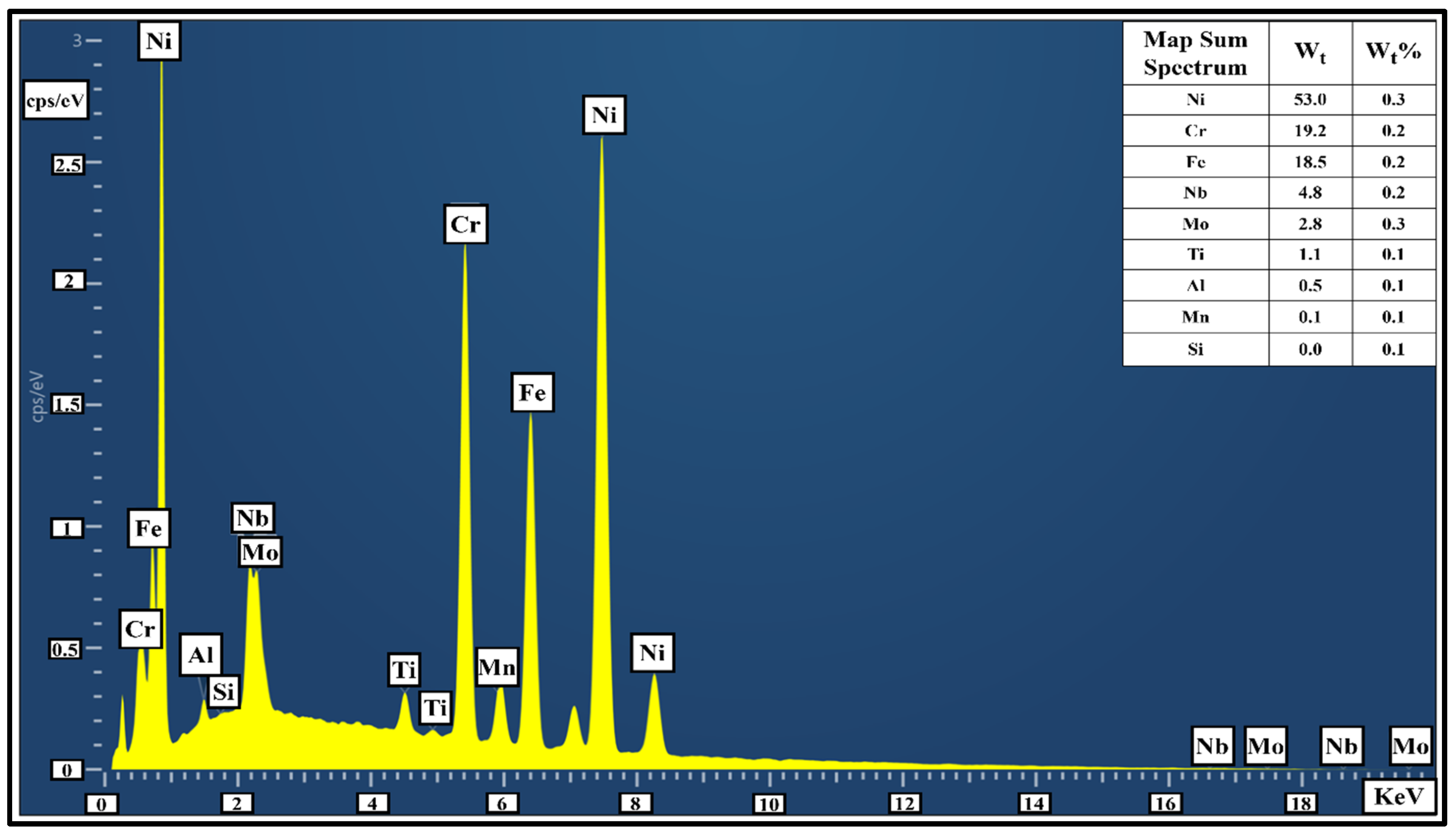
2.1. Inconel 718
2.2. Taguchi Design of Experiment and Sample(s) Extraction
2.3. Performance Measures
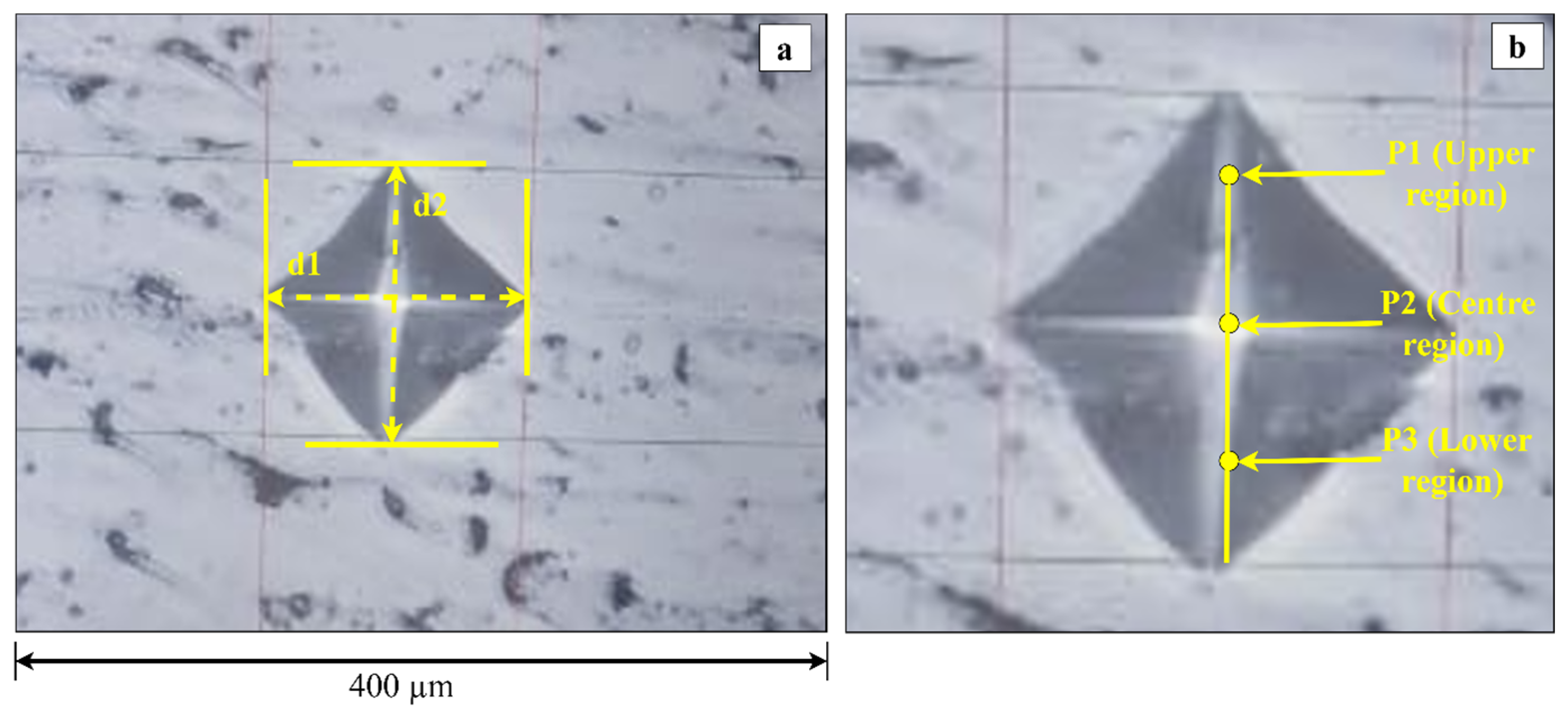
Calculation of Relative Density (RD) and Vickers Hardness (VH)
- ρdensity is the density of the sample (g/cm3 or kg/m3);
- ρfluid is the density of the immersion fluid (typically distilled water, ~0.998 g/cm3 at 20 °C);
- ρair is the density of air (typically ~0.0012 g/cm3 at room temperature and pressure);
- massair is the mass of the sample measured in air (g);
- massfluid is the mass of the sample measured in fluid (apparent mass) (g).
- VHN is the Vickers hardness number;
- F = Applied load (in kilograms-force, kgf);
- d = Average diagonal length of the indentation (in millimeters, mm);
- 1.854 = Geometrical constant for Vickers indenter shape.
2.4. Microstructural Analysis
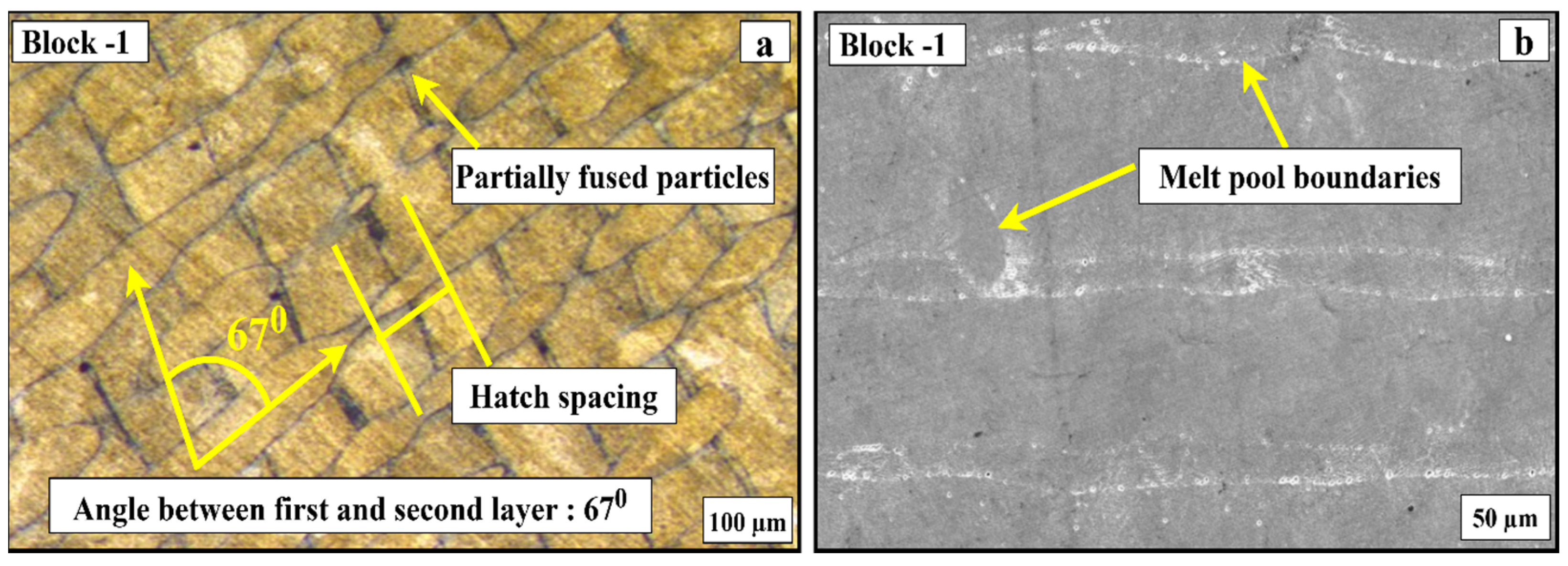
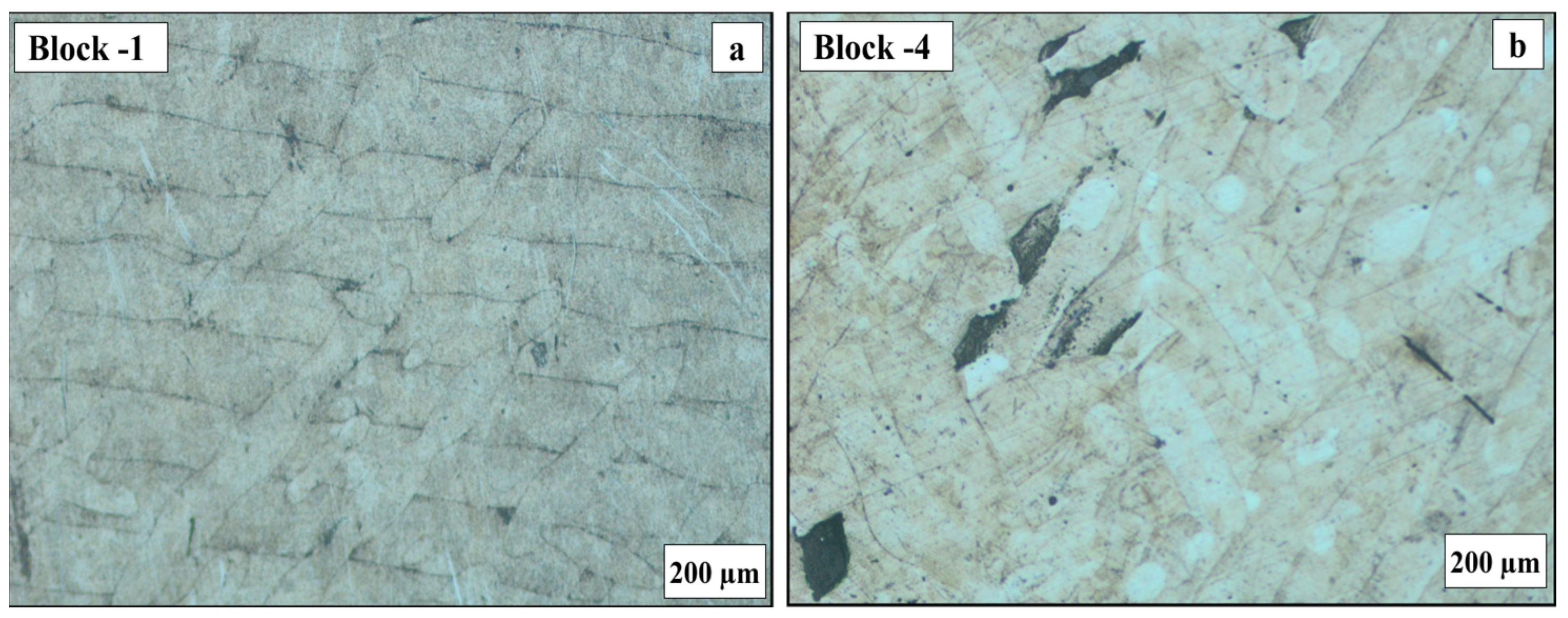
2.4.1. Optical Microscope
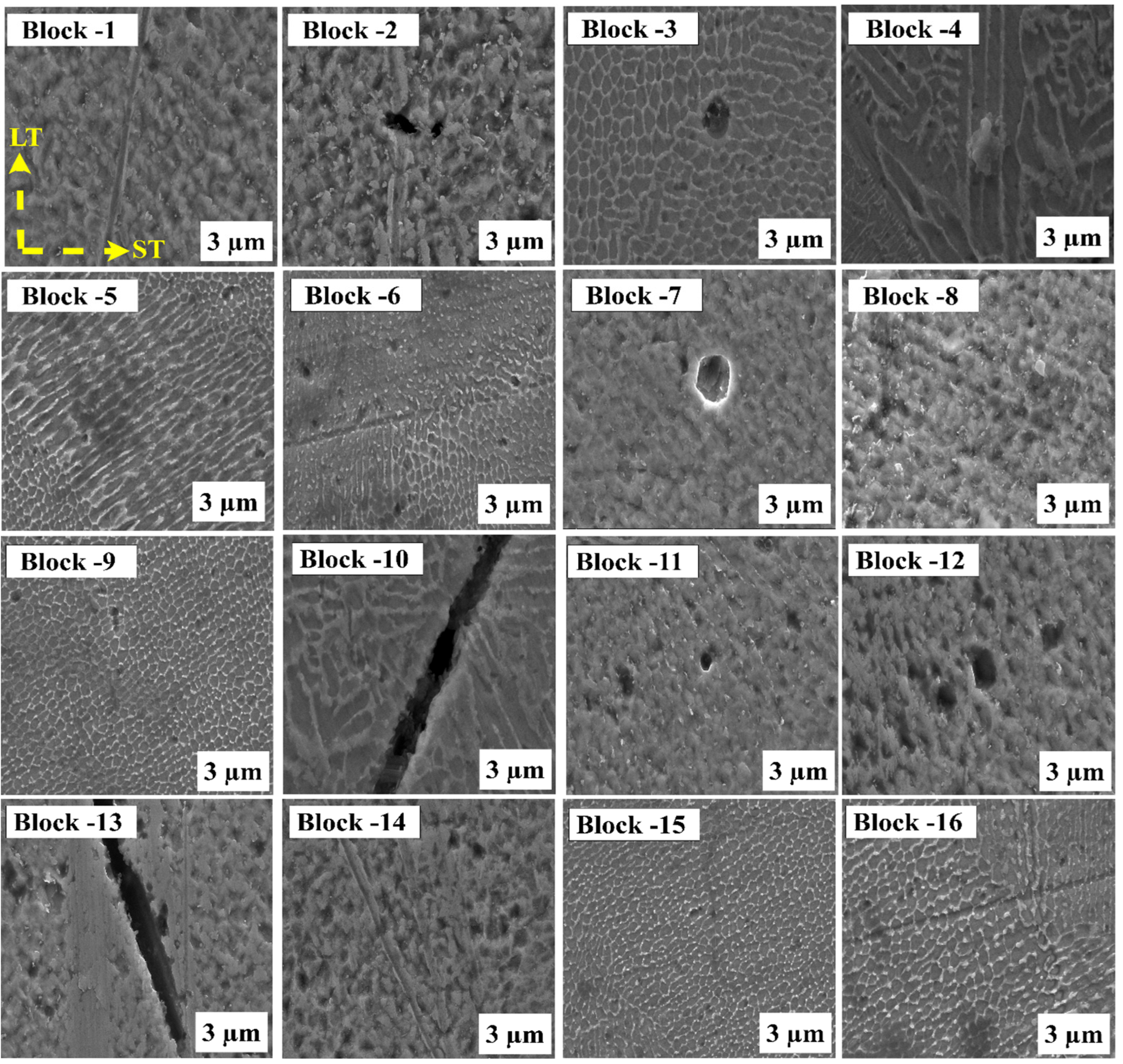
2.4.2. SEM Images of Inconel 718
2.5. Effect of SLM Process Parameters
3. Results and Discussion
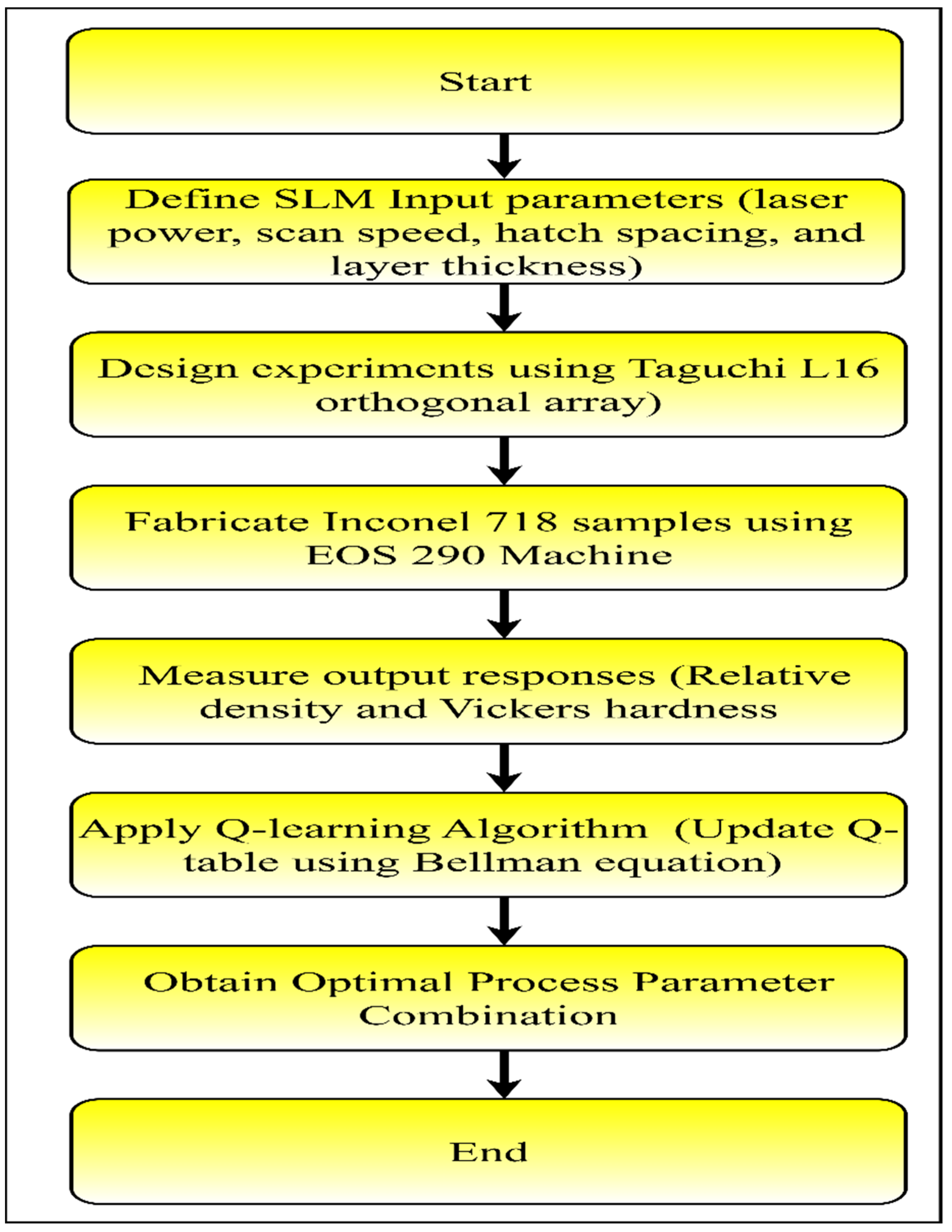
3.1. Process Optimization
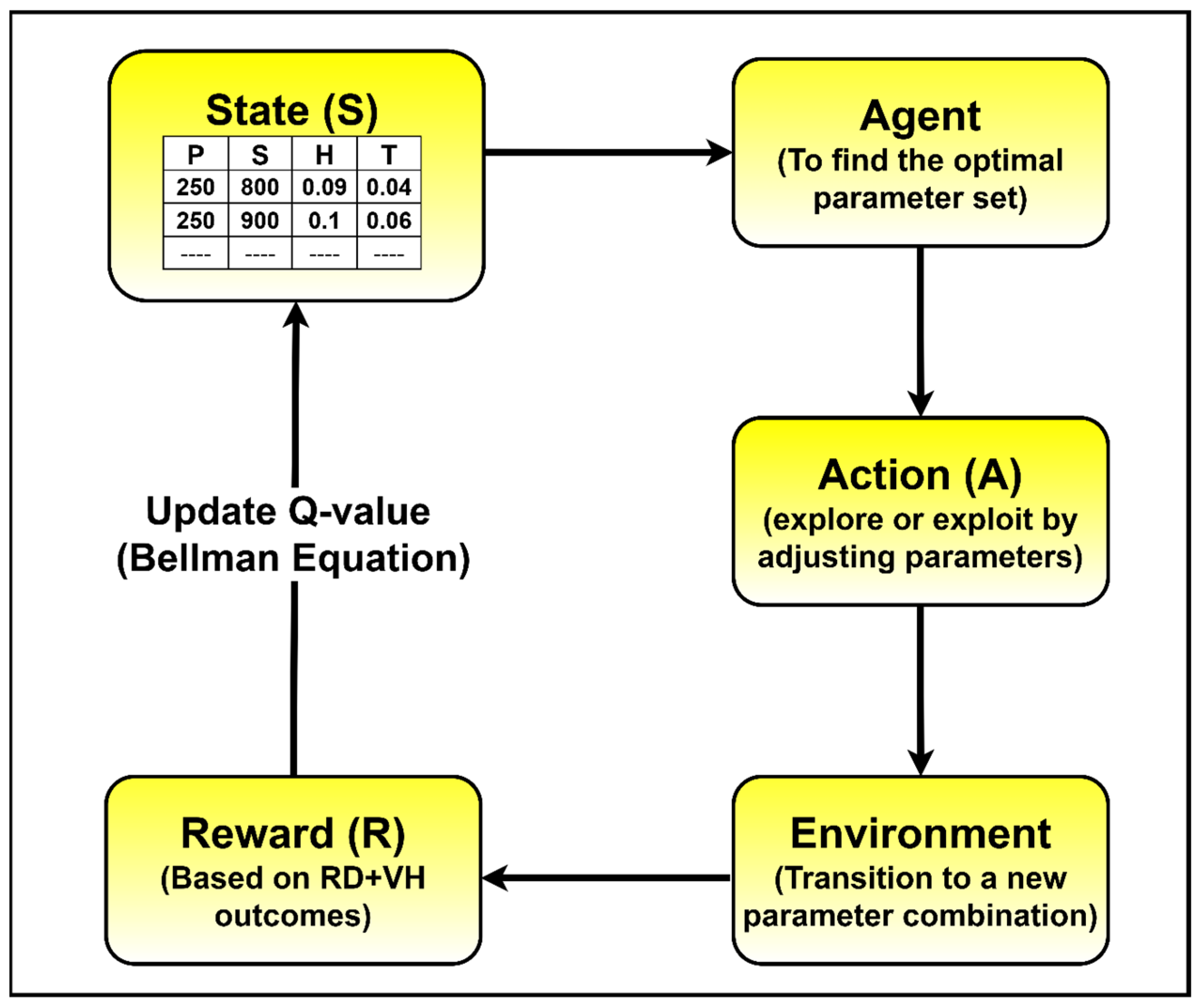
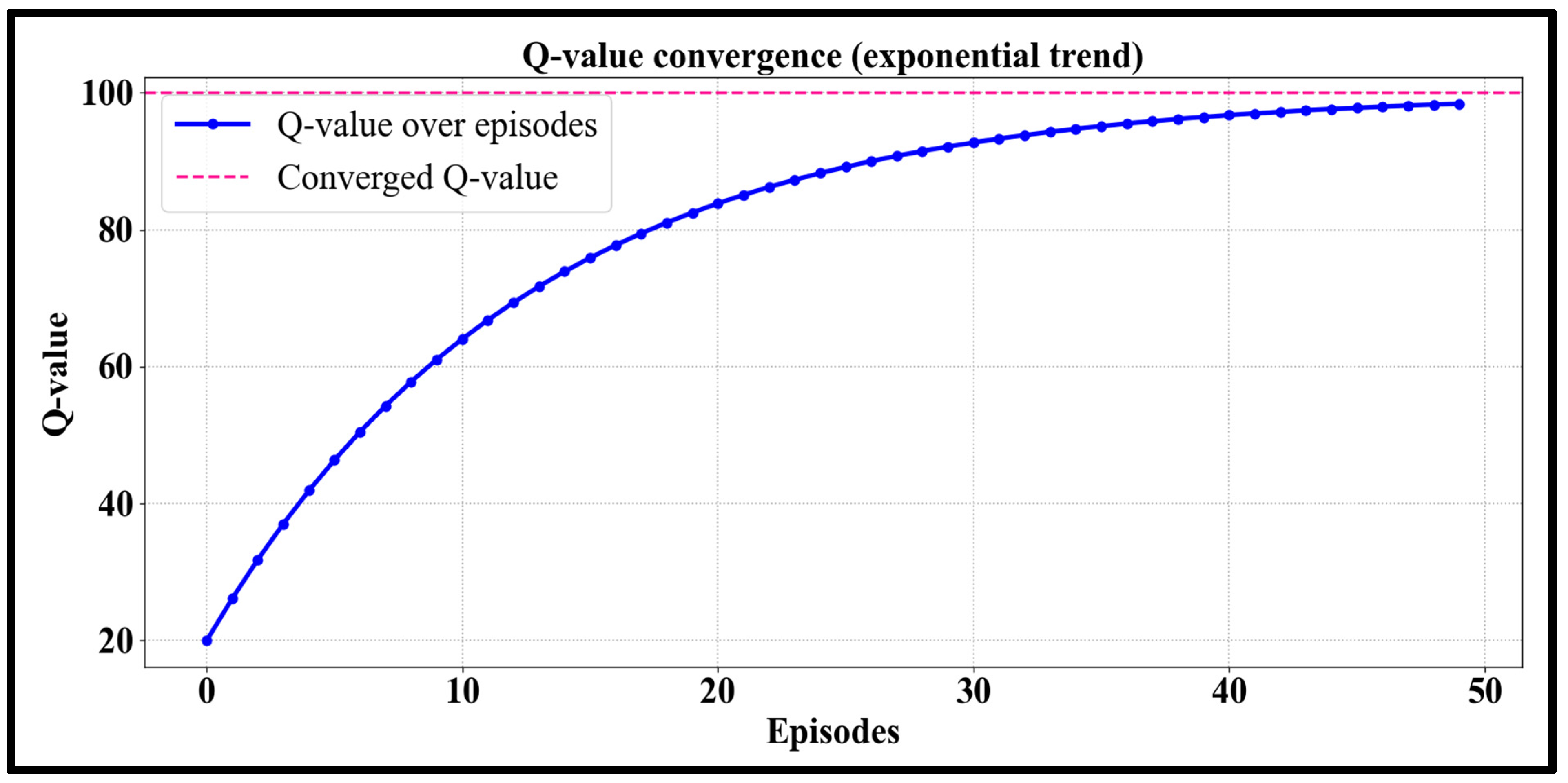
3.2. Q-Learning Algorithm
3.3. Q-Learning Algorithm Parameters
- Q(st, at) is the current Q-value for taking action at in state st;
- Qnew(st, at) is the updated Q-value after learning from new experience;
- α (alpha) is the Learning rate (0 < α ≤ 1): Determines how much new information overrides old;
- r is the Reward received after taking action at in state st;
- γ (gamma) is the Discount factor (0 < γ ≤ 1): Determines importance of future rewards;
- st is the current state at time step t;
- at is the action taken at time step t;
- st+1 is the next state after action at;
- maxa Q (st+1, a) is the maximum estimated future Q-value from the next state st+1.
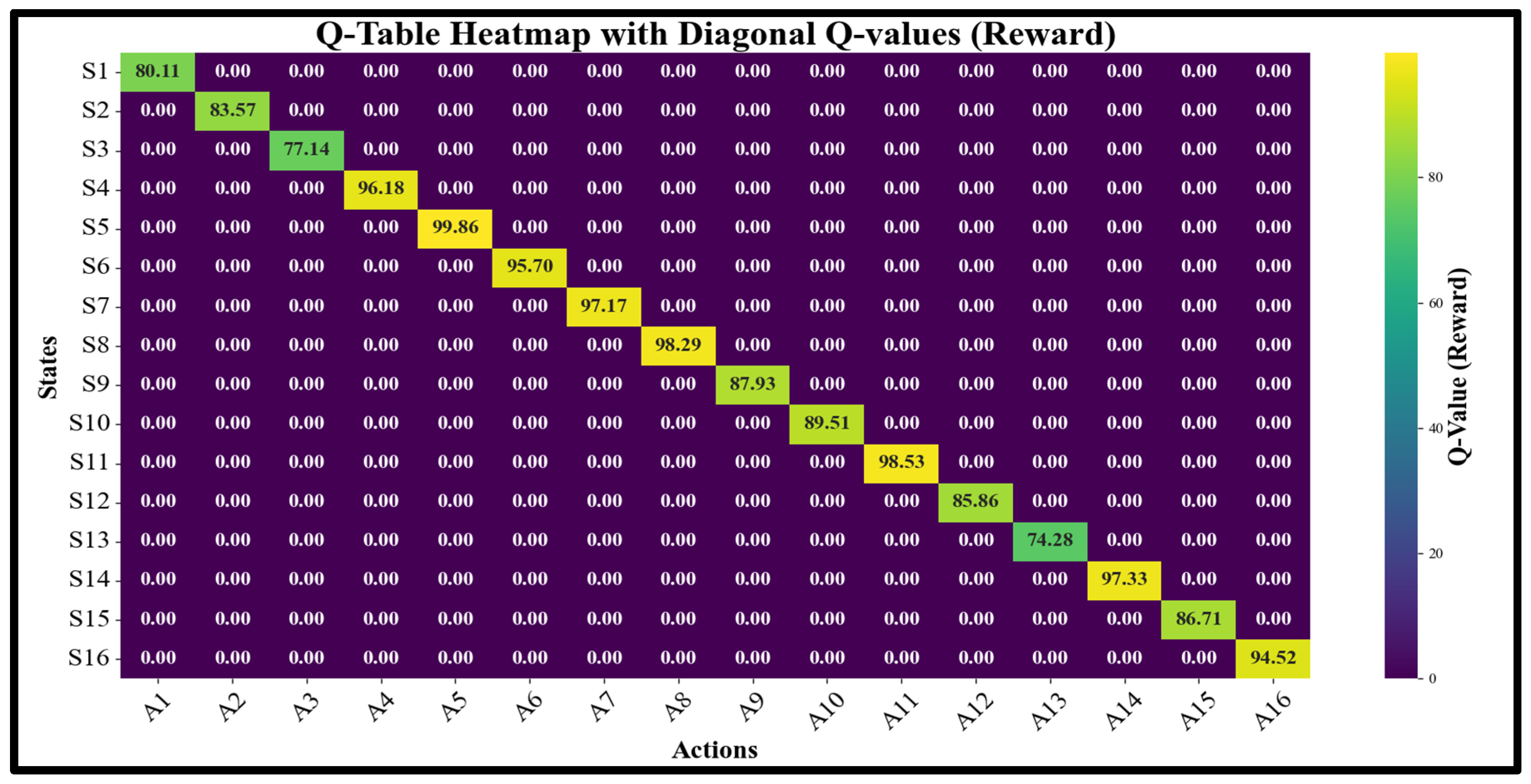
Q-Table
3.4. Calculation of Error Percentage
- Experimental Value: This is the actual experimental or observed value.
- Predicted Value: This is the value estimated by a Q-learning algorithm.
- Percentage prediction Error: This indicates the deviation of the prediction from the actual measurement, expressed as a percentage of the experimental value.
3.5. Analysis of Results and Evaluation of Optimized Value
3.5.1. Optimization Value Selection Criteria
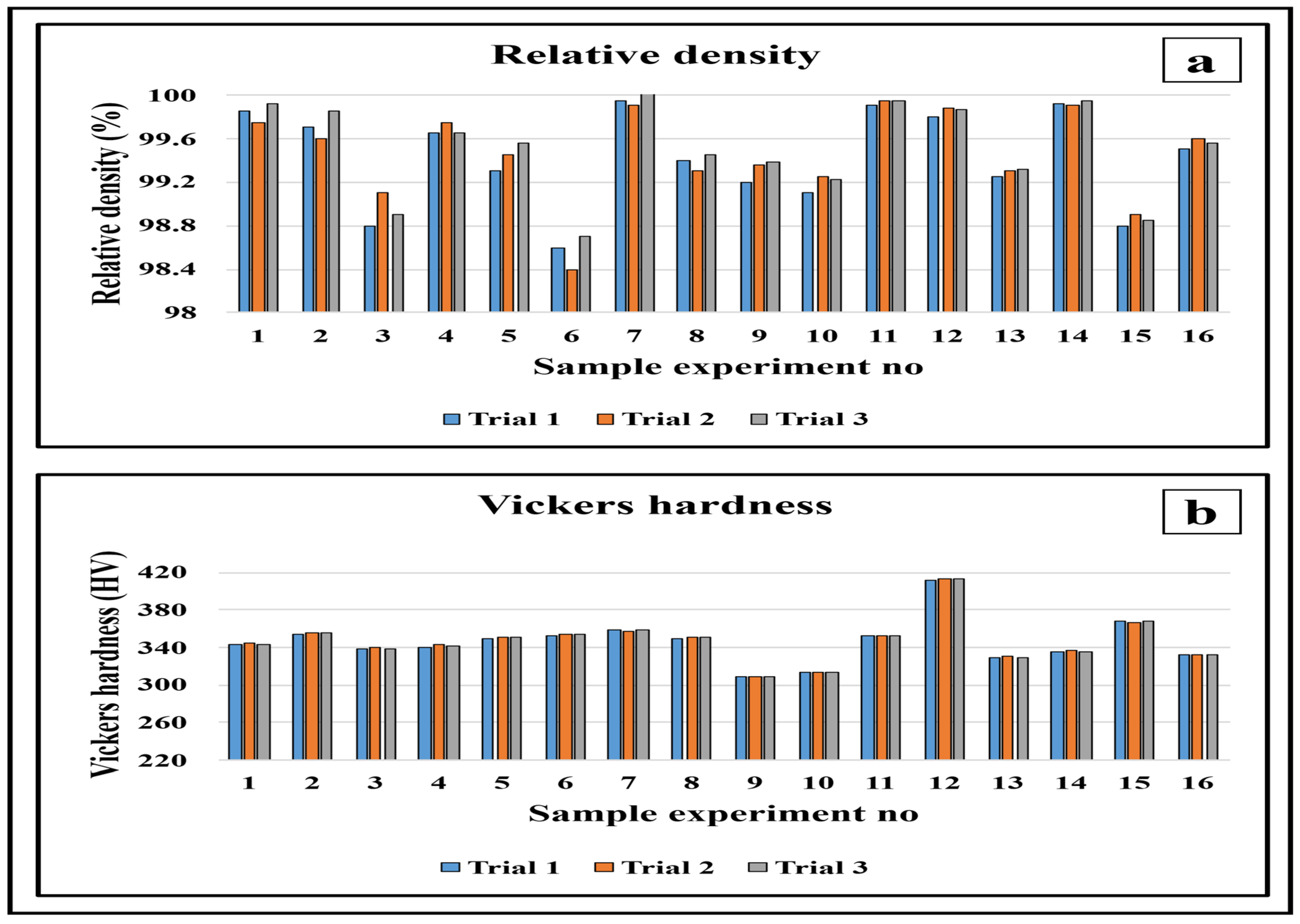
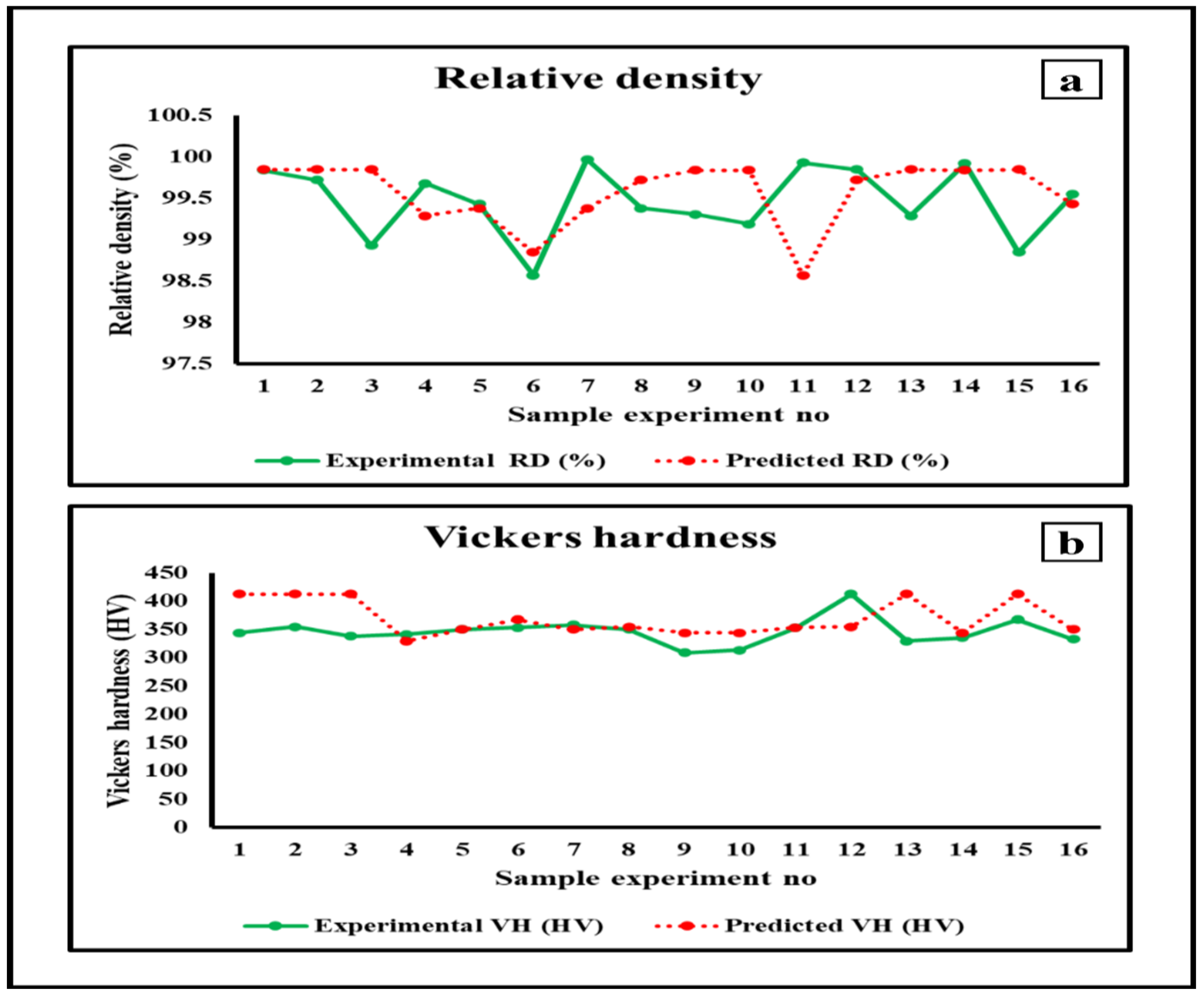
3.5.2. Analysis of Relative Density (RD) Values Derived from Experiment vs. Q-Learning
3.5.3. Analysis of Vickers Hardness (VH) Values Derived from Experiment vs. Q-Learning
3.6. Comparison of Classical Method Results and Proposed Work Results
4. Conclusions
Author Contributions
Funding
Institutional Review Board Statement
Informed Consent Statement
Data Availability Statement
Acknowledgments
Conflicts of Interest
References
- Khan, H.; Kushwah, K.K.; Singh, S.; Thakur, J.S.; Sadasivuni, K.K. Machine Learning in Additive Manufacturing. In Nanotechnology-Based Addit. Nanotechnology—Based Additive Manufacturing: Product Design, Properties and Applications; Wiley Online Library: Hoboken, NJ, USA, 2022; Volume 1–2, pp. 601–636. [Google Scholar] [CrossRef]
- Wang, C.; Tan, X.; Tor, S.; Lim, C. Machine learning in additive manufacturing: State-of-the-art and perspectives. Addit. Manuf. 2020, 36, 101538. [Google Scholar] [CrossRef]
- Akbari, P.; Zamani, M.; Mostafaei, A. Machine learning prediction of mechanical properties in metal additive manufacturing. Addit. Manuf. 2024, 91, 104320. [Google Scholar] [CrossRef]
- Lu, C.; Shi, J. Relative density and surface roughness prediction for Inconel 718 by selective laser melting: Central composite design and multi-objective optimization. Int. J. Adv. Manuf. Technol. 2022, 119, 3931–3949. [Google Scholar] [CrossRef]
- Lu, C.; Shi, J. Relative density prediction of additively manufactured Inconel 718: A study on genetic algorithm optimized neural network models. Rapid Prototyp. J. 2022, 28, 1425–1436. [Google Scholar] [CrossRef]
- Tiwari, J.; Cozzolino, E.; Devadula, S.; Astarita, A.; Krishnaswamy, H. Determination of process parameters for selective laser melting of inconel 718 alloy through evolutionary multi-objective optimization. Mater. Manuf. Process. 2024, 39, 1019–1028. [Google Scholar] [CrossRef]
- Nadiyadi, H.; Gajera, H.; Bidajwala, R.; Abhisek, K.; Dave, K. Effects of powder bed fusion process parameters on hardness for Inconel 718. Mater. Today Proc. 2020, 38, 2275–2280. [Google Scholar] [CrossRef]
- Sheshadri, R.; Nagaraj, M.; Lakshmikanthan, A.; Chandrashekarappa, M.P.G.; Pimenov, D.Y.; Giasin, K.; Prasad, R.V.S.; Wojciechowski, S. Experimental investigation of selective laser melting parameters for higher surface quality and microhardness properties: Taguchi and super ranking concept approaches. J. Mater. Res. Technol. 2021, 14, 2586–2600. [Google Scholar] [CrossRef]
- Ravichander, B.B.; Rahimzadeh, A.; Farhang, B.; Moghaddam, N.S.; Amerinatanzi, A.; Mehrpouya, M. A prediction model for additive manufacturing of inconel 718 superalloy. Appl. Sci. 2021, 11, 8010. [Google Scholar] [CrossRef]
- Neve, A.G.; Kakandikar, G.M.; Kulkarni, O. Application of Grasshopper Optimization Algorithm for Constrained and Unconstrained Test Functions. Int. J. Swarm Intell. Evol. Comput. 2017, 6, 1000165. [Google Scholar] [CrossRef]
- Dharmadhikari, S.; Menon, N.; Basak, A. A reinforcement learning approach for process parameter optimization in additive manufacturing. Addit. Manuf. 2023, 71, 103556. [Google Scholar] [CrossRef]
- Lillicrap, T.P.; Hunt, J.J.; Pritzel, A.; Heess, N.; Erez, T.; Tassa, Y.; Silver, D.; Wierstra, D. Continuous control with deep reinforcement learning. In Proceedings of the 4th International Conference on Learning Representations—ICLR 2016, San Juan, Puerto Rico, 2–4 May 2016. Conference Track Proceedings. [Google Scholar]
- Song, B.; Zhao, X.; Li, S.; Han, C.; Wei, Q.; Wen, S.; Liu, J.; Shi, Y. Differences in microstructure and properties between selective laser melting and traditional manufacturing for fabrication of metal parts: A review. Front. Mech. Eng. 2015, 10, 111–125. [Google Scholar] [CrossRef]
- Zhao, X.; Wang, T. Laser Powder Bed Fusion of Powder Material: A Review. 3D Print. Addit. Manuf. 2023, 10, 1439–1454. [Google Scholar] [CrossRef]
- Zhong, Y.; Liu, L.; Wikman, S.; Cui, D.; Shen, Z. Intragranular cellular segregation network structure strengthening 316L stainless steel prepared by selective laser melting. J. Nucl. Mater. 2016, 470, 170–178. [Google Scholar] [CrossRef]
- Hosseini, E.; Popovich, V. A review of mechanical properties of additively manufactured Inconel 718. Addit. Manuf. 2019, 30, 100877. [Google Scholar] [CrossRef]
- Kumar, L.J.; Nair, C.K. Laser metal deposition repair applications for Inconel 718 alloy. Mater. Today Proc. 2017, 4, 11068–11077. [Google Scholar] [CrossRef]
- Jiang, H.-Z.; Li, Z.-Y.; Feng, T.; Wu, P.-Y.; Chen, Q.-S.; Feng, Y.-L.; Li, S.-W.; Gao, H.; Xu, H.-J. Factor analysis of selective laser melting process parameters with normalised quantities and Taguchi method. Opt. Laser Technol. 2019, 119, 105592. [Google Scholar] [CrossRef]
- Marques, A.; Cunha, Â.; Silva, M.R.; Osendi, M.I.; Silva, F.S.; Carvalho, Ó.; Bartolomeu, F. Inconel 718 produced by laser powder bed fusion: An overview of the influence of processing parameters on microstructural and mechanical properties. Int. J. Adv. Manuf. Technol. 2022, 121, 5651–5675. [Google Scholar] [CrossRef]
- Chang, C.; Yao, G.; Cox, S.C.; Zhang, X.; Sheng, L.; Liu, M.; Cheng, W.; Lu, Y.; Yan, X. From macro-, through meso- to micro-scale: Densification behavior, deformation response and microstructural evolution of selective laser melted Mg-RE alloy. J. Magnes. Alloy. 2025, 13, 3947–3963. [Google Scholar] [CrossRef]
- Huxol, A.; Villmer, F.-J. DoE Methods for Parameter Evaluation in Selective Laser Melting. IFAC-PapersOnLine 2019, 52, 270–274. [Google Scholar] [CrossRef]
- Eguren, J.A.; Esnaola, A.; Unzueta, G. Modelling of an additive 3d-printing process based on design of experiments methodology. Qual. Innov. Prosper. 2020, 24, 128–151. [Google Scholar] [CrossRef]
- Macoretta, G.; Monelli, B. Effects of SLM process parameters on the fatigue strength of AMed Inconel 718. Procedia Struct. Integr. 2021, 37, 632–643. [Google Scholar] [CrossRef]
- Range, M.; Temperature, C. Special Metals Inconel G-3. Alloy Dig. 2021, 70, Ni-774. [Google Scholar] [CrossRef]
- Prabhu, T.R.; Moganraj, A.; Samuel, M.S.; Praveenkumar, K.; Bobby, S.S.; Prakasam, A. Effect of heat treatment on microstructure high-temperature wear performance of additive manufactured IN718. J. Manuf. Process. 2024, 127, 683–697. [Google Scholar] [CrossRef]
- Wu, Z.; Narra, S.P.; Rollett, A. Exploring the fabrication limits of thin-wall structures in a laser powder bed fusion process. Int. J. Adv. Manuf. Technol. 2020, 110, 191–207. [Google Scholar] [CrossRef]
- ASTM E384-17; Standard Test Method for Microindentation Hardness of Materials. ASTM: West Conshohocken, PA, USA, 2016. [CrossRef]
- Spierings, A.B.; Schneider, M.; Eggenberger, R. Comparison of density measurement techniques for additive manufactured metallic parts. Rapid Prototyp. J. 2011, 17, 380–386. [Google Scholar] [CrossRef]
- ASTM B962-13; ASTM International. Standard Test Methods for Density of Compacted or Sintered Powder Metallurgy (PM) Products Using Archimedes’ Principle. ASTM International: West Conshohocken, PA, USA, 2013.
- Mohrnheim, A.F. Microhardness Testing and Hardness Numbers. In Interpretive Techniques for Microstructural Analysis; Springer: Boston, MA, USA, 1977; pp. 117–126. [Google Scholar] [CrossRef]
- Amato, K.N.; Gaytan, S.M.; Murr, L.E.; Martinez, E.; Shindo, P.; Hernandez, J.; Collins, S.; Medina, F. Microstructures and mechanical behavior of Inconel 718 fabricated by selective laser melting. Acta Mater. 2012, 60, 2229–2239. [Google Scholar] [CrossRef]
- Huang, L.; Cao, Y.; Li, G.; Wang, Y. Microstructure characteristics and mechanical behaviour of a selective laser melted Inconel 718 alloy. Integr. Med. Res. 2019, 9, 2440–2454. [Google Scholar] [CrossRef]
- Kumar, P.; Farah, J.; Akram, J.; Teng, C.; Ginn, J.; Misra, M. Influence of laser processing parameters on porosity in Inconel 718 during additive manufacturing. Int. J. Adv. Manuf. Technol. 2019, 103, 1497–1507. [Google Scholar] [CrossRef]
- DebRoy, T.; Wei, H.L.; Zuback, J.S.; Mukherjee, T.; Elmer, J.W.; Milewski, J.O.; Beese, A.M.; Wilson-Heid, A.; De, A.; Zhang, W. Progress in Materials Science Additive manufacturing of metallic components—Process, structure and properties. Prog. Mater. Sci. 2018, 92, 112–224. [Google Scholar] [CrossRef]
- Balbaa, M.; Mekhiel, S.; Elbestawi, M.; McIsaac, J. On selective laser melting of Inconel 718: Densi fi cation, surface roughness, and residual stresses. Mater. Des. 2020, 193, 108818. [Google Scholar] [CrossRef]
- Kladovasilakis, N.; Charalampous, P.; Tsongas, K.; Kostavelis, I.; Tzovaras, D.; Tzetzis, D. Influence of Selective Laser Melting Additive Manufacturing Parameters in Inconel 718 Superalloy. Materials 2022, 15, 1362. [Google Scholar] [CrossRef]
- Xu, J.; Wu, Z.; Niu, J.; Song, Y.; Liang, C.; Yang, K.; Chen, Y.; Liu, Y. Effect of Laser Energy Density on the Microstructure and Microhardness of Inconel 718 Alloy Fabricated by Selective Laser Melting. Crystals 2022, 12, 1243. [Google Scholar] [CrossRef]
- Yang, H.; Meng, L.; Luo, S.; Wang, Z. Microstructural evolution and mechanical performances of selective laser melting Inconel 718 from low to high laser power. J. Alloys Compd. 2020, 828, 154473. [Google Scholar] [CrossRef]
- Wang, R.; Chen, C.; Liu, M.; Zhao, R.; Xu, S.; Hu, T.; Shuai, S.; Liao, H.; Ke, L.; Vanmeensel, K.; et al. Effects of laser scanning speed and building direction on the microstructure and mechanical properties of selective laser melted Inconel 718 superalloy. Mater. Today Commun. 2022, 30, 103095. [Google Scholar] [CrossRef]
- Liu, S.; Li, H.; Qin, C.; Zong, R.; Fang, X. The effect of energy density on texture and mechanical anisotropy in selective laser melted Inconel 718. Mater. Des. 2020, 191, 108642. [Google Scholar] [CrossRef]
- Zhu, L.; Xu, Z.; Liu, P.; Gu, Y. Effect of processing parameters on microstructure of laser solid forming Inconel 718 superalloy. Opt. Laser Technol. 2018, 98, 409–415. [Google Scholar] [CrossRef]
- Maamoun, A.H.; Xue, Y.F.; Elbestawi, M.A.; Veldhuis, S.C. Effect of Selective Laser Melting Process Parameters on the Quality of Al Alloy Parts: Powder and Dimensional Accuracy. Materials 2018, 11, 2343. [Google Scholar] [CrossRef]
- Sufiiarov, V.; Popovich, A.; Borisov, E.; Polozov, I.; Masaylo, D.; Orlov, A. The effect of layer thickness at selective laser melting. Procedia Eng. 2017, 174, 126–134. [Google Scholar] [CrossRef]
- Moussaoui, K.; Rubio, W.; Mousseigne, M.; Sultan, T.; Rezai, F. Materials Science & Engineering A Effects of Selective Laser Melting additive manufacturing parameters of Inconel 718 on porosity, microstructure and mechanical properties. Mater. Sci. Eng. A 2018, 735, 182–190. [Google Scholar] [CrossRef]
- Wang, Y.; Gao, L.; Yang, L.; Liu, T.; Miao, J.; Zang, Y.; Zhang, S. The Effects of Laser Power on the Performance and Microstructure of Inconel 718 Formed by Selective Laser Melting. Appl. Sci. 2024, 14, 9686. [Google Scholar] [CrossRef]
- Mao, Y.; Gao, Y.; Hu, J.; Shen, X.; Zhou, H. Effect of Hatch Spacing on the Quality of Inconel 718 Alloy Part. Materials 2024, 17, 452. [Google Scholar] [CrossRef] [PubMed]
- Paradise, P.; Patil, D.; Van Handel, N.; Temes, S.; Saxena, A.; Bruce, D.; Suder, A.; Clonts, S.; Shinde, M.; Noe, C.; et al. Improving Productivity in the Laser Powder Bed Fusion of Inconel 718 by Increasing Layer Thickness: Effects on Mechanical Behavior. J. Mater. Eng. Perform. 2022, 31, 6205–6220. [Google Scholar] [CrossRef]
- Sylajakumari, P.A.; Ramakrishnasamy, R.; Palaniappan, G. Taguchi grey relational analysis for multi-response optimization of wear in co-continuous composite. Materials 2018, 11, 1743. [Google Scholar] [CrossRef]
- Jang, B.; Kim, M.; Harerimana, G.; Kim, J.W. Q-Learning Algorithms: A Comprehensive Classification and Applications. IEEE Access 2019, 7, 133653–133667. [Google Scholar] [CrossRef]
- Neves, M.; Vieira, M.; Neto, P. A study on a Q-Learning algorithm application to a manufacturing assembly problem. J. Manuf. Syst. 2021, 59, 426–440. [Google Scholar] [CrossRef]
- Guang, W.; Baraldo, M.; Furlanut, M. Calculating percentage prediction error: A user’s note. Pharmacol. Res. 1995, 32, 241–248. [Google Scholar] [CrossRef]





| Ni | Fe | Cr | Nb | Al | Ti | Mo | Mn | Si | C | O |
|---|---|---|---|---|---|---|---|---|---|---|
| 54.04 | 17.8 | 18.18 | 5.3 | 0.49 | 1.12 | 3.02 | 0.02 | 0.18 | 0.04 | 0.015 |
| Parameter | Symbol | Units | Levels | |||
|---|---|---|---|---|---|---|
| 1 | 2 | 3 | 4 | |||
| Laser Power | P | W | 250 | 270 | 290 | 310 |
| Scan Speed | S | mm/s | 800 | 900 | 1000 | 1100 |
| Hatch Spacing | H | mm | 0.09 | 0.1 | 0.11 | 0.12 |
| Layer Thickness | T | mm | 0.04 | 0.06 | 0.08 | 0.1 |
| Sample Exp. No | P* (W) | S* (mm/s) | H* (mm) | T* (mm) | Energy Density (J/mm3) | Exp. RD (%) | Exp. VH (HV) | Pred. RD (%) | Pred. VH (HV) | %RD Error | %VH Error | Reward (R) |
|---|---|---|---|---|---|---|---|---|---|---|---|---|
| 1 | 250 | 800 | 0.09 | 0.04 | 86.81 | 99.84 | 344.1 | 99.85 | 412.5 | 0.01 | 19.8779 | 7.02 |
| 2 | 250 | 900 | 0.1 | 0.06 | 46.3 | 99.72 | 354.7 | 99.85 | 412.5 | 0.1304 | 16.2955 | −3.27 |
| 3 | 250 | 1000 | 0.11 | 0.08 | 28.41 | 98.93 | 338.3 | 99.85 | 412.5 | 0.93 | 21.9332 | −13.10 |
| 4 | 250 | 1100 | 0.12 | 0.1 | 18.94 | 99.68 | 341.3 | 99.29 | 329.6 | 0.3913 | 3.4281 | −1.28 |
| 5 | 270 | 800 | 0.1 | 0.08 | 42.19 | 99.43 | 350.2 | 99.38 | 349.9 | 0.0503 | 0.0857 | 23.65 |
| 6 | 270 | 900 | 0.09 | 0.1 | 33.33 | 98.57 | 353.2 | 98.85 | 367.4 | 0.2841 | 4.0204 | −0.58 |
| 7 | 270 | 1000 | 0.12 | 0.04 | 56.25 | 99.97 | 357.9 | 99.38 | 349.9 | 0.5902 | 2.2353 | −1.20 |
| 8 | 270 | 1100 | 0.11 | 0.06 | 37.07 | 99.38 | 349.9 | 99.72 | 354.7 | 0.3421 | 1.3718 | 3.29 |
| 9 | 290 | 800 | 0.11 | 0.1 | 32.95 | 99.31 | 308.5 | 99.84 | 344.1 | 0.5337 | 11.5397 | −7.89 |
| 10 | 290 | 900 | 0.12 | 0.08 | 33.57 | 99.19 | 313.3 | 99.84 | 344.1 | 0.6553 | 9.8308 | −8.09 |
| 11 | 290 | 1000 | 0.09 | 0.06 | 53.7 | 99.93 | 352.8 | 98.57 | 353.2 | 1.361 | 0.1134 | 8.12 |
| 12 | 290 | 1100 | 0.1 | 0.04 | 65.91 | 99.85 | 412.5 | 99.72 | 354.7 | 0.1302 | 14.0121 | −2.61 |
| 13 | 310 | 800 | 0.12 | 0.06 | 53.82 | 99.29 | 329.6 | 99.85 | 412.5 | 0.564 | 25.1517 | −11.52 |
| 14 | 310 | 900 | 0.11 | 0.04 | 78.22 | 99.92 | 335.4 | 99.84 | 344.1 | 0.0801 | 2.5939 | 6.82 |
| 15 | 310 | 1000 | 0.1 | 0.1 | 31 | 98.85 | 367.4 | 99.85 | 412.5 | 1.0116 | 12.2754 | −10.94 |
| 16 | 310 | 1100 | 0.09 | 0.08 | 39.14 | 99.55 | 332.4 | 99.43 | 350.2 | 0.1205 | 5.355 | 1.90 |
| Sl. No | Parameter | Value/Description/Reason Behind the Chosen Value |
|---|---|---|
| 1 | State Space (S) | 16 states (each row in the dataset representing a unique combination of 4 parameters) |
| 2 | Action Space (A) | 16 actions (each action represents choosing any one of the 16 possible states) |
| 3 | Q-value Q (s, a) | 16×16(Q-table initialized with zeros; updated iteratively using Q-learning formula) |
| 4 | Reward (R) | Logarithmic Cumulative value of errors: −(log (%RDerror) + log (%VH error)) |
| 5 | Learning Rate (α) | 0.1(Determines how much new information overrides old Q-values) |
| 6 | Discount Factor (γ) | 0.9 (long-term reward consideration) |
| 7 | Number of Episodes (Iterations) | 50 (Number of training episodes for agent to learn optimal policy) |
| Sample Exp. no | Exp. RD (%) | Exp. VH (HV) | %RD Error | %VH Error | Selected |
|---|---|---|---|---|---|
| 1 | 99.84 | 344.1 | 0.01 | 19.8779 | No Reason: %VH Error is High |
| 2 | 99.72 | 354.7 | 0.1304 | 16.2955 | No Reason: %VH Error is High |
| 3 | 98.93 | 338.3 | 0.93 | 21.9332 | No Reason: %VH Error is High |
| 4 | 99.68 | 341.3 | 0.3913 | 3.4281 | No Reason: %VH Error is High |
| 5 | 99.43 | 350.2 | 0.0503 | 0.0857 | YES (%RD and %VH both are lowest) |
| 6 | 98.57 | 353.2 | 0.2841 | 4.0204 | No Reason: %VH Error is High |
| 7 | 99.97 | 357.9 | 0.5902 | 2.2353 | No Reason: %VH Error is High |
| 8 | 99.38 | 349.9 | 0.3421 | 1.3718 | No Reason: %VH Error is High |
| 9 | 99.31 | 308.5 | 0.5337 | 11.5397 | No Reason: %VH Error is High |
| 10 | 99.19 | 313.3 | 0.6553 | 9.8308 | No Reason: %VH Error is High |
| 11 | 99.93 | 352.8 | 1.361 | 0.1134 | No Reason: %RD Error is High |
| 12 | 99.85 | 412.5 | 0.1302 | 14.0121 | No Reason: %VH Error is High |
| 13 | 99.29 | 329.6 | 0.564 | 25.1517 | No Reason: %VH Error is High |
| 14 | 99.92 | 335.4 | 0.0801 | 2.5939 | No Reason: %VH Error is High |
| 15 | 98.85 | 367.4 | 1.0116 | 12.2754 | No Reason: %VH Error is High |
| 16 | 99.55 | 332.4 | 0.1205 | 5.355 | No Reason: %VH Error is High |
| Sl. No | Method | Input Parameters | No. of Experiments | No. of Objectives | Error% | Author, Year |
|---|---|---|---|---|---|---|
| 1 | RSM | P, S, H, T | 30 | 2 (RD, SR) | RD = 29.86% | Cuiyuan Lu et al. (2022) [4] |
| 2 | GA | P, S, H, T | 25 | 1 (RD) | RD = 26.5% | Jing Shi et al. (2022) [5] |
| 3 | EvoNN + cRVEA | P, S, H | 16 | 3 (RD, SR, SEC) | RD = 6.85% | Tiwari et al. (2023) [6] |
| 4 | RSM (Box–Behnken) | P, S, T | 15 | 1 (VH) | VH = 10.94% | Hardik Nadiyadi et al. (2021) [7] |
| 5 | ANN | P, S, H | 20 | 2 (VH, HT) | VH = 3.26% | Bharath et al. (2021) [9] |
| 6 | Q-learning | P, S, H, T | 16 | 2 (RD, VH) | RD = 0.0503%, VH = 0.0857% | Proposed work |
Disclaimer/Publisher’s Note: The statements, opinions and data contained in all publications are solely those of the individual author(s) and contributor(s) and not of MDPI and/or the editor(s). MDPI and/or the editor(s) disclaim responsibility for any injury to people or property resulting from any ideas, methods, instructions or products referred to in the content. |
© 2025 by the authors. Licensee MDPI, Basel, Switzerland. This article is an open access article distributed under the terms and conditions of the Creative Commons Attribution (CC BY) license.
Share and Cite
Yusuf, S.B.; Sudhakarapandian, R. Q-Learning Algorithm for Predicting Mechanical Properties of Inconel 718 Processed by Selective Laser Melting. Appl. Sci. 2026, 16, 181. https://doi.org/10.3390/app16010181
Yusuf SB, Sudhakarapandian R. Q-Learning Algorithm for Predicting Mechanical Properties of Inconel 718 Processed by Selective Laser Melting. Applied Sciences. 2026; 16(1):181. https://doi.org/10.3390/app16010181
Chicago/Turabian StyleYusuf, Sultan Batcha, and Ranjitharamasamy Sudhakarapandian. 2026. "Q-Learning Algorithm for Predicting Mechanical Properties of Inconel 718 Processed by Selective Laser Melting" Applied Sciences 16, no. 1: 181. https://doi.org/10.3390/app16010181
APA StyleYusuf, S. B., & Sudhakarapandian, R. (2026). Q-Learning Algorithm for Predicting Mechanical Properties of Inconel 718 Processed by Selective Laser Melting. Applied Sciences, 16(1), 181. https://doi.org/10.3390/app16010181