Article

Far-Infrared-Emitting Fabric Improves Neuromuscular Parameters in Humans: Unexpected Result from Eccentric Exercise-Induced Muscle Damage Countermeasure Strategy


by
Arthur Fernandes Gáspari
1,2,*,†,
Thiago Mattos Frota de Souza
1,†,
Patricia dos Santos Guimarães
1,2,
Manoel Pereira da Silva
1,
Celene Fernandes Bernardes
1,3,
Renato Barroso
1,
Mara Patrícia Traina Chacon-Mikahil
1 and
Antonio Carlos de Moraes
1,*
1
Faculty of Physical Education, University of Campinas (UNICAMP), Campinas 13083-851, SP, Brazil
2
Brazilian Sport Climbing Confederation (CBEscalada), São Paulo 04616-004, SP, Brazil
3
Faculty of Chemistry, Pontifical Catholic University of Campinas (PUC-C), Campinas 13087-571, SP, Brazil
*
Authors to whom correspondence should be addressed.
These authors contributed equally to this work.
Appl. Sci. 2026, 16(1), 143; https://doi.org/10.3390/app16010143
Submission received: 18 November 2025 / Revised: 16 December 2025 / Accepted: 17 December 2025 / Published: 23 December 2025
(This article belongs to the Section Applied Biosciences and Bioengineering)

Featured Application

This study highlights the potential application of Far-Infrared emitting fabric technology in humans as an effective strategy to enhance performance during eccentric exercise.

Abstract

The present study examined the prophylactic effects of far-infrared-emitting fabric (FIR) on exercise-induced muscle damage and investigated its influence on neuromuscular parameters during eccentric exercise. FIR and placebo garments were worn for 1 h prior to and throughout a knee extension eccentric exercise protocol consisting of 10 sets of 15 maximal contractions performed at 210°·s−1, using a randomized, counterbalanced, double-blind, placebo-controlled crossover design. Twenty-one physically active individuals (age: 24 ± 1 years; body mass: 69.7 ± 2.3 kg; height: 1.73 ± 0.02 m) participated in this two-phase study. In the first phase (FIR effects on muscle damage; n = 9), eccentric peak torque (EPT) and total work (TW) were assessed during exercise, while maximal voluntary isometric contraction (MVIC) and creatine kinase (CK) were measured before and 24, 48, and 96 h after the protocol. No fabric × time interaction was observed for MVIC or CK. However, FIR use suggested an increased EPT and TW during exercise. To further investigate this effect and explore potential neuromuscular mechanisms, a second phase was conducted (FIR effects on eccentric exercise; n = 12) using the same exercise protocol. EPT, TW, and electromyographic root mean square (EMG-RMS) activity of the vastus lateralis (VL) and vastus medialis (VM) were assessed. Combined results from both phases (n = 21) demonstrated significant increases of 11% in mean EPT and 18.6% in mean TW, along with greater VL and VM EMG-RMS activity (n = 12), under FIR compared with placebo conditions. These findings indicate that FIR use enhances neuromuscular performance during eccentric exercise.

1. Introduction

Eccentric muscle contractions are essential to human movement, contributing to mobility, stability, and strength in both daily and sport activities. During these actions, skeletal muscles generate force while lengthening to support body weight against gravity, decelerate movement, absorb mechanical shock, and store elastic energy for subsequent concentric contractions, thereby enabling efficient and controlled movement execution [1,2]. However, the high mechanical loads associated with eccentric contractions during training and competition impose substantial stress on musculoskeletal structures, potentially leading to focal myofibrillar disruption and increased sarcolemmal permeability, thereby promoting muscle damage and subsequent impairments in force production and proprioceptive function [3,4]. Thus, improving recovery following an exercise bout and reducing exercise-induced muscle damage (EIMD) are important for training adaptation and performance enhancement [5].
Photobiomodulation (PBM) therapy, which involves the application of light (radiation) to a biological system to stimulate specific biochemical processes, has been widely employed to enhance recovery, improve performance, and attenuate EIMD [6,7,8]; demonstrating promising effects. The effects of PBM utilizing infrared (IR) light-emitting devices encompass reduced alterations in muscle damage markers (e.g., creatine kinase [CK], lactate dehydrogenase [LDH]) and preservation of the maximal strength following various exercise protocols, including the Wingate test [9], eccentric contractions [10], running [11], resistance exercise [12], and volleyball matches [13]. Furthermore, far-infrared emitted by electrically powered devices has been shown to accelerate the recovery of maximal voluntary isometric contractions (MVIC) and countermovement jump performance following running [14,15]. These findings collectively suggest that, despite the underlying mechanisms still being poorly understood, PBM holds potential as a valuable tool in athletic performance and preparation [8].
One point of concern is that these studies were performed using electric-powered light-emitting devices (LED or laser) that may be difficult to apply in the field. However, even when IR was emitted by material, such as fabric, the initial results also showed positive effects on oxidative stress, acidosis and fatigue resistance in electric stimulated isolated muscle and cell culture [16]. Additionally, the few studies of far-infrared emitting fabric (FIR) in humans have shown increases in MVIC and performance in high intense-short duration exercise [17] and some promising results on postexercise recovery [18,19,20].
Although the results on the effects of FIR in recovery from exercise are still equivocal [18,19,20], FIR emerges as an alternative to electric-powered PBM therapy. Accordingly, the primary objective of this study was to evaluate the effectiveness of FIR as a countermeasure against EIMD. However, our results suggested an unexpected increase in mean eccentric peak torque (EPT) and total work (TW) during eccentric exercise. To further investigate this effect, a second data collection was conducted, in which, in addition to eccentric exercise performance, electromyographic activity of the knee extensor muscles was assessed.

2. Materials and Methods

2.1. Subjects

Twenty-one young, physically active participants (comprising 14 men and 7 women; age: 24.1 ± 0.7 years; body mass: 69.7 ± 2.3 kg; height: 1.73 ± 0.02 m) were recruited for this study. All female participants were taking oral contraceptives and were not menstruating during the testing period. Participants were regularly engaged in a variety of sports training programs, at least twice a week in one of the following modalities: climbing, running, triathlon, soccer, volleyball, gymnastics, and swimming. Furthermore, they reported no history of lower limb musculoskeletal injuries in the six months preceding the study. All volunteers were informed of the purpose of this study and consent was obtained by signed the Free and Informed Consent Form. The study was conducted in accordance with the Declaration of Helsinki, and the protocol was approved by the Ethics Committee of the University of Campinas (0064014600011).

2.2. Experimental Design

The study comprised two distinct phases. The initial phase, termed ‘FIR effects on muscle damage,’ aimed to analyze the effectiveness of FIR as a countermeasure strategy for EIMD. Given that this initial phase unexpectedly revealed an improvement in neuromuscular parameters (specifically, increases in mean EPT and mean TW), a second phase of data collection was subsequently performed. This subsequent phase, designated ‘FIR effects on eccentric exercise,’ aimed to investigate the effects of FIR on specific neuromuscular parameters (EPT, TW, and electromyographic root mean square (EMG-RMS)). Both phases employed a randomized, crossover, double-blind, placebo-controlled design. To ensure blinding, garments were coded by a third party not involved in the study, thereby keeping researchers and participants blinded until statistical analyses were performed. This coding and blinding process was performed in both phases.
In the first phase (n = 9), FIR and placebo garments were worn for 1 h prior to and throughout a knee extension eccentric exercise protocol, which consisted of 10 sets of 15 maximal contractions performed at 210°·s−1. Eccentric peak torque and TW were recorded during exercise. Maximal voluntary isometric contraction and CK were assessed before, and at 24, 48, and 96 h after the exercise protocol. In the second phase, an additional sample of n = 12 subjects wore FIR and placebo garments for 1 h before and during the identical knee extensor eccentric exercise protocol as in the first phase. During this phase’s exercise protocol, EPT, TW, and muscle EMG-RMS activity were recorded. Importantly, no EIMD markers were assessed in this phase. For further analysis, EPT and TW results from both phases were combined (summing n = 21).

2.3. Garment Made with Far-Infrared Emitting Fabric (FIR)

The FIR and Placebo garments were identical in design, color, and texture, and each set consisted of a pair of pants and a sleeveless shirt. The FIR incorporated a textile fiber (EMANA®, Rhodia Poliamida e Especialidades LTDA, Santo André, SP, Brazil) produced from polyamide 66 polymer and a blend of inorganic substances (including titanium dioxide and aluminosilicate) within its polymeric matrix. This composition imparts to the fabric the ability to absorb and emit electromagnetic waves in the far-infrared range (above 3 µm). Analyses conducted by an independent institute (Korea Far Infrared Association, Seoul, Republic of Korea) revealed that a knit textile (with an areal density of 225 g·m−2) composed of 88% of the emitting fiber and 12% elastane exhibited an emissivity of 0.88 and an emitted power of 341 W·m−2·µm−1 at 37 °C within the 5–20 µm wavelength region (data provided by Rhodia Poliamida e Especialidades LTDA, Santo André, SP, Brazil). The mechanism of FIR emission in these fabrics relies on their capacity to absorb energy from the environment and subsequently re-emit it as far-infrared radiation, which then interacts with the organism [21,22], ultimately leading to PBM.

2.4. Exercise Protocol on Isokinetic Dynamometer

Participants in both phases performed the eccentric exercise protocol on an isokinetic dynamometer (Biodex System Pro 4®, Biodex Medical Systems, New York, NY, USA), as detailed below. Prior to the testing sessions, a familiarization session was conducted during which participants’ height and weight were recorded in the dynamometer software, with all settings determined according to manufacturer specifications.
Briefly, each participant was seated on the dynamometer chair in an upright position, with their knee joint bent at 90° (representing an angle from the horizontal). Stabilization was ensured by two shoulder straps crossing the participant’s chest, a waist strap, and a thigh strap. The estimated center of rotation of the knee joint was visually aligned with the dynamometer’s center of rotation. The length of the dynamometer attachment was adjusted to ensure the leg was comfortably positioned against a pad superior to the calcaneus. Knee-extension torque was calculated as the torque produced by the dynamometer motor, corrected for gravity. Participants’ specific settings on the isokinetic dynamometer were meticulously recorded to ensure reproducibility during subsequent tests.
Participants performed maximal eccentric contractions of the knee extensors using their non-dominant limb. The test routine commenced with a general warm-up on a cycle ergometer at 30–60 W for 5 min. This was followed by a specific warm-up on the isokinetic dynamometer, consisting of two sets of five submaximal contractions: one concentric-concentric set of knee extension/flexion at 90°·s−1 and another eccentric set at 210°·s−1 for the knee extensors. The range of motion for all exercises was uniformly set at 80°, extending from 10° to 90° (where 0° represents full knee extension). After the warm-up, each participant underwent measurements of MVIC (as described in a subsequent section). Subsequently, the participant executed the main protocol, which comprised 10 sets of 15 maximal eccentric contractions at 210°·s−1. A 1 min rest period was provided between sets, and the range of motion of the knee joint was maintained at 80° to ensure participant safety and optimal testing conditions. Immediately before each maximal eccentric contraction, participants were instructed to perform an isometric contraction at the initial position, directly preceding the start of the eccentric protocol, to ensure maximal effort from the onset of the eccentric movement. The arm of the isokinetic dynamometer returned to the initial position passively at a slow velocity. Verbal encouragement was consistently provided throughout each test.
Eccentric peak torque and TW were continuously recorded throughout the entire protocol. The EPT and TW values attained at each set, along with their overall average across the entire protocol, were utilized for statistical analysis.

2.5. Maximal Voluntary Isometric Contraction (MVIC)

Two maximal isometric attempts, each sustained for four seconds, were performed with the non-dominant limb at a knee flexion angle of 60°. A rest period of 180 s was provided between attempts. Verbal encouragement was given during both attempts. The peak isometric contraction torque achieved was subsequently used for further analysis.

2.6. Creatine Kinase (CK) Analysis

Blood samples (5 mL) were collected from an antecubital vein. Subsequently, serum was isolated via centrifugation (5000 rpm for 10 min) and stored at −80 °C until subsequent CK analysis. Serum CK levels were determined using the kinetic enzymatic method with commercial test kits (Laborlab®, São Paulo, SP, Brazil) and a spectrophotometer (Hitachi® U-5100, Tokyo, Japan).

2.7. Surface Electromyographic (EMG) Signal

Surface electromyographic (EMG) signals were acquired from the vastus lateralis (VL) and vastus medialis (VM) muscles using a Biopac MP150 system (Biopac System, Santa Barbara, CA, USA). Bipolar active EMG electrodes (model TSD150TM; Biopac Systems, Santa Barbara, CA, USA) were positioned over the muscle belly of the VL and VM, maintaining an interelectrode distance of 2 cm and aligned parallel to the muscle’s expected fiber orientation. Prior to electrode placement, the skin surface was shaved, abraded, and cleaned with an isopropyl alcohol pad to minimize skin impedance. A ground electrode was additionally placed on the tibia. All these procedures adhered to the recommendations by Hermens et al. [23].
Signals were sampled at 2000 Hz and band-pass filtered between 20 and 500 Hz. The EMG amplifiers exhibited an input noise below 1 µV and an effective common-mode rejection ratio of >95 dB. Signal processing and data acquisition were performed using AcqKnowledge software 3.8.1 (Biopac System, Santa Barbara, CA, USA), where raw signals were processed into root mean square (RMS) values. Knee extensor torque and EMG data were synchronized within the EMG unit. The RMS data from all repetitions were normalized to the peak RMS value obtained within each set. The RMS data corresponding to the EPT of each set, as well as their average across the entire protocol, were used for statistical analysis.

2.8. Statistical Analysis

Data normality was assessed using the Shapiro–Wilk test for both study phases. For the first phase, a two-way repeat measures ANOVA, was employed to compare MVIC and CK levels before and at 24, 48, and 96 h post-intervention. An initial visual inspection of the mean EPT and mean TW data suggested higher values in the FIR condition. To further investigate this observed trend, a second data collection phase was conducted. For this purpose, the sample size for the second phase was estimated using G*Power 3.1 software [24]. The sample size calculation was performed by setting the alpha level at 5%, statistical power at 85%, and utilizing the Cohen’s d effect size dependent samples (ES) calculated from the mean EPT and mean TW results of the first phase (ES = 1.01 and ES = 0.97, respectively). Consequently, a sample size of 12 participants was estimated to be sufficient for detecting effects in both EPT and TW.
In the second phase, paired t-tests were used to compare mean EPT, mean TW, mean Vastus Lateralis EMG-RMS (VL-RMS), and mean Vastus Medialis EMG-RMS (VM-RMS) between conditions. Additionally, a two-way repeated measures ANOVA, followed by Tukey’s post hoc test (when statistically appropriate), was applied to compare EPT, TW, VL-RMS, and VM-RMS across different sets. All statistical analyses were conducted using STATISTICA 6.0 software (StatSoft, Inc., Tulsa, OK, USA). Data are presented as mean ± standard error of the mean. The adopted level of significance for all statistical tests was set at p < 0.05.

3. Results

3.1. Study Phase 1: FIR Effects on Muscle Damage

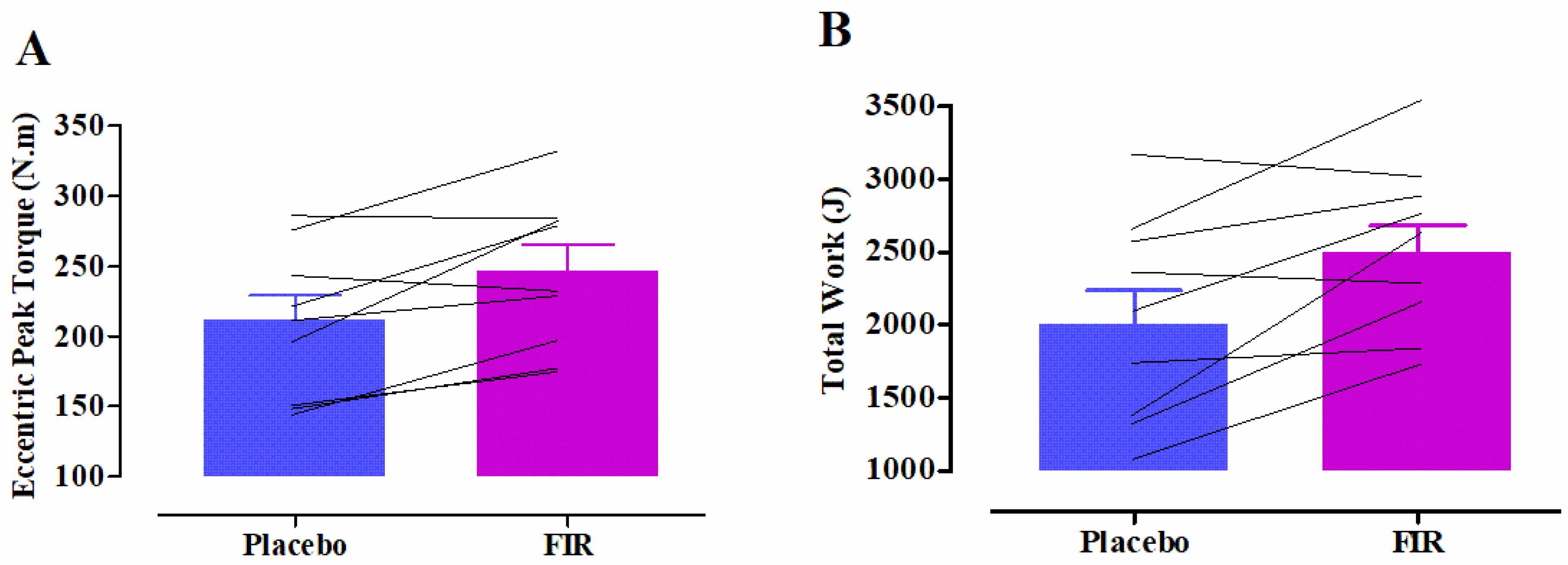
Muscle damage markers showed no significant differences between garments (FIR vs. Placebo) or across the different time points (baseline, 24, 48, and 96 h post-intervention) (Table 1). Specifically, the two-way repeated measures ANOVA conducted on MVIC and CK levels revealed no significant Fabric × Time interaction (p = 0.49 and p = 0.96, respectively). Despite the lack of statistical significance in these markers, a visual inspection of the mean EPT and mean TW data suggested greater values in the FIR condition (Figure 1A,B).

3.2. Study Phase 2: FIR Effects on Eccentric Exercise

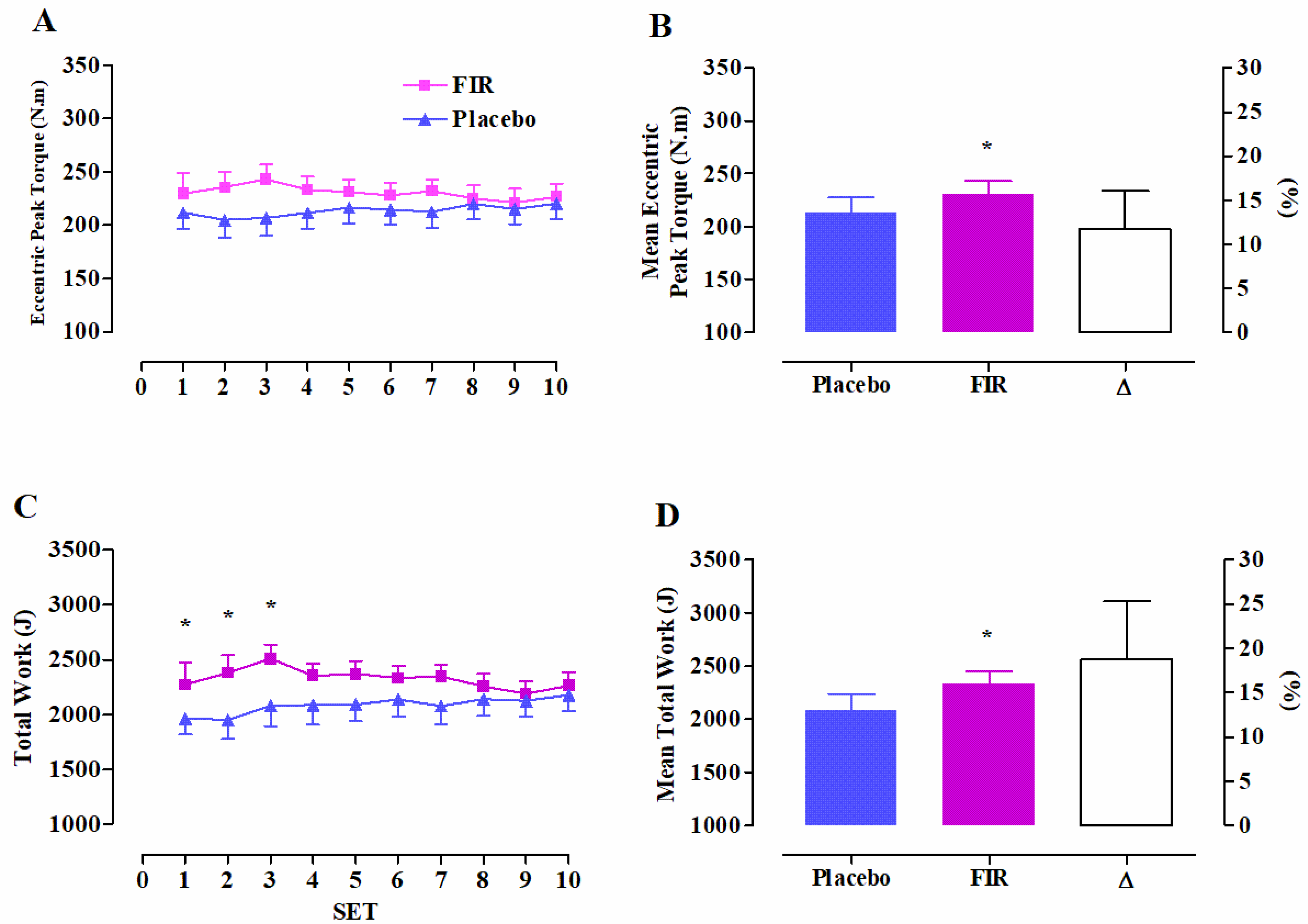
In the second study phase, the ANOVA for eccentric peak torque (EPT) revealed no significant Fabric × Set interaction (p = 0.115) (Figure 2A). However, Mean EPT values were higher in FIR (p = 0.0006) than in Placebo (Figure 2B). For TW, ANOVA indicated a significant Fabric × Set interaction (p = 0.015). Post hoc analysis using Tukey’s test identified significant differences between the FIR and Placebo fabrics in sets 1 (p = 0.028), 2 (p < 0.001), and 3 (p < 0.001) (Figure 2C). Additionally, FIR shows a greater mean TW value (p = 0.0002) than Placebo (Figure 2D).
Data regarding VL-RMS and VM-RMS data are presented in Table 2. The analysis of RMS-EMG data by ANOVA indicated a significant Fabric × Set interaction for VL-RMS (p = 0.02), but no significant interaction for VM-RMS (p = 0.87). However, despite the significant interaction for VL-RMS, Tukey’s post hoc analysis did not reveal significant pairwise differences between fabrics within any specific set. Moreover, FIR shows greater mean VL-RMS and VM-RMS values than Placebo (p = 0.003 and p = 0.00009, respectively).

4. Discussion

The initial aim of this study was to analyze the effectiveness of FIR as a countermeasure strategy for EIMD, which constituted Study Phase 1: FIR Effects on Muscle Damage. For this phase, nine participants underwent two bouts of a maximal knee extensor eccentric contraction protocol while wearing FIR and Placebo garments, within a randomized, crossover, double-blind, placebo-controlled design. In this context, no significant Fabric × Time interaction was identified for MVIC and CK levels (i.e., common indirect markers of muscle damage). This finding indicated that the eccentric exercise protocol employed was unable to promote significant muscle damage, thereby precluding a comprehensive analysis of FIR’s efficacy as a countermeasure strategy for EIMD.
However, an unexpected improvement in neuromuscular performance (EPT and TW) was observed. Consequently, a complementary data collection was undertaken, referred to as Study Phase 2: FIR Effects on Eccentric Exercise, to investigate this effect and potential underlying neuromuscular mechanisms. In this second phase, 12 additional participants underwent the same maximal eccentric exercise protocol within the identical experimental design. Significantly higher EPT and TW values were observed in the FIR condition compared to Placebo, accompanied by increased muscle activation (RMS-EMG).
To the best of our knowledge, this is the first study to demonstrate PBM effects on eccentric muscle contraction performance. Considering the fundamental role of eccentric contractions in both daily and sports activities [1,2,3,4,5], our findings highlight the potential application of FIR as an ergogenic aid.

4.1. Study Phase 1: FIR Effects on Muscle Damage

Photobiomodulation therapy, particularly with IR radiation, has been shown to attenuate changes in markers of EIMD [6,10,12,18,19,20,25,26,27]. These beneficial outcomes are often attributed to the interaction of electromagnetic radiation (e.g., IR) with biological structures, which translates into chemical signals that primarily enhance mitochondrial energy metabolism [21,28,29,30] and elicit anti-inflammatory and antioxidant effects [22].
In alignment with these considerations, our initial hypothesis was that FIR would reduce EIMD. However, our results from Study Phase 1 indicated that MVIC and CK levels did not significantly change in the days following the eccentric exercise protocol for either the FIR or Placebo conditions. This suggests that the protocol, as implemented, was unable to induce meaningful muscle damage, thereby preventing a conclusive analysis of FIR’s effectiveness as a countermeasure strategy for EIMD.
It is important to note that the participants included in the present study were physically active individuals who regularly engaged in sports and training involving eccentric contractions (e.g., jumps, landings, decelerations), fast movements, and high volumes and loads. Such consistent exposure contributes to the well-documented Repeated Bout Effect (RBE) [1,3,4], which attenuates the magnitude of EIMD induced by a subsequent bout of exercise, even in response to maximal eccentric exercise [31,32,33], as applied in the present study. This perspective is reinforced by a recent meta-analysis of 141 studies (totaling 3089 participants) demonstrating that training status and exercise type/modality significantly influence the magnitude of muscle damage [34]. Therefore, our subjects were likely protected by the RBE, exhibiting no significant changes in the analyzed EIMD markers after the maximal eccentric exercise protocol.
We acknowledge that some degree of EIMD might have been detected if direct EIMD markers, such as Z-band streaming, had been assessed through muscle biopsies at an intramuscular level [33,35]. Future studies could incorporate a broader range of EIMD markers, but more importantly, recruit individuals with a lower RBE (e.g., less active or sedentary individuals) or implement a more potent eccentric exercise protocol (e.g., by increasing volume or range of motion) to thoroughly investigate the EIMD attenuation effect of FIR.

4.2. Study Phase 2: FIR Effects on Eccentric Exercise

It is well-established that PBM therapy’s main photoreceptor is a mitochondrial enzyme, cytochrome C oxidase (COX) [6,36]. One key effect of PBM therapy is the increase in intracellular adenosine triphosphate (ATP) production, mediated by COX [29,30], as well as enhanced intracellular calcium bioavailability [36,37]. While these specific mechanisms were not directly assessed in the present study, the enhanced availability of ATP and intracellular calcium [29,38,39,40] provides a plausible explanation for the greater strength production (EPT) and, consequently, TW observed in the FIR condition.
While the eccentric exercise protocol aimed to induce muscle damage, the high volume of repetitions (i.e., 150) likely also generated muscle fatigue. PBM therapy is known to mitigate fatigue effects, potentially through this mechanism mentioned earlier [8,17,41], thereby enhancing performance. However, if FIR’s primary benefit was fatigue mitigation, one might expect performance improvements to be more pronounced in later sets, where fatigue typically accumulates. Yet, our findings for TW indicated significant differences predominantly in the initial sets (1, 2, and 3). This suggests that other mechanisms might be at play, particularly in the early stages of exercise. Under the experimental conditions, with participants rested and energy reserves complete before exercise, the improved bioavailability of intracellular calcium [36,37], could contribute to the enhanced performance observed in these initial sets, given calcium’s fundamental role in muscle fiber contraction and force production during eccentric actions [3,4]. It is important to note that the mean EPT was improved by FIR across all sets rather than being limited to initial or final sets.
Notably, the observed improvement in neuromuscular performance was accompanied by an increase in EMG-RMS values, suggesting enhanced motor unit recruitment. We speculate this may involve a greater activation of rapid contraction motor units, consistent with the selective recruitment patterns during eccentric actions [42,43]. However, the literature on PBM therapy and EMG analysis presents conflicting results, reporting increases, decreases, or no changes in EMG activity [44,45,46]. Considering the crucial role of calcium kinetics in neuronal impulse transmission, synaptic function, and muscle action potentials, the PBM-induced effects on calcium availability could potentially underpin the observed increase in EMG-RMS and consequently, the greater strength production (EPT) and TW [4,36,37]. While these proposed neuromuscular mechanisms offer plausible explanations for the PBM-induced increases in EMG-RMS and performance observed in this study, it is important to acknowledge that these remain speculative without direct mechanistic investigation.
Finally, It is well-established that the effects of PBM therapy are dose-dependent, exhibiting a biphasic response to irradiated energy [47]. An optimal therapeutic window is recognized for eliciting positive effects on muscular performance [7,8,28,47]. Typical effective doses for exercise performance applications range from 120 J to 300 J for large muscle groups and 20 J to 60 J for small muscle groups [8]. In the present study, a one-hour exposure to far-infrared through the FIR garment delivered an estimated total energy of approximately 4 J. Despite this relatively low energy delivery compared to typical PBM dosages, our observed improvements in EPT and TW performance suggest that this exposure reached at least the minimum effective threshold for enhancing eccentric muscle contractions.

4.3. Limitations

Our study acknowledges several limitations. Firstly, the application of far-infrared via textile materials, which incorporate a mixture of inorganic substances, is a relatively understudied topic. Consequently, there is a current lack of standardization concerning optimal exposure duration or the precise composition of these materials. Given the inherent characteristics of far-infrared (e.g., specific wavelength and photon energy), it is plausible that interventions using FIR may require longer exposure times than those used in this study to achieve more robust therapeutic thresholds.
Secondly, a significant limitation was that our experimental protocol proved insufficient in generating detectable muscle damage, as indirectly assessed by MVIC and CK levels. This outcome precluded the evaluation of the prophylactic effects of FIR garments against EIMD, thus highlighting the need for future studies employing protocols specifically designed to elicit significant EIMD.
Thirdly, our investigation did not include a direct analysis of the underlying cellular mechanisms responsible for the observed improvements in performance. It is important to recognize that many of the proposed mechanisms for FIR/PBM, such as those related to ATP production and calcium kinetics, are predominantly derived from animal or in vitro models. Therefore, further research, particularly using human models and incorporating direct assessments of cellular and molecular pathways, is essential to confirm these speculative associations and elucidate the precise mechanisms by which FIR enhances neuromuscular performance.

5. Conclusions

The present study demonstrates that FIR represents a practical and versatile method of PBM therapy, offering promising results in the realm of physical performance independent of external power supply. Our findings indicate that the application of FIR garments significantly improved the neuromuscular performance of knee extensors, specifically in a maximal eccentric exercise protocol, after only one hour of wear. This improvement manifested as enhanced EPT and TW. These results underscore the substantial potential of FIR as an ergogenic aid across a wide range of activities where eccentric action performance is critical. Such activities include supporting body weight against gravity, effectively decelerating movement, absorbing mechanical shock, and storing elastic energy for subsequent concentric contractions. To further advance this field, future research should focus on elucidating the underlying cellular mechanisms responsible for these observed performance enhancements, identifying an optimal dose–response relationship for FIR application in similar tasks.

Author Contributions

A.F.G. and T.M.F.d.S.—Conception and design, acquisition of data, analysis and interpretation of data; revising it critically, intellectual content and final approval of the version to be published. M.P.T.C.-M. and A.C.d.M.—Conception and design, acquisition of data, analysis and interpretation of data; revising it critically, intellectual content, general supervision and final approval of the version to be published. M.P.d.S.—Acquisition of data, analysis and interpretation of data; revising it critically, intellectual content and final approval of the version to be published. P.d.S.G., C.F.B. and R.B.—Analysis and interpretation of data; revising it critically, intellectual content and final approval of the version to be published. All authors have read and agreed to the published version of the manuscript.

Funding

This research was funded by Fundação de Amparo à Pesquisa do Estado de São Paulo (04/12589-0) and Conselho Nacional de Desenvolvimento Científico e Tecnológico (304602/2009-4).

Institutional Review Board Statement

The study was conducted in accordance with the Declaration of Helsinki, and the protocol was approved by the Ethics Committee of the University of Campinas (0064014600011).

Informed Consent Statement

Informed consent was obtained from all subjects involved in the study.

Data Availability Statement

The original data presented in the study are openly available in Figshare repository at https://doi.org/10.6084/m9.figshare.30933473.v1.

Acknowledgments

The authors would like to thank Rhodia Poliamida e Especialidades LTDA for donations in materials used for experiments.

Conflicts of Interest

The authors declare no conflicts of interest. The funders had no role in the design of the study; in the collection, analyses, or interpretation of data; in the writing of the manuscript; or in the decision to publish the results.

Abbreviations

The following abbreviations are used in this manuscript:
ATPAdenosine Triphosphate
CKCreatine Kinase
COXCytochrome C Oxidase
EIMDExercise-induced Muscle Damage
EPTEccentric Peak Torque
EMGElectromyographic
FIRFar-infrared emitting fabric
IRInfrared
LDHLactate Dehydrogenase
LEDLight-emitting Devices
MVICMaximal Voluntary Isometric Contractions
PBMPhotobiomodulation
RMSRoot Mean Square
TWTotal work
VLVastus Lateralis
VMVastus Medialis

References

  1. Hody, S.; Croisier, J.-L.; Bury, T.; Rogister, B.; Leprince, P. Eccentric Muscle Contractions: Risks and Benefits. Front. Physiol. 2019, 10, 536. [Google Scholar] [CrossRef]
  2. Harper, D.J.; McBurnie, A.J.; Santos, T.D.; Eriksrud, O.; Evans, M.; Cohen, D.D.; Rhodes, D.; Carling, C.; Kiely, J. Biomechanical and Neuromuscular Performance Requirements of Horizontal Deceleration: A Review with Implications for Random Intermittent Multi-Directional Sports. Sports Med. 2022, 52, 2321–2354. [Google Scholar] [CrossRef]
  3. Douglas, J.; Pearson, S.; Ross, A.; McGuigan, M. Eccentric Exercise: Physiological Characteristics and Acute Responses. Sports Med. 2017, 47, 663–675. [Google Scholar] [CrossRef]
  4. Harris-Love, M.O.; Gollie, J.M.; Keogh, J.W.L.; Harris-Love, M.O.; Gollie, J.M.; Keogh, J.W.L. Eccentric Exercise: Adaptations and Applications for Health and Performance. J. Funct. Morphol. Kinesiol. 2021, 6, 96. [Google Scholar] [CrossRef]
  5. Markus, I.; Constantini, K.; Hoffman, J.R.; Bartolomei, S.; Gepner, Y. Exercise-Induced Muscle Damage: Mechanism, Assessment and Nutritional Factors to Accelerate Recovery. Eur. J. Appl. Physiol. 2021, 121, 969–992. [Google Scholar] [CrossRef]
  6. Borsa, P.A.; Larkin, K.A.; True, J.M. Does Phototherapy Enhance Skeletal Muscle Contractile Function and Postexercise Recovery? A Systematic Review. J. Athl. Train. 2013, 48, 57–67. [Google Scholar] [CrossRef]
  7. Ferraresi, C.; Huang, Y.-Y.; Hamblin, M.R. Photobiomodulation in Human Muscle Tissue: An Advantage in Sports Performance? J. Biophotonics 2016, 9, 1273–1299. [Google Scholar] [CrossRef]
  8. Vanin, A.A.; Verhagen, E.; Barboza, S.D.; Costa, L.O.P.; Leal-Junior, E.C.P. Photobiomodulation Therapy for the Improvement of Muscular Performance and Reduction of Muscular Fatigue Associated with Exercise in Healthy People: A Systematic Review and Meta-Analysis. Lasers Med. Sci. 2018, 33, 181–214. [Google Scholar] [CrossRef] [PubMed]
  9. Leal Junior, E.C.P.; Lopes-Martins, R.A.B.; Baroni, B.M.; De Marchi, T.; Taufer, D.; Manfro, D.S.; Rech, M.; Danna, V.; Grosselli, D.; Generosi, R.A.; et al. Effect of 830 Nm Low-Level Laser Therapy Applied Before High-Intensity Exercises on Skeletal Muscle Recovery in Athletes. Lasers Med. Sci. 2009, 24, 857–863. [Google Scholar] [CrossRef] [PubMed]
  10. Baroni, B.M.; Leal Junior, E.C.P.; De Marchi, T.; Lopes, A.L.; Salvador, M.; Vaz, M.A. Low Level Laser Therapy before Eccentric Exercise Reduces Muscle Damage Markers in Humans. Eur. J. Appl. Physiol. 2010, 110, 789–796. [Google Scholar] [CrossRef] [PubMed]
  11. De Marchi, T.; Leal Junior, E.C.P.; Bortoli, C.; Tomazoni, S.S.; Lopes-Martins, R.A.B.; Salvador, M. Low-Level Laser Therapy (LLLT) in Human Progressive-Intensity Running: Effects on Exercise Performance, Skeletal Muscle Status, and Oxidative Stress. Lasers Med. Sci. 2012, 27, 231–236. [Google Scholar] [CrossRef]
  12. Felismino, A.S.; Costa, E.C.; Aoki, M.S.; Ferraresi, C.; de Araújo Moura Lemos, T.M.; de Brito Vieira, W.H. Effect of Low-Level Laser Therapy (808 Nm) on Markers of Muscle Damage: A Randomized Double-Blind Placebo-Controlled Trial. Lasers Med. Sci. 2014, 29, 933–938. [Google Scholar] [CrossRef]
  13. Ferraresi, C.; Dos Santos, R.V.; Marques, G.; Zangrande, M.; Leonaldo, R.; Hamblin, M.R.; Bagnato, V.S.; Parizotto, N.A. Light-Emitting Diode Therapy (LEDT) before Matches Prevents Increase in Creatine Kinase with a Light Dose Response in Volleyball Players. Lasers Med. Sci. 2015, 30, 1281–1287. [Google Scholar] [CrossRef]
  14. Hausswirth, C.; Louis, J.; Bieuzen, F.; Pournot, H.; Fournier, J.; Filliard, J.-R.; Brisswalter, J. Effects of Whole-Body Cryotherapy vs. Far-Infrared vs. Passive Modalities on Recovery from Exercise-Induced Muscle Damage in Highly-Trained Runners. PLoS ONE 2011, 6, e27749. [Google Scholar] [CrossRef]
  15. Mero, A.; Tornberg, J.; Mäntykoski, M.; Puurtinen, R. Effects of Far-Infrared Sauna Bathing on Recovery from Strength and Endurance Training Sessions in Men. SpringerPlus 2015, 4, 321. [Google Scholar] [CrossRef] [PubMed]
  16. Leung, T.-K.; Lee, C.-M.; Tsai, S.-Y.; Chen, Y.-C.; Chao, J.-S. A Pilot Study of Ceramic Powder Far-Infrared Ray Irradiation (cFIR) on Physiology: Observation of Cell Cultures and Amphibian Skeletal Muscle. Chin. J. Physiol. 2011, 54, 247–254. [Google Scholar] [CrossRef] [PubMed]
  17. Silva, M.; Gáspari, A.; Barbieri, J.; Barroso, R.; Figueiredo, G.; Motta, L.; Moraes, A. Far-Infrared-Emitting Fabric Improves Neuromuscular Performance of Knee Extensor. Lasers Med. Sci. 2022, 37, 2527–2536. [Google Scholar] [CrossRef]
  18. Loturco, I.; Abad, C.; Nakamura, F.Y.; Ramos, S.P.; Kobal, R.; Gil, S.; Pereira, L.A.; Burini, F.; Roschel, H.; Ugrinowitsch, C.; et al. Effects of Far Infrared Rays Emitting Clothing on Recovery After an Intense Plyometric Exercise Bout Applied to Elite Soccer Players: A Randomized Double-Blind Placebo-Controlled Trial. Biol. Sport 2016, 33, 277–283. [Google Scholar] [CrossRef]
  19. Nunes, R.F.H.; Dittrich, N.; Duffield, R.; Serpa, M.C.; Coelho, T.M.; Martins, D.F.; Guglielmo, L.G.A. Effects of Far-Infrared Emitting Ceramic Material Clothing on Recovery after Maximal Eccentric Exercise. J. Hum. Kinet. 2019, 70, 135–144. [Google Scholar] [CrossRef]
  20. Lever, J.R.; Ocobock, C.; Smith-Hale, V.; Metoyer, C.J.; Huebner, A.; Wagle, J.P.; Hauenstein, J.D. A Preliminary Investigation of the Efficacy of Far-Infrared-Emitting Garments in Enhancing Objective and Subjective Recovery Following Resistance Exercise. J. Funct. Morphol. Kinesiol. 2025, 10, 280. [Google Scholar] [CrossRef] [PubMed]
  21. Vatansever, F.; Hamblin, M.R. Far Infrared Radiation (FIR): Its Biological Effects and Medical Applications. Photonics Lasers Med. 2012, 4, 255–266. [Google Scholar] [CrossRef]
  22. Kyselovic, J.; Masarik, J.; Kechemir, H.; Koscova, E.; Turudic, I.I.; Hamblin, M.R. Physical Properties and Biological Effects of Ceramic Materials Emitting Infrared Radiation for Pain, Muscular Activity, and Musculoskeletal Conditions. Photodermatol. Photoimmunol. Photomed. 2023, 39, 3–15. [Google Scholar] [CrossRef] [PubMed]
  23. Hermens, H.J.; Freriks, B.; Disselhorst-Klug, C.; Rau, G. Development of Recommendations for SEMG Sensors and Sensor Placement Procedures. J. Electromyogr. Kinesiol. 2000, 10, 361–374. [Google Scholar] [CrossRef]
  24. Faul, F.; Erdfelder, E.; Lang, A.-G.; Buchner, A. G*Power 3: A Flexible Statistical Power Analysis Program for the Social, Behavioral, and Biomedical Sciences. Behav. Res. Methods 2007, 39, 175–191. [Google Scholar] [CrossRef] [PubMed]
  25. Douris, P.; Southard, V.; Ferrigi, R.; Grauer, J.; Katz, D.; Nascimento, C.; Podbielski, P. Effect of Phototherapy on Delayed Onset Muscle Soreness. Photomed. Laser Surg. 2006, 24, 377–382. [Google Scholar] [CrossRef]
  26. Borges, L.S.; Cerqueira, M.S.; dos Santos Rocha, J.A.; Conrado, L.A.L.; Machado, M.; Pereira, R.; Pinto Neto, O. Light-Emitting Diode Phototherapy Improves Muscle Recovery After a Damaging Exercise. Lasers Med. Sci. 2014, 29, 1139–1144. [Google Scholar] [CrossRef]
  27. de Oliveira, H.A.; Antonio, E.L.; Silva, F.A.; de Carvalho, P.d.T.C.; Feliciano, R.; Yoshizaki, A.; de Vieira, S.S.; de Melo, B.L.; Leal-Junior, E.C.P.; Labat, R.; et al. Protective Effects of Photobiomodulation Against Resistance Exercise-Induced Muscle Damage and Inflammation in Rats. J. Sports Sci. 2018, 36, 2349–2357. [Google Scholar] [CrossRef]
  28. Leal-Junior, E.C.P.; Lopes-Martins, R.Á.B.; Bjordal, J.M. Clinical and Scientific Recommendations for the Use of Photobiomodulation Therapy in Exercise Performance Enhancement and Post-Exercise Recovery: Current Evidence and Future Directions. Braz. J. Phys. Ther. 2019, 23, 71–75. [Google Scholar] [CrossRef] [PubMed]
  29. Ferraresi, C.; Parizotto, N.A.; Pires de Sousa, M.V.; Kaippert, B.; Huang, Y.-Y.; Koiso, T.; Bagnato, V.S.; Hamblin, M.R. Light-Emitting Diode Therapy in Exercise-Trained Mice Increases Muscle Performance, Cytochrome c Oxidase Activity, ATP and Cell Proliferation. J. Biophotonics 2015, 8, 740–754. [Google Scholar] [CrossRef]
  30. Ferraresi, C.; Kaippert, B.; Avci, P.; Huang, Y.-Y.; de Sousa, M.V.P.; Bagnato, V.S.; Parizotto, N.A.; Hamblin, M.R. Low-Level Laser (Light) Therapy Increases Mitochondrial Membrane Potential and ATP Synthesis in C2C12 Myotubes with a Peak Response at 3–6 h. Photochem. Photobiol. 2015, 91, 411–416. [Google Scholar] [CrossRef]
  31. Chen, T.C.; Nosaka, K.; Sacco, P. Intensity of Eccentric Exercise, Shift of Optimum Angle, and the Magnitude of Repeated-Bout Effect. J. Appl. Physiol. 2007, 102, 992–999. [Google Scholar] [CrossRef]
  32. Chapman, D.W.; Newton, M.; McGuigan, M.; Nosaka, K. Effect of Lengthening Contraction Velocity on Muscle Damage of the Elbow Flexors. Med. Sci. Sports Exerc. 2008, 40, 926–933. [Google Scholar] [CrossRef]
  33. Damas, F.; Phillips, S.M.; Libardi, C.A.; Vechin, F.C.; Lixandrão, M.E.; Jannig, P.R.; Costa, L.A.R.; Bacurau, A.V.; Snijders, T.; Parise, G.; et al. Resistance Training-Induced Changes in Integrated Myofibrillar Protein Synthesis Are Related to Hypertrophy Only after Attenuation of Muscle Damage. J. Physiol. 2016, 594, 5209–5222. [Google Scholar] [CrossRef]
  34. Chalchat, E.; Gaston, A.-F.; Charlot, K.; Peñailillo, L.; Valdés, O.; Tardo-Dino, P.-E.; Nosaka, K.; Martin, V.; Garcia-Vicencio, S.; Siracusa, J. Appropriateness of Indirect Markers of Muscle Damage Following Lower Limbs Eccentric-Biased Exercises: A Systematic Review with Meta-Analysis. PLoS ONE 2022, 17, e0271233. [Google Scholar] [CrossRef]
  35. Clarkson, P.M.; Hubal, M.J. Exercise-Induced Muscle Damage in Humans. Am. J. Phys. Med. Rehabil. 2002, 81, S52–S69. [Google Scholar] [CrossRef]
  36. Tsai, S.-R.; Hamblin, M.R. Biological Effects and Medical Applications of Infrared Radiation. J. Photochem. Photobiol. B 2017, 170, 197–207. [Google Scholar] [CrossRef] [PubMed]
  37. Dittami, G.M.; Rajguru, S.M.; Lasher, R.A.; Hitchcock, R.W.; Rabbitt, R.D. Intracellular Calcium Transients Evoked by Pulsed Infrared Radiation in Neonatal Cardiomyocytes. J. Physiol. 2011, 589, 1295–1306. [Google Scholar] [CrossRef]
  38. Antonialli, F.C.; De Marchi, T.; Tomazoni, S.S.; Vanin, A.A.; dos Santos Grandinetti, V.; de Paiva, P.R.V.; Pinto, H.D.; Miranda, E.F.; de Tarso Camillo de Carvalho, P.; Leal-Junior, E.C.P. Phototherapy in Skeletal Muscle Performance and Recovery after Exercise: Effect of Combination of Super-Pulsed Laser and Light-Emitting Diodes. Lasers Med. Sci. 2014, 29, 1967–1976. [Google Scholar] [CrossRef] [PubMed]
  39. Ferraresi, C.; de Sousa, M.V.P.; Huang, Y.-Y.; Bagnato, V.S.; Parizotto, N.A.; Hamblin, M.R. Time Response of Increases in ATP and Muscle Resistance to Fatigue after Low-Level Laser (Light) Therapy (LLLT) in Mice. Lasers Med. Sci. 2015, 30, 1259–1267. [Google Scholar] [CrossRef]
  40. Toma, R.L.; Oliveira, M.X.; Renno, A.C.M.; Laakso, E.-L. Photobiomodulation (PBM) Therapy at 904 Nm Mitigates Effects of Exercise-Induced Skeletal Muscle Fatigue in Young Women. Lasers Med. Sci. 2018, 33, 1197–1205. [Google Scholar] [CrossRef]
  41. Silva, M.; Gáspari, A.; Barbieri, J.; Caruso, D.; Nogueira, J.; Andrade, A.; Moraes, A. A Pilot Study on the Effects of Far-Infrared-Emitting Fabric on Neuromuscular Performance of Knee Extensor and Male Fertility. Lasers Med. Sci. 2022, 37, 3713–3722. [Google Scholar] [CrossRef] [PubMed]
  42. Linnamo, V.; Moritani, T.; Nicol, C.; Komi, P.V. Motor Unit Activation Patterns during Isometric, Concentric and Eccentric Actions at Different Force Levels. J. Electromyogr. Kinesiol. 2003, 13, 93–101. [Google Scholar] [CrossRef] [PubMed]
  43. Nardone, A.; Romanò, C.; Schieppati, M. Selective Recruitment of High-Threshold Human Motor Units During Voluntary Isotonic Lengthening of Active Muscles. J. Physiol. 1989, 409, 451–471. [Google Scholar] [CrossRef]
  44. Dellagrana, R.A.; Rossato, M.; Sakugawa, R.L.; Lazzari, C.D.; Baroni, B.M.; Diefenthaeler, F. Dose-Response Effect of Photobiomodulation Therapy on Neuromuscular Economy During Submaximal Running. Lasers Med. Sci. 2018, 33, 329–336. [Google Scholar] [CrossRef]
  45. Lanferdini, F.J.; Bini, R.R.; Baroni, B.M.; Klein, K.D.; Carpes, F.P.; Vaz, M.A. Improvement of Performance and Reduction of Fatigue with Low-Level Laser Therapy in Competitive Cyclists. Int. J. Sports Physiol. Perform. 2018, 13, 14–22. [Google Scholar] [CrossRef]
  46. Rossato, M.; Dellagrana, R.A.; Sakugawa, R.L.; Lazzari, C.D.; Baroni, B.M.; Diefenthaeler, F. Time Response of Photobiomodulation Therapy on Muscular Fatigue in Humans. J. Strength Cond. Res. 2018, 32, 3285–3293. [Google Scholar] [CrossRef]
  47. Huang, Y.-Y.; Sharma, S.K.; Carroll, J.; Hamblin, M.R. Biphasic Dose Response in Low Level Light Therapy—An Update. Dose Response Publ. Int. Hormesis Soc. 2011, 9, 602–618. [Google Scholar] [CrossRef] [PubMed]
Figure 1. FIR effects on Eccentric Peak Torque (A) and Total Work (B). Results from phase 1 (n = 9). FIR—far infrared emitting fabric; N·m—Newton-meter; J—joule. Data is mean, standard error of the mean and line represents individual responses.
Applsci 16 00143 g001
Figure 2. Changes between the FIR and Placebo in Eccentric Peak Torque (A,B) and Total Work (C,D). Results of participants from phases 1 and 2 combined (n = 21). FIR—far infrared emitting fabric; N·m—Newton-meter; J—joule. Data is mean and standard error of the mean. * Significant difference between conditions (p < 0.05).
Applsci 16 00143 g002
Table 1. Muscle damage markers (n = 9).
MVIC (N·m)CK (IU·L−1)
PlaceboFIRPlaceboFIR
Pre184.2 ± 14.7183.6 ± 11.663.2 ± 10.767.1 ± 13.1
24 h192.6 ± 13.4194.4 ± 14.4124.3 ± 22.0140.9 ± 30.7
48 h198.7 ± 14.4184.5 ± 11.584.8 ± 12.788.5 ± 16.5
96 h204.7 ± 12.8194.6 ± 13.387 ± 23.9103.9 ± 23.9
MVIC—Maximal Voluntary Isometric Contraction; N·m—Newton-meter; CK—creatine kinase; IU·L−1—International Units per Liter; FIR—far infrared emitting fabric; Pre—before protocol; 24 h—24 h after protocol; 48 h—48 h after protocol and 96 h—96 h after protocol. Data is mean and standard error of the mean.
Table 2. Muscle EMG-RMS (n = 12).
VL-RMSVM-RMS
PlaceboFIRPlaceboFIR
Set 10.74 ± 0.080.85 ± 0.040.78 ± 0.050.81 ± 0.04
Set 20.93 ± 0.010.84 ± 0.030.83 ± 0.030.85 ± 0.03
Set 30.86 ± 0.050.81 ± 0.040.80 ± 0.030.89 ± 0.04
Set 40.72 ± 0.080.83 ± 0.040.68 ± 0.030.74 ± 0.08
Set 50.81 ± 0.080.88 ± 0.030.81 ± 0.040.85 ± 0.04
Set 60.78 ± 0.060.85 ± 0.040.78 ± 0.050.81 ± 0.04
Set 70.86 ± 0.040.80 ± 0.050.83 ± 0.040.87 ± 0.03
Set 80.78 ± 0.070.81 ± 0.050.84 ± 0.050.86 ± 0.04
Set 90.72 ± 0.080.81 ± 0.070.84 ± 0.030.86 ± 0.05
Set 100.73 ± 0.050.92 ± 0.020.73 ± 0.050.88 ± 0.03
Mean0.82 ± 0.010.88 ± 0.01 *0.80 ± 0.010.86 ± 0.01 *
VL-RMS = Root Mean Square of Vastus Lateralis; VM-RMS = Root Mean Square of Vastus Medialis; FIR—far infrared emitting fabric. Data is mean and standard error of the mean. * Significant difference between conditions (p < 0.05).
Disclaimer/Publisher’s Note: The statements, opinions and data contained in all publications are solely those of the individual author(s) and contributor(s) and not of MDPI and/or the editor(s). MDPI and/or the editor(s) disclaim responsibility for any injury to people or property resulting from any ideas, methods, instructions or products referred to in the content.