
Article

The Effects of Parabolic Arc Height and Velocity of a Target During Interception on Forward Reach Movement Mechanics

by
Susanne M. van der Veen
1,*,
Alexander Stamenkovic
2,3,
Forough Abtahi
2 and
James S. Thomas
2,*
1
Department of Physical Therapy, East Carolina University, Greenville, NC 27858, USA
2
Department of Physical Therapy, Virginia Commonwealth University, Richmond, VA 23220, USA
3
Human Factors and User Experience Group, J.S. Held LLC, Redmond, WA 98052, USA
*
Authors to whom correspondence should be addressed.
Appl. Sci. 2026, 16(1), 144; https://doi.org/10.3390/app16010144
Submission received: 12 May 2025 / Revised: 15 December 2025 / Accepted: 19 December 2025 / Published: 23 December 2025

Abstract

Virtual reality (VR) provides immersive, interactive environments that can be carefully controlled for shaping movement during rehabilitation. Game mechanics such as object velocity and trajectory are often manipulated to increase engagement, but their effects on motor control strategies relevant for therapy remain unclear. This study examined how ball velocity and parabolic vertex height influence interception performance and movement patterns in VR dodgeball. Twenty-one healthy adults (10 males and 11 females; mean age of 24 ± 8 years) played virtual dodgeball in two visual environments. In the first visual environment, ‘Cannon’ dodgeball, the vertex heights were 4 m and 8 m. In the second visual condition, ‘Day’ dodgeball, the velocities were set to 40 m/s and 60 m/s. The outcomes included interception success, time to intercept, and joint kinematics (ankle, knee, hip, and lumbar spine flexion angles). Both higher velocity and vertex height reduced interception success (p < 0.001* and p < 0.001* respectively), indicating increased difficulty. However, only vertex height significantly influenced joint flexion patterns during gameplay (ankle p < 0.001*, knee p < 0.001*, hip p = 0.019*, and lumbar p = 0.026*). These results suggest that while both vertex height and velocity modulates task challenge, trajectory and vertex height more effectively shape movement strategies. Tailoring the vertex height of launched virtual objects in VR games may therefore optimize therapeutic engagement and promote desired motor behaviors.

1. Introduction

Virtual reality (VR) has emerged as a promising movement-based rehabilitation tool. For example, VR has been used to improve gait adaptability and stability in populations with mobility impairment and a heightened risk for falls [1,2], alleviate phantom limb pain in patients with upper extremity amputation [3], reduce combat-related post-traumatic stress in active-duty service members [4], and improve proprioception, mobility, and muscle strength in older adults with knee osteoarthritis [5]. A clear advantage of the VR environment is that it can provide a gamified intervention designed to increase enjoyment, motivation, and retention. This can be particularly beneficial when the goal of the intervention is to stimulate movements that may be associated with pain and fear. Based on these unique advantages and the increase in user-friendly VR systems that continue to reduce in cost, it is likely that VR could become a fundamental component of a blended behavioral-, psychological-, and movement-based approach to rehabilitation.
The effects of small changes in game design on movement behavior are often overlooked. The emphasis often lies on the task goal, such as intercepting the ball, and not the movement strategy itself. In the development of gamified therapies, this priority is reversed, and if not appropriately examined, it has the potential to impact the efficacy of a given approach. In fact, certain VR game design elements have been shown to significantly influence user movement, impacting immersion, comfort, and physical engagement [6,7,8]. These findings underscore the critical role of VR game design in shaping movement to create engaging, comfortable, and beneficial experiences for users.
The development of gamified therapies also relies on the appropriate quantification and interpretation of relevant motions. For example, avoidance behaviors in back pain can be quantified by assessing joint excursions in functional full body tasks that have inherent kinematic redundancy (i.e., more degrees of freedom than strictly required to complete the task). Consistent with this notion, we have repeatedly shown that individuals with high levels of fear-avoidance behavior and low back pain (experimental, sub-acute, or chronic) avoid more lumbar excursions compared with cohorts with low levels of fear avoidance [9,10]. Thus, the primary focus of our VR-based interventions is to encourage increased lumbar excursions through object interceptions in the form of a VR-inspired dodgeball game environment. However, understanding the trade-offs between usability and therapeutic benefits requires the specific evaluation of game design elements (i.e., object interception variables) tied to both engagement-based and motion-based outcomes (i.e., magnitude and rate of lumbar motion increases). Specifically, once the effects of launch velocity and parabolic vertex height on motor behavior are quantified, game development as well as real-time modifications during gameplay can be adopted to optimize health-related outcomes.
In the current experiment, we explored the effects of manipulating the (1) launch velocity and (2) launch vertex height of parabolic flight in a custom VR dodgeball game (i.e., Dodgeality) on joint excursions in a cohort of healthy participants. We expected success to decrease and joint flexion angles to increase at lower parabolic launch vertex heights and higher launch velocities. The outcomes of the current work will inform future standardization of unencumbered motion during object interception tasks in VR.
  • Aim 1: Evaluate how changes in parabolic vertex height to intercept an object in virtual reality affect task success.
  • Aim 2: Evaluate how changes in parabolic vertex height to intercept an object in virtual reality influence movement mechanics.
  • Aim 3: Determine how object velocity modulation in virtual reality affects task success during interception.
  • Aim 4: Determine how object velocity modulation in virtual reality influences movement mechanics during interception.
Overall Contribution: Generate guidance for the optimization of VR game design for rehabilitation and modulation of therapeutic motor behavior.

2. Materials and Methods

2.1. Participants

Twenty-one healthy participants (10 males, 11 females; mean of 24 ± 8 SD years) were recruited and enrolled from the local population in Richmond, Virginia. Participants provided informed consent forms, and the study was approved by the Virginia Commonwealth University Human Research Protection Program (HM20014879). Exclusion criteria for the study included individuals with prior spine injuries, hip surgeries, history of back pain in the last six months, significant visual impairments, neurological diagnosis, or any other cardiovascular or musculoskeletal disorder that would interfere with playing VR games, alcohol or drug dependence, and any self-reported prior episodes of motion sickness assessed by four questions modified from the motion sickness susceptibility questionnaire [11].

2.2. Gameplay

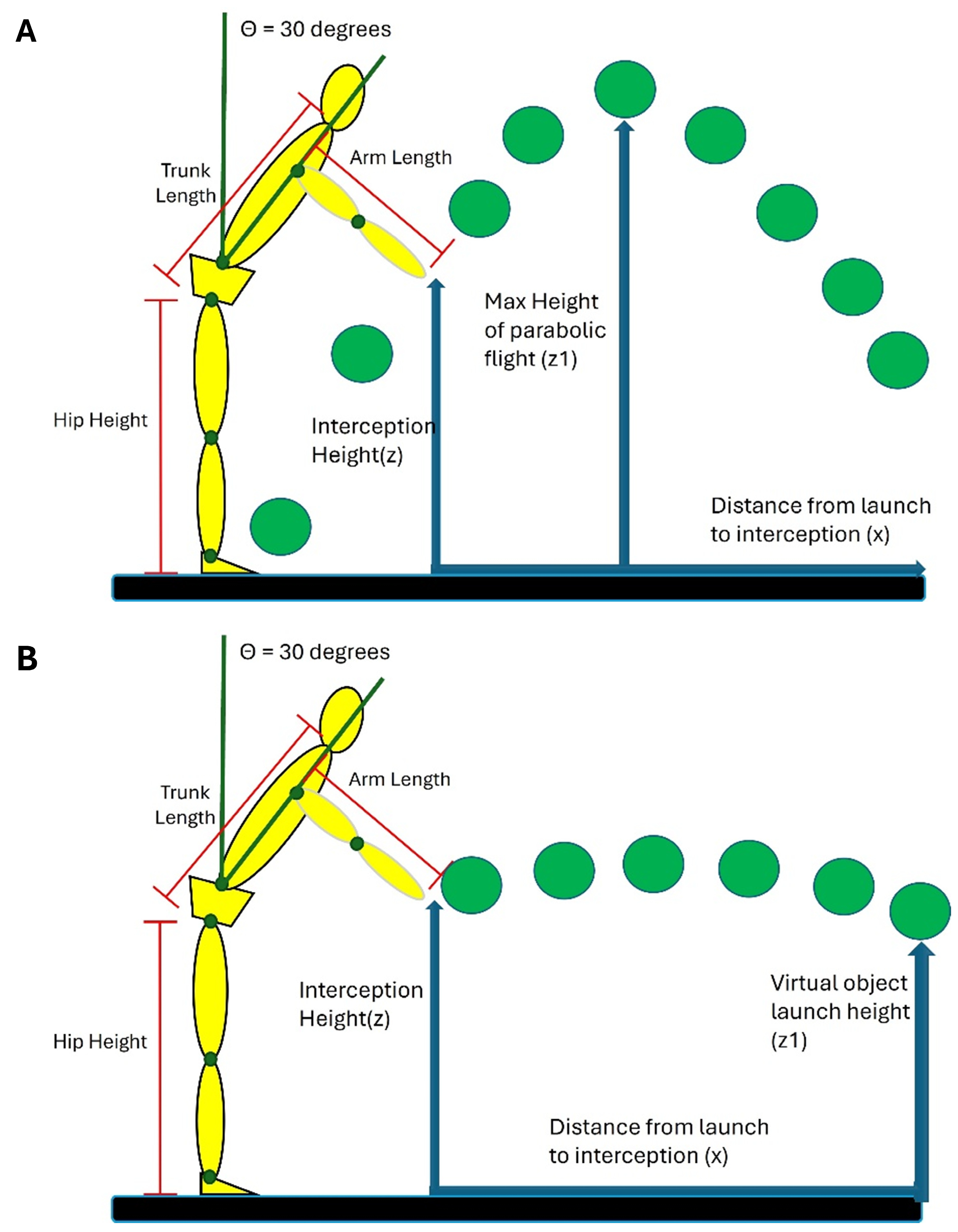
Participants played four levels of our VR dodgeball game (i.e., Dodgeality). The development of Dodgeality and its outcomes in clinical trials exploring its effectiveness as a gamified therapy in chronic low back pain populations has been described in detail previously [12,13]. In brief, Dodgeality requires participants to intercept by “blocking” a virtual ball launched from one of four opposing humanoid avatars in a virtual gym environment. Participants score points for successfully blocking the launched virtual ball with a tracked 3D-printed dodgeball that they held with both hands (see Figure 1A) but lose points if the launched virtual ball hits their own full-body humanoid avatar. Gameplay is extensively customizable, and our custom algorithm ensures that the virtual ball crosses a specific interception height that is based on the participant’s individual anthropometrics, and it necessitates progressively larger joint excursions from the participant to ensure game success (see Figure 2). In this environment, two levels are played, one with a velocity of 40 m/s and one with a velocity of 60 m/s. In addition, a simpler version of Dodgeality, i.e., Cannon, is used, whereby the four avatar opponents are replaced by a single, centrally located virtual cannon that launches the virtual ball on a more pronounced and customizable parabolic trajectory. In this version, the experimenter enters a desired vertex height for the parabolic trajectory, and the custom algorithm adjusts the launch angle and velocity to ensure the virtual ball crosses the intended interception height. In this environment, two levels were played, one with a vertex height of 4 m and one with a vertex height of 8 m (see Figure 1B,C for game views).
The four levels of gameplay were associated with a single alteration in either (1) launch velocity (40 m/s, and 60 m/s) or (2) parabolic launch height (4 m and 8 m) and presented in a fixed order (Cannon—8 m and Cannon—4 m; Day—40 m/s and Day—60 m/s); they were expected to increase the perceived task difficulty (see Figure 2 for the schematics of game design). Each game level consisted of 30 trials (two sets of 15, approximately 3 min in each set with 30 s break between). The intended interception heights of 12 of 15 trials, represented by red dodgeballs, were distributed amongst four heights normalized to the participant’s arm length, trunk length, and hip height [14,15,16]. These impacts heights would theoretically elicit 15°, 30°, 45°, and 60° of isolated trunk flexion. The only explicit instructions pertaining to user movement to achieve the game goals were that they had to keep their feet planted on the floor at a comfortable width (i.e., at approximately shoulder width, with no stepping or ambulating around the virtual environment allowed); otherwise, participants could intercept the incoming ball at any point on its trajectory in any way they choose (i.e., no restrictions on body mechanics were used).

2.3. Instrumentation

Whole body kinematics were collected in three dimensions at 100 Hz using a 12-camera passive motion capture system (Vero v1.3, Vicon Motion Systems Ltd., Oxford, UK) and rigid tracking clusters placed on the head, thoracic spine, lumbar spine, and pelvis; the trackers were placed bilaterally on the feet, shank, thighs, arms, forearms, and hands. Each rigid cluster was fixed on a custom 3D-printed base (Taz 6, LulzBot Inc., Fargo, ND, USA) containing four to seven spherical retroreflective markers (9.5 mm Pearl Markers, B&L Engineering, Santa Ana, CA, USA), and they were affixed to the body using Velcro straps (Fabrifoam ProWrap, Applied Technology International, Ltd., Rosswell, GA, USA). Each rigid cluster’s position and orientation were recorded at 100 Hz and streamed to a Transmission Control Protocol (TCP) socket port in real time using Vicon Tracker software 4.1 (see Figure 1A for setup).
Motion monitoring software 4.0 (MotionMonitor xGEN, Innovative Sports Training Inc., Chicago, IL, USA) was used to collect and synchronize VR game events (via Unity), kinematics, and kinetic data. Segment orientations were defined in MotionMonitor xGEN by digitizing anatomic landmarks during quiet stances using a custom 3D-printed stylus pen that contained five reflective markers. Segments were then tracked in six degrees of freedom during motion. Joint angles were computed between adjacent segments using an Euler angle sequence of rotations in the sagittal (y), frontal (x), and transverse (z) planes.
The position and orientation of the 3D-printed dodgeball was tracked with a centrally fixed wireless HTC Vive tracker (HTC America Inc., Berkeley, CA, USA) and 2 HTC Base Stations, which emit infrared light sensed by multiple photodiode detectors on the tracker to determine orientation. The Vive tracker kinematics were also streamed to a TCP socket port in near real-time using SteamVR software 1.22 (Valve Inc., Bellevue, WA, USA).
The VR environments and games were custom-built using the Unity game engine (version 3.9, Unity Technologies, San Francisco, CA, USA). The Unity program reads incoming data from Vicon Tracker, MotionMonitor xGEN, and SteamVR from the TCP socket ports. It used these data to build and control the participants’ avatars in the virtual environment. Along with reading incoming data, the Unity program also sent data to MotionMonitor xGEN regarding the timing of game events (e.g., when the virtual ball was first contacted during Dodgeball). Participants were immersed in the virtual environment using an HTC Vive-wired, head-mounted display, which presented them with a first-person perspective of their avatar. The head-mounted display (HTV Vive pro, HTC America Inc.) had a resolution of 1080 × 1200 per eye, with a refresh rate of 90 Hz and a field of view of 110°. Virtual room setup was completed with SteamVR functionality to ensure that the virtual environment overlayed the real world with its center over the lab force plates (as represented in Figure 1A).

2.4. Analysis

Joint kinematics exported from MotionMonitor xGEN were further reduced using a custom-built MATLAB program (version 2020a, The MathWorks Inc., Natick, MA, USA). Joint angle time series were smoothed and differentiated using a 41-point, fourth-order Savitzky–Golay filter, which computes polynomial coefficients to fit a least-squares solution to the data [17]. Lumbar flexion excursions and peak lumbar flexion velocity were calculated for each forward-reaching movement, i.e., an attempt to intercept the ball. Joint excursion and velocity were computed between the time when each movement began (launch of the ball) and 200 ms after the participant contacted the ball. Trials where the targets were not successfully intercepted were included in the analyses. Outcomes were computed for each movement and averaged across interception height for each game.

2.5. Statistical Analysis

Separate 2-way repeated measure ANOVAs were performed to assess the effects of vertex height, launch velocity, and interception height on success, joint flexion angles and angular velocities (ankle, knee, hip, and lumbar). Statistical significance was set at p ≤ 0.05, and all statistical analyses were performed using SPSS (version 29, IBM Inc., Armonk, NY, USA).

3. Results

3.1. Parabolic Launch Vertex Height

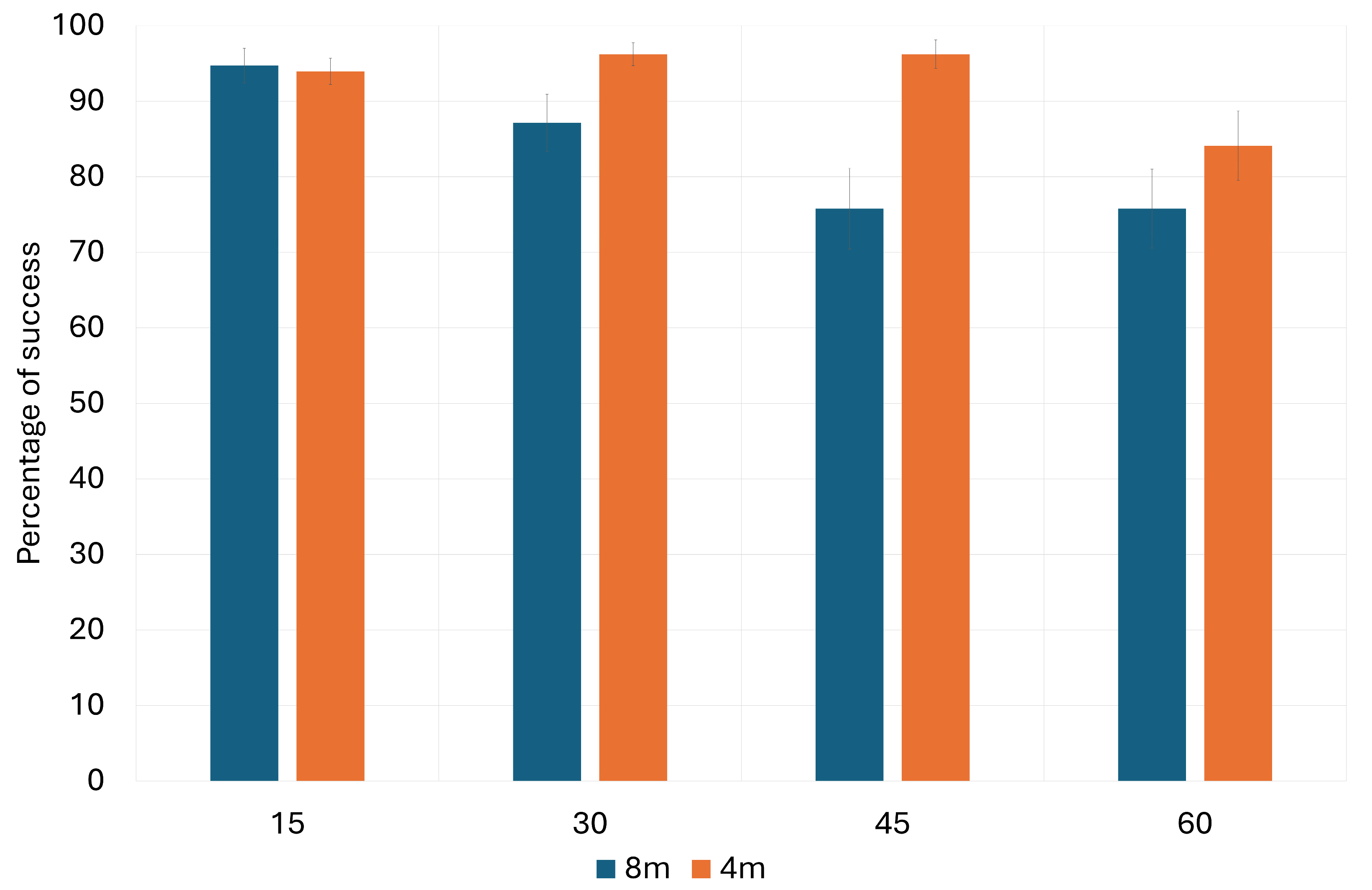
Table 1 and Figure 3 show the significant interactions between the height of the parabolic launch vertex and the interception height on the success rate. Success was generally high across all launch vertex heights (average ≈ 88%). However, as shown in Table 1, there was a significant interaction effect between parabolic launch vertex height and interception height on success. Specifically, the 4 m launch vertex produced significantly higher interception success as interception height increased (see Figure 3).
The main effects show that success was higher with a parabolic flight of 4 m than 8 m (92.6 ± 1.8% vs. 83.3 ± 3.6%) and that success declined with more challenging interception height i.e., when people had to bend lower. More specifically, success decreased progressively with lower interception targets (94.3 ± 1.6%, 91.7 ± 2.2%, 86.0 ± 3.4%, and 79.9 ± 4.5% for 15°, 30°, 45°, and 60°, respectively; see Table 2). Post hoc analysis revealed a significant difference at 45°, where parabolic height of 4 m yielded higher success (96.2 ± 1.9%) than 8 m (75.8 ± 5.3%, p < 0.001).
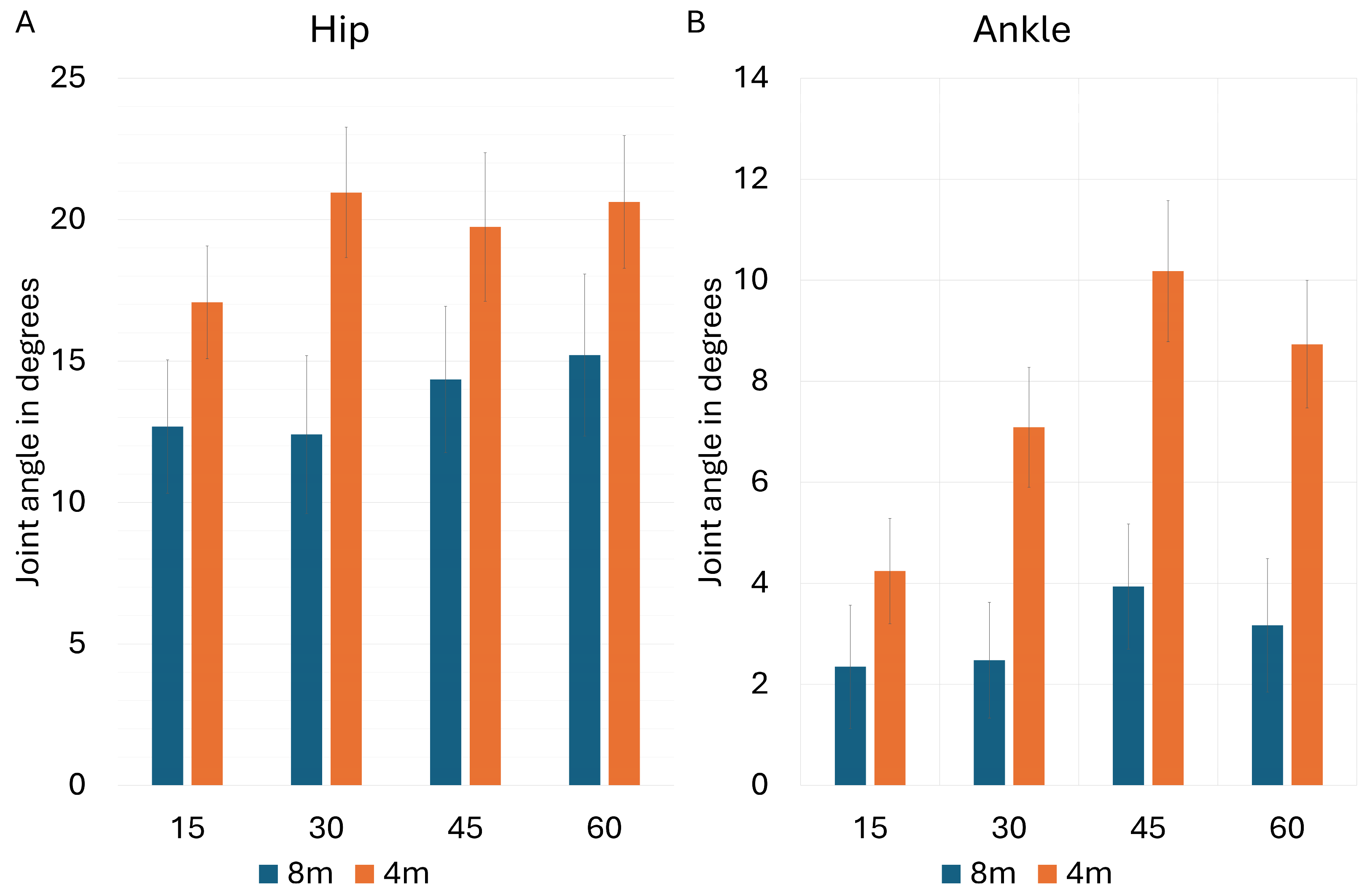
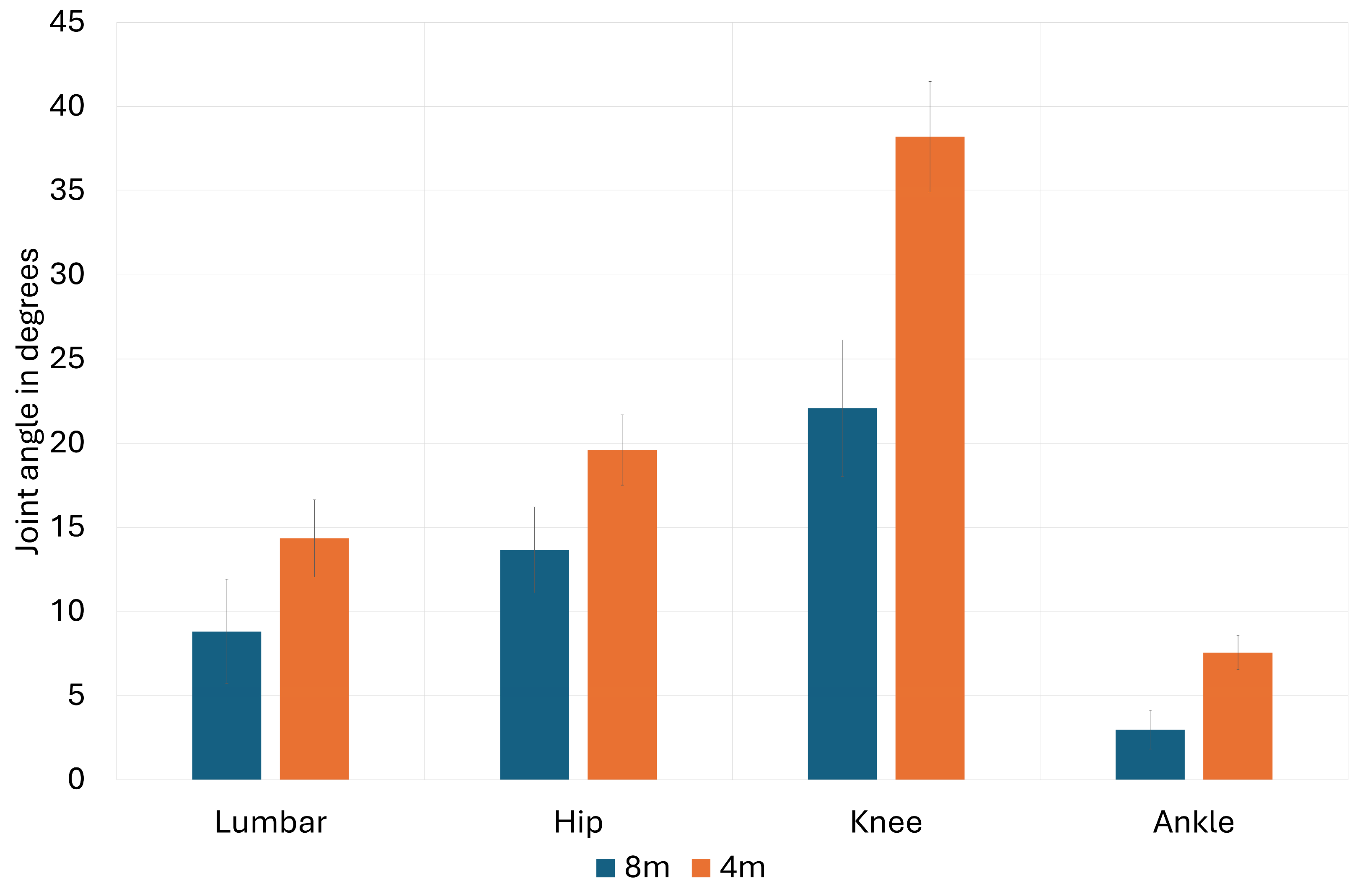
Table 3 and Figure 4 and Figure 5 show the results for joint angles. Significant interaction effects of parabolic height × interception height were observed for the hip and ankle, and the main effects of parabolic flight were found for the lumbar, hip, knee, and ankle joints. No significant interactions were detected for joint velocities, although the main effect of parabolic height was observed for knee joint velocity.

3.2. Launch Velocity

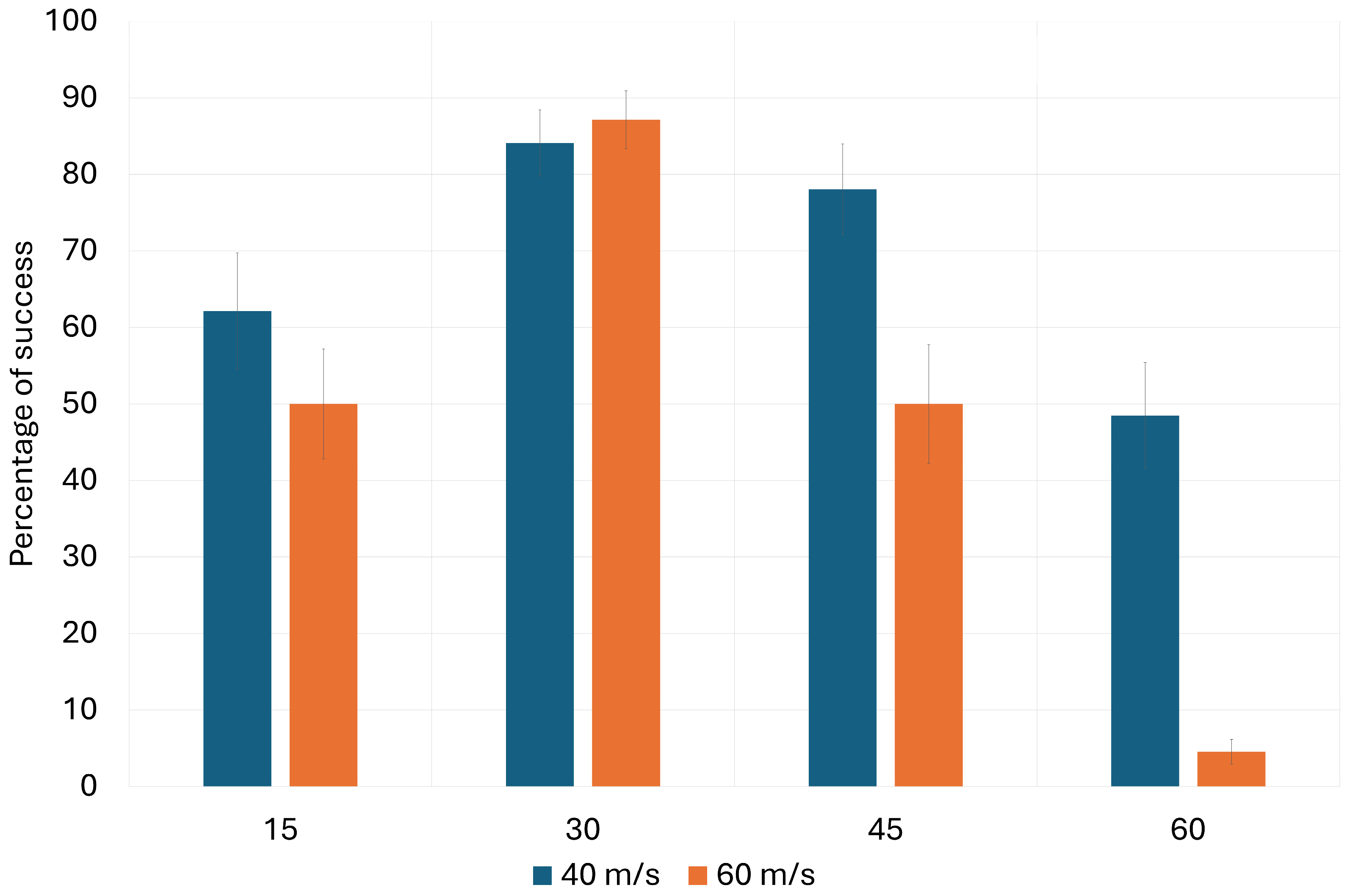
As shown in Table 1 and Figure 6, there was a significant interaction effect between launch velocity and interception height on success rate. Increasing launch velocity significantly reduced interception success: 40 m/s (68.2 ± 3.4%) vs. 60 m/s (47.9 ± 2.2%). The main effect of interception height was also found, with decreasing success at lower interception heights (56.0 ± 6.6%, 85.6 ± 3.0%, 64.0 ± 6.1%, and 26.5 ± 3.8% for 15°, 30°, 45°, and 60°, respectively). Post hoc comparisons indicated significant differences between the 40 m/s and 60 m/s conditions at both 45° and 60° (see Figure 6).

4. Discussion

Interception height significantly influenced task success, underscoring its value as a design parameter in VR-based movement interventions. From a therapeutic standpoint, interception height offers a scalable and incremental means of modulating difficulty, aligning with the principles of graded exposure and reinforcement learning [18,19]. By adjusting interception height, participants can experience repeated successes while progressively increasing physical demands. In contrast, launch velocity introduced abrupt increases in difficulty, reducing success rates and potentially undermining perceptions of control or competence [20]. These findings suggest that different mechanics serve distinct purposes: interception height for reliable progression and velocity for short-term challenge. Maselli et al. (2022) [21] compared four target locations of ball interception; in their experiment, participants were more successful at intercepting lower balls (1 and 4), and for the higher balls (2 and 3), only the top left (the worst success level) was explained by it being on the left side while players played on the right side. Their results are contrary to our results; we found that lower targets had less successful interception. However, the location of their target in respect to the player is missing, and no analysis of joint flexion angles is reported, so more detailed comparison of the two experiments is not possible [21].
Unexpectedly, higher parabolic launch vertex heights reduced interception success despite providing more time to respond (average difference ≈ 760 ms). This paradox may be explained by the reduced number of hip and knee excursions in the high-arc condition, limiting body positioning for accurate interception and shifting demand toward lumbar motion [22,23]. Perceptual constraints specific to VR, such as limited field of view and altered depth cues, may also impair prediction of high-arc trajectories [24]. Moreover, the enforced stationary stance constrained natural strategies (e.g., stepping to stabilize the ball within the visual field), further challenging performance [25]. Besides these constraints of our study, Varon et al. (2025) reported that more natural trajectories are easier to intercept than less natural trajectories [26]. In addition to the field of view implications when our increased parabola height was used (4 m and 8 m vs. Varon’s 40 cm), it could also be that a lower parabolic height is more common in real life, therefore distorting the expectations of the final trajectory under a higher parabolic flight. Thus, greater planning time did not necessarily translate into improved success when movement strategies or perceptual motor integration were constrained.
Joint-level analyses revealed increasing flexion amplitudes at lower interception heights [27,28,29]. Contradictory to the expected increase in joint angular velocities with increased ball velocities, neither launch velocity nor vertex height altered joint angular velocities. Ida et al. (2022) did show increased shoulder angular velocity during catching of real-world balls at three speeds while sitting, but these differences were reduced when participants caught virtual balls [30]. In the current study, participants appeared to adapt by initiating movements earlier at higher velocities while maintaining similar end-phase kinematics—consistent with interceptive strategies in batting, where timing rather than movement amplitude differentiates responses [31,32]. Lumbar velocities in particular did not increase with velocity, suggesting that participants modulated initiation velocity rather than accelerated spinal motion. This may be therapeutically relevant, as earlier initiation without increased lumbar velocity would constrain dynamic torque and reduce risk exposure in populations with pain or fear of motion [10]. Conversely, if the goal is to encourage greater loading as part of the rehabilitation strategy, these visual manipulations were ineffective.
Several limitations should be considered when interpreting these findings. First, the sample consisted of healthy adults, which may limit representativeness for the intended target population of individuals with chronic low back pain (CLBP) and fear of movement. People with CLBP often exhibit altered movement patterns, reduced mobility, heightened pain-related vigilance, and different motivational profiles, all of which could influence how they perform and respond to the task [10]. Second, the virtual reality setup introduces inherent motion constraints, including headset weight, sensor tracking accuracy, and restricted haptic or proprioceptive feedback, which may modify natural movement strategies and potentially interact differently with pain-related fear or guarded movement behaviors in clinical populations. Finally, the generalizability of the current results to CLBP patients—and to other potential future user groups—remains uncertain. Adaptations to task difficulty, safety parameters, or movement range may be necessary to ensure accessibility and relevance for individuals with varying degrees of pain, disability, or movement avoidance. Future work should therefore evaluate this task within CLBP populations and explore its applicability across a broader spectrum of users.
Together, these results show that game mechanics shape both success and strategy in distinct ways. Interception height provides predictable progression, launch velocity elevates task challenge, and vertex height alters the distribution of joint contributions. Such parameters can be tuned to balance usability, engagement, and targeted therapeutic outcomes in VR-based rehabilitation.

5. Conclusions

Both launch velocity and parabolic trajectory influence interception performance in VR, but only trajectory parameters consistently shape movement patterns. Lower interception heights and lower vertex arcs elicit greater hip and knee flexion, while velocity primarily modulates task difficulty. For rehabilitation, interception height provides the most reliable mechanism for graded exposure, with velocity and trajectory adjustments offering additional tools to guide engagement and joint contributions.

Author Contributions

Conceptualization, S.M.v.d.V., A.S. and J.S.T.; methodology, S.M.v.d.V. and J.S.T.; software, S.M.v.d.V., A.S., F.A. and J.S.T.; formal analysis, S.M.v.d.V. and F.A.; investigation, S.M.v.d.V., A.S. and F.A.; resources, J.S.T.; data curation, S.M.v.d.V.; writing—original draft preparation, S.M.v.d.V. and F.A.; writing—review and editing, S.M.v.d.V., A.S. and J.S.T.; visualization, S.M.v.d.V. and F.A.; supervision, J.S.T.; project administration, S.M.v.d.V., A.S. and J.S.T. All authors have read and agreed to the published version of the manuscript.

Funding

This research received no external funding.

Institutional Review Board Statement

The study was conducted in accordance with the Declaration of Helsinki and approved by the Institutional Review Board of Virginia Commonwealth University (HM20014879, 13 March 2019).

Informed Consent Statement

Informed consent was obtained from all participants involved in the study.

Data Availability Statement

The datasets presented in this article are not readily available because the data are part of an ongoing study. Requests to access the datasets should be directed to the corresponding author.

Acknowledgments

The authors would like to thank the generous assistance of interns from the VCU Undergraduate: Clinical REsearch and Applied Technologies Experience (U:CREATE) during data collection.

Conflicts of Interest

Author Alexander Stamenkovic was employed by the company J.S. Held LLC. The remaining authors declare that the research was conducted in the absence of any commercial or financial relationships that could be construed as a potential conflict of interest.

References

  1. Van Dijsseldonk, R.B.; De Jong, L.A.F.; Groen, B.E.; Van Der Hulst, M.V.; Geurts, A.C.H.; Keijsers, N.L.W. Gait stability training in a virtual environment improves gait and dynamic balance capacity in incomplete spinal cord injury patients. Front. Neurol. 2018, 9, 411121. [Google Scholar] [CrossRef]
  2. Fung, J.; Richards, C.L.; Malouin, F.; McFadyen, B.J.; Lamontagne, A. A Treadmill and Motion Coupled Virtual Reality System for Gait Training Post-Stroke. CyberPsychol. Behav. 2006, 9, 157–162. [Google Scholar] [CrossRef]
  3. Osumi, M.; Inomata, K.; Inoue, Y.; Otake, Y.; Morioka, S.; Sumitani, M. Characteristics of Phantom Limb Pain Alleviated with Virtual Reality Rehabilitation. Pain Med. 2019, 20, 1038–1046. [Google Scholar] [CrossRef]
  4. Rizzo, A.; Reger, G.; Perlman, K.; Rothbaum, B.; Difede, J.; McLay, R.; Graap, K.; Gahm, G.; Johnston, S.; Deal, R.; et al. Virtual reality posttraumatic stress disorder (PTSD) exposure therapy results with active duty OIF/OEF service members. Int. J. Disabil. Hum. Dev. 2011, 10, 301–308. [Google Scholar] [CrossRef]
  5. Lin, D.H.; Lin, Y.F.; Chai, H.M.; Han, Y.C.; Jan, M.H. Comparison of proprioceptive functions between computerized proprioception facilitation exercise and closed kinetic chain exercise in patients with knee osteoarthritis. Clin. Rheumatol. 2006, 26, 520–528. [Google Scholar] [CrossRef] [PubMed]
  6. Xu, W.; Liang, H.N.; Yu, K.; Baghaei, N. Effect of Gameplay Uncertainty, Display Type, and Age on Virtual Reality Exergames. In Proceedings of the 2021 CHI Conference on Human Factors in Computing Systems, Yokohama, Japan, 8–13 May 2021. [Google Scholar] [CrossRef]
  7. Pallavicini, F.; Pepe, A. Virtual Reality Games and the Role of Body Involvement in Enhancing Positive Emotions and Decreasing Anxiety: Within-Subjects Pilot Study. JMIR Serious Games 2020, 8, e15635. [Google Scholar] [CrossRef]
  8. Tao, G.; Garrett, B.; Taverner, T.; Cordingley, E.; Sun, C. Immersive virtual reality health games: A narrative review of game design. J. Neuroeng. Rehabil. 2021, 18, 31. [Google Scholar] [CrossRef] [PubMed]
  9. Thomas, J.S.; France, C.R. The relationship between pain-related fear and lumbar flexion during natural recovery from low back pain. Eur. Spine J. 2008, 17, 97–103. [Google Scholar] [CrossRef]
  10. Thomas, J.S.; France, C.R. Pain-Related Fear Is Associated with Avoidance of Spinal Motion During Recovery from Low Back Pain. Spine 2007, 32, E460–E466. [Google Scholar] [CrossRef]
  11. Golding, J.F. Motion sickness susceptibility questionnaire revised and its relationship to other forms of sickness. Brain Res. Bull. 1998, 47, 507–516. [Google Scholar] [CrossRef]
  12. France, C.R.; Thomas, J.S. Virtual immersive gaming to optimize recovery (VIGOR) in low back pain: A phase II randomized controlled trial. Contemp. Clin. Trials 2018, 69, 83–91. [Google Scholar] [CrossRef]
  13. Thomas, J.S.; France, C.R.; Applegate, M.E.; Leitkam, S.T.; Walkowski, S. Feasibility and Safety of a Virtual Reality Dodgeball Intervention for Chronic Low Back Pain: A Randomized Clinical Trial. J. Pain 2016, 17, 1302–1317. [Google Scholar] [CrossRef]
  14. Thomas, J.S.; France, C.R.; Leitkam, S.T.; Applegate, M.E.; Pidcoe, P.E.; Walkowski, S. Effects of real-world versus virtual environments on joint excursions in full-body reaching tasks. IEEE J. Transl. Eng. Health Med. 2016, 4, 2100608. [Google Scholar] [CrossRef]
  15. Thomas, J.S.; Corcos, D.M.; Hasan, Z. The Influence of Gender on Spine, Hip, Knee, and Ankle Motions During a Reaching Task. J. Mot. Behav. 1998, 30, 98–103. [Google Scholar] [CrossRef]
  16. Thomas, J.S.; Gibson, G.E. Coordination and timing of spine and hip joints during full body reaching tasks. Hum. Mov. Sci. 2007, 26, 124–140. [Google Scholar] [CrossRef]
  17. Press, W.H. Numerical Recipes in FORTRAN: The Art of Scientific Computing, 2nd ed.; Cambridge University Press: Cambridge, UK, 1992. [Google Scholar]
  18. Putawa, R.A.; Sugianto, D. Exploring User Experience and Immersion Levels in Virtual Reality: A Comprehensive Analysis of Factors and Trends. Int. J. Res. Metav. 2024, 1, 20–39. [Google Scholar] [CrossRef]
  19. Ahn, J.; Choi, S.; Lee, M.; Kim, K. Investigating Key User Experience Factors for Virtual Reality Interactions. J. Ergon. Soc. Korea 2017, 36, 267–280. [Google Scholar] [CrossRef]
  20. Owings, T.M.; Lancianese, S.L.; Lampe, E.M.; Grabiner, M.D. Influence of ball velocity, attention, and age on response time for a simulated catch. Med. Sci. Sports Exerc. 2003, 35, 1397–1405. [Google Scholar] [CrossRef]
  21. Maselli, A.; De Pasquale, P.; Lacquaniti, F.; d’Avella, A. Interception of virtual throws reveals predictive skills based on the visual processing of throwing kinematics. iScience 2022, 25, 105212. [Google Scholar] [CrossRef] [PubMed]
  22. van der Veen, S.M.; Stamenkovic, A.; Applegate, M.E.; Leitkam, S.T.; France, C.R.; Thomas, J.S. Effects of Avatar Perspective on Joint Excursions Used to Play Virtual Dodgeball: Within-Subject Comparative Study. JMIR Serious Games 2020, 8, e18888. [Google Scholar] [CrossRef]
  23. Stamenkovic, A.; Underation, M.; Cloud, L.J.; Pidcoe, P.E.; Baron, M.S.; Hand, R.; France, C.R.; van der Veen, S.M.; Thomas, J.S. Assessing perceptions to a virtual reality intervention to improve trunk control in Parkinson’s disease: A preliminary study. Virtual Real. 2023, 27, 465–479. [Google Scholar] [CrossRef]
  24. Thomas, J.S.; France, C.R.; Applegate, M.E.; Leitkam, S.T.; Pidcoe, P.E.; Walkowski, S. Effects of Visual Display on Joint Excursions Used to Play Virtual Dodgeball. JMIR Serious Games 2016, 4, e16. [Google Scholar] [CrossRef]
  25. Kistemaker, D.A.; Faber, H.; Beek, P.J. Catching fly balls: A simulation study of the Chapman strategy. Hum. Mov. Sci. 2009, 28, 236–249. [Google Scholar] [CrossRef] [PubMed]
  26. Varon, S.; Babin, K.; Spering, M.; Culham, J.C. Target interception in virtual reality is better for natural versus unnatural trajectory shapes and orientations. J. Vis. 2025, 25, 11. [Google Scholar] [CrossRef]
  27. Alexandrov, A.; Frolov, A.; Massion, J. Axial synergies during human upper trunk bending. Exp. Brain. Res. 1998, 118, 210–220. [Google Scholar] [CrossRef] [PubMed]
  28. Stapley, P.J.; Pozzo, T.; Cheron, G.; Grishin, A. Does the coordination between posture and movement during human whole-body reaching ensure center of mass stabilization? Exp. Brain Res. 1999, 129, 134–146. [Google Scholar] [CrossRef] [PubMed]
  29. Thomas, J.S.; Corcos, D.M.; Hasan, Z. Effect of movement speed on limb segment motions for reaching from a standing position. Exp. Brain Res. 2003, 148, 377–387. [Google Scholar] [CrossRef]
  30. Ida, H.; Fukuhara, K.; Ogata, T. Virtual reality modulates the control of upper limb motion in one-handed ball catching. Front. Sports Act. Living 2022, 4, 926542. [Google Scholar] [CrossRef] [PubMed]
  31. Hubbard, A.W.; Seng, C.N. Visual Movements of Batters. Res. Q. Am. Assoc. Health Phys. Educ. Recreat. 1954, 25, 42–57. [Google Scholar] [CrossRef]
  32. Katsumata, H. A functional modulation for timing a movement: A coordinative structure in baseball hitting. Hum. Mov. Sci. 2007, 26, 27–47. [Google Scholar] [CrossRef]
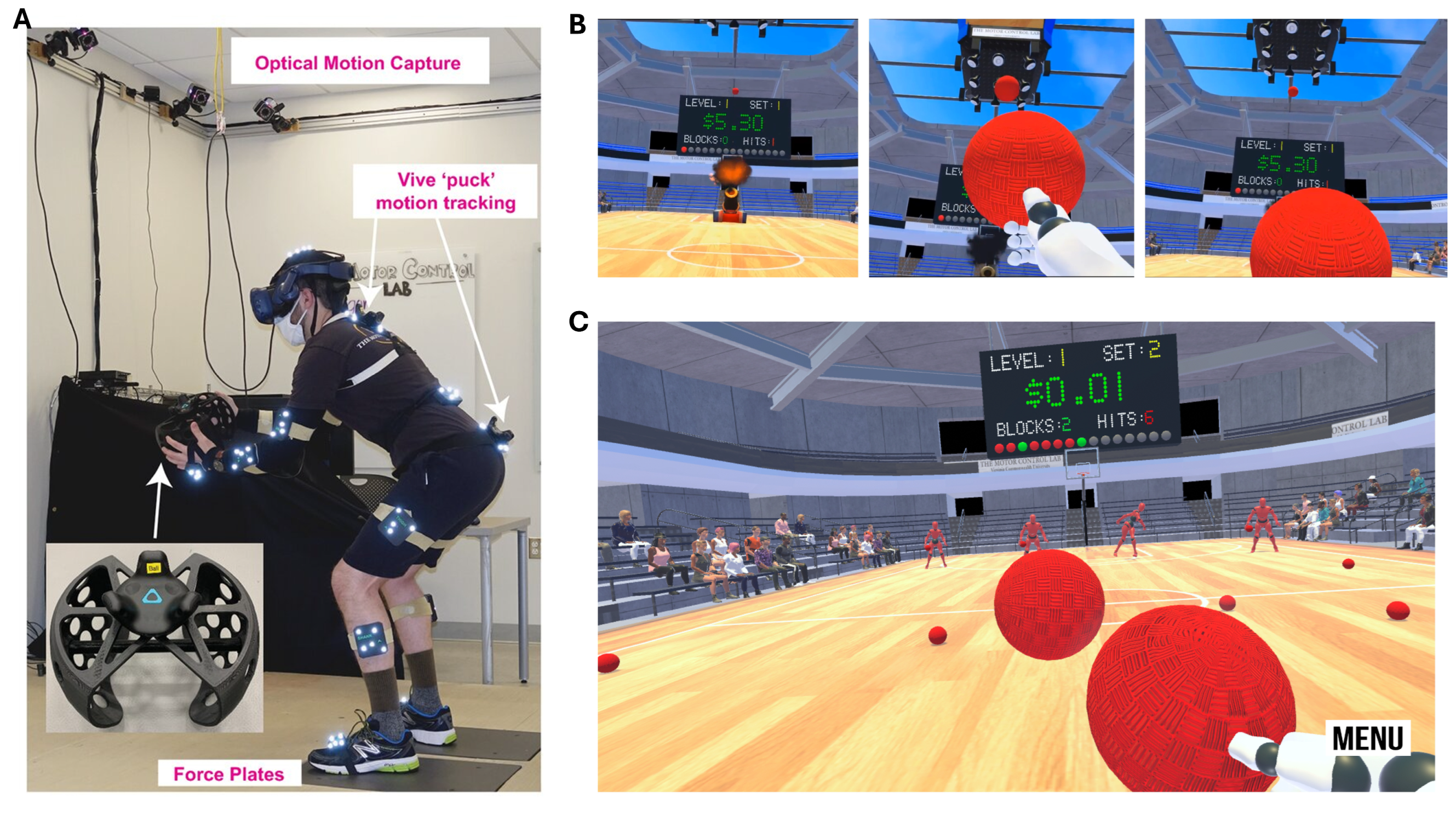
Figure 1. Representative example of participant setup and experimental apparatus (A), including custom equipment (A, inset) and first-person gameplay in each of the VR environments: Cannon dodgeball (B), and Day dodgeball (C).
Applsci 16 00144 g001
Figure 2. The trajectories for (A) cannon dodgeball and (B) day dodgeball were solved using standard equations of motion (see below). The input variables for day dodgeball were (1) intended interception height, (2) distance to intended interception, (3) launch height for virtual object, and (4) launch velocity. From these input variables, the launch angle necessary to ensure that the path of the launched virtual ball passed through the intended interception height was calculated. With respect to cannon dodgeball, the desired maximum trajectory height was an input variable, and both launch velocity and launch angle were derived from the equations of motion to ensure tha tthe path of the launched virtual ball passed through the intended interception height.
Applsci 16 00144 g002
Figure 3. Bars represent the percentage of blocked balls for parabolic vertex heights of 8 m in blue and 4 m in orange. Error bars represent the standard error of the mean.
Applsci 16 00144 g003
Figure 4. Bars represent the degree of joint flexion for a vertex height of 8 m (in blue) and 4 m (in orange): (A) hip and (B) ankle joints.
Applsci 16 00144 g004
Figure 5. Bars represent the joint angles for a vertex height of 8 m (in blue) and 4 m (in orange) for ankle, knee, hip and lumbar joints.
Applsci 16 00144 g005
Figure 6. Bars represent the percentage of blocked balls at a launch velocity of 40 m/s (in blue) and 60 m/s (in orange). Error bars represent the standard error of the mean.
Applsci 16 00144 g006
Table 1. Summary of ANOVA results for success rate. The * indicates statistical significance.
Condition TestedFactor(s)Dependent
Variable
df (Between, Within)Fpη2p
Parabolic HeightHeight × Interception HeightSuccess Rate(3, 19)10.887<0.001 *0.608
Parabolic HeightSuccess Rate(1, 21)13.335<0.001 *0.388
Interception HeightSuccess Rate(3, 19)4.8410.011 *0.433
Launch VelocityVelocity × Interception HeightSuccess Rate(3, 19)10.887<0.001 *0.632
Launch VelocitySuccess Rate(1, 21)31.900<0.001 *0.603
Interception HeightSuccess Rate(3, 19)148.558<0.001 *0.959
Table 2. Mean ± SD for significant effects on success rate.
ConditionFactor LevelMean ± SD (%)Post hoc Differences
(p < 0.05)
Parabolic Height4 m92.6 ± 1.8>8 m
8 m83.3 ± 3.6
Interception Height15°94.3 ± 1.6>30°, 45°, 60°
30°91.7 ± 2.2>45°, 60°
45°86.0 ± 3.4>60°
60°79.9 ± 4.5
Launch Velocity40 m/s68.2 ± 3.4>60 m/s
60 m/s47.9 ± 2.2
Interception Height (Velocity Test)15°56.0 ± 6.6>60°
30°85.6 ± 3.0>45°, 60°
45°64.0 ± 6.1>60°
60°26.5 ± 3.8
Table 3. Summary of ANOVA results for joint angles and velocities. The asterisk indicates statistical significance.
Dependent VariableFactor (s)df (Between, Within)Fpη2p
Hip AngleParabolic Height × Interception Height(3, 16)3.8760.029 *0.421
Ankle AngleParabolic Height × Interception Height(3, 17)3.5850.036 *0.387
Lumbar AngleParabolic Height(1, 16)6.0550.026 *0.275
Hip AngleParabolic Height(1, 18)6.5940.019 *0.268
Knee AngleParabolic Height(1, 20)32.138<0.001 *0.616
Ankle AngleParabolic Height(1, 19)14.2810.001 *0.429
Knee AngleInterception Height(3, 18)8.827<0.001 *0.595
Ankle AngleInterception Height(3, 17)6.8310.003 *0.547
Knee VelocityParabolic Height(1, 21)4.4090.048 *0.174
Disclaimer/Publisher’s Note: The statements, opinions and data contained in all publications are solely those of the individual author(s) and contributor(s) and not of MDPI and/or the editor(s). MDPI and/or the editor(s) disclaim responsibility for any injury to people or property resulting from any ideas, methods, instructions or products referred to in the content.