


Abstract
Background: Video-based biomechanical running gait analysis is widely used to optimise technique, guide footwear selection, and identify orthopaedic risk factors. Despite the increasing availability of such assessments, it is often assumed—without strong empirical support—that key kinematic parameters of running gait remain stable over short periods of time. This study aimed to examine the short-term stability of key joint angles during running using a standard 2D video-based kinematic analysis. Specifically, it was investigated whether these angles change within the first 4 min of treadmill running under three defined conditions: barefoot at 12 km h−1, shoed at 12 km h−1, and shoed at 14 km h−1, in a homogeneous sample of twelve young, trained, male recreational soccer players. Methods: Participants completed three four-minute runs. Joint angles were quantified manually from 2D video recordings. Temporal variation was analysed using repeated-measures statistics, intraclass correlation coefficients (ICCs), and minimal detectable changes (MDCs). Results: Six out of nine joint angles showed statistically significant temporal changes, mainly in hip extension, knee flexion, the Duchenne angle, the Trendelenburg angle, the leg axis angle, and heel-bottom angle. Lower leg angle and Achilles tendon angle remained stable. ICCs showed moderate to excellent agreement, indicating high within-session consistency across all angles. Discussion: Under the applied study protocol, significant short-term variations were observable in several joint angles during the first four minutes of running. These findings highlight the importance of analysing multiple strides and considering measurement uncertainty when interpreting short-duration running kinematics.
1. Introduction
Endurance running is one of the most popular recreational sport activities in Central Europe and North America [1,2]. It has been demonstrated to exert positive effects on the cardiovascular system, reducing resting pulse and blood pressure, and strengthening the immune system [2,3]. However, running is also associated with a high prevalence of overuse injuries, particularly in the lower extremities [1,4,5]. Biomechanical running gait analyses play a pivotal role in preventing such overuse injuries by helping to identify imbalances and improving load distribution and efficiency of movements [4,6]. In addition, running gait analyses may help to find adequate footwear and optimise performance on an individual level [2].
There are numerous approaches to conducting a running gait assessment, with optical video analysis motion capture traditionally considered the gold standard [2]. As technology advances, three-dimensional (3D) optical motion analysis systems have been increasingly utilised to provide more detailed and comprehensive insights into running kinematics than two-dimensional (2D) optical systems. Conventional 3D motion capture systems are most often based on infrared reflective optics and are as such typically elaborate, costly, not portable and only applicable to indoor environments, hindering their in-field use outside the laboratory [2]. In the quest to overcome these general limitations of traditional optical motion capture, advances in artificial intelligence (AI) applied to easily accessible smartphone-based video analysis have recently gained traction as a more cost-effective and accessible alternative [7,8].
Regardless of the measurement system used, the basis of any running gait analysis is the evaluation of spatio-temporal biomechanical parameters at specific phases of the running gait cycle. However, defining the precise conditions under which these parameters are to be assessed proves challenging, given that runners continually adapt their running gait in response to internal and external factors, such as intensity and environmental conditions [9,10]. Consequently, it is imperative to establish explicit criteria to ensure that the findings of a running gait analysis are translatable into practical exercise recommendations. The literature identifies three main influencing factors of running gait: duration and distance [11,12,13], intensity [9], and the surface of an overground running session [10,14,15].
As for distance, it has been observed, for instance, that hip extension during the swing phase decreases over the course of a marathon, while knee flexion increases during the swing phase and decreases during stance over that distance [13]. Step protocols until voluntary exhaustion have also been shown to result in a reduced knee flexion angle at initial contact and during the stance phase. However, these changes typically did not exceed the threshold of 5% [11]. Similarly, alterations in kinematic parameters have also been observed at shorter distances. As reported by Williams et al. [16], a significant increase in knee flexion angle may be seen during the initial and final phases of 1500 to 5000 m treadmill and track runs. Additionally, Derrick et al. [12] reported a time-dependent change in knee flexion angle at initial contact (IC) and peak knee angle during the stance phase after a 3200 m treadmill or track run.
Running intensity is usually expressed in terms of running speed or pace and may be influenced by external conditions, including incline, climate, and altitude. Running speed has been found to affect, among other parameters, leg stiffness as well as ankle and knee forces [17]. For joint angles, however, conflicting results have been reported: While some studies found no evidence for an effect of running speed on sagittal joint angles [18], others did report changes in ankle, knee, and hip flexion angles as a result of altered running speed [9,19].
The running surface is widely known to influence running biomechanics [14,15]. For instance, grass or woodchip tracks induce significantly lower peak tibial accelerations than synthetic tracks or concrete roads [5,14,20]. Moreover, treadmill running cannot fully simulate actual overground running: While overground running results in greater hip flexion at foot strike and greater ankle dorsiflexion at stance, it shows reduced ankle eversion [21]. In addition, several studies have demonstrated biomechanical differences between barefoot running and shoed running. Barefoot running typically results in reduced peak ground reaction forces (GRF), greater foot and ankle plantarflexion, and increased knee flexion at initial contact [18,22,23].
In light of these findings, it is clear that a valid implementation of a running gait analysis should include different durations, intensities and surfaces. However, in real-world testing scenarios, this scientifically based requirement is often not compatible with practical economic constraints. For example, in typical running gear stores, running gait analysis is often reduced to a short session of treadmill running at a single low to moderate pace. Even if equipped with advanced AI-based instant video analysis, modern retail stores rarely spend time evaluating more than 2–5 consecutive strides to obtain the key spatio-temporal metrics that form the basis of biomechanical running gait analysis. Interestingly, even in several recent studies that were conducted in well-equipped modern kinesiology laboratories, only 12–15 consecutive steps were assessed [9,24], despite the fact that technological capacity would have allowed for a deeper data base and neither time nor cost constraints were likely to be relevant in this context.
In essence, there often seems to be the implicit notion that for a well-defined running condition at submaximal intensity, the running gait is expected to be stable, suggesting that it does change significantly over several minutes. Despite the apparent importance of the validity of running gait analyses, there is no explicit scientific evidence for this assumption in the extant literature. Therefore, the aim of the present study was to examine the short-term stability of key joint angles during treadmill running using standard 2D video-based kinematic analysis. Based on initial findings on early-phase adaptations and footwear-related effects, it was hypothesised that joint angles might show small but detectable short-term changes already during the first minutes of running. We further hypothesised that these temporal adjustments might differ between barefoot and shoed running as well as between moderate and faster running speeds. Nonetheless, given the short duration of each running bout, we expected overall intra-individual consistency to remain relatively high. Specifically, we investigated whether these angles change within the first 4 min under three defined running conditions: barefoot at 12 km h−1, shoed at 12 km h−1, and shoed at 14 km h−1. Based on our initial assumptions, we expected small but detectable short-term changes in key joint angles during the first minutes of running. Specifically, we hypothesised that (1) in the sagittal plane, knee flexion at mid-stance would show a gradual increase over time whereas hip extension at toe-off would exhibit a gradual decrease, (2) frontal-plane angles at mid-stance would moderately increase with time, and (3) these changes would be most pronounced in the faster shoed condition (14 km h−1).
2. Materials and Methods
2.1. Participants
Twelve male amateur soccer players aged 22 to 36 years (body mass 86.9 ± 13.2 kg; height: 180.1 ± 6.0 cm) participated in this study. All participants were active soccer players of the regional team competing in the state league of Saxony Anhalt (7th league in Germany) and reported to be free of injuries and illnesses. This cohort was chosen to reflect a typical target group of healthy, non-specialist recreational athletes, who may occasionally seek counselling on optimal footwear choices in sport equipment stores or request basic biomechanical assessment at orthopaedic facilities. The study was conducted in accordance with the Declaration of Helsinki and approved by the Ethics committee of the Department of Engineering and Industrial Design of the Magdeburg-Stendal University of Applied Sciences (Approval number: EKIWID-2024-11-001). All subjects gave their written informed consent prior to participation and were free to withdraw from the study at any time.
2.2. Study Design
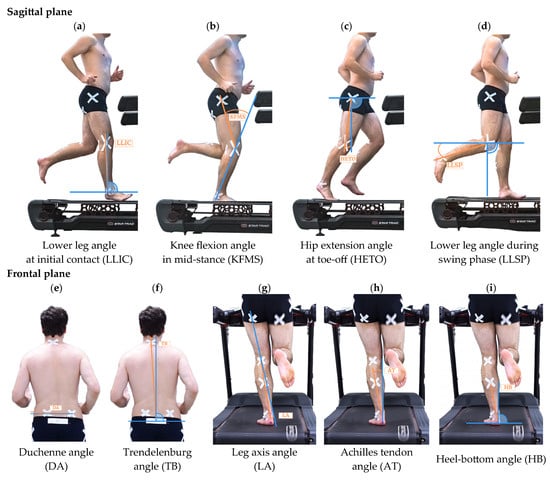
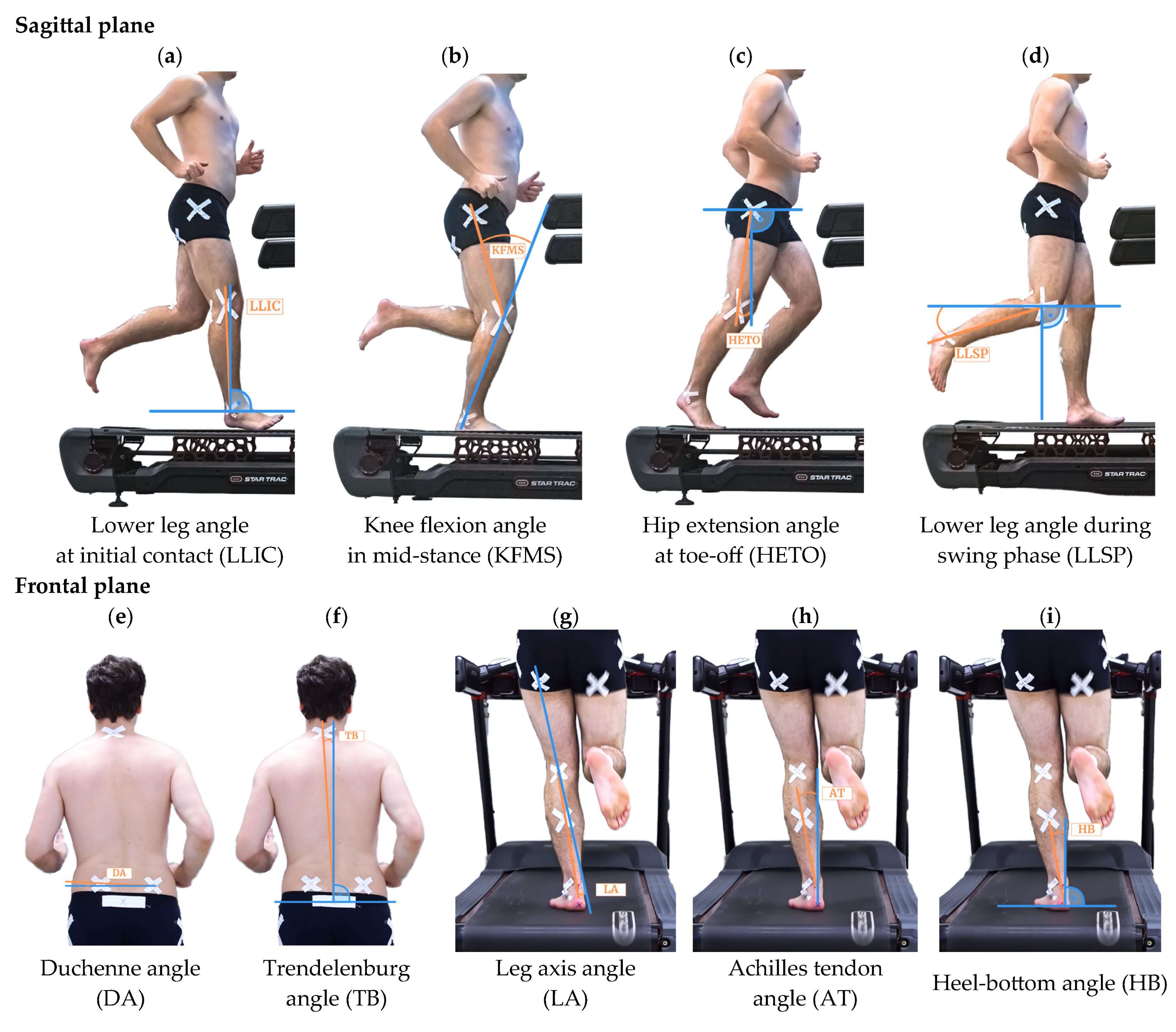
The employed video-based biomechanical assessment was based on a traditional 2D video analysis in the frontal and sagittal planes. The running movement was recorded by two cameras (Canon XH G1S; Canon XH G1, Tokyo, Japan, 50 Hz, 1920 × 1080 pixels, FHD) placed according to Marquardt [25], one laterally on the runner’s left side and one behind the treadmill, both positioned perpendicular to the runner’s centre of mass at a distance of 2 m. The treadmill used in this study was a motorised h/p/cosmos Saturn® (250/100) model (h/p/cosmos sports & medical GmbH, Nußdorf-Traunstein, Germany). For each joint angle, clearly defined body or limb positions were analysed as illustrated in Figure 1. In the sagittal plane, angles were measured at initial contact, at mid-stance, at toe-off, and during the swing phase. In the frontal plane, all angles were evaluated during mid-stance as viewed from behind. These definitions follow the standard 4-point method by Marquardt [25].
Figure 1.
Definition of the analysed joint angles using a model representative of the study population. Joint angles are visualised by a blue reference line and an orange line representing the measured segment orientation used to determine the respective angle. Subfigures (a–d) depict sagittal-plane angles: (a) lower leg angle at initial contact (LLIC), (b) knee flexion angle in mid-stance (KFMS), (c) hip extension angle at toe-off (HETO), and (d) lower leg angle during the swing phase (LLSP). Subfigures (e–i) show frontal-plane angles recorded from behind: (e) Duchenne angle (DA), (f) Trendelenburg angle (TB), (g) leg axis angle (LA), (h) Achilles tendon angle (AT), and (i) heel-bottom angle (HB). The camera positions may have been adjusted for visual clarity.
Participants were instructed to wear tight shorts and their preferred running shoes during the shoed trials. To facilitate video-based joint angle monitoring, 17 optical markers were placed on the participants’ body and shorts according to Marquardt’s 4-point method [25]. After preparation, participants completed a standardised warm-up consisting of a 4-min shoed treadmill run at a constant speed of 10 km h−1.
The test protocol consisted of three 4-min bouts of treadmill running, separated by 4-min periods of rest. The warm-up duration of 4 min was selected to align with common practice in clinical and commercial treadmill gait assessments, where only brief (and often even shorter) familiarisation periods are typically used. This duration allowed participants to reach a comfortable steady-state running pattern while minimising pre-fatigue prior to data collection. All bouts were performed in a fixed order, beginning with the running condition (1) barefoot at a speed of 12 km h−1 (Barefoot12), followed by (2) shoed at 12 km h−1 (Shoed12), and (3) shoed at 14 km h−1 (Shoed14), reflecting standard running analysis protocols used for amateur athletes. Perceived exertion was assessed at the start of each bout using the Borg scale [26].
Following the common 4-point method of Marquardt [25], the videos were analysed by the same researcher using a commercial video analysis software (utilius fairplay 5, ccc software, Leipzig, Germany) to evaluate four joint angles in the sagittal plane and five angles in the frontal plane, all measured in degrees (°). The sagittal joint angles included the lower leg angle at initial contact (LLIC), knee flexion angle in mid-stance (KFMS), hip extension angle at toe-off (HETO), and lower leg angle during swing phase (LLSP) (Figure 1a–d). The frontal plane angles analysed were the Duchenne angle (DA), Trendelenburg angle (TB), leg axis angle (LA), Achilles tendon angle (AT) and heel-bottom angle (HB) (Figure 1e–i).
2.3. Statistical Analysis
To determine the nine joint angles, eight contiguous segments [ti, ti+1], i = 1, 2, …, 8, of each 4-min run were evaluated, starting at t1 = 30 s and progressing in steps of 20 s up to t8 = 190 s, i.e., [30 s, 50 s], [50 s, 70 s], [70 s, 90 s] etc. For each segment, the first five strides were evaluated and averaged for subsequent analysis. Data curation was performed using MATLAB (R2023a, MathWorks Inc., Natick, MA, USA), while all statistical analyses were performed using JASP (version 0.17.1, JASP Team (2023), Amsterdam, The Netherlands). For all statistical tests, the significance level was set to p < 0.05. Two-way repeated measures ANOVA with Greenhouse-Geisser correction was used to analyse whether the running condition (factor 1) and/or time in terms of segment number i (factor 2) influenced the outcome of individual joint angles. If a significant main effect was observed, effect sizes were assessed using partial eta squared (ηp2), and post-hoc tests were performed. Results are presented as mean ± standard deviation (SD) unless otherwise stated. All variables were analysed using an intraclass correlation coefficient (ICC(1, 3)), indicating sufficiently high reliability, with all ICC values exceeding 0.75. For further evaluation of the results, the minimal detectable change (MDC), indicating the smallest measurable difference that can be attributed to the effect of time rather than measurement error, was calculated according to , with SE denoting the standard error [27].
3. Results
Table 1 summarises the experimentally obtained mean joint angles and their SD for the time points analysed, together with the number of soccer players included in the respective angle measurement. While eight players could be included for the analysis of the Duchenne angle, 11 players were included for the Achilles tendon and heel-bottom angles. It is noteworthy that the minimum and maximum mean values for approximately 85% of the angles measured occur either at the first two (t1 or t2) or last two time points (t7 or t8). These minima are marked in blue colour in Table 1, while the maxima are highlighted in green colour. In contrast to the other angles, the heel-bottom angle shows its maximum at the beginning of the measurements (t1) and its minimum at the end of the run (t7). Looking at the median values, the tendency of an increase of angles over time is less obvious. Minima are mostly observed during the first four time points (t1, t2, t3, t4), while maxima are present in the last four time points (t5, t6, t7, t8).
Table 1.
Mean and median (Med.) joint angles (±standard deviation, SD) for all analysed time points. t1–t8 represent consecutive 20-s segments from 30 s to 190 s of each 4-min running bout.
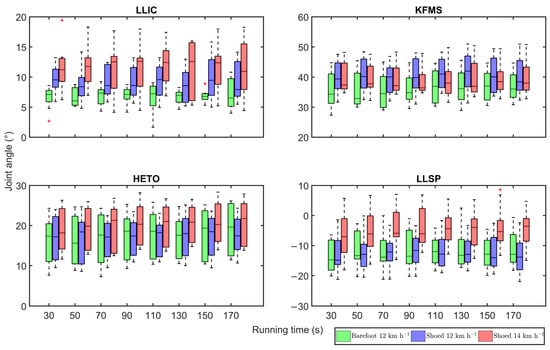
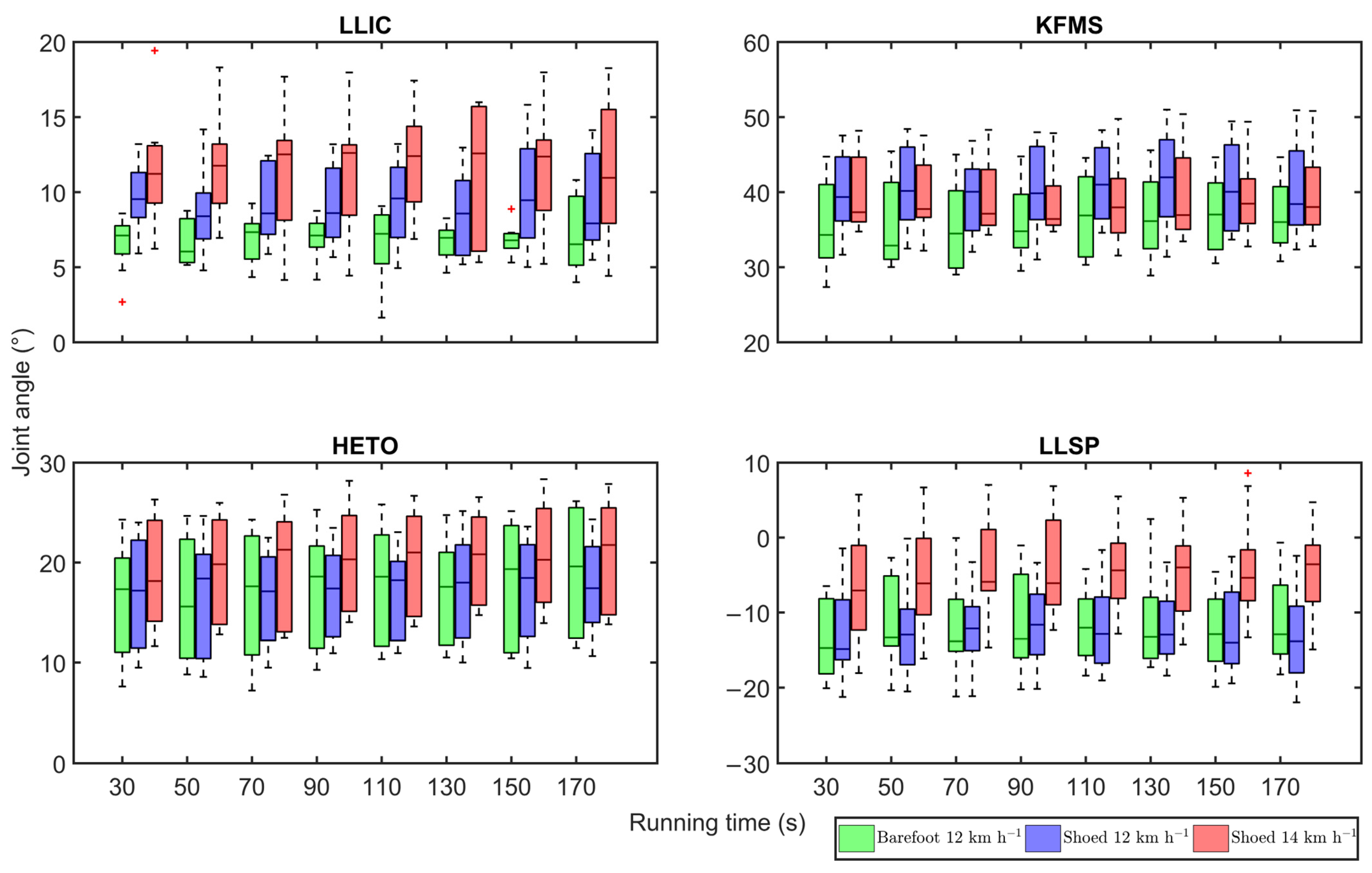
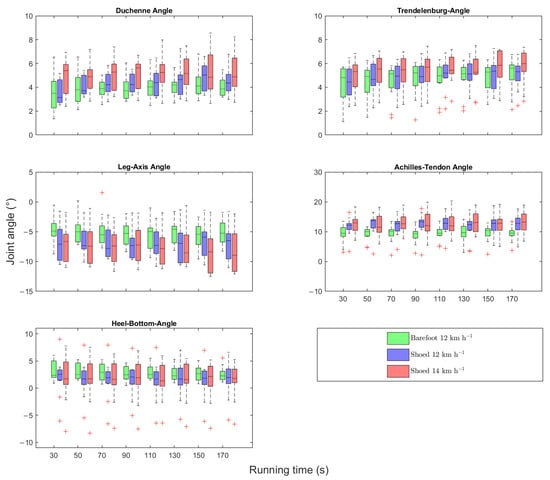
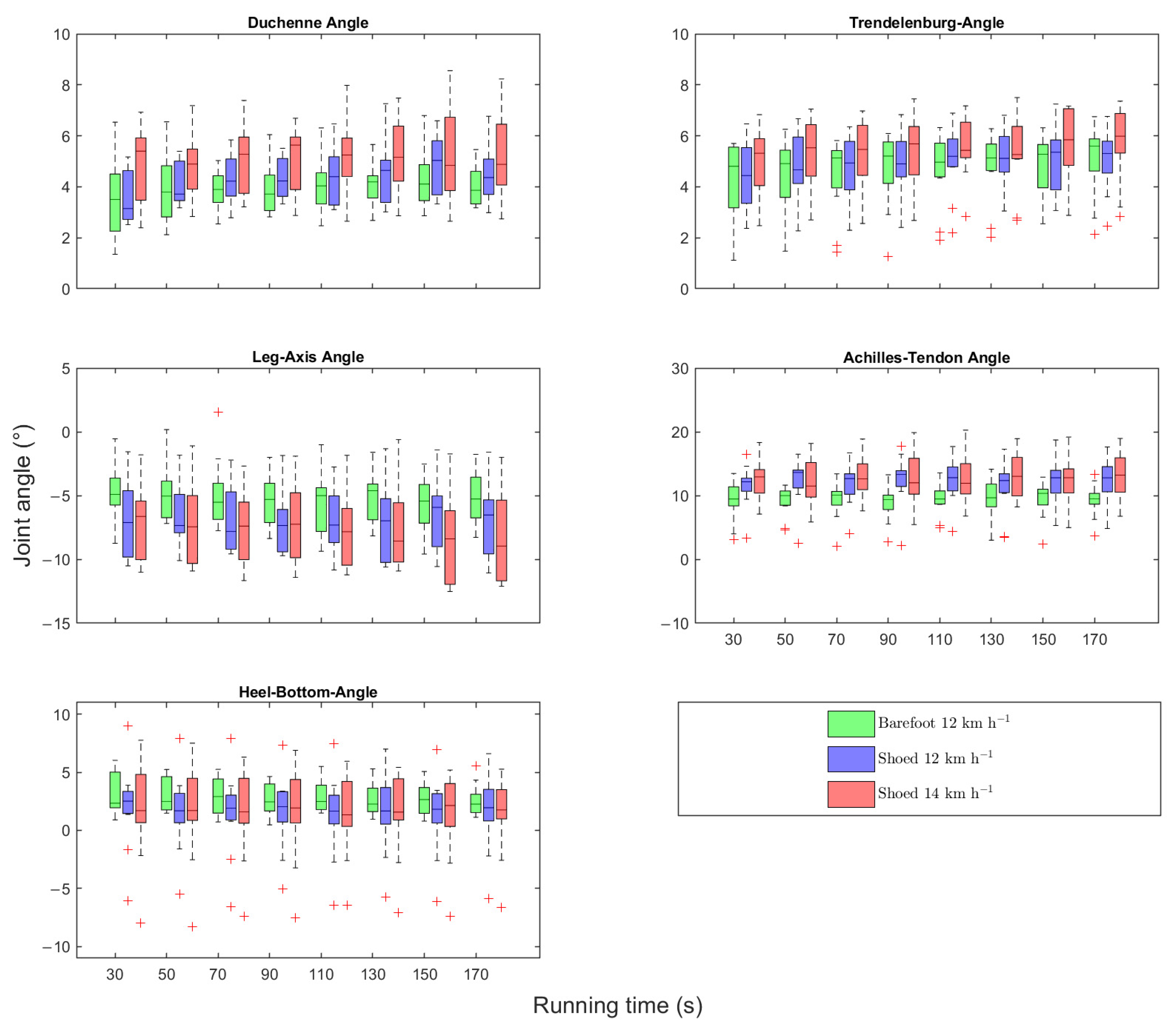
Figure 2 and Figure 3 illustrate the temporal development of the analysed joint angles during the first 4 min of each running condition. Qualitative assessment shows that some angles exhibit slight increasing or decreasing trends over time, whereas others remain relatively stable. The corresponding quantitative examination of stability over time confirms significant temporal changes in several joint angles (Table 2). Specifically, significant time effects were observed for KFMS, HETO, DA, TB and LA (all p < 0.05), whereas LLIC, LLSP, AT and HB showed no significant temporal change. In contrast, the running condition had a significant effect on almost all angles except for HB, with substantial effects observed for LLIC, KFMS, HETO, LLSP, DA, TB, LA, and AT. Importantly, no interaction effects of time × running condition were detected for any joint angle (all p > 0.14), indicating that temporal changes did not differ between the three conditions. Post-hoc analyses showed that temporal increases were most pronounced for HETO and TB, while KFMS and DA exhibited smaller but still detectable changes over time.
Figure 2.
Experimentally observed joint angles in the sagittal plane as a function of the three running conditions: Barefoot at 12 km h−1 (green), shoed at 12 km h−1 (blue) and shoed at 14 km h−1 (red). The angles shown are the lower leg angle at initial contact (LLIC), the knee flexion angle in mid-stance (KFMS), hip extension angle at toe-off (HETO) and the lower leg angle during swing phase (LLSP). Red crosses mark outliers (outside the whiskers representing 1.5 times the interquartile range).
Figure 3.
Experimentally observed joint angles in the frontal plane as a function of the three running conditions: Barefoot at 12 km h−1 (green), Shoed at 12 km h−1 (blue) and Shoed at 14 km h−1 (red). The angles shown are the Duchenne angle (DA), the Trendelenburg angle (TB), the Achilles tendon angle (AT) and the heel-bottom angle (HB). Red crosses mark outliers (outside the whiskers representing 1.5 times the interquartile range).
Table 2.
Results of the repeated-measures ANOVA for the main factors time and running condition, and the interaction of time × running condition for all joint angles, as measured in degrees.
The setup-based measurement reliability of joint angles is reflected in the absolute MDC values reported in Table 3. Across all angles, the MDC values were small, ranging from 1.05° (TB) to 5.33° (LLSP), indicating that only minor absolute changes would be required to exceed measurement uncertainty and thus become meaningfully detectable. ICC values demonstrated moderate to excellent reliability (ICC = 0.842–0.971), with the highest value observed for HB (0.971) and HETO (0.959) and the lowest, still acceptable, value for LLIC (0.842). Overall, the combination of small absolute MDC values and moderate-to-excellent ICCs indicates good short-term measurement reliability across all analysed joint angles.
Table 3.
Intraclass correlation coefficients (ICC(1, 3)) and absolute minimal detectable change (MDC, in degrees) for all analysed joint angles.
4. Discussion
The aim of this study was to examine the short-term stability of key joint angles during treadmill running using a standard 2D video-based kinematic analysis. Specifically, we investigated whether these angles change within the first 4 min under three defined conditions: barefoot at 12 km h−1, shoed at 12 km h−1, and shoed at 14 km h−1. Our results show that statistically significant changes occur within the first few three of running. In particular, changes in the knee angle KFMS and the hip angle HETO were observed in the sagittal plane. In accordance with the initial hypothesis, the knee angle increased by approximately 5%. Unexpectedly, however, the hip extension angle (HETO) also increased, by almost 10%. Both angles are commonly evaluated in running gait analyses, as they are key determinants of running economy [28] and are also relevant for injury prevention [25]. Greater hip extension is associated with a longer stance phase and increased propulsive force, which reflects a more efficient running technique. Corresponding increases in stride length after prolonged running have been reported previously [9].
Furthermore, our results show that these temporal changes also occur separately in specific individual conditions (Barefoot vs. Shoed12 vs. Shoed14: p < 0.05). Previous studies, which examined longer running periods, also exhibited an increase in hip angle and stride length at different intensities [9,19] and for different footwear conditions [18,22,23]. These adjustments may occur particularly during the first minutes of the running movement to quickly achieve an efficient running gait, which is essential for optimal performance [25]. Regarding KFMS, our findings contrast with previous research, which did not demonstrate changes in knee flexion over time [29,30,31]. However, as muscular fatigue is known to increase knee flexion during stance [32], our results prove plausible. The discrepancy to previous studies could be due to different experimental conditions: While the KFMS shows a change over time in the Shoed12 condition (p < 0.01), no change was observed in the Barefoot and Shoed14 conditions (p > 0.05).
In the frontal plane, all analysed angles, except for the Achilles tendon angle, exhibited a time dependence with a predominantly increasing trend, as hypothesised prior to the experiments. For the Duchenne and Trendelenburg angles, such temporal changes have been reported previously for prolonged running durations [33,34,35], and amounted to increases of approximately 14% in the present study. These changes may be related to the onset of hip abductor fatigue, although this mechanism generally remains a matter of debate [36]. The leg axis angle represents another parameter of particular orthopaedic relevance, as it is strongly associated with injury risk [6]. It is directly linked to minimum and peak knee varus angles as well as the knee varus angle at toe-off. Over the four minutes of each running bout, the mean leg axis angle increased in from –6.15° ± 2.99° to –6.87° ± 3.07°, indicating a more pronounced varus position over time, especially in the Shoed14 condition. Comparable time-dependent changes have also been reported in previous studies [34,37]. In contrast, the Achilles tendon angle did not exhibit a consistent time dependence, while the heel-bottom angle demonstrated a decreasing trend over time.
The observed general lack of reliability of joint angles in the frontal plane is in accordance with parts of the extant literature. For example, Abt et al. [30] reported time dependent changes in the frontal-plane angles following muscular fatigue, whereas Derrick et al. [12] and Willwacher et al. [38] reported conflicting results. One possible explanation for these discrepancies is inter-individual variability within and between different cohorts. In this context, it is interesting to note that there are one to two outliers per time point in our data for the Trendelenburg angle, Achilles tendon angle and heel-bottom angle. Notably, these results are attributed to the same individual, a finding that is concealed by the high ICC values. Another contributing factor to divergent findings across studies may be related to the applicable MDC values. To exclude measurement uncertainty, angle changes of at least 11%, and in some cases over 40%, would be required for the angles to become detectable. In the present data, however, only the HETO fell below its MDC threshold (MDC = 3.12°, actual observed difference = 1.82°). These relatively high MDC thresholds are due to the high standard deviations of the joint angles and may be reduced in future studies by increasing sample size. Importantly, the magnitude of the MDC values should not be interpreted as biomechanical instability of the joint angles. Rather, the good-to-excellent ICC values demonstrate reliable intra-individual consistency, whereas MDC values primarily reflect inter-individual variability and methodological limitations inherent to 2D video-based kinematic analyses. Several temporal changes observed in the present study fell below or close to their respective MDC thresholds. Such changes should not be interpreted as biomechanically meaningful changes but may instead reflect mere measurement uncertainty. Accordingly, only those effects that clearly exceed the MDC values should be considered robust. In addition, comparisons with previous studies must be interpreted with caution, as many of those investigations utilised 3D motion capture, employed different running durations, or studied different participant populations, which limits the direct comparability of their findings with our results.
The present findings should be interpreted in light of several limitations. First, the results are specific to a sample of young, trained male amateur soccer players and may not generalise to recreational runners, clinical populations, or individuals with different athletic backgrounds. The relatively small sample size further limits statistical power and reduces the robustness of subgroup comparisons. In addition, the study included only male athletes; although this approach is common in comparable biomechanical research [39], future studies should incorporate subjects of both sexes.
A further methodological limitation arises from the use of a 2D video-based kinematic analysis, which does not capture rotational movements. Nevertheless, previous work has demonstrated acceptable agreement between 2D and 3D methods for the joint angles examined [7]. Another limitation is the fixed order in which the running conditions were studied (Barefoot12, Shoed12, Shoed14). As the conditions were not randomised or counterbalanced, potential effects of order or fatigue cannot be fully ruled out. It is therefore possible that some of the observed temporal changes, particularly in the subsequent shoed conditions, were influenced not only by stride adaptations or kinematic variability but also by progressive fatigue or other protocol-related effects. This should be considered when interpreting short-term changes across conditions. Another limitation concerns the relatively short warm-up duration of 4 min, which may not have been sufficient for all participants—particularly during barefoot running—to fully stabilise their running technique. However, it should be noted that similarly brief familiarisation periods are common in real-world gait assessment settings such as running shoe stores, where time constraints often limit warm-up durations to only a few minutes. Thus, the chosen protocol likely reflects typical practical conditions, even though it may not allow all individuals to reach an individually stabilised running pattern.
Finally, the use of multiple ANOVAs and post-hoc comparisons increases the risk of type I errors. Given the exploratory nature of the study, the small sample size and the interdependence of many kinematic variables, strict correction procedures for multiple testing were not applied, as they would have substantially increased the likelihood of type II errors. Hence, some significant findings should be interpreted with caution.
5. Conclusions
This study aimed to examine the short-term stability of key joint angles during treadmill running under three defined conditions (barefoot at 12 km h−1, shoed at 12 km h−1 and shoed at 14 km h−1). Consistent with our hypotheses, several joint angles showed measurable temporal changes within the first minutes of running, most notably HETO, KFMS, DA, TB and LA, while others remained stable. These changes were in the range of approximately 5–10%, depending on the joint angle and running condition. Running condition influenced almost all joint angles, but no time × running condition interaction effects were observed, indicating that the temporal patterns were similar across conditions.
Overall, the combination of small absolute MDC values and moderate-to-excellent ICCs suggests that, within the present experimental protocol and population, short-term 2D kinematic assessments can provide useful within-session information. Nevertheless, caution is warranted when interpreting small changes, particularly those close to the MDC thresholds. Furthermore, the present findings should not be generalised to populations with different ages, sexes, or levels of running experience.
In essence, the outcome of this study supports the use of brief, at least four-minute, treadmill acclimation phases prior to gait assessment, and highlights which angles may require particular attention when interpreting short-term kinematic changes.
Author Contributions
Conceptualisation, O.U.; methodology, C.S. and O.U.; validation: C.S. and J.B.; formal analysis, J.B. and C.S.; investigation, C.S.; resources, O.U.; data curation C.S. and J.B.; writing—original draft, C.P. and J.B.; writing—review & editing, C.P. and O.U.; visualisation: C.P. and J.B.; supervision, O.U.; project administration, O.U. and C.S. All authors have read and agreed to the published version of the manuscript.
Funding
This research received no external funding.
Institutional Review Board Statement
The study was conducted in accordance with the Declaration of Helsinki and approved by the Ethics Committee of the Department of Engineering and Industrial Design of the Magdeburg-Stendal University of Applied Sciences (Number of approval: EKIWID-2024-11-001, 28 November 2024).
Informed Consent Statement
Informed consent was obtained from all subjects involved in the study.
Data Availability Statement
The original contributions presented in this study are included in the article. Further inquiries can be directed to the corresponding author.
Acknowledgments
We thank the players of the men’s first football team of the Dessauer Sportverein e.V. for their participation.
Conflicts of Interest
The authors declare no conflicts of interest.
Abbreviations
The following abbreviations are used in this manuscript:
| LLIC | Lower Leg Angle at Initial Contact |
| KFMS | Knee Flexion Angle at Mid-Stance |
| HETO | Hip Extension Angle at Toe-Off |
| LLSP | Lower Leg Angle at Swing Phase |
| DA | Duchenne Angle |
| TB | Trendelenburg Angle |
| LA | Leg Axis Angle |
| AT | Achilles-Tendon Angle |
| HB | Heel Bottom Angle |
References
- Van Mechelen, W. Running injuries. A review of the epidemiological literature. Sports Med. 1992, 14, 320–335. [Google Scholar] [CrossRef] [Scilit]
- Mason, R.; Pearson, L.T.; Barry, G.; Young, F.; Lennon, O.; Godfrey, A.; Stuart, S. Wearables for Running Gait Analysis: A Systematic Review. Sports Med. 2023, 53, 241–268. [Google Scholar] [CrossRef] [Scilit] [PubMed]
- Oja, P.; Titze, S.; Kokko, S.; Kujala, U.M.; Heinonen, A.; Kelly, P.; Koski, P.; Foster, C. Health benefits of different sport disciplines for adults: Systematic review of observational and intervention studies with meta-analysis. Br. J. Sports Med. 2015, 49, 434–440. [Google Scholar] [CrossRef] [Scilit] [PubMed]
- Willwacher, S.; Kurz, M.; Robbin, J.; Thelen, M.; Hamill, J.; Kelly, L.; Mai, P. Running-Related Biomechanical Risk Factors for Overuse Injuries in Distance Runners: A Systematic Review Considering Injury Specificity and the Potentials for Future Research. Sports Med. 2022, 52, 1863–1877. [Google Scholar] [CrossRef] [Scilit] [PubMed]
- Ueberschär, O.; Fleckenstein, D.; Warschun, F.; Kränzler, S.; Walter, N.; Hoppe, M.W. Measuring biomechanical loads and asymmetries in junior elite long-distance runners through triaxial inertial sensors. Sports Orthop. Traumatol. 2019, 35, 296–308. [Google Scholar] [CrossRef] [Scilit]
- Dillon, S.; Burke, A.; Whyte, E.F.; O’Connor, S.; Gore, S.; Moran, K.A. Running towards injury? A prospective investigation of factors associated with running injuries. PLoS ONE 2023, 18, e0288814. [Google Scholar] [CrossRef] [Scilit]
- Needham, L.; Evans, M.; Wade, L.; Cosker, D.P.; McGuigan, M.P.; Bilzon, J.L.; Colyer, S.L. The development and evaluation of a fully automated markerless motion capture workflow. J. Biomech. 2022, 144, 111338. [Google Scholar] [CrossRef] [Scilit]
- Peng, Y.; Wang, W.; Wang, L.; Zhou, H.; Chen, Z.; Zhang, Q.; Li, G. Smartphone videos-driven musculoskeletal multibody dynamics modelling workflow to estimate the lower limb joint contact forces and ground reaction forces. Med. Biol. Eng. Comput. 2024, 62, 3841–3853. [Google Scholar] [CrossRef] [Scilit]
- Monteiro, A.S.; Galano, J.P.; Cardoso, F.; Buzzachera, C.F.; Vilas-Boas, J.P.; Fernandes, R.J. Kinematical and Physiological Responses of Overground Running Gait Pattern at Different Intensities. Sensors 2024, 24, 7526. [Google Scholar] [CrossRef] [Scilit]
- Apte, S.; Prigent, G.; Stöggl, T.; Martínez, A.; Snyder, C.; Gremeaux-Bader, V.; Aminian, K. Biomechanical Response of the Lower Extremity to Running-Induced Acute Fatigue: A Systematic Review. Front. Physiol. 2021, 12, 646042. [Google Scholar] [CrossRef] [Scilit]
- Gao, Z.; Fekete, G.; Baker, J.S.; Liang, M.; Xuan, R.; Gu, Y. Effects of running fatigue on lower extremity symmetry among amateur runners: From a biomechanical perspective. Front. Physiol. 2022, 13, 899818. [Google Scholar] [CrossRef] [Scilit] [PubMed]
- Derrick, T.R.; Dereu, D.; McLean, S.P. Impacts and kinematic adjustments during an exhaustive run. Med. Sci. Sports Exerc. 2002, 34, 998–1002. [Google Scholar] [CrossRef] [Scilit] [PubMed]
- Chan-Roper, M.; Hunter, I.; Myrer, J.W.; Eggett, D.L.; Seeley, M.K. Kinematic changes during a marathon for fast and slow runners. J. Sports Sci. Med. 2012, 11, 77–82. [Google Scholar] [PubMed]
- Boey, H.; Aeles, J.; Schütte, K.; Vanwanseele, B. The effect of three surface conditions, speed and running experience on vertical acceleration of the tibia during running. Sports Biomech. 2017, 16, 166–176. [Google Scholar] [CrossRef] [Scilit]
- Dixon, S.J.; Collop, A.C.; Batt, M.E. Surface effects on ground reaction forces and lower extremity kinematics in running. Med. Sci. Sports Exerc. 2000, 32, 1919–1926. [Google Scholar] [CrossRef] [Scilit]
- Williams, K.R.; Snow, R.; Agruss, C. Changes in Distance Running Kinematics with Fatigue. Int. J. Sport. Biomech. 1991, 7, 138–162. [Google Scholar] [CrossRef] [Scilit]
- Arampatzis, A.; Brüggemann, G.P.; Metzler, V. The effect of speed on leg stiffness and joint kinetics in human running. J. Biomech. 1999, 32, 1349–1353. [Google Scholar] [CrossRef] [Scilit]
- De Wit, B.; De Clercq, D.; Aerts, P. Biomechanical analysis of the stance phase during barefoot and shod running. J. Biomech. 2000, 33, 269–278. [Google Scholar] [CrossRef] [Scilit]
- Khassetarash, A.; Vernillo, G.; Martinez, A.; Baggaley, M.; Giandolini, M.; Horvais, N.; Millet, G.Y.; Edwards, W.B. Biomechanics of graded running: Part II-Joint kinematics and kinetics. Scand. J. Med. Sci. Sports 2020, 30, 1642–1654. [Google Scholar] [CrossRef] [Scilit]
- Moon, G.R.; Leary, B.K.; Nguyen, A.-D.; McCrory, J.L. A comparison of running biomechanics on track, asphalt, grass, and treadmill using wearable sensors. Sports Biomech. 2025, 24, 1–13. [Google Scholar] [CrossRef] [Scilit]
- Sinclair, J.; Richards, J.; Taylor, P.J.; Edmundson, C.J.; Brooks, D.; Hobbs, S.J. Three-dimensional kinematic comparison of treadmill and overground running. Sports Biomech. 2013, 12, 272–282. [Google Scholar] [CrossRef] [Scilit] [PubMed]
- Hall, J.P.; Barton, C.; Jones, P.R.; Morrissey, D. The biomechanical differences between barefoot and shod distance running: A systematic review and preliminary meta-analysis. Sports Med. 2013, 43, 1335–1353. [Google Scholar] [CrossRef] [Scilit]
- Jahn, V.; Knierim Correia, C.; Dell’Antonio, E.; Mochizuki, L.; Ruschel, C. Biomechanics of Shod and Barefoot Running: A Literature Review. Rev. Bras. Med. Esporte 2020, 26, 551–557. [Google Scholar] [CrossRef] [Scilit]
- Baker, L.M.; Yawar, A.; Lieberman, D.E.; Walsh, C.J. Predicting overstriding with wearable IMUs during treadmill and overground running. Sci. Rep. 2024, 14, 6347. [Google Scholar] [CrossRef] [Scilit] [PubMed]
- Marquardt, M. Laufen und Laufanalyse. Medizinische Betreuung von Läufern; Thieme Verlag: Stuttgart, Germany, 2012; Volume 1, p. 276. [Google Scholar]
- Borg, G. Borg’s Perceived Exertion and Pain Scales; Human Kinetics: Champaign, IL, USA, 1998. [Google Scholar]
- Paiva, R.; Guadagnin, E.C.; Emilio de Carvalho, J.; Metsavaht, L.; Leporace, G. Test-retest reliability and minimal detectable change in pelvis and lower limb coordination during running assessed with modified vector coding. J. Biomech. 2024, 174, 112259. [Google Scholar] [CrossRef] [Scilit]
- Pizzuto, F.; de Oliveira, C.F.; Soares, T.S.A.; Rago, V.; Silva, G.; Oliveira, J. Relationship Between Running Economy and Kinematic Parameters in Long-Distance Runners. J. Strength Cond. Res. 2019, 33, 1921–1928. [Google Scholar] [CrossRef] [Scilit]
- Nilsson, J.; Thorstensson, A.; Halbertsma, J. Changes in leg movements and muscle activity with speed of locomotion and mode of progression in humans. Acta Physiol. Scand. 1985, 123, 457–475. [Google Scholar] [CrossRef] [Scilit]
- Abt, J.P.; Sell, T.C.; Chu, Y.; Lovalekar, M.; Burdett, R.G.; Lephart, S.M. Running kinematics and shock absorption do not change after brief exhaustive running. J. Strength Cond. Res. 2011, 25, 1479–1485. [Google Scholar] [CrossRef] [Scilit]
- Kellis, E.; Liassou, C. The effect of selective muscle fatigue on sagittal lower limb kinematics and muscle activity during level running. J. Orthop. Sports Phys. Ther. 2009, 39, 210–220. [Google Scholar] [CrossRef] [Scilit]
- Zandbergen, M.A.; Marotta, L.; Bulthuis, R.; Buurke, J.H.; Veltink, P.H.; Reenalda, J. Effects of level running-induced fatigue on running kinematics: A systematic review and meta-analysis. Gait Posture 2023, 99, 60–75. [Google Scholar] [CrossRef] [Scilit]
- Maas, E.; De Bie, J.; Vanfleteren, R.; Hoogkamer, W.; Vanwanseele, B. Novice runners show greater changes in kinematics with fatigue compared with competitive runners. Sports Biomech. 2018, 17, 350–360. [Google Scholar] [CrossRef] [Scilit]
- Radzak, K.N.; Stickley, C.D. Fatigue-Induced Hip-Abductor Weakness and Changes in Biomechanical Risk Factors for Running-Related Injuries. J. Athl. Train. 2020, 55, 1270–1276. [Google Scholar] [CrossRef] [Scilit]
- Riazati, S.; Caplan, N.; Matabuena, M.; Hayes, P.R. Fatigue Induced Changes in Muscle Strength and Gait Following Two Different Intensity, Energy Expenditure Matched Runs. Front. Bioeng. Biotechnol. 2020, 8, 360. [Google Scholar] [CrossRef] [Scilit]
- Gogu, S.; Gandbhir, V.N. Trendelenburg Sign; StatPearls Publishing: Treasure Island, FL, USA, 2023. [Google Scholar]
- Tian, F.; Li, N.; Zheng, Z.; Huang, Q.; Zhu, T.; Li, Q.; Wang, W.; Tsai, T.Y.; Wang, S. The effects of marathon running on three-dimensional knee kinematics during walking and running in recreational runners. Gait Posture 2020, 75, 72–77. [Google Scholar] [CrossRef] [Scilit]
- Willwacher, S.; Sanno, M.; Brüggemann, G.P. Fatigue matters: An intense 10 km run alters frontal and transverse plane joint kinematics in competitive and recreational adult runners. Gait Posture 2020, 76, 277–283. [Google Scholar] [CrossRef] [Scilit]
- Rodríguez-Barbero, S.; González-Mohíno, F.; Rodrigo-Carranza, V.; Santos-Garcia, D.J.; Boullosa, D.; González-Ravé, J.M. Acute effects of interval training on running kinematics in runners: A systematic review. Gait Posture 2023, 103, 19–26. [Google Scholar] [CrossRef] [Scilit]

Disclaimer/Publisher’s Note: The statements, opinions and data contained in all publications are solely those of the individual author(s) and contributor(s) and not of MDPI and/or the editor(s). MDPI and/or the editor(s) disclaim responsibility for any injury to people or property resulting from any ideas, methods, instructions or products referred to in the content. |
© 2025 by the authors. Licensee MDPI, Basel, Switzerland. This article is an open access article distributed under the terms and conditions of the Creative Commons Attribution (CC BY) license.