Article

Assessment of Equilibrium Path Sensitivity in Truss Domes Vulnerable to Node Snap-Through with Respect to Load Distribution


1
Faculty of Civil Engineering and Architecture, Kielce University of Technology, al. Tysiąclecia Państwa Polskiego 7, 25-314 Kielce, Poland
2
Faculty of Mechatronics and Mechanical Engineering, Department of Computer and Armament Technologies, Kielce University of Technology, al. Tysiąclecia Państwa Polskiego 7, 25-314 Kielce, Poland
*
Author to whom correspondence should be addressed.
Appl. Sci. 2026, 16(1), 128; https://doi.org/10.3390/app16010128
Submission received: 26 November 2025 / Revised: 10 December 2025 / Accepted: 18 December 2025 / Published: 22 December 2025
(This article belongs to the Section Civil Engineering)

Abstract

The objective of the article is the assessment of the sensitivity of the equilibrium path of structures susceptible to loss of stability due to node snap-through. Increasingly, architectural designs feature organic forms and structures with complex geometry, which makes it possible to create very large, column-free spaces. These developments lead to the design of structures with ever smaller rise while simultaneously increasing their span. Due to the parameters of structures of this type, it is justified to analyze such systems with consideration of nonlinear effects. The Newton–Raphson algorithm was used to determine the limit points on the equilibrium path, employing both load control and displacement control. To accurately determine the position of the limit point on the equilibrium path, the step length was defined adaptively. Four dome space trusses were analyzed. Individual load sets were differentiated in terms of load location. The developed algorithm was implemented in a proprietary finite element method program created in the Matlab R2025b software. The analysis showed that, despite significant differences in the critical force (Pult), the global response of the structure at the moment of snap-through remains similar. The displacement of the apex node at the moment of snap-through remains similar across most of the proposed load sets. In the case of low-rise structures, a significant increase in the sensitivity of the load location to the critical load value and in the displacement of the apex node at the moment of snap-through was observed.

1. Introduction

Structures composed of spatial truss members arranged over curved surfaces are commonly referred to as surface coverings. The most prevalent type of such structures is the dome. The popularity of bar domes (compared to solid-surface domes) continues to grow due to their significantly lower weight, relatively high load-bearing capacity, and shorter construction time. They are primarily used as coverings for exhibition halls, observatories, religious buildings, sports arenas, stadiums, and similar facilities. Their increasing adoption is undoubtedly facilitated by advancements in computational methods and computer-aided design. Another key factor is the design of structures that are easy to manufacture and assemble.
In the design of such structures, phenomena related to stability loss can play a decisive role, and their nature may vary. Here, the term “loss of stability” is understood as the loss of stability of the entire structure, which may involve bifurcation of the equilibrium position, snap-through phenomena, buckling of individual members within the system, or local snap-through of a node. Koiter’s doctoral dissertation [1] introduced an innovative approach to stability theory, enabling the consideration of the stability problem for the entire structure. It also initiated theoretical investigations into the behavior of structures in the vicinity of critical states and highlighted the need to extend analyses beyond the linear framework. This study focuses on structural systems whose dome members form only a small inclination angle relative to the horizontal plane. Such configurations are particularly susceptible to nodal snap-through instability. Currently, one of the main trends in the design of steel roof structures is not only structural optimization aimed at reducing steel consumption, but also aesthetic and architectural considerations. Structures are treated not only as load-bearing systems but also as architectural elements: exposed girders, perforated panels, and non-standard shapes. Increasingly, architectural designs feature organic forms and structures with complex geometry, which make it possible to create very large, column-free spaces. These developments lead to the design of structures with ever smaller rise while simultaneously increasing their span. These parameters necessitate analyses of such systems that account for nonlinear effects. The main challenge in the numerical analysis of nonlinear problems lies in the occurrence of singular points along the structure’s equilibrium path. In most structures of this type, the loss of stability of a bar between nodes is not the cause of overall instability, whereas a snap-through instability of the apex node may lead to global instability.
The node snap-through problem was first solved by von Mises in 1925 [2]. This issue concerns “low-rise” structures as well as metal (steel or aluminum) bar domes. The term “low-rise” refers to a small ratio of the structure’s height to its span (H/L < 0.2). At present, by applying nonlinear stability analysis, we can determine not only the value of the critical load, but also the equilibrium path of the structure, which enables us to assess its post-critical states. An invaluable working tool in this context is the finite element method combined with incremental–iterative techniques for tracing equilibrium paths. The fundamental problem in the numerical analysis of nonlinear problems is the occurrence of singular points along the equilibrium path. An interesting discussion of stability problems can be found in publications [3,4,5,6,7].
Over recent years, we have seen many interesting discussions of nonlinear analysis issues and innovative solution methods. Work [8] presents a new Newton–Raphson algorithm. It was developed for analyses involving nonlinear behavior. The authors’ proposed method, called the two-point method, is a predictor–corrector method that most frequently uses Newton’s method in the first iteration. In paper [9], the Newton–Raphson method is combined with three different algorithms (generalized minimum residual, least squares, and biconjugate gradient). To demonstrate the efficiency and accuracy of the method developed here, some well-known trusses are investigated and analyzed using the various aforementioned algorithms. In article [10], the stability analysis of the Schwedler reticulated dome has been conducted using the nonlinear finite element method. The arc-length method was utilized to solve the nonlinear equation systems. A study [11] is devoted to tracing the equilibrium path of structures with severe nonlinear behavior (frames and trusses). A new displacement increment is suggested to do the analysis. Moreover, the increment of the load factor is obtained by minimizing the residual displacement. A quasi-static experimental path-following method for analysis of critical points, based on Newton’s method, was presented in work [12]. Moreover, the authors developed a virtual testing environment and an experimental design for validating a classical FE benchmark model with rich nonlinearity. In paper [13], experiments and analysis of the complete post-buckling behavior of shallow geodesic lattice domes were presented. Equilibrium paths are shown in both the experiment and simulation. A similar topic is addressed in the work [14]. The article presents a series of experimental tests and numerical analyses for two types of steel truss domes. The nonlinear numerical analysis was performed in Abaqus using the Riks method.
Conventional numerical modeling procedures based on the finite element method (FEM) often employ incremental–iterative algorithms that pose significant challenges. These include significant computational and time requirements, difficulties in analyzing complex nonlinear behavior, limited ability to predict post-critical responses, and convergence issues. Problems arising in stability analysis, especially in structures susceptible to node snap-through, are increasingly being addressed using Machine Learning (ML), particularly Artificial Neural Networks (ANNs). In works [15,16,17,18,19,20,21,22], an interesting application of ANNs in the analysis of truss structures was presented.
Equilibrium-path analysis and probabilistic reliability methods can be integrated into contemporary structural engineering practice, particularly for systems susceptible to snap-through instability. Recent studies provide clear evidence of the applicability of these approaches. Work [22] showed that analyzing equilibrium paths enables identification of snap-through scenarios and their impact on the reliability index β in spatial truss domes, thus supporting both conceptual and detailed design. Authors of the article [23] demonstrated how equilibrium-path-based stability assessment can be used to evaluate the sensitivity of bar and lattice structures to geometric imperfections. The diagnostic value of arc-length FEM techniques for detecting instability patterns and critical failure regions—particularly relevant for aging or retrofitted structures—was demonstrated in the study [24]. Furthermore, recent developments presented in [19] demonstrate how pre- and post-buckling path-following algorithms can be directly integrated into design workflows, enabling early identification of instability-prone configurations in complex space trusses. Collectively, these documented applications highlight the significance of combining nonlinear equilibrium-path analysis with probabilistic reliability assessment, thereby reinforcing both the methodological foundation and the practical relevance of the present study.
A series of publications in recent years on the stability analysis of structures susceptible to nodal snap-through have focused exclusively on selected aspects, such as changes in nodal coordinates, weight minimization, or optimization. However, there is a lack of studies addressing the influence of load distribution on the characteristics of the equilibrium path and the critical load. The present study aims to fill this gap.
The aim of this article is to assess the sensitivity of the equilibrium path of structures susceptible to loss of stability due to a snap-through node. This approach involves evaluating the impact of different loading scenarios, in terms of their location, on the critical load value and the displacement of the structure’s apex node. It provides designers with information regarding the most favorable load configuration for the structure. In the study, we focused on geometric nonlinearity because it has a primary impact on stability assessment, while material nonlinearities generally play a secondary role in this type of structure. The following assumptions were introduced:
  • load multiplier µ = 1 was at every node,
  • equilibrium paths using the incremental Newton–Raphson method were calculated,
  • only geometric nonlinearity was considered (no material nonlinearity),
  • in each nonlinear analysis, snap-through of the apex node (Node 1)—i.e., the apex node of the truss—was investigated.

2. Research Assumptions and Methods

2.1. Incremental–Iterative Analysis

In the case of nonlinear analysis, the relationship between the internal force vector F i n t t and the displacement vector Q at the system level is nonlinear. Moreover, the vector F i n t t also depends on the load history. Therefore, in order to determine the equilibrium state of the system, it is necessary to discretize not only the space using finite elements but also the time t.
The nonlinear equilibrium equations of the discretized bar system at time t + ∆t, resulting from the principle of virtual work, take the following form:
K   Δ Q = F e x t t + Δ t F i n t t ,
where K = e = 1 E K e —tangent stiffness matrix of the system, Δ Q —vector of nodal displacement increments, F e x t t + Δ t —vector of nodal external forces of the system at time t + ∆t, F i n t t = e = 1 E F i n t e —vector of internal forces at time t.
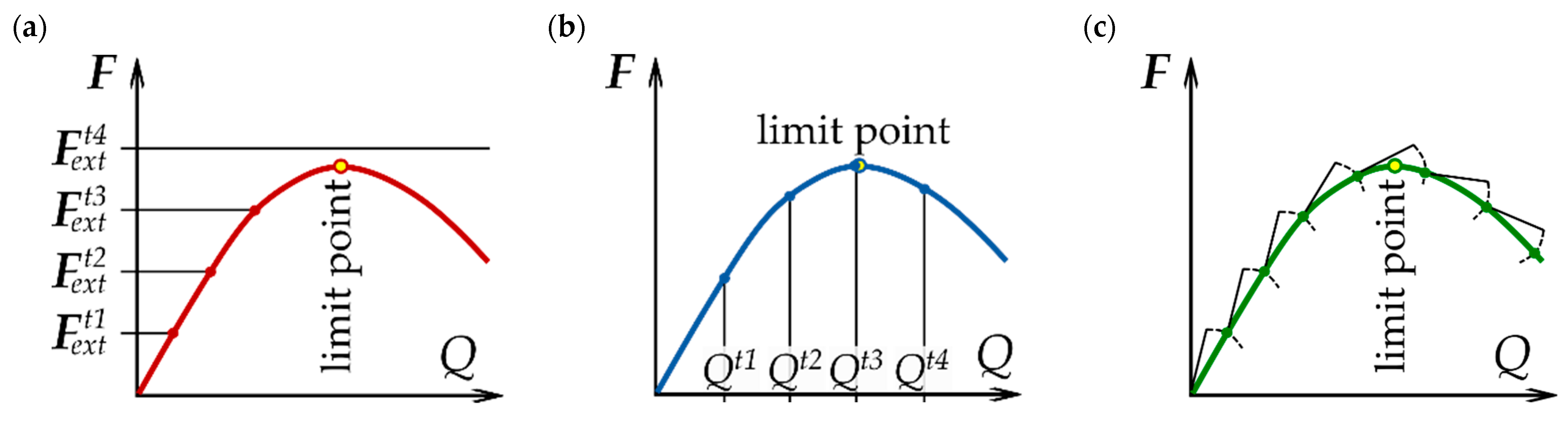
To solve the system of Equation (1), incremental–iterative methods are most commonly used, based, for example, on the Newton–Raphson algorithm [25]. In iterative methods, successive points along the equilibrium path are determined step by step. In each step, a series of iterations is performed to achieve equilibrium, such that by the end of the step, the solution satisfies the prescribed accuracy. Depending on the type of step control applied, the following approaches can be distinguished:
  • load control,
  • displacement control,
  • arc-length control.
Figure 1 shows the procedural schemes for the aforementioned types of control.
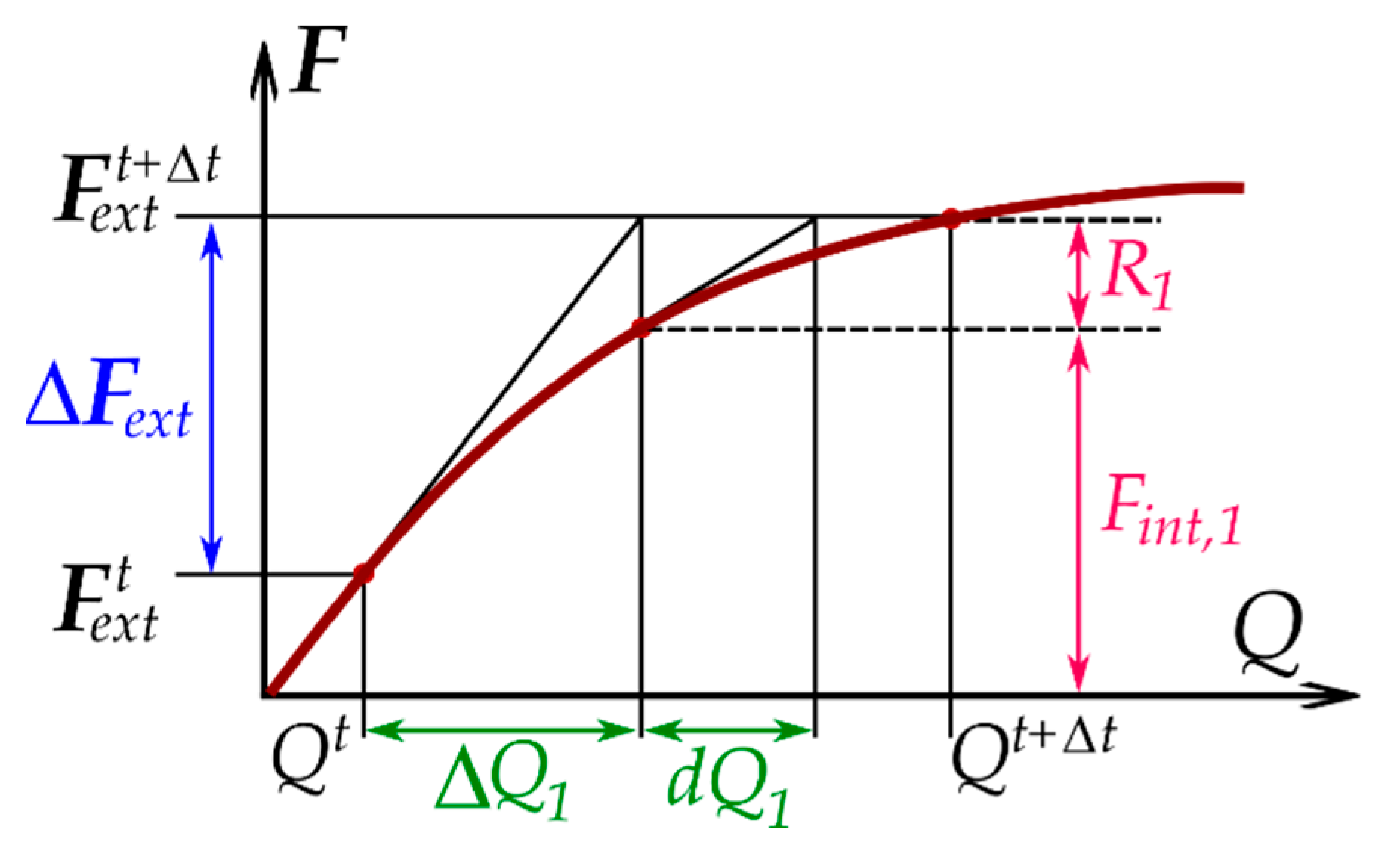
The scheme of the Newton–Raphson algorithm under load control for a single increment of the load vector is shown in Figure 2.
The calculations start from the equilibrium state at time t, meaning that the displacement vector Qt is known, and the next solution vector Qtt is to be determined. To achieve equilibrium at time t + ∆t, after applying the load increment Δ F e x t , the following steps, according to the Newton–Raphson algorithm, are performed:
  • First iteration j = 1 is as follows:
    Δ Q 1 = K 1 F e x t t + Δ t F i n t , 0 F i n t , 0 F e x t t + Δ t
  • Subsequent iterations, j = 2, 3, …, are performed until the adopted convergence criterion is satisfied as follows:
    d Q j = K j 1 1 F e x t t + Δ t F i n t , j 1 t + Δ t
    Δ Q j = Δ Q j 1 + d   Q j F i n t , j t + Δ t R j = F e x t t + Δ t F i n t , j 1 t + Δ t 0 ,
    where R j —residual (unbalanced) force vector.
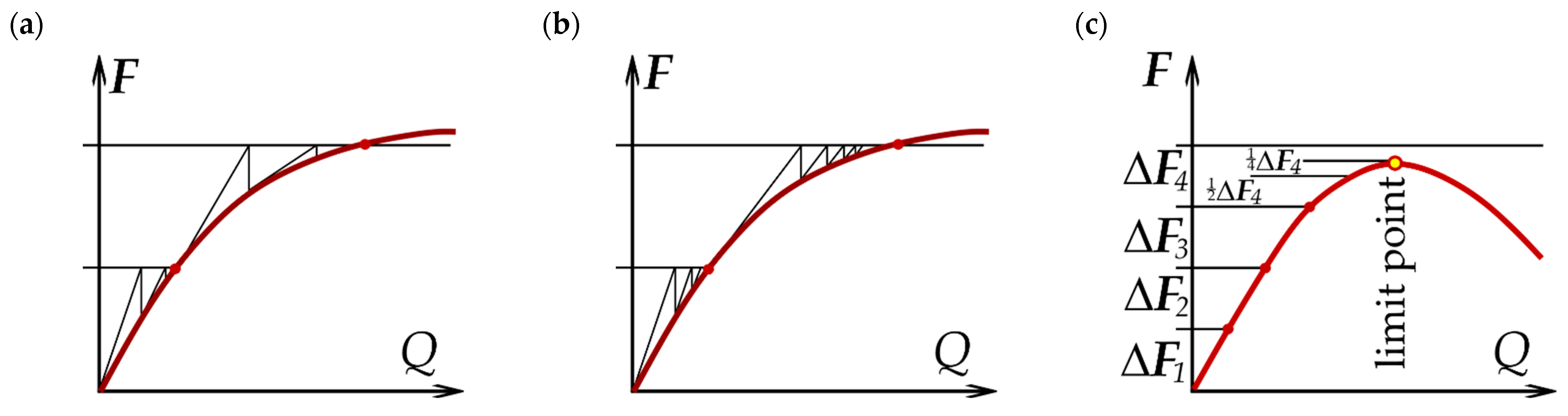
Figure 3 shows the iteration schemes for the standard and the modified Newton–Raphson algorithms. In the modified version, the tangent stiffness matrix is generated at the beginning of each load increment.
In this study, the Newton–Raphson algorithm was used to determine the limit points on the equilibrium path, employing both load control and displacement control. To accurately determine the position of the limit point on the equilibrium path, the step length was defined adaptively, as illustrated in Figure 3c. The developed algorithm was implemented in a proprietary finite element method (FEM) program. It is worth noting that the parameters for the adaptive method were selected individually for each truss and for each loading case.

2.2. Description of a Spatial Truss Finite Element

In the performed nonlinear analysis, a two-node spatial truss element described in [26] was used. The incremental equilibrium equation of the finite element (FE) in the local coordinate system takes the following form [27]:
Δ f e = k e Δ q e ,
where k e —the finite element stiffness matrix, Δ q e —the vector of incremental nodal displacements of the finite element, Δ f e —the vector of incremental nodal forces, i.e., the forces transmitted to a given element by adjacent elements through their shared constraints.
The tangent stiffness matrix K t of the element appearing in Equation (2) is the sum of three matrices:
k e = k 0 e + k u e + k σ e ,
where k 0 e —linear stiffness matrix, k u e —displacement stiffness matrix, k σ e —stress stiffness matrix.
Up to this point, all matrices and vectors have been referred to the local coordinate system of the element, associated with its initial configuration. In order to formulate the incremental equilibrium equation of the FE in the global coordinate system, it is necessary to transform the respective matrices and vectors appearing in (1) according to the following formulas:
K e = T e T k e T e , F i n t e = T e T f i n t e .
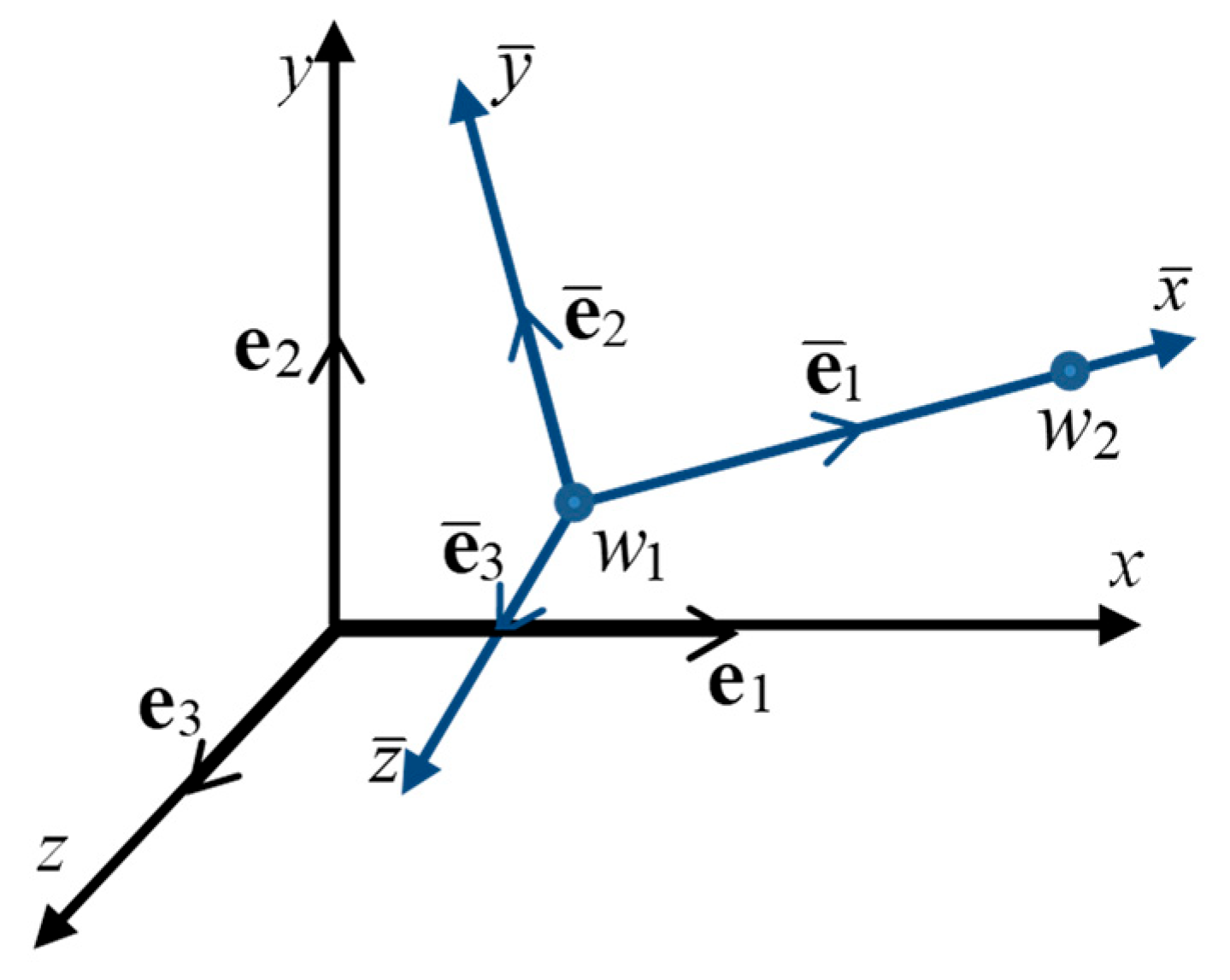
The transformation matrix T e appearing in Equation (4) is calculated based on the nodal coordinates of successive finite elements. The components of the matrix T e are the direction cosines between the unit vectors of the local and global coordinate systems; see Figure 4.
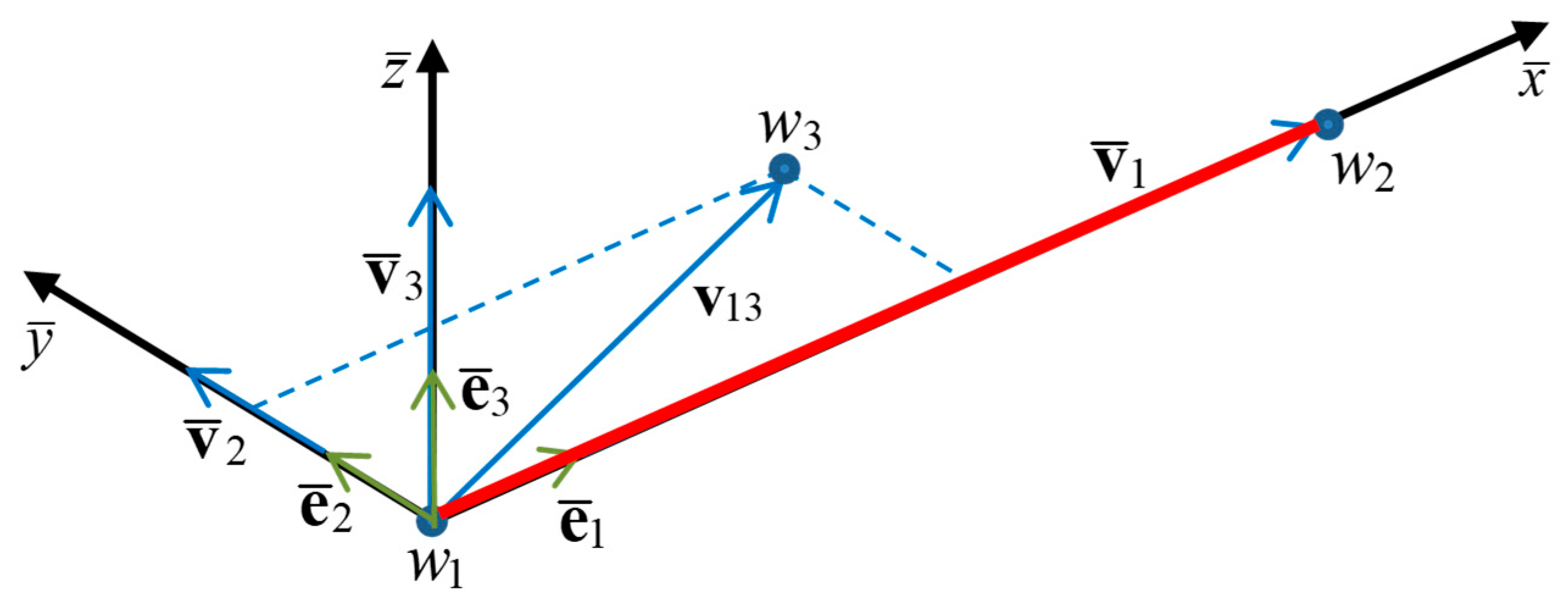
The unit vectors defining the local coordinate system were determined in accordance with Figure 5.
The nodes w 1 and w 2 of the FE make it possible to determine the coordinates of vector v ¯ 1 :
v ¯ 1 = x ¯ 2 x ¯ 1 y ¯ 2 y ¯ 1 z ¯ 2 z ¯ 1 ,
To determine the remaining vectors v 2 and v 3 , an auxiliary node w 3 must be introduced, which allows one to determine the vector v 13 :
v 13 = x ¯ 3 x ¯ 1 y ¯ 3 y ¯ 1 z ¯ 3 z ¯ 1 ,
Then, using the cross product, the required vectors are obtained as follows:
v ¯ 3 = v ¯ 1 × v 13 ,   v ¯ 2 = v ¯ 3 × v ¯ 1 .
After normalizing the vectors v ¯ 1 , v ¯ 2 , v ¯ 3 , we obtain the unit vectors of the local coordinate system, which form the desired transformation matrix T ^ e :
e ¯ 1 = v ¯ 1 v ¯ 1 ,   e ¯ 2 = v ¯ 2 v ¯ 2 ,   e ¯ 3 = v ¯ 3 v ¯ 3 , T ^ = e ¯ 1 ,   e ¯ 2 ,   e ¯ 3 T e = T ^ 0 0 T ^ .

2.3. Sensitivity Metrics

To quantify the influence of load distribution on the critical load Pult, we introduce the following measures. The change in critical load per changed loaded node is as follows [28]:
P n o d e = P u l t ( s e t ) P u l t ( r e f ) N ( s e t ) N ( r e f )
where N is the number of loaded nodes. The efficiency of the applied load is as follows [29]:
η = P u l t ( s e t ) P T ( s e t ) ,
where PT denotes the total applied load at the instant of snap-through. A log–log elasticity with respect to total applied load as follows [30]:
ε = ln ( P u l t ( s e t ) / P u l t ( r e f ) ) ln ( P T ( s e t ) / P T ( r e f ) ) ,
This provides a dimensionless measure of the sensitivity of Pult to changes in PT. The reference configuration is Set A for Cases 1–3 and Set B for Case 4 (consistent with the present study).

3. Results and Discussion

This section presents the results of stability analyses for four Cases (1–4) of spatial truss domes susceptible to loss of stability due to snap-through node. The analyzed structures differed in geometry and in the manner of loading. For all examples, tables were prepared that include the following information:
  • location of concentrated load—describes the load application scenario for the structural model; each load Set (A–F) corresponds to a specific pattern of concentrated loads applied to selected nodes of the structure,
  • Pult ultimate load—the magnitude of the load or total applied force at which the structure reaches the ultimate limit state associated with snap-through instability,
  • the percentage error relative to load Set A,
  • the displacement of the apex (top) node at the instant when snap-through instability occurs,
  • the number of structural nodes to which concentrated loads are applied in the given load case,
  • the total applied load acting in the considered load case at the moment when snap-through occurs. It depends on the number and distribution of loaded nodes.
For each case, the equilibrium paths were determined using the Newton–Raphson algorithm under both load control and displacement control. To accurately identify the position of the limit point along the equilibrium path, an adaptive step-length strategy was employed.

3.1. Description of Analyzed Structures

This section presents the equilibrium path analysis of four single-layer metal (steel and aluminum) domes with a spatial truss configuration. The structures were selected to enable comparison of the influence of geometry, material properties, and structural complexity on the shape and character of the equilibrium paths, as well as on the location of the critical point at which the snap-through phenomenon occurs.
It should be noted that these structures have been previously analyzed, although from a different research perspective. Both Case 1 and Case 3 were taken from the article [31], which focuses on the weight minimization of geometrically nonlinear 3D truss structures, serving as a case study for developing an effective, gradient-based optimization method that consistently accounts for displacement, stress, and nonlinear stability constraints. The truss scheme from Case 2 was taken from a study [32] where the FORM with the Rackwitz–Fiessler algorithm was applied to the reliability analysis of truss structures susceptible to snap-through instability, accounting for the randomness of member axial stiffness, load multipliers, and geometric imperfections, while comparing the efficiency of FORM with SORM and Monte Carlo methods. The truss scheme from Case 4 was taken from the paper [33], where in Section 2, the FORM was applied to the probabilistic stability analysis of a Lamella dome susceptible to snap-through failure. The analysis incorporated uncertainties in the central node load, axial stiffness of the members, and geometric imperfections (Z-coordinate of the apex node, Node 1), with the results benchmarked against the Monte Carlo simulation.
The basic geometric characteristics of the domes are summarized in Table 1. Detailed nodal coordinates and geometric models are provided in the Supplementary Materials.
The diversity of the analyzed structures enables a multi-aspect assessment of the stability of spatial truss systems and facilitates an in-depth investigation of how the locations of applied concentrated loads influence the equilibrium paths for different geometric parameters. Comparing domes of varying proportions and stiffness allows for the identification of mechanisms responsible for the onset of geometric nonlinearity and for determining how the load application point affects the position of the critical point associated with snap-through behavior.

3.2. Analysis of the Stability-Loss Mechanism for Case 1: Local Snap-Through of the Apex Node

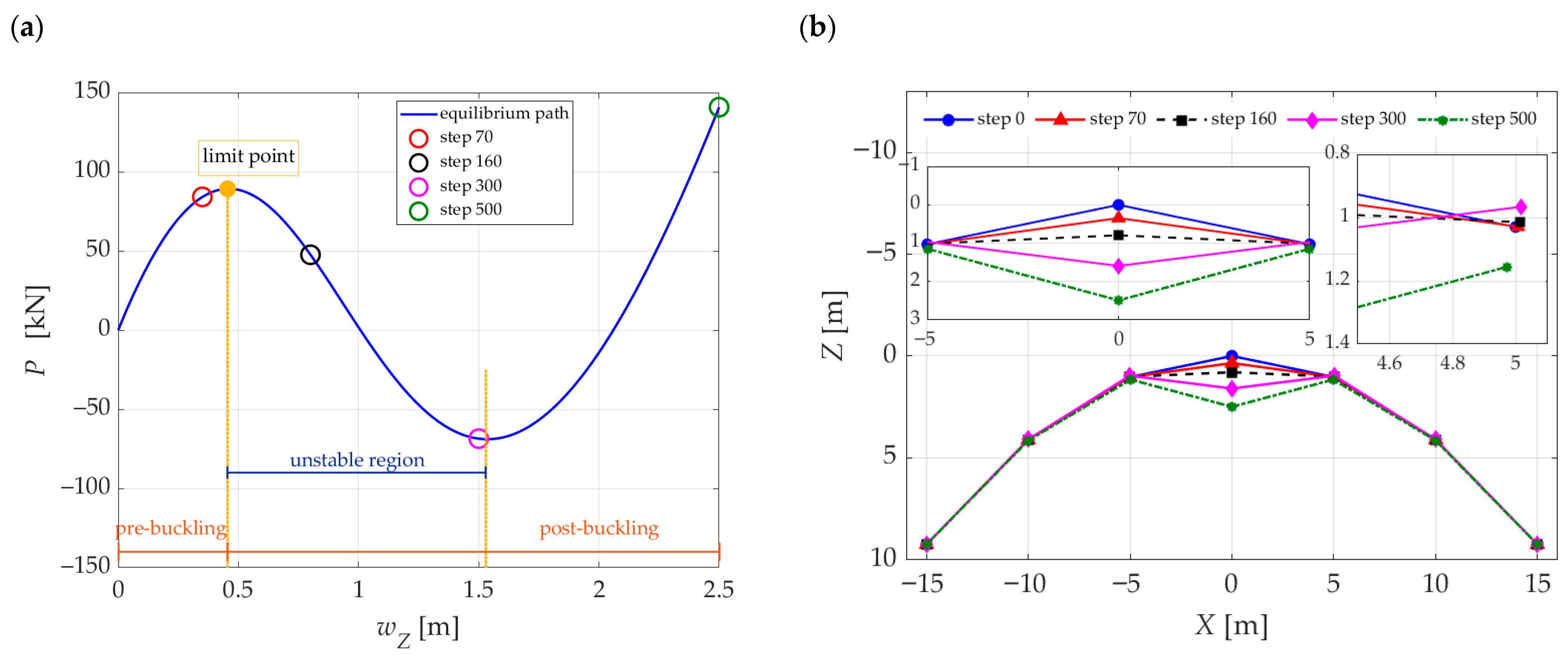
The stability-loss mechanism is a key aspect in the analysis of shell-type lattice structures. To illustrate the snap-through phenomenon, Figure 6a presents the equilibrium path (external force P as a function of the vertical displacement wZ of the apex node) for Case 1 under the reference loading rule Set A (Table 2). Figure 6b shows the projections of the dome in the XZ-plane for selected numerical steps, illustrating the failure mechanism.
The equilibrium path was computed using displacement-control (Figure 6a) applied to the apex node. A constant displacement increment of Δ wZ = 0.005 m was used, resulting in a total of 500 steps for the full path. In the initial part of the path, the external load P increases with the rising displacement wZ (Pre-buckling Phase). The maximum load is reached at the limit point, which represents the critical load for this configuration. Passing beyond this point initiates the stability-loss phenomenon. Beyond the limit point, the structure exhibits a decreasing reaction force P with further increase in wZ. Within this unstable region, the structure undergoes a snap-through of the apex node. Figure 6b clearly shows that in steps 160 and 300, the central node of the dome moves significantly downward (towards positive Z), which is characteristic of a local snap-through of the apex node. After the snap-through, the structure regains stiffness, and the equilibrium path again shows an increasing load P with displacement wZ (step 500), transitioning into a stable post-buckling state. Thus, in the analyzed case (Case 1, Set A), a local instability mechanism in the form of an apex-node snap-through was observed.
The full equilibrium path and the corresponding failure mechanism were analyzed only for Case 1 (Set A) in order to clearly illustrate the characteristic snap-through phenomenon occurring under centrally applied loads.
It should be emphasized that in other geometric configurations or loading schemes (e.g., in the literature [34]), other forms of stability loss may be observed, such as a global mechanism (overall buckling), where the entire shell deforms rather than a single node undergoing snap-through.
The aim of this study was not an exhaustive investigation and classification of failure mechanisms, but a sensitivity analysis of the limit load with respect to the location of the applied load. Therefore, for the remaining cases (Case 2–4) and for other loading schemes (Set B–G), the analysis focused solely on determining the critical load Pult at the limit point, while the full equilibrium paths and associated post-buckling failure mechanisms were not investigated in detail.

3.3. Results of the Stability Assessment

In all four analyzed structural cases, consistently defined concentrated-load application schemes were applied, enabling direct comparison of the effects of load distribution on the stability of metal (steel and aluminum) dome trusses with varying geometric characteristics. The loading variants included fully distributed internal-node loading (Set A), apex-only loading (Set B), combinations of apex loading with inner or outer node rings (Set C and Set D), as well as partially distributed or asymmetric load configurations (Set E and Set F). Set G represented loading applied exclusively to the outer ring of nodes. No loads were applied to support nodes, and in Case 3, due to the smaller number of nodes, it was not possible to reconstruct all predefined scenarios. This systematic classification provides a structured basis for assessing the sensitivity of the domes to different load application patterns and identifying mechanisms that influence geometric stability loss. As a result of the analyses carried out for each structure (Table 2, Table 3, Table 4 and Table 5), the following information was obtained: (1) percentage error relative to the baseline Set A (the exception is Case 4, where the errors are calculated baseline Set B)—err, (2) displacement value of the apex node (Node 1) at the moment of snap-through—wZ, (3) number of loaded nodes in a given scenario—N, (4) total load leading to instability (at the snap-through moment)—PT. Additionally, for each structure, summary plots were prepared (for various loading configurations), presenting the shape and characteristics of the equilibrium paths, along with the location of the critical point.
The interpretation of the obtained results shows that scenarios in which no snap-through phenomenon occurred exhibit a structural response fundamentally different from cases displaying a clear instability point on the equilibrium path. The absence of snap-through may indicate stress redistribution caused by more dispersed loading or the presence of local deformations and localized instabilities preventing the structure from reaching a global critical point within the analyzed load range. Therefore, “no snap” cases must be considered separately, as their behavior fundamentally differs from configurations where a distinct geometric instability point is present.

3.3.1. Case 1

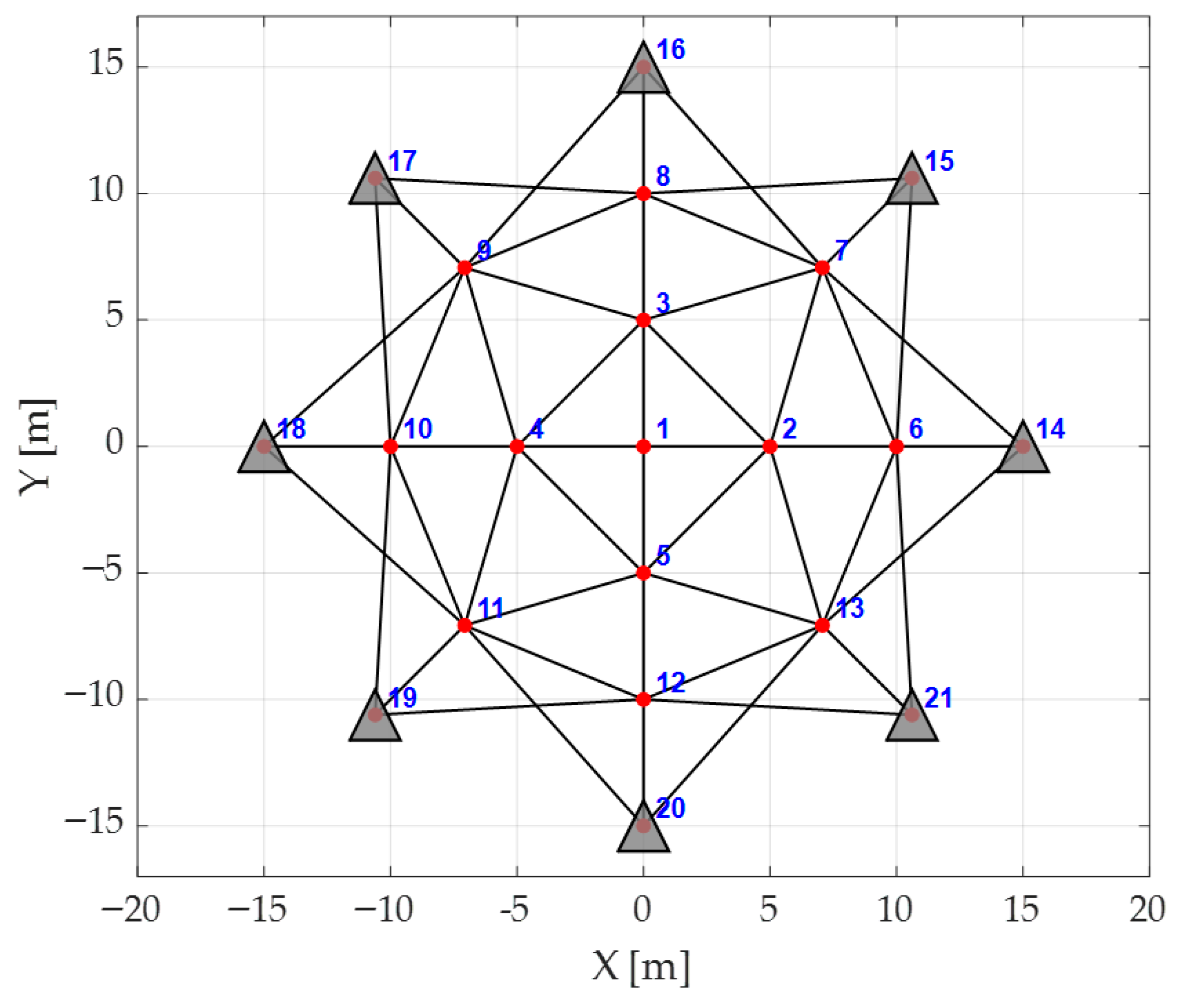
The 52-bar dome truss applied in Case 1 follows the configuration originally presented in [32]. The geometry of the structure is shown in Figure 7. The structure comprises eight groups of members, and the allowable displacement of all free nodes is limited to 1 cm. In the source publication, this dome served as a benchmark for displacement-constrained weight optimization, and its geometry was directly adopted in the present research based on [32].
Table 2 summarizes the load-carrying capacity and stability analysis for various concentrated-load application scenarios in the dome structure. For each load set (A–G), the table includes the critical load Pult, the corresponding apex-node displacement wZ, the number of nodes undergoing snap-through instability, and the total applied load PT. These results allow for an assessment of how different loading configurations influence the equilibrium paths and the onset of snap-through. The comparison reveals which loading patterns make the structure more susceptible to instability and which contribute to a more favorable redistribution of internal forces.
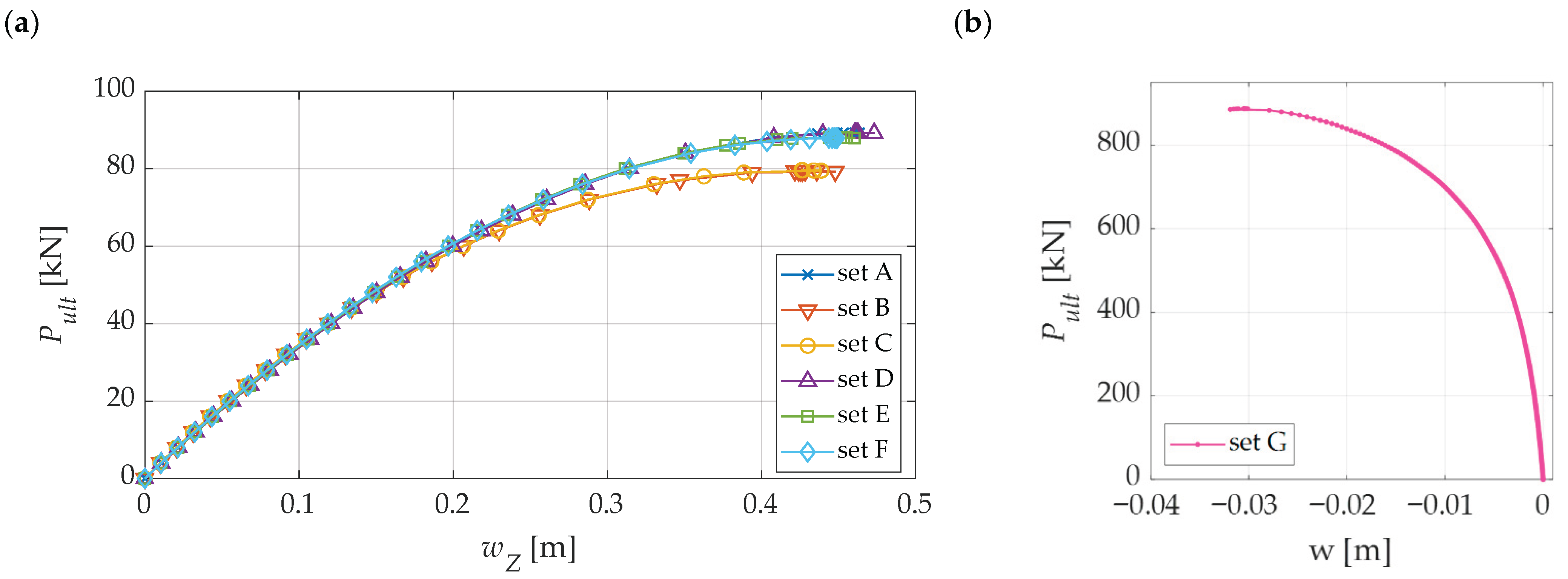
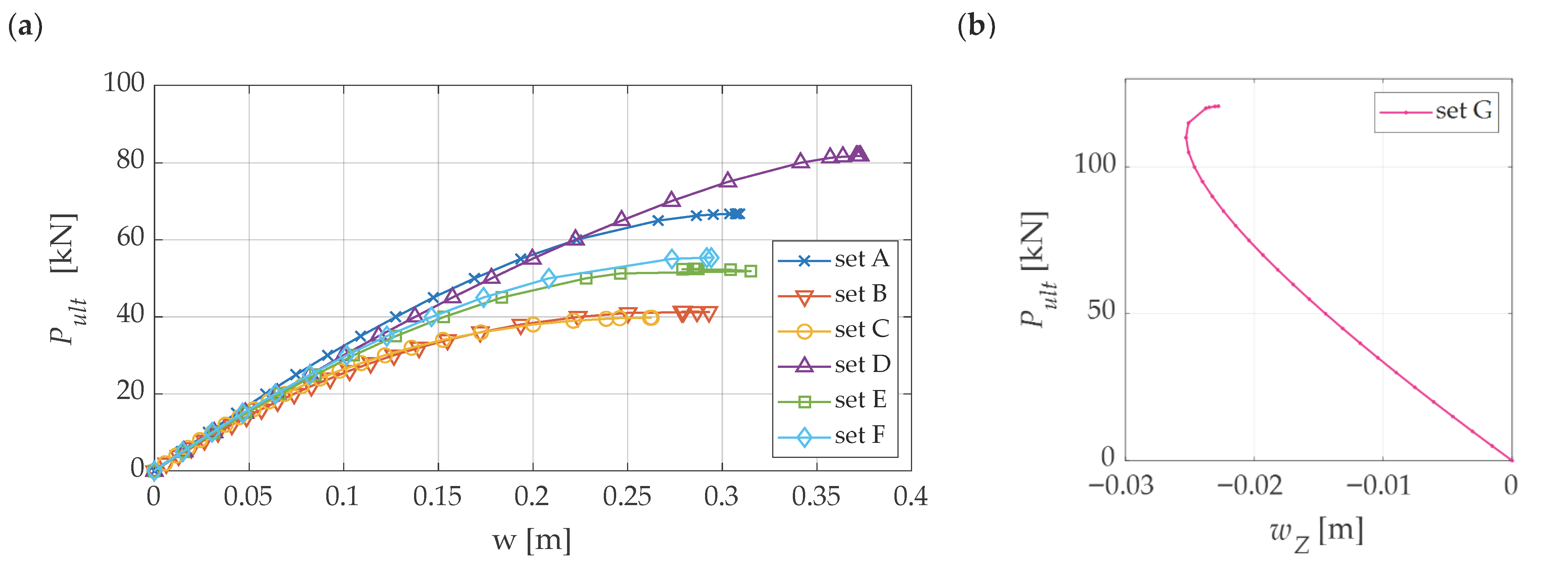
Figure 8 illustrates the equilibrium paths obtained for the analyzed loading scenarios. Figure 8a shows results for load sets A–F, which produce snap-through instability of individual nodes. Figure 8b presents the equilibrium path for load Set G, where no snap-through occurs. In this specific case, the dome responds by displacing upward, revealing a fundamentally different internal force distribution.
The analysis of Case 1 showed that the global response at the moment of snap-through instability of the apex node remains similar. When the structure is loaded with Sets A, D, E, and F, the total load at the point of loss of stability is nearly identical—the difference in critical load values does not exceed 1.5%. It is worth noting that when the structure is loaded only at the apex node (load Set B), the value of P ult differs by no more than 0.3% compared to load Set C (apex node and perimeter nodes). This indicates that the decisive factor in assessing the structural stability is the load applied to the apex node. Therefore, from a safety perspective, it is beneficial to redistribute the applied forces to the remaining nodes. It is worth emphasizing here that the loading scenario does not significantly affect the displacement of the apex node (Node 1) at the moment of snap-through—the difference among load Set A–F does not exceed 4% (taking load Set A as the reference). Load Set G corresponds to a situation in which the load is applied exclusively to the penultimate perimeter nodes. This results in a redistribution of internal forces that causes the structure to displace in a direction opposite to that of the applied load.

3.3.2. Case 2

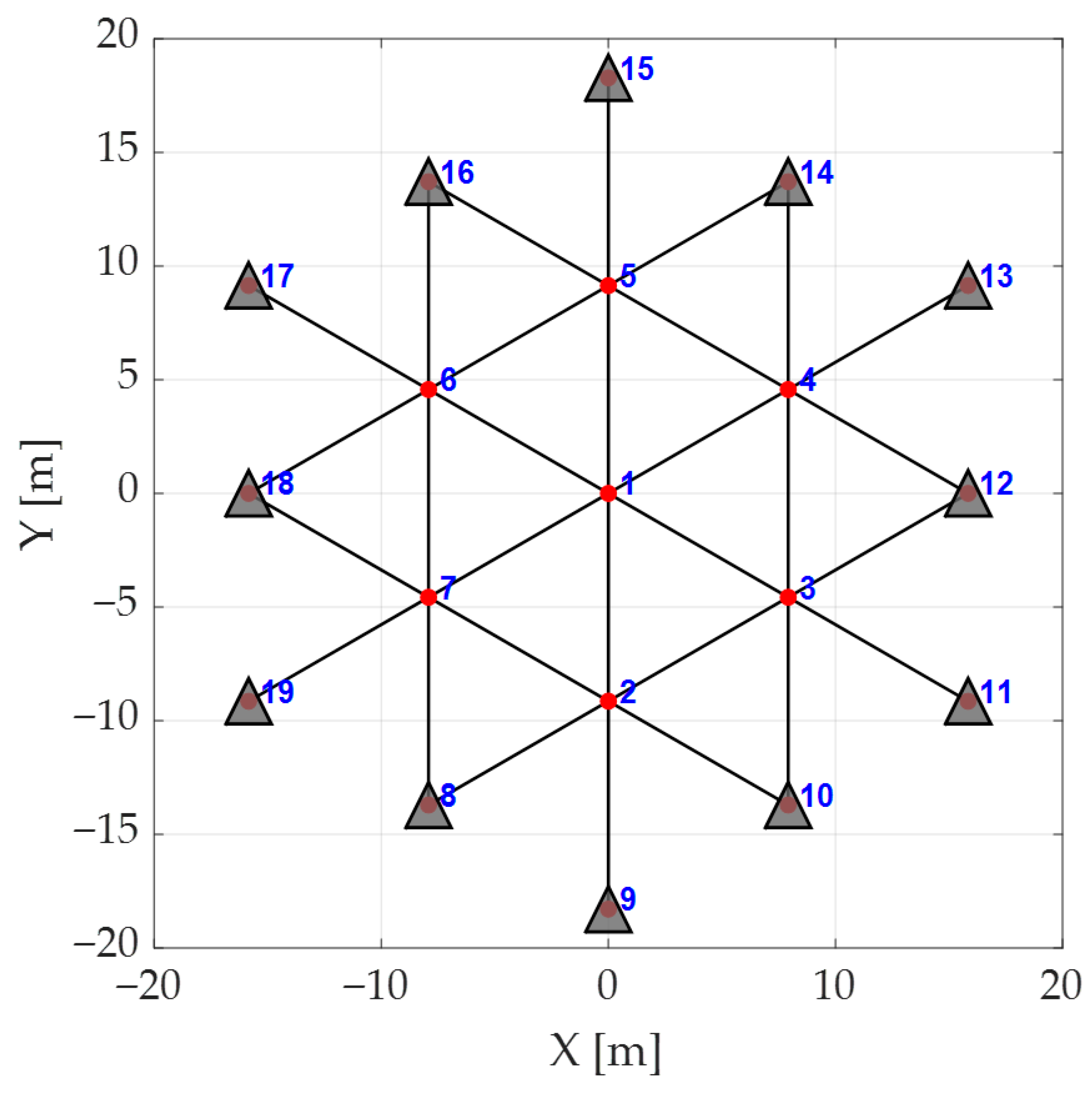
The geometry of Case 2 (Figure 9) is derived from Example 3 in publication [33]. The structure features plan dimensions of 20.15 × 19.94 m and a height of 6.45 m, yielding a compact spatial configuration with relatively high vertical slenderness (Z/X ≈ 0.32). It comprises 31 nodes and 75 bars, constructed from steel with E = 210 GPa and a uniform cross-sectional area of 6.66 cm2. Overall, the design is compact and stiff, making it suitable for carrying loads over a moderate span. From a reliability perspective, this example facilitates the evaluation of stability using the FORM method via analysis of the load multiplier and the limit-state function.
Table 3 summarizes the ultimate load Pult, the corresponding displacement wZ, the number of loaded nodes, and the total applied load, allowing for direct comparison of the considered loading scenarios.
Figure 10a,b presents equilibrium paths for the Case 2 structure subjected to concentrated loads applied at different sets of nodes. The curves illustrate the relationship between the vertical displacement of a representative node and the corresponding critical load leading to snap-through instability.
In Case 2, larger discrepancies in the values of P ult were observed compared to Case 1. The highest load and displacement values were obtained for load Set D (loading of the apex node and five adjacent nodes), while the lowest values occurred for load Set C (loading of the apex node and all penultimate-ring nodes). The displacement values of the apex node (Node 1) exhibit a greater degree of scatter compared to Case 1. This response is likely a consequence of the structural geometry—specifically, the absence of symmetry and the differing vertical coordinates of the nodes within groups 2–6 and 7–16. Similar to Case 1, applying concentrated loads to the nodes located nearest to the support points generates a displacement opposite to the direction of the applied load (upward).
A strong dependence between the placement of concentrated loads and both the load-carrying capacity and the instability characteristics is clearly visible. Set A, where all internal nodes are loaded, yields a moderate Pult and an intermediate critical displacement, representing the most balanced structural response. Sets B and C, involving load applied to a very limited number of nodes (including a single node in Set B), exhibit significantly reduced capacity and smaller critical displacements, demonstrating the high sensitivity of the structure to load localization. Set D achieves the highest Pult among all configurations with snap-through, suggesting a favorable arrangement of loads in a structurally efficient region. Sets E and F show intermediate results with comparable performance and a slightly higher number of loaded nodes. A special case is Set G, for which no snap-through is observed; the structure sustains the load until the final analysis step (120.70 kN). This indicates that the load distribution stabilizes the structure and prevents the typical snap-through behavior observed in other scenarios.
The results highlight the crucial influence of load placement on the global capacity and stability of the truss structure. Loads applied asymmetrically or at single nodes significantly reduce Pult, whereas adequately distributed loading can enhance stiffness and postpone instability. Set G demonstrates that a proper configuration of load application can fully suppress snap-through, which may be of practical importance in designing structures resistant to localized concentrated loads.

3.3.3. Case 3

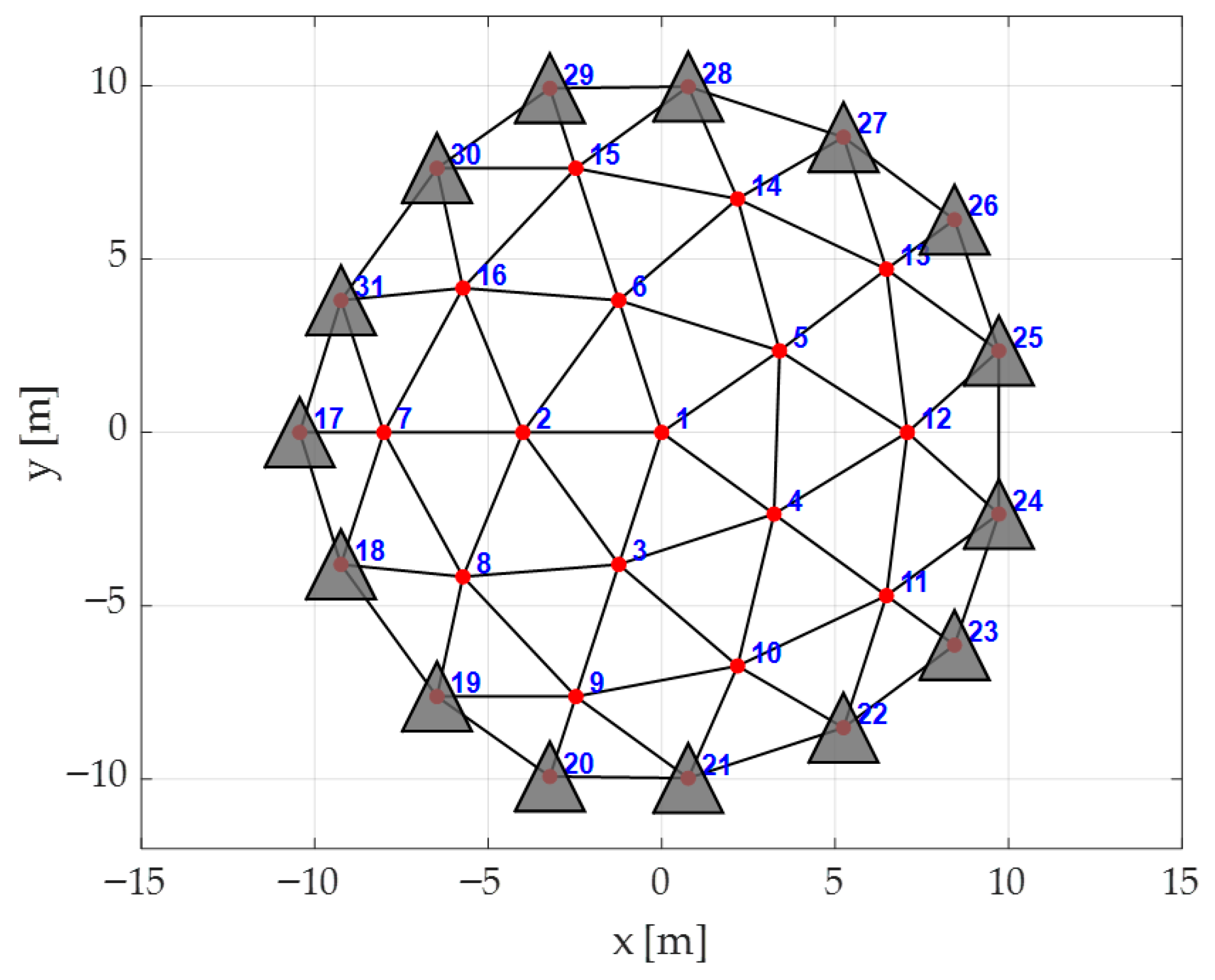
The structural configuration used in the analysis of Case 3 corresponds to that presented in [26] and is illustrated in Figure 11. In this work, the authors describe a single-layer lattice dome, where the generalized nodal displacements are approximated using global interpolation polynomials. Such structures exhibit nonlinear geometric behavior under increasing loads, making them a suitable reference model for stability analyses and the study of the snap-through phenomenon.
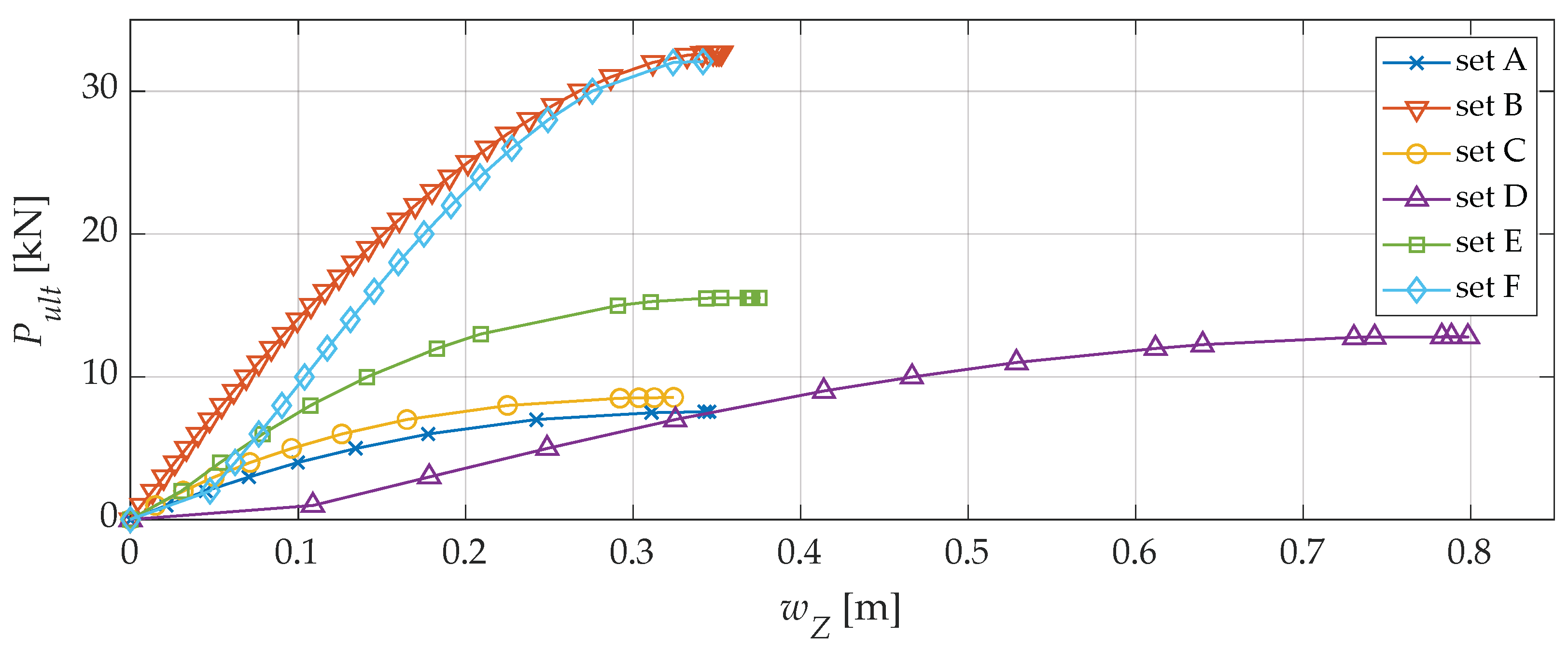
The analysis of different configurations of concentrated load arrangements (Table 4) showed that despite significant differences in the critical force Pult, the global response of the structure at the moment of snap-through remains similar. The cases involving loading of a single node (B and F) lead to almost identical values of total load at the point of instability, regardless of the symmetry of the applied forces, which indicates the dominant influence of the truss geometry on the snap-through mechanism. The total loads leading to instability in the multi-node loading cases (A, C, D, E) also fall within a narrow range, indicating a relatively constant global load-bearing capacity of the system, independent of the number and location of the loaded nodes.
The increased apex displacement in Set D results from the activation of a non-symmetric deformation mode, which deviates markedly from the dominant snap-through mechanism observed in the other loading scenarios.
As shown in Figure 12, the displacement of the apex of the structure at the moment of snap-through remains similar in configurations A, B, C, and F, confirming that this mechanism is primarily governed by the geometric layout and, to a lesser extent, by local force concentration. It was also observed that loads applied to a larger number of nodes reduce the value of the critical force per individual node, but do not lead to a significant change in the global characteristics of the snap-through phenomenon. Moreover, asymmetric loading does not necessarily generate larger critical displacements, as demonstrated by the comparison of cases B and F. In the less symmetric configurations (D and E), greater differences in displacements occur, which may result from a more complex equilibrium path caused by the non-uniform distribution of forces in the system.

3.3.4. Case 4

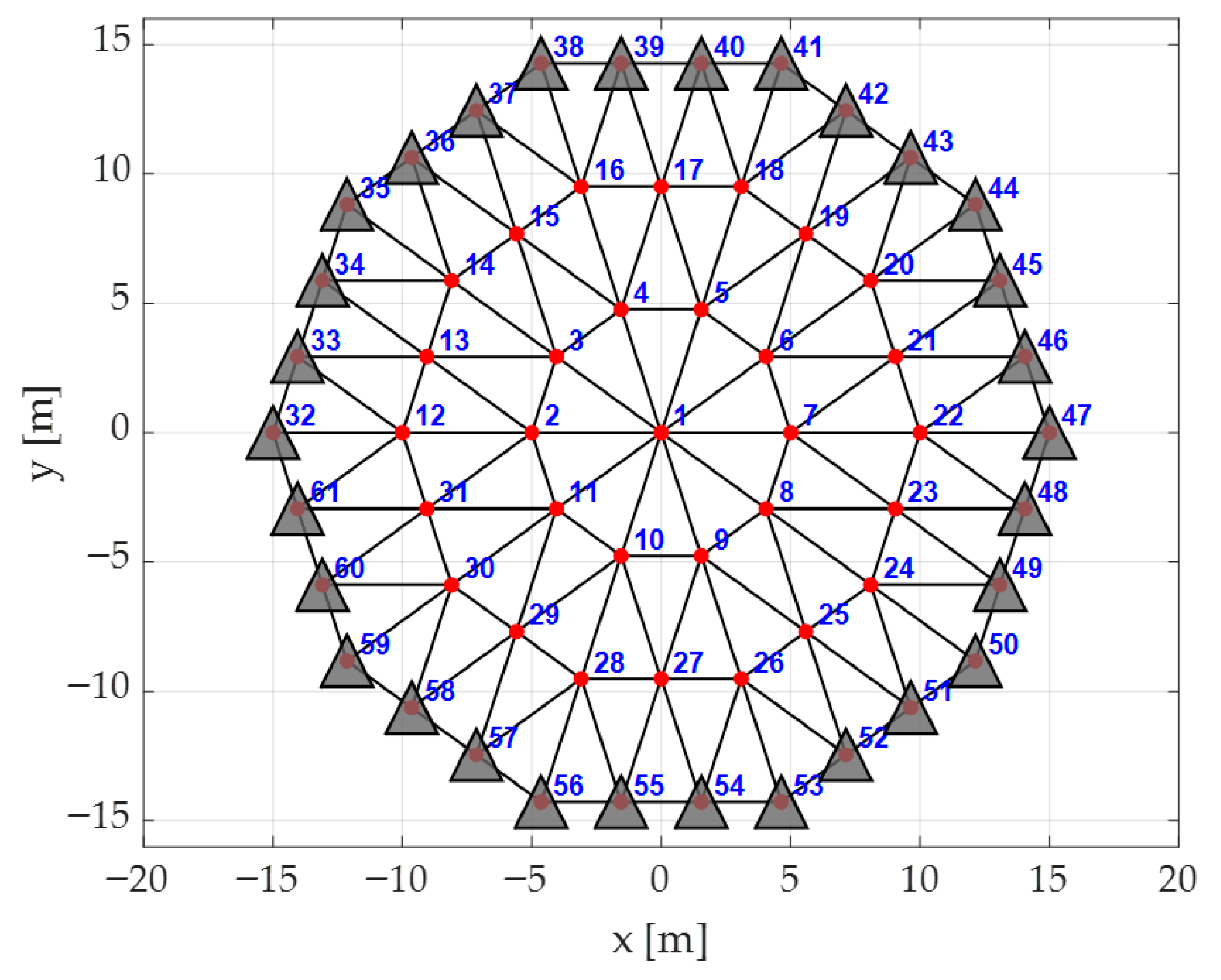
The geometry of the structure analyzed in Case 4 is adopted from the example presented in Section 2 of the publication [34], where the stability of a Lamella dome susceptible to snap-through instability of the apex node was investigated.
The system comprises a spatial truss constructed from tubular members, subjected to loads at selected nodes and simply supported along its perimeter. In the present article, the plan view of the structure is depicted in Figure 13, providing a reference for subsequent evaluations of load-carrying capacity and the effects of concentrated load distribution. Owing to its geometric flexibility, the structure exhibits pronounced sensitivity to snap-through instability, rendering it well-suited for reliability-based assessments.
Table 5 provides a consolidated overview of the load-carrying capacity and snap-through instability results obtained for Case 4 under various concentrated-load application scenarios. The table reports the critical load P ult , the corresponding vertical displacement of the apex node w Z , the number of loaded nodes, the total applied load P T , and the relative error with respect to the reference configuration. These data enable a direct assessment of how different load arrangements modify the structural response and influence the onset of instability.
Analysis of the results (Table 5) shows that the highest critical loads are achieved for Set G (185.0 kN) and Set B (179.36 kN). This indicates that applying loads to nodes located in the upper region of the dome enhances its overall resistance to snap-through. Set C also attains a relatively high value of P ult ; however, it is characterized by the largest critical displacement ( w Z = 0.156 m), which reflects a more compliant response of the structure in the vicinity of the instability point. In contrast, Set D exhibits a significant reduction in load-carrying capacity (98 kN), confirming that load application in geometrically unfavorable regions substantially decreases structural stability.
Furthermore, Sets A, E, and F do not reach a snap-through point within the analyzed loading range. This finding indicates that certain load distributions may stabilize the dome and effectively suppress instability associated with geometric nonlinearity. The comparison of results also demonstrates that the number of loaded nodes strongly affects the total applied force P T . However, it does not directly correlate with the effective structural capacity; this is particularly evident when contrasting Set C with Set G.
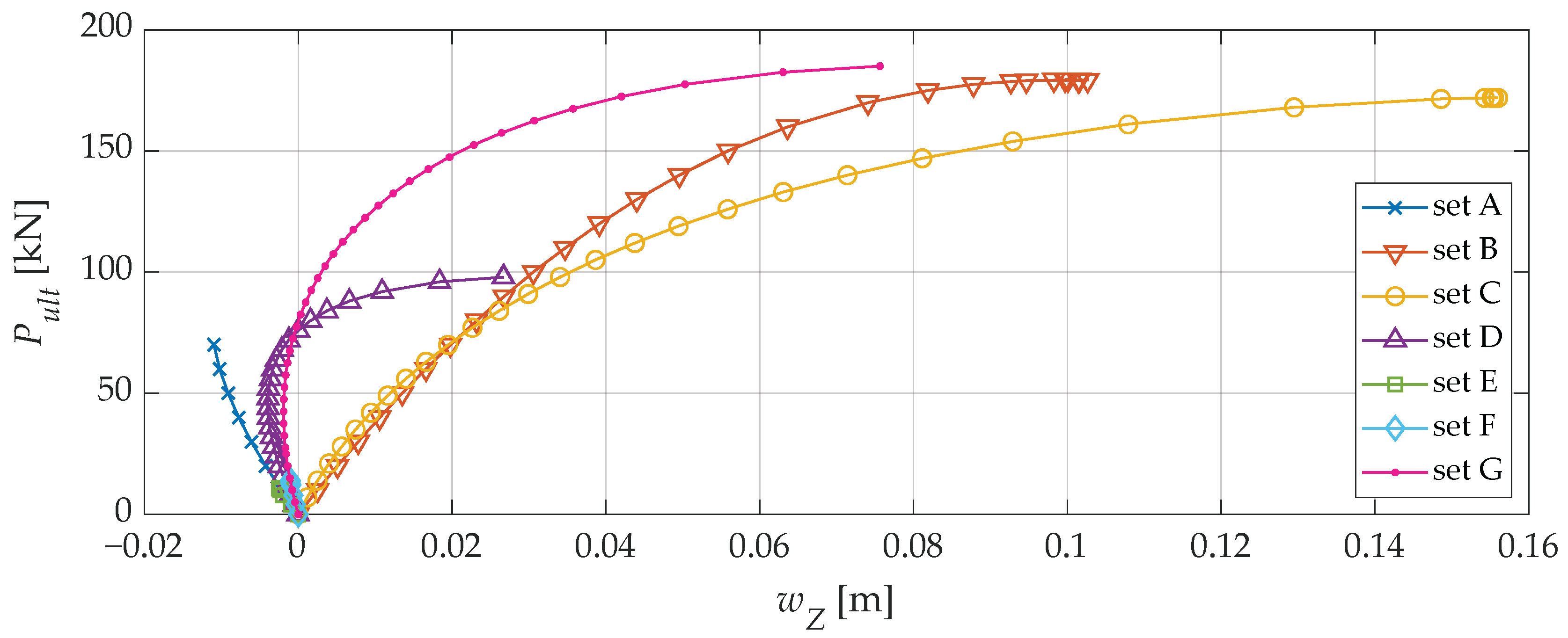
Figure 14 shows the equilibrium paths obtained for Case 4 for load sets A–G. The curves illustrate the dependence between the vertical displacement wZ and the critical load Pult, allowing for identification of limit points and characteristic stiffness changes. Differences between the paths clearly reflect the sensitivity of the structure to the spatial distribution of the applied loads.
The equilibrium curves show substantial variation across the load cases. Sets A, E, and F do not develop a snap-through point; their curves increase smoothly, indicating that distributed or symmetric loading has a stabilizing effect. In contrast, Sets B and G reach the highest critical loads (approximately 179–185 kN) and exhibit the typical arch-shaped nonlinear response associated with snap-through instability. Set C also attains a relatively high capacity, but at significantly larger displacements, suggesting a more compliant deformation mode. Conversely, Set D results in a much lower load-carrying capacity (98 kN) and very small critical displacements, reflecting an inefficient and destabilizing loading configuration.
Load placement has a decisive impact on the stability of the lamella dome, producing substantial differences in Pult. Loads applied to central or elevated nodes (Sets B and G) result in the highest capacity and a clear snap-through response. Distributed loads (Sets A, E, F) tend to suppress snap-through but limit the achievable critical load. Set D highlights the structural sensitivity to load localization, showing a strong reduction in capacity when the load is applied in an unfavorable region. The shape of the equilibrium paths confirms classical instability behavior, strongly dependent on the load configuration.
General Remarks
The following remarks summarize the key sensitivity trends observed across all four dome configurations based on the applied loading scenarios.
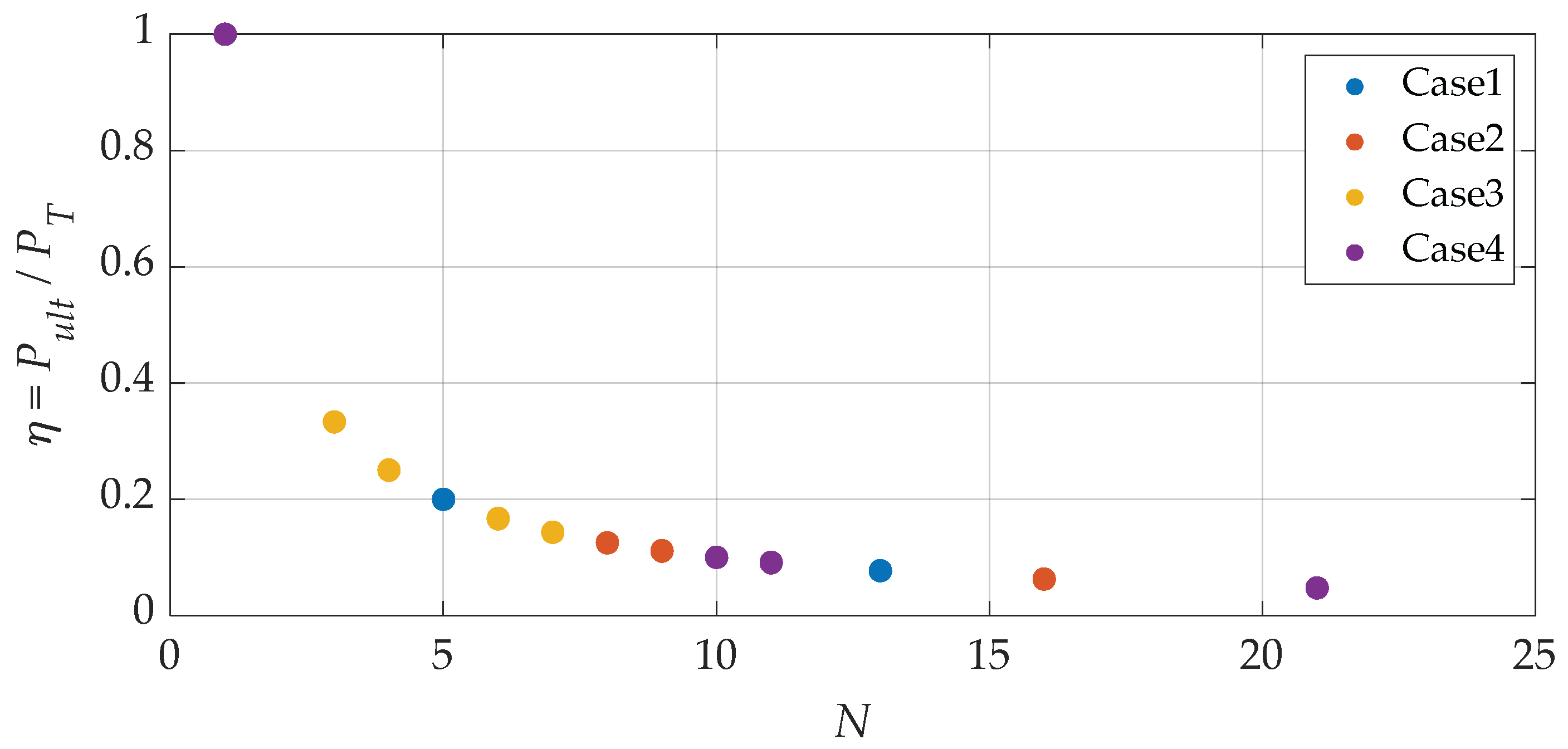
Based on the conducted analyses, the sensitivity of the equilibrium paths to the number of loaded structural nodes was evaluated. For this purpose, a dimensionless parameter η was defined, expressing the ratio of the total load applied to the nodes PT to the critical load Pult. This parameter was estimated for each loading scenario in which a node snap-through phenomenon was observed.
The trend observed in Figure 15 demonstrates a general decrease in dimensionless parameter η with an increase in the number of loaded nodes, indicative of an inverse relationship between these parameters. Specifically, Case 4 exhibits a relatively high initial value of η at the lowest N, followed by a pronounced decline, whereas Case 1 shows a more gradual reduction. Cases 2 and 3 present intermediate behaviors, with data points predominantly concentrated at a lower number of loaded nodes.
Table 6 shows the values of N and the corresponding efficiency η for each case and set. The efficiency η was computed using Equation (10).
The η metric is a useful tool for comparing structural robustness under different loading scenarios, complementing traditional Pult-based assessments.
In the study, we focused on geometric nonlinearity because it has a primary impact on stability assessment. Material nonlinearity can indeed influence the stability of truss domes, particularly under high or extreme loading conditions. While the global behavior of the dome under typical service loads is primarily controlled by geometric nonlinearity, local material effects, such as yielding and plastic deformation, can alter the distribution of internal forces and affect the critical load at which snap-through occurs. In regions where stresses approach or exceed the material’s yield strength, the stiffness of members is reduced, which may either delay or accelerate the onset of instability depending on the specific load configuration. Considering material nonlinearity in the analysis allows for a more realistic assessment of dome behavior, capturing both local yielding phenomena and their impact on the global structural response. For most practical cases within the elastic range, the effect of material nonlinearity is relatively minor, but it becomes increasingly significant for extreme or concentrated loads, which could influence design decisions and safety evaluations.
Further research will involve expanding the database of structures susceptible to snap-through instability of the apex node. This will allow for a more precise assessment of the influence of load location on the nature of the equilibrium paths of truss structures. In addition, geometric and material nonlinearities will be the objective of our future research. The created database will serve as a starting point for evaluating the structural reliability index under various loading scenarios.

4. Conclusions

In summary, it is important to emphasize that the Finite Element algorithm developed in Matlab R2025b, based on the iterative Newton–Raphson method, provides a useful tool for assessing the stability of structures susceptible to snap-through instability of the apex node. The analyzed structures display consistent patterns, from which the most significant conclusions can be drawn:
  • The analysis of different configurations of concentrated load arrangements showed that, despite significant differences in the critical force P ult , the global response of the structure at the moment of snap-through remains similar.
  • The structures where the ratio of the rise (H) to the span (L) (the horizontal distance covered) is H/L ≪ 0.2 (Case 3 and Case 4) exhibit greater sensitivity to changes in load location than snap-through susceptible domes with a ratio H/L > 0.2 (Case 1 and Case 2).
  • The displacement of the apex node (Node 1) at the moment of snap-through remains similar across most of the proposed load sets, which confirms that this mechanism is primarily determined by the system’s geometry and, to a lesser extent, by the local concentration of forces.
  • The sensitivity analysis showed that the dimensionless parameter η (defined as the ratio of the total load applied to the nodes P T to the critical load P u l t ) decreases as the number of loaded nodes increases. It was also observed that this does not cause significant changes in the global characteristics of the snap-through phenomenon.
The analysis of equilibrium paths allows for the prediction of possible forms of structural instability. Based on these paths, a limit state function can then be developed, which, together with the random variables, serves as a key parameter enabling the quantitative assessment of structural safety and the determination of the probability of occurrence of critical states.

Supplementary Materials

The following supporting information can be downloaded at https://doi.org/10.5281/zenodo.17716543. Dataset: Coordinates of all Nodes for Spatial Truss Domes (SET1–SET4)—Data for Structural Reliability Analysis.

Author Contributions

Conceptualization, B.P.-S., A.D. and M.G.; methodology, B.P.-S. and A.D.; software, B.P.-S.; validation, B.P.-S.; formal analysis, A.D.; investigation, A.D.; resources, B.P.-S. and A.D.; data curation, B.P.-S.; writing—original draft preparation, B.P.-S.; writing—review and editing, A.D. and M.G.; visualization, B.P.-S.; supervision, B.P.-S., M.G. and A.D.; project administration, M.G.; funding acquisition, M.G. All authors have read and agreed to the published version of the manuscript.

Funding

This research received no external funding.

Institutional Review Board Statement

Not applicable.

Informed Consent Statement

Not applicable.

Data Availability Statement

The original contributions presented in this study are included in the article. Further inquiries can be directed to the corresponding author.

Conflicts of Interest

The authors declare no conflicts of interest.

Abbreviations

The following abbreviations are used in this manuscript:
ANNArtificial Neural Network
FEFinite Element
FEMFinite Element Method
MLMachine Learning
NRNewton–Raphson Algorithm
FORMFirst Order Reliability Method
SORMSecond Order Reliability Method

References

  1. Koiter, W.T. Over de Stabiliteit van Het Elastisch Evenwicht. Ph.D. Thesis, University of Delft, Delft, The Netherlands, 1945. [Google Scholar]
  2. Mises, R.V.; Ratzersdorfer, J. Die Knicksicherheit von Fachwerken. ZAMM-J. Appl. Math. Mech./Z. Für Angew. Math. Und Mech. 1925, 5, 218–235. [Google Scholar] [CrossRef]
  3. Bathe, K.J.; Cimento, A.P. Some Practical Procedures for the Solution of Nonlinear Finite Element Equations. Comput. Methods Appl. Mech. Eng. 1980, 22, 59–85. [Google Scholar] [CrossRef]
  4. Bathe, K.J. Finite Element Procedure in Engineering Analysis; Prentice Hall: New York, NY, USA, 1982. [Google Scholar]
  5. Belytschko, T.; Liu, W.K.; Moran, B.; Elkhodary, K. Nonlinear Finite Elements for Continua and Structures, 2nd ed.; Wiley: Hoboken, NJ, USA, 2014; ISBN 978-1-118-63270-3. [Google Scholar]
  6. Crisfield, M.A. Non-Linear Finite Element Analysis of Solids and Structures, Volume 2: Advanced Topics; John Wiley & Sons: Chichester, UK, 2000. [Google Scholar]
  7. de Borst, R.; Crisfield, M.A.; Remmers, J.J.C.; Verhoosel, C.V. Nonlinear Finite Element Analysis of Solids and Structures, 2nd ed.; Wiley: Eindhoven, The Netherlands, 2012; ISBN 978-0-470-66644-9. [Google Scholar]
  8. Saffari, H.; Mansouri, I. Non-Linear Analysis of Structures Using Two-Point Method. Int. J. Non-Linear Mech. 2011, 46, 834–840. [Google Scholar] [CrossRef]
  9. Saffari, H.; Mirzai Nadia, M.; Mansouri, I.; Bagheripour Mohammad, H. Efficient Numerical Method in Second-Order Inelastic Analysis of Space Trusses. J. Comput. Civ. Eng. 2013, 27, 129–138. [Google Scholar] [CrossRef]
  10. Li, X.L.; Ji, J. Nonlinear Stability Analysis for Schwedler Reticulated Dome. In Applied Mechanics and Mechatronics Automation; Trans Tech Publications Ltd.: Baech, Switzerland, 2012; Volume 182, pp. 1609–1612. [Google Scholar]
  11. Rezaiee-Pajand, M.; Salehi-Ahmadabad, M.; Ghalishooyan, M. Structural Geometrical Nonlinear Analysis by Displacement Increment. Asian J. Civ. Eng. 2014, 15, 633–653. [Google Scholar]
  12. Shen, J.; Groh, R.M.J.; Schenk, M.; Pirrera, A. Experimental Path-Following of Equilibria Using Newton’s Method. Part II: Applications and Outlook. Int. J. Solids Struct. 2021, 213, 25–40. [Google Scholar] [CrossRef]
  13. Guan, Y.; Virgin, L.N.; Helm, D. Structural Behavior of Shallow Geodesic Lattice Domes. Int. J. Solids Struct. 2018, 155, 225–239. [Google Scholar] [CrossRef]
  14. Zabojszcza, P.; Radoń, U. Experimental and Numerical Verification of the Influence of the Covering Height on the Shape of Equilibrium Paths. Adv. Sci. Technol. Res. J. 2025, 19, 393–409. [Google Scholar] [CrossRef]
  15. Thai, H.-T. Machine Learning for Structural Engineering: A State-of-the-Art Review. Structures 2022, 38, 448–491. [Google Scholar] [CrossRef]
  16. Mai, H.T.; Lieu, Q.X.; Kang, J.; Lee, J. A Robust Unsupervised Neural Network Framework for Geometrically Nonlinear Analysis of Inelastic Truss Structures. Appl. Math. Model. 2022, 107, 332–352. [Google Scholar] [CrossRef]
  17. Đorđević, F.; Marinković, M. PINN Surrogate Model for Nonlinear Equilibrium Path Analysis of von Mises Shallow Truss. J. Big Data 2025, 12, 103. [Google Scholar] [CrossRef]
  18. Mai, H.T.; Lee, S.; Kang, J.; Lee, J. A Damage-Informed Neural Network Framework for Structural Damage Identification. Comput. Struct. 2024, 292, 107232. [Google Scholar] [CrossRef]
  19. Ojha, V.; Pantὸ, B.; Nicosia, G. Adaptive Search Space Decomposition Method for Pre- and Post-Buckling Analyses of Space Truss Structures. Eng. Appl. Artif. Intell. 2023, 117, 105593. [Google Scholar] [CrossRef]
  20. Dudzik, A.; Potrzeszcz-Sut, B. Hybrid Approach to the First Order Reliability Method in the Reliability Analysis of a Spatial Structure. Appl. Sci. 2021, 11, 648. [Google Scholar] [CrossRef]
  21. Dudzik, A.; Potrzeszcz-Sut, B. The Structural Reliability Analysis Using Explicit Neural State Functions. In Proceedings of the 64 Scientific Conference of the Committee for Civil Engineering of the Polish Academy of Sciences and the Science Committee of the Polish Association of Civil Engineers (PZITB) (KRYNICA 2018), Krynica-Zdrój, Poland, 16–20 September 2018; Volume 262. [Google Scholar]
  22. Potrzeszcz-Sut, B.; Dudzik, A.; Kossakowski, P.G. Quantitative Assessment of the Reliability Index in the Safety Analysis of Spatial Truss Domes. Appl. Sci. 2025, 15, 12060. [Google Scholar] [CrossRef]
  23. Radoń, U.; Zabojszcza, P. Stability Analysis of the Single-Layer Dome in Probabilistic Description by the Monte Carlo Method. J. Theor. Appl. Mech. 2020, 58, 425–436. [Google Scholar] [CrossRef]
  24. Hrinda, G. Snap-Through Instability Patterns in Truss Structures; American Institute of Aeronautics and Astronautics: Reston, VA, USA, 2010. [Google Scholar]
  25. Gawade, S. The Newton-Raphson Method: A Detailed Analysis. Int. J. Res. Appl. Sci. Eng. Technol. 2024, 12, 729–734. [Google Scholar] [CrossRef]
  26. Rakowski, G.; Kacprzyk, Z. Metoda Elementów Skończonych w Mechanice Konstrukcji; Oficyna Wydawnicza Politechniki Warszawskiej: Warsaw, Poland, 2005. [Google Scholar]
  27. Zienkiewicz, O.C.; Taylor, R.L. The Finite Element Method, 6th ed.; Butterworth-Heinemann: Oxford, UK, 2005; ISBN 0-7506-6320-0. [Google Scholar]
  28. Iwicki, P. Sensitivity Analysis of Buckling Loads of Bisymmetric I-Section Columns with Bracing Elements. Arch. Civ. Eng. 2010, 56, 69–88. [Google Scholar] [CrossRef]
  29. Ewert, E.; Schwiezerhof, K.; Vielsack, P. Measures to judge the sensitivity of thin-walled shells concerning stability under different loading conditions. Comput. Mech. 2006, 37, 507–522. [Google Scholar] [CrossRef]
  30. Ohsaki, M. Design Sensitivity Analysis and Optimization for Nonlinear Buckling of Finite-Dimensional Elastic Conservative Structures. Comput. Methods Appl. Mech. Eng. 2005, 194, 3331–3358. [Google Scholar] [CrossRef]
  31. Manguri, A.; Magisano, D.; Jankowski, R. Gradient-Based Weight Minimization of Nonlinear Truss Structures with Displacement, Stress, and Stability Constraints. Int. J. Numer. Methods Eng. 2025, 126, e70096. [Google Scholar] [CrossRef]
  32. Radoń, U. Zastosowanie Metody FORM w Analizie Niezawodności Konstrukcji Kratowych Podatnych Na Przeskok; Wydawnictwo Politechniki Świętokrzyskiej: Kielce, Poland, 2012. [Google Scholar]
  33. Dudzik, A.; Radoń, U. The Evaluation of Algorithms for Determination of the Reliability Index. Arch. Civ. Eng. 2015, LXI, 133–147. [Google Scholar] [CrossRef]
  34. Plaut, R. Snap-through of Shallow Reticulated Domes under Unilateral Displacement Control. Int. J. Solids Struct. 2017, 148–149, 24–34. [Google Scholar] [CrossRef]
Figure 1. Control methods: (a) load control, (b) displacement control, (c) arc-length control.
Applsci 16 00128 g001
Figure 2. Scheme of the Newton–Raphson algorithm under load control.
Applsci 16 00128 g002
Figure 3. Newton–Raphson algorithms: (a) standard, (b) modified, (c) Scheme for determining the limit point.
Applsci 16 00128 g003
Figure 4. Unit vectors of the local coordinate system: e ¯ 1 , e ¯ 2 , e ¯ 3 and of the global: e 1 , e 2 , e 3 .
Applsci 16 00128 g004
Figure 5. Directions of the unit vectors.
Applsci 16 00128 g005
Figure 6. Analysis of the stability-loss mechanism for Case 1 under loading Set A. (a) Equilibrium path of the apex node. (b) Projections of the dome in the XZ-plane illustrating the local snap-through of the apex node.
Applsci 16 00128 g006
Figure 7. Diagram of the nodes of the spatial truss, in the XY projection for Case 1.
Applsci 16 00128 g007
Figure 8. Equilibrium paths of Case 1 for load: (a) Sets A–E; (b) Set G.
Applsci 16 00128 g008
Figure 9. Diagram of the nodes of the spatial truss, in the XY projection for Case 2.
Applsci 16 00128 g009
Figure 10. Equilibrium paths of Case 2 for load: (a) Set A–E; (b) Set G.
Applsci 16 00128 g010
Figure 11. Diagram of the nodes of the spatial truss, in the XY projection for Case 3.
Applsci 16 00128 g011
Figure 12. Equilibrium paths of Case 3.
Applsci 16 00128 g012
Figure 13. Diagram of the nodes of the spatial truss, in the XY projection for Case 4.
Applsci 16 00128 g013
Figure 14. Equilibrium paths of Case 4.
Applsci 16 00128 g014
Figure 15. The relationship between the parameter η and the number of loaded nodes N.
Applsci 16 00128 g015
Table 1. Basic geometric parameters of the analyzed dome space trusses.
Case 1Case 2Case 3Case 4
Span (X) [m]3020.1531.6830.00
Width (Y) [m]3019.9436.5728.54
Height (Z) [m]9.256.452.181.49
Z/X0.3080.3200.0690.050
Z/Y0.3080.3230.0600.052
Number of nodes21311961
Number of bars527530150
Material, E [GPa]6921069210
Cross-sectional area A [cm2]2.10, 18.50, 7.506.6611.20, 9.06, 1.8243.23
Table 2. Study Case 1: Summary of load-carrying capacity and snap-through instability results for various concentrated-load application scenarios.
Node Location of Concentrated LoadPult
[kN]
err
[%]
wZ
[m]
NPT
[kN]
Set A: All internal nodes89.210 0.44131159.73
Set B: 179.4011.000.43179.40
Set C: 1, 6–1379.5410.850.439715.86
Set D: 1, 2–5 89.180.030.465445.90
Set E: 1, 2, 4, 9, 7, 11, 1387.981.380.447615.86
Set F: 1, 3–5, 8–12 87.891.480.459791.01
Set G: 6–13887.98--0.038-
Table 3. Study Case 2: Summary of load-carrying capacity and snap-through instability results for various concentrated-load application scenarios.
Node Location
of Concentrated Load
Pult
[kN]
err
[%]
wZ
[m]
NPT
[kN]
Set A: All internal nodes66.740 0.309161067.84
Set B: 141.1338.380.278141.13
Set C: 1, 7–1639.9740.100.26311439.67
Set D: 1, 2–681.1721.600.3736487.02
Set E: 1, 2, 4, 7, 9, 11, 13, 1552.3921.500.2758418.12
Set F: 1, 2, 3, 6, 7, 8, 9, 15, 1655.3217.100.2949497.88
Set G: 7–16no snap: last step load = 120.70 kN
Table 4. Study Case 3: Summary of load-carrying capacity and snap-through instability results for various concentrated-load application scenarios.
Node Location
of Concentrated Load
Pult
[kN]
err
[%]
wZ
[m]
NPT
[kN]
Set A: All internal nodes7.6500.346753.55
Set B: 132.6876.590.352132.68
Set C: 2–78.5511.760.324651.30
Set D: 1, 3, 5, 712.8140.590.811451.24
Set E: 2, 4, 613.1541.820.589339.45
Set F: 632.0676.140.342132.06
Table 5. Study Case 4: Summary of load-carrying capacity and snap-through instability results for various concentrated-load application scenarios.
Node Location
of Concentrated Load
Pult
[kN]
err
[%]
wZ
[m]
NPT
[kN]
Set A: All internal nodesno snap: last step load = 70 kN
Set B: 1179.3600.0991179.36
Set C: 1, 12–31 171.984.290.156213611.58
Set D: 1, 2–1198.0083.020.026111078.00
Set E: All odd nodesno snap: last step load = 11.01 kN
Set F: 1, 2–8, 14–16no snap: last step load = 14.19 kN
Set G: 12–31185.003.130.077203700
Table 6. Number of elements N and efficiency η for different cases and sets.
Case1Case2Case3Case4
SetABCDEFABCDEFABCDEFBCDG
N1319579161116897164311211110
η0.0771.0000.1110.2000.1430.1110.0631.0000.0910.1670.1250.1110.1431.0000.1670.2500.3331.0001.0000.0480.0910.100
Disclaimer/Publisher’s Note: The statements, opinions and data contained in all publications are solely those of the individual author(s) and contributor(s) and not of MDPI and/or the editor(s). MDPI and/or the editor(s) disclaim responsibility for any injury to people or property resulting from any ideas, methods, instructions or products referred to in the content.