Article

A Study on the Exit Width of Typical High-Speed Railway Platforms to Reduce the Risk of Passengers Falling off

1
Department of Computer Science and Technology, Tsinghua University, Beijing 100084, China
2
China Academy of Railway Sciences Corporation Limited, Beijing 100083, China
3
School of Economics and Management, Southwest Jiaotong University, Chengdu 610031, China
*
Author to whom correspondence should be addressed.
Appl. Sci. 2025, 15(7), 3726; https://doi.org/10.3390/app15073726
Submission received: 3 March 2025 / Revised: 25 March 2025 / Accepted: 26 March 2025 / Published: 28 March 2025
(This article belongs to the Section Applied Industrial Technologies)

Featured Application

This paper proposes a novel approach to examine the rationality of the current exit design (width) on typical high-speed railway platforms in China to improve passenger safety. The empirical analysis based on real data offers valuable insights and practical suggestions to redesign and improve the features of high-speed railway platforms.

Abstract

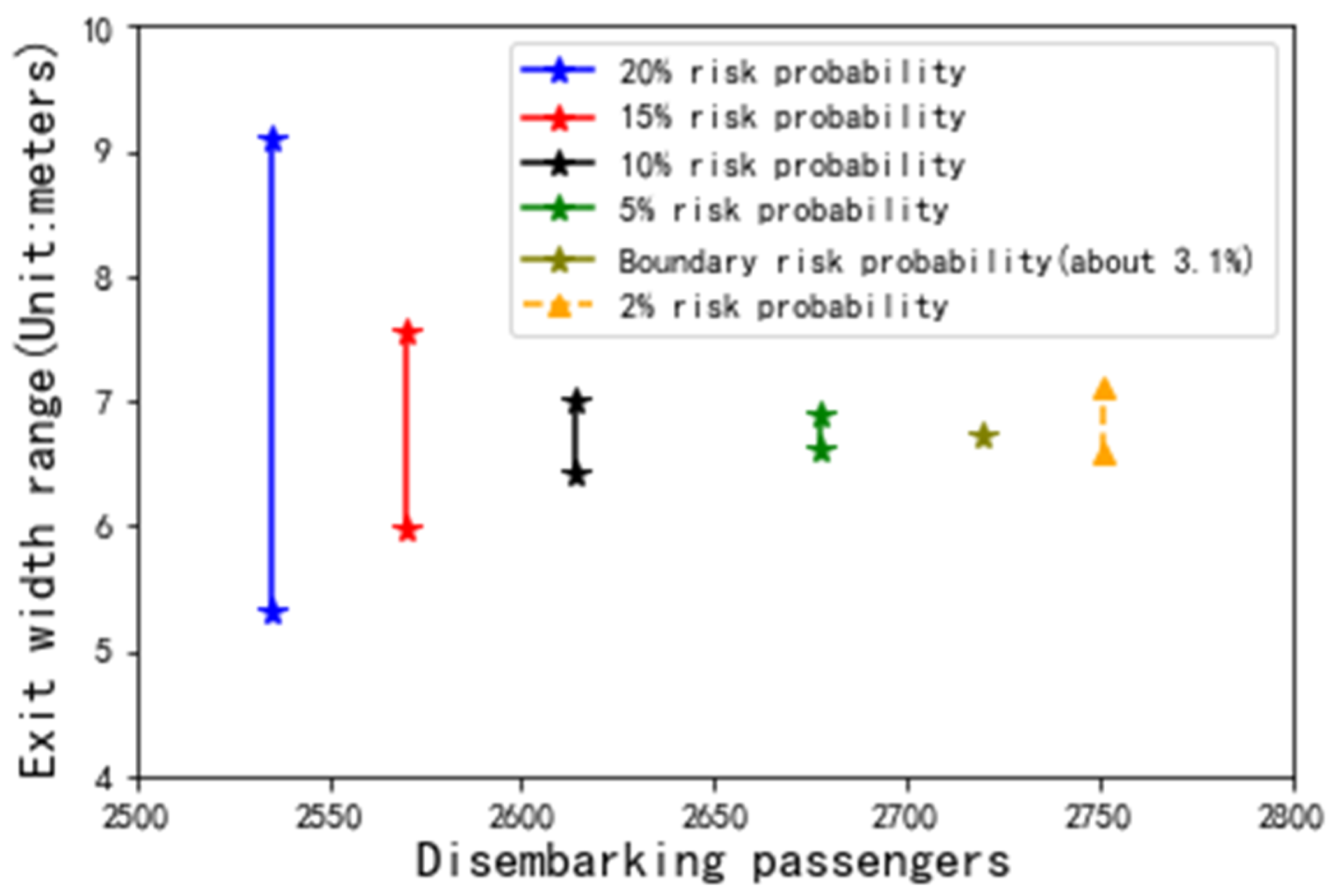
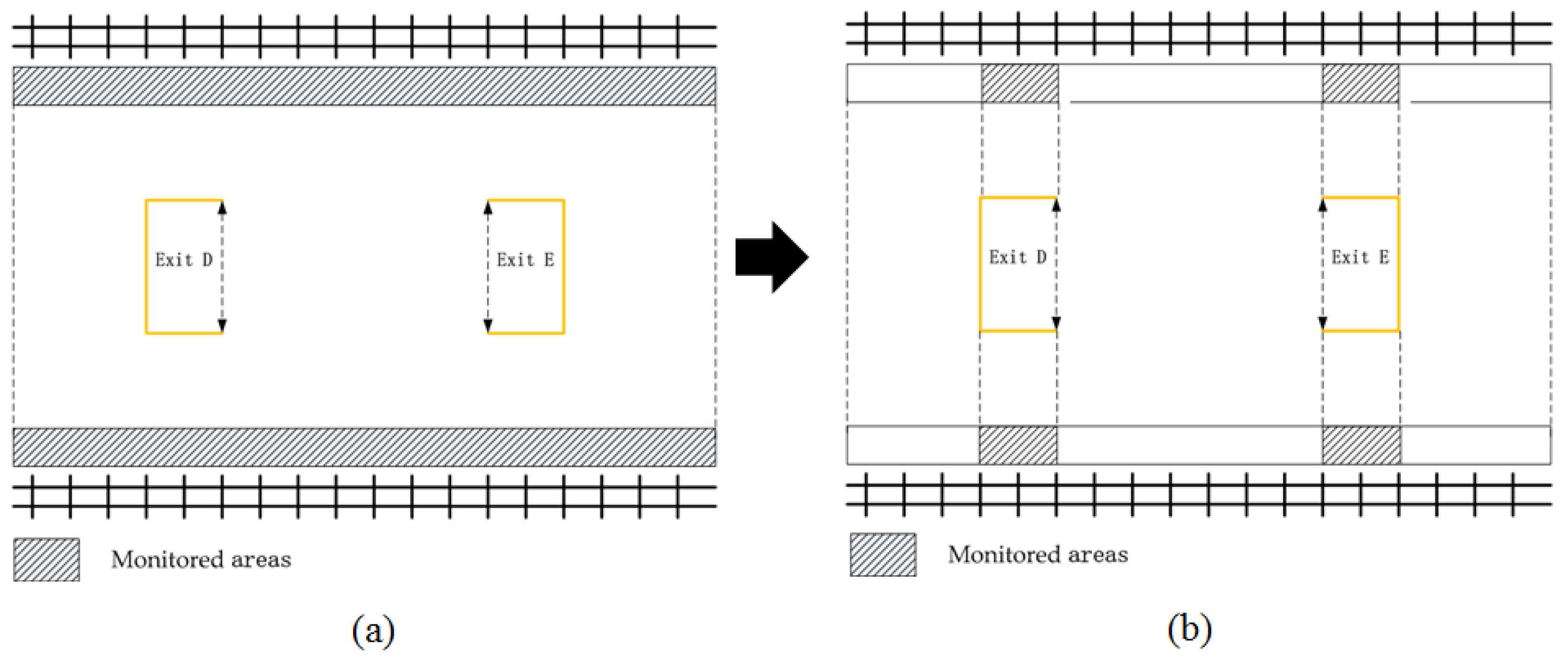
There are several accidents in China’s high-speed railways where passengers fall off the platform every year. In response to the risks of falling off high-speed railway platforms associated with passenger overcrowding, this study explores the platform exit width range in determining how to reduce the risk. In order to quantify the risk, we first define the risk probability to measure the likelihood of passengers falling off the platform. Then, we propose an integrated model that combines the passenger flow assignment with a dynamic calculation of passenger flow. This methodology addresses the passenger flow assignment through modeling passenger choices based on path utilities and determines an interpretable exit width range that ensures safe, non-congested evacuation within the designated timeframe. Empirical analysis reveals that the ranges of exit width and achieving different aims of risk probabilities are negatively correlated. The current exit width of 6 m on high-speed railway platforms is insufficient. Our results recommend expanding this width to between 6.43 and 7.01 m to facilitate more efficient passenger exits under normal operating conditions (risk probability of 10%). This adjustment potentially reduces the required investment in surveillance equipment by 77.7% and halves the monetary costs, thereby encouraging railway managers to implement these recommendations. Due to being restricted by a fixed platform width of 10 m, the limitation of optimizing the exit width aims to allow about 2770 passengers at most to leave the platform within the specified travel time.
Keywords: passenger safety; platform exit width; passenger assignment; route choice; path utility; passenger flow density; high-speed railway in China passenger safety; platform exit width; passenger assignment; route choice; path utility; passenger flow density; high-speed railway in China