Article

A Dual-Head Mixer-BiLSTM Architecture for Battery State of Charge Prediction


Department of Computer Engineering, Faculty of Engineering, Düzce University, 81620 Düzce, Türkiye
*
Author to whom correspondence should be addressed.
Appl. Sci. 2025, 15(24), 13255; https://doi.org/10.3390/app152413255
Submission received: 21 November 2025 / Revised: 12 December 2025 / Accepted: 16 December 2025 / Published: 18 December 2025
(This article belongs to the Section Computing and Artificial Intelligence)

Abstract

State of charge (SOC) estimation is a key research topic for electric vehicles, with accurate SOC estimation being important for both range and safety. In this study, we present the Dual-Head Depth Directional Mixer (DH-DW-M) model for SOC estimation. The model is tested using the BMW i3 dataset and its performance is evaluated using standard error measures from multiple perspectives. Furthermore, the results are compared with those of previous studies; specifically, DH-DW-M is compared with the Trend Flow-Mixer model, which has achieved the best results on this dataset in the literature to date. Notably, the proposed DH-DW-M model achieves the lowest overall estimation error value of 0.21%. Compared with the Trend Flow-Mixer model, DH-DW-M showed an 82% lower Root Mean Square Error (RMSE) when using the same input features. The model is also compared with well-known methods, with RMSE approximately 97%, 96%, and 95% lower when compared to those of Long Short-Term Memory (LSTM), Convolutional Neural Network–LSTM (CNN-LSTM), and Bidirectional LSTM with Attention (BiLSTM-AT) models, respectively.

1. Introduction

Compared with fossil fuel vehicles, electric vehicles offer a more environmentally sustainable mode of transportation. The lithium-ion market size is increasing day by day [1], and the widespread use of lithium-ion batteries across diverse applications suggests that demand will continue to increase. Lithium-ion batteries are widely employed in electric vehicles due to their safety, efficiency, and high power density [2]. Hazardous conditions, such as overcharging or overdischarging, may accelerate lithium-ion battery aging and can cause thermal runaway, leading to fires and explosions [3]. There are various methods in the literature for accurately estimating the remaining energy of batteries [4]. SOC estimation in multi-cell systems is a complex task. Accurate SOC estimation in electric vehicles is important for predicting the remaining range, and the gradual decline in an electric vehicle battery’s cycle life over time should also be accounted for in SOC estimations. Moreover, for trip planning, it is crucial that electric vehicles can reach charging stations in a timely manner and that drivers receive accurate information on the remaining range. The driving range of electric vehicles can vary considerably depending on operating conditions. Among the methods for SOC estimation, Coulomb counting is widely used. The Coulomb counting method offers the advantage of simple implementation; however, it requires knowledge of the initial SOC and is susceptible to measurement errors and battery parameter uncertainties arising from temperature and aging [5]. The open-circuit voltage method (OCVM) is straightforward to apply; however, because the battery requires time to reach equilibrium, its real-time implementation is difficult [6]. One of the most widely used filtering techniques for SOC estimation is the Kalman filter. The Extended Kalman Filter (EKF) remains prominent as it can operate on hardware with limited computational resources while still yielding accurate estimates [7]. Due to the complex internal architecture of batteries, mathematical modeling is not always feasible. In scholarly sources, data-driven techniques are typically grouped into fuzzy rule-based, classification/regression-oriented, hybrid, and artificial neural network (ANN)-based approaches [8]. Compared with model-based approaches, data-driven methods offer several advantages: they do not require an explicit model or extensive domain knowledge, parameter selection is generally simpler, and they remain effective under noisy conditions [9]. Among data-driven methods, LSTM networks are effective at learning long-term temporal dependencies. The LSTM is a recurrent neural network (RNN) architecture, with the LSTM cells employing input, forget, and output gates to modulate the cell state and capture long-term dependencies [10]. Thanks to these gates, LSTM cells retain salient information over extended time spans and discard irrelevant information. This capability is essential for processing time-varying data. While the LSTM architecture offers advantages over conventional feed-forward neural networks in learning long-term dependencies, standard (non-gated) recurrent neural networks are typically less effective than LSTMs at processing long sequences and capturing complex patterns. The operating mechanism entails assessing information at specific decision points, termed “gates.” Using a gating signal ranging from 0 to 1, it distinguishes between salient and non-salient inputs, thereby filtering or prioritizing information based on its importance. LSTM networks are employed in time-series analysis because they learn long-range temporal dependencies. In this study, we benchmark the proposed DH-DW-M architecture. We compare it with the best method published to date, Trend Flow-Mixer, as well as LSTM, CNN-LSTM, and BiLSTM-AT using the BMW i3 dataset under comparable experimental settings (i.e., same input features and protocol). DH-DW-M achieves the best reported performance to date on this dataset and yields the lowest RMSE of 0.21%. The proposed model’s RMSE is 97.6%, 96.1%, 95.1%, and 82% lower compared to LSTM, CNN-LSTM, BiLSTM-AT, and Trend Flow-Mixer, respectively. The rest of this article is organized as follows. Section 2 provides a survey of the literature. Section 3 describes the BMW i3 dataset and the proposed framework, and details the data preprocessing, splitting of the dataset, training of the model, and SOC estimation using the DH-DW-M architecture with parameter optimization. Section 4 reports the performance of the model, including RMSE, mean absolute error (MAE), and mean absolute percentage error (MAPE) values. Section 5 concludes the study.

2. Literature Review

In previous studies, electric vehicle datasets commonly comprise data from diverse sources, including environmental conditions, on-board vehicle telemetry, and battery measurements. In general, electric vehicle datasets include weather data, route information, driving behavior data, electric vehicle modeling variables, and battery data modeling that captures battery dynamics [11]. A study that integrated CNN and BiLSTM approaches showed improved performance across diverse driving cycle tests under varying temperature conditions [12]. Another study used current, voltage, and temperature as input features and showed that the LSTM method outperforms both CNN and feed-forward neural network (FNN) models [13]. In a study that used current, voltage, temperature, vehicle speed, traction power, and road elevation as input features, their LSTM-based approach achieved an RMSE of 0.02 [14]. One study reported that the Improved Anti-Noise Adaptive LSTM (ANA-LSTM) achieved an RMSE of 0.6% for remaining useful capacity prediction [15]. For low-temperature battery state-of-health (SOH) prediction, the SF-GPR-LSTM (Gaussian process regression-Long Short-Term Memory) model yielded an RMSE of 2.34% in [16]. Li et al. [17] compared the particle swarm optimization-temporal convolutional network (PSO–TCN) attention model with LSTM and TCN and reported an RMSE below 1%. Tian et al. [18] investigated SOC estimation for lithium–iron phosphate LFP batteries across differing states of health using a deep neural network (DNN)-based method. Zafar et al. [19] presented a hybrid deep-learning approach that involves training a conventional DNN using the Mountain Gazelle Optimizer (MGO), and reported an RMSE of approximately 0.3%. In Lin’s study [20], a DNN evaluated on the BMW i3 dataset with 24 features yielded an RMSE of 0.84. Using data from Panasonic 18650PF (Zellik, Belgium) cells, Chandran et al. [21] compared ANN, support vector machines (SVMs), linear regression (LR), Gaussian process regression (GPR), bagging ensembles (EBA), and boosting ensembles (EBO), and reported that ANN and GPR achieved superior performance. This finding demonstrates the effectiveness of ANN and GPR methods in battery data analysis. Ahmed et al. [22] estimated SOC in lithium-ion batteries using a hybrid EKF–Unscented Kalman Filter (UKF) framework and reported an RMSE of 0.2%.
In the literature, a broad range of machine learning and deep learning methods have been commonly employed for SOC estimation using datasets. Numerous studies employed feature selection and extraction techniques. In addition to electric vehicle datasets, laboratory-acquired battery cell datasets have been routinely utilized. Overall, the evidence indicates that hybrid approaches generally offer substantial advantages over conventional methods. Qiu et al. [23] proposed a spatio-temporal deep learning framework that integrates a Spatio-Temporal Graph Convolutional Network (STGCN) and a transformer network to estimate the SOC of shipboard lithium-ion batteries in a Battery Energy Storage System (BESS) under varying connection topologies and temperature conditions. Zhao et al. [24] presented a deep transfer learning method that uses a CNN and a multi-head self-attention block to estimate the SOH of LFP batteries during fast charging from only a limited part of the SOC voltage–capacity curve.

3. Material and Methods

This section provides an extensive overview of the dataset used in this study. It also delineates the methodological framework implemented in the proposed DH-DW-M architecture and, through a holistic analysis, details its operational principles.

3.1. BMW i3 Dataset

Electric vehicle efficiency depends on various dynamics. Researchers have compiled a comprehensive dataset comprising 72 real-world trips with a BMW i3 (Munich, Germany). The collection captures environmental conditions, on-board performance metrics, battery state variables, and the operation of the heating system. This dataset has since been used in numerous academic studies.
This study used the TripB subset of the BMW i3 (60 Ah) dataset, which consists of 38 real-world driving cycles. Table 1 provides a summary of each trip, including the route or area (urban, suburban, or highway), initial and final battery SOC (%), the distance traveled (km), the trip duration (min), the number of rows (which corresponds to the number of recorded time samples), mean vehicle speed (km/h), mean pack voltage (V), mean pack current (A), and mean ambient temperature (°C). Together, these indicators characterize the typical operating conditions of the battery and describe the dataset’s variability and representativeness. They capture the driving profile, load level, and environmental conditions, which were used to contextualize and interpret the performance of the proposed battery modeling and estimation methods.
In this dataset, positive battery current indicates charging and negative current indicates discharging. Charging can occur during regenerative braking or plug-in charging. Trip B04 contains a stationary charging segment (vehicle speed ≈ 0), which explains the SOC increase from 45.1% to 69.2%.

3.2. Proposed Framework

Implementing the DH-DW-M model constitutes an important step toward accurate SOC estimation and the reliable operation of battery management systems in electric vehicles. Feature extraction is an important step in data preprocessing. To compare the model’s performance with previous studies, velocity, battery voltage, battery current, and ambient temperature were used as inputs. Data splitting establishes the training and test datasets, and the final stage SOC estimation assesses the model’s effectiveness under real-world conditions (Figure 1). This comprehensive approach enables a detailed assessment of the DH DW-M model’s performance on the BMW-i3 dataset.

3.2.1. Data Preprocessing

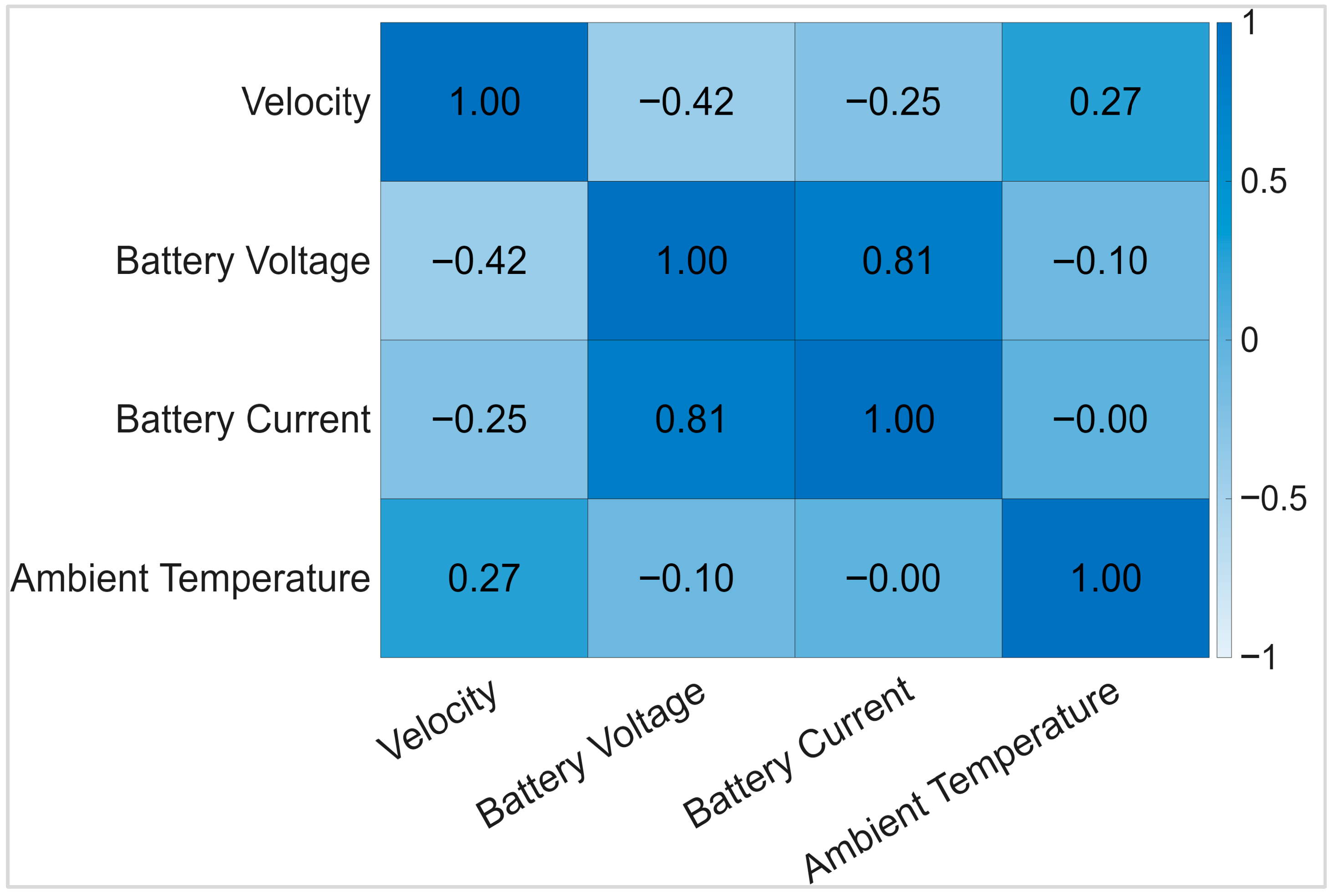
The feature set used in this study includes features such as current and voltage, which are frequently used in the literature, both in laboratory battery experiments and in studies involving real-world driving data. During preprocessing, speed, battery voltage, battery current, and ambient temperature were used as inputs, while SOC was determined as the output (Figure 2).

3.2.2. SOC Estimation

In this section, we survey related studies and examine both the progress made and the solutions proposed. The application of deep learning techniques to time series has been a significant step in overcoming the limitations of traditional approaches. LSTM emerged as a solution to the vanishing and exploding gradient problems inherent to RNNs [26]. It uses short-term memory to recall previous states at each time step, thus capturing long-term dependencies. The memory cells, together with the input gate ( i t ) , output gate ( o t ) , and forget gate ( f t ) , form a memory block. Initially, the forget gate ( f t ) , determines which information from the previous state should be discarded. As shown in Equation (1), it removes unnecessary information. The input gate ( i t ) then controls what new information will be stored in the cell, preparing for the update, as shown in Equation (2). The activation function ( C ~ t ) generates a candidate value to be added to the cell state. The previous cell state ( C t 1 ) is multiplied by the value from the forget gate while the new candidate value is scaled by the input gate and added to the updated cell state. Finally, the output gate ( o t ) regulates the information sent out of the memory block, as shown in Equation (5). The LSTM equations are shown in Equations (1)–(6) [27]. W i , W o , W f , and σ represent the weights of the input, forget, output gates, and the sigmoid activation function, respectively. In the LSTM network, the bias terms of the input, output, and forget gates are denoted by b i , b o , and b f .
f t = σ ( W f · [ h t 1 , x t ] + b f )
i t = σ ( W i · [ h t 1 , x t ] + b i )
C ~ t = t a n h ( W C · [ h t 1 , x t ] + b C )
C t = f t · C t 1 + i t   ·   C ~ t
o t = σ ( W o · [ h t 1 , x t ] + b o )
h t = o t   ·     t a n h ( C t )
BiLSTM plays a crucial role in modeling time series. Using two separate layers, BiLSTM processes the input sequence both forward and backward in time [28]. Thanks to its bidirectional structure, BiLSTM utilizes background information, as well as the next steps of the forward layer sequence, in its calculation. In the Z-score method, the average value is determined for each column using the mean(x). The average value is subtracted from each element and divided by the column’s standard deviation. The Z-score method is shown in Equation (7).
x j = x j m e a n ( x ) s t d ( x )
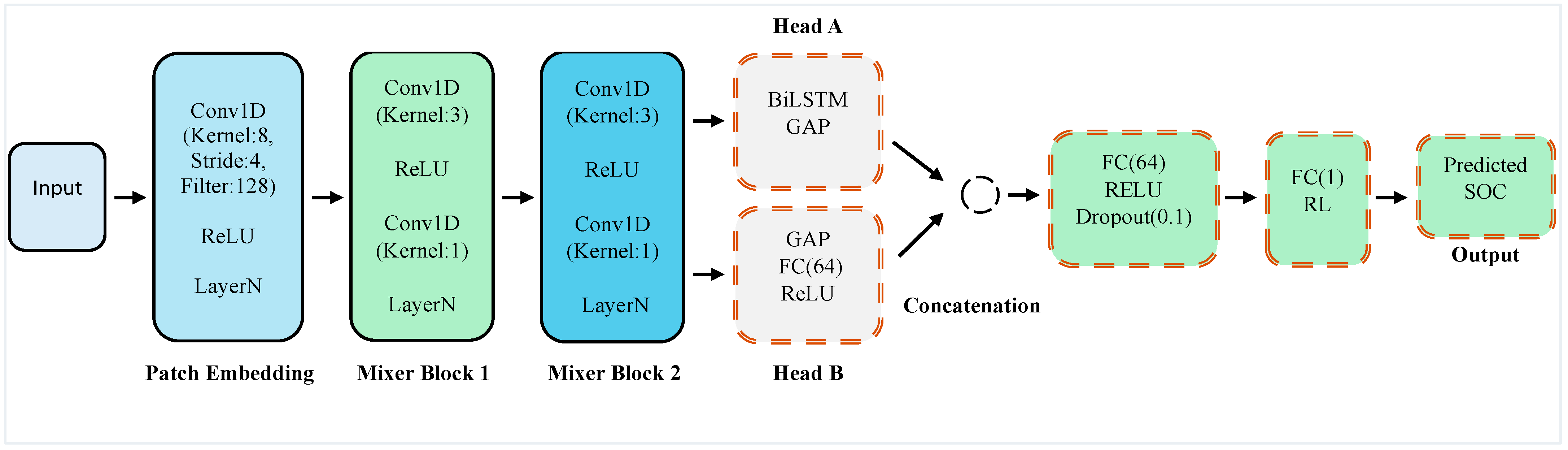
The proposed DH-DW-M architecture, depicted in Figure 3, receives a sliding window of 180 time steps with four channels (velocity, battery voltage, battery current, and ambient temperature) as input.
In the first stage, a one-dimensional convolutional layer (abbreviated as Conv1D) is utilized as a patch-embedding module. This layer uses a kernel size of 8, a stride of 4, 128 output filters, and the “same” padding. The output of the patch-embedding layer is passed through a Rectified Linear Unit ( R e l u ) activation function, which is a pointwise nonlinearity (Equation (8)).
R e l u x = m a x ( 0 , x )
Following R e l u , a layer normalization operation (LayerN) is applied. Layer normalization normalizes the activations across the channel dimension at each time step by subtracting the mean and dividing by the standard deviation of the 128 channels. In addition to the patch-embedding block, we employ two stacked convolutional mixer blocks. In the first mixer block, a depthwise 1D convolution (DWConv) with a kernel size of 3, the “same” padding, and 128 channels is applied along the temporal dimension. The depthwise convolution is followed by another R e l u activation, reintroducing nonlinearity. Two stacked convolutional mixer blocks, each integrating depthwise and pointwise Conv1D layers with layer normalization and a residual connection, then refine these embeddings. Global Average Pooling (GAP) takes a sequence with many time steps and computes the average value over time for each channel (feature). It squeezes the time dimension by taking the mean of each feature across all time steps. In addition to the mixer output, we utilize a dual-head readout. The first head (Head A) uses a bidirectional LSTM with 128 units per direction and global average pooling over time to obtain a 256-dimensional contextual representation. The second head (Head B) applies global average pooling directly to the mixer features. Next, a 128-to-64 fully connected layer with R e l u and dropout is used. The two heads are concatenated into a 320-dimensional fused vector. This vector passes through a 320-to-64 fully connected layer. Finally, a 64-to-1 regression layer predicts the normalized ΔSOC target. Instead of predicting the absolute future SOC, the network predicts the change in SOC, which is then normalized using the training-set min–max statistics. The formula for calculating ΔSOC is shown in Equation (9).
Δ S O C = S O C t 2 + h S O C ( t 2 )
We select the model’s hyperparameters using a grid search. This method tests different parameter combinations and chooses the best one. The hyperparameters are reported in Table 2. Training was run for up to 140 epochs with early stopping, which helped prevent overfitting. The input data consisted of the first five winter driving cycles of the electric vehicle in category B. The dataset was split into training (50%), validation (10%), and testing (40%) sets. The learning rate controls the update step size, which affects convergence speed and stability. We use a piecewise learning-rate schedule. The drop factor sets the reduction amount and the drop period sets how often the reduction is applied. This schedule improves late-stage convergence and reduces oscillations. The L2 regularization coefficient penalizes large weights. It helps reduce overfitting and improves generalization. Validation patience controls early stopping. Training stops when validation loss does not improve for a set number of validations. This limits overfitting and reduces the training time. The batch size affects gradient noise, stability, computational efficiency, and memory usage. Smaller batches give noisier gradients while larger batches give smoother updates but need more memory. Finally, the validation and test ratios define the data split. The validation set was used for hyperparameter tuning while the test set was used for final generalization evaluation.
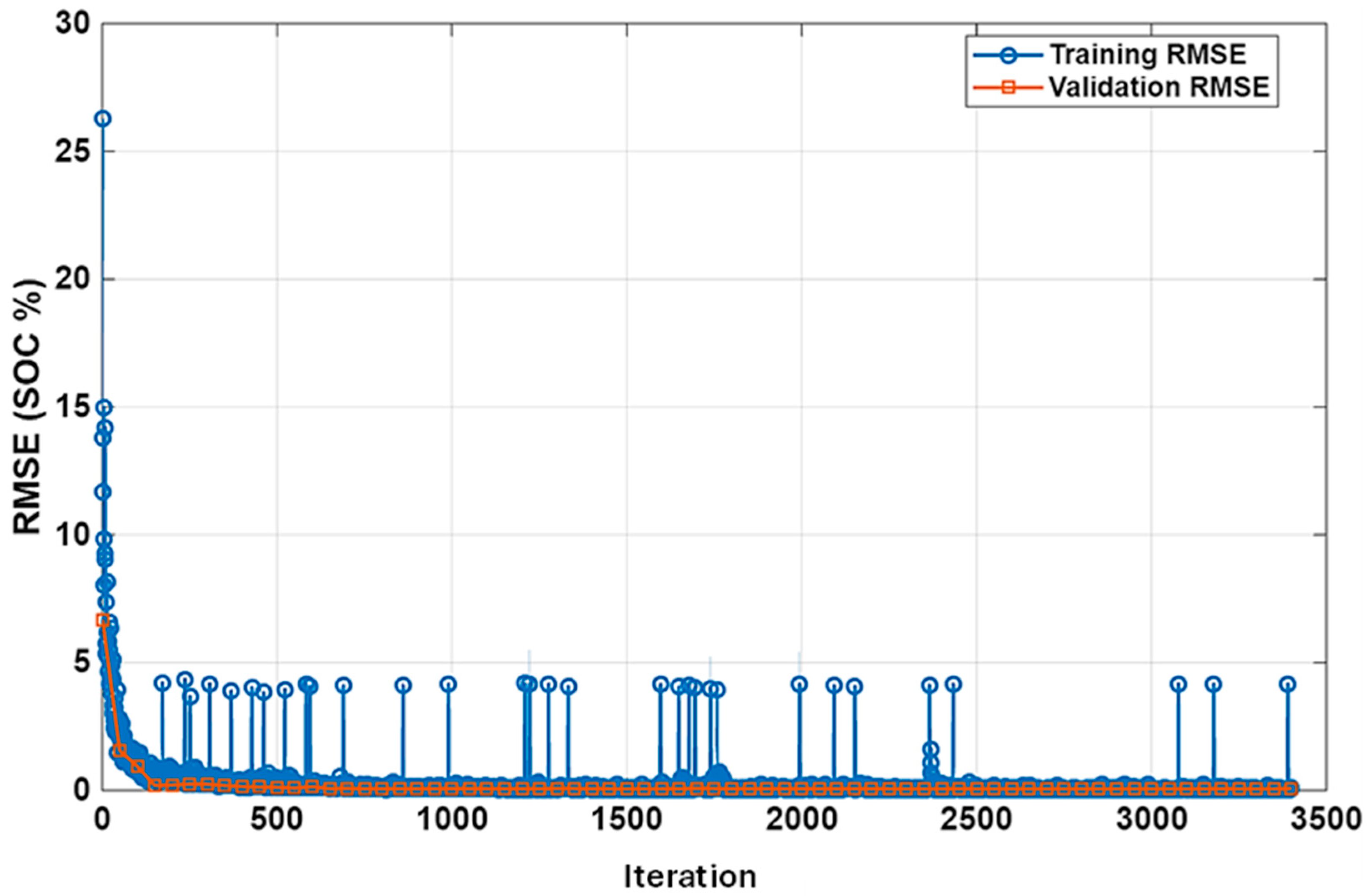
During training, the RMSE was calculated at the end of each epoch for both the training and validation sets. Since the network’s regression loss corresponds to the mean squared error, the RMSE at a given epoch was obtained by taking the square root of this loss and scaling it to the SOC percentage range. This curve allows us to monitor convergence and compare training and validation errors. It also helps to spot overfitting. Throughout the training, the RMSE values decreased and then stabilized, indicating that the model reached a consistent level of performance without performance degradation. Figure 4 shows the training and validation RMSEs as a function of the training iteration (mini-batch updates). A total of approximately 3500 iterations were performed, which corresponds to about 2–3 effective epochs. This behavior suggests that the proposed model neither overfits nor underfits; instead, it achieves a good balance between learning the underlying patterns in the data and maintaining generalization. We use 50% of the data for training. We generate training samples using a sliding window approach. This creates many overlapping sequences, thereby increasing the effective training set size. The remaining data is used for validation and final testing.

3.2.3. Computational Feasibility

Computational feasibility was evaluated using the parameter count, model size, and inference time. The trained network had 428,609 learnable parameters. The model size was computed assuming FP32 weights (32-bit, 4 bytes per parameter). The resulting size was 1.64 MB in FP32 and 3.27 MB in FP64 (8 bytes per parameter). The inference time was defined as the per-sample forward-pass latency. The measurement uses one input sequence with batch size = 1. The preprocessing time was excluded. A warm-up prediction was executed before the timing test, which was repeated N = 200 times. The results are reported as the mean ± standard deviation. The experiments were conducted in MATLAB Online R2025b Update 2 (25.2.0.3055257). The environment was a cloud-hosted Linux x86_64 virtual machine running Ubuntu 22.04 with kernel 6.8.0-1024-aws. The virtual machine had 8 CPU cores. The physical CPU model was not exposed by the platform. The measured inference time was 5.252 ± 4.223 ms on the CPU. These results support real-time inference at the considered sampling rate. Cross-vehicle validation on other electric vehicle models was not performed in this study, which is a limitation that could be addressed in future work.

4. Results

RMSE and MAE were the primary metrics used to evaluate the proposed model. MAPE metric indicates the average magnitude of the prediction error relative to the true value. MAE is the average of the absolute differences between the predicted and actual values. The formulas for RMSE, MAE, and MAPE are shown in Equations (10)–(12).
R M S E = 1 N   i = 1 N ŷ i y i 2
M A E = 1 N i = 1 N ŷ i y i
M A P E = 100 N   i = 1 N ŷ i y i y i
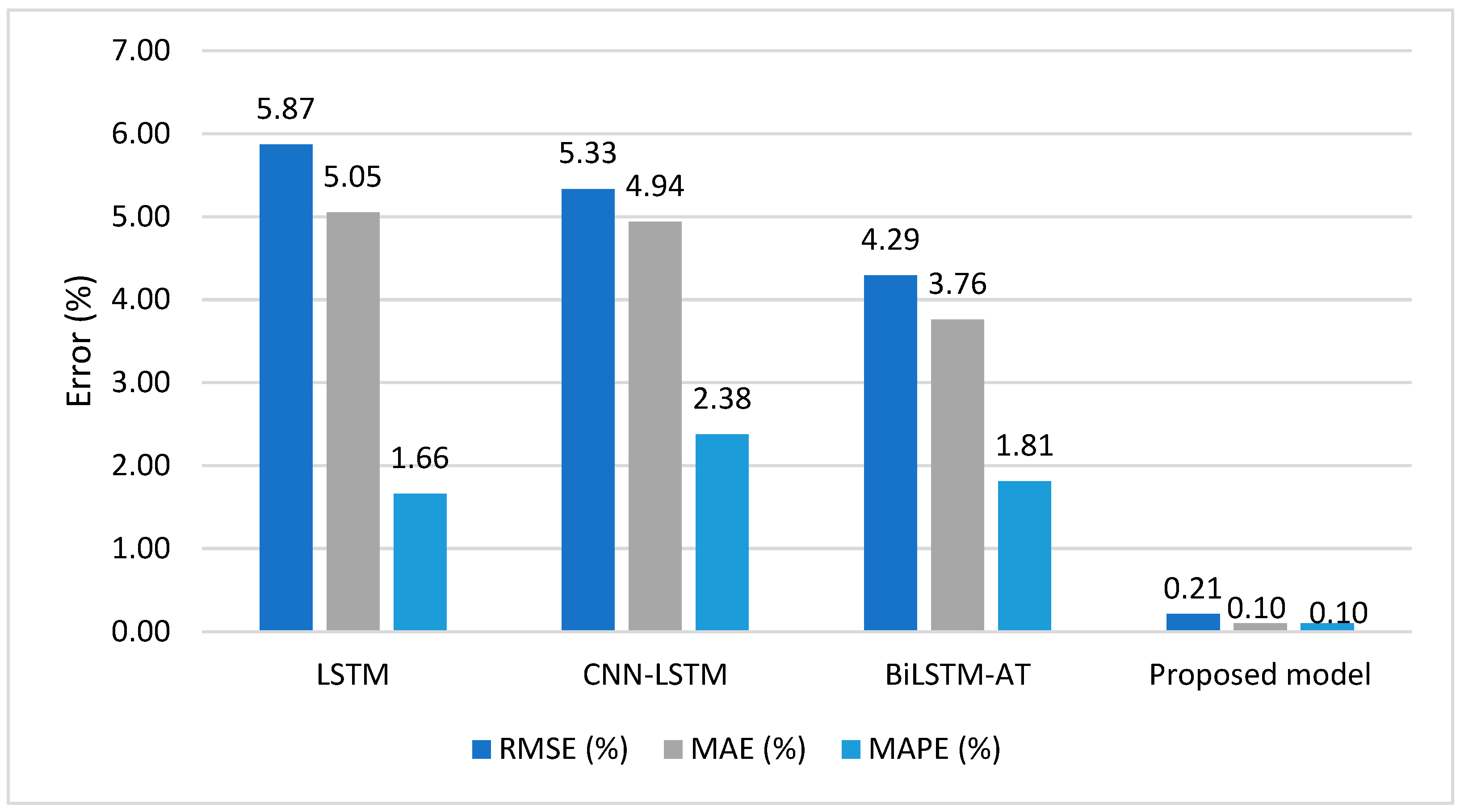
The evaluation was conducted on the BMW i3 winter driving dataset. We implemented each method in MATLAB R2025b and the RMSE, MAE, and MAPE values were calculated to evaluate the performance of each method. The results are summarized in Figure 5 and show a comparison of the proposed approach and widely used methods. The proposed method outperformed the other methods; specifically, it had the lowest RMSE, MAE, and MAPE values. Furthermore, the BiLSTM-AT method outperformed CNN-LSTM and LSTM.
The DH-DW-M method’s performance was compared with that of other models published in the literature that were tested on the same BMW i3 dataset (Table 3). Compared to Trend Flow-Mixer, the proposed method achieved a roughly fivefold lower RMSE.

5. Conclusions

In this study, we compared our proposed DH-DW-M model with existing methods and published methods that used the same dataset in the literature. We evaluated the DH-DW-M model using the BMW i3 dataset to demonstrate its application in an operational electric vehicle environment. We compared the models based on three metrics—RMSE, MAE, and MAPE—which directly measure accuracy and reliability. The DH-DW-M was tested using the same input features as the Trend Flow-Mixer model, which has the best results in the literature to date. The proposed method was also compared with the well-known LSTM, CNN-LSTM, and BiLSTM-AT methods, using the RMSE as the metric for prediction error. The proposed model achieved the lowest error of 0.21%. Compared to the LSTM (5.87), CNN-LSTM (5.33), and BiLSTM-AT (4.29) models, this corresponds to an approximately 97%, 96%, and 95% lower error, respectively. These results support the robustness of the method and its ability to minimize errors. We used evaluation criteria commonly used in previous research, which made the evaluation both fair and easy to interpret. The proposed method achieved an 82% relative improvement (RMSE) over the Trend Flow-Mixer model, making it more suitable for practical use.
Future studies could evaluate the predictive performance of different features by applying feature selection and extraction methods to this dataset and using different electric vehicle models. Furthermore, the proposed method can be applied to real-world driving data from different vehicles.

Author Contributions

Conceptualization, İ.Y. and F.K.; methodology, İ.Y. and F.K.; software, İ.Y. and F.K.; validation, İ.Y. and F.K.; formal analysis, İ.Y. and F.K.; investigation İ.Y. and F.K.; resources, İ.Y. and F.K.; data curation, İ.Y. and F.K.; writing—review and editing, İ.Y. and F.K.; visualization, İ.Y. and F.K.; supervision, İ.Y.; project administration, İ.Y. All authors have read and agreed to the published version of the manuscript.

Funding

This research received no external funding.

Institutional Review Board Statement

Not applicable.

Informed Consent Statement

Not applicable.

Data Availability Statement

Publicly available datasets were analyzed in this study. The BMW i3 “Battery and Heating Data in Real Driving Cycles” dataset is available on Kaggle at https://www.kaggle.com/datasets/atechnohazard/battery-and-heating-data-in-real-driving-cycles (accessed on 10 December 2025).

Conflicts of Interest

The authors declare no conflicts of interest.

References

  1. Electric Vehicle Battery Market Size, Segments, Regional Outlook (NA, EU, APAC, LA, MEA) & Competitive Landscape, 2025–2034. Available online: https://www.towardsautomotive.com/insights/electric-vehicle-battery-market-sizing (accessed on 10 December 2025).
  2. Hannan, M.A.; Hoque, M.M.; Hussain, A.; Yusof, Y.; Ker, P.J. State-of-the-Art and Energy Management System of Lithium-Ion Batteries in Electric Vehicle Applications: Issues and Recommendations. IEEE Access 2018, 6, 19362–19378. [Google Scholar] [CrossRef]
  3. Xiong, R.; Cao, J.; Yu, Q.; He, H.; Sun, F. Critical Review on the Battery State of Charge Estimation Methods for Electric Vehicles. IEEE Access 2017, 6, 1832–1843. [Google Scholar] [CrossRef]
  4. Manthopoulos, A.; Wang, X. A Review and Comparison of Lithium-Ion Battery SOC Estimation Methods for Electric Vehicles. In Proceedings of the IECON 2020 (Industrial Electronics Conference), Singapore, 18–21 October 2020; pp. 2385–2392. [Google Scholar] [CrossRef]
  5. Movassagh, K.; Raihan, A.; Balasingam, B.; Pattipati, K. A Critical Look at Coulomb Counting Approach for State of Charge Estimation in Batteries. Energies 2021, 14, 4074. [Google Scholar] [CrossRef]
  6. Shrivastava, P.; Naidu, P.A.; Sharma, S.; Panigrahi, B.K.; Garg, A. Review on Technological Advancement of Lithium-Ion Battery States Estimation Methods for Electric Vehicle Applications. J. Energy Storage 2023, 64, 107159. [Google Scholar] [CrossRef]
  7. Wang, Q.; Wang, J.; Zhao, P.; Kang, J.; Yan, F.; Du, C. Correlation between the Model Accuracy and Mod-el-Based SOC Estimation. Electrochim. Acta 2017, 228, 146–159. [Google Scholar] [CrossRef]
  8. Sesidhar, D.V.S.R.; Badachi, C.; Green, R.C. A Review on Data-Driven SOC Estimation with Li-Ion Batteries: Implementation Methods & Future Aspirations. J. Energy Storage 2023, 72, 108420. [Google Scholar] [CrossRef]
  9. Lipu, M.H.; Hannan, M.A.; Hussain, A.; Ayob, A.; Saad, M.H.; Karim, T.F.; How, D.N. Data-Driven State of Charge Estimation of Lithium-Ion Batteries: Algorithms, Im-plementation Factors, Limitations and Future Trends. J. Clean. Prod. 2020, 277, 124110. [Google Scholar] [CrossRef]
  10. Lindemann, B.; Müller, T.; Vietz, H.; Jazdi, N.; Weyrich, M. A Survey on Long Short-Term Memory Networks for Time Series Prediction. Procedia CIRP 2021, 99, 650–655. [Google Scholar] [CrossRef]
  11. Rahimi-Eichi, H.; Chow, M.Y. Big-Data Framework for Electric Vehicle Range Estimation. In Proceedings of the IECON 2014 (Industrial Electronics Conference), Dallas, TX, USA, 29 October–1 November 2014; pp. 5628–5634. [Google Scholar] [CrossRef]
  12. Zafar, M.H.; Khan, N.M.; Houran, M.A.; Mansoor, M.; Akhtar, N.; Sanfilippo, F. A Novel Hybrid Deep Learning Model for Accurate State of Charge Estimation of Li-Ion Batteries for Electric Vehicles under High and Low Temperature. Energy 2024, 292, 130584. [Google Scholar] [CrossRef]
  13. Choi, Y.; Ryu, S.; Park, K.; Kim, H. Machine Learning-Based Lithium-Ion Battery Capacity Estimation Ex-ploiting Multi-Channel Charging Profiles. IEEE Access 2019, 7, 75143–75152. [Google Scholar] [CrossRef]
  14. Mohanty, P.K.; Jena, P.; Padhy, N.P. Electric Vehicle State-of-Charge Prediction Using Deep LSTM Network Model. In Proceedings of the 10th IEEE International Conference on Power Electronics, Drives and Energy Systems (PEDES 2022), Jaipur, India, 14–17 December 2022. [Google Scholar] [CrossRef]
  15. Wang, S.; Fan, Y.; Jin, S.; Takyi-Aninakwa, P.; Fernandez, C. Improved Anti-Noise Adaptive Long Short-Term Memory Neural Network Modeling for the Robust Remaining Useful Life Prediction of Lithium-Ion Batteries. Reliab. Eng. Syst. Saf. 2023, 230, 108920. [Google Scholar] [CrossRef]
  16. Wang, S.; Wu, F.; Takyi-Aninakwa, P.; Fernandez, C.; Stroe, D.I.; Huang, Q. Improved Singular Filtering–Gaussian Process Regression–Long Short-Term Memory Model for Whole-Life-Cycle Remaining Capacity Estimation of Lithium-Ion Batteries Adaptive to Fast Aging and Multi-Current Variations. Energy 2023, 284, 128677. [Google Scholar] [CrossRef]
  17. Li, F.; Zuo, W.; Zhou, K.; Li, Q.; Huang, Y. State of Charge Estimation of Lithium-Ion Batteries Based on PSO–TCN–Attention Neural Network. J. Energy Storage 2024, 84, 110806. [Google Scholar] [CrossRef]
  18. Tian, J.; Xiong, R.; Shen, W.; Lu, J. State-of-Charge Estimation of LiFePO4 Batteries in Electric Vehicles: A Deep-Learning Enabled Approach. Appl. Energy 2021, 291, 116812. [Google Scholar] [CrossRef]
  19. Zafar, M.H.; Mansoor, M.; Abou Houran, M.; Khan, N.M.; Khan, K.; Moosavi, S.K.R.; Sanfilippo, F. Hybrid Deep Learning Model for Efficient State of Charge Estimation of Li-Ion Batteries in Electric Vehicles. Energy 2023, 282, 128317. [Google Scholar] [CrossRef]
  20. Lin, S.L. Deep Learning-Based State of Charge Estimation for Electric Vehicle Batteries: Overcoming Tech-nological Bottlenecks. Heliyon 2024, 10, e35780. [Google Scholar] [CrossRef]
  21. Chandran, V.; Patil, C.K.; Karthick, A.; Ganeshaperumal, D.; Rahim, R.; Ghosh, A. State of Charge Estimation of Lithium-Ion Battery for Electric Vehicles Using Machine Learning Algorithms. World Electr. Veh. J. 2021, 12, 38. [Google Scholar] [CrossRef]
  22. Ahmed, F.; Abualsaud, K. On Equivalent Circuit Model-Based State-of-Charge Estimation for Lithium-Ion Batteries in Electric Vehicles. IEEE Access 2025, 13, 69950–69966. [Google Scholar] [CrossRef]
  23. Qiu, Y.; Wen, S.; Zhao, Q.; Zhang, B.; Wu, G.; Zhu, M. Multi-Model Deep Learning-Based State of Charge Estimation for Shipboard Lithium Batteries with Feature Extraction and Spatio-Temporal Dependency. J. Power Sources 2025, 629, 235983. [Google Scholar] [CrossRef]
  24. Zhao, J.; Li, D.; Li, Y.; Shi, D.; Nan, J.; Burke, A.F. Battery State of Health Estimation under Fast Charging via Deep Transfer Learning. iScience 2025, 28, 112235. [Google Scholar] [CrossRef] [PubMed]
  25. IEEE DataPort. Battery and Heating Data in Real Driving Cycles. Available online: https://ieee-dataport.org/open-access/battery-and-heating-data-real-driving-cycles (accessed on 10 December 2025).
  26. Hochreiter, S.; Schmidhuber, J. Long Short-Term Memory. Neural Comput. 1997, 9, 1735–1780. [Google Scholar] [CrossRef]
  27. Oruh, J.; Viriri, S.; Adegun, A. Long Short-Term Memory Recurrent Neural Network for Automatic Speech Recognition. IEEE Access 2022, 10, 30069–30079. [Google Scholar] [CrossRef]
  28. Schuster, M.; Paliwal, K.K. Bidirectional Recurrent Neural Networks. IEEE Trans. Signal Process. 1997, 45, 2673–2681. [Google Scholar] [CrossRef]
  29. Pau, D.P.; Aniballi, A. Tiny Machine Learning Battery State-of-Charge Estimation Hardware Accelerated. Appl. Sci. 2024, 14, 6240. [Google Scholar] [CrossRef]
  30. Liu, Z.; Ruan, G.; Tian, Y.; Hu, X.; Yan, R.; Yang, K. A Real-World Battery State of Charge Prediction Method Based on a Lightweight Mixer Architecture. Energy 2024, 311, 133434. [Google Scholar] [CrossRef]
  31. Nainika, C.; Balamurugan, P.; Febin Daya, J.L.; Anantha Krishnan, V. Real Driving Cycle Based SoC and Battery Temperature Prediction for Electric Vehicle Using AI Models. J. Appl. Res. Technol. 2024, 22, 351–361. [Google Scholar] [CrossRef]
  32. Mustaffa, Z.; Sulaiman, M.H.; Isuwa, J. State of Charge Estimation of Lithium-Ion Batteries in an Electric Vehicle Using Hybrid Metaheuristic–Deep Neural Networks Models. Energy Storage Sav. 2025, 4, 111–122. [Google Scholar] [CrossRef]
  33. Ariche, S.; Boulghasoul, Z.; El Ouardi, A.; Elbacha, A.; Tajer, A.; Espié, S. A Comparative Study of Electric Vehicles Battery State of Charge Estimation Based on Machine Learning and Real Driving Data. J. Low Power Electron. Appl. 2024, 14, 59. [Google Scholar] [CrossRef]
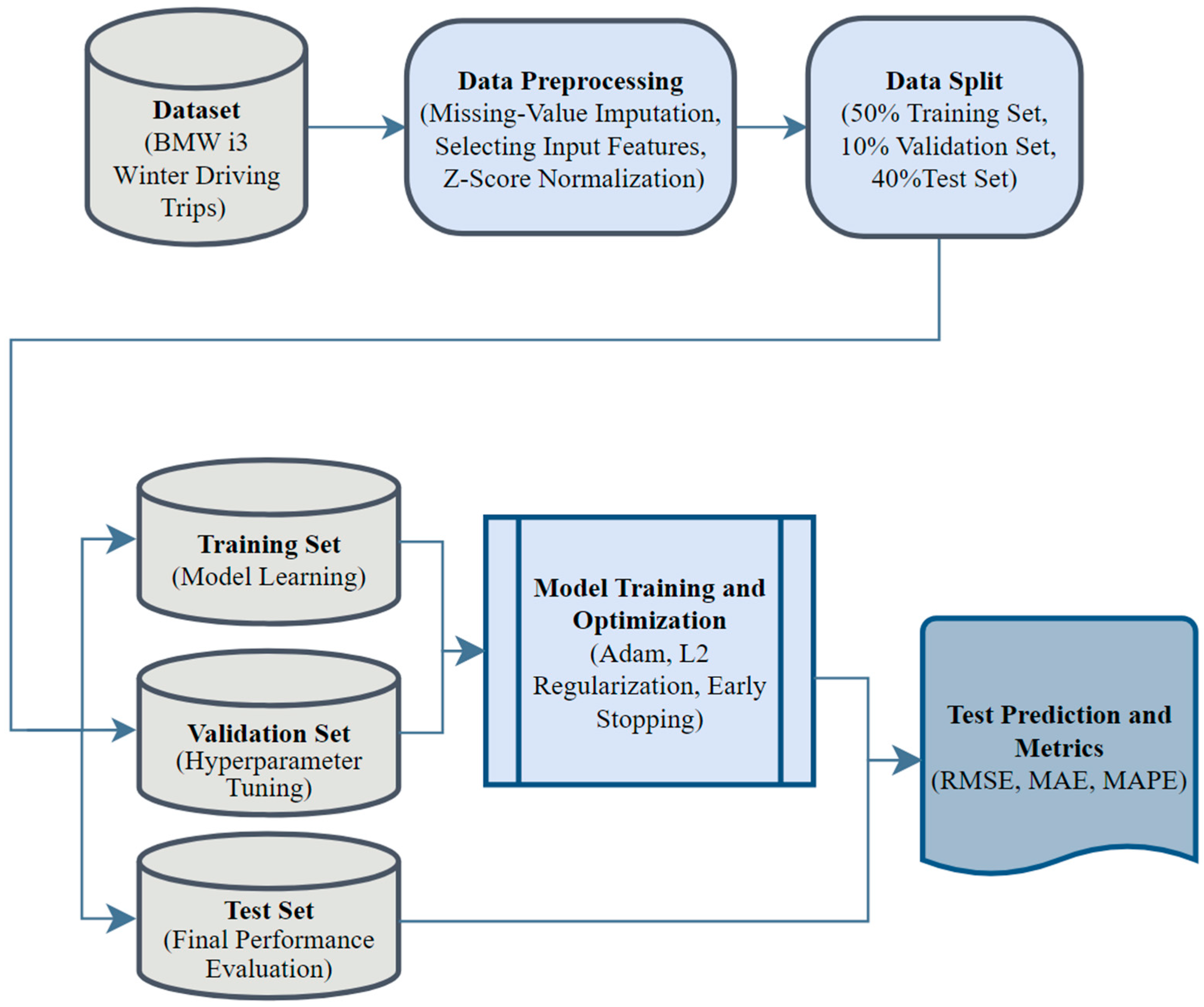
Figure 1. Flow diagram for SOC estimation.
Applsci 15 13255 g001
Figure 2. Heatmap correlation matrix.
Applsci 15 13255 g002
Figure 3. DH-DW-M architecture.
Applsci 15 13255 g003
Figure 4. Training process iteration–RMSE curve.
Applsci 15 13255 g004
Figure 5. Quantitative comparison of proposed model and baseline deep neural networks, namely, BiLSTM-AT, CNN-LSTM, and LSTM.
Applsci 15 13255 g005
Table 1. BMW i3 electric vehicle winter driving trips [25].
TripRoute/AreaInitial Battery SOC (%)Final Battery SOC (%)Distance (km)Duration (min)Number of RowsMean SpeedMean VoltageMean CurrentMean Ambient Temperature (°C)
TripB01FTMRoute (2×)86.157.438.854.232,51842.9378.7−19.69.5
TripB02FTMRoute81.066.218.926.916,11342.3381.6−26.57.2
TripB03FTMRoute67.450.419.426.315,79444.2370.2−24.05.0
TripB04Munich North45.169.216.649.229,55020.2379.717.110.1
TripB05Munich North71.959.514.8217.010,19552.3373.1−27.27.5
TripB06Munich North83.269.316.622.513,52144.1382.0−22.86.5
TripB07Munich Northeast67.450.430.438.222,89947.8369.9−24.42.3
TripB08Munich Northeast67.344.032.248.629,14039.8369.4−17.810.2
TripB09Munich South70.046.054.293.556,10234.8371.624.57.1
TripB10Highway84.839.047.833.720,23385.1364.7−50.44.4
TripB11Munich South38.930.810.212.6753448.8360.3−23.85.9
TripB12Highway73.451.337.153.832,25641.4378.8−15.35.9
TripB13Munich South57.055.12.85.9354528.3375.1−12.35.2
TripB14Highway85.534.661.063.738,22057.4368.0−29.63.5
TripB15FTMRoute85.167.519.230.418,22338.0381.3−21.52.7
TripB16FTMRoute67.552.819.225.515,28645.3372.4−21.33.1
TripB17FTMRoute52.837.219.226.015,61044.4365.4−22.23.4
TripB18Munich North82.868.115.818.511,09551.3375.2−29.45.1
TripB19Munich North85.871.616.419.911,91149.6379.5−26.54.3
TripB20Munich North72.762.012.323.414,02931.7376.8−16.98.6
TripB21Munich North55.741.115.817.310,39754.8365.2−31.24.1
TripB22Munich North84.470.516.920.011,99350.6380.8−25.88.7
TripB23Munich North72.153.518.718.611,13360.5366.8−37.15.7
TripB24Munich North53.445.59.316.3978034.4367.7−17.95.8
TripB25Munich North45.433.613.517.010,21947.6359.3−25.85.7
TripB26Munich North33.421.214.713.4805065.7348.7−33.65.7
TripB27FTMRoute52.934.519.224.514,69047.1361.1−28.02.6
TripB28FTMRoute34.420.017.522.813,66546.2351.1−24.23.3
TripB29Munich North31.515.415.816.1968658.8346.7−37.04.8
TripB30Munich North84.270.414.915.3920958.1376.2−33.21.1
TripB31Munich North72.157.815.218.310,96950.0370.0−29.04.3
TripB32Munich North52.638.114.213.3795864.4358.6−40.52.2
TripB33Munich North77.471.67.09.1548046.2384.0−23.74.2
TripB34Munich North73.971.39.112.2733844.9382.2−18.25.8
TripB35Munich North85.471.515.422.713,62640.7382.0−22.77.6
TripB36Munich North72.144.538.747.528,52348.9369.4−21.57.2
TripB37Munich East83.868.017.523.614,17344.4380.4−24.9−3.3
TripB38FTMRoute reverse65.048.818.927.416,42941.4364.6−22.0−0.9
Table 2. Hyperparameters used in the DH-DW-M model.
HyperparameterEvaluated Values
Learning Rate 5 × 10⁻⁵, 8 × 10⁻⁴, 1 × 10⁻³
Learning Rate Drop Factor 0.3, 0.5, 0.8
Learning Rate Drop Period20, 25, 30
L2 Regularization Coefficient5 × 10−5, 2 × 10⁻⁴, 1 × 10⁻³
Validation Patience12, 16, 20
Batch Size16, 32, 48
Test Dataset5%, 15%, 40%
Valid Dataset5%, 10%, 15%
Table 3. Comparison of performance of different models on BMW i3 dataset.
StudyMethodRMSE (%)MAE (%)MAPE (%)
Pau and Aniballi (2024) [29]TCN2.32-2.96
Liu et al. (2024) [30]Trend Flow-Mixer1.190.46-
Nainika et al. (2024) [31]Lasso Regression0.490.43-
Mustaffa et al. (2025) [32]Teaching–Learning-Based Optimization (TLBO) DNN4.643.44-
Ariche et al. (2024) [33]Neural Networks (NNs)0.790.49-
Lin (2024) [20]DNN0.840.62-
Proposed MethodDH-DW-M0.210.100.10
Disclaimer/Publisher’s Note: The statements, opinions and data contained in all publications are solely those of the individual author(s) and contributor(s) and not of MDPI and/or the editor(s). MDPI and/or the editor(s) disclaim responsibility for any injury to people or property resulting from any ideas, methods, instructions or products referred to in the content.