Intelligent Operational Risk Management Using the Enhanced FMEA Method and Artificial Intelligence—A Case Study

 ,
,  , ,
, , .jpg) , and
, and
Abstract
1. Introduction
2. Literature Review
3. Materials and Methods
- What new features or capabilities do emerging technologies bring to the traditional FMEA analyze?
- What barriers and risks are associated with using LLM in risk analysis, and how can they be mitigated?
- What specific AI techniques are currently being applied in FMEA?
4. Results
4.1. AI-FMEA
4.2. Platform Prototype—Case Study
4.2.1. FMEA Evaluation Table
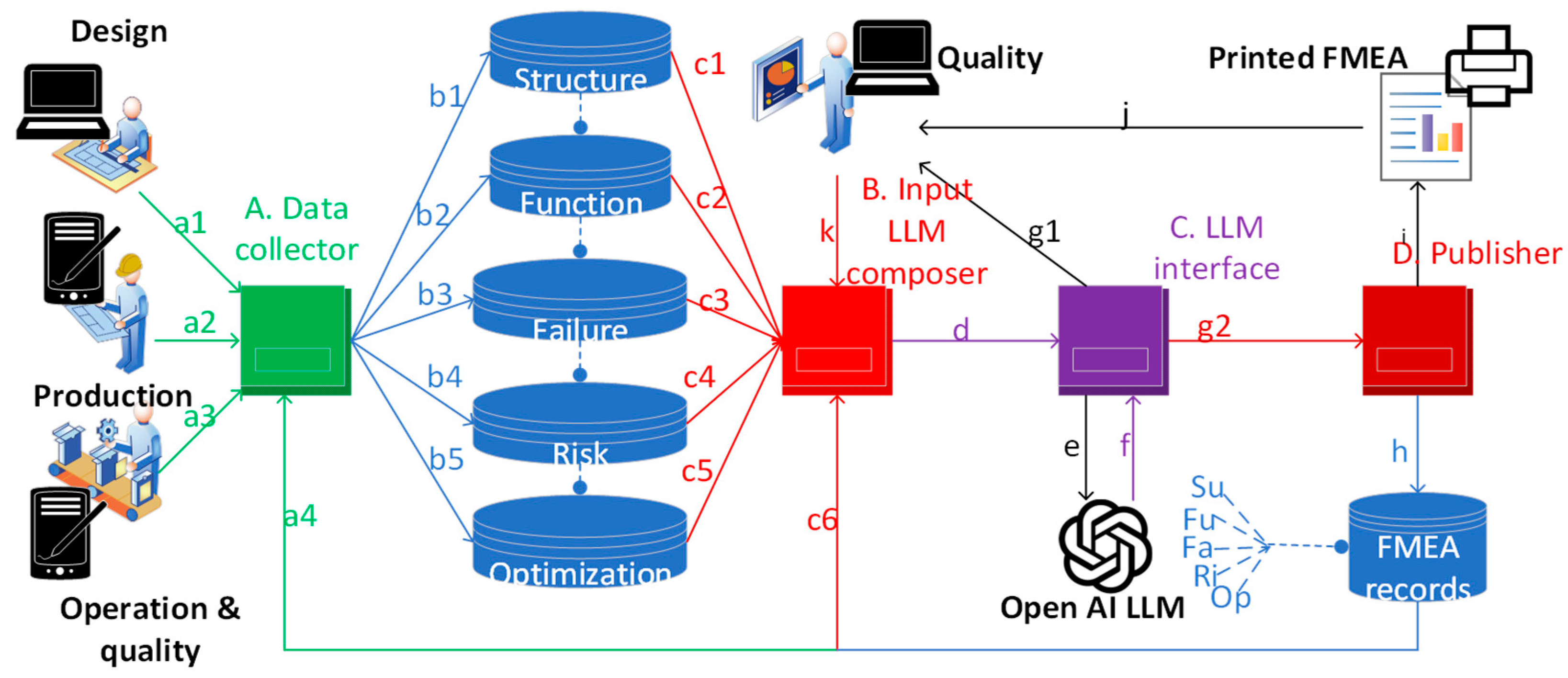
4.2.2. Presentation of the Solution
- Process Structure—includes the name of the process, its individual steps, and the work elements (execution components) involved;
- Process Function—describes each component of the process, the function of each step, and the function of the work element;
- Failure—documents the failure mode, cause of failure, and its effects, including the input or import of the severity coefficient (S);
- Risk—captures preventive and detection control types, along with the input or import of two FMEA parameters: occurrence rate (O) and detection rate (D);
- Optimization—refers to the proposed prevention and detection actions, the responsible parties, and the updated FMEA indicators.
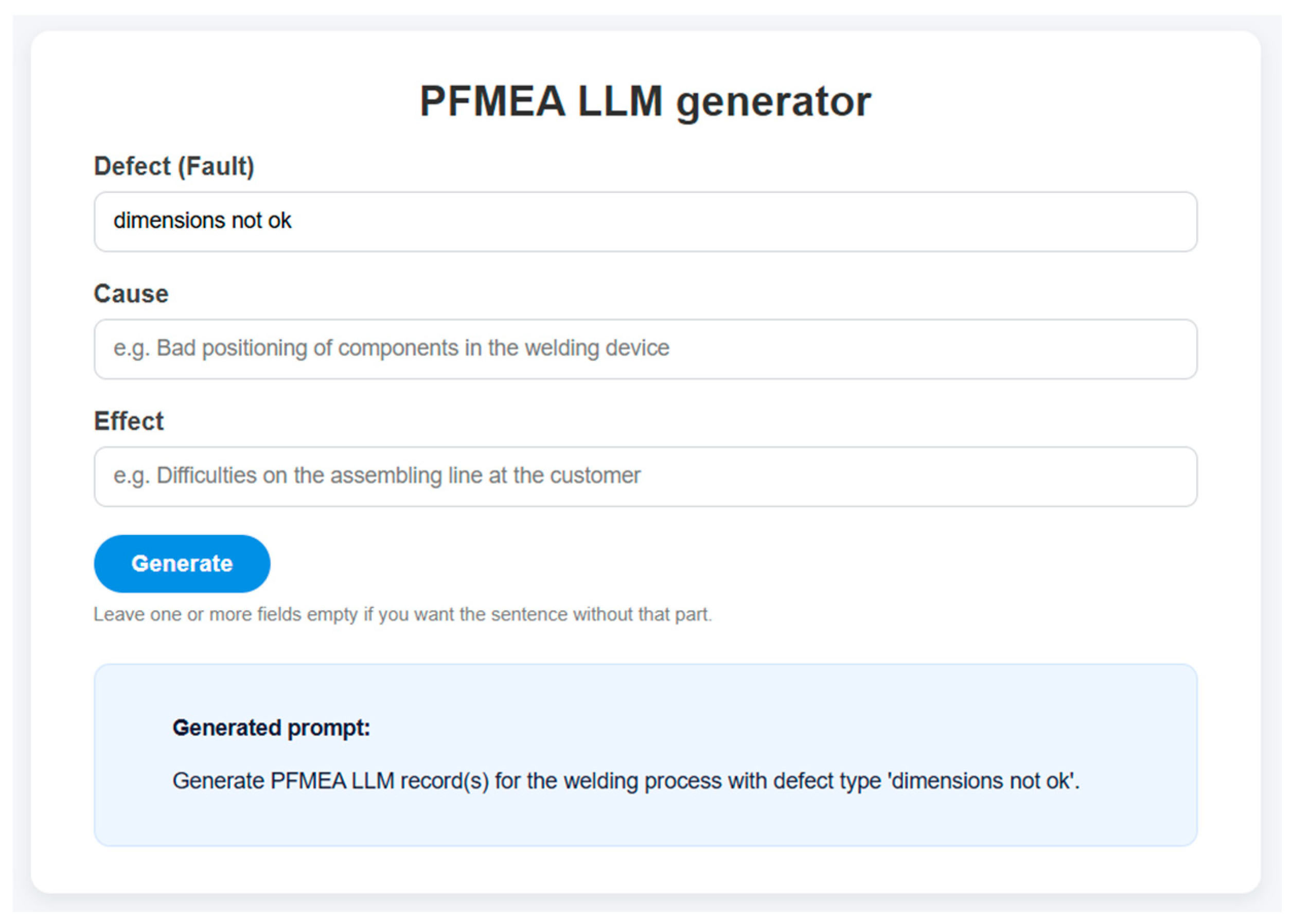
“As in process X, failure mode M with indicators I was associated with PFMEA AP.” For invalidated entries, the formulation changes to: “In process X, failure mode M with indicators I should not be associated with PFMEA AP.” This module also receives user feedback through a form confirming the validity of the currently generated FMEA report. If the report is marked as invalid, the input phrase is automatically reformulated to include: “The previously generated report is incorrect because M (reason).”
- -
- Closed-world restriction: the LLM is explicitly instructed to only return records present in the PFMEA JSON knowledge base.
- -
- Anchored retrieval: the entire base is included in the prompt, removing ambiguity about available failure modes, causes, and effects.
- -
- Output JSON schema enforcement: replies must follow a strict structure containing only existing PFMEA entries. Any deviation is treated as invalid and regenerated.
4.2.3. Dataflow
- Design and Development—marked as a1 in Figure 5. LLM FMEA solution block diagram.
- Production Engineering—a2.
- Operators and Quality Supervisors along the production line—a3.
4.2.4. Experimental Results
5. Discussion
6. Conclusions
Author Contributions
Funding
Data Availability Statement
Conflicts of Interest
References
- Kałkowska, J. Inteligentne wyzwania technologii i organizacji procesów wytwarzania maszyn. In Wybrane Aspekty Zarządzania Procesami, Projektami i Ryzykiem w Przedsiębiorstwach; OnePress: Athens, Greece, 2020; pp. 67–90. [Google Scholar]
- Huang, J.; Xu, D.H.; Liu, H.C.; Song, M.S. A new model for failure mode and effect analysis integrating linguistic Z-numbers and projection method. IEEE Trans. Fuzzy Syst. 2019, 29, 530–538. [Google Scholar] [CrossRef]
- Marczewska-Kuźma, R.; Misztal, A.; Ratajszczak, K. Classification of Quality Management Methods and Tools in a Functional Approach. Ann. Univ. Mariae Curie-Skłodowska Sect. H–Oeconomia 2024, 58, 171–186. [Google Scholar]
- Thomas, D. Revolutionizing failure modes and effects analysis with ChatGPT: Unleashing the power of AI language models. J. Fail. Anal. Prev. 2023, 23, 911–913. [Google Scholar] [CrossRef]
- El Hassani, I.; Masrour, T.; Kourouma, N.; Tavčar, J. AI-driven FMEA: Integration of large language models for faster and more accurate risk analysis. Des. Sci. 2025, 11, e10. [Google Scholar] [CrossRef]
- Zakrzewska, M.; Jarosz, S. Teoretyczne i Praktyczne Aspekty Gospodarki 4.0; ArchaeGraph Wydawnictwo Naukowe: Lodz, Poland, 2022; pp. 9–17. [Google Scholar]
- Barsalou, M. Investigation into a potential reduction of fmea efforts using action priority. Manag. Prod. Eng. Rev. 2022, 4, 59–71. [Google Scholar] [CrossRef]
- Wu, Z.; Liu, W.; Nie, W. Literature review and prospect of the development and application of FMEA in manufacturing industry. Int. J. Adv. Manuf. Technol. 2021, 112, 1409–1436. [Google Scholar] [CrossRef]
- Ramly, E.F.; Atan, H. FMEA AIAG-VDA-Commentary and Case Study. In Proceedings of the International Conference on Industrial Engineering and Operations Management, Dubai, United Arab Emirates, 10–12 March 2020; pp. 1–8. [Google Scholar]
- Belkaid, F.; Kahouadji, H.A. A New Hybrid FMECA Model for Prioritizing Failure Modes Using Multi-Criteria Decision Making. Manag. Prod. Eng. Rev. 2025, 15, 1–19. [Google Scholar]
- Prajapati, D.R. Implementation of failure mode and effect analysis: A literature review. Int. J. Manag. IT Eng. 2012, 2, 264–292. [Google Scholar]
- Luo, Z.; Zhang, X. AI in education risk assessment mechanism analysis. Appl. Econ. 2025, 57, 1949–1961. [Google Scholar] [CrossRef]
- Wirth, R.; Berthold, B.; Krämer, A.; Peter, G. Knowledge-based support of system analysis for the analysis of failure modes and effects. Eng. Appl. Artif. Intell. 1996, 9, 219–229. [Google Scholar] [CrossRef]
- Soltanali, H.; Ramezani, S. Smart failure mode and effects analysis (FMEA) for safety–Critical systems in the context of Industry 4.0. In Advances in Reliability, Failure and Risk Analysis; Garg, H., Ed.; Springer: Singapore, 2023; pp. 151–176. [Google Scholar]
- Na’amnh, S.; Salim, M.B.; Husti, I.; Daróczi, M. Using artificial neural network and fuzzy inference system based prediction to improve failure mode and effects analysis: A case study of the busbars production. Processes 2021, 9, 1444. [Google Scholar] [CrossRef]
- Peddi, S.; Lanka, K.; Gopal, P.R.C. Modified FMEA using machine learning for food supply chain. Mater. Today Proc. [CrossRef]
- ul Hassan, F.; Nguyen, T.; Le, T.; Le, C. Automated prioritization of construction project requirements using machine learning and fuzzy failure mode and effects analysis (FMEA). Autom. Constr. 2023, 154, 105013. [Google Scholar] [CrossRef]
- Yucesan, M.; Gul, M.; Celik, E. A holistic FMEA approach by fuzzy-based Bayesian network and best-worst method. Complex Intell. Syst. 2021, 7, 1547–1564. [Google Scholar] [CrossRef]
- Filz, M.A.; Langner, J.E.B.; Herrmann, C.; Thiede, S. Data-driven failure mode and effect analysis (FMEA) to enhance maintenance planning. Comput. Ind. 2021, 129, 103451. [Google Scholar] [CrossRef]
- Hodkiewicz, M.; Klüwer, J.W.; Woods, C.; Smoker, T.; Low, E. An ontology for reasoning over engineering textual data stored in FMEA spreadsheet tables. Comput. Ind. 2021, 131, 103496. [Google Scholar] [CrossRef]
- Xu, M. Enhancing FMEA with ChatGPT: Structured Outputs, Qualitative Evaluations, and AI-Human Hybrid FMEA. In Proceedings of the Annual Reliability and Maintainability Symposium (RAMS), Destin, FL, USA, 27–30 January 2025; pp. 1–6. [Google Scholar]
- Hu, Y.; Goktas, Y.; Yellamati, D.D.; De Tassigny, C. The use and misuse of pre-trained generative large language models in reliability engineering. In Proceedings of the 2024 Annual Reliability and Maintainability Symposium (RAMS), Albuquerque, NM, USA, 22–25 January 2024; pp. 1–7. [Google Scholar]
- Van Dijk, J.; Van Deursen, A.; Scheerder, A. Determinants of Internet skills, uses and outcomes. A systematic review of the second-and third-level digital divide. Telemat. Inform. 2017, 34, 1607–1624. [Google Scholar]
- Feagin, J.R.; Sjober, G.; Anthony, M.O. A Case for the Case Study; UNC Press Books: Chapel Hill, NC, USA, 2016. [Google Scholar]
- Ofoeda, J.; Boateng, R.; Effah, J. Application programming interface (API) research: A review of the past to inform the future. Int. J. Enterp. Inf. Syst. 2019, 15, 76–95. [Google Scholar] [CrossRef]
- Palomba, F.; Linares-Vásquez, M.; Bavota, G.; Oliveto, R.; Di Penta, M.; Poshyvanyk, D.; De Lucia, A. (Eds.) User reviews matter! tracking crowdsourced reviews to support evolution of successful apps. In Proceedings of the 2015 IEEE International Conference on 2015, London, UK, 3–5 September 2015; pp. 291–300. [Google Scholar]
- Dell’Acqua, F.; McFowland, E., III; Mollick, E.R.; Lifshitz-Assaf, H.; Kellogg, K.; Rajendran, S.; Lisa, K.; François, C.; Karim, R.L. Navigating the jagged technological frontier: Field experimental evidence of the effects of AI on knowledge worker productivity and quality. Harv. Bus. Sch. Technol. Oper. Mgt. Unit Work. Pap. 2023, 24, 58. [Google Scholar] [CrossRef]
- Eddy, D.; Krishnamurty, S.; Grosse, I.; White, M.; Blanchette, D. A defect prevention concept using artificial intelligence. In Proceedings of the ASME 2020 International Design Engineering Technical Conferences and Computers and Information in Engineering Conference, Virtual, 17–19 August 2020. [Google Scholar]
- Grabill, N.; Wang, S.; Olayinka, H.A.; De Alwis, T.P.; Khalil, Y.F.; Zou, J. AI-augmented failure modes, effects, and criticality analysis (AI-FMECA) for industrial applications. Reliab. Eng. Syst. Saf. 2024, 250, 110308. [Google Scholar] [CrossRef]
- Hoekstra, S.; Pereira Pessoa, M.; Sakwe, J.B. A FMEA based method for analyzing and prioritizing performance risk at the conceptual stage of performance PSS design. Proc. Des. Soc. 2021, 1, 81–90. [Google Scholar] [CrossRef]
- Bommasani, R. On the opportunities and risks of foundation models. arXiv 2021, arXiv:2108.07258. [Google Scholar] [CrossRef]
- Tyagi, A.K.; Mishra, A.K.; Kukreja, S. Role of Artificial Intelligence Enabled Internet of Things (IoT) in the Automobile Industry: Opportunities and Challenges for Society. In Proceedings of Fifth International Conference on Computing, Communications, and Cyber-Security; Springer: Singapore, 2024. [Google Scholar]
- Li, J.; Chignell, M. FMEA-AI: AI fairness impact assessment using failure mode and effects analysis. AI Ethics 2022, 2, 837–850. [Google Scholar] [CrossRef]
- Kanaujiya, A.K.; Tiwari, V. Addressing Public Health Challenges at Kumbh Mela 2025 in India: An FMEA-Based Resource Management Framework. Proc. Natl. Acad. Sci. India Sect. A Phys. Sci. 2025, 95, 229–239. [Google Scholar] [CrossRef]
- Meron, Y.; Tekmen, A.Y. Artificial intelligence in design education: Evaluating ChatGPT as a virtual colleague for post-graduate course development. Des. Sci. 2023, 9, e30. [Google Scholar] [CrossRef]
- Dai, J.X.; Boujut, J.F.; Pourroy, F.; Marin, P. Issues and challenges of knowledge management in online open source hardware communities. Des. Sci. 2020, 6, e24. [Google Scholar] [CrossRef]
- AIAG. VDA, AIAG & FMEA Handbook—Harmonized Edition: Failure Mode and Effects Analysis for Design and Process; Automotive Industry Action Group: Southfield, MI, USA, 2019. [Google Scholar]
- Bernardelli, A.E.; Paolo, G. AI Risk Management: A Bibliometric Analysis. Risks 2025, 13, 131. [Google Scholar] [CrossRef]
- Vasudevan, M.; Kumar, B.S.; Deevi, D.P.; More, A.B.; Huddar, V.; Turdialiev, M.A. AI-Driven Decision Support Systems for Project Management in Automobile Engineering. In Proceedings of the 2025 First International Conference on Advances in Computer Science, Electrical, Electronics, and Communication Technologies (CE2CT), Bhimtal, Bhimtal, 21–22 February 2025. [Google Scholar]
- Kodumuru, R.; Sarkar, S.; Parepally, V.; Chandarana, J. Artificial Intelligence and Internet of Things Integration in Pharmaceutical Manufacturing: A Smart Synergy. Pharmaceutics 2025, 17, 290. [Google Scholar] [CrossRef] [PubMed]
- Saini, S.; Yadav, A.; Shazli, A.; Itoo, M.A.; Ajith, A.; Vats, D. Significance of AI in automobiles. In Smart Electric and Hybrid Vehicles: Fundamentals, Strategies and Applications; CRC Press: Boca Raton, FL, USA, 2024. [Google Scholar]
- Shaterabadi, M.; Jirdehi, M.A.; Mehrjerdi, H.; Karimi, H. Artificial intelligence for autonomous vehicles: Comprehensive outlook. In Handbook of Power Electronics in Autonomous and Electric Vehicles; Academic Press: Cambridge, MA, USA, 2024. [Google Scholar]
- Ammal, S.M.; Kathiresh, M.; Neelaveni, R. Artificial Intelligence and Sensor Technology in the Automotive Industry: An Overview. In Automotive Embedded Systems, Key Technologies, Innovations, and Applications; Springer: Cham, Switzerland, 2021. [Google Scholar]
- Yazdi, M.; Zarei, E.; Adumene, S.; Beheshti, A. Navigating the power of artificial intelligence in risk management: A comparative analysis. Safety 2024, 10, 42. [Google Scholar] [CrossRef]
- Mihail, T.A.; Emanuel, B.; Daniel, B. Artificial Intelligence Management in Mechatronic Systems in the Automotive Industry: Privacy and Sustainability Challenges. In Lecture Notes in Mechanical Engineering; Springer: Cham, Switzerland, 2025. [Google Scholar]
- Younus, H.; Kabir, S.; Campean, F.; Bonnaud, P.; Delaux, D. AI-and Ontology-Based Enhancements to FMEA for Advanced Systems Engineering: Current Developments and Future Directions. arXiv 2025, arXiv:2511.17743. [Google Scholar]
- Spreafico, C.; Sutrisno, A. Artificial intelligence assisted social failure mode and effect analysis (FMEA) for sustainable product design. Sustainability 2023, 15, 11. [Google Scholar] [CrossRef]
- Lynch, K.; Lorenzi, F.; Sheehan, J.D.; Kabakci-Zorlu, D.; Eck, B. Structured Document Generation for Industrial Equipment. In Proceedings of the AAAI Conference on Artificial Intelligence; AAAI Press: Washington, DC, USA, 2025; Volume 39, pp. 28850–28856. [Google Scholar] [CrossRef]



| AI Tool/Technique | Best Practices | Strengths | Limitations/Risk |
|---|---|---|---|
| Machine Learning (ML) | Train on labeled historical failure data | High accuracy, pattern recognition | Needs labeled data, possible bias |
| Predictive Analytics and Statistical AI | Use historical data with well-defined labels; combine with visual dashboards | Provides quantified risk estimations; well-established methods | May oversimplify complex interactions; limited to historical patterns |
| Natural Language Processing (NLP) | Use domain-specific ontologies and terminology; fine-tune models on FMEA-related data | Automates analysis of textual data; improves traceability and consistency | Sensitive to language nuances; domain adaptation required |
| Large Language Models (LLMs) | Apply prompt engineering; use fine-tuned models for engineering tasks | Strong at extracting meaning, summarization, and classification, enables predictive failure analysis | Prone to hallucinations; requires validation; limited explainability |
| Expert Systems | Define clear, validated rule sets; update regularly with domain expert input | Transparent, traceable logic; good for structured decision support | Rigid structure; not scalable for complex, data-rich scenarios |
| Clustering Algorithms | Normalize data; choose appropriate distance metrics; validate clusters manually | Reveals unknown groupings; useful for exploratory analysis | Can produce arbitrary or meaningless groupings; interpretability varies |
| Anomaly Detection | Combining statistical and artificial intelligence-based methods | Useful for detecting rare but critical failure modes | Prone to false positives; needs historical normal/abnormal data |
| Deep Learning | Using large data sets; apply regularization and dropout to avoid overfitting | High accuracy with complex nonlinear data; handles images and sequences | Requires large data volumes; black-box nature; high computational cost |
| Integrated AI/ML Platforms | Use built-in validation clarification tools; configure for FMEA-specific KPIs | Scalable, user-friendly interfaces; accelerates adoption | May be expensive; requires training; vendor lock-in possible |
| Function of the Process Work Element | Faillure Effects (FE) | S | Failure Mode (FM) of Process Step | Failure Cause (FC) of Work Element | Current Prevention Control of FC | O | Current Detection Control of FC & FM | D | AP |
|---|---|---|---|---|---|---|---|---|---|
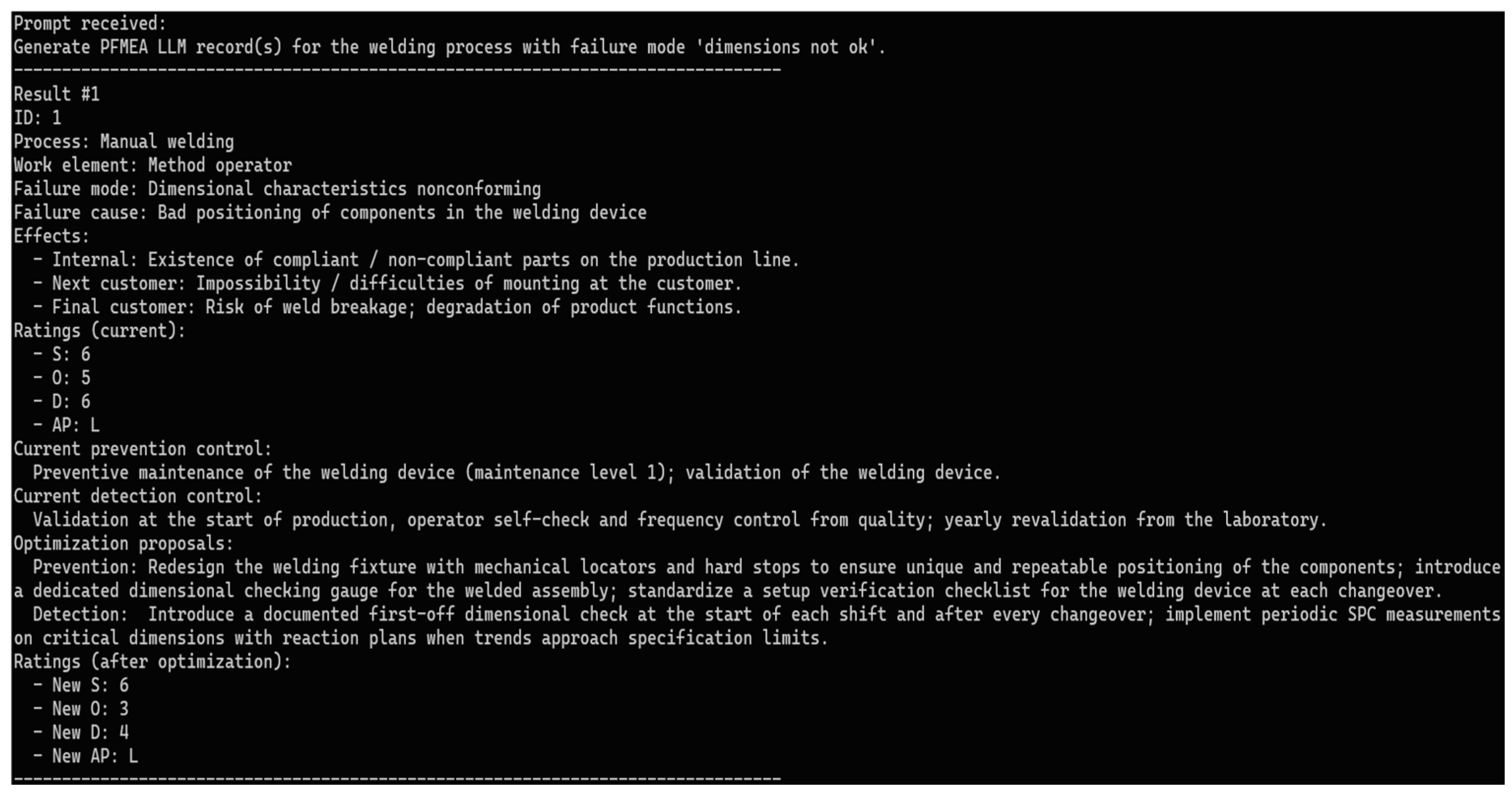
| Parts with conformal welds, without risk of welding breakage. | Impossibility/difficulties of mounting on the customer. | 6 | Dimensional characteristics nonconforming | Bad positioning of components in the welding device | Preventive Maintenance of the welding device Maintenance level 1 Validation of the welding device | 5 | Validation at the Start of Production, self-check and frequency control from quality Yearly revalidation from the laboratory | 6 | L |
| 6 | Dimensional characteristics nonconforming | Using another welding positioning device | Compliance with the requirements regarding use of devices and welding positioning device mentioned on instructions Reference status 5S workstation | 6 | Operator self-check Quality visual inspector control Working station audit | 6 | M | ||
| 6 | Geometric characteristics nonconforming | Bad positioning of components in the welding device | Preventive Maintenance of the welding device Maintenance level 1 Validation of the welding device | 5 | Validation at the Start of Production, self-check and frequency control from quality Yearly revalidation from the laboratory | 6 | L | ||
| 6 | Missing component | Human error | Work instruction. 2D drawing of welded assembly | 6 | 100% verification of component presence using a checklist | 6 | M | ||
| Fragility of the weld (homogeneity, positioning, symmetry), risk of weld breakage. | 6 | Geometric characteristics nonconforming | Non-compliance with the welding process (welding sequence, the positioning of the components) | Read the work instruction before starting series | 5 | Control starts series and Frequency control from quality | 6 | L | |
| Difficulties on the assembling line at the customer | 6 | Presence of the spatters on the machined areas | Spatters appeared after welding on the assembly lines | Updating of the reworking instruction sheet concerning the machining area (no spatters). Training of operators and quality inspectors following the reworking instruction sheets. | 5 | Visual check realized by operator and quality inspector (checklist control). | 6 | L | |
| Resistance problem at the customer | 7 | Porosity | Gas flow too low or too high | Maintenance instructions sheet (welding defects), Yearly evaluation of welders | 6 | Visual control unitary, Macrography test gas regulators | 6 | H | |
| 7 | Cracks | Thermal shock/cooling too fast | Read the work instruction before starting series, Yearly evaluation of welders | 6 | Visual unitary control, Penetration test | 6 | H | ||
| Nonconforming aspect or assembling with difficulties | 6 | Collage or extra thickness | Welding wire of “low quality” (comparative with the specifications) | Visual inspection of the appearance of the roll by the operator, Yearly evaluation of the welders | 5 | Visual control unitary, Macrography test | 6 | L |
| Group | Structure | Function | Failure | Risk | Optimization |
|---|---|---|---|---|---|
| Field | Process_name | Function_item | Failure_mode | PFMEA_AP | Prevention_action |
| Step | Function_step | Failure_cause | O | Detection_action | |
| Work_element | Function_work | Failure_effect | Detection_control | Responsible_name | |
| S | D | Status | |||
| Preventive_control | Target_date | ||||
| Completion_date | |||||
| Action | |||||
| New_S | |||||
| New_O | |||||
| New_D | |||||
| New_PFMEA_AP | |||||
| Remarks |
| Failure Effects (FE) | S | Failure Mode (FM) of Process Step | Failure Cause (FC) of Work Element | O | D | AP | Prevention Action | Detection Action | S | O | D | AP |
|---|---|---|---|---|---|---|---|---|---|---|---|---|
| Impossibility/difficulties of mounting on the customer. | 6 | Dimensional characteristics nonconforming | Using another welding positioning device | 6 | 6 | M | Development of the Poka Yoke device | Painting the welding masks in another color for an easier differentiation | 6 | 3 | 6 | L |
| 6 | Missing component | 6 | 6 | M | Implementation of AR-based guidance using the Supar app to support operators in real time during assembly by visually highlighting component locations and sequences on 2D/3D models, along with updated digital work instructions and operator training for AR-assisted assembly. | Real-time AR-based verification using the Supar app (CDMVision Software Services JSC, Istanbul, Turkey) ensures component presence and correct placement through visual overlays, automated model-to-assembly comparison, and mandatory digital confirmation. It enables 100% component verification before welding and enhances final inspection with AR-assisted validation of weld quality and positioning. | 6 | 2 | 2 | L | ||
| Resistance problem at the customer | 7 | Porosity | Gas flow too low or too high | 6 | 6 | H | Welding Dojo for new operators: Regularly calibrate and verify gas regulators and flowmeters; define and validate optimal gas flow parameters for each reference. | Implement gas flow monitoring; 100% visual weld inspection; random macro tests for internal porosity; leak/pressure tests for validation; periodic gas flow audits. | 7 | 3 | 4 | L |
| 7 | Cracks | Thermal shock/cooling too fast | 6 | 6 | H | An automated welding control system stores and locks validated parameters per part number, restricts changes to authorized personnel, and ensures full traceability via QR/lot tracking of operator, date, time, and settings. | 100% visual weld inspection with checklist; batch penetration tests; sampled macro tests for internal cracks; statistical monitoring of welding temperature. | 7 | 3 | 4 | L |
| Solution | Digitalization | Automatization | Deliverables | Time Response (Full Cycle to Generate FMEA) |
|---|---|---|---|---|
| Classic FMEA— | A DB with FMEA files | Partial—manual collection of the key data from customers or experts (email, papers) manual search: an expert search a record using match or like keywords. Team meeting for validation (quality, design, operation, production). | FMEA report—electronic and printed | 2–5 days |
| Our PFMEA with LLM | Data collection with FMEA history | Full—Web interface for collection of key data from customers or experts automatically search and return of PFMEA records using LLM. Online validation. | FMEA report—electronic and printed | <1 h |
Disclaimer/Publisher’s Note: The statements, opinions and data contained in all publications are solely those of the individual author(s) and contributor(s) and not of MDPI and/or the editor(s). MDPI and/or the editor(s) disclaim responsibility for any injury to people or property resulting from any ideas, methods, instructions or products referred to in the content. |
© 2025 by the authors. Licensee MDPI, Basel, Switzerland. This article is an open access article distributed under the terms and conditions of the Creative Commons Attribution (CC BY) license (https://creativecommons.org/licenses/by/4.0/).
Share and Cite
Ratajszczak, K.; Oancea, A.-V.; Misztal, A.; Ionescu, N.; Ionescu, L.M.; Wencek, A. Intelligent Operational Risk Management Using the Enhanced FMEA Method and Artificial Intelligence—A Case Study. Appl. Sci. 2025, 15, 13199. https://doi.org/10.3390/app152413199
Ratajszczak K, Oancea A-V, Misztal A, Ionescu N, Ionescu LM, Wencek A. Intelligent Operational Risk Management Using the Enhanced FMEA Method and Artificial Intelligence—A Case Study. Applied Sciences. 2025; 15(24):13199. https://doi.org/10.3390/app152413199
Chicago/Turabian StyleRatajszczak, Kinga, Alexandru-Vasile Oancea, Agnieszka Misztal, Nadia Ionescu, Laurențiu Mihai Ionescu, and Anna Wencek. 2025. "Intelligent Operational Risk Management Using the Enhanced FMEA Method and Artificial Intelligence—A Case Study" Applied Sciences 15, no. 24: 13199. https://doi.org/10.3390/app152413199
APA StyleRatajszczak, K., Oancea, A.-V., Misztal, A., Ionescu, N., Ionescu, L. M., & Wencek, A. (2025). Intelligent Operational Risk Management Using the Enhanced FMEA Method and Artificial Intelligence—A Case Study. Applied Sciences, 15(24), 13199. https://doi.org/10.3390/app152413199