You are currently viewing a new version of our website. To view the old version click .
Applied Sciences
  • Article
  • Open Access

16 December 2025

Effect of Ozone and Drying Treatments on Phenolic Compounds and Antioxidant Activity in Bee Pollen


,
,
,
,
and
1
Department of Zoology, University of Cordoba, Rabanales Campus, Charles Darwin Building, E-14071 Cordoba, Spain
2
Department of Agricultural Chemistry, Soil Science and Microbiology, Agrifood Campus of International Excellence CeiA3, University of Cordoba, Rabanales Campus, Marie Curie Building, E-14071 Cordoba, Spain
3
Chemical Institute for Energy and the Environment (IQUEMA), University of Cordoba, E-14071 Cordoba, Spain
4
Department of Botany, Ecology and Plant Physiology, Agrifood Campus of International Excellence CeiA3, University of Cordoba, Rabanales Campus, Celestino Mutis Building, E-14071 Cordoba, Spain
This article belongs to the Special Issue New Advances in Antioxidant Properties of Bee Products

Abstract

Bee pollen is a food with high nutritional value and important functional properties. It is usually consumed as dried pollen, due to the need for a preservation process that controls the high microbiological load of the fresh product. Unfortunately, dry pollen is unattractive to consumers. In this sense, the use of ozone may be an alternative for preserving fresh pollen, since it reduces the microbiological load, allowing for other preservation methods, including refrigeration, and it preserves the original texture and flavors of the product, making it more palatable. However, it is important to know how ozone can affect some of the bioactive properties of pollen, such as phenolic compounds (PC), or the antioxidant properties of this food. The aim of this research was to assess the effect of ozone treatment on the above-mentioned properties and to compare it with the conventional drying treatment. For this purpose, 19 samples of fresh bee pollen were collected. From each sample, five subsamples were obtained, two of which were treated with ozone for 1 h and 2 h (O1 and O2, respectively), two were dried for 4 h and 8 h (D4 and D8, respectively), and the fifth subsample remained as the untreated control (C). The results showed that ozone treatments did not have a negative effect on phenolic content (PC) or on antioxidant activity (AA). This would be positive for the use of this decontamination method. In contrast, traditional drying treatments significantly reduced total PC while increasing AA compared to C, O1, and O2. A low correlation was found between these variables in the studied samples.

1. Introduction

The current trend in society is to consume healthy, natural, and, if possible, functional foods. Several bee products, such as honey, royal jelly, and bee pollen, have these characteristics. Of the above, pollen is the least well-known, but its consumption is growing, and there are reports predicting a progressive increase in its use of 6.1% between 2024 and 2030 [1].
Bees collect pollen from flowers and transport it to their hives, where they use it as the main source of protein for the colony. They store the surplus in the cells of the honeycomb to use in times of scarcity [2]. Forager bees are impregnated with pollen during their visits to flowers, and through an elaborate behaviour of brushing, agglomerating, and adding their own glandular secretions and nectar, they transform it into pellets, which are transported to the hives in baskets located in the third pair of legs, known as corbiculae. This is why these pollen pellets are also called corbicular pollen [3]. What we know as commercial bee pollen, used for human consumption, consists of these pellets. Beekeepers remove the corbicular pollen from the bees just as they are entering the hive by placing a pollen trap at the entrance of the hive. Pollen traps force the bees to pass tightly through 5 mm holes, causing the corbicular pollen to detach and fall into a lower drawer, from where the beekeepers collect it [4,5].
Bee pollen is considered a superfood in the human diet. Bee pollen has been shown to be useful in combating some diseases, such as prostate diseases, sugar regulation, and blood pressure, among others [6,7,8]. These benefits for human health are due to the high nutritional value and to its significant functional properties. It is rich in carbohydrates, proteins, and lipids [9,10], and it contains multiple bioactive metabolites [11], such as phenolic compounds and carotenoids [12]. Although diverse natural metabolites participate in free radical scavenging activity, it is considered that phenolic acids and flavonoids are primarily responsible for most of the antioxidant properties [13,14]. However, the antioxidant activity and polyphenolic content vary notably among different pollens due to the particularities of the source plant species and the different geographical areas [15]. Regular consumption of bee pollen and, therefore, the intake of these metabolites are known to reduce oxidative stress and inhibit macromolecular oxidation, which is related to their high antioxidant activity. Moreover, they contribute positively to reducing the risk of degenerative diseases [16,17]. In order to maintain all the properties mentioned above, it is necessary to study the preservation of bee pollen [18].
In any case, the chemical composition of bee pollen mostly depends on its botanical and geographical origin, method of pollen extraction, and pollen storage [19,20,21]. After collection, the pollen composition is changed by the action of bee enzymes. In addition, its chemical composition is influenced by the treatment processes of the fresh bee pollen, especially if these treatments involve heat [22,23].
Fresh bee pollen has a granular structure; it is very palatable and presents a very soft and fluffy texture. It has a pleasant flavour, which depends on its floral origin. Unfortunately, fresh bee pollen can have a high microbiological load, which could represent a serious risk to consumer health [24,25,26,27]. In this sense, preservation methods must be applied for commercialisation. Bee pollen is usually sold dried, with a moisture content that should not exceed 5–8%. This is achieved by drying it with heat and air flow. This preservation method prevents the growth of microorganisms that can spoil it and even pose food safety risks to consumers. At present, to preserve commercial bee pollen, the two principals techniques used are drying and freezing. Drying stops the growth of bacteria and fungi commonly found in fresh pollen [28]. Moreover, the texture of dry bee pollen and a taste reminiscent of straw or dried grass often causes rejection by consumers. For this reason, it is usually consumed dissolved in juices or dairy products. In addition, several components of bee pollen could be affected by the drying process, causing the loss of some of its nutritional qualities [29,30,31]. On the other hand, fresh frozen pollen remains a food with a very pleasant taste and texture. This method preserves the organoleptic characteristics and nutritional properties of the fresh bee pollen better than the previous one [3,5,26,32]. Furthermore, it drastically delays the growth of microorganisms; however, the initial microbiological load is not eliminated, which can cause a serious risk to human health [24,25]. This is especially dangerous if the cold chain is not appropriately maintained during the transport of the product and until it finally reaches the consumer [3,5,24,25,29,30,31,32]. In addition, gamma irradiation treatment is another preservation method, but less frequently used. Nevertheless, this method is very effective, but it often generates rejection among consumers, especially those who prefer natural foods [33,34].
Due to the above-mentioned methods, new preservation methods are being studied to reduce the initial microbiological load of the bee pollen, in order to make it a safer product that can be preserved both as frozen and refrigerated food. Among these new methods of interest is ozonization. This technique is commonly used in the decontamination of water and food and could also be an alternative method used for bee pollen. Cabello et al. [26] proposed the use of ozone to reduce the microbiological load of bee pollen, with very interesting results, achieving reductions of 3, 1.5, and 1.7 log cycles for Enterobacteriaceae, mesophilic aerobes, and molds and yeasts. Storage in the refrigerator (4–6 °C) for several weeks would be possible, making it an interesting alternative treatment. However, the method raises questions about the possible effects of ozone treatment on the components of bee pollen, especially those that contribute to the functional properties of this food, such as phenolic compounds, or the influence on the antioxidant activity of this food. In this sense, recent studies [34] have found that ozone treatment reduces the microbiological load of bee pollen without affecting its AA.
The main objective of this study is to provide new information on the effect of ozone treatment on bee pollen. Particularly, the objective is to determine how ozone affects the polyphenol content and antioxidant activity of this natural product, and to compare it with the traditional drying method.

2. Materials and Methods

2.1. Bee Pollen Samples

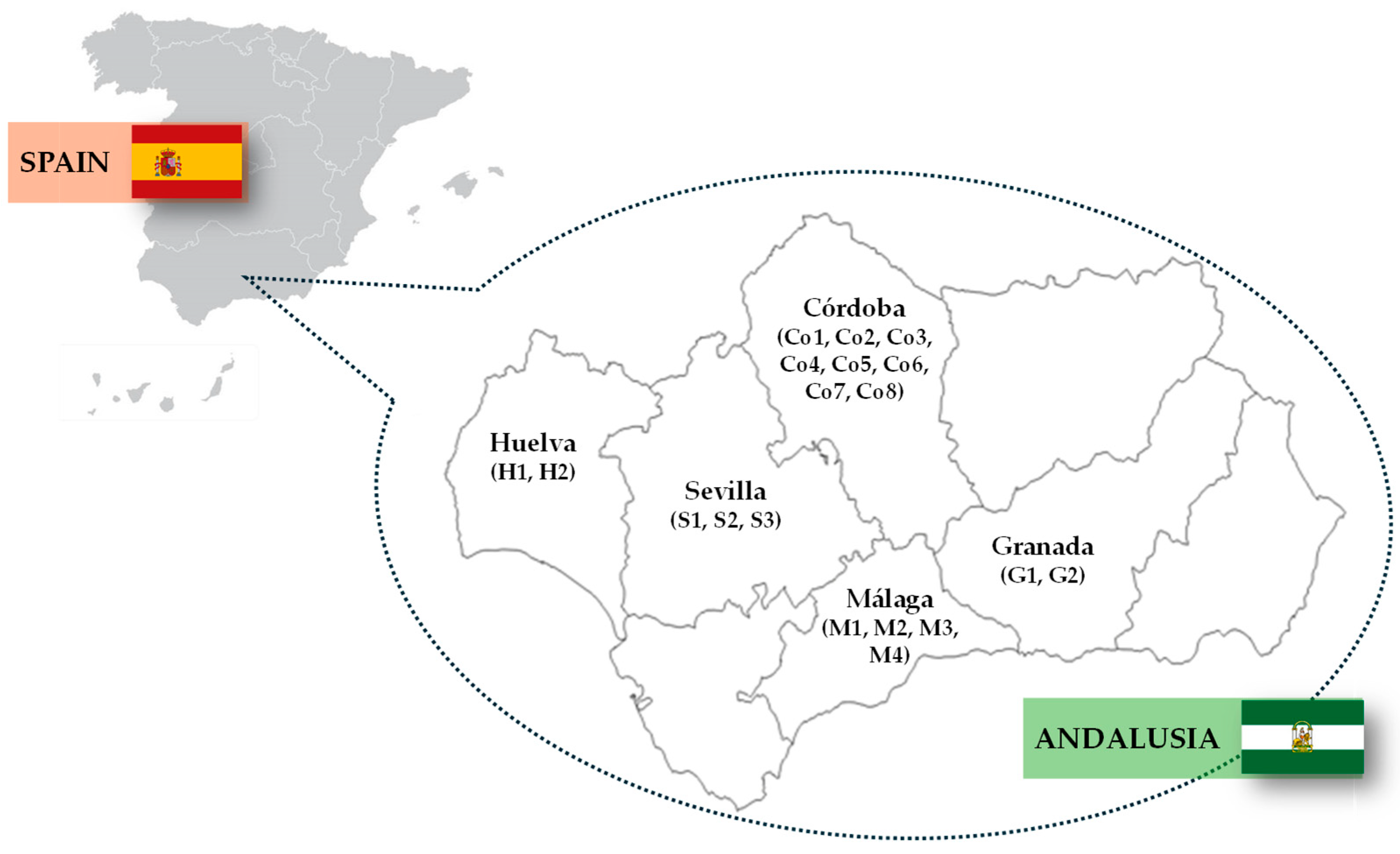
Nineteen samples of fresh multifloral bee pollen were acquired directly from professional beekeepers. All farms were located in the region of Andalusia (Spain). The location of these farms is shown in Figure 1. The samples were codified and transported to our laboratory while maintaining their frozen state. The samples were kept at −20 °C until use.
Figure 1. Origin of samples. Nineteen fresh pollen samples from five provinces in Andalusia (southern Spain) were used in the study. The location of the apiaries and the coding of the samples are shown.
Five 50 g subsamples were taken from each sample: (i) the first were placed in plastic bags and subjected to ozone (200 mg/h) for 1 h using a Multifunctional Ozono Care/Life® Vida10 portable ozone generator (P.R.C.) (O1), replicating the maximum treatment reported by Cabello et al. [26]); (ii) the second was ozonated for 2 h (O2) to assess the impact of doubling the exposure time; (iii) the third was dried at 40 °C for 4 h (D4) using an airflow pollen dryer (MainoRoberto & C. S. n. c. Mod. INGEGNOSOX5, Oltrona di San Mamette, Italy); and (iv) the fourth was dried at the same temperature for 8 h (D8). The 40 °C temperature was selected as suitable for reducing pollen moisture content to 6%, the adequate level for preservation [25]. The remaining subsample was kept untreated as the control (C). All subsamples were stored at −20 °C until analysis.

2.2. Bee Pollen Sample Preparation

Before analyzing the ground bee pollen samples, an extraction process was carried out according to the method used by Campos et al. [35], with some modifications. Briefly, 10 mg of bee pollen from each sample was placed in a glass vial, and 1 mL of ethanol-water solution (50% v/v) was added. After, it was sonicated for 60 min, and the resultant extract was centrifuged at 5000 rpm for 10 min. This process was carried out in duplicate.

2.3. Total Phenolic Compounds

The total phenolic compounds were quantified using the established Folin–Ciocalteu method [36]. The procedure involved adding 50 µL of the bee pollen extract to 1.25 mL of the Folin–Ciocalteu reagent, which had been previously diluted 1:5 with distilled water. After vigorous shaking and a one-minute rest, 1 mL of a 10% w/v sodium carbonate solution was introduced, and the mixture was incubated in the dark for 30 min. The absorbance of the resultant blue complex, formed by the oxidation of phenolic compounds (PC), was then measured at 760 nm using a Beckman DU 640 spectrophotometer (Beckman, Brea, CA, USA). Quantification was achieved via a gallic acid calibration curve (0.01 to 1 g/L). The results were expressed in mg gallic acid/100 g dry bee pollen.

2.4. Antioxidant Activity

The antioxidant activity (AA) of the bee pollen extract was determined using the DPPH assay, based on the methodology established by Katalinic et al. [37], with some modifications. To perform the test, 200 µL of the sample (diluted 1:10) was added to 3 mL of a 45 mg/L DPPH solution. For the control, 200 µL of water was substituted for the sample. The absorbance of the control and the sample was measured at 517 nm in a Beckman DU 640 spectrophotometer (Beckman, USA). A calibration curve was obtained with the Trolox standard in the range of 10–200 mg Trolox/L, and the percentage inhibition was calculated according to the following formula:
Percentage   inhibition   =   Abs control   -   Abs sample Abs control   ×   100
The results were expressed in mg Trolox/100 g dry bee pollen.

2.5. Determination of Botanical Origin

To determine the botanical origin of the bee pollen samples, the methodology described by Rojo et al. [38] and adapted by the RNM130-Systematic and Applied Botany research group of the Department of Botany, Ecology and Plant Physiology, University of Córdoba (Spain) was used. Each sample of the original freezer bee pollen was analyzed in three replicates. Original samples were thoroughly homogenized, and subsequently, 2 g of each sample were placed into separate vials. A colorimetric separation was then performed to obtain distinct subsamples. Samples were diluted using a vortex mixer in distilled water, applying two different volumes according to the initial mass of the solid material: (i) samples with a mass ≥ 0.1 g were diluted in 10 mL of distilled water, (ii) samples with a mass < 0.1 g were diluted in 1.5 mL of distilled water. This approach ensured comparable concentration ranges across all samples while accounting for the limited material availability in low-mass cases. From each dilution, 100 µL of sediment was taken to prepare microscope slides. The sediment was placed on a cover glass positioned on a heating plate at approximately 50 °C. Once the liquid had evaporated, a drop of fuchsin-stained glycerogelatin was added to stain the sample and facilitate the identification of pollen grains under an optical microscope (Nikon Eclipse, E400, 40× objective, East Paul Dirac Drive. The Florida State University. Tallahassee, FL, USA). The preparation was covered with a coverslip. After 24 h, excess fuchsin-stained glycerogelatin was removed, and the slide was sealed. The botanical origin of each subsample was determined by counting 100 pollen grains per subsample. The pollen spectra of the samples were calculated considering both the weight of each subsample and its botanical origin, and the results were expressed as percentages.
Pollen types were identified and classified according to their morphological characteristics, following standard palynological criteria. For pollen type identification and nomenclature, the reference melissopalynotheque developed by the RNM130 research group was used [39].

2.6. Data Analysis

Data were statistically processed using SPSS (Statistical Package for the Social Sciences) Statistics software for Windows, IBM Corp., 2016. Version 24.0. IBM Corp., Armonk, NY, USA. All the variables available were tested to check whether the data violated the assumptions for regular parametric tests to report valid results. Parametric statistics were applied when possible. When the data results were non-normally distributed or there was no variance homogeneity (heteroscedasticity), non-parametric statistics were used. The tests are specified in the results.

3. Results

The average of the total content of PC, expressed as mg of gallic acid in 100 g of dry bee pollen, and AA, expressed as mg Trolox in 100 g dry bee pollen for all samples, is shown in Table 1 (more information about the descriptive statistics is shown in the Supplementary Material, Table S1). Since the data did not follow a normal distribution for either variable (Shapiro–Wilk test, p ≤ 0.05), non-parametric statistics were applied. The fresh bee pollen samples and those treated with ozone for 1 h and 2 h (O1 and O2) showed a significantly higher total amount of PC than the samples dried for 4 h and 8 h (D4 and D8). In contrast, bee pollen samples D4 and D8 showed significantly higher AA than fresh pollen samples and those treated with ozone O1 and O2 (Kruskal–Wallis test, p ≤ 0.05; Mann–Whitney U test, p ≤ 0.05). When all the samples and treatments were considered together, a significant but low correlation was found between the total amount of PC and the AA recorded in the samples (Kendall’s tau_b, p = 0.000, r = 0.182).
Table 1. Average of total phenolic compounds (mg gallic acid/100 g dry bee pollen) and antioxidant activity (mg Trolox/100 g dry bee pollen) obtained from bee pollen subjected to different preservation treatments.
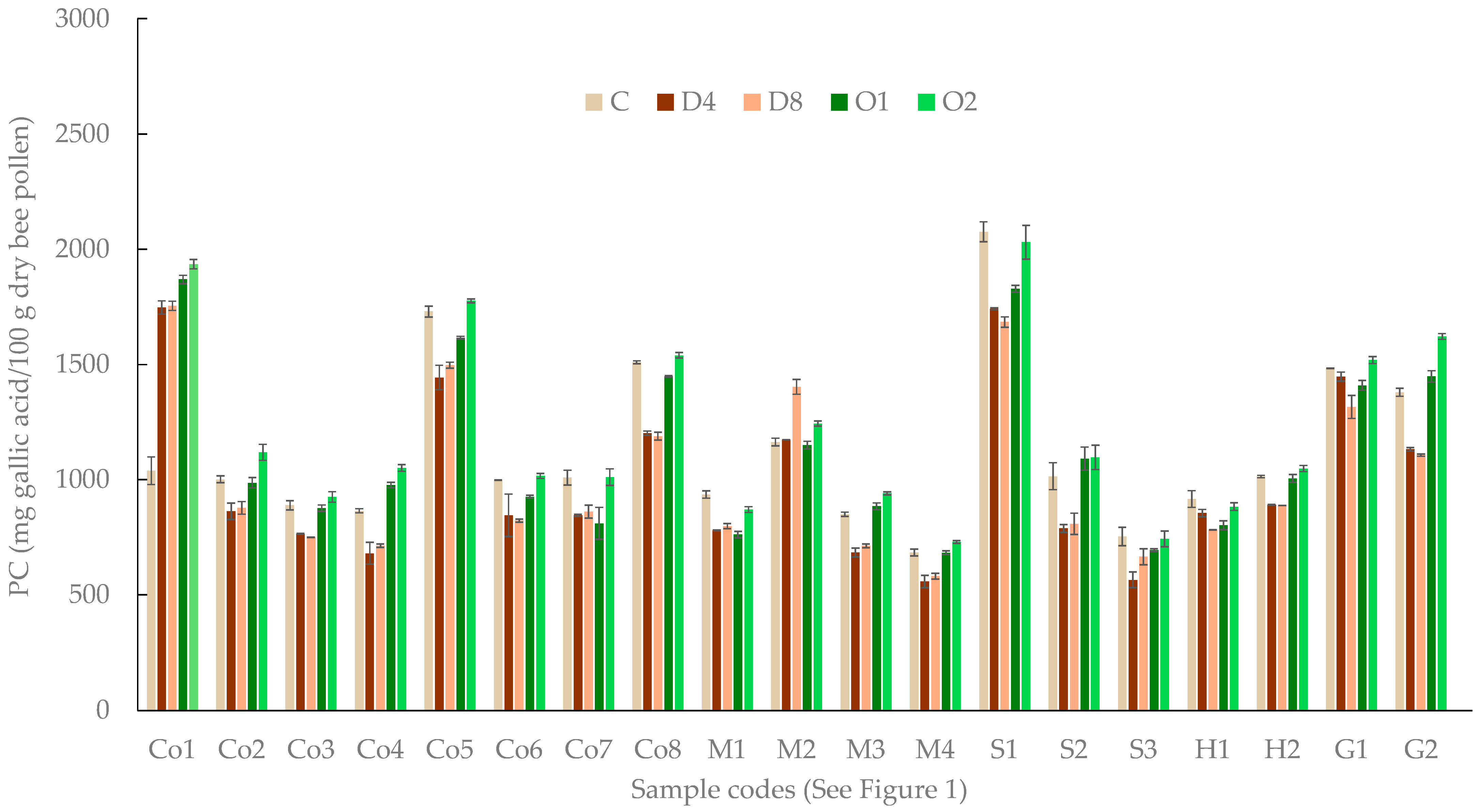
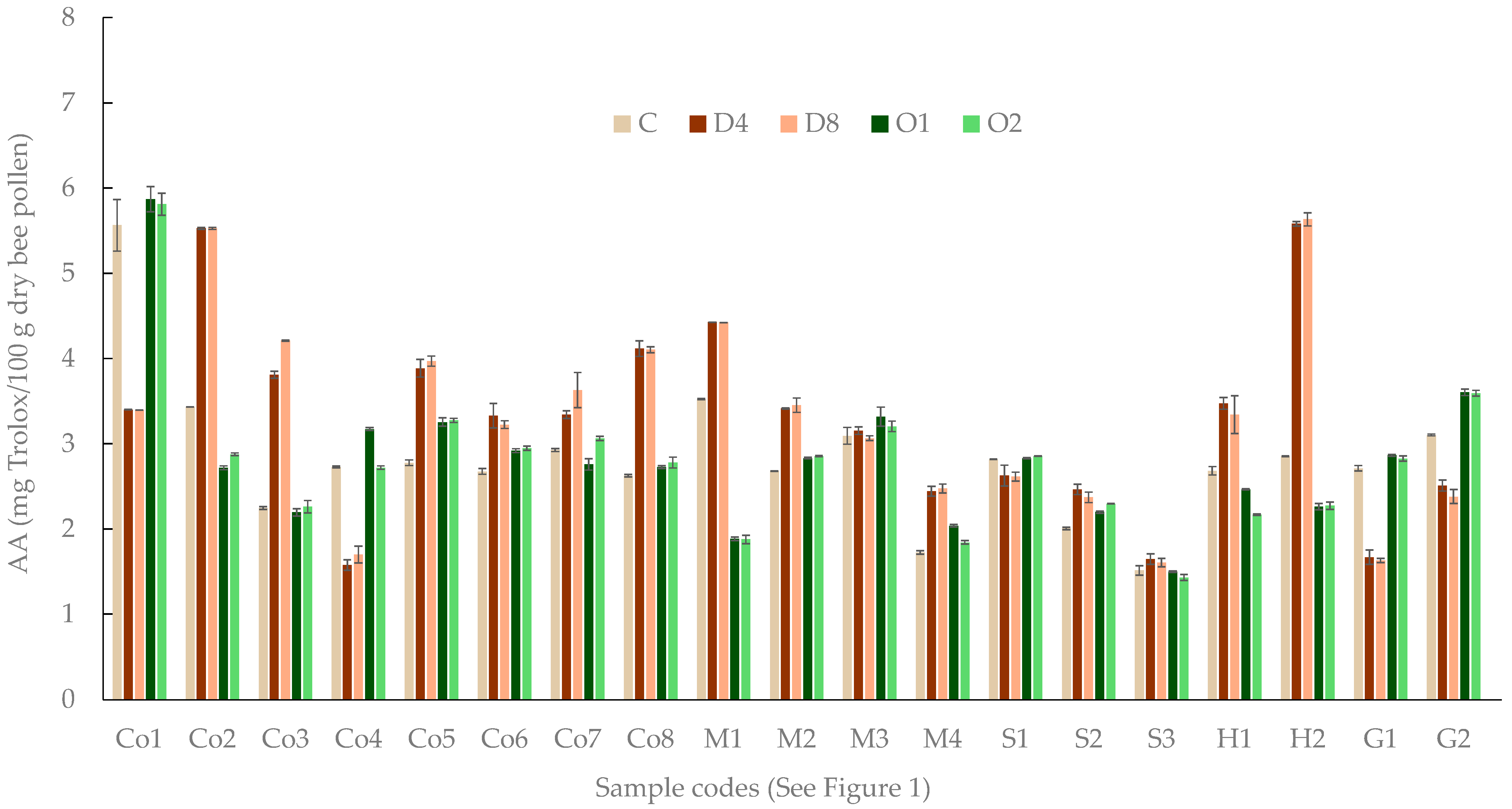
Uneven behaviour was found when each sample was considered independently. Each bee pollen sample responded differently when the treatments were applied. Multiple significant differences were found within each sample for both PC and AA (see Figure 2 and Figure 3 and Table S2 in the Supplementary Materials).
Figure 2. Quantification of the total PC obtained from the nineteen bee pollen samples subjected to different preservation treatments: fresh bee pollen (control, C), drying 4 h (D4), drying 8 h (D8), ozone 1 h (O1), and ozone 2 h (O2). The results are shown as Mean ± Standard Deviation (n = 4). More information is shown in Table S2.
Figure 3. AA obtained from the nineteen bee pollen samples subjected to different preservation treatments: fresh bee pollen (control, C), drying 4 h (D4), drying 8 h (D8), ozone 1 h (O1), and ozone 2 h (O2). The results are shown as Mean ± Standard Deviation (n = 4). More information is shown in Table S2.
On the other hand, the effect sizes (Cohen’s f test) of the two factors (treatments and samples) considered in this study on the PC and AA variables were calculated (Table 2). The variable “treatments” showed a significant effect size on both PC and AA, although this effect was not high. In contrast, the samples factor did show a high effect size on PC and AA (detailed information about Cohen’s f test is shown in Supplementary Material “Meaning and calculation of the Cohen’s f test”).
Table 2. Effect sizes (Cohen’s f test) of the factors on the variability recorded in the variables. Values up to 0.1 mean the effect is considered negligible. Values between 0.1 and 0.25 are considered indicative of a low effect. Values between 0.25 and 0.4 are indicative of a moderate effect. Finally, greater than 0.4 indicates a strong effect [40].
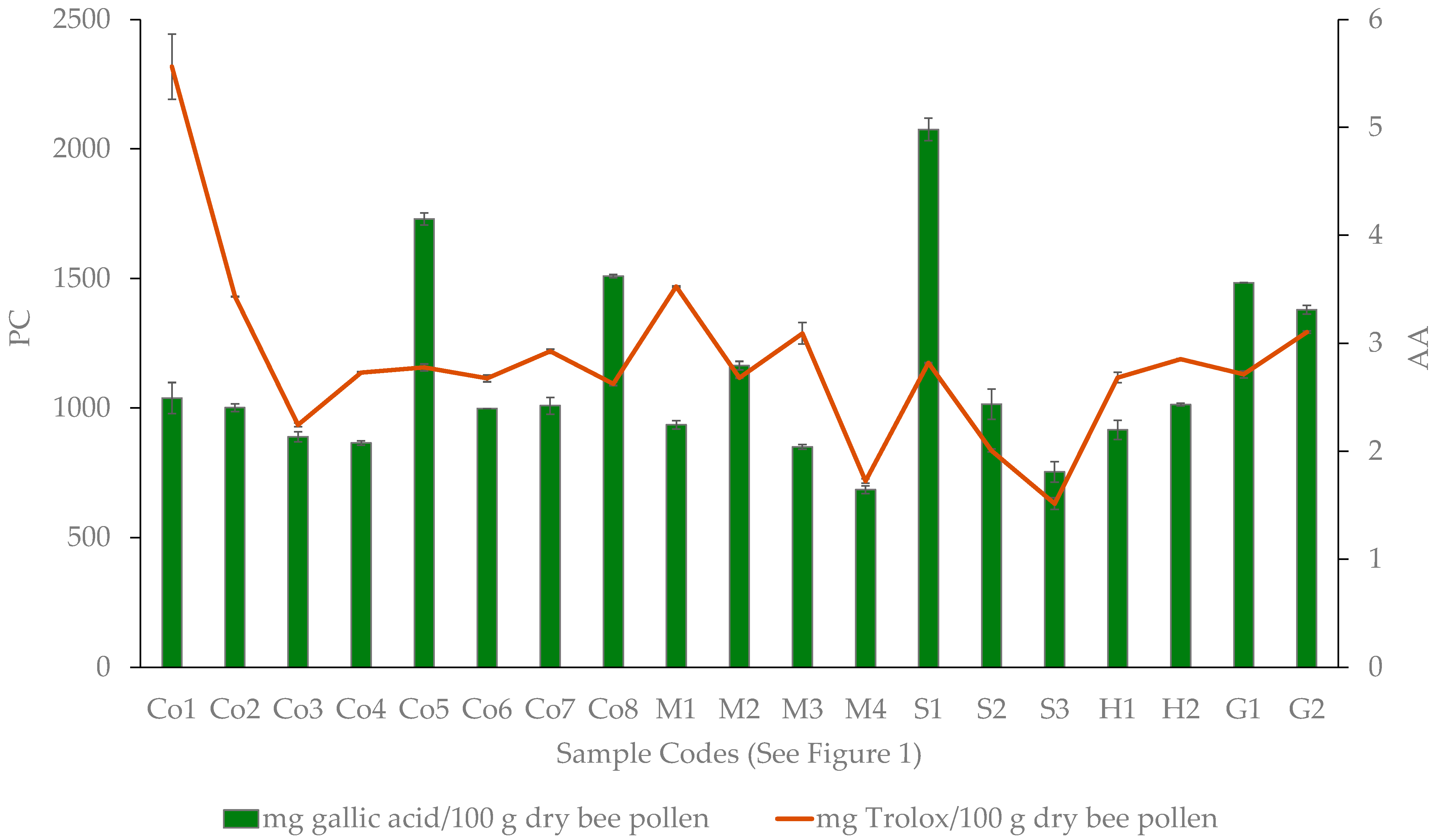
When initial samples of fresh bee pollen were considered, a slight significant positive correlation between the two variables can be observed (Kendall’s tau_b, p = 0.044, r = 0.158). On the contrary, when each sample was considered independently, a wide diversity in terms of total polyphenol content and antioxidant activity was found. No relationship between the variables was observed. A higher amount of total PC does not necessarily imply greater AA (see Figure 4).
Figure 4. Average of PC (mg gallic acid/100 g dry bee pollen) and AA (mg Trolox/100 g dry bee pollen) obtained from fresh bee pollen samples. No visual relationship was found between variables. Results are shown as Mean ± Standard Deviation (n = 4).
This is supported by the fact that no significant correlation was found between the two variables for each of the samples (Kendall’s tau b, p ≤ 0.05), except for sample G2, in which a high significant correlation was found (Kendall’s tau b, p ≤ 0.000, r = 0.800).
Because a significant influence on the PC content and AA could be due to the floral origin of the samples [41], each fresh bee pollen sample was considered separately. A wide variety of floral origins of pollen samples was found for both the set of samples and for each sample. The number of floral pollen types in the samples ranged from 4 to 31. Cistaceae (Cistus) pollen was the most represented pollen group in the sample set, accounting for 33.85% of the total pollen, followed by Boraginaceae (Echium, 15.54%), Cistaceae (Helianthemum, 10.96%), Fagaceae evergreen Quercus pollen type (Q. coccifera and Q. ilex, 9.99%) and Rosaceae type Rubus (Eriobotrya japonica, Geum, Pyracantha, Rubus, 3.23%). Boraginaceae (Cynoglossum), Brassicaceae; Fagaceae deciduous Quercus pollen type (Q. faginea, Q. humilis, Q. petrea, Q. robur, including the exception of Q. suber), and Oleaceae (Olea europaea) were represented between 2.00% and 3.00%. The remaining pollen types were represented in an amount less than 2.00%. Some of the pollen types were present in very small proportions and only in some samples (more detailed information is shown in Table S3).
Sample S1 contained the highest total amount of PC, and up to 12 different types of pollen were detected in it. Most of them corresponded to the Fagaceae (Q. coccifera, Q. ilex, 64.00% of the pollen), followed by Cistaceae (Cistus, 13.00%) and Rosaceae (Rosa), Cistaceae (Helianthemum), Boraginaceae (Echium), Myrtaceae (Eucalyptus), and Ranunculaceae (Clematis), with 7.00%, 6.50%, 4.67%, 2.00%, and 1.00%, respectively. The remaining pollen types were represented by less than 1%. In contrast, the highest AA was recorded in sample Co1. Up to 17 pollen types were recorded in this sample, the most represented being Rosaceae type Rubus (Eriobotrya japonica, Geum, Pyracantha, Rubus, 30.14%), Fagaceae (Q. coccifera and Q. ilex, 23.44%), Cistaceae (Cistus, 19.62%), Boraginaceae (Cynoglossum, 9.09%), and Boraginaceae (Borago officinalis, 5.26%). The remaining pollen types were found in smaller quantities.
Sample G2 was the only one in which a high correlation between the total amount of PC and AA was found. This sample was dominated by the pollen types Cistaceae (Helianthemum, 36.95%), Fagaceae (Q. coccifera, and Q. ilex, 24.63%), Cistaceae (Cistus., 15.76%), and Tamaricaceae (Tamarix, 5.91%). The remaining pollen types, up to a total of seven more, were represented in smaller quantities. In any case, this sample did not show exceptionally high total PC content or AA (see Figure 2 and Figure 3).
On the other hand, the correlation between the different botanical families found in the bee pollen samples and the PC and AA was analyzed (Kendall’s tau_b, p ≤ 0.05). When the correlation coefficient was high (r ≥ 0.5) [42], only the family Fagaceae evergreen Quercus pollen type Q. coccifera, Q. ile showed a significant positive correlation with total phenolic compounds for all treatments, with correlation coefficients (r) of 0.587, 0.600, 0.584, 0.593, and 0.648 for C, O1, O2, D4, and D8, respectively. No other family showed a significant high correlation with total phenolic compounds, either in the original fresh pollen samples or after being subjected to the different treatments. Moreover, a significant high correlation was found with respect to AA for the botanical families Arecaceae type Phoenix (Chamaerops humilis, Phoenix) (r = 0.505 and 0.522 for O1 and O2, respectively), Boraginaceae Echium (r = 0.600 and 0.632, for O1 and O2, respectively), and Liliaceae Muscari (r = 0.503 for O2). In addition, a significant high correlation was found between dehydration treatments and botanical families Boraginaceae Borago officinalis (r = 0.582 and 0.585 for D4 Y D8, respectively) and Cistaceae Helianthemum (r = 0.517 for D8). No significant large negative correlation was found between botanical families and PC and AA for any of the treatments, except for the botanical family Cistaceae Cistus (r = −0.516 for D8). This last botanical family also showed a significant low or medium negative correlation with total PC and AA in the control treatment (C), with AA in treatments O1 and O2, with PC and AA in treatment D4, and with PC in treatment D8. Multiple significant correlations with medium and low r values were also found for other botanical families and PC and AA for all treatments. Detailed information is shown in Table S4.

4. Discussion

In recent years, several studies have investigated the bioactive phenolic components of bee pollen. The total content of PC found in the fresh pollen samples (C) studied in this research from Andalusia (Spain) samples (684.59 ± 14.84 to 2075.56 ± 43.12 mg gallic acid/100 g dry bee pollen) (see Table S2) were similar to those found in samples from Romania (ranged from 440 ± 10 to 1640 ± 30 mg gallic acid/100 g dry bee pollen) [43]. The PC values in the samples studied are consistent with the results reported by Ilie et al. [44] for Romanian bee pollen (values in samples vary between 1080 ± 2 and 1620 ± 2 mg gallic acid/100 g dry bee pollen). In addition, in the study of the Andalusian samples, higher levels of total PC were obtained when compared with the findings of Aylanc et al. [18] and Domínguez-Valhondo et al. [20] (which ranged from 562 ± 18 to 857 ± 33 mg gallic acid/100 g dry bee pollen). Compared to other studies involving bee pollen samples from Spain (the range was between 772 and 2639 mg gallic acid/100 g dry bee pollen), Argelian (ranged from 772 ± 29 to 2350 ± 148 mg gallic acid/100 g dry bee pollen), and Morocco (ranged from 807 ± 104 to 3239 ± 15 mg gallic acid/100 g dry bee pollen) [38,41,45], the extracts of the samples studied exhibited lower contents of total phenolic compounds.
The results of the AA of the fresh bee pollen samples (C) ranged from 1.51 ± 0.05 to 5.56 ± 0.30 mg Trolox/100 g dry bee pollen (see Table S2). The variation could be attributed to the botanical origins and the presence of various antioxidants, such as flavonoids, phenolic acids, and vitamins C and E [46]. These results for AA were closer to those reported by Harbane et al. [47] and Zaidi et al. [48] for Algerian products. Compared to other studies involving bee pollen samples from Spain [29] (ranging from 3.64 ± 0.23 to 7.32 ± 0.08 mg Trolox/100 g dry bee pollen), the extracts of the studied samples exhibited lower values of AA.
Recent studies have found a significant relationship between PC and AA in bee pollen [36,38]. In contrast, several studies have concluded that antioxidant activity is not clearly associated with its total phenolic content [15,16,43]. According to the latter, the results showed a weak relationship between the amount of PC and AA. It is possible that the presence of specific phenolic compounds determines the increase in antioxidant activity [49]. This suggests that the identity of the phenolic compounds, rather than their concentration, may be a more critical factor. Furthermore, the antioxidant activity is influenced by synergistic and antagonistic effects among phenolic compounds and their interactions with other phytochemicals (such as Vitamin C) within the extract [50]. The polyphenolic profile is variable in bee pollen, and the antioxidant activity of polyphenols depends on the number and location of the hydroxyl groups in their chemical structure [51]. Hence, it is important to relate the botanical origin with the individual phenolic compounds, because these relationships can contribute to the discrimination of the antioxidant capacity of some pollen samples based on their floral origin.
The results point out that the contribution of PC to AA in the samples studied is relatively low, as shown by the low correlation between the variables, both for the original fresh pollen samples (a visual assessment can be seen in Figure 4) and when considering all samples and treatments together. This could be explained because multiple causes can affect the characteristics of bee pollen. Factors such as botanical origin, the region of origin, or the soil, among others, can significantly influence the composition of bee pollen and its AA [18,19,20,21]. In addition, other various components of bee pollen, different from PC, such as carotenoids, vitamins B, C, and E, or phenolamines, are also involved in AA [12,52,53]. Furthermore, based on our results, these components probably have a greater impact in this regard than PC. This is a topic that should be studied in the future.
Chemical composition of the bee pollen is influenced by the treatment processes applied to the fresh pollen, especially if these treatments involve heat [22,23]. In response to the objective of this research, which was to study how different pollen preservation treatments could affect its polyphenol content and AA, it also obtained results that were not as expected. Fresh pollen (C) and pollen treated for 1 and 2 h with ozone (O1 and O2) showed a higher polyphenol content than pollen dehydrated for 4 and 8 h (D4 and D8). This indicates that the total phenolic content was negatively affected by the drying process as a probable consequence of the activity of polyphenol oxidase and peroxidases, which can be attributed to the enzyme release following the freeze–thawing process preceding oven drying [54]. Similar results concerning to degradation of phenolic content were found by other authors [29,55].
However, ozone treatment even increased the total PC in some samples (Table S2), especially when ozone was applied for two hours, with significant differences for many of the samples (see Figure 2 and Table S2). These findings could be due to the changes in enzyme concentration and activity caused by ozone treatments [56], which are consistent with previous studies that reported similar results on bee pollen [34] and in fruit and vegetables [56]. However, since the effect sizes of the treatments on PC and AA were not high (see Table 2), further studies would be necessary to confirm this fact more reliably. Given the antioxidant role that polyphenols play in the cells, most of them are biosynthesized in both vines and grapes as a response to biotic and abiotic stresses due to the activation of the phenylpropanoid pathway [57]. However, the effect of ozonation on polyphenol content is not always clear; some papers describe a positive effect of ozone in terms of polyphenol accumulation [58].
Contrary to the above, as can be observed in Figure 3, AA was significantly higher in the D4 and D8 samples. In any case, the results show that ozone treatment did not negatively affect either the total amount of PC or AA compared to the fresh pollen samples. This fact could be a positive aspect in favour of using ozone as a method of preserving bee pollen compared to traditional methods. On the other hand, the increase in AA in heat-treated samples, compared to the control bee pollen, could be explained by the fact that during the drying process, there is a concentration of these other compounds with AA. However, the design of this research does not allow us to support this hypothesis. On the other hand, the increase in AA value with temperature, even though the phenolic content decreases, may be due to the increase in the concentration of specific polyphenols that contribute greatly to that antioxidant activity value, or affect other compounds that positively influence the value of this activity, such as vitamin C or carotenes. Similar results have been found by other authors [59].
The results of this study also show high effect sizes of the samples on the variability of AA and even higher on the variability in PC (see Table 2). This is probably due to the difference in pollen composition, which is strongly influenced by its floral origin. When the botanical origin of the samples was considered, a wide variety was found in the sample set and in each sample. The different botanical origins of the pollen probably influenced the composition, including the composition of PC and other substances with AA. Rojo et al. [38] point out that the nutraceutical properties of bee pollen would be enhanced by increasing the diversity of pollen in the samples. Up to 31 botanical families in the sample set were found. Cistaceae, Boraginaceae, Fagaceae, and Rosaceae were the most frequent. However, they were found in many samples, regardless of the amount of PC and AA they exhibited. For this reason, the correlation between the presence of each botanical family and the PC and AA recorded in the samples after applying each treatment was studied. The family Fagaceae Evergreen Quercus pollen type (Q. coccifera, Q. ilex) was the only one that showed a large, significant (positive) correlation with polyphenol content for all treatments. In contrast, it did not show a significantly high correlation with antioxidant activity. This would reinforce the hypothesis that polyphenols may not be a fundamental component in explaining AA in bee pollen samples. This is also reinforced by the fact that only the botanical families Arecaceae type Phoenix (Chamaerops humilis, Phoenix), Boraginaceae Borago officinalis, Boraginaceae Echium, Ericaceae Erica, Liliaceae Muscari, and Cistaceae Helianthemum, showed a large, significant correlation with AA, and only in some of the treatments, and none of them showed it with PC (See Table S3).
On the other hand, the high-positive significant correlations could not be explained by the greater presence of pollen in the samples, as the other botanical families: Arecaceae type Phoenix (Chamaerops humilis, Phoenix), Boraginaceae Borago officinalis, Cistaceae Helianthemum, Ericaceae Erica, and Liliaceae Muscari, were only detected in 2, 3, 8, 2, and 3 samples, respectively. Only Boraginaceae Echium was represented in a high number of samples (n = 17). It is important to emphasize that the family Cistaceae Cistus only showed negative correlation values with respect to PC and AA in the different treatments, although they were mainly medium or low. This fact is important, since this botanical family was present in all samples and accounted for 33% of the bee pollen in the samples as a whole.

5. Conclusions

Ozone treatments did not negatively affect the total amount of phenolic compounds and antioxidant activity in the treated samples. In contrast, drying treatments reduced the total phenolic content while increasing the antioxidant activity of bee pollen.
Based on the results obtained, no evidence was found to contraindicate the use of ozone as a preservation method for bee pollen. However, this study did not include other bee pollen compounds that might be susceptible to this treatment, such as carotenoids, vitamins B, C, and E, or phenolamines, among others. Therefore, subsequent investigations should complement these findings and ascertain that these compounds remain unaffected by this treatment. On the other hand, a significant but low correlation was found between the total concentration of phenolic compounds and the antioxidant activity of the samples. Probably, because other components of bee pollen also had an important influence on the antioxidant activity displayed by this natural product. Furthermore, the difficulty in achieving conclusive results during the evaluation of treatments on PC and AA was partly attributable to the variability of botanical origin. Given the heterogeneity of the different samples, future research should focus on utilizing monofloral samples to better isolate treatment effects. Finally, other studies could be conducted to optimize ozone application methods for bee pollen preservation.

Supplementary Materials

The following supporting information can be downloaded at: https://www.mdpi.com/article/10.3390/app152413175/s1, Table S1: Descriptive statistics calculated for PC (mg gallic acid/100 g dry bee pollen) and AA (mg Trolox/100 g dry bee pollen) recorded in nineteen bee pollen samples subjected to different preservation processes (treatments): fresh bee pollen (control) (C), drying 4 h (D4), drying 8 h (D8), ozone 1 h (O1), and ozone 2 h (O2). For each sample and each treatment, the results were measured four times. The results are shown as mean ± standard deviation (n = 4). Table S2: Quantification of total phenolic compounds (mg gallic acid/100 g dry bee pollen) and antioxidant activity (mg Trolox/100 g dry bee pollen) recorded in 19 bee pollen samples subjected to different preservation processes (treatments). For each sample and each treatment, the results were measured four times. The results are shown as mean ± standard deviation; Table S3: Botanical origin of pollen samples. The results show the presence in grams of the different pollen types. Table S4: Correlation coefficients (Kendall’s tau_b) between the different botanical types present in the set of 19 samples the samples and the PC (mg gallic acid/100 g dry bee pollen) and the AA (mg Trolox/100 g dry bee pollen) registered in the samples that were subjected to different treatments: fresh bee pollen (control, C), drying 4 h (D4), drying 8 h (D8), ozone 1 h (O1), and ozone 2 h (O2). Only significant results (p ≤ 0.05) are shown. According to [41], the correlation is low or nonexistent when r ≤ 0.29, medium when r is between 0.3 and 0.49, and high when r ≥ 0.5. The table shows positive correlations in shades of red and negative correlations in shades of blue. References [40,60,61] are cited in the supplementary materials.

Author Contributions

Conceptualization, J.M.F. and L.M.; methodology, M.Á.V., R.L.-O., and P.M.-V.; formal analysis, P.M.-V., D.B.-G., and M.Á.V.; investigation, P.M.-V., D.B.-G., and R.L.-O.; data curation, L.M., M.Á.V., and J.M.F.; writing—original draft preparation, P.M.-V., D.B.-G., and R.L.-O.; writing—review and editing, J.M.F. and L.M.; supervision, J.M.F. and L.M.; project administration, J.M.F. and L.M.; funding acquisition, J.M.F. and L.M. All authors have read and agreed to the published version of the manuscript.

Funding

This research was funded by University of Córdoba (Proyectos Propios de Innovación y Transferencia): New horizons for apiculture products (PPIT 20/22-I) and ‘Evaluation of heat treatment and ozone application as methods for preserving the quality of bee pollen‘(‘UCO Impulsa 2025‘, Metis-206187).

Institutional Review Board Statement

Not applicable.

Data Availability Statement

The data are available on request from the corresponding author.

Acknowledgments

We are sincerely grateful to the beekeepers and beekeeping associations of Málaga, Córdoba, Sevilla, Granada, and Huelva, who were involved in this work and provided us with bee pollen samples. As well as to all beekeepers, who fight every day for the survival of bees, and provide us with their products. Also, thanks go to José Salgado of the Department of Genetics at the University of Córdoba for his help with the statistical analysis of this study.

Conflicts of Interest

The authors declare no conflicts of interest.

Abbreviations

PCPhenolic compounds
AAAntioxidant activity
O1Treatment with ozone, 1 h
O2Treatment with ozone, 2 h
D4Drying treatment, 4 h
D8Drying treatment, 8 h
CControl, fresh bee pollen
Co1 to Co8Samples from Córdoba, Andalusia, Spain
M1 to M4Samples from Málaga, Andalusia, Spain
S1 to S3Samples from Sevilla, Andalusia, Spain
H1 and H2Samples from Huelva, Andalusia, Spain
G1 and G2Samples from Granada, Andalusia, Spain

References

  1. Grand View Research. Bee Pollen Market Size & Trends Report, 2024; Grand View Research: San Francisco, CA, USA, 2024; Available online: https://www.grandviewresearch.com/industry-analysis/bee-pollen-market-report (accessed on 23 September 2025).
  2. Brodschneider, R.; Crailsheim, K. Nutrition and health in honey bees. Apidologie 2010, 41, 278–294. [Google Scholar] [CrossRef]
  3. Campos, M.G.R.; Bogdanov, S.; Almeida-Muradian, L.; Szczesna, T.; Mancebo, Y.; Frigerio, C.; Ferreira, F. Pollen composition and standardisation of analytical methods. J. Apic. Res. 2008, 47, 154–161. [Google Scholar] [CrossRef]
  4. Somerville, D. Pollen Trapping and Storage; Primefact; NSW Department of Primary Industries: Orange, Australia, 2012; Volume 1126, pp. 1–5. [Google Scholar]
  5. Bogdanov, S. Pollen: Collection, Harvest, Compostion, Quality. Bee Product. Sci. 2016. Available online: https://www.researchgate.net/profile/Stefan-Bogdanov/publication/304011810_Pollen_Collection_Harvest_Compostion_Quality/links/5762c0c808aee61395bef502/Pollen-Collection-Harvest-Compostion-Quality.pdf?_tp=eyJjb250ZXh0Ijp7ImZpcnN0UGFnZSI6InB1YmxpY2F0aW9uIiwicGFnZSI6InB1YmxpY2F0aW9uIn19 (accessed on 23 September 2025).
  6. Khalifa, S.A.M.; Elashal, M.H.; Yosri, N.; Du, M.; Musharraf, S.G.; Nahar, L.; Sarker, S.D.; Guo, Z.; Cao, W.; Zou, X.; et al. Bee Pollen: Current Status and Therapeutic Potential. Nutrients 2021, 13, 1876. [Google Scholar] [CrossRef] [PubMed]
  7. Algethami, J.S.; El-Wahed, A.A.A.; Elashal, M.H.; Ahmed, H.R.; Elshafiey, E.H.; Omar, E.M.; Al Naggar, Y.; Algethami, A.F.; Shou, Q.; Alsharif, S.M.; et al. Bee Pollen: Clinical Trials and Patent Applications. Nutrients 2022, 14, 2858. [Google Scholar] [CrossRef]
  8. Kaur, J.; Rasane, P.; Kumar, V.; Nanda, V.; Bhadariya, V.; Kaur, S.; Singh, J. Exploring the Health Benefits of Bee Pollen and Its Viability as a Functional Food Ingredient. Rev. Agric. Sci. 2024, 12, 65–78. [Google Scholar] [CrossRef]
  9. Denisow, B.; Denisow-Pietrzyk, M. Biological and therapeutic properties of bee pollen: A review. J. Sci. Food Agric. 2016, 96, 4303–4309. [Google Scholar] [CrossRef]
  10. Durazzo, A.; Lucarini, M.; Plutino, M.; Lucini, L.; Aromolo, R.; Martinelli, E.; Souto, E.B.; Santini, A.; Pignatti, G. Bee Products: A Representation of Biodiversity, Sustainability and Health. Life 2021, 11, 970. [Google Scholar] [CrossRef]
  11. Silva, T.M.S.; Camara, C.A.; da Silva Lins, A.C.; Barbosa-Filho, J.M.; da Silva, E.M.S.; Freitas, B.M.; dos Santos, F.D.A.R. Chemical composition and free radical scavenging activity of pollen loads from stingless bee Melipona subnitida Ducke. J. Food Compos. Anal. 2006, 19, 507–511. [Google Scholar] [CrossRef]
  12. Zuluaga, C.; Martínez, A.; Fernández, J.; López-Baldó, J.; Quiles, A.; Rodrigo, D. Effect of high pressure processing on carotenoid and phenolic compounds, antioxidant capacity, and microbial counts of bee-pollen paste and bee-pollen-basedbeverage. Innov. Food Sci. Emerg. Technol. 2016, 37, 10–17. [Google Scholar] [CrossRef]
  13. Li, Q.-Q.; Wang, K.; Marcucci, M.C.; Sawaya, A.C.H.F.; Hu, L.; Xue, X.-F.; Wu, L.-M.; Hu, F.-L. Nutrient-rich bee pollen: A treasure trove of active natural metabolites. J. Funct. Foods 2018, 49, 472–484. [Google Scholar] [CrossRef]
  14. Freire, K.R.L.; Lins, A.C.S.; Dórea, M.C.; Santos, F.A.R.; Camara, C.A.; Silva, T.M.S. Palynological Origin, Phenolic Content, and Antioxidant Properties of Honeybee-Collected Pollen from Bahia, Brazil. Molecules 2012, 17, 1652–1664. [Google Scholar] [CrossRef] [PubMed]
  15. Leja, M.; Mareczek, A.; Wyzgolik, G.; Klepacz-Baniak, J.; Czekonska, K. Antioxidative properties of bee pollen in selected plant species. Food Chem. 2007, 100, 237–240. [Google Scholar] [CrossRef]
  16. Morais, M.; Moreira, L.; Feás, X.; Estevinho, L.M. Honeybee-collected pollen from five Portuguese Natural Parks: Palynological origin, phenolic content, antioxidant properties and antimicrobial activity. Food Chem. Toxicol. 2011, 49, 1096–1101. [Google Scholar] [CrossRef]
  17. Aličić, D.; Šubarić, D.; Jašić, M.; Pašalić, H.; Ačkar, Đ. Antioxidant properties of pollen. Hrana Zdr. Boles. Znan.-Stručni Časopis Nutr. Dijetetiku 2014, 3, 6–12. [Google Scholar]
  18. Aylanc, V.; Falcao, S.I.; Ertosun, S.; Vilas-Boas, M. From the Hive to thesupp: Nutrition Value, Digestibility and Bioavailability of the Dietary Phytochemicals Present in the Bee Pollen and Bee Bread. Trends Food Sci. Technol. 2021, 109, 464–481. [Google Scholar] [CrossRef]
  19. Oliveira, K.; Moriya, M.; Azedo, R.; de Almeida-Muradian, L.B.; Teixeira, E.W.; Alves, M.L.T.M.F.; Moreti, A.C.d.C.C. Relationship between botanical origin and antioxidants vitamins of bee-collected pollen. Quim. Nova 2009, 5, 1099–1102. [Google Scholar] [CrossRef]
  20. Mărgăoan, R.; Mărghitas, L.A.; Dezmirean, D.S.; Dulf, F.V.; Bunea, A.; Socaci, S.A.; Bobiş, O. Predominant and secondary pollen botanical origins influence the caratenoid and fatty acid profile in fresh honeybee-collected pollen. J. Agric. Food Chem. 2014, 62, 6306–6316. [Google Scholar] [CrossRef]
  21. Kostić, A.Ž.; Barać, M.B.; Stanojević, S.P.; Milojković-Opsenica, D.M.; Tešić, Ž.L.; Šikoparija, B.; Radišić, P.; Prentović, M.; Pešić, M.B. Physicochemical composition and techno-functional properties of bee pollen collected in Serbia. LWT Food Sci. Technol. 2015, 62, 301–309. [Google Scholar] [CrossRef]
  22. Almeida-Muradian, L.B.; Pamplona, L.C.; Coimbra, S.; Barth, O.M. Chemical composition and botanical evaluation of dried bee pollen pellets. J. Food Compos. Anal. 2005, 18, 105–111. [Google Scholar] [CrossRef]
  23. Campos Graça, M.; Frigerio, C.; Lopes, J.; Bogdanov, S. What is the future of bee pollen? J. ApiProduct ApiMedical Sci. 2010, 2, 131–144. [Google Scholar] [CrossRef]
  24. Mauriello, G.; De Prisco, A.; Di Prisco, G.; La Storia, A.; Caprio, E. Microbial characterization of bee pollen from the Vesuvius area collected by using three different traps. PLoS ONE 2017, 12, e0183208. [Google Scholar] [CrossRef] [PubMed]
  25. Mekki, I. Microbial Contamination of Bee Pollen and Impact of Preservation Methods. Master’s Thesis, Univeriste Libre de Tunis, Tunis, Tunisia, 2019. [Google Scholar]
  26. Cabello, J.R.; Serrano, S.; Rodríguez, I.; García-Valcárcel, A.I.; Hernando, M.D.; Flores, J.M. Microbial decontamination of bee pollen by direct ozone exposure. Foods 2021, 10, 2593. [Google Scholar] [CrossRef] [PubMed]
  27. Bonvehí, J.S.; Jordà, R.E. Nutrient Composition and Microbiological Quality of Honeybee-Collected Pollen in Spain. J. Agric. Food Chem. 1997, 45, 725–732. [Google Scholar] [CrossRef]
  28. Stanley, R.G.; Linskens, H.F. Pollen: Biology Biochemistry Management; Springer: Berlin/Heidelberg, Germany, 1974; pp. 223–246. [Google Scholar]
  29. Domínguez-Valhondo, D.; Bohoyo Gil, D.; Hernández, M.T.; González-Gómez, D. Influence of the commercial processing and floral origin on bioactive and nutritional properties of honeybee-collected pollen. Int. J. Food Sci. Technol. 2011, 46, 2204–2211. [Google Scholar] [CrossRef]
  30. Barajas, J.; Cortes-Rodriguez, M.; Rodríguez-Sandoval, E. Effect of temperature on the drying process of bee pollen from two zones of colombia. J. Food Process Eng. 2012, 35, 134–148. [Google Scholar] [CrossRef]
  31. Luo, X.; Dong, Y.; Gu, C.; Zhang, X.; Ma, H. Processing Technologies for Bee Products: An Overview of Recent Developments and Perspectives. Front. Nutr. 2021, 8, 727181. [Google Scholar] [CrossRef]
  32. Estevinho, L.M.; Dias, T.; Anjos, O. Influence of the storage conditions (frozen vs. dried) in health-related lipid indexes and antioxidants of bee pollen. Euro J. Lipid Sci. Technol. 2018, 121, 1800393. [Google Scholar] [CrossRef]
  33. Yook, H.; Lim, S.; Byun, M. Changes in microbiological and physicochemical properties of bee pollen by application of gamma irradiation and ozone treatment. J. Food Prot. 1998, 61, 217–220. [Google Scholar] [CrossRef]
  34. Al Naggar, Y.; Taha, I.M.; Taha, E.K.A.; Zaghlool, A.; Nasr, A.; Nagib, A.; Elhamamsy, S.M.; Abolaban, G.; Fahmy, A.; Hegazy, E.; et al. Gamma irradiation and ozone application as preservation methods for longer-term storage of bee pollen. Environ. Sci. Pollut. Res. 2024, 31, 25192–25201. [Google Scholar] [CrossRef]
  35. Campos, M.G.; Anjos, O.; Chica, M.; Campoy, P.; Nozkova, J.; Almaraz-Abarca, N.; Barreto, L.; Nordi, J.C.; Estevinho, L.; Pascoal, A.; et al. Standard methods for pollen research. J. Apic. Res. 2021, 60, 1–109. [Google Scholar] [CrossRef]
  36. Varo, M.A.; Jacotet-Navarro, M.; Serratosa, M.P.; Mérida, J.; Fabiano-Tixier, A.-S.; Bily, A.; Chemat, F. Green Ultrasound-Assisted Extraction of Antioxidant Phenolic Compounds Determined by High Performance Liquid Chromatography from Bilberry (Vaccinium Myrtillus L.) Juice By-Products. Waste Biomass Valorization 2018, 10, 1945–1955. [Google Scholar] [CrossRef]
  37. Katalinic, V.; Milos, M.; Kulisic, T.; Jukic, M. Screening of 70 Medicinal Plant Extracts for Antioxidant Capacity and Total Phenols. Food Chem. 2006, 94, 550–557. [Google Scholar] [CrossRef]
  38. Rojo, S.; Escuredo, O.; Rodríguez-Flores, M.S.; Seijo, M.C. Botanical Origin of Galician Bee Pollen (Northwest Spain) for the Characterization of Phenolic Content and Antioxidant Activity. Foods 2023, 12, 294. [Google Scholar] [CrossRef]
  39. Cardellach Lliso, P. Análisis Esporo-Polínico de la Miel y el Propóleo, y su Relación con el Entorno [Sporopollenin Analysis of Honey and Propolis, and Its Relationship with the Environment]. Ph.D. Thesis, Universitat Autònoma de Barcelona, Barcelona, Spain, 2020. Available online: https://www.tesisenred.net/handle/10803/670125 (accessed on 23 September 2025).
  40. Cohen, J. Statistical Power Analysis for the Behavioral Sciences; Lawrence Earlbaum Associates, Inc.: Hillsdale, NJ, USA, 1988. [Google Scholar]
  41. Boulfous, N.; Belattar, H.; Ambra, R.; Pastore, G.; Ghorab, A. Botanical origin, phytochemical profile, and antioxidant activity of bee pollen from the mila region, Algeria. Antioxidants 2025, 14, 291. [Google Scholar] [CrossRef]
  42. Hemphill, J.F. Interpreting the magnitudes of correlation coefficients. Am. Psychol. 2003, 58, 78–79. [Google Scholar] [CrossRef]
  43. Marghita¸s, L.A.; Stanciu, O.G.; Dezmirean, D.S.; Bobi¸s, O.; Popescu, O.; Bogdanov, S.; Campos, M.G. In vitro antioxidant capacity of honeybee-collected pollen of selected floral origin harvested from Romania. Food Chem. 2009, 115, 878–883. [Google Scholar] [CrossRef]
  44. Ilie, C.-I.; Oprea, E.; Geana, E.-I.; Spoiala, A.; Buleandra, M.; Gradisteanu Pircalabioru, G.; Badea, I.A.; Ficai, D.; Andronescu, E.; Ficai, A.; et al. Bee Pollen Extracts: Chemical Composition, Antioxidant Properties, and Effect on the Growth of Selected Probiotic and Pathogenic Bacteria. Antioxidants 2022, 11, 959. [Google Scholar] [CrossRef]
  45. El Ghouizi, A.; Bakour, M.; Laaroussi, H.; Ousaaid, D.; El Menyiy, N.; Hano, C.; Lyoussi, B. Bee Pollen as Functional Food: Insights into Its Composition and Therapeutic Properties. Antioxidants 2023, 12, 557. [Google Scholar] [CrossRef]
  46. Otmani, A.; Amessis-Ouchemoukh, N.; Birinci, C.; Yahiaoui, S.; Kolayli, S.; Rodríguez-Flores, M.S.; Ouchemoukh, S. Phenolic Compounds and Antioxidant and Antibacterial Activities of Algerian Honeys. Food Biosci. 2021, 42, 101070. [Google Scholar] [CrossRef]
  47. Harbane, S.; Escuredo, O.; Saker, Y.; Ghorab, A.; Nakib, R.; Rodríguez-Flores, M.S.; Ouelhadj, A.; Seijo, M.C. The contribution of botanical origin to the physicochemical and antioxidant properties of Algerian honeys. Foods 2024, 13, 573. [Google Scholar] [CrossRef] [PubMed]
  48. Zaidi, H.; Ouchemoukh, S.; Amessis-Ouchemoukh, N.; Debbache, N.; Pacheco, R.; Serralheiro, M.L.; Araujo, M.E. Biological properties of phenolic compound extracts in selected Algerian honeys—The inhibition of acetylcholinesterase and α-glucosidase activities. Eur. J. Integr. Med. 2019, 25, 77–84. [Google Scholar] [CrossRef]
  49. Araújo, J.S.; Chambó, E.D.; Costa, M.A.P.D.C.; Da Silva, S.M.P.C.; De Carvalho, C.A.L.; Estevinho, L.M. Chemical Composition and Biological Activities of Mono- and Heterofloral Bee Pollen of Different Geographical Origins. Int. J. Mol. Sci. 2017, 18, 921. [Google Scholar] [CrossRef] [PubMed]
  50. Gambaro, A.; Miraballes, M.; Urruzola, N.; Kniazev, M.; Dauber, C.; Romero, M.; Fernandez-Fernandez, A.M.; Medrano, A.; Santos, E.; Vieitez, I. Physicochemical Composition and Bioactive Properties of Uruguayan Bee Pollen from Different Botanical Sources. Foods 2025, 14, 1689. [Google Scholar] [CrossRef]
  51. Kuskoski, E.M.; Asuero, A.G.; Troncoso, A.M.; Mancini-Filho, J.; Fett, R. Aplicación de diversos métodos químicos para determinar actividad antioxidante en pulpa de frutos. Food Sci. Technol. 2005, 25, 726–732. [Google Scholar] [CrossRef]
  52. Barbieri, D.; Gabriele, M.; Summa, M.; Colosimo, R.; Leonardi, D.; Domenici, V.; Pucci, L. Antioxidant, nutraceutical properties, and fluorescence spectral profiles of bee pollen samples from different botanical origins. Antioxidants 2020, 9, 1001. [Google Scholar] [CrossRef]
  53. Zhang, H.; Liu, R.; Lu, Q. Separation and characterization of phenolamines and flavonoids from rape bee pollen, and comparison of their antioxidant activities and protective effects against oxidative stress. Molecules 2020, 25, 1264. [Google Scholar] [CrossRef]
  54. Silva, M.V.; Rosa, C.I.L.F.; Vilas-Boas, E.V.B. Conceitos e metodos de controle do escurecimento enzim atico no processamento mínimo de frutas e hortaliças. Bol. CEPPA 2009, 27, 83e96. [Google Scholar]
  55. Castagna, A.; Benelli, G.; Conte, G.; Sgherri, C.; Signorini, F.; Nicolella, C.; Ranieri, A.; Canale, A. Drying Techniques and Storage: Do They Affect the Nutritional Value of Bee-Collected Pollen? Molecules 2020, 25, 4925. [Google Scholar] [CrossRef]
  56. Sachadyn-Król, M.; Agriopoulou, S. Ozonation as a Method of Abiotic Elicitation Improving the Health-Promoting Properties of Plant Products—A Review. Molecules 2020, 25, 2416. [Google Scholar] [CrossRef]
  57. Dixon, A.; Lahoucine, A.; Parvathi, K.; Chang-Jun, L.; Srinivasa, R.; Liangjiang, W. The phenylpropanoid pathway and plant defence-a genomics perspective. Mol. Plant Pathol. 2002, 1, 371–390. [Google Scholar] [CrossRef]
  58. Modesti, M.; Petriccione, M.; Forniti, R.; Zampella, L.; Scortichini, M.; Mencarelli, F. Methyl jasmonate and ozone affect the antioxidant system and the quality of wine grape during postharvest partial dehydration. Food Res. Int. 2018, 112, 369–377. [Google Scholar] [CrossRef]
  59. Zuluaga-Domíngueza, C.; Serrato-Bermudez, J.; Quicazán, M. Influence of drying-related operations on microbiological, structural and physicochemical aspects for processing of bee-pollen. Eng. Agric. Environ. Food 2018, 11, 57–64. [Google Scholar] [CrossRef]
  60. Field, A.P. Discovering Statistics Using SPSS for Windows: Advanced Techniques for the Beginner; Sage Publications: Thousand Oaks, CA, USA, 2000. [Google Scholar]
  61. Richardson, J.T.E. Eta squared and partial eta squared as measures of effect size in educational research. Educ. Res. Rev. 2011, 6, 135–147. [Google Scholar] [CrossRef]
Disclaimer/Publisher’s Note: The statements, opinions and data contained in all publications are solely those of the individual author(s) and contributor(s) and not of MDPI and/or the editor(s). MDPI and/or the editor(s) disclaim responsibility for any injury to people or property resulting from any ideas, methods, instructions or products referred to in the content.

Article Metrics

Citations

Article Access Statistics

Multiple requests from the same IP address are counted as one view.