Review

Impact of Radiomic and Artificial Intelligence on Colorectal Cancer: A Narrative Review

by
Caterina Battaglia
1,*,
Maria Luisa Gambardella
2,
Domenico Morano
2,
Salvatore Cannavò
1,
Ludovico Abenavoli
2,
Domenico Laganà
1 and
Pier Paolo Arcuri
3
1
Department of Experimental and Clinical Medicine, University “Magna Graecia”, Viale Europa, 88100 Catanzaro, Italy
2
Department of Health Sciences, University “Magna Graecia”, 88100 Catanzaro, Italy
3
Radiology Unit, Pugliese-Ciaccio, Renato Dulbecco University Hospital, 88100 Catanzaro, Italy
*
Author to whom correspondence should be addressed.
Appl. Sci. 2025, 15(24), 13174; https://doi.org/10.3390/app152413174
Submission received: 6 November 2025 / Revised: 9 December 2025 / Accepted: 10 December 2025 / Published: 16 December 2025
(This article belongs to the Special Issue Machine Learning in Biomedical Sciences)

Abstract

Colorectal cancer (CRC) remains one of the leading causes of cancer-related morbidity and mortality worldwide, representing a major public health challenge. Despite advances in screening strategies, surgical techniques, and systemic therapies, patient prognosis is often compromised by late diagnosis, tumor heterogeneity, and therapeutic resistance. In recent years, the integration of advanced imaging analytics and artificial intelligence (AI) has opened new avenues for precision oncology. Radiomics, defined as the high-throughput extraction of quantitative features from medical images, has emerged as a promising tool to capture intratumoral heterogeneity and predict clinical outcomes in a non-invasive manner. When combined with AI, particularly machine learning and deep learning approaches, radiomics enables the development of predictive and prognostic models that may support treatment personalization. This narrative review provides a comprehensive overview of CRC epidemiology and risk factors, summarizes current diagnostic and clinical management strategies, and focuses extensively on radiomics and AI applications in CRC, including workflow standardization, feature extraction, clinical applications, and challenges for implementation in daily practice.

1. Introduction

Colorectal cancer (CRC) is the third most diagnosed malignancy and one of the leading causes of cancer-related death worldwide, with an estimated 1.93 million new cases and approximately 904,000 deaths reported in 2022 [1]. Despite a slight decline in mortality in high-income countries due to screening programs and improvements in therapy, CRC continues to pose a significant burden, particularly in low- and middle-income countries where access to prevention and treatment remains limited [2,3]. The development of CRC is strongly influenced by lifestyle and environmental factors, including diet, obesity, physical inactivity, alcohol consumption, and smoking, as well as genetic predisposition and inflammatory bowel disease [4,5,6,7]. Although colonoscopy and fecal immunochemical testing have significantly contributed to early detection, many patients are still diagnosed at advanced stages, when therapeutic options are limited and prognosis is poor [8,9]. Advances in molecular profiling have significantly improved the understanding of CRC biology, enabling the identification of actionable genetic alterations, including RAS and BRAF gene mutations and microsatellite instability (MSI) status, all of which are essential for guiding treatment selection [10,11]. However, tissue biopsy remains an invasive procedure that only provides information from a small portion of the tumor, limiting its ability to capture the spatial and temporal heterogeneity that characterizes CRC [12]. Medical imaging plays a central role in CRC management, particularly in staging, treatment planning, and follow-up. Conventional imaging modalities, including computed tomography (CT), magnetic resonance imaging (MRI), provide valuable morphological and functional information but often fail to capture the full complexity of tumor biology [13,14]. To overcome these limitations, radiomics has been introduced as an advanced imaging-based approach that quantitatively analyzes tumor features beyond visual assessment, as reported in Figure 1 [15,16]. Radiomics, particularly when combined with artificial intelligence (AI), offers the potential to generate non-invasive biomarkers capable of predicting treatment response, prognosis, and genetic profiles. These methods may substantially improve personalized treatment strategies and support clinical decision-making in CRC [17,18]. Despite the increasing number of reviews on AI and radiomics in CRC, most existing works either focus narrowly on specific clinical applications or provide broad overviews without critically appraising methodological rigor, model reproducibility, and real-world clinical readiness. This narrative review aims to provide a comprehensive synthesis of the epidemiological background and current diagnostic pathways of CRC, with a strong focus on the applications of radiomics and AI in this setting. We discuss the radiomic workflow, feature extraction, integration with machine learning and deep learning, clinical applications in rectal and colon cancer, as well as limitations and future perspectives for clinical implementation.

2. Data Source and Study Selection

In this narrative review, studies were selected from 2013 to 2025 using a meticulous screening method to examine the role of AI in the diagnosis and treatment of CRC, aiming to delineate the existing literature and identify gaps and domains of interest for potential investigation. The search involved an extensive examination of electronic databases, including ScienceDirect, PubMed, and Google Scholar, employing a blend of pertinent keywords such as “colorectal cancer”, “Artificial Intelligence”, “management”, “prognosis”, “treatment”, “diagnosis”, “monitoring”, and “prediction”, as well as subcategories of AI like “machine learning (ML)”, “deep learning (DL)”, and “natural language processing (NLP)” included within our search parameters. Inclusion criteria were original research articles or systematic/narrative reviews focusing on radiomics or AI applications in colorectal cancer; studies evaluating diagnostic, prognostic, predictive, or molecular characterization tasks; use of CT, MRI or multimodal imaging; availability of sufficient methodological detail regarding radiomic feature extraction, AI model development, or validation. Exclusion criteria included: conference abstracts, editorials, letters, or commentaries; studies not involving radiomics or AI; studies focusing exclusively on non-colorectal malignancies; preclinical, animal, or phantom studies; articles lacking key methodological information or outcome data. The authors subsequently reviewed all articles to eliminate those that were irrelevant. The search strategy aimed to present a critical synthesis of key insights from selected articles, reviewing the progress of AI techniques in CRC, and their future potential to influence diagnosis and management.

3. Epidemiology and Risk Factors

Diets high in red and processed meat, low fiber intake, obesity, and sedentary behavior are established contributors to CRC risk [19]. Adherence to a Mediterranean diet has been associated with a reduction in CRC risk, although it does not eliminate the possibility of developing the disease, as multiple genetic and environmental factors also play a role [20]. Alcohol consumption and smoking are also recognized risk factors [21]. Hereditary syndromes account for approximately 5% of CRC cases. Familial adenomatous polyposis (FAP) and Lynch syndrome significantly increase lifetime risk and require intensive surveillance [22,23]. Patients with long-standing inflammatory bowel disease (IBD), particularly ulcerative colitis, have an elevated CRC risk, linked to chronic inflammation and genomic instability [24]. Emerging evidence suggests that the gut microbiome plays a role in modulating carcinogenesis. Dysbiosis is linked to chronic inflammation, which is a major risk factor for CRC, but dysbiosis does not directly lead to hereditary syndromes like Lynch syndrome or familial adenomatous polyposis (FAP) [25,26,27]. It is important to mention the role of the gut microbiome in shaping local inflammatory and metabolic environments, further contributing to interpatient variability in tumor behavior. Patients with Lynch syndrome carry germline mutations in DNA mismatch repair (MMR) genes, predisposing them to early-onset CRC and extracolonic cancers [26]. FAP, caused by germline mutations in the APC gene, is characterized by hundreds to thousands of colorectal adenomas and a near-100% lifetime CRC risk if left untreated [25]. This epidemiologic heterogeneity supports the rationale for AI-based modeling, as radiomics and machine learning are uniquely positioned to quantify complex, multiscale phenotypic patterns that traditional risk stratification approaches cannot fully capture.

4. Diagnosis and Clinical Management

Early detection of CRC dramatically improves survival outcomes. Colonoscopy remains the gold standard for diagnosis, allowing direct visualization, biopsy, and removal of premalignant polyps. However, fecal immunochemical testing (FIT) and stool DNA testing represent effective non-invasive alternatives for screening [8,28,29]. Recent innovations include blood-based liquid biopsy assays targeting circulating tumor DNA, which are under investigation for CRC detection and monitoring [30]. Accurate staging is essential to guide therapy. The TNM classification system, provided by the American Joint Committee on Cancer (AJCC), remains the cornerstone for stratifying patients based on tumor invasion, nodal involvement, and distant metastases [31]. Computed tomography (CT) is widely used for staging, particularly for detecting distant metastases, whereas magnetic resonance imaging (MRI) is preferred for local staging of rectal cancer due to its superior soft-tissue resolution [32]. Also, positron emission tomography (PET), often combined with CT, provides complementary functional information on metabolic tumor activity and may be useful in the detection of occult metastases [33]. For localized disease, surgery remains the primary treatment. In rectal cancer, neoadjuvant chemoradiotherapy followed by total mesorectal excision (TME) represents the standard of care for locally advanced tumors, reducing the risk of local recurrence [34]. Adjuvant chemotherapy is recommended for stage III CRC and considered for high-risk stage II cases [35,36]. In metastatic disease, systemic therapy is based on fluoropyrimidines combined with oxaliplatin or irinotecan, often in combination with targeted agents such as anti-EGFR (cetuximab, panitumumab) or anti-VEGF (bevacizumab) monoclonal antibodies, depending on RAS/BRAF mutational status and microsatellite stability [37]. While these conventional imaging and molecular approaches are essential, they remain limited by qualitative interpretation, sampling bias, and inability to fully capture spatial intratumoral heterogeneity. Radiomics and AI directly address these gaps by extracting high-dimensional, quantitative features from standard CT, MRI, and PET images, enabling objective characterization of tumor phenotype. Unlike molecular profiling, which relies on localized tissue samples, radiomics provides a whole-tumor, non-invasive assessment that can reflect heterogeneity, treatment response, and early biological changes not visible to the human eye. AI-driven predictive models can integrate imaging, clinical, and molecular data to refine risk stratification, anticipate treatment response, and support personalized therapeutic decision-making, thereby enhancing existing workflows rather than replacing them. Despite advances in molecular characterization and therapeutic strategies, prognosis remains heterogeneous, with significant variability in treatment response. This highlights the urgent need for novel biomarkers and predictive tools, paving the way for the integration of radiomics and AI in CRC management.

5. Radiomics and Artificial Intelligence

Radiomics has emerged as a promising field that aims to overcome the limitations of conventional imaging by converting medical images into high-dimensional quantitative data, thereby capturing intratumoral heterogeneity in a reproducible and non-invasive manner [38,39]. First introduced by Lambin et al. in 2012, radiomics is based on the hypothesis that medical images contain hidden information beyond what is visible to the human eye, and that advanced computational analysis can reveal imaging biomarkers with diagnostic, prognostic, and predictive value [40]. By integrating radiomic features with genomic, proteomic, and clinical data, radiomics bridges the gap between imaging phenotypes and tumor biology, offering new opportunities for precision oncology [41]. The radiomics pipeline, often referred to as the “Radiomic Flow,” consists of a multi-step process encompassing image acquisition, preprocessing, segmentation, feature extraction, and data analysis [42].

5.1. Image Acquisition and Preprocessing

The accuracy of radiomics heavily depends on the quality and consistency of image acquisition. Computed tomography (CT), magnetic resonance imaging (MRI) are the most widely employed modalities, while ultrasound is occasionally used for superficial tumors and vascular assessment [43]. Variability in acquisition protocols across institutions represents a major challenge, as differences in slice thickness, contrast enhancement, and reconstruction kernels can significantly alter extracted radiomic features [44]. To mitigate this, initiatives such as the Quantitative Imaging Biomarker Alliance (QIBA) and the Quantitative Imaging Network (QIN) have promoted standardized acquisition protocols to enhance reproducibility [45]. Preprocessing techniques—including noise reduction, intensity normalization, histogram equalization, and spatial resampling—are applied to homogenize datasets and reduce artifacts [46]. While such steps improve comparability, they may also introduce bias, underscoring the need for transparent reporting and protocol standardization. Open-source tools such as PyRadiomics and 3D Slicer have facilitated reproducibility by providing standardized preprocessing pipelines and feature extraction libraries [47,48]. To contextualize segmentation variability, recent benchmarking initiatives such as the Medical Segmentation Decathlon (MSD) and Beyond the Cranial Vault (BCV) challenge have provided standardized datasets for evaluating algorithmic performance across different abdominal and pelvic structures, including bowel and soft-tissue regions relevant to colorectal imaging. These challenges consistently demonstrate that segmentation accuracy varies substantially across scanners, institutions, and anatomical sites, with rectal and pelvic organs among the most difficult to segment reliably. Their findings highlight why manual, semi-automated, and fully automated segmentation methods differ in consistency and why robust benchmarking is essential for interpreting variability in radiomics studies.

5.2. Segmentation of Regions of Interest

Precise tumor segmentation is a critical yet challenging step in radiomics, as tumor borders are often irregular or ill-defined. Manual segmentation, while still widely used, is prone to inter- and intra-observer variability. Semi-automated methods reduce subjectivity by combining operator input with computational algorithms, whereas fully automated approaches leverage artificial intelligence, particularly convolutional neural networks (CNNs), to achieve fast and reproducible delineation [49]. Volumetric segmentation (VOI) generally provides more robust data than two-dimensional approaches, as it captures the entire heterogeneity of the lesion [50]. Emerging approaches also exploit multiparametric imaging to define “habitats,” or physiologically distinct tumor subregions. For instance, combining T2-weighted and diffusion-weighted MRI can reveal areas of necrosis or high cellular density, enhancing biological interpretability [51].

5.3. Feature Extraction

Once segmentation is complete, quantitative features are extracted from the defined regions of interest. These features are typically divided into semantic and agnostic categories [52]. Semantic features include descriptors routinely used in clinical practice, such as tumor size, shape, and enhancement patterns, whereas agnostic features—often referred to as texture features—capture spatial relationships between pixels or voxels, quantifying heterogeneity beyond human perception. First-order statistics derived from image histograms measure intensity distributions, skewness, kurtosis, entropy, and energy. These descriptors reflect the degree of uniformity or randomness in voxel intensities, which can be associated with necrosis, fibrosis, or cellular proliferation [53]. Second-order texture features are derived from matrices such as the gray-level co-occurrence matrix (GLCM), gray-level run-length matrix (GLRLM), and neighborhood gray-tone difference matrix (NGTDM). These capture relationships between adjacent voxels and provide insights into tissue architecture and heterogeneity [54]. For example, high entropy values reflect disorganized architecture, while high contrast indicates sharp transitions between regions of different density. Higher-order features further explore structural complexity using advanced mathematical methods such as wavelet transforms, fractal analysis, and Minkowski functionals, which capture multi-scale patterns and morphological irregularities [55]. The use of these advanced descriptors has expanded the ability of radiomics to model tumor biology in a quantitative, non-invasive manner.

5.4. Data Analysis and Dimensionality Reduction

Radiomics typically produces hundreds to thousands of features, creating high-dimensional datasets where the number of variables often exceeds the number of patients. This so-called “curse of dimensionality” increases the risk of overfitting and reduces generalizability [56]. To address this, dimensionality reduction methods are applied. Feature selection strategies, including statistical tests and machine learning–based ranking, help identify the most informative variables, while feature extraction methods such as principal component analysis (PCA) create composite features that summarize information from correlated variables [57]. Among feature selection techniques, the least absolute shrinkage and selection operator (LASSO) regression is one of the most widely used, as it effectively reduces redundancy and enhances model interpretability [58]. Balanced sampling approaches, such as the synthetic minority oversampling technique (SMOTE), are also employed to address class imbalance in training datasets [59]. Validation is essential to ensure clinical applicability. Techniques such as k-fold cross-validation, bootstrapping, and nested validation frameworks are recommended to evaluate robustness and avoid optimistic bias. Ultimately, external validation in independent multicenter datasets remains the gold standard, though it is rarely achieved in current radiomics studies [60]. The complexity and high dimensionality of radiomic datasets have accelerated the integration of artificial intelligence (AI) methods, particularly machine learning (ML) and deep learning (DL), into radiomics workflows. These approaches can handle vast numbers of features, identifying complex, non-linear relationships, and improving predictive accuracy beyond what is achievable with traditional statistical modeling [61]. Machine learning methods commonly applied in radiomics include supervised classifiers such as logistic regression, support vector machines (SVM), random forests, k-nearest neighbors (k-NN), and naïve Bayes [62]. These algorithms map extracted features to clinical outcomes, such as treatment response or overall survival. By classical machine learning (ML), we refer to traditional supervised learning algorithms that rely on engineered features rather than end-to-end deep learning. Examples include support vector machines (SVM), random forests (RF), logistic regression, k-nearest neighbors (k-NN), and gradient boosting methods such as XGBoost (version 3.1.2.1). These models typically operate on handcrafted radiomic features and have been widely used in early radiomics studies for prediction and classification tasks. Random forests, for example, are particularly effective at handling heterogeneous datasets, while SVMs have shown promise in small-to-medium sample sizes by constructing optimal hyperplanes for classification tasks [63]. Among feature selection methods, LASSO regression has been particularly influential for radiomics because it simultaneously performs feature reduction and predictive modeling, improving interpretability while avoiding overfitting [64]. Deep learning approaches, especially convolutional neural networks (CNNs), have further revolutionized radiomics. Unlike classical ML, which relies on hand-crafted features, CNNs automatically learn hierarchical features directly from raw imaging data. CNN-based segmentation has achieved remarkable performance in delineating tumors and surrounding tissues, often outperforming manual or semi-automated methods [65]. Furthermore, interpretability is being enhanced by explainable AI methods, such as Gradient-weighted Class Activation Mapping (Grad-CAM), which visualizes the most influential regions of the image contributing to predictions [66].

6. Clinical Applications of Radiomics in Colorectal Cancer

6.1. Prediction of Therapy Response

In locally advanced rectal cancer (LARC), radiomics has shown promise in predicting response to neoadjuvant chemoradiotherapy (nCRT). Radiomic features derived from baseline T2-weighted MRI and diffusion-weighted imaging (DWI) have been associated with complete pathological response, with SVM and random forest models achieving area under the ROC curve (AUC) values between 0.71 and 0.87 [67,68]. For example, He J et al. [69] developed an MRI-based radiomics and machine-learning model using pretreatment multiparametric MRI to predict pathological complete response (pCR) in patients with locally advanced rectal cancer. Their model demonstrated high discriminative performance (AUC > 0.85) and was explicitly proposed as a tool to identify potential candidates for organ-preserving approaches. In addition, Domingo et al. developed a transcriptomic ML model to predict pCR in rectal cancer treated with nCRT. The authors emphasized the role of such predictive tools in refining patient selection for organ preservation, providing biological insights into therapy response [70]. In a recent study radiomic features extracted from restaging MRI were able to distinguish good responders from non-responders, improving discrimination beyond conventional radiological criteria. This work demonstrated that texture-based signatures can capture subtle microstructural changes induced by therapy and may support more accurate identification of patients eligible for non-operative management [71].

6.2. Assessment of Vascular and Perineural Invasion

Extramural venous invasion (EMVI) and perineural invasion (PNI) are critical prognostic factors in rectal cancer, associated with higher risks of recurrence and poor survival. Conventional MRI often fails to detect these features preoperatively due to edema or fibrosis. Radiomic models trained on T2-weighted MRI have demonstrated superior accuracy compared to radiologists in identifying EMVI and have shown promise in predicting PNI, supporting more individualized treatment strategies [72,73].

6.3. Prediction of Liver Metastases

Both synchronous and metachronous liver metastases (SLM and MLM) represent major clinical challenges in colorectal cancer. Radiomics nomograms combining clinical factors and radiomic signatures from T2-weighted MRI have achieved excellent predictive performance for synchronous liver metastases, with AUCs as high as 0.94 [74,75]. For metachronous metastases, logistic regression models integrating radiomic features from baseline rectal MRI have provided robust risk stratification, highlighting the role of non-invasive imaging biomarkers in early detection [76].

6.4. Prediction of Genetic Mutations

Molecular profiling is crucial for guiding targeted therapies, particularly for mutations in KRAS, NRAS, and BRAF, which influence the efficacy of anti-EGFR agents. Radiomics has emerged as a non-invasive alternative to biopsy, with multiple studies demonstrating significant associations between radiomic features and mutational status. MRI-based texture analysis has differentiated KRAS mutation status with accuracies exceeding 80%, while multicenter CT-based models using SVM classifiers have predicted KRAS and BRAF mutations with AUCs approaching 0.80 [77,78,79]. Radiomic features were shown to correlate with transcriptomic programs and clinically relevant phenotypes, revealing that specific imaging patterns reflect distinct molecular pathways. This integrative framework provides mechanistic support for the use of radiomics as a surrogate biomarker and demonstrates how the combination of imaging and molecular data can enhance prognostic stratification and biological interpretability [80]. These findings underscore the potential of radiomics as a surrogate biomarker for molecular characterization.

6.5. Delta-Radiomics

An emerging frontier is delta-radiomics, which evaluates temporal changes in radiomic features before and after therapy. This approach provides dynamic insights into tumor biology, offering prognostic information beyond static baseline imaging [81]. In colorectal liver metastases, delta-radiomic signatures have predicted response to chemotherapy and anti-EGFR therapies more accurately than RECIST criteria, achieving AUCs of 0.80 or higher [82,83,84]. By quantifying intralesional heterogeneity and treatment-induced changes, delta-radiomics could enable real-time adaptation of therapeutic strategies (Table 1). An emerging frontier is delta-radiomics, which evaluates temporal changes in radiomic features before and after therapy. This approach provides dynamic insights into tumor biology, offering prognostic information beyond static baseline imaging [85]. In colorectal liver metastases, delta-radiomic signatures have predicted response to chemotherapy and anti-EGFR therapies more accurately than RECIST criteria, achieving AUCs of 0.80 or higher [86,87]. By quantifying intralesional heterogeneity and treatment-induced changes, delta-radiomics could enable real-time adaptation of therapeutic strategies (Table 1). However, several limitations currently restrict clinical applicability. The reproducibility of longitudinal imaging is a major challenge: variations in patient positioning, bowel motion, contrast timing, or scanner calibration across different time points can introduce artificial fluctuations in radiomic features, potentially confounding true biological changes. Moreover, acquisition parameters often differ between baseline and follow-up scans—such as slice thickness, reconstruction kernels, or diffusion-weighted imaging settings—leading to instability in temporal feature measurements. Another critical issue is the lack of temporal standardization: the timing of post-treatment imaging varies widely across studies and clinical workflows, making it difficult to disentangle genuine treatment effects from differences in imaging schedules. Finally, the absence of large, multi-institutional test–retest datasets limit the ability to assess longitudinal feature robustness. Addressing these challenges through harmonized acquisition protocols and validated temporal normalization strategies will be essential for the reliable clinical adoption of delta-radiomics.

7. Limitations and Current Challenges

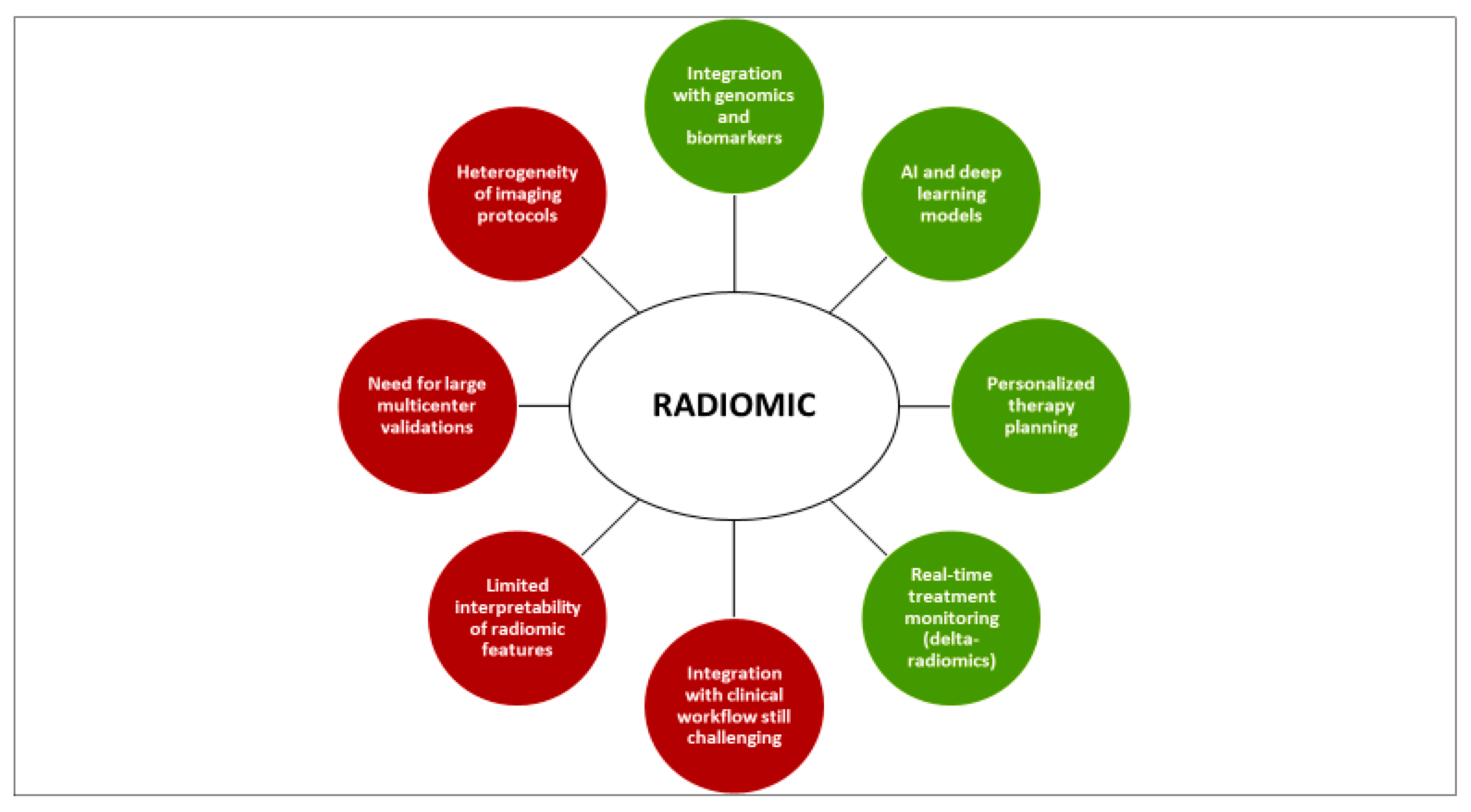
Despite its rapid growth, radiomics remains largely confined to research settings and has not yet been fully integrated into clinical practice (Figure 2). A key challenge lies in the variability of imaging protocols across institutions. Differences in acquisition parameters, reconstruction algorithms, and segmentation methods result in features that are not always reproducible, which undermine the reliability of predictive models [88]. Manual segmentation, still widely used, introduces inter- and intra-observer variability, while even automated methods can be affected by the quality and diversity of the training datasets [89]. A further limitation relates to the clinical representativeness of current radiomic datasets. Most models are trained on relatively homogeneous cohorts, often excluding patients with significant comorbidities or atypical disease presentations. As a result, models may perform well within the restricted distribution of the training data but fail to generalize when applied to patients with underlying conditions—such as inflammatory disorders, prior surgeries, metabolic disease, or treatment-related tissue changes—that alter imaging appearance but are underrepresented in training samples. This mismatch increases the risk of erroneous predictions when models are deployed in real-world populations [90]. Similarly, demographic bias is a growing concern. Radiomic studies frequently rely on single-center cohorts with narrow demographic profiles, including limited variability in age, ethnicity, socioeconomic status, and genetic background. Although disease progression mechanisms may be shared, the biological and imaging phenotypes of colorectal cancer (CRC) can differ across populations, and factors such as body habitus, tumor biology, or access to healthcare may influence both imaging signatures and treatment response. These constraints reduce model scalability and challenge their translation into diverse clinical environments. Another limitation is the lack of standardization in feature definitions. The same features may be calculated differently depending on the software or preprocessing pipeline, leading to inconsistencies across studies. Initiatives such as the Image Biomarker Standardization Initiative (IBSI) are working to address these discrepancies, but widespread adoption is still limited [91]. Moreover, most studies are retrospective, single-center analyses with relatively small sample sizes. These methodological constraints limit generalizability, making external validation across diverse patient cohorts imperative before radiomic biomarkers can be translated into routine care [92]. Ethical and regulatory considerations are increasingly central to AI-driven oncology. Future implementations must ensure robust patient consent, rigorous data anonymization and de-identification procedures, and transparent documentation of algorithmic decision-making. Emerging regulatory frameworks from the FDA and EMA further highlight the need for explainable AI systems, as model interpretability is essential to guarantee clinical accountability and foster clinician and patient trust. Finally, ethical and regulatory frameworks for AI-driven decision support in oncology are still evolving, and issues of data privacy, model transparency, demographic fairness, and clinical accountability must be resolved before radiomics-based tools can be responsibly integrated into standard workflows [93].

8. Future Perspectives

Radiomics and AI have the potential to transform the management of colorectal cancer by enabling non-invasive, quantitative, and individualized assessments of tumor biology. Moving forward, several priorities can accelerate clinical translation. First, standardization of imaging acquisition, segmentation, and feature extraction is essential to ensure reproducibility. Collaborative multicenter studies and the establishment of large, harmonized databases will provide the statistical power and diversity necessary for robust external validation [94]. Second, integration of radiomics with other “omics” technologies—such as genomics, transcriptomics, and proteomics—offers the promise of multi-modal predictive models that capture complementary aspects of tumor biology, providing deeper insights into mechanisms of progression and resistance [95]. Third, the development of explainable AI (XAI) frameworks is crucial to improving the interpretability of predictive models. Transparent, human-interpretable algorithms will facilitate clinician trust and accelerate adoption into multidisciplinary tumor boards [96]. In parallel, generative AI (GenAI) emerges as a powerful tool to address current limitations in data availability and heterogeneity. It can generate realistic, high-fidelity cell-level images that preserve key morphological phenotypes of cancer stem cells. Such approaches provide a proof-of-concept for using GenAI to augment datasets, model tumor heterogeneity, and simulate rare or underrepresented biological patterns. Applied to colorectal cancer radiomics, similar generative frameworks could improve model robustness, support domain adaptation across imaging centers, and ultimately enhance the biological relevance of predictive models [97]. Finally, prospective clinical trials incorporating radiomics-guided decision-making are needed to establish clinical utility. These trials could evaluate whether radiomics-based biomarkers improve patient outcomes by refining treatment selection, reducing overtreatment, and personalizing follow-up strategies [46]. To accelerate real-world implementation, several actionable steps should be prioritized. Establishing a dedicated CRC radiomics consortium would facilitate standardized imaging protocols, multicenter data harmonization, and cross-institutional reproducibility studies. Integrating radiomic signatures into molecular tumor boards could support multidisciplinary decision-making by combining imaging-derived phenotypes with genomic and pathological data. In addition, developing shared CRC radiomics repositories and benchmarking datasets would enable transparent evaluation of model performance across institutions. Finally, prospective clinical trials explicitly incorporating radiomics-guided stratification are needed to determine whether these tools can measurably improve treatment selection, escalate or de-escalate therapy, and enhance patient outcomes.

9. Conclusions

Radiomics and artificial intelligence represent a paradigm shift in the evaluation and management of colorectal cancer. By extracting high-dimensional, quantitative features from standard medical imaging, radiomics provides novel insights into tumor heterogeneity, treatment response, and molecular status, offering non-invasive biomarkers for precision oncology. The integration of AI, particularly machine learning and deep learning, enhances the predictive power of radiomics, enabling dynamic tools such as delta-radiomics that monitor treatment-induced changes over time [98,99]. However, significant barriers remain, including a lack of standardization, limited external validation, and concerns regarding interpretability. Addressing these challenges through multicenter collaborations, standardized workflows, and explainable AI will be critical for clinical implementation. If successfully translated, radiomics and AI hold the potential to complement histopathology and molecular profiling, advancing precision medicine and improving outcomes in colorectal cancer patients.

Author Contributions

Conceptualization, C.B. and P.P.A.; methodology, L.A.; validation, D.L.; investigation, M.L.G.; resources, D.M.; data curation, D.M.; writing—original draft preparation, C.B. and S.C.; writing—review and editing, C.B. All authors have read and agreed to the published version of the manuscript.

Funding

This research received no external funding.

Institutional Review Board Statement

Not applicable.

Informed Consent Statement

Not applicable.

Data Availability Statement

The original contributions presented in this study are included in the article. Further inquiries can be directed to the corresponding author.

Conflicts of Interest

The authors declare no conflicts of interest.

References

  1. Bray, F.; Laversanne, M.; Sung, H.; Ferlay, J.; Siegel, R.L.; Soerjomataram, I.; Jemal, A. Global cancer statistics 2022: GLOBOCAN estimates of incidence and mortality worldwide for 36 cancers in 185 countries. CA Cancer J. Clin. 2024, 74, 229–263. [Google Scholar] [CrossRef] [PubMed]
  2. Arnold, M.; Sierra, M.S.; Laversanne, M.; Soerjomataram, I.; Jemal, A.; Bray, F. Global patterns and trends in colorectal cancer incidence and mortality. Gut 2017, 66, 683–691. [Google Scholar] [CrossRef]
  3. Rawla, P.; Sunkara, T.; Barsouk, A. Epidemiology of colorectal cancer: Incidence, mortality, survival, and risk factors. Prz. Gastroenterol. 2019, 14, 89–103. [Google Scholar] [CrossRef]
  4. Thanikachalam, K.; Khan, G. Colorectal cancer and nutrition. Nutrients 2019, 11, 164. [Google Scholar] [CrossRef]
  5. Aune, D.; Keum, N.; Giovannucci, E.; Fadnes, L.T.; Boffetta, P.; Greenwood, D.C.; Tonstad, S.; Vatten, L.J.; Riboli, E.; Norat, T. Whole grain consumption and risk of cardiovascular disease, cancer, and all cause and cause specific mortality: Systematic review and dose-response meta-analysis of prospective studies. BMJ 2016, 353, i2716. [Google Scholar] [CrossRef] [PubMed] [PubMed Central]
  6. Zhang, X.; Keum, N.; Wu, K.; Smith-Warner, S.A.; Ogino, S.; Chan, A.T.; Fuchs, C.S.; Giovannucci, E.L. Calcium intake and colorectal cancer risk: Results from the nurses’ health study and health professionals follow-up study. Int. J. Cancer 2016, 139, 2232–2242. [Google Scholar] [CrossRef] [PubMed] [PubMed Central]
  7. Beaugerie, L.; Itzkowitz, S.H. Cancers complicating inflammatory bowel disease. N. Engl. J. Med. 2015, 372, 1441–1452. [Google Scholar] [CrossRef]
  8. Shaukat, A.; Kahi, C.J.; Burke, C.A.; Rabeneck, L.; Sauer, B.G.; Rex, D.K. ACG clinical guidelines: Colorectal cancer screening 2021. Am. J. Gastroenterol. 2021, 116, 458–479. [Google Scholar] [CrossRef] [PubMed]
  9. Smith, R.A.; Andrews, K.S.; Brooks, D.; Fedewa, S.A.; Manassaram-Baptiste, D.; Saslow, D.; Wender, R.C. Cancer screening in the United States, 2019: A review of current American Cancer Society guidelines and current issues in cancer screening. CA Cancer J. Clin. 2019, 69, 184–210. [Google Scholar] [CrossRef] [PubMed]
  10. Ciardiello, F.; Ciardiello, D.; Martini, G.; Napolitano, S.; Tabernero, J.; Cervantes, A. Clinical management of metastatic colorectal cancer in the era of precision medicine. CA Cancer J. Clin. 2022, 72, 372–401. [Google Scholar] [CrossRef]
  11. Grothey, A.; Fakih, M.; Tabernero, J. Management of BRAF-mutant metastatic colorectal cancer: A review of treatment options and evidence-based guidelines. Ann. Oncol. 2021, 32, 959–967. [Google Scholar] [CrossRef]
  12. Boland, C.R.; Goel, A. Microsatellite instability in colorectal cancer. Gastroenterology 2010, 138, 2073–2087. [Google Scholar] [CrossRef]
  13. van der Paardt, M.P.; Zagers, M.B.; Beets-Tan, R.G.; Stoker, J.; Bipat, S. Patients who undergo preoperative chemoradiotherapy for locally advanced rectal cancer restaged by using diagnostic MR imaging: A systematic review and meta-analysis. Radiology 2013, 269, 101–112. [Google Scholar] [CrossRef]
  14. Martin, S.T.; Heneghan, H.M.; Winter, D.C. Systematic review and meta-analysis of outcomes following pathological complete response to neoadjuvant chemoradiotherapy for rectal cancer. Br. J. Surg. 2012, 99, 918–928. [Google Scholar] [CrossRef] [PubMed]
  15. Lambin, P.; Rios-Velazquez, E.; Leijenaar, R.; Carvalho, S.; van Stiphout, R.G.P.M.; Granton, P.; Zegers, C.M.L.; Gillies, R.; Boellard, R.; Dekker, A.; et al. Radiomics: Extracting more information from medical images using advanced feature analysis. Eur. J. Cancer 2012, 48, 441–446. [Google Scholar] [CrossRef] [PubMed]
  16. Gillies, R.J.; Kinahan, P.E.; Hricak, H. Radiomics: Images are more than pictures, they are data. Radiology 2016, 278, 563–577. [Google Scholar] [CrossRef]
  17. Aerts, H.J.W.L.; Velazquez, E.R.; Leijenaar, R.T.H.; Parmar, C.; Grossmann, P.; Carvalho, S.; Bussink, J.; Monshouwer, R.; Haibe-Kains, B.; Rietveld, D.; et al. Decoding tumour phenotype by noninvasive imaging using a quantitative radiomics approach. Nat. Commun. 2014, 5, 4006. [Google Scholar] [CrossRef]
  18. Lambin, P.; Leijenaar, R.T.H.; Deist, T.M.; Peerlings, J.; de Jong, E.E.C.; van Timmeren, J.; Sanduleanu, S.; Larue, R.T.H.M.; Even, A.J.G.; Jochems, A.; et al. Radiomics: The bridge between medical imaging and personalized medicine. Nat. Rev. Clin. Oncol. 2017, 14, 749–762. [Google Scholar] [CrossRef] [PubMed]
  19. Matsuda, T.; Fujimoto, A.; Igarashi, Y. Colorectal Cancer: Epidemiology, Risk Factors, and Public Health Strategies. Digestion 2025, 106, 91–99. [Google Scholar] [CrossRef] [PubMed]
  20. Sofi, F.; Abbate, R.; Gensini, G.F.; Casini, A. Accruing evidence on benefits of adherence to the Mediterranean diet on health: An updated systematic review and meta-analysis. Am. J. Clin. Nutr. 2010, 92, 1189–1196. [Google Scholar] [CrossRef]
  21. Secretan, B.; Straif, K.; Baan, R.; Grosse, Y.; El Ghissassi, F.; Bouvard, V.; Benbrahim-Tallaa, L.; Guha, N.; Freeman, C.; Galichet, L.; et al. A review of human carcinogens—Part E: Tobacco, areca nut, alcohol, coal smoke, and salted fish. Lancet Oncol. 2009, 10, 1033–1034. [Google Scholar] [CrossRef]
  22. Jasperson, K.W.; Tuohy, T.M.; Neklason, D.W.; Burt, R.W. Hereditary and familial colon cancer. Gastroenterology 2010, 138, 2044–2058. [Google Scholar] [CrossRef]
  23. Otsuka, K.; Itabashi, T.; Sasaki, A.; Kimura, T.; Kato, K.; Wakabayashi, G. Laparoscopic-assisted proctocolectomy with prolapsing technique for familial adenomatous polyposis. Surg. Laparosc. Endosc. Percutan. Tech. 2014, 24, e228–e232. [Google Scholar] [CrossRef]
  24. Jess, T.; Rungoe, C.; Peyrin-Biroulet, L. Risk of colorectal cancer in patients with ulcerative colitis: A meta-analysis of population-based cohort studies. Clin. Gastroenterol. Hepatol. 2012, 10, 639–645. [Google Scholar] [CrossRef]
  25. Kinzler, K.W.; Vogelstein, B. Lessons from hereditary colorectal cancer. Cell 1996, 87, 159–170. [Google Scholar] [CrossRef]
  26. Lynch, H.T.; de la Chapelle, A. Hereditary colorectal cancer. N. Engl. J. Med. 2003, 348, 919–932. [Google Scholar] [CrossRef] [PubMed]
  27. Grover, S.; Kastrinos, F.; Steyerberg, E.W.; Cook, E.F.; Dewanwala, A.; Burbidge, L.A.; Wenstrup, R.J.; Syngal, S. Prevalence and phenotypes of APC and MUTYH mutations in patients with multiple colorectal adenomas. JAMA 2012, 308, 485–492. [Google Scholar] [CrossRef] [PubMed]
  28. Imperiale, T.F.; Ransohoff, D.F.; Itzkowitz, S.H.; Levin, T.R.; Lavin, P.; Lidgard, G.P.; Ahlquist, D.A.; Berger, B.M. Multitarget stool DNA testing for colorectal cancer screening. N. Engl. J. Med. 2014, 370, 1287–1297. [Google Scholar] [CrossRef] [PubMed]
  29. Chung, D.C.; Rustgi, A.K. A cell-free DNA blood-based test for colorectal cancer screening. N. Engl. J. Med. 2024, 390, 712–721. [Google Scholar] [CrossRef]
  30. Heitzer, E.; Haque, I.S.; Roberts, C.E.S.; Speicher, M.R. Current and future perspectives of liquid biopsies in genomics-driven oncology. Nat. Rev. Genet. 2019, 20, 71–88. [Google Scholar] [CrossRef]
  31. Amin, M.B.; Greene, F.L.; Edge, S.B.; Compton, C.C.; Gershenwald, J.E.; Brookland, R.K.; Meyer, L.; Gress, D.M.; Byrd, D.R.; Winchester, D.P. The Eighth Edition AJCC Cancer Staging Manual: Continuing to build a bridge from a population-based to a more “personalized” approach to cancer staging. CA Cancer J. Clin. 2017, 67, 93–99. [Google Scholar] [CrossRef]
  32. Beets-Tan, R.G.H.; Lambregts, D.M.J.; Maas, M.; Beets, G.L. Magnetic resonance imaging for the clinical management of rectal cancer patients: Recommendations from the 2012 European Society of Gastrointestinal and Abdominal Radiology (ESGAR) consensus meeting. Eur. Radiol. 2013, 23, 2522–2531. [Google Scholar] [CrossRef]
  33. Flamen, P.; Stroobants, S.; Van Cutsem, E.; Dupont, P.; Bormans, G.; De Vadder, N.; Penninckx, F.; Van Hoe, L.; Mortelmans, L. Additional value of whole-body positron emission tomography with fluorine-18-2-fluoro-2-deoxy-D-glucose in recurrent colorectal cancer. J. Clin. Oncol. 1999, 17, 894–901. [Google Scholar] [CrossRef]
  34. Maas, M.; Nelemans, P.J.; Valentini, V.; Das, P.; Rödel, C.; Kuo, L.J.; Calvo, F.A.; García-Aguilar, J.; Glynne-Jones, R.; Haustermans, K.; et al. Long-term outcome in patients with a pathological complete response after chemoradiation for rectal cancer: A pooled analysis of individual patient data. Lancet Oncol. 2010, 11, 835–844. [Google Scholar] [CrossRef]
  35. Quasar Collaborative Group. Adjuvant chemotherapy versus observation in patients with colorectal cancer: A randomized study. Lancet 2007, 370, 2020–2029. [Google Scholar] [CrossRef]
  36. Morton, D.; Seymour, M.; Magill, L.; Handley, K.; Glasbey, J.; Glimelius, B.; Palmer, A.; Seligmann, J.; Laurberg, S.; Murakami, K.; et al. Preoperative Chemotherapy for Operable Colon Cancer: Mature Results of an International Randomized Controlled Trial. J. Clin. Oncol. 2023, 41, 1541–1552. [Google Scholar] [CrossRef]
  37. Guler, I.; Askan, G.; Klostergaard, J.; Sahin, I.H. Precision medicine for metastatic colorectal cancer: An evolving era. Expert Rev. Gastroenterol. Hepatol. 2019, 13, 919–931. [Google Scholar] [CrossRef]
  38. Zwanenburg, A.; Vallières, M.; Abdalah, M.A.; Aerts, H.J.W.L.; Andrearczyk, V.; Apte, A.; Ashrafinia, S.; Bakas, S.; Beukinga, R.J.; Boellaard, R.; et al. The Image Biomarker Standardization Initiative: Standardized quantitative radiomics for High-Throughput Image-based Phenotyping. Radiology 2020, 295, 328–338. [Google Scholar] [CrossRef]
  39. Hou, M.; Sun, J.H. Emerging applications of radiomics in rectal cancer: State of the art and future perspectives. World J. Gastroenterol. 2021, 27, 3802–3814. [Google Scholar] [CrossRef]
  40. Kumar, V.; Gu, Y.; Basu, S.; Berglund, A.; Eschrich, S.A.; Schabath, M.B.; Forster, K.; Aerts, H.J.; Dekker, A.; Fenstermacher, D.; et al. Radiomics: The process and the challenges. Magn. Reson. Imaging 2012, 30, 1234–1248. [Google Scholar] [CrossRef]
  41. Verma, V.; Simone, C.B., 2nd; Krishnan, S.; Lin, S.H.; Yang, J.; Hahn, S.M. The Rise of Radiomics and Implications for Oncologic Management. J. Natl. Cancer Inst. 2017, 109, djx055. [Google Scholar] [CrossRef]
  42. Scapicchio, C.; Gabelloni, M.; Barucci, A.; Cioni, D.; Saba, L.; Neri, E. A deep look into radiomics. Radiol. Med. 2021, 126, 1296–1311. [Google Scholar] [CrossRef]
  43. Guiot, J.; Vaidyanathan, A.; Deprez, L.; Zerka, F.; Danthine, D.; Frix, A.N.; Lambin, P.; Bottari, F.; Tsoutzidis, N.; Miraglio, B.; et al. A review in radiomics: Making personalized medicine a reality via routine imaging. Med. Res. Rev. 2022, 42, 426–440. [Google Scholar] [CrossRef]
  44. Larue, R.; Defraene, G.; De Ruysscher, D.; Lambin, P.; van Elmpt, W. Quantitative radiomics studies for tissue characterization: Review of technology and methodology. Br. J. Radiol. 2017, 90, 20160665. [Google Scholar] [CrossRef]
  45. Sullivan, D.C.; Obuchowski, N.A.; Kessler, L.G.; Raunig, D.L.; Gatsonis, C.; Huang, E.P.; Kondratovich, M.; McShane, L.M.; Reeves, A.P.; Barboriak, D.P.; et al. Metrology Standards for Quantitative Imaging Biomarkers. Radiology 2015, 277, 813–825. [Google Scholar] [CrossRef]
  46. Mayerhoefer, M.E.; Materka, A.; Langs, G.; Häggström, I.; Szczypiński, P.; Gibbs, P.; Cook, G. Introduction to Radiomics. J. Nucl. Med. 2020, 61, 488–495. [Google Scholar] [CrossRef]
  47. Van Griethuysen, J.J.M.; Fedorov, A.; Parmar, C.; Hosny, A.; Aucoin, N.; Narayan, V.; Beets-Tan, R.G.H.; Fillion-Robin, J.C.; Pieper, S.; Aerts, H.J.W.L. Computational Radiomics System to Decode the Radiographic Phenotype. Cancer Res. 2017, 77, e104–e107. [Google Scholar] [CrossRef]
  48. Fedorov, A.; Beichel, R.; Kalpathy-Cramer, J.; Finet, J.; Fillion-Robin, J.C.; Pujol, S.; Bauer, C.; Jennings, D.; Fennessy, F.; Sonka, M.; et al. 3D Slicer as an image computing platform for the Quantitative Imaging Network. Magn. Reson. Imaging 2012, 30, 1323–1341. [Google Scholar] [CrossRef]
  49. Kayalibay, B.; Jensen, G.; van der Smagt, P. CNN-based segmentation of medical imaging data. arXiv 2017. [Google Scholar] [CrossRef]
  50. Parmar, C.; Rios Velazquez, E.; Leijenaar, R.; Jermoumi, M.; Carvalho, S.; Mak, R.H.; Mitra, S.; Shankar, B.U.; Kikinis, R.; Haibe-Kains, B. Robust Radiomics feature quantification using semiautomatic volumetric segmentation. PLoS ONE 2014, 9, e102107. [Google Scholar] [CrossRef]
  51. Wang, J.; Liu, X.; Dong, D.; Song, J.; Xu, M.; Zang, Y.; Tian, J. Prediction of malignant and benign of lung tumor using a quantitative radiomic method. In Proceedings of the 2016 38th Annual International Conference of the IEEE Engineering in Medicine and Biology Society (EMBC), Orlando, FL, USA, 16–20 August 2016; pp. 1272–1275. [Google Scholar] [CrossRef]
  52. Ghalati, M.K.; Nunes, A.; Ferreira, H.; Serranho, P.; Bernardes, R. Texture Analysis and Its Applications in Biomedical Imaging: A Survey. IEEE Rev. Biomed. Eng. 2022, 15, 222–246. [Google Scholar] [CrossRef]
  53. Haralick, R.M.; Shanmugam, K.; Dinstein, I. Textural features for image classification. IEEE Trans. Syst. Man Cybern. 1973, SMC-3, 610–621. [Google Scholar] [CrossRef]
  54. Amadasun, M.; King, R. Textural features corresponding to textural properties. IEEE Trans. Syst. Man Cybern. 1989, 19, 1264–1274. [Google Scholar] [CrossRef]
  55. Depeursinge, A.; Foncubierta-Rodriguez, A.; Van De Ville, D.; Müller, H. Three-dimensional solid texture analysis in biomedical imaging: Review and opportunities. Med. Image Anal. 2014, 18, 176–196. [Google Scholar] [CrossRef] [PubMed]
  56. Bellman, R. Adaptive Control Processes: A Guided Tour; Princeton University Press: Princeton, NJ, USA, 1961. [Google Scholar]
  57. Guyon, I.; Elisseeff, A. An introduction to variable and feature selection. J. Mach. Learn. Res. 2003, 3, 1157–1182. [Google Scholar]
  58. Tibshirani, R. Regression shrinkage and selection via the LASSO. J. R. Stat. Soc. Ser. B 1996, 58, 267–288. [Google Scholar] [CrossRef]
  59. Chawla, N.V.; Bowyer, K.W.; Hall, L.O.; Kegelmeyer, W.P. SMOTE: Synthetic minority over-sampling technique. J. Artif. Intell. Res. 2002, 16, 321–357. [Google Scholar] [CrossRef]
  60. Segato Dos Santos, L.F.; Neves, L.A.; Rozendo, G.B.; Ribeiro, M.G.; Zanchetta do Nascimento, M.; Azevedo Tosta, T.A. Multidimensional and fuzzy sample entropy (SampEnMF) for quantifying H&E histological images of colorectal cancer. Comput. Biol. Med. 2018, 103, 148–160. [Google Scholar] [CrossRef]
  61. Kourou, K.; Exarchos, T.P.; Exarchos, K.P.; Karamouzis, M.V.; Fotiadis, D.I. Machine learning applications in cancer prognosis and prediction. Comput. Struct. Biotechnol. J. 2015, 13, 8–17. [Google Scholar] [CrossRef]
  62. Koçak, B.; Durmaz, E.S.; Ateş, E.; Kılıçkesmez, Ö. Radiomics with artificial intelligence: A practical guide for beginners. Diagn. Interv. Radiol. 2019, 25, 485–495. [Google Scholar] [CrossRef]
  63. Vapnik, V.N. The Nature of Statistical Learning Theory; Springer: Berlin/Heidelberg, Germany, 1995. [Google Scholar] [CrossRef]
  64. Zou, H.; Hastie, T. Regularization and variable selection via the elastic net. J. R. Stat. Soc. Ser. B 2005, 67, 301–320. [Google Scholar] [CrossRef]
  65. LeCun, Y.; Bengio, Y.; Hinton, G. Deep learning. Nature 2015, 521, 436–444. [Google Scholar] [CrossRef] [PubMed]
  66. Selvaraju, R.R.; Cogswell, M.; Das, A.; Vedantam, R.; Parikh, D.; Batra, D. Grad-CAM: Visual explanations from deep networks via gradient-based localization. In Proceedings of the IEEE International Conference on Computer Vision, Venice, Italy, 22–29 October 2017; pp. 618–626. [Google Scholar] [CrossRef]
  67. Di Re, A.M.; Sun, Y.; Sundaresan, P.; Hau, E.; Toh, J.W.T.; Gee, H.; Or, M.; Haworth, A. MRI radiomics in the prediction of therapeutic response to neoadjuvant therapy for locoregionally advanced rectal cancer: A systematic review. Expert Rev. Anticancer Ther. 2021, 21, 425–449. [Google Scholar] [CrossRef]
  68. Horvat, N.; Veeraraghavan, H.; Khan, M.; Blazic, I.; Zheng, J.; Capanu, M.; Sala, E.; Garcia-Aguilar, J.; Gollub, M.J.; Petkovska, I. MR Imaging of Rectal Cancer: Radiomics Analysis to Assess Treatment Response after Neoadjuvant Therapy. Radiology 2018, 287, 833–843. [Google Scholar] [CrossRef] [PubMed]
  69. He, J.; Wang, S.X.; Liu, P. Machine learning in predicting pathological complete response to neoadjuvant chemoradiotherapy in rectal cancer using MRI: A systematic review and meta-analysis. Br. J. Radiol. 2024, 97, 1243–1254. [Google Scholar] [CrossRef]
  70. Domingo, E.; Rathee, S.; Blake, A.; Samuel, L.; Murray, G.; Sebag-Montefiore, D.; Gollins, S.; West, N.; Begum, R.; Richman, S.; et al. Identification and validation of a machine learning model of complete response to radiation in rectal cancer reveals immune infiltrate and TGFβ as key predictors. EBioMedicine 2024, 106, 105228. [Google Scholar] [CrossRef] [PubMed] [PubMed Central]
  71. Prieto-de-la-Lastra, C.; Carbonell-Asins, J.A.; Bueno, A.; Gómez-Alderete, A.; Busto, M.; Alcolado-Jaramillo, A.B.; Jimenez-Pastor, A.; Monzonís, X.; Cuñat, A.; Montagut, C.; et al. A radiomics-based artificial intelligence model to assess the risk of relapse in localized colon cancer. ESMO Open 2025, 10, 105495. [Google Scholar] [CrossRef] [PubMed]
  72. Bae, J.S.; Kim, S.H.; Hur, B.Y.; Chang, W.; Park, J.; Park, H.E.; Kim, J.H.; Kang, H.J.; Yu, M.H.; Han, J.K. Prognostic value of MRI in assessing extramural venous invasion in rectal cancer: Multi-readers’ diagnostic performance. Eur. Radiol. 2019, 29, 4379–4388. [Google Scholar] [CrossRef]
  73. Chen, J.; Chen, Y.; Zheng, D.; Pang, P.; Zhang, H.; Zheng, X.; Liao, J. Pretreatment MR-based radiomics nomogram as potential imaging biomarker for individualized assessment of perineural invasion status in rectal cancer. Abdom. Radiol. 2021, 46, 847–857. [Google Scholar] [CrossRef]
  74. Shu, Z.; Fang, S.; Ding, Z.; Mao, D.; Cai, R.; Chen, Y.; Pang, P.; Gong, X. MRI-based Radiomics nomogram to detect primary rectal cancer with synchronous liver metastases. Sci. Rep. 2019, 9, 3374. [Google Scholar] [CrossRef]
  75. Liu, M.; Ma, X.; Shen, F.; Xia, Y.; Jia, Y.; Lu, J. MRI-based radiomics nomogram to predict synchronous liver metastasis in primary rectal cancer patients. Cancer Med. 2020, 9, 5155–5163. [Google Scholar] [CrossRef]
  76. Beckers, R.C.J.; Lambregts, D.M.J.; Schnerr, R.S.; Maas, M.; Rao, S.X.; Kessels, A.G.H.; Thywissen, T.; Beets, G.L.; Trebeschi, S.; Houwers, J.B.; et al. Whole liver CT texture analysis to predict the development of colorectal liver metastases-A multicentre study. Eur. J. Radiol. 2017, 92, 64–71. [Google Scholar] [CrossRef]
  77. Meng, X.; Xia, W.; Xie, P.; Zhang, R.; Li, W.; Wang, M.; Xiong, F.; Liu, Y.; Fan, X.; Xie, Y.; et al. Preoperative radiomic signature based on multiparametric magnetic resonance imaging for noninvasive evaluation of biological characteristics in rectal cancer. Eur. Radiol. 2019, 29, 3200–3209. [Google Scholar] [CrossRef]
  78. Song, T.; Yao, Q.; Qu, J.; Zhang, H.; Zhao, Y.; Qin, J.; Feng, W.; Zhang, S.; Han, X.; Wang, S.; et al. The value of intravoxel incoherent motion diffusion-weighted imaging in predicting the pathologic response to neoadjuvant chemotherapy in locally advanced esophageal squamous cell carcinoma. Eur. Radiol. 2021, 31, 1391–1400. [Google Scholar] [CrossRef]
  79. Oh, J.E.; Kim, M.J.; Lee, J.; Hur, B.Y.; Kim, B.; Kim, D.Y.; Baek, J.Y.; Chang, H.J.; Park, S.C.; Oh, J.H.; et al. Magnetic Resonance-Based Texture Analysis Differentiating KRAS Mutation Status in Rectal Cancer. Cancer Res. Treat. 2020, 52, 51–59. [Google Scholar] [CrossRef] [PubMed]
  80. Dercle, L.; Lu, L.; Schwartz, L.H.; Qian, M.; Tejpar, S.; Eggleton, P.; Zhao, B.; Piessevaux, H. Radiomics Response Signature for Identification of Metastatic Colorectal Cancer Sensitive to Therapies Targeting EGFR Pathway. J. Natl. Cancer Inst. 2020, 112, 902–912. [Google Scholar] [CrossRef]
  81. Giannini, V.; Pusceddu, L.; Defeudis, A.; Nicoletti, G.; Cappello, G.; Mazzetti, S.; Sartore-Bianchi, A.; Siena, S.; Vanzulli, A.; Rizzetto, F.; et al. Delta-Radiomics Predicts Response to First-Line Oxaliplatin-Based Chemotherapy in Colorectal Cancer Patients with Liver Metastases. Cancers 2022, 14, 241. [Google Scholar] [CrossRef] [PubMed]
  82. Nardone, V.; Reginelli, A.; Grassi, R.; Boldrini, L.; Vacca, G.; D’Ippolito, E.; Annunziata, S.; Farchione, A.; Belfiore, M.P.; Desideri, I.; et al. Delta radiomics: A systematic review. Radiol. Med. 2021, 126, 1571–1583. [Google Scholar] [CrossRef]
  83. Liu, Z.; Zhang, X.Y.; Shi, Y.J.; Wang, L.; Zhu, H.T.; Tang, Z.; Wang, S.; Li, X.T.; Tian, J.; Sun, Y.S. Radiomics Analysis for Evaluation of Pathological Complete Response to Neoadjuvant Chemoradiotherapy in Locally Advanced Rectal Cancer. Clin. Cancer Res. 2017, 23, 7253–7262. [Google Scholar] [CrossRef]
  84. Cui, Y.; Yang, X.; Shi, Z.; Yang, Z.; Du, X.; Zhao, Z.; Cheng, X. Radiomics analysis of multiparametric MRI for prediction of pathological complete response to neoadjuvant chemoradiotherapy in locally advanced rectal cancer. Eur. Radiol. 2019, 29, 1211–1220. [Google Scholar] [CrossRef] [PubMed]
  85. Zhang, Y.C.; Li, M.; Jin, Y.M.; Xu, J.X.; Huang, C.C.; Song, B. Radiomics for differentiating tumor deposits from lymph node metastasis in rectal cancer. World J. Gastroenterol. 2022, 28, 3960–3970. [Google Scholar] [CrossRef]
  86. Shu, Z.; Mao, D.; Song, Q.; Xu, Y.; Pang, P.; Zhang, Y. Multiparameter MRI-based radiomics for preoperative prediction of extramural venous invasion in rectal cancer. Eur. Radiol. 2022, 32, 1002–1013. [Google Scholar] [CrossRef]
  87. Zhou, C.; Wang, Z.; Lai, S.; Meng, L.; Lu, Y.; Lu, X.; Lin, L.; Tang, Y.; Zhang, S.; Mo, S.; et al. Comparative study of radiomics, tumor morphology, and clinicopathological factors in predicting overall survival of patients with rectal cancer before surgery. Transl. Oncol. 2022, 18, 101352. [Google Scholar] [CrossRef]
  88. Reiazi, R.; Abbas, E.; Famiyeh, P.; Rezaie, A.; Kwan, J.Y.Y.; Patel, T.; Bratman, S.V.; Tadic, T.; Liu, F.F.; Haibe-Kains, B. The impact of the variation of imaging parameters on the robustness of Computed Tomography radiomic features: A review. Comput. Biol. Med. 2021, 133, 104400. [Google Scholar] [CrossRef] [PubMed]
  89. Whybra, P.; Spezi, E. Sensitivity of standardised radiomics algorithms to mask generation across different software platforms. Sci. Rep. 2023, 13, 14419. [Google Scholar] [CrossRef]
  90. Yang, L.; Wang, B.; Shi, X.; Li, B.; Xie, J.; Wang, C. Application research of radiomics in colorectal cancer: A bibliometric study. Medicine 2024, 103, e37827. [Google Scholar] [CrossRef] [PubMed] [PubMed Central]
  91. Aguirre-Meneses, H.; Stoehr-Muñoz, P.; Molina-Gonzalez, M.; Nuñez-Gaona, M.A.; Roldan-Valadez, E. Radiomics and the Image Biomarker Standardisation Initiative (IBSI): A Narrative Review Using a Six-Question Map and Implementation Framework for Reproducible Imaging Biomarkers. Cureus 2025, 17, e95335. [Google Scholar] [CrossRef]
  92. Holzinger, A.; Biemann, C.; Pattichis, C.S.; Kell, D.B. Explainable AI: The new 42? Int. J. Hum. Comput. Stud. 2020, 140, 102–123. [Google Scholar] [CrossRef]
  93. Samek, W.; Wiegand, T.; Müller, K.R. Explainable artificial intelligence: Understanding, visualizing, and interpreting deep learning models. arXiv 2017, arXiv:1708.08296. [Google Scholar]
  94. Volpe, S.; Mastroleo, F.; Krengli, M.; Jereczek-Fossa, B.A. Quo vadis Radiomics? Bibliometric analysis of 10-year Radiomics journey. Eur. Radiol. 2023, 33, 6736–6745. [Google Scholar] [CrossRef] [PubMed]
  95. Aida, S.; Okugawa, J.; Fujisaka, S.; Kasai, T.; Kameda, H.; Sugiyama, T. Deep Learning of Cancer Stem Cell Morphology Using Conditional Generative Adversarial Networks. Biomolecules 2020, 10, 931. [Google Scholar] [CrossRef] [PubMed] [PubMed Central]
  96. Aerts, H.J.W.L. The potential of radiomic biomarkers to guide precision medicine in oncology. JAMA Oncol. 2016, 2, 1636–1642. [Google Scholar] [CrossRef] [PubMed]
  97. Gardin, I.; Grégoire, V.; Gibon, D.; Kirisli, H.; Pasquier, D.; Thariat, J.; Vera, P. Radiomics: Principles and radiotherapy applications. Crit. Rev. Oncol. Hematol. 2019, 138, 44–50. [Google Scholar] [CrossRef] [PubMed]
  98. Abenavoli, L.; Guzzi, P.H. Artificial intelligence in gastroenterology—Promises and limits. J. Gastrointest. Liver Dis. 2024, 33, 444–447. [Google Scholar] [CrossRef]
  99. Abenavoli, L.; Scarlata, G.G.M.; Gambardella, M.L.; Battaglia, C.; Borelli, M.; Manti, F.; Laganà, D. Combined model for the diagnosis of hepatocellular carcinoma: A pilot study comparing the liver to spleen volume ratio and liver vein to cava attenuation. J. Clin. Med. 2025, 14, 4306. [Google Scholar] [CrossRef]
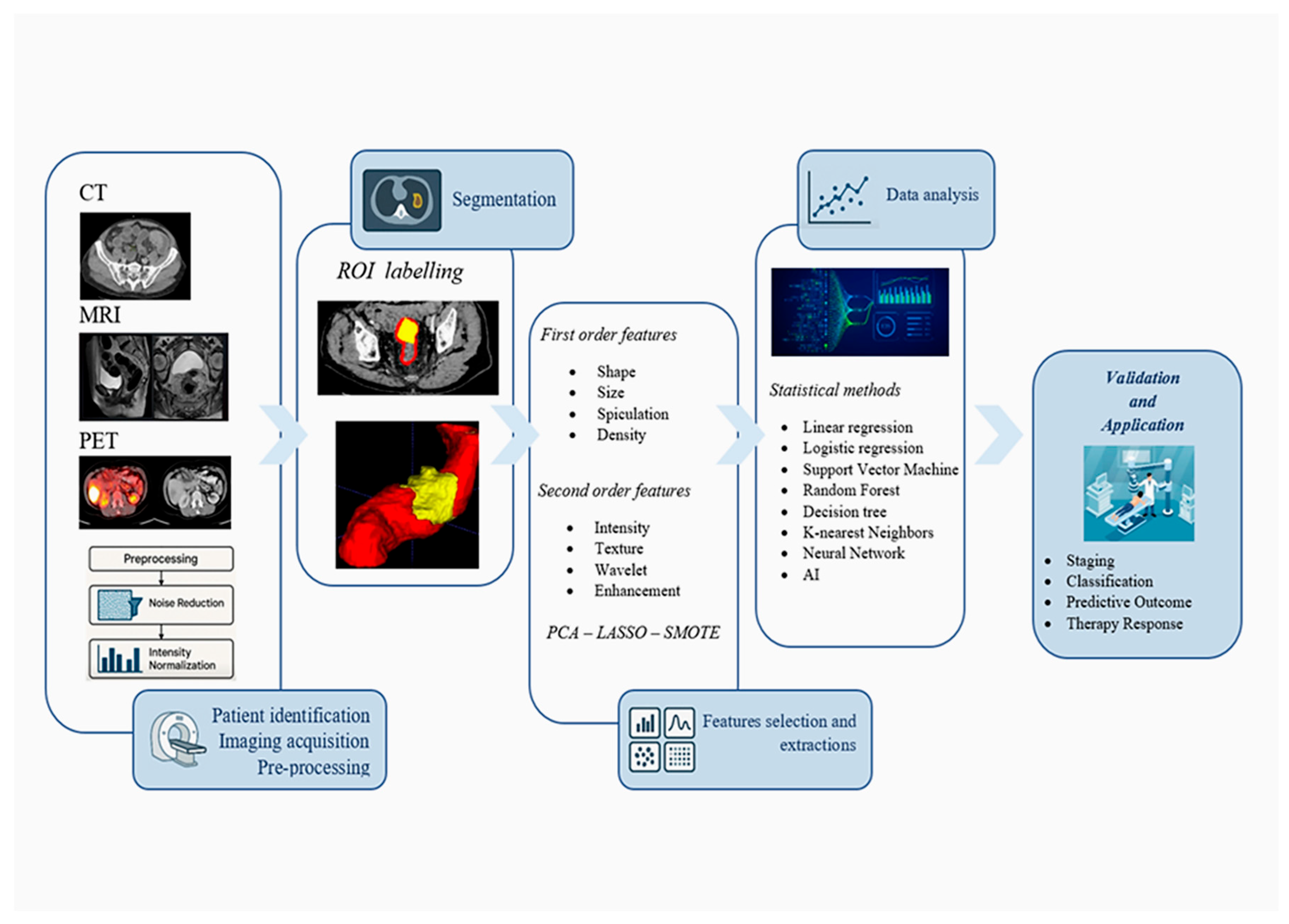
Figure 1. Workflow of the radiomics analysis process. Medical images (CT/MRI/PET) undergo pre-processing, followed by tumor segmentation and ROI labeling. First- and second-order radiomic features are extracted and selected using dimensionality-reduction methods. Statistical and AI-based models are then applied, and the resulting radiomic signatures are validated for staging, classification, outcome prediction, and therapy response.
Applsci 15 13174 g001
Figure 2. Challenges and opportunities in radiomics implementation. Main limitations and current challenges (red circles): heterogeneity of imaging protocols; need for large multicenter validations; limited interpretability of radiomic features; and integration with clinical workflow is still challenging. Future perspectives and areas of progress (green circles): integration with genomics and biomarkers; AI and deep learning models; personalized therapy planning; and real-time treatment monitoring (delta-radiomics).
Applsci 15 13174 g002
Table 1. Summary of key studies on the application of radiomics and artificial intelligence for predicting clinical outcomes in colorectal cancer.
Author/s and Year (Ref.)Clinical ApplicationImaging ModalityAI/Radiomics MethodologyMain Outcome (Metrics)
Liu Z, et al. (2017) [83]Prediction of pCR to nCRTMRI (T2WI + DWI)Radiomics model (LASSO + SVM + clinical)AUC = 0.98
(in the external validation cohort)
Cui Y, et al. (2019) [84]Prediction of pCR to nCRTMP-MRI
(T2w, cT1w, ADC)
Radiomics nomogram (LASSO + clinical)AUC = 0.966
(in the validation cohort)
Horvat N, et al. (2018) [68]Prediction of pCR to nCRTMRI (T2-weighted)Radiomics score (LASSO)AUC = 0.77
(in the external validation cohort)
Zhang YC, et al. (2022) [85]Differentiating tumor deposits (TDs) from lymph node metastasis (LNM)CTRadiomics signature from the largest peritumoral noduleAUC = 0.918
(in the validation cohort)
Shu Z, et al. (2022) [86]Prediction of extramural venous invasion (EMVI)MP-MRIJoint model (Bayes-based radiomics + clinical factors)AUC = 0.835
(in the test set)
Chen J, et al. (2021) [73]Prediction of Perineural Invasion (PNI)MRI (T2-weighted)Radiomics nomogram (mRMR & LASSO)AUC = 0.85
(in the test cohort)
Bae JS, et al. (2019) [72]Assessment of Extramural Venous Invasion (EMVI)MRI (T2-weighted)Radiomics assessment (ROC curve analysis)AUC = 0.829
(experienced radiologist)
Oh JE, et al. (2020) [79]Differentiation of KRAS mutation statusMRI (T2-weighted)Texture analysis (Decision tree model)AUC = 0.884
(on the whole dataset)
Meng X, et al. (2019) [77]Prediction of various biological characteristicsMP-MRIRadiomics signature (various selectors & classifiers)AUCs (validation): Differentiation = 0.720; Ki-67 = 0.699
KRAS = 0.651
Liu M, et al. (2020) [75]Prediction of synchronous liver metastasis (SLM)MRI (T2-weighted)Radiomics nomogram (LASSO + clinical factors)AUC = 0.944
(in the validation cohort)
Giannini V, et al. (2022) [81]Prediction of therapy response of liver metastases to FOLFOXCTDelta-radiomics signature (Decision tree)AUC = 0.93(in the validation cohort)
Shu Z, et al. (2019) [74]Prediction of synchronous liver metastasis (SLM)MRI (T2-weighted)Radiomics nomogram (feature selection with LASSO)AUC = 0.912
(in the validation cohort)
Dercle L, et al. (2020) [80]Prediction of therapy response to anti-EGFR treatmentCTDelta-radiomics signature (Random Forest)AUC = 0.80
(in the validation cohort)
Chuanji Z, et al. (2022) [87]Prediction of 3-year overall survival (OS)MRI (T2-weighted)Comprehensive nomogram (radiomics, morphological & clinical)C-index = 0.944
(in the validation cohort)
Abbreviations: pCR, Pathologic Complete Response; nCRT, neoadjuvant Chemoradiotherapy; MRI, Magnetic Resonance Imaging; T2WI, T2-weighted Imaging; DWI, Diffusion-weighted Imaging; MP-MRI, Multiparametric MRI; cT1w, contrast-enhanced T1-weighted; ADC, Apparent Diffusion Coefficient; CT, Computed Tomography; SVM, Support Vector Machine; LASSO, Least Absolute Shrinkage and Selection Operator; EMVI, Extramural Venous Invasion; PNI, Perineural Invasion; mRMR, Maximum Relevance Minimum Redundancy; TD, Tumor Deposits; LNM, Lymph Node Metastasis; KRAS, Kirsten Rat Sarcoma viral oncogene homolog; EGFR, Epidermal Growth Factor Receptor; FOLFOX, Folic acid + Fluorouracil + Oxaliplatin; OS, Overall Survival; C-index, Concordance Index.
Disclaimer/Publisher’s Note: The statements, opinions and data contained in all publications are solely those of the individual author(s) and contributor(s) and not of MDPI and/or the editor(s). MDPI and/or the editor(s) disclaim responsibility for any injury to people or property resulting from any ideas, methods, instructions or products referred to in the content.