1. Introduction
In modern communication and computing systems, maintaining efficient and reliable network connectivity is a critical design concern. Graph theory provides a powerful mathematical framework for modeling such network structures, where vertices represent devices and edges denote direct communication links. The existence of communication paths between vertices (nodes) reflects the overall performance and fault tolerance of the network. A Hamiltonian cycle, which visits every vertex exactly once and returns to the starting vertex, guarantees complete traversal and robust connectivity within the network. Owing to its theoretical importance and wide range of practical applications, the Hamiltonian cycle problem has long been recognized as a fundamental topic in graph theory and has attracted extensive research attention. Numerous studies have been conducted, for example, on the existence of Hamiltonian cycles in different graph structures [
1,
2,
3], on algorithms for their identification [
4,
5], and on various related extensions [
6,
7,
8].
When a graph contains faulty vertices or edges, the feasibility of finding a classical Hamiltonian cycle is immediately disrupted, as the graph is no longer fault-free. This introduces the concept of fault-tolerant Hamiltonicity, which fundamentally alters the research question. The problem shifts from merely establishing existence in a fault-free graph to determining the maximum number of faults that a network can sustain while still guaranteeing the existence of a Hamiltonian cycle in the remaining structure. Consequently, investigating fault-tolerant Hamiltonian cycles in graphs with faulty nodes or edges has become a critical and practically significant research topic [
9,
10,
11,
12]. Moreover, in many real-world applications, the directionality of edges carries specific meanings, leading to the study of directed Hamiltonian cycles [
13,
14,
15]. An even more intricate problem arises when both conditions are considered simultaneously—when certain vertices or edges may be faulty (i.e., unavailable) and traversal must also satisfy directional constraints. Such scenarios closely reflect practical situations in which network components fail or where directional communication restrictions exist.
In an undirected graph
G = (
V,
E), suppose the edge set
E is partitioned into
k subsets:
E1,
E2, …,
Eₖ. That is,
= {
E1,
E2, …,
Ek} is a partition of the edge set
E. For any cycle
C in
G, let
Ei(
C) =
E(
C) ∩
Ei. If ||
Ei(
C)| − |
Ej(
C)|| ≤ 1 for all 1 ≤
i <
j ≤
k, then
C is called a
dimension-balanced cycle (
DBC) with respect to
. If
C is also a Hamiltonian cycle, it is referred to as a
dimension-balanced Hamiltonian cycle (
DBH) [
16,
17]. In 3D imaging applications, applying the concept of dimension-balanced Hamiltonian cycle can improve the clarity of 3D reconstructions [
18,
19,
20]. Similarly, when network connections exhibit the properties of dimension-balance, communication efficiency is improved. Motivated by this observation, several papers have investigated Hamiltonian cycles and pancyclicity problems under dimensionality-balanced constraints [
21,
22,
23]. As discussed in the previous paragraph, both fault tolerance and directionality are crucial factors in realistic network environments. It is therefore natural to investigate how these two issues influence the existence of dimension-balanced Hamiltonian cycles. In other words, the challenges encountered in traditional Hamiltonian problems under faulty or directed conditions are also expected to arise in the dimension-balanced setting, making this topic particularly worthy of investigation. The central question addressed in this study is whether a dimension-balanced Hamiltonian cycle can still be constructed under these combined fault and direction constraints.
Formally, a
symmetric directed graph D is constructed from an undirected graph
G by replacing each undirected edge with a pair of directed edges in opposite directions. Accordingly, each edge subset
Ei is replaced by two sets
and
, representing edges in the positive and negative directions, respectively. Let
= {
,
,
,
, …,
,
}. For any dicycle
C in
D, let
, where
α ∈ {+, −} for any 1 ≤
i ≤
k. If
for all 1 ≤
i < j ≤
k and
α,
β ∈ {+, −}, then
C is called a
directed dimension-balanced cycle (DDBC) with respect to
. If
C is also a Hamiltonian cycle, it is called a
directed dimension-balanced Hamiltonian cycle (DDBH). The requirement for both directionality and dimension balancing in graph structures is primarily motivated by optimizing resource management and ensuring operational longevity in large-scale parallel computing networks that utilize torus-like topologies. Directionality is an inherent feature of the routing protocols in such networks. Dimension balancing is then critical to prevent network degradation and bottlenecks. In communication networks where physical links (edges) are finite resources, traversing a directed structure—such as a Hamiltonian cycle—that heavily favors one dimension over another leads to uneven wear and thermal stress on specific hardware components. More critically, this imbalance causes severe network congestion in the overutilized dimension, drastically limiting the system’s overall performance. Therefore, designing a highly regular, balanced, directed Hamiltonian cycle ensures uniform traffic distribution across all physical links, maximizing the network’s throughput and extending the operational lifespan of the hardware infrastructure. Following [
24], a graph
G is said to be
p-node q-edge dimension-balanced Hamiltonian (
p-node
q-edge DBH) if it has a DBH after removing any
p nodes and any
q edges. A graph
G is called
h-
fault dimension-balanced Hamiltonian (
h-
fault DBH for short) if it remains Hamiltonian after removing any
h nodes and/or edges.
The DBH problem has been extensively studied on the undirected toroidal mesh graph
Tm,n, with foundational work addressing the fault-free case in 2012 [
17] and later investigations covering the 1-fault scenario in 2025 [
24]. Concurrently, the directed version—the directed dimension-balanced Hamiltonian (DDBH) problem on
DTm,n —was studied under fault-free conditions [
25]. However, no prior work has successfully integrated both directionality and fault tolerance. Building upon these foundational results, this paper bridges that critical gap by pioneering the study of the
1-fault directed dimension-balanced Hamiltonian (1-fault DDBH) problem. Specifically, we examine the existence of a DDBH in
DTm,n when subjected to a single fault, encompassing either a faulty vertex
f or a faulty edge
e. The corresponding faulty graphs are denoted as
DTm,n −
f and
DTm,n −
e, respectively. The primary contributions of this study are structured as follows:
Pioneering the 1-Fault DDBH Problem: We formally establish and undertake the first comprehensive analysis of the One-Fault Directed Dimension-Balanced Hamiltonian (DDBH) problem on directed toroidal mesh graphs.
Existence Results for Vertex Faults: We successfully established constructive proofs showing that DTm,n is DDBH-tolerant under any single-fault vertex scenarios, ensuring the existence of an efficient, dimension-balanced route even after a single vertex failure when both m and n are odd (Theorem 6).
Major Limitations for Vertex Faults: Our results reveal a significant limitation regarding single-fault vertex tolerance. We demonstrate that the network is highly vulnerable, as DDBH does not exist when m and n are not both odd (Theorem 5), suggesting that vertex failure critically compromises connectivity in most cases.
Identification of Edge Fault Constraints: We identify a critical constraint related to the graph size, leading to the conjectured non-existence of DDBH when mn mod 8 = 0 (Conjecture 2) and resolving all cases when mn mod 8 ≠ 0 (Theorems 7 and 8).
An earlier version of this work was presented at a conference and is cited accordingly [
26]. The rest of this paper is organized as follows:
Section 2 presents the preliminaries,
Section 3 describes the main results, and
Section 4 concludes the paper.
2. Preliminaries
Given the complexity and specialized terminology used in graph construction and dimension-balanced routing, we provide a list of the key symbols and definitions used throughout this manuscript to enhance readability and clarity (
Table 1).
Let
Cn denote a cycle of
n vertices. The Cartesian product of
Cm and
Cn defines a graph
Tm,n, called the
toroidal mesh graph. The toroidal mesh graph is a widely used structure in practical applications. The symmetric directed graph of
Tm,n is the
directed toroidal mesh graph (also named
toroidal mesh digraph), denoted as
DTm,n. The vertex set of
DTm,n is defined as
V(DTm,n) =
V(Tm,n) = {(
x,
y) | 0 ≤
x ≤
m − 1; 0 ≤
y ≤
n − 1}, and its edge set is
E(
DTm,n) =
∪
∪
∪
, where
This study is based on the above edge partition
= {
,
,
,
}. It is essential to note that the resulting dimension-balancing criteria are fundamentally dependent on the chosen edge partition
, and any alternative partition would inherently lead to different research results.
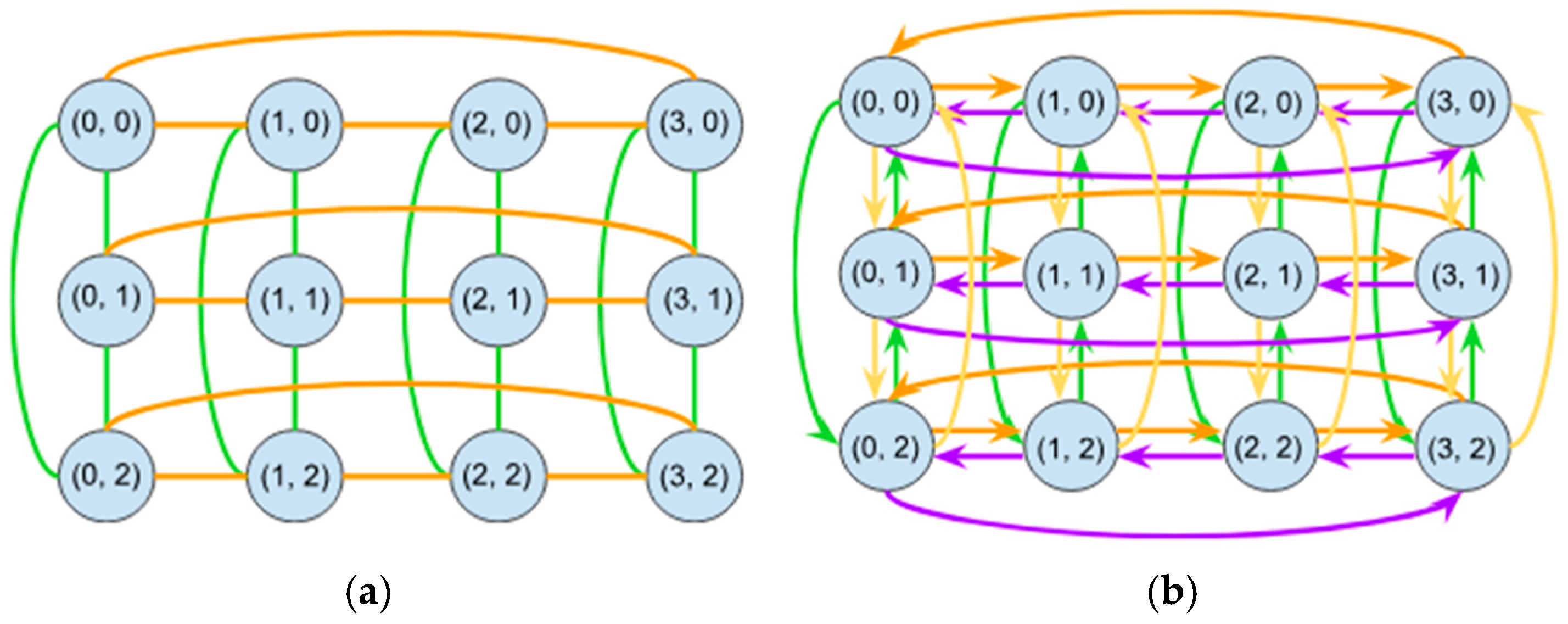
Figure 1a,b illustrates examples of the graphs
T4,3 and
DT4,3.
Based on a thorough review of previous literature, we identified several theorems and lemmas that can be leveraged to support our proofs regarding the existence of DDBHs. For all d ∈ {1, 2} and α ∈ {+, −}, if C is a dicycle (directed cycle) in DTm,n, then we define (C) = E(C) ∩ .
Theorem 1 ([
25])
. For m, n ≥ 6, and m, n mod 4 = 2, DTm,n has a DDBH with respect to . In Theorem 1, the specific condition that both m and n must be congruent to 2 modulo 4 arises from essential parity constraints required for the constructive proof of the DDBH. For even dimensions m and n, this condition isolates the critical case where the total number of vertices, mn, satisfies mn mod 8 = 4.
Theorem 2 ([
25])
. When both m and n are odd, DTm,n has no DDBH with respect to . Next, we utilize the foundational result concerning the balancing property of any directed dimension-balanced cycle (DDBC) in the toroidal mesh:
Theorem 3 ([
25])
. For any DDBC C on DTm,n with respect to , || = ||, for i {1, 2}. Theorem 3 has an implicit meaning, which is crucial to our proof of non-existence. This theorem implies a strict parity constraint: since the total number of edges in the cycle is |E(C)| = |(C)| + |(C)| + |(C)| + |(C)| = 2|(C)| + 2|(C)| if C is a DDBC on DTm,n with respect to . That is, the length of any DDBC C must necessarily be an even number. This independently established structural property is essential for demonstrating the contradictions presented in our non-existence theorems (e.g., Theorems 5 and 7), where we show that this required even length clashes with the fixed odd length imposed by the Hamiltonian requirement.
Theorem 4 ([
25])
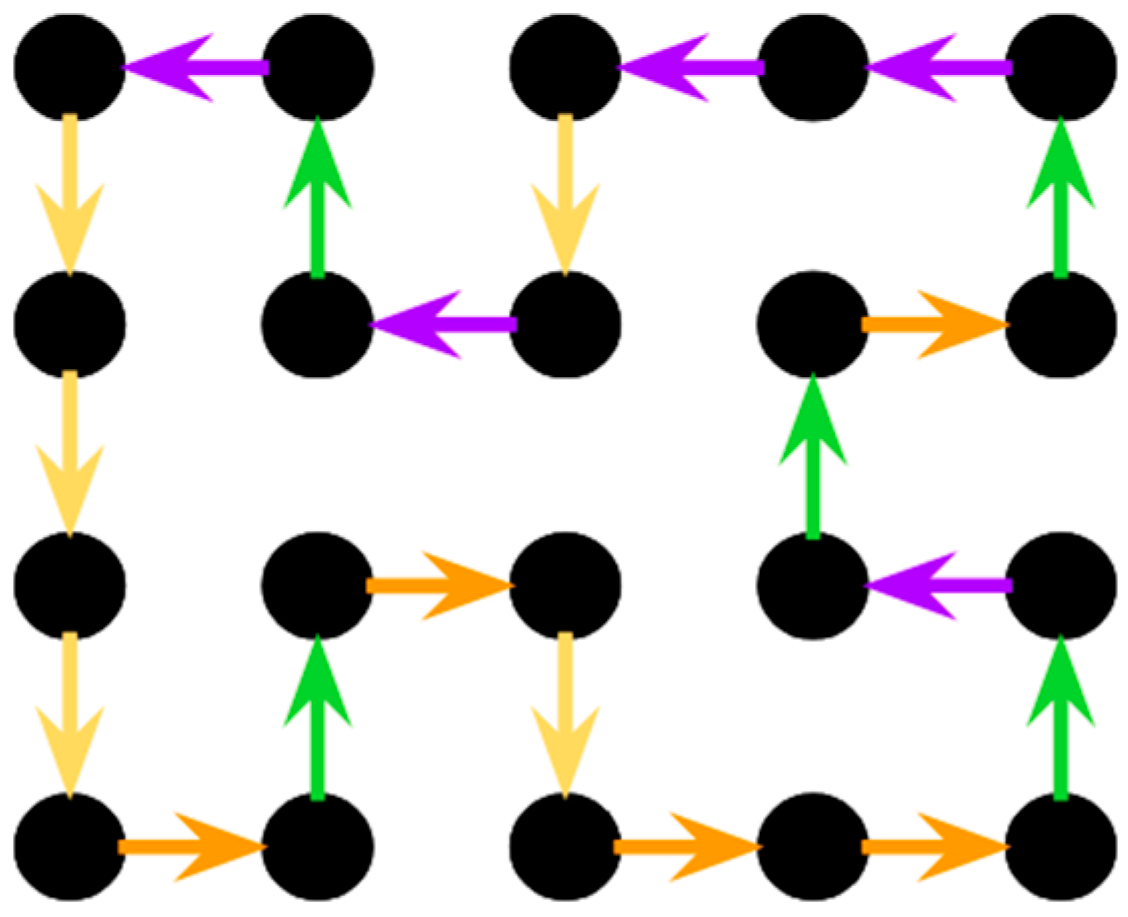
. When m and n ≥ 4, DTm,n has a DDBH with respect to for one of m, n is even, the other is odd, except that the even number is a multiple of 8. Figure 2 shows an example of Theorem 4: a DDBH on
DT4,5, where |
(
C)| = |
(
C)| = |
(
C)| = |
(
C)| = 5.
3. Materials and Methods
We classify the investigation into two major cases based on the type of fault—either a faulty vertex or a faulty edge. Each major case is further divided into three subcases according to the parity of m and n.
For Case 1: There exists a single faulty vertex
f in the graph. We subdivide this case into three subcases: Case 1.1: both
m and
n are even; Case 1.2: one of
m and
n is even, the other odd; Case 1.3: both
m and
n are odd. For Cases 1.1 and 1.2, Theorem 3 helps us to confirm the non-existence of a DDBH as in Theorem 5. In Case 1.3, the scenario is further classified into ten subcases as shown in
Table 1 and illustrated in
Figure 3,
Figure 4,
Figure 5,
Figure 6,
Figure 7,
Figure 8,
Figure 9,
Figure 10,
Figure 11 and
Figure 12. From these constructions, we derive Theorem 6.
Theorem 5. If m × n is even, then the digraph DTm,n with a single faulty vertex f (i.e., DTm,n − f) does not contain a DD BH with respect to .
Proof. If there exists a DDBH C in DTm,n − f with respect to , then by Theorem 3, we have || = || for i {1, 2}. This implies that |E(C)| = |(C)| + |(C)| + |(C)| + |(C)| = 2|(C)| + 2|(C)|, which is even. However, this contradicts the fact that mn − 1 is odd when one of mn is even. □
Note that a vertex-transitive graph (also known as a node-symmetric graph) is one in which every pair of vertices is equivalent under some automorphism of the graph. It is straightforward to verify that the directed toroidal mesh DTm,n is a vertex-transitive graph. Therefore, without loss of generality, we may assume that the faulty node f is the red node in the following theorem.
Theorem 6. If m × n is odd, then DTm,n − f for any faulty node f, has a DDBH with respect to .
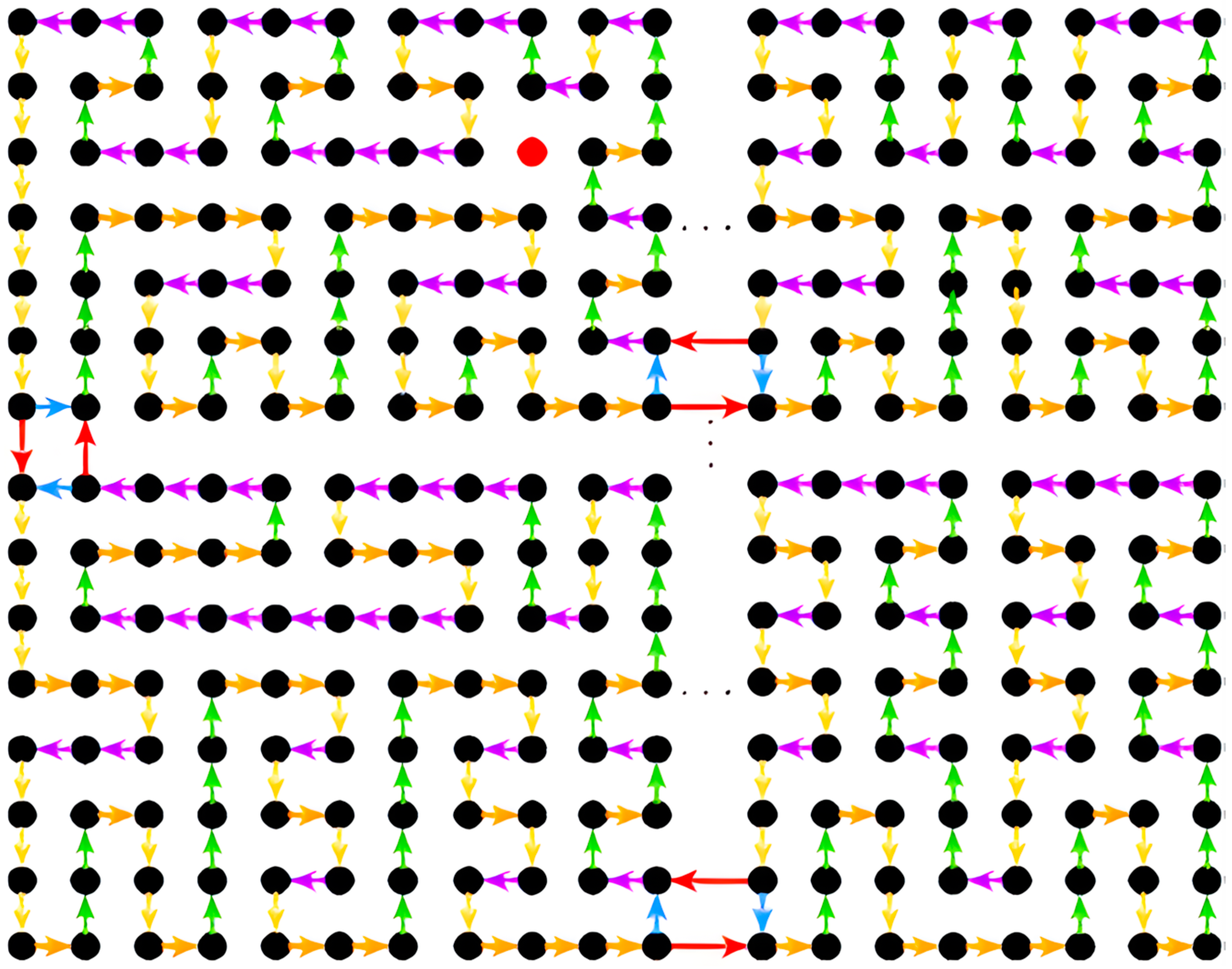
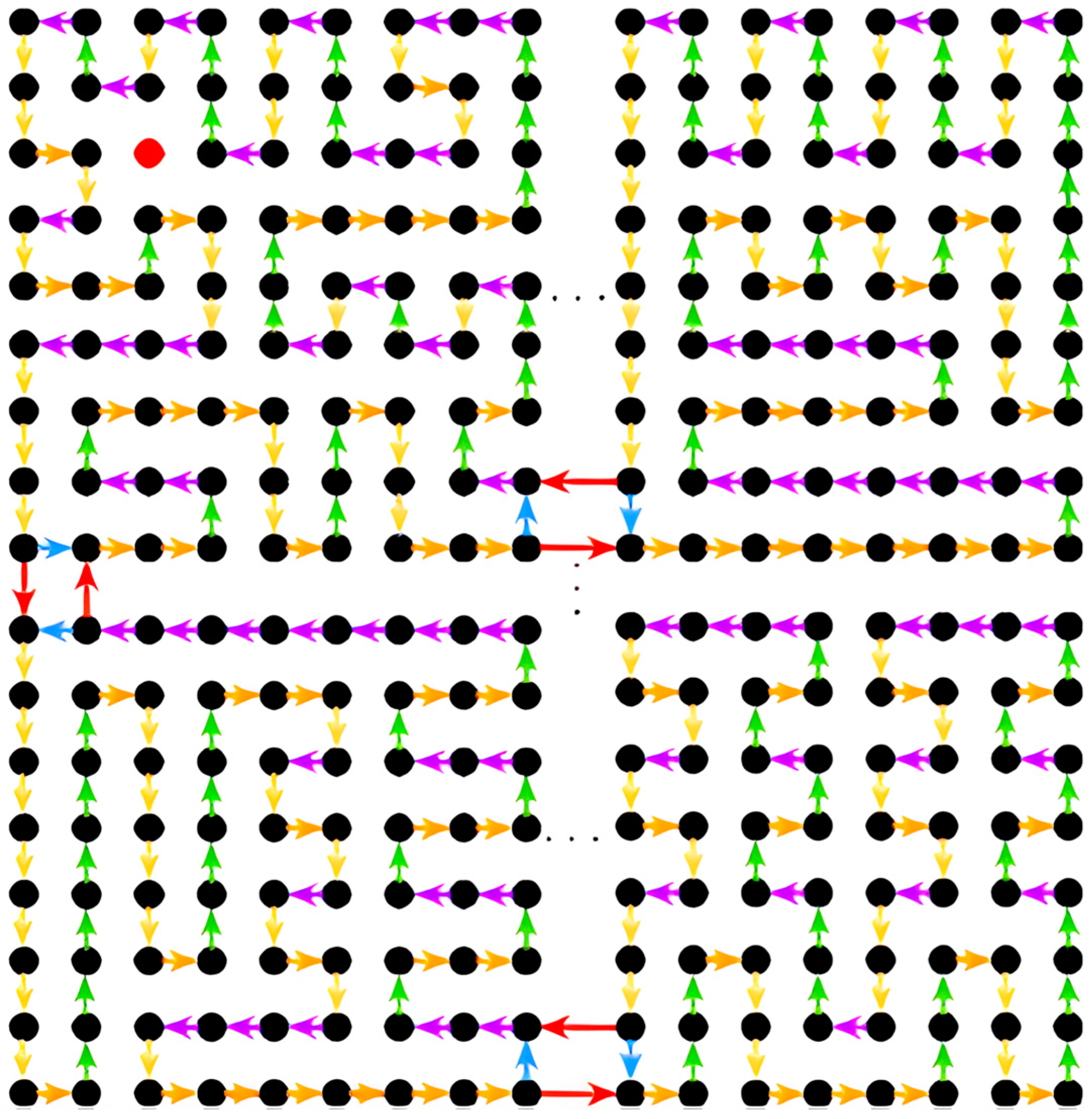
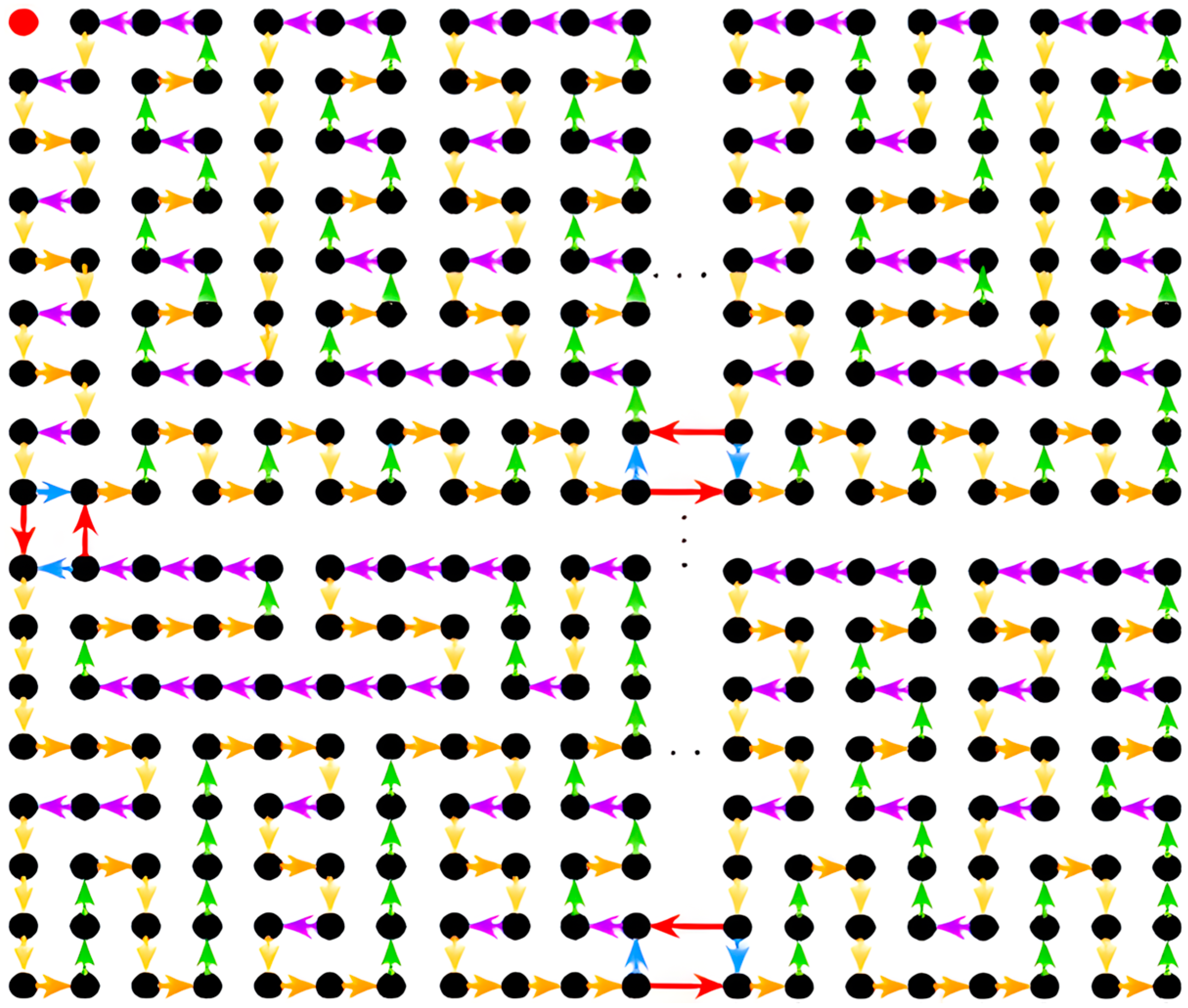
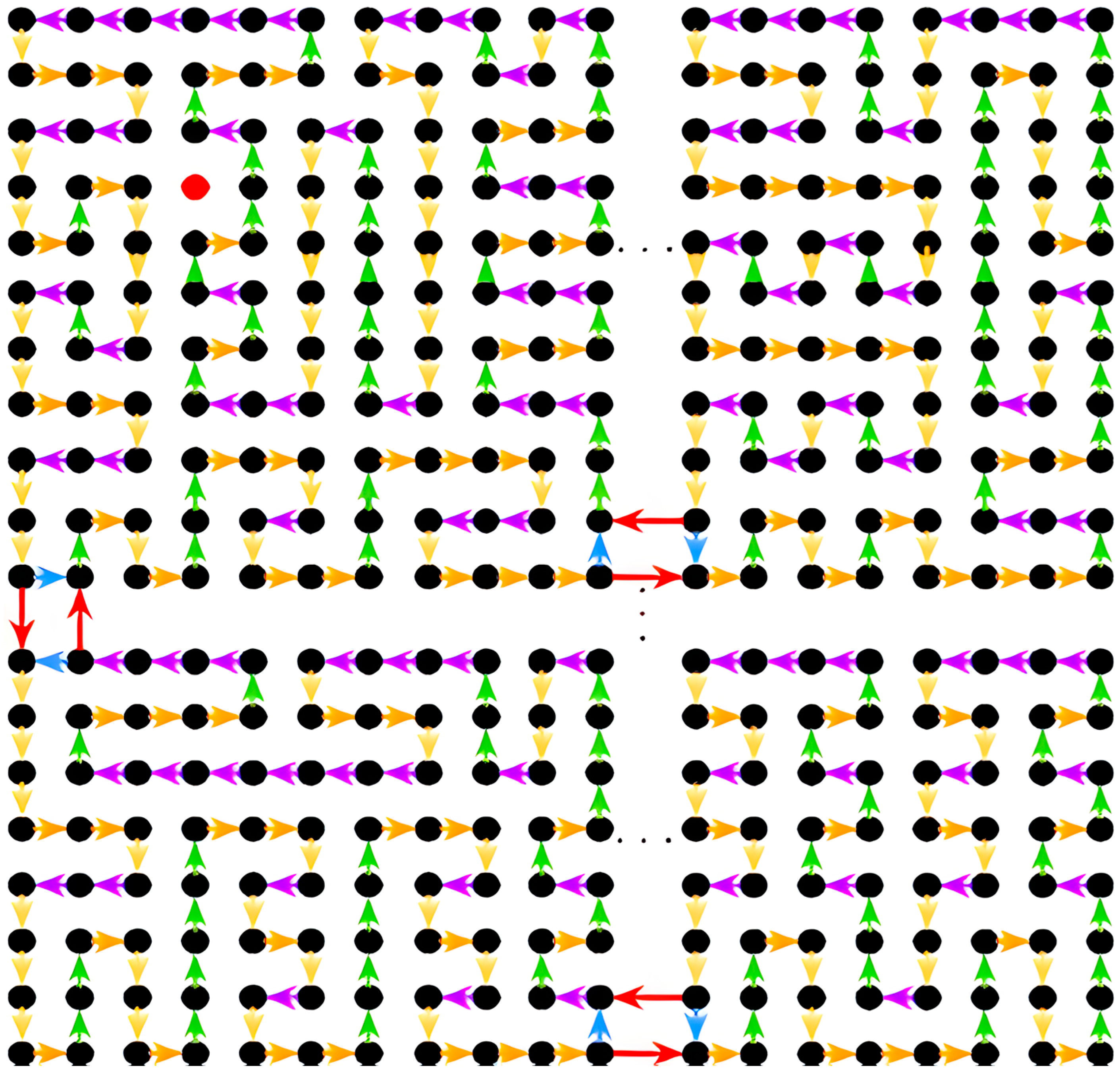
Proof. When m × n is odd, it means that both m and n are odd. We prove this theorem by considering ten different cases. The sets (C), (C), (C), (C) are represented using orange, purple, yellow, and green edges, respectively, in the following figures. Arrows are added to facilitate readability. Our construction methodology, applicable across all ten cases, follows a uniform decomposition and merging principle. The target faulty graph DTm,n − f is structurally partitioned into a base graph (DTm′,n′ − f) in the upper-left region, which contains the single faulty element, and three types of Auxiliary Graphs (DT8,n′, DTm′,8, and DT8,8) filling the remaining area. While we ensure the base graph contains a DDBH cycle, the Auxiliary Graphs each contain a directed Hamiltonian cycle (DHC). These DDBH and DHC components are then merged together by systematically removing specific existing edges and adding corresponding new edges (as detailed in the subsequent cases). The generic procedure for this cycle merging operation is formalized after the complete proof of this theorem. This merging operation guarantees that the resulting final cycle C is a single, continuous Hamiltonian dicycle covering all mn − 1 vertices while preserving the critical dimension-balanced property. □
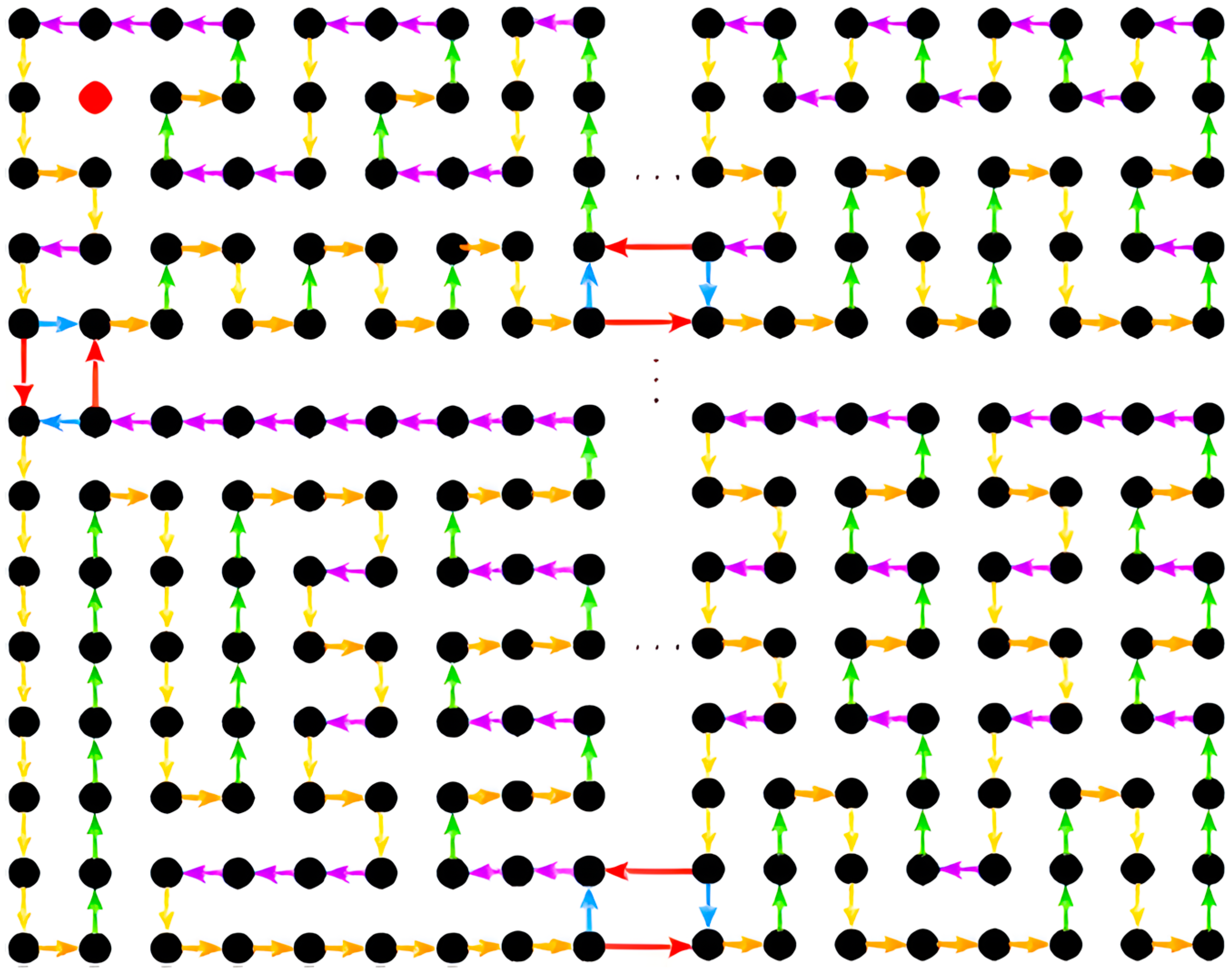
Case (a): When
m = 5 + 8
p and
n = 5 + 8
q,
Figure 3 illustrates how to construct a DDBH on
DT5+8p,5+8q −
f by combining the following components: a DDBH on
DT5,5 −
f (upper-left region),
p directed Hamiltonian cycles (DHCs) on
DT8,5 (upper-right region),
q DHCs on
DT5,8 (lower-left region), and
pq DHCs on
DT8,8 (lower-right region).
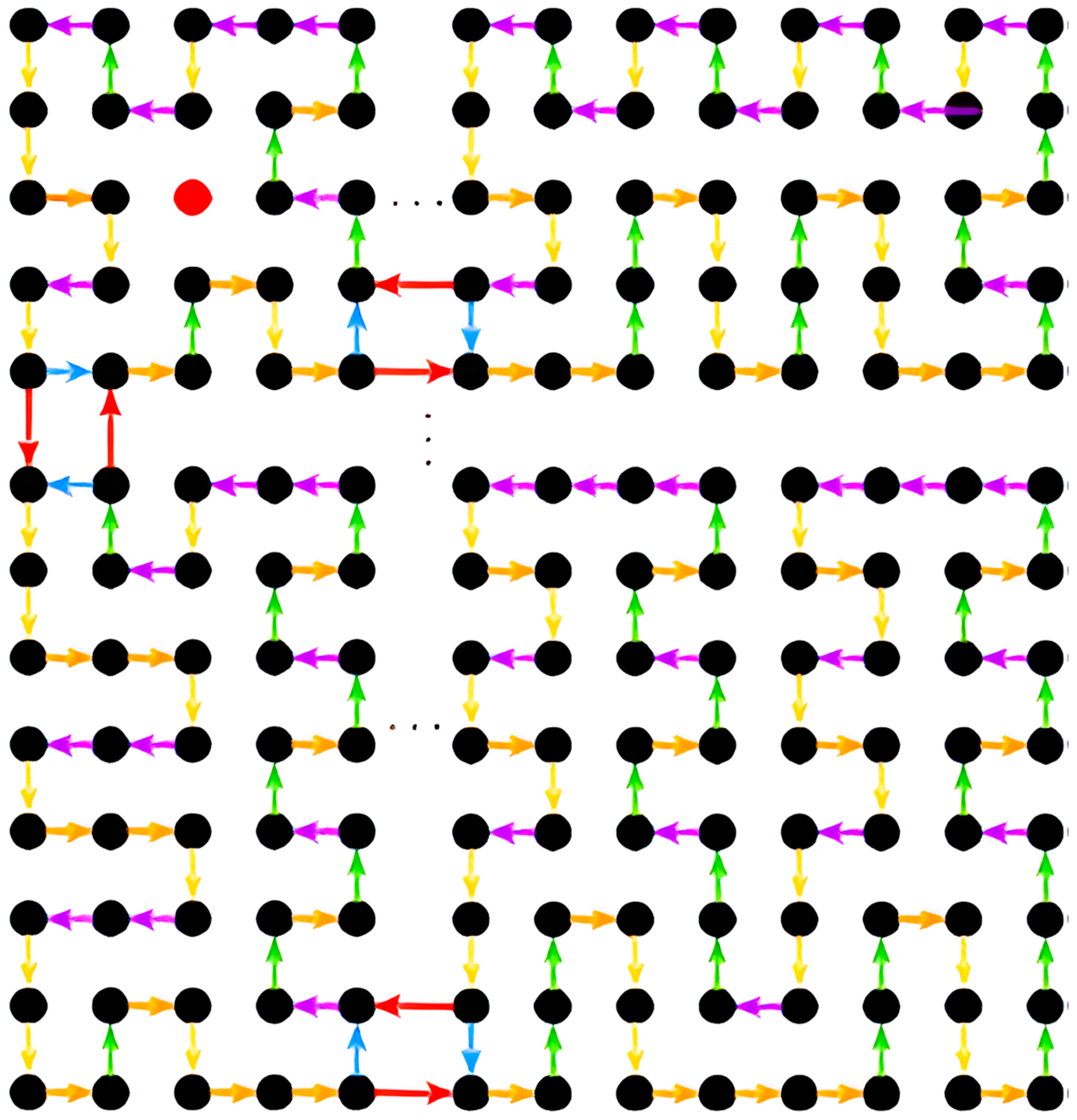
Figure 3.
A visualization of a DDBH in DT5+8p,5+8q − f.
Figure 3.
A visualization of a DDBH in DT5+8p,5+8q − f.
For all subsequent illustrations (
Figure 3,
Figure 4,
Figure 5,
Figure 6,
Figure 7,
Figure 8,
Figure 9,
Figure 10,
Figure 11 and
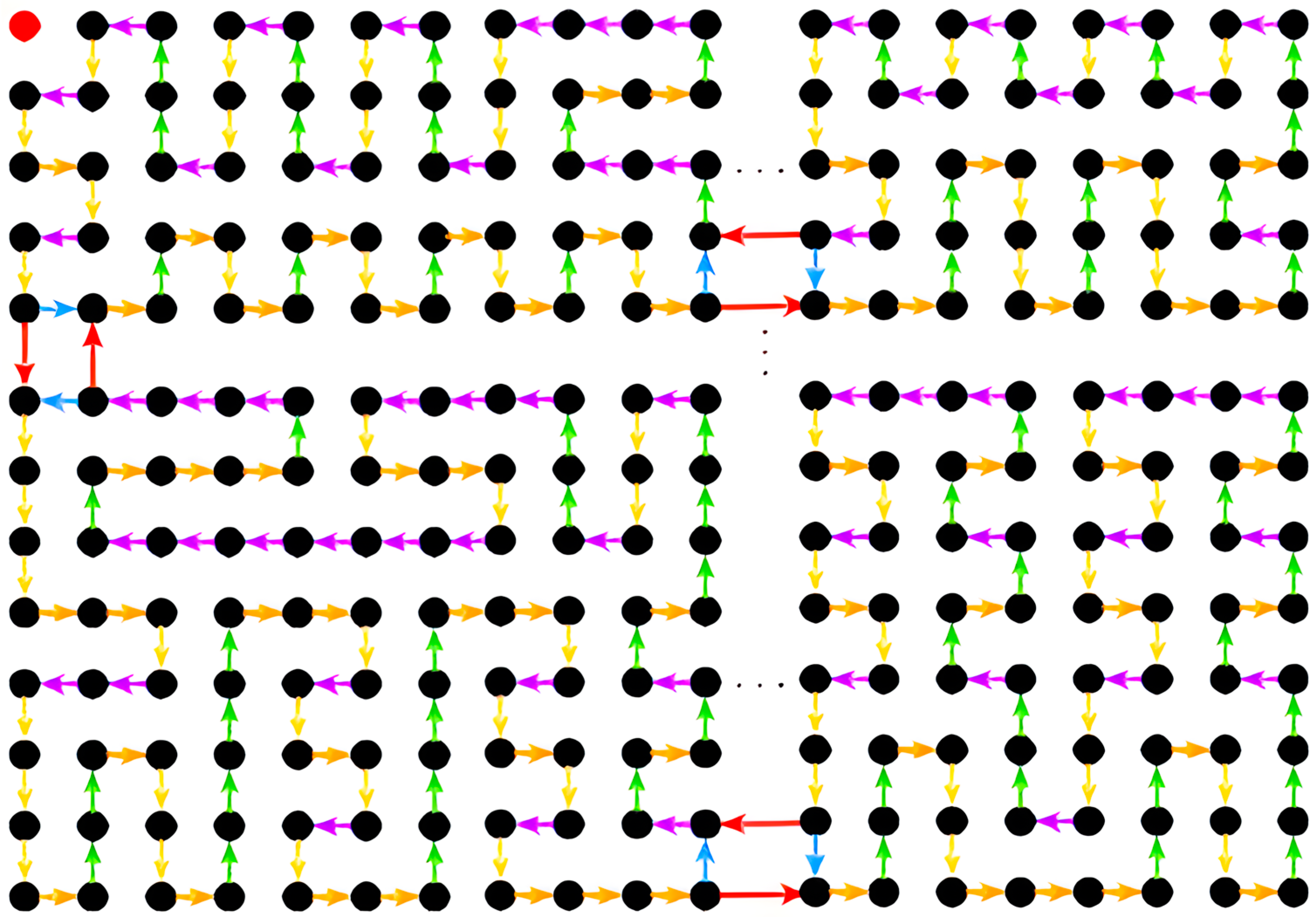
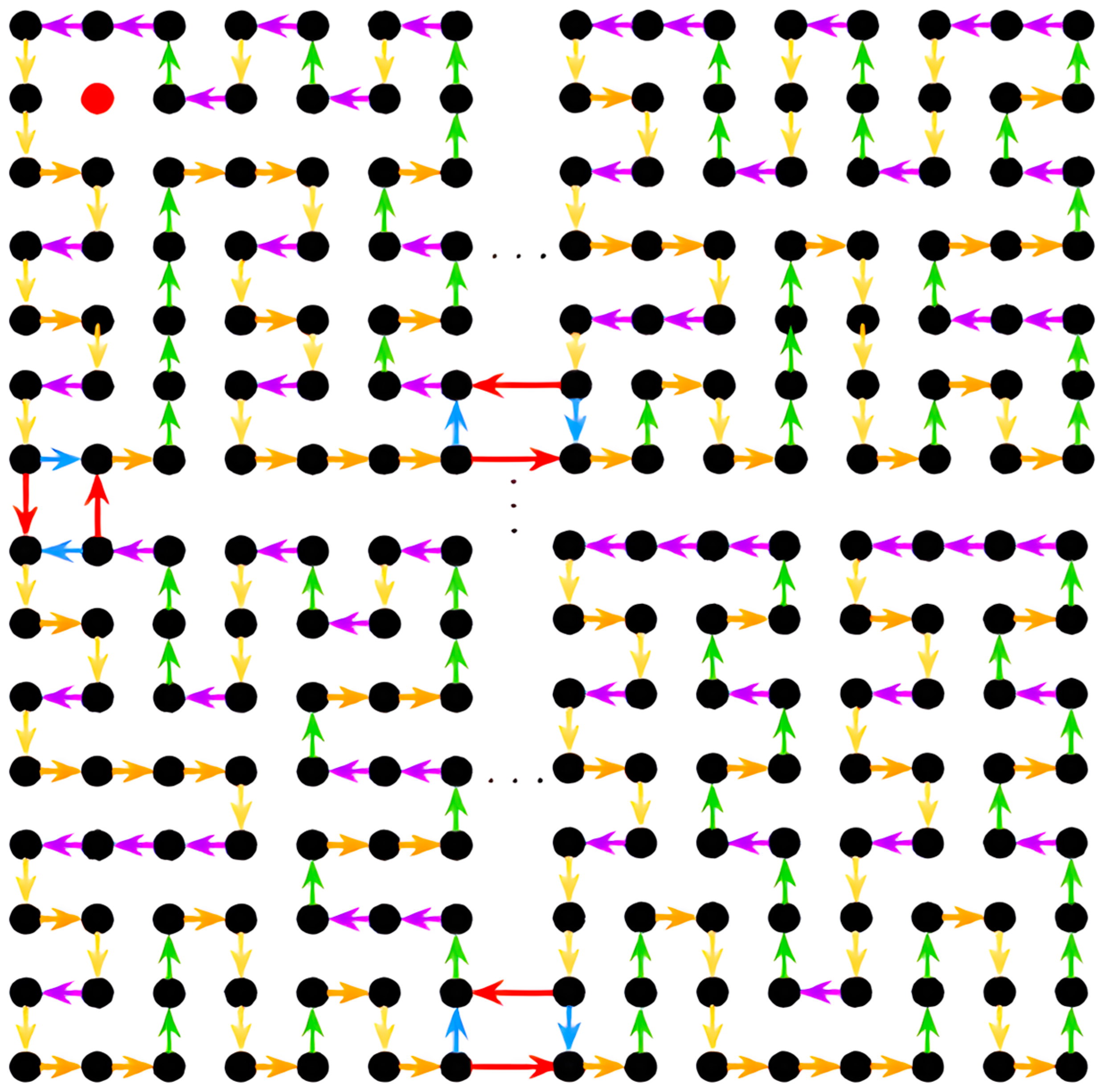
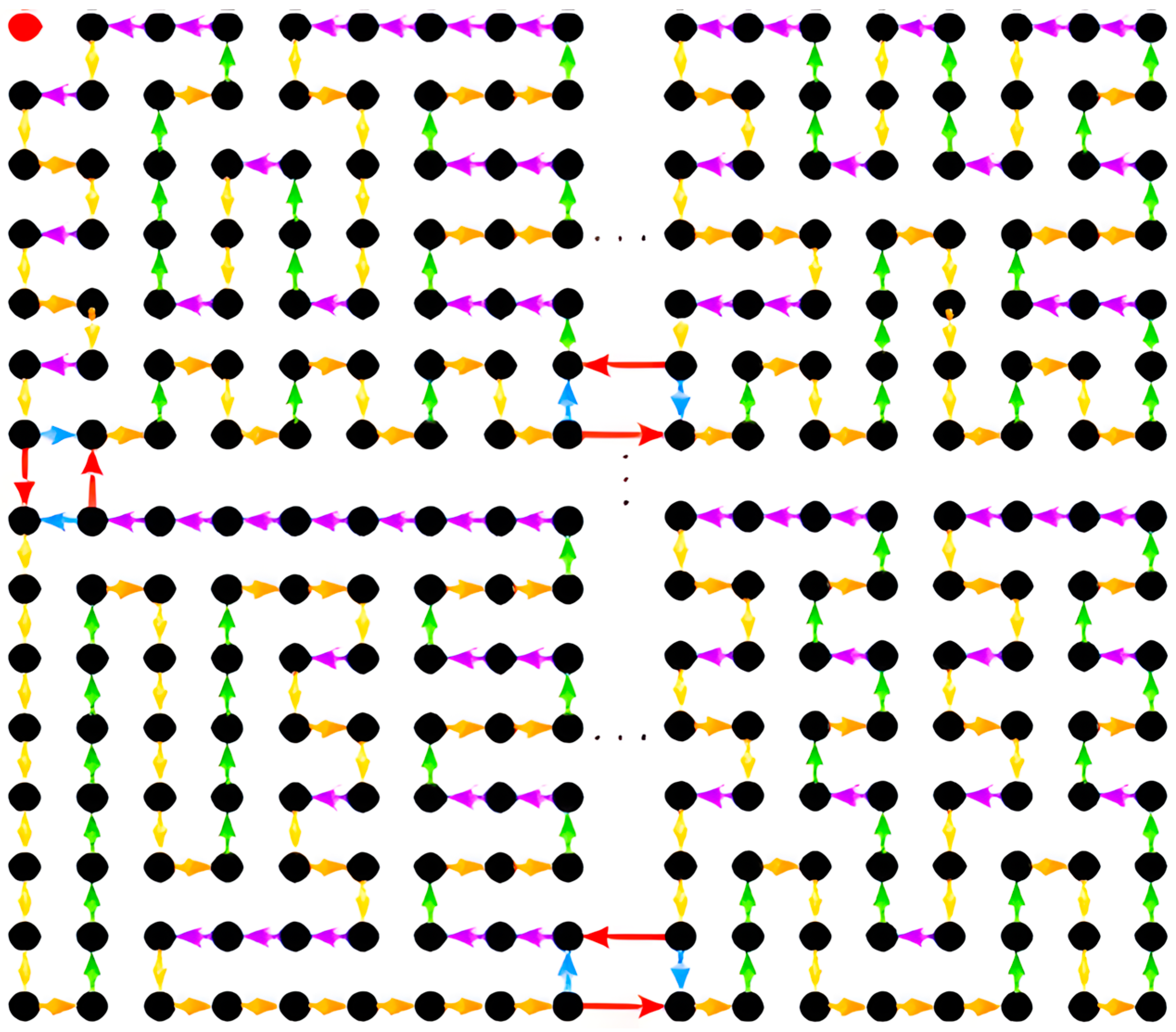
Figure 12), the edge colors indicate direction and modification status as we mentioned above: orange (right), purple (left), green (up), and yellow (down) denote the four directional edges. Additionally, blue edges are those deleted for connecting the directed Hamiltonian cycles, while red edges are those newly added. The integration is visually demonstrated by the edge modifications: the blue edges represent the deleted edges between the internal directed Hamiltonian cycles (DHCs), while the red edges show the newly added edges that successfully connect these cycles into a single, comprehensive DDBH.
Place the
p DHCs of
DT8,5 to the right of the DDBH on
DT5,5 −
f. Remove the set of edges {(4 + 8
x, 4)(4 + 8
x, 3), (5 + 8
x, 3)(5 + 8
x, 4) | 0 ≤
x <
p} and add the set of edges {(5 + 8
x, 3)(4 + 8
x, 3), (4 + 8
x, 4)(5 + 8
x, 4) | 0 ≤
x <
p}. This results in a dicycle
C1 in
DT5+8p,5 (see the upper part of
Figure 3), where |
(
C1)| = |
(
C1)| = |
(
C1)| = |
(
C1)| = 6 + 10
p.
Similarly, place the
p DHCs of
DT8,8 to the right of the constructed DHC of
DT5,8. Remove the edge set {(4 + 8
x, 7)(4 + 8
x, 6), (5 + 8
x, 6)(5 + 8
x, 7) | 0 ≤
x <
p} and add the edge set {(5 + 8
x, 6)(4 + 8
x, 6), (4 + 8
x, 7)(5 + 8
x, 7) | 0 ≤
x <
p}. This result is a dicycle
C2 in
DT5+8p,8 (see the lower part of
Figure 3). The resulting values for
C2 are ||
(
C2)| = |
(
C2)| = 11 + 16
p, |
(
C2)| = |
(
C2)| = 9 + 16
p.
Now, place q copies of C2 below C1. Remove the edge set {(0, 4 + 8y)(1, 4 + 8y), (1, 5 + 8y)(0, 5 + 8y) | 0 ≤ y < q} and connect the edges {(0, 4 + 8y)(0, 5 + 8y), (1, 5 + 8y)(1, 4 + 8y) | 0 ≤ y < q}. This results in a dicycle C3 in DT5+8p,5+8q, where |(C3)| = |(C3)| = |(C3)| = |(C3)| = 6 + 10p + 10q + 16pq. Therefore, C3 is a DDBH on DT5+8p,5+8q − f.
Case (b): When
m = 7 + 8
p,
n = 5 + 8
q, we apply a similar construction as in Case (a) to build a DDBH on
DT7+8p,5+8q −
f.
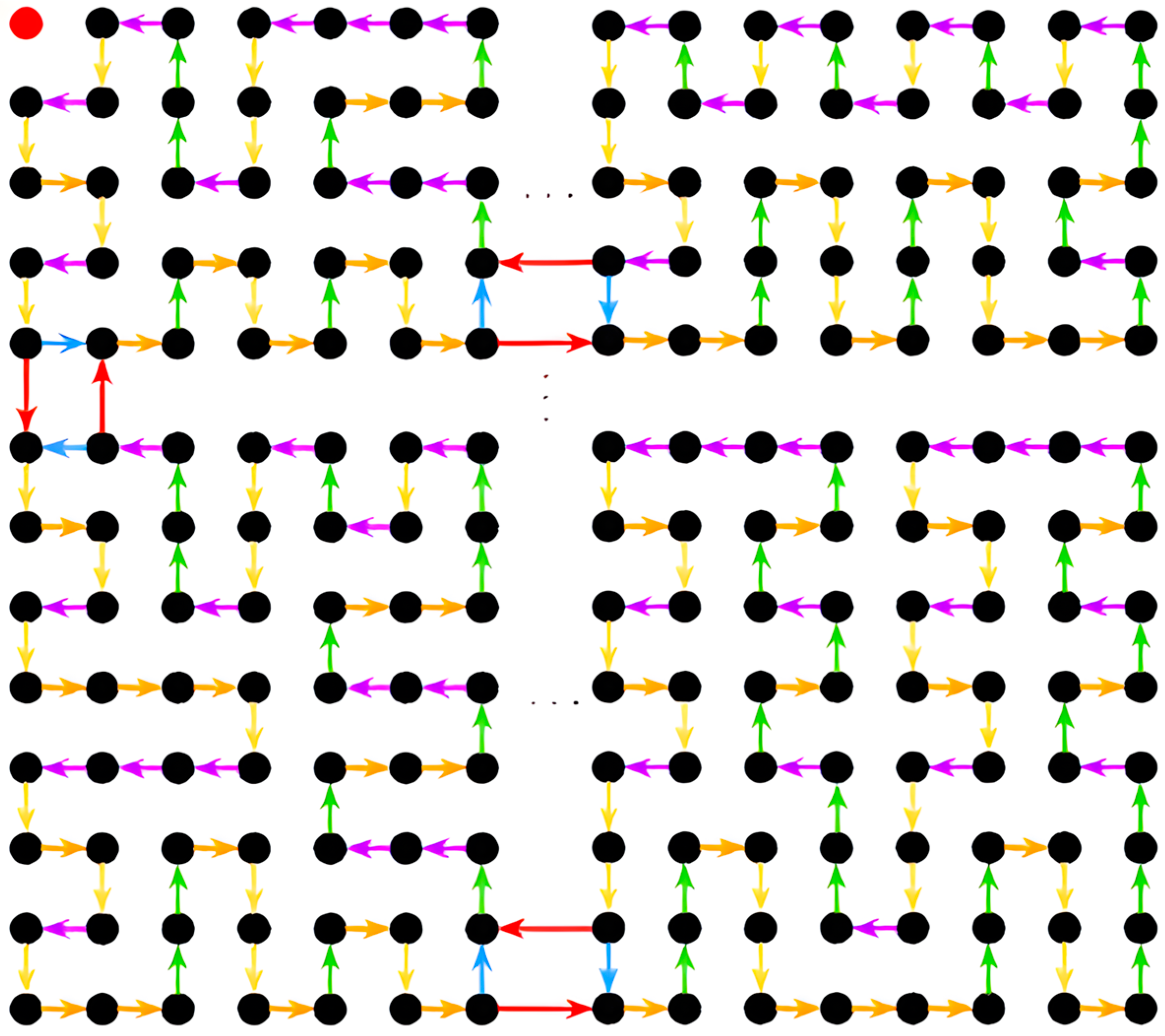
Figure 4 illustrates how the DDBH is constructed from a DBH on
DT7,5 −
f (upper-left region),
p DHCs on
DT8,5 (upper-right region),
q DHCs on
DT7,8 (lower-left region), and
pq DHCs on
DT8,8 (lower-right region). After combining those DHCs (by removing the set of edges {(6 + 8
x, 4)(6 + 8
x, 3), (7 + 8
x, 3)(7 + 8
x, 4) | 0 ≤
x <
p}, {(6 + 8
x, 12 + 8
y)(6 + 8
x, 11 + 8
y), (7 + 8
x, 11 + 8
y)(7 + 8
x, 12 + 8
y) | 0 ≤
x <
p, 0 ≤
y < q}, {(0, 4 + 8
y)(1, 4 + 8
y), (1, 5 + 8
y)(0, 5 + 8
y) | 0 ≤
y <
q} and adding the set of edges {(7 + 8
x, 3)(6 + 8
x, 3), (6 + 8
x, 4)(7 + 8
x, 4) | 0 ≤
x <
p}, {(7 + 8
x, 11 + 8
y)(6 + 8
x, 11 + 8
y), (6 + 8
x, 12 + 8
y)(7 + 8
x, 12 + 8
y) | 0 ≤
x <
p, 0 ≤
y <
q}, {(0, 4 + 8
y)(0, 5 + 8
y), (1, 5 + 8
y)(1, 4 + 8
y) | 0 ≤
x <
y}), a Hamiltonian dicycle
C on
DT7+8p,5+8q −
f is formed. We obtain |
(
C)| = |
(
C)| = 9 + 10
p +
q(15 + 16
p − 1) = 9 + 10
p + 14
q + 16
pq, |
(
C)| = |
(
C)| = 8 + 10
p +
q(13 + 16
p + 1) = 8 + 10
p + 14
q + 16
pq. Since
for all
α,
β ∈ {+, −}, the dicycle
C is a DDBH on
DT7+8p,5+8q −
f. Due to the symmetry of
DTm,n, interchanging
m and
n yields a DDBH on
DT5+8p,7+8q −
f. This symmetric property applies to all subsequent cases where
m ≠
n.
Note that the selection of the dimensions (
m′,
n′) of the “base graph”, as seen in
Figure 4 and
Figure 5, follows a general rule that is foundational to our constructive proof. For any general case
DTm,n, the base graph is chosen such that
m′ =
m mod 8 and
n′ =
n mod 8. This precise matching of the modulo 8 characteristics is essential, as it allows the overall graph
DTm,n to be uniquely decomposed into the base graph plus the auxiliary
DT8,n′,
DTm′,8 and
DT8,8 graphs, thereby enabling the proof by construction across all subsequent cases.
Figure 4.
A visualization of a DDBH in DT7+8p,5+8q − f.
Figure 4.
A visualization of a DDBH in DT7+8p,5+8q − f.
Case (c): When
m = 9 + 8
p,
n = 5 + 8
q, we apply a similar construction as in Case (a) to build a DDBH on
DT9+8p,5+8q −
f.
Figure 5 illustrates how the DDBH is constructed from the DDBH on
DT9,5 −
f (upper-left region),
p DHCs on
DT8,5 (upper-right region),
q DHCs on
DT9,8 (lower-left region), and
pq DHCs on
DT8,8 (lower-right region). After combining those DHCs, a Hamiltonian dicycle
C on
DT9+8p,5+8q −
f is formed. |
(
C)| = |
(
C)| = |
(
C)| = |
(
C)| = 11 + 10
p + 18
q + 16
pq. Therefore, the dicycle
C is a DDBH on
DT9+8p,5+8q −
f.
Figure 5.
A visualization of a DDBH in DT9+8p,5+8q − f.
Figure 5.
A visualization of a DDBH in DT9+8p,5+8q − f.
Case (d): When
m = 11 + 8
p,
n = 5 + 8
q, we apply a similar construction as in Case (a) to build a DDBH on
DT11+8p,5+8q −
f.
Figure 6 illustrates how the DDBH is constructed as in previous cases. After computing, we obtain: |
(
C)| = |
(
C)| = 13 + 10
p + 22
q + 16
pq, |
(
C)| = |
(
C)| = 14 + 10
p + 22
q + 16
pq. Since
for all
α,
β ∈ {+, −}, the dicycle
C is a DDBH on
DT11+8p,5+8q −
f.
Figure 6.
A visualization of a DDBH in DT11+8p,5+8q − f.
Figure 6.
A visualization of a DDBH in DT11+8p,5+8q − f.
Case (e): When
m = 7 + 8
p,
n = 7 + 8
q, we apply a similar construction as in Case (a) to build a DDBH on
DT7+8p,7+8q −
f.
Figure 7 illustrates how the DDBH is constructed. After computing, we obtain: |
(
C)| = |
(
C)| = |
(
C)| = |
(
C)| = 12 + 14
p + 14
q + 16
pq. Therefore, the constructed DHC
C is a DDBH on
DT7+8p,7+8q −
f.
Figure 7.
A visualization of a DDBH in DT7+8p,7+8q − f.
Figure 7.
A visualization of a DDBH in DT7+8p,7+8q − f.
Case (f): When
m = 9 + 8
p,
n = 7 + 8
q, we apply a similar construction as in Case (a) to build a DDBH on
DT9+8p,7+8q −
f.
Figure 8 illustrates how the DDBH is constructed. After computing: |
(
C)| = |
(
C)| = 16 + 14
p + 18
q + 16
pq, |
(
C)| = |
(
C)| = 15 + 14
p + 18
q + 16
pq. The constructed dicycle
C is a DDBH on
DT9+8p,7+8q −
f, since
for all
α,
β ∈ {+, −}.
Figure 8.
A visualization of a DDBH in DT9+8p,7+8q − f.
Figure 8.
A visualization of a DDBH in DT9+8p,7+8q − f.
Case (g): When
m = 11 + 8
p,
n = 7 + 8
q, we apply a similar construction as in Case (a) to build a DDBH on
DT11+8p,7+8q −
f.
Figure 9 illustrates how the DDBH is constructed. After computing, we obtain: |
(
C)| = |
(
C)| = |
(
C)| = |
(
C)| = 19 + 14
p + 22
q + 16
pq. Therefore, the constructed dicycle
C is a DDBH on
DT11+8p,7+8q −
f.
Figure 9.
A visualization of a DDBH in DT11+8p,7+8q − f.
Figure 9.
A visualization of a DDBH in DT11+8p,7+8q − f.
Case (h): When
m = 9 + 8
p,
n = 9 + 8
q, we apply a similar construction as in Case (a) to build a DDBH on
DT9+8p,9+8q −
f.
Figure 10 illustrates how the DDBH is constructed, and we have |
(
C)| = |
(
C)| = |
(
C)| = |
(
C)| = 20 + 18
p + 18
q + 16
pq. So, the constructed dicycle
C is a DDBH on
DT9+8p,9+8q −
f.
Figure 10.
A visualization of a DDBH in DT9+8p,9+8q − f.
Figure 10.
A visualization of a DDBH in DT9+8p,9+8q − f.
Case (i): When
m = 11 + 8
p,
n = 9 + 8
q, we apply a similar construction as in Case (a) to build a DDBH on
DT11+8p,9+8q −
f.
Figure 11 illustrates how the DDBH is constructed, and we obtain: |
(
C)| = |
(
C)| = 25 + 18
p + 22
q + 16
pq, |
(
C)| = |
(
C)| = 24 + 18
p + 22
q + 16
pq. Since
for all
α,
β ∈ {+, −}, the dicycle
C is a DDBH on
DT11+8p,9+8q −
f.
Figure 11.
A visualization of a DDBH in DT11+8p,9+8q − f.
Figure 11.
A visualization of a DDBH in DT11+8p,9+8q − f.
Case (j): When
m = 11 + 8
p,
n = 11 + 8
q, we apply a similar construction as in Case (a) to build a DDBH on
DT11+8p,11+8q −
f.
Figure 12 illustrates how the DDBH is constructed, and we obtain: |
(
C)| = |
(
C)| = |
(
C)| = |
(
C)| = 30 + 22
p + 22
q + 16
pq. So, the constructed dicycle
C is a DDBH on
DT11+8p,11+8q −
f.
Figure 12.
A visualization of a DDBH in DT11+8p,11+8q − f.
Figure 12.
A visualization of a DDBH in DT11+8p,11+8q − f.
Note that in the figures illustrating the construction (
Figure 3 through
Figure 12), if the ellipses (“...”) shown in the figures are removed, the resulting diagrams illustrate the construction for the specific case where
p =
q = 1. For example, when removing those three black ellipses,
Figure 3 is a visualization of a DDBH in
DT13,13.
The existence proofs rely on a robust, systematic procedure for integrating the individual cycle components into a final, single DDBH cycle spanning the entire faulty graph DTm,n − f. This formal procedure leverages the dimension-balanced property (|(C)| = |(C)| = |(C)| = |(C)|) and is applicable across all ten cases demonstrated in the proof of Theorem 6.
Procedure Construction Outline
- Step 1.
Initialization: The graph DTm,n − f is structurally decomposed into the base graph (DTm′,n′ − f) containing the DDBH cycle CBase and multiple Auxiliary Graphs (containing DHCs CAux). Initialize the resulting cycle C as CBase.
- Step 2.
Boundary Identification: For each boundary separating two adjacent graphs (Gi and Gj), identify the specific boundary edges required for merging. These typically include an existing edge eremove in Ci (and Cj) and the necessary replacement edge enew required to maintain balance that crosses the boundary between Gi and Gj.
- Step 3.
Path Transformation (Cutting): Remove eremove, transforming the original cycles (Ci and Cj) into directed Hamiltonian paths (Pi and Pj).
- Step 4.
Integration (Connecting): Introduce the edges in enew that connect the paths: Connect the tail of Pi to the head of Pj and connect the tail of Pj to the head of Pi.
- Step 5.
Verification of DDBH Property: Confirm that the new edges added in Step 4 maintain the dimension-balanced property across the merge boundary. The net effect of removing the old edges and adding the new ones must ensure the final resulting cycle is dimension-balanced.
- Step 6.
Sequential Merging: Repeat steps 2 through 5 sequentially, integrating the CBase with all Auxiliary Graphs one by one until a single, continuous, and dimension-balanced cycle Cfinal spanning all mn − 1 vertices is formed.
For Case 2: There exists a single faulty edge e in the graph. We further divide this case into two subcases: Case 2.1: both m and n are odd; Case 2.2: at least one of m or n is odd. For Case 2.1, where both m and n are odd, we can derive Theorem 7 using Theorem 3 again. In Case 2.2, since the faulty element is an edge and the directed toroidal mesh DTm,n is a vertex-transitive graph, the existence of a DDBH is unaffected. A Hamiltonian cycle does not traverse all edges, and in fact, each vertex has two edges that are not used in any Hamiltonian cycle. Therefore, through appropriate rotation, it is always possible to construct a DDBH that avoids the faulty edge. This leads to the following lemma. The same reasoning applies to the remaining edge-fault cases. Consequently, by Theorems 1 and 4, we derive Theorem 8.
Theorem 7. If m and n are both odd, then DTm,n is not 1-edge DDBH with respect to .
Proof. For any edge e in the graph DTm,n, suppose C is a DDBH in DTm,n – e with respect to . Note that E(C) is still equal to mn (since C is a Hamiltonian cycle covering all mn vertices). Similarly to Theorem 5, we have || = || for i {1, 2} by Theorem 3 (as any closed directed dimension-balanced cycle on DTm,n must use an equal number of edges in opposing directions within each dimension to close the cycle). This implies that |E(C)| = |(C)| + |(C)| + |(C)| + |(C)| = 2|(C)| + 2|(C)|, which is even. Therefore, m and n cannot both be odd. □
Theorem 8. If m, n ≥ 4 and at least one of m, n is even, then DTm,n is 1-edge DDBH with respect to , except when mn mod 8 = 0.
Proof. Theorem 1 states that a DDBH exists in DTm,n with respect to if m, n ≥ 6 and m, n mod 4 = 2. Observe that when both m and n are even, the product mn mod 8 = 4 if and only if both m and n mod 4 = 2; otherwise, mn mod 8 = 0. Furthermore, Theorem 4 establishes that a DDBH exists in DTm,n whenever m, n ≥ 4 and exactly one of m, n is even, provided that the even number is a multiple of 8. Consequently, by combining Theorems 1 and 4, we conclude that a DDBH exists in DTm,n for all m, n ≥ 4, where at least one of them is even, except in the case where mn mod 8 = 0.
Moreover, because the directed toroidal mesh is symmetric under rotations, reflections, and cyclic shifts, any directed edge can be mapped to any other edge of the same dimension through an automorphism of the graph. Consequently, whenever a particular edge becomes faulty, we can apply a suitable symmetry transformation to reposition the original DDBH so that it completely avoids the faulty edge. Hence, every single-edge fault can be resolved by exploiting the structural symmetries of , and a DDBH still exists in the faulty digraph DTm,n − e. □
However, in the case where
mn mod 8 = 0, it remains an open question whether a DBH exists on
Tm,n. A related conjecture was proposed in [
6], as follows.
Conjecture 1 ([
25])
. When mn mod 8 = 0, DTm,n has no DDBH with respect to . Similarly, when mn mod 8 = 0, the existence of a DDBH on DTm,n − e remains unknown for any edge e. We have investigated several small cases: the non-existence when one dimension (e.g., m = 3) is small is primarily attributed to the extreme disparity between the dimension lengths, which prevents achieving the dimension-balanced property with limited edges in the smaller dimension. For the m = 4 case, non-existence was established through exhaustive enumeration. A significant structural finding across these specific cases is that when mn mod 8 = 0, the dimension-balanced requirement dictates that each of the four edge sets ( and ) must contain exactly mn/4 edges, which is an even integer. This highly constrained, perfectly even required edge split likely contributes to the difficulty or impossibility of construction. Since the detailed proof of non-existence for the general case remains highly non-trivial, based on these findings, we propose the following conjecture.
Conjecture 2. If mn mod 8 = 0, then DTm,n − e does not contain a DDBH with respect to .
4. Conclusions and Discussion
Based on the preceding discussion, we conclude that in most cases, for any faulty vertex or edge
f, a DDBH exists in
DTm,n −
f. The following summarizes our findings and organizes them into
Table 2:
When both m and n are odd, Theorem 6 confirms that DTm,n is 1-node DDBH, but not 1-edge DDBH (by Theorem 7).
When m, n ≥ 4, with at least one of m or n being even, and mn mod 8 ≠ 0, Theorem 8 confirms that DTm,n is 1-edge DDBH, but not 1-node DDBH (by Theorem 5).
The primary contribution of this study is the comprehensive analysis of the One-Fault Directed Dimension-Balanced Hamiltonian (DDBH) Problem on directed toroidal mesh graphs (DTm,n). Our findings provide crucial insights into the fault tolerance and routing capabilities of these common network topologies. We successfully established that DTm,n is DDBH-tolerant under most single-fault edge scenarios (Theorem 8), ensuring the existence of an efficient, dimension-balanced route even after a single vertex failure when both m, n are odd (Theorem 6). However, a significant constraint appears when mn mod 8 = 0, leading to the conjectured non-existence of DDBH (Conjecture 2). Conversely, our results reveal a major limitation regarding single-fault vertex tolerance: the network is highly vulnerable when m and n are not both odd, as in these cases, DDBH does not exist (Theorem 5). This suggests that the vertex failure critically compromises the connectivity necessary for both Hamiltonian and dimension-balanced properties in most cases.
In addition to the theoretical results, we also provide an analysis of the computational complexity associated with constructing a DDBH cycle on a
DTm,n with one faulty vertex or edge. Given the values of
m and
n and the position of the faulty vertex or edge, we first determine the parity of
m and
n and identify the corresponding case in
Table 1. If the instance belongs to one of the solvable cases, we then compute the remainders of
m and
n modulo 8 to select the corresponding case of the constructive theorem. By appropriately rotating or reflecting the graph (isomorphism) so that the faulty position matches the configuration described in the selected case, the DDBH cycle can be directly constructed following the theorem. The preliminary checks on parity and modulo-8 remainders take
O(1) time, while the geometric transformation of the graph together with the construction of the Hamiltonian cycle and its directed extension require
O(
mn) time in total. Therefore, the overall computational complexity for generating a DDBH cycle for any valid input
m,
n with the position of one faulty vertex (or edge) is
O(
mn).
Finally, to precisely situate our work within the existing body of literature, we summarize the incremental contribution of this study compared to previous foundational research. While prior works addressed components of the problem—namely, dimension-balanced on the undirected toroidal mesh graph (
Tm,n) or the directed toroidal mesh graph (
DTm,n) under fault-free conditions—none successfully integrated both directionality and fault tolerance. For explicit clarity regarding the problem parameters addressed by our study versus prior works [
17,
24,
25], a comprehensive overview is provided in
Table 3.
Moreover, our results concerning the existence of the DDBH problem on the toroidal mesh are potentially extendable to a broader class of Cartesian product graphs. This is due to the inherent subgraph-supergraph relationship within this family of networks. Specifically, if a Cartesian product graph G is a supergraph of Tm,n (meaning Tm,n is a subgraph of G), then any dimension-balanced structure found in the sparser graph Tm,n is automatically guaranteed to exist in the denser graph with the same edge partition (the part of the same edge set of Tm,n). For example, the Rook graph (i.e., the Cartesian product Km × Kn of complete graphs) is a supergraph of Tm,n = Cm × Cn. Consequently, the existence of a DBH (or DDBH in the directed version) in Tm,n (or DTm,n in the directed version) immediately implies its existence in Km × Kn (or DKm × DKn in the directed version). This principle holds true for both undirected and directed networks. However, note that the non-existence of a DBH in Tm,n does not necessarily imply its non-existence in a supergraph G.
In addition to supergraphs, the expendability of our results to subgraphs of the toroidal mesh, such as the Stacked Prism Graph (Ym,n = Cm × Pn) or the Mesh Graph (Grid Graph, Mm,n = Pm × Pn), depends critically on the use of the wrap-around edges, called the cross set (also known as the bridge set). Since the Stacked Prism Graph and the Mesh Graph are subgraphs of the toroidal mesh graph (formed by removing one or both sets of cross edges, respectively), the existence of a DDBH on DTm,n does not automatically guarantee its existence on these sparser topologies. Specifically:
Generalization to the Stacked Prism Graph Ym,n is possible only if the constructed DDBH does not utilize the cross edges corresponding to the open dimension (the Pn dimension).
Generalization to the Mesh Graph requires that the DDBH does not utilize cross edges in either dimension.
This highlights that the existence of a DDBH in a supergraph (
DTm,n) is a necessary condition, but the structure must be further verified for the specific edge constraints of its subgraphs. Crucially, since the construction method presented for our main result (e.g., Theorem 6) does not utilize any edges from the cross set, the result can be directly generalized to
Ym,n and
Mm,n without relying on these edges. However, since neither
Ym,n nor
Mm,n is a vertex-transitive graph, the existence result for the fault-tolerant DDBH cannot be automatically generalized for an arbitrary single faulty vertex. Specifically, the generalization is only guaranteed when the faulty vertex is restricted to the specific locations corresponding to the DDBH construction in
DTm,n (as illustrated in
Figure 3,
Figure 4,
Figure 5,
Figure 6,
Figure 7,
Figure 8,
Figure 9,
Figure 10,
Figure 11 and
Figure 12). Therefore, we still cannot claim that the fault-tolerant DDBH exists in
Ym,n and
Mm,n for any single faulty vertex when
m and
n are both odd. Conversely, if there is no DBH in the graph
DTm,n (for a specific set of parameters
m,
n), then it is also guaranteed that there is no DBH in its subgraphs (e.g., Stacked Prism Graph (
Ym,n) or Mesh Graph (
Mm,n)). This fundamental principle directly applies to our non-existence results: the conditions established in Theorems 5 and 7 for
DTm,n simultaneously prove the non-existence of a DDBH in the corresponding Stacked Prism Graph and Mesh Graph.
These findings are essential for designing resilient Network-on-Chip (NoC) and interconnection networks with low communication costs. An important design implication arises from comparing the fault tolerance characteristics across different graph sizes, revealing a significant trade-off between edge-fault tolerance and vertex-fault tolerance dictated by the parity of m and n. For instance, when the product mn is odd, the system tends to exhibit robust single-vertex fault tolerance (DDBH exists in DTm,n − f, Theorem 6), yet may simultaneously be highly vulnerable or complex in handling certain single-edge faults (DDBH non-existence or complexity in DTm,n − e, Theorem 7). Conversely, when mn is even but not a multiple of 8, the system is demonstrably capable of sustaining single-edge faults (DDBH exists in DTm,n − e, Theorem 8), but this resilience comes at the cost of severe limitations in single-vertex fault tolerance (DDBH non-existence in DTm,n − f, Theorem 5). This structural dichotomy means that the selection of appropriate dimensions m and n for constructing the DTm,n network architecture requires users to critically evaluate which type of fault correction capability—node (vertex) failure tolerance or link (edge) failure tolerance—is strategically more vital for their specific application. Future work should focus on formally proving the non-existence of DDBH when mn mod 8 = 0 and extending the analysis to h-fault (multi-fault) tolerance to better reflect the complex failure patterns in large-scale parallel computing systems.