

Review

The Role of Bioactive Glasses in Caries Prevention and Enamel Remineralization

by
Rosana Farjaminejad
1,
Samira Farjaminejad
1,
Franklin Garcia-Godoy
2,* and
Mahsa Jalali
3
1
Department of Health Services Research and Management, School of Health and Psychological Sciences, City St George’s, University of London, London WC1E 7HU, UK
2
Department of Bioscience Research, Bioscience Research Center, College of Dentistry, University of Tennessee Health Science Center, Memphis, TN 38163, USA
3
Department of Preventive and Restorative Sciences, School of Dental Medicine, University of Pennsylvania, Philadelphia, PA 19104, USA
*
Author to whom correspondence should be addressed.
Appl. Sci. 2025, 15(24), 13157; https://doi.org/10.3390/app152413157
Submission received: 15 November 2025 / Revised: 3 December 2025 / Accepted: 11 December 2025 / Published: 15 December 2025

Abstract

Bioactive glasses (BGs) are promising materials for enamel remineralization and caries management due to their ion-releasing ability and capacity to promote apatite formation. However, their clinical translation remains limited. Conventional BGs, such as 45S5, exhibit excellent bioactivity but are mechanically weak, prone to rapid ion burst release, and lack long-term stability. Recent advances—including secondary oxide incorporation (e.g., B2O3, ZnO), polymer–glass hybrids, and nanostructured systems like mesoporous BGs and RegeSi have improved reactivity, mechanical performance, and remineralization depth, though their durability under oral conditions is not yet established. BGs also display antibacterial activity by elevating local pH and releasing ions that inhibit cariogenic bacteria, but their broader ecological impact on the oral microbiome remains poorly understood. Emerging approaches such as halogen-modified BGs, particularly fluoride- and chloride-doped formulations, show dual benefits for remineralization and antimicrobial action, though supporting evidence is largely confined to in vitro studies. The absence of standardized protocols for assessing remineralization, ion release, and biofilm interaction further complicates cross-study comparisons and slows clinical adoption. Future progress will require interdisciplinary collaboration, standardized evaluation methods, and rigorous clinical validation to ensure that next-generation BGs can be safely and effectively integrated into dental practice.

1. Introduction

Dental caries remains one of the most prevalent chronic diseases worldwide, affecting an estimated 3.5 billion people across all age groups and representing a major public health challenge [1]. Despite improvements in oral health awareness and preventive measures, untreated caries continues to impose significant social and economic burdens, particularly in children and young adults [2]. The disease is a biofilm-mediated process characterized by alternating cycles of demineralization and remineralization at the tooth–biofilm interface [3]. In the presence of fermentable carbohydrates, cariogenic bacteria such as Streptococcus mutans metabolize sugars into organic acids, lowering the local pH and driving the dissolution of enamel and dentine minerals. Dentine demineralization is further complicated by its higher organic content and open tubular structure, which facilitates acid diffusion and mineral loss [3].
Today, most preventive strategies, especially those using fluoride remain the foundation for controlling and preventing tooth decay. Fluoride enhances remineralization and increases enamel resistance to acid attack by forming fluorapatite (FA); however, its efficacy is not absolute [4]. At a population level, the caries-preventive effect of fluoride has plateaued, and some individuals continue to develop lesions despite optimal fluoride exposure [4]. Moreover, excessive fluoride ingestion during tooth development can lead to dental fluorosis, raising safety concerns, especially in young children [1]. Other calcium- and phosphate-based systems, such as casein phosphopeptide–amorphous calcium phosphate (CPP-ACP), have shown remineralizing potential, but their effects are often limited in the presence of high cariogenic challenge [5].
In recent years, the emergence of biomaterials with bioactive and multifunctional properties has opened new opportunities for caries management [5]. Among these, BGs first developed as 45S5 Bioglass have attracted considerable attention for their ability to release therapeutic ions (e.g., Ca2+, PO43−, SiO44−, F, Sr2+) that promote hydroxyapatite (HA) formation, occlude dentinal tubules, buffer acidic environments, and exert antibacterial effects [3,6]. BGs have evolved from melt-derived formulations to advanced sol–gel and mesoporous bioactive glasses (MBGs) with higher surface areas and faster ion release kinetics [7,8], which, while enhancing bioactivity, can also contribute to a premature burst release and reduced long-term stability. These developments have expanded their application from bone regeneration to dentistry, where they are incorporated into toothpastes, varnishes, and restorative materials to prevent demineralization and enhance remineralization [9].
In this review, the term “biological activity” refers specifically to the ability of bioactive glasses to initiate and support the formation of a hydroxyapatite or hydroxycarbonate-apatite layer on dental hard tissues through controlled ion release. Operationally, this includes: (i) the release of Ca2+, PO43−, Si4+, F and other functional ions, (ii) nucleation of an amorphous calcium phosphate precursor layer, and (iii) its maturation into a stable enamel or dentin-like apatite phase that enhances acid resistance, mineral recovery, and dentinal tubule occlusion. Throughout this manuscript, the terms “biological activity” and “bioactivity” are used consistently in this mechanistic sense.
Given the growing interest in BG-based strategies, there is a need to critically assess their performance in enamel and dentine remineralization across different experimental and early clinical models. The objective of this review is therefore to evaluate and compare the application of various BGs in caries prevention and enamel/dentine remineralization, synthesizing evidence from laboratory studies to initial clinical use.

2. Overview of BGs in Dentistry

BGs represent a class of silica-based materials capable of bonding chemically with hard and soft tissues through surface-mediated ion exchange. Their unique bioactivity, first demonstrated in orthopedic applications, has since been adapted to dentistry to promote remineralization, reduce sensitivity, and prevent demineralization. By releasing therapeutic ions such as calcium, phosphate, and silicate, BGs facilitate hydroxyapatite formation and restore the mineral balance of enamel and dentin, positioning them as multifunctional agents in preventive and restorative dental care [3,6].

2.1. History and Development

The story of bioactive glass in dentistry begins in 1969, when Larry L. Hench developed the first formulation known as 45S5 Bioglass. Made from 45% silica, 24.5% sodium oxide, 24.5% calcium oxide, and 6% phosphorus pentoxide, this material broke with the old idea that implants had to be biologically “inert.” Instead, 45S5 showed a remarkable ability to form a layer of calcium phosphate—very similar to the mineral in natural bone and tooth enamel—allowing it to chemically bond with surrounding tissues [10,11,12]. Over time, researchers adapted this concept for use in dentistry, leading to new compositions and manufacturing methods. One of the early commercial successes was NovaMin, a calcium sodium phosphosilicate based on the 45S5 formula. In toothpaste, NovaMin, works by releasing calcium and phosphate ions that can rebuild lost minerals and by physically blocking the tiny tubules in dentine that cause sensitivity [13,14]. Figure 1 illustrates the process of enamel demineralization and the remineralizing effect of bioactive glass-based toothpaste. Another innovation, BioMin, modified the glass composition to release ions more slowly over time.
Fluoride-containing formulations such as BioMin F are designed to promote the formation of stronger, acid-resistant fluorapatite (FA), while BioMin C replaces fluoride with chloride for specific clinical indications. However, although these mechanistic claims are scientifically plausible and supported by manufacturer-reported data, there remains a notable scarcity of independent, head-to-head studies that compare long-term ion-release profiles of these formulations or evaluate their sustained clinical effectiveness. This gap limits the ability to draw strong evidence-based conclusions about their relative performance and durability in real-world use [4,15,16].
BioMin F, for example, contains fluoride to encourage the formation of stronger, acid-resistant FA, while BioMin C replaces fluoride with chloride for specific clinical uses. Alongside these products, new production methods such as sol–gel processing have created BGs with far greater surface areas and reactivity than the original melt-derived glass. These advanced materials, including MBGs, can speed up HA formation and allow for more precise control of ion release. Together, these developments mark a clear path from Hench’s groundbreaking 45S5 Bioglass® to the modern range of commercial and next-generation BGs now widely used in preventive and restorative dentistry [15,16,17,18].

2.2. Classification of BGs

BGs can be broadly classified based on their manufacturing method, chemical composition, and functional modifications. From a processing perspective, melt-derived glasses are produced by melting raw materials at high temperatures (typically 1300–1500 °C), followed by rapid quenching to prevent crystallization [19]. The original 45S5 Bioglass belongs to this category, and melt-derived BGs are widely used in both medical and dental applications due to their ease of production and proven bioactivity [12].
In contrast, sol–gel-derived glasses are synthesized through a low-temperature chemical process involving hydrolysis and polycondensation of metal alkoxides. This method produces a material with significantly higher specific surface area and porosity than melt-derived glass, which in turn accelerates HA formation and enables tailored ion release. Sol–gel techniques also allow for the incorporation of delicate dopants and the formation of mesoporous BGs with enhanced reactivity [12,18,20].
Another important classification is based on chemical modifications aimed at enhancing remineralization potential. Fluoride-containing BGs, such as BioMin F, replace part of the phosphate or silicate network with fluoride ions. This substitution encourages the precipitation of FA rather than hydroxyapatite, thereby improving the acid resistance and durability of the remineralized layer [13,21].
Further refinement involves ion-doped BGs, where therapeutic elements such as strontium, zinc, magnesium, or silver are introduced into the glass network to confer additional properties such as antibacterial effects, promotion of dentin and bone mineralization, or modulation of cellular responses [12]. Closely related are hybrid BGs, in which bioactive glass particles are combined with organic polymers, resins, or other fillers to produce composites that retain the remineralization capability of BGs while improving mechanical performance and handling characteristics. These hybrids are increasingly explored for use in restorative materials, sealants, and preventive coatings in minimally invasive dentistry [12,22].

2.3. Mechanisms of Action

The benefits of BGs in dentistry stem from their ability to undergo surface reactions upon contact with saliva or other aqueous environments, leading to the controlled release of biologically active ions. This process begins with the exchange of alkali ions, such as sodium (Na+), in the glass with protons (H+) from the surrounding fluid, causing a localized pH increase and partial breakdown of the silicate network. As the glass continues to dissolve, it releases ions such as calcium (Ca2+), phosphate (PO43−), silicate (SiO44−), and, depending on the formulation, fluoride (F), strontium (Sr2+), zinc (Zn2+), or silver (Ag+) [6,12,14,23].
The released calcium and phosphate ions rapidly supersaturate the local environment with respect to apatite minerals, triggering the nucleation of an amorphous calcium phosphate (ACP) layer on the tooth surface. This layer subsequently crystallizes into HA, or into FA in the presence of fluoride-containing BGs a phase that is more resistant to acid dissolution [12,14,24]. In dentine, the newly formed mineral can infiltrate and occlude exposed dentinal tubules, offering lasting relief from hypersensitivity and enhancing the mechanical integrity of the tissue against future acid attacks [25].
Beyond remineralization, BGs also exert a pH-buffering effect. The release of alkaline ions helps raise the local pH, neutralizing the acidic environment caused by cariogenic bacteria [26]. This not only helps prevent further demineralization but also promotes a shift in the oral microbiota toward a less pathogenic profile. Moreover, ion-doped BGs can provide direct antibacterial effects—for instance, silver ions disrupt bacterial membranes and metabolic pathways, while zinc interferes with bacterial enzyme systems [12,27]. Through this combined action—mineral replenishment, tubule sealing, pH modulation, and antimicrobial activity—BGs offer a multifunctional approach for the protection and restoration of both enamel and dentine.

2.4. Delivery Systems

To harness these benefits, BGs have been incorporated into a variety of delivery formats tailored for preventive, restorative, and therapeutic use in dentistry. Pastes and gels, often formulated for home or professional application, allow BG particles to remain in prolonged contact with tooth surfaces, enhancing ion release and remineralization [14,28]. Varnishes provide a thin, adherent coating that can slowly release ions over days or weeks, making them suitable for high-risk caries patients [29]. Mouth rinses offer a more transient exposure but can be useful for daily maintenance or as adjuncts to other treatments. Films and coatings incorporating BGs can be applied directly to teeth or orthodontic appliances, creating localized reservoirs of remineralizing ions [30,31,32].
In restorative dentistry, BG particles are increasingly integrated into composite resins, adhesives, and glass ionomer cements to combine structural repair with ongoing therapeutic ion release. These composite restoratives not only fill cavities but also actively protect surrounding tooth structure against secondary caries [12]. Such versatility in delivery systems allows BG technology to be adapted across a wide spectrum of dental care, from everyday hygiene to minimally invasive and high-risk patient management.

3. Enamel Remineralization Potential of Different BGs

BGs promote enamel remineralization by releasing therapeutic ions that restore mineral content and improve acid resistance. Through controlled release of calcium, phosphate, fluoride, and other bioactive ions, they facilitate apatite formation within demineralized regions and help rebuild a stable, enamel-like surface structure [23].

3.1. Formulation Variants

BGs have evolved significantly from the original 45S5 composition into advanced formulations containing a variety of therapeutic ions, enabling targeted applications in enamel remineralization. These glasses are broadly categorized into fluoride-containing and fluoride-free types. Fluoride-containing BGs support the formation of FA, which is more acid-resistant than HA, offering superior long-term stability to the remineralized enamel surface. In contrast, fluoride-free BGs promote the precipitation of HA, contributing to structural repair without introducing additional fluoride [23,33,34]. The therapeutic effects of BGs are enhanced by ion release, particularly calcium (Ca2+) and phosphate (PO43−), which contribute to the supersaturation of the surrounding environment and stimulate apatite precipitation on demineralized surface [23,35]. Sr2+, which can substitute for calcium in the crystal lattice, has been shown to improve acid resistance, enhance mineral nucleation, and increase enamel microhardness [36]. Zinc (Zn2+) offers dual functionality by providing antibacterial action through inhibition of bacterial enzymes and interference with biofilm formation and by stimulating mineral deposition pathways while inhibiting matrix metalloproteinases that degrade collagen [23,27]. Magnesium (Mg2+) affects the morphology and crystallinity of apatite, resulting in finer, more enamel-like mineral structures. It also enhances mechanical compatibility and supports cell adhesion [27,36]. Ag+, although not a mineralizing ion, provides strong antimicrobial action by generating reactive oxygen species, disrupting bacterial membranes, and inducing DNA condensation. This antimicrobial effect is particularly beneficial in maintaining a microbe-free environment during the healing of demineralized enamel or dentin, especially when incorporated into bioactive restorative materials [35]. Fluoride (F) contributes to both remineralization and cariostatic effects by facilitating FA formation and enhancing acid resistance, while also suppressing bacterial metabolism [37]. Silicon (Si4+), released as soluble silicate, plays a crucial role in stabilizing the apatite layer and supporting early crystal growth [23]. Additionally, calcium phosphate-modified BGs offer a rapid and direct mineral supply, accelerating HA formation and improving penetration into demineralized enamel prisms [21]. Recent studies have demonstrated that novel ion-releasing restorative materials such as alkasite-based composites (e.g., Cention Forte), bioactive resin-based materials (e.g., Activa Bioactive Restorative), and hybrid glass-based systems (e.g., Surefil One) can significantly increase mineral density in affected enamel and dentin. These materials are not traditional glass ionomer cements but represent a new generation of restorative technologies designed to combine structural repair with therapeutic ion release [35]. Overall, this multifunctional approach allows BGs and BG-inspired materials to serve as smart, adaptive platforms that address both preventive and restorative needs in modern dentistry.

3.2. Material Properties

The clinical performance of BGs is shaped by several physicochemical factors, including particle size, solubility, ion release profile, and pH-buffering capacity. Studies comparing nano- and micro-scale BGs have demonstrated that nanosized particles exhibit enhanced reactivity, leading to faster and more sustained ion release. This allows for more effective mineral deposition within deeper regions of enamel lesions, as compared to microscale particles, which tend to act more superficially [38].
BG formulations with higher solubility accelerate the release of calcium and phosphate ions, creating a supersaturated local environment that promotes the formation of ACP, which eventually transforms into hydroxyapatite. Additionally, BGs exert a significant pH-buffering effect: upon exposure to acidic conditions, they rapidly raise the local pH from cariogenic levels to near-neutral and maintain this elevation for extended periods, helping to neutralize acidogenic bacterial activity [26].
Compared to other remineralizing agents, BGs offer unique functional advantages. Unlike fluoride-based systems, which primarily reinforce the outer enamel layer, BGs enable deeper mineral infiltration. Furthermore, unlike CPP-ACP formulations, BGs are capable of actively raising pH and do not rely on the availability of calcium and phosphate in saliva, making them potentially more effective in patients with hyposalivation. CPP-ACP also lacks significant buffering ability, while BGs release a broad spectrum of therapeutic ions, contributing to their multifunctionality [39].

4. Prevention of Demineralization and Early Lesion Progression

BGs play a preventive role in dental caries by counteracting mineral loss and supporting early enamel repair. Their ion-releasing capability not only neutralizes acidic conditions that promote demineralization but also enhances mineral redeposition, thereby stabilizing early lesions and preventing further structural degradation [40].

4.1. pH Buffering and Acid Neutralization

BGs help prevent enamel demineralization and slow early caries progression through sustained alkalizing activity, which buffers acidic pH over extended periods. Experimental evidence shows that certain BG formulations, when placed in acidic environments (initial pH ~4.4), gradually increase the pH toward near-neutral values (ranging approximately from 6.2 to 7.4), depending on composition and ion release behavior [23]. This rapid pH elevation is initially driven by sodium (Na+)–proton (H+) exchange, followed by the progressive release of multivalent cations such as Ca2+, Mg2+, and Sr2+, which possess higher charge densities and slower mobility. These ions not only sustain the pH shift but also contribute to remineralization processes [27,36].
Among these, strontium-doped BGs exhibit notably improved pH buffering stability under repeated acid exposure cycles. In particular, studies on fluorophosphate BGs with 6 mol% SrO substitution demonstrated higher cumulative pH values and prolonged alkalinity retention compared to non-doped controls, indicating their superior resistance to acid fatigue [27,36]. Moreover, Mg2+ and zinc dopants are also associated with enhanced buffering effects due to their slower leaching profiles and contribution to mineral stabilization [35]. These findings suggest that ion-doped BGs, particularly those enriched with Sr2+, are well-suited for patients experiencing frequent acid attacks or xerostomia, where maintaining a neutral oral pH is critical for enamel protection [41].

4.2. Biofilm Modulation and Pathogenic Shift Reduction

Zinc-doped BGs have been shown to reduce the acidogenicity of dental plaque biofilms, likely through a combination of ion release and pH modulation. Zinc ions are known to interfere with bacterial metabolism and enzyme systems, contributing to reduced lactic acid production and decreased cariogenic potential [36]. Additionally, the alkalizing effect of BGs can create a local environment less favorable to acidogenic bacterial growth [21].
Fluoride-containing BGs enhance enamel protection by releasing fluoride ions that integrate into remineralized layers as FA, improving acid resistance. While the reviewed literature did not include direct in situ evidence of bacterial colonization suppression, the formation of FA-rich mineral layers may reduce surface roughness and bacterial adhesion [42].

4.3. Performance in Early Lesion Models

Experimental data from artificial caries models confirm that BGs are effective in managing early-stage lesions by targeting subsurface demineralization. In enamel, nano-sized BG particles have been observed to penetrate 30–50 μm into demineralized regions, significantly enhancing mineral volume and microhardness beyond what is typically achieved with fluoride alone [38].
In dentin, BGs support remineralization by releasing calcium and phosphate ions that promote mineral infiltration into the collagen matrix and the formation of a dense mineral layer over exposed tubules. Scanning electron microscopy (SEM) images revealed extensive tubule occlusion following BG application, while energy-dispersive X-ray spectroscopy (EDS) confirmed the presence of calcium, phosphorus, and silicon in the deposited layer. This occlusion remained stable following lactic acid exposure, indicating the formation of an acid-resistant phase that contributes to long-term protection and reduced hypersensitivity [43].
Additionally, studies using BG-containing varnishes applied during the initial stages of demineralization demonstrated reduced lesion progression and improved mineral integration under cyclic pH challenge conditions, with performance superior to untreated controls and fluoride-only formulations [42]. Table 1 summarizes the surface morphology changes and functional performance of bioactive glasses (BGs) in dentistry, based on SEM/EDS findings from the literature.

5. Modified and Ion-Doped BGs

The development of modified and ion-doped BGs reflects an effort to overcome the limitations of conventional BGs, such as rapid ion release, insufficient acid resistance, or limited structural stability of the newly formed apatite [40]. By integrating additional calcium phosphate phases, organic stabilizers, or specific ion dopants, these systems are able to more closely reproduce the natural process of enamel and dentin biomineralization. The modification strategies typically operate through a three-stage mechanism: ion release from the BG matrix, nucleation of ACP, and its subsequent maturation into HA or FA. This section highlights key advances in β-TCP/fTCP integration, CPP–ACP complexes, synergistic polymer/fluoride systems, and biomimetic crystallization pathways [40,49].

5.1. β-TCP and fTCP Integration

Incorporating β-tricalcium phosphate (β-TCP) into bioactive glass (BG) scaffolds enhances apatite nucleation kinetics by providing a continuous supply of calcium (Ca2+) and phosphate (PO43−) ions. Compared to pure BG, β-TCP–BG composites form a more crystalline and stable hydroxyapatite (HA) layer, which exhibits greater resistance to acidic dissolution and improved mechanical integrity [50].
Functionalized tricalcium phosphate (fTCP) has been engineered to limit premature interactions with fluoride ions, ensuring that calcium, phosphate, and fluoride are released in a synchronized manner when co-formulated with fluoride-containing BGs. This controlled release supports deeper ion penetration into enamel lesions and stabilizes FA formation, improving the early stages of enamel repair and surpassing the remineralization potential of conventional BGs or fluoride alone [51].

5.2. CPP–ACP Integration

CPP–ACP has been successfully combined with nano-sized bioactive glass (nBG) to develop a synergistic ion delivery system for enamel remineralization. CPP stabilizes amorphous calcium phosphate nanoclusters, while nBG provides a sustained release of calcium, phosphate, and silicate ions, enhancing the remineralization process. In vitro studies have demonstrated that the CPP–ACP + nBG composite significantly increases enamel surface microhardness and reduces lesion depth more effectively than CPP–ACP or nBG alone. Additionally, the combination showed superior resistance to demineralization under pH cycling conditions, indicating potential clinical benefit for early caries intervention [52].

5.3. Synergistic Approaches with Fluoride, Chitosan, and Polymers

Fluoride doping in BGs accelerate apatite nucleation and favor the crystallization of fluorapatite, a phase with greater chemical stability under acidic conditions compared to hydroxyapatite. Co-doping with strontium and fluoride has further been reported to improve bioactivity, dentinal tubule sealing, and collagen preservation, making these compositions especially attractive for dentin hypersensitivity management and long-term remineralization [53].
Chitosan-modified BGs represent another synergistic approach. The positively charged amino groups of chitosan interact with calcium ions released from BGs, forming polyelectrolyte complexes that enhance adhesion to demineralized enamel and dentin substrates. At the same time, chitosan contributes intrinsic antibacterial activity and helps regulate ion delivery, complementing the bioactive behavior of BGs [53].
Polymer–BG hybrids, such as those based on PLA, PVA, or PMMA matrices, have also been investigated to address the inherent brittleness of BGs. These composites improve flexural strength and fatigue resistance, while slowing the rate of ion release to sustain remineralizing activity during long-term function. In particular, PLA–BG and BG/Mg-reinforced PLA composites have demonstrated enhanced mechanical properties and apatite-forming ability, highlighting their potential for durable restorative and coating applications [54].

5.4. Biomimetic Crystallization Pathways

A central advance in this field is the ability of ion-doped BGs to mimic the hierarchical crystallization pathways of natural enamel. The process typically progresses from ACP deposition to nanocrystalline apatite growth and eventually to enamel-like prismatic crystals. Fluoride promotes the stabilization of FA, imparting superior acid resistance compared to hydroxyapatite [55]. Zinc, in contrast, functions as a regulator of crystal growth acting as a “crystal poison” that adsorbs onto active growth sites of hydroxyapatite, reducing crystallite size and altering nucleation properties. Moreover, zinc can synergize with fluoride by preserving lesion porosity and enabling deeper fluoride penetration into subsurface regions, ultimately enhancing remineralization. Strontium contributes by increasing nucleation density and promoting mineral deposition, especially when co-doped with fluoride, leading to more stable and acid-resistant FA layers [56].
Collectively, these dopants not only produce more organized mineral layers but also help preserve the collagen scaffold, ensuring structural integrity during remineralization. The integration of β-TCP, fTCP, CPP–ACP, and ion-doped or polymer-modified BGs has transformed conventional glasses into multifunctional systems that combine mechanical reinforcement, antibacterial activity, and biomimetic mineralization. These innovations highlight the potential of BG-based formulations to replicate natural enamel development more faithfully and to achieve durable outcomes in caries prevention and enamel repair [53].

6. Bioactive Glass Studies in Caries Prevention and Enamel Remineralization

In recent years, researchers have been exploring how different types of BG can help stop early caries and rebuild weakened enamel. Studies range from the original 45S5 bioglass to newer formulations like calcium sodium phosphosilicate (CSPS, often known as SHY-NM or BioMin®), as well as BGs combined with polymers, chitosan, or doped with ions such as fluoride, Sr2+,or magnesium [21,22,48,57]. They have been tested on everything from artificial white spot lesions to bleached or eroded enamel, in both children’s and adults’ teeth.
Table 2 pulls together the most important studies in this area. It shows what type of BG was used, how it was applied, and how effective it was in rebuilding enamel. What becomes clear is that almost all BG formulations improve remineralization compared with untreated controls. In many cases, BGs are just as effective as fluoride treatments, and in some studies, they even perform better. Newer combinations, such as BG with chitosan or nanosilver, go a step further by adding antibacterial effects and creating stronger bonds to the tooth surface.

7. Discussion

BGs have emerged as promising candidates for enamel remineralization and caries prevention due to their ability to release therapeutic ions and stimulate apatite formation [3]. However, translating their laboratory potential into consistent clinical success remains challenging. As highlighted in the recent literature, one key barrier is the inconsistent understanding and application of the term “bioactivity” in dental materials. Many studies use the term broadly to describe ion-releasing systems, yet true bioactivity defined by the formation of a hydroxycarbonate apatite layer or interaction with biological tissues is not consistently evaluated or demonstrated across products. This conceptual ambiguity complicates regulatory classification and hinders the development of clear clinical guidelines [75,76].
Another major challenge lies in the physical and mechanical limitations of conventional BGs such as 45S5. Although this composition demonstrates excellent bioactivity in vitro and in vivo, it remains brittle and mechanically weak, restricting its application in stress-bearing areas [75,77,78]. The trade-off between high bioactivity and poor mechanical strength continues to limit the application of bioactive glass (BG) as a bulk restorative material. To overcome this, recent strategies have involved modifying BG formulations by incorporating secondary oxides such as B2O3 and ZnO. The addition of B2O3 has been shown to lower melting temperatures and enhance glass network stability while maintaining bioactivity, whereas ZnO incorporation improves radiopacity, antibacterial activity, and mechanical stability while still enabling pH-dependent ion release [79,80]. Another approach involves developing polymer–glass hybrid composites, which combine the ion-releasing and apatite-forming ability of BG with the toughness of polymers, thereby enhancing mechanical performance without fully compromising bioactivity [81].
The fundamental trade-off between bioactivity and mechanical strength arises from the structural characteristics of bioactive glasses. Highly bioactive compositions possess an open, amorphous, and partially depolymerized silica network that facilitates rapid ion exchange and apatite formation. However, this same loose network connectivity reduces resistance to crack initiation and propagation, resulting in inherently low mechanical strength. For example, conventional 45S5 Bioglass typically exhibits flexural strength values in the range of 40–60 MPa significantly lower than the 80–120 MPa reported for commercial resin composites and shows poor fracture toughness under mechanical loading [82,83]. Fatigue resistance is also limited, with rapid strength degradation under cyclic stresses that simulate mastication. Although BG–polymer composites can partially improve these properties, even optimized formulations generally remain mechanically inferior to nanohybrid or microhybrid resin composites, highlighting the ongoing difficulty of achieving both high bioactivity and sufficient long-term mechanical durability [54].
Nanostructured systems, including MBGs and sol–gel derived formulations such as RegeSi, have shown superior surface reactivity, deeper remineralization potential, and higher specific surface areas compared to melt-derived glasses [84,85]. However, their long-term mechanical durability, particularly under cyclic loading and thermal stress representative of the oral environment, remains insufficiently characterized, highlighting the need for more robust in vivo and clinical evaluations.
Beyond these material-specific limitations, a major factor restricting clinical translation is the absence of comprehensive aging and long-term performance data under conditions that accurately simulate the dynamic oral environment [53,54]. Most current in vitro studies rely on simplified, static models that do not reflect real fluctuations in salivary enzymes, masticatory forces, temperature cycling, or pH shifts. This limits the predictive value of laboratory results for clinical outcomes. To bridge this gap, future research should incorporate more clinically relevant in vitro aging models that include exposure to esterase- and protease-rich saliva, cyclic mechanical loading mimicking chewing, thermocycling between hot and cold temperatures, and repeated acidic challenges. Developing standardized protocols that integrate these factors would significantly improve the translational relevance of BG performance data. Additionally, clinical adoption of BG-based materials requires cost–benefit evaluations that consider long-term stability, manufacturing scalability, and patient-centered outcomes. Addressing these deeper translational issues is critical for advancing BGs from experimental materials to reliable clinical tools.
Ion release kinetics also present a translational bottleneck. Traditional BGs often exhibit a rapid burst release of calcium, phosphate, and silica ions, followed by a decline, which may not support sustained remineralization in a dynamic oral environment [86]. Moreover, the ionic profile can vary depending on particle size, surface area, and composition, leading to inconsistent biological outcomes. Recent strategies have aimed to overcome these issues through innovations in controlled release systems. For instance, pH-responsive nanocarriers and mesoporous delivery vehicles have been developed to modulate ion or drug release in response to acidic microenvironments characteristic of cariogenic biofilms [87]. Such smart-release systems provide more sustained availability of therapeutic agents, thereby enhancing remineralization potential while reducing undesirable burst effects. From a clinical perspective, these approaches are particularly promising for patients with xerostomia, where reduced salivary flow and buffering capacity exacerbate mineral loss and compromise natural protective mechanisms [88,89]. By combining BGs with responsive or sustained-release carriers, future formulations may achieve more consistent biological outcomes in caries prone individuals.
Despite these advances, current research often remains limited by narrow experimental scopes. For example, antibacterial assessments of modified BGs still largely rely on single-species models, particularly Streptococcus mutans [3]. While useful for baseline screening, such models fail to represent the ecological complexity of the oral microbiome, where multispecies interactions influence cariogenicity, remineralization behavior, and overall biofilm dynamics [90]. Future studies should adopt multispecies or saliva-derived biofilm models to better evaluate ecological compatibility, dysbiosis risks, and true antimicrobial efficacy [91].
In parallel, efforts to achieve sustained and controlled ion release require a more critical comparison of emerging delivery platforms. Core–shell architectures, microencapsulation technologies, and mesoporous carriers each offer different advantages in terms of tunable release kinetics, protection against premature ion depletion, and responsiveness to environmental cues [12,92,93]. A forward-looking research roadmap should prioritize systems that integrate mechanical resilience, long-term structural stability, and adaptive ion-release behavior to enable the development of next-generation BG formulations with genuine translational potential.
From a clinical standpoint, while several in vitro studies demonstrate effective surface remineralization, evidence for deep lesion repair remains limited. The formed mineral layer often lacks the structural and mechanical properties of native enamel, raising concerns about its resistance to future acid challenges [4,94]. Recent evaluations also indicate that although advanced bioactive glass systems can promote deeper mineral deposition and improved hardness recovery, the long-term stability of these layers under cyclic loading and oral environmental stress remains uncertain [85,95].
Recent investigations into halogen doped BGs, particularly those incorporating fluoride and chloride, highlight a promising direction for caries management. Fluoride doping enhances acid resistance, accelerates apatite formation, and improves the structural quality of the mineral phase, thereby strengthening remineralization outcomes [96]. When combined with chloride, mixed halide BGs demonstrate faster degradation and apatite formation, along with good biocompatibility and tunable hardness relevant to dental applications [97]. These modifications may also contribute to antibacterial action and improved physicochemical stability, addressing some limitations of conventional BGs [98,99]. Preliminary reports suggest that bromide doping could inhibit multispecies oral biofilm formation, though this remains largely unexplored beyond early-stage studies [100,101]. Importantly, the benefits of halogen incorporation must be balanced carefully, as excessive halide content can promote unwanted crystallization (e.g., CaF2 or chlorapatite), compromising structural integrity and ion-release stability [102,103].
Most of the current evidence on BGs still comes from in vitro or ex vivo studies, while well designed clinical trials in real patients are scarce. Future clinical trials should include follow-up periods longer than 18 months, standardized outcome measures such as QLF, ICDAS scoring, microhardness recovery, and radiographic lesion depth evaluation, and direct comparisons with gold-standard fluoride treatments. These components are essential to generate clinically meaningful and comparable data [80,104]. Even where clinical studies exist, they are often hampered by small sample sizes, short follow up periods, and inconsistent outcome measures, such as changes in enamel hardness or lesion depth [75]. On top of this, there is no agreement on standardized protocols for assessing remineralization, monitoring ion release, or studying biofilm interactions, which makes it difficult to compare results across different investigations or draw reliable conclusions. This lack of robust clinical data slows down evidence-based decision-making and limits the wider integration of BGs into routine dental care. To complicate matters further, new BG-based products are entering the market faster than they are being scientifically validated, raising important ethical and regulatory questions around safety, efficacy, and transparency [105,106].

8. Conclusions

Moving forward, real progress with BGs will depend on close collaboration between materials scientists, clinicians, and microbiologists. On one side, chemists must continue refining formulations to balance reactivity with durability; on the other, dental researchers need to evaluate how these materials behave in the complex oral environment, where saliva, biofilms, and diet all play a role. Equally important is the development of standardized testing models dynamic pH cycling, simulated oral fluids under stress, and advanced imaging like micro-CT to produce reproducible, clinically meaningful data.
Looking ahead, combining BGs with other bioactive agents, such as fluoride, casein phosphopeptide-amorphous calcium phosphate, or antimicrobial peptides, may unlock powerful synergistic effects. Among the most exciting innovations are halogen-modified BGs, which show promise for their dual benefits in remineralization and antimicrobial activity. The future may also involve four-dimensional (4D) smart materials in which bioactive glass release is activated not only by pH but also by specific enzymes or light stimuli, providing exceptional control over the remineralisation process. With careful validation and a stronger bridge between the lab and the clinic, these materials could become a cornerstone in the next generation of caries management.

Author Contributions

Conceptualization, R.F., S.F. and F.G.-G.; methodology, R.F., S.F. and F.G.-G.; software, S.F.; validation, R.F., S.F., F.G.-G. and M.J.; formal analysis, R.F.; investigation, R.F. and S.F.; resources, F.G.-G. and M.J.; data curation, R.F.; writing—original draft preparation, R.F.; writing—review and editing, S.F., F.G.-G. and M.J.; visualization, R.F.; supervision, F.G.-G.; scientific guidance and critical revision of the content, F.G.-G.; project administration, S.F.; funding acquisition, F.G.-G. All authors have read and agreed to the published version of the manuscript.

Funding

This research received no external funding.

Institutional Review Board Statement

Not applicable.

Informed Consent Statement

Not applicable.

Data Availability Statement

No datasets were generated or analyzed during the current study.

Conflicts of Interest

The authors declare that they have no known competing financial interests or personal relationships that could have appeared to influence the work reported in this article.

References

  1. Dye, B.A. The global burden of oral disease: Research and public health significance. J. Dent. Res. 2017, 96, 361–363. [Google Scholar] [CrossRef] [PubMed]
  2. Chatzidimitriou, K.; Theodorou, K.; Seremidi, K.; Kloukos, D.; Gizani, S.; Papaioannou, W. The role of hydroxyapatite-based, fluoride-free toothpastes on the prevention and the remineralization of initial caries lesions: A systematic review and meta-analysis. J. Dent. 2025, 156, 105691. [Google Scholar] [CrossRef]
  3. Dai, L.L.; Mei, M.L.; Chu, C.H.; Lo, E.C.M. Mechanisms of bioactive glass on caries management: A review. Materials 2019, 12, 4183. [Google Scholar] [CrossRef]
  4. González-Cabezas, C.; Fernández, C.E. Recent advances in remineralization therapies for caries lesions. Adv. Dent. Res. 2018, 29, 55–59. [Google Scholar] [CrossRef]
  5. Zhang, O.L.; Niu, J.Y.; Yin, I.X.; Yu, O.Y.; Mei, M.L.; Chu, C.H. Bioactive materials for caries management: A literature review. Dent. J. 2023, 11, 59. [Google Scholar] [CrossRef]
  6. Fiume, E.; Barberi, J.; Verné, E.; Baino, F. Bioactive glasses: From parent 45S5 composition to scaffold-assisted tissue-healing therapies. J. Funct. Biomater. 2018, 9, 24. [Google Scholar] [CrossRef]
  7. Zheng, K.; Sui, B.; Ilyas, K.; Boccaccini, A.R. Porous bioactive glass micro-and nanospheres with controlled morphology: Developments, properties and emerging biomedical applications. Mater. Horiz. 2021, 8, 300–335. [Google Scholar] [CrossRef]
  8. Vallet-Regí, M.; Colilla, M.; Izquierdo-Barba, I.; Vitale-Brovarone, C.; Fiorilli, S. Achievements in mesoporous bioactive glasses for biomedical applications. Pharmaceutics 2022, 14, 2636. [Google Scholar] [CrossRef] [PubMed]
  9. Fernandes, J.S.; Gentile, P.; Pires, R.A.; Reis, R.L.; Hatton, P.V. Multifunctional bioactive glass and glass-ceramic biomaterials with antibacterial properties for repair and regeneration of bone tissue. Acta Biomater. 2017, 59, 2–11. [Google Scholar] [CrossRef] [PubMed]
  10. Greenspan, D. Bioglass at 50—A look at Larry Hench’s legacy and bioactive materials. Biomed. Glas. 2019, 5, 178–184. [Google Scholar] [CrossRef]
  11. Siekkinen, M. The Impact of Dissolution Products and Solution pH on In Vitro Behaviour of the Bioactive Glasses 45S5 and S53P4. Master’s Thesis, Åbo Akademi University, Turku, Finland, 2024. [Google Scholar]
  12. Baino, F.; Hamzehlou, S.; Kargozar, S. Bioactive glasses: Where are we and where are we going? J. Funct. Biomater. 2018, 9, 25. [Google Scholar] [CrossRef] [PubMed]
  13. Song, X.; Segura-Egea, J.J.; Díaz-Cuenca, A. Sol–Gel technologies to obtain advanced bioceramics for dental therapeutics. Molecules 2023, 28, 6967. [Google Scholar] [CrossRef]
  14. Kargozar, S.; Baino, F.; Hamzehlou, S.; Hill, R.G.; Mozafari, M. Bioactive glasses: Sprouting angiogenesis in tissue engineering. Trends Biotechnol. 2018, 36, 430–444. [Google Scholar] [CrossRef]
  15. Örtengren, U.; Lehrkinder, A.; Safarloo, A.; Axelsson, J.; Lingström, P. Opportunities for caries prevention using an ion-releasing coating material: A randomised clinical study. Odontology 2021, 109, 358–367. [Google Scholar] [CrossRef]
  16. BioMin, F. BioMin F ten times more acid-resistant than NovaMin toothpastes. Br. Dent. J. 2023, 235, 148. [Google Scholar]
  17. Yang, C.; Guo, W.; Cui, L.; Xiang, D.; Cai, K.; Lin, H.; Qu, F. pH-responsive controlled-release system based on mesoporous bioglass materials capped with mineralized hydroxyapatite. Mater. Sci. Eng. C 2014, 36, 237–243. [Google Scholar] [CrossRef]
  18. Deshmukh, K.; Kovářík, T.; Křenek, T.; Docheva, D.; Stich, T.; Pola, J. Recent advances and future perspectives of sol–gel derived porous bioactive glasses: A review. RSC Adv. 2020, 10, 33782–33835. [Google Scholar] [CrossRef]
  19. Mecca, F.G.; Bellucci, D.; Cannillo, V. Effect of thermal treatments and ion substitution on sintering and crystallization of bioactive glasses: A review. Materials 2023, 16, 4651. [Google Scholar] [CrossRef] [PubMed]
  20. Klein, L.C. Sol-Gel Glasses. In Springer Handbook of Glass; Springer International Publishing: Cham, Switzerland, 2019; pp. 1333–1354. [Google Scholar]
  21. Ramadoss, R.; Padmanaban, R.; Subramanian, B. Role of bioglass in enamel remineralization: Existing strategies and future prospects—A narrative review. J. Biomed. Mater. Res. Part B Appl. Biomater. 2022, 110, 45–66. [Google Scholar] [CrossRef] [PubMed]
  22. Al-Kaff, A.A.; Alshehri, A.Z.; Alasmari, R.A.; Alsubaie, N.; Aldaws, A.; Althaqeel, A.; Alshehri, R.S.; Alawaji, Y.M.; Alkaff, A.A. Minimally Invasive Techniques for Managing Dental Caries in Children: Efficacy, Applications, and Future Directions. Cureus 2025, 17, e87450. [Google Scholar] [CrossRef]
  23. Aliberti, A.; Di Duca, F.; Triassi, M.; Montuori, P.; Scippa, S.; Piscopo, M.; Ausiello, P. The Effect of Different pH and Temperature Values on Ca2+, F, PO43−, OH, Si, and Sr2+ Release from Different Bioactive Restorative Dental Materials: An In Vitro Study. Polymers 2025, 17, 640. [Google Scholar] [CrossRef]
  24. Shrestha, B. The Synergistic Effect of High-Intensity Focused Ultrasound and Amorphous Calcium Phosphate Nanoparticles on the Biomimetic Remineralization of Dental Enamel. Ph.D. Thesis, The University of Western Australia, Perth, Australia, 2025. [Google Scholar]
  25. Pashley, D.H. Dentin permeability, dentin sensitivity, and treatment through tubule occlusion. J. Endod. 1986, 12, 465–474. [Google Scholar] [CrossRef]
  26. Lertwisitphon, P.; Worapasphaiboon, Y.; Champakanan, N.; Toneluck, A.; Naruphontjirakul, P.; Young, A.M.; Chinli, R.; Chairatana, P.; Sucharit, S.; Panpisut, P. Enhancing elemental release and antibacterial properties of resin-based dental sealants with calcium phosphate, bioactive glass, and polylysine. BMC Oral Health 2025, 25, 96. [Google Scholar] [CrossRef] [PubMed]
  27. Moradi, A.; Sharifianjazi, F.; Tavamaishvili, K.; Bakhtiari, A.; Mohammadi, A. A Review of samarium-containing bioactive glasses: Biomedical applications. J. Compos. Compd. 2025, 7, 1–8. [Google Scholar]
  28. Skallevold, H.E.; Rokaya, D.; Khurshid, Z.; Zafar, M.S. Bioactive glass applications in dentistry. Int. J. Mol. Sci. 2019, 20, 5960. [Google Scholar] [CrossRef]
  29. Mirwais, A. Effect of Tooth Mousse Containing Bioactive Glass on Remineralisation of Teeth. Ph.D. Thesis, Queen Mary University of London, London, UK, 2024. [Google Scholar]
  30. Suzuki, M.; Yamada, A.; Saito, K.; Hino, R.; Sugawara, Y.; Ono, M.; Naruse, M.; Arakaki, M.; Fukumoto, S. Application of a tooth-surface coating material containing pre-reacted glass-ionomer fillers for caries prevention. Pediatr. Dent. J. 2015, 25, 72–78. [Google Scholar] [CrossRef]
  31. Farjaminejad, R.; Farjaminejad, S.; Hasani, M.; Garcia-Godoy, F.; Sayahpour, B.; Marya, A.; Jamilian, A. The Role of Tissue Engineering in Orthodontic and Orthognathic Treatment: A Narrative Review. Oral 2025, 5, 21. [Google Scholar] [CrossRef]
  32. Mosquim, V.; Wang, L.; Zabeu, G.S.; Francisconi-dos-Rios, L.F.; Gillam, D.G.; Magalhães, A.C. Treatment Modalities and Procedures. In Dentine Hypersensitivity: Advances in Diagnosis, Management, and Treatment; Springer Nature Switzerland: Cham, Switzerland, 2025; pp. 99–130. [Google Scholar]
  33. Mneimne, M.; Hill, R.G.; Bushby, A.J.; Brauer, D.S. High phosphate content significantly increases apatite formation of fluoride-containing bioactive glasses. Acta Biomater. 2011, 7, 1827–1834. [Google Scholar] [CrossRef]
  34. Körner, P.; Schleich, J.A.; Wiedemeier, D.B.; Attin, T.; Wegehaupt, F.J. Effects of additional use of bioactive glasses or a hydroxyapatite toothpaste on remineralization of artificial lesions in vitro. Caries Res. 2020, 54, 336–342. [Google Scholar] [CrossRef] [PubMed]
  35. François, P.; Benoit, A.; Slimani, L.; Dufresne, A.; Gouze, H.; Attal, J.P.; Mangione, F.; Dursun, E. In vitro remineralization by various ion-releasing materials of artificially demineralized dentin: A micro-CT study. Dent. Mater. 2024, 40, 520–526. [Google Scholar] [CrossRef]
  36. Dhivya, V.; Mahalaxmi, S.; Rajkumar, K.; Premkumar, V.V.; Saravanakarthikeyan, B.; Karpagam, R.; Priyatharshini, R.; Sakthipandi, K.; Saikumari, V.; Vijay, N.; et al. Effects of strontium-containing fluorophosphate glasses for enhancing bioactivity and enamel remineralization. Mater. Charact. 2021, 181, 111496. [Google Scholar] [CrossRef]
  37. Al-Eesa, N.A.; Fernandes, S.D.; Hill, R.G.; Wong, F.S.L.; Jargalsaikhan, U.; Shahid, S. Remineralising fluorine containing bioactive glass composites. Dent. Mater. 2021, 37, 672–681. [Google Scholar] [CrossRef]
  38. Sleem, M.M.; Eid, E.S.G.; Abdelghany, A.M.; Farahat, D.S. Evaluation of the remineralization potential of different bioactive glass varnishes on white spot lesions: An in vitro study. BMC Oral Health 2025, 25, 1284. [Google Scholar] [CrossRef]
  39. Kumar, A.; Goyal, A.; Gauba, K.; Kapur, A.; Singh, S.K.; Mehta, S.K. An evaluation of remineralised MIH using CPP-ACP and fluoride varnish: An in-situ and in-vitro study. Eur. Arch. Paediatr. Dent. 2022, 23, 79–87. [Google Scholar] [CrossRef]
  40. Taye, M.B. Biomedical applications of ion-doped bioactive glass: A review. Appl. Nanosci. 2022, 12, 3797–3812. [Google Scholar] [CrossRef]
  41. Wang, W.; Chen, R.; Xie, Y.; Gao, Y.; Ma, L.; Li, B.; Yao, W. Research progress of bioactive glass in the remineralization of dental hard tissue. Biomed. Phys. Eng. Express 2025, 11, 052001. [Google Scholar] [CrossRef] [PubMed]
  42. Roberts, W.E.; Mangum, J.E.; Schneider, P.M. Pathophysiology of demineralization, part II: Enamel white spots, cavitated caries, and bone infection. Curr. Osteoporos. Rep. 2022, 20, 106–119. [Google Scholar] [CrossRef] [PubMed]
  43. Asadi, M.; Majidinia, S.; Bagheri, H.; Hoseinzadeh, M. The effect of formulated dentin remineralizing gel containing hydroxyapatite, fluoride, and bioactive glass on dentin microhardness: An in vitro study. Int. J. Dent. 2024, 2024, 4788668. [Google Scholar] [CrossRef]
  44. Xynos, I.D.; Hukkanen, M.V.J.; Batten, J.J.; Buttery, L.D.; Hench, L.L.; Polak, J.M. Bioglass® 45S5 stimulates osteoblast turnover and enhances bone formation in vitro: Implications and applications for bone tissue engineering. Calcif. Tissue Int. 2000, 67, 321–329. [Google Scholar] [CrossRef]
  45. Tan, S.; Chen, S.; Lei, Q.; Ma, D. A novel rapidly mineralized biphasic calcium phosphate with high acid-resistance stability for long-term treatment of dentin hypersensitivity. Dent. Mater. 2023, 39, 260–274. [Google Scholar] [CrossRef]
  46. Cao, X.; Jia, J.; Wu, L.; Huang, T.; Chen, M.; Niu, W.; Yang, T.; Zhou, Q.; Lei, B.; Li, Y. Antibacterial and metalloproteinase-inhibited zinc-doped bioactive glass nanoparticles for enhancing dentin adhesion. J. Dent. 2025, 154, 105610. [Google Scholar] [CrossRef]
  47. Tahmasbi, S.; Amdjadi, P.; Aghamohammadi, Z.; Sedighinia, M. Remineralizing and Antibacterial Properties, and Durability of a Silver-Doped Nanostructured Bioglass Resin Sealant on the Enamel. Iran. J. Orthod. 2025, 20, 1–10. [Google Scholar]
  48. Dai, L.L.; Mei, M.L.; Chu, C.H.; Lo, E.C.M. Remineralizing effect of a new strontium-doped bioactive glass and fluoride on demineralized enamel and dentine. J. Dent. 2021, 108, 103633. [Google Scholar] [CrossRef]
  49. Sleibi, A.; Tappuni, A.R.; Karpukhina, N.G.; Hill, R.G.; Baysan, A. A comparative evaluation of ion release characteristics of three different dental varnishes containing fluoride either with CPP-ACP or bioactive glass. Dent. Mater. 2019, 35, 1695–1705. [Google Scholar] [CrossRef] [PubMed]
  50. Karlinsey, R.L.; Pfarrer, A.M. Fluoride plus functionalized β-TCP: A promising combination for robust remineralization. Adv. Dent. Res. 2012, 24, 48–52. [Google Scholar] [CrossRef]
  51. Pinto de Souza, S.C.T.; Araújo, K.C.D.; Barbosa, J.R.; Cancio, V.; Rocha, A.A.; Tostes, M.A. Effect of dentifrice containing fTCP, CPP-ACP and fluoride in the prevention of enamel demineralization. Acta Odontol. Scand. 2018, 76, 188–194. [Google Scholar]
  52. Tina, A.; Abbas, F.; Maryam, F.; Zahra, K.; Ramtin, D. Synthesis and characterization of nano bioactive glass for improving enamel remineralization ability of casein phosphopeptide-amorphous calcium phosphate (CPP-ACP). BMC Oral Health 2022, 22, 1–9. [Google Scholar]
  53. Qu, S.; Ma, X.; Yu, S.; Wang, R. Chitosan as a biomaterial for the prevention and treatment of dental caries: Antibacterial effect, biomimetic mineralization, and drug delivery. Front. Bioeng. Biotechnol. 2023, 11, 1234758. [Google Scholar] [CrossRef]
  54. Ali, W.; Mehboob, A.; Han, M.G.; Chang, S.H. Novel biodegradable hybrid composite of polylactic acid (PLA) matrix reinforced by bioactive glass (BG) fibres and magnesium (Mg) wires for orthopaedic application. Compos. Struct. 2020, 245, 112322. [Google Scholar] [CrossRef]
  55. Lei, C.; Wang, K.Y.; Ma, Y.X.; Hao, D.X.; Zhu, Y.N.; Wan, Q.Q.; Zhang, J.S.; Tay, F.R.; Mu, Z.; Niu, L.N. Biomimetic Self-Maturation Mineralization System for Enamel Repair. Adv. Mater. 2024, 36, 2311659. [Google Scholar] [CrossRef]
  56. Mohammed, N.R. Effects of Zinc and Fluoride on In Vitro Enamel Demineralisation Conditions Relevant to Dental Caries. Ph.D. Thesis, Queen Mary University of London, London, UK, 2014. [Google Scholar]
  57. Patel, J.K.; Gillam, D. Efficacy of a BioMin F Toothpaste Compared to Conventional Toothpastes in Remineralisation and Dentine Hypersensitivity: An Overview. J. Dent. Maxillofac. Res. 2025, 8, 1–8. [Google Scholar]
  58. Prabhakar, A.R.; Arali, V. Comparison of the remineralizing effects of sodium fluoride and bioactive glass using bioerodible gel systems. J. Dent. Res. Dent. Clin. Dent. Prospect. 2009, 3, 117. [Google Scholar]
  59. Palaniswamy, U.K.; Prashar, N.; Kaushik, M.; Lakkam, S.R.; Arya, S.; Pebbeti, S. A comparative evaluation of remineralizing ability of bioactive glass and amorphous calcium phosphate casein phosphopeptide on early enamel lesion. Dent. Res. J. 2016, 13, 297–302. [Google Scholar] [CrossRef]
  60. Milly, H.; Festy, F.; Watson, T.F.; Thompson, I.; Banerjee, A. Enamel white spot lesions can remineralise using bio-active glass and polyacrylic acid-modified bio-active glass powders. J. Dent. 2014, 42, 158–166. [Google Scholar] [CrossRef]
  61. Rui, Z.; Jianyan, Q.; Min, G.; Hongyan, Z.; Jue, W.; Yufeng, M. Effects of 45S5 bioactive glass on the remineralization of early carious lesions in deciduous teeth: An in vitro study. BMC Oral Health 2021, 21, 1–9. [Google Scholar] [CrossRef]
  62. Tavassoli-Hojjati, S.; Atai, M.; Haghgoo, R.; Rahimian-Imam, S.; Kameli, S.; Ahmaian-Babaki, F.; Hamzeh, F.; Ahmadyar, M. Comparison of various concentrations of tricalcium phosphate nanoparticles on mechanical properties and remineralization of fissure sealants. J. Dent. 2014, 11, 379. [Google Scholar]
  63. Kim, H.J.; Mo, S.Y.; Kim, D.S. Effect of bioactive glass-containing light-curing varnish on enamel remineralization. Materials 2021, 14, 3745. [Google Scholar]
  64. Ali, S.; Farooq, I.; Al-Thobity, A.M.; Al-Khalifa, K.S.; Alhooshani, K.; Sauro, S. An in-vitro evaluation of fluoride content and enamel remineralization potential of two toothpastes containing different bioactive glasses. Bio-Med. Mater. Eng. 2020, 30, 487–496. [Google Scholar] [CrossRef]
  65. Soares, R.; De Ataide, I.D.N.; Fernandes, M.; Lambor, R. Assessment of enamel remineralisation after treatment with four different remineralising agents: A scanning electron microscopy (SEM) study. J. Clin. Diagn. Res. 2017, 11, ZC136–ZC141. [Google Scholar] [CrossRef] [PubMed]
  66. Rajan, R.; Krishnan, R.; Bhaskaran, B.; Kumar, S.V. A polarized light microscopic study to comparatively evaluate four remineralizing agents on enamel viz CPP-ACPF, ReminPro, SHY-NM and colgate strong teeth. Int. J. Clin. Pediatr. Dent. 2015, 8, 42. [Google Scholar] [CrossRef] [PubMed]
  67. Chinelatti, M.A.; Tirapelli, C.; Corona, S.A.M.; Jasinevicius, R.G.; Peitl, O.; Zanotto, E.D.; Pires-de-Souza, F.D.C.P. Effect of a bioactive glass ceramic on the control of enamel and dentin erosion lesions. Braz. Dent. J. 2017, 28, 489–497. [Google Scholar] [CrossRef]
  68. Park, I.S.; Kim, H.J.; Kwon, J.; Kim, D.S. Comparative In Vitro Study of Sol–Gel-Derived Bioactive Glasses Incorporated into Dentin Adhesives: Effects on Remineralization and Mechanical Properties of Dentin. J. Funct. Biomater. 2025, 16, 29. [Google Scholar] [CrossRef] [PubMed]
  69. Zhang, J.; Boyes, V.; Festy, F.; Lynch, R.J.; Watson, T.F.; Banerjee, A. In-vitro subsurface remineralisation of artificial enamel white spot lesions pre-treated with chitosan. Dent. Mater. 2018, 34, 1154–1167. [Google Scholar] [CrossRef] [PubMed]
  70. Fallahzadeh, F.; Nouri, F.; Rashvand, E.; Heidari, S.; Najafi, F.; Soltanian, N. Enamel changes of bleached teeth following application of an experimental combination of chitosan-bioactive glass. BMC Oral Health 2024, 24, 445. [Google Scholar] [CrossRef] [PubMed]
  71. Montaser, M.; Youssef, H.; Mahmoud, G.M. Remineralization of Decalcified Enamel in Primary Teeth via a New Bioactive Glass Paste:-An In Vitro Study. Alex. Dent. J. 2025, 50, 240–247. [Google Scholar] [CrossRef]
  72. Mareddy, A.R.; Reddy, V.N.; Done, V.; Rehaman, T.; Gadekar, T.; Raj, M. Comparative Evaluation of Three Remineralization Agents—Bioactive Glass, Nanohydroxyapatite and Casein Phosphopeptide-amorphous Calcium Phosphate Fluoride-based Slurry on Enamel Erosion of Primary Teeth: An In Vitro Study. Int. J. Clin. Pediatr. Dent. 2025, 18, 425. [Google Scholar]
  73. Poopirom, C.; Yimcharoen, V.; Rirattanapong, P. Comparative Analysis of Application of Fluoride Bioactive Glass and Sodium Fluoride Toothpastes for Remineralization of Primary Tooth Enamel Lesions. J. Int. Soc. Prev. Community Dent. 2025, 15, 34–41. [Google Scholar] [CrossRef]
  74. Safaee, S.; Nesabi, M.; Abe, S.; Harada, K.; Watanabe, I.; Murata, H. Effect of a novel bioactive glass synthesized by sol-gel method on restoring primary damage of enamel. Next Mater. 2025, 8, 100867. [Google Scholar] [CrossRef]
  75. Abozaid, D.; Azab, A.; Bahnsawy, M.A.; Eldebawy, M.; Ayad, A.; Soomro, R.; Elwakeel, E.; Mohamed, M.A. Bioactive restorative materials in dentistry: A comprehensive review of mechanisms, clinical applications, and future directions. Odontology 2025, 1–29. [Google Scholar] [CrossRef]
  76. Dixit, S.; Iftikhar, N.; Agramonte, E.C.; Sur, D. The Role of Bioactive Glasses in Modern Dentistry: From Remineralization to Regeneration. Saudi J. Oral Dent. Res. 2025, 10, 86–93. [Google Scholar] [CrossRef]
  77. Hench, L.L.; Polak, J.M. Third-generation biomedical materials. Science 2002, 295, 1014–1017. [Google Scholar] [CrossRef] [PubMed]
  78. Tran, R.T.; Yang, J.; Ameer, G.A. Citrate-based biomaterials and their applications in regenerative engineering. Annu. Rev. Mater. Res. 2015, 45, 277–310. [Google Scholar] [CrossRef]
  79. Alreshidi, S. Evaluation of Ion Release, Antibacterial characteristics, and Optical Properties of Newly Formulated Dental Composites with Zinc-Containing Glass Fillers. Ph.D. Thesis, Queen Mary University of London, London, UK, 2023. [Google Scholar]
  80. Ibadi, A.F.K.; Saud, A.N.; Incesu, A. Incorporation of B and V oxides into bioactive glass by melt quenching: In vitro studies for bone regeneration applications. Mater. Chem. Phys. 2025, 329, 130096. [Google Scholar] [CrossRef]
  81. Sergi, R.; Bellucci, D.; Cannillo, V. A review of bioactive glass/natural polymer composites: State of the art. Materials 2020, 13, 5560. [Google Scholar] [CrossRef] [PubMed]
  82. Par, M.; Plančak, L.; Ratkovski, L.; Tauböck, T.T.; Marovic, D.; Attin, T.; Tarle, Z. Improved flexural properties of experimental resin composites functionalized with a customized low-sodium bioactive glass. Polymers 2022, 14, 4289. [Google Scholar] [CrossRef]
  83. Rizwan, M.; Hamdi, M.; Basirun, W.J. Bioglass® 45S5-based composites for bone tissue engineering and functional applications. J. Biomed. Mater. Res. Part A 2017, 105, 3197–3223. [Google Scholar] [CrossRef]
  84. Simila, H.O.; Boccaccini, A.R. Sol-gel synthesis of lithium doped mesoporous bioactive glass nanoparticles and tricalcium silicate for restorative dentistry: Comparative investigation of physico-chemical structure, antibacterial susceptibility and biocompatibility. Front. Bioeng. Biotechnol. 2023, 11, 1065597. [Google Scholar] [CrossRef] [PubMed]
  85. Yang, M.; Zhang, J.; Deng, S.; Su, Y.; Liu, S.; Liu, L.; Gao, S. Novel nanostructured RegeSi bioactive glass for early enamel caries remineralization: Multi-dimensional evaluation from microstructure to mechanical properties. Dent. Mater. 2025, 41, 1298–1312. [Google Scholar] [CrossRef]
  86. Pires, P.M.; Neves, A.D.A.; Makeeva, I.M.; Schwendicke, F.; Faus-Matoses, V.; Yoshihara, K.; Banerjee, A.; Sauro, S. Contemporary restorative ion-releasing materials: Current status, interfacial properties and operative approaches. Br. Dent. J. 2020, 229, 450–458. [Google Scholar] [CrossRef]
  87. Du, H.; Wang, Z.; Long, S.; Li, Y.; Yang, D. The advancement of nanosystems for drug delivery in the prevention and treatment of dental caries. Front. Cell. Infect. Microbiol. 2025, 15, 1546816. [Google Scholar] [CrossRef]
  88. Špiljak, B.; Škoc, M.S.; Meštrović, I.R.; Bašić, K.; Bando, I.; Šutej, I. Targeting the Oral Mucosa: Emerging Drug Delivery Platforms and the Therapeutic Potential of Glycosaminoglycans. Pharmaceutics 2025, 17, 1212. [Google Scholar] [CrossRef] [PubMed]
  89. Lim, A.W.; Talley, N.J.; Walker, M.M.; Storm, G.; Hua, S. Current status and advances in esophageal drug delivery technology: Influence of physiological, pathophysiological and pharmaceutical factors. Drug Deliv. 2023, 30, 2219423. [Google Scholar] [CrossRef]
  90. Marsh, P.D. Dental plaque as a biofilm and a microbial community–implications for health and disease. BMC Oral Health 2006, 6 (Suppl. 1), S14. [Google Scholar] [CrossRef]
  91. Jiang, Y.; Exterkate, R.A.; Mazurel, D.; Deng, D. Multispecies Oral Biofilm Models. In Oral Biofilms in Health and Disease; Springer Nature: Cham, Switzerland, 2025; pp. 425–453. [Google Scholar]
  92. Jones, J.; Clare, A. (Eds.) Bio-Glasses: An Introduction; John Wiley & Sons: Hoboken, NJ, USA, 2012. [Google Scholar]
  93. Monfared, M.; Taghizadeh, S.; Zare-Hoseinabadi, A.; Mousavi, S.M.; Hashemi, S.A.; Ranjbar, S.; Amani, A.M. Emerging frontiers in drug release control by core–shell nanofibers: A review. Drug Metab. Rev. 2019, 51, 589–611. [Google Scholar] [CrossRef]
  94. Mohabatpour, F.; Chen, X.; Papagerakis, S.; Papagerakis, P. Novel trends, challenges and new perspectives for enamel repair and regeneration to treat dental defects. Biomater. Sci. 2022, 10, 3062–3087. [Google Scholar] [CrossRef]
  95. Dionysopoulos, D. The Role of Bioactive Glasses in Dental Erosion―A Narrative Review. Compounds 2024, 4, 442–452. [Google Scholar] [CrossRef]
  96. Chen, X.; Chen, X.; Pedone, A.; Apperley, D.; Hill, R.G.; Karpukhina, N. New insight into mixing fluoride and chloride in bioactive silicate glasses. Sci. Rep. 2018, 8, 1316. [Google Scholar] [CrossRef]
  97. Chen, X.; Wang, M.; Kenny, C.; Chen, X.; Karpukhina, N.; Hill, R.G. Novel fluoride-and chloride-containing bioactive glasses for use in air abrasion. J. Dent. 2022, 125, 104252. [Google Scholar] [CrossRef]
  98. Oliverio, R.; Patenaude, V.; Liberelle, B.; Virgilio, N.; Banquy, X.; De Crescenzo, G. Macroporous dextran hydrogels for controlled growth factor capture and delivery using coiled-coil interactions. Acta Biomater. 2022, 153, 190–203. [Google Scholar] [CrossRef] [PubMed]
  99. Kaou, M.H.; Furkó, M.; Balázsi, K.; Balázsi, C. Advanced bioactive glasses: The newest achievements and breakthroughs in the area. Nanomaterials 2023, 13, 2287. [Google Scholar] [CrossRef]
  100. Balaure, P.C.; Grumezescu, A.M. Recent advances in surface nanoengineering for biofilm prevention and control. Part II: Active, combined active and passive, and smart bacteria-responsive antibiofilm nanocoatings. Nanomaterials 2020, 10, 1527. [Google Scholar] [CrossRef]
  101. Galarraga-Vinueza, M.E.; Passoni, B.; Benfatti, C.A.M.; Mesquita-Guimarães, J.; Henriques, B.; Magini, R.S.; Fredel, M.C.; Meerbeek, B.V.; Teughels, W.; Souza, J.C.M. Inhibition of multi-species oral biofilm by bromide doped bioactive glass. J. Biomed. Mater. Res. Part A 2017, 105, 1994–2003. [Google Scholar] [CrossRef]
  102. Unkovskiy, A.; Spintzyk, S.; Beuer, F.; Huettig, F.; Röhler, A.; Kraemer-Fernandez, P. Accuracy of capturing nasal, orbital, and auricular defects with extra-and intraoral optical scanners and smartphone: An in vitro study. J. Dent. 2022, 117, 103916. [Google Scholar] [CrossRef] [PubMed]
  103. Chen, X. Novel Halide Containing Bioactive Glasses. Ph.D. Thesis, Queen Mary University of London, London, UK, 2015. [Google Scholar]
  104. Pitts, N.B.; Ekstrand, K.R.; ICDAS Foundation. International Caries Detection and Assessment System (ICDAS) and its International Caries Classification and Management System (ICCMS)–methods for staging of the caries process and enabling dentists to manage caries. Community Dent. Oral Epidemiol. 2013, 41, e41–e52. [Google Scholar] [CrossRef]
  105. Raszewski, Z.; Chojnacka, K.; Mikulewicz, M. Investigating bioactive-glass-infused gels for enamel remineralization: An in vitro study. J. Funct. Biomater. 2024, 15, 119. [Google Scholar] [CrossRef] [PubMed]
  106. Taha, A.A.; Patel, M.P.; Hill, R.G.; Fleming, P.S. The effect of bioactive glasses on enamel remineralization: A systematic review. J. Dent. 2017, 67, 9–17. [Google Scholar] [CrossRef] [PubMed]
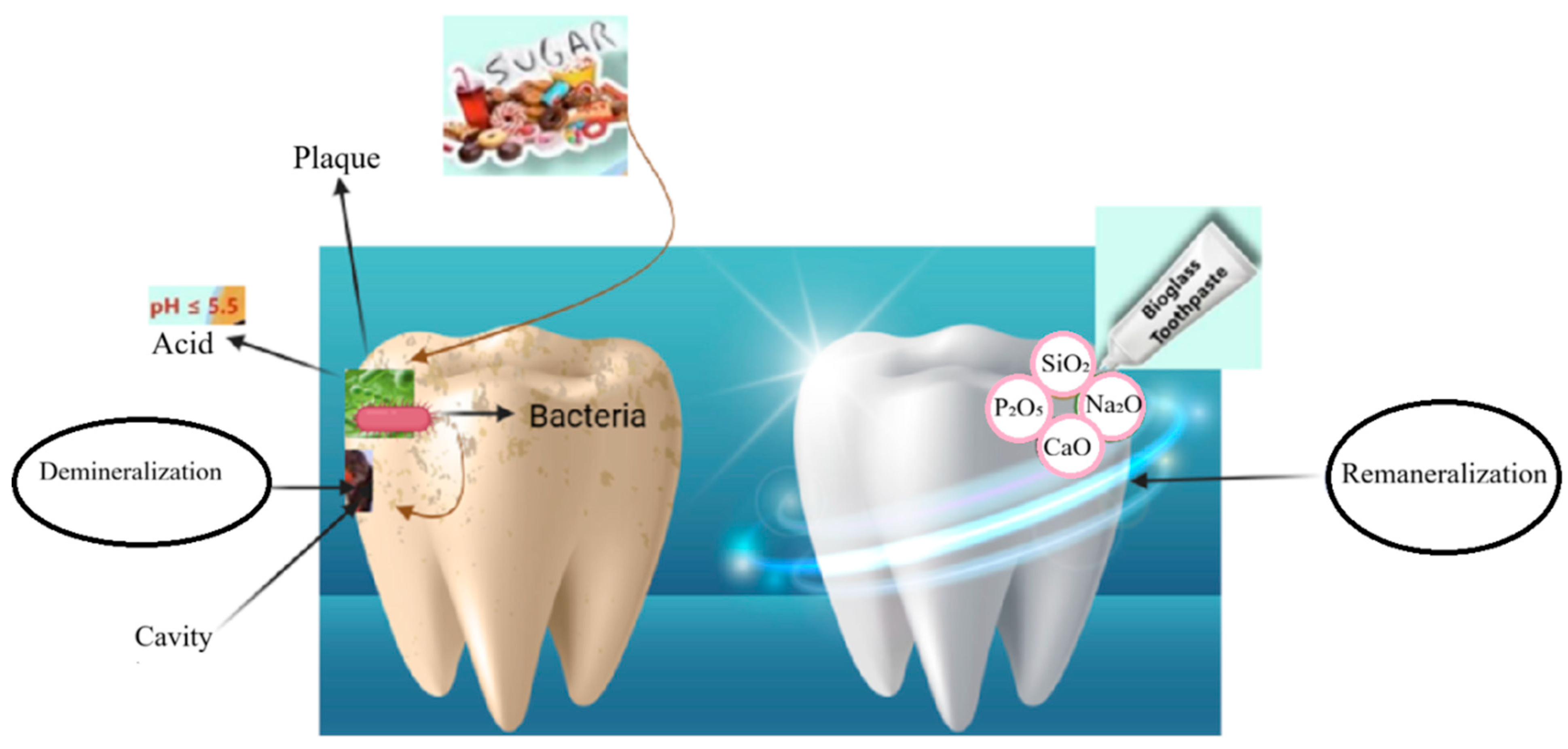
Figure 1. Schematic illustration of the demineralization and remineralization processes in tooth enamel. Frequent sugar intake promotes bacterial acid production (pH ≤ 5.5), leading to demineralization and cavity formation. Bioactive glass-based toothpaste containing SiO2, Na2O, CaO, and P2O5 releases calcium, phosphate, and silicate ions, which support remineralization and the formation of a hydroxycarbonate apatite layer that restores enamel integrity.
Applsci 15 13157 g001
Table 1. Surface morphology changes and functional performance of BGs in dentistry (based on SEM/EDS data from the literature).
BG TypeCompositionSurface Morphology Change (SEM/EDS Findings)Functional/Clinical ImplicationRef
Bioglass® 45S545% SiO2, 24.5% Na2O, 24.5% CaO, 6% P2O5
-
Day 2: spherical osteoblasts with numerous filopodia attaching to surface
-
Day 6: anchoring via lamellipodia with dorsal ruffles.
-
Day 12: formation of bone-like nodules with microvilli-like projections (enhanced mineral deposition sites).
Promotes rapid osteoblast adhesion, spreading, and extracellular matrix production, leading to mineralized nodule formation, relevant for strong interfacial bonding in dental and orthopedic applications.[44]
Calcium phosphate–modified BGDicalcium phosphate dihydrate (DCPD) + trace HA, compared to 45S5 BG
-
Baseline: BG shows sparse mineral particles; RMBCP surface already displays early aggregated calcium phosphate clusters.
-
After 3 days: RMBCP exhibits dense coverage with rod-like hydroxyapatite crystals, while BG remains only partially coated with irregular deposits.
-
EDS confirms higher Ca and P content for RMBCP compared to BG.
Rapid and uniform apatite layer formation; improved mineral deposition compared to conventional BG, supporting potential use in enhanced enamel/dentin remineralization.[45]
Zinc-dopted BGSol–gel derived bioactive glass with Zn2+ substitution for Ca2+ (up to 5 mol%)At 24 h, all groups show sparse silver deposition. After 3 months: control (SB2) displays extensive nanoleakage; SB2+5BGNs and SB2+5ZnBGNs show reduced silver uptake (less leakage); SB2+2.5ZnBGNs remain stable over time.Zn-doped BGNs enhance remineralization at the adhesive–dentin interface, reduce nanoleakage, inhibit MMP activity, and provide antibacterial effects, improving bond durability and caries prevention.[46]
Silver-doped nanostructured bioglass (nBG-Ag) resin sealantSol–gel synthesized Ca–Si–P bioglass nanoparticles doped with Ag (3% or 5% w/w) dispersed in Bis-GMA/TEGDMA resinControl shows honeycomb demineralization pattern; nBG-Ag shows hydroxyapatite (HA) crystal deposits masking enamel prisms. EDAX confirms Ca, P, Si, and Ag in the deposited layer.Seals enamel and promotes Ca/P deposition (HA). 5% nBG-Ag significantly reduces S. mutans vs. 3% and control, supporting anti-caries action around orthodontic brackets; durability maintained (no DC penalty).[47]
strontium-doped BG and fluorideExperimental strontium-containing bioactive glass-ceramic (HX-BGC); HX-BGC with fluoride addition (HX-BGC+F); fluoride glass (F); compared against water control
-
HX-BGC (Sr-BG): granular particles deposited in the intertubular area; some dentinal tubules still visible; collagen fibers relatively intact.
-
HX-BGC+F (Sr+F): dentinal tubules completely occluded; no exposure of collagen fibers; compact mineralized layer covering the surface.
-
Fluoride-BG (F): relatively rough surface with partial collagen fiber exposure; some tubule sealing but incomplete compared to Sr+F.
-
Water control: wide tubule and collagen fiber exposure in both inter- and intra-tubular regions.
Sr promotes apatite nucleation, while F stabilizes fluorapatite. The combined Sr+F BG produces the most effective tubule sealing and collagen protection, enhancing remineralization, improving acid resistance, and reducing dentin hypersensitivity compared to Sr- or F-only BG.[48]
F fluoride-containing BGSiO2–P2O5–CaO–SrO–Na2O–CaF2 incorporated into BisGMA–TEGMA resinSEM shows a reacted glass layer and surface apatite deposition. Apatite formation is more pronounced under neutral saliva (AS7) than acidic saliva (AS4). FTIR confirmed apatite bands at 560–600 cm−1.Fluoride incorporation promotes FA formation, enhances acid resistance, and supports remineralization. Despite reduced strength after immersion, silylated composites maintain clinically acceptable properties.[38]
NovaMinMulti-component bioactive glass containing Si, Ca, Na, P (commercial formulation; widely known in the literature as Calcium Sodium Phosphosilicate, CSPS)
-
Baseline: Intact enamel rods, homogeneous crystals.
-
Demineralized: Rough, honeycomb surface, prism disintegration.
-
Control: Shallow depressions, persistent porosities.
-
After SHY-NM: Smooth surface, obliterated interprismatic spaces, rods fused with globular deposits, fewer porosities.
Restores enamel microhardness, enhances remineralization, protects against caries progression in primary teeth.[40]
Table 2. Summary of Experimental Studies Evaluating Bioactive Glass for Caries Prevention and Enamel Remineralization.
Case No.Material UsedTarget LesionModel TypeApplication MethodEvaluation TechniquesKey FindingsRef
7Bioactive glass (BAG) & Sodium fluoride (bioerodible gel films)Artificial caries lesionsIn vitro, primary maxillary incisorsTopical gel films applied interproximally for 30 daysPolarized light microscopy, lesion area quantificationBoth BAG and NaF films significantly enhanced remineralization vs. controls[58]
4Bioactive glass (Novamin, Sensodyne Repair and Protect) and ACP-CPP (GC Tooth Mousse)Early enamel lesions (acid-induced)In vitro, human mandibular premolarsDaily topical application for 10–15 days, stored in salivaVickers microhardness testBioactive glass showed significantly faster remineralization at 10 days compared with ACP-CPP, but by 15 days both materials demonstrated similar remineralization potential.[59]
9BAG powder and BAG containing
polyacrylic acid (PAA-BAG)
WSLsIn vitro, human enamel samplesBAG or PAA-BAG slurry applied; compared with remineralization solution (positive control) and deionized water (negative control)Surface and cross-section Knoop microhardness, Micro-Raman spectroscopy, White light profilometry, SEMBAG and PAA-BAG significantly improved mechanical properties, increased phosphate content, and showed mineral deposition within lesions. However, lesion depth was not significantly reduced.[60]
145S5 BAG suspensions (2%, 4%, 6%, 8%)Early carious lesions (artificial) in deciduous enamelIn vitro, human deciduous teeth14-day pH-cycling with twice-daily BAG suspension applicationVickers microhardness, SEM with EDX, FT-IR/ATRBAG significantly enhanced remineralization compared with control. The 6% BAG group achieved the highest microhardness recovery, densest mineral deposition, and formation of hydroxycarbonate apatite[61]
16β-tricalcium phosphate (β-TCP) nanoparticles (1–5 wt%) incorporated into fissure sealantEnamel adjacent to fissure sealant restorationsIn vitro, human premolarsFissure sealant with varying β-TCP concentrations applied to prepared cavitiesFlexural strength, Micro-shear bond strength, SEM-EDXAddition of 1–5 wt% β-TCP nanoparticles significantly enhanced formation of an intermediate remineralized layer at the enamel–sealant interface, with increasing thickness at higher concentrations, while mechanical properties (flexural strength, micro-shear bond strength) were not adversely affected.[62]
3Biosilicate; Acidulated Phosphate Fluoride—APF; Untreated—controlArtificial erosive and carious lesionsIn vitro, bovine enamel and dentin
blocks
Daily topical application of Biosilicate® or APF solutions for 10 daysSurface microhardness, 3D profilometry, Confocal Laser Scanning Microscopy (CLSM)Both Biosilicate® and APF significantly reduced surface loss and demineralization compared with control. Biosilicate® was effective in both enamel and dentin, though APF performed better in enamel.[63]
2Novamin® (bioactive glass toothpaste) and BiominF® (fluoride-containing bioactive glass toothpaste)Artificially demineralized human enamel (citric acid, pH 2.2)In vitro, enamel blocks24 h storage in artificial saliva with added toothpaste slurryFluoride ion selective electrode (TF/TSF), Vickers microhardnessBoth toothpastes had lower fluoride than label claims. BiominF® contained significantly more fluoride than Novamin® and produced higher enamel microhardness recovery, showing greater remineralization potential.[64]
6(1) CPP-ACPF, Tooth Mousse Plus
(2)BAG, SHY-NM
(3) Fluoride-enhanced hydroxyapatite gel (ReminPro)
(4) Self-assembling peptide P11-4 (Curodont Protect)
Artificial enamel carious lesionsIn vitro, human enamel samplesTopical application during 30-day pH cycling modelSurface microhardness, SEMSelf-assembling peptide P11-4 achieved the greatest remineralization, significantly outperforming BAG and HA gel, and comparable to CPP-ACPF. CPP-ACPF also showed strong remineralizing ability, followed by BAG and HA gel[65]
5SHY-NM® (bioactive glass, calcium sodium phosphosilicate); GC Tooth Mousse Plus® (CPP-ACPF); ReminPro® (hydroxyapatite + fluoride + xylitol); Colgate Strong Teeth® (fluoridated toothpaste, 1000 ppm F)Artificial caries, extracted human premolarsIn vitro, human enamelTopical application, 20-day pH cyclingPolarized light microscopy, lesion depth analysis with ImageJSHY-NM demonstrated the highest remineralizing potential, followed by ReminPro, CPP-ACPF, and fluoridated toothpaste, with statistically significant superiority of SHY-NM.[66]
8Biosilicate® (bioactive glass-ceramic); Acidulated Phosphate Fluoride (APF); untreated controlArtificial erosive and caries-like lesions (bovine enamel and dentin)In vitroDaily topical application during erosive cycles (1–21 days) and caries pH cycling (14 days)3D optical profilometry, Confocal Laser Scanning Microscopy (CLSM), surface and cross-sectional Knoop microhardnessBiosilicate significantly reduced surface loss in enamel and dentin and provided higher surface and subsurface microhardness than APF and control. APF reduced demineralization compared with control but was less effective than Biosilicate.[67]
15Sol–gel-derived BGs (BAG79, BAG87, BAG91, BAG79F) and conventional melt-quenched BAG45, incorporated into dentin adhesivesDemineralized dentinIn vitro, human dentin specimensExperimental dentin adhesives containing BAG applied to demineralized dentin surfacesFE-SEM, TEM, BET surface area analysis, XRD, elastic modulus measurement
-
Sol–gel BAGs (especially BAG87) had much larger surface areas and induced more rapid hydroxyapatite formation compared with conventional BAG45.
-
BAG87-containing adhesive achieved the highest elastic modulus, indicating superior remineralization and improved mechanical properties of the adhesive–dentin interface.
[68]
10Chitosan-bioactive glass (CH-BG) compared with MI Paste (CPP-ACP) and controlBleached enamelIn vitro, human enamel specimensDaily topical application of CH-BG or MI Paste for 14 days after bleachingSEM-Energy-Dispersive X-ray Spectroscopy (EDX)
-
CH-BG significantly increased Ca and P content on bleached enamel, improving mineral deposition. Its remineralization effect was comparable to MI Paste.
-
SEM showed smoother, more homogeneous enamel surfaces in CH-BG and MI Paste groups than in the control.
[69]
11BioMin® bioactive glass toothpaste, fluoridated toothpaste, artificial salivaDemineralized primary enamelIn vitro, primary teethBrushing twice daily for 15 daysVickers microhardness, Polarized light microscopyBioMin® significantly increased microhardness and reduced lesion depth more than fluoridated toothpaste or artificial saliva[70]
12Bioactive glass (BAG), nano-hydroxyapatite (nHAp), CPP-ACPFEnamel erosion in primary teethIn vitro, primary teethTopical application of BAG-, nHAp-, and CPP-ACPF-based slurries during pH-cyclingVickers microhardness, SEMAll agents enhanced remineralization; nHAp showed highest microhardness, BAG also effective[71]
13BAG, nHAp, CPP-ACPFDemineralized primary enamelIn vitro, primary enameltopical slurry application during pH cycling (14 days).Vickers microhardness, SEMnHAp showed highest remineralization, followed by BAG; CPP-ACPF was less effective.[72]
14Fluoride bioactive glass (BioMin® F), sodium fluoride toothpastes (500–1500 ppm)Artificial carious lesions in primary teethIn vitro, human primary incisorsBrushing twice daily during 7-day pH cyclingSurface microhardness (%SMHR)BioMin® F had remineralization comparable to 1500 ppm fluoride and outperformed 500/1000 ppm; effective and safer for children[73]
17Bioactive glass varnish, fluoride-containing BAG, nanosilver-containing BAG, nanosilver fluoride, fluoride, nanosilver, artificial salivaWhite spot lesionsIn vitro (human teeth)Varnish applied with microbrush for 1 min, then stored in artificial saliva for 14 daysSEM, EDX (Ca/P ratio), Vickers microhardness, TEM, UV-vis spectroscopyNanosilver-containing BAG showed highest mineral gain (23.27%) and high hardness recovery; fluoride-containing BAG and nanosilver fluoride were similarly effective; BAG alone comparable to fluoride. Artificial saliva showed the least effect.[39]
18Synthesized bioactive glass (SiO2–CaO–P2O5–MgO–SrO) via sol–gel method, 20% aqueous suspensionArtificially demineralized enamelIn vitro (human third molars, sectioned)Daily immersion in 20% BG suspension for 15 days at 37 °C (BG-treated group); others: natural and demineralized controlsXRD, ATR-FTIR, SEM, Vickers microhardnessDemineralization caused a 49.6% reduction in hardness; remineralized enamel showed a 22.35% increase. SEM confirmed BG particle deposition and HA formation. ATR-FTIR indicated enhanced mineral content. XRD showed no significant mineral phase change.[74]
Disclaimer/Publisher’s Note: The statements, opinions and data contained in all publications are solely those of the individual author(s) and contributor(s) and not of MDPI and/or the editor(s). MDPI and/or the editor(s) disclaim responsibility for any injury to people or property resulting from any ideas, methods, instructions or products referred to in the content.


