
You are currently viewing a new version of our website. To view the old version click .
Applied Sciences
  • Article
  • Open Access

9 December 2025

Temporal Nutrient and Microbial Functional Dynamics in a Cattle Manure Composting System Inoculated with Lactobacillus acidophilus

,
,
and
1
Department of Applied Plant Science, Sangji University, Wonju-si 26339, Republic of Korea
2
Hoengseong Agricultural Technology Extension Center, Hoengseong 25208, Republic of Korea
3
Department of Smart Life Science, Sangji University, Wonju-si 26339, Republic of Korea
*
Author to whom correspondence should be addressed.
This article belongs to the Special Issue Biological Activity, Chemical Characterization and Contaminants of Plants and Waste: 2nd Edition

Abstract

This study presents an observational analysis of the chemical and microbial dynamics of cattle manure compost during maturation in a system inoculated with Lactobacillus acidophilus. Composting samples were collected at D15 and D60 to assess changes in key nutrient parameters and microbial community shifts from the early stage to the composting phase. At D60 in this inoculated composting system, ammonium nitrogen (NH4+-N), potassium (K), phosphorus (P), calcium (Ca), magnesium (Mg), and total nitrogen (T-N) levels were higher than at D15, with NH4+-N measuring 813.01 and 1714.24 mg/kg at D15 and D60, respectively (p < 0.001). Microbial analysis based on 16S rRNA gene sequencing showed that alpha diversity was slightly lower at D60 than at D15, although this difference was not statistically significant; in contrast, the community composition shifted toward a higher relative abundance of Firmicutes and lower relative abundances of Bacteroidetes and Proteobacteria. Mantel correlation analyses indicated strong associations between specific bacterial phyla and manure chemical properties, particularly between Firmicutes and levels of NH4+-N, chloride, and sodium. PICRUSt2-based functional prediction further suggested that mature compost samples had a higher predicted representation of genes associated with nitrogen- and energy-related pathways, including arginine and polyamine biosynthesis and butanoate fermentation. This observational study outlines how nutrient profiles, microbial communities, and PICRUSt2-predicted functional potentials change over time in a composting system amended with L. acidophilus. By documenting these characteristic patterns, our results provide a useful reference for focusing future research on specific nutrient–microbe–function linkages in lactic acid bacteria-amended composting systems, and for interpreting compost maturation in such systems within the context of sustainable agricultural practice.

1. Introduction

Composting transforms diverse organic residues into stable, nutrient-rich humus, reducing landfill burden and greenhouse gas emissions, and ultimately enhancing soil fertility while supporting sustainable crop production systems. The humus produced through composting also enhances soil structure, increases moisture retention, and improves cation exchange capacity, thereby offering long-term agronomic benefits [1]. The composting process progresses through three distinct phases, namely mesophilic, thermophilic, and maturity, each characterized by specific microbial communities and physicochemical conditions [2]. During the mesophilic phase, moderate temperatures promote the growth of fast-proliferating copiotrophic microbes, which initiate the decomposition of readily degradable substrates such as sugars and amino acids. As temperatures increase, the process shifts to the thermophilic phase, where thermotolerant and spore-forming microorganisms become dominant and drive the degradation of more complex and resistant organic compounds such as cellulose and lignin. The final maturity phase involves the stabilization of microbial activity and humus formation, along with the recovery of microbial diversity and improvement in compost quality [3,4].
Understanding the functional, microbial, and chemical dynamics across different composting phases is essential for minimizing nutrient losses and accelerating the composting process. To enhance composting efficiency, recent strategies have focused on inoculating biofunctional microbes capable of complementing native microbial communities. Among these, lactic acid bacteria (LAB) have received growing attention due to their ability to produce organic acids, inhibit pathogens, and enhance nutrient solubility [5,6]. LAB inoculation has been shown to reduce ammonia (NH3) and methane emissions while enhancing nitrogen retention and mineral availability, thereby supporting low-carbon, circular economy goals.
Lactic acid bacteria (LAB), long used as agricultural additives in food and feed fermentations, rapidly ferment soluble carbohydrates into lactic and other low-molecular-weight organic acids that lower pH, mobilize bound phosphate (and more broadly potassium); inhibit urease positive microbes; reduce NH3 volatilization; and increase the solubility and bioavailability of P, K, Ca, and Mg [7,8]. In parallel, LAB produce bacteriocins and exopolysaccharides (EPSs) that suppress plant pathogenic fungi such as Fusarium, support the formation of micro aggregates, and contribute to the restructuring and stabilization of compost microbial communities and chemistry, with these bacteriocin and EPS-associated changes being linked to improved N, P, and K retention in manure-based composting systems [8,9,10]. Nevertheless, direct validation of LAB-derived EPS effects within composting systems remains limited, and their specific roles in nutrient transformation and in shaping microbial community composition during composting have yet to be clearly elucidated.
Previous compost and soil microbiome studies have extensively characterized microbial community composition, inferred functional pathways, and associated chemical properties [11]. Nevertheless, complex and context-dependent interactions between environmental factors and microbes generate substantial variability among composting systems, which limits cross-environment generalization and species or strain-resolved meta-analyses [12]. In this context, we conducted an observational study of a cattle manure composting system inoculated with Lactobacillus acidophilus to describe temporal changes in nutrients, microbial communities, and PICRUSt2 predicted functional potential and to provide reference data on environment microbe relationships in lactic acid bacteria-amended composting systems.
To explore the complex relationships between microbial communities and nutrient dynamics during composting, we applied a multivariate analytical framework. Specifically, we employed Mantel tests and canonical correspondence analysis (CCA) to identify statistical associations between specific microbial phyla and nutrient fluxes and to evaluate their ecological relevance for nutrient retention and transformation. Such multivariate approaches are particularly useful under real composting conditions, where multiple environmental factors interact simultaneously [13]. In addition, we used PICRUSt2-based functional prediction to explore how shifts in microbial community structure are linked to predicted metabolic pathways and functional potential. By integrating predicted genetic potential with chemical and ecological data, we sought to improve the interpretability of microbiome-based patterns in real-world composting systems [14]. Ultimately, this study aimed to describe how nutrients, microbial communities, and PICRUSt2 predicted functions change in a composting system inoculated with Lactobacillus acidophilus, offering observational insights that may help inform future microbial inoculant studies and on-farm compost management.

2. Materials and Methods

2.1. Application of L. acidophilus and Manure Properties Analysis

This experiment used the same cattle manure material as our previous study [15]. Ten milliliters of a soil microbial fertilizer containing L. acidophilus (DIVITAL Solution, Divital Korea, Seoul, Korea) was used. The product formulation per liter included 1.5 g of L. acidophilus at 1.0 × 10⁷ cfu/g, 10 g of inactivated yeast, and 6.62 g of citric acid and sucrose. This solution was diluted in 2 L of water and sprayed onto 1 ton of cattle manure. Ambient air temperature during the composting period was obtained from the Korea Meteorological Administration (KMA; https://www.weather.go.kr (accessed from 1 July to 31 August 2022)); the mean ambient temperature was 23 °C, and all composting operations were conducted under outdoor conditions. The manure was stored in a composting facility under moisture conditions maintained at 55–65%. To evaluate the nutrient composition and changes during composting, chemical analyses were performed on compost samples collected in triplicate at 15 and 60 days after inoculation. All analytical procedures, quality control steps, and instrument settings followed the workflow described in a previous study [16]. In summary, the T-N, NH4+-N, and nitrate nitrogen (NO3-N) were quantified by the Kjeldahl method [17,18], with reagent blanks (B) included in every titration to calculate the factor (f) of standardized 0.01 N H2SO4. The available P was extracted with the Lancaster soil testing reagent and determined color-metrically [19] on a UV–Vis spectrophotometer (NEO-S2117, NEOGEN, Seoul, Republic of Korea) using fresh calibration curves prepared from 10, 100, and 1000 ppm standard P solutions. K, chloride (Cl), Mg, Ca, and sodium (Na) were measured after acid digestion of finely ground compost using an inductively coupled plasma optical emission spectrometer (ICP-OES; SPECTROBLUE, SPECTRO Analytical, Odiham, Hampshire, UK). Electrochemical-equivalent factors of 39.1 (K), 22.99 (Na), 12.15 (Mg), and 20.04 (Ca) were applied to convert instrument values to exchangeable-cation contents.

2.2. DNA Extraction and 16S rRNA Gene Library Preparation

Cattle manure samples were collected from a Hanwoo (Korean native cattle) farm located at the Agricultural Technology Center in Hoengseong County, Gangwon-do, Republic of Korea, at two time points: 15 days and 60 days after Lactobacillus acidophilus inoculation. Samples were immediately frozen on dry ice. At each time point, three replicate samples (500 g each) were transferred to sterile 50 mL tubes, stored at −80 °C, and subsequently processed. Genomic DNA was extracted from each replicate using the DNeasy PowerSoil Kit (Qiagen, Hilden, Germany) following the manufacturer’s protocol. DNA concentration was normalized with Quant-iTTM PicoGreen® (Invitrogen, Carlsbad, CA, USA). The polymerase chain reaction (PCR) was performed using Herculase II Fusion DNA Polymerase (Agilent Technologies, Santa Clara, CA, USA) to amplify the V3–V4 region of the 16S rRNA gene. Universal primers V3-F (5′-TCGTCGGCAGCGTCAGATGTGTATAAGAGACAGCCTACGGGNGGCWGCAG-3′) and V4-R (5′-GTCTCGTGGGCTCGGAGATGTGTATAAGAGACAGGACTACHVGGGTATCTAATCC-3′), which include Illumina adapter overhangs. Cycling conditions were 95 °C for 3 min; 25 cycles of 95 °C for 30 s, 55 °C for 30 s, and 72 °C for 30 s; and a final extension at 72 °C for 5 min. Amplicons were purified with AMPure XP beads (Beckman Coulter, Beverly, MA, USA) and re-amplified with Nextera XT Index primers (10 cycles under the same thermal profile), followed by a second bead cleanup. Final libraries were quantified using the KAPA Library Quantification Kit (Roche, Basel, Switzerland) for Illumina® platforms and assessed for size distribution using a TapeStation D1000 ScreenTape system (Agilent Technologies). Equimolar concentrations of each replicate were pooled and diluted prior to paired-end sequencing (2 × 300 bp) on an Illumina MiSeq™ platform (Illumina, San Diego, CA, USA), generating the raw sequencing data used for downstream analysis. The sequencing yield and DNA quality metrics are provided in Supplementary Table S1.

2.3. Read Processing and Taxonomy Assignment

Raw paired-end reads generated on the Illumina MiSeq platform were processed with mothur v1.48. Merged contigs that contained ambiguous bases were discarded, and reads were retained only when their lengths ranged from 442 bp to 467 bp, and homopolymer stretches did not exceed six identical nucleotides. Identical sequences were collapsed into unique representatives to reduce computational redundancy. The quality-filtered sequences were aligned to the SILVA SSU rRNA reference database (release 312), trimmed to the V3–V4 region; sequences falling outside alignment positions 5329–24,257 were removed. Non-informative alignment columns were filtered, and a pre-clustering step (≤2 base differences) further reduced residual sequencing errors. Putative chimeras were detected de novo with VSEARCH v2 and removed. The entire workflow was designed to ensure high-quality sequence curation and reduce taxonomic noise. This included quality control (merging, filtering, de-replication, and chimera removal), reference-based alignment, and taxonomic classification steps. Sequences classified as chloroplasts, mitochondria, eukaryotes, or unassigned lineages were filtered out to retain only prokaryotic ASVs for ecological analysis. The remaining reads were taxonomically assigned with mothur’s naïve Bayesian classifier against SILVA (80% bootstrap cutoff); sequences classified as chloroplast, mitochondria, eukaryote, or unknown lineages were excluded. ASV identifiers and accompanying taxonomy/abundance information are provided in Supplementary Data S1.

2.4. Microbiome Data and Statistical Analysis

Sequencing data were processed in R (v 4.4.1). Amplicon sequence variants (ASVs) that lacked taxonomic assignment at the kingdom level or were classified as chloroplasts, mitochondria, or “Unassigned” were excluded. Additionally, ASVs with a total abundance of 10 or fewer reads across all samples were removed to eliminate low-abundance noise that could bias diversity metrics. Taxonomic parsing, filtering, and data object construction were performed with phyloseq (v 13.8.0) [20], taxa (v 0.4.3) [21], and metacoder (v 0.3.7) [22]. Alpha diversity was assessed using the inverse Simpson index with vegan (v 2.6.6.1) [23]. Group-wise differences were investigated by one-way analysis of variance (ANOVA) followed by Tukey’s post hoc test using agricolae (v 1.3.7) [24]. Boxplots were produced with ggplot2 (v 3.5.1) [25]. Beta-diversity was investigated based on Bray–Curtis dissimilarities and visualized as heatmaps with pheatmap (v 1.0.12) [26]. To explore associations between compost physicochemical variables and microbial community structure, canonical correspondence analysis (CCA) was carried out using vegan, and the significance of the ordination axes was tested using 9999 permutations. Additionally, Mantel tests were conducted to assess community–environment concordance by comparing Bray–Curtis and Euclidean distance matrices, using 9999 permutations in vegan [13]. Before conducting the Mantel test, physicochemical variables (e.g., NH4+-N, T-N, Na, and Cl) were standardized using z-score transformation to account for differences in scale and units. Bray–Curtis dissimilarities were calculated based on the relative abundances of ASVs, while Euclidean distances were computed from the standardized chemical data. This methodology ensured compatibility and comparability between the two distance matrices utilized in the Mantel test.
The functional potential of bacterial communities was inferred with PICRUSt2 (v2.5.1) [14]. The KO- and EC-level abundance matrix was imported into R (v 4.4.1), processed with the tidyverse [27], and compared between the two experimental groups using Welch’s two-sample t-test. Among the significant functions, showing the greatest between-group variance were selected, normalized to row-wise Z-scores, and visualised as boxplots produced with ggpubr [28], with t-test significance levels integrated into the panels.

3. Results

3.1. Changes in Chemical Properties Following L. acidophilus Treatment

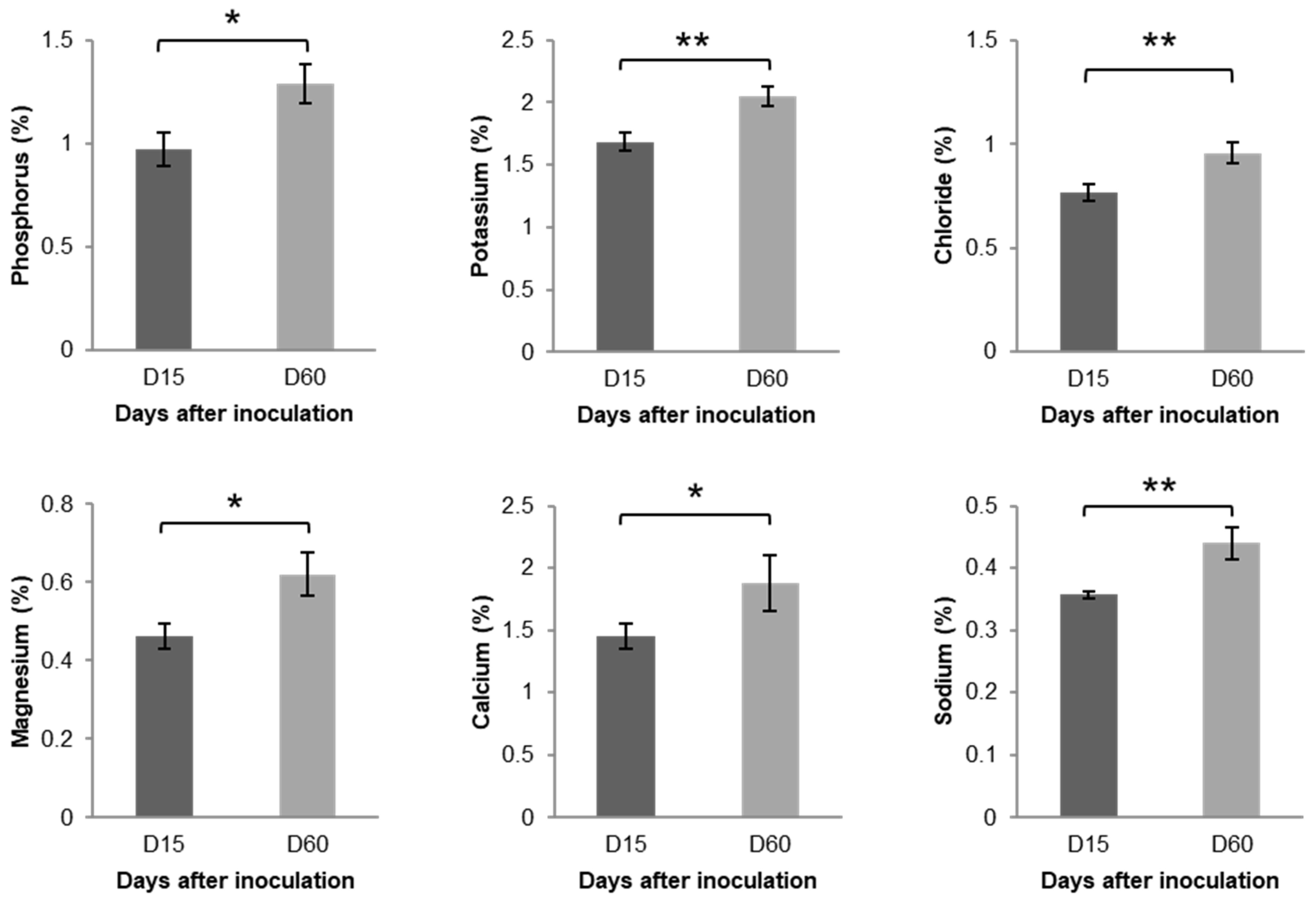
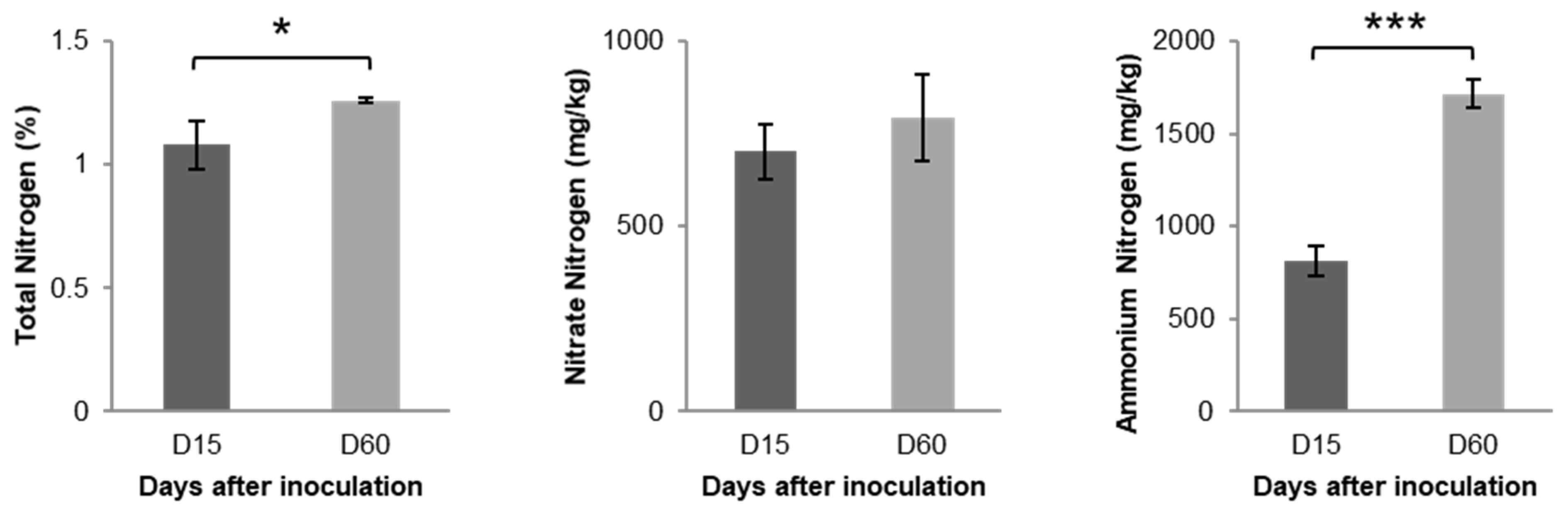
In the composting system inoculated with Lactobacillus acidophilus, clear differences in chemical composition were observed between D15 and D60 (Figure 1). Among the nine measured compost parameters, eight showed statistically significant increases at D60 compared with D15 (p < 0.05). NH4+-N increased from 813.01 to 1714.24 mg/kg (p = 0.00015), and K and P contents increased from 1.683% to 2.047% (p = 0.004) and from 0.973% to 1.29% (p = 0.012), respectively. Significant increases were also detected in Ca (1.45% to 1.877%, p = 0.042), Mg (0.463% to 0.62%, p = 0.014), Na (0.357% to 0.44%, p = 0.006), T-N (1.08% to 1.26%, p = 0.035), and Cl (0.767% to 0.957%, p = 0.007). In contrast, NO3-N increased from 702.02 to 793.56 mg/kg, but this change was not statistically significant (p = 0.315). Overall, these results show that, within the L. acidophilus inoculated composting system, multiple nitrogen and cation-related parameters were higher at D60 than at D15, indicating pronounced temporal shifts in nutrient composition during the composting period.
Figure 1. Changes in the chemical compositions of compost between D15 and D60. Values are presented as mean ± standard deviation (n = 3). Bar colors represent different samples. Asterisks indicate statistically significant differences: p < 0.05 (*), p < 0.01 (**), and p < 0.001 (***).

3.2. Alteration of Microbial Community During Composting

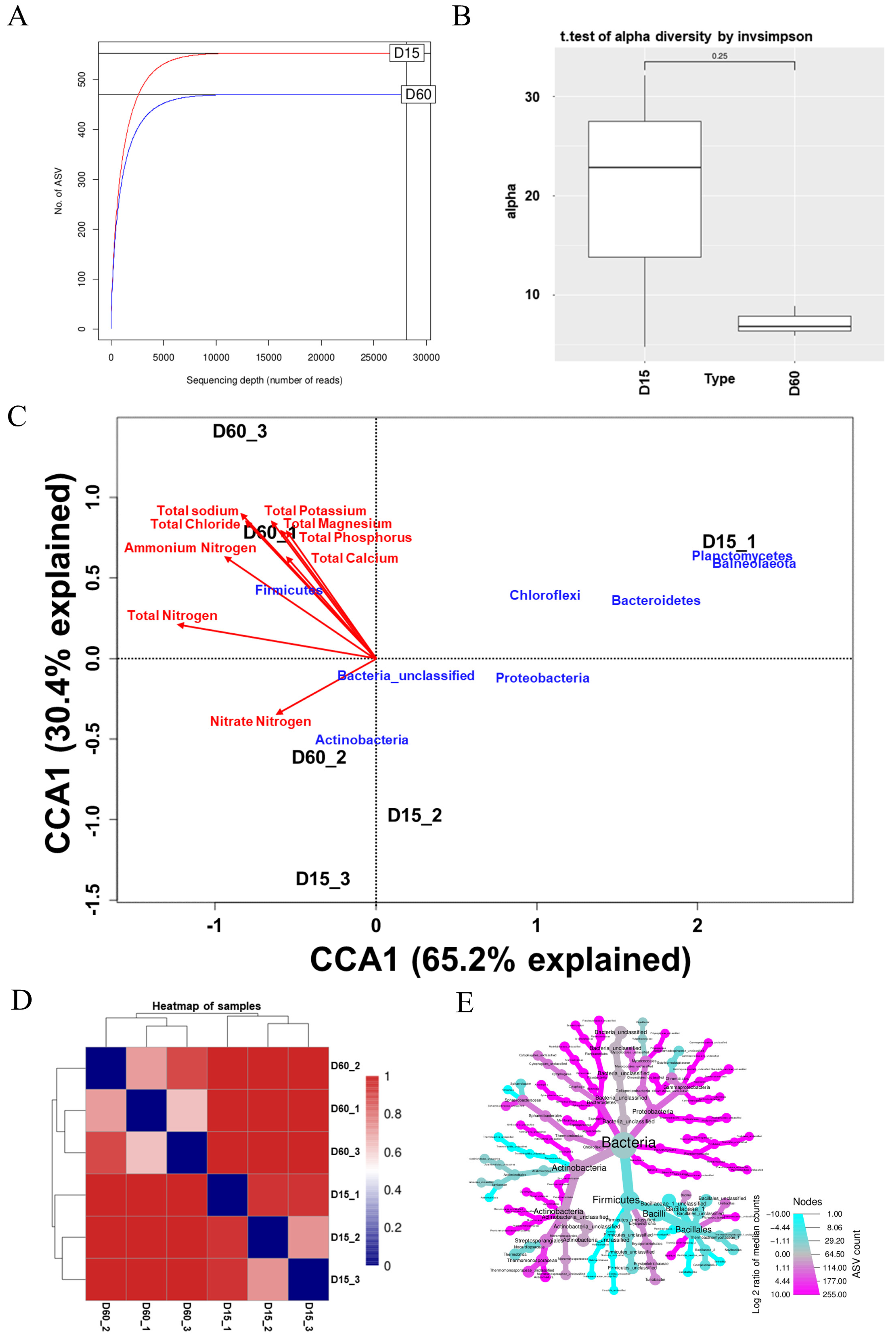
To investigate microbial community shifts during composting, differentially abundant bacteria (DAB) between the D15 and D60 groups were identified (Figure 2). The rarefaction curves for D15 and D60 plateaued at ~10,000 reads, indicating ASV richness had stabilized, and sequencing depth was sufficient (Figure 2A). Analysis of alpha diversity within the DAB community showed a higher mean value in the D15 group (22.6) compared to the D60 group (6.7) (Figure 2B). Despite the observed reduction in alpha diversity in the D60 group, the difference was not statistically significant. Correspondence analysis between bacterial abundance and manure chemical compositions revealed that members of the Firmicutes phylum were associated with NH4+-N, total phosphorus, and total K (Figure 2C). Additionally, Actinobacteria showed a high correspondence with NO3-N. High intra-group correlation was observed among replicate samples within each treatment group, indicating consistent microbial community patterns within the same composting stage (Figure 2D). The relative abundance of DAB was further compared between D15 and D60 (Figure 2E). The DAB affiliated with the phylum Firmicutes had higher relative abundances at D60 than at D15. In contrast, the DAB belonging to Bacteroidetes, Balneolaeota, Planctomycetes, Chloroflexi, and Proteobacteria had lower relative abundances at D60 than at D15. Taken together, alpha diversity did not differ significantly, yet phase-specific compositional shifts were evident. For beta diversity, PERMANOVA on Bray–Curtis distances did not detect a significant global separation (R2 = 0.348, p = 0.20), but the heatmap showed consistent community patterns; accordingly, subsequent analyses focused on taxa showing differences and evaluated their associations with nutrient chemistry using Mantel tests and targeted DAB analyses.
Figure 2. Microbial communities of compost between D15 and D60: (A) Rarefaction curves (D15 red, D60 blue). (B) Boxplot showing the alpha diversity of DAB. Alpha diversity was investigated using the inverse Simpson method, and p-values were calculated by Student’s t-test. (C) Canonical correspondence analysis (CCA) plot illustrating the relationship between chemical compositions (red lines) and DAB at the phylum level (blue dots). Pink dots represent replicate samples. (D) Heatmap of DAB across replicate samples. Color intensity indicates correlation coefficients, with darker red colors representing stronger correlations. (E) Taxonomic tree of DAB. Line colors indicate changes in abundance between D15 and D60: red lines represent increased abundance at D15, while blue lines indicate decreased abundance compared to D60.

3.3. Correlations Between DAB and Manure Properties

To assess the relationship between DAB, identified between D15 and D60 of composting, and manure chemical properties, Mantel tests were conducted on both phylum-level subsets of DAB (Table 1). The analysis revealed several statistically significant correlations, indicating a close association between specific bacterial phyla and key compost chemical properties. For Bacteroidetes, a significant correlation was observed with NH4+-N (p = 0.022), while a strong correlation was found with T-N (p = 0.001). Firmicutes exhibited significant correlations with multiple manure parameters, including NH4+-N (p = 0.015), total Cl (p = 0.011), and total Na (p = 0.042). For Proteobacteria, a significant positive correlation was identified with T-N (p = 0.029). Taken together, these Mantel test results indicate that correlation patterns with nutrient variables differ among phyla and may help guide future evaluations of microbial taxa as indicators of compost maturity and nutrient transformation.
Table 1. Results of the Mantel test between chemical compositions and bacterial phyla.

3.4. Variation of DAB and Predicted Functional Pathways During Composting

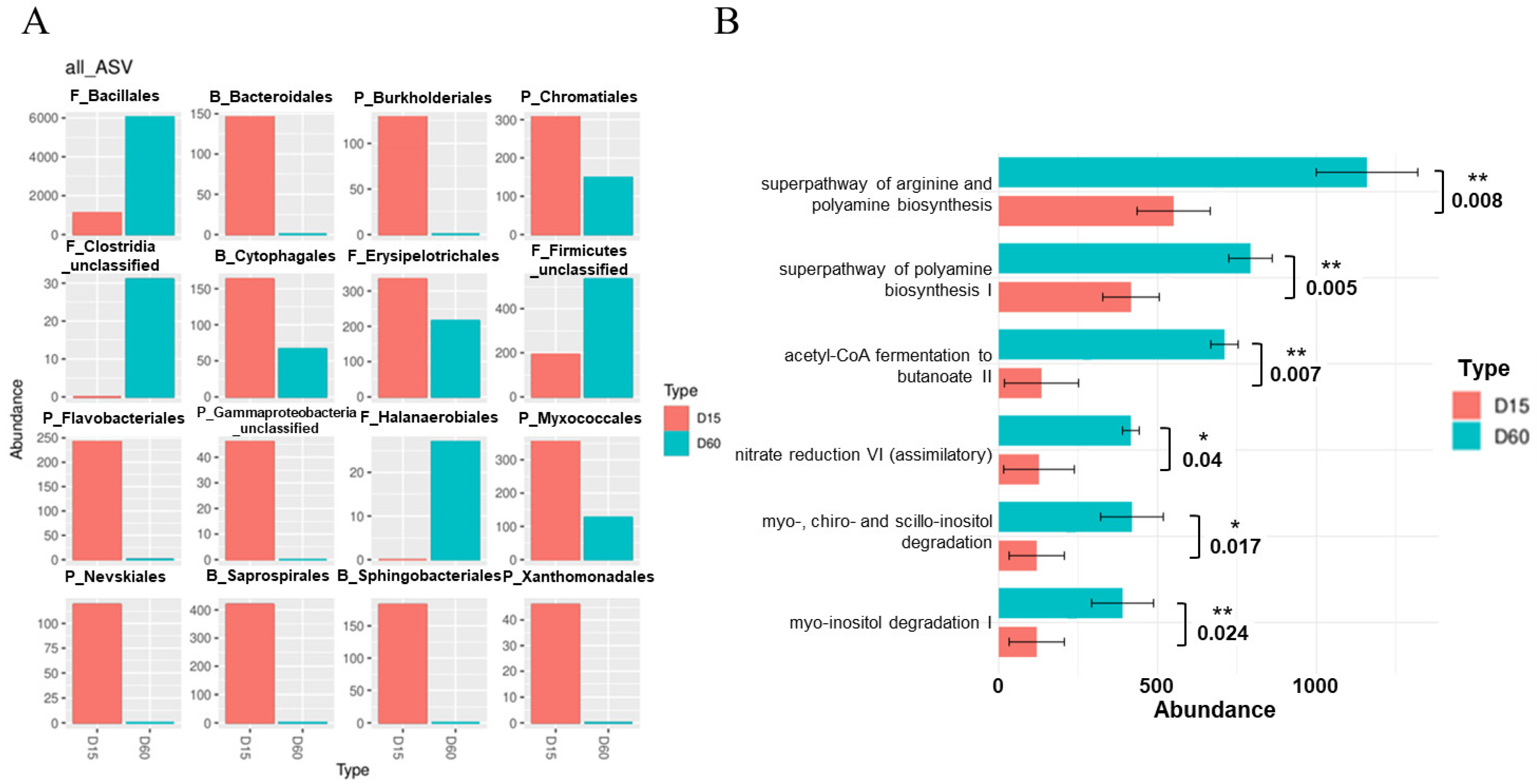
Building on the Mantel test results that showed significant associations between DAB abundance and chemical parameters for the phyla Bacteroidetes, Firmicutes, and Proteobacteria, we next examined family-level differences in DAB abundance within these phyla (Figure 3A). Compared with D15, several families within the Firmicutes phylum (Bacillales, Clostridia, Firmicutes, and Halanaerobiales) had higher relative abundances at D60. In contrast, Erysipelotrichales, also belonging to Firmicutes, had a lower relative abundance at D60 than at D15. In the Bacteroidetes phylum, the families Bacteroidales, Cytophagales, Saprospirales, and Sphingobacteriales had lower relative abundances at D60 than at D15. Similarly, Proteobacteria-affiliated families, including Burkholderiales, Chromatiales, Flavobacteriales, Gammaproteobacteria, Myxococcales, Nevskiales, and Xanthomonadales, had lower relative abundances at D60 than at D15. We also performed PICRUSt2-based functional pathway analysis for DAB that had higher or lower relative abundances at D60 than at D15 (Figure 3B). DAB that were more abundant at D60 had higher predicted contributions to the superpathway of arginine and polyamine biosynthesis, the super-pathway of polyamine biosynthesis I, and acetyl-CoA fermentation to butanoate II, with all three pathways showing p-values < 0.01. Additionally, several other pathways, including nitrate reduction VI (assimilatory), myo-, chiro-, and scillo-inositol degradation, and myo-inositol degradation I, showed significantly different predicted contributions between D15 and D60 (p < 0.05). Taken together, these results describe how family-level community changes over time in this L. acidophilus inoculated composting system are accompanied by shifts in predicted nutrient-related functional profiles and provide basic information for interpreting microbe nutrient relationships in such systems.
Figure 3. Microbial communities of bacterial phyla showing significant differences in the Mantel test: (A) Distribution of the phyla Bacteroidetes, Firmicutes, and Proteobacteria at the family level across samples (D15 and D60). Bar colors represent different samples. (B) Pathway analysis of Bacteroidetes, Firmicutes, and Proteobacteria. Values are presented as mean ± standard deviation (n = 3). Asterisks indicate statistically significant differences: p < 0.05 (*), p < 0.01 (**).

4. Discussion

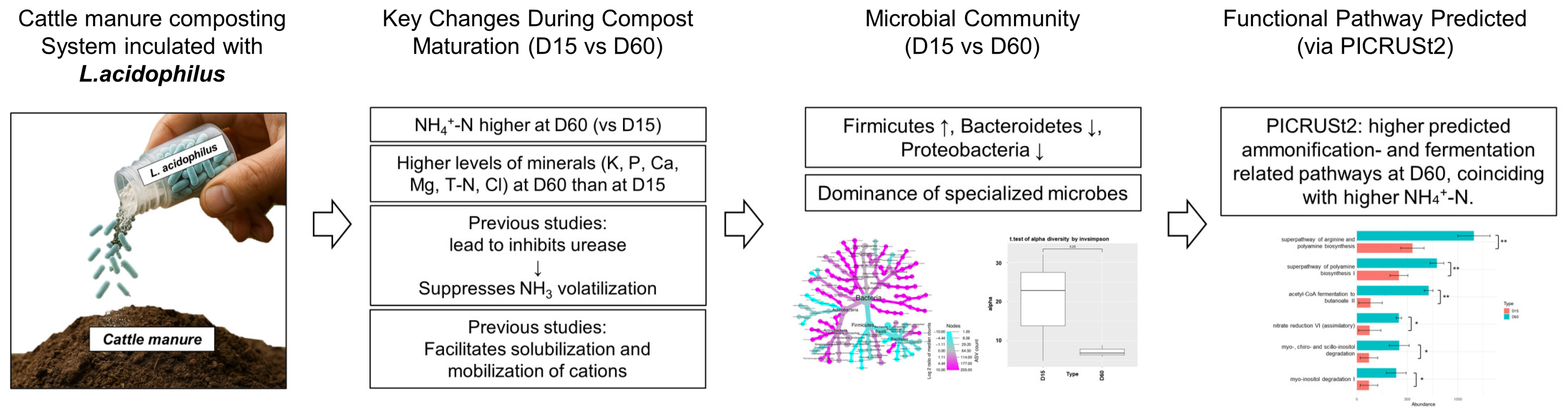
In this cattle manure composting system inoculated with Lactobacillus acidophilus, we observed clear temporal changes in nutrient profiles, microbial community composition, and PICRUSt2-predicted functional potentials between D15 and D60 (Figure 4). Although these observations derive from a single inoculated treatment without a matched uninoculated control, the overall directions of change show similarities to patterns reported in previous studies of lactic acid bacteria-amended composting systems. One of the most pronounced patterns was that NH4+-N concentrations were substantially higher at D60 (1714.24 mg/kg) than at D15 (813.01 mg/kg; p = 0.00015). Similar retention of ammonium and reductions in gaseous nitrogen losses have been reported in livestock waste composting systems when lactic acid-based or LAB-driven acidification strategies were applied [29,30,31]. In those studies, decreases in ammonia emissions were attributed to manure acidification, shifts in the NH3/NH4+ equilibrium, and inhibition of ureolytic bacteria, and these mechanisms provide one possible explanation for the elevated NH4+-N observed in our L. acidophilus inoculated composting system, although they were not directly tested here.
Figure 4. Schematic overview of Lactobacillus acidophilus-inoculated cattle manure composting.
In addition to the nitrogen-related changes, total K, P, Ca, Mg, and Na contents were also higher at D60 than at D15 in this inoculated composting system (Figure 1). These patterns are qualitatively consistent with reports that lactic acid bacteria-based inputs and mineral-solubilizing microbiomes can mobilize cations and enhance mineral availability in agricultural settings [8,32,33]. Previous work has shown that lactic acid bacteria and bio-organic amendments can improve the bioavailability or retention of divalent cations through mechanisms such as pH modulation, chelation, and complex in soils and composting environments [8,34,35]. In our dataset, T-N and Cl were also higher at D60 than at D15; although the underlying mechanisms were not resolved here, these net patterns are compatible with the idea that microbial processes can contribute to nutrient stabilization during composting. More broadly, our observations resemble findings from composting studies using microbial inoculants or sorptive amendments, where enhanced nitrogen conservation and ionic retention have been reported [36,37]. NO3–N did not change significantly over the composting period (702.02 → 793.56 mg kg−1; p = 0.315). In other composting studies, limited nitrate accumulation under lactic-acid-driven or acidified conditions has been attributed to constraints on nitrifying bacteria, where organic acid accumulation and lower pH can limit ammonia- and nitrite-oxidizing activities. In such systems, acidification has been proposed to both enhance the mineralization of organic nitrogen and suppress nitrifying populations. Consistent with these ideas, studies on composting systems have reported that lactic acid accumulation or acidification processes can reduce ammonia volatilization and inhibit nitrifiers by creating a weakly acidic environment [29,31]. For example, Liang et al. [37] reported that microbial inoculants reduced nitrogen loss during sludge composting by suppressing denitrification and promoting ammonia assimilation, illustrating how targeted microbial inputs can influence nitrogen transformation pathways in composting systems.
In this Lactobacillus acidophilus amended composting system, microbial community analysis showed that the relative abundance of Firmicutes was higher at D60 than at D15, whereas Bacteroidetes, Planctomycetes, Balneolaeota, Chloroflexi, and Proteobacteria were lower at D60. This time-dependent shift in phylum-level composition is consistent with previous reports describing composting successions, in which early communities dominated by copiotrophic taxa are progressively replaced by more thermotolerant and functionally specialized microbes [2,3]. Previous studies have reported that members of Firmicutes, particularly Bacillales and Clostridia, can degrade lignocellulosic substrates under high-temperature conditions and may contribute to organic matter breakdown and nitrogen stabilization during later composting phases [1,38].
In this L. acidophilus-inoculated composting system, Bacteroidetes and Proteobacteria were relatively more abundant at D15 and declined by D60, a pattern that is consistent with reports that these phyla tend to dominate early mesophilic phases and decrease as composting proceeds and thermophilic, stress-tolerant taxa become more prevalent [3,4,37,39]. Although the reduction in alpha diversity from D15 to D60 was not statistically significant, the tendency toward slightly lower richness at D60 agrees with previous observations that thermophilic and maturity phases often show reduced microbial diversity due to selection for thermotolerant and spore-forming groups [2,6,32,39].
Mantel test results revealed robust correlations between specific microbial phyla and chemical parameters, highlighting patterns that may be relevant for interpreting the functional ecology of compost microbial communities. Bacteroidetes were positively associated with NH4+-N in this study, and previous work has reported that members of this phylum can contribute to ammonification and organic matter degradation during early composting phases [1]. Firmicutes showed significant correlations with NH4+-N, chloride, and sodium, and studies in other composting systems have linked this phylum to nitrogen retention and tolerance of stressful conditions [2,3]. Proteobacteria were strongly associated with T-N, in line with their widely reported involvement in nitrogen transformation processes such as fixation, assimilation, and denitrification [4]. Given the correlational nature of the Mantel analysis and the absence of an uninoculated control, however, these phylum nutrient relationships should be viewed as hypothesis-generating associations rather than direct evidence of specific functional activities in this system.
To explore the potential functional implications of these temporal microbial changes, PICRUSt2-based pathway-level analysis indicated that DAB enriched at D60 had a higher predicted representation of genes assigned to key nitrogen- and energy-related pathways, including the super pathway of arginine and polyamine biosynthesis, polyamine biosynthesis I, and acetyl-CoA fermentation to butanoate II [6,32]. Consistent with the observed shifts in community structure and chemistry at D60, PICRUSt2 inference from 16S rRNA profiles predicted higher relative contributions of nitrogen metabolism and other energy-yielding pathways, with additional predicted increases for nitrate reduction VI and inositol degradation, which may point to greater metabolic specialization for nutrient cycling and carbon turnover in later phases [5]. However, because PICRUSt2 infers functional potential rather than measured activity, these pathway patterns should be interpreted as hypothesis-generating signals rather than definitive evidence, and are best treated as directionally informative indications that warrant follow-up testing through meta-analyses of microbial datasets and targeted functional assays.
Taken together, these observations describe how nutrient status, microbial community composition, and PICRUSt2-predicted functional potentials change over time in a cattle manure composting system inoculated with Lactobacillus acidophilus. Within this inoculated system, temporal shifts in nutrient profiles coincided with changes in microbial community composition and PICRUSt2-predicted functional capacities that are commonly associated with compost maturation. Importantly, the strength of this study lies not only in these observations themselves but also in the integrative analytical framework used to relate chemical properties, community composition, and PICRUSt2-based functional predictions. Given the absence of a matched non-inoculated control, we cannot make treatment-based causal claims; instead, we present time-resolved associations among key environmental and nutrient indices (e.g., NH4+-N, Cl, and Na), community shifts, and 16S-based functional predictions as decision-relevant signals to guide the design and interpretation of future controlled studies. This association-focused, multivariate approach provides a practical path to sharpen hypotheses and to increase the interpretive value of subsequent work by helping to distinguish process-related signals from simple temporal drift [40]. Although field applications will inevitably be influenced by uncontrolled environmental factors, the analytical strategy demonstrated here offers a reproducible and scalable template for structuring future composting studies. This approach is particularly relevant in the era of data-driven agricultural research, in which establishing statistically grounded associations is essential for the cautious development and evaluation of microbiome-based technologies [13]. Within this more observational and association-based scope, our findings can be used as contextual information when evaluating LAB-based amendments in future composting trials, particularly those that include appropriate uninoculated controls and direct measurements of gas emissions and functional activity. In combination with previous controlled studies, such work may ultimately clarify how LAB inoculants can be deployed to enhance compost quality, reduce nutrient losses, and support more sustainable agricultural practices.

5. Conclusions

This study provides an observational account of how nutrient profiles, microbial community composition, and PICRUSt2-predicted functional potentials changed between D15 and D60 in a cattle manure composting system inoculated with Lactobacillus acidophilus. Within this single inoculated treatment, higher NH4+-N and other nutrient indices at D60 co-occurred with shifts from early copiotroph-dominated communities toward more thermotolerant and functionally specialized taxa. Consistent with these patterns, Mantel and CCA analyses indicated that Bacteroidetes and Firmicutes were associated with NH4+-N (with Firmicutes also tracking Cl and Na), Proteobacteria with T-N, and ordination results suggested an Actinobacteria–NO3 link. PICRUSt2-based inference further suggested an increased predicted representation of nitrogen- and energy-related pathways at D60, including arginine/polyamine metabolism, butanoate fermentation, and assimilatory nitrate reduction; these patterns reflect functional potential rather than measured activity and therefore point to candidate processes and taxa that can be targeted in future work. Together, the chemical, taxonomic, and predicted functional patterns documented here can serve as contextual information for designing and interpreting future controlled evaluations of LAB-based amendments, for selecting informative nutrient and microbial indicators of compost status, and for developing data-driven strategies to manage composting processes in agricultural settings.

Supplementary Materials

The following supporting information can be downloaded at: https://www.mdpi.com/article/10.3390/app152412969/s1, Table S1: DNA yields and read-quality metrics; Data S1: ASV IDs and taxonomy assignments.

Author Contributions

J.L., H.S.C., and S.-G.H. conceived and designed the study. H.S.C. and T.Y.L.L. collected the samples. J.L. and S.-G.H. performed the ASV analysis. J.L. and T.Y.L.L. carried out the literature review and data visualization. All authors have read and agreed to the published version of the manuscript.

Funding

This work was supported by the Korea Institute of Planning and Evaluation for Technology in Food, Agriculture and Forestry (IPET) through the Agriculture and Food Convergence Technologies Program for Research Manpower Development Project, funded by the Ministry of Agriculture, Food and Rural Affairs (MAFRA) (grant number RS-2024-00400922). This research was supported by the Regional Innovation System & Education (RISE) program through the Gangwon RISE Center, funded by the Ministry of Education (MOE) and the Gangwon State (G.S.), Republic of Korea (2025-RISE-10-005).

Institutional Review Board Statement

Not applicable.

Data Availability Statement

The original contributions presented in this study are included in the article/Supplementary Material. Further inquiries can be directed to the corresponding author.

Conflicts of Interest

The authors declare no conflicts of interest.

Abbreviations

The following abbreviations are used in this manuscript:
LABLactic acid bacteria
NH4+-NAmmonium nitrogen
KPotassium
PPhosphorus
CaCalcium
Mgmagnesium
T-NTotal nitrogen
ClChloride
NaSodium
ASVsAmplicon sequence variants
DABDifferentially abundant bacteria
CCACanonical correspondence analysis

References

  1. Aguilar-Paredes, A.; Valdés, G.; Araneda, N.; Valdebenito, E.; Hansen, F.; Nuti, M. Microbial community in the composting process and its positive impact on the soil biota in sustainable agriculture. Agronomy 2023, 13, 542. [Google Scholar] [CrossRef]
  2. Insam, H.; De Bertoldi, M. Microbiology of the composting process. In Waste Management Series; Elsevier: Amsterdam, The Netherlands, 2007; Volume 8, pp. 25–48. [Google Scholar] [CrossRef]
  3. Ryckeboer, J.; Mergaert, J.; Vaes, K.; Klammer, S.; De Clercq, D.; Coosemans, J.; Insam, H.; Swings, J. A survey of bacteria and fungi occurring during composting and self-heating processes. Ann. Microbiol. 2003, 53, 349–410. [Google Scholar]
  4. Meng, Q.; Yang, W.; Men, M.; Bello, A.; Xu, X.; Xu, B.; Deng, L.; Jiang, X.; Sheng, S.; Wu, X. Microbial community succession and response to environmental variables during cow manure and corn straw composting. Front. Microbiol. 2019, 10, 529. [Google Scholar] [CrossRef] [PubMed]
  5. Higa, T.; Parr, J.F. Beneficial and Effective Microorganisms for a Sustainable Agriculture and Environment; International Nature Farming Research Center: Atami, Japan, 1994; Volume 1. [Google Scholar]
  6. Jaffar, N.S.; Jawan, R.; Chong, K.P. The potential of lactic acid bacteria in mediating the control of plant diseases and plant growth stimulation in crop production-A mini review. Front. Plant Sci. 2023, 13, 1047945. [Google Scholar] [CrossRef] [PubMed]
  7. Amer, M.N.; Elmaghraby, M.M.; Abdellatif, A.A.; Elmaghraby, I.M. Lactic acid bacteria for safe and sustainable agriculture. In Metabolomics, Proteomics and Gene Editing Approaches in Biofertilizer Industry: Volume II; Springer: Singapore, 2024; pp. 283–297. [Google Scholar]
  8. Raman, J.; Kim, J.-S.; Choi, K.R.; Eun, H.; Yang, D.; Ko, Y.-J.; Kim, S.-J. Application of lactic acid bacteria (LAB) in sustainable agriculture: Advantages and limitations. Int. J. Mol. Sci. 2022, 23, 7784. [Google Scholar] [CrossRef]
  9. López-Seijas, J.; García-Fraga, B.; da Silva, A.F.; Sieiro, C. Wine lactic acid bacteria with antimicrobial activity as potential biocontrol agents against Fusarium oxysporum f. sp. lycopersici. Agronomy 2019, 10, 31. [Google Scholar] [CrossRef]
  10. Baba, I.A.; Banday, M.T.; Khan, H.M.; Khan, A.A.; Sheikh, I.U.D. Effect of Lactobacillus acidophilus (LB) and Saccharomyces cerevisiae (Yeast) fermentation on nitrogen, phosphorus and potassium level of poultry farm waste. Ecol. Environ. Conserv. 2022, 28, 45–49. [Google Scholar] [CrossRef]
  11. Bharti, R.; Grimm, D.G. Current challenges and best practice protocols for microbiome analysis. Brief. Bioinform. 2021, 22, 178–193. [Google Scholar] [CrossRef]
  12. Akbar, S.; Gu, L.; Sun, Y.; Zhang, L.; Lyu, K.; Huang, Y.; Yang, Z. Understanding host microbiome environment interactions: Insights from Daphnia as a model organism. Sci. Total Environ. 2022, 808, 152093. [Google Scholar] [CrossRef]
  13. Paliy, O.; Shankar, V. Application of multivariate statistical techniques in microbial ecology. Mol. Ecol. 2016, 25, 1032–1057. [Google Scholar] [CrossRef]
  14. Douglas, G.M.; Maffei, V.J.; Zaneveld, J.R.; Yurgel, S.N.; Brown, J.R.; Taylor, C.M.; Huttenhower, C.; Langille, M.G. PICRUSt2 for prediction of metagenome functions. Nat. Biotechnol. 2020, 38, 685–688. [Google Scholar] [CrossRef] [PubMed]
  15. Byeon, J.-E.; Lee, J.K.; Park, M.-S.; Jo, N.Y.; Kim, S.-R.; Hong, S.-h.; Lee, B.-O.; Lee, M.-G.; Hwang, S.-G. Influence of hanwoo (Korean native cattle) manure compost application in soil on the growth of maize (Zea mays L.). Korean J. Crop Sci. 2022, 67, 164–171. [Google Scholar] [CrossRef]
  16. Lee, J.; Jo, N.-Y.; Shim, S.-Y.; Linh, L.T.Y.; Kim, S.-R.; Lee, M.-G.; Hwang, S.-G. Effects of Hanwoo (Korean cattle) manure as organic fertilizer on plant growth, feed quality, and soil bacterial community. Front. Plant Sci. 2023, 14, 1135947. [Google Scholar] [CrossRef]
  17. Barbano, D.M.; Clark, J.L.; Dunham, C.E.; Flemin, R.J. Kjeldahl method for determination of total nitrogen content of milk: Collaborative study. J. Assoc. Off. Anal. Chem. 1990, 73, 849–859. [Google Scholar] [CrossRef]
  18. AOAC. Official Methods of Analysis, 16th ed.; Association of Official Analytical Chemists: Washington, DC, USA, 1995. [Google Scholar]
  19. Lancaster, J. Mississippi soil test method and interpretation. In Mississippi Agricultural. Experiment Station Mimeograph; Mississippi State University: Starkville, MS, USA, 1980. [Google Scholar]
  20. McMurdie, P.J.; Holmes, S. phyloseq: An R package for reproducible interactive analysis and graphics of microbiome census data. PLoS ONE 2013, 8, e61217. [Google Scholar] [CrossRef] [PubMed]
  21. Foster, Z.S.; Chamberlain, S.; Grünwald, N.J. Taxa: An R package implementing data standards and methods for taxonomic data. F1000Research 2018, 7, 272. [Google Scholar] [CrossRef] [PubMed]
  22. Foster, Z.S.; Sharpton, T.J.; Grünwald, N.J. Metacoder: An R package for visualization and manipulation of community taxonomic diversity data. PLoS Comput. Biol. 2017, 13, e1005404. [Google Scholar] [CrossRef]
  23. Oksanen, J.; Blanchet, F.G.; Kindt, R.; Legendre, P.; Minchin, P.R.; O’hara, R.; Simpson, G.L.; Solymos, P.; Stevens, M.H.H.; Wagner, H. Package ‘vegan’. Community Ecol. Package Version 2013, 2, 1–295. [Google Scholar]
  24. de Mendiburu, F.; de Mendiburu, M.F. Package ‘vegan’. R Package Version 2019, 1, 1143–1149. [Google Scholar]
  25. Wickham, H.; Chang, W.; Wickham, M.H. Package ‘ggplot2’. Create Elegant Data Visualisations Using the Grammar of Graphics. Version 2016, 2, 1–189. [Google Scholar]
  26. Kolde, R.; Kolde, M.R. Package ‘pheatmap’. R Package 2015, 1, 790. [Google Scholar]
  27. Wickham, H.; Averick, M.; Bryan, J.; Chang, W.; McGowan, L.D.A.; François, R.; Grolemund, G.; Hayes, A.; Henry, L.; Hester, J. Welcome to the Tidyverse. J. Open Source Softw. 2019, 4, 1686. [Google Scholar] [CrossRef]
  28. Kassambara, A. ggpubr: ‘ggplot2’ based publication ready plots. R Package Version 2018, 2. [Google Scholar] [CrossRef]
  29. Nie, E.; Gao, D.; Zheng, G. Effects of lactic acid on modulating the ammonia emissions in co-composts of poultry litter with slaughter sludge. Bioresour. Technol. 2020, 315, 123812. [Google Scholar] [CrossRef] [PubMed]
  30. Liu, J.; Li, X.; Xu, Y.; Wu, Y.; Wang, R.; Zhang, X.; Hou, Y.; Qu, H.; Wang, L.; He, M. Highly efficient reduction of ammonia emissions from livestock waste by the synergy of novel manure acidification and inhibition of ureolytic bacteria. Environ. Int. 2023, 172, 107768. [Google Scholar] [CrossRef]
  31. Wang, X.; Liu, X.; Wang, Z.; Sun, G.; Li, J. Greenhouse gas reduction and nitrogen conservation during manure composting by combining biochar with wood vinegar. J. Environ. Manag. 2022, 324, 116349. [Google Scholar] [CrossRef] [PubMed]
  32. Linares-Morales, J.R.; Cuellar-Nevárez, G.E.; Rivera-Chavira, B.E.; Gutiérrez-Méndez, N.; Pérez-Vega, S.B.; Nevárez-Moorillón, G.V. Selection of lactic acid bacteria isolated from fresh fruits and vegetables based on their antimicrobial and enzymatic activities. Foods 2020, 9, 1399. [Google Scholar] [CrossRef]
  33. Devi, R.; Kaur, T.; Kour, D.; Yadav, A.; Yadav, A.N.; Suman, A.; Ahluwalia, A.S.; Saxena, A.K. Minerals solubilizing and mobilizing microbiomes: A sustainable approach for managing minerals’ deficiency in agricultural soil. J. Appl. Microbiol. 2022, 133, 1245–1272. [Google Scholar] [CrossRef]
  34. Al-Elwany, O.A.; Mohamed, A.M.; Abdelbaky, A.S.; Tammam, M.A.; Hemida, K.A.; Hassan, G.H.; El-Saadony, M.T.; El-Tarabily, K.A.; AbuQamar, S.F.; Abd El-Mageed, T.A. Application of bio-organic amendments improves soil quality and yield of fennel (Foeniculum vulgare Mill.) plants in saline calcareous soil. Sci. Rep. 2023, 13, 19876. [Google Scholar] [CrossRef]
  35. Zhou, J.; Cheng, J.; Liu, L.; Luo, J.; Peng, X. Lactobacillus acidophilus (LA) fermenting astragalus polysaccharides (APS) improves calcium absorption and osteoporosis by altering gut microbiota. Foods 2023, 12, 275. [Google Scholar] [CrossRef] [PubMed]
  36. Agyarko-Mintah, E.; Cowie, A.; Van Zwieten, L.; Singh, B.P.; Smillie, R.; Harden, S.; Fornasier, F. Biochar lowers ammonia emission and improves nitrogen retention in poultry litter composting. Waste Manag. 2017, 61, 129–137. [Google Scholar] [CrossRef] [PubMed]
  37. Liang, X.; Wen, X.; Yang, H.; Lu, H.; Wang, A.; Liu, S.; Li, Q. Incorporating microbial inoculants to reduce nitrogen loss during sludge composting by suppressing denitrification and promoting ammonia assimilation. Sci. Total Environ. 2024, 915, 170000. [Google Scholar] [CrossRef]
  38. Sun, L.; Guan, W.; Tai, X.; Qi, W.; Zhang, Y.; Ma, Y.; Sun, X.; Lu, Y.; Lin, D. Research Progress on Microbial Nitrogen Conservation Technology and Mechanism of Microorganisms in Aerobic Composting. Microb. Ecol. 2025, 88, 19. [Google Scholar] [CrossRef] [PubMed]
  39. Zhao, Y.; Li, W.; Chen, L.; Meng, L.; Zheng, Z. Effect of enriched thermotolerant nitrifying bacteria inoculation on reducing nitrogen loss during sewage sludge composting. Bioresour. Technol. 2020, 311, 123461. [Google Scholar] [CrossRef] [PubMed]
  40. Castagnoli, A.; Malibo, S.; Li, T.; Falcioni, S.; Modeo, L.; Petroni, G.; Kongjan, P.; Pecorini, I. Impact of phosphate limitation on PHBV production and microbial community dynamics fed with synthetic fermentation digestate. J. Environ. Manag. 2025, 395, 127759. [Google Scholar] [CrossRef] [PubMed]
Disclaimer/Publisher’s Note: The statements, opinions and data contained in all publications are solely those of the individual author(s) and contributor(s) and not of MDPI and/or the editor(s). MDPI and/or the editor(s) disclaim responsibility for any injury to people or property resulting from any ideas, methods, instructions or products referred to in the content.

Article Metrics

Citations

Article Access Statistics

Multiple requests from the same IP address are counted as one view.