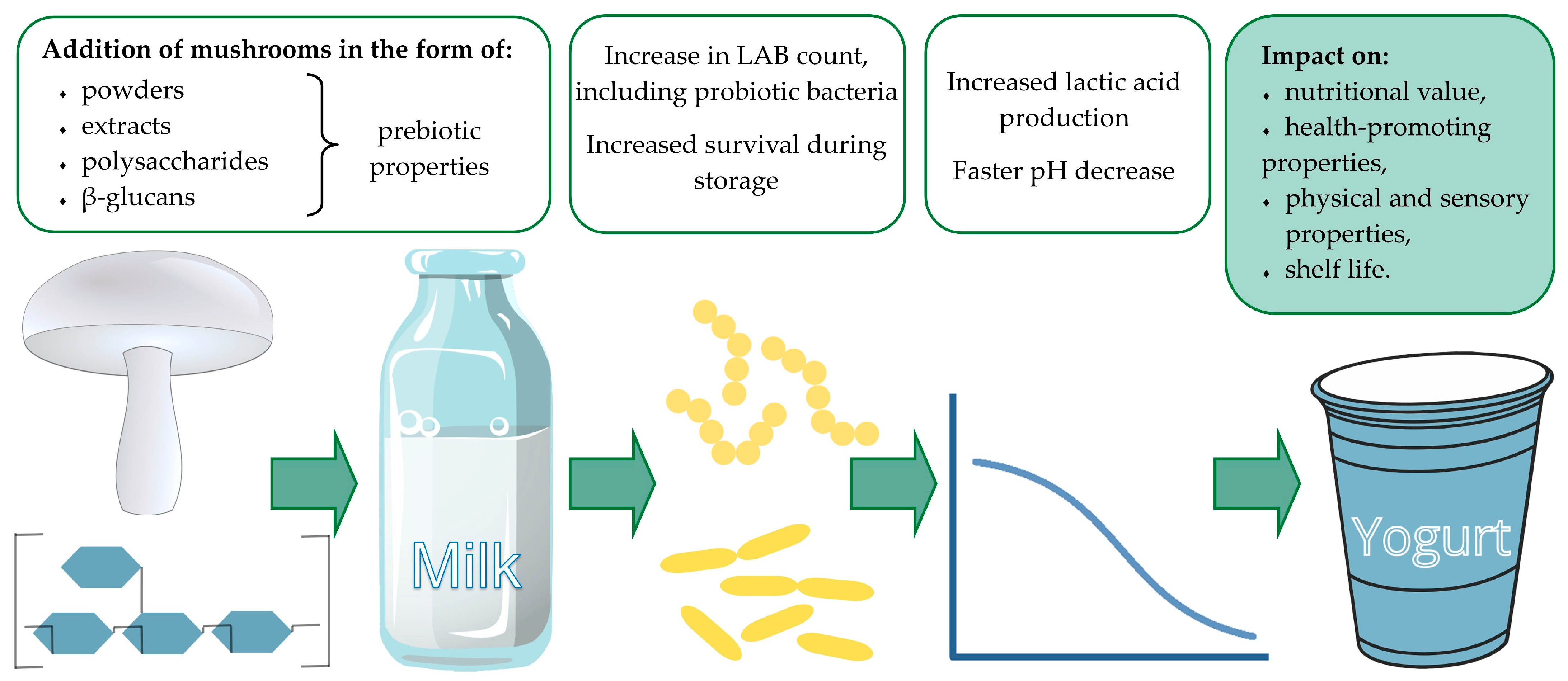
Fortifying Yogurt with Edible Mushrooms: Bioactive Compounds and Product Properties


Abstract
1. Introduction
2. Methods
3. Properties of Edible Mushrooms
3.1. Nutritional Value
3.2. Health-Promoting Properties
3.2.1. Antioxidant Properties

| Species | Compounds | Properties | References |
|---|---|---|---|
| A. bisporus | Phenolic acids | Antioxidant, anti-inflammatory, anti-carcinogenic, antimicrobial, antiviral; | [88,89,90] |
| Lectins (ABA—Agaricus bisporus agglutinin) | Immunomodulatory, antiproliferative, anti-carcinogenic; | [88,89] | |
| α-glucan | Induced tumour necrosis factor production; | [91,92] | |
| β-glucan | Increased monocyte proliferation, prebiotic; | [88,90,92] | |
| Ergosterol | antioxidant, antimicrobial, anticancer, antidiabetic, antineurodegenerative; | [90,93] | |
| Ergothioneine | Hypotriglyceridemic, antioxidant, antiatherosclerotic, hypocholesterolaemic, reducing oxidative stress; | [88,89] | |
| Agarodoxin (benzoquinone derivate) | Antibacterial; | [89] | |
| Lovastatin | Anticancer, antihyperlipidemic. | [89,94] | |
| L. edodes | β-glucan—lentinan | Anticancer, hypoglycaemic, immune-boosting; | [95,96,97] |
| Lectins | Antiproliferative, anticancer, antiviral, immune-stimulating potential; | [95,98,99] | |
| Eritadenine | Hypocholesterolaemic, hypotensive, antiparasitic | [95,100] | |
| Protein hydrolysates | Antioxidant; | [101] | |
| Polysaccharides | Antioxidant, anti-inflammatory, anticancer, antiaging, immunomodulatory, antiviral, hepatoprotection effects, antiatherosclerotic; | [96,102,103] | |
| Lentinmacrocycles A-C and Lentincoumarins A-B | Antioxidant, anti-inflammatory; | [104] | |
| Lenthionine | Antimicrobial; | [96] | |
| Polyacetylenes and sulphur compounds | Antimicrobial; | [105] | |
| Polyphenols | Antioxidant, hepatoprotection effects. | [96] | |
| P. ostreatus | Phenolic acids | Antioxidant; | [106] |
| Flavonoids | Antioxidant, anti-inflammatory, antiproliferative; | [107] | |
| Polysaccharides | Anticancer, hepatoprotective, prebiotic, anti-inflammatory, immunomodulatory, antidiabetic, antioxidant; | [106,107,108] | |
| β-glucan—pleuran | Antibacterial, antiviral, prebiotic, immunomodulatory, antioxidant; | [107,109,110] | |
| Chitosan | Antimicrobial; | [109] | |
| Lectins | Anticancer, antiviral; | [106,109] | |
| Ergosterol | Hypocholesterolaemic, antioxidant; | [107,110] | |
| Lovastatin | Hypocholesterolaemic. | [110] | |
| F. velutipes | Flammulinolide, enokipodin, proflamin | Anticancer, anti-hypertension, anti-hypercholesterolemic; | [111,112] |
| Polysaccharides | Immunomodulatory, anti-inflammatory, antibacterial, antioxidant, anti-aging, neuroprotective; | [113,114,115,116,117] | |
| Phenolic acids | Antioxidant; | [112] | |
| Arbutin, epicatechin, phillyrin, kaempferol, formononetin | Neuroprotective, antioxidant, anticancer; | [118] | |
| Sesquiterpenes | Antimicrobial, anticancer, antioxidant; | [112,117,119] | |
| Ergosterol | Anticancer. | [120] |
3.2.2. Anticancer Properties
3.2.3. Hypocholesterolaemic Properties
3.2.4. Antimicrobial Activity
3.2.5. Antiviral Activity
3.2.6. Anti-Diabetic Activity
3.2.7. Anti-Inflammatory Properties
3.2.8. Other Properties
4. Incorporating Mushrooms in Yogurt
4.1. The Form of a Mushroom Additive
4.2. The Course of Lactic Acid Fermentation and Prebiotic Properties
4.3. Effect on Physical Properties
4.3.1. Viscosity
4.3.2. Syneresis
4.3.3. Texture Profile
4.3.4. Microstructure
4.3.5. Colour Parameters
4.4. Impact on the Chemical Composition
4.4.1. Proximate Analysis
4.4.2. Amino Acids
4.4.3. Fatty Acids
4.4.4. Vitamins and Minerals
4.5. Phenolic Compound Content and Antioxidant Properties
4.6. Other Biological Activity
4.7. Sensory Quality Development
4.8. Effect on the Shelf-Life
5. Technological and Economic Aspects
6. Conclusions
Funding
Institutional Review Board Statement
Informed Consent Statement
Data Availability Statement
Conflicts of Interest
References
- Prasad, R. Historical Aspects of Milk Consumption in South, Southeast, and East Asia. Asian Agri-Hist. 2017, 21, 287–307. [Google Scholar]
- Lambrini, K.; Aikaterini, F.; Konstantinos, K.; Christos, I.; Ioanna, P.V.; Areti, T. Milk Nutritional Composition and Its Role in Human Health. J. Pharm. Pharmacol. 2020, 9, 10–15. [Google Scholar] [CrossRef]
- Bhtoya, R.; Pradhan, G.; Kumar, S.; Dobhal, A. Advanced Fortification Techniques in Dairy Products: Enhancement of Nutritional Value through Encapsulation. Nutrire 2025, 50, 22. [Google Scholar] [CrossRef]
- Saleem, G.N.; Gu, R.; Qu, H.; Bahar Khaskheli, G.; Rashid Rajput, I.; Qasim, M.; Chen, X. Therapeutic Potential of Popular Fermented Dairy Products and Its Benefits on Human Health. Front. Nutr. 2024, 11, 1328620. [Google Scholar] [CrossRef] [PubMed]
- Ratajczak, A.E.; Zawada, A.; Rychter, A.M.; Dobrowolska, A.; Krela-Kaźmierczak, I. Milk and Dairy Products: Good or Bad for Human Bone? Practical Dietary Recommendations for the Prevention and Management of Osteoporosis. Nutrients 2021, 13, 1329. [Google Scholar] [CrossRef]
- Sharma, H.; Ozogul, F.; Bartkiene, E.; Rocha, J.M. Impact of Lactic Acid Bacteria and Their Metabolites on the Techno-Functional Properties and Health Benefits of Fermented Dairy Products. Crit. Rev. Food Sci. Nutr. 2023, 63, 4819–4841. [Google Scholar] [CrossRef] [PubMed]
- Hadjimbei, E.; Botsaris, G.; Chrysostomou, S. Beneficial Effects of Yoghurts and Probiotic Fermented Milks and Their Functional Food Potential. Foods 2022, 11, 2691. [Google Scholar] [CrossRef]
- Widyastuti, Y.; Febrisiantosa, A.; Tidona, F. Health-Promoting Properties of Lactobacilli in Fermented Dairy Products. Front. Microbiol. 2021, 12, 673890. [Google Scholar] [CrossRef]
- CXS 243-2003; CODEX Standard for Fermented Milks. FAO: Rome, Italy; WHO: Geneva, Switzerland, 2024. Available online: https://www.fao.org/fao-who-codexalimentarius/sh-proxy/en/?lnk=1&url=https%253A%252F%252Fworkspace.fao.org%252Fsites%252Fcodex%252FStandards%252FCXS+243-2003%252FCXS_243e.pdf (accessed on 19 September 2025).
- Tremblay, A.; Panahi, S. Yogurt Consumption as a Signature of a Healthy Diet and Lifestyle. J. Nutr. 2017, 147, 1476S–1480S. [Google Scholar] [CrossRef]
- Wang, X.; Wang, L.; Wei, X.; Xu, C.; Cavender, G.; Lin, W.; Sun, S. Invited Review: Advances in Yogurt Development—Microbiological Safety, Quality, Functionality, Sensory Evaluation, and Consumer Perceptions across Different Dairy and Plant-Based Alternative Sources. J. Dairy Sci. 2025, 108, 33–58. [Google Scholar] [CrossRef]
- Boeck, T.; Sahin, A.W.; Zannini, E.; Arendt, E.K. Nutritional Properties and Health Aspects of Pulses and Their Use in Plant-based Yogurt Alternatives. Compr. Rev. Food Sci. Food Saf. 2021, 20, 3858–3880. [Google Scholar] [CrossRef] [PubMed]
- Montemurro, M.; Pontonio, E.; Coda, R.; Rizzello, C.G. Plant-Based Alternatives to Yogurt: State-of-the-Art and Perspectives of New Biotechnological Challenges. Foods 2021, 10, 316. [Google Scholar] [CrossRef]
- Ziarno, M.; Zaręba, D. Jogurty: Rozpoznaj Dobry Jogurt. Forum Mlecz. Handel 2022, 6, 50–53. [Google Scholar]
- Sarıtaş, S.; Mondragon Portocarrero, A.D.C.; Miranda, J.M.; Witkowska, A.M.; Karav, S. Functional Yogurt: Types and Health Benefits. Appl. Sci. 2024, 14, 11798. [Google Scholar] [CrossRef]
- Pannerchelvan, S.; Rios-Solis, L.; Wasoh, H.; Sobri, M.Z.M.; Faizal Wong, F.W.; Mohamed, M.S.; Mohamad, R.; Halim, M. Functional Yogurt: A Comprehensive Review of Its Nutritional Composition and Health Benefits. Food Funct. 2024, 15, 10927–10955. [Google Scholar] [CrossRef]
- Abdi-Moghadam, Z.; Darroudi, M.; Mahmoudzadeh, M.; Mohtashami, M.; Jamal, A.M.; Shamloo, E.; Rezaei, Z. Functional Yogurt, Enriched and Probiotic: A Focus on Human Health. Clin. Nutr. ESPEN 2023, 57, 575–586. [Google Scholar] [CrossRef] [PubMed]
- Ahmad, I.; Hao, M.; Li, Y.; Zhang, J.; Ding, Y.; Lyu, F. Fortification of Yogurt with Bioactive Functional Foods and Ingredients and Associated Challenges—A Review. Trends Food Sci. Technol. 2022, 129, 558–580. [Google Scholar] [CrossRef]
- He, Y.; Wang, B.; Wen, L.; Wang, F.; Yu, H.; Chen, D.; Su, X.; Zhang, C. Effects of Dietary Fiber on Human Health. Food Sci. Hum. Wellness 2022, 11, 1–10. [Google Scholar] [CrossRef]
- Li, M.; Ma, S. A Review of Healthy Role of Dietary Fiber in Modulating Chronic Diseases. Food Res. Int. 2024, 191, 114682. [Google Scholar] [CrossRef]
- Rashwan, A.K.; Osman, A.I.; Chen, W. Natural Nutraceuticals for Enhancing Yogurt Properties: A Review. Environ. Chem. Lett. 2023, 21, 1907–1931. [Google Scholar] [CrossRef]
- Kiani, A.K.; Dhuli, K.; Donato, K.; Aquilanti, B.; Velluti, V.; Matera, G.; Iaconelli, A.; Connelly, S.T.; Bellinato, F.; Gisondi, P.; et al. Main Nutritional Deficiencies. J. Prev. Med. Hyg. 2022, 63, E93–E101. [Google Scholar] [CrossRef]
- Pasricha, S.-R.; Tye-Din, J.; Muckenthaler, M.U.; Swinkels, D.W. Iron Deficiency. Lancet 2021, 397, 233–248. [Google Scholar] [CrossRef]
- Woźniak, D.; Cichy, W.; Dobrzyńska, M.; Przysławski, J.; Drzymała-Czyż, S. Reasonableness of Enriching Cow’s Milk with Vitamins and Minerals. Foods 2022, 11, 1079. [Google Scholar] [CrossRef]
- Hashemi Gahruie, H.; Eskandari, M.H.; Mesbahi, G.; Hanifpour, M.A. Scientific and Technical Aspects of Yogurt Fortification: A Review. Food Sci. Hum. Wellness 2015, 4, 1–8. [Google Scholar] [CrossRef]
- Picciotti, U.; Massaro, A.; Galiano, A.; Garganese, F. Cheese Fortification: Review and Possible Improvements. Food Rev. Int. 2022, 38, 474–500. [Google Scholar] [CrossRef]
- Arora, S. Fortification of Milk and Milk Products for Value Addition. In Chemical Analysis of Value Added Dairy Products and Their Quality Assurance; National Dairy Research Institute: Karnal, India, 2011; pp. 29–35. [Google Scholar]
- Bagheri, H.; Akhavan-Mahdavi, S.; Sarabi-Aghdam, V.; Mirarab Razi, S.; Singh Beniwal, A.; Rashidinejad, A. Targeted Dairy Fortification: Leveraging Bioactive Compounds to Enhance Nutritional Value. Crit. Rev. Food Sci. Nutr. 2025. online ahead of print. [Google Scholar] [CrossRef]
- Kolarzyk, E.; Pach, D. Różne Oblicza Żywności Spożywanej Przez Współczesnego Człowieka. Prz. Lek. 2012, 69, 492–497. [Google Scholar] [PubMed]
- Ambuja, S.R.; Rajakumar, S.N. Review on “Dietary Fiber Incorporated Dairy Foods: A Healthy Trend”. Int. J. Eng. Res. Appl. 2018, 8, 34–40. [Google Scholar]
- Arora, S.K.; Patel, A.; Chauhan, O. Trends in Milk and Milk Products Fortification with Dietary Fibers. Am. J. Adv. Food Sci. Technol. 2015, 3, 14–27. [Google Scholar] [CrossRef]
- Dewi, K.S.; Gavahian, M.; Phimolsiripol, Y. Dietary Fiber Supplementation in Animal Products: Recent Developments, Commercial Applications, and Sustainability Impact. Food Biosci. 2025, 68, 106668. [Google Scholar] [CrossRef]
- Wazzan, H. Fortification of Dairy Products Using Plant-Derived Bioactive Compounds. Curr. Res. Nutr. Food Sci. 2024, 12, 561–571. [Google Scholar] [CrossRef]
- Kruger, J.; Taylor, J.R.N.; Ferruzzi, M.G.; Debelo, H. What Is Food-to-food Fortification? A Working Definition and Framework for Evaluation of Efficiency and Implementation of Best Practices. Comp. Rev. Food Sci. Food Saf. 2020, 19, 3618–3658. [Google Scholar] [CrossRef]
- Vishwakarma, S.; Genu Dalbhagat, C.; Mandliya, S.; Niwas Mishra, H. Investigation of Natural Food Fortificants for Improving Various Properties of Fortified Foods: A Review. Food Res. Int. 2022, 156, 111186. [Google Scholar] [CrossRef]
- Salehi, F. Quality, Physicochemical, and Textural Properties of Dairy Products Containing Fruits and Vegetables: A Review. Food Sci. Nutr. 2021, 9, 4666–4686. [Google Scholar] [CrossRef]
- Abou-Zeid, N. The Nutraceutical Effects of Dairy Products Fortification with Plant Components: A Review. Int. J. Adv. Res. Sci. Eng. Technol. 2016, 3, 1475–1482. [Google Scholar]
- Aparna, S.; Patel, K.; Patel, S.; Pinto, S. Wheat and Its Application in Dairy Products: A Review. Res. Rev. J. Dairy Sci. Technol. 2015, 4, 19–34. [Google Scholar]
- Munteanu-Ichim, R.-A.; Canja, C.-M.; Lupu, M.; Bădărău, C.-L.; Matei, F. Tradition and Innovation in Yoghurt from a Functional Perspective—A Review. Fermentation 2024, 10, 357. [Google Scholar] [CrossRef]
- Losoya-Sifuentes, C.; Cruz, M.; Del Refugio Rocha-Pizaña, M.; Loredo-Treviño, A.; Belmares, R. Edible Mushrooms: A Nutrient-Rich Ingredient for Healthier Food Products—A Review. Curr. Nutr. Rep. 2025, 14, 9. [Google Scholar] [CrossRef]
- Das, A.K.; Nanda, P.K.; Dandapat, P.; Bandyopadhyay, S.; Gullón, P.; Sivaraman, G.K.; McClements, D.J.; Gullón, B.; Lorenzo, J.M. Edible Mushrooms as Functional Ingredients for Development of Healthier and More Sustainable Muscle Foods: A Flexitarian Approach. Molecules 2021, 26, 2463. [Google Scholar] [CrossRef]
- Li, H.; Tian, Y.; Menolli, N.; Ye, L.; Karunarathna, S.C.; Perez-Moreno, J.; Rahman, M.M.; Rashid, M.H.; Phengsintham, P.; Rizal, L.; et al. Reviewing the World’s Edible Mushroom Species: A New Evidence-based Classification System. Comp. Rev. Food Sci. Food Saf. 2021, 20, 1982–2014. [Google Scholar] [CrossRef] [PubMed]
- Ho, L.-H.; Asyikeen Zulkifli, N.; Tan, T.-C. Edible Mushroom: Nutritional Properties, Potential Nutraceutical Values, and Its Utilisation in Food Product Development. In An Introduction to Mushroom; Kumar Passari, A., Sánchez, S., Eds.; IntechOpen: London, UK, 2020; ISBN 978-1-78985-955-3. [Google Scholar]
- Kumar, H.; Bhardwaj, K.; Kuča, K.; Sharifi-Rad, J.; Verma, R.; Machado, M.; Kumar, D.; Cruz-Martins, N. Edible Mushrooms’ Enrichment in Food and Feed: A Mini Review. Int. J. Food Sci. Tech. 2022, 57, 1386–1398. [Google Scholar] [CrossRef]
- Perveen, I.; Bukhari, B.; Sarwar, A.; Aziz, T.; Koser, N.; Younis, H.; Ahmad, Q.; Sabahat, S.; Tzora, A.; Skoufos, I. Applications and Efficacy of Traditional to Emerging Trends in Lacto-Fermentation and Submerged Cultivation of Edible Mushrooms. Biomass Convers. Biorefinery 2024, 14, 29283–29302. [Google Scholar] [CrossRef]
- Li, C.; Xu, S. Edible Mushroom Industry in China: Current State and Perspectives. Appl. Microbiol. Biotechnol. 2022, 106, 3949–3955. [Google Scholar] [CrossRef]
- Kumar, K.; Mehra, R.; Guiné, R.P.F.; Lima, M.J.; Kumar, N.; Kaushik, R.; Ahmed, N.; Yadav, A.N.; Kumar, H. Edible Mushrooms: A Comprehensive Review on Bioactive Compounds with Health Benefits and Processing Aspects. Foods 2021, 10, 2996. [Google Scholar] [CrossRef] [PubMed]
- Rajewska, K.; Bałasińska, B. Związki Biologicznie Aktywne Zawarte w Grzybach Jadalnych i Ich Korzystny Wpływ Na Zdrowie. Post. Hig. Med. Dosw. 2004, 58, 352–357. [Google Scholar]
- Sławińska, A.; Michalak-Majewska, M.; Jabłońska-Ryś, E.; Skrzypczak, K.; Radzki, W.; Teterycz, D.; Gustaw, W. Grzyby Jadalne: Wartość Odżywcza, Produkcja, Przetwórstwo i Wykorzystanie; Towarzystwo Wydawnictw Naukowych LIBROPOLIS: Lublin, Poland, 2017. [Google Scholar]
- El Sebaaly, Z.; Assadi, F.; Najib Sassine, Y.; Shaban, N. Substrate Types Effect on Nutritional Composition of Button Mushroom (Agaricus bisporus). Agric. For. 2019, 65, 73–80. [Google Scholar] [CrossRef]
- Tsai, S.-Y.; Wu, T.-P.; Huang, S.-J.; Mau, J.-L. Nonvolatile Taste Components of Agaricus bisporus Harvested at Different Stages of Maturity. Food Chem. 2007, 103, 1457–1464. [Google Scholar] [CrossRef]
- Usman, M.; Murtaza, G.; Ditta, A. Nutritional, Medicinal, and Cosmetic Value of Bioactive Compounds in Button Mushroom (Agaricus bisporus): A Review. Appl. Sci. 2021, 11, 5943. [Google Scholar] [CrossRef]
- USDA. U.S. Department of Agriculture, Food Data Central. Available online: https://fdc.nal.usda.gov/ (accessed on 18 August 2025).
- Kalač, P. A Review of Chemical Composition and Nutritional Value of Wild-growing and Cultivated Mushrooms. J. Sci. Food Agric. 2013, 93, 209–218. [Google Scholar] [CrossRef]
- Sławińska, A.; Jabłońska-Ryś, E.; Stachniuk, A. High-Performance Liquid Chromatography Determination of Free Sugars and Mannitol in Mushrooms Using Corona Charged Aerosol Detection. Food Anal. Methods 2021, 14, 209–216. [Google Scholar] [CrossRef]
- Atila, F.; Nadhim Owaid, M.; Ali Shariati, M. The Nutritional and Medical Benefits of Agaricus bisporus: A Review. J. Microb. Biotech. Food Sci. 2017, 7, 281–286. [Google Scholar] [CrossRef]
- Golak-Siwulska, I.; Kałużewicz, A.; Wdowienko, S.; Dawidowicz, L.; Sobieralski, K. Nutritional Value and Health-Promoting Properties of Agaricus bisporus (Lange) Imbach. Herba Pol. 2018, 64, 71–81. [Google Scholar] [CrossRef]
- Cheung, P.C.K. Mini-Review on Edible Mushrooms as Source of Dietary Fiber: Preparation and Health Benefits. Food Sci. Hum. Wellness 2013, 2, 162–166. [Google Scholar] [CrossRef]
- Timm, T.G.; Costa, T.M.; Alberton, M.D.; Helm, C.V.; Tavares, L.B.B. Mushroom β-Glucans: Application and Innovation for Food Industry and Immunotherapy. Appl. Microbiol. Biotechnol. 2023, 107, 5035–5049. [Google Scholar] [CrossRef]
- Cerletti, C.; Esposito, S.; Iacoviello, L. Edible Mushrooms and Beta-Glucans: Impact on Human Health. Nutrients 2021, 13, 2195. [Google Scholar] [CrossRef]
- Siwulski, M.; Sobieralski, K.; Sas-Golak, I. Wartość Odżywcza i Prozdrowotna Grzybów. Żywność Nauka Technol. Jakość 2014, 1, 16–28. [Google Scholar] [CrossRef]
- Corrêa, R.C.G.; Brugnari, T.; Bracht, A.; Peralta, R.M.; Ferreira, I.C.F.R. Biotechnological, Nutritional and Therapeutic Uses of Pleurotus Spp. (Oyster Mushroom) Related with Its Chemical Composition: A Review on the Past Decade Findings. Trends Food Sci. Technol. 2016, 50, 103–117. [Google Scholar] [CrossRef]
- Ayimbila, F.; Keawsompong, S. Nutritional Quality and Biological Application of Mushroom Protein as a Novel Protein Alternative. Curr. Nutr. Rep. 2023, 12, 290–307. [Google Scholar] [CrossRef]
- Wang, M.; Zhao, R. A Review on Nutritional Advantages of Edible Mushrooms and Its Industrialization Development Situation in Protein Meat Analogues. J. Future Foods 2023, 3, 1–7. [Google Scholar] [CrossRef]
- Bach, F.; Helm, C.V.; Bellettini, M.B.; Maciel, G.M.; Haminiuk, C.W.I. Edible Mushrooms: A Potential Source of Essential Amino Acids, Glucans and Minerals. Int. J. Food Sci. Tech. 2017, 52, 2382–2392. [Google Scholar] [CrossRef]
- Akindahunsi, A.A.; Oyetayo, F.L. Nutrient and Antinutrient Distribution of Edible Mushroom, Pleurotus Tuber-Regium (Fries) Singer. LWT 2006, 39, 548–553. [Google Scholar] [CrossRef]
- Sun, L.; Zhang, Z.; Xin, G.; Sun, B.; Bao, X.; Wei, Y.; Zhao, X.; Xu, H. Advances in Umami Taste and Aroma of Edible Mushrooms. Trends Food Sci. Technol. 2020, 96, 176–187. [Google Scholar] [CrossRef]
- Jabłońska-Ryś, E.; Przygoński, K. Possibilities of Using the New Lactiplantibacillus plantarum EK11 Strain as a Starter Culture for the Fermentation of the Fruiting Bodies of Edible Mushrooms. Foods 2025, 14, 2833. [Google Scholar] [CrossRef]
- Han, J.; Sun, R.; Huang, C.; Xie, H.; Gao, X.; Yao, Q.; Yang, P.; Li, J.; Gong, Z. Effects of Different Carbon and Nitrogen Ratios on Yield, Nutritional Value, and Amino Acid Contents of Flammulina velutipes. Life 2024, 14, 598. [Google Scholar] [CrossRef] [PubMed]
- Saini, R.K.; Rauf, A.; Khalil, A.A.; Ko, E.-Y.; Keum, Y.-S.; Anwar, S.; Alamri, A.; Rengasamy, K.R.R. Edible Mushrooms Show Significant Differences in Sterols and Fatty Acid Compositions. S. Afr. J. Bot. 2021, 141, 344–356. [Google Scholar] [CrossRef]
- Das, A.K.; Asif, M.; Hasan, G.M.M.A. A Comparative Study of Fatty Acid Compositions of Three Cultivated Edible Mushroom Species of Bangladesh. J. Agric. Food Res. 2023, 12, 100620. [Google Scholar] [CrossRef]
- Baars, J.J.P.; Sonnenberg, A.S.M.; Mumm, R.; Stijger, I.; Wehrens, R. Metabolites Contributing to Taste in Agaricus bisporus; Stichting Dienst Landbouwkundig Onderzoek, Research Institute Praktijkonderzoek Plant & Omgeving/Plant Research International: Wageningen, The Netherlands, 2016. [Google Scholar]
- Sławińska, A.; Fornal, E.; Radzki, W.; Skrzypczak, K.; Zalewska-Korona, M.; Michalak-Majewska, M.; Parfieniuk, E.; Stachniuk, A. Study on Vitamin D2 Stability in Dried Mushrooms during Drying and Storage. Food Chem. 2016, 199, 203–209. [Google Scholar] [CrossRef]
- Elkhateeb, W.A.; Daba, G.M. Vitamin D Enriched Edible Mushrooms: A Review. J. Mycol. Mycol. Sci. 2023, 6, 000170. [Google Scholar] [CrossRef]
- Leung, M.F.; Cheung, P.C.K. Vitamins D and D2 in Cultivated Mushrooms under Ultraviolet Irradiation and Their Bioavailability in Humans: A Mini-Review. Int. J. Med. Mushrooms 2021, 23, 1–15. [Google Scholar] [CrossRef]
- Simon, R.R.; Phillips, K.M.; Horst, R.L.; Munro, I.C. Vitamin D Mushrooms: Comparison of the Composition of Button Mushrooms (Agaricus bisporus) Treated Postharvest with UVB Light or Sunlight. J. Agric. Food Chem. 2011, 59, 8724–8732. [Google Scholar] [CrossRef]
- Huang, S.-J.; Lin, C.-P.; Tsai, S.-Y. Vitamin D2 Content and Antioxidant Properties of Fruit Body and Mycelia of Edible Mushrooms by UV-B Irradiation. J. Food Compos. Anal. 2015, 42, 38–45. [Google Scholar] [CrossRef]
- Taofiq, O.; Fernandes, Â.; Barros, L.; Barreiro, M.F.; Ferreira, I.C.F.R. UV-Irradiated Mushrooms as a Source of Vitamin D2: A Review. Trends Food Sci. Technol. 2017, 70, 82–94. [Google Scholar] [CrossRef]
- Gucia, M.; Jarzyńska, G.; Rafał, E.; Roszak, M.; Kojta, A.K.; Osiej, I.; Falandysz, J. Multivariate Analysis of Mineral Constituents of Edible Parasol Mushroom (Macrolepiota procera) and Soils beneath Fruiting Bodies Collected from Northern Poland. Environ. Sci. Pollut. Res. 2012, 19, 416–431. [Google Scholar] [CrossRef]
- Surma, S.; Romańczyk, M.; Bańkowski, E. The Role of Limiting Sodium Intake in the Diet—From Theory to Practice. Folia Cardiol. 2020, 15, 227–235. [Google Scholar] [CrossRef]
- Liu, S.; Liu, H.; Li, J.; Wang, Y. Research Progress on Elements of Wild Edible Mushrooms. J. Fungi 2022, 8, 964. [Google Scholar] [CrossRef]
- Kozarski, M.; Klaus, A.; Jakovljevic, D.; Todorovic, N.; Vunduk, J.; Petrović, P.; Niksic, M.; Vrvic, M.; Van Griensven, L. Antioxidants of Edible Mushrooms. Molecules 2015, 20, 19489–19525. [Google Scholar] [CrossRef]
- Radzki, W.; Sławińska, A.; Jabłońska-Ryś, E.; Michalak-Majewska, M. Effect of Blanching and Cooking on Antioxidant Capacity of Cultivated Edible Mushrooms: A Comparative Study. Int. Food Res. J. 2016, 23, 599–605. [Google Scholar]
- Radzki, W.; Tutaj, K.; Skrzypczak, K.; Michalak-Majewska, M.; Gustaw, W. Ethanolic Extracts of Six Cultivated Mushrooms as a Source of Bioactive Compounds. Appl. Sci. 2023, 14, 66. [Google Scholar] [CrossRef]
- Abdelshafy, A.M.; Belwal, T.; Liang, Z.; Wang, L.; Li, D.; Luo, Z.; Li, L. A Comprehensive Review on Phenolic Compounds from Edible Mushrooms: Occurrence, Biological Activity, Application and Future Prospective. Crit. Rev. Food Sci. Nutr. 2022, 62, 6204–6224. [Google Scholar] [CrossRef]
- Muszyńska, B.; Sułkowska-Ziaja, K.; Ekiert, H. Indole Compounds in Fruiting Bodies of Some Edible Basidiomycota Species. Food Chem. 2011, 125, 1306–1308. [Google Scholar] [CrossRef]
- Kozarski, M.; Klaus, A.; Vunduk, J.; Zizak, Z.; Niksic, M.; Jakovljevic, D.; Vrvic, M.M.; Van Griensven, L.J.L.D. Nutraceutical Properties of the Methanolic Extract of Edible Mushroom Cantharellus cibarius (Fries): Primary Mechanisms. Food Funct. 2015, 6, 1875–1886. [Google Scholar] [CrossRef] [PubMed]
- Majewski, J.; Orylski, M.; Majewski, M.; Rasała, J. Wpływ Substancji Zawartych w Pieczarkach Na Organizm Człowieka. MR 2018, 21, 151–155. [Google Scholar] [CrossRef]
- Muszyńska, B.; Kała, K.; Rojowski, J.; Grzywacz, A.; Opoka, W. Composition and Biological Properties of Agaricus bisporus Fruiting Bodies—A Review. Pol. J. Food Nutr. Sci. 2017, 67, 173–181. [Google Scholar] [CrossRef]
- Kaushal, K.; Kumar, M.; Thakur, A.; Kaur, T. An Overview of the Phytochemical and Therapeutic Potential of the White Button Mushroom (Agaricus bisporus (J.E. Lange) Imbach). J. Phytonanotechnol. Pharm. Sci. 2025, 5, 34–40. [Google Scholar] [CrossRef]
- Ren, L.; Perera, C.; Hemar, Y. Antitumor Activity of Mushroom Polysaccharides: A Review. Food Funct. 2012, 3, 1118–1130. [Google Scholar] [CrossRef]
- Bhushan, A.; Kulshreshtha, M. The Medicinal Mushroom Agaricus bisporus: Review of Phytopharmacology and Potential Role in the Treatment of Various Diseases. J. Nat. Sci. Med. 2018, 1, 4–9. [Google Scholar]
- Rangsinth, P.; Sharika, R.; Pattarachotanant, N.; Duangjan, C.; Wongwan, C.; Sillapachaiyaporn, C.; Nilkhet, S.; Wongsirojkul, N.; Prasansuklab, A.; Tencomnao, T.; et al. Potential Beneficial Effects and Pharmacological Properties of Ergosterol, a Common Bioactive Compound in Edible Mushrooms. Foods 2023, 12, 2529. [Google Scholar] [CrossRef]
- Yang, T.; Yao, H.; He, G.; Song, L.; Liu, N.; Wang, Y.; Yang, Y.; Keller, E.T.; Deng, X. Effects of Lovastatin on MDA-MB-231 Breast Cancer Cells: An Antibody Microarray Analysis. J. Cancer 2016, 7, 192–199. [Google Scholar] [CrossRef] [PubMed]
- Bisen, P.S.; Baghel, R.K.; Sanodiya, B.S.; Thakur, G.S.; Prasad, G.B.K.S. Lentinus edodes: A Macrofungus with Pharmacological Activities. Curr. Med. Chem. 2010, 17, 2419–2430. [Google Scholar] [CrossRef] [PubMed]
- Ponnusamy, C.; Uddandrao, V.V.S.; Pudhupalayam, S.P.; Singaravel, S.; Periyasamy, T.; Ponnusamy, P.; Prabhu, P.; Sasikumar, V.; Ganapathy, S. Lentinula edodes (Edible Mushroom) as a Nutraceutical: A Review. Biosci. Biotech. Res. Asia 2022, 19, 1–11. [Google Scholar] [CrossRef]
- Chakraborty, S.; Beura, M.; Sharma, S.K.; Singh, A.; Dahuja, A.; Krishnan, V. Lentinan, β-Glucan from Shiitake (Lentinula edodes): A Review on Structure, Conformational Transition, and Gastro-Intestinal Interaction Contributing towards Its Anti-Diabetic Potential. Trends Food Sci. Technol. 2023, 142, 104224. [Google Scholar] [CrossRef]
- Nikitina, V.; Loshchinina, E.; Vetchinkina, E. Lectins from Mycelia of Basidiomycetes. Int. J. Mol. Sci. 2017, 18, 1334. [Google Scholar] [CrossRef]
- Singh, R.S.; Bhari, R.; Kaur, H.P. Mushroom Lectins: Current Status and Future Perspectives. Crit. Rev. Biotechnol. 2010, 30, 99–126. [Google Scholar] [CrossRef]
- Duran-Rivera, B.; Rojas-Rodas, F.; Silva López, W.; Gómez-Suárez, C.; Castro Restrepo, D. Enhancing Eritadenine Production in Submerged Cultures of Shiitake (Lentinula edodes Berk. Pegler) Using Blue LED Light and Activated Charcoal. Revealing Eritadenine’s Novel in Vitro Bioherbicidal Activity against Chrysanthemum morifolium. Mycobiology 2024, 52, 145–159. [Google Scholar] [CrossRef]
- Bing, S.-J.; Chen, X.-S.; Zhong, X.; Li, Y.-Q.; Sun, G.-J.; Wang, C.-Y.; Liang, Y.; Zhao, X.-Z.; Hua, D.-L.; Chen, L.; et al. Structural, Functional and Antioxidant Properties of Lentinus edodes Protein Hydrolysates Prepared by Five Enzymes. Food Chem. 2024, 437, 137805. [Google Scholar] [CrossRef]
- Sheng, K.; Wang, C.; Chen, B.; Kang, M.; Wang, M.; Liu, K.; Wang, M. Recent Advances in Polysaccharides from Lentinus edodes (Berk.): Isolation, Structures and Bioactivities. Food Chem. 2021, 358, 129883. [Google Scholar] [CrossRef]
- Roszczyk, A.; Turło, J.; Zagożdżon, R.; Kaleta, B. Immunomodulatory Properties of Polysaccharides from Lentinula edodes. Int. J. Mol. Sci. 2022, 23, 8980. [Google Scholar] [CrossRef] [PubMed]
- Xu, X.; Yu, C.; Liu, Z.; Cui, X.; Guo, X.; Wang, H. Chemical Composition, Antioxidant and Anti-Inflammatory Activity of Shiitake Mushrooms (Lentinus edodes). J. Fungi 2024, 10, 552. [Google Scholar] [CrossRef] [PubMed]
- Fukushima-Sakuno, E. Bioactive Small Secondary Metabolites from the Mushrooms Lentinula edodes and Flammulina velutipes. J. Antibiot. 2020, 73, 687–696. [Google Scholar] [CrossRef]
- Zhao, Q.; Liu, X.; Cui, L.; Ma, C. Extraction and Bioactivities of the Chemical Composition from Pleurotus ostreatus: A Review. J. Future Foods 2024, 4, 111–118. [Google Scholar] [CrossRef]
- Selvamani, S.; El-Enshasy, H.A.; Dailin, D.J.; Malek, R.A.; Hanapi, S.Z.; Ambehabati, K.K.; Sukmawati, D.; Leng, O.M.; Moloi, N. Antioxidant Compounds of the Edible Mushroom Pleurotus ostreatus. Int. J. Biotechnol. Wellness Ind. 2018, 7, 1–14. [Google Scholar] [CrossRef]
- Sharma, A.; Sharma, A.; Tripathi, A. Biological Activities of Pleurotus Spp. Polysaccharides: A Review. J. Food Biochem. 2021, 45, e13748. [Google Scholar] [CrossRef]
- Törős, G.; El-Ramady, H.; Prokisch, J.; Velasco, F.; Llanaj, X.; Nguyen, D.H.H.; Peles, F. Modulation of the Gut Microbiota with Prebiotics and Antimicrobial Agents from Pleurotus ostreatus Mushroom. Foods 2023, 12, 2010. [Google Scholar] [CrossRef]
- Sarma, D.; Saha, A.K.; Datta, B.K. Bioactive Compounds with Special References to Anticancer Property of Oyster Mushroom Pleurotus ostreatus. J. Pharmacogn. Phytochem. 2018, 7, 2694–2698. [Google Scholar]
- Sharma, V.P.; Barh, A.; Bairwa, R.K.; Annepu, S.K.; Kumari, B.; Kamal, S. Enoki Mushroom (Flammulina velutipes (Curtis) Singer) Breeding. In Advances in Plant Breeding Strategies: Vegetable Crops; Al-Khayri, J.M., Jain, S.M., Johnson, D.V., Eds.; Springer International Publishing: Cham, Switzerland, 2021; pp. 423–441. ISBN 978-3-030-66968-3. [Google Scholar]
- Tang, C.; Hoo, P.C.-X.; Tan, L.T.-H.; Pusparajah, P.; Khan, T.M.; Lee, L.-H.; Goh, B.-H.; Chan, K.-G. Golden Needle Mushroom: A Culinary Medicine with Evidenced-Based Biological Activities and Health Promoting Properties. Front. Pharmacol. 2016, 7, 474. [Google Scholar] [CrossRef] [PubMed]
- Ye, S.; Gao, Y.; Hu, X.; Cai, J.; Sun, S.; Jiang, J. Research Progress and Future Development Potential of Flammulina velutipes Polysaccharides in the Preparation Process, Structure Analysis, Biology, and Pharmacology: A Review. Int. J. Biol. Macromol. 2024, 267, 131467. [Google Scholar] [CrossRef] [PubMed]
- Song, W.; Li, M.; Yue, X.; Zheng, Y. Effect of Extraction and Purification on the Structure and Activity of Flammulina velutipes Polysaccharides: A Review. Int. J. Food Sci. Technol. 2024, 59, 9571–9591. [Google Scholar] [CrossRef]
- Liu, H.; Liu, X.; Xie, J.; Chen, S. Structure, Function and Mechanism of Edible Fungus Polysaccharides in Human Beings Chronic Diseases. Food Sci. Technol. 2023, 43, e111022. [Google Scholar] [CrossRef]
- Ma, G.; Li, X.; Tao, Q.; Ma, S.; Du, H.; Hu, Q.; Xiao, H. Impacts of Preparation Technologies on Biological Activities of Edible Mushroom Polysaccharides—Novel Insights for Personalized Nutrition Achievement. Crit. Rev. Food Sci. Nutr. 2025, 65, 2898–2920. [Google Scholar] [CrossRef]
- Ma, G.; Yang, W.; Zhao, L.; Pei, F.; Fang, D.; Hu, Q. A Critical Review on the Health Promoting Effects of Mushrooms Nutraceuticals. Food Sci. Hum. Wellness 2018, 7, 125–133. [Google Scholar] [CrossRef]
- Hu, Q.; Wang, D.; Yu, J.; Ma, G.; Pei, F.; Yang, W. Neuroprotective Effects of Six Components from Flammulina velutipes on H2O2-Induced Oxidative Damage in PC12 Cells. J. Funct. Foods 2017, 37, 586–593. [Google Scholar] [CrossRef]
- Saito, M.; Kuwahara, S. Enantioselective Total Synthesis of Enokipodins A–D, Antimicrobial Sesquiterpenes Produced by the Mushroom, Flammulina velutipes. Biosci. Biotechnol. Biochem. 2005, 69, 374–381. [Google Scholar] [CrossRef][Green Version]
- Yi, C.; Zhong, H.; Tong, S.; Cao, X.; Firempong, C.; Liu, H.; Fu, M.; Yang, Y.; Feng, Y.; Zhang, H.; et al. Enhanced Oral Bioavailability of a Sterol-Loaded Microemulsion Formulation of Flammulina velutipes, a Potential Antitumor Drug. Int. J. Nanomed. 2012, 7, 5067–5078. [Google Scholar] [CrossRef]
- Ferreira, I.; Barros, L.; Abreu, R. Antioxidants in Wild Mushrooms. Curr. Med. Chem. 2009, 16, 1543–1560. [Google Scholar] [CrossRef]
- Ferreira, I.; Vaz, J.; Vasconcelos, H.; Martins, A. Compounds from Wild Mushrooms with Antitumor Potential. Anticancer Agents Med. Chem. 2010, 10, 424–436. [Google Scholar] [CrossRef]
- Górska-Jakubowska, S.; Wu, Y.; Turło, J.; Xu, B. Critical Review on the Anti-Tumor Activity of Bioactive Compounds from Edible and Medicinal Mushrooms over the Last Five Years. Nutrients 2025, 17, 1887. [Google Scholar] [CrossRef]
- Vetter, J. The Mushroom Glucans: Molecules of High Biological and Medicinal Importance. Foods 2023, 12, 1009. [Google Scholar] [CrossRef]
- Rop, O.; Mlcek, J.; Jurikova, T. Beta-Glucans in Higher Fungi and Their Health Effects. Nutr. Rev. 2009, 67, 624–631. [Google Scholar] [CrossRef] [PubMed]
- Park, H.-J. Current Uses of Mushrooms in Cancer Treatment and Their Anticancer Mechanisms. Int. J. Mol. Sci. 2022, 23, 10502. [Google Scholar] [CrossRef] [PubMed]
- Fialková, V. Mushroom Beta-Glucans as Anticancer and Therapeutic Agents: A Focus on Their Mechanism of Action. Acta Fytotech. Zootech. 2023, 26, 429–437. [Google Scholar] [CrossRef]
- Moniruzzaman, M.; Tuong, D.T.C.; Chin, S.; Anjana, S.; Karthikeyan, A.; Min, T.; Kim, I.-J. A Review on Pharmacological Insights of Edible and Medicinal Mushroom Based β-Glucans. Appl. Biol. Chem. 2025, 68, 41. [Google Scholar] [CrossRef]
- El-Maradny, Y.A.; El-Fakharany, E.M.; Abu-Serie, M.M.; Hashish, M.H.; Selim, H.S. Lectins Purified from Medicinal and Edible Mushrooms: Insights into Their Antiviral Activity against Pathogenic Viruses. Int. J. Biol. Macromol. 2021, 179, 239–258. [Google Scholar] [CrossRef]
- Singh, S.; Wang, H.; Chan, Y.; Pan, W.; Dan, X.; Yin, C.; Akkouh, O.; Ng, T. Lectins from Edible Mushrooms. Molecules 2014, 20, 446–469. [Google Scholar] [CrossRef]
- Das, T.; Roy, B.; Bhattacharyya, S. Edible Mushrooms and Their Holistic Approach on Health. Arch. Food Nutr. Sci. 2023, 7, 78–87. [Google Scholar] [CrossRef]
- Gil-Ramírez, A.; Caz, V.; Martin-Hernandez, R.; Marín, F.R.; Largo, C.; Rodríguez-Casado, A.; Tabernero, M.; Ruiz-Rodríguez, A.; Reglero, G.; Soler-Rivas, C. Modulation of Cholesterol-Related Gene Expression by Ergosterol and Ergosterol-Enriched Extracts Obtained from Agaricus bisporus. Eur. J. Nutr. 2016, 55, 1041–1057. [Google Scholar] [CrossRef]
- Rauf, A.; Joshi, P.B.; Ahmad, Z.; Hemeg, H.A.; Olatunde, A.; Naz, S.; Hafeez, N.; Simal-Gandara, J. Edible Mushrooms as Potential Functional Foods in Amelioration of Hypertension. Phytother. Res. 2023, 37, 2644–2660. [Google Scholar] [CrossRef]
- Uffelman, C.N.; Chan, N.I.; Davis, E.M.; Wang, Y.; McGowan, B.S.; Campbell, W.W. An Assessment of Mushroom Consumption on Cardiometabolic Disease Risk Factors and Morbidities in Humans: A Systematic Review. Nutrients 2023, 15, 1079. [Google Scholar] [CrossRef]
- Noor, M.; Sivasamugham, L.A.; Subramaniam, G. A Review on the Antibacterial Activity of Edible Mushrooms. INTI J. 2021, 2021, 2600–7320. [Google Scholar] [CrossRef]
- Shah, S.R.; Ukaegbu, C.I.; Hamid, H.A.; Alara, O.R. Evaluation of Antioxidant and Antibacterial Activities of the Stems of Flammulina velutipes and Hypsizygus Tessellatus (White and Brown Var.) Extracted with Different Solvents. J. Food Meas. Charact. 2018, 12, 1947–1961. [Google Scholar] [CrossRef]
- Seo, D.J.; Choi, C. Antiviral Bioactive Compounds of Mushrooms and Their Antiviral Mechanisms: A Review. Viruses 2021, 13, 350. [Google Scholar] [CrossRef]
- Zhang, Y.; Zhang, G.; Ling, J. Medicinal Fungi with Antiviral Effect. Molecules 2022, 27, 4457. [Google Scholar] [CrossRef] [PubMed]
- Sousa, A.S.; Araújo-Rodrigues, H.; Pintado, M.E. The Health-Promoting Potential of Edible Mushroom Proteins. Curr. Pharm. Des. 2023, 29, 804–823. [Google Scholar] [CrossRef] [PubMed]
- Téllez-Téllez, M.; Diaz-Godinez, G. Mushrooms and Fungi and Their Biological Compounds with Antidiabetic Activity: A Review. Int. J. Med. Mushrooms 2024, 26, 13–24. [Google Scholar] [CrossRef] [PubMed]
- Das, A.; Chen, C.-M.; Mu, S.-C.; Yang, S.-H.; Ju, Y.-M.; Li, S.-C. Medicinal Components in Edible Mushrooms on Diabetes Mellitus Treatment. Pharmaceutics 2022, 14, 436. [Google Scholar] [CrossRef]
- Chowdhury, P.; Paul, S. The Potential Role of Mushrooms in the Prevention and Treatment of Diabetes: A Review. J. Biol. Act. Prod. Nat. 2020, 10, 429–454. [Google Scholar] [CrossRef]
- Asrafuzzaman, M.; Rahman, M.M.; Mandal, M.; Marjuque, M.; Bhowmik, A.; Rokeya, B.; Hassan, Z.; Faruque, M.O. Oyster Mushroom Functions as an Anti-Hyperglycaemic through Phosphorylation of AMPK and Increased Expression of GLUT4 in Type 2 Diabetic Model Rats. J. Taibah Univ. Med. Sci. 2018, 13, 465–471. [Google Scholar] [CrossRef]
- Kumar, K. Role of Edible Mushrooms as Functional Foods—A Review. SAJFTE 2015, 1, 211–218. [Google Scholar] [CrossRef]
- Pabasara, G.V.S.; Fernando, M.D.M.; Abeysekera, W.K.S.M.; Liyanapathirana, L.V.C. Comparative Study on the Therapeutic Potential of Aqueous Extracts from Commercially Cultivated Agaricus bisporus and Lentinula edodes in Sri Lanka: Antioxidant, Anticancer, Antidiabetic, and Antibacterial Properties. BMC Complement. Med. Ther. 2025, 25, 233. [Google Scholar] [CrossRef] [PubMed]
- Ekowati, N.; Yuniati, N.I.; Hernayanti, H.; Ratnaningtyas, N.I. Antidiabetic Potentials of Button Mushroom (Agaricus bisporus) on Alloxan-Induced Diabetic Rats. Biosaintifika J. Biol. Biol. Educ. 2018, 10, 655–662. [Google Scholar] [CrossRef]
- Elsayed, E.A.; El Enshasy, H.; Wadaan, M.A.M.; Aziz, R. Mushrooms: A Potential Natural Source of Anti-Inflammatory Compounds for Medical Applications. Mediat. Inflamm. 2014, 2014, 805841. [Google Scholar] [CrossRef]
- Yin, Z.; Zhang, J.; Qin, J.; Guo, L.; Guo, Q.; Kang, W.; Ma, C.; Chen, L. Anti-Inflammatory Properties of Polysaccharides from Edible Fungi on Health-Promotion: A Review. Front. Pharmacol. 2024, 15, 1447677. [Google Scholar] [CrossRef]
- Włodarczyk, A. Potencjał Biologiczny Wybranych Grzybów Uprawnych w Profilaktyce Chorób Cywilizacyjnych. Ph.D. Thesis, Uniwersytet Jagielloński, Kraków, Poland, 2022. [Google Scholar]
- Yin, Z.; Liang, Z.; Li, C.; Wang, J.; Ma, C.; Kang, W. Immunomodulatory Effects of Polysaccharides from Edible Fungus: A Review. Food Sci. Hum. Wellness 2021, 10, 393–400. [Google Scholar] [CrossRef]
- Soares, A.; De Sá-Nakanishi, A.; Bracht, A.; Da Costa, S.; Koehnlein, E.; De Souza, C.; Peralta, R. Hepatoprotective Effects of Mushrooms. Molecules 2013, 18, 7609–7630. [Google Scholar] [CrossRef]
- Ganesan, K.; Xu, B. Anti-Obesity Effects of Medicinal and Edible Mushrooms. Molecules 2018, 23, 2880. [Google Scholar] [CrossRef]
- Rangel-Vargas, E.; Rodriguez, J.A.; Domínguez, R.; Lorenzo, J.M.; Sosa, M.E.; Andrés, S.C.; Rosmini, M.; Pérez-Alvarez, J.A.; Teixeira, A.; Santos, E.M. Edible Mushrooms as a Natural Source of Food Ingredient/Additive Replacer. Foods 2021, 10, 2687. [Google Scholar] [CrossRef] [PubMed]
- Patinho, I.; Selani, M.M.; Saldaña, E.; Bortoluzzi, A.C.T.; Rios-Mera, J.D.; Da Silva, C.M.; Kushida, M.M.; Contreras-Castillo, C.J. Agaricus bisporus Mushroom as Partial Fat Replacer Improves the Sensory Quality Maintaining the Instrumental Characteristics of Beef Burger. Meat Sci. 2021, 172, 108307. [Google Scholar] [CrossRef]
- Fernández-López, J.; Viuda-Martos, M.; Botella-Martínez, C.; Muñoz-Bas, C.; Bermúdez-Gómez, P.; Lucas-González, R.; Pérez-Álvarez, J.Á. The Potential of Cultivated Mushrooms as Salt Substitutes in Meat Products. Foods 2025, 14, 977. [Google Scholar] [CrossRef]
- Dhanapal, D.; Rajoo, B. Value Addition of Mushrooms by Incorporation in the Food Products: An Overview. Int. J. Food Eng. 2023, 19, 573–591. [Google Scholar] [CrossRef]
- Michalska, A.; Sierocka, M.; Drzewiecka, B.; Świeca, M. Antioxidant and Anti-Inflammatory Properties of Mushroom-Based Food Additives and Food Fortified with Them—Current Status and Future Perspectives. Antioxidants 2025, 14, 519. [Google Scholar] [CrossRef]
- Salehi, F. Characterization of Different Mushrooms Powder and Its Application in Bakery Products: A Review. Int. J Food Prop. 2019, 22, 1375–1385. [Google Scholar] [CrossRef]
- Ghetran, Z.; Mulakhudair, A. Synbiotic Effects of Agaricus bisporus Fungus on Lactobacillus acidophilus Growth and the Properties of Yielded Yogurt. NTU-JAVS 2025, 5, 88–93. [Google Scholar] [CrossRef]
- Stojković, D.; Reis, F.S.; Glamočlija, J.; Ćirić, A.; Barros, L.; Van Griensven, L.J.L.D.; Ferreira, I.C.F.R.; Soković, M. Cultivated Strains of Agaricus bisporus and A. Brasiliensis: Chemical Characterization and Evaluation of Antioxidant and Antimicrobial Properties for the Final Healthy Product—Natural Preservatives in Yoghurt. Food Funct. 2014, 5, 1602. [Google Scholar] [CrossRef]
- Francisco, C.R.L.; Heleno, S.A.; Fernandes, I.P.M.; Barreira, J.C.M.; Calhelha, R.C.; Barros, L.; Gonçalves, O.H.; Ferreira, I.C.F.R.; Barreiro, M.F. Functionalization of Yogurts with Agaricus bisporus Extracts Encapsulated in Spray-Dried Maltodextrin Crosslinked with Citric Acid. Food Chem. 2018, 245, 845–853. [Google Scholar] [CrossRef]
- Popa, O.; Tita, O. Evaluation of the Properties of Yogurt Enriched with Crude Polysaccharides Obtained from Different Mushrooms. In Proceedings of the SGEM International Multidisciplinary Scientific GeoConference, Albena, Bulgaria, 29 June–8 July 2024; STEF92 Technology: Albena, Bulgaria, 2024; Volume 24, pp. 165–172. [Google Scholar]
- Corrêa, R.C.G.; Barros, L.; Fernandes, Â.; Sokovic, M.; Bracht, A.; Peralta, R.M.; Ferreira, I.C.F.R. A Natural Food Ingredient Based on Ergosterol: Optimization of the Extraction from Agaricus Blazei, Evaluation of Bioactive Properties and Incorporation in Yogurts. Food Funct. 2018, 9, 1465–1474. [Google Scholar] [CrossRef]
- Faraki, A.; Noori, N.; Gandomi, H.; Banuree, S.A.H.; Rahmani, F. Effect of Auricularia auricula Aqueous Extract on Survival of Lactobacillus acidophilus La-5 and Bifidobacterium bifidum Bb-12 and on Sensorial and Functional Properties of Synbiotic Yogurt. Food Sci. Nutr. 2020, 8, 1254–1263. [Google Scholar] [CrossRef] [PubMed]
- Wang, J.; Liu, B.; Qi, Y.; Wu, D.; Liu, X.; Liu, C.; Gao, Y.; Shi, J.; Fang, L.; Min, W. Impact of Auricularia Cornea Var. Li Polysaccharides on the Physicochemical, Textual, Flavor, and Antioxidant Properties of Set Yogurt. Int. J. Biol. Macromol. 2022, 206, 148–158. [Google Scholar] [CrossRef] [PubMed]
- Miao, Y.; Tang, Y.; Xu, H.; Tan, M.; Ma, Q. Multiangle Investigations of a Novel Exidia Yadongensis Polysaccharide: Yields, Characteristics, Bioactivities and Effect on Volatile Compounds of Stirred Cow Milk Yogurt. Available online: https://ssrn.com/abstract=4209269 (accessed on 25 September 2025).
- Chou, W.; Sheih, I.; Fang, T.J. The Applications of Polysaccharides from Various Mushroom Wastes as Prebiotics in Different Systems. J. Food Sci. 2013, 78, M1041–M1048. [Google Scholar] [CrossRef]
- Atik, A.; Atik, İ.; Akarca, G.; Denizkara, A.J. Incorporating Ganoderma lucidum Extract and Powder with Probiotic Cultures (Lactobacillus acidophilus and Bifidobacterium animalis Subsp. Lactis) Enhanced the Functional, Textural, and Sensory Qualities of Yogurt. J. Food Sci. Technol. 2025, 62, 787–798. [Google Scholar] [CrossRef] [PubMed]
- Vanegas-Azuero, A.-M.; Gutiérrez, L.-F. Physicochemical and Sensory Properties of Yogurts Containing Sacha Inchi (Plukenetia volubilis L.) Seeds and β-Glucans from Ganoderma lucidum. J. Dairy Sci. 2018, 101, 1020–1033. [Google Scholar] [CrossRef]
- Henao, S.L.D.; Urrego, S.A.; Cano, A.M.; Higuita, E.A. Randomized Clinical Trial for the Evaluation of Immune Modulation by Yogurt Enriched with β-Glucans from Lingzhi or Reishi Medicinal Mushroom, Ganoderma lucidum (Agaricomycetes), in Children from Medellin, Colombia. Int. J. Med. Mushrooms 2018, 20, 705–716. [Google Scholar] [CrossRef]
- Jovanović, M.; Vojvodić, P.; Petrović, M.; Radić, D.; Mitić-Ćulafić, D.; Kostić, M.; Veljović, S. Yogurt Fortified with GABA-Producing Strain and Ganoderma lucidum Industrial Waste. Czech J. Food Sci. 2022, 40, 456–464. [Google Scholar] [CrossRef]
- Aleman, R.S.; Cedillos, R.; Page, R.; Olson, D.; Aryana, K. Physico-Chemical, Microbiological, and Sensory Characteristics of Yogurt as Affected by Various Ingredients. J. Dairy Sci. 2023, 106, 3868–3883. [Google Scholar] [CrossRef]
- Zhu, H.; Li, G.; Liu, H.; Sun, W.; Yao, X.; Wu, R.; Hu, J.; Yang, Q. Effects of Lactarius Hatsudake Fortification on Physicochemical, Microbiological and Antioxidant Properties of Stirred-Type Yogurt during Cold Storage. Food Sci. Anim. Resour. 2025, 45, 1265–1279. [Google Scholar] [CrossRef]
- Zhu, H.; Chen, Z.; Li, G.; Yao, X.; Hu, Y.; Zhao, W. Physicochemical, Sensory, and Antioxidant Characteristics of Stirred-type Yogurt Enriched with Lentinula edodes Stipe Powder. Food Sci. Nutr. 2023, 11, 6231–6240. [Google Scholar] [CrossRef]
- Hozová, B.; Kuniak, Ľ.; Kelemenová, B. Application of β-d-Glucans Isolated from Mushrooms Pleurotus ostreatus (Pleuran) and Lentinus edodes (Lentinan) for Increasing the Bioactivity of Yoghurts. Czech J. Food Sci. 2004, 22, 204–214. [Google Scholar] [CrossRef]
- Tong, Q.; Yan, S.; Wang, S.; Xue, J. Optimization of Process Technology and Quality Analysis of a New Yogurt Fortified with Morchella Esculenta. Food Sci. Technol. 2022, 42, e45822. [Google Scholar] [CrossRef]
- Dimitrova-Shumkovska, J.; Kosharkoska-Spasovska, F.; Krstanoski, L.; Karadelev, M. Antioxidant Properties of Fortified Yogurt with Medicinal Mushrooms from Phellinus Species. J. Food Biochem. 2022, 46. [Google Scholar] [CrossRef]
- Pappa, E.C.; Kondyli, E.; MacNaughtan, W.; Kakouri, A.; Nesseris, K.; Israilides, C. Quality and Sensory Properties of Reduced Fat Yoghurt Made with Addition of β-Glucans. Food Nutr. Sci. 2018, 9, 390–402. [Google Scholar] [CrossRef]
- Setiarto, R.H.B.; Widhyastuti, N.; Risty, A.R. The Effect of Variation Concentration White Oyster Mushroom Flour for Quality Yogurt Mushroom Taro Synbiotic during Storage. IOP Conf. Ser. Earth Environ. Sci. 2022, 978, 012048. [Google Scholar] [CrossRef]
- Tupamahu, I.P.C.; Budiarso, T.Y. The Effect of Oyster Mushroom (Pleurotus ostreatus) Powder as Prebiotic Agent on Yoghurt Quality. AIP Conf. Proc. 2017, 1844, 030006. [Google Scholar] [CrossRef]
- El Attar, A.; Ahmed, N.E.H.; El Soda, M. The Effect of Oyster Mushroom (Pleurotus ostreatus) as Functional Food on Yoghurt Quality. Life Sci. J 2021, 18, 7–19. [Google Scholar]
- Heiba, S.; Ali, M.E.; Abd Elbaky, M.A.A.E.; Atwaa, E.H. Physicochemical, Rheological and Sensory Properties of Low-Fat Yoghurt Supplemented with Dried Mushroom Powder. Zagazig J. Agric. Res. 2022, 49, 57–66. [Google Scholar] [CrossRef]
- Al Kaisy, Q.H.; Al-Bedrani, D.I.J.; Kadhim, D.H.; Saadi, A.M. Effect of Sheep’s Milk Enrichment with Dried Oyster Mushroom (Pleurotus ostreatus) Powder in Yogurt Quality Characteristics. J. Hyg. Eng. Des. 2023, 42, 51–59. [Google Scholar]
- Heiba, S.; Aly, M.; El Baky, A.; Atwaa, S. Production of Low Fat Yogurt Fortified with Mushroom Stalk Powder as Source of Antioxidant Dietary Fibers Powder. Egypt. J. Chem. 2023, 66, 593–602. [Google Scholar] [CrossRef]
- Sakul, S.E.; Komansilan, S.; Tamasoleng, M. Sensory Properties and Physical Properties and Microstructure Appearance of Yogurt with the Addition of White Oyster Mushroom (Pleurotus ostreatus) Juice. Anim. Food Sci. J. Iasi 2023, 2023, 82–88. [Google Scholar]
- Sakul, S.; Komansilan, S.; Tamasoleng, M.; Rumondor, D.; Hadju, R. Antioxidant Activity and Viability Lactobacillus acidophilus Synbiotic Yogurt with the Addition of White Oyster Mushroom (Pleurotus ostreatus) Extract. IOP Conf. Ser. Earth Environ. Sci. 2024, 1341, 012039. [Google Scholar] [CrossRef]
- Sakul, S.E.; Rosyidi, D.; Radiati, L.E.R.; Mr, P.; Evanuarini, H. Effect of Pleurotus ostreatus Aqueous Extract on Physicochemical Properties, Protein Profile and Total Lactic Acid Bacteria of Yogurt Fortified with Lactobacillus acidophilus. J. Microbiol. Biotechnol. Food Sci. 2021, 10, e2551. [Google Scholar] [CrossRef]
- Pelaes Vital, A.C.; Goto, P.A.; Hanai, L.N.; Gomes-da-Costa, S.M.; De Abreu Filho, B.A.; Nakamura, C.V.; Matumoto-Pintro, P.T. Microbiological, Functional and Rheological Properties of Low Fat Yogurt Supplemented with Pleurotus ostreatus Aqueous Extract. LWT 2015, 64, 1028–1035. [Google Scholar] [CrossRef]
- Radzki, W.; Skrzypczak, K.; Sołowiej, B.; Jabłońska-Ryś, E.; Gustaw, W. Properties of Yogurts Enriched with Crude Polysaccharides Extracted from Pleurotus ostreatus Cultivated Mushroom. Foods 2023, 12, 4033. [Google Scholar] [CrossRef]
- Antontceva, E.; Sorokin, S.; Sedykh, V.; Krasnikova, L.; Shamtsyan, M. Influence of Fortification of Dairy Products by Pleurotus ostreatus Beta-Glucans on Product Characteristics. Sci. Study Res. Chem. Chem. Eng. Biotechnol. Food Ind. 2019, 20, 353–364. [Google Scholar]
- Liu, J.; Zheng, S.; Tian, Y.; Xing, S.; Qiao, S.; He, L.; Li, C.; Liu, L. Effects of Trametes Versicolor Fermented Rosa roxburghii Tratt and Coix Seed Complex on the Physicochemical Properties, Microstructure, and Shelf-Life Prediction of Yogurt. LWT 2025, 229, 118190. [Google Scholar] [CrossRef]
- Wang, L.; Zhang, F.; Zheng, B.; Zhang, Y.; Pan, L. Stability and Flavor of Set Yogurt Fortified with Tremella fuciformis Polysaccharide during Cold Storage. Cur. Res. Food Sci. 2023, 7, 100536. [Google Scholar] [CrossRef]
- Shams, R.; Singh, J.; Dash, K.K.; Dar, A.H. Comparative Study of Freeze Drying and Cabinet Drying of Button Mushroom. Appl. Food Res. 2022, 2, 100084. [Google Scholar] [CrossRef]
- Wang, Q.; Zhao, Y.; Feng, X.; Ibrahim, S.A.; Huang, W.; Liu, Y. Effects of Drying on the Structural Characteristics and Antioxidant Activities of Polysaccharides from Stropharia rugosoannulata. J. Food Sci. Technol. 2021, 58, 3622–3631. [Google Scholar] [CrossRef] [PubMed]
- Piskov, S.; Timchenko, L.; Avanesyan, S.; Siddiqui, S.A.; Sizonenko, M.; Kurchenko, V.; Rzhepakovsky, I.; Blinov, A.; Nagdalian, A.; Shariati, M.A.; et al. A Comparative Study on the Structural Properties and Lipid Profile of Mushroom (Pleurotus ostreatus) Powder Obtained by Different Drying Methods. Agriculture 2022, 12, 1590. [Google Scholar] [CrossRef]
- Zhang, L.; Dong, X.; Feng, X.; Ibrahim, S.A.; Huang, W.; Liu, Y. Effects of Drying Process on the Volatile and Non-Volatile Flavor Compounds of Lentinula edodes. Foods 2021, 10, 2836. [Google Scholar] [CrossRef]
- Sakdasri, W.; Arnutpongchai, P.; Phonsavat, S.; Bumrungthaichaichan, E.; Sawangkeaw, R. Pressurized Hot Water Extraction of Crude Polysaccharides, β-Glucan, and Phenolic Compounds from Dried Gray Oyster Mushroom. LWT 2022, 168, 113895. [Google Scholar] [CrossRef]
- Cheng, Y.; Gan, J.; Yan, B.; Wang, P.; Wu, H.; Huang, C. Polysaccharides from Russula: A Review on Extraction, Purification, and Bioactivities. Front. Nutr. 2024, 11, 1406817. [Google Scholar] [CrossRef]
- Wang, W.; Tan, J.; Nima, L.; Sang, Y.; Cai, X.; Xue, H. Polysaccharides from Fungi: A Review on Their Extraction, Purification, Structural Features, and Biological Activities. Food Chem. 2022, 15, 100414. [Google Scholar] [CrossRef] [PubMed]
- Sirohi, R.; Negi, T.; Rawat, N.; Sagar, N.A.; Sindhu, R.; Tarafdar, A. Emerging Technologies for the Extraction of Bioactives from Mushroom Waste. J. Food Sci. Technol. 2024, 61, 1069–1082. [Google Scholar] [CrossRef]
- Effiong, M.E.; Umeokwochi, C.P.; Afolabi, I.S.; Chinedu, S.N. Comparative Antioxidant Activity and Phytochemical Content of Five Extracts of Pleurotus ostreatus (Oyster Mushroom). Sci. Rep. 2024, 14, 3794. [Google Scholar] [CrossRef]
- Parí, S.M.; Saldaña, E.; Rios-Mera, J.D.; Quispe Angulo, M.F.; Huaman-Castilla, N.L. Emerging Technologies for Extracting Antioxidant Compounds from Edible and Medicinal Mushrooms: An Efficient and Sustainable Approach. Compounds 2025, 5, 29. [Google Scholar] [CrossRef]
- Li, H.; Liu, T.; Yang, J.; Wang, R.; Li, Y.; Feng, Y.; Liu, D.; Li, H.; Yu, J. Effect of a Microencapsulated Synbiotic Product on Microbiology, Microstructure, Textural and Rheological Properties of Stirred Yogurt. LWT 2021, 152, 112302. [Google Scholar] [CrossRef]
- Hussein, Z.E.H.; Silva, J.M.; Alves, E.S.; Castro, M.C.; Ferreira, C.S.R.; Chaves, M.L.C.; Bruni, A.R.D.S.; Santos, O.O. Technological Advances in Probiotic Stability in Yogurt: A Review. Res. Soc. Dev. 2021, 10, e449101220646. [Google Scholar] [CrossRef]
- Moura, S.C.S.R.; Schettini, G.N.; Gallina, D.A.; Dutra Alvim, I.; Hubinger, M.D. Microencapsulation of Hibiscus Bioactives and Its Application in Yogurt. J. Food Process. Preserv. 2022, 46, e16468. [Google Scholar] [CrossRef]
- Yousefi, S.; Kavyanirad, M.; Aminifar, M.; Weisany, W.; Mousavi Khaneghah, A. Yogurt Fortification by Microencapsulation of Beetroot Extract (Beta vulgaris L.) Using Maltodextrin, Gum Arabic, and Whey Protein Isolate. Food Sci. Nutr. 2022, 10, 1875–1887. [Google Scholar] [CrossRef]
- Lima, K.O.; Da Rocha, M.; Alemán, A.; López-Caballero, M.E.; Tovar, C.A.; Gómez-Guillén, M.C.; Montero, P.; Prentice, C. Yogurt Fortification by the Addition of Microencapsulated Stripped Weakfish (Cynoscion guatucupa) Protein Hydrolysate. Antioxidants 2021, 10, 1567. [Google Scholar] [CrossRef] [PubMed]
- Gruskiene, R.; Bockuviene, A.; Sereikaite, J. Microencapsulation of Bioactive Ingredients for Their Delivery into Fermented Milk Products: A Review. Molecules 2021, 26, 4601. [Google Scholar] [CrossRef] [PubMed]
- Gong, P.; Wang, S.; Liu, M.; Chen, F.; Yang, W.; Chang, X.; Liu, N.; Zhao, Y.; Wang, J.; Chen, X. Extraction Methods, Chemical Characterizations and Biological Activities of Mushroom Polysaccharides: A Mini-Review. Carbohydr. Res. 2020, 494, 108037. [Google Scholar] [CrossRef]
- Aida, F.M.N.A.; Shuhaimi, M.; Yazid, M.; Maaruf, A.G. Mushroom as a Potential Source of Prebiotics: A Review. Trends Food Sci. Technol. 2009, 20, 567–575. [Google Scholar] [CrossRef]
- Fernandes, A.; Nair, A.; Kulkarni, N.; Todewale, N.; Jobby, R. Exploring Mushroom Polysaccharides for the Development of Novel Prebiotics: A Review. Int. J. Med. Mushrooms 2023, 25, 1–10. [Google Scholar] [CrossRef] [PubMed]
- Dias, P.G.I.; Sajiwani, J.W.A.; Rathnayaka, R.M.U.S.K. Consumer Perception and Sensory Profile of Probiotic Yogurt with Added Sugar and Reduced Milk Fat. Heliyon 2020, 6, e04328. [Google Scholar] [CrossRef] [PubMed]
- Dabija, A.; Codină, G.G.; Gâtlan, A.-M.; Rusu, L. Quality Assessment of Yogurt Enriched with Different Types of Fibers. CyTA—J. Food 2018, 16, 859–867. [Google Scholar] [CrossRef]
- Akal, C. Using Dietary Fiber as Stabilizer in Dairy Products: β-Glucan and Inulin-Type Fructans. J. Food Sci. Technol. 2023, 60, 2945–2954. [Google Scholar] [CrossRef]
- Yildirim-Elikoglu, S.; Erdem, Y.K. Interactions between Milk Proteins and Polyphenols: Binding Mechanisms, Related Changes, and the Future Trends in the Dairy Industry. Food Rev. Inter. 2018, 34, 665–697. [Google Scholar] [CrossRef]
- Mejri, W.; Bornaz, S.; Sahli, A. Formulation of Non-Fat Yogurt with β-Glucan from Spent Brewer’s Yeast. J. Hyg. Eng. Des. 2014, 8, 163–173. [Google Scholar]
- Mykhalevych, A.; Polishchuk, G.; Nassar, K.; Osmak, T.; Buniowska-Olejnik, M. β-Glucan as a Techno-Functional Ingredient in Dairy and Milk-Based Products—A Review. Molecules 2022, 27, 6313. [Google Scholar] [CrossRef]
- Raikos, V.; Grant, S.B.; Hayes, H.; Ranawana, V. Use of β-Glucan from Spent Brewer’s Yeast as a Thickener in Skimmed Yogurt: Physicochemical, Textural, and Structural Properties Related to Sensory Perception. J. Dairy Sci. 2018, 101, 5821–5831. [Google Scholar] [CrossRef]
- Gustaw, W. The Effect of an Oat-β-Glucan Addition on the Physico-Chemical Properties of a Set Yoghurt. Milchwissenschaft 2008, 63, 296. [Google Scholar]
- Kose, Y.E.; Altun, I.; Kose, S. Determination of Texture Profile Analysis of Yogurt Produced by Industrial and Traditional Method. Int. J. Sci. Technol. Res. 2018, 4, 66–70. [Google Scholar]
- León, K.; Mery, D.; Pedreschi, F.; León, J. Color Measurement in L*a*b* Units from RGB Digital Images. Food Res. Intern. 2006, 39, 1084–1091. [Google Scholar] [CrossRef]
- Germani, A.; Luneia, R.; Nigro, F. The Yogurt Amino Acid Profile’s Variation during the Shelf-Life. Ann. Ig. Med. Prev. Comunità 2014, 26, 205–212. [Google Scholar] [CrossRef] [PubMed]
- Lamothe, S.; Guérette, C.; Dion, F.; Sabik, H.; Britten, M. Antioxidant Activity of Milk and Polyphenol-Rich Beverages during Simulated Gastrointestinal Digestion of Linseed Oil Emulsions. Food Res. Int. 2019, 122, 149–156. [Google Scholar] [CrossRef]
- Van De Langerijt, T.M.; O’Callaghan, Y.C.; Tzima, K.; Lucey, A.; O’Brien, N.M.; O’Mahony, J.A.; Rai, D.K.; Crowley, S.V. The Influence of Milk with Different Compositions on the Bioavailability of Blackberry Polyphenols in Model Sports Nutrition Beverages. Int. J. Dairy Tech. 2023, 76, 828–843. [Google Scholar] [CrossRef]
- Stobiecka, M.; Król, J.; Brodziak, A. Antioxidant Activity of Milk and Dairy Products. Animals 2022, 12, 245. [Google Scholar] [CrossRef]
- Wróblewska, B.; Kuliga, A.; Wnorowska, K. Bioactive Dairy-Fermented Products and Phenolic Compounds: Together or Apart. Molecules 2023, 28, 8081. [Google Scholar] [CrossRef]
- Zhang, H.; Zhang, J.; Liu, Y.; Tang, C. Recent Advances in the Preparation, Structure, and Biological Activities of β-Glucan from Ganoderma Species: A Review. Foods 2023, 12, 2975. [Google Scholar] [CrossRef]
- Edo, G.I.; Mafe, A.N.; Ali, A.B.M.; Akpoghelie, P.O.; Yousif, E.; Isoje, E.F.; Igbuku, U.A.; Zainulabdeen, K.; Owheruo, J.O.; Essaghah, A.E.A.; et al. Mechanistic Insights into β-Glucans and Gut Microbiota Interactions for Enhancing Human Health. Discov. Food 2025, 5, 282. [Google Scholar] [CrossRef]
- Lazaridou, A.; Serafeimidou, A.; Biliaderis, C.G.; Moschakis, T.; Tzanetakis, N. Structure Development and Acidification Kinetics in Fermented Milk Containing Oat β-Glucan, a Yogurt Culture and a Probiotic Strain. Food Hydrocoll. 2014, 39, 204–214. [Google Scholar] [CrossRef]
- Aljewicz, M.; Mulet-Cabero, A.-I.; Wilde, P.J. A Comparative Study of the Influence of the Content and Source of β-Glucan on the Rheological, Microstructural Properties and Stability of Milk Gel during Acidification. Food Hydrocoll. 2021, 113, 106486. [Google Scholar] [CrossRef]
- Tian, J.; Wei, J.; Liu, Y.; Li, C.; Ma, C.; Kang, W. Application of Electronic Tongue and HPLC in Rapid Determination of Functional Triterpenes and Origins of Ganoderma lucidum. Front. Nutr. 2024, 11, 1446956. [Google Scholar] [CrossRef] [PubMed]
- Wang, J.-Y.; Zhang, J.-S.; Yang, Z.-K.; Li, M.-Y.; Xu, J.; Tang, Q.-J.; Li, Z.-H. Correlation between Bitterness and Triterpenoid Content in Spore Powder of Ganoderma lucidum. Acta Edulis Fungi 2021, 28, 91–96. [Google Scholar]
- Chuensun, T.; Chewonarin, T.; Laopajon, W.; Samakradhamrongthai, R.S.; Chaisan, W.; Utama-ang, N. Evaluation of the Phytochemical, Bioactive Compounds and Descriptive Sensory of Encapsulated Lingzhi (Ganoderma lucidum) Extracts with Combined Wall Materials for Masking Effect on the Perception of off-Flavour and Bitterness. Heliyon 2024, 10, e40094. [Google Scholar] [CrossRef]
- Ledenbach, L.H.; Marshall, R.T. Microbiological Spoilage of Dairy Products. In Compendium of the Microbiological Spoilage of Foods and Beverages; Sperber, W.H., Doyle, M.P., Eds.; Springer: New York, NY, USA, 2009; pp. 41–67. ISBN 978-1-4419-0825-4. [Google Scholar]
- Buehler, A.J.; Martin, N.H.; Boor, K.J.; Wiedmann, M. Evaluation of Biopreservatives in Greek Yogurt to Inhibit Yeast and Mold Spoilage and Development of a Yogurt Spoilage Predictive Model. J. Dairy Sci. 2018, 101, 10759–10774. [Google Scholar] [CrossRef]
- Kumla, J.; Suwannarach, N.; Sujarit, K.; Penkhrue, W.; Kakumyan, P.; Jatuwong, K.; Vadthanarat, S.; Lumyong, S. Cultivation of Mushrooms and Their Lignocellulolytic Enzyme Production Through the Utilization of Agro-Industrial Waste. Molecules 2020, 25, 2811. [Google Scholar] [CrossRef] [PubMed]
- Antunes, F.; Marçal, S.; Taofiq, O.; M. M. B. Morais, A.; Freitas, A.C.; C. F. R. Ferreira, I.; Pintado, M. Valorization of Mushroom By-Products as a Source of Value-Added Compounds and Potential Applications. Molecules 2020, 25, 2672. [Google Scholar] [CrossRef] [PubMed]
- Zhang, H.; Jiang, F.; Tang, C.; Liu, Y.; Zhang, J. Prospects and Applications of Efficient Physical Field Processing Technologies for Polysaccharide Extraction and Quality Improvement in Edible Mushrooms: A Systematic Review. Int. J. Biol. Macromol. 2025, 301, 140412. [Google Scholar] [CrossRef] [PubMed]

| Nutrient | A. bisporus | L. edodes | P. ostreatus | F. velutipes |
|---|---|---|---|---|
| Water (g) | 91.8 | 88.6 | 89.2 | 88.3 |
| Protein (g) | 2.89 | 2.41 | 2.9 | 2.42 |
| Fat (g) | 0.37 | 0.2 | 0.19 | 0.24 |
| Ash (g) | 0.83 | 0.62 | 0.73 | 0.91 |
| Carbohydrates (g) | 4.08 | 8.17 | 6.94 | 8.14 |
| Dietary fibre (g) | 1.7 | 4.2 | 2.8 | 2.9 |
| Calcium (mg) | 5 | 1 | 2.5 | 1 |
| Iron (mg) | 0.23 | 0.14 | 0.7 | 1.28 |
| Magnesium (mg) | 10.2 | 14.1 | 13.9 | 12.8 |
| Phosphorus (mg) | 93 | 76 | 86 | 84 |
| Potassium (mg) | 373 | 243 | 282 | 402 |
| Sodium (mg) | 6 | 1 | 1 | 2.49 |
| Zinc (mg) | 0.51 | 0.76 | 0.68 | 0.48 |
| Copper (mg) | 0.389 | 0.05 | 0.106 | 0.093 |
| Manganese (mg) | 0.054 | 0.173 | 0.086 | 0.09 |
| Selenium (µg) | 20 | 1.2 | 1.4 | 2.5 |
| Thiamine (mg) | 0.065 | 0.001 | 0.07 | 0.012 |
| Riboflavin (mg) | 0.444 | 0.216 | 0.244 | 0.24 |
| Niacin (mg) | 3.88 | 2.74 | 5.75 | 6.99 |
| Species | Additive Form and Quantity | Yogurt Type, LAB | Effect of the Additive | References |
|---|---|---|---|---|
| Agaricus bisporus | Dried mushroom powder (0/0.5/1/3/5%) | Cow milk yogurt, S. thermophilus, L. bulgaricus, L. acidophilus | Increased acidity, total proteins, ash, fat, hardness, decreased syneresis, increased LAB viability; | [159] |
| Ethanolic extracts (1.17–18.75 mg/mL) | Cow milk low-fat yogurt, S. thermophilus | Inhibited growth of Listeria monocytogenes; | [160] | |
| Ethanolic extracts: free (40 mg/50 g) and microencapsulated (2.5 g/50 g) | Yogurt purchased from a local supermarket | Enhanced preservation of the extract’s bioactive properties during product storage; | [161] | |
| Polysaccharides (0/0.3/0.5%) | Cow milk yogurt | Decreased pH, enhanced antioxidant properties, increased syneresis. | [162] | |
| Agaricus blazei (syn. A. brasiliensis) | Ethanolic extracts (1.17–18.75 mg/mL) | Cow milk low-fat yogurt, S. thermophilus | Inhibited growth of L. monocytogenes, preserving properties; | [160] |
| Mushroom leftover ergosterol-rich dried ethanolic extract (737 mg per 50 g) | Natural plain yogurts purchased from a local market | Enhanced antioxidant properties. | [163] | |
| Auricularia auricula | Dried water extract (0/0.05/0.1%) | Cow milk yogurt, L. delbrueckii subsp. bulgaricus, S. salivarius subsp. thermophilus, L. acidophilus, B. bifidum | Prebiotic properties, increased phenolic compound content and antioxidant activity, increased syneresis, decreased sensory acceptance. | [164] |
| Auricularia cornea | Polysaccharides (0/3%) | Set yogurt, commercial yogurt culture | Increased viscosity, firmness, and cohesiveness, inhibited post-acidification of set yogurt during storage, decreased serum alanine aminotransferase and aspartate aminotransferase enzyme activities and malondialdehyde levels, increased superoxide dismutase, catalase, phospholipid hydroperoxide glutathione peroxidase, and total antioxidant capacity in the liver and hippocampus of mice. | [165] |
| Exidia yadongensis | Crude polysaccharides (0/1.5%) | Cow milk yogurt, multiprobiotic yogurt starter | Significantly enhanced production of aroma compounds, reduced post-acidification and syneresis, improved viscosity and sensory acceptance. | [166] |
| Flammulina velutipes | Polysaccharides (0.1/0.5%) | Low-fat yogurt, S. thermophilus, L. delbrueckii subsp. bulgaricus, L. acidophilus, L. casei, B. longum subsp. longum | Increased viability of probiotic bacteria. | [167] |
| Ganoderma lucidum | Freeze-dried mushroom powder (0/1/2%), water extract (0/1/2%) | Cow milk yogurt, L. delbrueckii subsp. bulgaricus, S. thermophilus, B. animalis subsp. lactis, L. acidophilus | Increased dry matter, phenolic compound content and antioxidant activity, increased viability of probiotic bacteria, changed colour values, increased firmness, consistency, and viscosity; | [168] |
| Polysaccharides (0/0.3/0.5%) | Cow milk yogurt | Decrease pH, increased antioxidant properties, increased syneresis; | [162] | |
| Ganogen—commercial β-glucans (0/0.5/1/1.5%) | Skim milk powder yogurt, starter culture Yomix 205 | Increased protein, fat, carbohydrates, ash, total solids, some amino acids, α-linolenic and linoleic acids, decreased firmness, consistency, cohesiveness, and viscosity, higher level of consumer acceptance; | [169] | |
| β-glucan | Yogurt | Immunomodulatory properties, increased frequency of immune system cells in the peripheral blood (in vivo studies on children aged 3–5 years); | [170] | |
| Dried solid residues: post-industrial water extract production (2%) | Cow milk yogurt, L. delbrueckii subsp. bulgaricus, S. thermophilus, Limosilactobacillus reuteri, Lacticaseibacillus rhamnosus, L. acidophilus, L. lactis subsp. lactis, B. animalis subsp. lactis, Bacillus coagulans, Lacticaseibacillus rhamnosus, Lactiplantibacillus plantarum | Increased viability of lactic acid bacteria, negative effect on the taste and texture, anti-coli effect. | [171] | |
| Grifola frondosa | Dried mushroom powder (42 mg/L) | Cow milk yogurt, L. delbrueckii subsp. bulgaricus, S. thermophilus | Decreased viscosity, increased growth of S. thermophilus, no effect on sensory properties. | [172] |
| Lactarius hatsudake | Freeze-dried mushroom powder (0/0.5/1.5/3%) | Cow milk yogurt, L. delbrueckii subsp. bulgaricus, S. thermophilus | Decreased pH values, viscosity and cohesiveness, increased viability of LAB cells, acidity, syneresis, and antioxidant activity. | [173] |
| Lentinula edodes | Dried mushroom stems powder (0/1/2/3%) | Cow milk stirred-type yogurt, S. thermophilus, L. bulgaricus | Decreased pH, increased acidity, antioxidant properties, increased viability of LAB, reduced firmness and viscosity, decreased syneresis, change in colour; | [174] |
| 1% hydrogels of β-glucan from the dried mushrooms (0/0.25/0.5/1 mL per 150 mL) | Natural and fruit yogurt from whole milk and semi-fat dried milk, YO-MIXTM yogurt cultures | Increased health-promoting values due to the presence of β-glucans, maintained organoleptic properties; | [175] | |
| Polysaccharides (0.1/0.5%) | Low-fat yogurt, S. thermophilus, L. delbrueckii subsp. bulgaricus, L. acidophilus, L. casei, B. longum subsp. longum | Increased viability of probiotic bacteria. | [167] | |
| Morchella esculenta | Mycelia (2/8 g per 18/12 g milk powder) | Cow milk powder yogurt, L. bulgaricus, S. thermophilus | Preserved texture properties, increased viability of LAB cells; | [176] |
| Phellinus species | Hot and cold water extract (0/1/5/10%) | Probiotic-rich yogurt obtained from a commercial food store, L. acidophilus, B. lactis, S. thermophilus | Enhanced antioxidant properties, inhibited lipid peroxidation, unchanged acidity and pH levels during storage. | [177] |
| Pleurotus citrinopileatus | β-glucan (0/0.3/0.4/0.5%) | Low-fat cow milk yogurt, S. salivarious subsp. thermophilus, L. delbrueckii subsp. bulgaricus | Decreased fat, total soluble solids, viscosity, increased syneresis, enhanced flavour. | [178] |
| Pleurotus eryngii | Polysaccharides (0.1/0.5%) | Low-fat yogurt, S. thermophilus, L. delbrueckii subsp. bulgaricus, L. acidophilus, L. casei, B. longum subsp. longum | Increased viability of probiotic bacteria. | [167] |
| Pleurotus ostreatus | Dried mushroom powder (0/0.1/0.2/0.3/0.4%) | Cow milk yogurt, L. acidophilus, L. bulgaricus, S. thermophilus | Increased dietary fibre and protein content, decreased total fat and moisture content, no effect on the sensory quality of fresh yogurts; | [179] |
| Dried mushroom powder (0/0.5/1/1.5%) | Cow milk yogurt from milk and skim milk powder, S. thermophilus, L. bulgaricus, L. acidophilus | Increased lactic acid content, decreased pH, prebiotic properties, enhanced colour and aroma (hedonic test); | [180] | |
| Freeze-dried mushroom powder (0/0.05/0.1/0.2%) | Buffalo milk yogurt, commercial starter culture YoFlex- L903, L. acidophilus | Increased protein, dietary fibre, minerals (Cu, Fe, Mn, Zn, Ca, Mg, K), vitamins (C, E), viscosity, hardness and gumminess; | [181] | |
| Dried mushroom powder (0/1/2/3%) | Buffalo milk low-fat yogurt, S. thermophilus, L. acidophilus, B. bifidum | Increased pH and decreased acidity, increased protein, dietary fibre, increased phenolic compound content and antioxidant activity, reduced syneresis, good sensory properties; | [182] | |
| Dried mushroom powder (0/1/3/5%) | Yogurt from sheep milk, S. thermophilus, L. bulgaricus | Increased acidity, protein, carbohydrates, ash, decreased fat, increased water-holding capacity, hardness, viscosity, cohesiveness and springiness; | [183] | |
| Dried mushroom stems powder (0/1/2/3%) | Buffalo milk low-fat yogurt, S. thermophilus, L. acidophilus, B. bifidum | Increased pH and decreased acidity, increased protein, dietary fibre, increased phenolic compound content and antioxidant activity, reduced syneresis, good sensory properties; | [184] | |
| Water extract from fresh mushrooms (0/2/4/6/8%) | Cow milk yogurt starter culture | Improved sensory properties, increased viscosity, decreased syneresis, positive effect on the compact microstructure; | [185] | |
| Water extract from fresh mushrooms (0/2/4/6/8%) | Cow milk yogurt starter culture, L. acidophilus | Increased antioxidant activity and viability of LAB, decreased cholesterol levels; | [186] | |
| Water extract from fresh mushrooms (0/1/2/3%) | Cow milk yogurt, L. bulgaricus, S. thermophilus, L. acidophilus | Increased acidity, protein, viscosity, stabilising properties with the addition level of 3%; | [187] | |
| Water extract (0/0.25/0.5/0.75/1%) | Skim cow milk powder low-fat yogurt, L. delbrueckii subsp. bulgaricus, S. thermophilus | Prebiotic properties, decreased pH, increased acidity, phenolic compound content and antioxidant activity, decreased value of the L* parameter (lightness), syneresis, firmness, increased cohesiveness, adhesiveness and springiness; | [188] | |
| Freeze-dried crude water-soluble polysaccharides (0/0.1/0.2/0.3/0.4/0.5%) | Skimmed milk powder yogurt, L. delbrueckii subsp. bulgaricus, S. thermophilus | Decreased pH and total soluble solids, increased antioxidant activity, hardness, gumminess and syneresis; | [189] | |
| Water-insoluble and water-soluble glucan-containing preparation from mycelia (0.1/0.25/0.5%) | Yogurt from low-fat ultra-high-temperature (UHT) treated milk, S. thermophilus, L. bulgaricus | Increased viscosity, shortened fermentation period, no negative effect on organoleptic properties; | [190] | |
| 1% hydrogels of β-glucan from fresh mushrooms (0/0.25/0.5/1 mL per 150 mL) | Yogurt from whole milk and semi-fat dried milk, YO-MIXTM yogurt cultures | Increased health-promoting values due to the presence of β-glucans, maintained organoleptic properties. | [175] | |
| Trametes versicolor | Mushroom fermentation broth from Rosa roxburghii and Siraitia grosvenorii juices (36%) | Yogurt from skimmed milk powder, S. thermophilus, B. animalis subsp. lactis, L. plantarum subsp. plantarum | Product fortified with γ-aminobutyric acid, improved rheological and microstructural properties, enhanced aroma. | [191] |
| Tremella fuciformis | Freeze-dried water-soluble polysaccharides (0/0.1%) | Set yogurt from commercial milk, starter culture YO-PROX BA986 | Improved stability of set yogurt, including water-holding capacity, texture, rheological properties and microstructure during cold storage, unchanged organoleptic properties. | [192] |
Disclaimer/Publisher’s Note: The statements, opinions and data contained in all publications are solely those of the individual author(s) and contributor(s) and not of MDPI and/or the editor(s). MDPI and/or the editor(s) disclaim responsibility for any injury to people or property resulting from any ideas, methods, instructions or products referred to in the content. |
© 2025 by the author. Licensee MDPI, Basel, Switzerland. This article is an open access article distributed under the terms and conditions of the Creative Commons Attribution (CC BY) license (https://creativecommons.org/licenses/by/4.0/).
Share and Cite
Jabłońska-Ryś, E. Fortifying Yogurt with Edible Mushrooms: Bioactive Compounds and Product Properties. Appl. Sci. 2025, 15, 12949. https://doi.org/10.3390/app152412949
Jabłońska-Ryś E. Fortifying Yogurt with Edible Mushrooms: Bioactive Compounds and Product Properties. Applied Sciences. 2025; 15(24):12949. https://doi.org/10.3390/app152412949
Chicago/Turabian StyleJabłońska-Ryś, Ewa. 2025. "Fortifying Yogurt with Edible Mushrooms: Bioactive Compounds and Product Properties" Applied Sciences 15, no. 24: 12949. https://doi.org/10.3390/app152412949
APA StyleJabłońska-Ryś, E. (2025). Fortifying Yogurt with Edible Mushrooms: Bioactive Compounds and Product Properties. Applied Sciences, 15(24), 12949. https://doi.org/10.3390/app152412949