Review

An Overview of Heavy Metals in Cosmetic Products and Their Toxicological Impact

1
Department of Toxicology, Faculty of Pharmacy, Grigore T. Popa University of Medicine and Pharmacy Iasi, 700115 Iasi, Romania
2
Department of Pharmacognosy-Phytotherapy, Faculty of Pharmacy, Grigore T. Popa University of Medicine and Pharmacy Iasi, 700115 Iasi, Romania
3
Department of Dental Technology, Faculty of Dental Medicine, Grigore T. Popa University of Medicine and Pharmacy Iasi, 700115 Iasi, Romania
*
Author to whom correspondence should be addressed.
Appl. Sci. 2025, 15(24), 12883; https://doi.org/10.3390/app152412883
Submission received: 14 October 2025 / Revised: 18 November 2025 / Accepted: 1 December 2025 / Published: 5 December 2025
(This article belongs to the Special Issue Exposure Pathways and Health Implications of Environmental Chemicals)

Abstract

Awareness of cosmetic product safety has grown in recent years. Certain ingredients and impurities, including heavy metals, may pose health risks to consumers. Heavy metals can be present in cosmetics as either intentional ingredients or contaminants, making strict monitoring of these substances essential. This review assesses the toxicological implications of heavy metals in cosmetics, with a focus on advancements in analytical quantification methods, health risk assessment, and emerging non-animal-based approaches for evaluating toxicological profiles. Recent studies have detected traces of toxic metals, some exceeding permissible levels, in various cosmetic products, highlighting the need for ongoing monitoring programs to address heavy metal contamination. Additionally, the review emphasizes the importance of reliable and validated exposure assessment models and non-animal methodologies for determining systemic toxicity.

1. Introduction

Cosmetic products have been used since ancient times, with every historical era featuring its own particularities. During the 20th and 21st centuries, the beauty and personal care products industry has flourished, introducing new and innovative items. As a result, the cosmetics market today comprises various products, including lipsticks, mascara, eye shadows, face powders, hair products, and mainly skin care products [1]. With the mass production of cosmetics and increased demand, concerns about product safety has emerged. Several incidents associated with harmful ingredients from cosmetics ultimately prompted President Franklin D. Roosevelt to introduce the Federal Food, Drug, and Cosmetic Act of 1938 [2].
Cosmetics usually contain a long list of ingredients (organic and inorganic compounds, herbal extracts, oils), so human safety is a significant concern, especially for products applied daily or on large surfaces or products designed for infants. The issue of personal care products becoming a source of exposure to heavy metals has gained attention over the past two decades [1,3]. Risk assessment for human cosmetics is based on the toxicological profile of the ingredients used and their exposure level. The current cosmetic legislation lists the permitted colorants, preservatives, and UV filters in the annexes, as well as the prohibited and restricted compounds [4].
This review aims to synthesize current knowledge on the toxicological impact of heavy metals in cosmetics. Metals such as cadmium (Cd), arsenic (As), lead (Pb), mercury (Hg), chromium (Cr), nickel (Ni), and cobalt (Co) are recognized for their toxic potential. Multiple studies have documented the presence of these metals in beauty and self-care products (skin-whitening creams, lotions, foundations, lip-care products, eye makeup) [5]. Even essential metals like iron (Fe), zinc (Zn), and copper (Cu) can have a negative impact on human health, in excess [6]. Significant progress has been made in recent years. Regulatory authorities in the USA, the EU, and other regions have imposed restrictive limits to ensure product safety and quality. Public awareness regarding these issues has also increased. Nevertheless, recent studies continue to report the presence of heavy metal contaminants in cosmetic products [7,8,9]. These contaminants can pose serious health risks if they accumulate in the body. They can cause neurological, cardiovascular, renal, hematological, and skin disorders and also exhibit carcinogenic effects. Some are also identified as endocrine disruptors and may cause reproductive disorders [10,11].
Related to cosmetics, safety evaluation is a complex process that consists of several steps, namely hazard identification (identifying the target of toxicity), the evaluation of the dose–adverse effect relationship, exposure assessment, and, finally, using combined data to characterize the risk for a human population. The 21st century has brought significant changes in European legislation regarding the safety assessment of cosmetic products. Various replacement alternatives have been developed and validated in the context of banning animal testing for cosmetic ingredients and products [4]. Moreover, the safety assessment of cosmetics presents significant challenges because numerous variables influence exposure risk. These include factors that affect dermal penetration, such as cosmetic formulation characteristics, particle size, and the properties of the exposed skin area [11].
Therefore, given the widespread use of cosmetics, the potential adverse health effects, and the complexity of related issues, research in this field is essential.

2. Methodology

A comprehensive literature search was performed across multiple electronic databases, including PubMed, Web of Science, Scopus, and Google Scholar, utilizing keywords such as “heavy metals”, “cosmetics”, “risk assessment”, “skin sensitization”, “carcinogenic risk”, “NAMs”, “cytotoxicity”, and “genotoxicity”. Original articles, reviews, and book chapters published from 1990 to the present were included.

3. Heavy Metals in Cosmetics

Several studies have identified heavy metals in various cosmetic or personal hygiene products intended for daily use. Metals in cosmetics may originate from primary ingredients, color additives, or the use of metal-coated equipment during the manufacturing process. Some of these elements are contaminants, while others are added intentionally. For example, aluminum salts are used in antiperspirant products, and the proportion of zinc oxide in mineral powders or sunscreen formulations is significant [12]. In cosmetics, zinc is typically incorporated as salts, zinc oxide, or complexes due to its sunscreen, anti-acne, astringent, and antiseptic properties [13]. Certain metals, such as Zn, are incorporated in the form of nanoparticles, which present a greater potential health risk because their small size enables them to penetrate the skin barrier more readily [11]. In other skin-care products, metal composites can be introduced for their ability to target melanogenesis and whiten the skin [14]. Furthermore, using raw herbal material from polluted areas can increase metal contamination [1]. Nevertheless, pigments and mineral solid fillers remain the primary source of heavy metal contamination in cosmetic products. Therefore, eye shadows, as highly pigmented cosmetics, tend to contain more heavy metal contaminants. Some studies have established a connection between the color of the product and the concentration of heavy metals [15,16,17]. Mercury has been detected in two forms, inorganic and organic, in cosmetic products, such as skin whitening soaps and creams. Organic mercury compounds (phenylmercuric compounds) can serve as preservatives in products such as eye makeup removers and mascaras [18].
All categories of cosmetic products have been screened regarding their heavy metal content. Kohl is a popular eye cosmetic, especially in the Middle East, documented since Ancient Egyptian times. Several studies have confirmed the presence of high lead concentrations in most of these traditional products, which are associated with significant risks for human health. These hazardous products are available worldwide, including in Europe and the USA [19,20]. Mokashi et al. [21] pointed out that the use of traditional kohl (eyeliner) products among immigrant populations presents a high risk of lead poisoning, with some samples showing lead concentrations up to 800,000 parts per million (ppm) [21]. Moreover, in these cultures, children are frequently exposed to kohl or similar products, which can determine hematological toxicity, neurological damage, and alteration of kidney function [22]. Bruyneel et al. [23] reported a case of lead poisoning associated with prolonged exposure to lead sulfide from kohl [23].
The literature search revealed that most articles analyzed a relatively low number of samples. Still, there are also extensive studies that provide valuable and statistically significant information not only to regulatory authorities and policymakers but also to regular consumers.
Piccinini et al. [3] investigated the lead content in 223 lip products, purchased in 15 EU member states [3]. The FDA (Food and Drug Administration) conducted surveys between 2010 and 2013, evaluating the lead content in lip products (over 400 samples) and externally applied cosmetics (120 samples) [24,25]. The US Agency also conducted surveys focusing on other types of cosmetics (eye shadows, blushes, face paints, lotions, mascaras, foundations, powders, shaving creams), analyzing the heavy metal content (As, Cd, Cr, Co, Pb, Hg, and Ni) in 150 cosmetic products of 12 types [26]. Hamann et al. [27] analyzed the mercury content in 549 skin-lightening products using a portable X-ray fluorescence spectrometer. 6.0% of the products presented a mercury level above 1000 ppm [27]. Al-Ashban et al. [20] examined 107 kohl samples in Saudi Arabia and found high levels of lead, which correlated with high lead blood concentrations [20]. Iwegbue et al. [28] assessed the concentration of heavy metals in 160 samples of facial cosmetics from Nigeria (lip products, eye shadows and pencils, mascaras, blushes, and face powders). Also, they calculated the Margin of Safety (MoS) for human risk assessment. They concluded that products produced in Asian countries exhibited higher levels of heavy metals compared to those from Europe and the USA. Still, in most cases, the MoS indicated a low consumer risk [28].
Corazza et al. [29] investigated the levels of heavy metals (nickel, cobalt, and chromium) in toy makeup products. Chromium exceeded the maximum limit (5 ppm) in 53.8% of the samples, with higher levels found in powdery products. Cobalt and nickel were also present in the samples investigated. Given that children are more prone to sensitization reactions, which can compromise the integrity of the skin barrier and increase systemic exposure, special attention must be given to the quality requirements of these products [29].
Face paint cosmetics represent a category of products used by stage performers and other individuals who require a distinctive appearance. Frequent use and the large amount of product applied to the skin increase the risk for cumulative harmful effects [30]. Wang et al. [31] found significant levels of heavy metals in this type of product, with over 25% of the tested samples associated with a carcinogenic risk that exceeded the maximum acceptable limit. Chromium was identified as the primary contributor to this high risk [31]. Studies performed with artificial sweat extracts of face paint revealed the potential toxicity of these products, which decreased cell viability in a 3D skin model and produced changes in the gene expression profiles, most of which were inflammation-relevant genes (e.g., TNF and IL-17 gene) [30].
Due to their high toxicity, lead, mercury, arsenic, and cadmium are heavy metals causing a significant public health threat. In contrast, other elements are essential minerals in small quantities, involved in specific processes in the human body (cobalt, copper, manganese, chromium) [32].
Lead is a highly toxic metal that adversely affects hematopoiesis, impairs renal function, and induces neurological disorders. Children, due to their greater absorption capacity, and pregnant women are particularly susceptible to lead exposure. Lead inhibits heme synthesis, disrupts the balance of oxidant and antioxidant systems, and triggers oxidative stress, as well as inflammatory responses [18,33].
Mercury induces neurotoxicity, nephrotoxicity, and hepatotoxicity. Inorganic mercury compounds present a lower toxicity compared to organic compounds. Inorganic mercury accumulates in the kidneys, resulting in renal injury. In contrast, organic mercury, due to its greater lipophilicity, crosses the blood–brain barrier and exhibits higher neurotoxicity than inorganic forms. Mercury binds to thiol groups, inactivates enzymatic systems, and promotes reactive oxygen species production and oxidative stress. Mercury chloride was detected in skin brightening creams, due to its ability to inhibit tyrosinase activity [33].
Cadmium is a highly toxic metal, classified as a carcinogen. It binds to cystein-rich proteins (such as metallothionein) and other metal transporters and decreases the absorption of Zn, Ca, and Cu. Cd causes hepatotoxicity, nephrotoxicity, and painful degenerative bone disease [33,34].
Chromium in the trivalent state is required in trace amounts for lipid and protein metabolism, whereas hexavalent chromium is a group 1 carcinogen. The primary mechanisms of chromium toxicity and carcinogenicity are genomic instability, DNA damage, and oxidative stress [33].
Arsenic can be found in various forms (organic, inorganic, and metalloid). The toxicity of inorganic species is higher compared to organic species, and As3+ is more toxic than As5+ [33]. Arsenic induces epigenetic alterations and DNA damage, thereby increasing cancer risk. Additionally, arsenic exposure is associated with neurotoxicity and skin disorders, including hyperpigmentation [35].
Nickel binds to keratin, accumulates in the stratum corneum, and is associated with allergic reactions. It is also classified as a carcinogenic and causes neurotoxicity [18,36].
Aluminum accumulates in the body following repeated exposure. It deposits in bone tissue, resulting in osteomalacia, and in the brain, where it contributes to the development of Alzheimer’s disease and other neurodegenerative disorders. Al also affects breast tissue morphology [36].
Iron is an essential element present in the structure of cytochromes and oxygen-transport proteins. Excessive iron intake results in unbound iron, which promotes the generation of free radicals and leads to cellular damage [34].
Copper is an essential element that participates in numerous physiological and metabolic processes, including those occurring in the skin. It promotes collagen production and contributes to the synthesis and stabilization of the skin’s extracellular matrix. Consequently, GHK-Cu, a copper tripeptide with the amino acid sequence glycyl-L-histidyl-L-lysine, and copper gluconate are incorporated into skincare formulations for their anti-aging properties [37]. Nevertheless, excessive copper can induce oxidative stress-related tissue damage [38].
Zinc is also an essential element that serves as a cofactor for numerous enzymes. In cosmetics, zinc is typically incorporated as salts, zinc oxide, or complexes due to its sunscreen, anti-acne, astringent, and antiseptic properties [13]. Zn compounds are considered safe in cosmetic formulations, when the maximum concentrations are respected [39]. Water soluble zinc salts are limited to a concentration of 1%, due to their irritative potential [36]. Excessive zinc exposure can cause gastrointestinal disorders and zinc-induced copper deficiency [40].
Table 1 presents the primary health risks associated with heavy metals in cosmetic products. These risks result from systemic absorption of metals following dermal exposure to such products. Prolonged and repeated use of cosmetics increases these risks due to cumulative effects.

4. Heavy Metal Limits in Cosmetic Products

While intact skin functions as a barrier that restricts the penetration of cosmetic product ingredients, trace quantities of heavy metals can nonetheless be absorbed into the body [14]. Heavy metals in cosmetic products can impact human health through direct action on the skin surface after exposure or absorption into the bloodstream, resulting in accumulation and organ-specific toxicity. Skin absorption is typically the primary exposure route for cosmetics, especially when the products are applied to extensive body areas, as with sunscreen. However, in some instances, oral ingestion can become a significant exposure pathway, particularly for lip products or due to hand-to-mouth behaviors in young children [32,53]. Consequently, regulatory authorities worldwide have established maximum permissible limits for heavy metals in cosmetics. However, these limits may differ between countries.
Regulation (EC) No. 1223/2009 in Europe establishes safety and high-quality standards for cosmetic products by defining maximum acceptable concentrations of heavy metals. According to current European legislation on cosmetics, the list of substances prohibited from being used intentionally in the preparation of cosmetic products includes various heavy metals (metallic ions or salts), such as Sb, As, Cd, Hg, and Pb. The maximum permissible concentration for water-soluble zinc salts is 1%. Zinc phenolsulfonate is permitted in deodorants, antiperspirants, and astringent lotions at concentrations up to 6%. Aluminum zirconium chloride hydroxide complexes may be used in antiperspirants, with a maximum concentration of 20%. Iron compounds are authorized as color additives in cosmetics. Mercuric compounds, such as thiomersal and phenylmercuric salts, are permitted as preservatives in eye products, with a maximum admitted Hg concentration of 0.007% [60].
The European country that enforces the lowest guidance limits is Germany: 0.1 mg/kg for Cd and Hg, 0.5 mg/kg for As and Sb, and 2 mg/kg for Pb [61].
In the United States, the Food and Drug Administration regulates cosmetic products under the Federal Food, Drug, and Cosmetic Act (FDCA), enacted in 1938. The Modernization of Cosmetics Regulation Act (MoCRA), introduced in 2022, emended existing legislation to grant the FDA authority to inspect safety records for cosmetic products and to mandate recalls of products that present a public health threat [62]. The established limits are 3 ppm for As, 1 ppm for Hg, 10 ppm for Pb in lip products and externally applied cosmetics, or 20 ppm for lead in color additives [61].
Canada enforces comprehensive safety measures and restrictions regarding heavy metals as impurities in cosmetic products. Lead, arsenic, cadmium, mercury, stibium, and chromium are prohibited as intentional ingredients. The maximum allowable limits are 10 ppm for Pb, 3 ppm for As, 3 ppm for Cd, 1 ppm for Hg, 5 ppm for Sb [63].
The Chinese regulatory maximum heavy metal limits in cosmetic products are 2 mg/kg for As, 5 mg/kg for Cd, 10 mg/kg for Pb, and 1 mg/kg for Hg [61].

5. Analytical Methods to Identify and Quantify Heavy Metals (Hazard Identification)

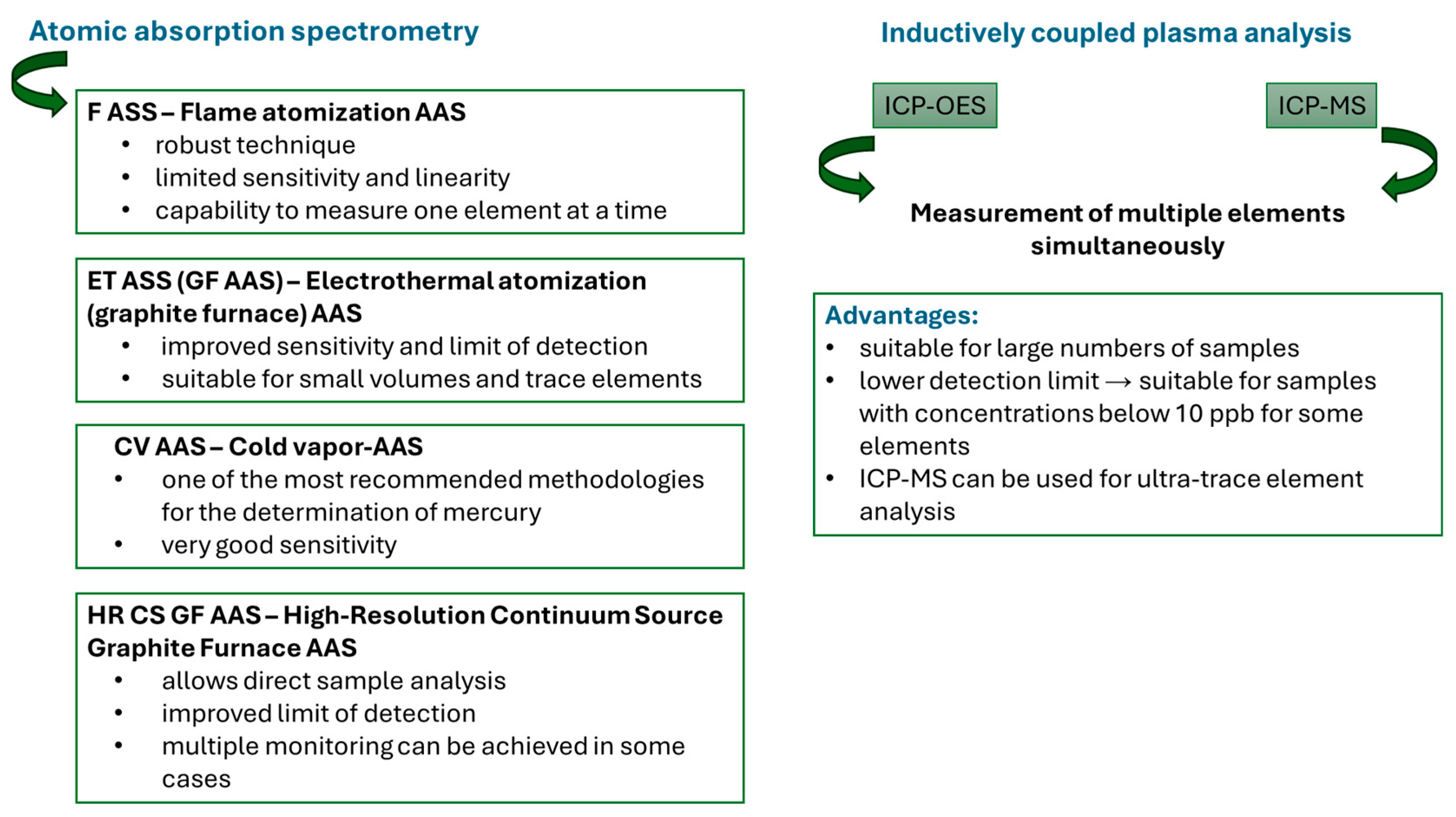
Atomic absorption spectrometry (AAS), inductively coupled plasma optical emission spectroscopy (ICP-OES), and inductively coupled plasma mass spectrometry (ICP-MS) are analytical techniques often used to quantify the heavy metal content in various samples.
In AAS, samples are converted to ground-state atoms that absorb radiation at specific wavelengths proportional to their concentration. Atomization methods include flame atomic absorption spectroscopy (FAAS) and graphite furnace atomic absorption spectroscopy (GFAAS), which vaporize the sample in a heated graphite tube. FAAS offers a favorable cost-effectiveness ratio, whereas GFAAS achieves lower detection limits (Figure 1) [17]. For mercury analysis, cold-vapor atomization (CV-AAS) serves as an appropriate alternative to FAAS and GFAAS. In this method, the mercury solution is acidified, and ionic mercury is reduced by stannous chloride to ground-state mercury atoms. An inert gas transports these atoms to an absorption cell [64]. Ho et al. [65] used CV-AAS to evaluate mercury contamination in facial lightening creams [65].
ICP-OES and ICP-MS use an inductively coupled argon plasma as an excitation source for the nebulized sample. The main advantages of ICP technology are its capacity for multi-element detection and lower detection limits. ICP-MS can quantify even ultra-trace concentrations of analytes. Furthermore, ICP-MS has the ability to differentiate between isotopes (Figure 1) [17]. The International Organization for Standardization (ISO) employs ICP-MS for the quantification of trace heavy metals in finished cosmetic formulations [66].
Most analytical methods require sample solubilization before the analysis. Digestion is achieved with a mixture of strong inorganic acids and oxidant agents, and the process can be microwave-assisted for improved results [67]. Sample preparation can be challenging and time-consuming, increasing the risks of contamination and analyte loss. Sample dilution can reduce the sensitivity. Furthermore, the process typically involves using acids and aggressive reagents, which disagree with environmentally friendly protocols. Several experimental factors can influence the outcome (the sample weight, the mixture of acids, and temperature). The HR CS GF AAS (High-Resolution Continuum Source Graphite Furnace Atomic Absorption Spectrometry) technique allows direct sample analysis from different matrices (biological materials, foods, environmental samples). This may require a pretreatment step (e.g., drying), especially for biological materials. However, the method development process (e.g., calibration, minimization of matrix effects) can be complicated in some cases [68]. Compared to other AAS methods, HR CS GF AAS offers improved signal stability and superior background correction (due to the possibility of scanning across the analytical wavelength), requiring only one radiation source for all elements. Another essential advantage of this technique is that multielemental analysis can be performed for metals with nearly adjacent absorption lines, which are within the spectral interval of the CCD (Charge-Coupled Device) detector [69,70,71,72]. Several elements, including Co, Cr, Fe, and Ni, exhibit rich in atomic lines in the UV-VIS region, making it feasible to determine them simultaneously. Pasias et al. [72] reviewed publications from 2000 to 2020 concerning the simultaneous multi-elemental analysis using HR-CS-GFAAS. They concluded that most studies were limited to the determination of two elements. This limitation represents the primary drawback of the technique, compared to ICP technology [72]. The method was used to assess heavy metal contents in sunscreen products (lead and chromium) [69] and in lipstick samples (lead) with accurate results, comparable with those obtained using the acid digestion procedure [73].
Another technology that can be successfully applied for elemental analysis and quantification of heavy metals in cosmetic products is X-ray fluorescence (XRF) [74]. The main issue with this technology is identifying suitable reference materials, similar to the samples’ matrix [67]. Bairi et al. [75] developed a rapid and cost-effective method to quantify Zn and Ti in sunscreen samples using a portable X-ray fluorescence spectroscopy analyzer. The results were compared to those obtained using ICP-MS, with good correlation [75].
Fluorescence resonance energy transfer (FRET) represents the process in which energy is transferred nonradiatively between a donor excited fluorophore and a nearby acceptor fluorophore. FRET-based assays can be employed for monitoring heavy metals in complex matrices, allowing the simultaneous assessment of multiple contaminants. These assays involve three types of systems: small-organic-molecule-based systems, nanomaterial-based systems, and fluorescent-protein-based systems [76]. FRET-based sensors are engineered to interact with target compounds, resulting in altered distances between donor and acceptor molecules, which correspond to changes in the fluorescence intensity of the acceptor [77].
FRET-based chemosensors have been used to detect lead rapidly. Ghosh et al. [78] developed a chemosensor based on rhodamine (RNPC) (Rhodamine-Naphthalimide Conjugate) and used it to estimate Pb2+ content in lipstick samples by measuring the fluorescence of the complex RNPC-Pb2+. Chemosensors have the advantage of being both sensitive and selective [78].
Radwan et al. [79] prepared optical chemosensors specific for Cd2+ and Co2+ in cosmetic products and used spectrophotometric and digital image-based colorimetric analysis for detection and quantification. They attached the specific chromophores to mesoporous silica nanospheres [79]. Chemosensors were also developed to monitor mercury in cosmetics [80,81].
The search for better techniques that are cost-effective, but also user- and environment-friendly, has led to the development of quantitative instrument-free detection devices. One example is distance-based paper microfluidic devices (DμPADs). They combine the characteristics of the two technologies. Developing microfluidic paper-based analytical devices involves creating hydrophobic barriers on the sheet of hydrophilic paper to create capillary channels and define fluidic pathways. At the same time, distance-based detection relies on the measurement of the zone where a color change occurs, the length of this zone being proportional to the analyte concentration [82,83]. Manmana et al. [84] developed an ion-exchange DμPADs to quantify heavy metals in herbal supplements and cosmetics, using 2-(5-bromo-2-pyridylazo)-5-[N-npropyl-N-(3-sulfopropyl)amino]phenol (5-Br-PAPS) as the anionic metallochromic reagent [84].
Paper-based microfluidic platforms have also been developed for the detection of other heavy metals and demonstrate significant potential for application in the analysis of cosmetic products [85,86,87,88].
Table 2 presents a selection of studies that examine the heavy metal content in cosmetics using various analytical methods.

6. Exposure Assessment for Heavy Metals in Cosmetics

As presented above, the quantitative and qualitative evaluation of heavy metals in cosmetic products has represented a popular research subject. However, developing robust and reliable tools and mathematical models to quantify systemic exposure and risk assessment parameters is equally essential. Clinical evidence of systemic heavy metal toxicity following cosmetic use further underscores this necessity [36,125,126,127,128].
For example, Guillard et al. [126] reported a clinical case of hyperaluminemia in a woman after four years of antiperspirant use containing aluminum chlorohydrate [126]. Elevated urinary mercury concentrations and a high prevalence of symptoms indicative of mercury poisoning among women who used beauty creams containing mercury [125,129]. High mercury levels associated with skin cream use were also reported in the case of a pregnant woman, with high risks for the developing fetus [130]. These cases demonstrate that dermal uptake from prolonged application of cosmetics can present significant health risks.
U.S. EPA (U.S. Environmental Protection Agency) offers tools for conducting exposure assessments and risk characterization that are suitable for various scenarios [131]. The SHEDS (Stochastic Human Exposure and Dose Simulation) models serve as probabilistic tools for estimating human exposure to chemicals encountered during routine activities. These models offer predictions of aggregate and cumulative exposures over specified time periods. SHEDS-HT (SHEDS-High throughput) provides a comprehensive platform for screening exposures associated with a wide range of products, including cosmetics [132].
Furthermore, there are commercially available models to estimate the exposure to various chemical compounds (including cosmetic ingredients). The Creme Global company has created one that uses Monte Carlo simulations [133].
The determination of toxicokinetic parameters for cosmetic products is essential for a correct evaluation of the health hazard. Dermal absorption is a crucial factor in assessing the safety of cosmetics. Dermal exposure is the primary route for cosmetics and personal care products, except for lipsticks and dental products [134]. Currently, validated non-animal alternatives are available to characterize this process. The OECD (Organization for Economic Co-operation and Development) has established in vitro protocols for studying the capacity of chemicals to penetrate the skin barrier. Skin Absorption: In Vitro Method (OECD TG 428) evaluates dermal absorption using a diffusion cell with two compartments separated by a skin sample (from human or animal sources), with the tested substance applied to the skin sample. The system comprises a diffusion cell with two chambers, designated as the donor and receptor, separated by a skin sample excised from a mammalian species, either human or animal. The chemical under investigation is applied to the surface of the skin following assessment of the stratum corneum’s integrity, which serves as the primary diffusion barrier. This diffusion chamber enables the determination of the chemical’s absorption profile over time and the quantification of the substance associated with the skin and deposited within distinct layers [135]. Metals such as chromium and nickel are electrophilic, which accounts for their protein reactivity and their tendency to form depots in the stratum corneum [136]. Assessing the capacity to accumulate in the skin is essential for sensitizing metals, nickel, cobalt, and chromium, which can activate local immune responses [137,138].
In silico Quantitative Structure–Activity Relationship (QSAR) models (e.g., ten Berge and Potts and Guy) can be used to estimate dermal absorption [134]. IH SkinPerm allows absorption evaluation after three exposure scenarios simulated (instantaneous deposition, deposition occurring over time due to repeated or continuous emission, and skin absorption consequent to airborne vapors. These scenarios were designed for occupational skin exposure assessment, but can also be adapted to cosmetic products [139].
Well-designed studies are needed to assess and understand how various factors influence the dermal absorption of heavy metals from cosmetics. The physicochemical properties of substances, such as ionization capacity, molecular mass, and lipophilicity, significantly influence the ability of metallic compounds to penetrate the skin. For example, Hostýnek [125] evaluated the diffusion of two nickel compounds, nickel chloride and nickel dioctanoate, and determined that the markedly lower diffusion rate of nickel dioctanoate was attributable to its higher molecular mass, which outweighed the influence of molecular polarity [140].
Besides heavy metal concentrations, contact frequency and duration, several other factors can influence absorption, including the composition of the cosmetic product (such as heavy metal levels and surfactants that enhance skin penetration), the characteristics of the application site, and the amount of product applied [107,141,142]. Moreover, if the compounds are water-soluble, their use on moist skin can enhance cutaneous absorption. Furthermore, nanosized particles can also penetrate the skin barrier easily [107,143]. Heavy metals can also enter the body via the transfollicular pathway, bypassing the epidermis [11].
Skin health and anatomical differences across age groups, including the incomplete barrier function in infants and increased transepidermal water loss in older adults, affect metal absorption. The site of cosmetic application is also relevant. Metals from eye cosmetics may be absorbed through the thin epidermis of the eyelids, the conjunctiva, or during tear production [36].
Franken et al. [144] reviewed human skin permeation studies that used the in vitro diffusion cell method and summarized the permeability order (Cu > Pb > Cr > Ni > Co > Hg). They noted that skin permeation and absorption are influenced by several factors. Penetration depends on the oxidation of metals to ionic forms, making the pH of the skin and sweat significant. Bioavailability is also affected by the metal’s valence state. Additionally, diffusion decreases when metals have a high affinity for skin tissues [144].
Midander et al. [137] investigated the kinetics of skin permeation for Co, Ni, and Cr under single and combined metals exposure scenarios, utilizing a diffusion cell and full-thickness piglet skin as the barrier. Measurements were performed continuously using ICP-MS. The findings demonstrated that the presence of multiple metals can modify skin permeation rates. Nickel exhibited faster absorption in the single-exposure scenario. In contrast, the absorption of cobalt and chromium was marginally higher during co-exposure; however, this difference was minimal and did not indicate a significant effect [137].
ZnO is a commonly found compound in cosmetic products (e.g., sunscreen formulations), especially in the form of nanoparticles. Their ability to penetrate the skin barrier and cause systemic toxicity has been studied using in vitro and in vivo approaches [145,146].
The absorption of aluminum compounds, including aluminum chloride, aluminum chlorohydrate, and aluminum zirconium chlorohydrate glycine complexes, commonly found in antiperspirants, is affected by the skin condition. The application of cosmetic products immediately after shaving increases absorption due to irritation, skin abrasions, and removal of the stratum corneum [42]. Pineau et al. [147] employed the Franz™ diffusion cell to assess aluminum percutaneous penetration and demonstrated increased absorption in the stripped skin, which serves as a model for post-shaving conditions [147].
Mixture formulations influence dermal permeation through multiple mechanisms. In cosmetic applications, co-solvents, terpenes, and surfactants frequently enhance the flux of chemicals across the skin relative to aqueous solutions, primarily due to thermodynamic modifications or disruption of the skin’s inherent permeability [148]. Cosmetic formulations significantly affect the skin penetration of metals. Musazzi et al. [142] studied iron oxide nanoparticles in both water suspensions and various semisolid formulations (carbopol gel, hydroxyethyl cellulose gel, carboxymethylcellulose gel, cetomacrogol cream, and cold cream). Using TEM (Transmission Electron Microscopy) imaging, they found that all semisolid formulations, except for the hydroxyethyl cellulose gel, increased the skin penetration of nanoparticles. Cetomacrogol cream formulation showed the highest permeation and the lowest retained amount for iron oxide nanoparticles [142]. Santini et al. [149] also demonstrated that applying iron oxide nanoparticles in a water-in-oil cream formulation accelerated permeation, reducing both penetration and diffusion times [149]. Therefore, creams and semisolid formulations may pose a higher risk in the event of metal contamination.
The assessment of heavy metal exposure can be challenging due to the multiple variables influencing the process, including substance characteristics, skin features (sensitivity, acne, injury), usage patterns (amount of product per use, frequency, body surface area, method of application), and demographic variables (age, gender). Furthermore, some cosmetics are used daily, while others are used only seasonally (e.g., sunscreen products) [150,151].
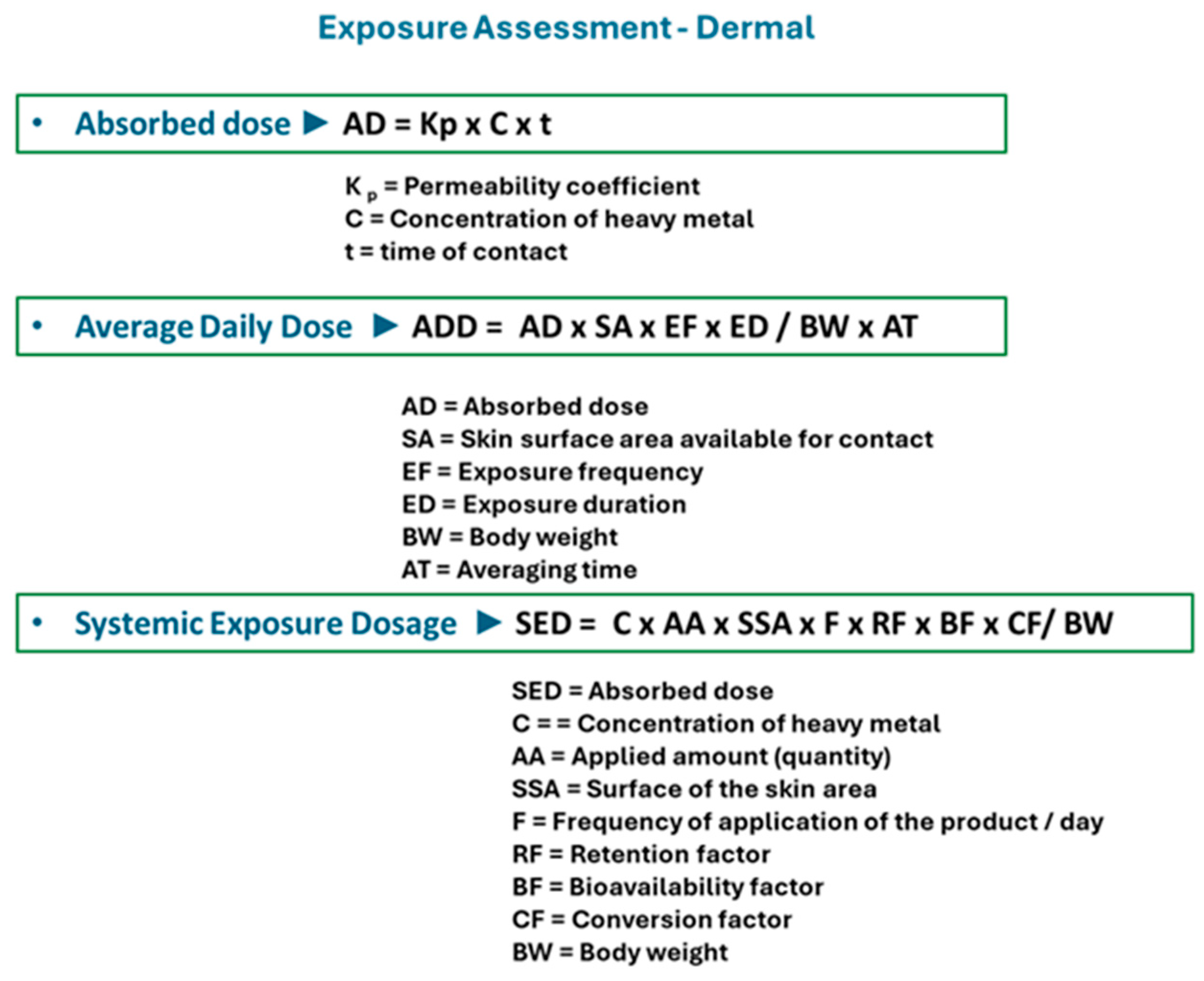
Several equations have been used to assess the exposure risk associated with the application of cosmetics (Figure 2). The values of some of the parameters used in calculation equations are standard and were established by the Scientific Committee on Consumer Safety (SCCS). The retention factor is a key parameter that estimates the fraction of the product that remains on the skin and can be absorbed after use. The retention factor distinguishes between rinse-off and leave-on products (a retention factor of 0.01 is considered for shampoos and shower gels, and a retention factor of 1 is considered for creams and foundations) [14].
The SCCS does not differentiate between male and female consumers or among various age categories regarding the estimated daily amount of cosmetic product applied, the calculated relative daily exposure values, the surface area for application, and the frequency of application (Table 3) [134]. However, this approach may lack accuracy, as studies have demonstrated significant differences in exposure across various demographic groups [150,152,153,154]. These differences can alter heavy metal systemic exposure calculations and affect risk assessments.
The SED (systemic exposure dosage) parameter calculates systemic exposure to heavy metals in skin care products. Its value is influenced by the metal concentration in the tested sample, body weight, and other standard parameters, whose values are established by the SCCS, namely the quantity of product applied on the skin, the application frequency, and the body surface area (Table 3). The NOAEL (No-observed-adverse-effect level) parameter can be calculated for each heavy metal, reflecting the exposure level with no toxic effects associated. This value is directly influenced by the dermal reference doses (RfDs) established for each metal. The Hazard quotient (HQ) for each metal investigated, and the Hazard index (HI—the sum of individual HQ values) are used to evaluate health risks determined by heavy metals in cosmetics [14].
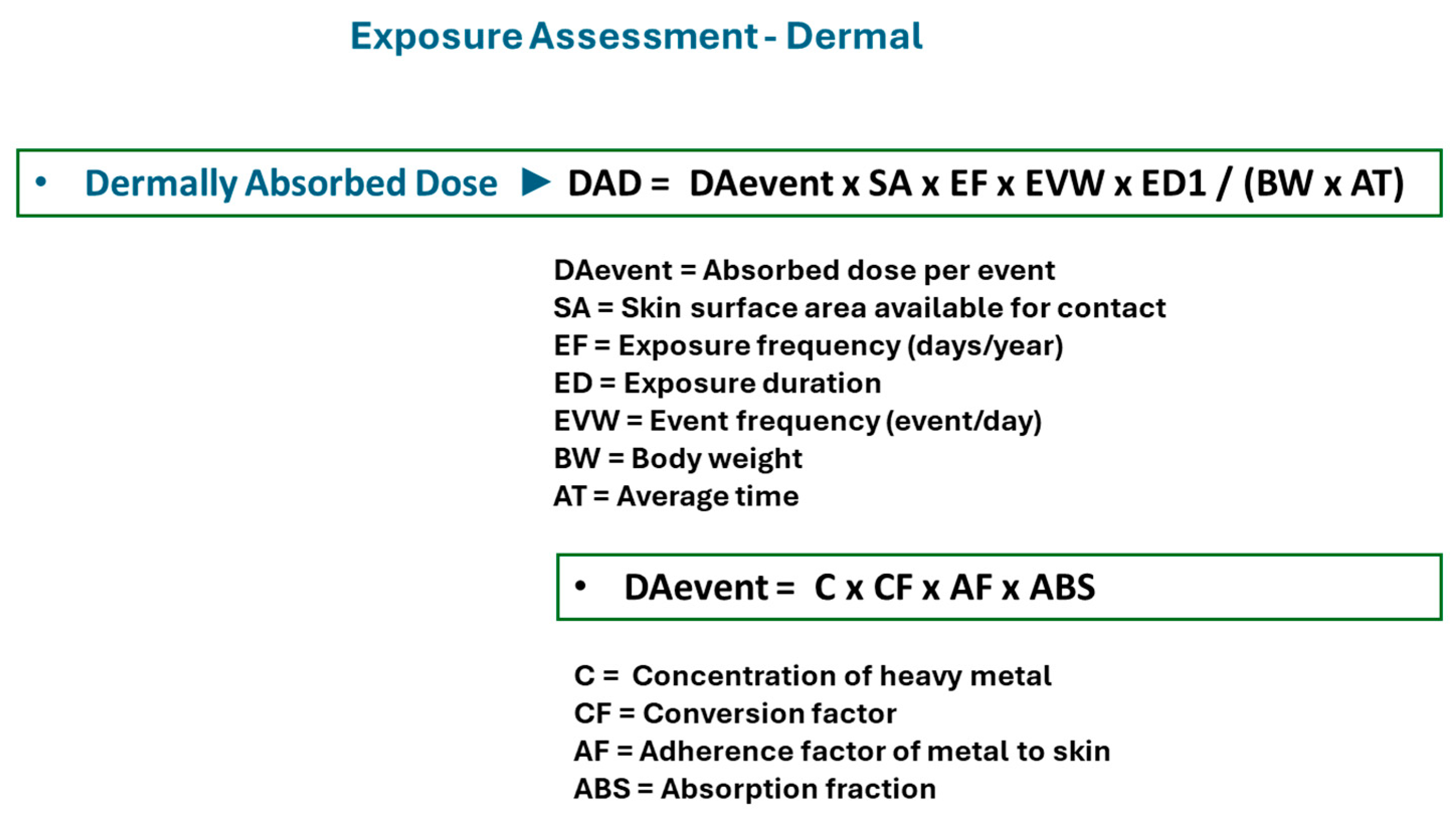
Meng et al. [150] quantified heavy metals in various cosmetics (hydrating, whitening, anti-acne) using ICP-MS. They then estimated the dermal absorption dose (DAD) (mg/kg/day) (Figure 3) based on the usage patterns of 570 consumers from different age groups, professions, and regions in China. The average DADs of Cd were the lowest for all skin care products, whereas those of Zn and Al were the highest. The usage patterns varied across the groups, which also influenced DAD results. Colder and drier climates, as well as the economic development of the region, can influence the frequency of applications and the DAD values [150].
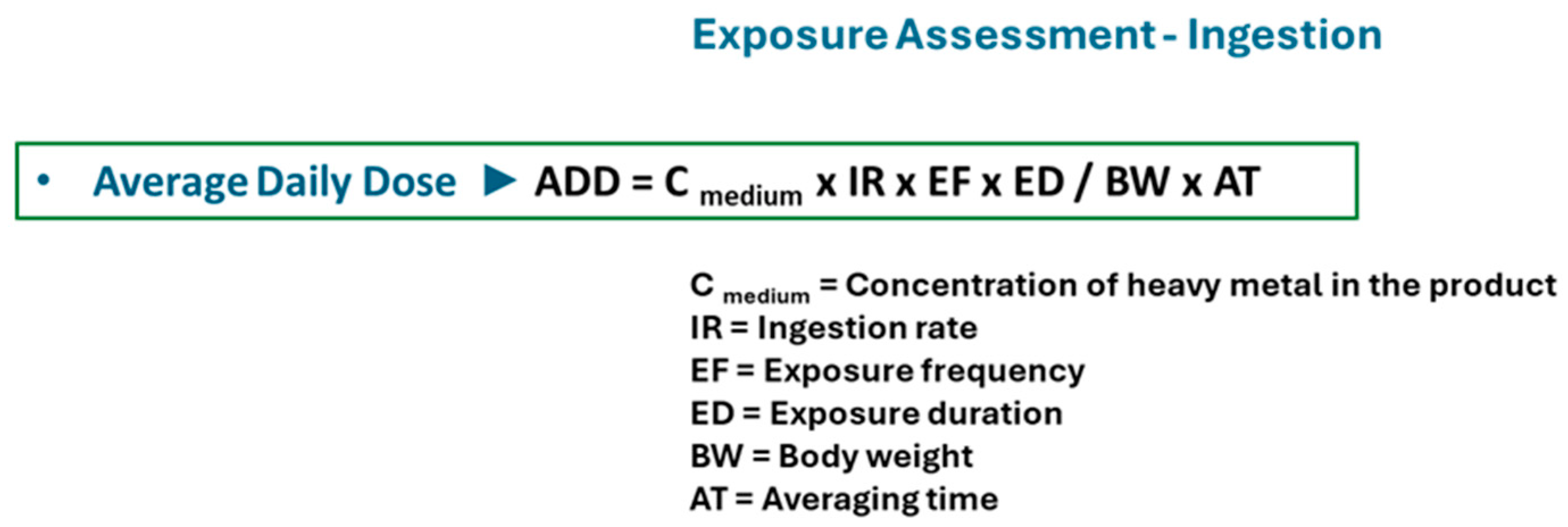
Ingestion can be regarded as the main pathway of exposure to the trace metals in lipsticks and is also a significant route for infants (hand- or object-to-mouth contact). Consequently, there are some differences in calculating systemic exposure. The average daily dose (ADD) of heavy metals is used, and the health risk is computed using ADD values (Figure 4) [109,111].
Estimating human exposure to harmful compounds such as heavy metals in cosmetic products remains challenging due to the numerous variables involved. However, substantial evidence indicates that metals deposited on the skin are capable of permeating the surface and reaching systemic circulation [155,156,157].

7. Health-Risk Assessment

The assessment of carcinogenic and non-carcinogenic health risks follows a structured process. The initial stages include hazard identification and exposure assessment, which are followed by the estimation of health risks [158].
The assessment of human health risk is a complex process designed to estimate the likelihood of adverse effects following exposure to a specific chemical entity. Risk is determined by the concentration of the substance, the extent of exposure, and its inherent toxicity. The primary objective is to evaluate whether a particular contaminant is present at concentrations that may pose significant risks to human health. Quantitative descriptors such as the no-observed-adverse-effect level (NOAEL), no-observed-effect level (NOEL), and cancer potency factors are used to characterize the hazard potential of a chemical. These metrics are involved in the calculation of guidance values, including the tolerable daily intake (TDI) and acceptable daily intake (ADI) [134].
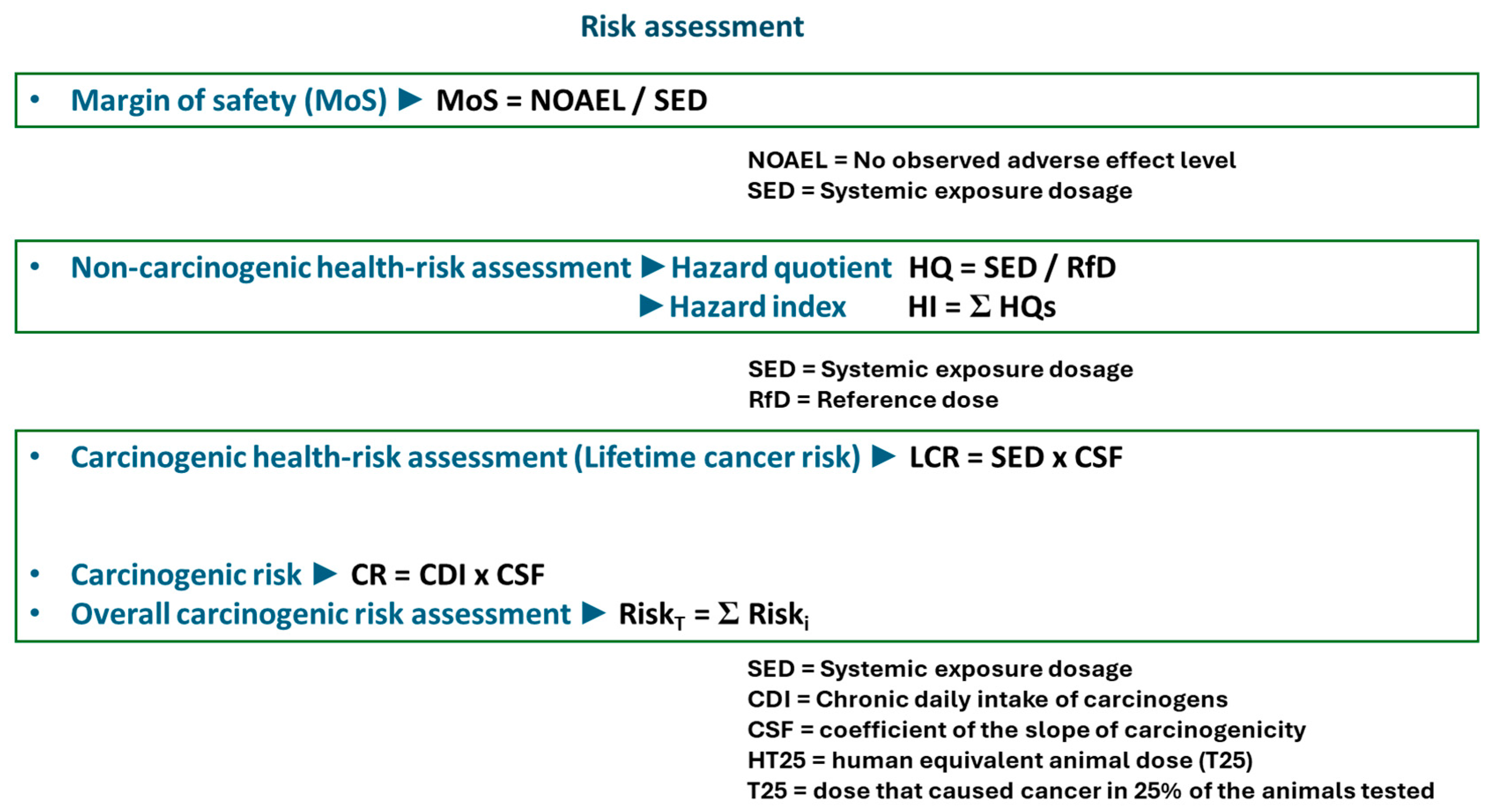
Different indicators can be used for human health risk analysis (Figure 5). One of them is the Margin of safety (MoS). MoS depends on the NOAEL value of the compound and the predicted amount of substance that enters the body (the systemic exposure dosage—SED). The SED value is determined by multiple factors, including metal concentration, application site area, frequency of application, retention factor, body weight, and bioaccessibility factor. A value over 100 for MoS signifies that the tested chemical is safe [11,12].
The Hazard Quotient (HQ) is another parameter used to evaluate the potential non-cancer health risks associated with heavy metal exposure. The Hazard Quotient is a typical indicator that compares estimated exposure levels to reference doses considered safe for human health. An HQ below 1 is associated with minimal or no risk for human health. Further investigation is required for values higher than 1, as an HQ over 1 indicates a potential hazard. The Hazard Index (HI) is a metric used for the comprehensive assessment of human health risks resulting from exposure to multiple chemicals. A HI value less than 1 indicates that non-cancer health effects are unlikely. Values greater than 1 suggest the possibility of adverse effects, and the risks increase as the HI values rise [11,74].
The carcinogenic risk (LCR) refers to the probability of developing cancer as a result of exposure to chemicals identified or suspected as carcinogens. LCR can be calculated by multiplying the Systemic Exposure Dosage by a coefficient of the slope of carcinogenicity (e.g., 0.5 mg kg−1 day−1 for Cr and 0.91 mg/kg day−1 for Ni). Values over 10−4 are linked to a significant cancer risk [74].
Table 4 summarizes key findings from the assessment of potential non-carcinogenic health risks linked to various cosmetic products. The referenced studies quantified heavy metal concentrations in these products using the analytical techniques detailed in Table 2 and subsequently calculated the potential health risks based on the equations shown in Figure 5.
Health risk assessment presents significant challenges due to the numerous factors influencing the effects of chemicals on humans. These complexities hinder the extrapolation of data and limit the accuracy of predictions for the general population. Uncertainty factors arise in evaluating both risk exposure and the quantity of chemical reaching systemic circulation. In the context of cosmetics, the primary exposure route is dermal, although oral exposure may also occur. Chemical form, product formulation, and usage patterns (such as whether products are rinsed off or remain on the skin for extended periods) influence bioavailability. Additionally, intraspecies variability can render certain individuals more susceptible to adverse health effects.

8. New Approach Methods (NAMs) for Cosmetics Safety Assessment

New approach methodologies (NAMs) have been developed for the assessment of cosmetic ingredients and finished products to provide ethical and practical alternatives that maintain biological relevance comparable to animal-based methods [159].
Toxicological analysis of cosmetic products should address multiple aspects, including systemic adverse effects after skin penetration, irritative potential, sensitization risk, reproductive toxicity, genotoxicity, and carcinogenic risk.
Cytotoxicity assessment of heavy metals in cosmetics involves several key endpoints, including cell viability, oxidative stress, apoptosis, and quantification of proteins involved in specific cellular mechanisms. Carcinogenicity and genotoxicity are primary toxicological endpoints of concern for specific heavy metals such as arsenic, cadmium, chromium (VI), and nickel, which are classified as known or probable human carcinogens [160]. Although general cytotoxicity and organ damage are common consequences of heavy metal exposure, these particular metals pose additional cancer risks.

8.1. Cytotoxicity

The mechanisms underlying heavy metal toxicity are multifaceted. Heavy metals disrupt cellular organelles, compromise cell membrane integrity, and alter the activities of enzymes essential for metabolism, detoxification, and damage repair. Metal ions interact with cellular components, including DNA and nuclear proteins, resulting in DNA damage that can induce carcinogenesis or apoptosis [35].
There are several factors that influence the cytotoxicity of metallic compounds, including electronegativity, oxidation state, chemical form, and particle size. For example, inorganic trivalent arsenite exhibits greater toxicity than pentavalent arsenate due to its capacity to interact with protein sulfhydryl groups and inactivate essential enzymatic systems. Chromium (VI) compounds are potent oxidizing agents and readily traverse cell membranes, unlike chromium (III), inducing cytotoxic and genotoxic effects. Organometallic species are typically more toxic due to their increased lipophilicity [35]; however, this is of little importance in the case of cosmetic products, where metals are most likely present as inorganic compounds.
Kar et al. [161] employed periodic table-based descriptors, such as electronegativity and metal cation charge, to develop a quantitative structure-toxicity relationship (QSTR) model for predicting the cytotoxicity of metal oxide nanoparticles using an Escherichia coli bacterial assay Since the induction of intracellular oxidative stress is a central component of heavy metal toxicity mechanisms, both electronegativity and cation charge are important variables influencing cytotoxicity, which is closely associated with the reductive properties of the compound [161]. Electron detachment from metal oxides can initiate the formation of ROS and subsequent oxidative stress. The cytotoxicity of ZnO and CuO was higher compared to Fe2O3 and Al2O3 [162].
Although two-dimensional cell culture systems have limited capacity to replicate in vivo conditions and accurately model skin properties and functions, in vitro assays using human skin cell lines offer practical approaches for assessing the cytotoxicity of cosmetic ingredients. Cell viability is commonly measured with colorimetric assays, such as the MTT or NRU assays. Microscopic analysis facilitates the examination of cellular morphological changes following exposure to xenobiotics, with observed alterations linked to cytotoxic effects. Excessive production of reactive oxygen species and depletion of glutathione are common mechanisms underlying the cytotoxicity of heavy metals. These processes lead to oxidative stress, lipid peroxidation, membrane damage, and DNA fragmentation. Genotoxic potential is typically evaluated using the Micronucleus and Comet assays [163,164]. Toxicogenomics provides an additional approach for investigating toxicity by enabling the analysis of gene expression changes in response to heavy metal exposure [164,165].
Table 5 presents selected studies conducted using two-dimensional skin cell culture systems to evaluate the cytotoxic potential of heavy metals.
Although these simple-design experiments provide valuable insights into heavy metal toxicity mechanisms, they present notable limitations. Beyond their restricted capacity to replicate in vivo conditions, there is considerable uncertainty about whether the exposure concentrations used are relevant to real-world scenarios.

8.2. Genotoxicity and Carcinogenicity

The safety of cosmetics is a mandatory requirement for all products available on the market. A special concern is directed towards potential long-term effects, as self-care products are often used over a significant portion of the human lifespan. In this context, the assessment of genotoxicity and carcinogenicity is a critical aspect ensuring human safety, as it helps to identify and mitigate risks associated with the prolonged use of cosmetic products [134].
Due to the fact that animal testing for cosmetic products is completely banned in Europe and in other countries around the world, alternative methods for evaluating the carcinogenic risk are needed [184]. The Scientific Committee for Consumer Safety recommends the use of in silico analysis for the toxicological evaluation of products in the cosmetic industry [134].
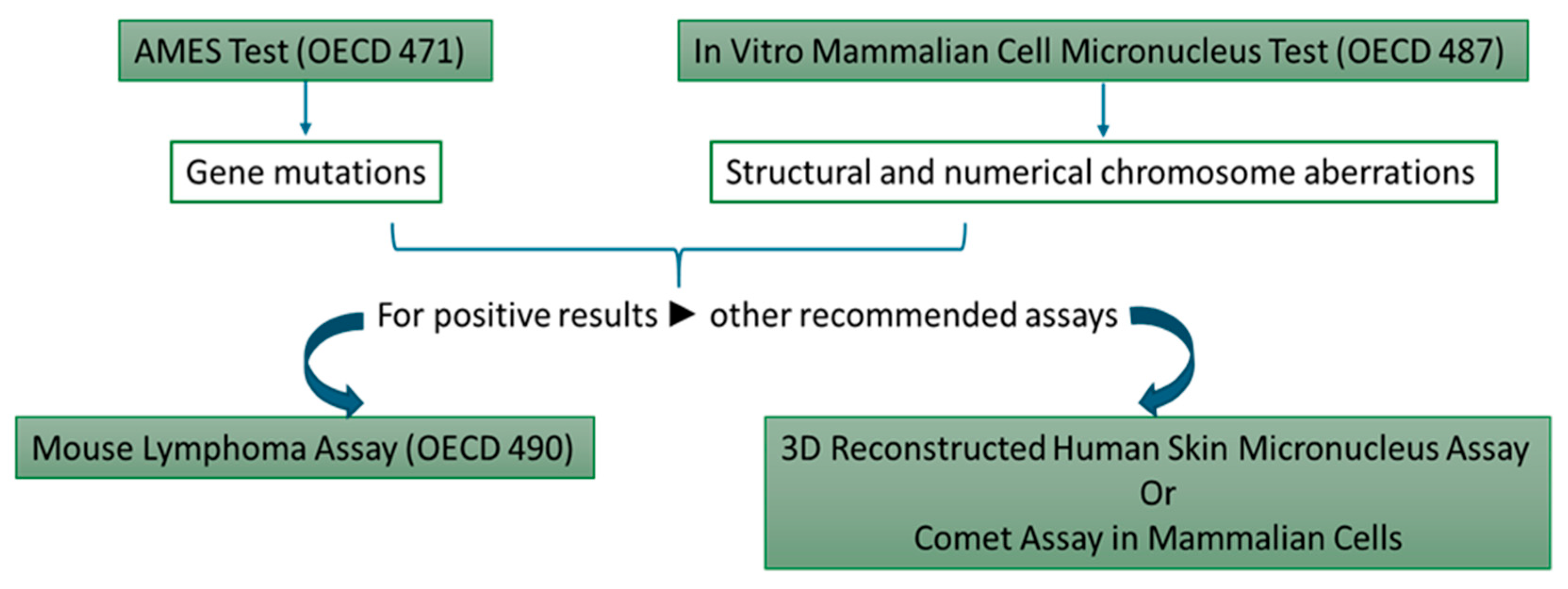
For genotoxicity investigation, the SCCS recommends two tests extracted from the battery of in vitro protocols elaborated by the Organization for Economic Cooperation and Development (OECD) (Figure 6) [134,184].
The Ames test (the Bacterial Reverse Mutation Test) was developed at the beginning of the 20th century and, since then, has been widely used to investigate the mutagenic potential [185]. In 1981, Gocke et al. [186] used this assay to evaluate 31 cosmetic ingredients that were approved at the time. Fifteen compounds exhibited positive results in the Ames test; for some of them, genotoxicity was also confirmed by other assays [186].
The development of highly specific mutagenicity/genotoxicity assays is vital for cosmetic ingredients and products, because, in the absence of animal testing, there are limited possibilities to verify and confirm false negative and positive results [187].
However, there is substantial evidence that heavy metal accumulation can cause genotoxic effects [163,188,189]. Therefore, cosmetic products containing significant levels of heavy metals can be linked to genotoxicity and mutagenicity risks.
The impact of UV light on the mutagenic potential of metallic compounds found in sunscreen products, such as zinc oxide (ZnO), has been examined. Studies utilizing human keratinocyte NCTC2544 cells (ICLC HL97002, National Institute for Cancer Research, Italy) assessed the phototoxic and pseudophotoclastogenic properties of these compounds. At elevated concentrations, ZnO demonstrated weak photogenotoxicity and induced micronuclei formation in both irradiated and non-irradiated cells [190]. Additionally, Demir et al. [191] reported an antagonist effect on genotoxicity when ZnO nanoparticles were combined with UV light exposure [191].
Predictive toxicology is now popular in risk assessment. Predictive toxicology methods use data from past studies on similar compounds. Machine learning helps identify relationships between chemical structures and their corresponding activities. QSAR models quickly identify structural alerts, which are chemical features linked to toxic potential. They predict the toxicity risks of cosmetic ingredients [184]. The Monte Carlo simulation is a probabilistic risk-assessment method with reliable results. The probabilistic analysis returns a range of outcomes, an interval for the estimated health risk, and not a single value, like the deterministic analysis [111,192]. QSAR analyses are part of the risk assessment toolbox and are very useful in screening a large number of chemical compounds and grouping them into risk categories [4].
The International Agency for Research on Cancer classifies As, Cr, Ni, and Cd as carcinogenic metals [160]. As non-biodegradable substances, they rapidly accumulate within the body, disrupting vital cellular functions and mechanisms. This accumulation increases the risk of cancer-related diseases by inducing oxidative stress, DNA damage, and cell death [121].
Li et al. [111] investigated the carcinogenic risk of heavy metals present in lip cosmetics found on the Chinese market using the two approaches—the probabilistic and deterministic methods. Differences appeared—the deterministic analysis established that the carcinogenic risks associated with heavy metal traces in lip products were within the acceptable range established by USEPA, while the probabilistic analysis suggests that approximately 10% of integrated risks are above the acceptable range for LCR, which is from 1 × 10⁻⁶ to 1 × 10⁻⁴ [111].
Currently, carcinogenic risk assessments for cosmetic products are primarily conducted using mathematical models to calculate parameters, such as Carcinogenic health-risk assessment and Overall carcinogenic risk assessment. Table 6 summarizes studies that used analytical methods to measure heavy metal concentrations, as shown in Table 2, and calculated carcinogenic and overall carcinogenic risks using the equations in Figure 5.

8.3. Irritation, Corrosivity, and Skin Sensitization

The use of topical products can affect the integrity of the skin tissues, causing irritation or even corrosion if the exposure concentration is high. The eyes are extremely sensitive and vulnerable to irritants; the application of cosmetic products near the ocular area can have a negative impact [193].
One heavy metal known to display irritant potential is mercury. The WHO states that inorganic mercury salts are corrosive chemicals [194], which can cause skin irritation and contact dermatitis [195]. These compounds were identified in skin-lightening products [55,196,197].
To investigate the irritation potential and corrosivity of chemicals, in vitro toxicity assessment on reconstructed human tissue models is usually preferred. EpiSkinTM (EpiSkin Research Institute, Lyon, France) represents a 3D model of reconstructed epidermis, obtained by culturing human keratinocytes, with multiple layers (basal, spinous, and granular layers), displaying a histology and cytoarchitecture that mimics in vivo skin structure. Corrosive substances penetrate the stratum corneum and decrease the cells’ viability in the underlying layers [198]. Cell viability is evaluated using the MTT method, and the quantity of formazan produced by enzymatic reduction is typically determined photometrically by measuring the optical density. This determination can be affected in the case of colored tested chemicals; however, one alternative to overcome this limitation is to measure formazan levels using HPLC/UPLC systems. EpiSkinTM was used to assess the irritation potential and corrosivity of some cosmetic ingredients, including zinc oxide and copper (II) sulfate. Copper (II) sulfate was included in the UN Globally Harmonized System Category 2, while zinc oxide was not classified [199].
EpiDermTM (MatTech Co., Ashland, MA, USA) is another alternative 3D skin model commercially available, which Kim et al. [200] used to investigate the corrosion and irritation potential of metallic nanoparticles (e.g., aluminum, iron, titanium). The tested nanoparticles reduced cell viability to some extent but were classified as non-corrosive and non-irritant after skin contact [200].
Skin sensitization is another significant risk associated with the use of cosmetic products. Nickel is recognized as one of the most prevalent allergens in cosmetic products. Concentrations exceeding 5 ppm are associated with the development of contact dermatitis. Another metal that may act as a hapten and contribute to the development of contact dermatitis is chromium (Cr III and Cr VI) [119].
In chemico assays represent an additional category of alternative methods for predicting skin sensitization. The Amino Acid Derivative Reactivity Assay (ADRA) and Direct Peptide Reactivity Assay (DPRA) evaluate the capacity of xenobiotics to bind to synthetic peptides, thereby simulating the initial event in the skin sensitization cascade: the attachment of haptens to self-proteins [201,202,203]. These assays are not suitable for metal compounds, which interact with proteins through mechanisms other than covalent bonding [204]. However, the SH test, an alternative method that also assesses the ability of chemicals to bind to proteins by measuring the reduction in free thiol groups on cell surface proteins, was successfully applied by Imai et al. [205] to evaluate metal compounds, such as nickel sulfate [205].
Various reconstructed human epidermis (RHE) models are available to assess skin sensitization hazards. The SensCeeTox assay uses EpiDermTM (MatTech Co., Ashland, MA, USA) to measure gene expression and protein reactivity in keratinocytes. Sens-IS also evaluates gene expression to predict skin sensitizing potential, while the RHE-IL18 assay assesses cell viability using the MTT assay and quantifies IL-18 levels in models such as EpiDermTM or EpiCS (CellSystems® Biotechnologie, Troisdorf, Germany) [206]. The RHE-IL-18 assay proved to be inadequate for evaluating the sensitizing potential of heavy metals [207], profiling, and 3D reconstructed human epidermis to assess skin sensitization by analyzing the changes in gene expression. Sensitizers upregulate genes involved in cytokine and chemokine activity, growth factor activity, metalloendopeptidase activity, and several other markers of inflammation and oxidative stress [208,209]. Potassium Dichromate was assessed using this method and included in category 1A [209].
Keratinocyte activation in the presence of skin sensitizers can be assessed using two in vitro ARE-Nrf2 luciferase test methods (as described in OECD TG 442D). The activation of the Keap1-Nrf2-ARE pathway by sensitizing chemicals in keratinocytes that express a luciferase reporter gene is determined by measuring luminescence intensity [210]. The ARE-Nrf2 Luciferase KeratinoSensTM assay (Givaudan Suisse SA, Vernier, Switzerland) was used to evaluate metal oxide nanoparticles (copper, cobalt, nickel, titanium, cerium, iron, and zinc) and demonstrated potential as a reliable assessment method [211,212].
Activation of antigen-presenting cells (APCs) is a key event in the skin sensitization pathway, resulting in the secretion of proinflammatory molecules and the upregulation of markers such as CD54 and CD86 [201]. Dendritic cell activation can be measured using various methods. OECD TG 442E describes the following: Human Cell Line Activation test (h-CLAT), U937 cell line activation Test (U-SENS™), Interleukin-8 Reporter Gene Assay (IL-8 Luc assay), and Genomic Allergen Rapid Detection (GARD™) [213]. Hölken et al. [214] integrated immature dendritic cells into a full-thickness 3D human skin model, thereby establishing an immune competent model that serves as a potential alternative to human ex vivo skin explants. This model was used to identify sensitizers, including NiSO4 [214].
The Genomic Allergen Rapid Detection (GARD™skin) assay was used to evaluate the sensitization potential of metal compounds. Results demonstrated 92% accuracy and 100% sensitivity in predicting skin sensitizing hazards [215].
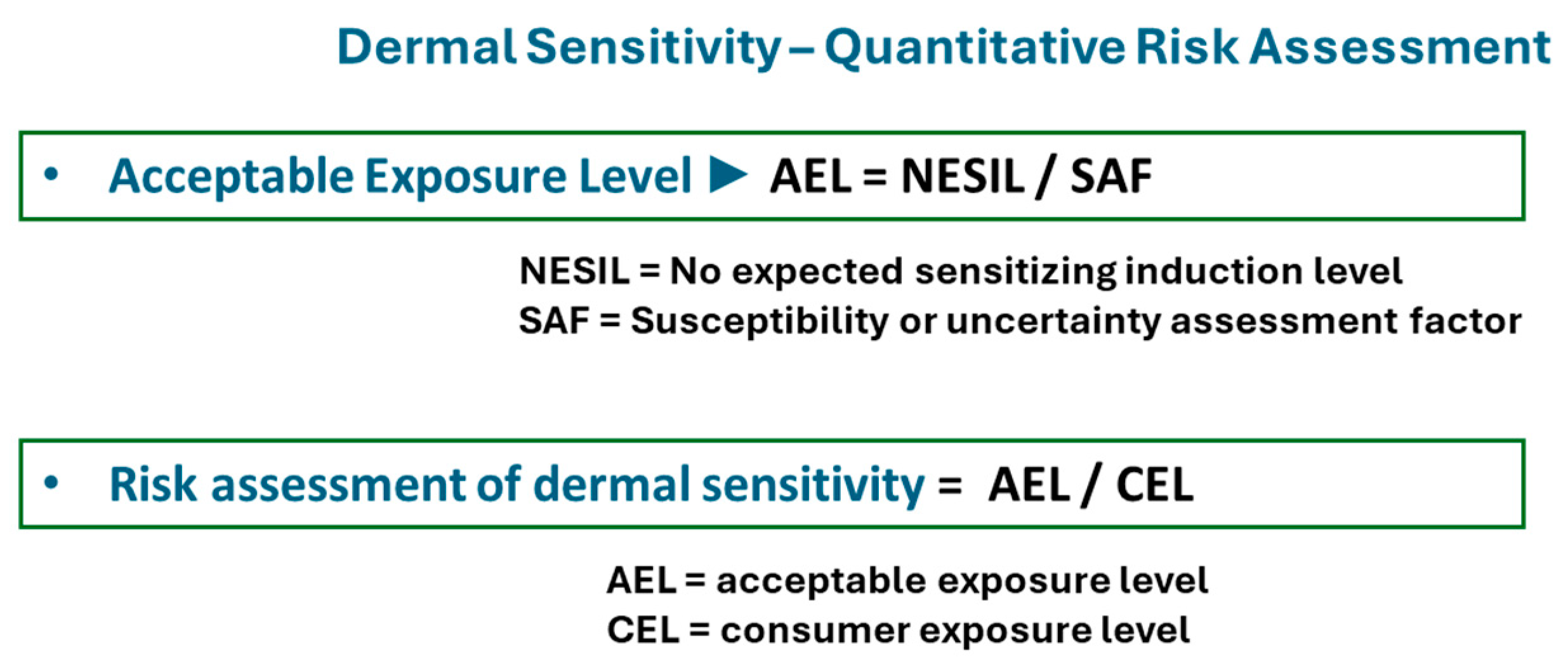
QRA (Quantitative Risk Assessment) models can also be used to estimate dermal sensitization, as shown in the equations in Figure 7. This method was applied to several sensitizing heavy metals (Ni, Co, Cu, and Hg). In all cases, the values of the ratios were above 1. When the AEL exceeds the CEL, the exposure is considered safe for consumers [112].
Assessment of ocular irritative and corrosive potential represents another critical phase in the development of cosmetic products. Following the prohibition of animal testing for cosmetics, ocular corrosives and irritants are now identified using non-animal methods, including the Bovine Corneal Opacity and Permeability (BCOP) test (OECD TG 437) [216] and the Reconstructed Human Cornea-like Epithelium test (OECD TG 492) [217]. Kolle et al. [218] utilized the EpiOcularTM tissue model (MatTek Corporation, Ashland, MA 01721, USA) and BCOP eye irritation testing to evaluate metal nanoparticles, including TiO2 and ZnO. Their findings indicate that this combination of in vitro assays provides a valid alternative to in vivo testing [218].
Over the past decade, advancements in in vitro testing for skin and ocular irritation and sensitization assessment have enabled the development of comprehensive strategies to identify irritant and sensitizing compounds.

9. Conclusions

The cosmetics market comprises a diverse array of products. Consumer safety is a critical concern, given the frequent and prolonged use of many cosmetic items. Adverse effects associated with cosmetic use have been documented since ancient times. The evaluation of heavy metals in cosmetic products has become a prominent research focus. Numerous quantification techniques have been developed to provide rapid and accurate results using environmentally sustainable protocols. Although regulatory laws in various countries limit metal content, recent studies have detected traces of toxic metals, some exceeding permissible levels, in numerous cosmetic products. These findings underscore the need for continuous monitoring programs to address heavy metal adulteration in cosmetics. Prolonged use of cosmetics may lead to chronic toxicity due to sustained exposure to low concentrations of heavy metals, particularly when products are applied to large surface areas or regions with thin epithelial linings.
The prohibition of animal testing in 2009 accelerated the advancement of alternative in vitro toxicity assessment methods. A range of assays are now available, enabling researchers to examine multiple dimensions of health risks related to heavy metals in cosmetics. In the safety assessment of cosmetic products, hazard identification can be effectively accomplished using the current array of alternative non-animal tests. However, risk characterization remains challenging in the absence of in vivo testing. Consequently, future research should prioritize the improvement, refinement, and validation of exposure assessment models and non-animal approaches to determine systemic toxicity following repeated exposure. Furthermore, an important consideration for regulatory authorities during health risk assessment is that demographic parameters influence cosmetics usage patterns, which can impact the accuracy of estimated exposure doses, hazard quotients, and hazard indices.

Author Contributions

Conceptualization, A.J. and A.T.; methodology, I.M.; investigation, I.M. and A.J.; writing—original draft preparation, A.J. and I.-C.C.; writing—review and editing, A.T. and L.A.; visualization, I.-C.C.; supervision, L.A. All authors have read and agreed to the published version of the manuscript.

Funding

This research received no external funding.

Institutional Review Board Statement

Not applicable.

Informed Consent Statement

Not applicable.

Data Availability Statement

No new data were created or analyzed in this study. Data sharing is not applicable to this article.

Conflicts of Interest

The authors declare no conflicts of interest.

Abbreviations

The following abbreviations are used in this manuscript:
5-Br-PAPS2-(5-bromo-2-pyridylazo)-5-[N-npropyl-N-(3-sulfopropyl)amino]phenol
8-OHdG8-hydroxy-2′-deoxyguanosine
AASAtomic absorption spectrometry
ADAbsorbed dose
ADDAverage Daily Dose
ADRAAmino Acid Derivative Reactivity Assay
AELAcceptable Exposure Level
AP-1Activator Protein 1
APCActivation of antigen-presenting cell
AREAntioxidant Response Element
CATCatalase
CCDCharge-Coupled Device
CCK-8Cell Counting Kit-8
CDDendritic Cells Maturation Marker
CDIChronic Daily Intake of Carcinogens
CELConsumer Exposure Level
CHOPC/EBP Homologous Protein
CRCarcinogenic risk
CV-AASCold-vapor atomization atomic absorption spectroscopy
DCFH-DADichlorofluorescin diacetate
DLDetection limit
DPRADirect Peptide Reactivity Assay
DμPADDistance-based paper microfluidic device
EC50Half-maximal Effective Concentration
ET AASElectrothermal Atomic Absorption Spectroscopy
F AASFlame atomic absorption spectroscopy
FASLFas ligand
FDAFood and Drug Administration
FDCAFederal Food, Drug, and Cosmetic Act
FOSL1FOS-like 1
FRETFluorescence resonance energy transfer
GF AASGraphite furnace atomic absorption spectroscopy
GHK-CuGlycyl-L-histidyl-L-lysine copper complex
GSHGlutathione
HIHazard index
HQHazard quotient
HPLCHigh-performance liquid chromatography
HR CS GF AASHigh-Resolution Continuum Source Graphite Furnace Atomic Absorption Spectrometry
HSP27Heat shock protein 27
HSPA1AGene that encodes Heat shock 70 kDa protein 1
ICP-MSInductively coupled plasma mass spectrometry
ICP-OESInductively coupled plasma optical emission spectroscopy
ILInterleukin
ISOThe International Organization for Standardization
Keap1Kelch-like ECH-associated protein 1
LCRLifetime Cancer Risk
LDHLactate dehydrogenase
LIBSLaser-induced breakdown spectroscopy
LODLimit of detection
LOQLimit of quantification
mBBrMonobromobimane
MDLMinimum detectable limit
MMPMetalloproteinase
MoCRAModernization of Cosmetics Regulation Act
MoSMargin of Safety
MTMetallothionein
MTT3-(4,5-dimethylthiazol-2-yl)-2,5-diphenyltetrazolium bromide
NAMNew Approach Methodologies
NESILNo Expected Sensitization Induction Level
NF-κBNuclear factor kappa-light-chain-enhancer of activated B cells
NOAELNo-observed-adverse-effect level
NPNanoparticle
Nrf2Nuclear Factor, erythroid 2-related factor
NRUNeutral Red Uptake
OECDOrganization for Economic Co-operation and Development
QRAQuantitative Risk Assessment
QSARQuantitative Structure–Activity Relationship
RfDDermal Reference Dose
RHEReconstructed Human Epidermis
RNPCRhodamine-Naphthalimide Conjugate
mRNAMessenger RNA
ROSReactive Oxygen Species
SCCSScientific Committee on Consumer Safety
SEDSystemic Exposure Dosage
SHEDSStochastic Human Exposure and Dose Simulation
SHEDS-HTSHEDS-High throughput
SODSuperoxide dismutase
TDITolerable daily intake
TNFTumor Necrosis Factor
UPLCUltra-performance liquid chromatography
USEPAU.S. Environmental Protection Agency
WSTWater-Soluble Tetrazolium salt
XRFX-ray fluorescence

References

  1. Zahra, M.; Riaz, L.; Kalsoom, S.; Saleem, A.R.; Taneez, M. Assessment and computational bioevaluation of heavy metals from selected cosmetic products. Environ. Monit. Assess. 2024, 196, 31. [Google Scholar] [CrossRef]
  2. Swafford, S. Cosmetics. In An Overview of FDA Regulated Products; Elsevier: Amsterdam, The Netherlands, 2025; pp. 257–279. [Google Scholar]
  3. Piccinini, P.; Piecha, M.; Torrent, S.F. European survey on the content of lead in lip products. J. Pharm. Biomed. Anal. 2013, 76, 225–233. [Google Scholar] [CrossRef] [PubMed]
  4. Pauwels, M.; Rogiers, V. Human health safety evaluation of cosmetics in the EU: A legally imposed challenge to science. Toxicol. Appl. Pharmacol. 2010, 243, 260–274. [Google Scholar] [CrossRef]
  5. Ashraf, T.; Taneez, M.; Kalsoom, S.; Irfan, T.; Shafique, M.A. Experimental calculations of metals content in skin-whitening creams and theoretical investigation for their biological effect against tyrosinase enzyme. Biol. Trace Elem. Res. 2021, 199, 3562–3569. [Google Scholar] [CrossRef]
  6. Jomova, K.; Makova, M.; Alomar, S.Y.; Alwasel, S.H.; Nepovimova, E.; Kuca, K.; Rhodes, C.J.; Valko, M. Essential metals in health and disease. Chem. Biol. Interact. 2022, 367, 110173. [Google Scholar] [CrossRef]
  7. Kerdoun, M.A.; Zergui, A.; Adjaine, O.E.-k.; Mekhloufi, S. Determination of Lead (Pb) in Kohl cosmetics sold in the south of Algeria. J. Trace Elem. Miner. 2024, 9, 100170. [Google Scholar] [CrossRef]
  8. Alhussaini, H.M.A.; Hossain, M.A.; Arputhanantham, S.S. Determination of toxic heavy metal content in a whitening creams by using inductively coupled plasma-optical emission spectrometry. Arab. J. Geosci. 2022, 15, 692. [Google Scholar] [CrossRef]
  9. Ahmad, M.N.; Ashraf, U.-e.-K.; Anjum, M.N.; Kiran, S.; Abrar, S.; Farid, M.F. Identification and quantification of selected heavy metals by ICP-OES in skin whitening creams marketed in Pakistan. Environ. Monit. Assess. 2025, 197, 263. [Google Scholar] [CrossRef]
  10. Massadeh, A.; El-Khateeb, M.; Ibrahim, S. Evaluation of Cd, Cr, Cu, Ni, and Pb in selected cosmetic products from Jordanian, Sudanese, and Syrian markets. Public Health 2017, 149, 130–137. [Google Scholar] [CrossRef] [PubMed]
  11. Kicińska, A.; Kowalczyk, M. Health risks from heavy metals in cosmetic products available in the online consumer market. Sci. Rep. 2025, 15, 316. [Google Scholar] [CrossRef]
  12. Arshad, H.; Mehmood, M.Z.; Shah, M.H.; Abbasi, A.M. Evaluation of heavy metals in cosmetic products and their health risk assessment. Saudi Pharm. J. 2020, 28, 779–790. [Google Scholar] [CrossRef]
  13. Abendrot, M.; Kalinowska-Lis, U. Zinc-containing compounds for personal care applications. Int. J. Cosmet. Sci. 2018, 40, 319–327. [Google Scholar] [CrossRef]
  14. Irfan, M.; Shafeeq, A.; Siddiq, U.; Bashir, F.; Ahmad, T.; Athar, M.; Butt, M.T.; Ullah, S.; Mukhtar, A.; Hussien, M. A mechanistic approach for toxicity and risk assessment of heavy metals, hydroquinone and microorganisms in cosmetic creams. J. Hazard. Mater. 2022, 433, 128806. [Google Scholar] [CrossRef]
  15. Mousavi, Z.; Ziarati, P.; Shariatdoost, A. Determination and safety assessment of lead and cadmium in eye shadows purchased in local market in Tehran. J. Environ. Anal. Toxicol. 2013, 3, 1000193. [Google Scholar]
  16. Abrar, A.; Nosheen, S.; Perveen, F.; Abbas, M. Evaluation of metals and organic contents in locally available eye shadow products in Lahore, Pakistan. Pak. J. Sci. Ind. Res. Ser. A 2018, 61, 51–55. [Google Scholar] [CrossRef]
  17. Gyamfi, O.; Aboko, J.; Ankapong, E.; Marfo, J.T.; Awuah-Boateng, N.Y.; Sarpong, K.; Dartey, E. A systematic review of heavy metals contamination in cosmetics. Cutan. Ocul. Toxicol. 2024, 43, 5–12. [Google Scholar] [CrossRef]
  18. Abed, M.S.; Moosa, A.A.; Alzuhairi, M.A. Heavy metals in cosmetics and tattoos: A review of historical background, health impact, and regulatory limits. J. Hazard. Mater. Adv. 2024, 13, 100390. [Google Scholar] [CrossRef]
  19. Filella, M.; Martignier, A.; Turner, A. Kohl containing lead (and other toxic elements) is widely available in Europe. Environ. Res. 2020, 187, 109658. [Google Scholar] [CrossRef]
  20. Al-Ashban, R.; Aslam, M.; Shah, A. Kohl (surma): A toxic traditional eye cosmetic study in Saudi Arabia. Public Health 2004, 118, 292–298. [Google Scholar] [CrossRef] [PubMed]
  21. Mokashi, A.; Fellows, K.M.; Chin, R.J.; Whittaker, S.G.; Simpson, C.D.; Ceballos, D.M. Lead in traditional eyeliners: An investigation into use and sources of exposure in King County, Washington. PLoS Glob. Public Health 2025, 5, e0004643. [Google Scholar] [CrossRef]
  22. McMichael, J.; Stoff, B. Surma eye cosmetic in Afghanistan: A potential source of lead toxicity in children. Eur. J. Pediatr. 2018, 177, 265–268. [Google Scholar] [CrossRef]
  23. Bruyneel, M.; De Caluwé, J.; Des Grottes, J.; Collart, F. Use of kohl and severe lead poisoning in Brussels. Rev. Med. Brux. 2002, 23, 519–522. [Google Scholar] [PubMed]
  24. Hepp, N.M. Determination of total lead in 400 lipsticks on the US market using a validated microwave-assisted digestion, inductively coupled plasma-mass spectrometric method. J. Cosmet. Sci. 2012, 63, 159–176. [Google Scholar]
  25. Lead in Cosmetic Lip Products and Externally Applied Cosmetics: Recommended Maximum Level Guidance for Industry. US Department of Health and Human Services Food and Drug Administration Center for Food Safety and Applied Nutrition. 2016. Available online: https://www.fda.gov/regulatory-information/search-fda-guidance-documents/draft-guidance-industry-lead-cosmetic-lip-products-and-externally-applied-cosmetics-recommended (accessed on 1 September 2025).
  26. Hepp, N.M.; Mindak, W.R.; Gasper, J.W.; Thompson, C.B.; Barrows, J.N. Survey of cosmetics for arsenic, cadmium, chromium, cobalt, lead, mercury, and nickel content. J. Cosmet. Sci. 2014, 65, 125. [Google Scholar]
  27. Hamann, C.R.; Boonchai, W.; Wen, L.; Sakanashi, E.N.; Chu, C.-Y.; Hamann, K.; Hamann, C.P.; Sinniah, K.; Hamann, D. Spectrometric analysis of mercury content in 549 skin-lightening products: Is mercury toxicity a hidden global health hazard? J. Am. Acad. Dermatol. 2014, 70, 281–287.e283. [Google Scholar] [CrossRef]
  28. Iwegbue, C.M.; Bassey, F.I.; Obi, G.; Tesi, G.O.; Martincigh, B.S. Concentrations and exposure risks of some metals in facial cosmetics in Nigeria. Toxicol. Rep. 2016, 3, 464–472. [Google Scholar] [CrossRef] [PubMed]
  29. Corazza, M.; Baldo, F.; Pagnoni, A.; Miscioscia, R.; Virgili, A. Measurement of nickel, cobalt and chromium in toy make-up by atomic absorption spectroscopy. Acta Derm. Venereol. 2009, 89, 130–133. [Google Scholar] [CrossRef] [PubMed]
  30. Wang, B.; Zheng, Z.; Chen, L.; Zhang, W.; He, Y.; Wu, B.; Ji, R. Transcriptomics reveals key regulatory pathways and genes associated with skin diseases induced by face paint usage. Sci. Total Environ. 2023, 890, 164374. [Google Scholar] [CrossRef]
  31. Wang, B.; Su, Y.; Tian, L.; Peng, S.; Ji, R. Heavy metals in face paints: Assessment of the health risks to Chinese opera actors. Sci. Total Environ. 2020, 724, 138163. [Google Scholar] [CrossRef]
  32. Salama, A.K. Assessment of metals in cosmetics commonly used in Saudi Arabia. Environ. Monit. Assess. 2016, 188, 553. [Google Scholar] [CrossRef]
  33. Balali-Mood, M.; Naseri, K.; Tahergorabi, Z.; Khazdair, M.R.; Sadeghi, M. Toxic mechanisms of five heavy metals: Mercury, lead, chromium, cadmium, and arsenic. Front. Pharmacol. 2021, 12, 643972. [Google Scholar] [CrossRef]
  34. Jaishankar, M.; Tseten, T.; Anbalagan, N.; Mathew, B.B.; Beeregowda, K.N. Toxicity, mechanism and health effects of some heavy metals. Interdiscip. Toxicol. 2014, 7, 60. [Google Scholar] [CrossRef]
  35. Mitra, S.; Chakraborty, A.J.; Tareq, A.M.; Emran, T.B.; Nainu, F.; Khusro, A.; Idris, A.M.; Khandaker, M.U.; Osman, H.; Alhumaydhi, F.A. Impact of heavy metals on the environment and human health: Novel therapeutic insights to counter the toxicity. J. King Saud. Univ. Sci. 2022, 34, 101865. [Google Scholar] [CrossRef]
  36. Borowska, S.; Brzóska, M.M. Metals in cosmetics: Implications for human health. J. Appl. Toxicol. 2015, 35, 551–572. [Google Scholar] [CrossRef]
  37. Borkow, G. Using copper to improve the well-being of the skin. Curr. Chem. Biol. 2014, 8, 89–102. [Google Scholar] [CrossRef] [PubMed]
  38. Gaetke, L.M.; Chow-Johnson, H.S.; Chow, C.K. Copper: Toxicological relevance and mechanisms. Arch. Toxicol. 2014, 88, 1929–1938. [Google Scholar] [CrossRef]
  39. Scott, L.N.; Fiume, M.; Zhu, J.; Bergfeld, W.F.; Belsito, D.V.; Hill, R.A.; Klaassen, C.D.; Liebler, D.C.; Marks, J.G., Jr.; Shank, R.C. Safety Assessment of Zinc Salts as Used in Cosmetics. Int. J. Toxicol. 2024, 43, 5S–69S. [Google Scholar] [CrossRef] [PubMed]
  40. Schoofs, H.; Schmit, J.; Rink, L. Zinc toxicity: Understanding the limits. Molecules 2024, 29, 3130. [Google Scholar] [CrossRef]
  41. Sanajou, S.; Şahin, G.; Baydar, T. Aluminium in cosmetics and personal care products. J. Appl. Toxicol. 2021, 41, 1704–1718. [Google Scholar] [CrossRef] [PubMed]
  42. Darbre, P.D. Aluminium and the human breast. Morphologie 2016, 100, 65–74. [Google Scholar] [CrossRef]
  43. Mohammed, T.; Mohammed, E.; Bascombe, S. The evaluation of total mercury and arsenic in skin bleaching creams commonly used in Trinidad and Tobago and their potential risk to the people of the Caribbean. J. Public Health Res. 2017, 6, 1097. [Google Scholar] [CrossRef] [PubMed]
  44. Naujokas, M.F.; Anderson, B.; Ahsan, H.; Aposhian, H.V.; Graziano, J.H.; Thompson, C.; Suk, W.A. The broad scope of health effects from chronic arsenic exposure: Update on a worldwide public health problem. Environ. Health Perspect. 2013, 121, 295–302. [Google Scholar] [CrossRef]
  45. Chung, J.-Y.; Yu, S.-D.; Hong, Y.-S. Environmental source of arsenic exposure. J. Prev. Med. Public Health 2014, 47, 253. [Google Scholar] [CrossRef]
  46. Tucovic, D.; Kulas, J.; Mirkov, I.; Popovic, D.; Zolotarevski, L.; Despotovic, M.; Kataranovski, M.; Aleksandrov, A.P. Oral cadmium intake enhances contact allergen-induced skin reaction in rats. Biomed. Environ. Sci. 2022, 35, 1038–1050. [Google Scholar]
  47. Raza-Naqvi, S.A.; Idrees, F.; Sherazi, T.A.; Anjum-Shahzad, S.; Ul-Hassan, S.; Ashraf, N. Toxicology of heavy metals used in cosmetics. J. Chil. Chem. Soc. 2022, 67, 5615–5622. [Google Scholar] [CrossRef]
  48. Kamal, S.; Malik, S.; Batool, F.; Rehman, K.; Akash, M.S.H. Metabolomics of heavy metal exposure. Adv. Clin. Chem. 2025, 128, 109–154. [Google Scholar] [PubMed]
  49. Li, H.; Toh, P.Z.; Tan, J.Y.; Zin, M.T.; Lee, C.-Y.; Li, B.; Leolukman, M.; Bao, H.; Kang, L. Selected biomarkers revealed potential skin toxicity caused by certain copper compounds. Sci. Rep. 2016, 6, 37664. [Google Scholar] [CrossRef]
  50. Lansdown, A. Iron: A cosmetic constituent but an essential nutrient for healthy skin. Int. J. Cosmet. Sci. 2001, 23, 129–137. [Google Scholar] [CrossRef]
  51. Sousa, L.; Oliveira, M.M.; Pessôa, M.T.C.; Barbosa, L.A. Iron overload: Effects on cellular biochemistry. Clin. Chim. Acta 2020, 504, 180–189. [Google Scholar] [CrossRef] [PubMed]
  52. Li, Y.; Fang, Y.; Liu, Z.; Zhang, Y.; Liu, K.; Jiang, L.; Yang, B.; Yang, Y.; Song, Y.; Liu, C. Trace metal lead exposure in typical lip cosmetics from electronic commercial platform: Investigation, health risk assessment and blood lead level analysis. Front. Public Health 2021, 9, 766984. [Google Scholar] [CrossRef]
  53. Almukainzi, M.; Alotaibi, L.; Abdulwahab, A.; Albukhary, N.; El Mahdy, A.M. Quality and safety investigation of commonly used topical cosmetic preparations. Sci. Rep. 2022, 12, 18299. [Google Scholar] [CrossRef]
  54. Flora, G.; Gupta, D.; Tiwari, A. Toxicity of lead: A review with recent updates. Interdiscip. Toxicol. 2012, 5, 47. [Google Scholar] [CrossRef] [PubMed]
  55. Abbas, H.H.; Sakakibara, M.; Sera, K.; Nurgahayu; Andayanie, E. Mercury exposure and health problems of the students using skin-lightening cosmetic products in Makassar, South Sulawesi, Indonesia. Cosmetics 2020, 7, 58. [Google Scholar] [CrossRef]
  56. Bjørklund, G.; Aaseth, J.; Ajsuvakova, O.P.; Nikonorov, A.A.; Skalny, A.V.; Skalnaya, M.G.; Tinkov, A.A. Molecular interaction between mercury and selenium in neurotoxicity. Coord. Chem. Rev. 2017, 332, 30–37. [Google Scholar] [CrossRef]
  57. Ahlström, M.G.; Thyssen, J.P.; Wennervaldt, M.; Menné, T.; Johansen, J.D. Nickel allergy and allergic contact dermatitis: A clinical review of immunology, epidemiology, exposure, and treatment. Contact Dermat. 2019, 81, 227–241. [Google Scholar] [CrossRef]
  58. Vella, A.; Attard, E. Analysis of heavy metal content in conventional and herbal toothpastes available at Maltese pharmacies. Cosmetics 2019, 6, 28. [Google Scholar] [CrossRef]
  59. Ullah, H.; Aslam, S.; Mustafa, G.; Waseem, A.; de Freitas Marques, M.B.; Gul, Z.; Usman Alvi, M.; Anwar, S.; Sabir, M.; Hamid, A. Potential toxicity of heavy metals in cosmetics: Fake or fact: A review. Int. J. Environ. Anal. Chem. 2024, 104, 8878–8909. [Google Scholar] [CrossRef]
  60. EUR-Lex. Regulation (EC) No. 1223/2009 of the European Parliament and of the Council; EUR-Lex: Luxembourg, 2009; Volume 342, p. 59. Available online: https://eur-lex.europa.eu/eli/reg/2009/1223/oj/eng (accessed on 9 September 2025).
  61. Axford, I.; Hill, D.S.; Bird, G.; Singh, D.S.; Macintyre, K. A feasibility study investigating action limits for certain heavy metal impurities in cosmetic products. In Office for Product Safety & Standards; GOV.UK: London, UK, 2023; pp. 1–67. [Google Scholar]
  62. Modernization of Cosmetics Regulation Act of 2022. US Food and Drug Administration. 2023. Available online: https://www.fda.gov/cosmetics/cosmetics-laws-regulations/modernization-cosmetics-regulation-act-2022-mocra (accessed on 9 September 2025).
  63. Available online: https://www.canada.ca/en/health-canada/services/consumer-product-safety/reports-publications/industry-professionals/guidance-heavy-metal-impurities-cosmetics.html (accessed on 10 September 2025).
  64. Shrader, D.; Hobbins, W. The determination of mercury by cold vapor atomic absorption. In Varian AA Work; Agilent Technologies, Inc.: Santa Clara, CA, USA, 1983; 5p. [Google Scholar]
  65. Ho, Y.B.; Abdullah, N.H.; Hamsan, H.; Tan, E.S.S. Mercury contamination in facial skin lightening creams and its health risks to user. Regul. Toxicol. Pharmacol. 2017, 88, 72–76. [Google Scholar] [CrossRef]
  66. Available online: https://www.iso.org/standard/70854.html (accessed on 10 September 2025).
  67. Marguí, E.; Eichert, D.; Jablan, J.; Bilo, F.; Depero, L.E.; Pejović-Milić, A.; Gross, A.; Stosnach, H.; Kubala-Kukuś, A.; Banaś, D. An overview of the applications of total reflection X-ray fluorescence spectrometry in food, cosmetics, and pharmaceutical research. J. Anal. At. Spectrom. 2024, 39, 1700–1719. [Google Scholar] [CrossRef]
  68. Resano, M.; Aramendía, M.; Belarra, M.A. High-resolution continuum source graphite furnace atomic absorption spectrometry for direct analysis of solid samples and complex materials: A tutorial review. Anal. Bioanal. Chem. 2014, 29, 2229–2250. [Google Scholar] [CrossRef]
  69. Zmozinski, A.V.; Pretto, T.; Borges, A.R.; Duarte, Á.T.; Vale, M.G.R. Determination of Pb and Cr in sunscreen samples by high-resolution continuum source graphite furnace atomic absorption spectrometry and direct analysis. Microchem. J. 2016, 128, 89–94. [Google Scholar] [CrossRef]
  70. Resano, M.; García-Ruiz, E. High-resolution continuum source graphite furnace atomic absorption spectrometry: Is it as good as it sounds? A critical review. Anal. Bioanal. Chem. 2011, 399, 323–330. [Google Scholar] [CrossRef]
  71. Krüger, D.; Butcher, D.J.; Baecker, D. Recent applications of graphite furnace atomic absorption spectrometry for the analysis of medicinal plants and plant-based remedies. Appl. Spectrosc. Rev. 2025, 60, 957–977. [Google Scholar] [CrossRef]
  72. Pasias, I.N.; Rousis, N.I.; Psoma, A.K.; Thomaidis, N.S. Simultaneous or sequential multi-element graphite furnace atomic absorption spectrometry techniques: Advances within the last 20 years. At. Spectrosc. 2021, 42, 310–327. [Google Scholar] [CrossRef]
  73. Gunduz, S.; Akman, S. Investigation of lead contents in lipsticks by solid sampling high resolution continuum source electrothermal atomic absorption spectrometry. Regul. Toxicol. Pharmacol. 2013, 65, 34–37. [Google Scholar] [CrossRef] [PubMed]
  74. Saah, S.A.; Boadi, N.O.; Sakyi, P.O.; Smith, E.Q. Human health risks of lead, cadmium, and other heavy metals in lipsticks. Heliyon 2024, 10, e40576. [Google Scholar] [CrossRef] [PubMed]
  75. Bairi, V.G.; Lim, J.-H.; Quevedo, I.R.; Mudalige, T.K.; Linder, S.W. Portable X-ray fluorescence spectroscopy as a rapid screening technique for analysis of TiO2 and ZnO in sunscreens. Acta B At. Spectrosc. 2016, 116, 21–27. [Google Scholar] [CrossRef]
  76. Shen, Y.; Nie, C.; Wei, Y.; Zheng, Z.; Xu, Z.-L.; Xiang, P. FRET-based innovative assays for precise detection of the residual heavy metals in food and agriculture-related matrices. Coord. Chem. Rev. 2022, 469, 214676. [Google Scholar] [CrossRef]
  77. Verma, A.K.; Noumani, A.; Yadav, A.K.; Solanki, P.R. FRET based biosensor: Principle applications recent advances and challenges. Diagnostics 2023, 13, 1375. [Google Scholar] [CrossRef]
  78. Ghosh, A.; Das, S.; Kundu, S.; Maiti, P.K.; Sahoo, P. Rapid estimation of lead in lipsticks. Sens. Actuators B Chem. 2018, 266, 80–85. [Google Scholar] [CrossRef]
  79. Radwan, A.; El-Sewify, I.; Azzazy, H. Monitoring of cobalt and cadmium in daily cosmetics using powder and paper optical chemosensors. ACS Omega 2022, 7, 15739–15750. [Google Scholar] [CrossRef]
  80. Almahri, A.; El-Metwaly, N.M. Smartphone-enabled mesoporous silica nanotube chemosensors for quick and selective mercury detection in water and cosmetics. Arab. J. Chem. 2024, 17, 105984. [Google Scholar] [CrossRef]
  81. Radwan, A.; El-Sewify, I.M.; Shahat, A.; Azzazy, H.M.; Khalil, M.M.; El-Shahat, M.F. Multiuse Al-MOF chemosensors for visual detection and removal of mercury ions in water and skin-whitening cosmetics. ACS Sustain. Chem. Eng. 2020, 8, 15097–15107. [Google Scholar] [CrossRef]
  82. Nuchtavorn, N.; Rypar, T.; Nejdl, L.; Vaculovicova, M.; Macka, M. Distance-based detection in analytical flow devices: From gas detection tubes to microfluidic chips and microfluidic paper-based analytical devices. TrAC Trends Anal. Chem. 2022, 150, 116581. [Google Scholar] [CrossRef]
  83. Lisowski, P.; Zarzycki, P.K. Microfluidic paper-based analytical devices (μPADs) and micro total analysis systems (μTAS): Development, applications and future trends. Chromatographia 2013, 76, 1201–1214. [Google Scholar] [CrossRef]
  84. Manmana, Y.; Macka, M.; Nuchtavorn, N. Distance-based paper microfluidic devices for rapid visual quantification of heavy metals in herbal supplements and cosmetics. RSC Adv. 2024, 14, 36142–36151. [Google Scholar] [CrossRef]
  85. Fakhri, N.; Hosseini, M.; Tavakoli, O. Aptamer-based colorimetric determination of Pb2+ using a paper-based microfluidic platform. Anal. Methods 2018, 10, 4438–4444. [Google Scholar] [CrossRef]
  86. Pai, S.; Binu, A.; Lavanya, G.; Harikumar, M.; Herga, S.K.; Citartan, M.; Mani, N.K. Advancements of paper-based microfluidics and organ-on-a-chip models in cosmetics hazards. RSC Adv. 2025, 15, 10319–10335. [Google Scholar] [CrossRef] [PubMed]
  87. Saadati, A.; Farshchi, F.; Hasanzadeh, M.; Liu, Y.; Seidi, F. Colorimetric and naked-eye detection of arsenic (iii) using a paper-based microfluidic device decorated with silver nanoparticles. RSC Adv. 2022, 12, 21836–21850. [Google Scholar] [CrossRef] [PubMed]
  88. Fu, L.-M.; Shih, M.-K.; Hsieh, C.-W.; Ju, W.-J.; Tain, Y.-L.; Cheng, K.-C.; Hsu, J.-H.; Chen, Y.-W.; Hou, C.-Y. Design of an integrated microfluidic paper-based chip and inspection machine for the detection of mercury in food with silver nanoparticles. Biosensors 2021, 11, 491. [Google Scholar] [CrossRef]
  89. Salvador, A.; Pascual-Martı, M.; Adell, J.; Requeni, A.; March, J. Analytical methodologies for atomic spectrometric determination of metallic oxides in UV sunscreen creams. J. Pharm. Biomed. Anal. 2000, 22, 301–306. [Google Scholar] [CrossRef]
  90. Ullah, H.; Noreen, S.; Rehman, A.; Waseem, A.; Zubair, S.; Adnan, M.; Ahmad, I. Comparative study of heavy metals content in cosmetic products of different countries marketed in Khyber Pakhtunkhwa, Pakistan. Arab. J. Chem. 2017, 10, 10–18. [Google Scholar] [CrossRef]
  91. Volpe, M.; Nazzaro, M.; Coppola, R.; Rapuano, F.; Aquino, R.P. Determination and assessments of selected heavy metals in eye shadow cosmetics from China, Italy, and USA. Microchem. J. 2012, 101, 65–69. [Google Scholar] [CrossRef]
  92. Rahil, S.; Elshara, I.; Ahmida, N.; Ahmida, M. Determination of some heavy metals in cosmetic products collected from Benghazi-Libya markets during 2016. Libyan Int. Med. Univ. J. 2019, 4, 10–17. [Google Scholar] [CrossRef]
  93. Ernest, E.; Onyeka, O.; Aniobi, C.; Ikedinobi, C.; Alieze, A. Analysis of heavy metals in different brands of lipsticks sold in Enugu Metropolis, Nigeria, and their potential health risks to users. J. Chem. Biol. 2019, 9, 402–411. [Google Scholar]
  94. Hoque, A.; Tanbi, T.A.; Saha, N.; Howlader, S.; Sarker, N.; Chowdhury, A.I.; Bandyopadhyay, A.; Islam, S.; Bakar, M.A.; Alam, N.E. Assessing trace metal-based human health risks for commonly used body soaps in Bangladesh. Biol. Trace Elem. Res. 2024, 202, 4802–4812. [Google Scholar] [CrossRef]
  95. Usman, U.L.; Danhauwa, S.A.; Sajad, S.; Banerjee, S. Assessment of heavy metal in some commonly used cosmetic product and associated health risk in Nigeria: Threat to public health. In Proceedings of the Macromolecular Symposia; Wiley Online Library: Hoboken, NJ, USA, 2021; p. 2100161. [Google Scholar]
  96. Iwegbue, C.M.; Bassey, F.I.; Tesi, G.O.; Onyeloni, S.O.; Obi, G.; Martincigh, B.S. Safety evaluation of metal exposure from commonly used moisturizing and skin-lightening creams in Nigeria. Regul. Toxicol. Pharmacol. 2015, 71, 484–490. [Google Scholar] [CrossRef] [PubMed]
  97. Baroi, A.; Siddique, M.A.B.; Akbor, M.A.; Chowdhury, F.N.; Jamil, M.A.; Uddin, M.K.; Rahman, M.M. Exposure and health risks of metals in imported and local brands’ lipsticks and eye pencils from Bangladesh. Environ. Sci. Pollut. Res. Int. 2023, 30, 46222–46233. [Google Scholar] [CrossRef] [PubMed]
  98. Alam, M.; Akhter, M.; Mazumder, B.; Ferdous, A.; Hossain, M.; Dafader, N.; Ahmed, F.; Kundu, S.; Taheri, T.; Atique Ullah, A. Assessment of some heavy metals in selected cosmetics commonly used in Bangladesh and human health risk. J. Anal. Sci. Technol. 2019, 10, 2. [Google Scholar] [CrossRef]
  99. Gyamfi, O.; Aboko, J.; Ankapong, E.; Marfo, J.T.; Awuah-Boateng, N.Y.; Agyei, V.; Sarpong, K.; Dartey, E. Heavy metals in local and imported cosmetics in Ghana and their health risk assessment. Cogent Public Health 2023, 10, 2217693. [Google Scholar] [CrossRef]
  100. Fischer, A.; Brodziak-Dopierała, B.; Jańska, W.; Jeyranyan, L.; Malara, B. Analysis of Mercury Concentration in Cosmetic Clays. Toxics 2025, 13, 507. [Google Scholar] [CrossRef] [PubMed]
  101. Orisakwe, O.E.; Otaraku, J.O. Metal concentrations in cosmetics commonly used in Nigeria. Sci. World J. 2013, 2013, 959637. [Google Scholar] [CrossRef] [PubMed]
  102. Castilho, I.N.; de Quadros, D.P.; Mior, R.; Welz, B.; Carasek, E.; Borges, D.L. Determination of aluminum in moisturizing body lotions using graphite furnace atomic absorption spectrometry. Anal. Methods 2015, 7, 9636–9640. [Google Scholar] [CrossRef]
  103. Soares, A.R.; Nascentes, C.C. Development of a simple method for the determination of lead in lipstick using alkaline solubilization and graphite furnace atomic absorption spectrometry. Talanta 2013, 105, 272–277. [Google Scholar] [CrossRef]
  104. Ricketts, P.; Knight, C.; Gordon, A.; Boischio, A.; Voutchkov, M. Mercury exposure associated with use of skin lightening products in Jamaica. J. Health Pollut. 2020, 10, 200601. [Google Scholar] [CrossRef]
  105. Agorku, E.S.; Kwaansa-Ansah, E.E.; Voegborlo, R.B.; Amegbletor, P.; Opoku, F. Mercury and hydroquinone content of skin toning creams and cosmetic soaps, and the potential risks to the health of Ghanaian women. SpringerPlus 2016, 5, 319. [Google Scholar] [CrossRef]
  106. Bocca, B.; Forte, G.; Petrucci, F.; Cristaudo, A. Levels of nickel and other potentially allergenic metals in Ni-tested commercial body creams. J. Pharm. Biomed. Anal. 2007, 44, 1197–1202. [Google Scholar] [CrossRef]
  107. Pawlaczyk, A.; Gajek, M.; Balcerek, M.; Szynkowska-Jóźwik, M.I. Determination of metallic impurities by ICP-MS technique in eyeshadows purchased in Poland. Part I. Molecules 2021, 26, 6753. [Google Scholar] [CrossRef]
  108. Almugren, K.; Sani, S.A.; Azim, M.M.; Ismail, N.; Khandaker, M.U.; Alsufyani, S.J.; Alkallas, F.; Almajid, H.F.; Bradley, D.; Naseer, K. The presence of NORMs and toxic heavy metals in talcum baby powder. J. Radiat. Res. Appl. Sci. 2023, 16, 100660. [Google Scholar] [CrossRef]
  109. Shaaban, H.; Issa, S.Y.; Ahmad, R.; Mostafa, A.; Refai, S.; Alkharraa, N.; Albaqshi, B.T.; Hussien, D.; Alqarni, A.M. Investigation on the elemental profiles of lip cosmetic products: Concentrations, distribution and assessment of potential carcinogenic and non-carcinogenic human health risk for consumer safety. Saudi Pharm. J. 2022, 30, 779–792. [Google Scholar] [CrossRef] [PubMed]
  110. Hepp, N.M.; Mindak, W.R.; Cheng, J. Determination of total lead in lipstick: Development and validation of a microwave-assisted digestion, inductively coupled plasma-mass spectrometric method. J. Cosmet. Sci. 2009, 60, 405. [Google Scholar] [CrossRef] [PubMed]
  111. Li, Y.; Liu, Z.; Zhang, Y.; Jiang, L.; Cai, Y.; Chen, X.; Zhou, X.; Li, H.; Li, F.; Zhang, J. Investigation and probabilistic health risk assessment of trace elements in good sale lip cosmetics crawled by Python from Chinese e-commerce market. J. Hazard. Mater. 2021, 405, 124279. [Google Scholar] [CrossRef]
  112. Lim, D.S.; Roh, T.H.; Kim, M.K.; Kwon, Y.C.; Choi, S.M.; Kwack, S.J.; Kim, K.B.; Yoon, S.; Kim, H.S.; Lee, B.-M. Non-cancer, cancer, and dermal sensitization risk assessment of heavy metals in cosmetics. J. Toxicol. Environ. Health A 2018, 81, 432–452. [Google Scholar] [CrossRef]
  113. Alvarez-Gonzales, R.L.; Yufra-Illanes, E.E.; Villanueva-Salas, J.A.; Choquenaira-Quispe, C.; Corzo-Salas-De-Valdivia, A.; Malpartida-Quispe, F.M.; Gonzales-Condori, E.G. Characterization of Commercial Eye Shadows with Emphasis on Heavy Metal Exposure Risks to Human Health. Cosmetics 2025, 12, 185. [Google Scholar] [CrossRef]
  114. Mercan, S.; Zengin, S.; Kilic, M.D.; Yayla, M. Theoretical health risk assessment based on potentially toxic element profiling of cosmetic products in Istanbul street bazaars. Biol. Trace Elem. Res. 2024, 202, 1816–1828. [Google Scholar] [CrossRef]
  115. Khalili, F.; Mahvi, A.H.; Nasseri, S.; Yunesian, M.; Yaseri, M.; Djahed, B. Health risk assessment of dermal exposure to heavy metals content of chemical hair dyes. Iran. J. Public Health 2019, 48, 902. [Google Scholar] [CrossRef]
  116. Lara-Torres, S.; Figueiredo, D.; Paz, S.; Gutiérrez, A.J.; Rubio, C.; González-Weller, D.; Revert, C.; Hardisson, A. Determination and risk assessment of toxic metals in lipsticks from Europe and China. J. Trace Elem. Med. Biol. 2021, 67, 126792. [Google Scholar] [CrossRef] [PubMed]
  117. Zakaria, A.; Ho, Y.B. Heavy metals contamination in lipsticks and their associated health risks to lipstick consumers. Regul. Toxicol. Pharmacol. 2015, 73, 191–195. [Google Scholar] [CrossRef]
  118. Kim, S.; Choi, C.; Lee, M.; Hwang, I. Determination of heavy metals and risk assessment in nail cosmetics sold in Seoul, Korea. Cutan. Ocul. Toxicol. 2023, 42, 131–136. [Google Scholar] [CrossRef]
  119. Mostafaii, G.; Karamali, F.; AbooSaedi, Z.; Atoof, F.; Hesami Arani, M.; Miranzadeh, M.B. Determination of heavy metals in hair dye sale in Iranian market: Dermal sensitivity and carcinogenicity assessment. Biol. Trace Elem. Res. 2022, 200, 1464–1472. [Google Scholar] [CrossRef] [PubMed]
  120. Dinake, P.; Motswetla, O.; Kereeditse, T.T.; Kelebemang, R. Assessment of level of heavy metals in cosmetics. Toxicol. Res. Appl. 2023, 7, 23978473231156620. [Google Scholar] [CrossRef]
  121. Ahmed, M.; Ahmad, M.; Sohail, A.; Sanaullah, M.; Saeed, A.; Qamar, S.; Wani, T.A.; Zargar, S.; Alkahtani, H.M.; Khalid, K. Multivariate statistical analysis of cosmetics due to potentially toxic/heavy metal (loid) contamination: Source identification for sustainability and human health risk assessment. Sustainability 2024, 16, 6127. [Google Scholar] [CrossRef]
  122. Daar, E.; Alsubaie, A.; Almugren, K.; Barnes, S.; Alanazi, A.; Alyahyawi, A.; Alomairy, S.; Al-Sulaiti, H.; Bradley, D. X-ray fluorescence analysis of Pb, Fe and Zn in kohl. Results Phys. 2017, 7, 3590–3595. [Google Scholar] [CrossRef]
  123. Bastos, C.M.; Rocha, F. Assessment of some clay-based products available on market and designed for topical use. Geosciences 2022, 12, 453. [Google Scholar] [CrossRef]
  124. Gondal, M.; Seddigi, Z.; Nasr, M.; Gondal, B. Spectroscopic detection of health hazardous contaminants in lipstick using laser induced breakdown spectroscopy. J. Hazard. Mater. 2010, 175, 726–732. [Google Scholar] [CrossRef]
  125. Weldon, M.M.; Smolinski, M.S.; Maroufi, A.; Hasty, B.W.; Gilliss, D.L.; Boulanger, L.L.; Balluz, L.S.; Dutton, R.J. Mercury poisoning associated with a Mexican beauty cream. West. J. Med. 2000, 173, 15. [Google Scholar] [CrossRef]
  126. Guillard, O.; Fauconneau, B.; Olichon, D.; Dedieu, G.; Deloncle, R. Hyperaluminemia in a woman using an aluminum-containing antiperspirant for 4 years. Am. J. Med. 2004, 117, 956–959. [Google Scholar] [CrossRef] [PubMed]
  127. Ramli, F.F. Clinical management of chronic mercury intoxication secondary to skin lightening products: A proposed algorithm. Bosn. J. Basic Med. Sci. 2021, 21, 261. [Google Scholar] [CrossRef] [PubMed]
  128. Lin, S.-H.; Wang, X.-R.; Yu, I.T.S.; Tang, W.N.; Li, J.; Liu, B.O. Lead powder use for skin care and elevated blood lead level among children in a Chinese rural area. J. Expo. Sci. Environ. Epidemiol. 2012, 22, 198–203. [Google Scholar] [CrossRef] [PubMed]
  129. Soo, Y.O.-Y.; Chow, K.-M.; Lam, C.W.-K.; Lai, F.M.-M.; Szeto, C.-C.; Chan, M.H.-M.; Li, P.K.-T. A whitened face woman with nephrotic syndrome. Am. J. Kidney Dis. 2003, 41, 250–253. [Google Scholar] [CrossRef]
  130. Dickenson, C.A.; Woodruff, T.J.; Stotland, N.E.; Dobraca, D.; Das, R. Elevated mercury levels in pregnant woman linked to skin cream from Mexico. Am. J. Obstet. Gynecol. 2013, 209, e4–e5. [Google Scholar] [CrossRef] [PubMed]
  131. Available online: https://www.epa.gov/expobox/exposure-assessment-tools-routes (accessed on 3 September 2025).
  132. Available online: https://www.epa.gov/chemical-research/stochastic-human-exposure-and-dose-simulation-sheds (accessed on 3 September 2025).
  133. Available online: https://www.cremeglobal.com/expert-models/ (accessed on 3 September 2025).
  134. Bernauer, U.; Bodin, L.; Chaudhry, Q.; Coenraads, P.; Dusinska, M.; Ezendam, J.; Gaffet, E.; Galli, C.; Panteri, E.; Rogiers, V. The SCCS Notes of Guidance for the Testing of Cosmetic Ingredients and Their Safety Evaluation-12th Revision-SCCS/1647/22; Commission Européenne: Luxembourg, 2023; Available online: https://health.ec.europa.eu/publications/sccs-notes-guidance-testing-cosmetic-ingredients-and-their-safety-evaluation-12th-revision_en (accessed on 1 September 2025).
  135. Available online: https://www.oecd.org/en/publications/2004/11/test-no-428-skin-absorption-in-vitro-method_g1gh4b52.html (accessed on 3 September 2025).
  136. Filon, F.L.; D’Agostin, F.; Crosera, M.; Adami, G.; Bovenzi, M.; Maina, G. In vitro absorption of metal powders through intact and damaged human skin. Toxicol. Vitr. 2009, 23, 574–579. [Google Scholar] [CrossRef]
  137. Midander, K.; Schenk, L.; Julander, A. A novel approach to monitor skin permeation of metals in vitro. Regul. Toxicol. Pharmacol. 2020, 115, 104693. [Google Scholar] [CrossRef]
  138. Tanojo, H.; Hostýnek, J.J.; Mountford, H.S.; Maibach, H.I. In vitro permeation of nickel salts through human stratum corneum. Acta Derm. Venereol. 2001, 81, 19–23. [Google Scholar] [CrossRef]
  139. Tibaldi, R.; ten Berge, W.; Drolet, D. Dermal absorption of chemicals: Estimation by IH SkinPerm. J. Occup. Environ. Hyg. 2014, 11, 19–31. [Google Scholar] [CrossRef]
  140. Hostýnek, J. Flux of a nickel (II) salt versus a nickel (II) soap across human skin in vitro. Exog. Dermatol. 2003, 2, 216–222. [Google Scholar] [CrossRef]
  141. Available online: https://www.epa.gov/expobox/exposure-assessment-tools-routes-dermal (accessed on 6 September 2025).
  142. Musazzi, U.M.; Santini, B.; Selmin, F.; Marini, V.; Corsi, F.; Allevi, R.; Ferretti, A.M.; Prosperi, D.; Cilurzo, F.; Colombo, M. Impact of semi-solid formulations on skin penetration of iron oxide nanoparticles. J. Nanobiotechnol. 2017, 15, 14. [Google Scholar] [CrossRef]
  143. Filon, F.L.; Mauro, M.; Adami, G.; Bovenzi, M.; Crosera, M. Nanoparticles skin absorption: New aspects for a safety profile evaluation. Regul. Toxicol. Pharmacol. 2015, 72, 310–322. [Google Scholar] [CrossRef]
  144. Franken, A.; Eloff, F.C.; Du Plessis, J.; Du Plessis, J.L. In vitro permeation of metals through human skin: A review and recommendations. Chem. Res. Toxicol. 2015, 28, 2237–2249. [Google Scholar] [CrossRef] [PubMed]
  145. Mohammed, Y.H.; Holmes, A.; Haridass, I.N.; Sanchez, W.Y.; Studier, H.; Grice, J.E.; Benson, H.A.; Roberts, M.S. Support for the safe use of zinc oxide nanoparticle sunscreens: Lack of skin penetration or cellular toxicity after repeated application in volunteers. J. Investig. Dermatol. 2019, 139, 308–315. [Google Scholar] [CrossRef] [PubMed]
  146. Wright, P.F. Realistic exposure study assists risk assessments of ZnO nanoparticle sunscreens and allays safety concerns. J. Investig. Dermatol. 2019, 139, 277–278. [Google Scholar] [CrossRef]
  147. Pineau, A.; Guillard, O.; Fauconneau, B.; Favreau, F.; Marty, M.-H.; Gaudin, A.; Vincent, C.M.; Marrauld, A.; Marty, J.-P. In vitro study of percutaneous absorption of aluminum from antiperspirants through human skin in the Franz™ diffusion cell. J. Inorg. Biochem. 2012, 110, 21–26. [Google Scholar] [CrossRef] [PubMed]
  148. Ernstoff, A.S.; Fantke, P.; Csiszar, S.A.; Henderson, A.D.; Chung, S.; Jolliet, O. Multi-pathway exposure modeling of chemicals in cosmetics with application to shampoo. Environ. Int. 2016, 92, 87–96. [Google Scholar] [CrossRef] [PubMed]
  149. Santini, B.; Zanoni, I.; Marzi, R.; Cigni, C.; Bedoni, M.; Gramatica, F.; Palugan, L.; Corsi, F.; Granucci, F.; Colombo, M. Cream formulation impact on topical administration of engineered colloidal nanoparticles. PLoS ONE 2015, 10, e0126366. [Google Scholar] [CrossRef]
  150. Meng, Y.; Li, Y.; Zheng, N.; Hou, S.; Li, Y.; Wang, S.; Sun, S.; Hua, X.; Liang, D. Potential health risks of metals in skin care products used by Chinese consumers aged 19–29 years. Ecotoxicol. Environ. Saf. 2021, 216, 112184. [Google Scholar] [CrossRef] [PubMed]
  151. Gomez-Berrada, M.-P.; Ficheux, A.-S.; Rakotomalala, S.; Guillou, S.; Bellec, M.; De Javel, D.; Roudot, A.-C.; Ferret, P.-J. Consumption and exposure assessment to sunscreen products: A key point for safety assessment. Food Chem. Toxicol. 2018, 114, 170–179. [Google Scholar] [CrossRef]
  152. Ficheux, A.; Chevillotte, G.; Wesolek, N.; Morisset, T.; Dornic, N.; Bernard, A.; Bertho, A.; Romanet, A.; Leroy, L.; Mercat, A. Consumption of cosmetic products by the French population second part: Amount data. Food Chem. Toxicol. 2016, 90, 130–141. [Google Scholar] [CrossRef]
  153. Ficheux, A.; Wesolek, N.; Chevillotte, G.; Roudot, A. Consumption of cosmetic products by the French population. First part: Frequency data. Food Chem. Toxicol. 2015, 78, 159–169. [Google Scholar]
  154. Ficheux, A.; Bernard, A.; Chevillotte, G.; Dornic, N.; Roudot, A. Probabilistic assessment of exposure to hair cosmetic products by the French population. Food Chem. Toxicol. 2016, 92, 205–216. [Google Scholar] [CrossRef]
  155. Sun, C.-C.; Wong, T.-T.; Hwang, Y.-H.; Chao, K.-Y.; Jee, S.-H.; Wang, J.-D. Percutaneous absorption of inorganic lead compounds. AIHA J. 2002, 63, 641–646. [Google Scholar] [CrossRef]
  156. Kettelarij, J.; Midander, K.; Lidén, C.; Bottai, M.; Julander, A. Neglected exposure route: Cobalt on skin and its associations with urinary cobalt levels. Occup. Environ. Med. 2018, 75, 837–842. [Google Scholar] [CrossRef]
  157. Klasson, M.; Lindberg, M.; Bryngelsson, I.L.; Arvidsson, H.; Pettersson, C.; Husby, B.; Westberg, H. Biological monitoring of dermal and air exposure to cobalt at a S wedish hard metal production plant: Does dermal exposure contribute to uptake? Contact Dermat. 2017, 77, 201–207. [Google Scholar] [CrossRef] [PubMed]
  158. Fallahizadeh, S.; Gousheh, S.N.H.; Zarei, M.; Rahimi, N.; Sadat, S.A. Health risk assessment of heavy metals in drinking water reservoirs of Yasuj Iran using Monte Carlo simulation and sensitivity analysis. J. Food Compos. Anal. 2025, 148, 108398. [Google Scholar] [CrossRef]
  159. Vaillancourt, E.; Mohamed, A.A.; Ansell, J.; Ashikaga, T.; Ayad, A.; Ayman, H.; Campos, M.V.; Chien, H.-S.; Giusti, A.; Hatao, M. Highlighting best practices to advance next-generation risk assessment of cosmetic ingredients. NAM J. 2025, 1, 100020. [Google Scholar] [CrossRef]
  160. IARC Monographs on the Identification of Carcinogenic Hazards to Humans. Available online: https://monographs.iarc.who.int/monographs-available/ (accessed on 15 November 2025).
  161. Kar, S.; Gajewicz, A.; Puzyn, T.; Roy, K.; Leszczynski, J. Periodic table-based descriptors to encode cytotoxicity profile of metal oxide nanoparticles: A mechanistic QSTR approach. Ecotoxicol. Environ. Saf. 2014, 107, 162–169. [Google Scholar] [CrossRef]
  162. Hu, X.; Cook, S.; Wang, P.; Hwang, H.-M. In vitro evaluation of cytotoxicity of engineered metal oxide nanoparticles. Sci. Total Environ. 2009, 407, 3070–3072. [Google Scholar] [CrossRef]
  163. Sharma, V.; Shukla, R.K.; Saxena, N.; Parmar, D.; Das, M.; Dhawan, A. DNA damaging potential of zinc oxide nanoparticles in human epidermal cells. Toxicol. Lett. 2009, 185, 211–218. [Google Scholar] [CrossRef] [PubMed]
  164. Li, J.-Y.; Cui, D.-L.; Xie, Y.-M.; Su, J.-Z.; Zhang, M.-Y.; Niu, Y.-Y.; Xiang, P. Mechanisms of Cd-induced cytotoxicity in normal human skin keratinocytes: Implication for human health. Int. J. Mol. Sci. 2022, 23, 11767. [Google Scholar] [CrossRef] [PubMed]
  165. Gao, X.; Topping, V.D.; Keltner, Z.; Sprando, R.L.; Yourick, J.J. Toxicity of nano-and ionic silver to embryonic stem cells: A comparative toxicogenomic study. J. Nanobiotechnol. 2017, 15, 31. [Google Scholar] [CrossRef]
  166. Hwang, J.-H.; An, G.J.; Kim, C.-H.; Chung, H.Y.; Lim, K.-M. Trivalent arsenicals induce skin toxicity through thiol depletion. Toxicol. Appl. Pharmacol. 2024, 492, 117115. [Google Scholar] [CrossRef]
  167. Liao, W.-T.; Chang, K.-L.; Yu, C.-L.; Chen, G.-S.; Chang, L.W.; Yu, H.-S. Arsenic induces human keratinocyte apoptosis by the FAS/FAS ligand pathway, which correlates with alterations in nuclear factor-κB and activator protein-1 activity. J. Investig. Dermatol. 2004, 122, 125–129. [Google Scholar] [CrossRef]
  168. Lee, C.-H.; Wu, S.-B.; Hong, C.-H.; Chen, G.-S.; Wei, Y.-H.; Yu, H.-S. Involvement of mtDNA damage elicited by oxidative stress in the arsenical skin cancers. J. Investig. Dermatol. 2013, 133, 1890–1900. [Google Scholar] [CrossRef]
  169. Wang, J.; Gao, P.; Li, M.-Y.; Ma, J.-Y.; Li, J.-Y.; Yang, D.-L.; Cui, D.-L.; Xiang, P. Dermal bioaccessibility and cytotoxicity of heavy metals in urban soils from a typical plateau city: Implication for human health. Sci. Total Environ. 2022, 835, 155544. [Google Scholar] [CrossRef]
  170. Nzengue, Y.; Steiman, R.; Guiraud, P. Characterization of the cell death induced by cadmium in HaCaT and C6 cell lines. Free Radic. Res. 2008, 42, 142–153. [Google Scholar] [CrossRef]
  171. Romashin, D.; Rusanov, A.; Tolstova, T.; Varshaver, A.; Netrusov, A.; Kozhin, P.; Luzgina, N. Loss of mutant p53 in HaCaT keratinocytes promotes cadmium-induced keratin 17 expression and cell death. Biophys. Res. Commun. 2024, 709, 149834. [Google Scholar] [CrossRef]
  172. Moon, S.; Lee, C.; Nam, M. Cytoprotective effects of taxifolin against cadmium-induced apoptosis in human keratinocytes. Hum. Exp. Toxicol. 2019, 38, 992–1003. [Google Scholar] [CrossRef]
  173. Kappus, H.; Reinhold, C. Heavy metal-induced cytotoxicity to cultured human epidermal keratinocytes and effects of antioxidants. Toxicol. Lett. 1994, 71, 105–109. [Google Scholar] [CrossRef] [PubMed]
  174. Ermolli, M.; Menné, C.; Pozzi, G.; Serra, M.-Á.; Clerici, L.A. Nickel, cobalt and chromium-induced cytotoxicity and intracellular accumulation in human hacat keratinocytes. Toxicology 2001, 159, 23–31. [Google Scholar] [CrossRef]
  175. Zhang, Q.; Zhang, L.; Xiao, X.; Su, Z.; Zou, P.; Hu, H.; Huang, Y.; He, Q.-Y. Heavy metals chromium and neodymium reduced phosphorylation level of heat shock protein 27 in human keratinocytes. Toxicol. Vitr. 2010, 24, 1098–1104. [Google Scholar] [CrossRef] [PubMed]
  176. Curtis, A.; Morton, J.; Balafa, C.; MacNeil, S.; Gawkrodger, D.J.; Warren, N.D.; Evans, G.S. The effects of nickel and chromium on human keratinocytes: Differences in viability, cell associated metal and IL-1α release. Toxicol. Vitr. 2007, 21, 809–819. [Google Scholar] [CrossRef]
  177. Wang, C.; Shang, H.; Zhang, S.; Wang, X.; Liu, D.; Shen, M.; Li, N.; Jiang, Y.; Wei, K.; Zhu, R. Hexavalent chromium disrupts the skin barrier by targeting ROS-mediated mitochondrial pathway apoptosis in keratinocytes. C Chem. Biol. Interact. 2023, 379, 110523. [Google Scholar] [CrossRef]
  178. Cammarota, M.; Lamberti, M.; Masella, L.; Galletti, P.; De Rosa, M.; Sannolo, N.; Giuliano, M. Matrix metalloproteinases and their inhibitors as biomarkers for metal toxicity in vitro. Toxicol. Vitr. 2006, 20, 1125–1132. [Google Scholar] [CrossRef]
  179. Hwang, T.-L.; Chen, H.-Y.; Changchien, T.-T.; Wang, C.-C.; Wu, C.-M. The cytotoxicity of mercury chloride to the keratinocytes is associated with metallothionein expression. Biomed. Rep. 2013, 1, 379–382. [Google Scholar] [CrossRef]
  180. Alarifi, S.; Ali, D.; Alakhtani, S.; Al Suhaibani, E.S.; Al-Qahtani, A.A. Reactive oxygen species-mediated DNA damage and apoptosis in human skin epidermal cells after exposure to nickel nanoparticles. Biol. Trace Elem. Res. 2014, 157, 84–93. [Google Scholar] [CrossRef] [PubMed]
  181. Horie, M.; Nishio, K.; Fujita, K.; Kato, H.; Nakamura, A.; Kinugasa, S.; Endoh, S.; Miyauchi, A.; Yamamoto, K.; Murayama, H. Ultrafine NiO particles induce cytotoxicity in vitro by cellular uptake and subsequent Ni (II) release. Chem. Res. Toxicol. 2009, 22, 1415–1426. [Google Scholar] [CrossRef]
  182. Mohamed, A.; Mahathi, P.; Nair, N.; DSouza, H. The toxic effects of lead nitrate on human keratinocytes (HaCaT). bioRxiv 2024. [Google Scholar] [CrossRef]
  183. Kocbek, P.; Teskač, K.; Kreft, M.E.; Kristl, J. Toxicological aspects of long-term treatment of keratinocytes with ZnO and TiO2 nanoparticles. Small 2010, 6, 1908–1917. [Google Scholar] [CrossRef]
  184. Tcheremenskaia, O.; Battistelli, C.L.; Giuliani, A.; Benigni, R.; Bossa, C. In silico approaches for prediction of genotoxic and carcinogenic potential of cosmetic ingredients. Comput. Toxicol. 2019, 11, 91–100. [Google Scholar] [CrossRef]
  185. Blevins, R.; Taylor, D. Mutagenicity screening of twenty-five cosmetic ingredients with the Salmonella/microsome test. J. Environ. Sci. Health A. 1982, 17, 217–239. [Google Scholar] [CrossRef]
  186. Gocke, E.; King, M.-T.; Eckhardt, K.; Wild, D. Mutagenicity of cosmetics ingredients licensed by the European Communities. Mutat. Res. Genet. Toxicol. 1981, 90, 91–109. [Google Scholar] [CrossRef]
  187. Ates, G.; Doktorova, T.Y.; Pauwels, M.; Rogiers, V. Retrospective analysis of the mutagenicity/genotoxicity data of the cosmetic ingredients present on the Annexes of the Cosmetic EU legislation (2000–12). Mutagenesis 2014, 29, 115–121. [Google Scholar] [CrossRef]
  188. Demir, E.; Demir, F.T. Genotoxicity responses of single and mixed exposure to heavy metals (cadmium, silver, and copper) as environmental pollutants in Drosophila melanogaster. Environ. Toxicol. Pharmacol. 2024, 106, 104390. [Google Scholar] [CrossRef]
  189. Balasubramanyam, A.; Sailaja, N.; Mahboob, M.; Rahman, M.; Misra, S.; Hussain, S.M.; Grover, P. Evaluation of genotoxic effects of oral exposure to aluminum oxide nanomaterials in rat bone marrow. Mutat. Res. Genet. Toxicol. Environ. Mutagen. 2009, 676, 41–47. [Google Scholar] [CrossRef]
  190. Horinouchi, M.; Arimoto-Kobayashi, S. Photomicronucleus assay of phototoxic and pseudophotoclastogenic chemicals in human keratinocyte NCTC2544 cells. Mutat. Res. Genet. Toxicol. Environ. Mutagen. 2011, 723, 43–50. [Google Scholar] [CrossRef]
  191. Demir, E.; Akca, H.; Kaya, B.; Burgucu, D.; Tokgün, O.; Turna, F.; Aksakal, S.; Vales, G.; Creus, A.; Marcos, R. Zinc oxide nanoparticles: Genotoxicity, interactions with UV-light and cell-transforming potential. J. Hazard. Mater. 2014, 264, 420–429. [Google Scholar] [CrossRef] [PubMed]
  192. Ghaderpoori, M.; Kamarehie, B.; Jafari, A.; Alinejad, A.A.; Hashempour, Y.; Saghi, M.H.; Yousefi, M.; Oliveri Conti, G.; Mohammadi, A.A.; Ghaderpoury, A. Health risk assessment of heavy metals in cosmetic products sold in Iran: The Monte Carlo simulation. Environ. Sci. Pollut. Res. 2020, 27, 7588–7595. [Google Scholar] [CrossRef] [PubMed]
  193. Cosert, K.M.; Kim, S.; Jalilian, I.; Chang, M.; Gates, B.L.; Pinkerton, K.E.; Van Winkle, L.S.; Raghunathan, V.K.; Leonard, B.C.; Thomasy, S.M. Metallic engineered nanomaterials and ocular toxicity: A current perspective. Pharmaceutics 2022, 14, 981. [Google Scholar] [CrossRef] [PubMed]
  194. Available online: https://www.who.int/news-room/fact-sheets/detail/mercury-and-health (accessed on 20 September 2025).
  195. Available online: https://www.gov.uk/government/publications/mercury-properties-incident-management-and-toxicology/elemental-mercury-and-inorganic-mercury-toxicological-overview (accessed on 20 September 2025).
  196. Ladizinski, B.; Mistry, N.; Kundu, R.V. Widespread use of toxic skin lightening compounds: Medical and psychosocial aspects. Dermatol. Clin. 2011, 29, 111–123. [Google Scholar] [CrossRef]
  197. Qudus, H.I.; Purwadi, P.; Holilah, I.; Hadi, S. Analysis of mercury in skin lightening cream by microwave plasma atomic emission spectroscopy (MP-AES). Molecules 2021, 26, 3130. [Google Scholar] [CrossRef]
  198. Alépée, N.; Grandidier, M.-H.; Cotovio, J. Usefulness of the EpiSkin™ reconstructed human epidermis model within Integrated Approaches on Testing and Assessment (IATA) for skin corrosion and irritation. Toxicol. Vitr. 2019, 54, 147–167. [Google Scholar] [CrossRef]
  199. Alépée, N.; Hibatallah, J.; Klaric, M.; Mewes, K.; Pfannenbecker, U.; McNamee, P. Assessment of cosmetic ingredients in the in vitro reconstructed human epidermis test method EpiSkin™ using HPLC/UPLC-spectrophotometry in the MTT-reduction assay. Toxicol. Vitr. 2016, 33, 105–117. [Google Scholar] [CrossRef]
  200. Kim, H.; Choi, J.; Lee, H.; Park, J.; Yoon, B.-I.; Jin, S.M.; Park, K. Skin corrosion and irritation test of nanoparticles using reconstructed three-dimensional human skin model, EpiDerm™. Toxicol. Res. 2016, 32, 311–316. [Google Scholar] [CrossRef]
  201. Losada-Fernández, I.; San Martín, A.; Moreno-Nombela, S.; Suárez-Cabrera, L.; Valencia, L.; Pérez-Aciego, P.; Velasco, D. In Vitro Skin Models for Skin Sensitisation: Challenges and Future Directions. Cosmetics 2025, 12, 173. [Google Scholar] [CrossRef]
  202. Wanibuchi, S.; Yamamoto, Y.; Sato, A.; Kasahara, T.; Fujita, M. The amino acid derivative reactivity assay with fluorescence detection and its application to multi-constituent substances. J. Toxicol. Sci. 2019, 44, 821–832. [Google Scholar] [CrossRef]
  203. Islas-Robles, A.; Ramani, M.; Phillips, J.; Costin, G.-E. New Horizons in Skin Sensitization Assessment of Complex Mixtures: The Use of New Approach Methodologies Beyond Regulatory Approaches. Toxics 2025, 13, 693. [Google Scholar] [CrossRef]
  204. OECD Test Guideline No. 442C. 2023. Available online: https://www.oecd.org/en/publications/test-no-442c-in-chemico-skin-sensitisation_9789264229709-en.html (accessed on 23 September 2025).
  205. Imai, N.; Takeyoshi, M.; Aizawa, S.; Tsurumaki, M.; Kurosawa, M.; Toyoda, A.; Sugiyama, M.; Kasahara, K.; Ogata, S.; Omori, T. Improved performance of the SH test as an in vitro skin sensitization test with a new predictive model and decision tree. J. Appl. Toxicol. 2022, 42, 1029–1043. [Google Scholar] [CrossRef]
  206. Mehling, A.; Adriaens, E.; Casati, S.; Hubesch, B.; Irizar, A.; Klaric, M.; Letasiova, S.; Manou, I.; Müller, B.; Roggen, E. In vitro RHE skin sensitisation assays: Applicability to challenging substances. Regul. Toxicol. Pharmacol. 2019, 108, 104473. [Google Scholar] [CrossRef]
  207. Gibbs, S.; Kosten, I.; Veldhuizen, R.; Spiekstra, S.; Corsini, E.; Roggen, E.; Rustemeyer, T.; Feilzer, A.J.; Kleverlaan, C.J. Assessment of metal sensitizer potency with the reconstructed human epidermis IL-18 assay. Toxicology 2018, 393, 62–72. [Google Scholar] [CrossRef]
  208. Cottrez, F.; Boitel, E.; Sahli, E.; Pellevoisin, C.; Groux, H. Applicability of the SENS-IS assay to assess skin sensitization of medical devices according the technical specification ISO/TS11796. Toxicol. Vitr. 2025, 105, 106032. [Google Scholar] [CrossRef]
  209. Cottrez, F.; Boitel, E.; Sahli, E.; Groux, H. Validation of a new 3D epidermis model for the SENS-IS assay to evaluate skin sensitization potency of chemicals. Toxicol. Vitr. 2025, 106, 106039. [Google Scholar] [CrossRef]
  210. OECD Test Guideline No. 442D. 2024. Available online: https://www.oecd.org/content/dam/oecd/en/publications/reports/2022/06/test-no-442d-in-vitro-skin-sensitisation_g1g507d0/9789264229822-en.pdf (accessed on 23 September 2025).
  211. Kim, S.-H.; Lee, D.; Lee, J.; Yang, J.-Y.; Seok, J.; Jung, K.; Lee, J. Evaluation of the skin sensitization potential of metal oxide nanoparticles using the ARE-Nrf2 Luciferase KeratinoSensTM assay. Toxicol. Res. 2021, 37, 277–284. [Google Scholar] [CrossRef] [PubMed]
  212. Kim, S.-H.; Lee, J.H.; Jung, K.; Yang, J.-Y.; Shin, H.-S.; Lee, J.P.; Jeong, J.; Oh, J.-H.; Lee, J.K. Copper and cobalt ions released from metal oxide nanoparticles trigger skin sensitization. Front. Pharmacol. 2021, 12, 627781. [Google Scholar] [CrossRef] [PubMed]
  213. OECD Test Guideline No. 442E. 2024. Available online: https://www.oecd.org/content/dam/oecd/en/publications/reports/2023/07/test-no-442e-in-vitro-skin-sensitisation_g1g6ece4/9789264264359-en.pdf (accessed on 23 September 2025).
  214. Hölken, J.M.; Friedrich, K.; Merkel, M.; Blasius, N.; Engels, U.; Buhl, T.; Mewes, K.R.; Vierkotten, L.; Teusch, N.E. A human 3D immune competent full-thickness skin model mimicking dermal dendritic cell activation. Front. Immunol. 2023, 14, 1276151. [Google Scholar] [CrossRef]
  215. Forreryd, A.; Gradin, R.; Larne, O.; Rajapakse, N.; Deag, E.; Johansson, H. The GARD™ skin assay: Investigation of the applicability domain for metals. ALTEX Altern. Anim. Ex. 2023, 40, 425–438. [Google Scholar] [CrossRef]
  216. OECD Test Guideline No. 437. 2025. Available online: https://www.oecd.org/content/dam/oecd/en/publications/reports/2023/07/test-no-437-bovine-corneal-opacity-and-permeability-test-method-for-identifying-i-chemicals-inducing-serious-eye-damage-and-ii-chemicals-not-requiring-classification-for-eye-irritation-or-serious-eye-damage_g1g34044/9789264203846-en.pdf (accessed on 25 September 2025).
  217. OECD Test Guideline No. 492. 2025. Available online: https://www.oecd.org/content/dam/oecd/en/publications/reports/2023/07/test-no-492-reconstructed-human-cornea-like-epithelium-rhce-test-method-for-identifying-chemicals-not-requiring-classification-and-labelling-for-eye-irritation-or-serious-eye-damage_g1g59947/9789264242548-en.pdf (accessed on 25 September 2025).
  218. Kolle, S.N.; Sauer, U.G.; Rey Moreno, M.C.; Teubner, W.; Wohlleben, W.; Landsiedel, R. Eye irritation testing of nanomaterials using the EpiOcular™ eye irritation test and the bovine corneal opacity and permeability assay. Part. Fibre Toxicol. 2015, 13, 18. [Google Scholar] [CrossRef] [PubMed]
Figure 1. ASS and ICP techniques—characteristics.
Applsci 15 12883 g001
Figure 2. Equations used to calculate parameters of dermal exposure to heavy metals in cosmetics. (Absorbed dose, Average daily dose, Systemic exposure dosage).
Applsci 15 12883 g002
Figure 3. Equations used to calculate parameters of dermal exposure to heavy metals in cosmetics (dermally absorbed dose).
Applsci 15 12883 g003
Figure 4. Equation used to calculate oral exposure to heavy metals in cosmetics.
Applsci 15 12883 g004
Figure 5. Equations for human risk assessment.
Applsci 15 12883 g005
Figure 6. In vitro genotoxicity assessment tools recommended for cosmetic ingredients.
Applsci 15 12883 g006
Figure 7. Equations for dermal sensitivity risk assessment.
Applsci 15 12883 g007
Table 1. Heavy metals in cosmetics—potential health risks after exposure to cosmetics.
MetalHealth RisksCosmetic ProductsReferences
Aluminum
  • Neurotoxicity (affects axonal transport, synaptic transmission, protein phosphorilation and degradation, gene expression, inflammatory and oxidative stress responses)
  • Embryotoxicity
  • Can cause breast tissue abnormalities and is a metalloestrogen
  • Sunscreens
  • Antiperspirants
  • Toothpastes
[41,42]
Arsenic
[inorganic species—As3+ is more toxic than As5+]
  • Cutaneous lesions
  • Gastrointestinal disorders
  • Neurotoxicity, hepatotoxicity
  • Carcinogenic potential, genotoxicity
  • Eyeshadows
  • Traditional eye makeup (kohl)
[43,44,45]
Cadmium
  • Nephrotoxicity,
  • Bone fragility and deformities
  • Reproductive toxicity and disturbing steroid hormone synthesis
  • Genotoxicity
  • Cumulative toxicity
  • Lipstick
  • Face powders
[33,46,47]
Chromium
[Cr6+ is more toxic than Cr3+]
  • Allergic reactions, dermatitis, ulcerations
  • Carcinogenic (hexavalent chromium)
  • Eye makeup products
[47,48]
Copper
  • Allergic reactions
  • Eye makeup
  • Face powders
  • Hair coloring products.
[49]
Iron
  • Occasional allergic reactions
  • Oxidative stress, cellular and organ damage (in case of overload)
  • Face powder
  • Eye makeup
  • Lipsticks
[50,51]
Lead
  • Neurotoxicity, nephrotoxicity
  • Hepato- and gastrointestinal toxicity
  • Anemia (affects the heme synthesis)
  • Oxidative stress, hormonal imbalance, reduced fertility, fetal toxicity
  • Lipsticks and lip glosses
  • Eyeshadows
  • Face creams
  • Toothpastes
  • Kohl
  • Hair dyes
[52,53,54]
Mercury
[inorganic salts]
  • Nephrotoxicity and chronic tubular necrosis
  • Neurological damage (blocks essential thiol groups, induces microglial activation and neuroinflammation)
  • Skin irritation and allergic reactions
  • Henna products
  • Makeup foundation
  • Skin-lightening products
[43,55,56]
Nickel
  • Skin irritation and allergic reactions
  • Carcinogenic potential
  • Vital organs toxicity
  • Eyeshadows
  • Mascara
[36,57]
Zinc
  • Gastrointestinal toxicity
  • Occasional allergic reactions
  • Dental cosmetic products
  • Sunscreen products
[58,59]
Table 2. Selection of studies evaluating the heavy metal content in cosmetic products.
Analytical MethodCosmetic Products
Number of
Samples (n)
Country of OriginAnalyzed Metals’ LOQ/LODResultsReference
F AASUV sunscreen creams
(n = 3)
Not mentionedZn, Fe

LODZn = 0.03 μg/mL
LODFe = 0.02 μg/mL
  • The percentage of ZnO ranged from 0.213 to 3.4%
  • The percentage of Fe2O3 ranged from 0.104 to 0.76%
[89]
Surma (n = 3)
Shampoo (n = 3)
Talc powders (n = 3)
Lipsticks (n = 3)
Creams (n = 3)
Pakinstan
China
India
Dubai
Pb, Cd, Cu, Co, Fe, Cr, Ni, Zn
LOQ/LOD not specified
  • Most samples contained high concentrations of heavy metals (Pb, Cu, Fe, Zn)
  • The highest level of Pb was recorded in surma—1071 μg/g
  • The highest level of Cr was determined in lipsticks—0.774 μg/g
[90]
Eyeshadow cosmetics
(n = 20)
China
Italy
USA
Pb

LOQ/LOD not specified
  • The highest concentrations of Pb were found in products manufactured in China—the maximum detected value was 81.50 μg/g
[91]
Eyeliner (n = 10)
Eye pencil (n = 10)
Mascara (n = 15)
Lipstick (n = 10)
Powder (n = 10)
Face cream (n = 10)
Body cream (n = 15)
Sunscreen (n = 5)
Vaseline (n = 5)
Kohl (n = 3)
Syria
Sudan
Jordan
Cd, Cr, Cu, Ni, Pb

LOQ/LOD not specified
  • The kohl samples exhibited the highest concentration of heavy metals
  • Pb concentrations in kohl were 391 μg/g (Syria) > Sudan (352.3 μg/g) > Jordan (328.5 mg/g)
[10]
Kohl (n = 8)
Eyeliner (n = 7)
Lipsticks (n = 10)
India
Pakistan
Saudi Arabia
China
Germany
France
Turkey
Cr, Cu, Fe, Zn, Cd, Pb

LOQ/LOD not specified
  • Fe and Cu were detected in all samples
  • Fe levels ranged from 0.6 to 124.5 μg/g in lipstick
  • Cu levels ranged from 0.95 to 51.40 μg/g
  • Cd and Pb concentrations were above WHO limits for some products
  • The highest detected levels were 20,25 μg/g for Pb, and 125 μg/g for Cd
[92]
Lipstick (n = 28)SUA
China
India
France
South Korea
UK
Cu, As, Pb, Ni

LOQ/LOD not specified
  • Pb, Cr, As, and Ni were detected in lipsticks
  • Pb and As were above the recommended limits in two samples
  • The highest level determined for As was 13.10 μg/g
  • The highest level determined for Pb was 22.07 μg/g
[93]
Body soaps
(n = 21)
Not mentioned

Study conducted in Bangladesh
Fe, Cu, Zn, Cr, Mn, Ni, Cd, Pb

LOQ/LOD not specified
  • Pb, Cd, and Ni were not detected
  • Cr exceeded the maximum limits in two of the samples investigated (2.57 μg/g and 1.44 μg/g)
[94]
Face powder (n = 5)
Eyeliner (n = 5)
Primer (n = 5)
Mascara (n = 5)
Lip gloss (n = 5)
Lipstick (n = 5)
Eye shadow (n = 5)
Foundation (n = 5)
Not mentioned

Study conducted in Nigeria
Pb, Ni, Co, Cu, Cr

LOQ/LOD not specified
  • The highest overall mean concentration was recorded for Pb—19.46 μg/g
  • The lowest overall mean concentration was recorded for Co—0.81 μg/g
[95]
Moisturizing cream (n = 30)
Skin-lightening cream (n = 30)
Nigeria
USA
China
Spain
Thailand
Argentina
South Africa
Cote d’Ivoire
Cd, Pb, Ni, Cr, Cu, Co, Fe, Mn, Zn, Al

LODNi = 0.009 μg/g
LOQNi = 0.03 μg/g
LODCr = 0.03 μg/g
LOQCr = 0.1 μg/g
LODCd = 0.05 μg/g
LOQCd = 0.15 μg/g
LODPb = 0.006 μg/g
LOQPb = 0.02 μg/g
  • More than 93% of the samples exhibited Pb, Cd, Ni, and Co concentrations below the specified limits
  • The concentrations of metals, except for Ni, were higher in skin-lightening creams
  • Ni levels in body creams ranged between <0.03–10.7 μg/g
  • The concentrations of Cr fall within the range known to induce allergic reactions (the intervals of concentrations were 2.25–6.25 μg/g for moisturizing body creams and 4.25–8.0 μg/g for skin-lightening creams
[96]
Lipsticks (n = 18)
Eye pencils (n = 24)
Canada
USA
China
Bangladesh
Pb, Cd, Cr, As, Co, Ni, Cu, Zn, Fe, Mn

LODNi= 2.2 μg/L
LOQNi= 25 μg/L
LODCr = 0.4 μg/L
LOQCr= 5 μg/L
LODAs= 0.2 μg/L
LOQAs= 2 μg/L
LODPb= 1.2 μg/L
LOQPb= 5 μg/L
LODFe= 67.7 μg/L
LOQFe= 100 μg/L
  • Cr levels ranged from 2.26 to 11.4 mg/kg
  • The maximum Fe concentration was 11.3 mg/kg
  • 5 samples showed Pb levels above 1 mg/kg
  • Ni concentrations ranged between 1.07 and 11.3 mg/kg
  • As concentrations were below 0.3 mg/kg in all samples
[97]
Lotions (n = 90)
Hair Dyes (n = 18)
Foundations (n = 27)
Whitening creams (n = 18)
Lipsticks (n = 18)
Sunblock (n = 18)
Dubai
Pakistan
USA
EU
India
China
Thailand
Cd, Cr, Fe, Ni, Pb

LODFe= 6 μg/L
LODPb= 10 μg/L
LODCr = 6 μg/L
LODNi= 2 μg/L
LODCd= 4 μg/L
  • Pb levels ranged from 0.07 to 8.29 mg/kg in lotions
  • The highest Fe average was detected in lipsticks—12 mk/kg,
  • Ni levels varied from 4.79 to 6.34 mg/Kg in foundations
  • The highest Pb concentration in whitening creams was 4.02 mg/kg
  • Cd levels in sunblocks varied from 0.12 to 0.16 mg/kg
[12]
Whitening creams
(n = 9)
Pakistan
Thailand
Pb, Cd, Cr, Ni, Zn

LOQ/LOD not specified
  • Zn levels ranged from 17.82 to 138.06 mg/kg
  • Hg concentrations varied between 2.3 and 141 mg/kg
  • The concentrations for all the other elements were below 2 mg/kg
[14]
Creams
(n = 6)
Not mentioned

Study conducted in Bangladesh
Pb, Cd, Cr, Hg

LODPb = 0.05 mg/kg
LODCd = 0.1 mg/kg
LODCr = 0.05 mg/kg
LODHg = 0.02 mg/kg
  • The average Pb concentration was 28.85 μg/g
  • Cd levels ranged between 2.4 and 6.27 μg/g
  • Cr was detected in one sample (2.82 μg/g)
  • The average Hg concentration was 0.25 μg/g
[98]
Lotions, creams, eyeliners, lipsticks
(n = 21)
Not mentioned

Study conducted in Ghana
Pb, Ni, Cd, Cr, As, Fe

LODNi = 0.001 μg/g
LOQNi = 0.05 μg/g
LODCr = 0.015 mg/kg
LOQCr = 0.05 mg/kg
LODCd = 0.06 mg/kg
LOQCd = 0.539 mg/kg
LODPb = 0.16 mg/kg
LOQPb = 0.539 mg/kg
  • Cr levels ranged from 0.33 to 7.68 mg/kg
  • Pb concentrations varied between 0.43 and 13.03 mg/kg
  • The highest Cd concentration was 9.58 mg/kg (in lipstick)
  • Ni was absent or in very low concentration in all samples
[99]
Cosmetic clays
(n = 111)
PolandHg

LOD = 0.01 ng Hg
  • The mean Hg content was 28.91 µg/kg
  • The highest level was 53.26 µg/kg (found in green clay)
[100]
ET AAS
(GF AAS)
Body cream, lotion (n = 28)
Powder (n = 10)
Soap (n = 3)
Eye makeup (n = 5)
Lipstick (n = 4)
USA
China
France
Germany
Malaysia
Pb, Cd, Ni, Cr, Hg

LODPb = 0.2 ppm
LODCd = 0.006 ppm
LODNi = 0.18 ppm
LODCr = 0.01 ppm
LODHg = 0.02 ppm
  • Cr and Hg were undetected
  • Ni was detected in all powder samples (the maximum value was 19.72 μg/g)
  • 50% of the lipstick samples contained Pb, with concentrations ranging from 2.6 to 5.7 μg/g
[101]
Kohl
(n = 16)
Algeria
Saudi Arabia
India
Pakistan
Pb

LOD = 15 μg/g
  • Pb was detected in 81.2% of the samples
  • The maximum Pb concentration recorded was 85.57 μg/g
[7]
HR-CS GF AASSunscreen
(n = 11)
Not mentioned

Study conducted in Brazil
Pb, Cr

LODPb = 3 μg/kg
LOQPb = 9 μg/kg
LODCr = 1 μg/kg
LOQCr = 4 μg/kg
  • Pb levels were below 2 μg/g
  • Cr concentrations were between 0.1 μg/g and 0.65 μg/g
[69]
Body lotion
(n = 15)
Not mentioned

Study conducted in Brazil
Al

LOD = 30 ng/g
LOQ = 95 ng/g
  • The Al content ranged between 0.17 µg/g and 11.8 µg/g
[102]
Lipstick
(n = 22)
China
Brazil
Taiwan
USA
France
Pb

LOD = 0.2 μg/g
LOQ = 0.34 μg/g
  • Pb was detected in all samples, with one exception
  • Pb concentrations ranged between 0.27 and 4.54 μg/g
[103]
SS-HR-CS ET AASLipsticks
(n = 25)
Not mentioned

Study conducted in Turkey
Pb

LOD = 21.3 pg
  • Pb levels varied between 0.11 and 4.48 ng/mg
[73]
CV-AASSkin lightening cream
(n = 20)
India
Malaysia
Thailand
Indonesia
China
Korea
UK
France
Australia
Hg

LOD = 0.0005 μg/g
LOQ = 0.001 μg/g
  • Only one sample exceeded the maximum limit (1.13 μg/g)
  • There was no significant connection between Hg levels and the price category
[65]
Skin lightening products
(n = 25)
Indonesia
India
EU
UK
Cote d’Ivoire
Lebanon
China
Morocco
Hg

LOQ/LOD not specified
  • Hg levels ranged from 0.05 ppm to 3.68 ppm.
  • 3 out of 25 products presented values over 1 ppm
  • Cream formulations had the highest Hg concentrations
[104]
Skin-lightening cream (n = 54)
Soap (n = 8)
Cote d’Ivoire
Italy
India
USA
Germany
Nigeria
Indonesia
Hg

LOQ/LOD not specified
  • Hg was identified in levels below 1 μg/g, with no risk associated with the consumers
  • 0.337 μg/g was the highest recorded concentration
[105]
Lotions, creams, eyeliners, lipsticks
(n = 21)
Not mentioned

Study conducted in Ghana
Hg

LOD = 0.07 μg/g
LOQ = 0.054 μg/g
  • The highest Hg level was 8.25 mg/kg (local cream)
  • Hg was absent from the lipstick samples
[99]
MP-AESToothpastes
(n = 9)
Not mentioned

Study conducted in Malta
Ag, Cd, Cr, Cu, Fe, Hg, Mn, Ni, Pb, Sn, Zn

LODHg = 0.0789 μg/g
LOQHg = 0.2391 μg/g
LODCd = 0.0067 μg/g
LOQCd = 0.0204 μg/g
LODPb = 0.0169 μg/g
LOQPb = 0.0511 μg/g
LODZn = 0.0301 μg/g
LOQZn = 0.912 μg/g
LODCr = 0.0005 μg/g
LOQCr = 0.0014 μg/g
LODNi = 0.0056 μg/g
LOQNi = 0.0169 μg/g
  • Hg and Cd were absent
  • Pb levels exceeded the approved limits in most cases—the maximum concentration was 8.83 ppm
  • Zn levels were high—the maximum level was 2417 ppm
  • Cr levels ranged from 0.28 to 7.35 ppm
  • Ni levels ranged from 0.43 to 2.54 ppm
[58]
ICP-MSBody creams
(n = 11)
Italy
France
Switzerland
USA
Ni, Co, Cr, Cd, Cu, Hg, Ir, Mn, Pd, Pb, Pt, Rh, V

LOQNi = 0.15 ng/g
LOQCd = 0.014 ng/g
LOQPb = 0.2 ng/g
LOQHg = 0.16 ng/g
LOQCr = 0.13 ng/g
LOQCo = 0.01 ng/g
  • Ni was present in all samples, the concentrations ranging from 17.5 to 153 ng/g
  • Cd, Pb mean concentrations were below 5 ng/g
  • Hg was absent from all samples
  • Cr was present in all samples, the concentrations ranging from 16.8 to 303 ng/g
  • The maximum Co concentration was 222 ng/g
[106]
Skin and hair products, makeup, toothpaste
(n = 21)
Not mentioned

Study conducted in Saudi Arabia
Pb, Al, Cd, Co, Cr, Mn, Ni, Zn, Fe, As

LOQ/LOD not specified
  • Toothpastes showed the highest levels of heavy metal impurities
  • The highest Pb concentration, 78.31 ppm, was found in a toothpaste sample
  • Cr exceeded the maximum admissible limit in most samples—the highest concentration was 1610.64 ppm (toothpaste)
  • The highest concentration of As was 221.96 ppm (toothpaste).
[53]
Soaps, toothpaste, skin creams, hair products
(n = 31)
Emirates
Saudi Arabia
Germany
India
Turkey
Egypt
UK
Thailand
Italy
Al, Cu, Mn, Pb, Cr, Ni, Hg, Co, As, Cd

LOQ/LOD not specified
  • Al was the metal present in the highest concentration in the tested samples, with maximum levels of 512,607.9 ppb (in creams), 339,869.0 ppb (in hair products), and 1,435,929.5 ppb (in toothpastes)
  • Pb levels ranged from 592.88 to 29,683.12 ppb (in hair products)
  • Hg levels ranged from 29.08 to 757.84 ppb (in creams)
[32]
Lip products (lipsticks, lip glosses)
(n = 223)
EU (88%)
USA (6%)
Japan (<1%)
Canada (<1%)
Pb

LOQ/LOD not specified
  • Pb levels were below the recommended limits
  • Pb concentrations were higher in lipsticks compared to lip glosses, and depended on the price category—the highest Pb average concentration was 0.91 ppm—for lipsticks (price category II)
[3]
Eye shadows
(n = 94)
Poland
China
Italy
Canada
Ag, Ba, Bi, Cd, Pb, Sr, Tl

LOQCd = 0.11 μg/kg
LOQPb = 0.25 μg/kg
  • Metallic impurities were identified in all samples, but the maximum limits in most cases were not exceeded
  • Cd maximum concentration was 3.985 mg/kg
  • Pb maximum concentration was 15.953 mg/kg
[107]
Talcum baby powder
(n = 4)
Malaysia
Thailand
Indonesia
Ni, As, Pb, Cd, Cu, Co, Cr

LOQ/LOD not specified
  • Ni levels were above the permissible limits in all samples, ranging from 2082 to 3102 ppb
  • As levels were within the safe limits (63–672.6 ppb)
  • Cr concentrations were slightly higher than 5 ppm in 3 out of the four samples (5.846 ppm, 5.624 ppm, and 5.25 ppm)
[108]
Lip products (lip gloss, lip balm, lip pencil, lipstick)
(n = 37)
Not mentioned

Study conducted in Saudi Arabia
Al, Mn, Fe, Cr, Co, Cu, Zn, As, Se, Sr, Ag, Cd, Sn, Sb, Ba, Hg, Ti, Pb

LODCd = 6.50 × 10⁻⁴ mg/kg
LOQCd = 2.15 × 10⁻³ mg/kg
LODPb = 4.00 × 10⁻⁵ mg/kg
LOQPb = 1.32 × 10⁻⁴ mg/kg
LODHg = 7.00 × 10⁻⁴ mg/kg
LOQHg = 2.31 × 10⁻³ mg/kg
  • Cd levels ranged between 0.004 and 2.004 µg/g
  • Hg showed a range of 0.00–2.28 µg/g
  • Pb concentrations ranged between 0.021 and 4.18 µg/g
[109]
Lipsticks
(n = 20)
Not mentioned

Study conducted in USA
Pb

LOD = 0.04 μg/g
  • The average Pb concentration was 1.07 µg/g.
[110]
Eye shadows
(n = 20)
China
Italy
USA
Cd, Co, Cr, Ni

LOQ/LOD not specified
  • Cd, Cr, and Co were within the acceptable range for cosmetics made in Italy and the USA
  • Ni concentrations exceeded the maximum limit in many Chinese samples—the highest detected value was 4148 ng/g.
[91]
Foundations (n = 4)
Blushes (n = 4)
Lipsticks (n = 4)
Creams (n = 4)
Face masks (n = 4)
Eye shadows (n = 3)
USA
Poland
France
Germany
The Czech Republic
Russia
Korea
Great Britain
Cr, Fe, Ni, Mn, Zn

DLCr = 5 × 10⁻³ mg/dm3
DLFe = 2 × 10⁻³ mg/dm3
DLNi = 1 × 10⁻³ mg/dm3
DLZn = 1 × 10⁻³ mg/dm3
  • The highest mean Zn concentration was 887 mg/kg (found in eye shadows)
  • The highest mean Fe concentration was 16,318 mg/kg (found in eye shadows)
  • The highest concentrations of Cr and Ni were found in blushes
  • The mean concentrations in blushes were 110 mg/kg for Cr, and 27 mg/kg for Ni
[11]
Face paints
(n = 91)
China
Germany
Japan
As, Cd, Cr, Co, Cu, Ni, Pb, Zn

LODAs = 0.01 μg/L
LODCd = 0.02 μg/L
LODCr = 0.01 μg/L
LODCo = 0.01 μg/L
LODCu = 0.03 μg/L
LODNi = 0.03 μg/L
LODPb = 0.01 μg/L
LODZn = 0.07 μg/L
  • As was detected in 100% of the samples
  • Cd concentrations ranged from 0.01 to 19.2 μg/g
  • The highest Zn level was 183,343 μg/g
  • The highest Cu concentration was 21,899 μg/g
  • Pb concentrations ranged from 0.02 to 370 μg/g (77 samples)
[31]
Lip products
(n = 34)
China
France
Canada
Italy
USA
Japan
Germany
As, Cd, Cr, Cu, Ni, Pb

LOQ/LOD not specified
  • The highest content of Ni was found in lipsticks (the average level was 0.9173 mg/kg)
  • The highest content of Cr was found in lip glosses (the average level was 0.4663 mg/kg)
  • The highest concentration of As was found in lipsticks—0.1403 mg/kg
  • The highest level of Cu was found in lipsticks—3.3812 mg/kg
[111]
Eyeliner, eye shadow, facial makeup, lip products, body
lotion, face cream, hair conditioner, makeup remover, shampoo, shower gel, sun cream
(n = 200)
Not mentioned
Study conducted in South Korea
Al, Cr, Mn, Fe, Co, Ni, Cu, Zn, As, Pb, Hg, Cd, Sb, Ti

LOQ/LOD not specified
  • The highest Pb level was found in lip glosses (The average concentration was 10.04 μg/g)
  • The highest As level was found in eye liners (The average concentration was 0.18 μg/g)
  • The highest Hg level was found in eye shadows (The average concentration was 0.23 μg/g)
  • Eye liners, eye shadows, and facial makeup presented the highest concentrations of Zn
[112]
Eye shadows
(n = 12)
Not mentioned
Study conducted in Peru
Al, Cu, Cr, Fe, Mn, Ni, Pb, Zn

LOQ/LOD not specified
  • Al concentrations ranged from 2393 to 3133 mg/kg
  • Fe levels ranged from 1390 to 97,667 mg/kg
  • The maximum Pb concentration was 1063 mg/kg
  • The maximum Zn concentration was 230 mg/kg
  • Ni concentrations ranged from 1.53 to 4.73 mg/kg
[113]
Lip products (lipsticks, lip glosses, lip pencils) (n = 41)
Eye shadows (n = 49)
Not mentioned
Study conducted in Turkey
Pb, Cd, Cr, Ni, Co, As, Hg, Sb, Al

LODPb = 0.04 ng/mL
LOQPb = 0.12 ng/mL
LODCd = 0.03 ng/mL
LOQCd = 0.11 ng/mL
LODCr = 0.04 ng/mL
LOQCr = 0.12 ng/mL
LODHg = 0.13 ng/mL
LOQHg = 0.43 ng/mL
LODAs = 0.03 ng/mL
LOQAs = 0.11 ng/mL
  • In lip products, Cr, Co, and Ni exceeded the permissible limits in 46.34%, 51.22%, and 85.37% of the samples, respectively.
  • The highest Cr level in lipsticks was 65.693 µg/g
  • Pb levels were above the maximum permissible limits in 73.47% of the eye shadows
  • The mean Pb level in eyeshadows was 29.200 µg/g
[114]
Hair dyes
(n = 32)
Italy
Spain
Iran
Germany
Fe, Ag, Co, Cr, Mn, Ba, Cd, Cu, Pb, Al

LODCd = 0.05 ppb
LODCr = 0.05 ppb
LODCu = 0.1 ppb
LODFe = 0.1 ppm
LODPb = 1 ppb
  • The average concentrations of Cd, Cu, and Pb were 0.45, 61.32, and 185.34 ppb, respectively
  • The average level of Fe was 1.19 ppm
[115]
ICP-OESLipsticks
(n = 30)
China
EU
Al, Cd, Pb

LODAl = 4 μg/L
LOQAl = 12 μg/L
LODCd = 3 μg/L
LOQCd = 10 μg/L
LODPb = 3 μg/L
LOQPb = 10 μg/L
  • The mean concentrations of Al were higher for Chinese products (70.5 mg/kg) than for European ones (48.2 mg/kg)
  • Cd and Pb in the samples did not exceed the limits
  • Cd mean levels were 0.07 mg/kg in samples from China and 0.01 mg/kg in samples from Europe
  • The highest Pb concentration was 3.39 mg/kg (sample from Europe)
[116]
Lipsticks
(n = 45)
Malaysia
USA
Korea
UK
France
Pb, Cd, Cr

LODCr = 0.21 mg/kg
LOQCr = 0.66 mg/kg
LODCd = 0.06 mg/kg
LOQCd = 0.23 mg/kg
LODPb = 0.63 mg/kg
LOQPb = 1.9 mg/kg
  • Pb concentrations ranged from 0.77 to 15.44 mg/kg and varied significantly for different price categories
  • Cd content varied between 0.06 and 0.33 mg/kg
  • The highest Cr concentration was 2.50 mg/kg
[117]
Face creams
(n = 2)
OmanAs, Cd, Co, Cr, Cu, Fe, Mn, Ni, Pb, Zn

LOQ/LOD not specified
  • Pb concentrations were 608.5 μg/g and 242.95 μg/g
  • In one sample, the Cu level was 1093.5 μg/g
  • As, Fe, Co, Cd, and Zn were absent
[8]
Nail cosmetics
(n = 45)
KoreaPb, Cd, As, Sb

LODPb = 0.037 mg/kg
LODCd = 0.021 mg/kg
LODAs = 0.094 mg/kg
LODSb = 59.017 mg/kg
  • Sb presented the highest concentrations (the mean concentration was 6.75 mg/kg)
  • The permissible limits for Sb were exceeded in some samples
  • The concentrations for the other metals were Pb 0.037 ± 0.083 mg/kg, Cd 0.021 ± 0.058 mg/kg, As 0.094 ± 0.278
[118]
Hair dyes
(n = 36)
Iran
Poland
Italy
Pb, Cd, Cr, Ni, Co

LODCr = 0.021 μg/g
LOQCr = 0.063 μg/g
LODCd = 0.028 μg/g
LOQCd = 0.084 μg/g
LODPb = 0.031 μg/g
LOQPb = 0.093 μg/g
LODNi = 0.014 μg/g
LOQNi = 0.042 μg/g
LODCo = 0.007 μg/g
LOQCo = 0.02 μg/g
  • Cr, Ni, and Co levels were above 5 μg/g (the allergenic limit)
  • The mean concentration of Cr was 48.15 μg/g
  • The maximum concentrations of Ni, Cr, and Co were determined in Iranian samples
  • Pb concentrations varied from 1 to 1.775 µg/g
[119]
Skin lightening cosmetics
(n = 14)
Hong Kong China
Italy
South Africa
Switzerland
Spain
Democratic Republic of Congo
Pb, Ni, Cr, As

LODPb = 0.026 μg/g
LOQPb = 0.085 μg/g
LODNi = 0.006 μg/g
LOQNi = 0.021 μg/g
LODCr = 0.002 μg/g
LOQCr = 0.005 μg/g
LODAs = 0.093 μg/g
LOQAs = 0.311 μg/g
  • Pb levels varied between 45.75 and 193.60 mg/kg and were higher than the FDA maximum limits in all samples
  • Ni, As, and Cr also exceeded the limits in some products
  • The maximum concentrations for Pb, Ni, Cr, and As were 193.60, 9.50, 7.41, and 4.52 mg/kg, respectively
[120]
Whitening creams (n = 9)Pakistan
Thailand
Hg

LOQ/LOD not specified
  • Hg concentrations varied between 2.3 and 141 mg/kg
[14]
Massage cream, cleaner, mud mask, skin polish, scrub, lipstick, foundation, lotion, face powder, highlighter
(n = 100)
Not mentioned

Study conducted in Pakistan
Al, Cr, Mn, Fe, Co, Ni, Cu, Zn, Sr, As, Sb, Cd, Pb, Bi, Hg

LODPb = 9.44 μg/L
LOQPb = 29.64 μg/L
LODNi = 1.48 μg/L
LOQNi = 4.65 μg/L
LODCr = 1.79 μg/L
LOQCr = 5.62 μg/L
LODZn = 1.41 μg/L
LOQZn = 4.42 μg/L
LODHg = 0.56 μg/L
LOQHg = 1.76 μg/L
  • Pb, Cr, and Ni concentrations ranged between 0.29 and 2.44 mg/kg, 0.13–2.19 mg/kg, and 0.11–5.39 mg/kg, respectively
  • The maximum Zn level was 244.81 mg/kg (scrub)
  • Hg levels varied between 0.012 and 0.42 mg/kg
[121]
XRFLipstick
(n = 12)
Not mentioned

Study conducted in Ghana
Cr, Mn, Ni, Cu, Cd, Pb, As, Hg

LODCr = 0.021 μg/g
LOQCr = 0.063 μg/g
LODCd = 0.028 μg/g
LOQCd = 0.084 μg/g
  • In many cases, the maximum acceptable limits for Cr, Cd, Ni, and Pb were exceeded
  • The highest concentrations for Cr and Ni were 2554.20 mg/kg and 228.40 mg/kg, respectively
  • As and Hg were absent
[74]
Kohl
(n = 135)
India
Pakistan

Study conducted in Saudi Arabia, Kuwait, Jordan and Qatar
Pb, Fe, Zn

MDL= 20 μg/g
  • Pb, was determined in all samples, the concentrations ranging from 3 to 57 mg/g.
  • High concentrations of Pb were found in products labeled as Pb-free
  • Fe and Zn levels ranged between 0.5 and 30 mg/g and 0.1–13 mg/g, respectively
[122]
Kohl
(n = 23)
Pakistan
India
Morocco
Turkey
Yemen
Cd, Co, Cr, Cu, Fe, Pb, Ni, Zn

DL= 20 μg/g
  • Pb was detected in 17 out of 23 samples
  • The highest concentrations recorded for Pb were in the range 25,000–40,000 mg/kg
  • Cd was identified in 13 samples (concentrations varied from 17.2 to 369 mg/kg)
  • The highest Cr level was 983 mg/kg
[19]
Skin-lightening products
(n = 549)
China
Japan
EU
Taiwan
USA
Thailand
Cote d’Ivoire
Lebanon
South Korea
Hg

LOD = 200 ppm
  • 6.0% of the samples contained Hg above 1000 ppm
  • The highest concentration recorded for Hg was 45,622 ppm
[27]
Skin lightening products
(n = 60)
Indonesia
India
EU
UK
Cote d’Ivoire
Lebanon
China
Morroco
Hg

LOD = 10 ppm
  • 3 out of 60 products had mercury levels above 400 ppm
  • The highest Hg concentration recorded was 17,547 ppm.
[104]
Cosmetic clays
(n = 16)
Spain
Italy
France
Portugal
Argentine
Israel
Hungary
As, Cr, Ni, Pb, Zn
LOQ/LOD not specified
  • The highest concentrations of toxic elements were: As—44.7 ppm, Cr—230 ppm, Ni—83.1 ppm, Pb—61.3 ppm, Zn—130 ppm
[123]
LIBS laser-induced breakdown spectroscopyLipstick
(n = 4)
China
India
Pb, Cr, Zn, Cd

LODPb = 1.7 ppm
LODCr = 2.3 ppm
LODCd = 2 ppm
  • The levels of Pb and Cr exceeded the maximum permissible limits.
  • Pb levels ranged from 5.7 to 9.4 ppm
  • The maximum concentration of Cr was 40.8 ppm
  • Cd concentrations ranged from 4.9 to 10.3 ppm
  • The results obtained using LIBS were validated with ICP.
[124]
FRET-based chemosensor RNPC
(Rhodamine-Naphthalimide Conjugate) for Pb detection
Lipstick
(n = 9)
Not mentionedPb

LOD = 30 ppb
  • Pb levels ranged between 4 and 10 ppm
[78]
Table 3. Daily exposure levels for different cosmetics according to the SCCS.
Cosmetic ProductEstimated Daily Amount Applied
(g/Day)
Calculated Relative Daily Exposure
(mg/kg bw/Day)
Surface Area for Application
(cm2)
Frequency of
Application
Shower gel18.672.7917,5001.43/day
Shampoo10.461.5114401/day
Hair styling45.7410101.14/day
Body lotion7.82123.215,6702.28/day
Face cream1.5424.145652.14/day
Hand cream2.1632.78602/day
Foundation0.517.95651/day
Lipstick0.0570.94.82/day
Eye shadow0.020.33242/day
Mascara0.0250.421.62/day
Eyeliner0.0050.083.22/day
Make-up remover5.008.335651/day
Table 4. Potential non-carcinogenic health risks associated with cosmetic products.
ProductInvestigated MetalsResultsReference
Foundations, blushes, lipsticks, face creams, face masks, eye shadowsCr, Fe, Ni, Mn, Zn
  • The SEDs for Cr, Ni, Mn, Zn were below their TDIs
  • MoS values for all products were above 100
  • The lowest MoS values were calculated for foundations
  • HQ and HI values were associated with low adverse effects risks
[11]
Lipsticks, eye pencilsPb, Cd, Cr, As, Co, Ni, Cu, Zn, Fe, Mn
  • The non-carcinogenic risks were estimated for dermal contact and ingestion
  • HQs and HI of lipsticks for dermal exposure were below 1
  • HQ ingestion value of Cr for some lipstick samples was above 1
  • HQ and HI values calculated for eye pencils did not indicate significant health risks
[97]
Hair dyes, foundations, whitening creams, lotions, sunblock creams, lipsticksCd, Cr, Fe, Ni, Pb
  • The calculated MoS values for Cd, Cr, and Pb in lotions and sunblock creams were lower than 100, suggesting potential health risks to consumers.
  • HQ values for Cd, Cr, and Pb in lotions and sunblock products were greater than 1; in contrast, the HQs for the other categories of products suggest the absence of risks
[12]
Whitening creamsCd, Cr, Ni, Pb, Zn, Hg
  • MoS values for most of the heavy metals were above 100
  • MoS values for Hg were significantly lower than 100 in many samples
  • HQ values for Hg in some samples indicated a serious health threat
[14]
Body soapsFe, Cu, Zn, Cr, Mn, Ni, Cd, Pb
  • HQ and HI values revealed no health risks
[94]
Eyeliner, eye shadow, facial makeup, lip products, body lotion, face cream, hair conditioner, makeup remover, shampoo, shower gel, sun creamAl, Cr, Mn, Fe, Co, Ni, Cu, Zn, As, Pb, Hg, Cd, Sb, Ti
  • MOS and HI values (calculated for all heavy metals and all product types) indicated the absence of non-carcinogenic risks for humans
[112]
Eye shadowsAl, Cu, Cr, Fe, Mn, Ni, Pb, Zn
  • MoS values were below 100 only for Mn in one sample
  • The same sample exhibited an HQ value over 1
  • Most samples did not pose a threat to human health
[113]
Hair dyesPb, Cd, Cr, Ni, Co
  • HQ calculated for Pb, Cd, Ni, Cr, Co were below 1
  • HI also indicated no health risks
[119]
LipsticksPb, Cd, Cr
  • The HQs for Cd and Cr were below 1 for all investigated samples
  • The HQ for Pb was not calculated
  • The HI for Cd and Cr was below 1; however, the overall HI, including lead (Pb), may exceed the reported value.
[117]
Lipsticks, lip glosses, lip pencils, eye shadowsPb, Cd, Cr, Ni, Co, As, Hg, Sb, Al
  • The HI calculated for oral exposure to lip products was above 1 for 87.8% of the samples
  • The HQs for lip products revealed significant health risks after oral exposure
  • HQ and HI values for dermal exposure to lip products were below 1 for all samples
  • The HQ and the HI values calculated for dermal exposure to eye shadows generally indicated no significant risk
[114]
Hair dyesFe, Ag, Co, Cr, Mn, Ba, Cd, Cu, Pb, Al
  • The HQ values for the 10 heavy metals investigated indicated the highest risk for Pb, and the lowest risk for Fe
  • HQs and HI values were below 1
[115]
Lip cosmetics (lipsticks, lip glosses, lip balms)As, Cd, Cr, Cu, Ni, Pb
  • HQ values for each category of products revealed safe levels for humans
  • The non-carcinogenic risk levels were higher for high users compared to average users
[111]
Beauty creamsPb, Cd, Cr, Hg
  • The HQ values for Pb, Hg, Cr, and Cd were below 1
  • The calculated HI was below 1
[98]
Lotions, creams, eyeliners, lipsticksPb, Cd, As, Fe, Ni, Cr, Hg
  • MoS values for Pb, Cd, Hg, As, Ni, Fe, and Cr in the analyzed cosmetic samples were below 100
  • Many calculated HQ and HI values exceeded the maximum acceptable limit
  • The highest HQ value was determined for As in lotions
[99]
Massage creams, cleaners, lotions, masks, scrubs, lipsticks, foundations, face powders, highlightersAl, Cr, Mn, Fe, Co, Ni, Cu, Zn, Sr, As, Sb, Cd, Pb, Bi, Hg
  • The MoS calculated for Hg, Pb, Co, Cr, Ni, Sb, and Mn, in several samples, under both 50% and 100% bio-accessibility scenarios, were less than 100
  • Ni, Pb, and Cd HQ values revealed potential health risks for many products
[121]
LipsticksAl, Cd, Pb
  • MoS values calculated for oral exposure for Pb in products from China and Europe were below 100
  • MoS values calculated for Cd and Al did not indicate any risks
[116]
Table 5. Selection of studies that assess heavy metals cytotoxicity on skin cell lines.
Metal
Conc. Range
Cell TypeInvestigated AspectsResultsReference
As
[Sodium arsenite (AsIII)]

2.5–50 μM
Human
keratinocytes (HaCaT)
  • Cell viability (CCK-8 assay)
  • Apoptosis (Annexin V—PI staining)
  • LDH leakage
  • ROS generation (DCFH-DA assay)
  • GSH levels (mBBr assay)
  • Mitochondrial membrane potential
  • Caspase-3 activity
  • DNA fragmentation (TUNEL assay)
  • As exhibited a cytotoxic effect, and induced apoptosis and necrosis, in a dose-dependent manner
  • ROS production was stimulated, in parallel with GSH depletion (at concentrations above 10 μM)
  • DNA damage increased in a concentration-dependent manner (p < 0.05 for 25 and 50 μM)
[166]
As
[Sodium arsenite (AsIII)]

0.1–10 μM
Human
keratinocytes
  • Cell viability (XTT assay)
  • Cell apoptosis (DNA laddering analysis)
  • Fas/FasL and caspase inhibition
  • NF-κB and AP-1 activity (pNFkB-TA-Luc and pAP1-Luc luciferase activity assays)
  • Cell viability was stimulated at an As concentration of 1 μm, but reduced at higher levels
  • Apoptosis was stimulated, with the enhanced expression of apoptotic proteins
  • Apoptotic DNA ladders were observed at 5 and 10 μM
[167]
As
[Arsenic
trioxide (As2O3)]

0.1–5 μM
Human
keratinocytes
  • Gene expression level of antioxidant enzymes and DNA-repair enzymes (TaqMan-based RT QPCR)
  • The protein expression levels of antioxidant enzymes (Western blot)
  • Oxidative damage to mtDNA (8-OHdG assessment)
  • The expression of antioxidant enzymes increased in a dose-dependent manner
  • MnSOD (SOD2) expression exhibited the most significant increase (p < 0.05 for 0.1 μM)
  • mtDNA damage increased in treated cells in a dose-dependent manner
[168]
As
[soil extracts in artificial perspiration]

Bioaccessible concentrations ranged from 0.04 to 0.07 mg/kg
Human
keratinocytes
  • Cell viability (CCK-8 assay)
  • Apoptosis (Annexin V—PI staining)
  • Cell morphology
  • Cytotoxic effects were observed (reduced cell viability and altered morphology) after 24 h exposure to the soil extract with a bioaccessible concentration of 0.07 mg/kg
  • The same extract induced the highest apoptosis ratio—38.4%
[169]
Cd
[Cadmium chloride]

15–100 μM
Human
keratinocytes
(HaCaT expressing a mutated p53)
  • Cell viability (MTT assay)
  • Apoptosis (DNA fragmentation—ELISA kit)
  • Caspase activity (caspase 3—fluorescent assay kit/caspase 9—colorimetric assay kit)
  • The cells were resistant to low concentrations of Cd
  • 100 μM Cd reduced cell viability, with a more pronounced effect in cells treated with p53 activator
  • No apoptotic DNA fragmentation and no increase in caspase activity were induced
[170]
Cd
[Cadmium chloride]

10–50 μM
Human
keratinocytes
(normal and HaCaT expressing a mutated p53)
  • Cell viability (MTT assay)
  • Apoptosis (Annexin V—PI staining)
  • DNA damage (histone H2A1B staining)
  • ROS production (DCFH-DA assay)
  • Proteomic data and gene expression analysis
  • TP53 knockout HaCaT cells were more susceptible to Cd-induced cytotoxicity
  • ROS production was higher in mutated cells
  • Cd induced DNA damage at 20 μM
  • Cd induces keratin 17 expression in mutated cells in a dose-dependent manner
[171]
Cd
[Cadmium chloride]

15–105 μM
Human
keratinocytes
(HaCaT)
  • Cell viability (WST-1 assay)
  • Apoptosis (Annexin V—PI staining)
  • DNA fragmentation (TUNEL assay)
  • Proteomic analysis
  • Cd reduced cell viability and induced apoptosis in a dose-dependent manner
  • IC50 for Cd was 33.54 μM
  • Cd stimulated the production of ROS and induced DNA fragmentation
[172]
Cd
[Cadmium chloride]

2.5–10 μM
Human
keratinocytes
(HaCaT)
  • Cell viability (CCK-8 assay)
  • Morphology
  • Apoptosis (Annexin V—PI staining)
  • DNA damage (staining for γ-H2AX)
  • Expression of stress-related genes
  • Cd reduced cell viability, affected cell morphology, and induced DNA damage
  • IC50 for Cd was 11 μM
  • Cd stimulated apoptosis
  • Cd upregulated the expression of stress-related genes
  • Exposure to 5–10 μM Cd for 24 h increased CHOP expression by 9–17-fold
[164]
Cd
[inorganic salt not mentioned]

50–1000 μM
Human
keratinocytes
  • Cell viability (NRU assay)
  • Cd exhibited cytotoxic effects at concentrations above 100 μM
[173]
Co
[Cobalt chloride]

3–1000 μM
Human
keratinocytes
(HaCaT)
  • Cell viability (MTT assay)
  • Metal accumulation
  • Co exhibited a cytotoxic effect [EC50 = 475 μM]
  • Co accumulated preferentially in the cytosolic compartment
[174]
Cr
[Potassium bichromate]

3.7 μmol/L
Human
keratinocytes
(HaCaT)
  • Transcriptomics and proteomics analyses (2D proteomic maps, quantitative PCR, immunofluorescence staining, Western blotting)
  • The expression of proteins involved in stress response was altered (e.g., HSP27 was up-regulated and total phosphorylated HSP27 decreased remarkably)
[175]
Cr
[Potassium dichromate]

0.01–1000 μM
Human
keratinocytes
  • Cell viability (MTT assay, Hoechst 33342 and propidium iodide staining)
  • Metal association with keratinocytes
  • Cytokine production
  • Cell viability decreased rapidly after exposure to Cr levels above 10 μM, in a dose-dependent manner
  • Necrosis was the main type of cell death
  • A dose-dependent increase in IL-1α production was observed
[176]
Cr
[Sodium chromate]

3–1000 μM
Human
keratinocytes
(HaCaT)
  • Cell viability (MTT assay)
  • Metal accumulation
  • Cr exhibited a cytotoxic effect [EC50 = 30 μM]
  • Cr exhibited preferential accumulation in the cytosol
[174]
Cr
[Potassium dichromate]

2–8 μg/mL
Human
keratinocytes
(HaCaT)
  • Cell viability (CCK-8 assay, LDH assay)
  • Morphology
  • Apoptosis (Annexin V-FITC and PI, TUNEL staining)
  • Membrane permeability
  • Cell viability was reduced in a time- and dose-dependent manner
  • LDH release increased in a concentration-dependent manner (p < 0.01 for 4 μg/mL Cr)
  • Cr (VI) induced apoptosis
[177]
Cr
[Potassium dichromate]

10−5 and 10−7 M
Human
keratinocytes
(HaCaT)
  • Cell cycle (flow cytometry)
  • Analysis of matrix metalloproteinase gene expression (Semiquantitative RT-PCR)
  • 10−5 M Cr determined an increase in cells in M (mitosis) + S (DNA synthesis) phases, with 4N DNA content
  • The down-regulation of MMP2 mRNA production was observed (10−5 M Cr, 6 h exposure)
  • The upregulation of TIMP-1 mRNA was observed (10−5 M Cr)
[178]
Cu
[inorganic salt not mentioned]

50–1000 μM
Human
keratinocytes
  • Cell viability (NRU assay)
  • Cu exhibited strong cytotoxic effects at 500 μM Cu
[173]
Cu
[copper peptide (GHK-Cu),
copper chloride, copper acetate]

0.0058–5800 μM
Human
keratinocytes
(HaCaT)
  • Cytotoxicity (MTT assay, LDH assay)
  • Expression of genes involved in irritation and inflammation (Real-time PCR analysis)
  • Release of cytokines (ELISA)
  • CuCl2 and Cu(OAc)2 induced significant cytotoxicity at 580 and 5800 μM
  • CuCl2 and Cu(OAc)2 upregulated the expression of IL1A, IL8, HSPA1A and FOSL1, at 580 μM
  • GHK-Cu exhibited minimal cytotoxicity for the whole range of concentrations and a limited capacity to induce inflammatory and irritative responses at 580 μM
[49]
Hg
[Inorganic salt not mentioned]

10–500 μM
Human
keratinocytes
  • Cell viability (NRU assay)
  • Hg exhibited cytotoxic effects above at levels 100 μM
[173]
Hg
[Mercury chloride]

0.25–1.5 μM
Human
Keratinocytes
(HaCaT)
  • Cell viability (MTT assay)
  • Morphology
  • MT protein expression (Western blot)
  • The cell survival fraction for 0.25 μM was 38.08%, and decreased to 0.77% for 1.5 μM
  • Hg affected cell morphology
  • MT protein expression increased in a dose-dependent manner
[179]
Ni
[Nickel nanopowder]

2–20 μg/mL
Human epidermal cells
  • Cytotoxicity (MTT assay, LDH assay)
  • Apoptosis (ethidium bromide and acridine orange)
  • DNA strand breakage (alkaline single cell gel electrophoresis)
  • ROS production (DCFH-DA assay)
  • Oxidative stress biomarkers (Lipid peroxidation, GSH, SOD, CAT)
  • Ni exposure induced cytotoxicity in a dose-dependent manner
  • The highest DNA damage was observed at 8 μg/mL
  • Ni increased ROS production and caused GSH depletion, in a dose- and time-dependent manner
  • Ni stimulated lipid peroxidation, and increased catalase, SOD, and caspase-3 activity (p < 0.01 for concentrations of 4 μg/mL and higher)
[180]
Ni
[Nickel chloride]

0.01–10,000 μM
Human
keratinocytes
  • Cell viability (MTT assay, Hoechst 33342 and propidium iodide staining)
  • Metal association with keratinocytes
  • Cytokine production
  • Mitochondrial activity and cell viability were reduced by Ni levels above 100 μM
  • The bonding of Ni to the cells was dose-dependent
  • A no dose-dependent release of ILs was observed
[176]
Ni
[NiO ultrafine nanoparticles]

0.1–50 mg/mL
Human
keratinocytes
(HaCaT)
  • Cell viability (MTT assay, LDH assay, clonogenic assay)
  • The cytotoxicity of ultrafine NiO was greater than that of fine NiO
  • Cell viability decreased in a dose-dependent manner
  • 50 µg/mL Ni completely inhibited cell proliferation
[181]
Ni
[Nickel chloride]

3–1000 μM
Human
keratinocytes
(HaCaT)
  • Cell viability (MTT assay)
  • Metal accumulation
  • Ni exhibited a cytotoxic effect [EC50 = 600 μM]
  • Ni accumulated in the cytosol
[174]
Ni
[Nickel sulfate]

10−5 and 10−7 M
Human
keratinocytes
(HaCaT)
  • Cell cycle (flow cytometry)
  • Analysis of matrix metalloproteinase gene expression (Semiquantitative RT-PCR)
  • No significant differences were seen in the cell cycle
  • The upregulation of MMP2 mRNA and TIMP1 mRNA was observed at 10−5 M Ni (6 h exposure)
  • The reduction in TIMP1 mRNA was observed in cells treated with Ni 10−5 M (72 h exposure)
[178]
Pb
[Lead nitrate]

50–800 µM
Human
keratinocytes
(HaCaT)
  • Cell viability (MTT assay, Clonogenic assay)
  • Genotoxicity (Micronucleus assay, Comet assay)
  • ROS production (DCFH-DA assay)
  • Oxidative stress in mitochondria (MitoSOX assay)
  • Cell viability decreased in a dose-dependent manner IC50 = 385.7 μM
  • Pb increased the frequency of micronuclei (p < 0.001 for 250 µM) and caused DNA fragmentation (p < 0.05 for 250 µM)
  • Pb increased ROS production
[182]
Zn
[ZnO nanoparticles]

0.05–100 µg/mL
Human
keratinocytes
  • Cell viability (MTS assay)
  • ROS production (DCFH-DA assay)
  • Cell morphology
  • Mitochondrial activity (MitoTracker Red CMXRos straining)
  • ZnO NPs decreased mitochondrial activity and reduced cell viability above 15 µg/mL
  • The loss of normal cell morphology was observed
  • The generation of ROS was stimulated by ZnO levels above 10 µg/mL
  • Mitochondrial activity increased after exposure to 0.5 and 5 μg/mL ZnO, but decreased abruptly at 10 µg/mL
[183]
Zn
[ZnO nanoparticles]

0.001–5 μg/mL
Human epidermal cells
  • Cell viability
  • Morphology
  • LDH release
  • Cell viability (MTT assay, NRU assay)
  • DNA fragmentation (Comet assay)
  • Oxidative stress (glutathione, lipid peroxidation, catalase, SOD activity)
  • ZnO NPs exhibited cytotoxic effects
  • The increase in hydroperoxide formation, depletion of glutathione, and decrease in catalase and SOD activities were observed at concentrations of 0.008 μg/mL and above
  • DNA-damaging effects were observed after exposure for 6 h to 0.8 and 5 μg/mL ZnO
[163]
Zn
[inorganic salt not mentioned]

5–400 μM Hg
Human
keratinocytes
  • Cell viability (NRU assay)
  • Zn exhibited cytotoxic effects at concentrations above 200 μM
[173]
Table 6. Estimation of carcinogenic risk associated with heavy metals in cosmetic products.
ProductsInvestigated MetalsResultsReference
Lip cosmetics (lipsticks, lip glosses, lip balms)As, Cd, Cr, Cu, Ni, Pb
  • The carcinogenic risk was greater among high users
  • Cr was identified as the principal contributor to carcinogenic risk
[111]
Whitening creamsCd, Cr, Ni, Pb, Zn, Hg
  • The LCR values in all samples indicated that usage for extended periods has carcinogenic risks
[14]
Beauty creamsPb, Cd, Cr, Hg
  • The carcinogenic risk due to Cr dermal exposure was absent
[98]
Foundations, blushes, lipsticks, face creams, face masks, eye shadowsCr, Fe, Ni, Mn, Zn
  • The calculated LCRs for Ni and Cr were within the acceptable range
  • The products were not associated with a carcinogenic risk
[11]
Hair dyesPb, Cd, Cr, Ni, Co
  • LCR values for Pb, Cd, Ni, and Cr were within the appropriate limits
[119]
Lipsticks and eye pencilsPb, Cd, Cr, As, Co, Ni, Cu, Zn, Fe, Mn
  • The cancer risks associated with lipsticks (calculated for Pb, Cr, Ni, and As) following dermal exposure were acceptable; in contrast, the risk values of Cr and Ni associated with lipstick ingestion suggest potential carcinogenic effects
  • No cancer risk associated with heavy metals in eye pencils was identified
[97]
Hair dyes, foundations, whitening creams, lotions, sunblock creams, lipsticksCd, Cr, Fe, Ni, Pb
  • LCR values exceeded the acceptable limits in all the tested products, with the exception of lipsticks.
[12]
Body soapsFe, Cu, Zn, Cr, Mn, Ni, Cd, Pb
  • The carcinogenic risk for Cr was lower than the permitted limits
[94]
Eye liner, eye shadow, facial makeup, lip products, body lotion, face cream, hair conditioner, makeup remover, shampoo, shower gel, sun creamAl, Cr, Mn, Fe, Co, Ni, Cu, Zn, As, Pb, Hg, Cd, Sb, Ti
  • The cancer risk (calculated for all metals) was below 10−6
[112]
Massage creams, cleaners, lotions, masks, scrubs, lipsticks, foundations, face powders, highlightersAl, Cr, Mn, Fe, Co, Ni, Cu, Zn, Sr, As, Sb, Cd, Pb, Bi, Hg
  • The LCR value for Cu calculated for lipsticks exceeded the acceptable level
[121]
Lotions, creams, eyeliners, lipsticksPb, Cd, As, Fe, Ni, Cr, Hg
  • CR values for Cr and As were above the permissible limits
[99]
Disclaimer/Publisher’s Note: The statements, opinions and data contained in all publications are solely those of the individual author(s) and contributor(s) and not of MDPI and/or the editor(s). MDPI and/or the editor(s) disclaim responsibility for any injury to people or property resulting from any ideas, methods, instructions or products referred to in the content.