Article

Study on Influencing Factors of Calendar Aging and Cycle Aging of LFP Batteries

1
Shenzhen Automotive Research Institute, Beijing Institute of Technology, Shenzhen 518118, China
2
National Engineering Research Center of Electric Vehicles, School of Mechanical Engineering, Beijing Institute of Technology, Beijing 100081, China
3
China Automotive New Energy Technology Co., Ltd., Tianjin 300384, China
4
Energy and Transportation Domain, Beijing Institute of Technology, Zhuhai 519088, China
*
Authors to whom correspondence should be addressed.
These authors contribute equally to this work.
Appl. Sci. 2025, 15(23), 12749; https://doi.org/10.3390/app152312749
Submission received: 27 October 2025 / Revised: 20 November 2025 / Accepted: 25 November 2025 / Published: 2 December 2025
(This article belongs to the Section Energy Science and Technology)

Abstract

Lithium iron phosphate (LFP) batteries are widely deployed in electric vehicles and large-scale energy storage systems due to their low cost, high safety, and excellent cycling stability. However, long-term operation introduces aging phenomena that critically limit performance and lifetime. In this study, multi-condition calendar and cycle aging tests were performed to elucidate the effects of storage state of charge (SOC), temperature, pressure, and cycling protocols on degradation. The results show that calendar aging is strongly governed by SOC and temperature, with higher SOC and elevated temperature accelerating capacity fade via enhanced SEI growth, while pressure exerts a negligible influence. Notably, under different SOC storage conditions, when the batteries are aged to the same state of health (SOH), the largest increase in Direct Current Resistance (DCR) is observed for the batteries stored at 50% SOC. For cycle aging, degradation is dominated by charging rate, SOC window, and temperature, whereas discharge rate and pressure have only minor effects. High-rate charging at low temperature induces lithium plating and rapid capacity loss, while wider or higher SOC cycling ranges significantly accelerate fade and stress accumulation. Overall, this work systematically identifies the key operational factors shaping LFP battery degradation, clarifies their underlying mechanisms, and provides theoretical guidance for optimizing usage strategies to enhance durability under complex operating conditions.

1. Introduction

In recent years, escalating environmental pollution and the worsening energy crisis have accelerated the rapid development of new energy vehicles and large-scale energy storage systems. As the prevailing electrochemical energy storage technology, lithium-ion batteries (LIBs) occupy a central role in these fields and represent a critical pillar of the energy storage sector [1,2,3]. Owing to their high energy density, long cycle life, and excellent rate performance, LIBs have become the preferred choice for diverse applications ranging from electric vehicles and stationary energy storage to portable electronics. However, with the diversification of application scenarios and the demand for longer service lifetimes, issues of durability and reliability have emerged as major bottlenecks restricting large-scale deployment. For example, traction batteries for electric vehicles must sustain stable performance for 8–10 years across a broad range of operating conditions, including varied temperatures, charge–discharge rates, and state-of-charge (SOC) windows. By contrast, stationary storage systems require lifetimes exceeding 20 years to ensure both safety and economic viability [4]. Despite their importance, research into battery lifetime remains insufficient, posing a significant barrier to practical application [5,6]. Broadly, LIB lifetime can be divided into two components: calendar life, associated with long-term static storage, and cycle life, determined by repeated charge–discharge operation [7,8].
Calendar aging is governed by multiple environmental and operational factors. Ecker et al. [9] established a calendar life testing matrix to evaluate the influence of calendar aging temperature and SOC on capacity fade and resistance growth, showing that both elevated temperatures and higher SOC levels accelerate degradation in a nonlinear fashion. Lewerenz et al. [10] further demonstrated that temperature strongly affects lithium transport within prismatic NMC/graphite cells, particularly migration from active anode regions to protrusions. Similarly, Lam et al. [11] reported that calendar aging at high SOC and temperature increases capacity loss. Fly et al. [12] found that the rate of aging scales with the square root of the fraction of calendar aging time spent at elevated temperature. To model such relationships, many studies adopt the Arrhenius framework, attributing temperature-accelerated degradation to enhanced side reactions such as electrolyte decomposition and solid electrolyte interphase (SEI) growth [13,14]. Yet deviations from Arrhenius behavior have been observed, suggesting distinct degradation pathways at higher temperatures [15]. For instance, Kuzhiyil et al. [16] reported that after 500 days of calendar aging at 45 °C, cells stored at 70% SOC degraded faster than those at 100% SOC, highlighting the complexity of calendar aging and the need for deeper investigation.
Cycle aging, in contrast, is dominated by operating conditions. High current rates and deep cycling significantly accelerate capacity fade. Keil et al. [17] examined the effects of charging protocols, demonstrating that charging current exerts a stronger influence on cycle life than discharging current—a finding corroborated by other studies [18,19]. Wang et al. [20] showed that cycling over high SOC ranges markedly accelerates capacity loss, largely due to SEI thickening [21], though this is strongly modulated by other conditions. Temperature is another critical factor: at low temperatures, lithium plating becomes more likely, accelerating degradation [22], while at high temperatures, parasitic side reactions dominate. Interestingly, Wu et al. [23] revealed that raising charging temperature under high-rate pulse conditions can alleviate aging and extend cycle life, underscoring the multifaceted role of temperature.
More recently, mechanical effects—particularly internal force evolution—have drawn growing attention as key contributors to battery degradation. Such forces are closely associated with aging mechanisms, including particle fracture and SEI breakdown [24]. Cannarella et al. [25] showed that appropriate preload pressure enhances interfacial contact and improves performance, whereas excessive pressure accelerates capacity fade. In follow-up work, they linked internal mechanical stress to electrochemical degradation and failure, noting that stress can exacerbate separator pore closure and induce localized lithium plating [26]. Using impedance spectroscopy, they further demonstrated that increased compression amplifies the SOC-dependence of charge-transfer resistance [27]. These findings underscore the intricate coupling between mechanical constraints and electrochemical degradation in LIBs.
Although existing studies have extensively examined the effects of individual factors—such as temperature, SOC, and in-plane mechanical stress—on the aging behavior of lithium-ion batteries, several limitations remain. First, calendar aging and cycle aging are often investigated separately, lacking systematic comparison and analysis between the two. Second, mechanical preload, an aging factor that has gained increasing attention in recent years, still lacks a unified understanding regarding its coupling with electrochemical degradation, particularly due to the scarcity of experimental data obtained under strictly controlled conditions that simultaneously consider temperature–SOC–pressure interactions. More importantly, the current literature often focuses on single-variable effects, while systematic studies using multi-factor, multi-condition experimental matrices are still limited. This gap makes it difficult to clarify the synergistic or competing relationships among different operating conditions—relationships that are crucial for lifetime prediction and operational optimization in practical applications.
Building upon the limitations outlined above, the present study investigates both calendar and cycle aging of 2 Ah lithium iron phosphate (LFP) pouch cells under systematically varied operating conditions. This study designs an experimental testing matrix that spans multidimensional operating conditions. The experimental matrix spans different SOC windows, temperatures, mechanical pressure levels, and charge–discharge rates. By monitoring key performance indicators—including capacity fade, DCR, and swelling force—this work elucidates how diverse operating factors and their interactions govern battery degradation. Particular emphasis is placed on disentangling the restrictive and synergistic relationships among calendar aging, cycle aging, and mechanical effects. The findings provide theoretical insights into the lifetime behavior of LFP batteries and contribute to the design of more durable and reliable energy storage systems.

2. Experiment

This section introduces the design and fabrication of the LFP cells, the experimental setup and instrumentation, and the comprehensive testing matrix and protocols used to induce and evaluate cell degradation.

2.1. LFP Cell Design and Fabrication

The study employs LFP pouch cells with a nominal capacity of 2 Ah as the research subject. Each cell comprises a positive electrode (LFP cathode) and a negative electrode (graphite anode), with all electrode materials and electrolytes supplied by a single manufacturer. The detailed parameters of the electrodes and the separator are summarized in Table 1.
Each pouch cell is constructed by stacking multiple unit cells along the thickness direction. A unit cell consists of one layer of single-side coated cathode, one separator layer, and one layer of single-side coated anode. Several unit cells are connected in parallel to form the jellyroll structure (the wound electrode assembly), which is then encapsulated in an aluminum–plastic laminate casing to complete the pouch cell.

2.2. Test Equipment and Setup

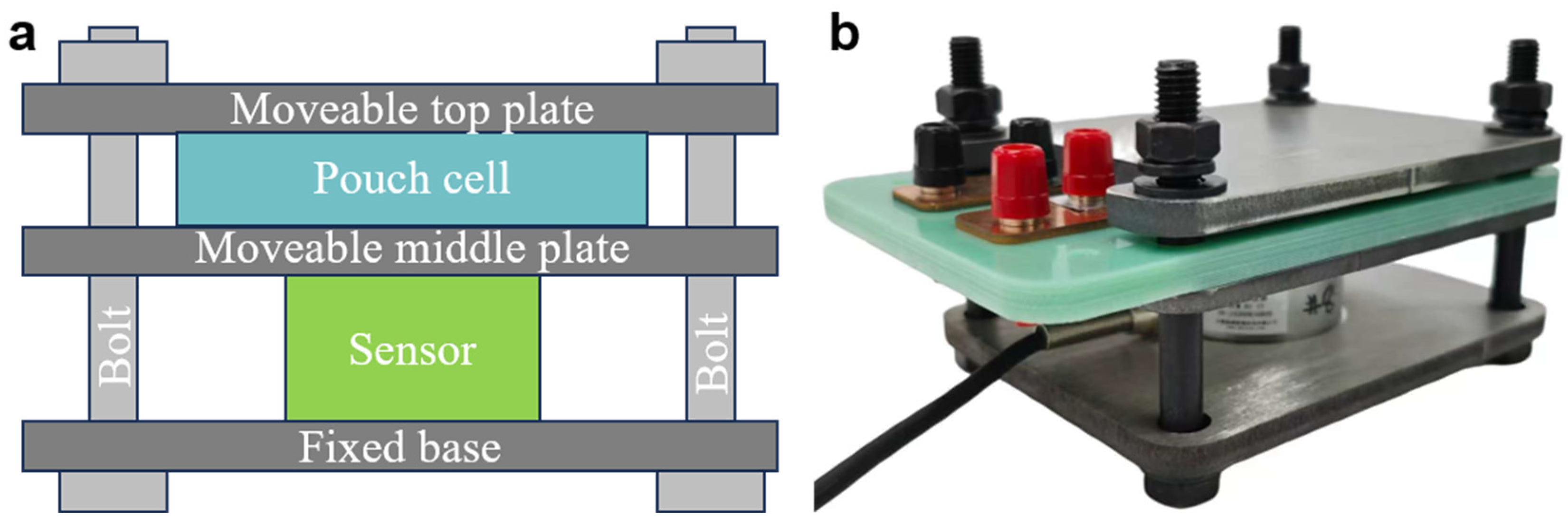
All tests were performed in a programmable high–low temperature chamber to ensure stable ambient conditions. To evaluate the influence of pressure on calendar and cycle aging, cells were mounted in custom fixtures equipped with force sensors, enabling real-time monitoring of both electrical and mechanical responses.
The fixture design is illustrated in Figure 1. It comprises three steel plates: the gap between the top and middle plates is adjustable via bolts, while a force sensor is placed between the middle and bottom plates. This configuration simulates the mechanical environment of a cell within a module. pressure was applied by tightening the bolts to reduce the gap, and because of the viscoelastic relaxation of the cells, a relatively large initial preload was applied. After a resting period, the force gradually decreased and stabilized at the target value.

2.3. Testing Protocols

Given the multiple factors influencing battery lifetime, this study investigates both calendar aging and cycle aging. The analysis focuses on the coupled effects of charge–discharge rate, cycling temperature, SOC window, and mechanical preload on cycle aging, aiming to clarify how these conditions jointly determine capacity fade and DCR growth. In parallel, by systematically varying calendar aging SOC, temperature, and preload, the study examines the key factors governing calendar aging.
The testing matrix included both cycle aging and calendar aging experiments, as summarized in Table 2.
For the cycling test, the baseline condition involved cycling at 1C charge/discharge within a 0–100% SOC window (2.0–3.65 V), under 0.5 MPa preload and 60 °C. The effect of charge/discharge rates was examined at 60 °C (Tests 2–3) and 45 °C (Tests 4–6), with additional comparisons at 25 °C (Tests 7–12). When high-rate discharge was applied, the discharge process was followed by a 1C discharge step to ensure full capacity release and minimize residual charge effects. A 1C rate was selected to maintain consistency with prior literature benchmarks. To evaluate the effect of the SOC window, four ranges were studied: 10–90%, 10–60%, 25–75%, and 40–90% (Tests 13–16).
For the calendar aging test, cells were stored under varied SOCs at 60 °C and 0.5 MPa preload (Tests 17–26). The combined effects of SOC and temperature were explored by varying calendar aging SOC levels under different temperatures (Tests 27–34). Additional experiments investigated the role of mechanical load: cells were subjected to preload levels of 1.0 and 2.0 MPa under four SOC conditions (10%, 50%, 70%, 100%) (Tests 35–42).
After fabrication, cells were assigned to either cycling (CYC) or calendar aging conditions. At fixed intervals, Reference Performance Tests (RPTs) were conducted, including 0.33C charge/discharge and Hybrid Pulse Power Characterization (HPPC), to measure capacity and DCR. For calendar aging tests, the effective calendar aging SOC was updated according to the capacity values obtained from RPT. It is noted that short-circuit failures occurred in the cells assigned to Test 17 and Test 20. The RPTs include charge/discharge and pulse tests, which allow us to obtain the battery capacity retention and DCR.

3. Results and Discussion

This section analyzes calendar and cycle aging under varied operating conditions, quantifying capacity fade and DCR growth, and isolating the roles of temperature, SOC, and pressure in the degradation of LFP pouch cells.

3.1. Calendar Aging

Calendar aging arises from multiple, interacting factors that together determine performance decay during calendar aging. Guided by the experimental matrix, we examine three key variables: calendar aging, SOC, temperature, and pressure.

3.1.1. Calendar Aging SOC

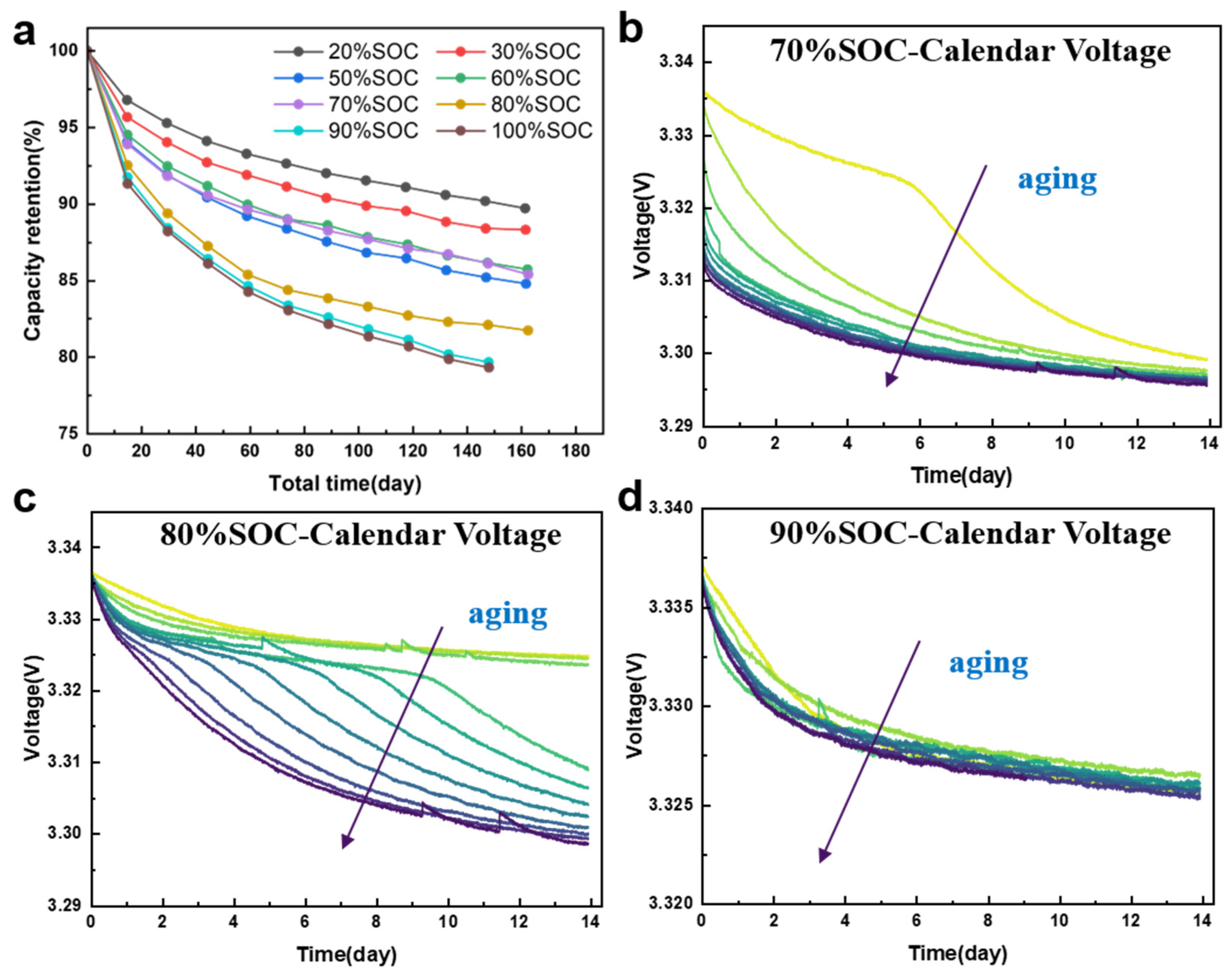
Figure 2 shows the effect of calendar aging SOC on capacity retention and OCV under 0.5 MPa preload at 60 °C. As illustrated in Figure 2a, capacity fade accelerates markedly with increasing SOC. The relationship is nonlinear: cells stored at high SOC (90–100%) degrade substantially faster than those stored at lower SOC. This behavior is mainly attributed to the dominant calendar-aging mechanism—the growth of the solid electrolyte interphase (SEI) on graphite particles. During charging, lithium ions intercalate into the graphite anode, while electrolyte solvents (e.g., carbonates) and salt anions undergo reduction prior to lithium deposition. The reduction products accumulate to form a dense, ion-conducting passivation film, i.e., the SEI. SEI formation consumes active lithium and results in irreversible capacity loss.
The rate of SEI growth depends strongly on the anode overpotential. As SOC increases, the degree of lithium intercalation in graphite rises, lowering the anode potential and thereby increasing the overpotential. A larger overpotential enhances the side-reaction current density exponentially, rather than linearly, leading to disproportionately higher SEI growth rates at elevated SOC. This exponential dependence explains why cells stored at 90–100% SOC fade much more rapidly than those at low SOC.
A distinctive trend was observed at 80% SOC. Early in calendar aging, its fade rate resembled that of 90–100% SOC, but over time, it slowed significantly. To investigate this, we examined OCV drift between successive RPTs (Figure 2b–d). OCV associated with a given SOC gradually decreases during calendar aging due to capacity recalibration after RPTs. It can be clearly observed that the OCV at 80% SOC remains relatively stable at the beginning of calendar aging, but exhibits a significant shift as calendar aging time increases. Considering that the cathode potential lies in a plateau region under this condition, the OCV is mainly influenced by the anode potential. We believe that at the beginning of calendar aging, the anode potential at 80% SOC is close to that at 90% SOC. However, as calendar aging progresses and capacity gradually fades, the capacity corresponding to 80% SOC also decreases. Since SEI growth leads to the loss of lithium ions, the maximum lithium concentration in the anode decreases over time, resulting in a shift in the anode potential. Consequently, the anode potential corresponding to 80% SOC gradually approaches that of 70% SOC. In the transition region between the two plateaus, the anode potential continuously evolves, causing the SEI growth rate to change accordingly. This explains why the capacity fade at 80% SOC initially resembles that observed at 90% SOC but later deviates from it.
Overall, these results show that OCV decreases with extended calendar aging time, though the magnitude of the decrease varies by SOC. The nonuniform OCV evolution may be associated with graphite phase transitions, altering the electrode potential and thus SEI formation kinetics.

3.1.2. Temperature

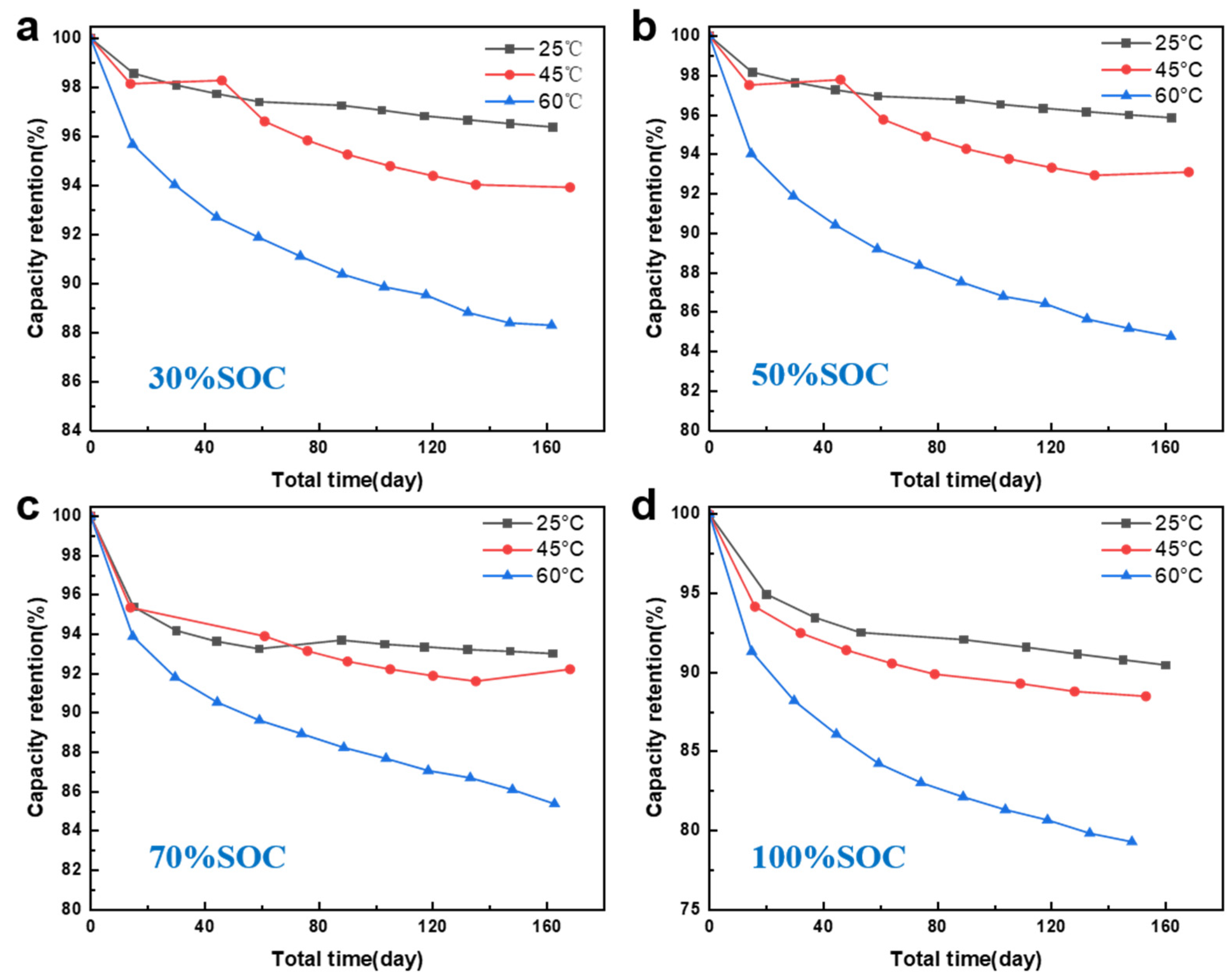
Figure 3 illustrates the effect of temperature on calendar aging under different SOC conditions (30%, 50%, 70%, and 100%) at 25, 45, and 60 °C. At a given SOC and calendar aging duration, capacity fade consistently accelerates with increasing temperature. This confirms that higher temperatures intensify the dominant aging pathway—SEI growth on the graphite anode.
The temperature dependence of SEI-related degradation arises from two competing effects. On the one hand, elevated temperature reduces cell polarization, which lowers overpotential and would be expected to suppress SEI growth. On the other hand, according to Arrhenius kinetics, higher temperature increases the rate constant of parasitic reactions, thereby accelerating SEI formation. The observed outcome—monotonically faster capacity loss at higher temperatures—indicates that the kinetic acceleration effect is more influential than the polarization reduction. Thus, elevated temperature unambiguously promotes calendar aging.

3.1.3. Pressure

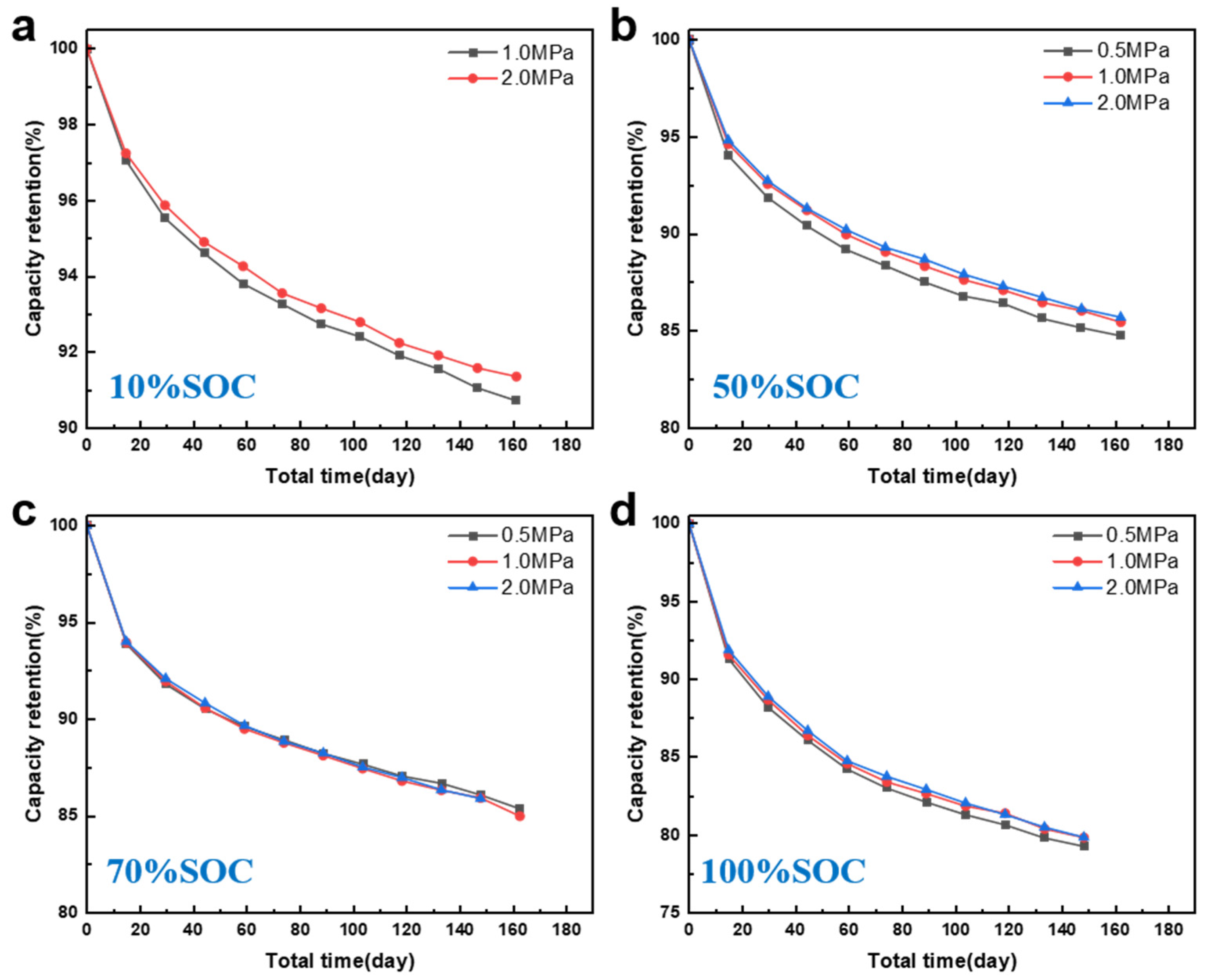
Pressure has been proposed to influence electrochemical performance by altering electrode–electrolyte contact, modifying porosity, and affecting transport resistance. Compression of the porous electrodes reduces void volume, which could increase polarization and impact capacity retention. To investigate its role, calendar aging experiments were conducted at 60 °C under SOCs of 10%, 50%, 70%, and 100%, with pressure of 0.5, 1.0, and 2.0 MPa. Capacity and direct current resistance (DCR) were tracked as indicators of degradation.
As shown in Figure 4, capacity fade shows negligible dependence on pressure under all SOC conditions. While preload affects initial porosity and may alter mass transport or contact resistance, these effects do not strongly couple to the SEI-driven loss of cyclable lithium. In other words, preload has minimal influence on the graphite potential, which is the key determinant of SEI growth rate.
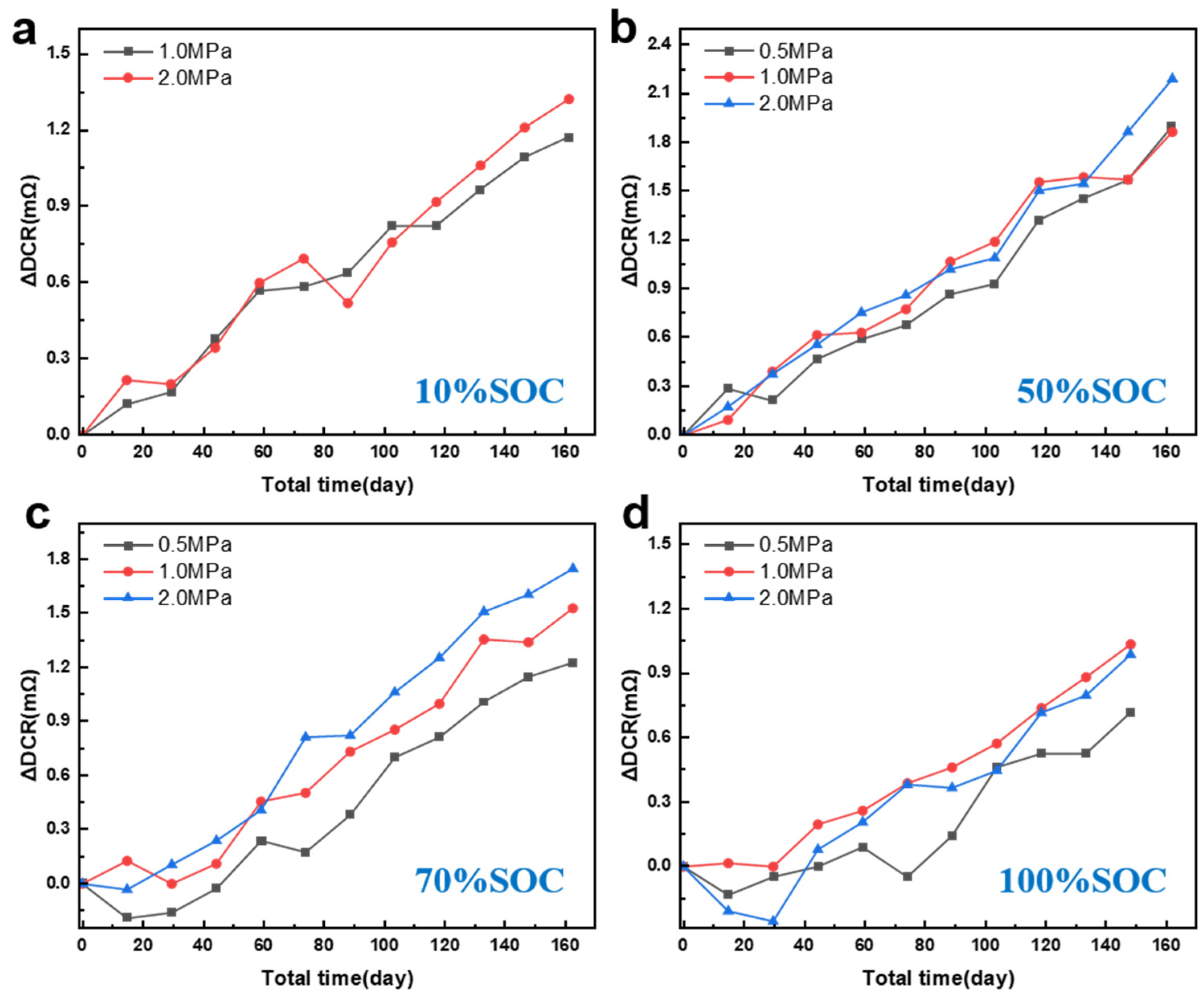
DCR evolution provides additional insights. Normalized DCR values extracted from HPPC tests are plotted in Figure 5. As expected, DCR increases progressively with aging, reflecting interfacial growth and transport resistance changes. However, the effect of pressure on DCR evolution is marginal. Interestingly, the most pronounced resistance growth occurs under 50% SOC calendar aging, suggesting that impedance rise does not scale directly with SEI growth inferred from capacity loss, but also depends on SOC-specific interfacial processes.

3.2. Cycle Aging

Battery cycle aging is comprehensively affected by multiple factors, which interact with one another and jointly determine the rate of performance degradation of the battery under cycling conditions. Based on the experimental matrix, this section will analyze the factors influencing battery cycle aging from three aspects: charge–discharge rate and temperature, pressure, and cycling range.

3.2.1. Charge–Discharge Rate and Temperature

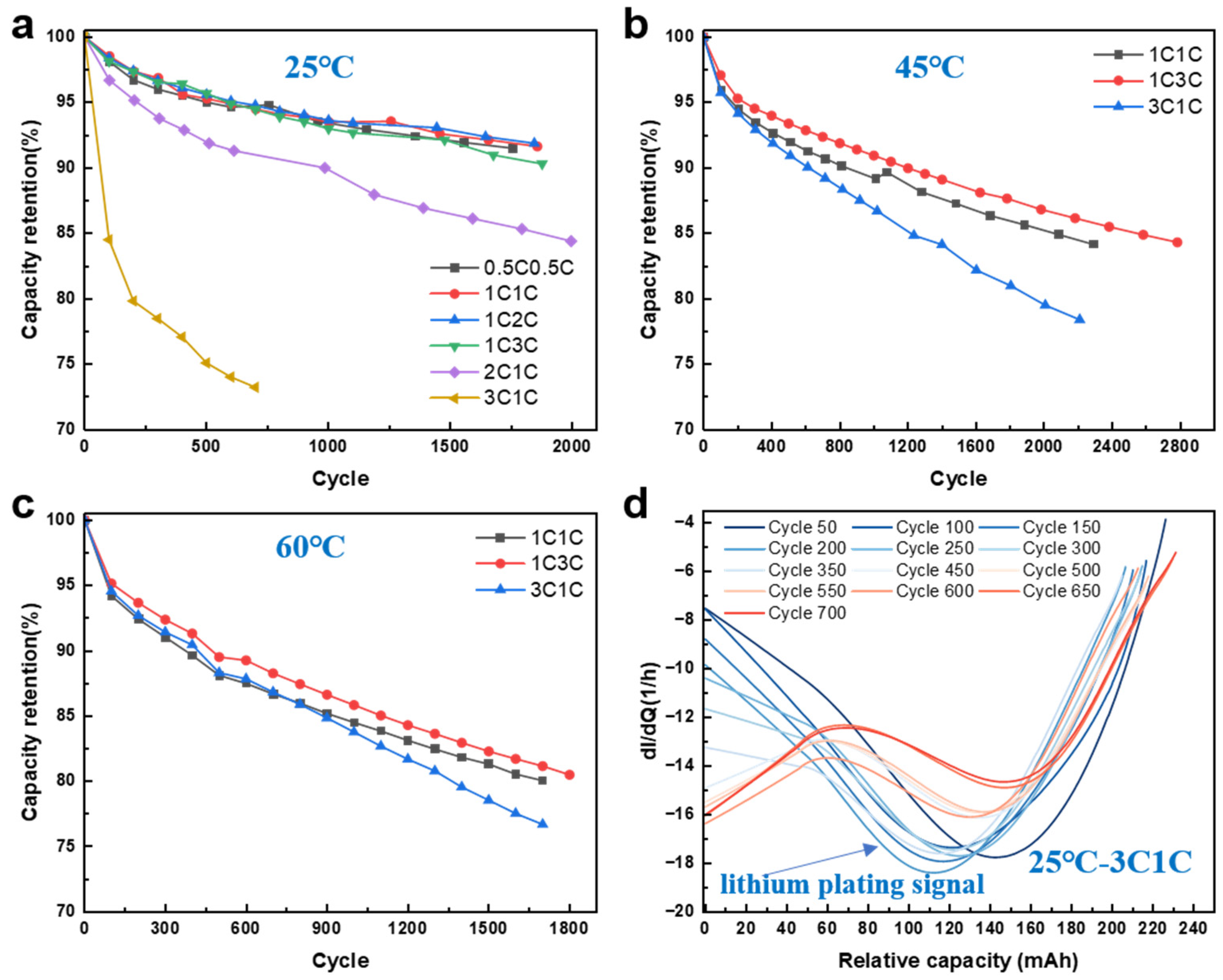
Figure 6 illustrates the influence of charge–discharge rate on cycle aging at three different temperatures (25, 45, and 60 °C), with preload maintained at 0.5 MPa. The results show that the rate strongly affects cycle life, but its impact is strongly modulated by temperature. In general, for a given rate, capacity fade accelerates with increasing temperature. This is consistent with the temperature-driven acceleration of parasitic reactions, such as SEI growth and, at sufficiently high temperatures, electrolyte decomposition.
At 25 °C, cells charged at 3C exhibit a steep capacity drop below 80% within the early stages of cycling (Figure 6a). This rapid degradation is attributed to lithium plating on the graphite anode. High-rate charging increases polarization, depressing the anode potential to values near the lithium deposition potential. Once plating initiates, the deposited lithium exacerbates transport limitations, further lowering the anode potential and reinforcing plating through a negative feedback loop, which leads to abrupt capacity loss. Koseoglou et al. [28] proposed a method for detecting lithium plating in lithium-ion batteries by monitoring the cell charging current during the constant-voltage (CV) charging stage. By applying differential current analysis (DCA), lithium plating can be identified through local maxima observed in the charging current versus time curve. Accordingly, we extracted the CV-stage current data during cycling under the condition of 25 °C, 3C charging, and 1C discharging, and performed differential current analysis. Clear local maxima were observed, indicating significant lithium plating under this condition and confirming the accuracy of our conclusion.
At 45 °C and 60 °C (Figure 6b–c), this early-life capacity collapse is absent, even at 3C charging. Elevated temperature enhances both ionic and electronic transport, which reduces polarization and keeps the anode potential above the threshold for lithium deposition. However, comparing 45 °C and 60 °C reveals that the higher temperature still accelerates degradation: at 60 °C, capacity fade proceeds more rapidly at the same charging rate, reflecting the dominance of thermally accelerated SEI growth.
By contrast, the discharge rate exerts only a modest influence. At 45 and 60 °C, cycling with 3C discharge generally results in slower capacity loss than 1C discharge for the same cycle count. This counterintuitive result stems from the time dependence of SEI growth: because one 1C discharge cycle takes longer than a 3C cycle, more time is available for interfacial side reactions to occur, leading to greater cumulative capacity fade.

3.2.2. Pressure

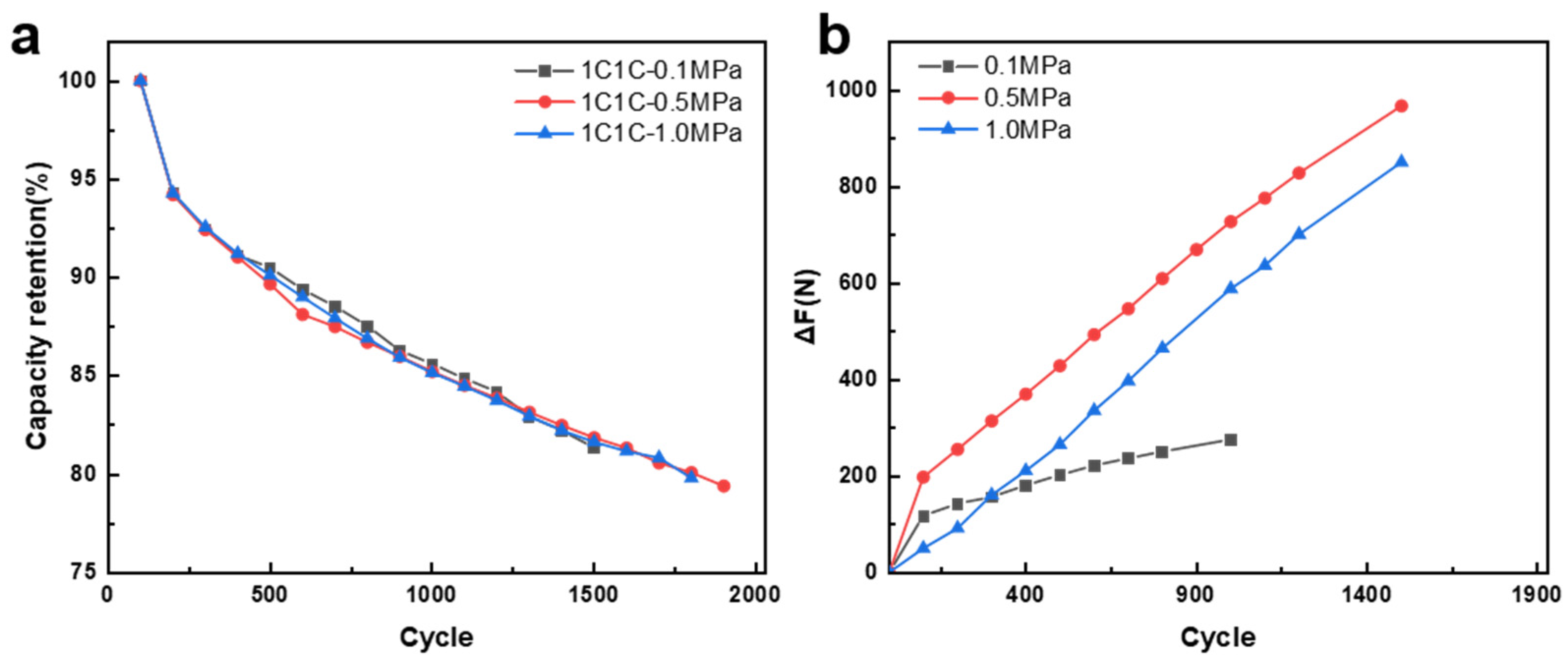
Figure 7 shows the effect of pressure on cycle aging under 1C charge–discharge conditions. The capacity-fade curves (Figure 7a) almost completely overlap for preload levels of 0.1, 0.5, and 1.0 MPa, indicating that preload has a negligible influence on capacity degradation. At this moderate cycling rate, the dominant aging mechanism is SEI growth, which is not significantly altered by mechanical compression. Thus, preload neither introduces additional degradation pathways nor measurably accelerates SEI-driven capacity loss. In other words, changes in initial porosity or impedance induced by preload are too small to impact cycle life under these conditions.
In contrast, preload exerts a clear influence on the minimum expansion force measured during cycling (Figure 7b). We extracted the force at the beginning of charging during the RPTs. As cells age, irreversible expansion caused by SEI formation accumulates. A higher preload amplifies the measured change in force, even though the intrinsic expansion is nearly identical across conditions. This amplification arises because higher preload increases cell stiffness: the same inherent expansion generates a greater incremental force signal. Consequently, preload does not worsen capacity loss, but it modulates the force response, providing insight into how external mechanical constraints shape the measured stress evolution.

3.2.3. SOC Windows

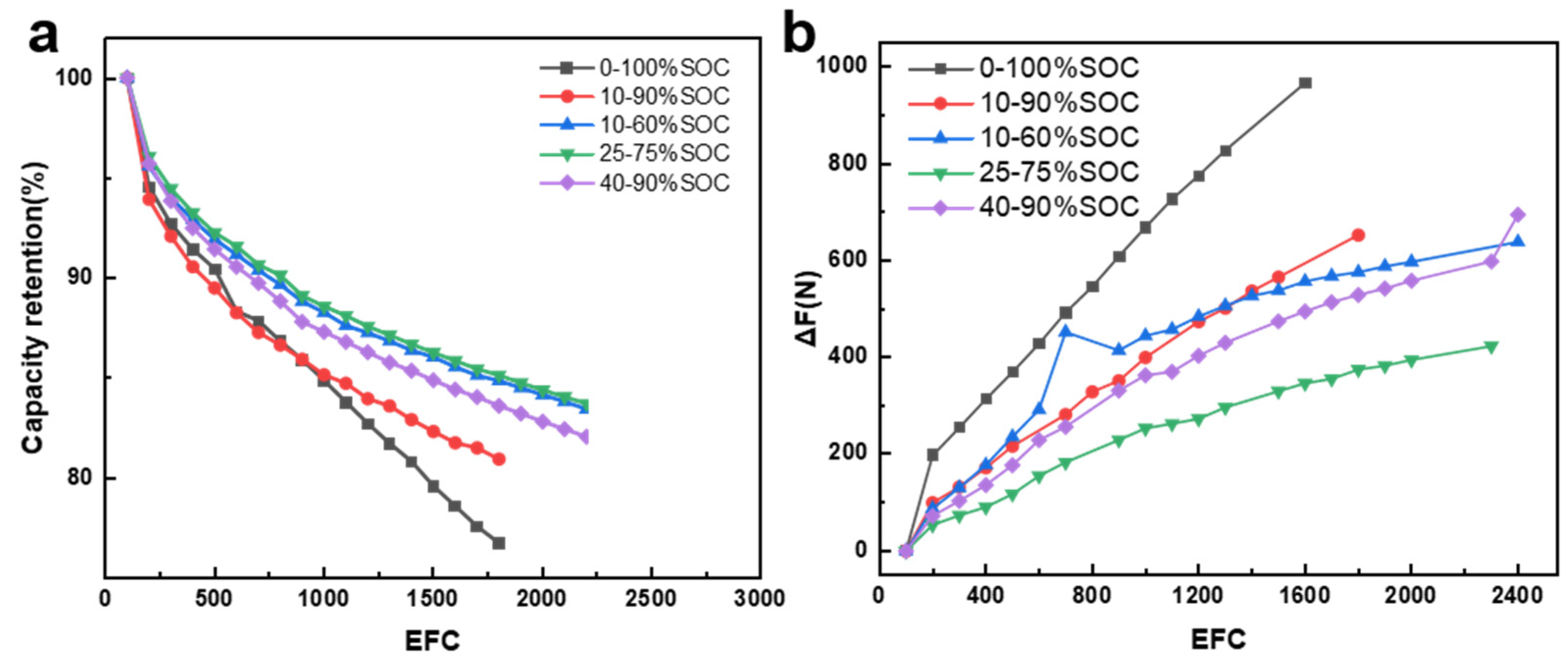
The influence of SOC cycling windows on capacity fade and expansion force is presented in Figure 8. Because the duration of one cycle varies with SOC range, results were normalized to equivalent cycle numbers for meaningful comparison.
As shown in Figure 8a, cells cycled over the full 0–100% SOC range degrade the fastest, followed by the 10–90% and 40–90% ranges. By contrast, the 10–60% and 25–75% ranges exhibit nearly identical and significantly slower fade rates. These results highlight the strong role of high-SOC exposure in accelerating degradation, consistent with enhanced SEI growth and structural stresses at elevated anode lithiation.
The evolution of the minimum expansion force (Figure 8b) also depends on the SOC range. Wider cycling windows, particularly those extending to 100% SOC, induce greater irreversible expansion and thus larger increases in force. Narrower windows that avoid deep charge reduce both fade and stress accumulation, underscoring the benefits of SOC-window management strategies for prolonging cycle life.

3.3. Summary of Aging Influencing Factors

In the preceding Section 3.1 and Section 3.2, this study systematically analyzed the experimental results of calendar aging and cycle aging, clarifying the influence of calendar aging, SOC, temperature, and pressure on calendar aging, as well as the dominant roles of charge–discharge rate, SOC window, and temperature in governing cycle aging behavior. To more clearly illustrate the mechanisms and relative impacts of these factors on battery degradation, this section provides an integrated summary and comparison of the major findings from both aging modes and further organizes them into two overview tables. This enables readers to comprehensively understand the dominance, sensitivity, and distinguishing characteristics of each factor in the aging process, thereby establishing a systematic foundation for proposing optimization strategies in subsequent sections.
Regarding battery calendar aging, experimental results indicate that the SOC and temperature are the primary influencing factors, while mechanical preload has little effect on calendar aging. Higher calendar aging SOC accelerates capacity fade, mainly due to faster SEI side reactions and enhanced self-discharge, highlighting the importance of proper SOC management during storage. In this study, three temperature points—25 °C, 45 °C, and 60 °C—were selected for testing, and the results show that capacity degradation increases significantly with rising temperature. Meanwhile, previous studies have indicated that excessively low temperatures can increase polarization, leading to a higher risk of lithium plating. Therefore, proper thermal management during battery use and storage is particularly critical. These findings suggest that controlling SOC levels and storage temperature is key to mitigating calendar aging and extending the lifespan of lithium iron phosphate (LFP) batteries. The effects of these calendar aging factors on battery life are summarized in Table 3.
Regarding cycle aging, it is primarily influenced by charge/discharge rates, temperature, and SOC windows, while mechanical preload has little effect on electrochemical degradation during low-rate cycling. High charging rates increase polarization, promote lithium plating, and accelerate active material loss, leading to faster capacity fade. Similarly, wider SOC windows and higher maximum SOC levels exacerbate degradation by enhancing SEI growth and polarization. The effects of temperature are consistent with calendar aging: high temperatures accelerate side reactions, whereas low temperatures increase polarization and the risk of lithium plating. These results highlight the importance of optimizing cycling protocols, SOC ranges, and thermal management to prolong cycle life. The effects of these cycle aging factors on battery life are summarized in Table 4.

4. Conclusions

This study systematically investigated the effects of calendar aging, SOC, temperature, pressure, charge–discharge rate, and SOC window on the calendar and cycle aging of LFP cells.
For calendar aging, capacity fade was strongly dependent on both SOC and temperature but only marginally influenced by preload. Higher calendar aging SOC accelerated degradation through intensified SEI growth, while OCV drift during long-term calendar aging revealed dynamic changes in anode potential that further shaped fade trends. Elevated temperature consistently accelerated capacity loss, reflecting the dominance of thermally enhanced side-reaction kinetics over polarization reduction. In contrast, pressure had little effect on either capacity fade or DCR increase, though resistance growth was found to be most pronounced at 50% SOC rather than at the highest SOC levels, indicating that impedance rise does not scale directly with SEI formation.
For cycle aging, degradation was primarily governed by charging rate, temperature, and SOC window, while preload exerted minimal influence. High-rate charging at 25 °C induced lithium plating and rapid capacity loss, whereas at elevated temperatures (45–60 °C), improved transport suppressed plating but accelerated SEI-driven fading. Discharge rate had a comparatively minor impact, with slower discharges producing more degradation due to longer time at temperature. Under low-rate cycling, preload did not affect capacity fade but amplified measured stress signals as aging progressed. The SOC window exerted a strong influence: wider ranges and higher maximum SOCs led to faster capacity fade and greater irreversible expansion, while narrower mid-range windows significantly mitigated both.
Overall, the results highlight that SOC management, temperature control, and charging protocols are critical levers for extending LFP battery lifetime, while preload primarily affects mechanical responses rather than electrochemical degradation. We selected commonly used LFP cells, which exhibit general applicability. A multi-factor and cross-factor experimental matrix was designed to investigate how different factors influence calendar aging and cycle aging. We hope that the findings can provide guidance for battery design and optimization. These insights provide a mechanistic basis for optimizing operating strategies and module design to enhance the durability of LFP-based energy storage systems.

Author Contributions

Conceptualization, Z.Y. and X.-G.Y.; methodology, Z.Y. and X.L.; hardware setup, Z.Y. and J.L.; validation, Z.Y. and H.L.; formal analysis, X.F. (Xingcun Fan); investigation, J.S. and X.F. (Xiaolong Feng); resources, Z.C. and X.L.; data curation, Z.Y. and H.L.; writing—original draft preparation, Z.Y.; writing—review and editing, X.-G.Y.; visualization, Z.Y. and J.L.; supervision, X.-G.Y.; project administration, X.L.; funding acquisition, X.-G.Y. All authors have read and agreed to the published version of the manuscript.

Funding

This research was funded by the National Key R&D Program of China (2022YFB2404300), the National Natural Science Foundation of China (No. 52277212), and the Shenzhen Science and Technology Program (No. KJZD20230923114611023).

Data Availability Statement

The data that support the plots within this paper and other findings of this study are available from the corresponding author on reasonable request.

Acknowledgments

Financial support from the National Key R&D Program of China (2022YFB2404300), the National Natural Science Foundation of China (No. 52277212), and the Shenzhen Science and Technology Program (No. KJZD20230923114611023) are greatly acknowledged.

Conflicts of Interest

Xue Li, Jintao Shi, Xingcun Fan, Zifeng Cong and Xiaolong Feng were employed by the company China Automotive New Energy Technology Co., Ltd. The remaining authors declare that the research was conducted in the absence of any commercial or financial relationships that could be construed as a potential conflict of interest.

References

  1. Wu, D.; Nzabahimana, J.; Hu, X. A designable sulfur-linked carbonyl compound anchored on reduced graphene oxide for high-rate organic lithium batteries. Carbon Neutralization 2023, 2, 738–745. [Google Scholar] [CrossRef]
  2. Ren, J.; Zhu, H.; Fang, Y.; Li, W.; Lan, S.; Wei, S.; Yin, Z.; Tang, Y.; Ren, Y.; Liu, Q. Typical cathode materials for lithium-ion and sodium-ion batteries: From structural design to performance optimization. Carbon Neutralization 2023, 2, 339–377. [Google Scholar] [CrossRef]
  3. Fan, X.; Li, Y.; Luo, C.; Luo, S.; Huang, B.; Liu, S.; Sun, W. Vertically aligned MnO2 nanosheets on carbon fiber cloth as lithiophilic host enables dendrite-free lithium metal anode. Electrochim. Acta 2023, 464, 142896. [Google Scholar] [CrossRef]
  4. Yang, K.; Zhang, W.-K.; Yin, Y.; Nan, J.; Wang, W.; Jiang, J.; Yang, X.-G. A hierarchical electrochemical-thermal-mechanical coupled model capable of predicting non-uniform behaviors in large-format Li-ion cells. J. Power Sources 2025, 629, 236049. [Google Scholar] [CrossRef]
  5. Sun, W.; Liu, C.; Li, Y.; Luo, S.; Liu, S.; Hong, X.; Xie, K.; Liu, Y.; Tan, X.; Zheng, C. Rational Construction of Fe2N@C Yolk-Shell Nanoboxes as Multifunctional Hosts for Ultralong Lithium-Sulfur Batteries. ACS Nano 2019, 13, 12137–12147. [Google Scholar] [CrossRef] [PubMed]
  6. Liu, Y.; Xie, K.; Pan, Y.; Li, Y.; Wang, H.; Jin, Z.; Zheng, C. Investigation of 4, 5-Dimethyl-1, 3-dioxol-2-one as Additives on the Storage Life of LiNi0.8Co0.15Al0.05O2/Graphite Batteries at Elevated Temperature. J. Electrochem. Soc. 2017, 164, A3949–A3959. [Google Scholar] [CrossRef]
  7. Li, R.; Bao, L.; Chen, L.; Zha, C.; Dong, J.; Qi, N.; Tang, R.; Lu, Y.; Wang, M.; Huang, R.; et al. Accelerated aging of lithium-ion batteries: Bridging battery aging analysis and operational lifetime prediction. Sci. Bull. 2023, 68, 3055–3079. [Google Scholar] [CrossRef] [PubMed]
  8. Pan, T.; Li, Y.; Yao, Z.; Liu, S.; Zhu, Y.; Wang, X.; Wang, J.; Zheng, C.; Sun, W. Research Advances on Lithium-Ion Batteries Calendar Life Prognostic Models. Carbon Neutralization 2025, 4, e192. [Google Scholar] [CrossRef]
  9. Ecker, M.; Nieto, N.; Käbitz, S.; Schmalstieg, J.; Blanke, H.; Warnecke, A.; Sauer, D.U. Calendar and cycle life study of Li(NiMnCo)O2-based 18650 lithium-ion batteries. J. Power Sources 2014, 248, 839–851. [Google Scholar] [CrossRef]
  10. Lewerenz, M.; Fuchs, G.; Becker, L.; Sauer, D.U. Irreversible calendar aging and quantification of the reversible capacity loss caused by anode overhang. J. Energy Storage 2018, 18, 149–159. [Google Scholar] [CrossRef]
  11. Lam, V.N.; Cui, X.; Stroebl, F.; Uppaluri, M.; Onori, S.; Chueh, W.C. A decade of insights: Delving into calendar aging trends and implications. Joule 2025, 9, 101796. [Google Scholar] [CrossRef]
  12. Fly, A.; Wimarshana, B.; Bin-Mat-Arishad, I.; Broad, R.J. Influence of periodic temperature variations on calendar ageing of lithium-ion batteries. J. Power Sources 2025, 657, 238147. [Google Scholar] [CrossRef]
  13. Braco, E.; Martin, I.S.; Sanchis, P.; Ursua, A. Analysis and modelling of calendar ageing in second-life lithium-ion batteries from electric vehicles. In Proceedings of the 2022 IEEE International Conference on Environment and Electrical Engineering and 2022 IEEE Industrial and Commercial Power Systems Europe (EEEIC/I&CPS Europe), Prague, Czech Republic, 28 June–1 July 2022; pp. 1–6. [Google Scholar]
  14. Baghdadi, I.; Briat, O.; Delétage, J.-Y.; Gyan, P.; Vinassa, J.-M. Lithium battery aging model based on Dakin’s degradation approach. J. Power Sources 2016, 325, 273–285. [Google Scholar] [CrossRef]
  15. Lewerenz, M.; Käbitz, S.; Knips, M.; Münnix, J.; Schmalstieg, J.; Warnecke, A.; Sauer, D.U. New method evaluating currents keeping the voltage constant for fast and highly resolved measurement of Arrhenius relation and capacity fade. J. Power Sources 2017, 353, 144–151. [Google Scholar] [CrossRef]
  16. Kuzhiyil, J.A.; Damoulas, T.; Planella, F.B.; Widanage, W.D. Lithium-ion battery degradation modelling using universal differential equations: Development of a cost-effective parameterisation methodology. Appl. Energy 2025, 382, 125221. [Google Scholar] [CrossRef]
  17. Keil, P.; Jossen, A. Charging protocols for lithium-ion batteries and their impact on cycle life—An experimental study with different 18650 high-power cells. J. Energy Storage 2016, 6, 125–141. [Google Scholar] [CrossRef]
  18. Su, L.; Zhang, J.; Wang, C.; Zhang, Y.; Li, Z.; Song, Y.; Jin, T.; Ma, Z. Identifying main factors of capacity fading in lithium ion cells using orthogonal design of experiments. Appl. Energy 2016, 163, 201–210. [Google Scholar] [CrossRef]
  19. Barcellona, S.; Piegari, L. Effect of current on cycle aging of lithium ion batteries. J. Energy Storage 2020, 29, 101310. [Google Scholar] [CrossRef]
  20. Wang, W.; Yuan, B.; Sun, Q.; Wennersten, R. Analysis and Modeling of Calendar Aging and Cycle Aging of LiCoO2/Graphite Cells. J. Therm. Sci. 2024, 33, 1109–1118. [Google Scholar] [CrossRef]
  21. Bashash, S.; Moura, S.J.; Forman, J.C.; Fathy, H.K. Plug-in hybrid electric vehicle charge pattern optimization for energy cost and battery longevity. J. Power Sources 2011, 196, 541–549. [Google Scholar] [CrossRef]
  22. Qi, C.; Liu, Z.; Lin, C.; Hu, Y.; Liu, D.; Li, Z.; Yi, A. Study on the effect of low-temperature cycling on the thermal and gas production behaviors of Ni0.8Co0.1Al0.1/graphite lithium-ion batteries. Appl. Therm. Eng. 2024, 247, 123054. [Google Scholar] [CrossRef]
  23. Wu, Y.; Long, X.; Lu, J.; Wu, Y.; Zhou, R.; Liu, L. Effect of temperature on the high-rate pulse charging of lithium-ion batteries. J. Electroanal. Chem. 2022, 922, 116773. [Google Scholar] [CrossRef]
  24. Laresgoiti, I.; Käbitz, S.; Ecker, M.; Sauer, D.U. Modeling mechanical degradation in lithium ion batteries during cycling: Solid electrolyte interphase fracture. J. Power Sources 2015, 300, 112–122. [Google Scholar] [CrossRef]
  25. Cannarella, J.; Arnold, C.B. Stress evolution and capacity fade in constrained lithium-ion pouch cells. J. Power Sources 2014, 245, 745–751. [Google Scholar] [CrossRef]
  26. Cannarella, J.; Arnold, C.B. The Effects of Defects on Localized Plating in Lithium-Ion Batteries. J. Electrochem. Soc. 2015, 162, A1365–A1373. [Google Scholar] [CrossRef]
  27. Cannarella, J.; Arnold, C.B. Ion transport restriction in mechanically strained separator membranes. J. Power Sources 2013, 226, 149–155. [Google Scholar] [CrossRef]
  28. Koseoglou, M.; Tsioumas, E.; Ferentinou, D.; Panagiotidis, I.; Jabbour, N.; Papagiannis, D.; Mademlis, C. Lithium plating detection using differential charging current analysis in lithium-ion batteries. J. Energy Storage 2022, 54, 105345. [Google Scholar] [CrossRef]
Figure 1. Schematic of the experimental fixture. (a) Constant-gap fixture for measuring expansion force under different preload conditions. (b) Detailed view of the fixture assembly.
Applsci 15 12749 g001
Figure 2. Variations in capacity and OCV during calendar aging at 60 °C and 0.5 MPa under different SOCs. (a) Capacity fade at different SOCs. (b) OCV variation at 70% SOC. (c) OCV variation at 80% SOC. (d) OCV variation at 100% SOC.
Applsci 15 12749 g002
Figure 3. Capacity fade during calendar aging under 0.5 MPa preload at different SOCs and temperatures. (a) 30% SOC; (b) 50% SOC; (c) 70% SOC; (d) 100% SOC.
Applsci 15 12749 g003
Figure 4. Capacity fade during calendar aging at 60 °C under different SOCs and preload levels. (a) 10% SOC; (b) 50% SOC; (c) 70% SOC; (d) 100% SOC.
Applsci 15 12749 g004
Figure 5. DCR Variation in LFP battery under 60 °C, different calendar aging SOC levels and pressure. (a) At 10% SOC. (b) At 50% SOC. (c) At 70% SOC. (d) At 100% SOC.
Applsci 15 12749 g005
Figure 6. Capacity fade during cycling under different charge–discharge rates and temperatures (preload 0.5 MPa). (a) 25 °C; (b) 45 °C; (c) 60 °C; (d) dI/dQ plot during the constant-voltage (CV) charging stage under 25 °C, 3C charge///1C discharge cycling conditions.
Applsci 15 12749 g006
Figure 7. Effect of preload on cycle aging at 1C/1C. (a) Capacity fade. (b) Minimum expansion force.
Applsci 15 12749 g007
Figure 8. Effect of SOC cycling range at 0.5 MPa preload and 1C/1C cycling. (a) Capacity fade (normalized to equivalent cycles); (b) Minimum expansion force.
Applsci 15 12749 g008
Table 1. Cell design parameters.
ParameterUnitCathode (LFP)SeparatorAnode (Gr)
Thicknessμm821668
Sizemm56*67/60*76
Loadingmg/cm220.290/9.589
Layers--10189
Porosity--0.360.440.29
Table 2. Cycling aging and calendar aging test matrix table.
Group #DescriptionCharge C-Rate (–)Discharge C-Rate (–)SOC Window (%)Pressure (MPa)Temperature (°C)
1Baseline1C1C0–1000.560
2C rate1C3C0–1000.560
3C rate3C1C0–1000.560
4C rate/Temperature1C1C0–1000.545
5C rate/Temperature1C3C0–1000.545
6C rate/Temperature3C1C0–1000.545
7C rate/Temperature0.5C0.5C0–1000.525
8C rate/Temperature1C1C0–1000.525
9C rate/Temperature1C2C0–1000.525
10C rate/Temperature1C3C0–1000.525
11C rate/Temperature2C1C0–1000.525
12C rate/Temperature3C1C0–1000.525
13SOC window1C1C10–900.560
14SOC window1C1C10–600.560
15SOC window1C1C25–750.560
16SOC window1C1C40–900.560
17Calendar SOC--100.560
18Calendar SOC--200.560
19Calendar SOC--300.560
20Calendar SOC--400.560
21Calendar SOC--500.560
22Calendar SOC--600.560
23Calendar SOC--700.560
24Calendar SOC--800.560
25Calendar SOC--900.560
26Calendar SOC--1000.560
27SOC/Temperature 300.545
28SOC/Temperature 300.525
29SOC/Temperature 500.545
30SOC/Temperature 500.525
31SOC/Temperature 700.545
32SOC/Temperature 700.525
33SOC/Temperature 1000.545
34SOC/Temperature 1000.525
35SOC/Pressure--101.060
36SOC/Pressure--102.060
37SOC/Pressure--501.060
388SOC/Pressure--502.060
39SOC/Pressure--701.060
40SOC/Pressure--702.060
41SOC/Pressure--1001.060
42SOC/Pressure--1002.060
Table 3. Summary of calendar aging influencing factors.
FactorInfluence on Capacity FadeDominant Degradation Mechanisms
Calendar aging SOCHigher calendar aging SOC leads to faster capacity loss. Accelerated SEI growth rate and enhanced self-discharge reactions.
PressurePressure has virtually no effect on capacity fade during calendar aging.No significant influence on SEI-related side reactions.
TemperatureBoth excessively high and excessively low temperatures lead to faster capacity loss.Temperature (High): Elevated temperatures accelerate side-reaction kinetics.
Temperature (Low): Increased polarization and higher risk of lithium plating.
Table 4. Summary of cycle aging influencing factors.
FactorInfluence on Capacity FadeDominant Degradation Mechanisms
Charge/Discharge C-rateThe charging rate has a greater impact on capacity loss than the discharging rate, and higher rates lead to faster capacity degradation.Increased polarization, higher tendency for lithium plating, and promoted active material loss.
PressurePreload has no effect on capacity loss during low-rate charge–discharge cycling.No significant influence on SEI-related side reactions.
TemperatureBoth excessively high and excessively low temperatures lead to faster capacity loss.Temperature (High): Elevated temperatures accelerate side-reaction kinetics.
Temperature (Low): Increased polarization and higher risk of lithium plating.
SOC WindowWider SOC windows and higher upper-SOC limits lead to faster capacity loss.Increased polarization and accelerated SEI growth.
Disclaimer/Publisher’s Note: The statements, opinions and data contained in all publications are solely those of the individual author(s) and contributor(s) and not of MDPI and/or the editor(s). MDPI and/or the editor(s) disclaim responsibility for any injury to people or property resulting from any ideas, methods, instructions or products referred to in the content.