Article

Comparative Evaluation of Human Whole-Body Vibration in Electric and Diesel Articulated Buses

by
Tobiasz Bochenek
1,
Gustaw Sierzputowski
2 and
Radosław Wróbel
2,*
1
Faculty of Mechanical Engineering, Wroclaw University of Science and Technology, 50-370 Wroclaw, Poland
2
Department of Automotive Engineering, Wroclaw University of Science and Technology, 50-370 Wroclaw, Poland
*
Author to whom correspondence should be addressed.
Appl. Sci. 2025, 15(23), 12741; https://doi.org/10.3390/app152312741
Submission received: 27 October 2025 / Revised: 20 November 2025 / Accepted: 27 November 2025 / Published: 2 December 2025
(This article belongs to the Special Issue Vibroacoustic Monitoring: Theory, Methods and Applications)

Abstract

Whole-body vibration (WBV) represents a significant health and comfort concern in modern public transportation systems. This study compares vibration exposure in two types of articulated city buses—diesel-powered and fully electric—under real operating conditions in one of the European cities (1 million inhabitants). Measurements were conducted at three seating positions (front, middle, rear) across four surface types: smooth asphalt, mixed asphalt-rail, cobblestone, and idle. Triaxial accelerometers recorded accelerations processed according to ISO 2631-1. The frequency-weighted Root Mean Square (RMS) served as the principal comfort indicator, while FFT spectra provided spectral insight. Results showed differences in vibrations, and therefore passenger comfort, in buses powered by different energy sources (the research was conducted from May to July 2025). The article highlights additional inconveniences resulting from operating the buses on roads.

1. Introduction

Mechanical vibrations are an inherent component of vehicular operation, affecting both mechanical integrity and human well-being. Whole-body vibration (WBV), transmitted through seats and vehicle structures, can lead to discomfort, fatigue, and long-term health risks. The ISO 2631-1:1997 standard [1] provides the foundation for assessing human exposure to vibration by defining frequency-weighting filters (Wd, Wk) and health guidance caution zones.
In the context of urban public transport, buses are one of the most frequent sources of long-term exposure to WBV. The recent transition to electric propulsion promises not only lower emissions but also potential improvement in ride quality due to smoother torque delivery and reduced drivetrain-induced vibrations. However, comparative data quantifying WBV differences between diesel and electric city buses remain limited.
While there is little information about WBV differences between diesel and electric city buses, the general research on vehicle vibrations is abundant, including studies on vibrations (and even their potential impact on passenger discomfort) in various vehicles equipped with engines with different power supply methods [2,3,4,5,6,7,8,9].
Thamsuwan O. et al. [2] conducted a large-scale field study on WBV exposure in urban bus drivers, showing significant health risk classification under ISO thresholds, especially on cobbled surfaces. Their findings underscore the role of road profile in WBV exposure. Similarly, Ittianuwat R. et al. [3] evaluated different seat suspension systems and found that vertical WBV amplitudes can be reduced with optimized passive dampers.
Patel, Gohil, and Borhade [4] compared vibration exposure across various urban road profiles and speeds, establishing that asphalt-rail transitions induce frequency spikes in the 2–8 Hz range, which directly affect lumbar resonance. In another key study, Jagiełło, Wołek, and Bizon [5] contrasted WBV between diesel and electric buses, revealing that e-buses demonstrate lower weighted RMS values due to smoother drivetrain profiles.
From a biomechanical standpoint, Alin et al. [6] modeled human-seat dynamics under vertical and multi-axis excitation. Their simulation validated ISO thresholds and indicated that the spine is most sensitive to oscillations below 6 Hz. This aligns with findings by Bai [7], who compared active and passive bus seats, noting a marked reduction in exposure under active damping conditions.
Multibody dynamics have also been applied. Portela and Zannin [8] simulated seated human response in vehicle cabins and identified yaw-induced WBV peaks near articulation joints. Fernandes [9] proposed an optimization framework for suspension design, validated with ISO metrics, reducing exposure zone classification from “Caution” to “Acceptable”.
Particularly valuable literature presents the results of tests of vehicle components (active and passive) on vibration potential [10,11,12,13,14]. Horvath and Feszty [10] reviewed gear waviness and NVH in EVs, emphasizing that high-frequency vibrations in EVs are more dominant compared to ICE vehicles, affecting perceived comfort. Sangeetha and Ramachandran [11] focused on PMSM-based electric drives, showing that torque ripple is a significant source of passenger discomfort, especially at low speeds. García-Tárrago et al. [12] explored vibration transmission through rubber mounts, highlighting how different impedance behavior in ICE and EV configurations affects isolation efficiency. Fiedler et al. [13] compared interior noise and vibration levels in premium ICE and EV vehicles, noting that EVs tend to have improved low-frequency profiles but introduce high-frequency challenges due to electric drivetrain harmonics. Gad et al. [14] evaluated magnetorheological damper seats in both ICE and EV platforms. The study found measurable improvements in vibration suppression under real-world, uncertain driving conditions, offering benefits in both types of vehicles.
Taking into account the subject of the article, it is also necessary to cite publications concerning vibration research due to their impact on the human body [15,16,17,18]. Whole-body vibration (WBV) occurs when mechanical oscillations are transmitted through a vehicle’s structure to its occupants. This type of exposure is common in transportation environments, particularly among professional drivers and frequent commuters. Numerous studies have investigated the physiological, neurological, and musculoskeletal impacts of WBV on the human body. Zhang et al. [15] investigated the onset of drowsiness induced by WBV during transportation. Their findings suggest that specific vibration frequencies (particularly in the 1–20 Hz range) can induce fatigue and drowsiness in as little as 20 min of exposure, posing significant safety risks in vehicular and public transport contexts. Griffin’s foundational work [16] identifies the resonance frequencies of the human body, revealing heightened sensitivity around 4–8 Hz for the spine and internal organs. These frequencies are commonly encountered in road and rail transport, which may contribute to spinal compression, lower back pain, and long-term tissue degradation. Rahmani et al. [17] assessed the physiological strain on bus drivers under WBV conditions, noting increased heart rates and muscle fatigue, particularly in the lumbar region. These effects were correlated with reduced reaction time and performance accuracy, suggesting operational risk escalation in professional driving scenarios. Li et al. [18] explored the effect of WBV in high-speed magnetic levitation (maglev) trains, comparing it with traditional rail vehicles. The study revealed that although maglev systems eliminate some vibrational sources, failures in levitation units can introduce unique WBV patterns with similar health implications.
In conclusion, the main objective of this paper is to quantify WBV in real operational conditions for two articulated bus platforms—diesel and electric—and to assess their implications for passenger comfort and health using the ISO 2631-1997 standard.

2. Methodology

The study was conducted over three months on a regular public transport bus route. These vehicles are very popular across Europe, with over 50,000 diesel and 2500 electric vehicles sold. The average age of the studied vehicles was five years. Table 1 compares the key parameters of the two articulated bus models studied.
Both vehicles operated in the same European city, along identical routes and traffic conditions, covering asphalt, cobblestone, and mixed surfaces (tram-rail section). Measurements were taken at three seat locations: front (behind driver), middle (articulated joint), and rear (above engine/electric axle).
WBV was measured using triaxial accelerometers, mounted on the seat bases to capture vertical (z), lateral (y), and longitudinal (x) accelerations. Sensors were connected to a data acquisition system offering 24-bit resolution and a 10 kHz sampling rate per channel [19]. Table 2 contains the most important parameters of the sensor and acquisition system used.
All devices were calibrated prior to measurements. The measurement protocol followed ISO 2631-1 guidelines, ensuring correct sensor orientation, surface fixation, and route repeatability.
The objective of the experiment was to obtain comparable seat-vibration data in two city buses (diesel-powered and electric). The experimental design consisted of applying commonly used methodologies [21], so that it was possible to indicate vibrations in one bus model, based on two different power supply methods (the total number of buses was greater; they were changed during the experiment, but all belonged to the same model).
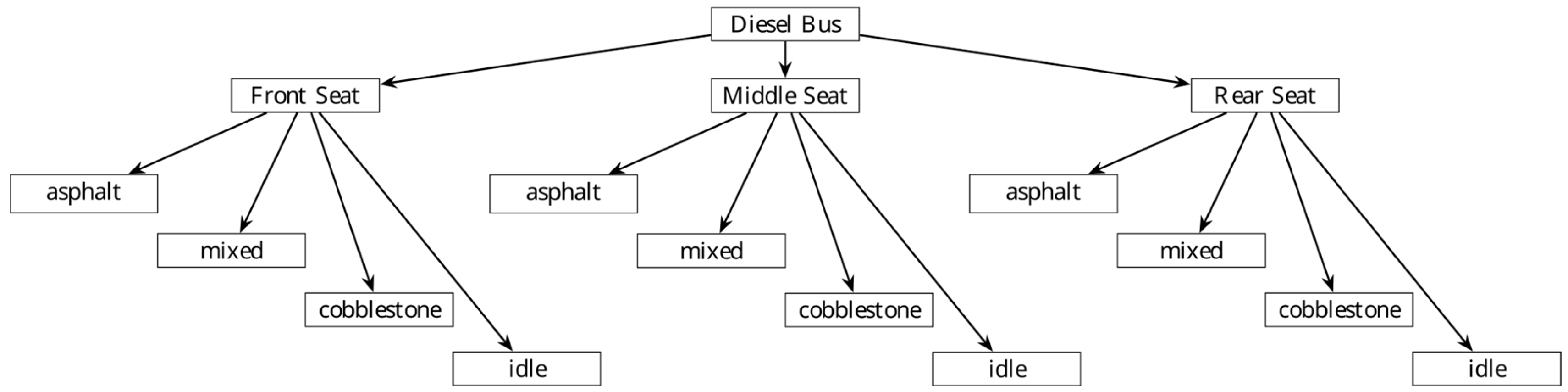
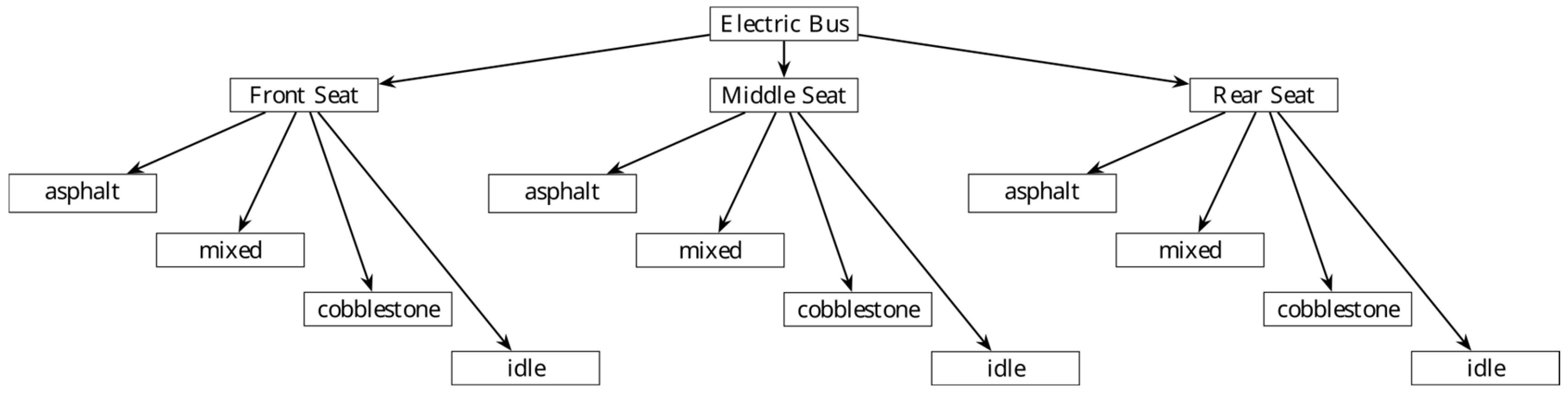
The study was organized as a two-factor design with repeated trials. The independent variables were: (i) pavement/operating condition with four levels—asphalt, mixed (asphalt with tram tracks, which is very common for bus rides, because trams and buses share the same “bus lane”), cobblestone, and idle (bus at standstill)—and (ii) seat location with three levels—front, middle, and rear. All other conditions were kept constant as far as practicable; in particular, the same route segments, instrumentation, and parameter settings were used throughout. The complete measurement structure for both buses is shown in Figure 1 (diesel) and Figure 2 (electric). For each bus and each seat location, the vehicle was driven over three fixed route segments representative of the pavement types (asphalt/mixed/cobblestone). In addition, an idle condition was recorded with the bus stopped. Each condition was measured in two independent repetitions (×2). In total, this yields 4 conditions × 3 seats × 2 repetitions = 24 runs per bus and 48 runs overall.
The following vibration parameters are calculated for each channel and seat position:
  • RMS (Root Mean Square)—quantifies the average vibration level and is directly linked to long-term health effects (shows the average vibration level);
  • VDV (Vibration Dose Value)—measures cumulative vibration exposure, sensitive to transient shocks (indicates the strength of the total vibration exposure);
  • Peak acceleration—the highest instantaneous acceleration recorded during the session;
  • Crest factor—the ratio of peak to RMS, indicating the sharpness or impulsiveness of the signal (checks if the vibration had sharp peaks or was smooth);
  • Dominant frequency—the frequency component with the highest energy (after weighting), related to human resonance;
  • Peak time—the moment at which peak acceleration occurs, useful for correlating with route events.
Before analysis, the raw acceleration signals were filtered using ISO-defined weighting curves (Wd, Wk, etc.) based on the axis of measurement [1]. This ensured that the signal reflected the actual perception and physiological impact of vibration on the human body. A key part of the methodology was the synthesis of a combined vector magnitude (VM) from the three orthogonal axes (X, Y, Z), which allowed the evaluation of total-body exposure. Based on the combined RMS and VDV values, each measurement was classified into ISO-defined exposure zones (e.g., safe, borderline, or hazardous).

3. Results and Discussion

This study compared the exposure to whole-body vibration in two articulated city buses: a diesel-powered bus and a fully electric bus (Table 1). Measurements were conducted under identical operating conditions across various seat positions and road surface types. All data were analyzed according to ISO 2631-1 standards, focusing on frequency-weighted RMS values, VDV, crest factor, and spectral characteristics.
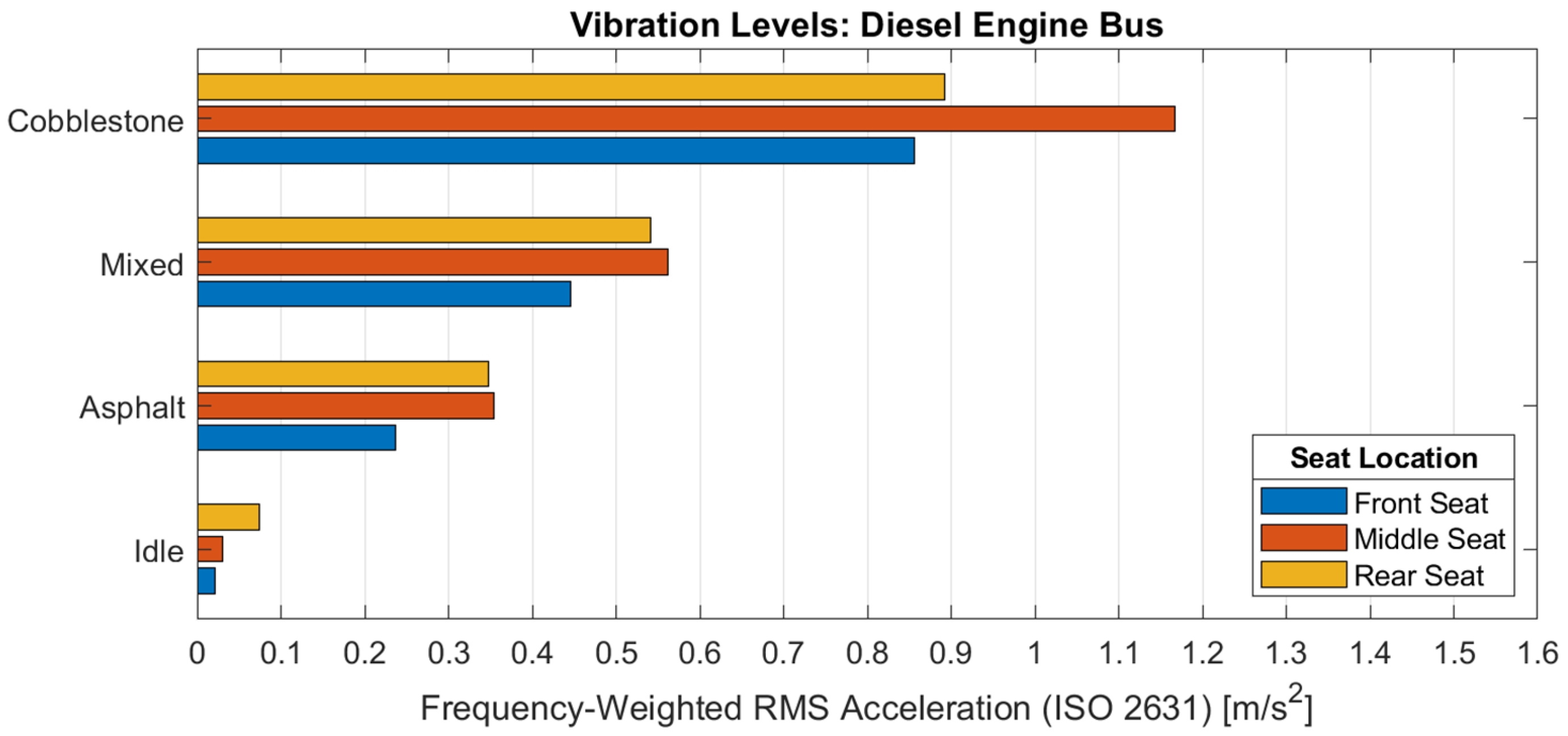
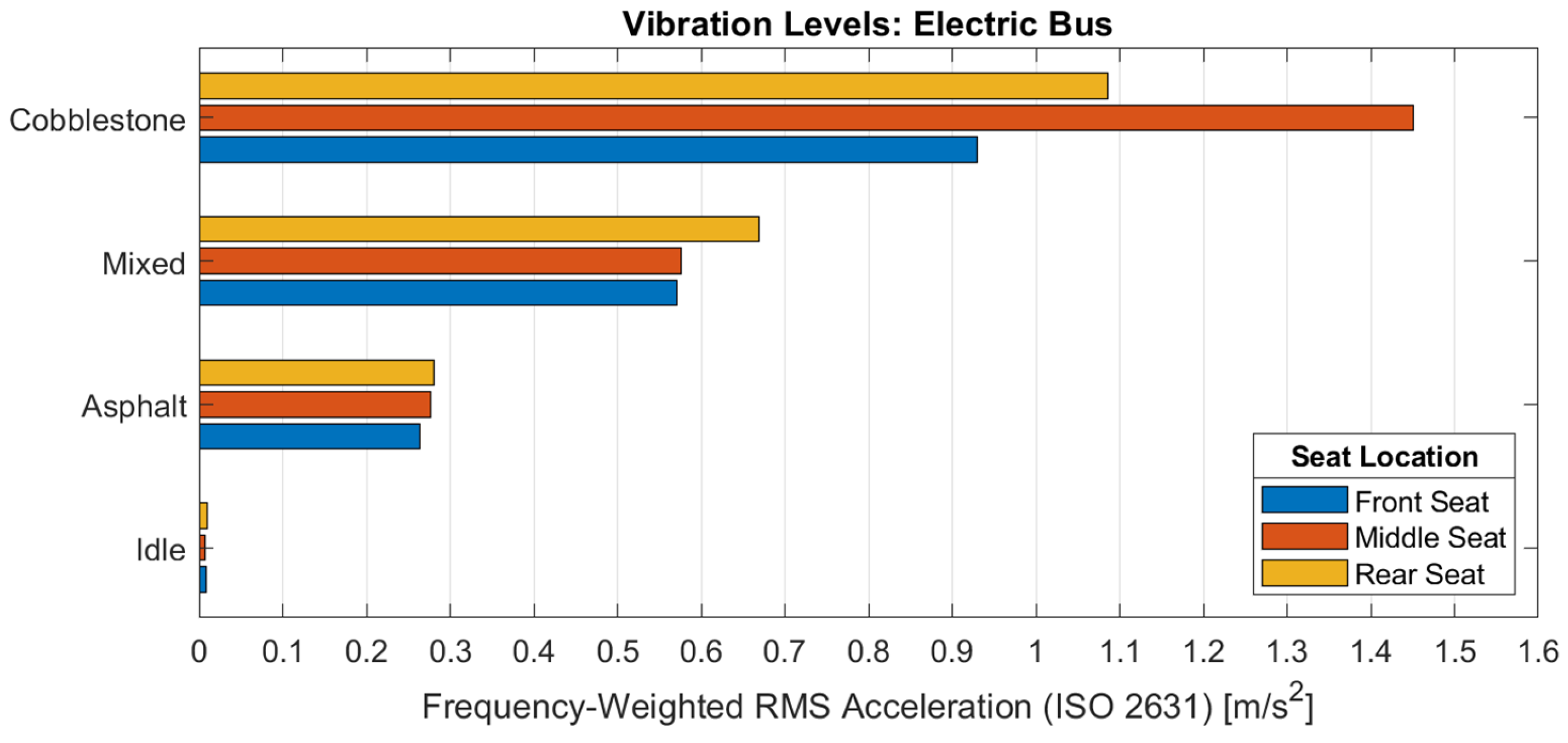
Seat location was the main factor determining the level of WBV. The front seat consistently provided the lowest exposure, while the middle and rear seats had higher amplitudes, especially on uneven surfaces. Critically, on uneven surfaces (mixed and cobblestone), the middle seat consistently exhibited the highest WBV amplitudes for both bus types. This suggests that this location is most susceptible to vibration transmission. Spectral analysis also confirmed that the electric drive effectively eliminates mid-frequency components (20–30 Hz), which are typically associated with oscillations of the combustion engine drivetrain at idle [22,23]. In other situations, vibration exposure in the articulated electric bus was higher than in the diesel bus (Figure 3 and Figure 4).
The above data pertain to the combined cycle, in terms of the vehicle’s driving surface. However, a more precise distinction between the surface (asphalt and cobblestone) reveals a slight reduction in vibrations in the articulated electric bus for the seats located in the middle and at the front of the vehicle, when driving on asphalt. These small differences do not affect the final conclusion of a higher average vibration exposure in the electric vehicle.
The summary of measurements and their analysis in relation to the ISO 2631-1 standard indicates detailed numerical values as follows:
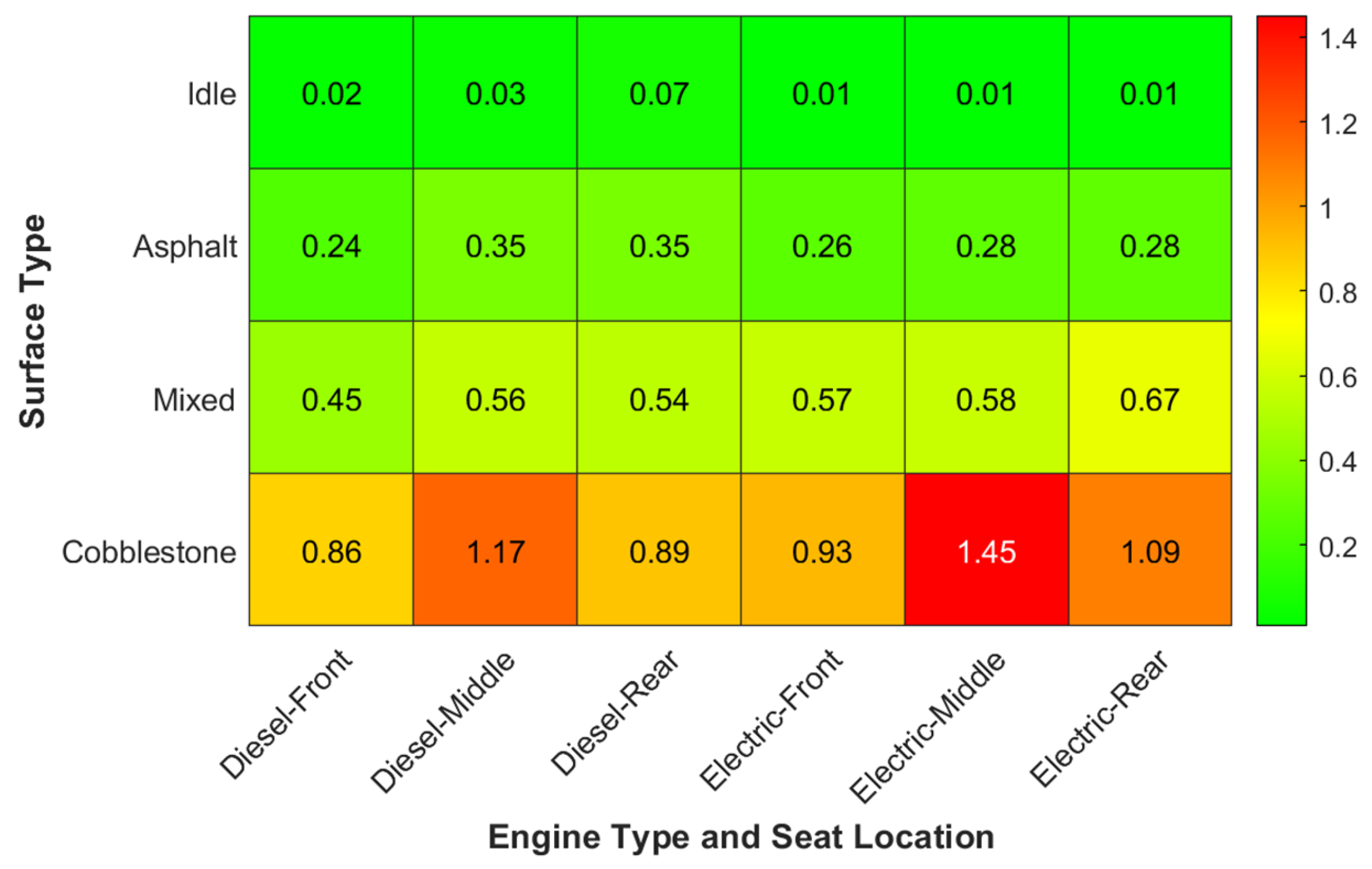
  • Asphalt: aw ≈ 0.24–0.35 m/s2 across seats. This places the front seat as not uncomfortable, and some middle/rear seats as a little uncomfortable. Diesel and electric results are similar; electric has scored lower for the middle seat. FFTs are dominated by very low frequencies with modest levels, hence small-weighted RMS.
  • Mixed (asphalt + tram tracks): aw ≈ 0.45–0.67 m/s2, mostly fairly uncomfortable (with some front-seat diesel cases being a little uncomfortable). Electric tends to be higher at the front and rear seats. FFTs show broadened energy in the 3–20 Hz band, which is strongly weighted by Wk. Cobblestone: aw ≈ 0.86–1.45 m/s2 at all seats, firmly uncomfortable. The electric bus typically scored higher for the middle and rear seats. FFTs present elevated broadband content with a hump at ∼4–12 Hz, the range most influential for seated vertical WBV per ISO 2631-1, explaining the high aw.
  • Idle: aw ≈ 0.008–0.074 m/s2 (not uncomfortable) for all seats. Diesel exhibits a narrow low-frequency line (idle engine), but absolute levels remain low; electric has uniformly lower scores for idle engine.
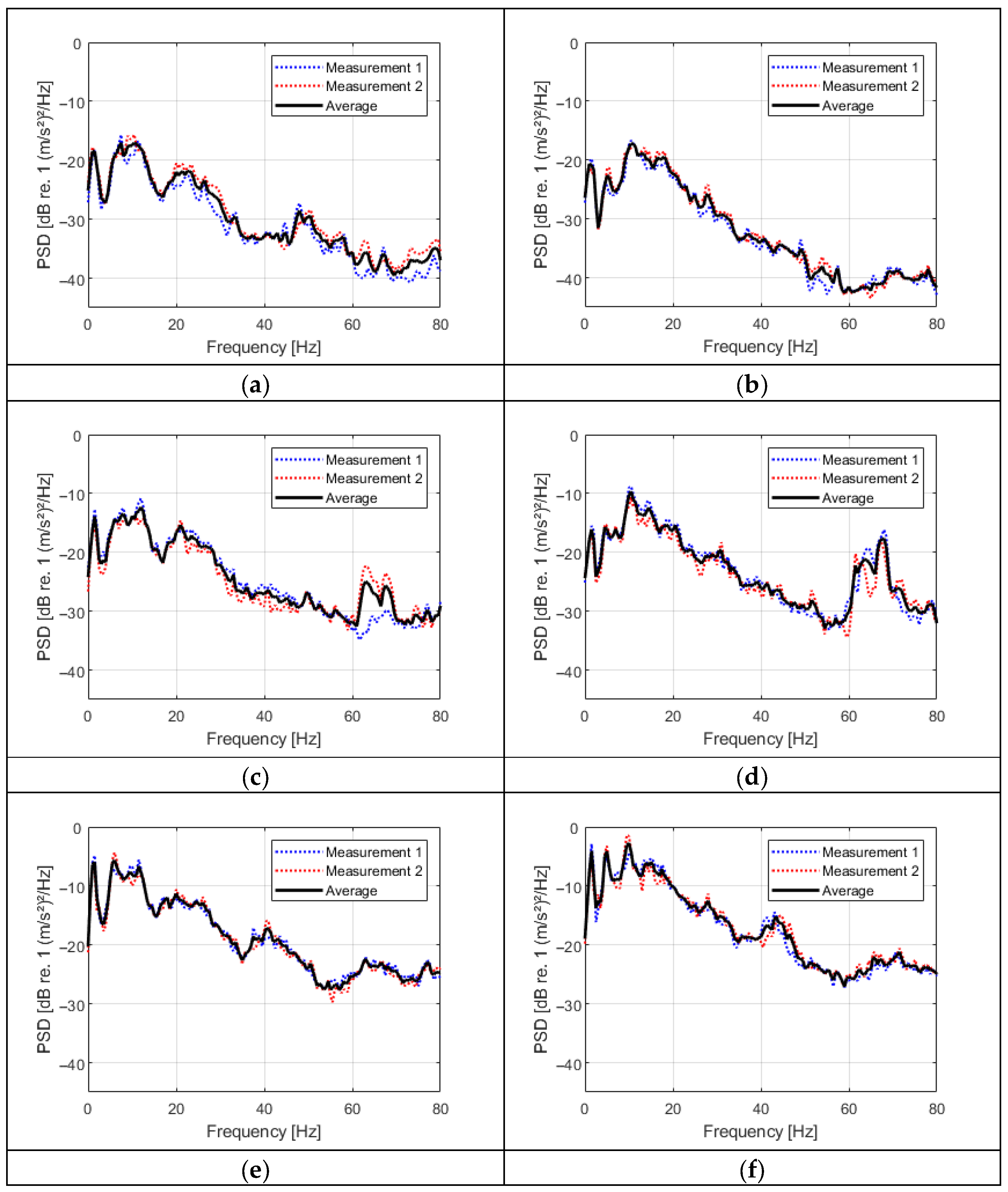
Figure 5 illustrates the frequency spectrum analysis performed using Power Spectral Density (PSD) calculated via Welch’s method. The results are focused on the 0–80 Hz band, as this range was identified to contain the dominant spectral content. The Total PSD represents the cumulative power across all three axes (X, Y, Z). This confirms the conclusions that can be found in the literature [2,3]; however, the authors rarely focus on specific frequency values, but rather on demonstrating the way of generating vibrations in vehicles with the aim of reducing them.
At the sample measurement location (middle seat) and for both mixed and cobblestone surfaces, the maximum PSD values within this range were higher for the electric bus. This observation is corroborated by the frequency-weighted RMS results. Furthermore, these distinct differences in the waveforms persist across all tested surface types, suggesting that this vibrational signature is primarily attributable to the bus’s intrinsic mechanical characteristics rather than the road-surface interaction.
It is important to note that not only high amplitude but also frequency variability can lead to micro-injuries, preclinical changes, and psychomotor fatigue [24]. This also highlights the importance of harmonizing vibration risk measurement methods. Further research will be conducted in this direction, because the available literature [2,3,4,5,6,7,8,9] presents results based on uniform vibration generation conditions
Due to the large number of distinct measurement configurations generated by combining the study’s primary factors (surface type, power supply method, passenger seat), it was decided to summarize the research results in the form of a heatmap. Figure 6 shows the aforementioned map for the OZ direction.

4. Conclusions

Based on the research carried out and its analysis, the following general conclusions can be drawn:
  • There is no universal winner between vehicle types. The relative ranking of diesel vs. electric depends on surface and seat. The electric bus results are consistently lower for idle and are sometimes lower on asphalt, whereas on mixed and cobblestone, it often shows higher Wk-weighted RMS at the middle and rear seats. So far, differences have been demonstrated [10,11,12,13,14], but with the focus on additional parameters, such as mass distribution, specific differences have been pointed out; however, this does not correspond to the presented results of tests in real conditions, where there are many more variables (and their overall demonstration seems unrealistic).
  • Comfort is governed by energy in the ISO-sensitive band. Elevated FFT content in ∼4–12 Hz (where Wk applies the strongest weights for a seated person in the vertical direction) is the primary driver of increases in mixed and cobblestone sections, concentrating energy in this band, which explains the shift toward higher discomfort classes.
  • Seat location matters. On rougher surfaces (mixed, cobblestone), the middle and rear seats typically exhibit higher aw than the front seat, consistent with the time domain envelopes and the low and middle frequency elevation in the FFTs.
  • Surface dictates comfort class: asphalt—not to a little uncomfortable; mixed—predominantly fairly uncomfortable; cobble-stone—uncomfortable for all seats; and idle—not uncomfortable.
  • Engine signature in idle is visible but negligible for aw. Diesel idle shows a narrow low-frequency line in the FFT (engine order), yet absolute levels are small; electric idle remains uniformly low. Both yield very low weighted RMS in idle.
It should be noted that the above studies were conducted (over three months) on real vehicles (articulated buses), both electric and diesel-powered, operating on a fixed route. The tested vehicles (Table 1) have very similar parameters (except for the power supply method) and are extremely popular in public transport in Europe. The obtained results appear to result from the weight distribution of these vehicles (articulated electric buses have batteries located on the roof). Each subsequent generation of batteries increases their capacity, but also their weight, as demonstrated in the literature [25,26].
Taking into account the average time of use of public transport buses in Europe (diesel: 12–15 years; electric: 10–14 years, corresponding to 500,000–800,000 km), the tests should be repeated periodically, based on subsequent generations of introduced buses. The research did not take into account another variable reported by electric bus drivers, i.e., significant surface degradation caused by electric buses, which must have a direct impact on vibration exposure.

Author Contributions

Conceptualization, G.S., T.B. and R.W.; methodology, G.S. and T.B.; software, T.B. and G.S.; validation, G.S., R.W. and T.B.; formal analysis, G.S. and T.B.; investigation, T.B.; resources, G.S.; data curation, G.S., R.W. and T.B.; writing—original draft preparation, R.W.; writing—review and editing, G.S. and R.W.; visualization, G.S., T.B. and R.W.; supervision, G.S. and R.W.; project administration, R.W.; funding acquisition, G.S. and R.W. All authors have read and agreed to the published version of the manuscript.

Funding

This research received no external funding.

Institutional Review Board Statement

Not applicable.

Informed Consent Statement

Not applicable.

Data Availability Statement

The raw data supporting the conclusions of this article will be made available by the authors on request.

Acknowledgments

The authors have reviewed and edited the output and take full responsibility for the content of this publication.

Conflicts of Interest

The authors declare no conflicts of interest.

Abbreviations

The following abbreviations are used in this manuscript:
AwWeighted Root Mean Square Acceleration (m/s2), as per ISO 2631-1
EVElectric Vehicle
FFTFast Fourier Transform
ICEInternal Combustion Engine
ISOInternational Organization for Standardization
NVHNoise, Vibration, and Harshness
PMSMPermanent Magnet Synchronous Motor
RMSRoot Mean Square
VDVVibration Dose Value
VMVector Magnitude
WBVWhole-Body Vibration
WdFrequency weighting filter for horizontal direction (per ISO 2631-1)
WkFrequency weighting filter for vertical direction (per ISO 2631-1)

References

  1. ISO 2631-1:1997; Mechanical Vibration and Shock—Evaluation of Human Exposure to Whole-Body Vibration—Part 1: General Requirements. International Organization for Standardization: Geneva, Switzerland, 1997.
  2. Thamsuwan, O.; Blood, R.P.; Ching, R.P.; Boyle, L.; Johnson, P.W. Whole-body vibration exposure in urban bus drivers: A field study. Int. J. Ind. Ergon. 2022, 43, 9–17. [Google Scholar] [CrossRef]
  3. Ittianuwat, R.; Fard, M.; Kato, K. Evaluation of seatback vibration based on ISO 2631-1 (1997) standard method: The influence of vehicle seat structural resonance. Ergonomics 2017, 60, 82–92. [Google Scholar] [CrossRef]
  4. Patel, A.; Gohil, P.; Borhade, B. Modeling and Vibration Analysis of Road Profile Measuring System. Int. J. Automot. Mech. Eng. 2010, 1, 13–28. [Google Scholar] [CrossRef]
  5. Jagiełło, A.; Wołek, M.; Bizon, W. Comparison of Tender Criteria for Electric and Diesel Buses in Poland—Has the Ongoing Revolution in Urban Transport Been Overlooked? Energies 2023, 16, 4280. [Google Scholar] [CrossRef]
  6. Alin, O.; Tarnita, D.; Bolcu, D.; Malciu, R. A study of biomechanical model of seated human body exposed to vertical vibrations. IOP Conf. Ser. Mater. Sci. Eng. 2025, 997, 2–9. [Google Scholar]
  7. Bai, X. Integrated semi-active seat suspension for both longitudinal and vertical vibration isolation. J. Intell. Mater. Syst. Struct. 2016, 28, 1036–1049. [Google Scholar] [CrossRef]
  8. Portela, B.; Zannin, P. Whole-Body Vibration in Bus Drivers: Association with Physical Fitness and Low Back Pain. Int. J. Innov. Educ. Res. 2021, 9, 44–56. [Google Scholar] [CrossRef]
  9. Fernandes, E.S. Optimization of Vehicle Suspension System to Improve Comfort. IOSR J. Mech. Civ. Eng. 2017, 17, 33–40. [Google Scholar] [CrossRef]
  10. Horvath, K.; Feszty, D. Surface Waviness of EV Gears and NVH Effects—A Comprehensive Review. World Electr. Veh. J. 2025, 16, 540. [Google Scholar] [CrossRef]
  11. Sangeetha, E.; Ramachandran, V.P. Speed and current harmonics reduction using an adaptive proportional integral resonant controller for PMSM based electric vehicle drives. Sci. Rep. 2025, 12, 26514. [Google Scholar] [CrossRef]
  12. García-Tárrago, M.J.; Calaf-Chica, J. High-frequency mechanical impedance of rubber mounts: Experimental characterization and resonance mechanisms. Eur. J. Mech. A/Solids 2025, 113, 105677. [Google Scholar] [CrossRef]
  13. Fiedler, U.; Visser, R.; Kreissig, V. Interior Noise Optimization of Powertrain Induced Vibrations for an Electric Vehicle Using Machine Learning Methods. In Proceedings of the Automotive Acoustics Conference 2023, Rueschlikon, Switzerland, 11–12 July 2023; Springer: Berlin/Heidelberg, Germany, 2025. [Google Scholar]
  14. Gad, A.S.; Ata, W.G.; El-Zomor, H.M.; Jabeen, S.D. Optimizing driver comfort: Magnetorheological damper seat suspension for internal combustion and electric vehicles under uncertain conditions. J. Vib. Eng. Technol. 2025, 13, 157. [Google Scholar] [CrossRef]
  15. Zhang, N.; Fard, M.; Davy, J.L.; Robinson, S.R. Vibration-induced drowsiness contours: New safety recommendations for the transport industry. J. Saf. Res. 2025, 94, 490–505. [Google Scholar] [CrossRef] [PubMed]
  16. Griffin, M.J. Handbook of Human Vibration; Academic Press: London, UK, 1996. [Google Scholar]
  17. Rahmani, R.; Aliabadi, M.; Golmohammadi, R.; Babamiri, M.; Farhadian, M. Body physiological responses of city bus drivers subjected to noise and vibration exposure in working environment. Heliyon 2022, 8, e10329. [Google Scholar] [CrossRef] [PubMed]
  18. Li, Y.; Yin, M.; Wang, Z.; He, Y.; Li, H. Dynamic Analysis of Levitator Failure in HTS Pinning Maglev Vehicle. IEEE Trans. Magn. 2025, 35, 3800409. [Google Scholar]
  19. National Instruments. NI-9234 Specifications. Available online: https://www.ni.com/pdf/manuals/374186d.pdf (accessed on 15 October 2025).
  20. PCB Piezotronics. Model 356B41. Available online: https://www.pcb.com/products?m=356B41 (accessed on 15 October 2025).
  21. Bezyukov, O.; Pervukhin, D.; Tukeev, D. Experimental Study Results Processing Method for the Marine Diesel Engines Vibration Activity Caused by the Cylinder-Piston Group Operations. Inventions 2023, 8, 71. [Google Scholar] [CrossRef]
  22. Mnati, H.M.; Hammami, M.; Ksentini, O. Study of Four-Stroke Engine Vibrations: Influence of Friction and Thermal Effects on Piston Speed, Displacement, and Acceleration. J. Middle Tech. Univ. 2025, 7, 70–81. [Google Scholar] [CrossRef]
  23. Rahimi, A.; Mohd, S.; Kamarudin, Q.E. Design of Vibration Energy Harvester Using Piezoelectric Sensor. Res. Prog. Mech. Manuf. Eng. 2025, 6, 252–256. [Google Scholar]
  24. Tarabini, M.; Bovenzi, M. Human Response to Vibration: Measurement and Assessment of Risk. IEEE Instrum. Meas. 2025, 28, 37–43. [Google Scholar] [CrossRef]
  25. Sandrini, G.; Chindamo, D.; Gadola, M.; Candela, A.; Magri, P. Exploring the Impact of Vehicle Lightweighting in Terms of Energy Consumption: Analysis and Simulation on Real Driving Cycle. Energies 2024, 17, 6398. [Google Scholar] [CrossRef]
  26. Czerliński, M.; Pawłowski, P. Capacity of Zero-Emission Urban Public Transport. Sustainability 2025, 17, 5835. [Google Scholar] [CrossRef]
Figure 1. Structure of vibration measurements for a diesel-powered bus.
Applsci 15 12741 g001
Figure 2. Structure of vibration measurements for an electrical-powered bus.
Applsci 15 12741 g002
Figure 3. Average RMS vector value, diesel bus.
Applsci 15 12741 g003
Figure 4. Average RMS vector value, electric bus.
Applsci 15 12741 g004
Figure 5. Comparison of the averaged Total Power Spectral Density (PSD) (power sum of X, Y, Z axes) measured at the middle seat for a diesel bus (left) and an electric bus (right) on an asphalt, mixed, and cobblestone surface. (a) Diesel, asphalt (Total PSD). (b) Electric, asphalt (Total PSD). (c) Diesel, mixed (Total PSD). (d) Electric, mixed (Total PSD). (e) Diesel, cobblestone (Total PSD). (f) Electric, cobblestone (Total PSD).
Applsci 15 12741 g005
Figure 6. Heatmap of frequency-weighted average RMS acceleration (ISO 2631) values [m/s2] by surface and seat/bus type combinations.
Applsci 15 12741 g006
Table 1. Comparison of methodologically significant parameters of the tested articulated buses.
SpecificationBus 1 (Diesel) (Euro-5)Bus 2 (Electric)
Length (m)18.1318.13
Power output (kW)220–260440 peak
Gross weight (kg)28,00029,000
Passenger capacity163146
Production period (years)1997–20242019–present
Table 2. Parameters of the vibration sensor used. [20].
SpecificationValue
Model356B41
ManufacturerPCB Piezotronics, Depew, New York, NY, USA
TypeTriaxial ICP® Accelerometer
Sensitivity (±10%)100 mV/g
Measurement Range±50 g
Frequency Range (±5%)0.5 to 1000 Hz
Resonant Frequency=>27 kHz
Transverse Sensitivity<=5%
OutputVoltage, single-ended
Weight272 g
House MaterialHermetic
Disclaimer/Publisher’s Note: The statements, opinions and data contained in all publications are solely those of the individual author(s) and contributor(s) and not of MDPI and/or the editor(s). MDPI and/or the editor(s) disclaim responsibility for any injury to people or property resulting from any ideas, methods, instructions or products referred to in the content.