Communication

How Many Trials Are Needed for Consistent Clinical Gait Assessment?

by
Charlend K. Howard
,
Christopher K. Rhea
,
Jacquelyn R. Moxey
,
Kyle Langerhans
,
Paphawee Prupetkaew
and
Brittany S. Samulski
*
Ellmer College of Health Sciences, Old Dominion University, Norfolk, VA 23529, USA
*
Author to whom correspondence should be addressed.
Appl. Sci. 2025, 15(23), 12740; https://doi.org/10.3390/app152312740
Submission received: 7 September 2025 / Revised: 24 November 2025 / Accepted: 27 November 2025 / Published: 2 December 2025

Abstract

Background: Clinical assessment of gait typically consists of patients walking a few trials at various speeds while the clinician assesses performance. Unfortunately, there is no clear guidance on how gait changes across trials, leaving clinicians uncertain about the optimal number of trials needed to observe consistent (non-variable) performance. To address this issue, we examined gait performance from a large dataset of older adults who participated in a community-based comprehensive fall risk assessment. Methods: Community-dwelling, older adults (n = 340; 70.8 ± 7.4 years; 120 men, 220 women) performed gait trials under two conditions: preferred and maximum walking speed. Individuals were encouraged to complete five trials for both conditions. Consistency between gait trials within each condition was calculated using intraclass correlation (ICC) and standard error of measurement (SEM) analysis. Results: Our data showed the middle three trials had the most consistency compared to the average of 2–5 trials. Conclusions: When performing a clinical gait analysis, the first trial should be used to acclimate the participant to the protocol and not used for analysis. Data should be recorded from the next three trials, which is when gait appears to stabilize. Data from a fifth trial differs from the second trial, potentially indicating fatigue and/or motivation changes, so it is recommended that the gait analysis conclude after the fourth trial.

1. Introduction

Gait performance is a commonly assessed outcome measure by clinical professionals [1]. The manner in which a person controls their gait can provide information about neurological and/or structural deficits that impede mobility, which can lead to elevated fall-risk [2], overuse injuries [3], and/or metabolic inefficiencies [4]. To this end, clinical professionals commonly have patients perform a series of walking trials to objectively and/or subjectively assess their gait performance. In routine clinical practice, gait speed is the most commonly collected spatiotemporal parameter and is increasingly conceptualized as a ‘functional vital sign,’ given its strong associations with morbidity, mortality, and functional decline. Because many outpatient, primary care, and home-health settings do not have access to instrumented walkways, speed is often the only feasible quantitative metric of gait performance [5]. Gait trials are typically conducted at both a preferred walking speed, reflecting natural performance, and at a maximum speed, reflecting performance when gait control is challenged [6,7,8].
While clinical assessment of gait is common, it is unclear how many gait trials are needed to obtain an accurate representation of the patient’s performance. A substantial body of work has established gait speed as a key indicator of health and function in older adults, to the point that it has been described as a ‘functional vital sign’ [5]. Multiple systematic reviews and a systematic review with meta-analysis have synthesized this literature across clinical and research settings, consistently documenting wide variability in gait speed testing protocols and a lack of consensus regarding the number of trials used to quantify performance. Despite this extensive evidence base, these reviews note that no standardized, evidence-based recommendation exists for how many walking trials are needed to obtain a stable estimate of gait speed in clinical practice [9,10,11,12]. It is well known in the motor control literature that performance can change across trials [13]. This is particularly true for newly learned skills [14]. Gait is a well-practiced skill, so steep learning curves are not expected. Nevertheless, a single gait trial may not accurately represent a patient’s typical performance due to various influences, including motivation, nervousness, and other situational factors. Alternatively, too many trials may lead to fatigue or loss of interest or focus [15,16]. Finding the right balance between too few and too many trials is essential to ensure reliable and valid assessment of gait performance.
To address this question, we ran a secondary analysis of data from a community-based comprehensive fall risk assessment. The program, conducted from 2021 to 2023, was offered through a partnership with a private insurance company that, as part of its value-based insurance design model, referred community-dwelling older adults for assessment. Once enrolled in the study, participants completed a suite of assessments that included vision testing, lower limb strength, reaction time, standing balance, proprioception, sensation, cognitive assessment, fear of falling, and gait assessment. This Communication focuses on the gait assessment portion of the dataset. It was hypothesized that a subset of the trials would show that gait stabilized during the testing, making them the candidate trials for clinical gait assessment.

2. Materials and Methods

2.1. Participants

A total of 340 older adults (N = 340; 70.9 ± 8.0 yrs; 120 men, 220 women) participated in the study. Recruitment was conducted in collaboration with a private insurance company, which supplied lists of eligible participants. Study staff attempted to reach each individual by phone at least three times to schedule an assessment and obtain study enrollment. Of 4366 older adults contacted, 340 were enrolled and assessed. Among those assessed, 261 participants (77%) completed all five gait trials in both walking conditions, and 79 participants (23%) completed fewer than five trials for either condition. Figure 1 shows a flow diagram depicting participant flow across recruitment, assessment, gait trial completion, and assistive device use. Study procedures were approved by the Institution Review Board (IRB) at Old Dominion University (IRB Protocol: 1690823).

2.2. Procedures

Participants were instructed to perform five gait trails in each of two conditions: (1) at a preferred walking speed and (2) at a maximum walking speed. The order of the two walking conditions was randomized at the time of data collection; however, specific order assignments were not retained in the analytic dataset, precluding explicit trial-by-order interaction testing. All walks were completed on a 20-foot pressure sensitive, instrumented walkway (ZenoWalkway; Protokinetics LLC, Havertown, PA, USA). For the preferred speed condition, individuals were asked to walk at their usual comfortable pace, and for the maximum speed condition, they were instructed to walk as if they were late to catch a flight. To minimize fatigue, examiners enforced a standardized inter-trial rest period of at least 30 s. Rest was extended up to 3 min if the participant requested or indicated that they wanted more rest time.

2.3. Data Processing

Gait velocities were extracted from the ProtoKinetics Movement Analysis Software (PKMAS, version 5.09C1k; ProtoKinetics LLC, Havertown, PA, USA) for each trial. Next, gait velocities were averaged across trials 1–2, 1–3, 1–4, and 1–5, along with the middle three trials (trials 2–4). Intraclass correlation coefficient (ICC) and standard error of measurement (SEM) analyses were calculated to compare the preferred and maximum gait velocity across the various trial averages. For these reliability analyses, participants were required to have five valid trials within the relevant walking condition. In contrast, the mixed effects models described below used all available trial-level observations, including data from participants who did not complete all five trials.

2.4. Statistical Analysis

Analyses were conducted using R (Version 4.3.3; R Foundation for Statistical Computing, Vienna, Austria) [9]. For each gait condition, a one-way repeated measure analysis of variance (ANOVA) with the within-subject factor of number of trials averaged was used. Assumptions for the repeated-measures ANOVAs were evaluated using Mauchly’s test of sphericity; when sphericity was violated, Greenhouse–Geisser corrections were applied. Effect sizes for ANOVA results are reported as partial η2 with 95% confidence intervals. Bonferroni post hoc analysis was performed if a significant F test was found. ANOVA results were used to calculate intraclass correlation coefficients based on a two-way random effects model with absolute agreement, single measure, ICC(2,1), and the corresponding average-measure ICC(2,k) (k = number of trials averaged) to estimate test–retest reliability, as this ICC type incorporates both systematic and random error [10]. Single-trial ICC(2,1) values were first obtained for each gait speed condition, and ICC(2,k) values for k > 1 were then derived using the standard relationship between single- and average-measure ICCs: ICC(2,k) = (k × ICC(2,1))/(1 + (k − 1) × ICC(2,1)).
The standard error of measurement for a single trial (SEM_single) was calculated as the square root of the mean square error term from the ANOVA, and the SEM of the mean across k trials (SEM_mean) was calculated as the square root of the ANOVA error term divided by the square root of k (SEM_mean = SEM_single/√k) and was used as a measure of absolute reliability [17,18]. Ninety-five percent confidence intervals were computed for all ICC estimates. ICC values were interpreted according to Koo and Li [19] as follows: less than 0.50, poor reliability; 0.50–0.75, moderate reliability; 0.75–0.90, good reliability; greater than 0.90, excellent reliability.
To leverage all available trial-level data and examine trial-to-trial changes in gait speed, we additionally fit a linear mixed effects model with Trial (1–5), Condition (Preferred vs. Maximum), and their interaction as fixed effects, and random intercepts for participants to account for repeated measurements. Polynomial contrasts on Trial were used to test for linear and quadratic trends across trials. Estimated marginal means (EMMs) and 95% confidence intervals for each Trial × Condition combination were obtained from the mixed effects model and are presented in Table 1.

3. Results

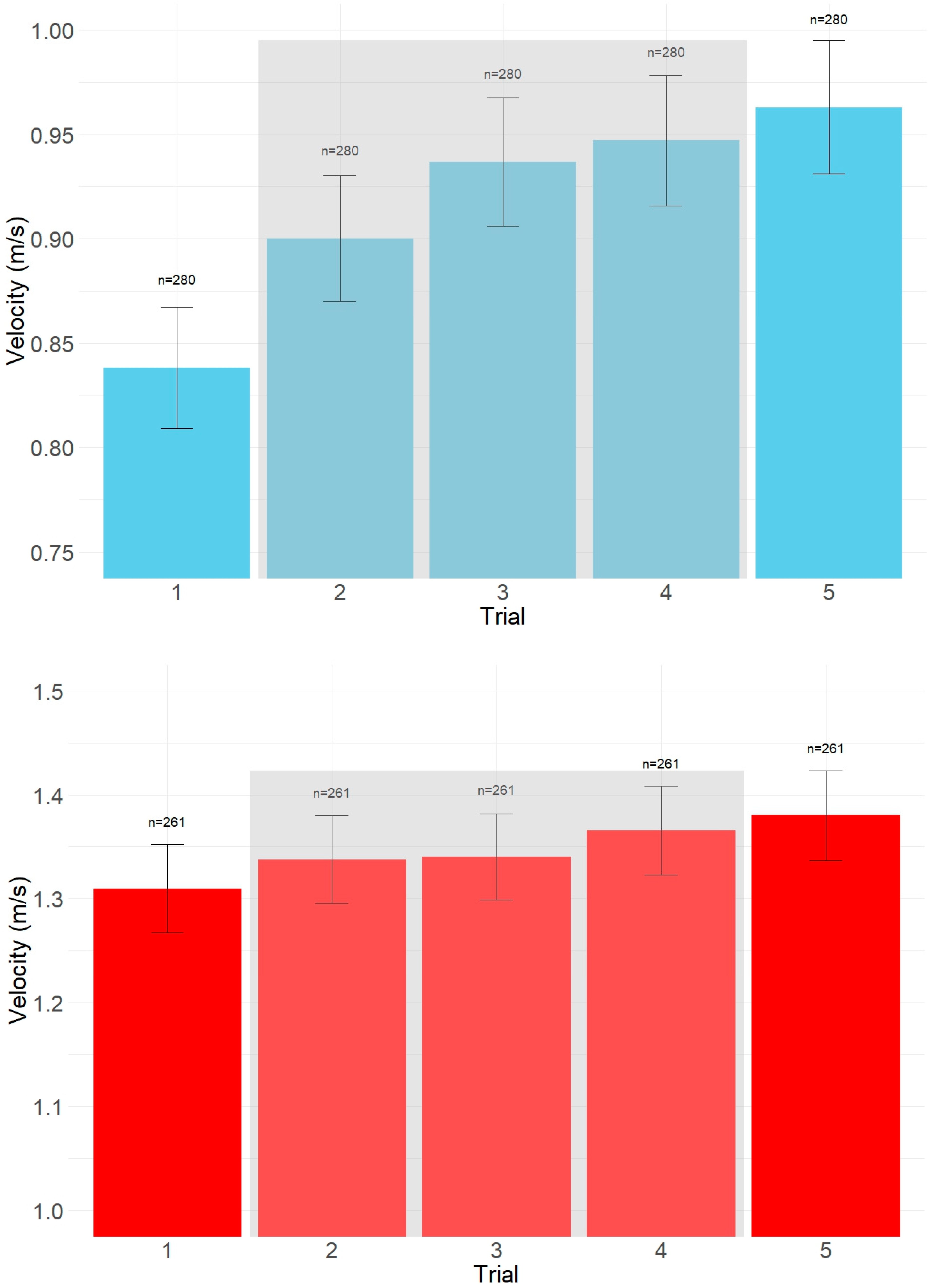
Some individuals were unable to perform all five trials in one or both of the walking conditions. Baseline characteristics for gait trial completers and non-completers are presented in Table 2. “Completers” include participants who performed all five trials for both gait conditions, whereas “non-completers” include participants who were unable to complete all five gait trials in at least one condition. To avoid discarding information from participants who did not complete all five trials, we also fit a linear mixed effects model using all available trial-level observations, including data from partial completers. The model included fixed effects for Trial (1–5), condition (preferred vs. maximum), and their interaction, with random intercepts for participants. The mixed-effects analysis revealed significant main effects of Trial and Condition, as well as a significant Trial × Condition interaction, indicating that gait velocity increased across trials and that maximum gait speed was consistently faster than preferred speed. Polynomial trend analyses showed a strong linear increase in gait speed across trials and a small but significant quadratic component, reflecting modest nonlinear changes over repeated trials. Estimated marginal means (EMMs), standard error (SE) and 95% confidence intervals for each Trial × Condition combination are presented in Table 2. A significant main effect of trial was observed for the preferred gait speed condition, F(4, 1116) = 269.35, p < 0.001, partial η2 = 0.49 [95% CI: 0.46, 1.00]. Mauchly’s test indicated that the assumption of sphericity was violated (W = 0.42, p < 0.001); therefore, Greenhouse–Geisser corrections were applied (ε = 0.65). Post hoc Bonferroni comparisons showed that average gait velocity in trial one was significantly slower than in trials three, four, and five, and that trial five was significantly faster than trial two (Figure 2). For preferred gait speed, reliability improved from “good” for single trials (ICC[2, 1] = 0.93, 95% CI: 0.85–0.96) to “excellent” when averaging two or more trials (ICC [2, k] = 0.951–0.983; see Table 3 for ICC values and 95% confidence intervals across k). SEM_mean values decreased as more trials were averaged, with the lowest error observed when averaging the middle three trials (SEM_mean = 2.36 m/s). A significant F test was also observed for the maximum gait speed condition (F(4, 1040) = 53.23, p = 0.0001); however, post hoc analysis showed no significant differences between individual trials (p > 0.05). For maximum gait speed, single-trial reliability was already “excellent” (ICC[2, 1] = 0.97, 95% CI: 0.95–0.97), and ICC values remained “excellent” across all trial averages (ICC[2, k] = 0.987–0.990; Table 3), with minimal improvement beyond averaging two trials. SEM_mean values similarly plateaued after the first few trials, reflecting high measurement consistency (Table 4).

4. Discussion

Clinical gait analysis is a commonly performed assessment in healthcare [20]. Although gait analysis is prevalent in clinical practice, there is no clear guidance on how many trials are required to minimize situational influences and capture stable gait performance [5]. Likewise, asking the patient or participant to perform too many trials could lead to fatigue (especially with clinical populations) or changes in emotional state (e.g., boredom) that alters performance such that it is no longer representative of the person’s typical gait behavior [21]. Thus, there is a sweet spot for selecting an appropriate number of gait trials from which to make the assessment. In the present study, both trial-averaged ICC(2,k)/SEM_mean estimates and model-based estimated marginal means (EMMs) from our mixed effects analysis reinforced the idea of an optimal range of trials. Our hypothesis was supported, such that a subset of the assessed gait trials (trials 2–4) produced the most consistent performance and provided a stable representation of preferred walking speed in community-dwelling older adults.
Previous work exploring the appropriate number of gait trials has been undertaken. As noted by Shinya and Takiyama [22], intuition is commonly used to determine the number of gait trials rather than a data-driven approach. To address this issue, the authors used statistical power to determine how many trials are appropriate based on the number of participants in the study. While this data-driven approach was an advancement over intuition, their model assumed a normal distribution of performance, which is unlikely in clinical populations. We extended Shinya and Takiyama’s [22] data-driven approach by combining complete-case reliability analyses (ICC and SEM_mean) with linear mixed effects models that used all available trial-level observations and by examining gait performance from a large dataset of community-dwelling older adults.
In recognition that clinical populations may be limited in the number (or duration) of gait trials they can complete, Kuznetsov and Rhea [23] used a modeling approach to estimate the sample size and number of trials needed to detect gait variability differences, determining that 2–4 trials were sufficient depending on the study design. Another technique is to “stitch” shorter trials together so that one long trial can be examined [24], which could be useful when examining how gait variability is structured over time (e.g., nonlinear analyses) in clinical populations [25,26]. While the aforementioned studies provide some guidance on the number of trials that should be assessed, they used relatively small sample sizes or limited modeling approaches. Our study leveraged a large dataset of community-dwelling older adults, offering a unique opportunity to refine guidance on the optimal number of gait trials using empirical evidence from a broad sample of individuals. By integrating mixed effects models with traditional reliability metrics, we were able to show that performance systematically changed across trials at preferred speed and that the middle three trials (2–4) captured a stabilized portion of the gait behavior. As such, our data showed that the first trial of the preferred walking speed condition was different than follow-on trials, suggesting a warm-up or “white coat” effect. Likewise, the fifth (last) trial differed in the preferred walking speed condition, suggesting fatigue or a change in motivation. Thus, the recommendation is to exclude the first preferred walking speed trial, then average trials 2–4 for assessment.
Differences were observed across trials in the preferred gait speed condition, whereas in the maximum gait speed condition any trial-to-trial differences were small and inconsistent in our sample. This pattern may reflect a ceiling effect, when exerting maximum effort, participants likely adopted similar performance strategies across all trials, whereas the submaximal nature of preferred speed allowed more flexibility in execution. Consistent with this interpretation, reliability at maximal speed was extremely high (ICC ≥ 0.978), indicating that within-person variance was already small relative to between-person differences. The EMM trajectories from the mixed effects model similarly showed only modest change across trials at maximum speed, reinforcing the conclusion that additional trials add little new information once one or two maximal efforts have been completed. These results align with previous motor control work that has demonstrated there is a change in performance during the first trial related to practice effects or a “warm-up decrement” [27]. It also aligns with previous work supporting a loss of complexity theory indicating that aging and disease compress movement variability in the fast time scales, limiting the ability to vary or adapt performance at the fastest movement speeds [28,29,30]. Accordingly, additional trials at maximal walking speed add little precision beyond the first one or two trials, whereas preferred speed benefits from discarding Trial 1 and Trial 5, then averaging Trials 2, 3 and 4. As such, maximum gait speed may represent a constrained upper boundary with little room for trial-to-trial change, while preferred speed retains greater adaptability and reveals more inherent variability. Together, these findings highlight the importance of considering trials number and walking condition in clinical gait assessment, emphasizing that optimizing protocols is critical to obtain reliable and valid measures of performance in community-dwelling older adults.

4.1. Study Limitations

This study has several limitations. First, recruitment occurred through a single insurance-plan provider, which may introduce selection bias related to plan demographics, health status, or care-seeking patterns. As a result, the sample may not fully represent community-dwelling older adults who are uninsured or participate in another type of insurance plan. Second, although our mixed effects models leveraged all available trial-level data, the ICC(2,k) estimates were limited to participants with five valid trials (completers) in a given condition, and device-related and order-related sensitivity analyses were constrained: assistive device users represented only 7% of the sample, and specific condition order assignments were not retained in the analytic dataset, which may obscure modest heterogeneity or order effects. Third, due to space limitations our short walkway length and use of a pressure-sensitive gait mat could have influenced participant pacing and acceleration/deceleration during walking. In addition, we focused exclusively on gait speed rather than cadence, step length, or variability measures, prioritizing the metric that is most feasible to implement across diverse clinical settings. Future work using longer walkways and a broader set of spatiotemporal and variability metrics will be important to determine whether the ‘discard Trial 1, average Trials 2–4’ rule generalizes beyond speed. Finally, despite quality controls, unmeasured factors, such as day-to-day symptoms, medication timing, or motivation, could have contributed to residual within-person variability.

4.2. Generalizability

External validity should be considered in light of setting and population. Our findings pertain to community-dwelling older adults ambulatory with or without common assistive devices. Feasibility and reliability may differ in cohorts with greater impairment or distinct pathophysiology (i.e., Parkinson’s disease, stroke, or frailty), where fatigue, safety needs, or device dependence are more pronounced. In such groups, within-person variability may be larger at preferred speed and lower at maximal speed, altering the marginal benefit of additional trials. Replication in these populations, as well as beyond the associated insurance-provided product, will help calibrate the recommended scheme and quantify any needed adjustments to rest intervals, walkway set up and safety procedures.

4.3. Feasibility and Clinical Implementation

The findings of this analysis support a practical approach for clinical practice: discard the first trial and average Trials 2, 3, and 4 at preferred walking speed. This recommendation is feasible to implement because gait speed can be measured with simple tools (a marked distance and a stopwatch), consistent with commonly used protocols such as the 10 m walk test. The protocol can be carried out in clinics or homes with short walkways and adds only a few minutes to the examination, even when brief rest breaks are provided. It is also compatible with the realities of providing care for older adults with reduced physical capacity. Clinicians can encourage the patient to use a familiar assistive device across trials and across visits for consistency, adjust rest intervals, or provide seated recovery when symptoms or fatigue emerge or when safety dictates.
At maximal speed, where trial-to-trial variability is attenuated and relative reliability is high, one or two passes usually provide sufficient precision. Clinics under tighter time or space constraints can prioritize preferred-speed assessment using the three-trial average for monitoring change and reserve maximum-speed testing for performance profiling when clinically indicated. Consistent trial labeling, order tracking, and notation of rest interval and assistive device use will support reproducibility, interpretation, and comparison across sites without imposing substantial workflow burden.

5. Conclusions

This study demonstrated that averaging the middle three of five gait trials at preferred walking speed provides the most reliable representation of gait, whereas maximum gait speed yields more consistent performance across trials. Selecting an appropriate number of gait trials is critical to minimize situational influences while avoiding fatigue or disengagement. Excluding the first trial and averaging the next three trials offers a practical, evidence-based recommendation for clinical gait assessment in older, community-dwelling adults. Future replication studies will be essential to confirm these findings and evaluate the generalizability of these recommendations to other clinical populations, with the ultimate goal of informing standardized protocols for clinical gait assessment.

Author Contributions

Conceptualization, C.K.H., C.K.R. and B.S.S.; methodology, C.K.H., C.K.R. and B.S.S.; software, C.K.H.; formal analysis, C.K.H.; investigation, J.R.M., K.L., P.P. and B.S.S.; resources, B.S.S.; data curation, C.K.H., K.L. and B.S.S.; writing—original draft preparation, C.K.H., C.K.R. and B.S.S.; writing—review and editing, C.K.H., C.K.R., J.R.M., K.L., P.P. and B.S.S.; visualization, C.K.H.; supervision, C.K.R. and B.S.S.; project administration, C.K.R. and B.S.S.; funding acquisition, B.S.S. All authors have read and agreed to the published version of the manuscript.

Funding

This research did not receive any specific grant from funding agencies in the public, commercial, or not-for-profit sectors. Data collection was supported by a service contract with a private U.S.-based health insurance provider. No grant or award number applies.

Institutional Review Board Statement

The study was conducted in accordance with the Declaration of Helsinki, and approved by the Institutional Review Board of Old Dominion University (protocol code: 1690823 approved 29 March 2021).

Informed Consent Statement

Written informed consent was obtained from all subjects involved in the study.

Data Availability Statement

The data that support the findings of this study are available on request from the corresponding author, B.S.S.

Conflicts of Interest

The authors declare no conflicts of interest. The funders had no role in the design of the study; in the collection, analyses, or interpretation of data; in the writing of the manuscript; or in the decision to publish the results.

References

  1. Ota, M.; Tateuchi, H.; Hashiguchi, T.; Ichihashi, N. Verification of validity of gait analysis systems during treadmill walking and running using human pose tracking algorithm. Gait Posture 2021, 85, 290–297. [Google Scholar] [CrossRef]
  2. Silva, J.; Atalaia, T.; Abrantes, J.; Aleixo, P. Gait biomechanical parameters related to falls in the elderly: A systematic review. Biomechanics 2024, 4, 165–218. [Google Scholar] [CrossRef]
  3. Willwacher, S.; Kurz, M.; Robbin, J.; Thelen, M.; Hamill, J.; Kelly, L.; Mai, P. Running-related biomechanical risk factors for overuse injuries in distance runners: A systematic review considering injury specificity and the potentials for future research. Sports Med. 2022, 52, 1863–1877. [Google Scholar] [CrossRef]
  4. McAllister, M.J.; Chen, A.; Selinger, J.C. Behavioural energetics in human locomotion: How energy use influences how we move. J. Exp. Biol. 2025, 228, JEB248125. [Google Scholar] [CrossRef] [PubMed]
  5. Middleton, A.; Fritz, S.L.; Lusardi, M. Walking speed: The functional vital sign. J. Aging Phys. Act. 2015, 23, 314–322. [Google Scholar] [CrossRef] [PubMed]
  6. Studenski, S. Bradypedia: Is gait speed ready for clinical use? J. Nutr. Health Aging 2009, 13, 878. [Google Scholar] [CrossRef] [PubMed]
  7. Mehmet, H.; Robinson, S.R.; Yang, A.W.H. Assessment of gait speed in older adults. J. Geriatr. Phys. Ther. 2020, 43, 42–52. [Google Scholar] [CrossRef]
  8. Karpman, C.; LeBrasseur, N.K.; DePew, Z.S.; Novotny, P.J.; Benzo, R.P. Measuring gait speed in the out-patient clinic: Methodology and feasibility. Respir. Care 2014, 59, 531–537. [Google Scholar] [CrossRef]
  9. Graham, J.E.; Ostir, G.V.; Fisher, S.R.; Ottenbacher, K.J. Assessing walking speed in clinical research: A systematic review. J. Eval. Clin. Pract. 2008, 14, 552–562. [Google Scholar] [CrossRef]
  10. Moon, Y.; Sung, J.; An, R.; Hernandez, M.E.; Sosnoff, J.J. Gait variability in people with neurological disorders: A systematic review and meta-analysis. Hum. Mov. Sci. 2016, 47, 197–208. [Google Scholar] [CrossRef]
  11. Bohannon, R.W.; Glenney, S.S. Minimal clinically important difference for change in comfortable gait speed of adults with pathology: A systematic review. J. Eval. Clin. Pract. 2014, 20, 295–300. [Google Scholar]
  12. Peel, N.M.; Kuys, S.S.; Klein, K. Gait speed as a measure in geriatric assessment in clinical settings: A systematic review. J. Gerontol. Ser. A Biomed. Sci. Med. Sci. 2013, 68, 39–46. [Google Scholar]
  13. Leech, K.A.; Roemmich, R.T.; Gordon, J.; Reisman, D.S.; Cherry-Allen, K.M. Updates in motor learning: Implications for physical therapist practice and education. Phys. Ther. 2022, 102, pzab250. [Google Scholar] [CrossRef]
  14. Luft, A.R.; Buitrago, M.M. Stages of motor skill learning. Mol. Neurobiol. 2005, 32, 205–216. [Google Scholar] [CrossRef]
  15. Santos, P.C.R.d.; Barbieri, F.A.; Zijdewind, I.; Gobbi, L.T.B.; Lamoth, C.; Hortobágyi, T. Effects of experimentally induced fatigue on healthy older adults’ gait: A systematic review. PLoS ONE 2019, 14, e0226939. [Google Scholar] [CrossRef]
  16. Homagain, A.; Ehgoetz Martens, K.A. Emotional states affect steady state walking performance. PloS One 2023, 18, e0284308. [Google Scholar] [CrossRef]
  17. Shrout, P.E.; Fleiss, J.L. Intraclass correlations: Uses in assessing rater reliability. Psychol. Bull. 1979, 86, 420. [Google Scholar] [CrossRef]
  18. Weir, J.P. Quantifying test-retest reliability using the intraclass correlation coefficient and the SEM. J. Strength Cond. Res. 2005, 19, 231–240. [Google Scholar] [PubMed]
  19. Koo, T.K.; Li, M.Y. A guideline of selecting and reporting intraclass correlation coefficients for reliability research. J. Chiropr. Med. 2016, 15, 155–163. [Google Scholar] [CrossRef] [PubMed]
  20. Stebbins, J.; Harrington, M.; Stewart, C. Clinical gait analysis 1973–2023: Evaluating progress to guide the future. J. Biomech. 2023, 160, 111827. [Google Scholar] [CrossRef] [PubMed]
  21. Mehdipour, A.; Malouka, S.; Beauchamp, M.; Richardson, J.; Kuspinar, A. Measurement properties of the usual and fast gait speed tests in community-dwelling older adults: A COSMIN-based systematic review. Age Ageing 2024, 53, afae055. [Google Scholar] [CrossRef]
  22. Shinya, M.; Takiyama, K. Guidelines for balancing the number of trials and the number of subjects to ensure the statistical power to detect variability–implication for gait studies. J. Biomech. 2024, 165, 111995. [Google Scholar] [CrossRef]
  23. Kuznetsov, N.A.; Rhea, C.K. Power considerations for the application of detrended fluctuation analysis in gait variability studies. PLoS ONE 2017, 12, e0174144. [Google Scholar] [CrossRef]
  24. Chen, Z.; Ivanov, P.C.; Hu, K.; Stanley, H.E. Effect of nonstationarities on detrended fluctuation analysis. Phys. Rev. E 2002, 65, 041107. [Google Scholar] [CrossRef] [PubMed]
  25. Kirchner, M.; Schubert, P.; Liebherr, M.; Haas, C.T. Detrended fluctuation analysis and adaptive fractal analysis of stride time data in Parkinson’s disease: Stitching together short gait trials. PLoS ONE 2014, 9, e85787. [Google Scholar] [CrossRef]
  26. Marmelat, V.; Reynolds, N.R.; Hellman, A. Gait dynamics in Parkinson’s disease: Short gait trials “stitched” together provide different fractal fluctuations compared to longer trials. Front. Physiol. 2018, 9, 861. [Google Scholar] [CrossRef]
  27. Joseph, M.E.; King, A.C.; Newell, K.M. Task difficulty and the time scales of warm-up and motor learning. J. Mot. Behav. 2013, 45, 231–238. [Google Scholar] [CrossRef]
  28. Lipsitz, L.A.; Goldberger, A.L. Loss of ‘complexity’ and aging: Potential applications of fractals and chaos theory to senescence. JAMA J. Am. Med. Assoc. 1992, 267, 1806–1809. [Google Scholar] [CrossRef]
  29. Vaillancourt, D.E.; Newell, K. Aging and the time and frequency structure of force output variability. J. Appl. Physiol. 2003, 94, 903–912. [Google Scholar] [CrossRef] [PubMed]
  30. Bisi, M.C.; Stagni, R. Complexity of human gait pattern at different ages assessed using multiscale entropy: From development to decline. Gait Posture 2016, 47, 37–42. [Google Scholar] [CrossRef]
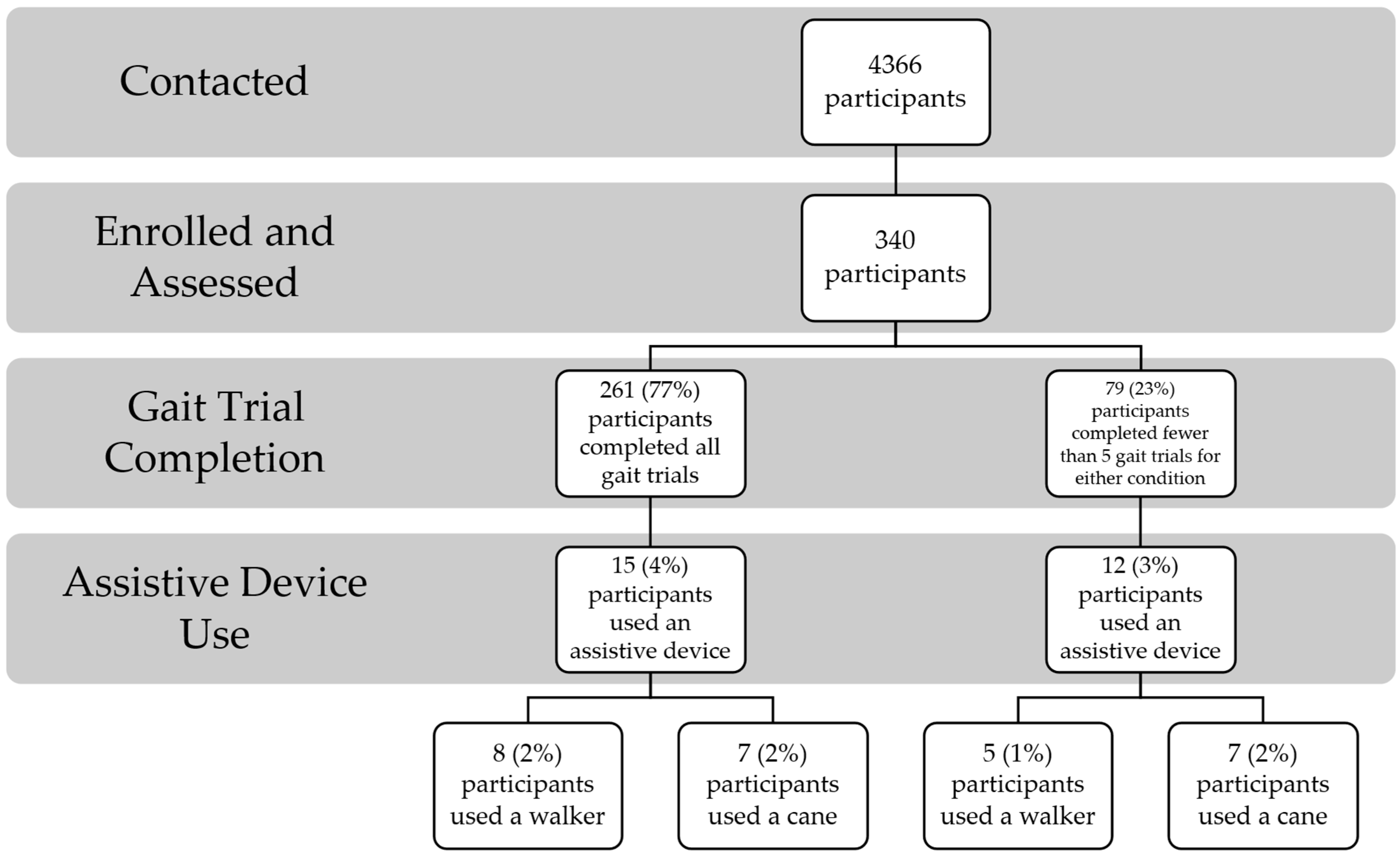
Figure 1. Participant flow from initial contact to analytic sample. Of 4366 community-dwelling older adults contacted, 340 were enrolled and assessed. Among those assessed, 264 (78%) participants completed all five gait trials for both walking conditions, while 76 (22%) completed fewer than five trials for at least one condition. Among completers, 15 (4% of the enrolled sample) used an assistive device during gait testing (walker: n = 8 [2%]; cane: n = 7 [2%]). Among non-completers, 12 (3% of the enrolled sample) used an assistive device (walker: n = 5 [1%]; cane: n = 7 [2%]).
Applsci 15 12740 g001
Figure 2. Estimated mean gait velocity (m/s) and 95% confidence intervals across trials for preferred (top) and maximum (bottom) gait speed conditions. Shaded region indicates Trials 2–4, from which the primary clinical recommendation (discard Trial 1, average Trials 2–4 at preferred speed) is derived. Sample sizes contributing to each trial are noted above CI bars.
Applsci 15 12740 g002
Table 1. Estimated marginal means (EMMs), standard error (SE), and 95% confidence intervals for each trial and condition.
ConditionTrialEstimated Mean (cm/s)SE95% CI Lower95% CI Upper
Preferred186.9225.174.783.38
289.1825.374.922.84
390.5625.585.022.51
491.7125.825.072.27
592.8026.094.092.36
Maximal1132.3834.715.834.12
2132.9334.395.973.45
3133.8434.435.993.00
4134.6734.556.032.70
5134.8034.455.453.15
Table 2. Baseline demographic information for completers and non-completers of gait trials. Completers include participants who performed all 5 trials for both gait conditions, whereas non-completers include participants who were unable to complete any of the 5 gait trials for either condition.
Preferred Gait VelocityMaximum Gait Velocity
Trial AverageCompleters (n = 281)Non-Completers (n = 59)Completers (n = 261)Non-Completers (n = 79)
Age (±SD) (years)70.83 ± 7.4771.32 ± 10.6470.86 ± 7.3471.04 ± 10.16
Sex (% female)62.6%77.3%62.6%72.9%
Height (±SD) (cm)166.64 ± 10.53164.09 ± 10.48166.71 ± 10.66164.58 ± 10.02
Number reported falls in past year (±SD)1.18 ± 1.211.45 ± 1.351.19 ± 1.201.38 ± 1.37
Gait Speed (±SD) (m/s)0.93 ± 0.200.59 ± 0.251.34 ± 0.350.94 ± 0.32
Number using assistive device (% of enrolled)20 (6%)8 (2%)13 (4%)15 (4%)
Table 3. ICC(2,k) values and 95% confidence intervals for preferred and maximum gait speed conditions.
ConditionTrialICC(2,k)95% CI Lower95% CI Upper
Preferred10.9290.8500.960
20.9890.9840.992
30.9920.9890.994
40.9910.9840.994
50.9850.9660.992
Maximal10.9650.9520.973
20.9910.9880.993
30.9920.9890.994
40.9930.9910.995
50.9930.9900.995
Table 4. Mean gait speed (centimeters per second, cm/s), standard deviation of gait speed (cm/s), SEM values (single, mean, percent) and ICC(2,k) for each condition and average number of trials. Trial average includes all trials included in the set (e.g., 1–2 is the average of trials 1 and 2, 1–3 is the average of trials 1, 2, and 3).
ConditionTrial AverageknMean Speed (cm/s)SD_Between (cm/s)SEM_SingleSEM_MeanPercent_SEMICC_2k (ICC Lower, ICC Upper)
Preferred1–2228086.9225.174.783.383.890.953 (0.919–0.900)
1–3328089.1825.374.922.843.190.951 (0.914–0.897)
1–4428090.5625.585.022.512.770.955 (0.921–0.906)
1–5528091.7125.825.072.272.470.957 (0.924–0.910)
Middle (2,3,4)328092.8026.094.092.362.550.983 (0.970–0.963)
Maximal1–22261132.3834.715.834.123.110.983 (0.970–0.962)
1–33261132.9334.395.973.452.600.988 (0.978–0.973)
1–44261133.8434.435.993.002.240.988 (0.979–0.974)
1–55261134.6734.556.032.702.000.988 (0.978–0.974)
Middle (2,3,4)3261134.8034.455.453.152.340.990 (0.982–0.977)
Disclaimer/Publisher’s Note: The statements, opinions and data contained in all publications are solely those of the individual author(s) and contributor(s) and not of MDPI and/or the editor(s). MDPI and/or the editor(s) disclaim responsibility for any injury to people or property resulting from any ideas, methods, instructions or products referred to in the content.