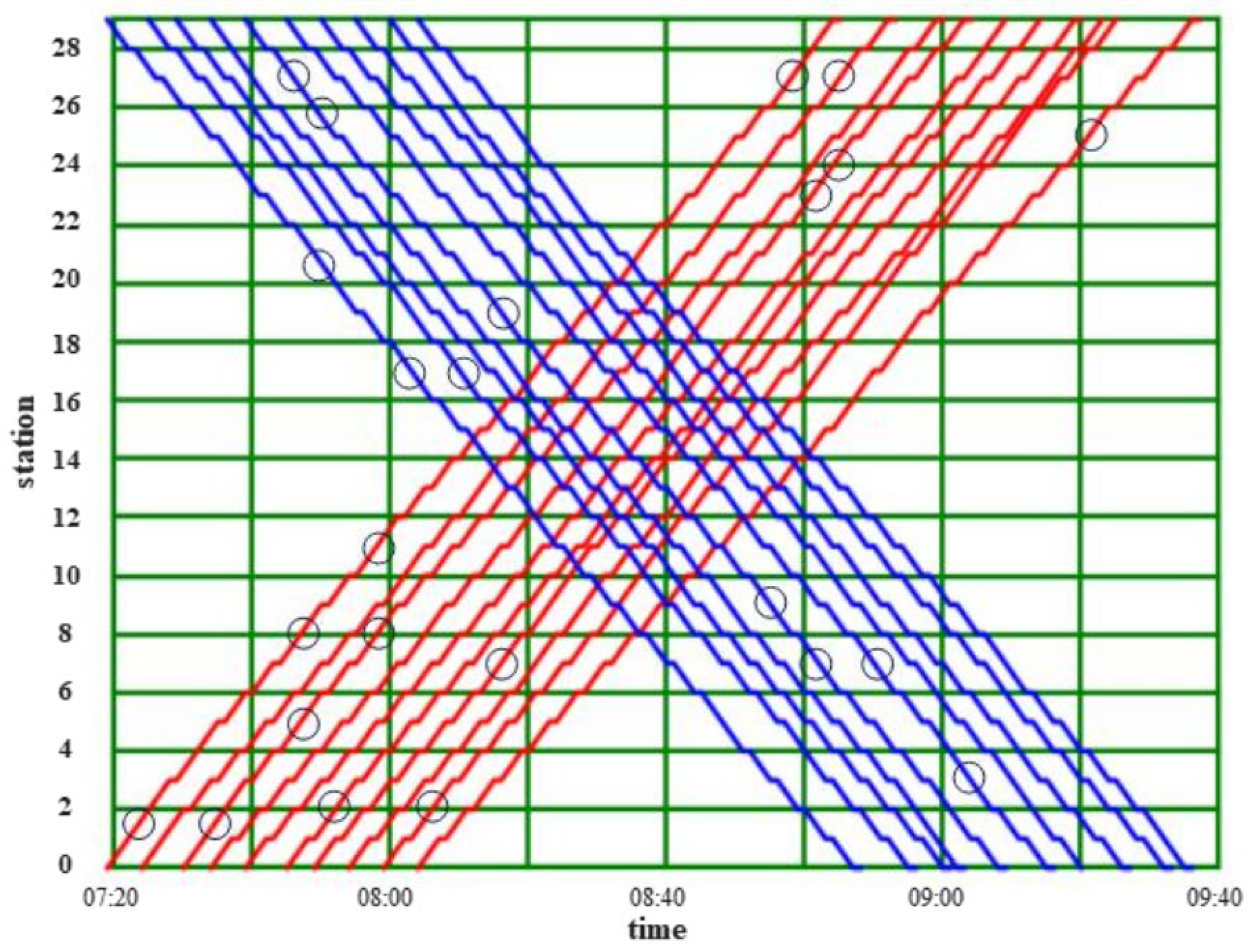
1. Introduction
With the increasing severity of urban traffic congestion, urban rail transit has become a preferred transportation mode, prized for its efficiency, punctuality, and eco-friendliness [
1]. To enhance its competitiveness in the urban transportation system, it is essential for operators to provide high-quality and cost-effective services. A central challenge lies in the inherent conflict between passenger expectations for minimal waiting time (favoring short train headways) and operator objectives to minimize costs (favoring longer headways) [
2,
3]. As a core task in urban rail transit operations management, train timetabling, which determines the arrival and departure times of each train at every station, plays a pivotal role in aligning train capacity resources effectively with the passenger demand [
4,
5].
In recent years, the continuous urban expansion and increasing travel distances have necessitated the development of extensive urban rail transit networks. The growth of passenger flow, coupled with the prominent imbalance in its temporal and spatial distribution, has imposed significant pressure on the formulation of train timetables [
6]. In response, researchers and operators have turned to flexible train operation strategies. The skip-stop strategy is one of the most widely used strategies, allowing trains to bypass certain stations [
7]. For instance, during peak hours, some trains may skip stations with low passenger boarding and alighting rates to more quickly serve other high-demand stations downstream. The adoption of the skip-stop operation mode can, on one hand, reduce the number of stations where trains stop, thereby shortening passengers’ travel time and saving energy consumption simultaneously. On the other hand, it can balance the transport capacity of trains, enabling passengers at upstream and downstream stations to obtain train services more equitably [
8,
9].
It is noteworthy that the train timetable and the skip-stop pattern are inherently interdependent. To address this issue, this study develops an integrated optimization model for synchronizing timetabling and skip-stop strategies in urban rail transit. Most of the previous similar studies assume that passengers are restricted to trains that serve both their origin and destination stations without transferring. In reality, passengers may opt to transfer to minimize their total travel time. For instance, a passenger traveling from station i to station j might choose to board a train that skips j but stops at a downstream station, and then transfer back to an upstream-bound train to reach j, provided this path is faster. Such adaptive passenger behavior, which impacts the effectiveness of any skip-stop strategy, has been largely overlooked.
The main contribution of this study lies in incorporating the impact of passenger transfer strategies on the optimization of train timetables and skip-stop patterns. To investigate the performance of the optimized strategy when passengers can choose to transfer, we design a passenger transfer strategy selection algorithm. Furthermore, to enhance the model’s practical applicability, we formulate a mixed-integer nonlinear programming (briefly, MINLP) model that incorporates strict first-come-first-served (briefly, FCFS) rules and train capacity constraints. The model aims to minimize the maximum waiting time among all passengers. A genetic algorithm is designed to solve this complex model and generate the optimal train timetable and skip-stop plan.
This paper is organized as follows.
Section 2 reviews the existing literature.
Section 3 gives the problem description and introduces three transfer strategies the considered in this study. In
Section 4, we propose the integrated optimization model.
Section 5 gives the algorithm for solving the model. Numerical studies validate the model’s effectiveness in
Section 6.
Section 7 concludes this paper with potential future directions.
2. Literature Review
The optimization of train timetables has attracted significant scholarly attention, with applications extending beyond urban rail transit to other public transport systems, such as shuttle buses, suburban railways, and airlines [
10,
11,
12]. Timetabling is typically formulated as a mathematical optimization problem. Li and Lo focused on minimizing the energy consumption of underground rail services by simultaneously optimizing the timetable, headway, and speed [
13]. Sun et al. considered optimizing the timetable during peak periods with the goal of minimizing the average waiting time. They designed timetables for each scenario and conducted sensitivity analysis on relevant parameters in their model [
14]. While the core decision variables often involve train departure headways or frequencies, some studies have expanded the scope to simultaneously optimize the number of carriages and vehicle speeds [
15,
16]. The objective functions in these problems are diverse, aiming to minimize metrics such as total delay time, total passenger waiting time, energy consumption, and uneven passenger load across trains [
4,
17,
18,
19]. Driven by growing emphasis on energy conservation and technological advancements, recent research has actively promoted the development of energy-efficient timetables for urban rail lines. For instance, Zhang et al. [
20] established a multi-objective optimization model to enhance the utilization of regenerative braking energy. Their model considered total energy consumption and travel time as objectives, subject to constraints on dwelling time and headways, and employed a genetic algorithm (GA) to generate optimal combinations of station stop times and departure intervals. A similar problem is explored in another study, which further incorporates the influence of potential power supply interruptions on service quality [
21].
The studies mentioned above are all conducted under an all-stop station mode. The limitations of this single mode become particularly pronounced when dealing with exceptionally long rail lines characterized by significant variations in passenger flow distribution [
22]. In such scenarios, the skip-stop mode, which determines stopping patterns based on passenger demand, can effectively address these limitations. Common skip-stop strategies in subway systems include the express/local strategy, the A/B station strategy, and the regular skip-stop strategy. Among these, the first strategy categorizes metro line services into two types: express trains that stop only at designated stations, and local trains that stop at all stations [
23,
24]. The A/B station strategy categorizes subway stations into three types (i.e., A, B, and AB), and underground train into A and B types. Type A trains stop only at A and AB stations, while Type B trains stop only at B and AB stations [
25]. Different from the former two strategies, within the regular skip-stop framework, each train service can skip any set of stations along the rail corridor. This strategy represents the most extensively researched category within urban rail skip-stop strategies. Compared to the express/local and A/B station strategies, the regular skip-stop strategy, despite its higher computational complexity, offers greater design flexibility and yields more robust outcomes. This paper focuses on investigating the regular skip-stop strategy and integrating its optimization with train timetabling.
Similarly to train timetabling, the optimization of stopping patterns under skip-stop operations is typically formulated as a mathematical optimization problem, for which researchers have developed corresponding models. Yang et al. [
26] addressed the skip-stop pattern design problem in metro line train scheduling, considering energy consumption and passenger characteristics. They proposed a two-step optimization strategy: the first step involved passenger demand analysis based on historical smart card data; the second step, acknowledging different train operation phases across sections, involved constructing a traditional mixed-integer programming model, which was then reformulated into a quadratic programming problem using Taylor approximation. Their numerical results indicated that the skip-stop strategy could reduce energy consumption by 15.39%. Chen et al. [
27] formulated this scheduling problem as a nonlinear programming model, with the primary objective of optimizing the total cost for both passengers and the operating agency, and a secondary objective of minimizing bus emissions, also designing a corresponding solution method. Li et al. [
28] developed a mixed-integer linear programming (MILP) model to determine two-way headways, stopping patterns, train departure times, and vehicle circulation plans, while considering train capacity constraints and the FCFS principle for passengers. Cao et al. addressed the scenario of train delays by proposing a bi-objective mixed-integer linear programming (MILP) model that utilizes a skip-stop operation strategy [
29]. The model was designed to efficiently allocate transport capacity for stranded passengers, thereby facilitating a rapid recovery to the established operational schedule.
This study focuses on the integrated optimization of train timetabling and skip-stop strategies, an area where comprehensive research remains relatively limited. A number of existing studies have approached this problem by optimizing the timetable based on a predetermined or fixed skip-stop pattern. For instance, under the premise of a predetermined train stop-skipping pattern, Niu et al. developed a unified quadratic integer programming model with linear constraints, which is used to coordinately synchronize the effective passenger boarding time windows and train arrival-departure times at each station [
30]. Wang et al. adopted a coordinated, yet sequential, two-step approach: the first step optimized the timetable to minimize total passenger waiting time, while the second step designed a skip-stop strategy to reduce total passenger travel time and system energy consumption [
31]. Through a case study, they demonstrated that this joint optimization could improve overall system performance by approximately 8–12% compared to an all-stop station mode. In a different focus, Yang et al. argued that the deceleration and acceleration associated with station stops lead to significant energy loss [
32]. They aimed to co-optimize the timetable and skip-stop strategy to minimize the number of stops, with results confirming a reduction in overall system energy consumption and operational costs. Zhang et al. developed and compared models for two scenarios—with and without train capacity constraints—to evaluate the effects of integrated optimization [
33]. They weighted the objectives of reducing passenger waiting time and in-vehicle travel time differently, arguing that these components, while both indicative of strategy effectiveness, are not equally important.
This study extends the existing body of research by incorporating the influence of passenger transfer strategies on the optimal integration of train timetabling and skip-stop patterns. Within related research domains, Lee et al. [
34] represent one of the few studies that consider passenger travel behavior. However, while their work proposes an optimal skip-stop strategy accounting for four types of passenger behaviors, the behavioral choices primarily revolve around selecting between express and local services. Furthermore, their study does not integrate timetable optimization with the skip-stop strategy. Huang et al. [
6] employed a Logit model to represent passengers’ route choices, but their focus was mainly on passenger flow assignment under cross-line and skip-stop operations.
In summary, the main contributions of this paper are twofold. First, it extends the traditional integrated optimization framework of skip-stop patterns and timetabling by incorporating strict train capacity constraints and a rigorous FCFS rule, and by constructing a model that treats individual passengers as the smallest input unit. Second, this study considers passenger transfer behaviors, defines specific transfer strategies, and incorporates them into the integrated optimization model. It further analyzes and compares the impacts of direct travel strategies versus transfer strategies on the co-optimization scheme.
3. Problem Statement and Assumptions
This chapter presents the problem framework of schedule optimization and skip-stop station strategy coordination, including relevant symbols and definitions, basic constraints, and basic assumptions. These contents will be used in
Section 4 and
Section 5 of this paper. The research problem of this paper is to design a coordinated optimization scheme for the departure schedule and skip-stop station strategy of a subway system during peak hours. We consider the optimization scheme of departure schedule and skip-stop station strategy in two directions.
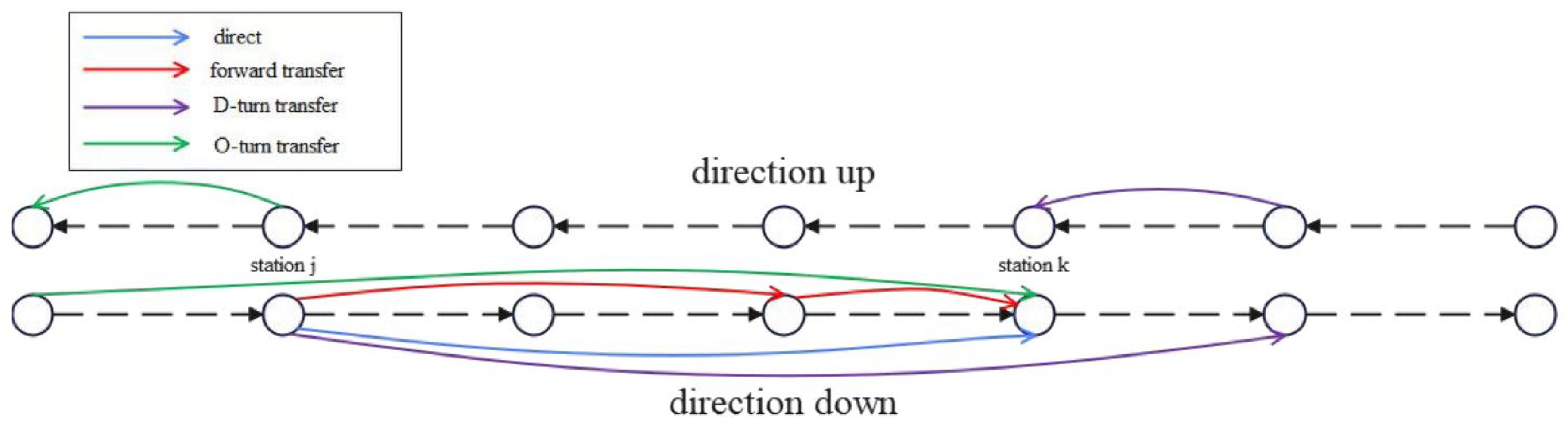
Figure 1 illustrates the physical structure of the rail transit line, which has two directions, namely “up” and “down”, and a total of
N platforms. The upstream and downstream directions pass through the same platforms and share platform numbers. In our model, subway services depart according to a given departure schedule, with each train stopping or skipping stations along the line based on its own skip-stop strategy until it reaches the terminus. Each passenger has an independent arrival time and O-D demand. Passengers follow a strict FCFS rule. The model takes the arrival times and O-D demands of all passengers, and other information as inputs, and gives the coordinated optimization scheme of departure timetable and skip-stop strategy for underground rails.
In previous studies on skip-stop station strategies in urban rail transit systems, it is generally assumed that passengers prefer direct travel, where direct travel refers to passengers selecting only the train that stops at both their origin and destination stations. Although skip-stop station strategies are easier for subway system operators to understand, they neglect the transfer behavior of passengers. Passengers may choose transfer strategies in order to minimize their travel time.
Figure 2 provides three simple examples to illustrate different transfer strategies.
We define three transfer strategies: forward transfer, D-turn transfer, and O-turn transfer. Assuming that the passenger’s origin is j and destination is k. Forward transfer refers to selecting at least one transfer in the passenger’s travel direction, where the first column train must stop at the origin platform and the last column train must stop at the destination platform. D-turn transfer refers to passengers firstly taking a train that stops at the origin platform and skips the destination platform, and then selecting a train that travels in the opposite direction to reach the destination platform. O-turn transfer, on the other hand, refers to passengers firstly boarding a train in the opposite direction and then choosing a train that travels in the passenger’s travel direction to reach the destination platform.
This paper investigates the collaborative optimization of timetabling and skip-stop strategy with passenger transfers. All passengers aim to minimize their travel time by choosing either direct or transfer strategies. Passengers are independent of each other, and underground rails adhere to strict capacity constraints. We take one single passenger as the minimum input unit of the model. Based on a general framework for subway operation planning, the following assumptions are made:
(1) The origin-destination (O-D) demands of all passengers within the planning time horizon are known, including their respective arrival times, departure stations, and destinations.
(2) According to the arrival time of each passenger, the FCFS rule is strictly followed.
(3) All trains have the same capacity constraints, operating speed, and station dwell time.
(4) All trains traveling in the same direction operate on the same line and do not overtake each other.
(5) Passengers’ transfer strategies involve only one transfer. If a passenger chooses a transfer strategy but cannot board any train due to limited capacity, they will instead opt for a direct strategy. Under this assumption, passengers’ transfer choices are limited.
5. Solution Methodology
5.1. The Travel Strategy Passengers Choice
In passenger transfer scenarios, all passengers aim to minimize their travel time by selecting appropriate boarding strategies. Consider passenger
p, whose origin station is
j and departure station is
k, Algorithm 1 shows how passengers decide their travel plan.
| Algorithm 1: Passenger choice |
| Input: passenger information; timetable and skip-stop strategy |
| Output: passenger travel choice |
| 1: | |
| 2: |
|
| 3: |
|
| 4: |
|
| 5: | #forward transfer |
| 6: | for |
| 7: | |
| 8: |
|
| 9: | end if |
| 10: | end for |
| 11: | #O-turn transfer |
| 12: |
|
| 13: |
|
| 14: |
|
| 15: |
|
| 16: | end if |
| 17: | end if |
| 18: | end for |
| 19: | #D-turn transfer |
| 20: |
|
| 21: |
|
| 22: |
|
| 23: |
|
| 24: | end if |
| 25: | end if |
| 26: | end for |
| 27: | Compare travel time of
|
| 28: | choose the minimum as
|
| 29: | end for |
Note that each passenger will only choose from limited strategies to reduce their waiting time instead of waiting for the direct rail. It is necessary that there exists at least one rail arriving at passengers’ destination station earlier than the latest direct rail. Passengers can choose forward transfer, O-turn transfer or D-turn transfer to get the early rail, skipping their origin stations.
5.2. Genetic Algorithm
Genetic algorithms have been widely applied to solve large-scale nonlinear problems and have also been extensively studied and applied in the field of urban rail transportation. We design a basic genetic algorithm framework. The main algorithm framework includes encoding/decoding, initialization, selection, crossover, and mutation. The main framework is shown in Algorithm 2.
| Algorithm 2: Genetic algorithm |
| Input: population size: n; maximum number of iteration: max_iter |
| Output: global best timetable and skip-stop strategy |
| 1: | |
| 2: | |
| 3: | compute the fitness value of each chromosome |
| 4: | | |
| 5: | calculate each chromosome’s fitness according to Algorithm 3 |
| 6: | select a pair of chromosomes from initial population by fitness |
| 7: | apply crossover on selected pair to generate offspring |
| 8: | apply mutation on each chromosome |
| 9: | increment c by l |
| 10: | end while |
| 11: | return the best timetable and skip-stop strategy |
The main parts of our algorithm are described below.
The optimization strategy for coordinating the timetable and skip-stop stations includes determining the departure times and skip-stop patterns for all trips within the planning time horizon. The encoding in this study consists of two parts: the first part represents the skip-stop patterns for each trip, with the upstream direction preceding the downstream direction. The second part represents the departure timetable for each trip, relative to fixed interval departure times. Considering a subway system with 3 stations and 3 trips in a single direction (see
Figure 3).
The strategy indicates that the second trip in the upstream direction skips the second station, and the third trip in the downstream direction skips the third station. The first trip in both the upstream and downstream directions depart 1 min earlier. The third trip in the upstream direction departs 1 min later. The decoding process simply follow the encoding steps.
This study adopts a conventional initialization method, randomly generating individual encodings. In the segment of the skip-stop strategy, a value of 1 in the individual segment indicates that the train stops at that station, while any other value indicates that the station will be skipped. Individuals generated with different probabilities of values are added to the initial population, ensuring diversity in the initial population. In the part of the departure schedule, we specify that the values in the individual segments are randomly selected from a limited set of values, which helps to reduce the complexity of the problem.
For each generation of the population, they are sorted based on their fitness values and paired up in pairs. Subsequent crossover operations are performed on these pairs. The fitness is calculated according to Algorithm 3.
| Algorithm 3: Fitness |
| Input: passenger information; one chromosome |
| Output: chromosome’s fitness |
| 1: | decode chromosome to get the timetable and skip-stop strategy |
| 2: | |
| 3: | passenger p chooses travel strategy according to Algorithm 1 |
| 4: | end for |
| 5: | |
| 6: | |
| 7: | subway enters the station |
| 8: | passenger get off the rail according to the travel strategy |
| 9: | passenger get on the rail according to the travel strategy |
| 10: | accumulate the waiting time each passenger and add it to
|
| 11: | rail leaves the station |
| 12: | increment t by l |
| 13: | end while |
| 14: | |
In this part, we design a specialized crossover algorithm based on the characteristics of the problem. Individual elements are used as the genes for crossover, and crossover is performed separately in the regions representing the skip-stop strategy and the departure schedule. Two individuals grouped together in the selection phase generate new offspring.
Similarly to conventional genetic algorithms, in this part, mutation operations are applied to all individuals. The probability of mutation is generally set to a small value.’
7. Conclusions and Future Research
This study investigates the optimization problem of timetable and skip-stop strategy in over-saturated URT systems, focusing on the potential unfairness in train capacity sharing. We also examine the impact of passengers’ transfer strategies on the effectiveness of optimization strategies. Additionally, our model incorporates strict FCFS rules and capacity constraints to make it closer to actual operational conditions.
The experimental results show that, in simulation cases where passenger demands are evenly distributed among stations, the optimization strategy has almost no effect on the fairness of passengers’ access to subway services but increases the average waiting time. However, when there are concentrated passenger travel demands at certain stations, the optimization strategy proposed in this study can alleviate the unfairness in accessing subway services. With the expansion of the problem scale, the optimization strategy not only significantly improves the fairness of passengers’ access to subway services but also reduces the average waiting time and enhances the operational efficiency of the entire subway system. The effectiveness of the algorithm is demonstrated using the dataset of Singapore’s MRT Line 1.
Thanks to the widespread use of AFC systems and the continuous development of internet technologies, accurate prediction of passenger O-D demand and timely access to subway schedules and other information will become increasingly achievable. Therefore, our research has broad potential for practical applications.
Future research can focus on a more detailed characterization of passengers’ transfer strategies. In order to control the complexity of the problem, this study assumes that passengers can only transfer at most once. Investigating the complex transfer behaviors that passengers may exhibit would be a valuable research direction. The application of agent-oriented simulation is another compelling direction for deepening the analysis of passenger behavior. Furthermore, considering the dynamic adjustment of subway operating strategies based on changes in passenger demands during the subway operation phase is also a possible research direction.