


Exploring Artificial Intelligence in Inclusive Education: A Systematic Review of Empirical Studies

Abstract
1. Introduction
1.1. Review Context
1.2. Impact of AI on Learning Outcomes and Engagement Among Students with Special Needs
1.3. Problem Statement
1.4. Research Questions
1.5. Purpose and Significance
2. Related Works
2.1. Barriers and Enablers Influencing Adoption and Use of AI Tools
2.2. Role of Theoretical Frameworks in the Design of AI-Based Intervention
3. Methods
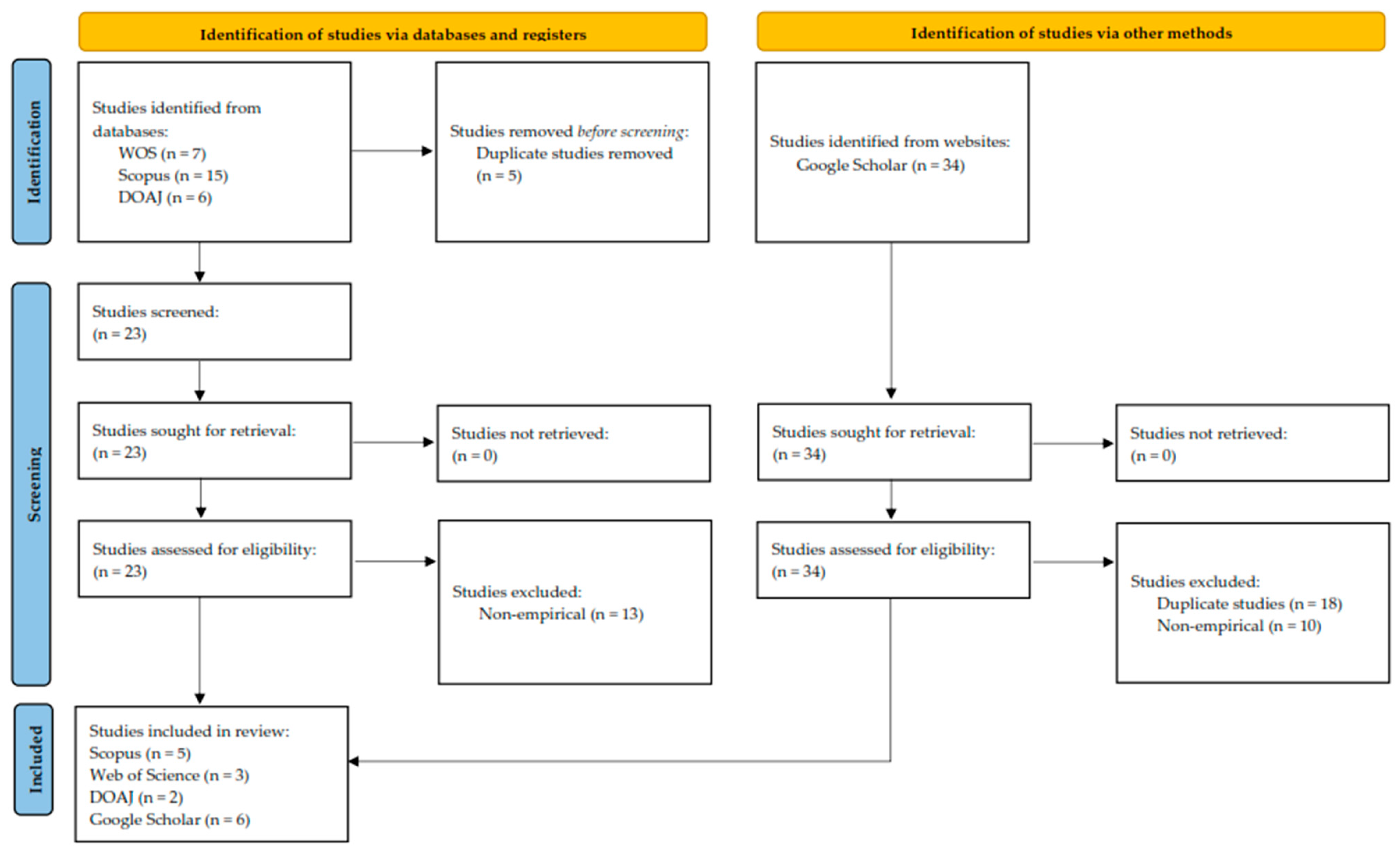
3.1. Search Strategy
- ARTIFICIAL INTELLIGENCE + INCLUSIVE EDUCATION.
- ARTIFICIAL INTELLIGENCE AND INCLUSIVE EDUCATION.
- INTELLIGENT TUTORING SYSTEM IN INCLUSIVE EDUCAITON.
- ARTIFICIAL INTELLIGENCE FOR STUDENTS WITH SPECIAL NEEDS.
- ARTIFICIAL INTELLIGENCE + SPECIAL STUDENTS.
- AI + PERSONALIZED LEARNING + STUDENTS WITH DISABILITY.
3.2. Inclusion and Exclusion Criteria
3.3. Data Extraction
3.4. Quality Appraisal
3.5. Data Analysis
- For quantitative studies, while numerical data was not analyzed using QCA, narrative sections, such as discussions and interpretations, were examined to identify author-reported implications and contextual meanings [33]. This approach is consistent with practices in mixed-method synthesis, where qualitative insights are extracted from quantitative papers to support thematic integration.
- For qualitative studies, full-text analysis was conducted, focusing on results, discussions, and conclusions to extract themes related to AI’s influence on student engagement and learning outcomes. These were coded inductively and grouped into thematic categories.
- Mixed-methods studies were analyzed by separating qualitative and quantitative components: the qualitative parts were coded using QCA, while the quantitative findings were summarized and mapped onto emerging themes.
- For the randomized controlled trial (RCT), narrative interpretations of results were included in the QCA, while statistical outcomes were descriptively interpreted to complement the thematic findings.
4. Results
4.1. Study Characteristics
4.2. RQ1—Impact of AI Technologies on Learning Outcomes and Engagement in Inclusive Education Settings
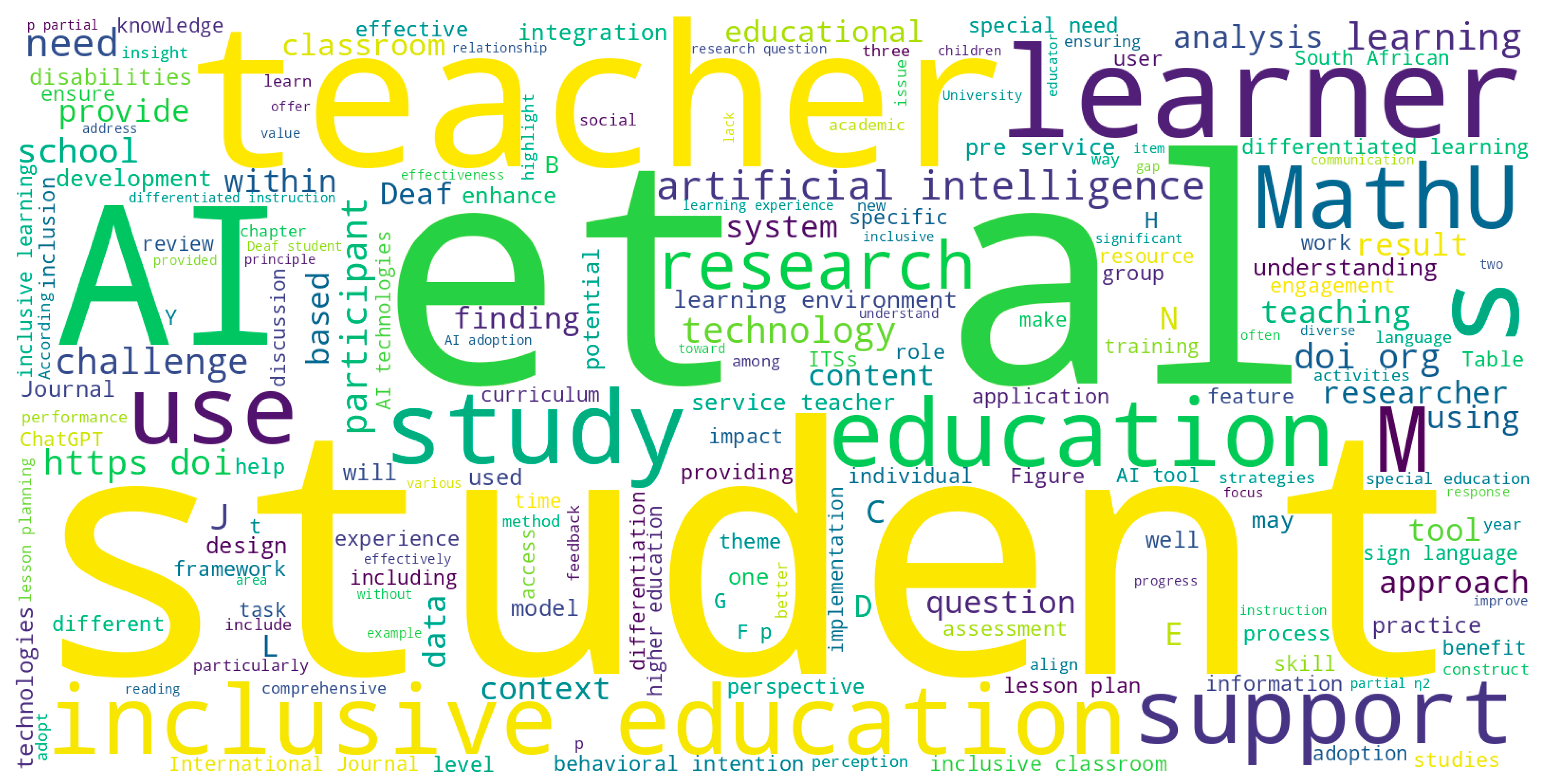
4.2.1. Word Cloud
4.2.2. Impact of AI Technologies on Learning Outcomes
4.2.3. Impact of AI Technologies on Engagement
4.3. RQ2—Barriers and Enablers Influencing the Adoption and Effective Use of AI Tools by Educators in Inclusive Education
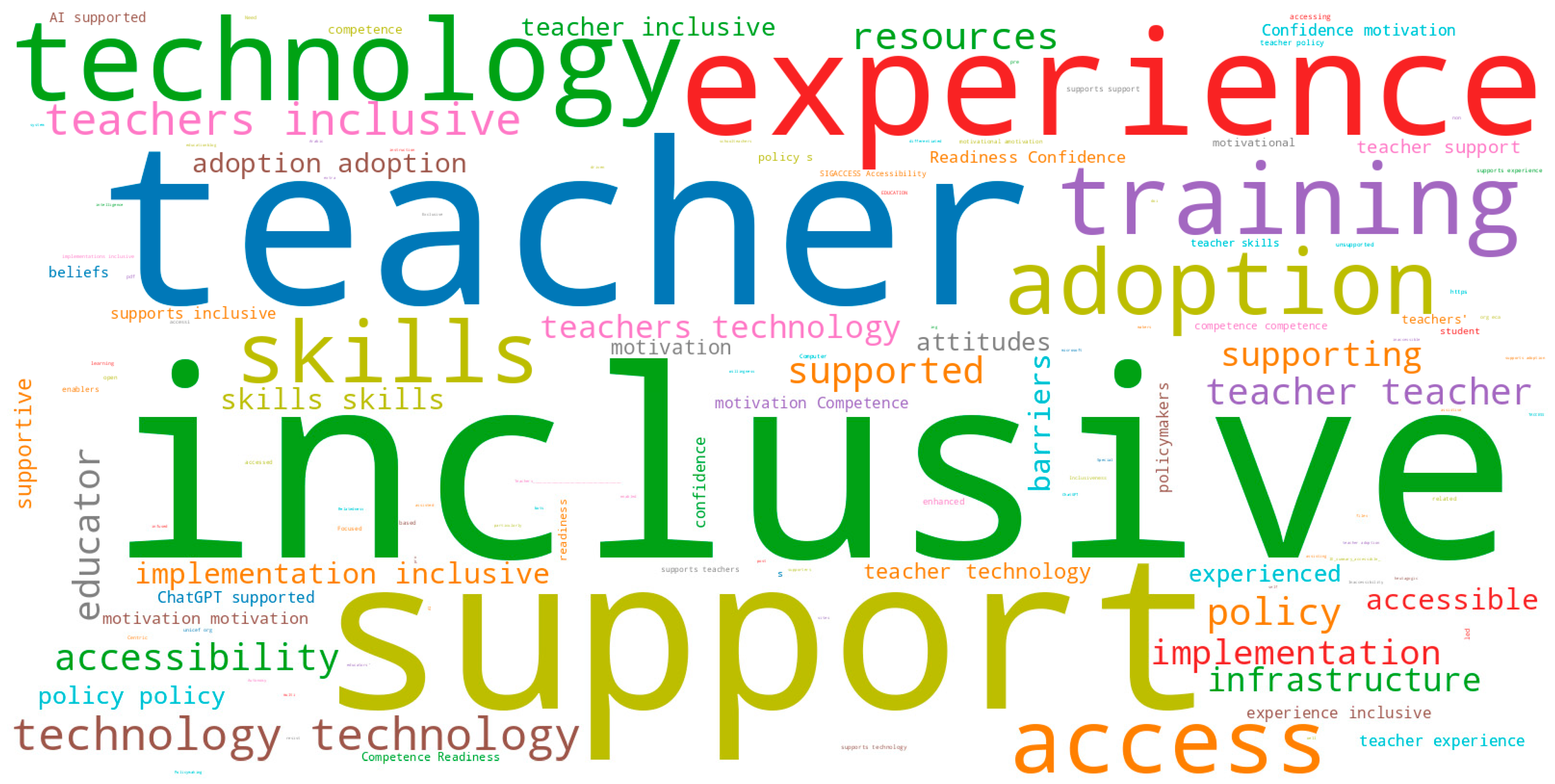
4.3.1. Word Cloud
4.3.2. Barriers Influencing the Adoption and Effective Use of AI Tools
4.3.3. Enablers Influencing the Adoption and Effective Use of AI Tools
4.4. RQ3—Role of Theoretical Frameworks in Informing the Design, Implementation and Evaluation of AI-Based Interventions in Inclusive Education
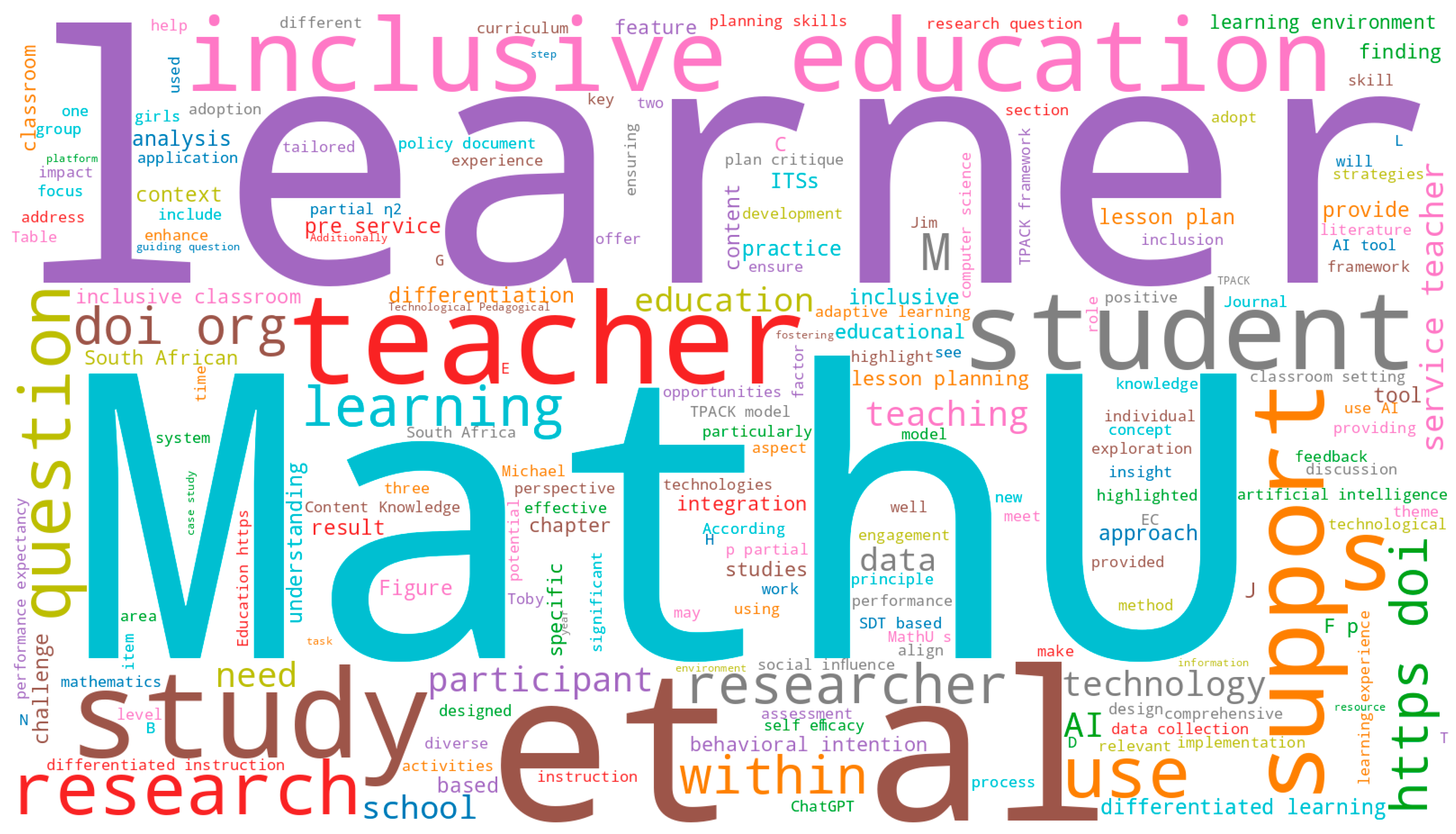
4.4.1. Word Cloud
4.4.2. How Theory Informs the Design of AI-Based Intervention
4.4.3. How Theory Informs the Implementation of AI-Based Intervention
4.4.4. How Theory Informs the Evaluation of AI-Based Intervention
5. Discussion
5.1. Converging Insights and Critical Gaps
5.2. Conclusions
5.3. Limitations
Funding
Institutional Review Board Statement
Informed Consent Statement
Data Availability Statement
Conflicts of Interest
Appendix A

| Study No. | 5 |
| Title | Impact of Artificial Intelligence in Special Need Education to Promote Inclusive Pedagogy |
| Author/Year | Garg et al. (2020) [21] |
| Publication Type | Empirical (Qualitative/Exploratory paper) |
| Language | English |
| Objective | The primary objective of the study is to:
|
| Study Design | The study follows a qualitative, exploratory research design, with the following key components:
|
| Study No. | 6 |
| Title | Challenges and opportunities of AI in inclusive education: a case study of data-enhanced active reading in Japan |
| Author/Year | Toyokawa et al. (2023) [22] |
| Publication Type | Empirical (Qualitative case study paper) |
| Language | English |
| Objective | The study aims to:
|
| Study Design | The research follows a qualitative case study design, with the following components:
|
| Study No. | 7 |
| Title | A self-determination theory (SDT) design approach for inclusive and diverse artificial intelligence (AI) education |
| Author/Year | Xia et al. (2022) [20] |
| Publication Type | Empirical (Quantitative paper) |
| Language | English |
| Objective | The primary aim of the study was to investigate how teacher support for students’ psychological needs, based on Self-Determination Theory (SDT), influences AI learning among secondary school students, with a focus on inclusion and diversity. Specifically, the study sought to answer three research questions:
|
| Study Design | The research was conducted in two separate studies, each using a 2 × 2 between-subjects factorial design: Study 1: Gender-Based Analysis
|
| Study No. | 10 |
| Title | Harnessing Artificial Intelligence for Inclusive Education Management: Strategies for Supporting Students with Special Needs |
| Author/Year | Irawan et al. (2025) [23] |
| Publication Type | Empirical (Qualitative paper) |
| Language | English |
| Objective |
|
| Study Design | The study employed a qualitative case study design. This design was chosen to allow for an in-depth, contextualized exploration of how AI is implemented in inclusive education settings. The researchers conducted:
|
| Study No. | 11 |
| Title | Inclusive Deaf Education Enabled by Artificial Intelligence: The Path to a Solution |
| Author/Year | Coy et al. (2024) [32] |
| Publication Type | Empirical (Mixed-method paper) |
| Language | English |
| Objective | The study aims to:
|
| Study Design | The study employs a mixed-methods exploratory design, combining:
|
| Study No. | 12 |
| Title | Acceptability of Artificial Intelligence in Inclusive Education: A TAM2-Based Study Among preservice Teachers |
| Author/Year | Amouri et al. (2025) [33] |
| Publication Type | Empirical (Mixed method paper) |
| Language | English |
| Objective | The study aimed to explore the acceptability of artificial intelligence (AI) among preservice teachers in the context of inclusive education, specifically for teaching students with Attention Deficit Hyperactivity Disorder (ADHD). The key objectives were:
|
| Study Design | The research employed a mixed-methods design, combining both quantitative and qualitative approaches:
|
| Study No. | 13 |
| Title | Understanding pre-service teachers’ intention to adopt and use artificial intelligence in Nigerian inclusive classrooms |
| Author/Year | Adigun et al. (2025) [27] |
| Publication Type | Empirical (Quantitative cross-sectional paper) |
| Language | English |
| Objective | The study aims to:
|
| Study Design | The study uses a quantitative, cross-sectional design with the following components:
|
| Study No. | 15 |
| Title | The effectiveness of using artificial intelligence in improving academic skills of school-aged students with mild intellectual disabilities in Saudi Arabia |
| Author/Year | Alsolami (2025) [35] |
| Publication Type | Empirical (Randomized controlled trial design) |
| Language | English |
| Objective | The primary objectives were to:
|
| Study Design | The study employed a randomized controlled trial (RCT) design with the following key features:
Surveys from teachers and parents to evaluate satisfaction and perceived effectiveness. |
| Study No. | 18 |
| Title | Is artificial intelligence an opportunity for inclusive education? A case study in a fully online university |
| Author/Year | Reyes et al. (2024) [24] |
| Publication Type | Empirical (Qualitative case study paper) |
| Language | English |
| Objective | The study aims to explore how artificial intelligence (AI) can be leveraged to promote inclusive education in online higher education settings. Specifically, it seeks to:
|
| Study Design | This is an exploratory qualitative case study, designed to deeply investigate a specific context within online higher education.
|
| Study No. | 21 |
| Title | AI adoption for collaboration: Factors influencing inclusive learning adoption in higher education |
| Author/Year | Alyoussef (2025) [28] |
| Publication Type | Empirical (Quantitative paper) |
| Language | English |
| Objective | The primary objective of the study is to investigate the factors that influence university students’ adoption of artificial intelligence (AI) technologies for collaboration, with a particular emphasis on how these technologies foster inclusive learning environments in higher education (HE). Specifically, the study aims to:
|
| Study Design | The study employs a quantitative research design with the following components:
|
| Study No. | 26 |
| Title | The Role of AI in Supporting Inclusive Education: Addressing Diverse Learning Needs Through Intelligent Tutoring System |
| Author/Year | Naseer et al. (2025) [31] |
| Publication Type | Empirical (Qualitative paper) |
| Language | English |
| Objective | The study aims to:
|
| Study Design | The study employed a quantitative research design.
|
| Study No. | 27 |
| Title | Impact of Artificial Intelligence Technologies on Inclusive Education: A Study in Students Aged 15 to 18 |
| Author/Year | Lunavictoria et al. (2024) [34] |
| Publication Type | Empirical (Mixed-method paper) |
| Language | English |
| Objective | The study aims to:
|
| Study Design |
|
| Study No. | 28 |
| Title | Challenges Special Education Teachers Encounter in Using Artificial Intelligence Techniques to Teach Students with Disabilities in Inclusive Schools |
| Author/Year | Beirat et al. (2025) [29] |
| Publication Type | Empirical (Quantitative paper) |
| Language | English |
| Objective | The study aims to:
|
| Study Design |
|
| Study No. | 32 |
| Title | Harnessing AI for teacher education to promote inclusive education: Investigating the effects of ChatGPT-supported lesson plan critiques on the development of pre-service teachers’ lesson planning skills |
| Author/Year | Cai et al. (2022) [30] |
| Publication Type | Empirical (Quasi-experimental paper) |
| Language | English |
| Objective |
The study aimed to investigate the impact of ChatGPT-supported lesson plan critiques on the lesson planning skills of pre-service teachers, with a focus on promoting inclusive education. Specifically, it sought to:
|
| Study Design | The study employed a quasi-experimental design with both quantitative and qualitative components:
|
| Study No. | 38 |
| Title | Enhancing inclusive education in the UAE: Integrating AI for diverse learning needs |
| Author/Year | El Naggar et al. (2024) [25] |
| Publication Type | Empirical (Qualitative paper) |
| Language | English |
| Objective | This study aimed to explore the role of Artificial Intelligence (AI) in enhancing inclusive education for exceptional learners (gifted students) in the United Arab Emirates (UAE). Specifically, the objectives were to:
|
| Study Design | The study employed a qualitative research design, grounded in cognitive psychology and constructivist learning theory, with the following components:
|
| Study No. | 41 |
| Title | Integrating intelligent tutoring systems for differentiated learning in inclusive classrooms |
| Author/Year | Kruger (2024) [26] |
| Publication Type | Empirical (Qualitative-exploratory paper) |
| Language | English |
| Objective | The study aims to explore how Intelligent Tutoring Systems (ITSs)—specifically MathU—can support differentiated learning in inclusive Grade 7 Mathematics classrooms in South Africa. The key objectives are:
|
| Study Design | The research follows a qualitative, exploratory case study design, structured using the TPACK framework (Technological Pedagogical and Content Knowledge). Here’s a breakdown:
|
References
- UNESCO. The Salamanca Statement and Framework for Action on Special Needs Education; UNESCO: Paris, France, 1994. [Google Scholar]
- United Nations. Convention on the Rights of Persons with Disabilities; United Nations: New York, NY, USA, 2006; Available online: https://social.desa.un.org/issues/disability/crpd/convention-on-the-rights-of-persons-with-disabilities-crpd (accessed on 1 October 2025).
- UNESCO. SDG4–Education 2030, Incheon Declaration and Framework for Action: For the Implementation of Sustainable Development Goal 4; UNESCO: Paris, France, 2015; ED-2016/WS/28. [Google Scholar]
- Resilient Educator. Inclusive Education: What It Means, Proven Strategies, and a Case Study. 2017. Available online: https://resilienteducator.com/classroom-resources/inclusive-education/#:~:text=Inclusive%20education%20is%20when%20all%20students%2C%20regardless%20of,Almazan%2C%20%26%20Valenti%2C%202010%3B%20Alquraini%20%26%20Gut%2C%202012%29. (accessed on 1 October 2025).
- Haenlein, M.; Kaplan, A. A brief history of artificial intelligence: On the past, present, and future of artificial intelligence. Calif. Manag. Rev. 2019, 61, 5–14. [Google Scholar] [CrossRef]
- UNESCO. Guidance for Generative AI in Education and Research; UNESCO Publishing: Paris, France, 2023; Available online: https://www.unesco.org/en/articles/guidance-generative-ai-education-and-research (accessed on 1 October 2025).
- UNICEF. Policy Guidance on AI for Children: Recommendations for Building AI Policies and Systems That Uphold Child Rights; Version 2.0; UNICEF Office of Global Insight and Policy: New York, NY, USA, 2021; Available online: https://www.unicef.org/innocenti/reports/policy-guidance-ai-children (accessed on 1 October 2025).
- Ethical Guidelines on the Use of Artificial Intelligence (AI) and Data in Teaching and Learning for Educators; Publications Office of the European Union: Luxembourg. 2022. Available online: https://op.europa.eu/en/publication-detail/-/publication/d81a0d54-5348-11ed-92ed-01aa75ed71a1/language-en (accessed on 1 October 2025).
- OECD. OECD Digital Education Outlook 2023; OECD Publishing: Paris, France, 2023; Available online: https://www.oecd.org/en/publications/oecd-digital-education-outlook-2023_c74f03de-en.html (accessed on 1 October 2025).
- Boateng, O. Can AI Close the Learning Gap? The Role of Adaptive Learning Technologies. AIEOU 2025. Available online: https://aieou.web.ox.ac.uk/article/can-ai-close-learning-gap-role-adaptive-learning-technologies (accessed on 1 October 2025).
- Melo-López, V.A.; Basantes-Andrade, A.; Gudiño-Mejía, C.B.; Hernández-Martínez, E. The impact of artificial intelligence on inclusive education: A systematic review. Educ. Sci. 2025, 15, 539. [Google Scholar] [CrossRef]
- Ayobami, A.; Onayemi, A.S.; Ojedele, E. AI-driven adaptive learning platforms: Enhancing educational outcomes for students with special needs. World J. Adv. Res. Rev. 2024, 22, 2253–2265. [Google Scholar] [CrossRef]
- Panjwani-Charania, S.; Zhai, X. AI for Students with Learning Disabilities: A Systematic Review. In Uses of Artificial Intelligence in STEM Education; Oxford University Press: Oxford, UK, 2024; pp. 469–493. [Google Scholar] [CrossRef]
- Nguyen, T.T. Artificial intelligence in higher education: A systematic review of impacts, barriers, and emerging trends. IOSR J. Res. Method Educ. 2025, 15, 53–61. [Google Scholar] [CrossRef]
- McGehee, N. Breaking Barriers: A Meta-Analysis of Educator Acceptance of AI Technology in Education; Michigan Virtual Learning Research Institute: Lansing, MI, USA, 2024; Available online: https://michiganvirtual.org/research/publications/breaking-barriers-a-meta-analysis-of-educator-acceptance-of-ai-technology-in-education/ (accessed on 1 October 2025).
- Daher, R. Integrating AI literacy into teacher education: A critical perspective. Discov. Artif. Intell. 2025, 5, 217. [Google Scholar] [CrossRef]
- Roshan, S.; Iqbal, S.Z.; Qing, Z. Teacher training and professional development for implementing AI-based educational tools. J. Asian Dev. Stud. 2024, 13, 1972–1987. [Google Scholar] [CrossRef]
- Bognár, L.; Ágoston, G.; Bacsa-Bán, A.; Fauszt, T.; Gubán, G.; Joós, A.; Juhász, L.Z.; Kocsó, E.; Kovács, E.; Maczó, E.; et al. Re-evaluating components of classical educational theories in AI-enhanced learning: An empirical study on student engagement. Educ. Sci. 2024, 14, 974. [Google Scholar] [CrossRef]
- Lubbe, A.; Marais, E.; Kruger, D. Cultivating independent thinkers: The triad of artificial intelligence, Bloom’s taxonomy and critical thinking in assessment pedagogy. Educ. Inf. Technol. 2025, 30, 17589–17622. [Google Scholar] [CrossRef]
- Xia, Q.; Chiu, T.K.F.; Lee, M.; Sanusi, I.T.; Dai, Y.; Chai, C.S. A self-determination theory (SDT) design approach for inclusive and diverse artificial intelligence (AI) education. Comput. Educ. 2022, 189, 104582. [Google Scholar] [CrossRef]
- Garg, S.; Sharma, S. Impact of artificial intelligence in special need education to promote inclusive pedagogy. Int. J. Inf. Educ. Technol. 2024, 10, 523–527. [Google Scholar] [CrossRef]
- Toyokawa, Y.; Horikoshi, I.; Majumdar, R.; Ogata, H. Challenges and opportunities of AI in inclusive education: A case study of data-enhanced active reading in Japan. Smart Learn. Environ. 2023, 10, 67. [Google Scholar] [CrossRef]
- Irawan, M.A.; Anwar, Z. Harnessing artificial intelligence for inclusive education management: Strategies for supporting students with special needs. J. Educ. Manag. Instr. 2025, 5, 350–370. [Google Scholar] [CrossRef]
- Reyes, J.I.; Meneses, J. Is artificial intelligence an opportunity for inclusive education? A case study in a fully online university. Ubiquity Proc. 2024, 4, 2. [Google Scholar] [CrossRef]
- El Naggar, A.; Gaad, E.; Inocencio, S.A.M. Enhancing inclusive education in the UAE: Integrating AI for diverse learning needs. Res. Dev. Disabil. 2024, 147, 104685. [Google Scholar] [CrossRef] [PubMed]
- Kruger, A. Integrating Intelligent Tutoring Systems for Differentiated Learning in Inclusive Classrooms. Master’s Dissertation, University of Pretoria, Pretoria, South Africa, 2024. Available online: http://hdl.handle.net/2263/100506 (accessed on 1 October 2025).
- Adigun, O.T.; Tijani, F.A.; Haihambo, C.K.; Enock, S.L. Understanding pre-service teachers’ intention to adopt and use artificial intelligence in Nigerian inclusive classrooms. Front. Educ. 2025, 10, 1519472. [Google Scholar] [CrossRef]
- Alyoussef, I.Y.; Drwish, A.M.; Albakheet, F.A.; Alhajhoj, R.H.; Al-Mousa, A.A. AI adoption for collaboration: Factors influencing inclusive learning adoption in higher education. IEEE Access 2025, 13, 81690–81713. [Google Scholar] [CrossRef]
- Beirat, M.A.; Algolaylat, A.S.; Al-Makhzoomy, A.K. Challenges special education teachers encounter in using artificial intelligence techniques to teach students with disabilities in inclusive schools. Dirasat Educ. Sci. 2025, 52, 11154. [Google Scholar] [CrossRef]
- Cai, H.; Han, B.; Sun, J.; Li, X.; Wong, L.H. Harnessing AI for teacher education to promote inclusive education: Investigating the effects of ChatGPT-supported lesson plan critiques on the development of pre-service teachers’ lesson planning skills. Internet High. Educ. 2025, 67, 101022. [Google Scholar] [CrossRef]
- Naseer, A.; Gondal, S.; Naeem, M.; Mehmood, W. The role of AI in supporting inclusive education: Addressing diverse learning needs through intelligent tutoring system. Rev. Appl. Manag. Soc. Sci. 2025, 8, 831–846. [Google Scholar] [CrossRef]
- Coy, A.; Mohammed, P.S.; Skerrit, P. Inclusive Deaf Education Enabled by Artificial Intelligence: The Path to a Solution. Int. J. Artif. Intell. Educ. 2025, 35, 96–134. [Google Scholar] [CrossRef]
- Amouri, H.; Haroud, S.; Ouchaouka, L.; Saqri, N. Acceptability of artificial intelligence in inclusive education: A TAM2-based study among preservice teachers. Front. Artif. Intell. 2025, 8, 1616327. [Google Scholar] [CrossRef] [PubMed]
- Lunavictoria, J.K.; Molina-Granja, F.T.; Yanza-Chávez, W.G.; Ortega-Mosquera, J.M. Impact of artificial intelligence technologies on inclusive education: A study in students aged 15 to 18. Encuentros Rev. Cienc. Humanas Teoría Soc. Pensam. Crítico 2024, 21, 116–125. [Google Scholar] [CrossRef]
- Alsolami, A.S. The effectiveness of using artificial intelligence in improving academic skills of school-aged students with mild intellectual disabilities in Saudi Arabia. Res. Dev. Disabil. 2025, 156, 104884. [Google Scholar] [CrossRef]
- Hong, Q.N.; Pluye, P.; Fàbregues, S.; Bartlett, G.; Boardman, F.; Cargo, M.; Vedel, I. Mixed Methods Appraisal Tool (MMAT), Version 2018; McGill University: Montreal, QC, Canada, 2018. [Google Scholar]
- Schreier, M. Qualitative Content Analysis in Practice; SAGE Publications: London, UK, 2012; Available online: https://methods.sagepub.com/book/mono/preview/qualitative-content-analysis-in-practice.pdf (accessed on 1 October 2025).
- Kyngäs, H. Qualitative Research and Content Analysis. In The Application of Content Analysis in Nursing Science Research; Kyngäs, H., Mikkonen, K., Kääriäinen, M., Eds.; Springer: Cham, Switzerland, 2020. [Google Scholar] [CrossRef]
- Thomas, J.; O’Mara-Eves, A.; Brunton, G. Diversity in the Use of Qualitative Comparative Analysis in Systematic Reviews: A Typology of Approaches. Poster Presentation, Cochrane Colloquium 2023, London, UK, 2023. Available online: https://abstracts.cochrane.org/sites/default/files/uploads/field_pdf/poster-7549.pdf (accessed on 1 October 2025).
- Ragin, C.C. Qualitative comparative analysis using fuzzy sets (fsQCA). Qual. Quant. 2025, 50, 237–251. [Google Scholar] [CrossRef]
- Taylor, K.S.; Mahtani, K.R.; Aronson, J.K. Summarizing good practice guidelines for data extraction for systematic reviews and meta-analysis. BMJ Evid. Based Med. 2021, 26, 88–92. [Google Scholar] [CrossRef]


| No. | Filters | Inclusion Criteria |
|---|---|---|
| 1 | Objective |
|
| 2 | Study Design |
|
| 3 | Publication Type |
|
| 4 | Indexation |
|
| 5 | Time Frame |
|
| 6 | Language |
|
| No. | Filters | Exclusion Criteria |
|---|---|---|
| 1 | Objective |
|
| 2 | Study Design |
|
| 3 | Publication Type |
|
| 4 | Indexation |
|
| 5 | Time Frame |
|
| 6 | Language |
|
| No. | Author/Year | Methodological Design | Screening Questions | MMAT Criteria Compliance | Inclusion Decision |
|---|---|---|---|---|---|
| 1 | Garg et al. (2024) [21] | Qualitative | 2/2 | 5/5 | Included |
| 2 | Toyokawa et al. (2023) [22] | Qualitative | 2/2 | 5/5 | Included |
| 3 | Irawan et al. (2025) [23] | Qualitative | 2/2 | 5/5 | Included |
| 4 | Reyes et al. (2024) [24] | Qualitative | 2/2 | 5/5 | Included |
| 5 | El Naggar et al. (2024) [25] | Qualitative | 2/2 | 5/5 | Included |
| 6 | Kruger (2024) [26] | Qualitative | 2/2 | 5/5 | Included |
| 7 | Xia et al. (2024) [20] | Quantitative experimental | 2/2 | 4/5 | Included |
| 8 | Adigun et al. (2025) [27] | Quantitative descriptive | 2/2 | 4/5 | Included |
| 9 | Alyoussef et al. (2025) [28] | Quantitative descriptive | 2/2 | 4/5 | Included |
| 10 | Beirat et al. (2024) [29] | Quantitative descriptive | 2/2 | 3/5 | Included |
| 11 | Cai et al. (2022) [30] | Quantitative quasi-experimental | 2/2 | 5/5 | Included |
| 12 | Naseer et al. (2025) [31] | Quantitative descriptive | 2/2 | 4/5 | Included |
| 13 | Coy et al. (2024) [32] | Mixed method | 2/2 | 4/5 | Included |
| 14 | Amouri et al. (2025) [33] | Mixed method | 2/2 | 5/5 | Included |
| 15 | Lunavictoria et al. (2024) [34] | Mixed Method | 2/2 | 4/5 | Included |
| 16 | Alsolami (2025) [35] | Randomized Controlled Trial | 2/2 | 5/5 | Included |
| Phase | Phase Title | Description |
|---|---|---|
| 1 | Preparation | Involves identifying and extracting relevant textual segments from each article. |
| 2 | Organization | A coding frame will be developed based on the research question and applied to the data. |
| 3 | Reporting | Synthesize and present emergent themes and patterns across studies. |
| Study Type | QCA Application | Data Segments Analyzed | Integration Strategy |
|---|---|---|---|
| Qualitative Studies | Full-text coding using QCA framework; themes extracted inductively | Results, discussions, conclusions | Themes categorized under parent and child nodes; patterns synthesized across studies |
| Quantitative Studies | Narrative sections analyzed using QCA; statistical data summarized separately | Discussions, interpretations | Interpretive insights coded; statistical findings mapped to relevant thematic categories |
| Mixed-Methods Studies | Qualitative components coded via QCA; quantitative findings descriptively summarized | Results (qualitative and quantitative), discussions | Dual analysis: qualitative data coded; quantitative data linked to emergent themes |
| RCT Study | Narrative interpretations included in QCA; statistical outcomes descriptively summarized | Discussion, results (narrative and statistical) | Triangulation: narrative themes coded; statistical outcomes aligned with thematic patterns |
| Author | Method | Variable/s Addressed in RQ1 (Impact of AI on Learning Outcomes and Engagement) |
| Garg et al. (2024) [21] | Qualitative | Learning outcomes, Engagement, Motivation |
| El Naggar et al. (2024) [25] | Qualitative | Learning outcomes, Engagement |
| Lunavictoria et al. (2024) [34] | Qualitative | Learning outcomes, Engagement, Motivation |
| Kruger (2024) [26] | Qualitative | Learning outcomes, Engagement, Motivation |
| Cai et al. (2022) [30] | Qualitative | Learning outcomes, Engagement |
| Xia et al. (2022) [20] | Qualitative | Learning outcomes, Engagement, Motivation |
| Alsolami (2025) [35] | Quantitative RCT | Learning outcomes, Engagement, Motivation |
| Naseer et al. (2025) [31] | Quantitative | Learning outcomes, Engagement, Motivation |
| Author | Method | Variable/s Addressed in RQ2 (Barriers and Enablers to AI Adoption) |
| El Naggar et al. (2024) [25] | Qualitative | Barriers: lack of AI literacy, ethical concerns Enablers: teacher openness, institutional vision |
| Toyokawa et al. (2023) [22] | Qualitative (Case Study) | Barriers: limited personalization, lack of inclusive design Enablers: data-enhanced reading tools |
| Irawan et al. (2025) [23] | Qualitative (Case Study) | Barriers: infrastructure, teacher readiness, policy gaps Enablers: personalization, assistive tools, leadership support |
| Reyes et al. (2024) [24] | Qualitative (Case Study) | Barriers: lack of training, invisibility of marginalized learners Enablers: metacognitive assessment, AI for accessibility |
| Amouri et al. (2025) [33] | Mixed Methods | Barriers: low ease of use, lack of experience Enablers: perceived usefulness, institutional support |
| Adigun et al. (2025) [27] | Quantitative (UTAUT + SEM) | Barriers: low technological self-efficacy, poor facilitating conditions Enablers: effort expectancy, social influence |
| Alyoussef et al. (2025) [28] | Quantitative (TAM + SEM) | Barriers: lack of trust, low familiarity, infrastructure gaps Enablers: perceived usefulness, ease of use, engagement efficacy |
| Beirat et al. (2025) [29] | Quantitative (Survey) | Barriers: lack of training, infrastructure, program design Enablers: higher qualifications, private school support |
| Author | Method | Variable/s Addressed in RQ3 (How Theory Inform the Design of AI-Based Interventions) |
| Amouri et al. (2025) [33] | Mixed Methods | AI adoption factors: perceived usefulness, ease of use, experience, accessibility |
| Adigun et al. (2025) [27] | Quantitative | AI adoption predictors: effort expectancy, social influence, facilitating conditions |
| Alyoussef et al. (2025) [28] | Quantitative | AI adoption: trust, familiarity, engagement, infrastructure |
| Kruger (2024) [26] | Qualitative | Engagement and motivation in AI-supported inclusive learning |
| Cai et al. (2022) [30] | Qualitative | Engagement and learning outcomes in AI-mediated environments |
| Xia et al. (2022) [20] | Qualitative | Engagement, motivation, and learning outcomes in AI-enhanced classrooms |
| Author(s) and Year | Country | Study Design | Sample Size and Population | Data Collection Methods | Outcomes Measured | Key Findings |
|---|---|---|---|---|---|---|
| Garg et al. (2024) [21] | India | Quantitative | N = 120, secondary school students | Surveys, performance tracking | Engagement levels, academic performance | AI analytics improved engagement and performance |
| Toyokawa et al. (2023) [22] | Japan | Qualitative | N = 15, inclusive education teachers | Interviews | Perceived usefulness, barriers | Teachers value AI but need training |
| Xia et al. (2022) [20] | China | Mixed Methods | N = 200, middle school students | Surveys, interviews, performance data | Learning outcomes, engagement | AI tutors improved learning outcomes |
| Irawan et al. (2025) [23] | Indonesia | Qualitative Case Study | N = 1 school, teachers and administrators | Interviews, policy analysis | Strategic benefits, challenges | AI supports personalization and accessibility |
| Coy et al. (2024) [32] | Jamaica | Mixed Methods | Focus group of Deaf community | Conceptual framework, focus group | Community perceptions, feasibility | Cautious optimism, need for cultural representation |
| Amouri et al. (2025) [33] | Morocco | Mixed Methods | N = 150, preservice teachers | Surveys, interviews | Technology acceptance predictors | Usefulness and social influence drive adoption |
| Adigun et al. (2025) [27] | Nigeria | Quantitative | N = 300, preservice teachers | Survey | Behavioral intention, perceived ease of use | Positive intention to adopt AI |
| Alsolami (2025) [35] | Saudi Arabia | Quantitative | N = 100, students with mild intellectual disabilities | Pre-post tests | Academic performance | AI improved academic skills |
| Reyes et al. (2024) [24] | Spain | Case Study | N = 1 online university | Document analysis, interviews | Opportunities and barriers | AI offers inclusion opportunities |
| Alyoussef et al. (2025) [28] | Saudi Arabia | Quantitative | N = 250, university students | Survey | Adoption factors | Social influence and ease of use matter |
| Naseer et al. (2025) [31] | Pakistan | Qualitative | N = 20, teachers and students | Interviews | Support for special needs | AI supports personalized learning |
| Lunavictoria et al. (2024) [34] | Peru | Quantitative | N = 180, students aged 15–18 | Survey | Engagement, learning outcomes | AI improves engagement and outcomes |
| Beirat et al. (2025) [29] | Jordan | Qualitative | N = 25, special education teachers | Interviews | Teacher experiences | Infrastructure and training are barriers |
| Cai et al. (2022) [30] | China | Quantitative | N = 90, preservice teachers | Pre-post evaluation | Lesson quality, reflection | ChatGPT improves lesson planning |
| El Naggar et al. (2024) [25] | UAE | Qualitative | N = 30, educators | Interviews | Educator perspectives | AI enhances inclusive practices |
| Kruger (2024) [26] | South Africa | Qualitative Case Study | Grade 7 learners and teachers | ITS exploration, interviews, policy analysis | Differentiated learning support | MathU supports differentiation and inclusion |
| Framework | Informs Design | Informs Implementation | Informs Evaluation |
|---|---|---|---|
| SDT | Needs-based instructional design | Teacher training for autonomy, competence, relatedness | Motivation, engagement, equity outcomes |
| TAM/TAM2 | Usability, usefulness, trust | Interface design, trainer support | Behavioral intention, adoption predictors |
| UTAUT | Performance and effort expectancy | Institutional support, self-efficacy | Policy alignment, curriculum integration |
| TPACK | Pedagogy, content, technology alignment | Curriculum-based ITS deployment | Thematic mapping, teacher feedback |
| Sociocultural Theory | Collaborative scaffolding | ChatGPT-mediated critique cycles | Epistemic network analysis of learning gains |
Disclaimer/Publisher’s Note: The statements, opinions and data contained in all publications are solely those of the individual author(s) and contributor(s) and not of MDPI and/or the editor(s). MDPI and/or the editor(s) disclaim responsibility for any injury to people or property resulting from any ideas, methods, instructions or products referred to in the content. |
© 2025 by the authors. Licensee MDPI, Basel, Switzerland. This article is an open access article distributed under the terms and conditions of the Creative Commons Attribution (CC BY) license (https://creativecommons.org/licenses/by/4.0/).
Share and Cite
Li, J.; Yan, Y.; Zeng, X. Exploring Artificial Intelligence in Inclusive Education: A Systematic Review of Empirical Studies. Appl. Sci. 2025, 15, 12624. https://doi.org/10.3390/app152312624
Li J, Yan Y, Zeng X. Exploring Artificial Intelligence in Inclusive Education: A Systematic Review of Empirical Studies. Applied Sciences. 2025; 15(23):12624. https://doi.org/10.3390/app152312624
Chicago/Turabian StyleLi, Jiahui, Yuyang Yan, and Xiaojun Zeng. 2025. "Exploring Artificial Intelligence in Inclusive Education: A Systematic Review of Empirical Studies" Applied Sciences 15, no. 23: 12624. https://doi.org/10.3390/app152312624
APA StyleLi, J., Yan, Y., & Zeng, X. (2025). Exploring Artificial Intelligence in Inclusive Education: A Systematic Review of Empirical Studies. Applied Sciences, 15(23), 12624. https://doi.org/10.3390/app152312624