Single-Step Allowable Action Threshold Determination of Renewable Energy Automatic Generation Control Using Model-Based and Data-Driven Method


Abstract
1. Introduction
- (1)
- The threshold tuning methods fail to adapt to the dynamic changes in system states, and lack real-time flexibility. Current methods can be divided into two categories. Model-based methods [24,25,26,27] rely on physical mechanisms and can compute thresholds accurately. However, they require multiple iterations and extensive simulations, making them too slow for AGC applications that require second-level responses. Consequently, they cannot keep up with rapid changes in system inertia or unit output in real-time. In contrast, data-driven methods can offer millisecond-level computational speed but are constrained by the coverage of their training datasets [28,29,30]. When the system operates beyond conventional training scenarios (such as during unexpected grid faults or unit start-up/shutdown events), the model may fail to adapt to the new system conditions, leading to error threshold outputs and risking the grid security.
- (2)
- The absence of effective error-prevention mechanisms leads to a high risk of error in operation. When abnormal operation occurs or training data contain noise, the threshold may deviate considerably from the true trend. Moreover, existing methods lack real-time identification and interception approaches for abnormal thresholds.
- (3)
- There is a little correlation between threshold update frequency and system state changes, leading to a lack of scheduling flexibility. In the current methods, thresholds are often updated every few minutes. This forces operators to monitor changes frequently, which lowers operational efficiency. In other cases, thresholds are updated at fixed intervals, failing to flexibly adjust the threshold based on the fluctuation characteristics of the system state.
- (4)
- The adaptability of thresholds under extreme scenarios is insufficient, leading to significant deviations. In extreme scenarios, if the threshold remains too tightly constrained, the rapid regulation capability of renewable energy is limited, making it difficult for it to play its role in the rapid stability process of the system.
- (1)
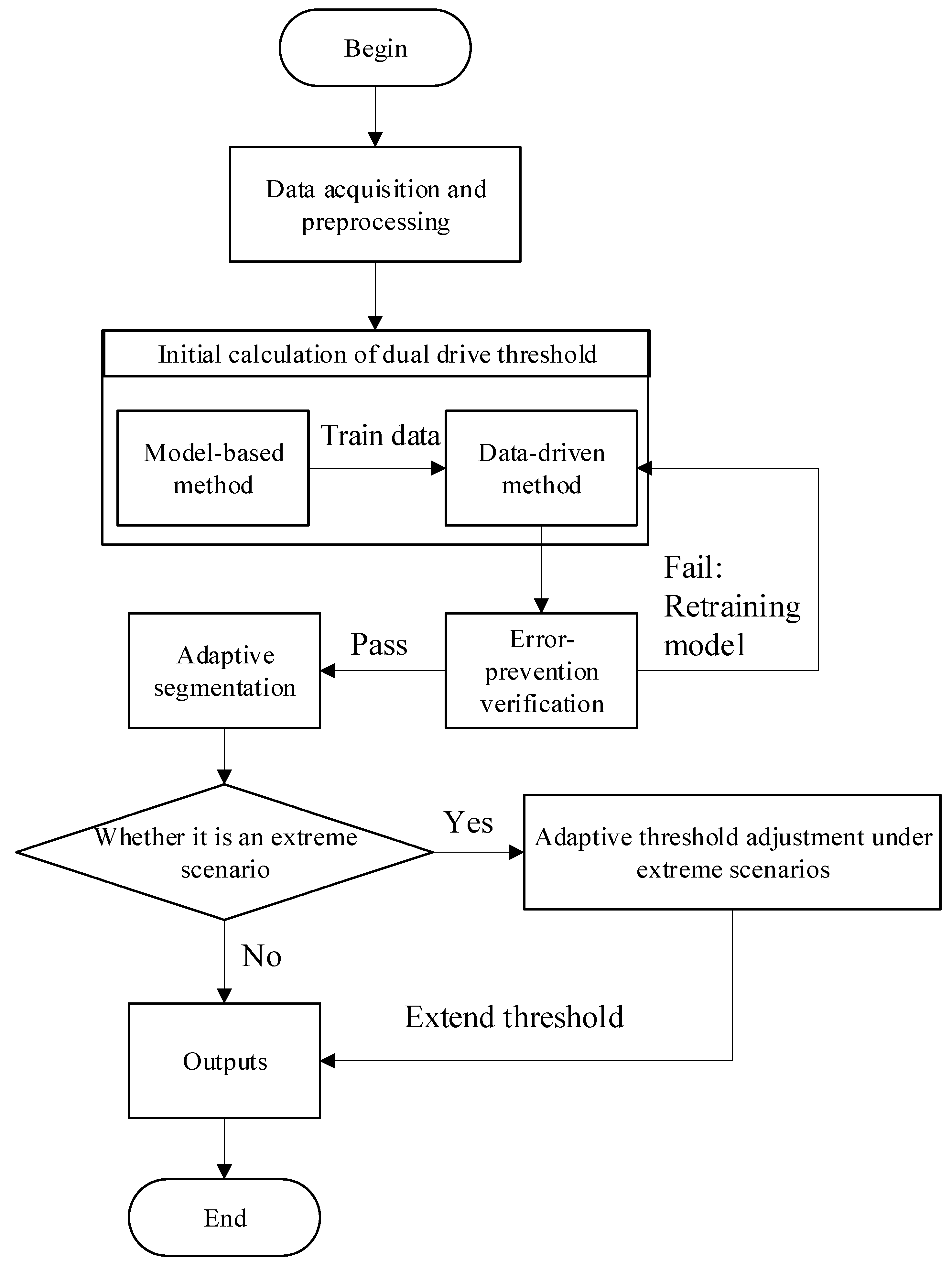
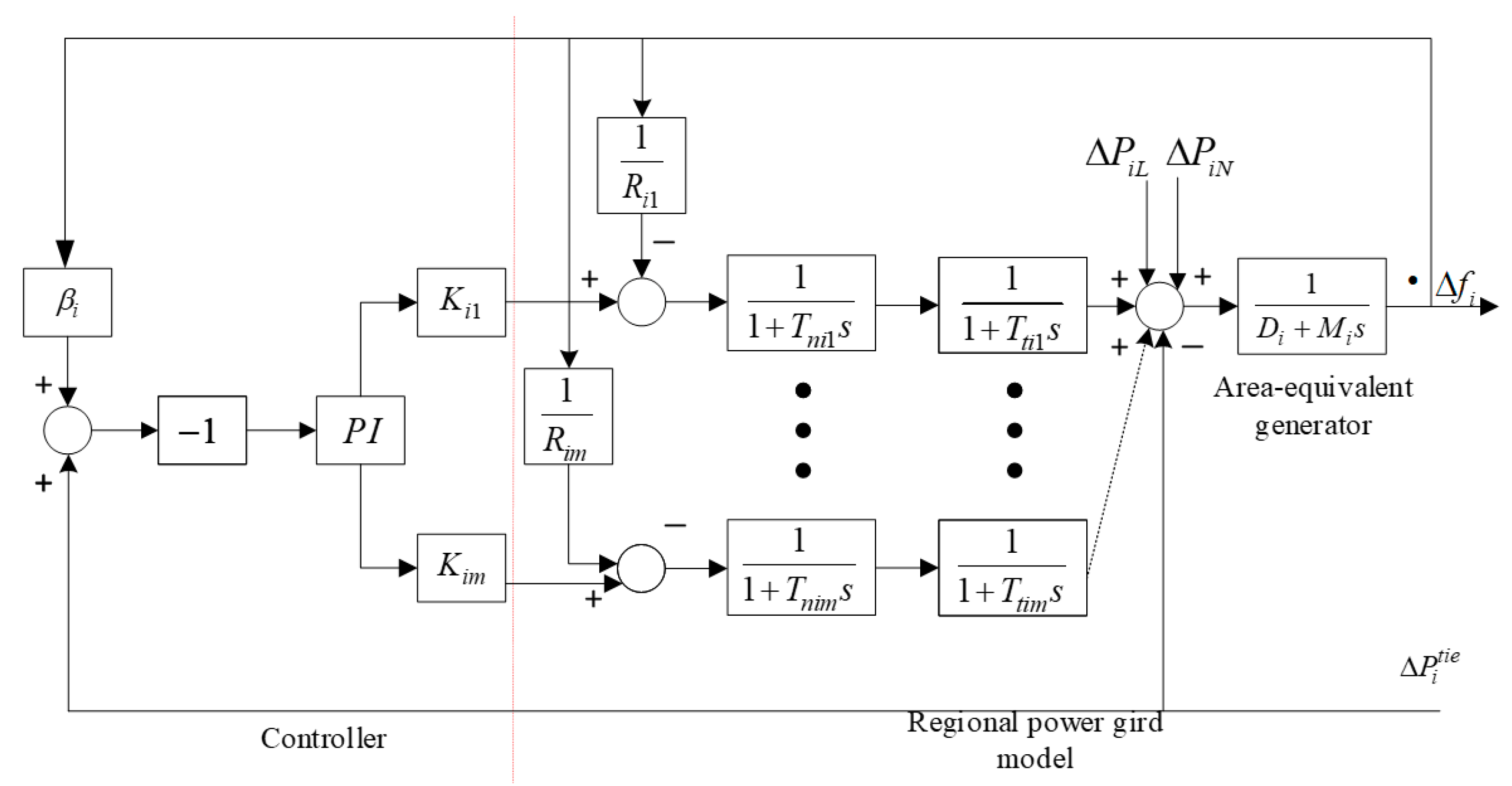
- A “data-driven dominated, model-based assisted” approach is proposed for determining the single-step allowable action threshold for renewable energy AGC. In this framework, a multi-unit AGC mechanism model is first constructed to characterize the dynamic response behaviors among multiple frequency-regulating units. The model-based approach is then utilized to generate a large number of simulation samples under diverse operating conditions, which serve as the foundational training data for the data-driven method. Using a CNN-LSTM neural network employed in the data-driven method, the proposed method is capable of determining a single-step allowable action threshold that adapts in real-time to the system operating conditions.
- (2)
- To address potential deviations and misjudgments in neural network outputs caused by limited training coverage or abnormal data, an error-prevention and verification mechanism is designed. This mechanism continuously monitors model outputs, and intercepts abnormal threshold decisions before they propagate to AGC execution. As a result, the operational safety and reliability of the control system are enhanced.Moreover, for extreme weather events (such as typhoons, sandstorms, or cold waves) or grid fault recovery scenarios, an adaptive adjustment strategy is introduced. This strategy dynamically extends the threshold boundary, ensuring that renewable energy resources can still perform fast, flexible, and effective regulation under extreme or uncertain conditions.
- (3)
- An adaptive piecewise threshold optimization method based on system state fluctuation features is further developed. This method adjusts the frequency of threshold updates according to the fluctuation characteristics of the system state. It balances threshold update frequency and dispatching flexibility. Consequently, the proposed approach not only reduces the computational and operational burden of system operators but also improves the real-time performance and robustness of renewable energy AGC systems.
2. The Introduction of Overall Framework
3. Materials and Methods
3.1. Single-Step Allowable Action Threshold Determination of Renewable Energy AGC Using Model-Based Method
3.1.1. The AGC Model of Renewable Energy
- (a)
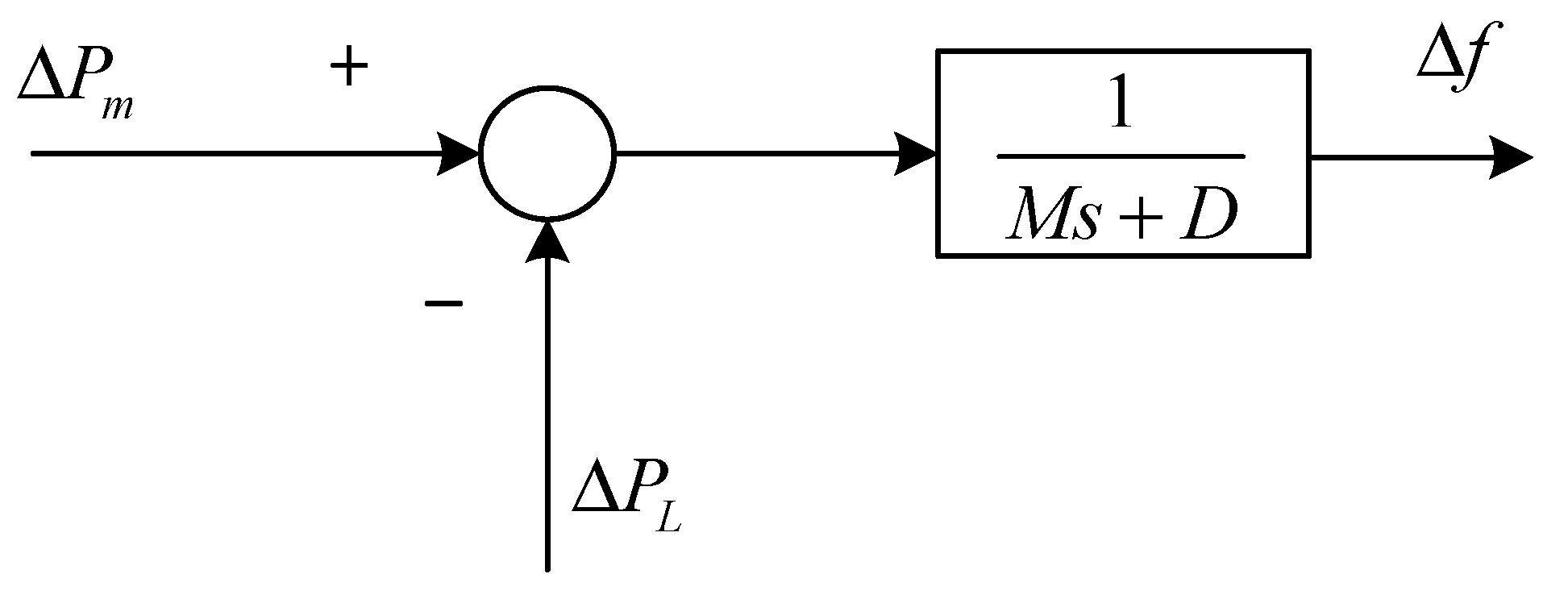
- Generator Model
- (b)
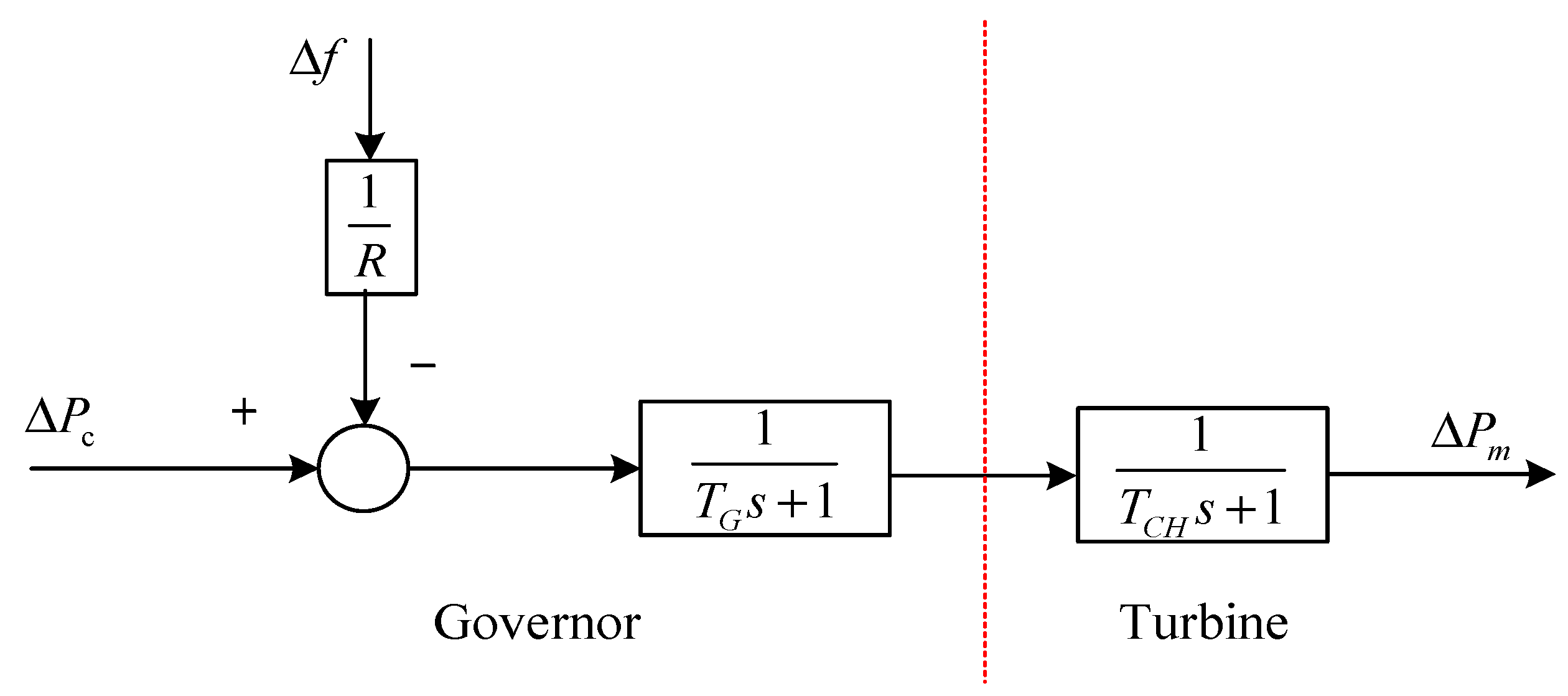
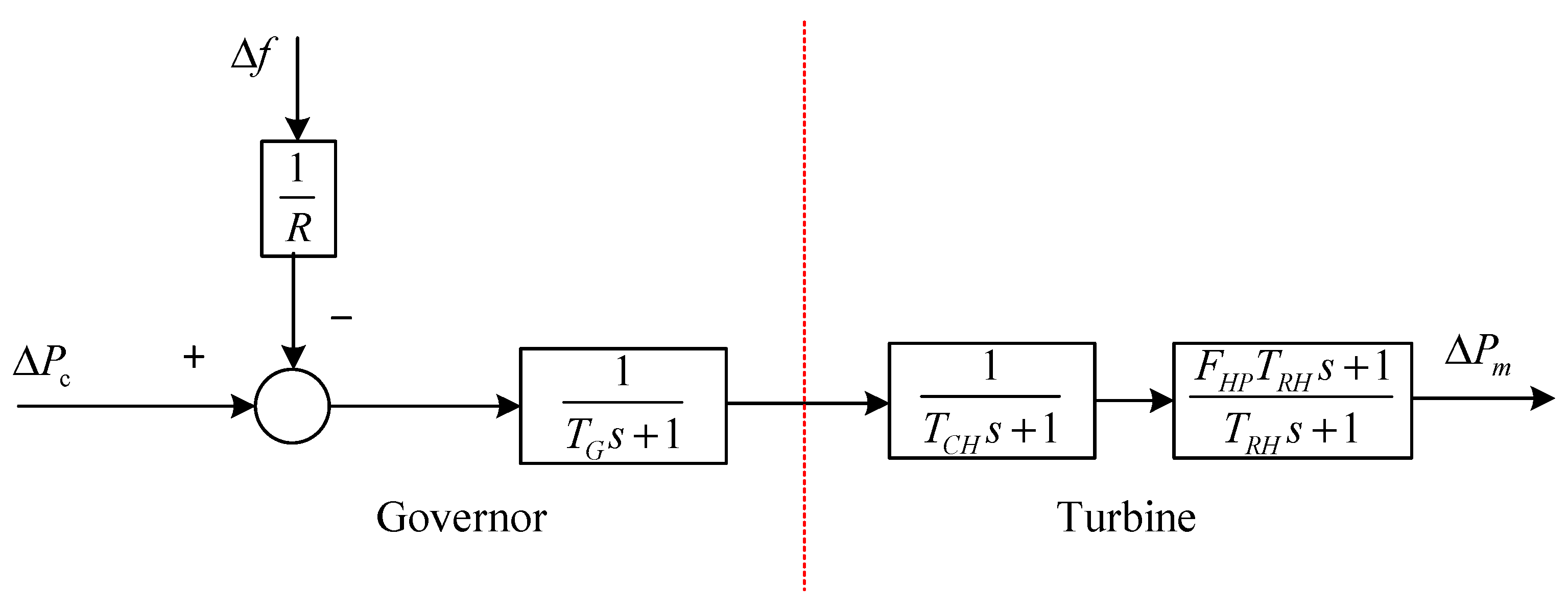
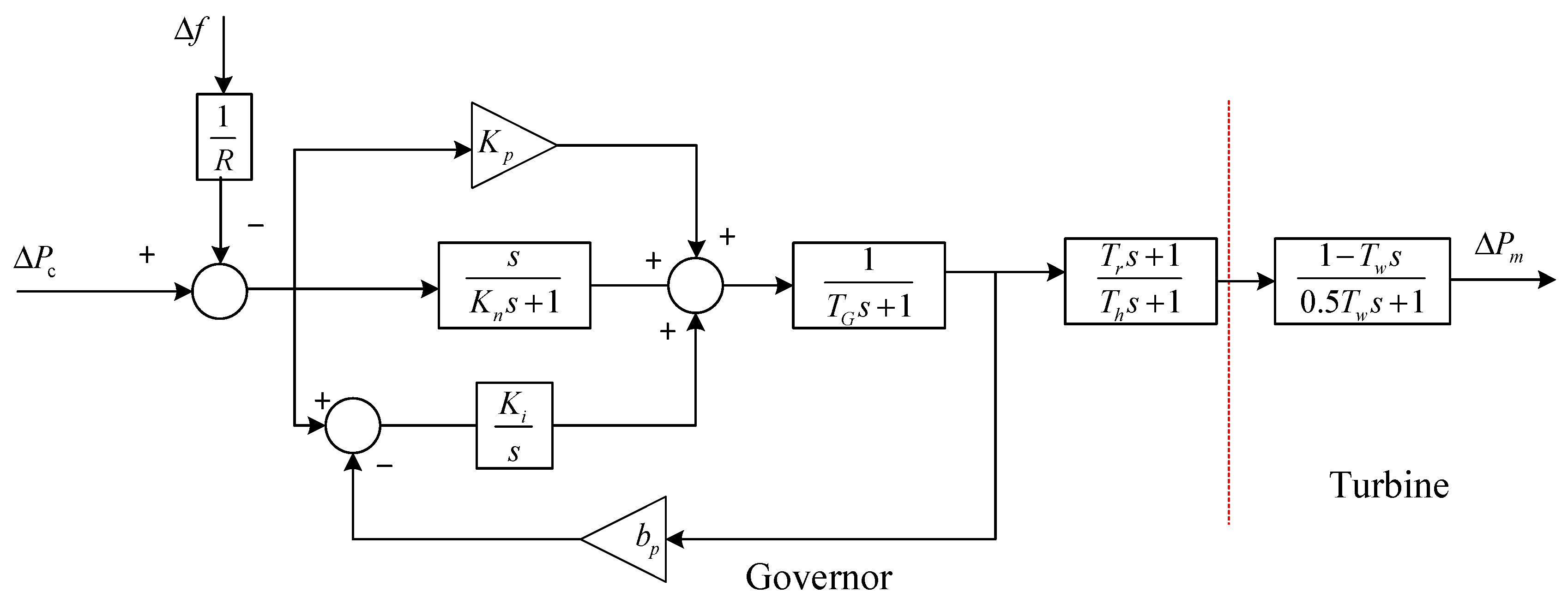
- Turbine and Governor Model
3.1.2. The Influencing Factors of Single-Step Allowable Action Threshold for Renewable Energy AGC
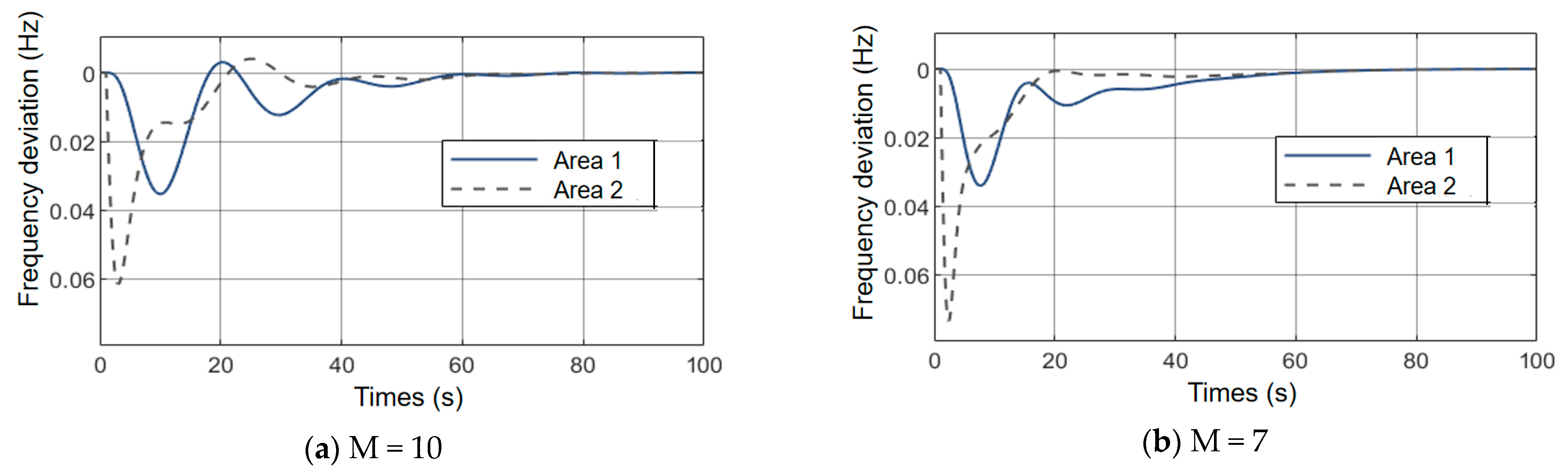
- (a)
- The Inertia of Power Grid
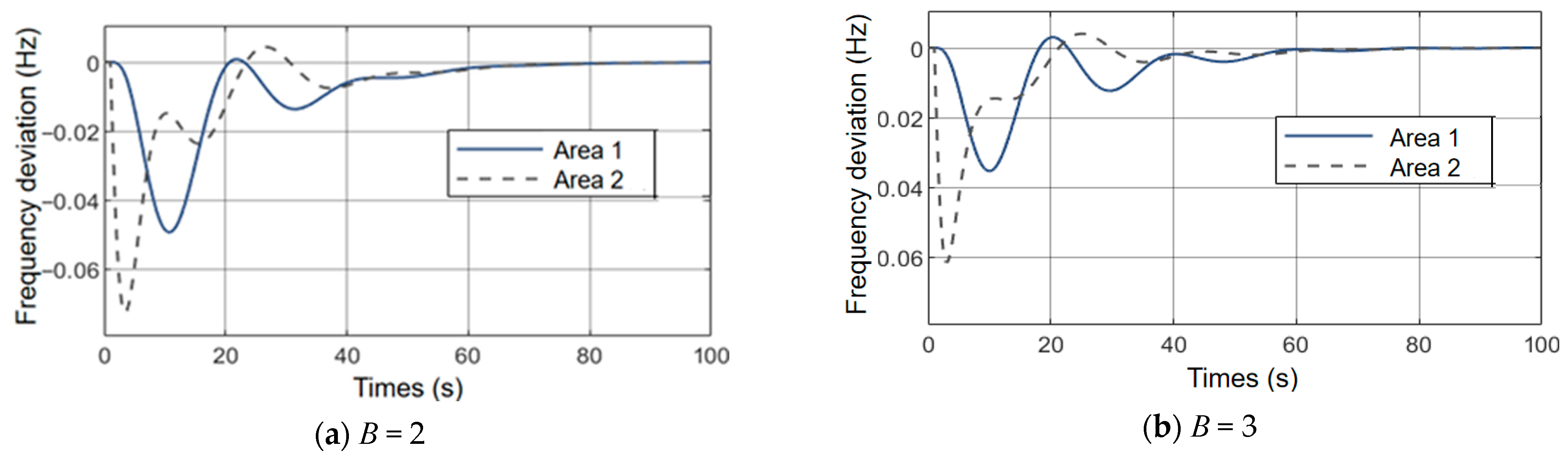
- (b)
- Frequency Bias Coefficient of Power System
- (c)
- Maximum Allowable Frequency Deviation
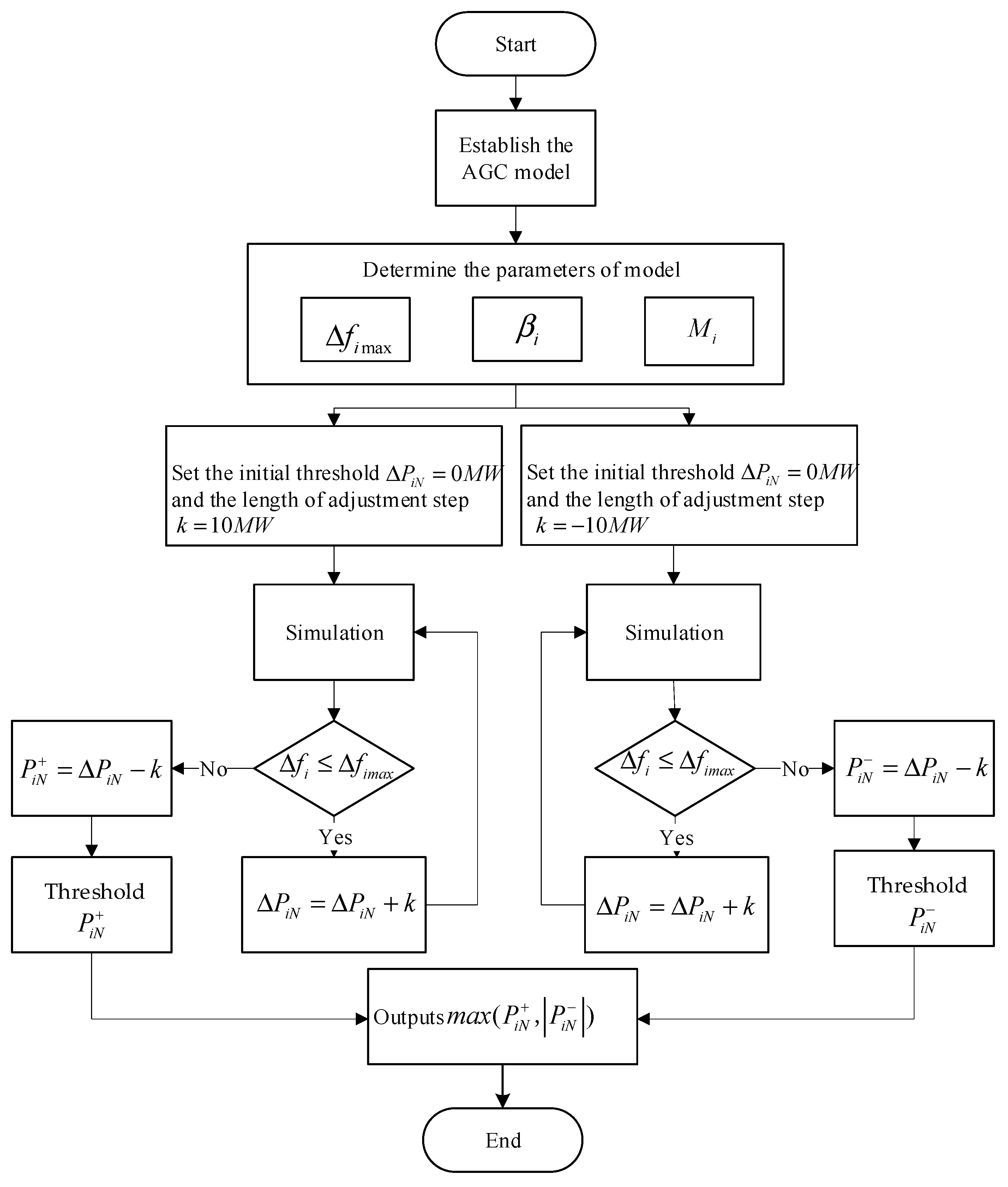
3.1.3. The Determination of a Single-Step Allowable Action Threshold Using Model-Based Method
3.2. Single-Step Allowable Action Threshold for the Determination of Renewable Energy AGC Using Data-Driven Method
3.2.1. Normalization Processing
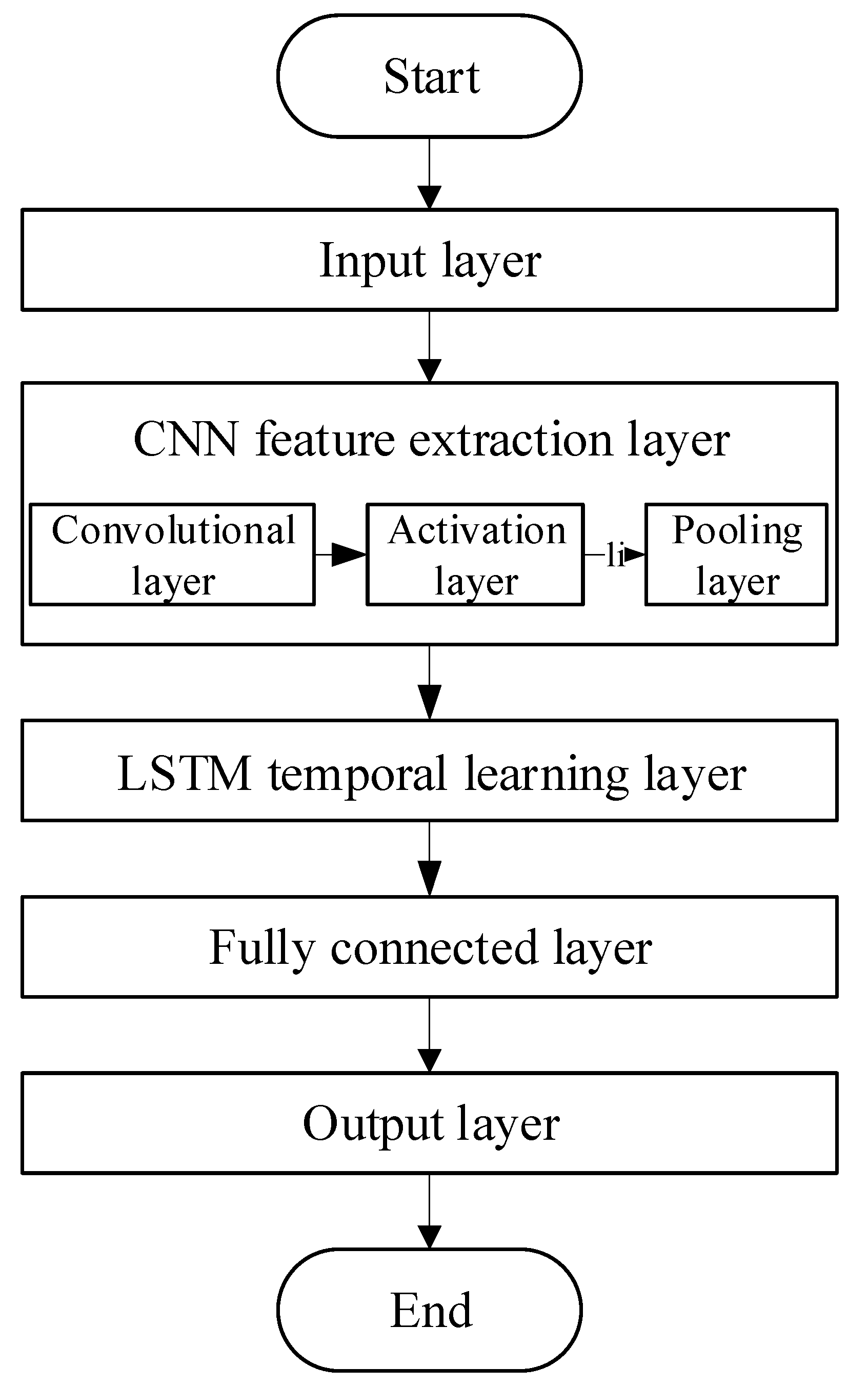
3.2.2. CNN-LSTM Model
- (a)
- Input Layer
- (b)
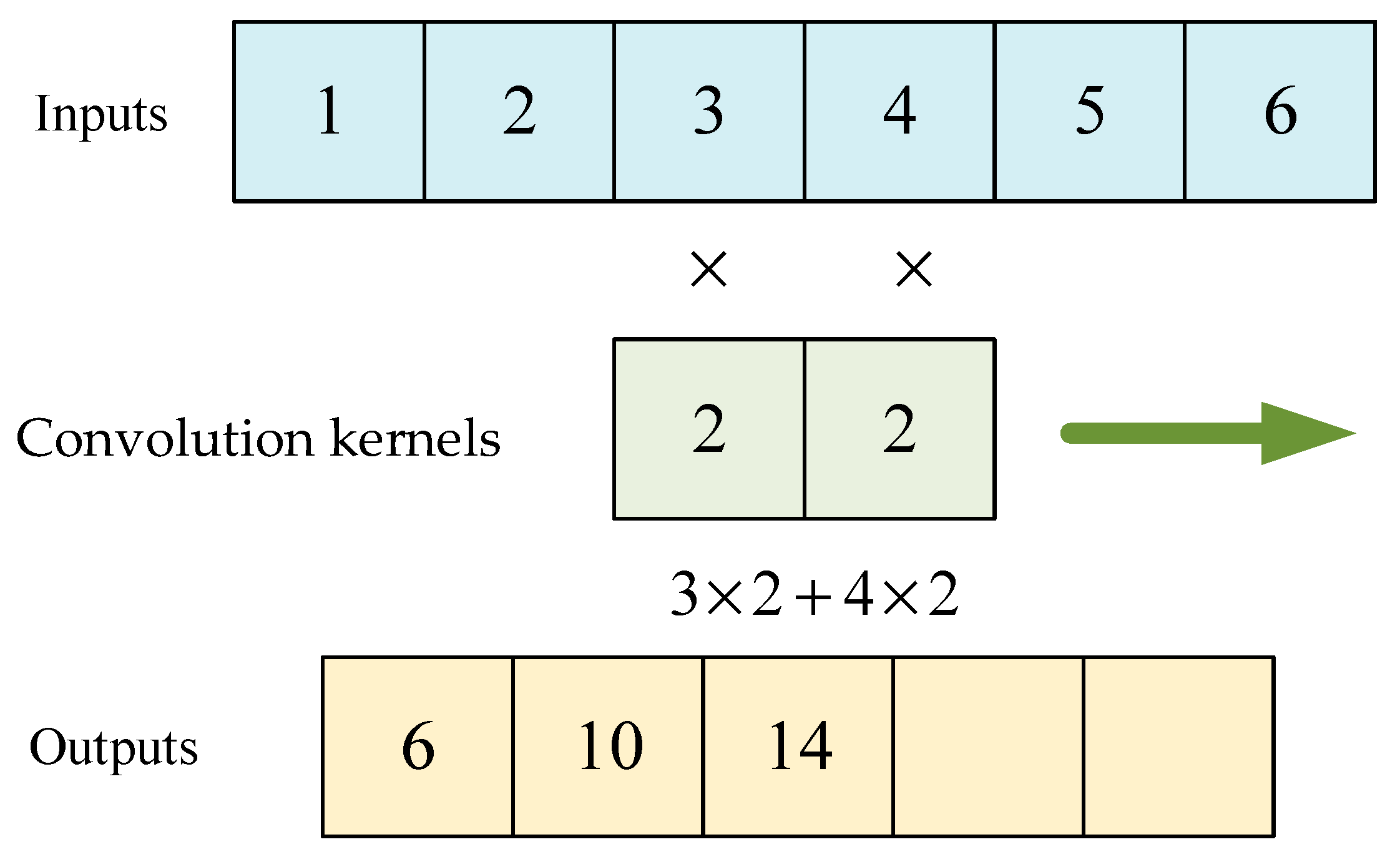
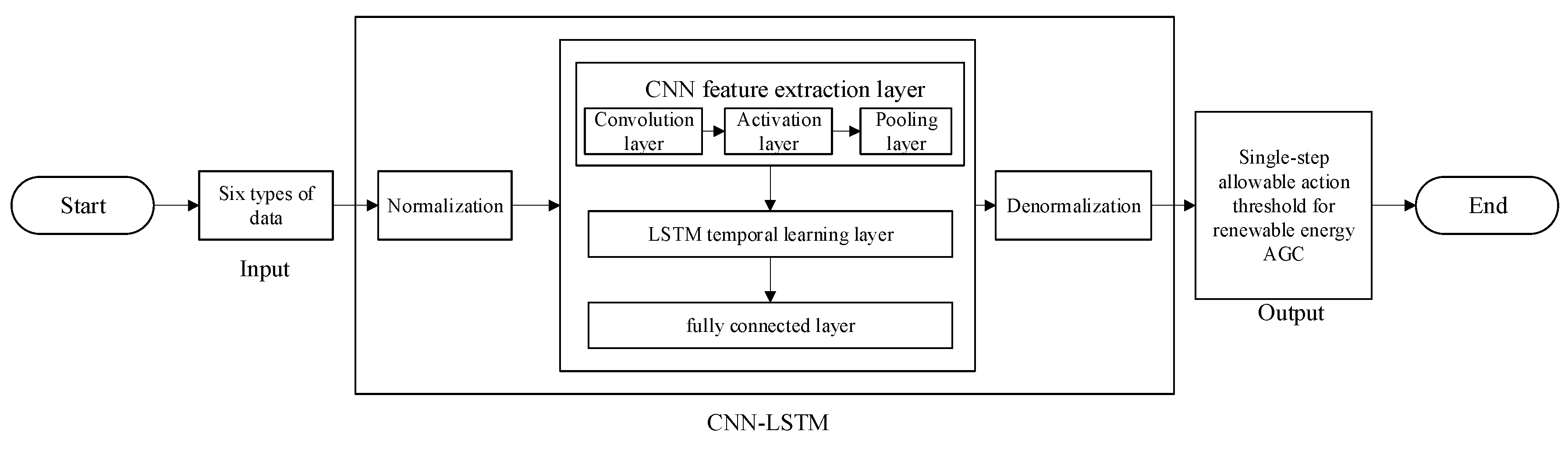
- CNN Feature Extraction Layer
- (c)
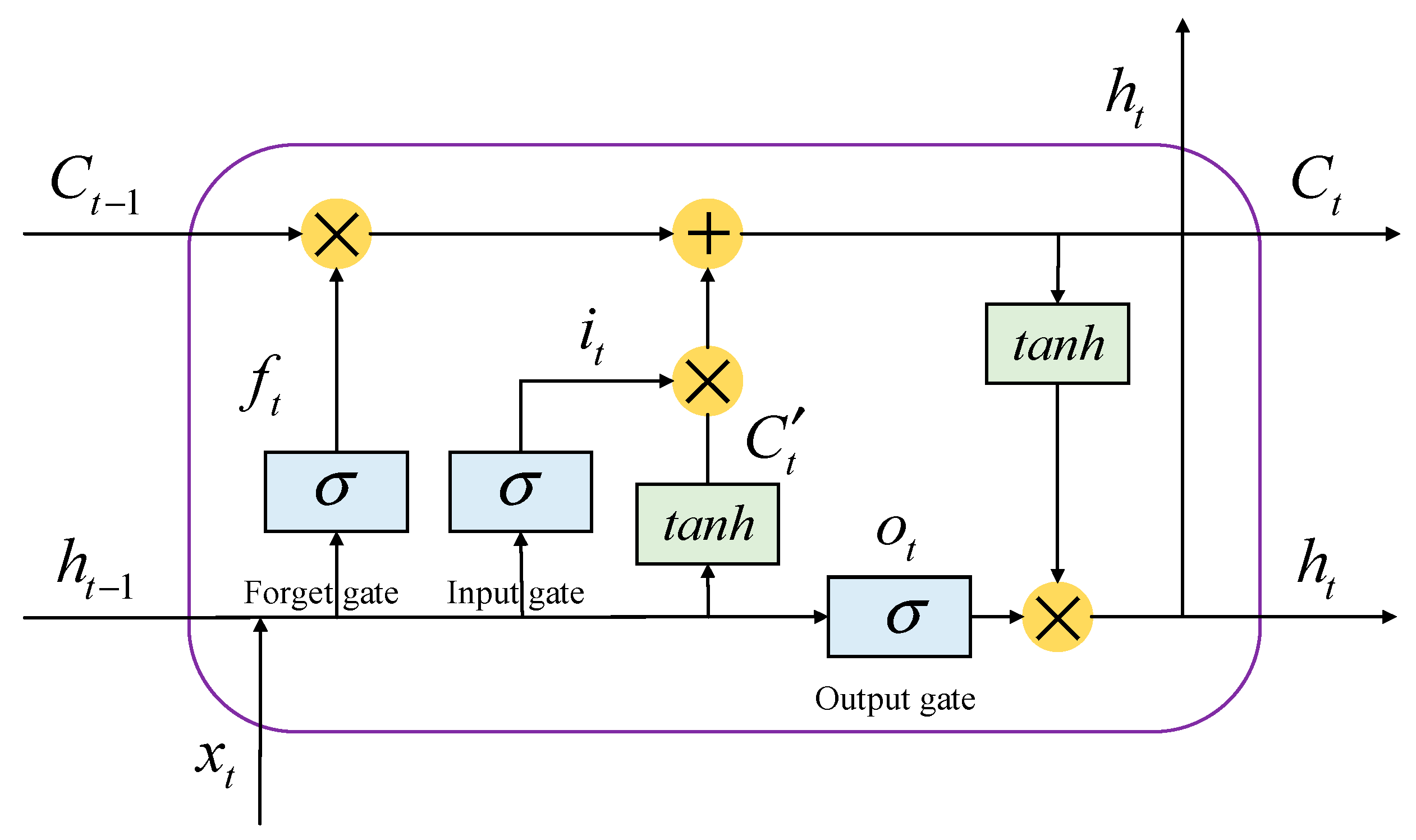
- LSTM Temporal Learning Layer
- (d)
- Fully Connected Layer
- (e)
- Output Layer
3.2.3. The Determination Method for the Single-Step Allowable Action Threshold for Renewable Energy AGC Based on CNN-LSTM
3.2.4. Error-Prevention Verification
3.3. Adaptive Threshold Optimization Method
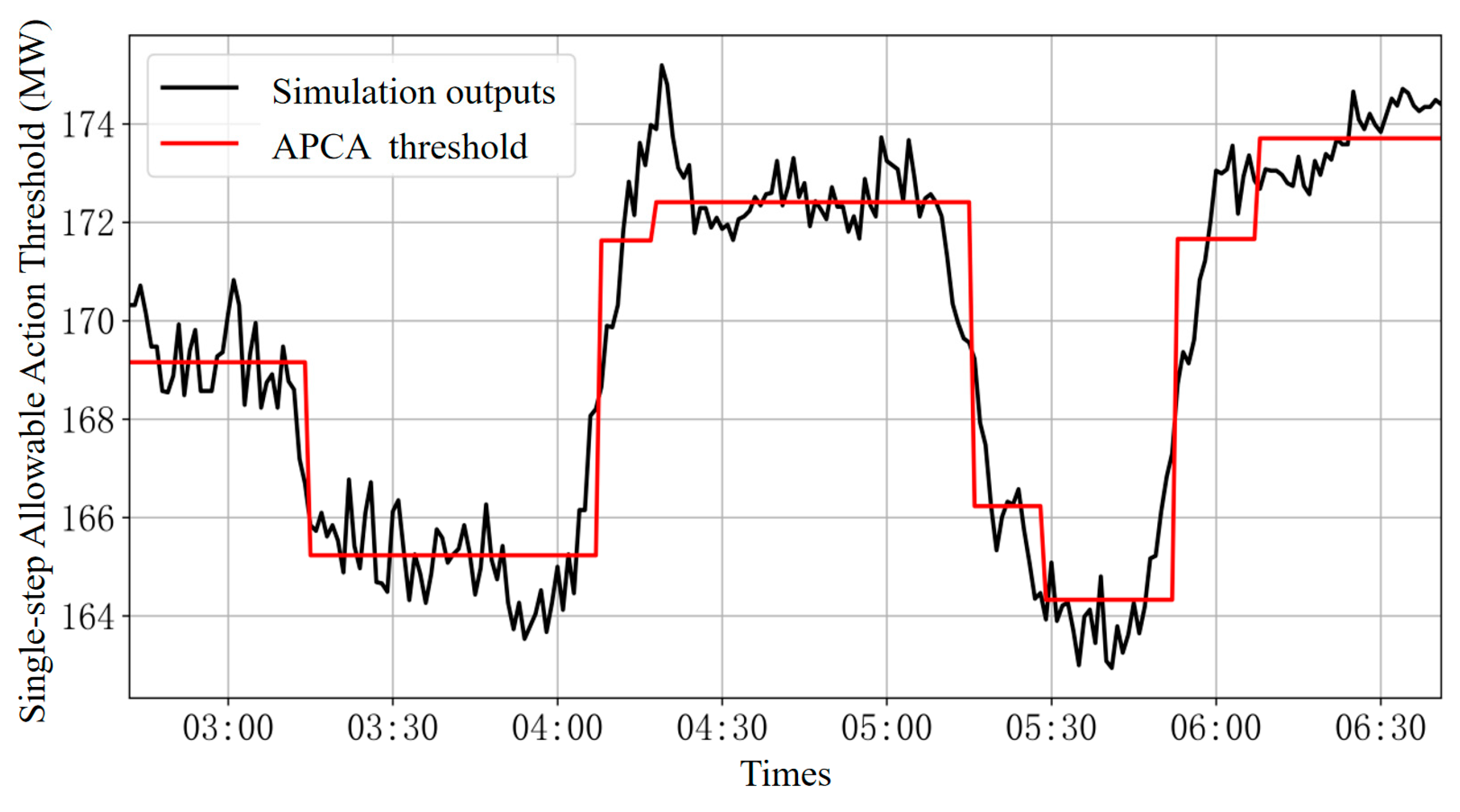
3.3.1. Adaptive Threshold Piecewise Method Based on APCA Approach
- (1)
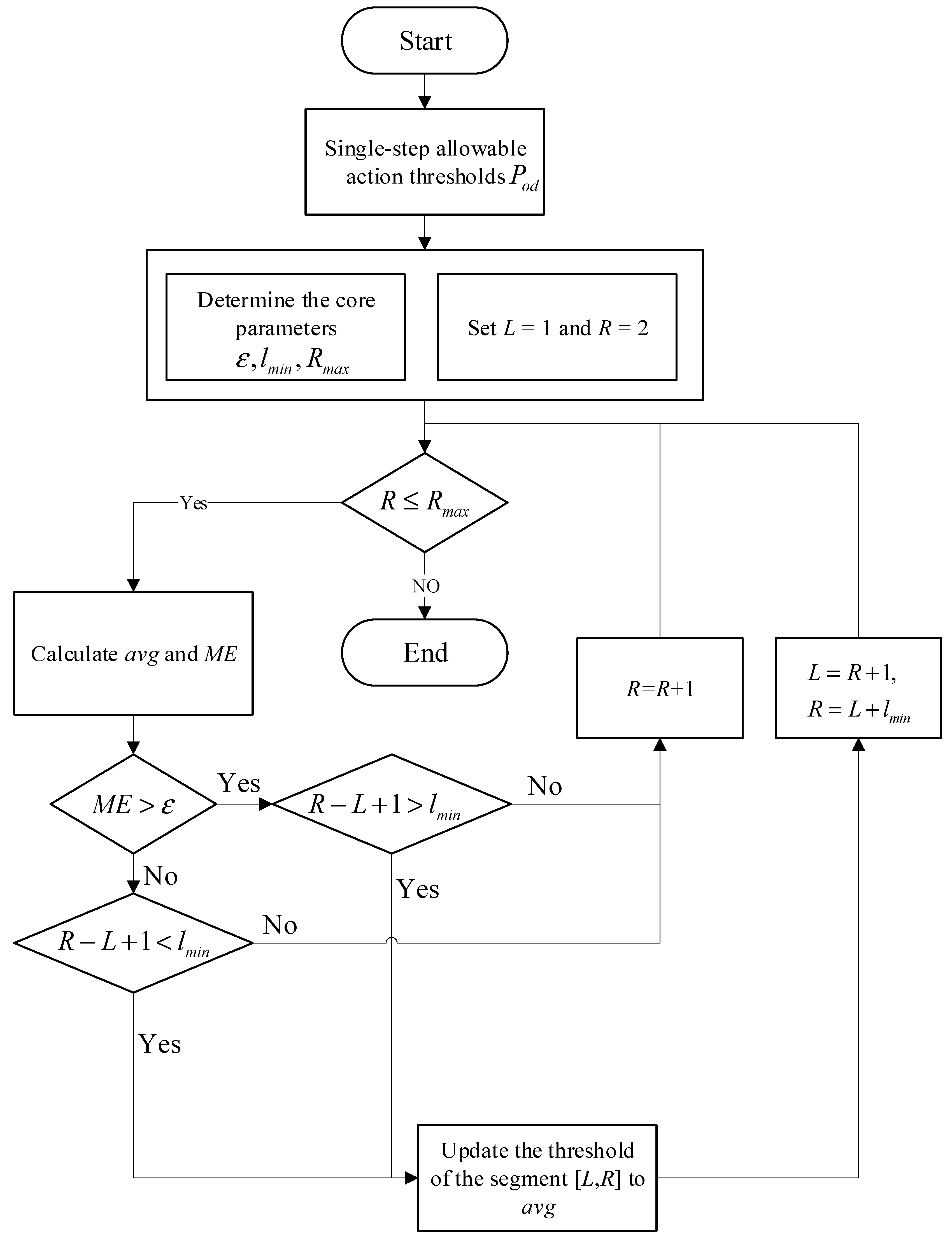
- Adaptive Piecewise Parameter Setting: The core parameters of the APCA algorithm are first determined: the maximum piecewise error threshold , which controls piecewise accuracy (smaller values indicate higher precision), and the minimum piecewise length , which defines the minimum non-update interval (e.g., 10 min means the threshold is not updated within 10 min). The input data are the time-series of the single-step allowable action thresholds obtained from Section 3.
- (2)
- APCA-Based Adaptive Piecewise Calculation: Initialize the piecewise start point and end point . Then, calculate the average value avg of within the current segment , as expressed in Equation (28):
3.3.2. Adaptive Threshold Adjustment Under Extreme Scenarios
4. Results and Discussion
4.1. Experiment Settings
4.2. The Experiment of Model-Based Method
4.2.1. Parameter Settings
4.2.2. Experimental Results and Discussion
- (1)
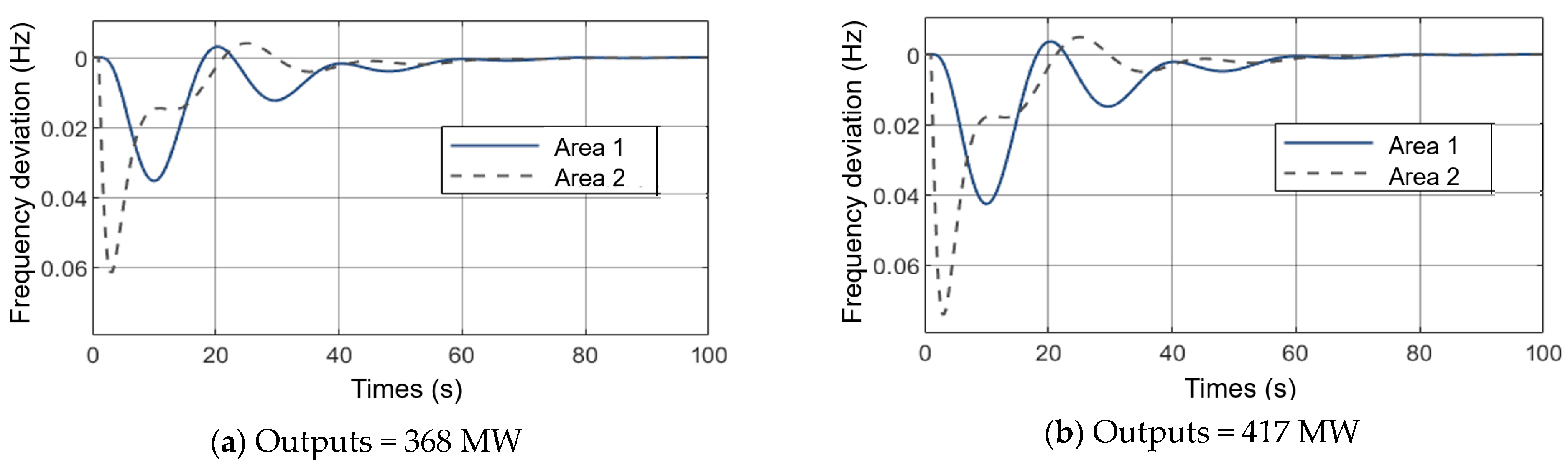
- Scenario I (the level of renewable energy penetration is 6%)
- (2)
- Scenario II (the level of renewable energy penetration is 27%)
- (3)
- Scenario III (the level of renewable energy penetration is 52%)
4.3. The Experiment of Data-Driven Method
- (1)
- Overall effectiveness of the proposed model.
- (2)
- Necessity of the CNN feature extraction layer.
- (3)
- Necessity of the LSTM temporal learning layer.
- (4)
- Verification of model rapidity.
4.4. Experiment Using the Adaptive Threshold Piecewise Method
4.5. Further Work
5. Conclusions
Author Contributions
Funding
Institutional Review Board Statement
Informed Consent Statement
Data Availability Statement
Conflicts of Interest
References
- Pal, P.; Behera, R.K.; Muduli, U.R. Eliminating current sensor dependencies in dab converters using a luenberger observer-based hybrid approach. IEEE Trans. Ind. Appl. 2024, 60, 6380–6392. [Google Scholar] [CrossRef]
- Saxena, A.; Shankar, R.; Al Zaabi, O.; Al Hosani, K.; Muduli, U.R. Fuzzy rule-based adaptive virtual inertia control for enhancing multi-region micro-grid dynamic response. In Proceedings of the 2023 IEEE IAS Global Conference on Renewable Energy and Hydrogen Technologies (GlobConHT), Malé, Maldives, 11–12 March 2023; pp. 1–6. [Google Scholar] [CrossRef]
- Saxena, A.; Shankar, R.; El-Saadany, E.F.; Kumar, M.; Al Zaabi, O.; Al Hosani, K.; Muduli, U.R. Intelligent Load Forecasting and Renewable Energy Integration for Enhanced Grid Reliability. IEEE Trans. Ind. Appl. 2024, 60, 8403–8417. [Google Scholar] [CrossRef]
- Peddakapu, K.; Mohamed, M.R.; Srinivasarao, P.; Arya, Y.; Leung, P.K.; Kishore, D.J.K. A State-of-the-Art Review on Modern and Future Developments of AGC/LFC of Conventional and Renewable Energy-Based Power Systems. Renew. Energy Focus 2022, 43, 146–171. [Google Scholar] [CrossRef]
- Xiang, M.; Yang, Z.; Yu, J. Hierarchical AGC dispatch with detailed modeling of energy storage system behaviors. IEEE Trans. Power Syst. 2023, 38, 1689–1701. [Google Scholar] [CrossRef]
- Wang, Y.; Wan, C.; Zhou, Z.; Zhang, K.; Botterud, A. Improving deployment availability of energy storage with data-driven AGC signal models. IEEE Trans. Power Syst. 2018, 33, 4207–4217. [Google Scholar] [CrossRef]
- Bevrani, H.; Hiyama, T. Intelligent Automatic Generation Control; CRC Press: New York, NY, USA, 2011. [Google Scholar] [CrossRef]
- Wu, Z.; Gao, W.; Gao, T.; Yan, W.; Zhang, H.; Yan, S.; Wang, X. State-of-the-Art Review on Frequency Response of Wind Power Plants in Power Systems. J. Mod. Power Syst. Clean Energy 2018, 6, 1–16. [Google Scholar] [CrossRef]
- Qiu, Y.; Lin, J.; Liu, F.; Dai, N.; Song, Y. Continuous Random Process Modeling of AGC Signals Based on Stochastic Differential Equations. IEEE Trans. Power Syst. 2021, 36, 4575–4587. [Google Scholar] [CrossRef]
- Xi, L.; Yu, L.; Xu, Y.; Wang, S.; Chen, X. A Novel Multi-Agent DDQN-AD Method-Based Distributed Strategy for Automatic Generation Control of Integrated Energy Systems. IEEE Trans. Sustain. Energy 2019, 11, 2417–2426. [Google Scholar] [CrossRef]
- Xu, Y.; Parisio, A.; Li, Z.; Dong, Z.; Ding, Z. Optimization-Based Ramping Reserve Allocation of BESS for AGC Enhancement. IEEE Trans. Power Syst. 2023, 39, 2491–2505. [Google Scholar] [CrossRef]
- Ondar, A.M.; Tremyasov, V.A.; Kenden, K.V. Analyzing the Risk Management of Renewable Energy Use. In Proceedings of the 2025 International Conference on Industrial Engineering, Applications and Manufacturing (ICIEAM), Sochi, Russian, 24 August 2025; pp. 183–187. [Google Scholar] [CrossRef]
- Spain Blackout Reveals Limits of Renewable Solar and Wind Energy. Available online: https://www.independent.co.uk/climate-change/news/spain-blackout-renewable-energy-solar-wind-b2742000.html (accessed on 20 October 2025).
- 2025 Iberian Peninsula Blackout. Available online: https://en.wikipedia.org/wiki/2025_Iberian_Peninsula_blackout#cite_note-ferris-9 (accessed on 20 October 2025).
- Du, F.; Zhang, M.; Zhu, K.; Jiang, D. Error Prevention Adaptive Optimization Model for Power Dispatch under Time Redundancy Control. Electr. Eng. 2024, 106, 7579–7586. [Google Scholar] [CrossRef]
- Taheri, B.; Safdarian, A.; Moeini-Aghtaie, M.; Lehtonen, M. Enhancing Resilience Level of Power Distribution Systems Using Proactive Operational Actions. IEEE Access 2019, 7, 137378–137389. [Google Scholar] [CrossRef]
- Zhukabayeva, T.; Pervez, A.; Mardenov, Y.; Othman, M.; Karabayev, N.; Ahmad, Z. A Traffic Analysis and Node Categorization-Aware Machine Learning-Integrated Framework for Cybersecurity Intrusion Detection and Prevention of WSNs in Smart Grids. IEEE Access 2024, 12, 91715–91733. [Google Scholar] [CrossRef]
- Hussain, F.; Abbas, G.S.; Pires, I.M.; Tanveer, S.; Fayyaz, U.U.; Garcia, N.M.; Shah, G.A.; Shahzad, F. A Two-Fold Machine Learning Approach to Prevent and Detect IoT Botnet Attacks. IEEE Access 2021, 9, 163412–163430. [Google Scholar] [CrossRef]
- Laghari, S.U.A.; Manickam, S.; Al-Ani, A.K.; Rehman, S.U.; Karuppayah, S. SECS/GEMsec: A Mechanism for Detection and Prevention of Cyber-Attacks on SECS/GEM Communications in Industry 4.0 Landscape. IEEE Access 2021, 9, 154380–154394. [Google Scholar] [CrossRef]
- Zhang, Q.; Li, F.; Zhao, J.; She, B. False Data Injection Attack and Corresponding Countermeasure in Multienergy Systems. IEEE Trans. Power Syst. 2024, 39, 3537–3547. [Google Scholar] [CrossRef]
- Kuang, M.; Tian, Y.; Liu, Q.; Zhao, M.; Wu, X. A Review of Control Strategies for Automatic Generation Control in Power Systems with Renewable Energy. Prog. Energy 2024, 6, 022001. [Google Scholar] [CrossRef]
- Liu, D.; Wu, Y.; Kang, Y.; Li, C.; Ji, X.; Zhang, X. Graph Convolution Network for Real-Time AGC Dispatch with High-Penetration Renewable Energy. CSEE J. Power Energy Syst. 2023, 1–11. [Google Scholar] [CrossRef]
- Debbarma, L.; Debbarma, S.; Roy, K.; Roy, S.D.; Singh, P.P. Joint Contribution of RTEM and AGC System for Frequency Stabilisation in Renewable Energy Integrated Power System. IET Energy Syst. Integr. 2024, 6, 498–511. [Google Scholar] [CrossRef]
- Hossain, R.R.; Yin, T.; Du, Y.; Huang, R.; Tan, J.; Yu, W.; Liu, Y.; Huang, Q. Efficient Learning of Power Grid Voltage Control Strategies via Model-Based Deep Reinforcement Learning. Mach. Learn. 2024, 113, 2675–2700. [Google Scholar] [CrossRef]
- Han, D.; Ma, J.; He, R.M.; Dong, Z.Y. A Real Application of Measurement-Based Load Modeling in Large-Scale Power Grids and Its Validation. IEEE Trans. Power Syst. 2009, 24, 1756–1764. [Google Scholar] [CrossRef]
- Mortazavian, S.; Mohamed, Y.A.R.I. Analysis and Augmented Model-Based Control Design of Distributed Generation Converters with a Flexible Grid-Support Controller. IEEE Trans. Power Electron. 2018, 34, 6369–6387. [Google Scholar] [CrossRef]
- Yang, Y.; Yang, Z.; Yu, J.; Zhang, B.; Zhang, Y.; Yu, H. Fast Calculation of Probabilistic Power Flow: A Model-Based Deep Learning Approach. IEEE Trans. Smart Grid 2019, 11, 2235–2244. [Google Scholar] [CrossRef]
- Strielkowski, W.; Vlasov, A.; Selivanov, K.; Muraviev, K.; Shakhnov, V. Prospects and Challenges of the Machine Learning and Data-Driven Methods for the Predictive Analysis of Power Systems: A Review. Energies 2023, 16, 4025. [Google Scholar] [CrossRef]
- Weng, Y.; Negi, R.; Faloutsos, C.; Ilić, M.D. Robust Data-Driven State Estimation for Smart Grid. IEEE Trans. Smart Grid 2016, 8, 1956–1967. [Google Scholar] [CrossRef]
- Oh, S.; Kong, J.; Choi, M.; Jung, J. Data-Driven Prediction Method for Power Grid State Subjected to Heavy-Rain Hazards. Appl. Sci. 2020, 10, 4693. [Google Scholar] [CrossRef]
- Jaleeli, N.; VanSlyck, L.S.; Ewart, D.N.; Fink, L.H.; Hoffmann, A.G. Understanding Automatic Generation Control. IEEE Trans. Power Syst. 1992, 7, 1106–1122. [Google Scholar] [CrossRef]
- Muduli, R.; Jena, D.; Moger, T. Application of Reinforcement Learning-Based Adaptive PID Controller for Automatic Generation Control of Multi-Area Power System. IEEE Trans. Autom. Sci. Eng. 2025, 22, 1057–1068. [Google Scholar] [CrossRef]
- Chen, X.; Lin, J.; Liu, F.; Song, Y. Stochastic assessment of AGC systems under non-Gaussian uncertainty. IEEE Trans. Power Syst. 2018, 34, 705–717. [Google Scholar] [CrossRef]
- Zhang, Y.; Yu, Y.; Zhang, Y.; Chen, B.; Liu, Z. Frequency Regulation Performance of a Wind–Energy Storage Hybrid System During Turbine Shutdown Due to Extreme Wind. Processes 2025, 13, 3383. [Google Scholar] [CrossRef]
- Zhang, C.; Yang, M.; Li, J. Detailed modelling and parameters optimisation analysis on governing system of hydro-turbine generator unit. IET Gener. Transm. Distrib. 2018, 12, 1045–1051. [Google Scholar] [CrossRef]
- Li, Q.; Ren, B.; Tang, W.; Wang, D.; Wang, C.; Lv, Z. Analyzing the inertia of power grid systems comprising diverse conventional and renewable energy sources. Energy Rep. 2022, 8, 15095–15105. [Google Scholar] [CrossRef]
- Tielens, P.; Van Hertem, D. Grid inertia and frequency control in power systems with high penetration of renewables. In Proceedings of the Young Researchers Symposium in Electrical Power Engineering, Delft, The Netherlands, 16–17 April 2012. [Google Scholar]
- Smahi, A.; Makhloufi, S. The Power Grid Inertia with High Renewable Energy Sources Integration: A Comprehensive Review. J. Eng. 2025, 2025, 7975311. [Google Scholar] [CrossRef]
- Yan, Z.; Xu, Y. A Multi-Agent Deep Reinforcement Learning Method for Cooperative Load Frequency Control of a Multi-Area Power System. IEEE Trans. Power Syst. 2020, 35, 4599–4608. [Google Scholar] [CrossRef]
- Rubasinghe; Zhang, X.; Chau, T.K.; Chow, Y.H.; Fernando, T.; Iu, H.H.-C. A novel sequence-to-sequence data modelling based CNN–LSTM algorithm for three years ahead monthly peak load forecasting. IEEE Trans. Power Syst. 2024, 39, 1932–1947. [Google Scholar] [CrossRef]
- Yang, Z.; Peng, X.; Song, J.; Duan, R.; Jiang, Y.; Liu, S. Short-term wind power prediction based on multi-parameters similarity wind process matching and weighed-voting-based deep learning model selection. IEEE Trans. Power Syst. 2024, 39, 2129–2142. [Google Scholar] [CrossRef]
- Abedinia, O.; Ghasemi-Marzbali, A.; Shafiei, M.; Sobhani, B.; Gharehpetian, G.B.; Bagheri, M. Wind power forecasting enhancement utilizing adaptive quantile function and CNN–LSTM: A probabilistic approach. IEEE Trans. Ind. 2024, 60, 4446–4457. [Google Scholar] [CrossRef]
- Sadaeim, H.; Silva, P.; Guimaraes, F.; Lee, M. Short-Term Load Forecasting by Using a Combined Method of Convolutional Neural Networks and Fuzzy Time Series. Energy 2019, 175, 365–377. [Google Scholar] [CrossRef]
- Li, Z.; Liu, F.; Yang, W.; Peng, S.; Zhou, J. A Survey of Convolutional Neural Networks: Analysis, Applications, and Prospects. IEEE Trans. Neural Netw. Learn. Syst. 2022, 33, 6999–7019. [Google Scholar] [CrossRef]
- Wen, S.; Wang, Y.; Tang, Y.; Xu, Y.; Li, P.; Zhao, T. Real-Time Identification of Power Fluctuations Based on LSTM Recurrent Neural Network: A Case Study on Singapore Power System. IEEE Trans. Ind. Inform. 2019, 15, 5266–5275. [Google Scholar] [CrossRef]
- Belagoune, S.; Bali, N.; Bakdi, A.; Baadji, B.; Atif, K. Deep Learning Through LSTM Classification and Regression for Transmission Line Fault Detection, Diagnosis and Location in Large-Scale Multi-Machine Power Systems. Measurement 2021, 177, 109330. [Google Scholar] [CrossRef]
- Eldar, Y.C.; Ben-Tal, A.; Nemirovski, A. Robust Mean-Squared Error Estimation in the Presence of Model Uncertainties. IEEE Trans. Signal Process. 2004, 53, 168–181. [Google Scholar] [CrossRef]
- Hodson, T.O.; Over, T.M.; Foks, S.S. Mean Squared Error, Deconstructed. J. Adv. Model. Earth Syst. 2021, 13, e2021MS002681. [Google Scholar] [CrossRef]
- Robeson, S.M.; Willmott, C.J. Decomposition of the Mean Absolute Error (MAE) into Systematic and Unsystematic Components. PLoS ONE 2023, 18, e0279774. [Google Scholar] [CrossRef]
- Keogh, E.; Chakrabarti, K.; Pazzani, M.; Mehrotra, S. Locally adaptive dimensionality reduction for indexing large time series databases. In Proceedings of the 2001 ACM SIGMOD International Conference on Management of Data, Santa Barbara, CA, USA, 21–24 May 2001; pp. 151–162. [Google Scholar] [CrossRef]
- Ren, H.; Liao, X.; Li, Z.; Al-Ahmari, A. Anomaly Detection Using Piecewise Aggregate Approximation in the Amplitude Domain. Appl. Intell. 2018, 48, 1097–1110. [Google Scholar] [CrossRef]
- Kondapally, M.; Kumar, K.N.; Vishnu, C.; Mohan, C.K. Towards a Transitional Weather Scene Recognition Approach for Autonomous Vehicles. IEEE Trans. Intell. Transp. Syst. 2023, 25, 5201–5210. [Google Scholar] [CrossRef]
- Wang, S.; Yao, S.; Niu, K.; Dong, C.; Qin, C.; Zhuang, H. Intelligent Scene Recognition Based on Deep Learning. IEEE Access 2021, 9, 24984–24993. [Google Scholar] [CrossRef]
- Xu, A.; Cong, W.; Qiu, J.; Yang, T.; Wei, Z.; Peng, B. Early Warning Method of Power Grid Meteorological Disasters Based on Scene Recognition. In Proceedings of the 2020 IEEE/IAS Industrial and Commercial Power System Asia (I&CPS Asia), Beijing, China, 20–23 July 2020; pp. 1087–1092. [Google Scholar] [CrossRef]
- Wang, W.; He, L.; Markham, P.; Qi, H.; Liu, Y.; Cao, Q.C.; Tolbert, L.M. Multiple Event Detection and Recognition Through Sparse Unmixing for High-Resolution Situational Awareness in Power Grid. IEEE Trans. Smart Grid 2017, 5, 1654–1664. [Google Scholar] [CrossRef]
- Bi, J.; Zhang, X.; Yuan, H.; Zhang, J.; Zhou, M. A Hybrid Prediction Method for Realistic Network Traffic with Temporal Convolutional Network and LSTM. IEEE Trans. Autom. Sci. Eng. 2021, 19, 1869–1879. [Google Scholar] [CrossRef]
- Zeng, J.; Chen, K.S.; Bi, H.; Chen, Q. A Preliminary Evaluation of the SMAP Radiometer Soil Moisture Product over United States and Europe Using Ground-Based Measurements. IEEE Trans. Geosci. Remote Sens. 2016, 54, 4929–4940. [Google Scholar] [CrossRef]
- Qi, M.; Zhang, G.P. Trend Time–Series Modeling and Forecasting with Neural Networks. IEEE Trans. Neural Netw. Learn. Syst. 2008, 19, 808–816. [Google Scholar] [CrossRef]
- Hodson, T.O. Root Mean Square Error (RMSE) or Mean Absolute Error (MAE): When to Use Them or Not. Geosci. Model Dev. Discuss. 2022, 15, 5481–5487. [Google Scholar] [CrossRef]
- Hedyehzadeh, M.; Maghooli, K.; MomenGharibvand, M.; Pistorius, S. A Comparison of the Efficiency of Using a Deep CNN Approach with Other Common Regression Methods for the Prediction of EGFR Expression in Glioblastoma Patients. J. Digit. Imaging 2020, 33, 391–398. [Google Scholar] [CrossRef] [PubMed]
- Mehtab, S.; Sen, J.; Dutta, A. Stock Price Prediction Using Machine Learning and LSTM-Based Deep Learning Models. In Proceedings of the Symposium on Machine Learning and Metaheuristics Algorithms, and Applications, Singapore, 1–3 October 2020; pp. 88–106. [Google Scholar] [CrossRef]
- Vastl, M.; Kulhánek, J.; Kubalík, J.; Derner, E.; Babuška, R. Symformer: End-to-End Symbolic Regression Using Transformer-Based Architecture. IEEE Access 2024, 12, 37840–37849. [Google Scholar] [CrossRef]
- Yulianto, F.; Mahmudy, W.F.; Soebroto, A.A. Comparison of Regression, Support Vector Regression (SVR), and SVR-Particle Swarm Optimization (PSO) for Rainfall Forecasting. J. Inf. Technol. Comput. Sci. 2020, 5, 235–247. [Google Scholar] [CrossRef]



| Title 1 | Title 2 |
|---|---|
| i | The i-th area |
| Total load deviation of area i | |
| Single-step renewable energy AGC command deviation of area i | |
| Simulated frequency deviation of area i | |
| Frequency deviation coefficient of area i | |
| PI | Proportional–Integral (PI) controller |
| Allocation coefficients of the PI controller for units 1 to m in area i | |
| Primary frequency regulation models of units 1 to m in area i | |
| Total inertia of area i | |
| Maximum allowable frequency deviation of area i | |
| Tie-line power exchange deviation | |
| Load damping coefficient of area i | |
| , | Model of the first generating unit in area i |
| , | Model of the m-th generating unit in area i |
| Generator model of area i |
| Times | Wind Generation Output (MW) | Photovoltaic Generation Output (MW) | Thermal Generation Output (MW) | Hydro-Generation Output (MW) | System Load (MW) | Inertia (104 kg·m2) |
|---|---|---|---|---|---|---|
| 10:39 | 3661 | 6217 | 21,017 | 654 | 33,581 | 128 |
| 10:40 | 3658 | 6273 | 21,053 | 651 | 33,721 | 128 |
| 10:41 | 3665 | 6271 | 21,073 | 652 | 33,841 | 128 |
| 10:42 | 3654 | 6240 | 21,101 | 651 | 33,702 | 128 |
| 10:43 | 3642 | 6232 | 21,061 | 654 | 33,631 | 128 |
| 10:44 | 3660 | 6234 | 21,049 | 652 | 33,547 | 128 |
| 10:45 | 3667 | 6259 | 21,023 | 654 | 33,687 | 128 |
| 10:46 | 3674 | 6255 | 20,974 | 653 | 33,530 | 128 |
| Parameters | Value |
|---|---|
| 1 | |
| 2.4 | |
| 0.2 | |
| 0.3 | |
| 0.25 | |
| 10 | |
| 5.6 | |
| 0.28 | |
| 1.2 | |
| 5 | |
| 28.75 | |
| 1 | |
| 0.06 |
| Parameters | RMSE | MAE |
|---|---|---|
| CNN | 30.23 | 27.42 |
| LSTM | 9.12 | 7.33 |
| Transformer | 10.16 | 8.03 |
| SVR | 47.68 | 38.32 |
| The model proposed in this study | 4.09 | 3.18 |
| Model-Based Approach Runtime | CNN-LSTM Runtime (ms) |
|---|---|
| 8866 | 23 |
| Method | RMSE | CR |
|---|---|---|
| APCA | 2.60 | 48.00 |
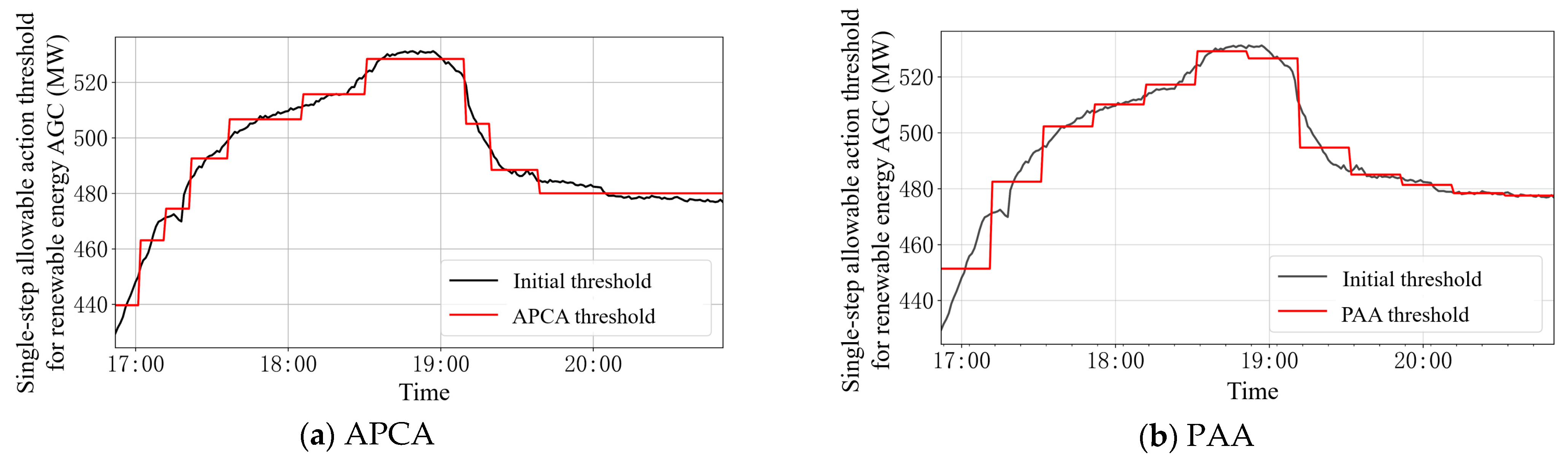
| PAA | 2.98 | 20.00 |
Disclaimer/Publisher’s Note: The statements, opinions and data contained in all publications are solely those of the individual author(s) and contributor(s) and not of MDPI and/or the editor(s). MDPI and/or the editor(s) disclaim responsibility for any injury to people or property resulting from any ideas, methods, instructions or products referred to in the content. |
© 2025 by the authors. Licensee MDPI, Basel, Switzerland. This article is an open access article distributed under the terms and conditions of the Creative Commons Attribution (CC BY) license (https://creativecommons.org/licenses/by/4.0/).
Share and Cite
Wang, Z.; Xue, G.; Song, Y.; Liu, R.; Chang, G.; Wu, P.; Zhang, K. Single-Step Allowable Action Threshold Determination of Renewable Energy Automatic Generation Control Using Model-Based and Data-Driven Method. Appl. Sci. 2025, 15, 12408. https://doi.org/10.3390/app152312408
Wang Z, Xue G, Song Y, Liu R, Chang G, Wu P, Zhang K. Single-Step Allowable Action Threshold Determination of Renewable Energy Automatic Generation Control Using Model-Based and Data-Driven Method. Applied Sciences. 2025; 15(23):12408. https://doi.org/10.3390/app152312408
Chicago/Turabian StyleWang, Ziqi, Gaichao Xue, Yanlou Song, Renkai Liu, Guanghui Chang, Po Wu, and Kaifeng Zhang. 2025. "Single-Step Allowable Action Threshold Determination of Renewable Energy Automatic Generation Control Using Model-Based and Data-Driven Method" Applied Sciences 15, no. 23: 12408. https://doi.org/10.3390/app152312408
APA StyleWang, Z., Xue, G., Song, Y., Liu, R., Chang, G., Wu, P., & Zhang, K. (2025). Single-Step Allowable Action Threshold Determination of Renewable Energy Automatic Generation Control Using Model-Based and Data-Driven Method. Applied Sciences, 15(23), 12408. https://doi.org/10.3390/app152312408