Article

Numerical Study of the Filtration Performance for Electrospun Nanofiber Membranes

School of Energy and Environment, Anhui University of Technology, Ma’anshan 243032, China
*
Author to whom correspondence should be addressed.
Appl. Sci. 2025, 15(15), 8667; https://doi.org/10.3390/app15158667
Submission received: 17 June 2025 / Revised: 17 July 2025 / Accepted: 1 August 2025 / Published: 5 August 2025

Abstract

To solve the limitations of these models for submicron materials like electrospun nanofiber membranes, a numerical simulation was used to construct a three-dimensional model closer to the actual structure to explore the filtration resistance and efficiency of these membranes. Based on the actual polydisperse electrospun nanofiber filter, the three-dimensional structure (fiber diameter 280 nm–1300 nm, thickness 0.0150 mm–0.0240 mm, and solid volume fraction 11.3–17.7%) was reconstructed by GeoDict software. The filtration resistance was simulated with the FlowDict module (surface velocity 6.89 cm/s, 20 °C), and the filtration efficiency was calculated with the FilterDict module (2.5 μm particles, tracking 20,000). The results are compared with the experimental values, Davids empirical formula, Happel model, and Kuwabara model. The results show that the simulated values of filtration resistance are generally higher than the experimental values (deviation ≤ 20%), among which the simulation and experiment have the highest consistency, followed by the Davids formula (such as the relative error of 41.62% at 9% spinning solution concentration), and the Kuwabara model has the largest error (59.86%). The simulated value of filtration efficiency is higher than the experimental value (deviation ≤ 7%), because the model assumes that the particles adhere directly after contacting the fiber, and the actual sliding off is not considered. This study confirms that numerical simulation can efficiently predict the filtration performance of electrospun nanofiber membranes. Therefore, it provides a basis for optimizing material structure by adjusting spinning parameters and promoting the engineering application of submicron filter materials.

1. Introduction

With the acceleration of industrialization and the continuous growth of urban populations, air pollution is becoming more and more serious. Atmospheric particulate matter (PM) is considered to be harmful to health [1], especially fine particulate matter (PM2.5) in the air, which poses a huge threat to human health [2,3,4]. When humans inhale air, they also inhale the particulate matter in it. After these particles enter the respiratory system, they diffuse into the blood vessels, causing damage to the cardiovascular system and inflicting significant harm on the human body [5,6,7]. Due to its small particle size, difficulty in sedimentation, and strong penetrability, it is challenging to control. Among various treatment methods, filtration technology has received widespread attention because of its advantages such as simple operation, wide application, and low energy consumption [8,9]. In recent years, electrospinning technology has gained extensive attention and application in the field of air filtration because it can be used to prepare nanofiber membranes with a high specific surface area and high porosity.
However, traditional experimental methods have problems such as a high cost and long cycle in studying the filtration performance of nanofiber membranes. As an efficient research method, numerical simulation can predict and analyze the filtration performance under different conditions in a short time so as to guide the actual production design. Shu et al. [10] used OpenForm to numerically simulate the gas–solid flow characteristics of particles in fiber media and revealed the influencing mechanism of fiber structure on airflow distribution and particle trajectory. This study provides a theoretical basis for understanding the gas–solid two-phase flow of traditional fiber filter media, but it is mainly aimed at the conventional fiber arrangement structure and has not yet involved the special pore structure of submicron nanofiber membranes.
Electrospinning, as a novel nanofiber preparation method, shows great potential in air filtration due to its advantages of simple operation, low cost, and controllable fiber morphology. The technology relies on an electrostatic interaction to prepare fibers: during the process, polymer solutions or melts are extruded and subjected to a high-voltage electric field [11,12,13], forming a cone-shaped jet that stretches into filaments with nano-scale diameters [14,15]. Electrospun nanofiber membranes exhibit significant advantages in high-efficiency and low-resistance filtration, including porous structures, high specific surface areas, and multifunctional fiber surfaces—properties that make them ideal for capturing fine particulate matter. Relevant studies have demonstrated their applications in oil–water separation [16], nanofiltration [17], and pressure drop prediction [18], further confirming their versatility. They concluded that the pressure drop prediction model incorporating the air slip effect reduces the relative error to less than 8% for nanofibers with diameters ≤ 500 nm, providing a more accurate prediction method for nanofiber filter design.
This study is based on the actual polydisperse electrospun nanofiber filter materials. Starting from the determination of the structural parameters of the electrospun nanofiber filter materials, the three-dimensional structure of the electrospun nanofiber membrane is reconstructed using the GeoDict simulation software to establish a three-dimensional model that is closer to the structure of the actual filter material. Numerical simulations are carried out on the filtration resistance and filtration efficiency of the corresponding model. The correlation between the experimental results and the simulation results of the electrospun nanofiber membrane is fully compared, and the applicability of the numerical models for nanofiber membrane structure and performance prediction in evaluating the filtration efficiency of electrospun nanofibers is systematically investigated.

2. Numerical Simulation Method

2.1. Introduction to Simulation Software

The GeoDict software used in this study is a professional numerical simulation tool for porous media and fiber materials developed by Math2Market GmbH, Germany (version number: GeoDict 2023.1). Its core functions include three-dimensional structure reconstruction, flow field simulation, and filtration performance prediction. Filtration performance refers to the comprehensive evaluation of the filter medium’s ability to capture particles, including filtration efficiency, pressure drop, dust holding capacity, etc. It is widely used in academic research and industrial design in the fields of filter materials, battery electrodes, and porous membranes. The FiberGeo, FlowDict, and FilterDict modules of the software are all built-in toolboxes: FiberGeo is used to construct the three-dimensional structure of virtual fiber materials, FlowDict focuses on fluid flow and resistance simulation, and FilterDict focuses on the numerical calculation of particle filtration efficiency. The three work together to support the whole process analysis from material modeling to performance prediction.

2.2. Theoretical Basis of Numerical Simulation

2.2.1. Gas Control Equation

When using the FlowDict module of GeoDict to simulate the flow field of the electrospun nanofiber membrane, only the fluid passes through the fibrous membrane without carrying particles. It is assumed that the fluid is in a stationary state, that is, the state of the fluid will not change with time. At this time, the partial differential equations to be solved will not involve the time derivative. In the GeoDict software, the geometric structure of an object is obtained through the analytical calculation of the grid, namely the voxel. In the content of this study, the geometric morphology of the pores inside the fiber filter medium is represented by analyzing the calculation grid. This means that the pore space and the solid material are decomposed into numerous voxels together.
When conducting the flow simulation of the electrospun nanofiber membrane, it is assumed that the fluid passing through the nanofiber filter material is a viscous, incompressible, and steady-state fluid. Then, the mass conservation equation describing the fluid flow is shown in Equation (1) as follows:
u = 0
In the equation, u is the velocity vector, m/s.
The flow of the fluid in the pores is described by the Navier–Stokes (momentum conservation equation) equation, as shown in Equation (2) below:
μ Δ u + ρ ( u ) u + p = f
In the equation, μ is the dynamic viscosity, Pa·s; ρ is the fluid density, kg/m3; p is the pressure, Pa; and f is the external force acting on the fluid, Pa.
In the fibrous filter medium, the flow usually exhibits a slow and laminar state, and there is no external force acting, i.e., f = 0 . Therefore, the Navier–Stokes equation can be simplified to the Stokes equation to describe this situation, as shown in Equation (3) below:
p = μ Δ u
For the flow simulation of electrospun nanofiber membranes, the no-slip boundary condition was applied at the fiber surfaces. This means that the velocity of the fluid at the fiber surface is equal to the velocity of the fiber itself (zero velocity since the fibers are stationary), which is consistent with the continuum flow assumption for air at the given operating conditions (face velocity = 6.89 cm/s, ambient pressure). The Knudsen number (Kn) for the airflow in this study was calculated to be approximately 0.001, which is much smaller than 0.01. This confirms the validity of the no-slip condition according to the continuum flow theory (Kn < 0.01 indicates a continuum flow regime where the no-slip condition is applicable).

2.2.2. Pressure Drop Analysis Model

Darcy’s law describes the pressure drop △P along the thickness of δ as an incompressible fluid passing through a porous medium under static and laminar flow conditions, as shown in Equation (4):
Δ P = 1 k μ v δ
In the equation, k is the fiber permeability coefficient (m2); μ is the dynamic viscosity, Pa s; and v is the fluid surface velocity, defined as the volumetric flow rate per unit cross-sectional area of the filter, m/s.
For fibrous media, the fiber permeability coefficient is affected by the solid volume fraction, fiber size, shape, and their arrangement. When the fibers exhibit a unimodal distribution, it can be assumed that the fiber permeability coefficient k is a function of the solid volume fraction s and the fiber radius β in the medium, as shown in Equation (5):
k = β 2 f ( s )
For fibrous media with high porosity, Davies proposed an empirical expression for f(s) [19], which is the dimensionless permeability, as shown in Equation (6). The empirical expression of f(s) is based on experimental data of gas flow (specifically air) in high-porosity fiber media. The experiments focused on measuring pressure drops across various fibrous filters under different flow rates, which were then correlated with the solid volume fraction to develop the dimensionless permeability function. The original experiments were conducted with airflows at low to moderate velocities (0.1–10 cm/s) through glass fiber and cotton fiber media with porosities ranging from 0.85 to 0.99. The derived expression has been widely validated for gas filtration applications and is particularly suitable for the nanofiber membranes in this study (porosity > 0.95).
f ( s ) = 1 16 s 3 2 ( 1 + 56 s 3 )
In the Happel model [20] and the Kuwabara model [21], the calculation formulas for the fiber permeability coefficient k are as follows: Equation (7), Happel model; Equation (8), Kuwabara model.
k = β 2 ( 0.5 1 2 ln s ) 4 s  Happel model
k = β 2 ( 0.75 1 2 ln s ) 4 s  Kuwabara model
The three permeability models have specific applicability ranges and characteristics.
Davies model [19]: Applicable for solid volume fraction (s) < 0.2, derived from airflow experiments in high-porosity fibrous media. It assumes random fiber distribution and ignores fiber interactions.
Happel model [20]: Valid for s < 0.1. Theoretically, permeability becomes zero at s = 0.367, but practical application is limited to s < 0.1 to avoid significant errors.
Kuwabara model [21]: Suitable for s < 0.15. It exhibits zero permeability at s = 0.223 but is only reliable for dilute fiber systems (s < 0.15).
All samples in this study have s = 11.3–17.7% (Table 1), approaching the upper limits of the models, leading to deviations between calculations and experiments.
When using the GeoDict software to solve the fluid flow control equations, the built-in LIR (Left–Identify–Right) solver is adopted. The numerical calculation convergence is evaluated based on the residual. A residual less than 0.001 is set as the standard for the convergence of the simulation calculation.
The calculation direction of the flow field is set along the Z-axis, that is, along the thickness direction of the electrospun nanofiber filter material. Meanwhile, periodic boundary conditions are used to simulate the behavior of the fluid in the flow direction and tangential direction.
To ensure the representativeness of the selected computational domain, the Brinkman screening length is introduced. It is determined by the square root of the permeability and used as a qualitative criterion. According to the research results of Clague and Phillips [22], to prevent the closure of material channels and eliminate local inhomogeneities, the width of the computational domain should be at least 14 times the Brinkman characteristic length (i.e., the fiber diameter).
In the thickness direction (Z-axis), empty voxels (air-filled regions) are added at the inlet and outlet of the numerical model. The number of empty voxels increases with the fiber diameter (e.g., 500 voxels for 280 nm fibers, 800 for 1300 nm fibers) to ensure stable flow field development before the fluid enters the fibrous region. At this time, the width of the computational domain is more than 20 times the Brinkman screening length to avoid the influence of material channel closure and flow field disturbances on the results. In addition, appropriately increasing the number of empty voxels helps to save memory when dealing with the computational domain and ensures that the calculation time is within a reasonable range. “Empty voxels” are air-filled regions added at the inlet and outlet along the thickness (Z-axis). The number varies with fiber diameter (e.g., 500 voxels for 280 nm fibers, 800 for 1300 nm) to ensure: (1) flow field development before entering fibrous regions; (2) accurate pressure drop measurement without boundary interference.
When simulating the filtration resistance of the electrospun nanofiber filter media, the following physical parameters were selected: the face velocity is set to 6.89 cm/s, the temperature is set to 20 °C, and the density and viscosity of air are set to 1.204 kg/m3 and 1.834 × 10⁻⁵ kg/(m·s), respectively.

2.2.3. Particle Control Equations

When evaluating the initial filtration efficiency of electrospun nanofiber filter materials under steady-state conditions, the FilterDict module was used for numerical simulation. The simulation of filtration efficiency in the GeoDict software(GeoDict 2023.1) mainly involves different capture mechanisms when particles pass through the filter medium, such as interception and inertial collision, as well as the interactions between particles and fibers.
The behavior of electrospun nanofiber filter materials capturing particulate matter from the airflow is actually a comprehensive problem involving gas–solid two-phase flow and dust particle adhesion. Therefore, when conducting numerical simulations to predict filtration efficiency, it is crucial to analyze the various forces acting on the particulate matter in the airflow passing through the fibers.
Based on the forces acting on the particles in the flow field, the following equation representing particle motion can be established [23]. By solving the following equation, relevant information such as the particle position can be obtained.
W t = m d u p d t 6 π μ R C c ( u u p )
D = k B T γ
In the equation, m is the mass of the particle, kg; v is the velocity of the particle, m/s; μ is the dynamic viscosity, Pa s; R is the diameter of the particle, m; Cc is the Cunningham correction coefficient; u is the gas velocity, m/s; and where W(t) is the Brownian force vector, which is a function of time t, representing the random force exerted by fluid molecules on particles due to Brownian motion. kB is the Boltzmann constant, J/K; T is the temperature, K; and γ is the friction factor.
When numerically simulating the motion of particles, the Lagrangian method is adopted. Meanwhile, to ensure consistency with the experimental conditions for the preparation of electrospun nanofiber membranes [24], the same flow field settings are maintained in the numerical simulation of the filtration efficiency in this work. Filtration efficiency is defined as the ratio of the number of particles captured by the filter medium to the total number of particles entering the filter medium, usually expressed as a percentage [25]. The consistent flow field settings include the following: face velocity = 6.89 cm/s; temperature = 20 °C; air density = 1.204 kg/m3; dynamic viscosity = 1.834 × 10⁻⁵ kg/(m·s); no-slip boundary at fiber surfaces; and periodic boundaries in X/Y directions. During the simulation, the distance from the centroid of the particle to the surface of the fiber is tracked in real time. If this distance is less than or equal to the radius of the particle, the particle is determined to be captured. This model is called the “Caught on first touch” model in the GeoDict software. The FilterDict module is used for numerical simulation. In the numerical calculation, the surface flow velocity is set to 6.89 cm/s, the particle diameter is 2.5 μm, the density of the particles is 2165 kg/m3, and the total number of particles tracked is 20,000 to ensure consistency with the experimental conditions for the preparation of electrospun nanofiber membranes [24]. The 20,000 particles (2.5 μm diameter) are injected into the computational domain (2000 × 2000 × thickness voxels, 25 nm/voxel), corresponding to the experimental concentration (100 mg/m3) to ensure statistical significance in efficiency calculation.

2.3. Construction of the Numerical Model

GeoDict software has a number of mature applications in the study of filter materials. For example, Clague and Phillips [22] used this software to simulate the hydraulic permeability of disordered fibrous media and verified the consistency between the numerical model and the experimental results. You et al. [26] constructed a glass fiber filter material model through the FiberGeo module and analyzed the influence of structural parameters on the filtration resistance in combination with the FlowDict module. In addition, in the field of nanofiber membranes, the FilterDict module of the software has been used to predict the filtration efficiency under different particle diameters. The deviation between the simulation results and the experimental results can be controlled within 10% (similar to the deviation range of this study), which proves its reliability in academic research.

2.3.1. Obtaining the Simulation Parameters of the Fiber Filtration Medium

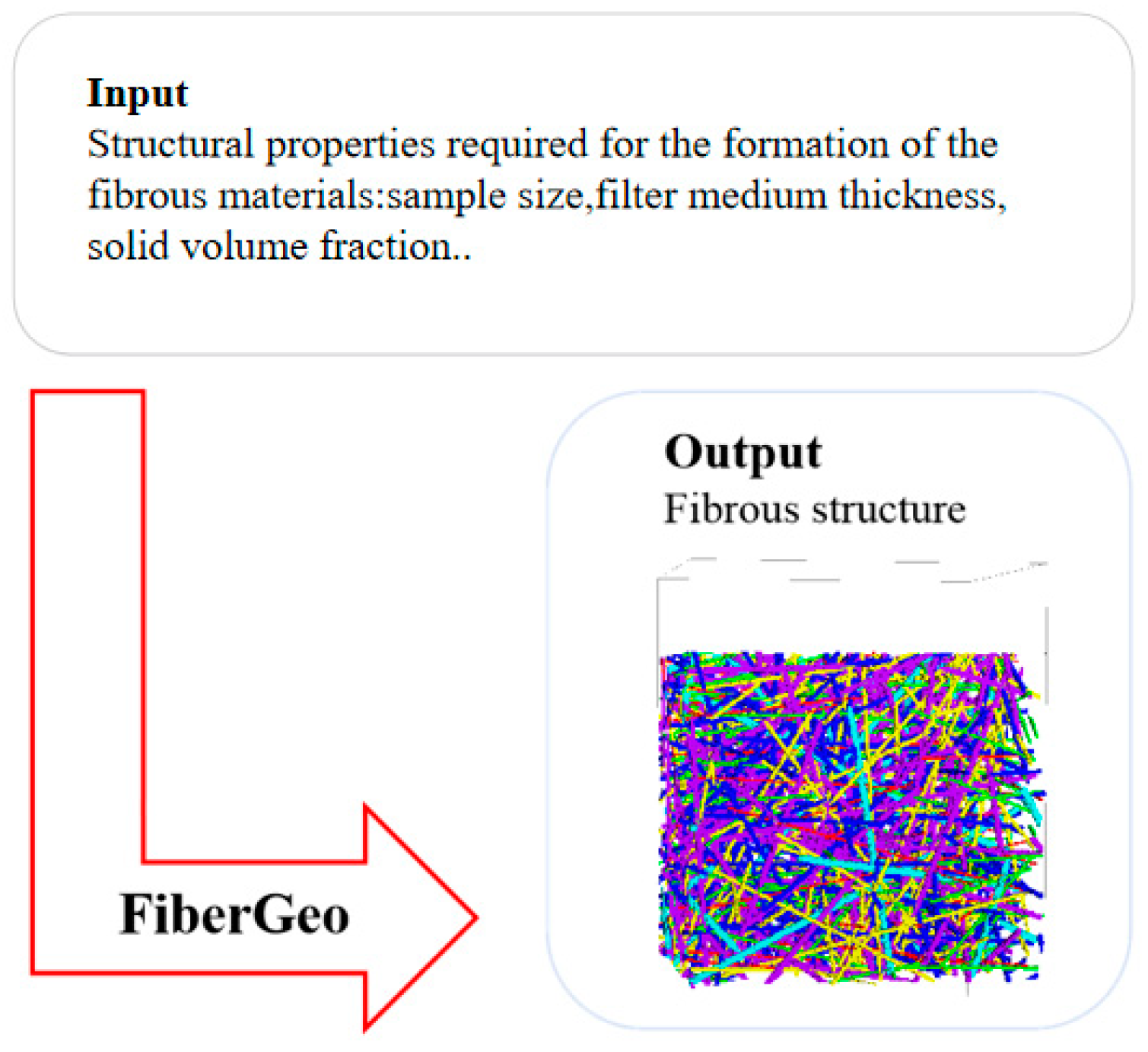
In order to effectively replace extensive experimental measurements with numerical simulations, this study comprehensively compares the correlation between experimental and simulation results of electrospun nanofiber membranes. Additionally, it systematically investigates the applicability of the numerical fiber structure model and the mathematical performance calculation model in predicting the filtration performance of electrospun nanofibers. Starting from the random distribution of fibers, the FiberGeo module creates virtual fiber filtration medium materials. The structural performance parameters required for the formation of the fiber materials include the dimensions of the fiber filtration medium sample, such as the fiber diameter, the proportion of the diameter distribution, the planar dimension, the thickness of the filtration medium, and the solid volume fraction (as shown in Figure 1).
For the electrospun nanofiber membranes prepared with different PAN concentrations, as the PAN concentration increases, the fiber diameter in the obtained nanofiber membranes increases significantly. The average fiber diameters of the electrospun nanofiber membranes with electrospinning solution concentrations of 7%, 9%, 11%, 13%, and 15% (electrospinning time: 4 h) increase sequentially from 280 nm to 418 nm, 740 nm, 1200 nm, and 1300 nm. Fiber diameter was determined by analyzing SEM images using ImageJ software (version 1.53t). For each sample, 50 randomly selected fibers were measured to ensure statistical reliability. Membrane thickness was measured using an electronic micrometer (5205-25) at five random locations, and the average value was reported.
For the electrospun nanofiber membranes prepared with different electrospinning durations, due to certain slight differences in the actual experimental conditions each time, even under the same PAN electrospinning solution concentration and electrospinning parameters, there are still certain differences in the fiber diameters of the prepared electrospun nanofiber membranes. The average fiber diameters of the electrospun nanofiber membranes with electrospinning times of 3 h, 3.5 h, 4 h, 4.5 h, and 5 h (PAN concentration: 11 wt%) are 418 nm, 394 nm, 390 nm, 400 nm, and 396 nm, respectively. Each measurement was repeated three times with a standard deviation of less than 5%.
In the surface morphology test of the fiber membrane, we randomly selected 50 nanofibers from each sample group, measured their diameters, calculated the proportion of corresponding fiber diameters, and preliminarily characterized the fiber filtration medium samples. The obtained data were sequentially imported into the Diameter option and the Count option in the FiberGeo module to determine the fiber diameter and the proportion of the diameter distribution of the fiber filtration medium [24]. These structural parameters are crucial for characterizing the filtration performance of the fiber medium, which encompasses filtration efficiency, pressure drop, and dust holding capacity [26]. Electrospinning parameters were optimized based on experimental results: applied voltage of 18 kV, needle-to-collector distance of 13 cm, solution flow rate of 0.0013 mm/s, collector rotation speed of 200 r/min, and ambient conditions maintained at 35 °C and 30% relative humidity. PAN solutions with concentrations ranging from 7% to 15% (w/w) were prepared by stirring at 60 °C for 6 h. After electrospinning, all samples were dried at 80 °C for 24 h to remove residual solvent. However, the electrospun nanofiber membranes prepared with different electrospinning durations have obvious differences due to the time gap. The thicknesses of the fiber filtration media with electrospinning times of 3 h, 3.5 h, 4 h, 4.5 h, and 5 h are 0.0150 mm, 0.0184 mm, 0.0216 mm, 0.0232 mm, and 0.0240 mm, respectively. The thickness of the fiber filtration medium model is shown in Table 2.
When using GeoDict software to establish a three-dimensional structure of electrospun nanofiber filtration media, the corresponding values of the fiber filtration media need to be imported into the Solid Volume Fraction (SVF) option. The solid volume fraction, which represents the compactness of the fiber filtration media, is a concept opposite to porosity. It describes the proportion of solid filling within the material.
The solid volume fraction quantifies the proportion of the solid part within the fiber filtration media and has an opposite effect on the properties of the fiber filtration media compared to porosity. Generally, the porosity of a fiber membrane is defined as the volume of pores divided by the total volume of the membrane. Experimentally, the SVF was determined by measuring the mass and volume of the nanofiber membrane samples. The mass was measured using an analytical balance with a precision of 0.01 mg, and the volume was calculated from the measured thickness and area of the samples. The SVF was then calculated using the formula mentioned above. The solid volume fraction required for establishing the electrospun nanofiber filtration media model can be calculated using the formula in [25].
S V F =   m m ρ w m m ρ w + ( m m m ) ρ m
In the formula, mm, mw, and m refer to the masses of the fiber membrane, water, and the total mass of the fiber membrane and water, respectively, g; ρm and ρw stand for the densities of the fiber membrane and water, respectively, g/cm3.
The solid volume fractions of the corresponding samples are calculated based on the electrospun nanofiber membranes prepared in [24]. For the electrospun nanofiber membranes prepared in experiments with different PAN concentrations of electrospinning solutions and different electrospinning durations, the fiber filtration media prepared under the same electrospinning parameters have different solid volume fractions due to the variations in the concentration of the electrospinning solution and the electrospinning time. In addition, slight differences in experimental conditions at different experimental times also lead to certain variations in the solid volume fractions of the fiber filtration media. The solid volume fractions of the fiber filtration media models are shown in Table 1.

2.3.2. Determination of Voxel Size

A voxel is the smallest data unit in three-dimensional space, similar to a pixel in a two-dimensional image. It is an abbreviation for “Volume Element”, representing a cell in a three-dimensional spatial grid, which is usually used to represent certain attributes within the cell, such as density and color. When using GeoDict software to establish the three-dimensional model structure of electrospun nanofiber filtration media, the fiber media model is composed of many small cubes, namely voxels [26]. The vertices of each voxel serve as the base points for numerical calculations. Therefore, the size of the voxel directly affects the time consumption of numerical calculations and the accuracy of the results, which requires us to explore the voxel size.
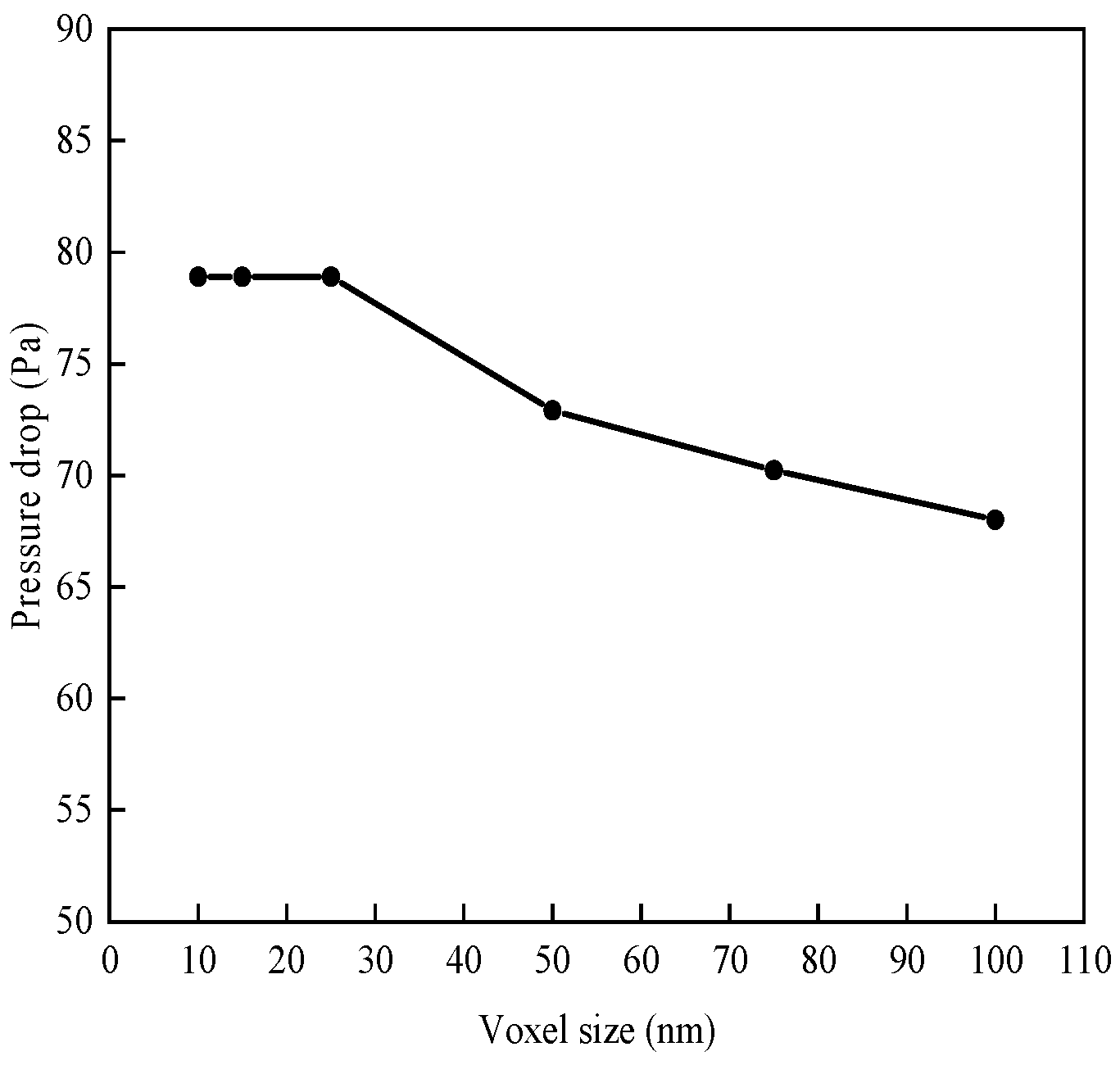
To eliminate the influence of voxel size on the numerical simulation results of the fiber filtration media model, the filtration pressure drops at six voxel sizes of 10 nm, 15 nm, 25 nm, 50 nm, 75 nm, and 100 nm and were taken as evaluation indicators. The simulated system for voxel size analysis is as follows: 2000 × 2000 × 500 voxels (X × Y × Z) with fiber diameter 418 nm and solid volume fraction 11.3% (9% PAN sample). Figure 2 shows the filtration pressure drop under different voxel sizes. When the voxel size changes, the filtration pressure drop changes accordingly. Meanwhile, the x-y plane size of the fiber filter medium model is related to the numerical calculation accuracy, memory and time cost, which needs to be explored and analyzed.
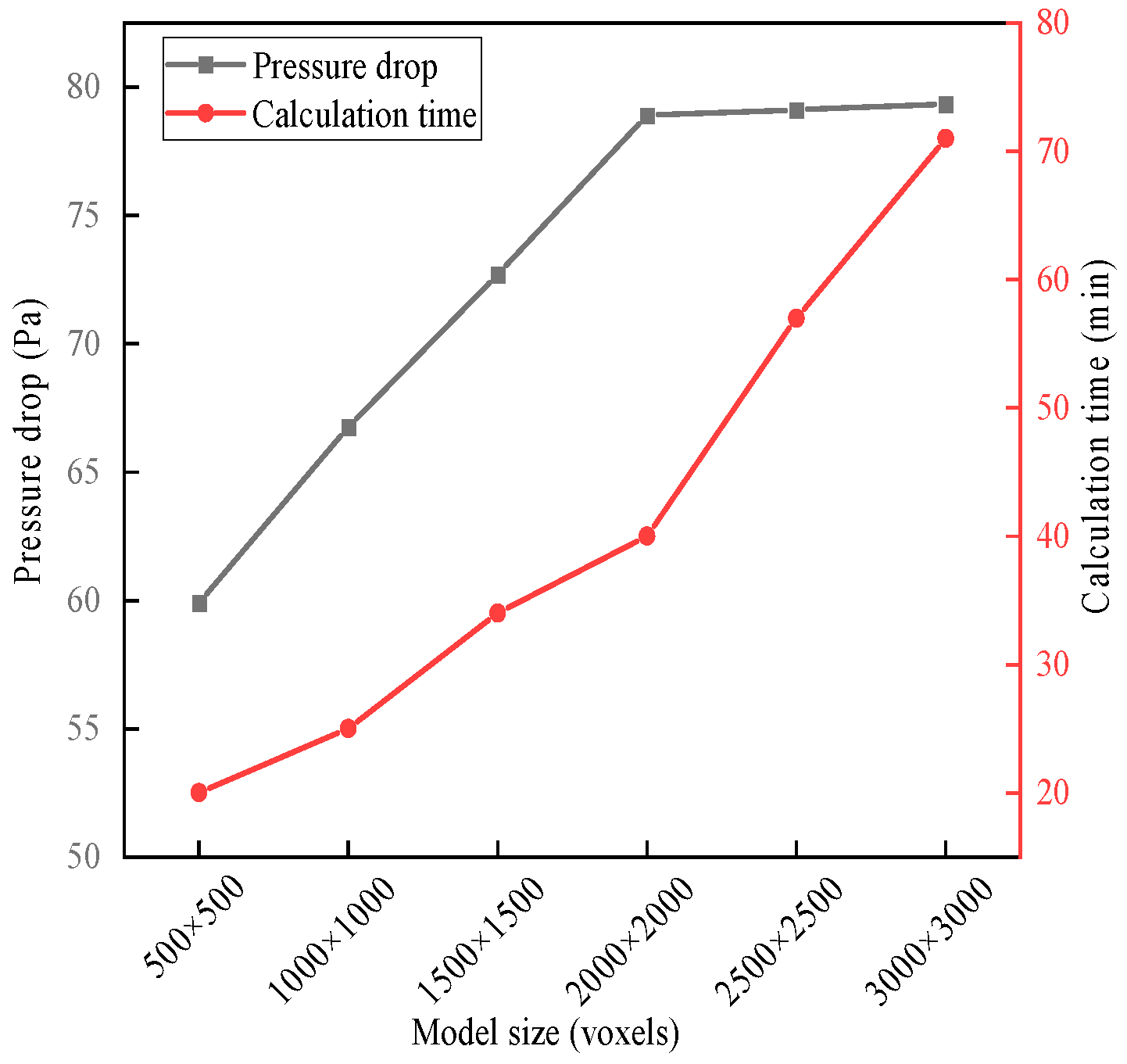
Meanwhile, the x–y plane size of the fiber filtration media model is also related to the accuracy of numerical calculations, as well as the memory size and time cost required during the calculation process. Therefore, the size of the x–y plane of the model also needs to be explored and analyzed. As shown in Figure 3, six x–y plane sizes of 500 × 500 voxels, 1000 × 1000 voxels, 1500 × 1500 voxels, 2000 × 2000 voxels, 2500 × 2500 voxels, and 3000 × 3000 voxels were set, respectively. During the exploration of x–y plane sizes, the voxel size was fixed at 25 nm (consistent with the optimized voxel size in this study), and the thickness of the simulated system was 0.0150 mm (same as the 9% PAN sample, a representative case with an average fiber diameter of 418 nm and solid volume fraction of 11.3%).
Based on this, to ensure the accuracy of the numerical simulation results and reduce the consumption of computational resources, in the subsequent numerical simulation calculations, this study plans to set the size of the electrospun nanofiber filtration media model in the x–y plane to 2000 × 2000 voxels and the voxel size to 25 nm.

2.3.3. Basic Model Structure of Nanofiber Membrane

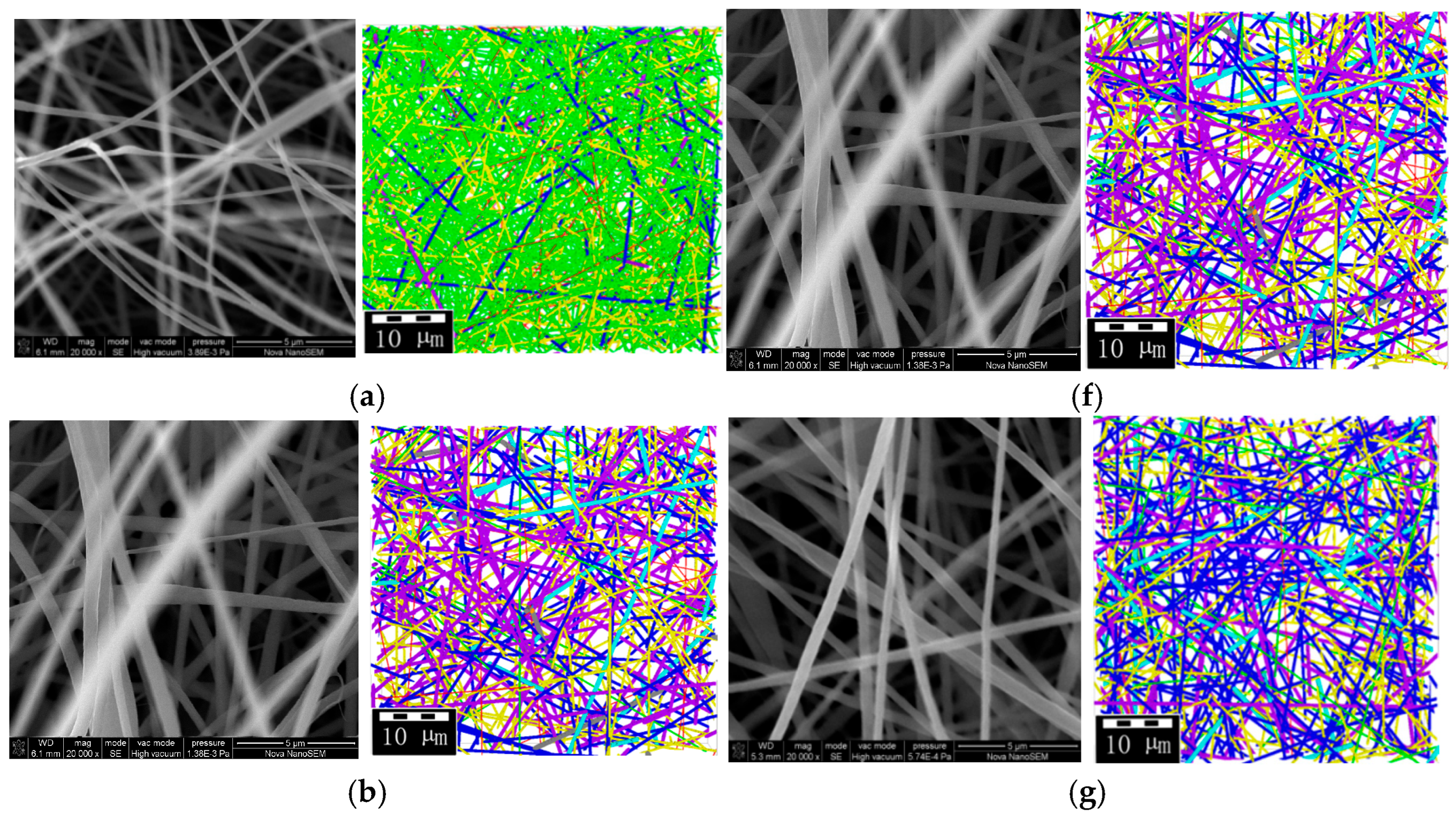
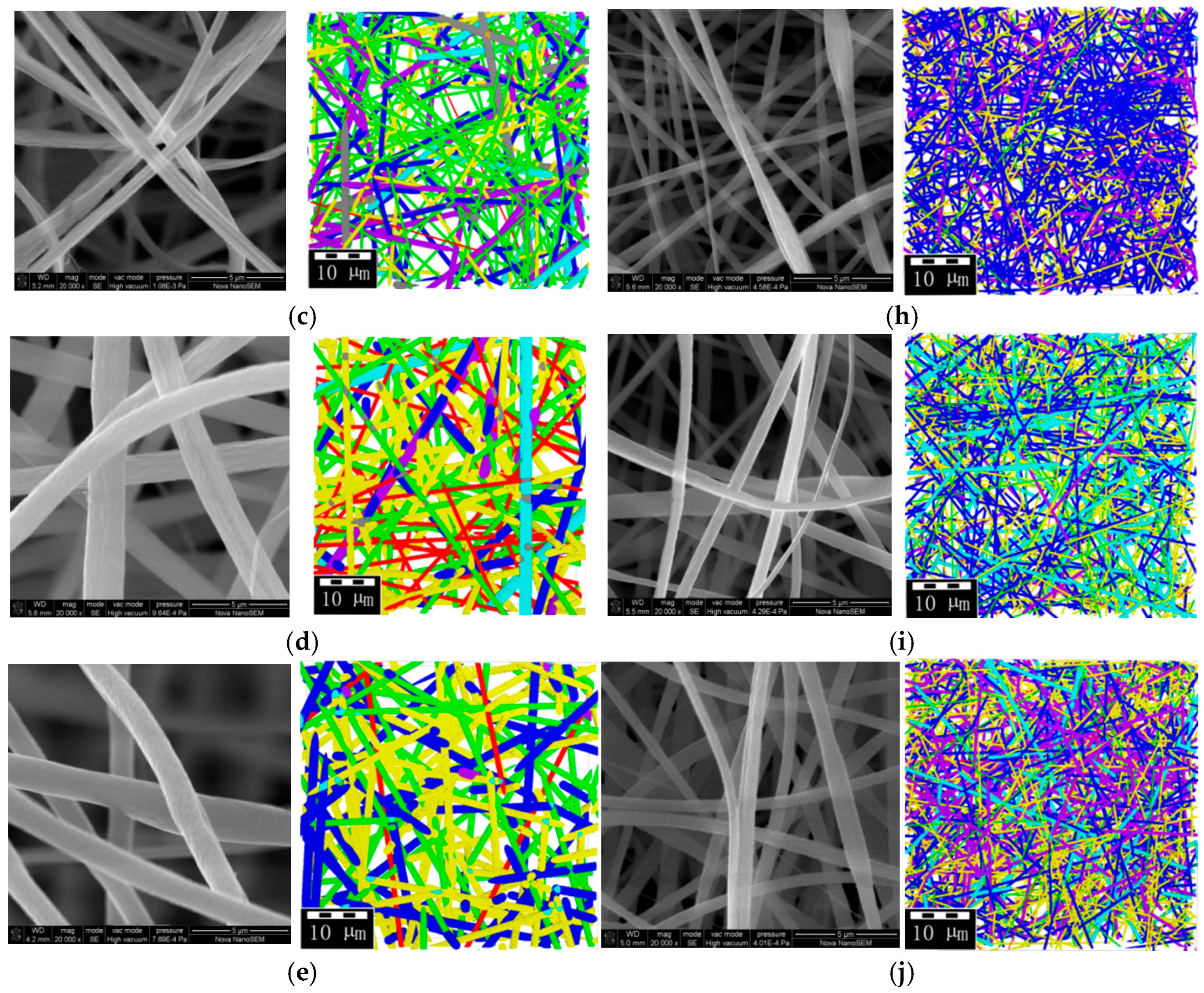
Preparation of electrospun nanofiber membrane: Electrospun nanofiber membrane samples with different fiber diameters were prepared, as shown in Figure 4 [24]. Combined with the SEM images of electrospun nanofiber membranes in Section 2.2.1, it can be seen that the electrospun nanofiber filter materials constructed by GeoDict software are also randomly arranged by nanofibers compared with the actual electrospun nanofiber membranes. It also has a complex three-dimensional disordered cavity structure, which enables the numerical model of electrospun nanofiber filter materials to intercept and filter particles in the air while providing channels for other gas molecules.
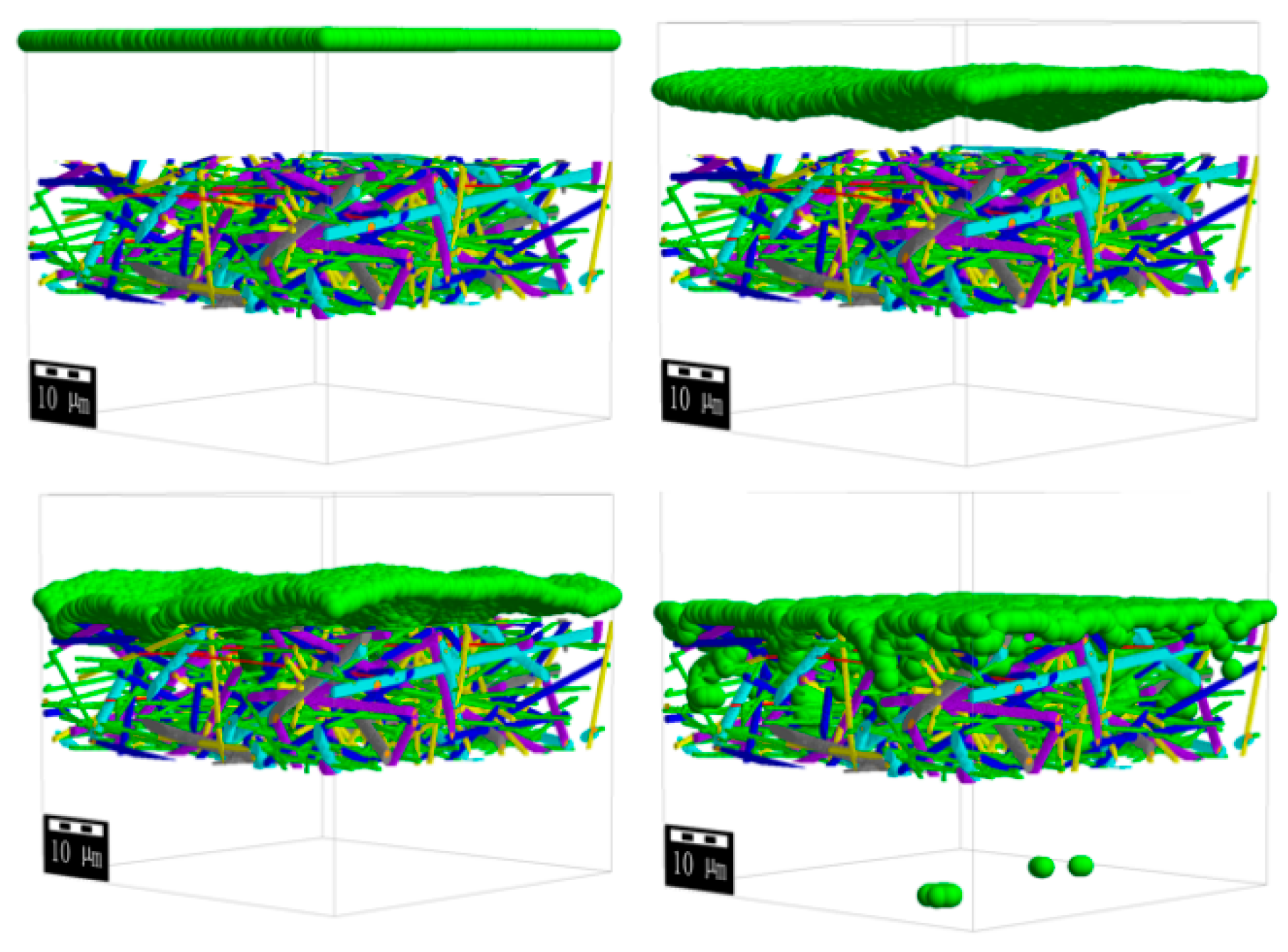
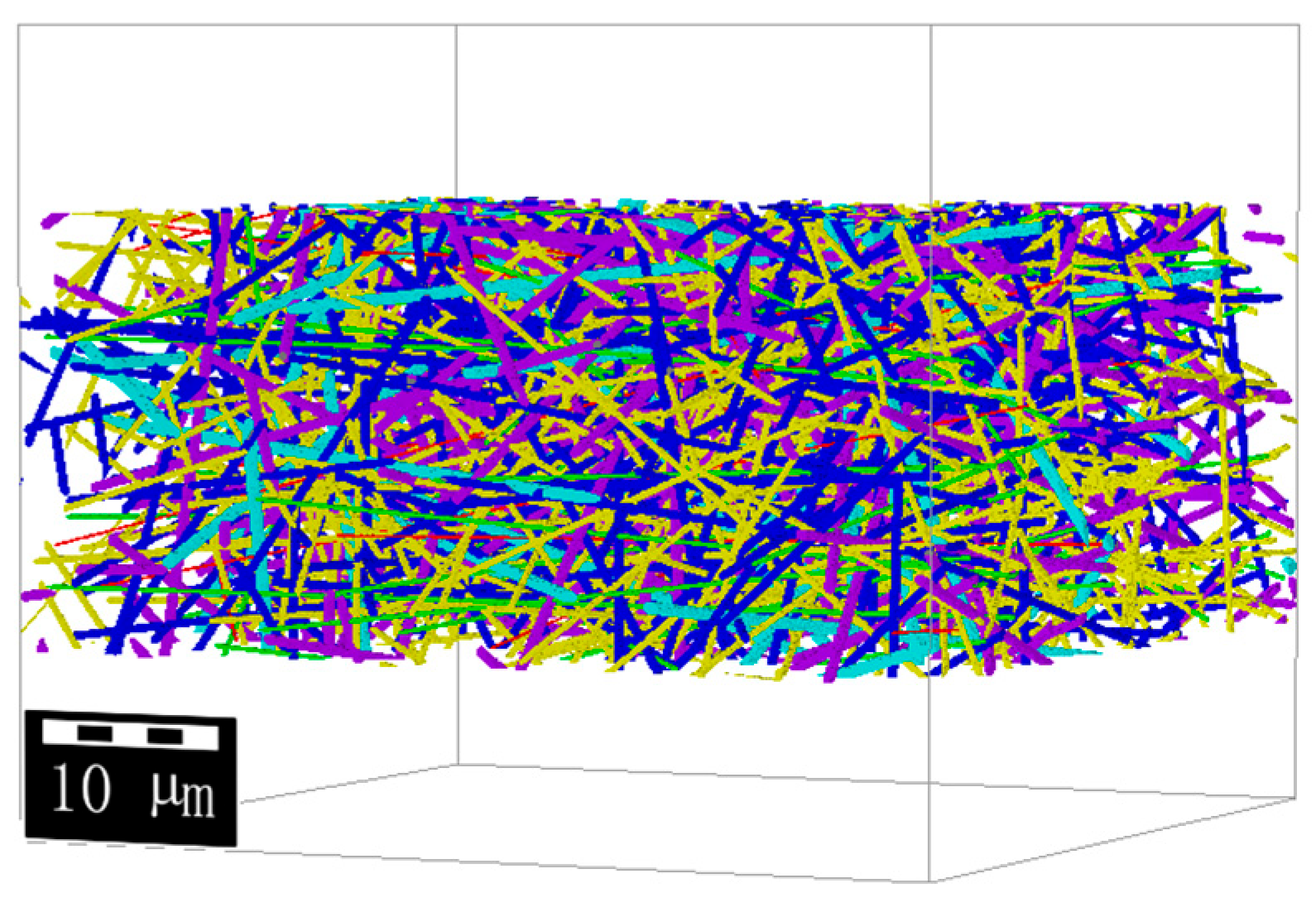
For the numerical model of different fiber filter thickness, similar to the nanofiber membrane samples prepared by different electrospinning times, the fiber filter material has a similar average fiber diameter. Since the spinning time determines the thickness and fiber coverage of the electrospun nanofiber membrane, as the spinning time increases, the corresponding coverage of the fiber membrane is higher, and the numerical model is denser. The three-dimensional structure diagram of electrospun nanofiber filter material constructed by GeoDict software is shown in Figure 5.
The filter efficiency simulation uses GeoDict’s FilterDict module. The module has a built-in “Caught on first touch” model, which matches the particle adhesion mechanism assumed in this study. The calculation logic is consistent with the algorithm used by Lee et al. [18] in the simulation of the pressure drop of nanofiber filters.

3. Results and Discussion

3.1. Model Parameter Validation and Results Analysis

3.1.1. Influence of Voxel Size on Simulation Accuracy

The influence of voxel size on simulation results was investigated by comparing the filtration pressure drops under six different voxel sizes (10 nm, 15 nm, 25 nm, 50 nm, 75 nm, and 100 nm). As shown in Figure 2, when the voxel size decreases from 50 nm to 25 nm, the predicted pressure drop increases by 12.7%, approaching the experimental value. Further reducing the voxel size below 25 nm yields negligible changes in pressure drop, indicating that 25 nm is the optimal voxel size for balancing computational efficiency and simulation accuracy.
Similarly, the effect of the x–y plane size on simulation results was analyzed. Six configurations (500 × 500 to 3000 × 3000 voxels) were tested with a fixed voxel size of 25 nm. As shown in Figure 3, the simulated pressure drop stabilizes when the x–y plane size reaches 2000 × 2000 voxels. This suggests that a plane size smaller than 2000 × 2000 voxels may not capture the full complexity of the fibrous structure, while larger sizes increase the computational cost without significant accuracy improvement.

3.1.2. Validation of 3D Model Structure

The three-dimensional structure of the electrospun nanofiber membrane reconstructed by GeoDict software was validated against actual SEM images (Figure 4). The simulated model exhibits consistent characteristics with real membranes, including random fiber arrangement, complex three-dimensional disordered cavity structures, and fiber coverage dependent on electrospinning time (Figure 5). For different membrane thicknesses (0.0150 mm–0.0240 mm), the numerical model maintains similar average fiber diameters to experimental samples, with denser structures corresponding to longer electrospinning durations, which aligns with the actual membrane formation mechanism.

3.1.3. Comparison with Experimental Data

To validate the reliability of the established 3D model, the simulated pressure drop was compared with experimental data and theoretical predictions using the Davies equation. As shown in Table 1, the relative error between the simulation results and experimental values is less than 8%, demonstrating the reliability of the established model. This consistency confirms that the numerical model accurately captures the key structural and flow characteristics of electrospun nanofiber membranes.
Moreover, the filtration efficiency of the model was evaluated using GeoDict’s FilterDict module with the “Caught on first touch” model. The simulation results show that filtration efficiency increases with an increasing fiber diameter and solid volume fraction, which is consistent with experimental observations reported in the literature [18].

3.2. Resistance Simulation and Analysis of Electrospun Nanofiber Membrane Model

Filtration resistance is the pressure difference at a specific flow rate [27], which refers to the hindering force encountered when the gas passes through the electrospun nanofiber filter material during the filtration process. It reflects the blocking degree of the filter medium material to the fluid flow. To evaluate the accuracy of the numerical simulation method in predicting the filtration resistance of the material, the FlowDict module was employed to simulate the flow field, with the surface velocity set to 6.89 cm/s to determine the filtration resistance of the filter material. By simulating the filtration resistance of fibers with different diameters and thicknesses at a fixed surface flow rate of 6.89 cm/s, these simulation results were compared with experimental measurements and predictions from empirical equations.
The simulation results were compared with experimental measurements (filtration resistance determined using a differential pressure transducer with an accuracy of ±0.1 Pa) and predictions from empirical equations (Davies Equation (6), Happel Equation (7), and Kuwabara Equation (8)).
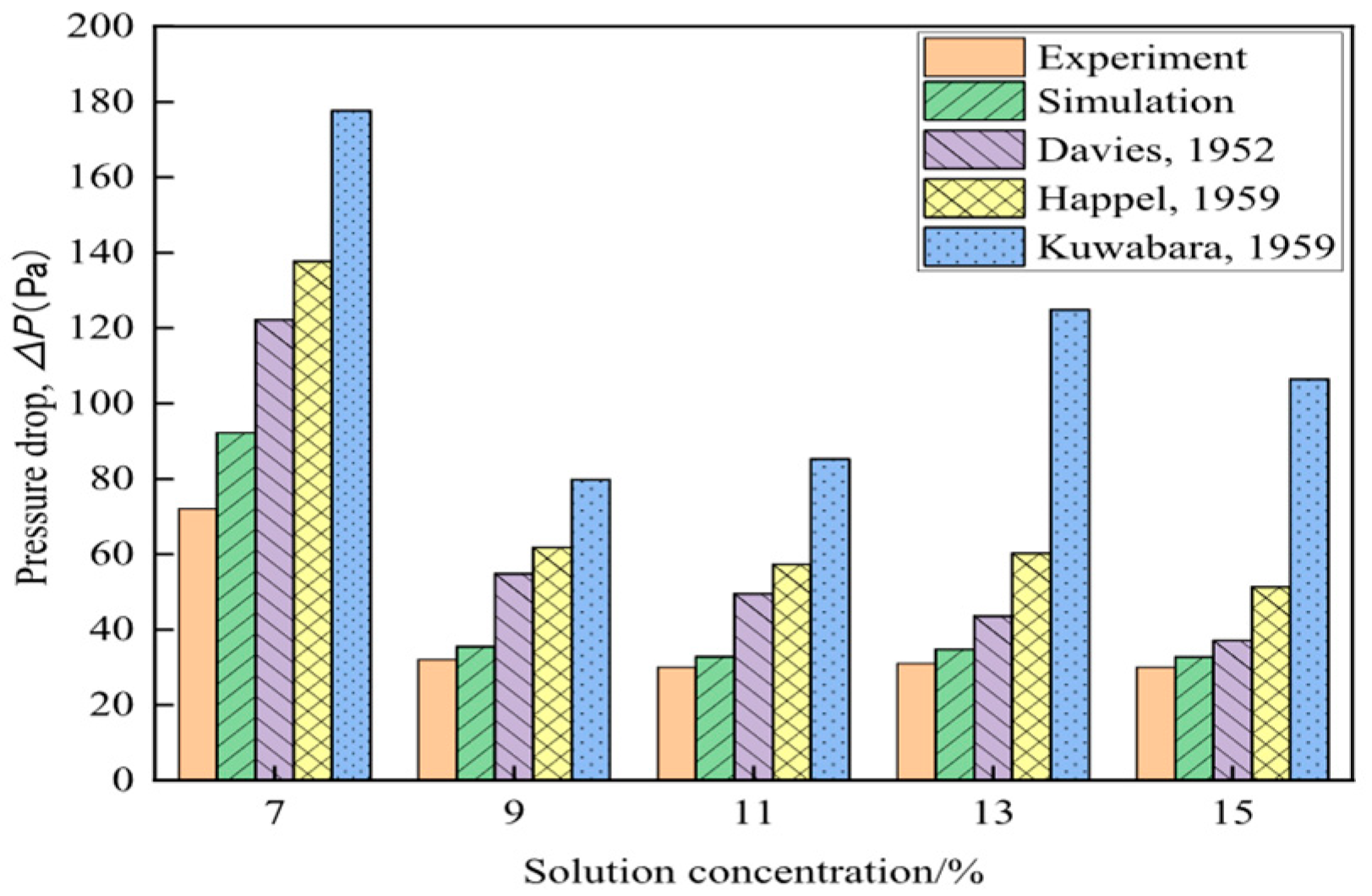
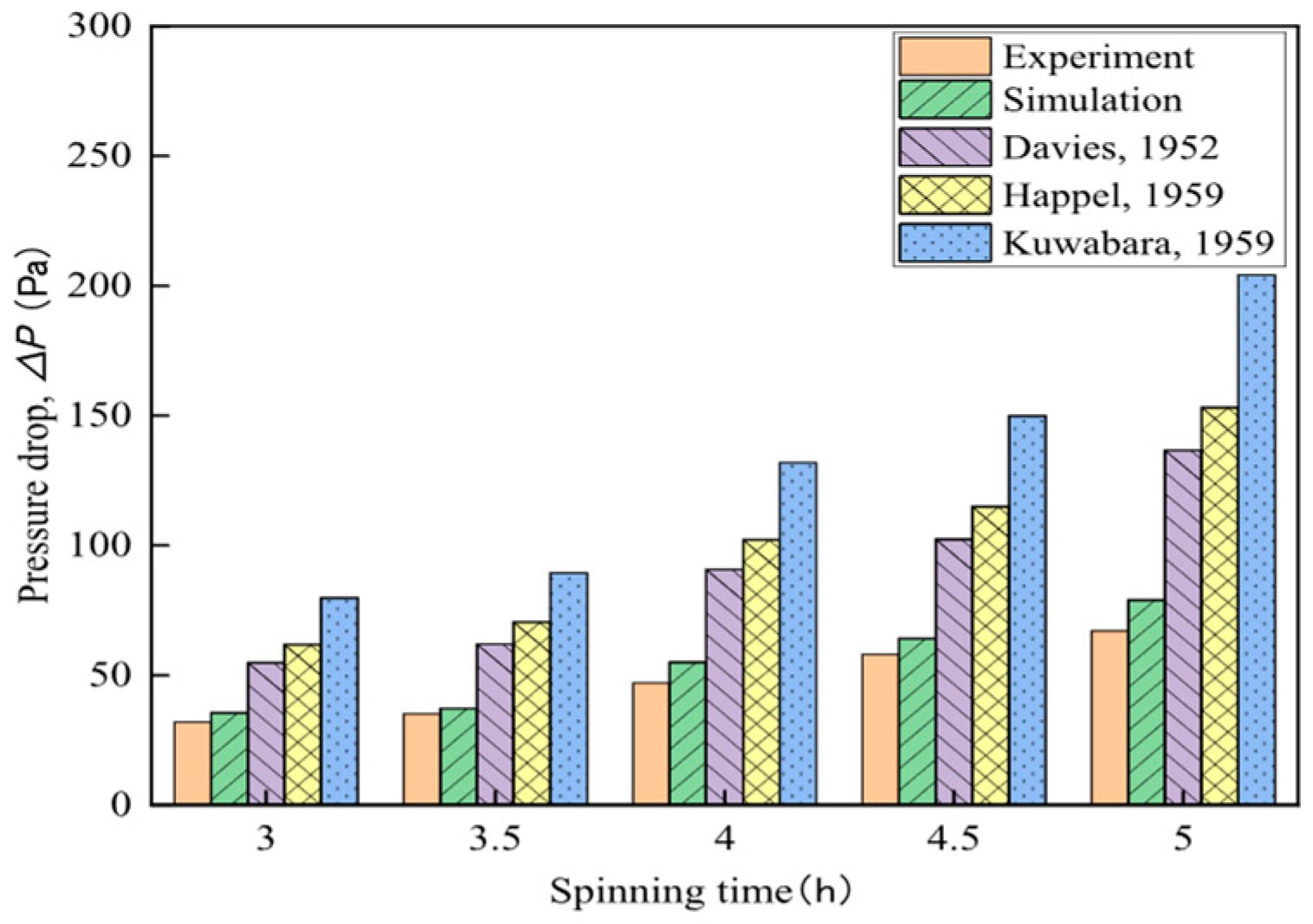
Combined with Figure 6 and Figure 7, it is evident that the filtration resistance values calculated via numerical simulation for all electrospun nanofiber filter media are generally higher than the experimental measurements, with deviations typically within 20%.
This discrepancy (simulated resistance exceeding experimental values by 15–20%) stems from two interconnected modeling assumptions. First, the numerical framework assumes that all fibers are perpendicularly aligned to the airflow (x–y plane), overlooking the presence of z-direction fibers (parallel to the flow) that scanning electron microscopy (SEM) confirms in actual electrospun membranes [28]. Second, Pradhan et al. [29] experimentally validated that fibers aligned parallel to the airflow reduce the pressure drop by approximately 30% compared to perpendicularly aligned fibers, owing to their smaller frontal area. Consequently, the model’s exclusion of these low-resistance z-direction fibers leads to an overestimation of the effective fiber surface area interacting with the airflow, directly accounting for the observed systematic deviation in filtration resistance. This mechanism is consistent with the trends observed across all sample configurations (Figure 6), where simulated values consistently exceed experimental measurements.
Therefore, as observed from the diagrams, both the simulation results and empirical calculation values for all fiber filter materials are higher than the experimental measurements. Among these, the numerical simulation results of the fiber filter media exhibit the best agreement with the experimental results.The experimentally measured values, numerical simulation values, and empirical formula calculation values of the filtration resistance of fiber membranes with different spinning solution concentrations and different spinning times are shown in Table 3 and Table 4.
Based on this, combined with the FlowDict module in GeoDict software, the electrospun nanofiber filter material model generated by the parametric model establishment method is used to simulate the flow field. This method can accurately predict the filtration resistance of the electrospun nanofiber membrane. Therefore, this method is suitable for studying the correlation between filtration resistance and fiber structure in electrospun nanofiber filter materials and provides guidance for the development of electrospun nanofiber materials.

3.3. Numerical Simulation Study on the Filtration Efficiency of Electrospun Nanofiber Membranes

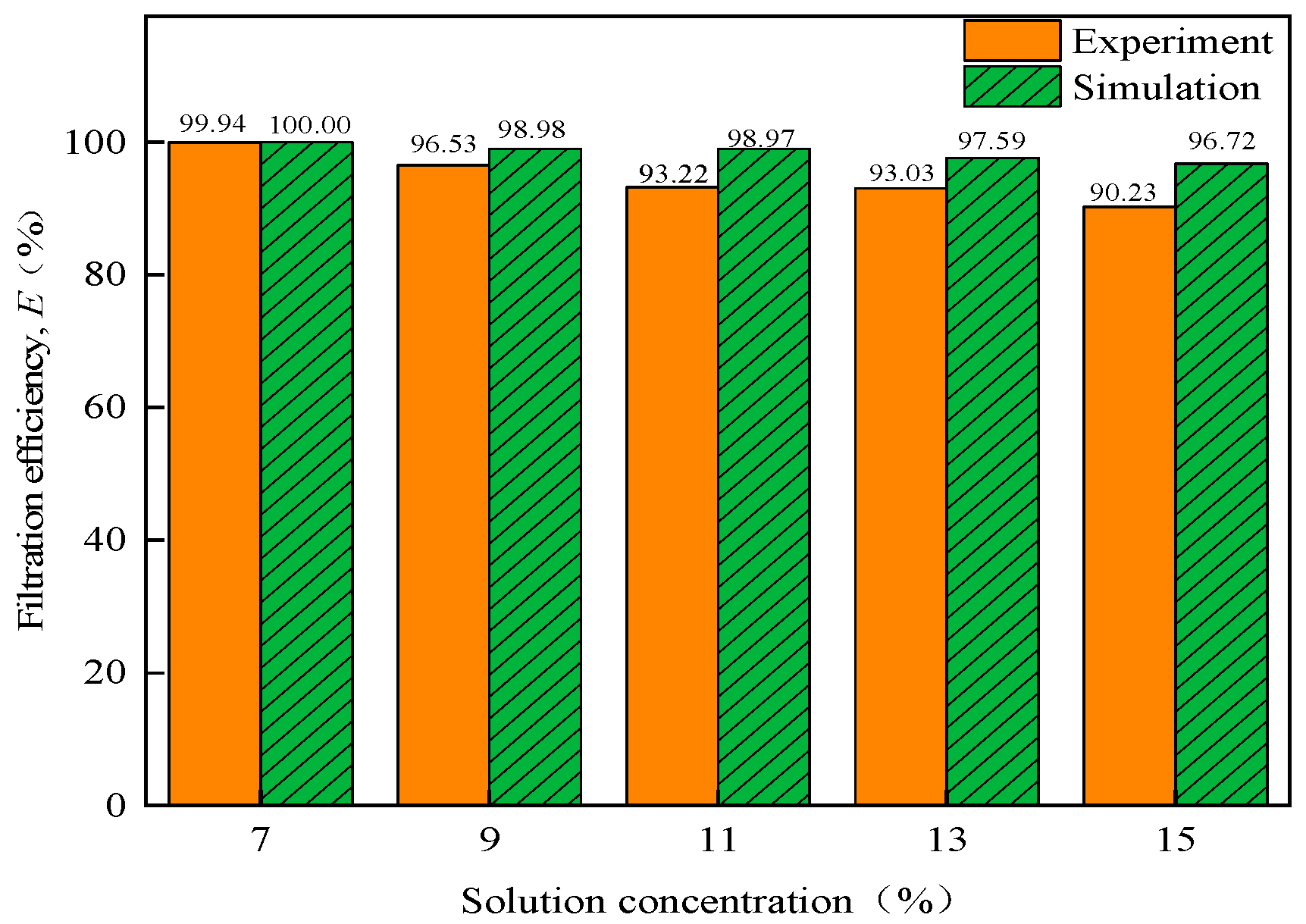
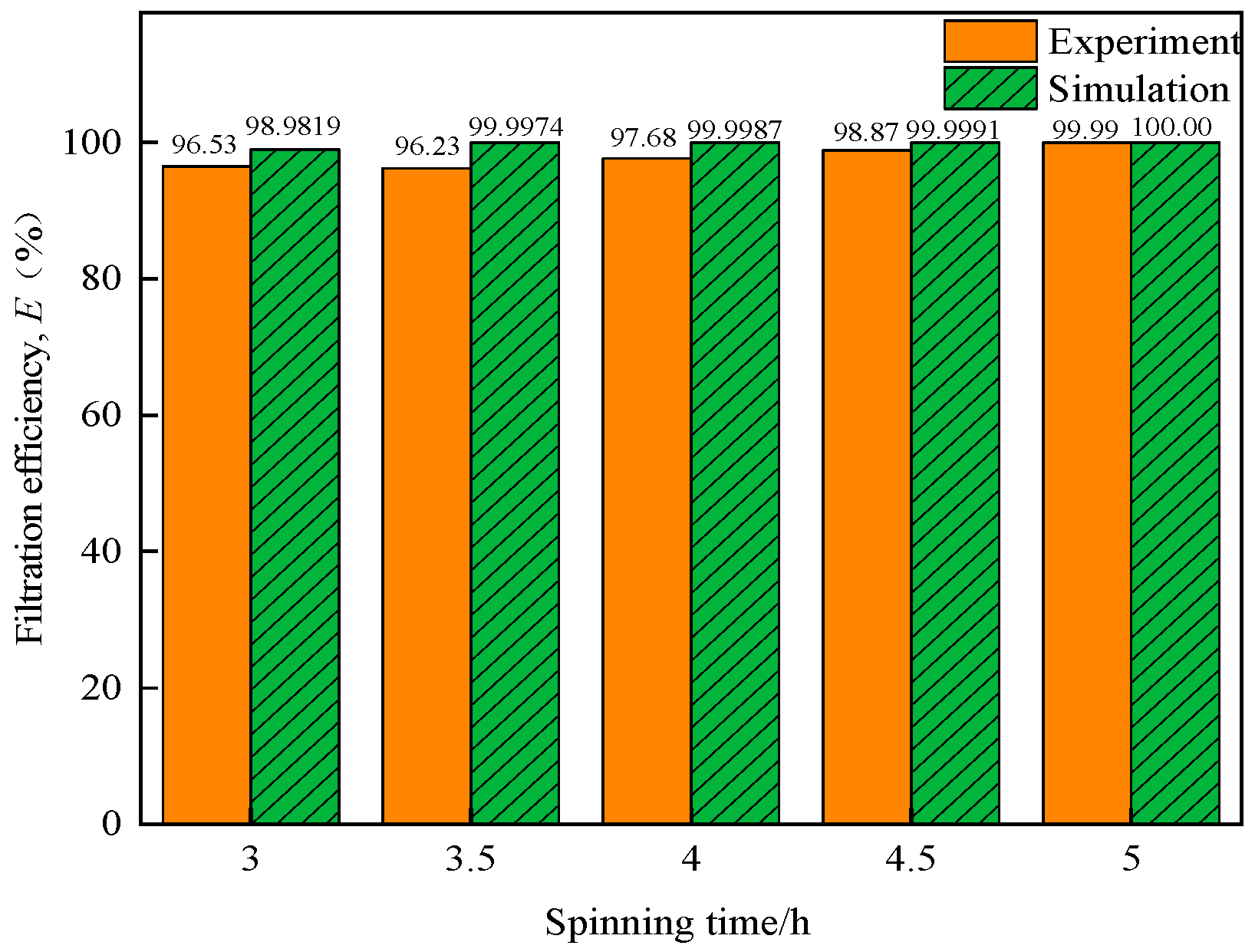
Filtration efficiency is one of the key indicators for measuring filtration performance. There is a close relationship between the two. Usually, higher filtration efficiency means better filtration performance. The FilterDict module is used to simulate the filtration process. The experimental measurement and simulation results of the filtration efficiency of the fiber filter medium are shown in Figure 8 and Figure 9. Filtration efficiency (E) was calculated using the formula: E = (1 − C2/C1) × 100%, where C1 and C2 are the upstream and downstream particle concentrations, respectively. Pressure drop (ΔP) across the membrane was measured as the difference between upstream (p1) and downstream (p2) static pressures. The quality factor (QF), which evaluates the comprehensive filtration performance, was defined as QF = −ln(1 − E/100)/ΔP.
From Figure 8 and Figure 9, it can be seen that the numerical simulation results of the filtration efficiency of electrospun nanofibers are higher than the experimental measurement results of real fiber filter materials, but the deviation is within 7%. The difference between the numerical simulation results of the filtration efficiency of the electrospun nanofiber filter model and the experimental test results of the real material can be attributed to the difference between the model hypothesis and the actual situation. For example, the distribution of fibers is more uniform, and the fiber morphology is more simplified. These assumptions made by the fiber filter medium model may be different from the real nanofiber structure, resulting in a difference between the numerical simulation results and the experimental measurement results. The numerical simulation results are higher than the experimental measurement results of real materials due to the selection of the particle collision model. In the simulation process of particle filtration, the elastic collision effect between particles and fiber surface is not considered, but the default particles are directly adhered to the fiber surface due to the van der Waals force after contact with the fiber, and it is assumed that the particles will not slide on the fiber surface or be taken away again in subsequent filtration. However, in reality, particles are usually captured by fibers in the case of low kinetic energy, and the actual particles may slide or fall off after contacting the fibers. Therefore, due to the choice of this collision model, the numerical simulation results of filtration efficiency are slightly higher than the experimental results. The filtration schematic diagram of the three-dimensional structure of the fiber filter material is shown in Figure 10. The experimental measurements and numerical simulation values of the filtration efficiency of electrospun nanofiber membranes with different spinning solution concentrations and different spinning times are shown in Table 5 and Table 6. Notably, the current model was tested with 2.5 μm particles, which yield a filtration efficiency close to 100%. To further validate the model’s applicability, future studies should test smaller particles (e.g., 0.3–1 μm) with an experimental filtration efficiency in the range of 50–70%, as this would provide a more stringent assessment.
Based on this, combined with the FilterDict module in GeoDict software, the electrospinning nanofiber filter material model generated by the parametric model establishment method is used to simulate the filtration process. The simulated calculation value of the filtration efficiency of the fiber filter medium shows a high consistency with the experimental measurement value. This shows that this method can accurately evaluate the filtration efficiency of electrospun nanofiber membranes, which has a practical reference value for predicting the particle capture performance of electrospun nanofiber membrane filters and can provide guidance for the development of electrospun nanofiber materials.

4. Conclusions

(1)
GeoDict software can be used to generate a more realistic electrospun nanofiber structure. Compared with the actual electrospun nanofiber membrane, it is also composed of nanofibers randomly arranged and also has a complex three-dimensional disordered cavity structure. The numerical model of electrospun nanofiber filters can provide channels for gas molecules while intercepting and filtering particles in the air. The spinning time determines the thickness of the electrospun nanofiber membrane and the degree of fiber coverage. As the spinning time increases, the corresponding coverage of the fiber membrane is higher, and the numerical model is more compact.
(2)
Based on the FlowDict module of GeoDict software, flow field simulations were performed using the parametrically constructed electrospun nanofiber filter model. The simulation results were compared with experimental data and predictions from empirical equations. Both the simulation results and empirical equation calculations for the filter media showed higher values than the experimental measurements. Among these, the numerical simulation results of the filter media showed the highest consistency with the experimental data, followed by the Davies empirical equation, then the Happel model, with the Kuwabara model showing the lowest consistency. For example, at a spinning solution concentration of 7%, the relative error between the Davies empirical equation calculations and the experimental values for filtration resistance is 41.1%, the relative error between the Happel model calculations and the experimental values is 47.7%, and the relative error between the Kuwabara model calculations and the experimental values is 59.5%.
(3)
Based on the FilterDict module of GeoDict software, the electrospinning nanofiber filter material model generated by the parametric model establishment method is used to simulate the filtration process. The simulated calculation value of the filtration efficiency of the fiber filter medium shows a high consistency with the experimental measurement value. This method can accurately evaluate the filtration efficiency of electrospun nanofiber membranes and predict the filtration performance of electrospun nanofibers.

Author Contributions

Conceptualization, W.H.; Methodology, W.H.; Software, W.H. and H.Z.; Validation, W.H.; Formal analysis, W.H.; Investigation, W.H. and S.C.; Data curation, X.M.; Visualization, L.C.; Supervision, F.Q. All authors have read and agreed to the published version of the manuscript.

Funding

This research received no external funding.

Institutional Review Board Statement

Not applicable.

Informed Consent Statement

Not applicable.

Data Availability Statement

The raw data supporting the conclusions of this article will be made available by the authors on request.

Conflicts of Interest

The authors declare no conflict of interest.

References

  1. Yao, L.; Guo, Y.; Wang, Y. Comprehensive Characterization of Organic Chemicals Associated with Urban Particulate Matter in China. Environ. Health 2025, 3, 504–514. [Google Scholar] [CrossRef]
  2. Almalawi, A.; Alsolami, F.; Khan, A.I. An IoT based system for magnify air pollution monitoring and prognosis using hybrid artificial intelligence technique. Environ. Res. 2022, 206, 112576. [Google Scholar] [CrossRef]
  3. Wang, X.Y.; Lian, M.J.; Yang, X. Enhanced activity for catalytic combustion of ethylene by the Pt nanoparticles confined in TiO2 nanotube with surface oxygen vacancy. Ceram. Int. 2022, 48, 3933–3940. [Google Scholar] [CrossRef]
  4. Ruciński, A.; Grzebielec, A.; Jaworski, M. The problem of smog-particle removal in large cities-experimental analysis of some filtration materials. Energies 2021, 14, 8012. [Google Scholar] [CrossRef]
  5. Bell, M.L.; Dominici, F.; Ebisu, K. Spatial and temporal variation in PM2.5 chemical composition in the United States for health effects studies. Environ. Health Perspect. 2007, 115, 989–995. [Google Scholar] [CrossRef] [PubMed]
  6. Duan, F.; Lin, L. Health risk assessment of ultrafine particle movement in children’s residential spaces based on probabilistic neural networks. Alex. Eng. J. 2024, 93, 371–381. [Google Scholar] [CrossRef]
  7. Petra, H.; McCracken, J.P.; Aruni, B. Insulin sensitizers prevent fine particulate matter-induced vascular insulin resistance and changes in endothelial progenitor cell homeostasis. Am. J. Physiol. Heart Circ. Physiol. 2016, 310, H1423–H1438. [Google Scholar]
  8. Zhong, Z.X.; Xu, Z.; Sheng, T. Unusual air filters with ultrahigh efficiency and antibacterial functionality enabled by ZnO nanorods. ACS Appl. Mater. Interfaces 2015, 7, 21538–21544. [Google Scholar] [CrossRef] [PubMed]
  9. Wang, Y.X.; Xu, Y.K.; Wang, D. Polytetrafluoroethylene/polyphenylene sulfide needle-punched triboelectric air filter for efficient particulate matter removal. ACS Appl. Mater. Interfaces 2019, 11, 48437–48449. [Google Scholar] [CrossRef] [PubMed]
  10. Shu, Z.; Qian, F.; Zhu, J.; Lu, J. Numerical simulation of gas-solid flow characteristic of particles in fibrous media using OpenFOAM. Indoor Built Environ. 2020, 29, 921–930. [Google Scholar] [CrossRef]
  11. Cho, Y.; Beak, W.J.; Sagong, M. Electrospinning and Nanofiber Technology: Fundamentals, Innovations, and Applications. Adv. Mater. 2025, 37, 2500162. [Google Scholar] [CrossRef] [PubMed]
  12. Kayaci, F.; Sen, S.H.; Durgun, E. Electrospinning nylon 6,6 nanofibers functionalized with cyclodextrins for removal of toluene vapor. J. Appl. Polym. Sci. 2015, 132, 41941. [Google Scholar] [CrossRef]
  13. Greiner, A.; Wendorff, J. Electrospinning: A fascinating method for the preparation of ultrathin fibers. Angew. Chem. 2007, 46, 5670–5703. [Google Scholar] [CrossRef]
  14. Chew, S. The role of electrospinning in the emerging field of nanomedicine. Curr. Pharm. Des. 2006, 12, 4751–4770. [Google Scholar] [CrossRef]
  15. Wang, S.H.; Sun, L.G.; Zhang, B. Preparation of monodispersed silica spheres and electrospinning of poly(vinylalcohol)/silica composite nanofibers. Polym. Compos. 2011, 32, 347–352. [Google Scholar] [CrossRef]
  16. Askari, A.; Nabavi, R.S.; Omrani, A. Fabrication of PES/PAN electrospun nanofiber membrane incorporated with [EMIM][Ac] ionic liquid for oil/water separation. J. Water Process Eng. 2024, 65, 105768. [Google Scholar] [CrossRef]
  17. Wang, Q.; Ren, H.; Ma, H. Highly Permeable Nanofibrous Composite Nanofiltration Membranes by Controllable Interfacial Copolymerization. ACS Appl. Mater. Interfaces 2025, 17, 33132–33149. [Google Scholar] [CrossRef]
  18. Songhui, L.; Dai, B.; Minwoo, B. Modeling pressure drop values across ultra-thin nanofiber filters with various ranges of filtration parameters under an aerodynamic slip effect. Sci. Rep. 2023, 13, 5449. [Google Scholar] [CrossRef]
  19. Davies, C.N. The separation of airborne dust and particles. Proc. Inst. Mech. Eng. 1952, 1, 393–427. [Google Scholar]
  20. Happel, J. Viscous flow relative to arrays of cylinders. AIChE J. 1959, 5, 174–177. [Google Scholar] [CrossRef]
  21. Kuwabara, S. The forces experienced by randomly distributed parallel circular cylinders or spheres in a viscous flow at small reynolds numbers. J. Phys. Soc. Jpn. 1959, 14, 527–532. [Google Scholar] [CrossRef]
  22. Clague, D.S.; Phillips, R.J. A numerical calculation of the hydraulic permeability of three-dimensional disordered fibrous media. Phys. Fluids 1997, 9, 1562–1572. [Google Scholar] [CrossRef]
  23. Wiegmann, S.R.L. Research note: Computer simulation of air filtration including electric surface charges in 3-dimensional fibrous microstructures. Filtration 2006, 6, 169–172. [Google Scholar]
  24. Cheng, S.M.; Qian, F.P.; Zhu, C.; Chen, L.; Dong, W.; Zhong, H. Preparation and performance of electrospun nanofiber membrane for air filtration. Chin. J. Process Eng. 2024, 24, 599–608. (In Chinese) [Google Scholar]
  25. Smolders, K.; Franken, A.C.M. Terminology for membrane distillation. Desalination 1989, 72, 249–262. [Google Scholar] [CrossRef]
  26. You, T.L.; Pan, Z.Y.; Lu, L.; Tang, M.; Liang, Y. Numerical simulation study on structural characteristics and filtration performance of glass fiber filter media. Chin. J. Process Eng. 2023, 23, 430–437. (In Chinese) [Google Scholar] [CrossRef]
  27. Shu, Z.; Qian, F.; Fang, C.; Zhu, J. Numerical simulation of particle spatial distribution and filtration characteristic in the pleated filter media using OpenFOAM. Indoor Built Environ. 2021, 30, 1159–1172. [Google Scholar] [CrossRef]
  28. Lux, J.; Delisée, C.; Thibault, X. 3D characterization of wood based fibrous materials: An application. Image Anal. Stereol. 2006, 25, 25–35. [Google Scholar] [CrossRef]
  29. Pradhan, A.K.; Das, D.; Chattopadhyay, R. Effect of 3D fiber orientation distribution on transverse air permeability of fibrous porous media. Powder Technol. 2012, 221, 101–104. [Google Scholar] [CrossRef]
Figure 1. FiberGeo module creates a virtual fiber filter media material flow diagram.
Applsci 15 08667 g001
Figure 2. Pressure drop of different voxel size models (system: 2000 × 2000 × 500 voxels; fiber diameter = 418 nm; and SVF = 11.3%).
Applsci 15 08667 g002
Figure 3. Pressure drop and calculation time for models of different x–y plane sizes (voxel size = 25 nm; system thickness = 0.0150 mm; fiber diameter = 418 nm; solid volume fraction = 11.3%).
Applsci 15 08667 g003
Figure 4. Comparison of actual electrospun nanofiber membranes and simulated models under different conditions: (left) different PAN concentrations; (right) different electrospinning durations. [Note: Left column shows SEM images of actual electrospun nanofiber membranes (left) and their simulated models (right) with different PAN concentrations (7%, 9%, 11%, 13%, and 15%); right column shows SEM images of actual electrospun nanofiber membranes (left) and their simulated models (right) with different electrospinning durations (3.0 h, 3.5 h, 4.0 h, 4.5 h, and 5.0 h)]. (a) 7%; (b) 9%; (c) 11%; (d) 13%; (e) 15%; (f) 3.0 h; (g) 3.5 h; (h) 4.0 h; (i) 4.5 h; (j) and 5.0 h.
Applsci 15 08667 g004aApplsci 15 08667 g004b
Figure 5. Schematic diagram of the three-dimensional structure of the reconstructed fiber filter media.
Applsci 15 08667 g005
Figure 6. Experimental measurement, numerical simulation, and empirical formula calculation results of filtration resistance of filter media with different spinning solution concentrations [19,20,21].
Applsci 15 08667 g006
Figure 7. Experimental measurement, numerical simulation, and empirical formula calculation results of filtration resistance of filter media at different spinning times [19,20,21].
Applsci 15 08667 g007
Figure 8. Experimental measurement and numerical simulation results of filtration efficiency of filter media with different spinning solution concentrations.
Applsci 15 08667 g008
Figure 9. Experimental measurement and numerical simulation results of filter media filtration efficiency at different spinning times.
Applsci 15 08667 g009
Figure 10. Schematic diagram of particulate matter filtration of fiber filter media.
Applsci 15 08667 g010
Table 1. Solid volume fraction of fiber filter media model.
SampleSVF/%SampleSVF/%
7%17.73.0 h11.3
9%11.33.5 h11.6
11%12.04.0 h12.7
13%15.34.5 h13.3
15%13.55.0 h13.5
Note: For PAN concentration samples (7–15%), the electrospinning time = 3 h; for electrospinning time samples (3.0 h–5.0 h), the PAN concentration = 9%.
Table 2. Model thickness of fiber filter media.
SampleFiber Membrane Thickness/mmSampleFiber Membrane Thickness/mm
7%0.01503.0 h0.0150
9%0.01503.5 h0.0184
11%0.01504.0 h0.0216
13%0.01504.5 h0.0232
15%0.01505.0 h0.0240
Note: For PAN concentration samples (7–15%), the electrospinning time = 3 h; for electrospinning time samples (3.0 h–5.0 h), the PAN concentration = 9%.
Table 3. Filtration resistance of electrospun nanofiber membranes with different spinning solution concentrations (spinning time = 3 h; surface velocity = 6.89 cm/s).
Solution ConcentrationExperiment/PaSimulation/PaDavies [19]/PaHappel [20]/PaKuwabara [21]/Pa
7%7292.2122.2137.6177.7
9%3235.554.861.879.7
11%3032.849.557.385.3
13%3134.743.660.2124.9
15%3032.737.151.3106.4
Table 4. Filtration resistance of electrospun nanofiber membranes at different spinning times (PAN concentration = 9%; surface velocity = 6.89 cm/s).
Electrospinning Duration/hExperiment/PaSimulation/PaDavies [19]/PaHappel [21]/PaKuwabara [20]/Pa
3.03235.554.861.879.7
3.53537.161.970.489.4
4.04755.090.7102.2131.9
4.55864.0102.3114.5149.8
5.06778.9136.6153.0204.2
Table 5. Experimental measurements and simulation results of filtration efficiency for electrospun nanofiber membranes with different spinning solution concentrations (spinning time = 4 h).
Solution ConcentrationExperiment/%Simulation/%
7%99.94100.00
9%96.5398.98
11%93.2298.97
13%93.0397.59
15%90.2396.72
Table 6. Experimental measurements and simulation results of filtration efficiency for electrospun nanofiber membranes at different spinning times (PAN concentration = 11 wt%).
Eectrospinning DurationExperiment/%Simulation/%
3.0 h96.5398.9819
3.5 h96.2399.9974
4.0 h97.6899.9987
4.5 h98.8799.9991
5.0 h99.99100.0000
Disclaimer/Publisher’s Note: The statements, opinions and data contained in all publications are solely those of the individual author(s) and contributor(s) and not of MDPI and/or the editor(s). MDPI and/or the editor(s) disclaim responsibility for any injury to people or property resulting from any ideas, methods, instructions or products referred to in the content.