Using Virtual Reality Simulators to Enhance Laparoscopic Cholecystectomy Skills Learning



Abstract
1. Introduction
2. Materials and Methods
2.1. Design and Search Strategy
2.2. Quality Assessment
2.3. Definitions and Data Categorized
2.4. Data Extraction
2.5. Statistical Analysis
3. Results
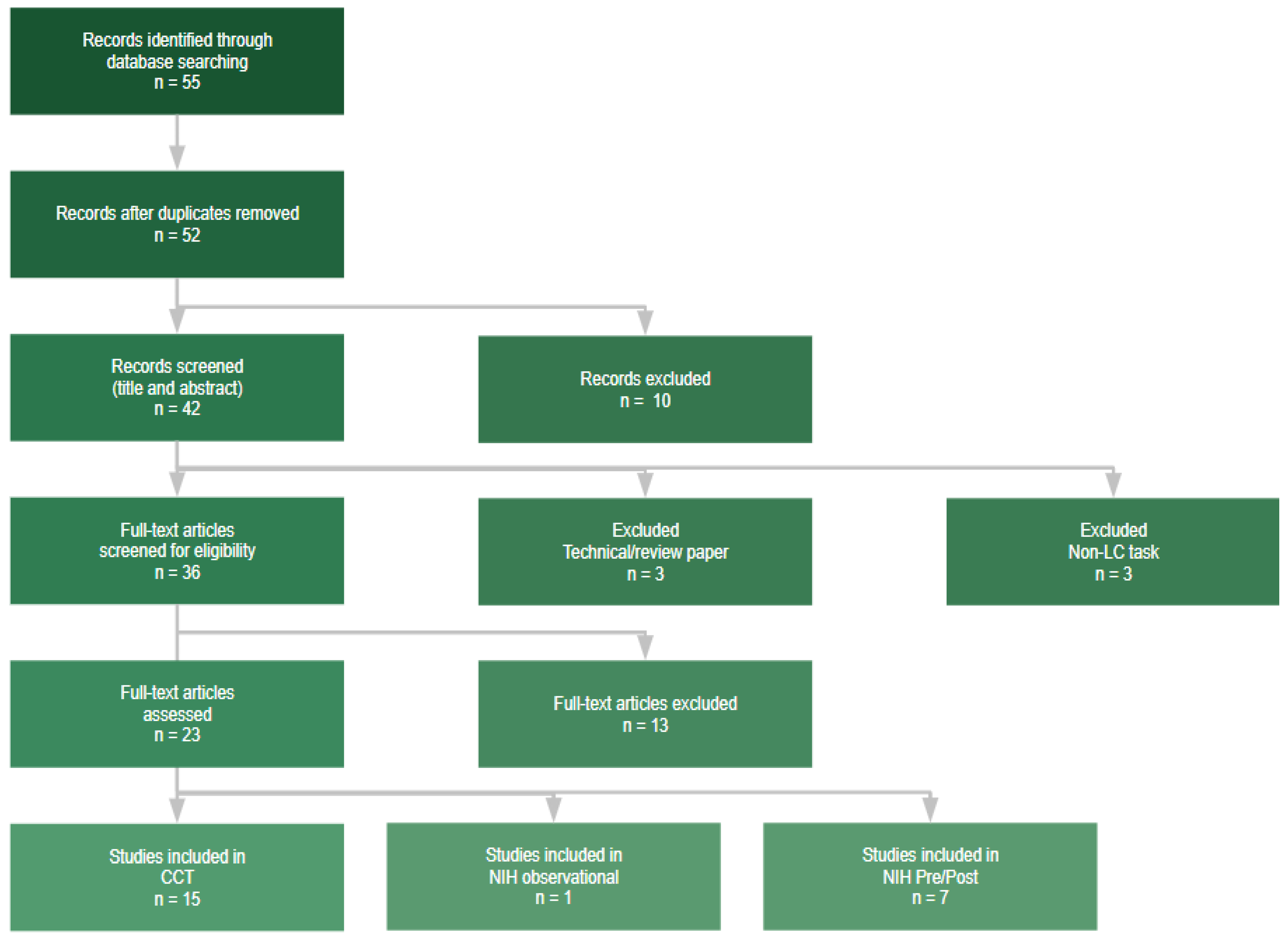
3.1. Study Selection
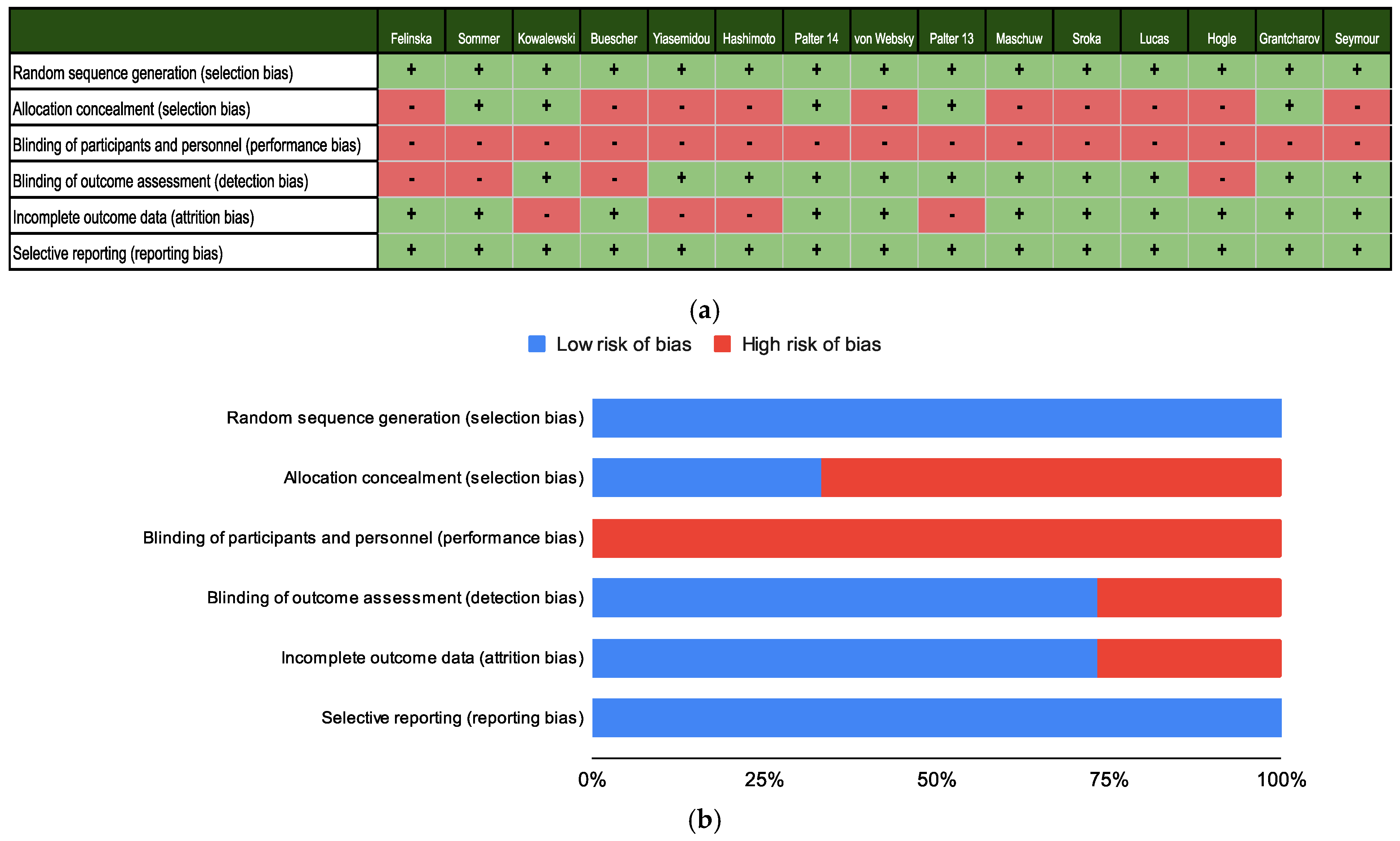
3.2. Risk of Bias
3.3. Meta-Analysis
4. Discussion
5. Conclusions
Supplementary Materials
Author Contributions
Funding
Data Availability Statement
Conflicts of Interest
References
- Harrysson, I.; Hull, L.; Sevdalis, N.; Darzi, A.; Aggarwal, R. Development of a knowledge, skills, and attitudes framework for training in laparoscopic cholecystectomy. Am. J. Surg. 2014, 207, 790–796. [Google Scholar] [CrossRef] [PubMed]
- Deziel, D.J.; Milikan, K.W.; Economou, S.G.; Doolas, A.; Ko, S.T.; Airan, M.C. Complications of laparoscopic cholecystectomy: A national survey of 4292 hospitals and an analysis of 77,604 cases. Am. J. Surg. 1993, 165, 9–14. [Google Scholar] [CrossRef] [PubMed]
- Moore, M.J.; Bennett, C.L. The learning curve for laparoscopic cholecystectomy. The Southern Surgeons Club. Am. J. Surg. 1995, 170, 55–59. [Google Scholar] [PubMed]
- Borman, K.; Fuhrman, G. Association Program Directors in Surgery. “Resident Duty Hours: Enhancing Sleep, Supervision, and Safety”: Response of the Association of Program Directors in Surgery to the December 2008 Report of the Institute of Medicine. Surgery 2009, 146, 420–427. [Google Scholar] [CrossRef]
- Britt, L.D.; Sachdeva, A.K.; Healy, G.B.; Whalen, T.V.; Blair, P.G.; Members of ACS Task Force on Resident Duty Hours. Resident duty hours in surgery for ensuring patient safety, providing optimum resident education and training, and promoting resident well-being: A response from the American College of Surgeons to the Report of the Institute of Medicine, “Resident Duty Hours: Enhancing Sleep, Supervision, and Safety”. Surgery 2009, 146, 398–409. [Google Scholar] [CrossRef]
- Zendejas, B.; Cook, D.A.; Bingener, J.; Huebner, M.; Dunn, W.F.; Sarr, M.G.; Farley, D.R. Simulation-based mastery learning improves patient outcomes in laparoscopic inguinal hernia repair: A randomized controlled trial. Ann. Surg. 2011, 254, 509–511. [Google Scholar] [CrossRef]
- Shore, E.M.; Grantcharov, T.P.; Husslein, H.; Shirreff, L.; Dedy, N.J.; McDermott, C.D.; Lefebvre, G.G. Validating a standardized laparoscopy curriculum for gynecology residents: A randomized controlled trial. Am. J. Obstet. Gynecol. 2016, 215, 204.e1–204.e11. [Google Scholar] [CrossRef]
- Patel, N.R.; Makai, G.E.; Sloan, N.L.; Della Badia, C.R. Traditional versus simulation resident surgical laparoscopic salpingectomy training: A randomized controlled trial. J. Minim. Invasive Gynecol. 2016, 23, 372–377. [Google Scholar] [CrossRef]
- Nilsson, C.; Sorensen, J.L.; Konge, L.; Westen, M.; Stadeager, M.; Ottesen, B.; Bjerrum, F. Simulation-based camera navigation training in laparoscopy a randomized trial. Surg. Endosc. 2017, 31, 2131–2139. [Google Scholar] [CrossRef]
- Shakur, S.F.; Luciano, C.J.; Kania, P.; Roitberg, B.Z.; Banerjee, P.P.; Slavin, K.V.; Sorenson, J.; Charbel, F.T.; Alaraj, A. Usefulness of a virtual reality percutaneous trigeminal rhizotomy simulator in neurosurgical training. Neurosurgery 2015, 11, 420–425. [Google Scholar] [CrossRef]
- Ahlberg, G.; Enochsson, L.; Gallagher, A.G.; Hedman, L.; Hogman, C.; McClusky, D.A., 3rd; Ramel, S.; Smith, C.D.; Arvidsson, D. Proficiency-based virtual reality training significantly reduces the error rate for residents during their first 10 laparoscopic cholecystectomies. Am. J. Surg. 2007, 193, 797–804. [Google Scholar] [CrossRef]
- Peltan, I.D.; Shiga, T.; Gordon, J.A.; Currier, P.F. Simulation improves procedural protocol adherence during central venous catheter placement: A randomized controlled trial. Simul. Healthc. 2015, 10, 270–276. [Google Scholar] [CrossRef]
- Aggarwal, R.; Ward, J.; Balasundaram, I.; Sains, P.; Athanasiou, T.; Darzi, A. Proving the effectiveness of virtual reality simulation for training in laparoscopic surgery. Ann. Surg. 2007, 246, 771–779. [Google Scholar] [CrossRef]
- Grantcharov, T.; Kristiansen, V.; Bendix, J.; Bardram, L.; Rosenberg, J.; Funch-Jensen, P. Randomized clinical trial of virtual reality simulation for laparoscopic skills training. Br. J. Surg. 2004, 91, 146–150. [Google Scholar] [CrossRef] [PubMed]
- Sedlack, R.; Kolars, J. Computer simulator training enhances the competency of gastroenterology fellows at colonoscopy: Results of a pilot study. Am. J. Gastroenterol. 2004, 99, 33–37. [Google Scholar] [CrossRef] [PubMed]
- Portelli, M.; Bianco, S.F.; Bezzina, T.; Abela, J.E. Virtual reality training compared with apprenticeship training in laparoscopic surgery: A meta-analysis. Ann. R. Coll. Surg. Engl. 2020, 102, 672–684. [Google Scholar] [CrossRef] [PubMed]
- Cook, D.A.; Hatala, R.; Brydges, R.; Zendejas, B.; Szostek, J.H.; Wang, A.T.; Erwin, P.J.; Hamstra, S.J. Technology-enhanced simulation for health professions education: A systematic review and meta-analysis. JAMA 2011, 306, 978–988. [Google Scholar] [CrossRef]
- Cook, D.A.; Brydges, R.; Hamstra, S.; Zendejas, B.; Szostek, J.H.; Wang, A.T.; Erwin, P.J.; Hatala, R. Comparative Effectiveness of Technology-Enhanced Simulation vs. Other Instructional Methods: A Systematic Review and Meta-Analysis. Simul. Healthc. 2012, 7, 308–320. [Google Scholar] [CrossRef]
- Cook, D.A.; Hamstra, S.; Brydges, R.; Zendejas, B.; Szostek, J.H.; Wang, A.T.; Erwin, P.J.; Hatala, R. Comparative Effectiveness of Instructional Design Features in Simulation-based Education: Systematic Review and Meta-analysis. Med. Teach. 2013, 35, e867–e898. [Google Scholar] [CrossRef]
- Moher, D.; Liberati, A.; Tetzlaff, J.; Altman, D.G. Preferred reporting items for systematic reviews and meta-analyses: The PRISMA statement. BMJ 2009, 339, b2535. [Google Scholar] [CrossRef]
- Study Quality Assessment Tools. Available online: https://www.nhlbi.nih.gov/health-topics/study-quality-assessment-tools (accessed on 12 December 2024).
- Watanabe, Y.; Bilgic, E.; Lebedeva, E.; McKendy, K.M.; Feldman, L.S.; Fried, G.M.; Vassiliou, M.C. A systematic review of performance assessment tools for laparoscopic cholecystectomy. Surg. Endosc. 2016, 30, 832–844. [Google Scholar] [CrossRef] [PubMed]
- Martin, J.A.; Regehr, G.; Reznick, R.; MacRae, H.; Murnaghan, J.; Hutchison, C.; Brown, M. Objective structured assessment of technical skill (OSATS) for surgical residents. Br. J. Surg. 1997, 84, 273–278. [Google Scholar] [PubMed]
- Vassiliou, M.C.; Feldman, L.S.; Andrew, C.G.; Bergman, S.; Leffondré, K.; Stanbridge, D.; Fried, G.M. A global assessment tool for evaluation of intraoperative laparoscopic skills. Am. J. Surg. 2005, 190, 107–113. [Google Scholar] [CrossRef] [PubMed]
- Doi, S.A.; Barendregt, J.J.; Khan, S.; Thalib, L.; Williams, G.M. Advances in the meta-analysis of heterogeneous clinical trials I: The inverse variance heterogeneity model. Contemp. Clin. Trials 2015, 45, 130–138. [Google Scholar] [CrossRef]
- Higgins, J.P.T.; Altman, D.G.; Gøtzsche, P.C.; Jüni, P.; Moher, D.; Oxman, A.D.; Savovic, J.; Schulz, K.F.; Weeks, L.; Sterne, J.A.; et al. The Cochrane Collaboration’s tool for assessing risk of bias in randomised trials. BMJ 2011, 343, d5928. [Google Scholar] [CrossRef]
- Felinska, E.A.; Fuchs, T.E.; Kogkas, A.; Chen, Z.W.; Otto, B.; Kowalewski, K.F.; Petersen, J.; Müller-Stich, B.P.; Mylonas, G.; Nickel, F. Telestration with augmented reality improves surgical performance through gaze guidance. Surg. Endosc. 2023, 37, 3557–3566. [Google Scholar] [CrossRef]
- Kojima, Y.; Wong, H.J.; Kuchta, K.; Denham, W.; Haggerty, S.; Linn, J.; Ujiki, M. Resident performance in simulation module is associated with operating room performance for laparoscopic cholecystectomy. Surg. Endosc. 2022, 36, 9273–9280. [Google Scholar] [CrossRef]
- Sommer, G.M.; Broschewitz, J.; Huppert, S.; Sommer, C.G.; Jahn, N.; Jansen-Winkeln, B.; Gockel, I.; Hau, H.M. The role of virtual reality simulation in surgical training in the light of COVID-19 pandemic Visual spatial ability as a predictor for improved surgical performance: A randomized trial. Medicine 2021, 100, E27844. [Google Scholar] [CrossRef]
- Khoo, H.C.; Chik, I.; Azman, A.; Zuhdi, Z.; Harunarashid, H.; Jarmin, R. Virtual reality laparoscopic simulator: Training tool for surgical trainee in Malaysia. Formosan J. Surg. 2021, 54, 11–18. [Google Scholar] [CrossRef]
- Kowalewski, K.F.; Garrow, C.R.; Proctor, T.; Preukschas, A.A.; Friedrich, M.; Müller, P.C.; Kenngott, H.G.; Fischer, L.; Müller-Stich, B.P.; Nickel, F. LapTrain: Multi-modality training curriculum for laparoscopic cholecystectomy—Results of a randomized controlled trial. Surg. Endosc. 2018, 32, 3830–3838. [Google Scholar] [CrossRef]
- Buescher, J.F.; Mehdorn, A.-S.; Neumann, P.A.; Becker, F.; Eichelmann, A.K.; Pankratius, U.; Bahde, R.; Foell, D.; Senninger, N.; Rijcken, E. Effect of Continuous Motion Parameter Feedback on Laparoscopic Simulation Training: A Prospective Randomized Controlled Trial on Skill Acquisition and Retention. J. Surg. Educ. 2018, 75, 516–526. [Google Scholar] [CrossRef]
- Yiasemidou, M.; de Siqueira, J.; Tomlinson, J.; Glassman, D.; Stock, S.; Gough, M. “Take-home” box trainers are an effective alternative to virtual reality simulators. J. Surg. Res. 2017, 213, 69–74. [Google Scholar] [CrossRef]
- Hashimoto, D.A.; Sirimanna, P.; Gomez, E.D.; Beyer-Berjot, L.; Ericsson, K.A.; Williams, N.N.; Darzi, A.; Aggarwal, R. Deliberate practice enhances quality of laparoscopic surgical performance in a randomized controlled trial: From arrested development to expert performance. Surg. Endosc. 2015, 29, 3154–3162. [Google Scholar] [CrossRef] [PubMed]
- Palter, V.N.; Grantcharov, T.P. Individualized deliberate practice on a virtual reality simulator improves technical performance of surgical novices in the operating room: A randomized controlled trial. Ann. Surg. 2014, 259, 443–448. [Google Scholar] [CrossRef]
- von Websky, M.W.; Raptis, D.A.; Vitz, M.; Rosenthal, R.; Clavien, P.A.; Hahnloser, D. Access to a simulator is not enough: The benefits of virtual reality training based on peer-group-derived benchmarks—A randomized controlled trial. World J. Surg. 2013, 37, 2534–2541. [Google Scholar] [CrossRef] [PubMed]
- Palter, V.N.; Orzech, N.; Reznick, R.K.; Grantcharov, T.P. Validation of a structured training and assessment curriculum for technical skill acquisition in minimally invasive surgery: A randomized controlled trial. Ann. Surg. 2013, 257, 224–230. [Google Scholar] [CrossRef]
- Maschuw, K.; Schlosser, K.; Kupietz, E.; Slater, E.P.; Weyers, P.; Hassan, I. Do soft skills predict surgical performance? A single-center randomized controlled trial evaluating predictors of skill acquisition in virtual reality laparoscopy. World J. Surg. 2011, 35, 480–486. [Google Scholar] [CrossRef]
- Loukas, C.; Nikiteas, N.; Kanakis, M.; Georgiou, E. Deconstructing laparoscopic competence in a virtual reality simulation environment. Surgery 2011, 149, 750–760. [Google Scholar] [CrossRef] [PubMed]
- Sroka, G.; Feldman, L.S.; Vassiliou, M.C.; Kaneva, P.A.; Fayez, R.; Fried, G.M. Fundamentals of Laparoscopic Surgery simulator training to proficiency improves laparoscopic performance in the operating room- A randomized controlled trial. Am. J. Surg. 2010, 199, 115–120. [Google Scholar] [CrossRef]
- Brown, D.C.; Miskovic, D.; Tang, B.; Hanna, G.B. Impact of established skills in open surgery on the proficiency gain process for laparoscopic surgery. Surg. Endosc. Interv. Tech. 2010, 24, 1420–1426. [Google Scholar] [CrossRef]
- Lucas, S.; Tuncel, A.; Bensalah, K.; Zeltser, I.; Jenkins, A.; Pearle, M.; Cadeddu, J. Virtual reality training improves simulated laparoscopic surgery performance in laparoscopy naïve medical students. J. Endourol. 2008, 22, 1047–1051. [Google Scholar] [CrossRef]
- Hogle, N.J.; Widmann, W.D.; Ude, A.O.; Hardy, M.A.; Fowler, D.L. Does Training Novices to Criteria and Does Rapid Acquisition of Skills on Laparoscopic Simulators Have Predictive Validity or Are We Just Playing Video Games? J. Surg. Educ. 2008, 65, 431–435. [Google Scholar] [CrossRef]
- Schijven, M.; Klaassen, R.; Jakimowicz, J.; Terpstra, O.T. The Intercollegiate Basic Surgical Skills Course: Laparoscopic skill assessment using the Xitact LS500 laparoscopy simulator. Surg. Endosc. 2003, 17, 1978–1984. [Google Scholar] [CrossRef]
- Seymour, N.E.; Gallagher, A.G.; Roman, S.A.; O’Brien, M.K.; Bansal, V.K.; Andersen, D.K.; Satava, R.M. Virtual reality training improves operating room performance results of a randomized, double-blinded study. Ann. Surg. 2002, 236, 458–464. [Google Scholar] [CrossRef]
- Grantcharov, T.P.; Rosenberg, J.; Pahle, E.; Funch-Jensen, P. Virtual reality computer simulation: An objective method for the evaluation of laparoscopic surgical skills. Surg. Endosc. 2001, 15, 242–244. [Google Scholar] [CrossRef]
- Zendejas, B.; Brydges, R.; Wang, A.T.; Cook, D.A. Patient outcomes in simulation-based medical education: A systematic review. J. Gen. Intern. Med. 2013, 28, 1078–1089. [Google Scholar] [CrossRef]
- Johnston, M.J.; Paige, J.T.; Aggarwal, R.; Stefanidis, D.; Tsuda, S.; Khajuria, A.; Arora, S.; Association for Surgical Education Simulation Committee. An overview of research priorities in surgical simulation: What the literature shows has been achieved during the 21st century and what remains. Am. J. Surg. 2016, 21, 214–225. [Google Scholar] [CrossRef] [PubMed]



| First Author (Year), Country | Study Design | Participant Grade (Total) | Intervention(s): Control | VR System | Comparator | Assessment | Outcomes | Result: Was VRT Favored? |
|---|---|---|---|---|---|---|---|---|
| Felinska (2023) [27] Germany, UK | MC, Crossover Trial, RCT | Medical students (40) | 20:20 | iSurgeon | NAT | 8-task (ex vivo porcine LC) | OSATS, time, errors, NASA-TLX, blink rate | Yes |
| Kojima (2022) [28] | SC, Pre-Post | Residents (21) | 21: no control | LAPMentor | SP vs. OR LCMP | Hands-on LC Case I | GOALS, OSATS, LC-SIM, STAT | No |
| Sommer (2021) [29] Germany | SC, 2-RCT | Medical students (60) | 30:30 | LapX (SOR) LapSim (CD) | NAT | Tube figure test | Time, instrument movement, number of missed clips | No |
| Khoo (2021) [30] Malaysia | SC, Pre-Post | Surgical residents (9) | 9: no control | LAPMentor, VRLS | Baseline | Full LC on LAPMentor | Time, LAPMentor metrics, Confidence level | Yes |
| Kowalewski (2018) [31] Germany | SC, 2-RCT | Surgical residents (64) | 33:31 | LAPMentor | NAT | VR LC Porcine LC | GOALS | Yes |
| Buescher (2017) [32] Germany | SC, 2-RCT | Medical students (36) | 18:18 | LAPMentorII LapX-Hybrid Simulator | Box Training | VR cholecystectomy | Time, path length, number of movements, velocity, and idle time | Yes |
| Yiasemidou (2017) [33] UK | SC, 2-RCT | Surgical trainees (16) | 9:7 | LAPMentor | “Take-Home “ Box Training | Two VR cholecystectomies | GOALS, time, path length, number of movements | No |
| Hashimoto (2015) [34] USA | SC, 2-RCT | Surgical residents (14) | 7:7 | LAPMentor, LapSim | Deliberate Practice | Pre- and post- Basic Task 5 and 6 | GRS, OSATS | No |
| Palter (2014) [35] Canada | SC, 2-RCT | Surgical trainees (16) | 8:8 | LAPSim | Conventional Feedback | LC in OR under supervision | OSATS, procedure-specific evaluation tool | Yes |
| Harrysson (2014) [1] UK | SC | Surgical residents (5) | 5: no control | LAPMentor | Classroom | LC | Survey | Yes |
| von Websky (2013) [36] | SC, 2-RCT | Surgical residents (68) | 32:34 (dropouts = 2) | LAPMentor | Peer-group-derived benchmarks | LC on the simulator | PEM, SEM | Yes |
| Palter (2013) [37] Canada | SC, 2-RCT | Surgical trainees (20) | 10:10 | LapSim | conventionally trained group | 5 sequential LC in OR | OSATS | Yes |
| Maschuw (2011) [38] France | SC, 2-RCT Pre-Post | Surgical residents (50) | 25:25 | LapSim | NAT | Camera navigation in LC, SPQ | VR performance parameters | No |
| Loukas (2011) [39] Greece | SC, Pre-Post: Experienced | Surgical residents (20) Expert (8) | 20:no control | LapVR (Surgical VR Simulator) | LapVR | Essential tasks, procedural task, surgical procedure (LC) | Time, total path length, dexterity, velocity, and technical skill (error) | Yes |
| Sroka (2010) [40] | SC, 2-RCT | Surgical trainees (19) | 9:8 (excluded = 2, GOALS > 15) | MISTELS | Regular Residency Training | Elective LC | GOALS | Yes |
| Brown (2010) [41] UK | MC, Pre-Post-Retention | Medical students (11), Surgical residents (14) | 25: no control | LAPMentor | LAPMentor | 10 LC | OSATS, GRS, Survey, PM, Knowledge, confidence level, corrective instruction, PM | Yes |
| Lucas (2008) [42] USA | SC, 2-RCT Pre-Post | Medical students (32) | 16:16 | LAPMentor | NAT | VR LC | OSATS | Yes |
| Hogle (2008) [43] USA | SC, 2-RCT | Surgical residents (21) | 10:11 | LapSim | NAT | LC in a pig | GOALS | No |
| Ahlberg (2006) [11] Sweden | MC, 2-RCT | Surgical residents (13) | NR | LapSim | NAT | 1st, 5th and 10th LC | Time, Path Length, Defined surgical errors | Yes |
| Grantcharov (2004) [14] Denmark | MC, 2-RCT | Surgical residents (20) | 10:10 | MIST-VR | NAT | 2 LC | Time, Error scores, Economy of movement scores | Yes |
| Schijven (2003) [44] Netherlands | MC, 2-RCT Pre-Post | Surgical residents (25), Interns (25) | 25:25 | Xitact LS500 | No BSSC | Standardized LC Clip-and cut | Time, Sum score, QCM | No |
| Seymour (2002) [45] UK | SC, 2-RCT | Surgical residents (16) | 8:8 | MIST-VR | Non-VR trained | LC with an attending surgeon | Time, Operative errors | Yes |
| Grantcharov (2001) [46] Denmark | SC Pig LC: MIST-VR | Surgical residents (14) | 14: no control | MIST-VR | NAT | LC on pig | Time, Error score | Yes |
| Intervention | Control | Mean Difference | Weight | Mean Difference | |||||
|---|---|---|---|---|---|---|---|---|---|
| Study | Mean | S.D. | N | Mean | S.D. | N | IVhet, 95% CI | (%) | IVhet, 95% CI |
| VR vs. NAT subgroup | 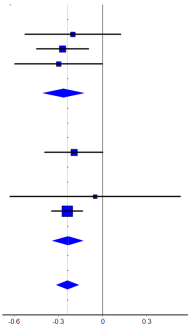 | ||||||||
| Felinska et al. [27] | 0.80 | 0.49 | 20 | 1.00 | 0.55 | 20 | −0.20 [−0.53, 0.12] | 5.51 | |
| Kowalewski et al. [31] | 0.73 | 0.31 | 33 | 1.00 | 0.40 | 31 | −0.27 [−0.45, −0.10] | 18.48 | |
| Seymour et al. [45] | 0.70 | 0.22 | 8 | 1.00 | 0.27 | 8 | −0.30 [−0.60, −0.15] | 6.50 | |
| Subtotal | 61 | 59 | −0.27 [−0.40, −0.13] | 30.49 | |||||
| Heterogeneity: Q = 0.20, p = 0.90, I2 = 0% | |||||||||
| VR vs. TT subgroup | |||||||||
| Palter et al. (13) [37] | 0.80 | 0.21 | 10 | 1.00 | 0.23 | 10 | −0.20 [−0.39, 0.00] | 15.09 | |
| VR+ vs. VR subgroup | |||||||||
| Hashimoto et al. [34] | 0.95 | 0.56 | 7 | 1.00 | 0.55 | 7 | −0.05 [−0.63, 0.53] | 1.73 | |
| von Websky et al. [36] | 0.76 | 0.34 | 107 | 1.00 | 0.38 | 81 | −0.24 [−0.35, −0.14] | 52.69 | |
| Subtotal | 114 | 88 | −0.24 [−0.32, −0.13] | 54.42 | |||||
| Heterogeneity: Q = 0.41, p = 0.52, I2 = 0% | |||||||||
| Overall | 185 | 157 | −0.24 [−0.32, −0.16] | 100.00 | |||||
| Heterogeneity: Q = 0.94, p = 0.97, I2 = 0% | |||||||||
| VRT Favored | |||||||||
| Intervention | Control | Mean Difference | Weight | Mean Difference | |||||
|---|---|---|---|---|---|---|---|---|---|
| Study | Mean | S.D. | N | Mean | S.D. | N | IVhet, 95% CI | (%) | IVhet, 95% CI |
| Students subgroup | 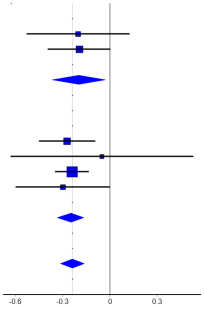 | ||||||||
| Felinska et al. [27] | 0.80 | 0.49 | 20 | 1.00 | 0.55 | 20 | −0.20 [−0.53, 0.12] | 5.51 | |
| Palter et al. (13) [37] | 0.80 | 0.21 | 10 | 1.00 | 0.23 | 10 | −0.20 [−0.39, 0.00] | 15.09 | |
| Subtotal | 30 | 30 | −0.20 [−0.37, −0.03] | 20.60 | |||||
| Heterogeneity: Q = 0.00, p = 0.97, I2 = 0% | |||||||||
| Residents subgroup | |||||||||
| Kowalewski et al. [31] | 0.73 | 0.31 | 33 | 1.00 | 0.40 | 31 | −0.27 [−0.45, −0.10] | 18.48 | |
| Hashimoto et al. [34] | 0.95 | 0.56 | 7 | 1.00 | 0.55 | 7 | −0.05 [−0.63, 0.53] | 1.73 | |
| von Websky et al. [36] | 0.76 | 0.34 | 107 | 1.00 | 0.38 | 81 | −0.24 [−0.35, −0.14] | 52.69 | |
| Seymour et al. [45] | 0.70 | 0.22 | 8 | 1.00 | 0.27 | 8 | −0.30 [−0.60, −0.15] | 6.50 | |
| Subtotal | 155 | 127 | −0.25 [−0.34, −0.16] | 79.40 | |||||
| Heterogeneity: Q = 0.65, p = 0.89, I2 = 0% | |||||||||
| Overall | 185 | 157 | −0.24 [−0.32, −0.16] | 100.00 | |||||
| Heterogeneity: Q = 0.94, p = 0.97, I2 = 0% | |||||||||
| VRT Favored | |||||||||
| Intervention | Control | Mean Difference | Weight | Mean Difference | |||||
|---|---|---|---|---|---|---|---|---|---|
| Study | Mean | S.D. | N | Mean | S.D. | N | IVhet, 95% CI | (%) | IVhet, 95% CI |
| VR vs. NAT subgroup |  | ||||||||
| Felinska et al. [27] | 8.13 | 1.88 | 20 | 5.13 | 4.13 | 20 | 3.00 [1.01, 4.99] | 7.91 | |
| Kowalewski et al. [31] | 5.76 | 4.24 | 33 | 4.00 | 3.00 | 31 | 1.76 [−0.03, 3.55] | 9.71 | |
| Palter et al. (14) [35] | 8.17 | 1.83 | 8 | 4.71 | 3.71 | 8 | 3.47 [0.60, 6.33] | 3.80 | |
| Lucas et al. [39] | 7.27 | 2.73 | 16 | 3.35 | 2.35 | 16 | 3.91 [2.14, 5.68] | 9.97 | |
| Seymour et al. [45] | 7.97 | 0.84 | 8 | 5.50 | 4.50 | 8 | 2.47 [−0.70, 5.64] | 3.10 | |
| Subtotal | 85 | 83 | 2.92 [1.97, 3.87] | 34.49 | |||||
| Heterogeneity: Q = 3.05, p = 0.55, I2 = 0% | |||||||||
| VR vs. TT subgroup | |||||||||
| Yiasemidou et al. [33] | 3.92 | 2.92 | 7 | 8.78 | 1.22 | 9 | −4.86 [−7.17, −2.56] | 5.87 | |
| Palter et al. (13) [37] | 8.96 | 1.04 | 10 | 3.77 | 2.77 | 10 | 5.19 [3.36, 7.03] | 9.28 | |
| Sroka et al. [40] | 7.78 | 2.22 | 9 | 3.57 | 2.57 | 8 | 4.21 [1.91, 6.51] | 5.90 | |
| Subtotal | 26 | 27 | 2.11 [−4.16, 8.38] | 21.06 | |||||
| Heterogeneity: Q = 49.28, p = 0.00, I2 = 96% | |||||||||
| VR+ vs. VR subgroup | |||||||||
| Hashimoto et al. [34] | 8.33 | 1.67 | 7 | 2.67 | 1.67 | 7 | 5.65 [3.90, 7.41] | 10.13 | |
| von Websky et al. [36] | 7.31 | 2.69 | 107 | 4.71 | 3.70 | 81 | 2.61 [1.66, 3.57] | 34.32 | |
| Subtotal | 114 | 88 | 3.30 [0.00, 6.61] | 44.45 | |||||
| Heterogeneity: Q = 8.90, p = 0.00, I2 = 89% | |||||||||
| Overall | 225 | 198 | 2.92 [0.96, 4.88] | 100.00 | |||||
| Heterogeneity: Q = 63.74, p = 0.00, I2 = 86% | |||||||||
| VRT Favored | |||||||||
| Intervention | Control | Mean Difference | Weight | Mean Difference | |||||
|---|---|---|---|---|---|---|---|---|---|
| Study | Mean | S.D. | N | Mean | S.D. | N | IVhet, 95% CI | (%) | IVhet, 95% CI |
| Students subgroup |  | ||||||||
| Felinska et al. [27] | 8.13 | 1.88 | 20 | 5.13 | 4.13 | 20 | 3.00 [1.01, 4.99] | 8.40 | |
| Palter et al. (14) [35] | 8.17 | 1.83 | 8 | 4.71 | 3.71 | 8 | 3.47 [0.60, 6.33] | 4.04 | |
| Palter et al. (13) [37] | 8.96 | 1.04 | 10 | 3.77 | 2.77 | 10 | 5.19 [3.36, 7.03] | 9.86 | |
| Sroka et al. [40] | 7.78 | 2.22 | 9 | 3.57 | 2.57 | 8 | 4.21 [1.91, 6.51] | 6.27 | |
| Lucas et al. [42] | 7.27 | 2.73 | 16 | 3.35 | 2.35 | 16 | 3.91 [2.14, 5.68] | 10.60 | |
| Subtotal | 63 | 62 | 4.04 [3.12, 4.96] | 39.16 | |||||
| Heterogeneity: Q = 2.77, p = 0.60, I2 = 0% | |||||||||
| Residents subgroup | |||||||||
| Kowalewski et al. [31] | 5.76 | 4.24 | 33 | 4.00 | 3.00 | 31 | 1.76 [−0.03, 3.55] | 10.32 | |
| Hashimoto et al. [34] | 8.33 | 1.67 | 7 | 2.67 | 1.67 | 7 | 5.65 [3.90, 7.41] | 10.76 | |
| von Websky et al. [36] | 7.31 | 2.69 | 107 | 4.71 | 3.70 | 81 | 2.61 [1.66, 3.57] | 36.46 | |
| Seymour et al. [45] | 7.97 | 0.84 | 8 | 5.50 | 4.50 | 8 | 2.47 [−0.70, 5.64] | 3.29 | |
| Subtotal | 155 | 127 | 3.00 [1.03, 4.97] | 60.84 | |||||
| Heterogeneity: Q = 11.36, p = 0.01, I2 = 74% | |||||||||
| Overall | 218 | 189 | 3.41 [2.39, 4.43] | 100.00 | |||||
| Heterogeneity: Q = 17.13, p = 0.03, I2 = 53% | |||||||||
| VRT Favored | |||||||||
| Intervention | Control | Mean Difference | Weight | Mean Difference | |||||
|---|---|---|---|---|---|---|---|---|---|
| Study | Mean | S.D. | N | Mean | S.D. | N | IVhet, 95% CI | (%) | IVhet, 95% CI |
| OSATS subgroup |  | ||||||||
| Felinska et al. [27] | 8.13 | 1.88 | 20 | 5.13 | 4.13 | 20 | 3.00 [1.01, 4.99] | 8.40 | |
| Hashimoto et al. [34] | 8.33 | 1.67 | 7 | 2.67 | 1.67 | 7 | 5.65 [3.90, 7.41] | 10.76 | |
| Palter et al. (14) [35] | 8.17 | 1.83 | 8 | 4.71 | 3.71 | 8 | 3.47 [0.60, 6.33] | 4.04 | |
| Sroka et al. [40] | 7.78 | 2.22 | 9 | 3.57 | 2.57 | 8 | 4.21 [1.91, 6.51] | 6.27 | |
| Lucas et al. [42] | 7.27 | 2.73 | 16 | 3.35 | 2.35 | 16 | 3.91 [2.14, 5.68] | 10.60 | |
| Subtotal | 60 | 59 | 4.19 [3.23, 5.15] | 40.07 | |||||
| Heterogeneity: Q = 4.39, p = 0.36, I2 = 9% | |||||||||
| GOALS subgroup | |||||||||
| Kowalewski et al. [31] | 5.76 | 4.24 | 33 | 4.00 | 3.00 | 31 | 1.76 [−0.03, 3.55] | 10.32 | |
| PathLen subgroup | |||||||||
| von Websky et al. [36] | 7.31 | 2.69 | 107 | 4.71 | 3.70 | 81 | 2.61 [1.66, 3.57] | 36.46 | |
| Palter et al. (13) [37] | 8.96 | 1.04 | 10 | 3.77 | 2.77 | 10 | 5.19 [3.36, 7.03] | 9.86 | |
| Subtotal | 117 | 91 | 3.16 [0.37, 5.95] | 46.32 | |||||
| Heterogeneity: Q = 5.99, p = 0.01, I2 = 83% | |||||||||
| Operative Error subgroup | |||||||||
| Seymour et al. [45] | 7.97 | 0.84 | 8 | 5.50 | 4.50 | 8 | 2.47 [−0.70, 5.64] | 3.29 | |
| Overall | 218 | 189 | 3.41 [2.39, 4.43] | 100.00 | |||||
| Heterogeneity: Q = 17.13, p = 0.03, I2 = 53% | |||||||||
| Favors Intervention | |||||||||
| Intervention | Control | Mean Difference | Weight | Mean Difference | |||||
|---|---|---|---|---|---|---|---|---|---|
| Study | Mean | S.D. | N | Mean | S.D. | N | IVhet, 95% CI | (%) | IVhet, 95% CI |
| iSurgeon subgroup |  | ||||||||
| Felinska et al. [27] | 8.13 | 1.88 | 20 | 5.13 | 4.13 | 20 | 3.00 [1.01, 4.99] | 9.41 | |
| LAP Mentor subgroup | |||||||||
| Kowalewski et al. [31] | 5.76 | 4.24 | 33 | 4.00 | 3.00 | 31 | 1.76 [−0.03, 3.55] | 11.57 | |
| von Websky et al. [36] | 7.31 | 2.69 | 107 | 4.71 | 3.70 | 81 | 2.61 [1.66, 3.57] | 40.86 | |
| Lucas et al. [39] | 7.27 | 2.73 | 16 | 3.35 | 2.35 | 16 | 3.91 [2.14, 5.68] | 11.88 | |
| Subtotal | 156 | 128 | 2.70 [1.68, 3.72] | 64.30 | |||||
| Heterogeneity: Q = 2.90, p = 0.23, I2 = 31% | |||||||||
| LAP Sim subgroup | |||||||||
| Palter et al. (14) [35] | 8.17 | 1.83 | 8 | 4.71 | 3.71 | 8 | 3.47 [0.60, 6.33] | 4.52 | |
| Palter et al. (13) [37] | 8.96 | 1.04 | 10 | 3.77 | 2.77 | 10 | 5.19 [3.36, 7.03] | 11.05 | |
| Subtotal | 18 | 18 | 4.69 [3.15, 6.24] | 15.57 | |||||
| Heterogeneity: Q = 0.99, p = 0.32, I2 = 0% | |||||||||
| MIST-VR subgroup | |||||||||
| Sroka et al. [40] | 7.78 | 2.22 | 9 | 3.57 | 2.57 | 8 | 4.21 [1.91, 6.51] | 7.03 | |
| Seymour et al. [45] | 7.97 | 0.84 | 8 | 5.50 | 4.50 | 8 | 2.47 [−0.70, 5.64] | 3.69 | |
| Subtotal | 17 | 16 | 3.61 [1.75, 5.47] | 10.72 | |||||
| Heterogeneity: Q = 0.76, p = 0.38, I2 = 0% | |||||||||
| Overall | 211 | 182 | 3.14 [2.30, 3.97] | 100.00 | |||||
| Heterogeneity: Q = 10.08, p = 0.18, I2 = 31% | |||||||||
| VRT Favored | |||||||||
Disclaimer/Publisher’s Note: The statements, opinions and data contained in all publications are solely those of the individual author(s) and contributor(s) and not of MDPI and/or the editor(s). MDPI and/or the editor(s) disclaim responsibility for any injury to people or property resulting from any ideas, methods, instructions or products referred to in the content. |
© 2025 by the authors. Licensee MDPI, Basel, Switzerland. This article is an open access article distributed under the terms and conditions of the Creative Commons Attribution (CC BY) license (https://creativecommons.org/licenses/by/4.0/).
Share and Cite
Suh, I.; Li, H.; Li, Y.; Nelson, C.; Oleynikov, D.; Siu, K.-C. Using Virtual Reality Simulators to Enhance Laparoscopic Cholecystectomy Skills Learning. Appl. Sci. 2025, 15, 8424. https://doi.org/10.3390/app15158424
Suh I, Li H, Li Y, Nelson C, Oleynikov D, Siu K-C. Using Virtual Reality Simulators to Enhance Laparoscopic Cholecystectomy Skills Learning. Applied Sciences. 2025; 15(15):8424. https://doi.org/10.3390/app15158424
Chicago/Turabian StyleSuh, Irene, Hong Li, Yucheng Li, Carl Nelson, Dmitry Oleynikov, and Ka-Chun Siu. 2025. "Using Virtual Reality Simulators to Enhance Laparoscopic Cholecystectomy Skills Learning" Applied Sciences 15, no. 15: 8424. https://doi.org/10.3390/app15158424
APA StyleSuh, I., Li, H., Li, Y., Nelson, C., Oleynikov, D., & Siu, K.-C. (2025). Using Virtual Reality Simulators to Enhance Laparoscopic Cholecystectomy Skills Learning. Applied Sciences, 15(15), 8424. https://doi.org/10.3390/app15158424