Article

Experimental Study on the Effects of Loading Rates on the Fracture Mechanical Characteristics of Coal Influenced by Long-Term Immersion in Mine Water


1
State Key Laboratory of Water Resource Protection and Utilization in Coal Mining, National Institute of Low Carbon and Clean Energy, Beijing 102209, China
2
College of Water Resource & Hydropower, Sichuan University, Chengdu 610065, China
3
School of Mines, China University of Mining and Technology, Xuzhou 221116, China
4
College of Civil Engineering, Guizhou University, Guiyang 550025, China
*
Author to whom correspondence should be addressed.
Appl. Sci. 2025, 15(15), 8222; https://doi.org/10.3390/app15158222
Submission received: 22 May 2025 / Revised: 22 June 2025 / Accepted: 9 July 2025 / Published: 24 July 2025

Abstract

Underground pumped storage hydropower stations (UPSH) are of great significance for energy structure adjustment, and coal mine underground reservoirs are an integral part of UPSH. This study investigates the fracture mechanics behavior of coal in mine water immersion environments with varying loading rates and layer direction. Three types of samples were analyzed: Crack-arrester, Crack-splitter, and Crack-divider types. The immersion duration extended up to 120 days. The results indicate that, after immersion in mine water for 120 days, the fracture toughness (KIC), fracture modulus (ES), and absorbed energy (UT) of coal decreased by 60.87%, 53.38%, and 63.21%, respectively, compared to the unsaturated coal samples. An immersion period of 30 days significantly weakens the mechanical properties of coal fractures. The KIC, ES, and UT of coal demonstrate a positive correlation with loading rate, primarily influenced by the duration of coal damage. At the same loading rate, the order of fracture toughness among the three coal types is as follows: Crack-divider > Crack-arrester > Crack-splitter. This hierarchy is determined by the properties of the coal matrix and bedding planes, as well as the mechanical structures composed of them. This study holds significant implications for the safe construction and operational design of underground water reservoirs in coal mines.

1. Introduction

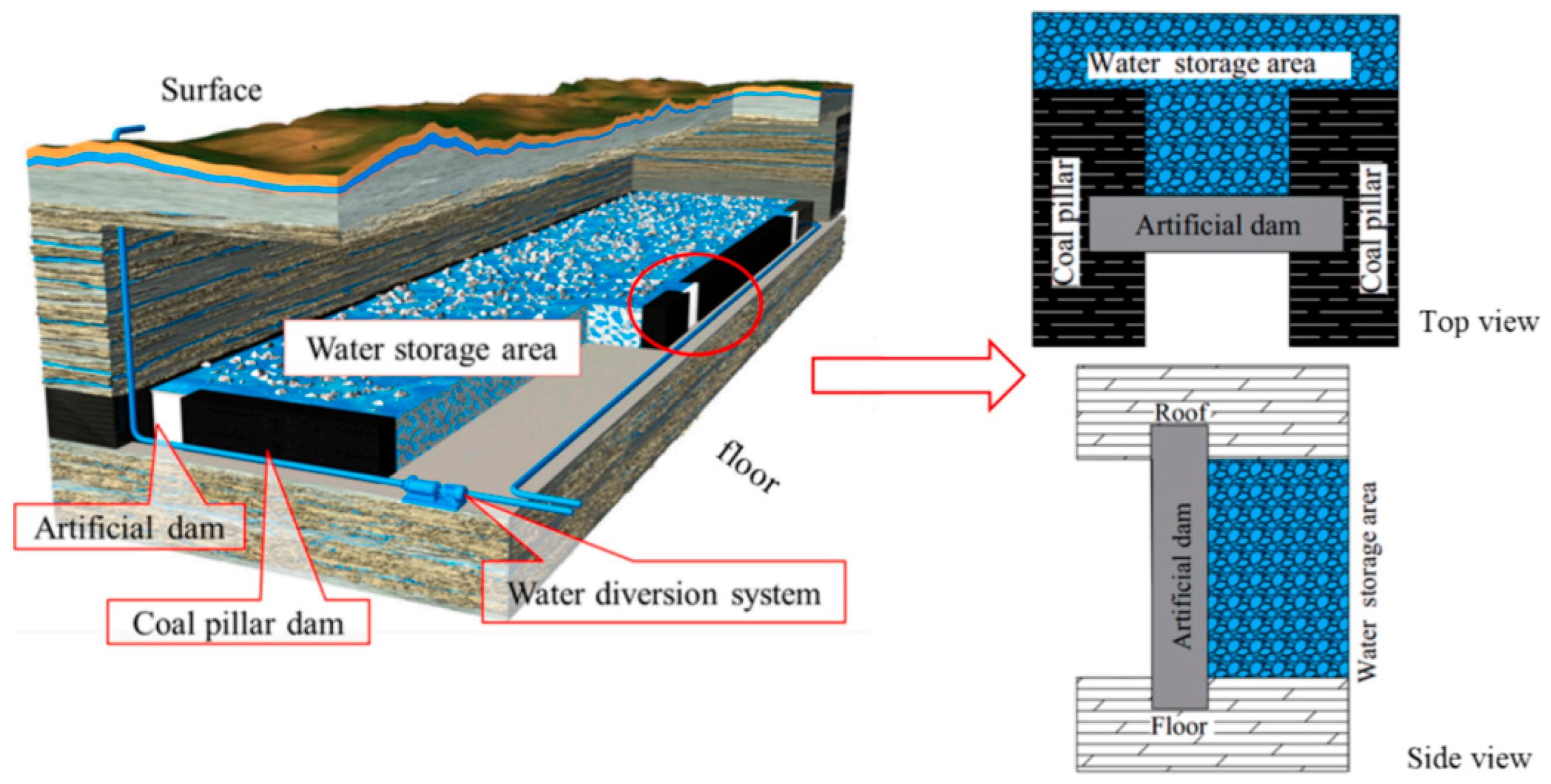
To reduce carbon emissions, the world is undergoing a transformation of its energy structure to mitigate impacts on the ecological environment [1]. China is the largest producer and consumer of coal globally [2]. High-intensity, large-scale coal mining has resulted in the formation of numerous goaf areas. These substantial spatial resources present an excellent opportunity for adjusting the green and clean energy structure and for the comprehensive development of new energy sources [3]. Abandoned coal mine tunnels are viable sites for compressed air energy storage systems, whereas the goafs of such mines can be effectively utilized as key components in pumped storage power generation systems. Underground pumped storage hydropower stations (UPSH) represent an optimal choice for repurposing the underground space in mines [4,5,6,7]. The underground water reservoir in coal mines is a critical component of UPSH, utilizing voids in the collapsed rock mass created by coal mining to connect coal pillars with artificial dam bodies, thereby forming the reservoir dam body [8,9,10,11,12]. This system also includes facilities for storing and utilizing mine water, as shown in Figure 1. Underground water reservoirs in coal mines serve dual purposes: they function as pumped-storage hydropower facilities while simultaneously providing water resources for domestic use by local communities and agricultural irrigation. During the operation of the underground reservoir, the coal pillar dam body remains immersed in mine water for extended periods. Therefore, it is essential to study the mechanical characteristics of coal subjected to long-term mine water immersion.
Previous studies have demonstrated that the physical and mechanical properties of coal change after immersion in water. Vishal et al. [13] found that as moisture content increases, the compressive strength of coal decreases. Yao et al. [14] reported that the peak strain and compressive strength of coal exhibit positive and negative linear relationships with increasing moisture content, respectively, while the elastic modulus shows a negative exponential relationship with moisture content. Wang and Jiang et al. [15] indicated that as moisture content rises, the stress-strain curve of coal displays a multi-stage drop and manifests as a combination of shear failure and tensile-shear failure. Qiu [16] conducted a pressurized water injection simulation experiment and found that the water film formed on the surface of coal molecules can lubricate the coal body and increase its porosity. Ai et al. [17] demonstrated that as immersion time increases, coal porosity gradually rises, while the mechanical parameters exhibit an exponential decay relationship with immersion time. Currently, research on the effects of water immersion on the physical and mechanical properties of coal primarily considers two factors: the pure water environment and moisture content.
Coal pillars are affected not only by prolonged immersion in mine water but also by static and quasi-static loads on the coal pillar dam body due to disturbances from coal mining. This is equivalent to subjecting the coal pillars to varying loading rates. Higher loading rates enhance the ability of coal and rock to convert external energy into elastic strain energy, making coal more susceptible to non-steady state failure [18,19,20]. Generally, a higher loading rate correlates with greater strength exhibited by coal and rock [21,22]. However, this trend does not persist indefinitely; mechanical strength does not continuously increase with rising loading rates and displays certain nonlinear characteristics. In the relationship where coal strength initially increases and then decreases with increasing loading rate, the loading rate at the turning point is known as the critical loading rate [23]. Below this critical value, the strength of the coal sample increases with the loading rate; above this value, the strength actually decreases. Both the peak strength and fragmentation degree of coal depend on the strain loading rate [19,24], while the strength and failure mechanisms of coal are influenced by the strain rate and microstructure [25]. Li et al. [26] proposed a method for assessing coal sample impact that takes loading rate into account. Huang et al. [27] addressed the initial damage of coal and examined the effect of loading rate on the creep mechanical behavior of initially damaged coal samples.
The coal pillar is influenced not only by the mining water immersion and variable loading rate environment but also by the structure and properties of the coal itself, both of which are important factors affecting its stability. Due to geological sedimentation, coal bodies exhibit significant heterogeneity and anisotropy. Fan et al. [28] demonstrated that the peak strength and axial peak strain of coal show a “V”-shaped trend, initially decreasing and then increasing with the dip angle of the bedding plane, reaching a maximum at a dip angle of 0° and a minimum at 60°. Sun et al. [29] reported that the mechanical properties of coal depend on both the loading type of the coal sample and environmental factors. Gong et al. [30] found that the fractal crack propagation rate of coal samples with a bedding angle of 0° was the lowest. Zhang et al. [31] studied the energy evolution characteristics during the coal failure process through uniaxial and triaxial compression tests, establishing a brittle evaluation index for coal samples that considers the effect of bedding. Liu et al. [32] introduced the bedding ratio index to quantitatively analyze the impact of bedding on the strength, deformation, and permeability characteristics of coal samples under triaxial stress conditions. However, long-term immersion in mine water causes complex changes in the matrix, bedding planes, and structure of coal pillars, which undeniably affects their mechanical properties and failure modes.
However, under long-term immersion in mine water and the disturbances caused by mining, when the stress concentration at the crack tip exceeds the coal fracture pressure, the crack will propagate and penetrate until a macroscopic crack is formed. The capacity of cracked materials to resist fracture is a significant topic in fracture mechanics. Current research primarily focuses on the effects of pure water immersion on the permeability, tensile strength, and compressive strength of coal pillars, while there is a lack of studies addressing the influence of coal crack propagation and fracture toughness. Additionally, the long-term effects of mine water are often overlooked; however, mine water contains more complex ionic components than pure water, and these effects cannot be ignored. Moreover, the ability of coal pillars to resist fracture instability is an evolving process influenced by variable loading rates. Existing research does not adequately consider the fracture characteristics of coal under varying loading rates affected by mine water immersion. Therefore, it is essential to investigate the fracture mechanics characteristics of coal, taking into account the combined effects of mine water immersion, different loading rates, and bedding directions, to provide a reference for the stability analysis of coal pillar dam bodies.

2. Coal Samples and Experimental Procedure

2.1. Coal Samples

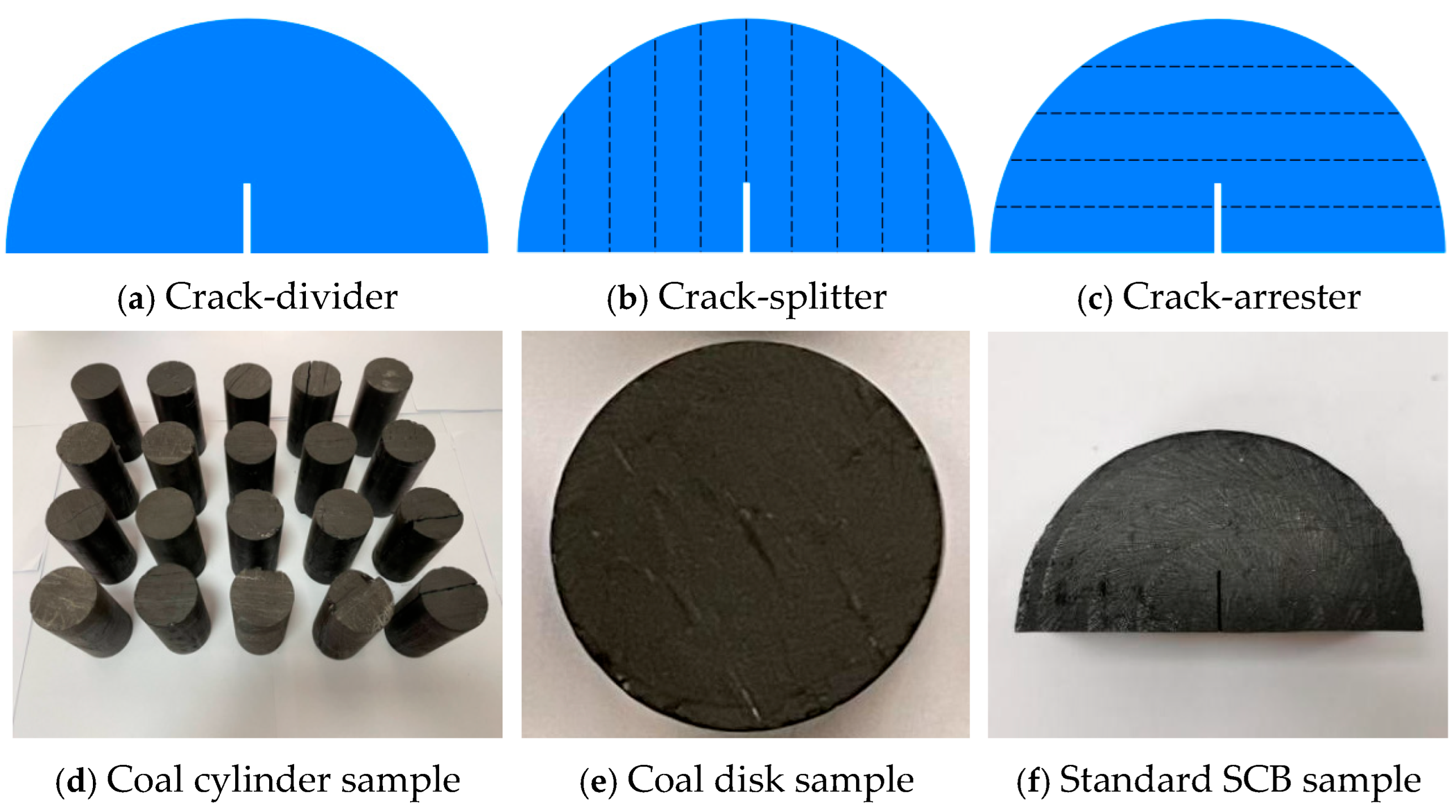
The coal sample was obtained from a mining area in Shaanxi, China. The mine water in this mining area exhibits weak alkalinity, with pH values ranging from 7 to 8. The target coal seam occurs at a depth of 100 m, containing an underground water reservoir with a water column height of 3 m. The hydrostatic pressure regime maintains thermal equilibrium with surface climatic conditions. The coal pillar dam body of the underground water reservoir has been subjected to a long-term environment of mine water immersion, and it is also influenced by mining disturbances. Intact coal specimens demonstrating structural homogeneity and absence of macroscopic discontinuities were selected for experimental investigation. Three types of Semi-Circular Bend (SCB) specimens with central straight cracks were prepared according to the standards recommended by the International Society for Rock Mechanics (ISRMs) [33], as illustrated in Figure 2a–c. Cylindrical coal samples with a diameter of 50 mm and a height of 100 mm were produced both parallel and perpendicular to the bedding plane. These samples were then cut into circular disks with a height of 22 mm. The disks were subsequently transformed into semi-disks using a wire cutting method, and pre-cut grooves, each 7.5 mm in length, were machined at the center position of the semi-disks, as illustrated in Figure 2d–f.

2.2. Experimental Procedure

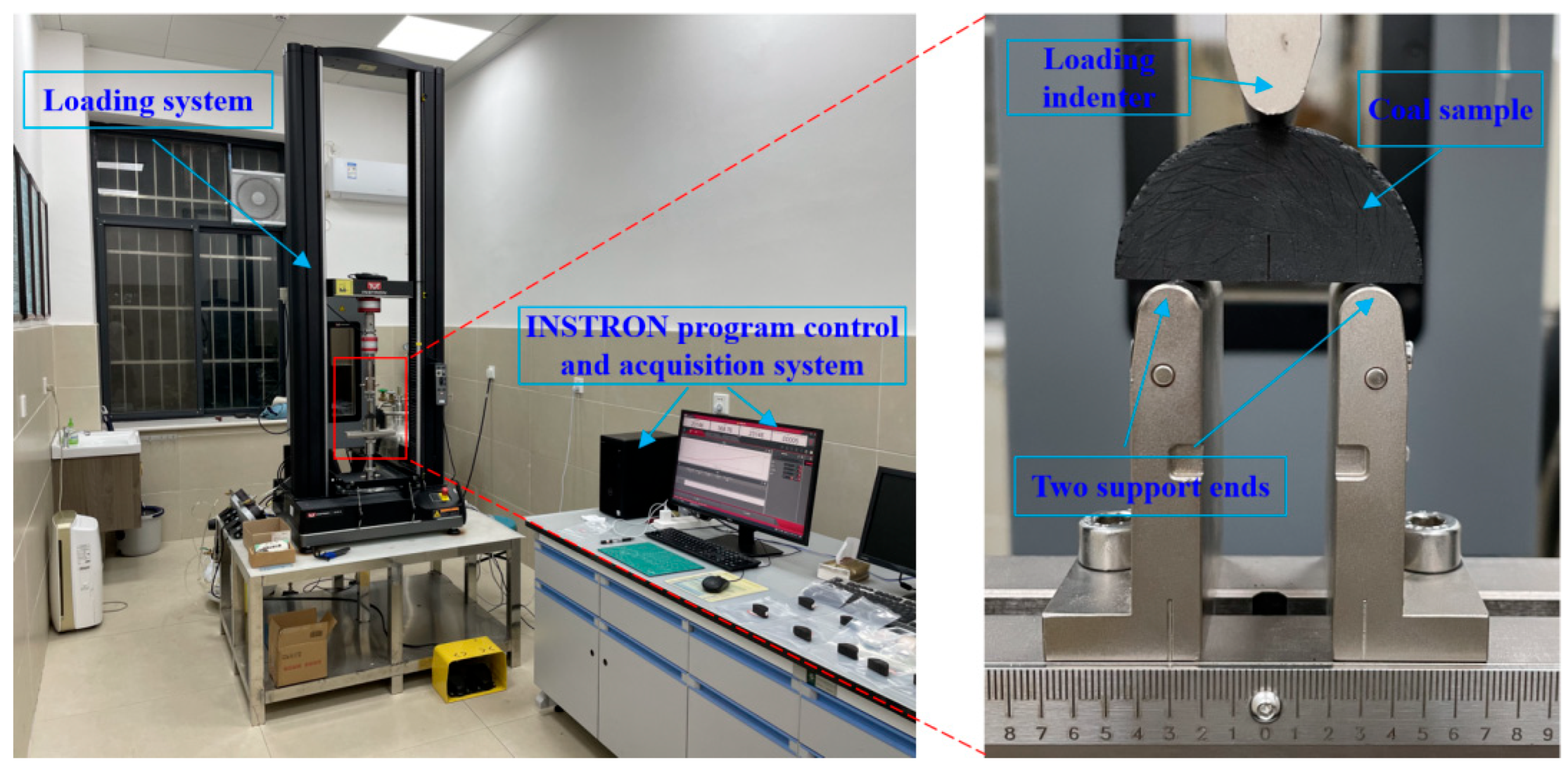
Mine water was collected from underground coal reservoirs, and coal samples were immersed in the mine water in batches. During the immersion experiment, a preliminary study revealed that after approximately 5 days of immersion, the coal samples reached a state of near saturation. To investigate the effects of extended immersion durations, the specified time intervals were 0 days, 30 days, 60 days, and 120 days. Rapid fracture mechanics testing was subsequently conducted on the coal samples after immersion, utilizing an INSTRON testing machine at Sichuan University, as illustrated in Figure 3. The displacement loading mode was employed, with different loading rates set at 0.0002 mm/s, 0.0005 mm/s, 0.002 mm/s, and 0.005 mm/s.
The three-point bending fracture mechanics experiment for coal is capable of testing the fracture toughness of coal. In accordance with the standards recommended by the International Society for Rock Mechanics (ISRMs) [33], the calculation of fracture toughness is performed using Formulas (1)–(3).
K I C = Y P max π a 2 R B
Y = 1.297 + 9.516 ( L / 2 R ) [ 0.47 + 16.457 ( L / 2 R ) ] β + [ 1.071 + 34.401 ( L / 2 R ) ] β 2
β = a / R
In the formula, KIC represents the fracture toughness (MPa·mm1/2); Pmax denotes the peak load (N); is the dimensionless stress intensity factor; a indicates the length of the manually cut groove (mm); B refers to the thickness of the SCB sample (mm); R represents the radius of the SCB specimen (mm); and L specifies the distance (mm) between the lower two support ends of the specimen during loading.

3. Experimental Results and Analysis

3.1. Fracture Toughness of Coal

Substituting the data and sample size recorded during the experiment into Equations (1)–(3) allows for the calculation of the fracture toughness of the coal sample. Additionally, the variations in coal fracture toughness with respect to immersion time in mine water, loading rate, and bedding direction are plotted, as illustrated in Figure 4, Figure 5 and Figure 6.

3.1.1. Variations in Fracture Toughness with Immersion Time in Mine Water

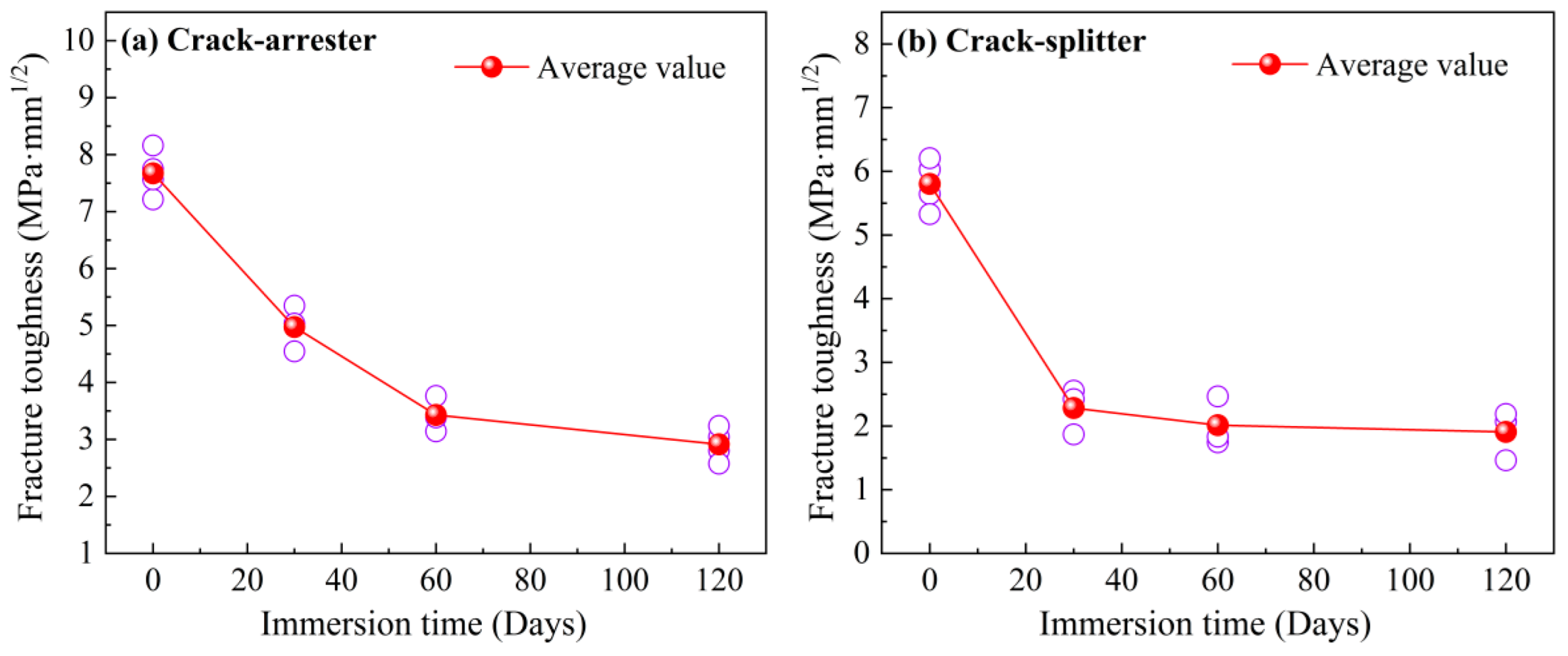
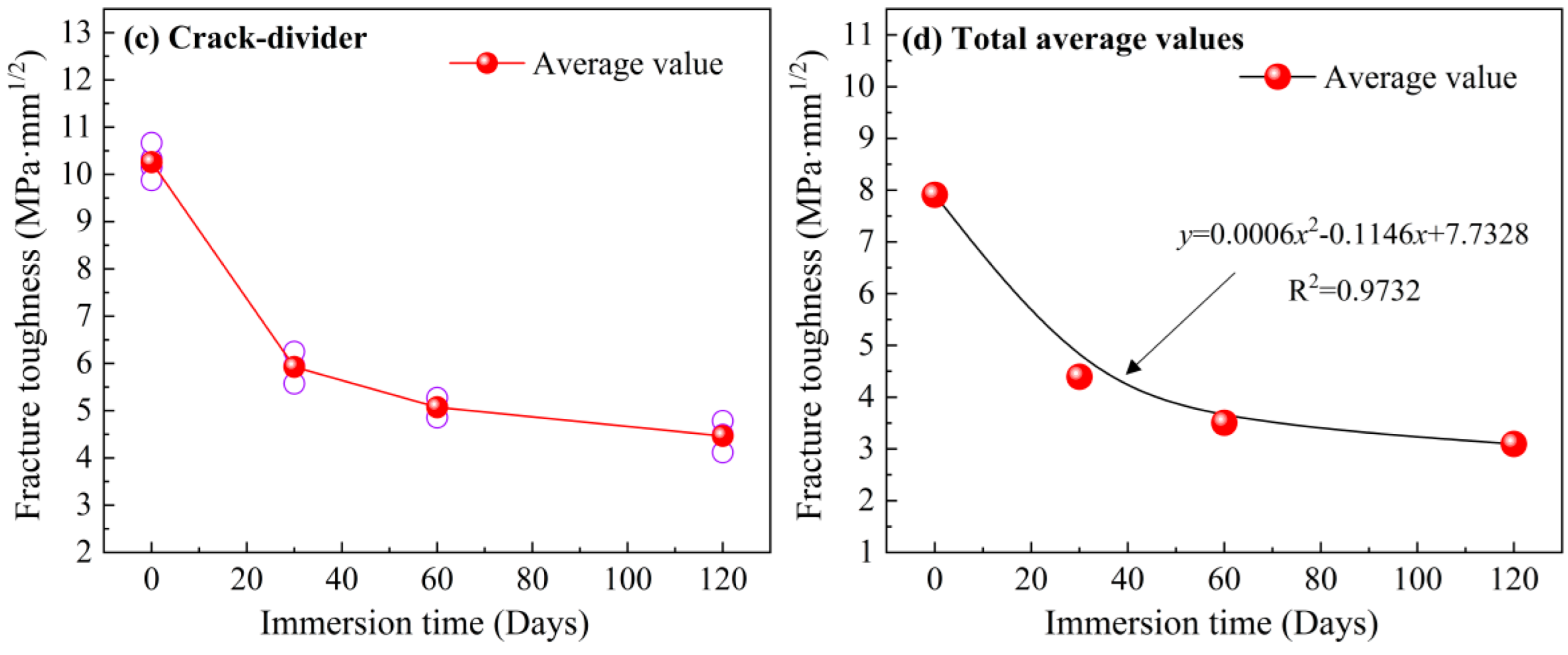
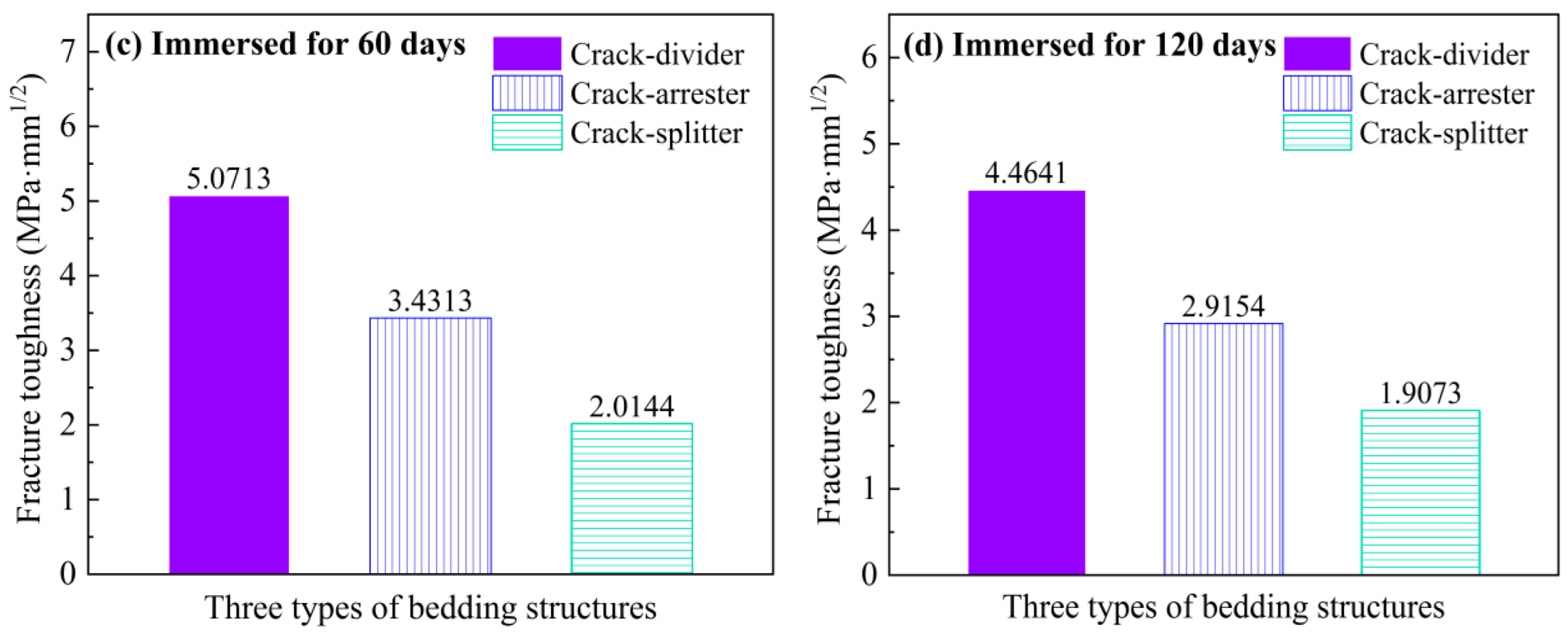
According to Figure 4a, for the Crack-arrester type coal sample, the fracture toughness without immersion is 7.67 MPa·mm1/2, which decreases by 35.15% to 4.98 MPa·mm1/2 after immersion for 30 days. The fracture toughness after immersion for 60 days is measured at 3.43 MPa·mm1/2. As the immersion time increases to 120 days, the fracture toughness decreases to 2.92 MPa·mm1/2, reflecting a decrease of 62.00% compared to the non-immersed condition and a 15.03% decrease relative to the 60-day immersion period. Based on Figure 4b,c, the fracture toughness of the Crack-splitter and Crack-divider coal samples without immersion is recorded as 5.80 MPa·mm1/2 and 10.26 MPa·mm1/2, respectively. After a 30-day immersion period, the fracture toughness values are 2.28 MPa·mm1/2 and 5.92 MPa·mm1/2, indicating significant decreases of 60.67% and 42.24% compared to the non-immersed conditions. When the immersion time is extended to 120 days, the Crack-splitter and Crack-divider coal samples exhibit decreases of 67.13% and 56.48%, respectively, when compared to the non-immersed samples. However, relative to the 60-day immersion duration, the fracture toughness decreases by only 5.32% and 11.97%, respectively, indicating a smaller magnitude of decrease. Overall, the trends in fracture toughness among the three types of samples are similar. The average of all data is taken to plot a curve, as illustrated in Figure 4d, and the curve is fitted to determine the relationship between fracture toughness and time.
y = 0.0006 x 2 0.1146 x + 7.7328
According to Figure 4d, the fracture toughness of non-immersed coal is measured at 7.91 MPa·mm1/2. The fracture toughness values for coal immersed in mine water for 30 days, 60 days, and 120 days are 4.39 MPa·mm1/2, 3.51 MPa·mm1/2, and 3.10 MPa·mm1/2, respectively, reflecting decreases of 44.45%, 55.68%, and 60.87% compared to non-immersed coal. This indicates that immersion in mine water significantly weakens the coal’s resistance to fracture. After immersion for more than 30 days, the reduction in fracture toughness slows with increasing immersion time. Liu et al. [34] immersed coal from the Daliuta Coal Mine in pure water for 16 days and found that this treatment softened the coal and reduced its compressive strength, which they attributed to the transformation of pore cracks into larger sizes.

3.1.2. Variation of Fracture Toughness with Loading Rate

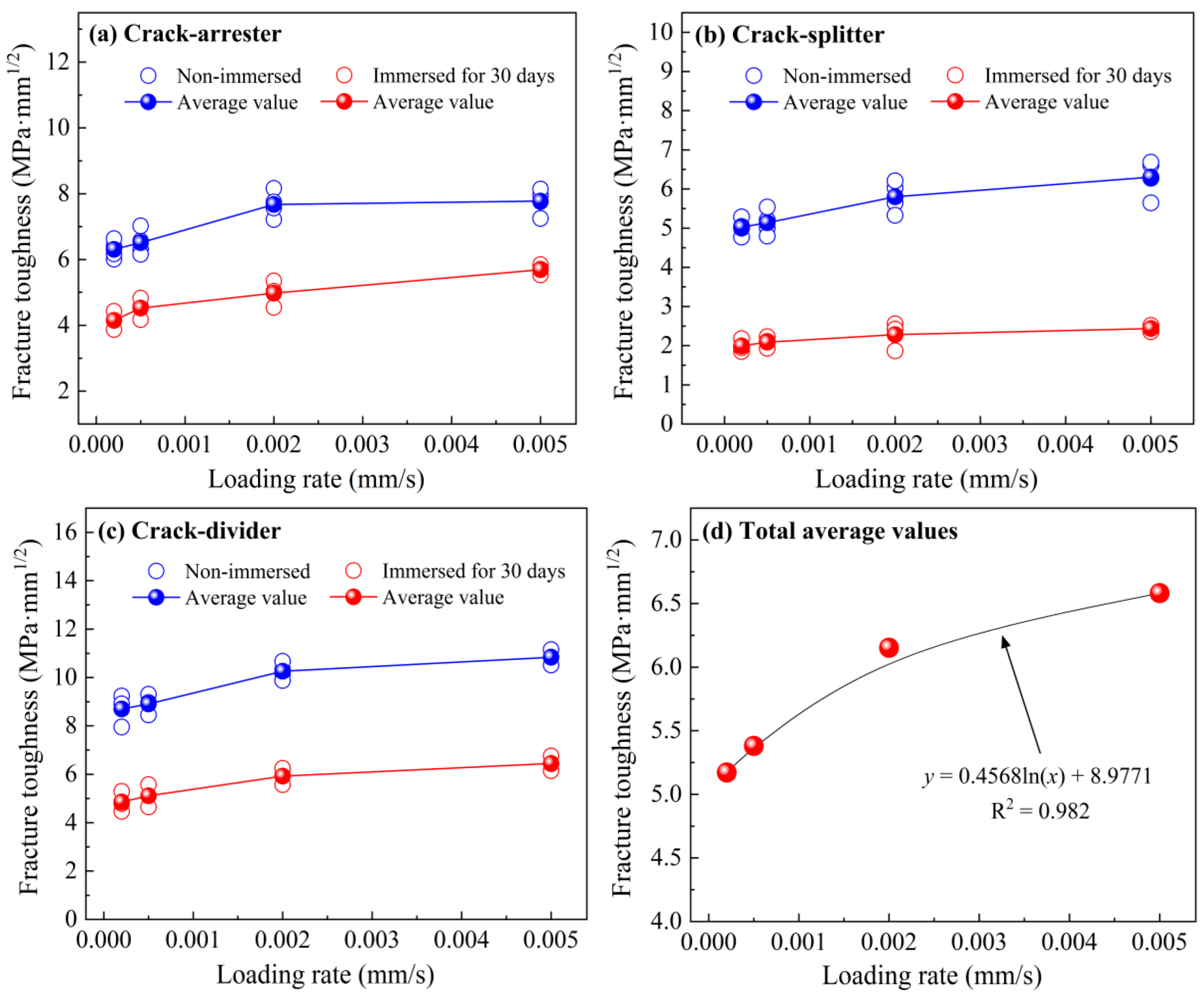
According to Figure 5a, for the Crack-arrester coal sample, the fracture toughness prior to immersion is measured at 6.31 MPa·mm1/2 (0.0002 mm/s), 6.51 MPa·mm1/2 (0.0005 mm/s), 7.67 MPa·mm1/2 (0.002 mm/s), and 7.78 MPa·mm1/2 (0.005 mm/s). There is no significant change in fracture toughness at low loading rates. However, when the loading rate is increased tenfold to 0.002 mm/s, the fracture toughness rises by 21.66% compared to the value at 0.0002 mm/s, indicating a significant change. As the loading rate continues to increase, the rate of change gradually stabilizes. For coal immersed for 30 days, the fracture toughness values are 4.15 MPa·mm1/2 (0.0002 mm/s), 4.52 MPa·mm1/2 (0.0005 mm/s), 4.98 MPa·mm1/2 (0.002 mm/s), and 5.69 MPa·mm1/2 (0.005 mm/s). While the fracture toughness exhibits considerable changes at low loading rates, it increases more slowly as the rate rises. From Figure 5b,c, it is evident that the trend of change for the Crack-splitter and Crack-divider types is consistent with that of the Crack-arrester type, characterized by a gradual increase in fracture toughness with increasing loading rate. The average values of all data plotted as a function of loading rate are illustrated in Figure 5d, and this trend can be described by Equation (5).
y = 0.4568 ln ( x ) + 8.9771
The fracture toughness at a loading rate of 0.005 mm/s increased by 27.28% compared to 0.0002 mm/s, indicating a significant improvement in the coal’s resistance to fracture. The slope of the curve suggests that the change in coal fracture toughness is more gradual when immersed in mine water than when not immersed. This is primarily attributed to the weakening of the coal matrix and layered structure by mine water, which results in reduced structural differences. The effect of loading rate on coal results in increased mechanical strength. Chen et al. [35] revealed that peak stress and elastic modulus decreased with increasing loading rates. Li et al. [36] argue that when the strength of coal samples exhibits a nonlinear characteristic of initially increasing and then decreasing with elevated loading rates, it is due to the inhibiting effect of high loading rates on crack development; this leads to lower strength due to localized fracture surfaces. However, the coal samples displayed overall softening and no localized fracture surfaces under immersion in mine water, indicating a positive correlation between fracture toughness and loading rate.

3.1.3. Changes in Fracture Toughness Relative to Bedding Plane Structure

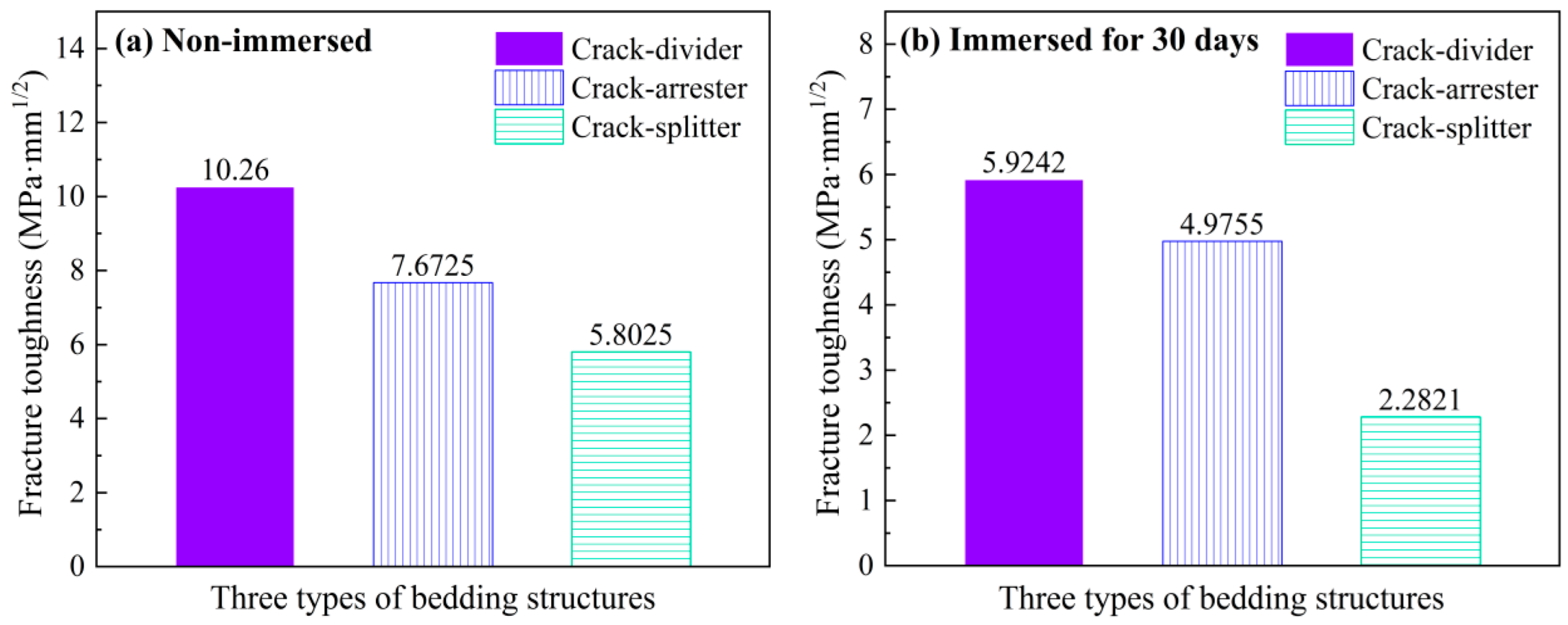
According to Figure 6a, the fracture toughness of the Crack-divider type, without immersion, measures 10.26 MPa·mm1/2, representing the highest value among the three types, indicating that this coal exhibits the strongest resistance to fracture. In contrast, the Crack-splitter type displays the lowest fracture toughness at 5.80 MPa·mm1/2, signifying the weakest ability to resist fracture. The fracture toughness of the Crack-arrester type is 7.67 MPa·mm1/2, placing it between the first two types. As the immersion time increased to 120 days, the relative order of fracture toughness among the three specimen types remained unchanged: Crack-divider type > Crack-arrester type > Crack-splitter type, as shown in Figure 6b–d. For the non-immersed, 30-day, 60-day, and 120-day immersed conditions, the Crack-divider type exhibited increases of 76.76%, 159.59%, 151.76%, and 134.05%, respectively, compared to the Crack-splitter type. This demonstrates that different loading types significantly impact the fracture toughness of coal, with notable differences in toughness values among the three types. The variability in fracture toughness is primarily attributed to the strength of the coal matrix, the strength of the bedding planes, the degree of bonding between the matrix and the bedding planes, and the extent of weakening of both the coal matrix and bedding planes due to mine water.

3.2. Test Load-Displacement Curve

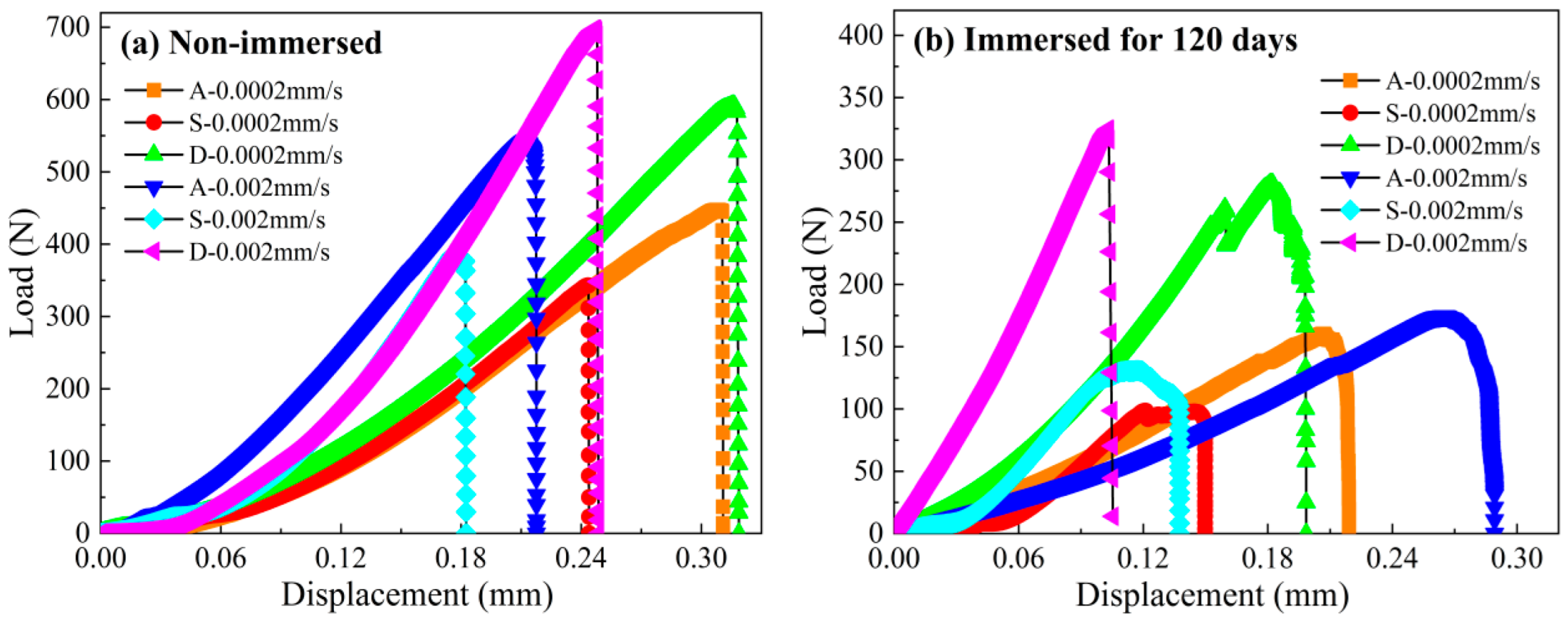
Through three-point bending fracture mechanics testing, the load-displacement curve can be obtained, as demonstrated in Figure 7. This curve aids in understanding the fracture characteristics of rock-like materials [37]. The complete load-displacement curve for coal and rock typically consists of four stages: compaction, elasticity, plasticity, and failure.
According to Figure 7, coal fractures after undergoing the compaction, elasticity, and plasticity stages. Almost all coal samples exhibit an upward concave shape at the initial stage. This phenomenon is attributed to the presence of numerous pores and fractures in coal; when initially subjected to stress, these primary pores, as well as those induced by water immersion, become compacted, resulting in a significant compaction stage. The immersion of mine water reduces the slope of the curve for the coal sample during the elastic stage, indicating a weakening of the elastic properties. Additionally, after the elastic stage, the non-immersed samples typically fail abruptly at the peak load, whereas the samples immersed for 120 days experience a significant ductile deformation stage before gradually becoming unstable. This behavior is due to the increasing physical and chemical effects of mine water on the coal samples over time. It is evident that immersion in mine water causes coal samples to transition from “sudden instability” to “gradual instability” concerning their fracture characteristics. Furthermore, for coal samples that have not been immersed or have been immersed for 120 days, the slope of the elastic stage also increases with the loading rate, which aligns with the observed changes in fracture toughness and the characteristics of unstable fracture. For the Crack-arrester, Crack-splitter, and Crack-divider samples, the load-displacement curve shapes are similar, with the primary difference being the peak load magnitude.

3.3. Fracture Modulus

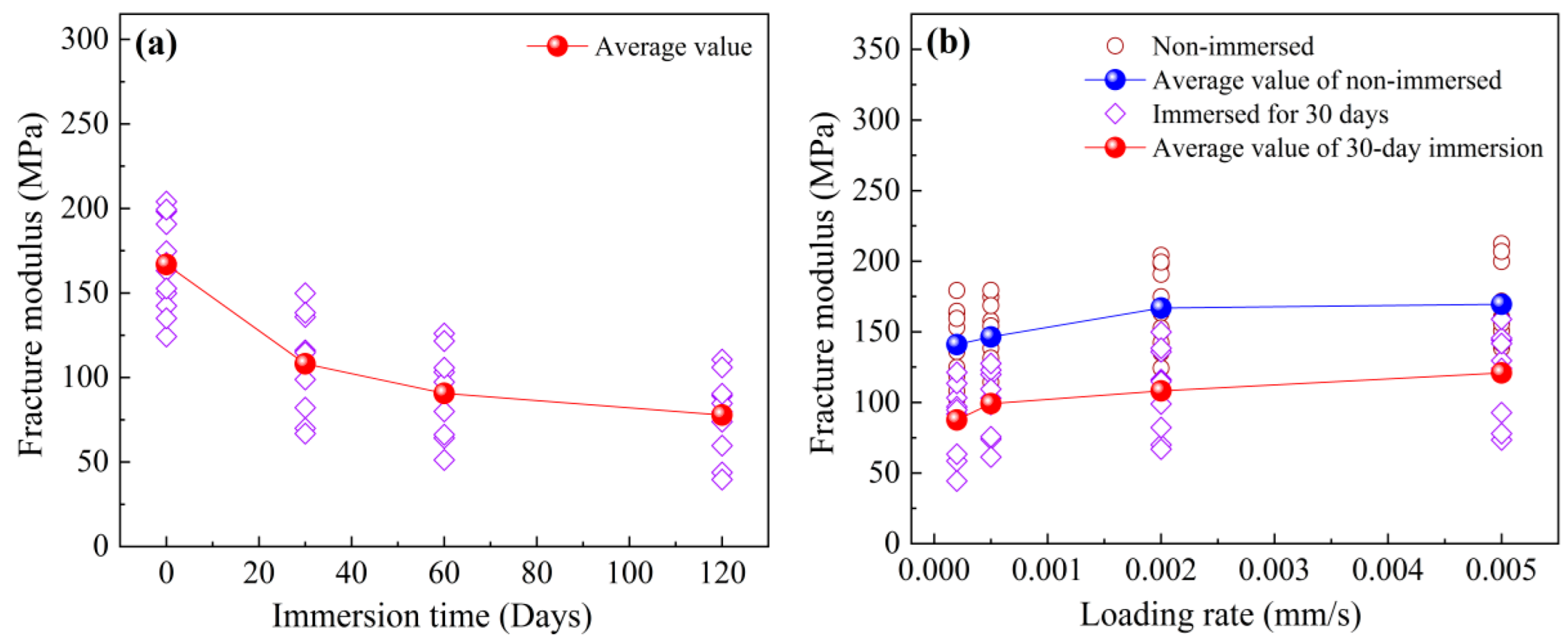
In the fracture mechanics experiment involving coal samples, the fracture modulus (ES) reflects the capacity of coal to resist elastic deformation. The fracture modulus of coal samples varies with the immersion time and loading rate of mine water, as illustrated in Figure 8.
From Figure 8a, it is evident that the fracture modulus gradually decreases with increasing immersion time in mine water. The fracture modulus for non-immersed samples and those immersed for 30 days, 60 days, and 120 days are 166.89 MPa, 108.12 MPa, 90.65 MPa, and 77.81 MPa, respectively. After immersion for 30 days, the fracture modulus significantly decreased by 35.22% compared to non-immersed samples. Subsequently, immersion for 120 days results in a 53.38% decrease compared to non-immersed samples. Thus, the trend in the decreasing fracture modulus gradually becomes flatter. Generally, a higher elastic modulus in rocks indicates increased brittleness [38], as well as a greater ability to resist induced crack closure [39]. Conversely, in the case of coal samples, the weakening of the fracture modulus due to mine water indicates a diminished ability to resist crack instability. According to Figure 8b, the fracture modulus of coal varies from 87 MPa to 121 MPa at different loading rates. The fracture modulus increases significantly, by 23.53%, with an increase in the loading rate from 0.0002 mm/s to 0.002 mm/s. As the loading rate increases to 0.005 mm/s, the fracture modulus rises by 11.80% relative to the 0.002 mm/s loading rate. Therefore, within this range of loading rates, the loading rate has minimal impact on the ability of coal to resist elastic deformation during fracture.

3.4. Absorb Energy

The fracture of coal can be understood as the result of the work performed by the force acting on the coal, which meets the criteria for crack instability. The deformation and failure of rocks occur alongside an energy evolution process characterized by energy absorption, accumulation, and dissipation [40]. By studying energy conversion during rock failure, the mechanical response patterns of rocks can be more accurately described [41,42,43,44]. During the loading process of the specimen, the absorbed energy is associated with the area under the load-displacement curve, delineated by the horizontal and vertical axes [40]. The instability of the main crack at peak load leads to the overall fracture of the coal sample. Therefore, the calculation formula is expressed in Equation (6).
U T = 0 S j P j d S
Among these variables, UT represents the absorbed energy (mJ); Pj denotes the load (N) at step j; ds is the displacement difference (mm) between steps j and j + 1; and Sj refers to the displacement value at step i. Figure 9 presents the energy calculation results for coal samples during the fracture process influenced by mine water immersion and varying loading rates.
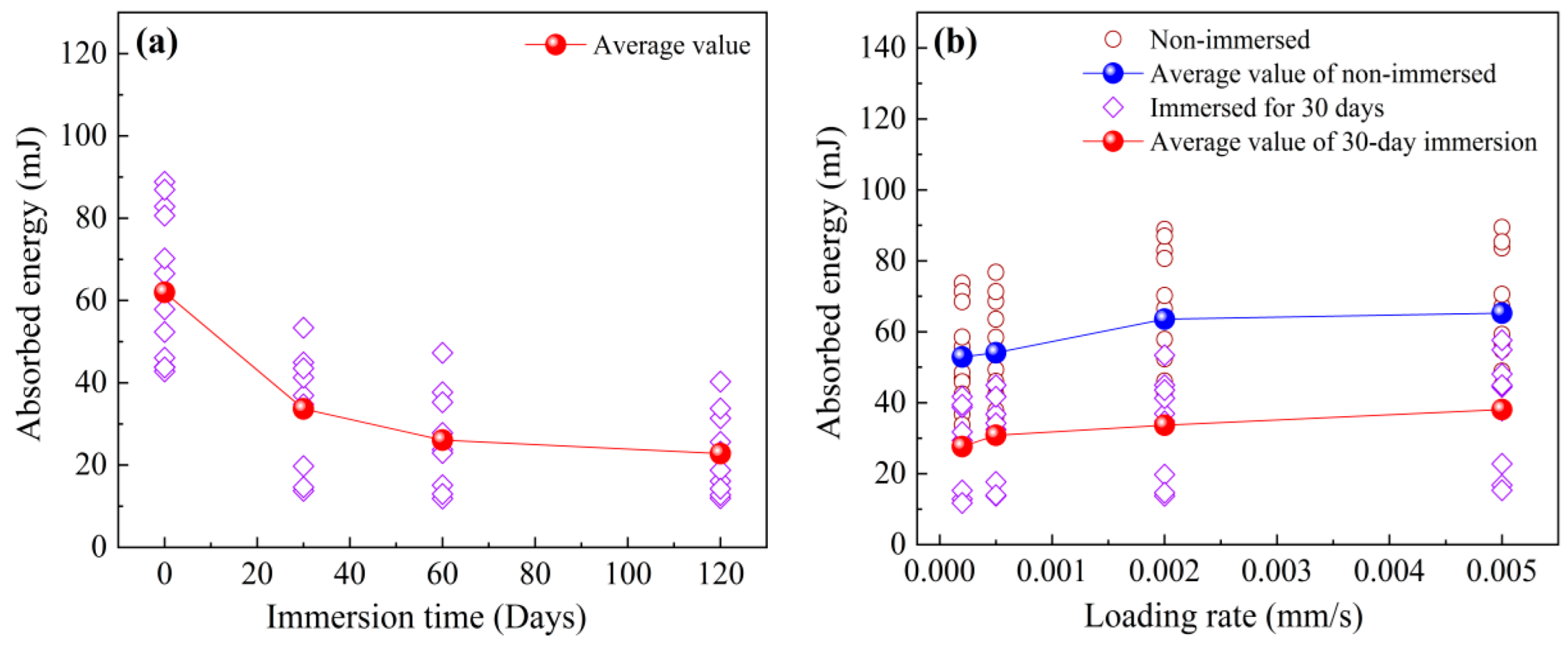
The absorbed energy during the fracture of coal samples is influenced by closure stress, peak stress, compaction stage displacement, and elastic stage displacement. As illustrated in Figure 9a, the absorbed energy gradually decreases with increasing immersion time in mine water. This reduction results from the physical and chemical reactions of mine water, which damage the coal, making it require less energy for crack expansion. Immersion for 30 days, 60 days, and 120 days resulted in decreases of 45.71%, 57.92%, and 63.21%, respectively, compared to the non-immersion condition. Notably, as the immersion time exceeds 60 days, although the energy absorbed by the coal sample during fracture continues to decrease, the rate of decrease slows. This observation serves as a reference point for measuring the energy conditions required for the residual fracture of coal samples. From Figure 9b, it is apparent that as the loading rate increases, the energy absorbed by the coal sample also increases. This increase is attributed to the reduced duration of the applied load, which causes the main crack to propagate increasingly toward the direction of the applied load, thereby overcoming the coal matrix and bedding planes along this path. This process shortens the activation and expansion time of primary fractures, thereby decreasing the probability of connection between the main fracture and weaker surfaces. It can be inferred that one effective measure to control crack propagation may relate to the rate of applied load.

4. Discussion

4.1. The Influence of Immersion Time in Mine Water on the Mechanical Properties of Coal Fracture

Coal is composed primarily of organic compounds, along with a smaller proportion of inorganic minerals. Common inorganic minerals include clay minerals (such as kaolinite and chlorite), quartz, calcite, and pyrite. In the presence of water, coal is likely to undergo partial dissolution of its components. Mine water exhibits a complex composition of multivalent metal cations, which induce more sophisticated physicochemical interactions at the coal-water interface compared to distilled water systems. For instance, the dissolution of clay and carbonate minerals occurs; clay becomes soft or decomposes upon contact with water, while montmorillonite swells due to water absorption, resulting in the uncoordinated deformation of mineral particles. The presence of water molecules significantly reduces the intermolecular binding forces within coal matrices, consequently diminishing interparticle friction coefficients [45,46,47]. The experimental mine water exhibited weak alkalinity, wherein hydroxide ions (OH) significantly decoupled molecular bonds within the coal matrix. This physicochemical interaction induced microstructural alterations in the coal specimens, ultimately compromising their mechanical integrity [46,47,48,49]. These factors contribute to the formation of small pores and cracks in coal and lead to changes in the primary pore and crack structures, thereby affecting the coal’s ability to resist fracture instability.
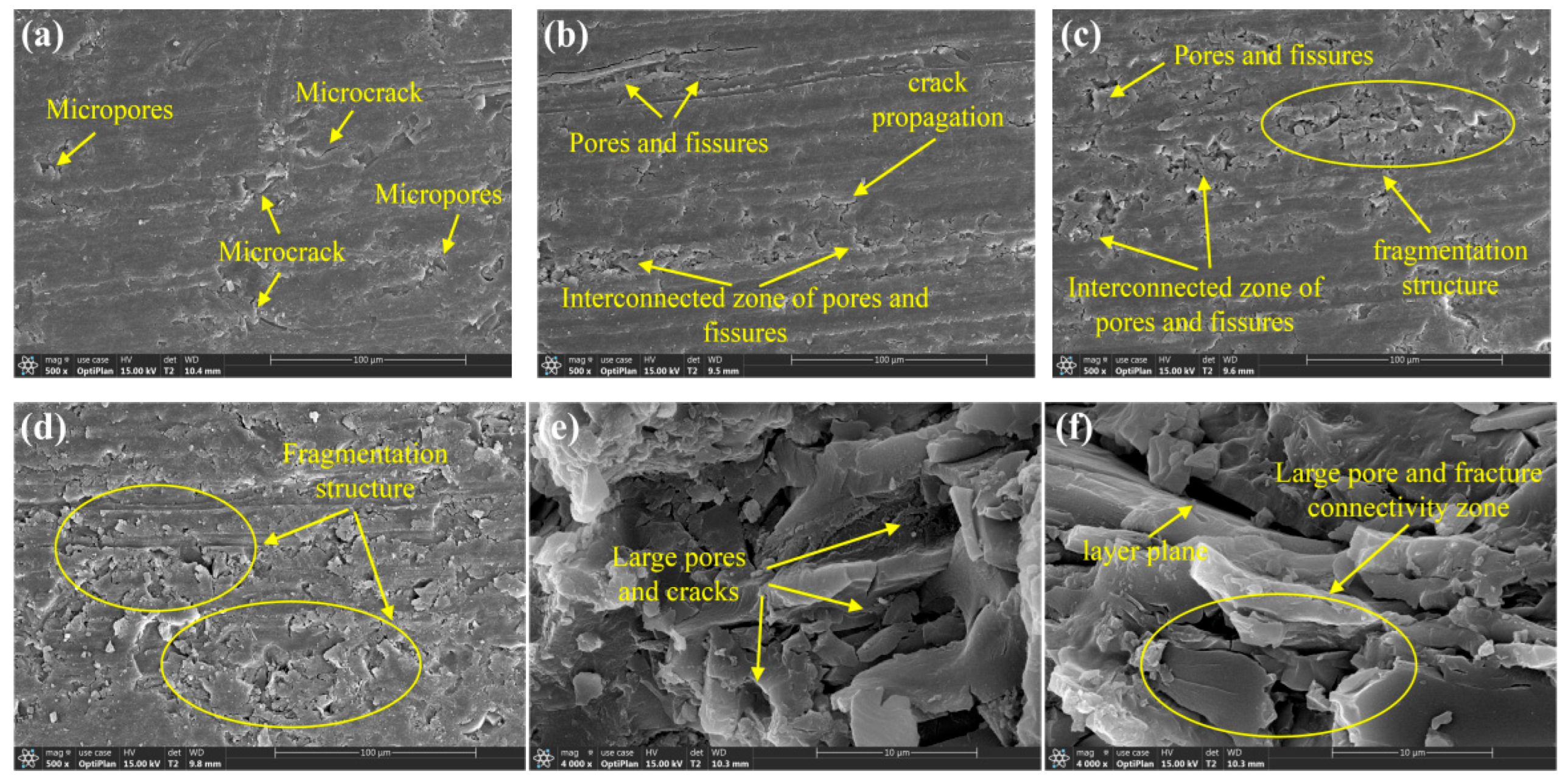
The microscopic characteristics of coal under both non-immersion and immersion conditions with mine water were observed using scanning electron microscopy (SEM), as illustrated in Figure 10.
From Figure 10a, it is evident that in the absence of mine water immersion, the coal exhibits certain primary pores and cracks, along with smaller cracks on the matrix; however, the overall structure remains intact. This integrity contributes to the relatively weak and brittle properties of the coal. Figure 10b illustrates coal that has been immersed for 30 days, revealing larger pores, elongated cracks, and an accumulation of pores and cracks that form a relatively loose structure. This observation demonstrates that the corrosive effects of mine water immersion can lead to structural damage. The components present in mine water undergo physical and chemical reactions with coal, resulting not only in changes to the pore and fracture structures but also facilitating the entry of water molecules into the coal’s interior through fracture channels. This process induces damage and alters the macroscopic mechanical response of the coal. According to Figure 10c, after immersion in mine water for 60 days, the pore diameters have increased and interconnected with the cracks, creating a fragmented structure. Figure 10d–f indicate that after 120 days of immersion, an increasing number of pores and cracks emerge, with the original pores and cracks further developing, leading to increased fragmentation. This may be attributed to the prolonged immersion in mine water, where the dissolution rate of coal components surpasses the adhesion rate of new substances to the matrix. The appearance of these fragmented structures on the coal surface significantly weakens its mechanical properties, facilitating the propagation of fracture cracks along the surface and natural weak planes.
When coal samples are immersed in water, the clay minerals within them undergo softening and mudification [34]. As the immersion time increases, the internal structure of the coal gradually changes, resulting in the continuous generation of new micropores. Concurrently, the pores transition from smaller to larger sizes (micropores → small pores → mesopores → large pores) [17], while the connections and cementation between particles weaken. Furthermore, the ability of coal samples to resist deformation diminishes, the energy required for deformation and failure decreases, and the overall strength of the coal samples declines. For soft and fissured coal bodies, there exists a critical moisture content. When the moisture content is below this critical threshold, the strength of the coal increases with rising moisture content; however, when the moisture content exceeds this critical level, the strength decreases with further increases in moisture [50]. The coal samples used in this experiment are relatively weak, and the minimum immersion time in mine water is 30 days, significantly exceeding the critical duration. Additionally, compared to pure water, mine water contains a higher concentration of ions and various components, resulting in complex chemical reactions and interactions between the weak coal and mine water. Consequently, as the immersion time in mine water increases, the mechanical properties of the coal samples gradually deteriorate. Notably, studies [51,52] have demonstrated that the fracture toughness of rocks decreases after exposure to high temperatures and carbonation corrosion. Scanning electron microscopy (SEM) observations corroborated the accumulation of pores and cracks, as well as the formation of fractured structures. In this experiment with coal, similar fragmentation structures were also identified. These findings indicate that both immersion in mine water and the effects of high temperature may relate to changes in the material’s skeleton, driven by the evolution of pores and cracks, thereby affecting the macroscopic mechanical properties of the material.

4.2. The Influence of Loading Rate on the Mechanical Properties of Coal Fracture

The fracture toughness of coal gradually increases with the loading rate, exhibiting significant ductile failure characteristics. Li et al. [53] reported that as the loading rate increases, the scale of coal debris ejected from the samples becomes larger, the ejection distance increases, the integrity of the coal deteriorates, and the intensity of energy release increases. Additionally, Ai et al. [54] discovered that higher loading rates cause coal failure to occur earlier. At the critical loading rate, coal failure transitions from a brittle to a ductile state. In contrast, Li et al. [55] found that as the loading rate increases, the ultimate stress and strain of coal samples first decrease before increasing. Although the loading rate significantly impacts the mechanical strength, elastic modulus, fracture properties, and failure characteristics of coal, the variation patterns of these mechanical performance parameters are not entirely consistent, which is influenced by the water saturation state of the coal.
The interaction between pore water pressure and crack propagation rate leads to complex mechanical and damage characteristics in saturated coal samples subjected to varying loading rates. Although the coal used in this experiment contains natural micropores and fractures, its overall structure remains weak. Micro-defects, such as micropores and microcracks within the coal, require sufficient time to expand, evolve, and penetrate. At low loading rates, internal cracks and pores in the coal are gradually activated and evolve under applied force, resulting in increased damage and enhanced connectivity among pores and cracks. Particularly, as the degree of damage increases at the tip of a crack, the crack becomes more susceptible to instability and expansion, ultimately facilitating the penetration of rock microcracks and reducing resistance to fracture. Conversely, at high loading rates, primary pores and cracks within the coal do not have adequate time to respond, resulting in a failure to accumulate damage effectively. This condition necessitates that the coal skeleton quickly and directly withstand the applied load, thereby increasing the destructive load required and resulting in relatively higher absorbed energy [56]. The load at failure is positively correlated with fracture toughness, which increases with the loading rate.

4.3. The Influence of Layered Structure on the Mechanical Characteristics of Coal Fracture

Coal is a typical layered geological material, and its layered characteristics significantly affect the stress and stability of coal seams, particularly in underground coal mine reservoirs. Additionally, coal is subjected to the corrosive effects of mine water, which directly impacts the stability of coal pillar dam bodies. In the case of Crack-divider type coal samples, their structure consists of a pre-cut groove orthogonal to the bedding plane. After failure in the fracture process zone at the tip of the prefabricated groove, the fracture crack penetrates the coal matrix along the direction of loading. If the bedding planes of the coal do not undergo significant lateral delamination, the integrity and strength of the coal matrix directly determine its ability to resist fracture. The relative fracture toughness of Crack-arrester type and Crack-divider type coal is closely related to the integrity of the layered material matrix and bedding planes as well as the strength of the matrix and bedding planes, and the degree of interlayer delamination [57]. The extent to which the fracture trajectory deviates from the centerline is influenced by the distribution and arrangement of particles [58]. The larger the particles aligned with the load direction, the greater the deviation of the main crack propagation from that direction, resulting in a larger deviation angle of the fracture path. Although the coal matrix used in this study contains primary microcracks and pores, it is generally more cohesive compared to the relatively weaker bedding planes. Consequently, the main fracture must overcome the resistance of the matrix during expansion, leading to Crack-divider type coal exhibiting relatively higher resistance to fracture compared to Crack-arrester type and Crack-splitter type coal.
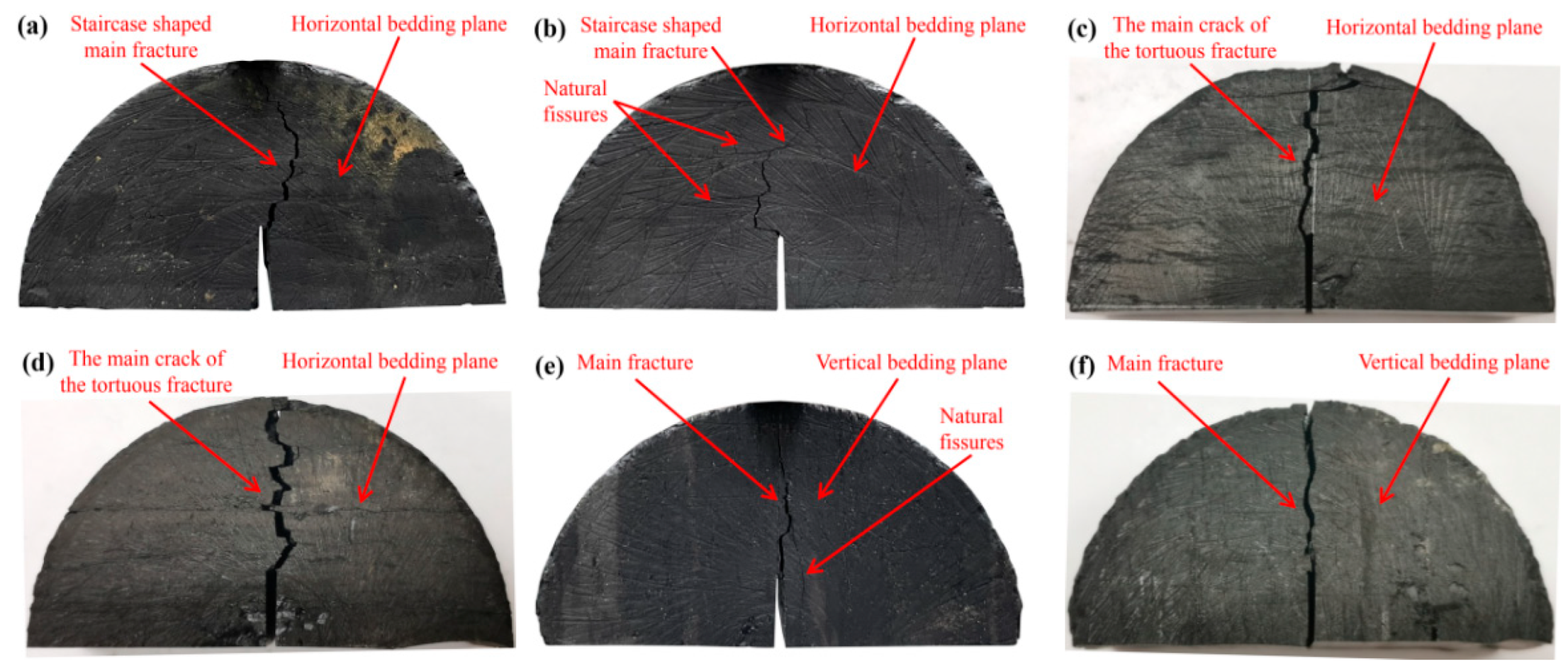
The structure of the Crack-arrester type coal sample is organized layer by layer along the direction of the pre-cut groove in the coal matrix. When subjected to a load perpendicular to the bedding plane, the tip of the pre-cut groove becomes unstable, allowing the main crack to penetrate the bedding plane and expand into the matrix. Two primary types of fracture trajectories can be observed. The first occurs when the coal bedding planes are relatively intact, exhibiting good cementation and high strength. In this case, the main crack is minimally affected by bedding plane interference and primarily extends in the direction of the applied force, forming an approximately straight line. This configuration exhibits strong resistance to fracture and results in relatively high fracture toughness. The second scenario arises when the main crack gradually loses stability and expands from the tip. If the energy required to penetrate the coal matrix exceeds that required to advance along the horizontal bedding plane, the main crack will expand horizontally for a certain distance. This is due to the tensile forces acting along the vertical direction on the weak bedding planes, which results in lower resistance to fracture. After expanding to a certain distance, the energy required to sustain the crack’s continued expansion increases. Once this energy exceeds the energy necessary to overcome the matrix and layers vertically along the direction of the applied load, the main crack will change direction. At this juncture, the crack turns and expands in the direction of the applied load, subsequently turning again, resulting in a fracture trajectory characterized by a step-like shape. Due to the relative weakness of the bedding planes in this coal sample, the fracture trajectories tend to be mostly stepped, exhibiting one, two, or multiple turns, as illustrated in Figure 11. This characteristic explains why the fracture toughness of the Crack-arrester type is lower than that of the Crack-divider type but higher than that of the Crack-splitter type.
The structure of the Crack-splitter type coal sample consists of pre-cut grooves along the bedding plane. When subjected to loading, the main fracture initiates and propagates along the bedding plane from the tip of the prefabricated groove. If the bedding plane is weak, only a small amount of energy is required to promote the expansion of the main crack, making the coal highly prone to fracture. In this case, the fracture path is predominantly a straight line along the bedding plane, as illustrated in Figure 11. Conversely, if the bonding within the bedding plane is strong, the strength is relatively high, or if the thickness of the bedding plane is small and uneven, the main crack requires more energy to penetrate the coal matrix, resulting in relatively higher resistance to fracture. However, this coal sample contains numerous natural weak structural planes, pointing to the inherent weakness of the bedding planes, leading to its fracture toughness being the lowest among the three types of coal samples.

5. Conclusions

This article examines the effects of mine water immersion time, loading rate, and bedding direction on the fracture mechanical properties of coal through experiments in fracture mechanics. The following key conclusions have been drawn.
The fracture toughness (KIC) values of coal samples immersed in mine water for 30 days, 60 days, and 120 days were 4.39 MPa·mm1/2, 3.51 MPa·mm1/2, and 3.10 MPa·mm1/2, respectively, indicating decreases of 44.45%, 55.68%, and 60.87% compared to non-immersed samples, which had a fracture toughness of 7.91 MPa·mm1/2. After immersion in mine water for 120 days, the fracture modulus (ES) and absorbed energy (UT) of coal decreased by 53.38% and 63.21%, respectively, compared to the unsaturated coal samples. The most significant weakening of mechanical properties occurs after 30 days of immersion. However, with prolonged immersion times, the degree of weakening in mechanical properties tends to stabilize.
In a mine water environment, the physical and chemical interactions between various substances can compromise the structure of coal, leading to damage, the initiation of micropores and cracks, and the growth of existing cracks and pore sizes. Consequently, pores and cracks become interconnected, ultimately forming a fragmented structure. The ongoing evolution of these fragmented structures weakens the coal’s ability to resist fracture.
The fracture toughness, fracture modulus, and absorbed energy of coal exhibit a positive correlation with the loading rate; that is, as the loading rate increases, these fracture mechanical parameters also increase. This phenomenon occurs because the damage caused by load application requires time, and a higher loading rate reduces the likelihood of activating holes and cracks. The slopes of the fracture toughness curves for the three types of coal samples across varying loading rates are essentially the same, indicating that there is no significant difference in the degree to which loading rates influence the fracture resistance of different sample types.
The orientation of bedding significantly affects the fracture toughness of coal. The Crack-divider type exhibits the highest fracture toughness and demonstrates the greatest resistance to fracture, while the Crack-splitter type displays the lowest fracture toughness and is most susceptible to unstable fracture. The fracture toughness of the Crack-arrester type lies between the other two types. This variation is attributed to the fact that the strength of the bedding plane in weak coal is lower than that of the matrix. Furthermore, when combined with the immersion effects of mine water, the mechanical properties of the three coal sample types differ markedly.

Author Contributions

X.L. and G.F.: provided the concept and idea and conducted the experiments. M.X. and G.W.: conducted the literature review, experimental data analysis, and wrote draft manuscript. J.B. and C.G.: conducted experiments, illustrated the pictures, and revised the manuscripts. H.L. and G.F.: analyzed the experimental results, and conducted theoretical analysis. X.L.: completed the writing—review and editing. All authors have read and agreed to the published version of the manuscript.

Funding

This research was funded by the National Natural Science Foundation of China (Grant No. 52374099; 52404109), the open fund of the State Key Laboratory of Water Resource Protection and Utilization in Coal Mining (Grant No. GJNY-21-41-01), and the Natural Science Foundation of Sichuan Province, China (Grant No. 2025YFHZ0323).

Institutional Review Board Statement

Not applicable.

Informed Consent Statement

Not applicable.

Data Availability Statement

The raw data supporting the conclusions of this article will be made available by the authors on request.

Conflicts of Interest

The authors declare no conflicts of interest.

References

  1. Colas, E.; Klopries, E.M.; Tian, D.; Kroll, M.; Selzner, M.; Bruecker, C.; Khaledi, K.; Kukla, P.; Preuße, A.; Sabarny, C.; et al. Overview of converting abandoned coal mines to underground pumped storage systems: Focus on the underground reservoir. J. Energy Storage 2023, 73, 109153. [Google Scholar] [CrossRef]
  2. Sun, Z.B.; Zhao, Y.X.; Ren, J.D. Regional development potential of underground pumped storage power station using abandoned coal mines: A case study of the Yellow River Basin, China. J. Energy Storage 2024, 77, 109992. [Google Scholar] [CrossRef]
  3. Yang, K.; Fu, Q.; Yuan, L.; Liu, Q.; He, X.; Liu, F. Research on development demand and potential of pumped storage power plants combined with abandoned mines in China. J. Energy Storage 2023, 63, 106977. [Google Scholar] [CrossRef]
  4. Tao, Y.; Luo, X.; Zhou, J.; Wu, Y.; Zhang, L.; Liu, Y. Site selection for underground pumped storage plant using abandoned coal mine through a hybrid multi-criteria decision-making framework under the fuzzy environment: A case in China. J. Energy Storage 2022, 56, 105957. [Google Scholar] [CrossRef]
  5. Kretschmann, J.; Efremenkov, A.B.; Khoreshok, A.A. From mining to post-mining: The sustainable development strategy of the German hard coal mining industry. IOP Conf. Ser. Earth Environ. Sci. 2017, 50, 012024. [Google Scholar] [CrossRef]
  6. Montero, R.A.; Niemann, A.; Schwanenberg, D. Concepts for pumped-storage hydro-electricity using underground coal mines. In Proceedings of the 35th IAHR World Congress, Chengdu, China, 8–13 September 2013; Zhaoyin, W., Lee, J.H., Jizhang, G., Shuyou, C., Eds.; Tsinghua University Press: Beijing, China, 2013. Volume I and II. Available online: http://www.iahr.org.cn/library/infor?pid=15090 (accessed on 1 May 2025).
  7. Schultz, R.A.; Heinemann, N.; Horváth, B.; Wickens, J.; Miocic, J.M.; Babarinde, O.O.; Cao, W.; Capuano, P.; Dewers, T.A.; Dusseault, M.; et al. An overview of underground energy-related product storage and sequestration. Geol. Soc. Lond. Spec. Publ. 2023, 528, 15–35. [Google Scholar] [CrossRef]
  8. Li, Y.; Yao, Q.L.; Li, X.H.; Zheng, C.K. Creep characteristics and long-term strength of underground water reservoirs’ coal pillar dam specimens under different osmotic pressures. J. Clean. Prod. 2024, 452, 141901. [Google Scholar] [CrossRef]
  9. Kong, X.S.; Yang, W.; Shan, R.L.; Wang, S.; Fang, J. Ultimate water level and deformation failures of the artificial dam in the coal mine underground reservoir. Eng. Failure Anal. 2024, 162, 108367. [Google Scholar] [CrossRef]
  10. Schmidt, F.; Menéndez, J.; Konietzky, H.; Jiang, Z.; Fernández-Oro, J.M.; Álvarez, L.; Bernardo-Sanchez, A. Technical feasibility of lined mining tunnels in closed coal mines as underground reservoirs of compressed air energy storage systems. J. Energy Storage 2024, 78, 110055. [Google Scholar] [CrossRef]
  11. González-Quirós, A.; Fernández-Álvarez, J.P. Conceptualization and finite element groundwater flow modeling of a flooded underground mine reservoir in the Asturian Coal Basin, Spain. J. Hydrol. 2019, 578, 124036. [Google Scholar] [CrossRef]
  12. Menendez, J.; Loredo, J.; Galdo, M.; Fernandez-Oro, J.M. Energy storage in underground coal mines in NW Spain: Assessment of an underground lower water reservoir and preliminary energy balance. Renew. Energy 2019, 134, 1381–1391. [Google Scholar] [CrossRef]
  13. Vishal, V.; Ranjith, P.G.; Singh, T.N. An experimental investigation on behaviour of coal under fluid saturation using acoustic emission. J. Nat. Gas. Sci. Eng. 2015, 22, 428–436. [Google Scholar] [CrossRef]
  14. Yao, Q.L.; Li, X.H.; Zhou, J.; Ju, M.; Chong, Z.; Zhao, B. Experimental study of strength characteristics of coal specimens after water intrusion. Arab. J. Geosci. 2015, 8, 6779–6789. [Google Scholar] [CrossRef]
  15. Wang, K.; Jiang, Y.F.; Xu, C. Mechanical properties and statistical damage model of coal with different moisture contents under uniaxial compression. Chin. J. Rock Mech. Eng. 2018, 37, 1070–1079. (In Chinese) [Google Scholar] [CrossRef]
  16. Qiu, J.L. Experimental study on physical and mechanical properties of coal with different moisture content. J. North. Chin. Institute. Sci. Tech. 2013, 10, 6–9. Available online: https://www.nstl.gov.cn/paper_detail.html?id=f956c9b439cc8b14b1d3a97f71155723 (accessed on 1 May 2025). (In Chinese).
  17. Ai, T.; Wu, S.; Zhang, R.; Gao, M.; Zhou, J.; Xie, J.; Ren, L.; Zhang, Z. Changes in the structure and mechanical properties of a typical coal induced by water immersion. Int. J. Rock Mech. Min. 2021, 138, 104597. [Google Scholar] [CrossRef]
  18. Ma, D.; Zhang, J.X.; Duan, H.Y.; Huang, Y.L.; Li, M.; Sun, Q.; Zhou, N. Reutilization of gangue wastes in underground backfilling mining: Overburden aquifer protection. Chemosphere 2021, 264, 128400. [Google Scholar] [CrossRef] [PubMed]
  19. Xiao, W.J.; Zhang, D.M.; Cai, Y.; Chu, Y.P. Study on loading rate dependence of the coal failure process based on uniaxial compression test. Pure Appl. Geophys. 2020, 177, 4925–4941. [Google Scholar] [CrossRef]
  20. Huang, B.; Liu, J. The effect of loading rate on the behavior of samples composed of coal and rock. Int. J. Rock Mech. Min. 2013, 61, 23–30. [Google Scholar] [CrossRef]
  21. Qi, C.Z.; Wang, M.Y.; Qian, Q.H. Strain rate effects on the strength and fragmentation size of rocks. Int. J. Impact. Eng. 2009, 36, 1355–1364. [Google Scholar] [CrossRef]
  22. Wang, N.; Xu, Y.Q.; Zhu, D.Y.; Wang, N.; Yu, B.F. Acoustic emission and failure modes for coal-rock structure under different loading rates. Adv. Civ. Eng. 2018, 9391780. [Google Scholar] [CrossRef]
  23. Li, H.T.; Jiang, C.X.; Jiang, Y.D.; Wang, H.W.; Liu, H.B. Mechanical behavior and mechanism analysis of coal samples based on loading rate effect. J. Chin. Univer. Min. Tech. 2015, 44, 430–436. (In Chinese) [Google Scholar] [CrossRef]
  24. Okubo, S.; Fukui, K.; Qingxin, Q. Uniaxial compression and tension tests of anthracite and loading rate dependence of peak strength. Int. J. Coal Geol. 2006, 68, 196–204. [Google Scholar] [CrossRef]
  25. Zhao, Y.X.; Liu, S.M.; Zhao, G.F.; Elsworth, D.; Jiang, Y.D.; Han, J.L. Failure mechanisms in coal: Dependence on strain rate and microstructure. J. Geophys. Res. Solid. Earth 2014, 119, 6924–6935. [Google Scholar] [CrossRef]
  26. Li, H.T.; Zhou, H.W.; Jiang, Y.D.; Wang, H.W. An evaluation method for the bursting characteristics of coal under the effect of loading rate. Rock Mech. Rock Eng. 2016, 49, 3281–3291. [Google Scholar] [CrossRef]
  27. Huang, P.; Zhang, J.X.; Damascene, N.J.; Wang, Z.J.; Li, M. Effect of loading rate on mechanical behavior of coal samples with initial damage accumulation. Mech. Time-Depend. Mater. 2022, 26, 309–322. [Google Scholar] [CrossRef]
  28. Fan, H.; Wang, L.; Wang, L.G. Experimental study on mechanical properties of bedding coal under different stress paths. Rock Soil. Mech. 2024, 45, 1–11. (In Chinese) [Google Scholar] [CrossRef]
  29. Sun, Z.D.; Xie, H.Q.; Feng, G.; Song, X.M.; Chi, M.B.; Meng, T.; Sun, B.L. Effects of sub-/super-critical CO2 on the fracture-related mechanical characteristics of bituminous coal. Front. Earth Sci. 2023, 17, 760–775. [Google Scholar] [CrossRef]
  30. Gong, S.; Zhao, Y.X.; Wang, Z.; Zhou, L.; Yang, D.; Wang, W. Effect of bedding on the fractal characteristics of dynamic crack propagation in coal rocks. J. China Coal Soc. 2021, 46, 2574–2582. (In Chinese) [Google Scholar] [CrossRef]
  31. Zhang, J.; Ai, C.; Li, Y.; Che, M.G.; Gao, R.; Zeng, J. Energy-based brittleness index and acoustic emission characteristics of anisotropic coal under triaxial stress condition. Rock Mech. Rock Eng. 2018, 51, 3343–3360. [Google Scholar] [CrossRef]
  32. Liu, C.; Yin, G.; Li, M.; Shang, D.; Deng, B.; Song, Z. Deformation and permeability evolution of coals considering the effect of beddings. Int. J. Rock Mech. Min. 2019, 117, 49–62. [Google Scholar] [CrossRef]
  33. Kuruppu, K.D.; Obara, Y.; Ayatollahi, M.R.; Chong, K.P.; Funatsu, T. ISRM-Suggested Method for Determining the Mode I Static Fracture Toughness Using Semi-Circular Bend Specimen. Rock Mech. Rock Eng. 2014, 47, 267–274. [Google Scholar] [CrossRef]
  34. Liu, X.L.; Zhang, Z.T.; Zhang, R.; Cao, Z.G.; Ren, L.; Sun, Z.W.; Zha, E.S. Energy failure mechanism and bedding effect of immersed coal under uniaxial compression. Adv. Eng. Sci. 2024, 57, 1–15. (In Chinese) [Google Scholar] [CrossRef]
  35. Chen, T.; Yao, Q.L.; Wei, F.; Chong, Z.H.; Zhou, J.; Wang, C.B.; Li, J. Effects of water intrusion and loading rate on mechanical properties of and crack propagation in coal–rock combinations. J. Cent. South. Univ. 2017, 24, 423–431. [Google Scholar] [CrossRef]
  36. Li, H.T.; Song, L.; Zhou, H.W.; Song, F. Experimental study of nonlinear evolution mechanism of coal strength under multi-loading rates and its application. Chin. J. Rock Mech. Eng. 2016, 35 (Suppl. 1), 2978–2989. (In Chinese) [Google Scholar] [CrossRef]
  37. Xie, H.Q.; Feng, G.; Liu, H.Z.; He, Q.; Xiao, M.L.; Pei, J.L.; Taherdangkoo, R. Study on the characteristics of crack initiation in deep dense shale containing circular hole under varying stress conditions. J. Cent. South. Univ. 2025, 32, 244–261. [Google Scholar] [CrossRef]
  38. Aybar, U.; Eshkalak, M.O.; Sepehrnoori, K.; Patzek, T.W. The effect of natural fracture’s closure on long-term gas production from unconventional resources. J. Nat. Gas. Sci. Eng. 2014, 21, 1205–1213. [Google Scholar] [CrossRef]
  39. Gholami, R.; Rasouli, V.; Sarmadivaleh, M.; Minaeian, V.; Fakhari, N. Brittleness of gas shale reservoirs: A case study from the north Perth Basin, Australia. J. Nat. Gas. Sci. Eng. 2016, 33, 1244–1259. [Google Scholar] [CrossRef]
  40. Feng, G.; Wang, X.C.; Wang, M.; Kang, Y. Experimental investigation of thermal cycling effect on fracture characteristics of granite in a geothermal-energy reservoir. Eng. Fract. Mech. 2020, 235, 107180. [Google Scholar] [CrossRef]
  41. Wu, N.; Liang, Z.Z.; Zhou, J.R.; Zhang, Y.Z. Energy evolution characteristics of coal specimens with preformed holes under uniaxial compression. Geomech. Eng. 2020, 1, 55–66. [Google Scholar] [CrossRef]
  42. Wang, J.; Qiu, P.Q.; Ning, J.G.; Zhuang, L.; Yang, S. A numerical study of the mining-induced energy redistribution in a coal seam adjacent to an extracted coal panel during longwall face mining: A case study. Energy Sci. Eng. 2020, 8, 817–835. [Google Scholar] [CrossRef]
  43. Wasantha, P.L.P.; Ranjith, P.G.; Shao, S.S. Energy monitoring and analysis during deformation of bedded-sandstone: Use of acoustic emission. Ultrasonics 2014, 54, 217–226. [Google Scholar] [CrossRef] [PubMed]
  44. Feng, G.; Kang, Y.; Wang, X.C.; Hu, Y.Q.; Li, X.H. Investigation on the failure characteristics and fracture classification of shale under Brazilian test conditions. Rock Mech. Rock Eng. 2020, 53, 3325–3340. [Google Scholar] [CrossRef]
  45. Zou, J.; Li, S. Theoretical solution for displacement and stress in strain-softening surrounding rock under hydraulic-mechanical coupling. Sci. China Technol. Sci. 2015, 58, 1401–1413. [Google Scholar] [CrossRef]
  46. Chen, T.; Yao, Q.; Du, M.; Zhu, C.; Zhang, B. Experimental research of effect of water intrusion times on crack propagation in coal. Chin. J. Rock Mech. Eng. 2016, 35, 3756–3762. (In Chinese) [Google Scholar] [CrossRef]
  47. Yao, Q.; Liu, Y.; Chen, T.; Li, X.; Yang, S.; Duan, H. Experimental study of damage evolution of artificial dam strength ofunderground reservoir. J. China Coal Soc. 2018, 43, 1111–1117. (In Chinese) [Google Scholar] [CrossRef]
  48. Yu, Z.; Zhang, L.; Jiang, P.; Papelis, C.; Li, Y. Study on Water-Rock Interactions of Trace Elements in Groundwater with Leaching Experiments. Groundwater 2015, 53, 95–102. [Google Scholar] [CrossRef] [PubMed]
  49. Xu, H.; Liu, J.; Wang, L.; Yang, B.; Yang, H. The weakening effect of hydrostatic pressure on rock mass of different lithology. Environ. Earth. Sci. 2015, 74, 2489–2497. [Google Scholar] [CrossRef]
  50. Zhu, C.Q.; Li, C.M.; Yin, Z.Q.; Hou, J.L. Experimental study of soft coal mechanics characteristics with different moistures and clay contents. Chin. J. Rock Mech. Eng. 2017, 36, 3258–3265. (In Chinese) [Google Scholar] [CrossRef]
  51. Feng, G.; Kang, Y.; Meng, T.; Hu, Y.Q.; Li, X.H. The influence of temperature on mode I fracture toughness and fracture characteristics of sandstone. Rock Mech. Rock Eng. 2017, 50, 2007–2019. [Google Scholar] [CrossRef]
  52. Feng, G.; Kang, Y.; Sun, Z.D.; Wang, X.C.; Hu, Y.Q. Effects of supercritical CO2 adsorption on the mechanical characteristics and failure mechanisms of shale. Energy 2019, 173, 870–882. [Google Scholar] [CrossRef]
  53. Li, Q.W.; Gao, S.L.; Hu, L.L.; Yu, M.M.; Liu, Y.W.; Zeng, X.G.; Zhu, Q.Y.; Cao, H.; Huang, X. Constitutive relation of energy dissipation damage of heterogeneous coal samples under different loading rates. J. China Coal Soc. 2022, 47 (Suppl. 1), 90–102. (In Chinese) [Google Scholar] [CrossRef]
  54. Ai, T.; Zhang, R.; Liu, J.F.; Ren, L. Space-time evolution rules of acoustic emission location of unloaded coal sample at different loading rates. Int. J. Min. Sci. Technol. 2012, 22, 847–854. [Google Scholar] [CrossRef]
  55. Li, G.W.; Lu, S.F.; Liu, S.F.; Liu, J.; Shi, P.; Fan, B.W. Application and effect of loading rates on coal sample failure. Shock Vib. 2021, 6681082. [Google Scholar] [CrossRef]
  56. Mahanta, B.; Tripathy, A.; Vishal, V.; Singh, T.N.; Ranjith, P.G. Effects of strain rate on fracture toughness and energy release rate of gas shales. Eng. Geol. 2016, 218, 39–49. [Google Scholar] [CrossRef]
  57. Li, H.X.; Xiao, X.R. An approach on the mode-I fracture toughness anisotropy for materials with layered microstructures. Eng. Fract. Mech. 1995, 52, 671–683. [Google Scholar] [CrossRef]
  58. Kataoka, M.; Obara, Y.; Kuruppu, M. Estimation of fracture toughness of anisotropic rocks by semi-circular bend(SCB) tests under water vapor pressure. Rock Mech. Rock Eng. 2015, 48, 135–1367. [Google Scholar] [CrossRef]
Figure 1. Schematic diagram of an underground water reservoir in a coal mine [9].
Applsci 15 08222 g001
Figure 2. Schematic diagram and photograph of coal sample types (dashed lines indicate bedding planes).
Applsci 15 08222 g002
Figure 3. Physical representation of the three-point bending test on a coal sample.
Applsci 15 08222 g003
Figure 4. Fracture toughness vs. mine water immersion time (0.002 mm/s).
Applsci 15 08222 g004aApplsci 15 08222 g004b
Figure 5. Variation of fracture toughness with loading rate.
Applsci 15 08222 g005
Figure 6. Variation of fracture toughness with bedding structure (0.002 mm/s).
Applsci 15 08222 g006aApplsci 15 08222 g006b
Figure 7. Test load-displacement curves for the coal samples (A represents Arrester type, S represents Splitter type, and D represents Divider type).
Applsci 15 08222 g007
Figure 8. Fracture modulus curve of coal samples ((a) fracture modulus versus immersion time (loading rate is 0.002 mm/s); (b) fracture modulus versus loading rate).
Applsci 15 08222 g008
Figure 9. Absorbed energy curve of coal sample ((a) depicts the absorbed energy versus immersion time (loading rate is 0.002 mm/s); (b) depicts the absorbed energy versus loading rate).
Applsci 15 08222 g009
Figure 10. Scanning electron microscopy (SEM) images of coal samples ((a) no immersion; (b) immersed for 30 days; (c) immersed for 60 days; (d) immersed for 120 days; (e) enlarged image of the fragmented structure; (f) pore and fracture connectivity in the coal layer).
Applsci 15 08222 g010
Figure 11. Typical fracture trajectory of coal. (af) are six typical fracture trajectories, respectively.
Applsci 15 08222 g011
Disclaimer/Publisher’s Note: The statements, opinions and data contained in all publications are solely those of the individual author(s) and contributor(s) and not of MDPI and/or the editor(s). MDPI and/or the editor(s) disclaim responsibility for any injury to people or property resulting from any ideas, methods, instructions or products referred to in the content.