Creating an Immersive Virtual Reality Game Space for Multiuser, Synchronous Co-Located Collaboration: Design Considerations and Influencing Factors


Abstract
1. Introduction
- What are the overall collaboration experiences in the IVR space?
- What are the effective design features of the IVR space that support collaboration experiences?
- What are the factors that influence collaboration experiences in the IVR space?
2. Literature Review
2.1. Key Constructs of Collaborative Experience
2.2. Collaboration in IVR
2.3. Design Considerations for Collaboration in IVR
3. Design and Development of an IVR Collaboration Space
3.1. Mission and Role Design
3.2. Human–Computer Interaction Design
3.3. Collaborative Mechanism Design
3.4. Technical Features
3.4.1. Hardware
3.4.2. Software
3.4.3. Algorithm
4. Evaluation Study
4.1. Participants
4.2. Procedure
4.3. Data Collection and Analysis
4.3.1. Quantitative Data Collection and Analysis
4.3.2. Qualitative Data Collection and Analysis
4.4. Quantitative Findings
4.4.1. Overall Experience of Collaboration in IVR
4.4.2. Factors Influencing the Collaboration Experience in IVR
4.5. Qualitative Findings
4.5.1. Themed Finding 1: Spatial Presence and Natural Feedback Afford a Sense of Immersion in the IVR Collaboration Space
4.5.2. Themed Finding 2: Co-Presence in IVR Is a Key Feature That Improves Social Presence and Collaboration Experience
4.5.3. Themed Finding 3: Individual Competence Rather Than Personality Influences the Collaboration Experience in IVR
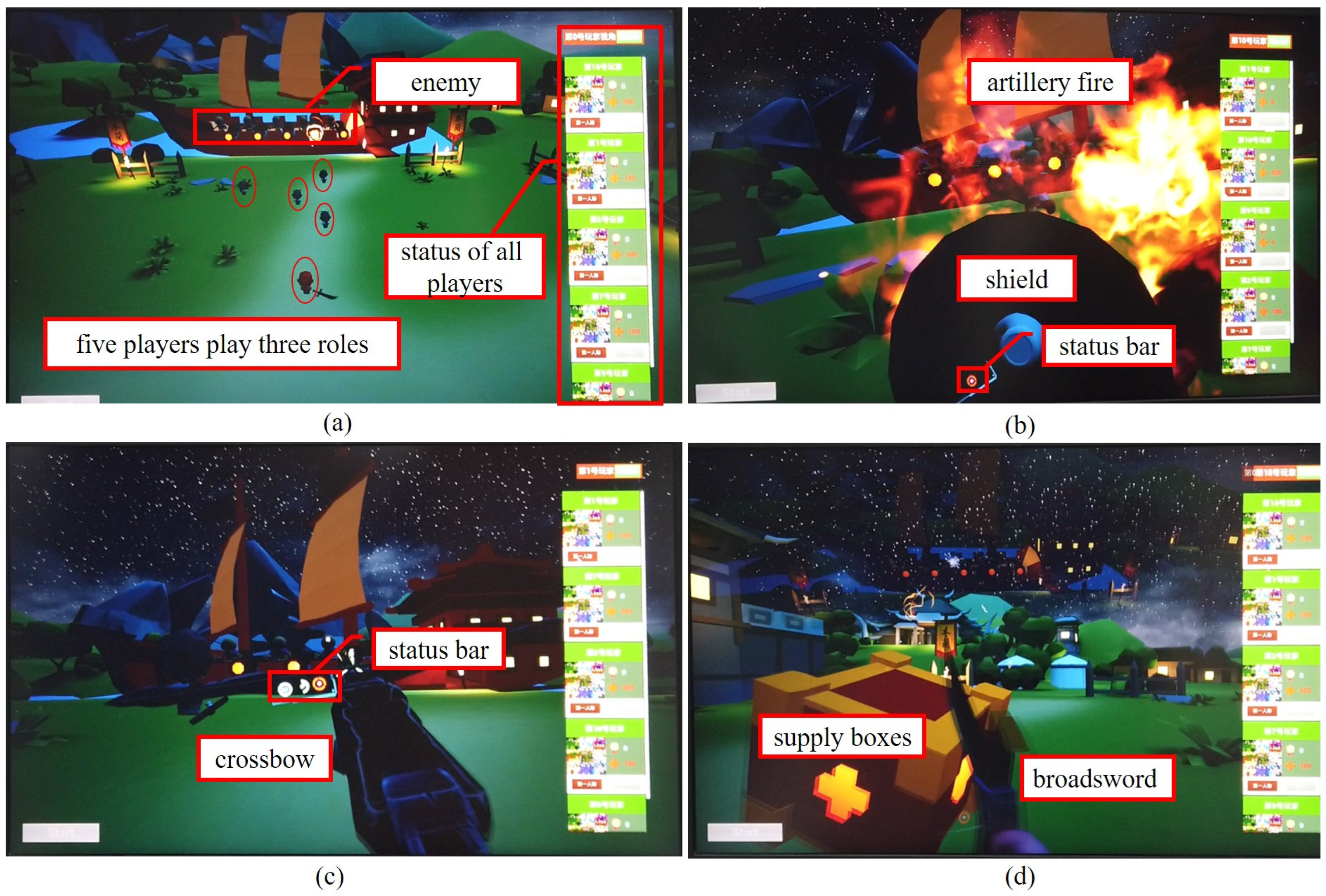
“… We discussed the division of labor before game started, but there were still some unexpected issues when artillery fire appeared. Sometimes two of us bumped into each other trying to block the same artillery fire, and sometimes no one blocked a particular fire …”
“I’ve always been a novice at playing games, so I thought I might not be able to shoot in this game, but the Defender only needs to run back and forth, and I thought I’d be better able to do it, so I chose the Defender …”
5. Discussion
5.1. Role and Collaboration Mechanism Design
5.2. Task Design
5.3. Feedback and Communication Design
5.4. Pre-Training Design
5.5. Limitations and Future Research
6. Conclusions
Author Contributions
Funding
Institutional Review Board Statement
Informed Consent Statement
Data Availability Statement
Conflicts of Interest
Appendix A. IVR Collaboration Questionnaire
- Part 1: Basic information
- Personality
- Collaboration competency
- Communication skills
- Teamwork ability
- Leadership
- Collaboration experience
- VR readiness
- Part 2: IVR collaboration experience
- Collective Efficacy
- Social experience
- Part 3: IVR presence
- Social presence
- Spatial presence
Appendix B. Qualitative Coding Results
References
- Ferguson, C.; van den Broek, E.L.; van Oostendorp, H. On the role of interaction mode and story structure in virtual reality serious games. Comput. Educ. 2020, 143, 103671. [Google Scholar] [CrossRef] [Scilit]
- Luo, H.; Li, G.; Feng, Q.; Yang, Y.; Zuo, M. Virtual reality in K-12 and higher education: A systematic review of the literature from 2000 to 2019. J. Comput. Assist. Learn. 2021, 37, 887–901. [Google Scholar] [CrossRef] [Scilit]
- Ke, F.; Xu, X. Virtual reality simulation-based learning of teaching with alternative perspectives taking. Br. J. Educ. Technol. 2020, 51, 2544–2557. [Google Scholar] [CrossRef] [Scilit]
- Ristor, R.; Morélot, S.; Garrigou, A.; N’ Kaoua, B. Virtual reality for fire safety training: Study of factors involved in immersive learning. Virtual Real. 2023, 27, 2237–2254. [Google Scholar] [CrossRef] [Scilit]
- Slater, M.; Wilbur, S. A framework for immersive virtual environments (FIVE): Speculations on the role of presence in virtual environments. Presence 1997, 6, 603–616. [Google Scholar] [CrossRef] [Scilit]
- Lu, A.S.; Pelarski, V.; Alon, D.; Baran, A.; McGarrity, E.; Swaminathan, N.; Sousa, C.V. The effect of narrative element incorporation on physical activity and game experience in active and sedentary virtual reality games. Virtual Real. 2023, 27, 1607–1622. [Google Scholar] [CrossRef] [Scilit]
- Tursø-Finnich, T.; Jensen, R.O.; Jensen, L.X.; Konge, L.; Thinggaard, E. Virtual reality head-mounted displays in medical education. Simul. Healthc. 2023, 18, 42–50. [Google Scholar] [CrossRef] [Scilit]
- Wu, T.-H.; Wu, F.; Liang, C.-J.; Li, Y.-F.; Tseng, C.-M.; Kang, S.-C. A virtual reality tool for training in global engineering collaboration. Univers. Access Inf. Soc. 2019, 18, 243–255. [Google Scholar] [CrossRef] [Scilit]
- Laukkanen, T.; Xi, N.; Hallikainen, H.; Ruusunen, N.; Hamari, J. Virtual technologies in supporting sustainable consumption: From a single-sensory stimulus to a multi-sensory experience. Int. J. Inf. Manag. 2022, 63, 102455. [Google Scholar] [CrossRef] [Scilit]
- Shi, A.; Wang, Y.; Ding, N. The effect of game–based immersive virtual reality learning environment on learning outcomes: Designing an intrinsic integrated educational game for pre–class learning. Interact. Learn. Environ. 2022, 30, 721–734. [Google Scholar] [CrossRef] [Scilit]
- Drey, T.; Albus, P.; der Kinderen, S.; Milo, M.; Segschneider, T.; Chanzab, L.; Rietzler, M.; Seufert, T.; Rukzio, E. Towards collaborative learning in virtual reality: A comparison of co-located symmetric and asymmetric pair-learning. In Proceedings of the CHI Conference on Human Factors in Computing Systems, New Orleans, LA, USA, 29 April–5 May 2022. [Google Scholar] [CrossRef] [Scilit]
- Morrison-Smith, S.; Ruiz, J. Challenges and barriers in virtual teams: A literature review. SN Appl. Sci. 2020, 2, 1096. [Google Scholar] [CrossRef] [Scilit]
- Hube, N.; Müller, M.; Lapczyna, E.; Wojdziak, J. Mixed reality based collaboration for design processes. i-com 2020, 19, 123–137. [Google Scholar] [CrossRef] [Scilit]
- Billinghurst, M.; Cordeil, M.; Bezerianos, A.; Margolis, T. Collaborative immersive analytics. In Immersive Analytics; Marriott, K., Schreiber, F., Dwyer, T., Klein, K., Riche, N.H., Itoh, T., Stuerzlinger, W., Thomas, B.H., Eds.; Springer: Cham, Switzerland, 2018; pp. 221–257. [Google Scholar] [CrossRef] [Scilit]
- Lehmann-Willenbrock, N.; Hung, H.; Keyton, J. New frontiers in analyzing dynamic group interactions: Bridging social and computer science. Small Group Res. 2017, 48, 519–531. [Google Scholar] [CrossRef] [Scilit]
- Chow, K.; Coyiuto, C.; Nguyen, C.; Yoon, D. Challenges and design considerations for multimodal asynchronous collaboration in VR. Proc. ACM Hum. Comput. Interact. 2019, 3, 1–24. [Google Scholar] [CrossRef] [Scilit]
- Saunders, C.S.; Ahuja, M.K. Are all distributed teams the same? Differentiating between temporary and ongoing distributed teams. Small Group Res. 2006, 37, 662–700. [Google Scholar] [CrossRef] [Scilit]
- Eiris, R.; Wen, J.; Gheisari, M. iVisit-Collaborate: Collaborative problem-solving in multiuser 360-degree panoramic site visits. Comput. Educ. 2022, 177, 104365. [Google Scholar] [CrossRef] [Scilit]
- Eriksson, T. Failure and success in using mozilla hubs for online teaching in a movie production course. In Proceedings of the 2021 7th International Conference of the Immersive Learning Research Network (iLRN), Eureka, CA, USA, 17 May–10 June 2021. [Google Scholar] [CrossRef] [Scilit]
- Papamitsiou, Z.; Pappas, I.O.; Sharma, K.; Giannakos, M.N. Utilizing multimodal data through fsQCA to explain engagement in adaptive learning. IEEE Trans. Learn. Technol. 2020, 13, 689–703. [Google Scholar] [CrossRef] [Scilit]
- Liang, H.-N.; Lu, F.; Shi, Y.; Nanjappan, V.; Papangelis, K. Evaluating the effects of collaboration and competition in navigation tasks and spatial knowledge acquisition within virtual reality environments. Future Gener. Comput. Syst. 2019, 95, 855–866. [Google Scholar] [CrossRef] [Scilit]
- Makransky, G. The Immersion Principle in Multimedia Learning. In The Cambridge Handbook of Multimedia Learning; Mayer, R., Fiorella, L., Eds.; Cambridge Handbooks in Psychology; Cambridge University Press: Cambridge, UK, 2021; pp. 296–303. [Google Scholar] [CrossRef] [Scilit]
- Makransky, G.; Borre-Gude, S.; Mayer, R.E. Motivational and cognitive benefits of training in immersive virtual reality based on multiple assessments. J. Comput. Assist. Learn. 2019, 35, 691–707. [Google Scholar] [CrossRef] [Scilit]
- Jiang, X.; Zhu, L.; Liu, J.; Song, A. A SLAM-based 6DoF controller with smooth auto-calibration for virtual reality. Visual Comput. 2023, 39, 3873–3886. [Google Scholar] [CrossRef] [Scilit]
- Li, Z.; Zhang, W.; Tian, Y.; Li, F. RS-fusion: A novel virtual reality localization method based on RTK and visual SLAM. In Proceedings of the Conference on Computer Graphics, Artificial Intelligence, and Data Processing, Guangzhou, China, 23–25 December 2022. [Google Scholar]
- Maqtary, N.; Mohsen, A.; Bechkoum, K. Group formation techniques in computer-supported collaborative learning: A systematic literature review. Technol. Knowl. Learn. 2019, 24, 169–190. [Google Scholar] [CrossRef] [Scilit]
- Han, J.; Kim, K.H.; Rhee, W.; Cho, Y.H. Learning analytics dashboards for adaptive support in face-to-face collaborative argumentation. Comput. Educ. 2021, 163, 104041. [Google Scholar] [CrossRef] [Scilit]
- Shah, N.; Lewis, C.M. Amplifying and attenuating inequity in collaborative learning: Toward an analytical framework. Cogn. Instr. 2019, 37, 423–452. [Google Scholar] [CrossRef] [Scilit]
- Boling, E. The need for design cases: Disseminating design knowledge. Int. J. Des. Learn. 2010, 1, 1–8. [Google Scholar] [CrossRef] [Scilit]
- Goncalo, J.A.; Polman, E.; Maslach, C. Can confidence come too soon? Collective efficacy, conflict and group performance over time. Organ. Behav. Hum. Decis. Process. 2010, 113, 13–24. [Google Scholar] [CrossRef] [Scilit]
- Stajkovic, A.D.; Lee, D.; Nyberg, A.J. Collective efficacy, group potency, and group performance: Meta-analyses of their relationships, and test of a mediation model. J. Appl. Psychol. 2009, 94, 814–828. [Google Scholar] [CrossRef] [Scilit]
- Elms, A.K.; Gill, H.; Gonzalez-Morales, M.G. Confidence is key: Collective efficacy, team processes, and team effectiveness. Small Group Res. 2023, 54, 191–218. [Google Scholar] [CrossRef] [Scilit]
- Huang, X.; Lajoie, S.P. Social emotional interaction in collaborative learning: Why it matters and how can we measure it? Soc. Sci. Humanit. Open 2023, 7, 100447. [Google Scholar] [CrossRef] [Scilit]
- Bandura, A.; Freeman, W.H.; Lightsey, R. Self-efficacy: The exercise of control. J. Cogn. Psychother. 1999, 13, 158–166. [Google Scholar] [CrossRef] [Scilit]
- Wang, S.-L.; Lin, S.S.J. The effects of group composition of self-efficacy and collective efficacy on computer-supported collaborative learning. Comput. Hum. Behav. 2007, 23, 2256–2268. [Google Scholar] [CrossRef] [Scilit]
- Wang, S.-L.; Hwang, G.-H.; Chu, J.-C.; Tsai, P.-S. The role of collective efficacy and collaborative learning behavior in learning computer science through CSCL. In Proceedings of the 14th Annual ACM SIGCSE Conference on Innovation and Technology in Computer Science Education, Paris, France, 6–9 July 2009. [Google Scholar] [CrossRef] [Scilit]
- Hong, E.; Jeong, Y. Coach leadership style and Korean professional soccer team performance: Collective efficacy as a mediator. Soc. Behav. Pers. Int. J. 2020, 48, 1–14. [Google Scholar] [CrossRef] [Scilit]
- Vidergor, H.E. Effects of digital escape room on gameful experience, collaboration, and motivation of elementary school students. Comput. Educ. 2021, 166, 104156. [Google Scholar] [CrossRef] [Scilit]
- Forrester, W.R.; Tashchian, A. Effects of personality on attitudes toward academic group work. Am. J. Bus. Educ. 2010, 3, 39–46. [Google Scholar] [CrossRef] [Scilit]
- Türel, Y.K. Relationships between students’ perceived team learning experiences, team performances, and social abilities in a blended course setting. Internet High. Educ. 2016, 31, 79–86. [Google Scholar] [CrossRef] [Scilit]
- Laffey, J.; Lin, G.Y.; Lin, Y. Assessing social ability in online learning environments. J. Interact. Learn. Res. 2006, 17, 163–177. [Google Scholar]
- Rodríguez Illera, J.L. Collaborative environments and task design in the university. Comput. Hum. Behav. 2001, 17, 481–493. [Google Scholar] [CrossRef] [Scilit]
- Minor, M.; Swanson, A. Instructor social presence within the community of inquiry framework and its impact on classroom community and the learning environment. Online J. Distance Learn. Adm. 2014, 17. Available online: https://www.learntechlib.org/p/152959/ (accessed on 31 January 2024).
- Moser, I.; Chiquet, S.; Strahm, S.K.; Mast, F.W.; Bergamin, P. Group decision-making in multi-user immersive virtual reality. Cyberpsychol. Behav. Soc. Netw. 2020, 23, 846–853. [Google Scholar] [CrossRef] [Scilit] [PubMed]
- Dalgarno, B.; Lee, M.J.W. What are the learning affordances of 3-XD virtual environments? Br. J. Educ. Technol. 2010, 41, 10–32. [Google Scholar] [CrossRef] [Scilit]
- Chheang, V.; Fischer, V.; Buggenhagen, H.; Huber, T.; Huettl, F.; Kneist, W.; Preim, B.; Saalfeld, P.; Hansen, C. Toward interprofessional team training for surgeons and anesthesiologists using virtual reality. Int. J. Comput. Assist. Radiol. Surg. 2020, 15, 2109–2118. [Google Scholar] [CrossRef] [Scilit] [PubMed]
- Zhang, L.; Weitlauf, A.S.; Amat, A.Z.; Swanson, A.; Warren, Z.E.; Sarkar, N. Assessing social communication and collaboration in autism spectrum disorder using intelligent collaborative virtual environments. J. Autism Dev. Disord. 2020, 50, 199–211. [Google Scholar] [CrossRef] [Scilit]
- Agnès, A.; Sylvain, F.; Vanukuru, R.; Richir, S. Studying the effect of symmetry in team structures on collaborative tasks in virtual reality. Behav. Inf. Technol. 2022, 42, 2467–2475. [Google Scholar] [CrossRef] [Scilit]
- Stavroulia, K.E.; Lanitis, A. The role of perspective-taking on empowering the empathetic behavior of educators in VR-based training sessions: An experimental evaluation. Comput. Educ. 2023, 197, 104739. [Google Scholar] [CrossRef] [Scilit]
- De Back, T.T.; Tinga, A.M.; Louwerse, M.M. Learning in immersed collaborative virtual environments: Design and implementation. Interact. Learn. Environ. 2021, 31, 5364–5382. [Google Scholar] [CrossRef] [Scilit]
- Thompson, M.M.; Wang, A.; Roy, D.; Klopfer, E. Authenticity, interactivity, and collaboration in VR learning games. Front. Robot. AI 2018, 5, 133. [Google Scholar] [CrossRef] [Scilit] [PubMed]
- Xia, H.; Herscher, S.; Perlin, K.; Wigdor, D. Spacetime: Enabling Fluid Individual and Collaborative Editing in Virtual Reality. In Proceedings of the 31st Annual ACM Symposium on User Interface Software and Technology, Berlin, Germany, 14 October 2018. [Google Scholar] [CrossRef] [Scilit]
- Ghoshal, M.; Ong, J.; Won, H.; Koutsonikolas, D.; Yildirim, C. Co-located immersive gaming: A comparison between augmented and virtual reality. In Proceedings of the 2022 IEEE Conference on Games (CoG), Beijing, China, 21–24 August 2022. [Google Scholar] [CrossRef] [Scilit]
- Won, M.; Ungu, D.A.K.; Matovu, H.; Treagust, D.F.; Tsai, C.-C.; Park, J.; Mocerino, M.; Tasker, R. Diverse approaches to learning with immersive Virtual Reality identified from a systematic review. Comput. Educ. 2023, 195, 104701. [Google Scholar] [CrossRef] [Scilit]
- Dede, C.J.; Jacobson, J.; Richards, J. Introduction: Virtual, augmented, and mixed realities in education. In Virtual, Augmented, and Mixed Realities in Education; Liu, D., Dede, C., Huang, R., Richards, J., Eds.; Springer: Singapore, 2017; pp. 1–16. [Google Scholar] [CrossRef] [Scilit]
- Faul, F.; Erdfelder, E.; Buchner, A.; Lang, A.-G. Statistical power analyses using G*Power 3.1: Tests for correlation and regression analyses. Behav. Res. Methods 2009, 41, 1149–1160. [Google Scholar] [CrossRef] [Scilit] [PubMed]
- Radziej, K.; Loechner, J.; Engerer, C.; Niglio de Figueiredo, M.; Freund, J.; Sattel, H.; Bachmann, C.; Berberat, P.O.; Dinkel, A.; Wuensch, A. How to assess communication skills? Development of the rating scale ComOn Check. Med. Educ. Online 2017, 22, 1392823. [Google Scholar] [CrossRef] [Scilit]
- Duong, M.-Q. Perceptions of faculty members on the leadership capacity of their students at Vietnam national university Ho Chi Minh City. Int. J. Educ. Pract. 2020, 8, 356–364. [Google Scholar] [CrossRef] [Scilit]
- von der Pütten, A.M.; Klatt, J.; Ten Broeke, S.; McCall, R.; Krämer, N.C.; Wetzel, R.; Blum, L.; Oppermann, L.; Klatt, J. Subjective and behavioral presence measurement and interactivity in the collaborative augmented reality game TimeWarp. Interact. Comput. 2012, 24, 317–325. [Google Scholar] [CrossRef] [Scilit]
- Bland, J.M.; Altman, D.G. Cronbach’s alpha. BMJ 1997, 314, 572. [Google Scholar] [CrossRef] [Scilit] [PubMed]
- Campbell, D.T.; Fiske, D.W. Convergent and discriminant validation by the multitrait-multimethod matrix. Psychol. Bull. 1959, 56, 81–105. [Google Scholar] [CrossRef] [Scilit] [PubMed]
- Saldana, J. The Coding Manual for Qualitative Researchers; Sage: Los Angeles, CA, USA, 2013. [Google Scholar]
- Bazeley, P. Qualitative Data Analysis: Practical Strategies; Sage Publications: London, UK, 2020; pp. 1–584. [Google Scholar]
- O’brien, R.M. A caution regarding rules of thumb for variance inflation factors. Qual. Quant. 2007, 41, 673–690. [Google Scholar] [CrossRef] [Scilit]
- Strojny, P.M.; Dużmańska-Misiarczyk, N.; Lipp, N.; Strojny, A. Moderators of social facilitation effect in virtual reality: Co-presence and realism of virtual agents. Front. Psychol. 2020, 11, 1252. [Google Scholar] [CrossRef] [Scilit] [PubMed]
- Lui, M.; Slotta, J.D. Immersive simulations for smart classrooms: Exploring evolutionary concepts in secondary science. Technol. Pedagog. Educ. 2014, 23, 57–80. [Google Scholar] [CrossRef] [Scilit]
- Strijbos, J.-W.; Weinberger, A. Emerging and scripted roles in computer-supported collaborative learning. Comput. Hum. Behav. 2010, 26, 491–494. [Google Scholar] [CrossRef] [Scilit]
- Laal, M. Positive interdependence in collaborative learning. Procedia Soc. Behav. Sci. 2013, 93, 1433–1437. [Google Scholar] [CrossRef] [Scilit]
- Wang, A.; Thompson, M.; Uz-Bilgin, C.; Klopfer, E. Authenticity, interactivity, and collaboration in virtual reality games: Best practices and lessons learned. Front. Virtual Real. 2021, 2, 734083. [Google Scholar] [CrossRef] [Scilit]
- Care, E.; Scoular, C.; Griffin, P. Assessment of collaborative problem solving in education environments. Appl. Meas. Educ. 2016, 29, 250–264. [Google Scholar] [CrossRef] [Scilit]
- Hong, S.W.; Jeong, Y.; Kalay, Y.E.; Jung, S.; Lee, J. Enablers and barriers of the multi-user virtual environment for exploratory creativity in architectural design collaboration. CoDesign 2016, 12, 151–170. [Google Scholar] [CrossRef] [Scilit]
- Bulu, S.T. Place presence, social presence, co-presence, and satisfaction in virtual worlds. Comput. Educ. 2012, 58, 154–161. [Google Scholar] [CrossRef] [Scilit]
- Meyer, O.A.; Omdahl, M.K.; Makransky, G. Investigating the effect of pre-training when learning through immersive virtual reality and video: A media and methods experiment. Comput. Educ. 2019, 140, 103603. [Google Scholar] [CrossRef] [Scilit]
- Mayer, R.E.; Pilegard, C. Principles for managing essential processing in multimedia learning: Segmenting, pre-training, and modality principles. In The Cambridge Handbook of Multimedia Learning; Mayer, R.E., Ed.; Cambridge University Press: Cambridge, UK, 2014; pp. 316–344. [Google Scholar] [CrossRef] [Scilit]



| Collaboration Design Principle | Description | References |
|---|---|---|
| Role script design |
| [50,51] |
| Task design |
| [1,11,54] |
| Collaboration mechanism design |
| [14,50] |
| Feedback and communication design |
| [18,55] |
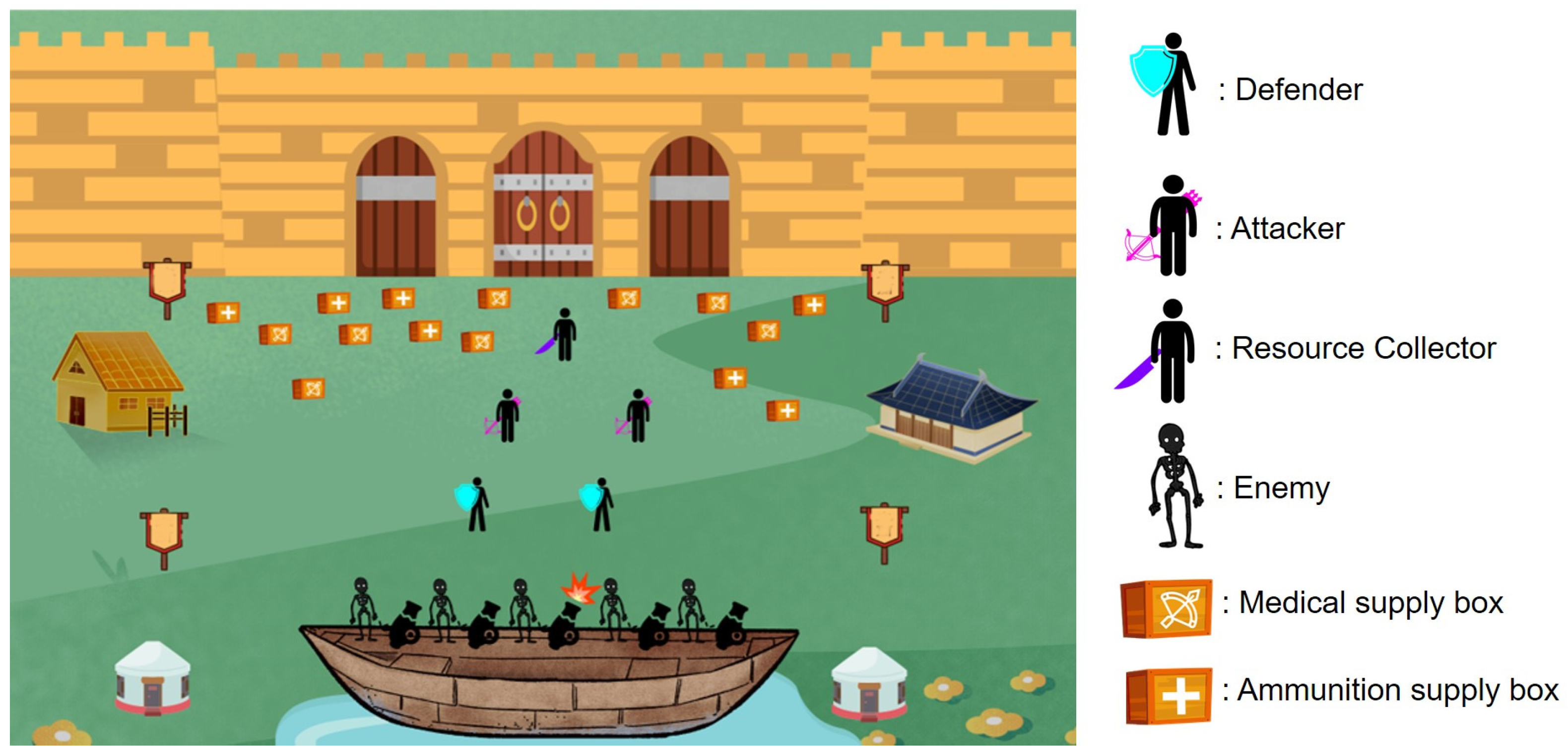
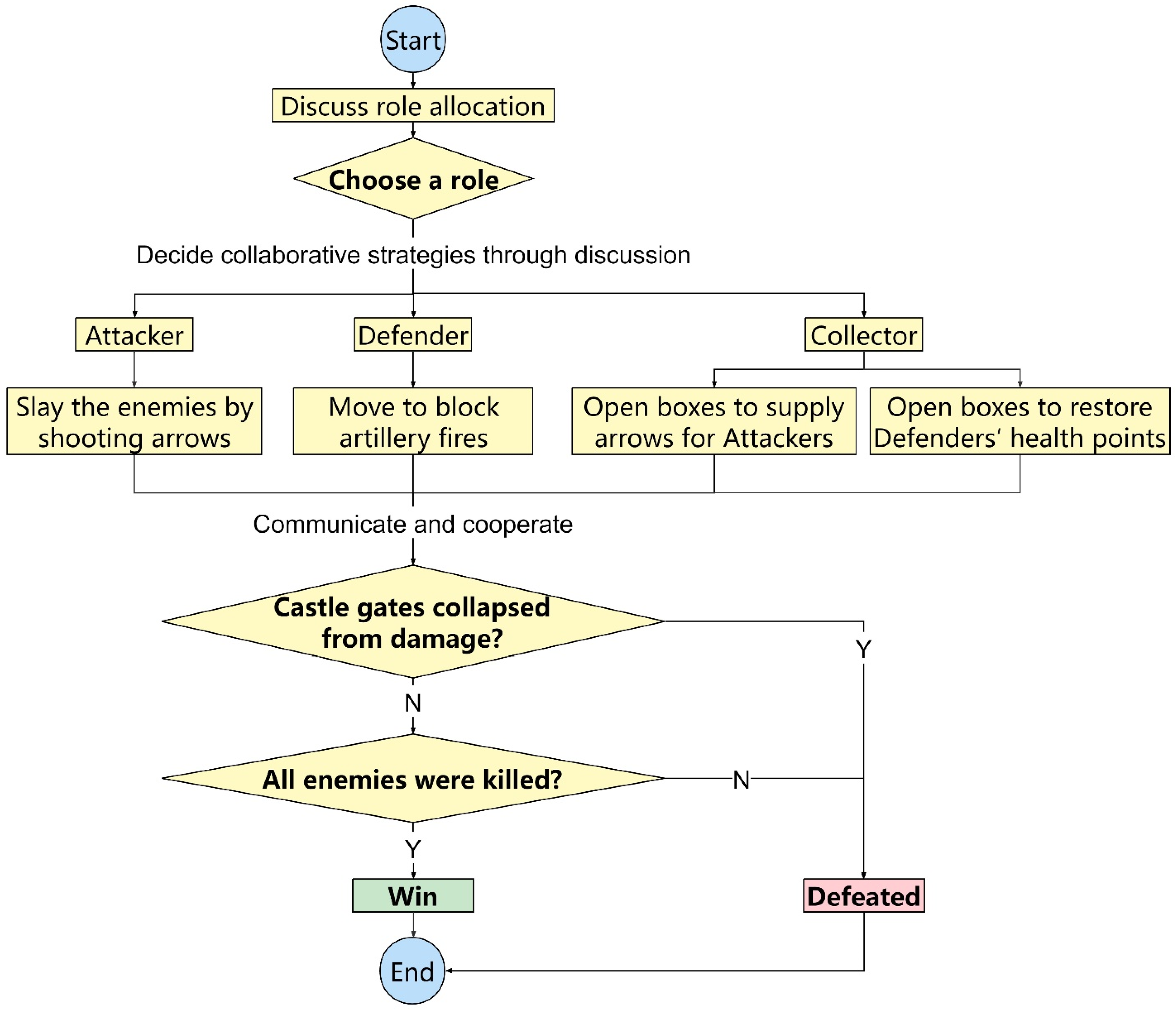
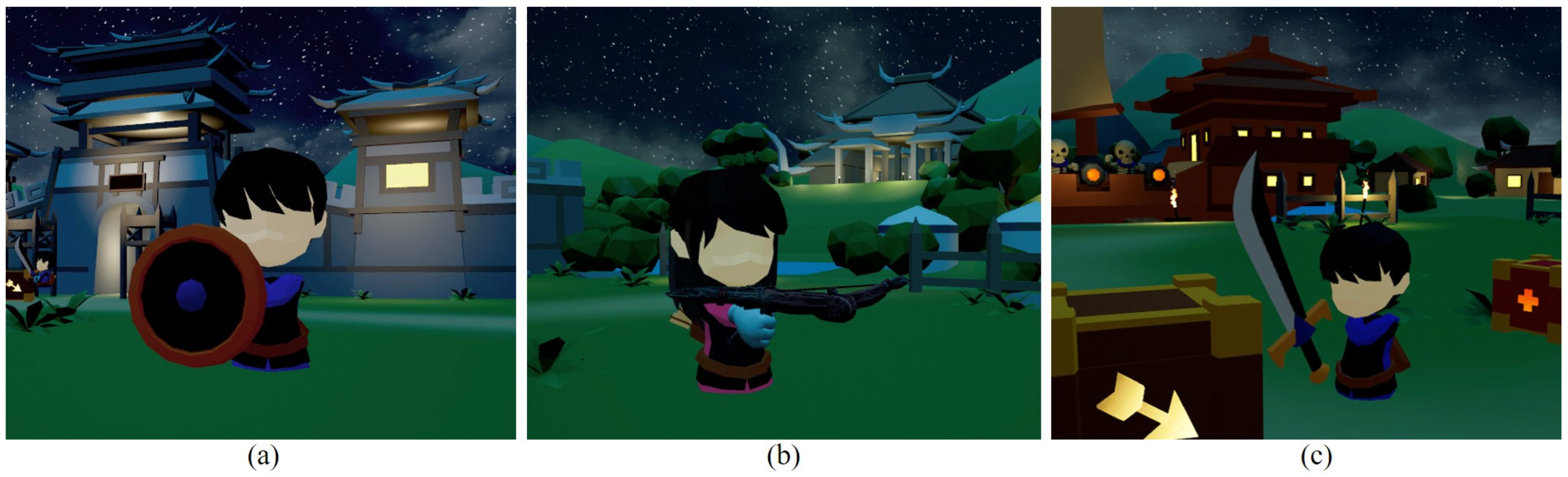
| Role Type | Role Functions | Role Missions |
|---|---|---|
| Defender |
| Anticipate the flight path of the artillery and move quickly to block it. |
| Attacker |
| Slay all the enemies by shooting arrows while avoiding the enemies’ artillery. |
| Collector |
| Find and open the supply boxes at the back of the group to provide the defender with blood or the attacker with arrows. |
| Constructs | Number of Items | Cronbach’s Alpha | CR | AVE |
|---|---|---|---|---|
| Basic information | ||||
| Personality | 5 | 0.708 | n/a | n/a |
| Collaborative competence | 19 | 0.944 | n/a | n/a |
| VR readiness | 8 | 0.809 | n/a | n/a |
| Collaboration experience | ||||
| Collective efficacy | 8 | 0.942 | 0.922 | 0.748 |
| Social experience | 6 | 0.902 | 0.914 | 0.641 |
| IVR presence | ||||
| Spatial presence | 5 | 0.836 | 0.831 | 0.632 |
| Social presence | 3 | 0.763 | 0.770 | 0.408 |
| Themes | Categories (Frequency Count) | Nodes (Frequency Count) |
|---|---|---|
| Theme 1 | Game experience (25) | Novel and interesting (9) |
| Challenging (8) | ||
| Intense (3) | ||
| Enjoy (3) | ||
| Competing and exploring (2) | ||
| Immersion (24) | Spatial presence (5) | |
| Exquisitely crafted visuals (5) | ||
| Realistic special effects (5) | ||
| Natural feedback (4) | ||
| Authentic story (5) | ||
| Theme 2 | Co-presence (14) | Observing teammates’ positions (2) |
| Seeing avatars’ actions (3) | ||
| Interacting with teammates (6) | ||
| Moving realistically (1) | ||
| Face-to-face negotiation (2) | ||
| Co-located (11) | Safety issues (6) | |
| Real and warm (2) | ||
| Form strategies quickly (3) | ||
| Pre-training (22) | Lack of understanding of game rules (9) | |
| Unfamiliarity with VR devices (1) | ||
| Effective observation and learning (11) | ||
| Prior experience (1) | ||
| Theme 4 | Technological issues (7) | Unstable real-mapping technology (5) |
| Unstable game functionality (2) | ||
| Communication issues (14) | Channels of communication (5) | |
| Timeliness of communication (5) | ||
| Flexibility in communication (4) | ||
| Game issues (19) | Lack of dynamic information cues (10) | |
| Lack of level challenges (3) | ||
| Lack of audio cues (2) | ||
| Lack of key content prompts (3) | ||
| Lack of personalized choices (1) |
| Item Statement a | Strongly Disagree | Disagree | Neutral | Agree | Strongly Agree |
|---|---|---|---|---|---|
| Social presence (Mean = 3.84, SD = 0.64) | |||||
| Presence of virtual objects in the game scene | 1 (1.1%) | 0 | 9 (9.5%) | 55 (57.9%) | 30 (31.6%) |
| Realistic feeling of virtual things | 0 | 5 (5.3%) | 27 (28.4%) | 42 (44.2%) | 21 (22.1%) |
| Forgot that it was computer-generated | 0 | 13 (13.7%) | 22 (23.2%) | 36 (37.9%) | 24 (25.3%) |
| Awareness of teammates’ presence | 0 | 6 (6.3%) | 10 (10.5%) | 50 (52.6%) | 29 (30.5%) |
| Easy communication with teammates | 3 (3.2%) | 21 (22.1%) | 25 (26.3%) | 31 (32.6%) | 15 (15.8%) |
| Spatial presence (Mean = 4.21, SD = 0.66) | |||||
| A feeling of entering a new world | 0 | 2 (2.1%) | 4 (4.2%) | 48 (50.5%) | 41 (43.2%) |
| A feeling of being part of the game | 0 | 3 (3.2%) | 13 (13.7%) | 41 (43.2%) | 38 (40.0%) |
| All my senses were stimulated in the game | 0 | 4 (4.2%) | 15 (15.8%) | 43 (45.3%) | 33 (34.7%) |
| Collective efficacy (Mean = 3.98, SD = 0.72) | |||||
| My group could solve difficult situations. | 0 | 2 (2.1%) | 16 (16.8%) | 52 (54.7%) | 25 (26.3%) |
| Group members worked harder than expected. | 0 | 4 (4.2%) | 11 (11.6%) | 50 (52.6%) | 30 (31.6%) |
| Group members worked hard to complete task. | 0 | 1 (1.1%) | 5 (5.3%) | 51 (53.7%) | 38 (40.0%) |
| My group was effective in finishing the task. | 1 (1.1%) | 4 (4.2%) | 26 (27.4%) | 38 (40.0%) | 26 (27.4%) |
| My group did a good job in getting things done. | 0 | 3 (3.2%) | 23 (24.2%) | 36 (37.9%) | 33 (34.7%) |
| My group effectively fulfilled task requirements. | 0 | 3 (3.2%) | 23 (24.2%) | 40 (42.1%) | 29 (30.5%) |
| My group accomplished its goals successfully. | 0 | 9 (9.55) | 28 (29.5%) | 35 (36.8%) | 23 (24.2%) |
| My group completed its task successfully. | 2 (2.1%) | 14 (14.7%) | 22 (23.2%) | 32 (33.7%) | 25 (26.3%) |
| Social experience (Mean = 4.11, SD = 0.66) | |||||
| I felt I was not alone. | 1 (1.1%) | 4 (4.2%) | 13 (13.75%) | 46 (48.4%) | 31 (32.6%) |
| I felt the group members supported me. | 0 | 2 (2.1%) | 9 (9.5%) | 57 (60.0%) | 27 (28.4%) |
| I felt I had someone to work with in my group. | 0 | 4 (4.2%) | 6 (6.3%) | 52 (54.7%) | 33 (34.7%) |
| I felt like a member of my group. | 0 | 1 (1.1%) | 6 (6.3%) | 50 (52.6%) | 38 (40.0%) |
| I felt connected to others in my group. | 0 | 4 (4.2%) | 12 (12.6%) | 52 (54.7%) | 27 (28.4%) |
| I felt I could discuss with members of my group. | 2 (2.1%) | 13 (13.7%) | 11 (11.6%) | 40 (42.1%) | 29 (30.5%) |
| EP | RD | CC | SpaP | SocP | CE | SE | |
|---|---|---|---|---|---|---|---|
| Extroverted personality (EP) | 1 | ||||||
| VR readiness (RD) | 0.476 ** | 1 | |||||
| Collaboration competence (CC) | 0.612 ** | 0.373 ** | 1 | ||||
| Spatial presence (SpaP) | 0.226 * | 0.153 | 0.375 ** | 1 | |||
| Social presence (SocP) | 0.277 ** | 0.154 | 0.302 ** | 0.706 ** | 1 | ||
| Collective efficacy (CE) | 0.303 ** | 0.174 | 0.297 ** | 0.459 ** | 0.521 ** | 1 | |
| Social experience (SE) | 0.275 ** | 0.119 | 0.365 ** | 0.577 ** | 0.679 ** | 0.627 ** | 1 |
| Dependent Variable | Predictors | B | SE | β | Collinearity | Adjusted R2 | |
|---|---|---|---|---|---|---|---|
| Tolerance | VIF | ||||||
| Collective efficacy | Extraversion | 0.197 | 0.104 | 0.172 | 0.923 | 1.083 | 0.283 |
| Social presence | 0.529 | 0.102 | 0.473 *** | 0.923 | 1.083 | ||
| Social experience | Collaboration competence | 0.214 | 0.095 | 0.176 * | 0.909 | 1.100 | 0.479 |
| Social presence | 0.642 | 0.080 | 0.626 *** | 0.909 | 1.100 | ||
Disclaimer/Publisher’s Note: The statements, opinions and data contained in all publications are solely those of the individual author(s) and contributor(s) and not of MDPI and/or the editor(s). MDPI and/or the editor(s) disclaim responsibility for any injury to people or property resulting from any ideas, methods, instructions or products referred to in the content. |
© 2024 by the authors. Licensee MDPI, Basel, Switzerland. This article is an open access article distributed under the terms and conditions of the Creative Commons Attribution (CC BY) license (https://creativecommons.org/licenses/by/4.0/).
Share and Cite
Feng, Q.; Luo, H.; Li, Z.; Liang, J.; Li, G.; Yi, Y. Creating an Immersive Virtual Reality Game Space for Multiuser, Synchronous Co-Located Collaboration: Design Considerations and Influencing Factors. Appl. Sci. 2024, 14, 2167. https://doi.org/10.3390/app14052167
Feng Q, Luo H, Li Z, Liang J, Li G, Yi Y. Creating an Immersive Virtual Reality Game Space for Multiuser, Synchronous Co-Located Collaboration: Design Considerations and Influencing Factors. Applied Sciences. 2024; 14(5):2167. https://doi.org/10.3390/app14052167
Chicago/Turabian StyleFeng, Qinna, Heng Luo, Zijian Li, Jiarong Liang, Gege Li, and Yan Yi. 2024. "Creating an Immersive Virtual Reality Game Space for Multiuser, Synchronous Co-Located Collaboration: Design Considerations and Influencing Factors" Applied Sciences 14, no. 5: 2167. https://doi.org/10.3390/app14052167
APA StyleFeng, Q., Luo, H., Li, Z., Liang, J., Li, G., & Yi, Y. (2024). Creating an Immersive Virtual Reality Game Space for Multiuser, Synchronous Co-Located Collaboration: Design Considerations and Influencing Factors. Applied Sciences, 14(5), 2167. https://doi.org/10.3390/app14052167