Article

Monte Carlo Simulation of Electron Interactions in an MeV-STEM for Thick Frozen Biological Sample Imaging


1
Laboratory for BioMolecular Structure, Brookhaven National Laboratory, Upton, NY 11973, USA
2
National Synchrotron Light Source II, Brookhaven National Laboratory, Upton, NY 11973, USA
*
Authors to whom correspondence should be addressed.
Appl. Sci. 2024, 14(5), 1888; https://doi.org/10.3390/app14051888
Submission received: 19 January 2024 / Revised: 20 February 2024 / Accepted: 23 February 2024 / Published: 25 February 2024
(This article belongs to the Special Issue Advances in Molecular Imaging and Its Biomedical Application)

Abstract

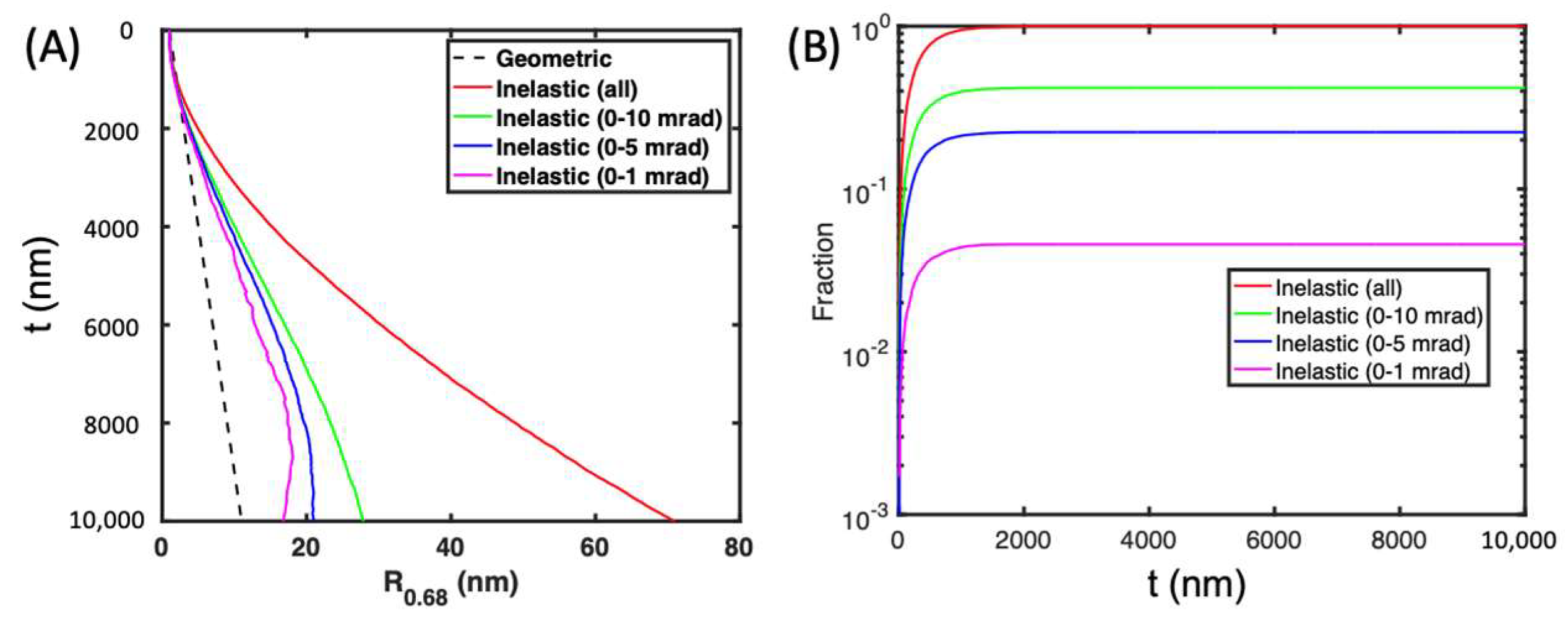
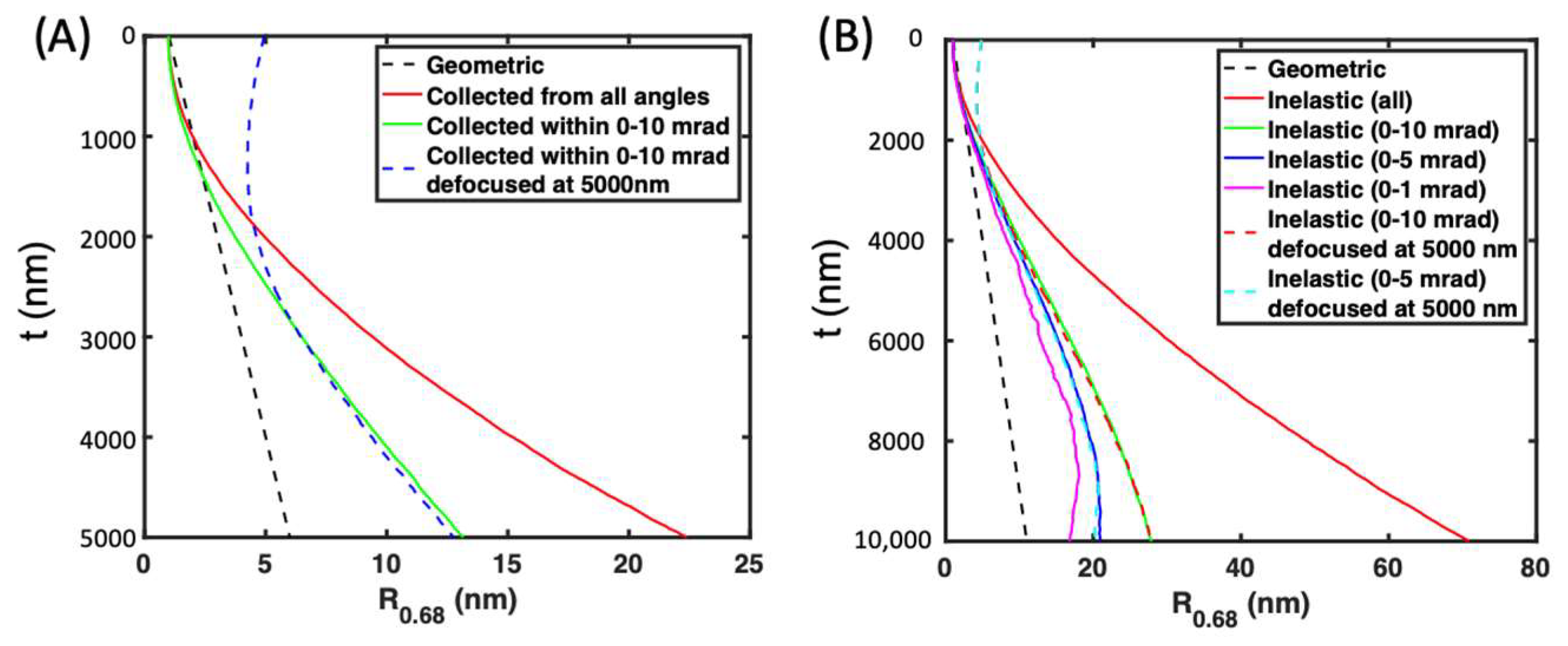
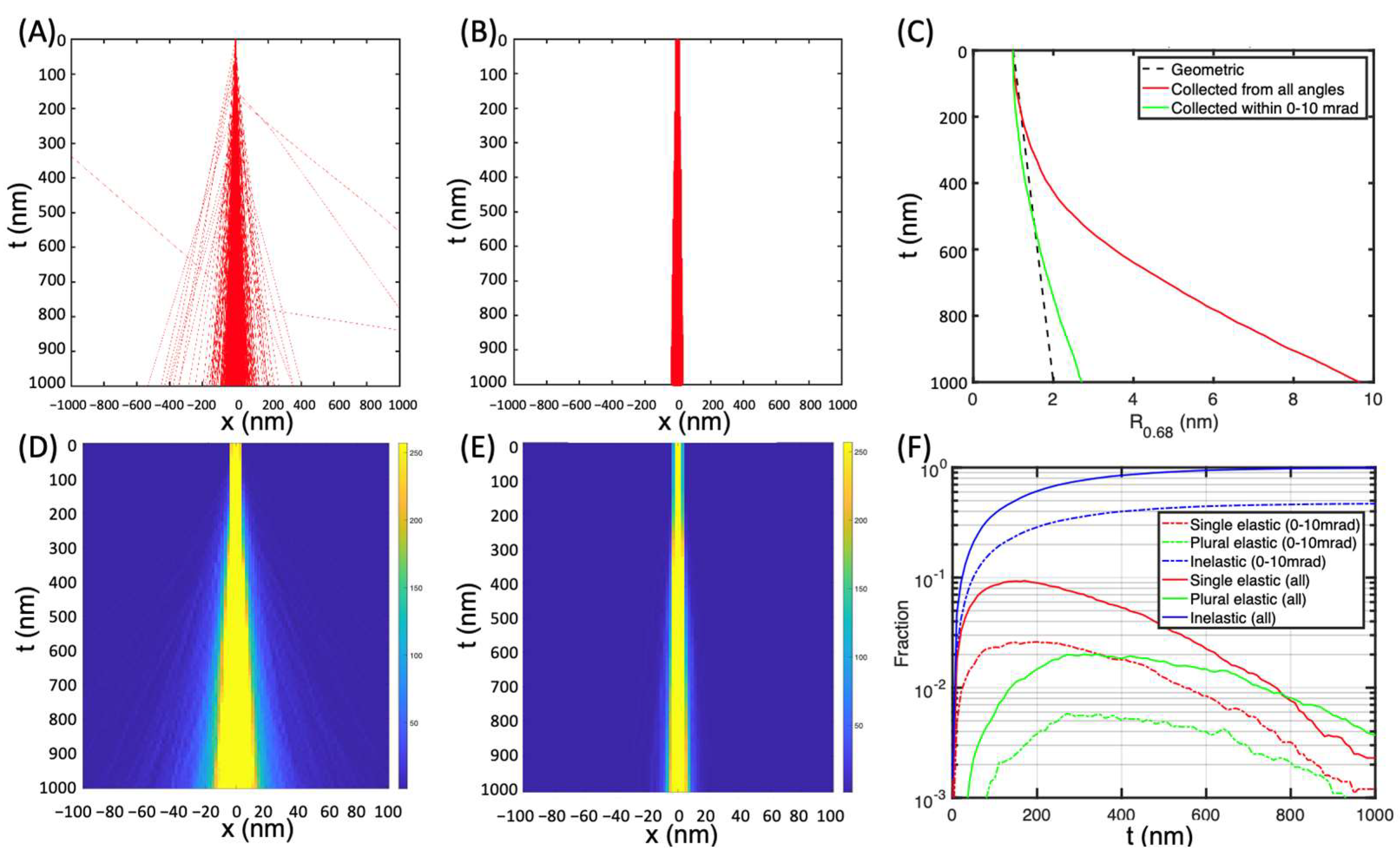
A variety of volume electron microscopy techniques have been developed to visualize thick biological samples. However, the resolution is limited by the sliced section thickness (>30–60 nm). To preserve biological samples in a hydrated state, cryo-focused ion beam scanning electron microscopy has been developed, providing nm resolutions. However, this method is time-consuming, requiring 15–20 h to image a 10 μm thick sample with an 8 nm slice thickness. There is a pressing need for a method that allows the rapid and efficient study of thick biological samples while maintaining nanoscale resolution. The remarkable ability of mega-electron-volt (MeV) electrons to penetrate thick biological samples, even exceeding 10 μm in thickness, while maintaining nanoscale resolution, positions MeV-STEM as a suitable microscopy tool for such applications. Our research delves into understanding the interactions between MeV electrons and frozen biological specimens through Monte Carlo simulations. Single elastic scattering, plural elastic scattering, single inelastic scattering, and plural inelastic scattering events have been simulated. The electron trajectories, the beam profile, and the intensity change of electrons in each category have been investigated. Additionally, the effects of the detector collection angle and the focal position of the electron beam were investigated. As electrons penetrated deeper into the specimen, single and plural elastic scattered electrons diminished, and plural inelastic scattered electrons became dominant, and the beam profile became wider. Even after 10 μm of the specimen, 42% of the MeV electrons were collected within 10 mrad. This confirms that MeV-STEM can be employed to study thick biological samples.
Keywords: Monte Carlo simulation; MeV-STEM; thick biological samples; nanometer resolution; electron specimen interaction Monte Carlo simulation; MeV-STEM; thick biological samples; nanometer resolution; electron specimen interaction